



















TECHNICAL INTELLIGENCE ASSESSMENT | ITALY · EUROPEAN UNION · UNITED KINGDOM | STRATEGIC HORIZON 2027–2028
Scope: Examination of documented refrigeration-control compromises and comparable operational-technology intrusions between 2024 and November 2026, with particular attention to Italy, France, Germany, the Netherlands, Sweden, other European markets and the potential evolution of cross-sector disruption through 2028.
Executive Summary — Bottom Line Up Front
The principal security failure is the exposure of industrial control authority beyond trusted operational boundaries. An adversary does not necessarily require sophisticated malware to produce physical consequences when remote supervisory systems permit poorly controlled changes to operating parameters. Existing refrigeration incidents demonstrate the significance of this exposure, although the precise entry methods, operational scale and attribution remain incompletely established.
France’s CERT-FR formally confirmed numerous compromises affecting Danfoss AK-SM and AK-SC refrigeration controllers and Copeland/Dixell XWEB supervisory equipment in its alert of 12 October 2026, updated on 16 October. CERTFR-2026-ALE-012 — CERT-FR, October 2026 On 3 November 2026, the European Commission confirmed investigations across several Member States and coordination involving ENISA, Europol and EU-CyCLONe, while explicitly declining to attribute responsibility. EC Midday Press Briefing — European Commission, November 2026
The technical exposure is independently corroborated by manufacturer vulnerability disclosures. Copeland identifies serious authentication and code-execution weaknesses in specified XWEB PRO models, including CVE-2026-21718 with a published severity score of 10.0. The manufacturer also documents firmware remediation and recommends eliminating direct internet access. These findings establish exploitable product weaknesses, but do not establish which vulnerability caused any particular incident. Product Security Advisories — Copeland, February 2026
The immediate economic risk is concentrated in temperature-sensitive inventories and continuity of distribution. Wider systemic risk depends on the ability to compromise multiple sites, shared service-provider access and the independence of safety and temperature-monitoring systems. Food spoilage, product quarantine, waste disposal and prolonged restocking may arise even without lasting damage to refrigeration machinery.
The highest defensible operational priority is therefore to remove uncontrolled external access, establish trusted configuration baselines and verify physical temperatures independently of potentially compromised supervisory systems. The currently verified public record does not support precise country-by-country exposure counts or a numerical ranking of individual facilities.
CYBERSECURITY THREAT INTELLIGENCE UPDATE
Incident Overview: Targeted OT Sabotage on Critical Medical Cold Chain Infrastructure (France)
A sophisticated cyberattack has successfully compromised the refrigeration systems of the Établissement français du sang (EFS), the French public agency responsible for national blood donations and plasma supply chains. The incident, first disclosed by the investigative weekly Le Canard enchaîné, marks a critical escalation in operational technology (OT) sabotage, shifting from commercial retail targets to vital healthcare infrastructure.
Technical Dynamic & Kill Chain Analysis
- Third-Party Supply Chain Breach: Initial access was gained by infiltrating the IT networks of an external vendor responsible for managing and maintaining the facility’s cooling infrastructure.
- Industrial Control Tampering: Leveraging this unauthorized access, attackers remotely manipulated the Industrial Control Systems (ICS) of three major refrigeration units.
- Extreme Temperature Anomalies: The threat actors altered the environmental parameters of the cold storage units, forcing temperatures to surge from their standard baseline of -30°C (-22°F) to an unprecedented 110°C (230°F), effectively attempting to incinerate or degrade the biological materials inside.
Incident Response & Operational Impact
The attack occurred during the overnight hours between Sunday and Monday. Automated environmental telemetry systems immediately triggered critical alarms, prompting an emergency deployment of technical repair teams to restore baseline conditions.
The French Ministry of Health and EFS President Frédéric Pacoud issued joint statements confirming that:
- Zero Inventory Loss: Prompt remediation successfully prevented the destruction of critical blood and plasma samples destined for patient therapies.
- Continuity of Operations (COOP): Blood collection drives and national distribution networks remained entirely unaffected and continue to operate at full capacity.
Strategic Implications for the Report
This incident underlines a dangerous trend of threat actors pivoting from standard IT data theft to direct kinetic manipulation of Operational Technology (OT). By exploiting a third-party vendor (supply chain vulnerability), the attackers circumvented primary perimeter defenses, showcasing how single points of failure in external vendor access can directly jeopardize national critical healthcare infrastructure.
Europe’s Refrigeration Intrusions Expose Italy’s Larger Industrial-Control Liability
The refrigeration attacks expose a liability beyond food retail: physical systems are administered through digital identities and contractor connections that operators may not independently control. France’s CERT-FR reported numerous compromises involving Danfoss AK-SM/AK-SC and Copeland/Dixell XWEB systems on 12 October 2026; the Netherlands and Sweden acknowledged related refrigeration incidents on 2 November, and the European Commission convened cross-border coordination on 3 November without attributing responsibility. Italy has no verified census proving that its electricity, water or railway controllers are vulnerable; the issue is whether unauthorised administration can change physical services without detection. The costs run through inventory, production and recovery; operators must demonstrate that control remains trustworthy.
An attacker can use ordinary permissions; sabotage requires proof of physical effect
The French CERT-FR refrigeration alert of October 2026 identified compromised supervision and instructed operators to remove public management exposure, examine complete configurations and verify defrost schedules. A living-off-the-land intrusion may misuse an existing management interface, valid credentials or third-party maintenance authority without a purpose-built executable. The evidentiary sequence runs from unauthorised session to effective privilege, unapproved change, equipment response and measured loss; a changed screen or SCADA login establishes no physical damage by itself. The UK National Cyber Security Centre’s January 2026 OT connectivity principles require protected remote access, segregation, attributable sessions and independent monitoring.
The product record establishes real weaknesses, not one common exploit. Copeland’s February 2026 advisory listed 18 vulnerabilities in specified XWEB PRO models through firmware 1.12.1, including CVE-2026-21718, CVSS 10.0; firmware 1.13 addressed the disclosed weaknesses, while support for XWEB EVO ended on 16 March 2026. Copeland’s product-security documentation establishes a patch-or-replace decision, not that those CVEs caused the October incidents. Danfoss AK-SM generations also differ in secure-session capabilities and configured enforcement. Contractor access may be necessary, but shared and unrecorded administrative authority concentrates risk across installations.
Italy’s figures measure dependence and incidents, not vulnerable SCADA devices
The Agenzia per la Cybersicurezza Nazionale’s 2025 Annual Report, published in 2026, recorded more than 21,800 entities in the Italian NIS framework, including over 2,000 in energy, 500 in transport, 2,000 in healthcare, 3,000 in food activities, and 4,000 in manufacturing. During 2025, CSIRT Italia handled 2,729 cyber events, of which 615 were incidents with confirmed impact; proactive notifications covered 31,050 at-risk devices or services and 10,312 potentially compromised devices or services. These are different statistical populations, not estimates of exposed industrial controllers. ACN also attributed 40% of its 2025 initial-access vector distribution to email-related activity, 24% to valid accounts and 11% to vulnerability exploitation; these are not OT-only rates. They establish the scope of security governance, not the missing count of reachable, write-capable SCADA systems.
Physical network scale does not prove easier compromise. Snam’s 2025 Annual Financial Report describes over 38,000 kilometres of gas transport networks across its Italian and international activities, not Italy-only SCADA coverage or verified cyber exposure. Terna’s 2025 electricity statistics record 312.2 terawatt-hours of national demand; Rete Ferroviaria Italiana records 13,736 kilometres of remotely controlled railway traffic infrastructure as of June 2026; ISTAT measured 42.4% water losses in municipal distribution networks in 2022. Terna’s electricity statistics, RFI’s network inventory and ISTAT’s water assessment describe demand, remote control and physical network losses—not exposed SCADA or cyber-induced water loss. Treating them as a vulnerability ranking would misdirect investment.
Contractors connect corporate systems to plants—and determine how far one incident travels
Italian electricity and gas security turns on separation of corporate IT, remote engineering, supervision and independent protection, while water utilities must additionally establish the integrity of process measurements and quality assurance. For railways and ports, interruption of business applications does not prove compromise of safety-critical command; chemical production, healthcare facilities and pharmaceutical storage require different physical safeguards. The European Union Agency for Cybersecurity’s NIS360 assessment of May 2026 identifies drinking water, wastewater, railway, maritime, healthcare and ICT service management among sectors whose EU-level cybersecurity maturity was below assessed criticality. That assessment does not certify particular Italian facilities as vulnerable, but establishes where sectoral assurance requires additional attention.
The transmission mechanism can be organisational before it becomes mechanical. When one integrator provides diagnostics, configuration management and alarm services to multiple facilities, shared privileged access may complicate the isolation of a suspected compromise without simultaneously removing legitimate remote assistance. Conversely, independent local control and separately retained physical measurements can constrain the consequences of a compromised supervisor. NIST SP 800-82 Revision 3, September 2023 treats reliability and safety as properties of the operational architecture. Procurement must therefore secure accountable administrative access, customer separation, trusted backups and tested restoration rather than merely finance newer management interfaces.
A restarted controller cannot certify a safe product
Regulation (EC) No 852/2004 places responsibility for food hygiene and cold-chain conditions on the food operator. Under Directive 89/108/EEC, qualifying quick-frozen products are generally maintained at −18°C, subject to defined exceptions; Regulation (EC) No 37/2005 requires appropriate temperature-monitoring records, retained for at least one year. Restoring an XWEB supervisory interface is therefore not equivalent to authorising product release. Goods may remain quarantined until independent temperature histories establish whether the relevant storage requirements were maintained, even after the refrigeration equipment has resumed normal operation.
Eurostat estimated 57.9 million tonnes of EU food waste in 2024, or 129 kilograms per inhabitant; retail and other distribution accounted for 8%. Neither figure measures cyberattack losses. A credible financial reconstruction must distinguish discarded inventory, emergency labour, diverted logistics, lost contribution margin and recoveries, without counting the same goods or costs several times. Regulation (EC) No 178/2002 may require withdrawal and competent-authority communication where unsafe food is involved, but a cyber incident does not automatically become a RASFF notification. Cybersecurity recovery cannot independently certify food safety.
Global precedents prove competing mechanisms—not a universal attack recipe
Ukraine’s electricity-distribution incidents on 23 December 2015 interrupted service to approximately 225,000 customers for one to six hours, while the 2016 Industroyer incident demonstrated more specialised industrial-control capabilities. The 2017 Triton/Trisis incident in Saudi Arabia involved industrial safety instrumentation and a protective shutdown; Colonial Pipeline in May 2021 suspended physical operations following a ransomware compromise of enterprise IT, without that fact demonstrating direct controller manipulation. The US Department of Energy’s industrial cyberattack overview distinguishes these mechanisms. CISA and partner agencies in May 2024 documented limited physical interference at water facilities through inadequately protected operational interfaces. These precedents establish the importance of verifying control authority and independent safeguards, not an assumption that Italian infrastructure shares the same vulnerabilities.
ENISA’s September 2026 report recorded 4,709 hacktivist claims relating to EU Member States in 2025, more than 89% involving denial-of-service activity; OT-related claims rose from 37 in the third quarter to 124 in the fourth. This increase demonstrates greater reported activity, not an equivalent rise in verified physical disruption. The European Commission’s briefing of 3 November 2026 confirmed coordination involving ENISA, Europol and EU-CyCLONe but explicitly withheld attribution for the refrigeration incidents. Public claims, access to industrial interfaces and demonstrated capacity for physical sabotage remain separate forms of evidence. Geopolitical inference cannot replace forensic attribution.
European rules divide the duty; they do not eliminate the cost of delay
Directive (EU) 2022/2555 assigns cybersecurity risk-management and incident-reporting obligations to covered entities, while Directive (EU) 2022/2557 addresses continuity of identified critical entities. Italy’s Legislative Decree 138/2024, effective 16 October 2024, establishes, for qualifying significant incidents, early warning within 24 hours, incident notification within 72 hours, and a final report generally within one month after notification, subject to provisions for ongoing incidents. Reporting cannot validate product temperatures or trusted restoration. Article 25 of the Italian decree establishes a notification framework, not an engineering acceptance test.
Over the next 12–24 months, Italian operators face a capital and accountability choice: replace unsupported supervisory layers where necessary, control contractor access, separate physical safety monitoring and demonstrate trusted restoration through controlled exercises—or retain arrangements in which one compromised administrative identity can undermine both operational authority and confidence in the records needed for recovery. The proposed 90-day remediation programme addresses exposure, access governance and configuration integrity before longer-term equipment replacement; its milestones are engineering targets, not completed investments. Food retailers and logistics customers would absorb inventory holds and disrupted deliveries, industrial operators would bear production and recovery costs, and utilities and public-service users would face the consequences of impaired continuity. European coordination can exchange validated evidence, but the economic burden of inadequate industrial assurance remains with the organisations and customers unable to establish that essential physical systems are safe to operate.
Navigational Index
Pillar I — Incident Evidence, Technical Exposure and Red-Team Reconstruction
- Chapter 1. Technical Feasibility, Incident Reconstruction and Scalability of Living-off-the-Land Refrigeration Intrusions
- Chapter 2. Danfoss, Dixell and Equivalent Supervisory Systems: Attack Surfaces, Access Dependencies, Parameter Integrity and Observable Intrusion Chains
- Chapter 3. European Exposure Assessment: Italy, France, Germany, the Netherlands, Sweden and Other Major Markets
Pillar II — Physical Consequences, Critical Infrastructure and Adversary Evolution
- Chapter 4. Architectural Transferability to Water Treatment, Electricity Distribution, Building Automation and Industrial Production
- Chapter 5. Food Safety, Inventory Loss, Logistics Disruption, Economic Transmission and Systemic Concentration Risk
- Chapter 6. Adversary Capabilities, Attribution Boundaries, Strategic Intent and Evolution Through 2027–2028
Pillar III — Blue-Team Engineering, Operational Verification and Institutional Response
- Chapter 7. Defensive Architecture: Immediate Containment, 90-Day Remediation and Longer-Term Capital Replacement
- Chapter 8. Verification, Configuration Auditing, Detection Engineering, Controlled Testing and Purple-Team Exercises
- Chapter 9. Prioritised Action Framework for Operators, National Cybersecurity Authorities, Food-Safety Regulators and European Institutions; Intelligence Gaps and Final Net Assessment
PILLAR IV — The Anatomy of Industrial Cyberattacks and the Criticality of Italian SCADA Infrastructure
Global Attack Mechanisms, Italian Industrial-Control Dependencies, Infrastructure Sensitivity, Cyber-Physical Consequences and National Defence Requirements Through 2028
- Chapter 10. How Industrial Control Systems Are Attacked: Technical Mechanisms, Operational Access and the Transition to Physical Consequences
- Chapter 11. Italian SCADA Infrastructure: National Service Criticality, Operational Dependencies and Defensive Priorities
- Chapter 12. Global Industrial-Cyberattack Precedents, Italian Strategic Implications and the National Defence Model
Master Abstract
The transition from cyber intrusion to physical disruption
The European refrigeration incidents of October and November 2026 establish a significant operational-security concern: the compromise of comparatively ordinary supervisory equipment can affect physical processes without requiring an adversary to develop purpose-built industrial malware. This distinction is fundamental. Conventional enterprise cyber incidents primarily threaten information confidentiality, data integrity and system availability; refrigeration-control intrusions can additionally compromise the environmental conditions under which food is stored, transported and sold. The material risk therefore arises not simply from access to an electronic interface but from the authority that interface possesses over equipment, operating schedules, alarms and process configurations.
The documented European response now extends beyond France. On 2 November 2026, the Netherlands’ National Cyber Security Centre explicitly acknowledged multiple attacks against refrigeration systems in Europe, including the Netherlands, and identified weaknesses associated with internet-connected systems and inadequate authentication. Sweden’s CERT-SE separately confirmed that it was coordinating with affected parties following incidents involving connected refrigeration and freezer systems in food retail. The European Commission subsequently confirmed cross-border coordination on 3 November. These records establish a multinational incident pattern without establishing identical technical entry methods or a common perpetrator. Refrigeration Cyberattacks in Europe — NCSC Netherlands, November 2026 Cyberattacks Against Connected Freezer and Refrigeration Systems — CERT-SE, November 2026
Product vulnerabilities and the distinction between exposure and exploitation
The refrigeration environment requires careful separation between supervisory platforms, subordinate controllers and the mechanical refrigeration process. Danfoss AK-SM/AK-SC systems and Copeland/Dixell XWEB equipment provide supervisory functions, but the particular devices, generations, authentication arrangements and installed firmware determine the applicable technical risk. Their common designation as refrigeration controllers does not imply that all devices have identical vulnerabilities or that every deployed installation is externally accessible.
The manufacturer documentation makes this distinction especially important. Copeland’s February 2026 security bulletin identifies firmware version 1.13 as addressing the previously identified XWEB PRO vulnerabilities. Its vulnerability register identifies affected XWEB 300D PRO, XWEB 500D PRO and XWEB 500B PRO versions through 1.12.1, including authentication-bypass and remote-code-execution weaknesses. Separately, the 14 October 2026 product guidance identifies XWEB EVO as a discontinued generation that no longer receives security patches and directs customers toward a supported platform. Consequently, patching a supported XWEB PRO device and replacing an end-of-service XWEB EVO unit are different remediation requirements. Both also require the elimination of direct public-internet exposure. XWEB PRO Security Update Advisory — Copeland, February 2026 Secure Operation of XWEB Supervisory Systems — Copeland/Dixell, October 2026
Physical and economic consequences depend on the process, not the interface alone
The consequences of unauthorised parameter manipulation depend on the relationship between the supervisory system, local controller autonomy, thermal inertia, alarm independence and response capabilities. A malicious configuration change does not establish that the product temperature immediately reached the altered set-point, because physical warming depends on the equipment and storage conditions. Likewise, an implausible displayed temperature or command value cannot independently establish the actual temperature of stored goods.
Food-safety exposure must therefore be evaluated through physical measurements, product-specific limits, documented time-temperature histories and the operator’s hazard-analysis procedures. Financial consequences should distinguish the replacement value of discarded inventory, emergency refrigeration expenditure, temporary loss of sales, disposal expenses, recovery costs and interruption to distribution. A local incident at one store is not equivalent to simultaneous disruption of a regional logistics network. The latter becomes a systemic concern when multiple facilities depend on common remote-access arrangements, supervisory services or maintenance providers. The Dutch NCSC expressly identifies spoilage, food-safety risks, financial losses and possible business interruption as potential consequences of the current attacks. Refrigeration Cyberattacks in Europe — NCSC Netherlands, November 2026
Critical infrastructure transferability and the European institutional response
The broader operational-technology threat is not hypothetical. In a joint advisory dated 1 May 2024, CISA and partner agencies documented pro-Russia hacktivist activity against exposed operational systems in water, wastewater, dams, energy and food-related sectors. The advisory describes incidents involving the remote manipulation of water-sector human–machine interfaces and physical operational disruptions. France’s ANSSI has separately documented the targeting of connected water and renewable-energy installations. These records establish that similar weaknesses exist across sectors, although they do not prove that the perpetrators of the 2026 refrigeration incidents conducted the earlier operations. Defending OT Operations Against Ongoing Pro-Russia Hacktivist Activity — CISA and Partners, May 2024 Recommendations for Energy and Water Operators — CERT-FR, January 2026
For Italy, the relevant institutional framework includes Legislative Decree No. 138 of 4 September 2024, implementing the NIS2 Directive. At European level, the Directive’s sectoral framework encompasses qualifying food-production, processing and distribution activities as well as drinking water, wastewater, energy and specified industrial activities. The regulatory implications nevertheless depend on the legal classification of each entity, its activities and the applicable national implementing requirements; not every individual retail establishment automatically qualifies as an entity subject to NIS2. Legislative Decree No. 138 — Italian Republic, September 2024 Cybersecurity of Critical Sectors — ENISA
Strategic judgement through 2028
The principal evolutionary risk is the replication of low-complexity intrusions across installations with similar weaknesses, rather than a demonstrated transition to sophisticated industrial sabotage. Automation may reduce the effort required to identify and misuse exposed interfaces, while shared contractors or remote-management arrangements could allow one compromised administrative environment to affect multiple sites. Neither development should be treated as proven in the refrigeration investigations without supporting forensic evidence.
The defensive response must therefore measure three distinct outcomes: whether unauthorised remote access has been eliminated, whether changes to operational parameters are reliably detected and whether independent physical safeguards prevent a cyber incident from becoming a food-safety or wider infrastructure emergency. The identity, organisational sponsorship and strategic objectives of the perpetrators of the current refrigeration campaign remain unresolved. The European Commission’s 3 November statement explicitly preserved this attribution uncertainty. European Commission Cybersecurity Briefing — November 2026
Key Evidence Table
Official incidents, first-party technical disclosures and applicable institutional records, verified to 4 November 2026.
| Indicator | Value/status | Reference date | Definition/scope | Issuer | Exact source |
|---|---|---|---|---|---|
| French refrigeration compromises | Numerous compromises confirmed | 12–16 Oct 2026 | Danfoss AK-SM/AK-SC and Copeland/Dixell XWEB systems | CERT-FR | CERTFR-2026-ALE-012 |
| Dutch refrigeration incidents | Multiple attacks acknowledged, including Netherlands | 2 Nov 2026 | Connected refrigeration systems from various suppliers | NCSC Netherlands | National advisory |
| Swedish refrigeration incidents | Incidents acknowledged; coordination with affected parties | 2 Nov 2026 | Connected retail refrigeration and freezer equipment | CERT-SE | Incident notification |
| European coordination | Two coordination meetings confirmed | 3 Nov 2026 | EU agencies and Member State authorities | European Commission | Official briefing |
| XWEB PRO authentication weakness | CVE-2026-21718; CVSS 10.0 | Feb 2026 | Specified XWEB PRO models through firmware 1.12.1 | Copeland | Product security advisories |
| XWEB PRO remediation | Firmware 1.13 addresses previously identified weaknesses | Feb 2026 | Supported XWEB PRO systems | Copeland | Security update bulletin |
| Legacy XWEB EVO status | End of service; migration recommended | 14 Oct 2026 | Unsupported XWEB EVO generation | Copeland/Dixell | Manufacturer recommendations |
| Cross-sector operational intrusion | Confirmed examples of physical manipulation in water systems | May 2024 | Water, wastewater and related OT environments | CISA and partner agencies | Joint OT advisory |
| UK operational-technology exposure | Increased targeting and limited real-world disruption reported | 27 Aug 2026 | Cross-sector OT, not specifically attributed to the refrigeration campaign | UK NCSC | Official security alert |
| Italian cybersecurity framework | NIS2 national transposition | Effective 16 Oct 2024 | Covered essential and important entities | Italian Republic | Legislative Decree 138/2024 |
The evidence establishes a common class of operational exposure, not necessarily a single intrusion chain. In particular, the existence of a disclosed CVE must not be interpreted as forensic confirmation that the CVE was used during the incidents.
Preliminary Technical Reconstruction — Observable Dependencies
The following reconstruction is organised around the conditions defenders must verify rather than executable intrusion instructions. Confidence describes the supporting evidence for the pathway, not a numerical probability that a particular facility will be attacked.
| Attack step | Required condition | Observable artefact | Detection opportunity | Mitigation |
|---|---|---|---|---|
| Unauthorised supervisory access — high confidence as a documented risk class | Management interface exposed or authentication inadequately controlled | Unexpected session, unfamiliar source or anomalous management connection | Gateway logs, session records and owner-authorised external-exposure validation | Remove public exposure; enforce protected remote access |
| Misuse of maintenance credentials — medium confidence as a plausible incident pathway | Shared, retained or insufficiently restricted contractor access | Access outside approved maintenance activity; privileged account use | Central authentication logs and maintenance-ticket correlation | Unique contractor identities, MFA and time-limited access |
| Unauthorised configuration modification — high confidence as a demonstrated consequence class | Write-capable supervisory permissions | Configuration difference affecting operating or alarm parameters | Baseline comparison and authenticated change-event monitoring | Restrict write authority; independently verify set-point integrity |
| Propagation across a managed estate — low confidence for the current incidents | Common administrative access to multiple sites | Correlated configuration deviations or access events at separate facilities | Multi-site telemetry correlation and central security-event monitoring | Site-specific access boundaries and separation of maintenance privileges |
| Physical temperature excursion — high confidence as an established hazard mechanism | Control disruption persists and local safeguards do not prevent unsafe conditions | Independent product-temperature deviation, equipment alarms or documented thermal excursion | Out-of-band temperature monitoring and onsite response | Independent alarms, safe local operation and tested recovery procedures |
The French CERT-FR and Dutch NCSC notifications support the exposure and configuration-integrity concerns. Copeland’s October 2026 technical recommendations establish the relevance of account review, alarm verification, backup restoration and direct temperature checks. They do not independently establish every intermediate step of the suspected intrusion chains.
Preliminary European Asset Prioritisation
A defensible priority ranking must be conditional on verified exposure, operational concentration and physical consequence, rather than treating the number of refrigeration installations in a country as a proxy for vulnerability.
| Asset class | Conditional defensive priority | Primary consequence | Confidence in consequence mechanism |
|---|---|---|---|
| Large retail refrigeration estates with externally accessible supervision | Priority 1 | Distributed inventory exposure and simultaneous operational disruption | High |
| Regional refrigerated warehousing and consolidation facilities | Priority 1 where shared supervision or remote access is confirmed | Concentrated inventory loss and distribution delays | Medium |
| Food-logistics facilities dependent on third-party maintenance connectivity | Priority 2 pending access verification | Service interruption and delayed cold-chain movements | Medium |
| Co-located refrigeration and building-management systems | Priority 2 where control or trust boundaries overlap | Possible cross-system disruption | Medium |
| Independent smaller refrigeration installations | Priority determined by actual exposure and capacity for local recovery | Local spoilage and commercial interruption | High |
| Water, electricity and heavy-industry control environments | Separate sector-specific safety assessment | Potential public-service or industrial-process consequences | High for general OT hazard; low for a demonstrated connection to the current refrigeration campaign |
Geographic interpretation: France, the Netherlands and Sweden have direct national-authority documentation concerning the refrigeration incidents. Italy and Germany require comparable official exposure and incident datasets before their relative exposure can be established. The United Kingdom has independently documented broader OT targeting, but that does not establish participation in this specific campaign. No reliable denominator of deployed Danfoss or XWEB equipment, and no harmonised country-level inventory of publicly reachable units, was verified in the admissible record. Consequently, numerical country rankings or exact exposed-device totals would introduce unsupported precision.
Structural Visualisation — From Remote Supervision to Physical Consequence
The central relationship is between remote-access trust, supervisory authority, physical refrigeration and independent safety verification. The following WordPress component illustrates the defensive architecture implied by the official records. It is a conceptual dependency model, not a reconstruction of a proven attacker sequence.
Refrigeration OT: Four Defensive Boundaries
Qualitative architecture and control dependencies. No exposure counts or incident attribution inferred.
-
BOUNDARY 01
External Connectivity
Contractor access must pass through an authenticated, audited and restricted remote-access service. Direct public management access is excluded.
-
BOUNDARY 02
Supervisory Control
Danfoss and XWEB-class supervisory equipment requires controlled privileges, supported firmware, configuration baselines and recorded changes.
-
BOUNDARY 03
Physical Refrigeration
Local control maintains refrigeration processes. Set-points, defrost operation and alarm thresholds require independent integrity verification.
-
BOUNDARY 04
Independent Safety Monitoring
Product temperatures and environmental excursions are checked through monitoring and alerting that cannot be disabled through the same compromised account.
Required operating principle: A compromise of remote supervision must not automatically eliminate physical temperature monitoring, local response or the ability to restore safe operation.
Evidence basis: CERT-FR refrigeration alert, October 2026; Copeland XWEB security recommendations, October 2026; UK NCSC OT connectivity guidance, January 2026. CERT-FR | Copeland | NCSC
Competing Operational Pathways and Indicators
The evidence presently supports a narrow explanation for many incidents: internet-connected industrial systems can be compromised when remote management is inadequately protected, allowing unauthorised changes to operational settings. This explanation has direct support from national cybersecurity authorities and manufacturer advisories.
Two additional pathways require investigation but should not be assumed. The first is the possible use of shared integrator or contractor access to affect multiple installations. Confirmation would require correlated authentication events, service-provider account records and forensic evidence linking separate environments. The second is compromise extending beyond normal supervisory functions, including persistence or lateral movement between corporate and industrial systems. Confirmation would require host-level, gateway and controller evidence that has not been established in the official records examined.
These pathways are not necessarily mutually exclusive. Nevertheless, the documentary basis is insufficient to assign comparative numerical probabilities or identify one as the universal explanation for the campaign.
Principal Intelligence Gaps and Watch Indicators
| Critical uncertainty | Required evidence | Observable indicator that would change the assessment |
|---|---|---|
| Actual internet exposure in Italy and selected EU markets | Dated, deduplicated and authorised exposure census with manufacturer/model validation | Verified reduction or concentration of publicly reachable management systems |
| Common initial access mechanism | Incident-specific authentication logs, gateway records and forensic timelines | Repeated, independently corroborated access patterns across affected sites |
| Shared service-provider compromise | Contractor identity records, customer access architecture and incident correlation | Same compromised credential, session or management service linked to multiple incidents |
| Actual operational damage | Independent temperature histories, product inventories and incident recovery records | Confirmed food losses or interruptions supported by physical and commercial records |
| Higher-consequence sector expansion | Official notifications and technical incident findings from competent sector authorities | Verified unauthorised process changes in water, electricity or industrial operations |
| Adversary attribution | Corroborated forensic infrastructure, operational overlap and competent investigative findings | Attribution supported by independent technical evidence rather than statements of responsibility |
| Recovery capability | Controlled restoration exercises and configuration-integrity audits | Demonstrated restoration of trusted settings without renewed compromise |
The absence of an independently verifiable national device census is consequential because it prevents reliable estimation of how widespread the exposed-controller problem remains. A defensible census would require a defined observation date, model identification, duplicate removal, treatment of shared or changing addresses, and validation that an externally visible interface actually belongs to an operational refrigeration installation. Search-engine results alone do not establish that a system is vulnerable, compromised or controllable.
Likewise, determining economic damage requires separate evidence on temperature exposure and inventory disposition. A monetary estimate constructed solely from an alleged malicious set-point or an unverified number of affected stores would not constitute a reliable estimate of actual loss.
Immediate Decision Implications
For operators, the first 90-day programme should prioritise demonstrable removal of direct management exposure, reconciliation of the complete supervisory-system inventory, identification and isolation of unsupported devices, validation of individual maintenance accounts, and restoration tests against trusted configuration baselines. The baseline should include refrigeration settings, defrost schedules, alarm thresholds and notification recipients. These priorities are directly supported by the October CERT-FR alert and Copeland’s technical recovery guidance.
For national agencies, the priority is to consolidate verified incident reporting and identify common access dependencies without relying on unvalidated geographic exposure rankings. Cooperation between national CSIRTs, manufacturers, maintenance contractors and food-safety authorities is essential because the effects of a compromised refrigeration installation may emerge first as a physical operating anomaly rather than a conventional cybersecurity alert.
For regulators, the decisive question is whether an affected operator can substantiate both operational continuity and food-safety decisions after an incident. Cybersecurity remediation and product safety assessment are related obligations, but they are not interchangeable.
The longer-term investment decision concerns the replacement of end-of-service supervisory devices, secure remote-access architecture and genuinely independent temperature-monitoring arrangements. Success should be established through measured reductions in internet reachability, eliminated credential reuse, verified parameter-change detection and demonstrated recovery performance, rather than equipment-purchase totals or general compliance declarations.
The strategic assessment is that European cold-chain cyber risk is already an operational reality, while its precise scale, the commonality of the intrusion methods and its potential transition into coordinated cross-sector sabotage remain open intelligence questions. The appropriate institutional response is immediate, evidence-driven containment coupled with measured verification of the physical systems that maintain food and infrastructure safety.
European Cold-Chain Cyber Intrusions
An evidence-driven assessment of supervisory-control exposure, refrigeration manipulation, physical consequences and institutional response. Documented incidents are separated from hypothetical intrusion paths and unresolved attribution.
Interactive 3D Control-System Architecture
Select an intrusion scenario or a control-system layer. The graph represents defensive dependencies, not a proven incident-specific attack sequence.
- External connectivity and exposed management
- Authenticated remote access and contractor privileges
- Supervisory controllers and supported firmware
- Configuration and set-point integrity
- Local refrigeration process
- Independent temperature monitoring and safety response
Exposed supervision
External connectivity
Identify and remove direct internet access to control-system management interfaces.
Interactive Evidence Chronology
Official records and manufacturer notices. Earlier OT activity is contextual evidence, not proof of common attribution with the refrigeration incidents.
1 May 2024 — CISA documents cross-sector OT targeting.
February 2026 — Copeland publishes XWEB PRO security guidance.
12 October 2026 — CERT-FR issues its refrigeration alert.
14 October 2026 — Copeland advises on legacy XWEB systems.
2 November 2026 — Dutch and Swedish authorities report incidents.
3 November 2026 — European Commission confirms coordination.
European incident chronology
Select an event to inspect the scope of its evidence.
European Evidence and Exposure Matrix
Countries are classified by verified official evidence, not by an invented likelihood of attack. No comparable exposed-device census was established.
| Country | Evidence category | Finding and limitation |
|---|---|---|
| France | Official refrigeration incidents | CERT-FR identified compromises of named controller families. |
| Netherlands | Official refrigeration incidents | NCSC Netherlands acknowledged attacks. |
| Sweden | Official refrigeration incidents | CERT-SE acknowledged connected refrigeration incidents. |
| Italy / Germany | Exposure not quantified | No comparable national device census verified here. |
| United Kingdom | Related OT evidence | Broader OT targeting warning, not confirmation of the same refrigeration campaign. |
Institutional Response and Verification Matrix
Filter recommendations by responsible organisation and implementation horizon. Each action has an observable completion criterion.
| Actor | Period | Control and purpose | Verification criterion |
|---|---|---|---|
| Operators | Within 90 days | Remove direct public management access. | Owner-authorised exposure verification. |
| Operators | Within 90 days | Baseline set-points and monitor configuration changes. | Time to detect an unauthorised modification. |
| Operators | Longer term | Replace unsupported supervision and separate safety monitoring. | Tested restoration and independently measured temperatures. |
Intelligence Confidence and Collection Gaps
Established in the official record
Multiple national authorities have acknowledged refrigeration incidents. Manufacturer advisories document vulnerabilities and defensive measures. Earlier official OT advisories establish comparable architectural risks in other sectors.
Not established by the verified record
A common entry method for all incidents, precise national exposed-device counts, a verified multinational damage total, shared-service-provider compromise and attribution to a specific adversary organisation.
PILLAR I — Incident Evidence, Technical Exposure and Red-Team Reconstruction
European Cold-Chain Cyber Intrusions: Verified Operational Incidents, Supervisory-System Vulnerabilities, Attack-Path Reconstruction and Geographic Exposure
Chapter 1. Technical Feasibility, Incident Reconstruction and Scalability of Living-off-the-Land Refrigeration Intrusions
The operational significance of the European refrigeration incidents
The incidents affecting European refrigeration installations in October and November 2026 demonstrate an important distinction in the evolution of cyber threats against operational technology: a cyberattack can interfere with physical industrial processes without necessarily deploying specialised industrial malware, modifying programmable logic or causing mechanical destruction. In refrigeration environments, the supervisory system constitutes an operational interface between digital administration and the physical conditions required to preserve temperature-sensitive goods, meaning that unauthorised access to management functions can create consequences extending beyond conventional information-security incidents. The resulting exposure concerns not only the confidentiality or integrity of technical information but also the continuity of refrigeration, the reliability of alarms, the validity of temperature records and, ultimately, the operator’s ability to demonstrate that food has remained within acceptable storage conditions.
The French national cybersecurity authority provided the first decisive official record examined for this assessment. In CERTFR-2026-ALE-012, initially published on 12 October 2026 and updated on 16 October, CERT-FR reported knowledge of numerous compromises involving Danfoss AK-SM and AK-SC refrigeration-management systems and Copeland/Dixell XWEB equipment. The notice identified direct internet exposure of management interfaces as a central security concern and recommended removing that exposure, examining the entire operational configuration, verifying defrost schedules and restoring access through protected communications arrangements. Significantly, the authority differentiated between equipment that had not been compromised and equipment requiring recovery, warning that returning a compromised device to factory settings would not eliminate the underlying exposure if the vulnerable configuration remained accessible. This is a technically consequential finding because it establishes that recovery cannot be considered complete merely because the equipment restarts or its interface becomes reachable again. Incident de sécurité ciblant les contrôleurs à distance des installations de réfrigération — CERT-FR, October 2026.
The multinational character of the incident pattern became clearer on 2 November 2026, when the Netherlands’ National Cyber Security Centre publicly acknowledged several cyberattacks against refrigeration installations from different manufacturers, including installations within the Netherlands. Its statement described how weaknesses associated with internet-connected equipment and inadequate authentication can allow unauthorised changes to refrigeration configurations, including temperature management and defrost operations. The agency explicitly connected these security concerns with potential deterioration of food inventories, interruption of commercial operations and financial losses. On the same date, Sweden’s CERT-SE confirmed contact with affected parties following incidents involving connected refrigeration and freezer systems in the grocery-retail sector. These two national records provide independent institutional confirmation of an incident class extending beyond the initially identified French environment, although neither establishes a complete count of compromised installations, a common method of intrusion or the identity of the responsible actor. Cyberaanvallen op koelinstallaties in Europa — NCSC Netherlands, November 2026; Cyberangrepp mot uppkopplade frys- och kylsystem — CERT-SE, November 2026.
The European Commission formally addressed the incidents on 3 November 2026, confirming that relevant national authorities were conducting investigations and that the Commission had convened two coordination meetings that morning. The first involved an interinstitutional task force with ENISA, Europol and relevant Commission services; the second involved EU-CyCLONe and national authorities, including those of affected Member States. The Commission stated that the incidents were not confined to a single Member State, while declining to attribute responsibility. The distinction between the confirmed multinational nature of the problem and unresolved attribution is especially important because simultaneous or geographically dispersed incidents do not, by themselves, prove a centrally coordinated operation, a state sponsor or the exploitation of a single vulnerability. EC Midday Press Briefing: Cybersecurity — European Commission, 3 November 2026.
Verified incident chronology and the evidentiary limits of the public record
The official chronology establishes the development of institutional awareness, manufacturer disclosure and cross-border coordination, but it does not yet provide a complete incident-level forensic history. Each public record must therefore be interpreted according to the information its issuing institution was competent to establish. A national incident notification may confirm that equipment was compromised without identifying the precise authentication exchange or configuration operation involved; a manufacturer’s vulnerability disclosure may demonstrate that particular software versions contain security weaknesses without establishing that those weaknesses were exploited in any reported installation; and a European coordination announcement may confirm multinational concern without independently verifying every reported commercial loss.
| Date | Issuing authority or organisation | Verified development | Evidentiary significance |
|---|---|---|---|
| 1 May 2024 | CISA and international partners | Joint advisory on disruptive activity targeting operational technology | Establishes an earlier cross-sector precedent, not a confirmed connection to the 2026 refrigeration incidents |
| February 2026 | Copeland Controls | Security bulletin for XWEB PRO supervisory equipment | Documents a product-security remediation baseline predating the October incidents |
| 12 October 2026 | CERT-FR | Initial refrigeration security alert | Confirms numerous compromises involving identified supervisory-system families |
| 16 October 2026 | CERT-FR | Updated technical recommendations | Clarifies containment, configuration verification and recovery requirements |
| 2 November 2026 | NCSC Netherlands | Acknowledgement of refrigeration cyberattacks involving various suppliers | Confirms a broader incident pattern and the relevance of insecure connectivity |
| 2 November 2026 | CERT-SE | Notification concerning connected refrigeration and freezer systems | Confirms Swedish incident-response engagement |
| 3 November 2026 | European Commission | Confirmation of two European coordination meetings | Establishes multinational institutional response while preserving attribution uncertainty |
Sources: Joint Advisory on Operational Technology Threats — CISA and Partners, May 2024; XWEB PRO Security Update Advisory — Copeland, February 2026; CERTFR-2026-ALE-012 — CERT-FR, October 2026; Dutch NCSC Refrigeration Advisory — November 2026; CERT-SE Refrigeration Notification — November 2026; European Commission Cybersecurity Briefing — November 2026.
Why legitimate industrial functionality can become an intrusion instrument
Living-off-the-land activity in an industrial environment differs fundamentally from the traditional image of malware-driven sabotage. The attacker may misuse existing application capabilities and authorised administrative workflows rather than introduce a new executable. In a refrigeration installation, the relevant capabilities can include remote supervision, operational-parameter administration, maintenance access, scheduling and alarm management. The critical security question is whether the person or system exercising those capabilities has been properly authenticated, is operating within an authorised maintenance context and possesses only the permissions required for its assigned function. When these safeguards fail, the operating system and supervisory application can execute apparently legitimate administrative operations whose origin and purpose are illegitimate.
This mechanism is especially relevant to distributed commercial refrigeration because legitimate remote access often serves essential operational requirements. Refrigeration contractors must diagnose faults, examine equipment conditions, respond to alarms and assist operators when onsite technical personnel are unavailable. Remote connectivity may therefore represent an operational dependency rather than an unnecessary convenience. The security weakness emerges when a requirement for remote maintenance is implemented as unrestricted access to the underlying supervisory interface, when multiple facilities rely on inadequately separated credentials or when the administrative pathway cannot distinguish approved maintenance from unauthorised intervention. The resulting risk is not intrinsic to remote maintenance; it is created by insufficient control over the authority conveyed through that maintenance channel.
The concept also requires a technical qualification. An intrusion may remain entirely within legitimate supervisory functions if an adversary obtains the privileges necessary to modify operating settings, whereas a vulnerability allowing authentication bypass or operating-system command execution represents an additional and materially different class of compromise. The two mechanisms may produce overlapping operational symptoms, but they are not interchangeable. A confirmed unauthorised set-point change does not establish exploitation of an operating-system vulnerability, just as a publicly disclosed remote-code-execution weakness does not establish that refrigeration settings were actually modified during an incident. This distinction matters when selecting forensic artefacts, determining whether credentials must be revoked, assessing configuration integrity and deciding whether a compromised device can be safely returned to service.
The Dutch NCSC’s November 2026 explanation provides direct institutional support for the concern that inadequate authentication can enable unauthorised adjustment of refrigeration settings. Copeland’s February 2026 disclosure independently establishes that specified XWEB PRO software versions contained critical authentication and code-execution vulnerabilities. These records support the technical feasibility of more than one compromise mechanism, but they do not justify presenting a single reconstructed exploitation sequence as the verified method used throughout Europe. NCSC Netherlands Refrigeration Advisory — November 2026; Product Security Resources — Copeland, February 2026.
The physical mechanism: from configuration integrity to temperature assurance
The principal operational vulnerability is the potential loss of assurance over the relationship between authorised refrigeration settings and actual storage conditions. A supervisory platform may communicate with subordinate controllers, collect temperature readings, apply schedules and present operational alarms, but the resulting behaviour depends on the architecture of the refrigeration installation and the autonomy of its local equipment. A modification to supervisory configuration does not necessarily produce an instantaneous or uniform change in product temperature. Physical consequences depend on whether the change is accepted by the subordinate equipment, whether protective functions intervene, how long the changed operating state persists, and the thermal characteristics of the storage environment. An incident therefore needs to be reconstructed through configuration evidence and independent physical measurements rather than inferred solely from the appearance of an altered value in a management interface.
In a large refrigerated retail environment, this distinction affects incident response at every stage. A displayed value may represent a requested operating condition, a measured air temperature, an equipment alarm threshold or another type of supervisory information, and confusing these quantities can lead either to exaggerated assessments of damage or to the premature release of temperature-sensitive goods. Forensic investigators require a consistent chronology linking administrative access, configuration changes, equipment response, independent temperature readings and operational intervention. Food-safety personnel need a corresponding record of product-specific exposure and the basis for accepting, quarantining or rejecting inventory. A cyber incident becomes a physical safety incident when the available evidence demonstrates that actual storage conditions, not merely administrative settings, were compromised.
European food-hygiene legislation makes this separation important. Regulation (EC) No 852/2004 establishes the food-business operator’s primary responsibility for food safety and requires the cold chain to be maintained where necessary. Regulation (EC) No 37/2005 provides specific requirements for monitoring and recording temperatures in the transport, warehousing and storage of quick-frozen foodstuffs, including retention of relevant temperature records for at least one year, or longer where appropriate. These requirements demonstrate why cyber-event logs and physical temperature evidence must be treated as complementary rather than interchangeable records. Regulation (EC) No 852/2004 on the Hygiene of Foodstuffs — European Parliament and Council, April 2004; Commission Regulation (EC) No 37/2005 on Temperature Monitoring of Quick-Frozen Foodstuffs — European Commission, January 2005.
Scalability: the difference between repeated access and coordinated disruption
The scalability of refrigeration intrusions depends on several distinct forms of commonality. Product commonality may simplify the recognition of a supervisory-system family, but the presence of the same manufacturer’s equipment at multiple facilities does not establish that those facilities share an exploitable condition. Configuration commonality becomes more consequential where different sites retain the same inadequate access arrangements or comparable legacy security settings. Organisational commonality introduces a separate dependency when a maintenance provider, integrator or central operations platform possesses authority across multiple installations. Finally, physical commonality matters because installations with similar supervisory systems may differ considerably in local protection, temperature-monitoring independence, equipment capacity and the speed with which staff can detect and correct abnormal behaviour.
These distinctions determine whether a series of geographically distributed compromises remains a collection of local incidents or develops into a more substantial operational disruption. The number of affected sites is only one variable: the extent of shared administrative authority, the number of independent defensive boundaries and the ability of the operator to restore safe control are equally significant. In a distributed estate with independently controlled local installations, compromise of one supervisory environment may remain confined to one location. Where multiple sites depend on a common remote-management arrangement, the same security failure may affect several operating environments before local teams understand the relationship between the events. Such multi-site propagation is a plausible architectural risk, not an established fact about the entire October–November 2026 campaign.
The UK’s National Cyber Security Centre addressed the wider concern in its 27 August 2026 warning on internet-exposed operational systems and edge devices, reporting increased targeting of operational technology across multiple sectors and some limited real-world disruption. Its recommendations emphasised definitive knowledge of OT assets, verification of external connectivity, removal of public management exposure, separation of corporate and industrial networks, monitoring of configuration changes and tested recovery arrangements. The warning provides important contextual evidence that refrigeration is part of a broader exposure problem, but it does not establish that the British incidents were perpetrated by the same actor or involved the same supervisory-system products. Disruptive Cyber Activity Highlights Risk from Internet-Exposed Systems and Edge Devices — UK NCSC, August 2026.
Technical feasibility and confidence assessment
| Operational proposition | Supporting evidence | What remains unproven | Confidence |
|---|---|---|---|
| Refrigeration supervisory systems have been compromised in Europe | CERT-FR, Dutch NCSC and CERT-SE incident notifications | Total affected-site count and complete forensic chronology | High |
| Legitimate supervisory functions can be misused to affect refrigeration operation | Official explanations of unauthorised settings changes; documented supervisory functionality | Exact administrative actions used in each compromise | High |
| Vulnerabilities in specified XWEB PRO versions can compromise system security | Copeland’s February 2026 vulnerability register and product bulletin | Exploitation of an identified CVE during the refrigeration campaign | High for the vulnerability; unresolved for incident linkage |
| Remote maintenance access is a significant trust boundary | Manufacturer remote-access documentation and government OT security guidance | Shared contractor credentials in the observed campaign | High for architectural relevance; medium for the hypothesised pathway |
| A common service provider could connect otherwise separate affected sites | General multi-site OT architecture and remote-maintenance dependencies | A compromised provider or common privileged account linking the incidents | Low for campaign-specific involvement |
| The campaign could produce coordinated pan-European physical disruption | Confirmed cross-border incidents and the potential for administrative commonality | Synchronized targeting, common command infrastructure and measured systemic consequences | Low for the systemic scenario |
The technical judgement for Chapter 1 is that unauthorised manipulation of refrigeration supervisory functions is feasible, has a documented operational basis and must be investigated as a potential source of physical disruption. The public record does not yet substantiate a complete common intrusion chain, a verified Europe-wide exposure denominator or a defensible estimate of the total inventory affected. The correct analytical unit is therefore not the number of publicly visible interfaces alone, but the complete relationship between external reachability, authenticated authority, configuration integrity, local control and independently documented physical conditions.
Chapter 2. Danfoss, Dixell and Equivalent Supervisory Systems: Attack Surfaces, Access Dependencies, Parameter Integrity and Observable Intrusion Chains
Supervisory-system architecture and the distribution of control authority
The security assessment of commercial refrigeration environments must begin by distinguishing the individual control components from the supervisory systems through which operators and maintenance organisations administer them. Refrigeration installations generally contain physical sensing and actuation equipment, local controllers responsible for particular operating functions, communications networks linking those controllers and higher-level management platforms that consolidate operational information. The supervisory layer may provide centralised visibility, historical data collection, alarm routing, maintenance administration and selected control functions, but its authority over subordinate equipment depends on the installation design and the permissions associated with each interface. Consequently, a technically accurate analysis cannot treat every web-accessible refrigeration device as a programmable industrial controller with unrestricted control over the complete installation.
Danfoss documentation provides a particularly useful example of this distinction. The AK-SM 800A series supports refrigeration management alongside additional functions that, depending on the model and installation, can include lighting, heating, ventilation, air conditioning and energy-management capabilities. Its architecture therefore extends beyond an isolated refrigeration controller and can connect several categories of building operation through one supervisory environment. Danfoss also documents StoreView Web as a management application providing access to supported AK-SM equipment, while differentiating between generations with different communications and security capabilities. The manufacturer’s documentation confirms that AK-SM 800 and AK-SM 800A systems do not have identical support for HTTPS, browser-security functions and authentication arrangements; evaluating an installation solely by its visible product family would therefore obscure significant differences between deployed generations. StoreView Web: Full Remote Access to AK-SM800A and AK-SM800 — Danfoss, product documentation.
The design implication is that the security boundary must be assessed at more than one level. The first boundary separates external administrative connectivity from the operator’s trusted network. The second separates maintenance users from administrative functions they do not require. The third separates the supervisory environment from subordinate control networks and other building-management functions. The fourth separates the integrity of configuration data from the integrity of independent physical measurements. A technically secure installation requires evidence that these boundaries remain effective under ordinary maintenance conditions, during loss of network connectivity and when an administrative identity is compromised. It is insufficient to verify that a firewall exists if the firewall permits an uncontrolled maintenance session to reach equipment with broad operational authority.
Danfoss security architecture: product generation, session enforcement and authentication
The Danfoss AK-SM environment illustrates the significance of security configuration as a technical state rather than merely a software version. Manufacturer documentation for the AK-SM 800A describes the introduction of enhanced session controls with software package 4.0.x and later, including compatibility-oriented, permissive and strict enforcement arrangements. Under the stronger architecture, encrypted communications and session-based authentication are required for supported remote interfaces, including relevant third-party integrations. A compatibility mode exists because installed supervisory systems must sometimes communicate with existing management software, external service applications and older integration arrangements. That requirement introduces a potential security trade-off: preserving an older communications workflow may also preserve weaker authentication behaviour.
This distinction means that firmware installation and security enforcement must be checked separately. An installation may have completed a software upgrade but still require validation of its configured security level, external integrations and actual authentication behaviour. Conversely, activating stronger authentication without examining dependent maintenance services could disrupt operational visibility or remote assistance. The manufacturer’s documented migration considerations therefore support a controlled process in which the operator inventories connected applications, validates compatibility, confirms secure session enforcement and verifies that required service functions continue operating after the transition. The relevant objective is not simply to display a newer version number but to establish that remote management is authenticated, authorised and contained within the intended network boundary. AK-SM 800A Series Security and Software Documentation — Danfoss; AK-SM 800A User Guide — Danfoss, 2026.
Historical Danfoss vulnerability disclosures further reinforce the requirement to identify software generations precisely. The manufacturer’s 2025 advisories describe an authentication weakness associated with CVE-2025-41450 and additional post-authentication weaknesses associated with CVE-2025-41451 and CVE-2025-41452, with remediation requirements tied to specific AK-SM 8xxA software versions. Earlier disclosures also cover authentication and information-exposure weaknesses affecting AK-SM 800A installations. These are distinct vulnerability categories: a weakness that discloses internal configuration information does not necessarily confer administrative write authority, whereas a post-authentication vulnerability presupposes a different access condition from a remotely accessible service that fails to enforce authentication correctly. The existence of these records supports model- and version-specific vulnerability management, not a conclusion that every Danfoss AK-SM system is exploitable or that the same weakness caused the October 2026 incidents. Danfoss Security Advisories — Manufacturer vulnerability register; CVE-2023-25913 — National Vulnerability Database, NIST.
Copeland/Dixell XWEB: disclosed vulnerabilities and lifecycle discontinuity
The Copeland/Dixell XWEB environment requires an equally precise distinction between supported XWEB PRO equipment and legacy XWEB EVO installations. Copeland’s public product-security register, updated on 26 February 2026, identifies 18 CVE entries affecting specified XWEB 300D PRO, XWEB 500D PRO and XWEB 500B PRO models running software versions through 1.12.1. These entries include authentication-bypass and operating-system command-execution vulnerability classes, with published CVSS scores ranging from 8.0 to 10.0. Two entries receive a critical severity designation, while the remainder are classified as high. This count refers to distinct entries in the cited manufacturer register, not to 18 separately observed intrusions or 18 independently confirmed methods used during the European refrigeration campaign. Product Security Advisories — Copeland, February 2026.
Copeland’s February 2026 bulletin states that firmware version 1.13 addresses the vulnerabilities previously identified in the affected XWEB PRO systems. The bulletin also states that there had been no reports of exploitation at the time of that disclosure, making the distinction between a vulnerability known in February and incidents reported in October essential to the interpretation of the available evidence. A February statement that exploitation had not been reported cannot establish that exploitation remained absent throughout the subsequent year, while later refrigeration incidents do not retrospectively prove exploitation of a particular February CVE. Incident investigators must connect the relevant software version, forensic records and observed access conditions before attributing a compromise to a disclosed weakness. Security Update Advisory for XWEB PRO Monitoring Systems — Copeland, February 2026.
The legacy XWEB EVO family introduces an additional problem that cannot be resolved through routine patch management. Copeland announced that software support for this family ended on 16 March 2026, following an end-of-sales date in October 2023. Its formal bulletin states that security patches, corrective firmware releases, software maintenance and related support activities would cease, and recommends transition toward supported XWEB PRO equipment. The same document identifies network segmentation, restricted access and additional monitoring as interim compensating measures. From an operational-security perspective, the distinction is consequential because a supported device may be brought into compliance with the manufacturer’s current remediation instructions, whereas an unsupported device may require architectural isolation and ultimately replacement even when its immediate operating functions remain satisfactory. End of Software Support for the XWEB EVO Family — Copeland, March 2026.
Manufacturer-specific vulnerability and remediation matrix
| Manufacturer and platform | Documented technical condition | Affected or relevant version | Security interpretation | Required verification |
|---|---|---|---|---|
| Danfoss AK-SM 800A | Historical authentication and information-exposure weaknesses | Model-specific versions identified in the vendor advisories | Possibility of unauthorised access to information or functions depends on the particular flaw | Exact model, software build, remediation status and exposure pathway |
| Danfoss AK-SM 8xxA | CVE-2025-41450, improper authentication | Earlier than software 4.2 | Authentication weakness; not proof of operational manipulation | Version validation and confirmation that remediation is installed |
| Danfoss AK-SM 8xxA | CVE-2025-41451 and CVE-2025-41452, post-authentication weaknesses | Earlier than software 4.3.1 | Additional system-security risk after an authenticated access condition | Patch status, privileged-access review and system-integrity assessment |
| Danfoss AK-SM 800A | Strengthened session-control mechanisms | Software 4.0.x and later | Authentication enforcement must be checked as a configured operating state | Active security mode, encrypted access and compatibility dependencies |
| Copeland XWEB PRO | CVE-2026-21718, authentication-bypass/code-execution category | XWEB 300D PRO, 500D PRO and 500B PRO through 1.12.1 | Critical software vulnerability; not established as the cause of the incidents | Confirm exact hardware, software version, network exposure and remediation |
| Copeland XWEB PRO | CVE-2026-25085, authentication-bypass category | Same specified models and versions | High-severity authentication weakness | Authentication controls and firmware remediation |
| Copeland XWEB PRO | CVE-2026-24663, unauthenticated code-execution category | Same specified models and versions | Critical system-compromise potential | Isolation, supported firmware and investigation of suspicious activity |
| Copeland XWEB PRO | Fifteen additional published high-severity entries | Same specified models and versions | Additional code-execution and software-input security exposure | Manufacturer security-update coverage and integrity checks |
| Copeland XWEB PRO | Firmware 1.13 security remediation | Supported PRO family | Manufacturer-stated remediation for previously identified vulnerabilities | Installed firmware and operational acceptance testing |
| Copeland XWEB EVO | End of software support | Effective 16 March 2026 | No further manufacturer security patches | Compensating controls, inventory reconciliation and replacement plan |
Technical references: Danfoss Vulnerability Register; Copeland Product Security Register; Copeland XWEB PRO Security Bulletin, February 2026; Copeland XWEB EVO End-of-Support Bulletin, March 2026.
Remote-access dependencies and the reconstruction of observable intrusion chains
A defensible Red-Team reconstruction must identify the trust boundary crossed, the authority subsequently available and the evidence that would distinguish legitimate maintenance from unauthorised activity. For an internet-exposed supervisory platform, the relevant failure occurs when external communications reach management functions that should be confined to a protected operational environment. For maintenance gateways, the central issue is whether an authenticated remote identity has excessive privileges, can access multiple sites or remains active beyond an authorised work period. For an intrusion originating in corporate information systems, the decisive question is whether the network architecture allows a compromised corporate identity or endpoint to cross into a supervisory environment with operational authority. These are technically different intrusion classes even when the resulting refrigeration anomaly appears similar.
The network boundaries must also be differentiated according to their functions. A virtual private network may protect a communication channel without independently establishing that the user has appropriate authorisation for every reachable controller. Multi-factor authentication strengthens the remote-access decision, but it does not by itself prevent an authorised account from being used outside its intended operational scope. Network segmentation restricts the systems reachable from a particular location, but it will not detect a parameter modification made through an otherwise permitted management session unless application events or configuration changes are separately monitored. Consequently, the combination of access control, privilege restriction, session recording and configuration integrity provides stronger evidence and containment than any one of these mechanisms in isolation.
The manufacturer’s documented functionality explains why this distinction is practical rather than theoretical. Danfoss StoreView Web supports remote access to compatible AK-SM management equipment, while its software ecosystem spans different device generations and communications arrangements. The presence of an authorised supervisory application does not imply that access to the underlying installation is secure: the security outcome depends on how the operator establishes the connection, manages identities and constrains the authority granted after authentication. In February 2026, Copeland similarly advised customers not to expose XWEB control systems directly to the public internet, to restrict administrative communications, to replace default credentials and to deploy updated software. These manufacturer instructions closely correspond to the access-boundary concerns identified in the October and November national incident notifications. StoreView Web — Danfoss; XWEB PRO Security Bulletin — Copeland, February 2026.
The public record supports reconstruction of the relevant security failures and observable changes, but not reproduction of unauthorised writes against live refrigeration equipment. The operationally necessary detail is the category of parameter affected, the privilege boundary through which the change occurred and the evidence that would prove the transition from administrative access to physical consequence. Exact commands, writable device addresses and live sabotage configurations are not required to evaluate incident causality or design defensive verification exercises.
Red-Team reconstruction and Blue-Team detection opportunities
| Attack step | Required condition | Observable artefact | Detection opportunity | Mitigation |
|---|---|---|---|---|
| External supervisory access | Management functions reachable from an untrusted network | External session to a control-management interface | Firewall, remote gateway and supervisory-session correlation | Remove direct internet exposure and broker approved access |
| Use of an inadequately protected identity | Weak authentication, retained contractor access or insufficient account separation | Unexpected account use, maintenance-session anomalies or privilege changes | Identity-provider logs correlated with authorised work records | Unique identities, MFA and bounded privileges |
| Access through a shared service environment | Administrative relationship between contractor infrastructure and several sites | Related sessions across multiple facilities | Central maintenance-access records and site-event comparison | Separate customer and site privileges |
| Movement across an IT/OT boundary | Permitted or insufficiently restricted management communications | Unusual connections from enterprise systems to supervisory environments | Segmentation-gateway telemetry and approved-flow baselines | Deny unnecessary IT-to-OT access |
| Supervisory configuration modification | Write authority over operational configuration | Change to a controlled parameter or configuration baseline | Authenticated change events and trusted configuration comparison | Authorisation workflow and independent change detection |
| Modification of alarm or monitoring configuration | Privilege to change supervisory notification settings | Alarm-policy changes, interrupted forwarding or inconsistent monitoring state | Independent alarm-channel supervision and integrity review | Restrict alarm administration and separate safety notification |
| Persistence of an abnormal operating condition | Changed operating state remains active despite local safeguards | Physical measurement diverging from expected conditions | Independent temperature sensing and onsite verification | Local protection and validated recovery procedures |
| Restoration of affected equipment | Trusted configuration, authorised technician and controlled reconnection | Restored configuration, validated alarms and clean access state | Recovery acceptance test with retained evidence | Trusted backup, credential renewal and approved return to service |
The table identifies defensive observation points, not a confirmed common chronology of the reported incidents. Its principal value is to establish which evidence should exist if each proposed pathway occurred and which controls would make that pathway observable or interruptible.
Logging limitations and the distinction between access, configuration and physical evidence
Industrial investigations are particularly vulnerable to evidentiary gaps when a supervisory system was not originally deployed with security incident reconstruction as a design objective. A conventional management interface may record administrative activity, equipment alarms or historical operating values without producing a complete forensic account of every authentication exchange, originating network identity, privilege transition and parameter modification. Even where event logging exists, local time settings, limited storage, inconsistent retention periods and the absence of central collection can prevent investigators from establishing an authoritative sequence across the remote-access gateway, supervisory platform and subordinate controllers.
The evidentiary problem becomes more serious when the same compromised supervisory environment is responsible both for controlling a physical process and reporting whether the process is functioning correctly. A local record stored on the affected platform may remain useful, but it should not be accepted as an independent measure of physical integrity without corroboration. Investigators should preserve the gateway’s authenticated-session records, available controller event histories, change-management approvals, trusted configuration snapshots, independent temperature histories and contemporaneous onsite observations. The objective is to construct a cross-system timeline in which each material operational change can be linked to an authorised or unauthorised access event and subsequently compared with physical equipment behaviour.
The strongest single detection opportunity is therefore not necessarily the identification of malicious software. It is the discovery of an unapproved change in a safety-relevant operational parameter, particularly when the change occurs outside an authorised maintenance interval or is followed by discrepancies between supervisory information and independently measured conditions. The United Kingdom’s NCSC specifically recommends monitoring connectivity to OT assets, identifying unexpected communication routes, verifying asset inventories and maintaining trusted recoverable configurations. These measures are suitable for refrigeration systems precisely because normal control-system communication patterns and maintenance schedules are more constrained than those of ordinary enterprise information technology. Disruptive Cyber Activity Highlights Risk from Internet-Exposed Systems and Edge Devices — UK NCSC, August 2026.
The essential forensic difference between set-point changes and physical damage
A supervisory setting is not equivalent to a physical outcome. Refrigeration performance involves sensors, local control algorithms, equipment operating states, thermal loads and environmental conditions, so a change recorded by supervisory software must be validated against the actual response of the installation. Investigators should distinguish between an intended operating set-point, an observed temperature, an alarm trigger condition, a defrost schedule and the physical temperature history of the relevant goods. These categories may be closely related but serve different purposes and cannot be substituted for one another in a defensible incident reconstruction.
The time between an unauthorised administrative event and a physical consequence must likewise be measured rather than assumed. The change itself may be registered almost immediately, whereas thermal consequences depend on whether the altered configuration affects equipment operation, how long the effect persists and whether local protective functions intervene. Detection time depends on logging coverage and monitoring frequency, while recovery time may involve both cyber restoration and operational validation. The practical result is that incident timelines should preserve distinct timestamps for first unauthorised access, first unapproved configuration deviation, first confirmed equipment anomaly, first independently verified temperature excursion, containment and restoration of trusted operation. No universal time-to-spoilage or time-to-systemic-disruption can be inferred from a controller family or a published CVE.
Verification requirements for a defensible technical reconstruction
| Evidence category | Minimum record | Analytical question answered | Limitation if unavailable |
|---|---|---|---|
| Asset identity | Manufacturer, model, serial reference, installed firmware and support status | Was the installation affected by a documented vulnerability or lifecycle issue? | Product-family assumptions replace exact applicability |
| External connectivity | Authorised network-boundary inventory and historical access configuration | Could an external actor reach the relevant management environment? | Entry pathway remains uncertain |
| Authentication | User identity, session start and end, access origin and privilege | Who exercised management authority, and when? | Legitimate and illegitimate sessions may be indistinguishable |
| Change management | Approved work order and recorded parameter changes | Was the configuration change authorised? | Administrative actions cannot be reliably classified |
| Configuration integrity | Trusted baseline, subsequent changes and restoration record | Which operating settings differed from the approved state? | Technical reconstruction becomes dependent on recollection or incomplete logs |
| Equipment behaviour | Independent process measurements and local equipment events | Did the change affect physical refrigeration? | The analysis may confuse a displayed configuration value with operational impact |
| Food-safety evidence | Relevant time-temperature records and inventory identification | Which goods were exposed, and for what period? | Product disposition cannot be substantiated through cyber logs alone |
| Incident correlation | Validated technical indicators across facilities | Do separate cases share infrastructure, access mechanisms or service dependencies? | Apparent geographic clustering may be misinterpreted as coordination |
Chapter 2 establishes a differentiated technical conclusion: the decisive risk is the convergence of remotely accessible supervisory authority, inadequate authentication or privilege separation, and insufficiently independent verification of physical conditions. Manufacturer-specific vulnerability records establish concrete software-security problems, but incident causality remains dependent on site-level evidence. This distinction also governs the geographic analysis: the number of devices associated with a manufacturer cannot establish how many installations are reachable, how many are vulnerable or how many could suffer a physical consequence.
Chapter 3. European Exposure Assessment: Italy, France, Germany, the Netherlands, Sweden and Other Major Markets
Geographic exposure is determined by installed architecture, not national incident counts
The geographical distribution of European refrigeration cyber risk cannot be reconstructed accurately by counting national incident announcements or assuming that countries with larger food-retail and logistics industries necessarily possess more vulnerable industrial-control systems. A valid exposure assessment requires several different denominators: the population of installed supervisory equipment; the proportion operating unsupported or vulnerable software; the proportion reachable through inadequately controlled external connections; the proportion permitting changes to safety-relevant configuration; and the distribution of independent physical safeguards across the affected installations. None of these variables can be inferred reliably from a manufacturer’s general commercial presence or a collection of publicly indexed management interfaces. Consequently, the appropriate geographical assessment must distinguish confirmed incident evidence, verified technical vulnerability and unmeasured national exposure, rather than combining them into an apparently precise but unsupported country ranking.
The evidence available on 4 November 2026 establishes three especially relevant national incident records. France’s CERT-FR confirms numerous compromises involving named Danfoss and XWEB controller families; the Netherlands’ NCSC confirms attacks against refrigeration installations from several manufacturers; and Sweden’s CERT-SE acknowledges incidents involving connected refrigeration and freezer equipment within grocery retail. At European level, the Commission confirms that the incidents involve several Member States, although it does not publish a comprehensive country-by-country incident inventory. These records demonstrate that the operational concern is multinational, but they do not establish whether the confirmed national incidents share identical software vulnerabilities, authentication weaknesses, service-provider dependencies or attacker infrastructure. CERT-FR Refrigeration Alert — October 2026; NCSC Netherlands Incident Notification — November 2026; CERT-SE Incident Notification — November 2026; European Commission Cybersecurity Briefing — November 2026.
Italy: the strategic importance of distributed refrigeration governance
Italy requires particular attention because the relevant exposure cannot be evaluated exclusively through the cybersecurity arrangements of major retailers or large industrial groups. The operational environment encompasses retail refrigeration, wholesale distribution, refrigerated warehouses, food-processing facilities and outsourced technical-maintenance relationships. These categories represent different administrative and physical systems even when they depend on comparable refrigeration technologies. The central analytical question for Italian operators is whether the commercial organisation controlling a facility possesses a complete and current understanding of the equipment installed, the contractor identities authorised to maintain it, the connectivity used to access it and the extent to which a local refrigeration configuration can be changed through remote supervision.
The distinction between ownership and operational administration is especially significant. A food business may own the premises and hold responsibility for the goods stored within them while relying on a refrigeration contractor for equipment configuration, technical maintenance and alarm management. The contractor may in turn depend on manufacturer-provided software, external connectivity and third-party systems. This creates multiple possible boundaries of administrative responsibility, none of which can be resolved through a conventional inventory listing only the retailer’s office computers, corporate servers and payment infrastructure. A defensible Italian exposure review must therefore record both the physical asset and the organisation exercising each form of administrative authority over it. Such information is particularly important for equipment operated over long lifecycles, because commercial maintenance arrangements, remote-access technologies and software support status can change independently of the physical refrigeration installation.
Italy’s institutional framework is relevant to the organisation of that review. Legislative Decree No. 138 of 4 September 2024, published in the Gazzetta Ufficiale on 1 October and effective from 16 October 2024, transposed Directive (EU) 2022/2555 into Italian law. The decree establishes a framework for determining which public and private entities fall within its scope, including the applicable sectoral and organisational criteria. The European NIS2 framework identifies relevant food-sector activities involving wholesale distribution and industrial production or processing, but this does not automatically place every supermarket, small food business or individual refrigerated warehouse within the same regulatory category. Accordingly, technical assessments should separately record the operating entity’s actual activities, its potential NIS2 classification and the food-safety obligations that may apply regardless of cybersecurity classification. Legislative Decree No. 138 of 4 September 2024 — Gazzetta Ufficiale, October 2024; Directive (EU) 2022/2555 — European Parliament and Council, December 2022.
For Italy, the most consequential operational distinction is between a facility whose refrigeration supervision has been independently verified as inaccessible from untrusted networks and a facility whose remote connectivity has never been conclusively documented. The latter condition should be treated as an inventory and assurance deficiency, not as automatic proof of compromise. Initial collection should concentrate on the relationship between site ownership, equipment maintenance, external access authorisation and recoverable configuration records. The ability to establish those relationships would permit a national or sectoral assessment to distinguish isolated technical weaknesses from dependencies involving multiple customers of the same maintenance organisation. However, the public record examined does not establish an Italian national total of exposed Danfoss, Dixell or equivalent supervisory installations, nor does it provide a harmonised count of Italian facilities affected by the current refrigeration campaign.
France: confirmed incidents and the operational complexity of containment
France provides the strongest product-specific national incident evidence in the available official record because CERT-FR expressly identifies the affected supervisory-system families and differentiates between precautionary measures and recovery actions. This distinction gives the French alert greater operational specificity than a general warning about industrial cybersecurity. The authority instructs operators to remove internet exposure, verify the integrity of the complete configuration and restore controlled connectivity rather than continuing to operate an exposed management interface as an acceptable long-term condition. It explicitly identifies defrost schedules as relevant to configuration verification, showing that incident remediation must extend beyond checking whether a device can communicate or whether a user account has been reset. CERTFR-2026-ALE-012 — CERT-FR, October 2026.
A notable element of the French guidance concerns the contractual consequences of interrupting remote access used by refrigeration service providers. CERT-FR advises operators to check relevant insurance contractual conditions before disconnecting internet-based transmission of information to their refrigeration contractor. This qualification exposes an important governance dependency: a technically correct emergency security action may affect existing maintenance, alarm-response or insurance arrangements. It does not mean that insecure connectivity should be maintained, but it does mean that the transition to protected access must be accompanied by a clear operational procedure for maintaining safety monitoring and contractor response capability. A retailer that removes an exposed remote connection without establishing an alternative means of receiving critical equipment alarms could inadvertently eliminate an operational safeguard while correcting a cybersecurity weakness.
France also illustrates the difference between national incident visibility and population-level prevalence. The expression numerous compromises, used by CERT-FR, establishes that the authority is aware of multiple affected systems, but it does not constitute an audited count of every compromised installation or a national census of exposed devices. It cannot support extrapolation to the percentage of French supermarkets, the total number of affected freezer cabinets or the number of installations operating a particular vulnerable firmware version. Such estimates would require facility-specific inventories and incident records using consistent definitions of devices, supervisory platforms, affected sites and independently verified physical consequences.
Germany: industrial-control assurance and the separation of cybersecurity from physical resilience
Germany represents a distinct analytical case because its critical-infrastructure governance includes both cybersecurity obligations and a developed framework for the resilience of critical facilities. According to the Bundesamt für Sicherheit in der Informationstechnik (BSI), Germany’s NIS2 implementing legislation entered into force on 6 December 2025, establishing registration and reporting arrangements through the BSI Portal for organisations within the relevant scope. Separately, BSI information on the KRITIS-Dachgesetz records its entry into force on 17 March 2026, creating a framework concerned with the physical resilience of critical installations. These frameworks address related but different institutional responsibilities and should not be interpreted as establishing that all German refrigeration facilities are registered critical infrastructure. Information on NIS2 Registration — BSI, 2026; Information on the KRITIS-Dachgesetz — BSI, 2026.
The German case is especially useful for understanding the difference between cybersecurity assurance and physical-service continuity. A facility may satisfy particular network-security requirements while still depending on a single supervisory environment for several operational functions, just as a physically resilient refrigeration installation may retain inadequately protected remote access. A combined assessment must therefore examine whether the continuity of essential operations can survive loss of supervisory connectivity, administrative compromise and the temporary unavailability of an external maintenance provider. For refrigeration facilities supporting wider distribution activities, the relevant question is not simply whether a controller can be restored but whether the operator can maintain validated temperature conditions and continue essential logistics functions during the period required to investigate and correct the cyber incident.
The current official evidence does not permit Germany to be placed above or below France, Italy or the Netherlands in a quantitative ranking of internet-exposed refrigeration controllers. National cybersecurity legislation, the scale of industrial activity and the existence of reporting infrastructure provide institutional context, but none is a direct measure of controller vulnerability. A German exposure assessment would require the same manufacturer- and version-specific census used elsewhere, combined with evidence of remote-management arrangements and the relationship between the affected facilities and their wider supply chains.
The Netherlands: multi-vendor exposure and food-distribution continuity
The Dutch NCSC’s statement of 2 November 2026 is particularly important because it does not confine the incidents to the two manufacturer families initially highlighted in the French alert. The authority states that refrigeration installations from various suppliers have been subjected to attacks, suggesting that the operational-security problem cannot responsibly be reduced to one product line or one software vulnerability. The agency’s description associates insecure internet connectivity and inadequate passwords with unauthorised changes to refrigeration settings and identifies the possible consequences as deterioration of goods, food-safety concerns, financial damage and interruption of operations. Cyberaanvallen op koelinstallaties in Europa — NCSC Netherlands, 2 November 2026.
The Netherlands therefore demonstrates why a national asset inventory should be organised by control function and administrative authority before it is organised by manufacturer. If several suppliers are implicated in incidents of a similar operational character, the common exposure may arise from connectivity arrangements, maintenance practices or authentication weaknesses rather than a universal software defect. This is a hypothesis requiring validation, not a finding about a shared initial access mechanism. Investigators must retain separate records of the equipment affected, the maintenance organisation, the access conditions and the actual configuration changes, while avoiding premature aggregation of technically different incidents under one assumed vulnerability class.
The Dutch institutional response also provides a reporting context. In its November statement, the NCSC identifies its role as a national and sectoral computer security incident response organisation and describes how reports from affected operators contribute to the national understanding of ongoing incidents. The statement records that the Cyberbeveiligingswet had entered into force on 15 August 2026 and that its scope extends to approximately 8,000 organisations across 18 critical and highly critical sectors, according to the NCSC’s description. That figure concerns the national cybersecurity-law coverage stated by the authority; it is not a count of refrigeration operators, affected companies or vulnerable devices. The distinction is essential because institutional coverage and technical exposure have entirely different statistical denominators. NCSC Netherlands Refrigeration Advisory and Reporting Guidance — November 2026.
Sweden: confirmed retail-sector incidents and the importance of evidence preservation
Sweden’s CERT-SE notification confirms engagement with parties affected by attacks against connected freezer and refrigeration systems in grocery retail. The notice establishes the sectoral context and the existence of incident-response coordination, but does not identify specific vulnerable firmware versions, a confirmed common access mechanism or a national count of affected installations. Sweden should therefore be treated as a country with officially acknowledged incidents, while its exact exposure prevalence remains undetermined. Cyberangrepp mot uppkopplade frys- och kylsystem — CERT-SE, 2 November 2026.
The Swedish case demonstrates the importance of separating public incident notification from technical disclosure. A national response team may have access to non-public incident information while publishing only the minimum information required to support reporting and defensive awareness. The lack of publicly released vulnerability details should not be interpreted as evidence that no exploitable weakness existed, nor should it be used to infer a particular technique. For operators, the relevant evidence-collection requirement is to preserve the access and configuration history of affected equipment and compare it with the independently recorded refrigeration process, allowing competent incident responders to determine whether the same technical conditions appear across different facilities.
United Kingdom and other European markets: contextual threat evidence without false attribution
The United Kingdom has independently documented increased targeting of operational technology and internet-exposed edge systems, including incidents associated with limited real-world disruption. Its NCSC warning of 27 August 2026 identifies insecure external connectivity, unmanaged assets, default credentials and insufficient separation between corporate and operational systems as security concerns. This evidence supports the relevance of the same architectural failure classes considered in the refrigeration assessment, but it does not establish that the United Kingdom was affected by the identical October–November refrigeration campaign or that the same perpetrators were responsible. Disruptive Cyber Activity Highlights Risk from Internet-Exposed Systems and Edge Devices — UK NCSC, August 2026.
Other European markets should be incorporated through a comparable technical reporting and data-collection framework rather than through unsupported assumptions about their relative vulnerability. Relevant factors include the prevalence of centralised refrigeration supervision, dependence on external service providers, the proportion of equipment beyond manufacturer support, the separation of building-management and refrigeration-control networks, and the presence of independently monitored physical safeguards. Countries with extensive food-distribution operations may have important concentrations of temperature-sensitive activity, but industrial density is a consequence and dependency indicator rather than a direct measurement of exploitable cyber exposure. A credible comparative assessment must therefore distinguish the size and operational importance of the sector from the proportion of installations that possess a verified vulnerable condition.
European comparative evidence matrix
| Jurisdiction | Verified incident evidence | Official technical or institutional evidence | Principal unresolved variable | Confidence |
|---|---|---|---|---|
| Italy | No comparable national incident count established in the record examined | NIS2 transposition through Legislative Decree 138/2024 | Installed supervisory-device population, external exposure and maintenance-account relationships | High confidence in regulatory baseline; low in national exposure quantification |
| France | CERT-FR reports numerous compromises involving named refrigeration systems | Product-specific containment and recovery recommendations | Exact affected-site population and incident-specific entry methods | High confidence in confirmed incident class |
| Germany | No verified national count for the current refrigeration campaign | BSI NIS2 implementation and critical-infrastructure resilience arrangements | Number and configuration of reachable refrigeration supervisory installations | High confidence in institutional baseline; low in exposure quantification |
| Netherlands | NCSC acknowledges attacks involving various refrigeration suppliers | National incident guidance and cybersecurity reporting framework | Manufacturer distribution, affected-site count and commonality of attack paths | High confidence in confirmed incident class |
| Sweden | CERT-SE acknowledges connected refrigeration and freezer incidents | National incident-response coordination | Technical entry mechanisms, affected models and number of sites | High confidence in notification; limited forensic detail |
| United Kingdom | Broader OT targeting documented; no demonstrated link to the refrigeration campaign | NCSC warning on externally exposed OT and edge devices | Refrigeration-specific incident prevalence and geographic connection | High confidence in general OT risk; low in campaign-specific linkage |
| European Union collectively | Commission confirms incidents involving several Member States | ENISA, Europol and EU-CyCLONe coordination | Harmonised incident totals, shared mechanisms and cross-border operational effects | High confidence in institutional coordination |
The matrix is not a ranking of national vulnerability. Its categories describe the strength and nature of the available evidence, which must not be converted into numerical probabilities or rankings without valid exposure denominators. Sources: CERT-FR, October 2026; NCSC Netherlands, November 2026; CERT-SE, November 2026; BSI NIS2 Registration Information, 2026; Gazzetta Ufficiale, Legislative Decree 138/2024; UK NCSC, August 2026; European Commission, November 2026.
Functional asset concentration and defensive prioritisation
The prioritisation of refrigeration assets should be based on operational consequence and verified trust-boundary conditions rather than convenience of external discovery. A large retail estate, a refrigerated distribution hub and a smaller independent food-storage facility may all use comparable supervisory technologies, but they differ in the quantity and nature of goods at risk, the number of dependent business processes, their capacity for local manual response and the consequences of prolonged service interruption. The assessment must therefore separate assets whose compromise primarily threatens one commercial location from facilities whose loss of function could interrupt a wider distribution service.
For a large retail estate, the defining analytical factor is the possibility that multiple sites share administrative dependencies while retaining different degrees of local operational autonomy. For a regional cold-storage hub, the principal concern is the concentration of temperature-sensitive goods and the dependence of transport schedules and downstream customers on the continued availability of storage conditions. For refrigerated logistics nodes, the relevant risk is the interaction between storage, handling schedules, loading operations and the maintenance of temperature assurance during transfer. For mixed-use facilities, the critical issue is whether refrigeration supervision, building automation, access control or energy-management systems share administrative identities or network trust zones. Such overlaps must be demonstrated through asset and network documentation rather than inferred from the physical co-location of equipment.
| Asset category | Relevant exposure condition | Operational consequence requiring examination | Defensive priority criterion |
|---|---|---|---|
| Multi-site retail refrigeration | Shared supervisory administration or inadequately separated remote maintenance | Simultaneous operational anomalies across several sites | Verified cross-site privilege or access dependency |
| Regional refrigerated distribution hub | Concentrated inventory with externally administered control | Disruption to storage continuity and downstream distribution | Confirmed control-system exposure combined with critical inventory dependency |
| Industrial food-processing refrigeration | Supervisory access connected to production and storage processes | Interruption of temperature-controlled production or preservation | Verified connection between remote authority and essential process functions |
| Refrigerated logistics interchange | Remote supervision combined with time-sensitive handling | Reduced continuity of temperature assurance during storage and transfer | Evidence of exposed management and insufficient independent monitoring |
| Mixed refrigeration and building-management site | Common administrative or network trust boundary | Potential effects across multiple building functions | Demonstrated shared authority or insufficient segmentation |
| Independent small refrigeration installation | Directly accessible control without adequate monitoring | Localised inventory or service loss | Confirmed insecure exposure and limited local recovery capability |
This prioritisation intentionally identifies the conditions that justify urgent defensive intervention without naming or locating individual vulnerable facilities. A facility should receive immediate technical attention where an owner-authorised assessment demonstrates uncontrolled external access or a compromised management identity. Larger consequence potential may justify additional monitoring and continuity measures, but it cannot substitute for evidence that a vulnerability is actually present.
Quantifying external exposure: a defensible European measurement framework
A reliable measure of exposed refrigeration infrastructure requires a reproducible methodology that distinguishes an externally visible service from a verified industrial-control device. A public IP address may host a reverse proxy, a shared remote-access gateway, a vendor application or an unrelated administrative service. A device may also be temporarily reachable during maintenance, hidden behind an access broker or represented by multiple observations across changing network addresses. Counting every apparent response as a separate refrigeration controller would therefore create duplicates and false positives, while restricting a census to obvious manufacturer signatures would omit systems whose identities are obscured by network architecture or integration services.
The relevant collection should be conducted by competent authorities or asset owners using authorised external-exposure validation and existing administrative records. The resulting database should distinguish device identity, operator, site, network address, firmware status, vendor support status, remote-access ownership and whether the management interface is directly reachable without an approved intermediary. For installations covered by multiple reporting channels, the data should be deduplicated at the device and facility levels while preserving the distinction between supervisory units and subordinate controllers. Historical observations should retain their measurement dates because exposure can change after containment, maintenance or network reconfiguration.
The resulting statistics should be separated into at least four measurements, each with a clearly defined denominator: the number of verified supervisory installations in the covered estate; the number of those installations for which external connectivity has been assessed; the number confirmed to possess unacceptable direct exposure; and the number whose firmware or lifecycle status requires remediation. These variables permit comparison between operators or countries only when observation periods and methods are equivalent. They also support measurement of remediation without falsely equating the disappearance of a service from public search results with proof that every underlying security weakness has been corrected.
| Measurement | Required numerator | Required denominator | Interpretation |
|---|---|---|---|
| Inventory completeness | Verified supervisory installations with complete asset records | All installations identified in the authorised estate | Coverage of technical knowledge |
| External-exposure assessment coverage | Installations with completed authorised connectivity validation | All installations in the assessed estate | Completeness of reachability assessment |
| Confirmed direct-exposure prevalence | Verified installations with unacceptable direct external management access | Installations whose exposure has actually been assessed | Proportion requiring access-boundary remediation |
| Supported-firmware coverage | Assessed installations operating supported and appropriately remediated software | Installations for which software status is known | Manufacturer-remediation coverage |
| Unique administrative identity coverage | Administrative accounts individually attributable to an authorised person or service | All inventoried administrative accounts | Credential-governance assurance |
| Configuration-integrity coverage | Installations with trusted and testable configuration baselines | Installations in the assessed control estate | Ability to identify unauthorised changes |
| Independent physical-monitoring coverage | Installations with verified independent temperature monitoring | Installations requiring temperature assurance | Resilience against supervisory-monitoring failure |
The absence of harmonised national observations means that these indicators cannot currently be populated with credible Italy–France–Germany–Netherlands–Sweden comparisons. Their value lies in defining exactly what must be collected before issuing country-level prevalence claims, identifying sectoral concentration and measuring the reduction of exposure over time.
European aggregation and the risk of inconsistent national reporting
The European Union requires a common evidentiary vocabulary if national incident reports are to support strategic conclusions. One Member State may count affected stores, another compromised supervisory devices and another reported security events. These measurements cannot be added without reconciliation because one commercial site may contain several supervisory units, one supervisory unit may manage numerous local refrigeration circuits and repeated unauthorised actions against the same device may generate multiple incident records. The same problem applies to economic effects, where the number of disrupted installations is not equivalent to the value of spoiled inventory or the duration of business interruption.
A common European incident dataset should therefore distinguish facility, supervisory device, access identity, configuration-change event, confirmed physical excursion and validated commercial consequence. Each category should retain its observation period, confidence level and supporting evidence. The Commission’s coordination activity involving Member States, ENISA, Europol and EU-CyCLONe offers an institutional basis for exchanging information, but the 3 November briefing does not establish that such a harmonised technical census has already been completed. National authorities remain responsible for the underlying investigations and the validation of information supplied by affected operators. European Commission Cybersecurity Briefing — 3 November 2026.
The geographic conclusion for Pillar I is consequently narrower and more defensible than a ranking of supposedly vulnerable European countries. Multiple national authorities have confirmed refrigeration incidents; official manufacturer records establish serious technical vulnerabilities and differences in product support; and the available evidence identifies remote-control governance as a material cross-border concern. The current public record does not establish the precise number of exposed installations in the countries examined, the proportion that can be compromised or the extent to which separate incidents share a common administrative dependency. European exposure should be measured through validated operating environments and independently corroborated incident evidence rather than inferred from country size, retail concentration or the visibility of internet services.
WordPress Interactive Technical Scheme — From Cyber Access to Verified Physical Consequence
The following component is a self-contained HTML visualisation for insertion immediately after Chapter 3. It represents the six analytical boundaries separating external connectivity from independently verified physical consequences. The diagram is interactive, uses animated three-dimensional panels, provides an evidence-versus-defence selector and includes a technical verification table. All labels, explanatory content and table entries change dynamically between English, Italian, French and German.
From External Access to Physical Consequence
Six analytical boundaries connect cyber access, supervisory authority and independently verified physical conditions. Select a layer to examine the required evidence and the defensive verification point.
External connectivity
External access must be distinguished from authorised operational connectivity.
Independent assurance
Confirm that direct public management exposure is absent, and that necessary remote access follows an approved pathway.
| Boundary | Required evidence | Verification outcome |
|---|---|---|
| Connectivity | Gateway records | External access condition established |
| Identity | Authentication records | Session attributable to an identity |
| Authority | Permission records | Effective privileges established |
| Configuration | Trusted baseline | Changes validated |
| Equipment | Operating measurements | Physical response assessed |
| Safety | Independent temperatures | Product exposure assessed |
The scheme reflects the controls and evidence requirements documented in CERTFR-2026-ALE-012 — CERT-FR, October 2026, XWEB PRO Security Update Advisory — Copeland, February 2026, AK-SM 800A Technical Documentation — Danfoss and Disruptive Cyber Activity and Internet-Exposed OT — UK NCSC, August 2026.
The component is intended for a WordPress Custom HTML block. It uses no external libraries or external data requests. The technical evidence table remains present if JavaScript is unavailable, although interactive mode selection and translation require WordPress to permit the embedded script.
Pillar I — Key Judgments
The available record supports a direct conclusion: cybersecurity authorities in several European countries have documented compromises or attacks involving refrigeration-control environments, while manufacturer disclosures establish that specific supervisory products have suffered serious authentication and software-security weaknesses. The combination creates a demonstrable class of operational risk in which externally administered equipment may affect the integrity of refrigeration settings, alarm management and the assurance of physical storage conditions. This conclusion does not require assuming that every incident involved the same vulnerability or that the responsible parties possessed sophisticated industrial-malware capabilities.
The technical reconstruction identifies external connectivity, authentication, administrative permissions, configuration integrity and independent physical verification as distinct control boundaries. A failure at one boundary can increase exposure at the next, but the existence of that relationship does not establish that all boundaries failed in a particular incident. Consequently, the decisive forensic requirement is the correlation of authenticated access, approved maintenance activity, configuration changes and actual equipment behaviour, supported by temperature records independent of the potentially compromised supervisory environment.
The geographical assessment demonstrates a further limitation: officially confirmed incidents and nationally quantified vulnerability prevalence are different forms of evidence. France, the Netherlands and Sweden provide direct national incident notifications, while Italy, Germany and the United Kingdom have relevant institutional or operational-technology frameworks that do not, by themselves, establish an equivalent national refrigeration incident count. A European prevalence estimate requires comparable verified asset denominators and consistent exposure measurements, neither of which has been established in the public record examined.
What Would Change the Assessment
A material change in the current judgement would require publication or competent disclosure of incident-level forensic evidence establishing a shared entry mechanism across multiple affected installations, a validated common maintenance-service dependency, or a technical chain linking a specific manufacturer vulnerability to confirmed physical refrigeration consequences. Equally important would be a harmonised and deduplicated national or European inventory of externally reachable supervisory systems, including exact device generations, firmware versions, supported status and operational ownership. Such evidence could permit more confident conclusions about the scale of residual exposure and whether current incidents represent independently reproducible weaknesses or a coordinated effort against shared infrastructure.
Open Official Record
The most consequential outstanding records are the detailed technical incident findings of affected national CSIRTs, manufacturer-specific information on compromised equipment and validated installation versions, authenticated-session and configuration-change evidence from affected operators, and harmonised European incident statistics distinguishing affected facilities from individual devices. These records are required to move from confirmed incident categories and defensible technical pathways to evidence-based conclusions about common intrusion mechanisms, geographic prevalence and operational scalability.
European Cold-Chain Cyber Intelligence
Technical exposure, operational consequences, documented incidents and defensive controls. The dashboard distinguishes verified evidence from unconfirmed intrusion mechanisms and unknown national exposure.
Interactive 3D Infrastructure Dependency Model
Choose a technical scenario. Select any control boundary to inspect the required condition, observable evidence and defensive verification measure.
Exposed supervision
Required condition Observable evidence Defensive interruption ConfidenceExternal access
Verification criterionEuropean Evidence Matrix
Verified national notifications are distinguished from related operational-technology warnings and unresolved exposure data.
| Country | Evidence status | Finding and limitation |
|---|---|---|
| France | Confirmed | CERT-FR reported compromises of named refrigeration systems. |
| Netherlands | Confirmed | NCSC acknowledged refrigeration attacks. |
| Sweden | Confirmed | CERT-SE acknowledged connected refrigeration incidents. |
| Italy | Unquantified | No comparable exposed-device census verified. |
| Germany | Unquantified | No comparable exposed-device census verified. |
| United Kingdom | Related OT evidence | Broader OT warning, without confirmed linkage to this campaign. |
Incident and Evidence Chronology
Select an official development to inspect its evidentiary meaning.
Institutional Action and Verification Matrix
Filter actions by responsible organisation and implementation horizon. Metrics are verification requirements, not invented performance results.
| Actor | Horizon | Action | Verification metric |
|---|
PILLAR II — Physical Consequences, Critical Infrastructure and Adversary Evolution
Cross-Sector Industrial Vulnerability, Food-Safety Consequences, Economic Disruption, Adversary Capabilities and Strategic Risk Through 2028
Chapter 4. Architectural Transferability to Water Treatment, Electricity Distribution, Building Automation and Industrial Production
The fundamental distinction between common cyber vulnerability and equivalent physical consequences
The principal technical judgement is that the weaknesses exposed by European refrigeration-control incidents are transferable to other operational-technology environments at the level of network architecture, remote-access governance, supervisory authority and integrity monitoring, but they do not automatically confer the same degree of physical control or produce equivalent consequences across different industrial sectors. The distinction is decisive for national cybersecurity authorities because refrigeration, drinking-water treatment, electricity distribution and heavy industrial production may all employ remotely administered control systems while differing substantially in their process dynamics, protective engineering, operator supervision and capacity to maintain safe operation when higher-level supervisory functions become unavailable. A compromise that allows an unauthorised person to modify a refrigeration setting demonstrates the danger of inadequately governed operational authority; it does not establish that the same person could manipulate electrical protection equipment, alter drinking-water quality or interfere with a hazardous industrial process without encountering additional physical, software or organisational barriers.
The common architecture typically includes a communications boundary, a supervisory application or human–machine interface, an authentication and authorisation mechanism, subordinate controllers and physical equipment whose behaviour is influenced by authorised operating parameters. The supervisory layer can be particularly important because it centralises information and may provide an approved means of modifying equipment behaviour. Where remote access is provided for maintenance, diagnostics or operations, the system must distinguish between an authorised technician carrying out an approved task and an unauthorised actor exercising the same application functions. The risk increases when remote-management services are exposed directly to untrusted networks, when shared identities obscure individual accountability or when process configuration can be changed without independent validation. These are architectural dependencies rather than vulnerabilities inherent to one manufacturer.
The relevance of this distinction is supported by the MITRE ATT&CK for Industrial Control Systems framework, which identifies Modify Parameter — T0836 as a technique through which adversaries can affect industrial processes by changing values used to determine equipment behaviour. MITRE separately identifies Inhibit Response Function — TA0107, encompassing interference with protective, safety, quality-assurance or operator-response capabilities. These categories explain why altering an operating parameter and preventing the detection of its physical consequences are distinct security problems. The classification is technically useful for constructing defensive monitoring and incident reconstruction, but it does not establish that either technique was employed in every European refrigeration incident. Modify Parameter, Technique T0836 — MITRE ATT&CK for ICS; Inhibit Response Function, Tactic TA0107 — MITRE ATT&CK for ICS.
Water treatment and wastewater operations: established physical disruption precedents
Water and wastewater infrastructure provides the strongest independently documented example of an operational-technology intrusion class sharing features with the refrigeration cases. In a joint advisory issued on 1 May 2024, the United States Cybersecurity and Infrastructure Security Agency, Federal Bureau of Investigation, National Security Agency, Environmental Protection Agency, Department of Energy and other American, Canadian and British agencies reported malicious activity by pro-Russia hacktivists targeting exposed operational systems in water, wastewater, dams, energy, food and agriculture. The advisory documented incidents in which unauthorised users remotely manipulated human–machine interfaces at American water and wastewater facilities, causing equipment to operate outside normal settings. It recorded limited physical disruption, including minor tank overflows, while also documenting cases in which operators restored normal operations by reverting to manual control.
This record is important for two reasons. First, it demonstrates that relatively low-complexity compromises of exposed industrial-management interfaces can produce measurable effects in a physical process without proving that the attackers possessed sophisticated capabilities to modify industrial-controller firmware. Second, it demonstrates that the operational consequences of such compromises may be limited when plant personnel retain independent control, understand the abnormal condition and possess tested procedures for restoring safe operation. The confirmed incidents were therefore neither purely informational compromises nor evidence of unrestricted industrial sabotage. They involved physical operational interference whose observed impact was constrained by the affected installations and their response capabilities. Defending OT Operations Against Ongoing Pro-Russia Hacktivist Activity — CISA, FBI, NSA and Partner Agencies, 1 May 2024.
Drinking-water treatment introduces additional safety considerations that prevent direct extrapolation from refrigeration. An installation’s process-control architecture may govern intake, treatment, storage, pumping and distribution, but the consequences of a supervisory compromise depend on which physical functions are accessible through the affected interface and which protective systems remain independent. Water-quality assurance involves more than the correct operation of a supervisory display: it depends on measurement, treatment verification, operational procedures and compliance with the standards applicable to water intended for human consumption. A malfunction or unauthorised configuration change must therefore be assessed according to the actual measured condition of the water and the effectiveness of the treatment process, rather than inferred from the existence of access to a management interface.
European regulation reinforces this requirement. Directive (EU) 2020/2184 establishes the legal framework for the quality of water intended for human consumption, while the Critical Entities Resilience Directive, Directive (EU) 2022/2557, addresses continuity of essential services and the ability of identified critical entities to withstand and recover from disruptive incidents. The European Commission’s guidelines of 13 July 2026 specifically discuss alternative water sources, treatment capacity, continuity arrangements and the need to preserve drinking-water quality during emergencies. These provisions create a direct institutional connection between cyber resilience, physical-process continuity and public-health assurance, while preserving the distinction between binding legal obligations and the Commission’s non-binding technical guidance. Directive (EU) 2020/2184 on the Quality of Water Intended for Human Consumption — European Parliament and Council, December 2020; Commission Guidelines on the Resilience of Critical Entities, C/2026/3712 — European Commission, July 2026.
Electricity distribution: similar remote-access dependencies, different protection architecture
Electricity-distribution environments share certain architectural features with remotely managed refrigeration installations, including networked supervision, geographically distributed equipment, remote engineering access and the operational importance of accurate process-state information. However, the direct analogy becomes progressively weaker when an assessment moves from remote visibility or ordinary distribution automation toward protective relays, substation control, switching operations and equipment intended to maintain electrical safety. Those functions may be governed by dedicated engineering configurations, supervisory interlocks, local protection, operational authorisations and control-centre procedures that differ substantially from the arrangements used to maintain commercial refrigeration.
For this reason, the presence of an exposed management service in an electrical environment cannot be treated as proof that an adversary could interrupt electricity supply. The security significance of access depends on whether it confers read-only monitoring, limited supervisory administration or authority over operational functions; whether the proposed action is accepted by local equipment; and whether protective or procedural safeguards independently prevent unsafe behaviour. Even where an adversary gains access to supervisory information, its ability to produce a physical outage may remain constrained by local protection and the separation of control functions. Conversely, a weakness affecting an engineering workstation or a privileged remote-maintenance platform may represent a more consequential trust-boundary failure than the compromise of a public-facing status interface, because the engineering environment may possess broader configuration authority.
The May 2024 international advisory establishes that malicious actors had targeted exposed operational systems in the energy sector, but it does not provide evidence that the refrigeration attackers achieved electrical-distribution disruption. The applicable judgement is therefore that internet-exposed operational interfaces and inadequate authentication constitute verified cross-sector risk factors, while the feasibility of a particular electrical consequence must be established through the affected installation’s engineering architecture and independent operational evidence. Defending OT Operations Against Ongoing Pro-Russia Hacktivist Activity — CISA and Partner Agencies, May 2024.
The consequences of an electricity-distribution incident also have a different propagation mechanism from those of a local refrigeration compromise. Electricity is an upstream dependency for refrigeration, communications, water treatment and numerous industrial processes, meaning that interruption of supply can affect several otherwise secure facilities simultaneously. This does not mean that every electricity-distribution cyber incident would cause cascading disruption, but it establishes why dependency mapping and service-restoration arrangements are especially important. The 2026 European Commission guidelines for critical entities address this issue by recommending appropriate redundancy, alternative power supplies, tested continuity arrangements and, in the context of emergency support systems, fuel autonomy of at least 72 hours. The 72-hour figure is a non-binding guideline concerning emergency resilience, not evidence that all European critical facilities possess or are legally required to possess that exact capability. Commission Guidelines on the Resilience of Critical Entities — European Commission, 13 July 2026, paragraphs 51–56.
Building automation: administrative convergence and the hidden importance of shared dependencies
Building-management systems occupy an intermediate position between commercial refrigeration supervision and higher-consequence industrial control. Heating, ventilation, air conditioning, lighting, energy management and environmental monitoring may be integrated through common platforms or administrative services, depending on the age, size and technical design of the facility. Where refrigeration and other building functions are physically co-located, the relevant security question is not whether the equipment shares a building, but whether it shares credentials, remote-maintenance infrastructure, supervisory applications or a trusted network segment. Physical proximity alone does not demonstrate a common cyber boundary.
The significance of this distinction lies in the possibility that an apparently limited maintenance identity could acquire access to multiple operational services if the site uses insufficiently differentiated administrative permissions. In such an environment, a failure of authentication or privilege separation could affect more than one category of equipment, although any physical consequences would still depend on the control authority actually available through the compromised service. Building automation therefore represents an important area for reviewing organisational dependencies, particularly where responsibility is divided among property managers, refrigeration contractors, mechanical-service providers and information-technology personnel.
The European Union Agency for Cybersecurity identified related activity in its ENISA Threat Landscape 2025, published in October 2025. In its analysis of hacktivist activity affecting operational technology, ENISA recorded an attributed claim concerning the compromise of an Italian smart-building automation company on 30 June 2025. The report connected this claim with a wider discussion of groups advertising or claiming capabilities against industrial systems, while expressly preserving uncertainty about the underlying actor identities and the technical maturity of certain alleged capabilities. The material is therefore relevant as evidence of reported adversary interest and claimed activity involving building automation, not as proof that a particular malware family was deployed successfully or that the event was connected to the refrigeration campaign of October 2026. ENISA Threat Landscape 2025 — ENISA, October 2025, section 9.4.
Heavy industrial production: the importance of process-specific safety and operational dependencies
Heavy industrial environments require a more differentiated analysis because the consequences of control-system compromise depend on industrial processes, machinery, stored energy, hazardous materials and the protective engineering designed around each installation. A factory’s supervisory environment may provide production visibility, manage selected operating parameters or communicate with manufacturing execution systems, but those functions should not be assumed to have unrestricted authority over all equipment. Production lines, thermal processes, chemical-treatment systems and other industrial functions may incorporate distinct local controllers, dedicated protection and operational interlocks. Consequently, a weakness in a central supervisory interface does not necessarily translate into a capacity to damage equipment or create a public-safety emergency.
The decisive technical difference is the relationship between supervisory authority and the safety envelope of the process. Where the affected system has limited monitoring privileges, compromise may principally create uncertainty over data integrity, production scheduling or the reliability of operational information. Where it can change approved operating conditions, the consequences may include interruption, reduced production quality, equipment stress or unsafe process behaviour, depending on the safeguards that remain effective. Where a separate safety system operates independently, it may constrain the consequences of abnormal supervisory commands; where protective functions and ordinary control share insufficiently independent administrative dependencies, the assurance problem becomes more serious. These are engineering distinctions that require validated process documentation and testing rather than generic claims about the vulnerability of industrial machinery.
The relevance of the broader industrial dependency problem is confirmed in the ENISA Threat Landscape 2026, published on 22 September 2026 and covering incidents observed from 1 January through 31 December 2025. ENISA identifies manufacturing among the sectors represented in its incident dataset, while emphasising that organisational interdependencies and external service relationships expand the potential consequences of cyber incidents. The agency’s published summary states that manufacturing accounted for 7% of targeted organisations in the relevant incident population, compared with 8% for transport, 8% for business services and 32% for public administration. These percentages describe the distribution of organisations within ENISA’s collected cybersecurity incidents; they are not measurements of compromised industrial-control systems, operational outages or refrigeration exposure. ENISA Threat Landscape 2026 — ENISA, September 2026; Exploring the Evolution of the Cyber Threat Landscape — ENISA, September 2026.
Cross-sector architectural comparison
| Sector | Shared architectural characteristic | Principal additional safeguard or dependency | Physical consequence requiring verification | Transferability judgement |
|---|---|---|---|---|
| Commercial refrigeration | Networked supervision and remote administrative access | Local refrigeration control and independent temperature assurance | Loss of approved storage conditions and inventory deterioration | High, as the reference sector |
| Drinking-water treatment | Supervisory interfaces connected to physical processes | Independent water-quality assurance and plant operational safeguards | Treatment deviation, interruption of supply or quality uncertainty | High for access-boundary failure; process-specific for consequences |
| Wastewater systems | Remote supervision of pumping and treatment operations | Local protection, process monitoring and manual operating capability | Equipment deviation, overflow or interrupted treatment | High for architectural similarity, supported by 2024 incidents |
| Electricity distribution | Remote operational visibility and controlled administration | Protection engineering, interlocks and operational authorisation | Distribution interruption or loss of reliable control information | Medium for architecture; low without evidence of control authority |
| Building automation | Distributed equipment administered through supervisory services | Separation of environmental, access and energy-management privileges | Loss of environmental control or disruption of building services | High where administrative convergence is verified |
| Heavy industrial production | Networked supervisory and engineering environments | Process safety, local protection and dedicated engineering controls | Production interruption, equipment impairment or process-safety concerns | Conditional on process design and privilege boundaries |
The confidence categories concern architectural transferability, not the probability of a successful intrusion. The comparison is supported by MITRE ATT&CK for ICS — Modify Parameter, MITRE ATT&CK for ICS — Inhibit Response Function, CISA and Partner Agencies — Defending OT Operations, May 2024 and European Commission Guidelines on Critical-Entity Resilience, July 2026.
The European legal distinction between cybersecurity and continuity of essential services
A cross-sector assessment must distinguish two complementary institutional objectives. Directive (EU) 2022/2555, commonly referred to as NIS2, establishes a cybersecurity risk-management and incident-reporting framework for entities within its scope, while Directive (EU) 2022/2557, the Critical Entities Resilience Directive, establishes a framework for the resilience of identified entities providing essential services. The latter takes an all-hazards approach, covering natural, accidental and intentional disruption. Its framework recognises that essential-service interruption may propagate between interconnected sectors, which is particularly relevant where electricity, water, telecommunications and temperature-controlled logistics are mutually dependent.
The legal scope is not identical across the two instruments. Under the Critical Entities Resilience Directive, identification of critical entities in the food sector is deliberately narrower than a general definition encompassing every food business. The Directive’s framework directs attention toward specified logistics and wholesale-distribution activities and large-scale industrial production or processing with significant market relevance. As a result, a cyberattack affecting a small food retailer may still create serious food-safety obligations and commercial damage without necessarily engaging the same critical-entity requirements that apply to an identified large logistics operator. The status of an organisation under NIS2, the Critical Entities Resilience Directive and food-safety legislation must therefore be determined separately according to the applicable legal provisions and competent national implementation. Directive (EU) 2022/2555 — European Parliament and Council, December 2022; Directive (EU) 2022/2557 on the Resilience of Critical Entities — European Parliament and Council, December 2022.
The Commission’s 13 July 2026 guidelines add a practical engineering dimension by describing the continuity of the essential service, rather than the security of individual infrastructure components, as the central objective of resilience planning. The guidelines discuss fail-safe design, alternative supply arrangements, maintenance capacity, physical redundancy, emergency communications and independent restoration capabilities, while explicitly identifying themselves as non-binding. This framing is important because a facility could possess technically secure supervisory equipment while still having inadequate continuity arrangements for prolonged refrigeration or power failure. Equally, a well-designed physical backup arrangement does not eliminate the need to protect remote administrative authority from compromise. Commission Communication C/2026/3712 — Guidelines on the Resilience of Critical Entities, July 2026.
Chapter 4 — Technical judgement
The decisive cross-sector finding is that the same classes of access-control and configuration-integrity failure can occur in refrigeration, water, building automation, electricity distribution and industrial production, but their physical consequences cannot be treated as equivalent. The 2024 water-sector incidents establish an independently documented precedent for tangible physical interference through compromised industrial-management interfaces, while the 2026 European refrigeration incidents demonstrate the continuing relevance of supervisory-system security in a different commercial environment. Higher-consequence scenarios require evidence about the affected installation’s actual control authority, local protection, operational procedures and physical measurements. Without those records, a claim of access to an industrial interface establishes exposure, not control over an entire critical service.
Chapter 5. Food Safety, Inventory Loss, Logistics Disruption, Economic Transmission and Systemic Concentration Risk
The economic significance of refrigeration disruption is determined by the condition of the goods, not the duration of cyber access
The economic assessment of attacks against refrigeration infrastructure requires a fundamental separation between the digital event, the physical condition of the storage environment and the commercial consequences that follow from the operator’s response. An adversary may alter an administrative configuration, disrupt the reliability of supervision or interfere with equipment operation, but none of these events automatically establishes the quantity of food rendered unsafe, the replacement value of the inventory or the length of the resulting business interruption. A technically serious compromise may be contained before product temperatures exceed acceptable limits, while a comparatively brief disruption of a heavily loaded storage facility can create substantial uncertainty about product suitability if independent monitoring is unavailable. The decisive economic variable is therefore the operator’s ability to establish, for each affected product category and storage location, whether the required temperature conditions were maintained throughout the incident and whether the available evidence is sufficient to support a defensible decision on the goods.
The distinction is particularly important because the commercial consequences of a refrigeration incident are not limited to visibly damaged or discarded food. When a potentially compromised control environment can no longer be trusted, operators may need to restrict access to affected inventory, suspend distribution, undertake independent measurements, inspect refrigeration equipment, preserve technical evidence and determine whether products can lawfully and safely return to commercial circulation. These activities can produce substantial operational costs even when a subsequent investigation finds that the goods remained within acceptable conditions. Conversely, treating the absence of a confirmed product-temperature excursion as proof that no commercial damage occurred would overlook labour, emergency maintenance, distribution rescheduling and the cost of restoring trusted operating conditions.
The Dutch National Cyber Security Centre explicitly recognises this relationship in its 2 November 2026 notification, identifying deterioration of refrigerated goods, food-safety concerns, financial losses and possible interruption of commercial operations as consequences of the reported attacks. The authority’s statement establishes the relevant categories of economic exposure but does not publish a verified aggregate value of food destroyed, the number of facilities experiencing actual product losses or an independently audited total of commercial damages. Any estimate of the European financial consequences must therefore distinguish the verified existence of the operational threat from the still incomplete measurement of realised losses. Cyberaanvallen op koelinstallaties in Europa — NCSC Netherlands, 2 November 2026.
Temperature assurance and the legal distinction between chilled and quick-frozen food
European food law provides a necessary technical baseline for interpreting refrigeration disruption, but it does not establish one universal temperature threshold applicable to every refrigerated product. Regulation (EC) No 852/2004 requires food-business operators to maintain appropriate hygienic conditions and to avoid temperatures that would create a health risk, while recognising limited departures from temperature control in specified handling circumstances where safety is preserved. The relevant provisions establish the operator’s responsibility to maintain the cold chain and apply food-safety procedures appropriate to the products concerned. They do not permit a cybersecurity investigator to declare food unsafe solely because a supervisory system displayed an unusual setting, nor do they allow a business to disregard a demonstrated physical excursion because the configuration was subsequently restored. Regulation (EC) No 852/2004 on the Hygiene of Foodstuffs — European Parliament and Council, April 2004.
Quick-frozen foodstuffs are subject to additional rules under Council Directive 89/108/EEC, which establishes the general requirement that the temperature of qualifying quick-frozen products, following thermal stabilisation, be maintained at −18°C or below throughout the product, subject to defined circumstances allowing limited upward fluctuations. The Directive provides for specific tolerances in transport, local distribution and retail display, and these provisions must not be interpreted as a general authorisation for any duration or scale of temperature abuse. The applicable classification of the product, the location in the supply chain and the precise legal conditions determine whether a particular deviation is permissible. A refrigeration-management setting cannot be used as a substitute for the product-temperature evidence needed to apply those rules. Council Directive 89/108/EEC on Quick-Frozen Foodstuffs — Council of the European Communities, December 1988.
Commission Regulation (EC) No 37/2005 further requires suitable instruments to monitor and record the air temperature affecting quick-frozen foodstuffs during transport, warehousing and storage, with records dated and retained for at least one year or longer where justified by the nature and shelf life of the products. The Regulation references EN 12830, EN 13485 and EN 13486 in relation to applicable measurement and verification requirements. This creates an important distinction between the maintenance history of the refrigeration-control platform and the temperature-monitoring evidence required for food-safety assurance. An incident investigation may require both categories, but their legal and technical purposes are different. Commission Regulation (EC) No 37/2005 on Temperature Monitoring of Quick-Frozen Foodstuffs — European Commission, January 2005.
The practical consequence is that the investigation of a suspected cyber-induced temperature excursion must establish which products were present, their relevant storage requirements, the physical measurements available and the duration of any departure from acceptable conditions. A change to a freezer-control set-point is evidence of an administrative intervention; a product-temperature measurement is evidence of a physical state; and a decision to quarantine, release or discard goods is a food-safety determination requiring an appropriate evidentiary basis. Combining these three categories into one undifferentiated incident record would weaken both the technical investigation and the operator’s ability to substantiate its commercial decisions.
European food-waste statistics: the correct economic baseline and its limitations
The broader economic context is substantial. In its release dated 29 September 2026, Eurostat estimated that the European Union generated 57.9 million tonnes of food waste in 2024, equivalent to approximately 129 kilograms per inhabitant. The aggregate covers both edible and inedible components of food waste and therefore represents a much broader category than products discarded because of refrigeration failures. Households accounted for approximately 53%, food manufacturing and beverage production for 19%, restaurants and food services for 12%, primary production for 8%, and retail together with other food distribution for 8%. The figures establish the scale and sectoral distribution of food waste in the European economy; they do not establish the contribution of cyber incidents, refrigeration failures or operational sabotage to those totals. Food Waste in the EU: 129 kg per Person in 2024 — Eurostat, 29 September 2026.
The statistical vintage matters. Eurostat’s October 2025 publication reported 58.2 million tonnes for 2023, whereas the September 2026 release presented a revised or updated comparative figure of 57.5 million tonnes for 2023 and an estimated 57.9 million tonnes for 2024. The two publications should not be combined into a misleading historical series that treats the older 2023 estimate and the newer 2024 estimate as directly comparable without reconciliation. For the present assessment, the September 2026 publication is the operative statistical vintage. Eurostat also states that 2024 data were unavailable for Bulgaria, Germany and Romania, and that the European aggregate incorporates estimates using the latest available information for countries without 2024 data. This qualification is especially important when discussing Germany: an EU aggregate derived partly through estimation cannot support an unsupported national calculation of German cold-chain losses. 130 kg of Food Wasted per Person Annually in the EU — Eurostat, October 2025; Food Waste in the EU: 129 kg per Person in 2024 — Eurostat, September 2026.
The European Commission separately cites an estimated €132 billion in annual market value associated with food waste, based on the Commission’s earlier analytical work identified as SWD(2023) 421. This is an economic valuation of the wider food-waste problem rather than a measured 2024 market loss associated with refrigeration incidents. It cannot be divided by the number of reported cyberattacks to estimate average incident damage, nor can it be attributed proportionally to refrigeration without evidence of the contribution made by storage failures to total waste. Its policy significance lies in demonstrating that preventable loss of food already represents a large economic and resource-efficiency problem, meaning that cyber-induced inventory loss would add to an existing structural burden rather than constitute the entirety of that burden. Food Waste — European Commission, Food Safety Directorate.
European food-waste baseline and statistical comparability
| Indicator | Verified value | Reference period | Definition and interpretation |
|---|---|---|---|
| EU food waste | 57.9 million tonnes | 2024, September 2026 vintage | Edible and inedible food waste; EU aggregate includes estimates |
| EU food waste per inhabitant | 129 kg | 2024 | Annual food-waste quantity divided by population |
| Household contribution | 53% | 2024 | Household share of total food waste |
| Food manufacturing and beverages | 19% | 2024 | Manufacturing-sector share, not refrigeration-specific loss |
| Restaurants and food services | 12% | 2024 | Food-service share |
| Primary production | 8% | 2024 | Food waste generated at the primary-production stage |
| Retail and other food distribution | 8% | 2024 | Retail and distribution share; not a measure of cold-chain failures |
| Earlier 2023 food-waste estimate | 58.2 million tonnes | Published October 2025 | Earlier statistical vintage |
| Revised comparative 2023 figure | 57.5 million tonnes | Published September 2026 | Comparative figure in the latest release |
| Countries without 2024 data in the EU estimate | 3 Member States | 2024 reference year | Bulgaria, Germany and Romania |
| Estimated EU food-waste market value | €132 billion annually | Earlier Commission valuation | Broad food-waste economic estimate, not cyber damage |
Sources: Eurostat Food-Waste Statistics, September 2026; Eurostat Food-Waste Statistics, October 2025; European Commission Food-Waste Overview.
Direct inventory losses and the financial transmission of a temperature-control incident
The immediate financial consequence of a confirmed refrigeration failure is generally associated with the condition and value of the affected inventory, but a decision-grade assessment must separate products that are demonstrably compromised from products temporarily held for inspection and products whose temperature history supports continued commercial use. The loss calculation should distinguish the quantity of each inventory category, its relevant carrying or replacement cost, the extent of physically validated exposure, the resulting product-disposition decision and any recoverable value consistent with applicable safety and commercial requirements. The calculation should not assume that every item stored in an affected facility has been lost, because temperature conditions may differ by location, product characteristics and exposure duration.
The corresponding accounting treatment depends on the organisation’s inventory valuation and the costs incurred to restore operations. A retailer may recognise the direct cost of goods discarded and additional logistics expenditure, while a distribution operator may incur contractual or service-related consequences that are not reflected in the inventory it directly owns. A facility storing goods for multiple clients introduces another distinction between physical custody, legal ownership, contractual liability and insurance coverage. These differences matter because the economic cost to the affected facility may not equal the total economic loss borne by its customers, suppliers and insurers. A credible estimate therefore requires a reconciliation of the physical inventory record with the responsible entities and must avoid summing the same goods at several commercial stages.
A useful analytical accounting relationship is:
Verified incident-related economic cost = direct inventory impairment + emergency operating costs + incremental logistics costs + documented lost contribution margin + restoration and investigation costs + other substantiated liabilities − recoveries − costs already included elsewhere.
This expression is a framework for organising verified company data, not a formula capable of producing a credible monetary value without those inputs. Direct inventory impairment must not be equated automatically with the final selling price of all affected goods. Likewise, lost gross sales should not be added to replacement inventory value without accounting for the costs and margins associated with the goods, because doing so may overstate the economic consequence through double counting.
Logistics hubs and the difference between inventory concentration and systemic concentration
Regional refrigerated warehouses and food-distribution centres represent a different economic exposure from retail display equipment because their operational importance may derive from the services they provide to multiple downstream businesses. A large storage installation can contain goods owned by different companies, support several temperature-controlled distribution routes and coordinate dispatches through time-dependent loading and transport arrangements. If refrigeration integrity becomes uncertain, the facility may need to suspend dispatches or impose additional product checks even when the mechanical equipment remains functional. The resulting delay can extend beyond the affected warehouse because transport capacity, customer receiving windows and alternative cold-storage availability may already be committed.
The potential for broader consequences depends on the concentration of services rather than simply the value of the goods held at the affected facility. A warehouse representing a small share of national cold-storage capacity may nevertheless be operationally important for a particular product, region or distribution route if substitute facilities are unavailable or cannot immediately accept the affected inventory. Conversely, a large installation may have relatively limited downstream consequences if its customers maintain redundant storage arrangements and can redirect deliveries without compromising temperature assurance. The key concentration measure is therefore the proportion of a defined essential logistics function that cannot be transferred within the required operating period, rather than the site’s physical size alone.
The Critical Entities Resilience Directive explicitly recognises the role of logistics, wholesale distribution and large-scale food production within the essential-service framework. Its approach is consistent with the need to identify those food businesses whose disruption could have consequences beyond the affected company’s own premises. The distinction is particularly significant for cross-border food distribution, where one logistics centre may support commercial activity in several Member States while the initiating technical incident remains confined to a single facility. The Directive does not establish that every refrigerated distribution site is a critical entity, but it provides an institutional basis for assessing the market relevance and continuity requirements of qualifying operators. Directive (EU) 2022/2557 on the Resilience of Critical Entities — European Parliament and Council, December 2022.
The economic difference between localised, regional and systemic disruption
| Disruption category | Defining operational condition | Direct economic exposure | Wider transmission mechanism | Evidence required |
|---|---|---|---|---|
| Localised retail incident | One store or an independently operated refrigeration installation | Affected inventory, emergency service, temporary lost sales | Limited to the establishment unless supply arrangements are affected | Inventory disposition, actual temperatures and restoration costs |
| Multi-site retail incident | Several stores experience related abnormalities | Combined stock losses, staffing and emergency maintenance | Common maintenance dependency and simultaneous operational response demand | Validated incident correlation across sites |
| Regional distribution interruption | A hub cannot maintain or demonstrate safe storage conditions | Inventory holds, inspection costs, redirection and distribution delays | Dependence of downstream retailers and transport operators on the affected hub | Customer flows, transfer capacity and duration of service interruption |
| Industrial food-processing interruption | Temperature-controlled production or preservation is disrupted | Work-in-progress loss, production interruption and sanitation or recovery costs | Delayed supply of inputs or finished products to other businesses | Production records, batch identity and independent process evidence |
| Systemic cross-border disruption | Multiple essential logistics functions are simultaneously impaired without adequate alternatives | Combined direct losses and broader supply-chain interruption | Shared service dependencies, inadequate redundancy and constrained substitution | Cross-border operating records and verified common-cause evidence |
The table defines consequence categories and the evidence required to establish them. It does not classify the October–November 2026 campaign as systemic, because the verified official record does not yet establish the corresponding scale of simultaneous essential-service disruption.
Food safety, product withdrawal and the role of European notification systems
Food-safety obligations remain relevant even where the originating incident was malicious rather than accidental. Regulation (EC) No 178/2002 establishes the general principles of EU food law, including requirements associated with unsafe food and the responsibilities of operators in withdrawing or recalling products where the applicable legal conditions are met. The distinction between a temporary internal quarantine and a formal market withdrawal or recall matters because not every cyber-induced refrigeration anomaly creates the same notification obligation. A company that identifies a potentially affected batch before distribution may have a different operational and legal response from one that discovers unsafe goods have already entered wider circulation.
The Rapid Alert System for Food and Feed (RASFF) provides a European mechanism for rapid communication of serious food or feed risks through competent authorities. The European Commission explains that Article 50 of Regulation (EC) No 178/2002 governs notification where members of the network receive information about serious health risks requiring relevant protective action, including specified withdrawal or recall measures. A cybersecurity incident is not automatically a RASFF event merely because refrigeration equipment was attacked; the notification question depends on the resulting food-safety risk and the legal conditions governing reporting. This distinction prevents the inappropriate conversion of every technical compromise into a consumer-health alert while preserving the need for rapid cross-border notification where food has actually become unsafe. RASFF Legal Basis — European Commission.
The required evidence must therefore support two different decisions. Cybersecurity authorities need sufficient information to determine the compromise mechanism, affected administrative identities, configuration changes and continuing technical exposure. Food-safety authorities need product identification, validated temperature history, conditions of storage and distribution, the basis for disposition decisions and information about goods that may already have entered the market. Those records may overlap, but they should not be collapsed into one unstructured incident statement. The practical implication is that a successful containment operation does not independently authorise the return of affected goods to sale, just as a food-safety determination does not prove that the cybersecurity weakness has been removed.
The environmental and policy dimension of cyber-induced food waste
Cyber-induced food loss also has an environmental dimension because the economic value of discarded inventory does not encompass the resources used in producing, processing, packaging, refrigerating and transporting the goods. The European Commission’s broader food-waste analysis recognises the contribution of discarded food to resource consumption and greenhouse-gas emissions. Those findings establish the significance of food-waste prevention as a policy objective, but they do not permit attribution of a corresponding quantity of greenhouse-gas emissions to the current refrigeration incidents without actual product-loss data and a reproducible environmental assessment. Food Waste — European Commission.
The regulatory context has also changed. Directive (EU) 2025/1892, amending the EU waste framework, establishes national food-waste reduction objectives to be achieved by 31 December 2030, including a 10% reduction in food waste from processing and manufacturing and a 30% per-capita reduction across retail and other food distribution, restaurants, food services and households, measured against the specified 2021–2023 average baseline. These targets are not cybersecurity requirements and should not be represented as obligations to deploy a particular refrigeration-control technology. Nevertheless, they create a broader policy reason for reducing preventable food loss, including loss caused by failures of temperature assurance. Directive (EU) 2025/1892 Amending Directive 2008/98/EC on Waste — European Parliament and Council, September 2025.
Economic evidence requirements and loss-calculation discipline
| Cost or impact variable | Required operating record | Valuation basis | Principal risk of miscalculation |
|---|---|---|---|
| Physically affected inventory | Product, batch, quantity, location and disposition | Documented inventory cost or recoverable value | Treating all stored goods as destroyed |
| Temperature excursion | Independent measurement, timestamps and product conditions | Evidence for disposition; not itself a monetary value | Equating set-point with actual product temperature |
| Emergency response | Contractor invoices, staff hours and temporary equipment | Incremental documented expenditure | Including ordinary operating expenditure |
| Distribution delay | Transport changes, storage diversions and contractual records | Incremental logistics cost | Counting the same expense for multiple parties |
| Lost commercial contribution | Disrupted orders, alternative sales and relevant cost structure | Lost contribution margin | Using gross revenue as an additional net loss |
| Equipment recovery | Verified repair, replacement or configuration restoration | Actual expenditure or substantiated impairment | Assuming equipment destruction without inspection |
| Insurance recovery | Applicable policy, claim status and settlement evidence | Confirmed or appropriately recognised recovery | Treating possible compensation as guaranteed |
| Regulatory and consumer consequences | Competent authority decisions and documented corrective action | Actual compliance, withdrawal or recall costs | Assuming every incident requires a public recall |
| Wider supply-chain loss | Customer dependence, substitution limits and verified interruption | Reconciled economic impact across affected entities | Double counting intermediate commercial transfers |
The chapter’s economic conclusion is that temperature-control compromise can produce material inventory and logistics consequences, but reliable valuation requires independent physical evidence, product-specific assessment and company-level accounting records. The latest Eurostat data establish the magnitude of the wider European food-waste problem, not the proportion attributable to cyber incidents. The strongest operational indicator of systemic risk is the concentration of essential distribution functions without adequate alternative capacity or independent recovery arrangements.
Chapter 6. Adversary Capabilities, Attribution Boundaries, Strategic Intent and Evolution Through 2027–2028
The demonstrated threat is operational interference; organisational attribution remains unresolved
The central intelligence judgement is that the European refrigeration incidents belong to a broader international pattern in which relatively accessible operational-technology management functions have become attractive targets for actors seeking effects beyond conventional website disruption or information theft. The demonstrated technical concern is the ability to interfere with industrial or commercial operating conditions through existing management capabilities, while the unresolved question concerns whether the incidents represent opportunistic exploitation by independent actors, coordinated activity by a hacktivist network, a politically motivated influence operation or activity supported by a more capable organisation. These explanations cannot be distinguished reliably through geographical distribution, product selection or the absence of an immediately visible financial demand alone. Attribution requires a separate evidentiary process involving validated technical artefacts, access infrastructure, operational sequencing, independently corroborated claims and any competent investigative findings that become publicly available.
The European Commission’s statement of 3 November 2026 is especially consequential in this respect because it confirms cross-border coordination while declining to identify a responsible actor. The Commission’s position establishes the legitimate boundary of public institutional knowledge: an incident pattern can be serious enough to require European coordination without the available evidence supporting a public accusation against a particular individual, group or state. A technical report that converted the existence of multiple affected countries into evidence of state direction would exceed that record, while a report that dismissed geopolitical relevance merely because attribution remains unresolved would overlook independently documented patterns of politically motivated targeting of European operational infrastructure. European Commission Midday Press Briefing — 3 November 2026.
The distinction between observed capability and claimed capability is equally important. An actor may demonstrate the ability to access an exposed management system, alter visible parameters or interrupt a local process without demonstrating persistent access, reliable control over multiple facilities or the capability to defeat independent safety protection. A published screenshot or video may show control over a graphical interface while providing limited evidence about the actual physical effect, the duration of access or the extent of the affected installation. Even when a physical consequence is independently confirmed, the event does not necessarily establish that the actor can reproduce the same result against other generations of equipment, differently configured networks or facilities with independent protection. The adversary capability assessment must therefore identify the highest demonstrated effect rather than extrapolate from the most alarming scenario that the compromised interface might theoretically permit.
The 2024 operational-technology precedent: low-complexity techniques and limited physical disruption
The May 2024 international advisory concerning pro-Russia hacktivist activity provides an authoritative historical baseline for assessing comparable malicious behaviour. CISA, the FBI, NSA and partner organisations described compromises of comparatively small operational-technology environments in water, wastewater, energy and related sectors, with investigations confirming instances of unauthorised manipulation of human–machine interfaces and limited physical disruption. The advisory also explicitly cautioned that the actors involved had historically exaggerated their capabilities and impacts. This is an important evidentiary qualification because it shows that competent authorities had already identified a gap between the public presentation of industrial cyber incidents and the consequences established through victim reporting. Defending OT Operations Against Ongoing Pro-Russia Hacktivist Activity — CISA and Partner Agencies, 1 May 2024.
The operational significance of the 2024 incidents lies in the demonstrated combination of accessible industrial interfaces, weakly governed remote access and physical process interference. The cases show that disruption does not necessarily require a novel industrial exploit or advanced knowledge of every component of a control system when an exposed management environment already provides significant operational authority. Nevertheless, the recorded consequences were generally limited, and several operators were able to restore normal conditions through local intervention and manual control. The correct conclusion is therefore not that low-complexity actors can reliably cause major infrastructure disasters, but that insecure operational interfaces can allow actors with limited demonstrated sophistication to create physical problems that would not arise from an ordinary compromise of public-facing informational websites.
This distinction also limits the usefulness of broad labels such as sophisticated, state-grade or advanced persistent threat when applied without technical evidence. A geographically extensive campaign may result from repeated exploitation of common weaknesses rather than advanced control-system engineering, while a technically simple intrusion may still cause substantial commercial damage if the affected installation is operationally important and lacks independent monitoring. Capability and impact should therefore be assessed as separate dimensions. The former concerns the access, knowledge and control demonstrated by the adversary; the latter concerns the actual physical, commercial and public-service consequences established through affected-system evidence.
ENISA 2025: the emergence of claimed industrial-control targeting in European hacktivism
The ENISA Threat Landscape 2025, published in October 2025, documented increasing attention to operational technology among hacktivist groups, including public claims associated with Z-PENTEST-ALLIANCE involving industrial-management interfaces in European energy and water environments. The report identified Italy among the countries featured in these claims and discussed activity concerning the Czech Republic, Lithuania, Poland, Portugal, the Netherlands and Spain. However, the analytical character of ENISA’s description is crucial: the cited activity included claims and videos presented by the actors themselves, and the agency expressly cautioned that the reported incidents generally had not produced significant verified operational consequences. This evidence establishes interest in industrial environments and a pattern of public claims; it does not independently validate every claimed compromise or connect the actors to the refrigeration incidents of 2026.
ENISA’s analysis also described the possible propaganda value of videos showing apparent manipulation of operational systems, observing that their dissemination could amplify psychological pressure beyond the physical consequences confirmed by investigators. In such circumstances, the industrial interface can serve two different purposes for the attacker: it may provide an actual opportunity to interfere with equipment, and it may provide visual material intended to demonstrate perceived reach into national infrastructure. The second objective does not require the attacker to achieve the worst conceivable physical consequence. A limited intrusion can be presented as evidence of far-reaching infrastructure vulnerability, particularly when the targeted sector is highly visible or associated with essential public services. ENISA Threat Landscape 2025 — ENISA, October 2025, section 9.4.
The same ENISA report addressed claims that Z-PENTEST-ALLIANCE possessed links with the Russia-associated intrusion set commonly referred to as Sandworm. The agency stated that the claimed connection could not be verified and considered it doubtful at the time of reporting. This is a decisive attribution constraint: an actor’s public assertion of affiliation does not constitute proof of operational command, financial support, technical collaboration or state direction. The presence of geopolitical messaging, shared symbolic references or claimed alliances is relevant to assessing possible motives and information operations, but stronger evidence is required before those observations can be converted into findings about sponsorship.
ENISA also discussed claims involving an organisation calling itself Infrastructure Destruction Squad, including allegations concerning an industrial-control malware offering and an Italian building-automation company. The report treated the associated capabilities as insufficiently established and the wider organisational interpretation as uncertain. The implication for the present assessment is that claims of advanced industrial malware or sophisticated persistence must not be retrospectively attached to the refrigeration campaign merely because they appeared in the same general threat ecosystem. Distinct actor identities, different technical capabilities and different incident periods must remain separate unless forensic evidence establishes a direct relationship. ENISA Threat Landscape 2025 — ENISA, October 2025, pages 52–53.
ENISA 2026: the latest documented pattern of operational-technology claims
The more recent ENISA Threat Landscape 2026, published on 22 September 2026, provides a stronger basis for assessing the trajectory of European hacktivist activity before the October refrigeration incidents. The report covers events observed from 1 January to 31 December 2025 and records 4,709 hacktivist claims against EU Member States, of which more than 89% involved distributed denial-of-service activity. The distinction between claims and verified operational consequences is integral to the report’s methodology: the number of publicly reported incidents is not equivalent to the number of technically confirmed intrusions, and the concentration of denial-of-service activity does not establish a corresponding volume of industrial-control compromises. ENISA Threat Landscape 2026 — ENISA, September 2026, chapter 6, pages 83–89.
ENISA nevertheless identified a notable increase in claimed attacks involving operational technology. Its report records 37 OT-related claims in the third quarter of 2025 and 124 in the fourth quarter, involving groups such as Z-Pentest Alliance and Infrastructure Destruction Squad. The increase represents 87 additional recorded claims, and the fourth-quarter total was approximately 3.35 times the third-quarter figure. These are derived comparisons of claims within ENISA’s 2025 reporting population, not measurements of successful compromises, equipment damage or changes in the underlying number of vulnerable facilities. ENISA explicitly states that most claims lacked sufficient information about the techniques used or the affected organisations to permit a reliable impact assessment. Consequently, the growth in public claims is evidence of increased claimed activity and visibility, but cannot independently establish a comparable increase in verified industrial disruption. ENISA Threat Landscape 2026 — ENISA, September 2026, page 84.
The distinction is reinforced by ENISA’s analysis of NoName057(16) and the DDoSia ecosystem, where the agency found that only 23.8% of the claims assessed were independently validated through third-party availability checks. That figure concerns a defined subset of denial-of-service claims and the validation methodology applied to them. It cannot be used as an assumed verification rate for operational-technology intrusions, refrigeration incidents or other actor groups. Its analytical value is narrower but important: publicity claims and independently established operational outcomes can diverge substantially, meaning that analysts should preserve the source and verification status of each incident when evaluating a campaign. ENISA Threat Landscape 2026 — ENISA, September 2026, page 88.
Geographical concentration of hacktivist claims and its limits for industrial targeting
ENISA’s September 2026 report also provides a geographically differentiated account of hacktivist claims recorded during 2025. The agency reports that Germany accounted for 16% of the observed claims, France for 14.8%, Italy for 10.5%, Spain for 10.1% and Poland for 8.9%. These proportions relate to ENISA’s overall monitored hacktivist incident-claim population and are not specific to industrial control, refrigeration or food logistics. They therefore cannot be used to rank the probability of refrigeration attacks against the named countries. The figures are nevertheless relevant to understanding the geographical distribution of broader hostile cyber activity and the extent to which the most visible campaigns were associated with geopolitical events affecting particular Member States. ENISA Threat Landscape 2026 — ENISA, September 2026, page 85.
The temporal distribution reinforces the importance of separating a campaign’s political context from its technical method. ENISA identifies variation across the four quarters of 2025, with periods of increased activity associated with political developments, European support for Ukraine, national events and campaigns using country-specific operation labels. These observations support the hypothesis that certain hacktivist activities are influenced by geopolitical visibility and symbolic target selection. They do not demonstrate that a particular refrigeration facility was chosen because of the foreign-policy position of the country in which it operates, nor do they establish that all actors participating in public campaigns share a central command structure.
| Indicator | Verified ENISA figure | Evidence population | Permissible interpretation |
|---|---|---|---|
| EU hacktivist claims recorded | 4,709 | Events observed in 2025 | Scale of monitored claims, not confirmed OT compromises |
| Share involving DDoS | More than 89% | ENISA’s 2025 hacktivist claims | Dominance of denial-of-service methods |
| OT-related claims, Q3 2025 | 37 | Quarterly claimed OT activity | Claimed industrial interest and activity |
| OT-related claims, Q4 2025 | 124 | Quarterly claimed OT activity | Higher recorded claim volume |
| Increase from Q3 to Q4 | 87 claims | Calculated from ENISA figures | Change in reported claims, not verified attacks |
| Q4/Q3 claim ratio | 3.35 | Calculated from 124 divided by 37 | Approximate relative change in claims |
| Germany’s share of overall claims | 16.0% | All monitored EU hacktivist claims in 2025 | Geographical claim distribution |
| France’s share | 14.8% | Same population | Geographical claim distribution |
| Italy’s share | 10.5% | Same population | Geographical claim distribution |
| Spain’s share | 10.1% | Same population | Geographical claim distribution |
| Poland’s share | 8.9% | Same population | Geographical claim distribution |
| Independently validated DDoSia-related claims | 23.8% | Defined ENISA-reviewed DDoSia claim subset | Claim-validation result, not an OT success rate |
Source: ENISA Threat Landscape 2026 — European Union Agency for Cybersecurity, September 2026, chapter 6.
The absence of an identified ransom motive does not establish a political perpetrator
The public documentation of the refrigeration incidents has not established a verified common financial-extortion operation or a final attribution to a particular criminal or political organisation. The absence of a documented ransom demand is relevant because conventional extortion activity often includes identifiable payment requests or threats intended to obtain money from the victim, but it is not a reliable attribution mechanism on its own. Financially motivated actors may interfere with systems for reasons unrelated to immediate ransom collection, while politically motivated actors may exploit the same products and access weaknesses used by ordinary cybercriminals. An opportunistic intrusion may also be conducted without a clearly established strategic objective. Consequently, the observed absence of an identified demand should narrow the currently evidenced motive rather than be used to establish an alternative motive by elimination.
A further complication is the convergence of tools and access methods across actor categories. ENISA’s 2026 report expressly identifies increasing overlap between cybercriminal, hacktivist and state-associated operational techniques, warning that technical similarities can complicate the distinction between underlying objectives. This means that discovering an exposed management interface, using a compromised remote-access account or modifying a configuration does not constitute an actor signature. Attribution must instead depend on a combination of independently corroborated evidence, including the operational sequence, infrastructure relationships, authenticated activity, communication records and the relationship between claimed responsibility and verified actions. Exploring the Evolution of the Cyber Threat Landscape — ENISA, September 2026.
Competing explanations for the refrigeration campaign
The available evidence permits consideration of several genuinely distinct explanations, although they need not be mutually exclusive. Independent actors may exploit common weaknesses without direct coordination, while politically motivated groups may communicate or amplify one another’s results. A financially motivated intrusion may be misinterpreted as sabotage if the commercial demand has not been publicly disclosed, and a more capable organisation could conceivably support or exploit a lower-visibility campaign. These propositions should be judged by evidence capable of differentiating them, rather than by the general political environment.
| Hypothesis | Diagnostic support currently available | Evidence that would weaken the explanation | Decisive collection requirement | Current standing |
|---|---|---|---|---|
| H1 — Opportunistic independent intrusions | Multiple potentially accessible product families and established weak-access mechanisms | Strong evidence of common tasking, infrastructure or coordinated operational timing | Site-level forensic sequences and authenticated access origins | Plausible; not established |
| H2 — Coordinated hacktivist activity | Documented European history of politically framed OT claims and cross-border campaigning | Independent incidents with unrelated actors and no meaningful operational coordination | Corroborated actor communications and technical links between incidents | Plausible; attribution unverified |
| H3 — Financially motivated activity | Existing overlap between ordinary cybercrime and OT access methods | Verified operational objective unrelated to financial gain and no supporting economic infrastructure | Payment communications, financial flows and victim-specific evidence | Not substantiated by the currently verified record |
| H4 — State-associated or proxy operation | Historical existence of politically aligned operations against European infrastructure | Credible forensic evidence of unrelated independent actors or disproved claimed affiliations | Competent attribution findings, infrastructure correlation and operational-tasking evidence | Insufficient evidence for attribution |
The hypotheses concern potential explanations of the observed pattern, not findings about the responsible actors. The ENISA and CISA records establish that several actor categories possess relevant historical interests or capabilities, while the European Commission’s November 2026 statement preserves the absence of an established attribution for the current refrigeration incidents. ENISA Threat Landscape 2026 — September 2026; CISA and Partner Agencies, May 2024; European Commission Cybersecurity Briefing — November 2026.
Strategic evolution through 2027–2028: automation, shared dependencies and cross-sector experimentation
The first plausible evolutionary pathway concerns the increased automation of reconnaissance and repetitive administrative interference against inadequately secured operational systems. The technical premise is supported by the existence of identifiable supervisory-system families, established mechanisms for remote maintenance and public vulnerability information, while the broader trend toward increased automation of malicious cyber activity is recognised in the 2026 ENISA threat assessment. However, the existence of a technical opportunity does not establish that the refrigeration campaign employed artificial intelligence or autonomous attack systems. ENISA distinguishes between the demonstrated use of artificial intelligence to assist existing malicious workflows and more speculative future developments involving increasingly autonomous phases of intrusion operations. This distinction is central to any forecast through 2028: greater scale may result from conventional scripting and repeated use of established access methods without the emergence of fundamentally new capabilities. ENISA Threat Landscape 2026 — ENISA, September 2026.
The second pathway concerns organisational concentration rather than software sophistication. As industrial operators increasingly rely on specialist contractors, shared remote-maintenance services and centrally administered equipment estates, the potential consequences of a compromised administrative dependency may extend beyond one installation. The relevant risk is not that every contractor account can control an entire network, but that insufficient separation of identities and privileges could create a common point of failure across sites. A multi-site incident resulting from such a dependency would have a different forensic signature from independent compromises of similarly configured products: investigators would expect to identify common account use, shared service infrastructure or correlated access records rather than simply similar equipment types. A confirmed common administrative dependency would materially strengthen the case for centralised remediation and more extensive sectoral coordination.
The third evolutionary pathway is the migration of attention toward industrial installations whose disruption offers greater public visibility or more serious operational consequences. ENISA’s records establish historical claims involving water, energy and building automation, while the May 2024 multinational advisory confirms actual limited physical interference at water facilities. These precedents support concern about possible cross-sector experimentation, but the transition from accessible supervisory interfaces to reliably disrupting higher-consequence industrial processes depends on additional engineering conditions. A compromised interface may provide little physical authority where independent protection is effective; more consequential effects require evidence that the affected system possesses relevant control authority and that existing safeguards are insufficient. A credible forecast must therefore distinguish increased attempts against industrial environments, which are supported by documented historical trends, from successful large-scale physical disruption, which remains a substantially stronger proposition requiring additional evidence.
The fourth pathway concerns the combination of industrial interference with information operations. ENISA’s 2025 and 2026 reports document how politically motivated cyber campaigns may be promoted through public claims, named operations, videos and accompanying narratives intended to shape perceptions of institutional vulnerability. A refrigeration incident may provide a particularly visible narrative because food spoilage, temporary store disruption and concern about product safety are understandable to a broad audience. The information effect may therefore exceed the proven physical effect, particularly where public claims are disseminated before investigators complete forensic reconstruction. This mechanism creates an institutional requirement for precise communication that acknowledges verified incidents and immediate protective needs without reproducing unsupported claims of catastrophic or coordinated disruption.
Scenario pathways and measurable warning indicators
| Scenario through 2027–2028 | Required development | Supporting historical basis | Indicator strengthening the scenario | Principal limiting factor |
|---|---|---|---|---|
| Repeated opportunistic refrigeration compromises | Continued presence of exposed or inadequately protected management systems | CERT-FR and Dutch NCSC findings | Additional independently verified compromises involving similar access failures | Removal of public exposure and strengthened authentication |
| Increased automated interference | Reusable discovery and administrative workflows | ENISA assessment of malicious automation and established access weaknesses | Validated evidence of repeated machine-timed configuration activity | Diverse installations, access controls and physical safeguards |
| Multi-site compromise through common maintenance access | Shared privileged administrative dependency across facilities | General OT remote-management architecture | Confirmed correlated use of the same compromised service or identity | Separation of customers, sites and privileges |
| Migration toward water or energy environments | Accessible systems with consequential supervisory authority | Confirmed 2024 water-sector interference and ENISA OT-related claims | New officially verified incidents involving physical process changes | Independent process protection and operational response |
| Combined cyber and information operation | Public amplification of a confirmed or claimed industrial incident | ENISA analysis of hacktivist messaging | Coordinated publication of claims, narratives and validated technical effects | Independent verification and effective institutional communication |
| Higher-consequence coordinated industrial disruption | Multiple control-boundary failures and insufficient physical safeguards | Architectural possibility, not confirmed campaign capability | Competent forensic findings establishing coordinated process interference | Process-specific engineering barriers and resilience measures |
No numerical probabilities are assigned because the available official record does not provide a reliable base rate for these distinct outcomes, nor does it establish a reproducible model of actor capability, vulnerable-device prevalence and physical-system consequences. The pathways are therefore conditional assessments supported by documented mechanisms rather than predictions that particular sectors will be attacked successfully.
Implications for national intelligence and industrial-security authorities
The distinction between cyber incident, operational disruption and strategic intent should govern the collection of future evidence. National cybersecurity authorities require incident information sufficient to identify the affected equipment, the external-access mechanism, the configuration changes and the physical response. Competent sectoral authorities require evidence of continuity and safety, while law-enforcement and intelligence organisations require additional material capable of linking individuals, infrastructure, finances and operational tasking to the events. These functions should exchange validated indicators and relevant technical findings without treating a common vulnerability as proof of a common actor.
Italy has particular reason to integrate this distinction into its wider industrial-security analysis because ENISA’s historical reporting includes claimed operational-technology targeting involving Italian infrastructure, while the country’s food-processing, logistics and industrial activities depend on numerous forms of operational supervision. The historical ENISA references do not establish that Italy was the primary target of the refrigeration incidents or that an identified group was responsible. They do demonstrate why Italian cybersecurity governance cannot treat industrial interfaces as peripheral to the protection of operational continuity. Similar considerations apply to France, Germany, the Netherlands and Sweden, although the underlying incident evidence and the relevant institutional arrangements differ across jurisdictions.
The final adversary judgement is that the demonstrated capability concerns interference with accessible operational systems, while large-scale coordinated sabotage, common organisational command and state sponsorship remain unproven for the current refrigeration campaign. The documented rise in OT-related claims during 2025 justifies sustained monitoring, but the number of claims must not be confused with verified intrusions or physical damage. Through 2028, the decisive indicators will be validated multi-site access correlations, independently measured physical effects, evidence of common administrative dependencies and credible forensic links between operations in different infrastructure sectors.
WordPress Technical Scheme — Physical Consequence Transmission and Verified European Indicators
The following HTML component is intended for insertion after Chapter 6, where the report brings together the physical effects of operational-technology compromise, the financial implications of cold-chain disruption and the observed development of European hacktivist activity. Rather than presenting unsupported risk scores, it provides three interactive analytical views: a physical-consequence transmission model, the 2024 European food-waste distribution, and the 2025 geographic distribution of recorded hacktivist claims. The last two visualisations use separate statistical populations and must never be interpreted as a common measure of cyber risk. The interface includes animated three-dimensional bars, selectable process stages, a responsive evidence table, keyboard-operable controls and complete interface translations into English, Italian, Spanish, French and German. All numerical inputs are taken from official records, and the component neither performs internet scanning nor invents estimates of compromised refrigeration devices.
Physical Consequences and European Threat Evidence
Explore the relationship between operational interference and physical evidence, and compare two distinct official statistical populations without conflating food waste with cyber incidents.
Five Boundaries of Physical Consequence
Select each stage to inspect how an administrative event can become a validated economic consequence. A transition between stages must be supported by independent evidence.
Supervisory anomaly
What it establishes Required evidenceIndependent verification
Analytical limitationEU Food Waste by Economic Sector, 2024
Eurostat’s September 2026 release estimates 57.9 million tonnes in 2024, equal to 129 kg per inhabitant. These shares are not cyber-related loss percentages.
Scale: 0–100% of all EU food waste. The EU aggregate includes estimates; 2024 national data were unavailable for Bulgaria, Germany and Romania.
| Sector | Share | Interpretation |
|---|
Geographical Distribution of Hacktivist Claims, 2025
These country shares refer to ENISA’s monitored hacktivist claim population, not confirmed refrigeration attacks or industrial-control intrusions.
Scale: 0–20 percentage points. Only the five reported countries are displayed; other Member States are not represented in these bars.
| Country | Share | Interpretation |
|---|
The numerical visualisations correspond to Food Waste in the EU: 129 kg per Person in 2024 — Eurostat, 29 September 2026 and ENISA Threat Landscape 2026 — European Union Agency for Cybersecurity, 22 September 2026, chapter 6. The consequence-transmission model is grounded in Regulation (EC) No 852/2004 on Food Hygiene, Regulation (EC) No 37/2005 on Temperature Monitoring and Commission Guidelines on Critical-Entity Resilience, July 2026. The interactive bar charts represent published historical proportions, while the process model displays analytical relationships rather than a quantified probability of physical compromise.
Pillar II — Key Judgments
The assessment establishes that operational-technology compromises affecting refrigeration installations are part of a broader class of cyber-physical security failures in which the integrity of remote administrative authority has direct relevance to industrial continuity and safety. The architectural weaknesses documented by CISA, national cybersecurity authorities and industrial-security frameworks are transferable across several sectors, but the resulting physical consequences remain strongly dependent on local equipment design, safety protections, access privileges and independent operating capabilities. The historical evidence supports confirmed limited physical interference in water and wastewater environments and confirmed refrigeration-system compromises in Europe, while more extensive claims involving electricity distribution, industrial destruction or coordinated cross-sector sabotage require additional forensic corroboration.
The economic consequences must be evaluated through the actual physical condition of products, the concentration of logistics dependencies and the ability of operators to maintain or reconstruct trustworthy operating records. Eurostat’s 57.9 million tonnes of EU food waste in 2024 and the Commission’s wider economic valuation demonstrate the scale of the food-waste problem, but neither provides a numerical estimate of losses caused by the refrigeration campaign. Such a calculation would require verified inventory impairment, actual expenditure, distribution interruptions and documented recovery, together with explicit precautions against double counting. The strategic exposure is most consequential where a compromised service affects multiple dependent operations and where alternative storage, transportation or production capacity cannot be activated in time to preserve continuity.
The adversary assessment supports concern about increasing interest in operational technology, but not a definitive attribution of the 2026 refrigeration incidents. ENISA’s 37 OT-related claims in the third quarter of 2025 and 124 in the fourth quarter establish a substantial change in the volume of reported activity, while the agency’s own qualifications make clear that the underlying physical effects were frequently unverified. The ability to generate public claims, access an industrial interface and produce reliable physical disruption must remain three distinct measures of adversary capability. Through 2028, the principal risk indicators are the emergence of validated multi-site compromise mechanisms, confirmed common remote-management dependencies and independently measured industrial consequences.
What Would Change the Assessment
The assessment would change materially if competent authorities established a technically corroborated relationship between the refrigeration incidents and previously identified industrial-control actor groups, if multiple facilities were shown to have been compromised through the same remote-maintenance infrastructure, or if independent operational records demonstrated sustained disruption of essential logistics functions across national boundaries. Equally consequential would be evidence that similar methods had successfully affected higher-consequence water, electricity or industrial processes despite independently engineered protections. Such findings would support stronger conclusions about actor capability, infrastructure concentration and the maturity of cross-sector intrusion techniques, whereas additional publicity claims unsupported by forensic or physical evidence would not.
Open Official Record
The decisive outstanding evidence comprises incident-level forensic findings, verified attribution by competent investigative authorities, authenticated remote-access histories, independent physical-process measurements, product-disposition records, audited commercial losses and validated information about the dependency of essential services on shared contractors or supervisory infrastructure. Further European collection should distinguish observed incidents, claimed intrusions, confirmed physical consequences and measured economic damage, preserving the issuing authority, reporting period and verification standard for each figure. Without these distinctions, a numerical forecast of large-scale industrial disruption would risk mistaking the visibility of an adversary campaign for its demonstrated operational capability.
European Cold-Chain and Critical Infrastructure Risk
Interactive assessment of how operational interference can become physical disruption, how food-chain losses should be measured, and what European threat reporting establishes about adversary capabilities. Different datasets retain their original definitions.
Interactive 3D Cyber-Physical Consequence Model
Select a stage to distinguish an administrative event from independently verified physical and economic consequences. Each transition requires additional supporting evidence.
Administrative anomaly
Analytical meaningAn unexpected control or configuration event has occurred.
Required evidenceAuthenticated access records and configuration history.
Verification and limitation
Verification methodCorrelate events with independent records.
What this does not proveA changed configuration does not prove physical damage.
European Food Waste and Economic Exposure
Eurostat’s latest 2024 EU estimate is 57.9 million tonnes. The sectoral shares below describe all food waste, not refrigeration incidents. The categories total 100%.
Economic Consequence Verification Matrix
A validated loss estimate requires company and product records. The table separates cost categories to avoid double counting.
| Loss category | Required record | Analytical constraint |
|---|---|---|
| Inventory impairment | Product quantities and disposition | Do not treat every stored product as destroyed. |
| Logistics interruption | Verified delivery and storage changes | Do not count the same transfer twice. |
European Adversary-Activity Evidence
ENISA recorded an increase in OT-related claims between the third and fourth quarters of 2025. Claims are not equivalent to verified compromises or physical disruption.
Hacktivist Claims by Country, 2025
Shares of the overall ENISA-monitored hacktivist claim population. Not refrigeration-specific, and not a ranking of industrial vulnerability.
Cross-Sector Architecture and Consequence Matrix
Compare refrigeration, water, electricity distribution, building automation and industrial production. Architectural similarity does not establish equal control authority or equal physical damage.
Refrigeration
Shared architectural feature Additional physical boundaryConsequence and evidence
Physical consequence to establish Evidence interpretation| Sector | Shared security concern | Additional verification |
|---|---|---|
| Refrigeration | Remote supervisory authority | Independent temperatures |
| Water systems | Remote operational interfaces | Process and water-quality records |
PILLAR III — Blue-Team Engineering, Operational Verification and Institutional Response
Industrial Cybersecurity Architecture, Measurable Defensive Controls, Operational Recovery, European Regulatory Coordination and Final Strategic Assessment
Chapter 7. Defensive Architecture: Immediate Containment, 90-Day Remediation and Longer-Term Capital Replacement
From incident containment to demonstrable industrial resilience
The principal engineering judgement is that the protection of European refrigeration infrastructure must evolve from a conventional approach centred on software updates, passwords and network firewalls toward an architecture in which administrative authority, operational configuration, physical-process integrity and independent safety monitoring are separately controlled and continuously verifiable. A refrigeration installation should not be considered secure merely because an externally accessible management interface has been removed, a vulnerable software package has been updated or a maintenance contractor has received new authentication credentials. These interventions may eliminate specific access opportunities, but the integrity of the resulting operating environment also depends on whether the approved refrigeration configuration has been restored, whether administrative privileges remain appropriately restricted, whether unauthorised changes can be detected and whether the installation can continue operating safely when remote supervision or external communications become unavailable.
The engineering objective is therefore to ensure that the compromise of a single administrative identity, supervisory application or remote-maintenance connection cannot simultaneously compromise refrigeration control, suppress independent physical monitoring and prevent safe operational recovery. This does not require every component to function without external communications indefinitely, nor does it imply that all legacy equipment can be replaced immediately. It requires the operator to identify which dependencies are essential, distinguish them from unnecessary exposure and verify that each critical operational function can be protected or restored independently of the security boundary most likely to be compromised.
The need for this approach is directly supported by the French national incident response. CERT-FR’s alert of 12 October 2026, updated on 16 October, instructs operators of affected Danfoss and Copeland/Dixell refrigeration equipment to remove direct public-internet exposure, verify complete equipment configurations and restore remote access through protected communications. The authority expressly warns that returning an unsupported, exposed device to factory settings does not eliminate the conditions allowing subsequent compromise. Consequently, restarting or resetting a controller is not equivalent to restoring a trusted operational state. Incident de sécurité ciblant les contrôleurs à distance des installations de réfrigération — CERT-FR, October 2026.
The same principle is reinforced by the United Kingdom’s National Cyber Security Centre in its Secure Connectivity Principles for Operational Technology, published on 14 January 2026. The NCSC recommends limiting externally reachable administrative interfaces, mediating necessary remote access through protected infrastructure, maintaining knowledge of connectivity and establishing isolation procedures that preserve essential services. Its framework distinguishes immediate exposure reduction from the longer-term architecture required to prevent recurrence, offering a particularly suitable foundation for European multi-site food-retail operators and refrigerated logistics networks. Secure Connectivity Principles for Operational Technology — UK NCSC, January 2026.
Immediate containment without creating a second operational incident
The first operational priority following suspected unauthorised control activity is to establish whether refrigeration can remain within validated operating limits while the affected external-access pathway is restricted. A cybersecurity response that disconnects remote equipment without establishing how local personnel will receive alarms or obtain emergency technical assistance may eliminate one attack pathway while creating an avoidable continuity problem. This is especially important where the contractor responsible for refrigeration maintenance also provides remote fault notification, periodic monitoring or emergency intervention. The operator must therefore establish an agreed isolation procedure involving the responsible technical personnel, the facility’s operational management and the cybersecurity incident coordinator, with food-safety staff participating wherever the integrity of stored goods may be affected.
The preferred containment unit is the compromised administrative pathway rather than the entire physical installation. Where the environment permits selective isolation, an external maintenance identity or vulnerable management service should be disabled without unnecessarily interrupting local control, independent temperature monitoring or unrelated essential communications. Where selective isolation is impossible because the network is insufficiently segmented, a broader disconnection may be required, but its physical implications must be understood before execution. The UK NCSC expressly distinguishes site-wide isolation, application- or service-specific isolation and architectures capable of preserving trusted monitoring flows while other communications are disconnected. It also advises that isolation plans incorporate contractual arrangements with maintenance providers and the practical possibility of replacing remote assistance with onsite attendance. Principle 8: Establish an Isolation Plan — UK NCSC, January 2026.
Incident containment must also preserve evidence. Authentication histories, remote-access records, controller events, available configuration snapshots and independent temperature measurements may be essential for determining whether a reported compromise was confined to an administrative interface or affected actual refrigeration operation. Where preservation would jeopardise immediate physical safety, protection of people and safe operating conditions takes precedence; however, the intervention should be documented with accurate timestamps, the identity of the person authorising the action and the resulting equipment state. This produces a defensible sequence in which operational safety, cybersecurity containment and forensic reconstruction reinforce one another rather than compete for control of the incident.
The immediate containment decision should be guided by the following distinctions.
| Observed condition | Operational interpretation | Required decision | Evidence of successful containment |
|---|---|---|---|
| Public management interface exposed; no compromise confirmed | Preventive exposure requiring correction | Remove direct access while preserving approved monitoring and maintenance arrangements | Authorised external validation confirms the management interface is no longer directly reachable |
| Unexplained administrative session | Possible identity misuse or unauthorised access | Suspend the relevant identity or session and examine the approved maintenance record | Session terminated, credentials or access rights controlled and related activity reviewed |
| Unapproved supervisory configuration change | Confirmed loss of configuration integrity | Preserve evidence and restore approved settings through authorised personnel | Trusted comparison verifies the complete relevant configuration |
| Uncertain physical operating conditions | Potential loss of process assurance | Activate independent monitoring and onsite operational verification | Physical conditions established through trusted measurements |
| Suspected compromise of a shared maintenance service | Potential multi-site administrative dependency | Restrict the affected service across its authorised customer scope | Access revoked or contained, with unaffected services independently verified |
| Unsupported supervisory equipment exposed | Persistent vulnerability without normal manufacturer remediation | Isolate through compensating controls and initiate replacement planning | No direct public exposure, restricted permitted access and documented residual risk |
| Independent temperature alerts unavailable | Loss of a critical safety-assurance function | Establish alternative monitoring before relying on continued remote supervision | Independent alarms and escalation procedures tested successfully |
The table defines conditional responses rather than automatic actions. Each containment decision must be adapted to the equipment manufacturer’s operating instructions and the actual process architecture; unplanned disconnection of industrial equipment should not be substituted for an approved isolation procedure.
Engineering the remote-access boundary
The most consequential architectural improvement is the replacement of direct supervisory-system exposure with a controlled remote-access service that authenticates users before granting access to the industrial environment, restricts each session to an approved operational purpose and generates records independent of the equipment being administered. Such an arrangement should place the access broker within a protected network segment, separate external identities from industrial controllers and prohibit unrestricted routing from the contractor’s endpoint into the operator’s operational network. The objective is to make access to industrial administration an explicitly authorised transaction rather than an enduring property of the network connection.
The UK NCSC recommends an architecture in which external access is mediated through a secure gateway, preferably without exposing inbound management ports directly on the operational-technology boundary. It also recommends just-in-time access, whereby connections are enabled only when required, and the use of privileged access workstations for sensitive administrative activity. These measures reduce the period during which an attacker could misuse a valid access pathway and provide a controlled point at which identity, access duration and activity can be recorded. The guidance further explains that legacy equipment should be protected by compensating controls, including network segregation, hardened intermediary systems and continuous monitoring, when direct replacement is not immediately possible. Principle 2: Limit the Exposure of Your Connectivity — UK NCSC, January 2026.
For a distributed refrigeration estate, remote-access architecture must be designed around site-specific authority. A contractor providing maintenance to several commercial locations may require operational access to many installations, but this business requirement does not justify a single unrestricted administrative identity capable of reaching every controller at all times. Each authorised session should identify the individual or accountable service, the destination site, the intended maintenance operation, the approved access window and the privileges granted. Emergency access may require an accelerated procedure, but the exception should remain attributable, time-limited and auditable. An emergency account that becomes the ordinary method of administration would invalidate the distinction between controlled maintenance and privileged exception handling.
The administration of service accounts presents a separate challenge. Some industrial platforms rely on technical identities used by applications or integrations rather than people, and those accounts may be unable to use conventional interactive multi-factor authentication directly. The appropriate response is not to assume that MFA can be installed on every legacy controller, but to enforce strong authentication at the controlled access boundary, identify and restrict non-interactive service identities, and verify that their credentials are unique and their permissions narrowly scoped. Where the controller itself cannot support these protections, the compensating infrastructure must carry the security responsibility until the equipment is replaced.
Segmentation, protocol governance and the limits of firewall-only security
Network segmentation should prevent external maintenance systems, corporate information-technology endpoints and unrelated building-management services from reaching industrial controllers except through explicitly authorised communication paths. The relevant distinction is between traffic necessary for routine operational functions and traffic permitted merely because devices happen to share a physical network or a broadly trusted subnet. A useful segmentation policy therefore begins with the operator’s actual communications inventory, identifies which applications initiate each connection and restricts those connections according to their legitimate operational purpose. It should not be constructed solely from generic assumptions about industrial protocol port numbers, because the same communications service may support several application functions whose authority and security implications differ.
At the physical and supervisory levels, this implies different restrictions for observation, administration and configuration changes. A system used only to collect operating measurements should not automatically receive permission to modify configuration. A maintenance workstation should reach only the equipment included in its authorised work order. A central monitoring system should not be able to transfer unrestricted administrative authority to every connected refrigeration unit merely because it is responsible for collecting alarms from multiple facilities. Where the equipment and intermediary security technology permit more granular controls, authorised operations should be constrained by service, direction, identity and function; where the equipment does not support such distinctions, network isolation and controlled administrative procedures must compensate for the limitation.
The underlying security objective is consistent with the National Institute of Standards and Technology’s SP 800-82 Revision 3, which addresses operational-technology security in the context of process reliability, safety and availability. The current final edition was published in September 2023; NIST published an initial public draft of Revision 4 in September 2026, but that draft has not replaced Revision 3 as the final guidance at the adopted cut-off date. This version distinction matters because public consultation drafts should not be treated as operative technical standards merely because they are more recent. Guide to Operational Technology Security, SP 800-82 Revision 3 — NIST, September 2023.
Configuration integrity as an independently governed operational function
Refrigeration configuration must be treated as a controlled operational asset with a documented owner, an approved baseline, a change history and an independently verifiable restoration procedure. The baseline should identify the safety-relevant settings appropriate to the installation, including the approved temperature-control configuration, applicable schedules, alarm thresholds, notification arrangements and relationships between supervisory and subordinate equipment. The purpose is not to impose universal parameter values, which would be technically inappropriate across different refrigeration systems, but to establish which specific configuration has been authorised for each installation and how deviations from that configuration can be detected.
A mature change-control arrangement should distinguish ordinary approved maintenance, emergency restoration and unexplained modification. A scheduled change should have an identifiable requester, competent approver, defined implementation interval, expected configuration difference and acceptance test. An emergency change may require retrospective approval, but it should still preserve the identity of the technician, the reason for the intervention and the resulting operating state. An unexplained change should trigger investigation even when the new value appears technically plausible, because a malicious or accidental intervention may remain within the apparent operating capabilities of the controller while violating the operator’s approved conditions.
The integrity of the reference configuration is fundamental. If the only available backup was collected from a system after compromise, it cannot automatically be treated as a trusted restoration source. Where possible, operators should preserve validated baseline copies outside the administrative trust domain of the supervisory system, maintain identifiable versions associated with approved maintenance activity and test restoration on compatible equipment or an isolated engineering environment. Restoring the saved configuration should be followed by verification of the actual installed settings, alarm behaviour and communication with local controllers. A successful file import is not equivalent to a complete operational recovery.
Independent temperature monitoring and safety continuity
Independent physical monitoring is the control that most directly separates a cybersecurity compromise from an undetected food-safety emergency. The architecture should ensure that the loss or manipulation of supervisory authority cannot silently eliminate all available evidence concerning the temperature of stored goods. Depending on the facility’s existing engineering arrangement, this may require a separate measurement channel, dedicated alarm equipment, independent retention of temperature records or a protected monitoring service whose administrative privileges and communications path are distinct from those of the refrigeration supervisor.
Independence must be evaluated substantively rather than inferred from the presence of multiple screens or applications. Two monitoring dashboards using the same controller data, the same administrative account and the same communications gateway may provide redundant presentation without independent assurance. Similarly, a secondary alarm service cannot be considered independent merely because it is hosted separately if the compromised supervisory administrator can disable the relevant alarm rule or alter the data before transmission. A valid assurance design must establish which elements remain unaffected when the supervisory platform, remote-access broker or connected network becomes unavailable.
The design must also distinguish monitoring reliability from automatic intervention. An independent sensor can establish that operating conditions are abnormal without necessarily possessing authority to correct them; an independent protective function may intervene physically but still require onsite verification; and an emergency response procedure may restore safe operation while leaving commercial product disposition unresolved. These are complementary layers whose effectiveness must be tested separately. European food-temperature monitoring obligations, particularly those governing quick-frozen foodstuffs, reinforce the requirement to maintain reliable records of actual conditions rather than relying exclusively on supervisory configuration values. Commission Regulation (EC) No 37/2005 on Temperature Monitoring of Quick-Frozen Foodstuffs — European Commission, January 2005.
The first 90 days: a sequenced industrial remediation programme
A 90-day remediation programme should be organised around verified engineering deliverables rather than a checklist of purchased cybersecurity products. The first period should establish exposure, operational authority and immediate safety constraints; the second should replace uncontrolled access pathways with accountable administrative processes; and the final period should demonstrate that monitoring, isolation and recovery operate correctly under controlled test conditions. These periods are proposed operational milestones, not statutory deadlines imposed by European legislation. They should be accelerated when an installation is actively compromised or direct public access creates an immediate unacceptable exposure.
| Period from programme initiation | Engineering workstream | Accountable function | Required deliverable | Acceptance criterion |
|---|---|---|---|---|
| Days 0–7 | Immediate exposure and process assessment | OT operations and incident coordinator | Verified list of externally managed supervisory systems and interim access restrictions | No known direct public management access left uncontrolled |
| Days 0–14 | Site-level authority inventory | Asset owner and refrigeration maintenance lead | Record of devices, firmware, administrative identities, service providers and control ownership | Each in-scope supervisory installation has an identified accountable owner |
| Days 7–21 | Configuration assurance | OT engineering | Approved configurations and available trusted backups | Relevant installed settings reconciled with documented operational baselines |
| Days 7–30 | Maintenance identity control | Identity management and contractors | Individual access attribution, revocation of unnecessary rights and approved emergency-access procedure | Administrative access is attributable and limited by operational purpose |
| Days 15–45 | Remote-access containment | Network engineering and OT security | Protected access broker, defined industrial trust zones and access records | Unauthorised direct paths are rejected by controlled validation |
| Days 21–60 | Independent physical assurance | Facilities engineering and food-safety lead | Documented independent monitoring and alarm escalation | Controlled tests confirm measurement and notification independence |
| Days 30–75 | Detection engineering | Security operations centre and OT engineering | Rules for unapproved administrative activity and configuration deviation | Controlled test events generate attributable alerts |
| Days 45–90 | Recovery and continuity | Operations, maintenance providers and incident response | Tested isolation, restoration and return-to-service procedures | Critical operating functions demonstrated under an approved exercise |
| Days 60–90 | Management assurance | Executive risk owner and internal audit | Residual-risk register and investment decision record | Unresolved risks assigned an owner, compensating control and review date |
The exact sequence should be adjusted to the operational dependencies identified at each site. A facility that cannot safely isolate its supervisory environment must prioritise alternative monitoring and local operating arrangements before attempting network changes that would remove essential safety services. Conversely, a publicly reachable management interface with no legitimate reason for direct exposure should not remain available merely because the wider architecture programme has been scheduled over several months.
Capital replacement and the economics of industrial lifecycle risk
The longer-term capital programme should concentrate on equipment and architectures whose security limitations cannot be adequately addressed through compensating controls. Unsupported supervisory products represent a particularly important category because continued availability of the physical refrigeration function may conceal the absence of manufacturer security maintenance. A controller may remain mechanically and operationally effective while its software has passed beyond the supported lifecycle, leaving the operator dependent on external isolation and additional monitoring to control the residual cybersecurity risk. Replacement decisions should therefore consider manufacturer support, actual access dependencies, the availability of secure administration, configuration compatibility and the ability to preserve local refrigeration autonomy.
Capital replacement should not be equated with a universal requirement to replace all existing refrigeration equipment. In many installations, the highest-value intervention may involve replacing the supervisory or communications layer while retaining suitable subordinate controllers and mechanical systems, provided the manufacturer supports that arrangement and the resulting architecture can be validated. In other installations, the lack of supported security functions, insufficient configuration integrity or dependence on obsolete communications may make a broader replacement necessary. These decisions require vendor-specific engineering evaluation, procurement planning and controlled migration tests; neither a generic cybersecurity severity score nor the mere age of the equipment is sufficient to determine the appropriate scope of investment.
The procurement specification should consequently require supportable software, accountable administrative access, documented security configuration, trustworthy event records, tested restoration, secure update mechanisms and clear manufacturer procedures for vulnerability disclosure and end-of-support transitions. Where monitoring and safety functions require independence, that requirement should be expressed architecturally and verified during acceptance rather than satisfied through marketing descriptions of redundant dashboards. Copeland’s public product-security programme explicitly recognises exposure, exploitability, safety impact, product lifecycle and available mitigations as factors in vulnerability management, providing a relevant first-party basis for treating equipment support and operational consequences as part of the replacement decision. Product Security Resources and Vulnerability Disclosure Policy — Copeland.
Capital investment and operational trade-offs
| Capital intervention | Conditions justifying investment | Expected security effect | Implementation constraint | Verification before acceptance |
|---|---|---|---|---|
| Replacement of unsupported supervision | Security maintenance unavailable and compensating controls insufficient for the intended operating life | Restores access to supported software and security functions | Integration with existing controllers and preservation of operating settings | Complete configuration and operating acceptance tests |
| Remote-access broker and privileged-access infrastructure | Multiple contractors or sites require controlled maintenance connectivity | Centralises authentication, session control and accountability | Contractor integration and ongoing identity governance | Unauthorised access rejection and complete session attribution |
| Industrial segmentation equipment | Flat or broadly trusted networks permit excessive administrative reach | Limits the consequences of compromised identities or adjacent systems | Mapping and preservation of required operational communications | Verified communication rules and controlled isolation |
| Independent temperature-monitoring architecture | Existing measurements or alarms share the supervisory compromise boundary | Preserves physical assurance during supervisory compromise | Sensor placement, calibration and operational response arrangements | Independent measurements and alarm delivery under test conditions |
| Protected configuration and recovery infrastructure | Restoration depends on potentially compromised local backups | Improves recovery confidence and configuration integrity | Model compatibility, backup validation and skilled maintenance | Successful restoration and approved setting comparison |
| Replacement of legacy integration services | Necessary applications cannot support secure communications or authentication | Reduces dependence on obsolete administrative pathways | Software compatibility and possible operational redesign | Acceptance testing of all required maintenance and monitoring functions |
The technical distinction between near-term risk reduction and capital replacement is fundamental. Network exposure, excessive privileges, incomplete inventories and uncontrolled contractor access can often be addressed without replacing refrigeration machinery, whereas unsupported software and inherent architectural limitations may require investment that must be scheduled around operational continuity. A defensible capital programme therefore begins with verified technical deficiencies and documented service dependencies, not a predetermined list of equipment acquisitions.
Chapter 8. Verification, Configuration Auditing, Detection Engineering, Controlled Testing and Purple-Team Exercises
Verification must establish that protective controls work under realistic operational conditions
The central verification judgement is that cybersecurity controls deployed in refrigeration environments should be accepted only when the operator can demonstrate their effectiveness against a defined failure mechanism without compromising the safety of the underlying process. A firewall configuration, access-control policy, monitoring dashboard or configuration backup should not be classified as effective merely because it has been installed and documented. The operator must establish whether the control prevents an unauthorised access condition, creates an attributable record of suspicious activity, detects an unapproved operational change or supports recovery within the facility’s required continuity limits. This distinction between control implementation and operational effectiveness is particularly important in legacy industrial environments, where security products may appear correctly deployed while actual maintenance practices, undocumented communications or equipment limitations preserve the original exposure.
Verification must therefore take place across several evidence categories. The first concerns network reachability and whether management interfaces can be contacted from an untrusted environment. The second concerns identity and whether each administrative operation can be attributed to a permitted individual or accountable service. The third concerns operational authorisation and whether the observed activity corresponds to an approved work order. The fourth concerns configuration integrity and whether the equipment remains within its authorised operating state. The fifth concerns physical assurance and whether temperature measurements, alarms and local protection remain effective if supervisory access is compromised or unavailable. Finally, the recovery process must demonstrate that the installation can return to a trusted state without depending on potentially compromised configurations or on the continued availability of the original external service.
The UK’s NCSC specifically recommends constructing monitoring around realistic attacker objectives and the weaknesses an adversary might exploit, rather than collecting logs without defining what the operator needs to detect. It identifies unauthorised activity, anomalous communications, exceptional administrative access and inter-segment network traffic as relevant monitoring categories. The guidance also emphasises that anomaly detection must not replace technical controls restricting unnecessary ports, services or industrial commands. This creates a direct engineering relationship between preventive segmentation and detective monitoring: the former establishes what traffic and authority are permitted, while the latter establishes whether actual activity remains within those boundaries. Principle 7: Ensure All Connectivity Is Logged and Monitored — UK NCSC, January 2026.
Establishing a defensible configuration-audit baseline
A configuration audit should begin with a record of the exact installed equipment and the security-relevant characteristics of each component, but its principal objective is to determine whether the current environment corresponds to a documented and approved operating arrangement. The audit must connect the manufacturer’s product identity and software-support status with the operator’s actual access configuration, authorised users, operational settings, monitoring dependencies and restoration capability. It should also distinguish parameters controlled centrally from those enforced locally, because an apparent change in the supervisory application may not be sufficient to establish the final operating state of subordinate equipment. This distinction prevents investigators from treating a configuration file as a complete representation of the physical installation.
The audit record should contain enough information to reproduce the assessment. Each finding requires the asset identifier, relevant configuration item, observed value or state, approved baseline, evidence source, observation date, assessor, remediation decision and subsequent validation result. Where the observed condition is permitted temporarily for operational reasons, the exception should identify the business justification, responsible approver, compensating controls and expiry or review date. Exceptions without accountable ownership or a defined review mechanism risk becoming permanent undocumented weaknesses. The audit should therefore be capable of distinguishing a correctly controlled legacy installation from one that simply remains functional despite unresolved security exposure.
For distributed operators, consistency of the baseline is as important as completeness at an individual site. Common equipment families may legitimately require different configurations because of their physical applications, operating environments and local control arrangements, so a central audit should not impose identical process settings across all sites. Instead, it should standardise the evidence required to establish that each site’s configuration is valid: identifiable equipment, manufacturer-supported parameters, approved operating limits, authorised administrative roles, independently monitored conditions and a tested restoration path. The UK NCSC’s OT architecture guidance supports this emphasis on maintaining a definitive inventory of assets, connectivity and third-party relationships as the foundation of informed risk management. Creating and Maintaining a Definitive View of Your OT Architecture — UK NCSC.
Configuration-audit evidence matrix
| Audit domain | Required inspection | Evidence retained | Acceptance criterion | Typical unresolved finding |
|---|---|---|---|---|
| Device identity | Manufacturer, model, software build and site ownership | Signed or versioned asset register | Equipment identity confirmed against installed device | Unknown firmware or undocumented supervisory unit |
| Software lifecycle | Vendor support status and applicable security advisories | Manufacturer advisory and maintenance record | Remediation or approved isolation appropriate to lifecycle | Unsupported equipment without compensating controls |
| External connectivity | Authorised inventory of permitted communications and externally reachable services | Gateway configuration and authorised test result | No uncontrolled direct public administration | Unrecognised maintenance connection |
| Administrative access | Individual identities, service accounts and privileged roles | Identity register and permission export | Every privileged identity has an owner and defined purpose | Shared or orphaned maintenance account |
| Configuration control | Trusted settings and approved changes | Protected baseline and change history | Current operating settings match approved configuration or documented exception | Unexplained parameter deviation |
| Monitoring integrity | Alarm source, routing, storage and administrative separation | Architecture record and test result | Compromise of one supervisory account cannot silently suppress every critical notification | Duplicate dashboards sharing one vulnerable data source |
| Physical assurance | Independent measurement and equipment response | Time-stamped test results and calibration records | Physical conditions can be verified without relying solely on compromised supervision | Temperature evidence entirely dependent on supervisory software |
| Recovery assurance | Configuration restoration, local operating procedure and secure reconnection | Recovery exercise and acceptance report | Trusted control restored and independently validated | Backup exists but has never been restored successfully |
The acceptance criteria in this table are proposed engineering requirements, not measurements of compliance already achieved by the installations examined. Their purpose is to translate documented failure mechanisms into tests that can be repeated and independently reviewed.
Detection engineering: turning administrative and physical events into correlated evidence
Effective operational-technology detection should produce an understandable relationship between identity, approved maintenance activity, configuration changes and observed equipment conditions. A technically complete network log that cannot identify the responsible administrative session may have limited value for deciding whether an operational change was authorised. Similarly, a supervisory event indicating a configuration change may establish that the system state was modified without identifying the user or external connection responsible. Detection engineering must therefore define a common event model linking the relevant evidence sources through consistent asset identifiers, timestamps and authenticated-session references.
The minimum useful event record should identify the originating service or identity, the destination supervisory asset, the activity category, the relevant configuration object, the event time, the applicable authorisation and the resulting status. For an approved maintenance operation, the monitoring system should correlate the session with the work order and expected change interval. For an unexplained operation, it should preserve sufficient evidence for investigation without assuming that every unexpected change is malicious. Where equipment does not produce comprehensive native audit logs, a protected remote-access broker, approved engineering workstation, network gateway or independent configuration-monitoring system may supply additional visibility, although compensating records cannot reconstruct events the underlying architecture never observed.
The distinction between preventive and detective controls becomes especially important for industrial protocols. Some legacy control communications do not provide strong identity and authorisation semantics at the level of each operation, meaning that network access restrictions and monitoring may need to enforce boundaries the controller cannot implement directly. A permitted communication path must therefore be constrained to the smallest necessary set of communicating systems and operational functions, with deviations generating events that can be interpreted by the security operations centre. Network monitoring should be designed around the actual installation’s communication baseline and tested with the responsible engineers, rather than assuming that a generic enterprise intrusion-detection signature provides reliable coverage of industrial configuration changes.
Detection-use-case engineering
| Detection use case | Observable condition | Required telemetry | Correlation logic | Defensive response |
|---|---|---|---|---|
| Unexpected external administration | Management access outside approved connectivity | Remote-access gateway and network-boundary logs | Session destination does not match permitted access path | Restrict access and investigate the source |
| Maintenance activity without authorisation | Privileged session lacks an approved work record | Identity logs, session records and maintenance schedule | Authenticated activity has no matching authorised work interval | Suspend or review the session before permitting further changes |
| Administrative identity used across unrelated sites | Unexpected cross-site privilege activity | Central access records and site identifiers | Identity acts outside assigned customer or facility scope | Revoke unnecessary privileges and investigate related sessions |
| Unapproved configuration modification | Trusted operational baseline changes without approval | Controller change event or configuration comparison | Changed state lacks a corresponding approved change record | Validate and restore the authorised configuration |
| Unexpected alarm administration | Alarm thresholds or notification arrangements change outside maintenance | Alarm configuration history and approval records | Monitoring configuration differs from approved baseline | Restore approved alarms and verify independent notification |
| Loss of independent monitoring | Expected physical measurements or heartbeat messages cease | Independent monitoring platform | Missing measurement or communication exceeds approved supervision interval | Activate the facility’s alternative monitoring procedure |
| Divergence between supervisory and independent measurements | Supervisory information conflicts with physical observations | Separate sensors and supervisory records | Sustained disagreement exceeds an engineering-approved tolerance | Escalate for physical verification and product-safety assessment |
| Recovery without validated configuration | Controller resumes communication after an incident but trusted state is not confirmed | Restoration records and baseline comparison | Service restored without evidence of configuration acceptance | Withhold formal recovery acceptance until validation is complete |
These are analytic detection conditions. Their precise thresholds must be established through equipment engineering, measurement characteristics and the operator’s approved monitoring requirements. A universal threshold would be inappropriate because different refrigeration applications have different physical dynamics, sampling intervals and safety constraints.
The distinction between alert generation and successful detection
A monitoring platform may generate an alert and still fail operationally if the event is not delivered to a responsible person, cannot be understood without specialist interpretation or arrives too late to support the required response. A complete detection metric should therefore distinguish the time at which an abnormal condition first occurred, the time at which the relevant sensor or log source recorded it, the time at which the monitoring system created an alert, the time at which the alert reached an accountable responder and the time at which corrective intervention began. These intervals identify different engineering problems: delayed data collection, ineffective correlation, overloaded monitoring operations, inadequate escalation or slow physical response.
The same distinction applies to false-positive management. Industrial systems often follow repetitive operating patterns, which can make changes relatively visible when a trustworthy baseline exists, but legitimate maintenance, automatic equipment functions and seasonal operating adjustments may also produce deviations. The objective is not to suppress every alert that resembles maintenance activity, because an attacker using a compromised identity may attempt to operate during an apparently legitimate service interval. Instead, the detection system should verify that the activity corresponds to an authorised person, permitted site, approved work scope and accepted configuration result. An unexpected modification performed through a legitimate management application remains relevant even when no malicious executable is present.
Detection engineering should also account for the integrity of the monitoring system itself. If the same privileged identity can change refrigeration settings and disable the corresponding alert, the security design retains a common point of failure. A compensating architecture should preserve independent observation or notification for events whose consequences may affect food safety. This principle is consistent with the UK NCSC’s recommendation to monitor connectivity and unauthorised activity while maintaining effective technical restrictions on the underlying industrial systems. Principle 7: Ensure All Connectivity Is Logged and Monitored — UK NCSC, January 2026.
Purple-team methodology: controlled reconstruction without unsafe physical manipulation
Purple-team exercises should reproduce the relevant trust-boundary and detection conditions in a controlled environment, combining an authorised simulation of the suspected security failure with observation of the preventive and detective controls intended to interrupt it. The purpose is not to demonstrate that a refrigeration installation can be forced into an unsafe operating condition or to recreate a production sabotage sequence. It is to establish whether the operator’s controls recognise and prevent unauthorised administrative reachability, distinguish approved maintenance from privilege misuse, detect a simulated configuration deviation and preserve independent physical monitoring when supervisory communications are unavailable.
The safest and most analytically useful starting point is a dedicated test environment containing representative supervisory software, non-production equipment or a digital simulation of the relevant controller functions. Where representative hardware is unavailable, the exercise may use recorded event data and simulated administrative operations to validate detection logic, but such a test should be classified as a telemetry or procedural exercise rather than presented as proof of end-to-end physical resilience. A live facility should be used only for tests that have been explicitly authorised by the operational owner, reviewed by the responsible engineering and food-safety personnel and designed so that actual product temperatures, critical equipment limits and essential safety functions are not placed at risk.
The exercise should define an approved test window, the participating personnel, the systems in scope, the expected event types, permitted test actions, stop conditions and independent monitoring arrangements. Normal operators should retain the ability to intervene immediately. The Blue Team should receive sufficient information to ensure physical safety and preserve authorised operational control, while the exercise can still evaluate whether the security-monitoring process identifies the simulated abnormal activity without being supplied with every event in advance. After the exercise, both teams should compare recorded observations against the expected detection and containment results, documenting gaps and corrective action.
Controlled purple-team exercise matrix
| Exercise | Simulated condition | Test environment | Expected detection or prevention | Pass criterion |
|---|---|---|---|---|
| PT-01: External exposure rejection | Untrusted attempt to reach a management service | Authorised network boundary or isolated test environment | Public management access denied | No unintended management connection established |
| PT-02: Contractor identity restriction | Valid test identity attempts access outside its approved scope | Test access broker and simulated destination | Policy rejects the out-of-scope session | Denial recorded with identity and destination |
| PT-03: Maintenance-window verification | Privileged test session occurs without a matching approved work order | Non-production administrative environment | Activity classified as unauthorised or requiring investigation | Alert generated and linked to the relevant session |
| PT-04: Configuration-integrity test | Harmless reference parameter is changed in a test controller or simulated configuration | Isolated controller or digital test representation | Baseline deviation identified | Change detection produces a traceable event |
| PT-05: Alarm-integrity test | Simulated failure of one supervisory notification path | Test monitoring environment | Independent alarm remains available | Independent alert delivered and acknowledged |
| PT-06: Physical-data discrepancy | Synthetic measurement differs from supervisory reference data | Digital test feed; no alteration of actual food storage | Divergence identified by correlation logic | Test discrepancy detected without modifying production conditions |
| PT-07: Shared-access containment | Simulated compromise of a contractor service | Test access gateway with multiple isolated destination profiles | Access revoked across the intended scope | All relevant simulated sessions blocked and logged |
| PT-08: Recovery validation | Trusted configuration restored to representative test equipment | Isolated engineering environment | Configuration and monitored operation verified | Restored state matches approved baseline |
| PT-09: Site isolation | Remote-management connectivity is suspended under a controlled procedure | Approved low-impact test or staging environment | Local operation and independent monitoring remain available | Required operational services continue within approved test limits |
| PT-10: Reporting exercise | Simulated significant incident with possible cross-border implications | Tabletop and notification workflow | Legal and operational notification decisions documented | Correct responsible entities, timelines and evidence fields identified |
The exercise design follows the safety-and-reliability approach in Guide to Operational Technology Security, SP 800-82 Revision 3 — NIST, September 2023 and the isolation and monitoring principles in Secure Connectivity for Operational Technology — UK NCSC, January 2026.
Evidence quality and the interpretation of exercise results
A successful exercise must generate a record sufficiently complete for an independent reviewer to determine what was tested, which conditions were simulated and whether the expected control response occurred. The exercise report should identify the actual technology or simulator used, the approved test scope, the source and timestamps of relevant events, the expected detection or prevention outcome and the observed result. If a test failed because required telemetry was unavailable, the finding should identify the missing evidence source rather than merely record that the security operations centre did not detect an attack. If the event was generated correctly but did not reach the responsible person, the deficiency belongs to notification and response rather than initial sensing. If the alert arrived but the operator could not determine the affected refrigeration asset, the failure concerns contextual correlation and asset identification.
The exercise should also document the limits of inference. A simulated configuration change proves that the associated integrity-monitoring mechanism can detect the tested condition; it does not demonstrate that every harmful parameter change would be detected. A successful remote-access denial proves that the tested pathway was blocked under the observed configuration; it does not prove that all possible external paths have been eliminated. Similarly, successful restoration in a test environment provides evidence of recovery capability for the equipment and configuration represented, but cannot automatically establish that every production installation can be restored within the same period. These limitations should remain attached to the corresponding findings rather than be removed when the results are reported to senior management.
Engineering metrics and reproducible measurement definitions
Cybersecurity metrics for industrial environments should be constructed from defined observations, appropriate denominators and independently reproducible measurement procedures. A percentage of compliant controllers is not meaningful unless the operator can identify the complete population to which the percentage applies. A detection-time result is not comparable across facilities unless the event timestamp, alert timestamp and treatment of unobserved events are consistent. A recovery-time measurement is incomplete if it records the moment a controller returns online without verifying that the refrigeration configuration and physical monitoring have also been restored.
| Metric | Definition | Measurement method | Required interpretation |
|---|---|---|---|
| Direct management exposure | Confirmed externally reachable management interfaces divided by interfaces assessed | Owner-authorised external validation | Zero confirmed direct exposure is the engineering objective; incomplete assessment coverage must be shown separately |
| Inventory coverage | Fully identified in-scope supervisory devices divided by the established in-scope population | Asset reconciliation with maintenance records | Missing records must not be counted as compliant |
| Privileged identity attribution | Individually attributable privileged accounts divided by all inventoried privileged accounts | Identity and account audit | Service identities require separate accountable ownership |
| Credential-reuse incidence | Confirmed reused credentials or identities divided by the assessed relevant identity population | Authorised credential-governance review | Unknown usage must be distinguished from confirmed absence of reuse |
| Set-point-change detection time | Alert timestamp minus the first reliably recorded unauthorised test-change timestamp | Controlled configuration-integrity exercise | Report event source and clock accuracy |
| Notification delivery time | Accountable responder notification minus alert generation timestamp | Monitoring and escalation records | Distinguish sensing delay from operational communication delay |
| Independent monitoring coverage | Facilities with validated separate physical monitoring divided by facilities requiring such assurance | Architecture review and controlled test | Independence must be tested, not assumed from multiple displays |
| Restoration verification rate | Recovery exercises meeting all defined acceptance conditions divided by completed eligible recovery exercises | Controlled restoration records | A successful restart alone is insufficient |
| Residual-risk exception age | Time elapsed since the formal approval of each unresolved security exception | Risk register and review evidence | Open exceptions require accountable ownership and periodic revalidation |
| Multi-site isolation effectiveness | Relevant simulated access paths blocked after the isolation decision | Controlled exercise across representative site profiles | Measure the completeness of containment and any effect on essential services |
The proposed metrics intentionally separate actual security results from data completeness. An operator reporting no exposed devices while having assessed only a fraction of its installations cannot reasonably claim that the entire estate has been protected. Similarly, a detection programme cannot claim full coverage when controllers are incapable of providing the relevant event records and no compensating evidence source exists.
A measurable recovery objective requires more than one clock
Restoration performance must be recorded through distinct operational milestones. The first concerns the time necessary to contain the security incident and prevent further unauthorised administration. The second concerns the time required to recover a trusted supervisory configuration. The third concerns the time needed to validate the local refrigeration process. The fourth concerns the restoration of independent monitoring and alarm delivery. The fifth concerns the food-safety determination required before the affected goods can be released or distribution resumed. These milestones may occur at different times and may depend on different personnel, meaning that a single reported recovery duration could conceal material operational uncertainty.
For a distributed operator, the exercise must additionally verify whether the central maintenance service can be restricted without preventing unrelated sites from obtaining essential technical support. A response that restores one affected controller but disables remote maintenance across an entire national estate may have a different economic and continuity consequence from a response that isolates only the compromised identity. The relevant engineering target is therefore controlled containment with preserved essential functionality, not indiscriminate removal of every external communication pathway. The UK NCSC’s isolation guidance explicitly recognises the need to maintain critical data flows and to account for wider business or national dependencies when designing isolation procedures. Principle 8: Establish an Isolation Plan — UK NCSC, January 2026.
Chapter 8 — Verification judgement
The completed verification framework establishes that the minimum defensible standard for refrigeration cybersecurity is not the presence of a security control, but a tested relationship between the identified intrusion condition, the preventive or detective response, the independently observed physical state and the evidence required for recovery. Configuration auditing identifies the authorised baseline; access and network monitoring establish administrative accountability; independent temperature monitoring preserves physical assurance; and controlled purple-team exercises determine whether these mechanisms remain effective when expected trust boundaries are challenged. The resulting evidence should support operational decisions, not merely demonstrate compliance with a technology checklist.
Chapter 9. Prioritised Action Framework for Operators, National Cybersecurity Authorities, Food-Safety Regulators and European Institutions; Intelligence Gaps and Final Net Assessment
Industrial resilience requires a defined allocation of authority, information and operational responsibility
The principal institutional judgement is that European cold-chain cybersecurity cannot be governed effectively through isolated obligations placed on refrigeration contractors, information-technology departments or national incident-response organisations. The relevant functions are distributed across commercial asset owners, operational engineers, equipment manufacturers, remote-maintenance providers, food-business operators, food-safety authorities and cybersecurity agencies, each possessing different technical capabilities and legal responsibilities. An effective response must establish how those functions interact during prevention, detection, containment, physical verification, regulatory notification and operational recovery. The objective is not to create an additional reporting bureaucracy around every refrigeration fault, but to ensure that the organisation responsible for a safety-critical process can obtain the technical evidence and operational assistance necessary to maintain continuity when a cybersecurity incident affects its control environment.
This allocation of authority has a direct practical consequence. A cybersecurity team may determine that an external administrative identity has been compromised, but it cannot independently decide that all products held in a refrigerated warehouse remain safe for sale. A food-safety manager may determine that goods must be quarantined, but cannot establish that the compromised management pathway has been eliminated without appropriate technical evidence. A refrigeration contractor may restore equipment operation, but the operator must still determine whether the system has returned to its approved configuration and whether any connected sites remain exposed. The executive risk owner must therefore establish a common incident-management structure in which each decision is made by the competent function and supported by records that can be reviewed subsequently.
The European cybersecurity framework provides a basis for this approach. Article 21 of Directive (EU) 2022/2555 addresses cybersecurity risk-management measures for covered entities, including incident handling, business continuity, supply-chain security, acquisition and maintenance of network and information systems, assessment of cybersecurity measures, access control and appropriate authentication. The Directive’s requirements are subject to national implementation and the legal classification of the entity concerned. They should not be interpreted as making every small refrigerated retail establishment automatically subject to identical NIS2 obligations. Nevertheless, the underlying security principles are relevant to the technical management of remotely connected refrigeration infrastructure irrespective of whether the individual operator falls within the Directive’s formal scope. Directive (EU) 2022/2555 on Measures for a High Common Level of Cybersecurity Across the Union — European Parliament and Council, December 2022, Article 21.
Retail and logistics operators: accountability for the complete control environment
The primary responsibility of a refrigeration operator is to maintain a demonstrable relationship between the equipment it uses, the organisations authorised to administer that equipment and the physical operating conditions required by its business. This responsibility cannot be discharged through a general contractual statement that cybersecurity belongs to the maintenance provider. Where a contractor maintains supervisory software, operates a remote-access service or receives automated alarms, the operator should establish which administrative identities are authorised, which facilities they can reach, what security functions the contractor provides and how those functions will continue if the contractor’s infrastructure becomes compromised. The operator also requires the ability to withdraw administrative permission without losing all knowledge of the physical state of the refrigeration installation.
For large retail and logistics groups, the immediate management priority should be the creation of a complete and accountable register of remote administrative dependencies. That register should identify who can access each installation, through which protected pathway, for which approved purpose and under whose operational authority. It should distinguish maintenance permissions from monitoring permissions and preserve a documented means of emergency assistance. The register becomes materially more useful when it is linked to configuration baselines and operational change records, because the security team can then determine not only that a contractor accessed the system but whether the resulting change corresponded to approved maintenance activity.
The operator should also establish a contractual requirement for evidence preservation and incident cooperation. Contractors must be able to provide the relevant access and change records, disclose suspected compromise of the services used to administer customer installations and assist with containment and restoration. The operational requirements should be incorporated into service agreements with clearly defined access ownership, notification expectations, data-retention arrangements and termination procedures. A contractor relationship that cannot be interrupted safely creates a continuity dependency; a contractor relationship whose activity cannot be independently attributed creates a forensic dependency. Both should be identified during procurement and periodic assurance rather than discovered during a live incident.
These requirements are consistent with the UK NCSC’s guidance on controlling third-party connectivity and maintaining the ability to isolate external services without unnecessarily disrupting essential operations. Secure Connectivity Principles for Operational Technology — UK NCSC, January 2026.
National cybersecurity authorities: the need for verified, comparable technical intelligence
National cybersecurity authorities should establish an incident-information framework capable of identifying common technical conditions without prematurely assuming that geographically separate events originate from a single actor. The minimum useful dataset must distinguish the affected company from the individual facility, the supervisory device from the subordinate controller and the compromised administrative account from the service provider responsible for maintaining it. The distinction is necessary because a single security incident may affect several devices, while several reported incidents may involve one shared administrative dependency. Without consistent definitions, national authorities risk aggregating incompatible observations into figures that exaggerate or obscure the actual scale of exposure.
The national collection framework should also distinguish confirmed compromise from suspected access, manufacturer-disclosed vulnerability, unauthorised configuration change and independently measured physical consequence. These categories answer different intelligence questions. A vulnerability register establishes which products require remediation, but does not demonstrate that an adversary exploited the weakness. A verified account compromise may establish the initial access mechanism without proving that operating conditions changed. An independently measured refrigeration excursion may establish a physical consequence without identifying the responsible actor. Correlating these records permits a more reliable understanding of the campaign than counting public claims or assigning all incidents involving one manufacturer to the same intrusion mechanism.
Authorities should therefore prioritise the exchange of validated technical indicators, manufacturer-specific remediation information and evidence concerning shared service-provider dependencies. Where a national authority receives information suggesting a common contractor or access infrastructure across multiple jurisdictions, the intelligence should be distributed through the competent cybersecurity coordination mechanisms while preserving operational confidentiality. Detailed lists of exposed live installations should not be published indiscriminately, because doing so could create an additional discovery resource for malicious actors. Public advisories should instead identify affected product families, supported versions, observable compromise indicators and defensive measures, while restricted technical exchanges provide competent operators with the information required to validate and remediate specific installations.
Italy: ACN, CSIRT Italia and the legally defined notification sequence
For Italy, Legislative Decree No. 138 of 4 September 2024 establishes the national NIS2 framework and identifies the cybersecurity risk-management and incident-notification obligations of entities falling within its scope. The Decree entered into force on 16 October 2024, and its application is accompanied by subsequent implementing determinations and technical specifications issued by the Agenzia per la Cybersicurezza Nazionale. As a result, the reporting obligations of a particular refrigeration, logistics or food-processing organisation must be assessed by reference to its formal NIS classification, the applicable incident criteria and the operative implementation provisions rather than through an assumption that every cyber event is automatically reportable under the same national procedure. Legislative Decree No. 138 of 4 September 2024 — Gazzetta Ufficiale della Repubblica Italiana, October 2024.
Article 25 of the Decree establishes the principal statutory sequence for significant incidents affecting covered essential and important entities. An initial notification must be submitted without unjustified delay and, in any event, within 24 hours of becoming aware of a significant incident, with information where possible concerning malicious origin and potential cross-border effects. A subsequent incident notification must be submitted within 72 hours, updating the initial information and including an initial assessment of severity, impact and available indicators of compromise. The CSIRT may request an intermediate report, while a final report is required within one month after the incident notification. Where the incident remains ongoing at the point when the final report would otherwise be submitted, the legislation provides for progress reporting and a final report after incident handling is completed. These are statutory milestones for the applicable category of significant incident; the applicable commencement and operational arrangements must also be checked against the relevant implementing provisions. Article 25, Legislative Decree No. 138/2024 — Gazzetta Ufficiale, October 2024.
The practical reporting challenge lies in the relationship between cybersecurity evidence and operational consequence. A significant incident may be identified through unauthorised access to a refrigeration-control environment before the operator has established whether the incident caused actual product loss or wider service interruption. The initial reporting procedure should therefore distinguish known facts, preliminary assessments and unresolved effects, rather than delaying notification until every aspect of the forensic investigation has been completed. A subsequent report can update the operational consequences, affected facilities, relevant technical findings and possible cross-border dependencies as they become established. This approach is consistent with the staged statutory reporting model, under which initial notification and detailed final assessment serve different informational purposes.
The operator’s internal workflow should preserve the timestamp at which the organisation became aware of the incident and the evidence supporting its significance assessment. It should also identify the authorised person responsible for communication with CSIRT Italia, the competent technical incident coordinator and the operating personnel responsible for validating physical conditions. Where the incident involves possible food-safety consequences, the cybersecurity notification process should proceed alongside, rather than replace, the applicable food-safety assessment and communication with competent authorities.
European coordination: a common information model without centralising every operational decision
At European level, the appropriate institutional response is to improve comparability and controlled exchange of incident information while preserving national responsibility for investigations, supervision and incident response. ENISA provides cybersecurity expertise and supports European cooperation, national CSIRTs possess jurisdiction-specific incident knowledge, and relevant European coordination mechanisms can facilitate information sharing where incidents have cross-border or systemic significance. Europol may contribute within its law-enforcement competence where criminal activity is suspected, while food-safety authorities retain separate responsibilities concerning unsafe products and the operation of established notification arrangements.
The European Commission’s confirmation on 3 November 2026 of coordination involving ENISA, Europol, EU-CyCLONe and national authorities demonstrates the institutional relevance of the refrigeration incidents. It does not establish that all technical facts have been reconciled, that the incidents share one perpetrator or that Europe possesses a complete inventory of affected equipment. A proportionate European response should therefore use shared definitions for incidents, devices, facilities and physical effects, while allowing the underlying technical investigations to proceed according to the competent authorities’ procedures. European Commission Midday Press Briefing on Cybersecurity — European Commission, November 2026.
A common European reporting model should include sufficient metadata to distinguish the incident’s location, affected equipment, relevant software status, administrative access condition, observed operational modification, independently measured physical consequence and remediation status. The purpose of such standardisation is not to impose identical hardware or supervisory architectures on operators across Member States, but to ensure that separate incident records can support meaningful technical comparison. A harmonised record would allow investigators to distinguish the repeated appearance of one product family from evidence of a shared intrusion mechanism, and distinguish national reporting intensity from actual prevalence of exposure.
Food-safety regulators: the integrity of product decisions after a cyber incident
Food-safety regulators should concentrate on the continuity and reliability of physical evidence, particularly when an incident affects the systems ordinarily responsible for recording or displaying storage temperatures. The regulatory question is not whether the operator has experienced a cybersecurity incident in isolation, but whether the incident has compromised food-safety conditions or the evidence required to determine those conditions. An operator may need to restrict distribution while records are reconstructed, even where the eventual conclusion is that the products remained within acceptable conditions. Conversely, the restoration of computer systems does not itself establish that goods previously exposed to unacceptable temperatures can safely return to market.
Regulation (EC) No 178/2002 establishes the general responsibilities concerning unsafe food, including obligations to withdraw products and inform competent authorities under the relevant conditions. The European Commission explains that the Rapid Alert System for Food and Feed, established under Articles 50–52 of the Regulation, supports communication of serious food or feed risks requiring rapid action. It is important to distinguish the operator’s obligation to communicate with the competent food-safety authority from the subsequent functioning of the RASFF network: a cybersecurity incident does not automatically become a RASFF notification merely because refrigeration equipment was affected. A report through the European food-safety notification system depends on the relevant food-risk and notification criteria. RASFF Legal Basis — European Commission, Directorate-General for Health and Food Safety.
Regulators should consequently encourage or require, within the scope of their existing competence, documented separation between administrative refrigeration records and physical temperature assurance. The audit should establish how the operator validates temperature measurements when the supervisory system is unreliable, how affected product batches are identified and how the final disposition decision is supported. Such verification would improve the quality of food-safety decisions without converting food regulators into technical cybersecurity incident responders. It would also strengthen the operator’s ability to explain and document product quarantine, withdrawal or release in circumstances where the initial cause of the refrigeration anomaly remains under investigation.
Institutional responsibility and decision matrix
| Responsible organisation | Priority action | Authority or operational basis | Required evidence | Principal implementation constraint |
|---|---|---|---|---|
| Food-retail and logistics operators | Establish accountable control over supervisory equipment and maintenance access | Facility ownership, operating responsibility and contractual arrangements | Asset inventory, account ownership, access records and restoration evidence | Legacy integration and contractor dependence |
| Refrigeration service providers | Ensure attributable, restricted and auditable maintenance access | Service contracts and approved operational permissions | Individual access histories and customer-specific privileges | Different customer architectures and equipment generations |
| Equipment manufacturers | Maintain supported remediation and transparent product lifecycle information | Manufacturer security and support responsibilities | Advisories, version applicability and update instructions | Unsupported products and compatibility constraints |
| National cybersecurity agencies | Correlate verified incidents and issue actionable technical guidance | National cybersecurity and CSIRT competence | Validated incident records and vulnerability evidence | Incomplete forensic data and inconsistent reporting |
| ACN and CSIRT Italia | Administer applicable NIS obligations and significant-incident processes | Legislative Decree 138/2024 and implementing measures | Entity classification, notification records and assessed impact | Scope determination and phased implementation |
| Food-safety authorities | Verify whether affected products remain safe and whether notification duties arise | Applicable EU and national food law | Independent temperature histories and product disposition | Incomplete physical records |
| ENISA and European coordination bodies | Improve technical comparability and cross-border information exchange | Applicable European cybersecurity cooperation frameworks | Harmonised incident metadata and validated indicators | Differences in national collection procedures |
| Executive management of covered operators | Fund residual-risk reduction and verify performance | Corporate governance and applicable regulatory duties | Independent testing, exception register and investment decisions | Capital constraints and operational continuity |
The proposed division of responsibilities recognises that the same event may generate several distinct legal and operational obligations. These should be coordinated to avoid contradictory decisions, but should not be merged into a single process that obscures accountability.
Prioritisation for operators: the relationship between immediacy, feasibility and residual risk
For operators, the highest immediate priority is any confirmed condition allowing untrusted external access to industrial administration, because that exposure can be addressed directly and because the available national incident records identify it as a material security concern. The next priority is the reliability of operational authority: every administrative identity with access to safety-relevant settings should have a defined owner and a documented purpose, and every facility should possess an approved configuration against which unexpected changes can be checked. Independent temperature monitoring must be verified before an operator relies on continued service under circumstances in which the normal supervisory environment has become untrustworthy. Finally, recovery capability should be exercised so that the organisation can restore safe and trusted operation without depending on the original compromised access pathway.
The relative order can change when the site lacks safe alternatives. If disconnecting external communications would also eliminate all available alarm reporting, the immediate engineering action must preserve or establish another monitoring route before the disconnection is completed. If an installation uses unsupported supervisory equipment whose replacement requires prolonged procurement, the appropriate interim action is to isolate it behind controlled administrative infrastructure while maintaining a funded replacement programme. If a facility’s existing equipment is supported but its maintenance identities are shared across multiple customers, credential and privilege governance may offer a more immediate reduction in residual risk than replacing otherwise serviceable hardware.
| Defensive priority | Control objective | Implementation character | Expected effect | Principal residual risk |
|---|---|---|---|---|
| Priority A | Eliminate uncontrolled public supervisory access | Immediate exposure and connectivity remediation | Removes a documented direct access condition | Other compromised identities or internal pathways may remain |
| Priority A | Preserve independent physical temperature assurance | Operational and monitoring intervention | Maintains safety evidence during supervisory compromise | Physical monitoring does not independently restore control |
| Priority A | Restore trusted configuration after compromise | Incident response and engineering validation | Removes unapproved operating changes | Reinfection or reconfiguration if the original exposure remains |
| Priority B | Restrict and attribute remote maintenance access | Identity and access architecture | Reduces excessive and unaccountable administrative authority | A permitted identity may still act outside approved purpose |
| Priority B | Correlate configuration changes with authorisation | Detection engineering | Makes misuse of legitimate functions more observable | Incomplete device logging or inaccurate baseline |
| Priority B | Test isolation and restoration | Controlled engineering exercise | Demonstrates containment and recovery capability | Test coverage may not represent every live installation |
| Priority C | Replace unsupported supervision and insecure integration | Capital migration | Removes structural security limitations | Integration failures and lifecycle costs during transition |
| Priority C | Redesign cross-site administrative dependencies | Architectural investment | Limits common-cause multi-site compromise | Central services may retain some operational concentration |
These priorities reflect the mechanisms established in CERTFR-2026-ALE-012 — CERT-FR, October 2026 and Secure Connectivity Principles for Operational Technology — UK NCSC, January 2026. They are proposed engineering priorities, not numerical estimates of attack probability.
Prioritisation for national agencies: from incident accumulation to sectoral assurance
National agencies should initially concentrate on the verified technical properties of reported compromises and the identification of conditions shared across affected installations. A series of incidents involving one product family may justify an urgent manufacturer-specific advisory, while incidents involving multiple products but the same inadequate access architecture may justify guidance directed at remote-maintenance providers and industrial operators. The distinction affects the practical response: the former may require a defined software remediation, whereas the latter requires changes to connectivity, identities and operational governance. National intelligence assessments should preserve both possibilities until validated forensic evidence permits a narrower conclusion.
The next priority is establishing a reliable view of sectoral exposure. A national authority cannot accurately estimate the prevalence of vulnerable refrigeration systems by counting public internet search results without validation, nor can it infer the absence of risk from the absence of reported incidents. A more credible approach combines authorised exposure assessment, manufacturer and integrator information, operator inventories and reports from affected facilities. The resulting collection should preserve the date and coverage of each observation and should distinguish a directly exposed supervisory device from a protected service gateway. This enables the authority to measure remediation over time without confusing reduced public visibility with completed technical recovery.
The third priority concerns shared industrial-service dependencies. Where several operators depend on one contractor platform or remotely administered service, a compromise affecting that service may create a cross-organisational risk even when each individual facility has satisfactory local controls. Identifying those dependencies requires cooperation with maintenance organisations and an appropriate balance between public transparency and protection of sensitive technical information. A common European intelligence framework could support cross-border correlation, but national authorities should remain responsible for validating the underlying incidents within their respective competence.
Prioritisation for regulators: separate legal obligations from technical assurance objectives
Regulators should distinguish mandatory compliance requirements from additional engineering practices that may be appropriate but are not automatically prescribed in identical form by legislation. NIS2 establishes cybersecurity risk-management and reporting obligations for covered entities; food law establishes duties concerning safe products, hygiene and relevant temperature monitoring; and critical-entity resilience requirements address the continuity of identified essential services. These frameworks are complementary but have different thresholds, responsible authorities and legal consequences. A technically useful recommendation should not be represented as an existing statutory duty unless the relevant legal instrument actually establishes that obligation for the operator concerned.
For food-safety authorities, the immediate priority is ensuring that product-disposition decisions remain supported by reliable evidence when a cyber incident compromises the integrity of supervisory monitoring. For cybersecurity regulators, the immediate priority is ensuring that covered operators can identify significant incidents, preserve the necessary technical evidence and comply with applicable reporting arrangements. For authorities responsible for critical-service continuity, the relevant priority is determining whether common dependencies could cause a disruption extending beyond one commercial entity and whether alternative operating arrangements can preserve the essential service.
The long-term regulatory challenge is therefore one of assurance: developing methods through which operators demonstrate that cybersecurity controls and physical continuity arrangements remain effective, without requiring identical technology across different industrial environments. A risk-based regulatory model should verify the outcome—controlled access, accountable administration, reliable monitoring and recoverable operation—while allowing appropriately validated technical implementations to differ according to equipment characteristics and operational requirements.
Remaining intelligence gaps and collection priorities
The residual intelligence gaps are not simply missing descriptive details. They affect the ability to determine which defensive investments are most urgent, whether the incidents are technically related and whether broader European disruption is plausible under the observed conditions. The absence of a harmonised exposure census prevents calculation of the proportion of installed refrigeration supervisors reachable from untrusted networks. The absence of incident-specific authentication and configuration records prevents reliable classification of the entry mechanisms. The lack of independently validated physical-process histories limits understanding of actual temperature abuse, while incomplete commercial records prevent reconstruction of total losses. Finally, the lack of competent attribution evidence prevents the identification of a common organisational command or political sponsor.
A decision-oriented collection programme should rank these gaps according to the effect their resolution would have on action. Identifying a currently exposed unsupported system has immediate operational value because the operator can isolate it without knowing who might attack it. Establishing a shared compromised maintenance identity has wider significance because remediation may be needed across several customer environments. Demonstrating independent monitoring failure has direct food-safety implications. Establishing a common actor may be important for strategic attribution and law-enforcement coordination, but should not be required before operators implement safeguards against the documented access and configuration weaknesses.
| Intelligence gap | Required source or collection | Analytical consequence of resolution | Responsible collection function |
|---|---|---|---|
| Country-level prevalence of exposed refrigeration supervision | Dated, deduplicated and authorised device census | Enables comparable national exposure estimates | National authorities, manufacturers and operators |
| Incident-specific entry mechanisms | Authenticated access and forensic session evidence | Distinguishes weak authentication, compromised identities and software exploitation | Incident responders and affected operators |
| Shared contractor dependencies | Contractual access records and cross-site technical correlation | Identifies common administrative points of failure | Operators, integrators and competent CSIRTs |
| Actual configuration changes | Trusted baseline and controller event history | Establishes which operating parameters were modified | OT engineering and forensic investigators |
| Physical consequences | Independent equipment and product-temperature records | Separates digital compromise from verified process disruption | Facility engineers and food-safety personnel |
| Commercial losses | Audited inventory disposition, cost and interruption records | Enables reliable economic-impact assessment | Operators and financial auditors |
| Recovery effectiveness | Controlled restoration and isolation exercises | Establishes realistic continuity capability | Operators and independent assessors |
| Organisational attribution | Validated forensic and investigative evidence | Supports identification of responsible actors | Competent law-enforcement and intelligence bodies |
| Cross-border systemic effects | Harmonised incident and operational-dependency records | Determines whether disruption extends beyond local facilities | National and European coordination mechanisms |
The table identifies records whose collection would materially improve decisions. It does not assume that such records are currently public or accessible to every authority.
Integrated institutional decision framework
The implementation framework emerging from the technical and regulatory assessment is based on five decisions that should remain distinct throughout the incident lifecycle. First, the operator must determine whether external administrative authority is appropriately restricted and whether an active compromise requires containment. Second, operational engineering must establish the integrity of the installed configuration and the continuing availability of local refrigeration control. Third, independent physical measurements must determine whether storage conditions and relevant product histories remain reliable. Fourth, the competent management and regulatory functions must determine which cybersecurity and food-safety notifications are applicable. Fifth, recovery must be accepted only when the technical weakness has been corrected or adequately contained, the approved operating state has been restored and the physical monitoring necessary for safe continuation is functioning.
These decisions are interdependent but should not be collapsed into one administrative approval. A declaration that the cyber incident has been contained does not automatically resolve product safety, and the restoration of satisfactory physical temperatures does not establish that an unauthorised remote-access pathway has been eliminated. Likewise, completion of a statutory notification does not represent proof of technical recovery. Each decision requires its own accountable authority, evidence and acceptance conditions, with coordinated incident management ensuring that the separate results contribute to one coherent operational response.
WordPress Technical Scheme — Industrial Cybersecurity Assurance and Institutional Decision Chain
The following component is designed specifically for insertion into the report as an architectural scheme rather than a separate dashboard. It displays the sequence from access control and configuration integrity to physical assurance, regulatory determination and trusted recovery, using animated three-dimensional panels, interactive disclosure of verification criteria and a compact responsibility matrix. It contains no numerical risk scores, fabricated operational data or external assets. The component uses native HTML interactions, so the explanatory functions do not depend on JavaScript or external libraries.
From Controlled Access to Verified Recovery
A six-boundary engineering and governance model for refrigeration and comparable operational technology. Each boundary requires a responsible authority, independently reviewable evidence and a defined operational acceptance condition.
Controlled Connectivity
External administration is mediated through an authorised and independently logged access pathway.
Accountable Authority
Administrative identities possess defined, limited and attributable operational permissions.
Configuration Integrity
Installed operating settings are compared with a trusted and approved configuration baseline.
Physical Assurance
Equipment behaviour and product conditions are established through independent measurements.
Regulatory Determination
Competent functions independently assess cyber notification, food safety and service continuity.
Trusted Recovery
Service resumes after access, configuration, physical conditions and monitoring are validated.
Direction of analytical assurance, not a chronological reconstruction of an adversary intrusion.
Verification and Responsibility Details
01 — Remote access boundary
Required evidence: authorised network-path inventory, authenticated access records and externally validated absence of direct public management exposure. Responsible functions: network engineering, operational technology security and maintenance providers.
02 — Administrative authority
Required evidence: individual identity attribution, approved maintenance scope, privileged-access records and documented exceptions. Responsible functions: operational owner, identity management and contractor governance.
03 — Approved operating configuration
Required evidence: trusted configuration baselines, controlled changes, restoration records and comparison with installed settings. Responsible functions: refrigeration engineers and the authorised change-control authority.
04 — Independent temperature assurance
Required evidence: separately controlled measurements, alarm test results, local operating history and product-specific temperature records. Responsible functions: facility engineering, operations and food-safety management.
05 — Incident and regulatory decisions
Required evidence: incident significance assessment, applicable entity classification, statutory reporting timestamps and documented food-safety decisions. Responsible functions: incident management, competent cybersecurity authorities and food regulators.
06 — Recovery acceptance
Required evidence: closure of unauthorised access, validated restoration of configuration, independent operating measurements, tested alarms and formal return-to-service approval. Responsible functions: operational management, technical engineering and safety assurance.
Evidence-Based Acceptance Matrix
| Control boundary | Required evidence | Failure condition | Accountable authority |
|---|---|---|---|
| Connectivity | Approved routes and access-gateway records | Uncontrolled external administrative access | OT network owner |
| Identity | Attributable privileged sessions and permissions | Shared or excessive unaccountable authority | Identity and contractor governance |
| Configuration | Trusted baseline and documented changes | Unexplained operating-setting deviation | Authorised engineering lead |
| Physical monitoring | Independent measurements and alarm tests | Temperature assurance depends entirely on compromised supervision | Facilities and food-safety management |
| Reporting | Significance decision, timestamps and notices | Applicable obligations not assessed or evidence unavailable | Incident and regulatory coordinator |
| Recovery | Validated system state and service acceptance | Service restored without trusted configuration or physical verification | Operational risk owner |
The scheme’s connectivity, monitoring and recovery controls are grounded in Secure Connectivity Principles for Operational Technology — UK NCSC, January 2026, Guide to Operational Technology Security, NIST SP 800-82 Revision 3 — NIST, September 2023 and CERTFR-2026-ALE-012 — CERT-FR, October 2026. The separation of cybersecurity reporting and food-safety decisions follows Legislative Decree No. 138/2024, Article 25 — Italian Republic and RASFF Legal Basis — European Commission.
The HTML is confined to the specific scheme and its directly associated verification table, with no external libraries, hosted files or scripts. It is suitable for a WordPress Custom HTML block, subject to the styling restrictions applied by the WordPress installation.
Final Net Assessment — European Industrial Cybersecurity and Cold-Chain Resilience Through 2028
The completed assessment supports a clear strategic conclusion: the most immediate vulnerability in connected refrigeration infrastructure is not the absence of sophisticated cybersecurity technology but the failure to establish, preserve and independently verify the boundaries between remote administrative access, operational authority and physical safety. The European refrigeration incidents demonstrate that comparatively conventional management functions can become security-relevant pathways when their access conditions are inadequately controlled. The appropriate defensive response therefore begins with the actual architecture of the installation and the authority possessed by its administrative interfaces, rather than with a generic catalogue of cyber threats. A controller that cannot be reached from an untrusted network, cannot be administered through an unauthorised identity, possesses a trusted configuration and remains subject to independently verified physical monitoring presents a substantially more constrained operational exposure than an installation in which those functions depend on the same inadequately protected supervisory environment.
The engineering evidence also establishes that no individual control can independently guarantee resilience. Software updates are important where the manufacturer continues to provide security support, but they do not automatically correct inappropriate access permissions or restore configuration integrity after compromise. Network segmentation restricts connectivity, but may not prevent misuse of an authorised session unless identity and change-control arrangements are effective. Multi-factor authentication strengthens access decisions, but does not establish that a permitted administrative action is operationally appropriate. Monitoring can identify suspicious activity, but its value depends on the availability of trustworthy records and an effective response procedure. Independent temperature measurement preserves essential physical evidence, but does not necessarily restore control over the refrigeration process. These distinctions explain why the central measure of security maturity should be the demonstrated ability to prevent, detect, contain and recover from defined failures while preserving safe operation.
The operational programme should consequently be judged by verified outcomes rather than the volume of completed activities. Within the first 90 days, operators should be capable of demonstrating knowledge of the supervisory systems under their responsibility, the removal or effective containment of uncontrolled external management access, accountable maintenance identities, established configuration baselines and operationally meaningful independent monitoring. Those achievements require disciplined engineering and management rather than an automatic replacement of entire refrigeration installations. Longer-term expenditure should focus on unsupported supervisory equipment, structural network deficiencies, insecure service integration and monitoring arrangements whose independence cannot be established through testing. Investment decisions must also preserve commercial continuity, because poorly planned migration of industrial control systems can create service risks even when the intended security architecture is technically preferable.
At the institutional level, the most consequential improvement would be the creation of a common evidence framework through which operators, manufacturers, national cybersecurity authorities and competent food-safety bodies can exchange verified findings without confusing distinct technical and regulatory questions. National incident statistics should distinguish affected companies, facilities, supervisory devices, confirmed configuration changes and independently measured physical consequences. Regulatory reporting should preserve legal thresholds and institutional responsibilities, while cybersecurity and food-safety information should be coordinated so that physical recovery is not declared solely on the basis of restored computer access. The European NIS2 framework, national implementing legislation and existing food-safety rules provide distinct elements of this governance structure, but their combined effectiveness depends on the ability of operators to produce evidence that their technical and operational safeguards work in practice. Directive (EU) 2022/2555 — European Parliament and Council, December 2022; RASFF Legal Basis — European Commission.
Key Judgments
The implementation priorities developed in this pillar are supported by official incident evidence, manufacturer security disclosures and published operational-technology guidance, while the proposed acceptance criteria and 90-day milestones represent an engineering framework requiring adaptation and validation by each operator. The strongest conclusion is that direct public exposure of refrigeration administration should be eliminated or appropriately contained, particularly where equipment lacks effective security maintenance. The second conclusion is that the integrity of operating parameters must be governed independently of administrative access, with unexpected changes producing actionable evidence. The third is that physical monitoring must remain sufficiently independent to support reliable food-safety decisions when supervisory systems become compromised or unavailable. The fourth is that recovery must be demonstrated through configuration and physical-process validation, not inferred from the restoration of network connectivity. Finally, incident reporting and institutional coordination must be based on legally applicable obligations and verified facts rather than assumptions about the scale, commonality or attribution of the campaign.
What Would Change the Assessment
The most significant development would be verified evidence of a common intrusion mechanism affecting multiple operators or countries, particularly if the responsible access infrastructure were shown to connect several otherwise independent refrigeration estates. Such evidence would strengthen the rationale for coordinated remediation across service providers and could materially change the appropriate scale of national and European intervention. Evidence that a particular product vulnerability was repeatedly exploited would support more targeted software remediation and manufacturer coordination. Independently documented failures of physical protection or monitoring at several installations would increase the urgency of architectural replacement, while successful controlled isolation and recovery across representative facilities would provide evidence that the operational consequences of similar compromises can be constrained. Attribution findings would improve understanding of strategic intent, but would not invalidate the immediate requirement to address the access, configuration and safety-assurance weaknesses already established.
Open Official Record
The remaining records necessary to strengthen the final assessment include the technical findings of competent national incident-response authorities, verified installation-specific software and configuration data, authenticated records from affected remote-maintenance environments, independent evidence of physical refrigeration conditions, and documented operational recovery results. A harmonised European exposure census remains necessary before credible national prevalence estimates can be published. Relevant manufacturers and operators should also be able to establish the extent of unsupported equipment, the availability of secure management functions and the effectiveness of compensating measures where replacement cannot occur immediately. These collection requirements are consequential because they determine whether future decisions can rely on demonstrated technical risks and measured operational effects rather than inferred vulnerability or publicity surrounding attacks.
Final Strategic Judgement
European cold-chain resilience should be measured by the capacity to preserve safe physical operation despite the compromise of digital supervision. The prevention of unauthorised access remains essential, but it is only one element of a complete industrial-security architecture. The more demanding objective is to maintain accountable administrative authority, detect departures from approved operating conditions, retain independent evidence of physical safety and restore services through tested procedures whose success can be established by competent engineers and regulators. This approach is equally relevant to refrigeration, water services, building automation and other operational environments, although the required safeguards must remain proportionate to the specific processes and consequences involved.
Through 2028, the decisive policy and industrial challenge will be to convert this architecture into measurable operating practice across organisations with different equipment generations, maintenance structures, financial resources and regulatory classifications. The principal obstacle is not the absence of conceptual cybersecurity guidance, which is already available through national authorities and established technical frameworks, but the uneven ability to translate that guidance into verified control of real industrial installations. European resilience will therefore depend less on the sophistication of any single monitoring platform than on the consistency with which operators can demonstrate that cyber compromise does not automatically become uncontrolled physical disruption.
Final determination: the appropriate objective is not merely to make industrial intrusions more difficult, but to ensure that a successful digital intrusion cannot silently defeat operational control, physical safety assurance and trusted recovery at the same time.
Industrial Cybersecurity Assurance Architecture
A decision-oriented framework for securing refrigeration and comparable operational technology. Explore protective boundaries, the proposed 90-day programme, controlled verification exercises, engineering metrics and institutional responsibilities.
Interactive 3D Defensive Architecture
Select one of the six trust and assurance boundaries. Each boundary identifies a concrete failure condition, the necessary observation and the engineering acceptance test.
Remote connectivity
Failure mechanismDirect public exposure permits uncontrolled administrative reach.
Observable evidenceGateway records and approved access-path inventory.
Control acceptance criterion
Authorised tests confirm no direct public management access.
Proposed 90-Day Remediation Programme
The bars represent proposed implementation windows from programme initiation, not real progress or legal compliance deadlines. Select a workstream to inspect its deliverable and acceptance test.
Exposure containment
Expected deliverableControl acceptance criterion
Purple-Team Test Library and Detection Engineering
Ten controlled test cases evaluate denied access, attributable administrative activity, configuration integrity, independent monitoring and recovery. Production refrigeration parameters are not manipulated by this dashboard.
| Test | Controlled condition | Expected artefact | Pass criterion |
|---|---|---|---|
| PT-01 | Untrusted management access | Blocked gateway connection | No unauthorised connection established |
Reproducible Engineering Indicators
These are measurement definitions, not reported performance. Each indicator requires a defined scope, dated observation and auditable evidence.
| Indicator | Definition | Verification evidence |
|---|
Institutional Governance and Reporting Responsibilities
Cybersecurity containment, restoration of industrial operation, food-safety decisions and regulatory reporting have different owners and must produce different evidence.
| Responsible function | Required action | Demonstrable output |
|---|
Italy: Statutory NIS2 Incident-Reporting Sequence
The statutory sequence concerns significant incidents affecting covered entities, subject to applicable implementation rules. These are not universal deadlines for every refrigeration fault.
Without undue delay and within 24 hours after awareness of a significant incident.
Updated information and initial severity or impact assessment.
Following the incident notification, subject to the statutory rules for ongoing incidents.
PILLAR IV — The Anatomy of Industrial Cyberattacks and the Criticality of Italian SCADA Infrastructure
Global Attack Mechanisms, Italian Industrial-Control Dependencies, Infrastructure Sensitivity, Cyber-Physical Consequences and National Defence Requirements Through 2028
Chapter 10. How Industrial Control Systems Are Attacked: Technical Mechanisms, Operational Access and the Transition to Physical Consequences
The central vulnerability is not SCADA technology itself, but the transfer of operational authority across insufficiently controlled boundaries
The most consequential question left by the European refrigeration incidents is how a malicious actor moves from access to a digital system toward exercising authority over an industrial process. The answer requires distinguishing the supervisory software visible to an operator from the underlying industrial-control architecture, because the presence of a SCADA interface, an industrial communications protocol or an internet-connected engineering workstation does not independently establish the ability to alter physical equipment. Industrial-control systems combine supervisory control and data acquisition platforms, distributed control systems, programmable logic controllers, remote terminal units, human–machine interfaces, engineering workstations and, in certain environments, dedicated safety instrumentation. Each component performs a different function, possesses different permissions and operates within a specific engineering architecture. The security failure occurs when an identity, communications service or software component gains authority beyond its intended trust boundary and the industrial process accepts a change that the legitimate operator did not authorise.
This distinction is supported by the United Kingdom National Cyber Security Centre’s Secure Connectivity Principles for Operational Technology — January 2026, which explains that operational environments have become increasingly interconnected through remote monitoring, administration, analytics and maintenance. The NCSC identifies external connectivity, third-party access, insecure protocols, deficient network segmentation and inadequate monitoring as separate problems requiring different controls. Its analysis is particularly relevant to Italy because many industrial installations depend on long-lived equipment integrated with more recent network and management technologies. The existence of such an integration does not establish vulnerability, but it creates an additional security relationship that must be understood and verified.
The international evidence demonstrates why this distinction matters. The joint advisory issued by CISA, the FBI, NSA and partner agencies on 1 May 2024 documents pro-Russia hacktivists compromising exposed operational systems in North America and Europe through inadequately protected remote-management arrangements, including legacy remote-desktop functionality and weak authentication. The observed activity illustrates a class of intrusion in which an adversary may misuse an existing operational interface rather than deploy custom industrial malware. However, the same advisory distinguishes demonstrated limited operational interference from more sophisticated claims of industrial disruption. Access to a control interface, modification of a displayed configuration and confirmed physical consequences are three different levels of evidence.
The six principal intrusion mechanisms relevant to industrial control
An industrial attack should be reconstructed according to the control boundary compromised and the operational authority subsequently obtained. Six mechanisms are particularly relevant to interpreting the global case record:
- exposed supervisory administration,
- compromised legitimate credentials,
- third-party maintenance compromise,
- movement from corporate information systems into operational networks,
- manipulation of industrial data or configuration integrity,
- disruption of monitoring or recovery capabilities.
These mechanisms may occur independently or together, but combining them into a universal intrusion sequence would misrepresent the evidence. Some historical incidents involved compromised supervisory interfaces without specialised industrial malware; others required extended preparation, additional system access and malware engineered for the industrial environment.
Exposed supervisory administration occurs when a management function intended for an operator or contractor is reachable beyond its authorised operational network. The critical condition is not merely that a device responds to an internet connection, but that the exposed service permits unauthorised administrative activity or inadequately restricts authenticated users. Historical cases demonstrate the significance of this weakness in smaller industrial installations, while the affected equipment’s actual authority determines whether compromise can influence operating conditions. A supervisory interface that provides only status information has a different consequence profile from one authorised to change operating configurations. The corresponding defensive requirement is to identify the legitimate purpose of every external management connection, terminate unnecessary exposure and enforce access through controlled intermediary systems.
Compromise of legitimate credentials creates a different forensic problem because the resulting session may resemble ordinary maintenance. An attacker using an authorised identity does not necessarily need to defeat the supervisory application’s software security if that identity already has excessive permissions. The relevant questions become whether the account belongs to an identifiable individual, whether its privileges are appropriate, whether the access corresponds to an authorised work order and whether subsequent configuration changes match the approved task. The absence of custom malware is not reassuring when the existing application already provides operational control. The September 2026 ENISA Threat Landscape 2026 confirms that malicious actors increasingly reuse tools and methods across cybercriminal, hacktivist and state-associated operations, complicating attribution based solely on the access technique.
Third-party maintenance compromise introduces an organisational dimension. Industrial operators frequently delegate equipment maintenance, remote diagnostics, software integration or alarm monitoring to specialist contractors, creating relationships in which external organisations possess some level of authorised access to operational systems. The compromise of a contractor does not automatically grant access to every customer installation; that depends on the isolation of accounts, customer environments, network permissions and administrative services. Nevertheless, a shared remote-maintenance arrangement can represent a concentration of operational authority that is not visible in the asset inventory of an individual industrial facility. The NCSC’s January 2026 guidance on centralising and standardising OT connections explicitly addresses this complexity and recommends protected intermediary services rather than uncontrolled direct access arrangements.
Movement from information technology into operational technology concerns the relationship between ordinary enterprise networks and equipment responsible for physical processes. Corporate systems support procurement, finance, human resources, logistics and business applications; operational systems govern machinery, process conditions and industrial communications. The risk arises when connectivity or permissions intended to support business integration allow a compromised corporate environment to reach sensitive operational functions. Such movement is not inevitable, and a compromise of enterprise information systems should not be described as an industrial-control compromise without supporting evidence. The central engineering question is whether the operator can demonstrate that the relevant boundary restricts communications to approved functions and provides independently retained evidence of administrative activity.
Manipulation of data or configuration integrity concerns the misuse of authority after access has been obtained. Industrial applications often distinguish between measurements, operational settings, equipment commands, alarm conditions and historical records. A malicious modification can undermine confidence in one or more of these categories, but the physical consequence depends on what the modified information controls and whether independent protection remains effective. Changes to a supervisory representation, a configuration baseline and an actual equipment state must be reconstructed separately. The NCSC’s guidance on standardised and secure industrial protocols — January 2026 explains the importance of authenticated communications, message integrity and validation of approved data structures at operational trust boundaries.
Disruption of monitoring or recovery represents a separate class of operational harm. A compromised system may become difficult to assess if event histories, monitoring pathways or configuration backups are unreliable, and the interruption of normal administrative services can prevent operators from determining whether the physical process remains within its approved operating conditions. This differs from directly changing equipment behaviour: a facility may continue operating while management lacks sufficient trustworthy information to establish its condition. The corresponding engineering requirements are protected event records, independent physical measurements, trusted recovery configurations and tested isolation procedures. The NCSC’s January 2026 secure-connectivity framework addresses monitoring, containment and operational isolation as distinct safeguards.
Technical intrusion taxonomy: prerequisites, evidence and defensive interruption
| Intrusion mechanism | Required security failure | Observable evidence | Possible operational consequence | Control that interrupts the mechanism |
|---|---|---|---|---|
| Exposed supervisory administration | Management access extends beyond the intended trust boundary | Unexpected management session or unapproved configuration activity | Loss of confidence in authorised control | Removal of direct exposure and protected access brokering |
| Misuse of legitimate credentials | Administrative identity or privilege is inadequately controlled | Unusual session attribution, maintenance mismatch or privilege use | Unauthorised administration through existing functions | Individual accounts, MFA and site-specific privileges |
| Third-party maintenance compromise | Contractor access is insufficiently isolated or audited | Cross-customer access anomalies and unexpected privileged sessions | Potential multi-site administrative exposure | Customer separation, contractor-session recording and revocation procedures |
| IT-to-OT boundary compromise | Enterprise access can reach industrial services beyond approved purpose | Connections outside documented communication flows | Wider operational access following enterprise compromise | Network segmentation and industrial trust-boundary enforcement |
| Configuration-integrity compromise | Operational changes can occur without independent authorisation | Configuration difference lacking an approved work order | Unapproved operating conditions | Trusted baselines, change approval and integrity monitoring |
| Monitoring-integrity compromise | Operational monitoring shares excessive trust with administration | Missing events, unexpected alarm-policy changes or source disagreement | Delayed recognition of physical problems | Independent measurement and separately controlled alerting |
| Recovery compromise | Restoration depends on untrusted configurations or retained access | Restored system fails configuration or access acceptance | Recurrence or persistence of the original exposure | Protected backups and verified restoration procedures |
This taxonomy identifies the evidence needed to reconstruct industrial intrusions and the controls required to interrupt them. It does not assign the observed European refrigeration incidents to one universal method, nor does it establish exploitable conditions at any particular Italian installation.
How the international evidence changes the interpretation of initial access
The relative importance of intrusion methods becomes clearer when the Italian national evidence is compared with recent reporting from other countries. In its 2025 Annual Report to Parliament, published in 2026, Italy’s Agenzia per la Cybersicurezza Nazionale (ACN) identified email-related activity as 40% of the principal attack vectors in its reported distribution, use of valid accounts as 24%, and exploitation of vulnerabilities as 11%. These figures are drawn from the agency’s national cyber-threat assessment rather than a dataset limited to SCADA installations. They therefore support a conclusion about the importance of identity and initial access across Italian cybersecurity incidents, but not a claim that 40% of attacks against Italian industrial controllers begin with phishing. The same report recorded 2,729 cyber events, 615 incidents with confirmed impact, 3,907 victim occurrences, including 1,901 unique victims, and 55 direct incident-response interventions during 2025. These figures demonstrate the distinction between detected hostile activity, confirmed incidents and affected organisations. 2025 Annual Report to Parliament — Agenzia per la Cybersicurezza Nazionale, published 2026, pages 21–23.
A more recent international comparison is provided by the Australian Signals Directorate’s Annual Cyber Threat Report 2025–26 — October 2026. Australia recorded 154 incidents affecting critical infrastructure during its 2025–26 reporting year, representing 10% of the incidents handled by the Australian Cyber Security Centre. Within its critical-infrastructure initial-access dataset, phishing accounted for 36% of identified techniques, valid accounts for 16%, and drive-by compromise for 10%. Again, these values describe the incidents and methodological categories used by the Australian authority, not a census of successful industrial-controller manipulation. Their relevance is the independent confirmation that compromised identities and ordinary access mechanisms remain significant even when the potential victim operates essential physical services.
The comparative evidence has an important consequence for Italian infrastructure protection. A security programme centred exclusively on discovering vulnerable programmable logic controllers would fail to address the wider set of identities, gateways, engineering computers and outsourced services through which industrial authority may be exercised. Conversely, concentrating entirely on enterprise phishing protection would leave unresolved the integrity of industrial communications and the possibility of direct access to inadequately protected supervisory systems. The correct analytical model must encompass both the initial compromise of digital authority and the additional conditions required for that compromise to affect the physical environment.
Attack development is a series of evidence thresholds, not an automatic path to sabotage
A useful operational reconstruction should separate five evidentiary thresholds. The first establishes whether an actor gained unauthorised access to an administrative environment. The second establishes whether the actor possessed privileges capable of affecting the relevant industrial service. The third establishes whether a configuration or process-related operation occurred without legitimate authorisation. The fourth establishes whether the physical equipment actually responded. The fifth establishes whether the resulting change produced a validated interruption, safety consequence or economic loss. A public report may establish one or several of these thresholds, but should not be interpreted as proving every subsequent step.
The distinction is especially important when comparing opportunistic intrusions with highly prepared attacks. A compromised remote-maintenance account may permit a malicious user to exercise existing privileges without specialised industrial malware, but producing a reliable physical consequence still depends on the installation’s control architecture and local safeguards. A more sophisticated operation may involve manipulation of several administrative and operational systems, disruption of monitoring and attempts to obstruct recovery. Such differences have been documented internationally, but they cannot be converted into an assumed attack sequence for a particular Italian facility without its own forensic evidence.
| Evidentiary threshold | What must be established | Minimum supporting record | What the evidence does not establish |
|---|---|---|---|
| Unauthorised access | A management or engineering session occurred without valid authority | Authentication, gateway and maintenance records | Physical control over equipment |
| Effective operational privilege | The accessed identity or service had specific authorised control functions | Role permissions and engineering configuration | Actual use of those functions |
| Unapproved modification | A protected operating state differed from its approved baseline | Configuration history and independent change records | Physical deviation or equipment damage |
| Confirmed equipment response | Local equipment behaved differently because of the relevant operational event | Physical telemetry and independently recorded plant observations | Public-health, environmental or economic impact |
| Validated consequence | An operational service, safety condition or inventory was demonstrably affected | Independent measurements, operating records and competent assessment | A particular perpetrator or strategic motive |
| Common campaign attribution | Separate incidents are connected through corroborated operational evidence | Competent forensic and investigative findings | State direction merely because several countries were affected |
This approach reflects the distinction between system security and physical process integrity established in NIST Special Publication 800-82 Revision 3 — Guide to Operational Technology Security, September 2023 and the risk-informed connectivity principles published by the UK National Cyber Security Centre in January 2026.
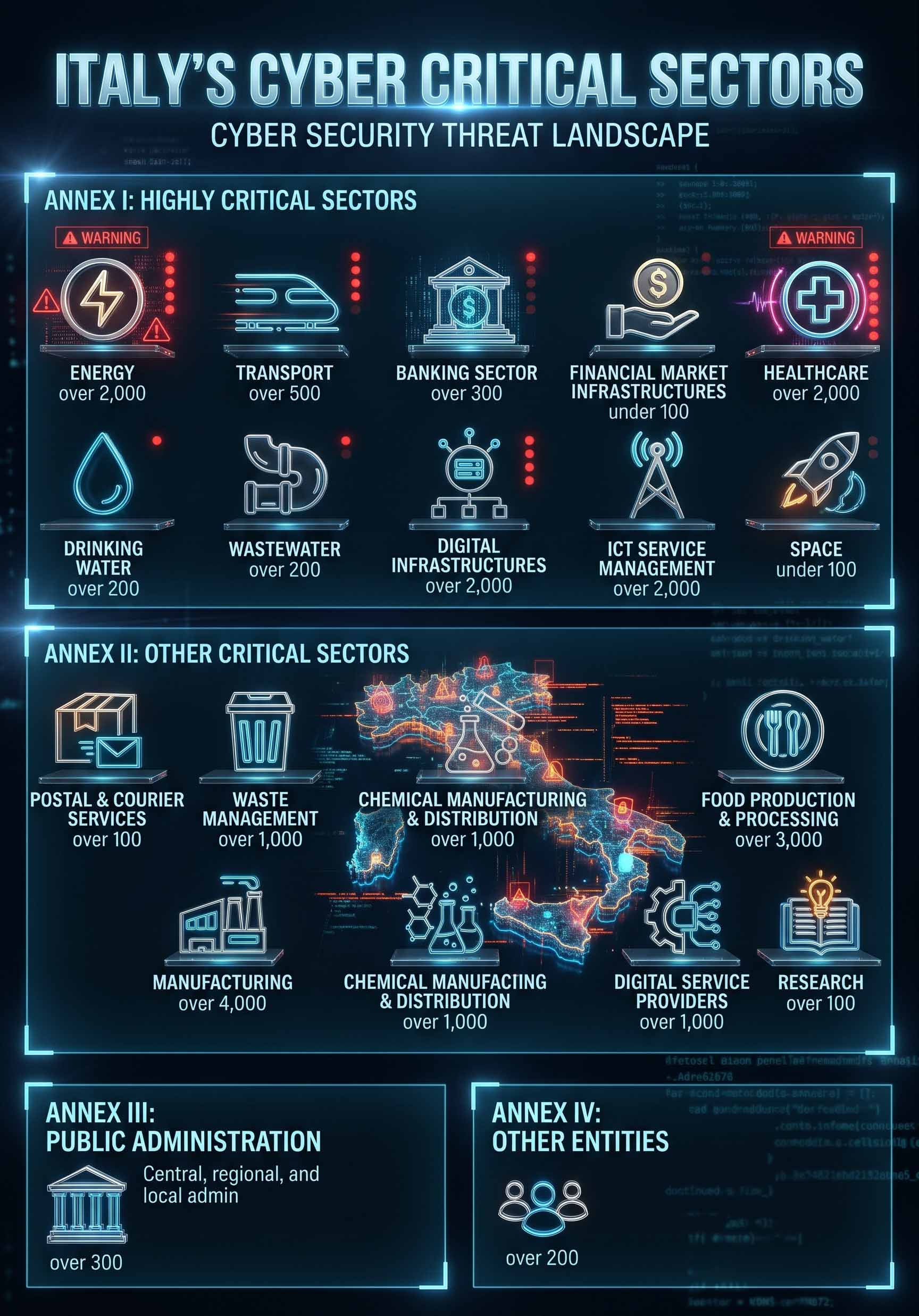
Chapter 11. Italian SCADA Infrastructure: National Service Criticality, Operational Dependencies and Defensive Priorities
Italy’s exposure must be evaluated through the services maintained by industrial control, not by an unverified catalogue of vulnerable installations
The most relevant Italian infrastructure categories are those in which operational technology supports the continuous provision of essential services, where service interruption can propagate beyond the facility directly affected, or where a failure of control and monitoring could produce consequences for human health, industrial safety or the wider economy. These characteristics apply to electricity transmission and distribution, gas transport and storage, drinking-water and wastewater systems, railway operation, port and logistics infrastructure, selected healthcare services, chemical and industrial production, and temperature-controlled food and pharmaceutical supply chains. Their importance is well established by sectoral regulation and official infrastructure data, but the presence of SCADA or related industrial-control technology in these sectors must not be confused with evidence that particular systems are internet-exposed or exploitable.
The Italian ACN’s 2025 Annual Report to Parliament provides an unusually useful institutional baseline. The report states that more than 21,800 entities were included within Italy’s NIS framework in 2025, distributed across high-criticality and other critical sectors. Its sectoral breakdown identifies more than 2,000 energy entities, more than 500 transport entities, more than 2,000 healthcare entities, more than 200 drinking-water entities, more than 200 wastewater entities, more than 3,000 food-production, processing and distribution entities, more than 4,000 manufacturing entities, and more than 1,000 entities involved in the manufacture, production or distribution of chemical substances. The report also identifies more than 2,000 digital-infrastructure entities and more than 2,000 ICT service-management entities. 2025 Annual Report to Parliament — Agenzia per la Cybersicurezza Nazionale, published 2026, pages 13–14.
These figures are strategically important but must be interpreted precisely. They represent entities classified within the NIS framework according to the reporting methodology and reference period; they do not count SCADA installations, controllers, exposed interfaces or organisations that have suffered successful cyberattacks. A manufacturing company may operate numerous production-control systems, while an organisation included in the food sector may have no directly administered industrial controller of its own. Conversely, an industrial installation may fall outside a particular NIS category while still possessing significant operational importance. The registry therefore establishes the institutional breadth of Italy’s cybersecurity governance, not a measurable national distribution of technical vulnerability.
Italian institutional and operational baseline
| Official indicator | Verified figure | Reference period | What the figure measures |
|---|---|---|---|
| Entities within the Italian NIS framework | More than 21,800 | 2025 | Classified entities, not SCADA devices |
| Energy entities | More than 2,000 | 2025 | NIS sector population |
| Transport entities | More than 500 | 2025 | NIS sector population |
| Healthcare entities | More than 2,000 | 2025 | NIS sector population |
| Drinking-water entities | More than 200 | 2025 | NIS sector population |
| Wastewater entities | More than 200 | 2025 | NIS sector population |
| Food production, processing and distribution | More than 3,000 | 2025 | NIS sector population |
| Manufacturing entities | More than 4,000 | 2025 | NIS sector population |
| Chemical-sector entities | More than 1,000 | 2025 | NIS sector population |
| Cyber events handled by CSIRT Italia | 2,729 | 2025 | Nationally observed cyber events |
| Cyber incidents with confirmed impact | 615 | 2025 | Confirmed-impact incidents, not exclusively OT |
| Devices and services at risk reported to relevant entities | 31,050 | 2025 | Proactive alerts concerning at-risk assets and services |
| Potentially compromised devices and services reported | 10,312 | 2025 | Potential compromise findings, not a confirmed SCADA count |
The ACN report’s 31,050 at-risk devices and services and 10,312 potentially compromised devices and services warrant particular attention because they demonstrate the scale of proactive national exposure notification. Nevertheless, they are not interchangeable with the number of vulnerable Italian SCADA systems. The report does not provide a verified public breakdown establishing how many of those findings concern industrial supervisory equipment, how many are duplicates across services or how many could affect a physical process. Using these figures to estimate the probability of an industrial outage would therefore produce a misleading result.
Electricity transmission and distribution: the systemic importance of continuous control and reliable operational information
Italy’s electricity infrastructure is a central concern for national resilience because interruption of electrical supply can affect other essential services even when their own industrial controllers remain uncompromised. Electricity transmission and distribution depend on coordinated monitoring, operational authorisation, equipment protection and communications across geographically distributed installations. The SCADA-related function is the ability to observe and administer the electrical network within an engineering framework that also includes local protection and safety functions. A security assessment must distinguish high-level energy-management and supervisory applications from distribution automation, engineering configuration and equipment-protection systems, because they do not provide identical authority or respond to the same administrative operations.
The economic scale is established by Terna’s official statistics. Terna’s 21 January 2026 provisional communication reported Italian electricity demand of 311.3 terawatt-hours for 2025, with renewable generation covering approximately 41% of demand. The company’s subsequently published statistical figures report 312.2 terawatt-hours for the same year. The difference reflects distinct publication vintages and should be preserved rather than silently reconciled. For the present appendix, the later 312.2 TWh figure is the relevant published statistical value, while the January estimate is identified as provisional. These figures establish the scale of the electricity system, not the amount of demand susceptible to cyber disruption. Italy’s Electricity System Statistics — Terna, 2025 statistical publication; Italian Electricity Demand in 2025 — Terna, 21 January 2026.
Electricity transmission and distribution warrant intensive defensive assurance because a failure of system visibility, communications or authorised control can complicate service continuity over a wider area than the equipment immediately involved. That does not mean an external actor who reaches a status interface can interrupt electrical service. Actual consequences depend on operational permissions, independent protection, interlocks, local control and the ability of qualified operators to intervene. The required security evaluation must therefore establish whether control authority is appropriately separated from corporate IT and external service providers, whether administrative changes to engineering configurations are independently approved, and whether the network retains sufficient operating visibility and restoration capability during communications disruption.
The principal national dependency is not limited to energy consumers. Water pumping, wastewater treatment, rail electrification, telecommunications, industrial production, healthcare systems and refrigeration all depend on electricity, although the extent of their continuity arrangements differs by installation. This creates a distinction between a direct cyberattack against a downstream facility and a disruption propagated through an upstream service. The former requires evidence of compromise of the facility itself; the latter requires evidence of actual interruption of its supporting infrastructure. National risk analysis should map both forms of dependency without treating them as identical attack paths.
Natural gas transport and storage: process continuity and the significance of safety boundaries
Natural gas infrastructure is important because it supports energy supply, industrial production, heating and electricity generation, with industrial operations involving transport, storage, treatment and associated monitoring. A supervisory system may contribute to measurement, coordination and approved operational control, but the resulting authority is constrained by the installation’s process engineering and safety systems. It is therefore inaccurate to infer that a compromised corporate server or remotely visible monitoring display would automatically allow an adversary to change the physical state of the gas network.
The relevant industrial scale is documented by Snam’s 2025 Annual Financial Report, published in March 2026. Snam describes a transport-network portfolio exceeding 38,000 kilometres across Italy and its international operations, alongside gas storage and regasification activities. It identifies managed or jointly managed regasification capacity of approximately 28 billion cubic metres annually. These figures describe the company’s infrastructure portfolio and nominal capacity, not its Italian-only network length or actual 2025 gas throughput. They establish why control-system resilience is relevant to a large interconnected service, but cannot identify exposed or vulnerable installations. 2025 Annual Financial Report — Snam, March 2026.
The major security distinction concerns the independence of ordinary supervision from process protection. Monitoring, engineering configuration, equipment control and safety functions must be assessed as separate authorities. A failure affecting operational visibility may produce uncertainty or require a controlled reduction in service, whereas an unauthorised process change could have different consequences depending on protective systems and the physical conditions involved. A defensible assessment should consequently examine authenticated administrative access, the integrity of operating configurations, independent safety protection and the operator’s ability to maintain or safely suspend service when supervisory communications are unavailable. The existence of safety systems should not be assumed to eliminate all cybersecurity risk, but their separation and tested effectiveness materially affect the range of physically credible outcomes.
Drinking water and wastewater: public-health consequences and the danger of confusing infrastructure deterioration with cybersecurity exposure
Italy’s water infrastructure presents a different type of sensitivity because its essential outcome is the reliable supply of water meeting applicable quality requirements, together with the safe collection and treatment of wastewater. Water-sector automation may include supervision of supply, storage, pumping, distribution and treatment processes, with local controllers and monitoring systems supporting geographically dispersed operations. The relevant risk is therefore the possibility of losing trustworthy information about the physical process or losing the ability to maintain an essential service, rather than simply the possibility that an administrative interface might be accessible.
Italy’s underlying physical infrastructure also faces significant non-cybersecurity challenges. ISTAT’s national water statistics report that 42.4% of water introduced into municipal drinking-water distribution networks was lost in 2022, compared with 42.2% in 2020. The 2022 figure is a measure of total distribution losses, not an estimate of water lost because of industrial-control failures or cyberattacks. The distinction matters because physical network deterioration, leakage, ageing equipment, metering deficiencies and cyber exposure are different risk categories, even where investments in monitoring and automation are relevant to several of them. A system installed to reduce leakage may improve operational visibility while introducing new communications and administrative dependencies that must be secured independently. Italian Water Statistics, 2020–2023 — ISTAT, 22 March 2024.
ARERA’s regulatory framework confirms the scale of modernisation. Its 2025 Annual Report, covering relevant regulatory activities and service information, identifies the 2024–2029 water-sector investment programme as giving substantial attention to reducing distribution losses, limiting service interruptions, improving treated-water quality and upgrading wastewater networks. The reported distribution of planned investment needs attributes 26.31% to reducing water losses, approximately 15.69% to reducing interruptions, 13.86% to improving treated-water quality and 12.79% to sewerage-system adequacy. These figures concern investment planning, not cybersecurity expenditure, but demonstrate why water infrastructure is undergoing technical modernisation with potential consequences for control-system architecture. 2025 Annual Report — Autorità di Regolazione per Energia Reti e Ambiente.
The public-health dimension requires independent verification of water quality and service continuity. An unauthorised administrative change may be relevant to the investigation, but competent technical evidence must establish whether treatment processes, monitored conditions or actual supply were affected. Unlike commercial inventory loss, public water-supply interruption can influence households, health services and industrial users that depend on the same network. The appropriate defensive focus is therefore the protection of administrative boundaries, preservation of independent process measurements, continuity arrangements and the ability of authorised local personnel to verify safe conditions.
The European Union Agency for Cybersecurity provides an important comparative finding. In its NIS360 assessment published on 28 May 2026, ENISA identified drinking water and wastewater among the sectors where cybersecurity maturity fell below the level appropriate to their assessed criticality. This is a European sector-level maturity judgement, not a finding that any particular Italian water operator has been compromised. It nevertheless supports the case for giving water-service continuity and industrial-control assurance substantial attention within the national defensive programme.
Railways, ports and intermodal logistics: when control-system reliability becomes a national mobility issue
Railway and maritime infrastructure require separate technical treatment because a supervisory platform supporting operational visibility is not necessarily equivalent to a signalling, train-protection or safety-critical control system. Italian rail operations involve multiple classes of technology supporting traffic management, remote supervision, communications, route control and train protection. The resulting security assessment must distinguish the consequences of losing an information service, the consequences of losing operational visibility and the more demanding conditions required to affect safety-critical railway functions. A cybersecurity incident may disrupt scheduling, dispatching, passenger information or maintenance activity without establishing that an attacker has gained authority over railway protection systems.
The scale of remote railway administration is documented by Rete Ferroviaria Italiana. Its published network statistics identify approximately 16,909 kilometres of operating railway lines, of which 13,736 kilometres are covered by remote traffic-control systems. The same source lists approximately 2,200 passenger stations, 169 freight facilities, 13,767 kilometres equipped with the Sistema Controllo Marcia Treno and 1,096 kilometres equipped with ERTMS-related infrastructure. The categories are technically different and some coverage overlaps; their values must not be added together to calculate total SCADA exposure. In particular, ERTMS is a railway control-command and interoperability framework, not simply a conventional SCADA management application. The Network Today — Rete Ferroviaria Italiana, official infrastructure statistics.
Railway services have substantial dependency effects because passenger transport, freight movement, industrial supply chains and logistics scheduling depend on reliable circulation. An operational-security incident may therefore produce commercial and societal consequences without compromising the physical safety of a train. The relevant engineering requirement is to maintain separation between administrative systems and safety-critical functions, preserve reliable operational information, and establish the conditions under which services can continue, be restricted or resume after a cyber incident. Such decisions must remain grounded in the railway infrastructure manager’s approved safety and operational procedures, not in generic assumptions about industrial-control interfaces.
Ports and intermodal logistics introduce additional organisational complexity through the interaction of terminal operators, vessel services, freight forwarders, customs-related information systems, warehousing and industrial handling equipment. Terminal-management software, cargo databases, industrial machinery and associated control systems have different functions and access rights. Compromise of a terminal-management application can interrupt logistics without proving that the attacker controls cranes or other physical handling machinery. Conversely, compromise of an industrial-control component must be assessed according to its actual operational authority and independent protective functions. The distinction is important because port disruption can arise from loss of coordination and reliable information even when the underlying machinery remains technically functional.
ENISA’s assessment supports particular attention to these sectors. On 28 May 2026, its NIS360 analysis identified railway and maritime services within a group of sectors whose cybersecurity maturity remained below the level associated with their assessed criticality. The agency subsequently conducted Cyber Europe 2026 on 10–11 June, using a simulated cross-border transport crisis involving railway and maritime operations. The exercise involved more than 5,000 participants and was designed to evaluate coordination and continuity under severe disruption. Its scenarios were exercises, not evidence that the simulated incidents had occurred against European infrastructure. NIS360: Cybersecurity Maturity and Criticality — ENISA, May 2026; Cyber Europe 2026 — ENISA, 11 June 2026.
Chemical production, metallurgy and industrial manufacturing: the decisive difference between operational disruption and process-safety compromise
Italian manufacturing presents a broad and heterogeneous operational-technology environment. Industrial control may support mechanical production lines, heat treatment, process chemistry, continuous manufacturing, materials handling, quality assurance and production utilities. SCADA systems frequently operate alongside programmable controllers, distributed control systems, manufacturing execution systems and engineering applications, but their functions vary substantially by facility. A production-monitoring dashboard may have no authority to change a hazardous process, while an engineering workstation may possess significant configuration privileges under narrowly defined maintenance conditions. Treating the existence of any one of these technologies as proof of exploitable process authority would therefore be technically unsound.
The relevance of the sector is confirmed by the Italian NIS population, which included more than 4,000 manufacturing entities and more than 1,000 entities engaged in the manufacture, production or distribution of chemical substances in 2025. The counts illustrate the number of organisations falling within the relevant regulatory categories, not the installed stock of industrial control systems or the number of vulnerable plants. Their national significance also varies by product and industrial process. A failure of a factory’s production-control system may cause temporary output loss and contractual disruption, whereas a failure affecting a process with hazardous operating conditions may create more serious safety or environmental consequences if protective engineering is insufficient. 2025 Annual Report to Parliament — Agenzia per la Cybersicurezza Nazionale, published 2026.
The protection of hazardous processes requires a stronger distinction between normal control and independent safety functions. Distributed control and supervisory systems are designed primarily to manage ordinary production operations, while safety instrumentation is intended to maintain or restore safe conditions when defined hazardous states arise. A compromise of an ordinary management environment does not automatically bypass independent safety protection. The relevant audit must determine whether that protection is genuinely independent, whether its configuration is controlled through appropriate engineering governance and whether its operation can be verified during loss of other systems. This requirement applies to process industries across Europe, but the effectiveness of the safeguard cannot be assessed from public descriptions of a facility’s business activities.
For conventional manufacturing, the economic risk may arise earlier in the causal chain. An unavailable production-management system can prevent scheduling, quality validation, inventory release or coordination of machinery even where the machinery itself remains physically safe. The resulting interruption can affect employment, production output, customer deliveries and downstream industrial supply. This distinction is central to economic assessment: an interruption of production caused by ransomware in enterprise systems is not automatically a compromise of SCADA, while a confirmed controller compromise may have consequences limited by local protection and the operator’s capacity for safe manual intervention.
Healthcare infrastructure: safety-critical dependencies extend beyond medical information systems
Healthcare requires consideration because hospital continuity depends on more than electronic clinical records and ordinary information-technology services. Building electricity, ventilation, environmental control, emergency power, sterilisation systems, medical-gas infrastructure and storage of temperature-sensitive medical products can all have operational significance, with the importance of each function depending on the facility and its approved technical design. The fact that a hospital uses building automation or industrial-control equipment does not establish that a cyberattack against ordinary administrative IT can manipulate patient-care equipment; however, the dependence of essential clinical services on physical infrastructure makes reliable separation and continuity particularly important.
The ACN’s 2025 NIS figures identify more than 2,000 healthcare-sector entities within the national framework, while ENISA’s May 2026 NIS360 identifies healthcare among the European sectors whose criticality exceeds their assessed cybersecurity maturity. These figures and assessments support a national requirement for stronger assurance of healthcare service continuity, but do not provide a count of exposed hospital SCADA controllers or evidence of a specific Italian medical facility’s vulnerability. ACN Annual Report 2025, published 2026; NIS360 Sector Assessment — ENISA, May 2026.
A defensible healthcare assessment should establish whether building-management functions essential to care can remain available when ordinary enterprise systems or remote contractors are unavailable, whether environmental and medical-product monitoring is independently trustworthy, and whether emergency procedures maintain safe conditions during a prolonged interruption. The focus should be the continuity of critical clinical functions rather than a speculative claim that any externally accessible building-management interface can directly affect medical treatment.
Food and pharmaceutical cold chains: commercial exposure becomes a public-interest concern when traceability and assurance fail
Food and pharmaceutical cold chains form an important intersection between distributed industrial control and regulatory product assurance. The Italian NIS framework included more than 3,000 entities in food production, processing and distribution in 2025, but that population does not represent an inventory of refrigeration controllers. Cold-chain technology may range from individual local refrigeration units to centrally supervised storage and logistics operations, and the associated cyber risk depends on whether management access is appropriately restricted, whether product conditions are independently recorded and whether the operator can distinguish a digital abnormality from an actual storage excursion. ACN Annual Report to Parliament 2025 — published 2026.
The economic sensitivity of these environments is not determined solely by the value of stored goods. Loss of trustworthy temperature records may delay distribution or require additional inspection even when the equipment itself remains operable, while disruption to a shared logistics service can affect several customers whose goods depend on the same storage and transport arrangements. Pharmaceutical storage additionally involves product-specific conditions and quality systems that cannot be replaced by generic refrigeration assumptions. The appropriate protection objective is therefore evidence continuity: operators must be able to establish the identity of affected products, the physical conditions they experienced and the basis for any release, quarantine or disposal decision.
Digital infrastructure and telecommunications: the common dependency that may be outside a facility’s industrial inventory
Industrial systems increasingly depend on communications services, remote-access infrastructure, identity providers, hosted applications and specialist maintenance connectivity. The compromise or unavailability of such services may affect industrial visibility or administration without any direct compromise of the local controller. In Italy, the 2025 NIS population included more than 2,000 digital-infrastructure entities and more than 2,000 ICT service-management entities, according to ACN. These are distinct regulatory populations and cannot be interpreted as a count of shared industrial-service providers or as proof that their customers possess vulnerable operational access arrangements. ACN Annual Report 2025 — published 2026.
The relevant national risk is the existence of dependencies that may connect otherwise independent industrial operators. A failure of shared communications or administration can reduce an operator’s ability to monitor and maintain equipment, while a compromise of privileged third-party access may affect the security assumptions of several customer environments. The appropriate defensive requirement is to identify which industrial services depend on external providers, verify separation between customers and facilities, and establish whether the essential physical process can continue safely when the external service is unavailable.
Italian infrastructure sensitivity: consequences, control functions and evidence required
A distinction is necessary between criticality to Italian society and demonstrated cybersecurity weakness. The following classification groups services by the nature of harm that interruption could cause; it does not identify attractive attack targets or rank specific facilities by ease of compromise.
| Infrastructure category | Relevant control-system functions | Reason for national sensitivity | Principal consequence to assess | Evidence required before claiming cybersecurity vulnerability |
|---|---|---|---|---|
| Electricity transmission and distribution | SCADA, energy-management systems, distribution supervision and remote engineering | Electricity supports many other essential services | Service interruption and downstream dependency effects | Verified access boundaries, engineering permissions and protection independence |
| Natural gas transport, storage and processing | Process supervision, distributed control and remote telemetry | Energy supply and industrial continuity | Supply uncertainty, interruption or process-safety implications | Exact process-control architecture and independent protection evidence |
| Drinking-water systems | Water-supply supervision, pumping and process monitoring | Public health and continuity of essential supply | Reduced service or loss of confidence in water-quality conditions | Trustworthy process measurements, administrative access and continuity tests |
| Wastewater treatment | Process control, pumping and monitoring | Environmental protection and public-service continuity | Treatment interruption or abnormal operating conditions | Local safeguards, operating records and independent measurements |
| Railway and intermodal services | Remote traffic supervision, signalling-related systems, communications and logistics applications | Passenger movement, freight and industrial supply | Operational disruption and service delays | Separation of safety functions, approved access and validated recovery |
| Port and maritime logistics | Terminal administration, industrial handling control and logistics coordination | Trade and international supply chains | Cargo delays and interruption of dependent services | Separation of business applications from physical control |
| Chemical and process industry | DCS, PLCs, engineering environments and safety instrumentation | Industrial continuity and process safety | Production disruption or safety-relevant deviation | Independent safety protection and process-specific engineering evidence |
| General manufacturing | PLC-controlled machinery, SCADA, MES and industrial utilities | Production, employment and supply-chain dependence | Output loss, quality disruption and delivery delays | Installed asset and privilege inventory |
| Healthcare and associated facilities | Building automation, power continuity and environmental monitoring | Continuity of clinical services | Loss of environmental assurance or supporting services | Validated dependencies and independent safety monitoring |
| Food and pharmaceutical cold chains | Refrigeration supervision, local control and product monitoring | Food safety, medical-product integrity and distribution | Product holds, spoilage and commercial interruption | Independently documented time-temperature conditions |
| Telecommunications and digital services | Communications, identity, remote administration and supporting infrastructure | Dependency of multiple critical-service operators | Loss of monitoring, administration or coordination | Documented service dependencies and customer isolation |
The relative importance of these categories cannot be converted into a defensible ranking of individual attackable facilities without a confidential asset inventory, validated technical conditions, service-consequence modelling and authorised engineering assessment. The public evidence permits sectoral criticality analysis, not identification of specific installations as exploitable.
The decisive Italian finding: physical criticality and cybersecurity maturity are not equivalent
Italy’s industrial criticality is confirmed by the scale of its essential-service infrastructure, but industrial scale does not establish cyber vulnerability. The Terna electricity figures, RFI railway statistics, ISTAT water-distribution data and ACN’s 2025 NIS entity population measure different characteristics of the national economy. They must not be combined into a numerical index without a defensible model and comparable inputs. The most important unresolved variable is the quality of the control boundaries and recovery capability actually implemented by each operator.
This distinction also prevents a misleading conclusion about the national distribution of risk. A large national operator may manage complex but carefully controlled operational systems, whereas a smaller facility may possess simpler equipment with inadequate remote-access arrangements. Conversely, a small installation may have limited local consequences while a large distribution or utility service may have substantial downstream dependencies. Neither size nor operating sector is sufficient to determine the probability of successful compromise.
The appropriate national investment question is therefore whether the services whose interruption would have the greatest public consequences possess demonstrably effective access control, independent monitoring and tested continuity arrangements. That question can be answered through regulated operator assurance, competent technical inspection and protected information exchange; it cannot be answered by publishing an unverified list of supposedly vulnerable SCADA installations.
Chapter 12. Global Industrial-Cyberattack Precedents, Italian Strategic Implications and the National Defence Model
The international record demonstrates several fundamentally different forms of industrial cyberattack
The global history of industrial-control attacks demonstrates that disruption can arise through mechanisms requiring very different levels of access, technical preparation and knowledge of physical processes. An attack that misuses an exposed management interface is not equivalent to an operation against an industrial safety system, while ransomware affecting a corporate network may cause the precautionary suspension of a physical service without compromising its controllers. These distinctions are essential for interpreting Italy’s industrial exposure. A national analysis that treats all three mechanisms as one generic SCADA threat would produce unreliable conclusions about adversary capability and the investment necessary to prevent operational consequences.
The United States Department of Energy provides an authoritative comparative record in its May 2022 State Energy Security Plan: IT/OT and Cyber Threat Overview, which documents major historical incidents involving industrial-control systems, energy facilities and operational disruption. The cases demonstrate three different patterns: attacks using legitimate or compromised control authority, attacks designed specifically for industrial-control environments, and attacks against enterprise technology that lead operators to suspend physical services as a precaution. The distinction is particularly important for public communication because a company reporting that a cyberattack interrupted industrial production has not necessarily reported that attackers obtained direct control over its machinery. State Energy Security Plan: IT/OT and Cyber Threat Overview — United States Department of Energy, May 2022.
Ukraine, 2015–2016: confirmed electricity disruption and the role of industrial access authority
On 23 December 2015, three Ukrainian electricity-distribution companies experienced coordinated cyber incidents that interrupted electricity supply to approximately 225,000 customers for periods reported by the United States Department of Energy as one to six hours. The official American assessment identifies a combination of compromised information systems and subsequent interference with industrial-control operations, demonstrating that an attacker could move beyond access to business information and affect a physical essential service. The incident also involved measures intended to complicate the defenders’ ability to observe and restore normal operations. The verified outcome was a substantial but temporally limited electricity interruption, not the permanent destruction of the affected distribution system.
The importance of this precedent for Italy lies in its demonstration that industrial disruption can result from the convergence of several security failures rather than the compromise of one isolated device. Legitimate control capabilities, inadequately constrained administrative authority and interference with operational recovery contributed to the observed outcome. The 2015 event therefore supports the protection of the entire control environment, including administrative access and restoration capability, rather than a narrower programme concerned only with vulnerabilities in field devices. However, its historical method and consequences cannot be assumed to apply to modern Italian electricity installations without independent evidence concerning their architecture and protective systems. Assessment of Electricity Disruption Incident Response Capabilities — United States Department of Energy, August 2017, page 6.
A further attack affected Ukraine’s electricity infrastructure in December 2016, illustrating the emergence of more specialised capabilities associated with industrial-control environments. The Department of Energy’s subsequent comparative analysis identifies the incident with the malware family commonly known as CrashOverride or Industroyer and reports an electricity interruption of approximately one hour. Its significance is the distinction between opportunistic misuse of exposed administration and an operation involving software specifically developed for industrial applications. Even in this more technically specialised case, the documented physical consequence must be separated from the wider range of effects the malware might theoretically have produced. Industrial Control System Cyberattack Examples — United States Department of Energy, May 2022.
Saudi Arabia, 2017: why safety-system compromise requires a different national assessment
The 2017 Triton/Trisis incident at a Saudi petrochemical facility represents a different category of industrial attack because it involved a Safety Instrumented System rather than merely the ordinary supervisory functions used during normal production. According to the United States Department of Energy, the malicious activity affected equipment intended to provide protective intervention when specified unsafe operating conditions arise. The incident resulted in a protective shutdown and subsequent investigation, demonstrating that an attack against safety infrastructure can have operational consequences even when the protective response prevents a more serious outcome.
This historical case establishes an important engineering boundary for Italian chemical and heavy-industrial operators. Ordinary process control and independent safety protection are related but different functions. The compromise of a manufacturing-management application does not automatically establish control of the protective systems, and the existence of a safety system does not independently prove that the overall installation is protected against every class of malicious administrative activity. Assurance requires evidence that safety functions are independently engineered, that their configuration is appropriately governed and that relevant protective actions remain effective when other systems become untrustworthy. Industrial Control System Cyberattack Examples — United States Department of Energy, May 2022.
United States, 2021: the Colonial Pipeline case proves that physical interruption does not require SCADA compromise
The May 2021 Colonial Pipeline ransomware incident provides a separate and economically significant precedent. The attack affected the company’s information-technology environment, prompting the operator to suspend pipeline operations as a precaution. The resulting interruption affected fuel distribution, demonstrating how a cybersecurity incident can interrupt a physical essential service through operational decision-making and business-system dependencies even without establishing that malicious actors directly manipulated industrial controllers.
The distinction has direct relevance to Italy’s gas, electricity, logistics and manufacturing sectors. The continuity of physical production may depend on information systems needed for scheduling, commercial transactions, inventory reconciliation, dispatching and operational coordination. A sufficiently serious cyber incident affecting those systems can lead management to limit or suspend operations because it cannot safely or reliably continue the service. Therefore, an industrial resilience programme must address not only the protection of control equipment but also the supporting business processes whose unavailability can independently force the interruption of an essential service. State Energy Security Plan: IT/OT and Cyber Threat Overview — United States Department of Energy, May 2022.
North America and Europe, 2023–2024: low-complexity industrial interference is a documented operational threat
The international advisory issued by CISA and partner organisations on 1 May 2024 documents malicious activity against operational systems in the water, wastewater, energy, food and agricultural sectors. The agencies identified exploitation of inadequate remote-access security, weak passwords and publicly exposed industrial-management interfaces, confirming that comparatively unsophisticated intrusion methods can create physical operating problems in improperly secured environments. The reported consequences included limited process interference, while the agencies noted that the actors involved had historically exaggerated their claimed capabilities and operational effects.
The lesson for Italy is not that all water or energy installations are similarly exposed, but that the availability of existing operational functionality can reduce the technical sophistication required to produce an effect when access boundaries are deficient. A system that permits a remote administrator to alter operating conditions must distinguish that administrator from an unauthorised actor using the same functions. When this distinction fails, the attacker may not need purpose-built industrial malware to cause an abnormal operating state. Nevertheless, the effect remains dependent on the actual authority available, local process protection and the operator’s response. Defending OT Operations Against Ongoing Pro-Russia Hacktivist Activity — CISA and Partner Agencies, May 2024.
A related multinational campaign involving internet-connected industrial controllers was addressed in American cybersecurity advisories concerning activity attributed to actors affiliated with Iran’s Islamic Revolutionary Guard Corps. In a June 2025 joint fact sheet, American agencies referred to compromises involving Israeli-manufactured industrial-control equipment during the period from November 2023 to January 2024, including affected organisations in water, energy, food manufacturing and healthcare. The public record demonstrates that politically motivated actors have targeted industrial products used in several sectors and countries. It does not establish that every installation using comparable products is vulnerable or that the actors involved were responsible for the European refrigeration incidents of 2026. Iranian Cyber Actors May Target Vulnerable US Networks and Entities of Interest — CISA, FBI, NSA and Department of Defense Cyber Crime Center, June 2025.
Australia, 2026: the latest critical-infrastructure evidence confirms the importance of ordinary access mechanisms
The Australian Signals Directorate’s Annual Cyber Threat Report 2025–26, published on 26 October 2026, provides a recent comparison with the European evidence. During the reporting year, the Australian Cyber Security Centre responded to 154 incidents involving critical infrastructure, equivalent to approximately 10% of the total incidents it handled. The authority identified phishing, valid-account misuse and drive-by compromise among the principal initial-access techniques in its critical-infrastructure dataset. Importantly, the reported incidents cover a broad population of critical-infrastructure organisations and should not be interpreted as 154 successful attacks against industrial controllers.
The Australian data also identify financial and insurance services at 30%, public administration and safety at 21%, and electricity, gas, water and waste services at 17% of the relevant critical-infrastructure incident population. These are observed sector shares, not a measure of the probability of successful physical disruption. They demonstrate how national reporting can identify important cyber-threat patterns while preserving a distinction between affected critical-infrastructure organisations and demonstrated compromise of operational technology. Annual Cyber Threat Report 2025–26: Critical Infrastructure — Australian Signals Directorate, 26 October 2026.
The comparison is useful because the Australian authority’s definitions differ from those used by ACN and ENISA. Italy’s 2025 national figures distinguish cyber events from incidents with confirmed impact; Australia’s 2025–26 critical-infrastructure report classifies incidents and initial-access techniques within its national response population; and ENISA’s European threat assessments include incident collections and attributed adversary claims. Aggregating these figures into one global number of successful industrial intrusions would therefore be methodologically invalid. Their common analytical contribution lies in the continued prominence of credential compromise, exposed services, third-party dependencies and the need for validated evidence of operational effects.
Japan, 2026: industrial-control protection is becoming a cross-sector governance obligation
Japan provides a further institutional comparison because its national cybersecurity framework explicitly recognises the importance of industrial-control security across manufacturing, petrochemicals, electricity and water supply. JPCERT/CC identifies the transition from proprietary, relatively isolated industrial systems toward more open and interconnected architectures as a significant source of cybersecurity concern. Its industrial-control programme supports incident handling, vulnerability coordination, operator awareness and technical self-assessment. This approach reinforces the conclusion that industrial security should be managed as a continuing engineering and governance function rather than a one-time software update. Control System Security — Japan Computer Emergency Response Team Coordination Center.
Japan’s National Cybersecurity Office also records the adoption of Common Cybersecurity Standards for Critical Infrastructure, effective 1 October 2026, intended to establish more consistent expectations for protection across operators and sectors. The Japanese approach is not directly interchangeable with Italy’s NIS2 implementation because the legal frameworks and institutional arrangements differ. Nevertheless, the international convergence is significant: mature industrial economies increasingly treat critical-service cybersecurity as an assurance problem extending beyond individual technical components toward administrative responsibility, continuity and verified protection. Critical Infrastructure Cybersecurity Framework — National Cybersecurity Office of Japan, 2026.
Global evidence comparison
| Incident or institutional record | Jurisdiction and date | Confirmed or documented characteristic | Physical or operational consequence | Relevance to Italy |
|---|---|---|---|---|
| Stuxnet | Iran, 2010 | Malware developed for industrial-control functions | Physical infrastructure interference described in the official historical record | Demonstrates that specialised industrial attacks differ from ordinary IT compromise |
| Ukrainian electricity disruption | Ukraine, 23 December 2015 | Compromise of electricity-distribution operational systems | Approximately 225,000 customers lost supply for 1–6 hours | Establishes the importance of control authority and restoration capability |
| CrashOverride/Industroyer | Ukraine, December 2016 | Specialised industrial-control attack | Electricity interruption of approximately one hour | Demonstrates a more specialised operational attack category |
| Triton/Trisis | Saudi Arabia, 2017 | Attack involving industrial safety instrumentation | Protective shutdown at a petrochemical facility | Establishes the need to verify independence of safety systems |
| Colonial Pipeline | United States, May 2021 | Ransomware affecting enterprise IT | Precautionary suspension of pipeline operations | Demonstrates business-system dependencies capable of interrupting physical services |
| Industrial-interface compromises | North America and Europe, 2022–April 2024 | Unauthorised access through inadequately protected operational interfaces | Limited process interference documented | Supports protection of remote administrative authority |
| European refrigeration incidents | Several European Member States, October–November 2026 | Compromises involving refrigeration supervision | Operational exposure confirmed; complete physical and financial totals unresolved | Demonstrates the relevance of connected refrigeration management |
| Australian critical-infrastructure report | Australia, published 26 October 2026 | 154 critical-infrastructure incidents handled during FY2025–26 | Multiple cyber incident categories; not exclusively industrial-control compromises | Provides independent evidence on initial-access mechanisms and reporting limitations |
| Japanese critical-infrastructure standards | Japan, effective October 2026 | Cross-sector cybersecurity assurance framework | Institutional prevention and resilience measure, not an attack | Demonstrates convergence toward systematic assurance |
Sources: United States Department of Energy — Industrial Control System Cyberattack History, 2022; CISA and Partner Agencies — OT Hacktivist Activity, May 2024; Australian Signals Directorate — Critical Infrastructure Report, October 2026; JPCERT/CC — Industrial Control System Security.
An Italian national assessment must measure three different kinds of risk
The international record supports a national model separating likelihood of unauthorised access, ability to produce a physical consequence and importance of the affected service. These are related but not equivalent variables. A publicly exposed management interface may create an unacceptable access condition while possessing limited authority over the physical process. A well-protected industrial installation may have exceptionally important public-service functions yet a comparatively constrained external attack surface. A successful compromise of enterprise systems may interrupt a service for operational reasons without the attacker ever controlling a programmable logic controller. For these reasons, a single risk score based on public sector, vendor or device information would conceal decisive engineering distinctions.
The first assessment dimension should concern verified security conditions: external reachability, administrative authentication, privileged access, network segmentation, software support and configuration-integrity monitoring. The second should concern engineering consequences: the functions an authorised user can change, local controller autonomy, protective systems, independent physical measurements and safe operating procedures. The third should concern service continuity: the availability of alternative capacity, dependence on other essential services, recovery arrangements, geographical service coverage and the operator’s ability to maintain a safe state during interruption. Only a structured analysis of all three dimensions can justify a conclusion about the residual operational risk of a particular facility.
The resulting approach would materially improve Italy’s ability to direct resources. It would distinguish an exposed but low-authority supervisory service from an inadequately protected administrative function capable of affecting essential operations. It would also prevent the mistaken assumption that every large industrial organisation is technically more vulnerable than a smaller one. The assessment can be implemented through a combination of operator asset registers, manufacturer security information, national cybersecurity supervision and controlled technical validation, without publishing sensitive details about specific live installations.
Defensive investment priorities for the Italian SCADA environment
| Investment domain | Technical objective | Specific evidence required | Institutional consequence |
|---|---|---|---|
| Industrial asset identification | Establish which systems actually exercise operational authority | Verified inventory of supervisory, controller, engineering and protective functions | Prevents incorrect attribution of risk to unrelated IT assets |
| Remote-access governance | Restrict administration to identifiable, approved sessions | Account ownership, permissions, work orders and gateway logs | Improves contractor accountability |
| Network trust boundaries | Prevent unnecessary communication between enterprise and operational systems | Approved communications matrix and controlled validation | Limits propagation of unrelated compromise |
| Configuration integrity | Make unapproved operational changes observable | Trusted baselines and independently retained change records | Supports investigation and restoration |
| Independent physical monitoring | Preserve knowledge of actual operating conditions | Calibrated measurements, alert delivery and source independence | Supports safety and continuity decisions |
| Safety-system assurance | Verify protection remains effective independently of ordinary supervision | Approved engineering records and controlled protection tests | Limits escalation from operational abnormality to physical harm |
| Recovery capability | Restore a trusted operating state without perpetuating original exposure | Tested backups, access revalidation and formal acceptance | Reduces prolonged interruption and recurrence |
| Sectoral dependency analysis | Identify common administrative and service dependencies | Validated contractual and operational relationships | Supports national contingency planning |
| Supply-chain security | Constrain shared contractor privileges and software dependencies | Supplier assurance, support status and incident cooperation records | Reduces cross-organisational concentration risk |
| National intelligence collection | Distinguish exposed systems, compromises and physical effects | Harmonised incident records and validated technical findings | Improves public and confidential risk assessments |
These are defensive assurance categories derived from NIST SP 800-82 Revision 3 — September 2023, UK NCSC Secure Connectivity Principles — January 2026, and ENISA NIS360 — May 2026.
WordPress Analytical Scheme — Industrial Access, Physical Consequence and Essential-Service Dependency
This diagram is a specific analytical component for insertion into the appendix, not a separate dashboard. It distinguishes administrative compromise, industrial authority, physical protection, independently verified consequence and service dependency. The structure corresponds to the documented engineering distinctions in the international records and does not portray a proven attack path against an Italian installation.
Five Boundaries Between Cyber Access and National Consequence
The consequences of an industrial cyber incident depend on a sequence of distinct technical and operational conditions. The existence of one condition does not establish that the subsequent conditions have occurred.
Administrative Access
Establish whether access was authorised and attributable. Evidence: identity and session records.
Operational Authority
Establish which industrial functions the identity could administer. Evidence: effective permissions and engineering records.
Physical Protection
Establish whether independent protection and local operating constraints remained effective.
Verified Physical Effect
Establish actual equipment behaviour through independent measurements and competent operational assessment.
Essential-Service Consequence
Establish interruption, affected demand, substitute capacity, restoration and downstream dependencies.
Authenticated sessions, authorised access routes, privileged identities and configuration-integrity records.
Local controller behaviour, independently verified physical measurements and safety-function records.
Service interruption, recovery capability, downstream dependencies and alternative capacity.
The scheme follows the engineering distinction between cybersecurity access, physical operating conditions and essential-service continuity established in NIST SP 800-82 Revision 3 — Guide to Operational Technology Security, United States Department of Energy — IT/OT and Cyber Threat Overview, May 2022, and UK NCSC — Secure Connectivity Principles, January 2026.
Appendix IV — Consolidated findings
The additional international and Italian evidence establishes that industrial cyberattacks should be classified according to the operational authority actually compromised, the safeguards independently protecting the physical process and the consequences demonstrated through reliable measurements. The historical record includes direct compromise of industrial-control environments, attacks against specialised safety systems, opportunistic misuse of weakly protected supervisory interfaces and enterprise cyber incidents that prompted precautionary interruption of physical services. These are materially different mechanisms whose consequences and defensive requirements cannot be treated as identical.
For Italy, the most consequential infrastructure categories from a national resilience perspective include electricity, gas, drinking water, wastewater, transportation, industrial processes, healthcare and selected temperature-controlled supply chains. Their sensitivity derives from public dependence, the importance of continuous service, potential physical safety consequences and the transmission of interruption to other sectors. The official evidence does not establish that any one named Italian facility is more easily compromised than another, nor does it provide a valid census of exposed national SCADA installations.
The figures reported by ACN for 2025—more than 21,800 NIS entities, 2,729 cyber events, 615 confirmed-impact incidents and 31,050 at-risk devices or services identified through proactive monitoring—provide a substantial institutional basis for national planning, but must not be misrepresented as counts of compromised industrial controllers. Their value is to demonstrate the scale of the population requiring risk management and the importance of translating national notification and supervision into verified engineering assurance. ACN Annual Report to Parliament 2025 — published 2026.
What would materially change the Italian assessment
A robust reassessment would require a validated inventory of Italian industrial-control environments, with information about supported software, remote administrative access, trust boundaries, operational permissions, independent protection and tested recovery. It would also require comparable sectoral evidence linking reported cyber incidents to specific physical processes without conflating supervisory access with equipment control. Such a collection would permit ACN and competent sector authorities to distinguish national service criticality from technical exposure and to identify where additional assurance or replacement investment would have a measurable effect.
Further international cases would change the assessment only to the extent that competent investigations establish new capabilities, demonstrated physical consequences or common cross-sector dependencies. Public claims of access to SCADA interfaces, unsupported assertions of widespread compromise and unverified inventories of internet-connected devices would not independently establish a change in the likelihood of physical disruption.
Final Appendix IV Strategic Determination
Italy’s principal industrial-cybersecurity requirement is the preservation of trustworthy operational authority over essential services, even when administrative networks or remote-maintenance arrangements are compromised. The decisive national question is not simply which industrial installations use SCADA, but whether their operators can demonstrate control over external access, integrity of engineering configuration, independence of physical protection and the capability to restore essential functions without relying on a compromised supervisory environment.
Through 2027–2028, the most consequential improvement would be a consistent national assurance framework linking the technical responsibilities of industrial operators with the supervisory and incident-response functions of ACN, competent sector authorities and European coordination mechanisms. Such a framework would allow cybersecurity investments to be evaluated according to demonstrated reductions in uncontrolled access, improvements in physical monitoring and tested continuity of essential services, rather than inferred vulnerability from the size or visibility of national infrastructure.
The ultimate measure of resilience is therefore not the absence of reported cyberattacks but the demonstrated ability of Italy’s essential-service operators to prevent an unauthorised digital action from becoming an uncontrolled physical consequence, and to verify that the service can continue or be restored safely when a security boundary fails.
Italy’s Industrial Control and Critical Infrastructure Atlas
An evidence-based exploration of industrial access mechanisms, national infrastructure dependencies, official cybersecurity observations and documented international precedents. Service criticality is not a measurement of technical vulnerability.
Five Evidence Boundaries Between Access and Disruption
The model reconstructs what investigators must establish before describing an industrial intrusion as a physical attack. Select a boundary for its evidence and limitations.
Administrative access
Analytical mechanism Required observable evidenceEvidence threshold
Italian Essential-Service Infrastructure Comparison
Compare the functions and consequences associated with industrial control in different sectors. These are defensive service categories, not ranked attack targets.
Electricity
Service-critical dependency Consequence requiring verificationDefensive assurance requirement
Evidentiary qualificationCross-Sector Evidence Matrix
| Sector | Service dependency | Assurance objective |
|---|
Italian National Cybersecurity Evidence — 2025
ACN distinguishes cyber events, confirmed-impact incidents, at-risk devices and potentially compromised services. These are different measurement populations.
CSIRT Italia: event classification
Confirmed-impact incidents are distinguished from the broader event total; not exclusively industrial control.
Proactive asset notifications
Devices and services reported as at risk or potentially compromised. Categories are not a deduplicated census of Italian SCADA.
Official Evidence and Correct Interpretation
| Indicator | Value and year | What it does not measure |
|---|
International Cyber-Physical Incident Precedents
Select a documented precedent to distinguish direct industrial interference, safety-system compromise, enterprise disruption and official incident notifications.


