















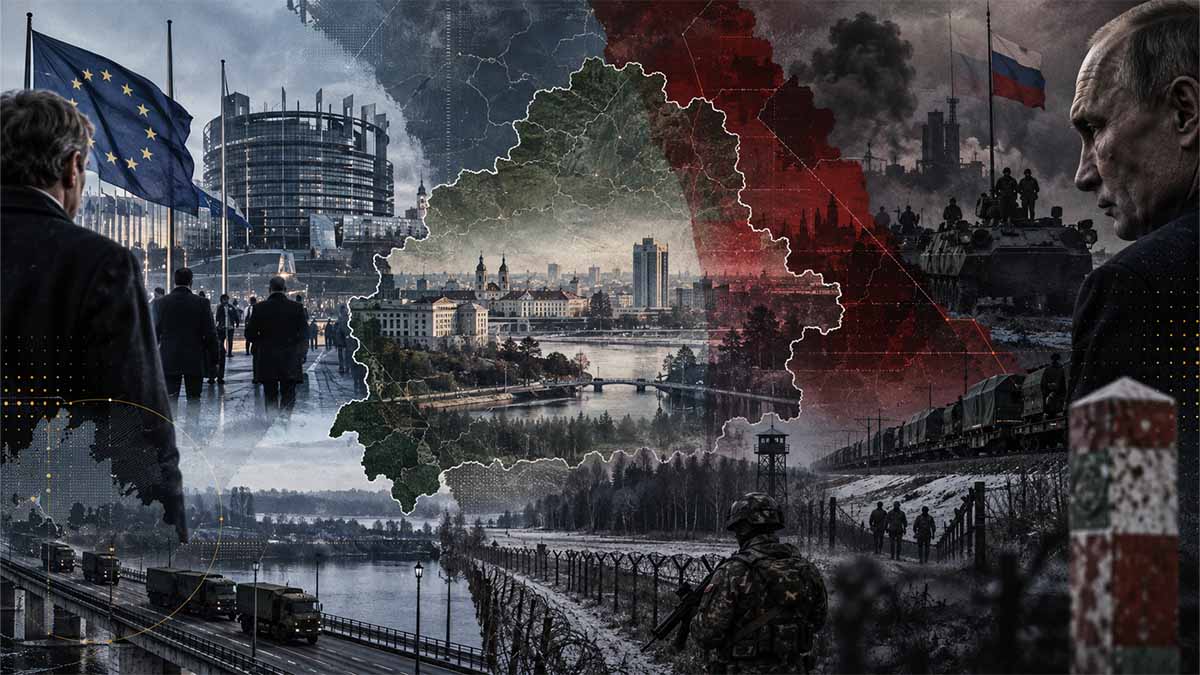
Scope: This assessment examines Belarus as a European security, sanctions, sovereignty, human-rights and geopolitical problem through 14 September 2026, with particular attention to Belarus–Russia integration, the emerging divergence between United States and European policy, the Polish-Belarusian frontier, the political-prisoner question, and the implications for the European Union, Poland, Italy, France, Germany and the United Kingdom over a five-year strategic horizon.
Executive Summary / BLUF
The central judgment is that Belarus has not entered a geopolitical realignment away from Russia, but it has entered a period in which Minsk possesses greater tactical room to transact with Western governments than at any point since the immediate post-2020 rupture, because Washington has selectively relaxed important sanctions while the European Union has maintained and in 2026 further tightened its own regime; this divergence gives Minsk additional bargaining space without reversing the far deeper military, economic and institutional integration already established with Moscow. The current EU restrictive framework remains extensive, covering 310 individuals and 46 entities, with the measures extended until 28 February 2027, while Council Decision (CFSP) 2026/1847 added further restrictions in July 2026 on military-technological items, revenue-generating imports and crypto-asset-related governance. [EU sanctions against Belarus — Council of the European Union — Feb 2026] Official Council source [Statement on Council Decision (CFSP) 2026/1847 — Council of the European Union — Aug 2026] Official Council statement
The United States has nevertheless moved in a materially different direction in selected sectors, because on 26 March 2026 OFAC issued General License 14, rescinded Directive 1 restrictions affecting the Belarusian Ministry of Finance and Development Bank, and removed Belarusian entities including Belaruskalij from the SDN framework; the operative analytical point is therefore not that U.S. sanctions disappeared, because the Belarus sanctions programme remains active, but that Washington demonstrated a willingness to exchange economic relief for changes in Belarusian behaviour that Brussels has not yet replicated at comparable scale. [Belarus Designations Removals; Issuance of Belarus General License; Rescission of Belarus Directive 1 — U.S. Treasury OFAC — Mar 2026] Official OFAC action
This opening exists inside a security structure that is moving in the opposite direction, because Russia and Belarus continued Union State integration in 2026, Russia reported that bilateral trade increased 5.6% in 2025, and President Vladimir Putin stated at the 26 February 2026 Supreme State Council that implementation of the Union State security treaty had begun and that the Russian Oreshnik missile system had entered combat duty in Belarus in December 2025; the resulting configuration sharply limits the credibility of any thesis that Minsk is presently capable of strategic equidistance between Moscow and the West, even though it does not eliminate narrower Belarusian incentives to diversify diplomatic and economic exposure. [Meeting of the Supreme State Council of the Union State — President of Russia — Feb 2026] Official Kremlin record [Union State Council of Ministers meeting — Government of the Russian Federation — Feb 2026] Official Russian Government record
Political-prisoner releases therefore constitute a genuine humanitarian and diplomatic variable but not, on the present evidence, proof of systemic liberalisation, because the European Union welcomed releases while reporting in July that at least 863 political prisoners remained detained, and on 9 August stated that more than 800 people were still arbitrarily held despite releases during the preceding year; the UN Special Rapporteur’s 2026 report, covering 1 April 2025–31 March 2026, consequently remains a central benchmark for assessing whether transactional releases are being accompanied by changes in repression, judicial practice, civic space and the treatment of released detainees. [EU Statement on the recent release of political prisoners in Belarus — EEAS — Jul 2026] Official EU statement [Situation of human rights in Belarus, A/HRC/62/52 — United Nations Human Rights Council — 2026] Official UN record
For Europe, the decision problem is consequently not whether to choose between unconditional normalisation and permanent isolation, but whether it can build a reversible, conditional and measurable engagement architecture that preserves coercive instruments against repression, hybrid activity and Russian military support while exploiting specific areas in which Minsk has incentives that are not perfectly identical to Moscow’s; the decisive risk is that poorly conditioned engagement legitimises repression and subsidises the Union State security structure, while the opposite risk is that complete political and economic disengagement leaves every marginal Belarusian diversification channel to Washington, Moscow, Beijing or other external actors rather than to the European Union.
Europe’s Belarus problem is no longer simply whether to isolate Alexander Lukashenko’s regime, but whether the European Union can exploit the limited room Minsk still has without weakening deterrence or mistaking tactical concessions for strategic realignment. Since 2020, EU policy has been reduced largely to sanctions and restricted political contact after the repression of post-election protests, the instrumentalisation of migration on the Union’s border and Belarus’s role as an operational rear for Russia’s invasion of Ukraine. Yet the dossier records a simultaneous shift in Washington, where the administration of President Donald Trump, back in office since January 2025, has begun easing pressure in exchange for prisoner releases. The contradiction now facing Europe is direct: if it remains passive, it cedes influence to Moscow and Washington; if it moves too fast, it risks rewarding a regime that has not changed its political system.
A sanctions-only policy is becoming a strategic liability
The closed Defence24 Days panel, attended by more than 20 experts from Europe, the United States and Belarus, reached a blunt conclusion: the European Union needs its own long-term policy toward Minsk because passivity is not neutral. The dossier states that current EU policy is still centred on maintaining sanctions while limiting political contacts, even though this has not prevented Belarus from deepening economic and political dependence on Russia. The structural problem is that sanctions constrain Minsk but do not by themselves create a European channel of influence; the vacuum is filled by Moscow, while Washington has started to test a more transactional model. For Brussels, the policy question is therefore no longer whether sanctions work in isolation, but whether they are being used as leverage or merely preserved as a static position.
Washington is buying movement, not transformation
Since President Donald Trump returned to the White House in January 2025, the United States has gradually softened parts of its policy toward Belarus in exchange for successive releases of political prisoners. U.S. Special Envoy John Coale described normalisation as a process moving from “small steps to more confident strides”, while the dossier characterises the broader American approach as ad hoc and transactional rather than the product of a coherent regional strategy. That distinction matters because Washington’s moves have still changed the bargaining environment: Alexander Lukashenko has more room to manoeuvre when the United States and European Union are no longer applying pressure in the same way. Europe can reject the American sequencing, but it cannot ignore the effect, because asymmetry among Western policies increases Minsk’s capacity to trade one channel against another.
Belarus is dependent on Russia, but not identical to Russia
The dossier repeatedly warns against equating Belarus with the Kremlin. Belarus remains authoritarian and deeply dependent on Moscow, but Alexander Lukashenko’s overriding objective is described as regime preservation rather than territorial expansion, and the report argues that Minsk still retains a limited but real margin of independent decision-making. This distinction is visible in prisoner releases, which Belarus has used as an instrument in dealing with the West even while Russia has not adopted comparable gestures toward its own political prisoners. It is also visible in the legal and political distinction the panel drew between Belarus’s role in making its territory available for the Russian invasion of Ukraine and direct participation of Belarusian armed forces in combat. For Europe, the implication is not that Belarus is autonomous, but that Russian control is not total and therefore not every available lever has disappeared.
Poland carries the security cost of European indecision
No European state faces the Belarus question as directly as Poland, which borders Belarus, Russia and Ukraine and has been exposed to the instrumentalisation of migration and wider hybrid pressure. The dossier records a markedly sceptical Polish view: Minsk has no coherent strategy for normalising relations with the West, Poland is not currently perceived by Lukashenko’s regime as a political partner, and gestures such as the release of Andrzej Poczobut should not automatically be read as evidence of a durable change in course. Yet the same report concludes that Poland will sooner or later have to formulate a more active policy toward Belarus because the regional environment, security pressures and the actions of its closest allies will force the issue. For Warsaw, the cost of inaction is therefore not diplomatic irrelevance alone; it is the risk that others define the terms of engagement with a neighbouring state whose choices directly affect Polish security.
Prisoner releases are leverage, not liberalisation
Political prisoners remain the hardest test of any policy of selective engagement because they sit at the intersection of values, domestic legitimacy and diplomatic bargaining. The dossier notes that a record number of Belarusian political prisoners were released during Donald Trump’s second term, but it also insists that the releases should not be treated as proof of permanent political change. Representatives of prisoners’ families and Belarusian democratic circles argued that these releases matter in human terms even when used instrumentally, while also demanding durable mechanisms to protect those released from renewed repression. The policy logic follows directly: Europe should distinguish symbolic gestures from verifiable progress and should convert individual releases into conditional, measurable commitments rather than into broad political rehabilitation.
Economic disengagement is not cost-free
The dossier’s most consequential economic argument is that European withdrawal does not leave Belarus empty; it leaves more space for Russia. Investments, European corporate presence and trade are described as underused instruments of influence, while excessive economic restriction risks narrowing Minsk’s room for manoeuvre and deepening dependence on Moscow. The argument is not for wholesale normalisation, which the panel explicitly judged neither realistic nor desirable, but for selective and conditional economic engagement tied to measurable Belarusian actions. This is where Europe’s current policy is weakest: sanctions create pain, but the dossier suggests they need to be paired with incentives capable of altering behaviour. If every concession is impossible regardless of what Minsk does, then sanctions cease to function as a bargaining instrument and become a fixed condition to which Belarus adapts.
The United Nations preserves pressure when bilateral politics shifts
The report gives the United Nations a role that neither Washington nor Brussels can fully substitute. Special rapporteurs, Human Rights Council resolutions and systematic documentation of abuses keep political prisoners and repression on the international agenda even when the United States becomes more transactional or the European Union concentrates on sanctions. This matters because any future engagement with Minsk will need an external benchmark capable of distinguishing tactical gestures from structural change. The UN does not compel immediate liberalisation, but the dossier argues that it raises the political cost of normalising relations without addressing repression and therefore gives Europe a way to combine dialogue with continuing scrutiny.
The next 12–24 months will decide whether Europe shapes the opening or merely reacts to it
The dossier’s central warning is that the divergence between U.S. and European policy is already widening while Belarus continues to manoeuvre between dependence on Russia and limited engagement with the West. Over the next 12–24 months, the European Union will have to decide whether sanctions remain the entire policy or become one instrument inside a broader strategy combining pressure, conditional dialogue, support for civil society, multilateral monitoring and carefully limited economic incentives. Poland faces the highest immediate cost if Europe misreads Minsk, but it also pays heavily if Europe leaves the field to Washington and Moscow. The dossier’s logic is therefore less about normalisation than sequencing: Europe must define which Belarusian actions trigger which European responses before Alexander Lukashenko concludes that Western division itself is the most valuable concession on offer.
Navigational Index
- Russia–Belarus strategic integration and the residual sovereignty question: the first pillar assesses how far Belarusian room for manoeuvre remains meaningful after the consolidation of Union State security guarantees, Russian military deployments, dense economic integration and Belarusian support for Russia’s war against Ukraine, while distinguishing genuine Belarusian state interests from Russian strategic control rather than assuming complete identity between the two. [Meeting of the Supreme State Council of the Union State — President of Russia — Feb 2026] Official Kremlin record
- Western leverage, sanctions divergence and human-rights conditionality: the second pillar examines the widening difference between U.S. sanctions relief and the EU’s continued restrictive architecture, asking whether political-prisoner releases and selective economic concessions can form the basis of enforceable transactional diplomacy without being misread as political liberalisation. [Belarus Designations Removals — U.S. Treasury OFAC — Mar 2026] Official OFAC record [EU sanctions against Belarus — Council of the European Union — Feb 2026] Official Council framework
- European security exposure and differentiated national interests: the third pillar assesses Poland as the immediate frontier state and then distinguishes the institutional positions and strategic exposure of Italy, France, Germany and the United Kingdom, because geography, sanctions jurisdiction, NATO responsibilities, bilateral diplomatic posture and domestic political constraints make a single undifferentiated concept of “European policy” analytically inadequate.
Master Abstract
The governing judgment: tactical Belarusian manoeuvre inside strategic Russian integration
The available official record supports a distinction that is essential for policy design: Belarus retains state agency, but its strategic freedom is much narrower than its tactical diplomatic freedom, because the latter can be exercised through prisoner releases, sanctions bargaining, diplomatic contact, sector-specific economic concessions and calibrated signalling, whereas the former is constrained by an increasingly institutionalised Russian-Belarusian security and economic architecture. Russia stated in February 2026 that practical implementation of the Union State security treaty was under way and that Oreshnik had entered combat duty in Belarus, while Russian government records simultaneously describe continued industrial, standards, transport and economic integration and reported a 5.6% increase in bilateral trade in 2025; these are not merely political declarations of friendship but observable indicators of deepening institutional interdependence that raise the economic and security cost to Minsk of any large-scale Western reorientation. [Meeting of the Supreme State Council of the Union State — President of Russia — Feb 2026] Official Kremlin record [Meeting of the Union State Council of Ministers — Government of the Russian Federation — Feb 2026] Official Russian Government record
The legal and international baseline likewise remains adverse to a theory of Belarusian neutrality, because United Nations General Assembly resolution A/RES/ES-11/1 explicitly deplored Belarus’s involvement in Russia’s unlawful use of force against Ukraine, while the EU sanctions regime continues to target Belarus not only for domestic repression but also for military support to Russia and hybrid actions affecting EU member states; the Council currently applies financial, trade, technology, transport, services and anti-circumvention measures, including restrictions on dual-use goods, defence technology, selected Belarusian imports, banking relations and transit, so any future European engagement would operate within a dense pre-existing legal architecture rather than through a clean bilateral reset. [Aggression against Ukraine, A/RES/ES-11/1 — United Nations General Assembly — Mar 2022] Official UN resolution [EU sanctions against Belarus — Council of the European Union — Feb 2026] Official Council framework
Washington has created a sanctions asymmetry that Europe cannot ignore
The most consequential diplomatic development during 2025–2026 is not a verified geopolitical “pivot” by Minsk but the creation of a measurable asymmetry in Western sanctions policy, because OFAC’s March 2026 action authorised transactions involving Belinvestbank and additional entities, rescinded Directive 1 restrictions affecting the Belarusian Ministry of Finance and Development Bank, and removed Belaruskalij-related entries from the SDN list, while a further Belarus-related deletion was recorded on 23 July 2026; at the same time the EU moved in the opposite regulatory direction by extending its restrictive measures through February 2027 and adopting additional restrictions in April and July 2026. [Belarus Designations Removals; Issuance of Belarus General License; Rescission of Belarus Directive 1 — U.S. Treasury OFAC — Mar 2026] Official OFAC action [Counter Terrorism Designations; Counter Narcotics Designations; Cuba Designations; Belarus-related Designation Removal — U.S. Treasury OFAC — Jul 2026] Official OFAC action [Council Decision (CFSP) 2026/1847 statement — Council of the European Union — Aug 2026] Official EU statement
This asymmetry changes Minsk’s negotiating environment even if it does not change Belarus’s strategic alignment, because an actor that can obtain selective financial or sectoral relief from one Western capital while facing continued pressure from another gains additional capacity to sequence concessions, test political divisions and seek the cheapest pathway to economic relief; Brussels therefore faces a coordination problem in which unconditional convergence with Washington risks abandoning EU-defined human-rights and security objectives, whereas automatic refusal to exploit any behavioural change risks ceding the initiative to bilateral U.S.-Belarus bargaining that the EU does not control. The appropriate analytical standard is consequently transactional rather than declaratory: every Belarusian concession should be evaluated according to whether it is measurable, durable, reversible only at political cost and connected to a corresponding Western instrument that can itself be rapidly reversed if Minsk fails to comply.
Political-prisoner releases are material evidence, but not yet evidence of systemic change
The release of political prisoners has diplomatic significance because it produces concrete humanitarian outcomes and demonstrates that Minsk is willing to use detention policy within external bargaining, but the official record does not support treating those releases as evidence that the coercive system itself has been dismantled; the EU stated on 8 July 2026 that it welcomed the release of 28 political prisoners while remaining concerned about at least 863 still detained, and on 9 August 2026 stated that more than 800 people remained arbitrarily imprisoned despite multiple releases over the preceding year, while also referring to new arrests, forced departure pressure and continuing repression. [EU Statement on the recent release of political prisoners in Belarus — EEAS — Jul 2026] Official EU statement [Belarus: Statement marking six years since the fraudulent presidential elections — EEAS — Aug 2026] Official EU statement
The United Nations record reinforces this caution, because the Special Rapporteur’s A/HRC/62/52 report covers developments through 31 March 2026, while Human Rights Council special procedures were still addressing allegations in May 2026 involving arbitrary detention, prolonged incommunicado detention, solitary confinement, ill-treatment and fair-trial violations; accordingly, a credible liberalisation indicator would require not merely a falling headline prisoner count but evidence of declining politically motivated prosecutions, reduced re-arrest, restored legal representation, rehabilitation of released detainees, expanded civic and media space, and cooperation with international human-rights mechanisms. [Situation of human rights in Belarus, A/HRC/62/52 — UN Human Rights Council — 2026] Official UN document record [BLR 2/2026 — UN Special Procedures — May 2026] Official OHCHR communication record
The economic constraint is increasingly Russian-centred
Belarus’s economic capacity to rebalance externally has narrowed because post-2022 trade, finance and logistics have been redirected toward Russia and Russia-linked networks, while the World Bank’s April 2026 Macro Poverty Outlook described the economy as increasingly isolated, dependent on Russian demand, Russian logistics and subsidised energy, with 2025 real GDP growth slowing to 1.3% from 4.3% in 2024 and medium-term performance constrained by labour shortages, supply bottlenecks and limited access to global markets; this matters strategically because dependence is transmitted not only through political alignment but through export demand, logistics, payments, energy pricing, industrial cooperation and investment pathways that cannot be rapidly substituted by diplomatic engagement alone. [Macro Poverty Outlook: Belarus — World Bank — Apr 2026] Official World Bank report
The Russian government’s own figures and policy documents are consistent with that direction of integration, reporting 5.6% growth in Russia-Belarus foreign trade during 2025, continued industrial cooperation, work on a Union State product regime and common standardisation mechanisms, and preparation of the next three-year implementation programme for the Union Treaty; because these statements come from an interested party they establish Moscow’s declared policy and reported figures rather than independent verification of every economic outcome, but they nevertheless demonstrate the institutional depth and intended direction of the bilateral integration project. [Meeting of the Union State Council of Ministers — Government of the Russian Federation — Feb 2026] Official Russian Government record [Government meeting following the Supreme State Council — Government of the Russian Federation — Feb 2026] Official Russian Government record
Poland faces the highest immediate operational exposure
Poland’s Belarus policy cannot be treated primarily as a diplomatic question because Warsaw continues to manage a live border-security problem that it attributes to Belarusian pressure, even though the scale of attempted irregular crossings fell sharply during 2026; the Polish Ministry of Interior reported 215 attempted illegal crossings between 1 January and 31 May 2026, 98% fewer than the comparable period of 2025, while the government stated that almost PLN 3 billion had been allocated over two years to border protection and on 31 August 2026 extended the frontier buffer zone through 29 November 2026. [Extension of the buffer zone on the Polish-Belarusian border — Polish Ministry of Interior — Jun 2026] Official Polish government source [Przedłużenie strefy buforowej na granicy polsko-białoruskiej — Polish Ministry of Interior — Aug 2026] Official Polish government source
The decision consequence for Warsaw is that diplomatic experimentation carries much higher domestic and operational costs than it does for more distant EU states, because Poland must reconcile any selective reopening with physical border protection, asylum policy, counter-hybrid measures, protection of the Polish minority, NATO eastern-flank security and the possibility that Minsk may combine tactical cooperation in one area with pressure in another; consequently, a Polish channel to Minsk would be more sustainable if built around narrow measurable transactions rather than a politically branded “normalisation”, because the latter would be vulnerable to immediate reversal after any renewed migration, airspace or security incident. The EU itself formally broadened its Belarus sanctions criteria in December 2025 to cover hybrid activities affecting member states, including migrant instrumentalisation, foreign information manipulation, critical-infrastructure disruption and other destabilising conduct, which provides the institutional basis for keeping border behaviour within the same conditionality framework as political repression and Russian military support. [Belarus: Council broadens scope of sanctions regime to cover hybrid activities against EU member states — Council of the European Union — Dec 2025] Official Council decision summary
France sees room for movement, but only within continued political conditionality
France’s official record is among the clearest in acknowledging simultaneously that prisoner releases matter and that they do not by themselves resolve the political problem, because Paris welcomed the release of 123 prisoners in December 2025, explicitly credited U.S. mediation, and called on the Belarusian authorities to continue the process by ending politically motivated imprisonment, respecting fundamental rights and opening dialogue with Belarusian society; an updated French country assessment published on 5 August 2026 additionally states that more than 500 political prisoners had been pardoned since July 2024 while repression continued, and records the recent U.S.-Belarus dialogue alongside deep Russian-Belarusian strategic, military, economic, customs and financial ties. [Biélorussie – Libération de prisonniers — French Ministry for Europe and Foreign Affairs — Dec 2025] Official French statement [Biélorussie – Présentation de la Biélorussie — French Ministry for Europe and Foreign Affairs — Aug 2026] Official French country assessment
For France, the practical policy space therefore lies in designing European conditionality rather than choosing between isolation and recognition, because Paris retains an interest in EU strategic autonomy, European sanctions coherence, human-rights protection and the broader containment of Russian strategic reach; a French-supported opening would consequently be most defensible if structured around staged measures tied to specific Belarusian performance, with automatic suspension clauses and no relaxation affecting military, dual-use, sanctions-circumvention or Russian-support channels until the underlying security behaviour changes.
Germany remains institutionally sceptical of political normalisation
Germany’s Foreign Office continued in March 2026 to state that Germany and the European Union do not recognise the 2020 or 2025 elections and described the Belarusian political system as highly presidential, repressive toward civil society and independent media, while reporting more than 1,100 political prisoners as of February 2026; the numerical difference between that February figure and lower counts reported by EU institutions later in the year is temporally compatible with subsequent releases and should not be interpreted as a definitional reconciliation without a common dataset, but the German position nevertheless demonstrates that Berlin’s baseline remains centred on legitimacy, repression and institutional conditions rather than on geopolitical bargaining alone. [Belarus: Politisches Porträt — German Federal Foreign Office — Mar 2026] Official German Foreign Office assessment
Germany’s policy importance is disproportionate to its distance from the Belarusian border because German economic weight, sanctions implementation capacity and central role in EU decision-making make Berlin indispensable to any meaningful change in European economic policy toward Minsk; accordingly, an EU strategy that cannot satisfy German evidentiary requirements on political prisoners, repression and Russian military support would be unlikely to produce durable sanctions modification, while a narrowly transactional humanitarian channel is considerably more plausible than broad political rehabilitation under present conditions.
The United Kingdom remains closer to sustained pressure than to sanctions détente
The United Kingdom is institutionally separate from EU sanctions law and therefore provides an important test of whether Western policy divergence extends beyond the United States, but the official British record through mid-2026 indicates continued emphasis on pressure rather than relaxation; Prime Minister Keir Starmer met Sviatlana Tsikhanouskaya on 3 June 2026, condemned continuing repression and detention, and explicitly reiterated support for sanctions, while the UK’s Belarus sanctions guidance, updated on 1 May 2026, retains financial, trade, transport, immigration and director-disqualification measures directed at repression, human-rights violations and Belarusian support for actions destabilising Ukraine. [PM meeting with the leader of the Belarusian opposition — UK Prime Minister’s Office — Jun 2026] Official UK government statement [Republic of Belarus sanctions: statutory guidance — UK Government — May 2026] Official UK sanctions guidance
London therefore presently sits closer to the EU than to Washington on the coercive side of the policy spectrum, which means that any European engagement strategy must anticipate a broader transatlantic coordination geometry than a simple EU-versus-U.S. divide; the UK can support humanitarian bargaining and prisoner-release diplomacy while independently preserving sanctions, and its non-EU jurisdiction also means that sanctions relief granted in Brussels would not automatically reproduce equivalent legal effects in London.
Italy’s leverage is primarily European and alliance-based rather than bilateral
Italy’s current publicly retrievable official record does not establish a distinct 2026 bilateral strategy of political reopening toward Minsk comparable to the documented U.S. channel, while Rome continues to operate within the binding EU sanctions framework and publicly links Belarus to Russian aggression; in February 2026 the Italian government objected to the full symbolic participation of Russian and Belarusian athletes at the Milano Cortina Paralympics and explicitly described Belarus as supporting Russia, which, although not itself a foreign-policy strategy document, is consistent with the broader EU and G7 position rather than with a separate Italian accommodation policy. [Tajani-Abodi: Governo contrario decisione Comitato paralimpico internazionale sulla Russia — Italian Ministry of Foreign Affairs — Feb 2026] Official Italian government statement [EU sanctions against Belarus — Council of the European Union — Feb 2026] Official EU framework binding on Italy
For Italy, the most realistic policy contribution is therefore likely to be made through EU sanctions calibration, diplomatic coalition-building, economic due diligence, NATO deterrence and support for conditional humanitarian engagement rather than through autonomous bilateral leverage, because Italy lacks Poland’s geographic exposure, France’s more visible political positioning on recent releases and the United Kingdom’s independent sanctions jurisdiction; this makes Rome potentially useful as a coalition broker if the European debate moves toward reversible engagement, but the current official record does not justify attributing such a strategy to the Italian government today.
Key Evidence Table
| Indicator | Value/status | Reference date | Definition/scope | Issuer | Exact source |
|---|---|---|---|---|---|
| EU Belarus sanctions | 310 individuals; 46 entities; extended to 28 Feb 2027 | 26 Feb 2026 baseline | EU restrictive measures linked to repression, Russian-war support and hybrid activity | Council of the EU | [EU sanctions against Belarus] Council of the EU |
| Additional EU restrictions | Council Decision (CFSP) 2026/1847 | 23 Jul 2026 | Military/technology goods, revenue-generating imports, crypto-related governance and derogations | Council of the EU | [Statement on Council Decision (CFSP) 2026/1847] Council of the EU |
| U.S. sanctions easing | General License 14; Directive 1 rescinded; multiple SDN removals | 26 Mar 2026 | Selected Belarusian financial and corporate restrictions | U.S. Treasury OFAC | [Belarus Designations Removals; Issuance of Belarus General License; Rescission of Belarus Directive 1] OFAC |
| Remaining political prisoners | At least 863 according to the figure cited by the EU | 8 Jul 2026 | Persons described by EU statement as political prisoners | EEAS | [EU Statement on the recent release of political prisoners in Belarus] EEAS |
| Belarus–Russia trade | +5.6% in 2025, Russian government report | 2 Feb 2026 publication | Bilateral foreign trade, Russian official figure | Government of Russia | [Union State Council of Ministers meeting] Russian Government |
| Oreshnik deployment | Russian President stated system entered combat duty in Belarus in Dec 2025 | 26 Feb 2026 | Russian official assertion concerning deployment status | President of Russia | [Meeting of the Supreme State Council of the Union State] Kremlin official record |
| Polish border pressure | 215 attempts, Jan–May 2026; 98% below comparable 2025 period | 3 Jun 2026 | Attempts to cross Polish-Belarusian border illegally | Polish Interior Ministry | [Extension of the buffer zone on the Polish-Belarusian border] Gov.pl |
| Belarus GDP growth | 1.3% in 2025 versus 4.3% in 2024 | Apr 2026 outlook | Real GDP growth; World Bank assessment using official and modelled data | World Bank | [Macro Poverty Outlook: Belarus] World Bank |
Principal Gaps and Watch Indicators
The first decisive gap concerns the terms and durability of U.S.-Belarus bargaining, because public OFAC actions establish what sanctions were modified but do not fully establish every political understanding attached to those actions; the assessment would change materially if official U.S. or Belarusian records disclosed binding sequencing arrangements linking future sanctions relief to political-prisoner releases, diplomatic representation, Russian military activity or wider economic concessions, particularly if such arrangements contained measurable benchmarks rather than discretionary political understandings. [Belarus Sanctions — OFAC — current through Jul 2026] Official OFAC programme page
The second watch indicator is whether the prisoner-release process changes the stock and reproduction mechanism of repression rather than merely the stock of detainees, because a sustainable downward trend in politically motivated prosecutions, re-arrest, incommunicado detention, forced exile and administrative harassment would support the interpretation that Minsk is modifying internal practice, whereas continued arrests alongside episodic releases would support the narrower interpretation of prisoner diplomacy as a transactional instrument. [Situation of human rights in Belarus, A/HRC/62/52 — UN Human Rights Council — 2026] Official UN record [EU Statement on recent release of political prisoners — EEAS — Jul 2026] Official EU statement
The third indicator is the military implementation trajectory of the Union State security architecture, particularly operational status, exercise patterns, command integration, additional Russian force deployments, nuclear-related arrangements and the permanence of Oreshnik basing, because further integration in these areas would reduce the strategic significance of diplomatic rapprochement even if economic and humanitarian ties with the West improved. [Meeting of the Supreme State Council of the Union State — President of Russia — Feb 2026] Official Kremlin record
The fourth indicator is the Polish, Lithuanian and Latvian border-security environment, because sustained reductions in migrant instrumentalisation, airspace violations and other hybrid activity would create political space for selective EU engagement, whereas renewed incidents would strengthen the argument that Minsk continues to treat coercive pressure and diplomatic accommodation as parallel instruments rather than alternatives; Poland’s continued buffer-zone extension through late November 2026 shows that Warsaw has not yet treated the reduced crossing numbers as sufficient evidence that the underlying security problem has disappeared. [Przedłużenie strefy buforowej na granicy polsko-białoruskiej — Polish Ministry of Interior — Aug 2026] Official Polish source [Statement on Belarus’ hybrid actions at the EU external border — Council of the EU — Oct 2025] Official Council statement
The fifth indicator concerns Belarusian economic diversification outside Russia, because meaningful changes in export geography, payment infrastructure, transport routes, external borrowing, industrial inputs and investment would provide harder evidence of regained autonomy than diplomatic rhetoric alone; the present World Bank assessment instead describes increasing isolation and reliance on Russia, so any claimed Belarusian strategic opening should be tested first against these economic variables rather than against summit language or prisoner diplomacy. [Macro Poverty Outlook: Belarus — World Bank — Apr 2026] Official World Bank report
Decision Implication
The evidence supports a European policy architecture built around conditional differentiation rather than either strategic normalisation or strategic abandonment, because Belarus is sufficiently integrated with Russia that Western policy cannot plausibly “extract” Minsk from Moscow through concessions at acceptable short-term cost, but sufficiently state-driven that selective Belarusian interests can still diverge from Russian preferences in areas where regime security, market access, diplomatic recognition, financing, transit or sanctions relief are involved; the objective of policy should therefore be to preserve and enlarge those areas of non-identical interest without financing capabilities that strengthen Russian military power, weakening accountability for repression or conceding strategic recognition before measurable changes occur.
A workable European structure would consequently require separate negotiating tracks for humanitarian releases and rehabilitation, border and hybrid-security behaviour, diplomatic channels, civilian connectivity and information access, economic sanctions, and military/dual-use restrictions, because bundling every issue into one all-or-nothing settlement gives Minsk an incentive to demand disproportionate sanctions relief for reversible gestures; economic or diplomatic concessions should be reversible and tied to observable performance, while military technology, dual-use goods, sanctions-circumvention mechanisms and support relevant to Russian operations should remain in a much harder category until the corresponding security facts change. Council Decision (CFSP) 2026/1847 already demonstrates that the EU can differentiate even within sanctions policy by tightening military and revenue restrictions while preserving derogations necessary for public internet infrastructure, providing an institutional precedent for more granular conditionality. [Statement on Council Decision (CFSP) 2026/1847 — Council of the European Union — Aug 2026] Official Council source
For Poland, the threshold for engagement should remain higher because the country absorbs immediate border and security externalities; for France and Germany, the principal challenge is designing a common EU conditionality system capable of surviving domestic and institutional scrutiny; for Italy, influence is more likely to operate through EU coalition formation, sanctions implementation and NATO policy than through bilateral leverage; and for the United Kingdom, the continuing independent sanctions regime means that European policy coordination will remain incomplete unless London is incorporated into any wider sanctions-for-behaviour framework alongside Washington and Brussels.
The five-year judgment is therefore that Belarus is more likely to remain a militarily anchored Russian ally seeking selective Western economic and diplomatic optionality than to become either fully absorbed by Russia or strategically rebalanced toward Europe, although numerical probabilities are not assigned because the official record does not provide a defensible base rate or quantitative forecasting model; the assessment would strengthen toward greater Belarusian autonomy only if economic diversification, reduced Russian military integration, durable domestic de-repression and sustained cessation of hybrid pressure moved together, whereas progress on only one of those dimensions should be treated as tactical rather than strategic change.
Belarus Between Russia and the West: Europe’s Shrinking Strategic Room for Influence
BLUF (Bottom Line Up Front): Belarus has not entered a systemic geopolitical pivot away from the Russian Federation; rather, Minsk has secured tactical room to transact with Western capitals following selective United States sanctions relief (OFAC GL 14, Directive 1 rescission, and Belaruskalij SDN de-listings in March 2026). In stark contrast, the European Union has extended sanctions through 28 February 2027 and introduced additional curbs via Council Decision (CFSP) 2026/1847. This divergence expands Lukashenka’s transactional leverage without unraveling deep Union State military, logistical, and economic integration with Moscow—symbolized by the December 2025 combat deployment of Russia’s Oreshnik missile system in Belarus.
Relative Metric Pressure & Structural Realignment Indicators
Normalized comparative assessment index (0–100 Scale) across strategic axesTransatlantic Sanctions Divergence: U.S. Transactionalism vs. EU Normative Rigidity
Operational Vectors
On 26 March 2026, U.S. OFAC issued General License 14, rescinded Directive 1 restrictions on the Ministry of Finance and Development Bank, and removed key entities (e.g. Belaruskalij) from the SDN List. Conversely, EU restrictive measures cover 310 individuals and 46 entities through 28 February 2027, with Council Decision (CFSP) 2026/1847 adding further import and military-tech restrictions.
Strategic Impediments
Brussels faces an acute coordination trap: automatic convergence with Washington’s unilateral relief would abandon core European human rights criteria, while complete institutional inertia forfeits tactical diplomatic leverage to Washington, Beijing, or direct Moscow intermediaries.
Audit Verification
A calibrated transactional standard requires enforceable ‘snap-back’ mechanisms. Relief must be granted strictly via temporary derogations linked to monitored performance indicators rather than permanent statutory de-listings.
Primary Audited Evidence Matrix: Official Empirical Baselines
De jure statutory measures, military dispositions, economic indicators, and human-rights tracking (through Sep 2026)| Indicator / Subsystem | Empirical Value / Status | Reference Date | Statutory Scope / Operational Definition | Issuing Authority | Primary Source Baseline |
|---|---|---|---|---|---|
| EU Belarus Sanctions Regime | 310 Indiv. / 46 Entities | Extended to 28 Feb 2027 | Restrictive measures tied to severe internal repression, Russian war facilitation, and border hybrid attacks. | Council of the EU | EU sanctions against Belarus (Feb 2026) |
| Additional EU Trade & Tech Curbs | CFSP 2026/1847 Active | 23 July 2026 | Tightened dual-use/tech exports, import bans on revenue goods, and crypto-asset governance (preserving internet public derogations). | Council of the EU | Statement on Council Decision 2026/1847 (Aug 2026) |
| U.S. OFAC Easing & De-listings | GL 14; Directive 1 Rescinded | 26 March 2026 / 23 Jul 2026 | Authorized Belinvestbank transactions; rescinded financial debt curbs on MinFin/DevBank; deleted Belaruskalij from SDN list. | U.S. Treasury (OFAC) | OFAC Belarus Program Updates (Mar/Jul 2026) |
| Oreshnik IRBM Basing | Combat Duty Active | Deployment Dec 2025 (Confirmed Feb 2026) | Operational stationing of intermediate-range ballistic missile complex under Union State bilateral defense treaty. | President of the Russian Federation | Supreme State Council Address (Feb 2026) |
| Documented Political Detainees | > 800 (At least 863) | 8 July 2026 / 9 August 2026 | Total recognized political prisoners detained arbitrarily, despite piecemeal releases (28 in July; >500 pardons since mid-2024). | EEAS / UN HRC Special Rapporteur | EEAS Official Statements; UN Doc A/HRC/62/52 |
| Poland Border Infiltration Vector | 215 Attempted Crossings (-98%) | Jan–May 2026 (Audited Jun 2026) | Irregular border breach attempts dropped 98% YoY; buffer zone extended to 29 Nov 2026; PLN 3B allocated over 2 years. | Polish Ministry of the Interior | Gov.pl Border Security Briefings (Jun/Aug 2026) |
| Bilateral Russia-Belarus Trade | +5.6% YoY Growth | 2025 Reported (Feb 2026 Session) | Denser economic interlock via common industrial standards, logistics channeling, and unified state product regimes. | Government of the Russian Federation | Union State Council of Ministers Record (Feb 2026) |
| Belarus Macroeconomic Expansion | 1.3% Real GDP (from 4.3%) | April 2026 Economic Outlook | Substantial deceleration; acute labor deficits, production bottlenecks, structural isolation, and total dependence on Russian subsidies. | World Bank | Macro Poverty Outlook: Belarus (Apr 2026) |
Differentiated European National Postures & Institutional Profiles
Comparative breakdown across key European actors: exposure, posture, and operational limitsFrontier Security Anchor: Absorbs direct operational externalities (hybrid migration, border militarization). Despite a 98% drop in irregular border crossings, Warsaw maintains its buffer zone through late Nov 2026. Prioritizes deterrence, eastern-flank territorial defense, and protection of the Polish minority over diplomatic experimentation.
Conditional Transactionalism: Acknowledged U.S. mediation that freed 123 prisoners in Dec 2025 and recognized over 500 pardons since July 2024. Advocates staged, reversible diplomacy anchored in European strategic autonomy, strictly ring-fencing military and dual-use sanctions from concessions.
Institutional Rigor: Foreign Office baseline firmly rejects the democratic legitimacy of the 2020 and 2025 elections. Sceptical of geopolitical concessions without structural de-repression, civic rehabilitation, and verifiable disengagement from Russia’s war logistics.
Extraterritorial Alignment: Operates outside EU sanctions jurisdiction; Starmer reaffirmed strict sanctions and opposition backing in June 2026. Statutory guidance updated May 2026 maintains robust financial, transport, and trade bans, mirroring coercive EU posture rather than U.S. easing.
Alliance Consensus: Lacks autonomous bilateral transaction channels with Minsk; operates strictly within the EU framework, NATO deterrence, and G7 sanctions execution. Useful as a consensus broker for reversible engagement rather than an independent diplomatic driver.
Forensic Strategic Key Judgments: Five-Year Horizon (2026–2031)
Definitive analytic deductions derived from documented empirical indicatorsTactical Agency vs Strategic Lock-In
Belarus exercises genuine tactical manoeuvring via prisoner releases and sanctions bargaining, but its strategic trajectory is locked into Moscow’s orbit. Deepening Union State integration and Russian military stationing eliminate strategic equidistance.
Transatlantic Sanctions Fracture
The divergence between U.S. sectoral de-listings (OFAC GL 14) and extended EU restrictive regimes (CFSP 2026/1847) grants Minsk leverage to arbitrate between Western capitals, testing Western consensus and seeking sanctions relief at the lowest political cost.
Hostage Diplomacy is Non-Systemic
Documented pardons reflect calibrated diplomatic transactions rather than systemic judicial reform. With over 800 political prisoners still held and repressive legal machinery intact, releases do not signal domestic political liberalisation.
Irreversible Military Subjugation
The deployment of the Oreshnik IRBM complex and the formal execution of the Union State mutual security treaty firmly tether Belarusian territory to Russian deterrence architecture, regardless of civilian diplomatic shifts.
Structural Economic Vulnerability
Economic growth decelerating to 1.3% underscores acute dependence on Russian logistics, subsidized energy, and demand. Minsk cannot achieve meaningful external rebalancing through diplomatic outreach alone without sustained capital access.
Requirement for Staged Conditionality
Europe cannot rely on binary choices of total isolation or unconditioned normalization. The sustainable strategic posture requires unbundled, reversible engagement with automatic snap-backs, strictly separating humanitarian dialogue from dual-use trade relief.
Open Official Record Gaps (Analytic Limits)
- Classified U.S.–Belarus Quid Pro Quo: Public OFAC actions document what sanctions were eased, but not the exact political sequencing or private assurances agreed between Washington and Minsk.
- Net Detention Flows: While releases are highlighted diplomatically, complete internal tracking of new arbitrary detentions and repeat arrests remains shielded by state secrecy.
- Oreshnik Command Authority: Ambiguity persists regarding the precise operational command and control protocols governing nuclear-capable IRBM systems on Belarusian soil.
- Sanctions Evasion Channels: The exact share of dual-use imports re-exported to the Russian defense-industrial complex via Belarusian customs remains difficult to audit precisely.
Observable Watch Indicators (Strategic Triggers)
Russia–Belarus strategic integration and the residual sovereignty question
Principal judgment
Belarus remains a sovereign state in formal international law and continues to possess meaningful control over its domestic institutions, armed forces, diplomatic sequencing and selected external economic relations, but the strategic content of that sovereignty has narrowed materially since 2020 and especially since Russia’s full-scale invasion of Ukraine, because security guarantees, Russian military deployments, nuclear deterrence arrangements, industrial integration, financial insulation, common standards and coordinated foreign-policy mechanisms increasingly bind Minsk to a Russian-centred security and economic system whose costs of exit are substantially higher than they were before the war. The strongest conclusion permitted by the official record is therefore neither that Belarus has become a Russian province nor that Alexander Lukashenko retains the pre-2020 capacity to balance Moscow against the European Union, because the present structure is better characterised as asymmetric allied integration in which Belarus retains tactical agency inside a progressively constrained strategic perimeter, while Russia possesses far greater military, economic and escalation resources and therefore exercises disproportionate influence over the boundaries within which Belarusian autonomy can be exercised. The Treaty on Security Guarantees within the Union State, which entered into force on 13 March 2025, is particularly important because it transformed previously extensive military cooperation into a more explicit mutual-defence architecture whose operative provisions encompass threats to sovereignty and constitutional order, possible Russian military facilities and formations on Belarusian territory, and Russian nuclear deterrence in defence of Belarus. Official publication record: Treaty between the Russian Federation and the Republic of Belarus on Security Guarantees within the Union State — 13 Mar 2025
This distinction between tactical autonomy and strategic dependence is critical for European policy because the capacity of Minsk to negotiate prisoner releases, restore selected diplomatic contacts, bargain over sanctions or diversify limited parts of its commercial relationships does not establish an equivalent capacity to reverse Russian force deployments, dismantle the integrated defence architecture, abandon the Union State economic framework or rapidly replace Russian markets, energy and financial infrastructure; conversely, the depth of Russian leverage does not demonstrate that every Belarusian decision is dictated from Moscow, because the bilateral architecture itself continues to operate through treaties, presidential decisions, Belarusian state organs and negotiated implementation mechanisms rather than through formal Russian annexation or replacement of Belarusian constitutional institutions. The February 2026 Supreme State Council illustrates this dual reality particularly clearly, because Vladimir Putin described implementation of the security treaty, Oreshnik deployment and foreign-policy coordination as common Union State projects while simultaneously framing the relationship as one between two allied states whose sovereignty, independence, constitutional order and borders are objects of treaty protection. Meeting of the Supreme State Council of the Union State — President of Russia — 26 Feb 2026
From political union to an integrated security architecture
The Union State was originally constructed around a much wider political and economic integration project, but the security dimension has become considerably more consequential since 2022 because Russia’s war against Ukraine, NATO reinforcement on the eastern flank, Belarusian dependence on Moscow after the 2020 political crisis and the intensification of Western sanctions have progressively transformed the bilateral relationship from a predominantly integration-management framework into an increasingly explicit combined security system, within which military defence, external threat perception, sanctions resistance, industrial policy and diplomatic coordination are treated as interconnected rather than separate policy domains. The Russian government stated in February 2026 that implementation of the Union State treaty provisions had created a comprehensive legal framework for economic integration, while the Supreme State Council simultaneously treated security cooperation, common foreign-policy positions and economic integration as mutually reinforcing components of the same strategic relationship; this institutional convergence matters because dependence becomes more difficult to reverse when it is embedded not in a single military agreement but across defence, industry, finance, standards, energy, transport and foreign-policy institutions at the same time. Union State Council of Ministers meeting — Government of the Russian Federation — 2 Feb 2026 Supreme State Council of the Union State — President of Russia — 26 Feb 2026
The decisive development was the entry into force of the Treaty between the Russian Federation and the Republic of Belarus on Security Guarantees within the Union State, signed on 6 December 2024 and brought into force following the exchange of ratification instruments on 13 March 2025, because the treaty does more than restate political solidarity and instead codifies mutual security obligations in a form that explicitly connects an attack on either state with the security of the Union State as a whole. Russian official statements accompanying ratification described the treaty as providing for the defence of both states using “all available forces and means,” while the official legal publication records its ratification through Russian Federal Law No. 12-FZ of 28 February 2025 and its subsequent entry into force; the wording therefore creates an institutional basis for Russian military involvement in circumstances defined not only by a conventional attack but by threats interpreted through the broader Union State security framework. Federal Law No. 12-FZ ratifying the Treaty on Security Guarantees — Official Russian legal publication — 28 Feb 2025 Russia–Belarus talks following entry into force of the security treaty — President of Russia — Mar 2025
The significance for Belarusian sovereignty lies not merely in the existence of a mutual-defence obligation but in the scope of the protected interests and permitted instruments, because the treaty framework covers sovereignty, independence, constitutional order, territorial integrity and the external frontier of the Union State and allows military, military-technical and other assistance after consultation between the parties; it additionally permits, through separate agreements, the establishment of Russian military or other facilities and the stationing of Russian formations on Belarusian territory, thereby providing a standing legal pathway through which Russian force presence can be expanded without requiring a new conceptual security doctrine each time. This does not legally extinguish Belarusian consent, because deployment still proceeds through inter-state arrangements and Belarusian participation in the treaty architecture, but it materially lowers the institutional distance between a Belarusian security crisis and Russian military involvement, which is particularly consequential where the treaty language extends protection to the constitutional order rather than only to internationally recognised territorial defence. Official Russian publication record of the Treaty on Security Guarantees within the Union State
Nuclear deterrence changes the meaning of Belarusian dependence
The nuclear dimension makes the contemporary relationship qualitatively different from an ordinary alliance between unequal states because Russian nuclear weapons are now explicitly integrated into the security guarantees extended to Belarus, while Russian officials have confirmed the presence of Russian tactical nuclear weapons on Belarusian territory and have connected those deployments with the defence of the Union State’s western perimeter; the treaty framework itself states that Russian nuclear weapons are regarded as an instrument of deterrence protecting both parties and provides for their possible use in response to nuclear or other weapons-of-mass-destruction attacks against either party and under specified conditions involving conventional aggression threatening sovereignty or territorial integrity. Russian official statements must be treated as statements by a party to the arrangement rather than independent verification of operational readiness or warhead numbers, but the existence of the treaty provisions and the public acknowledgement of the deployment establish that Belarus has entered a Russian nuclear-deterrence architecture that cannot plausibly be treated as a peripheral or symbolic component of bilateral relations. Russia–Belarus talks and security arrangements — President of Russia — Mar 2025 Russian submission to the 2026 NPT Review Conference concerning Belarus and nuclear deterrence — United Nations
The sovereignty implication is asymmetric because Belarus gains protection but does not acquire equivalent nuclear decision-making power, while Russia retains the nuclear arsenal, escalation infrastructure and ultimate strategic capability that underpins the guarantee; although bilateral arrangements determine how nuclear weapons positioned for Belarus’s defence are treated, the deterrent remains Russian and therefore embeds a core component of Belarusian national survival inside a capability controlled by another state. This configuration can increase Minsk’s security against external coercion while simultaneously reducing its freedom to pursue a foreign policy that fundamentally diverges from Moscow on questions affecting the nuclear and military posture, because a state cannot easily separate itself diplomatically from the power that supplies and controls the strategic deterrent on which its formal security architecture increasingly depends. Russia’s 2026 submission to the NPT review process explicitly presents the Union State treaty as the legal framework through which Russia strengthened nuclear guarantees to Belarus, demonstrating that Moscow itself understands the arrangement as an extension of Russian strategic deterrence rather than merely as local force protection. NPT/CONF.2026/14 — Russian Federation submission to the 2026 NPT Review Conference — United Nations
Oreshnik adds a further strategic layer
The reported deployment of the Oreshnik missile system adds another strategic layer because President Putin stated at the Supreme State Council meeting on 26 February 2026 that the system had entered combat duty in Belarus in December 2025, while earlier Russian statements had linked Oreshnik, tactical nuclear weapons, regular exercises and the joint grouping of forces to the defence of the Union State; the precise operational configuration, warhead allocation, targeting doctrine and Belarusian command role are not publicly established by independently verifiable first-order records, which requires analytical restraint, but the official Russian claim of combat-duty status is itself strategically important because it indicates that Moscow publicly regards Belarusian territory as part of the operational basing structure for one of Russia’s newest long-range strike systems. Meeting of the Supreme State Council of the Union State — President of Russia — 26 Feb 2026 Russian presidential statements on Oreshnik, tactical nuclear weapons and the Union State force grouping — Dec 2025
For Belarus, hosting such systems increases both strategic relevance and strategic exposure because Belarus becomes more valuable to Russian deterrence and force-posture planning while simultaneously becoming more deeply implicated in escalation dynamics that it cannot control independently at every level; this is an important distinction from ordinary dependence, because Minsk can derive bargaining value, security guarantees and regime protection from hosting Russian strategic capabilities while still accepting a reduction in freedom of manoeuvre that results from becoming part of Moscow’s broader deterrence architecture. The evidence therefore supports describing the relationship as reciprocal but profoundly unequal, because Russia obtains geographic depth, forward basing opportunities and a more integrated western defence zone, whereas Belarus receives military guarantees and political-security insurance that would be extraordinarily expensive, and probably impossible, to replace rapidly through alternative partners under present geopolitical conditions. Supreme State Council of the Union State — President of Russia — Feb 2026
The Regional Group of Forces reduces the distinction between national and Union State defence
Military integration extends beyond strategic weapons because Russia and Belarus maintain a Regional Group of Forces, conduct regular exercises and coordinate through their defence ministries, while Russian official statements describe the western frontiers of Russia and Belarus as part of a unified defensive space; during the March 2025 bilateral discussions following the entry into force of the security treaty, Moscow publicly stated that a joint regional grouping had been deployed in Belarus alongside advanced Russian defence systems and tactical nuclear weapons, and Putin subsequently described the two countries’ defence ministries as maintaining very close cooperation. These statements do not establish that Belarusian forces have been subsumed into the Russian chain of command in peacetime, and the official record examined here does not support such a claim, but they do show that operational planning increasingly assumes interoperability, combined force structures and common threat perception rather than two completely separate national military postures. Russia–Belarus talks following entry into force of the security treaty — President of Russia — Mar 2025 Russian presidential remarks on Russia–Belarus military cooperation — Dec 2025
This architecture places a practical constraint on Belarusian strategic autonomy because defence planning, basing, escalation management and military infrastructure increasingly operate within a system whose most powerful assets are Russian, while the geographic logic of Belarus as the western forward space of the Union State connects Belarusian territory directly with Russian planning toward NATO’s eastern members and Ukraine; the result is that a future Belarusian attempt to move sharply toward military neutrality would require more than a political declaration, because it would necessitate renegotiating treaty obligations, Russian deployments, command arrangements, infrastructure usage, nuclear guarantees and the entire structure of combined force planning. Consequently, residual sovereignty should not be measured solely by whether Lukashenko can refuse a discrete Russian request, because the more consequential measure is the institutional cost of changing the strategic orientation of the Belarusian state, and that cost has risen substantially as the defence relationship has been formalised and operationalised. Treaty on Security Guarantees official publication record — Russian legal information portal Supreme State Council of the Union State — President of Russia — Feb 2026
Belarus’s role in the war against Ukraine establishes the practical boundary of neutrality
The clearest evidence that Belarusian territory has already been integrated into Russian war-making is the internationally documented role Belarus played in Russia’s aggression against Ukraine, because United Nations General Assembly Resolution A/RES/ES-11/1, adopted on 2 March 2022, explicitly deplored Belarus’s involvement in Russia’s unlawful use of force against Ukraine, while the European Union continues to maintain sanctions specifically linked to Belarusian involvement in Russia’s aggression and in 2026 further expanded restrictions targeting goods, technology, industrial capacities and services that could contribute to Belarus’s military or technological enhancement. These records establish a materially stronger proposition than political alignment alone: Belarus enabled Russian military operations to a degree that international institutions treated as involvement in the aggression, even though the official evidence cited here does not justify collapsing Belarus and Russia into a single belligerent actor or asserting that Belarusian regular forces have participated in combat on the same basis as Russian forces. A/RES/ES-11/1, Aggression against Ukraine — United Nations General Assembly — 2 Mar 2022 EU restrictive measures concerning Belarusian involvement in Russian aggression — Council of the EU — May 2026
The analytical importance of this distinction is considerable because Belarus’s behaviour since 2022 demonstrates that Minsk can avoid certain forms of direct military participation while still providing strategically valuable support to Moscow, meaning that residual autonomy exists but operates below the threshold of strategic rupture; avoiding full deployment of Belarusian armed forces into sustained offensive combat, where such non-deployment continues, represents a meaningful Belarusian interest in limiting domestic and military costs, but allowing Russian use of territory, hosting strategic systems, deepening defence integration and supporting the Union State security concept demonstrate that Minsk has not translated that caution into strategic neutrality. The observable pattern therefore supports the interpretation that Lukashenko seeks to maximise regime security and minimise uniquely Belarusian costs while remaining inside the Russian strategic system, rather than attempting a genuine geopolitical balancing policy comparable with earlier periods of selective engagement with Europe. EU sanctions framework concerning Belarus and Russian aggression — Council of the European Union
Economic integration creates structural rather than merely political dependence
The military relationship cannot be understood separately from the economic one because the Union State has progressively created a common economic environment designed to reduce barriers, protect bilateral trade from external sanctions and build technological self-sufficiency through coordinated industrial policy; according to the Russian government, bilateral foreign trade increased by 5.6% in 2025, trade in services expanded even more rapidly, and the two governments moved forward in 2026 with proposals for a formal Union State product, a Union State Committee for Standardisation and Quality, industrial cooperation programmes and a new implementation programme for the Union Treaty. These are official Russian figures and policy descriptions and must therefore be treated as Moscow’s record of bilateral integration rather than as independent statistical verification of every claimed benefit, but they demonstrate the intended direction of policy and the density of the institutions being created to make Russian and Belarusian production systems increasingly interoperable. Meeting of the Union State Council of Ministers — Government of the Russian Federation — 2 Feb 2026
The integration programme extends across industry, agriculture, energy, logistics, tax, customs, science, education and technical regulation, and the Russian government reported that the 2024–2026 implementation framework encompassed 31 action plans containing more than 300 tasks, which illustrates that the relationship cannot be reduced to bilateral trade volume alone because it increasingly concerns harmonisation of the rules governing production and economic activity. Earlier Russian government reporting also described mutual-recognition arrangements for technological operations, common industrial policy and plans for products made within the Union State to circulate with fewer internal barriers, while more recent work on a common standardisation institution suggests that integration is shifting from political declarations toward regulatory infrastructure capable of affecting firms, procurement, certification and supply chains across both economies. Russia–Belarus integration agenda and 31 action plans — Government of the Russian Federation Union State industrial-policy and product framework — Government of the Russian Federation
This matters for sovereignty because regulatory integration changes the cost structure of future geopolitical change, since a government that depends on shared standards, integrated industrial projects, common procurement ecosystems, preferential market access and Russian-linked supply chains cannot reverse strategic alignment without imposing disruption on its own enterprises and public finances; integration therefore operates as a form of path dependence, in which every additional industrial programme or harmonised rule increases the number of domestic actors whose economic interests become linked to continuity in the Union State. Moscow openly frames these policies in terms of import independence, technological sovereignty and resilience against Western sanctions, meaning that economic integration is not merely commercial but also part of a broader strategy for constructing a protected economic space less vulnerable to Western coercion. Meeting of the Union State Council of Ministers — Government of the Russian Federation — Feb 2026
Payments and currency structures reinforce the Russian economic anchor
Financial integration adds another layer because Russian government reporting states that more than 90–95% of bilateral settlements have been shifted into national currencies, while Belarusian central-bank data show the continuing dominance of the Russian ruble within the domestic foreign-exchange market and a growing role for the Chinese yuan relative to Western currencies; the National Bank of the Republic of Belarus reported that the Russian ruble represented 47.2% of total foreign-currency transactions in 2024, compared with 28.1% for the U.S. dollar, 15.1% for the euro and 9.0% for the Chinese yuan, and specifically noted that the Russian ruble continued to dominate the market. This distribution does not establish that Belarus has entered a formal Russian monetary union, because the Belarusian ruble remains the national currency and Belarus retains its central bank, but it demonstrates that financial behaviour and exchange-rate transmission are increasingly centred on the Russian economic space rather than the euro-dollar system that would underpin rapid reintegration with Western Europe. Financial Stability in the Republic of Belarus 2024 — National Bank of the Republic of Belarus Russia–Belarus government meeting on national-currency settlements — Government of the Russian Federation
The strategic consequence is that Western sanctions relief alone would not automatically restore Belarusian economic optionality, because trade invoicing, payments, banking relationships, exchange-rate exposure and industrial financing have adapted to a sanctions environment in which Russia functions as both principal partner and protective financial channel; rebuilding a meaningful European economic pole would therefore require not only legal removal of restrictions but also bank compliance, transport connections, commercial insurance, predictable market access, credible investment protection and sufficient political stability to persuade firms to assume Belarus exposure again. This is one reason why the idea of rapidly “pulling Belarus away from Russia” through selective sanctions relaxation is not supported by the current structural evidence, because the economic network that would need to be replaced or balanced has become denser and more internally protected than before 2022. Financial Stability in the Republic of Belarus 2024 — National Bank of the Republic of Belarus Russia–Belarus Union State economic integration programme — Government of the Russian Federation
Technological sovereignty is increasingly conceived as a joint Russian-Belarusian project
The industrial relationship is particularly significant because Moscow and Minsk increasingly describe technological sovereignty as a Union State objective rather than two independent national strategies, with joint work in mechanical engineering, machine-tool production, microelectronics, unmanned systems, artificial intelligence and import-substitution projects; Russian government records describe these initiatives as mechanisms for reducing dependence on Western suppliers and strengthening the technological and industrial sovereignty of the common integration space. The key policy implication is that Belarusian industrial capacity can simultaneously remain nationally owned and institutionally Belarusian while becoming functionally embedded in Russian supply chains, procurement systems and strategic industrial planning, which illustrates why formal ownership or separate corporate registration does not by itself measure geopolitical autonomy. Russia–Belarus industrial and technological cooperation — Government of the Russian Federation Union State Council of Ministers — Government of the Russian Federation — Feb 2026
European restrictions adopted during 2026 reflect this same structural concern from the opposite direction, because the Council of the European Union expanded controls on items that could contribute to Belarusian military and technological enhancement, broadened export restrictions affecting industrial capacities, extended transit prohibitions and further restricted services capable of strengthening Belarusian technological capabilities; the EU’s regulatory architecture therefore increasingly treats Belarusian industry not simply as a national economic sector but as part of a wider capability environment through which Russia can potentially obtain military, industrial or sanctions-circumvention benefits. Council Decision (CFSP) 2026/512 restrictions concerning Belarusian military, technological and industrial capabilities — Council of the EU — Apr 2026 Council Decision (CFSP) 2026/1847 — Council of the EU — Jul 2026
Foreign-policy coordination is extensive but does not amount to diplomatic merger
Russia and Belarus also coordinate increasingly closely in international organisations and foreign-policy positioning, with Moscow publicly describing their positions on most major regional and global questions as aligned and highlighting cooperation within the CSTO, CIS, Eurasian Economic Union, Shanghai Cooperation Organisation and broader Eurasian integration formats; the 2026 Supreme State Council additionally adopted a directive concerning mutual support and cooperation in international justice, which indicates that alignment is expanding beyond conventional diplomatic coordination into institutional responses to international legal and political pressure. Russia also supported Belarus’s accession to the Shanghai Cooperation Organisation, while both governments have framed closer Eurasian integration as an alternative to Western political and economic structures. Russia–Belarus talks on foreign-policy coordination and multilateral institutions — President of Russia Supreme State Council of the Union State — President of Russia — Feb 2026
Nevertheless, foreign-policy coordination should not be interpreted as the disappearance of a Belarusian diplomatic service or independent Belarusian international legal personality, because Minsk continues to maintain its own bilateral relations, embassies, treaty commitments, votes, negotiations and representation in international organisations; the analytically relevant point is therefore that the zone of divergence has narrowed, particularly on questions Moscow defines as core security interests, while lower-order diplomatic relationships can still be used by Minsk to generate economic or political leverage. This is precisely the distinction that makes Belarusian engagement with the United States analytically important without making it evidence of geopolitical defection from Russia, because Minsk can cultivate external contacts while remaining inside a security architecture that its own government continues to implement jointly with Moscow. The March 2026 meeting of Belarusian and Russian special representatives reviewing implementation of the security treaty, for example, reportedly confirmed identical approaches to Union State security threats and agreed on continued implementation work, reinforcing the evidence that diplomatic flexibility is occurring within, rather than outside, the Russian alliance structure.
The relationship remains asymmetric because capabilities are asymmetric
The central structural imbalance is ultimately material rather than semantic, because Russia possesses the nuclear arsenal, vastly larger armed forces, substantially larger economy, larger domestic market, broader energy resources, stronger international coercive instruments and greater capacity to absorb the economic cost of confrontation with Western states, while Belarus depends heavily on access to Russian markets, Russian security guarantees, Russian energy and logistics, and a financial ecosystem increasingly insulated through national-currency settlement and Eurasian integration. Even where agreements are formally reciprocal, the value of Russian support to Belarus is therefore not equivalent to the value of Belarusian support to Russia, which means that formal treaty equality does not create equal bargaining power and that Moscow can sustain strategic pressure or withdraw benefits at costs that Minsk would find significantly harder to absorb. Russian government data on the scope of bilateral trade, national-currency settlement and industrial integration support this asymmetry even though they do not, by themselves, quantify political leverage. Union State Council of Ministers — Government of the Russian Federation — Feb 2026 Russia–Belarus economic cooperation and national-currency settlement — Government of the Russian Federation
This asymmetry nevertheless has limits because Russia also derives substantial strategic benefits from Belarus, including territorial depth west of the Russian core, direct adjacency to Poland, Lithuania, Latvia and Ukraine, military basing opportunities, transportation routes, industrial capacity, a politically aligned ally and a forward platform that complicates NATO defence planning; dependence therefore should not be confused with absence of Belarusian bargaining power, because Minsk controls assets and geography that Moscow values and can exploit that value when negotiating economic subsidies, security support or freedom of manoeuvre in secondary policy areas. The relationship is consequently best described as asymmetric interdependence, in which Russia possesses the stronger overall position but Belarus retains bargaining resources that help explain why Moscow has repeatedly institutionalised cooperation rather than simply replacing Belarusian decision-making structures. Supreme State Council of the Union State — President of Russia — Feb 2026
Residual Belarusian sovereignty remains real where regime interests diverge at the margin
The remaining Belarusian margin of manoeuvre is most credible where the interests of the Lukashenko regime and the Russian state overlap broadly but are not perfectly identical, because Minsk has its own interest in preserving formal statehood, domestic command authority, economic rents, international recognition, regime succession options and freedom to negotiate limited commercial or diplomatic concessions with third parties; none of these interests requires Belarus to abandon the Russian alliance, but each gives the Belarusian leadership incentives to resist forms of integration that would make national institutions redundant or eliminate Minsk’s ability to bargain independently. The fact that integration continues to require negotiated treaties, ratification, bilateral implementation bodies and regular meetings between separate governments indicates that the Union State remains an inter-state architecture rather than a completed federal merger, even though its substantive integration is becoming progressively deeper. Official publication of the Russia–Belarus Treaty on Security Guarantees Meeting of the Union State Council of Ministers — Government of the Russian Federation — Feb 2026
The most defensible interpretation is therefore that Lukashenko retains implementation autonomy more than orientation autonomy, meaning that Minsk can influence the timing, form and price of particular measures while having far less credible capacity to redefine the strategic direction of Belarus away from Russia; the distinction explains why Belarus can pursue selective dialogue with Western governments, adjust individual domestic decisions or use prisoner releases as diplomatic instruments without contradicting the much deeper pattern of military and economic integration with Moscow. A genuine expansion of strategic sovereignty would require simultaneous movement in harder indicators, including reduced Russian force presence, weaker dependence on Russian markets and payments, greater diversification of energy and logistics, independent security planning and a reduction in the institutional density of the Union State, none of which is established by the current official record. Union State economic and security integration — Government of the Russian Federation — Feb 2026 Supreme State Council of the Union State — President of Russia — Feb 2026
The sovereignty constraint is institutional rather than necessarily coercive at every decision point
It would be analytically misleading to assume that Russian influence must always take the form of explicit orders, threats or direct intervention, because the more consequential constraint increasingly operates through institutional structure, whereby Belarusian decision-makers confront economic, military and bureaucratic incentives that make alignment with Moscow cheaper and divergence more costly even in the absence of visible coercion; a ministry integrated into common standards, an industrial sector dependent on Russian procurement, a defence establishment operating a common force structure, and a government protected by Russian security guarantees are each independently more likely to favour continuity, while their cumulative effect is substantially stronger than any single dependency. This mechanism also explains why measuring autonomy solely through episodes in which Lukashenko publicly disagrees with Moscow can exaggerate sovereignty, because tactical disagreement can coexist with structural dependence if the underlying institutional architecture remains unchanged. Union State integration framework and common standards — Government of the Russian Federation Union State Council of Ministers — Government of the Russian Federation — Feb 2026
Conversely, evidence of deep integration should not be used to infer direct Kremlin authorship of every Belarusian action, because such a conclusion would exceed the available documentary record and would obscure the Belarusian regime’s own incentives, administrative capacity and responsibility; Minsk can undertake policies that are simultaneously compatible with Russian strategic interests and independently useful to the Belarusian leadership, meaning that analytical attribution must distinguish Russian control, Russian enablement, common interest and autonomous Belarusian initiative rather than treating them as interchangeable categories. This distinction is particularly important for hybrid activity, internal repression and negotiations with third countries, where similar outcomes may arise from different decision mechanisms and therefore require different policy responses from European governments. EU sanctions framework covering Belarusian hybrid activities and Russian-war involvement — Council of the EU
What would constitute a genuine increase in Belarusian strategic autonomy
A genuine change in Belarusian sovereignty would need to be visible through several independent indicators moving simultaneously, rather than through diplomatic rhetoric or individual humanitarian concessions, because the structural integration documented above spans too many domains for one isolated policy reversal to alter the strategic balance; the strongest indicators would include formal modification or non-renewal of Union State security obligations, verified reductions in Russian military infrastructure and force presence, changes in nuclear and Oreshnik arrangements, greater independence of Belarusian defence planning, sustained diversification of trade and payments away from Russia, renewed access to non-Russian logistics and financing, lower Russian participation in strategically important industrial sectors, and foreign-policy decisions on core security questions that demonstrably diverge from Moscow at material cost to Minsk. The absence of such changes would mean that expanding diplomatic contacts should continue to be interpreted as tactical diversification rather than strategic reorientation. Treaty on Security Guarantees official publication record National Bank of Belarus Financial Stability Report 2024
A second category of indicators concerns institutional autonomy rather than geopolitical symbolism, because the creation or abolition of common Union State agencies, binding technical rules, integrated procurement arrangements, joint industrial programmes and security-implementation bodies will reveal more about the direction of sovereignty than summit language alone; continued establishment of common standardisation structures, product regimes and security implementation mechanisms would deepen integration even if Minsk simultaneously improved relations with Washington or selected European governments. The March 2026 review of implementation of the security treaty and Moscow’s February 2026 preparations for additional Union State economic instruments therefore deserve greater analytical weight than episodic public disagreements, because they demonstrate whether integration is becoming self-reinforcing at the bureaucratic level. Union State Committee for Standardisation and Quality and integration programme — Government of the Russian Federation
Implications for the European Union and NATO
For European governments, the current architecture means that policy designed around the objective of rapidly detaching Belarus from Russia is not supported by the verified structural record, because the level of military, financial, industrial and regulatory integration would make such an outcome extraordinarily costly and would require changes that cannot be produced through limited sanctions relief or diplomatic recognition alone; a more defensible objective is to preserve Belarusian state distinctiveness, increase the cost of further Russian military absorption, and exploit areas in which Minsk has incentives to retain independent institutions, without confusing those measures with a near-term geopolitical realignment. The EU’s 2026 sanctions architecture already reflects one element of this differentiation by targeting military, technological and industrial capabilities while retaining derogations intended to protect public internet infrastructure, demonstrating that European pressure can distinguish between capabilities that strengthen the Russian-Belarusian strategic system and channels that preserve societal or civilian connectivity. Council Decision (CFSP) 2026/1847 restrictions and internet-infrastructure derogations — Council of the EU
For NATO, the practical implication is that defence planning must treat Belarusian territory as an increasingly integrated component of the Russian military geometry while preserving the analytical distinction between Russian and Belarusian decision-making, because escalation management requires understanding which capabilities Moscow controls directly, which are operated jointly, which remain under Belarusian national command and which political actions could plausibly be altered through pressure on Minsk alone. Treating the two states as completely interchangeable risks overlooking exploitable divergences and may unintentionally strengthen the argument that Belarus has no alternative to permanent strategic fusion with Russia, whereas treating Belarus as a substantially autonomous military actor would underestimate the depth of the alliance architecture and Russian strategic presence documented since 2022. Russia–Belarus security treaty and military integration — President of Russia Supreme State Council of the Union State — President of Russia — Feb 2026
Key judgments
Belarusian sovereignty remains legally intact but strategically constrained, because Minsk continues to possess its own state institutions and international personality while an increasing share of its national security, deterrence, industrial resilience, foreign-economic infrastructure and sanctions protection is embedded in Russian-supported or Union State mechanisms; the resulting system does not eliminate Belarusian choice, but it increases the economic and military price of choices that conflict with Moscow’s core security interests. Treaty on Security Guarantees official publication record
The security treaty that entered into force in March 2025 represents the most consequential formalisation of this dependence, because it connects the defence of Belarusian sovereignty and constitutional order to Russian military assistance, permits Russian military infrastructure and formations under bilateral arrangements, and integrates Russian nuclear deterrence into the security framework protecting Belarus, thereby creating a considerably deeper dependency than conventional diplomatic alignment. Federal Law ratifying the security treaty — Official Russian legal publication Russia–Belarus security arrangements following treaty entry into force — President of Russia
Oreshnik, Russian tactical nuclear weapons and the Regional Group of Forces make Belarusian territory strategically important to Russia, while simultaneously increasing Belarusian exposure to Russian escalation dynamics; Russia’s February 2026 statement that Oreshnik had entered combat duty should be treated as an official Russian assertion whose detailed operational parameters remain outside the verified public record, but the assertion itself demonstrates Moscow’s declared use of Belarusian territory within its forward strategic posture. Supreme State Council of the Union State — President of Russia — 26 Feb 2026
Economic integration is becoming a strategic constraint in its own right, because bilateral trade growth, national-currency settlement, industrial cooperation, common standards, import substitution and Russian-centred financial exposure raise the cost to Minsk of reversing geopolitical alignment even if political relations with Western governments improve. Union State Council of Ministers — Russian Government — Feb 2026 Financial Stability in the Republic of Belarus 2024 — National Bank of Belarus
Residual autonomy is most credible at the level of implementation, bargaining and regime-specific interests rather than strategic orientation, meaning that Minsk retains room to negotiate with Western states, sequence concessions and defend selected national prerogatives, but the official record does not presently establish the military, economic or institutional changes that would be required to support a judgment of strategic rebalancing away from Russia. Union State integration programme — Government of the Russian Federation
What would change the assessment
The present judgment would move toward greater Belarusian strategic autonomy if Minsk began simultaneously reducing Russian military presence, modifying the Union State security architecture, diversifying trade and financial settlement substantially away from Russia, restoring independent transport and investment channels with Europe, resisting further integration of defence and industrial regulation, and taking sustained foreign-policy positions contrary to Moscow on core security questions despite material Russian pressure; isolated prisoner releases, diplomatic meetings, partial sanctions relief or commercial agreements would not by themselves meet this threshold because none materially alters the architecture through which Russia currently supplies security, markets, payments and strategic military capabilities. Official Union State security treaty publication record Union State economic integration programme — Russian Government
The assessment would move in the opposite direction, toward functional erosion of Belarusian strategic sovereignty, if Russian combat formations became permanently embedded on a larger scale, nuclear and missile deployments expanded, command-and-control integration deepened, common defence structures acquired greater standing authority, Union State institutions obtained binding regulatory competence over additional strategic sectors, Russian financial and industrial participation increased further, or Belarusian foreign policy ceased to demonstrate even limited independent bargaining behaviour; these developments would not necessarily constitute legal annexation, but they would reduce the practical capacity of future Belarusian governments to change strategic direction without Russian consent or without incurring prohibitive economic and security costs. Supreme State Council of the Union State — President of Russia — Feb 2026 Union State standardisation and integration mechanisms — Government of the Russian Federation
Open official record
The official public record does not establish the complete operational command arrangements governing Russian tactical nuclear weapons in Belarus, the full operational parameters and warhead configuration of Oreshnik deployments, every classified protocol implementing the Union State security treaty, the precise wartime command relationship within the Regional Group of Forces, the complete financial value of Russian security support to Belarus, or the full extent to which Russian and Belarusian intelligence and internal-security structures share operational authorities; these missing records are directly relevant because they determine whether current integration should be understood primarily as deep alliance dependence or whether, in specific sectors, it has already approached functional delegation of sovereign authority beyond what public treaty language alone demonstrates. The public treaty and official presidential records establish the existence and political direction of the architecture, but they do not permit unsupported reconstruction of the non-public implementation mechanisms. Official publication record of the Russia–Belarus Treaty on Security Guarantees Supreme State Council of the Union State — President of Russia — Feb 2026
Net assessment: the evidence supports describing Belarus in September 2026 as a formally sovereign but strategically constrained Russian ally whose residual autonomy remains politically meaningful but structurally bounded, because Minsk retains enough institutional independence to bargain, delay, differentiate and seek limited external options, while the combined weight of Russian security guarantees, forward military deployments, nuclear deterrence, integrated defence planning, Russian-centred financial relations and increasingly dense Union State industrial and regulatory structures makes a fundamental geopolitical reorientation significantly more difficult than any selective diplomatic thaw would imply. The central European policy error would therefore be either to assume that Belarus is merely Russia under another flag or to mistake tactical Belarusian flexibility for a restoration of pre-2020 strategic balancing, because the verified record supports neither extreme and instead points to a durable condition of asymmetric integration in which sovereignty persists, but its strategic exercise is increasingly expensive. Meeting of the Supreme State Council of the Union State — President of Russia — 26 Feb 2026 Meeting of the Union State Council of Ministers — Government of the Russian Federation — 2 Feb 2026
Russia–Belarus Strategic Integration and the Residual Sovereignty Question
BLUF (Bottom Line Up Front): Belarus remains a sovereign state in formal international law with intact constitutional organs, but the strategic content of that sovereignty has structurally narrowed since the 2020 political rupture and the 2022 invasion of Ukraine. The entry into force of the bilateral Treaty on Security Guarantees within the Union State on 13 March 2025, combined with confirmed Russian tactical nuclear deployments, Oreshnik IRBM forward basing, deep industrial-standards harmonization, and over 90–95% trade settlement in national currencies (predominantly the Russian ruble at 47.2% of domestic FX volume), has locked Minsk into an asymmetric allied architecture. Lukashenko retains tactical implementation autonomy and diplomatic bargaining space, but lacks the strategic orientation capacity to decouple from Moscow without incurring prohibitive security and economic costs.
Institutional Interdependence & Sovereignty Restriction Index
Normalized structural integration metrics (0–100 Scale) across sovereign state domainsThe Security Guarantees Treaty (13 March 2025): Codified Defense & Constitutional Protection
Operative Legal Mechanisms
Signed on 6 December 2024 and ratified via Russian Federal Law No. 12-FZ (28 Feb 2025), the treaty entered into force on 13 March 2025. It formally commits both states to mutual defense with 'all available forces and means'. Significantly, operative protection extends beyond external aggression to include domestic threats to the 'constitutional order' and the Union State frontier.
Sovereignty Limitations
The framework establishes a standing legal basis for Russian military formations and facilities on Belarusian territory via simplified secondary agreements. Protecting the 'constitutional order' materially lowers the institutional barrier to Russian military intervention during domestic political crises, severely constraining Belarusian succession dynamics.
Nuclear Dimension
Official Russian submissions to the 2026 NPT Review Conference (NPT/CONF.2026/14) cite the treaty as the definitive legal framework for nuclear deterrence guarantees. Belarus gains an extended nuclear shield but exercises zero operational release control, creating asymmetric security dependence on Moscow's strategic command.
Primary Audited Evidence Matrix: Treaties, Force Basing & Macro-Regulatory Baselines
Statutory legal acts, military deployment records, currency profiles, and multilateral resolutions (audited through Sep 2026)| Indicator / Subsystem | Empirical Value / Legal Status | Reference Date | Statutory Scope / Operational Definition | Issuing Authority | Primary Source Baseline |
|---|---|---|---|---|---|
| Union State Security Guarantees Treaty | In Force (Federal Law 12-FZ) | 13 March 2025 (Ratified 28 Feb) | Mutual defense with 'all forces and means'; encompasses protection of sovereignty, borders, and domestic 'constitutional order'. | RU / BY Parliaments & Heads of State | Official Russian Legal Portal / Kremlin Records |
| Oreshnik IRBM Combat Deployment | Combat Duty Operational | Dec 2025 (Declared 26 Feb 2026) | Intermediate-range ballistic missile system deployed on Belarusian territory to cover the Union State western theater. | Supreme State Council of the Union State | President of Russia SSC Address (Feb 2026) |
| Tactical Nuclear Weapons (TNW) Architecture | Forward Stationed; Russian C2 | 2025–2026 Ongoing | Nuclear deterrence extended to Belarus; confirmed in international reporting; weapons retain Russian custody and launch authorization. | Russian Delegation to UN NPT | UN Doc NPT/CONF.2026/14 (2026) |
| Regional Group of Forces (RGV) | Active Combined Deployment | March 2025 / Feb 2026 | Interoperable military planning, joint exercises, unified defensive perimeter; common defense ministerial oversight. | Ministries of Defense (RU & BY) | Kremlin Post-Ratification Statements (Mar 2025) |
| Bilateral Settlement De-dollarization | 90%–95% National Currencies | 2 February 2026 Report | Complete insulation of mutual commercial flows from Western clearing systems (SWIFT/USD/EUR) through bilateral clearing mechanisms. | Government of the Russian Federation | Union State Council of Ministers (Feb 2026) |
| Belarus Domestic FX Market Structure | 47.2% RUB; 28.1% USD; 15.1% EUR | Financial Stability Audit (2024–2025) | Russian ruble constitutes the dominant traded currency; Chinese yuan expanded to 9.0%; euro share curtailed. | National Bank of the Republic of Belarus | Financial Stability in Belarus Report |
| Economic Integration Programme (2024–2026) | 31 Action Plans / >300 Tasks | Feb 2026 Implementation Audit | Deep industrial policy, Committee for Standardisation and Quality, mutual recognition of technological operations, common product regime. | Union State Council of Ministers | Government of the Russian Federation Records |
| Aggression Liability Resolution | UNGA Resolution A/RES/ES-11/1 | 2 March 2022 (Binding Precedent) | Formally deplored Belarus's involvement in the unlawful use of force against Ukraine; legal baseline for ongoing EU/US restrictive frameworks. | UN General Assembly | UN Official Document System |
| EU Technological Capability Restrictions | CFSP 2026/512 & CFSP 2026/1847 | April 2026 / July 2026 | Broadened export restrictions targeting dual-use technology, industrial inputs, and transit to prevent circumvention benefiting Russia. | Council of the European Union | Official Journal of the European Union |
Structural Anatomy of Asymmetric Allied Integration
Four pillars delineating operational autonomy, institutional locking, and systemic barriers to Western reorientationStrategic Trap: Forward deployment of Russian tactical nuclear arms and Oreshnik IRBM units integrates Belarusian soil into Moscow's offensive and retaliatory posture. Disentanglement would require repealing the 2025 Security Guarantees Treaty, dismantling the joint Regional Group of Forces, and evicting Russian military infrastructure.
Path Dependence: Implementation of 31 sectoral action plans, a unified Committee for Standardisation and Quality, and mutual recognition of technological operations binds Belarusian machine-building, electronics, and precision tooling directly to Russian defense supply chains and import-substitution mandates.
Monetary Insulation: Shifting 90–95% of bilateral trade settlements to national currencies, accompanied by a 47.2% Russian ruble share in domestic FX trading, shields bilateral trade from Western financial sanctions but concentrates financial and exchange-rate transmission squarely within the Russian macro orbit.
Narrow Maneuver: Minsk retains independent embassies, UN representation, and transactional bargaining capacity (e.g. U.S. OFAC de-listing negotiations and prisoner pardons). However, this operates within strict strategic parameters coordinated via CSTO, EAEU, and SCO frameworks.
Forensic Strategic Key Judgments: Sovereignty & Alliance Geometry
Six core intelligence deductions defining the structural boundaries of Belarusian state agencyDe Jure Statehood vs Strategic Subjugation
Belarus has not been annexed into a Russian administrative province. Separate state organs, distinct legal personality, and sovereign consent mechanisms remain active. However, the operational latitude of that sovereignty is bounded by a Russian-dominated defense and economic architecture.
The 2025 Treaty as an Intervention Conduit
The Union State Security Guarantees Treaty (in force 13 March 2025) explicitly protects Belarus's 'constitutional order' with 'all available forces and means'. This provides Moscow with a standing legal justification to deploy military power internally to preserve political alignment during domestic crises.
Irreversible Deterrence Hosting
Hosting Russian tactical nuclear weapons and the Oreshnik IRBM transforms Belarusian territory into a critical forward echelon of Russian theater deterrence. This status increases Minsk's security backing while eliminating its ability to adopt strategic neutrality toward NATO.
Regulatory and Commercial Lock-In
Economic dependency is embedded in regulatory infrastructure: 31 action plans, unified quality standards, and deep industrial integration create high switching costs. Decoupling from the Russian market would risk severe domestic industrial contraction and financial disruption.
Implementation vs Orientation Autonomy
Lukashenko retains considerable agency over the timing, pricing, and execution of specific policies (implementation autonomy), but cannot alter the strategic orientation of the state without risking Russian retaliation or regime destabilization.
Western Policy: Differentiation Over Decoupling
European and transatlantic strategy cannot realistically pull Minsk out of Moscow’s orbit via near-term economic or diplomatic concessions. Policy should instead focus on preserving Belarusian legal distinctiveness and civilian connectivity while maintaining firm sanctions against integrated military and industrial capabilities.
Open Official Record Gaps (Analytic Limits)
- TNW Operational C2 Protocols: Public documents do not establish whether Belarusian command elements possess permissive action link (PAL) dual-key consultation or remain entirely bypassed by Russian Strategic Rocket Forces.
- Oreshnik Warhead Allocation: Official records state the system entered combat duty in Dec 2025, but omit operational basing sites, targeting doctrine, and conventional vs. nuclear warhead configurations.
- Classified Security Protocols: The secondary agreements authorized under the 13 March 2025 Treaty governing permanent Russian military facility rights and jurisdiction on Belarusian soil remain undisclosed.
- Intelligence Fusion Architecture: The official record leaves unverified the operational boundary between Belarusian KGB/State Security and Russian FSB/GRU surveillance networks inside Belarus.
Observable Watch Indicators (Autonomy vs Absorption)
Western leverage, sanctions divergence and human-rights conditionality
Principal judgment
The widening divergence between Washington and Brussels has become one of the most consequential variables in Belarus policy because the United States has moved from a predominantly punitive sanctions posture toward selective, transaction-specific relief, while the European Union has preserved a substantially broader coercive architecture and continued to tighten elements linked to repression, Russia’s war against Ukraine, sanctions circumvention and hybrid activity; the resulting asymmetry creates genuine leverage over Minsk, but it also creates a serious analytical hazard, because sanctions relief granted in response to discrete Belarusian concessions can be mistaken for evidence of political liberalisation even when the coercive institutions, legal instruments and detention practices that generated the original sanctions remain substantially intact. On 26 March 2026, the U.S. Treasury’s Office of Foreign Assets Control issued Belarus General License No. 14, authorising transactions involving Belinvestbank, Belinvest-Engineering, Belbizneslizing and entities at least 50% owned by them, while separately rescinding Directive 1 restrictions on the Belarusian Ministry of Finance and Development Bank and removing Belarusian potash-sector entities from the SDN list; these measures materially reduced U.S. economic pressure in selected sectors, but OFAC simultaneously preserved the wider Belarus sanctions programme, meaning that Washington changed the calibration of coercion rather than terminating the regime. [Belarus Designations Removals; Issuance of Belarus General License; Rescission of Belarus Directive 1 — U.S. Department of the Treasury, Office of Foreign Assets Control — Mar 2026] Official OFAC action [Belarus General License No. 14 — U.S. Department of the Treasury, Office of Foreign Assets Control — Mar 2026] Official General License 14 PDF
The European Union moved in the opposite direction during the same period, because its Belarus sanctions regime remained in force against 310 individuals and 46 entities, was extended until 28 February 2027, and in April and July 2026 was further strengthened through Council Decisions addressing military and technological capabilities, industrial inputs, transit restrictions, services, revenue-generating imports and new financial or digital instruments; this divergence is therefore not rhetorical but legally and economically operative, because U.S. persons can now undertake transactions that remain restricted or commercially unattractive under EU law, while European operators continue to face financial, technological, transport, service, trade and anti-circumvention prohibitions that substantially exceed the specific U.S. relief granted during 2025–2026. [EU sanctions against Belarus — Council of the European Union — current through 2026] Official Council sanctions framework [Council Decision (CFSP) 2026/512 — Council of the European Union — Apr 2026] Official Journal text on EUR-Lex [Council Decision (CFSP) 2026/1847 — Council of the European Union — Jul 2026] Official Journal text on EUR-Lex
The principal assessment is therefore that transactional diplomacy is possible and demonstrably capable of producing concrete outcomes, including prisoner releases and sanctions modification, but the present evidence does not support treating those outcomes as equivalent to institutional liberalisation, because the EU and United Nations continued during 2026 to document new arrests, re-arrests, restrictions imposed on released prisoners, arbitrary or incommunicado detention, ill-treatment allegations, forced exile and the continued detention of hundreds of people identified as political prisoners; a credible conditionality framework must consequently distinguish between humanitarian transactions, coercive-system reform and geopolitical behaviour, because each requires different indicators, different rewards and different reversal mechanisms. [EU Statement on the recent release of political prisoners in Belarus — European External Action Service — Jul 2026] Official EEAS statement [Belarus: Statement marking six years since the fraudulent presidential elections — European External Action Service — Aug 2026] Official EEAS statement
Washington has shifted from broad pressure toward calibrated economic permission
The evolution of U.S. sanctions policy is visible through a sequence of narrowly defined regulatory actions rather than through a single declaration of rapprochement, because OFAC first issued General License 12 on 4 November 2025 for transactions related to certain blocked aircraft and removed Belavia from the SDN list, then issued General License 13 on 15 December 2025 authorising transactions involving Belarusian Potash Company, Agrorozkvit and Belaruskali, before subsequently replacing that temporary licensing structure in March 2026 with outright designation removals, General License 14 and the rescission of Directive 1; the cumulative significance is that Washington progressed from limited licensing toward removal of specific structural impediments affecting aviation, potash, commercial banking and sovereign or quasi-sovereign finance, which represents a material increase in the economic value of U.S. concessions available to Minsk. [Cyber-related Designations; North Korea Designations and Designation Update; Belarus Designations Removals; Issuance of Belarus General License — OFAC — Nov 2025] Official OFAC action [Issuance of Belarus General License — OFAC — Dec 2025] Official OFAC action [Belarus Designations Removals; Issuance of Belarus General License; Rescission of Belarus Directive 1 — OFAC — Mar 2026] Official OFAC action
The March 2026 action is especially important because rescinding Directive 1 changed the status of restrictions affecting the Ministry of Finance of the Republic of Belarus and the Development Bank of the Republic of Belarus, with OFAC explicitly stating, after consultation with the Department of State, that circumstances no longer warranted those prohibitions; unlike a short-duration waiver, such a determination signals an executive judgment that the existing restriction no longer served U.S. policy in its previous form, while the simultaneous removal of Belaruskali and the Belarusian Potash Company from the SDN framework converted previously licensed economic activity into activity no longer dependent on the same blocking designations. [Belarus Designations Removals; Issuance of Belarus General License; Rescission of Belarus Directive 1 — OFAC — Mar 2026] Official OFAC record
General License 14 nevertheless demonstrates that U.S. relief remains legally bounded rather than unlimited, because the licence authorises transactions involving specified entities but explicitly does not unblock property already blocked under other provisions and does not authorise transactions otherwise prohibited by the Belarus Sanctions Regulations involving other blocked persons unless separately authorised; this distinction is strategically important because it means Washington preserved the ability to compartmentalise relief and to maintain coercive pressure against other actors, making the U.S. model potentially suitable for transactional diplomacy precisely because permissions can be entity-specific, sector-specific and legally reversible without requiring wholesale dismantling of the Belarus sanctions framework. [Belarus General License No. 14 — Office of Foreign Assets Control — 26 Mar 2026] Official General License 14
This distinction between authorisation and delisting also matters when measuring the value of concessions offered to Minsk, because OFAC itself defines a general licence as an authorisation permitting categories of transactions that would otherwise be prohibited, whereas delisting removes the particular person or entity from the relevant blocking list; these instruments therefore create different degrees of durability and commercial confidence, with delisting generally producing a stronger signal to banks and counterparties than a narrow licence whose scope, conditions or continued existence remain dependent on administrative action. [OFAC Consolidated Frequently Asked Questions, FAQ 74 — U.S. Department of the Treasury — updated Sep 2026] Official OFAC FAQ
The U.S. trajectory is incremental rather than a wholesale sanctions reset
The U.S. record should nevertheless not be overstated, because OFAC continues to maintain a dedicated Belarus Sanctions programme under 31 CFR Part 548, retains multiple authorities derived from executive orders and continues to list active Belarus-related licences, meaning that the March and July actions are better understood as selective subtraction from an existing sanctions architecture rather than replacement of that architecture with normal commercial relations; the continued existence of the programme preserves Washington’s capacity to reimpose, expand or redirect restrictions if Belarusian conduct changes, while also allowing additional relief without requiring repeal of the entire statutory and regulatory framework. [Belarus Sanctions — Office of Foreign Assets Control — current 2026] Official OFAC Belarus sanctions programme
The further 23 July 2026 removal of BEL-KAP-STEEL LLC from the SDN list reinforces the incremental nature of this approach because it shows that Belarus-related delisting did not end with the March package, yet the action concerned a single entity rather than a general lifting of the programme; the cumulative pattern is therefore one of progressively widened but carefully segmented economic permission, which is consistent with a bargaining strategy designed to demonstrate that tangible concessions can generate tangible relief while preserving sufficient residual sanctions authority to maintain leverage over future Belarusian decisions. [Counter Terrorism Designations; Counter Narcotics Designations; Cuba Designations; Belarus-related Designation Removal — OFAC — Jul 2026] Official OFAC action
The public official record, however, does not provide a complete documentary account of the bargaining sequence connecting every prisoner release to every U.S. sanctions measure, and therefore it would exceed the evidence to state that a specific number of releases purchased a specific licence or delisting unless such linkage is expressly documented; what the record does establish is temporal coexistence between repeated releases and progressive U.S. sanctions modification, together with Treasury’s explicit consultation with the State Department before rescinding Directive 1, which supports the narrower judgment that sanctions policy has become an active diplomatic instrument rather than a static punishment regime. [Belarus Designations Removals; Issuance of Belarus General License; Rescission of Belarus Directive 1 — OFAC — Mar 2026] Official OFAC record
Brussels has preserved a multidomain coercive architecture
The European Union’s sanctions framework is substantially broader in policy purpose because it now combines several distinct rationales that developed over time, including repression following the 2020 election, human-rights abuses, Belarusian involvement in Russia’s war against Ukraine, support for sanctions circumvention and hybrid activity affecting EU member states, which means that prisoner releases alone cannot logically satisfy every condition underlying European restrictions even if they materially improve one dimension of the relationship. The Council states that 310 individuals and 46 entities remain sanctioned, with individual measures including travel bans, asset freezes and prohibitions on making funds available, while the listed population encompasses senior officials, judicial actors, prison officials, propagandists, businesspeople supporting the regime, companies assisting sanctions circumvention and entities implicated in border-related activity. [EU sanctions against Belarus — Council of the European Union — 2026] Official Council sanctions framework
The economic layer reaches well beyond individual asset freezes because the Council records restrictions affecting finance, defence and technology, transport, professional services, raw materials and industrial goods, including prohibitions or limitations concerning transactions with the Belarusian central bank and designated banks, euro-denominated banknotes, firearms, ammunition, dual-use items, defence technology, aviation and maritime technology, Belarusian road transport, accounting and legal services, advertising and market research, potash, wood, cement, iron, steel, rubber, gold, diamonds, helium, coal and mineral products; anti-circumvention provisions further require contractual “no-Belarus” clauses for certain exports, due-diligence mechanisms and restrictions on the transit of dual-use technology through Belarus. [EU sanctions against Belarus — Council of the European Union — 2026] Official Council description of economic sanctions
This multidomain structure makes EU relief institutionally more difficult than U.S. entity-specific licensing because different restrictive measures correspond to different policy objectives, legal acts and security concerns, while modification requires agreement among member states rather than unilateral executive action by a single administration; consequently, a Belarusian concession concerning political prisoners may strengthen the case for changes to sanctions imposed specifically for repression while doing little to justify lifting restrictions linked to military support for Russia, defence technology, hybrid attacks or sanctions circumvention. The implication is that conditionality must be disaggregated by sanction rationale, otherwise Brussels either offers too little relief to reward verified change or risks lifting measures whose underlying justification has not changed. [EU sanctions against Belarus — Council of the European Union — current framework] Official Council framework
The April and July 2026 measures show that Brussels is still tightening strategically sensitive sectors
The EU did not merely roll over pre-existing sanctions during 2026, because Council Decision (CFSP) 2026/512 of 23 April 2026 expanded restrictions concerning items capable of contributing to Belarus’s military and technological enhancement or the development of its defence and security sector, enlarged restrictions covering goods contributing to Belarusian industrial capacities, extended prohibitions on the transit of specified goods and technology through Belarus and added constraints on services capable of enhancing Belarusian technological capabilities; these additions demonstrate that the EU continued to treat Belarus as an active security and sanctions-circumvention problem even while prisoner releases were creating greater diplomatic room elsewhere. [Council Decision (CFSP) 2026/512 — Council of the European Union — Apr 2026] Official EUR-Lex decision [Statement by the High Representative concerning Council Decision (CFSP) 2026/512 — Council of the European Union — May 2026] Official Council statement
The subsequent Council Decision (CFSP) 2026/1847 of 23 July 2026 again expanded restrictions on goods contributing to Belarusian military and technological enhancement, restricted additional imports capable of generating revenue, and altered derogations to preserve access to goods and services required for public internet infrastructure, demonstrating simultaneously that Brussels was willing to intensify coercion against strategic capabilities while creating targeted humanitarian or societal exceptions; this is analytically significant because it provides a working precedent for differentiated sanctions architecture, under which the EU can tighten military and revenue measures without treating civilian connectivity as collateral damage. [Council Decision (CFSP) 2026/1847 — Council of the European Union — Jul 2026] Official EUR-Lex decision [Statement by the High Representative concerning Council Decision (CFSP) 2026/1847 — Council of the European Union — Aug 2026] Official Council statement
The policy significance is that the EU already possesses the legal capacity to construct a more granular conditionality regime without abandoning pressure, because restrictions can be differentiated according to the objective they serve, derogations can protect civilian infrastructure or humanitarian interests, and delisting or licensing can be confined to actors or sectors whose conduct has demonstrably changed; the principal obstacle is therefore less the absence of legal instruments than the political challenge of defining what Belarus must do, which benefits are available in exchange, what evidentiary standard determines compliance and what event automatically reverses the concession. [Council Decision (CFSP) 2026/1847 — Council of the European Union — Jul 2026] Official legal text
Prisoner releases are real outcomes and must not be analytically discounted
Any rigorous assessment must avoid the opposite error of dismissing prisoner releases as meaningless because they are politically transactional, since a transactional release remains a real release, producing immediate effects for detainees and their families even when it does not demonstrate ideological or institutional transformation; the EU itself welcomed the release of 28 political prisoners in July 2026, demonstrating that Brussels recognises humanitarian progress even while rejecting the proposition that those releases sufficiently alter the broader human-rights assessment. [EU Statement on the recent release of political prisoners in Belarus — European External Action Service — 8 Jul 2026] Official EEAS statement
Transactional diplomacy can therefore be justified even in the absence of liberalisation when the transaction produces verifiable humanitarian benefits at an acceptable strategic cost, because the policy objective need not be to transform the Belarusian political system in one negotiation but can instead be to obtain the release, rehabilitation and protection of specific detainees while preserving leverage for broader objectives; the analytical requirement is that the concession granted by Western governments remain proportionate to the concession actually delivered by Minsk, rather than pricing a limited humanitarian measure as though it constituted systemic reform. [EU Statement on the recent release of political prisoners in Belarus — EEAS — Jul 2026] Official EEAS statement
This proportionality principle becomes especially important when sanctions relief affects economically valuable sectors such as potash, banking or sovereign finance, because Minsk can obtain recurring financial benefits from sanctions changes whereas the political value of releasing a finite group of detainees is non-recurring unless accompanied by changes reducing the creation of new political prisoners; if releases and new arrests proceed simultaneously, the regime can theoretically regenerate the bargaining asset, which means that a durable conditionality mechanism must measure net repression flows, not merely gross release numbers. The EU’s July statement explicitly recorded both releases and new arrests and re-arrests, while its August statement reiterated that new arrests continued despite multiple releases, providing direct official support for evaluating prisoner diplomacy in terms of stocks, inflows and repressive practices rather than headline releases alone. [EU Statement on the recent release of political prisoners in Belarus — EEAS — Jul 2026] Official EEAS statement [Belarus: Statement marking six years since the fraudulent presidential elections — EEAS — Aug 2026] Official EEAS statement
The remaining detention burden prevents a liberalisation judgment
The strongest official evidence against interpreting releases as systemic liberalisation is quantitative and behavioural, because the EU stated on 8 July 2026 that at least 863 political prisoners remained detained, citing Viasna for that figure, while on 9 August 2026 it described more than 800 people as still arbitrarily detained and explicitly stated that repression remained systematic, with continuing arrests, intimidation and restrictions affecting civil society, journalists, independent trade unionists, cultural actors and human-rights defenders; the reduction between those figures cannot be cleanly attributed solely to releases without a common official underlying dataset and should therefore not be converted into a derived release count. [EU Statement on the recent release of political prisoners in Belarus — EEAS — Jul 2026] Official EEAS statement [Belarus: Statement marking six years since the fraudulent presidential elections — EEAS — Aug 2026] Official EEAS statement
The EU further demanded not only release but effective rehabilitation and reintegration, while calling for an end to forced expulsion and administrative pressure on released prisoners, which is an analytically important expansion of conditionality because it recognises that formal liberation from prison does not constitute restoration of political rights if the individual is simultaneously deprived of documents, expelled, threatened with renewed prosecution or prevented from returning to civic life. [Belarus: Statement marking six years since the fraudulent presidential elections — EEAS — Aug 2026] Official EEAS statement
This distinction is reinforced by UN Special Procedures communication BLR 3/2026 of 3 June 2026, which recorded allegations concerning the arbitrary invalidation of passports of eight Belarusian citizens who had been recognised as political prisoners and forcibly expelled from Belarus after their release in December 2025, while also raising the continuing situation of another human-rights defender living in exile under criminal pressure; because these are UN communications transmitting allegations rather than judicial findings, they must be described as such, but they provide competent first-order evidence that release can coexist with continuing state-imposed restrictions and therefore cannot be treated automatically as complete rehabilitation. [BLR 3/2026 — United Nations Special Procedures — Jun 2026] Official OHCHR communication search record
The prison system remains an independent indicator of regime behaviour
The detention environment provides another reason to separate humanitarian releases from liberalisation because UN Special Procedures communication BLR 2/2026 of 14 May 2026 transmitted allegations involving continued arbitrary detention under politically motivated charges, extended periods of incommunicado and solitary confinement, ill-treatment, restrictions on prisoners’ basic rights and alleged due-process violations concerning six named individuals; the significance for conditionality is that these practices concern the functioning of the detention and judicial system itself rather than the status of one negotiated group, meaning that systemic reform requires observable changes in treatment, procedure and prosecutorial practice, not merely decrees releasing selected prisoners. [BLR 2/2026 — United Nations Special Procedures — May 2026] Official OHCHR communication record
The March 2026 UN communication BLR 1/2026 similarly transmitted allegations concerning prolonged incommunicado detention, inadequate medical and psychological care and ill-treatment in Correctional Colony No. 1 at Navapolatsk, including allegations concerning a detainee later released and expelled to Lithuania; again, these allegations are not final judicial determinations, but their existence within the UN special-procedures mechanism demonstrates why European conditionality must include treatment in detention and post-release status rather than concentrating exclusively on the number of individuals leaving prison. [BLR 1/2026 — United Nations Special Procedures — Mar 2026] Official OHCHR communication record
The Human Rights Council’s institutional response also remained active in 2026, with resolution A/HRC/RES/61/26, adopted on 30 March 2026 by 28 votes in favour, 4 against and 15 abstentions, extending the international monitoring architecture concerning Belarus; while the vote itself does not establish the truth of every alleged violation, it shows that a majority of Council members considered the situation sufficiently serious to maintain dedicated scrutiny rather than regarding prisoner releases as evidence that the monitoring problem had been resolved. [Situation of human rights in Belarus, A/HRC/RES/61/26 — United Nations Human Rights Council — Mar 2026] Official OHCHR library record
Human-rights conditionality must measure the production of repression, not merely its inventory
The central methodological implication is that a credible sanctions-for-prisoners mechanism should evaluate at least four separate variables: the number released, the number newly detained, the status of those released, and the institutional practices generating politically motivated cases, because focusing only on gross releases permits a government to create and extinguish political-prisoner cases in ways that preserve a permanent bargaining pool; a genuine improvement occurs when the stock falls because the inflow also falls, while rehabilitation and freedom after release reduce the likelihood that detention is being converted into exile rather than ended. The EU’s July and August 2026 statements directly support this framework by simultaneously welcoming releases, reporting continued detention, identifying new arrests and re-arrests, demanding rehabilitation and condemning administrative pressure on released persons. [EU Statement on the recent release of political prisoners in Belarus — EEAS — Jul 2026] Official EEAS statement [Belarus: Statement marking six years since the fraudulent presidential elections — EEAS — Aug 2026] Official EEAS statement
An enforceable mechanism would therefore need to define in advance whether sanctions relief is triggered by the release of named individuals, achievement of a verified numerical threshold, cessation of specified criminal practices, restoration of documents and legal status, access by lawyers and relatives, cooperation with UN mechanisms, or some combination of these indicators, because ambiguity strengthens Minsk’s ability to argue that a symbolic concession has satisfied a broader Western demand; the most robust structure would separate humanitarian milestones from institutional reform milestones, allowing immediate but limited rewards for verified releases while reserving larger economic or political concessions for changes that reduce the state’s capacity or willingness to regenerate repression. [Belarus: Statement marking six years since the fraudulent presidential elections — EEAS — Aug 2026] Official EEAS human-rights conditions
Reversibility is the essential design principle
The strongest case for transactional engagement rests on reversibility, because Western governments can offer benefits that are immediately valuable to Minsk but legally capable of being suspended or withdrawn if agreed conditions are breached; OFAC general licences provide a particularly clear example, since they authorise otherwise prohibited transactions without eliminating the underlying regulatory authority, while EU derogations, suspensions, delistings or carefully confined sectoral permissions can be structured in comparable fashion even though the EU decision process is institutionally more complex. [OFAC Consolidated FAQs, FAQ 74 — Office of Foreign Assets Control — updated Sep 2026] Official OFAC licensing explanation [EU sanctions against Belarus — Council of the European Union — 2026] Official Council framework
Reversibility reduces the political cost of experimentation because policymakers do not need to determine ex ante that Minsk has undertaken an irreversible strategic transformation, but can instead test whether a specific concession produces a specific observable response while preserving the legal capacity to restore pressure; the relevant policy unit consequently becomes the transaction, not the relationship as a whole, which is better suited to an environment in which Belarusian behaviour differs across humanitarian, military, economic and hybrid domains. [Belarus General License No. 14 — OFAC — Mar 2026] Official licence text [Council Decision (CFSP) 2026/1847 — Council of the EU — Jul 2026] Official EU legal act
The model fails, however, if relief becomes politically or commercially irreversible before Belarusian performance becomes durable, because companies, banks and governments can create vested interests around reopened activity that make reimposition progressively more costly; this is particularly relevant for large export sectors, correspondent banking, sovereign finance and infrastructure relationships, where even formally reversible licences can generate contracts, payment channels and political constituencies that complicate future coercion. For this reason, early-stage relief should favour limited-duration permissions, specified entities, defined transaction categories and explicit snapback conditions, while permanent delisting should be reserved for performance that has persisted long enough to change the underlying justification for designation. [Belarus General License No. 14 — OFAC — Mar 2026] Official OFAC licence
Sanctions relief should be priced according to strategic value
Not all sanctions relief has equal value, and therefore a serious conditionality mechanism must distinguish the economic significance of the instrument being offered, because authorising transactions with a single financial institution is different from reopening sovereign finance, removing a major export producer, restoring aviation access or dismantling technology restrictions that affect military-industrial capability; the United States’ removal of major potash-sector entities and rescission of Directive 1 therefore represented a qualitatively greater concession than a narrow humanitarian or administrative licence, which means that proportionality should be assessed against the durability and strategic significance of the Belarusian action received in return. [Belarus Designations Removals; Issuance of Belarus General License; Rescission of Belarus Directive 1 — OFAC — Mar 2026] Official OFAC action
The same principle applies to the European Union, whose sanctions affect sectors directly relevant to Belarusian state revenue, military and technological capacity, transport and financial access; lifting an individual travel ban imposed for repression therefore carries a different strategic cost from relaxing dual-use export restrictions, potash restrictions or anti-circumvention requirements, and the latter should logically demand evidence addressing the security rationale for which they were imposed rather than being exchanged solely for humanitarian concessions. [EU sanctions against Belarus — Council of the European Union — 2026] Official Council sanctions framework
A rigorous transactional framework would accordingly place measures into separate baskets, with repression-linked individual sanctions paired to releases, rehabilitation and legal change; civilian commercial permissions paired to verified reductions in coercive behaviour and sanctions circumvention; border-related restrictions paired to measurable reductions in hybrid pressure; and military, dual-use and technology restrictions paired only to changes in Belarusian support for Russian military capability or in the underlying security environment. Such differentiation would avoid both overpayment and underpayment, because Minsk would know which concession opens which economic or political benefit, while European governments could defend relief as performance-based rather than as political normalisation. [EU sanctions against Belarus — Council of the European Union — 2026] Official Council framework
The principal transatlantic problem is sanctions arbitrage
The divergence between Washington and Brussels creates an opportunity for Minsk to practise sanctions arbitrage, not necessarily in the technical sense of illegal circumvention but in the political sense of negotiating separately with jurisdictions that attach different conditions to relief; where the United States authorises activity that the EU continues to restrict, Belarus gains an incentive to direct diplomatic concessions toward Washington while portraying European policy as inflexible, thereby increasing pressure inside the EU for accommodation without necessarily changing the conduct that justified European measures. [Belarus Designations Removals — OFAC — Mar 2026] Official U.S. action [EU sanctions against Belarus — Council of the European Union — 2026] Official EU framework
The reverse risk also exists because U.S. relief can have reduced commercial effect if European financial institutions, insurers, logistics providers and manufacturers remain prohibited or unwilling to engage, meaning that divergent sanctions can dilute both reward and coercion simultaneously; Minsk can receive enough relief to demonstrate diplomatic success while remaining unable to obtain the full economic benefit required to justify deeper concessions, while Western governments lose the clarity that comes from a common sanctions price. The result is a bargaining environment in which coordination about sequencing and objectives becomes more important than formal uniformity, because identical sanctions are not necessary if Washington, Brussels and London agree on what behaviour they are trying to change and how the value of relief is calibrated. [Belarus Sanctions — OFAC — 2026] Official U.S. sanctions programme [EU sanctions against Belarus — Council of the EU — 2026] Official EU sanctions framework
Europe should not imitate Washington mechanically
The fact that U.S. transactional relief has produced a new diplomatic dynamic does not mean that Brussels should simply replicate each American measure, because the European Union faces a different exposure profile and its Belarus sanctions address additional interests directly affecting member states, including border pressure, hybrid attacks, sanctions circumvention, transport security and proximity to the Russia-Belarus military system; measures that are economically rational for Washington can therefore impose externalities on Poland, Lithuania, Latvia or other member states that the United States does not bear to the same extent. [EU sanctions against Belarus — Council of the European Union — 2026] Official Council framework
The EU should instead adopt the transactional logic without importing the American policy hierarchy, meaning that it should identify limited, measurable Belarusian actions for which reversible European incentives are appropriate while retaining independent European red lines concerning Russia-related military support, hybrid pressure and repression; this would preserve strategic autonomy without converting transatlantic divergence into passive European inaction. [Council Decision (CFSP) 2026/1847 — Council of the European Union — Jul 2026] Official EUR-Lex decision
Conditionality requires verified post-release protection
One of the strongest lessons from the 2025–2026 record is that release should not be treated as the terminal indicator, because the EU and UN records describe forced expulsion, administrative harassment, passport invalidation and continuing legal vulnerability affecting people after detention; a sanctions-for-release mechanism that ignores these post-release conditions risks transforming imprisonment into forced exile while still rewarding Minsk for compliance. [Belarus: Statement marking six years since the fraudulent presidential elections — EEAS — Aug 2026] Official EEAS statement [BLR 3/2026 — United Nations Special Procedures — Jun 2026] Official OHCHR record
A stronger mechanism would therefore define successful release as including physical freedom, freedom from immediate re-arrest, restoration or retention of identity and travel documents, access to medical care, removal of extraordinary administrative restrictions and a documented period without retaliatory prosecution, because these are observable conditions that distinguish genuine humanitarian relief from simple displacement of coercion; larger concessions could then be linked to systematic changes in law enforcement and judicial behaviour rather than to individual cases. [EU Statement on the recent release of political prisoners in Belarus — EEAS — Jul 2026] Official EEAS statement [BLR 3/2026 — United Nations Special Procedures — Jun 2026] Official OHCHR record
Political liberalisation requires a different evidentiary threshold
A political-liberalisation judgment would require evidence substantially stronger than releases because liberalisation concerns changes in the rules and institutions governing political competition, expression, association, detention and legal accountability, rather than individual executive acts; the minimum evidentiary threshold would therefore include sustained reductions in politically motivated prosecutions, independent access to lawyers and detainees, cessation of systematic intimidation, restored media and civil-society space, credible legal rehabilitation of released prisoners and durable reduction in coercive treatment documented across multiple independent official mechanisms. [Belarus: Statement marking six years since the fraudulent presidential elections — EEAS — Aug 2026] Official EEAS statement [BLR 2/2026 — United Nations Special Procedures — May 2026] Official OHCHR record
None of the verified official records examined here establishes that such systemic change had occurred by 14 September 2026, while the EU instead described repression in August as continuing and systematic and the UN special-procedures record continued to contain allegations of arbitrary detention, incommunicado confinement, ill-treatment and rights restrictions; the evidence therefore supports describing the current process as selective humanitarian and economic bargaining occurring inside an authoritarian institutional baseline, not as a verified transition toward political pluralism. [Belarus: Statement marking six years since the fraudulent presidential elections — EEAS — Aug 2026] Official EEAS statement [BLR 2/2026 — United Nations Special Procedures — May 2026] Official OHCHR record
A workable European transactional architecture
The strongest policy option available to the European Union is therefore neither automatic sanctions relaxation nor indefinite refusal to bargain, but a graduated conditionality architecture in which every concession belongs to a predefined tier and every tier has measurable entry conditions, monitoring requirements and snapback triggers; this structure would allow humanitarian achievements to generate proportionate benefits without conferring political legitimacy or weakening security restrictions whose underlying rationale remains unchanged. [EU sanctions against Belarus — Council of the European Union — 2026] Official sanctions framework
At the first tier, verified release and rehabilitation of named political prisoners could justify limited humanitarian, diplomatic or individual-sanctions relief, because these measures are readily reversible and directly connected to the behaviour being rewarded; at the second tier, sustained reductions in new politically motivated detention, re-arrest and administrative harassment could justify carefully bounded commercial permissions or selected individual delistings; at the third tier, documented institutional changes affecting judicial practice, civil society and media space could support broader economic engagement; measures affecting military technology, strategic industry, sanctions circumvention or support for Russia’s war should remain outside this human-rights track and require corresponding security changes before relief is considered. [EU Statement on the recent release of political prisoners in Belarus — EEAS — Jul 2026] Official EEAS statement [EU sanctions against Belarus — Council of the European Union — 2026] Official Council sanctions framework
Such a structure would also reduce Minsk’s ability to exploit transatlantic policy differences, because Brussels could respond to verified improvements without matching every U.S. economic concession, while Washington could retain its own negotiating flexibility without forcing European governments to choose between rigid non-engagement and wholesale convergence with U.S. policy; coordination would shift from attempting identical sanctions lists toward establishing common behavioural benchmarks and shared evidence standards, which is more realistic given the different legal systems and strategic exposures of the United States, European Union and United Kingdom. [Belarus Sanctions — OFAC — 2026] Official OFAC programme [EU sanctions against Belarus — Council of the EU — 2026] Official Council framework
Indicators that would confirm a durable opening
The strongest evidence that transactional diplomacy was evolving into something structurally more significant would be a sustained decline in both the stock and inflow of political prisoners, accompanied by cessation of re-arrests, meaningful rehabilitation of released detainees, restoration of documents and civil rights, reduced use of extremism and terrorism provisions against peaceful political activity, improved access for lawyers and families, measurable relaxation of restrictions on journalists and civil society, and renewed cooperation with international human-rights mechanisms; simultaneous movement across these indicators would justify progressively larger sanctions adjustments because it would demonstrate that releases are reflecting changes in state practice rather than merely changes in bargaining tactics. [EU Statement on the recent release of political prisoners in Belarus — EEAS — Jul 2026] Official EEAS statement [BLR 2/2026 — United Nations Special Procedures — May 2026] Official OHCHR record
Conversely, continued new arrests, re-arrest of released individuals, forced exile, passport invalidation, pressure on families, sustained incommunicado detention or expansion of coercive legislation would support the judgment that releases remain transactional and should therefore be rewarded only with proportionate, reversible benefits rather than with political rehabilitation or strategic sanctions relief. [Belarus: Statement marking six years since the fraudulent presidential elections — EEAS — Aug 2026] Official EEAS statement [BLR 3/2026 — United Nations Special Procedures — Jun 2026] Official OHCHR record
Key judgments
The United States has materially altered its Belarus sanctions posture without dismantling the sanctions regime, moving through aircraft-related permissions, potash-sector licensing, entity removals, banking authorisations and rescission of Directive 1, while retaining the broader legal framework necessary to reimpose or redirect pressure; this creates a credible transactional instrument but does not establish U.S. recognition that Belarus has politically liberalised. [Belarus Sanctions — OFAC — current through Sep 2026] Official OFAC sanctions programme [Belarus Designations Removals — OFAC — Mar 2026] Official OFAC action
The European Union has preserved a substantially harder and more multidimensional sanctions architecture, because its restrictions address not only political repression but also Belarusian support for Russia’s war, military and industrial capabilities, sanctions circumvention and hybrid pressure against member states, making a direct one-for-one replication of U.S. sanctions relief neither institutionally necessary nor strategically coherent. [EU sanctions against Belarus — Council of the European Union — 2026] Official Council framework
Political-prisoner releases are decision-relevant and should be rewarded when verified, but they do not presently establish political liberalisation, because European and United Nations records continue to document or transmit allegations of new arrests, re-arrests, arbitrary detention, ill-treatment, forced exile, document invalidation and continuing pressure on civil society, while more than 800 people remained arbitrarily detained according to the EU in August 2026. [Belarus: Statement marking six years since the fraudulent presidential elections — EEAS — Aug 2026] Official EEAS statement [BLR 2/2026 — UN Special Procedures — May 2026] Official OHCHR record
The most effective Western conditionality would separate humanitarian, political, hybrid-security and military-economic tracks, because each type of Belarusian behaviour corresponds to a different sanctions rationale and should therefore unlock a different class of benefit; this structure maximises leverage, limits overpayment and reduces the risk that a humanitarian concession is converted into strategic economic relief unrelated to the conduct being changed. [EU sanctions against Belarus — Council of the European Union — 2026] Official Council framework
Reversibility should be the governing design rule, because early sanctions relief must remain easy to suspend if new arrests, re-arrests or other violations occur, while larger and more durable economic concessions should follow only after sustained evidence that Minsk has reduced the institutional production of repression rather than merely released selected detainees. [Belarus General License No. 14 — OFAC — Mar 2026] Official OFAC licence [EU Statement on the recent release of political prisoners in Belarus — EEAS — Jul 2026] Official EEAS statement
What would change the assessment
The present assessment would move toward a judgment of genuine political opening if releases became accompanied by a sustained decline in politically motivated prosecutions and arrests, cessation of re-arrest and forced exile, effective rehabilitation of released detainees, restoration of passports and legal rights, improved detention conditions, wider political and media space and measurable cooperation with international human-rights mechanisms, because such changes would indicate that Minsk was altering the institutional mechanisms of repression rather than merely negotiating over selected cases. [Belarus: Statement marking six years since the fraudulent presidential elections — EEAS — Aug 2026] Official EEAS statement [BLR 3/2026 — UN Special Procedures — Jun 2026] Official OHCHR record
The assessment would move toward a judgment of purely tactical prisoner diplomacy if economic concessions were followed by renewed arrest cycles, replacement of released detainees with new political prisoners, intensified pressure on exiles and their families, continued forced expulsion or a failure to alter detention and judicial practices, because that pattern would indicate that prisoner releases remain a renewable bargaining instrument rather than evidence of a changing political system. [EU Statement on the recent release of political prisoners in Belarus — EEAS — Jul 2026] Official EEAS statement [BLR 2/2026 — UN Special Procedures — May 2026] Official OHCHR record
Open official record
The public official record does not disclose the complete negotiating understandings linking each U.S. sanctions action to individual Belarusian concessions, the precise sequencing commitments exchanged between Washington and Minsk, any non-public guarantees concerning future prisoner releases, the internal U.S. valuation placed on individual sanctions instruments, or a complete common EU-U.S. framework governing future relief; without those records, it is possible to establish that U.S. sanctions were progressively relaxed and that prisoner releases occurred, but it is not defensible to reconstruct an undisclosed quid pro quo or to attribute a fixed exchange ratio between detainees and sanctions measures. [Belarus Designations Removals; Issuance of Belarus General License; Rescission of Belarus Directive 1 — OFAC — Mar 2026] Official OFAC action [Belarus Sanctions — OFAC — 2026] Official OFAC programme
The official record also does not provide a single harmonised, continuously updated international dataset for political prisoners, which is why contemporaneous EU statements cite external monitoring organisations and figures can differ across dates; these figures should therefore be preserved with their dates and provenance rather than silently reconciled, while policy conditionality should rely on named cases, auditable status changes and multiple indicators rather than on one headline number. [EU Statement on the recent release of political prisoners in Belarus — EEAS — Jul 2026] Official EEAS statement [Belarus: Statement marking six years since the fraudulent presidential elections — EEAS — Aug 2026] Official EEAS statement
Net assessment
The verified record through 14 September 2026 supports a clear but carefully bounded conclusion: Western leverage over Minsk has become more usable precisely because it is no longer monolithic, but that same fragmentation makes policy easier for Belarus to arbitrage and easier for Western governments to misread, because Washington has demonstrated that sanctions relief can produce a new transactional channel while Brussels has preserved substantially stronger restrictions tied to a broader set of political and security objectives. The releases achieved during this period matter in humanitarian and diplomatic terms and provide evidence that Belarusian authorities respond to incentives, but they do not presently establish political liberalisation because the institutions capable of producing repression remain active, new arrests and re-arrests continue to be reported, post-release coercion remains documented in official international mechanisms and hundreds of people remain detained on politically contested grounds. [Belarus Designations Removals — OFAC — Mar 2026] Official U.S. sanctions action [EU Statement on the recent release of political prisoners in Belarus — EEAS — Jul 2026] Official EU statement [Belarus: Statement marking six years since the fraudulent presidential elections — EEAS — Aug 2026] Official EU statement
The decision consequence is therefore that transactional diplomacy should be expanded only if it is designed as enforceable conditionality rather than interpreted as normalisation, with each Belarusian concession matched to a proportionate Western benefit, larger rewards reserved for changes in the institutional production of repression, military and Russia-related sanctions insulated from unrelated humanitarian bargaining, and every early-stage concession structured so that it can be rapidly reversed if verified behaviour deteriorates; under that model, engagement does not require confidence in Lukashenko’s intentions, because compliance is judged through observable behaviour rather than declarations, while sanctions remain instruments for changing conduct rather than symbols whose preservation or removal becomes an end in itself. [Belarus General License No. 14 — OFAC — Mar 2026] Official licence text [Council Decision (CFSP) 2026/1847 — Council of the European Union — Jul 2026] Official EU legal act
Western Leverage, Sanctions Divergence and Human-Rights Conditionality
BLUF (Bottom Line Up Front): The transatlantic divergence on Belarus has expanded into a structural regulatory asymmetry: Washington has transitioned toward calibrated, sector-specific sanctions relief (OFAC GL 12 aircraft permissions, GL 13/14 banking licenses, Directive 1 rescission, and Belaruskali SDN removals), while Brussels has maintained and deepened a multidomain coercive regime covering 310 individuals and 46 entities extended through 28 February 2027. Despite documented prisoner releases (including 28 pardons in July 2026), the European External Action Service and United Nations Special Procedures confirm that over 800 political prisoners remain arbitrarily detained under systematic repression, torture, and post-release passport revocations (UN BLR 3/2026). This divergence presents Minsk with a potent mechanism for sanctions arbitrage unless Western capitals establish strict, reversible conditionality that separates humanitarian bargaining from strategic military-industrial sanctions.
Regulatory Divergence & Transactional Pressure Metrics
Normalized comparative indices (0–100 Scale) across Western sanctions and rights monitoringTransatlantic Sanctions Asymmetry: U.S. Transactional Permissions vs. EU Multidomain Lock
U.S. Regulatory Vectors
Between November 2025 and July 2026, OFAC moved progressively through General Licenses 12, 13, and 14, unblocked Belinvestbank and Belinvest-Engineering, rescinded Directive 1 restrictions on the Ministry of Finance and Development Bank, and removed Belaruskali, the Belarusian Potash Company, and BEL-KAP-STEEL from the SDN list. Washington preserved its 31 CFR Part 548 authorities while granting substantial sector-specific economic relief.
EU Multidomain Rigidity
Brussels maintains restrictive measures on 310 individuals and 46 entities through 28 February 2027. Council Decisions (CFSP) 2026/512 and 2026/1847 broadened restrictions on military-technological items, transit, industrial inputs, and revenue imports, while preserving derogations for public internet infrastructure. Relief requires unanimous consensus across multiple policy rationales (repression, Ukraine aggression, hybrid warfare).
Arbitrage & Coordination Hazards
Minsk leverages this regulatory split to engage Washington transactionally while portraying Brussels as rigid, seeking to erode European unity. Meanwhile, continued European secondary prohibitions prevent Belarus from capturing the full commercial benefit of U.S. relief, diluting both Western coercion and Western incentives.
Primary Audited Evidence Matrix: Western Statutory Frameworks & Detention Records
Comparative regulatory decisions, licensing instruments, rights communications, and monitoring resolutions (through Sep 2026)| Regulatory Action / Subsystem | Empirical Status / Metric | Reference Date | Statutory Scope / Operational Scope | Issuing Authority | Primary Audited Baseline |
|---|---|---|---|---|---|
| U.S. OFAC General License No. 14 | Active Authorization | 26 March 2026 | Authorizes transactions involving Belinvestbank, Belinvest-Engineering, Belbizneslizing (≥50% owned); does not unblock prior blocked property. | U.S. Treasury (OFAC) | OFAC General License 14 PDF |
| U.S. OFAC Directive 1 Rescission | Rescinded in Full | 26 March 2026 | Terminates financial restrictions on sovereign/quasi-sovereign debt involving the Belarusian Ministry of Finance and Development Bank. | U.S. Treasury / State Dept | OFAC Rescission Notice (Mar 2026) |
| U.S. SDN Entity De-listings | Belaruskali, BPC, Bel-Kap | 26 Mar 2026 / 23 Jul 2026 | De-lists potash monopolies Belaruskali and Belarusian Potash Company; separate delisting of BEL-KAP-STEEL LLC on 23 July. | U.S. Treasury (OFAC) | OFAC Designation Removals Records |
| EU Multidomain Coercive Framework | 310 Indiv. / 46 Entities | Extended to 28 Feb 2027 | Covers individual asset freezes, travel bans, central bank transactions, dual-use exports, potash/raw material bans, and 'no-Belarus' clauses. | Council of the European Union | EU Sanctions against Belarus Framework |
| EU Council Decision (CFSP) 2026/512 | Strategic Tech Expansion | 23 April 2026 | Expands export curbs on items enhancing military/technological capabilities, industrial goods, transit through Belarus, and tech services. | Council of the European Union | EUR-Lex Official Journal L-Series |
| EU Council Decision (CFSP) 2026/1847 | Revenue Curbs & Derogation | 23 July 2026 | Restricts revenue-generating imports and crypto assets; carves out explicit derogations to preserve public internet infrastructure. | Council of the European Union | Council Statement & Legal Text |
| Arbitrary Detainee Baseline (EEAS) | >800 (At least 863 Viasna) | 8 Jul 2026 / 9 Aug 2026 | Net population of recognized political prisoners remains high despite 28 released in July 2026 and >500 pardons since mid-2024. | EEAS / Viasna Center | EEAS Official Statements (Jul/Aug 2026) |
| UN Special Procedures: Post-Release Abuse | Doc BLR 3/2026 (Passports) | 3 June 2026 | Documents arbitrary invalidation of passports of 8 freed political prisoners expelled abroad in Dec 2025; ongoing prosecution in absentia. | UN OHCHR Special Procedures | UN Special Procedures Communication |
| UN Special Procedures: Prison System Violations | Doc BLR 2/2026 & BLR 1/2026 | March 2026 / 14 May 2026 | Transmits allegations of incommunicado detention, solitary confinement, and severe ill-treatment in Correctional Colony No. 1 (Navapolatsk). | UN OHCHR Special Procedures | UN Special Procedures Communications |
| UN Human Rights Council Mandate Extension | A/HRC/RES/61/26 (28-4-15) | 30 March 2026 | Extends international accountability and monitoring mandate; confirms systematic rights violations continue despite release transactions. | UN Human Rights Council | UN Official Document Record |
Graduated Tiered Architecture: Functional Conditionality Framework
Unbundling conditionality: separating humanitarian milestones, systemic reforms, and strategic security prohibitionsTriggers & Concessions: Verified, unconditional release and documented non-harassment of named political detainees. Yields individual travel-ban suspensions, limited diplomatic contact, or targeted humanitarian derogations. Immediately revocable if individuals are re-arrested or expelled.
Triggers & Concessions: Verified decline in the net political prisoner population below agreed milestones, cessation of in absentia prosecutions, and restoration of invalid passports (remedying BLR 3/2026). Unlocks bounded commercial banking licenses and relief on non-strategic export goods.
Triggers & Concessions: Repeal of criminal provisions targeting 'extremism', unrestricted access for UN Special Procedures (A/HRC/RES/61/26), and legal re-registration of independent NGOs and media. Unlocks sovereign finance engagement and broader economic normalization.
Security Firewalls: Controls on dual-use technology, military inputs, transit restrictions, and circumvention mechanisms (CFSP 2026/512 and 2026/1847). Strictly decoupled from prisoner releases; relief requires verifiable withdrawal of Russian strike systems (Oreshnik, TNW) and an end to Ukraine war support.
Forensic Strategic Key Judgments: Leverage, Rights & Regulatory Divergence
Six core analytical judgments governing transatlantic conditionality and bargaining realitiesU.S. Sanctions Shift: Tactical Relief, Preserved Baseline
Washington has not terminated its Belarus sanctions program. Through GL 14, Directive 1 rescission, and Belaruskali de-listing, OFAC converted punitive sanctions into an active bargaining tool, while retaining 31 CFR Part 548 authorities to reimpose controls if cooperation falters.
EU Multidomain Coercion Cannot Mechanically Replicate OFAC
EU sanctions address multiple distinct policy mandates: post-2020 repression, complicity in Russia's invasion of Ukraine, hybrid border attacks, and sanctions evasion. Replicating U.S. de-listings in response to prisoner pardons alone would compromise non-humanitarian European security objectives.
Gross Releases vs. Net Production of Repression
Headline pardons represent transactional adjustments rather than systemic reform. With over 800 political prisoners still detained and ongoing arrests documented by the EEAS, focusing solely on gross releases allows the regime to treat detainees as a renewable diplomatic asset.
Post-Release Displacement and Forced Exile
UN Special Procedures (BLR 3/2026) show that released prisoners face passport invalidation, criminal trials in absentia, and forced expulsion. Genuine conditionality must measure civic rehabilitation, document validity, and freedom from retaliation rather than physical prison gate releases alone.
Pricing Relief Against Reversibility
Permanent statutory de-listings create vested commercial interests that hinder future re-imposition. Initial relief should rely on temporary, performance-conditioned licenses and derogations with explicit snapback clauses, ensuring Western leverage is not surrendered prematurely.
Transatlantic Alignment Without Formal Uniformity
Washington and Brussels need not maintain identical designation lists, given their different legal systems and geographic exposures. However, coordination on bargaining benchmarks, behavioral thresholds, and evidentiary standards is critical to avoid sanctions arbitrage by Minsk.
Open Official Record Gaps (Analytic Limits)
- Classified U.S.–Minsk Exchange Metrics: OFAC records confirm the rescission of Directive 1 and GL 14 issuance after State Department consultation, but the detailed political commitments exchanged remain undisclosed.
- Disaggregated Inflow/Outflow Statistics: Official international databases lack a centralized, daily ledger tracking newly initiated politically motivated arrests alongside releases, requiring reliance on monitoring groups like Viasna.
- Potash Secondary Clearing Routes: The extent to which de-listed Belaruskali entities clear transactions via third-country financial institutions without triggering EU circumvention prohibitions is not fully documented in public reporting.
- Incommunicado Detainee Status: High-profile detainees held under prolonged incommunicado conditions (UN BLR 2/2026) remain inaccessible to independent monitoring bodies, leaving their health and legal status unverified.
Observable Watch Indicators (Strategic Triggers)
European security exposure and differentiated national interests
Principal judgment
European policy toward Belarus cannot be reduced to a single strategic preference because the five states examined here occupy materially different positions in relation to Belarusian territory, Russian military integration, sanctions enforcement, alliance defence and diplomatic risk, which means that Poland approaches Belarus primarily as an immediate border-security and hybrid-threat problem, France increasingly treats Minsk as a constrained but potentially usable diplomatic channel, Germany remains anchored in sanctions discipline, eastern-flank deterrence and civil-society conditionality, Italy operates mainly through EU and NATO frameworks while maintaining a lower-intensity bilateral presence, and the United Kingdom combines an independent sanctions regime with an explicitly political commitment to democratic opposition and accountability. The differences are not cosmetic, because geography determines exposure, sanctions law determines leverage, alliance posture determines military responsibility and domestic political constraints determine how far each government can move without incurring unacceptable internal or allied costs. The common European denominator remains that Belarus continues to support Russia strategically, retains an authoritarian internal system and participates in hybrid pressure affecting EU member states, but the means through which individual governments seek to influence Minsk increasingly diverge. EU sanctions against Belarus — Council of the European Union — 2026
The principal operational consequence is that any viable European strategy will have to accommodate national asymmetry rather than suppress it, because Poland cannot assume the same political or security risk as Italy, France can explore diplomatic contact without bearing Poland’s daily border burden, Germany can prioritise institutional conditionality while simultaneously reinforcing the Baltic defence space, and the United Kingdom can preserve sanctions pressure independently of future EU adjustments. This differentiated geometry does not necessarily weaken Europe, because it can provide a wider portfolio of instruments if roles are deliberately coordinated; it becomes strategically damaging only when different national approaches produce contradictory incentives for Minsk, undermine sanctions credibility or create opportunities for Belarus and Russia to negotiate separately with governments whose threat perceptions are not aligned. NATO’s own 2026 posture reflects the same structural reality, because the Alliance has reinforced its eastern flank through forward land forces, Baltic Sentry and Eastern Sentry while emphasising that airspace violations, cyber attacks and sabotage are increasingly frequent threats to allied territory, meaning that Belarus policy now intersects directly with the broader defence of the eastern and northern European theatre. Strengthening NATO’s eastern flank — NATO — Jun 2026
Poland is the immediate exposure state
Poland occupies a fundamentally different position from the other major European states because its Belarus policy is inseparable from physical border defence, migration management, counter-hybrid operations, military deterrence, domestic security and the protection of a frontier that simultaneously constitutes an external border of the European Union and a strategically important segment of NATO’s eastern flank. The Polish Interior Ministry reported that between 1 January and 31 May 2026 the Border Guard recorded 215 attempted illegal crossings from Belarus, 98% fewer than the more than 10,600 attempts recorded during the corresponding period of 2025, while the government stated that almost PLN 3 billion had been allocated during the preceding two years to reinforce the frontier through physical barriers, electronic surveillance, observation towers, hardened infrastructure and anti-drone capabilities; despite that sharp reduction in crossing attempts, Warsaw extended the buffer zone again on 31 August 2026, keeping it in force from 1 September through 29 November 2026, which demonstrates that the Polish government does not interpret lower migration pressure as the disappearance of the underlying security threat. Extension of the buffer zone on the Polish-Belarusian border — Polish Ministry of Interior and Administration — Jun 2026 Przedłużenie strefy buforowej na granicy polsko-białoruskiej — Polish Ministry of Interior and Administration — Aug 2026
The Polish government has explicitly described the border environment in terms of a hybrid threat emanating from Minsk and Moscow, while presenting the reduction in illegal crossings as the result of an integrated security model rather than of political normalisation; in June 2026, Interior Minister Marcin Kierwiński described the border system as a combination of physical and electronic barriers, legal measures, anti-drone detection and coordinated security operations, and the ministry stated that migration pressure had shifted in part toward Lithuania and Latvia rather than disappearing from the wider region. A meeting between Minister Marcin Kierwiński and Irish Minister Jim O'Callaghan at the border — Polish Ministry of Interior and Administration — Jun 2026
This geography creates a much higher threshold for Polish diplomatic experimentation because Warsaw must assess every prospective concession against the possibility that Minsk could simultaneously preserve political contacts while resuming migration pressure, enabling airspace incidents, facilitating Russian military activity or applying pressure against Polish citizens and the Polish minority; the result is that for Poland, Belarus policy is not primarily a foreign-policy portfolio but an integrated homeland-security and alliance-defence problem, which explains why Polish reluctance to normalise relations cannot be evaluated on the same basis as the caution of more distant states. The EU itself has reinforced this Polish threat assessment by broadening the Belarus sanctions framework to cover migrant instrumentalisation, foreign information manipulation, interference with democratic and economic functions and actions affecting critical infrastructure, thereby legally recognising that Belarus-related pressure against member states extends beyond traditional human-rights sanctions. EU sanctions against Belarus — Council of the European Union — 2026 Hybrid threats — Council of the European Union — Mar 2026 review
Poland’s political position toward Belarusian society is nevertheless more differentiated than its security posture toward the Lukashenko government, because the Ministry of Foreign Affairs stated on 9 August 2026 that Poland supports Belarusian civil society and advocates good-neighbourly relations with a sovereign, democratic Republic of Belarus, while demanding dialogue with citizens, full respect for rights and the release and rehabilitation of prisoners of conscience; this distinction is strategically important because Warsaw’s long-term interest is not permanent hostility toward Belarus as a state, but rather preventing Belarus from functioning as a hostile Russian military and hybrid platform on Poland’s eastern frontier. MFA statement marking six years since the presidential election in Belarus — Ministry of Foreign Affairs of Poland — Aug 2026
The June 2026 meeting between Deputy Prime Minister and Foreign Minister Radosław Sikorski and Nobel laureate Ales Bialatski further illustrates the duality in Polish policy because Warsaw simultaneously supports democratic Belarusian actors and preserves a hard security line against the regime; the Polish ministry noted that Bialatski had been released from a Belarusian penal colony in December 2025 following U.S.-led dialogue and forcibly deported to Lithuania, while Sikorski publicly expressed support for his civil-liberties work. Deputy Prime Minister and Minister of Foreign Affairs Radosław Sikorski met with Ales Bialatski — Ministry of Foreign Affairs of Poland — Jun 2026
The realistic Polish policy space therefore lies between deterrence and selective engagement, because Warsaw has the strongest interest among the states examined in preventing Belarus from becoming irreversibly incorporated into Russian military planning, but it also bears the highest direct cost if engagement is misread by Minsk as weakness; any Polish opening would consequently require front-loaded security benchmarks, including sustained cessation of migration instrumentalisation, measurable reductions in hybrid activity, credible treatment of political prisoners and Polish-linked detainees, and evidence that Belarusian authorities are willing to compartmentalise bilateral issues from Russian military pressure. A diplomatic reset lacking those conditions would expose Warsaw to disproportionate political and operational risk, whereas complete abandonment of bilateral channels could leave Poland with little capacity to shape developments in the neighbouring state whose territory has become increasingly integrated into Russian strategic planning.
France is testing controlled diplomatic re-entry
France occupies a more flexible position because its direct geographic exposure is lower, its bilateral economic exposure to Belarus is limited, and Paris retains a longstanding preference for maintaining high-level diplomatic channels even with adversarial or authoritarian states when those channels can serve wider European strategic objectives; the most significant evidence of this flexibility appeared during 2026, when the French Foreign Ministry recorded a new bilateral dynamic that included a visit to Minsk in February by the director for continental Europe for consultations with Belarusian Deputy Foreign Minister Igor Sekreta, followed by a 24 May 2026 telephone call from President Emmanuel Macron to Alexander Lukashenko, during which the French president warned against further Belarusian involvement in the war in Ukraine and encouraged Minsk to take steps capable of improving relations with the European Union. Biélorussie – Politique et économie — Ministère de l’Europe et des Affaires étrangères — updated Aug 2026
This French opening is analytically significant because Paris continues simultaneously to deny recognition of Lukashenko’s political legitimacy, maintain links with Belarusian democratic forces through a Special Envoy for Belarus and support EU sanctions, which demonstrates that dialogue has been separated from political rehabilitation rather than treated as its consequence; France’s current model therefore approximates the conditional-engagement architecture most compatible with the broader European problem, because contact can be restored for specific strategic purposes without conceding legitimacy or dismantling coercive measures in advance. Biélorussie – Politique et économie — France Diplomatie — Aug 2026
France’s economic stake in Belarus is modest enough to permit such experimentation without significant domestic commercial pressure, because the French Foreign Ministry reported that France represented approximately 1% of the Belarusian import market, making it the country’s eighth-largest supplier according to the ministry’s cited data, while Belarus directed only 0.3% of its exports to France; by comparison, the same French source recorded Germany at roughly 5% of Belarusian imports, Poland at 4%, Italy at 2% and Russia at 55.7%, underscoring that French leverage is diplomatic and European rather than derived from a major bilateral trade dependence. Biélorussie – Politique et économie — France Diplomatie — Aug 2026
The French government has also adopted a comparatively nuanced interpretation of prisoner diplomacy, because on 24 March 2026 it welcomed the release of 250 prisoners, explicitly credited U.S. mediation, called for the process to continue and accelerate, and demanded an end to politically motivated convictions and imprisonment while also insisting that released individuals be allowed to live peacefully in Belarus or return if they so wished; this position recognises the humanitarian value of transactional diplomacy without equating releases with systemic reform. Biélorussie – Libération de prisonniers — Ministère de l’Europe et des Affaires étrangères — Mar 2026
France’s updated official assessment goes further by stating that more than 500 political prisoners had been pardoned since July 2024, while repression continued in parallel, and by explicitly linking Minsk’s search for improved Western relations to concern over the increasingly dominant influence of Russia; because this is an analytical judgment published by the French Foreign Ministry rather than an independently proven statement of Lukashenko’s intentions, it should be treated as the French government’s official assessment, but it is nevertheless important because Paris appears to perceive a limited strategic opportunity where Belarusian regime interests and Russian preferences may not be completely identical. Biélorussie – Présentation de la Biélorussie — France Diplomatie — 2026
France therefore has greater political capacity than Poland to test engagement, but Paris’s room for manoeuvre remains constrained by EU sanctions, NATO solidarity and the risk that bilateral dialogue could be interpreted as a weakening of the common European position; the optimal French role is consequently strategic intermediary rather than unilateral normaliser, using presidential and diplomatic channels to communicate conditional offers, clarify red lines and test Belarusian intentions while preserving collective sanctions and coordinating with Poland, Germany, the Baltic states and the United Kingdom. France’s own official sanctions policy remains firmly embedded within the EU and G7 framework and continues to treat Belarusian involvement in Russia’s war as a basis for restrictive measures. Sanctions against Russia and Belarus — France Diplomatie — updated Sep 2026
Germany remains the institutional anchor of restrictive policy
Germany’s Belarus posture remains more structurally cautious because Berlin combines substantial economic weight inside the European Union with a foreign-policy assessment that continues to emphasise non-recognition, repression, civil-society support and Belarusian facilitation of Russia’s war; the Federal Foreign Office stated in March 2026 that Germany and the European Union do not recognise the 2020 or 2025 elections, described the political system as heavily concentrated around the presidency and reported more than 1,100 political prisoners as of February 2026, while also recording the suppression of civil society and independent media and inadequate detention and medical conditions. Belarus: Politisches Porträt — Auswärtiges Amt — Mar 2026
Germany’s bilateral relationship has consequently been reduced to a minimum at governmental level, with the Foreign Office stating that the combination of the 2020 election, deteriorating human rights, the 2025 presidential election environment, migrant instrumentalisation and Belarusian support for Russia’s unlawful war has severely burdened relations and that cooperation with Belarusian state institutions has been reduced to a minimum, while support for Belarusian civil society has been increased through a dedicated action plan. Deutschland und Belarus: bilaterale Beziehungen — Auswärtiges Amt — Mar 2026
Berlin nevertheless retains more direct economic exposure than France, because the German Foreign Office reported bilateral trade of approximately €623 million in 2025, while French official data indicate that German suppliers accounted for roughly 5% of the Belarusian import market, which means that Germany would become one of the more consequential EU economies if sanctions relief eventually reopened commercial channels on a larger scale. Deutschland und Belarus: bilaterale Beziehungen — Auswärtiges Amt — Mar 2026 Biélorussie – Politique et économie — France Diplomatie — Aug 2026
Germany’s significance, however, extends far beyond bilateral trade because it has become one of the principal military contributors to the defence of NATO’s northeastern flank, which directly affects its perception of Belarus as part of the wider Russian security environment; Chancellor Friedrich Merz stated on 3 July 2026, during consultations with the Baltic states, that Germany regards the threat on NATO’s eastern flank as concrete rather than abstract, while the German government emphasised its participation in Baltic air surveillance, Baltic Sentry and Eastern Sentry and its wider role in forward defence. Press conference of Chancellor Merz and the heads of government of the three Baltic states — Federal Government of Germany — Jul 2026
The same German statement recorded recent E5 coordination among Germany, Italy, France, the United Kingdom and Poland ahead of the NATO summit, which is particularly relevant to Belarus because those five states constitute precisely the major European actors whose positions must be reconciled if a differentiated policy is to remain strategically coherent; Berlin is therefore structurally positioned to act as the institutional bridge between the high-threat perceptions of Poland and the Baltic region and the more flexible diplomatic instincts evident in France and potentially Italy. Press conference of Chancellor Merz and Baltic leaders — Federal Government of Germany — Jul 2026
Germany’s likely threshold for meaningful sanctions modification is therefore higher than France’s threshold for diplomatic contact, because Berlin’s current public posture treats political legitimacy, civil-society repression, hybrid pressure and support for Russia as interconnected rather than separable irritants; this does not preclude German participation in transactional releases or humanitarian bargaining, but it means that Berlin is more likely to insist on institutional evidence of sustained change before supporting broader economic rehabilitation. Germany therefore functions as a credibility anchor for EU conditionality, because a policy acceptable to Berlin is more likely to satisfy concerns over human rights, sanctions integrity and eastern-flank security simultaneously.
Italy is a lower-exposure state whose influence is primarily multilateral
Italy’s strategic exposure to Belarus is materially lower than that of Poland and less politically developed than that of France or Germany, because Rome does not share a border with Belarus, does not bear direct migration or airspace pressure from Minsk and does not operate an independent sanctions system comparable to the United Kingdom; its leverage therefore flows mainly through EU Common Foreign and Security Policy, NATO decision-making, G7 coordination, economic compliance and its continuing diplomatic presence in Minsk, rather than through a distinctly Italian bilateral strategy. The Italian Foreign Ministry’s sanctions framework explicitly describes EU restrictive measures as diplomatic and economic tools intended to alter conduct involving violations of international law, human rights, the rule of law and democratic principles, which places Italy institutionally inside the common EU architecture rather than outside it. Restrictive measures in force and waivers — Italian Ministry of Foreign Affairs and International Cooperation
The relative absence of a high-profile Italian political initiative toward Lukashenko during 2026 is itself analytically relevant because it indicates that Rome has not yet adopted a bilateral engagement model comparable to France, while its embassy in Minsk remains operational and continues to process Schengen visa activity, cultural programmes and bilateral administrative functions; the Italian Embassy announced in April 2026 that visa-service arrangements would continue without changing the embassy’s visa policy, demonstrating continued societal and consular connectivity despite the broader sanctions environment. Visti Schengen rilasciati dall’Ambasciata d’Italia in Belarus: nuovo fornitore di servizi, nessun cambiamento — Ambasciata d’Italia a Minsk — Apr 2026
This continuing presence gives Italy a form of low-intensity societal leverage that differs from high-level political dialogue, because visa channels, cultural contacts, educational initiatives and embassy activity preserve interaction with Belarusian citizens without requiring political normalisation of the regime; such channels are particularly valuable in a sanctions environment because they reduce the risk that European pressure unintentionally eliminates the very social connectivity capable of preserving a non-Russian orientation among sections of Belarusian society. The Italian Embassy’s active cultural and consular programming through September 2026 demonstrates that Rome has preserved these civilian interfaces rather than allowing sanctions policy to become complete social isolation. Ambasciata d’Italia a Minsk — official embassy portal — Sep 2026
Italy also participates in the common European human-rights position through multilateral institutions, including the OSCE and EU, and was among the countries associated with joint statements calling for the release of Belarusian political prisoners; a May 2026 OSCE statement delivered on behalf of a wider coalition, including Italy, Germany, France, Poland and the United Kingdom, welcomed recent prisoner releases achieved through U.S. efforts while stressing that arbitrary arrests, persecution, forced exile and severe detention conditions continued. Political prisoners in Belarus: Joint Statement to the OSCE Permanent Council — May 2026
The Italian role becomes more strategically important inside the broader European security architecture because Italy participates in NATO eastern-flank deterrence and in the E5 political coordination format identified by the German government, which places Rome within the principal European group discussing defence and transatlantic security even though Belarus itself is not an immediate Italian frontier issue. Press conference of Chancellor Merz and Baltic leaders — Federal Government of Germany — Jul 2026
Italy’s most useful policy function is therefore likely to be coalition mediation rather than autonomous pressure, because Rome can support security assurances demanded by Poland and Germany while also maintaining civilian engagement and potentially supporting a French-style conditional diplomatic channel if Belarusian behaviour creates sufficient evidence to justify one; conversely, Italy has little strategic reason to lead unilateral sanctions relief that would impose security externalities on eastern member states while generating limited direct national benefit. The current official record does not establish an autonomous Italian rapprochement strategy, and therefore any stronger claim would exceed the evidence.
The United Kingdom is institutionally harder because its sanctions system is autonomous
The United Kingdom occupies a distinctive position because Brexit separated British sanctions law from EU decision-making, giving London the ability to maintain, modify or intensify Belarus restrictions independently of Brussels; the Republic of Belarus (Sanctions) (EU Exit) Regulations 2019, as reflected in statutory guidance updated on 1 May 2026, impose financial, trade, transport, immigration and director-disqualification measures whose stated purposes include encouraging respect for democratic principles, preventing repression of civil society, securing compliance with international human-rights law and ending Belarusian actions that destabilise Ukraine or support Russian threats to Ukrainian sovereignty and independence. Republic of Belarus sanctions: statutory guidance — UK Government — updated May 2026
This autonomy matters because future EU sanctions relief would not automatically produce equivalent legal relief in London, while continued British restrictions would reduce the economic and political effect of any European reopening involving internationally exposed companies, banks or individuals subject to UK jurisdiction; the UK therefore constitutes a separate sanctions centre whose participation becomes essential if Europe seeks to offer Minsk a large, coordinated economic incentive rather than a narrow EU-only concession. The Foreign, Commonwealth and Development Office maintains a separate Belarus designation system and published an updated sanctions-designation framework in January 2026, reinforcing the institutional permanence of the independent British regime. Republic of Belarus: list of designations and sanctions notices — UK Government — 2026
Politically, London’s position remains among the clearest in support of the Belarusian democratic opposition because Prime Minister Keir Starmer hosted Sviatlana Tsikhanouskaya at Downing Street on 2 June 2026, condemned continuing attacks on democracy and the detention of political prisoners and explicitly reiterated British support for sanctions pressure against the regime; this level of political engagement with the opposition raises the domestic and reputational threshold for any future British normalisation with Lukashenko unless accompanied by substantial verified change. PM meeting with the leader of the Belarusian opposition — UK Prime Minister’s Office — Jun 2026
The United Kingdom has simultaneously preserved a strong multilateral human-rights posture, with its Human Rights Ambassador telling the UN Human Rights Council on 29 June 2026 that London remained deeply concerned by arbitrary detention, pressure against journalists and civil society, alleged ill-treatment and the Belarusian authorities’ refusal to engage with UN mechanisms; the British position therefore treats accountability, sanctions and support for civil society as mutually reinforcing rather than as negotiable components that can easily be traded away in exchange for isolated concessions. UN Human Rights Council 62: UK Statement for the Interactive Dialogue on Belarus — Foreign, Commonwealth & Development Office — Jun 2026
London nevertheless participates in the same pragmatic recognition of prisoner releases visible elsewhere in Europe, because the May 2026 OSCE statement supported by the United Kingdom welcomed U.S.-facilitated releases while expressing concern that many released persons had effectively been forced into exile without valid documents and that repression continued; the British position should therefore not be read as opposition to transactional diplomacy itself, but rather as insistence that limited humanitarian achievements not be converted into premature political rehabilitation. Political prisoners in Belarus: Joint Statement to the OSCE Permanent Council — May 2026
The United Kingdom is therefore likely to function as a sanctions and accountability anchor outside the EU, which strengthens Western leverage if coordinated with Brussels but can complicate economic reopening if EU and UK positions diverge; because London also remains a major NATO military power and participates in E5 consultations alongside France, Germany, Italy and Poland, its policy cannot be treated as an external adjunct to EU decision-making but must instead be incorporated into any serious European-wide Belarus strategy. Press conference of Chancellor Merz and Baltic leaders — Federal Government of Germany — Jul 2026
The European Union provides the legal framework but not a unified strategic preference
The EU supplies the most important common legal architecture because sanctions, trade restrictions, financial controls, visa measures, anti-circumvention rules and hybrid-threat criteria operate collectively across member states, but common law does not imply identical national threat perception, which explains why France can reopen high-level communication, Poland can continue fortifying the border, Germany can maintain minimal state-level cooperation and Italy can preserve civilian contacts without any of these states formally leaving the common sanctions regime. The Council’s sanctions framework currently covers 310 individuals and 46 entities, remains extended until 28 February 2027, and explicitly addresses human-rights abuses, Belarusian military support for Russia and hybrid attacks against EU member states, which provides a broad legal baseline within which differentiated national diplomacy can occur. EU sanctions against Belarus — Council of the European Union — 2026
The EU’s 2025–2026 expansion of sanctions criteria is especially relevant to national divergence because it incorporates threats felt disproportionately by eastern member states into a common European legal framework, including migrant instrumentalisation, information manipulation, disruption of critical infrastructure and other destabilising activity; this reduces the risk that concerns voiced by Poland or the Baltic states are dismissed as purely national problems and makes them part of the Union’s collective sanctions rationale. EU sanctions against Belarus — Council of the European Union — hybrid attacks section Hybrid threats — Council of the European Union — 2026
The April and July 2026 measures also demonstrate that the EU remains capable of tightening strategically sensitive restrictions even while individual member states test diplomatic channels, because Council Decisions expanded controls on military and technological goods, industrial capacities, transit and revenue-generating imports while preserving targeted derogations supporting public internet infrastructure; the emerging model is therefore already one of differentiation by policy domain, which could be extended to permit conditional diplomatic engagement without weakening military-security restrictions. Statement concerning Council Decision (CFSP) 2026/512 — Council of the European Union — May 2026 Statement concerning Council Decision (CFSP) 2026/1847 — Council of the European Union — Aug 2026
NATO changes the cost of national divergence
NATO adds a second institutional layer because Belarus is not simply an EU foreign-policy problem but part of a military geography shaped by Russia’s forward posture, Baltic defence, Poland’s eastern border and the security of the Suwałki region, which means that diplomatic initiatives toward Minsk cannot be assessed independently of allied deterrence; NATO stated in June 2026 that its eastern-flank posture had been extensively reinforced following Russia’s invasion of Ukraine and increasing hostile actions, while the Alliance identified airspace violations, cyber attacks and sabotage as recurring challenges and continued to develop forward land forces and vigilance activities. Strengthening NATO’s eastern flank — NATO — updated Jun 2026
This security environment places an implicit ceiling on national diplomatic divergence because France or Italy can test political contact with Minsk only insofar as such contact does not weaken allied defence planning, sanctions compliance or confidence among eastern allies that Belarus-related military threats are being taken seriously; the same logic works in reverse, because Poland and the Baltic states benefit if France, Germany or Italy can maintain diplomatic channels capable of transmitting allied red lines or testing Belarusian intentions without requiring security concessions. The policy problem is therefore not whether national approaches should differ, but whether those differences are functionally coordinated or strategically contradictory.
Five national models reveal the limits of a single “European” policy
The national positions can be reduced to five distinct but overlapping models, each of which responds rationally to different exposure patterns: Poland represents the frontier-security model, France the conditional-contact model, Germany the institutional-conditionality model, Italy the multilateral and societal-connectivity model, and the United Kingdom the independent sanctions-and-accountability model. These categories are analytical rather than official labels, but they are supported by the current record and illustrate why attempts to impose one uniform diplomatic doctrine across Europe are likely to fail.
| State | Primary exposure | Current leverage | Binding constraint | Most plausible policy function |
|---|---|---|---|---|
| Poland | Border security, hybrid activity, Russian-Belarus military geography | Frontier controls, EU sanctions influence, regional diplomacy, Belarusian civil-society networks | Direct security externalities and domestic political sensitivity | Security gatekeeper and benchmark setter |
| France | European strategic stability, Russia policy, EU cohesion | Presidential diplomacy, UNSC status, EU leadership, limited bilateral economic exposure | Need to preserve eastern-allied confidence and sanctions credibility | Conditional diplomatic intermediary |
| Germany | EU economic weight, Baltic/NATO defence, sanctions credibility | Market weight, EU coalition influence, military contribution to eastern flank | Strong human-rights and security conditionality | Institutional anchor and economic gatekeeper |
| Italy | Lower direct exposure, alliance solidarity, EU sanctions compliance | EU/NATO participation, embassy and societal channels, E5 coordination | Limited autonomous leverage over Minsk | Coalition broker and civilian-connectivity channel |
| United Kingdom | Russia deterrence, independent sanctions, democratic-opposition policy | Autonomous sanctions law, NATO power, London financial jurisdiction | Political commitment to accountability and opposition support | External sanctions anchor and strategic coordinator |
The table should not be interpreted as indicating mutually exclusive policies because all five states participate in NATO security and most participate in EU sanctions or closely coordinated European restrictions, but it demonstrates that their marginal incentives differ, which becomes particularly important if Belarus offers partial concessions designed to split European responses.
The central coordination problem is sequencing
The principal danger for European policy is not national diversity itself but uncoordinated sequencing, because Minsk can exploit situations in which one government offers political contact before another has defined the conditions for sanctions relief, or in which economic benefits are granted while frontier security and hybrid behaviour remain unchanged; the most effective European response would therefore establish a common sequence in which national diplomatic channels can differ but the value and timing of concessions remain tied to shared benchmarks.
Under such a model, France could maintain high-level contact, Italy could preserve civilian and consular engagement, Germany could define economically meaningful thresholds, Poland could verify frontier-security performance, and the United Kingdom could coordinate independent sanctions relief or snapback without requiring that every government adopt identical political rhetoric; this would convert national asymmetry into functional specialisation rather than fragmentation.
The E5 consultations involving Germany, Italy, France, the United Kingdom and Poland, publicly referenced by Chancellor Merz in July 2026, provide an existing political format capable of supporting this kind of coordination, although the public record does not establish that Belarus currently forms a dedicated E5 workstream; any claim that such a structure already exists would therefore be unsupported, but the format offers an obvious institutional setting through which major European governments can align security and sanctions priorities before broader NATO or EU decisions. Press conference of Chancellor Merz and Baltic leaders — Federal Government of Germany — Jul 2026
Poland should hold the security veto without monopolising the diplomatic strategy
A coherent European approach requires recognising that Poland’s direct exposure gives Warsaw a legitimate claim to shape the security conditions attached to engagement, particularly regarding border pressure, hybrid threats, military activity and Belarusian cooperation with Russia, but that this does not necessarily mean Poland should control every diplomatic channel or economic instrument; allowing France or another state to test Belarusian intentions can be useful if Warsaw is confident that security concessions will not be offered without measurable changes.
This distinction between security veto and diplomatic monopoly is critical because European policy becomes paralysed if the most exposed state must conduct every negotiation itself, while it becomes politically unsustainable if less exposed governments negotiate arrangements whose security costs are transferred to Poland or the Baltic region; the most workable model therefore gives frontier states decisive weight over threat-related conditions while allowing other states to operate communication channels under agreed European parameters.
France can test intent without setting the sanctions price alone
France’s renewed contacts with Minsk make it the most obvious major EU state to test whether Belarusian behaviour is shifting beyond tactical prisoner diplomacy, but Paris should not independently determine the economic price of Belarusian concessions because the costs of sanctions relaxation are distributed across Europe rather than concentrated in France; the February and May 2026 contacts give France an opportunity to probe Belarusian intentions, communicate European expectations and assess whether Minsk is willing to offer changes in Ukraine-related behaviour, repression or hybrid activity beyond symbolic gestures. Biélorussie – Politique et économie — France Diplomatie — Aug 2026
France’s comparative advantage is therefore political access rather than economic leverage, which argues for using French dialogue as an information and signalling channel while preserving sanctions decisions at EU level and coordinating with states bearing higher security exposure.
Germany should calibrate economic thresholds
Germany’s larger commercial relationship with Belarus and central role in EU economic policymaking make Berlin the most natural state to define whether a particular Belarusian concession is sufficiently durable to justify broader commercial reopening, because German banks, manufacturers and exporters would be among the actors whose behaviour determines whether formal sanctions relief becomes economically meaningful in practice; Berlin’s current restrictive bilateral posture also gives it credibility with Poland and the Baltic states that France may lack when advocating conditional engagement. Deutschland und Belarus: bilaterale Beziehungen — Auswärtiges Amt — Mar 2026
Germany should consequently function as an economic gatekeeper, insisting that any movement from humanitarian concessions toward wider commercial permissions be supported by sustained behavioural evidence rather than short-term diplomatic gestures, while preserving support for Belarusian civil society and maintaining deterrence on the eastern flank.
Italy should protect societal connectivity and coalition flexibility
Italy has less leverage over Minsk at the strategic level but possesses a comparative advantage in preserving non-political channels of contact, because its embassy remains active, visa processing continues and Rome is not burdened by the same historical and geographic confrontation that shapes Polish policy; maintaining these channels can help prevent sanctions from hardening into total societal disengagement, particularly if academic, cultural and consular contacts remain legally permissible and insulated from regime financing.
Italy’s participation in E5 coordination and NATO nevertheless means that such connectivity must remain aligned with common security objectives, and Rome should resist economic initiatives that weaken strategically sensitive sanctions without corresponding Belarusian changes; its value lies precisely in combining low-intensity engagement with high-level alliance discipline, allowing Europe to preserve communication with Belarusian society while maintaining pressure on the state apparatus.
The United Kingdom should provide external sanctions discipline
London’s independent legal regime means that it can function as an important safeguard against premature EU relaxation because companies and individuals seeking wider Western reintegration would still face UK restrictions if London concluded that the underlying conduct had not changed; this increases the value of coordinated conditionality because Belarus cannot obtain full Western economic rehabilitation merely by persuading Brussels if London remains unconvinced.
The same autonomy can become a problem if EU and UK policies diverge sharply without coordination, because conflicting rules create compliance complexity and reduce the clarity of Western incentives; the United Kingdom should therefore be integrated into European discussions at the design stage rather than consulted only after EU positions are settled, particularly where relief involves finance, major enterprises, transport or internationally active Belarusian entities.
The strongest common European interest is preventing irreversible Russian absorption
Despite national differences, the strongest shared strategic interest is not simply punishment of the Lukashenko regime but preventing Belarus from becoming so deeply embedded in Russian military, industrial and political structures that future Belarusian governments lose meaningful capacity to alter the country’s strategic direction, because that outcome would permanently worsen the security environment for Poland, Lithuania and Latvia while increasing the Russian military footprint facing NATO.
This does not require believing that Belarus can be detached rapidly from Moscow, because the structural integration documented in the first pillar makes such an objective unrealistic under present conditions, but it does require preserving enough Belarusian institutional distinctiveness, societal connectivity and external economic optionality to ensure that Russian integration does not become irreversible; the policy challenge is therefore to apply pressure in ways that constrain the regime and Russian military cooperation without destroying every non-Russian connection through which future diversification could occur.
The current EU sanctions architecture already contains elements of this logic by differentiating between restrictions targeting military and technological capacity and derogations intended to maintain public internet infrastructure, demonstrating that strategic containment and societal connectivity are not mutually exclusive objectives. Statement concerning Council Decision (CFSP) 2026/1847 — Council of the European Union — Aug 2026
A differentiated European strategy should operate through four coordinated tracks
The most defensible European architecture would divide policy into four coordinated tracks so that governments can contribute according to their comparative advantages while preserving common benchmarks.
The security track should be led politically by Poland and the most exposed eastern allies and should cover border pressure, airspace incidents, hybrid operations, Russian military deployments, sanctions circumvention and Belarusian facilitation of Russian military activity, because concessions in these areas have direct consequences for allied security and should not be traded away through bilateral diplomacy by states that do not bear equivalent exposure.
The diplomatic track can be conducted more flexibly by France and other governments capable of maintaining high-level contact, with the objective of testing Minsk’s intentions, transmitting red lines and exploring reversible transactions without implying recognition or strategic normalisation.
The economic and sanctions track should remain principally European and heavily influenced by Germany, France, Italy and Poland inside the EU while being closely coordinated with the United Kingdom, because only collective alignment can ensure that sanctions relief carries sufficient economic value and that snapback remains credible.
The societal and human-rights track should remain open across all participating states, with visas, civil-society support, academic contacts, cultural activity and humanitarian mechanisms protected wherever legally possible, because the strategic objective of preventing complete Russian absorption is incompatible with policies that sever Belarusian society from Europe.
Key judgments
Poland is the decisive exposure state and should be treated as the security benchmark for any European reopening, because the Polish government continues to maintain a heavily fortified buffer regime despite a 98% reduction in attempted illegal border crossings during the first five months of 2026, demonstrating that Warsaw interprets the Belarus problem as persistent hybrid and strategic risk rather than as a temporary migration emergency. Extension of the buffer zone on the Polish-Belarusian border — Polish Interior Ministry — Jun 2026
France has moved furthest among the major EU states toward controlled political re-engagement, because its 2026 bilateral contacts included official consultations in Minsk and a presidential call to Lukashenko while Paris simultaneously withheld political recognition and maintained support for Belarusian democratic forces; this combination makes France the most plausible European diplomatic testing channel, provided sanctions decisions remain collective. Biélorussie – Politique et économie — France Diplomatie — Aug 2026
Germany remains the principal institutional and economic anchor of a restrictive European policy, because Berlin has reduced state-level cooperation to a minimum, continues to foreground repression and non-recognition, maintains meaningful economic weight and has simultaneously increased its military role in the Baltic and eastern-flank security system. Deutschland und Belarus: bilaterale Beziehungen — Auswärtiges Amt — Mar 2026 Press conference of Chancellor Merz and Baltic leaders — Federal Government — Jul 2026
Italy’s leverage is primarily multilateral and societal rather than bilateral or coercive, because Rome operates through the EU sanctions system, NATO and E5 coordination while maintaining an active embassy, visa processing and civilian channels inside Belarus; the official record does not presently establish an autonomous Italian rapprochement policy, and any stronger interpretation would therefore be unsupported. Restrictive measures in force and waivers — Italian Foreign Ministry Italian Embassy in Minsk — official portal
The United Kingdom is the indispensable external sanctions anchor, because British sanctions remain legally independent of the EU and London continues to combine coercive measures with high-level political backing for democratic opposition and multilateral accountability, meaning that any large-scale Western economic reopening that excludes the UK would remain incomplete. Republic of Belarus sanctions: statutory guidance — UK Government — May 2026 PM meeting with the leader of the Belarusian opposition — UK Government — Jun 2026
The shared strategic objective should be preservation of Belarusian state distinctiveness without weakening deterrence, because Europe has a long-term security interest in preventing irreversible Russian absorption while also preventing Minsk from using tactical engagement to obtain sanctions relief without changing the behaviour that generates military, hybrid and human-rights risk.
What would change the assessment
The assessment would move toward greater European convergence on conditional engagement if Minsk sustained the sharp reduction in border pressure, ended documented hybrid actions against EU members, reduced political detention and re-arrest, demonstrated restraint in further military integration with Russia and responded positively to French or other European diplomatic contacts with measurable changes rather than symbolic gestures; under those circumstances, Poland’s security objections would become easier to accommodate, Germany could support calibrated economic incentives, Italy could widen societal engagement and the United Kingdom could consider corresponding changes within its independent sanctions regime.
The assessment would instead move toward greater European hardening and reduced diplomatic differentiation if migration instrumentalisation resumed, Belarusian airspace or drone incidents intensified, Russian force deployments expanded materially, political detention increased again or Minsk used engagement with France or the United States primarily to obtain sanctions relief while maintaining unchanged hybrid and military behaviour; such developments would strengthen the Polish and British positions, constrain French diplomatic experimentation and make German support for broader economic reopening considerably less plausible. Hybrid threats — Council of the European Union — 2026 Strengthening NATO’s eastern flank — NATO — Jun 2026
Open official record
The current official record does not establish a common E5 strategy specifically dedicated to Belarus, the full content of France’s February 2026 consultations in Minsk or the May presidential call beyond the broad objectives publicly reported, a distinct Italian bilateral Belarus strategy, a detailed German sanctions-relief threshold, or any formal mechanism through which Poland possesses veto authority over wider European diplomatic initiatives; those elements should therefore not be inferred from political coordination alone, although the existing E5, EU and NATO structures provide credible institutional channels through which such coordination could be developed. Press conference of Chancellor Merz and Baltic leaders — Federal Government of Germany — Jul 2026 Biélorussie – Politique et économie — France Diplomatie — Aug 2026
The public record likewise does not permit a precise quantitative comparison of the economic cost that sanctions relief or reimposition would impose on each of the five countries, because available bilateral trade figures use different vintages and definitions and because sanctions exposure depends on financial, corporate and supply-chain positions not captured by headline trade totals; the appropriate current comparison is therefore institutional and strategic rather than a fabricated numerical ranking.
Net assessment
The evidence supports a clear conclusion that Europe’s apparent policy fragmentation is partly the rational consequence of unequal exposure rather than simple political incoherence, because Poland faces direct frontier and hybrid risk, France possesses greater freedom to test diplomacy, Germany carries disproportionate responsibility for EU economic credibility and Baltic deterrence, Italy contributes primarily through multilateral coordination and civilian connectivity, and the United Kingdom controls an independent sanctions jurisdiction with significant strategic and financial weight. Treating those states as though they should adopt identical policies would disregard the structural conditions shaping their national interests, while allowing them to act without common benchmarks would give Minsk and Moscow opportunities to exploit European asymmetry. The optimal European architecture is therefore one of coordinated differentiation, in which security thresholds are shaped principally by exposed eastern allies, diplomatic testing can be conducted by states possessing political access, sanctions relief remains collectively priced and reversible, civilian channels remain protected, and the United Kingdom is incorporated into sanctions planning despite remaining outside the European Union. EU sanctions against Belarus — Council of the European Union — 2026 Strengthening NATO’s eastern flank — NATO — Jun 2026
Under this model, the strategic objective is not to manufacture European uniformity but to ensure that different national instruments point toward the same behavioural conditions, because a Polish security veto, French diplomatic channel, German economic threshold, Italian societal interface and British independent sanctions regime can reinforce one another if Minsk understands that improvement in one domain does not purchase unconditional relief in another; if that coordination can be sustained, national diversity becomes a source of leverage rather than weakness, while Europe retains the capacity to respond simultaneously to Belarusian tactical openings, Russian strategic integration and the enduring long-term interest in preventing the disappearance of Belarusian sovereignty into a permanently consolidated Russian security space.
European Security Exposure and Differentiated National Interests
BLUF (Bottom Line Up Front): European policy toward Belarus cannot be reduced to a single strategic preference because exposure profiles, sanctions jurisdictions, and defensive responsibilities diverge fundamentally across key capitals. Poland functions as the immediate frontier gatekeeper, maintaining its border buffer zone through 29 November 2026 backed by nearly PLN 3 billion in fortifications despite a 98% drop in irregular crossings. France has deployed controlled presidential and ministerial diplomacy (Macron–Lukashenko call, May 2026) to probe strategic divergence from Moscow. Germany enforces institutional sanctions credibility and NATO Baltic forward presence while keeping bilateral ties minimalized. Italy preserves consular and societal connectivity without bilateral accommodation, and the United Kingdom operates an autonomous legal sanctions apparatus aligned with democratic opposition backing. Strategic coherence requires coordinated differentiation—coupling a Polish security veto with collective economic pricing—to prevent Minsk from exploiting Western policy fragmentation.
Frontier Security Exposure & National Posture Metrics
Normalized comparative indices (0–100 Scale) across sovereign European posture vectorsPoland: Direct Operational Exposure, Border Buffer Fortification & Civil Society Duality
Operational Vectors
Poland recorded 215 irregular crossing attempts from Belarus between January and May 2026—a 98% drop compared to over 10,600 attempts in the same period of 2025. Warsaw allocated nearly PLN 3 billion over two years to physical barriers, electronic towers, and anti-drone defenses, extending its border buffer zone on 31 August through 29 November 2026.
Policy Constraints
Warsaw cannot evaluate Belarus as a routine foreign policy dossier; it absorbs immediate security externalities (migrant instrumentalization, airspace breaches, military drills). Consequently, Poland maintains a de facto security veto over EU re-engagement, requiring front-loaded benchmarks before border points reopen.
Civilian & Minority Support
While enforcing strict border security, Poland maintains extensive backing for Belarusian civil society. In June 2026, Foreign Minister Sikorski met Nobel laureate Ales Bialatski (pardoned and deported to Lithuania), and the MFA formally reiterated support for democratic institutions and the Polish minority in Belarus.
Comparative National Posture Matrix: The European E5 & Multilateral Architecture
Audited institutional baselines across Poland, France, Germany, Italy, the United Kingdom, the EU, and NATO| Actor / State | Primary Exposure Profile | Available National Leverage | Binding Constraints | Functional Policy Role | Key Reference Actions / Dates |
|---|---|---|---|---|---|
| POLAND | Frontier border security, hybrid pressure, Suwałki corridor, Russian-BY military basing. | Physical border controls, transit chokepoints, EU sanctions veto, civil-society diaspora networks. | Direct security externalities, protection of Polish minority, public domestic sensitivity. | Security gatekeeper and baseline setter. | Buffer zone extended to 29 Nov 2026; PLN 3B spent; 215 crossings Jan–May (-98%). |
| FRANCE | European strategic stability, containment of Russian hegemony, CFSP cohesion. | Presidential diplomacy, UNSC permanent seat, EU diplomatic leadership (minimal trade at ~1% imports). | Requirement to maintain eastern-allied confidence and collective sanctions integrity. | Controlled diplomatic testing and signaling channel. | Minsk diplomatic visit (Feb 2026); Macron call to Lukashenko (24 May 2026). |
| GERMANY | EU economic weight, Baltic air defense/deterrence, sanctions enforcement. | EU commercial leverage (€623M bilateral trade in 2025; ~5% BY imports), Baltic defense deployments. | Strict non-recognition of 2020/2025 elections, >1,100 detainees baseline (Feb 2026 audit). | Institutional anchor and economic gatekeeper. | Merz Baltic defense summit (3 Jul 2026); Baltic Sentry & Eastern Sentry air ops. |
| ITALY | Lower direct geographic exposure; Mediterranean focus; alliance solidarity. | Continuous embassy presence in Minsk, Schengen visa processing, E5 coordination. | Limited autonomous leverage; full adherence to binding EU/G7 sanctions decisions. | Coalition broker and civilian societal connectivity. | New visa service provider contract (Apr 2026); Joint OSCE rights statements (May 2026). |
| UNITED KINGDOM | Russian strategic deterrence, non-EU sanctions jurisdiction, opposition alignment. | Independent statutory sanctions law (2019 Regulations), London financial center reach. | High domestic political commitment to opposition leadership and human rights accountability. | External sanctions anchor and legal accountability driver. | Starmer meeting with Tsikhanouskaya (2 Jun 2026); updated guidance (1 May 2026). |
| EUROPEAN UNION | Single market integrity, eastern frontier stability, strategic autonomy. | CFSP consensus framework, 310 individuals & 46 entities listed through 28 Feb 2027. | Unanimity requirement; balancing 27 national positions across multiple policy mandates. | Multidomain legal architecture and collective regulator. | Council Decisions (CFSP) 2026/512 (Apr) and 2026/1847 (Jul 2026). |
| NATO | Collective defense, Suwałki corridor, Russian theater nuclear and IRBM forward basing. | Forward land brigades, air policing, Baltic Sentry, integrated airspace surveillance. | Escalation management against Russian forces deployed under Union State umbrella. | Theater military deterrence and territorial defense. | Eastern Flank Reinforcement Baseline; Oreshnik tracking (Jun 2026 audit). |
The Four Coordinated Functional Policy Tracks
A division of labor aligning national comparative advantages with collective European red linesLead: Poland & Baltic Allies. Covers physical border defense, hybrid containment, airspace security, and monitoring Russian military integration (Oreshnik IRBM, TNW). Holds a de facto security veto: no broader European economic or political concessions can be traded away without verified border and military de-escalation.
Lead: France. Operates high-level signaling to test whether Minsk seeks genuine room for maneuver from Moscow. Uses presidential dialogue (Macron–Lukashenko, May 2026) and senior diplomatic visits to convey European expectations and structure reversible transactions, without offering premature political legitimacy.
Lead: Germany, UK & EU Council. Sets the economic price of sanctions relief. Enforces strict conditionality across commercial banking and trade, ensuring temporary derogations include automated snapbacks while coordinating between EU and UK autonomous sanctions jurisdictions.
Lead: Italy & Allied Embassies. Protects non-regime societal interfaces by sustaining Schengen visa processing, academic exchanges, and cultural ties. Insulates ordinary Belarusian citizens from total isolation to prevent complete social and cultural absorption into the Russian sphere of influence.
Forensic Strategic Key Judgments: European National Differentiation
Six deductions outlining why European policy asymmetry is a structural necessity rather than incoherencePoland Holds the Decisive Security Veto
Because Poland directly absorbs the operational costs of border pressure, airspace breaches, and forward Russian deployments, Warsaw must set the security threshold for European policy. An opening negotiated by distant capitals that compromises border deterrence is politically and strategically unviable.
French Diplomatic Testing Without Legitimation
France's ministerial consultations in Minsk and Macron's May 2026 call to Lukashenko demonstrate that high-level communication can be maintained without conceding democratic legitimacy. Paris serves as a valuable testing channel, provided it does not independently negotiate the price of collective sanctions.
Germany as the Institutional & Commercial Anchor
Given its commercial scale (€623M trade in 2025; ~5% of Belarusian imports) and leading role in Baltic air surveillance and forward defense, Berlin must anchor EU economic conditionality. Germany prevents symbolic prisoner pardons from being converted into broad commercial concessions without structural reforms.
The UK Sanctions Regime as an External Firewall
The UK's post-Brexit statutory sanctions framework operates independently of EU law. Because London maintains firm opposition backing and independent financial restrictions, Minsk cannot secure full Western economic reintegration solely through Brussels, making UK coordination essential to Western leverage.
Preventing Complete Russian Absorption
The common European interest is preventing the irreversible strategic absorption of Belarus into Russian military and industrial structures. Policy must apply pressure against regime complicity in Russia's war while preserving targeted derogations (e.g. public internet infrastructure under CFSP 2026/1847) to protect societal links.
The E5 as the Coordination Mechanism
The E5 format (Germany, France, Italy, Poland, UK), highlighted by Chancellor Merz in July 2026, provides an established framework to align strategic sequencing. Coordinating national actions within this group prevents Minsk from exploiting differences between exposed frontier states and more flexible Western capitals.
Open Official Record Gaps (Analytic Limits)
- Formal E5 Belarus Mandate: Official communiqués confirm E5 defense coordination ahead of the NATO summit, but do not disclose a formal, joint strategy specifically dedicated to Belarus.
- Paris–Minsk Readout Specifics: Public statements outline the general themes of the Macron–Lukashenko call (May 2026), but the precise transactional terms discussed remain classified.
- Polish Veto Mechanics: While Poland's geographical exposure gives it decisive political weight, the EU treaty architecture contains no statutory veto mechanism dedicated to eastern frontier policy beyond standard CFSP unanimity.
- Comprehensive Trade-Adjustment Data: Available economic figures for bilateral trade with Belarus across EU member states vary in reporting timelines and definitions, complicating direct cross-country exposure comparisons.


