













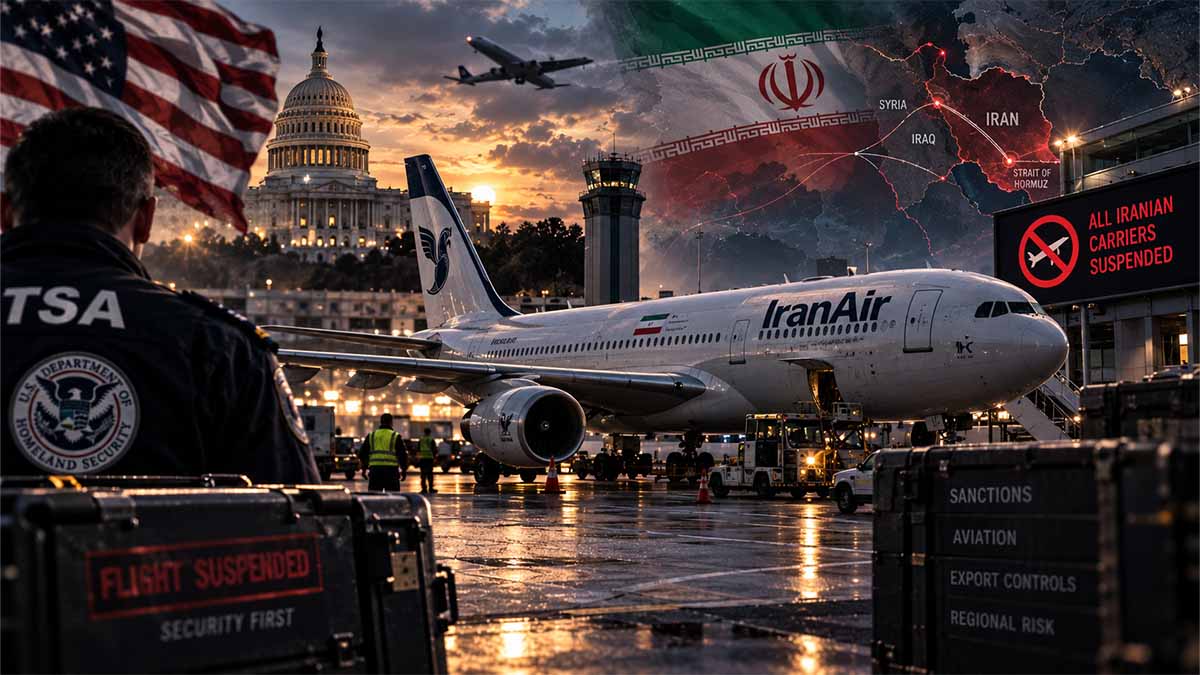
Scope: This first-delivery assessment examines the U.S. aviation sanctions imposed against Iran in September 2026, the legal and commercial mechanisms through which they constrain Iranian carriers, the verified exposure of adjacent airspace and aviation-service networks, the civilian and religious-connectivity consequences visible in Iraq, and the conditions under which an initially targeted sanctions measure could produce wider regional disruption; no cross-country comparative assessment is included, and the analysis stops before Chapter 1 as required by the governing protocol.
Executive Summary / BLUF
Washington has moved beyond sanctioning individual aviation intermediaries and has constructed an aviation-sector pressure architecture intended to make continued commercial support for Iranian carriers legally and financially hazardous: on 8 September 2026, the U.S. Department of the Treasury announced sanctions against 36 aviation-linked targets, including 27 Iranian airlines, while OFAC simultaneously suspended aviation authorizations that had permitted specified overflight and civil-aircraft transactions involving Iran. The controlling record is Treasury’s “Treasury Grounds Iranian Airlines with Sweeping Sanctions Action”, issued on 8 September. U.S. Treasury — Treasury Grounds Iranian Airlines with Sweeping Sanctions Action — 8 Sep 2026
The pressure mechanism does not depend on physically preventing an Iranian aircraft from taking off; it operates through blocked-property rules, transaction prohibitions, secondary-sanctions exposure, restrictions on U.S.-origin or U.S.-controlled aviation assets, financial surveillance and the compliance decisions of fuel suppliers, airport-service providers, cargo handlers, general sales agents, banks and other commercial intermediaries whose continued access to the U.S. financial system can outweigh the commercial value of servicing an Iranian carrier. OFAC’s own sanctions notice identifies airlines such as Varesh and Zagros as subject to secondary-sanctions exposure, while Treasury explicitly warns foreign firms supporting designated Iranian airlines through aircraft transfers, cargo services or sales-agent functions. OFAC — Iran-related Designations and General License Updates — 8 Sep 2026
The measure therefore possesses substantial capacity to narrow Iran’s usable international aviation network, but the verified record does not establish that its consequences will remain geographically confined to Iranian passengers or Iranian airports, because the sanctions are being applied inside an aviation environment that was already exposed to military-risk transmission across Iran, Iraq and the Persian Gulf before the September airline measures were introduced. EASA’s active conflict-zone documentation currently covers the entire Tehran FIR, the entire Baghdad FIR and the airspace of Bahrain, Kuwait, Qatar, the United Arab Emirates and Oman, with the Gulf advisory expressly identifying missile and drone activity, interception, falling debris and escalation around the Strait of Hormuz as hazards to civil aviation. EASA — Airspace of Iran — CZIB-2026-04-R1 EASA — Airspace of the Persian Gulf and Gulf of Oman — CZIB-2026-07R2
What can presently be established is therefore a conditional regional-spillover risk rather than a demonstrated regional aviation shutdown: sanctions compliance can remove Iranian airlines from individual markets, while renewed kinetic activity, air-defence activation, route-risk reassessment, insurance constraints or operational caution could affect traffic that neither originates in nor is destined for Iran; however, the current official record does not support treating those consequences as automatic results of the 8 September sanctions themselves. EASA’s Gulf assessment describes the regional security situation as volatile and its Iraq assessment identifies continuing risks from missile and drone activity, air-defence systems and armed non-state actors, making the distinction between sanctions-driven exclusion and conflict-driven aviation disruption analytically essential. EASA — Airspace of Iraq — CZIB-2026-05-R1
The regional implementation record is not yet sufficiently complete to certify every restriction described in the supplied topic, although Georgia provides a documented case: on 10 September its Civil Aviation Agency stated that Georgia applies OFAC sanctions lists as an additional monitoring mechanism, acknowledged that airlines operating Iran–Georgia services were included in the expanded U.S. sanctions action, and said that Georgia would act in accordance with the applicable sanctions regime. Georgian Civil Aviation Agency — Statement of Georgian Civil Aviation Agency — 10 Sep 2026
The principal judgment is consequently narrow but consequential: the United States has created a sanctions framework capable of imposing severe commercial isolation on designated Iranian airlines through third-party compliance, yet the public official record does not justify confidence that the wider operational consequences can be politically or geographically contained if the sanctions dispute interacts with the already unstable airspace surrounding Iran; equally, the same record does not support the stronger proposition that Tehran can unilaterally close neighbouring airports or that a regional shutdown is already occurring.
Washington Can Ground Iran’s Airlines, but Not the Costs Around Them
Washington’s 8 September 2026 aviation package is more consequential than a conventional flight ban because it attacks the commercial machinery that keeps an airline operating: 36 aviation-linked targets, including 27 Iranian carriers, were sanctioned, aviation authorisations were suspended and financial institutions were pushed deeper into procurement surveillance. Yet the policy contains a structural contradiction. The United States can make Iranian airlines progressively harder to service, finance and maintain, but it cannot ensure that the resulting disruption stops at Iran’s borders. Iraq’s pilgrimage economy, Najaf’s airport, the land crossings carrying Iranian travellers and the already fragile airspace around Iran and the Gulf turn a sanctions measure into a regional logistics problem. The immediate pressure falls on Tehran; the secondary costs accumulate in neighbouring states that did not design the sanctions but must absorb their consequences. U.S. Treasury, 8 September 2026
Washington has targeted the operating system, not the timetable
The decisive change came on 24 August 2026, when the U.S. Treasury brought Iran’s aviation sector within the scope of Executive Order 13902, allowing operation in the sector itself to become a designation basis; on 8 September, Treasury then designated 27 Iranian airlines and targeted foreign intermediaries linked to aircraft transfers, cargo services and general-sales representation. The significance lies in the transmission mechanism: a route can disappear even when a foreign airport has not formally prohibited Iranian aircraft, because banks, fuel suppliers, handlers, aircraft-service companies, sales agents and component distributors may independently decide that continued business no longer justifies the sanctions exposure. OFAC, 24 August 2026 U.S. Treasury, 8 September 2026
The suspended authorisations show how deliberately the policy reaches into airline operations. On 8 September, OFAC suspended provisions covering overflight payments, aircraft safety, bunkering and emergency repairs, together with General License J-1 for specified temporary-sojourn aircraft activity; General License DD then allowed only a wind-down until 23 September 2026. This is not simply an airline blacklist: it narrows the legal space around the transactions that make an international flight technically and commercially sustainable. OFAC suspension notice OFAC General License DD
The numbers say isolation is possible, but containment is not guaranteed
The sanctions architecture is powerful because aviation depends on multiple external nodes, while enforcement needs to disable only some of them. A designated carrier can retain aircraft and crews yet lose an acceptable payment route, a ground handler, a compliant fuel supplier or access to controlled parts. FinCEN reinforced that pressure on 8 September 2026 by issuing FIN-2026-Alert006, instructing financial institutions to scrutinise Iranian commercial-aviation procurement and identifying seven red-flag patterns involving shell companies, aircraft re-registration, transshipment and concealed end-users. FinCEN FIN-2026-Alert006
But the same month’s aviation-security data show why legal isolation does not equal geographic containment. EASA’s current advisories treat the entire Tehran FIR and the entire Baghdad FIR as high-risk at every altitude, while a separate Gulf bulletin covers Bahrain, Kuwait, Qatar, the United Arab Emirates and Oman, especially over-water sectors exposed to missile, drone, interception and falling-debris risks. An Iranian carrier can therefore be isolated commercially at the same time that non-Iranian airlines are making independent decisions about whether adjacent routes remain operationally acceptable. EASA Iran CZIB EASA Iraq CZIB EASA Gulf CZIB
The March shock shows what happens when the geography turns against the airlines
EUROCONTROL’s March 2026 record provides the clearest stress test. Europe–Middle East traffic fell from roughly 2,000 daily flights to 373 on 1 March, an approximately 80 per cent collapse; flows later stabilised around 800 flights per day, still roughly 59 per cent below normal, while the reduction reached about 1,360 flights per day, or 56 per cent, when overflying traffic was included. The replacement geography was visible immediately: traffic shifted into a northern corridor through Türkiye, Georgia and Azerbaijan and a southern corridor through Saudi Arabia and Oman. EUROCONTROL, March 2026
Those figures do not measure the effect of the September sanctions and should not be presented as though they did; they demonstrate something more important for policy. When operators judge Iranian and Iraqi airspace unusable, disruption propagates into corridors serving passengers and cargo with no connection to Iran. By 11 September 2026, EUROCONTROL was also recording jet fuel at about $4.58 per gallon, up 18 per cent over two weeks as the U.S.–Iran conflict resumed, showing that the same geopolitical shock can affect routing and airline input costs simultaneously. EUROCONTROL Week 37
Iraq absorbs the civilian cost that sanctions law does not capture
The strongest evidence comes from Iraq’s own experience. In March 2026, air disruption stranded Iranian Umrah pilgrims returning from Saudi Arabia and forced Baghdad to construct an emergency land corridor; the Iraqi High Commission for Hajj and Umrah reported that 8,338 Iranian pilgrims were moved across Iraq using approximately 200 buses over nine consecutive days, with food, security, health and logistical support organised from the Arar crossing to Shalamcheh. Iraqi High Commission for Hajj and Umrah, 11 March 2026
That operation identifies the hidden fiscal and administrative cost of lost aviation. A commercial flight internalises much of the transport chain inside the airport-airline system; road substitution externalises it onto border police, buses, fuel supply, health services, communications, sanitation and onward distribution. Iraq’s original 2026 Hajj transport plan envisaged 90 per cent of pilgrims travelling by air and 10 per cent by road, while Iraqi Airways subsequently transported about 23,000 pilgrims on 125 direct flights by 18 May. The figures explain why air access matters: substituting road transport is possible, but it is institutionally expensive. Iraqi Hajj Commission, 1 May 2026 Iraqi News Agency, 18 May 2026
Najaf turns an aviation restriction into domestic politics
Najaf is where Washington’s legal architecture meets Iraq’s religious economy. After more than 59 days of interrupted international service, Najaf International Airport resumed flights on 26 April 2026, with Iran Air operating Tehran–Najaf and Meraj Air scheduled on a Tehran–Najaf–Mashhad routing; by 26 June, airport management reported more than 32,000 passengers and 187 flights during the early Muharram period, while June as a whole recorded 507 arriving flights and 513 departing flights. Iraqi News Agency, 26 April 2026 Iraqi News Agency, 26 June 2026 Iraqi Ministry of Transport data
The wider pilgrimage system operates at another order of magnitude. During the 2026 Arbaeen preparations, Iraq and Iran planned to process approximately 2,000 pilgrims per hour through Al-Mundhiriyah, while the Imam Hussain Holy Shrine later reported about 20 million participants, including more than 5 million Arab and foreign visitors from over 172 countries. Those are not figures for Iranian air passengers, but they establish why access to Najaf and Karbala cannot be treated as a peripheral bilateral service: it sits inside a recurring mass-mobility system that requires border capacity, transport fleets and public-security planning. Iraqi News Agency, 14 July 2026 Imam Hussain Holy Shrine, 8 August 2026
Baghdad is asking for a carve-out because the burden is no longer theoretical
On 26 September 2026, the Iraqi government was reported to be seeking exemptions for certain airports on grounds including medical treatment, education, religious visits and broader civilian interests. That formulation is revealing because Baghdad is not publicly asking Washington to dismantle the entire sanctions regime; it is trying to compartmentalise the civilian functions whose disruption creates domestic costs. Anadolu Agency, 26 September 2026
The request also exposes Washington’s policy trade-off. A tightly drafted exemption could preserve selected civilian mobility without reopening the full commercial network of the 27 designated airlines; a refusal would maintain maximum pressure but transfer more passengers toward roads and border crossings, while increasing the political visibility of the sanctions inside Iraq. The dossier does not contain the text of any U.S. exemption decision as of 28 September 2026: [NOT IN DOSSIER].
Over the next 12–24 months, the bill will be distributed rather than eliminated
If the September framework remains in force through 2027–28, the first cost will continue to fall on Iranian airlines and passengers through narrower international access, but the second-order burden will be paid elsewhere: Iraqi authorities will absorb more border and transport pressure, Najaf’s airport and pilgrimage economy will face lower or less predictable Iranian traffic, and travellers requiring medical, educational or religious journeys will bear longer and more physically demanding itineraries. The March transfer of 8,338 pilgrims, the June Najaf traffic of 507 arrivals and 513 departures, and the 2,000-per-hour Arbaeen border-processing plan show that Iraq can substitute for lost air capacity, but only by mobilising resources that commercial aviation would otherwise carry.
The cost of inaction is therefore not that Iran becomes suddenly unreachable; it is that a sanctions policy designed in Washington progressively converts private aviation flows into public logistics problems in Iraq and, if regional security deteriorates again, into wider routing and cost pressures for carriers that never intended to serve Iran. The United States can sustain the pressure on the Iranian aviation system. What it cannot assume is that the consequences will remain Iranian.
Navigational Index
| Thematic pillar | Analytical focus |
|---|---|
| Sanctions architecture and aviation-service exposure | How the 8 September measures operate through airline designations, suspended aviation authorizations, financial compliance, secondary-sanctions exposure and third-country service providers rather than through a simple prohibition on Iranian aircraft movements. |
| Regional airspace transmission and escalation geometry | How conflict-zone conditions around Iran, Iraq, the Persian Gulf and the Strait of Hormuz create pathways through which an aviation dispute can affect routing, insurance, operational decisions and non-Iranian traffic without requiring a formal closure of neighbouring airports. |
| Civilian connectivity, pilgrimage and political pressure | How diminishing air access affects passengers, family links and religious mobility, with Iraq providing an officially documented example of the logistical burden created when Iranian passenger movement has to migrate from aviation to overland transport. |
Master Abstract
Washington is targeting the aviation ecosystem, not simply the aircraft
The decisive feature of the September sanctions is that their coercive reach extends beyond the Iranian carriers themselves and into the infrastructure required to keep an international airline commercially functional, because the 8 September Treasury action simultaneously designated 27 Iranian airlines, sanctioned foreign companies and intermediaries associated with aviation support, suspended three Iran-related aviation authorizations and warned foreign actors that aircraft transfers, cargo services and general-sales-agent support for sanctioned airlines can create sanctions exposure. Treasury also states that the action was taken under Executive Order 13902, following the 24 August aviation-sector determination, alongside counterterrorism authorities applicable to particular designated actors; these instruments matter because they transform the question from whether another government formally “bans Iranian aviation” into whether airlines, banks, airports, lessors, fuel providers, travel intermediaries and service contractors are prepared to assume the legal and financial consequences associated with continued dealings. U.S. Treasury — Treasury Grounds Iranian Airlines with Sweeping Sanctions Action — 8 Sep 2026
OFAC reinforced that structure by suspending Iran General License J-1, which had authorized specified re-exportation of certain civil aircraft to Iran on temporary sojourn and related transactions, and by issuing Iran General License DD to permit a limited wind-down of previously authorized civil-aviation transactions; the wind-down authorization subsequently expired on 23 September 2026, removing an important transitional window shortly before the late-September route disruptions described in the supplied topic. OFAC — Iran-related Designations; Counter Terrorism Designations; Updates to Iran-related General Licenses — 8 Sep 2026 OFAC — Archive of Selected Revoked and Expired General Licenses
The enforcement environment became still more restrictive on 10 September, when OFAC announced that Iran-related applications for specific licences would thereafter be considered under a presumption of denial, except where authorization is required by law or in specified circumstances including risks to life, limb or environmental safety; this does not eliminate licensing discretion, and Treasury separately stated on 8 September that aviation-safety requests would be considered case by case, but it materially narrows the assumption that ordinary commercial aviation activity can obtain relief once it falls inside the sanctions perimeter. OFAC — Iran-related and Counter Terrorism Designations; Licensing Policy Update under Operation Economic Outcast — 10 Sep 2026
The financial perimeter extends beyond airports and airframes
The sanctions architecture reaches directly into financial compliance through the Financial Crimes Enforcement Network, which on the same day issued an alert concerning Iranian procurement efforts for the commercial aviation sector and asked financial institutions to identify and report activity associated with aviation-procurement networks; this matters operationally because a carrier requires not only landing permission but also banking, settlement, ticketing, procurement, maintenance, insurance and logistics functions, and the withdrawal of one or several of those services can render a formally permitted route commercially impracticable without any government publishing a conventional flight-ban decree. FinCEN — FinCEN Issues Alert to Counter Iranian Procurement Efforts for Its Commercial Aviation Industry — 8 Sep 2026
Treasury’s designation of third-country aviation businesses also demonstrates that Washington intends the enforcement perimeter to extend outside Iran itself: the 8 September action identifies entities in jurisdictions including the United Arab Emirates, Türkiye, Malaysia, Kazakhstan and the United Kingdom in connection with aircraft transfers, cargo handling or sales-agent services associated with sanctioned Iranian aviation, although these are U.S. government allegations and designations and should not be converted into independent findings about the underlying conduct without the corresponding evidentiary record. U.S. Treasury — Treasury Grounds Iranian Airlines with Sweeping Sanctions Action — 8 Sep 2026
Georgia supplies the clearest publicly retrievable first-order example of how this pressure can migrate into a neighbouring aviation market, because the Georgian Civil Aviation Agency stated on 10 September that OFAC lists, including the SDN List and other OFAC-administered sanctions lists, have for years been used as an additional monitoring mechanism when assessing airline access, that Georgia had previously restricted airline operations under this mechanism, and that airlines serving the Iran–Georgia market appeared in the newly expanded sanctions list. Georgian Civil Aviation Agency — Statement of Georgian Civil Aviation Agency — 10 Sep 2026
Regional airspace risk exists independently of the sanctions dispute
The most important constraint on claims that Washington can fully “contain” the aviation consequences is that the sanctions are being enforced in an airspace environment that EASA already treats as conflict-sensitive across a geographically connected zone, because its current Iran CZIB covers the entire Tehran FIR at every altitude and flight level through 30 September 2026, while recording that the military conflict beginning on 28 February created high aviation risks not only inside Iran but also in neighbouring states affected by hostilities, military activity and interceptions. EASA — Airspace of Iran — CZIB-2026-04-R1
Iraqi airspace remains covered separately by CZIB-2026-05-R1, likewise valid through 30 September and applying to the entire Baghdad FIR at all altitudes, with EASA attributing continuing civil-aviation risk to recurrent drone and ballistic-missile activity, air-defence activation, military assets and violent non-state actors; the significance for the sanctions question is not that the U.S. airline measures caused these threats, because the record shows that they pre-date the September action, but that an aviation dispute involving Iranian access is occurring inside a route environment in which operators already have grounds to alter schedules, routings and operating assumptions when security conditions deteriorate. EASA — Airspace of Iraq — CZIB-2026-05-R1
The same logic applies to the Gulf without requiring the assumption that Tehran possesses an effortless ability to “close” regional hubs: CZIB-2026-07R2 covers the airspace of Bahrain, Kuwait, Qatar, the United Arab Emirates and Oman and states that the regional security situation remains volatile following the U.S.–Iran military conflict, while identifying Iranian efforts concerning the Strait of Hormuz, attacks against commercial vessels, related U.S. military activity, missile or drone overflights, interception activity and falling debris as sources of aviation risk. An airport can therefore remain legally open while individual airlines reduce exposure, reroute flights, impose additional fuel requirements, alter crew planning or avoid a corridor because their own security and insurance assessments have changed, meaning that “airport operating” and “regional connectivity remaining unaffected” are not equivalent conditions. EASA — Airspace of the Persian Gulf and Gulf of Oman — CZIB-2026-07R2
Tehran’s reported warning remains operationally undefined
The warning attributed in the supplied topic to Mohsen Rezaei on 23 September—that neighbouring states participating in Washington’s aviation restrictions could find their airports unable to operate—is analytically important because it attempts to shift the perceived cost of sanctions compliance from Iranian carriers to the states surrounding Iran, yet the strict official-source record assembled for this assessment does not presently contain an accessible Supreme National Security Council or state-broadcast transcript specifying the mechanism by which such disruption would be produced, and the proposition must therefore remain an attributed and unresolved official-record claim rather than an established operational capability.
That evidentiary distinction materially changes the assessment because reciprocal denial of access to Iranian airspace, broader state restrictions on overflight, political pressure, cyber interference, military coercion and conflict-driven carrier avoidance would represent profoundly different escalation pathways and cannot responsibly be collapsed into a single assumption; what is independently established is that EASA already identifies missile, drone, interception and Strait-of-Hormuz-related activity as capable of affecting the same Gulf airspace in which any retaliatory aviation dispute would unfold. EASA — Airspace of the Persian Gulf and Gulf of Oman — CZIB-2026-07R2
Accordingly, the defensible conclusion is not that Iran can shut Dubai, Muscat, Doha or another regional airport at will, nor that the U.S. measures will inevitably create a regional aviation crisis; it is that the operational environment contains credible transmission mechanisms through which renewed military tension around Iran could raise the cost, complexity or perceived risk of regional aviation at the same time that sanctions are removing Iranian carriers from commercial networks, and the presence of those mechanisms prevents sanctions planners or neighbouring governments from treating the aviation file as geographically self-contained. EASA — Airspace of Iran — CZIB-2026-04-R1 EASA — Airspace of the Persian Gulf and Gulf of Oman — CZIB-2026-07R2
Civilian connectivity carries a measurable second-order burden
The sanctions are directed at aviation-sector entities, but the immediate physical manifestation of lost connectivity falls on passengers because an unavailable international route cannot be substituted costlessly by the existence of another destination, another carrier or a land border, particularly for elderly travellers, people seeking medical treatment, families divided across borders and religious travellers moving between Iran and Iraq; the official Iraqi record provides a useful, although earlier and conflict-driven rather than sanctions-driven, demonstration of what such substitution entails.
On 3 March 2026, Iraq’s High Commission for Hajj and Umrah stated that the interruption of aviation had prevented Iranian Umrah pilgrims from returning home by air and that Iraq therefore established transport, reception and logistical arrangements to move them overland through Iraqi territory, with approximately 1,000 Iranian pilgrims arriving through Iraq on the first day alone. This episode cannot be used as evidence that September sanctions produced the same outcome, but it demonstrates through an official operational record that disruption of Iranian aviation links can rapidly shift passenger flows onto slower and administratively heavier land-transport systems. Iraq High Commission for Hajj and Umrah — Iranian Pilgrim Transport Arrangements — 3 Mar 2026
This precedent is particularly relevant to Najaf and the wider Iraqi pilgrimage system because the cost of losing a flight is not exhausted by the value of the cancelled ticket: land substitution requires buses, border processing, security coordination, accommodation and welfare arrangements while increasing travel time and physical demands, so restrictions affecting Iranian passenger aviation can create a domestic administrative and political problem for Iraq even where the legal trigger originates outside Iraq and even where religious travel remains technically possible by road.
Key Evidence Table
| Indicator | Value/status | Reference date | Definition/scope | Issuer | Exact source |
|---|---|---|---|---|---|
| Iranian aviation sanctions package | 36 targets, including 27 Iranian airlines | 8 Sep 2026 | Aviation-sector sanctions plus third-country aviation facilitators and service providers | U.S. Treasury / OFAC | Treasury Grounds Iranian Airlines with Sweeping Sanctions Action |
| Iranian airlines designated under E.O. 13902 aviation determination | 27 carriers | 8 Sep 2026 | Remaining active Iranian airlines identified by Treasury under the aviation-sector determination | U.S. Treasury / OFAC | Treasury Grounds Iranian Airlines with Sweeping Sanctions Action |
| Iran General License J-1 | Suspended | 8 Sep 2026 | Previously authorized specified re-exportation of certain civil aircraft to Iran on temporary sojourn and related transactions | OFAC | OFAC — Iran-related Designations and General License Updates |
| Iran General License DD | Expired 23 Sep 2026 | 23 Sep 2026 | Wind-down authorization for certain civil-aviation-related and other transactions previously authorized under the Iranian Transactions and Sanctions Regulations | OFAC | OFAC — Archive of Selected Revoked and Expired General Licenses |
| Iran-specific licensing policy | Presumption of denial, with stated exceptions | 10 Sep 2026 | Specific-licence applications involving Iran, except where required by law or in certain circumstances including risks to life, limb or environmental safety | OFAC | OFAC — Licensing Policy Update under Operation Economic Outcast |
| Financial-sector aviation-procurement alert | Active | 8 Sep 2026 | Identification and reporting of financial activity associated with Iranian aviation-procurement networks | FinCEN | FinCEN Issues Alert to Counter Iranian Procurement Efforts for Its Commercial Aviation Industry |
| Tehran FIR conflict-zone advisory | Active; all altitudes and flight levels | Revised 31 Aug 2026; valid to 30 Sep | FIR Tehran OIIX | EASA | EASA — Airspace of Iran — CZIB-2026-04-R1 |
| Baghdad FIR conflict-zone advisory | Active; all altitudes and flight levels | Revised 31 Aug 2026; valid to 30 Sep | FIR Baghdad ORBB | EASA | EASA — Airspace of Iraq — CZIB-2026-05-R1 |
| Persian Gulf and Gulf of Oman advisory | Active | Revised 31 Aug 2026; valid to 30 Sep | Bahrain, Kuwait, Qatar, UAE and Oman FIRs; all altitudes and flight levels | EASA | EASA — Airspace of the Persian Gulf and Gulf of Oman — CZIB-2026-07R2 |
| Georgian sanctions implementation mechanism | OFAC sanctions lists expressly incorporated into aviation-market monitoring | 10 Sep 2026 | Foreign-airline access and monitoring; statement notes Iran-serving airlines in expanded sanctions list | Georgian Civil Aviation Agency | Statement of Georgian Civil Aviation Agency |
| Iraqi land substitution during earlier aviation interruption | About 1,000 Iranian pilgrims on first day | 3 Mar 2026 | Official logistical response after Iranian pilgrims could not return by air | Iraq High Commission for Hajj and Umrah | Iraq High Commission for Hajj and Umrah — 3 Mar 2026 |
Principal Gaps and Watch Indicators
| Official-record gap or indicator | Decision relevance | Evidence that would materially change the assessment |
|---|---|---|
| National instruments governing the reported restrictions in the UAE, Oman, Azerbaijan and Turkmenistan | The supplied account describes restrictions in these jurisdictions, but the strict official record presently assembled does not provide a sufficiently specific national regulatory instrument for each case to certify its legal basis, duration and exact scope. | Civil-aviation-authority orders, NOTAMs, airport operating notices, sanctions directives or official carrier-access decisions identifying the affected Iranian airlines and effective dates. |
| Current Iraqi instrument governing the reported Baghdad and Najaf suspensions | The existence, scope and legal basis of a September suspension require confirmation from the competent Iraqi aviation or governmental authority before it can be treated as a controlling fact under the adopted evidentiary standard. | Iraqi Civil Aviation Authority decision, NOTAM, airport notice, Council of Ministers record or official U.S.–Iraq exemption documentation. |
| First-order transcript of the 23 September Iranian airport warning | Without an official transcript, the intended mechanism and threshold behind the warning attributed to Mohsen Rezaei remain undefined, preventing a defensible distinction between political signalling, reciprocal aviation restrictions and coercive escalation. | Supreme National Security Council statement, state-broadcast transcript, Iranian civil-aviation directive or other attributable official record specifying the contemplated response. |
| EASA advisories after 30 September | The present Iran, Iraq and Gulf CZIBs expire on 30 September unless reviewed earlier, so renewal, narrowing or withdrawal would be an immediate indicator of whether the conflict-risk baseline surrounding the sanctions dispute is deteriorating or stabilising. | Revised or replacement CZIBs issued by EASA. EASA — Airspace of the Persian Gulf and Gulf of Oman |
| OFAC safety, humanitarian or civil-aviation licensing decisions | Case-specific relief could preserve selected connectivity even while the wider sanctions regime remains intact, particularly where safety-of-flight or humanitarian considerations become material. | New general licence, specific licensing policy, published FAQ or formal OFAC authorization modifying the 8–10 September framework. OFAC — Iran Sanctions Program and Country Information |
| Verified airport-service withdrawal rather than formal state prohibition | Loss of fuel, handling, settlement, ticketing, insurance or agency support could remove a route without a politically visible airport ban and would demonstrate that sanctions transmission is occurring through commercial compliance rather than formal diplomatic alignment. | Airport operator notices, handling-company disclosures, insurer notices, payment-network restrictions or airline operational notices tied explicitly to OFAC compliance. |
| Evidence of broader non-Iranian route disruption | This is the principal threshold separating successful isolation of designated Iranian carriers from demonstrable regional aviation spillover. | Sustained rerouting, cancellations, airspace closures or risk advisories affecting third-country services and explicitly linked either to retaliation associated with the aviation dispute or to a conflict escalation triggered by it. |
Analytical Boundary
The record presently supports a clear separation between three different phenomena that must not be merged: first, direct U.S. sanctions against Iranian airlines and aviation facilitators, which are documented and legally operative; second, third-country regulatory and commercial compliance decisions, of which Georgia is currently documented at official level while several restrictions described in the supplied account require additional national first-order records; and third, regional flight disruption generated by military risk, airspace insecurity or escalation, which EASA documents extensively but which cannot automatically be attributed to the September sanctions. U.S. Treasury — Treasury Grounds Iranian Airlines with Sweeping Sanctions Action EASA — Airspace of the Persian Gulf and Gulf of Oman — CZIB-2026-07R2
Within those boundaries, Washington’s sanctions are already capable of inflicting substantial connectivity losses because an international airline cannot function through landing permission alone when its surrounding commercial ecosystem is exposed to sanctions and financial exclusion; nevertheless, the proposition that the resulting pressure can be kept wholly inside Iran remains unproven because the relevant airspace, security environment and aviation-service networks extend across borders, while the proposition that Tehran can deliberately paralyse neighbouring airports also remains unproven because no verified first-order record presently establishes either the mechanism or an executed operation corresponding to that warning.
Washington Grounds Iran’s Airlines as Spillover Risk Persists
The September 2026 sanctions architecture is designed to isolate Iranian carriers through financial, regulatory and aviation-service exposure rather than through a single physical prohibition on flight. The central uncertainty is whether that isolation can remain contained while Iranian, Iraqi and Persian Gulf airspace continues to operate inside an already conflict-sensitive aviation environment.
How Washington’s aviation-pressure architecture operates
Airline and facilitator designations
OFAC designations create blocked-property consequences and expose designated aviation actors to restrictions under U.S. sanctions authorities.
Third-party compliance pressure
Banks, airports, fuel suppliers, handling companies, sales agents and aircraft-service providers must assess the sanctions consequences of continued dealings.
Services become harder to obtain
A route can become commercially impracticable even without a formal airport closure if settlement, handling, fuel, ticketing or aircraft support is withdrawn.
International connectivity contracts
Iranian carriers lose usable destinations, overflight options or supporting commercial infrastructure as external actors reduce sanctions exposure.
Can the impact remain contained?
Containment depends not only on sanctions compliance but also on whether the surrounding conflict-sensitive airspace remains stable.
Regional operating geometry
Three distinct pathways must remain analytically separated
Direct sanctions exclusion
Iranian airlines and facilitators become legally or commercially difficult to service because foreign companies seek to avoid U.S. sanctions exposure. This pathway is directly documented by Treasury and OFAC.
Third-country implementation
National regulators, airports or commercial operators restrict access or service after reviewing sanctions exposure. Georgia provides an officially documented example of this compliance mechanism.
Conflict-driven regional disruption
Airlines alter routes or operations because of missile, drone, interception or military-escalation risk. EASA documents this risk, but it must not automatically be attributed to the sanctions themselves.
Verified evidence base
| Indicator | Verified status | Operational meaning | Official source |
|---|---|---|---|
| 8 September sanctions package | 36 aviation-linked targets, including 27 Iranian airlines | Creates direct sanctions exposure across the aviation network. | U.S. Treasury |
| OFAC aviation authorizations | Specified authorizations suspended; wind-down mechanism introduced | Reduces the legal space for previously authorized aviation-related activity. | OFAC — 8 Sep 2026 |
| Financial compliance pressure | FinCEN alert issued | Extends scrutiny into aviation procurement and financial transactions. | FinCEN |
| Iranian airspace | Entire Tehran FIR covered by active EASA conflict-zone advisory | Maintains a separate military-risk baseline independent of sanctions compliance. | EASA — Iran |
| Iraqi airspace | Entire Baghdad FIR covered by active EASA advisory | Missile, drone, air-defence and non-state-actor risks remain relevant to civil aviation. | EASA — Iraq |
| Persian Gulf / Gulf of Oman | Bahrain, Kuwait, Qatar, UAE and Oman remain within EASA regional advisory scope | Demonstrates that aviation-security exposure extends beyond Iranian airspace. | EASA — Gulf |
| Georgia implementation | OFAC lists explicitly used as an aviation-access monitoring mechanism | Provides a documented example of U.S. sanctions influencing third-country aviation decisions. | Georgian Civil Aviation Agency |
Watch indicators capable of changing the assessment
The verified record supports a strong judgment that Washington can make international operations increasingly difficult for designated Iranian airlines by shifting the cost of continued cooperation onto third-country aviation and financial-service providers. It does not yet support the stronger proposition that Washington can guarantee geographic containment of the consequences, because the same aviation network operates beside Iranian, Iraqi and Persian Gulf airspace that remains subject to documented conflict-related risk. Conversely, the public record does not establish that Tehran possesses an automatic capability to close neighbouring hubs. The decisive threshold will be whether sanctions-driven exclusion begins to coincide with renewed security deterioration that materially affects traffic with no connection to Iran.
Sanctions Architecture and Aviation-Service Exposure
Principal judgment
The September 2026 aviation measures should be understood not as a conventional prohibition that simply prevents Iranian aircraft from landing abroad, but as a layered sanctions-and-export-control architecture designed to make the entire commercial chain required to operate, maintain, finance, dispatch and support an international airline progressively harder to access. The decisive change occurred before the mass airline designations themselves: on 24 August 2026, OFAC formally brought the aviation sector of the Iranian economy within the scope of Executive Order 13902, giving Treasury a sector-wide designation basis extending beyond previously sanctioned carriers such as Mahan Air; on 8 September, OFAC then used that authority to designate 27 Iranian airlines, while simultaneously targeting aviation intermediaries outside Iran, suspending civil-aviation authorizations and activating a FinCEN financial-intelligence campaign against procurement networks. OFAC — Determination Pursuant to Executive Order 13902, 24 August 2026 U.S. Treasury — Treasury Grounds Iranian Airlines with Sweeping Sanctions Action, 8 September 2026 Ufficio degli Attivi Esteri
The result is a system in which landing rights constitute only one variable. An Iranian carrier that retains permission to enter a foreign airport can still encounter obstacles in dollar or U.S.-linked settlement, aircraft acquisition, spare-parts procurement, maintenance support, fuel and bunkering services, general-sales representation, cargo forwarding, insurance documentation, aircraft registration and ownership transfers, or dealings with financial institutions that assess the transaction as creating direct or secondary sanctions exposure. Treasury explicitly states that the 8 September action was directed not only at Iranian airlines but also at foreign intermediaries, front companies, aircraft-transfer structures, cargo-service providers and general sales agents, while FinCEN separately instructed financial institutions to monitor procurement structures even where Iran is not evident from the face of the transaction. U.S. Treasury — 8 September aviation sanctions action FinCEN — Alert FIN-2026-Alert006 U.S. Department of the Treasury
This distinction is strategically important because it explains why an aviation sanctions campaign can contract a route network without Washington issuing a global flight prohibition and without every third-country government adopting an identical formal policy. The architecture relies instead on cumulative friction: the more nodes of the airline operating chain that become legally prohibited, financially risky or commercially unattractive, the less usable the nominal network becomes.
The legal architecture is cumulative rather than dependent on a single sanctions instrument
Executive Order 13902, issued in January 2020, authorizes the blocking of property and interests in property of persons determined to operate in designated sectors of the Iranian economy and also reaches persons determined to have knowingly engaged in significant transactions involving significant goods or services used in connection with those sectors, persons providing material support to blocked persons, and persons owned or controlled by blocked persons. The order separately authorizes correspondent- and payable-through-account sanctions against foreign financial institutions determined to have knowingly conducted or facilitated specified significant transactions. GovInfo — Executive Order 13902, Imposing Sanctions With Respect to Additional Sectors of Iran GovInfo
What changed on 24 August 2026 was the sectoral perimeter. OFAC determined that section 1(a)(i) of E.O. 13902 would henceforth apply specifically to aviation, digital assets, gold, shipping and technology, meaning that operation in Iran’s aviation sector itself became a potential designation criterion rather than Treasury having to rely exclusively on an airline’s particular relationship with an already sanctioned military, terrorist or proliferation actor. OFAC — Aviation, Digital Asset, Gold, Shipping and Technology Sectors Determination Ufficio degli Attivi Esteri
Legal and enforcement stack
| Instrument or action | Effective date | Legal or regulatory function | Aviation consequence | Official record |
|---|---|---|---|---|
| Executive Order 13902 | 10 Jan 2020 | Authorizes blocking measures against persons operating in designated sectors of Iran and against specified supporting actors; provides authority for sanctions affecting foreign financial institutions involved in significant covered transactions | Creates the underlying sector-sanctions framework subsequently extended to aviation | GovInfo — Executive Order 13902 |
| Aviation-sector determination under E.O. 13902 | 24 Aug 2026 | Adds aviation to the sectors to which section 1(a)(i) applies | Operating in Iran’s aviation sector becomes an independent designation basis | OFAC — 24 August 2026 sector determination |
| 27 Iranian airline designations | 8 Sep 2026 | Adds remaining active carriers identified by Treasury to OFAC sanctions lists pursuant to the aviation-sector determination | Extends blocked-person and secondary-sanctions consequences across a much larger proportion of Iran’s commercial-airline system | U.S. Treasury — 8 September aviation sanctions action |
| Third-country aviation-intermediary designations | 8 Sep 2026 | Targets entities and an individual that Treasury states supported Mahan Air through aircraft transfers, cargo services or sales representation | Raises direct sanctions exposure outside Iran and signals that support functions are enforcement targets | OFAC — Iran-related designations, 8 September 2026 |
| Suspension of aviation-related ITSR authorizations | 8 Sep 2026 | Indefinitely suspends specified general licences and licensing provisions | Removes previously available general authorization for particular overflight payments, aircraft-safety activity, bunkering/emergency repair transactions and temporary-sojourn aircraft activity | OFAC — Suspension of Certain ITSR General Licenses |
| General License DD wind-down | 8–23 Sep 2026 | Temporarily permits only transactions ordinarily incident and necessary to wind down specified previously authorized aviation activity | Prevents immediate contractual disorder while closing the former authorization channels | OFAC — General License DD |
| Iran licensing-policy tightening | 10 Sep 2026 | Introduces a presumption of denial for Iran-related specific-licence applications except where required by law or in specified circumstances | Moves residual aviation-related licensing from an already restrictive regime toward a still narrower discretionary gateway | OFAC — Licensing Policy Update, 10 September 2026 |
| FinCEN FIN-2026-Alert006 | 8 Sep 2026 | Directs financial institutions toward aviation-procurement typologies and suspicious-activity indicators | Extends aviation pressure into banking due diligence, transaction monitoring and SAR reporting | FinCEN — Iranian Commercial Aviation Procurement Alert |
| EAR / BIS Iran controls | Continuing | Requires licences for broad categories of exports and reexports to Iran and applies the Iran Foreign Direct Product rule to specified foreign-produced items | Constrains aircraft components, technology and other controlled inputs even where procurement takes place outside the United States | BIS — Iran Export Controls |
The operational significance of this stack is that no single legal event has to carry the entire burden of enforcement. Treasury can designate the airline; the 50 Percent Rule can extend blocking consequences to entities it owns; OFAC regulations can constrain U.S.-nexus transactions; E.O. 13902 can expose foreign financial institutions to correspondent-account measures for significant covered activity; FinCEN can increase the probability that unusual procurement payments are investigated; and BIS export controls can separately reach U.S.-origin and certain foreign-produced aircraft technology or components. The aviation carrier is therefore surrounded by multiple compliance perimeters rather than facing only a binary permission-to-fly question. OFAC — FAQ 401, 50 Percent Rule BIS — Part 746, Iran controls Ufficio degli Attivi Esteri
The 8 September action transformed the breadth of airline exposure
Treasury’s 8 September action formally designated 27 Iranian airlines pursuant to E.O. 13902 for operating in the aviation sector, including Air Shiraz, Asa Jet Airline, Ata Airlines, Atlas Aviation Group, Ava Airlines, Chabahar Airlines, Erwan Airline, Fly Kish, Fly Persia, Iran Air Tour, Iran Aseman Airlines, Jsky Airlines, Kish Airlines, Karun Airlines, Lad Airways, Mehr Airways, Nasim Air, Pars Oghyanous Kish, Qeshm Air, Raimon Airways, Saha Airlines, Sepehran Airlines, Soroush Air, Taban Airlines, Toos Airlines, Varesh Airlines and Zagros Airlines. OFAC’s entries identify the designated airlines as subject to secondary-sanctions exposure and apply the [IRAN-EO13902] and [IFSR] sanctions identifiers. OFAC — Specially Designated Nationals updates, 8 September 2026 Ufficio degli Attivi Esteri
This matters because a designation is not merely a notation beside an airline’s name. Treasury states that property and interests in property of the designated persons that are in the United States, come within the United States, or are in the possession or control of U.S. persons must be blocked and reported; Treasury further states that entities directly or indirectly owned 50 percent or more in the aggregate by one or more blocked persons are themselves blocked, even when they are not individually named on the SDN List. U.S. Treasury — Sanctions implications of the 8 September action OFAC — 50 Percent Rule guidance U.S. Department of the Treasury
OFAC’s guidance also makes clear that control alone, without the relevant ownership threshold, does not automatically make an entity blocked under the 50 Percent Rule, although OFAC can separately designate controlled entities and advises caution where blocked persons maintain significant minority ownership or non-ownership control. That distinction matters for aviation structures involving leasing companies, sales agents, maintenance entities and holding vehicles because ownership, control and transaction participation do not always produce identical sanctions consequences. OFAC — FAQ 398 on ownership and control Ufficio degli Attivi Esteri
The suspended aviation authorizations expose the operational anatomy of the sanctions campaign
The most revealing element of the September package is not the airline list but the precise authorizations OFAC chose to suspend, because they correspond to functions without which international aviation cannot operate normally. OFAC’s 8 September notice indefinitely suspended 31 CFR §560.522, concerning allowable payments for overflights of Iranian airspace; §560.528, concerning aircraft safety; §560.529, concerning bunkering and emergency repairs; and Iran General License J-1, which had authorized defined temporary-sojourn activity involving certain civil aircraft. OFAC — Suspension of Certain Iranian Transactions and Sanctions Regulations General Licenses Ufficio degli Attivi Esteri
Aviation authorizations removed on 8 September
| Authorization | Function identified by OFAC | Status after 8 Sep | Wind-down position | Operational significance |
|---|---|---|---|---|
| 31 CFR §560.522 | Allowable payments for overflights of Iranian airspace | Indefinitely suspended | Covered by General License DD until 12:01 a.m. EDT, 23 Sep 2026 | Directly affects a financial mechanism associated with the use of Iranian airspace by aircraft operators |
| 31 CFR §560.528 | Aircraft safety | Indefinitely suspended | Not included among the three authorizations listed in GL DD; Treasury stated separately that aviation-safety requests would be considered case by case | Converts a previously general authorization into a more restrictive licensing environment |
| 31 CFR §560.529 | Bunkering and emergency repairs | Indefinitely suspended | Covered by GL DD until 23 Sep | Directly concerns aircraft fuel/support and emergency-maintenance transactions |
| Iran General License J-1 | Reexportation of certain civil aircraft to Iran on temporary sojourn and related transactions | Suspended | Covered by GL DD until 23 Sep | Restricts the legal channel under which specified non-Iranian civil aircraft could temporarily operate into Iran |
Official instruments: OFAC suspension notice, updated 8 September 2026 and OFAC General License DD. Ufficio degli Attivi Esteri
The distinction concerning aircraft safety is especially important. General License DD expressly listed §560.522, §560.529 and General License J-1 as eligible for wind-down activity through 23 September, but did not list §560.528 in that wind-down authorization; Treasury’s broader release instead stated that OFAC would consider aviation-safety-related requests case by case. The practical implication is not that safety-related activity became categorically impossible, but that the automatic general-authorisation route was removed and the regulatory burden shifted toward specific government authorization. OFAC — General License DD, 8 September 2026 U.S. Treasury — Aviation sanctions action Ufficio degli Attivi Esteri
The subsequent licensing-policy change tightened that environment again. On 10 September, OFAC announced that Iran-related specific-licence applications would be considered under a presumption of denial, except where approval is required by law or in specified circumstances such as risk to life, limb or environmental safety. This does not eliminate case-by-case authority, but it alters the default posture faced by an applicant seeking permission for activity that no longer falls under a general licence. OFAC — Iran-related licensing-policy update, 10 September 2026 OFAC — Specific Licenses and Interpretive Guidance Ufficio degli Attivi Esteri
General License DD was an exit mechanism, not a continuation mechanism
General License DD authorized transactions ordinarily incident and necessary to wind down previously authorized activity through 12:01 a.m. Eastern Daylight Time on 23 September 2026, and required that any payment to a blocked person be placed into a blocked, interest-bearing account in the United States in accordance with the ITSR. The authorization did not reopen other activities prohibited under another executive order or another part of 31 CFR chapter V. OFAC — General License DD, full instrument Ufficio degli Attivi Esteri
That legal construction matters because a wind-down licence is designed to permit orderly termination of existing exposure, not continuation of normal commercial service. Airlines, agents, banks and aviation providers therefore faced a short interval in which they could close defined transactions that had previously been lawful under the affected authorizations, after which the underlying prohibitions again applied unless another exemption or authorization existed.
A parallel Counter Terrorism General License No. 37 granted a corresponding wind-down period through 23 September for dealings involving three specifically identified entities blocked on 8 September—ECT Aviation Support LLC, S Sistem Lojistik Hizmetler Anonim Sirketi and Mes Cargo Transportation Tourism and Foreign Trade Limited Company, together with entities 50 percent or more owned by them—but again did not authorize transactions involving other persons blocked under the Global Terrorism Sanctions Regulations unless separately authorized. OFAC — Counter Terrorism General License No. 37 Ufficio degli Attivi Esteri
Third-country aviation infrastructure is part of the enforcement perimeter
Treasury’s September action demonstrates that Washington is not limiting enforcement to the Iranian carrier incorporated in Tehran or Shiraz. The department identified and sanctioned entities in the United Arab Emirates, Türkiye, the United Kingdom, Malaysia and Kazakhstan, alleging different forms of support for Mahan Air ranging from aircraft transfer structures to cargo coordination and general-sales representation. These descriptions are U.S. government findings for sanctions purposes and should therefore be treated as attributed Treasury determinations rather than independently adjudicated findings. U.S. Treasury — Commercial Aircraft Procurement and Cargo Services sections U.S. Department of the Treasury
Foreign aviation nodes named in the September action
| Jurisdiction | Entity / person | Treasury-described function | Sanctions authority identified by Treasury | Aviation-system relevance |
|---|---|---|---|---|
| UAE | ECT Aviation Support LLC | Treasury states that it acted as an intermediary in transfers of U.S.-origin B-777 aircraft to Mahan Air | E.O. 13224, as amended | Aircraft acquisition and transfer |
| Türkiye | Sky Phoenix Hava Yollari Tasimaciligi Ticaret Limited Sirketi | Treasury states that it served as an intermediary in the aircraft-transfer scheme | E.O. 13224, as amended | Aircraft transfer / intermediary function |
| UAE | Aerobravo Airplane Management and Operation LLC | Treasury states that it operated aircraft owned by ECT Aviation Support UAE | E.O. 13224, as amended | Aircraft management / operation |
| UAE | Ibrahim Ali Mohamed Mohamed Mahran | Treasury identifies him as CEO, managing director, founder and owner of ECT Aviation Support UAE | E.O. 13224, as amended | Ownership and management nexus |
| United Kingdom | ECT Aviation Support LTD | Treasury states that the company was wholly owned by ECT Aviation Support UAE and directed through the same ownership structure | E.O. 13224, as amended | Corporate and ownership node |
| Türkiye | S Sistem Lojistik Hizmetler A.Ş. | Treasury states that it coordinated shipments for Mahan Air, including UAV components and industrial equipment destined for Iran | E.O. 13224, as amended | Cargo/logistics |
| Türkiye | Mes Cargo Transportation Tourism and Foreign Trade Ltd. | Treasury describes it as a Mahan Air general sales agent involved in shipment coordination | E.O. 13224, as amended | Sales representation and cargo |
| Malaysia | Icargo SDN BHD | Treasury states that it served as a Mahan Air general sales agent and coordinated shipment of U.S.-origin parts | E.O. 13224, as amended | Sales agency / procurement logistics |
| Kazakhstan | Tour Invest LLC | Treasury states that it served as a general sales agent for Mahan Air | E.O. 13224, as amended | Commercial representation |
Official source: U.S. Treasury — Treasury Grounds Iranian Airlines with Sweeping Sanctions Action. U.S. Department of the Treasury
Treasury also states that at least three Boeing 777 aircraft were transferred to Mahan Air during summer 2026 through a structure involving the UAE and Oman, with temporary registrations and intermediaries; the department characterised the route as resembling previous sanctions-evasion operations. Because these are Treasury’s allegations underlying designation decisions rather than findings of a judicial tribunal, the precise formulation matters: the public official record establishes that the U.S. government made and acted upon those determinations, while independent adjudication of every underlying factual element is not demonstrated by the release itself. U.S. Treasury — Commercial Aircraft Procurement section U.S. Department of the Treasury
General sales agents are strategically important because airlines do not sell international transport alone
Treasury’s inclusion of general sales agents is operationally significant because these firms can perform activities extending beyond simple ticket distribution. Treasury describes GSAs as providing sales and customer-support services and coordinating with freight forwarders and shippers on an airline’s behalf, which places them at the interface between the carrier, commercial clients and logistics networks. U.S. Treasury — Cargo Services Providers and General Sales Agents U.S. Department of the Treasury
Targeting this layer therefore affects the ability of a sanctioned carrier to maintain commercial representation outside its home jurisdiction even when aircraft and crews remain available. If a carrier can technically operate a sector but cannot readily contract a sales agent, process freight relationships, receive payments through acceptable banking channels or retain logistics providers willing to deal with it, the route may become commercially degraded before it becomes legally impossible.
This is one of the central mechanisms through which sanctions can migrate from a legal designation into network contraction without requiring Washington to compel every foreign civil-aviation authority to cancel landing rights.
Financial surveillance has been integrated directly into the aviation campaign
FinCEN’s FIN-2026-Alert006, issued simultaneously with the sanctions package, materially expands the enforcement architecture because it treats Iranian aviation procurement as a financial-monitoring problem rather than solely a customs or aircraft-registration problem. FinCEN states that its alert draws on Bank Secrecy Act data, open-source reporting and law-enforcement information, and requests that financial institutions identify relevant Suspicious Activity Reports using the key term “FIN-2026-IRANAIR.” FinCEN — FIN-2026-Alert006, 8 September 2026 FinCEN.gov
The importance of that alert lies in the typologies it formalises. FinCEN describes aircraft being re-registered across jurisdictions, layered ownership transfers among geographically dispersed companies, aircraft moving through several jurisdictions before arrival in Iran, documentation concerning registration, insurance or overflight movements that may be falsified or fabricated, and purchases of aircraft components by front companies presenting themselves as technology, aviation or logistics firms. FinCEN also identifies Türkiye and the UAE as examples of transshipment jurisdictions used in procurement chains described in its source base. FinCEN — Iranian commercial aviation procurement typologies FinCEN.gov
FinCEN’s seven aviation-procurement red flags
| FinCEN indicator | What the indicator is designed to detect | Operational node affected |
|---|---|---|
| Recently incorporated aviation, technology or logistics company with opaque ownership and limited online presence purchasing substantial aircraft components | Possible front-company procurement | Corporate onboarding, banking, component supply |
| Newly incorporated company sharing residential addresses, beneficial owners, PO boxes or unusual co-location patterns with multiple similar companies | Possible networked shell-company structure | Beneficial-ownership due diligence |
| Stored aircraft undergoing frequent re-registration, layered ownership changes or repeated jurisdictional movement, particularly involving Central Asia | Concealment of final aircraft destination or ownership | Registry, aircraft trading, leasing, financing |
| Iran-linked customer claims OFAC or BIS authorization without producing the authorization | Possible misrepresentation of regulatory permission | Bank compliance, supplier compliance, aircraft transactions |
| General trading company in a free-trade zone unexpectedly ordering U.S.- or Western-origin aircraft components | Procurement outside normal business profile | Component distribution and trade finance |
| Aircraft parts ordered in one country but delivered to a freight forwarder or logistics company in another | Possible transshipment structure | Freight forwarding, payment screening, customs |
| Aircraft parts moved by logistics or air-freight companies doing business with Iran or sanctioned Iranian or Russian aviation entities | Possible final-destination or sanctioned-counterparty risk | Logistics and aviation freight |
FinCEN expressly cautions that no single red flag is determinative and directs financial institutions to consider the totality of facts, historical customer activity, prevailing business practice and the presence of multiple indicators before determining that conduct is suspicious. FinCEN — Red Flag Indicators for Iranian Commercial Aviation Procurement FinCEN.gov
The practical consequence is a widening compliance perimeter because a payment can become operationally problematic even before OFAC publicly designates the immediate recipient. Banks may investigate the ownership chain, destination, freight forwarder, aircraft history, claimed licence, free-zone location and consistency of the transaction with the customer’s normal business profile, increasing delay, documentation requirements and the possibility that a transaction is rejected by the institution’s own risk controls.
Export controls create a separate constraint on the physical sustainment of aircraft
The OFAC regime is only one part of the U.S. legal architecture. The Commerce Department’s Bureau of Industry and Security states that a BIS licence is required to export or reexport most items on the Commerce Control List to Iran under §746.7 of the Export Administration Regulations, while OFAC separately administers the comprehensive trade and investment embargo. BIS further states that no EAR licence exceptions may be used for exports or reexports to Iran and that applications involving humanitarian reasons or the safety of civil aviation and safe operation of U.S.-origin aircraft are considered case by case, while licences for other purposes generally will be denied. BIS — Iran Export Controls BIS — EAR Part 746, §746.7 Iran BIS
The Iran Foreign Direct Product rule widens the potential reach beyond products manufactured physically in the United States. BIS regulations cover specified foreign-produced items where the relevant product and destination or end-use conditions are satisfied, including foreign-produced items within specified Commerce Control List categories or categories identified in Supplement No. 7, where the item is destined for Iran or will be incorporated into covered equipment located in or destined for Iran. BIS — EAR §734.9, Iran Foreign Direct Product Rule BIS
This is particularly important for aviation because modern aircraft maintenance chains are multinational: an assembly can be manufactured in one jurisdiction, incorporate U.S.-origin technology or controlled content, be sold through a second country, financed through a third jurisdiction and ultimately installed on an aircraft operated in Iran. The regulatory question therefore does not reduce to the nationality of the immediate seller.
Aviation-service exposure by function
| Aviation function | Primary U.S. exposure mechanism | What has changed by late September 2026 | Residual legal pathway |
|---|---|---|---|
| Aircraft operation by designated Iranian carrier | OFAC blocking sanctions / E.O. 13902 | 27 additional carriers designated | Delisting, exemption or specific authorization where legally available |
| Airline payments | OFAC prohibitions; financial-institution exposure; FinCEN monitoring | Larger universe of airline transactions requires sanctions screening | Authorized or exempt transactions only |
| Overflight payments involving Iran | ITSR §560.522 | General authorization suspended | Specific authorization where granted |
| Aircraft safety transactions | ITSR §560.528 plus export-control requirements | General licensing route suspended | Case-by-case safety-related authorization remains possible |
| Fuel / bunkering / emergency repairs | ITSR §560.529 | General authorization suspended; DD wind-down expired 23 Sep | Specific authorization or other applicable exemption |
| Temporary-sojourn aircraft transactions | General License J-1 | Suspended; DD wind-down expired | New specific authorization if granted |
| Aircraft and component procurement | OFAC + EAR/BIS controls | Increased sanctions and transaction-monitoring pressure | Applicable licences where granted |
| Foreign-produced controlled components | Iran FDP rule | Can fall under U.S. export controls despite foreign production | BIS/OFAC authorization where applicable |
| Cargo forwarding | Material-support exposure, counterparty sanctions, financial monitoring | Named logistics firms designated in September action | Transactions must avoid prohibited sanctioned involvement |
| General sales agency services | Support to blocked carriers / counterterrorism authorities | Multiple foreign GSAs designated | Non-prohibited relationships require careful counterparty assessment |
| Corporate ownership structures | OFAC 50 Percent Rule | Blocking may extend automatically beyond entities explicitly listed | Ownership below threshold does not itself automatically block, although other sanctions bases may still apply |
| Trade finance / banking | OFAC prohibitions, E.O. 13902 financial-institution provisions, FinCEN BSA reporting | Greater compliance and investigative burden around aviation procurement | Transactions must fall outside prohibitions or receive authorization |
Sources: OFAC — 8 September designations and General License actions; OFAC — suspension notice; FinCEN — FIN-2026-Alert006; BIS — Iran Export Controls; OFAC — 50 Percent Rule. Ufficio degli Attivi Esteri
Secondary sanctions change the calculations of actors that are not U.S. persons
The coercive reach of the system depends heavily on the distinction between primary sanctions obligations and secondary-sanctions exposure. U.S. persons are directly subject to OFAC prohibitions applicable to blocked persons and Iran-related transactions within U.S. jurisdiction, while foreign firms and foreign financial institutions can encounter separate sanctions consequences for specified dealings even where they are not themselves U.S. persons. Treasury’s 8 September notice states that financial institutions and other persons can risk sanctions exposure for certain transactions involving blocked persons, while foreign financial institutions knowingly conducting or facilitating significant transactions on behalf of persons designated under relevant authorities can face restrictions on correspondent or payable-through accounts in the United States. U.S. Treasury — Sanctions Implications, 8 September 2026 U.S. Department of the Treasury
Treasury further states that non-U.S. persons are prohibited from causing or conspiring to cause U.S. persons to violate sanctions or from engaging in conduct designed to evade them. This becomes particularly relevant in aviation because a transaction that appears geographically foreign can still encounter a U.S. nexus through banking, aircraft origin, controlled technology, components, a U.S. service provider or another element of the transaction chain. U.S. Treasury — Sanctions Implications section U.S. Department of the Treasury
The resulting pressure therefore does not require every foreign company to be legally treated as though it were an American company. A foreign supplier can independently conclude that the expected revenue from an Iranian airline does not justify the possibility of designation, correspondent-banking difficulty, blocked payments, export-control investigation or future enforcement scrutiny.
The sanctions architecture produces several distinct forms of operational friction
Payment friction
International aviation generates repeated cross-border payments for airport charges, handling, fuel, navigation services, spare parts, maintenance, reservations, agency commissions, aircraft leases and freight services. When a carrier becomes a blocked person, every payment chain containing a U.S. nexus must be examined against the applicable prohibitions, while foreign banks also have reason to assess secondary-sanctions exposure. Treasury’s statement that participating foreign financial institutions may face correspondent-account consequences for certain significant transactions substantially increases the compliance stakes beyond the value of an individual ticket or handling invoice. Treasury — Sanctions Implications U.S. Department of the Treasury
Procurement friction
Aircraft can remain physically serviceable only if operators can obtain appropriate parts, consumables, technical documentation and specialized services. The BIS Iran regime requires licences for broad categories of items, the Iran FDP rule can capture specified foreign-produced goods, and FinCEN is now directing banks to scrutinize corporate and payment structures associated with aircraft and component procurement. BIS — EAR Part 746 Iran controls FinCEN — aviation procurement alert BIS
Counterparty friction
The 50 Percent Rule means a compliance department cannot rely exclusively on whether the immediate contracting company’s name appears on the SDN List; ownership analysis can reveal that an unnamed entity is nevertheless blocked because blocked persons own 50 percent or more of it in the aggregate. OFAC explicitly urges due diligence concerning ownership structures. OFAC — FAQ 401 Ufficio degli Attivi Esteri
Documentation friction
FinCEN’s alert specifically identifies frequent aircraft re-registration, layered ownership transfers, irregular jurisdictional movement and questionable claims concerning OFAC or BIS authorizations as indicators requiring heightened scrutiny. This can increase documentary demands even for transactions ultimately determined to be lawful. FinCEN — Red Flag Indicators FinCEN.gov
Service-network friction
Treasury’s designation of cargo firms and general sales agents shows that Washington is willing to move down the value chain from the carrier to the companies enabling the airline to sell capacity, move freight and maintain its foreign commercial presence. Treasury — Cargo Services Providers and General Sales Agents U.S. Department of the Treasury
The system is deliberately asymmetric: a carrier needs many service providers, but sanctions need only disable some of them
An airline route is a composite service. The aircraft must be legally operable, crewed, dispatched, insured under acceptable conditions, supplied with fuel, granted navigation and airport access, supported by handlers, able to settle charges, able to sell tickets or cargo capacity, and capable of obtaining maintenance and replacement parts. A sanctions regime does not have to eliminate every one of those functions simultaneously; disabling a sufficiently important subset can make continued operation commercially or legally impracticable.
This creates an asymmetric enforcement structure. Iran can preserve the aircraft and crew but lose access to a suitable payment route; preserve banking access in one jurisdiction but lose ground handling in another; retain airport permission but fail to obtain commercially acceptable component support; or preserve an individual route while the foreign agency network required to sell and administer it becomes progressively smaller. Treasury’s September actions against airlines, GSAs, logistics providers, procurement intermediaries and financial channels indicate that the enforcement strategy is directed at precisely this multi-node structure rather than at a single regulatory chokepoint. Treasury — 8 September aviation sanctions package U.S. Department of the Treasury
The architecture does not amount to a universal international flight ban
The scope should not be overstated. U.S. sanctions do not, by themselves, constitute a multilateral legal order requiring every sovereign state to deny Iranian aircraft access to its airspace or airports. Third-country states retain their own civil-aviation, sanctions and foreign-policy authorities, while private actors can make commercial and compliance decisions that are more restrictive than the minimum required by local law.
The correct analytical formulation is therefore that Washington has created powerful incentives and legal risks capable of influencing foreign aviation behaviour, not that the United States has directly acquired regulatory jurisdiction over every airport handling an Iranian aircraft. The distinction is essential when assessing individual route cancellations: a route can disappear because a foreign government withdraws authorization, because a bank or handling company refuses service, because a carrier cannot establish an acceptable payment channel, because export-control rules affect the aircraft, because a sanctions licence has expired, or because the operator itself concludes that the route is no longer commercially viable.
Without the governing national notice, NOTAM, regulator decision or operator statement, those mechanisms should not be silently treated as interchangeable.
Safety remains a narrow but important pressure-release mechanism
The sanctions architecture retains a distinction between economic isolation and immediate aviation safety. Treasury explicitly stated on 8 September that aviation-safety-related requests would be considered case by case, while BIS’s current Iran export-control guidance likewise states that licence applications for the safety of civil aviation and the safe operation of U.S.-origin aircraft will be considered case by case. Treasury — Aviation safety licensing statement BIS — Iran Export Controls licensing policy U.S. Department of the Treasury
That distinction is operationally important because sanctions law can create a tension between denying an airline access to economically valuable services and avoiding a situation in which sanctions themselves prevent transactions necessary to address an immediate safety-of-flight problem. The September measures narrow the general licensing environment, but they do not demonstrate an official U.S. policy of refusing all aviation-safety authorization irrespective of circumstance.
Humanitarian exclusions should not be confused with a general aviation exemption
Executive Order 13902 states that its measures do not apply to persons conducting or facilitating transactions for the provision of agricultural commodities, food, medicine or medical devices to Iran, and it separately excludes specified United Nations official business. Those exclusions remain legally important, but they should not be interpreted as a general exemption for passenger airlines merely because civilian passengers, medical travellers or humanitarian personnel can use commercial aviation. GovInfo — Executive Order 13902, Sections 11–12 GovInfo
The distinction between the purpose of a transaction and the institutional status of the airline therefore remains essential: humanitarian trade can fall inside protected or authorized categories while dealings with a designated carrier may still require separate legal analysis.
Exposure matrix for the aviation ecosystem
| Actor | Direct sanctions concern | Secondary or associated exposure | Principal compliance question |
|---|---|---|---|
| Iranian airline | SDN / E.O. 13902 designation | Loss of external services and finance | Is the carrier itself blocked or owned by blocked persons? |
| Foreign airport operator | Potential dealings with blocked carrier | Commercial exposure depending on transaction and jurisdiction | What services and payments are being provided, and is there a U.S. nexus or secondary-sanctions criterion? |
| Ground handler | Provision of services to designated carrier | Designation / enforcement risk depending on applicable authority and conduct | Does the service constitute prohibited support or involve blocked property? |
| Fuel supplier | Payment and service exposure | Secondary-sanctions or commercial-bank risk | Are bunkering transactions authorized or otherwise permissible? |
| Maintenance provider | Services plus controlled technology or parts | OFAC and BIS exposure | Is the maintenance transaction safety-related, licensed and export-control compliant? |
| Aircraft lessor / seller | Aircraft transfer and blocked-party exposure | EAR, OFAC and procurement-network risk | Is the aircraft subject to U.S. jurisdiction or controlled technology, and what is the true end-user? |
| Spare-parts distributor | Export/reexport controls | Iran FDP / transshipment exposure | Is the item subject to the EAR and ultimately destined for Iran? |
| Bank | Blocked transactions, reporting and sanctions compliance | Correspondent-account consequences / SAR obligations | Are the parties, owners, purpose and destination consistent with permitted activity? |
| General sales agent | Service provision to airline | Material-support designation exposure | Is the airline blocked and what services are being provided? |
| Freight forwarder | Cargo coordination | Procurement-network and transshipment scrutiny | Is the forwarding chain concealing Iranian destination or sanctioned end-user? |
| Insurance-related intermediary | Transaction and documentation exposure | Due-diligence risk where aircraft ownership and destination are obscured | Are aircraft ownership, registration, authorization and end-user representations accurate? |
The exposure pathways in this matrix derive from the combined operation of OFAC’s September designations, the 50 Percent Rule, Treasury’s sanctions-implications guidance, FinCEN’s aviation alert and BIS’s Iran export-control regime. OFAC — 8 September designations OFAC — 50 Percent Rule FinCEN — FIN-2026-Alert006 BIS — Iran Export Controls Ufficio degli Attivi Esteri
The most consequential feature is enforcement propagation beyond the named airline
The September package creates a propagation mechanism in which an initial designation can influence entities that were not themselves the original sanctions target. A blocked airline forces banks to screen payments; ownership rules force counterparties to investigate subsidiaries and affiliates; export controls force component suppliers to establish destination and end-user; FinCEN alerts encourage scrutiny of unusual procurement payments; and the designation of foreign logistics and sales agents demonstrates that intermediaries themselves can become future sanctions targets.
The consequence is therefore broader than the number 27. That figure defines the newly designated Iranian-airline population identified on 8 September, but it does not define the total commercial population required to comply with, avoid or price the consequences of the action. Treasury’s legal leverage is magnified precisely because the affected commercial ecosystem is international.
What the present official record establishes about effectiveness
The official evidence establishes that Washington has created four mutually reinforcing forms of leverage: sector designation authority, blocking and secondary-sanctions exposure, withdrawal of aviation-specific general authorizations, and financial/export-control surveillance of procurement chains. OFAC — aviation-sector determination OFAC — September licensing actions FinCEN — aviation procurement alert BIS — Iran export-control regime Ufficio degli Attivi Esteri
The public official record does not, however, yet provide a sufficiently complete carrier-by-carrier dataset showing how many scheduled international frequencies have disappeared specifically because of the September sanctions, how many foreign suppliers have terminated contracts, how many aviation transactions have been blocked by banks, or how many safety-related specific licences OFAC has approved or denied since the suspension. Those data would be necessary before converting the demonstrated breadth of legal exposure into a precise quantitative measure of aviation-capacity loss.
That evidentiary gap is material: legal reach and operational effect are related, but they are not identical.
Key judgments
The sanctions architecture now reaches substantially deeper than an airline blacklist because the aviation-sector determination allows Treasury to designate carriers for operating within the sector, while separate authorities extend consequences into banking, procurement, logistics, aircraft transfers, sales representation, ownership structures and export-controlled technology. OFAC — 24 August aviation-sector determination Ufficio degli Attivi Esteri
The suspension of §560.522, §560.528, §560.529 and General License J-1 is operationally more important than its legalistic presentation suggests, because those provisions correspond to overflight payments, aircraft safety, bunkering and emergency repairs, and temporary aircraft operations, which are core functions rather than peripheral commercial conveniences. OFAC — Suspension of Certain ITSR General Licenses Ufficio degli Attivi Esteri
The expiration of General License DD on 23 September removed the temporary wind-down channel for the three aviation authorizations expressly covered by that licence, leaving subsequent otherwise-prohibited activity dependent on another exemption, authorization or specific licence. OFAC — General License DD Ufficio degli Attivi Esteri
The designation of foreign aircraft-transfer intermediaries, cargo companies and general sales agents shows that third-country commercial support is itself an enforcement target rather than merely collateral to the airline designations. Treasury — Foreign aviation intermediaries designated 8 September U.S. Department of the Treasury
FinCEN’s parallel intervention makes financial institutions active detection nodes in the aviation-enforcement architecture by providing seven procurement red flags and a dedicated SAR key term, while BIS controls extend scrutiny to aircraft parts and technology beyond transactions directly governed by OFAC. FinCEN — FIN-2026-Alert006 BIS — Iran Export Controls FinCEN.gov
The architecture is capable of shrinking usable connectivity without producing a universal formal ban because an airline route can fail when only one or several critical support functions become unavailable; nevertheless, the current official record does not yet quantify how much of Iran’s international seat capacity or frequency reduction is attributable uniquely to the September sanctions rather than to the parallel effects of conflict risk, carrier decisions or national regulatory measures.
What would change the assessment
A materially stronger assessment of sanctions effectiveness would become possible if OFAC published transaction, licence or enforcement data quantifying aviation-related blocked transactions; if foreign civil-aviation authorities published formal legal instruments identifying sanctions as the basis for particular route restrictions; if major airport operators, handlers, fuel suppliers, insurers or financial institutions disclosed the withdrawal of services from designated carriers; or if official Iranian or foreign aviation schedules supplied auditable before-and-after capacity data allowing route losses to be attributed to a defined legal event rather than to the broader regional conflict.
A materially weaker assessment of the architecture’s ability to isolate Iranian aviation would arise if substantial numbers of designated carriers retained stable foreign route networks through service providers demonstrably willing and legally able to process their payments, supply aircraft and parts, provide ground services and maintain foreign representation without subsequent U.S. enforcement action.
Open official record
The public official record still lacks a consolidated OFAC dataset showing the number and disposition of aviation-safety specific-licence applications submitted after 8 September; carrier-level data separating sanctions-induced cancellations from conflict-induced cancellations; transaction-level information on payments blocked or rejected by international financial institutions; and a comprehensive national legal record for every reported third-country restriction affecting the 27 newly designated Iranian airlines.
Those missing records prevent a defensible calculation of a sanctions-attributable percentage reduction in Iranian international aviation capacity, and no such percentage should presently be fabricated from schedule snapshots or media reporting alone.
Regional Airspace Transmission and Escalation Geometry
Principal judgment
The aviation consequences of confrontation around Iran cannot be assessed by asking only whether Iranian airports or Iranian airlines remain operational, because the decisive transmission mechanism sits in the interaction between Flight Information Regions, conflict-zone risk assessments, military activity, air-defence readiness, operator contingency planning, rerouting capacity and the commercial conditions under which aircraft can continue to use alternative corridors. As of 28 September 2026, EASA continues to recommend that operators not operate at any altitude or flight level in either the Tehran FIR or the Baghdad FIR, while its Persian Gulf and Gulf of Oman bulletin advises operators not to use substantial over-water portions of Bahrain, Kuwait, Qatar, the United Arab Emirates and Oman except where necessary for specified airport operations and subject to current risk assessment. EASA — Airspace of Iran, CZIB-2026-04-R1
The distinction is operationally decisive because an airport does not need to be formally closed for connectivity to deteriorate. A state can leave its airport open and its air navigation services available while individual operators determine that a route, approach sector, over-water segment or diversion environment no longer satisfies their own conflict-zone risk tolerance; insurers or regulators can require additional evidence or conditions; air navigation service providers can impose tactical restrictions; and carriers can shift traffic into alternative corridors that are longer, more congested or operationally less resilient. ICAO explicitly places conflict-zone risk assessment not only on territorial states but also on operators and air navigation service providers, while recognising that airlines commonly perform their own proprietary assessments and that states are responsible for communicating risks affecting safe civil aviation. ICAO — Risks posed to civil aviation operations over or near conflict zones ICAO — State Sovereignty over Airspace and Safety Assessments
The most defensible assessment is therefore that regional spillover does not require Tehran to possess the ability to order a neighbouring airport closed and does not require Washington to impose a regional flight ban; it can emerge through a distributed operational response in which military-risk information changes carrier behaviour across several adjacent FIRs simultaneously. The 2026 record already demonstrates the scale of that mechanism: during the intense phase of the Middle East conflict after 28 February, EUROCONTROL measured a collapse of Europe–Middle East traffic from roughly 2,000 daily flights to a low of 373 flights on 1 March, an approximately 80 percent reduction, before flows stabilised around 800 daily flights, approximately 59 percent below normal; when overflying traffic was included, the network reduction reached approximately 1,360 flights per day, or 56 percent. Those figures describe the earlier conflict shock rather than the September aviation sanctions, but they provide first-order empirical evidence of the magnitude of network transmission that becomes possible when the same airspace complex is judged unsafe. EUROCONTROL — Impact of the current Middle East crisis on European aviation
The current risk architecture is geographically wider than Iranian airspace
The present EASA structure is no longer a single undifferentiated Middle East warning, but a differentiated set of conflict-zone assessments that separates the highest-risk FIRs from surrounding airspace where mitigated operations remain possible. This matters because it shows where the European aviation-security system currently draws operational boundaries rather than treating the entire region as either open or closed.
Current EASA operational risk geometry
| Airspace | FIR | Current EASA status | Vertical scope | Current recommendation | Operational implication |
|---|---|---|---|---|---|
| Iran | Tehran FIR OIIX | Active CZIB | All altitudes and flight levels | Operators should not operate within the FIR | Iran remains treated as a high-risk conflict-zone airspace rather than merely an airport-access problem |
| Iraq | Baghdad FIR ORBB | Active CZIB | All altitudes and flight levels | Operators should not operate within the FIR | Removes a major direct east–west transit area from the preferred operating environment of affected operators |
| Bahrain | Bahrain FIR OBBB | Active Gulf CZIB | All altitudes/flight levels in affected portions | Avoid airspace over Persian Gulf waters except where required for arrivals/departures | Airport access can remain possible while transit exposure is restricted |
| Kuwait | Kuwait FIR OKAC | Active Gulf CZIB | Same | Avoid Gulf over-water airspace except operationally necessary airport access | Regional operations remain dependent on detailed routing and risk mitigation |
| Qatar | Doha FIR OTDF | Active Gulf CZIB | Same | Avoid Gulf over-water airspace except necessary airport access | Hub operations can continue while surrounding route flexibility is reduced |
| United Arab Emirates | Emirates FIR OMAE | Active Gulf CZIB | Same | Avoid Gulf over-water airspace except necessary airport access | Airport openness does not eliminate exposure of arrival/departure corridors |
| Oman | Muscat FIR OOMM | Active Gulf CZIB | All altitudes/flight levels in affected area | Do not operate over Gulf of Oman waters west of 58°E | The Gulf of Oman becomes an explicit geographic constraint on eastbound/westbound planning |
The regulatory detail is contained in EASA’s current Iran, Iraq and Gulf bulletins, all of which remain valid until 30 September 2026 unless reviewed earlier. The Iran and Iraq advisories retain full-FIR recommendations not to operate at any altitude, while the Gulf bulletin distinguishes between over-water sectors, where risk remains high, and land sectors, where operators are instructed to exercise caution and maintain updated risk assessments. EASA — Iran CZIB-2026-04-R1 EASA — Iraq CZIB-2026-05-R1 EASA — Persian Gulf and Gulf of Oman CZIB-2026-07R2
This configuration creates an important operational asymmetry: airports can remain usable while the surrounding transit environment becomes constrained, which means that the relevant question for Dubai, Doha, Abu Dhabi, Muscat or other regional gateways is not simply whether runways are open, but whether sufficient safe and commercially viable arrival, departure, diversion and onward-routing options remain available to sustain the network at normal efficiency.
The Strait of Hormuz is simultaneously a maritime and aviation risk zone
EASA’s current Gulf assessment identifies the Strait of Hormuz not merely as a maritime chokepoint but as part of the aviation-security geometry because activity connected to control of the strait, attacks against commercial vessels and related military responses can generate missile or drone overflight, interception activity, falling debris and heightened air-defence activation in the surrounding airspace. EASA specifically states that these factors create high risks over the waters of Bahrain, Kuwait, Qatar and the United Arab Emirates and in the Gulf of Oman west of 58°E. EASA — Airspace of the Persian Gulf and Gulf of Oman
That observation substantially changes the geometry of the sanctions dispute because the aviation consequences of escalation are not dependent on attacks against civil airports. A missile launched toward a military facility, an interceptor engagement over water, debris falling from a destroyed drone, an unexpected air-defence activation or a temporary military closure can all alter the operational acceptability of a route that serves passengers with no connection to Iran. The relevant transmission chain is therefore indirect but technically coherent:
| Trigger | Immediate aviation effect | Secondary network consequence | Geographic reach |
|---|---|---|---|
| Missile or drone launch | Air-defence activation and temporary hazard area | Tactical rerouting or suspension | Can extend across neighbouring FIRs |
| Interception activity | Risk of debris, misidentification or unintended engagement | Operators avoid route sector | Affects through-traffic, not merely local traffic |
| Maritime confrontation in Strait of Hormuz | Military activity over adjacent waters | Reduced use of Gulf over-water routes | Bahrain, Qatar, UAE, Kuwait, Oman corridors |
| Sudden state airspace restriction | Route no longer available at filed altitude/segment | Refiled flight plans and capacity displacement | Adjacent ACCs and alternate corridors |
| Elevated national air-defence alert | Higher misidentification risk | More conservative operator routing | Wider than the location of actual kinetic activity |
| Attack on or near aviation infrastructure | Airport or navigation-system contingency response | Diversions, cancellations and rotation disruption | Propagates through airline network |
| Short-notice military escalation | Reduced reaction time for ANSPs and carriers | Pre-emptive cancellation or avoidance | Regional rather than target-specific |
EASA expressly identifies misidentification, unintended engagement, missile or drone overflight, falling debris and limited warning time as part of the current risk environment and notes that military activity may develop too quickly for normal tactical rerouting or airspace-management measures to remove all exposure. EASA — Gulf conflict-zone risk assessment
Iran and Iraq remove two major pieces of routing flexibility simultaneously
The operational importance of Iran and Iraq lies partly in their geographic position between Europe, the Persian Gulf, Central Asia and South Asia. When both the Tehran FIR and Baghdad FIR are treated as unavailable by an operator, the remaining route network must absorb traffic through alternative geographic channels rather than simply shifting a flight a few miles laterally.
EUROCONTROL documented this effect during the earlier 2026 conflict phase and identified two principal eastbound rerouting corridors after widespread closures: a northern corridor through Türkiye, Georgia and Azerbaijan, avoiding Iran and largely avoiding Russia and Ukraine, and a southern corridor through Saudi Arabia and Oman. EUROCONTROL — European Aviation Trends, Middle East crisis impact
This is a crucial network finding because the existence of alternate corridors does not mean that closure or avoidance is costless. Alternative corridors have finite air traffic control capacity, sector configurations, route restrictions, weather exposure, geopolitical constraints and traffic-demand limits; their use also changes distances and the sequence in which flights enter other control areas. EUROCONTROL’s Network Manager exists precisely because route availability and capacity changes in one part of the network can redistribute demand elsewhere, while its current airspace-utilisation framework identifies adjacent-airspace closure, capacity constraints and route availability as factors shaping flight planning. EUROCONTROL — Airspace utilisation and route network management
The regional aviation system therefore behaves less like a collection of isolated national markets than like a network in which the loss of a large FIR transfers traffic into neighbouring sectors. The immediate effect is route displacement; the next-order effects can include additional flight distance, altered fuel planning, different diversion airports, changed crew-duty calculations, altered slot utilisation and increased exposure to congestion in corridors that were not designed to absorb an unlimited substitution flow.
The 2026 traffic record demonstrates how large the transmission can become
The strongest available evidence that airspace risk can generate consequences well beyond the belligerent state comes from EUROCONTROL’s recorded traffic response after the conflict began on 28 February 2026. The resulting disruption was not confined to Iranian carriers: it affected European flows, Middle Eastern hub traffic, transcontinental routes and the distribution of traffic across European airspace. EUROCONTROL — Impact of the current Middle East crisis on European aviation
Documented network transmission during the 2026 conflict
| Indicator | Recorded value | Period | What it demonstrates |
|---|---|---|---|
| Normal Europe–Middle East flow before acute disruption | Approximately 2,000 flights/day | Pre-crisis reference used by EUROCONTROL | Scale of the corridor exposed to disruption |
| Crisis low point | 373 flights | 1 Mar 2026 | Approximately 80% collapse from normal flow |
| Stabilised flow after initial shock | Around 800 flights/day | From 5 Mar | Traffic remained far below normal even after immediate shock |
| Reduction in Europe–Middle East flights | Approximately 1,200 flights/day | March crisis period | 59% reduction |
| Reduction including flights overflying Europe | Approximately 1,360 flights/day | Same period | 56% reduction in the wider affected flow |
| Europe–Middle East share of European flows | Fell from approximately 5% to 2.5% | Crisis period | Demonstrates network-level redistribution |
| Main substitute eastbound routings | Two major corridors | March 2026 | Northern Türkiye–Georgia–Azerbaijan and southern Saudi Arabia–Oman routing became critical |
These figures are recorded by EUROCONTROL and should be interpreted as evidence of the sensitivity of the aviation network to regional conflict-zone conditions, not as a measure of the impact of the September sanctions themselves. EUROCONTROL — Aviation Trends, 31 March 2026
That distinction is analytically important because it prevents a causal error: the September sanctions do not need to reproduce the February–March military shock for the earlier shock to remain relevant. The earlier episode provides an observed stress test showing what happens when operators decide that the airspace around Iran and neighbouring states is unsafe or inaccessible; it therefore defines the plausible transmission mechanism if political confrontation over aviation access were to interact with renewed military escalation.
Traffic recovery has repeatedly tracked the security environment
The 2026 record also shows that the network response has been reversible rather than permanently structural. When the security environment improved in June, EUROCONTROL recorded an 11 percent week-on-week increase in Europe–Middle East flights during 15–21 June, with traffic standing 7 percent above the equivalent period in 2025; the three large Gulf carriers identified by EUROCONTROL—Qatar Airways, Etihad Airways and Emirates—collectively increased flight activity by 16 percent week on week during that period. EUROCONTROL — European Aviation Overview, Week 25
During 29 June–5 July, the Europe–Middle East flow increased another 13 percent week on week and stood approximately 3 percent above 2025, demonstrating that carriers returned capacity rapidly when risk assessments permitted it. EUROCONTROL — European Aviation Overview, Week 27
When the security environment deteriorated again, the recovery weakened. EUROCONTROL reported for 13–19 July that the rebound had lost momentum after renewed tension and that Europe–Middle East traffic remained 3 percent below 2025 levels; by 24–30 August traffic had recovered to approximately its 2025 level, but EUROCONTROL stated that it declined again in the following week after renewed tensions. EUROCONTROL — European Aviation Overview, Week 29 EUROCONTROL — European Aviation Overview, Week 35
The implication is not that every short-term movement in traffic was caused solely by military risk, because seasonal schedules, demand, capacity and other variables also matter; rather, the official network data show repeated movement in the same direction as major changes in the regional security environment, giving a documented basis for treating escalation risk as a material aviation variable rather than as a theoretical concern.
September data show renewed cost pressure even before a general regional shutdown
EUROCONTROL’s Week 37 assessment, covering 7–13 September 2026, recorded 35,893 average daily flights across the European network and noted that jet-fuel prices had risen sharply as the U.S.–Iran conflict resumed, reaching approximately $4.58 per gallon on 11 September, an increase of 18 percent over the preceding two weeks. EUROCONTROL — European Aviation Overview, Week 37
The fuel figure does not prove that the September aviation sanctions raised airline operating costs, because EUROCONTROL attributes the movement to renewed geopolitical conflict rather than to the airline designations. It nevertheless illustrates a second transmission channel through which regional escalation can affect carriers that never operate to Iran: airlines can face higher input costs because the same geopolitical environment that threatens regional airspace also affects energy markets.
This distinction is essential for measuring fallout correctly. Sanctions exposure, airspace-risk exposure and energy-price exposure can occur simultaneously but arise through different mechanisms; merging them into a single sanctions effect would overstate what can presently be established.
Rerouting imposes a compound cost rather than merely additional distance
The most visible consequence of airspace avoidance is longer routing, but additional distance is only the first component of the operational burden. A rerouted flight can require increased trip fuel, additional contingency fuel, a changed alternate-airport strategy, new dispatch calculations, different air traffic control sector sequencing and potentially more restrictive crew-duty planning if block time expands sufficiently.
The effect can also propagate into the aircraft’s subsequent rotation. If an aircraft arrives late because it has taken a longer conflict-avoidance route, the delay can affect the next scheduled sector even when that second sector is entirely outside the Middle East. That mechanism is particularly relevant to hub-and-spoke systems because the value of the hub depends on maintaining synchronized banks of arriving and departing aircraft rather than merely keeping each runway technically available.
Operational transmission from airspace avoidance
| Initial constraint | Direct airline response | Cost or capacity consequence | Possible downstream effect |
|---|---|---|---|
| Tehran FIR avoided | Northern or southern reroute | More route miles and fuel | Later arrival and reduced schedule margin |
| Baghdad FIR avoided | Traffic displaced into neighbouring FIRs | Concentrated traffic demand | ATC sector loading and slot restrictions |
| Gulf over-water sector avoided | Arrival/departure route redesign | More restrictive approach/departure geometry | Reduced routing flexibility during disruption |
| Tactical military closure | Short-notice flight-plan amendment | Dispatch and crew replanning | Departure delay or cancellation |
| Loss of planned alternate route | New diversion strategy | Additional reserve-fuel requirement | Payload or commercial limitation on some missions |
| Congested substitute corridor | Air traffic flow restriction | Ground or airborne delay | Knock-on rotation disruption |
| Simultaneous weather in substitute corridor | Reduced usable network redundancy | Longer or unavailable reroute | Cancellation threshold reached sooner |
| Reopening after closure | Rapid traffic return | Demand concentrated into reopened sectors | Temporary capacity instability |
EUROCONTROL’s 2026 reporting provides empirical support for the redistribution mechanism: its Network Manager documented substantial re-routing around the conflict area and has repeatedly identified the Middle East crisis as a factor shaping traffic distribution across European states and air navigation service providers. EUROCONTROL — Middle East crisis and rerouting distortions EUROCONTROL — Summer 2026 Flash Briefing
The European network has capacity to absorb displacement, but the capacity is not unlimited
EUROCONTROL recorded an average of 35,959 daily flights during summer 2026, approximately 2.4 percent above summer 2025, with a record network peak of 37,659 flights on 24 July 2026. Over the same summer, 681,000 flights were affected by air traffic flow management restrictions, equivalent to approximately 7,400 flights per day, and EUROCONTROL reported that 10 of 68 area control centres were on track for their annual capacity target but remained affected by adverse weather and/or the continuing Middle East crisis. EUROCONTROL — Special Summer 2026 Flash Briefing
These data should not be interpreted as showing that Middle East rerouting caused all of those restrictions; EUROCONTROL attributes substantial summer delay to weather and capacity/staffing as well. The relevance is instead structural: displacement from Iran or Iraq enters a network that is already managing high traffic volumes, seasonal peaks and finite sector capacity, which means the marginal effect of rerouting depends on what else is occurring in the alternate corridor at the same time.
A route that is operationally manageable during moderate demand may become substantially more disruptive when combined with convective weather, staffing constraints, military airspace reservations or other airspace closures. Regional aviation resilience is therefore state-dependent rather than fixed.
Temporary closure is not the only form of airspace loss
The EASA advisories illuminate four distinct operational states that are often incorrectly described under the single word “closure”:
| Airspace condition | Formal state closure required? | Can flights technically operate? | Practical result |
|---|---|---|---|
| Formal closure | Yes | Generally no for covered operations | Traffic must reroute or cancel |
| Regulatory prohibition for specified operators | No host-state closure required | Airspace may remain physically open | Covered operators cannot use it |
| Safety advisory / operator avoidance | No | Yes | Carrier may voluntarily avoid route after risk assessment |
| Restricted or conditional use | No full closure | Yes, under defined conditions | Traffic continues with reduced flexibility |
ICAO’s framework explicitly preserves the distinction between state sovereignty over airspace and an operator’s independent responsibility to decide whether a particular geographic zone can be used safely. A state controls its sovereign airspace and can designate or restrict routes, but states of operator and individual airlines can impose or adopt more restrictive operational decisions based on their own risk assessments. ICAO — State Sovereignty over Airspace and Safety Assessments
This is precisely why regional disruption can occur without an Iranian military action against Dubai, Doha or another hub: a significant number of carriers can alter their own operating decisions in response to perceived escalation before the host state’s airport authority closes anything.
United States restrictions reinforce the independent-operator risk layer
The U.S. Federal Aviation Administration currently maintains Special Federal Aviation Regulation 117 concerning certain flights within the Tehran FIR and SFAR 77 concerning certain flights in the Baghdad FIR, while it separately maintains an advisory relating to over-water airspace above the Persian Gulf and Gulf of Oman. FAA — Prohibitions, Restrictions and Notices
The existence of parallel FAA and EASA mechanisms underscores that a regional FIR can be legally open under the territorial state’s rules while particular populations of foreign operators remain restricted or strongly advised against operating there. The resulting traffic picture is therefore heterogeneous: one carrier may fly a route that another carrier cannot or will not use, which can alter competition, connectivity and hub schedules without producing a uniform regional closure.
Insurance is a transmission mechanism, but current pricing effects should not be invented
For operators serving or overflying the European Union, Regulation (EC) No 785/2004 requires insurance for aviation-specific liability and expressly requires the insured risks to include war, terrorism, hijacking, sabotage, unlawful seizure of aircraft and civil commotion; the regulation further requires insurance coverage for each and every flight and empowers competent authorities to request evidence of valid insurance. EUR-Lex — Regulation (EC) No 785/2004 on insurance requirements for air carriers and aircraft operators
For third-party liability, the regulation establishes minimum insurance requirements linked to aircraft maximum take-off mass, ranging from 0.75 million SDR for aircraft below 500 kilograms to 700 million SDR for aircraft of at least 500,000 kilograms; it also acknowledges that war- and terrorism-risk cover can be provided on an aggregate basis if per-accident insurance becomes unavailable, provided the regulatory conditions are satisfied. EUR-Lex — Regulation 785/2004, Articles 4 and 7
Regulatory insurance exposure relevant to conflict-zone operations
| Requirement | EU rule | Relevance to regional escalation |
|---|---|---|
| Insurance for aviation liability | Mandatory | Operator must maintain compliant cover |
| War risk | Explicitly included | Conflict-zone exposure falls within risks contemplated by regulation |
| Terrorism | Explicitly included | Relevant where threat environment includes deliberate attack |
| Sabotage / unlawful seizure / civil commotion | Included | Broadens required risk categories |
| Coverage for each flight | Mandatory | Compliance is not satisfied by general corporate insurance alone |
| Evidence of insurance | Competent authority can require it | Documentation becomes operationally relevant |
| Non-EU carrier landing rights | Enforcement applies to relevant third-country operators | Failure to meet requirements can affect ability to operate into EU territory |
| Aggregate war/terror cover | Permitted under stated conditions if per-accident cover unavailable | Provides a regulatory contingency mechanism |
What cannot presently be established from the official record is that September’s aviation sanctions have caused a quantified increase in aviation war-risk premiums for flights around Iran or the Gulf, because no competent regulator or first-party insurer dataset in the present evidence base provides such a figure. It is therefore defensible to identify insurance availability and compliance as an operational transmission channel, but not to fabricate a premium increase or claim that insurers have collectively withdrawn cover.
Misidentification risk is more important than deliberate attack when assessing some civilian scenarios
EASA repeatedly emphasizes the danger created by heightened air-defence readiness, because a civil aircraft need not be the intended target of military action to be exposed to conflict-zone risk. In Iran, EASA specifically identifies nationwide air-force and air-defence alert levels as increasing the risk of misidentification; in Iraq it identifies military assets, recurring air-defence activity and operations by violent non-state actors as factors increasing the risk of misidentification and unintended escalation; and in the Gulf it identifies activation of national and U.S. air-defence systems as increasing the possibility of unintended engagement or collateral effects. EASA — Iran conflict-zone assessment EASA — Iraq conflict-zone assessment EASA — Gulf conflict-zone assessment
ICAO’s conflict-zone manual similarly treats deliberate attack and unintended effects as distinct risk categories and includes surface-to-air missiles, ballistic missiles, surface-to-surface missiles and air-to-air attack within the threat environment that states and operators should consider. ICAO — Risk Assessment Manual for Civil Aircraft Operations Over or Near Conflict Zones
This makes rapid escalation especially problematic because the relevant safety question is not simply whether a belligerent intends to target civil aviation, but whether military systems operating under compressed warning conditions can reliably distinguish civilian traffic while missiles, drones, fighters and interceptors are active in the same or adjacent airspace.
Tactical warning time is a critical weakness in Gulf aviation resilience
EASA’s present Gulf bulletin makes an unusually important operational observation: military activity may occur with little or no warning in confined airspace, significantly reducing the time available to airlines and air navigation service providers to mitigate exposure through tactical rerouting or timely airspace-management measures. EASA — Gulf CZIB-2026-07R2
This means that formal closure mechanisms have an inherent timing limitation. Even where regional governments are willing to close airspace during military escalation, the closure is effective only if hazardous activity is detected early enough, communicated rapidly enough and operationally implemented before aircraft enter the affected sector.
EASA notes that regional authorities have used temporary closures and restrictions during the conflict but also states that the speed and unpredictability of military events can challenge their timely and effective implementation. EASA — Gulf airspace management assessment
The same problem appears in Iraq, where EASA records that Iraqi authorities implemented temporary closures and restrictions during the conflict but states that the unpredictability of ballistic-missile and drone attacks means that timely risk mitigation cannot necessarily be relied upon. EASA — Iraq CZIB-2026-05-R1
Hub resilience depends on route redundancy, not only airport protection
A Gulf hub’s physical runway system, terminal complex and local security architecture represent only the innermost layer of aviation resilience. The airport also depends upon usable arrival and departure corridors, functioning air navigation services, viable alternates, acceptable insurance conditions, crew and aircraft availability and a sufficiently predictable regional operating environment to maintain connecting banks.
This is why EASA’s Gulf bulletin permits arrival and departure operations where sufficient mitigation exists even while advising against broad use of the surrounding over-water airspace: the bulletin implicitly distinguishes airport operability from full network operability. EASA — Persian Gulf and Gulf of Oman recommendations
Layers of hub resilience
| Resilience layer | Can remain functional while another layer fails? | Regional escalation exposure |
|---|---|---|
| Runway and terminal infrastructure | Yes | Direct attack, debris, closure |
| Air navigation services | Yes, until degraded or restricted | Military activity, capacity, temporary restrictions |
| Arrival/departure corridor | No substitute without rerouting | Gulf over-water hazard and tactical closure |
| Alternate airport availability | Limited | Simultaneous regional restrictions reduce options |
| Through-route network | Yes, but at increased cost | Iran/Iraq avoidance and corridor concentration |
| Airline schedule integrity | Temporarily | Longer block time and rotation disruption |
| Insurance and regulatory compliance | Essential | Conflict-zone conditions can affect operating conditions |
| Passenger connection bank | Highly time-sensitive | Arrival delays can break onward connections |
| Cargo connection system | Time-sensitive | Route and handling disruption propagates commercially |
The practical meaning is that a hub can remain visibly open while suffering reduced connectivity, lower schedule reliability or selective carrier withdrawal, which is precisely the form of regional fallout that would be missed by an analysis focused only on airport closure notices.
The historical EASA advisory sequence shows how rapidly geographic risk boundaries can change
The current targeted advisories emerged from a much broader regional warning. On 28 February 2026, EASA issued a Middle East and Persian Gulf CZIB covering, at different levels, airspace including Bahrain, Iran, Iraq, Israel, Jordan, Kuwait, Lebanon, Oman, Qatar, the UAE and Saudi Arabia. After the security environment improved, EASA withdrew that broad bulletin on 8 July and replaced it with separate high-risk advisories for Iran, Iraq and Lebanon and a lower-risk information framework for other regional airspace; subsequently, the Gulf received a renewed dedicated CZIB as conditions again required a more specific warning. EASA — Withdrawn Middle East and Persian Gulf CZIB 2026-03-R14 EASA — Revised conflict-zone advisories for the Middle East, 8 July 2026
Evolution of the regional EASA perimeter
| Date | EASA posture | Geographic meaning |
|---|---|---|
| 28 Feb 2026 | Broad Middle East/Persian Gulf CZIB introduced | Large multi-state airspace area treated as exposed to conflict spillover |
| March–June | Repeated revisions | Risk boundary adjusted as military activity and ceasefire conditions changed |
| 8 Jul 2026 | Broad bulletin withdrawn | Risk differentiated rather than eliminated |
| July onward | Dedicated Iran, Iraq and Lebanon CZIBs | Highest-risk areas isolated into separate advisories |
| 14 Jul 2026 | Dedicated Gulf CZIB introduced | Gulf over-water risk again required specific treatment |
| 31 Aug 2026 | Iran/Iraq validity extended; Gulf recommendations revised | EASA maintained high-risk treatment into September |
| 30 Sep 2026 | Current expiry date unless reviewed earlier | Immediate watch point for continuation, narrowing or expansion |
This chronology demonstrates that the risk map is dynamic rather than binary. The regional system can move from broad exclusion, to differentiated caution, to renewed localised high-risk treatment without ever passing through a single moment when the entire Middle East aviation network is either universally safe or universally closed.
Non-Iranian traffic is the decisive test of genuine regional spillover
The most analytically useful threshold for determining whether the September aviation confrontation has escaped containment is not the number of Iranian routes cancelled, because those cancellations are the direct object of the sanctions campaign. The stronger spillover indicator is measurable disruption to flights that neither originate in Iran nor are destined for Iran.
That threshold can be observed through several first-order operational indicators:
| Indicator | Why it matters | Evidence source required |
|---|---|---|
| Sustained rerouting of Europe–Asia services around Iran/Iraq | Shows geographic spillover to unrelated traffic | EUROCONTROL / ANSP flight-plan data |
| Reduction in Gulf hub arrivals/departures unrelated to Iranian services | Demonstrates hub-level transmission | Airport or civil-aviation authority data |
| Expansion of EASA Gulf avoidance recommendations | Indicates deterioration of conflict-zone risk | EASA CZIB |
| New FAA or national operational restrictions | Shows state-of-operator response | FAA / national aviation authority |
| Repeated temporary closures of Gulf FIRs | Demonstrates direct operational instability | Official NOTAMs / AIPs |
| Significant additional traffic in substitute corridors | Shows redistribution rather than disappearance | EUROCONTROL Network Manager data |
| Capacity restrictions in substitute ACCs attributable to rerouting | Demonstrates second-order network congestion | EUROCONTROL / ANSP records |
| Withdrawal of specific foreign carriers from Gulf routes for security reasons | Shows operator-level spillover | Carrier operational notice |
| Verified insurance-condition changes affecting conflict-zone operations | Confirms financial transmission | Regulator or first-party insurer documentation |
EUROCONTROL’s February–March data already prove that the first several mechanisms are possible at scale under severe military escalation; what remains unproven is whether the September sanctions dispute itself will generate conditions severe enough to reactivate them.
A neighbouring state’s decision is therefore governed by more than sanctions compliance
For governments around Iran, the aviation decision is not simply whether to admit a designated Iranian carrier. The relevant operational calculation includes the security of national airspace, the exposure of airports and military installations, the availability of air-defence coordination, the reliability of NOTAM and closure mechanisms, the vulnerability of over-water routes, the capacity of alternative corridors and the effect of escalation on national hub connectivity.
ICAO’s current position is that states retain sovereignty over their airspace and responsibility for communicating safety information, while airlines and states of operator remain responsible for determining whether a particular route can be flown safely. ICAO — Statement on State Sovereignty over Airspace and Safety Assessments
That framework explains why political alignment with Washington does not mechanically determine aviation behaviour and why accommodation of Iranian aviation would not, by itself, eliminate regional risk. A state can comply with U.S. sanctions and still seek to reduce military escalation; another can resist aspects of U.S. policy yet restrict particular flights on safety grounds; and a carrier can adopt a more restrictive route policy than its own government requires.
Escalation pathways
The evidence supports four materially distinct pathways rather than a single generic scenario.
Contained aviation sanctions
Iranian carriers lose destinations and commercial support, but regional security conditions remain sufficiently stable that foreign carriers continue to use Gulf hubs and alternative corridors without major additional restrictions. Under this pathway, the costs remain concentrated on Iranian connectivity and on counterparties dealing directly with Iranian carriers.
Distributed operator avoidance
No neighbouring airport is formally closed, but a deterioration in threat information causes individual airlines to expand avoidance of Iranian, Iraqi or Gulf sectors, producing longer routings, selective cancellations and reduced schedule reliability. This pathway requires no direct Iranian attack on civilian aviation.
Temporary regional airspace fragmentation
Missile or drone activity, interceptions or air-defence activation produce repeated short-notice restrictions across several FIRs. The principal consequence becomes network unpredictability rather than a permanent shutdown, with operators repeatedly changing flight plans and substitute corridors experiencing concentrated demand.
Major escalation and hub disruption
Military activity affects airports, approach sectors, critical navigation infrastructure or surrounding airspace sufficiently to produce large-scale cancellation, diversion or temporary closure. The March 2026 EUROCONTROL record provides an empirical indication of the scale of traffic collapse that can occur under such conditions, but the present evidence does not establish that the September sanctions confrontation has reached this pathway. EUROCONTROL — March 2026 Middle East network impact
Key judgments
The most important operational fact is that the Tehran FIR and Baghdad FIR are simultaneously treated by EASA as high-risk airspace at every altitude, removing two geographically central airspace blocks from the preferred operating environment of affected carriers and forcing alternative routing rather than simple local avoidance. EASA — Iran CZIB EASA — Iraq CZIB
The Gulf is operationally different from Iran and Iraq because EASA currently permits mitigated arrival and departure operations while advising operators to avoid specified over-water airspace, which means airport openness and network normality must not be treated as synonymous. EASA — Gulf CZIB
The Strait of Hormuz matters to aviation independently of its shipping role because EASA identifies missile and drone activity, interception, falling debris, military facilities and air-defence activation around the Gulf as direct civil-aviation hazards. EASA — Persian Gulf and Gulf of Oman risk description
EUROCONTROL’s March 2026 evidence demonstrates that a severe conflict shock in the same geography can remove approximately 1,200 Europe–Middle East flights per day and force traffic into narrow northern and southern alternative corridors, establishing that regional aviation spillover is an observed mechanism rather than a hypothetical construct. EUROCONTROL — Impact of the current Middle East crisis on European aviation
The current record does not establish that the September sanctions have themselves generated comparable regional disruption, and any attempt to attribute the earlier military-conflict traffic losses to the sanctions would therefore be analytically invalid.
The most sensitive future indicator is not whether additional Iranian routes disappear but whether non-Iranian international traffic begins to reroute, cancel or lose reliability because of renewed conflict-zone risk associated with the aviation confrontation.
What would change the assessment
The assessment would move toward stronger evidence of regional spillover if EASA expands the geographic scope or severity of its Gulf recommendations after 30 September; if official NOTAMs show repeated closure or restriction of Bahrain, Doha, Emirates, Muscat or other neighbouring FIRs; if EUROCONTROL records a renewed substantial decline in Europe–Middle East flows or a measurable migration into substitute corridors; or if major foreign carriers publish security-driven suspensions affecting services unrelated to Iran.
The assessment would move toward successful containment if the Tehran and Baghdad restrictions remain geographically isolated, Gulf CZIB recommendations narrow, Europe–Middle East traffic remains stable, substitute corridors show no exceptional displacement and third-country airport operations remain normal despite continuing restrictions on Iranian carriers.
Open official record
The public first-order record does not presently provide a complete post-8 September dataset separating sanctions-related traffic effects from military-risk-related effects, nor does it provide a regulator-level dataset quantifying conflict-driven increases in aviation insurance premiums, additional fuel burned specifically because of Iran/Iraq avoidance, incremental block time attributable to current rerouting, or the number of non-Iranian flights cancelled specifically because of the late-September aviation dispute.
Those missing data are important because they determine whether the current situation should be characterised as targeted Iranian aviation isolation occurring inside a dangerous regional airspace environment, which is already established, or as an aviation sanctions dispute that has itself begun to disrupt the wider regional network, which remains to be demonstrated from the official record.
Civilian Connectivity, Pilgrimage and Political Pressure
Principal judgment
The civilian significance of the Iran–Iraq aviation corridor is substantially greater than the number of scheduled flights alone would suggest, because air services connect a recurring ecosystem of religious pilgrimage, medical travel, education, family mobility and the commercial services that surround those movements, while Iraq’s own 2026 experience provides unusually strong first-order evidence of what happens when a large passenger flow that would normally use aviation has to be transferred onto land transport. The most important documented case occurred in March 2026, when the Iraqi High Commission for Hajj and Umrah reported that disruption to aviation prevented Iranian Umrah pilgrims returning from Saudi Arabia to Iran by air and compelled Iraq to construct an emergency land corridor across its territory; approximately 1,000 Iranian pilgrims entered Iraq on the first day, and by 11 March the Commission reported that 8,338 Iranian pilgrims had been transferred across Iraq using nearly 200 buses over nine consecutive days, from the Arar border crossing with Saudi Arabia to the Shalamcheh crossing with Iran. Iraqi High Commission for Hajj and Umrah — emergency reception and transfer of Iranian Umrah pilgrims, 3 March 2026 Iraqi High Commission for Hajj and Umrah — completion of the Iranian pilgrim transfer operation, 11 March 2026
That episode is analytically important because it converts an abstract claim about “passenger hardship” into a documented government logistics requirement involving buses, border processing, food, accommodation, security, health services and coordination between Iraqi and Saudi authorities. It also demonstrates that the civilian cost of disrupted aviation is partly transferred from the passenger to the state: when air access disappears, governments and public institutions may have to replace a commercial flight with a managed multimodal transport operation.
The September dispute therefore creates a specifically Iraqi political problem even before any broader regional aviation spillover occurs. Najaf is not simply another regional destination; it is a major religious gateway, and the Iraqi state has repeatedly planned transport, border infrastructure and mass-mobility systems around very large domestic and foreign pilgrimage flows. The Iraqi National Investment Commission’s Najaf–Karbala transport project explicitly identifies “millions” of pilgrims, continuous religious travel throughout the year and weekly movement toward Najaf and Karbala as the demand basis for large-scale public transport investment.
The political consequence follows directly from that mobility structure: a restriction affecting Iranian air services is not perceived inside Iraq solely as implementation of a foreign sanctions regime, because it also changes access to Iraqi religious sites, imposes new costs on Iraqi and Iranian travellers, affects companies dependent on pilgrim traffic and requires Iraqi authorities to decide whether they should accept the resulting disruption, negotiate an exemption, or construct substitute transport arrangements.
Iraq already possesses an empirical model of forced aviation-to-road substitution
The March 2026 Iranian Umrah operation is the most useful verified precedent because it contains both scale and logistics. On 3 March, the Iraqi High Commission for Hajj and Umrah announced the creation of specialised transport, movement-management and food-service committees after air disruption prevented Iranian pilgrims from returning home normally; the Commission reported that roughly 1,000 Iranian pilgrims entered Iraq from Saudi Arabia through Arar during the first day and stated that security, military and other government bodies were participating in the operation. Iraqi High Commission for Hajj and Umrah — 3 March 2026
By 11 March, the Commission reported completion of the operation after transferring 8,338 Iranian Umrah pilgrims with approximately 200 modern buses, moving them from Arar across Iraq to Shalamcheh on the Iranian frontier over nine consecutive days; the Commission also stated that it provided hot meals and coordinated with security, health and service institutions during the transit operation. Iraqi High Commission for Hajj and Umrah — 11 March 2026
Documented March 2026 land-substitution operation
| Operational element | Verified record | Why it matters for the September aviation dispute |
|---|---|---|
| Passengers entering Iraq on first day | Approximately 1,000 Iranian pilgrims | Demonstrates how quickly an aviation interruption can create a concentrated land-border flow |
| Total Iranian pilgrims transported | 8,338 | Provides a documented civilian cohort rather than an estimated theoretical population |
| Buses mobilised | Approximately 200 | Shows that replacing aviation requires substantial ground-transport capacity |
| Duration | 9 consecutive days | Land substitution becomes a sustained public-service operation rather than a single emergency transfer |
| Entry point | Arar border crossing with Saudi Arabia | Requires international border coordination outside normal airport processing |
| Exit point | Shalamcheh border crossing with Iran | Transfers passenger processing to a separate land-border system |
| Public services reported | Transport, food, reception, security, health and logistical assistance | Demonstrates multi-agency state burden |
| Trigger | Air movement could no longer return the pilgrims normally | Direct evidence of forced modal substitution |
Sources: Iraqi High Commission for Hajj and Umrah, 3 March 2026 and Iraqi High Commission for Hajj and Umrah, 11 March 2026.
The importance of this precedent is not that the March operation and the September restrictions have the same legal cause; they do not. The March case was generated by the regional military crisis, whereas the September problem concerns restrictions associated with designated Iranian airlines. The precedent is relevant because it isolates the transport mechanism: when an air corridor disappears, passenger mobility does not disappear with it, and the unresolved demand is transferred to roads, border posts, buses, hotels, food provision, policing and medical support.
The difference between air and road transport is administrative as well as physical
A passenger moved by air passes through an airport system designed to process large numbers of international travellers through a concentrated infrastructure of immigration, customs, baggage handling, security and scheduled transport. Once that passenger is transferred to land transport, the state must reproduce those functions across a different chain involving bus assembly, departure control, road security, border queues, rest areas, food and water, driver management, fuel supply and onward distribution after the border crossing.
Iraq’s own Hajj planning demonstrates how institutionally distinct the two modes are. On 1 May 2026, the Iraqi High Commission for Hajj and Umrah stated that its original Hajj transport plan had envisaged 90 percent of pilgrims travelling by air and 10 percent by road, but regional military activity and airspace restrictions forced the Commission to adopt a land-based alternative before air services could progressively resume. Iraqi High Commission for Hajj and Umrah — launch of 2026 Hajj flights, 1 May 2026
The Iraqi Airways record further quantifies the scale of capacity that aviation can concentrate: by 18 May 2026, the national carrier stated that it had transported approximately 23,000 Iraqi pilgrims on 125 direct flights from Iraqi airports to Jeddah and Medina. Iraqi News Agency — Iraqi Airways completes outbound Hajj transport plan, 18 May 2026
Those figures illustrate why replacing aviation is not a one-for-one transport substitution. A scheduled aircraft consolidates several hundred kilometres of international movement, border formalities and passenger processing into one controlled operation; replacing the same movement with buses distributes that burden across road networks and border infrastructure for many hours.
Pilgrimage transport is a national logistics system rather than a niche tourism market
Iraq’s own planning documents show that religious movement is treated institutionally as mass mobility infrastructure. On 30 June 2026, Prime Minister Ali Faleh al-Zaidi chaired a meeting of the Higher Service Committee for mass pilgrimages and instructed authorities to establish an integrated mechanism for the Arbaeen pilgrimage, including sufficient vehicles for the movement and return of pilgrims, coordination across ministries and provincial governments, electricity, fuel, healthcare, communications and organised entry for Arab and foreign visitors. Iraqi News Agency — Prime Minister directs integrated Arbaeen mechanism, 30 June 2026
That government architecture is important to the aviation dispute because it establishes that foreign pilgrim movement is not treated as a purely private transaction between an airline and an individual traveller. Once passenger numbers become large, the state assumes responsibility for border capacity, traffic flows, security, health, telecommunications, fuel and onward transport.
The same logic appeared on 14 July 2026, when Iraqi and Iranian authorities agreed to process approximately 2,000 pilgrims per hour through the Al-Mundhiriyah border crossing during the Arbaeen pilgrimage, while Iraqi officials also approved the entry of Iranian buses to carry visitors toward the holy cities. Iraqi News Agency — Iraq and Iran agree on movement of 2,000 pilgrims per hour through Al-Mundhiriyah, 14 July 2026
Religious-mobility infrastructure already maintained by Iraq
| System component | 2026 documented capacity or measure | Institutional implication |
|---|---|---|
| Al-Mundhiriyah land crossing | Planned processing of 2,000 pilgrims/hour | Border throughput has to be engineered for mass religious movement |
| Iranian buses | Entry permitted during Arbaeen planning | International pilgrimage transport extends directly into Iraqi road operations |
| Passport systems | Iraqi and Iranian systems linked electronically during preparations | Border processing itself becomes a technology and capacity issue |
| Government vehicles | Ministries and local governments instructed to provide sufficient vehicles | Passenger movement requires public-fleet mobilisation |
| Fuel and electricity | Included in central pilgrimage planning | Transport disruption creates demands beyond passenger carriage |
| Medical services | Explicitly included in government plans | Large overland movement produces health-service requirements |
| Communications | Included in national pilgrimage planning | Crowd mobility requires communications infrastructure |
| Security services | Integrated throughout border and transport plans | Pilgrimage is simultaneously a mobility and security operation |
Sources: Iraqi News Agency — comprehensive Arbaeen plan, 15 July 2026, Iraqi News Agency — Al-Mundhiriyah processing agreement, 14 July 2026, and Iraqi News Agency — Prime Minister’s Arbaeen planning instructions, 30 June 2026.
The scale of religious mobility explains why Najaf is politically sensitive
The strongest evidence of scale comes from the 2026 Arbaeen pilgrimage. The General Secretariat of the Imam Hussain Holy Shrine reported approximately 20 million participants, including more than 5 million Arab and foreign visitors from more than 172 countries. This figure is a first-party institutional count associated with the shrine rather than a national statistical-office census and should be treated accordingly, but it demonstrates the extraordinary magnitude of international religious mobility into Iraq. Imam Hussain Holy Shrine — 2026 Arbaeen participation figures, 8 August 2026
Iraqi government operational data independently confirm very large foreign inflows. During the 2026 Arbaeen mobilisation, the command centre attached to the Office of the Commander-in-Chief reported more than 2.139 million incoming visitors since the beginning of Muharram at the point of its published update, while earlier security reporting had already recorded more than 1.273 million arrivals. Iraqi News Agency — Arbaeen command centre reports more than 2.139 million incoming visitors Iraqi News Agency — Security Media Cell reports 1.273 million arrivals
These figures do not represent the number of Iranian air passengers and should not be used to estimate the September flight disruption directly. Their relevance is structural: they establish that Iraqi religious sites sit inside a high-volume transnational mobility system, so transport access to Najaf carries political, economic and administrative significance well beyond conventional leisure tourism.
Najaf airport functions as part of that pilgrimage infrastructure
Najaf International Airport’s 2026 operating data further demonstrate that the airport is not marginal to the religious-mobility system. On 26 April 2026, airport management announced the gradual restoration of international services after approximately 59 days of interruption, with an Iran Air service from Tehran becoming the first Iranian arrival and Meraj Air scheduled to follow on the Tehran–Najaf–Mashhad route. Iraqi News Agency — Najaf International Airport resumes international flights, 26 April 2026
During the early May Hajj operation, Najaf airport expected approximately 1,500 pilgrims on 14–16 Iraqi Airways flights, with one or two pilgrimage flights per day. Iraqi News Agency — Najaf airport begins Hajj operations, 6 May 2026
By 26 June, airport management reported 187 arriving and departing flights and more than 32,000 passengers since the beginning of Muharram, explicitly associating the increase with religious visitation. Iraqi News Agency — Najaf records 187 flights and 32,000 passengers during Muharram, 26 June 2026
For June as a whole, Iraq’s Ministry of Transport reported 507 arriving flights and 513 departing flights at Najaf, making it the third-largest airport in the published Iraqi dataset behind Baghdad and Erbil for that month. Iraqi News Agency — Ministry of Transport June 2026 aviation statistics
Najaf aviation indicators relevant to civilian connectivity
| Indicator | Recorded value | Reference period | Evidentiary significance |
|---|---|---|---|
| International-service interruption before April reopening | Approximately 59 days | Feb–Apr 2026 | Shows that prolonged loss of international access has already occurred during the regional crisis |
| First restored Iranian service | Iran Air, Tehran–Najaf | 26 Apr 2026 | Demonstrates direct Iranian religious/travel corridor |
| Follow-on Iranian routing | Tehran–Najaf–Mashhad announced for Meraj | From 27 Apr 2026 | Connects Iraqi and Iranian religious destinations within one aviation network |
| Planned Hajj passengers through Najaf | Approximately 1,500 | May 2026 | Shows airport’s formal pilgrimage-transport role |
| Planned Hajj flight movements | 14–16 flights | May 2026 | Demonstrates concentrated aviation capacity |
| Muharram movements | 187 flights | By 26 Jun 2026 | Direct airport-reported activity during religious season |
| Muharram passengers | More than 32,000 | By 26 Jun 2026 | Demonstrates passenger-scale sensitivity |
| June arrivals | 507 flights | Jun 2026 | Shows regular international/domestic operational scale |
| June departures | 513 flights | Jun 2026 | Confirms substantial two-way traffic volume |
Sources: Najaf airport reopening, 26 April, Hajj operations, 6 May, Muharram traffic statistics, 26 June, and Ministry of Transport June aviation statistics.
The resulting implication is that interruption of Iranian services at Najaf affects not merely a bilateral city pair but a transport node embedded in pilgrimage circulation between Iraq and Iranian religious centres.
Air access changes the physical accessibility of religious travel
Religious travel is particularly sensitive to transport mode because the traveller population is heterogeneous. Pilgrimage movements include elderly passengers and persons with health limitations, while the Iraqi state itself applies health and mobility planning to pilgrimage operations. The Iraqi High Commission for Hajj and Umrah’s 2026 health requirements explicitly address serious chronic illness, mobility impairments and older travellers, demonstrating that pilgrimage administration must account for passengers whose physical capacity is materially relevant to transport planning. Iraqi High Commission for Hajj and Umrah — health requirements for the 2026 Hajj season
A flight suspension therefore does not merely increase travel time uniformly. For a physically robust traveller, a long overland journey may be inconvenient but possible; for a traveller requiring regular medication, reduced mobility, medical supervision or controlled rest conditions, the same substitution can materially change whether the journey remains practical.
The official record does not provide a passenger-level medical profile of the people affected by the September restrictions, so the number of medically vulnerable passengers should not be estimated. The defensible conclusion is narrower: pilgrimage populations demonstrably include health-sensitive travellers, and road substitution increases the importance of medical, rest and logistical infrastructure.
Road substitution shifts costs into border systems
The Arbaeen experience demonstrates that Iraq can move very large foreign populations overland, but it also demonstrates the infrastructure required to do so. In July 2026, the Higher Committee for Mass Pilgrimages coordinated border operations with Iran, linked passport-processing systems to reduce processing time and established dedicated arrangements for entry and onward movement. Iraqi News Agency — comprehensive Arbaeen plan, 15 July 2026
At the Al-Shaib crossing, Iraqi authorities reported more than 21,000 foreign visitors entering in a single day during the Arbaeen mobilisation, with officials stating that the overwhelming majority were Iranian. Iraqi News Agency — Al-Shaib border crossing records more than 21,000 foreign entrants in one day
That capacity is evidence of resilience, but it should not be misunderstood as evidence that replacing aviation is costless. Mass-pilgrimage border operations are deliberately prepared events supported by exceptional staffing, transport, security and service plans; an abrupt aviation shutdown creates a different problem because passengers may arrive outside planned pilgrimage windows, with tickets, itineraries and onward arrangements constructed around airports rather than border crossings.
What changes when passengers move from air to land
| Air-transport function | Land-substitution requirement | Public burden created |
|---|---|---|
| Centralised airport immigration | Land-border passport processing | More pressure on specific crossings |
| Airline scheduling | Bus fleet scheduling | Vehicle and driver mobilisation |
| Aircraft catering / terminal services | Road meals and rest stops | Food, sanitation and accommodation requirements |
| Airport security perimeter | Long-distance route protection | Police and security deployment over a larger geographic area |
| Airport medical facilities | Mobile and border health support | Distributed healthcare requirement |
| Baggage handling | Bus and border baggage management | Longer chain of custody |
| Short terminal transfer | Long-distance road journey | Passenger welfare burden |
| Airline disruption management | Government/company road coordination | Institutional intervention increases |
| International airport onward connections | Border-to-city distribution | Additional domestic transport stage |
| Predictable flight duration | Road congestion and border queues | Greater travel-time uncertainty |
The March 2026 Iraqi operation demonstrates nearly every element in this chain because the Hajj Commission explicitly reported the mobilisation of transport, food, reception, security, health and government coordination to return Iranian pilgrims overland. Iraqi High Commission for Hajj and Umrah — March emergency operation Iraqi High Commission for Hajj and Umrah — completion report
The economic exposure is concentrated around the mobility ecosystem
The public official record does not yet quantify the September revenue loss to Najaf hotels, travel agencies, restaurants, ground transport companies or pilgrimage-service providers, and no aggregate monetary figure should therefore be asserted. The structure of exposure, however, can be established from Iraqi government planning: official investment documents expressly justify transport infrastructure around Najaf and Karbala by reference to millions of pilgrims, continuous religious journeys throughout the year and recurring weekly travel, while government pilgrimage plans mobilise transport, accommodation, food, medical and communications services around the same flows. Iraqi National Investment Commission — Najaf–Karbala transport project
The economic transmission therefore operates through passenger presence rather than through airline activity alone: fewer or more difficult pilgrim journeys can affect ground transport, accommodation, food services, religious-tour operators, airport concessions and commercial activity around shrines even when the airport itself remains operational for other routes.
This is also why a measure aimed at Iranian airlines can acquire domestic political salience in Iraq. The constituency affected by lost connectivity includes not just Iranian carriers or Tehran-based passengers but Iraqi businesses, religious institutions, transport providers and citizens whose travel to Iran depends on the same bilateral network.
Pilgrimage mobility also moves in both directions
The Iran–Iraq religious corridor is not one-directional. Iranian visitors travel to Najaf and Karbala, while Iraqi pilgrims travel toward Iranian religious centres such as Mashhad and Qom; the April 2026 restoration of a Tehran–Najaf–Mashhad routing is direct operational evidence of the integration between the two religious-travel systems. Iraqi News Agency — Najaf International Airport resumes Iranian services, 26 April 2026
The existence of bidirectional demand matters for assessing civilian impact because a restriction affects both inbound Iraqi religious-tourism activity and outbound Iraqi access to Iranian destinations. The Iraqi government’s current public position, as transmitted by several news organisations quoting the Prime Minister’s Media Office on 26 September, explicitly identifies medical treatment, education, religious visits and civilian interests as the grounds on which Baghdad is seeking exemptions for certain airports. A stable first-party copy of that 26 September statement on the Prime Minister’s own website was not retrievable in the present research session, so this point is treated as an attributed Iraqi government position rather than a Tier-A documentary instrument. Anadolu Agency — Iraq seeks exemption for some airports, quoting the Iraqi Prime Minister’s Media Office, 26 September 2026 964media — Iraqi government seeks U.S. exemption, 26 September 2026
That formulation is significant because the Iraqi government itself, if the statement is reproduced accurately, is framing the problem in civilian-access terms rather than as a request to remove the entire U.S. sanctions architecture.
Medical travel creates a qualitatively different form of connectivity dependence
The government’s reported inclusion of medical treatment in its exemption request deserves separate treatment because medical mobility is less substitutable than tourism. A leisure traveller can postpone a journey or alter a destination; a patient may be tied to a specific clinician, hospital, treatment cycle or follow-up schedule.
The present official record does not establish how many Iraqis currently receive treatment in Iran, how many September bookings involved medical travel, or how many treatments were delayed by the flight restrictions. No numerical estimate is therefore supportable under the evidence standard used for this report.
What can be stated is that Baghdad’s reported request specifically identifies medical treatment as a humanitarian rationale for restoring some aviation access, meaning the Iraqi executive itself regards medical connectivity as a material category in its dialogue with Washington. Anadolu Agency — attributed statement of the Iraqi Prime Minister’s Media Office
Education adds another population that cannot be measured from ticket data alone
The same government statement identifies education as another basis for an exemption, indicating that the bilateral passenger network includes students in addition to pilgrims and patients. Anadolu Agency — Iraq seeks exemption from U.S. restrictions on Iranian airline services
There is no verified official dataset in the present record separating student traffic from religious, medical, commercial or family travel, and therefore passenger totals cannot be converted into a purpose-of-travel distribution. This is a significant collection gap because the political effect of prolonged restrictions depends partly on how much of the traffic represents discretionary travel and how much represents travel tied to education, treatment or religious obligations.
Family connectivity is real but poorly quantified in the official record
Family and personal links across the Iran–Iraq border are part of the civilian consequences described in the original topic, but the present first-order evidence does not provide a defensible numerical measure of passengers travelling specifically to visit relatives. Airport statistics count passengers rather than purpose of travel, border statistics count entries and exits rather than family relationships, and pilgrimage institutions record religious travellers rather than the full bilateral civilian population.
The report can therefore identify family connectivity as a plausible and ordinary component of the route network but cannot quantify its share without passenger survey data, visa-purpose information or another competent official dataset. Treating every Iran–Iraq traveller as either a pilgrim or a politically significant passenger would be analytically incorrect.
The Arbaeen system demonstrates how much state capacity is required to make overland mobility work
The 2026 Arbaeen operation provides a useful upper-bound example of what Iraq can accomplish when mass land movement is planned in advance. The official system included dedicated border arrangements, electronic passport coordination, security deployment, service convoys and high-volume transport planning. Iraqi News Agency — comprehensive Arbaeen plan
At the service level, the Imam Hussain Holy Shrine reported that one pilgrim city on the Karbala–Baghdad axis alone received more than one million pilgrims between the 10th and 20th of Safar, distributed more than 230,000 meals and provided medical services to more than 130,000 people. These are institutional service statistics rather than national totals, but they illustrate the resource intensity associated with very large overland religious flows. Imam Hussain Holy Shrine — Sayyid al-Awsiya City 2026 Arbaeen service totals
A separate shrine medical unit reported 38,092 patients during the 2026 Arbaeen period, including 17,903 foreign and Arab pilgrims, with 150 physicians, 70 pharmacists and 500 nurses mobilised for its operations. Again, these figures apply only to that institutional service system and must not be interpreted as national totals, but they demonstrate that large-scale religious mobility produces a measurable health-service burden. Imam Hussain Holy Shrine — Disaster Management Center medical statistics, 16 August 2026
What Iraq’s pilgrimage system reveals about forced land substitution
| Resource | Evidence from 2026 pilgrimage operations | Implication if aviation access contracts |
|---|---|---|
| Border throughput | Thousands of visitors per hour can be planned through designated crossings | Capacity exists, but it depends on planned staffing and coordination |
| Bus fleets | Hundreds of buses can be mobilised for emergency or pilgrimage transport | Large substitution requires organised fleet capacity |
| Food | Large-scale institutional meal provision is routine during pilgrimage seasons | Long road movements generate welfare requirements absent from short flights |
| Medical support | Tens of thousands of pilgrims require treatment during mass events | Longer journeys increase dependence on distributed healthcare |
| Security | Pilgrimage plans involve national and provincial security structures | Land mobility exposes a much larger geographic corridor |
| Accommodation/rest | Pilgrim cities and rest facilities form part of transport logistics | Road substitution requires staging infrastructure |
| Communications | Government and shrine systems deploy dedicated communications capability | Crowd management becomes a real-time operational task |
| Border technology | Passport systems are linked to accelerate entry | Large flows can overwhelm conventional processing without special arrangements |
| Local transport | Government directs ministries and provinces to provide vehicles | The final journey does not end at the border |
| Return transport | “Reverse movement” is separately planned | Entry and departure peaks require different logistical planning |
Sources: Iraqi government Arbaeen planning, Al-Mundhiriyah border coordination, Iraqi High Commission March Iranian-pilgrim transfer, and Imam Hussain Holy Shrine service statistics.
The central civilian problem is not absolute isolation but deterioration in accessibility
Iranian travellers are not rendered physically unable to reach Iraq merely because a particular flight disappears. Land crossings remain a potential alternative, and Iraq has demonstrated significant ability to process large pilgrim flows. The analytically relevant measure is therefore accessibility, not binary connectivity.
Accessibility deteriorates when the journey requires more time, more border processes, additional transport changes, greater physical endurance, increased uncertainty and more public or private coordination. For some passengers, the substitute remains feasible; for others, particularly those with medical or mobility constraints, the substitution may make the journey impractical even though the border remains technically open.
This distinction matters because a sanctions regime can impose large civilian costs without producing complete isolation. The appropriate question is not simply “Can passengers still travel?” but “Under what conditions, through which modes, at what administrative burden, and for which categories of passengers does travel remain realistically usable?”
Political pressure emerges when transport policy touches religious legitimacy and domestic service provision
The late-September dispute has begun to generate visible political pressure inside Iraq. Akram al-Kaabi, secretary-general of Harakat al-Nujaba, publicly called for airport sit-ins if Iran–Iraq aviation was not restored, while the movement’s executive council subsequently called for a sit-in at Najaf airport; these are political statements by the faction and are evidence of its position and mobilisation effort, not independent evidence that the sanctions are illegal or that the movement’s quantitative claims about affected pilgrims are correct. 964media — Nujaba calls for Najaf airport sit-in, 27 September 2026 Video News Agency — Al-Kaabi statement, 25 September 2026
The significance of this pressure is institutional rather than ideological. Baghdad is being required to manage three distinct constraints simultaneously: compliance exposure arising from U.S. measures, the practical need to preserve civilian and religious mobility, and domestic actors portraying the restrictions as an issue of Iraqi sovereignty and religious access.
Those pressures are not evidence that one position is legally or politically correct; they demonstrate that airline access has migrated from a technical aviation matter into domestic Iraqi politics.
The government’s exemption strategy is therefore narrower than wholesale rejection
The reported 26 September position of the Iraqi Prime Minister’s Media Office is analytically important because Baghdad did not publicly frame its response, as reproduced by the available sources, as a demand to dismantle the entire U.S. sanctions package. Instead, it sought exemptions for certain Iraqi airports so that flights could resume for medical treatment, education, religious visits and civilian interests. Anadolu Agency — Iraqi government seeks airport exemptions, 26 September 2026
If accurately reproduced, that position suggests a compartmentalisation strategy: Iraq is seeking to preserve categories of civilian movement while avoiding a broader confrontation over the legal architecture already examined in the previous chapter.
Whether Washington will accept such a compartmentalisation, what airports would qualify, what carriers could operate under any exemption, and what transaction chain would be authorised remain unresolved in the public record.
Civilian-access categories should be analytically separated
| Passenger category | Evidence that category is material | Substitutability of air travel | Principal burden if flights disappear |
|---|---|---|---|
| Religious pilgrims | Explicitly identified in Iraqi government exemption rationale and mass-pilgrimage planning | Medium for physically capable travellers | Longer journey, border processing, buses, accommodation |
| Medical travellers | Explicitly identified in reported Iraqi exemption request | Potentially low | Treatment delay, physical burden, continuity-of-care problem |
| Students | Explicitly identified in reported government rationale | Medium, depending on academic timing | Longer travel, term disruption, border logistics |
| Family visitors | Ordinary component of bilateral mobility, but not separately quantified | Variable | Higher journey cost and reduced frequency of visits |
| Religious officials / institutions | Embedded in recurring pilgrimage system | Variable | Reduced institutional connectivity |
| Tour operators | Transport ecosystem documented around religious visits | Not applicable | Lost passengers and contract disruption |
| Airport and ground-service workers | Dependent on traffic volumes | Not applicable | Lower activity where route suspensions persist |
| Hotels and local services | Pilgrimage recognised in state infrastructure planning as recurring high-volume demand | Not applicable | Reduced visitor expenditure if arrivals decline |
The table deliberately does not assign passenger numbers to categories because the competent Iraqi sources presently available do not provide a purpose-of-travel breakdown for Iran–Iraq air passengers.
The civilian burden has a time dimension
Short restrictions and prolonged restrictions produce qualitatively different consequences. A passenger whose flight is delayed for several days can often defer travel; a restriction lasting weeks begins to alter medical appointments, university attendance, religious-tour schedules and travel-company operations; a prolonged restriction can cause permanent modal substitution or remove some travel altogether.
Duration and likely transport consequence
| Duration of disruption | Primary civilian consequence | State/logistics consequence |
|---|---|---|
| Hours to several days | Rebooking and waiting | Airport passenger management |
| Several days to weeks | Road substitution becomes attractive or necessary | Border and bus capacity begins to matter |
| Several weeks | Repeated medical, student and pilgrimage disruption | Government exemption pressure increases |
| Seasonal pilgrimage period | Passenger volumes can concentrate rapidly | Emergency transport planning may be required |
| Prolonged structural restriction | Some travel demand may disappear or permanently migrate to land routes | Long-term border and transport infrastructure becomes more important |
This table describes mechanisms rather than a forecast. The official record does not yet establish the duration of the late-September restrictions or whether a durable exemption mechanism will be created.
The March precedent demonstrates resilience, but also the cost of resilience
It would be incorrect to describe Iraq as incapable of absorbing additional land movement. The 2026 evidence shows considerable state capacity: Iraq moved more than eight thousand stranded Iranian pilgrims across the country in March, manages mass pilgrim crossings during Arbaeen, coordinates Iranian buses, links border-processing systems and operates service infrastructure capable of receiving very large foreign visitor populations. Iraqi High Commission for Hajj and Umrah — March transfer operation Iraqi News Agency — Arbaeen border coordination
The more precise conclusion is that Iraq possesses substantial substitution capacity, but that capacity has a real institutional cost. The March transfer required nearly 200 buses, nine days of operations and coordinated food, health and security support for 8,338 people. A recurring bilateral air corridor cannot therefore be replaced indefinitely by land transport without shifting resources and burdens elsewhere.
Political exposure increases when the burden becomes visible to ordinary travellers
A sanctions measure directed at airlines is initially abstract to most citizens; it becomes politically salient when passengers cannot reach a shrine, treatment appointment, university or relative without changing routes and spending many additional hours travelling overland.
The Iraqi government’s reported exemption rationale is evidence that this transition has already occurred at the policy level because Baghdad is explicitly invoking civilian categories rather than discussing the question solely in terms of airline compliance. Anadolu Agency — Iraqi exemption request, 26 September 2026
At the same time, factional mobilisation around Najaf airport demonstrates that the issue can be framed domestically through sovereignty, religious access and economic effects. Those claims must remain attributed to the actors advancing them and should not be adopted as independent analytical conclusions. 964media — political mobilisation over Iranian flight restrictions
The available data do not justify claims of a humanitarian collapse
Despite the seriousness of the civilian burden, the verified evidence does not support describing the situation as a humanitarian collapse or as complete isolation of Iraqi and Iranian religious communities. Iraq maintains land borders capable of handling large foreign flows, and the state has repeatedly demonstrated emergency and mass-pilgrimage transport capacity.
Nor does the record establish that all civilian travel purposes are affected equally. Medical passengers, elderly pilgrims, students, family travellers and commercial visitors face different substitution costs, and the absence of a passenger-purpose dataset prevents precise distributional analysis.
The stronger and better-supported conclusion is that air restrictions create unequal accessibility losses, with the burden greatest where time, physical condition, treatment schedules or institutional obligations make long road journeys a poor substitute.
Evidence table: the civilian-connectivity system
| Indicator | Value/status | Date | What it establishes | Exact source |
|---|---|---|---|---|
| Iranian Umrah pilgrims entering Iraq on first emergency-transfer day | Approx. 1,000 | 3 Mar 2026 | Immediate passenger-flow transfer after aviation disruption | Iraqi Hajj Commission |
| Iranian Umrah pilgrims ultimately transferred across Iraq | 8,338 | Completed 11 Mar 2026 | Scale of documented emergency substitution | Iraqi Hajj Commission |
| Buses mobilised | Approx. 200 | Mar 2026 | Physical resource requirement of road substitution | Iraqi Hajj Commission |
| Duration of emergency transfer | 9 days | Mar 2026 | Sustained rather than instantaneous substitution | Iraqi Hajj Commission |
| Original Iraqi Hajj modal plan | 90% air / 10% road | 2026 season | Official preference for aviation where available | Iraqi Hajj Commission |
| Iraqi pilgrims transported by Iraqi Airways | 23,000 | By 18 May 2026 | Concentrated capacity of aviation | Iraqi News Agency |
| Direct Hajj flights | 125 | By 18 May 2026 | Aviation movement required for 23,000 passengers | Iraqi News Agency |
| Najaf Iranian-air-service interruption before April resumption | More than 59 days | To 26 Apr 2026 | Prior vulnerability of bilateral air connection | Iraqi News Agency |
| Najaf passengers during early Muharram | More than 32,000 | By 26 Jun 2026 | Religious-season airport demand | Iraqi News Agency |
| Najaf arrivals in June | 507 flights | Jun 2026 | Airport-scale indicator | Iraqi News Agency |
| Najaf departures in June | 513 flights | Jun 2026 | Airport-scale indicator | Iraqi News Agency |
| Arbaeen planned Al-Mundhiriyah processing capacity | 2,000 pilgrims/hour | Jul 2026 | High-volume land-border capability | Iraqi News Agency |
| 2026 Arbaeen participation reported by shrine | Approx. 20 million | Aug 2026 | Overall religious-mobility scale | Imam Hussain Holy Shrine |
| Foreign/Arab visitors reported by shrine | More than 5 million from 172+ countries | Aug 2026 | International character of pilgrimage flow | Imam Hussain Holy Shrine |
| Iraqi government exemption categories reported | Treatment, education, religious visits, civilian interests | 26 Sep 2026 | Government framing of civilian consequences | Anadolu Agency quoting Prime Minister’s Media Office |
Key judgments
The strongest empirical finding is that Iraq has already experienced the precise logistical mechanism relevant to the September dispute: aviation disruption forced 8,338 Iranian pilgrims onto an organised land corridor requiring approximately 200 buses, nine days of operations and coordinated food, medical, security and border support. That episode establishes the existence and cost structure of modal substitution without requiring speculative modelling. Iraqi High Commission for Hajj and Umrah — 11 March 2026
Najaf should be assessed as religious-mobility infrastructure rather than merely a provincial airport, because official Iraqi transport policy, airport statistics and pilgrimage planning all show that large and recurring flows of foreign and domestic religious travellers are structurally important to the city and surrounding transport network. Iraqi National Investment Commission — Najaf–Karbala transport project Iraqi News Agency — Najaf June traffic
Iraq possesses substantial capacity to move pilgrims by road, but the Arbaeen system demonstrates that this capacity depends on exceptional coordination, border preparation, vehicle mobilisation, security, healthcare and service infrastructure; land substitution is therefore a resilience mechanism, not a zero-cost replacement for aviation. Iraqi News Agency — comprehensive Arbaeen plan
The late-September political issue is broader than religious pilgrimage alone because the Iraqi government’s reported exemption request explicitly includes medical treatment, education and civilian interests alongside religious visits; however, the absence of an accessible first-party 26 September Prime Minister’s Office webpage means that this government position should remain attributed to the office as reproduced by the available reporting rather than treated as a directly retrieved Tier-A document. Anadolu Agency — 26 September 2026
The political pressure generated by the restrictions is documented, including calls by Harakat al-Nujaba figures for airport sit-ins, but those statements establish the faction’s position and mobilisation intent rather than the legality of the restrictions, the scale of civilian loss or any operational capability to overturn them. 964media — Najaf airport sit-in call
The civilian consequence should therefore be characterised as a progressive deterioration in accessibility rather than complete isolation: land transport preserves a route for many passengers, but it does so with greater time, physical burden, border dependence and public-service requirements, and those differences matter most for travellers whose medical, educational or physical circumstances make a long overland journey a poor substitute for aviation.
What would change the assessment
A substantially stronger assessment of civilian impact would require an official Iraqi dataset identifying the number of cancelled Iran-related passengers since 23 September, the number of travellers rerouted through land borders, the number of medical or student cases affected, changes in Najaf airport passenger volumes, and any emergency increase in bus, border, health or accommodation capacity attributable specifically to the flight restrictions.
Evidence that large numbers of former air passengers were appearing at Shalamcheh, Al-Mundhiriyah, Al-Shaib or other Iran–Iraq crossings would establish that modal substitution is already occurring at scale, while stable border traffic combined with sharply lower aviation traffic would instead indicate that some travel demand is being suppressed rather than transferred.
A U.S. exemption allowing specified Iranian flights to Najaf or another Iraqi airport would materially alter the accessibility assessment because it could preserve civilian connectivity without reopening the entire Iranian aviation network, but the precise effect would depend on which carriers, airports, transactions and passenger purposes the authorization covered.
Open official record
The decisive missing records are now highly specific: the Iraqi Civil Aviation Authority or airport orders implementing the late-September restrictions; the underlying 26 September Prime Minister’s Office exemption statement in an accessible first-party repository; any U.S. document recording Iraq’s exemption request or Washington’s response; current Najaf and Baghdad passenger and flight statistics after 23 September; official land-border counts distinguishing ordinary Arbaeen or commercial traffic from passengers displaced from cancelled flights; and passenger-purpose data separating pilgrims, patients, students, family visitors and ordinary commercial travellers.
Until those records become available, the official evidence firmly establishes that Iraq’s religious-mobility system is large, that Najaf is an important aviation node within it, and that forced substitution from air to land can impose substantial government and passenger burdens; it does not yet establish a defensible numerical estimate of the total civilian population affected by the September aviation restrictions or the monetary value of the resulting losses.
When Air Access Contracts, the Burden Moves to the Road
Restrictions on Iranian aviation do not eliminate passenger demand. They redistribute it across border crossings, road transport, health services, security systems and public logistics. Iraq’s own 2026 experience provides a documented model of this transfer: thousands of Iranian pilgrims who could no longer return normally by air were moved across Iraq through an organised land corridor.
What happens when aviation disappears
Air route becomes unavailable
Passengers cannot complete the planned journey through the airport system and must delay travel, change destination or move to land transport.
Passengers migrate to road
Aircraft capacity must be replaced by buses, drivers, fuel, border coordination and long-distance road movement.
Processing moves to land crossings
Immigration, security and passenger control shift from airports to crossings such as Shalamcheh, Al-Mundhiriyah or Al-Shaib.
Public services expand
Security, food, health support, communications, sanitation and onward transport become part of the mobility operation.
Civilian disruption becomes domestic policy
Governments face pressure to obtain exemptions, preserve religious access or finance alternative transport arrangements.
Documented 2026 emergency corridor
State burden created by air-to-road substitution
Transport capacity
Bus fleets, drivers, maintenance, fuel and dispatch replace the concentrated carrying capacity of scheduled aircraft.
Border processing
Passport control, customs and security move from centralised terminals to land crossings with finite hourly capacity.
Health services
Longer travel increases the importance of medical assistance, rest facilities and support for elderly or vulnerable pilgrims.
Security deployment
Passenger protection expands from an airport perimeter to extended road corridors and border areas.
Food and welfare
Long journeys create requirements for meals, water, sanitation, shelter and rest stops that do not arise in the same form on flights.
Communications
High-volume pilgrim movements require continuous coordination among security, transport and border authorities.
Onward distribution
Arrival at the border does not complete the journey; passengers still require transport to cities, shrines, clinics or homes.
Political management
Repeated disruption can shift the issue from aviation regulation into religious access, sovereignty and domestic-service politics.
Najaf as civilian and religious mobility infrastructure
| Indicator | Verified value | Reference period | Why it matters | Official / first-party source |
|---|---|---|---|---|
| International-service interruption before reopening | More than 59 days | Feb–Apr 2026 | Demonstrates that Najaf has already experienced prolonged loss of international connectivity during the regional crisis. | Iraqi News Agency |
| First restored Iranian service | Iran Air, Tehran–Najaf | 26 Apr 2026 | Confirms direct bilateral air connectivity between Iran and Najaf. | Iraqi News Agency |
| Follow-on Iranian itinerary | Tehran–Najaf–Mashhad | Apr 2026 | Demonstrates integration of Iraqi and Iranian religious destinations. | Iraqi News Agency |
| Najaf Muharram passengers | More than 32,000 | By 26 Jun 2026 | Shows the scale of religious-season passenger demand. | Iraqi News Agency |
| Najaf Muharram flight movements | 187 | By 26 Jun 2026 | Demonstrates that religious mobility generates concentrated aviation activity. | Iraqi News Agency |
| Najaf arrivals | 507 flights | Jun 2026 | Indicates material airport scale within the Iraqi network. | Iraqi News Agency |
| Najaf departures | 513 flights | Jun 2026 | Confirms substantial two-way passenger flow. | Iraqi News Agency |
Who bears the loss of air accessibility
Evidence of large-scale land-mobility capacity
Arbaeen border and transport capacity
| System component | 2026 documented measure | Operational meaning |
|---|---|---|
| Al-Mundhiriyah processing | Approx. 2,000 pilgrims/hour planned | Demonstrates high-volume border-processing capability when pre-planned. |
| Iranian buses | Entry authorised during pilgrimage planning | Cross-border road transport is institutionally integrated into the pilgrimage system. |
| Passport systems | Iraqi and Iranian systems coordinated | Border technology becomes a critical capacity multiplier. |
| Vehicle mobilisation | Ministries and local governments instructed to contribute | Mass movement requires public-sector transport resources. |
| Health, fuel and communications | Included in national pilgrimage planning | Passenger transport generates multi-sector infrastructure demand. |
Scale of international religious mobility
| Indicator | Reported value | Evidence qualification |
|---|---|---|
| 2026 Arbaeen participation | Approx. 20 million | Reported by the Imam Hussain Holy Shrine; institutional rather than national statistical count. |
| Arab and foreign participants | More than 5 million | Reported from more than 172 countries by the shrine. |
| Single-day Al-Shaib foreign arrivals | More than 21,000 | Iraqi authorities reported the overwhelming majority as Iranian. |
| Government-recorded inbound Arbaeen visitors | More than 2.139 million at reporting point | Government operational count, not final total pilgrimage attendance. |
Why Iraq faces political pressure
Civilian exemption request
The Iraqi government’s reported 26 September position sought exemptions for certain airports on grounds including medical treatment, education, religious visits and broader civilian interests.
Pilgrimage access becomes politically visible
Restrictions affecting Najaf reach a population whose movement is tied to religious obligations and recurring transnational pilgrim flows.
Airport protest mobilisation
Harakat al-Nujaba figures called for sit-ins linked to restoration of Iranian flights. These statements establish mobilisation intent, not the legality or scale of civilian harm.
Accessibility loss is uneven
| Passenger group | Air substitution potential | Primary burden created by road travel | Evidence status |
|---|---|---|---|
| Religious pilgrims | Medium for physically capable travellers | Travel duration, border processing, buses and welfare support | Strongly documented |
| Medical travellers | Potentially low | Treatment timing, physical endurance and continuity of care | Category confirmed in reported government exemption rationale; no passenger count available |
| Students | Medium | Academic timing and repeated cross-border journey burden | Category confirmed; no current volume dataset |
| Family / civilian visitors | Variable | Longer journey, reduced frequency and higher logistical burden | Not separately quantified by official statistics |
| Travel operators and local services | Not applicable | Reduced passenger volume and commercial activity | Exposure mechanism established; monetary loss not yet quantified |
Indicators that would materially change the assessment
Iraq possesses significant capacity to keep religious and civilian movement functioning when air links fail, but the March 2026 emergency transfer demonstrates that this resilience is resource-intensive. Replacing a flight corridor with land transport shifts the burden onto buses, borders, security, medical services, food provision and public coordination. The September dispute should therefore be measured not only by the number of cancelled flights but by the deterioration in practical accessibility for pilgrims, patients, students and other civilians, and by the additional institutional burden transferred to Iraq.


