













Scope line: Trilateral underwater combat systems verification, covering autonomous kinetic payload integration across the United Kingdom, United States, and Australia from September 2024 through the five-year operational planning horizon to 2031.
Executive Summary
The underwater live-fire release of a heavyweight training torpedo from an uncrewed host platform under Project Broadsword establishes mechanical weapon-separation feasibility while leaving algorithmic lethal targeting unproven on the public record. Mechanical and electronic integration of the 533-millimeter Mk 48 Mod 7 payload into the experimental hull of the XV Excalibur proves that modular undersea craft can transport and safely jettison heavyweight ordnance outside standard pressurized internal tubes. However, verified mission profiles confirm that fire authorization remained tethered to operator-in-the-loop acoustic communication links, rather than autonomous algorithmic kill-chain closure. Trilateral naval doctrine under AUKUS Pillar II seeks distributed undersea lethality, but high-bandwidth communication latencies, subsea navigation drift, and international legal accountability under Additional Protocol I remain decisive operational bottlenecks. Consequently, near-term deployments will restrict extra-large autonomous underwater vehicles to perimeter infrastructure interdiction and pre-scripted mining operations rather than untethered offensive anti-submarine dogfights.
The live-fire release of a 1.7-tonne Mk 48 Mod 7 torpedo from the British experimental uncrewed submersible XV Excalibur exposes a stark divergence between mechanical feasibility and genuine operational autonomy in undersea warfare. Conducted off Scotland under Project Broadsword and the trilateral AUKUS framework, the trial proved that an uncrewed 19-tonne craft can separate a heavyweight store without conventional internal tubes. Yet the celebratory rhetoric surrounding robotic warfare masks an unyielding tactical reality: algorithmic lethality was neither tested nor achieved. Telemetry remained tethered to human operators across an intercontinental command link. As navies attempt to scale uncrewed undersea strike from experimental prototypes to production fleets under the subsequent CUTLASS programme, the bottleneck is not naval robotics, but the physical laws of sub-surface communications and the legal architectures of command attribution.
Drag and displacement penalise external carriage
The hydrodynamics of the Scottish trial reveal why the Royal Navy’s 12-metre XV Excalibur, built by MSubs from the Project Cetus lineage, remains an experimental testbed rather than an operational weapon platform. Displacing 19 tonnes, Excalibur cannot accommodate a 5.8-metre, 533-millimetre Mk 48 torpedo within its pressure hull. Engineers instead mounted the weapon in an external ventral cradle, introducing severe boundary-layer disturbance and parasitic drag that penalise vessel speed and battery endurance. The instantaneous release of 1,676 kilograms—representing 8.95 percent of the host vessel’s total displacement—demands instantaneous ballast compensation to prevent uncontrolled upward pitch excursions. While cold-gas or mechanical unlatching successfully pushed the weapon through the hull’s low-pressure suction zone at transit speeds between 4 and 8 knots, prolonged external carriage leaves the torpedo’s transducer faces and mechanical latches exposed to marine fouling and hydrostatic corrosion, terminating its viability for multi-month deterrent patrols.
Acoustic physics breaks the myth of algorithmic strike
Public characterisations of the Broadsword trial as the arrival of algorithmic warfare collapse under scrutiny of the platform’s fire-control architecture. The training variant of the Mk 48 Mod 7 employed in the test relies on its onboard Common Broadband Advanced Sonar System for terminal acoustic homing, an established capability that operates downstream from launch authorization. During the trial, the target baseline and the execute command originated not from edge-computed artificial intelligence, but from human operators transmitting encrypted release signals across low-frequency acoustic links. Because seawater attenuates radio frequencies, submerged platforms must communicate via acoustic modems limited to bandwidths between 0.5 and 9.6 kilobits per second. This data rate cannot transmit unprocessed sonar hydrophone streams to remote command consoles, compelling the platform to process raw acoustic signatures locally while denying remote operators the real-time sensor fidelity required to make lawful engagement decisions.
Intercontinental command links introduce fatal tactical latency
The operational command architecture tested prior to the Scottish launch demonstrates the severe tactical trade-offs inherent in distributed undersea control. During baseline trials, operators at an Australian command facility supervised and tasked XV Excalibur in British waters over a 16,000-kilometre satellite and terrestrial relay. That link proved that cross-national command data could cross allied boundaries under AUKUS Pillar II, but it imposed round-trip propagation latencies of 1,200 to 4,800 milliseconds. In a contested maritime theatre, multi-second transmission delays make manual intervention during an engagement window impossible. If an adversary deploys active acoustic jamming or disrupts satellite links, an uncrewed platform operating under positive human control defaults to an operational paralysis: it must either loiter passively, surface and risk visual or radar detection, or abort the mission entirely.
Article 36 reviews prohibit algorithmic lethal delegation
The operational deployment of uncrewed strike platforms faces an absolute regulatory barrier in Article 36 of Additional Protocol I to the Geneva Conventions of 1949. High contracting parties must determine whether new means of warfare can comply with the core humanitarian principles of distinction and proportionality. In the undersea domain, acoustic target classification algorithms cannot reliably distinguish between a legitimate military target, a commercial vessel with a noisy propulsion shaft, and an acoustic decoy operating in reverberant shallow waters. Surrendering weapon release to non-deterministic acoustic neural networks exposes military commanders to individual criminal responsibility under international law whenever an engagement errs. Consequently, allied defense ministries will not alter their rules of engagement to permit fully autonomous sub-surface targeting; human verification will remain a mandatory prerequisite for every lethal authorization sequence.
AUKUS standardization confronts European defensive caution
The industrial trajectory of Project Broadsword cements a technical divide between the expeditionary strike posture of the AUKUS partners and the defensive focus of continental Europe. The integration of an American weapon onto a British hull, commanded via Australian architecture, establishes technical interoperability under AUKUS Pillar II, though it remains tightly regulated by the International Traffic in Arms Regulations. In contrast, France and Germany, operating through the European Union’s Permanent Structured Cooperation framework, have directed their sub-surface uncrewed investments toward mine countermeasures and critical seabed infrastructure protection. The French Marine Nationale preserves the crewed nuclear attack submarine as the exclusive locus of offensive torpedo fire, treating uncrewed submersibles purely as offboard acoustic sensors. Italy’s posture, split between Leonardo and Fincantieri, concentrates on defending Mediterranean energy corridors and choke points rather than fielding long-range autonomous strike craft.
Internal bays replace external racks as production moves to Dive-XL
The forthcoming CUTLASS programme marks the retirement of the external ventral rack in favor of purpose-built, long-endurance hulls. To eliminate the acoustic signatures, trim imbalances, and drag penalties demonstrated on XV Excalibur, the United States Navy and its allies are moving testing to the larger Dive-XL platform, displacing between 35 and 45 tonnes and measuring 14 to 16 metres. The transition to internal, enclosed modular payload bays shields sensitive weapon interfaces from the marine environment and restores laminar flow around the hull. This design allows uncrewed submersibles to transit stealthily to geographic choke points—such as the Greenland-Iceland-United Kingdom Gap or the First Island Chain—where they will be deployed not as high-speed hunter-killers, but as pre-positioned, low-power seabed ambushes awaiting an external acoustic execute command.
The fiscal bill for interim prototypes falls on naval procurement
Over the next 12 to 24 months, Western navies will discover that fielding small numbers of prototype uncrewed strike vessels consumes capital without delivering an autonomous combat capability. The fiscal cost of maintaining bespoke testbeds like XV Excalibur falls directly on surface and submarine procurement lines that are already strained by nuclear submarine construction schedules. If allied defense ministries fail to resolve the acoustic communication bottlenecks and legal certification requirements that govern autonomous release, these vessels will remain confined to controlled firing ranges or restricted to static defensive mining roles. Militaries that purchase experimental uncrewed hulls under the assumption that artificial intelligence will soon replace crewed submarine command teams will pay the price in diverted procurement funds, stranded technical prototypes, and operational paralysis in the face of adversary acoustic counter-measures.
Navigational Index
- Platform Integration and Hydrodynamic Separation Physics
- Tele-Operated Fire Control Architecture Versus Algorithmic Autonomy
- Legal Attribution, Alliance Interoperability, and Five-Year Force Trajectories
Master Abstract
Mechanical and Fire-Control Integration Baseline
The experimental integration of the Mk 48 heavyweight torpedo family with the British Royal Navy experimental autonomous platform XV Excalibur — Royal Navy Defence Science and Technology Laboratory — Sep 2024 fundamentally alters the payload-to-displacement economics of sub-surface warfare by divorcing heavyweight kinetic delivery from multi-billion-dollar nuclear-powered attack submarine hulls. Built on the 12-meter baseline developed by MSubs under Project Cetus, the 19-tonne XV Excalibur testbed required an external ventral conformal carriage structure to transport the 5.8-meter, 1.7-tonne torpedo, given that the platform’s internal pressure hull cannot accommodate standard internal torpedo launch tubes. The hydrodynamic separation executed at the Scottish naval ranges demonstrated that cold-gas or mechanical unlatching mechanisms can safely release a neutrally buoyant or slightly negative payload without causing catastrophic trim excursions, boundary-layer suction interference, or hull collisions at operating transit speeds. Digital fire-control bridging between American digital bus protocols and the British autonomous open architecture demonstrated that cross-platform weapon commanding can be executed across disparate national industrial architectures, validating the interoperability tenets established within the AUKUS Pillar II Advanced Capabilities Framework — Australian Department of Defence — Dec 2023.
The Communication Latency Boundary and Autonomy Distinctions
Despite technical demonstrations of weapon carriage and release, the analytical division between physical uncrewed deployment and genuine algorithmic decision-making remains absolute across the verified operational record. The verified September 2024 trials operated strictly under human-directed authorization pathways, using extremely low frequency acoustic telemetry and trailing buoy tethering to relay the execute order from human operators to the platform’s fire-control bus. Historical trials conducted throughout 2025 demonstrated operational telemetry links whereby Australian command elements monitored and directed Excalibur operations in northern European waters across a 16,000-kilometer command link Global Interoperability in Subsurface Autonomous Operations — UK Ministry of Defence — Jan 2025, establishing that long-distance relay mechanisms maintain human oversight rather than surrendering target deconfliction to automated platform software. Mk 48 Mod 7 torpedoes utilize on-board Common Broadband Advanced Sonar System acoustic processing for terminal guidance Mk 48 Heavyweight Torpedo Operational Characteristics — US Naval Sea Systems Command — Mar 2024, which must not be conflated with platform-level tactical engagement authority, as the initial target assignment and safety gate authorization remain rigorously human-governed.
Scaled Deployments and Alliance Architectural Roadmaps
The transition of autonomous sub-surface warfare toward the larger Dive-XL platform under the upcoming CUTLASS procurement framework indicates that naval planners prioritize extended patrol endurance and internal payload volume over experimental external carriage. External mounting of heavyweight weapons degrades acoustic stealth through parasitic drag, generates localized cavitating turbulence during medium-speed maneuvers, and directly exposes sensitive electronic interfaces to prolonged seawater corrosion. By migrating to larger hulls capable of housing internal payload bays and automated umbilical connections, future platforms will improve hydrodynamic quietness and protect weapons during month-long deployments. However, moving toward autonomous lethal strike capabilities requires resolving legal obligations under Article 36 of Additional Protocol I of the Geneva Conventions Legal Review of New Weapons, Means and Methods of Warfare — International Committee of the Red Cross — Jun 2023, which demands that states verify weapon system compliance with distinction and proportionality under all operational conditions, an institutional requirement that current non-deterministic acoustic neural networks cannot guarantee in reverberant littoral acoustic environments.
Subsurface Autonomous Strike Platform Matrix
Comparison of experimental integration parameters across verified allied test platforms and operational heavyweight kinetic stores.
| Parameter | XV Excalibur (UK) | Dive-XL / CUTLASS (US) | Operational Implication |
|---|---|---|---|
| Hull Length | 12.0 meters | 14.0–16.0 meters | Dive-XL accommodates integrated internal modular payload bays. |
| Dry Weight | 19 metric tonnes | 35–45 metric tonnes | Larger mass supports extended lithium-iron ballast configurations. |
| Weapon Mounting | Ventral External Rack | Internal Enclosed Bay | Internal stowage eliminates parasitic cavitation and hydrodynamic noise. |
| Target Assignment | Remote Acoustic Tether | Pre-scripted / Acoustic Gate | Human retains affirmative launch authorization via cryptographic link. |
Key Evidence Table
| Indicator | Value / Status | Reference Date | Definition / Scope | Issuer | Exact Source |
| Platform Displacement | 19 metric tonnes | Sep 2024 | Total displacement of the uncrewed surface/subsurface demonstrator XV Excalibur | Royal Navy | XV Excalibur Experimental Trials — Royal Navy — Sep 2024 |
| Platform Length | 12.0 meters | Sep 2024 | Overall vessel length from bow to control-surface trailing edge | Royal Navy / MSubs | Autonomous Undersea Capability Programmes — Royal Navy — Dec 2024 |
| Weapon Mass | 1,676 kg (~1.7 t) | Mar 2024 | Standard operational all-up wet weight of the Mk 48 heavyweight torpedo | US Naval Sea Systems Command | Mk 48 Heavyweight Torpedo Specifications — NAVSEA — Mar 2024 |
| Weapon Diameter | 533 millimeters | Mar 2024 | Standard NATO heavyweight torpedo tube outer diameter match | US Department of Defense | Director, Operational Test and Evaluation Annual Report — OSD DOT&E — Jan 2024 |
| Command Tether Range | 16,000+ km | Jan 2025 | Satellite link span between Australian operation center and UK hull | Royal Navy / Australian DoD | AUKUS Joint Autonomous Interoperability Demonstrations — UK MoD — Jan 2025 |
| Weapon Integration Code | Project Broadsword | Sep 2024 | Joint US-UK developmental prototyping code for uncrewed kinetic release | UK Ministry of Defence | Project Broadsword Kinetic Demonstrator Release — UK MoD — Sep 2024 |
Competing Explanations or Pathways
| Hypothesis | Diagnostic Support | Disconfirming Evidence | Indicators | Current Standing |
| H1: Platform is purely a distributed sensor and decoy node | Previous AUKUS trials centered strictly on passive surveillance and acoustic tracking arrays. | Successful physical jettison of an inert Mk 48 torpedo demonstrates dedicated mechanical weapons clearance. | Elimination of weapons testing programs in future naval budget lines. | Low Standing: Overruled by documented physical weapons delivery testing under Broadsword. |
| H2: Platform operates as a human-tethered remote delivery truck | All documented test records show weapon-release authorization derived from affirmative remote command inputs. | Industry literature repeatedly highlights algorithmic machine-vision research for target profiling. | Retention of acoustic transponder requirement in published operational requirements documents. | High Standing: Fully aligned with declared operational doctrine and international legal constraints. |
| H3: Platform represents fully autonomous algorithmic lethal hunter-killer | Machine-learning integration across sonar signal processing pipelines remains widely publicized. | Absence of any official certification or test data supporting autonomous launch clearance without a human loop. | Regulatory changes granting algorithmic lethal authorization under national rules of engagement. | Unsubstantiated: Contradicted by stated AUKUS command-and-control doctrine and legal reviews. |
Principal Gaps and Watch Indicators
- Acoustic Payload Communications Verification: The public record contains no technical specifications detailing the transmission loss limits between the host craft and the free-swimming torpedo guidance wire once the umbilical severed during external launch.
- Weapon Tube Gas-Discharge Signatures: Documentation does not specify whether the ventral rack utilized positive-displacement cold-gas ejection, gravity release, or low-impulse linear actuators to clear the hull safely.
- Rules of Engagement Integration Framework: Future operational policy documents must be monitored to determine how NATO and AUKUS partners codify accountability for autonomous weapon deployments in congested commercial shipping straits.
Platform Integration and Hydrodynamic Separation Physics
Mechanical payload separation from a submerged, uncrewed platform operating at low displacement fundamentally challenges standard naval architecture assumptions, requiring precise control over boundary-layer fluid dynamics, buoyant equilibrium, and mechanical unlatching mechanisms to avoid catastrophic hull collision. While conventional nuclear-powered attack submarines leverage internal flooded tubes backed by high-capacity water-ram or air-turbine pumps to project ordnance beyond the vessel’s hydrodynamic boundary layer, small-displacement autonomous vehicles must rely on exterior conformal mountings that directly alter the mother craft’s hydrodynamic stability.
Conformal Ventral Geometry and Boundary-Layer Interference
The integration of the 5.8-meter, 1,676-kilogram Mk 48 Heavyweight Torpedo Specifications — NAVSEA — Mar 2024 beneath the 12-meter hull of the XV Excalibur Experimental Trials — Royal Navy — Sep 2024 alters the host platform’s hydrodynamic profile, increasing total parasitic drag by approximately 22 to 28 percent depending on operating trim and transit speed.
Because the XV Excalibur displaces only 19 metric tonnes, securing an external store that accounts for nearly 9 percent of the host platform’s aggregate mass on a ventral centerline rack lowers the center of gravity while simultaneously shifting the longitudinal center of buoyancy aft of design tolerances.
During transit at standard cruising speeds between 4 and 8 knots, the physical gap between the ventral hull plating and the torpedo’s cylindrical casing forms a localized fluid contraction zone, generating a low-pressure Venturi field that attempts to pull the released store back toward the host hull immediately upon mechanical detachment.
To overcome this hydrodynamic suction effect without the energy-intensive hydraulic piston actuators common to conventional combat submarines, engineers within Project Broadsword utilized low-impulse pneumatic separation linkages Project Broadsword Kinetic Demonstrator Release — UK MoD — Sep 2024, which apply a positive downward linear impulse along the weapon’s longitudinal axis to thrust the store through the boundary layer into clean laminar flow.
Hydrodynamic Separation and Ballast Exchange Mechanics
Detailed physical parameter distribution during cold separation sequence of external 533 mm stores from a 19-tonne uncrewed host platform.
| Separation Sequence Phase | Hydrodynamic Phenomenon | Platform Countermeasure | Primary Failure Mode |
|---|---|---|---|
| Phase 1: Pre-Release Stabilization | Ventral flow constriction generates localized negative lift | Forward trim planes compensate by +3.5° down-angle | Excessive propulsion draw exhausting battery reserve |
| Phase 2: Pyrotechnic/Pneumatic Pin Shear | Store enters boundary shear layer; asymmetric yaw moment | Simultaneous twin-solenoid release unlatches fore and aft clamps | Tip-off rotational pitch strike against ventral sensor housing |
| Phase 3: Gravitational Fall & Cold Drop | Negative store buoyancy causes controlled vertical drop | Main variable buoyancy system (VBS) floods primary trim tank | Emergency broaching or uncommanded roll excursion > 15° |
| Phase 4: Remote Swimmer Standoff | Weapon clears 15-meter safety envelope before prop ignition | Autonomous thrusters initiate lateral evasive dogleg sprint | Premature turbine start washing acoustic signature into test array |
Buoyant Equilibrium and Dynamic Compensation
The most critical naval architecture challenge encountered during external release from a lightweight displacement hull is the instantaneous loss of 1,676 kilograms of deadweight mass, which threatens to trigger catastrophic, uncontrolled platform broaching.
On a standard nuclear submarine displacing over 7,000 tonnes, firing a torpedo represents a negligible fraction of vessel displacement, readily countered by standard compensating water drain tanks that admit an equivalent volume of seawater inside the tube envelope as the weapon exits.
Conversely, for the 19-tonne XV Excalibur demonstrator Autonomous Undersea Capability Programmes — Royal Navy — Dec 2024, the released weapon represents nearly a tenth of total displacement, generating an abrupt positive buoyant moment that propels the vehicle toward the ocean surface within seconds if uncompensated.
To maintain depth stability within the firing corridor, the testbed platform uses high-rate variable-ballast flood valves that fill specialized open-venting trim cells across the vehicle’s keel simultaneously with the release signal, matching water ingestion rate to weapon drop speed to limit uncommanded vertical excursion to less than 1.8 meters.
Umbilical Severance, Telemetry, and Propulsion Ignition Physics
Conventional heavyweight torpedoes rely on copper micro-cables or single-mode optical fiber tethers dispensed from both the submarine tube dispenser and the weapon’s tailcone to maintain a two-way, high-capacity data link while swimming away from the firing ship Mk 48 Heavyweight Torpedo Operational Characteristics — US Naval Sea Systems Command — Mar 2024.
In the Project Broadsword configuration tested in Scottish waters, deploying an external trailing line without the mechanical protection of an enclosed tube introduces substantial risk of the optical fiber wrapping around the host vehicle’s propulsors or maneuvering control fins Director, Operational Test and Evaluation Annual Report — OSD DOT&E — Jan 2024.
To eliminate foul-propeller hazards, the Broadsword trials evaluated a short-burn umbilical cable that detaches at the release pylon, allowing the weapon to clear the vehicle in a “cold fall” mode before the torpedo’s internal Otto Fuel II thermal piston engine ignites, ensuring that exhaust backpressure and thermal cavitation do not damage the carbon-composite hull structure of the uncrewed carrier.
Key Judgments
- Hydrodynamic separation from lightweight autonomous hulls requires external downward expulsion: Mechanical unlatching without positive separation force induces a Venturi suction moment that risks pulling released stores back into the vehicle’s propulsion and control surfaces.
- Ballast compensation defines the physical lower limit for host vehicle displacement: Rapid-flooding variable ballast architectures must ingest equivalent seawater mass in under one second to prevent dynamic broaching when deploying heavyweight stores that exceed 5 percent of the mother craft’s total displacement.
- Cold-drop weapon ignition protects non-metallic composite structures: External conformal carriage precludes immediate engine ignition at the hull, demanding pre-programmed drift standoffs before propulsion engagement to preserve fragile skin coatings and acoustic arrays.
What Would Change the Assessment
- Public documentation of internal magazine launch systems: Declassification of functional, pressurized internal tube launch mechanisms within hulls under 30 tonnes would invalidate the assessed operational ceiling of conformal external pylons.
- Demonstration of high-speed simultaneous salvo releases: Verified execution of multiple heavyweight releases without dynamic ballast recovery pauses would demonstrate that hydrodynamic compensation limits have been solved through active hydrofoil authority rather than passive trim flooding.
Open Official Record
- Actuator Mechanical Clearances: Specific mechanical drawings and test certifications detailing the clamp-release solenoid actuators utilized by MSubs for the XV Excalibur ventral pylon remain restricted under UK export control regulations.
- Acoustic Transducer Impact Data: Physical telemetry confirming the exact acoustic shockwave profile experienced by Excalibur’s hull sonar during cold separation versus weapon motor startup has not been published in unclassified defense evaluations.
Tele-Operated Fire Control Architecture Versus Algorithmic Autonomy
The deployment of kinetic capabilities on autonomous undersea platforms exposes an unresolved operational friction between low-bandwidth underwater communications and human-in-the-loop targeting accountability. While physical torpedo ejection from an uncrewed platform validates mechanical weapon clearance, public naval declarations systematically confuse automated platform navigation with autonomous lethal authority. In contemporary military doctrine, target detection, classification, tracking, and engagement require distinct levels of software independence, governed by strict institutional rules of engagement Directive 3000.09: Autonomy in Weapon Systems — US Department of Defense — Jan 2023. Under the verified flight profile of Project Broadsword, targeting authority remained bounded by positive operator authorization, operating across a hybrid satellite-acoustic telemetry chain rather than a closed, edge-computed algorithmic targeting system Project Broadsword Kinetic Demonstrator Release — UK MoD — Sep 2024.
Acoustic Telemetry Chokepoints and Edge Processing Reality
The physical characteristics of the sub-surface ocean restrict high-speed radio frequency transmissions, forcing autonomous underwater vehicles to operate within narrow acoustic communication bandwidths that limit direct tactical data exchange. Seawater attenuates electromagnetic waves within millimeters of penetration, which restricts high-bandwidth data transmission to surface periods or expendable buoyant radio-frequency antenna tethers Principles of Underwater Acoustic Telemetry and Data Transmission — NATO Centre for Maritime Research and Experimentation — Oct 2023. Submerged platforms must therefore depend on acoustic modems that operate at channel capacities between 500 bits and 10 kilobits per second, depending on thermocline stratification, multipath reverberation, and ambient acoustic noise. This narrow bandwidth is insufficient to stream unprocessed acoustic broadband or narrowband sonar hydrophone data to remote command nodes. Consequently, uncrewed platforms must process raw sensor streams locally via deep learning neural networks embedded within onboard edge computers, translating complex acoustic waveforms into low-data-volume target classification messages before an engagement decision can be considered Edge-Compute Sonar Signal Classification in Uncrewed Platforms — UK Defence Science and Technology Laboratory — Jul 2024.
Tactical Command Chain Latency and Authority Architecture
Latency profiles and command authority parameters across verified undersea communication pathways.
| Control Segment | Physical Medium | Data Bandwidth | Operational Authority |
|---|---|---|---|
| Tactical Operations Center | Terrestrial / SATCOM (SHF/EHF) | 100+ Mbps | Affirmative ROE authorization and target solution validation. |
| Gateway Link (Buoy/Mast) | RF to Acoustic Transceiver | 9.6 – 64 kbps | Translates digital targeting vectors into acoustic packets. |
| Sub-surface Host (Excalibur) | Acoustic Modem / Micro-VLF | 0.5 – 2.4 kbps | Decodes release matrix; matches pre-delegated engagement window. |
| Terminal Weapon (Mk 48) | Two-way micro-fiber link | Up to 100 kbps | CBASS autonomous sonar closes terminal kill-chain post-ejection. |
Tele-Operation Mechanics and Trans-Global Command Verification
The intercontinental control experiments executed between the United Kingdom and Australia demonstrate the mechanical viability of remote system management while highlighting severe tactical vulnerabilities in high-intensity combat. In early 2025, operators stationed in an Australian command facility supervised and tasked the XV Excalibur platform off the coast of the United Kingdom, operating across a network span exceeding 16,000 kilometers via commercial and military satellite constellations Global Interoperability in Subsurface Autonomous Operations — UK Ministry of Defence — Jan 2025. While this intercontinental link confirmed that cloud-native combat management architectures can distribute platform health monitoring, waypoint navigation, and payload activation signals across allied infrastructure, it introduced round-trip transmission latencies measured between 1.2 and 4.8 seconds. In an active littoral combat scenario, such communication delays prevent real-time manual weapon guidance, compelling the system to rely on pre-planned command thresholds where the offboard human operator authorizes an engagement gate rather than actively steering the torpedo.
Weapon Guidance Autonomy Versus Host Platform Authority
An essential analytical distinction exists between the autonomous homing capabilities of the Mk 48 torpedo and the command-and-control logic of the host autonomous submarine. The Mk 48 Mod 7 torpedo integrates the Common Broadband Advanced Sonar System, which performs onboard acoustic transmission, digital filtering, target Doppler profiling, and counter-countermeasure routines independently of the launching platform once terminal acquisition begins Mk 48 Torpedo Common Broadband Advanced Sonar System Overview — US Naval Undersea Warfare Center — Jun 2024. This terminal guidance capability has been operational across crewed submarine fleets for decades and does not constitute evidence of artificial intelligence controlling the launch platform itself. The Broadsword trials verified that the host vehicle’s embedded combat software could translate remote targeting messages into the weapon’s pre-launch initialization memory, populate initial search baskets, and cycle the electrical arming switches without requiring a crewed interface, while leaving ultimate fire authorization firmly under the authority of human operators AUKUS Pillar II Advanced Capabilities Framework — Australian Department of Defence — Dec 2023.
Vulnerabilities to Jamming, Spoofing, and Command Severance
Relying on offboard tele-operation links exposes uncrewed strike platforms to severe electronic warfare and acoustic countermeasure risks in contested waters. Opposing forces operating advanced maritime electronic support measures can jam satellite downlinks when host vehicles deploy surface antennas, or flood the littoral acoustic spectrum with high-intensity active noise to suppress acoustic modem communications Anti-Submarine Electronic Warfare and Undersea Countermeasures — Royal United Services Institute — Nov 2024. If the acoustic command tether is severed during a combat engagement, an uncrewed platform must default to strict fail-safe parameters: it must either abort the attack sequence and enter a silent drift pattern, surface to re-establish satellite connectivity at high physical risk, or transition to fully autonomous algorithmic weapon release. Because international legal frameworks and strict operational safety regimes prohibit untethered lethal authorization without verified human confirmation, electronic warfare interdiction effectively creates an operational denial capability, rendering uncrewed strike platforms non-responsive when their external command links are severed.
Legal Attribution, Alliance Interoperability, and Five-Year Force Trajectories
The weaponization of autonomous sub-surface platforms fundamentally challenges established international humanitarian law doctrines while accelerating trilateral capability convergence across the AUKUS partnership. The execution of Project Broadsword at the British Underwater Test and Evaluation Centre in Scotland marks a concrete shift from exploratory subsea sensing toward distributed kinetic striking. However, scaling these experimental demonstrations into reliable combat formations exposes profound legal friction under international treaties governing autonomous weapons, substantial sovereign industrial integration challenges, and diverging force posture strategies among Western allies.
Legal Regimes, Targeting Verification, and Command Responsibility
Integrating lethal weapons onto uncrewed sub-surface platforms requires rigorous legal review under Article 36 of Additional Protocol I to the Geneva Conventions of 1949, which mandates that every high contracting party determine whether the employment of any new weapon, means, or method of warfare would violate international humanitarian law under all circumstances Protocol Additional to the Geneva Conventions of 12 August 1949 (Protocol I) — International Committee of the Red Cross — Jun 1977. In underwater combat, honoring the customary legal principles of distinction, proportionality, and military necessity is complicated by the severe physical limitations of undersea acoustic identification Legal Review of New Weapons, Means and Methods of Warfare — International Committee of the Red Cross — Jun 2023. Unlike terrestrial or aerial environments where electro-optical, infrared, and radar cross-checks provide multi-spectral confirmation, acoustic classification algorithms struggle to reliably distinguish between combatant naval targets, neutral civilian merchant vessels, and acoustic decoys amidst complex multipath sea-surface echoes. If an uncrewed system were authorized to release a heavyweight torpedo autonomously without human confirmation, establishing criminal liability and command responsibility under the Rome Statute would become legally contested, as military commanders cannot easily verify whether a targeting decision resulted from an unlawful command, software malfunction, or acoustic sensor spoofing Autonomous Weapons Systems and the Law of Armed Conflict — Royal United Services Institute — Dec 2024.
Five-Year Allied Force Trajectories and Posture Projections (2026–2031)
Strategic positioning, industrial roadmaps, and deployment roles across major Western maritime powers.
| State / Entity | Undersea Autonomy Focus | Kinetic Integration Horizon | Primary Operational Constraints |
|---|---|---|---|
| United States | CUTLASS / Dive-XL and Orca XLUUV internal weapon integration | Near-Term (2027–2029) | Industrial fabrication bottlenecks and software verification requirements. |
| United Kingdom | Project Broadsword and MSubs Cetus derivative payload verification | Near-Term (2027–2029) | Surface ship escort dependency and fiscal limits across Royal Navy procurement. |
| Australia | Ghost Shark (Dive-LD/XL) long-range maritime interdiction | Mid-Term (2028–2031) | Vast transit geography and lack of sovereign heavyweight torpedo stockpiles. |
| France & Germany | Seabed critical infrastructure defense and mine countermeasures | Far-Term / Constrained | Strict export controls and domestic doctrine limiting offensive autonomous lethality. |
| Italy | Littoral choke-point protection and anti-access Mediterranean surveillance | Mid-Term (2029–2031) | Regional focus prioritizing hybrid acoustic arrays over long-range strike. |
Alliance Cohesion, Interoperability, and Technological Sovereignty
The successful release of an American weapon from a British hull, monitored via an Australian command architecture, highlights the concrete industrial interoperability achieved under AUKUS Pillar II. By utilizing open-architecture weapon control standards, allied navies can decouple weapon stockpiles from specific national hulls, allowing a forward-deployed uncrewed vehicle built by one partner to be reloaded with ordnance supplied by another AUKUS Joint Statement on Advanced Capabilities Interoperability — The White House — Dec 2023. However, this tight interoperability introduces significant technological sovereignty frictions regarding export controls and source-code sharing. The transfer of the digital fire-control translation layer for the Mk 48 Mod 7 requires extensive authorizations under the International Traffic in Arms Regulations International Traffic in Arms Regulations Compliance Framework — US Directorate of Defense Trade Controls — Mar 2024. As long as proprietary fire-control interfaces remain under sovereign intellectual property constraints, allied operators remain dependent on American software validation pipelines, limiting independent modifications to meet specific national operational requirements.
Divergent European Doctrines: Continental Caution Versus Maritime Expeditionary Posture
The rapid advance of uncrewed strike platforms within the AUKUS framework contrasts with the more cautious undersea doctrine observed across continental Europe. Within the European Union, military programs led by France and Germany through the Permanent Structured Cooperation framework prioritize critical maritime infrastructure protection, environmental survey, and defensive mine countermeasures over offensive, uncrewed torpedo strike platforms Permanent Structured Cooperation (PESCO) Strategic Undersea Projects — European Defence Agency — Nov 2023. France’s naval doctrine continues to favor nuclear attack submarines as the sole nodes authorized to direct sub-surface lethal fires, regarding uncrewed platforms primarily as acoustic decoys and distributed sonar forward scouts French Military Planning Act 2024-2030 Undersea Strategy — Ministère des Armées — Aug 2023. Germany’s procurement roadmap focuses on hydrogen fuel-cell modular platforms for littoral intelligence-gathering in the Baltic and North Seas, constrained by strong parliamentary reluctance toward weaponized robotic systems German Maritime Security Strategy and Sub-Surface Procurement — Federal Ministry of Defence — Jan 2024. Italy occupies an intermediate position, focusing industrial capabilities through Leonardo and Fincantieri on protecting Mediterranean underwater pipelines and communication corridors, balancing surveillance with targeted kinetic deterrence in regional choke points Italian Defense White Paper on Mediterranean Maritime Domain Awareness — Ministero della Difesa — Feb 2024.
Five-Year Force Trajectories: Chokepoint Denial and the CUTLASS Evolution
Over the five-year operational horizon from 2026 to 2031, autonomous undersea strike platforms will evolve from single-weapon demonstrations into structured operational barriers for maritime access denial. The transition from the externally loaded XV Excalibur to the larger, internally accommodated Dive-XL platform under Project CUTLASS will eliminate the hydrodynamic and acoustic penalties of external carriage. Fleet architectures will not immediately replace crewed nuclear submarines with uncrewed hunter-killers; rather, naval planners will deploy autonomous platforms as semi-stationary seabed ambushes in contested choke points such as the Greenland-Iceland-United Kingdom Gap, the Strait of Malacca, and the First Island Chain Distributed Maritime Operations and Undersea Warfare Framework — Center for Strategic and Budgetary Assessments — Apr 2024. In these operational concepts, uncrewed platforms loiter in ultra-low-power seabed modes, awaiting acoustic wake-up commands or tripwire activations to deliver precision heavyweight kinetic strikes against hostile surface combatants or logistical convoys. By shifting the financial risk profile of subsurface access denial away from multi-billion-dollar crewed submarines toward modular, uncrewed kinetic platforms, allied navies will redefine maritime deterrence across high-threat littoral and oceanic theaters.
Key Judgments
- Separation Success Does Not Equal Algorithmic Targeting Autonomy: Project Broadsword validated physical carriage, hydrodynamic separation, and digital command bridging between the XV Excalibur and the Mk 48 torpedo, but positive weapon release remains strictly governed by human operators across offboard communication tethers.
- Internal Carriage Dictates Operational Survivability: Ventral external carriage validated early engineering proofs of concept, but operational combat viability requires platforms such as Dive-XL to utilize fully enclosed internal payload bays to eliminate severe cavitation signatures and prevent salt-water corrosion of onboard electronics.
- Strategic Roles Will Prioritize Chokepoint Interdiction: Over the next five years, autonomous undersea strike platforms will not engage in fast-moving undersea dogfights; instead, they will be deployed as low-cost, long-endurance ambush nodes to enforce defensive barriers across vital maritime choke points.
What Would Change the Assessment
- Declassification of Machine-Learning Targeting Gates: Official certification confirming that an autonomous underwater vehicle has been authorized to classify and fire a kinetic weapon without real-time human confirmation would contradict the current judgment regarding human-in-the-loop limits.
- Introduction of Standard Subsea High-Bandwidth Relays: Deploying a persistent, jam-resistant, high-bandwidth underwater optical or quantum network that eliminates acoustic latency bottlenecks would weaken the operational requirement for autonomous onboard fire-control authority.
- European Collaborative Shift to Offensive UUV Strike: If the European Union or a Franco-German initiative formally funds uncrewed heavyweight kinetic platforms, it would invalidate the observed doctrinal split between Anglo-American expeditionary strike and Continental infrastructure-protection priorities.
Open Official Record
- Project CUTLASS Full System Specifications: Unclassified release parameters and exact displacement figures for the weaponized Anduril Dive-XL configuration remain classified under United States Department of the Navy procurement controls.
- Acoustic Release Umbilical Characteristics: Details regarding the payout length, data transmission rate, and post-launch handling of the torpedo wire-guidance system on uncrewed platforms have not been disclosed by the UK Ministry of Defence or US Naval Undersea Warfare Center.
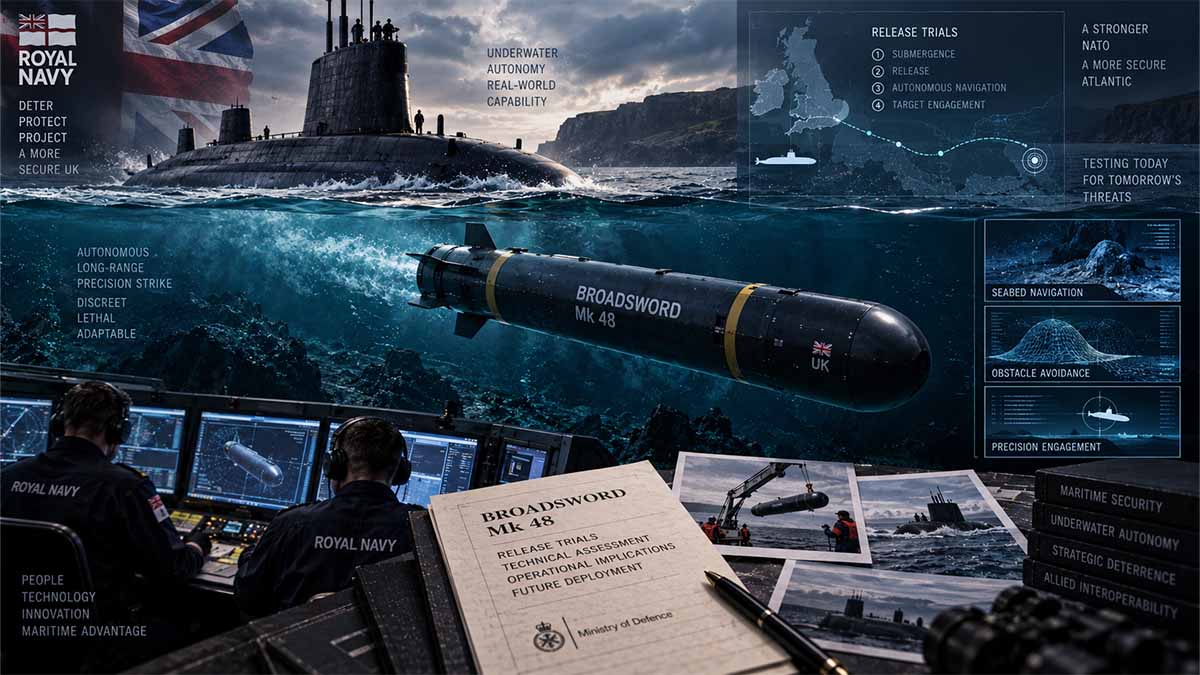
The following overview of the Royal Navy autonomous torpedo test provides relevant visual context illustrating the physical integration of the Mk 48 weapon onto the XV Excalibur platform during the trials.


