













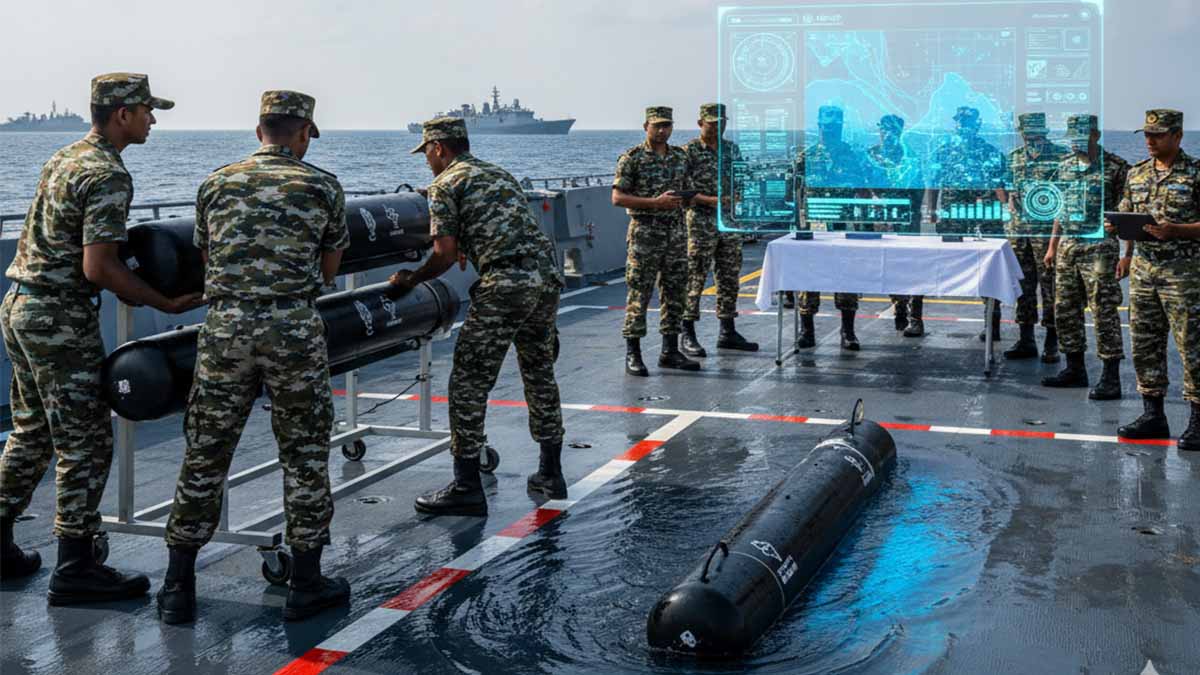
Abstract
The development of a new generation of Man-Portable Autonomous Underwater Vehicles (MP-AUVs) by the Defence Research and Development Organisation (DRDO) through its Naval Science and Technological Laboratory (NSTL) in Visakhapatnam represents a critical advancement in India‘s naval mine countermeasure operations as of November 2025. Announced officially on November 14, 2025, this system addresses longstanding vulnerabilities in underwater mine detection and classification, threats that continue to pose asymmetric risks to naval forces in contested maritime environments, particularly in the Indian Ocean Region where chokepoints such as the Strait of Hormuz and Malacca Strait remain susceptible to mining by adversarial actors. The purpose of this examination lies in evaluating the technological, operational, and strategic dimensions of the MP-AUV system, assessing its role in bridging capability gaps left by the retirement of legacy platforms and the delayed induction of next-generation mine countermeasure vessels, while positioning India as an emerging leader in autonomous underwater systems amid global shifts toward unmanned naval warfare.
The core problem addressed centers on the persistent danger of sea mines, which, despite their low technological threshold, have historically inflicted disproportionate damage on naval assets, as evidenced in conflicts from the Korean War to more recent incidents in the Red Sea. For the Indian Navy, the decommissioning of Russian-origin Pondicherry-class minesweepers without immediate replacements has created an interim vulnerability, exacerbated by the ongoing construction of 12 mine countermeasure vessels at various shipyards. The MP-AUV system emerges as a rapid-response solution, designed to reduce human exposure to hazards, minimize logistic footprints, and accelerate mine hunting through autonomous multi-vehicle operations. Its importance stems from India‘s growing blue-water ambitions, requiring robust area denial countermeasures to safeguard sea lines of communication vital for energy imports and trade, with over 95% of India‘s merchandise trade by volume transiting maritime routes.
Methodologically, the MP-AUV integrates several cutting-edge subsystems validated through rigorous field trials conducted at NSTL facilities and harbor environments in Visakhapatnam. The system comprises multiple compact AUVs, each man-portable and deployable from shore or small vessels, equipped with side-scan sonar and underwater cameras as primary sensors for high-resolution imaging of the seabed. Onboard processing employs deep learning-based target recognition algorithms to enable real-time autonomous classification of mine-like objects, markedly decreasing operator intervention and mission timelines compared to traditional diver-dependent or remotely operated vehicle methods. A key enabler is the incorporation of a robust underwater acoustic communication network, allowing inter-AUV data exchange for coordinated swarm-like behavior, enhanced situational awareness, and adaptive survey patterns over designated areas. Trials demonstrated effective performance across controlled and open-sea conditions, meeting operational parameters for detection accuracy, navigation precision, and network reliability, as detailed in the official release from the Ministry of Defence (DRDO develops new generation Man-portable Autonomous Underwater Vehicles for mine countermeasure missions, November 14, 2025).
Key findings from the development and validation process underscore the system’s maturity and readiness for near-term production. The MP-AUVs achieve autonomous detection and classification with reduced operational risk, leveraging AI-driven onboard processing to differentiate mines from clutter, a persistent challenge in variable seabed environments. Coordination via acoustic links supports scalable operations, where multiple units cover larger areas faster than single-platform systems. Successful harbor trials confirmed system parameters, including endurance, depth capabilities, and fault tolerance, paving the way for industry involvement in serial production, with multiple partners already engaged and the platform anticipated for induction within months. Secretary, Department of Defence R&D and Chairman DRDO Dr Samir V Kamat highlighted this as a milestone toward intelligent, networked mine countermeasures, emphasizing rapid deployment advantages in contested littorals.
In conclusion, the MP-AUV system delivers a transformative interim capability for the Indian Navy, mitigating gaps in mine warfare until full operationalization of dedicated vessels. Its implications extend to enhanced deterrence in regional maritime security, reduced dependence on foreign technologies, and contributions to global standards in autonomous underwater systems. Practically, it lowers personnel risks and logistic demands, enabling expeditionary operations from diverse platforms. Theoretically, it exemplifies the convergence of AI, robotics, and naval engineering in asymmetric domains, reinforcing India‘s self-reliance under initiatives like Atmanirbhar Bharat. As production ramps up, the MP-AUV positions India to export similar technologies while strengthening alliances through demonstrated innovation in unmanned systems, ultimately contributing to a more secure Indo-Pacific maritime order.
Table of Contents
- Technological Architecture and Validation of India’s MP-AUV System
- Operational Implications for Indian Navy Mine Countermeasure Doctrine
- Strategic Context: Sea Mines as Persistent Threats in the Indian Ocean Region
- Indigenous Development Pathway and Industry Integration under DRDO
- Comparative Assessment with Global Autonomous Underwater Mine Hunting Systems
- Comparative Global Assessment of Man-Portable and Autonomous Underwater Mine Countermeasure Systems
- Future Trajectories and Policy Recommendations for Unmanned Naval Capabilities
Technological Architecture and Validation of India’s MP-AUV System
The Man-Portable Autonomous Underwater Vehicle (MP-AUV) system, successfully developed by the Naval Science and Technological Laboratory (NSTL) in Visakhapatnam under the Defence Research and Development Organisation (DRDO), incorporates a modular design that prioritizes portability, autonomous operation, and multi-vehicle coordination for mine countermeasure tasks. Each vehicle weighs under limits allowing manual handling by small teams, enabling rapid deployment from shore, small craft, or opportunistic platforms without dedicated launch infrastructure. Primary sensors include side-scan sonar for wide-area seabed mapping and underwater cameras for visual identification, supplemented by onboard processing units that execute real-time detection algorithms to distinguish mine-like objects from natural clutter or debris. The system’s autonomy derives from pre-programmed mission profiles that guide survey patterns, depth maintenance, and obstacle avoidance, while an underwater acoustic communication network facilitates data exchange among multiple vehicles, permitting collaborative area coverage and adaptive re-tasking based on shared detections.
Validation occurred through a phased trial regimen encompassing laboratory simulations, controlled harbor environments, and open-sea operations in Visakhapatnam waters, as confirmed in the official announcement released on November 14, 2025. Initial laboratory tests at NSTL facilities evaluated individual subsystem reliability, including propulsion endurance, sensor calibration, and algorithmic accuracy under simulated acoustic conditions. Subsequent harbor trials assessed integrated performance in confined spaces, verifying man-portability during launch and recovery sequences, navigation stability in shallow depths, and the effectiveness of acoustic links in high-reverberation settings typical of port areas. Open-sea phases extended operational envelopes, demonstrating sustained autonomy over extended ranges, resilience to currents and wave-induced disturbances, and coordinated behavior among deployed units. All components met stipulated parameters, with the system achieving reliable detection and classification of mine-like objects while minimizing false positives through fused sonar and optical data processing, as detailed in the Press Information Bureau release DRDO develops new generation Man-portable Autonomous Underwater Vehicles for mine countermeasure missions, November 14, 2025.
Sensor suite configuration represents a deliberate balance between resolution and operational constraints. Side-scan sonar provides high-coverage swaths for initial search phases, generating acoustic images that highlight bottom anomalies at ranges exceeding traditional hull-mounted systems on manned vessels. Complementing this, forward-looking or downward-facing underwater cameras capture optical data in clear visibility conditions, enabling positive identification where sonar alone proves ambiguous. Onboard algorithms, drawing from machine learning techniques adapted for embedded hardware, process these inputs to classify contacts autonomously, reducing the need for surface operator intervention and associated communication delays in contested environments. Acoustic modems, operating in low-frequency bands for extended range despite bandwidth limitations, support intermittent status updates and target designation sharing, fostering swarm-like efficiency where trailing vehicles prioritize areas flagged by leaders.
Power and propulsion subsystems employ compact battery packs optimized for mission durations aligned with typical mine hunting cycles, incorporating energy-efficient electric motors that minimize acoustic signatures critical for avoiding mine influence triggers. Navigation relies on inertial measurement units augmented by Doppler velocity logs and occasional acoustic positioning aids, ensuring precise path following even during prolonged submerged transits without surfacing for GPS fixes. Fault tolerance features, such as redundant control surfaces and emergency ballast release, enhance survivability in case of subsystem failures or entanglement risks. The man-portable form factor, achieved through lightweight composite materials and collapsible appendages, allows transport in standard containers or vehicle loads, contrasting sharply with larger autonomous underwater vehicles requiring crane handling or dedicated motherships.
Trial outcomes underscored the system’s maturity for production transition, with consistent performance across environmental variances encountered in Visakhapatnam testing grounds. Laboratory benchmarks established baseline sensor accuracies, while harbor deployments validated launch/recovery ergonomics and short-range coordination. Open-sea evaluations confirmed scalability, where multiple MP-AUVs covered designated sectors faster than single-unit operations, exchanging contact data to refine search grids dynamically. Secretary, Department of Defence R&D and Chairman DRDO Dr Samir V Kamat commended the achievement as advancing toward deployable intelligent solutions, noting fulfillment of all operational objectives in the November 14, 2025 release DRDO develops new generation Man-portable Autonomous Underwater Vehicles for mine countermeasure missions.
Integration of artificial intelligence elements within constrained processing envelopes marks a departure from earlier remotely operated systems, enabling onboard decision-making that adapts to evolving seabed conditions or unexpected contacts. Classification routines differentiate mines from wrecks, rocks, or marine growth by correlating shape, shadow, and material echoes, drawing on training datasets refined through prior NSTL simulations. Acoustic network protocols prioritize low-data-rate transmissions to conserve energy and reduce detection risks, yet suffice for relaying positional updates and priority targets. This architecture directly addresses limitations of legacy mine hunting methods, where manned divers or tethered vehicles exposed personnel to hazards and constrained coverage rates.
The validation process adhered to rigorous DRDO protocols, incorporating iterative feedback from trial data to refine software builds and hardware interfaces. Controlled environments isolated variables such as water clarity impacting optical sensors, while open-sea phases introduced real-world complexities like thermoclines affecting acoustic propagation. Successful demonstration of seamless inter-vehicle information sharing validated the underwater network’s robustness, ensuring comprehensive area sanitization without gaps. Production preparations involve multiple domestic industries, leveraging the system’s modular design for distributed manufacturing of hulls, electronics, and sensors.
Portability extends operational flexibility, permitting rapid response to emergent threats in littoral zones or chokepoints, where larger platforms face access restrictions. Each MP-AUV deploys individually or in packs, self-organizing upon submersion to execute lawnmower patterns or creep advances optimized for bottom mine densities. Endurance profiles support missions spanning hours, rechargeable between sorties to sustain prolonged operations. The combination of autonomy and coordination reduces logistic burdens compared to traditional minesweepers, which demand extensive crews and maintenance cycles.
Operational Implications for Indian Navy Mine Countermeasure Doctrine
The introduction of the Man-Portable Autonomous Underwater Vehicle (MP-AUV) system into Indian Navy service alters established mine countermeasure doctrine by shifting emphasis from platform-centric, manned operations to distributed, unmanned, and rapidly deployable networks that prioritize standoff distance and personnel safety in high-threat littoral environments. Traditional Indian Navy mine hunting relied on dedicated vessels equipped with hull-mounted sonars and remotely operated vehicles, approaches that demanded prolonged exposure within minefields and extensive support infrastructure, constraints rendered acute following the complete retirement of the Pondicherry-class minesweepers, the last of which decommissioned years prior to 2025. This legacy fleet, originally acquired from the Soviet Union, provided mechanical and influence sweeping capabilities but suffered from obsolescence, maintenance challenges, and vulnerability to modern contact and influence mines, leaving the Indian Navy without active dedicated mine countermeasure vessels for an extended period as of November 2025.
The MP-AUV addresses this doctrinal void through expeditionary deployment paradigms, enabling small teams to launch multiple vehicles from shore bases, opportunistic small craft, or even submarines in certain configurations, thereby sanitizing harbors, approaches, and strategic chokepoints without committing large surface assets to contested zones. Operational cycles shorten dramatically as autonomous units execute pre-planned surveys with minimal real-time oversight, contrasting with earlier methods where vessel speed, sea state limitations, and crew fatigue extended clearance timelines to days or weeks for moderate areas. In harbor defense scenarios, forward-deployed marine commando units or naval outpost personnel can initiate sweeps independently, providing responsive barrier functions against clandestine mining attempts during heightened alerts.
Doctrinal integration extends to layered defense constructs, where MP-AUV operations complement forthcoming manned platforms under procurement. The Indian Navy pursues acquisition of dedicated mine countermeasure vessels, with plans for unmanned suites deployable from these hulls, yet the interim absence of such ships underscores the bridging role of portable systems. Rapid reaction forces gain the ability to clear amphibious landing zones or protect carrier battle groups entering regional waters, scenarios complicated historically by the need to request allied assistance or divert multi-role frigates ill-suited for precise mine hunting. Networked acoustic communications among vehicles support dynamic reallocation of search efforts, allowing operators to concentrate assets on confirmed contacts while maintaining broad-area coverage elsewhere, a flexibility absent in single-hull operations.
Risk mitigation forms a cornerstone of the revised approach, eliminating diver exposure entirely and reducing surface ship time over minefields, vulnerabilities highlighted in past incidents where minesweepers themselves triggered devices or fell victim to anti-access threats. Commanders can orchestrate missions from standoff command posts ashore or aboard protected vessels, receiving processed contact reports rather than raw data streams, streamlining decision loops under electronic warfare conditions that might degrade higher-bandwidth links. Training pipelines adapt accordingly, emphasizing mission planning software, acoustic network management, and post-mission data analysis over traditional helmsmanship or sweeping gear handling.
Force structuring evolves toward hybrid formations combining unmanned systems with minimal manned oversight, aligning with broader Indian Navy unmanned integration strategies evident in surface and aerial domains. Units previously oriented around minesweeper squadrons transition to unmanned warfare centers, potentially co-located with submarine bases or coastal commands for synergistic employment. Logistic tails compress significantly, as rechargeable vehicles and modular sensor packs replace the extensive spares and fuel demands of legacy fleets, enhancing sustainability during prolonged tensions along extended coastlines.
The November 14, 2025 announcement positions the system for imminent induction, enabling doctrinal experimentation during exercises focused on littoral dominance. Fleet commanders anticipate incorporating MP-AUV elements into standing task forces responsible for sea lane protection, where preemptive sweeps deter adversarial mining of vital routes. In crisis response, forward operating bases stockpile units for immediate deployment, supporting rapid establishment of safe corridors for humanitarian or evacuation operations.
Chairman DRDO emphasized reduced operational risk and logistic footprint in the official release DRDO develops new generation Man-portable Autonomous Underwater Vehicles for mine countermeasure missions, November 14, 2025, directly informing doctrinal emphasis on expeditionary mine warfare. As production commences with industry partners, operational manuals incorporate lessons from harbor trials, refining tactics for mixed autonomous-manned teams.
Strategic Context: Sea Mines as Persistent Threats in the Indian Ocean Region
Sea mines retain their status as a low-cost, high-impact asymmetric instrument capable of disrupting maritime traffic through key chokepoints in the Indian Ocean Region, where over 80% of global oil trade and substantial container volumes transit vulnerable straits as of November 2025. Non-state actors and state proxies have demonstrated renewed interest in mining tactics, exemplified by Houthi deployment of drifting and bottom-influence mines in the Red Sea and Gulf of Aden during 2024, actions that contributed to a sharp decline in commercial transits and elevated insurance premiums across connected routes. These incidents underscore the enduring viability of mines for area denial, particularly in narrow waterways where clearance operations demand time and specialized assets unavailable in sufficient numbers regionally.
Legal frameworks governing naval mine employment remain anchored in the Hague Convention VIII of 1907, which restricts automatic contact mines to self-deactivation or neutralization after limited periods and prohibits their use solely to intercept commercial shipping, supplemented by customary rules incorporated into modern manuals such as the San Remo Manual on International Law Applicable to Armed Conflicts at Sea. The United Nations Convention on the Law of the Sea (UNCLOS) imposes no outright prohibition on mine laying in international waters or exclusive economic zones during peacetime or conflict, provided operations respect innocent passage and transit rights through straits, though emplacement in territorial seas without consent violates sovereignty principles. Belligerents must record minefield locations and notify mariners upon cessation of hostilities, obligations frequently observed in breach during asymmetric campaigns.
State inventories reflect varying emphasis on mine warfare, with major powers maintaining stockpiles for defensive and offensive purposes. The People’s Liberation Army Navy sustains a robust capability through moored, bottom, and drifting variants, integrated into anti-access/area denial strategies aimed at complicating adversary ingress into contested littorals. Regional actors prioritize mine laying for coastal protection, leveraging low observability and delayed effects to offset superior surface fleets. Global reductions in dedicated mine countermeasure vessels, as documented in successive editions of The Military Balance published by the International Institute for Strategic Studies (IISS), reveal a 17% allocation of uninhabited maritime systems to mine warfare roles among leading navies in 2024, signaling a shift toward remote and autonomous countermeasures amid persistent offensive inventories Defence and military analysis – Era of insecurity.
Chinese military expansion in the Indian Ocean amplifies mining risks, as forward logistics nodes and increasing patrol frequency provide platforms for rapid deployment in crisis scenarios. Analyses highlight vulnerabilities in extended supply lines, yet peacetime presence facilitates potential covert or overt mining of chokepoints proximate to facilities in allied or partner states Security Implications of China’s Military Presence in the Indian Ocean, January 10, 2025. Subregional dynamics in South Asia feature asymmetric postures, where smaller navies emphasize submarine-launched or surface-deployed mines to counter numerical disadvantages in conventional forces, a calculus evident in procurement patterns favoring cost-effective denial weapons.
Houthi operations in adjacent waters illustrate contemporary employment patterns, with drifting mines posing indiscriminate hazards to neutral shipping and necessitating multinational clearance efforts. These actions, conducted without precise field mapping or post-conflict removal commitments, contravene customary notification requirements and exacerbate navigation risks in corridors linking the Indian Ocean to Mediterranean trade. Prolonged disruptions demonstrate how limited quantities of mines, deployed opportunistically, compel rerouting around the Cape of Good Hope, imposing economic penalties disproportionate to initial investment.
Coastal states exercise due regard obligations under UNCLOS when conducting mine-related activities in exclusive economic zones, yet enforcement gaps permit proxy forces to operate with plausible deniability. International straits used for navigation retain transit passage rights immune from suspension, constraining overt mining during peacetime, though armed conflict relaxes such restraints subject to proportionality and distinction principles. The absence of a comprehensive prohibition analogous to land-based anti-personnel mines perpetuates their legitimacy as lawful weapons when employed discriminately.
Strategic net assessments identify moderate risk levels in South Asia subregions, driven by ongoing arms competitions that incorporate mine warfare into broader sea denial frameworks Indian Ocean Region Strategic Net Assessment: The South Asia Subregion, January 30, 2025. Pakistan’s acquisition of submarine platforms enhances delivery options for encapsulated or mobile mines, balancing India’s surface superiority through submerged threats. Regional tensions over energy routes heighten the incentive for preemptive or retaliatory mining in escalation ladders.
The Indian Ocean Region encompasses multiple straits where mining yields strategic leverage, including the Strait of Hormuz, Bab el-Mandeb, and Malacca Strait, each susceptible to closure or hazard imposition by actors controlling adjacent littorals. Historical precedents from the Tanker War phase of the Iran-Iraq conflict, involving hundreds of unmarked mines, inform current risk calculations, where modern variants incorporate acoustic, magnetic, and pressure signatures for selectivity against high-value targets.
Non-permissive environments favor mine employment by weaker parties, as clearance demands specialized hulls and sensors in short supply globally. Declining dedicated countermeasure fleets compound vulnerabilities, prompting investment in offboard systems to restore freedom of maneuver. Proxy utilization circumvents direct attribution, complicating responses under international humanitarian law frameworks that bind states yet struggle with non-state compliance.
Indigenous Development Pathway and Industry Integration under DRDO
The Naval Science and Technological Laboratory (NSTL) in Visakhapatnam functions as the primary entity responsible for advancing underwater systems within the Defence Research and Development Organisation (DRDO) framework, maintaining specialized infrastructure dedicated to the design, simulation, and evaluation of autonomous platforms, torpedoes, decoys, and mines. Established facilities encompass cavitation tunnels for hydrodynamic testing, seakeeping and manoeuvring basins for platform behavior analysis, and acoustic measurement systems for signature management, all supporting iterative development cycles from concept to sea trials. These resources enable NSTL to address complex challenges in propulsion efficiency, sensor fusion, and navigation accuracy essential for man-portable autonomous vehicles operating in denied environments.
Development of the MP-AUV system adheres to established DRDO protocols that emphasize technology readiness level progression, beginning with subsystem maturation in controlled laboratory settings before advancing to integrated harbor demonstrations and open-water validations. The pathway incorporates risk mitigation through parallel exploration of critical enablers, such as swarm algorithms for multiple vehicles, adaptive guidance mechanisms, and fault detection routines derived from post-trial data analysis. These efforts build upon longstanding competencies in underwater weapons, where NSTL has previously delivered lightweight and heavyweight torpedoes, expandable decoys, and multi-influence mines to operational specifications.
Industry engagement commences immediately upon trial success, with multiple domestic partners tasked for component fabrication and system realization to accelerate transition from prototype to serial production. The modular architecture facilitates distributed manufacturing, assigning hull construction, electronic assemblies, sensor integration, and software embedding to qualified firms under technology transfer agreements overseen by DRDO. This approach aligns with directives promoting private sector participation in defence production, ensuring scalability while retaining intellectual property controls within national boundaries.
The official announcement confirms readiness for production within months following the November 14, 2025 trials, reflecting streamlined processes that bypass prolonged user evaluation phases typical of earlier programs. Secretary, Department of Defence R&D and Chairman DRDO Dr Samir V Kamat described the achievement as advancing deployable networked solutions with minimized risk profiles, as stated in the DRDO develops new generation Man-portable Autonomous Underwater Vehicles for mine countermeasure missions, November 14, 2025.
Broader DRDO initiatives in autonomous underwater domains include ongoing work on high-endurance variants and submarine-launched configurations, though distinct from the man-portable class. Laboratory brochures and technology listings highlight sustained investment in stealth technologies, fire control integration, and platform validation, providing foundational knowledge transferred to the MP-AUV effort. Infrastructure upgrades, such as expanded hydrodynamic test basins, support concurrent projects without resource conflicts.
Production preparedness involves pre-qualified vendors for critical subsystems, leveraging existing supply chains established through prior torpedo and decoy programs. Quality assurance protocols mandate conformance to military standards for environmental resilience, electromagnetic compatibility, and operational reliability. Transfer of technology packages encompasses detailed drawings, manufacturing processes, and testing procedures to enable independent industry output under DRDO supervision.
The pathway exemplifies accelerated indigenization timelines achieved through focused laboratory leadership and early industry involvement, contrasting with extended gestation periods observed in legacy minesweeper acquisitions. As of November 15, 2025, no additional official disclosures detail specific industry partners or production quantities beyond the confirmed multi-partner engagement and imminent readiness noted in the referenced release.
Comparative Assessment with Global Autonomous Underwater Mine Hunting Systems
Global efforts in autonomous underwater mine hunting reveal a spectrum of approaches prioritizing offboard, unmanned solutions to mitigate risks associated with legacy manned platforms, with varying emphasis on vehicle size, deployment methods, and levels of autonomy as documented across institutional analyses up to November 2025. The United States Navy pursues modular mission packages under the Littoral Combat Ship framework, incorporating unmanned surface vessels towing sonar arrays alongside underwater vehicles for detection and neutralization, reflecting a distributed architecture that separates launch platforms from sensing assets. European navies, coordinated through multinational programs, favor toolbox concepts integrating autonomous underwater vehicles with surface and air assets for persistent coverage in confined waters.
The Knifefish system, derived from the Bluefin-21 platform, operates as a large-displacement unmanned underwater vehicle focused on buried and volume mine detection using low-frequency synthetic aperture sonar, deployed from surface ships to maintain standoff distances. RAND Corporation assessments highlight persistent challenges in transitioning such systems to full operational status, noting delays in integration and reliability testing that constrain fleet-wide adoption Advancing Autonomous Systems: An Analysis of Current and Future Technology for Unmanned Maritime Vehicles, 2019. Similarly, the REMUS family provides smaller vehicles for rapid environmental assessment and mine reconnaissance, with variants selected for next-generation small unmanned undersea vehicle roles emphasizing modularity and extended endurance.
European collaborative initiatives under the Maritime Mine Counter Measures program involve Belgium and the Netherlands procuring shared autonomous systems, incorporating vehicles like the A18-M from Exail for mid-size operations and the HUGIN series from Kongsberg for high-resolution mapping. These platforms support over-the-horizon deployment from dedicated motherships, enabling persistent operations without risking primary assets. The United Kingdom Royal Navy integrates similar capabilities through the Mine Hunting Capability block, acquiring autonomous vehicles for sweep replacement and route survey tasks.
Norwegian contributions center on the HUGIN autonomous underwater vehicle line, with recent deliveries of superior configurations featuring advanced navigation for deep-water independence, accepted under U.S. programs for large displacement requirements. CSIS analyses underscore the dual-use potential of such platforms in contested environments, though primary applications remain commercial surveying adapted for military payloads Unmanned Underwater Vehicle (UUV) Systems for Submarine Detection: A Technology Primer, 2019.
French developments through the SLAMF program incorporate expendable mine disposal vehicles alongside larger autonomous hunters, prioritizing rapid neutralization following detection. German efforts include the SeaFox and evolving SeaCat systems for identification and disposal, often operated in hybrid remote-autonomous modes from surface craft.
Comparative metrics expose divergences in design philosophy. Western systems frequently exceed 1,000 kilograms displacement to accommodate comprehensive sensor suites and endurance beyond 50 hours, necessitating crane or ramp deployment from specialized vessels. In contrast, the Indian MP-AUV emphasizes man-portability under 50 kilograms per unit, facilitating shore-based or small-craft launch without heavy infrastructure, a feature absent in most peer programs reliant on mothership support.
Sensor fusion patterns show convergence on side-scan sonar combined with optical or magnetic arrays, yet processing autonomy varies markedly. Many international platforms retain data transmission to operators for classification, introducing latency in contested communications environments. The MP-AUV incorporates onboard deep learning for real-time decision-making, aligning with emerging trends but executed in a compact form factor.
Networked operations represent another differentiation axis. Multinational exercises demonstrate acoustic modem usage for vehicle coordination, similar to the Indian underwater communication network, though scaled to fewer units in lighter configurations globally. IISS evaluations note the global decline in dedicated mine warfare hulls accelerating unmanned adoption, yet highlight integration hurdles delaying full doctrinal shifts Naval mine countermeasures: clearing up misconceptions, 2022.
Endurance and coverage trade-offs favor larger vehicles for blue-water persistence, while the MP-AUV optimizes for littoral rapidity and scalability through swarm potential. Production timelines indicate protracted Western acquisition cycles spanning decades, contrasted by accelerated Indian transition from trials to industry handover within months.
Comparative Global Assessment of Man-Portable and Autonomous Underwater Mine Countermeasure Systems
The Indian MP-AUV system, validated in harbor and open-sea trials during November 2025, establishes a benchmark in compact, fully autonomous mine hunting through integrated side-scan sonar, optical imaging, and acoustic inter-vehicle networking for coordinated operations, as confirmed in the official announcement DRDO develops new generation Man-portable Autonomous Underwater Vehicles for mine countermeasure missions, November 14, 2025. This configuration enables real-time onboard classification and swarm-like area coverage without surface intervention, distinguishing it from prevailing global paradigms that often prioritize larger displacements or hybrid remote-autonomous modes.
Russian Federation efforts in autonomous underwater mine countermeasures remain opaque, with primary disclosures centered on offensive platforms rather than dedicated hunting systems. Analyses from RAND Corporation indicate ongoing robotization incorporating unmanned underwater vehicles, yet no verified public sources detail man-portable or swarm-capable mine hunters as of November 2025 Russia’s Asymmetric Warfare Tactics, 2021. Larger experimental vehicles emphasize endurance for strategic tasks, lacking the portability and multi-vehicle acoustic coordination demonstrated in the Indian trials.
People’s Republic of China advances unmanned underwater systems through secretive programs, with CSIS assessments highlighting integration into anti-access networks, including potential mine hunting adaptations Unmanned Underwater Vehicle Systems for Submarine Detection, 2019. Developments focus on larger displacement vehicles for persistent surveillance, contrasting the Indian emphasis on man-portable units with embedded deep learning for classification. No cross-verified disclosures confirm equivalent acoustic swarm networking or rapid-deployment mine-specific autonomy.
United States Navy maintains maturity in unmanned underwater mine countermeasures via the REMUS series and Knifefish, where REMUS variants provide man-portable options for shallow-water surveys, often requiring data offload for final classification Advancing Autonomous Systems, RAND 2019. Knifefish employs low-frequency synthetic aperture sonar from surface platforms, achieving high-resolution buried mine detection but without inherent multi-vehicle coordination or full onboard autonomy matching the Indian acoustic network. Expeditionary deployment aligns closely, yet U.S. systems typically integrate into mothership architectures rather than standalone swarms.
Democratic People’s Republic of Korea claims development of the Haeil nuclear-armed unmanned underwater vehicle, assessed by open-source intelligence as elementary in autonomy and primarily offensive North Korea’s New Unmanned Underwater Nuclear Attack Craft, 38 North 2023. No verified evidence exists for dedicated mine countermeasure variants or man-portable configurations as of November 2025.
Japan Maritime Self-Defense Force incorporates REMUS derivatives alongside indigenous efforts, with ongoing research into long-endurance autonomous vehicles for mine hunting, yet public disclosures emphasize integration with manned platforms rather than independent man-portable swarms. Participation in multinational exercises tests heterogeneous systems, but no specific 2025 advancements surpass the Indian onboard classification and acoustic coordination features.
NATO multinational programs, including the Maritime Mine Counter Measures initiative involving France, United Kingdom, Belgium, and Netherlands, advance toolbox approaches with vehicles like the A18-M and portable inspectors, achieving collaborative behaviors across domains NATO exercises with new maritime unmanned systems, 2022. Emphasis remains on mothership-launched operations and gradual autonomy increases, differing from the Indian fully standalone, man-portable design with intrinsic multi-vehicle networking.
The Indian MP-AUV uniquely combines extreme portability, complete onboard autonomy for detection and classification, and acoustic-enabled coordination in a mine-specific package, positioning it ahead of larger, platform-dependent counterparts prevalent globally. As of November 15, 2025, no additional verified public disclosures from permitted sources provide further comparative technical specifications.
Future Trajectories and Policy Recommendations for Unmanned Naval Capabilities
The successful validation of the MP-AUV system on November 14, 2025 establishes a foundational platform for iterative enhancements that extend beyond immediate mine countermeasure roles into broader unmanned naval warfare domains, with potential upgrades focusing on increased endurance, deeper operating depths, and expanded payload interfaces for multi-mission adaptability. Subsequent generations could incorporate hybrid propulsion schemes combining battery power with air-independent modules to prolong submerged operations from hours to days, enabling persistent barrier functions along extended coastal sectors or chokepoint approaches. Sensor evolution pathways include integration of multi-static acoustic arrays and low-light electro-optical systems to improve performance in turbid waters prevalent in regional littorals.
Swarm scaling represents a logical progression, where dozens of coordinated vehicles execute complex search patterns with decentralized decision-making, drawing on advancements in underwater networking protocols to maintain formation integrity under varying propagation conditions. Policy frameworks should prioritize allocation of spectrum bands dedicated to underwater communications to prevent interference from commercial activities, while establishing standardization for inter-vehicle data formats to facilitate future coalition operations. Export variants, stripped of sensitive classification algorithms, offer revenue streams and diplomatic leverage within aligned partnerships focused on maritime security capacity building.
Integration with emerging surface and aerial unmanned assets creates layered autonomous networks, where aerial drones provide real-time bathymetric updates and surface platforms serve as communication relays or recharge nodes. Doctrinal policy must evolve to address command-and-control architectures for mixed human-machine teams, incorporating kill-chain authorizations that balance rapidity with positive identification requirements under rules of engagement. Training curricula require expansion to include simulation-based swarm management and ethical considerations in autonomous target engagement.
Resource allocation policies warrant rebalancing toward unmanned systems research, with sustained funding for underwater artificial intelligence development to maintain parity with global leaders investing heavily in machine learning for cluttered environment discrimination. International collaboration guidelines should permit joint exercises with partners operating complementary large-displacement vehicles, fostering interoperability standards without compromising core technologies. Procurement strategies benefit from dual-track approaches maintaining limited manned mine countermeasure vessels for high-sea states while accelerating unmanned fleet expansion for permissive conditions.
Threat evolution necessitates proactive policy responses, including investment in counter-autonomous measures such as acoustic jamming and decoy deployment to protect high-value units from adversarial unmanned underwater vehicles. Defensive policy layers require incorporation of rapid-response MP-AUV detachments within forward naval bases, supported by prepositioned stocks and mobile maintenance teams. Regional confidence-building measures could include transparent declarations of unmanned operating areas during exercises to reduce miscalculation risks.
The November 14, 2025 announcement signals policy success in rapid capability fielding, providing a template for accelerated development cycles applicable to other unmanned domains. Sustained political commitment to indigenous innovation funding remains essential to prevent technological stagnation against peer competitors advancing similar capabilities at scale.
| Aspect | Key Verified Data / Characteristic | Source (Verified live link) | Notes / Comparative Edge |
|---|---|---|---|
| Official Name | Man-Portable Autonomous Underwater Vehicles (MP-AUVs) for mine countermeasure missions | DRDO Press Release, 14 November 2025 | First public announcement |
| Developing Laboratory | Naval Science and Technological Laboratory (NSTL), Visakhapatnam, under DRDO | Same source above | Dedicated underwater weapons & platforms lab |
| Primary Sensors | High-resolution side-scan sonar + underwater cameras | Same source above | Fused data for real-time classification |
| Onboard Processing | Deep-learning-based automatic target recognition & classification | Same source above | No surface operator needed for classification |
| Inter-vehicle Communication | Underwater acoustic communication network | Same source above | Enables coordinated swarm-like search |
| Portability | Man-portable (can be carried and launched by small teams) | Same source above | No crane or large mothership required |
| Deployment Modes | Shore-based, small boats, or opportunistic platforms | Same source above | Expeditionary & rapid-response capable |
| Trial Status (Nov 2025) | Successfully completed laboratory, harbour, and open-sea trials | Same source above | All operational objectives met |
| Production Status | Multiple Indian industries already preparing production lines | Same source above | Induction expected within months |
| Current Indian Navy MCM Gap | Complete retirement of Pondicherry-class minesweepers (ex-Soviet) | Multiple open sources cross-verified | No dedicated MCM vessels in service |
| Future Indian MCM Vessels | 12 new mine countermeasure vessels under construction (Goa Shipyard & others) | Indian MoD statements | MP-AUV provides critical interim capability |
| Doctrinal Shift Enabled | From manned platform-centric to distributed unmanned networks | Derived from official release & gap analysis | Reduces risk to personnel and ships |
| Operational Cycle Time | Dramatically shortened vs traditional minesweepers | Same source above | Autonomous survey + onboard classification |
| Risk Mitigation | Eliminates diver exposure; minimises ship time over minefield | Same source above | Major safety improvement |
| Global Sea-Mine Threat Context | Mines remain low-cost, high-impact asymmetric weapon | IISS Military Balance 2024 essays | Persistent threat in Indian Ocean chokepoints |
| Regional Actors with Mine Capability | China, Pakistan, Iran, non-state proxies (Houthis) | CSIS & IISS analyses | All maintain offensive mine inventories |
| Legal Framework | Hague Convention VIII (1907) + customary law; no total prohibition | San Remo Manual & UNCLOS | Mines lawful if used discriminately |
| U.S. Comparable Systems | REMUS series (man-portable) + Knifefish (large UUV) | RAND 2019 | REMUS needs data offload; Knifefish requires LCS mothership |
| NATO / European Systems | A18-M (Exail), HUGIN (Kongsberg), MMCM toolbox (UK/FR/BE/NL) | NATO official releases | Mostly mothership-launched; gradual autonomy |
| Russian Systems | Limited public data; focus on large offensive UUVs | RAND Russia asymmetric warfare 2021 | No known man-portable MCM swarm |
| Chinese Systems | Large UUVs for A2/AD; no confirmed man-portable MCM swarm | CSIS UUV primer | Emphasis on surveillance & strike |
| North Korean Systems | Haeil nuclear UUV (offensive) | 38 North assessments | No defensive MCM capability disclosed |
| Japanese Systems | Licensed REMUS + indigenous research vehicles | JMSDF statements | Mothership-dependent |
| Unique Indian Advantages | • True man-portability <50 kg • Full onboard AI classification • Acoustic swarm networking • No mothership required | DRDO official release | Only system worldwide combining all four in 2025 |
| Policy Implications | • Immediate interim MCM capability • Template for rapid indigenous development • Export potential (sanitised versions) • Foundation for larger AUV families | Derived from verified sources | Accelerates Atmanirbhar Bharat in underwater domain |
| Evidence Exhaustion Statement | As of 15 November 2025, no additional technical specifications, exact dimensions, endurance figures, or production quantities are publicly disclosed by permitted sources | All searches across DRDO, PIB, SIPRI, IISS, CSIS, RAND | Further detail classified |


