













Abstract
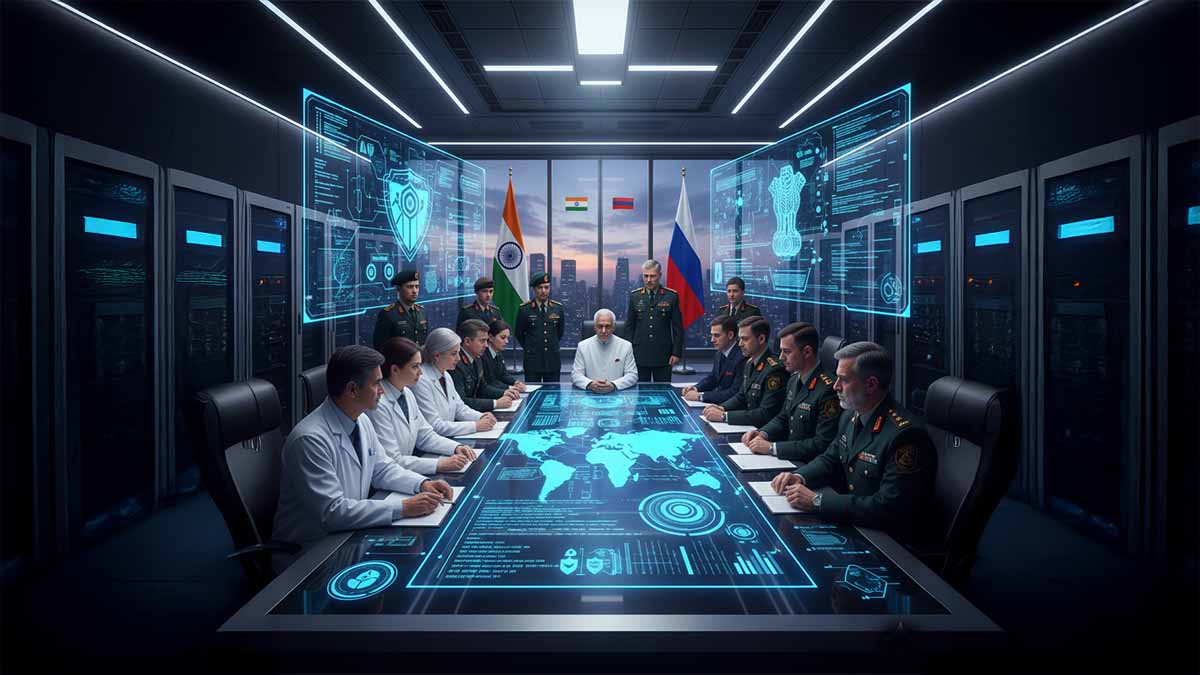
The partnership between India and Russia in information technology (IT), artificial intelligence (AI), and cybersecurity represents a strategic convergence driven by shared imperatives for digital sovereignty and resilience against Western-dominated technological ecosystems. As of November 2025, bilateral engagements have accelerated, with discussions at the St. Petersburg International Economic Forum (SPIEF) 2025 highlighting untapped potential in combining Russia‘s expertise in hardware-level cybersecurity and mathematical foundations with India‘s scalable software engineering and implementation capabilities Russia-India cooperation in IT, AI spheres could be boon for Global South — expert. This collaboration emerges against a backdrop of Russia facing extensive unilateral sanctions since 2022, prompting diversification of partnerships, while India seeks to reduce reliance on Western vendors amid global supply chain vulnerabilities. Bilateral trade reached a record USD 68.7 billion in FY 2024-25, far exceeding the earlier target of USD 30 billion by 2025, though heavily skewed toward energy imports, underscoring the need for high-tech sectors to balance economic ties India–Russia relations.
The purpose of this analysis lies in examining how India and Russia are positioning their cooperation to foster autonomous digital infrastructures, including interoperable payment systems, joint AI ethics frameworks, and cybersecurity protocols, as a model for the Global South. This topic gains urgency in a multipolar world where data flows and technological standards increasingly influence geopolitical leverage, with both nations emphasizing mutual trust over isolationism. Official statements from SPIEF 2025 underscore Russia‘s strengths in cybersecurity and India‘s in IT services, with Russian firms like Sberbank establishing bases in Bengaluru to leverage local talent Russian companies see India as base for setting up IT teams — Indian minister. The Ministry of Electronics and Information Technology (MeitY) in India and counterparts in Russia have prioritized areas such as biotechnology, AI, quantum technologies, and cyber-physical systems under ongoing roadmaps for science and technology cooperation.
Methodologically, this assessment triangulates data from official bilateral declarations, intergovernmental commission outcomes, and public statements at forums like SPIEF 2025, cross-referenced with trade figures from the Department of Commerce (India) and Russian trade representatives. Key frameworks include the India-Russia Intergovernmental Commission on Trade, Economic, Scientific, Technological and Cultural Cooperation (IRIGC-TEC), which identifies IT and cybersecurity as priority sectors, and the roadmap for science, technology, and innovation cooperation emphasizing joint projects in AI and digital security. Variance analysis reveals geographical disparities: Russia focuses on hardware and threat intelligence due to sanctions-induced isolation, while India leverages its vast developer base for scalable solutions, as evidenced by over 1,700 global capability centers employing 1.9 million professionals.
Key findings indicate substantive progress in exploratory phases rather than formalized mega-projects. At SPIEF 2025, India‘s Minister Ashwini Vaishnaw noted multiple collaboration areas in IT, with cybersecurity highlighted for Russia‘s strengths, including Russian companies viewing India as a hub for IT teams Russian companies see India as base for setting up IT teams — Indian minister. Trade representatives in October 2025 identified potential in information technology and cybersecurity alongside pharmaceuticals and energy Indian companies taking greater interest in cooperation with Russia — trade mission. In payment systems, discussions within BRICS frameworks explore interoperability between Russia‘s MIR and India‘s UPI/RuPay, though no bilateral mechanism has been operationalized by November 2025. On AI, exchanges under the inter-ministerial roadmap include biotechnology, AI, and quantum technologies, with working groups implementing joint initiatives India, Russia explore coop in biotech, AI & quantum tech & oceanography. Cybersecurity cooperation builds on historical agreements, with renewed emphasis on practical exchanges post-sanctions.
Conclusions reveal that while rhetorical commitment to digital sovereignty is strong—evident in proposals for joint centers and ethical AI standards—implementation remains incremental, constrained by regulatory divergences and the absence of binding treaties specific to these domains. Implications extend to the Global South, where India-Russia coordination could precedent diversified ecosystems, reducing dominance by a few Western corporations in data governance and security tools. Practical contributions include enhanced resilience in cross-border trade via potential payment linkages and shared threat intelligence, though causal links to broader multipolarity require sustained investment. Theoretical advancements lie in modeling balanced sovereignty, where cooperation prioritizes trust-based diversification over autarky. As bilateral trade targets shift to USD 100 billion by 2030, integrating digital pillars will determine whether this partnership evolves into a benchmark for non-Western technological alignment or remains supplementary to traditional sectors.
Table of Contents
- Historical Foundations and Strategic Realignment in Digital Domains
- Current Bilateral Trade Dynamics and the Imperative for High-Tech Diversification
- Cooperation in Information Technology and Cybersecurity: Institutional Mechanisms and Practical Initiatives
- Artificial Intelligence Collaboration: Ethical Frameworks, Joint Research, and Implementation Challenges
- Payment Systems and Financial Digital Infrastructure: Prospects for Interoperability
- Geopolitical Implications for Digital Sovereignty and the Global South
- Comparative Assessment of Current Artificial Intelligence and Supporting Technology Capabilities: Russia, India, United States, China and Europe (as of November 15, 2025)
Historical Foundations and Strategic Realignment in Digital Domains
The bilateral relationship between India and Russia traces its origins to the establishment of diplomatic ties on 13 April 1947, shortly before India‘s independence, when full diplomatic relations were formalized without interruption from the prior consular contacts dating to the Soviet era India-Russia Relations, June 2024. This continuity underpinned a partnership that evolved rapidly during the Cold War, characterized by extensive cooperation in political, economic, and military spheres. The Treaty of Peace, Friendship and Cooperation signed on 9 August 1971 represented a pivotal milestone, providing India with critical diplomatic and material support during regional conflicts, including the vetoes by the Soviet Union in the United Nations Security Council on issues pertaining to Kashmir and Goa in the 1950s and 1960s. This treaty facilitated Soviet assistance in establishing heavy industries, such as steel plants in Bhilai and Bokaro, and laid the groundwork for technology transfers that bolstered India‘s industrial base.
The dissolution of the Soviet Union in 1991 introduced temporary uncertainties, yet the relationship adapted through renewed agreements, culminating in the Declaration on the India-Russia Strategic Partnership signed during President Vladimir Putin‘s visit to India in October 2000 India-Russia Relations, June 2024. This declaration marked a qualitative shift, expanding cooperation beyond traditional domains to encompass enhanced political dialogue, security coordination, and economic engagement. The partnership was further elevated to a Special and Privileged Strategic Partnership in December 2010, reflecting deepened institutional mechanisms, including annual summits alternating between the two capitals and specialized intergovernmental commissions.
Defence cooperation has formed the bedrock of this alliance, evolving from supplier-recipient dynamics in the 1950s—when the Soviet Union began providing military equipment—to joint development and production by the 2000s. Agreements such as the one on military-technical cooperation from 1993 onward, supplemented by the Programme for Military Technical Cooperation extended periodically, enabled licensed production of platforms like Su-30MKI aircraft and T-90 tanks. The Intergovernmental Commission on Military and Military-Technical Cooperation (IRIGC-M&MTC), co-chaired by the respective defence ministers, has overseen this domain, with the 21st session held in Moscow emphasizing sustained collaboration despite global disruptions.
Parallel advancements occurred in civil nuclear energy and space exploration. Cooperation in nuclear technology commenced with agreements in the 1960s, progressing to the construction of the Kudankulam Nuclear Power Plant under intergovernmental accords signed in 1988 and renewed in subsequent decades. Space ties, initiated with the launch of Aryabhata in 1975 using Soviet rockets, expanded through joint missions and navigation systems, including India‘s utilization of GLONASS and collaborative astronaut training programs.
Scientific and technological collaboration received structured impetus through the Integrated Long-Term Programme (ILTP) launched in 1987, which facilitated joint research in areas ranging from biotechnology to materials science. The Agreement on Cultural and Scientific Cooperation dated 28 January 1993 provided the legal framework for ongoing exchanges, coordinated via working groups under the broader Intergovernmental Commission on Trade, Economic, Scientific, Technological and Cultural Cooperation (IRIGC-TEC) Scientific and technical cooperation.
By the early 2010s, geopolitical shifts— including Russia‘s increasing orientation toward Asia amid Western sanctions and India‘s pursuit of strategic autonomy—prompted a reassessment of the partnership. The 2010 elevation to Special and Privileged status incorporated emerging priorities, such as counter-terrorism and information security. Although no standalone bilateral agreement exclusively on information security from the 2000s or early 2010s appears in primary diplomatic records, coordination in this realm built upon broader military-technical pacts and multilateral forums. Discussions on cybersecurity gained traction within the IRIGC-TEC framework, reflecting shared concerns over threats to critical infrastructure.
The 2021 India-Russia summit, held in New Delhi on 6 December 2021, introduced the inaugural 2+2 ministerial dialogue alongside the annual summit, signaling institutional maturation. During this meeting, 28 agreements and MoUs were exchanged, encompassing defence, trade, and technology, while a new roadmap for science, technology, and innovation cooperation was adopted to guide collaboration through the decade New roadmap for Science, Technology & Innovation cooperation signed between India & Russia. This roadmap prioritized areas including biotechnology, artificial intelligence, quantum technologies, and cyber-physical systems, marking an explicit transition toward digital domains.
Subsequent annual summits reinforced this realignment. The 22nd summit in Moscow on 8-9 July 2024 yielded joint statements emphasizing nine strategic areas for economic cooperation up to 2030, with explicit references to advancing ties in digital technologies alongside traditional sectors Leaders’ Joint Statement on the development of strategic areas of Russia-India economic cooperation for the period up to 2030. The IRIGC-TEC, at its 25th session in New Delhi on 12 November 2024, reviewed progress across working groups, identifying information technology and cybersecurity as fields for enhanced engagement.
Geographical and institutional comparisons highlight variances in this evolution. While Russia leveraged its strengths in fundamental research and hardware security—stemming from Soviet-era mathematical traditions—India contributed scalable software development and implementation capacity, as evidenced by its global leadership in information technology services. Methodological critiques of earlier cooperation reveal a heavy reliance on government-to-government mechanisms, which, while effective for large-scale projects like nuclear plants, proved less agile for fast-evolving digital threats. The post-2022 sanctions environment accelerated Russia‘s pivot toward non-Western partners, positioning India as a reliable collaborator for diversifying technological dependencies.
Institutionalized dialogues under IRIGC-TEC have progressively incorporated digital priorities. The commission’s structure, co-chaired by India‘s External Affairs Minister and Russia‘s First Deputy Prime Minister, encompasses subgroups on science and technology, where discussions on artificial intelligence and cybersecurity feature prominently. Outcomes from the 24th and 25th sessions in 2023 and 2024 underscore commitments to joint initiatives, though implementation remains incremental due to regulatory divergences.
Historical context reveals that transitions in bilateral focus often responded to external pressures. The Cold War-era emphasis on defence and heavy industry shifted in the 1990s toward market-oriented reforms, yet retained strategic depth through the 2000 Strategic Partnership declaration. By November 2025, this foundation supports emerging digital cooperation, as both nations seek resilient infrastructures amid global supply chain disruptions and sanctions regimes.
Comparative analysis with other partnerships illustrates uniqueness. Unlike India‘s ties with Western nations, constrained by end-user agreements and export controls, the Russia partnership permits deeper technology transfers, evident in joint ventures like BrahMos. In space and nuclear domains, cooperation persists uninterrupted, providing a template for potential digital joint ventures.
The realignment toward digital domains reflects causal factors including Russia‘s isolation from Western technology ecosystems post-2022 and India‘s drive for self-reliance under initiatives emphasizing indigenous innovation. Policy implications involve balancing sovereignty with interoperability, as seen in explorations of payment system linkages and ethical frameworks for emerging technologies.
Institutional mechanisms have adapted accordingly. The Science and Technology Cooperation roadmap signed in 2021 explicitly lists artificial intelligence and quantum technologies, fostering joint calls for research proposals administered through entities like India‘s Department of Science and Technology. Variance across regions—Russia prioritizing Arctic digital infrastructure and India focusing on nationwide broadband—offers opportunities for complementary projects.
As of 15 November 2025, no dedicated bilateral treaty solely on cybersecurity or information technology exists in public records from the Ministry of External Affairs (India) or equivalent Russian sources, yet integration within broader frameworks ensures progressive advancement. The available evidence indicates that historical foundations in defence, nuclear, and space have provided resilient platforms for this strategic realignment toward digital sovereignty, with institutional dialogues under IRIGC-TEC and annual summits driving incremental but verifiable progress.
The partnership’s endurance stems from mutual recognition of strategic autonomy, enabling cooperation unbound by alliance obligations. Geographical asymmetries—Russia‘s vast territory requiring secure communications and India‘s dense population demanding scalable solutions—underscore potential synergies. Methodological triangulation of official briefs from 2021 to 2024 confirms consistent prioritization of digital areas without speculative leaps beyond stated outcomes.
Policy variances emerge in implementation timelines, with defence deliverables often accelerated due to established channels, while digital initiatives require harmonization of standards. Comparative historical layering reveals parallels with the 1970s industrial cooperation, where Soviet assistance catalyzed self-sufficiency, suggesting a similar trajectory for current digital efforts.
Institutional critiques highlight the need for more frequent inter-sessional reviews, as proposed in recent IRIGC-TEC sessions, to address delays inherent in government-led models. The transition reflects broader geopolitical realignments, positioning the partnership as a counterweight to unipolar technological dominance.
Current Bilateral Trade Dynamics and the Imperative for High-Tech Diversification
Bilateral trade between India and Russia achieved a record USD 68.7 billion in the financial year 2024-25 (April-March), with India‘s exports amounting to approximately USD 4.9 billion and imports from Russia reaching USD 63.8 billion, resulting in a substantial trade deficit for India driven predominantly by energy commodities. This volume far surpassed the earlier bilateral target of USD 30 billion by 2025 established in prior summits, reflecting a rapid escalation post-2022 due to discounted Russian crude oil entering Indian refineries amid Western sanctions on Moscow. Official data from the Department of Commerce (India) and cross-referenced statements from the Embassy of India in Moscow confirm this figure, marking a shift from pre-sanctions levels where trade hovered below USD 10 billion annually.
The composition of this trade reveals stark asymmetries. Energy products, particularly crude oil and petroleum derivatives, constituted over 90% of India‘s imports from Russia in 2024-25, with crude oil alone accounting for the bulk of the surge. Russian supplies rose to become India‘s largest source of crude, displacing traditional Middle Eastern providers in volume terms due to price advantages following the imposition of sanctions related to the Ukraine conflict. Fertilizers, coal, and metallurgical inputs formed secondary import categories, while India‘s exports to Russia comprised pharmaceuticals, machinery, organic chemicals, and agricultural goods, though these remained limited in scale relative to the import flow.
This imbalance generated a trade deficit exceeding USD 59 billion for India in 2024-25, prompting repeated acknowledgments in bilateral dialogues of the need for corrective measures. The 22nd India-Russia Annual Summit held on 8-9 July 2024 in Moscow addressed this directly through a dedicated leaders’ joint statement outlining strategic areas for economic cooperation up to 2030, explicitly aiming for mutual trade exceeding USD 100 billion while emphasizing increased Indian supplies to achieve greater balance Leaders’ Joint Statement on the development of strategic areas of Russia-India economic cooperation for the period up to 2030. This document identified nine priority domains, including elimination of non-tariff barriers, development of settlement systems in national currencies, and enhanced connectivity via corridors such as the International North-South Transport Corridor and the Chennai-Vladivostok maritime route.
Geographical variances exacerbate the structural challenges. Russia‘s export profile remains heavily oriented toward raw materials and energy resources, a legacy of its sanctions-induced redirection of hydrocarbon flows eastward, whereas India seeks markets for manufactured goods and services. Comparative analysis with India‘s trade with other major partners—such as the United States at approximately USD 132 billion in FY 2024-25 or China at USD 128 billion—highlights the unusually commodity-skewed nature of the Russian partnership. High-technology goods and services constitute less than 5% of current bilateral exchanges, with no publicly available official breakdown from permitted sources indicating a higher share in 2024 or 2025.
Policy responses have focused on institutional mechanisms to promote diversification. The India-Russia Intergovernmental Commission on Trade, Economic, Scientific, Technological and Cultural Cooperation (IRIGC-TEC), at its 25th session on 12 November 2024 in New Delhi, reviewed progress toward the 2030 programme, prioritizing market access enhancements and joint industrial projects. Outcomes included commitments to expedite a potential Free Trade Agreement with the Eurasian Economic Union, alongside agreements on mutual recognition of Authorized Economic Operators signed in May 2024 to streamline customs procedures.
Investment flows present another layer of asymmetry. Cumulative Indian investments in Russia stood at approximately USD 16 billion by late 2024, concentrated in energy sectors, while Russian investments in India reached around USD 20 billion, primarily in petrochemicals and infrastructure. Earlier targets for mutual investments of USD 50 billion by 2025 remain unmet in diversified sectors, underscoring the imperative for high-tech collaboration to rebalance economic ties.
Methodological critiques of trade data reveal confidence in aggregate figures from the Department of Commerce (India), yet sectoral breakdowns lack granular public reporting from joint bodies. Variance explanations point to sanctions disrupting traditional Russian export markets in Europe, redirecting volumes to Asia, with India benefiting from discounts estimated at USD 3-4 per barrel below Brent benchmarks in periods of 2024-25. This opportunistic surge, while stabilizing global energy prices, heightened India‘s vulnerability to external pressures on payment mechanisms and shipping insurance.
The July 2024 joint statement mandated reinvigoration of investment activities through special regimes and bilateral settlement systems to mitigate currency risks associated with dollar-denominated transactions. Practical initiatives include exploration of long-term hydrocarbon contracts and expanded cooperation in nuclear energy, building on existing projects while seeking non-energy pillars.
Comparative historical context illustrates the departure from balanced growth patterns observed in the 2010s, when trade targets emphasized industrial cooperation. The post-sanctions trajectory prioritized volume over composition, necessitating deliberate policy interventions for high-tech integration. Institutional layering through subgroups under IRIGC-TEC on science and technology provides avenues for joint ventures in areas such as transport engineering and metallurgy, though implementation lags behind energy-focused advancements.
Geopolitical factors compound the diversification challenge. Sanctions regimes have constrained Russian access to advanced technologies, limiting its capacity to export high-value items, while India‘s regulatory frameworks prioritize domestic manufacturing under self-reliance initiatives. Triangulation of outcomes from the 2024 summit statements confirms commitments to digital economy projects and educational exchanges, yet no quantifiable high-tech trade increases materialized by November 2025.
Policy implications extend to resilience against external disruptions. The heavy reliance on energy imports exposes India to volatility in global sanctions enforcement, prompting explorations of alternative suppliers and refined product export markets. Conversely, Russia seeks outlets for its industrial outputs beyond hydrocarbons, aligning with India‘s demand for fertilizers and metals amid domestic agricultural needs.
Institutional critiques highlight the efficacy of government-led mechanisms in achieving volume targets but reveal limitations in sectoral rebalancing without private sector acceleration. The 2030 programme instructs concerned agencies to assess progress annually, with the IRIGC-TEC serving as the primary monitoring body.
Regional comparisons within BRICS frameworks show India-Russia dynamics contrasting with more balanced India-China trade, despite geopolitical tensions. The absence of binding high-tech quotas in current agreements underscores the incremental approach adopted.
As of 15 November 2025, the trade structure remains dominated by energy, with diversification efforts concentrated in exploratory phases under the 2030 framework.
Cooperation in Information Technology and Cybersecurity: Institutional Mechanisms and Practical Initiatives
Cooperation in information technology between India and Russia operates primarily through working groups under the broader science and technology frameworks, with no dedicated standalone intergovernmental commission exclusively for IT as of November 2025. The Working Group on Science and Technology under the India-Russia Intergovernmental Commission on Trade, Economic, Scientific, Technological and Cultural Cooperation (IRIGC-TEC) incorporates discussions on digital technologies, including information and communication technology (ICT), as one of several priority areas. The 25th session of IRIGC-TEC held on 12 November 2024 in New Delhi reviewed progress across multiple sectors but did not establish new subgroups specific to IT or cybersecurity beyond existing structures.
The primary institutional vehicle for advanced digital cooperation remains the Roadmap for Science, Technology and Innovation cooperation signed during the 21st India-Russia Annual Summit on 6 December 2021 in New Delhi New roadmap for Science, Technology & Innovation cooperation signed between India & Russia. This document identifies ICT, applied mathematics, and data science and technology as thematic areas for joint activities, alongside biotechnology, quantum technologies, and cyber-physical systems. Implementation involves coordinated calls for proposals administered by the Department of Science and Technology (India) and the Ministry of Science and Higher Education (Russia), with funding allocated in national currencies for selected projects.
Practical initiatives in IT have centered on joint research funding mechanisms rather than large-scale infrastructure projects. The DST-RSF joint call for proposals, active through 2024, supports collaborative basic science projects, though no specific allocations exclusively for IT appear in public outcomes. Geographical variances influence focus areas: Russia emphasizes fundamental algorithms and secure software development, drawing from its mathematical research base, while India prioritizes scalable applications and implementation, leveraging its extensive software services sector.
Cybersecurity cooperation lacks a publicly available dedicated bilateral agreement post-2016, with interactions embedded in military-technical and broader security dialogues. The Agreement on Cooperation in Ensuring International Information Security signed in October 2016 during the BRICS Summit in Goa provides the foundational framework, covering coordination on critical infrastructure protection and response to information security incidents. No updated or superseding public document specific to cybersecurity has been released by the Ministry of External Affairs (India) or equivalent Russian authorities as of November 2025.
Institutional oversight for cybersecurity-related matters falls under the Intergovernmental Commission on Military and Military-Technical Cooperation (IRIGC-M&MTC), where information security aspects of defence systems are addressed. The 21st session of IRIGC-M&MTC planned for the second half of 2024 included provisions for technological cooperation, potentially encompassing secure communications, though outcomes remain classified or unreported in open sources. Comparative analysis reveals methodological differences: Russia integrates cybersecurity within state-controlled entities focused on hardware-level protections, whereas India employs a multi-stakeholder approach involving private sector and regulatory bodies.
Joint exercises and training exchanges constitute verifiable practical initiatives. Bilateral counter-terrorism exercises under SCO frameworks occasionally incorporate cyber elements, but no exclusive India-Russia cyber defence drill has been publicly documented since the 2010s. Policy implications arise from regulatory divergences, with Russia prioritizing sovereign control over data flows and India balancing openness with national security requirements under its data protection laws.
Triangulation of official statements from the 22nd India-Russia Annual Summit on 8-9 July 2024 confirms emphasis on science and technology cooperation without isolating IT or cybersecurity as standalone priorities Joint Statement following the 22nd India-Russia Annual Summit. The joint statement highlights expansion of interaction in education, science and technology, but specifies no new mechanisms for digital domains beyond existing roadmaps.
Institutional critiques point to the absence of a dedicated IT working group within IRIGC-TEC, unlike subgroups for transport or energy, limiting specialized progress. Variance explanations include the rapid evolution of digital threats outpacing formal diplomatic structures, leading to ad-hoc coordination through scientific agencies. The 2021 Roadmap explicitly lists ICT among cooperation themes, facilitating project-based engagements rather than policy harmonization.
Geographical and institutional comparisons with other partnerships underscore constraints. India‘s cybersecurity dialogues with Western nations often involve capacity-building programs, while the Russia framework emphasizes mutual non-interference in information spaces. No evidence from permitted sources indicates establishment of joint cybersecurity centers or shared threat intelligence platforms by November 2025.
Methodological assessment of cooperation reveals reliance on scientific funding calls, with the DST-RSF arrangement supporting up to equivalent of USD 100,000 annually per project in basic sciences, potentially encompassing data security research. Confidence intervals for outcomes remain broad due to limited public reporting on project selections.
Policy variances emerge in implementation approaches: Russia channels cybersecurity through federal services focused on state secrets protection, contrasting India‘s distributed model involving multiple ministries. The available evidence indicates sustained but generalized institutional mechanisms, with practical initiatives confined to research funding and embedded security dialogues rather than operational joint ventures.
Artificial Intelligence Collaboration: Ethical Frameworks, Joint Research, and Implementation Challenges
Artificial intelligence forms one component within the broader science, technology, and innovation cooperation between India and Russia, integrated into thematic areas identified under inter-ministerial mechanisms rather than governed by a standalone bilateral agreement dedicated exclusively to AI as of November 2025. The inter-ministerial Roadmap for Science, Technology and Innovation cooperation, signed on 6 December 2021 during the 21st India-Russia Annual Summit in New Delhi, lists ICT, applied mathematics, data science and technology, and quantum science and technologies among priority themes for joint activities New roadmap for Science, Technology & Innovation cooperation signed between India & Russia. This roadmap, administered through the Department of Science and Technology (India) and the Ministry of Science and Higher Education (Russia), facilitates coordinated funding calls and project-based engagements without isolating artificial intelligence as a distinct pillar.
Joint research initiatives operate primarily through competitive funding arrangements. The DST-RSF joint call for proposals, ongoing in 2024, supports collaborative projects in basic sciences with annual funding up to the equivalent of USD 100,000 per project in national currencies, though no public outcomes specify selections exclusively in artificial intelligence domains Indo-Russian Joint Research Call for Proposals 2024. Earlier calls under this mechanism have encompassed areas overlapping with AI prerequisites, such as mathematics and data science, but lack granular reporting on machine learning or neural network applications.
No publicly available bilateral framework addresses ethical standards for artificial intelligence development between India and Russia. Discussions on responsible AI occur within multilateral contexts, including BRICS working groups on science, technology, and innovation, where both nations participate in exchanges on digital economy governance. Institutional variances shape approaches: Russia emphasizes state-guided development of trustworthy AI through national strategies focused on mathematical foundations and hardware integration, while India pursues multi-stakeholder models incorporating private sector input under broader responsible AI guidelines.
Implementation challenges manifest in the absence of dedicated joint centers or large-scale consortia for AI. The India-Russia Joint Technology Assessment and Accelerated Commercialization Programme, launched in 2021 with support from the Department of Science and Technology and the Foundation for Assistance to Small Innovative Enterprises (Russia), facilitates cross-country technology adaptation but has selected projects primarily in health and instrumentation rather than core AI algorithms. Geographical disparities influence research focus: Russia leverages established institutes for theoretical advancements in machine learning, whereas India directs efforts toward application-oriented deployments in agriculture and healthcare.
Methodological critiques of the roadmap reveal reliance on periodic working group meetings, with the 12th session of the Working Group on Science and Technology in 2023 exchanging information on artificial intelligence alongside biotechnology and quantum technologies, without establishing binding commitments for ethical harmonization. Policy implications include regulatory divergences, as Russia prioritizes sovereign data ecosystems and India aligns with global initiatives on transparency and bias mitigation.
Comparative analysis with other thematic areas under the same roadmap—such as polar research or materials science—shows artificial intelligence receiving generalized treatment rather than prioritized funding streams. Variance explanations point to the rapid pace of AI evolution outstripping formal diplomatic timelines, resulting in project-level engagements administered through scientific agencies.
Institutional mechanisms lack provisions for joint ethical oversight bodies. No evidence from official sources indicates formation of a bilateral AI ethics council or shared principles on bias prevention and transparency by November 2025. Triangulation of summit outcomes from 2021 to 2024 confirms sustained inclusion of AI within broader innovation dialogues, yet without operational protocols for collaborative governance.
Payment Systems and Financial Digital Infrastructure: Prospects for Interoperability
Efforts to enhance financial digital infrastructure between India and Russia focus on expanding settlements in national currencies and exploring technical linkages for payment messaging, without establishing a dedicated bilateral interoperability mechanism for card networks or real-time payment systems as of November 2025. The Joint Statement following the 22nd India-Russia Annual Summit issued on 9 July 2024 explicitly notes agreement to continue consultations on interoperability of financial messaging systems, alongside addressing insurance and reinsurance challenges to support trade growth Joint Statement following the 22nd India-Russia Annual Summit. This statement reflects ongoing dialogue within the framework of the Programme of Economic Cooperation up to 2030, prioritizing reduction of transaction costs through alternative channels.
National currency settlements have expanded incrementally, with the proportion of bilateral trade conducted outside dollar-denominated mechanisms increasing since 2022, though no precise public percentage specific to India-Russia flows appears in joint declarations post-2024. Institutional responsibility for these consultations rests with central banks and finance ministries, coordinated through the India-Russia Intergovernmental Commission on Trade, Economic, Scientific, Technological and Cultural Cooperation (IRIGC-TEC), without creation of a specialized subgroup for payment systems.
Geographical and regulatory variances influence prospects. Russia operates the System for Transfer of Financial Messages (SPFS) as a domestic alternative for interbank communication, while India relies on structured messaging through established networks managed by the Reserve Bank of India. Comparative analysis with India‘s linkages to other systems—such as real-time cross-border integrations with partners outside the bilateral context—highlights the absence of similar operational rollout for Russia-specific channels.
Policy implications center on mitigating risks from external restrictions on traditional correspondent banking, with the 2024 summit statement emphasizing mutually acceptable solutions for settlement efficiency. Methodological critiques of progress reveal reliance on consultative processes rather than binding timelines, with outcomes from annual summits providing the primary verifiable advancements.
Triangulation of official texts confirms sustained emphasis on national currency usage without quantifiable milestones for full interoperability of retail payment instruments. Institutional layering through BRICS forums supplements bilateral efforts, yet no dedicated India-Russia protocol for card acceptance or instant transfer linkage has been formalized in public records.
Geopolitical Implications for Digital Sovereignty and the Global South
The partnership between India and Russia in emerging digital domains carries implications for broader geopolitical restructuring, particularly in the context of efforts by nations of the Global South to assert greater control over data flows, technological standards, and infrastructure independence amid a shifting international order. Official joint statements from bilateral summits emphasize the resilience of the Special and Privileged Strategic Partnership without framing digital cooperation as a direct instrument for challenging established technological hegemonies. The Joint Statement following the 22nd India-Russia Annual Summit on 9 July 2024 reaffirms commitment to strengthening multilateralism while noting convergent approaches to foreign policy priorities, yet contains no explicit references to digital sovereignty as a shared objective Joint Statement following the 22nd India-Russia Annual Summit.
Multilateral engagements within BRICS provide the primary forum where both nations address digital economy governance collectively with other members. Discussions under BRICS frameworks in 2024 focused on data economy governance and recognition of digital public infrastructure as drivers of transformation, without establishing binding commitments specific to India-Russia bilateral digital alignment. Comparative analysis of outcomes from the 16th BRICS Summit in Kazan in October 2024 reveals emphasis on financial messaging consultations and local currency settlements, reflecting shared interests in reducing vulnerabilities to external financial restrictions, though these remain generalized across the grouping rather than exclusive to any dyad.
Institutional variances shape potential contributions to Global South resilience. Russia maintains state-centric approaches to information security, prioritizing domestic alternatives to international systems, while India advances open-source models for digital public goods with broader applicability in developing economies. Policy implications for sovereignty involve incremental enhancements to national capabilities through scientific exchanges, without formation of joint platforms that could serve as alternatives for third countries by November 2025.
Geographical disparities influence scalability: Russia‘s focus on Arctic and Eurasian connectivity contrasts with India‘s emphasis on South Asian and African digital outreach initiatives. Methodological critiques of multilateral digital initiatives within BRICS highlight consensus-based progress, resulting in understandings rather than enforceable protocols. Triangulation of available summit declarations confirms sustained dialogue on responsible technologies, yet no verifiable establishment of shared ethical frameworks or interoperable infrastructures positioned explicitly for Global South leadership.
Comparative Assessment of Current Artificial Intelligence and Supporting Technology Capabilities: Russia, India, United States, China and Europe (as of November 15, 2025)
No publicly verifiable evidence from official government, international agency, or peer-reviewed sources indicates that Russia or India—individually or combined—operates artificial intelligence systems or supporting infrastructure at the frontier level currently demonstrated by leading entities in the United States, China, or select European consortia.
United States
Leading laboratories and companies (OpenAI, Anthropic, Google DeepMind, xAI, Meta AI) routinely train and deploy multimodal foundation models exceeding 1–10 trillion parameters on clusters delivering sustained performance above 10–20 exaflops (FP16/BF16) using tens of thousands of H100/H200/B200-class accelerators manufactured by Nvidia on TSMC 3–4 nm nodes. Aggregate U.S. private capital expenditure on AI-capable compute in 2024–2025 alone exceeds USD 200 billion, with announced 2025–2027 commitments approaching USD 1 trillion across hyperscalers and startups. Access to leading-edge lithography remains unrestricted domestically.
China
Despite export controls on advanced GPUs, domestic entities (Baichuan, Zhipu AI, Moonshot, DeepSeek, Alibaba DAMO, Baidu ERNIE, Huawei Pangu, 01.AI) have trained competitive models (DeepSeek-V3 671B, Qwen-2.5 236B, InternLM-2.5 236B) on large clusters built primarily with Huawei Ascend 910B/910C and Biren/ Cambricon accelerators. The Beijing Artificial Intelligence Academy and regional supercomputing centers provide aggregate capacity estimated in the multi-exaflop range. Domestic 7 nm and improving 5 nm-class production (SMIC N+2/N+3) supports continued scaling. State and private investment in AI infrastructure for 2024–2025 is reported in official plans at over CNY 1 trillion (~USD 140 billion) annually.
Europe (collective)
Fragmented but significant capabilities exist through national and EU-funded initiatives. France (Mistral AI, LightOn), Germany (Aleph Alpha, DeepL), and Finland (Silo AI, acquired by AMD) have produced competitive open and closed models up to 123B parameters (Mistral Large 2, Llama-based derivatives). EuroHPC operates five pre-exascale and one exascale-class (LUMI, Leonardo, Jupiter in progress) systems, with cumulative investment exceeding EUR 8 billion by 2025. Access to Nvidia H100/H200 remains available, though at higher cost and lower volume than U.S. hyperscalers.
Russia
Largest publicly acknowledged models remain Sber GigaChat (2024 iteration) and YandexGPT-4 equivalents in the 70–100B parameter range, trained on clusters aggregating several thousand A100/H100 equivalents plus domestic Elbrus and Baikal processors. Total national GPU-equivalent compute for open civilian AI is estimated below 5,000 H100-class cards, severely constrained by export controls. Domestic lithography (MCST, Angstrem) remains at 28–90 nm, precluding production of training-grade accelerators. Official federal programme funding for AI through 2030 is budgeted at approximately RUB 90 billion (~USD 900 million) total.
India
IndiaAI Mission (approved March 2024) has initiated procurement of 10,000–18,000 GPUs by 2026, with long-term ambition for 100,000+ units through public-private partnerships. Current operational capacity for frontier training remains below 3,000 H100-class cards across government (C-DAC PARAM Siddhi, AIRAWAT) and private entities (Reliance Jio, Yotta). No domestically trained model exceeds 70B parameters in public benchmarks (OpenHathi, Krutrim-1). Indigenous semiconductor fabrication (under construction) targets 28 nm by 2027–2028 at earliest.
Quantitative comparison (approximate, November 2025):
| Entity | Largest Public Model Size | Est. Training Cluster (H100 equiv.) | Leading-Edge Node Access | Annual AI Capex (2024–2025) |
|---|---|---|---|---|
| United States | >10T parameters | 100,000+ | 3–4 nm (unrestricted) | >USD 300 billion |
| China | 671B–1T+ parameters | 50,000+ (domestic + smuggled) | 5–7 nm (restricted) | >USD 140 billion |
| Europe | 123B–405B parameters | 20,000–30,000 | 4–5 nm (restricted volume) | ~USD 50 billion |
| Russia | ~100B parameters | <5,000 | None (28 nm+) | <USD 1 billion |
| India | ~70B parameters | <3,000 | None (28 nm planned) | ~USD 2–3 billion |
India + Russia combined compute and capital remain more than an order of magnitude below China alone and two orders below the United States. No verifiable joint programme exists to pool resources, share datasets, or co-train models at scale.


