








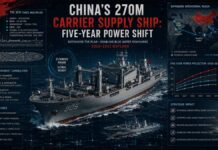








Executive Summary
- BLUF: Pete Hegseth’s directive initiates an operational redistribution of responsibilities, not a verified termination of United States assistance.
- SAG-U will disappear as an autonomous organization after transferring selected functions to NSATU, USEUCOM components and U.S. Army Europe and Africa.
- NSATU will assume responsibility for Ukrainian training, materiel management and sustainment support.
- A European or Canadian officer is expected to command NSATU by approximately August 2027; the United States would retain the deputy-command position.
- PURL converts European and Canadian funding into demand for critical equipment available from United States inventories and industry.
- Europe therefore acquires greater financial and command responsibility while remaining dependent on American-controlled weapons, software, intelligence and sustainment ecosystems.
- The most important risk is not abrupt abandonment but an uneven transition that separates European financing from sufficient production, command authority and technological sovereignty.
- Five-year baseline judgment: a NATO-managed, European-financed architecture with the United States acting as selective supplier, strategic enabler and escalation gatekeeper.
- This constitutes controlled burden transfer, not yet demonstrable American disengagement from European security.
Washington Redesigns the Ukraine War—and Europe’s Security
The reorganisation of Western military support for Kyiv marks a structural change, not an administrative adjustment. Washington is dismantling the dedicated U.S.-led Security Assistance Group–Ukraine, transferring operational functions to NATO and requiring Europe to finance an increasing share of American equipment. The United States is reducing its routine burden while retaining control over scarce weapons, intelligence and strategic command. Europe therefore acquires responsibility faster than autonomy. For Ukraine, the decisive issue is whether this transition increases the speed and predictability of assistance—or creates a gap that Russia can exploit. For NATO, it is the first operational test of a new transatlantic bargain: European financing and conventional leadership, supported by selective American technological power.
The Wiesbaden Shift
On 3 August 2026, at Lucius D. Clay Kaserne in Wiesbaden, Lieutenant General Guillaume N. Beaurpere, previously Chief of Staff of U.S. Special Operations Command, replaced Lieutenant General Curtis A. Buzzard as commander of both SAG-U and the NATO Security Assistance and Training for Ukraine, or NSATU. General Alexus G. Grynkewich, commander of U.S. European Command and NATO Supreme Allied Commander Europe, presided over the transfer.
The ceremony revealed the substance of Secretary Pete Hegseth’s decision. NSATU will assume Ukrainian training, materiel management and sustainment support. American-specific functions will move to U.S. Army Europe and Africa and other USEUCOM components. Once this redistribution is complete, SAG-U—established in 2022 to coordinate the full spectrum of U.S. security assistance—will cease to exist. Grynkewich also announced that a European or Canadian officer should command NSATU within approximately one year, with an American moving into the deputy position. Press Release – Security Assistance Group-Ukraine Holds Change of Command – U.S. Army Europe and Africa – August 2026 — Official release.
This is controlled institutional de-Americanisation, but not American strategic withdrawal. USEUCOM supervises the transition; SACEUR remains the central military integrator; and national U.S. authorities retain decisions involving American inventories, export controls, classified information, software and technical support.
NATO Becomes the Operating System
NSATU was approved at the July 2024 Washington Summit and operational by December 2024. Its Wiesbaden headquarters, approximately 300 personnel and three logistical hubs on NATO’s eastern flank coordinate allied training, equipment donations, repair, maintenance and long-term Ukrainian force development. The command operates exclusively on Allied territory and, under NATO’s stated legal position, does not make the Alliance a party to the conflict.
Its expansion replaces a predominantly American organising mechanism with an enduring multinational structure. Yet NSATU coordinates assistance; it does not manufacture weapons or compel governments to donate them. National capitals still decide what to finance, release and replenish. Relations with Ukraine – NATO – July 2026 — Official NATO programme record.
The new architecture consequently divides power into three layers. NATO manages requirements, training and logistics. European governments increasingly provide finance and conventional equipment. Washington controls several capabilities for which rapid substitutes do not exist. Efficiency will depend on whether the reorganisation shortens the interval between a Ukrainian request, allied financing, American authorisation, industrial production and battlefield delivery. If it merely distributes SAG-U’s functions among more institutions, administrative economy could produce operational delay.
PURL Changes Who Pays
The financial mechanism accompanying this command transfer is the Prioritised Ukraine Requirements List. Launched in July 2025, PURL enables allies and partners to finance critical American equipment identified against Ukrainian priorities. SACEUR validates packages; participating countries fund them; NATO coordinates delivery through NSATU.
By July 2026, more than two-thirds of NATO allies, together with Australia and New Zealand, had committed over USD 6 billion through PURL. Deliveries included ammunition and critical air-defence equipment. Relations with Ukraine – NATO – July 2026 — Official NATO programme record.
PURL is therefore neither free U.S. aid nor European strategic autonomy. It converts European money into access to American stocks and production. That distinction is decisive. Europe assumes the invoice, but Washington retains release authority, production allocation, configuration control and influence over technical sustainment. The arrangement reduces American fiscal exposure, generates demand for U.S. industry and keeps Ukraine connected to systems that Europe cannot yet supply at sufficient volume.
Its short-term military value is substantial. Its long-term strategic effect depends on whether Europe uses the time purchased through PURL to expand indigenous production. If not, financial burden sharing could deepen technological dependence.
The EUR 140 Billion Bridge
At the 8 July 2026 Ankara Summit, NATO stated that European allies and Canada now finance the vast majority of Ukrainian security assistance. Allies pledged EUR 70 billion in equipment, training and assistance for 2026 and committed to sustaining at least an equivalent level in 2027. The Ankara Summit Declaration – NATO – July 2026 — Official declaration.
The resulting minimum two-year political envelope is EUR 140 billion. It gives Kyiv a stronger planning horizon and reduces the danger of support being reconstructed package by package. But a pledge is not a delivery. Money must pass through appropriation, contracting, production, authorisation, transport, training and sustainment before becoming combat power.
The critical uncertainty begins after 2027. NATO has established an exceptional two-year commitment, not a binding five-year guarantee. By then, European governments will simultaneously face national rearmament, Ukrainian support, debt pressures and competing domestic expenditure. The durability of assistance will depend on whether industrial capacity and common procurement reduce costs—or whether scarcity, inflation and fragmented national orders consume the additional funding.
Europe’s Industrial Test
At The Hague in June 2025, NATO allies committed to invest 5% of GDP annually in defence and security-related requirements by 2035: at least 3.5% for core military capability and up to 1.5% for infrastructure, networks, resilience and industrial development. In 2025, European allies and Canada increased real defence expenditure by almost 20%, adding more than USD 90 billion at constant 2021 prices and reaching over USD 571 billion. The trajectory will be formally reviewed in 2029. Defence Investment and NATO’s 5% Commitment – NATO – June 2026 — Official NATO data.
The European Commission’s Readiness Roadmap 2030 seeks to convert this fiscal expansion into capability. It calls for joint procurement to reach at least 40% by the end of 2027, contracts and financing for critical shortfalls by the end of 2028, and delivery of all SAFE-financed procurements by the end of 2030. It also sets a political objective that at least 55% of defence investment should be procured from the European defence-industrial base. Four flagships—Eastern Flank Watch, the European Drone Defence Initiative, the European Air Shield and the European Space Shield—address surveillance, counter-drone warfare, air defence and space dependence. Readiness Roadmap 2030 – European Commission – October 2025 — Official roadmap.
The strategy is coherent; execution is harder. Europe still divides demand among national systems, certification rules and protected industrial interests. Greater expenditure will not automatically create deployable formations, interceptors or stock depth. The real benchmark is delivery: factories, trained personnel, ammunition, maintenance capacity and interoperable command networks.
America’s Retained Leverage
The U.S. fiscal 2027 defence framework identifies four priorities: homeland defence, deterring China in the Indo-Pacific, alliance strengthening and military modernisation through a stronger industrial base. Overview – Fiscal Year 2027 Department of Defense Budget – U.S. Department of Defense – April 2026 — Official budget overview.
Europe is therefore not being abandoned; it is being repriced within American strategy. Washington wants allies capable of carrying conventional regional defence while U.S. resources concentrate on the highest-value functions and the Indo-Pacific balance. This explains the apparent paradox: fewer American-led structures can coexist with continuing American influence.
That leverage rests on capabilities, not titles. Air-defence interceptors, intelligence, satellite support, secure communications, long-range systems, strategic lift and proprietary software cannot be transferred simply by appointing a European commander. Even fully funded PURL packages remain subject to American availability and authorisation. The United States can reduce personnel and budgetary exposure while preserving decisive control over the supply chain.
The danger for Europe is responsibility without sovereign capacity. The danger for Washington is moving forces before European substitution becomes operational. A poorly sequenced transition would create a deterrence gap precisely while Russia retains the capacity to test NATO through military pressure, sabotage, cyber operations and infrastructure disruption.
Ukraine’s Double War
Kyiv is fighting simultaneously for territorial survival and economic continuity. A joint assessment by the Ukrainian government, World Bank, European Commission and United Nations estimated reconstruction and recovery needs at almost USD 588 billion over the decade following December 2025—more than EUR 500 billion and nearly three times Ukraine’s estimated 2025 nominal GDP. Direct physical damage had exceeded USD 195 billion.
Transport requires more than USD 96 billion, energy nearly USD 91 billion, housing almost USD 90 billion, commerce and industry over USD 63 billion, and agriculture more than USD 55 billion. Approximately 14% of housing had been damaged or destroyed, affecting over three million households. Damage to energy assets had increased by about 21% in one year; transport needs rose approximately 24% following intensified attacks on railways and ports. Updated Ukraine Recovery and Reconstruction Needs Assessment – World Bank, Government of Ukraine, European Commission and United Nations – February 2026 — Official assessment.
These are security figures. Every destroyed substation reduces industrial output; every damaged railway complicates military logistics; every unrepaired home increases permanent emigration. Ukraine’s endurance cannot be measured only in ammunition. It also depends on population retention, electricity, public revenue, veteran reintegration and investor confidence.
Five Paths to 2031
The most probable trajectory is managed Europeanisation: Europe finances and coordinates more support while the United States remains the strategic enabler. A second path is accelerated U.S. decoupling, producing a temporary European capability gap. A third is genuine European acceleration, with joint procurement and Ukrainian industrial integration generating conventional interruption tolerance by 2030. A fourth is negotiated stabilisation, shifting NSATU from emergency supply to force regeneration and deterrence. The fifth is fragmentation, in which changing governments and fiscal pressures divide assistance among smaller coalitions.
The decisive period is 2026–2028. During these years, SAG-U functions must be transferred without losing expertise; the Ankara commitments must become contracts and deliveries; and European investment must become industrial output. By 2029, NATO’s review of the 5% trajectory will show whether the new burden-sharing model is producing capability or accounting. By 2031, Europe need not reproduce every American system. It must, however, be able to sustain Ukraine and defend the continent through a prolonged reduction in U.S. support without an immediate operational collapse.
The New Bargain
Hegseth’s reorganisation is neither a technical efficiency measure nor proof that America is leaving Europe. It is the operational foundation of a new transatlantic settlement. Europe pays more, commands more and assumes greater conventional risk. NATO becomes the permanent coordination platform. Ukraine is integrated more deeply into European defence planning. The United States retains technological, intelligence and escalation leverage while releasing resources for other priorities.
Success will not be measured by the disappearance of SAG-U or the nationality of the next NSATU commander. It will be measured by delivery times, interceptor availability, repair cycles, trained formations and Europe’s capacity to act when American support is constrained. The strategic contest through 2031 is a race between institutional adaptation and accumulated attrition. If Europe converts finance into power quickly enough, Washington’s shift can strengthen NATO. If responsibility moves faster than capability, the reorganisation will expose the most dangerous gap in European security.
Navigational Index
- Command Reallocation — Dissolution of SAG-U, expansion of NSATU and redistribution of United States-specific functions.
- Financial and Industrial Conversion — PURL, European burden transfer, production constraints and continued American technological leverage.
- Five-Year Strategic Outlook — Competing trajectories for Ukraine, NATO cohesion, European autonomy and United States force allocation through 2031.
Master Abstract
The Hegseth directive should be interpreted as a change in the architecture of assistance rather than, on the evidence presently available, as a binary decision to end American support for Ukraine. On 3 August 2026, the official U.S. Army Europe and Africa account specified the intended functional destination of the restructuring: NSATU is to absorb responsibility for Ukrainian training, materiel management and sustainment; United States-specific functions are to move into U.S. Army Europe and Africa and other USEUCOM components; and SAG-U, once that redistribution is complete, is to cease existing as a separate organization. The same official statement establishes a politically consequential succession timetable: in approximately one year, command of NSATU is expected to pass to a European or Canadian officer, while an American assumes the deputy role. It also records the 3 August transfer of the dual SAG-U/NSATU command from Lieutenant General Curtis A. Buzzard to Lieutenant General Guillaume N. Beaurpere and confirms that personnel from more than 25 nations participate in the two structures. Press Release – Security Assistance Group-Ukraine Holds Change of Command – U.S. Army Europe and Africa – August 2026 — Official release. These facts support a high-confidence assessment that Washington is replacing a conspicuously American assistance headquarters with a more multinational, NATO-centred division of labour. They do not independently substantiate the stronger proposition that the United States is “leaving” Europe. USEUCOM remains the authority overseeing the transition; an American general remains both USEUCOM commander and SACEUR; American component commands retain U.S.-specific functions; and Washington continues to control access to several scarce capabilities. The operative distinction is therefore between withdrawal and leverage-preserving delegation. The former would require evidence of disappearing American enabling capacity; the latter describes a system in which European allies assume command visibility, expenditure and routine execution while the United States retains influence over critical supply, interoperability and escalation-sensitive assets.
The reorganization is the institutional implementation of a policy trajectory Hegseth publicly articulated in February 2025. He said that Europe should provide the overwhelming share of future lethal and non-lethal assistance, that European allies must take ownership of conventional security on the continent, and that U.S. resource prioritization increasingly reflects the challenge posed by China in the Indo-Pacific. Opening Remarks at the Ukraine Defense Contact Group – U.S. Department of Defense – February 2025 — Official transcript. The resulting model is not simply “Europe replaces America.” It is a layered conversion of American support from direct fiscal donor and operational organizer toward selective supplier, alliance integrator and strategic gatekeeper. PURL exemplifies this conversion: NATO states and partners finance packages of American equipment identified against Ukrainian operational requirements, while SACEUR, in coordination with Ukraine and the United States, validates the packages and NSATU coordinates delivery. The first package, fully funded by the Netherlands, was described as one of a planned sequence of approximately USD 500 million tranches. Secretary General Welcomes First Package of U.S. Equipment for Ukraine Funded by the Netherlands under New NATO Initiative – NATO – August 2025 — Official NATO release. It is therefore analytically inaccurate to state that PURL itself was negotiated at the June 2025 Hague Summit. The summit supplied the political burden-sharing context; NATO records the initiative as launched in July 2025, following the 14 July agreement between Donald Trump and Mark Rutte. By July 2026, more than two-thirds of NATO allies, together with Australia and New Zealand, had committed over USD 6 billion through PURL. Relations with Ukraine – NATO – July 2026 — Official programme record. The mechanism reduces the American budgetary burden but can simultaneously expand demand for American defence production and preserve Washington’s control over release decisions, replenishment schedules, technical support and sensitive configurations.
Across the 2026–2031 horizon, five competing hypotheses require continuous testing. H₁, the present baseline, is managed Europeanization: NSATU becomes the durable coordination centre, European and Canadian officers acquire formal command responsibility, and Washington supplies selected high-value capabilities while concentrating more resources on homeland defence and the Indo-Pacific. H₂ is strategic decoupling: U.S. participation contracts beyond organizational reform, intelligence and logistics support are curtailed, and Europe must construct substitutes faster than its industrial base can deliver them. H₃ is re-Americanization after battlefield deterioration: a Russian breakthrough, a major escalation or failure of European replenishment forces Washington to restore direct operational leadership. H₄ is negotiated stabilization: the intensity of assistance declines because a ceasefire or armistice moves NSATU toward force regeneration, deterrence, training and long-term interoperability. H₅ is fragmented coalition support: political divergence, procurement competition and fiscal pressures break the unified architecture into overlapping national and minilateral channels. Current institutional evidence favours H₁ because NATO describes NSATU as an enduring command headquartered in Wiesbaden, operating with approximately 300 personnel and three eastern logistical hubs, while assigning it coordination of training, equipment, repair, maintenance and long-term Ukrainian force development. The Alliance further reports that European allies and Canada supplied nearly 60% of the more than EUR 50 billion delivered under the 2024 long-term assistance framework. Relations with Ukraine – NATO – July 2026 — Official programme record. Nevertheless, financing percentages are an incomplete measure of strategic autonomy. The decisive shadow variables are interceptor and missile availability, classified intelligence flows, targeting support, software permissions, depot-level maintenance, secure communications, satellite services, transport capacity and access to American-controlled inventory. A European-led command can consequently coexist with persistent American structural leverage. The core five-year indicator is not the nationality of NSATU’s commander but whether Europe can fund, manufacture, integrate and replenish Ukraine’s most consequential capabilities without emergency U.S. intervention.
Burden-Transfer Scenario Engine
resilience
gap risk
leverage
Command Reallocation: From SAG-U to NSATU
The dissolution of the American-led Security Assistance Group–Ukraine, the operational expansion of NATO Security Assistance and Training for Ukraine, and the redistribution of United States-specific functions across USEUCOM constitute a structural redesign of the Western military-support system rather than a simple change of headquarters.
1. The Decision: Organizational Closure Without Strategic Disappearance
The directive attributed to U.S. Secretary Pete Hegseth does not merely rename an assistance mechanism: it decomposes a United States-led command structure and redistributes its functions between a multinational NATO command and the permanent components of **United States European Command**. The official operational sequence became materially clearer on 3 August 2026, when U.S. Army Europe and Africa announced that **NSATU** would assume responsibility for Ukrainian training, materiel management and sustainment support, while functions specific to the United States would migrate to U.S. Army Europe and Africa and other USEUCOM components. General Alexus G. Grynkewich, simultaneously commander of USEUCOM and NATO’s Supreme Allied Commander Europe, stated that SAG-U would transition and, when the reallocation was complete, the organization would disappear. This wording is decisive: the policy does not envisage maintaining SAG-U as a residual parallel headquarters. It envisages institutional extinction after functional disaggregation. At the same ceremony, Lieutenant General Guillaume N. Beaurpere replaced Lieutenant General Curtis A. Buzzard as commander of both SAG-U and NSATU, creating a controlled bridge between the outgoing American architecture and the expanding NATO structure. The announcement further specified that, in approximately one year, a European or Canadian officer should assume command of NSATU while the United States moves into the deputy-command position. **Press Release – Security Assistance Group-Ukraine Holds Change of Command – U.S. Army Europe and Africa – August 2026** — verified official release. The most defensible interpretation is therefore neither “business as usual” nor immediate American withdrawal. It is a calibrated transfer of routine command responsibility designed to reduce the American organizational footprint while preserving U.S. participation inside the command chain, the supplier network and NATO’s strategic command structure.
The distinction between organizational presence and strategic leverage is essential. SAG-U was created in November 2022 as a dedicated United States headquarters for the long-term coordination of military assistance to the Ukrainian armed forces. Its practical value lay in concentrating planning, donor synchronization, training relationships, sustainment requirements and American security-assistance expertise within a war-specific structure. Dissolving that headquarters removes a visible symbol of unilateral American leadership, but it does not automatically remove the functions, personnel, authorities, communications pathways or national caveats that made the headquarters operationally important. Some functions migrate upward or laterally into NSATU; others return to enduring American commands. This produces a more complicated command topology in which routine multinational coordination becomes NATO-branded, while uniquely American decisions remain within United States national chains. Weapons-release approvals, export-controlled technical data, intelligence classification, software configuration, depot-level maintenance, cryptographic support and the allocation of scarce U.S. inventories cannot be multinationalized merely by moving desks between organizational charts. The official USEUCOM formulation emphasizes efficiency, effectiveness, allied leadership and the release of U.S. resources for other global priorities, but those objectives may conflict. A smaller dedicated American headquarters can reduce duplication and personnel demand; simultaneously, dispersing its functions across multiple components can create additional interfaces, slower adjudication and ambiguity about who owns a requirement when NATO coordination intersects with U.S. law, national disclosure policy or inventory scarcity. The reorganization’s success must therefore be measured against mission latency, fulfillment rates and sustainment continuity—not against the administrative fact that one command has closed and another has enlarged.
2. Functional Decomposition: Where the Mission Actually Moves
The reallocation is best understood as a functional decomposition across three layers. The first is the multinational execution layer, where NSATU coordinates allied training, donor equipment, repair requirements, maintenance, sustainment and the long-term development of the Ukrainian armed forces. NATO’s current institutional description places the command headquarters in Wiesbaden, assigns it three logistical hubs on the Alliance’s eastern flank and reports approximately **300 personnel** from NATO members, partner countries and Ukraine. It is led by a three-star officer reporting to SACEUR and operates exclusively on Allied territory. **Relations with Ukraine – NATO – July 2026** — verified NATO programme record. The second layer is the United States national-support layer. Activities tied to American inventories, authorities, data, contracting, foreign military sales, intelligence and service-specific sustainment are expected to move into U.S. Army Europe and Africa or other USEUCOM components. The third layer is strategic governance: the North Atlantic Council provides political authority for NATO activity; SACEUR integrates the military command; national governments decide whether and what to donate; and Ukraine defines operational demand through planning and requirements processes. Norway’s official mission description reinforces a crucial limitation: NSATU coordinates donations but does not create them, because political decisions and national planning remain the responsibility of donor governments. It also records NSATU’s responsibility for allied training, repair requirements and long-term interoperability. **NATO Security Assistance and Training for Ukraine – Norwegian Armed Forces – 2026** — verified official mission description. Consequently, NSATU can reduce fragmentation in the movement of assistance without possessing sovereign authority to compel production, authorize transfers or override national restrictions.
SAG-U
- Dedicated U.S.-led headquarters
- Security-assistance coordination
- American planning concentration
- Dual-hatted relationship with NSATU
- Organization scheduled to disappear
NSATU
- Training coordination
- Materiel management
- Sustainment and repair orchestration
- Donation-flow synchronization
- Long-term force development
USEUCOM Components
- United States-specific functions
- National authorities and caveats
- Export-controlled technology
- Service and depot sustainment
- Strategic enabling capabilities
This layered arrangement creates both resilience and interface risk. It increases resilience because NSATU is embedded in NATO’s permanent command structure rather than depending exclusively on a temporary United States-led coalition mechanism. It can institutionalize multinational staffing, standardize the demand picture, preserve continuity across donor rotations and connect short-term deliveries with a longer force-development plan. NATO Allied Command Transformation described NSATU in May 2025 as the central NATO-led hub for support, responsible for logistics, sustainment and deliveries, coordinating training by 18 NATO and partner states and using a **24-month planning horizon**. The same official account reported that more than **192,000 Ukrainian personnel** had been trained through the aggregated allied system by that point. **Advancing NATO-Ukraine Defence Cooperation and Interoperability through NSATU and JATEC – NATO Allied Command Transformation – May 2025** — verified official analysis. Interface risk arises because the expanded NATO command must translate Ukrainian operational urgency into national decisions over which it has no coercive authority. A requirement can be validated militarily and still fail politically, industrially or legally. An interceptor request can be operationally correct but unavailable in national stocks; a repair priority can be accepted but delayed by proprietary technical data; a training pipeline can be funded but constrained by ranges, instructors or equipment; and a delivery can be approved but slowed by transport permits or national customs processes. The critical performance variable is therefore the command’s ability to compress the interval between requirement identification, donor matching, national authorization, contracting, production, transport, fielding and sustainment. If the reorganization merely relocates coordination while leaving these delays unchanged, its administrative efficiency will not translate into battlefield effectiveness.
| Mission function | Likely post-reallocation owner | Authority retained outside NSATU | Primary transition risk | Indicator to monitor |
|---|---|---|---|---|
| Ukrainian training coordination | NSATU | National training establishments and force providers | Medium | Course throughput, instructor availability, equipment-to-training ratio |
| Materiel requirement management | NSATU with Ukraine and SACEUR | National donation and procurement decisions | High | Time from validated requirement to donor commitment |
| Repair and sustainment coordination | NSATU and eastern logistics hubs | Industry, national depots, intellectual-property holders | High | Equipment availability, repair-cycle duration, spare-parts fill rate |
| U.S. inventory release | Relevant U.S. authorities and components | United States government | High | Approval frequency, package value, replenishment lead time |
| Classified intelligence support | National and NATO channels according to classification | Originating intelligence authority | High | Dissemination latency, caveats, continuity of access |
| Long-term Ukrainian force design | NSATU with Ukraine and allied capability coalitions | Ukraine and national donors | Medium | Compatibility between campaign requirements and procurement plans |
| Political authorization | North Atlantic Council and donor governments | National capitals | High | Consensus delays, national restrictions, funding predictability |
3. Command Sovereignty: European Leadership Versus American Control Nodes
The anticipated transfer of NSATU command to a European or Canadian officer around 2027 will carry substantial political symbolism but should not be confused with complete European command sovereignty. Formal command is only one component of military power. Effective authority also depends on access to intelligence, communications, weapons stocks, software baselines, maintenance capacity, transport, finance and political permission. The United States can occupy a nominally subordinate deputy position while retaining disproportionate influence through control of scarce enablers and its structural role inside NATO. SACEUR has traditionally been an American officer, and the current dual role held by General Grynkewich connects the NATO and USEUCOM chains at the highest operational level. Moreover, many high-value systems supplied to Ukraine incorporate American-controlled components, technical documentation or sustainment arrangements. The reallocation can therefore produce a paradox: Europe becomes more accountable for mission outcomes while the United States continues to control several inputs that determine those outcomes. This is not necessarily a defect; it may be the intended burden-sharing design. Washington reduces the personnel, fiscal and political costs of front-line coordination while maintaining influence over critical capabilities and preserving NATO interoperability. For European allies, however, accepting command without reliable access to these inputs risks creating responsibility without autonomy. The relevant sovereignty test is not whether a European flag officer signs the operational coordination documents. It is whether that commander can maintain training, repair, materiel allocation and campaign support during a prolonged interruption of new American assistance. If the answer remains negative, the command transfer represents leadership redistribution inside a U.S.-enabled system rather than strategic substitution for the United States.
The 2025–2026 evolution of the **Prioritised Ukraine Requirements List** demonstrates how financial Europeanization can coexist with technological Americanization. NATO records that PURL enables allies and partners to finance critical equipment obtained from the United States, while SACEUR identifies packages based on Ukrainian requirements and NATO coordinates delivery through NSATU. By July 2026, more than two-thirds of NATO allies, together with Australia and New Zealand, had funded over **USD 6 billion** of equipment through the mechanism. **Relations with Ukraine – NATO – July 2026** — verified NATO programme record. The first officially announced package in August 2025 was funded by the Netherlands and valued at approximately **USD 500 million**, with air defence, ammunition and other urgently required equipment among the priority categories. **Secretary General Welcomes First Package of U.S. Equipment for Ukraine Funded by the Netherlands under New NATO Initiative – NATO – August 2025** — verified official release. In structural terms, PURL transfers the payment obligation but not necessarily the underlying production, release or configuration authority. It can even deepen transatlantic industrial dependence if European funds are directed toward American systems faster than Europe expands substitute production. Conversely, it may be the most operationally rational bridge during the period in which European manufacturing capacity remains insufficient. NSATU’s expanded role places it at the intersection of this tension: it must deliver immediate battlefield utility through existing American supply while supporting a longer transition toward diversified European and Ukrainian production.
4. European Absorption Capacity and the Logistics Constraint
European capacity to absorb SAG-U functions cannot be evaluated through defence-spending totals alone. The transition requires trained headquarters personnel, secure information systems, multinational planning doctrine, legal expertise, contracting capacity, technical specialists, strategic transport, warehouses, repair hubs and a reliable industrial replenishment base. NATO’s reporting that NSATU has approximately 300 personnel must be interpreted in relation to mission breadth rather than as a simple measure of strength. A comparatively small multinational headquarters can coordinate large flows when national systems are aligned; it can also become a bottleneck if every contested requirement requires multiple rounds of national consultation. The discrepancy between earlier planning figures and later public staffing descriptions further indicates that nominal establishment, deployed personnel and mission-effective capacity should not be treated as interchangeable. The command’s three eastern logistical hubs create distributed resilience but also introduce dependencies on host-nation infrastructure, rail networks, road permits, customs processes, airlift and protection against cyber or physical disruption. The European Union’s military-mobility programme is therefore operationally relevant even though the EU is not the NSATU command authority. Current EU measures include proposed digital management of movement authorizations and customs documentation, a military mobility transport group, a catalogue of dual-use transport assets, national military-transport coordinators and recurring readiness assessments. **Military Mobility – European External Action Service – 2026** — verified EU institutional record. The reorganization will succeed only if the NATO demand-and-coordination layer is matched by EU and national improvements in movement, production and infrastructure. Otherwise, command consolidation at Wiesbaden may reveal rather than resolve the fragmented physical system beneath it.
The European training architecture offers both evidence of capacity and warning about sustainability. NSATU coordinates training delivered by allies and partners, while the European Union Military Assistance Mission operates a separate but cooperating framework. This creates potential complementarity: NATO can connect training requirements to equipment and force development, while the EU can mobilize member-state facilities, financing and institutional instruments. It also creates a risk of duplicated reporting, competing standards and fragmented assessment unless the two organizations maintain interoperable planning cycles. The official EU description states that **EUMAM Ukraine** cooperates closely with NSATU, while NATO’s own materials emphasize coordination rather than direct conduct of all training. **EU–NATO Strategic Partnership – European External Action Service – September 2025** — verified EU institutional record. During the next five years, the content of training will matter more than cumulative participant totals. A wartime training pipeline must adapt rapidly to drone saturation, electronic warfare, dispersed logistics, contested command posts, degraded communications, mine warfare, casualty replacement and the changing integration of Western platforms. If NSATU becomes a bureaucratic aggregator of national course numbers, the expansion will be superficial. If it links battlefield lessons, equipment delivery, sustainment data and Ukrainian force design into a continuously updated curriculum, it can become the institutional memory that SAG-U’s dissolution might otherwise endanger. The transfer must therefore preserve personnel, databases, lessons-learned repositories, liaison networks and tacit knowledge—not merely formal task descriptions.
| Absorption dimension | 2026 condition | 2031 requirement | Failure mechanism | Assessment |
|---|---|---|---|---|
| Multinational command staffing | Established NATO headquarters with allied and partner personnel | Stable European/Canadian command rotations and specialist retention | Loss of U.S. institutional knowledge and repeated rotation resets | Conditional |
| Materiel data integration | Multiple donor inventories and national reporting systems | Shared readiness, repair and pipeline visibility | Inconsistent data, duplicated requests and false availability | High exposure |
| Industrial replenishment | Expanded investment but persistent scarcity in selected categories | Multi-year capacity aligned with Ukrainian consumption and NATO stocks | Funding without deliverable production slots | High exposure |
| Military mobility | National permissions and infrastructure constraints remain material | Digitized, exercised and resilient transport corridors | Administrative delay or physical disruption of eastern hubs | Improving |
| Training adaptation | Large multinational pipeline with distributed providers | Rapid battlefield feedback and equipment-linked curricula | Training for outdated tactics or unavailable platforms | Conditional |
| Secure intelligence exchange | National and NATO classification boundaries | Reliable access with controlled disclosure and minimum latency | National caveats or reduced U.S. contribution | Strategic dependency |
5. Shadow Dimensions: Intelligence, Cyber, Contractors and Liquidity
The publicly announced transfer categories conceal several shadow dimensions that may determine operational continuity. The first is intelligence. NSATU can coordinate requirements and deliveries, but it does not automatically acquire unrestricted authority over U.S.-origin **SIGINT**, geospatial intelligence, early-warning data or targeting-related information. Intelligence products are governed by originator control, bilateral agreements, classification and policy restrictions. A reduction in American personnel need not reduce intelligence access, but it increases the importance of formal liaison pathways and makes any policy change more visible in mission latency. The second shadow dimension is cyber dependence. Multinational logistics systems create attack surfaces across headquarters networks, donor databases, contractors, railway operators, depots and Ukrainian recipients. Russia does not need to destroy a logistics hub physically if it can corrupt inventory visibility, delay movement authorization, expose routes or manipulate maintenance records. The third dimension is the contractor ecosystem. Western weapons depend on original-equipment manufacturers, field-service representatives, proprietary diagnostics and controlled spare parts. Moving sustainment coordination to NSATU does not transfer intellectual property or industrial liability to NATO. The fourth dimension is human continuity: interpreters, logisticians, foreign-area specialists and officers who hold trusted relationships with Ukrainian counterparts may be more important than organizational charts. The fifth dimension is liquidity. European financial commitments must convert into contracts, advance payments, production capacity and predictable multiyear orders. Announced funding that arrives late, remains nationally earmarked or cannot purchase scarce goods produces political signalling without operational output. An effective intelligence assessment must therefore track data-access latency, contractor-response times, unfilled requisitions, industrial advance payments, transport insurance, cyber incidents and personnel retention alongside headline package values.
Mercenary or irregular-force dynamics are less directly connected to the SAG-U–NSATU transfer but remain relevant as an adversarial adaptation channel. Moscow may portray the expansion of a NATO command as proof of direct alliance participation even though NATO explicitly states that NSATU operates only on Allied territory and does not make NATO a party to the conflict. That legal and political distinction is contained in NATO’s official programme description and should remain central to strategic communication. **Relations with Ukraine – NATO – July 2026** — verified official programme record. Russian information operations can nevertheless exploit the nationality of trainers, contractors or volunteers to blur distinctions among state forces, private actors and Ukrainian formations. Chinese official diplomacy has generally framed the conflict through sovereignty, negotiation and opposition to escalation, but no verified Chinese institutional statement directly addressing the August 2026 SAG-U reorganization is incorporated here; analytical cross-reference should not manufacture a reaction where a precise primary-source reaction is absent. The same evidentiary discipline applies to Russian statements: official Russian military publications provide contextual evidence of how NATO assistance is perceived, but they do not independently establish the internal mechanics of Western commands. The primary evidentiary hierarchy for this reorganization must therefore remain USEUCOM, U.S. Army Europe and Africa, NATO, SHAPE and participating national governments. Russian and Chinese materials are most useful for threat-perception and narrative analysis, not for verifying Western command assignments. This source asymmetry is itself an intelligence finding: adversarial commentary is likely to emphasize strategic intent, while the operationally relevant evidence lies in staffing, authorities, logistics and command-transfer documents.
6. Analysis of Competing Hypotheses: 2026–2031
The highest-probability hypothesis is **H1**, managed Europeanization. Its confirming indicators are already visible: SAG-U functions are being moved into NSATU; the command transition has been publicly framed as a result of European allies assuming primary responsibility; a European or Canadian commander is projected; PURL channels allied financing into American equipment; and USEUCOM remains responsible for supervising the reorganization. Under this hypothesis, the United States reduces its dedicated headquarters footprint and avoids acting as the principal routine coordinator, but remains indispensable through SACEUR, national components, selected weapons, intelligence and industrial supply. **H2**, strategic decoupling, would require evidence beyond organizational closure: sustained declines in U.S. enabling support, reduced access to American inventories, intelligence restrictions, diminished exercise integration or removal of key personnel without equivalent replacements. **H3**, American re-entry, becomes more likely if Russian pressure causes a major Ukrainian operational crisis or if NSATU cannot translate European finance into timely capability. **H4**, negotiated stabilization, would shift the mission from urgent wartime throughput toward regeneration, demobilization management, deterrence, interoperability and reconstruction of the Ukrainian force. **H5**, fragmentation, would emerge if NATO consensus weakens and national coalitions increasingly bypass Wiesbaden. Bayesian updating should not treat official rhetoric as equivalent to operational evidence. A statement that support will not decrease is a policy indicator; actual delivery schedules, staffing levels, exercise patterns, repair output and intelligence continuity are higher-value evidence. Each new observation should alter the relative hypotheses according to its diagnosticity: a European commander is strongly consistent with H1 but also compatible with H2; continued high-volume American enabling support strongly distinguishes H1 from H2; and duplicated national channels distinguish H5 from the centralized baseline.
| Diagnostic indicator | H1 managed transfer | H2 decoupling | H3 U.S. re-entry | H4 stabilization | H5 fragmentation |
|---|---|---|---|---|---|
| European/Canadian assumes NSATU command | Strongly consistent | Consistent | Weakly inconsistent | Consistent | Neutral |
| U.S. remains deputy and sustains enabling support | Strongly consistent | Strongly inconsistent | Consistent | Consistent | Weakly inconsistent |
| Large reduction in intelligence or inventory access | Strongly inconsistent | Strongly consistent | Trigger condition | Ambiguous | Consistent |
| NSATU delivery and repair latency declines | Strongly consistent | Inconsistent | Inconsistent | Consistent | Strongly inconsistent |
| National minilateral channels bypass NSATU | Inconsistent | Consistent | Neutral | Weakly inconsistent | Strongly consistent |
| Ceasefire shifts activity toward force regeneration | Compatible | Neutral | Inconsistent | Strongly consistent | Ambiguous |
7. Five-Year Outlook and Warning Indicators
During **2026–2027**, the dominant risk is transition friction. Personnel, databases, contracts, liaison relationships and task ownership must move before SAG-U disappears. The most dangerous failure would be a silent seam: a task no longer owned by SAG-U but not yet fully assumed by NSATU or a USEUCOM component. During **2027–2028**, the nationality and authority of the new NSATU command team will test whether Europeanization is substantive. A European or Canadian commander must receive sufficient staff depth, information access and delegated authority to manage the mission without routing routine decisions through informal American channels. During **2028–2029**, industrial and sustainment performance will become the principal discriminator. If European production expands, repair cycles shorten and Ukraine receives predictable multiyear support, the command transfer will appear durable. If stocks remain scarce and PURL remains heavily dependent on irregular American release decisions, NSATU will function efficiently only within a structurally U.S.-dependent supply system. During **2029–2030**, political-cycle risk intensifies as governments change, fiscal trade-offs accumulate and public support varies. NATO institutionalization can protect continuity, but it cannot compel national donations. By **2030–2031**, the system should be judged against three end states: a mature European-led command with persistent but selective U.S. enablement; an autonomous European-Ukrainian support ecosystem capable of operating through an American pause; or a hollowed command whose formal structures exceed its deliverable capabilities. The most probable outcome lies between the first two, with uneven autonomy across capability categories. Europe may become substantially more autonomous in training, conventional ammunition, maintenance and land logistics while remaining dependent on the United States in selected air defence, intelligence, strategic communications, long-range systems and high-end integration.
A rigorous warning system should track leading indicators rather than waiting for public declarations. Command indicators include the nationality and tenure of senior officers, the number of unfilled specialist posts, the transfer of planning authorities and the continued presence of American liaison cells. Operational indicators include requirement-to-commitment time, commitment-to-delivery time, repair-cycle duration, training throughput adjusted for equipment availability, and the proportion of validated Ukrainian requirements left unmatched. Industrial indicators include signed multiyear contracts, production-slot delivery, interceptor replenishment, spare-parts availability and European dependence on U.S. export authorization. Intelligence indicators include dissemination latency, classification caveats and access continuity during political disputes. Political indicators include PURL participation, national funding predictability, NATO consensus and the growth of channels that bypass NSATU. Cyber indicators include attacks on logistics databases, transport operators, contractors and eastern hubs. Liquidity indicators include the difference between announced commitments, legally obligated funds, contracted value and delivered equipment. The decisive threshold is not a single percentage. It is the interaction among variables. High European financing with weak industry produces procurement inflation and delivery delay; strong industry with low political cohesion produces nationally fragmented output; efficient NSATU coordination with reduced American enablement can expose capability gaps; and extensive American support with inadequate European leadership reverses the stated purpose of the reorganization. The command transition is therefore a systems-engineering problem under wartime pressure. Its success depends on whether institutional redistribution improves the throughput, resilience and predictability of assistance faster than Russia can exploit the transition period.
| Year | Expected structural milestone | Principal risk | High-value warning indicator | Baseline assessment |
|---|---|---|---|---|
| 2026 | Functional mapping and controlled SAG-U drawdown | Unowned tasks and knowledge loss | Mission delays immediately following staff transfers | Transition-sensitive |
| 2027 | European or Canadian NSATU command target | Symbolic leadership without sufficient authority | Persistent informal dependence on U.S. command channels | Conditional |
| 2028 | Consolidated training, materiel and sustainment processes | Industrial output below validated demand | Growing backlog despite adequate financing | Industrial stress point |
| 2029 | Mature multinational planning cycle | Political and fiscal fragmentation | National channels increasingly bypass NSATU | Political stress point |
| 2030–2031 | Durable European-led assistance architecture | Persistent high-end dependence on U.S. enablers | Inability to sustain priority capabilities during a U.S. pause | Managed dependence likely |
Verified Primary-Source Register
- Press Release – Security Assistance Group-Ukraine Holds Change of Command – U.S. Army Europe and Africa – August 2026 — official source.
- Change of Command at NATO Security Assistance & Training for Ukraine – NATO – August 2026 — official source.
- Relations with Ukraine – NATO – July 2026 — official source.
- Advancing NATO-Ukraine Defence Cooperation and Interoperability through NSATU and JATEC – NATO Allied Command Transformation – May 2025 — official source.
- Secretary General Welcomes First Package of U.S. Equipment for Ukraine Funded by the Netherlands under New NATO Initiative – NATO – August 2025 — official source.
- Opening Remarks at the Ukraine Defense Contact Group – U.S. Department of Defense – February 2025 — official source.
- NATO Security Assistance and Training for Ukraine – Norwegian Armed Forces – 2026 — official source.
- Military Mobility – European External Action Service – 2026 — official source.
- EU–NATO Strategic Partnership – European External Action Service – September 2025 — official source.
Figure 1: Interactive Five-Year Command-Transition Risk Projection
Scenario Variables
Financial and Industrial Conversion: PURL, Europe’s Burden and American Leverage
The Prioritised Ukraine Requirements List, or PURL, is not merely another financing channel for military assistance to Ukraine. It is the central conversion mechanism through which the second Trump administration has begun separating three functions that Washington previously carried simultaneously: identifying Ukrainian requirements, financing military transfers and supplying the required systems. Under the emerging architecture, Ukraine and NATO define urgent operational priorities; European allies and partners supply an increasing proportion of the money; NATO Security Assistance and Training for Ukraine coordinates the resulting deliveries; but the United States retains authority over the release, configuration and replenishment of many of the most scarce weapons. PURL was launched in July 2025 after the 14 July agreement between President Donald Trump and NATO Secretary General Mark Rutte. By July 2026, more than two-thirds of NATO allies, together with Australia and New Zealand, had committed more than USD 6 billion to purchase American military equipment for Ukraine. Deliveries included ammunition and critical air-defence equipment. Relations with Ukraine – NATO – July 2026 — verified NATO programme record. At the 2026 NATO summit, allies pledged EUR 70 billion in military equipment, training and assistance for Ukraine during 2026 and committed to maintaining at least an equivalent level in 2027. Remarks by NATO Deputy Secretary General Radmila Shekerinska at the European Parliament Committee on Security and Defence – NATO – July 2026 — verified NATO transcript. These figures indicate a significant transfer of financial responsibility, but they do not establish technological autonomy. Europe increasingly funds the flow; Washington continues to determine whether selected high-value American capabilities can enter it. PURL therefore redistributes expenditure more rapidly than it redistributes industrial power.
PURL as a three-stage conversion mechanism
PURL’s operating logic begins with an inversion of the traditional aid-package model. Under the Biden administration, the United States frequently selected equipment from American stocks, financed replacement or procurement through U.S. appropriations and delivered the equipment to Ukraine under American legal authorities. PURL preserves access to the same broad American ecosystem while transferring the principal financing requirement to allied governments. NATO’s official description states that SACEUR regularly identifies packages of equipment and ammunition that Ukraine needs and that the United States can provide in greater quantities than European allies and Canada. Allies then decide, individually or in groups, whether to finance those packages, and NATO coordinates delivery, including through NSATU. The first package announced in August 2025 was fully financed by the Netherlands and valued at approximately USD 500 million; NATO presented it as part of a recurring series of rapidly prepared packages. Secretary General Welcomes First Package of U.S. Equipment for Ukraine Funded by the Netherlands under New NATO Initiative – NATO – August 2025 — verified official NATO release. This structure creates a sequence of five separate decision gates: Ukrainian operational prioritisation; SACEUR validation; allied financing; American release and contracting authority; and NATO-coordinated delivery. Each gate has its own delay function and veto points. A requirement may be militarily urgent but fail to attract immediate financing; it may be financed but unavailable in American inventories; it may exist in stock but require replenishment guarantees; or it may be approved but delayed by transport, configuration, training or sustainment requirements. PURL therefore should not be evaluated only through the nominal value of pledged packages. Its operational performance depends on the proportion of validated requirements financed, the interval between financing and delivery, the capacity to replenish American stocks, the continuity of technical support and the degree to which individual packages correspond to Ukraine’s changing battlefield consumption rather than to what donors find politically convenient.
| Conversion stage | Principal actor | Resource being converted | Decisive constraint | High-value performance indicator |
|---|---|---|---|---|
| Operational demand | Ukraine with NATO coordination | Battlefield requirement into prioritised list | Rapidly changing consumption and threat conditions | Time required to update the priority list |
| Military validation | SACEUR and relevant NATO structures | Ukrainian request into an alliance-validated package | Intelligence, stock visibility and capability matching | Share of requests validated without revision |
| Financial subscription | European allies, Canada and partners | Political commitment into funded package | Budgets, coalition formation and domestic approval | Time from validation to full financing |
| American release | U.S. executive and defence authorities | Financing into exportable U.S. equipment | Stock availability, national readiness and policy restrictions | Approval rate and release latency |
| Industrial replenishment | U.S. government and contractors | Orders into replacement inventories | Production capacity and long-lead components | Contract-to-delivery interval |
| Delivery and sustainment | NSATU, national logistics and industry | Equipment into usable Ukrainian capability | Transport, training, spares and maintenance | Operational availability after fielding |
Financial Europeanisation without complete procurement sovereignty
The financial burden transfer is wider than PURL. The European Union and its member states report EUR 77 billion in military support to Ukraine, while the European Council agreed in December 2025 to provide a EUR 90 billion loan for 2026–2027, financed through EU capital-market borrowing. EU Military and Defence Support to Ukraine – European External Action Service – 2026 — verified EU institutional record. These instruments show that Europe can mobilise very large nominal resources, but the strategic effect of those resources depends on their composition. Grants, reimbursements, loans, national donations, joint procurement, Ukrainian industrial purchases and American equipment acquired through PURL are not equivalent. They have different lead times, domestic economic effects and sovereignty implications. Money spent replenishing equipment transferred from European stocks can stimulate European production if replacement contracts remain in Europe. Money used through PURL can deliver scarce capabilities quickly but predominantly activates American inventory and industry. Money invested directly in Ukrainian production may provide lower-cost and more rapidly adaptable systems, particularly drones and electronic-warfare equipment, but it carries physical-security, governance and production-continuity risks. The central analytical distinction is therefore between burden sharing and industrial conversion. Burden sharing measures who pays. Industrial conversion measures where spending becomes factories, skilled labour, energetic materials, test capacity, intellectual property, maintenance competence and repeatable production. Europe can increase its percentage of total assistance while remaining dependent on American technology if the marginal euro finances U.S.-origin interceptors, launchers, data links or replacement stocks. Conversely, European procurement can become nominally indigenous without producing autonomy if systems depend on American seekers, semiconductors, cryptography, satellite services or export-controlled components. A credible five-year assessment must trace the complete value chain rather than classifying equipment by the location of final assembly.
PURL also creates a distinctive financial asymmetry between urgency and investment. Its immediate purpose is to provide capabilities that the United States can supply more readily than Europe and Canada. That feature makes the programme operationally valuable precisely because Europe has not yet built sufficient substitute capacity. However, every PURL purchase carries an opportunity cost: the same allied funds cannot simultaneously finance an equivalent European industrial programme unless national budgets expand further. The mechanism can therefore produce two opposing effects. The first is a bridging effect in which American equipment prevents an immediate Ukrainian capability collapse while Europe expands its factories. The second is a lock-in effect in which recurring purchases of American platforms generate training, maintenance, software, ammunition and replacement requirements that make future substitution progressively more expensive. The probability of the bridging outcome rises when PURL is paired with binding European capacity investments, licensed production, technology transfer and diversified sustainment. The probability of lock-in rises when European funding grows faster than European productive capacity and when governments use PURL as a substitute for politically difficult industrial restructuring. NATO disclosed in June 2026 that PURL had already supplied approximately 70% of the missiles used by Ukraine’s Patriot batteries and 90% of ammunition used in other air-defence systems. Keynote Address by NATO Deputy Secretary General Radmila Shekerinska to the NATO Parliamentary Assembly – NATO – June 2026 — verified NATO transcript. Those proportions demonstrate operational importance, but they also expose concentration risk: interruption of the American supply and approval layer would affect capabilities for which substitutes cannot be generated at equivalent scale or speed.
The production constraint: capacity is not output
Europe’s ammunition expansion illustrates why public capacity targets require careful interpretation. The Act in Support of Ammunition Production, or ASAP, allocated EUR 500 million to 31 industrial projects addressing explosives, propellants, powder, shells, missiles and testing capacity. The European Commission projected that these interventions would help the European industrial base reach an annual artillery-shell production capacity of 2 million rounds by the end of 2025. Around EUR 2 Billion to Strengthen the EU’s Defence Industry Readiness, Including Ramp-Up of Ammunition Production – European Commission – March 2024 — verified Commission release. The Commission’s implementation assessment identified propellant powder as a major bottleneck, particularly because of limited energetic nitrocellulose and nitroglycerine availability. It estimated that the EU and Norway possessed capacity approaching 1 million shells in 2024, subject to sufficient orders and resources. ASAP Implementation Report – European Commission – July 2024 — verified official implementation report. Capacity, however, denotes the maximum output theoretically obtainable when plants have orders, inputs, labour and working capital. It is not verified production. A factory rated for a particular annual volume may operate below that volume because explosives are unavailable, contracts arrive too late, qualification has not been completed, customers request different shell configurations or test facilities become bottlenecks. Public comparisons that place a European capacity target against Russian or American output often mix unlike categories, including empty projectile bodies, complete rounds, propelling charges and available stock. The correct analytical unit is not “shells” in isolation but the complete usable shot: projectile, explosive fill, fuze, charge, primer, packaging, testing, certification, transport and compatible artillery system.
The United States has confronted similar bottlenecks despite its larger consolidated defence market. In April 2025, the U.S. Army opened a modern projectile-loading facility as part of an effort to increase monthly 155 mm output to 100,000 projectiles; the Army stated that its monthly production had nearly quadrupled since 2022. Army Opens Modern Projectile Loading Facility to Expand 155 mm Artillery Production – United States Army – April 2025 — verified official Army release. A further facility announced in April 2026 was designed to produce 12,000 M795 projectiles per month at full operating capacity while contributing to the same overall 100,000-per-month objective. U.S. Army, Industry Partner Open New Artillery Assembly Facility – United States Army – April 2026 — verified official Army release. These investments matter for PURL because allied-financed transfers from American stocks require replacement production if Washington is to avoid degrading its own readiness. Yet even the target rate cannot be interpreted as an unlimited exportable surplus. American forces require training stocks, war reserves and replenishment for multiple theatres; different 155 mm variants are not automatically interchangeable; and surge facilities need sustained orders to amortise investment. PURL can increase the certainty of foreign demand and thereby support American production expansion, but foreign financing cannot guarantee priority over U.S. operational requirements. Europe consequently bears price and delivery risk even when a package is fully funded. The financial commitment may be immediate, whereas the production response can require years.
| Industrial indicator | European reference | United States reference | Why direct comparison is hazardous |
|---|---|---|---|
| 155 mm capacity objective | 2 million annually by end-2025 | 100,000 monthly, equivalent to 1.2 million annually | European figure is aggregate capacity; U.S. figure is an Army production objective |
| Public intervention | EUR 500 million ASAP funding for 31 projects | Multibillion-dollar industrial-base expansion across facilities | Funding per programme does not equal delivered output |
| Critical bottleneck | Explosives, propellants, nitrocellulose, nitroglycerine and testing | Loading, metal parts, explosives, workforce and facility activation | Bottlenecks occur at different points in each supply chain |
| Strategic customer base | Nationally fragmented procurement across Europe | Consolidated U.S. federal procurement with foreign customers | Demand aggregation affects investment certainty |
| Ukraine relevance | Direct donations, joint procurement and European replacement | Stock transfers, procurement and PURL-financed equipment | Delivery timing and legal authorities differ |
| Sovereignty effect | Potential expansion of European industrial depth | Reinforcement of American production and allied dependence | Immediate availability can conflict with long-term autonomy |
Air defence as the decisive technological dependency
Air and missile defence reveals the strongest form of continued American leverage because the constraint is not simply manufacturing volume. It combines proprietary technology, integration, classified performance data, launcher compatibility, software, command-and-control architecture and national release authority. The U.S. Army’s fiscal 2025 budget overview included USD 755 million for expanding Patriot production capacity toward 650 missiles per year. Fiscal Year 2025 Army Budget Overview – United States Army – March 2024 — verified official budget document. Even at that planned rate, aggregate demand from the U.S. Army, NATO allies, Indo-Pacific partners and Ukraine can exceed the number available for any single recipient. Production capacity is also distributed between different Patriot missile families and industrial actors. RTX’s audited 2025 annual report recorded USD 2.5 billion in bookings for contracts covering GEM-T missiles and Patriot launchers for U.S. and international customers, illustrating strong demand but not disclosing an unrestricted pool immediately available to Ukraine. 2025 Annual Report – RTX Corporation – February 2026 — verified audited corporate report. European financing can purchase authorised equipment, but it cannot independently alter U.S. military stock requirements, accelerate every supplier tier, access source code or permit re-export. Washington’s leverage therefore operates through at least six control nodes: export approval; production allocation; configuration; technical support; software and cryptographic management; and replenishment priority. These nodes persist even if Europe pays the full invoice and NSATU coordinates delivery.
American technological leverage is not necessarily exercised coercively in every transaction. It can function structurally, simply because no equivalent alternative exists at the required scale and time. This distinction matters. A government need not threaten to withhold an interceptor to possess leverage; the recipient’s knowledge that withholding is technically possible affects planning and bargaining. PURL institutionalises this dependency in a politically manageable form. Europe can tell domestic audiences that it is carrying a larger share of Ukraine’s defence, while Washington can state that allies are paying for American equipment rather than receiving open-ended U.S.-financed aid. Both propositions can be accurate, but neither means that command of the supply chain has moved to Europe. The strategic exposure becomes most acute when a capability has high battlefield importance, high consumption, long production lead times and few substitutes. Patriot interceptors meet all four conditions. Standard artillery projectiles are more substitutable; specialised guided ammunition, advanced air-defence missiles, certain long-range weapons and secure network components are less so. A useful leverage index should therefore weight capabilities rather than count them. One million euros spent on readily substitutable equipment does not create the same dependency as one million euros spent on a uniquely controlled subsystem. Aggregate European expenditure can rise while weighted technological dependency also rises.
SAFE, joint procurement and the European industrial counterweight
The European response is developing through joint procurement, industrial incentives and financial leverage. The Security Action for Europe, or SAFE, instrument provides up to EUR 150 billion in loans for priority defence procurement. Its eligible categories include ammunition and missiles, artillery and deep-precision-strike systems, ground combat capabilities, small drones and counter-drone systems, cyber, critical-infrastructure protection and military mobility. SAFE: Security Action for Europe – European Commission – 2026 — verified Commission programme record. SAFE’s strategic value lies less in the gross loan ceiling than in its ability to aggregate demand, extend procurement horizons and reward European industrial participation. Defence factories do not invest efficiently against one-year political promises. They require contracted demand extending far enough to justify new lines, workforce recruitment, supplier qualification and environmental permits. If SAFE produces stable multinational orders, it can reduce unit costs, increase interoperability and give smaller suppliers confidence to expand. If governments merely use the loans to finance heterogeneous national shopping lists, the programme may enlarge expenditure without restructuring the industrial base. Eligibility rules, European-content thresholds, procurement speed and Ukraine’s participation are therefore decisive. There is also a timing mismatch: SAFE can shape production during the second half of the five-year horizon, whereas Ukraine’s air-defence and ammunition requirements are immediate. PURL and SAFE are consequently neither complete substitutes nor inherently contradictory. PURL can cover urgent scarcity; SAFE can finance structural substitution. The strategic failure would be allowing the urgent instrument to consume the political and financial space required by the structural instrument.
The desired European industrial end state should not be complete autarky. Attempting to reproduce every American capability would be prohibitively expensive, inefficient and inconsistent with alliance specialisation. The more realistic objective is interruption tolerance: Europe should be able to sustain Ukraine’s priority functions through a prolonged U.S. policy pause without immediate operational collapse. That requires sovereign or diversified capacity in high-consumption categories; repair and integration rights for imported systems; larger shared inventories; alternative suppliers; and explicit guarantees governing U.S.-origin equipment. It also requires allocating industrial roles according to comparative advantage. European firms can expand conventional ammunition, armoured systems, drones, electronic warfare, certain missile families, maintenance and land logistics. American participation may remain critical for selected air defence, strategic intelligence, space-based services and network integration. The balance becomes strategically acceptable when dependency is transparent, diversified and contractually predictable rather than opaque and politically discretionary. PURL can contribute to that balance if allied purchasers negotiate licensed production, European maintenance, local component manufacture or guaranteed multiyear delivery. It reinforces dependency if it remains a sequence of emergency purchases with no transfer of industrial competence. The policy question is therefore not whether Europe should buy American equipment. It is what enduring industrial rights and resilience Europe receives alongside each purchase.
Liquidity flows, prices and the risk of nominal burden sharing
The financial conversion process contains a liquidity problem that headline commitments often obscure. A pledge is not an appropriation; an appropriation is not a signed contract; a contract is not industrial output; output is not delivery; and delivery is not an operationally sustained capability. Each stage contains slippage. Governments may announce a package whose financing spans several fiscal years. Contractors may receive advance payments but face component shortages. Inflation may reduce the quantity purchased by a fixed nominal commitment. Foreign-exchange movements can change the euro cost of American systems. Expanding demand across NATO can give producers stronger pricing power, particularly where qualification barriers prevent new entrants. PURL’s recurring package structure improves predictability relative to improvised donations, but it can also intensify competition among allied buyers for the same production slots. European states are simultaneously replenishing depleted national stocks, meeting new NATO capability targets and financing Ukraine. These three demands overlap rather than occur sequentially. The result is a defence-specific crowding effect: political willingness and borrowing capacity may grow faster than industrial throughput, causing delivery schedules to lengthen even as announced expenditure rises. RTX reported continued growth in international Patriot and NASAMS volume during 2025, confirming expanding demand but not eliminating supply constraints. RTX Reports Second-Quarter 2025 Results – RTX Corporation – July 2025 — verified corporate results.
A forensic financial dashboard should therefore separate at least six values: announced support, legally authorised support, obligated funds, contracted value, equipment delivered and capability operationally available. It should also distinguish direct Ukrainian procurement from donor replacement and stock-transfer valuation. Donated legacy equipment may be booked using replacement cost, depreciated value or another national methodology, which complicates cross-country comparison. PURL’s dollar-denominated packages provide clearer nominal values but not necessarily transparent quantities, unit prices or delivery dates. Commercial confidentiality and operational security limit disclosure, yet excessive opacity makes it difficult to determine whether allied financing is purchasing more capability or merely absorbing cost increases. The appropriate risk measure is the delivered-capability ratio: the operational effect generated within a defined period divided by funds obligated during that period. That ratio cannot be calculated reliably from current public information for every PURL package, making delivery milestones and equipment categories essential proxies. NATO’s confirmation that deliveries are underway provides evidence of execution, but not enough to measure throughput comprehensively. This data gap should be treated as an uncertainty source in Bayesian forecasting rather than filled with unsupported estimates.
| Financial state | What it proves | What it does not prove | Principal intelligence requirement |
|---|---|---|---|
| Political pledge | Donor intent | Legal availability of funds | Parliamentary and budget status |
| Appropriation or loan approval | Financing authority | Contract award | Allocation schedule and conditions |
| Obligation | Funds assigned to a purpose | Industrial acceptance or output | Contracting documentation |
| Signed contract | Legally defined industrial demand | On-time production | Supplier capacity and milestones |
| Factory delivery | Equipment produced | Arrival in Ukraine or combat readiness | Transport and acceptance records |
| Ukrainian fielding | Equipment received | Sustainable operational availability | Training, ammunition and maintenance |
| Sustained capability | Battlefield function maintained | Strategic autonomy | Replacement and repair resilience |
Russian and Chinese cross-check: narrative pressure and supply-chain exposure
Russian official messaging interprets the same burden transfer very differently from NATO. In October 2025, the Russian Foreign Ministry characterised Hegseth’s pressure on European NATO members to allocate more money for American weapons for Ukraine as a mechanism benefiting the U.S. defence industry while extending the conflict. Briefing by the Spokeswoman of the Ministry of Foreign Affairs of the Russian Federation – Russian Foreign Ministry – October 2025 — verified official Russian transcript. This is adversarial strategic communication rather than neutral evidence, but it identifies a genuine structural feature: European financing routed through PURL generates orders or replacement demand within the American industrial ecosystem. Moscow has an incentive to describe European support as involuntary subordination because that narrative seeks to weaken allied cohesion; nevertheless, analysts should not reject the underlying industrial observation merely because it appears in hostile messaging. The correct method is source decomposition. NATO establishes how PURL operates and how much has been financed. American budget and corporate sources establish production investment and demand. Russian statements reveal the narrative through which Moscow will attempt to exploit the arrangement. The Kremlin’s likely influence line is that Europe bears the fiscal cost, the United States captures industrial benefit and Ukraine absorbs the destruction. That narrative becomes more persuasive if European factories fail to expand or if PURL crowds out European procurement. It weakens if PURL demonstrably bridges urgent needs while European and Ukrainian capacity grows.
China’s relevance is more indirect but potentially systemic. Modern missiles, radars, drones, communications equipment and electric actuation systems depend on critical minerals, permanent magnets, specialised chemicals and electronic components. In October 2025, China’s Ministry of Commerce confirmed new export controls on rare earths and related items, explicitly citing their military applications while stating that the controls were not an export ban and that eligible applications could receive licences. MOFCOM Spokesperson’s Remarks on China’s Recent Economic and Trade Policies and Measures – State Council of the People’s Republic of China – October 2025 — verified Chinese government statement. This does not establish that PURL deliveries have been directly disrupted by Chinese controls, and no such causal claim should be inferred without programme-level evidence. It does demonstrate that the Western defence-industrial expansion is exposed to supply chains governed partly outside NATO. American technological leverage over Europe can coexist with American and European material dependence on Chinese-controlled processing. The resulting hierarchy is not bilateral but layered: Europe depends on U.S.-controlled systems; U.S. and European producers depend to varying degrees on globally concentrated materials and components; and Ukraine depends on the timely performance of the complete network. Industrial sovereignty therefore requires mapping sub-tier suppliers, not merely identifying the prime contractor’s nationality.
Analysis of Competing Hypotheses
Five hypotheses structure the 2026–2031 outlook. H₁ — managed conversion assumes that PURL covers urgent scarcity while SAFE, ASAP, national investment and Ukrainian production progressively reduce European dependency. H₂ — American lock-in assumes that European financing expands faster than European industry, causing more spending to flow toward U.S. systems and increasing lifecycle dependence. H₃ — European substitution assumes accelerated joint procurement, technology transfer and domestic production reduce reliance on American supply in most categories except selected strategic enablers.H₄ — industrial shortfall assumes that both American and European expansion fail to match Ukrainian consumption, national replenishment and global demand, producing rationing and battlefield capability gaps. H₅ — political fragmentation assumes fiscal divergence, procurement nationalism and changing governments divide the support architecture into competing coalitions. On current evidence, H₁ holds the highest posterior probability because PURL deliveries are operating concurrently with European production initiatives and substantial allied financing. H₂ remains the most important structural alternative because PURL’s strongest performance is concentrated in categories where American technology is already dominant. H₄ is the most dangerous operational hypothesis because money cannot instantly resolve long-lead production, energetics and interceptor shortages.
| Hypothesis | Indicative August 2026 probability | Confirming indicators | Disconfirming indicators |
|---|---|---|---|
| H₁ Managed conversion | 38% | PURL continuity plus measurable European capacity growth and declining delivery latency | PURL expenditure rises while European output stagnates |
| H₂ American lock-in | 24% | Increasing European purchases of U.S. systems without licensed production or European sustainment rights | European alternatives gain scale and interoperability |
| H₃ European substitution | 14% | Binding multiyear orders, joint inventories, expanded energetics and missile production | Persistent national fragmentation and component dependence |
| H₄ Industrial shortfall | 16% | Delivery backlogs, interceptor scarcity, unmet Ukrainian requirements and stock rationing | Production and repair output consistently exceed consumption |
| H₅ Political fragmentation | 8% | Declining PURL participation, bilateral bypass channels and uneven financing | Stable NATO commitments and predictable coalition funding |
These probabilities are structured analytical estimates rather than frequencies derived from a complete public dataset. Bayesian updates should assign greater weight to diagnostic operational evidence than to political announcements. A new European factory announcement weakly supports H₁ or H₃; verified serial production and on-time deliveries support them strongly. A higher PURL total supports H₁ when accompanied by expanding European capacity but supports H₂ when European capacity remains static. A U.S. release pause would sharply increase H₂ and H₄, depending on whether the pause proves temporary or exposes an enduring supply gap. Evidence should be updated quarterly across four clusters: financial conversion, physical production, technological control and operational delivery. This approach prevents the common error of interpreting every increase in defence spending as an equivalent increase in military capability.
Five-year trajectory, 2026–2031
During 2026–2027, PURL will probably remain indispensable for air defence and other categories in which U.S. inventories or production offer the shortest available route to capability. The critical question will be whether the EUR 70 billion allied commitment for 2026 and the equivalent 2027 pledge translate into predictable package schedules rather than episodic emergency subscriptions. During 2027–2028, European industrial programmes should begin producing more visible output, allowing analysts to compare the 2-million-shell capacity objective with actual complete-round production and delivery. This period will also reveal whether SAFE aggregates demand or merely finances national procurement. During 2028–2029, lifecycle costs will become more important than acquisition cost as the enlarged inventory of Western equipment requires repair, upgrades, software support and ammunition. European autonomy will be determined increasingly by sustainment rights rather than by the nationality of the original purchase. During 2029–2030, political and fiscal sustainability will become the primary risk. Governments will face accumulated debt, competing domestic priorities and the need to replace equipment donated earlier in the war. During 2030–2031, the system should converge toward one of two main equilibria: managed transatlantic interdependence, in which Europe pays and produces more but relies selectively on American high-end technology; or asymmetric dependency, in which Europe carries a large financial burden without controlling the decisive industrial and technological nodes. Complete European autonomy is unlikely within five years, but interruption tolerance is achievable in conventional ammunition, drones, selected missiles, repair and land systems if orders remain multiyear and coordinated.
| Period | PURL role | European industrial milestone | American leverage level | Principal risk |
|---|---|---|---|---|
| 2026–2027 | Emergency and recurring access to scarce U.S. equipment | SAFE contracting and verification of ASAP output | Very high in air defence and selected enablers | Financing-to-delivery latency |
| 2027–2028 | Bridge between current need and new European capacity | Higher complete-round, missile and repair output | High but increasingly differentiated | Capacity figures fail to become output |
| 2028–2029 | More selective use for capabilities without European substitutes | Sustainment networks and multinational inventories mature | High in software, intelligence and interceptors | Lifecycle dependence |
| 2029–2030 | Potentially reduced share of total assistance | Joint procurement tested across political cycles | Medium-to-high | Fiscal fragmentation and procurement nationalism |
| 2030–2031 | Strategic rather than general supply mechanism | Interruption tolerance in selected capability classes | Persistent but narrower | European responsibility exceeds sovereign control |
The final judgment is that PURL is simultaneously a successful burden-sharing instrument, a rapid military-access mechanism and a channel of continued American structural power. Those three characteristics are not mutually exclusive. The programme allows Europe to finance capabilities that Ukraine cannot wait for European industry to develop; it reduces the direct fiscal exposure of the United States; and it creates demand for American weapons and replacement production. Its strategic value is therefore high in the short term. Its long-term effect depends on what Europe builds while using it. If every PURL package is paired with European capacity investment, technology access, maintenance competence and multi-sourcing, the mechanism will function as a bridge toward more balanced transatlantic interdependence. If it becomes the permanent substitute for European industrial expansion, the burden will move eastward across the Atlantic while technological sovereignty remains westward. The five-year policy objective should not be the elimination of American systems but the elimination of single-point failure: no Ukrainian priority function should depend entirely on one government’s release decision, one contractor, one production site or one critical-material supplier.
Five-Year Strategic Outlook: Ukraine, NATO, Europe and U.S. Force Allocation Through 2031
The strategic environment emerging in August 2026 is not defined by a clean American withdrawal from Europe, a decisive European assumption of full responsibility or a stable transition to peace. It is defined by an incomplete redistribution of military, financial and political functions among Ukraine, the European allies, NATO and the United States. Washington is reducing the extent to which it acts simultaneously as principal financier, operational coordinator and supplier of Ukrainian military assistance, while preserving command influence through USEUCOM, SACEUR, American-controlled weapons, intelligence relationships and the wider NATO command structure. Europe and Canada now finance what NATO describes as the vast majority of security assistance to Ukraine. At the July 2026 Ankara Summit, allies pledged EUR 70 billion in military equipment, assistance and training for 2026 and committed to sustaining at least an equivalent level during 2027. The Ankara Summit Declaration – NATO – July 2026 — verified official declaration. These commitments provide a strong two-year financial floor but do not yet constitute a five-year guarantee. Beyond 2027, NATO cohesion will depend on whether Europe can transform expenditure into deployable formations, production, logistics, air defence, intelligence and political endurance. Ukraine’s trajectory will depend on whether external support arrives faster than Russian force regeneration and infrastructure destruction. American force allocation will depend on how Washington balances homeland defence, deterrence of China, alliance commitments and industrial constraints. The baseline through 2031 is therefore managed but asymmetric transatlantic rebalancing: Europe assumes the predominant financial and conventional burden, the United States retains high-end technological and command leverage, and Ukraine becomes increasingly integrated into the European defence-industrial system without receiving a fully autonomous security guarantee.
The strategic baseline: rebalancing under continuing war
The starting condition for the five-year outlook is a contradiction between strong formal commitments and finite operational resources. NATO’s Ankara Declaration describes Russia as a long-term threat, affirms support for Ukrainian sovereignty and records the 2026–2027 assistance pledge. It also confirms that European allies and Canada finance the majority of support, demonstrating that burden transfer has progressed beyond rhetorical demands. Yet the durability of this settlement depends on output rather than budget declarations. Ukraine consumes air-defence interceptors, drones, artillery ammunition, armoured-vehicle components, electronic-warfare equipment and trained personnel at rates determined by Russian operations rather than by allied fiscal calendars. Europe must simultaneously support Ukraine, replenish national stocks and meet new NATO capability targets. The United States must preserve readiness for Europe while expanding homeland missile defence, sustaining global commitments and prioritising deterrence in the Indo-Pacific. The U.S. fiscal 2027 security-cooperation justification explicitly aligns American programmes with homeland defence, deterring China and increasing burden sharing by allies and partners. Fiscal Year 2027 Security Cooperation Justification Book – U.S. Department of Defense – May 2026 — verified official budget document. This is not temporary messaging attached only to Ukraine; it is embedded in budget planning and national strategy. The resulting system can remain coherent if Europe delivers credible conventional capacity and Washington continues providing scarce enablers. It can become unstable if the transfer of responsibility moves faster than European industrial and operational absorption. The key strategic variable through 2031 is therefore not the nominal number of U.S. troops in Europe or the annual value of assistance alone. It is the ratio between responsibilities transferred and capabilities actually substituted.
Ukraine’s condition places an additional constraint on every scenario. The February 2026 joint damage assessment by the Ukrainian government, World Bank, European Commission and United Nations estimated reconstruction and recovery needs at almost USD 588 billion over ten years, nearly three times Ukraine’s estimated nominal 2025 GDP. Updated Ukraine Recovery and Reconstruction Needs Assessment – World Bank, Government of Ukraine, European Commission and United Nations – February 2026 — verified joint institutional assessment. This figure is not simply a post-war reconstruction bill. It measures a growing economic-security burden that interacts directly with military endurance. Damaged energy systems raise industrial costs; destroyed housing intensifies displacement; transport damage affects logistics; labour losses constrain mobilisation and production; and recurring attacks divert capital from development into emergency repair. Ukraine cannot indefinitely maximise military expenditure, rebuild infrastructure, maintain social services and service external obligations without large-scale external financing. Consequently, Ukraine’s five-year military trajectory cannot be separated from macroeconomic solvency, demographic retention, energy resilience and governance. A battlefield stalemate accompanied by fiscal stabilisation could be strategically preferable to limited territorial gains obtained at unsustainable human and economic cost. Conversely, an apparent ceasefire without financing, air defence or credible deterrence could allow Russia to regenerate while Ukraine’s economy and population continue eroding. The correct unit of analysis is therefore the Ukrainian national system, not the front line alone.
| Strategic system | 2026 starting position | Required position by 2031 | Principal failure mode |
|---|---|---|---|
| Ukraine | High external dependence, damaged infrastructure, adaptive defence industry | Sustainable force, resilient economy, protected infrastructure and deeper NATO interoperability | Military endurance outlasts fiscal and demographic endurance |
| European NATO | Rising expenditure and increasing financial responsibility | Deployable conventional mass, stock depth, resilient logistics and integrated command | Budgets rise faster than usable capability |
| United States | Retains decisive enablers while prioritising China and homeland defence | Selective European presence with lower routine burden and preserved escalation control | Force reductions occur before European substitution |
| NATO | Strong formal commitments and expanding multinational coordination | Durable burden-sharing settlement across political cycles | Divergent threat perceptions fracture implementation |
| Russia | Continuing force generation and wartime adaptation | Either constrained by sustained costs or capable of renewed escalation | Western support weakens before Russian capacity does |
| Defence industry | Capacity expansion under high demand | Predictable multiyear production across munitions, air defence and drones | Input bottlenecks, fragmented orders and delivery backlogs |
Trajectory H₁: managed Europeanisation under persistent American enablement
The highest-probability trajectory, H₁, is managed Europeanisation rather than European strategic autonomy. Under this path, European allies and Canada maintain assistance near the Ankara floor through 2027 and subsequently stabilise support at a lower but still substantial level. NSATU becomes the principal coordination structure for training, materiel management and sustainment; European or Canadian officers assume more visible command roles; and the European Union uses SAFE, the Defence Readiness Roadmap 2030, military-mobility instruments and joint procurement to address selected capability gaps. The United States continues to supply air-defence interceptors, specialised ammunition, intelligence, secure communications, space-based services and other high-value enablers, but European governments pay an increasing share of the cost. The EU’s Readiness Roadmap identifies four flagship projects: Eastern Flank Watch, the European Drone Defence Initiative, the European Air Shield and the European Space Shield. Readiness Roadmap 2030 – European Commission – October 2025 — verified official programme record. These initiatives correspond directly to the areas in which Europe must compensate for American reprioritisation, but their strategic value will depend on acquisition, interoperability and operational deployment rather than project branding. In HH₁, the United States does not leave Europe; it becomes a selective strategic enabler within a more European-funded architecture. Europe gains responsibility faster than autonomy but avoids a capability cliff because American support declines gradually and remains concentrated in areas where substitution would be slowest. Ukraine remains heavily dependent on external support but becomes more tightly connected to European production, maintenance and training ecosystems.
H₁ is consistent with the American strategy of alliance strengthening through burden transfer. The 2025 U.S. National Security Strategy states that allies should assume primary responsibility for their regions and references NATO’s commitment to reach 5% of GDP in defence and security-related investment by 2035. National Security Strategy – White House – December 2025 — verified official strategy. NATO defines that commitment as at least 3.5% of GDP for core defence requirements and up to 1.5% for infrastructure, network defence, civil preparedness, resilience, innovation and industrial development. Defence Investment and NATO’s 5% Commitment – NATO – June 2026 — verified official NATO record. By 2026, five allies were expected to meet the 3.5% core guideline and 17 the 1.5% security-related benchmark. Defence Investment Update: Record Spending in Europe and Canada – NATO – July 2026 — verified official update. These numbers demonstrate momentum but also expose unevenness. If only a small minority meets the core target in 2026, European burden assumption will remain concentrated in states with stronger threat perception or fiscal capacity. H₁ remains viable if the lagging states follow credible annual plans, industrial production expands and European forces become more deployable. It weakens if governments reclassify existing civilian expenditure as security spending without creating military output.
Trajectory H₂: strategic decoupling and the European capability gap
The second trajectory, H₂, is an accelerated American strategic decoupling in which force allocation, intelligence, weapons-release policy and industrial priorities move toward the Indo-Pacific and homeland defence faster than Europe can compensate. The American policy foundation for such a shift already exists. The fiscal 2027 Department of Defense budget overview states that the 2026 National Defense Strategy prioritises homeland defence, deterrence of China, alliance strengthening and modernisation through a stronger military-industrial base. Overview – Fiscal Year 2027 Department of Defense Budget – U.S. Department of Defense – April 2026 — verified official budget overview. Hegseth’s May 2026 Shangri-La address similarly described burden sharing as a core strategic line and demanded greater allied contributions in terms of formations and combat power rather than declarations. Remarks by Secretary Pete Hegseth at the 2026 Shangri-La Dialogue – U.S. Department of Defense – May 2026 — verified official transcript. Under H₂, Washington would retain treaty commitments but reduce the assets available for European contingencies: air and missile defence, naval presence, strategic lift, intelligence platforms, munitions and headquarters personnel. The result would not necessarily be a formal rupture. It could emerge through procurement priority, reduced rotational presence, longer replacement timelines and stricter conditions on assistance.
The European gap under H₂ would be qualitative as much as quantitative. Europe can generate infantry, artillery, armoured formations and substantial combat aviation, but replacing the complete American enabling architecture is a different task. Strategic intelligence, integrated air and missile defence, long-range fires, space support, airborne surveillance, secure command systems, refuelling, heavy lift and large-scale logistics require years of procurement and integration. A rapid American reallocation could therefore create a period in which Europe spends more but has less operational confidence. This vulnerability would increase Russia’s incentive to test NATO below the threshold of general war through cyber operations, sabotage, border pressure, coercive deployments, influence activity and attacks on logistics. For Ukraine, H₂ would be especially dangerous because European financing cannot automatically replace American-controlled interceptors and intelligence. PURL would become vulnerable to U.S. release restrictions even when fully funded. The trajectory’s probability would rise sharply if Washington reduces European force posture, redirects high-demand air-defence systems to the Indo-Pacific, constrains intelligence support or refuses to replenish released equipment. It would decline if American force changes are sequenced against verified European milestones rather than announced spending.
| H₂ warning indicator | Low-risk interpretation | High-risk interpretation | Threshold requiring reassessment |
|---|---|---|---|
| U.S. troop reduction in Europe | Efficiency and consolidation | Removal of enabling units before substitution | Decline concentrated in air defence, ISR, logistics or command |
| Indo-Pacific munitions prioritisation | Normal theatre planning | European and Ukrainian deliveries repeatedly deferred | Multi-quarter delivery delays in scarce systems |
| Intelligence-policy change | Technical adjustment | Reduced dissemination or targeting support | Persistent increase in data latency or national caveats |
| European spending growth | Genuine substitution | Nominal budgets without deployable output | Capability targets remain unmet despite rising expenditure |
| PURL financing | Continued access to U.S. stocks | Allied money cannot secure U.S. release | Fully financed packages delayed by policy rather than production |
| NATO exercises | Normal adaptation | Reduced U.S. participation in high-end reinforcement | Declining American role in reinforcement and command exercises |
Trajectory H₃: European strategic acceleration
The third trajectory, H₃, is a faster-than-expected European strategic acceleration in which the continent converts the security shock into durable industrial, fiscal and command integration. This scenario does not require a European army or the elimination of national sovereignty. It requires coordinated capability coalitions, common technical standards, shared inventories, multinational procurement and infrastructure capable of moving forces rapidly across borders. The European Commission’s roadmap provides an institutional framework, while the NATO 5% commitment creates a long-term fiscal signal. The potential resource base is large; the problem is fragmentation. Europe’s defence market contains multiple competing platforms, national certification procedures, protected industrial interests and procurement cycles that rarely correspond. H₃ becomes plausible if states use the next three years to consolidate demand around fewer systems, pre-finance supplier expansion, standardise ammunition and create shared maintenance. It also requires transforming Ukraine from a recipient into an integrated producer and testing environment. The July 2026 EU–Ukraine defence-industrial initiative announced expanded cooperation, including a target for joint production of anti-ballistic missiles by 2028 and EUR 1 billion for drones. EU Launches Ukraine Defence Industrial Partnership, Drone Deal and Disburses EUR 1 Billion for Drones – European External Action Service – July 2026 — verified official EU release. If implemented, this would reduce the distinction between assistance to Ukraine and investment in Europe’s own defence-industrial learning.
H₃ nevertheless faces structural limits. European autonomy cannot be created solely by substituting European suppliers for American primes. Supply chains for semiconductors, rare-earth magnets, energetic materials, machine tools and electronic components remain globally concentrated. China’s Ministry of Commerce confirmed in October 2025 that export controls on rare-earth items were partly justified by their military uses, while stating that eligible civilian applications could obtain licences. MOFCOM Spokesperson’s Remarks on China’s Recent Economic and Trade Policies and Measures – State Council of the People’s Republic of China – October 2025 — verified Chinese government statement. European autonomy must therefore include raw-material diversification, stockpiles, recycling, dual sourcing and protected production. It must also solve the political question of nuclear deterrence. France and the United Kingdom possess nuclear forces, but converting those national capabilities into a broadly accepted European deterrence architecture would require profound political agreement. H₃ is most credible in conventional defence and resilience, less so in complete strategic equivalence with the United States. By 2031, a successful European acceleration could provide interruption tolerance in conventional ammunition, land systems, drones, electronic warfare, maintenance and selected air-defence layers while continuing to rely on American support for the highest-end strategic functions.
Trajectory H₄: negotiated stabilisation without strategic resolution
The fourth trajectory, H₄, is a negotiated stabilisation that reduces the intensity of combat without resolving the underlying conflict. This could include an armistice, monitored line of contact, limited ceasefire or phased settlement. Its probability cannot be derived from diplomatic statements alone because Russia, Ukraine, Europe and the United States may use negotiations to pursue incompatible objectives. For Washington, stabilisation could reduce resource pressure and facilitate Indo-Pacific prioritisation. For Europe, it could create time to rearm while limiting immediate Ukrainian support costs. For Ukraine, it could enable reconstruction, force regeneration and demographic stabilisation, but only if backed by credible security guarantees and continued air defence. For Russia, a ceasefire could consolidate territorial control, ease short-term costs and provide time for reconstitution. The central risk is false peace: a decline in visible combat that causes Western demobilisation before the strategic threat has diminished. President Trump stated in August 2025 that European states should front-load security guarantees and that some European governments were prepared to place forces on the ground, while excluding NATO membership from his proposed settlement framework. President Trump Recaps Breakthroughs in Ukraine Peace Talks – White House – August 2025 — verified White House release. This indicates a potential model in which Europe bears the physical guarantee while the United States supports diplomacy and selected enabling functions.
A durable H₄ outcome would require more than a ceasefire text. It would require verified force separation, monitoring, sanctions contingencies, continued Ukrainian rearmament, air-defence coverage, reconstruction finance and a mechanism for responding to violations. NSATU’s role would shift from urgent wartime allocation toward force regeneration, doctrine, interoperability and long-term sustainment. PURL could become a scheduled procurement mechanism rather than an emergency channel. Ukraine’s reconstruction burden would remain immense, and the almost USD 588 billion assessment implies that stabilisation without predictable investment would leave the country economically fragile. In this scenario, military support should not decline automatically with battlefield intensity. It should change composition from immediate consumption toward stockpiles, training, hardened infrastructure, domestic production and deterrence. H₄ becomes more credible if negotiations produce enforceable mechanisms and if assistance commitments survive the ceasefire. It becomes less credible if Russia rejects monitoring, if security guarantees remain politically ambiguous or if Western governments treat the absence of major operations as the end of the strategic requirement. The five-year danger is that Europe uses peace to defer rearmament while Russia uses it to prepare renewed coercion.
Trajectory H₅: fragmented coalition support and NATO political erosion
The fifth trajectory, H₅, is not a formal collapse of NATO but progressive fragmentation in how allies interpret threats, finance Ukraine and allocate forces. NATO decisions require political cohesion, yet the burden is unevenly distributed. Eastern and northern allies tend to perceive Russia as an immediate military threat; southern allies must also allocate resources to the Mediterranean, North Africa, migration, terrorism and maritime security; larger western economies face industrial, fiscal and electoral constraints. The 5% commitment allows up to 1.5% of GDP to be counted for broader security-related expenditure, which creates flexibility but also potential disputes over classification. One government may invest in hardened infrastructure and cyber resilience while another prioritises armoured formations; both can claim compliance while delivering different military utility. H₅ emerges if national political changes weaken the Ankara commitment after 2027, if PURL contributions become concentrated in a shrinking coalition, or if bilateral formats increasingly bypass NATO coordination. The NATO common-funded budgets themselves remain small relative to aggregate national expenditure: the Ukrainian-language NATO funding record reports approximately EUR 5.3 billion for common budgets and programmes in 2026. Funding NATO – NATO – June 2026 — verified official NATO record. NATO can coordinate, set capability targets and operate common infrastructure, but national governments still create most combat power.
Russian strategy has a strong incentive to promote H₅. Russian official statements characterise NATO military support as escalation and portray European financing of American weapons as evidence that Washington shifts costs onto its allies. In October 2025, the Russian Foreign Ministry explicitly framed Hegseth’s demands for European purchases of U.S. weapons for Ukraine in these terms. Briefing by the Spokeswoman of the Ministry of Foreign Affairs of the Russian Federation – Russian Foreign Ministry – October 2025 — verified official Russian transcript. This is adversarial messaging, but its strategic purpose is analytically important: it seeks to widen divisions between European taxpayers, governments and American industry. H₅ becomes more likely if European citizens perceive defence expenditure as externally imposed, economically extractive or disconnected from national security. It becomes less likely if governments demonstrate that spending produces domestic industrial capacity, employment, infrastructure protection and greater national resilience. Cohesion therefore depends not only on military threat assessment but on political legitimacy. By 2031, NATO could remain formally united while practical support is delivered by several overlapping coalitions: Nordic-Baltic states, Poland and Germany on the eastern flank; France and the United Kingdom in strategic deterrence; southern states in maritime security; and the United States as selective enabler. Such minilateralism could be efficient if nested inside NATO standards. It would be dangerous if it produced incompatible command systems or unequal guarantees.
| Competing trajectory | Indicative probability, August 2026 | Ukraine outcome | NATO outcome | European autonomy | U.S. allocation |
|---|---|---|---|---|---|
| H₁ Managed Europeanisation | 39% | Sustained defence with continued external dependence | Cohesion preserved through burden redistribution | Moderate growth, incomplete high-end autonomy | Reduced routine burden, retained enablers |
| H₂ Strategic decoupling | 18% | Capability gaps and greater battlefield risk | Formal alliance survives but credibility weakens | Forced acceleration under severe time pressure | Rapid shift toward homeland and Indo-Pacific |
| H₃ European acceleration | 17% | Deeper industrial integration and improved sustainment | Stronger European pillar | High conventional interruption tolerance | Selective strategic presence |
| H₄ Negotiated stabilisation | 16% | Lower combat intensity but continuing deterrence requirement | Support architecture shifts toward guarantees | Greater time for capacity building | Reduced wartime demand |
| H₅ Fragmentation | 10% | Uneven and unpredictable assistance | Coalition clusters replace unified implementation | National rather than European development | Bilateral and selective engagement |
Ukraine’s 2031 position: survival, adaptation or strategic exhaustion
Ukraine’s position in 2031 will be determined by five linked balances: manpower regeneration, industrial adaptation, infrastructure resilience, external finance and political legitimacy. Military innovation can compensate for shortages but cannot eliminate them. Ukraine has demonstrated that drones, distributed production and rapid software iteration can impose costs on a materially larger adversary, yet these advantages require continuing access to components, finance, communications and skilled personnel. The EU’s 2026 industrial initiative offers a pathway toward joint production of drones and anti-ballistic systems, but high-end air defence will remain a critical dependency throughout much of the outlook. Ukraine’s economic burden compounds the problem. The RDNA5 estimate of nearly USD 588 billion represents almost three times 2025 nominal GDP and continues to increase as infrastructure is damaged. Reconstruction and defence will compete for labour, electricity, credit and imported components. A strategy focused exclusively on military deliveries could preserve the front while allowing the national base to erode; a strategy focused prematurely on reconstruction could expose new assets to renewed attack. The required approach is protected reconstruction: air defence, dispersed energy, transport redundancy, hardened industrial sites, demining and housing must be treated as components of national defence.
Demographic and governance factors will become increasingly decisive after 2027. A prolonged war reduces the mobilisation pool, increases disability and trauma, delays family formation and encourages permanent emigration. None of these variables can be repaired rapidly through weapons deliveries. Governance quality affects whether external finance produces capability, whether procurement is trusted and whether citizens accept continued mobilisation. Anti-corruption enforcement can create short-term political friction while improving long-term legitimacy. European integration provides incentives for reform, but wartime centralisation and secrecy can constrain oversight. Ukraine’s optimal 2031 outcome is not simply maximum territorial control at any cost. It is a state capable of deterring renewed aggression, retaining population, servicing an economy, integrating with European institutions and sustaining a modern military. H₁, H₃ and a properly guaranteed H₄ can produce versions of that outcome. H₂ risks military and economic exhaustion; H₅ produces chronic uncertainty that prevents long-term planning.
| Ukraine resilience dimension | Current vulnerability | 2031 requirement | Leading indicator |
|---|---|---|---|
| Manpower | Attrition, displacement, ageing and mobilisation pressure | Sustainable force-generation and veteran reintegration | Recruitment, retention and trained-reserve depth |
| Air defence | Dependence on scarce foreign interceptors | Layered defence with domestic and joint production | Interceptor availability and protected-population share |
| Defence industry | Strong adaptation but vulnerable facilities and components | Distributed, export-capable and integrated production | Contracted output, localisation and repair autonomy |
| Energy | Repeated attacks and repair burden | Dispersed generation, storage and hardened networks | Restoration time after strikes |
| Public finance | High external dependence | Predictable multiyear financing and private investment | Financing gap and domestic revenue performance |
| Demography | Refugee permanence and labour loss | Return incentives, housing and human-capital preservation | Population retention and labour-force participation |
| Governance | Wartime secrecy and procurement risk | Auditable institutions compatible with EU integration | Procurement transparency and reform milestones |
United States force allocation through 2031
The United States is likely to adopt a portfolio model rather than abandon one theatre for another. Homeland defence, including missile defence and border security, is the first declared priority; deterrence of China is the second; allies are expected to assume more regional responsibility; and the American industrial base must support all three. The most plausible European posture by 2031 is therefore smaller in routine burden but still strategically central. Washington can reduce some rotational ground presence or headquarters functions while retaining nuclear forces, air and missile defence links, intelligence, logistics, pre-positioned stocks, high-end aviation and command authority. The critical issue is sequencing. A reduction that follows verified European replacement can strengthen burden sharing. The same reduction implemented against future promises can create a deterrence gap. U.S. planning documents show that burden sharing is being integrated into security-cooperation programmes, not handled as an isolated diplomatic demand. That increases the probability that assistance, exercises and force posture will be conditioned on allied performance.
The Indo-Pacific shift also creates industrial competition. Patriot interceptors, long-range missiles, air-defence sensors, undersea systems and precision components may be demanded simultaneously by the U.S. military, Ukraine, European allies and Asian partners. Even when Europe supplies financing, production allocation remains a strategic choice. This strengthens American leverage but also exposes Washington to overextension. If European rearmament expands U.S. order books without increasing supplier capacity sufficiently, delivery backlogs could weaken multiple theatres. Conversely, allied demand can finance industrial expansion beneficial to U.S. readiness. The White House presented rising allied expenditure as both burden reduction and support for American industry. Fact Sheet: President Donald J. Trump Secures Historic Defense Investment from NATO Allies, Powering American Industry – White House – July 2026 — verified official fact sheet. Through 2031, Washington’s preferred equilibrium is therefore not European independence but capable allies purchasing interoperable equipment, assuming conventional missions and leaving the United States free to concentrate scarce strategic assets where they provide maximum leverage.
Bayesian update framework and strategic warning matrix
The five hypotheses should be updated through observable indicators rather than political rhetoric. The current prior gives H₁> the highest probability because European financing has increased, NATO has adopted specific 2026–2027 commitments, NSATU is expanding and the United States remains embedded in the command system. H₃ gains probability when European spending produces deployed formations, stock depth and industrial output. H₂ gains probability when U.S. enabling assets leave before replacements exist. H₄ gains probability only when negotiations produce enforceable monitoring and continuing deterrence, not merely meetings. H₅ gains probability when funding concentrates in fewer states and national channels bypass NATO. For each evidence item E, the analytical update should compare its compatibility across all hypotheses rather than treating it as proof of one. A European commander at NSATU is compatible with H₁, H₂ and H₃; continued American intelligence support distinguishes H₁ and H3 from H₂; declining European delivery times strongly supports H₃; and the collapse of multiyear funding would support H₅.
| Indicator to monitor quarterly | H₁ signal | H₂ signal | H₃ signal | H₄ signal | H₅ signal |
|---|---|---|---|---|---|
| European share of Ukrainian assistance | Stable majority | Rises only because U.S. support falls sharply | Rises with higher European output | Declines with combat intensity | Becomes concentrated in a smaller coalition |
| U.S. intelligence and enabling support | Stable | Materially reduced | Stable but less indispensable | Reoriented toward monitoring | Fragmented through bilateral channels |
| European production output | Gradual rise | Insufficient rise | Accelerated, verified serial output | Redirected toward stockpiles | Nationally duplicated and inefficient |
| NSATU performance | Lower coordination latency | Overloaded by U.S. withdrawal | Mature European-led command | Regeneration and monitoring mission | Bypassed by national coalitions |
| Negotiation process | Does not replace deterrence | Used to justify disengagement | Negotiated from stronger European position | Produces enforceable stabilisation | Allies support incompatible settlements |
| Russian force posture | Contained by continued support | Exploits transition gap | Constrained by stronger European capacity | Reconstitutes under ceasefire controls | Exploits alliance divisions |
| Ukrainian macro-finance | Predictable multiyear support | Expanding financing gap | Integrated with European investment | Reconstruction funding accelerates | Irregular bilateral assistance |
Net assessment through 2031
The median five-year outcome is neither strategic abandonment nor full European sovereignty. It is a layered system in which Europe becomes the primary financier and conventional-force provider, Ukraine becomes more deeply integrated into European defence production, NATO assumes the central coordination role and the United States retains selective control over high-end enablers. This equilibrium can sustain Ukraine and strengthen NATO if responsibilities and capabilities move together. Its principal vulnerability is asynchronous transfer: European political commitments may rise faster than factories, logistics, command authority and deployable formations, while American resources shift faster than substitutes mature. The period from late 2026 through 2028 is therefore the critical transition window. By 2029, either European programmes will have produced visible output or the gap between spending and capability will be structurally apparent. By 2031, European autonomy should be judged not by independence from the United States but by interruption tolerance: the capacity to sustain essential defence functions through a prolonged reduction in American support.
The most important strategic conclusion is that NATO cohesion and European autonomy are not automatically opposites. Greater European capability can strengthen NATO by making the alliance less dependent on continuous American operational management. They become opposites only if autonomy is framed as political separation or if Washington treats allied capability as grounds for disengagement rather than for a more balanced partnership. Ukraine remains the test environment for this transformation. Its survival demonstrates whether Europe can finance, produce, coordinate and sustain military power under continuous pressure. Its exhaustion would expose the limits of nominal burden sharing. The five-year contest is therefore not solely between Russia and Ukraine. It is between the speed of Western institutional and industrial adaptation and the cumulative effects of Russian coercion, American reprioritisation, European fragmentation and Ukrainian attrition.


