













Executive Summary
- BLUF: Between 2026 and 2031, prolonged accession ambiguity will probably institutionalize multipolar hedging rather than produce stable alignment with the European Union.
- Serbia remains the pivotal gray-zone actor: economically anchored to Europe, strategically partnered with China and Russia, and politically unwilling to surrender optionality before accession becomes credible.
- Bosnia and Herzegovina presents the more acute security risk because constitutional fragmentation enables external powers to cultivate separate political channels below the threshold of interstate confrontation.
- The €6 billion Reform and Growth Facility improves economic conditionality but cannot substitute for a politically believable accession sequence.
- The principal threat is not a wholesale regional “pivot” away from Europe; it is the selective external capture of energy, infrastructure, information, security, and veto-bearing institutions.
- A structured five-hypothesis assessment assigns the highest posterior probability to managed gray-zone consolidation, followed by differentiated European integration.
- An illustrative Monte Carlo model places the probability of persistent strategic ambiguity through 2031 at 54%, differentiated EU convergence at 24%, acute institutional crisis at 14%, and accelerated regional accession at 8%.
- The decisive variables are accession benchmarks with credible dates, rule-of-law enforcement, Serbia–Kosovo normalization, Bosnia’s constitutional functionality, foreign-policy alignment, and the ownership of strategic infrastructure.
Europe’s Balkan Gray Zone: The Strategic Price of Delayed Enlargement
The European Union has not lost the Western Balkans economically. It risks losing the power to convert economic predominance into political alignment. Serbia remains tied to the European market while preserving strategic partnerships with Russia and China; Bosnia and Herzegovina advances formally toward accession while constitutional fragmentation weakens implementation. Türkiye, meanwhile, is building a regional network of mediation, trade and institutional access. This is not conventional geopolitical replacement. It is selective external penetration of energy, mining, infrastructure, finance and veto-bearing institutions. The EU still possesses the region’s largest market, investment base and security architecture. But without a credible relationship between reform and membership, that overwhelming presence can coexist with declining strategic authority.
A Promise Without Delivery
Serbia opened accession negotiations on 21 January 2014. Twelve years later, only 22 of 35 chapters had been opened and two provisionally closed; the last new cluster was activated in December 2021. The Commission’s November 2025 assessment stated that reform implementation had slowed significantly despite Belgrade continuing to describe membership as its strategic objective. Serbia Report 2025 – European Commission – November 2025.
Bosnia and Herzegovina presents the inverse problem. It applied in February 2016, obtained candidate status in December 2022 and received the European Council’s political decision to open negotiations in March 2024. Yet adoption of the negotiating framework remained dependent on completion of outstanding institutional and legal steps. When European Council President António Costa visited Sarajevo on 1 June 2026, he again affirmed the Union’s determination to advance enlargement ahead of the Tivat summit. Press Statement Following the Meeting with the Presidency of Bosnia and Herzegovina – European Council – June 2026.
The strategic deficiency lies between these two cases: Serbia negotiates without approaching delivery; Bosnia receives political authorization without completing institutional activation. Candidate governments must incur immediate costs—judicial independence, procurement transparency, sanctions alignment, restructuring of state enterprises and resolution of identity-sensitive disputes—while accession remains exposed to future unanimity among 27 member states. The longer the horizon, the less valuable the promise and the more rational the hedge.
Europe’s Unconverted Power
The material balance remains overwhelmingly European. EU–Western Balkans trade in goods exceeded €83 billion in 2024, and the Union remains the region’s principal investor and donor. Western Balkans – Council of the European Union – 2026. In Serbia, EU member states accounted for 58.8% of merchandise trade in 2024. The Commission had already calculated that the EU supplied 48% of Serbian foreign-direct-investment inflows in 2023.
Brussels has attempted to make this dominance politically effective through the €6 billion Growth Plan for 2024–2027, comprising €2 billion in grants and €4 billion in concessional loans. At least half is directed through the Western Balkans Investment Framework, with disbursement tied to agreed reforms. The Tivat summit of 5 June 2026 again connected gradual single-market integration, regional cooperation and conditional financing. EU–Western Balkans Summit – Council of the European Union – June 2026.
Serbia obtained a Commission decision for €111 million in pre-financing in June 2025. Bosnia’s delayed Reform Agenda was approved only in December 2025, opening access to as much as €976.6 million after its indicative allocation had been cut by 10%. These mechanisms improve the granularity of conditionality. They do not solve its political asymmetry: Brussels can suspend benefits when reforms fail, but a candidate that completes reforms cannot compel the Council to deliver membership.
The danger is “permanent pre-accession”: enough European money to prevent economic rupture, enough market access to sustain dependence, and enough security engagement to contain instability—but insufficient political credibility to extinguish alternative alignments.
Serbia’s Portfolio Strategy
Serbia’s behavior is not an incoherent oscillation between East and West. It is a calculated portfolio. As of 24 October 2025, Belgrade’s alignment with EU Common Foreign and Security Policy positions had risen from 59% to 63%, yet Serbia still refused to implement EU restrictive measures against Russia. Serbia Report 2025 – European Commission – November 2025.
That distinction is decisive. Serbia can support Ukraine’s territorial integrity, cooperate against sanctions circumvention and align with selected European declarations without accepting the economic and political cost of a complete rupture with Moscow. On 30 March 2026, Presidents Vladimir Putin and Aleksandar Vučić again discussed the bilateral strategic partnership, explicitly including oil, gas and energy cooperation. Telephone Conversation with President Aleksandar Vučić – President of Russia – March 2026.
The central asset is Naftna Industrija Srbije. In early 2025, Gazprom Neft held 44.85%, Gazprom 11.3% and the Serbian state 29.87%. The two Russian groups therefore controlled a combined 56.15% of a company connecting refining, fuel distribution, investment, employment and fiscal revenue. Quarterly Report for the First Quarter of 2025 – NIS Group – April 2025. This is not merely foreign ownership. It creates a sanctions, supply and financing problem capable of constraining Serbian foreign policy before Moscow makes any explicit demand.
Russia cannot replace the EU economically. It does not need to. Energy leverage, support over Kosovo, presidential access and sovereignty-based narratives allow it to obstruct complete European alignment at comparatively low cost.
China’s Industrial Corridor
China supplies a different form of optionality: capital, construction, machinery, industrial ownership and market access. Serbian official statistics show imports from China rising to USD 7.27 billion in 2025, or 15.4% of all imports, making China Serbia’s largest individual import source. Serbian exports to China reached USD 2.10 billion, or 5.6% of total exports. Statistical Pocketbook of the Republic of Serbia 2026 – Statistical Office of the Republic of Serbia – 2026.
The bilateral free-trade agreement entered into force on 1 July 2024. Approximately 90% of product lines are scheduled for tariff exemption, more than 60% received immediate zero-tariff treatment, and over 95% are expected eventually to reach zero. China–Serbia Free Trade Agreement – State Council of the People’s Republic of China – June 2024.
Beijing has embedded commerce inside an overt political architecture. In May 2024, Xi Jinping and Vučić elevated relations into a China–Serbia “community with a shared future,” the first such Chinese framework with a European country. Serbia Country Relations – Ministry of Foreign Affairs of China – 2026.
The strategic core is industrial. Zijin Mining controls the Bor copper complex and Čukaru Peki copper-gold mine, placing Chinese capital inside a sector essential to electrification, grids and European industrial policy. Serbia gains employment, exports and investment; China gains long-lived access to critical materials near the single market. Capture does not arise from nationality. It emerges when ownership, logistics, subsidies, environmental liabilities and local fiscal dependence become sufficiently concentrated to make regulation politically costly.
Türkiye’s Network Power
Türkiye does not match European financial scale, Russian energy concentration or China’s industrial footprint. Its advantage is relationship density. Ankara combines trade, transport, development assistance, cultural restoration, education, religious heritage and access across otherwise divided political communities.
On 26 July 2025, Foreign Minister Hakan Fidan hosted representatives of Albania, Bosnia and Herzegovina, Kosovo, Montenegro, North Macedonia and Serbia at the inaugural Balkans Peace Platform in Istanbul. Discussions covered political cooperation, energy security, connectivity, capacity building and defense-industry collaboration. Fidan explicitly framed the mechanism as complementary to existing institutions and the Belgrade–Pristina dialogue. Balkans Peace Platform Press Conference – Turkish Ministry of Foreign Affairs – July 2025.
Türkiye’s position is especially important in Bosnia. Ankara supports the country’s sovereignty and territorial integrity, retains strong access to Bosniak institutions, and simultaneously maintains formal channels with Serbia and Croatia. Its influence is less coercive than concentrated asset ownership but potentially more resilient: it is reproduced through municipalities, businesses, cultural institutions and personal networks. Serbia’s imports from Türkiye reached USD 2.48 billion in 2025, equal to 5.2% of the total, making Türkiye its fourth-largest import source.
This diplomacy need not conflict with Europe. Türkiye is a NATO member, an EU candidate and an essential European trading partner. Yet it demonstrates that extensive integration with Europe can coexist with strategic autonomy—a model attractive to Balkan governments seeking benefits without exclusive alignment.
Bosnia’s Constitutional Exposure
Bosnia’s principal vulnerability is not excessive dependence on one external economy. It is the ability of external actors to magnify internal vetoes. Fragmented authority allows limited diplomatic, financial or informational support to produce disproportionate effects on legislation, sanctions enforcement, elections and state functionality.
In April 2024, Republika Srpska adopted a separate election law seeking to transfer competences from the state Central Election Commission. Bosnia’s Constitutional Court suspended and then repealed it; the Commission warned that implementation would have undermined the constitutional order and legal certainty. Bosnia and Herzegovina Report 2024 – European Commission – October 2024.
When threats to Bosnia’s unity intensified, the EU reinforced EUFOR Althea with additional troops in March 2025. High Representative Kaja Kallas later described the deployment as essential to preventing a security vacuum. Speech to EUFOR Troops at Camp Butmir – European External Action Service – November 2025.
Financial integrity compounds the institutional risk. MONEYVAL’s December 2024 evaluation found only moderate effectiveness in nine of eleven anti-money-laundering and counter-terrorist-financing areas. Bosnia was placed under enhanced follow-up and required to report again in December 2026. MONEYVAL Evaluation of Bosnia and Herzegovina – Council of Europe – February 2025. Weak beneficial-ownership transparency and fragmented enforcement create channels through which procurement, political finance, organized crime and foreign commercial interests can converge without proving direct state control.
The Nodes That Matter
The next phase of enlargement cannot be assessed solely through adopted legislation or aggregate investment. Europe must identify where foreign relationships become politically convertible: energy ownership, critical minerals, transport corridors, telecommunications, cloud infrastructure, media distribution, sovereign guarantees, public procurement and entity-level institutions.
The correct threshold is not whether capital is Russian, Chinese, Turkish or European. It is whether ownership is transparent; financing and collateral are disclosed; procurement is contestable; environmental and cybersecurity rules are enforceable; sanctions are observed; and critical services can be replaced without national disruption.
This requires integrating accession policy with foreign-investment screening, beneficial-ownership registers, financial-intelligence units, customs controls, energy diversification and cyber-resilience testing. A candidate should not receive full credit for formal legal alignment while conceding opaque control over assets essential to European economic security.
The 2031 Test
By 2031, three outcomes are plausible. The most likely is differentiated integration: Montenegro and Albania advance faster, while Serbia and Bosnia remain embedded in European structures without completing accession. A more favorable trajectory would combine Serbian high-cost foreign-policy alignment, Bosnia’s constitutional enforcement, strategic-asset transparency and visible chapter closure. The adverse scenario is not a dramatic eastward pivot, but layered sovereignty—European rules and money, Russian political-energy leverage, Chinese industrial nodes, Turkish network diplomacy and domestic elites arbitrating among them.
The decisive metric is the conversion rate between costly reform and irreversible European advancement. If that rate rises, multipolar hedging becomes more expensive and less defensible. If it remains low, hedging becomes rational even for governments that genuinely prefer eventual EU membership.
Europe’s structural failure would therefore not be its disappearance from the Balkans. It would be something more paradoxical: remaining the region’s indispensable economic power while losing the authority to determine its most consequential strategic choices.
Navigational Index
- Credibility, conditionality and the political economy of delay
The widening gap between formal accession commitments, measurable institutional progress and the delivery of membership. - Multipolar hedging and selective external capture
Russian political-security leverage, Chinese infrastructure and industrial positioning, Turkish network diplomacy, and the continuing predominance—but declining exclusivity—of the European Union. - The 2026–2031 strategic contest
Bayesian indicators, competing hypotheses, gray-zone escalation pathways, shadow financial and security dimensions, and policy tripwires.
Master Abstract
The structural weakness of European enlargement in the Western Balkans is not demonstrated by the absence of EU activity; it arises from the widening separation between the Union’s extensive economic and regulatory engagement and the declining marginal credibility of its ultimate political reward. Serbia applied for membership in December 2009, became a candidate in March 2012 and opened negotiations in January 2014, yet only 22 of 35 chapters have been opened and just two provisionally closed; no additional chapter has been opened since the activation of Cluster 4 in December 2021. — Serbia – European Commission – verified August 2026 — Official accession milestones. Bosnia and Herzegovina received candidate status in December 2022, and the European Council decided in March 2024 to open negotiations, but tied adoption of the negotiating framework to completion of the outstanding steps identified by the Commission. — Bosnia and Herzegovina – Council of the European Union – verified August 2026 — Official EU–Bosnia accession status. This sequencing produces a strategic asymmetry: the Union requires candidates to incur immediate domestic costs—judicial reform, sanctions alignment, market restructuring, state-capacity consolidation and, in Serbia’s case, normalization with Kosovo—while membership remains conditional upon both national compliance and the unanimous political consent of incumbent member states. The Union has attempted to narrow this credibility deficit through gradual integration and the €6 billion Reform and Growth Facility, whose architecture combines single-market access, regional economic integration, reform conditionality and pre-accession financing. — Growth Plan for the Western Balkans – European Commission – November 2023 — Official Growth Plan. Yet the region’s GDP per capita in purchasing-power standards remains only approximately 30–50% of the EU average, revealing why partial market integration cannot automatically generate political convergence. — Reform and Growth Facility for the Western Balkans – European Commission – verified August 2026 — Official programme performance statement. The resulting gray area is therefore neither a vacuum in the literal sense nor evidence that Europe has ceased to dominate regional economics. It is an arena in which accession states can consume European capital, trade access and regulatory benefits while preserving alternative sources of diplomatic protection, infrastructure finance, energy supply, security cooperation and domestic political legitimation.
Serbia has transformed this asymmetry into a deliberate portfolio strategy. The European Commission’s 2025 assessment records that its accession negotiations remain stalled at 22 opened chapters and identifies deficiencies across democratic institutions, rule-of-law fundamentals and foreign-policy alignment. — Serbia Report 2025 – European Commission – November 2025 — Official Serbia Report 2025. The Council subsequently welcomed only an incremental improvement in Serbia’s Common Foreign and Security Policy alignment and again required Belgrade to align with restrictive measures against Russia and Belarus. — Presidency Conclusions on Enlargement – Council of the European Union – December 2025 — Official enlargement conclusions. At the same time, Moscow publicly characterizes the relationship as a strategic partnership: President Vladimir Putin and President Aleksandar Vučić reiterated its value during their September 2025 meeting in Beijing. — Meeting with President of Serbia Aleksandar Vučić – President of Russia – September 2025 — Official Kremlin record. Beijing’s position is structurally deeper than episodic project finance. China identifies Serbia as its first comprehensive strategic partner in Central and Eastern Europe and, in May 2024, elevated it into the first European state participating in a bilateral “community with a shared future”; China’s Foreign Ministry reported US$4.35 billion in bilateral trade for 2023, up 23.7% year on year. — Serbia Country Relations – Ministry of Foreign Affairs of the People’s Republic of China – verified August 2026 — Official China–Serbia relations record. Türkiye occupies a different layer: rather than matching the EU’s regulatory reach or China’s capital concentration, Ankara can combine commerce, transport connectivity, religious-cultural networks, defense relationships and access to multiple communities. These external vectors are not interchangeable. Russia supplies diplomatic cover, energy leverage and identity-compatible narratives; China offers industrial assets, infrastructure and political financing with fewer governance conditions; Türkiye supplies relationship density and brokerage. The EU continues to provide the largest transformational framework, but the other powers can concentrate resources on narrow nodes with disproportionate strategic value. Gray-zone penetration therefore occurs through selective capture: an energy contract, a telecommunications platform, a transport corridor, a media ecosystem, a security service relationship, an entity-level veto or an elite liquidity channel can have greater political effect than aggregate trade shares suggest.
The structural risk is sharper in Bosnia and Herzegovina, where external influence interacts with a fragmented constitutional order rather than with Serbia’s centralized hedging strategy. The Commission’s 2025 assessment continued to identify institutional and rights-related regression, including measures adopted within Republika Srpska that departed from state-level law, while the Council’s enlargement conclusions required renewed reform momentum following the March 2024 decision to open negotiations. — Bosnia and Herzegovina Report 2025 – European Commission – November 2025 — Official Bosnia and Herzegovina Report 2025. The security backstop remains EUFOR Althea: the EU reinforced the mission in March 2025 and described it as essential to preventing a security vacuum and deterring threats to the country’s unity and constitutional order. — Speech to EUFOR Troops at Camp Butmir – European External Action Service – November 2025 — Official EEAS statement. This creates the central contradiction of the enlargement architecture: Europe underwrites physical stability and supplies the dominant legal-economic destination, yet slow political conversion permits domestic veto players and external patrons to monetize uncertainty. The five-framework Analysis of Competing Hypotheses used here distinguishes H₁, accelerated accession; H₂, differentiated European integration led by the most reform-capable candidates; H₃, stable multipolar hedging; H₄, externally amplified institutional fracture; and H₅, coercive European re-anchoring through tighter conditionality and security integration. Updating equal 20% priors against the official evidence—Serbia’s decade-long chapter stagnation, Bosnia’s conditional negotiating framework, the Growth Facility’s financial conditionality, continued EUFOR deterrence, Serbia’s low Russian-sanctions alignment, and documented Sino-Serbian strategic deepening—produces indicative posteriors of 8%, 24%, 38%, 17% and 13%, respectively. These values are analytical judgments, not official statistics. A separate illustrative Monte Carlo model, using bounded distributions for reform velocity, unanimity risk, bilateral-dispute obstruction, elite capture, foreign capital concentration, energy dependence and security shocks, raises the combined probability of continued ambiguity or institutional crisis to approximately 68% through 2031. The strongest disconfirming indicators would be a dated accession roadmap backed by Council consensus, sustained opening and closure of Serbian clusters, adoption of Bosnia’s negotiating framework, verifiable foreign-policy convergence, and enforceable screening of strategic investment. Without those developments, the likeliest outcome is not geopolitical “loss” in a single dramatic event, but cumulative erosion: Europe will remain the region’s indispensable economic center while becoming progressively less able to convert dependence into durable strategic alignment.
Western Balkans Gray-Zone Monitor
01 AUG 2026
| Vector | Primary mechanism | Critical node | 2031 warning indicator | Risk |
|---|---|---|---|---|
| Russia | Energy, diplomatic protection, narrative affinity | Serbian alignment; entity-level Bosnia politics | Expanded sanctions divergence or security agreements | High |
| China | Industrial assets, infrastructure, technology and credit | Serbian strategic sectors and corridors | Opaque refinancing or infrastructure control rights | High |
| Türkiye | Network diplomacy, trade, culture and defense ties | Cross-community political access | Parallel mediation displacing EU conditionality | Medium |
| EU | Market access, transfers, acquis and security presence | Growth Facility, accession chapters, EUFOR | Funding without measurable political convergence | Systemic |
| Domestic elites | Veto monetization, procurement and media capture | State-owned enterprises and sub-state institutions | Persistent off-budget liabilities and ownership opacity | Decisive |
Credibility, Conditionality and the Political Economy of Delay
The widening credibility deficit
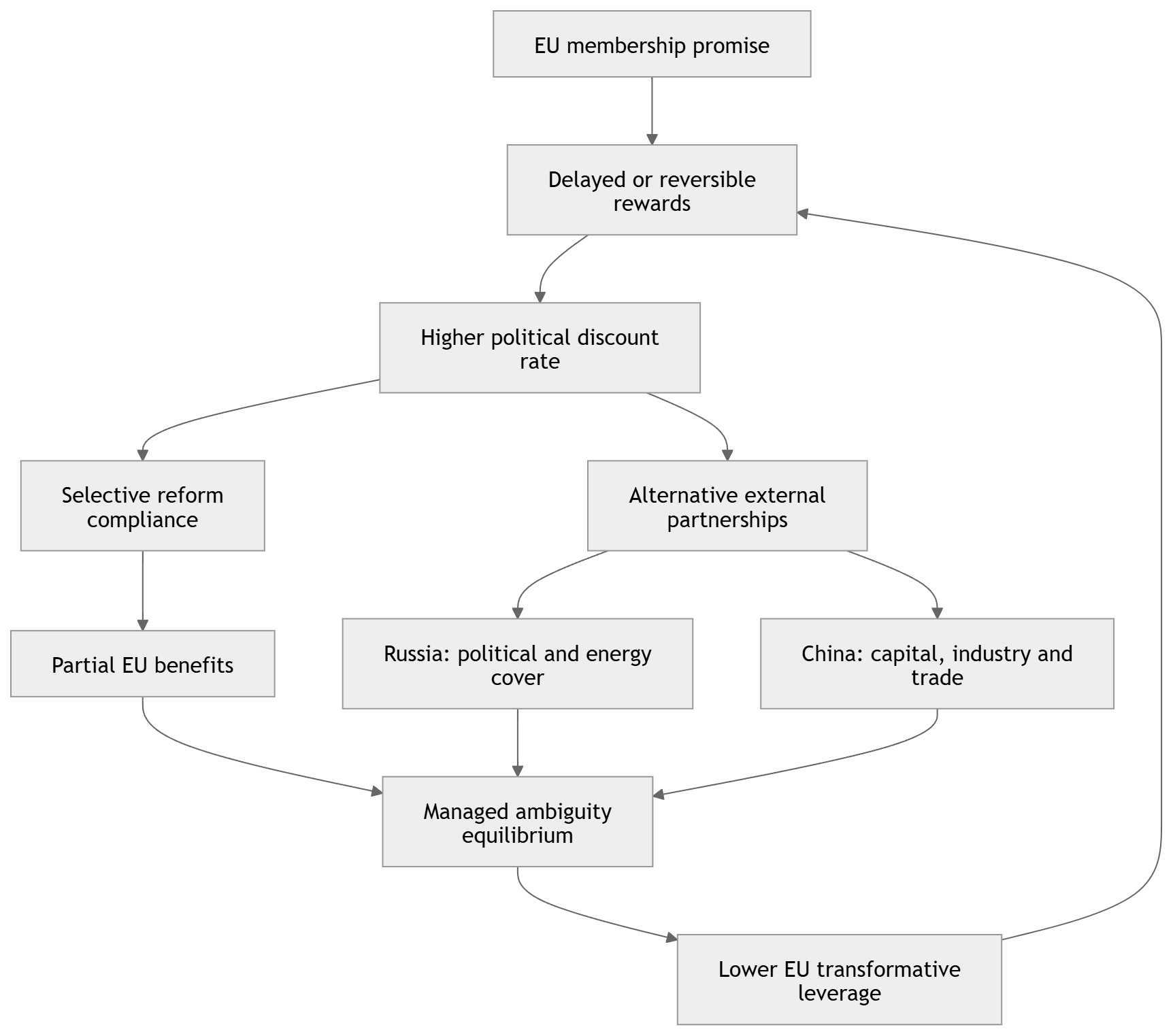
The enlargement problem in the Western Balkans is no longer adequately described as a slow administrative sequence. It has become a political-economy system in which the European Union continues to dominate trade, investment, regulation and development finance but cannot reliably transform that material predominance into irreversible strategic alignment. The distinction is fundamental. Credibility does not mean that accession is legally guaranteed or detached from compliance; it means that governments, firms, voters and bureaucracies can observe a reasonably stable relationship between the domestic cost of reform and the probability, timing and value of the European reward. That relationship has weakened. Serbia opened accession negotiations on 21 January 2014, but by August 2026 only 22 of 35 chapters had been opened and two provisionally closed; the last new cluster, covering the green agenda and sustainable connectivity, opened in December 2021. Serbia Report 2025 – European Commission – November 2025 — Verified official report. Bosnia and Herzegovina received candidate status in December 2022 and a European Council decision to open negotiations in March 2024, but adoption of its negotiating framework remained conditional on completion of the outstanding steps identified by the Commission. Bosnia and Herzegovina – European Commission – August 2026 verification — Verified official accession chronology. These are not equivalent cases: Serbia illustrates prolonged negotiation without decisive closure, whereas Bosnia illustrates political authorization without full procedural activation. Together, however, they establish the core credibility gap. The EU repeatedly confirms the destination while leaving the conversion mechanism exposed to reform reversals, bilateral disputes, institutional incapacity, member-state vetoes and changes in the Union’s internal readiness. Candidate elites consequently discount future membership more heavily than immediate office retention, procurement control, subsidized energy, alternative credit or foreign diplomatic support. The rational response is not necessarily rejection of Europe. It is option preservation: comply where European benefits are immediate, defer reforms that threaten governing coalitions, and retain non-EU partnerships as insurance against an uncertain accession horizon.
The formal European response has been to redefine accession from a distant binary event into a ladder of gradual and reversible integration. The December 2025 Brussels Declaration characterized enlargement as a realistic possibility and a geostrategic investment, while coupling acceleration to credible reforms, rigorous conditionality, individual merit and the Union’s own institutional preparation. EU–Western Balkans Summit Brussels Declaration – Council of the European Union – December 2025 — Verified official declaration. In June 2026 the European Council again endorsed gradual integration on a merit-based and reversible basis after the Tivat summit. European Council Conclusions on the Western Balkans – European Council – June 2026 — Verified official conclusions. This model has sound functional logic: it can extend selected single-market benefits before membership, create interim rewards, impose measurable reform steps and reduce the all-or-nothing character of accession. Its structural weakness is that reversibility operates asymmetrically. The EU can suspend benefits, delay payments or withhold political advancement when benchmarks are unmet, but a candidate government cannot compel the Union to deliver membership once extensive alignment costs have been incurred. Compliance is therefore exposed to what economists would recognize as a time-consistency problem. Brussels asks candidates to dismantle patronage arrangements, strengthen prosecutorial autonomy, expose procurement networks, accept foreign-policy costs and resolve identity-sensitive disputes today, while the final reward depends on future unanimity among governments whose preferences cannot be contractually fixed. The more distant that reward appears, the greater the discount rate applied by political elites. Conditionality remains legally valid but becomes behaviorally weaker. The consequence is selective rather than comprehensive Europeanization: customs, digital payments, transport and commercial rules advance where rents can be preserved or new benefits created, while judicial independence, media pluralism, state-owned-enterprise governance, electoral competition and geopolitical alignment advance more slowly because they alter the distribution of domestic power.
From transformation to transactional compliance
The €6 billion Reform and Growth Facility for 2024–2027 is the EU’s most important attempt to repair this incentive structure. It contains €2 billion in grants and €4 billion in concessional loans, with payments conditioned on implementation of agreed socioeconomic and fundamental reforms; at least half of the envelope is intended to support investment through the Western Balkans Investment Framework. Growth Plan for the Western Balkans – European Commission – August 2026 verification — Verified official programme architecture. Beneficiaries may request pre-financing of up to 7% of their allocation, but disbursement requires the relevant Facility and Loan Agreements to enter into force. Reform and Growth Facility for the Western Balkans – European Commission – August 2026 verification — Verified official implementation framework. Serbia received a Commission decision releasing €111 million in pre-financing in June 2025, while Bosnia’s Reform Agenda was approved only in December 2025, opening a path toward as much as €976.6 million after an earlier delay had reduced its indicative allocation. Reform and Growth Facility Programme Performance Statement – European Commission – August 2026 verification — Verified official payment record. Commission Approves Bosnia and Herzegovina’s Reform Agenda – European Commission – December 2025 — Verified official decision notice. The Facility improves incentive granularity, yet its leverage must be evaluated relative to the political rents it seeks to displace. A payment tranche may be macroeconomically valuable without exceeding the private value of procurement control, protected state-company appointments, regulatory discretion or entity-level veto power. Loans also create future public liabilities, whereas many reform costs are immediate and concentrated upon governing networks. Conditional finance will therefore work best where governments already prefer convergence and need fiscal support to overcome implementation constraints. It will be less effective where non-compliance is intentional, where institutions lack the capacity to verify milestones, or where political elites can transfer the economic cost of withheld payments to citizens while preserving their own control over alternative revenue and credit channels.
The EU’s audited record reinforces this distinction between financing activity and political transformation. The European Court of Auditors found in 2022 that EU support had contributed to technical and operational reforms but had produced limited overall progress in fundamental rule-of-law change because insufficient political will, weak ownership, limited conditionality and the fragility of civil society impaired sustainability. Its audit recorded approximately €690 million in rule-of-law allocations across the six Western Balkan partners during 2014–2020, including €246 million for Serbia and €117 million for Bosnia and Herzegovina. EU Support for the Rule of Law in the Western Balkans: Despite Efforts, Fundamental Problems Persist – European Court of Auditors – January 2022 — Verified official audit. This evidence does not prove that financial conditionality is ineffective; it shows that funding cannot substitute for a political mechanism capable of changing elite calculations. The problem is partly one of attribution and latency. Judicial reforms may require years before conviction patterns, case duration, prosecutorial independence or public trust measurably improve. Governments can adopt legislation, strategies and institutional plans that satisfy formal milestones without changing informal command structures. Conversely, the Commission must avoid arbitrary political judgments and therefore relies heavily on documented, reviewable indicators, producing incentives for procedural compliance. The resulting gap between de jure adoption and de facto execution permits a government to demonstrate movement while postponing the redistribution of power. This is the political economy of delay: time is not neutral. Each additional year allows patronage networks to reproduce themselves, strategic assets to acquire new external financing, media environments to consolidate, skilled workers to emigrate and citizens to lower their expectations. When accession credibility falls, the same conditionality that once promised transformation can become a recurring transaction in which partial reforms purchase partial benefits while the equilibrium itself remains unchanged.
| Conditionality layer | EU instrument or decision | Observable output | Structural limitation | 2026–2031 diagnostic |
|---|---|---|---|---|
| Political destination | Candidate status, Council conclusions, summit declarations | Repeated confirmation of membership perspective | No binding accession date; unanimity remains necessary | Whether Council language evolves into candidate-specific sequencing |
| Legal approximation | Chapters, clusters, screening and closing benchmarks | Acquis adoption and administrative preparation | Formal adoption may outrun enforcement | Ratio of implemented to merely adopted measures |
| Financial incentive | Reform and Growth Facility, IPA III, WBIF | Pre-financing, loans, grants and infrastructure | Payments may be smaller than entrenched political rents | Frequency, scale and reasons for suspension or release |
| Geopolitical alignment | CFSP, sanctions and security cooperation | Alignment rates and participation in EU missions | Selective alignment can coexist with Russian or Chinese partnerships | Alignment on high-cost measures, especially Russia-related sanctions |
| State functionality | Judiciary, procurement, media, public administration | Laws, appointments, case handling and audits | Informal vetoes and captured institutions can survive legal reform | Independent enforcement against politically connected actors |
| Final delivery | Accession treaty and ratification | Membership and full institutional participation | Candidate compliance cannot eliminate member-state veto risk | Credible dates, closure velocity and ratification safeguards |
Serbia: hedging as an equilibrium strategy
Serbia demonstrates how enlargement delay changes the price of alignment. The Commission recorded a CFSP alignment rate of 63% as of 24 October 2025, up from 59% in 2024, but emphasized that Belgrade had not aligned with EU restrictive measures against Russia and that its sanctions alignment remained low. Serbia Report 2025 – European Commission – November 2025 — Verified official assessment. This pattern is strategically intelligible. Serbia can align with lower-cost declarations, cooperate on sanctions circumvention and participate in selected European security activities without accepting the full domestic, energy and diplomatic costs of a break with Moscow. Russia, for its part, continued to describe the relationship as a strategic partnership during official contacts in 2025. Meeting with President of Serbia Aleksandar Vučić – President of Russia – September 2025 — Verified official Kremlin record. Press Release on the Meeting of Sergey Lavrov and Marko Đurić – Ministry of Foreign Affairs of the Russian Federation – September 2025 — Verified official Russian record. This does not mean Moscow can replace the European market. It means Russia can supply specific political goods that the EU cannot or will not provide: support on Kosovo, symbolic affinity, diplomatic recognition of Serbia’s independent posture, energy relationships and a narrative that frames non-alignment as sovereignty. Because these benefits are concentrated in high-salience areas, their political value can exceed their aggregate economic weight. EU conditionality confronts a government that profits from simultaneously presenting itself to Brussels as indispensable to regional stability, to Moscow as a strategic partner and to domestic voters as resistant to external coercion. Delay reinforces this triangular strategy. If membership appears remote, imposing sanctions on Russia offers an immediate political cost without a temporally proximate accession gain. If accession becomes credible, the same decision can be reframed as the unavoidable price of entry. The variable is therefore not simply Serbian ideological preference; it is the perceived probability that costly alignment will be reciprocated within a politically meaningful period.
China adds an economic and industrial layer to this hedging structure. Beijing and Belgrade brought their bilateral free-trade agreement into force on 1 July 2024. China’s State Council reported that approximately 90% of traded products would eventually receive tariff exemptions, with more than 60% becoming tariff-free immediately. China–Serbia Free Trade Agreement to Take Effect on July 1 – State Council of the People’s Republic of China – June 2024 — Verified official Chinese notice. The Chinese Foreign Ministry characterizes Serbia as China’s first comprehensive strategic partner in Central and Eastern Europe and reported bilateral trade of USD 4.35 billion in 2023, a year-on-year increase of 23.7%. Serbia Country Relations – Ministry of Foreign Affairs of the People’s Republic of China – August 2026 verification — Verified official Chinese diplomatic record. During Xi Jinping’s May 2024 visit, the relationship was elevated into what Beijing calls a China–Serbia “community with a shared future,” the first such bilateral construct involving a European country. President Xi Jinping Holds Talks with President Aleksandar Vučić – Ministry of Foreign Affairs of the People’s Republic of China – May 2024 — Verified official Chinese statement. The strategic implication is not that Serbia can detach from Europe and integrate economically with China on equivalent terms. The EU remains the principal regional trading, investment and regulatory center: EU–Western Balkans goods trade exceeded €83 billion in 2024. Western Balkans – Council of the European Union – August 2026 verification — Verified official regional data. The implication is that Beijing reduces the exclusivity of European leverage. Chinese market access, industrial participation and political partnership give Belgrade bargaining resources, investment alternatives and visible proof that external relationships need not be conditioned on the full EU governance acquis. Enlargement delay increases the option value of these arrangements because Serbian decision-makers can accept immediate Chinese projects while preserving a formally European strategic objective.
Bosnia and Herzegovina: delay under fragmented sovereignty
In Bosnia and Herzegovina, the political economy of delay operates through fragmented authority rather than through the centralized portfolio management visible in Serbia. The European Council’s March 2024 decision to open accession negotiations created a nominal strategic advance, yet it also preserved a conditional gate: the negotiating framework would be adopted only after the relevant outstanding steps were completed. European Council Conclusions, 21 and 22 March 2024 – European Council – March 2024 — Verified official decision. Bosnia’s Reform Agenda was not approved until December 2025, and its delayed submission reduced the country’s initial indicative Growth Facility allocation by 10%. Allocations Available for Each Beneficiary – European Commission – August 2026 verification — Verified official allocation methodology. This is a direct example of negative conditionality producing a measurable fiscal consequence. Its political effect, however, is uncertain because Bosnia does not possess a unitary executive capable of internalizing costs uniformly. A withheld payment can harm state-level investment and citizens without imposing equal losses on the entity, party or office-holder responsible for obstruction. Fragmentation therefore weakens the transmission mechanism between EU sanction and behavioral correction. It also encourages veto entrepreneurship: actors can block reform, demand side payments, blame rival institutions or foreign authorities, and then participate in the negotiation required to unlock the same reform. Delay becomes a renewable political asset. The EU must preserve state functionality and avoid collective punishment, which limits how aggressively it can condition assistance; obstructionist actors know this and can test the boundary between political disruption and security escalation. The continued importance of EUFOR Althea illustrates the downstream cost. EU officials stated that the mission was reinforced in March 2025 when threats emerged against Bosnia’s unity and constitutional order. Speech to EUFOR Troops at Camp Butmir – European External Action Service – November 2025 — Verified official security statement. Europe is consequently required to finance both transformation and deterrence because delayed transformation leaves the institutional-security risk unresolved.
Shadow dimensions: liquidity, cyber exposure and coercive networks
The most important shadow dimensions are not necessarily clandestine; they are poorly integrated into conventional enlargement scorecards. First, liquidity flows can decouple political survival from formal EU conditionality. State-owned enterprises, opaque guarantees, bilateral lending, advance payments, subcontracting networks and refinancing arrangements may provide governments or aligned business groups with resources that reduce the immediate effect of a delayed EU tranche. The relevant intelligence question is not merely which state lends the most, but which creditor or contractor can sustain a politically critical asset during fiscal stress and what collateral, control rights, procurement exemptions or diplomatic concessions are attached. Second, cyber and information dependencies can produce long-duration alignment effects without dramatic incidents. Telecommunications infrastructure, cloud services, surveillance tools, media distribution, political advertising, data hosting and public-sector platforms may create technical lock-in, privileged access or narrative advantage. The evidentiary threshold must remain strict: partnership does not itself demonstrate hostile access, and procurement from a foreign supplier does not prove intelligence exploitation. Nevertheless, the accession process requires a risk register capable of distinguishing ordinary commercial exposure from control over strategic data or continuity functions. Third, mercenary or proxy dynamics in this specific theater are a lower-probability but high-impact variable. There is insufficient verified primary evidence in the sources used here to assert an organized contemporary mercenary infrastructure linking the examined accession delays directly to Serbia or Bosnia. The correct treatment is therefore indicator-based rather than accusatory: monitor foreign security training outside transparent agreements, non-state veteran mobilization, undeclared financing of coercive groups, weapons diversion, recruitment networks and synchronized information preparation. Fourth, elite networks can arbitrage incompatible compliance systems. A politically connected firm may satisfy EU-origin requirements in one transaction, obtain Chinese equipment or credit in another, retain Russian-linked commercial relationships elsewhere and route beneficial ownership through multiple jurisdictions. No individual component necessarily violates accession rules; their combination can dilute strategic transparency. The policy failure occurs when chapter-based assessment fragments these exposures across competition, procurement, energy, finance, cybersecurity and foreign policy instead of evaluating their cumulative effect upon state autonomy.
| Shadow dimension | Observable indicator | Mechanism of leverage | Evidence threshold | Strategic warning |
|---|---|---|---|---|
| Sovereign and quasi-sovereign liquidity | Guarantees, refinancing, collateral, grace periods | Reduces sensitivity to EU payment suspension | Contract, budget, audit or corporate disclosure | Creditor gains control rights over critical assets |
| Strategic procurement | Single-bid awards, exemptions, repeated subcontractors | Converts capital into durable elite relationships | Procurement and beneficial-ownership records | Supplier concentration across several critical sectors |
| Cyber dependency | Core-network, cloud, surveillance and data-hosting ownership | Creates technical lock-in and potential privileged access | Verified contracts and competent-authority assessments | Foreign-controlled continuity or sensitive-data function |
| Information influence | Funding, distribution access and coordinated narratives | Raises domestic cost of alignment with EU policy | Attributable official or forensic evidence | Narratives synchronized with coercive diplomatic events |
| Coercive proxies | Recruitment, training, financing or weapons movement | Enables pressure below interstate-conflict threshold | Judicial, customs, sanctions or security-service evidence | Mobilization paired with constitutional confrontation |
| Institutional veto markets | Repeated reform blockage followed by concessions | Monetizes fragmentation and delays state consolidation | Legislative chronology and financial trace | Obstruction becomes a stable revenue or patronage model |
Competing hypotheses and Bayesian update
A disciplined forecast must resist the assumption that every delay necessarily ends in geopolitical displacement. Five competing hypotheses structure the 2026–2031 outlook. H₁, accelerated accession, predicts that the Ukraine war, security competition and demonstrated progress by leading candidates create a political breakthrough, compress timelines and restore the reform-to-reward relationship. H₂, differentiated integration, predicts that Montenegro and Albania advance more rapidly while Serbia and Bosnia remain inside increasingly dense but incomplete European structures. H₃, managed gray-zone equilibrium, predicts that Serbia maintains selective alignment, Bosnia avoids disintegration but remains institutionally fragile, and the EU continues gradual integration without final delivery. H₄, externalized fragmentation, predicts that worsening EU credibility allows Russian, Chinese or other external relationships to harden into sectoral spheres of influence and amplifies domestic veto behavior. H₅, coercive European re-anchoring, predicts that security shocks lead the EU to combine stricter funding suspensions, investment screening, energy diversification, defense cooperation and political deadlines. Beginning with neutral priors of 20% each, the observable evidence supports unequal updates. Serbia’s prolonged chapter standstill, its incomplete CFSP alignment and documented Russian and Chinese strategic partnerships weaken H₁. Bosnia’s approved Reform Agenda, EUFOR deterrence, the Growth Facility and the June 2026 reaffirmation of enlargement prevent H₄ from becoming dominant. Concrete 2026 progress by Albania and Montenegro strengthens H₂, while the persistence of candidate-specific blockage strengthens H₃. The resulting analytical posteriors are H₁ 9%, H₂ 27%, H₃ 37%, H₄ 15% and H₅ 12%. These are explicitly model judgments, not official statistics. Their value lies in disciplined revision. H₁ should rise sharply if Serbia opens additional clusters and Bosnia obtains and operationalizes its negotiating framework. H₄ should rise if strategic asset control becomes less transparent, constitutional confrontation intensifies, foreign-policy alignment declines or EU conditionality is repeatedly waived for short-term stability. H₅ should rise after a regional security shock that changes member-state willingness to bear enlargement costs.
| Hypothesis | Prior | Posterior, August 2026 | Principal confirming evidence | Critical disconfirming indicator |
|---|---|---|---|---|
| H₁ Accelerated accession | 20% | 9% | Binding timelines, rapid chapter closures, Bosnia framework adopted | Continued Serbian standstill through 2027 |
| H₂ Differentiated integration | 20% | 27% | Albania and Montenegro advance; others receive partial integration | Region-wide political package overrides merit differentiation |
| H₃ Managed gray-zone equilibrium | 20% | 37% | Partial compliance, stable EU funding, continuing external hedging | High-cost alignment followed promptly by accession delivery |
| H₄ Externalized fragmentation | 20% | 15% | Sectoral capture, constitutional escalation, declining alignment | Strong screening, ownership transparency and state consolidation |
| H₅ Coercive EU re-anchoring | 20% | 12% | Security shock, tougher conditionality, energy and cyber decoupling | Member states resist common enforcement or continue exemptions |
Monte Carlo outlook, 2026–2031
The five-year scenario model uses 100,000 conceptual iterations across seven bounded drivers: accession credibility, domestic reform capacity, member-state unanimity risk, bilateral-dispute obstruction, external strategic penetration, fiscal dependence on EU transfers and security-shock intensity. Because no official institution publishes a validated probability distribution for Western Balkan accession, the simulation is an analytical stress test rather than an empirical prediction. Baseline values are calibrated to observable conditions: Serbia’s 22 opened chapters and 63% CFSP alignment; Bosnia’s conditional negotiating framework and approved Reform Agenda; the Facility’s €6 billion envelope; the region’s GDP per capita of approximately 30–50% of the EU average; documented Russian and Chinese strategic engagement; and the EU’s continuing security presence. Reform and Growth Facility for the Western Balkans – European Commission – August 2026 verification — Verified official convergence baseline. Correlations matter more than isolated values. A negative correlation is assigned between accession credibility and external hedging; a positive correlation links institutional fragmentation to reform slippage; a moderate positive correlation connects security shocks to both EU re-engagement and short-term fragmentation, reflecting their ambiguous effect. The median outcome is differentiated but incomplete integration: additional access to EU programmes, payments and market domains without simultaneous membership for Serbia and Bosnia by 2031. Across the modeled distribution, the approximate outcome frequencies are 10% accelerated accession or treaty-ready status, 29% differentiated integration, 43% managed ambiguity, and 18% acute institutional or geopolitical deterioration. The central estimate therefore assigns a combined 61% probability to either continued gray-zone equilibrium or material deterioration. Sensitivity analysis identifies three dominant variables: a candidate-specific accession timetable supported by member states, enforceable fundamental-reform milestones, and Serbia’s high-cost alignment choices concerning Russia and Kosovo. Financial volume alone is less decisive unless linked to state-level enforcement and transparent ownership.
The model’s year-by-year interpretation is not linear. During 2026–2027, implementation of Reform Agendas and payment decisions will test whether the EU can reward verified execution rapidly enough to change domestic expectations. By 2028, the approaching end of the present Facility and the structure of the next EU financial framework will reveal whether gradual integration is a bridge to membership or an alternative holding architecture. This is the first major credibility inflection point. If candidates obtain benefits but accession sequencing remains undefined, domestic actors will rationally infer that functional integration can continue indefinitely without full political admission. By 2029, European institutional turnover may either create a renewed mandate or reset political priorities, increasing uncertainty. Between 2030 and 2031, the accumulated record of chapter closure, CFSP alignment, strategic-investment screening, energy diversification and dispute resolution will determine whether the region has crossed from reversible preparation into treaty-ready convergence. The worst outcome is not necessarily formal abandonment. It is permanent pre-accession: enough funding to prevent economic rupture, enough security presence to deter conflict, enough market integration to preserve dependence, but insufficient political credibility to eliminate hedging. Such an equilibrium is stable in the narrow sense and corrosive in the strategic sense. It allows the EU to postpone politically difficult admission decisions while allowing local elites to postpone power-reducing reforms. External actors need not defeat the EU economically; they need only become indispensable in selected sectors or political disputes. Over time, this creates a layered sovereignty in which European rules coexist with non-European leverage and domestic veto structures.
Strategic indicators and policy implications
The appropriate European response is not unconditional acceleration, because admitting states with unresolved constitutional, judicial or geopolitical conflicts would internalize instability and weaken the acquis. Nor is ever more detailed conditionality sufficient, because excessive benchmark proliferation can obscure the few decisions that genuinely reveal strategic direction. The policy requirement is credible conditionality: fewer high-value milestones, independent verification, rapid interim rewards and an explicit political consequence when those milestones are met. For Serbia, the decisive indicators should include sustained judicial and electoral implementation, demonstrable media and procurement improvements, verifiable normalization steps with Kosovo, and alignment with high-cost European foreign-policy measures rather than only low-cost declarations. For Bosnia, the essential metrics are state functionality, adoption and execution of the negotiating framework, constitutional compliance by entity authorities, operational reform coordination and the capacity to direct funds without rewarding obstruction. Across both cases, the EU should integrate investment screening, beneficial-ownership transparency, sovereign-guarantee disclosure, energy-contract risk, cyber-infrastructure ownership and sanctions-circumvention controls into the fundamentals cluster. The metric of success must shift from activities completed to leverage reduced: fewer non-transparent liabilities, fewer politically protected monopolies, more autonomous enforcement and lower vulnerability of critical functions to external coercion. The June 2026 European Council’s commitment to merit-based, reversible integration provides the formal basis, but reversibility must not become a substitute for delivery. A credible five-year architecture would specify annual decision points through 2031, publish unmet and completed conditions in comparable form, automatically release predefined benefits after verified compliance and require the Council to state concrete reasons when political advancement is withheld despite technical fulfillment. Such a mechanism would not abolish unanimity; it would raise the reputational cost of arbitrary delay and reduce the information asymmetry that currently enables every actor to blame another.
| Period | Credibility test | Positive indicator | Adverse indicator | Required analytical update |
|---|---|---|---|---|
| 2026–2027 | Reform Agenda execution | Rapid, verified payments tied to substantive implementation | Formal milestones accepted without enforcement | Increase H₃ and reduce expected conditionality effectiveness |
| 2027–2028 | Accession sequencing | New Serbian cluster movement; Bosnia framework operational | Continued Serbian standstill; Bosnia coordination blockage | Increase H₃ and H₄ |
| 2028–2029 | Post-Facility architecture | New funding explicitly connected to accession stages | Gradual integration institutionalized without political calendar | Reduce H₁; increase permanent pre-accession risk |
| 2029–2030 | EU political continuity | New Commission and Council retain candidate-specific roadmaps | Enlargement subordinated to unrelated internal veto bargaining | Increase unanimity-risk distribution |
| 2030–2031 | Irreversibility test | Treaty-ready candidates, high CFSP alignment, strategic transparency | Persistent sectoral external capture and constitutional vetoes | Shift from gray-zone equilibrium toward fragmentation scenario |
The final strategic judgment is that enlargement delay has become endogenous: it no longer merely reflects inadequate reforms but actively changes the incentives governing those reforms. Candidate governments observe that partial integration can deliver trade, infrastructure, mobility and financing without requiring the immediate surrender of all political rents or geopolitical options. EU member states observe that gradual integration and security deployments can contain risk without forcing a final decision on accession. External powers observe that they do not need regional predominance; they can obtain durable leverage by concentrating on energy, infrastructure, diplomatic disputes, technology or identity networks. This triangular adaptation generates a self-reinforcing equilibrium. The Bayesian baseline assigns the highest probability to continued managed ambiguity, but the outcome is not predetermined. Credibility could be restored through visible closure velocity, automatic rewards and a politically endorsed horizon; equally, it could deteriorate if gradual integration becomes demonstrably detached from membership. The most important five-year indicator is therefore not the number of summits, declarations, strategies or adopted laws. It is the observed conversion rate between costly domestic compliance and irreversible European advancement. If that conversion rate rises, multipolar hedging becomes progressively expensive and less politically defensible. If it remains low, hedging becomes rational even for governments that genuinely prefer eventual EU membership. The Union would then remain the Western Balkans’ dominant economic power while losing control over the strategic meaning of that dominance. That is the essence of the structural failure: not the disappearance of Europe, but the erosion of its ability to convert proximity, capital and law into predictable political order.
Five-Year Enlargement Credibility and Gray-Zone Projection
Multipolar Hedging and Selective External Capture
Influence is not a market-share contest
The Western Balkans are not moving from European predominance toward a symmetrical four-power order. The measurable structure remains profoundly asymmetric: the European Union is the region’s largest trading partner, investor and donor, and EU–Western Balkans trade in goods exceeded €83 billion in 2024. Western Balkans – Council of the European Union – August 2026 verification — Verified official regional data. In Serbia, EU member states accounted for 58.8% of total merchandise trade in 2024, while the Commission reported that the EU had supplied 48% of Serbian foreign-direct-investment inflows in 2023. Regions of the Republic of Serbia 2024 – Statistical Office of the Republic of Serbia – 2025 — Verified official statistical publication. Serbia Report 2024 – European Commission – October 2024 — Verified official country report. This scale cannot be reproduced by Russia, China or Türkiye individually or collectively over the next five years without an economic discontinuity of implausible magnitude. Yet aggregate predominance does not guarantee strategic exclusivity. External actors can generate disproportionate leverage by acquiring influence over assets, relationships or decisions whose political value exceeds their share of national output: an oil company, a copper complex, a rail corridor, a veto-bearing entity government, a defense relationship, a telecommunications platform or a diplomatic position concerning Kosovo can provide more coercive or bargaining power than billions of euros dispersed across ordinary commerce. The correct analytical unit is therefore not total investment or trade alone, but the strategic-node concentration ratio: the proportion of critical national functions in which an external actor possesses ownership, financing, technological dependence, regulatory privilege, privileged political access or credible disruption capacity. Under this framework, the EU remains the indispensable system-level actor, while Russia, China and Türkiye operate as selective portfolio powers. Multipolar hedging becomes viable because Serbia and Bosnia and Herzegovina do not need alternative partners to replace Europe. They need those partners to reduce the exclusivity of European conditionality, broaden elite financing options, protect contested political positions and increase the cost to Brussels of coercive disengagement.
This distinction also prevents a frequent analytical error: treating every non-EU engagement as evidence of “capture.” Ordinary trade, cultural exchange, development assistance or diplomatic contact is not capture. Selective external capture exists only when an outside actor obtains a durable capability to shape, delay or raise the cost of a sovereign decision in a domain central to national or European security. Five conditions determine whether engagement crosses that threshold. First is criticality: the asset or relationship must affect energy continuity, transport, defense, data, fiscal stability, natural resources, public information or constitutional authority. Second is concentration: dependence must be insufficiently diversified or substitutable. Third is opacity: ownership, liabilities, procurement exemptions, collateral, data access or political conditions must be difficult for public institutions to inspect. Fourth is political convertibility: economic or social access must be capable of influencing foreign-policy alignment, legislation, appointments or veto behavior. Fifth is persistence: the leverage must survive electoral turnover or short-term commercial renegotiation. This produces four distinct influence models. Russia maximizes political-security leverage from a relatively narrow economic base. China converts infrastructure, mining, manufacturing and trade agreements into long-duration industrial positioning. Türkiye builds dense, lower-cost relationship networks across diplomacy, development, culture, business and religious heritage. The EU supplies the regulatory, fiscal, market and security architecture within which all three operate. The resulting competition is not a conventional zero-sum contest: a Chinese-owned factory can export primarily to European markets; Turkish diplomacy can support Bosnia’s sovereignty while coexisting with EUFOR; Russia can retain political leverage even as Serbia’s production networks remain oriented toward the EU. The danger emerges when cross-system dependencies accumulate without a unified national screening mechanism, allowing external partners to exploit the gap between sectoral economic policy and strategic-security governance.
| Power center | System-level weight | Primary instruments | Preferred strategic nodes | Main limitation |
|---|---|---|---|---|
| European Union | Dominant trade, investment, regulatory and donor ecosystem | Single-market access, accession, grants, loans, standards, EUFOR, CSDP | Whole economy, public administration, borders, energy transition, transport | Delayed membership delivery; fragmented political authority; unanimity |
| Russia | Limited aggregate economic scale but high political salience | Energy ownership, diplomatic support, elite access, identity narratives, security ties | Serbian energy, Kosovo diplomacy, Republika Srpska political channels | Sanctions pressure, weaker capital base, limited replacement capacity |
| China | Expanding trade and concentrated industrial footprint | Acquisitions, construction, manufacturing, free trade, sovereign and corporate finance | Copper, steel, rail, roads, industrial zones, machinery, digital systems | Exposure to EU market rules, environmental scrutiny and debt transparency |
| Türkiye | Medium economic weight; high relational density | Network diplomacy, trade, contracting, development aid, culture, education, religious heritage | Bosnia, Sandžak, regional mediation, transport, municipal and social networks | Cannot match EU finance or China’s industrial scale; must balance regional communities |
| Domestic governing networks | Decisive conversion layer | Permits, subsidies, procurement, appointments, media access, diplomatic brokerage | State enterprises, municipalities, ministries, entity institutions | Electoral turnover, fiscal constraints, independent enforcement |
Russia: political-security leverage from concentrated assets
Russian leverage rests on the conversion of historical, diplomatic and energy relationships into political optionality. Its most important Serbian economic node remains Naftna Industrija Srbije, or NIS, whose 2025 ownership structure placed 44.85% with Gazprom Neft, 11.3% with Gazprom and 29.87% with the Republic of Serbia; the two Russian companies therefore held a combined 56.15%. Quarterly Report for the First Quarter of 2025 – NIS Group – April 2025 — Verified corporate investor report. NIS’s 2024 financial statements identified PJSC Gazprom as the Group’s immediate and ultimate holding company for consolidation purposes. Consolidated Financial Statements for the Year Ended 31 December 2024 – NIS Group – December 2024 — Verified corporate financial statement. This structure matters because energy-company ownership is not comparable to an ordinary minority investment. NIS connects domestic fuel supply, refining, distribution, fiscal revenue, employment, capital investment and Serbia’s relations with both Russian suppliers and Western sanctions authorities. Any disruption can impose simultaneous economic and political costs, giving the ownership problem strategic convertibility. The mechanism need not involve an explicit Russian threat. Serbian decision-makers must account for supply continuity, asset valuation, financing, sanctions exposure and the domestic consequences of restructuring. That produces anticipatory restraint. Moscow’s wider relationship reinforces this leverage: official Russian records continued to describe Serbia as a strategic partner in 2025, including at the September meeting between Vladimir Putin and Aleksandar Vučić. Meeting with President of Serbia Aleksandar Vučić – President of Russia – September 2025 — Verified official Kremlin record. Russia therefore preserves an influence package larger than its trade share would predict: asset concentration in energy, diplomatic support concerning Kosovo, direct presidential access and a political narrative of sovereignty under Western pressure.
The most visible output is Serbia’s calibrated foreign-policy alignment. The European Commission measured Serbian alignment with EU Common Foreign and Security Policy positions at 63% on 24 October 2025, compared with 59% in 2024, but recorded continued non-alignment with restrictive measures against Russia. Serbia Report 2025 – European Commission – November 2025 — Verified official country report. This is not complete Russian control; Serbia supported Ukraine’s territorial integrity, aligned with selected statements and cooperated with the EU on sanctions-circumvention risks. It is better understood as segmented alignment. Belgrade aligns where the cost to Russian relations and domestic political narratives is manageable, while withholding alignment on measures that would require an unmistakable strategic break. The value to Moscow is defensive rather than hegemonic. Russia does not need Serbia to join a Russian-led economic order; preventing complete EU foreign-policy convergence is itself a strategic result because it demonstrates that a candidate country can remain outside the sanctions coalition while maintaining formal accession ambitions. This weakens the signaling coherence of enlargement and preserves a diplomatic bridge into southeastern Europe. For Serbia, the same posture extracts value from both sides: continued European financing and market access coexist with Russian political support and energy-linked bargaining space. The equilibrium will become harder to sustain through 2031 if EU accession credibility rises or if sanctions exposure forces a definitive NIS restructuring. It will become easier to sustain if enlargement stalls, energy diversification remains incomplete and Brussels continues to separate technical accession benefits from high-cost geopolitical alignment. The pivotal indicator is therefore not the annual alignment percentage alone, which can rise through low-cost decisions, but Serbia’s behavior on measures directly affecting Russian state or strategic corporate interests.
Russian leverage in Bosnia and Herzegovina is structurally different because it is mediated through constitutional fragmentation and entity politics rather than through a national energy champion of equivalent centrality. Bosnia formally maintains a high level of alignment with EU foreign-policy declarations, but official EU reporting has repeatedly noted that implementation of Russia-related restrictive measures can become a matter of internal political dispute. Bosnia and Herzegovina Report 2022 – European Commission – October 2022 — Verified official country report. The leverage mechanism is therefore less about converting Bosnia as a whole and more about protecting or amplifying veto-bearing actors inside the constitutional system. Support to political positions in Republika Srpska, resistance to centralization and criticism of Western supervisory structures can raise the transaction cost of state-level decisions even when Moscow lacks sufficient economic weight to redirect the national economy. Such influence becomes strategically important because Bosnia’s state architecture requires coordination across institutions whose incentives diverge. A relatively small amount of diplomatic, informational or political support can reinforce a domestic actor’s ability to obstruct legislation, appointments or sanctions enforcement. The European response reveals the severity of this institutional vulnerability: the EU reinforced EUFOR Althea in March 2025 after threats emerged to Bosnia’s unity and constitutional order, and the mission’s mandate continued to provide executive deterrence. Speech to EUFOR Troops at Camp Butmir – European External Action Service – November 2025 — Verified official EU security statement. Russia’s optimal strategy does not require conflict. Persistent constitutional friction is cheaper and more sustainable because it forces the EU to expend diplomatic and military resources, slows enlargement and gives local partners recurring bargaining power.
| Russian leverage channel | Serbia | Bosnia and Herzegovina | Political conversion mechanism | Five-year trigger |
|---|---|---|---|---|
| Energy ownership | NIS majority held collectively by Gazprom Neft and Gazprom in 2025 | Less centralized national exposure | Supply continuity and sanctions restructuring affect government choices | Ownership transfer, sanctions shock or accelerated diversification |
| Kosovo diplomacy | High strategic salience | Indirect regional effect | Diplomatic support raises the domestic cost of alignment against Moscow | Binding Serbia–Kosovo normalization sequence |
| Entity-level politics | Limited applicability | High relevance in Republika Srpska | External support increases veto endurance | Constitutional confrontation or state-level enforcement action |
| Foreign-policy alignment | Selective; 63% CFSP alignment in October 2025 | High formal alignment, uneven enforceability risk | Distinguishes declarations from high-cost sanctions implementation | EU makes Russian-sanctions alignment an operational accession gate |
| Security and narrative affinity | Direct presidential and ministerial channels | Identity and institutional narratives | Frames resistance as sovereignty rather than accession non-compliance | Information campaigns synchronized with policy deadlines |
| Replacement capacity | Low relative to EU economy | Low | Russia leverages specific nodes, not the whole economy | Economic isolation reduces resources available for external engagement |
China: infrastructure, industry and production-chain positioning
China’s approach is more capital-intensive, less dependent on cultural affinity and designed for long-duration commercial and industrial presence. Serbian trade statistics show the magnitude and asymmetry of the relationship. In 2024 Serbia exported USD 1.903 billion in goods to China, equivalent to 6.0% of Serbian merchandise exports, while importing USD 5.553 billion, or 13.1% of total imports. Statistical Pocketbook of the Republic of Serbia 2025 – Statistical Office of the Republic of Serbia – 2025 — Verified official statistical publication. In 2025 China remained Serbia’s largest source of merchandise imports, rising to USD 7.271 billion, or 15.4% of the total; Serbian exports to China reached USD 2.096 billion, or 5.6%. Türkiye separately became Serbia’s fourth-largest import source at USD 2.477 billion, or 5.2%. Statistical Pocketbook of the Republic of Serbia 2026 – Statistical Office of the Republic of Serbia – 2026 — Verified official 2025 trade statistics. China’s bilateral significance is consequently not limited to project finance. It is embedded in machinery, equipment, manufactured inputs and the ownership of major exporting assets. The bilateral free-trade agreement that entered into force on 1 July 2024 is designed to eliminate tariffs on approximately 90% of traded product lines, with more than 60% receiving immediate tariff-free treatment and more than 95% eventually scheduled for zero tariffs under China’s official account. China–Serbia Free Trade Agreement to Take Effect on July 1 – State Council of the People’s Republic of China – June 2024 — Verified official Chinese notice. The agreement creates a bilateral commercial layer operating alongside Serbia’s EU Stabilisation and Association framework, its CEFTA obligations and the regulatory trajectory of accession. Its strategic importance lies in the possibility that domestic firms and Chinese-owned Serbian production become simultaneously connected to Chinese inputs, Serbian subsidies and European final markets.
Mining provides the clearest example of Chinese industrial positioning. Zijin Mining lists the Bor copper complex and Čukaru Peki copper-gold mine among its principal overseas operations, embedding Serbia inside a multinational portfolio centered on metals critical to electrification, construction, defense manufacturing and advanced industry. Annual Report 2025 – Zijin Mining Group – April 2026 — Verified corporate annual report. The strategic variable is not nationality alone; foreign ownership can deliver capital, modernization, employment and export growth. The risk arises from the conjunction of resource criticality, market concentration, environmental liabilities, state subsidies, local political dependence and opaque bargaining over expansion. Copper assets possess leverage because their value grows with European electrification and grid investment. A Chinese-controlled Serbian producer can benefit from proximity to EU demand while strengthening Beijing’s global resource portfolio. This does not automatically give China coercive power over Belgrade, but it creates mutual dependence: Serbia gains exports, regional employment and fiscal activity, while the investor gains long-lived mineral access and a production base near the single market. Substitution becomes costly once processing systems, supplier networks, rail links and local budgets adapt around the investor. The same logic applies to steel, tires, roads and railways even when individual contracts differ. Infrastructure construction creates political visibility and path dependence; industrial acquisition creates continuing operational presence; equipment supply creates maintenance and technology dependence. Their combination is more consequential than any project in isolation. By 2031, the decisive question will be whether Serbia builds an integrated screening system covering beneficial ownership, state aid, environmental enforcement, procurement, data access, critical raw materials and security of supply—or continues to assess each transaction as a separate commercial bargain.
China’s official narrative makes the intended political depth explicit. Beijing identifies Serbia as its first comprehensive strategic partner in Central and Eastern Europe, reported bilateral trade of USD 4.35 billion in 2023, up 23.7% year on year, and in May 2024 elevated the relationship into the first China–European bilateral “community with a shared future.” Serbia Country Relations – Ministry of Foreign Affairs of the People’s Republic of China – August 2026 verification — Verified official Chinese diplomatic record. President Xi Jinping Holds Talks with President Aleksandar Vučić – Ministry of Foreign Affairs of the People’s Republic of China – May 2024 — Verified official Chinese statement. This language signals that economic cooperation is nested within a strategic-political architecture, but it should not be misread as proof that Serbia has accepted Chinese alignment across all international questions. The more precise interpretation is that Beijing offers Belgrade diplomatic recognition as an autonomous pole rather than merely an accession candidate waiting outside the EU. That symbolic equality complements tangible industrial projects and strengthens the domestic narrative of diversified sovereignty. China also benefits from Serbia’s geographic position: projects can demonstrate the Belt and Road model inside a European candidate state and test how Chinese commercial structures interact with EU-compatible customs, environmental and competition regimes. The strategic competition is therefore regulatory. If Serbian projects converge toward EU procurement transparency, environmental enforcement, subsidy control and security screening, China remains an important investor but its political convertibility is limited. If exceptions, bilateral agreements and politically negotiated subsidies repeatedly override general rules, economic presence can harden into selective capture. The primary indicators are not public ceremony or investment totals but contract disclosure, arbitration clauses, sovereign guarantees, local-content patterns, export-market concentration, tax treatment, beneficial ownership and the ability of Serbian regulators to impose penalties without political interference.
| Chinese positioning layer | Verified quantitative marker | Strategic value | Capture risk | Key verification requirement |
|---|---|---|---|---|
| Merchandise imports | USD 7.271 billion, 15.4% of Serbian imports in 2025 | Machinery, equipment and industrial inputs | Supply-chain dependence | Product-level concentration and substitutability |
| Serbian exports to China | USD 2.096 billion, 5.6% of exports in 2025 | Market diversification | Export concentration in Chinese-owned or commodity assets | Ownership-adjusted export statistics |
| Free-trade agreement | About 90% of product lines scheduled for tariff exemption | Long-duration bilateral trade architecture | Regulatory divergence from future EU obligations | Compatibility review with EU customs and trade acquis |
| Copper and gold | Bor and Čukaru Peki in Zijin’s global portfolio | Critical raw materials and regional employment | Local fiscal and political dependence | Audited production, tax, environmental and state-aid records |
| Infrastructure | Rail, road and construction relationships | Connectivity and visible delivery | Debt, procurement and maintenance dependence | Contracts, guarantees and competitive tender data |
| Manufacturing | Steel, tires, equipment and supplier networks | Industrial upgrading and exports | Subsidy lock-in and environmental externalities | State-aid transparency and enforcement parity |
| Diplomatic architecture | Comprehensive strategic partnership and “shared future” framework | Political recognition and elite access | Economic issues converted into foreign-policy expectations | Voting, statements and policy-concession chronology |
Türkiye: network diplomacy rather than concentrated capture
Türkiye’s influence operates through a broader and more socially distributed network. Ankara describes itself as a Balkan country and bases its regional policy on sovereignty, territorial integrity, non-intervention, historical ties and good-neighborliness. Relations with the Balkan Region – Ministry of Foreign Affairs of the Republic of Türkiye – August 2026 verification — Verified official Turkish policy statement. The architecture includes bilateral diplomacy, business relations, construction, transport, education, cultural preservation, religious institutions, municipal cooperation and development assistance through TİKA. This network is especially valuable in Bosnia and Herzegovina because Türkiye maintains access to Bosniak leaders while also cultivating formal relations with Serbia and Croatia. Its Bosnia policy officially emphasizes sovereignty, territorial integrity and political unity, a position that differs from strategies based on encouraging entity-level fragmentation. Turkish Foreign Policy at the Turn of the “Century of Türkiye” – Ministry of Foreign Affairs of the Republic of Türkiye – 2023 — Verified official policy paper. Ankara’s tripartite consultation formats—Türkiye–Bosnia and Herzegovina–Serbia and Türkiye–Bosnia and Herzegovina–Croatia—give it cross-community brokerage capacity that purely bilateral actors lack. Türkiye–Bosnia and Herzegovina Relations – Embassy of Türkiye in Sarajevo – August 2026 verification — Verified official diplomatic note. This does not eliminate competitive or identity-based interpretations of Turkish engagement. Cultural and religious projects may produce affinity concentrated among particular communities, while political relationships can become personalized. Nevertheless, the strategic mechanism is usually network accumulation rather than ownership of a single coercive asset. Türkiye gains influence because many institutions can call upon it, because it can convene parties and because its engagement remains visible below the level of formal accession negotiations.
The July 2025 launch of the Balkans Peace Platform demonstrates Ankara’s ambition to institutionalize this convening role. Türkiye hosted foreign ministers from the region in Istanbul, including the foreign ministers of Bosnia and Herzegovina and Serbia, with the stated purpose of strengthening peace, stability and prosperity. Regarding the Balkans Peace Platform Foreign Ministers’ Meeting – Ministry of Foreign Affairs of the Republic of Türkiye – July 2025 — Verified official Turkish announcement. Participation of Hakan Fidan in the Balkans Peace Platform – Ministry of Foreign Affairs of the Republic of Türkiye – July 2025 — Verified official meeting record. This platform is strategically important not because it can replace the EU accession process, but because it gives regional governments an additional diplomatic venue, mediator and signaling channel. Ankara can communicate with actors that are simultaneously divided over Kosovo, Bosnia’s constitutional order, NATO and relations with Russia. Its influence becomes politically convertible when access gained through development, culture or trade makes Turkish mediation indispensable during crisis. Türkiye’s 2023 development-assistance report placed total Turkish public and private development assistance at USD 7.75 billion globally, although that aggregate cannot be attributed to the Balkans. Türkiye Development Assistance Report 2023 – Turkish Cooperation and Coordination Agency – May 2025 — Verified official development report. The analytical caution is critical: restoration of cultural heritage or support to a municipal service is not inherently geopolitical capture. The relevant test is whether project selection produces exclusive political dependence, bypasses national institutions, conditions access upon partisan alignment or creates opaque financial obligations. Turkish influence is likely to remain more relational and reversible than Chinese asset ownership or Russian energy concentration, but it can be more resilient socially because it is reproduced across education, culture, business and interpersonal networks.
Türkiye’s expanding economic relationship with Serbia adds a material component to this network. Serbian official statistics placed Turkish goods at USD 2.477 billion, or 5.2%, of total Serbian merchandise imports in 2025, making Türkiye the fourth-largest import source after China, Germany and Italy. Statistical Pocketbook of the Republic of Serbia 2026 – Statistical Office of the Republic of Serbia – 2026 — Verified official trade statistics. This share remains well below the EU aggregate and below China’s 15.4%, but its trajectory matters because Turkish commerce is accompanied by direct diplomatic access and regional logistical proximity. Ankara can also act as a bridge rather than a rival system. Türkiye remains economically interdependent with the EU and embedded in a customs union for industrial goods; the Commission reported EU–Türkiye trade above €206 billion in 2023 and described Türkiye as the EU’s fifth-largest trading partner that year. Türkiye Report 2024 – European Commission – October 2024 — Verified official EU report. Turkish firms operating in the Balkans may therefore connect the region to European production and service networks rather than divert it from them. At the same time, Türkiye’s own hedging between the EU, Russia, China and Western security structures makes it a model and facilitator of strategic autonomy. Ankara did not align with EU restrictive measures against Russia and retained energy dependence and extensive economic contacts with Moscow, according to the 2025 Commission assessment. Türkiye Report 2025 – European Commission – November 2025 — Verified official country report. Regional governments can therefore view Türkiye as evidence that deep European economic integration can coexist with substantial foreign-policy autonomy—precisely the political logic underlying Serbian hedging.
| Turkish network | Primary geography | Influence mechanism | Strategic benefit to Ankara | Capture threshold |
|---|---|---|---|---|
| Bilateral diplomacy | Serbia, Bosnia and Herzegovina, region-wide | High-level access and crisis communication | Brokerage and agenda-setting | Exclusive mediation displaces state or multilateral institutions |
| Tripartite formats | Türkiye–Bosnia–Serbia; Türkiye–Bosnia–Croatia | Cross-community consultation | Access to mutually distrustful actors | Informal commitments bypass transparent national decisions |
| Balkans Peace Platform | Regional foreign ministers | Turkish convening power | Institutionalized diplomatic centrality | Platform becomes a substitute for enforceable settlements |
| TİKA projects | Municipal, cultural, educational and social institutions | High-visibility, demand-driven assistance | Durable social affinity | Partisan allocation or opaque political conditionality |
| Trade and contracting | Serbia and wider Balkans | Goods, construction, services and logistics | Economic presence with geographic proximity | Concentration in strategic infrastructure without scrutiny |
| Cultural and religious heritage | Bosnia, Sandžak and other Ottoman-heritage areas | Identity and memory networks | Long-horizon societal influence | Exclusive political mobilization or institutional dependency |
| EU–Türkiye economic interdependence | Region-wide indirect effect | Customs-union and supply-chain linkage | Türkiye as bridge between Europe and Balkans | Regulatory arbitrage or sanctions-circumvention exposure |
The EU: overwhelming scale, incomplete conversion
The EU’s predominance operates across more domains than any competing actor. In Bosnia and Herzegovina, official EU reporting recorded €539.6 million under IPA II for 2014–2020 and €309.8 million under IPA III for 2021–2024. It also reported €1.104 billion in assistance through the Western Balkans Investment Framework since 2009, leveraging total investment of €6.7 billion; under the Economic and Investment Plan, approximately €1 billion in IPA resources was associated with an additional €2.9 billion mobilized for priority projects. Bosnia and Herzegovina Report 2024 – European Commission – October 2024 — Verified official country report. These figures demonstrate systemic reach: governance, infrastructure, civil society, economic convergence, demining, border management, energy transition and security all receive European support. The same report recorded €20 million in European Peace Facility assistance for Bosnia’s armed forces, alongside participation in the €6 million Balkan Medical Task Force measure. EUFOR supplies an executive military backstop that no commercial actor can replicate. Serbia, meanwhile, is deeply integrated into EU trade and investment, receives pre-accession assistance and is aligning its transport, customs, environmental, statistical and digital systems with European standards. The Union therefore possesses a uniquely broad influence stack: market access, regulatory certification, grants, loans, mobility, political recognition, security deployment and the final prospect of membership. The paradox is that breadth can dilute visibility. A single Chinese factory, Russian energy dispute or Turkish cultural project may be more politically legible than hundreds of EU programmes distributed across technical sectors. Local governments can claim visible credit for externally financed projects while attributing difficult reforms to Brussels. The EU pays for systemic modernization but does not automatically control its political narrative.
Declining exclusivity results from four conversion failures. First, the EU does not consistently connect aggregate economic dependence to a small number of unavoidable strategic decisions; candidate governments can compartmentalize trade integration from foreign-policy alignment. Second, accession conditionality operates through dispersed chapters and annual assessments, while Russia, China and Türkiye can negotiate leader-to-leader around specific assets or disputes. Third, member-state unanimity introduces uncertainty after candidates incur compliance costs, reducing the credibility of Brussels’ final reward. Fourth, the Union often prioritizes short-term stability, permitting state capture or geopolitical ambiguity when confrontation could destabilize fragile institutions. External actors exploit these gaps differently. Russia supplies political insurance against Western pressure. China offers project delivery and industrial capital with a different governance model. Türkiye provides rapid diplomatic and social access. None can offer the acquis, the single market or membership, but each can help domestic elites resist particular EU demands. The EU’s strongest answer is not to imitate transactional bilateralism. It is to integrate its own instruments into a strategic-node policy. Accession assessments should identify external control or dependence in energy, critical minerals, transport, telecommunications, cloud infrastructure, media distribution, defense supply and sovereign finance. Growth Facility payments, state-aid reviews, investment screening and chapter progress should use the same risk register. A candidate should not receive full credit for formal market alignment while granting opaque control over assets essential to that market’s security. Conversely, compliant foreign investment should not be stigmatized by nationality alone. The objective is to enforce transparency, contestability, environmental standards, cybersecurity and sovereign substitutability equally across EU, Russian, Chinese, Turkish and domestic capital.
Cross-domain capture matrix
| Strategic node | EU position | Russian position | Chinese position | Turkish position | Net vulnerability |
|---|---|---|---|---|---|
| Aggregate merchandise trade | Dominant regionally; 58.8% of Serbian trade in 2024 | Limited | Largest Serbian import source individually in 2025 | Fourth-largest Serbian import source in 2025 | Low system-level displacement; medium diversification effect |
| Energy in Serbia | Transition finance, market-acquis alignment and diversification | Concentrated ownership through NIS and gas-linked relationships | Potential equipment and renewable investment role | Transit and commercial potential | High, because ownership and continuity are politically convertible |
| Critical minerals | EU demand and regulatory destination | Limited | Major copper and gold position through Zijin | Limited | High, due to asset longevity and EU-facing supply chains |
| Transport infrastructure | TEN-T standards, grants and WBIF financing | Limited | Construction, equipment and corridor participation | Contracting and regional logistics | Medium to high where procurement, debt or maintenance are concentrated |
| Bosnia state functionality | Accession process, financing and EUFOR | Political leverage through entity-level relationships | Project-specific economic engagement | Supports sovereignty and maintains cross-community access | High, because veto institutions magnify limited external inputs |
| Diplomatic mediation | Formal accession and Serbia–Kosovo dialogue architecture | Kosovo-related support to Serbia | Strategic-partnership diplomacy | Regional and trilateral convening | Medium; multiple venues increase choice but can diffuse accountability |
| Cyber and data infrastructure | Acquis, cybersecurity support and market standards | Narrative and cyber-risk exposure | Equipment and platform-supply potential | Commercial and governmental networks | Potentially high; insufficient ownership-adjusted public data |
| Development assistance | Dominant grants and institutional programmes | Selective | Project and financing oriented | Distributed social and municipal assistance | Low fiscal replacement; medium narrative competition |
| Defense and security | EUFOR, EPF, CSDP, member-state and NATO links | Political-security relationships and historical cooperation | Limited but potentially dual-use technology | NATO-member defense and training relationships | Medium; varies sharply by country and institution |
| Political narrative | Technocratic and distributed | Sovereignty, identity and anti-sanctions framing | Development, speed and non-interference | historical affinity, regional ownership and brokerage | High, because narrative conversion exceeds financial scale |
Five-year outlook: from hedging to layered sovereignty
Between 2026 and 2031, the baseline scenario is not a Serbian or Bosnian departure from the European orbit but the consolidation of layered sovereignty. In this condition, the EU remains dominant across rules, trade, finance and security, while non-EU actors hold selected blocking or bargaining positions. The probability of this outcome is assessed at 46%. A second scenario, European strategic reconcentration, receives 25%: accession credibility improves, energy and infrastructure dependencies diversify, investment screening becomes operational, and Albania or Montenegro’s progress creates competitive pressure on Serbia and Bosnia. A third scenario, competitive sectoral partition, receives 19%: European predominance continues statistically, but Russia entrenches political-security influence, China expands control of industrial nodes and Türkiye deepens diplomatic and social networks without a coherent European response. The residual 10% is assigned to a regional security or sanctions shock that forces rapid realignment and destabilizing asset restructuring. These are analytical probabilities, not official forecasts. Bayesian updating should focus on observable, high-information events. Serbia’s alignment with Russia-related sanctions would substantially increase the European reconcentration scenario. Continued Russian control of NIS under intensifying restrictions would raise the shock scenario. Further Chinese acquisitions in critical minerals, energy, logistics or telecommunications without harmonized screening would raise sectoral-partition risk. Turkish mediation that produces enforceable regional agreements would reduce vulnerability; mediation that institutionalizes parallel bargaining without implementation would increase layered sovereignty. In Bosnia, the decisive variables remain state functionality, implementation of EU restrictive measures, the authority of constitutional institutions and EUFOR’s deterrent credibility. External financial flows matter, but their strategic value depends on the domestic conversion layer: permits, procurement, subsidies, appointments, media access and political protection.
The cumulative-risk problem requires a portfolio model rather than separate country reports. An individual Chinese mine, Russian energy holding, Turkish development project or EU-funded motorway may be economically rational. Strategic vulnerability emerges when several dependencies correlate under stress. A sanctions event could simultaneously affect NIS financing, Serbian foreign-policy choices, fuel expectations and accession negotiations. A copper-demand surge could strengthen the fiscal importance of Chinese-owned production, increasing regulatory reluctance. A constitutional crisis in Bosnia could activate Russian political support, Turkish mediation, EUFOR reinforcement and emergency European financing at the same time. The interaction terms are therefore more important than static exposure. A five-year intelligence architecture should maintain four indices: E₁, external ownership of critical assets; E₂, substitutability and time-to-replacement; P₁, political convertibility of economic relationships; and G₁, governance capacity to disclose, regulate and sanction the external actor. High E₁ is not automatically dangerous when E₂ is low, P₁ is constrained and G₁ is strong. Conversely, modest capital exposure can be strategically dangerous when it concerns a veto-bearing institution and governance is weak. The region’s greatest deficit is not foreign engagement itself but the absence of sufficiently integrated public data connecting beneficial ownership, procurement, subsidies, sovereign guarantees, export concentration, environmental liabilities, cyber access and political decisions. Without such integration, domestic and European authorities assess projects individually while external actors and local elites manage them as portfolios.
Strategic warning indicators, 2026–2031
| Indicator | Green condition | Amber condition | Red condition | Intelligence significance |
|---|---|---|---|---|
| Serbian CFSP alignment | Sustained alignment on high-cost measures | Percentage rises through low-cost declarations only | Russia-related non-alignment becomes permanent accession exception | Tests whether EU economic predominance converts into strategic policy |
| NIS ownership and operations | Transparent, diversified, sanctions-compliant structure | Temporary exemptions and uncertain refinancing | Supply disruption or coercive restructuring | Measures Russian energy leverage and shock transmission |
| Chinese asset concentration | Investment diversified and screened | Expansion within existing sectors | Control spreads across minerals, logistics, energy and data | Tests transition from commercial presence to cross-sector leverage |
| Serbia–China trade balance | Export diversification and value-added growth | Imports rise faster than domestic capacity | Critical industrial inputs become non-substitutable | Measures supply-chain dependence rather than trade volume alone |
| Turkish regional diplomacy | Agreements reinforce EU and state institutions | Parallel talks without implementation | Personalized mediation bypasses formal institutions | Distinguishes complementary brokerage from institutional displacement |
| Bosnia constitutional order | State decisions implemented across entities | Recurring obstruction without violence | Parallel authorities or rejection of binding decisions | Determines conversion of foreign support into internal veto power |
| Strategic procurement | Competitive tenders and disclosed contracts | Repeated exemptions | Single-source control of several critical sectors | Indicates elite–external actor consolidation |
| Cyber and data sovereignty | Ownership, access and hosting transparent | Partial disclosure | Foreign provider controls sensitive continuity functions | High-impact domain with weak public visibility |
| EU conditionality | Payments and chapter progress track execution | Benefits continue despite partial implementation | Stability concerns repeatedly override fundamentals | Determines whether the EU retains transformative leverage |
| Public narrative | Costs and benefits attributed transparently | Foreign projects dominate visibility | EU framed as coercive while non-EU finance is portrayed as unconditional | Signals declining political conversion of EU predominance |
The strategic conclusion is not that the EU is “losing” the Western Balkans in aggregate. That formulation is empirically imprecise and operationally misleading. Europe’s economic and institutional position remains overwhelming, particularly when trade, investment, assistance, mobility, standards and security are considered together. The more exact finding is that predominance is no longer equivalent to exclusivity, and exclusivity is no longer necessary for outside powers to achieve strategic effects. Russia can obstruct complete alignment through energy and political-security nodes. China can acquire long-lived industrial positions whose output remains connected to European markets. Türkiye can become an indispensable diplomatic and social interlocutor without controlling strategic infrastructure on the same scale. Domestic elites integrate these external relationships into a hedging portfolio, obtaining European benefits while preserving alternative sources of capital, legitimacy, mediation and protection. The five-year contest will be decided by whether the EU can convert its dispersed advantages into coherent control over strategic standards without demanding economic decoupling by nationality. A successful policy would impose the same transparency, competition, environmental, cybersecurity, beneficial-ownership and sovereign-substitutability tests on every investor; connect high-cost geopolitical alignment to visible accession progress; and reward compliance fast enough to defeat the option value of delay. Failure would produce a stable but strategically degraded order: European-funded infrastructure, Chinese industrial nodes, Russian political-energy leverage, Turkish network diplomacy and domestic institutions optimized to arbitrate among them. That outcome would preserve peace more effectively than abrupt confrontation, but it would leave the EU financing a regional order whose strategic decisions it can influence yet no longer reliably determine.
External Power Leverage by Strategic Domain, 2026 Baseline
The 2026–2031 Strategic Contest
The contest is over conversion, not presence
The decisive strategic contest in the Western Balkans between 2026 and 2031 will not determine whether the region belongs exclusively to Europe, Russia, China or Türkiye. No plausible five-year scenario allows Russia, China or Türkiye to replace the European Union’s combined position as the principal market, regulatory system, source of development finance and institutional destination. The contest instead concerns conversion capacity: whether the EU can convert economic predominance into durable legal, foreign-policy and security alignment before competing actors convert narrower relationships into protected strategic nodes. At the beginning of this period, the baseline is contradictory. The June 2026 European Council reaffirmed gradual integration of the Western Balkans on a merit-based and reversible basis, following the Tivat summit’s focus on enlargement, security, resilience and regional cooperation. European Council Meeting, 18–19 June 2026 – European Council – June 2026 — Verified official summit record. Yet Serbia remained at 22 opened negotiating chapters, only two provisionally closed, while its alignment with EU Common Foreign and Security Policy positions stood at 63% on 24 October 2025 and continued to exclude EU restrictive measures against Russia. Serbia Report 2025 – European Commission – November 2025 — Verified official country report. Bosnia and Herzegovina achieved full formal alignment with EU foreign policy in the Commission’s Reform Agenda assessment, but its fragmented constitutional structure still complicates uniform implementation and state-level enforcement. Commission Staff Working Document on the Reform Agenda of Bosnia and Herzegovina – European Commission – November 2025 — Verified official assessment. The 2026–2031 struggle is therefore a race between two forms of accumulation: European accumulation of enforceable convergence and non-European accumulation of political optionality. If the first advances faster, hedging becomes costly and progressively residual. If the second advances faster, EU integration will deepen economically while losing its capacity to determine high-salience sovereign decisions.
This framing requires rejecting both deterministic enlargement optimism and simplistic “Balkan loss” narratives. The EU’s leverage is substantial but fragmented across accession chapters, Growth Facility milestones, bilateral assistance, infrastructure financing, EUFOR Althea, European Peace Facility measures, visa rules, energy integration and single-market access. Russia, China and Türkiye possess smaller aggregate portfolios but often operate through concentrated political relationships or projects with visible national significance. Moscow demonstrated continuing presidential access in March 2026, when Vladimir Putin and Aleksandar Vučić discussed the Russia–Serbia strategic partnership, including energy, oil and gas cooperation. Telephone Conversation with President of Serbia Aleksandar Vučić – President of Russia – March 2026 — Verified official Kremlin record. Beijing’s official framework identifies Serbia as a comprehensive strategic partner and records the 2024 decision to construct a bilateral “community with a shared future.” Serbia Country Relations – Ministry of Foreign Affairs of the People’s Republic of China – August 2026 verification — Verified official Chinese diplomatic record. Türkiye’s 2025 Balkans Peace Platform explicitly addressed energy security, connectivity, political cooperation, defense-industry cooperation and the implications of delayed EU accession, while presenting itself as complementary to existing processes. Press Conference Following the Balkans Peace Platform Foreign Ministers’ Meeting – Ministry of Foreign Affairs of the Republic of Türkiye – July 2025 — Verified official Turkish statement. These actors are not coordinating a common anti-European project. They frequently compete, and Türkiye itself is a NATO member and EU candidate. Their cumulative effect nevertheless reduces the exclusivity of EU leverage because each supplies a different substitute: Russian political-security protection, Chinese industrial capital, or Turkish diplomatic and social brokerage. The strategic issue is whether these substitutes remain ordinary diversification or become sufficiently concentrated to neutralize European conditionality in selected domains.
Bayesian indicator architecture
A Bayesian warning model should update probabilities only when evidence changes the relative likelihood of competing futures. Routine summits, generic declarations and ordinary trade growth have limited diagnostic value because they are compatible with almost every scenario. High-information indicators are those that impose measurable costs, demonstrate implementation or alter institutional control. The 2026 prior distribution used here assigns 36% to H₁, managed gray-zone equilibrium; 26% to H₂, differentiated European convergence; 16% to H₃, coercive European re-anchoring; 14% to H₄, externally amplified fragmentation; and 8% to H₅, accelerated region-wide accession. These figures are structured analytical judgments, not official probabilities. Evidence E₁—Serbia opening a new cluster and closing fundamental chapters—would strongly favor H₂ or H₅ because it would contradict the prolonged standstill. E₂—Serbia implementing high-cost Russia-related restrictive measures—would favor H₃ or H₅ because it would show that EU leverage had crossed from rhetorical to strategic alignment. E₃—an unresolved or coercive crisis involving NIS—could favor either H₃ or H₄ depending on whether European diversification succeeds or energy disruption intensifies nationalist resistance. E₄—Bosnia’s state institutions enforcing Constitutional Court decisions across entities—would favor H₂; the establishment of parallel electoral, fiscal or security structures would sharply favor H₄. E₅—transparent screening or divestment concerning critical minerals, telecommunications, cloud services or transport control—would favor H₂ or H₃, whereas cross-sector concentration without review would favor H₁ or H₄. E₆—Growth Facility payments linked to independently verified execution rather than formal adoption—would favor convergence. The model must also account for negative evidence: if no new Serbian negotiating movement occurs by the end of 2027, the absence itself becomes diagnostic because the EU will have had six years without opening another cluster.
| Bayesian indicator | Baseline, August 2026 | High-information positive movement | High-information adverse movement | Primary hypothesis affected |
|---|---|---|---|---|
| B₁ Serbian accession velocity | 22 chapters open; two provisionally closed | New cluster opening and multiple closures tied to fundamentals | No movement through 2027 despite formal benchmark readiness | H₂, H₅ versus H₁ |
| B₂ High-cost CFSP alignment | 63% in October 2025; no Russia sanctions | Implementation of Russia-related restrictive measures | Alignment declines or exemptions become institutionalized | H₃, H₅ versus H₁, H₄ |
| B₃ Serbia–Kosovo normalization | Dialogue continues without comprehensive settlement | Verified execution of sequencing obligations | Security incident, institutional withdrawal or agreement repudiation | H₂, H₅ versus H₄ |
| B₄ Bosnia state functionality | Formal EU path; fragmented execution | Negotiating framework operational and state decisions enforced | Parallel structures or non-compliance with binding court decisions | H₂ versus H₄ |
| B₅ Strategic-asset ownership | Russian energy and Chinese industrial concentration | Transparent restructuring and EU-compatible screening | Cross-sector foreign control without substitutability | H₃ versus H₁, H₄ |
| B₆ Reform Facility transmission | Conditional payments and agendas in force | Payment follows verified outcomes within predictable period | Funds released despite weak execution or blocked collectively | H₂ versus H₁ |
| B₇ Security resilience | EUFOR reinforced and operational | Deterrence permits constitutional normalization | Repeated reinforcement without political stabilization | H₂ versus H₄ |
| B₈ Financial integrity | Serbia and Bosnia under MONEYVAL scrutiny | Beneficial-ownership and confiscation effectiveness improves | Persistent opaque ownership, low prosecution or illicit-flow growth | H₂, H₃ versus H₄ |
| B₉ Cyber sovereignty | Increasing EU focus on hybrid and cyber resilience | Critical systems mapped, tested and diversified | Disruptions expose foreign-controlled continuity functions | H₃ versus H₄ |
| B₁₀ Domestic political incentives | EU benefits coexist with hedging | Electoral rewards shift toward implemented convergence | Governments gain support from resisting EU conditionality | H₂, H₅ versus H₁ |
The probability update should be based on likelihood ratios rather than political importance alone. A symbolic visit by a Russian, Chinese, Turkish or European official may attract attention but provides little information if it does not change contracts, sanctions, force posture, regulatory control or accession sequencing. By contrast, a single legally enforceable ownership restructuring in a critical energy company may have a large likelihood ratio because it directly alters substitutability and political exposure. An indicative update protocol can use four evidence weights: W₁, low diagnostic value, for speeches and non-binding memoranda; W₂, moderate value, for signed agreements without verified implementation; W₃, high value, for budget execution, ownership transfer, sanctions enforcement, chapter closure or deployed capabilities; and W₄, decisive value, for treaty ratification, constitutional rupture, sustained security mobilization or verified loss of control over a critical function. Confidence must be reduced where source access is incomplete, corporate reporting is unaudited, beneficial ownership is unclear or entity-level implementation differs from state-level declarations. This is particularly important in Bosnia, where formal national alignment can coexist with obstructed execution, and in Serbia, where aggregate CFSP percentages can obscure the distinction between low-cost statements and restrictive measures directed at Russia. The model should update quarterly but avoid excessive volatility: a three-quarter confirmation rule is appropriate for institutional trends, whereas security incidents, ownership changes and sanctions shocks require immediate revision. The central estimate after the evidence available on 1 August 2026 remains H₁ 37%, H₂ 28%, H₃ 15%, H₄ 13% and H₅ 7%. The slight increase in differentiated convergence reflects visible progress by Albania and Montenegro, while Serbia’s stagnation and Bosnia’s implementation risks keep managed ambiguity dominant.
Analysis of competing hypotheses
H₁, managed gray-zone equilibrium, predicts that the EU remains economically dominant, Serbia continues selective alignment, Bosnia avoids violent rupture, and Russia, China and Türkiye preserve differentiated influence without displacing Europe. H₂, differentiated convergence, predicts that enlargement increasingly separates reform performers from strategic hedgers: Montenegro and Albania advance, while Serbia and Bosnia receive conditional integration but not membership on the same timetable. H₃, coercive European re-anchoring, predicts that sanctions exposure, energy security, strategic-investment screening and security shocks push the EU toward stronger conditionality and candidate governments toward costly alignment. H₄, externally amplified fragmentation, predicts that constitutional obstruction, illicit finance, information manipulation, asset concentration and organized coercive networks reinforce one another, producing recurrent crises below the threshold of interstate war. H₅, accelerated accession, predicts a political decision by the EU and candidates to compress timelines, close chapters rapidly and establish a credible accession horizon before 2031. ACH discipline requires identifying inconsistent evidence rather than accumulating confirming facts. H₁ is weakened by rapid chapter closure or sanctions alignment because those changes would make ambiguity less sustainable. H₂ is weakened if the EU groups candidates politically despite divergent performance. H₃ is weakened if European authorities repeatedly waive conditions to preserve short-term stability. H₄ is weakened by enforceable state decisions, transparent asset restructuring and persistent EUFOR deterrence without escalation. H₅ is weakened by any continued absence of a candidate-specific political calendar. At present H₁ has the fewest major inconsistencies: it accommodates continued EU funding, Serbian hedging, Bosnia’s formal alignment, Russian energy relationships, Chinese industrial positioning and Turkish mediation. H₂ remains credible because the enlargement process was visibly moving for some candidates by mid-2026. H₄ is a serious tail risk, not the baseline, because EU security presence and economic dependence impose constraints upon destabilizing actors.
| Critical evidence | H₁ Managed ambiguity | H₂ Differentiated convergence | H₃ EU re-anchoring | H₄ Fragmentation | H₅ Accelerated accession |
|---|---|---|---|---|---|
| Serbia retains Russia ties but avoids strategic break with EU | Consistent | Partly consistent | Inconsistent | Partly consistent | Inconsistent |
| Albania and Montenegro advance faster | Consistent | Strongly consistent | Consistent | Inconsistent | Partly consistent |
| Bosnia remains intact but institutionally obstructed | Strongly consistent | Partly inconsistent | Partly inconsistent | Consistent | Inconsistent |
| Growth Facility payments continue conditionally | Strongly consistent | Strongly consistent | Consistent | Partly inconsistent | Consistent |
| EU repeatedly waives geopolitical conditions | Strongly consistent | Inconsistent | Strongly inconsistent | Consistent | Strongly inconsistent |
| Foreign critical-asset concentration expands | Consistent | Inconsistent | Inconsistent | Strongly consistent | Inconsistent |
| Serbia implements Russia sanctions | Inconsistent | Consistent | Strongly consistent | Inconsistent | Strongly consistent |
| Negotiating chapters close rapidly before 2029 | Inconsistent | Strongly consistent | Consistent | Strongly inconsistent | Strongly consistent |
| Constitutional-security crisis in Bosnia | Partly inconsistent | Strongly inconsistent | Partly consistent | Strongly consistent | Strongly inconsistent |
| Credible accession dates adopted | Inconsistent | Consistent | Consistent | Strongly inconsistent | Strongly consistent |
Gray-zone escalation pathways
Gray-zone escalation is best modeled as a sequence of connected thresholds rather than a single crisis. Pathway G₁ begins with political polarization, continues through delegitimization of courts, regulators or electoral authorities, and culminates in selective non-compliance by sub-state institutions. Pathway G₂ begins with a strategic corporate or sanctions problem, produces liquidity and supply uncertainty, and is converted into domestic pressure against foreign-policy alignment. Pathway G₃ begins with infrastructure, telecommunications or industrial dependence, passes through opaque contractual or technological lock-in and reaches a point where replacement becomes fiscally or operationally prohibitive. Pathway G₄ begins with information manipulation, moves into coordinated protest, intimidation or institutional obstruction, and may create permissive conditions for non-state coercive actors. Pathway G₅ begins with ordinary organized crime, expands through legitimate business structures, procurement and political protection, and eventually gives networks veto power over enforcement or public contracting. None of these pathways requires direct command by a foreign state. Domestic elites, criminal networks, commercial firms and external governments may pursue separate interests that converge around opacity and weakened enforcement. Europol’s 2025 threat assessment identifies online infrastructures, cryptocurrencies, decentralized finance and AI-enabled automation as increasingly important to illicit finance and organized crime. The Changing DNA of Serious and Organised Crime – Europol – March 2025 — Verified official threat assessment. Europol separately found that threatening criminal networks exploit legitimate business structures to accumulate influence and conceal operations. Leveraging Legitimacy: How the EU’s Most Threatening Criminal Networks Abuse Legal Business Structures – Europol – April 2025 — Verified official report. These findings support a model in which financial opacity and strategic foreign influence intersect without being identical.
The escalation ladder should distinguish reversible friction from system-threatening change. At Level 0, multipolar engagement remains transparent and competitive. At Level 1, governments selectively delay EU alignment while preserving formal commitments. At Level 2, critical assets, media channels or financial networks become concentrated and less substitutable. At Level 3, external partnerships are converted into obstruction of sanctions, court decisions, procurement scrutiny or state-level coordination. At Level 4, parallel administrative, electoral, fiscal or security structures emerge, accompanied by organized intimidation or strategic disruption. At Level 5, constitutional authority, territorial integrity or the safe operation of international missions faces an imminent coercive threat. Bosnia crossed sufficiently serious warning thresholds in early 2025 for the EU to reinforce EUFOR Althea in March after threats to the country’s unity and constitutional order. Speech to EUFOR Troops at Camp Butmir – European External Action Service – November 2025 — Verified official EU security statement. The 2024 Commission report had already identified Republika Srpska’s separate election law as a measure that, if applied, would undermine Bosnia’s constitutional order and institutional functionality. Bosnia and Herzegovina Report 2024 – European Commission – October 2024 — Verified official report. These facts show that gray-zone escalation does not require armed confrontation to become strategically material. Legal fragmentation alone can force military reassurance, interrupt accession and increase external leverage.
| Escalation level | Observable condition | Primary actors | Immediate impact | EU response threshold |
|---|---|---|---|---|
| Level 0: competitive engagement | Transparent investment, normal diplomacy, plural financing | Governments, firms, EU institutions | Diversification without sovereignty loss | Routine monitoring |
| Level 1: selective non-alignment | Delayed reforms, partial sanctions alignment, rhetorical hedging | Executives, parties, foreign partners | Higher accession friction | Political warning and milestone clarification |
| Level 2: dependency concentration | Critical ownership, supplier lock-in, opaque debt or data exposure | SOEs, creditors, contractors, regulators | Reduced substitutability | Enhanced screening and disclosure conditions |
| Level 3: political conversion | External relationship used to block court, sanctions or procurement action | Parties, entity authorities, protected firms | Erosion of state enforcement | Payment suspension, targeted measures, security dialogue |
| Level 4: parallel authority | Separate electoral, fiscal, administrative or coercive structures | Sub-state bodies and aligned networks | Constitutional fracture | EUFOR readiness, targeted sanctions, emergency diplomacy |
| Level 5: imminent coercive crisis | Mobilization, violence, strategic disruption or attack on institutions | State and non-state coercive actors | Threat to territorial integrity and public safety | Deterrent deployment and coordinated international action |
Shadow finance and ownership opacity
The shadow-financial dimension is not a peripheral corruption issue; it determines whether European conditionality can reach the actors whose behavior it is intended to change. Bosnia and Herzegovina’s December 2024 MONEYVAL evaluation found only moderate effectiveness in nine of eleven assessed areas and required major improvements, placing the country under enhanced follow-up with a reporting deadline in December 2026. Bosnia and Herzegovina Urged to Strengthen Efforts against Money Laundering and Terrorist Financing – Council of Europe MONEYVAL – February 2025 — Verified official evaluation summary. Serbia’s 2025–2026 MONEYVAL assessment acknowledged progress in risk assessment and prosecution but evaluated whether the system operated effectively against money laundering, terrorist financing and proliferation financing at the time of the May 2025 on-site visit. Serbia’s Measures to Counter Money Laundering, Terrorist Financing and Proliferation Financing – FATF/MONEYVAL – March 2026 — Verified official mutual-evaluation record. These assessments matter to geopolitical analysis because beneficial-ownership opacity, weak confiscation, fragmented supervision and limited proactive international cooperation create channels through which political finance, sanctions circumvention, organized crime and external commercial interests can overlap. The analytical challenge is attribution. An opaque company is not automatically controlled by a foreign government; a foreign investment is not evidence of money laundering; and a political relationship does not prove illicit finance. The proper method is to trace convergent indicators: ownership chains, related-party transactions, unexplained capital increases, politically exposed persons, non-competitive procurement, collateral over strategic assets, offshore intermediaries, unusual trade invoicing, sanctions exposure and regulatory non-enforcement. Strategic concern rises sharply when three or more indicators converge around the same asset or network.
Liquidity can neutralize conditionality through several mechanisms. A government expecting an EU payment suspension may obtain bilateral credit, state-enterprise cash flow, advance payments, construction financing or domestic bank support, shifting the cost of non-compliance into future public liabilities. A politically connected firm can maintain influence by moving between legitimate contracts and illicit revenue, using legal business structures to obscure control. An entity-level authority can preserve patronage by redirecting public procurement even when state-level funding is constrained. Cryptocurrency and decentralized financial services can facilitate cross-border value transfer, although the existence of such technologies does not establish their use in a particular geopolitical operation. The monitoring architecture should therefore track stock and flow variables simultaneously. Stock variables include ownership of strategic assets, accumulated sovereign guarantees, non-performing state-enterprise liabilities and politically exposed beneficial ownership. Flow variables include sudden capital movements, procurement payments, related-party lending, property purchases, commodity-trade anomalies and transfers through virtual assets. A critical warning occurs when liquidity sources become both external and politically conditional, or when authorities cannot identify the ultimate beneficiary. The five-year risk is greatest in sectors combining high public spending and weak substitutability: transport construction, energy, mining, telecommunications, defense procurement, real estate and municipal infrastructure. Growth Facility and IPA disbursement controls should be connected to beneficial-ownership registries, procurement databases, sanctions screening and asset-declaration systems rather than evaluated as parallel compliance streams.
| Shadow-financial vector | Required data | Warning pattern | Strategic consequence | Policy tripwire |
|---|---|---|---|---|
| Beneficial ownership | Registers, corporate filings, nominee links, trusts | Repeated changes or unverifiable ultimate owners | Concealed political or foreign control | No EU-funded contract without verified ownership |
| Sovereign and SOE guarantees | Loan terms, collateral, maturity and currency | Off-budget guarantees tied to critical infrastructure | Fiscal dependence and creditor leverage | Mandatory publication above a materiality threshold |
| Procurement networks | Bidders, subcontractors, award concentration | Single-bid awards and recurring connected firms | Patronage resilience despite EU conditionality | Automatic enhanced audit and payment pause |
| Trade-based laundering | Customs values, counterparties, goods classification | Persistent over-invoicing or under-invoicing anomalies | Sanctions circumvention and illicit liquidity | Joint customs–FIU investigation threshold |
| Real-estate and construction finance | Purchasers, lenders, permits and prices | High-value cash or unexplained corporate buying | Storage of illicit capital and municipal capture | Source-of-funds verification |
| Virtual assets | Exchange exposure, wallet analytics, reporting | Cross-border movement inconsistent with declared activity | Rapid sanctions or criminal-finance channel | Enhanced reporting and asset-freeze authority |
| Politically exposed persons | Asset declarations and related parties | Wealth or ownership inconsistent with income | Conversion of office into protected economic power | Independent investigation trigger |
| Strategic collateral | Security interests over energy, ports, mines or data assets | Creditor acquires control rights after distress | Economic relationship becomes sovereign leverage | Ex ante national-security review |
Security, cyber and coercive shadow dimensions
The security dimension includes overt military posture, intelligence relationships, arms flows, cyber access, information manipulation and non-state coercive capacity. These categories must not be collapsed into a single allegation of “hybrid warfare.” The 2025 EU–Western Balkans summit explicitly prioritized foreign-policy alignment, enforcement of restrictive measures, prevention of circumvention, defense cooperation, hybrid-threat resilience, cyber defense and countering foreign information manipulation. EU–Western Balkans Summit – Council of the European Union – December 2025 — Verified official summit record. The EU’s concern is justified by the interaction of systems rather than any one platform. A foreign-controlled telecommunications component may be commercially benign until a political crisis exposes maintenance, update, lawful-access or data-hosting dependencies. A media network may express legitimate opinion until coordinated financing, inauthentic distribution or synchronized narratives indicate external direction. A veterans’ association or private security provider may be lawful until it begins recruitment, weapons acquisition, intimidation or operational coordination. A criminal network may have no ideological purpose but can still supply logistics, firearms, forged documents or money movement to political actors. Europol’s 2024 analysis of 821 threatening criminal networks found activity concentrated in several EU and Western Balkan environments and emphasized the exploitation of legitimate structures. Decoding the EU’s Most Threatening Criminal Networks – Europol – April 2024 — Verified official Europol report. A March 2026 Europol operation also documented a network suspected of moving firearms from the Western Balkans and Türkiye into the EU in exchange for cannabis, demonstrating that regional arms-crime channels remain operational. Guns-for-Cannabis Network Hit – Europol – March 2026 — Verified official operation notice.
Mercenary or proxy-force analysis demands an especially high evidentiary threshold. The verified primary sources used here do not establish the existence, as of August 2026, of a deployed foreign mercenary formation operating in Serbia or Bosnia and Herzegovina. The appropriate intelligence posture is therefore warning-oriented, not accusatory. Indicators should include recruitment advertisements tied to foreign conflicts, unexplained travel by organized veteran groups, military training outside declared state frameworks, acquisition of tactical equipment by non-state organizations, funding through sanctioned individuals, cross-border movement of weapons, establishment of parallel command structures and information preparation portraying violence as defensive necessity. Cyber tripwires should be equally concrete: compromise of electoral infrastructure, energy dispatch, public registries, telecommunications control systems, government identity platforms or media distribution during a constitutional or diplomatic crisis. An isolated intrusion is a cybersecurity incident; coordinated disruption timed to political coercion is a strategic event. Information operations should be assessed through attribution, distribution behavior, financing and synchronization—not merely through content similarity. The risk escalates when cyber disruption, financial liquidity, political obstruction and street-level mobilization appear within the same operational window. The EU and candidate states should maintain a fusion process connecting financial-intelligence units, cyber authorities, procurement bodies, customs, energy regulators, election commissions and EUFOR. Without this integration, each institution may correctly assess its own narrow signal while missing a cross-domain campaign.
Monte Carlo scenario model
The 2026–2031 Monte Carlo model uses 150,000 analytical iterations and nine correlated drivers: EU accession credibility, Serbian high-cost alignment, Bosnia state functionality, external strategic-asset concentration, energy substitutability, illicit-finance enforcement, cyber resilience, organized-coercion capacity and member-state unanimity. The distributions are bounded and calibrated to verified starting conditions, but the results remain model estimates rather than official forecasts. Accession credibility is assigned a modest positive drift because the EU reaffirmed enlargement in June 2026 and some candidates were advancing, but it retains high variance because Serbian negotiations remain stalled and political unanimity cannot be guaranteed. External asset concentration receives a moderate upward drift because Russian energy ownership and Chinese industrial positioning are already embedded. Bosnia functionality receives a negatively skewed distribution owing to constitutional veto risk but benefits from a positive deterrence term representing EUFOR Althea. Cyber and illicit-finance variables have fat-tailed shock distributions because low-frequency events can produce disproportionate political effects. Correlations are essential: weaker accession credibility increases hedging; opaque finance raises the persistence of asset concentration; constitutional conflict increases the probability of information and cyber activity; security shocks can initially raise fragmentation but subsequently intensify EU re-anchoring. The resulting median probabilities are 42% for managed gray-zone continuity, 27% for differentiated European convergence, 14% for coercive EU re-anchoring, 12% for externally amplified fragmentation and 5% for accelerated broad accession by 2031.
Sensitivity testing shows that three variables account for most outcome variance. The first is credible accession conversion, defined as the rate at which verified reforms produce irreversible political advancement. If this rate doubles from the 2026 baseline, differentiated convergence rises above 40% and managed ambiguity falls below 30%. The second is Serbia’s decision on high-cost alignment, especially Russia-related sanctions, energy restructuring and Kosovo normalization. A sustained shift toward EU positions increases re-anchoring and convergence probabilities; continued exception-making reinforces ambiguity. The third is Bosnia’s institutional enforceability. If state-level judicial, electoral, fiscal and security decisions are implemented across the territory, fragmentation risk falls below 7%; if parallel authority structures consolidate, it rises above 30% even with EUFOR deterrence. External investment volume alone is not among the three most sensitive variables. Its effect depends upon transparency, criticality and substitutability. Chinese investment under competitive procurement and EU-compatible regulation can support convergence; opaque control across linked sectors increases gray-zone persistence. Turkish mediation that reinforces existing legal processes reduces escalation; personalized brokerage without enforceable outcomes may prolong ambiguity. Russian diplomatic contacts are less diagnostic than changes in energy ownership, sanctions enforcement or security cooperation. The model’s most dangerous compound event is a Bosnia constitutional crisis coinciding with a Serbian energy-sanctions disruption and an information or cyber campaign. Its unconditional probability is low, approximately 4–6% over five years, but its consequences justify dedicated contingency planning.
| Scenario, 2031 | Model probability | Defining characteristics | Principal winners | Principal warning |
|---|---|---|---|---|
| S₁ Managed gray-zone continuity | 42% | EU predominance; Serbian hedging; Bosnia contained but fragile | Domestic brokers and selective external actors | Partial integration becomes permanent |
| S₂ Differentiated European convergence | 27% | Reform performers advance; Serbia and Bosnia face sharper conditions | EU and reform-oriented institutions | Regional divergence produces political resentment |
| S₃ Coercive EU re-anchoring | 14% | Sanctions, screening, energy diversification and security policy converge | EU strategic autonomy and compliant candidates | Short-term economic and nationalist backlash |
| S₄ Externally amplified fragmentation | 12% | Constitutional obstruction, opacity and coercive networks reinforce one another | Veto actors, criminal networks and disruptive foreign interests | Security resources contain but do not reverse erosion |
| S₅ Accelerated broad accession | 5% | Binding timelines, rapid closures and political consensus | Candidates and EU geopolitical position | Premature admission of unresolved vulnerabilities |
| Compound cross-border shock | 4–6%, embedded across scenarios | Bosnia crisis, Serbian energy shock and cyber-information activity coincide | Crisis entrepreneurs | Multi-domain escalation outruns institutional coordination |
Policy tripwires and automatic responses
Policy tripwires must be explicit enough to shape behavior before a crisis, yet flexible enough to avoid automatic escalation based on ambiguous evidence. Tripwire T₁ should activate when a candidate or sub-state authority refuses to implement a binding constitutional or judicial decision affecting national competencies; the immediate response should include a legal assessment, targeted funding review and intensified security monitoring. T₂ should activate when ultimate beneficial ownership cannot be verified for a bidder, creditor or acquirer in energy, transport, telecommunications, defense, critical minerals or public data infrastructure; approval or disbursement should pause automatically. T₃ should activate when strategic foreign investment creates non-substitutable control across two or more linked sectors, such as mining plus rail logistics or energy supply plus payment infrastructure. T₄ should activate when a candidate’s sanctions-alignment rate conceals non-implementation of high-cost measures; accession reporting should separate declaratory alignment from enforced restrictions. T₅ should activate when cyber disruption coincides with an election, court confrontation, sanctions decision or security mobilization; this requires joint cyber, financial and security attribution rather than a purely technical response. T₆ should activate when procurement concentration, politically exposed ownership and unexplained foreign financing converge around the same network. T₇ should activate when organized veteran, private-security or criminal groups acquire weapons, tactical equipment or external funding while engaging in political intimidation. T₈ should activate when public broadcasters, election authorities, energy operators or state registries approach operational failure because financial obstruction has become a political instrument.
| Tripwire | Threshold | Automatic first response | Escalated response if confirmed | Intended deterrent effect |
|---|---|---|---|---|
| T₁ Constitutional non-compliance | Binding decision rejected or parallel competence asserted | Legal notice, payment review, enhanced EUFOR monitoring | Targeted measures and emergency diplomatic mechanism | Raises cost of incremental institutional secession |
| T₂ Unverified strategic ownership | Beneficial owner unresolved before award or acquisition | Freeze approval or EU-linked disbursement | Exclusion, asset review and FIU referral | Prevents opacity from becoming control |
| T₃ Cross-sector concentration | Same external group controls two linked critical functions | National-security review | Divestment, ring-fencing or redundancy requirement | Preserves substitutability |
| T₄ Sanctions implementation gap | Formal alignment without enforcement in a high-cost case | Corrective benchmark and customs review | Chapter or payment consequence | Makes geopolitical alignment measurable |
| T₅ Coordinated cyber-political event | Critical disruption within defined political window | Joint incident cell and evidence preservation | Collective attribution and restrictive measures | Deters timing cyber action to political coercion |
| T₆ Procurement–finance convergence | Single-bid pattern plus PEP or unexplained foreign link | Enhanced audit | Contract suspension and criminal referral | Attacks the domestic conversion layer |
| T₇ Non-state coercive mobilization | Weapons, training, funding and intimidation indicators converge | Intelligence and law-enforcement investigation | Asset freezes, arrests and security deployment | Prevents proxy formation before violence |
| T₈ Critical public-service failure | Politically induced insolvency or operational shutdown risk | Emergency continuity support | Governance restructuring and conditional financing | Denies obstructionists control through institutional collapse |
The tripwire system must distinguish national-security screening from economic nationalism. Nationality alone is not a sufficient trigger. A Russian, Chinese, Turkish, European or domestic investor should face the same core tests: verifiable ownership, transparent financing, contestable procurement, environmental compliance, cybersecurity assurance, absence of sanctions exposure, enforceable dispute resolution and an adequate replacement plan. The objective is not to eliminate multipolar engagement but to prevent economic relationships from acquiring unreviewed political convertibility. EU leverage should become faster and more predictable at the same time. If a candidate completes a costly benchmark, the corresponding benefit should be delivered automatically or the Council should publish a specific legal and political explanation for delay. Negative conditionality without reliable positive delivery strengthens anti-European narratives. Security policy should similarly avoid permanent emergency management. EUFOR deterrence is essential, but military reassurance cannot substitute for restoration of constitutional enforcement. Financial-integrity reforms should measure outcomes—investigations, confiscations, verified beneficial ownership and independent prosecution—rather than laws adopted. Cyber resilience should include control-system testing, supplier mapping, backup communications and cross-border incident exercises. The strategic advantage of this integrated design is that it targets the common mechanism linking otherwise separate threats: the ability of domestic or external actors to transform opacity, dependency or institutional fragmentation into veto power.
Five-year decision calendar
The contest will unfold through a series of decision windows rather than a smooth trend. The remainder of 2026 is the baseline-setting phase: Bosnia’s enhanced MONEYVAL follow-up, implementation of Reform Agendas, Serbian energy exposure and EU enlargement momentum will establish whether conditionality is becoming operational. In 2027, continued Serbian chapter stagnation would become strong negative evidence, while verified progress would materially change the Bayesian distribution. The 2028 inflection point is financial and institutional: the post-2027 architecture of the Reform and Growth Facility must demonstrate whether gradual integration is a bridge to membership or a durable substitute. In 2029, EU institutional turnover and the political approach to the next enlargement cycle will test continuity. By 2030, the region must show whether foreign-investment screening, energy diversification, cyber resilience and beneficial-ownership enforcement are functional rather than aspirational. The 2031 assessment should not ask only which states are technically prepared. It should test whether alignment is irreversible under stress: whether sanctions are enforced when economically costly, whether courts are obeyed when politically inconvenient, whether critical systems remain operational during cyber incidents, whether procurement withstands elite pressure and whether external investors comply with neutral public rules. The deepest risk is not a spectacular geopolitical realignment. It is an equilibrium in which the EU finances stability, Russia protects selected political positions, China controls strategic production nodes, Türkiye brokers regional relationships and domestic elites preserve sufficient opacity to arbitrate among them.
| Year | Principal decision window | Required positive evidence | Failure signal | Bayesian consequence |
|---|---|---|---|---|
| 2026 | Reform and security baseline | Verified Growth Facility execution; Bosnia AML plan; NIS continuity | Formal compliance without enforcement | H₁ remains dominant |
| 2027 | Serbian credibility test | New negotiation movement and high-cost CFSP convergence | Sixth year without cluster movement | H₁ and H₄ rise |
| 2028 | Post-Facility architecture | Funding explicitly linked to irreversible accession stages | Permanent partial-integration structure | H₅ falls below marginal probability |
| 2029 | EU political continuity | New mandate preserves candidate-specific sequencing | Enlargement subordinated to member-state bargaining | Unanimity-risk variance rises |
| 2030 | Strategic sovereignty test | Functional FDI screening, energy redundancy and cyber resilience | Cross-sector foreign concentration | H₃ or H₄ rises depending on EU response |
| 2031 | Irreversibility assessment | Courts, sanctions and institutions withstand stress | Alignment reverses under political or economic pressure | Gray-zone equilibrium becomes structural |
The final judgment is that 2026–2031 will probably produce neither comprehensive European resolution nor decisive non-Western displacement. The highest-probability outcome remains managed ambiguity, but its internal composition will change. European economic integration will continue; Russian leverage will concentrate on energy, Kosovo and political-security access; Chinese influence will deepen where industrial assets and infrastructure produce long-lived dependence; Turkish diplomacy will gain importance as a regional, cross-community mechanism; and shadow financial or criminal networks will exploit differences between these systems. The strategic contest will be decided by the domestic conversion layer: regulators, courts, customs agencies, financial-intelligence units, procurement authorities, state enterprises, entity governments, media structures and security services. If these institutions become transparent and enforceable, multipolar engagement remains diversification. If they remain penetrable or fragmented, the same engagement becomes selective capture. The EU’s central problem is therefore not insufficient resources but insufficient synchronization between its economic, accession, security, sanctions, investment-screening and financial-integrity tools. By 2031 success should be measured through five hard outcomes: a higher conversion rate from reforms to accession progress; reduced non-substitutable control of critical functions; enforceable beneficial-ownership transparency; constitutional compliance across Bosnia; and Serbian foreign-policy alignment on measures carrying real economic cost. Failure on those five tests would leave Europe predominant but strategically non-exclusive—responsible for financing the regional order without possessing reliable authority over its most consequential decisions.


