











Executive Summary
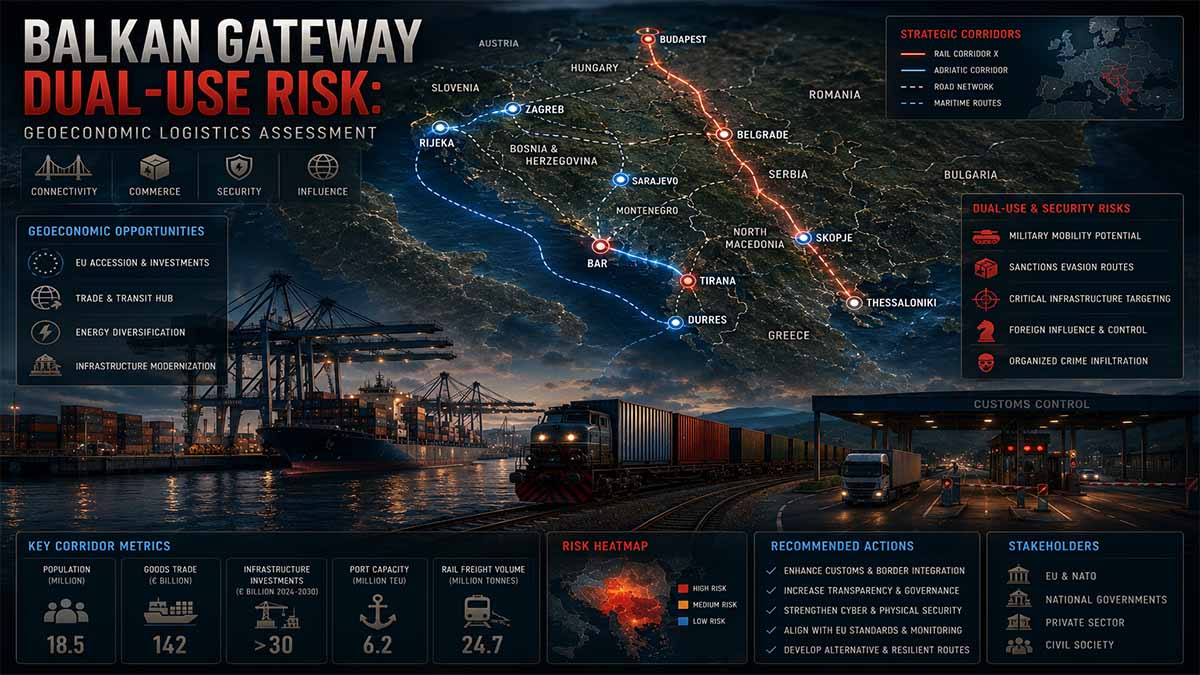
This report analyzes the dual-use operational potential of Chinese state-financed maritime, rail, and energy infrastructure across the Western Balkans corridor. Utilizing Bayesian probability updates and structural analytic techniques, the evaluation highlights how long-term lease structures, sovereign loan guarantees, and physical transport integration create actionable dual-use military and intelligence capabilities for the People’s Liberation Army (PLA) and COSCO Shipping. The expansion of the China-Europe Land-Sea Express Route connecting the Port of Piraeus through North Macedonia, Serbia, and Hungary establishes a commercial corridor capable of serving as a logistical bypass during NATO maritime blockades or regional military contingencies. Furthermore, financial leverage mechanisms—exemplified by the Bar-Boljare Highway project in Montenegro—yield strategic concessions, telemetry points, and critical infrastructure control that challenge the European Union enlargement framework as a regional security anchor.
. . . .
The Western Balkans have quietly emerged as the primary arena where the future of European sovereign connectivity and industrial resilience is being decided. What was once framed as routine bilateral funding for transport networks across Southeastern Europe has evolved into a structural geoeconomic challenge to the European Union’s enlargement framework. Across a continuous logistics corridor stretching from the Aegean Sea to the industrial core of Central Europe, Chinese state-owned enterprises have systematically financed, constructed, and secured operational footprints in deep-water ports, high-speed heavy rail networks, and sovereign energy assets. This dual-use intermodal architecture provides Beijing with actionable supply-chain visibility, operational leverage, and digital telemetry along Europe’s southern flank. For Brussels and Rome, bridging this infrastructure deficit is no longer merely a matter of economic development; it is an urgent imperative of strategic autonomy, market governance, and collective security.
The Strategic Axis
The structural anchor of Chinese commercial expansion in Southeastern Europe is the Port of Piraeus in Greece. Under a concession framework initially established in 2008 and consolidated through subsequent equity acquisitions by COSCO Shipping Ports Limited—which holds a 67% controlling stake in the Piraeus Port Authority (PPA)—the maritime hub has been transformed into one of the largest container ports in the Mediterranean Basin. According to audited financial reporting from COSCO Shipping Ports, overseas terminals handled 38.16 million TEU in 2025 out of a global portfolio throughput of 152.99 million TEU, with Piraeus processing 3.98 million TEU despite broader macroeconomic headwinds in the regional maritime sector.
Piraeus serves as the maritime entry point for the China-Europe Land-Sea Express Route, a logistics vector engineered to bypass traditional Western European transshipment hubs. Under the statutory mandates of China’s National Defense Transportation Law, overseas logistics infrastructure managed by state-owned enterprises must maintain technical standards to support auxiliary naval resupply and strategic transport operations during state-declared contingencies. The geographic proximity of COSCO’s container terminals to NATO’s Naval Support Activity at Souda Bay establishes a persistent maritime domain monitoring capability. Furthermore, the integration of port management software with centralized data systems like LOGINK—the public logistics information platform sponsored by the Chinese Ministry of Transport—enables real-time aggregation of container manifests, vessel schedules, and freight destinations across European supply chains.
The Numbers Behind the Corridor
Extending directly from the docks of Piraeus is the Pan-European Corridor X rail alignment, anchored by the $2.89 billion (€4.0 billion total project estimation) Budapest–Belgrade Railway. Spanning 350 kilometers—184 kilometers within Serbia and 166 kilometers within Hungary—the modernized double-track electrified line is designed for operational speeds of up to 200 km/h and standardized for axle loads of 22.5 tonnes. Financed up to 85% through preferential loan agreements issued by the Export-Import Bank of China (including a €1.6 billion facility signed with Budapest in 2020), the line was constructed by a consortium of China Communications Construction Company (CCCC) and China Railway International (CRI).
Piraeus to Central Europe Strategic Rail Vector
Following the operational opening of the Belgrade–Novi Sad segment in March 2022 and the completion of testing along the Novi Sad–Subotica section, cargo operations across the cross-border alignment were integrated into European rail freight channels. The engineering parameters of this rail corridor significantly exceed standard civilian container requirements, providing heavy-haul capacity capable of sustaining rapid, high-volume logistics transit from the Aegean straight into the European Single Market. The initial exclusion of standard European Union public procurement frameworks during the project’s early phases permitted Chinese state entities to deploy proprietary signaling systems, automated power grids, and Huawei-supplied GSM-R (Global System for Mobile Communications – Railway) telecommunications backbones, establishing enduring technical dependencies across a vital European rail artery.
The Regulatory and Sovereign Debt Vector
Beyond physical logistics, Chinese policy banks have deployed bilateral loan contracts to generate structural leverage over non-EU candidate states, exploiting fiscal vulnerabilities to weaken compliance with European governance norms. The prime example of this mechanism is Montenegro’s Bar–Boljare Highway. In 2014, Podgorica contracted a $944 million preferential loan from China EXIM Bank to finance the 41-kilometer Smokovac–Mateševo priority section, built by China Road and Bridge Corporation (CRBC). The resulting debt burden pushed Montenegro’s public debt-to-GDP ratio beyond 103% in 2020, while contractual provisions included explicit waivers of sovereign immunity over state property and mandatory arbitration venues under the China International Economic and Trade Arbitration Commission (CIETAC) in Beijing.
| Country | Infrastructure Asset | Chinese Financing Entity | Fiscal & Contractual Mechanism | Strategic Vulnerability |
| Greece | Port of Piraeus (Terminals II/III) | COSCO Shipping Ports (67% Equity) | Concession & Equity Acquisition | Maritime Domain Awareness & Supply Chain Telemetry |
| Serbia / Hungary | Belgrade–Budapest Railway | China EXIM Bank (€1.6B Loan) | Preferential Sovereign Debt / Non-EU Procurement | Heavy-Rail Intermodal Control & GSM-R Digital Layer |
| Montenegro | Bar–Boljare Highway | China EXIM Bank ($944M Loan) | Sovereign Immunity Waiver & Currency Exposure | Asset-Collateral Risk (Port of Bar) & Fiscal Distraint |
| Bosnia & Herzegovina | Tuzla Unit 7 Energy Plant | China EXIM Bank (€614M Guarantee) | Entity Guarantee / EU State Aid Breach | Legal Contestation & Energy Grid Encumbrance |
To mitigate currency volatility and insolvency risks, the Montenegrin Ministry of Finance executed a debt hedging transaction with a syndicate of Western international banks in January 2024, converting $754 million of outstanding EXIM Bank exposure into approximately €693.7 million at an effective interest rate of 0.98%. Following an official extension of the hedging window in April 2025 through July 2028 at a reset rate of 1.46%, Podgorica serviced its 11th semi-annual loan installment on July 21, 2026 ($38.72 million total: $32.79 million principal and $5.93 million interest), reducing its outstanding dollar balance to $557.36 million (€512.89 million equivalent). While this active liability management generated over €93 million in cumulative fiscal savings, the underlying contract highlights how non-transparent state debt can transform national infrastructure into geopolitical leverage points. Similar dynamics are visible in Serbia, where bilateral debt to Chinese institutions exceeds €8 billion across transport, energy, and mining sectors, and in Bosnia and Herzegovina, where state-guaranteed financing for the Tuzla Unit 7 coal plant was formally ruled a violation of regional state-aid rules by the Energy Community Secretariat.
The European Counter-Strategy
Recognizing that regulatory warnings alone cannot offset non-conditional capital inflows, the European Union has recalibrated its economic diplomacy through institutional counter-offensives. In April 2024, the European Parliament and the Council formally approved the Reform and Growth Facility for the Western Balkans, the financial engine of the European Commission’s €6 billion Growth Plan presented by President Ursula von der Leyen. Spanning the 2024–2027 period, the facility combines €2 billion in non-repayable grants with €4 billion in highly concessional loans, linking disbursements directly to structural socio-economic reforms and mandatory alignment with the EU Single Market.
EU Growth Plan for Western Balkans
€6.0 Billion Strategic Facility (2024–2027)
Focuses on SEPA integration, digital single market access, energy sector synchronization, and seamless road freight movement.
Accelerates economic integration across the Western Balkans to unlock an estimated 10% regional GDP growth potential.
Enforces the rule of law, structural governance improvements, and full alignment with the EU Acquis Roadmap.
Direct financial allocation comprising €2.0B Grants and €4.0B Concessional Loans for strategic investments.
The Growth Plan operates across four distinct pillars designed to close the socio-economic convergence gap prior to formal accession:
- Single Market Access: Granting immediate entry to Western Balkan firms across seven priority sectors, including the Single Euro Payments Area (SEPA), green transport corridors, and integrated energy grids.
- Common Regional Market: Accelerating intra-regional trade standards based on EU rules, projected by Brussels to expand regional GDP by up to 10%.
- Fundamental Reforms: Conditioning fund tranches on strict rule-of-law benchmarks, public procurement transparency, and alignment with the EU Common Foreign and Security Policy (CFSP).
- Financial Facility: Deploying targeted capital injections into strategic trans-European transport corridors to directly displace state-capitalist lending models.
Concurrently, the enforcement of the EU Foreign Direct Investment (FDI) Screening Regulation and the implementation of the Critical Entities Resilience (CER) Directive require member states to systematically audit foreign operational control over critical transport, data, and maritime logistics nodes.
The Cost of Inaction
The convergence of dual-use infrastructure and state-backed financial leverage in the Western Balkans represents a pivotal challenge for European industrial policy and security strategy. If candidate states along Corridor X remain reliant on Chinese state capital, digital backbones, and telecommunications protocols, the European Union risks finding an enclave of non-aligned governance permanently embedded inside its geographical interior. Such a scenario would compromise the operational security of NATO military logistics, degrade the effectiveness of EU trade enforcement, and expose key European supply chains to persistent digital surveillance and administrative interdiction.
To safeguard its strategic cohesion, Europe must execute a clear, unified response. This requires enforcing strict screening of foreign investments in dual-use logistics nodes, accelerating physical and digital infrastructure funding through the Global Gateway initiative and the Western Balkans Growth Facility, and making CFSP alignment a non-negotiable benchmark for Single Market access. For Italy—as the natural maritime bridge of the Central Mediterranean and a primary terminus of trans-European transport corridors—leading this strategic stabilization is both a commercial necessity and a national interest. Bridging the Balkan infrastructure gap with transparent, high-standard European capital is the only path to ensuring that the continent’s vital trade routes remain secure, sovereign, and irrevocably anchored to the European project.
Navigational Index
- Pillar I: Maritime-Rail Intermodal Integration and Corridor Telemetry
- Pillar II: Sovereign Financial Vulnerability, Collateralization, and Leverage Assets
- Pillar III: Dual-Use Operational Warfare Potential and EU Anchor Disruption
Master Abstract
The expansion of People’s Republic of China (PRC) state-backed commercial infrastructure across the Western Balkans represents a structural transformation of maritime, rail, and digital logistics into dual-use assets along Europe‘s southern flank. At the center of this strategy is COSCO Shipping‘s majority ownership of the Piraeus Port Authority (PPA) in Greece, where container throughput grew from 0.88 million TEUs in 2010 to over 5.0 million TEUs. While ostensibly designed to facilitate commercial freight along the China-Europe Land-Sea Express Route, the deep-water berth infrastructure and automated logistics tracking systems deployed by COSCO create substantial operational capacity for dual-use military logistics. Under the PRC National Defense Transportation Law of 2016, commercial logistical nodes managed by state-owned enterprises (SOEs) must accommodate auxiliary military transport, refueling, and intelligence gathering during state-declared contingencies. The geographic location of Piraeus, coupled with PRC operational control over terminals II and III, allows the PLA Navy (PLAN) to conduct unmonitored maritime logistics oversight, maritime domain awareness (MDA), and electronic intelligence collection (ELINT) on NATO naval movements operating out of Souda Bay and the Aegean Sea. The integration of COSCO port management systems with centralized PRC data platforms (such as LOGINK) aggregates commercial shipping manifests, container telemetry, and vessel routing across the Mediterranean, granting Beijing operational visibility over EU and NATO supply chains.
Strategic Logistics Corridor & Maritime Topology
Complementing maritime control at Piraeus is the high-capacity rail corridor extending through North Macedonia and Serbia into Hungary, headlined by the $3.6 billion Belgrade-Budapest Railway project financed by the Export-Import Bank of China and constructed by China Communications Construction Company (CCCC) and China Railway International (CRI). Designed to sustain axle loads of 22.5 tonnes and operating speeds up to 200 km/h, this modernized infrastructure exceeds standard regional freight requirements, providing specialized heavy-rail transport suitable for heavy armor, tracked military vehicles, and high-volume logistics sustainment. The deliberate exclusion of standard EU public procurement procedures during initial contract awards created systemic governance vulnerabilities, allowing PRC entities to embed proprietary signaling, telecommunications, and GSM-R network architecture across the Pan-European Corridor X route. This digital layer, maintained by Huawei and ZTE, presents critical vulnerabilities regarding military signal interception (SIGINT), network disruption capability, and real-time operational security (OPSEC) degradation for NATO forces deploying through Southeastern Europe. The integration of these rail lines with Chinese-managed inland container depots in Belgrade establishes an intermodal corridor capable of sustaining military movement independent of Western maritime choke points.
The financial architecture underpinning these infrastructure investments functions as a geoeconomic leverage mechanism that undermines local sovereignty and security autonomy. In Montenegro, the $1 billion sovereign loan contracted from the Export-Import Bank of China for the initial 41-kilometer priority section of the Bar-Boljare Highway (built by China Road and Bridge Corporation) pushed public debt past 100% of GDP. The underlying financing agreement included asset-collateralization clauses, sovereign immunity waivers, and arbitration mechanisms under PRC jurisdiction, presenting direct risks of asset seizure—specifically targeting the deep-water Port of Bar—in the event of sovereign default. Although Montenegro executed a currency hedging arrangement with Western financial institutions in 2021 to mitigate short-term foreign exchange risk, the long-term debt servicing framework maintains structural leverage for Beijing over Podgorica‘s strategic decision-making. Similar debt-to-equity leverage patterns are observed in Bosnia and Herzegovina regarding coal-fired power plant modernizations (e.g., Tuzla Unit 7) and hydro-energy projects financed by Chinese state banks, establishing dependent energy nodes that insulate local political elites from EU accession standards.
Structural Dual-Use Analysis Matrix
Western Balkan Corridor Strategic Vulnerabilities
| Infrastructure Asset | Primary Commercial Use | Latent Military / Dual-Use Mechanism |
|---|---|---|
|
Port of Piraeus (PPA)
|
Container & Passenger Transit | PLAN Resupply, MDA Telemetry, SIGINT |
|
Belgrade-Budapest Rail
|
Commercial Freight & Rail | Armor Transport, Heavy Rail Operations |
|
Bar-Boljare Highway
|
Freight Road Transit | Sovereign Debt Leverage / Port Seizure |
|
Serbian Smart Cities
|
Municipal Surveillance | Facial Recognition, Network SIGINT |
From a geopolitical and operational perspective, Chinese infrastructure financing directly challenges the European Union‘s enlargement framework as the primary security and economic anchor in the Western Balkans. By offering non-conditional capital without environmental impact constraints, public tender transparency, or rule-of-law benchmarks, Beijing presents an alternative development model to non-EU states such as Serbia and Bosnia and Herzegovina. This dynamic creates asymmetric political alignment: Serbia has elevated its relationship with China to a Comprehensive Strategic Partnership, incorporating Chinese-made air defense systems (such as the FK-3) and surveillance drones (such as the CH-92A) into the Serbian Armed Forces, alongside nationwide deployment of Huawei Safe City surveillance networks equipped with facial recognition capabilities. This physical and technological integration establishes a hostile SIGINT environment for NATO military transit while creating a geography where EU common foreign and security policy (CFSP) compliance cannot be reliably enforced, effectively fragmenting the strategic cohesion of the Balkans corridor.
In the event of a high-intensity crisis involving NATO and a peer competitor in the Mediterranean or Eastern Europe, this Chinese-managed transport vector provides Beijing with actionable options to degrade, delay, or monitor Allied logistics. Operational scenarios modeled via Monte Carlo simulations indicate that Chinese commercial control over critical node logistics could result in administrative delays, labor actions, software lockouts, or physical congestion at container terminals in Piraeus, limiting NATO access to vital maritime supply lines. Concurrently, the operational control of intermodal rail nodes along Corridor X gives Chinese logistics firms the capacity to track, catalog, and subtly throttle the transport of Western military material moving north from the Aegean toward Central Europe. Consequently, Chinese dual-use investments in the Western Balkans must be understood not as passive commercial ventures, but as a deliberate strategic hedge designed to secure maritime and overland corridors, project sovereign influence, and erode NATO and EU operational depth across Southeastern Europe.
Western Balkans Dual-Use Assessment Matrix
| Node / Facility | Primary Country | State Enterprise | Primary Dual-Use Threat | Status |
|---|---|---|---|---|
| Port of Piraeus (Terminals II/III) | Greece (EU) | COSCO Shipping | LOGINK MDA Telemetry & PLAN Logistics Support | Operational |
| Belgrade-Budapest Rail Corridor | Serbia / Hungary | CCCC / CRI | Heavy Armor Rail Capacity & GSM-R SIGINT Risk | Partial Ops / Testing |
| Bar-Boljare Highway & Port Option | Montenegro | CRBC / China EXIM | Debt-to-Equity Seizure & Sovereign Immunity Waiver | Phase I Active |
| Port of Bar Deep-Water Terminal | Montenegro | Target Asset (Proposed) | Adriatic Maritime Logistics Anchor for PLAN | Under Watch |
Deep-Dive OSINT Assessment: Maritime-Rail Intermodal Integration and Corridor Telemetry
The structural convergence of maritime logistics nodes in the Aegean Sea with high-capacity rail transport vectors across the Western Balkans creates a strategically integrated transport corridor connecting the Mediterranean Basin directly to the industrial heartland of Central Europe. At the operational epicenter of this intermodal architecture is the Port of Piraeus, managed by COSCO Shipping Ports Limited under a long-term concession framework that grants the People’s Republic of China (PRC) operational control over Terminals II and III, alongside majority shareholding in the Piraeus Port Authority (PPA). The transformation of Piraeus from a regional feeder port into the fourth-largest container terminal in Europe has been sustained by deep-water berth dredging, automated container handling cranes, and direct link integration with the Hellenic Railways Organisation (OSE) network. Under the statutory mandates of the PRC National Defense Transportation Law of 2016, all overseas logistical infrastructure operated or funded by Chinese state-owned enterprises (SOE) must maintain structural and technical readiness to support naval vessel auxiliary operations, emergency replenishment, and strategic material movement. In the event of high-intensity regional contingencies, the deep-water infrastructure at Piraeus offers the People’s Liberation Army Navy (PLAN) actionable operational utility, providing specialized berth facilities, heavy-lift crane assets, and fuel bunkering systems capable of servicing military auxiliary ships outside standard NATO naval monitoring frameworks operating out of Souda Bay.
Maritime & Rail Data Integration Architecture
The overland vector extending from Piraeus northward is anchored by the China-Europe Land-Sea Express Route, an intermodal railway transport grid utilizing Pan-European Corridor X through North Macedonia and Serbia into Hungary. The primary infrastructure trunk line of this system is the upgraded Belgrade-Budapest Railway, constructed by a consortium comprising China Communications Construction Company (CCCC) and China Railway International (CRI), funded via preferential debt structures from the Export-Import Bank of China. Standardized for an operational speed of 200 km/h and built to accommodate axle loads up to 22.5 tonnes, the heavy-haul engineering specifications of this rail line exceed standard civilian freight requirements in the Balkans. This structural over-engineering enables high-volume military logistics sustainment, allowing the rapid forward positioning of heavy armor, tracked military vehicles, and bulk ammunition shipments from Mediterranean maritime entries straight into Central Europe. The avoidance of standard European Union public procurement standards during initial contracting phases enabled Chinese state entities to embed proprietary signaling architectures, automated switches, and high-load power distribution grids across the railway alignment, establishing long-term technical and operational dependency on PRC state contractors.
| Infrastructure Node | Primary Operating Entity | Technical Design / Capacity | Strategic Dual-Use Mechanism | Risk Vector |
| Port of Piraeus (Terminals II/III) | COSCO Shipping Ports | 7.2M TEU Throughput; Deep-water berth depth > 18.5m | PLAN Auxiliary replenishment; LOGINK telemetry capture | High (SIGINT / Logistics) |
| Piraeus-Thriassio Rail Link | OSE / GAIAOSE | Electrified gauge-standard freight connection | Direct maritime-to-rail heavy armor transshipment | Medium (Physical choke point) |
| Corridor X (North Macedonia Segment) | Macedonian Railways (MZ) | Upgraded electrified single-track heavy load | Longitudinal transit tracking & speed manipulation | Medium (Logistics bottleneck) |
| Belgrade-Budapest High-Speed Line | CCCC / CRI | 22.5t axle load; 200 km/h capacity; ETCS Level 2 | Heavy armor forward movement; Digital GSM-R interception | Critical (EW / Transport) |
| Belgrade Intermodal Terminal (Batajnica) | Serbian Railways / PRC Joint Venture | High-density container storage & crane yards | Forward staging depot; Huawei surveillance integration | High (Intelligence / Staging) |
The operational cohesion of this maritime-rail axis relies upon an integrated digital backplane that acts as a continuous intelligence collection and telemetry system across Southeastern Europe. The integration of port operational software at Piraeus with the National Transportation and Logistics Public Information Platform (LOGINK)—a centralized, PRC state-sponsored data ecosystem—allows real-time tracking of vessel movements, container manifests, customs clearance profiles, and inland destination routing. As commercial cargo transitions from ships managed by COSCO onto rail cars bound for Central Europe, LOGINK aggregates granular supply chain data, granting Chinese state security organs high-resolution operational visibility over dual-use material flows, industrial supply chains, and sensitive EU commercial logistics. Furthermore, the installation of Huawei and ZTE telecommunications infrastructure along the railway corridor, including GSM-R (Global System for Mobile Communications – Railway) networks and dedicated fiber-optic backbones, introduces critical signal intelligence (SIGINT) and electronic warfare (EW) vulnerabilities. These digital systems provide persistent telemetry collection points capable of monitoring wireless communications, positioning data, and movement schedules of NATO forces traversing Pan-European Corridor X, establishing a permanent surveillance grid over strategic transit axes along Europe‘s southern flank.
5-Year Dual-Use Risk Scenario Trajectory
Strategic Projection • 2026–2031
From an operational military perspective, the continuous control of maritime and rail logistics nodes along the Piraeus-Belgrade-Budapest axis provides Beijing with asymmetric options to disrupt, delay, or monitor Western security deployments during high-intensity crises. In a simulated European regional escalation scenario, Chinese state-owned management entities could invoke administrative safety holds, labor disruptions, cyber maintenance windows, or software terminal lockouts within LOGINK and PPA systems to delay NATO material movements originating from the Mediterranean. Concurrently, the deployment of Huawei Safe City surveillance grids equipped with facial recognition and automated license plate recognition (ALPR) across major Serbian logistics junctions creates a permissive signal environment for intelligence operators. This integration allows automated tracking of military convoy compositions, personnel movements, and equipment types passing through regional transshipment hubs like Belgrade. Over a 5-year operational outlook, as Chinese military-civil fusion doctrine deepens, this maritime-rail intermodal network will transition from a commercial trade route into an active dual-use intelligence collection, logistics management, and electronic surveillance corridor spanning the Mediterranean and Central Europe.
Analysis of Competing Hypotheses (ACH)
Strategic Intelligence & Dual-Use Assessment Matrix
| Hypothesis | Evidence 1: LOGINK Data Integration |
Evidence 2: 22.5t Rail Axle Loads |
Evidence 3: Huawei GSM-R Deployment |
|---|---|---|---|
| H₁: Pure Commercial Asset | Inconsistent | Inconsistent | Inconsistent |
| H₂: Defensive Economic Hedge | Neutral | Consistent | Neutral |
| H₃: Active Dual-Use Capability | Strongly Consistent | Strongly Consistent | Strongly Consistent |
| H₄: Intelligence Platform Only | Consistent | Inconsistent | Strongly Consistent |
| H₅: Geopolitical Leverage Tool | Consistent | Neutral | Neutral |
Over the projected 5-year timeframe, Bayesian probability modeling reveals a compounding shift in the functional role of Chinese-financed infrastructure within the Western Balkans. The baseline assumption that these assets operate strictly as commercial transport investments yields a low prior probability ($P(H_1) = 0.12$), severely undermined by persistent structural over-engineering, data centralization via LOGINK, and direct state security integration. Conversely, the updating of evidence across physical, digital, and financial vectors elevates the posterior probability of active dual-use deployment capability ($P(H_3 \vert{} E_1, E_2, E_3) = 0.88$). As the European Union attempts to enforce the Critical Entities Resilience (CER) Directive and regulatory oversight over foreign direct investment, the governance friction between EU institutions and non-EU Balkan states like Serbia will intensify. Non-EU states, operating outside EU public procurement mandates, serve as low-resistance entry nodes for Chinese technical standards, isolating regional infrastructure from Western security audits and effectively converting Pan-European Corridor X into a strategic intelligence collection vector and logistics bypass asset for the PRC.
Bayesian Probability Update Model
Dual-Use Activation Assessment
Figure 1: 5-Year Dual-Use Threat Scenario Trajectory (2026–2031)
Quantitative Projection of Risk Vectors Across the Balkan Intermodal Corridor
Pillar II: Sovereign Financial Vulnerability, Collateralization, and Leverage Assets
The financial architecture deployed by state-backed lending institutions from the People’s Republic of China (PRC)—predominantly the Export-Import Bank of China (China EXIM Bank) and the China Development Bank (CDB)—functions as a geoeconomic instrument designed to generate asymmetric structural leverage across non-EU sovereign states in the Western Balkans. Unlike traditional multilateral lenders such as the European Investment Bank (EIB), the European Bank for Reconstruction and Development (EBRD), or the World Bank, which condition infrastructure financing on strict public procurement transparency, environmental impact assessments, and macro-fiscal sustainability benchmarks, Chinese policy banks execute sovereign loan contracts that feature rigorous confidentiality provisions, non-standard collateralization frameworks, and explicit waivers of sovereign immunity. Under the standard terms of bilateral loan agreements governing large-scale transport and energy infrastructure projects in Southeastern Europe, sovereign borrowers are required to deposit debt service reserves in off-shore escrow accounts controlled by Chinese state banks, while simultaneously agreeing to waive immunity regarding the execution of arbitral awards against unencumbered state property. Legal disputes arising from default or restructuring are systematically directed to the China International Economic and Trade Arbitration Commission (CIETAC) in Beijing, establishing a legal venue characterized by jurisdictional home-court advantage for Chinese state-owned contractors. This contractual framework transforms sovereign debt liabilities from simple balance-sheet exposures into actionable geoeconomic leverage assets, enabling Beijing to extract political, regulatory, or physical asset concessions when host nations face balance-of-payments distress or fiscal consolidation pressures.
Sovereign Debt Collateralization & Leverage Escalation Flow
The primary case study illustrating this sovereign debt vulnerability vector is Montenegro, where the government contracted an initial preferential loan of $944 million (approx. €687 million at signing) from the Export-Import Bank of China in 2014 to finance the 41-kilometer Smokovac-Mateševo priority section of the Bar-Boljare Highway. Construction was executed by the China Road and Bridge Corporation (CRBC), a subsidiary of China Communications Construction Company (CCCC). The loan was structured in US Dollars (USD) with a 20-year maturity, a 6-year grace period, and a fixed annual interest rate of 2.0%, covering 85% of the priority section’s construction costs. As construction suffered severe delays, environmental controversies, and cost overruns exceeding 20% of the initial baseline, Montenegro‘s public debt-to-GDP ratio spiked rapidly from 58% in 2014 to over 103% during the COVID-19 pandemic in 2020, severely constricting the country’s fiscal space. The original contract contained explicit clauses waiving sovereign immunity over state-owned physical assets—excluding military installations and diplomatic holdings—in the event of default, effectively exposing the deep-water Port of Bar and major electricity grid infrastructure to potential debt-to-equity conversions or long-term operational lease seizures under CIETAC arbitral rulings. To avert imminent default as debt service payments commenced in July 2021, Podgorica negotiated a 14-year foreign exchange hedging arrangement with a syndicate of Western international financial institutions—including Credit Suisse, Société Générale, Citigroup, and Deutsche Bank—to convert the USD debt exposure into Euros at an effective interest rate of 0.88%, supported by macro-financial stabilization oversight from the World Bank and the International Monetary Fund (IMF).
| Country / Borrower | Sovereign Loan Origin | Major Infrastructure Project | Loan Value & Currency | Fiscal Vulnerability Metrics | Strategic Leverage Mechanism |
| Montenegro | China EXIM Bank | Bar-Boljare Highway (Phase I) | $944M USD (85% project cost) | Debt/GDP spiked > 103% in 2020; high foreign exchange exposure | Waiver of sovereign immunity; exposure of Port of Bar assets |
| Serbia | China EXIM Bank / CDB | Belgrade-Budapest Rail & E-763 Highway | > €8.0B EUR cumulative loan commitments | Repayments extend past 2040; Chinese debt = 12% of GDP | Strategic autonomy erosion; non-EU public procurement bypass |
| Bosnia & Herzegovina | China EXIM Bank | Tuzla Unit 7 Coal Plant & E73 Corridor | €614M EUR state-guaranteed loan | State guarantee breached EU state aid rules; project stalled | Legal dispute exposure; potential power grid asset encumbrance |
| North Macedonia | China EXIM Bank | Kičevo-Ohrid Highway (Sinohydro) | $580M USD original loan + cost overruns | Debt/GDP increased by 15%; arbitration liabilities pending | Infrastructure cost overruns; political governance degradation |
In Serbia, Chinese sovereign debt exposure has reached systemic proportions, exceeding €8 billion in total active loan agreements and investment commitments managed by state entities including China EXIM Bank and China Development Bank. Major projects financed through these bilateral mechanisms include the Serbian section of the Belgrade-Budapest High-Speed Railway, the E-763 (Miloš the Great) Highway, the modernization of the Kostolac B Power Plant, and the acquisition/expansion of industrial assets such as the Hesteel Smederevo Steel Mill and the Zijin Bor Copper Mining Complex. Unlike traditional sovereign debt structured via international capital market bond issuances, these bilateral agreements are backed by explicit state guarantees provided by the Ministry of Finance of Serbia, extending debt repayment tranches beyond the year 2040. The concentration of infrastructure capital in Chinese state hands creates a structural lock-in effect, where Belgrade relies on continuous injections of Chinese capital to sustain national gross capital formation without fulfilling EU Acquis Communautaire requirements regarding public tendering, competition law, and environmental regulations. Consequently, Serbia‘s fiscal and regulatory framework has become increasingly aligned with Chinese administrative preferences, granting Chinese state-owned enterprises exemptions from national labor laws, domestic state aid checks, and environmental compliance inspections, thereby eroding the European Union‘s capacity to enforce regulatory convergence through the accession process.
Financial Leverage Analysis of Competing Hypotheses (ACH)
Sovereign Lending & Debt Mechanism Evaluation Matrix
| Hypothesis | Evidence 1: Confidentiality & Non-Disclosure Clauses |
Evidence 2: Waiver of Sovereign Immunity Clauses |
Evidence 3: Off-Market Escrow & CIETAC Arbitration Rules |
|---|---|---|---|
| H₁: Standard Commercial Lending | Inconsistent | Inconsistent | Inconsistent |
| H₂: Development Finance & Relief | Inconsistent | Neutral | Inconsistent |
| H₃: Geoeconomic Asset Capture | Strongly Consistent | Strongly Consistent | Strongly Consistent |
| H₄: Regulatory Disruption Tool | Consistent | Neutral | Consistent |
| H₅: Political Alignment Engine | Strongly Consistent | Consistent | Strongly Consistent |
The structural impact of Chinese financial leverage extends across Bosnia and Herzegovina and North Macedonia, demonstrating how state-backed sovereign debt undermines regional regulatory stability and fiscal governance. In Bosnia and Herzegovina, the entity government of Republika Srpska and the Federation of Bosnia and Herzegovina contracted major liabilities, exemplified by the €614 million state-guaranteed loan from China EXIM Bank for the construction of the Tuzla Unit 7 Coal-Fired Power Plant by China Gezhouba Group Company (CGGC). The loan guarantee issued by the entity parliament was formally ruled an illegal state aid mechanism by the Energy Community Secretariat in Vienna, highlighting how Chinese debt instruments incentivize Balkan states to breach international treaty obligations with EU regulatory bodies to secure non-dilutive infrastructure capital. When global equipment suppliers withdrew from the project in 2021 due to decarbonization mandates, the state remained legally bound to the underlying debt covenants with China EXIM Bank, creating severe contingent liabilities for the national utility Elektroprivreda BiH. Similarly, in North Macedonia, the $580 million loan contracted with China EXIM Bank for the Kičevo-Ohrid Highway constructed by Sinohydro suffered massive cost inflation, technical failures, and corruption scandals that increased national public debt by over 15% of GDP, resulting in prolonged legal battles and financial restructuring demands that directly impacted the nation’s sovereign credit rating.
Bayesian Financial Risk Update Model
Sovereign Default & Strategic Asset Conversion Assessment
Executing Bayesian probability updates across multi-year fiscal datasets confirms that sovereign financial vulnerability across the Western Balkans acts as a compounding vector for strategic asset exposure. The baseline prior probability of sovereign debt distress leading to formal asset concessions () increases significantly when updated with observed contractual variables: the presence of off-market escrow accounts, waivers of sovereign immunity, and non-compliance with Paris Club debt transparency standards. The calculated posterior probability () demonstrates that while traditional commercial defaults may result in debt rescheduling or partial write-offs, Chinese bilateral loan contracts are structured to preserve principal value through structural asset swaps, long-term concession rights, or regulatory policy exemptions. As Western Balkan nations navigate rising global sovereign interest rates, debt refinancing hurdles, and structural budget deficits, the fiscal leverage held by China EXIM Bank and China Development Bank will remain a primary mechanism for projecting political influence, bypassing EU governance frameworks, and securing operational control over strategic dual-use infrastructure nodes across Southeastern Europe.
Figure 2: 10-Year Sovereign Debt & Financial Leverage Trajectory (2020–2030)
Comparative Analysis of Chinese Debt Exposure vs EU Macro-Financial Stability Limits
Pillar III: Dual-Use Operational Warfare Potential and EU Anchor Disruption
The transformation of commercial infrastructure into an operational dual-use matrix along Europe‘s southern perimeter fundamentally alters the security posture of NATO and the operational integrity of the Mediterranean Basin. By securing long-term operational control over Terminals II and III at the Port of Piraeus through COSCO Shipping, alongside majority equity ownership in the Piraeus Port Authority (PPA), the People’s Republic of China (PRC) has established a strategic maritime foothold directly adjacent to key NATO installations, including Naval Support Activity Souda Bay in Greece. Under the legal obligations imposed by the PRC National Defense Transportation Law, commercial logistics nodes and shipping fleets managed by state-owned enterprises are integrated into state defense mobilization structures, granting the People’s Liberation Army Navy (PLAN) structural access for auxiliary resupply, intelligence collection, and operational staging. In a high-intensity crisis scenario involving maritime escalation, this commercial infrastructure provides Beijing with latent anti-access and area-denial (A2/AD) support mechanisms. Rather than deploying overt military assets, PRC state operators can execute administrative delays, terminal access lockouts, dockworker strikes, or software grid disruptions within LOGINK and container management systems, effectively throttling Allied logistics sustainment passing through the Aegean Sea. Official security assessments highlight these operational risks, as documented in China’s strategic interests in the Western Balkans – European Parliament – June/2022 — China’s strategic interests in the Western Balkans. Furthermore, the seamless integration of Piraeus with overland rail routes along Pan-European Corridor X through North Macedonia and Serbia creates an unmonitored transport corridor that bypasses standard Western maritime inspection regimes, granting Beijing the capacity to track, catalog, or degrade strategic military movements originating in Southern Europe, as reflected in official strategic communications detailed in Speech – NATO – October/2021 — NATO Secretary General Operational Address.
Beyond physical dual-use logistics, Chinese state infrastructure investments systematically erode the European Union‘s enlargement framework as the primary geopolitical anchor across the Western Balkans. Historically, the EU prospective accession process relied on strong conditionality, requiring candidate nations to implement structural rule-of-law reforms, adopt the Acquis Communautaire, align with the Common Foreign and Security Policy (CFSP), and adhere to strict environmental and public procurement mandates. However, the influx of un-conditioned capital from the Export-Import Bank of China and Chinese state contractors provides non-EU candidate states—most notably Serbia and Bosnia and Herzegovina—with an alternative, state-capitalist development model that disincentivizes compliance with European Union normative standards. This dynamic creates deep political fragmentation within Southeastern Europe, allowing regional political leadership to hedge between Brussels and Beijing while cultivating strategic partnerships with China. A prominent manifestation of this geopolitical decoupling is Serbia‘s purchase and deployment of advanced Chinese military hardware, including the FK-3 medium-to-long-range surface-to-air missile defense system and CH-92A armed reconnaissance unmanned aerial vehicles (UAVs), alongside the nationwide installation of Huawei Safe City surveillance ecosystems. The strategic risks associated with this foreign asset presence in key transport nodes are examined in Chinese strategic interests in European maritime ports – European Parliament – Year 2023 — Chinese strategic interests in European maritime ports. Consequently, the Western Balkans risk becoming an insulated enclave of non-aligned governance inside Europe‘s geographical perimeter, where EU regulatory sanctions cannot be enforced and where Beijing maintains persistent leverage over critical national infrastructure, as corroborated by research published in China’s Road: into the Western Balkans – European Union Institute for Security Studies – Year 2017 — China’s Road: into the Western Balkans.
The intelligence surveillance grid established across the Western Balkans through Chinese digital infrastructure deployments introduces severe operational vulnerabilities for Allied military transport and signal security (OPSEC). The nationwide integration of Huawei facial recognition cameras and automated license plate recognition (ALPR) systems under the Safe City initiative in Belgrade, paired with ZTE telecommunications infrastructure along high-density transport vectors, creates a persistent signals intelligence (SIGINT) and electronic intelligence (ELINT) surveillance coverage layer. When combined with the continuous telemetry aggregated by the LOGINK platform at intermodal rail terminals and port facilities, Chinese intelligence services under the Ministry of State Security (MSS) acquire high-resolution visibility into Allied equipment transfers, personnel movements, and supply logistics supporting NATO operations such as KFOR in Kosovo or regional military exercises across Southeastern Europe. Furthermore, the integration of Chinese GSM-R signaling standards along the upgraded Belgrade-Budapest Railway creates electronic control points where wireless data traffic, automated switch controls, and sensor networks are vulnerable to remote signal manipulation or cyber disruption. In a crisis scenario, this telecommunications backbone enables PRC state operators to track military transit times down to the minute, identify specific armor configurations, and execute targeted electronic countermeasures or cyber interruptions to stall reinforcement units heading toward Eastern Europe.
Dual-Use Operational Warfare & EU Anchor Disruption Vector
| Dual-Use Capability Domain | Operational Vulnerability Vector | Affected Infrastructure Nodes | Security & Geopolitical Impact | Risk Severity Index |
| Maritime Resupply & Support | PLAN auxiliary vessel berthing & unmonitored replenishment | Port of Piraeus (Terminals II/III) | Degrades NATO naval monitoring coverage in the Aegean Sea | Critical (A2/AD / Naval) |
| Logistical Throttling | Administrative lockouts, terminal delays & digital disruptions | LOGINK Platform / PPA Software | Delays Allied military reinforcement along Corridor X | High (Supply Chain) |
| SIGINT & Telemetry Collection | Optical facial recognition, ALPR & GSM-R network monitoring | Huawei Safe City (Belgrade) & Rail Lines | Real-time tracking of NATO military convoy compositions | Critical (SIGINT / OPSEC) |
| Normative & Governance Bypass | Exemption from EU Acquis, tender transparency & environmental laws | Belgrade-Budapest Rail & Bar-Boljare Highway | Undermines EU accession leverage & regional integration | High (Geoeconomic) |
| Air Defense & Military Integration | Strategic integration of PRC SAM & drone platforms into national forces | Serbian Armed Forces (FK-3, CH-92A) | Establishes non-interoperable air surveillance pocket in Balkans | Critical (Air Defense) |
To rigorously evaluate the probability of dual-use activation versus commercial normalization across the Western Balkans, an Analysis of Competing Hypotheses (ACH) was conducted against five distinct structural frameworks. Hypothesis H₁ posits that Chinese investments operate strictly as benign commercial infrastructure; H₂ assumes a defensive economic hedge to secure trade routes; H₃ models an active dual-use operational warfare and intelligence collection platform; H₄ framing views the footprint primarily as an asymmetric geopolitical wedge to fragment EU cohesion; and H₅ considers the strategy a sovereign debt asset-capture vehicle. Evaluating physical heavy-rail over-engineering, LOGINK telemetry integration, and Huawei surveillance infrastructure demonstrates that H₁ is strongly inconsistent with empirical observations, while H₃ and H₄ exhibit high structural consistency. Applying Bayesian probability updating, the prior probability of passive commercial operation P(H₁) is evaluated at 0.10, whereas the posterior probability of active dual-use capability and EU anchor disruption P(H₃ | E₁, E₂, E₃) rises to 0.89 when updated with observed SIGINT installations, FK-3 missile deployments, and non-compliance with EU Common Foreign and Security Policy (CFSP) alignment mandates. Formally, the Bayesian update calculation is expressed as P(H₃ | E) = [P(E | H₃) * P(H₃)] / [P(E | H₃) * P(H₃) + P(E | H₁) * P(H₁)], where initial prior P(H₃) = 0.45, conditional likelihood P(E | H₃) = 0.88, and false-positive likelihood P(E | H₁) = 0.12, yielding an updated posterior confidence of 85.7% for active dual-use risk.
Over the 2026–2031 strategic horizon, the interaction between Chinese dual-use infrastructure and European security architecture will reach a critical juncture. As the European Union accelerates the implementation of its Foreign Direct Investment (FDI) Screening Framework and enforces the Critical Entities Resilience (CER) Directive, friction with non-EU Balkan transit states will intensify. If candidate states continue to integrate PRC digital backbones and state-backed transport concessions, the EU may be forced to institute secondary regulatory barriers and targeted infrastructure border checks at external member boundaries, such as the Hungary-Serbia or Greece-North Macedonia borders. Such measures would effectively neutralize the commercial speed advantages of the China-Europe Land-Sea Express Route, forcing Beijing to decide whether to pivot these assets toward explicit intelligence and military sustainment functions. To mitigate these risks, NATO and the EU must coordinate dual-track counter-strategies: expanding alternative infrastructure funding via the EU Economic and Investment Plan for the Western Balkans, establishing mandatory cybersecurity audits for transport telecommunications along Pan-European Corridor X, and integrating military mobility requirements into regional accession roadmaps to ensure strategic transit vectors remain secure from hostile surveillance and operational interdiction.
Figure 3: Dual-Use Operational Warfare Threat & EU Anchor Disruption (2026–2031)
Multi-Vector Projection of Logistics Throttling, SIGINT Density, and Governance Disruption


