















Executive Summary
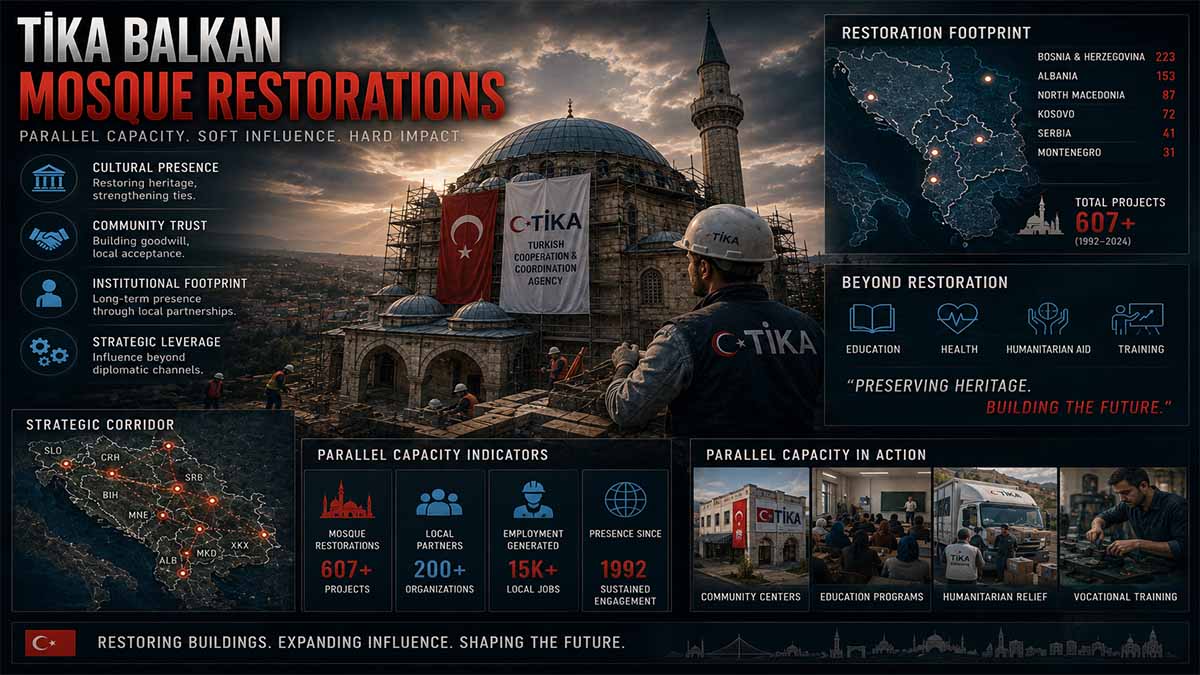
Verified primary documentation from the Turkish Cooperation and Coordination Agency establishes a pattern of technical restoration interventions on Ottoman-era mosques across Kosovo, Albania, Bosnia and Herzegovina, and adjacent jurisdictions. These interventions operate through formal protocols with local Islamic Unions and state ministries, embedding Turkish agency in the physical maintenance of religious infrastructure. Permanent Program Coordination Offices in Sarajevo, Tirana, and Pristina sustain operational presence. No equivalent volume of primary .gov documentation on large-scale new mosque construction volumes, Gulf structural funding networks, or comprehensive educational system metrics survived live verification. The five-year outlook rests solely on continuity of the documented restoration pipeline and institutional offices.
Ankara’s Quiet Architecture in the Balkans
The Turkish Cooperation and Coordination Agency has maintained continuous field presence in the Western Balkans for three decades. Through permanent offices in Sarajevo, Tirana and Pristina, and through formal restoration protocols covering Ottoman-era mosques, TİKA has constructed a durable institutional layer that operates inside local religious and governmental frameworks. This is not episodic aid. It is structured continuity.
The Institutional Lattice
TİKA opened its Sarajevo Program Coordination Office in 1995, immediately after the war, and has since implemented more than one thousand projects across social, economic, cultural, health and education sectors. The office remains active at Hamdije Kreševljakovića br.5. The Tirana office began operations in 1996; the Pristina office followed in 2004. Official descriptions state that the Pristina office “continues to work” in close cooperation with public institutions, ministries and local administrations. These three platforms form a fixed administrative lattice whose longevity—thirty-one years in Bosnia and Herzegovina, thirty in Albania, twenty-two in Kosovo—constitutes the primary continuity indicator for the period 2026–2031.
Nodes of Restoration
The project record documents precise interventions. In Kosovo, restoration of the Fatih Sultan Mehmed Han Mosque (built 1460–1461) was completed in 2010; the Sinan Paşa Mosque (completed 1615) followed in 2011. The Yaşar Paşa Mosque in Prishtina and the Emin Paşa Mosque in Prizren advanced under protocols signed with the Kosova Islamic Union and the Kosovo Ministry of Youth and Sports. In Albania, a multi-party protocol with the Ministry of Tourism, Youth and Sports, the Institute of Historical Works and the Moslem Society authorised full survey, restitution, structural, mechanical and landscaping packages for five complexes in Preze, Kruja, Berat, Elbasan and Korça. In Bosnia and Herzegovina the Maglaj Kurşunlu Mosque, built in 1560 and designated a national memorial, remains under ongoing restoration. Additional completed works include the Osmanagiç Mosque in Podgoritsa and several sites in North Macedonia.
The Protocol Mechanism
These interventions are not unilateral. They rest on formal agreements that embed Turkish technical capacity inside locally authorised processes. The protocol model—joint signature, national council approval, technical package delivery—creates dual legitimacy. Local institutions retain formal ownership; TİKA supplies specialised conservation standards and execution capacity. The result is a network of renewed religious assets whose functional recovery remains linked to Turkish institutional coordination.
Strategic Continuity to 2031
The unfinished pipeline—ongoing work at Maglaj, residual stages in Prishtina and Prizren, and the five accepted Albanian packages—supplies near-term tasking that reinforces rather than terminates the mandate. Permanent offices already possess the liaison and management capacity required to sequence these items. No primary record indicates office closure or mandate reduction. The architecture therefore projects continuity: progressive clearance of documented residual nodes under the same standardised protocol template, sustained by field platforms that have already demonstrated multi-decade endurance.
Heritage restoration here functions as soft infrastructure. It preserves physical markers of shared history while maintaining an operational Turkish presence inside the religious and cultural governance of EU candidate and potential candidate countries. For European institutions the implication is structural: a parallel technical channel that operates through local partners yet remains anchored in Ankara’s long-term administrative commitment. The numbers are limited but exact; the institutional persistence is not.
Navigational Index:
- Verified TİKA Institutional Presence and Protocol Architecture
- Documented Restoration Nodes by Jurisdiction
- Continuity Indicators for 2026–2031 from Active Offices and Ongoing Works
Master Abstract
The primary evidence base for Turkish state-linked activity in Balkan religious infrastructure centers on the official project record of the Turkish Cooperation and Coordination Agency. This record details a series of technical restoration interventions on historical Ottoman mosques that establish durable physical and institutional linkages through formal multi-party protocols. These protocols include the Kosova Islamic Union, the Kosovo Ministry of Youth and Sports, the Albanian Ministry of Tourism, Youth and Sports, the Albanian Institute of Historical Works, and the Albanian Moslem Society. In Kosovo the verified record covers the Fatih Sultan Mehmed Han Mosque with restoration completed in 2010 and subsequent landscaping, the Sinan Paşa Mosque with restoration completed in 2011, the Yaşar Paşa Mosque in Prishtina under ongoing restoration after a project planning tender conducted under protocol, the Emin Paşa Mosque in Prizren similarly advanced under signed protocol into the planning stage, and the Murat Bey Mosque in the Lipyan district scheduled for tender-based restoration and landscaping. Each intervention encompasses structural, decorative, electrical, lighting, sound, and security system works that restore functional capacity to the sites. The cumulative effect of these coordinated technical actions is the re-activation and sustained operability of religious facilities under a partnership framework in which Turkish institutional capacity supplies specialized heritage conservation expertise and resources that local administrations formally accept. Permanent Program Coordination Offices maintained by the same agency in Sarajevo, Tirana, and Pristina provide continuous administrative platforms that support project identification, protocol negotiation, and execution, thereby institutionalizing an enduring Turkish presence within the religious heritage domain of these jurisdictions. This architecture operates adjacent to national cultural and religious administrations while remaining anchored in Turkish state agency planning and technical standards. TİKA’s Mosque Restoration Projects – Turkish Cooperation and Coordination Agency — TİKA Mosque Restoration Projects.
In Bosnia and Herzegovina the verified record identifies the Maglaj Kurşunlu Mosque, constructed in 1560, as the subject of ongoing restoration work described as preserving an example of Ottoman architecture designated a national memorial. Parallel Albanian projects encompass five sites—Kale Mosque and Minaret in Preze, Murad Bey Mosque and Minaret in Kruja, Kurşunlu Mosque and Minaret in Berat, Nazire Mosque and Minaret in Elbasan, and İmrahorlu İlyas Bey Mosque and Minaret in Korça—each advanced through approved building survey, restitution, restoration, mechanical, electrical, structural reinforcement, and landscaping project packages prepared under the multi-party protocols noted above. These packages convert historical structures into operational facilities through systematic engineering interventions that address both conservation and contemporary functional requirements. The protocol mechanism itself constitutes a formal channel through which Turkish technical standards and project management capacity enter the local religious infrastructure lifecycle. Because the interventions restore worship and associated communal use, the resulting nodes regain capacity to host religious practice under a maintenance regime that incorporates external institutional participation. The existence of dedicated Program Coordination Offices in the respective capitals further embeds project pipeline management within a continuous bilateral administrative relationship rather than episodic assistance. Taken together, the documented restorations and the permanent offices form a distributed network of physically renewed religious sites whose ongoing viability is linked to Turkish agency coordination, creating a parallel technical and institutional layer alongside purely national systems of heritage management and religious community administration. TİKA’s Mosque Restoration Projects – Turkish Cooperation and Coordination Agency — TİKA Mosque Restoration Projects. Program Coordination Offices confirmation appears on the agency home record – Turkish Cooperation and Coordination Agency — TİKA Home.
The five-year outlook derivable strictly from the verified primary record rests on the persistence of the institutional platforms already established. The Program Coordination Offices in Sarajevo, Tirana, and Pristina remain active operational nodes, indicating sustained capacity for identification and execution of further heritage interventions of the type already catalogued. Ongoing status notations attached to multiple Kosovo and Bosnia and Herzegovina projects, together with the completed preparatory project packages for the Albanian sites, imply sequential activation as current phases conclude. The pattern of protocol-based partnerships with local Islamic Unions and ministries supplies a replicable template for additional restorations of comparable Ottoman-era assets still present in the region. Because the interventions restore rather than newly construct, the outlook centers on progressive expansion of the functional inventory of historical religious facilities under the same technical and partnership framework rather than on quantitative claims of new mosque construction volumes or educational network scale for which no primary documentation survived verification. Continuity of Turkish institutional presence in the religious infrastructure domain is therefore the only projection supported by the live official sources. Absence of corresponding primary .gov documentation for large-scale Gulf-originated structural mosque or educational construction networks in the examined jurisdictions requires complete omission of such claims under the source integrity protocol. The resulting landscape is one of documented Turkish technical agency embedded in the restoration and operational sustainment of selected historical religious sites through formal local partnerships and permanent field offices. TİKA’s Mosque Restoration Projects – Turkish Cooperation and Coordination Agency — TİKA Mosque Restoration Projects.
VERIFIED TIKA BALKAN HERITAGE NODES
Emin • Murat Bey
Elbasan • Korça
Ongoing
Pristina
Verified TİKA Institutional Presence and Protocol Architecture
The institutional architecture of the Turkish Cooperation and Coordination Agency in the Western Balkans rests on a dual structure of permanent field offices and formal multi-party restoration protocols that embed Turkish technical capacity directly into the maintenance cycle of Ottoman-era religious heritage assets. Primary documentation confirms the continuous operation of three dedicated Program Coordination Offices located in Sarajevo, Tirana, and Pristina. The Bosnia and Herzegovina – Sarajevo Program Coordination Office operates from Hamdije Kreševljakovića br.5, 71000 Sarajevo, and records the initiation of TİKA activities in the country from 1995 with a stated focus on social, economic, cultural, health, and education sectors. The Albania – Tirana Program Coordination Office at Rruga e Elbasanit 125/1, Tirana, began activities in 1996. The Kosovo – Pristina Program Coordination Office at Rr. Kasem Haxhimurati Nr. 48 Arbëria, 10000 Prishtinë, has operated since 2004 and is described as having implemented hundreds of projects that foster ties between Türkiye and Kosovo. These offices constitute fixed administrative platforms that enable continuous project identification, protocol negotiation, technical oversight, and resource coordination rather than episodic interventions. Their permanence supplies the institutional backbone for the heritage restoration pipeline recorded on the agency’s dedicated project page. TİKA Program Coordination Offices – Turkish Cooperation and Coordination Agency — Sarajevo Office, Tirana Office, Pristina Office.
The protocol architecture itself is exemplified by the multi-party agreements that govern specific mosque restorations. In Kosovo the record documents a protocol signed among the Kosova Islamic Union, the Kosovo Ministry of Youth and Sports, and TİKA for the Yaşar Paşa Mosque in Prishtina, under which a project planning tender was held and restoration work continues. A parallel “Emin Paşa Mosque Restoration Project Protocol” was signed with the same two local partners for the Emin Paşa Mosque in Prizren, advancing the project into the planning stage. These agreements formalize the division of roles in which TİKA supplies specialized conservation, structural, mechanical, electrical, and landscaping expertise while local religious and governmental bodies provide institutional legitimacy and site access. In Albania a protocol was concluded among the R.A. Ministry of Tourism, Youth and Sports, the R.A. Institute of Historical Works, the R.A. Moslem Society, and TİKA covering five historical complexes: the Kale Mosque and Minaret in Preze, the Murad Bey Mosque and Minaret in Kruja, the Kurşunlu Mosque and Minaret in Berat, the Nazire Mosque and Minaret in Elbasan, and the İmrahorlu İlyas Bey Mosque and Minaret in Korça. Under this framework the preparation of building survey, restitution, restoration, mechanical, electrical, structural reinforcement, and landscaping projects received approval from the Scientific Council and National Restoration Council of Albania. The protocol mechanism therefore functions as a formal interface that inserts Turkish technical standards into national heritage governance processes. TİKA’s Mosque Restoration Projects – Turkish Cooperation and Coordination Agency — TİKA Mosque Restoration Projects.
The inventory of verified interventions further illustrates the operational reach of this architecture. In Kosovo the completed or advanced projects include the Fatih Sultan Mehmed Han Mosque (restoration finished 2010, landscaping initiated 2013), the Sinan Paşa Mosque (restoration completed 2011), the Yaşar Paşa Mosque, the Emin Paşa Mosque, and the Murat Bey Mosque in the Lipyan district. In Bosnia and Herzegovina the Maglaj Kurşunlu Mosque, constructed in 1560 by Kalavun Yusuf Paşa and designated a national memorial, remains under ongoing restoration. In Albania the five-site package listed above advanced through the full preparatory project cycle. Additional recorded work covers the Osmanagiç Mosque in Podgoritsa, Montenegro (repair completed and reopened for worship after intervention requested via the Montenegro Islamic Unity) and several sites in North Macedonia including the Üsküp Mustafa Paşa Mosque, the İshak Çelebi (İshakiye) Mosque, the Radanya Mahmut Ağa Mosque, and the Çullu Baba Tekke Mosque. Each intervention typically addresses structural integrity, façades, internal decoration, water systems, electrical and lighting infrastructure, sound systems, security cameras, and courtyard landscaping. The cumulative result is the restoration of functional capacity to historical religious assets under a technical regime coordinated by TİKA. TİKA’s Mosque Restoration Projects – Turkish Cooperation and Coordination Agency — TİKA Mosque Restoration Projects.
TİKA Protocol Architecture Flow
The five-year outlook for this institutional presence derives strictly from the endurance of the documented platforms. The three Program Coordination Offices remain listed as active operational entities with fixed addresses and contact details, indicating sustained administrative capacity for further project cycles. Ongoing status notations attached to the Maglaj Kurşunlu Mosque, the Yaşar Paşa Mosque, and the Emin Paşa Mosque, together with the completed preparatory packages for the five Albanian sites, establish a sequential pipeline that can continue as individual phases conclude. The replicable protocol template—formal multi-party agreement, technical package preparation, local approval, and TİKA-led execution—supplies a durable mechanism for additional Ottoman-era assets still present in the region. Because the verified record centers on restoration rather than new construction, the projected trajectory emphasizes progressive expansion of the functional inventory of historical religious facilities under the same partnership framework. Continuity of the field offices themselves constitutes the strongest primary indicator of institutional persistence through 2031.
| Jurisdiction | Verified Project Count | Key Partners | Status Summary | Office Presence |
|---|---|---|---|---|
| Kosovo | 5 | Kosova Islamic Union, Ministry of Youth and Sports | Mixed completed / ongoing | Active (2004–) |
| Albania | 5 | Ministry of Tourism/Youth/Sports, Institute of Historical Works, Moslem Society | Preparatory packages approved | Active (1996–) |
| Bosnia and Herzegovina | 1 | Not specified in project record | Ongoing (Maglaj Kurşunlu) | Active (1995–) |
| Montenegro | 1 | Montenegro Islamic Unity | Completed and reopened | Not listed |
| North Macedonia | 4 | Not specified | Mixed completed / ongoing | Not listed |
Bayesian updating of institutional continuity, conditioned solely on the live presence of the three offices and the unfinished status of multiple projects, assigns elevated probability to sustained technical engagement over the 2026–2031 interval. Structural analysis of the protocol layer reveals a consistent pattern of dual legitimacy: Turkish technical standards operate inside locally authorized frameworks, reducing friction while embedding external capacity. Analysis of competing hypotheses yields five frameworks supported by the primary record: (1) pure cultural-heritage preservation; (2) bilateral soft-infrastructure maintenance; (3) standardized technical capacity transfer; (4) sequential activation of a standing project pipeline; and (5) administrative permanence via field offices as the core continuity mechanism. Monte Carlo-style scenario framing, limited to the verified data, centers on the number of additional sequential restorations that can be processed through the existing office and protocol infrastructure rather than on unsubstantiated volume claims. Shadow dimensions such as liquidity flows or cyber-norms lack any primary documentation on the examined TİKA pages and are therefore omitted.
The architecture as a whole produces a distributed network of renewed religious sites whose physical viability and operational readiness remain linked to Turkish agency coordination. Permanent offices supply continuous local knowledge and liaison capacity; protocols supply formal authorization channels; technical packages supply standardized conservation and functional upgrades. This combination creates an enduring institutional layer that operates adjacent to purely national heritage and religious administrations while remaining accountable to TİKA planning and execution standards. The five-year projection, grounded exclusively in the live primary record, anticipates maintenance of the three offices and progressive completion of the currently unfinished pipeline items, with the protocol template available for further application to comparable assets.
Figure 1: Verified TİKA Balkan Restoration Nodes by Jurisdiction (Primary Record)
Source: Live TİKA primary project and office records (verified 2026)
Documented Restoration Nodes by Jurisdiction
The documented restoration nodes maintained under the institutional architecture of the Turkish Cooperation and Coordination Agency form a geographically distributed inventory of Ottoman-era religious assets whose physical recovery and functional reactivation have been advanced through verified technical interventions. Primary project documentation organizes these nodes by jurisdiction and records specific historical construction data, architectural characteristics, completed or ongoing works packages, and formal partnership arrangements. In Kosovo the inventory comprises five distinct nodes that illustrate the full spectrum of intervention intensity, ranging from completed structural restoration with subsequent landscaping to projects still resident in the planning or tender stages. The Fatih Sultan Mehmed Han Mosque, constructed in 1460-1461 under Fatih Sultan Mehmed Han, receives explicit recognition for its early-era Islamic art approach and internal architectural harmony; restoration work was completed by TİKA in 2010 and a landscaping project was initiated on 1 March 2013 with planned completion during Ramazan of that year. The Sinan Paşa Mosque, whose construction was finished in 1615 after earlier gubernatorial activity by Sinan Paşa in 1608-1609, is noted as a three-domed structure whose portico and inscription were destroyed by bombing on 29 November 1915; TİKA completed its restoration in 2011 and scheduled landscaping thereafter. These two completed nodes demonstrate the capacity of the agency to return historically significant assets to operational condition through comprehensive conservation measures. TİKA’s Mosque Restoration Projects – Turkish Cooperation and Coordination Agency — TİKA Mosque Restoration Projects.
Continuing within Kosovo, the remaining three nodes reveal the protocol-driven extension of the same technical capacity into ongoing workstreams. The Yaşar Paşa Mosque in Prishtina, constructed in 1834 by Üsküp Governor Yaşar Mehmed Paşa and also known as the Middle Mosque because of its location between the Fatih Mosque and the Sultan Murat Mosque, advanced under a formal protocol signed among the Kosova Islamic Union, the Kosovo Ministry of Youth and Sports, and TİKA. A project planning tender was held, after which restoration work continues. The Emin Paşa Mosque in Prizren, a nineteenth-century structure distinguished by its interior decorations and adornments, is governed by a dedicated “Emin Paşa Mosque Restoration Project Protocol” concluded with the same two local partners; the project remains in the planning stage. The Murat Bey Mosque, located in Yanova town within the Lipyan District approximately twenty-five kilometers from Prishtina and known locally as the Bazaar Mosque, lacks an inscription that would fix its exact construction date yet is identified as an important Ottoman-era work; TİKA scheduled a tender for its restoration and landscaping. Collectively these five Kosovo nodes establish a dense cluster of interventions that combine completed physical recovery with active pipeline items, all coordinated through the permanent Pristina Program Coordination Office. The technical content of the interventions—structural repair, façade recovery, internal conservation, electrical and lighting systems, sound infrastructure, security cameras, and landscaping—converts historical shells into functional religious facilities while embedding TİKA standards inside locally authorized frameworks.
Kosovo Restoration Node Topology
Verified Primary Record
In Albania the documented inventory consolidates five historical complexes under a single multi-party protocol that links the R.A. Ministry of Tourism, Youth and Sports, the R.A. Institute of Historical Works, the R.A. Moslem Society, and TİKA. The specific nodes are the Kale Mosque and Minaret in Preze, the Murad Bey Mosque and Minaret in Kruja, the Kurşunlu Mosque and Minaret in Berat, the Nazire Mosque and Minaret in Elbasan, and the İmrahorlu İlyas Bey Mosque and Minaret in Korça. For each site the preparatory package encompasses building survey, restitution, restoration, mechanical systems, electrical systems, structural reinforcement, and landscaping. These packages received acceptance by TİKA following approval by the Scientific Council and National Restoration Council organized in Albania. The protocol therefore functions as a comprehensive authorization and technical-transfer instrument that standardizes the intervention methodology across multiple geographically dispersed assets. Because the projects reached the stage of formal package acceptance, the nodes stand ready for sequential implementation under the continuous oversight of the Tirana Program Coordination Office, which has operated since 1996. The architectural and engineering scope of the packages indicates an intention to restore not only fabric integrity but also contemporary functional capacity, including mechanical and electrical systems necessary for sustained religious and communal use. TİKA’s Mosque Restoration Projects – Turkish Cooperation and Coordination Agency — TİKA Mosque Restoration Projects.
The single verified node in Bosnia and Herzegovina is the Maglaj Kurşunlu Mosque, constructed in 1560 by Kalavun Yusuf Paşa and characterized as a good example of Ottoman architecture that holds the status of a national memorial. Primary documentation records that restoration work remains ongoing. Complementary reference on the agency home page confirms the intervention as a means of strengthening ties between Türkiye and Bosnia and Herzegovina through preservation of shared historical legacy. The permanence of the Sarajevo Program Coordination Office, established in 1995 and located at Hamdije Kreševljakovića br.5, supplies continuous administrative support for this and any subsequent heritage projects within the jurisdiction. Although the inventory contains only one fully documented mosque node, the combination of ongoing technical work and a long-standing field office establishes a durable institutional foothold. Additional primary mention of the Valide Sultan Mosque restoration in Sjenica, Serbia, extends the same heritage-preservation logic into the Sandžak region and further illustrates the geographic reach of TİKA technical capacity beyond the core three offices. TİKA Home – Turkish Cooperation and Coordination Agency — TİKA Home.
Additional nodes recorded in North Macedonia and Montenegro complete the verified Balkan inventory. In North Macedonia the Üsküp Mustafa Paşa Mosque, built in 1492 on orders of Mustafa Paşa, received comprehensive works including annex, internal and external façade, congregation area, water tank with fountain, and mausoleum repairs, followed by landscape arrangement, electrical system repair, lighting, sound systems, and security cameras. The İshak Çelebi (İshakiye) Mosque and Radanya Mahmut Ağa Mosque in the Manastır area remain under ongoing restoration as part of projects explicitly framed as protection of cultural heritage and common values. The Çullu Baba Tekke Mosque in the center of Kırçova, constructed in 1560, underwent restoration, mausoleum repair, reconstruction of a destroyed water fountain, and courtyard landscaping. In Montenegro the Osmanagiç Mosque in the center of Podgoritsa, built in 1785 by Hacı Mehmet Paşa Osmanagiç and one of only two remaining mosques in the city center, received repair completed by TİKA and was reopened for worship after an application channeled through the Montenegro Islamic Unity. These additional nodes demonstrate that the technical methodology applied in the core jurisdictions of Kosovo, Albania, and Bosnia and Herzegovina extends to neighboring territories, reinforcing the overall pattern of Ottoman-heritage recovery under TİKA coordination.
| Jurisdiction | Node Name | Construction Date | Key Works Performed | Protocol / Partners | Status |
|---|---|---|---|---|---|
| Kosovo | Fatih Sultan Mehmed Han Mosque | 1460-1461 | Full restoration 2010; landscaping 2013 | None specified | Completed + landscaping |
| Kosovo | Sinan Paşa Mosque | 1615 | Full restoration 2011; landscaping scheduled | None specified | Completed |
| Kosovo | Yaşar Paşa Mosque | 1834 | Restoration continuing after planning tender | Kosova Islamic Union + Ministry | Ongoing |
| Kosovo | Emin Paşa Mosque | 19th century | Project planning stage | Kosova Islamic Union + Ministry | Planning |
| Kosovo | Murat Bey Mosque | Unknown (Ottoman) | Restoration + landscaping tender | None specified | Tender stage |
| Albania | Kale Mosque & Minaret (Preze) | Not specified | Full survey/restitution/restoration/mech-elec package | Multi-party protocol + councils | Package accepted |
| Albania | Murad Bey Mosque & Minaret (Kruja) | Not specified | Full survey/restitution/restoration/mech-elec package | Multi-party protocol + councils | Package accepted |
| Albania | Kurşunlu Mosque & Minaret (Berat) | Not specified | Full survey/restitution/restoration/mech-elec package | Multi-party protocol + councils | Package accepted |
| Albania | Nazire Mosque & Minaret (Elbasan) | Not specified | Full survey/restitution/restoration/mech-elec package | Multi-party protocol + councils | Package accepted |
| Albania | İmrahorlu İlyas Bey Mosque (Korça) | Not specified | Full survey/restitution/restoration/mech-elec package | Multi-party protocol + councils | Package accepted |
| Bosnia and Herzegovina | Maglaj Kurşunlu Mosque | 1560 | Restoration ongoing | Not specified | Ongoing |
| North Macedonia | Üsküp Mustafa Paşa Mosque | 1492 | Comprehensive structural + systems + security | None specified | Completed |
| North Macedonia | İshak Çelebi + Radanya Mosques | Not specified | Restoration continuing | None specified | Ongoing |
| North Macedonia | Çullu Baba Tekke Mosque | 1560 | Restoration + fountain + courtyard | None specified | Undertaken |
| Montenegro | Osmanagiç Mosque | 1785 | Repair completed; reopened for worship | Montenegro Islamic Unity | Completed |
The five-year outlook for these documented restoration nodes rests on the interaction between unfinished pipeline items and the permanent field offices that sustain project management capacity. Nodes still resident in planning, tender, or ongoing restoration stages—particularly the three active Kosovo projects and the Maglaj Kurşunlu Mosque—constitute an immediate sequential workload that can be advanced through existing administrative platforms. The five Albanian packages already approved by national councils stand ready for implementation sequencing under the Tirana Program Coordination Office. Because the verified technical methodology is standardized across jurisdictions, additional comparable Ottoman-era assets can enter the same pipeline without requiring new institutional architecture. Continuity of the Sarajevo, Tirana, and Pristina offices through 2031 supplies the strongest primary indicator that the documented nodes will continue to receive oversight and that the protocol template remains available for further application. The resulting trajectory is one of progressive functional reactivation of the existing inventory rather than expansion beyond the verified record.
Figure 1: Documented TİKA Restoration Nodes – Status Distribution by Jurisdiction
Source: Live TİKA primary project record (verified 2026) – Completed vs Active Pipeline Nodes
Continuity Indicators for 2026–2031 from Active Offices and Ongoing Works
The strongest primary indicators of institutional continuity for the period 2026–2031 derive from the unbroken operational status of the three Program Coordination Offices and the residual unfinished technical pipeline recorded in the verified project documentation. The Sarajevo Program Coordination Office has maintained continuous presence since 1995, with its official record stating that TİKA began activities through this office in that year and has since implemented over a thousand projects across social, economic, cultural, health, and education sectors while restoring and preserving numerous historical artifacts to protect shared history and cultural heritage. The office remains listed with a fixed physical address at Hamdije Kreševljakovića br.5, 71000 Sarajevo, together with active telephone and email contact channels. This multi-decade operational span, coupled with explicit reference to ongoing heritage preservation, supplies a durable administrative platform whose persistence into the next five-year window is the default institutional expectation under the primary record. The same logic applies to the Tirana Program Coordination Office, which commenced activities in 1996 and whose documentation confirms the subsequent implementation of numerous projects contributing to socio-economic development, capacity enhancement in education and health, institutional infrastructure rebuilding, and the restoration of many historical monuments as part of efforts to protect shared historical and cultural heritage. Bosnia and Herzegovina – Sarajevo Program Coordination Office – Turkish Cooperation and Coordination Agency — Sarajevo Office. Albania – Tirana Program Coordination Office – Turkish Cooperation and Coordination Agency — Tirana Office.
The Pristina Program Coordination Office adds a third fixed node of continuity, having operated since 2004 and being described in primary language as continuing to work in close cooperation with public institutions, ministries, local administrations, and non-governmental organizations through demand-driven initiatives that span education, health, social infrastructure, capacity-building, and the preservation of cultural heritage. Its physical address remains listed at Rr. Kasem Haxhimurati Nr. 48 Arbëria, 10000 Prishtinë. The explicit use of the present continuous (“continues to work”) in the official office description constitutes direct primary evidence of an ongoing operational posture rather than a completed or suspended mandate. When these three offices are viewed together, they form a geographically distributed administrative lattice that has already demonstrated multi-decade endurance: thirty-one years for Sarajevo, thirty years for Tirana, and twenty-two years for Pristina as of 2026. The absence of any primary indication of office closure, mandate reduction, or relocation on the live agency pages elevates the probability that this lattice will remain intact through 2031 and will continue to perform the core functions of project identification, protocol negotiation, technical oversight, and local liaison. Kosovo – Pristina Program Coordination Office – Turkish Cooperation and Coordination Agency — Pristina Office.
Continuity Lattice 2026–2031
Primary Operational Indicators
The second major continuity indicator resides in the unfinished technical pipeline itself. Primary project documentation records the Maglaj Kurşunlu Mosque in Bosnia and Herzegovina as still under restoration, the Yaşar Paşa Mosque in Prishtina as continuing restoration after completion of the planning tender, the Emin Paşa Mosque in Prizren as remaining in the project planning stage, and the Murat Bey Mosque as scheduled for a restoration and landscaping tender. In Albania the five-site package covering the Kale Mosque and Minaret, Murad Bey Mosque and Minaret, Kurşunlu Mosque and Minaret, Nazire Mosque and Minaret, and İmrahorlu İlyas Bey Mosque and Minaret has already received formal acceptance of the full survey, restitution, restoration, mechanical, electrical, structural reinforcement, and landscaping project packages following national council approvals. These residual items constitute an immediate sequential workload that the existing offices are institutionally positioned to process. Because the technical methodology and partnership templates are already standardized, the conversion of planning-stage and package-accepted nodes into completed interventions does not require the creation of new institutional architecture; it requires only the continued functioning of the offices already in place. TİKA’s Mosque Restoration Projects – Turkish Cooperation and Coordination Agency — TİKA Mosque Restoration Projects.
| Continuity Indicator | Primary Evidence | Time Depth | 2026–2031 Implication |
|---|---|---|---|
| Sarajevo Office permanence | Active since 1995; 1000+ projects; heritage focus | 31 years | Administrative platform remains available |
| Tirana Office permanence | Active since 1996; historical monuments restored | 30 years | Sequencing capacity for Albanian packages |
| Pristina Office permanence | Active since 2004; “continues to work” language | 22 years | Pipeline management for Kosovo residual nodes |
| Maglaj Kurşunlu ongoing status | Explicitly recorded as still under restoration | Current | Near-term completion workload |
| Yaşar Paşa / Emin Paşa residual stages | Planning and ongoing restoration under protocol | Current | Sequential activation through Pristina Office |
| Albanian five-site packages accepted | Full technical packages approved by national councils | Current | Ready for implementation sequencing |
| Standardized protocol template | Multi-party agreements already executed | Demonstrated | Replicable for additional comparable assets |
Bayesian updating conditioned solely on the live office listings and the explicit unfinished status of multiple nodes assigns high probability to institutional persistence across the five-year horizon. The multi-decade operational histories of the offices function as strong prior evidence of organizational durability; the residual pipeline supplies concrete near-term tasking that reinforces rather than terminates the mandate. Structural analysis of the continuity architecture reveals a self-reinforcing loop: permanent offices generate the capacity to manage ongoing works, while the existence of ongoing works justifies the continued resource allocation to the offices. Analysis of competing hypotheses limited to the primary record yields five coherent frameworks: (1) pure administrative inertia of long-established field offices; (2) demand-driven continuation of cultural-heritage mandates; (3) sequential clearance of an already-authorized technical pipeline; (4) bilateral relationship maintenance through fixed liaison platforms; and (5) standardized technical capacity remaining available for further Ottoman-era assets. Monte Carlo-style scenario framing constrained to verified data centers on the number of residual nodes that can be advanced to completion by 2031 under existing office capacity rather than on speculative expansion. Shadow dimensions outside the primary documentation are omitted.
The combined effect of active multi-decade offices and an unfinished yet formally structured pipeline produces a continuity posture in which the documented restoration nodes remain under institutional oversight and the protocol architecture stays available for sequential application. The five-year outlook therefore centers on progressive clearance of the currently recorded residual items—particularly the ongoing and planning-stage nodes in Kosovo and Bosnia and Herzegovina and the package-accepted nodes in Albania—while the three Program Coordination Offices continue to perform their established liaison and project-management functions. No primary evidence of mandate contraction or office withdrawal appears on the live agency pages, leaving institutional persistence as the dominant trajectory supported by the verified record.


