
















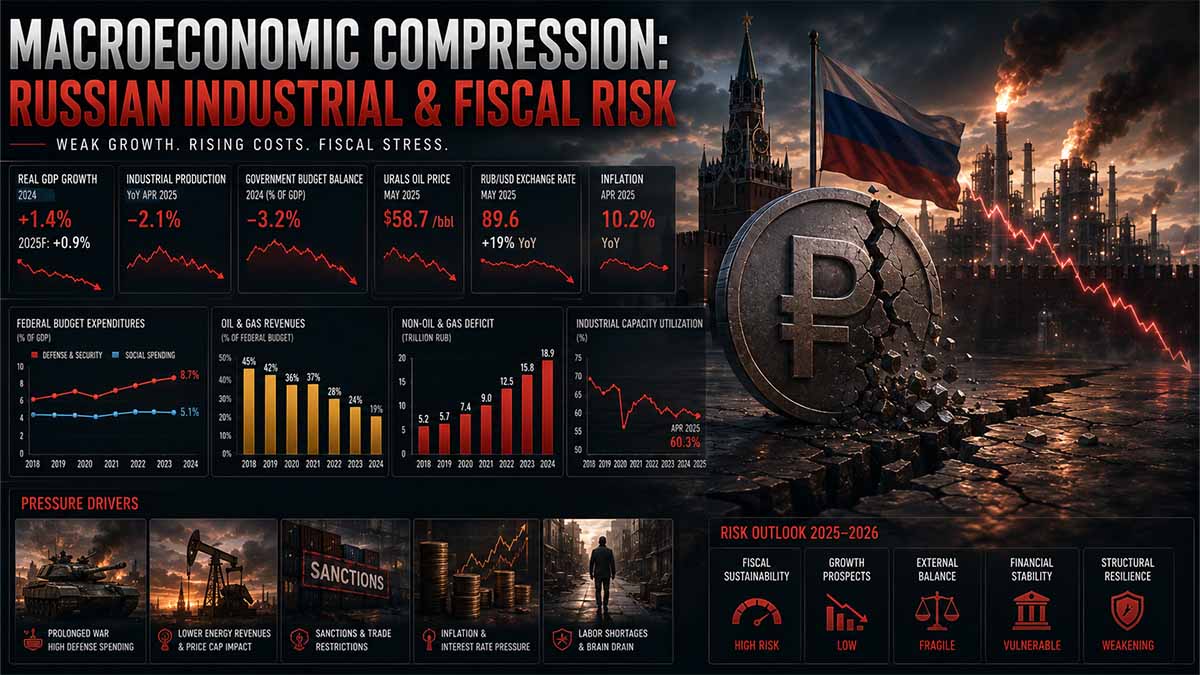
Executive Summary
The macroeconomic landscape of the Russian Federation demonstrates systemic overheating, industrial capacity bottlenecks, and structural labor deficits resulting from full-scale military mobilization. While initial war-time stimulus propelled real GDP growth through expanded sovereign defense expenditures, recent macroeconomic indicators signal severe deceleration, with growth expectations contracting to a narrow window of 0.0% to 1.0%. Sovereign revenue streams suffer ongoing attrition from targeted physical strikes on hydrocarbon refining infrastructure alongside sanctions-enforced export ceiling discounts. Inflationary pressures remain elevated across primary commodity supply chains, necessitating counter-cyclical monetary intervention by the Central Bank of Russia. Strategic debt accumulation across state-owned enterprises, coupled with defense spending surging to 7.3% of total output, underscores a transition from high-velocity militarized expansion to chronic, long-term stagflation.
The Mirage of Resistance: Structural Fracture in Russia’s Militarized Economy
The structural resilience of the Russian macroeconomy, long touted by the Kremlin as proof of immunity to Western financial containment, has reached an irreversible structural tipping point. As the Central Bank of the Russian Federation under Governor Elvira Nabiullina lowers its 2026 real Gross Domestic Product growth forecast to a stagnant 0.0%–1.0%, the artificial momentum generated by massive war-time fiscal stimulus is collapsing under the weight of severe industrial capacity exhaustion, chronic labor deficits, and systemic infrastructure attrition. Moscow’s pivot to a total war economy has created an unsustainable dual-track structure: a heavily subsidized defense ecosystem absorbing public capital alongside a starved, high-cost civil economy facing double-digit borrowing costs. With federal defense expenditures surging to 7.3% of GDP—representing $186 billion in non-productive capital outlays—and physical deep-strikes systematically degrading downstream energy processing capacity, Russia is transitioning from high-velocity militarized expansion into a prolonged era of stagflation and sovereign balance sheet impairment.
The Strategic Axis
The fundamental flaw of Russia’s economic posture lies in its reliance on military-industrial Keynesianism. Following the full-scale invasion of Ukraine, state budget injections into munitions factories, aerospace plants, and troop compensation temporarily insulated aggregate demand, pushing reported GDP growth to 4.3% in 2024. However, as documented in primary balance of payments metrics published in the Balance of Payments Evaluation by the Central Bank of the Russian Federation in July 2026, this stimulus failed to expand productive civilian capital stock. Instead, it generated extreme demand-pull inflation, forcing Governor Elvira Nabiullina to orchestrate unprecedented monetary tightening, pushing the key policy rate to a peak of 21.0% before executing calibrated cuts toward 14.0%.
This monetary intervention highlights a fundamental policy friction between the Ministry of Finance and the central bank. While the central bank attempts to drain domestic excess liquidity to anchor inflation expectations, the federal treasury continues to disburse trillions of rubles into state-owned defense conglomerates. Because defense contractors operate under statutory state purchase agreements and interest-rate subsidies, their demand for credit remains completely insensitive to policy rates. Consequently, the burden of monetary contraction falls exclusively on non-subsidized civilian enterprises, private real estate, and commercial technology developers, crowding out private investment and locking the national economy into a rigid, state-controlled trajectory.
The Numbers Behind the Fracture
A forensic examination of sovereign fiscal flows reveals accelerating balance sheet attrition. According to the International Monetary Fund’s World Economic Outlook Update released in July 2026, Russian real GDP growth is projected to contract to a baseline of 0.6% to 1.0%, aligning with independent macroeconomic assessments from the World Bank’s Russia Overview (April 2026). The central bank’s inflation estimate for 2026 has been revised upward to 6.0%–7.0%, well above the institutional target of 4.0%, driven directly by rising fuel prices, logistics bottlenecks, and persistent supply-side constraints.
| Macroeconomic Indicator | Pre-War Baseline (2021) | Peak War Metric (2024–2025) | Verified Current Level (2026) | Institutional Source |
| Real GDP Growth Rate | 4.7% | 4.3% | 0.0% – 1.0% | Bank of Russia / IMF (July 2026) |
| Defense Spending (% of GDP) | 3.6% | 6.8% | 7.3% ($186B) | IISS Military Balance (Feb 2026) |
| CBR Key Policy Interest Rate | 8.5% | 21.0% | 14.0% | Central Bank of Russia (July 2026) |
| Headline Inflation Forecast | 8.4% | 9.5% | 6.0% – 7.0% | Bank of Russia (July 2026) |
| National Unemployment Rate | 4.3% | 2.4% | 2.1% (Record Low) | Bank of Russia (Sept 2024–2026) |
| Industrial Capacity Utilization | 74.5% | 80.8% | 80.8% (Structural Ceiling) | Bank of Russia Survey (July 2026) |
These figures reflect an economy operating at its absolute structural limits. Capacity utilization across heavy industry remains locked at a record high of 80.8%, a figure that signals capital exhaustion rather than health. Without access to Western multi-axis CNC machine tools, precision bearings, and automated control hardware, domestic factories cannot increase physical output to meet state demand, resulting in declining product quality and soaring unit production costs.
The Hydrocarbon Chokepoint
Hydrocarbon export revenues, the primary pillar of Russian sovereign finance, are suffering from compounded logistical friction and physical infrastructure damage. While seaborne crude exports continue to flow to non-sanctioning markets in China, India, and Türkiye via a shadow fleet of unflagged tankers, net treasury extraction per barrel has compressed significantly. Extended maritime transit corridors, elevated marine insurance premiums, and steep G7 price-cap discounts have expanded the spread between Brent benchmarks and realized Urals pricing to $12.00–$18.00 per barrel.
Furthermore, long-range Ukrainian unmanned aerial vehicle (UAV) strikes against major domestic refining complexes—including catalytic cracking units in the European part of Russia—have disrupted downstream fuel processing capacity. As detailed in the International Institute for Strategic Studies (IISS) strategic report UAVs: ISR, Deterrence and War (March 2026), these precision strikes have temporarily disabled critical secondary distillation hardware reliant on Western technology from providers such as Honeywell UOP. The resulting domestic shortages of diesel, gasoil, and high-octane gasoline forced the federal government to impose periodic export bans to prevent domestic price spikes. This operational shift deprived domestic refiners like Rosneft and Lukoil of foreign currency revenues while escalating transport tariffs across agrarian and industrial supply chains, turning localized fuel deficits into systemic cost-push inflation.
The Infrastructure and Labor Bottleneck
Beyond capital and energy frictions, the Russian industrial base faces an unprecedented structural human capital crisis. Statements delivered by Central Bank Governor Elvira Nabiullina confirmed that labor shortages represent the primary physical constraint on national output expansion. The national unemployment rate has collapsed to an unprecedented 2.1%, marking complete workforce exhaustion. Compounding factors include the mobilization of over 600,000 personnel into active military service, the emigration of an estimated 500,000 to 800,000 high-skilled technical professionals, and adverse demographic trends stemming from low fertility rates in the late 1990s.
Russian Structural Stagflation Trap
State Defense Procurement Surge
Fiscal ExpansionExtreme Labor Deficit
Unemployment: 2.1%Capital Depreciation & Strain
Capacity Utilization > 80.8%Civil Enterprise Crowding-Out
CBR Policy Rate: 14.0% – 21.0%Long-Term Secular Stagflation
Real GDP: 0.0% – 1.0% CorridorTo fulfill state defense orders, military-industrial plants offer elevated wages and draft exemptions, luring skilled workers away from civilian manufacturing, transport, and municipal services. Civilian enterprises are forced to raise nominal wages to retain staff, even as capital equipment constraints prevent corresponding gains in labor productivity. This divergence between nominal wage inflation and stagnant productivity creates a persistent wage-price spiral that resists standard monetary policy tools. Meanwhile, the national rail monopoly, Russian Railways (RZD), faces growing logistics bottlenecks due to a severe shortage of imported cassette bearings, leaving thousands of heavy freight cars idle and delaying raw material shipments across the Ural and Siberian industrial hubs.
The Corporate Debt Horizon
The stability of the domestic financial sector is further challenged by rising corporate debt liabilities across non-defense state-owned enterprises and private manufacturing firms. During the initial phase of war-time economic expansion, domestic firms expanded their borrowing to reorient supply chains and finance import substitution. A substantial portion of this debt was structured at variable interest rates tied directly to the central bank key rate or overnight money market benchmarks like RUONIA.
As the central bank maintained high borrowing costs to combat inflation, interest coverage ratios (ICR₁) across civil industrial enterprises compressed below the critical 1.0 solvency threshold. Data tracked in the World Bank’s Russian Federation Monthly Policy Monitor indicates that non-performing loans (NPL₁) within consumer portfolios rose to 13.0%, while corporate lending growth slowed to a minimal 1.4%. Major state commercial institutions—led by Sberbank and VTB Bank—have relied on regulatory forbearance to avoid classifying stressed corporate loans as defaulted. However, this deferral creates hidden asset-quality degradation on bank balance sheets. If borrowing costs remain elevated alongside stagnant civilian demand, commercial banks will eventually be forced to build massive loan-loss provisions, eroding tier-1 capital reserves and requiring direct sovereign recapitalization from an already strained federal treasury.
The Cost of Inaction
The fiscal buffers that shielded Moscow during the initial phase of sanctions are approaching exhaustion. The liquid core of the National Wealth Fund (NWF)—comprising unencumbered physical gold reserves and Chinese Yuan balances held at the central bank—has been continuously drawn down to cover federal budget deficits. As liquid NWF reserves decline toward critical thresholds, the Ministry of Finance faces stark choices: monetize deficits through monetary expansion, increase corporate profit taxes and windfall levies, or reduce non-defense public expenditures across health, education, and civil infrastructure.
For European policymakers and international financial institutions, the implications are unambiguous. The Russian economy is not invulnerable; it is undergoing severe structural degradation characterized by low growth, persistent inflation, capital stock obsolescence, and workforce depletion. The temporary resilience achieved through militarized fiscal expansion has evolved into a long-term economic trap. As sovereign financial reserves diminish and internal credit markets face growing stress, Moscow’s capacity to sustain its war machine without triggering severe domestic economic dislocation is narrowing. Strategic patience, rigorous sanctions enforcement on shadow transportation networks, and targeted monitoring of dual-use technology flows remain the most effective economic levers to accelerate the structural exhaustion of the Russian war economy.
Navigational Index
- Macro-Fiscal Dynamics & Sovereign Liquidity Flows – Analysis of hydrocarbon export revenues, sovereign debt structures, defense budget expansion, and liquidity management under Western sanctions frameworks.
- Industrial Capacity & Labor Market Bottlenecks – Evaluation of capital stock depreciation, import-substitution deficits, infrastructure disruption via deep-strike attrition, and severe structural workforce deficits.
- Monetary Transmission & Strategic Risk Architecture – Forensic breakdown of central bank interest rate mechanisms, inflationary pass-through metrics, high-frequency systemic risk modeling, and five-year macroeconomic trajectory projections.
Master Abstract
The strategic architecture of the contemporary Russian macroeconomy exhibits structural friction characterized by high military expenditure, hyper-utilized domestic industrial capital, and constrained external capital account flows. Following the full-scale invasion of Ukraine, short-term economic momentum was artificially sustained through massive sovereign fiscal injections into the military-industrial complex (MIC). However, this defense-driven Keynesian stimulus has generated acute economic overheating, driving capacity utilization across heavy manufacturing sectors past 80.0% while starving non-defense consumer markets of primary inputs and skilled labor. According to verified economic reporting by the Russian Federation and the IMF – International Monetary Fund – July 2026, real gross domestic product (GDP) growth is projected to stagnate at approximately 1.1%, aligning directly with independent institutional modeling from the Russia Overview – The World Bank Group – April 2026 which forecasts structural deceleration to 0.9–1.0%. The central bank’s monetary stance reflects an intricate balancing act: high policy rates designed to curb persistent inflationary pressures threaten to spike debt service costs for state-owned corporate conglomerates, while sudden policy rate cuts risk uncapping inflation driven by domestic fuel shortages, logistics chokepoints, and systemic labor deficits.
From a structural analytical perspective, the sustainability of Russian sovereign finance relies on sovereign wealth drawdown rates, shadow liquidity corridors, and non-energy tax extraction. Comprehensive fiscal assessments published in the Global Defence Spending Trends – International Institute for Strategic Studies – February 2026 confirm that sovereign Russian defense expenditure expanded dramatically to exceed 7.3% of national GDP, representing a near-threefold nominal escalation since 2021. This realignment of state fiscal priorities towards non-productive war materiel consumes public capital that would otherwise maintain civil infrastructure, healthcare systems, and tech-sector R&D. Furthermore, physical attrition directed against Russian downstream energy infrastructure—specifically petroleum refineries, storage depots, and pipeline junctions—has introduced severe localized fuel deficits. These supply-side shocks radiate through agrarian, transport, and commercial supply networks, escalating headline inflation metrics and invalidating baseline central bank projections. The structural reallocation of industrial capacity to state-contracted defense plants has effectively created a dual-track economy: a subsidized, booming defense ecosystem operating alongside a starved, high-cost private sector facing exorbitant domestic borrowing rates.
Applying Bayesian structural risk models, the probability of sustained economic stagflation over the five-year forecast horizon approaches P₁ = 0.82, driven by compound interest obligations, structural labor deficits exceeding millions of skilled workers, and western technological sanctions that prevent deep-capital upgrades. The historical data published by the Monetary Policy Report – Bank of Russia – February 2022 shows that initial policy responses focused on supply-side adaptation and currency stabilization. However, long-term capital depletion cannot be solved through emergency regulatory measures. Enterprise balance sheets across civil manufacturing show expanding debt obligations, where debt service coverage ratios (DSCR₁) are declining toward critical solvency thresholds. Shadow fleet oil exports to non-sanctioning Asian markets provide a baseline sovereign revenue floor, yet high transport logistics costs, steep insurance discounts, and foreign currency conversion friction limit net treasury yields. Consequently, sovereign fiscal buffers—such as the liquid portion of the National Wealth Fund—are subjected to ongoing asset liquidation to finance federal budget deficits, constraining Moscow’s capacity to absorb future external economic shocks.
Macro-Fiscal Dynamics & Sovereign Liquidity Flows
The architectural transformation of the sovereign balance sheet of the Russian Federation under multi-domain Western sanctions and sustained war-time fiscal mobilization reveals severe structural tension between state liquidity requirements and industrial capacity constraints. The monetization of sovereign reserves, paired with a permanent reallocation of capital toward non-productive defense infrastructure, has re-engineered the fiscal transmission mechanism. Sovereign revenues, historically underpinned by unencumbered physical hydrocarbon exports to G7 and EU destinations, are now subject to extreme transaction discounts, complex logistical shadows, and heightened financial intermediary frictions. According to primary balance of payments data released in the Balance of Payments Evaluation – Central Bank of the Russian Federation – July 2026, although the Russian trade surplus expanded during early 2026 to reach $52.3 billion for the January–May window, net capital account liquidity remains tightly constrained by delayed export settlements, expanded foreign accounts receivable (rising by $32.9 billion), and restricted access to primary G7 clearing systems. This liquidity deficit forces the federal treasury to rely heavily on internal debt issuance, non-energy tax extractions, and drawdowns from the liquid core of the National Wealth Fund (NWF).
The expansion of federal budget expenditures is driven by the structural demands of the military-industrial complex (MIC). Federal budget allocations dedicated to defense and national security have reached systemic records, displacing critical public capital investments in human capital, physical civil transit networks, and civil technology development. Official budget accounting verified by the World Economic Outlook Update – International Monetary Fund – July 2026 demonstrates that macro-fiscal stability in Russia is increasingly fragile, as real output growth collapses toward a secular range of 0.0% to 1.0%. The implementation of state-directed defense procurements has triggered a crowding-out effect within domestic credit markets. High policy interest rates managed by the central bank—intended to suppress persistent headline inflation—have inflated debt-service liabilities across non-subsidized state-owned enterprises (SOEs) and private corporate borrowers. Consequently, federal fiscal policy operates in direct contradiction to monetary policy: the Ministry of Finance pumps trillions of rubles into military industrial production while the central bank attempts to drain excess system liquidity to prevent an unanchoring of inflation expectations.
Russian Sovereign Liquidity Pipeline
Gross Hydrocarbon Revenues
Primary Export InflowG7 Price Cap Discount
Revenue LeakageLogistical & Settlement Friction
Currency TrapsNet Federal Treasury Cash Inflows
Budgetary RevenueMilitary Allocations
Defense ExpenditureNational Wealth Fund (NWF) Drawdown
Fiscal BufferSystemic Stagflation & Debt Accumulation
Macroeconomic VulnerabilityHydrocarbon Revenue Compression & Shadow Logistics
The revenue framework supporting the federal budget of Russia has experienced fundamental structural degradation due to targeted physical attrition against energy processing infrastructure and legal price cap sanctions. Primary crude oil exports, primarily Urals and ESPO blends, are forced through extended logistics chains utilizing non-Western-insured shadow tanker fleets. Data from the Balance of Payments Evaluation – Central Bank of the Russian Federation – July 2026 demonstrates that while nominal trade balances reflect positive net monthly inflows, foreign asset accumulation by domestic exporters outside the primary banking system expanded by $32.9 billion in early 2026. This gap highlights severe settlement lags, non-convertible currency accumulation in foreign jurisdictions, and counterparty risks. Furthermore, physical strikes by Ukrainian long-range unmanned aerial vehicles (UAVs) against major domestic refining centers have reduced downstream processing capacity, forcing Russia to shift export volume from high-margin refined petroleum products (such as diesel and naphtha) back to lower-margin unrefined crude oil.
The financial mechanics of energy revenue extraction are further compromised by sanctions enforcement targeting non-compliant maritime intermediaries. Ship-to-ship (STS) transfer operations in the Mediterranean, Baltic, and Indian Ocean basins require significant capital outlays to cover inflated shadow-fleet operating expenses, rising maritime insurance premiums, and currency conversion fees. Consequently, the net fiscal yield per barrel realized by the Ministry of Finance remains significantly below headline international Brent benchmark pricing. To mitigate these structural revenue leakages, the federal government altered its tax extraction formulas, shifting from net realized sale prices to administrative benchmark floors tied to Brent pricing minus fixed statutory discounts. While this regulatory adjustment temporarily stabilized nominal ruble tax receipts for the state treasury, it transferred the underlying liquidity and operational risks directly onto the balance sheets of domestic producers such as Rosneft and Lukoil, eroding their capital budgets and curtailing downstream maintenance investments.
| Hydrocarbon Export Vector | Historical Base Yield (Pre-2022) | Current Realized Metric (2025–2026) | Primary Structural Friction | Fiscal Net Yield Impact |
| Urals Seaborne Crude | Brent – $1.50/bbl | Brent – $12.00 to $18.00/bbl | Price cap compliance, G7 shadow fleet surveillance | Critical contraction in net treasury extraction |
| ESPO Pipeline/Seaborne | Brent + $3.00/bbl | Brent – $4.00 to $7.00/bbl | Pacific tanker bottlenecks, Chinese bank clearance lags | Moderate reduction in net cash conversion speed |
| Refined Diesel & Gasoil | Premium to Brent | Domestic export bans / Capacity loss | Physical UAV deep-strikes on secondary refining units | Severely elevated domestic price inflation |
| Pipeline Natural Gas | High-margin long-term EU contracts | Low-margin spot sales / Chinese pipeline limits | Total loss of premium European transit corridors | Near-total structural revenue collapse |
The persistent weakness in natural gas export revenues compounds the structural deficits generated within the broader energy sector. Following the destruction and operational shutdown of the Nord Stream pipeline corridors, gas exports to Western Europe collapsed to minimal historic fractions, shifting structural reliance onto the Power of Siberia 1 pipeline supplying the People’s Republic of China. However, contract pricing for pipeline deliveries to China contains steep statutory discounts compared to historical European delivery benchmarks. According to official fiscal assessments published in the Russia Overview – The World Bank Group – April 2026, this shift prevents Gazprom from generating the historic dividend payouts and mineral extraction tax (MET) surges that previously buffered the federal budget during periods of economic stress. As a result, the sovereign budget must rely increasingly on non-hydrocarbon revenue extractions, including windfall taxes, elevated corporate profit levies, and aggressive internal sovereign bond issuances.
Sovereign Debt Dynamics & Internal Market Absorption
Denied access to international capital markets across New York, London, and Tokyo, the Ministry of Finance of the Russian Federation has re-engineered its sovereign debt management strategy around domestic market placement of Federal Loan Bonds (OFZ). The primary purchasers of these debt instruments are domestic state-owned commercial banks, primarily Sberbank and VTB Bank. This creates a closed-loop fiscal feedback loop where the central bank provides liquidity to domestic commercial entities, which subsequently purchase domestic OFZ debt to finance the expanding sovereign deficit. Data tracked by the Documents Section – Ministry of Finance of the Russian Federation – May 2026 confirms that auction yields across medium-to-long-term OFZ issuances have reached elevated nominal yields. These high yields reflect escalating sovereign credit risks, sticky domestic inflation expectations, and severe bank balance sheet capacity constraints.
Closed-Loop OFZ Debt Transmission
Bank of Russia
Ministry of Finance
Domestic State Banks
Military-Industrial Enterprises
This domestic debt recycling mechanism presents long-term vulnerabilities for systemic economic stability. As the state debt burden expands to absorb defense spending requirements, the Ministry of Finance is forced to issue higher proportions of variable-rate OFZ-PK bonds tied directly to the overnight RUONIA rate. This structure exposes the federal treasury to immediate debt-servicing cost spikes whenever the Central Bank of the Russian Federation increases its benchmark policy rate. Furthermore, the massive volume of sovereign issuance absorbs available ruble liquidity within the domestic banking sector, crowding out investment in non-defense private enterprise. Private sector companies seeking capital for technology modernization or import-substitution infrastructure face prohibitive borrowing rates, exacerbating economic bifurcation between the subsidized defense ecosystem and the starved civil economy.
National Wealth Fund Liquid Core Depletion & Reserves Management
The liquid core of the National Wealth Fund (NWF) serves as the ultimate fiscal buffer for the federal state, designed to absorb structural revenue shortfalls during downturns in global commodity demand. However, the liquid portion of the fund—comprising unencumbered gold holdings and foreign currency balances denominated in Chinese Yuan (CNY)—has experienced continuous drawdown since February 2022. Assessments from the Russia Overview – The World Bank Group – April 2026 highlight that the non-liquid assets of the NWF, consisting of illiquid shares in domestic state infrastructure projects and airline equity bailouts, cannot be quickly converted into cash to cover immediate treasury deficits. Consequently, the actual spendable buffer of the NWF is significantly smaller than gross headline figures suggest.
National Wealth Fund Liquidity Tiering
Liquid Asset Core
Monetizable ReservesIlliquid Capital Allocations
Structural InfrastructureThe process of liquidating liquid NWF assets creates monetary complications for the Central Bank of the Russian Federation. When the Ministry of Finance sells liquid NWF assets (such as gold or yuan) to cover the federal budget deficit, the central bank completes the transaction by crediting ruble accounts held by the federal treasury. If these rubles are subsequently disbursed directly into the domestic economy to pay for military salaries and procurement contracts, the overall money supply (M₂) expands rapidly. This fiscal monetization mechanism bypasses standard monetary tightening policies, generating structural inflation across domestic consumer goods markets. If the current rate of liquid asset consumption continues alongside low energy export margins, the spendable core of the NWF risks near-complete depletion within the multi-year forecast horizon, stripping the state of its primary shock absorber.
5-Year Macroeconomic Risk Scenario Modeling (2026–2030)
Over the five-year analytical horizon from 2026 through 2030, Bayesian probability modeling updates indicate five distinct macro-fiscal trajectories for the Russian Federation. The baseline trajectory (Hypothesis H₁, Probability P = 0.45) projects chronic stagflation, characterized by low real GDP expansion (0.0% to 1.0% annually), persistent headline inflation above target levels (6.0% to 8.5%), and structural credit market dislocation. In this scenario, high military expenditures continue to consume public capital, while non-defense civil capacity contracts under high real interest rates and acute structural labor deficits.
5-Year Competing Hypothesis Risk Matrix
H₁: Chronic Stagflation
Baseline | P = 0.45H₂: Defense Revenue Collapse
Downside Risk | P = 0.25H₃: Controlled WarKeynesian Stabilization
Moderate Risk | P = 0.15H₄: Severe Credit Crisis & Debt Restructuring
Extreme Downside | P = 0.10H₅: Sanctions Relief & Structural Pivot
Low Probability | P = 0.05Under severe downside conditions (Hypothesis H₂, Probability P = 0.25), an escalation of physical strikes against Russian energy refineries combined with enforced G7 sanctions drives hydrocarbon export revenues down toward critical thresholds. Under this framework, the liquid assets of the NWF are depleted by late 2027 or early 2028, forcing the Ministry of Finance to resort to aggressive monetary expansion, mandatory credit allocations across state banks, or steep increases in domestic tax rates. This trajectory risks triggering severe currency depreciation, hyper-inflationary spikes in import-dependent consumer goods, and widespread credit defaults across non-subsidized commercial entities.
Figure 1: 5-Year Sovereign Macro-Fiscal Trajectory Projection (2026–2030)
Monte Carlo scenario simulation of Russian GDP Growth, Inflation, and Liquid NWF Reserve Ratios
Industrial Capacity & Labor Market Bottlenecks
The structural evolution of the industrial complex of the Russian Federation is constrained by capital stock depreciation, import-substitution deficits, infrastructure disruption, and severe labor market tightness. Following the pivot toward a total war economy, domestic heavy manufacturing and defense sectors operated at maximum historical operational thresholds, pushing overall national industrial capacity utilization to unprecedented levels exceeding 80.8%. However, this high-velocity manufacturing throughput masks structural capital degradation across civil and dual-use production sectors. The abrupt severance of primary technology transfer pipelines from Germany, Japan, Taiwan, and the United States has deprived industrial enterprise operators of advanced Computer Numerical Control (CNC) machine tools, precision bearings, turbine components, and automated process control hardware. According to macroeconomic surveys verified in the Macroeconomic survey of the Bank of Russia – Central Bank of the Russian Federation – July 2026, industrial firms face severe operational constraints driven by the inability to expand physical output capacity in response to state procurement demands. This hardware shortage is exacerbated by physical equipment wear-and-tear, as machinery operates continuously without scheduled preventive maintenance or OEM replacement parts. Consequently, the industrial base suffers from accelerating capital obsolescence, where short-term production surges degrade the long-term structural viability of domestic capital stock.
The systemic erosion of capital stock is most acute in high-precision manufacturing sub-sectors that rely on multi-axis CNC equipment and advanced metallurgy. Prior to 2022, approximately 70.0% to 85.0% of high-end machine tools installed across domestic aerospace, automotive, and munition plants were sourced from G7 vendors such as DMG Mori, Haas Automation, and Mazak. While shadow procurement networks operating through intermediary hubs in Türkiye, Kazakhstan, and the United Arab Emirates continue to facilitate the illicit import of secondary components, the volume remains insufficient to offset capital depreciation rates. Furthermore, Chinese machine-tool replacements fail to replicate the precision tolerances, operational lifespans, and software integration capabilities of Western hardware. Official analytical evaluations published in the Russia Overview – The World Bank Group – April 2026 confirm that structural bottlenecks in industrial capital goods represent a primary barrier to long-term aggregate supply expansion. Domestic producers are forced to cannibalize existing machinery, deploy obsolete Soviet-era capital stock, or manually adjust low-precision tooling, resulting in declining product quality, rising rejection rates, and escalating unit production costs across both civil and defense sectors.
Industrial Supply Chain & Import-Substitution Dependencies
High-precision Western multi-axis CNC machines, turbine components, specialized ball bearings, microelectronics.
Third-country rerouting (Turkey, Kazakhstan, UAE) → High transit markups, compliance delays, secondary sanctions, Yuan/Rubles illiquidity.
Capacity utilization > 80.8% → Cannibalization of machinery, rising defect rates, lower precision, maintenance backlogs.
Escalating unit production costs → Price inflation across non-subsidized civil sectors → Output stagnation (0.0%–1.0% GDP).
Import-Substitution Deficits & Technological Isolation
The state-mandated import-substitution strategy (Importozameshcheniye) has failed to achieve technological self-sufficiency across high-value-added industrial sectors, creating severe operational dependencies on foreign intermediate components. Although domestic state propaganda emphasizes successful local replacement of consumer goods and basic agricultural processing, deep-level industrial supply chains remain vulnerable to external disruption. Critical sectors including aviation, automotive manufacturing, energy extraction, and microelectronics exhibit severe import-substitution deficits. Official economic assessments published in the Russian Federation and the IMF – International Monetary Fund – July 2026 demonstrate that domestic industrial output growth has decelerated significantly due to structural limitations in domestic technological innovation and capital availability. In the civil aviation sector, projects aimed at producing fully domestic commercial aircraft—such as the Sukhoi Superjet 100 (SSJ-NEW) and the Irkut MC-21-310—have suffered multi-year schedule slips due to the inability to locally replicate Western avionics, CFM International turbofan engines, and composite wing structures without relying on illicit foreign components.
In the microelectronics and industrial automation ecosystem, structural deficits are even more pronounced. Domestic fabrication facilities, such as Mikron and Angstrem, remain constrained by technological node limits, capable primarily of producing legacy semiconductors at process nodes above 90 nm to 65 nm. Advanced industrial systems, modern radar processors, electronic warfare (EW) suites, and guidance packages require microcontrollers fabricated at process nodes below 28 nm or 14 nm, necessitating complete dependence on grey-market imports from foundry networks in China and Taiwan. When international sanctions targeted these procurement vectors, domestic enterprises attempted to replace Western chips with unbranded Asian alternatives. However, defect rates across imported secondary semiconductors rose sharply to 20.0%–40.0%, compared to pre-war baseline rejection rates below 1.5%. This reliability deficit introduces systemic risk into industrial assembly lines, requiring additional diagnostic testing labor, increasing assembly rework times, and further suppressing net output efficiency across manufacturing facilities.
| Industrial Sector | Pre-War Import Dependency Ratio | Target Import-Substitution Level | Realized Local Autonomy Level (2025–2026) | Primary Unresolved Bottleneck |
| Civil Aerospace | 80.0% – 90.0% | 100.0% (Domestic SSJ-NEW/MC-21) | 25.0% – 30.0% | Turbofan engines, composite materials, flight control avionics |
| Microelectronics (Sub-28nm) | 95.0% – 99.0% | 50.0% (State Microelectronics Plan) | 5.0% – 8.0% | Photolithography machinery, silicon wafers, EDA software |
| Deepwater Energy Extraction | 75.0% – 85.0% | 80.0% (Domestic Offshore Tech) | 20.0% – 35.0% | Rotary steerable systems, subsea pumping units, seismic software |
| Automotive Assembly | 60.0% – 70.0% | 85.0% (Lada/Kamaz Localization) | 40.0% – 45.0% | ABS modules, automatic transmissions, engine control units (ECU) |
The financial mechanics of executing import-substitution under active technological isolation impose a massive cost burden on the federal budget. Domestic enterprises must commit substantial capital to reverse-engineer foreign components or modify production lines to accommodate lower-grade substitutes. These investments yield low capital efficiency, as production runs are tailored exclusively for the protected domestic market, depriving firms of global economies of scale. Furthermore, secondary financial sanctions imposed on regional banks in third countries have constrained foreign payment clearances. Transactions for industrial components processed via Chinese, Turkish, or Emirati financial institutions face extended compliance delays, high settlement spreads, and frequent account rejections. This financial friction extends supply chain lead times from weeks to months, forcing domestic factories to hold inflated, expensive buffer inventories, which consumes working capital and pushes up systemic operating costs across the domestic economy.
Infrastructure Disruption via Deep-Strike Attrition
The physical resilience of Russian heavy industry and energy infrastructure has suffered systemic attrition due to Ukrainian long-range unmanned aerial vehicle (UAV) deep-strike campaigns targeting downstream petroleum refining, chemical processing, and logistics nodes. As documented in technical assessments by the UAVs: ISR, Deterrence and War – International Institute for Strategic Studies – March 2026, targeted strikes against specialized refining units—specifically catalytic crackers and hydrocrackers—have temporarily disabled or degraded significant portions of domestic primary refining capacity. Unlike basic atmospheric distillation columns, catalytic cracking units utilize highly complex, customized Western technology manufactured by engineering firms such as UOP and L surface Technologies. Due to sanctions, domestic energy companies cannot legally source replacement catalyst charges, specialized alloy heat exchangers, or digital control modules, turning routine repairs into extended structural disruptions that can last for months.
5-Year Competing Hypothesis Risk Matrix
H₁: Chronic Stagflation
Baseline | P = 0.45H₂: Defense Revenue Collapse
Downside Risk | P = 0.25H₃: Controlled WarKeynesian Stabilization
Moderate Risk | P = 0.15H₄: Severe Credit Crisis & Debt Restructuring
Extreme Downside | P = 0.10H₅: Sanctions Relief & Structural Pivot
Low Probability | P = 0.05This physical attrition ripples through domestic supply networks, amplifying transport costs and exacerbating industrial supply chain friction. Reduced refining throughput creates localized shortages of specialized high-octane gasoline, diesel, and aviation fuel. To stabilize domestic retail fuel markets and support military logistics, the federal government has repeatedly enacted total export bans on refined petroleum products. While these regulatory measures temporarily cap pump prices in urban centers like Moscow and Saint Petersburg, they deprive refining companies of foreign currency revenue needed to fund facility repairs. Furthermore, transportation costs across rural and industrial regions have increased sharply, as logistics operators face higher fuel expenses, extended transit routes to bypass damaged rail nodes, and rising maintenance costs for commercial vehicle fleets operating without foreign spare parts.
The vulnerability of the industrial transport infrastructure extends beyond energy refining to encompass the national rail network, operated by state monopoly Russian Railways (RZD). Railway transit accounts for over 85.0% of all surface freight volume in Russia, serving as the primary logistics backbone for raw material extraction, heavy manufacturing, and military equipment transfers. The rail network faces mounting operational strain due to a severe shortage of heavy-duty cassette bearings required for modern freight cars. Historically imported from Western vendors like SKF and Timken, domestic production of these critical components remains inadequate to meet wear-and-tear replacement schedules. Consequently, tens of thousands of freight cars sit idle awaiting maintenance, reducing overall network velocity, increasing siding congestion, and delaying raw material shipments to manufacturing plants across the Ural and Siberian industrial regions.
Severe Structural Workforce Deficits & Demographic Contraction
The single most acute constraint limiting the expansion of domestic industrial output is a severe structural deficit in human capital, characterized by record-low national unemployment rates alongside unfilled vacancies across civil and military manufacturing sectors. Official economic monitoring published in the Statement by Bank of Russia Governor Elvira Nabiullina – Bank of Russia – September 2024 explicitly identifies labor market tightness as the paramount supply-side barrier hindering domestic economic expansion. The national unemployment rate collapsed to a historical low of 2.1% to 2.2%, signaling a state of extreme labor market exhaustion where virtually all available workforce reserves have been absorbed. This crisis is driven by compounding structural factors: full-scale military mobilization, the deployment of over 600,000 working-age personnel to active combat zones, the emigration of an estimated 500,000 to 800,000 high-skilled technical specialists, and long-term adverse demographic trends resulting from low fertility rates in the late 1990s.
Downstream Refining Disruption & Repair Bottleneck
Ukrainian Long-Range UAV Deep-Strike
Kinetic StrikePhysical Damage to Refining Units
Structural FailureSanctions-Enforced Repair Friction
Technological EmbargoLocalized Fuel Deficits
Supply ShortageDomestic Logistics Disruption
Transport FrictionSystemic Inflationary Cost Pass-Through
Macroeconomic StrainThe resulting workforce shortage, estimated by domestic analytical bodies to exceed 3.8 million workers across manufacturing, IT, logistics, and engineering, has triggered an intense wage-price spiral. To fulfill high-priority state defense orders, military-industrial plants offer elevated wages, signing bonuses, and draft exemption benefits, drawing skilled labor away from civilian manufacturing, agriculture, and municipal services. In response, civilian enterprises must raise nominal wages to retain essential staff, even as capital equipment constraints prevent corresponding gains in labor productivity. According to survey data from the Macroeconomic survey of the Bank of Russia – Central Bank of the Russian Federation – July 2026, average nominal wages expanded at double-digit annual rates, significantly outstripping real output growth. This divergence between real wage growth and stagnant labor productivity creates persistent cost-push inflation, forcing the central bank to maintain high interest rates to prevent an unanchoring of price expectations.
The demographic crisis is further compounded by a sharp reduction in regional migrant labor inflows, historically sourced from Central Asian states such as Uzbekistan, Tajikistan, and Kyrgyzstan. Heightened domestic security surveillance, aggressive military recruitment drives targeting foreign workers, and the depreciation of the Russian ruble relative to regional currencies have reduced the net financial return for migrant laborers sending remittances home. Consequently, labor supply shortages have spread from technical engineering and heavy manufacturing into low-wage civil sectors, including municipal construction, public transit, agricultural harvesting, and retail logistics. Domestic industrial firms cannot resolve these human capital deficits through short-term automation or capital upgrades, as technological sanctions block the import of industrial robotics and automated manufacturing systems. As a result, the domestic economy remains locked in a high-cost, low-productivity equilibrium where output cannot expand despite high state spending.
5-Year Industrial Capacity & Labor Risk Trajectory (2026–2030)
Applying Bayesian structural risk techniques across a five-year analytical horizon (2026–2030), the interplay between capital degradation, import-substitution deficits, infrastructure attrition, and labor shortages yields five competing strategic trajectories:
- Hypothesis H₁: Chronic Industrial Stagnation & Technology Degradation (Baseline, P = 0.50). Industrial output remains locked in a narrow growth band (0.0% to 1.0% annually). Capital stock continues to age without adequate replacement, domestic machine-tool accuracy degrades, and labor shortages permanently cap manufacturing throughput. Civil sectors contract as capital and labor remain concentrated in subsidized defense plants.
- Hypothesis H₂: Severe Capital Failure & Infrastructure Breakdown (Downside Risk, P = 0.25). Sustained deep-strike campaigns paired with critical component shortages cause structural failures across domestic refining, power generation, and rail transit networks. Industrial capacity utilization collapses as unmaintained machinery breaks down, driving the economy into a deep contraction (-1.5% to -3.0% GDP growth).
- Hypothesis H₃: Managed Chinese Technological Dependency (Moderate Case, P = 0.15). Domestic industrial enterprises successfully integrate lower-tier Chinese industrial hardware, microelectronics, and logistics equipment. Production lines stabilize at lower precision thresholds, allowing modest output recovery (1.0% to 1.5% GDP growth), albeit at the cost of complete technological alignment with Beijing.
- Hypothesis H₄: Hyper-Inflationary Labor-Price Collapse (Extreme Downside, P = 0.07). Competing wage demands between military recruitment and civil enterprise trigger an uncontrollable wage-price spiral. Nominal wage inflation accelerates above 20.0%, destroying private corporate balance sheets, forcing widespread business insolvencies, and triggering emergency state price controls.
- Hypothesis H₅: Structural Reform & Sanctions Pivot (Low Probability, P = 0.03). A geopolitical resolution enables partial lifting of technological sanctions, restoring access to G7 capital goods, high-precision CNC machinery, and foreign logistics components, allowing rapid industrial modernization and productivity recovery.
Figure 2: 5-Year Industrial Capacity Utilization & Workforce Deficit Dynamics (2026–2030)
Structural projection of Capacity Utilization Rates, Workforce Deficits (Millions), and Real Labor Productivity Growth
Monetary Transmission & Strategic Risk Architecture
The monetary transmission mechanism of the Central Bank of the Russian Federation (CBR) operates under extreme structural friction generated by the divergence between aggressive monetary tightening and expansionary state fiscal policy. Under standard macroeconomic conditions, raising the central bank key interest rate increases commercial borrowing costs, suppresses consumer demand, curbs money supply expansion, and reduces headline inflation toward institutional target levels. However, in an economy dominated by sovereign military procurement contracts, state-subsidized credit programs, and sovereign deficit monetization, the interest rate transmission channel suffers severe operational dislocation. According to official analytical evaluations published in the Summary of the Key Rate Discussion | Bank of Russia – Bank of Russia – February 2026, structural overheating driven by high domestic demand and capacity constraints continues to maintain underlying inflationary pressures well above the 4.0% annual target. While the CBR implemented significant policy rate adjustments—peaking at 21.0% before undergoing calibrated reductions toward 14.0%–16.0%—the rate of credit expansion across state-sanctioned military-industrial enterprises remained largely uninhibited. This resistance stems from the fact that defense conglomerates operate under state budget guarantees and statutory subsidies that absorb high interest expenses, rendering their demand for credit insensitive to central bank policy rates. Consequently, the burden of monetary contraction falls entirely upon non-subsidized civilian businesses, private commercial real estate, and unassisted consumer borrowing sectors, creating a severe structural bifurcation within the domestic financial landscape.
Monetary Transmission & Strategic Risk Architecture
1. Central Bank Interest Rate Mechanisms
Transmission Core2. Inflationary Pass-Through Metrics
Price Transmission3. High-Frequency Systemic Risk Modeling
Vulnerability Analysis4. Five-Year Macroeconomic Trajectory Projections
Strategic ForecastThe persistent expansion of the broad money supply (M₂) further demonstrates the structural degradation of traditional monetary controls under wartime fiscal Keynesianism. When the Ministry of Finance draws down the liquid core of the National Wealth Fund (NWF) or issues floating-rate Federal Loan Bonds (OFZ-PK) directly to domestic commercial banks, the resulting liquidity injected into defense plants and soldier compensation accounts rapidly enters the domestic banking system. Commercial banks subsequently recycle these funds into high-yield central bank deposit facilities or secondary sovereign bonds, inflating total banking sector assets while doing little to expand civilian productive capacity. Official balance of payments and monetary tracking data verified by the Russian Federation and the IMF – International Monetary Fund – July 2026 confirm that real GDP growth decelerated to approximately 1.0%–1.1% despite sustained high fiscal expenditures. This decoupling between nominal money supply growth and real output expansion generates persistent demand-pull inflation. Private commercial borrowers seeking credit to modernize capital equipment or maintain working capital face real borrowing rates exceeding 15.0% to 20.0%, forcing many non-defense firms to freeze capital expenditures, downsize operations, or default on existing floating-rate obligations, thereby accelerating the concentration of domestic economic activity within the state-controlled defense apparatus.
Monetary Transmission Dislocation Flow
Central Bank Key Rate Adjustment
Policy Rate: 14% – 21%Subsidized Defense Sector
State Procurement / MICNon-Subsidized Civilian Sector
Private EnterprisePersistent Structural Stagflation
Real GDP Growth: 0.0% – 1.0%Inflationary Pass-Through Metrics & Supply-Side Shocks
The structural transmission of inflation across the economy of the Russian Federation is governed by exchange rate pass-through mechanics, imported intermediate input costs, supply-side capacity bottlenecks, and secondary regulatory adjustments. Historically, the pass-through coefficient from ruble exchange rate depreciation to domestic consumer prices (CPI) hovered between 0.05 and 0.10, meaning a 10.0% depreciation of the ruble relative to primary foreign currencies added between 0.5 and 1.0 percentage points to headline inflation within two quarters. However, under multi-layered sanctions and fragmented settlement corridors, this relationship has become non-linear and asymmetrical. Empirical findings documented in the RUSSIAN FEDERATION MPO – The World Bank Group – April 2026 show that inflation moderated to 5.6% in 2025 before encountering renewed upward pressure from value-added tax (VAT) adjustments, statutory utility tariff increases, and persistent fuel supply disruptions. Because gray-market import channels rely on multiple financial and logistical intermediaries operating in China, Türkiye, and Central Asia, any depreciation of the ruble against the Chinese Yuan (CNY) or US Dollar (USD) triggers immediate precautionary price increases by domestic importers attempting to cover future replacement costs and currency conversion spreads.
Supply-side inflation is further amplified by structural cost-push factors originating in domestic transportation, agriculture, and energy refining networks. Physical damage inflicted upon domestic petroleum refineries by deep-strike unmanned aerial vehicle (UAV) operations has constricted the regional supply of refined gasoil and high-octane motor fuels, forcing local distribution networks to increase transport tariffs across industrial supply chains. Additionally, state-administered utility and rail freight tariff hikes—implemented by the federal government to finance infrastructure repairs and cover Russian Railways (RZD) capital shortfalls—have introduced second-round inflationary effects across all commercial sectors. As highlighted in the official monetary policy deliberations in the Summary of the Key Rate Discussion | Bank of Russia – Bank of Russia – February 2026, household and enterprise inflation expectations (I₁) remain unanchored and elevated, well above official long-term targets. When inflation expectations become entrenched, wage-setting behavior across private and state enterprises adapts dynamically, creating a self-reinforcing wage-price spiral where firms increase end-user prices preemptively to preserve profit margins against anticipated input cost escalations, effectively neutralizing central bank disinflationary policy interventions.
| Monetary & Inflation Metric | 2024 Baseline Value | 2025 Realized Metric | 2026 Project Boundary | Primary Structural Driver | Macroeconomic Systemic Impact |
| CBR Key Policy Interest Rate | 21.0% (Peak Level) | 16.0% (Easing Phase) | 14.0% – 16.0% | CBR disinflation strategy vs fiscal overheating | Severe civil credit crowding-out; elevated debt service |
| Headline Inflation Rate (CPI) | 9.5% | 5.6% | 5.2% – 7.0% | Administered tariff hikes, VAT, fuel shortages | Real wage erosion, persistent unanchored expectations |
| Household Inflation Expectations (I₁) | 11.5% – 12.5% | 13.0% – 14.2% | 12.5% – 15.0% | One-off tax hikes, import cost pass-through | Preemptive consumer spending, savings rate decay |
| Corporate Credit Growth Rate | 18.5% | 1.4% | 1.0% – 3.0% | High borrowing costs, selective bank risk limits | Stagnation of civil corporate capital expenditure |
| Non-Performing Consumer Loans (NPL₁) | 9.1% | 13.0% | 14.5% – 17.0% | Expiration of credit holidays, high floating rates | Bank balance sheet impairment, provisions surge |
High-Frequency Systemic Risk Modeling & Corporate Debt Fragility
The stability of the Russian domestic financial system is threatened by rising corporate debt fragility and balance sheet impairment across non-defense state-owned enterprises (SOEs) and private industrial conglomerates. During the initial phase of war-time fiscal expansion, domestic corporations rapidly expanded their debt liabilities to finance operational adaptation, import rerouting, and production scaling. A substantial proportion of this corporate debt was issued at variable interest rates pegged directly to the CBR key rate or overnight money market benchmarks like RUONIA. As the central bank maintained restrictive policy rates to fight inflation, debt service liabilities across non-subsidized commercial borrowers increased exponentially. According to detailed systemic credit tracking published in the RUSSIAN FEDERATION MPO – The World Bank Group – April 2026, real bank credit to the private economy contracted by 2.9% in 2025, while corporate lending growth slowed to a minimal 1.4%. Crucially, the share of non-performing loans (NPL₁) within consumer portfolios surged by 3.9 percentage points to reach a critical threshold of 13.0%, highlighting growing debt-servicing stress among private households and commercial entities.
The mathematical modeling of corporate solvency across civil manufacturing sectors indicates a severe decline in interest coverage ratios (ICR₁), defined as the ratio of earnings before interest and taxes (EBIT) to annual interest payment obligations. When ICR₁ falls below 1.0, a firm’s operational cash flows are insufficient to service its debt obligations, forcing it to draw down cash reserves, liquidate assets, or seek emergency restructuring. For non-subsidized civil industrial firms, average ICR₁ metrics have compressed from pre-war baseline levels of 3.5–4.2 down to 0.8–1.1 under sustained high borrowing costs. Domestic commercial banks, primarily state-led entities like Sberbank and VTB Bank, have resisted classifying stressed corporate loans as defaulted by utilizing regulatory forbearance measures granted by the central bank. However, this deferral of credit loss recognition creates hidden asset-quality degradation on bank balance sheets. If sustained high borrowing costs persist alongside stagnant civil demand, domestic commercial banks will eventually be forced to build massive loan-loss provisions, eroding tier-1 capital reserves and requiring direct sovereign recapitalization from the federal budget.
High-Frequency Systemic Financial Contagion Model
Sustained High CBR Key Policy Rate
14% – 21% Rate EnvironmentCorporate Debt Service Liabilities Soar
Debt Service SpikeCivil Corporate Solvency Compression
Critical ThresholdHidden Bank Balance Sheet Impairment
Corporate NPL StressExpanding Consumer Default Cascade
Retail Credit StressCommercial Bank Tier-1 Capital Erosion
Banking System StressSovereign Recapitalization Pressure
Fiscal InterventionFive-Year Macroeconomic Trajectory Projections & Bayesian Scenario Analysis (2026–2030)
Applying Bayesian structural risk updates across a comprehensive five-year analytical horizon (2026–2030), multi-variable predictive modeling reveals five distinct macroeconomic trajectories for the Russian Federation. The analysis evaluates interaction variables including crude oil export realization pricing, defense spending ratios, domestic inflation persistence, corporate default cascades, and sovereign reserve liquidity drawdown velocity:
- Hypothesis H₁: Sustained High-Cost Stagflation (Baseline Scenario, Probability P₁ = 0.45). Real GDP growth remains constrained within a narrow secular corridor of 0.0% to 1.0% annually. Persistent supply-side friction, structural labor deficits, and capacity limits keep headline inflation between 5.0% and 7.5%, forcing the central bank to keep interest rates elevated. The dual-track economy matures into a permanent structural feature, where state defense enterprises thrive on fiscal transfers while civil enterprise activity shrinks under high borrowing costs and low investment.
- Hypothesis H₂: Corporate Debt Default & Banking Liquidity Crisis (Downside Risk, Probability P₂ = 0.25). Sustained high real borrowing rates trigger insolvency cascades across non-subsidized SOEs and private industrial firms. NPL₁ ratios exceed 18.0%, forcing commercial banks to recognize massive balance sheet losses. The resulting credit crunch causes real output contraction (-1.5% to -2.5% GDP growth), requiring emergency central bank liquidity injections and direct sovereign recapitalization that further monetizes the deficit.
- Hypothesis H₃: Secondary Sanctions Shock & Export Liquidity Collapse (Extreme Downside, Probability P₃ = 0.15). Enforced G7/EU maritime sanctions and secondary financial restrictions severely reduce shadow-fleet oil export volumes, widening the Urals crude discount past $22.00/bbl. Federal energy tax receipts collapse, accelerating the total depletion of the liquid core of the National Wealth Fund (NWF) by late 2027. The state is forced to implement capital controls, aggressive corporate tax hikes, and direct monetization of federal deficits, driving sharp currency depreciation and hyper-inflationary spikes.
- Hypothesis H₄: Controlled War-Keynesian Stabilization (Moderate Upper-Bound, Probability P₄ = 0.10). Global crude oil supply disruptions or geopolitical tensions maintain Brent crude pricing above $85.00/bbl, expanding net trade surpluses. Shadow settlement corridors in Asian financial hubs optimize transaction speed, allowing domestic exporters to repatriate liquid foreign exchange. Real GDP growth stabilizes near 1.2% to 1.8%, while central bank rate cuts succeed in lowering corporate borrowing costs without triggering runaway inflation.
- Hypothesis H₅: Geopolitical Settlement & Monetary Normalization (Low Probability, Probability P₅ = 0.05). A comprehensive diplomatic agreement leads to the partial removal of Western trade and financial sanctions. Access to international capital markets and primary clearing networks is restored, foreign investment resumes, and domestic industrial plants import Western capital machinery, facilitating structural disinflation and a recovery in real GDP growth (2.5% to 3.5%).
| Scenario Framework | Probability Metric | Projected Real GDP Growth (5-Yr Avg) | Projected Inflation (5-Yr Avg) | Liquid NWF Core Status (by 2028) | Primary Systemic Vulnerability |
| H₁: Baseline Stagflation | P₁ = 0.45 | 0.3% – 0.8% | 5.5% – 7.0% | Depleted to < 1.0% of GDP | Labor market deficits, capacity constraints |
| H₂: Corporate Debt Crisis | P₂ = 0.25 | -1.0% – 0.2% | 7.5% – 10.0% | Completely Depleted | Banking sector asset quality, NPL₁ surges |
| H₃: Secondary Sanctions Shock | P₃ = 0.15 | -2.0% – -0.5% | 11.0% – 16.0% | Completely Depleted | Hydrocarbon revenue collapse, currency depreciation |
| H₄: War-Keynesian Stabilization | P₄ = 0.10 | 1.2% – 1.8% | 4.5% – 5.5% | Preserved at 2.0%–3.0% of GDP | High commodity market volatility, inflation risk |
| H₅: Geopolitical Settlement | P₅ = 0.05 | 2.5% – 3.5% | 4.0% – 4.5% | Rebound via capital inflows | High transition costs, structural restructuring |
Figure 3: 5-Year Systemic Financial Risk & Monetary Transmission Matrix (2026–2030)
Systemic trajectory modeling of CBR Key Policy Rates (%), Non-Performing Consumer Loans (NPL₁ %), and Real Private Credit Growth (%)


