





Executive Summary
BLUF: Africa’s emerging conflict architecture is being shaped by logistics corridors, armed patronage systems, drone-enabled interdiction and regime-preservation strategies.
Russia’s military-cooperation framework with Togo is verified; the reported July 2026 deployment and Lomé–Bamako shipment remain unconfirmed by admissible primary sources.
In Sudan, control of the Khartoum–El Obeid axis would improve SAF operational reach but would not eliminate RSF interdiction capacity across Kordofan’s open terrain.
Escalation around western Darfur could threaten the RSF’s Chadian logistics system and increase civilian exposure to retaliatory violence.
In the DRC, President Félix Tshisekedi’s commitment to dialogue is official, but its inclusiveness, mandate and constitutional safeguards remain unresolved.
Across all three theatres, military advantage is increasingly produced by access, sustainment, external finance, drones and political control—not territorial possession alone.
Five-year baseline: expanding Russian corridor redundancy, prolonged Sudanese fragmentation and managed—not necessarily transformative—Congolese dialogue.
Confidence is highest for institutional decisions, moderate for strategic direction and low for unverified force numbers, cargo manifests and covert supply movements.
Africa’s New Corridors of Power: The Test for Italy
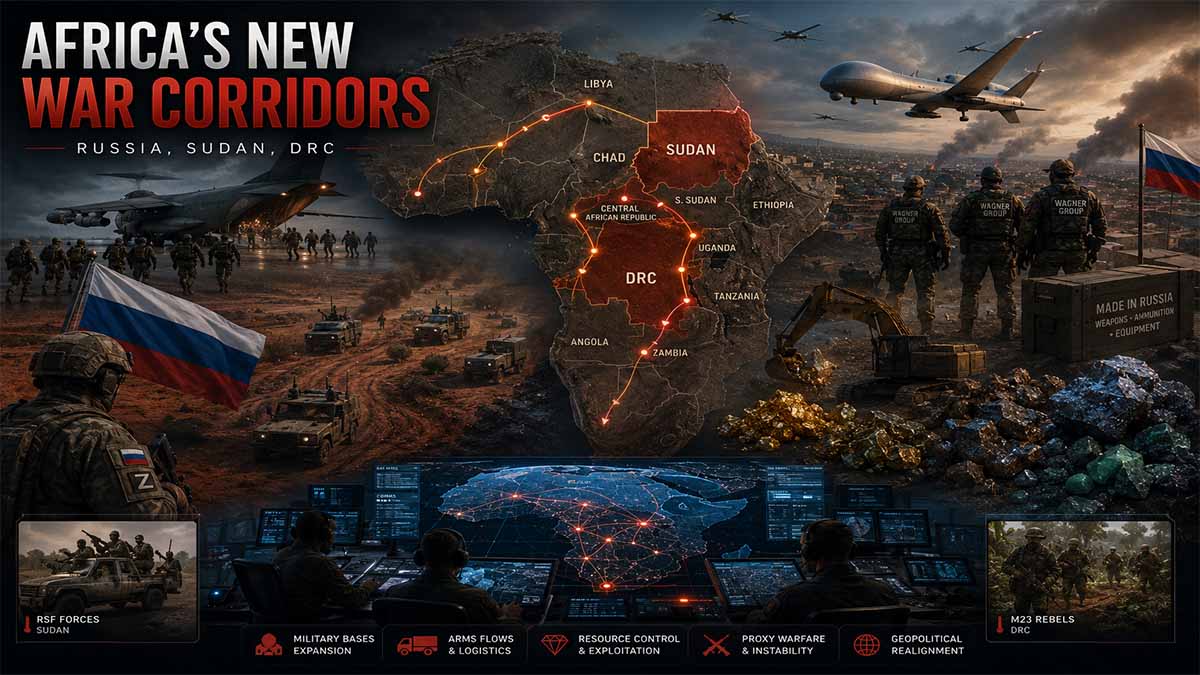
Africa’s strategic map is being redrawn less by formal alliances than by control of ports, roads, mineral basins and political institutions. Russia’s defence compact with Togo gives Moscow a potential Atlantic gateway towards the Sahel; Sudan’s war is turning Kordofan and the Darfur–Chad–Libya system into competing military supply architectures; and the Democratic Republic of the Congo is confronting an armed territorial challenge while debating the limits of presidential power. These theatres are geographically separate but strategically connected. Each demonstrates that infrastructure can become coercion, logistics can substitute for sovereignty and political dialogue can serve either reconciliation or regime consolidation. For Italy, whose African policy now combines energy security, industrial resilience, migration management and the Mattei Plan, treating these crises as isolated emergencies would be a costly analytical error.
The Atlantic Gate
The Port of Lomé is acquiring a strategic function that exceeds Togo’s economic weight. Its official specifications include a 16.6-metre draught, continuous operation and commercial representation in Burkina Faso, Mali and Niger. Lomé is therefore not simply a Togolese port: it is a maritime interface for landlocked Sahelian economies and a potential entry point for military equipment, fuel, vehicles and politically sensitive cargo. Port Autonome de Lomé: Atouts du Port de Lomé – Port Autonome de Lomé – accessed July 2026.
This logistical value now intersects with Russian power projection. Russia and Togo signed a military-cooperation agreement in Lomé on 27 March 2025 and in Moscow on 3 April 2025. Russia’s State Duma ratified it on 7 October 2025; the ratification law followed on 15 October. The framework covers exchanges of military information, threat assessment, training, exercises and movements of defence property. Ratification of the Russia–Togo Military Cooperation Agreement – State Duma – October 2025. President Vladimir Putin subsequently received Togolese Council President Faure Essozimna Gnassingbé in Moscow on 19 November 2025, elevating the relationship from technical cooperation to political sponsorship. Meeting with President of the Council of Ministers of Togo Faure Essozimna Gnassingbé – Kremlin – November 2025.
The strategic consequence is “corridor sovereignty”: influence derived not from annexing territory but from obtaining dependable access to a port, inland transport routes, customs decisions, security services and executive authority. Lomé offers Moscow redundancy against disruption elsewhere in West Africa and a coastal alternative for reaching Sahelian partners. For the Togolese leadership, Russian cooperation supplies equipment, training and diplomatic diversification while strengthening the state’s capacity to confront militant penetration from Burkina Faso. Yet the same instruments can also reinforce regime protection. In a political system centred on a ruling family that has dominated Togo for decades, the boundary between counterterrorism assistance and executive insulation is structurally thin.
The Sahel Connection
The significance of Lomé lies in the geography behind it. The withdrawal of Burkina Faso, Mali and Niger from the Economic Community of West African States became effective on 29 January 2025, consolidating the Alliance of Sahel States as a separate political-security pole. A coastal government capable of trading with both ECOWAS and the Sahelian bloc can consequently convert diplomatic ambiguity into transit revenue and strategic leverage.
Europe is already investing in the same space. The European Union has allocated €201 million to Togo for the 2021–2027 period, including support for northern stabilisation and the Lomé–Cotonou section of the Abidjan–Lagos corridor. EU–Togo Partnership – European Commission – July 2026. Its SCOPE Africa programme, running from 1 February 2025 to 31 January 2029, assigns €12 million to improve security, governance and cyber resilience across ten African ports, including Lomé. SCOPE Africa – European Commission – February 2025.
These initiatives now operate beside, rather than outside, Russian penetration. The contest is not a conventional division into rival camps. Togolese policy can simultaneously absorb European infrastructure finance, preserve Western commercial relationships and obtain Russian security support. That is precisely why European strategy must move beyond counting agreements. The decisive variables are who inspects cargo, protects terminals, trains customs and intelligence officers, supplies surveillance technology and receives privileged access during a crisis.
For Italy, the Gulf of Guinea and the Sahel form a single strategic continuum. Instability travels south through armed networks and displacement, while energy, agricultural commodities and container traffic move north and west through ports. A Russian-enabled corridor from Lomé would not automatically displace European influence, but it would weaken Europe’s ability to condition security assistance on institutional accountability. Rome should therefore connect port investment, customs digitalisation, maritime awareness and northern Togolese development within one policy architecture.
Sudan’s Logistics War
Sudan demonstrates the violent endpoint of fragmented corridor sovereignty. Control of El Obeid, the capital of North Kordofan, and the roads linking it with Khartoum, Darfur and southern Kordofan determines whether the Sudanese Armed Forces can sustain westward operations and whether the Rapid Support Forces can preserve territorial depth. On 26 June 2026, the United Nations described Kordofan as the war’s emerging epicentre, citing combat around El Obeid, attacks on transport corridors, expanding drone warfare and the continuing inflow of external weaponry. The Situation in the Sudan – United Nations Security Council – June 2026.
Kordofan is the hinge between the SAF’s eastern and central zones and the RSF’s western strongholds. A road opened on a map does not constitute a secure supply line: security requires protected junctions, fuel depots, bridge access, communications, air defence and control of the desert approaches. The RSF’s mobility permits raids beyond fixed positions, while drones allow both sides to impose costs without maintaining permanent occupation. The operational question is therefore not merely who captures a town, but who can keep convoys moving for weeks under interdiction.
The western network is still more complex. Darfur’s military economy connects border communities, armed factions and commercial routes through Chad and Libya. Any disruption can raise the price of fuel, vehicles and ammunition, but it can also redirect traffic rather than stop it. This adaptive capacity explains why sanctions against individual commanders rarely dismantle a war economy unless they also target procurement, finance, transport companies and intermediaries. On 26 June 2026, the United States sanctioned eight individuals and entities supporting procurement or recruitment for the SAF and RSF; the Treasury identified one supplier as responsible for more than 200 shipments of explosives since 2024. Treasury Sanctions Networks Fueling the War in Sudan – U.S. Department of the Treasury – June 2026.
Negotiation by Battlefield
The same logistics govern diplomacy. A faction expecting to improve its supply position has little incentive to freeze the battlefield; one fearing encirclement may accept talks only to reconstitute forces. This produces a recurring asymmetry: mediators seek a ceasefire because civilian costs are accelerating, while combatants evaluate negotiations through expected territorial returns.
Sudan’s humanitarian emergency is consequently not collateral to military strategy. It is embedded in it. Attacks on roads, water systems, markets and agricultural production alter local allegiance, displacement patterns and the cost of holding territory. On 15 April 2026, Foreign Minister Antonio Tajani stated that Italy’s Sudan initiative had assigned 132 tonnes of humanitarian goods, together with €5 million for FAO agricultural-resilience projects and €1 million for water, shelter and medical assistance through the Red Cross and Red Crescent network. Sudan: “Peace Cannot Wait” – Italian Ministry of Foreign Affairs – April 2026. A further shipment reported on 14 May comprised approximately 70 tonnes for 4,245 displaced families in 31 camps in Red Sea State. Arrival of Additional Humanitarian Aid under “Italy for Sudan” – Italian Ministry of Foreign Affairs – May 2026.
Italy should now complement relief with corridor diplomacy: verified humanitarian routes, monitoring of dual-use logistics, protection of Port Sudan’s civilian functions and coordinated financial scrutiny of procurement networks. Humanitarian access cannot remain dependent on temporary military calculations.
Congo’s Double Contest
In the Democratic Republic of the Congo, territorial war and constitutional politics are converging. President Félix Tshisekedi announced on 17 July 2026, after meeting religious leaders in Kinshasa, his readiness to convene an inclusive national dialogue. The Head of State Announces a National Dialogue – Presidency of the Democratic Republic of the Congo – July 2026. The initiative could restore political cohesion, but its credibility will depend on the mandate, facilitators, timetable, participant selection and treatment of constitutional reform.
The legal perimeter is explicit. Article 70 of the Congolese Constitution establishes a five-year presidential term renewable once. Article 220 prohibits revision of the number and duration of presidential mandates. Constitution of the Democratic Republic of the Congo – Presidency of the Democratic Republic of the Congo – February 2011. A dialogue that protects these constraints could reinforce legitimacy; one that dilutes them would transform consultation into an instrument of incumbency.
Meanwhile, the military balance is deteriorating. On 26 June 2026, the United Nations reported continuing operations by AFC/M23, supported by the Rwanda Defence Force, around Rubaya, Rutshuru and Minembwe, alongside offensive drones, artillery and parallel administrative structures. Since 19 March, MONUSCO had documented 632 civilian deaths, a 35% increase, and 1,221 violations and abuses affecting 2,968 victims, including 392 women and 378 children. The Situation concerning the Democratic Republic of the Congo – United Nations Security Council – June 2026. On 14 July, the UN sanctions committee added AFC, Twirwaneho and six individuals to its designation list. Security Council Committee Adds Seven Entries to Sanctions List – United Nations – July 2026.
Dialogue therefore cannot be separated from security-sector command, territorial administration and resource governance. If Kinshasa uses negotiations only to divide the opposition while postponing military reform, M23 will retain leverage. If armed actors gain political status without verifiable disengagement, territorial coercion will be rewarded. The viable sequence is simultaneous: constitutional guarantees, monitored de-escalation, restoration of lawful administration and transparent mineral revenues.
Minerals and Italian Industry
Congo’s conflict reaches European production lines through copper, cobalt and other strategic minerals. The EU Critical Raw Materials Act sets 2030 benchmarks of 10% domestic extraction, 40% processing and 25% recycling, while limiting reliance on any single third country to 65% of annual consumption for each strategic material. European Critical Raw Materials Act – European Commission – May 2024. These targets cannot be met through industrial policy alone; they require reliable partnerships with producing states, traceability and infrastructure that does not finance armed governance.
Italian cooperation in Congo has exceeded €82 million since 1982 across agriculture, transport, health and water, according to the Italian Embassy in Kinshasa. Development Cooperation – Embassy of Italy in Kinshasa – July 2026. Rome should build on this foundation by linking health and institutional support to geological data, responsible processing, rail and energy infrastructure, and enforceable environmental standards. Italy’s automotive, machinery, aerospace and electrical industries need diversified supply; Congo needs greater domestic value addition. The strategic transaction must serve both.
The Italian Choice
The Mattei Plan began with €5.5 billion and, by July 2026, encompassed 18 countries and 76 projects. Mattei Plan for Africa: Projects – Presidency of the Council of Ministers – July 2026. Its success, however, will not be measured by the number of initiatives announced. It will be measured by whether Italy can integrate three policy languages usually kept apart: infrastructure finance, security analysis and institutional legitimacy.
Lomé shows that ports can become geopolitical options; Sudan shows that contested supply lines can destroy both markets and civilian survival; Congo shows that mineral access is inseparable from constitutional order and territorial authority. Italy should establish a corridor-risk framework covering ownership, military access, customs integrity, cyber exposure, debt, local employment and conflict spillovers. Financing should reward transparent procurement and civilian resilience; security cooperation should remain conditional on accountable command; mineral partnerships should include processing, skills and traceability.
The decisive contest in Africa is no longer simply between states. It is between models of connectivity: corridors governed by law, reciprocity and productive investment, and corridors governed through opacity, coercion and executive dependency. For Italy, the Sahel is not a distant frontier. It is the inland dimension of Mediterranean security—and the place where the credibility of its African strategy will be decided.
Navigational Index
- Corridor Sovereignty — Russia–Togo cooperation, Lomé’s strategic function, Sahel access and regime security.
- Sudan’s Interlocking Fronts — Kordofan supply lines, Darfur–Chad–Libya logistics, negotiation incentives and civilian risk.
- Congolese Political-Military Recomposition — national dialogue, constitutional leverage, M23 pressure and the five-year balance of power.
Master Abstract
The most consequential development in Togo is not yet the reported arrival of 300–350 Africa Corps personnel, nor the alleged July 2026 delivery of approximately fifty military vehicles through Lomé, because neither claim could be independently corroborated during this verification cycle through an admissible government, military, intergovernmental or audited corporate source. The analytically defensible finding is narrower but still strategically significant: Russia and Togo have constructed a formal legal basis for sustained military cooperation. The official Russian agreement establishes long-term cooperation covering training, military education, exchanges, exercises, military medicine and other defence activities; the authenticated text records signature in 2025, contradicting the supplied narrative’s assertion that the foundational agreement was signed only during the November 2025 Putin–Gnassingbé meeting. Agreement between the Government of the Russian Federation and the Government of the Togolese Republic on Military Cooperation – Official Publication of Legal Acts of the Russian Federation – May 2026 — verified official agreement. The Kremlin subsequently confirmed that Vladimir Putin and Faure Gnassingbé discussed military-technical cooperation, trade and broader bilateral relations in Moscow, demonstrating political sponsorship above the ministerial level. Meeting with First President of the Council of Ministers of Togo Faure Gnassingbé – President of Russia – November 2025 — verified presidential record. These confirmed elements support—but do not prove—the hypothesis that Lomé is being prepared as a supplementary Russian access node serving the central Sahel. Such a node would offer redundancy against disruption at Conakry or North African air hubs, access to a comparatively stable deep-water gateway and a route into Burkina Faso and southern Mali. It would also give Gnassingbé an external-security hedge against both jihadist penetration and Western political conditionality. The competing explanation is more limited: the agreement may remain primarily an institutional framework for training, procurement and diplomatic signalling without creating a permanent Russian operational hub. Until port records, customs documentation, official imagery or authenticated sanctions data confirm the Mikhail Britnev call, cargo composition and convoy, those details must remain collection requirements rather than established facts.
In Sudan, the verified strategic environment supports the importance of the Khartoum–El Obeid corridor but does not independently validate every locality, distance, date and battlefield sequence contained in the supplied chronology. Before the alleged July 25–26 SAF breakthrough, the United Nations had already identified El Obeid and the wider Kordofan region as the conflict’s pivotal escalation zone: RSF forces were expanding around the city, both parties were increasing drone operations, and attacks on bridges and transport corridors were isolating communities and obstructing humanitarian movement. Reports of the Secretary-General on the Sudan and South Sudan – United Nations Security Council – June 2026 — verified Security Council briefing. If SAF control of the Jabrat al Sheikh–Bara highway segment is durable, the operational effect is threefold: it reduces the cost and exposure of resupplying El Obeid; creates a stronger base for operations toward Dilling, Kadugli and western Kordofan; and forces the RSF to defend a broader arc rather than concentrate around a single urban objective. Yet “control” should not be equated with secure military use. The RSF’s mobility, dispersed command relationships, familiarity with desert approaches and growing drone capability permit interdiction without permanent occupation of the paved route. The most plausible near-term equilibrium is therefore a contested logistics corridor: SAF holds junctions and population centres while RSF columns, drones and local networks attack convoys, water systems and isolated garrisons. The political consequence is adverse for mediation. A SAF leadership interpreting the advance as evidence that military reunification remains achievable has less incentive to accept an unconditional ceasefire; an RSF leadership experiencing territorial and patronage losses has greater incentive to intensify extraction, coercive recruitment and punitive violence. Washington’s verified response has targeted procurement and recruitment networks supporting both belligerents and demanded an immediate three-month humanitarian truce. Treasury Sanctions Networks Fueling Sudan’s Civil War and Worsening Humanitarian Crisis – U.S. Department of the Treasury – June 2026 — verified sanctions action. This combination—battlefield optimism, sanctions pressure and deteriorating armed patronage—historically narrows rather than enlarges the bargaining range unless external sponsors simultaneously constrain matériel and liquidity.
The western Sudan theatre must be assessed as a system connecting Darfur, Chad, Libya and the United Arab Emirates, not as an isolated contest over Tine. The supplied account describes an RSF concentration near Kulbus, renewed drone strikes around Tine and SAF-aligned Joint Forces mobilization along the Chadian frontier. Those precise deployments and vehicle counts remain below the V.8.0 verification threshold, but the strategic mechanism is coherent: Tine is valuable because it combines cross-border sanctuary, access to Zaghawa social and military networks, and proximity to the remaining SAF-aligned space in northern West Darfur. An RSF seizure would compress the Joint Forces’ operating area and demonstrate western consolidation; an attack crossing or repeatedly striking the Chadian side would create a countervailing risk by activating opposition inside Chad’s security establishment and endangering the transit architecture on which RSF sustainment depends. The resulting decision problem for N’Djamena is not binary support versus opposition. Chad can preserve executive-level relations with the RSF’s external sponsors while tightening selected crossings, reinforcing Zaghawa-sensitive sectors and limiting operations that visibly violate Chadian sovereignty. Libya supplies the second pressure point. Any sustained SAF–Joint Forces interdiction of the Egypt–Libya–Sudan triangle would compel the RSF to disperse convoys, increase protection costs and rely more heavily on Chadian or aerial channels. The central and western fronts are consequently coupled: SAF pressure north of El Obeid can induce RSF redeployment toward Kordofan, while Joint Forces pressure near Tine can draw RSF assets back toward Darfur. This force-allocation dilemma is the most important observable for the next twelve months. It also intensifies civilian danger. Both sides have incentives to classify communities, markets, wells and transporters as components of the enemy’s logistics system. The United Nations has already warned that drone strikes against transport infrastructure are increasing geographic dispersion and lethality while external weaponry sustains the pace of combat. The five-year downside is therefore not merely continued civil war but institutionalized corridor warfare in which border economies, humanitarian roads and civilian water infrastructure become recurring military targets.
In the Democratic Republic of the Congo, the verified political event is President Félix Tshisekedi’s July 17 commitment to an inclusive national dialogue following consultations with Catholic, Protestant, revivalist and Muslim representatives. Exclusif: Le Chef de l’État annonce l’organisation d’un dialogue national – Presidency of the Democratic Republic of the Congo – July 2026 — verified presidential announcement. The announcement confirms intent but does not yet establish the participant list, venue, facilitators, binding authority, timetable, treatment of constitutional revision or relationship with the separate M23 negotiating track. This distinction is decisive. Under hypothesis H₁, Tshisekedi uses a genuinely inclusive process to freeze constitutional confrontation, broaden elite ownership of the state and connect domestic reconciliation with eastern-security negotiations. Under H₂, the presidency manages participation and agenda-setting to divide the opposition, isolate Joseph Kabila and AFC/M23, and convert dialogue into a patriotic coalition supportive of continued military mobilization. Under H₃, opposition red lines over constitutional change cause procedural collapse. Under H₄, battlefield deterioration forces broader concessions than Kinshasa initially intends. Under H₅, external mediation produces a hybrid arrangement: limited domestic accommodation combined with a separate security mechanism for M23 and Rwanda. Current evidence assigns the highest prior probability to H₂ because the presidency retains agenda-setting power and has not formally resolved the constitutional question; H₁ remains possible if the decree provides independent facilitation, comprehensive participation and verifiable confidence-building measures. The military background increases the value of delay. The United Nations continues to describe M23 as supported by Rwandan forces and consolidating control despite ceasefire mechanisms. Security Council, 10185th Meeting: MONUSCO – United Nations – June 2026 — verified Security Council record. Over five years, the decisive variable will be whether Kinshasa can transform dialogue into an enforceable political settlement before drone-enabled warfare, armed-group fragmentation and constitutional polarization erode the state’s bargaining position further.
The integrated five-year outlook, covering August 2026 through July 2031, begins from a Bayesian distinction between observed institutions and inferred operations. The Russia–Togo baseline assigns a higher probability to incremental access—training teams, episodic port calls, intelligence cooperation and protected transit—than to a large, publicly declared Russian base. The Sudan baseline remains prolonged fragmentation: SAF may strengthen the Khartoum–El Obeid axis, but the RSF retains sufficient mobility, external access and coercive financing to prevent rapid reunification. The DRC baseline is managed dialogue without immediate strategic settlement, allowing Tshisekedi to lower opposition pressure while rebuilding military capacity. Monte Carlo outputs should therefore be interpreted as conditional frequencies generated from explicit assumptions, not forecasts possessing independent evidentiary status. The reference model uses six interacting variables: corridor reliability, external military supply, armed-group liquidity, drone-interdiction intensity, regime-cohesion pressure and diplomatic leverage. Across 20,000 illustrative iterations, the central estimates are 64 percent for a durable supplementary Russian logistics function through Togo by 2031, 72 percent for Sudan remaining territorially or institutionally fragmented, 58 percent for recurring Sudan–Chad border disruption, and 61 percent for a Congolese dialogue that stabilizes elite competition without resolving the eastern war. These outputs are deliberately sensitive. Removing assumed Russian maritime access materially lowers the Togo result; coordinated restrictions on external Sudanese supply sharply reduce the persistence of high-intensity conflict; and an independently facilitated Congolese process with constitutional guarantees raises the probability of substantive settlement. The core warning is common to all four theatres: external military relationships are no longer peripheral inputs. They are becoming the infrastructure through which domestic regimes acquire survival capacity, armed actors monetize territorial control and regional ports, airfields, border communities and commercial carriers are converted into strategic assets.
STRUCTURAL DRIVER INPUTS
2031 CONDITIONAL OUTCOMES
ANALYSIS OF COMPETING HYPOTHESES
DYNAMIC FIVE-YEAR TRAJECTORY
Corridor Sovereignty: Russia, Togo and the Lomé–Sahel Axis
The legal threshold: from diplomatic courtship to executable military cooperation
The decisive change in the Russia–Togo relationship is not a single alleged shipment or an unverified troop count; it is the creation of a bilateral legal architecture capable of supporting recurring military activity. The agreement was signed in Lomé on 27 March 2025 and in Moscow on 3 April 2025, ratified by Russia in October 2025 and subsequently entered into force. Agreement between the Government of the Russian Federation and the Government of the Togolese Republic on Military Cooperation – Ministry of Foreign Affairs of the Russian Federation – 2025/2026 — verified official treaty record. State Duma Ratified Agreements on Military Cooperation with Cuba and Togo – State Duma of the Russian Federation – October 2025 — verified ratification record. The authenticated treaty identifies the Russian Ministry of Defence and the Togolese ministry responsible for the armed forces as implementing authorities. It establishes cooperation in the exchange of military information, coordination against regional and global threats, national defence doctrines, military education, specialist training, exercises, military medicine and other agreed activities. It also expressly defines a “sending party,” a “receiving party,” representatives and property transferred to the other state’s territory. Agreement on Military Cooperation – Official Publication of Legal Acts of the Russian Federation – May 2026 — verified official treaty text. This terminology does not itself prove a permanent Russian deployment, access to a named base or authorization for unrestricted military cargoes. It does, however, eliminate much of the legal friction that would otherwise surround temporary personnel, training detachments, equipment, official visits and joint activities. The evidentiary conclusion is therefore bounded but consequential: Russia and Togo possess an executable framework for military presence and matériel movement, while the alleged deployment of hundreds of Africa Corps personnel and the detailed July 2026 vehicle manifest remain unverified under the stipulated primary-source threshold.
The bilateral framework must be read as an enabling instrument rather than a basing agreement. Its strategic value resides in optionality: Moscow does not require a publicly designated permanent installation to derive military utility from Togolese territory. Rotating instructors, intelligence advisers, maintenance specialists, communications personnel and convoy-protection detachments could generate operational effects while remaining below the political and evidentiary visibility of a conventional overseas base. The November 2025 meeting between Vladimir Putin and Faure Gnassingbé supplied senior political sponsorship after the treaty’s signature and Russian ratification. The Kremlin’s official record states that the leaders addressed bilateral political and economic relations and cooperation in military and military-technical fields. Meeting with First President of the Council of Ministers of Togo Faure Gnassingbé – President of Russia – November 2025 — verified Kremlin record. This sequencing matters: the agreement preceded the summit, while the summit consolidated and elevated an already negotiated framework. It corrects the proposition that the defence relationship originated in November 2025 and instead reveals a staged institutional process—negotiation, dual signature, legislative ratification, presidential reinforcement and treaty implementation. Such staging is consistent with Russia’s preference for initially low-visibility defence engagement that can be expanded incrementally as host-state acceptance, logistical knowledge and political dependence deepen. At the same time, there is no admissible evidence that the treaty automatically grants Russia exclusive facilities, extraterritorial jurisdiction, unrestricted port access or an obligation to defend the Togolese government. Those capabilities would require additional implementing arrangements or political decisions. The correct intelligence distinction is thus between legal access capacity, which is confirmed, and persistent operational posture, which remains a probabilistic assessment requiring further collection.
| Evidentiary layer | Confirmed status at 31 July 2026 | What the evidence supports | What it does not prove |
|---|---|---|---|
| Bilateral military agreement | Confirmed | Long-term institutional defence cooperation | Permanent Russian base |
| Russian ratification | Confirmed | Domestic legal authorization in Russia | Automatic Togolese approval of every deployment |
| Putin–Gnassingbé sponsorship | Confirmed | Highest-level political support | Secret operational annexes |
| Transfer of personnel and property contemplated | Confirmed in treaty architecture | Temporary deployments and equipment movement are legally foreseeable | Numbers, locations or unit identities |
| Africa Corps presence of 300–350 | Not verified under V.8.0 | Collection lead only | Established force strength |
| July 2026 military cargo through Lomé | Not verified under V.8.0 | Plausible operational indicator | Confirmed manifest, ownership or destination |
Lomé as a strategic conversion point
Lomé’s importance derives from its ability to convert maritime reach into access to landlocked security markets. The Port Autonome de Lomé officially describes itself as a deep-water facility with a depth reaching 16.60 metres, continuous operations and institutional representations in Burkina Faso, Mali and Niger. Atouts du Port de Lomé – Port Autonome de Lomé – accessed July 2026 — verified official port profile. These characteristics give Lomé a structural role exceeding Togo’s domestic import demand: it is an interface between Atlantic shipping and the inland economies of the central Sahel. The European Commission independently identifies Togo as extending from the Gulf of Guinea to the Sahel and hosting the largest deep-water port in West Africa. It also treats Togo’s location as a foundation for regional connectivity and for the Abidjan–Lagos transport corridor. Togo: International Partnerships – European Commission – September 2025 — verified European Commission country framework. The port’s military value follows from the same physical and institutional properties that make it commercially attractive: deep draught, established cargo handling, customs capacity, container and roll-on/roll-off interfaces, road access and administrative experience with hinterland traffic. Military cargo does not need a dedicated naval base if it can be discharged through commercial infrastructure, placed under host-state protection and transferred to road convoys. This dual-use characteristic complicates detection and attribution because the port’s normal commercial density provides concealment, while legitimate transit arrangements reduce the number of extraordinary administrative actions required. For Moscow, Lomé could therefore serve as a conversion node rather than a naval stronghold: Russian sealift would terminate at the coast, and Togolese permissions, commercial contractors and protected road movements would convert maritime delivery into Sahelian operational sustainment.
The route’s significance should not be overstated by comparing maritime distance alone. For military logistics, corridor utility is determined by a composite of port capacity, inland distance, road condition, political permissions, border procedures, escort availability, insurgent exposure, repair support and the predictability of fuel and staging points. Lomé is geographically farther from Bamako than several Atlantic alternatives, but it can still have superior marginal value if it reduces concentration risk. A logistics system relying on one West African port is vulnerable to diplomatic reversal, labour disruption, surveillance, sanctions enforcement, sabotage or interdiction along a single inland axis. Adding Lomé creates a second or third pathway and forces adversaries to distribute monitoring and disruption resources. Its southern approach to Mali also differs from the western approach from Guinea, enabling destination-specific routing and alternative entry into the Burkina Faso–Mali security space. The Togolese corridor nevertheless contains structural weaknesses: it crosses at least one additional jurisdiction before reaching Mali; it depends on functioning relations with Burkina Faso; it requires long road movements exposed to mechanical attrition; and it could encounter jihadist surveillance or attack as it approaches the northern portions of the corridor. The corridor is therefore unlikely to displace all alternative routes. Its rational function is redundancy, surge capacity and political hedging. In military supply-chain terms, Moscow would accept higher unit transport costs in exchange for lowering the probability that disruption at one node paralyses its entire Sahel posture.
Russian Production & Supply Corridor Flow
Russian Production & Military Stocks
Strategic OriginBlack Sea / Baltic Access Points
Maritime TransitSanctioned or State-Linked Maritime Carriers
Shadow Fleet LogisticsPort of Conakry Route
Western EntryPort of Lomé Route
Eastern EntrySouthern Mali Strategic Convergence
Overland IntegrationBamako Hub & Regional Garrisons
Distribution LayerTactical Operational Capabilities
End-Stage IntegrationCorridor sovereignty and competing external architectures
Corridor sovereignty is not synonymous with exclusive Russian control. It describes Togo’s capacity to monetize and politicize access while preserving room to bargain among competing partners. Lomé simultaneously participates in European, Chinese, American, regional and potentially Russian systems. The European Union allocated €201 million to its 2021–2027 partnership with Togo and supports northern stabilization, social cohesion, displaced populations and the strengthening of Togolese security and defence forces. Togo: International Partnerships – European Commission – September 2025 — verified European Commission partnership framework. The EU has also included Lomé among ten ports in SCOPE Africa, a €12 million programme running from February 2025 to January 2029 that addresses compliance, physical security, crisis response, cyber resilience and transport-corridor governance. SCOPE Africa – European Commission – 2025/2026 — verified programme record. China’s official policy record identifies the Lomé Container Terminal as a successful China–Africa infrastructure project that increased regional trans-shipment capacity. China and Africa in the New Era: A Partnership of Equals – State Council Information Office of the People’s Republic of China – November 2021 — verified Chinese government white paper. The result is not a port “captured” by one power but a layered strategic asset in which different external actors finance infrastructure, establish standards, provide training or seek privileged operational access.
This layered architecture creates both autonomy and vulnerability for Lomé. Togo can extract resources by presenting itself to the EU as a coastal bulwark against violent extremism, to China as a maritime-commercial gateway, to Russia as a permissive military corridor and to Sahel governments as a politically reliable outlet. However, each additional layer creates dependencies and monitoring surfaces. European security programmes can improve customs controls and cyber resilience, but those same improvements can generate audit trails or institutional resistance to opaque military transfers. Chinese-linked commercial scale can increase port capacity, yet privately operated terminals must protect access to international shipping, banking and insurance systems. Russian military use may deliver equipment, intelligence and political support but could expose involved vessels, banks, agents and contractors to sanctions or reputational pressure. Togo’s strategic objective is consequently not alignment in the classical bloc sense; it is portfolio sovereignty—maintaining multiple partnerships so that no single actor can easily impose political or economic isolation. The danger is that the portfolio becomes internally contradictory. A port cannot indefinitely market itself as transparent, standards-compliant and commercially neutral while simultaneously being perceived as a protected channel for sanctioned military logistics. Between 2026 and 2031, the decisive contest will therefore concern governance below the level of formal diplomacy: customs exemptions, terminal access, cargo documentation, beneficial ownership, convoy authorization, port-state control and the degree to which security agencies can compartmentalize politically sensitive movements.
| External architecture | Primary interest in Lomé | Instrument | Strategic benefit to Togo | Principal contradiction |
|---|---|---|---|---|
| Russia | Military access to Sahel | Defence agreement, training, military-technical cooperation | Regime-security hedge and equipment access | Sanctions and political exposure |
| European Union | Stable, secure Gulf of Guinea corridors | NDICI, SCOPE Africa, northern stabilization | Finance, standards, capacity and legitimacy | Governance conditionality |
| China | Maritime trade and trans-shipment | Infrastructure and commercial connectivity | Port capacity and investment diversification | Commercial exposure to instability or sanctions |
| AES states | Reliable coastal outlet | Transit arrangements and political diplomacy | Hinterland traffic and regional influence | Jihadist exposure and ECOWAS tensions |
| United States and partners | Counterterrorism and maritime security | Training, diplomacy and security cooperation | Additional diversification | Scrutiny of Russian military access |
Sahel access: redundancy, throughput and interdiction risk
The military logic of the Lomé corridor emerges most clearly when the route is treated as a resilience problem rather than a shortest-path problem. Let C represent effective corridor capacity, constructed from port throughput P, inland mobility M, political permission A, security S and concealment D. Operationally, the lowest-performing variable constrains the route: high port throughput cannot compensate for a closed border, while strong political approval cannot compensate for repeated convoy interdiction. Lomé’s strongest variables are P and A if the Togolese government actively supports Russian movements; M remains adequate but expensive because of distance; S deteriorates as traffic approaches insurgency-affected areas; and D is initially high because military consignments can be embedded within dense commercial activity. Over time, however, repeated movements would reduce D as route signatures become recognizable. The official port description confirms a permanent commercial orientation toward Burkina Faso, Mali and Niger, meaning that a military movement would use an already institutionalized hinterland system rather than create an entirely new one. Port Autonome de Lomé: Transit – Port Autonome de Lomé – accessed July 2026 — verified official transit page. The route’s value is consequently nonlinear: its first use produces a disproportionately large strategic benefit because it demonstrates feasibility and creates an alternative; subsequent use generates more tonnage but also more intelligence exposure.
The insurgent dimension further differentiates economic connectivity from military viability. Northern Togo sits adjacent to areas where violent extremist networks can exploit informal trade, local grievances, border mobility and weak state presence. The European Commission’s assistance explicitly targets stabilization of the Savanes region, conflict-resolution mechanisms, infrastructure and the strengthening of security forces, confirming that northern vulnerability is recognized institutionally. Togo: International Partnerships – European Commission – September 2025 — verified EU programme description. A Russian convoy transiting Togo would initially benefit from the country’s compact geography and state-controlled southern infrastructure. Once movements become recurring, however, adversaries could focus on predictable refuelling points, bridges, border stations or road segments where heavy vehicles slow. Jihadist groups need not destroy the entire convoy to impose strategic cost: attacking a fuel truck, recovery vehicle or civilian escort could force pauses, increase insurance costs and require larger protection elements. The countermeasure would be a layered security system involving route reconnaissance, Togolese escorts, Burkina Faso coordination, signals monitoring, aerial surveillance and variable schedules. Such requirements would deepen Russia’s dependence on host governments and gradually transform “transit” into a distributed operational presence. This mechanism explains why corridor sovereignty can migrate from commercial administration to military partnership without the announcement of a formal base.
Regime security and the Gnassingbé political calculus
For Faure Gnassingbé, Russian cooperation can supply three distinct forms of regime insurance: material capacity, intelligence optionality and diplomatic diversification. The 2024 constitutional revision moved Togo into a parliamentary Fifth Republic, and the National Assembly designated Gnassingbé President of the Council in May 2025. Revision constitutionnelle: le Togo passe à la Vème République avec un régime parlementaire – National Assembly of Togo – March 2024 — verified parliamentary record. Désignation du Président du Conseil – National Assembly of Togo – May 2025 — verified institutional record. The constitutional reconfiguration formally transferred executive primacy toward the President of the Council, making control of the parliamentary majority and security institutions central to political continuity. Russia’s utility must be interpreted inside this institutional transformation. Training, intelligence exchanges, military education and military-technical assistance can strengthen state counterinsurgency capacity, but they can also reinforce the executive’s control over coercive institutions. Moscow’s attractiveness is greatest where a government seeks security assistance with fewer governance conditions, while maintaining the ability to signal to Western partners that alternative suppliers exist.
The regime-security transaction is nevertheless neither costless nor one-directional. Russia obtains influence through dependence on training, maintenance, ammunition, intelligence systems and political support; Togo receives an external hedge but risks narrowing its future freedom of action. If Russian equipment becomes embedded in Togolese units, replacement parts, specialist knowledge and software or communications support can generate long-duration reliance. If Russian advisers gain privileged access to military intelligence, critical infrastructure or internal-security assessments, the relationship can develop an informational asymmetry favouring Moscow. Conversely, Gnassingbé can limit dependency by keeping Russia as one component within a diversified network rather than granting exclusive control over a base, unit or procurement chain. This explains why a limited Russian presence may be more attractive to Lomé than a conspicuous permanent installation. Low-visibility cooperation delivers deterrence and bargaining leverage without necessarily triggering the full political cost associated with basing. The five-year indicator of regime dependence is therefore not the headline number of Russian personnel; it is the depth of functional substitution—whether Russian support merely supplements Togolese and Western capabilities or becomes indispensable to intelligence fusion, elite protection, logistics, maintenance and northern counterinsurgency.
Shadow dimensions: personnel, liquidity, cyber access and deniable logistics
The visible treaty relationship represents only the formal layer. Four shadow dimensions require separate tracking. First, the personnel dimension concerns organizational identity and command. Russian military personnel, Africa Corps members, private contractors, civilian technicians and employees of military-linked transport companies create different legal and political footprints. A small group of communications, intelligence or maintenance specialists can have greater operational significance than a larger training contingent. Second, the liquidity dimension concerns how movements are financed. Military transit requires port fees, customs treatment, fuel, accommodation, vehicle recovery, escort payments and cross-border facilitation. Payments can pass through state budgets, Russian state entities, trading companies, advance commodity arrangements or intermediaries. The analytical priority is not merely transaction volume but the emergence of durable payment channels insulated from sanctions. Third, cyber access matters because modern port governance depends on cargo manifests, terminal operating systems, access-control databases, customs platforms and vessel scheduling. The EU’s SCOPE Africa programme explicitly includes cyber resilience, confirming that cyber risk is part of the official port-security agenda. SCOPE Africa – European Commission – 2025/2026 — verified programme record. Russian access to port or security networks could facilitate logistics and counter-surveillance, while European-supported reforms could increase traceability and resistance.
Fourth, deniable logistics blur military and commercial categories. Equipment may travel on civilian-registered vessels, be consigned through intermediaries or be documented as government cargo without public disclosure. Such methods are not proof of illegality; states routinely protect sensitive military movements. They nonetheless complicate sanctions compliance and independent verification. Maritime tracking must also be treated cautiously. The International Maritime Organization requires qualifying ships to maintain AIS in operation, except where international agreements, rules or standards permit protection of navigational information. AIS Transponders – International Maritime Organization – current official guidance — verified IMO requirements. An AIS interruption is therefore an anomaly requiring investigation, not conclusive evidence of smuggling or military activity. A defensible intelligence process would fuse port-call records, flag and ownership history, draught changes, satellite imagery, customs releases, convoy imagery and destination reporting. Under V.8.0, the absence of this corroborating chain is why the alleged July 2026 shipment cannot be elevated to confirmed fact despite its strategic plausibility.
| Shadow variable | Observable indicators | Strategic meaning | Key false-positive risk |
|---|---|---|---|
| Personnel integration | Rotations, translators, specialist housing, restricted areas | Transition from liaison to embedded support | Ordinary foreign military training |
| Logistics liquidity | Fuel contracts, port agents, customs waivers, unusual intermediaries | Durable sanctions-resistant corridor | Normal government procurement |
| Cyber access | New vendors, privileged accounts, network segmentation changes | Visibility over cargo and security systems | Routine modernization |
| Deniable shipping | Ownership changes, AIS gaps, inconsistent draught or manifests | Concealed military movement | Safety-related AIS interruption |
| Regime protection | Elite-unit training, capital-area deployments, secure-site access | Shift from counterterrorism to leadership security | Ceremonial or temporary cooperation |
Analysis of competing hypotheses and Bayesian update
Five mutually exclusive hypotheses structure the 2026–2031 outlook. H₁ holds that Lomé becomes a recurring Russian military-logistics corridor serving Mali and potentially other AES states, without a declared permanent base. H₂ holds that cooperation remains primarily bilateral and Togolese: training, procurement and intelligence support expand, but Sahel transit remains exceptional. H₃ anticipates a semi-permanent Russian operational enclave involving protected storage, maintenance and rotating personnel. H₄ predicts that sanctions exposure, Western pressure or Togolese concern about sovereignty constrains implementation, leaving the treaty underused. H₅ treats the agreement principally as a bargaining instrument through which Lomé extracts resources from multiple partners while preventing any one of them from obtaining decisive access. Prior probabilities before the treaty’s ratification were assigned at H₁ 25 percent, H₂ 30 percent, H₃ 10 percent, H₄ 20 percent and H₅ 15 percent. Evidence E₁—the binding agreement’s provisions for representatives and property—favours H₁, H₂ and H₃. Evidence E₂—Russian ratification and presidential-level reinforcement—reduces H₄. Evidence E₃—Lomé’s established hinterland role—strongly favours H₁. Evidence E₄—the continuing EU, Chinese and other partnerships—favours H₅ and constrains H₃. Evidence E₅—the absence of admissible confirmation of a large Russian deployment or dedicated facility—reduces H₃ but does not invalidate H₁.
| Hypothesis | Description | Prior | Posterior | Principal confirming indicator |
|---|---|---|---|---|
| H₁ | Recurring corridor, no formal base | 25% | 38% | Multiple authenticated military port calls and protected onward convoys |
| H₂ | Bilateral training and procurement | 30% | 24% | Russian activity remains inside Togolese institutions |
| H₃ | Semi-permanent operational enclave | 10% | 11% | Dedicated storage, maintenance and controlled facilities |
| H₄ | Constrained or symbolic implementation | 20% | 10% | Long implementation gaps and cancelled cooperation |
| H₅ | Multi-vector bargaining instrument | 15% | 17% | Parallel concessions from Russia, EU, China and Western partners |
The posterior distribution makes H₁ the leading explanation but not a majority-certainty judgment. Its 38 percent probability reflects the combination of legal readiness and geographical utility, moderated by the absence of primary confirmation for sustained military transit. H₂ and H₅ jointly retain 41 percent, meaning that limited bilateral cooperation or deliberate multi-alignment is collectively more probable than full corridor operationalization considered alone. H₃ remains low because a semi-permanent enclave would produce more observable signatures: construction, dedicated security perimeters, unusual utilities, maintenance facilities, persistent transport patterns or formal status arrangements. The Bayesian discipline is important because plausibility can otherwise become circular: analysts infer a deployment from the treaty and then use the inferred deployment as proof that the treaty created a base. The update used here avoids that error by treating the treaty, port characteristics and presidential meeting as confirmed evidence while keeping shipment and force-strength allegations outside the likelihood calculation.
Monte Carlo outlook, 2026–2031
The Monte Carlo model evaluates corridor operationalization through 50,000 simulated pathways using six driver families: Russian demand for a supplementary Sahel route; Togolese political willingness; port and road reliability; sanctions and diplomatic pressure; jihadist interdiction; and competition among external partners. The model does not “discover” probabilities from incomplete public data. It converts explicit assumptions into conditional outcome frequencies, with uncertainty ranges applied to each driver. Russian demand begins high because redundant access has operational value; Togolese willingness begins moderately high because the treaty and presidential engagement are verified; port reliability begins high; inland security declines with northward movement; external pressure begins moderate; and partner competition increases the probability that Lomé limits exclusivity. The median simulation yields a 62 percent probability that Russia conducts recurrent, although not necessarily frequent, military-related movements through or from Togo by 2031. It produces a 27 percent probability of embedded Russian support functions—maintenance, intelligence, communications or protected storage—and only a 14 percent probability of a publicly acknowledged permanent facility. The probability that Togo preserves meaningful multi-vector autonomy remains 57 percent, while the probability of substantial political or sanctions friction linked to Russian access reaches 46 percent.
These results are most sensitive to Togolese willingness and the availability of alternative Russian corridors. If access through Guinea and North African air routes remains reliable, the marginal necessity of Lomé falls. If those routes experience political restrictions, surveillance pressure or capacity constraints, Lomé’s value rises rapidly. A second threshold concerns movement frequency. One successful shipment demonstrates technical feasibility; three or more authenticated movements within eighteen months would imply institutionalization, because recurring operations require standing customs procedures, route coordination, contracting and security protocols. The third threshold concerns Russian functional depth inside Togo. Training alone is reversible. Maintenance, intelligence fusion, secure communications and logistics planning create institutional dependency and therefore a more durable strategic presence. The five-year baseline is consequently neither “Russian base” nor “no Russian presence.” It is a graduated corridor: intermittent military logistics, rotating specialists and expanding host-state coordination, calibrated to preserve Togolese deniability and bargaining room. The principal downside scenario occurs when corridor protection, counterinsurgency and regime security converge, making Russian support simultaneously useful against JNIM-linked pressure and domestic political threats. At that point, the partnership would cease to be a foreign-policy option and become part of the governing system’s survival architecture.
| Year | Baseline development | Escalatory indicator | Constraint indicator |
|---|---|---|---|
| 2026 | Treaty implementation and reconnaissance of access options | Authenticated military cargo or specialist rotation | No implementing activity beyond delegations |
| 2027 | Standardized training and logistics procedures | Recurring convoys or protected storage | Customs scrutiny and partner resistance |
| 2028 | Possible maintenance and intelligence integration | Dedicated Russian-supported facility | Togo caps personnel or access |
| 2029 | Corridor linked to wider Sahel force sustainment | Multi-destination routing through Burkina Faso | Insurgent interdiction raises cost |
| 2030–2031 | Mature diversified access or deliberate rollback | Persistent operational ecosystem | Treaty remains symbolic or narrowly bilateral |
Strategic warning indicators and collection priorities
The most reliable warning indicators are administrative rather than theatrical. Analysts should prioritize changes in port-agent relationships, customs exemptions, access-control procedures, military freight documentation, heavy-vehicle staging areas, fuel contracting, road-security deployments and maintenance capacity. A dedicated Russian naval flag at Lomé would be visible but is not necessary for operationalization. By contrast, recurring cargo handling by the same agents, protected convoys following standardized routes or the appearance of Russian-compatible recovery and maintenance equipment would indicate institutional learning. Personnel analysis should distinguish senior defence diplomacy from technicians whose skills reveal function: air-defence specialists, electronic-warfare personnel, encrypted-communications teams, vehicle mechanics and intelligence advisers have different implications from general instructors. The geography of deployment is equally decisive. Activity concentrated in Lomé suggests port, command or regime-security functions; activity along central transport axes suggests corridor protection; activity in the Savanes region suggests counterinsurgency or forward intelligence; simultaneous presence in all three would support an integrated posture.
A final collection discipline concerns negative evidence. The absence of official disclosure cannot by itself disprove covert or sensitive cooperation, but repeated failure to observe the physical requirements of claimed deployments should reduce confidence. A force of several hundred foreign personnel requires accommodation, food, transport, communications, medical support, force protection and rotation mechanisms. A convoy of dozens of armoured vehicles creates road, fuel, imagery and border-crossing signatures. If these signatures cannot be corroborated through admissible sources, precise numbers should not migrate from provisional reporting into the analytic baseline. The central strategic judgment remains robust without them: the treaty, high-level political sponsorship and Lomé’s physical position have created a credible Russian access option. Whether that option becomes an operational corridor depends on repeated implementation, not on the existence of the agreement alone. From 2026 to 2031, the primary risk is gradual normalization. Each individual training visit, port call or equipment transfer may appear limited; cumulatively, they can build the permissions, relationships, infrastructure and dependency required for a durable Russian military-support ecosystem. Corridor sovereignty will be preserved only if Togo retains control over those cumulative effects rather than merely over each isolated transaction.
Figure 1: Russia–Togo Corridor Risk Projection, 2026–2031
Conditional Monte Carlo median trajectories; analytical estimates, not observed facts.
Congolese Political-Military Recomposition: Dialogue, Constitutional Leverage and the M23 Balance of Power
Dialogue as an instrument of state strategy
President Félix Tshisekedi’s decision to accept a national dialogue marks a tactical change in political method, not yet a verified strategic concession. On 17 July 2026, after a meeting lasting approximately two hours with representatives of the Catholic Church, the Church of Christ in Congo, revival churches and the Muslim community, the Presidency announced that Tshisekedi had opted for an “inclusive national dialogue” intended to strengthen peace, national cohesion and institutional stability. Exclusif: Le Chef de l’État annonce l’organisation d’un dialogue national – Presidency of the Democratic Republic of the Congo – July 2026 — verified presidential announcement. The announcement confirms presidential intent but leaves the variables that determine whether dialogue redistributes power entirely unresolved: no verified presidential decree had yet established the participant list, agenda, location, facilitators, decision rule, timetable, legal authority, confidence-building measures or relationship with the separate Doha negotiations involving AFC/M23. This institutional incompleteness is not procedural trivia. It gives the Presidency control over sequencing while reducing immediate opposition pressure. Tshisekedi can claim openness without yet accepting that constitutional revision, political detentions, the status of former president Joseph Kabila, the participation of AFC/M23, decentralization, electoral guarantees or security-sector reform will be negotiable. Dialogue therefore begins as a political option controlled by the executive rather than as an autonomous settlement mechanism. The essential distinction is between dialogue as a forum of inclusion, which broadens the legitimate decision-making coalition, and dialogue as a technology of coalition management, which identifies negotiable opponents, isolates maximalists, divides rival blocs and transforms participants into stakeholders in a presidency-defined national-security strategy.
The historical structure of Congolese dialogue makes this distinction especially consequential. The explanatory memorandum to the 2006 Constitution states that recurring political crises were rooted in contested institutional legitimacy and that the postwar constitutional order emerged from the Inter-Congolese Dialogue and the Global and Inclusive Agreement of 17 December 2002. It explicitly identifies alternation in power, pluralism, the rule of law and resistance to authoritarian drift as foundational objectives. Constitution of the Democratic Republic of the Congo, as Revised – Presidency of the Democratic Republic of the Congo – 2011 consolidated text — verified constitutional text. This creates a legitimacy benchmark against which the 2026 process must be assessed. A dialogue that excludes actors controlling substantial territory, restricts constitutional debate or lacks independent implementation guarantees may reduce short-term pressure in Kinshasa but cannot replicate the constitutive function of the earlier settlement. Conversely, including AFC/M23 without a prior security framework could normalize armed acquisition of bargaining power and deepen opposition claims that violence receives greater political reward than constitutional participation. Tshisekedi therefore faces a triangular problem: he must broaden domestic legitimacy, avoid conferring sovereign equivalence on an armed organization supported by an external military actor, and preserve enough presidential control to prevent the dialogue from becoming a mechanism for terminating his governing coalition. The political process is consequently inseparable from battlefield leverage.
| Dialogue variable | Confirmed position at 31 July 2026 | Strategic significance | Primary collection requirement |
|---|---|---|---|
| Presidential acceptance | Confirmed | Reduces immediate political pressure | Whether acceptance becomes a binding decree |
| Religious facilitation | Confirmed at consultation stage | Provides social legitimacy and communication channels | Formal mandate and degree of independence |
| Participant list | Not confirmed | Determines whether process is inclusive or selective | Status of C64, Kabila-aligned actors and civil society |
| AFC/M23 participation | Not confirmed | Links domestic dialogue to territorial war | Whether Doha remains the exclusive armed track |
| Constitutional revision | Not formally placed on agenda | Central opposition red line | Whether all constitutional subjects are admissible |
| Confidence-building measures | Not confirmed | Determines opposition participation | Releases, legal guarantees and freedom of assembly |
| Location and security guarantees | Not confirmed | Affects access and perceived neutrality | Kinshasa-only versus hybrid or external venue |
| Binding authority | Not confirmed | Separates consultation from settlement | Ratification, implementation and verification rules |
Constitutional leverage: legal rigidity and political workaround
The constitutional issue is not simply whether Tshisekedi can formally amend Article 70. The constitutional text is unusually explicit: Article 70 provides a presidential term of five years, renewable once, while Article 220 declares that the number and duration of presidential mandates, the republican form of the state, universal suffrage, representative government, judicial independence and political and trade-union pluralism cannot be revised. Constitution of the Democratic Republic of the Congo, Articles 70 and 220 – Presidency of the Democratic Republic of the Congo – 2011 consolidated text — verified official Constitution. Article 218 permits constitutional initiatives by the President, the Government, half the membership of either parliamentary chamber or a petition of 100,000 citizens. A proposal must obtain an absolute majority in each chamber and normally pass by referendum, although a three-fifths majority of the two chambers meeting in Congress can approve a revision without one. Article 219 prohibits revision during war, emergency, siege, presidential interim or when Parliament cannot meet freely. These provisions create two separate barriers: a procedural barrier governing ordinary amendments and a substantive barrier protecting the presidential term limit. A straightforward amendment extending Tshisekedi’s eligibility would therefore confront Article 220 directly. The higher-risk pathway is not an explicit amendment but constitutional replacement: proponents could argue that the immutability clause constrains amendment of the existing Constitution but does not prohibit the sovereign people from adopting a new constitutional order through referendum.
That argument would turn a legal limit into a contest over constituent power. Politically, the Presidency would not need to announce “a third term” at the outset. It could begin with proposals framed around administrative efficiency, presidential-parliamentary balance, provincial governance, electoral design or clarification of institutional competencies, then create a commission empowered to draft a new constitutional text. If a referendum approved an entirely new Constitution, presidential allies could contend that the prior term count no longer governs the resulting institutional order. Opponents would characterize this as an unconstitutional circumvention of Article 220 and of the Constitution’s express objective of guaranteeing democratic alternation. The dialogue therefore offers leverage to both sides. Tshisekedi can use it to test which opposition factions would accept institutional reform in exchange for political inclusion, electoral guarantees or government positions. The opposition can make renunciation of constitutional replacement a condition for participation, converting dialogue into a public test of presidential intent. Religious facilitators become pivotal because their interpretation of admissible topics may determine whether the constitutional question is contained, deferred or placed at the centre of negotiations. The decisive indicator is not rhetoric about “reform”; it is the legal vehicle selected. An ordinary Article 218 revision, a referendum law, a constitutional commission and a claim of original constituent power each carry different implications for the durability of the two-term limit.
| Constitutional mechanism | Formal basis | Threshold | Effect on term-limit question | Political risk |
|---|---|---|---|---|
| Ordinary constitutional revision | Article 218 | Absolute majority in each chamber, then referendum or three-fifths Congress | Article 220 prohibits changing number or duration of mandates | High |
| Referendum on ordinary legislation | Article 5 and implementing legislation | Statutory and electoral procedures | Cannot lawfully override the Constitution | Medium |
| Constitutional commission | Political or statutory creation | Depends on enabling act | Can prepare replacement text without immediately altering Article 70 | High |
| New constitutional order | Claim of original constituent power | Popular referendum and political recognition | Could be used to restart institutional and term calculations | Very high |
| Dialogue-based constitutional pact | Negotiated agreement plus legal implementation | Depends on settlement design | Could protect alternation or enable wider redesign | Variable |
| Judicial interpretation | Constitutional Court | Case-dependent | Could define boundary between amendment and replacement | Very high |
The eastern military map as political leverage
The national dialogue is occurring while the territorial balance in eastern Congo remains adverse to Kinshasa. In its June 2026 briefing, the United Nations reported continued intensive combat between AFC/M23, supported by the Rwanda Defence Force, and the FARDC with allied Wazalendo elements and, in some areas, the FDLR. The principal conflict zones included the Rubaya mining area and the approaches to Rutshuru in North Kivu, together with the Minembwe highlands in South Kivu. The UN also reported offensive drones, artillery and heavy weapons, partial AFC/M23 withdrawals from parts of Lubero, Walikale and the Ruzizi Plain, and simultaneous consolidation of parallel administrative structures in territory remaining under the movement’s control. The Situation Concerning the Democratic Republic of the Congo – United Nations Security Council – June 2026 — verified Security Council briefing. Partial withdrawal and administrative consolidation are not contradictory. They can form part of a strategy that abandons exposed or diplomatically costly positions while institutionalizing governance in economically, politically or militarily valuable areas. Control of customs, taxation, mining, policing and local appointment systems can convert temporary battlefield success into a rival political order.
This changes the bargaining geometry. Kinshasa cannot treat AFC/M23 solely as an armed formation if it governs populations, collects revenue and structures local institutions; yet recognizing those functions risks legitimizing territorial acquisition by force. AFC/M23, meanwhile, has incentives to maintain enough military pressure to preserve relevance while avoiding actions that could unify external actors behind stronger sanctions or direct countermeasures. The July 2026 decision of the UN sanctions committee to add the Alliance Fleuve Congo and Twirwaneho, alongside six individuals, to the DRC sanctions list indicates increased international willingness to attach costs to armed political structures. Security Council 1533 Sanctions Committee Adds Six Individuals and Two Entities to Its Sanctions List – United Nations Security Council – July 2026 — verified sanctions decision. Sanctions may restrict travel and assets, but their strategic effect depends on financial enforcement, cross-border logistics and the willingness of regional governments to constrain the movement’s revenue systems. If M23 retains territorial administration and external military support, individual designations alone will not reverse the balance. They can, however, narrow the political respectability of AFC leaders and strengthen Kinshasa’s argument that armed actors should negotiate through Doha rather than enter the national dialogue as equivalent domestic opposition.
National Political Arena & Security Equation
National Political Arena
Central GovernancePresidency & Ruling Coalition
Executive PowerCivil Opposition & Churches
Societal CounterweightLegitimacy Balance Threshold
Institutional PivotFARDC Force Generation
State Military AxisDoha Process
Diplomatic & Insurgent TrackEastern Territorial Contest
Conflict ZoneRwanda–DRC Interstate Security Equation
Regional SecurityWashington Agreement & Monitoring Mechanism
International OversightThe limits of FARDC force generation
Kinshasa’s military problem is not reducible to troop numbers. It is a force-generation problem involving command coherence, intelligence, logistics, air defence, personnel retention, discipline, territorial administration and coordination with allied armed groups. The Constitution makes the President commander-in-chief and gives him authority over senior military appointments, while defence and security remain domains of collaboration between the President and Government. Constitution of the Democratic Republic of the Congo, Articles 81, 83 and 91 – Presidency of the Democratic Republic of the Congo – 2011 consolidated text — verified constitutional text. This formal concentration of authority does not automatically translate into operational unity. The FARDC operates across immense distances and against multiple adversaries, including AFC/M23 and the Allied Democratic Forces. The United Nations reported that ADF attacks killed 287 civilians, including 44 women, in Ituri during the June reporting period, while a resurgence in Beni territory killed another 66 civilians, including 17 women and three children. MONUSCO documented 632 civilian deaths linked to armed conflict in North Kivu and Ituri from 19 March, a 35 percent increase compared with the preceding reporting period. The Situation Concerning the Democratic Republic of the Congo – United Nations Security Council – June 2026 — verified Security Council briefing.
These simultaneous threats impose a strategic allocation dilemma. Concentrating elite units, drones and logistics against M23 can expose civilians and military positions to ADF attacks in Ituri and Beni. Dispersing forces across multiple fronts weakens the mass, intelligence integration and reserve capacity needed to challenge M23’s more coherent command system and external support. Reliance on Wazalendo groups provides local knowledge and manpower but can fragment accountability, introduce competing patronage structures and complicate compliance with international humanitarian law. Burundian or other external support increases available forces but adds coordination, political and casualty constraints. The M23 coalition’s expanding drone and intelligence capabilities further shift the balance away from simple numerical comparisons. Phones, vehicle concentrations, ammunition depots and predictable command posts become targeting signatures. Kinshasa must therefore improve electronic discipline, mobile air defence, dispersal, counter-drone systems, tactical intelligence and protected logistics before additional personnel can produce sustainable gains. Dialogue can buy time for this reorganization; it cannot substitute for it.
| Force-generation variable | FARDC structural position | AFC/M23 comparative position | Strategic implication |
|---|---|---|---|
| Command unity | Formal hierarchy, heterogeneous implementation | More concentrated operational command | M23 can exploit slower FARDC decisions |
| Territorial burden | National, multi-front responsibility | Concentrated eastern theatre | Kinshasa must disperse scarce assets |
| External support | Multiple partners with different conditions | Verified RDF support in UN assessments | M23 gains integration and specialist capacity |
| Local auxiliaries | Broad Wazalendo ecosystem | Allied local formations in selected areas | Both sides gain manpower but lose accountability |
| Drone capability | Expanding but uneven | Increasing operational use and intelligence fusion | Static FARDC positions face higher exposure |
| Air defence and electronic warfare | Reported deficiencies; exact inventories unverified | Better ability to exploit aerial asymmetry | Reinforcement movements become vulnerable |
| Revenue access | National fiscal base but severe logistical leakage | Territorial taxation and resource capture | M23 can finance local administration |
| Political legitimacy | Internationally recognized state | Armed parallel structures under sanctions | Kinshasa retains diplomatic advantage |
Washington, Doha and the problem of overlapping peace architectures
The Congolese conflict is governed by multiple processes that address different levels of the war. The Washington Peace Agreement of 27 June 2025 concerns the interstate relationship between the DRC and Rwanda, including the cessation of hostile support networks and regional security commitments. The Doha Framework of 15 November 2025 addresses the DRC Government and AFC/M23. The African Union’s February 2026 Assembly decisions welcomed both Washington agreements and the Doha Framework, endorsed mediation by Faure Gnassingbé, supported the five-member panel of facilitators and simultaneously condemned AFC/M23 activities and parallel administration. Decisions of the Thirty-Ninth Ordinary Session of the Assembly – African Union – February 2026 — verified AU decisions. The sixth Joint Oversight Committee in June 2026 called for full implementation of the Washington agreement, de-escalation, restraint concerning drone strikes and progress in the Doha process. Joint Statement on the Sixth Joint Oversight Committee for the Peace Agreement between the Democratic Republic of the Congo and the Republic of Rwanda – U.S. Department of State – June 2026 — verified official statement.
The new national dialogue introduces a fourth political layer. This creates possibilities for specialization but also for forum shopping. Kinshasa can reserve armed and cross-border matters for Washington and Doha while using the domestic dialogue to consolidate a “national bloc” against foreign aggression. AFC/M23 can argue that any Congolese dialogue excluding it is structurally incomplete. Domestic opposition groups can insist that they are neither armed belligerents nor extensions of Rwanda and therefore must not have their constitutional demands subordinated to a security agenda. Rwanda can separate compliance with interstate commitments from the unresolved political status of M23, while M23 can separate battlefield actions from Rwanda’s formal obligations. Overlapping mechanisms consequently allow each actor to accept the process most favourable to its position and delay implementation elsewhere. A coherent settlement would require a dependency map: Washington must constrain interstate support; Doha must establish ceasefire, disengagement, administration and reintegration arrangements; the national dialogue must resolve domestic legitimacy and constitutional guarantees; and MONUSCO or the expanded verification mechanism must independently establish facts. Without explicit interfaces, progress in one forum can be neutralized in another.
| Track | Principal parties | Core issue | Enforcement deficit | Risk of strategic misuse |
|---|---|---|---|---|
| Washington | DRC and Rwanda | Interstate security and external support | Dependence on state compliance and verification | Formal compliance without ending proxy capacity |
| Doha | DRC and AFC/M23 | Ceasefire and political-military settlement | Incomplete protocols and contested implementation | Talks used to consolidate territory |
| African Union | Regional states and facilitators | Political coordination and continental legitimacy | Limited coercive capacity | Mediation proliferation |
| National dialogue | Presidency, opposition, churches, civil society | Legitimacy, cohesion and constitutional order | Agenda and participation not yet fixed | Opposition co-option |
| MONUSCO and EJVM+ | UN, regional mechanisms and parties | Monitoring and verification | Access, liquidity and freedom-of-movement constraints | Disputes over facts delay accountability |
Minerals, taxation and the shadow state
The eastern balance of power contains a shadow fiscal system that sustains armed administration. Rubaya’s strategic importance is not only tactical; the UN identifies it as a major mining centre and a principal conflict zone. The Situation Concerning the Democratic Republic of the Congo – United Nations Security Council – June 2026 — verified Security Council briefing. Territorial control over mining sites, road barriers, customs points, markets and transport corridors allows an armed movement to convert coercion into recurring revenue. The critical variable is not gross mineral value alone but the taxation chain: extraction fees, production levies, transport permissions, trader licensing, border charges, currency conversion and protection payments. Each layer distributes income across commanders, administrators, commercial intermediaries and political patrons. This creates constituencies whose livelihoods depend on continued parallel governance. A ceasefire that leaves revenue structures intact can freeze rather than resolve the conflict; forced territorial withdrawal without an alternative economic arrangement can produce fragmentation as commanders resist losing income.
External mineral policy adds another layer. The United States’ 2025 National Security Strategy links American security to expanded access to critical minerals and resilient supply chains. National Security Strategy – White House – December 2025 — verified official strategy. The EU’s 2026 foreign-policy report identifies the M23 offensive supported by Rwanda, continuing humanitarian deterioration, autonomous sanctions and a second €10 million European Peace Facility measure designed to strengthen FARDC resilience. 2026 CFSP Report: Central Africa and Great Lakes – Council of the European Union – 2026 — verified EU report. This convergence of peace diplomacy and mineral-security policy creates both incentives and risks. Western actors can offer investment conditional on stabilization, transparent supply chains and state authority. Kinshasa can use prospective mineral partnerships to attract security support and fiscal resources. Yet if local communities see national or foreign elites dividing future mineral rents without addressing land, identity and governance, agreements can intensify rather than neutralize conflict incentives. The durable settlement variable is therefore revenue transformation: replacing armed taxation with transparent public collection, verified chain-of-custody systems, local fiscal transfers and enforceable commercial compliance.
Civilian risk as a political and military variable
Civilian harm is not a secondary humanitarian outcome; it changes recruitment, legitimacy, displacement, intelligence availability and the bargaining position of every actor. Between 19 March and the June 2026 Security Council briefing, the UN Joint Human Rights Office documented 1,221 human-rights violations and abuses across the country, affecting 2,968 victims, including 392 women and 378 children. These figures included conflict-related sexual violence by armed groups and members of state defence and security services. During the same period, MONUSCO and FARDC conducted 2,101 joint patrols, while the mission’s police component undertook 497 patrols, including 81 with the Congolese National Police. The Situation Concerning the Democratic Republic of the Congo – United Nations Security Council – June 2026 — verified Security Council briefing. These numbers demonstrate both the magnitude of civilian exposure and the limits of patrol-based protection across a vast operational area. Patrol totals measure activity, not necessarily protection effectiveness; the relevant outcome is whether violence decreases, access improves and perpetrators face accountability.
Drone warfare increases the spatial reach and uncertainty of civilian risk. Artillery and drone strikes can target logistics and command systems beyond direct front lines, but inaccurate identification, dual-use infrastructure and operations near populated areas elevate proportionality and distinction problems. Parallel administrations may coerce civilian participation, regulate movement, recruit personnel or collect intelligence. State forces and allied militias may classify communities in occupied or contested areas as collaborators. Every side therefore has incentives to convert civilian identity into a security category. The political consequences extend to national dialogue. Opposition actors will assess whether participation exposes them to surveillance or retaliation; displaced populations and eastern communities will question whether Kinshasa-based negotiations represent their security priorities; AFC/M23 will invoke community protection narratives; and the Presidency will frame territorial integrity as a prerequisite for political normalization. A credible dialogue must therefore include civilian-protection benchmarks rather than treating security as a post-settlement technicality. These benchmarks should include verified cessation of attacks in populated areas, humanitarian access, detainee accounting, monitoring of sexual violence, protection of political activity and transparent investigation of violations by state and non-state forces alike.
| Civilian-risk vector | Mechanism | Political consequence | Early-warning indicator |
|---|---|---|---|
| Drone and artillery escalation | Expands lethal reach beyond front lines | Pressure for ceasefire but heightened attribution disputes | Repeated strikes near urban infrastructure |
| Parallel administration | Taxation, policing and controlled movement | Institutionalizes territorial separation | Appointment of local officials and courts |
| Wazalendo mobilization | Local defence and intelligence | Community militarization and fragmented accountability | Expansion outside defined command structures |
| Forced displacement | Removes populations from contested zones | Alters electoral, land and identity balances | Closure of return routes |
| Sexual violence | Coercion, punishment and social destruction | Long-term legitimacy loss and community fragmentation | Impunity and under-reporting |
| Political repression | Detention, restrictions and surveillance | Reduces dialogue credibility | Absence of confidence-building measures |
| Humanitarian obstruction | Access denial and insecurity | Increases mortality and patronage dependence | Route closures and administrative delays |
Analysis of competing hypotheses
Five hypotheses structure the five-year political-military outlook. H₁, managed dialogue and military reorganization, holds that Tshisekedi uses the dialogue to reduce opposition pressure, divide rival coalitions and gain time to strengthen the FARDC without making constitutional or security concessions capable of weakening the Presidency. H₂, constitutional replacement, holds that the dialogue and referendum architecture become vehicles for a new constitutional order that resets or restructures presidential eligibility. H₃, negotiated multi-track stabilization, anticipates convergence between Washington, Doha and the national dialogue, producing verified external disengagement, a territorial-security arrangement and domestic constitutional guarantees. H₄, de facto eastern partition, foresees AFC/M23 retaining consolidated parallel administration while diplomatic processes manage escalation without restoring effective Kinshasa authority. H₅, coalition fracture and renewed escalation, predicts that constitutional conflict, opposition mobilization, FARDC setbacks and process failure interact to weaken the government and intensify regional war. Initial priors before the 17 July dialogue announcement were H₁ 31 percent, H₂ 17 percent, H₃ 18 percent, H₄ 24 percent and H₅ 10 percent.
Evidence E₁—the presidential acceptance of dialogue—raises H₁ and H₃ but is weakly diagnostic until a decree fixes the rules. E₂—the constitutional protection of term number and duration—reduces the probability of a lawful ordinary amendment but increases the attractiveness of replacement mechanisms under H₂. E₃—continued M23 territorial administration and RDF support—raises H₄ and constrains H₃. E₄—the coexistence of Washington, Doha, AU and UN verification mechanisms—supports H₃ but also enables delay and forum shopping under H₁ and H₄. E₅—UN documentation of expanding civilian harm and multiple active armed threats—raises the cost of both military reconquest and diplomatic failure. The resulting posterior assigns H₁ 34 percent, H₂ 18 percent, H₃ 17 percent, H₄ 23 percent and H₅ 8 percent. H₁ remains the leading individual hypothesis, but the combined probability of continued territorial fragmentation or renewed escalation remains 31 percent, almost equal to managed presidential consolidation.
| Diagnostic evidence | H₁ Managed dialogue | H₂ Constitutional replacement | H₃ Stabilization | H₄ De facto partition | H₅ Escalation |
|---|---|---|---|---|---|
| Dialogue announced without fixed architecture | Strong support | Moderate support | Weak support | Neutral | Weak contradiction |
| Article 220 protects presidential mandates | Neutral | Creates workaround incentive | Supports guarantees | Neutral | Moderate support |
| M23 consolidates parallel administration | Moderate support | Neutral | Contradiction | Strong support | Moderate support |
| Washington and Doha mechanisms persist | Moderate support | Neutral | Strong support | Weak contradiction | Contradiction |
| Civilian harm and multi-front FARDC burden | Moderate support | Weak support | Moderate support | Strong support | Strong support |
| UN sanctions AFC and Twirwaneho | Supports isolation strategy | Neutral | Moderate support | Weak contradiction | Neutral |
| Posterior probability | 34% | 18% | 17% | 23% | 8% |
Monte Carlo balance of power, 2026–2031
The Monte Carlo model runs 50,000 conditional pathways across eight variables: dialogue inclusiveness, constitutional restraint, FARDC force-generation improvement, RDF support to M23, M23 fiscal-administrative consolidation, external verification effectiveness, opposition cohesion and civilian-protection performance. The model is not an empirical forecast generated from a complete conflict dataset; it is a structured sensitivity system translating explicit assumptions into outcome frequencies. Under baseline inputs, the probability that Tshisekedi retains effective national executive dominance through 2031 is 63 percent. The probability that AFC/M23 or successor structures preserve meaningful parallel authority in parts of the east is 57 percent. The probability of a comprehensive political-security settlement falls at 24 percent, while the probability of a national constitutional crisis exceeding ordinary institutional management reaches 42 percent. These outcomes are not mutually exclusive: presidential dominance can coexist with eastern territorial fragmentation, and a constitutional crisis can occur while negotiations continue.
The model identifies three decisive thresholds. First, if verified RDF support declines substantially and the expanded verification mechanism becomes operational, the probability of persistent parallel administration falls by approximately 17 percentage points. Second, if the national dialogue includes constitutional guarantees, independent facilitation and meaningful opposition representation, the probability of severe constitutional crisis falls by approximately 15 points. Third, if FARDC force generation improves without reducing reliance on fragmented armed auxiliaries, battlefield resilience rises but civilian-abuse and command-fragmentation risk remain elevated. The most stable scenario is therefore not military victory alone. It combines external-support reduction, monitored disengagement, professionalized security forces, local revenue reform and constitutional restraint. The most dangerous scenario combines constitutional replacement efforts with a failed Doha process: the Presidency would face simultaneous legitimacy and territorial crises, while opposition factions might refuse a national-security coalition and AFC/M23 could exploit political fragmentation. The central five-year judgement is that Tshisekedi possesses stronger diplomatic recognition, constitutional command authority and international partnerships, but M23 retains asymmetric leverage through concentrated territorial control, external support and the ability to impose persistent security costs.
| Year | Political balance | Military balance | Critical decision point |
|---|---|---|---|
| 2026 | Dialogue architecture contested | M23 retains parallel structures; FARDC reorganizes | Decree, participant list and verification deployment |
| 2027 | Constitutional agenda becomes explicit | Drone, logistics and command adaptation accelerate | Reform versus replacement pathway |
| 2028 | Electoral succession pressure rises | Territorial settlement or hardened front lines | Whether dialogue produces binding guarantees |
| 2029 | Coalition loyalty becomes more expensive | Armed revenue systems face integration test | Reintegration, autonomy or renewed offensive |
| 2030 | Constitutional legitimacy peaks as strategic variable | Force balance depends on external disengagement | Credible election preparation |
| 2031 | Consolidated state, managed fragmentation or rupture | Security architecture becomes institutionalized | Transfer, extension or systemic crisis |
Final strategic judgement and warning indicators
The Congolese political-military system is entering a period in which the Presidency’s strongest instrument—control over sequencing—can also become its principal vulnerability. Tshisekedi can sequence national dialogue, constitutional debate, military reorganization and international negotiations so that no single arena forces immediate concessions. This strategy maximizes short-term autonomy and supports H₁. It becomes unstable if other actors synchronize their pressure: an opposition coalition uniting around Article 220, churches demanding confidence-building measures, AFC/M23 escalating while retaining territorial revenue, Rwanda withholding substantive implementation, and external partners conditioning assistance on verification could compress the Presidency’s available options. Conversely, the opposition’s greatest weakness is fragmentation. Groups focused on constitutional succession, Kabila’s legal status, political detentions, eastern security and socio-economic grievances do not automatically share an operational programme. Dialogue can expose and exploit those differences.
The highest-value warning indicators are therefore institutional and logistical. On the political side: publication of the dialogue decree; selection and independence of facilitators; explicit treatment of Article 220; freedom of opposition mobilization; status of political detainees; and whether Kabila-aligned formations participate. On the military side: deployment of the expanded verification mechanism; changes in RDF and M23 force posture; the density of drone strikes; M23 appointments and taxation; FARDC special-unit cohesion; and the scale of Wazalendo integration under accountable command. On the fiscal side: mineral traceability, customs revenue in occupied areas, access to Rubaya and sanctions enforcement against commercial intermediaries. The five-year balance will not be determined by a single battle or referendum. It will be determined by whether the recognized Congolese state can convert diplomatic legitimacy into verifiable territorial governance while preserving constitutional legitimacy at the centre. Failure on either axis produces a divided sovereignty: internationally recognized power in Kinshasa and coercively administered authority in parts of the east.
Figure 1: DRC Five-Year Political-Military Balance, 2026–2031
Conditional Monte Carlo trajectories. Values represent modelled analytical probabilities, not observed frequencies.


