












Executive Summary
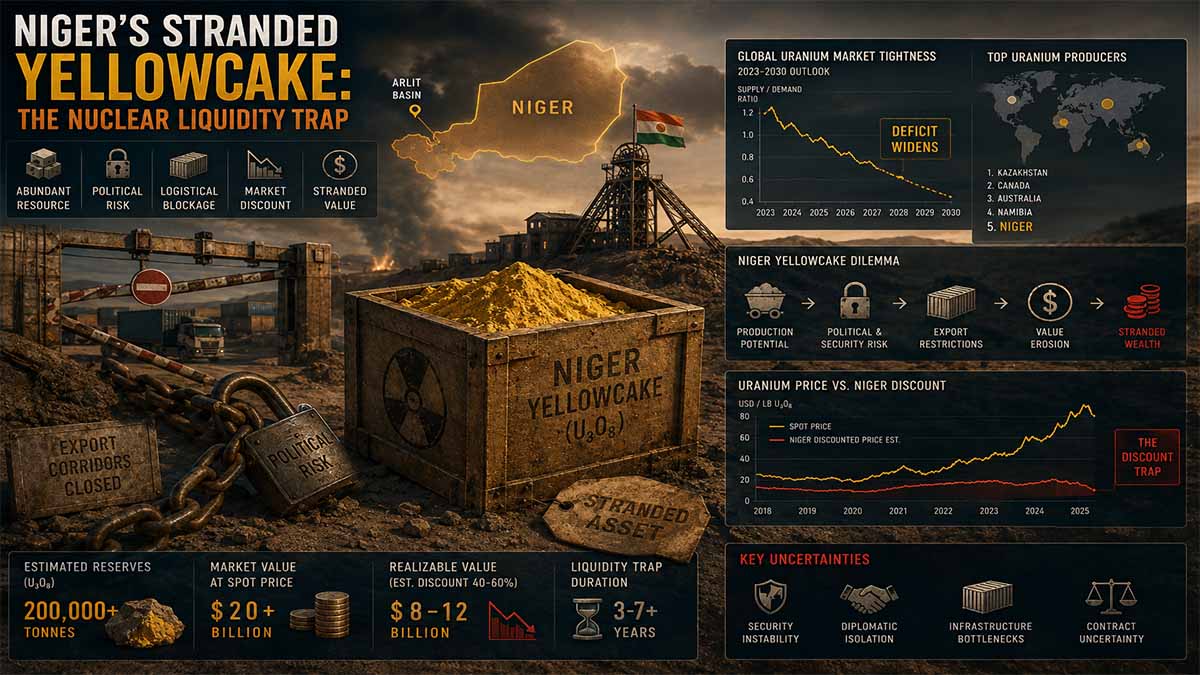
- BLUF: Niger physically controls approximately 1,000–1,050 tonnes of SOMAÏR yellowcake, but it has not demonstrated that it can lawfully and commercially monetize the material.
- The uranium was transported in late November 2025 from Arlit to Air Base 101, adjoining Niamey’s international airport.
- An ICSID provisional order dated 23 September 2025 prohibited Niger from selling, transferring or facilitating the transfer of the disputed uranium.
- The stock remained at Air Base 101 when the airport complex was attacked on 29 January 2026.
- Yellowcake is neither reactor-ready fuel nor weapons-grade uranium; the principal risks are loss of custody, contamination, diversion and coercive state-to-state transfer.
- The commercial constraint is not a single IAEA prohibition but a system of mutually reinforcing legal, logistical, financial, safety and end-user barriers.
- Russia remains a plausible strategic buyer, but no admissible evidence presently proves a completed Rosatom purchase.
- The case exposes the central weakness of nuclear-resource nationalism: territorial seizure does not automatically create internationally transferable title or liquidity.
- The most credible 2026–2031 outcome is a negotiated or heavily discounted state-backed disposition, not an ordinary commodity sale.
Niger’s Stranded Yellowcake and the Limits of Sovereignty
Niger’s uranium confrontation is no longer a conventional dispute over post-colonial ownership. It is a test of whether political control over a strategic resource can be converted into legal title, transportability and cash. After nationalising SOMAÏR in June 2025, Niamey obtained physical control of uranium produced at Arlit but inherited a formidable chain of constraints: international arbitration, radioactive-material transport rules, governmental end-use assurances, restricted conversion capacity, banking compliance and insecurity along every plausible export corridor. The result is a paradox with consequences extending well beyond the Sahel. Niger can possess the material, yet struggle to monetise it; Europe can replace the missing tonnes, yet only by accepting greater exposure to concentrated suppliers, Russian fuel-cycle services and a uranium market in which geopolitical reliability increasingly commands a premium.
The Break with Orano
The dispute began before nationalisation. Orano, the French nuclear-fuel group, owned 63.4% of SOMAÏR, while Niger’s state company SOPAMIN held 36.6%. On 4 December 2024, Orano announced that it had lost operational control of the company. On 20 December it initiated arbitration concerning the withdrawal of the Imouraren mining permit; on 21 January 2025 it opened a second proceeding over SOMAÏR, its inventory and the resulting financial damage. Orano initiates a second arbitration procedure vis-à-vis the State of Niger – Orano – January 2025.
Niger nationalised SOMAÏR on 19 June 2025. The decision transferred sovereign control over one of the country’s principal industrial assets, but it did not extinguish the former shareholder’s claims. Orano’s 2025 regulated reporting records the deconsolidation of SOMAÏR and the removal of its resources and reserves from the group’s portfolio. At the end of 2024, the mine still carried 40,108 tonnes of uranium in proven and probable reserves, of which 21,334 tonnes represented Orano’s attributable share. Indicated resources totalled another 30,609 tonnes, while inferred resources reached 28,757 tonnes. The cargo dispute is therefore only the liquid surface of a much larger contest over decades of potential production. 2025 Annual Activity Report – Orano – March 2026.
Possession Is Not Title
On 23 September 2025, the tribunal constituted in the International Centre for Settlement of Investment Disputes case ARB/25/8 ordered Niger not to sell or transfer uranium produced by SOMAÏR, or facilitate its transfer to third parties, when retained in violation of Orano’s asserted rights. The measure did not finally determine ownership: it preserved the contested position while arbitration continued. That distinction matters. Niger exercises effective physical control; Orano claims contractual and proprietary rights; the definitive legal allocation remains unresolved. ICSID arbitral tribunal opposes the sale of uranium produced by SOMAÏR – Orano – September 2025.
ICSID itself cannot intercept a convoy. Its leverage enters through counterparties. A prospective buyer must assess whether acquiring the uranium could expose it to attachment proceedings, damages claims, sanctions screening, loss of correspondent banking and exclusion from Western nuclear markets. Under Articles 53 and 54 of the ICSID Convention, final awards bind the parties and are enforceable through contracting states as if they were final domestic judgments. Convention on the Settlement of Investment Disputes between States and Nationals of Other States – ICSID – April 2006. Orano’s strategy is consequently aimed not only at Niger but at the ecosystem required to commercialise the material: traders, carriers, insurers, laboratories, converters, banks and ultimate users.
The Nuclear Liquidity Barrier
Yellowcake is not weapons-grade material, but neither is it an anonymous commodity. Its commercial movement requires verified composition, radiation classification, compliant packaging, transport documentation and an identifiable consignee. The International Atomic Energy Agency’s SSR-6 rules govern radioactive-material classification, package integrity, contamination limits, labelling, dose-rate controls and emergency arrangements. Regulations for the Safe Transport of Radioactive Material, 2025 Edition – IAEA – 2025. Maritime transport adds the International Maritime Dangerous Goods Code, whose 2024 amendments entered into mandatory application on 1 January 2026. Amendments to the International Maritime Dangerous Goods Code – IMO – May 2024.
The decisive barriers are cumulative. A mine cannot create nuclear liquidity merely by finding a politically sympathetic buyer. The consignee needs a lawful import channel; the receiving state must be able to provide the relevant assurances; the material requires an accepted conversion facility; the transporter needs permits and security plans; and the bank and insurer must be satisfied that neither title nor destination will generate an unquantifiable liability. Nuclear Suppliers Group guidelines reinforce peaceful-use assurances, safeguards and physical-protection expectations for controlled nuclear transfers. Guidelines for Nuclear Transfers – IAEA/NSG – November 2019.
| Commercial gate | Required capability | Principal Niger vulnerability |
|---|---|---|
| Legal title | Defensible ownership and transferable contract | Pending arbitration and third-party litigation risk |
| Assay | Verified uranium content and impurities | No publicly certified specification for the disputed shipment |
| Land transport | Licensed vehicles, security and emergency planning | Long routes through insurgency-affected territory |
| Transit | Consent of every jurisdiction crossed | Political friction with coastal neighbours |
| Maritime shipment | IMDG-compliant carrier and port handling | Landlocked geography and limited carrier appetite |
| Conversion | Facility willing to accept the batch | Globally concentrated, reputation-sensitive capacity |
| Finance | Traceable payment and correspondent banking | Enhanced compliance and attachment exposure |
| Insurance | Quantifiable ownership and transport risk | Political violence and radioactive-cargo exclusions |
| End use | Identifiable civil nuclear customer | Few buyers can absorb material outside established contracts |
The Corridor Trap
On 27 November 2025, Orano confirmed that a uranium shipment had departed the SOMAÏR site at Arlit without its authorisation. It stated that it had received no official information concerning the quantity, destination, safety or security arrangements and reserved the right to pursue responsible third parties. Orano condemns illegal shipment of uranium stored at the SOMAÏR site – Orano – November 2025.
International investigations subsequently placed roughly 1,000–1,050 tonnes of uranium concentrate in Niamey, reportedly around Air Base 101. The official record confirms the departure but not the publicly reported tonnage or final storage location. That evidentiary gap is economically material: tonnes of concentrate are not automatically tonnes of contained uranium, and valuation depends on assay, moisture, impurities, ownership and delivery terms.
Using 2025 Euratom benchmarks, 1,000 tonnes of contained uranium would carry a theoretical gross value of approximately EUR131 million at the average multiannual price of EUR131.37 per kilogram of uranium, or EUR169 million at the average spot price of EUR168.92. Those figures cannot be applied directly to an unassayed gross concentrate weight. Euratom Supply Agency Market Observatory – European Commission – 2026. The gap between headline valuation and financeable value is precisely where resource nationalism encounters nuclear-market reality.
Europe’s Supply Shock
Niger’s leverage over Europe was substantial but has already declined sharply. In 2022, Niger supplied EU utilities with 2,975 tonnes of uranium, equal to 25.38% of their deliveries. Euratom Supply Agency Annual Report 2022 – European Commission – October 2023. By 2025, deliveries of Nigerien origin had collapsed to 33 tonnes, only 0.23% of the European total and 97.14% below the previous year.
Europe absorbed the immediate disruption because utilities received 14,678 tonnes in 2025 while loading fuel equivalent to 12,916 tonnes of natural uranium. Their inventories ended the year at 42,522 tonnes, more than three average annual reactor reloads. This buffer prevents a near-term physical shortage. It does not eliminate structural concentration. Canada supplied 36.68% of EU uranium deliveries, Kazakhstan 20.31%, Russia 15.98%, Uzbekistan 10.37%, Australia 9.39% and Namibia 5.74%. Suppliers from the former Soviet space collectively accounted for 46.81%.
The dependence becomes more acute beyond mining. Russian facilities provided 24.40% of EU conversion services in 2025 and 22.55% of enrichment services. Niger’s disappearance therefore pushes European procurement toward a market already exposed to Russian processing, Kazakh transport corridors and a small number of Western facilities. The disputed cargo will not shut European reactors; its strategic effect is to intensify competition for politically reliable uranium and to raise the value of inventories, diversification contracts and domestic fuel-cycle capacity.
Moscow and Beijing
Russia and China possess the political relationships and industrial assets required to explore alternatives, but no official Russian or Chinese source has confirmed the purchase of the disputed SOMAÏR material. Russia’s embassy in Niger identifies cooperation between Rosatom and Niger’s Ministry of Mines as a promising bilateral sector. Russia–Niger bilateral relations – Embassy of the Russian Federation in Niger – 2026. China National Nuclear Corporation maintains an Africa office in Abuja tasked with uranium-resource development across sub-Saharan Africa. CNNC Africa Office – China National Nuclear Corporation – 2026.
Capability, however, is not equivalent to willingness. A Russian route would still require secure passage from landlocked Niger to a cooperating port, documented acceptance by a conversion facility and payment channels resilient to legal challenge. A Chinese transaction would confront the same title and logistics questions while potentially jeopardising wider commercial relationships. Both powers may gain more by using the stranded inventory as negotiating leverage—securing future mining rights, infrastructure concessions or preferential supply—than by acquiring the contested batch immediately.
Security Becomes a Price
The uranium dispute now intersects directly with the Sahel insurgency. Niger’s government confirmed that Niamey’s airport and Air Base 101 were attacked during the night of 28–29 January 2026. Attack on Niamey Airport – Government of Niger – January 2026. The United Nations subsequently identified attacks on Niamey airport and military facilities among the major terrorist incidents recorded during the first half of 2026, while warning that armed groups were expanding their use of drones, encrypted communications and cryptocurrency. Security Council briefing on West Africa and the Sahel – United Nations – July 2026.
Yellowcake does not create an immediate nuclear-detonation risk. The credible threats are theft, sabotage, dispersal, contamination, propaganda and the reputational consequences of losing control over a strategic cargo. Each threat increases escort requirements, insurance exclusions and the cost of persuading a legitimate buyer that custody remained intact. Security is therefore not external to valuation; it is one of its principal discounts.
The Five-Year Contest
Between 2026 and 2031, the most probable outcome is neither a spectacular clandestine sale nor an effortless return to French control. The stronger scenario is prolonged bargaining: Niger retains physical possession, Orano sustains arbitration and third-party deterrence, while prospective partners seek access to future production without assuming avoidable liability for the disputed inventory. A negotiated settlement could exchange compensation, inventory allocation and debt restructuring for a legally marketable supply framework. A second possibility is a state-to-state arrangement with a Russian or Chinese entity, but it would require a complete sovereign logistics chain and acceptance of reputational costs. A third is continued immobilisation, with deterioration in packaging, security and commercial value.
Transit diplomacy will be decisive. The United Nations reported that Niger and Nigeria reopened the Kamba crossing on 9 February 2026, while discussions continued over reopening the Niger–Benin frontier. A functioning southern corridor would reduce physical isolation, but it would not neutralise arbitration, port compliance or buyer due diligence. Geography can be reopened by decree; nuclear-market legitimacy cannot.
Europe’s Strategic Choice
Europe should treat Niger not as a lost supplier to be replaced tonne for tonne, but as a warning about the architecture of nuclear security. The essential assets are diversified mines, redundant conversion and enrichment capacity, strategic inventories, transport agreements and enforceable partnerships with producer states. The EU’s three-reload stock buffer provides time, not immunity.
For Niger, the lesson is equally severe. Sovereignty can determine who guards a warehouse and who operates a mine. It cannot by itself produce a recognised title, an insured corridor, a compliant converter or a solvent buyer. Uranium acquires value only inside an institutional chain. By breaking that chain before constructing another, Niamey transformed a strategic resource into a constrained asset—and revealed that, in the nuclear economy, power belongs not simply to the state controlling the ore, but to the network capable of moving, certifying, financing and using it.
Navigational Index
- Seizure, Title and Sovereign Control — SOMAÏR’s nationalization, the disputed inventory, ICSID restrictions and Orano’s enforcement strategy.
- The Nuclear Liquidity Barrier — safeguards, end-user assurances, transport regulation, conversion capacity, insurance, banking and transit corridors.
- The 2026–2031 Strategic Contest — Russian and Chinese options, Sahel security, shadow logistics, competing hypotheses and forward indicators.
Master Abstract
The Niger uranium crisis is real, but analytical accuracy requires separating independently corroborated events from claims advanced by the disputing parties. Nigerien authorities had already deprived Orano of operational control over SOMAÏR, the joint venture operating the Arlit uranium mine, before Niger announced the enterprise’s nationalization in June 2025. Orano’s regulated reporting confirms that it lost operational control in December 2024 and subsequently deconsolidated SOMAÏR from its financial perimeter — Annual Activity Report 2025 – Orano – May 2026 — regulated corporate report. On 23 September 2025, the arbitral tribunal constituted in ICSID case ARB/25/8 issued provisional measures directing Niger not to sell, transfer or facilitate the transfer to third parties of uranium produced by SOMAÏR and retained in violation of Orano’s asserted rights. Because the complete tribunal decision is not publicly accessible, its operative content is established through Orano’s official disclosure rather than an independently published ICSID order — The ICSID Arbitral Tribunal Opposes the Sale by the State of Niger of Uranium Produced by SOMAÏR – Orano – September 2025 — official disclosure. This distinction matters: the order restricted disposition of the material but did not, on the publicly available record, constitute a final award resolving every question of ownership, compensation or sovereignty. On 27 November 2025, Orano confirmed that an unauthorized uranium shipment had left SOMAÏR’s Arlit site, while expressly stating that it lacked official information about the quantity, destination and transport conditions — Orano Condemns Illegal Shipment of Uranium Stored at the SOMAÏR Site – Orano – November 2025 — official statement. The existence of the movement is therefore officially confirmed; its scale and endpoint depend on convergent investigative reporting.
That investigative record is unusually consistent. Reuters reported that the convoy carried approximately 1,050 tonnes of uranium concentrate. Le Monde subsequently reconstructed a movement of 34 trucks carrying 68 containers, which departed Arlit under military escort and reached Air Base 101, the military section adjoining Diori Hamani International Airport in Niamey. Satellite imagery and multiple French and regional sources were cited in support of the convoy’s composition and location — How a Uranium Supply Coveted by Russia Ended Up in Limbo in Niger – Le Monde – January 2026 — investigative reconstruction. On the night of 28–29 January 2026, the airport and Air Base 101 were subjected to a sustained armed attack. Niger’s government officially confirmed that Base 101 had been targeted, although its attribution of external responsibility was not accompanied by publicly disclosed evidence — Attaque sur l’aéroport de Niamey – Government of Niger – January 2026 — official government account. Reuters reported, citing separate sources, that approximately 1,000 tonnes remained at the base during the attack and were not damaged. The Financial Times reported on 15 February 2026 that Niger wanted to sell the stock but was struggling to secure a viable buyer — The 1,000 Tonnes of Uranium in the Crosshairs of Isis – Financial Times – February 2026 — international investigation. FPRI reported on 24 April 2026 that more than 1,000 tonnes remained at Air Base 101, still loaded on immobilized trucks — Why Niger Can Seize Uranium but Cannot Sell It – Foreign Policy Research Institute – April 2026 — strategic assessment. No later admissible source located for this report establishes that the entire stock has subsequently left the base; its exact disposition after April 2026 must therefore be treated as unresolved rather than assumed.
The resulting impasse is more complex than the proposition that the IAEA simply prohibits an unauthorized yellowcake sale. Uranium concentrate is not enriched uranium, fabricated fuel or a directly weapons-usable substance. Its precise safeguards treatment depends on its chemical composition, processing stage and the applicable safeguards agreement. Under an INFCIRC/153-type comprehensive safeguards regime, material that has not reached the composition and purity suitable for fuel fabrication or isotopic enrichment may remain in the category commonly described as pre-34(c) material. Imports and exports can nevertheless generate reporting obligations, including for material containing uranium or thorium that has not yet crossed the ordinary starting point of safeguards — Safeguards Implementation Guide for States with Small Quantities Protocols – IAEA – January 2013 — official safeguards guidance. The NPT separately requires non-nuclear-weapon states to accept safeguards and restricts nuclear transfers where the relevant material will not be subject to safeguards — Treaty on the Non-Proliferation of Nuclear Weapons – United Nations – July 1968 — official treaty text. Nuclear Suppliers Group guidelines add recipient assurances, peaceful-use conditions, safeguards expectations and physical-protection requirements — Guidelines for Nuclear Transfers, INFCIRC/254 – IAEA – November 2013 — official transfer guidelines. These instruments do not create one universal IAEA export licence for every drum of yellowcake. They instead contribute to a distributed compliance architecture in which exporting and transit governments, prospective recipients, conversion facilities, banks, insurers, shipowners and regulators can independently refuse participation. The material may consequently remain technically transferable while being legally contested, operationally hazardous, financially unbankable and politically toxic. This distributed veto structure—not a single prohibition—is the central mechanism producing the Nigerien stockpile’s illiquidity.
Logistics deepen the constraint. Niger is landlocked, while Arlit lies approximately 1,200 kilometres by road from Niamey and substantially farther from any suitable seaport. The historical southern corridor depended on access through Benin, but political relations and the continued closure of the Niger–Benin land border eliminated the most established route. Alternative movement toward Lomé would require transit through or around insecurity-affected territory in Burkina Faso and onward cooperation from Togo. Every transfer must preserve cargo integrity, radiation controls, documentary continuity and acceptance by the destination port and carrier. The applicable IAEA transport standards govern classification, packaging, marking, radiation limits, handling, emergency preparation and multimodal carriage of uranium concentrates — Regulations for the Safe Transport of Radioactive Material, SSR-6 Rev. 2 – IAEA – December 2025 — official transport requirements. A hypothetical airlift would not eliminate these requirements. It would instead compress them into a highly visible operation involving certified packaging, aircraft acceptance, overflight permissions, destination authorization and potentially prohibitive liability and insurance conditions. Even after export, yellowcake cannot enter a power reactor: it requires assaying and acceptance by a conversion plant, transformation into uranium hexafluoride or another appropriate feed material, enrichment where required, and fuel fabrication. Conversion capacity is concentrated among a small number of industrial operators operating within regulated national systems. A purchaser must therefore acquire not merely physical drums but an admissible chain of title, custody, analysis, conversion and end use. Niger controls the first link; the dispute concerns its capacity to secure all the others without Orano’s cooperation.
The economic value is correspondingly conditional. Published valuations ranging from approximately $170 million to $270 million, or roughly €145–250 million at the exchange rates used by the respective reports, do not necessarily contradict one another. They may apply different quantities, uranium-content assumptions, spot benchmarks, contract terms and legal discounts. A tonne of uranium concentrate is not automatically a tonne of contained uranium, while published uranium prices are normally quoted per pound of U₃O₈ and do not incorporate conversion, transport, financing or title risk. The stock’s gross reference value must therefore be distinguished from its risk-adjusted realizable value. A conventional nuclear utility or converter accepting contested material could face asset seizure, litigation, exclusion by insurers, reputational damage and interruption of long-term supplier relations. An alternative state buyer can internalize more of those risks, but it will demand compensation through a lower price, deferred payment, barter, future mining rights, security privileges or political concessions. This produces a sovereignty paradox: nationalization gives Niamey physical command over the material but can simultaneously increase dependence on the limited group of state-backed purchasers able to tolerate legal and compliance exposure. The narrower the buyer pool, the greater the monopsony power of Russia, China or any opaque intermediary. Resource nationalism may therefore transfer leverage from the former concession holder without transferring equivalent leverage to the producing state. In the most adverse configuration, Niger exchanges a diversified commercial relationship for a bilateral strategic dependency while realizing only a fraction of the stock’s nominal market value.
A structured Analysis of Competing Hypotheses identifies five principal pathways through 2031. H₁ — negotiated regularization: Niger and Orano reach a settlement covering ownership, revenue allocation, compensation and export documentation, allowing the material to re-enter a conventional fuel-cycle chain. H₂ — state-backed eastern transfer: a Russian, Chinese or other state-linked entity acquires some or all of the stock through a politically protected transaction, accepting litigation and reputational exposure in exchange for a discount or strategic concessions. H₃ — prolonged immobilization: the uranium remains a bargaining asset while physical custody costs, packaging risk and political exposure increase. H₄ — fragmented or triangular disposition: portions are moved through intermediaries, altered documentation or mixed contractual structures intended to obscure the contested title. H₅ — security failure: attack, theft, dispersal, mishandling or loss of inventory control transforms a commercial dispute into a radiological-security incident. The evidence available through April 2026 supports H₃ as the observed condition, but not necessarily the ultimate five-year outcome. The ICSID restriction and Orano’s threatened actions weaken H₂ and H₄ in conventional markets; Niger’s fiscal incentive to monetize the cargo weakens indefinite H₃; the limited universe of conversion-capable buyers prevents treating H₂ as implausible. No defensible historical dataset exists from which to calculate objective frequencies for this unique event. Accordingly, Bayesian and Monte Carlo outputs in this report are explicitly analyst-conditioned scenario estimates, not observed probabilities. Their purpose is to test how conclusions change when logistics, legal title, buyer protection, security and diplomatic settlement assumptions are varied.
The five-year outlook is therefore governed by identifiable indicators rather than speculative certainty. Evidence of joint sampling, independent inventory reconciliation, escrow arrangements or renewed communication between Niger and Orano would sharply strengthen H₁. A disclosed conversion contract, sovereign payment guarantee, port reservation, cargo-insurance certificate or Russian or Chinese government assurance would strengthen H₂. Continued satellite evidence of parked containers, renewed packaging work without onward movement and accumulating legal proceedings would reinforce H₃. Unexplained discrepancies in reported mass, container numbers, customs records or routing would increase concern about H₄. Security cordons, relocation into multiple storage sites, damaged packages, militant reconnaissance or cyber interference with inventory systems would elevate H₅. Three shadow dimensions require continuous tracking. The first is the role of Russian security personnel and any military-logistics organizations capable of protecting a sovereign transfer outside Western commercial channels. The second is the use of non-dollar payment networks, barter, mineral-backed credit or future concession rights to bypass conventional banking scrutiny. The third is documentary warfare: cyber intrusion, alteration of certificates of origin, substitution of batch identifiers or destruction of inventory records could degrade traceability without physically stealing a single container. The strategic lesson extends beyond Niger. Highly regulated minerals derive liquidity from institutional infrastructure as much as from geology. A government can seize a mine, its trucks and its warehouse inventory in a single political act. It cannot seize foreign ports, conversion plants, insurance capacity, correspondent banking, international title recognition or the confidence of end users. Niger’s stranded yellowcake is therefore not merely a Franco-Nigerien commercial dispute. It is a live test of whether territorial sovereignty can be converted into transactional sovereignty within an increasingly fragmented nuclear order.
Scenario variables
Competing-hypothesis sensitivity
Settlement, inventory reconciliation and conventional export.
Strategic buyer accepts legal and political exposure.
Stock remains a bargaining asset with declining liquidity.
Partial movement through intermediaries or opaque structures.
Attack, diversion, contamination or inventory disruption.
Seizure, Title and Sovereign Control: SOMAÏR’s Uranium Contest
Nationalization as an act of control
The nationalization of SOMAÏR must be understood as the culmination of a progressive transfer of operational, administrative and physical control rather than as a single event capable of extinguishing every pre-existing shareholder, contractual and property right. SOMAÏR was structured as a Nigerien joint venture in which Orano held 63.4% and Niger’s state-owned SOPAMIN held 36.6%. Following the July 2023 military takeover, the relationship deteriorated through restrictions on exports, interruption of established logistics, loss of corporate access and eventual assumption of operational control by the Nigerien authorities. Orano formally declared that it had lost operational control on 4 December 2024; it then initiated a second arbitration procedure on 21 January 2025, seeking damages and asserting rights over inventories corresponding to SOMAÏR production — Orano Initiates a Second Arbitration Procedure vis-à-vis the State of Niger Following the Loss of Operational Control over SOMAÏR – Orano – January 2025 — official corporate disclosure. Niger nationalized SOMAÏR on 19 June 2025. Orano characterizes the measure as an expropriation undertaken without legal process or compensation; that characterization appears in its audited financial reporting and must be attributed to the company rather than treated as an adjudicated conclusion — Annual Activity Report 2025 – Orano – May 2026 — regulated annual report. The legal distinction is decisive. Niger unquestionably exercises territorial sovereignty and de facto administrative power over the mine, personnel, production facilities and material situated within its territory. That does not automatically determine whether nationalization complied with the applicable investment framework, whether compensation is owed, whether uranium produced before nationalization belonged beneficially to SOMAÏR, Orano or a customer under an offtake arrangement, or whether a subsequent foreign purchaser would acquire uncontested title. The case consequently operates across four different layers of authority: sovereign legislative control, corporate ownership, contractual entitlement and internationally recognizable title.
| Control layer | Niger’s strongest position | Orano’s strongest position | Unresolved legal question |
|---|---|---|---|
| Territorial control | Mine, roads, storage sites and public authorities are inside Niger | Physical exclusion does not itself extinguish rights | Can territorial control be exercised without compensation liability? |
| Corporate control | Nationalization transferred effective command of SOMAÏR | Orano held the controlling equity interest before nationalization | Was the taking lawful, compensated and consistent with applicable commitments? |
| Inventory control | Niger controls access to produced material | Orano claims offtake and inventory rights tied to production | Who held legal or beneficial title to each production batch? |
| Export control | Niger can issue domestic authorizations | Foreign jurisdictions need not recognize those authorizations | Can Niger confer title that survives foreign litigation or attachment? |
| Commercial control | Niger may select a prospective purchaser | Orano can warn buyers, converters, banks and carriers | Which counterparty will accept litigation and enforcement exposure? |
Inventory: mass is not title
The disputed inventory must be disaggregated by batch, production date, uranium content, accounting treatment, contractual allocation and physical custody. Public reporting has commonly described a transferred quantity of approximately 1,000–1,050 tonnes of yellowcake, but the precise figure is not contained in the publicly accessible primary documents permitted under the present evidence protocol. The defensible primary-source conclusion is narrower: Orano confirmed on 27 November 2025 that a shipment of uranium had left the SOMAÏR site in Arlit, while explicitly stating that it possessed no official information about its quantity, destination or safety and security conditions — Orano Condemns Illegal Shipment of Uranium Stored at the SOMAÏR Site – Orano – November 2025 — official corporate statement. The widely reported 1,000–1,050-tonne band should therefore be used as an intelligence working estimate with medium confidence, not as a measurement certified by Orano, Niger, the IAEA or ICSID. More importantly, “tonnes of yellowcake” cannot be converted mechanically into tonnes of uranium or a market valuation. Uranium concentrate may be expressed as total product mass, U₃O₈ mass or contained uranium, and each convention produces a different economic result. Laboratory assays, moisture, impurities, packaging condition and the conversion facility’s acceptance criteria affect the deliverable quantity. Legal title can also vary within one physical stockpile: batches may have been produced before or after operational control changed; production may have been committed under existing offtake rights; costs may have been financed by different shareholders; and inventory may have been recognized differently in SOMAÏR’s accounts and Orano’s consolidated statements. A credible adjudication or settlement therefore requires a container-level inventory rather than a political declaration that “the uranium belongs to Niger” or “belongs to Orano.” The evidentiary core would include production logs, batch identifiers, assay certificates, warehouse receipts, shareholder resolutions, sales commitments, transport documents and audited inventory records. Loss or manipulation of any of these records would not eliminate the material, but it would sharply reduce its legal and commercial fungibility.
| Inventory variable | Required evidence | Consequence if missing | Intelligence confidence |
|---|---|---|---|
| Gross concentrate mass | Calibrated weighing records and container manifests | Valuation range remains unstable | Medium |
| Contained uranium | Independent sampling and assay certificates | Buyer cannot price conversion feed reliably | Low–medium |
| Production date | Mill and warehouse batch records | Pre- and post-nationalization rights cannot be separated | Medium |
| Contractual allocation | Offtake agreements and customer nominations | Beneficial ownership remains contested | Low |
| Physical integrity | Seal records, photographs and inspection reports | Tampering or contamination cannot be excluded | Medium |
| Present custody | Official site inventory and independent inspection | Location may be known without proving completeness | Medium |
| Regulatory status | Export, safeguards and transport documentation | Conversion plants and carriers may reject delivery | Low–medium |
The ICSID restriction
The 23 September 2025 measure issued by the tribunal constituted under ICSID case ARB/25/8 is the pivotal legal constraint, but its procedural meaning must be stated precisely. According to Orano’s audited consolidated financial statements, the tribunal ordered Niger not to sell, transfer or facilitate the transfer to third parties of uranium produced by SOMAÏR and retained in violation of Orano’s rights — Consolidated Financial Statements as of 31 December 2025 – Orano – May 2026 — audited financial statements. The decision is best understood as a provisional measure preserving disputed rights and preventing the subject matter of the arbitration from being irreversibly transferred before final adjudication. Article 47 of the ICSID Convention authorizes a tribunal to recommend provisional measures when circumstances require the preservation of the parties’ respective rights — Convention on the Settlement of Investment Disputes between States and Nationals of Other States, Article 47 – ICSID – October 1966 — official convention text. The order is therefore not equivalent to a final award conclusively declaring that every container is Orano property. It nonetheless creates a serious litigation barrier because any sophisticated buyer receiving notice of the order would understand that acquisition might aggravate Niger’s exposure, interfere with the tribunal’s jurisdiction and generate claims against third parties. The distinction between provisional measures and final awards also affects enforcement. Articles 53 and 54 of the Convention require contracting states to recognize an ICSID award as binding and enforce its pecuniary obligations as though it were a final domestic judgment, subject to the Convention’s remedies and Article 55’s preservation of state-immunity rules. A provisional measure does not automatically become a money judgment enforceable under Article 54. Its practical force instead derives from tribunal authority, the risk of adverse inferences, eventual damages, reputational consequences and the possibility that assets or payment streams associated with a later transaction could become enforcement targets.
Jurisdictional & Title Risk Chain Matrix
Nigerien Physical Uranium Asset Flow & ICSID Arbitration Mechanics
Orano’s enforcement architecture
Orano’s enforcement strategy is designed to expand the dispute beyond the bilateral relationship with Niger and contaminate the transaction perimeter for every enabling counterparty. In January 2025, the company reserved the right to bring proceedings against third parties that pre-empted material in violation of its offtake rights. In June 2025, when opposing the nationalization plan, it again warned that it could initiate legal action, including criminal proceedings, against third parties involved in the allegedly unlawful seizure of materials — Orano Opposes Nationalization Plans of SOMAÏR in Niger – Orano – June 2025 — official corporate statement. After the November movement, Orano reiterated that warning and expressly linked the shipment to the September ICSID measure. The strategy creates several concentric enforcement zones. The first is the arbitration itself, where unauthorized disposition could influence provisional relief, evidence preservation, damages and allocation of costs. The second is civil litigation against a purchaser or intermediary in any jurisdiction recognizing claims based on ownership, conversion of property, interference with contractual rights or unjust enrichment. The third is criminal referral where national law potentially covers theft, concealment, receipt of disputed property, falsified documentation or unlawful handling of regulated material. The fourth is asset tracing: payment accounts, receivables, cargo, insurance proceeds or non-sovereign commercial property may be more reachable outside Niger than the mine itself. The fifth is compliance deterrence, which does not require Orano to win a final case before affecting behaviour. A bank, insurer or conversion operator may refuse participation simply because its expected return does not compensate for injunction risk, compliance review, reputational damage and disruption to long-term nuclear-sector relationships. This is particularly powerful in uranium markets because the number of qualified conversion facilities, specialist carriers and nuclear-material customers is small. Orano does not need to exercise territorial power over the stock. It needs to make the stock commercially radioactive in the legal sense: identifiable, contested, expensive to finance and dangerous for conventional counterparties to accept.
| Enforcement channel | Likely target | Legal or commercial mechanism | Expected deterrent effect |
|---|---|---|---|
| ICSID proceedings | Niger | Provisional measures, damages, costs, adverse findings | High against conventional settlement; lower against defiance |
| Civil proceedings | Buyer, broker or converter | Title, contractual interference, conversion, unjust enrichment | High in jurisdictions with reachable assets |
| Criminal complaints | Intermediaries and document handlers | Alleged unlawful appropriation, concealment or falsification | Potentially high, but jurisdiction-dependent |
| Asset tracing | Payments and commercial property | Attachment following judgment or award | High where transaction touches cooperative jurisdictions |
| Compliance notification | Banks, insurers and carriers | Enhanced due diligence and refusal of service | Very high because no final judgment is required |
| Industry exclusion | Conversion and fuel-cycle firms | Contractual and reputational risk management | High within concentrated nuclear markets |
| Public disclosure | Governments and counterparties | Notice defeating claims of innocent acquisition | Medium–high |
The limits of sovereign title
Niger’s strongest legal argument begins with permanent sovereignty over natural resources, domestic legislative competence and the authority to determine the conditions under which minerals within its territory are exploited. Its weakest point is the assumption that sovereignty over uranium in the ground necessarily resolves rights in processed material already produced by a joint venture and potentially allocated under shareholder or offtake arrangements. Nationalization can transfer shares, concessions and assets under domestic law, but it does not automatically compel foreign jurisdictions to disregard investment commitments, compensation standards, contractual allocations or a tribunal’s preservation order. The distinction resembles the difference between the sovereign power to levy tax and the separate question of whether a particular tax measure violates an investment guarantee. Niger may possess the governmental capacity to nationalize while remaining internationally responsible for the manner, discrimination, compensation or consequences of that taking. Conversely, Orano’s majority shareholding does not automatically prove personal ownership of every physical tonne. A company normally owns assets separately from its shareholders; SOMAÏR’s legal personality, applicable accounting rules, contractual offtake structure and shareholder arrangements determine whether Orano’s interest is direct ownership, a lifting entitlement, a receivable or an economic claim. This is why the publicly available ICSID description refers to uranium retained in violation of Orano’s rights rather than publishing a simple declaration that Orano owns all material. The dispute becomes more difficult if Niger transfers the stock to another sovereign or a state enterprise. State-backed purchasers may assert sovereign arrangements, resist foreign jurisdiction or structure payment outside exposed financial systems. Yet a state-to-state label does not erase the material’s provenance. The uranium must eventually enter a physical fuel-cycle facility, and that facility ordinarily keeps records, accepts regulatory oversight and interacts with international suppliers. A transaction can therefore evade immediate Western leverage without becoming commercially clean. Sovereignty can relocate risk; it cannot abolish the industrial dependencies through which yellowcake becomes usable nuclear fuel.
European exposure: supply shock versus strategic displacement
The stranded inventory has limited capacity to cause an immediate aggregate uranium shortage in Europe, but it materially changes the geography and political composition of European supply. In 2022, Niger delivered 2,975 tU, equal to 25.38% of all natural uranium supplied to EU utilities, making it the Union’s second-largest origin after Kazakhstan — Euratom Supply Agency Annual Report 2022 – Euratom Supply Agency – October 2023 — official annual report. By 2025, deliveries of Niger-origin uranium had fallen to only 33 tU, or 0.23% of EU deliveries, a year-on-year decline of 97.14%. EU utilities nevertheless purchased 14,678 tU during 2025 and loaded the equivalent of 12,916 tU into reactors. Canada provided 5,384 tU, Kazakhstan 2,981 tU, Russia 2,346 tU, Uzbekistan 1,522 tU, Australia 1,379 tU and Namibia 842 tU — Market Observatory: Supply of Natural Uranium in 2025 – Euratom Supply Agency – 2026 — official market data. Using the reported stock range only as an intelligence estimate, 1,000 tU would equal approximately 6.8% of the EU’s 2025 purchases and 7.7% of the natural-uranium equivalent loaded into reactors. That is strategically relevant but insufficient, by itself, to disable Europe’s reactor fleet. The deeper effect is substitution. The disappearance of Nigerien supply coincided with 46.81% of 2025 EU natural-uranium deliveries originating in Commonwealth of Independent States countries. Europe reduced one African exposure but became more dependent on Kazakhstan, Russia and Uzbekistan at a time when reducing Russian nuclear-fuel leverage remains a strategic objective. The Niger crisis therefore influences Europe through portfolio composition, inventory policy, contract prices, conversion scheduling and bargaining power—not merely through missing tonnes.
| EU natural-uranium origin | 2022 deliveries | 2022 share | 2025 deliveries | 2025 share | Strategic interpretation |
|---|---|---|---|---|---|
| Niger | 2,975 tU | 25.38% | 33 tU | 0.23% | Near-total collapse of established supply |
| Canada | 2,578 tU | 21.99% | 5,384 tU | 36.68% | Principal Western replacement source |
| Kazakhstan | 3,145 tU | 26.82% | 2,981 tU | 20.31% | Large supply, but exposed to Eurasian transit |
| Russia | 1,980 tU | 16.89% | 2,346 tU | 15.98% | Persistent strategic dependence |
| Uzbekistan | 441 tU | 3.76% | 1,522 tU | 10.37% | Rapidly expanded substitute supply |
| Australia | 327 tU | 2.79% | 1,379 tU | 9.39% | Politically reliable but geographically distant |
| Namibia and regional grouping | 262 tU | 2.23% | 842 tU | 5.74% | African diversification shifted southward |
| Total EU deliveries | 11,724 tU | 100% | 14,678 tU | 100% | Volume resilience masks geopolitical recomposition |
The European impact also extends beyond mining origin. Uranium security depends on a sequence of conversion, enrichment and fuel-fabrication services whose capacity is more concentrated than global ore resources. A disputed Nigerien batch purchased by a Russian-linked entity could enter a Russian-controlled conversion or enrichment chain, thereby allowing Moscow to convert a distressed African asset into additional fuel-cycle leverage. The effect would not necessarily appear as “Russian uranium” in political discussion because mining origin and service provider are different dimensions: Nigerien ore can generate revenue and feedstock for a Russian enterprise even though its geological origin remains Niger. Europe must therefore monitor not only the country of extraction but also the converter, enricher, contractual owner, transport corridor and financing provider. The Euratom Supply Agency reported that, following Russia’s invasion of Ukraine, EU utilities accumulated nuclear materials and fuel and in 2025 purchased more material than they loaded, creating a short-term buffer — Market Observatory: Nuclear Fuel Supply and Demand – Euratom Supply Agency – 2026 — official market data. That buffer reduces immediate operational exposure but cannot permanently offset structurally concentrated services. The stranded SOMAÏR stock may consequently influence European contract negotiations even if it never reaches an EU customer: its removal from transparent markets narrows optionality; a Russian acquisition would increase Moscow’s feedstock flexibility; prolonged immobilization would reinforce the perception of African political risk; and a negotiated Orano settlement could reopen a non-CIS supply corridor. The relevant European metric is therefore not whether 1,000 tonnes can “power Europe,” but whether their eventual disposition improves or worsens the Union’s diversification across every stage of the nuclear fuel cycle.
Russian and Chinese strategic optionality
The multilingual primary-source search produces an important negative finding: no live official Russian government, Rosatom, Chinese government or CNNC document reviewed for this section confirms a completed purchase of the disputed SOMAÏR inventory. Claims that Russia “has already bought” the material must therefore remain unverified. This absence does not make Russian or Chinese participation implausible; it limits the confidence with which intent can be converted into fact. A state-backed nuclear enterprise possesses structural advantages over an ordinary commodity trader: sovereign diplomatic access, existing fuel-cycle infrastructure, capacity to accept longer settlement periods, control over conversion or enrichment services and the ability to exchange cash for mining concessions, security assistance or future production. China’s national nuclear corporation confirms that its Africa office in Abuja covers nuclear power, resource exploration and uranium-resource development across sub-Saharan Africa, while its Middle East office, including an Algiers presence, covers resource development and trade — Global Operations – China National Nuclear Corporation – 2026 — official CNNC corporate information. This establishes institutional capacity, not involvement in the SOMAÏR transaction. The same evidentiary discipline must apply to Russia. Moscow could treat the inventory as a relatively small material acquisition but a disproportionately valuable political instrument: purchasing it would demonstrate that Western legal pressure cannot entirely prevent Sahelian governments from redirecting strategic resources. Yet Russia would inherit several burdens, including title litigation, transport protection, batch acceptance and the need to prevent the transaction from disrupting other nuclear relationships. China would face similar constraints while generally having stronger incentives to preserve regulatory predictability for its global infrastructure and reactor-export business. The most likely non-Western mechanism is therefore not a crude clandestine purchase. It is a sovereignly protected package combining material acquisition, future mining access, logistics, security cooperation and deferred or non-transparent financial consideration.
Shadow dimensions
The shadow architecture surrounding the stock is more consequential than the market value alone. The first dimension is security-provider leverage. A convoy moving from Niamey toward Burkina Faso, Togo, Algeria or another exit point would require intelligence preparation, route control, hardened escort, emergency response and coordination across sovereign jurisdictions. Nigerien forces may seek assistance from foreign military personnel or security contractors already present in the country. Whoever secures the movement would acquire privileged knowledge of timing, container identity and destination and could transform logistical protection into influence over the transaction. The second dimension is liquidity engineering. Conventional dollar or euro payment would expose banks and identifiable accounts to compliance review and possible litigation. Alternative structures could include advance payments against future production, barter for military equipment, settlement through a non-Western currency, escrow in a less cooperative jurisdiction, transfer of mining participation or an offset against security services. Such mechanisms reduce transparency but do not eliminate counterparty and delivery risk. The third dimension is cyber-documentary manipulation. Uranium’s physical characteristics cannot be digitally rewritten, but its commercial identity depends on batch records, assay data, seal numbers, certificates of origin, ownership documentation and transport declarations. Compromise of customs or inventory systems could create conflicting chains of custody, substitute container identities or disguise the relationship between disputed material and a later delivery. The fourth dimension is narrative warfare: Niger can frame nationalization as decolonization and resource sovereignty; Orano can frame it as uncompensated expropriation and unlawful diversion; Russia can portray any acquisition as sovereign South–South commerce; Europe can frame enforcement as protection of nuclear governance. These narratives affect domestic legitimacy, diplomatic alignment and the willingness of third countries to facilitate transit. The intelligence requirement is therefore to track material, documents, money, protection and narrative as a single interconnected system.
| Shadow vector | Observable indicators | Strategic implication | European relevance |
|---|---|---|---|
| Foreign security support | New perimeter units, escorts, aircraft or protected convoys | Imminent movement or bargaining escalation | Indicates external power acquiring operational influence |
| Alternative settlement | Barter, mining rights, deferred payment, non-Western escrow | Nominal sale price may conceal a deeper concession | Weakens transparency and sanctions-screening capacity |
| Document substitution | Changed batch numbers, inconsistent weights, new origin certificates | Attempt to launder contested provenance | Raises converter and customs compliance risk |
| Cyber intrusion | Disrupted inventory databases or customs systems | Traceability can be degraded without stealing material | Threatens confidence in nuclear-material accounting |
| Port diplomacy | Unusual customs exemptions or secure terminal preparation | Export corridor moving from theory to execution | Identifies states exposed to legal and diplomatic pressure |
| Narrative synchronization | Identical sovereignty messaging across governments | Coordinated political protection for transaction | Signals broader challenge to Western enforcement norms |
ACH assessment and Bayesian update
The Analysis of Competing Hypotheses should not assign confidence according to which scenario appears politically dramatic. It must evaluate which hypothesis best explains the verified sequence: loss of Orano’s operational control, nationalization, initiation of arbitration, a provisional restriction, confirmed removal of uranium from Arlit, third-party legal warnings and the absence of a publicly verified completed sale. H₁, negotiated regularization, explains why all parties might ultimately preserve economic value but does not yet explain the continued confrontation. H₂, a state-backed Russian or Chinese transfer, explains Niger’s capacity to bypass conventional buyers but lacks primary confirmation of a completed contract. H₃, prolonged immobilization, currently fits the interaction of physical control and legal-commercial paralysis most closely. H₄, fragmented triangular disposition, becomes more plausible if batch records, customs data or mass balances diverge. H₅, eventual compensation award without physical restitution, recognizes that Orano may be unable to recover the material but may secure a monetary claim. H₆, negotiated re-entry under a new commercial structure, differs from H₁ by allowing Niger to retain sovereignty and select new partners while compensating or settling with Orano. A disciplined Bayesian update assigns no immutable numerical truth. The prior distribution should reflect the rarity of comparable cases, while likelihood adjustments respond to specific evidence. The September order increases H₃ and H₅ by making a conventional sale more difficult. The November movement increases H₂, H₄ and H₆ because Niger demonstrated intent to alter physical custody. The absence of official Russian or Chinese confirmation weakens, but does not eliminate, H₂. Europe’s successful substitution away from Niger reduces pressure on Orano and France to accept an immediate unfavourable compromise, indirectly supporting H₃ and H₅. Niger’s fiscal and political incentives work in the opposite direction, making indefinite storage costly and gradually strengthening H₂ or H₆ over a five-year horizon.
| Hypothesis | Present evidentiary fit | Evidence supporting it | Evidence inconsistent or absent | 2031 directional assessment |
|---|---|---|---|---|
| H₁: Full negotiated regularization | Medium | Both parties preserve value and reduce legal risk | No public settlement architecture | Plausible but politically difficult |
| H₂: State-backed non-Western transfer | Medium | Niger controls material; limited buyers can absorb risk | No primary confirmation of completed purchase | Rising if logistics and sovereign guarantees emerge |
| H₃: Prolonged immobilization | High | Legal restriction, title risk, narrow buyer pool | Niger has strong incentive to monetize | Most consistent current condition, less stable over time |
| H₄: Triangular or fragmented disposition | Low–medium | Could reduce visibility and spread risk | No verified batch discrepancy or partial transfer | Rises if records become inconsistent |
| H₅: Compensation without restitution | Medium–high | Typical remedy where physical recovery is impractical | Final award not yet public | Strong long-term legal pathway |
| H₆: New structure with Niger retaining control | Medium | Could reconcile sovereignty with commercial compliance | Requires complex multi-party agreement | Increasingly credible over five years |
Five-year outlook and Monte Carlo structure
The 2026–2031 outlook should be modeled as a dynamic transition rather than a one-time forecast. The baseline analytical model begins with H₃ as the dominant observed state and permits annual transitions based on four variable families: legal resolution, corridor availability, state-backed buyer support and custody integrity. A Monte Carlo architecture of 100,000 simulated paths should draw annual values from bounded distributions rather than pretending that precise frequencies are known. Legal settlement probability rises as arbitration costs and opportunity losses accumulate; corridor availability remains volatile because it depends on Niger’s relations with Benin, Burkina Faso and potential coastal transit states; state-backed buyer support depends on geopolitical willingness to absorb enforcement risk; custody integrity declines when storage and documentation remain outside the previous operator’s controls. Under the transparent baseline used for Figure 1, the 2031 terminal distribution remains centered on three outcomes: negotiated restructuring, state-backed transfer and compensation without physical restitution. Prolonged immobilization remains substantial but declines over time because political and storage costs accumulate. Custody failure remains a low-probability, high-impact tail rather than the central expectation. These outputs are analytical products, not official intelligence estimates. Their value lies in sensitivity: if legal regularization exceeds approximately 55% while corridor access improves, H₁ and H₆ dominate; if buyer support rises without legal settlement, H₂ becomes the leading disposition route; if both corridor access and custody integrity deteriorate, H₃ and H₅ expand; if documentary anomalies appear, H₄ rises sharply. Europe’s policy objective should be to prevent the apparent binary choice between indefinite immobilization and an opaque transfer. A structured settlement that preserves Nigerien economic participation, independently verifies the inventory and prevents monopolistic capture by a single external power would better protect European diversification, nuclear governance and Sahelian stability.
| Period | Principal decision point | Indicators to monitor | Expected strategic effect |
|---|---|---|---|
| 2026–2027 | Preservation or movement of inventory | Independent inspection, seal status, convoy preparation, new negotiations | Determines whether current immobilization persists |
| 2027–2028 | Arbitration maturation | Procedural decisions, quantum claims, settlement channels | Clarifies compensation and enforcement exposure |
| 2028–2029 | Buyer and corridor consolidation | Conversion agreement, port access, sovereign guarantees | Converts political intent into executable trade |
| 2029–2030 | Enforcement or restructuring | Asset tracing, escrow, compensation framework | Shifts contest from physical control to financial resolution |
| 2030–2031 | Terminal disposition | Sale, settlement, allocation or continuing storage | Establishes precedent for regulated-resource nationalization |
Strategic implications
The SOMAÏR dispute establishes a precedent far beyond Niger because it tests whether nationalization of a regulated strategic commodity can generate durable sovereignty or merely replace one form of dependence with another. Niger succeeded in removing the foreign operator, controlling the production site and relocating at least part of the disputed inventory. It has not publicly demonstrated a complete chain capable of converting that control into uncontested international revenue. Orano, conversely, lost the mine and physical access but retained powerful extraterritorial instruments: arbitration, notice to counterparties, concentrated industry relationships, potential asset tracing and the ability to raise transaction costs without physically intercepting the uranium. Europe absorbed the immediate supply loss through Canada, Kazakhstan, Uzbekistan, Australia and Namibia, but this resilience came with a strategic penalty: higher exposure to CIS-origin material and a reduced European position in the Sahelian uranium economy. A Russian-controlled disposition would compound that penalty by turning Nigerien geological resources into leverage inside a Russian-linked fuel-cycle architecture. A Chinese acquisition would diversify the buyer away from Moscow but could further detach African mineral production from European industrial networks. Indefinite immobilization would deny the material to every buyer but would deepen Niger’s fiscal loss and increase custody risks. The optimal European response is therefore neither restoration of the pre-2023 arrangement by coercion nor passive reliance on arbitration. It is a negotiated framework combining compensation, Nigerien revenue participation, independent inventory verification, IAEA-consistent reporting, secure transport, diversified conversion options and enforceable end-use commitments. The decisive lesson is that sovereignty over strategic materials has become modular. Niger possesses sovereign control of territory; Orano possesses claims, data and commercial relationships; ICSID possesses adjudicatory authority; foreign states control transit; banks control liquidity; insurers control risk transfer; and conversion plants control entry into the usable fuel cycle. No actor possesses the entire system. The five-year contest will be decided by whichever coalition integrates the most modules without losing legal legitimacy, operational security or economic value.
The Nuclear Liquidity Barrier: Why Niger’s Yellowcake Cannot Move Like Gold
A chain of permissions, not a single prohibition
The disputed SOMAÏR inventory is constrained by a nuclear liquidity barrier: a cumulative system in which physical possession is economically useless unless the seller can also establish an acceptable product specification, transferable title, a recognized end user, compliant safeguards reporting, licensed transport, secure transit, insurance, banking and admission into a conversion facility. No single institution exercises absolute control over this chain. The IAEA does not act as a global commercial licensing office that approves or rejects every yellowcake sale, while the Nuclear Suppliers Group does not operate as a supranational police authority. Instead, each state incorporates different elements of international safeguards, nuclear-transfer guidelines, transport standards, customs law, dangerous-goods regulation and financial controls into its national system. Commercial actors then impose additional requirements that may be stricter than the formal law. This fragmented architecture explains why Niger can move uranium internally yet remain unable to convert it into reliable external revenue. A government vehicle can leave Arlit under military escort without satisfying a foreign converter’s acceptance protocol; a domestic export authorization cannot force Benin, Togo, Algeria or another transit state to admit the cargo; a buyer’s declaration cannot compel a bank to process payment; and an end-user certificate cannot cure a contested ownership claim. Liquidity therefore decreases multiplicatively. If title acceptability, transit approval, qualified transport, insurance, financing and converter admission each had an illustrative independent success rate of 70%, the combined probability of a seamless transaction would be only approximately 11.8%. The real dependencies are not fully independent, but the calculation demonstrates the underlying mechanism: a moderately difficult obstacle at every stage produces an exceptionally difficult transaction overall. Yellowcake is thus unlike gold, which can be divided, recast, blended and sold through numerous industrial and financial channels. Uranium concentrate must ultimately enter a narrow and recorded fuel-cycle infrastructure.
| Liquidity gate | Principal decision-maker | Required evidence | Failure consequence |
|---|---|---|---|
| Product identity | Independent laboratory and converter | Weight, uranium content, impurities, batch records | Cargo cannot be priced or accepted |
| Legal title | Seller, buyer, legal counsel and courts | Ownership chain, offtake rights, arbitration status | Buyer inherits litigation risk |
| Safeguards status | Niger, recipient state and IAEA framework | Material category, reports and transfer notifications | Unmatched or non-compliant transfer |
| End-user assurance | Exporting and recipient governments | Final user, location, peaceful use and retransfer terms | Export or import authorization refused |
| Road transit | Each territorial state | Dangerous-goods permits, customs declarations and security plan | Convoy denied entry or immobilized |
| Maritime transport | Port authority, carrier and flag state | IMDG compliance, stowage, manifests and emergency arrangements | Vessel or terminal refuses cargo |
| Air transport | Civil aviation authority and airline | ICAO classification, packaging and state variations | Airlift becomes unavailable or uneconomic |
| Insurance | Cargo, liability and political-risk underwriters | Title opinion, route assessment, packaging and emergency plan | Carrier and financier will not proceed |
| Banking | Originating, intermediary and receiving banks | Beneficial ownership, purpose, sanctions and proliferation screening | Payment blocked, delayed or frozen |
| Conversion | Qualified nuclear-fuel-cycle operator | Assay, origin, ownership, safeguards and delivery nomination | Yellowcake remains non-usable inventory |
Safeguards: where IAEA control actually begins
The safeguards issue requires precision because yellowcake sits near the boundary between mining activity and the formal nuclear fuel cycle. Niger is a party to the Treaty on the Non-Proliferation of Nuclear Weapons and has a comprehensive safeguards relationship with the IAEA. Under the standard INFCIRC/153 architecture, the Agency’s full material-accountancy safeguards ordinarily begin when uranium has reached the composition and purity suitable for fuel fabrication or isotopic enrichment, generally described through the threshold in paragraph 34(c). Material before that point—including uranium ore and some concentrates—is frequently described as pre-34(c) material. This does not mean that yellowcake exists in a legal vacuum. States can be required to report imports and exports of material containing uranium or thorium even before the ordinary starting point of full safeguards, and an additional protocol can expand information concerning uranium mining, concentration plants, exports and imports. The applicable IAEA guidance explicitly addresses reporting for imports and exports of both paragraph 34(c) nuclear material and material that has not yet reached that stage — Safeguards Implementation Guide for States with Small Quantities Protocols – International Atomic Energy Agency – January 2013 — official safeguards implementation guide. The current status lists published by the IAEA provide the authoritative framework for determining which safeguards agreements and additional protocols are in force for individual states — Status List: Conclusion of Safeguards Agreements, Additional Protocols and Small Quantities Protocols – International Atomic Energy Agency – June 2026 — official safeguards status document. The critical point is that IAEA safeguards do not create commercial title and do not replace national export authorization. They establish nuclear-material transparency and verification obligations directed at states. A transaction may therefore be correctly reported for safeguards purposes yet remain unlawful under an arbitral measure, rejected by a port or unbankable because of ownership risk. Conversely, a seller cannot use the claim that yellowcake is “not yet fully safeguarded” to avoid every reporting, security or recipient-state obligation. The material’s exact chemical state, concentration and intended destination must be established before the appropriate safeguards pathway can be determined.
| Material stage | Typical physical form | Safeguards significance | Commercial significance |
|---|---|---|---|
| Ore in the ground | Mineralized rock | Outside ordinary nuclear-material accountancy | No portable international commodity |
| Mined ore | Crushed or processed rock | Mining and production information may remain relevant | Very low value-to-mass ratio |
| Uranium concentrate | Yellowcake, often dominated by U₃O₈ | May remain pre-34(c), subject to applicable reporting | Exportable only with assay, documentation and compliant custody |
| Conversion feed | Purified uranium compounds | Approaches or crosses full safeguards starting point | Requires qualified conversion facility |
| Uranium hexafluoride | UF₆ | Nuclear-material accountancy and strict transport controls | Necessary feed for most enrichment services |
| Enriched uranium | UF₆ or oxide with elevated U-235 | Enhanced safeguards, security and export-control sensitivity | Far narrower permitted customer base |
| Fabricated fuel | Pellets and assemblies | Facility-specific accountancy and verification | Reactor-design-specific commercial product |
End-user assurances and transfer control
End-user assurance is not a decorative certificate attached after the sale; it is the legal and evidentiary bridge connecting the physical material to a permitted peaceful activity. The Nuclear Suppliers Group guidelines reproduced by the IAEA provide that nuclear transfers to non-nuclear-weapon states should be conducted for peaceful purposes under appropriate safeguards and physical-protection conditions. They also contemplate formal governmental assurances concerning non-explosive use, safeguards, retransfer and protection — Guidelines for Nuclear Transfers, INFCIRC/254 – International Atomic Energy Agency – November 2013 — official nuclear-transfer guidelines. The guidelines are applied through participating governments’ national systems; they do not constitute a directly self-executing universal treaty. Nevertheless, they establish the compliance expectations used by major nuclear suppliers and therefore shape the practices of converters, utilities, banks and insurers even where a particular concentrate falls outside one trigger-list interpretation. A credible end-user package must identify the purchaser, beneficial owner, consignee, conversion facility, intended chemical transformation, ultimate fuel-cycle purpose, physical delivery location and any intermediary. It may also require an undertaking against nuclear-explosive use, confirmation that the material will enter safeguards where applicable, restrictions on retransfers, consent rights, physical-protection commitments and authorization for verification. The document loses value if the named buyer lacks a conversion contract, if the consignee is merely a trading company, if the destination warehouse is not licensed for radioactive material, or if the ultimate user cannot explain the material balance between purchased concentrate and planned conversion. For Niger, the ownership dispute creates an additional defect: even a technically complete end-user certificate cannot establish that the issuer had authority to transfer uncontested title. A prospective Russian, Chinese or other state-backed purchaser might provide sovereign assurances adequate for its own regulatory system, but the transaction would still face Orano’s claims and potential restrictions wherever cargo, payments or downstream products entered cooperative jurisdictions. End-use compliance and property legitimacy are therefore parallel tests, not substitutes.
Nuclear Material Trade Compliance Architecture
Regulatory & Safeguards Chain of Custody
Only achieved if title, transport, finance, and conversion clearance requirements are fully satisfied.
Transport regulation: classification before movement
The transportation problem begins before a truck, aircraft or vessel is selected. The consignor must determine the material’s radionuclide composition, activity concentration, total activity, physical and chemical form, subsidiary hazards, package category, surface contamination, dose rates and applicable United Nations shipping description. It must then establish whether the consignment can be treated as low-specific-activity material, whether industrial packages are sufficient, whether exclusive-use conditions apply and which national approvals or notifications are required. The 2025 edition of SSR-6 Rev. 2 supplies the current international safety baseline for radioactive-material transport. Its requirements address package performance, containment, radiation shielding, criticality where relevant, marking, labelling, transport indexes, contamination limits, consignor documentation, operational controls and emergency arrangements — Regulations for the Safe Transport of Radioactive Material, SSR-6 Rev. 2 – International Atomic Energy Agency – December 2025 — official transport regulations. For chemical uranium concentrates other than uranium hexafluoride, the regulations recognize a reference maximum dose-rate value of 0.02 mSv/h at one metre for purposes of determining the transport index in the specified circumstances. That value does not mean that every drum automatically complies or that no measurement is required. Damaged packages, loose contamination, chemical impurities or non-conforming consolidation into freight containers can change the transport assessment. The consignor must also demonstrate that packaging designed for previous operations remains serviceable after months of uncertain storage and a long road movement from Arlit. If the stock was relocated in containers without Orano’s oversight, prospective carriers will require evidence that drums were not damaged, seals remain intact, container floors are uncontaminated and package documentation matches the actual contents. A military escort cannot substitute for a radiation-protection programme, quality assurance or emergency instructions. The regulatory chain therefore becomes particularly difficult after the original operator has lost access: the party best placed to explain production and packaging history is excluded, while the party exercising custody may lack records accepted by international commercial carriers.
| Transport-control layer | Required determination | Evidence expected by a qualified carrier |
|---|---|---|
| Material classification | Chemical form, activity and subsidiary hazards | Laboratory analysis and competent classification |
| Package selection | Applicable industrial or other package standard | Package design records and conformity evidence |
| Radiation control | Surface and one-metre dose rates | Recent calibrated measurements |
| Contamination control | Fixed and non-fixed contamination | Wipe-test and inspection records |
| Container loading | Segregation, restraint and weight distribution | Loading plan, photographs and verified gross mass |
| Marking and labels | UN number, proper shipping name and hazard labels | Package and freight-container inspection |
| Transport index | Dose-rate-derived operational value | Calculated and independently checked index |
| Emergency planning | Accident, fire, spill, theft and route disruption | Written response plan and competent contacts |
| Custody security | Seals, tracking, communications and escort | Security plan and incident-reporting procedures |
| Consignor declaration | Accuracy of all transport information | Signed dangerous-goods documentation |
Security in transit
Safety regulation addresses accidental exposure and package performance; transport security addresses theft, sabotage, unauthorized removal and deliberate interference. The two systems overlap but are not identical. The IAEA’s security guidance recognizes transport as a particularly exposed phase because the material leaves a protected fixed site, follows partially predictable routes and passes through multiple organizations and jurisdictions. The implementing guidance for nuclear and other radioactive material recommends a graded approach based on the material’s attractiveness, possible consequences, threat assessment, route characteristics and response capacity — Security of Nuclear and Other Radioactive Material in Transport – International Atomic Energy Agency – December 2024 — official nuclear-security guidance. For the Nigerien inventory, the principal security concern is not that natural-uranium concentrate can be immediately fashioned into a nuclear explosive. It cannot. The realistic threats are armed seizure for political effect, theft of smaller quantities, dispersal of powder, deliberate package damage, hostage-taking, convoy ambush, substitution of containers and destruction of documentation. The January 2026 attack on the Niamey airport complex demonstrates that strategic facilities in the capital cannot be treated as immune from organized assault. A future convoy would encounter additional vulnerabilities: predictable departure windows, limited paved-road alternatives, fuel and maintenance requirements, checkpoints, bridges, overnight halts and communications black spots. Security measures would need to include route reconnaissance, redundant tracking, compartmentalized schedules, armed escort, recovery vehicles, radiation-trained responders, alternate safe havens and bilateral protocols for cross-border pursuit or emergency assistance. Excessive secrecy creates a countervailing risk because customs, emergency services and receiving ports need accurate information. The optimal design is controlled disclosure: operational detail restricted to those with a need to know, while regulatory authorities receive complete and timely documentation. Niger’s broader challenge is that any reliance on foreign security personnel would give the protecting power operational knowledge and leverage over the cargo’s disposition.
The road-corridor problem
Niger’s landlocked geography turns every export into a multi-sovereign transaction. The historic southern route connected Arlit and Niamey to Benin and the Port of Cotonou, but political rupture following the 2023 coup removed the most familiar commercial pathway. As of July 2026, the United Nations reported that Niger and Nigeria had reopened the Kamba crossing on 9 February, while talks were still under way to reopen the Niger–Benin border — Renewed Diplomacy Beginning to Yield Results in West Africa and the Sahel – United Nations Security Council – July 2026 — official Security Council briefing. Reopening an ordinary border crossing would not automatically authorize uranium transit. Niger, Benin and any subsequent coastal jurisdiction would still need to accept the cargo’s dangerous-goods classification, customs status, security arrangements, liability allocation and destination documentation. A Nigeria route could theoretically provide access to Atlantic ports but would add distance, administrative complexity and movement through heavily populated or insecurity-affected areas. A Burkina Faso–Togo corridor reduces reliance on Benin but crosses territories exposed to jihadist activity and would require both Burkinabè and Togolese political consent. An Algerian route would avoid coastal West African states but cross far greater Saharan distances before reaching Mediterranean infrastructure. Aerial export from Niamey would shorten territorial exposure but impose severe aircraft, packaging, state-variation and cost constraints. Regional digital customs systems cannot neutralize these political obstacles. ECOWAS’s SIGMAT platform is designed to exchange electronic transit messages, anticipate risks, reduce repeated controls and combat diversion — Launch of the Interconnected Transit Goods Management System between Benin and Nigeria – ECOWAS – May 2025 — official regional customs statement. Yet Niger’s withdrawal from ECOWAS and the exceptional nature of radioactive cargo make ordinary regional trade facilitation an insufficient substitute for bespoke bilateral authorization.
| Corridor | Approximate strategic logic | Principal constraints | Five-year viability |
|---|---|---|---|
| Niger–Benin–Cotonou | Historic and comparatively direct commercial route | Border reopening, political trust, Beninese consent, port acceptance | Medium if diplomatic normalization succeeds |
| Niger–Nigeria–Atlantic port | Kamba crossing reopened; multiple port options | Longer route, federal and state authorities, security and congestion | Low–medium |
| Niger–Burkina Faso–Togo–Lomé | Politically aligned AES passage before coastal exit | Armed-group exposure, difficult escort, Togolese consent | Medium politically, low operationally |
| Niger–Burkina Faso–Ghana | Alternative Gulf of Guinea outlet | Additional border, longer route and Ghanaian regulatory scrutiny | Low |
| Niger–Algeria–Mediterranean | Avoids ECOWAS coastal dependence | Extreme distance, desert security, Algerian nuclear and customs approval | Low |
| Direct airlift from Niamey | Minimizes overland transit | Aircraft acceptance, package limits, cost, overflight and destination permits | Very low for the full inventory |
| Phased multimodal movement | Smaller lots reduce single-convoy exposure | Repeated approvals, higher unit cost, detection of title dispute | Medium only under a formal settlement |
Maritime admission is a separate veto
Arrival at a coast would not complete the export; it would merely transfer the transaction to a different regulatory system. Radioactive material transported by sea falls under Class 7 of the International Maritime Dangerous Goods framework where the applicable activity thresholds are exceeded. The current IMDG amendments adopted by the International Maritime Organization replace and update the Code’s provisions for classification, packing, documentation, stowage, segregation and emergency response — Amendments to the International Maritime Dangerous Goods Code, Amendment 42-24 – International Maritime Organization – May 2024 — official IMO resolution. A port authority would need to determine whether its dangerous-goods terminal can receive the consignment, where containers may be staged, how long they may remain, which emergency services are available and whether onward loading is authorized. The shipping line would examine package compliance, verified gross mass, stowage position, segregation, vessel documentation, crew notification and the cargo’s compatibility with its insurance and charter-party terms. The vessel’s flag state, port state, carrier and terminal operator can each create an independent refusal point. These parties also face title risk: if Orano obtains a court order against cargo, bills of lading, sale proceeds or a buyer’s assets, the vessel could be delayed while demurrage and reputational costs accumulate. A maritime carrier generally earns freight, not the commodity margin, and has little incentive to accept an exceptional legal and political exposure unless indemnities are extraordinarily strong. Niger or a buyer could use a state-controlled vessel to reduce commercial refusal risk, but port admission, canal passage, bunkering, emergency assistance and destination acceptance would remain external dependencies. Maritime transport is therefore not simply a matter of placing containers aboard a ship. It requires the creation of an internationally recognized documentary chain whose reliability is exactly what the SOMAÏR dispute has damaged.
Why a full airlift is structurally unattractive
Air transport appears politically attractive because Air Base 101 adjoins Niamey’s international airport and aircraft could theoretically bypass hostile road corridors. Operationally, however, a full airlift of approximately 1,000 tonnes of concentrate would be an extreme undertaking. The gross transported mass would exceed the uranium-product mass once drums, overpacks, pallets and handling equipment were included. Even with heavy strategic transport aircraft, the operation would require numerous sorties, specialized loading procedures, secure ground handling, compatible package certification, dangerous-goods documentation, overflight permissions and a receiving airport licensed and willing to process radioactive cargo. ICAO’s technical architecture incorporates specific provisions for radioactive material, including classification, package categories, transport indexes, separation from persons and state variations. States and operators may impose restrictions beyond the baseline rules — State Variations: Dangerous Goods – International Civil Aviation Organization – 2026 — official ICAO regulatory resource. Each sortie would expose the transaction’s destination and participating aircraft to surveillance, diplomatic pressure and potential denial of overflight or landing permission. Commercial cargo airlines would evaluate not only radiation safety but also aircraft contamination risk, schedule disruption, reputational exposure and insurance exclusions. Military aircraft could reduce dependence on commercial operators but would transform the shipment into a conspicuous state-to-state strategic operation. A receiving state would then need to explain why military aircraft were importing disputed uranium and identify the licensed consignee. Airlift therefore reduces kilometre-based ground exposure while increasing regulatory concentration and political visibility. It might be credible for samples, a small tranche or emergency relocation, but it is unlikely to provide an efficient solution for the whole stock unless supported by a powerful state prepared to absorb costs and openly assume responsibility.
Conversion capacity: the narrow industrial throat
Yellowcake achieves practical utility only after admission to a conversion plant capable of purifying the concentrate and producing the chemical feed required for later enrichment or fuel fabrication. Global primary conversion capacity is concentrated among a small group: Orano in France, Rosatom in Russia, Cameco in Canada, ConverDyn in the United States and CNNC in China. The Euratom Supply Agency identified these five as the principal global conversion providers — Euratom Supply Agency Annual Report 2021 – Euratom Supply Agency – December 2022 — official annual report. For EU utilities in 2025, reported conversion-service deliveries totalled 13,248 tU: Orano supplied 3,292 tU, Rosatom 3,233 tU, ConverDyn 2,825 tU, Cameco 2,791 tU, and unspecified providers 1,107 tU — Market Observatory: Conversion Services in 2025 – Euratom Supply Agency – 2026 — official market data. The disputed Nigerien working inventory would equal approximately 7.5% of those annual EU conversion-service deliveries if expressed on a comparable contained-uranium basis; because the public stock figure may refer to concentrate rather than tU, that comparison is indicative rather than definitive. The concentration of conversion capacity creates a powerful gatekeeping effect. Orano is manifestly unavailable for material it regards as unlawfully transferred. Cameco and ConverDyn would face Western legal, compliance and reputational scrutiny. CNNC or Rosatom are structurally more plausible recipients, but no live primary source reviewed confirms that either has accepted the cargo. A converter must know precisely what it is receiving because impurity profiles affect processing, waste streams, plant safety and product quality. It must also nominate the resulting material into a customer account. A state-backed converter can accept greater title risk, but it cannot convert an unidentified batch without creating records linking the product to its origin.
| Primary conversion provider | Jurisdiction | 2025 EU service contribution | SOMAÏR acceptance constraint |
|---|---|---|---|
| Orano | France | 3,292 tU; 24.85% | Direct claimant; acceptance effectively excluded absent settlement |
| Rosatom | Russia | 3,233 tU; 24.40% | Politically plausible but no primary confirmation of a contract |
| ConverDyn | United States | 2,825 tU; 21.32% | High legal, sanctions-screening and reputational exposure |
| Cameco | Canada | 2,791 tU; 21.07% | High title and compliance scrutiny |
| CNNC | China | Not separately reported in ESA 2025 table | State-backed capacity, but no verified acceptance of disputed stock |
| Unspecified | Multiple | 1,107 tU; 8.36% | Lack of public attribution does not remove licensing requirements |
Insurance: the silent transaction veto
Insurance operates as a private licensing mechanism because no prudent carrier, lender, terminal or cargo owner will accept a large radioactive-material movement without allocating loss and liability. The required structure would likely extend beyond ordinary cargo insurance. It could include physical loss or damage, contamination response, third-party liability, motor or aviation liability, maritime liability, political violence, terrorism, war-risk cover, environmental remediation, delay, confiscation and legal-defence costs. Title insurance or a specific contractual indemnity would be needed to address Orano’s claims, although many underwriters would refuse to insure a loss arising from a known pre-existing ownership dispute. Nuclear-liability conventions do not provide a universal solution. Coverage varies by material, state participation, transport stage and applicable national law, while transboundary shipments can pass between jurisdictions governed by different liability systems. The IAEA’s nuclear-law guidance emphasizes that transport liability must be allocated through applicable conventions and domestic law — Handbook on Nuclear Law – International Atomic Energy Agency – July 2003 — official legal handbook. Even where natural-uranium concentrate presents lower radiological risk than enriched material, insurers still confront chemical toxicity, dust dispersal, cleanup expense, armed attack and cargo immobilization. They also require subrogation rights—the ability to pursue responsible parties after paying a claim. Those rights become difficult when the insured is a sovereign, the route crosses conflict-affected territory or the legal owner is disputed. A Nigerien sovereign indemnity might be politically valid domestically but of limited value if payment cannot be enforced or transferred. A Russian or Chinese state guarantee could improve credit quality, yet Western reinsurers might remain unwilling to participate. Without reinsurance, the primary insurer may lack sufficient capacity. Insurance therefore converts every unresolved defect—title, packaging, route, consignee and security—into a price increase, exclusion or outright refusal.
Banking and payment finality
The banking barrier is not limited to formal sanctions. A financial institution must determine who owns the material, who benefits from the payment, whether the transaction is consistent with the stated customer profile, whether the end user is credible, whether intermediary companies have genuine economic functions and whether the payment route could expose the bank to proliferation-financing, corruption, sanctions-evasion or asset-freezing risk. Orano’s public notice that it may pursue third parties removes the possibility that a sophisticated bank can plausibly treat the ownership dispute as unknown. Payment in euros would likely touch European banks; payment in another internationally cleared currency could still involve correspondent institutions; and a trade-finance instrument would require documentary examination by issuing, advising, confirming and reimbursing banks. A letter of credit would be particularly difficult because banks deal in documents, while the core dispute concerns whether the seller can present documents that confer valid title. If the bill of lading, warehouse receipt or certificate of origin is later challenged, the bank could face litigation even if it never handled the material. Advance payment exposes the buyer to non-delivery or border refusal; payment after conversion exposes Niger to buyer leverage; escrow requires a trusted jurisdiction; barter obscures price and complicates valuation. Proliferation-financing controls intensify examination of complex ownership, front companies, unusual routing, opaque freight forwarders and transactions inconsistent with ordinary commercial practice. A state buyer could bypass Western correspondent networks through domestic currency, bilateral clearing or commodity offsets, but this would reduce transparency and deepen Niger’s dependency on the buyer’s financial architecture. Payment avoidance is therefore not free. It replaces the risk of Western refusal with exchange-rate exposure, illiquid balances, political conditionality and limited legal recourse.
| Payment structure | Advantage for Niger | Principal weakness |
|---|---|---|
| Conventional bank transfer | Transparent and immediately monetizable | Highest exposure to compliance holds and litigation |
| Documentary letter of credit | Payment tied to shipment documents | Disputed title undermines documentary reliability |
| Escrow settlement | Allows conditions and staged release | Requires trusted neutral bank and agreed governing law |
| Advance sovereign payment | Transfers delivery risk to buyer | Buyer demands discount and strong security rights |
| Deferred payment after conversion | Resolves quality uncertainty | Niger loses leverage after physical delivery |
| Local-currency settlement | Avoids some correspondent exposure | Currency may be difficult to use internationally |
| Barter for arms or infrastructure | Reduces need for convertible currency | Conceals valuation and creates long-term dependency |
| Future-production offset | Monetizes relationship rather than current cargo | Encumbers later mining output and sovereignty |
| Mining-equity exchange | Attracts strategic state partner | Converts one disputed stock into lasting foreign control |
Europe’s indirect exposure
Europe is protected against an immediate reactor shutdown because Niger’s contribution to EU uranium deliveries had already fallen to 33 tU, only 0.23%, in 2025, while EU utilities purchased 14,678 tU and maintained inventories accumulated partly in response to Russian supply risks — Market Observatory: Natural Uranium Supply in 2025 – Euratom Supply Agency – 2026 — official European data. Nevertheless, the nuclear liquidity barrier affects Europe through five less visible channels. First, the disappearance of Niger as a conventional supplier increases demand for Canadian, Kazakh, Uzbek, Australian and Namibian uranium, tightening portfolio competition. Second, if Rosatom acquires the material, Nigerien feedstock could reinforce a Russian conversion system that already supplied 24.40% of EU conversion services in 2025. Third, legal uncertainty raises the compliance premium for all new uranium projects in politically unstable jurisdictions, potentially increasing long-term contracting costs. Fourth, European operators must consider whether material offered by intermediaries could contain disputed Nigerien batches, requiring stronger provenance checks. Fifth, a security incident involving the stock would generate political pressure for more restrictive transport and import rules even though natural yellowcake is not directly weapons-usable. Europe therefore has an interest in a verifiable settlement even if it does not require the material for immediate consumption. A lawful disposition could restore some African diversification and prevent the inventory from becoming a symbol of Western inability to enforce nuclear-commerce norms. An excessively punitive response, however, could push Niger toward a closed Russian or Chinese fuel-cycle relationship. The optimal European position is conditional integration: support independent assay and inventory reconciliation, accept Niger’s right to obtain greater economic value from its resources, require settlement of third-party rights, preserve safeguards transparency and insist on a licensed transport-to-conversion chain.
Five-year barrier outlook
Between 2026 and 2031, the most mutable barriers are transit and political settlement; the least mutable are conversion concentration and the need for credible product documentation. A Niger–Benin normalization could restore the shortest established corridor, but it would not solve title, insurance, buyer or conversion acceptance. A sovereign Russian or Chinese guarantee could resolve buyer and finance constraints while leaving legal exposure and route security intact. An ICSID settlement could substantially improve title and banking conditions yet still require repackaging, inspection and a qualified converter. This means that no single diplomatic breakthrough unlocks the stock. The optimal route to liquidity is sequential: freeze further uncontrolled movement; conduct independent container-level verification; establish the chemical and radiological condition; reconcile production and ownership records; negotiate a legal allocation or escrow; identify a licensed converter; secure recipient-state end-use assurances; select a corridor with bilateral transit agreements; obtain transport and insurance approvals; and release payment only against verified milestones. The five-year probability of some disposition is materially higher than the probability of an ordinary spot-market sale. State-backed transfer, negotiated allocation and compensation-linked release are more plausible than a simple auction. The high-impact failure case is not nuclear detonation but degradation of control: divided storage, damaged packages, stolen quantities, falsified documentation or a convoy attack producing localized contamination and international alarm. The leading indicators are therefore operational rather than rhetorical: independent inspection access, published batch reconciliation, converter nomination, insurance placement, port preparations, bilateral transit instruments, end-user guarantees and escrow design. Until several of these appear simultaneously, political declarations that Niger “can sell to whomever it chooses” describe sovereign intent rather than executable nuclear commerce.
| Outlook indicator | Barrier affected | Positive signal | Warning signal |
|---|---|---|---|
| Independent inventory inspection | Product, title and safeguards | Container-by-container reconciliation | Continued denial of external access |
| New assay programme | Conversion and valuation | Accredited sampling and impurity analysis | Reliance on historical certificates only |
| ICSID settlement channel | Title and banking | Escrow, compensation or allocation talks | Escalating third-party litigation |
| Named converter | Industrial acceptance | Confirmed delivery nomination | Buyer without conversion capacity |
| Government end-user assurance | Non-proliferation | Exact facility and peaceful-use undertaking | Generic trading company as consignee |
| Bilateral transit agreement | Road and customs | Route-specific permits and emergency plan | Informal military movement |
| Insurance placement | Finance and logistics | Identified underwriter and reinsurer | Sovereign self-insurance without capacity |
| Port preparation | Maritime transport | Class 7 terminal and vessel acceptance | Containers moved before ship confirmation |
| Payment architecture | Banking | Transparent escrow and beneficial ownership | Barter, front companies or opaque settlement |
| Custody condition | Security | Intact seals, tracking and stable storage | Fragmentation, missing batches or damaged drums |
The 2026–2031 Strategic Contest: Uranium, Power and Shadow Logistics in the Sahel
The contest is larger than the stockpile
The struggle over SOMAÏR’s disputed yellowcake is not principally a contest for approximately 1,000–1,050 tonnes of uranium concentrate. It is a contest over who will reconstruct the political, financial and logistical system that previously connected Nigerien uranium to the international nuclear fuel cycle. France and Orano lost physical control but retain contractual knowledge, conversion capacity, arbitral leverage and relationships with Western utilities. Niger controls the territory, inventory and domestic authorizations but lacks an uncontested route to a foreign converter. Russia can combine security cooperation, sovereign-risk tolerance and nuclear-fuel-cycle capability, yet would inherit litigation, transport and reputational exposure. China possesses capital, uranium-mining experience, conversion capacity and a comparatively broad African commercial footprint, but Beijing must balance acquisition opportunities against its interest in predictable nuclear governance and long-term relationships with Western markets. Benin, Togo, Nigeria, Burkina Faso and Algeria possess corridor or transit leverage disproportionate to their direct interest in the material. Armed organizations can influence the transaction without purchasing any uranium: an attack, blockade, kidnapping or credible threat may alter route choice, insurance cost and diplomatic calculations. Europe no longer depends materially on current Nigerien deliveries, but it remains exposed to the geopolitical destination of the stock. In 2025, EU utilities obtained 46.81% of natural-uranium deliveries from Commonwealth of Independent States countries, while Russia provided 24.40% of EU conversion services and 22.55% of enrichment services — Market Observatory: European Union Nuclear Fuel Market in 2025 – Euratom Supply Agency – 2026 — official European market data. If the disputed inventory enters a Russian-controlled fuel chain, Europe’s lost African diversification would be converted into additional Russian strategic flexibility even if no tonne returns directly to an EU reactor.
| Actor | Assets controlled | Principal objective | Structural weakness | Most effective leverage |
|---|---|---|---|---|
| Nigerien authorities | Territory, stock, domestic permits, armed forces | Monetize uranium while demonstrating sovereignty | Landlocked geography and contested title | Access, custody and choice of political buyer |
| Orano | Legal claims, technical records, market relationships, conversion capability | Protect offtake and investment rights; deter third parties | No physical access to the stock | Arbitration, litigation notice and industry exclusion |
| Russia | Nuclear fuel cycle, security relationship, sovereign-risk tolerance | Expand Sahel influence and secure strategic feedstock | Litigation, route dependence and sanctions exposure | Integrated security–nuclear–financial package |
| China | Capital, mining experience, conversion capacity, African infrastructure networks | Secure diversified supply without excessive confrontation | Reputational and regulatory cost of disputed title | Long-term investment and infrastructure financing |
| European Union | Market access, finance, regulation and procurement demand | Preserve diversified, transparent nuclear supply | Persistent Russian fuel-cycle exposure | Commercial recognition and financial compliance |
| Benin and Togo | Coastal corridors and ports | Protect security and diplomatic interests | Exposure to external pressure and regional instability | Transit and port authorization |
| Burkina Faso | AES political alignment and land corridor | Reinforce Sahel alliance autonomy | Severe insurgent threat and limited logistics | Escort, transit and political protection |
| Armed groups | Route disruption and attack capability | Propaganda, coercion, financing and erosion of state legitimacy | No industrial use for bulk yellowcake | Threat, ambush and symbolic targeting |
Russia’s integrated option
Russia offers Niger the most politically coherent non-Western option because Moscow can bundle activities that Western commercial firms would ordinarily separate: security cooperation, military training, diplomatic protection, mineral access, transport support, nuclear technology and state-controlled finance. The Russian Embassy in Niger describes cooperation between Rosatom and Niger’s responsible ministry as a promising area, establishing official Russian interest in bilateral nuclear-sector engagement without confirming a SOMAÏR purchase — Information on Russian–Nigerien Bilateral Relations – Embassy of the Russian Federation in Niger – 2026 — official Russian diplomatic record. This evidentiary distinction is fundamental. Russia possesses the institutional capacity and political motive to pursue the inventory; no live official Russian or Rosatom document reviewed for this report confirms that it has purchased, received or converted the disputed material. The most credible Russian pathway would not resemble an ordinary spot-market transaction. It would be a sovereign package under which a Russian entity provides an advance, security support, transport planning or future mining investment in exchange for discounted material and preferential access to later production. Such an arrangement could limit exposure to Western banks by using bilateral clearing, non-euro settlement, barter or a wider government-to-government agreement. Rosatom’s conversion and enrichment capabilities would solve the downstream industrial bottleneck once the concentrate reached an accepted facility. Yet Russia cannot remove geography. A westward route still needs Togo or another coastal state; a northern route still requires Algeria; an airlift still needs aircraft, overflight and receiving-state authorization. Moscow could use a state-controlled carrier or military aircraft, but doing so would transform a disputed commercial movement into a visible strategic operation. That visibility would intensify diplomatic scrutiny and make denial impossible. Russia’s strongest advantage is therefore not clandestinity. It is its ability to accept legal and political risks that conventional Western actors reject and to compensate Niger through a broader strategic relationship rather than a clean commodity price.
| Russian option | Mechanism | Advantage | Constraint | Intelligence signature |
|---|---|---|---|---|
| Direct Rosatom acquisition | State nuclear entity contracts for concentrate | Immediate downstream conversion pathway | No official contract confirmed; title litigation | Rosatom delegation, assay team, converter nomination |
| Intermediated state purchase | Third-country or special-purpose buyer acquires cargo | Distances Rosatom from initial transaction | Beneficial ownership and documentation scrutiny | New trader with Russian finance or logistics |
| Commodity-for-security barter | Uranium exchanged for equipment, training or protection | Reduces dependence on bank settlement | Opaque valuation and long-term dependency | Deliveries synchronized with security agreements |
| Advance against future production | Financing secured by current and later uranium | Creates durable access beyond disputed stock | Encumbers Niger’s future sovereignty | New mining rights or long-duration offtake |
| State airlift | Military or state cargo aircraft move smaller tranches | Avoids vulnerable coastal road corridor | High visibility, cost and overflight restrictions | Heavy-transport deployment and airport preparation |
| Burkina Faso–Togo convoy | AES territory followed by Lomé export | Politically compatible regional alignment | Insurgent exposure and Togolese consent | Joint escort, route closures, port security preparations |
| Algeria–Mediterranean route | Overland movement northward | Avoids Gulf of Guinea dependence | Extreme distance and Algerian regulatory control | Northbound staging, Algerian bilateral arrangements |
Russian leverage over Europe
A Russian acquisition would matter to Europe less because of the stock’s absolute size than because of the structure of the European fuel market. In 2025, Russia supplied EU utilities with 2,346 tU of natural uranium, equivalent to 15.98% of EU deliveries. Rosatom provided 3,233 tU, or 24.40%, of EU conversion services, while Russian enrichment services accounted for 2,735 tSW, or 22.55%, of EU deliveries. EU utilities owned inventories equivalent to 42,522 tU, sufficient for more than three average annual reloads, so Europe has a substantial short-term buffer — Market Observatory: Inventories, Conversion and Enrichment in 2025 – Euratom Supply Agency – 2026 — official European supply data. The buffer prevents the Nigerien crisis from becoming an immediate reactor emergency, but it does not eliminate structural dependence. If Russia acquired Nigerien concentrate, it could allocate the material within its integrated system, substitute it for other feedstock, preserve export flexibility or redirect Russian- and Kazakh-origin uranium to different customers. The transaction would also reinforce Moscow’s claim that Western legal and financial pressure cannot prevent resource realignment in the Sahel. That narrative could influence other governments considering nationalization or renegotiation of mining concessions. Europe’s exposure is therefore threefold: direct fuel-cycle concentration, loss of a historically important African source and normative erosion of investment and transfer rules. A Russian acquisition would not necessarily increase the number of Russian-origin tonnes recorded in EU statistics because mining origin and converter identity are separate variables. Nigerien material processed by Rosatom remains Nigerien in geological origin while strengthening Russian industrial throughput and bargaining capacity. European risk analysis must consequently track the complete chain—mine, trader, converter, enricher, fabricator and financier—rather than relying on origin-country statistics alone. The strategic objective is not merely to replace Niger with Canada. It is to prevent diversification at the mining stage from being neutralized by concentration at conversion and enrichment.
China’s lower-visibility option
China’s option is less militarized and potentially more commercially sustainable. CNNC maintains an Africa office in Abuja responsible for nuclear power, nuclear applications, resource exploration and uranium-resource development across sub-Saharan Africa. It also operates offices in the Middle East, Europe, Russia, Asia and the Americas, demonstrating an organizational structure capable of linking African resource development to a global nuclear portfolio — CNNC Africa Office and Worldwide Operations – China National Nuclear Corporation – 2026 — official CNNC corporate information. China already possesses a proven uranium-investment model in Africa. Chinese official reporting identifies the Husab uranium operation as the country’s largest single investment project in Namibia and states that Husab and Rössing together created more than 6,000 jobs and paid 70 million United States dollars in Namibian tax during 2023 — Transcript of Ambassador Zhao Weiping’s Interview on China–Namibia Cooperation – Embassy of the People’s Republic of China in Namibia – January 2025 — official Chinese diplomatic record. This model emphasizes equity, long-term production, infrastructure, employment and fiscal contribution rather than opportunistic cargo acquisition. In Niger, Beijing could offer an inventory solution embedded in a wider mining and infrastructure agreement: independent assay, investment in storage and transport, new development rights, future production offtake and eventual conversion within the Chinese fuel cycle. China’s balance sheet and state-company system could tolerate long settlement periods, while its diplomatic posture would allow it to present the transaction as development cooperation rather than geopolitical confrontation. However, Beijing would still confront the ICSID restriction, Orano’s third-party warnings and the risk that accepting disputed material might damage CNNC’s relationships with foreign regulators and partners. China therefore has a greater incentive than Russia to seek legal regularization or at least a negotiated allocation before taking physical delivery.
| Chinese option | Commercial structure | Strategic advantage | Principal deterrent | Observable indicator |
|---|---|---|---|---|
| Negotiated inventory purchase | Purchase after settlement or escrow | Cleanest title and conversion pathway | Requires accommodation with Orano | Independent legal and technical due diligence |
| Mining-for-infrastructure agreement | Roads, energy or processing investment tied to uranium | Converts one-off cargo into long-term access | Debt, sovereignty and valuation concerns | State framework agreement and project finance |
| Future-production offtake | Current support exchanged for later deliveries | Avoids immediate disputed-title exposure | Delays resource access | New concession or long-term supply contract |
| CNNC technical custody role | Assay, repackaging and inventory verification | Builds influence without immediate purchase | Could still be treated as intervention | Chinese laboratory or logistics specialists |
| Third-country commercial intermediary | Trader acquires material before Chinese processing | Political distance from Beijing | Beneficial-owner and provenance risk | Newly formed trader linked to Chinese finance |
| Joint settlement with Orano | Compensation or allocation involving multiple parties | Preserves access to Western and Chinese systems | Politically complex and expensive | Tripartite talks, escrow or shared offtake |
| Strategic non-action | Wait for legal and fiscal pressure to reduce price | Avoids early exposure and improves bargaining position | Russia may pre-empt opportunity | Continued diplomatic engagement without contract |
Russia–China asymmetry
Russia and China should not be treated as interchangeable “non-Western buyers.” Russia’s comparative advantage lies in political defiance, security provision, integrated nuclear services and a willingness to turn a contested asset into proof of strategic alignment. China’s comparative advantage lies in capital, long-term mining investment, infrastructure delivery, commercial patience and a larger need to preserve cross-system legitimacy. Russia can credibly accept a transaction that remains politically confrontational; China benefits more from waiting until the title has been partially regularized. Russia is also more directly relevant to European nuclear vulnerability because Rosatom already provides substantial conversion and enrichment services to EU utilities. China’s fuel cycle is strategically important but supplied zero recorded natural-uranium-origin deliveries to EU utilities in 2025, according to ESA’s origin table; this does not measure Chinese conversion activity worldwide but indicates that Chinese-origin uranium was absent from that year’s EU delivery mix — Market Observatory: Origins of Uranium Delivered to EU Utilities in 2025 – Euratom Supply Agency – 2026 — official European data. Moscow therefore gains more immediate leverage against Europe from controlling additional feedstock, whereas Beijing gains a longer-term resource and influence position in Africa. Niger can exploit this asymmetry by encouraging competition: using Russian interest to pressure China, Chinese capital to improve terms from Russia, and both to increase pressure on Orano. Yet buyer competition does not necessarily maximize Nigerien sovereignty. If legal and logistical constraints exclude conventional bidders, the apparent auction may involve only two politically powerful purchasers. Each can demand discounts, security privileges or future concessions. Niger could consequently exchange French dependence for monopsony dependence on one Eurasian state. A more balanced strategy would divide functions: one partner provides infrastructure, another accepts future production, an independent entity verifies current inventory, and a settlement preserves access to multiple converters. Such modularity is difficult but strategically superior to transferring the entire uranium relationship to a single vertically integrated foreign power.
Sahel security as a market variable
The security environment makes physical disposition progressively more difficult and gives armed actors indirect influence over uranium valuation. The United Nations reported in July 2026 that terrorist attacks had occurred at Niamey’s airport and at a military base in Tahoua during the first half of the year. The same Security Council briefing described a regional threat in which armed groups were adapting through drones, communications technologies, cryptocurrency and coordinated multi-front attacks — Peace Consolidation in West Africa: Security Council Meeting – United Nations – July 2026 — official United Nations transcript. The attack on the airport complex is strategically significant even though no primary evidence establishes that the uranium was its intended target. It demonstrates access to a heavily protected national facility and creates a proof of vulnerability that insurers, convoy planners and foreign partners must incorporate. The threat spectrum extends beyond direct seizure. Armed groups could attack escort forces, destroy bridges, mine routes, launch drones against parked vehicles, create false checkpoints, kidnap technical personnel, leak schedules or damage a small number of drums for propaganda. The bulk inventory would be difficult for a non-state group to transport or monetize; a few kilograms or one damaged container could nevertheless generate global attention far exceeding the material’s practical nuclear value. The state must therefore defend against both acquisition and spectacle. Every additional day of storage creates opportunities for surveillance, insider recruitment and routine degradation. Every attempted movement creates a predictable operational pattern: route reconnaissance, fuel preparation, escort concentration, communications testing and road closures. These preparations themselves become indicators available to hostile observers. The security contest thus produces a paradox. Greater secrecy protects timing but weakens coordination with customs and emergency services; larger convoys reduce the number of movements but concentrate risk; smaller tranches reduce catastrophic loss but multiply exposure windows.
| Threat vector | Operational objective | Probability tendency | Impact tendency | Principal mitigation |
|---|---|---|---|---|
| Direct base assault | Demonstrate state vulnerability | Medium | High political, medium material | Layered perimeter, counter-drone and rapid response |
| Convoy ambush | Destroy escort or capture symbolic cargo | Medium–high on insecure routes | High | Route control, deception, redundancy and aerial surveillance |
| Insider compromise | Reveal schedules, seals or documentation | Medium | High | Vetting, compartmentation and dual control |
| Container sabotage | Cause contamination and panic | Low–medium | Very high political | Inspection, hardened staging and emergency containment |
| Theft of small quantity | Propaganda, trafficking or coercion | Low–medium | Moderate material, high reputational | Inventory reconciliation and tamper detection |
| Cyber-document attack | Alter manifests, batch records or route data | Medium | High commercial | Offline backups, cryptographic signing and independent records |
| Drone reconnaissance | Track staging and convoy movement | High | Enables later attack | Electronic detection, camouflage and movement discipline |
| Information operation | Portray loss, theft or foreign seizure | High | High legitimacy impact | Rapid verified disclosure and independent monitoring |
Shadow logistics
The movement of a disputed uranium stock cannot be analyzed only through official borders and declared carriers. Shadow logistics may include state-controlled trucking companies, military convoys, front companies, special-purpose trading entities, trans-shipment through bonded zones, altered certificates of origin, commodity swaps and destination changes after departure. None of these mechanisms necessarily proves illegality; several are common in complex sovereign trade. Their simultaneous appearance, however, would indicate an attempt to reduce the traceability of title or counterparties. The most plausible structure would separate the transaction into modules. A Nigerien state entity remains the formal seller; a regional intermediary contracts transport; a third-country company becomes nominal buyer; a state bank provides advance finance; a foreign government supplies security; and a qualified converter accepts the material only after arrival under a new batch identity or settlement arrangement. This fragmentation distributes exposure but also creates failure points. One bank can delay funds, one port can reject the manifest, one insurer can withdraw cover and one converter can refuse the assay. Documentation becomes the central battlefield. Physical yellowcake cannot be electronically disguised, but its commercial identity is constructed through warehouse receipts, seal numbers, assays, bills of lading, customs declarations and ownership certificates. A batch may be blended with other material, yet the parties must still account for inputs and outputs inside a regulated conversion plant. Shadow logistics can defer attribution; it cannot eliminate the mass balance. Analysts should therefore track discontinuities rather than search only for a single decisive document: changes in container count, sudden creation of traders, unusual aircraft deployments, non-standard port calls, customs exemptions, discrepancies between invoiced and transported weight, or a mismatch between the named buyer and available conversion capacity. The intelligence problem is a graph of relationships, not a linear convoy route.
Custody Transfer & Multi-Vector Analysis Architecture
Operational Tracking Grid • Sovereign Custody Network
Liquidity flows and concealed consideration
The reported market value of the inventory is not equivalent to the economic value Niger would realize under a strategic transaction. A cash price may be reduced by title risk, re-assay costs, repackaging, storage, route security, insurance, financing and conversion rejection risk. Conversely, a nominally low cash payment may be supplemented by military equipment, debt relief, infrastructure, future royalties or political protection. Analysts must therefore calculate total consideration, not invoice value. A Russian package could include training, air-defence equipment, drones, maintenance, fuel, intelligence support or diplomatic backing. A Chinese package could include roads, power infrastructure, mine rehabilitation, processing equipment, concessional lending or equity investment. These benefits have different liquidity and sovereignty consequences. Cash can finance the budget immediately; equipment creates operating and maintenance dependencies; infrastructure has long-term value but may be tied to foreign contractors; debt relief improves fiscal space while obscuring the uranium price; and future-concession agreements can sacrifice decades of bargaining power. The use of the CFA franc adds another dimension because Niger remains inside the West African Economic and Monetary Union’s monetary architecture even after withdrawing from ECOWAS. A large conventional payment interacts with regulated banks and foreign-exchange controls, whereas off-system settlement reduces transparency. The safest intelligence method is to construct a shadow balance sheet listing every observed transfer of money, equipment, services, rights and guarantees within a defined window around the uranium transaction. Unexplained increases in military imports, new infrastructure announcements or changes in mining licences may represent indirect consideration. This does not prove linkage, but temporal and contractual convergence would strengthen the inference. The true price may ultimately be paid in sovereignty rather than currency.
| Consideration form | Immediate fiscal value | Transparency | Long-term sovereignty cost | Russian fit | Chinese fit |
|---|---|---|---|---|---|
| Convertible-currency payment | High | Medium–high | Low if unconditional | Medium | High |
| Non-Western currency payment | Medium | Medium | Currency and usability dependence | High | High |
| Military equipment | Low budget liquidity | Low–medium | High maintenance dependence | Very high | Low |
| Security services | Low | Low | Very high political dependence | Very high | Low–medium |
| Infrastructure construction | Medium–high | Medium | Depends on financing and ownership | Medium | Very high |
| Debt restructuring | Medium | Low–medium | Creditor influence | Medium | High |
| Future mining concession | Low immediate cash unless accompanied by advance | Medium | Very high | High | Very high |
| Long-term offtake | Medium | Medium | Reduces future marketing freedom | High | High |
| Diplomatic protection | Indirect | Low | Alignment cost | Very high | Medium–high |
Competing hypotheses
A rigorous ACH framework requires hypotheses that are mutually distinguishable and capable of being weakened by observable evidence. H₁ — Russian strategic acquisition: a Russian state or state-linked entity secures the stock through a sovereign package and moves it to a Russian-controlled converter. H₂ — Chinese negotiated acquisition: China waits for partial legal regularization, then incorporates the material or future production into a long-term mining and infrastructure relationship. H₃ — tripartite settlement: Niger, Orano and a new buyer agree on compensation, escrow, inventory allocation or shared proceeds, restoring the uranium to a conventional chain. H₄ — prolonged immobilization: the stock remains under Nigerien custody because no buyer can integrate title, transport, finance and conversion. H₅ — fragmented shadow disposition: smaller tranches move through intermediaries or blended contractual structures, reducing visibility but increasing documentary risk. H₆ — compensation without material recovery: Orano ultimately obtains an award or settlement while Niger retains or disposes of the physical uranium. H₇ — security-driven loss of control: an attack, theft, package failure or forced relocation transforms the dispute into a nuclear-security emergency. The evidence through August 2026 most strongly supports H₄ as the current state, not necessarily as the 2031 terminal outcome. Official Russian interest makes H₁ plausible, but the lack of a verified Rosatom contract prevents a high-confidence judgment. CNNC’s African uranium capabilities make H₂ structurally feasible, while China’s preference for long-horizon investment favours a future-production arrangement over immediate acceptance of disputed drums. The cost of storage and Niger’s need to demonstrate benefits from nationalization gradually weaken H₄. The ICSID process and Orano’s enforcement campaign increase the attractiveness of H₃ or H₆. H₇ remains a tail risk with disproportionate consequences. Bayesian updating should therefore shift probabilities when hard indicators appear, not when political rhetoric intensifies.
| Hypothesis | Current fit | Evidence that would strengthen it | Evidence that would weaken it |
|---|---|---|---|
| H₁ Russian strategic acquisition | Medium | Rosatom assay team, state guarantee, converter nomination, Russian transport assets | Formal Russian denial plus competing settlement |
| H₂ Chinese negotiated acquisition | Low–medium | CNNC due diligence, infrastructure package, long-term offtake | Continued Chinese non-engagement or Russian exclusivity |
| H₃ Tripartite settlement | Medium | Escrow, independent inspection, renewed Orano access | New uncompensated transfer or breakdown of arbitration |
| H₄ Prolonged immobilization | High as present condition | Continued storage, no converter, no corridor agreement | Confirmed shipment and facility acceptance |
| H₅ Fragmented shadow disposition | Low–medium | Inventory discrepancies, new intermediary, unexplained partial movements | Verified intact stock and independent audit |
| H₆ Compensation without recovery | Medium–high over five years | Final award, compensation negotiations, asset-tracing activity | Physical restitution or comprehensive commercial settlement |
| H₇ Security loss of control | Low probability, extreme impact | Repeated base attacks, seal damage, insider compromise | Hardened storage and international monitoring |
Bayesian update framework
The Bayesian structure should begin with broad priors because no sufficiently large historical class of directly comparable cases exists. A defensible baseline for the 2026–2031 terminal outcome could allocate 24% to H₁, 13% to H₂, 21% to H₃, 18% to H₄, 8% to H₅, 12% to H₆ and 4% to H₇. These are analytic priors, not measured frequencies. The arrival of a Russian technical delegation accompanied by a converter nomination would materially increase the likelihood ratio for H₁; diplomatic contact alone would produce only a small update. A CNNC infrastructure memorandum mentioning uranium resources but not the disputed stock would moderately strengthen H₂ for future production while barely affecting immediate inventory disposition. Independent inspection involving Orano or a mutually accepted laboratory would substantially strengthen H₃. A further twelve months without a named converter or transit agreement would raise H₄ in the near term while also increasing H₆ over the full horizon because legal proceedings would mature. A discrepancy exceeding the normal tolerance between container manifests, warehouse records and measured mass would sharply strengthen H₅ and H₇. The model must also account for dependent evidence. A new Russian security agreement, Russian aircraft arrival and a Rosatom meeting may all originate from the same underlying decision; treating them as independent would overstate confidence. Analysts should group indicators into decision clusters: commercial, legal, logistics, security and financial. Only cross-cluster convergence justifies a major probability shift. This discipline prevents narrative bias, particularly the tendency to interpret every Russian military contact as evidence of a uranium sale or every Chinese infrastructure discussion as proof of resource acquisition.
| Indicator | H₁ update | H₂ update | H₃ update | H₄ update | Reliability threshold |
|---|---|---|---|---|---|
| Official converter nomination by Rosatom | Very strong positive | Negative | Negative | Strong negative | Primary contractual or regulatory record |
| CNNC technical assay mission | Neutral | Very strong positive | Moderate positive | Negative | Official CNNC or Nigerien confirmation |
| Joint Niger–Orano inventory inspection | Negative | Neutral | Very strong positive | Moderate negative | Named institutions and documented scope |
| Niger–Benin radioactive-cargo transit agreement | Moderate positive | Moderate positive | Positive | Strong negative | Bilateral governmental instrument |
| New state-backed escrow | Positive | Positive | Very strong positive | Negative | Identified financial institution |
| Twelve months without movement | Slight negative | Slight negative | Neutral | Strong positive | Independent continuity of custody |
| Unexplained missing containers | Moderate positive | Moderate positive | Strong negative | Negative | Verified before-and-after inventory |
| Second major attack on storage site | Neutral | Neutral | Negative | Negative | H₇ rises sharply |
| Final ICSID award | Context-dependent | Context-dependent | Strong positive | Moderate negative | Published tribunal or audited disclosure |
Five-year scenario pathways
The contest will evolve through phases rather than reach a single sudden resolution. During 2026–2027, the decisive issue is preservation: maintaining custody, verifying inventory and preventing an improvised movement that creates a safety or security failure. During 2027–2028, legal and diplomatic positioning becomes more important as arbitration matures and the cost of immobilization grows. Russia may press for early access before legal claims become more expensive; China may wait for a cleaner structure. During 2028–2029, the viability of corridors and conversion contracts will separate political declarations from executable transactions. A reopened Niger–Benin route would materially improve all acquisition scenarios but would also give Benin and external partners substantial leverage. During 2029–2030, compensation and asset-enforcement risks may make H₃ or H₆ more attractive even if neither side publicly concedes. By 2030–2031, prolonged storage becomes increasingly irrational unless Niger uses the stock as a permanent sovereignty symbol. Physical packaging, documentation and market relevance can degrade, while future mine production may become more valuable than the original inventory. The most favourable outcome for Niger is not necessarily the highest immediate price. It is a diversified arrangement that preserves future marketing options, limits foreign control of new concessions and restores access to multiple fuel-cycle partners. The most favourable outcome for Russia is a vertically integrated package binding security, mining and nuclear services. China benefits from long-term resource access under a stable investment structure. Orano benefits from compensation, protection of its contractual rights and deterrence of uncompensated replication elsewhere. Europe benefits from a solution that does not deepen Russian fuel-cycle leverage and does not permanently exclude African supply from transparent markets.
| Period | Dominant contest | Russian opportunity | Chinese opportunity | Principal risk |
|---|---|---|---|---|
| 2026–2027 | Custody and immediate disposition | Early sovereign deal before settlement | Technical engagement without purchase | Attack, improvised convoy or inventory degradation |
| 2027–2028 | Arbitration and diplomatic bargaining | Exchange security support for access | Offer settlement-compatible investment | Parties become locked into maximalist positions |
| 2028–2029 | Corridor and converter selection | Activate state-controlled logistics | Build infrastructure-linked supply chain | Transit state refuses or delays cargo |
| 2029–2030 | Financial enforcement and compensation | Insulate settlement from Western finance | Participate in escrow or allocation framework | Asset seizure and payment disputes |
| 2030–2031 | Long-term mining order | Secure future concessions and offtake | Establish durable equity and infrastructure presence | Niger replaces one dependency with another |
Forward indicators
Forward indicators must be specific enough to falsify assumptions. Political speeches about sovereignty have low predictive value because they do not prove that a buyer, corridor or converter exists. High-value indicators include independent assay activity, changes in container configuration, arrival of specialized radiation-monitoring equipment, identification of a recipient conversion facility, government-to-government end-user assurances, insurance or sovereign indemnity documents, port dangerous-goods preparations and financial escrow. Satellite observation can establish vehicle presence, compound expansion or convoy staging but cannot determine title, chemical quality or final buyer. Customs records can identify weight and destination but may lag or contain deliberate cover information. Aircraft tracking can reveal heavy-lift activity, yet military aircraft may suppress public signals. Human-source reporting is essential but vulnerable to deliberate influence because every party benefits from shaping perceptions: Niger wants to appear capable of selling, Orano wants buyers to perceive maximum legal risk, Russia benefits from appearing influential even before a contract, and China benefits from preserving ambiguity. The best collection strategy triangulates independent domains. A credible pre-transfer warning would combine at least one physical indicator, one regulatory indicator and one financial or industrial indicator. For example, trucks leaving storage are insufficient; trucks leaving alongside a transit authorization and converter nomination would represent a materially different signal. Similarly, a Rosatom visit is insufficient; a Rosatom visit accompanied by sampling equipment, state cargo arrangements and a designated conversion account would justify a major Bayesian update. The monitoring architecture should therefore assign evidence by domain and penalize single-source clusters.
| Indicator class | Low-value signal | High-value signal | Expected lead time |
|---|---|---|---|
| Political | Sovereignty speech or general cooperation statement | Cabinet-approved uranium framework agreement | Weeks to months |
| Technical | Routine mine personnel movement | Independent assay and repackaging team | One to six months |
| Physical | Additional guards at storage site | Convoy formation with verified route preparation | Days to weeks |
| Regulatory | Generic customs coordination | Cargo-specific export, transit and import permits | Weeks |
| Financial | Rumour of advance payment | Named escrow, guarantee or audited receivable | Weeks to months |
| Industrial | Buyer expresses interest | Converter accepts batch and assigns delivery account | One to six months |
| Maritime | Ordinary port call | Class 7 terminal closure and designated vessel | Days to weeks |
| Aviation | Unrelated military transport | Repeated heavy-lift arrivals plus dangerous-goods handling | Days |
| Legal | Public threats of litigation | Published award, settlement or injunction | Immediate strategic effect |
| Security | General insurgent activity | Route reconnaissance, insider compromise or targeted propaganda | Hours to weeks |
Europe’s decision space
Europe should avoid interpreting the dispute solely as an effort to recover French commercial privilege. That framing strengthens Niger’s decolonization narrative and increases the political attractiveness of Russian support. Europe’s strategic objective should be narrower and more defensible: preserve nuclear-material accountability, prevent unsafe movement, protect legitimate property and contractual rights, maintain diversified uranium supply and avoid creating a Russian monopoly over the relationship between Sahelian security and nuclear resources. The European Union has sufficient inventory to tolerate a long negotiation. ESA recorded 42,522 tU in utility-owned natural-uranium-equivalent inventories at the end of 2025, against average annual gross reactor requirements of 11,835 tU, providing more than three reloads on average — Market Observatory: EU Nuclear Inventories in 2025 – Euratom Supply Agency – 2026 — official inventory data. This buffer gives Europe time but should not encourage passivity. A constructive European package could support independent inventory verification, safe storage, a settlement mechanism, compensation financing, training for Nigerien nuclear-material regulators and conditional reopening of compliant commercial channels. Europe could also expand Canadian, Australian, Namibian and Uzbek supply while accelerating non-Russian conversion and enrichment capacity. The policy must distinguish between recognizing Niger’s sovereign demand for greater economic benefit and accepting uncompensated transfer of disputed assets. If Europe offers only legal pressure, Russia gains influence. If it abandons enforcement entirely, nationalization without compensation becomes easier to replicate. Conditional re-entry is the middle path: Niger retains a larger economic role, Orano’s rights receive adjudicated treatment, the stock enters a verified chain and no single external power captures the entire future uranium relationship.
Strategic judgment
The most likely 2031 landscape is not a complete Russian victory, a clean Chinese acquisition or restoration of the former Franco-Nigerien model. It is a hybrid settlement in which Niger retains political control, Orano receives some form of compensation or legal recognition, and a new external partner obtains commercial access under stricter sovereign terms. Russia currently has the strongest capability to execute a politically defiant transfer, while China has the stronger capability to construct a durable post-dispute mining relationship. Orano’s strategy can delay and discount an unauthorized sale but cannot indefinitely govern material it does not physically control. Armed groups cannot use bulk yellowcake as reactor fuel or a nuclear weapon, but they can transform a storage or convoy incident into a global security crisis. Transit states possess hidden veto power. Europe has time, inventory and alternative mining suppliers, yet remains vulnerable to Russian conversion and enrichment leverage. The decisive variable is coalition integration: which actor can align title, assay, security, transit, finance, conversion and political legitimacy at an acceptable cost. Russia can integrate security and nuclear services but struggles with legitimacy and route exposure. China can integrate finance, infrastructure and long-term mining but prefers legal stability. Europe can integrate markets, compliance and alternative supply but lacks territorial access and faces political distrust. Niger controls the material but cannot independently integrate the remaining functions. The strategic contest will therefore be won not by the actor with the largest military presence or the highest nominal bid, but by the coalition that transforms fragmented authority into a functioning chain while preventing its partners from capturing disproportionate leverage.


