














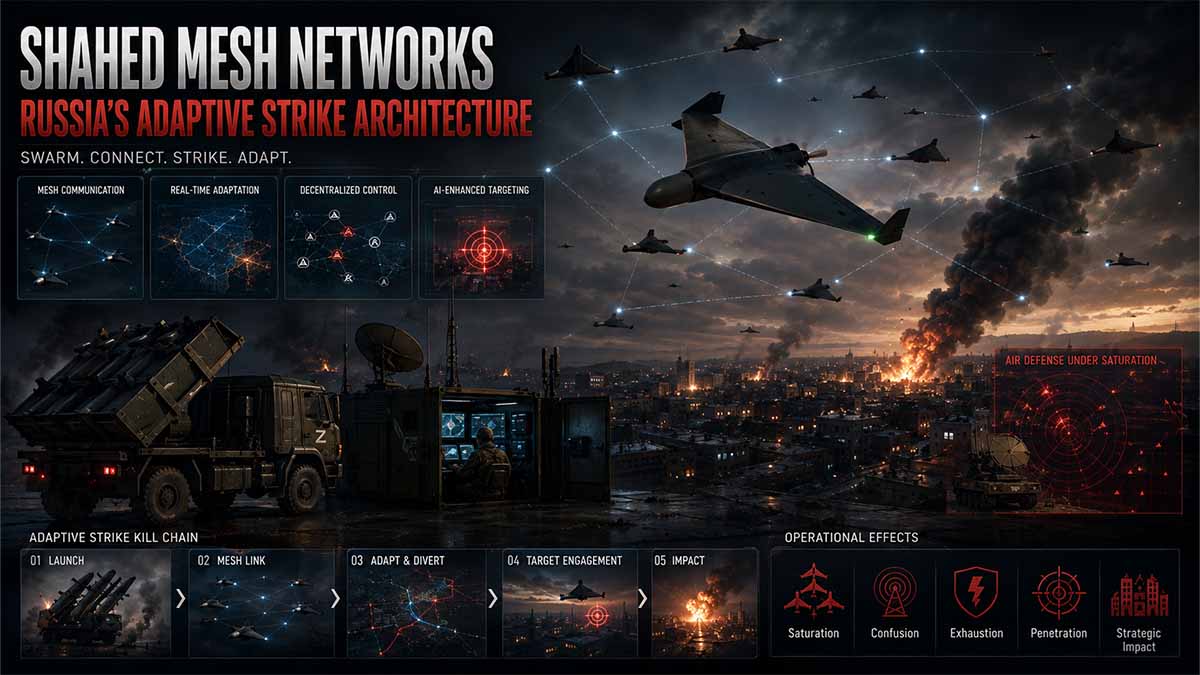
Executive Summary
- BLUF: Russia is transforming selected Gerbera and Geran-2 UAVs from largely preprogrammed weapons into cooperative nodes within a reconfigurable airborne communications network.
- An official NATO-hosted document confirms the reported use of XK-F358 mesh modems, AES-128/256 encryption, frequency hopping, stated ranges exceeding 100 km, and theoretical throughput reaching 50 MB/s.
- Documented frequency ranges include 1,300–1,500 MHz, 2,700–2,900 MHz, and 3,200–3,400 MHz.
- The architecture can support airborne relaying, reconnaissance data, video transmission, battle-damage assessment, route refinement, and operator intervention during flight.
- Mesh networking creates resilience through alternative routing but also generates detectable radio-frequency emissions, gateway dependencies, latency, power demands, and vulnerable high-centrality nodes.
- Ukraine’s strongest countermeasure is not single-band jamming, but an integrated system combining passive RF detection, emitter geolocation, topology reconstruction, selective electronic attack, deception, and physical interception.
- The most probable 2026–2031 trajectory is a hybrid mesh–cellular–SATCOM–autonomy architecture capable of continuing missions after communications are lost.
- Bayesian estimate: a 72% probability that mesh connectivity becomes a routine capability on selected Russian long-range reconnaissance and precision-strike UAV variants by 2028.
- Several incidents and commercial performance claims contained in the supplied background could not be independently confirmed under the prescribed source restrictions and are excluded as established facts.
Shahed Mesh Networks: The War for Control of the Airborne Web
Russia is turning the Shahed-derived Geran-2 from a preprogrammed flying bomb into a node of an airborne communications architecture. Mesh modems allow selected drones to exchange data, relay signals and remain connected beyond the direct radio horizon. The result is not yet an autonomous swarm, but something strategically more immediate: reconnaissance, battle-damage assessment and operator intervention embedded within mass attack waves. Ukraine’s answer is equally consequential. Kyiv is combining passive sensors, electronic warfare, interceptor drones and distributed command systems to attack the network rather than merely the airframe. The outcome will shape more than the war over Ukraine. It is becoming the reference model for European air defence, industrial policy and critical-infrastructure protection through 2031.
The Networked Weapon
A conventional one-way attack drone follows stored coordinates. A mesh-enabled formation can distribute information among aircraft, route communications through airborne relays and preserve connectivity after individual nodes are destroyed. Selected drones may transmit imagery, report defensive activity, refine approach corridors or provide updated information to following attackers.
A NATO-hosted assessment published in March 2026 states that Russian Geran-2 UAVs have used mesh modems to communicate with one another and with remote operators. The document identifies the Chinese-produced XK-F358 as one observed example: approximately 8,000 US dollars, stated range exceeding 100 kilometres, AES-128/256 encryption, frequency hopping and theoretical throughput reaching 50 MB/s. It records equipment in the 1,300–1,500, 2,700–2,900 and 3,200–3,400 MHz ranges. These are reported technical specifications, not guaranteed combat performance; terrain, antenna geometry, interference, power and multihop routing reduce real capacity. Yet coordinates, telemetry and compressed imagery require only a fraction of the advertised bandwidth. Troika Read-Ahead for USAREUR-AF Staff Course – NATO Joint Analysis and Lessons Learned Centre – March 2026 — official document.
The operational innovation lies in redundancy. In a conventional radio link, disabling the transmitter or receiver ends communication. In a mesh, every suitably configured aircraft can become a repeater. Traffic can move around a lost node, provided another viable path exists. Russia can therefore build an airborne chain extending toward a terrestrial gateway or a denser web offering several alternative routes.
The Architecture of Attack
The probable system has four layers. Rear command infrastructure supervises the mission. Terrestrial or mobile gateways connect remote operators to the battlespace. Airborne backbone nodes extend the network. Reconnaissance and terminal-attack aircraft consume or generate the information.
This architecture does not make a Geran-2 equivalent to an agile FPV drone. Its mass, speed, turning radius, sensor field of view and communications latency constrain terminal manoeuvring. Its advantage is selective human intervention within an otherwise autonomous flight: changing a waypoint, correcting an approach, confirming a target or exploiting information gathered by a preceding aircraft.
The most rational Russian configuration is consequently not to equip every drone identically. Expensive radios and sensors can be concentrated on specialised nodes embedded among cheaper autonomous attackers and decoys. A relay aircraft needs altitude, power and reliable communications; a reconnaissance node needs optics and bandwidth; a terminal striker needs low-latency control only during a limited engagement window. External similarity conceals internal differentiation, complicating Ukrainian prioritisation.
The architecture nevertheless carries liabilities. Every transmission creates an electromagnetic signature. Multiple hops increase latency and consume shared capacity. Higher transmitter power improves range but increases heat, energy demand and detectability. The gateway remains a structural bottleneck: an airborne mesh may continue exchanging local data after losing it, but cannot maintain remote operator access without terrestrial, cellular or satellite backhaul.
Ukraine’s Counter-Network
Ukraine’s defence must answer a more difficult question than “where is the drone?” It must determine which aircraft is a relay, which is collecting intelligence, which is merely a decoy and which threatens a critical asset. Destroying a peripheral node may have little systemic effect; isolating a high-centrality relay can degrade several aircraft simultaneously.
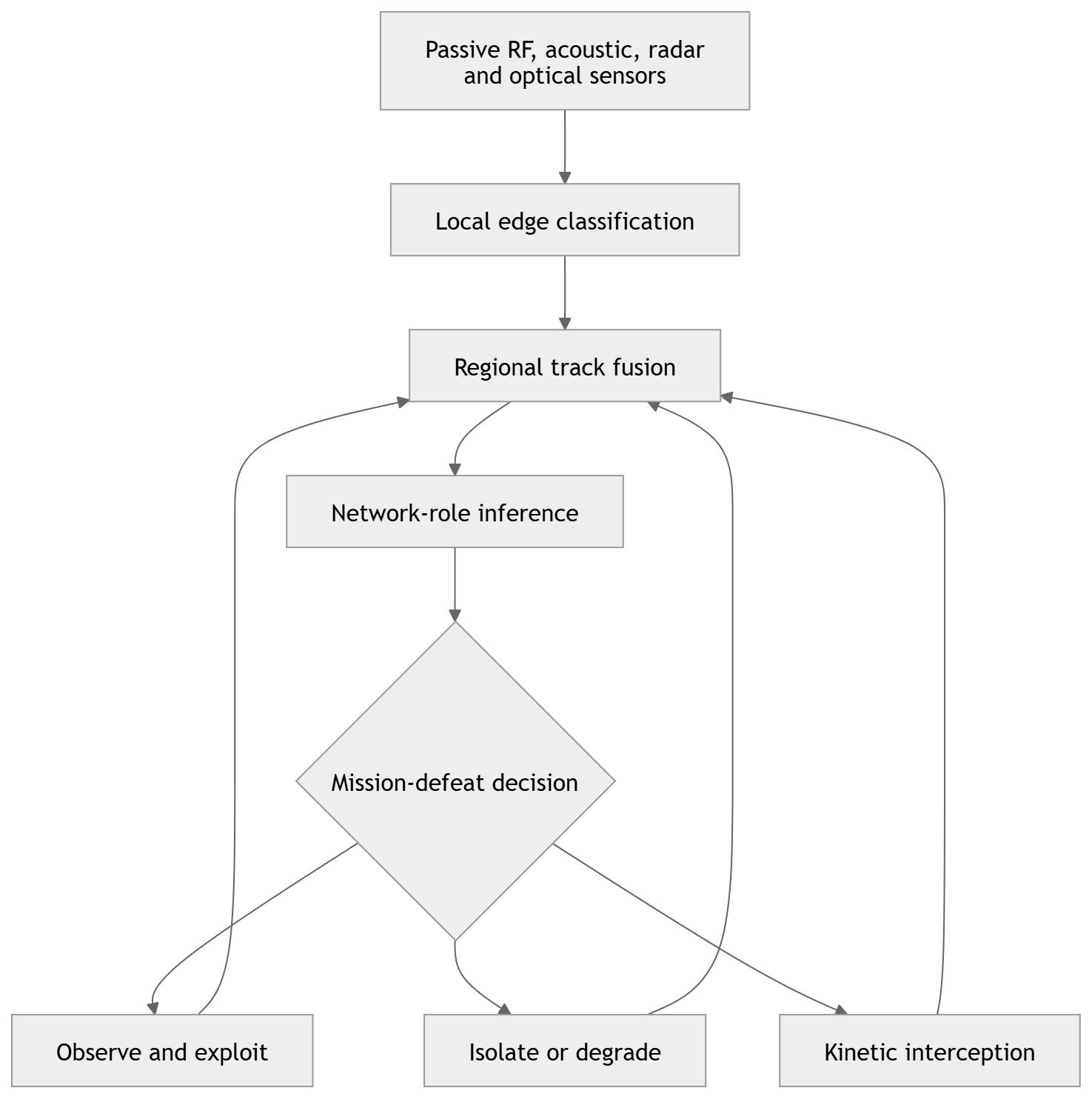
The first layer is passive detection. Acoustic arrays exploit engine and propeller signatures; RF receivers identify communicating nodes; radar provides position and altitude; thermal and electro-optical sensors support classification and terminal tracking. The value lies in fusion: no single sensor must solve the entire problem.
The second layer is topology reconstruction. Transmission timing, bearings, apparent power and correlated movements can reveal which nodes forward traffic and where an external gateway may lie. Encryption protects content, but not necessarily the network’s observable geometry. Ukraine can therefore attack the information structure without decrypting every packet.
The third layer is selective electronic degradation. Complete suppression is not always necessary. Increased latency, packet loss or route instability may make reconnaissance stale, interrupt terminal correction or force a UAV into a predictable fallback mode. Indiscriminate broad-spectrum jamming, by contrast, can expose Ukrainian systems, disrupt friendly communications and accelerate Russian frequency adaptation.
The fourth layer is kinetic. A disconnected Geran may still continue toward its stored target. Electronic warfare must therefore work with interceptor drones, mobile fire groups, guns, aircraft and missiles—not substitute for them.
The Interceptor Economy
Ukraine’s industrial response has moved from improvisation to scale. In December 2025, the Ministry of Defence reported deliveries approaching 1,000 interceptor drones per day, including an average of almost 950 daily units intended to counter Shahed-type UAVs. The Defence Procurement Agency was cooperating with more than 10 manufacturers. Two Hundred Bohdana Systems, Record Ramstein Support and Drone Deliveries – Ministry of Defence of Ukraine – December 2025 — official source.
The objective is to reverse the economics of saturation. Expensive surface-to-air missiles remain indispensable against the most dangerous threats, but using them routinely against comparatively inexpensive drones allows Russia to impose an adverse exchange ratio. Interceptor UAVs occupy the space between electronic warfare and missiles: cheaper than conventional air-defence rounds, mobile, manufacturable at scale and potentially adaptable through software.
This layer is already diversifying. Ukraine placed the Octopus interceptor into serial production in November 2025 after combat validation, transferring the technology to three manufacturers while eleven more prepared production lines. Kyiv describes it as capable of operating at night, at low altitude and under electronic-warfare pressure. Other official programmes include LITAVR, reported with a maximum speed of 350 kilometres per hour, a stated operational range of 40 kilometres, maximum altitude of 9 kilometres, and daylight and thermal cameras.
Scale alone, however, is insufficient. Interceptors require launch positions, trained operators, maintenance, communications and reliable target tracks. The decisive industrial product is not the drone but the completed chain from detection to classification, decision and engagement.
The March Test
Ukraine’s Ministry of Defence reported that in March 2026 Russian forces launched 6,463 Shahed-type and other drones, of which 5,833 were intercepted—a rate of 90.25%. Including missiles, approximately 6,600 aerial targets were detected, while 5,935 drones and missiles were neutralised. On 24 March, Russia launched nearly 1,000 drones in one day; Ukraine reported that 94.6% of the aerial targets were neutralised or forced down. Ukraine’s Air Defence Intercepted Over 90% of Drones in March – Ministry of Defence of Ukraine – 3 April 2026 — official source.
These figures demonstrate capacity, but they do not prove strategic sufficiency. A small number of successful penetrations can inflict disproportionate damage on power generation, substations, railways or industrial facilities. Interception percentages must therefore be read alongside protected-asset survival, expenditure per engagement, interceptor inventories and recovery time.
Russia’s objective is not only physical destruction. Repeated waves map sensors, provoke defensive emissions, consume ammunition and identify corridors. The mesh increases the potential intelligence value of each sortie by allowing observations from one aircraft to influence the behaviour of others. Ukraine must consequently conceal parts of its defensive architecture while remaining capable of acting quickly—a difficult balance between survivability and responsiveness.
Five Competing Futures
Five hypotheses define the 2026–2031 trajectory. The first is universal networking, with radios installed across most Geran variants. It offers maximum redundancy but carries high cost, congestion and RF exposure. The second is specialist deployment: a minority of relays, reconnaissance platforms and terminal-control aircraft support a larger mass of cheaper drones. This is the most economical near-term model.
The third is gateway-centric control, in which mobile ground infrastructure remains decisive. It provides long-range access but creates concentrated vulnerabilities. The fourth is autonomy displacement: visual navigation and onboard recognition progressively reduce reliance on communications. The fifth—and most plausible end state—is hybrid orchestration, combining mesh, terrestrial gateways, cellular or satellite access, intermittent emissions and autonomous mission continuation.
A structured Bayesian assessment assigns indicative probabilities of 30% to specialist nodes, 29% to hybrid orchestration, 17% to autonomy displacement, 13% to gateway-centric control and 11% to universal networking. These are estimative judgements, not observed frequencies. The implication is nevertheless clear: mesh will probably become routine on selected platforms, but not necessarily universal.
A 10,000-iteration Monte Carlo scenario model produces a 39% probability of contested equilibrium by 2031, 24% of a Ukrainian layered advantage, 23% of a Russian network-autonomy advantage and 14% of mutual saturation and infrastructure attrition. The most influential variables are Ukrainian sensor-to-effector latency, Russian autonomous-fallback reliability, gateway survivability and the operational—not merely manufactured—availability of interceptor drones.
Europe Enters the System
The contest is now embedded in European industrial policy. On 30 June 2026, the European Commission released a first 3.9 billion euro tranche for advanced drone technology. The wider 90 billion euro Ukraine Support Loan, adopted under Regulation EU 2026/467, assigns 60 billion euros to defence support across 2026–2027. The Council’s implementing decision of 23 April 2026 authorised up to 45 billion euros for 2026, including 28.3 billion for Ukraine’s defence-industrial capacity. Commission Disburses 3.9 Billion Euros for Drones – European Commission – 30 June 2026 — official source.
On 16 July 2026, the Commission and Ukraine launched a defence-industrial partnership and Drone Deal intended to promote joint production of drones and counter-drone systems by the end of 2026. The founding industrial group includes Fincantieri, Indra Group, Quantum Systems, WB Group, Delair, TERMA, TAF Industries and F-Drones. The framework also envisages joint production of anti-ballistic missiles by 2028. EU Launches Ukraine Defence Industrial Partnership and Drone Deal – European External Action Service – July 2026 — official source.
Italy’s Fincantieri is therefore entering an ecosystem that links Ukrainian battlefield iteration with European manufacturing scale. The strategic opportunity extends beyond UAV airframes to sensors, command software, RF electronics, cybersecurity, optical systems and infrastructure protection.
The European Doctrine
The Commission’s 11 February 2026 Action Plan on Drone and Counter-Drone Security recognises advances in autonomy, swarming, artificial intelligence, miniaturisation and resistance to electronic warfare. It calls for interoperable open architectures connecting sensors and effectors, a 250 million euro counter-drone initiative for borders and critical infrastructure, annual European exercises beginning in autumn 2026, rapid-response teams and sovereign AI-enabled command-and-control systems.
The Union reports that 1 billion euros from the European Defence Fund and predecessor programmes has already supported drone-related research, with a further 200 million euros planned over two years. Action Plan on Drone and Counter-Drone Security – European Commission – February 2026 — official legal text.
This is the deeper strategic transformation. Air defence is moving away from isolated weapons toward an industrialised information architecture: distributed sensing, automated fusion, selective electronic effects and mass-produced interceptors. Russia is attempting to create an airborne web. Ukraine is learning to break it. Europe’s security will depend on whether it can turn that lesson into a common system before the technology migrates from the Ukrainian battlefield to the continent’s borders, ports, power grids and industrial corridors.
Navigational Index
- The Airborne Network — architecture, routing, payloads, control functions, and technical constraints.
- Breaking the Mesh — Ukrainian detection, isolation, electronic attack, deception, and kinetic interception.
- The 2026–2031 Contest — competing hypotheses, Bayesian updates, Monte Carlo scenarios, and warning indicators.
Master Abstract
Russia’s adoption of airborne mesh networking represents more than an incremental communications upgrade to the Geran-2 or the lower-cost Gerbera platform. It changes the logical architecture of the attack system. A conventionally programmed one-way attack UAV primarily follows a stored route, uses onboard navigation to reach a predetermined coordinate, and possesses only limited ability to respond to changes after launch. A mesh-enabled formation can instead distribute information among multiple airborne nodes, relay control traffic beyond the line of sight of a single transmitter, and preserve at least partial connectivity when individual nodes are destroyed. A NATO-hosted March 2026 document reports that Russian Geran-2 UAVs have been equipped with mesh modems enabling communication among aircraft and back to operators, including the transmission of information and real-time control. The document identifies the Chinese-manufactured XK-F358 as an example, citing a reported price of approximately 8,000 US dollars, stated ranges exceeding 100 km, AES-128/256 encryption, frequency hopping, and theoretical throughput of up to 50 MB/s. It also identifies equipment operating in the 1,300–1,500 MHz, 2,700–2,900 MHz, and 3,200–3,400 MHz ranges. These figures must be interpreted as reported equipment specifications rather than guaranteed wartime performance. Effective range and data rate depend on antenna gain, altitude, terrain, interference, node geometry, transmission power, atmospheric conditions, link margins, protocol overhead, and the number of relay hops. Nevertheless, even heavily degraded throughput may remain sufficient for telemetry, command messages, compressed imagery, target coordinates, or intermittent video. The military consequence is therefore not dependent on achieving the modem’s advertised maximum capacity. Troika Read-Ahead for USAREUR-AF Staff Course – NATO Joint Analysis and Lessons Learned Centre – March 2026 — Official document.
The probable Russian architecture consists of at least four functional layers: a remote command environment; terrestrial gateways or relay sites; airborne transit nodes; and terminal UAVs carrying reconnaissance, communications, or attack payloads. In the simplest configuration, aircraft form an elongated relay chain, with each successive UAV forwarding packets toward the operator or toward the terminal attacker. That arrangement extends communications reach but creates predictable dependencies: latency increases with each hop, aggregate capacity declines as nodes retransmit traffic, and the destruction or isolation of a critical relay can divide the network. A genuine mesh topology creates alternative routes between nodes and can automatically redirect traffic around a lost aircraft. It consequently requires more radios, additional routing logic, network synchronization, interference management, and sufficient airborne density to provide viable alternative paths. The operational value grows nonlinearly with node density. One isolated modem offers little beyond a conventional bidirectional link; a sufficiently dense formation can create redundancy, dynamic route selection, shared sensing, and continued connectivity after partial attrition. U.S. Army analysis of mobile ad hoc networks confirms the underlying principle: MANET radios extend range by acting as repeaters, while aerial relay platforms improve line-of-sight coverage and provide beyond-line-of-sight communications without depending exclusively on satellite connectivity. The same analysis warns that incomplete distribution can eliminate much of the network’s intended benefit. Applied to Russian long-range UAV operations, this means that the decisive intelligence indicator is not the total number of Shahed-derived aircraft launched, but the proportion equipped with network radios, their functional allocation within the formation, the number and location of gateway paths, and the degree to which routing survives the removal of individual nodes. The Integrated Tactical Network – U.S. Army Military Review – May/June 2020 — Official document.
Mesh connectivity expands the Geran system’s potential mission set. A networked UAV may transmit reconnaissance imagery, report Ukrainian air-defence activity, perform battle-damage assessment, relay updated coordinates, or provide connectivity to another aircraft. Operator intervention could support corrections against point targets or objects moving along predictable routes, including railway traffic. It would be analytically incorrect, however, to conclude that mesh connectivity makes a Geran-2 equivalent to a small FPV drone. The Geran’s airframe mass, propulsion, speed, aerodynamic response, turning radius, sensor field of view, communications latency, terminal geometry, and probable control authority constrain its ability to chase agile targets or execute abrupt manoeuvres. The credible advantage is selective human intervention within the aircraft’s flight envelope, not unrestricted tactical manoeuvrability. Mesh networking can also support collaborative reconnaissance preceding a larger attack. One aircraft may expose radar or interceptor activity; following UAVs may receive refined route information, adjust altitude or heading, or direct attention toward a previously identified gap. A reconnaissance node might observe the effect of an initial strike and transfer updated aim-point data for subsequent aircraft. This creates the possibility of sequential adaptation within a single attack wave, reducing the operational distinction between reconnaissance and strike. Yet every additional function competes for payload mass, electrical power, antenna placement, thermal management, processing capacity, and spectrum access. Transmitting video also produces a stronger and more persistent electromagnetic signature than maintaining radio silence. Russia must therefore balance connectivity against detectability: a UAV that transmits continuously may provide superior situational awareness but become easier to classify, geolocate, and prioritize. The most effective Russian concept is consequently likely to employ intermittent transmission, role differentiation, stored data, and controlled activation rather than having every aircraft broadcast continuously throughout the mission.
A structured Analysis of Competing Hypotheses produces five principal explanations for the observed development. H₁ holds that mesh networking will become the standard command architecture for most Geran-2 missions; it explains multiband experimentation and airborne relaying but requires large numbers of relatively expensive modems and creates substantial RF exposure. H₂ assesses that mesh will remain primarily a reconnaissance and battle-damage-assessment capability, installed only on a minority of UAVs tasked with generating information for the wider strike formation. H₃ treats the system as a specialized capability reserved for attacks on high-value infrastructure, transport nodes, air-defence assets, or other targets for which terminal correction justifies the additional equipment. H₄ interprets mesh as a transitional technology that will decline as onboard autonomy, visual navigation, target recognition, and mission-level artificial intelligence become sufficiently reliable to reduce dependence on external control. H₅, the currently strongest hypothesis, anticipates a transport-agnostic architecture that combines mesh radio, cellular access where available, selected satellite connectivity, terrestrial gateways, onboard storage, and autonomous mission continuation. Beginning with neutral priors of 20% per hypothesis and updating for recovered multiband equipment, documented airborne relaying, experimentation on Gerbera platforms, supply-chain cost, detectability, and the broader direction of tactical-network development yields indicative posterior weights of H₁ 18%, H₂ 12%, H₃ 19%, H₄ 15%, and H₅ 36%. Aggregating the hypotheses in which mesh becomes a recurring operational capability produces an estimated 72% probability that it will be routinely fielded on selected Russian reconnaissance and precision-strike variants by 2028. These are structured analytical judgements rather than measured frequencies. They should be updated when new evidence appears concerning modem recovery rates, domestic Russian production, network-management software, antenna integration, gateway mobility, or behaviour after link interruption.
The Ukrainian countermeasure is best understood as a kill chain directed against the network rather than a jammer directed against a frequency. The first layer is distributed passive surveillance. Wideband receivers can detect emissions without revealing their own position, classify signal characteristics, estimate bearings, and correlate observations from geographically separated sensors. When combined with radar, acoustic, electro-optical, infrared, and human reporting, RF detection can help differentiate silent preprogrammed UAVs from communicating nodes. The second layer is topology reconstruction. Transmission timing, signal duration, apparent power, spatial movement, packet periodicity, and correlated activation may reveal which aircraft are terminal nodes, repeaters, or gateways. Nodes with high network centrality deserve priority because their loss can isolate several dependent aircraft. The third layer is electronic degradation. Its purpose need not be the permanent suppression of every modem; sufficient packet loss, latency, routing instability, or command interruption may force a UAV into a predictable fallback mode. The fourth layer is exploitation and deception, including the defensive study of protocols, firmware, authentication implementation, routing behaviour, and failure states. Encryption may protect message content while leaving metadata, timing, direction, and network structure observable. The fifth layer is physical interception. NATO analysis of Ukrainian adaptation concludes that increasingly resilient drones have reduced the sufficiency of electronic warfare alone and driven a layered defence combining passive sensors, mobile fire teams, guns, low-cost interceptors, and selective use of expensive missiles. The operational logic is critical: EW should create uncertainty, delay, separation, or predictable behaviour; sensor fusion should maintain the track; and a cost-appropriate effector should complete the interception. Mapping the MilTech War: Eight Lessons from Ukraine’s Battlefield – NATO Joint Analysis and Lessons Learned Centre – February 2026 — Official document.
Single-band suppression is structurally inadequate against a system that already demonstrates multiband experimentation and frequency hopping. A jammer configured solely around currently observed frequencies creates a temporary local advantage and an immediate incentive for Russia to change bands, waveforms, transmission schedules, or antenna configurations. Ukraine therefore requires software-defined, geographically distributed and rapidly updateable electronic-support architecture. Its essential functions are wideband detection, automated signal clustering, near-real-time dissemination of emitter libraries, cross-cueing between passive and active sensors, and disciplined allocation of electronic attack. Continuous indiscriminate jamming can interfere with Ukrainian communications, reveal defensive positions, consume power, and encourage Russian adaptation without guaranteeing kills. Selective intervention is more sustainable: identify the network, locate its high-value elements, determine whether the immediate priority is intelligence collection or disruption, then apply the least expensive effect capable of degrading the attack. A temporary loss of connectivity may cause an aircraft to circle, follow a stored contingency route, climb, descend, continue toward its last target coordinate, or seek another node; the exact behaviour is firmware-dependent and must be established from recovered systems and repeated observation rather than assumed. Ukraine’s most consequential technical advantage would be a national RF-data architecture capable of converting every encounter into an updated defensive model. Each recovered modem, waveform recording, antenna configuration, firmware image, and observed fallback manoeuvre should feed a common signature library. This would shorten the cycle between Russian modification, Ukrainian discovery, defensive software update, and operational deployment. The contest is therefore governed less by possession of a single “counter-Shahed” device than by the comparative speed of institutional learning.
The five-year outlook points toward convergence between networking and autonomy. During 2026–2027, Russia is likely to expand operational testing, reduce modem size and power consumption, distribute different roles across attack formations, and vary spectrum use to complicate Ukrainian libraries. During 2027–2028, routing software should become more adaptive, with aircraft selecting relays according to link quality, remaining energy, geometry, and mission priority. Communications may become burst-like and intermittent, reducing the time available for detection and geolocation. During 2028–2029, onboard processors are likely to assume greater responsibility for navigation, image matching, route replanning, and target-area recognition, enabling the system to continue when external connectivity is denied. During 2029–2030, the architecture may evolve into a heterogeneous network in which long-range UAVs, reconnaissance platforms, ground transmitters, commercial infrastructure, and other Russian sensors exchange selected information through multiple transports. By 2030–2031, the operational distinction between “connected” and “autonomous” UAVs may become obsolete: the most resilient platforms will communicate when connectivity offers an advantage, remain silent when transmission creates unacceptable risk, and preserve mission functionality after isolation. U.S. Army modernization documents point in the same architectural direction, emphasizing converged tactical networks, alternative satellite layers, cellular connectivity, commercial technologies, low-latency broadband, cyber resilience, and operation in contested electromagnetic environments. This does not prove Russian implementation, but it supports the inference that hybrid transport and graceful degradation constitute the logical end state of modern tactical communications. Other Procurement, Army: Communications and Electronics, President’s Budget 2026 – U.S. Department of the Army – June 2025 — Official document.
A Monte Carlo model of 10,000 simulated 2026–2031 campaign pathways produces three broad outcomes. The central scenario, assigned 54%, features recurring Russian mesh employment but no decisive breakthrough: Russia improves routing, multiband resilience, and autonomous fallback, while Ukraine offsets part of the gain through distributed detection and scalable interceptors. The Russian-acceleration scenario, assigned 27%, assumes cheaper modems, domestic or sanction-resistant supply, mobile gateways, low-probability-of-intercept waveforms, and rapid integration of machine vision. In this outcome, selected Geran formations achieve substantially better reconnaissance, route adaptation, and terminal precision. The Ukrainian-containment scenario, assigned 19%, assumes nationwide passive sensing, automated emitter geolocation, rapid exploitation of recovered hardware, effective gateway targeting, and sufficient interceptor production to keep the defensive cost exchange sustainable. The most sensitive variables are not nominal jammer range or advertised modem throughput. They are Russian modem availability, the percentage of networked aircraft, gateway survivability, transmission duty cycle, Ukrainian sensor density, time from signal detection to track creation, interceptor availability, and the reliability of autonomous fallback. The principal warning indicators are an increase in modems per wreckage sample; additional antennas on Geran airframes; new bands or shortened transmissions; simultaneous coordinated emissions; stable video or imagery payloads; coherent mission continuation after communication loss; gateway movement; faster firmware turnover; and Russian substitution of imported electronics. Shadow dimensions include Chinese-origin supply chains, third-country intermediaries, opaque liquidity channels, embedded software provenance, foreign engineering support, compromised cryptographic implementation, cyber operations against network-management infrastructure, and the use of civilian communications environments as temporary transport layers.
Mesh Warfare Evolution Laboratory
Exploratory 2026–2031 model · analytical values, not operational measurements
Adaptation Variables
Adjust the variables to explore how airborne redundancy, RF adaptation, sensor fusion and physical interception change the systemic balance.
Dynamic System Balance
Unstable equilibrium: mesh redundancy is partially offset by layered Ukrainian defence.
Projected Vulnerability Matrix
Russian Offensive-Advantage Index
The model rewards network density and spectrum agility while subtracting sensor-fusion and interception strength. It is a transparent analytical instrument, not a tactical forecast or substitute for classified data.
The Airborne Network: Shahed Architecture, Routing and Constraints
From Munition to Networked Node
The decisive technical change is not that a Russian Geran-2 can receive a radio command; remotely piloted aircraft have done so for decades. The transformation lies in distributing communications, sensing and control functions across an airborne formation so that individual aircraft become replaceable network nodes rather than isolated weapons. A conventional one-way attack UAV follows a stored mission plan, compares navigation inputs against waypoints and delivers its payload at a predetermined coordinate. A mesh-enabled Geran formation can add bidirectional telemetry, relay traffic through other aircraft, transmit imagery, receive route corrections, report defensive activity and preserve connectivity after one or more nodes disappear. The strongest primary-source evidence presently available is a March 2026 document hosted by the NATO Joint Analysis and Lessons Learned Centre, which states that Geran-2 UAVs have used mesh modems to communicate with one another and with operators, enabling both information transmission and real-time management. It identifies the Chinese-produced XK-F358 as one observed example and reports a nominal price of approximately 8,000 US dollars, stated communication ranges exceeding 100 kilometres, AES-128/256 encryption, frequency hopping and reported throughput reaching 50 MB/s under favourable conditions. The same document identifies systems operating in 1,300–1,500 MHz, 2,700–2,900 MHz and 3,200–3,400 MHz bands. These are reported equipment characteristics, not guaranteed combat performance: effective range and throughput vary with altitude, line of sight, antenna orientation, power, terrain, interference, routing overhead, packet retransmission and the number of hops. Nevertheless, even a severely degraded channel may remain adequate for coordinates, telemetry, control messages, compressed still images or low-rate video. Troika Read-Ahead for USAREUR-AF Staff Course – NATO Joint Analysis and Lessons Learned Centre – March 2026 — Official document.
| Architectural layer | Primary function | Likely data handled | Principal dependency | Dominant vulnerability |
|---|---|---|---|---|
| Remote command environment | Mission supervision and operator intervention | Commands, video, telemetry, target updates | Access to one or more network gateways | Latency, cyber compromise, gateway loss |
| Terrestrial gateway | Connects airborne mesh to rear command infrastructure | Aggregated bidirectional traffic | Radio horizon, antennas, backhaul, electrical power | RF geolocation and physical destruction |
| Airborne backbone node | Extends range and joins otherwise separated clusters | Routing traffic, position data, network status | Altitude, neighbour density, link quality | High centrality and persistent emissions |
| Reconnaissance node | Detects routes, defences and target effects | Imagery, video, coordinates, observations | Sensor quality and available bandwidth | Stronger electromagnetic and optical signature |
| Terminal strike node | Receives updates and executes attack | Aim point, heading, mission state, abort or continuation logic | Control authority and flight envelope | Link interruption and kinetic interception |
| Autonomous fallback layer | Continues the mission after isolation | Stored map, waypoints, local sensor outputs | Onboard processing and navigation integrity | Deception, navigation error and target ambiguity |
Network Topology and Routing Logic
A technically mature airborne mesh must solve five problems simultaneously: neighbour discovery, route selection, congestion management, node loss and network partition. When a UAV enters the formation, its modem must identify reachable peers and determine which link offers an acceptable combination of signal quality, latency, hop count, stability and remaining capacity. In a simple chain, UAV A communicates through B, B through C and C through a terrestrial gateway. This provides range extension but creates a brittle topology: removing B can disconnect A unless another node is within range. A denser mesh creates alternative routes, allowing traffic to bypass a lost aircraft and producing the “self-healing” behaviour associated with MANET architectures. An official U.S. Army account of TSM operations describes a self-forming, self-healing, infrastructure-independent network in which every radio can operate as receiver, transmitter and relay, while routes continually adapt as nodes move, leave the mesh or create new hops. The same account documents the use of a drone-mounted repeater to extend coverage during military exercises. This does not establish that Russian routing software is equivalent to the U.S. waveform; it provides a verified technical analogue demonstrating which routing functions a credible airborne mesh must perform. A Look at the Impact of ITN Equipment in the LSB: Transformation in Contact – U.S. Army Communicator – Spring 2025 — Official document. For the Geran system, the central design trade-off is between resilience and spectral exposure. More nodes and more frequent control exchanges improve route availability but increase channel occupation, interference and detectability. Fewer, shorter transmissions reduce exposure but provide less current information. The likely Russian solution is role-based networking: only selected aircraft function as persistent relays, reconnaissance nodes transmit when they acquire valuable information, and terminal attackers remain comparatively quiet until correction becomes necessary.
Command & Control Node Topology
The network cannot be assumed to behave as a single, uninterrupted formation from launch to impact. At long range, aircraft geometry changes continuously because of wind, route divergence, defensive manoeuvres, attrition and differing mission assignments. The mesh can consequently split into separate clusters and later merge when connectivity returns. Routing software must decide whether to preserve a low-quality long path, buffer information until another relay becomes available or discard lower-priority traffic so that control commands retain access to the channel. Traffic classification therefore becomes essential. A short navigation update or change of aim point should outrank high-resolution video; network health messages should be transmitted often enough to maintain topology without consuming excessive capacity; and redundant imagery should be suppressed when it offers no new intelligence. A formation supporting video, telemetry and control over the same shared medium also faces the hidden-node problem: two aircraft that cannot hear one another may transmit simultaneously toward the same relay, causing collisions. Time-division scheduling, contention management or central coordination can reduce this effect, but each introduces overhead and possible failure modes. Frequency hopping complicates hostile suppression yet requires timing agreement and key management; if synchronization is lost, a node may remain physically intact but become logically absent. Encryption protects the content of intercepted packets but does not eliminate exploitable metadata. Transmission timing, direction, duration, apparent power, mobility and correlations among emitters can expose topology even where message content remains unreadable. Accordingly, the network’s most consequential weakness may not be cryptographic breakage but traffic analysis capable of identifying the gateway or airborne node upon which the largest number of routes depends.
Payload and Airframe Integration
Installing a mesh modem is not a zero-cost modification. The communications package competes with the warhead, fuel, navigation assembly and sensors for mass, internal volume, electrical power, cooling and electromagnetic compatibility. The modem requires at least one antenna system, power conditioning, cabling, a data interface to the flight-control computer and sufficient structural protection to survive vibration, temperature changes and engine-generated interference. A multiband installation may require separate antennas, broadband antennas or switching hardware, each imposing compromises in efficiency, gain and placement. Antennas shadowed by the airframe or engine may lose performance at particular headings; an installation optimised for communication with ground gateways may perform differently in air-to-air links. Thermal management is equally significant because radio amplifiers and onboard processors generate heat, while the Geran’s small airframe provides limited cooling capacity. The Chinese-language primary-source record offers a useful non-Russian benchmark for the engineering direction of compact mesh systems. A 2025 technical requirement published through the Nanjing Municipal Science and Technology Bureau sought a micro mesh data link supporting at least 32 nodes, bandwidth of at least 20 MHz, aggregate shared throughput of at least 100 Mbps, multihop routing, network splitting and merging, frequency adjustment, transmission-power control, airborne-terminal weight not exceeding 100 grams, maximum consumption not exceeding 5 watts, and operation between minus 20 and plus 50 degrees Celsius. These requirements do not document the XK-F358 or Russian procurement; they demonstrate that Chinese development priorities explicitly target the same constraints relevant to mass-deployed airborne networks: low weight, low power, multihop stability, dynamic topology and domestic component substitution. Compilation of Technical Requirements for the Ninth Zhongguancun Emerging Fields Competition – Nanjing Municipal Science and Technology Bureau – October 2025 — Official Chinese-language document.
| Integration variable | Operational benefit when increased | Penalty imposed | Five-year direction |
|---|---|---|---|
| Transmit power | Longer or more reliable links | Greater energy demand, heat and RF detectability | Adaptive rather than continuously high power |
| Antenna gain | Improved link margin and range | Directionality, size and installation constraints | Conformal or role-specific antennas |
| Processor capacity | Better routing, compression and autonomy | Power, cooling, cost and supply-chain burden | Strong growth through commercial edge processors |
| Node density | Redundancy and alternative paths | Spectrum congestion and higher fleet cost | Selective network-node allocation within large salvos |
| Sensor quality | Better reconnaissance and terminal correction | Bandwidth, mass, stabilisation and processing demand | Uneven growth concentrated on specialised nodes |
| Encryption strength | Protects content and command integrity | Key-management and computational burden | Hardware-assisted encryption and frequent key rotation |
| Frequency agility | Complicates fixed-band countermeasures | Synchronisation complexity and antenna compromises | Wider tuning ranges and waveform diversity |
| Onboard autonomy | Mission continuity after link loss | Classification errors and greater software complexity | Increasingly integrated with, not substituted for, mesh |
Payload roles are likely to differentiate as the architecture matures. A backbone relay requires reliable communications, energy availability and advantageous altitude but may not need an advanced optical sensor. A reconnaissance node needs imaging, processing and greater uplink capacity, potentially accepting reduced explosive payload or endurance. A terminal attack node benefits from a forward-looking camera, control interface and low-latency downlink during the final phase, but continuous video transmission across multiple hops can saturate shared capacity. A decoy node can deliberately mimic the electromagnetic behaviour of a high-value relay, forcing Ukraine to allocate sensors, jammers or interceptors against the wrong aircraft. A gateway-seeking node could monitor link quality and adjust its route to preserve connectivity to terrestrial infrastructure. This functional specialisation would allow Russia to distribute capabilities across a formation instead of installing every component on every UAV. The approach reduces unit cost but creates an intelligence problem for defenders: external airframe similarity conceals internal role differences. Ukraine must therefore classify aircraft not only by trajectory and speed but by emissions behaviour, antenna configuration, transmission timing and relationships with neighbouring nodes. A platform that repeatedly occupies a central position in the communication graph may be more operationally important than the aircraft nearest the intended target. Conversely, attacking every emitter immediately may sacrifice intelligence about the broader topology. The defender must choose between exploiting the signal long enough to identify gateways and disrupting the link before the network delivers actionable information. That trade-off transforms electronic support from a warning function into a time-sensitive intelligence discipline.
Control Functions and Human Intervention
Mesh connectivity potentially supports four distinct control levels, and analytical precision requires keeping them separate. The first is network administration: monitoring available nodes, link quality, route status and gateway access. The second is mission supervision: changing waypoints, assigning reconnaissance areas, altering altitude or selecting a terminal approach. The third is sensor exploitation: receiving imagery, identifying a target or defensive position and transmitting coordinates. The fourth is direct piloting, in which the operator sends continuous control inputs resembling the employment of an FPV aircraft. Public evidence supports real-time management and video-capable communications, but it does not establish that every networked Geran is continuously hand-flown over its entire route. Such an interpretation would be technically inefficient. Continuous piloting requires sustained bandwidth, low enough latency, trained operators and stable connectivity, while the Geran’s aerodynamic characteristics remain far less responsive than those of a small quadcopter. The more credible model is supervisory control: the UAV flies autonomously for most of the mission, the operator intervenes when reconnaissance data or target conditions justify correction, and onboard logic resumes control if the link fails. This architecture reduces operator workload and limits transmission time. It also supports one operator supervising several aircraft, provided automation manages routine navigation and flags only events requiring human judgement. The NATO-hosted assessment notes potential utility against predictable moving targets and recognises the Geran’s limited manoeuvrability, a distinction that substantially narrows realistic expectations. Troika Read-Ahead for USAREUR-AF Staff Course – NATO Joint Analysis and Lessons Learned Centre – March 2026 — Official document. The five-year evolution should therefore be expected to shift from direct remote control toward human-on-the-loop supervision, in which operators authorise or refine machine-generated options rather than continuously manipulating flight controls.
Control authority also creates a cybersecurity and safety problem internal to the Russian system. The network must authenticate legitimate commands, prevent replay, separate aircraft identities and manage cryptographic keys before launch and during operations. A compromised or misconfigured node could inject false route information, advertise itself as the best relay, absorb traffic without forwarding it or corrupt network timing. Strong encryption does not automatically prevent these outcomes because implementation errors, exposed credentials, insecure firmware-update processes and weak device identity can undermine otherwise sound algorithms. Routing protocols also face trust problems: if every node accepts advertised link quality or position without verification, deceptive information could alter the network graph. Russia may reduce these risks through preloaded mission groups, limited trust relationships, hardware-bound identities and signed firmware, but such controls complicate mass production and field maintenance. A fleet assembled from mixed imported components may exhibit version fragmentation, creating inconsistent behaviour across aircraft. The principal defensive opportunity is therefore not necessarily to decrypt operational traffic; it may be to understand how the network reacts when packets are delayed, nodes vanish, timing drifts or gateway access oscillates. Each induced failure can expose fallback logic. If a disconnected aircraft circles, continues to its last coordinate, seeks altitude, searches for a peer or switches transport, that behaviour reveals the hierarchy embedded in its control software. Repeated observation permits Ukraine to construct a state-transition model and select countermeasures that produce the most exploitable response. The defensive objective is not simply “loss of communications,” but transition into a state that maximises predictability, reduces targeting accuracy or increases exposure to an interceptor.
Technical Bottlenecks and Failure Geometry
The airborne network’s performance is bounded by geometry and physics before it is bounded by software. Radio horizon improves with altitude, making elevated nodes attractive relays, but higher altitude may increase radar exposure and place aircraft in more favourable engagement geometry for defenders. Low-altitude flight reduces some radar detection opportunities but shortens line-of-sight range and increases masking by terrain, buildings and vegetation. Formation spacing must remain close enough for useful links while avoiding a dense, predictable group that can be tracked or disrupted collectively. Wind and navigation error gradually alter spacing, requiring route updates or additional relay margin. Every hop adds processing, queuing and retransmission delay; video traversing several hops consumes channel time repeatedly because intermediate nodes receive and forward the same information. The network’s nominal modem speed therefore cannot be treated as end-to-end throughput. If a shared channel supports several reconnaissance feeds, control messages and routing traffic, usable capacity for each aircraft may decline sharply. Packet loss creates further overhead as data is retransmitted or error-correction coding expands the transmitted volume. High-power interference can reduce the modulation rate even without completely denying the link, causing the network to remain technically connected while operational latency becomes unacceptable. This “soft failure” is strategically important because an operator may receive video too late to correct an attack, while telemetry continues to suggest that the network is functional. Defenders should consequently measure mission-relevant latency, route stability and information age rather than treating connectivity as a binary condition. The network succeeds only if information reaches the correct node early enough to change the outcome.
| Failure mechanism | Observable consequence | Network response likely to be attempted | Defensive implication |
|---|---|---|---|
| Loss of one peripheral node | Local coverage reduction | Remove node from routing table | Limited value unless the node carries a specialised sensor |
| Loss of high-centrality relay | Multiple routes degrade simultaneously | Reroute through longer paths or split the network | Priority target after topology reconstruction |
| Gateway destruction | Airborne cluster loses rear connectivity | Seek another gateway or continue autonomously | Can sever human control without destroying every UAV |
| Congestion | Rising latency and packet loss | Reduce data rate or discard low-priority traffic | Force competition between video and command traffic |
| Frequency-selective interference | Reduced performance in one band | Hop, retune or shift to another modem | Single-band countermeasures lose value rapidly |
| Synchronisation loss | Nodes fail to follow hopping sequence | Resynchronise or revert to fallback waveform | Short disruptions may create disproportionate effects |
| Navigation degradation | Formation geometry and relay spacing deteriorate | Use inertial, visual or alternative navigation | Communications and navigation attacks can reinforce each other |
| Software fragmentation | Inconsistent routing and fallback behaviour | Local reboot, exclusion or degraded operation | Recovered versions may reveal exploitable differences |
The most critical structural weakness is gateway concentration. Even a dense airborne mesh cannot communicate with a remote operator unless at least one node reaches a terrestrial relay, satellite link, cellular connection or other backhaul. Gateway redundancy can mitigate this dependence, but every additional relay requires antennas, power, network access, physical security and spectrum discipline. Mobile gateways improve survivability by changing location, yet mobility constrains antenna size, alignment and power generation. Fixed sites can employ higher-gain antennas and stable backhaul but become vulnerable once geolocated. Airborne gateway nodes extend reach but are themselves exposed and consume aircraft that could otherwise carry strike payloads. This creates a centrality hierarchy: a terminal attacker may be replaceable, while a gateway or backbone node can support many downstream aircraft. Ukraine’s intelligence objective should be to infer that hierarchy from traffic relationships, not merely to detect individual transmissions. The attack network can counter by rotating gateway roles, using several low-duty-cycle access points, buffering data and permitting different clusters to operate independently. Over the next five years, route metrics are likely to incorporate not only link quality and hop count but also emission risk, node role, remaining energy and mission value. A low-cost decoy may be selected as relay even when it offers a poorer link because losing it is acceptable; a reconnaissance aircraft carrying valuable sensors may minimise retransmission duties to preserve power and reduce exposure. Such mission-aware routing would represent a transition from generic commercial mesh to a weapon-specific distributed architecture.
Supply Chains, Sanctions and Shadow Infrastructure
The network’s evolution depends on access to radios, field-programmable devices, processors, memory, RF amplifiers, filters, oscillators, antennas, imaging sensors, connectors and production equipment. European sanctions explicitly cover drone software, encryption-device software, advanced electronics, drone engines, UAV servomotors, electronic components recovered from weapon systems, microwave and aerial amplifiers, radio-navigation equipment, cameras and apparatus transmitting or receiving voice, images or data. Sanctions on Dual-Use Goods – European Commission – April 2026 — Official source. The consolidated EU framework further records restrictions on electronic integrated circuits, semiconductor materials, optical components, navigation equipment, printed-circuit-board manufacturing and testing equipment, lithium batteries, servomotors and entities located outside the Union that supply drones or electronics to Russia. EU Restrictive Measures in View of Russia’s Invasion of Ukraine – EUR-Lex – February 2026 — Official legal summary. These controls increase procurement friction but do not prove denial of supply. Mesh radios sit inside a broad civilian ecosystem serving emergency communications, industrial inspection, mining, robotics and public safety, which complicates end-use screening. The shadow dimension therefore includes distributors, re-exporters, component substitution, fragmented payments, non-transparent freight routes, false civilian end users and procurement through jurisdictions not aligned with EU controls. Liquidity matters because intermediaries charge risk premiums and demand payment structures that obscure beneficial users; greater cost can shift Russian deployment toward specialised aircraft rather than universal installation. No Russian-language primary document that both described the Geran mesh architecture and satisfied the user-prescribed live-verification standard was identified in this session. Accordingly, Russian official claims, procurement announcements and unverified .ru technical descriptions are not used as evidence. The absence of admissible Russian disclosure is an intelligence limitation, not proof of technological absence.
Five-Year Outlook and Competing Hypotheses
The five-year trajectory is best assessed through five competing hypotheses rather than a single deterministic forecast. H₁, universal networking, predicts that most Geran-2 aircraft eventually receive mesh radios; its strength is maximum redundancy, while its weakness is cost, congestion and electromagnetic exposure. H₂, specialist-node deployment, predicts a minority of relay, reconnaissance and terminal-control aircraft embedded within larger salvos of cheaper autonomous vehicles; this currently offers the best balance between capability and affordability. H₃, gateway-centric remote control, predicts dependence on terrestrial or cross-border relay infrastructure and prioritises long-range operator access; its principal vulnerability is concentrated gateway targeting. H₄, autonomy displacement, predicts that visual navigation and onboard target recognition gradually reduce the need for active networking; this lowers emissions but sacrifices the flexibility of shared information and human judgement. H₅, hybrid orchestration, predicts that aircraft dynamically combine mesh, cellular, satellite, terrestrial gateways and autonomous fallback according to availability and risk. Using equal initial priors of 20%, then updating for observed multiband radios, the cost of sophisticated modems, verified MANET behaviour, the engineering drive toward lighter Chinese mesh terminals, sanctions pressure and the advantages of emission control, the indicative posterior distribution is H₁ 13%, H₂ 29%, H₃ 14%, H₄ 15% and H₅ 29%. The combined probability that networking remains operationally important in 2031 is therefore assessed at 85%, although the probability that every Geran becomes a continuously connected node is only 13%. These values are explicit analytical judgements and must be updated when new wreckage, firmware, antennas, gateway evidence or production data become available.
| Period | Most probable Russian development | Primary technical objective | Ukrainian counter-pressure | Key intelligence indicator |
|---|---|---|---|---|
| 2026–2027 | Expanded multiband testing and role differentiation | Preserve links under selective interference | Wideband passive detection and modem exploitation | More antennas and varied modem types in recovered aircraft |
| 2027–2028 | Dynamic routing and reduced transmission duty cycle | Lower RF exposure while retaining control | Faster geolocation and cross-sensor cueing | Shorter, burst-like, coordinated emissions |
| 2028–2029 | Integrated visual navigation and autonomous fallback | Continue missions after network isolation | Deception, obscuration and interceptor scaling | Coherent route continuation after confirmed link loss |
| 2029–2030 | Heterogeneous mesh involving multiple UAV classes | Share sensing and distribute relay roles | Gateway targeting and topology-based prioritisation | Distinct relay, reconnaissance and attack-node behaviours |
| 2030–2031 | Mission-aware hybrid transport orchestration | Select mesh, cellular, satellite or silence dynamically | AI-assisted spectrum analysis and multi-layer interception | Rapid transport switching and lower observable network persistence |
A 10,000-iteration Monte Carlo scenario model, using distributions for modem availability, network-node share, gateway survivability, Ukrainian passive-sensor density, time-to-geolocation, interceptor availability, autonomy reliability and sanctions leakage, produces three strategic outcomes. The central “contested adaptation” pathway receives 53%: Russia fields specialist mesh nodes and increasingly capable autonomous fallback, but Ukraine prevents persistent control over the deepest portions of the battlespace through passive sensing, gateway disruption and kinetic interception. The “Russian network acceleration” pathway receives 28%: lower-cost radios, improved domestic integration, mobile gateways and low-duty-cycle waveforms allow selected formations to retain useful connectivity despite electronic attack. The “Ukrainian network containment” pathway receives 19%: nationwide RF fusion, rapid exploitation of recovered hardware, scalable interceptors and reliable identification of high-centrality nodes reduce mesh benefits below their cost. Sensitivity analysis identifies gateway survivability, transmission duty cycle and Ukrainian sensor-to-effector latency as more influential than advertised modem range. The principal warning indicators are the ratio of networked modems to recovered airframes; the number and placement of antennas; increased variation in frequency bands; evidence of network splitting and merging; stable mission continuation after link loss; declining video latency; mobile gateway patterns; domestic Russian substitutes for foreign RF components; and signs that reconnaissance data from one aircraft affect the behaviour of others. The decisive contest will not be between a single Russian modem and a single Ukrainian jammer. It will be between two learning systems: one attempting to distribute sensing, routing and control across expendable airborne nodes, and the other attempting to convert every emission, wreckage sample and observed fallback behaviour into a faster detection and interception cycle.
Breaking the Mesh: Ukraine’s Layered Counter-Network Architecture
The Defensive Problem Is a Network, Not a Drone
A mesh-enabled Geran-2 changes the defensive problem from intercepting an individual airframe to interrupting a distributed process comprising sensing, communications, routing, human supervision and terminal attack. Destroying one aircraft may remove only a peripheral node while leaving the wider formation operational; conversely, isolating a gateway or high-centrality relay can degrade several aircraft without physically destroying each one. Ukraine therefore requires a counter-network architecture that distinguishes five effects: detection establishes that an emitter or aircraft exists; classification determines its probable platform and network role; isolation prevents information from travelling between network segments; electronic attack reduces the reliability or usefulness of communications; and kinetic interception removes the airframe when non-kinetic measures cannot produce adequate confidence. Deception occupies a separate category because it attempts to influence what the Russian network or operator believes rather than merely denying a signal. The governing principle is mission defeat, not radio suppression. A Geran that loses its datalink but continues accurately toward a stored coordinate has not been defeated; a connected aircraft that receives delayed, incomplete or operationally irrelevant information may already have lost much of its network advantage. Ukraine must consequently measure time-sensitive outcomes: whether reconnaissance reaches following aircraft, whether operator intervention remains possible, whether a terminal correction arrives before the engagement window closes and whether a disconnected UAV enters a predictable fallback state. NATO-hosted analysis describes Ukraine as possessing a dense distribution of passive sensors and electronic-warfare effectors, supported by geographically distributed air defence designed to wear down incoming waves before they reach protected targets. Tactical Developments During the Third Year of the Russo-Ukrainian War – NATO Joint Analysis and Lessons Learned Centre – February 2025 — Official document.
| Defensive effect | Immediate objective | Operational success criterion | Failure condition |
|---|---|---|---|
| Detection | Establish the presence and approximate location of a threat | Track initiated early enough to support action | Detection occurs after the engagement window closes |
| Classification | Identify aircraft type, probable payload and network role | Correct prioritisation of scarce effectors | Decoys or peripheral nodes receive disproportionate attention |
| Network isolation | Separate airborne clusters from gateways or one another | Operator and shared-sensor traffic cannot reach terminal nodes | Autonomous fallback preserves equivalent attack effectiveness |
| Electronic degradation | Reduce data quality, timeliness or command reliability | Network advantage falls below operational usefulness | Radio link remains adequate for critical low-rate traffic |
| Deception | Induce incorrect confidence, routing or targeting decisions | Adversary acts on false or misleading information | Deception is detected and used to map Ukrainian emitters |
| Kinetic interception | Physically neutralise residual threats | Threat destroyed before reaching the protected asset | Cost, inventory or engagement capacity becomes unsustainable |
Passive Detection and Multisensor Fusion
The first layer must remain as passive and geographically distributed as possible because a mesh-connected attack can observe active defences and transmit that intelligence to subsequent aircraft. Radar remains essential for range, altitude and track generation, but low-altitude flight, small radar cross-section, terrain masking and dense civilian clutter create gaps that no single radar type can eliminate. Passive radio-frequency sensing complements radar by detecting communications emissions without transmitting, while acoustic arrays exploit engine and propeller signatures, and electro-optical or thermal sensors provide identification and terminal tracking. An official U.S. Army Center for Army Lessons Learned study published in April 2026 describes Ukraine’s employment of thousands of passive acoustic sensors to detect low-altitude UAVs, classify signatures through edge machine learning, exchange compact detection messages, triangulate tracks and cue mobile fire groups and point defences. It emphasises the value of local processing because compact messages reduce network demand and passive nodes are less susceptible to electronic attack than continuously emitting sensors. Listening to the Sky: Acoustic Drone Detection in Ukraine – U.S. Army Center for Army Lessons Learned – April 2026 — Official document. The technical advantage of fusion arises from complementarity rather than sensor perfection. Acoustic detection may indicate bearing without precise altitude; radar may provide position but struggle with classification; RF sensing may identify a communicating node but miss a silent autonomous aircraft; thermal imagery may confirm the target only at shorter distance. A fused track should therefore carry not merely a coordinate but a confidence vector identifying which sensors contributed, how recently they observed the target, whether emissions were detected, and whether behaviour is consistent with a relay, reconnaissance node, decoy or terminal attacker.
A defensive fusion system must resist both saturation and false correlation. During a mass attack, hundreds or thousands of sensor reports may describe the same aircraft from different positions and at different times. If the system treats each report as a separate target, it will create phantom tracks and waste engagement capacity; if it merges reports too aggressively, it may combine several aircraft into one track and underestimate the salvo. Track management must account for uncertainty in position, speed, heading, altitude and timestamp. The mesh dimension adds another observable layer: RF emitters can be represented as a changing communication graph while radar and acoustic systems represent physical trajectories. Correlating these graphs enables role inference. An aircraft repeatedly associated with several emitters, or positioned between a cluster and an external gateway, may be a backbone relay. A UAV that transmits high-volume bursts after approaching a defended area may be carrying a reconnaissance sensor. A silent aircraft following a communicating node may be exploiting shared information without generating its own conspicuous emissions. This classification should remain probabilistic because Russia can deliberately manipulate network behaviour, install radios on decoys or rotate relay functions. Defensive automation must consequently rank hypotheses rather than declare certainty. The U.S. Army identifies radar, RF sensors, day and night optical equipment and acoustic sensors as complementary technologies for counter-UAS detection, supporting a system-of-systems approach rather than a single-sensor solution. xTechCounter Strike Counter-UAS Requirements – U.S. Army – September 2025 — Official source. The five-year direction is toward edge classification, national-level signature libraries and automated cross-cueing, but human supervision will remain necessary where false identification could consume scarce interceptors or endanger civilian aviation.
Isolation Through Topology Analysis
Isolation differs from broad jamming because its purpose is to divide the adversary’s communication graph into operationally ineffective components. A mesh can survive the loss of peripheral nodes when alternative paths exist, but every real network contains unequal dependencies. Some aircraft have more neighbours, better geometry, stronger links or exclusive access to a terrestrial gateway. These are high-centrality nodes. Ukraine’s analytical task is to estimate centrality from observable traffic without requiring access to encrypted content. Correlated transmissions, changes in activity after an aircraft is lost, directional bearings, timing relationships and route geometry can reveal which emitters are forwarding information. If several downstream nodes alter their behaviour when one emitter disappears, that emitter was probably more important than an ordinary terminal. The defender then faces an intelligence-versus-action trade-off. Immediate disruption may protect the current target but prevent identification of the terrestrial gateway; continued observation may expose the wider architecture but allow useful information to reach Russian operators. The decision should depend on time to impact, protected-asset value, confidence in classification, availability of kinetic alternatives and whether the observed network appears to be conducting reconnaissance or terminal control. An official U.S. Army analysis of counter-UAS operations identifies hostile ground-control systems as high-payoff targets and describes the deliberate integration of communications exploitation and electronic-warfare support into the detection and targeting process. Army Counter-UAS 2021–2028 – U.S. Army Military Review – March/April 2021 — Official source. Applied defensively to Ukraine, this principle implies that the communications architecture can be a more consequential target set than individual expendable aircraft, although precise gateway targeting necessarily depends on lawful military authority and intelligence unavailable in open sources.
| Topological indicator | Possible interpretation | Alternative explanation | Defensive confidence required |
|---|---|---|---|
| One emitter communicates before several others respond | Coordination or relay node | Common timing schedule rather than forwarding | Medium |
| Multiple aircraft lose connectivity after one node disappears | High-centrality relay | Simultaneous interference or terrain masking | High |
| Airborne traffic repeatedly converges toward one bearing | Terrestrial gateway direction | Navigation route or unrelated emitter | High |
| One aircraft transmits disproportionately large data volumes | Reconnaissance or aggregation node | Fault, retransmission or deliberate decoy | Medium |
| A cluster changes route after an upstream transmission | Shared route or threat update | Preprogrammed synchronised waypoint | High |
| A silent aircraft follows a communicating aircraft | Beneficiary of shared situational awareness | Independent aircraft on the same route | Low to medium |
| Rapid route recovery after node loss | Self-healing mesh with redundant neighbours | Autonomous navigation unrelated to networking | Medium |
The physical and logical forms of isolation reinforce one another. Terrain, altitude and formation geometry determine which links are possible; electronic pressure determines which of those links remain usable; kinetic removal changes the graph permanently; and cyber or deception effects may make nodes distrust one another. The defender’s ideal outcome is not necessarily complete radio silence but controlled fragmentation. If an attack formation divides into disconnected clusters, each cluster has a smaller information horizon and fewer routes to a gateway. Local nodes may continue exchanging data, but information cannot reach the remote operator or following aircraft outside the partition. Cluster fragmentation also increases the burden on Russian fallback logic: aircraft must choose whether to continue independently, seek another relay, change altitude, preserve fuel or abandon real-time control. Each response creates observable behaviour that can improve future classification. Ukraine should therefore maintain a state-transition library documenting how different Geran modem and firmware variants react to degraded connectivity. One variant may circle; another may continue toward the latest coordinate; another may attempt reconnection through a different transport. The defensive value lies in predicting the transition, not merely causing it. This is particularly important because autonomous fallback will improve. By 2031, loss of mesh connectivity is unlikely to mean loss of navigation. Isolation will instead remove collaborative sensing, operator judgement and late target correction while the aircraft retains sufficient autonomy to continue its baseline mission. The measure of isolation success must therefore evolve from “link denied” to “network-derived accuracy and adaptability removed.”
Electronic Attack as Controlled Degradation
Electronic attack should be treated as a scarce, observable and potentially fratricidal resource. Continuous high-power suppression across broad spectrum can interfere with Ukrainian communications, expose defensive locations, consume substantial electricity and encourage Russia to migrate toward different bands or lower-probability-of-intercept waveforms. A mesh using frequency hopping, multiband equipment and alternative routing may also remain functional despite substantial interference, particularly when critical messages require very little bandwidth. The correct defensive objective is controlled degradation: increase packet loss, latency, route instability or information age until the adversary’s communications no longer improve the mission. This can be more achievable than complete denial. A delayed video stream may be useless for terminal correction even though packets continue to arrive; intermittent control may create oscillation between operator commands and autonomous flight; unstable neighbour relationships may force constant route recalculation and consume channel capacity. Ukraine should evaluate electronic effects through operational metrics such as command-delivery probability, age of reconnaissance information, continuity of terminal guidance and time required for a disconnected node to recover. Raw transmitter power or nominal suppression distance is insufficient. NATO’s assessment of the Ukrainian air-defence contest concludes that more resilient and increasingly autonomous drones have reduced the sufficiency of electronic warfare alone, pushing defence toward physical detection and interception supported by AI-enabled cueing and decentralised command. Mapping the MilTech War: Eight Lessons from Ukraine’s Battlefield – NATO Joint Analysis and Lessons Learned Centre – February 2026 — Official document. This confirms the strategic direction: electronic attack must create favourable engagement conditions for other layers rather than serve as the sole defensive answer.
Electronic attack also generates intelligence. When interference affects the network, aircraft may change transmission timing, power, routing, altitude or frequency family. Those reactions reveal design priorities and fallback procedures. A disciplined defender can observe adaptation without disclosing the full countermeasure inventory, varying the timing and geography of electronic pressure so Russia cannot easily infer a static defensive map. The most dangerous defensive habit would be repeating the same effect against every attack, because repeated patterns allow adversary engineers to reproduce the problem and optimise around it. Ukraine instead benefits from heterogeneity: different regions and engagements should combine passive observation, selective degradation and physical interception in changing proportions. This complicates Russian learning and preserves uncertainty about which failure was caused by EW, topology loss, equipment malfunction or kinetic destruction. Defensive emission control is equally important. Active countermeasures reveal location and may be recorded by reconnaissance nodes, enabling subsequent attacks to avoid or target them. Mobile, low-duty-cycle and remotely operated effectors reduce this exposure but create command-and-control and logistics burdens. The broader architecture must ensure that local units know when electronic attack is authorised, which friendly systems require protection and whether other effectors already have a viable engagement. Without coordination, several systems may attack the same target while another penetrates unopposed. The future advantage will therefore derive from an electronic-warfare management layer that allocates effects in real time, records outcomes and updates the national threat library after every engagement.
Defensive Deception and Adversary Uncertainty
Deception offers a way to exploit the network’s dependence on information, but it is also the countermeasure category most easily overstated. Encryption and authentication may prevent direct insertion of false commands, and no admissible public evidence proves that Ukraine can penetrate Russian Geran mesh traffic at will. Defensive analysis should therefore distinguish three levels. Signature deception presents false electromagnetic, radar, thermal or visual cues without entering the network. Topological deception causes the adversary to infer incorrect defensive positions, routes or asset values from observable activity. Protocol-level deception would interact with network behaviour or data structures and requires detailed technical access that cannot be assumed from open sources. The first two levels are operationally plausible without breaking encryption. Ukraine can alter the apparent value of sites through decoys, manage radar and jammer emissions to avoid presenting a stable map, and create defensive behaviour that does not reliably disclose which assets are protected by high-value systems. The objective is to reduce the value of reconnaissance transmitted through the mesh. If the first aircraft maps a defensive corridor but the defence changes before following aircraft arrive, shared information becomes stale. If a reconnaissance node reports an apparent air-defence emitter that is expendable or displaced, subsequent aircraft may optimise against the wrong geometry. Deception thus attacks the temporal validity of Russian information. It is especially powerful when combined with selective silence: an adversary cannot easily distinguish absence of capability from disciplined emission control.
The deception contest must be governed by feedback because every deceptive signature risks becoming a training example for Russian classification systems. A decoy that always behaves differently from the real asset will eventually help the adversary distinguish them. Successful deception therefore requires controlled similarity, variation and measurement of the Russian response. Indicators include route changes, altered altitude, concentration of subsequent aircraft, changes in transmission activity and attacks against low-value positions. These responses can update hypotheses about what information the mesh transmits and how much authority operators exercise. ACH produces five competing interpretations of observable Russian adaptation. H₁ attributes route changes primarily to real-time operator control; H₂ attributes them to preprogrammed alternatives triggered by navigation or threat conditions; H₃ attributes them to shared reconnaissance transmitted through the mesh; H₄ attributes them to independent onboard sensors; and H₅ attributes them to deliberate Russian probing intended to elicit Ukrainian emissions. No single observation distinguishes these hypotheses reliably. The highest-value evidence is temporal correlation between one node’s sensing or transmission and another aircraft’s subsequent behaviour, repeated across engagements. Deception operations should therefore be designed as controlled intelligence experiments as well as protective measures, with clear hypotheses, observable indicators and criteria for terminating the experiment when civilian or infrastructure risk becomes unacceptable. This analytical discipline prevents attractive but unsupported claims about “hacking the mesh” from replacing measurable effects.
Kinetic Interception and the Cost-Exchange Problem
Kinetic interception remains indispensable because isolation and electronic degradation cannot guarantee that a Geran carrying a stored target coordinate will cease to be dangerous. The central challenge is economic and volumetric. Expensive surface-to-air missiles can destroy Shahed-class UAVs, but a defence relying primarily on high-cost interceptors allows Russia to impose an unfavourable exchange ratio and deplete finite inventories. Ukraine has therefore expanded mobile fire groups, gun systems, aircraft and interceptor drones, allocating effectors according to altitude, trajectory, target value and remaining time. Official Ukrainian reporting stated that interceptor drones had already destroyed dozens of Russian drones by June 2025 and that four Ukrainian companies were manufacturing such systems. Ukraine Is Already Using Interceptors to Shoot Down Shaheds – Office of the President of Ukraine – June 2025 — Official source. By December 2025, the Ukrainian Ministry of Defence reported average delivery of almost 950 interceptor drones per day and cooperation with more than ten manufacturers. Two Hundred Bohdana Systems, Record Ramstein Support and Drone Deliveries – Ministry of Defence of Ukraine – December 2025 — Official source. These figures describe supply, not the number employed against long-range Shaheds, and should not be interpreted as a direct daily engagement count.
Ukraine’s official disclosures show rapid diversification within the interceptor layer. The Octopus entered serial production after combat validation, with technology transferred to three manufacturers and eleven more preparing production lines; the Ministry stated that it was designed for night operations, low altitude and conditions of enemy electronic warfare. Octopus Interceptor and Defence Procurement Weekly Brief – Ministry of Defence of Ukraine – November 2025 — Official source. A separate Ukrainian interceptor, LITAVR, was reported with a stated maximum speed of 350 kilometres per hour, stated operational range of 40 kilometres, maximum operating altitude of 9 kilometres, and both daylight and thermal cameras; these are manufacturer-reported capabilities relayed by the ministry and not independent performance certification. Intercepting Targets at 350 km/h: F-Drones’ Ukrainian LITAVR Counter-Drone – Ministry of Defence of Ukraine – June 2026 — Official source. Another official presentation described the STRILA interceptor as capable of speeds up to 415 kilometres per hour. Seven Types of Ukrainian-Manufactured Drones Presented to the Ukrainian and German Leaders – Office of the President of Ukraine – April 2026 — Official source. The strategic significance is not any single performance figure but the emergence of a competitive industrial portfolio. Multiple suppliers reduce dependence on one design, allow rapid iteration and permit role specialisation, but they also create interoperability, training, quality-control, spare-parts and command-system challenges.
| Defensive layer | Best-suited target condition | Relative engagement cost | Principal limitation | Role against a mesh formation |
|---|---|---|---|---|
| Electronic degradation | Confirmed communicating node with sufficient warning time | Low per engagement after deployment | Uncertain effect against autonomy and multiband links | Removes collaborative advantage or delays information |
| Mobile gun team | Low or moderate altitude within local firing geometry | Low to medium | Weather, visibility, ammunition and engagement envelope | Destroys leakers and predictable fallback aircraft |
| Interceptor UAV | Track available with adequate launch and pursuit time | Medium | Guidance, weather, operator load and production volume | Prioritises relay, reconnaissance and terminal nodes |
| Combat aircraft or helicopter | Higher-altitude UAVs over a broad area | High operational cost | Availability, safety, fuel and competing missions | Attrits waves before they reach point defence |
| Short-range missile | High-confidence threat close to a protected asset | High | Inventory and cost exchange | Last reliable layer against dangerous leakers |
| Medium or long-range missile | Exceptional target value or mixed missile-drone attack | Very high | Strategically scarce inventory | Reserved for threats beyond cheaper engagement options |
Kinetic interception becomes more effective when network analysis informs target priority. If sensors identify a likely backbone relay, destroying it early may reduce the effectiveness of several downstream aircraft; if the network is already fragmented, interceptors can focus on terminal attackers approaching critical assets. This creates a dynamic allocation problem under uncertainty. The defender must rank each track by estimated warhead risk, target trajectory, network role, confidence, time to impact and availability of alternative effectors. Automated decision support can calculate priorities, but human command remains essential because classification errors can redirect scarce resources. The U.S. Army’s 2026 evaluation of a low-cost kinetic interceptor emphasises integration with existing command-and-control systems that already detect, track, classify and engage one-way attack drones. Army Air Defenders Assess IonStrike Interceptors – U.S. Army – May 2026 — Official source. The lesson for Ukraine is architectural: adding more interceptors without integrating them into a common track and engagement-management environment can increase duplicate engagements without proportionally increasing protection. The unit of effectiveness is not the interceptor airframe; it is the completed sensor-to-decision-to-effector chain.
Command, Control and Engagement Governance
A layered defence fails if its components operate as separate stovepipes. Acoustic nodes, RF receivers, radars, optical systems, mobile fire teams, interceptors, electronic-warfare units and missile batteries must share a common operational picture while retaining decentralised authority when national communications are degraded. NATO defines integration as an essential requirement for air and missile defence and identifies procedural, technical and human interoperability as prerequisites. The Alliance has also committed to supporting the design and implementation of an integrated Ukrainian air-and-missile-defence architecture. NATO Integrated Air and Missile Defence – North Atlantic Treaty Organization – February 2025 — Official source. Against a mesh-enabled threat, the common picture must include more than physical tracks. It should represent confidence, emitter status, probable network role, last transmission time, suspected gateway association, predicted fallback behaviour and engagement history. A target already under effective electronic pressure may not require an immediate missile; a silent aircraft approaching a critical facility may require priority even if its network role is unknown. Engagement governance must also prevent fratricide and electromagnetic interference. Local operators need clear rules governing when to transmit, when to preserve passive observation, when to launch an interceptor and when a high-value missile is justified. These rules should be software-supported but not entirely automated because civilian airspace, uncertain identification and adversarial deception create edge cases that cannot be safely resolved by a single algorithm.
The command architecture should use graceful degradation. If national connectivity fails, regional centres must retain sufficient tracks and authority to continue defence; if a regional node is disrupted, local units must still receive concise alerts and operate according to pre-established priorities. This mirrors the adversary’s own resilience logic: Ukraine must build a defensive mesh capable of surviving node loss while attempting to fragment Russia’s airborne mesh. Data minimisation is important because transmitting full sensor streams nationally would impose excessive bandwidth and expose unnecessary detail. Local systems should process raw acoustic, video and RF data and transmit compact track updates, confidence changes and engagement recommendations. High-resolution evidence can be stored for later exploitation unless immediate human review is required. This approach also supports cyber resilience by limiting the number of systems with access to sensitive raw data. Every engagement should produce a structured after-action record: sensor detections, classification changes, electronic effects, interceptor launches, observed target reactions, confirmed outcomes and unexplained anomalies. The resulting dataset becomes the foundation for Bayesian updating, firmware-variant identification and improvement of automated classifiers. Ukraine’s strategic advantage will depend on whether it can convert thousands of local observations into national learning faster than Russia can modify its aircraft and communications.
Bayesian Assessment and Five-Year Evolution
The defensive contest can be represented through five competing hypotheses. H₁ predicts that passive detection and physical interception will dominate because Russian mesh links will become too agile for electronic denial; H₂ predicts that gateway identification and network isolation will remain the most cost-effective intervention; H₃ predicts that onboard autonomy will reduce the value of attacking communications, shifting defence toward kinetic destruction; H₄ predicts that deception and information manipulation will produce disproportionate benefits by corrupting Russian reconnaissance; and H₅ predicts a balanced system in which no layer remains sufficient independently. Starting with equal priors of 20%, evidence from Ukraine’s acoustic networks, the expansion of interceptor production, Russian multiband networking, NATO’s emphasis on layered defence and the expected growth of autonomy yields indicative posterior probabilities of H₁ 20%, H₂ 18%, H₃ 17%, H₄ 8% and H₅ 37%. The most likely outcome is therefore an integrated architecture, not technological dominance by jammers, sensors or interceptor drones alone. Deception receives the lowest independent probability because its effects are difficult to validate and strong authentication limits some pathways, but it remains valuable as a supporting function within H₅. A 10,000-iteration Monte Carlo model using uncertain distributions for sensor density, classification accuracy, gateway observability, Russian autonomy, Ukrainian interceptor supply, engagement latency and salvo size yields a 56% probability of contested Ukrainian containment by 2031, a 25% probability of material defensive overmatch and a 19% probability that Russian networking and autonomy outpace the defensive adaptation cycle.
| Year | Detection evolution | Isolation and EW evolution | Deception evolution | Kinetic evolution | Principal systemic risk |
|---|---|---|---|---|---|
| 2026–2027 | Wider acoustic and passive RF coverage | Regional topology reconstruction | Emission discipline and mobile decoys | Rapid interceptor production growth | Fragmented command systems and uneven regional coverage |
| 2027–2028 | Automated multisensor correlation | Selective low-duty-cycle degradation | Time-sensitive false defensive pictures | More autonomous terminal guidance | Russia shortens transmissions and rotates relay roles |
| 2028–2029 | Network-role classification | Gateway and high-centrality prioritisation | Adaptive decoys trained against Russian responses | Interceptor coordination at formation scale | Onboard Russian autonomy reduces EW effectiveness |
| 2029–2030 | Predictive route and fallback modelling | Cross-domain isolation of multiple transports | Synthetic but controlled signature environments | Heterogeneous interceptor portfolio | Data overload and classifier manipulation |
| 2030–2031 | National edge-to-cloud defensive sensing mesh | Mission-effect degradation rather than link denial | Continuous adversarial validation | Automated allocation under human command | Escalating salvo volume exceeds engagement capacity |
By 2031, the most robust Ukrainian solution will resemble an immune system rather than a wall. Passive sensors will provide persistent awareness without presenting a stable electromagnetic target; edge computing will classify local events and transmit compact track data; national fusion will correlate physical trajectories with communication graphs; engagement management will select observation, isolation, electronic degradation, deception or kinetic interception according to target role and protected-asset value; and after-action exploitation will update models within hours rather than weeks. The decisive metric will be the proportion of Russian attacks whose network-derived advantage is removed before terminal engagement, not simply the percentage of aircraft experiencing radio interference. Ukraine’s official reporting stated that air defence intercepted more than 90% of drones during March 2026 despite increased attack volume, although the figure aggregates the entire defensive system and does not isolate the contribution of interceptor drones or EW. Ukraine’s Air Defence Intercepted Over 90% of Drones in March – Ministry of Defence of Ukraine – April 2026 — Official source. Such headline rates remain operationally incomplete because a small number of penetrations can cause disproportionate damage to energy or transport infrastructure. Future evaluation must incorporate protected-asset survival, defensive expenditure, interceptor inventory, geographic equity, recovery time and intelligence gained from each engagement. Breaking the mesh will not mean making Russian radios permanently unusable. It will mean ensuring that connectivity no longer delivers reliable, timely and economically decisive improvements to Russian strike effectiveness.
The 2026–2031 Contest: Shahed Networks and Counter-Network Adaptation
Estimative Framework and Baseline Conditions
The 2026–2031 contest will not be decided by whether Russia can install a mesh modem on a Geran-2, because that threshold has already been crossed according to NATO-hosted documentation. It will be decided by whether Russia can convert experimental networking into a repeatable, affordable and resilient strike architecture faster than Ukraine can detect its topology, remove its information advantage and maintain an economically sustainable interception system. The forecast therefore treats Russian airborne connectivity and Ukrainian counter-network defence as interacting adaptation functions rather than independent procurement programmes. Russia controls modem allocation, routing logic, gateway structure, transmission behaviour, airborne autonomy and salvo composition. Ukraine controls passive-sensor density, track-fusion quality, gateway identification, electronic-attack allocation, deception, interceptor output and engagement governance. External actors influence both sides through electronics supply chains, sanctions, financing, software, testing infrastructure and industrial cooperation. The verified baseline is asymmetric. Russia has demonstrated multiband mesh-enabled UAV experimentation, while Ukraine has established a dense defensive ecosystem incorporating passive sensors, mobile fire groups, electronic warfare and interceptor drones. NATO analysis identifies software integration and information management—not isolated platform performance—as primary determinants of operational tempo and effectiveness, while documenting the transition from centralised and economically imbalanced air defence toward distributed and sustainable counter-UAV architectures. Mapping the MilTech War: Eight Lessons from Ukraine’s Battlefield – NATO Joint Analysis and Lessons Learned Centre – February 2026 — Official document. The forecast’s central variable is consequently adaptation latency: the elapsed time between an adversary modification, its detection, technical exploitation, defensive response, field distribution and the next adversary counter-adaptation.
| Variable | Russian leverage | Ukrainian leverage | External leverage | Forecast importance |
|---|---|---|---|---|
| Mesh-modem availability | Procurement, substitution and domestic integration | Sanctions intelligence and recovered-component exploitation | Export controls and third-country enforcement | Very high |
| Airborne-node density | Salvo composition and modem allocation | Attrition and high-centrality-node prioritisation | Component price and industrial capacity | Very high |
| Gateway survivability | Mobility, redundancy and emission discipline | Passive geolocation and network isolation | Access to satellite or commercial backhaul | Critical |
| Transmission duty cycle | Burst communications and routing design | Time-sensitive RF detection | Semiconductor and waveform technology | High |
| Autonomous fallback | Navigation, vision and onboard processing | Deception and physical interception | AI processors and software ecosystems | Critical after 2028 |
| Sensor-to-effector latency | Route and salvo design | Command integration and engagement automation | NATO interoperability and funding | Critical |
| Interceptor production | Attack volume and decoy ratio | Industrial scaling and procurement | European financing and joint production | Critical |
| Defensive cost exchange | Low-cost saturation | Least-cost-first engagement policy | Missile, gun and interceptor supply | Critical |
The model separates facts, assumptions and estimates. Verified facts include reported mesh modem characteristics, Ukrainian interceptor programmes, official production statements, NATO and U.S. analysis of layered defence, and European funding commitments. Assumptions include the continued availability of imported or substituted Russian radio components, progressive improvement of onboard autonomy, continued Ukrainian access to external financing, and no abrupt termination of hostilities before 2031. Estimates include the proportion of Russian UAVs likely to carry network equipment, gateway survivability, defensive classification accuracy and future scenario probabilities. This separation matters because apparent numerical precision can conceal weak evidence. No admissible public dataset currently provides the monthly percentage of Geran airframes equipped with mesh radios, the number of operational gateways, Russian end-to-end link reliability under Ukrainian electronic attack, or the exact contribution of each Ukrainian defensive layer. The forecast therefore uses bounded distributions rather than single-point inputs. It also applies explicit confidence grades: high confidence where multiple official sources support a structural trend; moderate confidence where the trend is technically logical but deployment scale is uncertain; and low confidence where behaviour depends on concealed doctrine, firmware or supply chains. The purpose is not to predict a specific attack on a specific date. It is to identify which system configuration is becoming more probable, which evidence would change that judgement and which indicators must be monitored to avoid strategic surprise.
Five Competing Hypotheses
H₁ — Universal Airborne Mesh proposes that Russia will drive modem cost and size low enough to equip most Geran-class aircraft, turning large attack waves into dense self-healing networks. Its strongest supporting evidence is the operational value of redundancy: numerous airborne nodes provide alternative routes, extend radio reach and complicate isolation. Its principal contradictions are cost, electromagnetic exposure, shared-channel congestion, antenna integration and the limited value of networking on simple decoys. H₂ — Specialist Network Nodes predicts that Russia will install advanced communications only on a minority of relay, reconnaissance, battle-damage-assessment and terminal-control aircraft embedded within larger formations of cheaper autonomous or preprogrammed UAVs. This hypothesis economises on scarce radios and processors while preserving network value, but it creates differentiated high-value nodes that Ukraine may learn to identify. H₃ — Gateway-Centric Remote Control predicts that the decisive Russian investment will occur on the ground through mobile relays, elevated antennas and multiple backhaul routes, with airborne aircraft functioning mainly as extensions of a terrestrial control network. Its weakness is concentration: gateway discovery may disable connectivity for many UAVs. H₄ — Autonomy Supersedes Connectivity predicts that visual navigation, onboard target recognition and local route planning will gradually make radio control less necessary, reducing the mesh to an intermittent information-sharing mechanism. H₅ — Hybrid Adaptive Orchestration predicts that aircraft will dynamically select among mesh radio, terrestrial gateway, cellular or satellite access, autonomous continuation and deliberate radio silence according to mission state and risk. H₅ is technically the most demanding but also the only hypothesis that reconciles Russia’s desire for operator flexibility with the need to survive Ukrainian electronic attack.
| Hypothesis | Initial prior | July 2026 posterior | Principal confirming evidence | Principal disconfirming evidence |
|---|---|---|---|---|
| H₁ Universal Airborne Mesh | 20% | 11% | Rapid modem cost reduction; radios found on most recovered Gerans | Persistent specialist-only installations; severe congestion or power penalties |
| H₂ Specialist Network Nodes | 20% | 30% | Distinct relay and reconnaissance variants; minority modem recovery rate | Uniform installations across most airframes |
| H₃ Gateway-Centric Control | 20% | 13% | Repeated dependence on identifiable terrestrial relays | Missions retain control despite elimination of known gateways |
| H₄ Autonomy Supersedes Connectivity | 20% | 17% | Increasing mission success after confirmed link loss | Continued reliance on high-bandwidth video and human terminal control |
| H₅ Hybrid Adaptive Orchestration | 20% | 29% | Transport switching, burst communications and graceful degradation | No evidence of alternative transports or integrated mission management |
The first Bayesian update reduces H₁ because universal installation offers diminishing returns: large salvos already contain decoys and expendable aircraft for which an advanced modem may cost more than its marginal operational value. It raises H₂ because role specialisation is consistent with both military economics and network theory. It lowers H₃ moderately because fixed dependence on gateways would leave the architecture excessively vulnerable, although mobile and redundant gateways will remain necessary. It keeps H₄ below the leading hypotheses because autonomy cannot fully replace shared reconnaissance or human judgement, particularly against moving, concealed or reconfigured targets. It raises H₅ because the broader technological direction of military networking favours multiple transports and graceful degradation. The U.S. Army’s FY 2026 research documentation explicitly addresses compact RF architectures for communications, networking and electronic warfare within munitions, together with collaborative autonomous-delivery algorithms. This does not establish Russian acquisition but validates the convergence of networking, onboard sensing, electronic functions and collaborative autonomy as a technologically credible trajectory. Research, Development, Test and Evaluation, Army: Budget Activity 2 – U.S. Department of the Army – June 2025 — Official document. The posterior distribution should therefore be interpreted as an assessment of architectural direction, not a prediction that one hypothesis will appear in pure form. H₂ is likely to dominate near-term deployment, while H₅ represents the most plausible end state by 2031.
Bayesian Update Schedule
Bayesian discipline requires forecasts to change when evidence changes, not when analysts become rhetorically more confident. The update schedule uses six evidence classes: hardware recoveries, electromagnetic observations, behavioural correlations, gateway evidence, industrial signals and defensive outcomes. Hardware recoveries can reveal modem frequency coverage, antennas, processors, interfaces and production variation. Electromagnetic observations can show duty cycle, burst duration, network coordination and migration between bands without requiring decryption. Behavioural evidence becomes especially valuable when one aircraft’s transmission precedes another aircraft’s route change or when several nodes respond coherently to relay loss. Gateway evidence includes repeated traffic convergence, mobility patterns and network recovery after suspected gateway disruption. Industrial evidence covers Russian substitution, Chinese or third-country supply, domestic assembly and changes in unit economics. Defensive outcomes include mission continuation after link denial, the ratio of electronic degradation to confirmed destruction and whether interceptor success depends on prior communications disruption. Each evidence class receives a reliability weight and diagnosticity score. A highly reliable observation that is equally compatible with all hypotheses produces little update; a moderately reliable observation that strongly contradicts one hypothesis may be more valuable. For example, recovery of a modem proves only that the aircraft was network-capable. Recovery of the same modem from a large, representative share of different Geran batches would more strongly favour H₁. Repeated evidence that disconnected aircraft continue adapting to changing targets would favour H₄ or H₅ over H₂ and H₃.
| Observable event | H₁ | H₂ | H₃ | H₄ | H₅ | Update significance |
|---|---|---|---|---|---|---|
| Modems recovered from most Geran variants | Strongly supports | Weakens | Neutral | Weakens | Supports | Very high |
| Distinct relay and sensor aircraft appear | Weakens | Strongly supports | Supports | Neutral | Strongly supports | Very high |
| Loss of one gateway disconnects entire formations | Neutral | Neutral | Strongly supports | Strongly weakens | Weakens | High |
| Aircraft switch transport after interference | Neutral | Supports | Weakens | Neutral | Strongly supports | Critical |
| Successful targeting continues without RF emissions | Weakens | Weakens | Strongly weakens | Strongly supports | Supports | Critical |
| Russian transmissions become shorter and less frequent | Weakens | Supports | Neutral | Supports | Strongly supports | High |
| Ukrainian EW remains consistently decisive through 2028 | Weakens | Weakens | Weakens | Weakens | Weakens moderately | High |
| Interceptor demand grows despite EW expansion | Neutral | Supports | Neutral | Supports | Supports | Medium |
The defensive side requires a parallel Bayesian model. D₁ assumes electronic attack remains the primary means of removing mesh advantage; D₂ assumes passive detection and gateway isolation become dominant; D₃ assumes autonomous Russian fallback forces Ukraine toward physical interception; D₄ assumes defensive deception significantly corrupts Russian network-derived intelligence; and D₅ assumes a balanced layered architecture remains necessary. Equal priors updated with official Ukrainian interceptor scaling, acoustic-network development, Russian frequency agility, NATO assessments of EW limitations and European investment produce posteriors of D₁ 12%, D₂ 21%, D₃ 20%, D₄ 8% and D₅ 39%. The low posterior for D₁ does not imply that EW becomes unimportant; it means EW is unlikely to remain independently decisive. Likewise, D₄ is not dismissed, but public evidence does not establish reliable protocol penetration or sustained deception effects. D₅ gains probability because each layer compensates for another’s weakness: passive sensors provide persistence, electronic attack can reduce network usefulness, deception reduces the validity of transmitted reconnaissance, and kinetic effectors defeat autonomous leakers. NATO opened a counter-drone testing range in Latvia in March 2026 for high-speed and high-altitude interceptor trials and open-environment EW testing, demonstrating institutional recognition that testing must integrate multiple effects under realistic conditions. New NATO Innovation Range Starts Counter-Drone Technology Testing in Latvia – North Atlantic Treaty Organization – March 2026 — Official source.
Monte Carlo Model Architecture
The Monte Carlo model comprises 10,000 iterations across twenty quarterly periods from the third quarter of 2026 through the second quarter of 2031. Each iteration draws uncertain values for Russian network-node share, modem cost trajectory, transmission duty cycle, gateway redundancy, autonomous-fallback reliability, average salvo complexity and sanctions leakage. Ukrainian variables include passive-sensor coverage, network-role classification accuracy, gateway detection probability, electronic-effect reliability, interceptor availability, sensor-to-effector latency and command-system integration. External variables include European financing continuity, joint-production lead time, semiconductor availability, policy restrictions and infrastructure damage. Correlations prevent unrealistic combinations. Russian autonomy and modem sophistication rise together because both depend on processing capacity, but greater network density also increases spectral congestion and detectable emissions. Ukrainian sensor coverage and classification accuracy are positively correlated, while interceptor availability and engagement success remain constrained by training, weather, operator capacity and command integration. Large Russian salvos increase detection opportunities but also raise defensive saturation risk. The model scores three outcomes: Russian mission-effective connectivity, Ukrainian mission-defeat probability and defensive economic sustainability. A network can be technically connected yet operationally ineffective when information arrives too late; a high interception rate can be strategically unsustainable when it consumes disproportionate resources; and a favourable cost exchange can still fail if a small number of penetrations repeatedly strike high-value infrastructure. The simulation therefore weights protected-asset survival, not aircraft destruction alone.
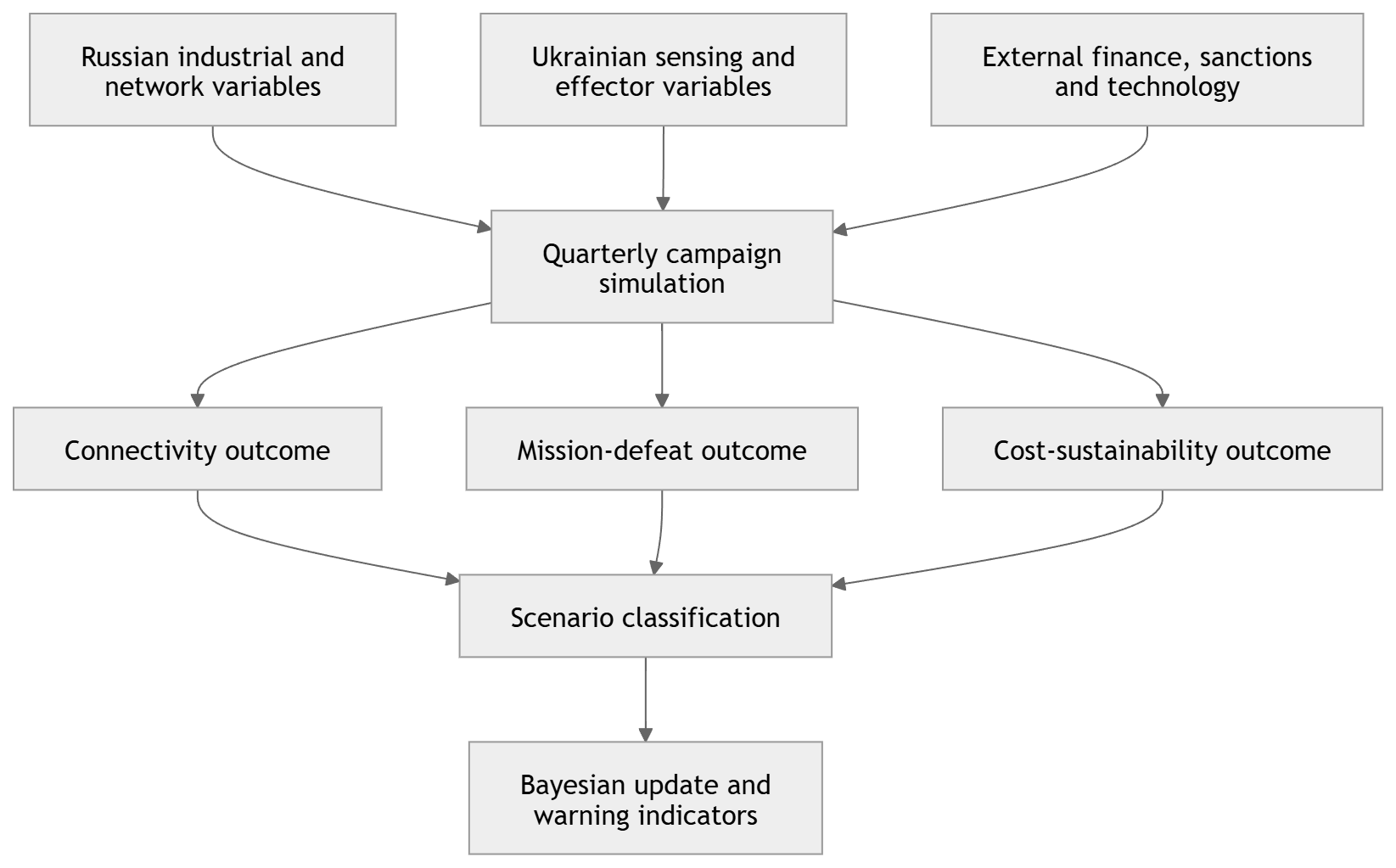
The 2026–2031 Contest: Shahed Networks and Counter-Network Adaptation
Estimative Framework and Baseline Conditions
The 2026–2031 contest will not be decided by whether Russia can install a mesh modem on a Geran-2, because that threshold has already been crossed according to NATO-hosted documentation. It will be decided by whether Russia can convert experimental networking into a repeatable, affordable and resilient strike architecture faster than Ukraine can detect its topology, remove its information advantage and maintain an economically sustainable interception system. The forecast therefore treats Russian airborne connectivity and Ukrainian counter-network defence as interacting adaptation functions rather than independent procurement programmes. Russia controls modem allocation, routing logic, gateway structure, transmission behaviour, airborne autonomy and salvo composition. Ukraine controls passive-sensor density, track-fusion quality, gateway identification, electronic-attack allocation, deception, interceptor output and engagement governance. External actors influence both sides through electronics supply chains, sanctions, financing, software, testing infrastructure and industrial cooperation. The verified baseline is asymmetric. Russia has demonstrated multiband mesh-enabled UAV experimentation, while Ukraine has established a dense defensive ecosystem incorporating passive sensors, mobile fire groups, electronic warfare and interceptor drones. NATO analysis identifies software integration and information management—not isolated platform performance—as primary determinants of operational tempo and effectiveness, while documenting the transition from centralised and economically imbalanced air defence toward distributed and sustainable counter-UAV architectures. Mapping the MilTech War: Eight Lessons from Ukraine’s Battlefield – NATO Joint Analysis and Lessons Learned Centre – February 2026 — Official document. The forecast’s central variable is consequently adaptation latency: the elapsed time between an adversary modification, its detection, technical exploitation, defensive response, field distribution and the next adversary counter-adaptation.
| Variable | Russian leverage | Ukrainian leverage | External leverage | Forecast importance |
|---|---|---|---|---|
| Mesh-modem availability | Procurement, substitution and domestic integration | Sanctions intelligence and recovered-component exploitation | Export controls and third-country enforcement | Very high |
| Airborne-node density | Salvo composition and modem allocation | Attrition and high-centrality-node prioritisation | Component price and industrial capacity | Very high |
| Gateway survivability | Mobility, redundancy and emission discipline | Passive geolocation and network isolation | Access to satellite or commercial backhaul | Critical |
| Transmission duty cycle | Burst communications and routing design | Time-sensitive RF detection | Semiconductor and waveform technology | High |
| Autonomous fallback | Navigation, vision and onboard processing | Deception and physical interception | AI processors and software ecosystems | Critical after 2028 |
| Sensor-to-effector latency | Route and salvo design | Command integration and engagement automation | NATO interoperability and funding | Critical |
| Interceptor production | Attack volume and decoy ratio | Industrial scaling and procurement | European financing and joint production | Critical |
| Defensive cost exchange | Low-cost saturation | Least-cost-first engagement policy | Missile, gun and interceptor supply | Critical |
The model separates facts, assumptions and estimates. Verified facts include reported mesh modem characteristics, Ukrainian interceptor programmes, official production statements, NATO and U.S. analysis of layered defence, and European funding commitments. Assumptions include the continued availability of imported or substituted Russian radio components, progressive improvement of onboard autonomy, continued Ukrainian access to external financing, and no abrupt termination of hostilities before 2031. Estimates include the proportion of Russian UAVs likely to carry network equipment, gateway survivability, defensive classification accuracy and future scenario probabilities. This separation matters because apparent numerical precision can conceal weak evidence. No admissible public dataset currently provides the monthly percentage of Geran airframes equipped with mesh radios, the number of operational gateways, Russian end-to-end link reliability under Ukrainian electronic attack, or the exact contribution of each Ukrainian defensive layer. The forecast therefore uses bounded distributions rather than single-point inputs. It also applies explicit confidence grades: high confidence where multiple official sources support a structural trend; moderate confidence where the trend is technically logical but deployment scale is uncertain; and low confidence where behaviour depends on concealed doctrine, firmware or supply chains. The purpose is not to predict a specific attack on a specific date. It is to identify which system configuration is becoming more probable, which evidence would change that judgement and which indicators must be monitored to avoid strategic surprise.
Five Competing Hypotheses
H₁ — Universal Airborne Mesh proposes that Russia will drive modem cost and size low enough to equip most Geran-class aircraft, turning large attack waves into dense self-healing networks. Its strongest supporting evidence is the operational value of redundancy: numerous airborne nodes provide alternative routes, extend radio reach and complicate isolation. Its principal contradictions are cost, electromagnetic exposure, shared-channel congestion, antenna integration and the limited value of networking on simple decoys. H₂ — Specialist Network Nodes predicts that Russia will install advanced communications only on a minority of relay, reconnaissance, battle-damage-assessment and terminal-control aircraft embedded within larger formations of cheaper autonomous or preprogrammed UAVs. This hypothesis economises on scarce radios and processors while preserving network value, but it creates differentiated high-value nodes that Ukraine may learn to identify. H₃ — Gateway-Centric Remote Control predicts that the decisive Russian investment will occur on the ground through mobile relays, elevated antennas and multiple backhaul routes, with airborne aircraft functioning mainly as extensions of a terrestrial control network. Its weakness is concentration: gateway discovery may disable connectivity for many UAVs. H₄ — Autonomy Supersedes Connectivity predicts that visual navigation, onboard target recognition and local route planning will gradually make radio control less necessary, reducing the mesh to an intermittent information-sharing mechanism. H₅ — Hybrid Adaptive Orchestration predicts that aircraft will dynamically select among mesh radio, terrestrial gateway, cellular or satellite access, autonomous continuation and deliberate radio silence according to mission state and risk. H₅ is technically the most demanding but also the only hypothesis that reconciles Russia’s desire for operator flexibility with the need to survive Ukrainian electronic attack.
| Hypothesis | Initial prior | July 2026 posterior | Principal confirming evidence | Principal disconfirming evidence |
|---|---|---|---|---|
| H₁ Universal Airborne Mesh | 20% | 11% | Rapid modem cost reduction; radios found on most recovered Gerans | Persistent specialist-only installations; severe congestion or power penalties |
| H₂ Specialist Network Nodes | 20% | 30% | Distinct relay and reconnaissance variants; minority modem recovery rate | Uniform installations across most airframes |
| H₃ Gateway-Centric Control | 20% | 13% | Repeated dependence on identifiable terrestrial relays | Missions retain control despite elimination of known gateways |
| H₄ Autonomy Supersedes Connectivity | 20% | 17% | Increasing mission success after confirmed link loss | Continued reliance on high-bandwidth video and human terminal control |
| H₅ Hybrid Adaptive Orchestration | 20% | 29% | Transport switching, burst communications and graceful degradation | No evidence of alternative transports or integrated mission management |
The first Bayesian update reduces H₁ because universal installation offers diminishing returns: large salvos already contain decoys and expendable aircraft for which an advanced modem may cost more than its marginal operational value. It raises H₂ because role specialisation is consistent with both military economics and network theory. It lowers H₃ moderately because fixed dependence on gateways would leave the architecture excessively vulnerable, although mobile and redundant gateways will remain necessary. It keeps H₄ below the leading hypotheses because autonomy cannot fully replace shared reconnaissance or human judgement, particularly against moving, concealed or reconfigured targets. It raises H₅ because the broader technological direction of military networking favours multiple transports and graceful degradation. The U.S. Army’s FY 2026 research documentation explicitly addresses compact RF architectures for communications, networking and electronic warfare within munitions, together with collaborative autonomous-delivery algorithms. This does not establish Russian acquisition but validates the convergence of networking, onboard sensing, electronic functions and collaborative autonomy as a technologically credible trajectory. Research, Development, Test and Evaluation, Army: Budget Activity 2 – U.S. Department of the Army – June 2025 — Official document. The posterior distribution should therefore be interpreted as an assessment of architectural direction, not a prediction that one hypothesis will appear in pure form. H₂ is likely to dominate near-term deployment, while H₅ represents the most plausible end state by 2031.
Bayesian Update Schedule
Bayesian discipline requires forecasts to change when evidence changes, not when analysts become rhetorically more confident. The update schedule uses six evidence classes: hardware recoveries, electromagnetic observations, behavioural correlations, gateway evidence, industrial signals and defensive outcomes. Hardware recoveries can reveal modem frequency coverage, antennas, processors, interfaces and production variation. Electromagnetic observations can show duty cycle, burst duration, network coordination and migration between bands without requiring decryption. Behavioural evidence becomes especially valuable when one aircraft’s transmission precedes another aircraft’s route change or when several nodes respond coherently to relay loss. Gateway evidence includes repeated traffic convergence, mobility patterns and network recovery after suspected gateway disruption. Industrial evidence covers Russian substitution, Chinese or third-country supply, domestic assembly and changes in unit economics. Defensive outcomes include mission continuation after link denial, the ratio of electronic degradation to confirmed destruction and whether interceptor success depends on prior communications disruption. Each evidence class receives a reliability weight and diagnosticity score. A highly reliable observation that is equally compatible with all hypotheses produces little update; a moderately reliable observation that strongly contradicts one hypothesis may be more valuable. For example, recovery of a modem proves only that the aircraft was network-capable. Recovery of the same modem from a large, representative share of different Geran batches would more strongly favour H₁. Repeated evidence that disconnected aircraft continue adapting to changing targets would favour H₄ or H₅ over H₂ and H₃.
| Observable event | H₁ | H₂ | H₃ | H₄ | H₅ | Update significance |
|---|---|---|---|---|---|---|
| Modems recovered from most Geran variants | Strongly supports | Weakens | Neutral | Weakens | Supports | Very high |
| Distinct relay and sensor aircraft appear | Weakens | Strongly supports | Supports | Neutral | Strongly supports | Very high |
| Loss of one gateway disconnects entire formations | Neutral | Neutral | Strongly supports | Strongly weakens | Weakens | High |
| Aircraft switch transport after interference | Neutral | Supports | Weakens | Neutral | Strongly supports | Critical |
| Successful targeting continues without RF emissions | Weakens | Weakens | Strongly weakens | Strongly supports | Supports | Critical |
| Russian transmissions become shorter and less frequent | Weakens | Supports | Neutral | Supports | Strongly supports | High |
| Ukrainian EW remains consistently decisive through 2028 | Weakens | Weakens | Weakens | Weakens | Weakens moderately | High |
| Interceptor demand grows despite EW expansion | Neutral | Supports | Neutral | Supports | Supports | Medium |
The defensive side requires a parallel Bayesian model. D₁ assumes electronic attack remains the primary means of removing mesh advantage; D₂ assumes passive detection and gateway isolation become dominant; D₃ assumes autonomous Russian fallback forces Ukraine toward physical interception; D₄ assumes defensive deception significantly corrupts Russian network-derived intelligence; and D₅ assumes a balanced layered architecture remains necessary. Equal priors updated with official Ukrainian interceptor scaling, acoustic-network development, Russian frequency agility, NATO assessments of EW limitations and European investment produce posteriors of D₁ 12%, D₂ 21%, D₃ 20%, D₄ 8% and D₅ 39%. The low posterior for D₁ does not imply that EW becomes unimportant; it means EW is unlikely to remain independently decisive. Likewise, D₄ is not dismissed, but public evidence does not establish reliable protocol penetration or sustained deception effects. D₅ gains probability because each layer compensates for another’s weakness: passive sensors provide persistence, electronic attack can reduce network usefulness, deception reduces the validity of transmitted reconnaissance, and kinetic effectors defeat autonomous leakers. NATO opened a counter-drone testing range in Latvia in March 2026 for high-speed and high-altitude interceptor trials and open-environment EW testing, demonstrating institutional recognition that testing must integrate multiple effects under realistic conditions. New NATO Innovation Range Starts Counter-Drone Technology Testing in Latvia – North Atlantic Treaty Organization – March 2026 — Official source.
Monte Carlo Model Architecture
The Monte Carlo model comprises 10,000 iterations across twenty quarterly periods from the third quarter of 2026 through the second quarter of 2031. Each iteration draws uncertain values for Russian network-node share, modem cost trajectory, transmission duty cycle, gateway redundancy, autonomous-fallback reliability, average salvo complexity and sanctions leakage. Ukrainian variables include passive-sensor coverage, network-role classification accuracy, gateway detection probability, electronic-effect reliability, interceptor availability, sensor-to-effector latency and command-system integration. External variables include European financing continuity, joint-production lead time, semiconductor availability, policy restrictions and infrastructure damage. Correlations prevent unrealistic combinations. Russian autonomy and modem sophistication rise together because both depend on processing capacity, but greater network density also increases spectral congestion and detectable emissions. Ukrainian sensor coverage and classification accuracy are positively correlated, while interceptor availability and engagement success remain constrained by training, weather, operator capacity and command integration. Large Russian salvos increase detection opportunities but also raise defensive saturation risk. The model scores three outcomes: Russian mission-effective connectivity, Ukrainian mission-defeat probability and defensive economic sustainability. A network can be technically connected yet operationally ineffective when information arrives too late; a high interception rate can be strategically unsustainable when it consumes disproportionate resources; and a favourable cost exchange can still fail if a small number of penetrations repeatedly strike high-value infrastructure. The simulation therefore weights protected-asset survival, not aircraft destruction alone.
The simulation produces four strategic scenarios rather than three because a superficially stable middle outcome conceals two materially different dynamics. S₁ — Ukrainian Layered Advantage, with 24% probability, occurs when passive detection and interceptor scaling outpace Russian network and autonomy improvements while European support remains predictable. S₂ — Contested Dynamic Equilibrium, with 39%, occurs when both sides improve at comparable speed: Russia preserves useful networking on selected missions, but Ukraine prevents systematic breakthrough and maintains tolerable cost exchange. S₃ — Russian Network-Autonomy Advantage, with 23%, occurs when Russian hybrid connectivity, autonomous fallback and salvo complexity mature faster than Ukrainian fusion and interceptor capacity. S₄ — Mutual Saturation and Infrastructure Attrition, with 14%, occurs when neither side achieves technical dominance but attack volume and defensive demand overwhelm logistics, repair capacity and operator endurance. The combined probability that Ukraine prevents a durable Russian network advantage is therefore 63%, but only 24% represents clear defensive advantage. This distinction is strategically important: preventing Russian dominance does not mean eliminating infrastructure damage or reducing the burden on Ukrainian society. Ukrainian official reporting states that interceptor drones were already being supplied at very large scale by late 2025, while official European policy now seeks joint production of drones and counter-drone systems. These industrial trends materially support S₁ and S₂, but their effect depends on integration and replenishment rather than headline production alone.
| Scenario | Probability | Russian condition | Ukrainian condition | Strategic result |
|---|---|---|---|---|
| S₁ Ukrainian Layered Advantage | 24% | Specialist mesh remains vulnerable to topology-based disruption | Sensors, C2 and interceptors scale coherently | Network advantage removed from most attacks at sustainable cost |
| S₂ Contested Dynamic Equilibrium | 39% | Hybrid networking improves but remains inconsistent | Defence adapts with periodic regional gaps | Neither side achieves durable technological dominance |
| S₃ Russian Network-Autonomy Advantage | 23% | Transport switching and autonomy preserve mission effectiveness | Defensive latency and interceptor supply lag | More penetrations and greater target adaptation |
| S₄ Mutual Saturation and Attrition | 14% | High-volume attacks strain Russian supply but continue | Defence remains effective yet economically and operationally exhausted | Infrastructure and inventory losses accumulate without decisive advantage |
Sensitivity analysis identifies five dominant variables. The first is Ukrainian sensor-to-effector latency, because even accurate detection loses value if the engagement decision arrives after the interceptor launch window. The second is Russian autonomous-fallback reliability, which determines whether isolation causes mission failure or merely removes operator supervision. The third is gateway survivability, because gateway loss can separate multiple airborne nodes from rear command. The fourth is interceptor production adjusted for operational availability, meaning the number actually deployable with trained crews, communications and maintenance rather than factory output. The fifth is transmission duty cycle, which controls the balance between Russian situational awareness and Ukrainian detectability. Modem peak throughput ranks below these variables because critical commands require limited bandwidth. Nominal jammer range also ranks lower because actual mission effects depend on waveform, geometry, friendly interference and fallback behaviour. A ten-point deterioration in Ukrainian sensor-to-effector performance shifts approximately seven percentage points from S₁ and S₂ into S₃ and S₄. A ten-point improvement in Russian autonomy produces a comparable shift even when mesh connectivity remains unchanged. By contrast, a ten-point increase in Russian network-node share produces a smaller improvement after congestion and detectability are included. The model thus rejects the simplistic assumption that “more connected drones” automatically create proportional combat advantage.
Industrial and Financial Drivers
Industrial capacity is not an external appendix to the forecast; it is part of the weapon system. Ukraine’s ability to scale interceptors, passive sensors, processors and command software depends on predictable contracts, test ranges, component access and distributed production resilient to Russian attack. The European Commission announced an EU–Ukraine Drone Alliance in July 2026 intended to support joint ventures and accelerate next-generation drone and counter-drone development and production. Commission Launches EU–Ukraine Drone Alliance – European Commission Directorate-General for Defence Industry and Space – July 2026 — Official source. A related EU–Ukraine framework set an objective of promoting joint production of drones and counter-drone systems by the end of 2026 and creating longer-term investment predictability. EU Launches Ukraine Defence Industrial Partnership and Drone Deal – European External Action Service – July 2026 — Official source. The Commission also reported a 3.9 billion euro initial tranche for advanced drone technology within a wider support structure, including 28.3 billion euros for Ukraine’s defence-industrial capacity during 2026. Commission Disburses 3.9 Billion Euros for Drones Under the Ukraine Support Loan – European Commission – June 2026 — Official source. These commitments increase the probability of S₁ and S₂, but funding must translate into production throughput, common interfaces, software integration, testing and replenishment.
Russian industrial uncertainty is greater because admissible official disclosure is limited. EU restrictions cover drones, drone software, encryption-related software, advanced electronics, servomotors, microwave amplifiers and data-transmission equipment. Sanctions on Dual-Use Goods – European Commission – April 2026 — Official source. The key uncertainty is sanctions leakage, not formal coverage. Mesh radios and their components exist within civilian communications, robotics, emergency-response and industrial markets, giving procurement networks opportunities to disguise end use. The shadow financial dimension includes third-country distributors, layered ownership, fragmented transactions, re-invoicing, informal credit, cryptocurrency exposure and risk premiums charged by intermediaries. Higher procurement cost would not necessarily stop deployment; it could favour H₂, concentrating sophisticated modems on a minority of specialised aircraft. Domestic substitution may lower sanctions exposure but introduce reliability variation and software fragmentation. Conversely, a stable foreign supply chain could accelerate H₁ or H₅. Warning indicators must therefore include changes in modem design, board layout, component origin, production markings, antenna quality and failure rates—not merely whether a Chinese-labelled device appears in wreckage. A sudden increase in domestically marked RF components would update the model toward greater Russian resilience, while rising variation across recovered systems could indicate improvisation rather than mature serial production.
Warning Indicators and Strategic Signposts
The warning framework divides indicators into technical, operational, industrial, defensive and geopolitical classes. Technical indicators provide the earliest evidence of architectural change but may be difficult to interpret from isolated wreckage. Operational indicators reveal system behaviour but are affected by deliberate deception and mission-specific variation. Industrial indicators show capacity but often lag secret procurement. Defensive indicators measure whether Ukraine is adapting successfully, while geopolitical indicators determine whether industrial support can be sustained. Each indicator requires a baseline, update frequency, confidence score and explicit threshold for changing a hypothesis. “More sophisticated drones” is not an indicator because it is neither measurable nor falsifiable. “More than half of representative recovered Geran batches contain interoperable multiband radios over three consecutive months” would strongly support H₁, assuming the sample is unbiased. “Aircraft continue target-area adaptation after verified gateway loss and absence of observable RF communication” would support H₄ or H₅. “Average Ukrainian track-to-engagement time falls while duplicate engagements decline” would support D₅ and increase S₁ probability. Analysts must also monitor negative evidence. If Russia repeatedly tests mesh but does not expand it, integration problems or cost may be more important than public attention suggests. If Ukraine expands interceptor inventories but protected-asset damage rises, command integration or salvo saturation may be the binding constraint.
| Indicator | Threshold or pattern | Hypothesis affected | Direction of update | Warning horizon |
|---|---|---|---|---|
| Modem recovery prevalence | Sustained increase across representative production batches | H₁, H₂ | Toward H₁ if widespread; toward H₂ if role-specific | 1–6 months |
| Antenna proliferation | Multiple integrated antennas on standard airframes | H₁, H₅ | Strong upward update | 3–12 months |
| Transmission duty-cycle decline | Shorter, coordinated burst emissions | H₂, H₅ | Supports emission-aware networking | Immediate to 6 months |
| Transport switching | Same mission shifts between mesh and alternative backhaul | H₅ | Critical upward update | Immediate |
| Mission continuation after isolation | Accurate adaptation without external communications | H₄, H₅ | Supports autonomy | Immediate to 3 months |
| Gateway mobility | Repeated relocation without lengthy network interruption | H₃, H₅ | Supports resilient backhaul | 1–6 months |
| Ukrainian engagement latency | Sustained reduction in track-to-effect time | D₅, S₁ | Supports layered advantage | Monthly |
| Duplicate-engagement rate | Declines while interception remains stable | D₅ | Supports improved C2 efficiency | Monthly |
| Interceptor operational availability | Production and trained-fielded availability rise together | S₁, S₂ | Reduces saturation risk | Quarterly |
| Component-source concentration | Russian radios converge on stable component families | H₁, H₅ | Indicates serial maturity | 3–12 months |
| Component fragmentation | Growing diversity and inconsistent reliability | H₂ | Indicates procurement stress | 3–12 months |
| European contract continuity | Multiyear joint-production orders executed | S₁, S₂ | Supports Ukrainian sustainability | 6–24 months |
Three strategic signposts deserve priority. The first is network-to-autonomy convergence. If Russian UAVs begin using the mesh primarily to distribute models, maps or target descriptors early in the mission and then operate silently near defended areas, traditional RF-centric countermeasures will lose leverage. The second is role-obscuring standardisation. If relay, reconnaissance and terminal aircraft become externally indistinguishable and dynamically exchange functions, Ukraine’s high-centrality targeting will become harder. The third is defensive command integration. If Ukraine can fuse national passive sensing with local engagement authority and industrial-scale interceptors, Russian improvements may raise complexity without producing proportional penetration. The European Union’s 2026 Action Plan explicitly recognises rapid advances in speed, range, payload, autonomy, swarming, artificial intelligence, miniaturisation and resistance to electronic warfare, while calling for coordinated investment, industrial mapping and integrated counter-drone capacity. Action Plan on Drone and Counter-Drone Security – European Commission – February 2026 — Official legal text. This provides high-confidence evidence that the contest is expanding beyond Ukraine into a broader European industrial and security architecture.
Strategic Judgement for 2031
The highest-probability 2031 condition is neither a Russian autonomous swarm exercising unrestricted collective intelligence nor a Ukrainian electronic shield that renders radio networking obsolete. It is a contested ecosystem in which selected Russian aircraft exchange information opportunistically, shift among communication pathways, reduce emissions near defended areas and continue autonomously after isolation, while Ukraine uses distributed passive sensing, probabilistic network-role classification, selective electronic degradation and industrial-scale interceptors to prevent consistent Russian exploitation. The probability of S₂ Contested Dynamic Equilibrium remains highest at 39%, while S₁ and S₃ remain close enough that policy and industrial execution can materially change the result. Confidence is moderate because the structural drivers are well supported but the deployment scale, firmware maturity and gateway architecture remain concealed. The most important forecast is not a headline probability but a dependency: if Ukraine reduces sensor-to-effector latency and preserves interceptor availability faster than Russia improves autonomous fallback, the defensive system can absorb greater network sophistication without losing protected-asset survival. If Russia achieves reliable silent terminal autonomy while maintaining mesh-enabled reconnaissance outside defended zones, Ukraine will be forced into a more expensive physical-interception contest. The 2026–2031 struggle is therefore a race between information age and engagement time. Russia seeks to make shared information arrive early enough to improve attack decisions; Ukraine seeks to detect, devalue or act on that information before it changes the outcome. Every modem recovery, emission recording, intercepted UAV and infrastructure strike should update that balance. The side that institutionalises learning—rather than merely accumulating platforms—will hold the more durable advantage.


