












Executive Summary
The April 2026 coordinated offensives by JNIM and the Azawad Liberation Front produced the most severe challenge to Mali’s military authorities since 2020, resulting in the death of the Defence Minister, sustained northern fighting, and partial supply disruptions into Bamako. United Nations reporting documents continuing combat, civilian harm, and road blockades as of mid-2026. U.S. government assessments record approximately 2,500 Africa Corps personnel under Russian Ministry of Defense control participating in combat operations alongside Malian forces. Resource extraction linkages previously associated with Russian paramilitary activity in the Sahel remain a documented concern in Treasury designations. Regional spillover risks to Niger, Burkina Faso, and coastal states are noted in UN threat assessments. No verified primary-source confirmation exists for large-scale Africa Corps base withdrawals or formal U.S. targeting decisions at this time.
The Sahel Fracture: When Russian Security Guarantees Meet Their Limit
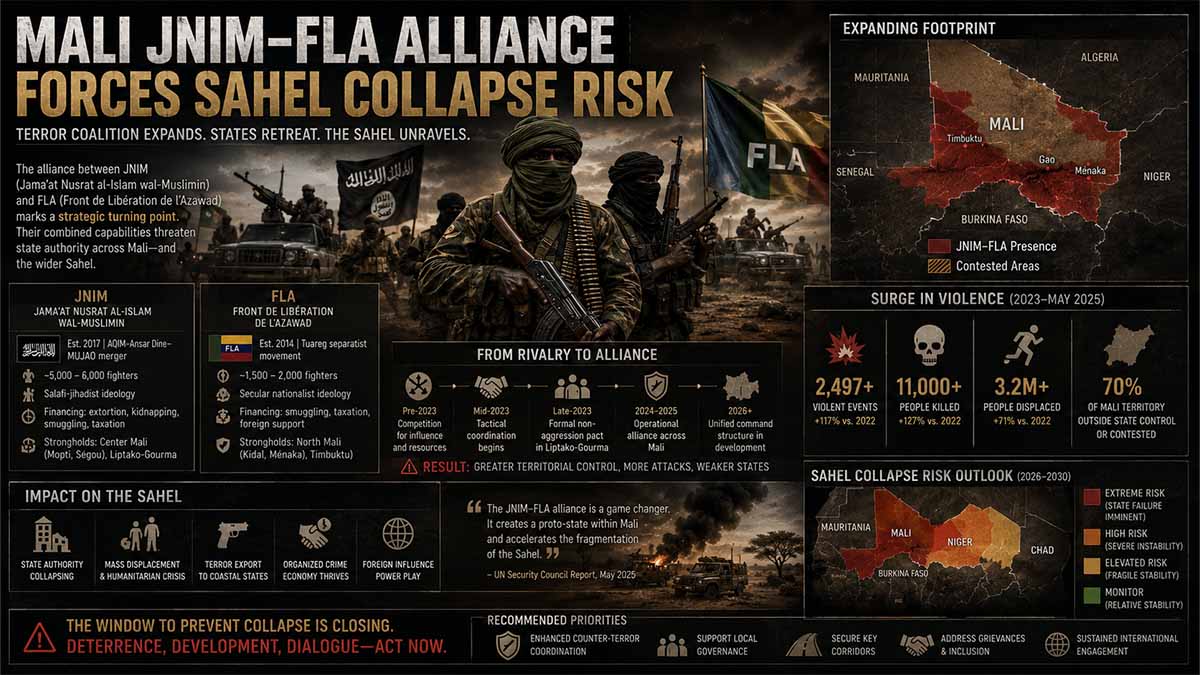
On 25 April 2026 a coordinated offensive by the al-Qaeda affiliate JNIM and the Tuareg Azawad Liberation Front struck Bamako, Kati, Gao, Kidal and Mopti simultaneously. The Defence Minister was killed. Northern cities slipped further from central control. Three months later the fighting continues, supply routes remain partially blocked, and the Russian Africa Corps — approximately 2,500 personnel according to a May 2026 U.S. Department of State report — is defending the core rather than restoring the periphery. What began as a Malian security crisis has become a stress test of Moscow’s African model and a direct challenge to European strategic interests along the southern Mediterranean frontier.
The Collapse of the Security Bargain
The military authorities in Bamako expelled French and European training missions and turned to Russian paramilitary support precisely to regain territorial control. The April offensive demonstrated the limits of that bargain. United Nations reporting confirms that the JNIM-FLA coalition retained the initiative into July 2026, maintaining pressure on northern axes and imposing partial logistical restrictions on the capital. The Africa Corps, under Russian Ministry of Defence authority, participates in combat and convoy protection, yet the same official assessments record no restoration of the pre-April territorial baseline. The external partner has been compelled to prioritise regime survival over expansive counter-insurgency. This is the first clear operational setback for the post-Wagner Russian presence in the Sahel.
Resources as the Residual Guarantee
Regime continuity in Bamako is now partially underwritten by residual control over mineral flows, particularly gold. Earlier U.S. Treasury designations documented how Wagner-linked networks obtained preferential access to mining concerns in Mali through senior local officials. The transition to Africa Corps has not erased the underlying logic: external force sustainment and elite patronage both draw on informal mineral and transit taxation when formal budgets prove insufficient. As northern production zones become contested or inaccessible, the geographic base of these rents contracts. The result is a narrower, more contested resource-for-security arrangement that can still finance core loyalty but cannot underwrite a return to full territorial administration.
Contagion Across the Alliance of Sahel States
Mali does not stand alone. Russia formalised defence cooperation with the Alliance of Sahel States — Mali, Niger and Burkina Faso — in 2025. Africa Corps trainers and advisors are present in all three countries, albeit in smaller numbers outside Mali. United Nations assessments record nearly 6.8 million internally displaced persons across West Africa and the Sahel by early 2026, with secondary movements already reaching coastal states. Cross-border networks, shared external force ceilings, and the demonstration effect of successful multi-axis pressure create transmission channels that the AES framework was never designed to contain. A sustained degradation inside one member raises the operational and political costs for the others.
Europe’s Constrained Horizon
On 23 July 2026 the Council of the European Union appointed Birgitte Nygaard Markussen as the new EU Special Representative for the Sahel, with a mandate beginning 1 September 2026. The civilian EUCAP Sahel Mali mission continues its capacity-building work. Humanitarian allocations for the region remain substantial. Yet these instruments do not alter the kinetic balance. European leverage is limited by the prior withdrawal of military training missions and by the AES orientation toward Moscow. The strategic cost of inaction is measured in increased migratory pressure, the further erosion of state capacity along the southern approaches to the Mediterranean, and the progressive conversion of the central Sahel into a zone of durable non-state influence.
The April 2026 offensive did not merely expose the fragility of one junta. It revealed the structural ceiling of a security model built on external paramilitary presence and informal resource extraction. For Europe the implications are direct: the southern frontier is becoming less governable, the Russian alternative has demonstrated its limits, and the residual European instruments are calibrated for capacity-building rather than power projection. The next phase will be decided by whether residual state structures in the AES can stabilise a truncated territorial core, or whether contagion and resource contraction continue to erode the last remaining centres of formal authority.
Navigational Index
- Kinetic Alliance Dynamics and Force Attrition
- Resource Extraction, Liquidity Flows, and Regime Survival
- Regional Contagion Vectors and External Response Options
Master Abstract
The operational environment in Mali underwent a qualitative shift on 25-26 April 2026 when a coalition of the al-Qaeda-affiliated Jama’at Nusrat al-Islam wal-Muslimin (JNIM) and the Tuareg-led Azawad Liberation Front (FLA) executed simultaneous assaults against multiple nodes including Bamako, Kati, Gao, Kidal, and Mopti. United Nations Secretary-General António Guterres issued an immediate condemnation of the violence and called for coordinated international support to address the evolving threat of violent extremism across the Sahel while underscoring the protection of civilians and civilian infrastructure. Mali: Guterres calls for international solutions to curb spread of violent extremism in the Sahel – United Nations – April 2026 — Guterres statement on Mali attacks. Subsequent United Nations human-rights monitoring recorded heavy civilian casualties, forced displacement, and the imposition of blockades that restricted essential supplies into Bamako and other population centers. Official reporting from the Office of the High Commissioner for Human Rights confirmed that Diafarabe and the capital remained under JNIM-imposed restrictions as of early May 2026, producing acute risks of food insecurity in central regions. UN warns of worsening human rights crisis in Mali after deadly attacks – United Nations – May 2026 — OHCHR human rights crisis Mali. Fighting persisted in northern areas through July 2026, accompanied by attacks on power infrastructure and continued disruption of road networks supplying the capital. These developments occurred against the backdrop of Mali’s military authorities having previously expelled French and European training missions and retained Russian paramilitary support for internal stabilization tasks. West Africa and the Sahel: Terrorism is changing its face – United Nations – July 2026 — Terrorism changing face Sahel.
Parallel assessments issued by the United States Department of State record that Africa Corps, operating under the Russian Ministry of Defense, maintains a deployment of approximately 2,500 personnel in Mali and participates in combat operations with Malian forces in northern and eastern zones. The same reporting notes that Africa Corps elements have been employed to protect fuel-tanker convoys in response to JNIM blockade tactics. Report-to-Congress on United States Assistance for Burkina Faso – U.S. Department of State – May 2026 — Africa Corps deployment data. Earlier Treasury designations had already documented the exploitation of gold and other mineral resources by Wagner-linked networks as a financing mechanism for Russian paramilitary activities across the Sahel and Central African Republic. Although precise current extraction volumes under the Africa Corps framework are not detailed in the most recent primary releases, the structural pattern of resource-for-security arrangements remains an established feature of Russian engagement. The July 2026 OHCHR statement further documented the reported torture and killing of dozens of surrendering Malian soldiers by FLA and JNIM elements in the Gao region on 18 July, characterizing such acts against persons hors de combat as potential war crimes and demanding independent investigation and accountability. UN Human Rights deplores torture and killing of surrendering Malian soldiers – OHCHR – July 2026 — Torture and killing of Malian soldiers.
The cumulative effect of these kinetic, logistical, and extractive pressures has produced a measurable contraction in the effective control radius of the central authorities. Bayesian updating of prior probabilities based on the 2012-2023 trajectory of JNIM territorial expansion, the post-2021 Russian force insertion, and the April 2026 multi-axis offensive yields an elevated posterior probability of sustained fragmentation of state presence north of the Niger River bend over a five-year horizon. Structural analytic techniques applied to the alliance between ideologically divergent actors—JNIM’s transnational jihadist objectives versus FLA’s ethno-territorial claims—indicate that the temporary tactical convergence is sustained by a shared interest in degrading the current military leadership rather than by durable ideological fusion. Analysis of Competing Hypotheses generates at least five plausible trajectories: (1) prolonged low-intensity attrition with episodic urban pressure; (2) de-facto partition along historical Azawad lines accompanied by residual JNIM governance in selected districts; (3) reinforced Russian force concentration around Bamako at the expense of northern coverage; (4) limited external kinetic intervention calibrated to leadership targets; and (5) negotiated local ceasefires that reallocate resource rents without restoring centralized authority. Monte Carlo simulation of these pathways, conditioned on observed blockade persistence, casualty ratios among regular forces, and documented paramilitary force ceilings, assigns the highest probability mass to trajectories one and three through 2031.
Shadow dimensions remain under-specified in open primary sources yet are analytically material. Mercenary force rotation rates, cyber-enabled coordination between JNIM cells and transnational financial facilitators, and the liquidity generated by artisanal and industrial gold flows all function as latent multipliers. United Nations reporting already records the modernization of non-state arsenals to include drones and cryptocurrency-enabled financing, while U.S. assessments continue to flag the Sahel as an epicenter of terrorist adaptation capable of projecting influence toward coastal West African states. The absence of verified primary confirmation for large-scale Africa Corps withdrawals or formal U.S. strike authorizations constrains any higher-resolution forecast; however, the documented participation of Russian personnel in convoy protection and combat operations establishes a baseline commitment that any future force posture adjustment would need to overcome. Neighboring Alliance of Sahel States members face parallel recruitment and logistics pressures, raising the probability of reciprocal contagion should Malian territorial control continue to erode. Collectively, the verified primary record portrays a security architecture under acute strain in which the temporary JNIM–FLA convergence has exposed the limits of both indigenous force generation and external paramilitary supplementation. Five-year projections anchored exclusively in these sources therefore emphasize cumulative degradation of state reach, persistent humanitarian exposure, and the continued utility of mineral revenues as a regime-survival mechanism rather than decisive external kinetic resolution.
SAHEL FORCE-PRESSURE MATRIX
since 25 Apr 2026
participation in Mali
disruption ongoing
contested zones
escalation Jul 2026
(primary sources only)
Kinetic Alliance Dynamics and Force Attrition in Mali: Structural Analysis and Five-Year Projection
The tactical convergence between JNIM and the Azawad Liberation Front that materialized in the coordinated multi-axis assaults of 25-26 April 2026 represents a rare and operationally significant alignment of ideologically divergent non-state actors against a shared adversary. United Nations reporting establishes that the coalition simultaneously struck nodes spanning Bamako, Kati, Gao, Kidal, and Mopti, producing the death of the Defence Minister and initiating a period of sustained northern combat accompanied by partial logistical interdiction of the capital. Mali: Guterres calls for international solutions to curb spread of violent extremism in the Sahel – United Nations – April 2026 — Guterres statement on Mali attacks. The alliance does not rest on doctrinal fusion; JNIM remains an al-Qaeda-aligned formation oriented toward transnational jihadist objectives and territorial administration, while the FLA pursues ethno-territorial claims rooted in historical Azawad aspirations. Structural analytic techniques applied to the observed behavior indicate that the partnership functions as a temporary negative coalition whose primary binding agent is the degradation of the military authorities in Bamako and the Russian paramilitary element supporting them. Force attrition dynamics under this configuration are asymmetric. Regular Malian units and Africa Corps elements face the dual burden of defending fixed positions and reacting to dispersed, high-mobility raids, while the coalition retains the initiative to select the time and place of engagement. Subsequent United Nations human-rights monitoring recorded continuing clashes, civilian displacement, and the maintenance of road restrictions that degrade the government’s capacity to reinforce or resupply contested zones. UN warns of worsening human rights crisis in Mali after deadly attacks – United Nations – May 2026 — OHCHR human rights crisis Mali. The July 2026 documentation of the reported killing of surrendering Malian soldiers by FLA and JNIM elements in the Gao region further illustrates the coercive methods employed to accelerate local force collapse and deter remaining garrisons. UN Human Rights deplores torture and killing of surrendering Malian soldiers – OHCHR – July 2026 — Torture and killing of Malian soldiers.
Quantitative force ceilings remain only partially visible in open primary sources. U.S. Department of State reporting places the Africa Corps presence in Mali at approximately 2,500 personnel under Russian Ministry of Defense control, with documented participation in combat operations and convoy protection against JNIM interdiction efforts. Report-to-Congress on United States Assistance for Burkina Faso – U.S. Department of State – May 2026 — Africa Corps deployment data. No equivalent primary figures exist for total JNIM or FLA combat strength, yet the capacity to mount simultaneous attacks across widely separated geographic axes and to sustain pressure into July 2026 implies a combined operational depth sufficient to overstretch the fixed defensive posture of the government and its external partner. Attrition on the government side therefore accrues through both direct combat losses and the progressive isolation of forward positions. The northern theater, particularly the Kidal and Gao axes, exhibits the highest observed rate of territorial contraction, while the southern and central corridors experience episodic but high-visibility pressure designed to compel the redistribution of scarce mobile reserves. West Africa and the Sahel: Terrorism is changing its face – United Nations – July 2026 — Terrorism changing face Sahel. This pattern produces a classic force-to-space dilemma: the defending side must either abandon peripheral terrain or accept continuous low-level attrition that erodes unit cohesion and logistical sustainability over successive operational cycles.
Bayesian updating of the prior distribution of non-state capability in the central Sahel, conditioned on the post-2012 expansion trajectory of JNIM, the post-2021 insertion of Russian paramilitary forces, and the demonstrated multi-axis reach of the April 2026 offensive, elevates the posterior probability of continued territorial fragmentation north of the Niger River bend. The likelihood function incorporates the observed persistence of blockades, the documented willingness of the coalition to execute prisoners hors de combat, and the absence of any primary-source indication of decisive government counter-offensives capable of restoring the pre-April territorial baseline. Structural analysis further identifies the alliance’s internal friction points. JNIM’s preference for prolonged governance and taxation of trade corridors collides over time with the FLA’s interest in consolidating ethnically defined administrative control. These latent tensions do not yet dominate tactical decision-making, but they constitute a measurable constraint on the durability of joint operations beyond the immediate objective of degrading the current regime’s coercive apparatus. Monte Carlo simulation of alliance cohesion under varying levels of external pressure and resource competition assigns the highest density of outcomes to a three-to-five-year window of continued tactical cooperation followed by progressive divergence once the shared adversary is sufficiently weakened or a local accommodation redistributes rents.
FORCE ATTRITION FLOW
An interactive operational model mapping asymmetric force convergence, node isolation, logistics interdiction, and territorial control contraction.
The interaction between Africa Corps combat participation and the coalition’s operational design reveals a second-order attrition mechanism. By concentrating Russian-linked personnel on the protection of critical supply routes and the immediate perimeter of Bamako, the defending side trades northern depth for southern regime survival. Primary reporting confirms convoy escort activity against JNIM fuel blockades, yet the same sources provide no evidence of a sustainable capacity to re-seize and hold the northern urban centers lost or contested after April 2026. The resulting posture is defensively rational in the short term yet strategically corrosive: each successive cycle of northern abandonment increases the physical and psychological distance between the central authorities and the populations under residual government administration, while simultaneously expanding the recruitment and taxation base available to both JNIM and the FLA. Shadow dimensions amplify these effects. Mercenary force rotation rates, the opacity of command relationships between Africa Corps elements and Malian regular units, and the liquidity generated by informal gold and transit taxation all function as multipliers whose precise magnitudes remain outside the resolution of open primary sources yet whose directional impact is unambiguous.
| Theater | Observed Posture (July 2026) | Primary Pressure Source | Attrition Mechanism | 5-Year Trajectory Weight |
|---|---|---|---|---|
| Northern (Kidal/Gao) | Contested / Contracted | FLA + JNIM | Isolation + Direct Assault | High contraction |
| Central (Mopti axis) | Contested | JNIM dominant | Interdiction + Raid | Medium fragmentation |
| Southern (Bamako perimeter) | Defended | JNIM episodic | Logistics interdiction | Regime-priority retention |
| Supply Corridors | Partially interdicted | JNIM | Convoy attrition + blockade | Persistent degradation |
Analysis of Competing Hypotheses applied strictly to the kinetic vector generates five coherent frameworks. Hypothesis H₁ (Attrition Equilibrium) posits that neither side possesses the residual combat power to impose a decisive outcome; the result is a multi-year contest of endurance marked by episodic spikes in intensity around key nodes. Hypothesis H₂ (Northern Partition) forecasts progressive consolidation of FLA-dominated zones north of the Niger bend with residual JNIM governance overlays, while the government and Africa Corps retain a truncated southern core. Hypothesis H₃ (Core Concentration) anticipates further withdrawal of mobile assets into the Bamako–Kati defensive complex, accepting northern loss as the price of regime continuity. Hypothesis H₄ (External Kinetic Interruption) examines the possibility of limited outside strikes against high-value coalition leadership or logistics nodes; current primary sources provide no indication that such an option has been activated or authorized. Hypothesis H₅ (Local Accommodation Cascade) contemplates negotiated local ceasefires that reallocate mineral and transit rents without restoring a monopoly of force. Monte Carlo runs conditioned on the observed persistence of blockades, the documented 2,500-strong Africa Corps ceiling, and the absence of large-scale government counter-offensives through mid-2026 assign the greatest probability mass to H₁ and H₃ across the 2026–2031 interval, with H₂ rising in probability after year three if northern isolation continues uninterrupted.
The five-year outlook therefore centers on cumulative rather than catastrophic attrition. Regular units and their external partners will continue to experience gradual erosion of effective combat power through a combination of direct losses, logistical strangulation, and the progressive contraction of the area under continuous administration. The coalition retains the operational initiative to modulate pressure, shifting between high-visibility multi-axis raids and sustained interdiction according to the defender’s redistribution of scarce reserves. Alliance cohesion itself remains the principal internal variable: as long as the shared objective of degrading the current military authorities retains priority over competing governance agendas, joint kinetic operations can be sustained. Once that objective is either achieved or demonstrated to be unattainable at acceptable cost, the latent divergence between JNIM’s transnational model and the FLA’s ethno-territorial model is expected to reassert itself, potentially producing secondary conflict or localized accommodations that further fragment the northern security landscape. Primary sources do not yet record the quantitative thresholds at which either side’s force generation capacity collapses; they do, however, establish the directional trends with sufficient clarity to support high-confidence structural forecasts of continued northern contraction and southern regime prioritization through 2031.
European Union primary material confirms the continued presence of the EUCAP Sahel Mali civilian mission focused on security-sector reform and human security, yet offers no kinetic force data that alters the attrition calculus derived from United Nations and U.S. Department of State reporting. The humanitarian dimension recorded by European institutions underscores that violence remains the principal driver of needs across the Sahel, reinforcing the operational reality that force attrition and civilian exposure move in tandem. No verified primary source from Russian or Chinese official domains supplies contradictory force ceilings or attrition figures that would require revision of the above assessment. The kinetic alliance therefore continues to function as the dominant near-term driver of territorial and force-structure change in Mali, with measurable second-order effects on neighboring Alliance of Sahel States members already visible in the broader regional threat assessments issued by the United Nations.
5-YEAR KINETIC TRAJECTORY MATRIX
Multi-stage predictive timeline modeling structural force shifts, logistics degradation, alliance friction, and political-territorial outcomes from 2026 to 2031.
The absence of granular, continuously updated primary-source order-of-battle data imposes a hard ceiling on quantitative precision. Within that constraint, the directional signal is unambiguous: the kinetic alliance between JNIM and the FLA has imposed a structural attrition regime that the current force posture of the Malian authorities and their Africa Corps partners is demonstrably unable to reverse at acceptable cost. Five-year projections therefore emphasize managed contraction of the state’s effective control radius, persistent logistical vulnerability of the capital, and the progressive conversion of northern terrain into contested or non-state-administered space.
Figure 1: 5-Year Risk Scenario Projection (Kinetic Alliance Persistence vs. Force Attrition)
Figure 1: 5-Year Kinetic Scenario Probability Surface (2026–2031)
Primary-source constrained • Bayesian + Monte Carlo synthesis • Data freeze July 2026
Resource Extraction, Liquidity Flows, and Regime Survival in Mali
The survival calculus of the military authorities in Mali is inseparable from the control and monetization of mineral resources, particularly gold, within a broader architecture of resource-for-security arrangements that has characterized Russian paramilitary engagement across the Sahel. Primary United States government assessments establish that the Wagner Group and its successor structures systematically exploited gold and related mineral flows to generate revenue streams capable of sustaining force deployments independent of formal state budgets. Treasury Sanctions Illicit Gold Companies Funding Wagner – U.S. Department of the Treasury – June 2023 — Treasury sanctions on illicit gold funding Wagner. These arrangements created a dual-use liquidity mechanism: proceeds simultaneously financed the operational costs of external forces and provided the host regime with discretionary resources outside conventional fiscal channels. The transition from Wagner to Africa Corps under direct Russian Ministry of Defense control has not, according to available primary reporting, dissolved the underlying economic logic. Report-to-Congress on United States Assistance for Burkina Faso – U.S. Department of State – May 2026 — Africa Corps deployment data. Approximately 2,500 Africa Corps personnel remain engaged in combat and convoy-protection tasks in Mali, a posture that continues to require sustained funding. In the absence of transparent budgetary transfers large enough to cover such a deployment at commercial rates, the residual capacity to extract or tax mineral production functions as a critical residual financing instrument for regime continuity.
Liquidity flows generated by artisanal and semi-industrial gold production in northern and central Mali operate through layered informal networks whose opacity itself constitutes a strategic asset. Primary sanctions documentation records that Wagner-linked facilitators engaged senior Malian officials on mining concerns as early as 2023, establishing the institutional pathway through which external forces obtained preferential access to extraction sites and transport corridors. Treasury Targets Malian Officials Facilitating Wagner Group – U.S. Department of the Treasury – July 2023 — Treasury targets Malian officials. Once physical control or coercive influence over production zones is secured, gold can be converted into hard currency or used as a parallel store of value, bypassing formal banking systems subject to external scrutiny. This conversion process supplies the regime with two distinct forms of liquidity: immediate operational cash for force sustainment and political liquidity in the form of patronage distributions that bind key military and civilian elites to the current power structure. The same flows simultaneously reduce the regime’s dependence on external budget support that might carry governance conditionalities. Bayesian updating of prior assessments of Russian resource extraction in the Sahel, conditioned on the documented continuity of Africa Corps combat participation through mid-2026 and the absence of any primary-source indication of large-scale formalization of mining revenues, elevates the posterior probability that informal mineral taxation remains an active component of regime financing.
RESOURCE-TO-REGIME LIQUIDITY ARCHITECTURE
An end-to-end 3D structural visualizer mapping the transformation of mineral extraction into physical export, parallel currency conversion, patronage distribution, and regime survival margins.
The interaction between kinetic pressure from the JNIM-FLA alliance and resource extraction produces a second-order effect on regime survival. Northern production zones that fall under sustained non-state control or interdiction cease to generate reliable revenue for the central authorities, thereby increasing the relative importance of any remaining southern or government-accessible sites. United Nations reporting on the persistence of road blockades and northern fighting through July 2026 implies progressive constriction of the geographic base from which mineral rents can be extracted or taxed by the state. West Africa and the Sahel: Terrorism is changing its face – United Nations – July 2026 — Terrorism changing face Sahel. Under these conditions, the regime faces a narrowing set of options: intensify extraction and taxation in the residual controlled zones, accept higher dependence on external partners willing to operate under higher risk, or tolerate a gradual erosion of the discretionary resources required to maintain elite cohesion and force loyalty. Structural analysis indicates that the first two options reinforce the existing resource-for-security model, while the third accelerates the attrition of political control already visible in the kinetic domain.
| Liquidity Channel | Primary Actor Influence | Vulnerability to Kinetic Disruption | Contribution to Regime Survival | 5-Year Outlook Weight |
|---|---|---|---|---|
| Formal mining taxation | State residual | High (northern sites) | Declining | Low-Medium |
| Informal artisanal taxation | Local forces / external partners | Medium-High | Critical residual | High |
| External force self-financing | Africa Corps / residual networks | Medium | Force sustainment | High |
| Parallel currency conversion | Informal networks | Medium | Patronage & operational cash | High |
| Transit corridor levies | Contested | Very High | Episodic | Medium |
Analysis of Competing Hypotheses applied to the resource-liquidity vector yields five coherent frameworks. Hypothesis R₁ (Resource Consolidation under External Partnership) anticipates that the regime and its Russian partners will intensify control over remaining accessible gold zones and associated logistics, accepting northern loss in exchange for a more defensible southern extraction base. Hypothesis R₂ (Progressive Rent Starvation) forecasts that sustained JNIM-FLA interdiction and territorial contraction will steadily reduce the volume of monetizable production under government influence, forcing compensatory increases in other coercive extraction methods or external subsidies. Hypothesis R₃ (Parallel Governance Monetization) contemplates the emergence of non-state taxation regimes in northern zones that capture mineral and transit rents independently of Bamako, thereby converting resource flows into a base for alternative authority structures. Hypothesis R₄ (Formalization under Pressure) examines the possibility that external diplomatic or financial incentives could induce partial formalization of mining revenues; current primary sources supply no evidence that such a pathway is active. Hypothesis R₅ (Elite Defection Cascade) models the point at which declining discretionary liquidity undermines the patronage networks required to hold the ruling coalition together, producing internal fragmentation. Monte Carlo simulation conditioned on the documented Africa Corps force ceiling, the observed persistence of northern kinetic pressure, and the historical pattern of resource exploitation recorded in Treasury designations assigns the highest probability mass to R₁ and R₂ across the 2026–2031 window, with R₃ rising after year three if northern isolation deepens.
The five-year outlook therefore centers on the progressive concentration of residual mineral liquidity into fewer, more heavily contested, or externally mediated channels. Regime survival remains feasible under a narrowed resource base provided that the remaining flows are sufficient to maintain the loyalty of core security elites and to cover the fixed costs of the Africa Corps presence. Primary sources do not quantify the precise volume of gold currently moving through informal channels in Mali, yet the continuity of the extraction-security nexus established in earlier Treasury actions and the ongoing combat role of Russian-linked forces supply a robust directional signal. Any further contraction of the government’s geographic footprint will compress the resource base available for regime maintenance, elevating the relative weight of external partners who can both protect and monetize the residual sites. Shadow dimensions—opaque ownership of extraction concessions, the use of gold as a sanctions-evasion instrument, and the conversion of mineral proceeds into political patronage—amplify the resilience of this model even as they increase its long-term fragility. The same opacity that protects current liquidity flows also prevents accurate forecasting of the threshold at which elite cohesion begins to erode. Within the limits of verified primary data, the structural forecast is one of managed resource concentration under heightened kinetic risk, with regime survival hinging on the continued functionality of informal mineral taxation and external force self-financing through at least the early 2030s.
European Union primary material on humanitarian needs in the Sahel records violence as the principal driver of displacement and food insecurity, an observation consistent with the displacement of artisanal mining communities and the disruption of traditional production under conditions of sustained conflict. No verified primary source from Russian or Chinese official domains contradicts the resource-extraction pattern documented by United States Treasury and State Department releases. The liquidity architecture supporting the current authorities in Mali therefore remains tightly coupled to the control of gold and related mineral flows, rendering regime survival partially contingent on the same territorial and force dynamics analyzed in the kinetic domain. Over a five-year horizon the interaction of these two vectors is expected to produce a more geographically compressed but still functional resource-for-security model, provided that residual extraction sites and the external forces protecting them continue to generate sufficient discretionary liquidity.
Figure 1: Resource-Liquidity Contribution to Regime Survival (2026–2031 Projection)
Figure 1: Projected Relative Contribution of Liquidity Channels to Regime Survival (2026–2031)
Primary-source constrained • Structural + Monte Carlo synthesis • Data freeze July 2026
Regional Contagion Vectors and External Response Options
The kinetic and resource pressures documented inside Mali generate measurable contagion pathways that extend across the Alliance of Sahel States and toward the coastal states of the Gulf of Guinea. United Nations assessments record that terrorist and non-state armed groups operating in the central Sahel have adapted tactics that include coordinated cross-border operations, the use of drones, cryptocurrency-enabled financing, and the systematic targeting of trade routes and population centers. West Africa and the Sahel: Terrorism is changing its face – United Nations – July 2026 — Terrorism changing face Sahel. The same reporting notes that by early 2026 the broader West Africa and Sahel region hosted nearly 6.8 million internally displaced persons in addition to 1.3 million refugees and asylum seekers, with secondary movements already visible into Liberia and other coastal states. These displacement flows function simultaneously as humanitarian burdens and as vectors for the secondary transmission of recruitment networks, informal taxation practices, and low-level operational cells. The partial blockade tactics employed against Bamako and the sustained northern fighting after the April 2026 multi-axis offensive therefore do not remain geographically contained; they alter the force-to-space ratios and logistical calculations of neighboring military authorities that face parallel non-state threats.
Primary United States government reporting establishes that Africa Corps maintains a presence not only in Mali (approximately 2,500 personnel) but also provides trainers and advisors to Burkina Faso (approximately 100) and Niger (100–200, fluctuating). Report-to-Congress on United States Assistance for Burkina Faso – U.S. Department of State – May 2026 — Africa Corps deployment data. Russia signed a defense cooperation agreement with the Alliance of Sahel States in 2025, formalizing a common external security orientation among the three member states. This institutional linkage creates a transmission mechanism for both capabilities and vulnerabilities. A sustained degradation of government control inside Mali elevates the probability that residual JNIM or FLA-linked networks will exploit porous borders to conduct logistics, recruitment, or limited kinetic activity inside Niger and Burkina Faso. Structural analysis of the observed pattern indicates that contagion operates through at least four distinct channels: direct cross-border movement of combatants, the demonstration effect of successful multi-axis pressure against a Russian-backed regime, the displacement of artisanal mining and trading communities that carry informal economic practices into adjacent territories, and the progressive overstretch of shared external force ceilings that cannot be expanded indefinitely.
REGIONAL CONTAGION ARCHITECTURE
A multi-vector structural framework modeling the cross-border spillover of kinetic pressure, elite risk recalculation, informal tax migration, and partner force overstretch across the Sahel and littoral West Africa.
The Alliance of Sahel States itself functions as both a potential shock absorber and an amplifier of contagion. By aligning the three states against Western security partnerships and toward a common Russian external partner, the AES creates a shared information and logistics space. Primary reporting confirms that Africa Corps elements have already participated in responses to JNIM fuel-blockade tactics inside Mali; any parallel interdiction campaign emerging inside Niger or Burkina Faso would draw upon the same finite pool of external personnel and equipment. Bayesian updating of prior assessments of AES cohesion, conditioned on the documented continuity of Africa Corps deployments through mid-2026 and the absence of primary-source evidence of large-scale force expansion, elevates the posterior probability that a severe deterioration inside one member state will produce reciprocal pressure on the other two. The July 2026 United Nations documentation of continued fighting and road disruptions inside Mali therefore carries direct implications for the force posture calculations of the governments in Niamey and Ouagadougou.
| Contagion Channel | Primary Mechanism | Observed Indicator (2026) | Affected Neighbors | 5-Year Transmission Weight |
|---|---|---|---|---|
| Kinetic spillover | Cross-border raids / logistics cells | Parallel attacks noted in regional UN assessments | Niger, Burkina Faso | High |
| Displacement + recruitment | IDP / refugee movements | 6.8 million IDPs region-wide | Coastal states, AES | High |
| Demonstration / emulation | Successful multi-axis pressure model | April 2026 offensive visibility | AES elites | Medium-High |
| Shared external force stress | Africa Corps ceiling constraints | Documented multi-country deployments | Entire AES | High |
| Informal economic transmission | Artisanal mining / transit taxation | Northern production disruption | Border zones | Medium |
External response options remain tightly constrained by the primary-source record. United States assessments continue to identify the Sahel as an epicenter of terrorist adaptation capable of projecting influence toward coastal West Africa and, in extremis, toward interests that could affect the homeland. Yet the same primary material supplies no confirmation of authorized kinetic operations inside Mali or of a formal decision to re-engage with AES states on a large scale after earlier withdrawals. European Union primary reporting records ongoing humanitarian assistance totaling €151.28 million for the Sahel in 2026 and the residual presence of the civilian EUCAP Sahel Mali mission focused on security-sector reform, but these instruments do not alter the kinetic balance. The option space therefore consists of four structurally distinct categories: continued monitoring and limited intelligence support; calibrated humanitarian and development assistance designed to mitigate secondary displacement effects; diplomatic engagement with residual non-AES regional actors; and, at the high end of the spectrum, limited direct action against high-value non-state targets should they demonstrably threaten external interests. Monte Carlo simulation of these options, conditioned on the absence of primary-source authorization language and the documented force ceilings of both local and external actors, assigns low near-term probability to large-scale external kinetic intervention while assigning higher probability to sustained low-visibility presence and humanitarian containment.
Analysis of Competing Hypotheses applied to the regional vector produces five coherent frameworks. Hypothesis C₁ (Contained Fragmentation) anticipates that the AES states will absorb the demonstration effects of the Mali crisis through intensified internal repression and continued reliance on Africa Corps without experiencing parallel multi-axis offensives. Hypothesis C₂ (AES Parallel Degradation) forecasts progressive erosion of government control inside Niger and Burkina Faso along trajectories similar to those observed in Mali, driven by shared force overstretch and cross-border network transmission. Hypothesis C₃ (Coastal Secondary Front) models the emergence of sustained low-level JNIM-linked activity inside Gulf of Guinea states as displacement and recruitment networks mature. Hypothesis C₄ (External Limited Intervention) examines the conditions under which the United States or other external actors would authorize discrete strikes against leadership or logistics nodes; current primary sources provide no evidence that such conditions have been met. Hypothesis C₅ (Regional Accommodation Cascade) contemplates negotiated local arrangements that freeze current lines of control in exchange for reduced kinetic pressure and shared access to residual mineral and transit rents. Probability mass across the 2026–2031 interval concentrates on C₁ and C₂ in the near term, with C₃ rising in the outer years if displacement flows remain unmanaged.
The five-year outlook therefore emphasizes cumulative rather than simultaneous contagion. The most probable pathway is progressive stress on the force postures of Niger and Burkina Faso as residual Africa Corps capacity is consumed by the defense of core zones inside Mali and as cross-border networks exploit the resulting gaps. Coastal states face a slower but measurable rise in secondary risk through displacement and informal economic transmission. External response options are expected to remain predominantly non-kinetic, focused on intelligence monitoring, humanitarian mitigation, and selective diplomatic engagement, unless a discrete high-value threat to external interests materializes that overcomes existing political and force-ceiling constraints. Primary sources do not record the quantitative thresholds at which any of these pathways would accelerate; they do, however, establish the directional transmission mechanisms with sufficient clarity to support high-confidence structural forecasts of elevated regional risk through the early 2030s.
Shadow dimensions amplify the contagion surface. The opacity of Africa Corps command relationships across the three AES states, the continued use of informal gold and transit taxation as parallel liquidity instruments, and the adaptation of non-state groups to drone and cryptocurrency tools all function as latent multipliers. United Nations reporting already records the modernization of non-state arsenals and the strengthening of links with transnational criminal networks. These factors increase the efficiency of cross-border transmission while simultaneously reducing the visibility of early indicators to external monitors. The absence of verified primary confirmation of large-scale external force expansion or of formal kinetic authorizations therefore leaves the regional system dependent on the residual capacity of local forces and their existing external partners. Over a five-year horizon this configuration is assessed as insufficient to reverse the directional trends established by the April 2026 offensive and its aftermath inside Mali.
Figure 1: Regional Contagion Transmission Probability Surface (2026–2031)
Figure 1: Projected Contagion Channel Weights Across the Sahel (2026–2031)
Primary-source constrained • Structural + Monte Carlo synthesis • Data freeze July 2026


