


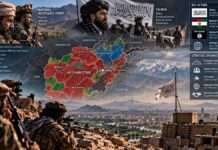







Strategic assessment of insurgent capabilities, territorial control, regional intervention, institutional legitimacy and the future of Afghan sovereignty
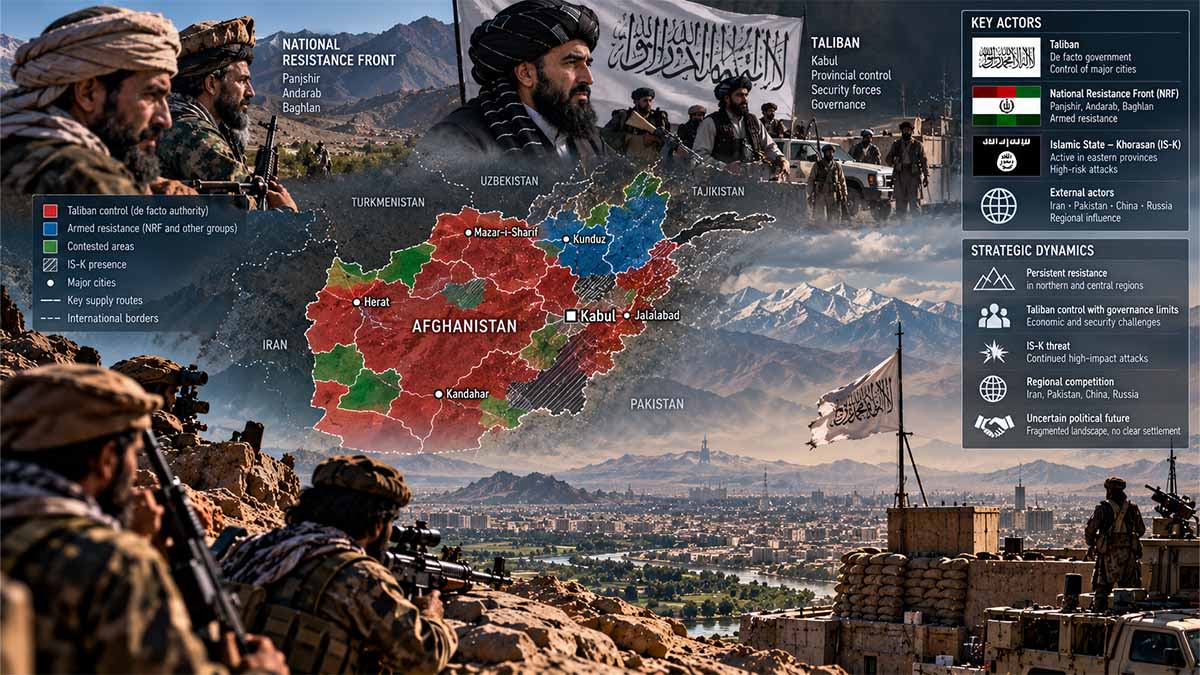
Scope: This assessment examines Afghanistan’s political and security environment from August 2021 to October 2026, including the roles of Pakistan, Central Asian states, China, Russia and European governments, with a strategic outlook extending through 2031.
Executive Summary / BLUF
Afghanistan’s armed opposition has demonstrated an ability to survive, reorganise and conduct operations against Taliban authorities. It has not demonstrated the institutional cohesion, territorial endurance or political legitimacy required to replace them.
The United Nations documented 88 armed-opposition incident claims across 21 provinces between 1 May and 31 July 2026, independently verifying 55 incidents. The same report concluded that these operations did not significantly challenge the Taliban’s territorial control.
The distinction is fundamental: tactical disruption is possible without producing a viable alternative government.
The Taliban’s principal vulnerabilities lie in its exclusionary political system, restrictions on women and girls, exposure to regional conflict, economic fragility and dependence on coercive institutional cohesion. None automatically translates into military opportunity for opposition factions.
Afghanistan’s confrontation with Pakistan represents a more immediate potential source of strategic disruption than the existing scale of republican armed resistance.
Badakhshan offers an important test of local political authority, but a brief occupation of government buildings cannot establish durable territorial control.
Regional governments have incentives to maintain relationships with Kabul, constrain transnational militancy and protect trade corridors, even when their political interests conflict with Taliban policies.
For European governments, the central objective should be to preserve diplomatic flexibility, protect Afghan civilians, maintain independent humanitarian access and evaluate political alternatives against demonstrable standards of representation and accountability.
Principal judgment: The Taliban is vulnerable to prolonged political and regional instability, but the available evidence does not support an imminent opposition victory. A credible alternative would require a transformation in political organisation, public legitimacy and governing capacity—not merely an increase in attacks.
Afghanistan’s Fragile Stability: The Taliban Can Hold Power, but Can It Sustain the State?
Five years after the fall of Kabul, the Taliban controls Afghanistan’s institutions while economic deprivation, regional confrontation and international isolation deepen. The armed opposition survives, but the absence of a credible political successor may prove as consequential as the weaknesses of the government it seeks to replace.
Afghanistan’s central strategic contradiction is no longer whether the Taliban can retain power, but whether it can preserve a functioning state without restoring the economic, political and institutional conditions necessary for national development. By October 2026, the authorities controlled the country’s administrative apparatus, collected domestic revenue equivalent to 19.8% of GDP and faced an armed opposition unable to establish durable territorial control. Yet World Bank estimates showed GDP per capita declining by 5.6%, while 21.9 million people required humanitarian assistance. Meanwhile, military confrontation with Pakistan was adding a regional security crisis to an already fragile economy. For neighbouring governments, Europe and the United States, the problem is increasingly uncomfortable: weakening Taliban authority would not necessarily produce a legitimate successor, while preserving essential state functions risks prolonging an exclusionary political order.
The Taliban has consolidated authority without securing political legitimacy
The institutional transformation since August 2021 has given the Taliban a degree of central control that its republican predecessors struggled to maintain consistently. Supreme leader Haibatullah Akhundzada exercises ultimate political and religious authority, while the administration operates through ministries, security organisations, courts and provincial officials. The September 2026 United Nations assessment documented appointments or reshuffles involving six provincial governors, nine deputy governors, seventeen district governors and seven provincial police chiefs, alongside senior ministerial and administrative changes.
These appointments reveal the mechanism of consolidation. Kabul maintains the machinery of government, but decisive political authority remains concentrated around Akhundzada’s leadership in Kandahar. Provincial administrations depend on appointments rather than electoral accountability, and the judiciary operates without the constitutional framework that formally structured the previous republic. Centralisation can strengthen discipline and administrative continuity, but it also concentrates succession risks and reduces the mechanisms through which competing interests can be resolved peacefully.
The distinction matters because the Taliban’s political isolation has not prevented it from developing institutional endurance. Its authorities collect taxes, administer public offices and maintain security organisations. Neither diplomatic non-recognition nor continuing opposition attacks have produced a systemic failure of central government.
Yet the costs of this governing model are measurable. The United Nations has documented violations affecting former officials and security personnel despite the general amnesty announced after the Taliban takeover. UNESCO estimated in August 2026 that approximately 2.4 million Afghan girls remained excluded from secondary education. The exclusion of women from major areas of public life constrains the future professional workforce, weakens essential services and limits the credibility of any claim that institutional consolidation represents national recovery.
Economic growth is concealing a deterioration in living standards
The economic figures reveal Afghanistan’s most consequential structural weakness. The World Bank’s May 2026 assessment estimated real GDP growth of 4.8%, alongside a 5.6% decline in GDP per capita. Population expansion, including substantial returns from neighbouring countries, has outpaced the economy’s ability to generate additional output per person. Inflation had reached 7.6% by March, while the current-account deficit was estimated at 36.1% of GDP in 2025.
The United Nations Development Programme, using a different statistical framework, reported real GDP growth of 1.9% for 2025, a 2.1% decline in per-capita output and approximately 74% of the population unable to meet basic subsistence needs. The estimates should not be mechanically combined, but their conclusions converge: Afghanistan is experiencing limited economic recovery without a corresponding recovery in household welfare.
The financing structure explains why. Domestic revenue collection has improved, but the economy remains dependent on imported goods, external financing and functioning regional transport routes. UNDP estimated a merchandise trade deficit of approximately $11.3 billion in 2025. Electricity insecurity, restricted access to credit and widespread informality constrain the expansion of productive enterprises, while international assistance declined by 16.5% according to UNDP’s assessment.
The result is a widening separation between the fiscal resilience of the authorities and the financial resilience of households. More than 80% of households were estimated to be in debt in 2025, while over 440 health facilities suspended or reduced services because of funding shortfalls. Access to adequate drinking water fell from 59% in 2024 to 44% in 2025.
These are not merely humanitarian indicators. They describe an economy progressively losing the human capital, infrastructure reliability and private financial capacity needed to sustain growth. An administration may continue collecting revenue while the population becomes less capable of investing, working productively or absorbing another shock.
Population returns are overwhelming an already constrained labour market
Afghanistan’s demographic pressure is being intensified by return movements from neighbouring countries. UNDP estimated approximately 2.9 million Afghan returns during 2025. UNHCR subsequently recorded 1,298,370 returns during 2026 as of 3 October, including approximately 715,400 from Pakistan and 581,600 from Iran. Within that total, around 563,460 were recorded as deportations.
These movements are economically significant because returning populations increase demand for housing, employment, food, healthcare and documentation before the economy has created sufficient additional productive capacity. UNDP estimated that 92% of recent returnees could not meet their basic subsistence needs. In the high-return provinces it assessed, only 3% of workers held formal employment, while 78% depended on casual daily labour.
This is the transmission mechanism through which migration pressure becomes a structural development problem. Population growth may expand the labour force, but without investment, reliable infrastructure and access to finance, it can instead increase competition for insecure employment and place additional demands on already weakened public services.
Restrictions on women’s participation intensify that imbalance. UNDP reported girls’ school attendance of approximately 42% in 2025, compared with 73% for boys. Continued educational exclusion reduces the supply of qualified workers precisely when healthcare, education and administration require additional personnel. Afghanistan is therefore absorbing a growing population while constraining part of its potential productive workforce.
Over the next decade, that contradiction will have consequences beyond annual GDP figures. The erosion of skills, household savings and access to essential services can outlast the economic shock that initially produced it.
Pakistan has turned Afghanistan’s western frontier into a regional security liability
The deterioration of relations between Islamabad and Kabul has fundamentally changed Afghanistan’s external security environment. Pakistan’s concerns over Tehreek-e-Taliban Pakistan and cross-border militant activity have developed into recurring military confrontation with the Afghan authorities, despite the historical relationship between Pakistan’s security establishment and the Taliban movement.
The civilian consequences have become substantial. UNAMA verified 185 civilian casualties, including 56 deaths and 129 injuries, between 26 February and 5 March 2026. Its September reporting recorded another 399 civilian casualties from Afghanistan–Pakistan hostilities during April–June. By 1 October, UNAMA reported more than 1,100 civilian deaths and injuries from cross-border armed violence during 2026.
Pakistan’s conventional military superiority does not automatically translate into the ability to compel Kabul to deliver a sustainable security settlement. Cross-border operations can damage infrastructure and personnel while also increasing civilian suffering, disrupting trade and deepening political hostility. Equally, Taliban control of Afghan territory does not by itself resolve questions about the ability or willingness of its authorities to constrain armed networks operating within the country.
For Afghanistan, the consequences extend beyond the immediate military confrontation. Border instability threatens import routes, raises commercial uncertainty and complicates economic relations at a time when the country already faces a severe external financing imbalance. Pakistan thus possesses considerable leverage over Afghanistan’s economic security, even without demonstrating that it can determine the country’s political future.
Nor does deterioration in bilateral relations establish that Islamabad has committed itself to financing an Afghan republican insurgency. Political contact, strategic interest and sustained military sponsorship are different categories of evidence. Confusing them would overstate both Pakistan’s intentions and the present capabilities of Afghanistan’s armed opposition.
Russia and China are expanding Kabul’s diplomatic options without resolving its vulnerabilities
Russia’s formal recognition of the Taliban government in July 2025 marked a significant diplomatic development. China has pursued a different approach, maintaining practical relations and accepting Taliban-appointed diplomatic representation without adopting the same explicit recognition formula. Beijing’s May 2025 trilateral engagement with Afghanistan and Pakistan also demonstrated its interest in limiting regional confrontation while protecting security and economic relationships.
These policies reflect national interests rather than a coordinated regional endorsement of Taliban governance. Russia seeks counterterrorism cooperation and stability affecting Central Asia. China prioritises security, commercial connectivity and its relationship with Pakistan. Iran must manage water disputes, migration and border security, while Uzbekistan and Turkmenistan have interests in transport and energy infrastructure.
The distinction between diplomatic engagement and economic transformation is crucial. Recognition does not automatically provide international financial access, industrial investment or enforceable security guarantees. Proposed infrastructure corridors require financing, construction, reliable commercial institutions and sustained regional cooperation. Announcements and memoranda cannot substitute for operating assets.
Nevertheless, selective engagement reduces the leverage available to governments that seek political concessions through diplomatic isolation alone. Kabul can maintain external relationships even while major Western governments withhold recognition. The resulting international order is fragmented: neighbouring states pursue practical arrangements with the incumbent authorities, while European governments emphasise conditionality, humanitarian assistance and accountability.
Europe is financing civilian resilience while withholding normalisation
The European Union’s position illustrates the limits of diplomatic conditionality when the authorities exercising control do not depend exclusively on Western recognition. In August 2026, the European External Action Service reaffirmed that the Union neither recognised nor legitimised the Taliban authorities, while maintaining operational contact and reporting more than €2 billion in assistance since August 2021.
The policies of the principal European governments reflect different national responsibilities. Italy documented assistance commitments of €14.5 million in 2024 and €16.5 million in 2025, principally through humanitarian and multilateral channels. France reported more than €177 million in humanitarian assistance since August 2021 and reaffirmed on 22 October 2026 that diplomatic normalisation remained conditional, particularly concerning women’s and girls’ rights. Germany continued humanitarian engagement without recognising the Taliban government, while the United Kingdom maintained assistance, protection and human-rights programmes.
These arrangements preserve essential civilian services without transferring political recognition to the incumbent authorities. Yet they cannot independently establish the political institutions that Afghanistan lacks. Humanitarian assistance can sustain healthcare and food access; it cannot substitute indefinitely for productive employment, functioning public finance or representative government.
International legal pressure has also increased. In July 2025, the International Criminal Court issued arrest warrants against Taliban supreme leader Haibatullah Akhundzada and Chief Justice Abdul Hakim Haqqani concerning alleged crimes against humanity. On 5 October 2026, the Court disclosed additional warrants against Habibullah Agha and Neda Mohammad Nadim. These remain allegations subject to judicial proceedings, not convictions.
The warrants increase the significance of accountability in international relations but do not constitute a mechanism for replacing Afghanistan’s government. That distinction also applies to Washington. The United States retains counterterrorism, diplomatic and protection interests after its 2021 withdrawal, but historical relationships with former Afghan officials cannot establish that today’s fragmented opposition could administer a successor state.
The next two years will expose the cost of governing without recovery
The medium-term outlook is defined by a dangerous asymmetry. The Taliban possesses institutions capable of preserving central authority, while Afghanistan’s armed opposition has not demonstrated the unified command, public legitimacy or administrative capability necessary to replace them. During May–July 2026, fourteen named opposition organisations claimed 88 incidents across twenty-one provinces, of which the United Nations verified 55. These figures establish continuing armed activity, not a credible national transition.
Between late 2026 and 2028, the decisive question will therefore be whether Afghanistan’s existing institutions can withstand the cumulative effects of demographic expansion, weak employment, declining assistance and regional confrontation. The World Bank’s approximately 4% growth projection for 2026 does not eliminate the risk that household welfare and essential services will continue deteriorating.
Three outcomes remain possible: prolonged Taliban control under economic pressure, increasing instability without a coherent successor, or a conditional political opening supported by credible representative institutions. The present evidence most strongly supports continued institutional control, but it does not establish that this outcome will deliver economic stability or political legitimacy.
The cost of inaction will fall first on Afghan households, particularly women, children, returnees and communities dependent on fragile public services. Neighbouring governments will carry additional costs through migration, border insecurity and commercial disruption. European donors will face growing pressure to finance emergency assistance while having limited influence over the policies that perpetuate dependence.
Afghanistan’s governing authorities can continue exercising power without achieving a sustainable economic recovery. What remains unproven is whether the country can absorb another two years of structural deterioration without deepening the separation between institutional survival and the welfare of its population.
Navigational Index
PILLAR I — THE DOMESTIC BALANCE OF POWER
- Chapter 1. The Taliban State: Authority, Command and Institutional Consolidation
- Chapter 2. Afghanistan’s Armed Opposition: Organisations, Operational Evidence and Strategic Limitations
- Chapter 3. Territorial Contestation: Badakhshan, Local Grievances and the Requirements of Durable Control
PILLAR II — REGIONAL POWER AND INTERNATIONAL SECURITY
- Chapter 4. Pakistan and Afghanistan: Border Conflict, Militant Networks and Strategic Leverage
- Chapter 5. Russia, China, Iran and Central Asia: Competing Interests and the Limits of External Sponsorship
- Chapter 6. International Law and Western Policy: The United States, European Union, Italy, France, Germany and United Kingdom
PILLAR III — STATE RESILIENCE AND THE 2031 OUTLOOK
- Chapter 7. Afghanistan’s Economic and Humanitarian Pressures: State Revenue, Social Exclusion and Migration
- Chapter 8. Strategic Pathways Through 2031: Regime Continuity, Political Fragmentation and Conditional Transition
- Chapter 9. Policy Options, Warning Indicators and Final Net Assessment
Master Abstract
The central contradiction: coercive control without broad political inclusion
The Afghan political system presents an apparent contradiction. The Taliban maintains effective control over the country’s principal administrative institutions while continuing to face armed opposition, humanitarian distress, severe restrictions on women and girls, and growing disputes with neighbouring governments. Its security position cannot be assessed solely through the frequency of attacks against its personnel, just as its political durability cannot be inferred from the absence of a competing government.
The September 2026 report of the United Nations Secretary-General describes a highly centralised governing structure under Taliban leader Haibatullah Akhundzada, with key decisions concentrated around his authority and mechanisms of consultation remaining opaque. Loyalty provides institutional coherence, while decrees and enforcement institutions shape public life in the absence of a constitutional framework comparable to that of the former republic. The same assessment identifies armed opposition activity as persistent but insufficient to materially alter territorial control. The Situation in Afghanistan and Its Implications for International Peace and Security — UN Secretary-General — Sep 2026, pp. 3–5.
This produces a strategic asymmetry. An opposition organisation can demonstrate that the Taliban cannot prevent every attack, but it must meet a much higher threshold to demonstrate that an alternative authority can govern territory, command armed personnel, administer resources and protect civilians. The Taliban needs to preserve the essential functioning of an existing state apparatus; its adversaries must establish institutions that do not yet operate at comparable national scale.
The resulting contest is therefore not simply between government forces and guerrillas. It concerns the relationship between military coercion, political organisation and public confidence in a society where memories of conflict, displacement and institutional breakdown remain highly consequential.
The operational evidence supports persistence, not military convergence
Afghanistan Security Architecture & Armed Opposition Assessment
A comprehensive visual analysis dissecting macro-level safety incidents, verified armed opposition activities, structural operational fragmentation, and underlying political governance deficiencies.
1. Macro vs. Micro Threat Landscape: Incident Classification
Aggregate safety- and security-related incident reports logged by the UN between May and July 2026, relative to the corresponding window in 2025.
Specific attacks and sabotage claimed by anti-Taliban political/armed organizations, accounting for a minor fraction (≈2.98%) of all recorded security events.
Macro security encompasses narcotics interdiction, violent criminality, interpersonal disputes, tribal clashes, border friction, and internal regime disciplinary actions. It must not be conflated with coordinated anti-regime insurgent warfare.
2. Core Measures of Opposition Activity & UN Verification Status
Claim Breakdown & Evidentiary Confidence
3. Operational Characterisation: Tactics, Scale & Territorial Impact
4. Resistance Paradox: Proliferation vs. Political Cohesion
• Apparent Expansion (Operational)
- Emergence of 14 separate named factions.
- Spread of claimed incidents across 21 provinces.
- Increasing geographic dispersion of claims.
- Elevated frequency of tactical press releases and social claims.
× Structural Deficit (Strategic)
- Absence of unity of purpose across insurgent networks.
- Autonomous and non-integrated leadership structures.
- Divergent domestic constituencies and ethnic bases.
- Competing external patrons and diplomatic ties.
The Decisive Political Deficit: Core Unanswered Questions
The primary obstacle confronting the anti-Taliban movement is fundamentally political rather than exclusively military. A broad-based coalition assembled purely on anti-Taliban sentiment lacks viable mechanisms to administer a state apparatus without definitive institutional consensus on five core pillars:
Badakhshan reveals the difference between access and control
Northern Afghanistan remains important because geographical remoteness, local power structures and disputes over economic resources can complicate the exercise of authority from Kabul and Kandahar. Nevertheless, topography alone does not create a sustainable insurgent base, and local dissatisfaction does not necessarily produce support for a particular armed faction.
The events of July 2026 illustrate the distinction. On 17 July, the Homeland Soldiers Front briefly seized administrative buildings in Yaftal-e Payin district of Badakhshan before withdrawing. On 24 July, the Afghanistan Freedom Front attacked a checkpoint in Zaybak district; the Taliban authorities reportedly repelled the assault and retained control of the area despite subsequent sporadic clashes. Both incidents were recorded in the September United Nations report. The Situation in Afghanistan and Its Implications for International Peace and Security — UN Secretary-General — Sep 2026, para. 9.
The first event demonstrated that an opposition faction could temporarily penetrate an administrative location. It did not demonstrate the ability to hold the surrounding territory, sustain civilian administration or prevent restoration of Taliban authority. The second demonstrated continued contested security conditions without establishing a change in control.
These distinctions matter for international assessment. A temporary seizure may have symbolic and operational significance, but a durable change in political control would require evidence of sustained administration, local cooperation, reliable public services and security conditions that do not expose civilians to uncontrolled retaliation.
Badakhshan also illustrates how social and economic grievances may operate independently of organised resistance. In May 2026, protests in Argo district over the destruction of poppy fields were followed by two deaths during the dispersal of demonstrators. Such episodes reveal tensions between central policy and local livelihoods. They do not, without further evidence, establish recruitment into opposition formations or popular endorsement of armed insurrection. The Situation in Afghanistan and Its Implications for International Peace and Security — UN Secretary-General — Sep 2026, para. 20.
Pakistan may become the principal external variable
The deterioration of relations between Islamabad and Afghanistan’s Taliban authorities introduces a separate strategic process that could affect the domestic balance of power without being controlled by Afghan opposition leaders.
Pakistan’s central security concern involves armed groups operating across or near the border, including Tehreek-e-Taliban Pakistan and associated networks. These organisations must be distinguished from Afghan republican opposition groups and from Islamic State in Iraq and the Levant–Khorasan Province (ISIL-K). Their objectives, command structures and relationships with Kabul are not interchangeable.
The United Nations documented continued cross-border military activity in May–July 2026, including air strikes, drone operations, shelling and clashes between security forces. For the period from 1 April to 30 June, it recorded 399 civilian casualties inside Afghanistan, comprising 57 deaths and 342 injuries, attributable to Afghanistan–Pakistan hostilities. Pakistan stated that its operations targeted militant infrastructure and complied with international law, while the Afghan de facto authorities disputed those assertions. The disagreement remains material to legal and political interpretation. The Situation in Afghanistan and Its Implications for International Peace and Security — UN Secretary-General — Sep 2026, paras. 10, 18–19.
The strategic significance of the border confrontation is not that it guarantees assistance to Afghan resistance factions. It is that a prolonged interstate security crisis can absorb resources, complicate commercial access, intensify displacement and encourage competing relationships with political actors across the frontier.
Any assumption that pressure from Pakistan would automatically strengthen a viable national alternative is therefore premature. External patronage can improve the resources available to one organisation while weakening its perceived independence, increasing factional rivalry and producing incentives inconsistent with a broadly representative political settlement.
Historical precedent is relevant only when the mechanisms remain comparable. Contemporary Afghanistan differs in its international environment, border-security priorities, sanctions framework and relationships with neighbouring states. External involvement must therefore be assessed through documented actions rather than inferred from historical alliances.
Transnational militancy and republican opposition are separate security problems
The existence of multiple armed actors inside Afghanistan creates a risk of analytical misclassification. Anti-Taliban republican organisations seek political change within Afghanistan. ISIL-K represents a distinct extremist threat, while TTP primarily pursues objectives related to Pakistan. Al-Qaeda-linked networks raise a different category of international counterterrorism concern.
The UN Security Council’s Analytical Support and Sanctions Monitoring Team has assessed that anti-Taliban armed opposition remains fragmented and has not posed a significant threat to Taliban rule. Its reporting also examines continuing security concerns associated with terrorist networks, although member-state accounts do not always agree on the scale or operational capabilities of particular groups. Sixteenth Report of the Analytical Support and Sanctions Monitoring Team Concerning the Taliban — UN Security Council — Dec 2025; Thirty-Eighth Report of the Analytical Support and Sanctions Monitoring Team — UN Security Council — Aug 2026.
This distinction has direct consequences for policy. A government seeking to reduce the risk of cross-border terrorism should not assume that every armed enemy of the Taliban is a suitable counterterrorism partner. Equally, the Taliban’s ability to suppress individual organisations does not independently prove that Afghanistan presents no external security threat.
The relevant assessment requires separate evidence about organisational command, financing, recruitment, training, cross-border activity and relationships between militant structures and de facto state institutions. Political statements by interested parties cannot substitute for this evidence.
Economic endurance does not mean economic recovery for the population
Afghanistan’s economic experience demonstrates why regime-collapse predictions based on social hardship are unreliable.
In May 2026, the World Bank estimated real GDP growth of 4.8%, alongside a 5.6% decline in GDP per capita. The Bank associated the divergence with substantial population growth, including the return of approximately 3.7 million Afghans, while reporting that inflation had reached 7.6% by March 2026. Domestic revenue collection had improved to 19.8% of GDP in 2025, yet external financing constraints continued to limit investment and resilience. Afghanistan’s Economy Shows Resilience but Living Standards Are Falling — World Bank — May 2026.
These indicators demonstrate the coexistence of limited economic recovery, declining average welfare and some administrative capacity. They do not justify either a prediction of financial collapse or a conclusion that the authorities possess a sustainable development model.
Humanitarian conditions remain severe. The European Commission estimates that 21.9 million people require humanitarian assistance in 2026. The September United Nations report recorded financing of only $513 million against $1.7 billion required under the humanitarian response plan, equivalent to 29.9%. Funding shortfalls, restrictions affecting female humanitarian workers and continuing needs create pressures that can persist regardless of changes in military activity. Afghanistan — European Commission, European Civil Protection and Humanitarian Aid Operations; The Situation in Afghanistan and Its Implications for International Peace and Security — UN Secretary-General — Sep 2026.
A credible transition strategy must consequently address basic service delivery, employment, taxation, the banking environment and humanitarian access. An opposition organisation unable to administer these functions would face an immediate legitimacy problem even if military circumstances became favourable.
Europe has influence, but its instruments are predominantly civilian
European policy should not be treated as a single undifferentiated position. Member states and the United Kingdom share major concerns over human rights, terrorism and instability, but retain distinct diplomatic arrangements, national obligations and capacities.
Italy maintains a development and humanitarian engagement oriented toward international organisations and implementing partners. Its embassy records assistance commitments of €14.5 million in 2024 and €16.5 million in 2025, while indicating that its assistance programming avoids direct engagement with the de facto authorities. Its policy relevance lies in humanitarian delivery, regional diplomatic coordination and protection of Afghan communities rather than a documented programme of military support for insurgent organisations. Development Cooperation — Embassy of Italy in Kabul.
France maintains a particularly explicit position on political normalisation. Its Foreign Ministry stated on 22 October 2026 that Paris has not maintained diplomatic relations with the Taliban since 2021 and that normalisation depends on political developments and conditions associated with UN Security Council Resolution 2593, notably respect for women’s and girls’ rights. France reported more than €177 million in humanitarian aid since August 2021. Afghanistan: Bilateral Relations — French Ministry for Europe and Foreign Affairs — Oct 2026.
Germany does not recognise the Taliban government and has kept its embassy in Kabul closed since 2021. Its official policy retains attention to humanitarian conditions, regional security and fundamental rights. Germany’s significance to a broader European approach lies in the coordination of diplomatic pressure, civilian assistance and migration-related policy, not in a public commitment to replacing the Taliban through armed intervention. Germany and Afghanistan: Bilateral Relations — German Federal Foreign Office — Mar 2026.
The United Kingdom continues to frame Afghanistan through human-rights accountability, security and humanitarian concerns. In a published September 2026 Human Rights Council statement—which the UK mission specified was not delivered orally because of time constraints—it reiterated concerns about the situation of Afghan women and girls and the broader humanitarian emergency. These positions provide a basis for multilateral coordination but do not themselves establish a decision to support armed opposition. UN Human Rights Council 63: UK Statement for the Interactive Dialogue on Afghanistan — UK Government — Sep 2026.
At the European Union level, operational contact with Taliban-controlled institutions has been distinguished from political recognition. The European External Action Service’s August 2026 statement reaffirmed continued engagement on humanitarian needs, human rights and counterterrorism while withholding political legitimisation of the de facto government. Five Years After Kabul Takeover, EU Support for Afghan People Continues — European External Action Service — Aug 2026.
The resulting policy question is not whether European governments should choose between passive acceptance and renewed military intervention. It is how diplomatic engagement, conditionality, independent assistance, accountability mechanisms and support for inclusive Afghan political participation can be combined without increasing harm to civilians.
The five-year outlook depends on political capability
The decisive uncertainty between 2027 and 2031 is whether Afghanistan’s opposition can develop a legitimate, nationally relevant political organisation that remains credible beyond the areas in which its armed members operate.
There are three broad possibilities.
The first is continued Taliban rule with persistent low-intensity armed opposition. This is most consistent with the presently verified military balance. Its durability would depend on Taliban internal cohesion, the management of regional disputes and the ability of the state apparatus to function despite economic constraints.
The second is increasing instability without a coherent political successor. A serious Pakistan–Afghanistan confrontation, an internal Taliban leadership dispute, worsening economic pressures or local clashes could weaken security conditions while leaving the opposition too fragmented to offer an effective replacement. This is a materially different outcome from an organised transition.
The third is a conditional political opening in which Afghan opposition actors demonstrate shared institutions, credible civilian representation, a coherent constitutional direction and the ability to negotiate or administer a transition. Such an outcome is conceivable over the five-year horizon, but it would require developments not established by the available record.
The most consequential analytical error would be to assume that Taliban difficulties and opposition success are interchangeable variables. They are not. A ruling system can deteriorate without producing a capable successor, and opposition organisations can survive for years without moving appreciably closer to governing.
Key Evidence Table
| Indicator | Value/status | Reference date | Definition/scope | Issuer | Exact source |
|---|---|---|---|---|---|
| Nationwide safety and security incident reports | 2,947; 11% above comparable period in 2025 | May–Jul 2026 | All recorded safety/security incidents; not exclusively resistance attacks | UN Secretary-General | A/81/363–S/2026/724, para. 8 |
| Armed opposition claims | 88 incidents across 21 provinces, attributed to 14 named groups | May–Jul 2026 | Claimed attacks, not wholly verified | UN Secretary-General | A/81/363–S/2026/724, para. 9 |
| Independently verified opposition incidents | 55 | May–Jul 2026 | Verified subset of claims; no finding of significant territorial threat | UN Secretary-General | A/81/363–S/2026/724, para. 9 |
| Badakhshan administrative seizure | Temporary occupation followed by withdrawal | 17 Jul 2026 | Yaftal-e Payin; no verified lasting change of control | UN Secretary-General | A/81/363–S/2026/724, para. 9 |
| Civilian casualties from Afghanistan–Pakistan hostilities | 399: 57 killed and 342 injured | Apr–Jun 2026 | Civilians in Afghanistan affected by cross-border hostilities | UN Secretary-General | A/81/363–S/2026/724, para. 18 |
| National economic growth | Estimated 4.8% real GDP growth | Spring 2026 assessment | Aggregate output; not household living-standard growth | World Bank | Afghanistan Development Update announcement — May 2026 |
| GDP per capita | Decline of 5.6% | Spring 2026 assessment | Per-person output, affected by substantial population growth | World Bank | Afghanistan Development Update announcement — May 2026 |
| People requiring humanitarian aid | 21.9 million | 2026 | Humanitarian needs estimate | European Commission | Afghanistan — ECHO |
| Humanitarian response financing | $513 million received; $1.7 billion required; 29.9% funded | Sep 2026 reporting | Response-plan funding snapshot, not annual expenditure | UN Secretary-General | A/81/363–S/2026/724, summary |
| French humanitarian assistance | More than €177 million since Aug 2021 | 22 Oct 2026 update | Cumulative French humanitarian allocation | French Foreign Ministry | Relations bilatérales — Oct 2026 |
Comparability note: The security totals, humanitarian requirements and economic estimates describe different observation periods and populations. They are not components of a single composite measure of political instability.
Competing Strategic Pathways
| Pathway | Supporting evidence | Evidence against or necessary condition | Indicator to monitor | Current assessment |
|---|---|---|---|---|
| Consolidated Taliban rule with continued guerrilla activity | Centralised authority, continuing territorial control and fragmented opposition | A serious, sustained breakdown in governing institutions or security cohesion | Durable loss of district administration; verifiable command defections | Most consistent with the verified baseline |
| Regional escalation and domestic fragmentation | Pakistan–Afghanistan clashes, civilian casualties, border volatility and local grievances | Requires escalation sufficient to weaken institutional control beyond current levels | Sustained border closures, military deployments, displacement and disruption of administrative services | Material risk; not equivalent to opposition victory |
| Emergence of a credible national political alternative | Persistence of armed opposition and political dissatisfaction among sections of Afghan society | Requires representative leadership, civilian institutions, political agreement and evidence of durable authority | Public coalition charter, functioning common institutions and independently observed civilian support | Possible but not demonstrated |
These pathways are analytical alternatives, not mutually exclusive outcomes. A deteriorating regional security environment could coexist with either continuing Taliban control or an evolving opposition movement. No numerical probabilities are assigned because the available record does not supply a defensible statistical model or empirical base rate for these specific outcomes.
Principal Intelligence Gaps and Watch Indicators
Institutional cohesion inside the Taliban. The central question is whether leadership differences remain manageable within existing structures or begin to affect appointments, command discipline, revenue administration and security enforcement. Isolated rumours of division are insufficient. A change in assessment would require repeated and independently corroborated evidence of noncompliance by significant institutions or commanders.
Opposition command and civilian legitimacy. Publicly verifiable evidence is needed concerning coalition leadership, decision procedures, financing transparency, constituency representation and arrangements for civilian protection. A common declaration without implementation would not establish organisational unity.
Durability of territorial authority. Future incidents must distinguish temporary access to administrative premises from continuing control. Persistent administration over weeks or months, independently documented service provision and stable civilian access would constitute more consequential indicators than isolated engagements.
External relationships. Assertions concerning material support from Pakistan, Tajikistan, Iran or other governments require corroboration through official decisions, independently observed transfers or other reliable records. Diplomatic contact and military sponsorship are analytically distinct.
Cross-border escalation. The intensity of Afghanistan–Pakistan hostilities, consequences for commercial corridors, civilian displacement and the role of transnational armed networks will provide critical evidence about whether regional conflict changes the internal balance of power.
Humanitarian and economic deterioration. Key observations include changes in household purchasing power, food insecurity, humanitarian financing, banking access and the capacity of public institutions to sustain essential services. Humanitarian deterioration should be measured as a civilian-protection concern, not treated as a proxy for insurgent strength.
Political transition capacity. The decisive question for any prospective alternative is whether it can make enforceable commitments on constitutional authority, rights, public finance, ethnic and religious inclusion, and civilian oversight of armed forces. These capabilities cannot be assumed from military opposition to the incumbent authorities.
Strategic Implications and Preliminary Decision Framework
For governments and international institutions, the first policy requirement is to separate the objectives of containing external terrorist threats, improving humanitarian conditions, defending fundamental rights and assessing potential future political alternatives. These objectives overlap but are not identical. A policy that treats every hostile actor as a potential replacement government risks undermining both counterterrorism credibility and political legitimacy.
For neighbouring states, the most consequential near-term responsibility is the prevention of uncontrolled regional escalation. Border security, cross-border commerce, refugee movements and armed-group activity require documented agreements and functional communication channels. Using Afghan political factions as instruments of bilateral pressure may create short-term leverage while producing long-term dependence, fragmentation and civilian insecurity.
For the European Union and its member states, existing civilian and diplomatic instruments provide a more substantiated policy foundation than an unverified expectation of military transition. Humanitarian access, accountability, support for Afghan women and independent civil society, and consistent evaluation of political representation can preserve influence without equating engagement with recognition.
For Afghanistan’s opposition, the greatest strategic challenge is to become more than the sum of its armed factions. Political credibility depends on the ability to specify how an alternative authority would govern, finance services, guarantee rights, command security personnel and negotiate relationships with neighbouring states.
The five-year outlook therefore turns on a distinction between the erosion of an incumbent government’s legitimacy and the emergence of a viable successor. The first may proceed through economic, political and diplomatic mechanisms. The second requires institutions, representation and public trust that cannot be manufactured through guerrilla operations alone.
Final opening judgment: As of 27 October 2026, the evidence supports the continued survival of Afghanistan’s armed opposition, but not a conclusion that it is approaching national victory. The most important strategic developments through 2031 will be those that demonstrate either a measurable weakening of Taliban state cohesion or the creation of an independently credible, inclusive Afghan political alternative. Without such developments, greater violence may change the level of instability without changing who governs Afghanistan.
AFGHANISTAN 2026 Taliban Authority, Armed Resistance and Regional Instability
The survival of Afghanistan’s armed opposition is not equivalent to the emergence of a viable alternative government. This dashboard distinguishes verified security incidents, territorial control, regional pressures, economic fragility and competing strategic pathways through 2031.
Verified Security and Humanitarian Indicators
Each measure reflects its own reporting period and definition. These figures must not be combined into a synthetic conflict index.
May–July 2026
May–July 2026
April–June 2026
assistance during 2026
Armed Opposition and Civilian Exposure
Three-dimensional styling represents verified quantities without introducing statistical weights or speculative military capabilities.
Armed Opposition Incident Claims
May–July 2026. The 55 verified incidents are included within the 88 reported claims.
Afghanistan–Pakistan Civilian Casualties
April–June 2026. Civilian casualties recorded inside Afghanistan from cross-border hostilities.
Source: UN Secretary-General, September 2026, paragraph 18 .
Economic Resilience, Falling Welfare and Aid Constraints
Aggregate economic activity, individual living standards and humanitarian financing describe different dimensions of Afghanistan’s fragility.
Humanitarian Financing
UN humanitarian response plan funding snapshot, reported in September 2026.
The percentage is the published funding rate; dollar figures are rounded and need not reproduce that rate exactly. Source: UN Secretary-General, September 2026 .
Aggregate Growth Versus Living Standards
World Bank estimates cited in the May 2026 economic assessment.
Estimated increase in aggregate real economic output.
Estimated decline in output per person.
The coloured lines are directional markers, not bars drawn to a quantitative scale. Source: World Bank, May 2026 .
Badakhshan: Tactical Penetration Is Not Durable Control
Two Incidents, No Verified Lasting Transfer of Authority
Yaftal-e Payin
An armed opposition group briefly occupied district administrative buildings before withdrawing. The event established temporary access, not sustained administrative control.
Zaybak
An opposition assault targeted a Taliban checkpoint. The authorities reportedly retained control despite further sporadic clashes in the area.
Three Competing Pathways Through 2031
These are evidence-based qualitative pathways. They may overlap and have not been assigned numerical probabilities or synthetic risk scores.
Taliban Institutional Continuity
Central authorities retain administrative and security control while fragmented opposition factions conduct intermittent operations.
Supporting baseline: Continued territorial control and the absence of a verified, durable opposition-held district.
Indicator that would weaken it: Sustained territorial losses, verified command fragmentation or persistent failure of governing institutions.
Regional Escalation and Fragmentation
Border confrontation, economic shocks and local security disputes increase instability without necessarily producing a coherent successor government.
Supporting baseline: Recorded Afghanistan–Pakistan hostilities and unresolved regional security disputes.
Indicator that would strengthen it: Prolonged border disruption, expanding civilian displacement and measurable erosion of state administrative functions.
Credible Political Alternative
Opposition groups develop functioning representative structures, civilian institutions and an agreed constitutional transition framework.
Necessary condition: Demonstrable national political coordination and administrative capability beyond isolated military operations.
Indicator that would strengthen it: Implemented coalition institutions, transparent leadership arrangements and independently observed civilian support.
Verified Indicators and Source Definitions
The table distinguishes claimed incidents, verified activity, civilian harm, economic estimates and humanitarian indicators.
| Indicator | Value | Reference period | Interpretation / limitation | Official source |
|---|---|---|---|---|
| Safety and security incidents | 2,947 | May–July 2026 | Broad security incident category; 11% above the comparable 2025 period. Not solely opposition attacks. | UN, para. 8 |
| Armed opposition claims | 88 | May–July 2026 | Claimed incidents across 21 provinces by 14 named groups. | UN, para. 9 |
| Independently verified opposition incidents | 55 | May–July 2026 | Verified subset of 88 claims. No finding of significant change in territorial control. | UN, para. 9 |
| Border-conflict civilian casualties | 399 | April–June 2026 | 57 killed and 342 injured inside Afghanistan. | UN, para. 18 |
| Aggregate real GDP growth estimate | +4.8% | May 2026 assessment | Aggregate economic growth; not an indicator of household welfare. | World Bank |
| GDP per capita change estimate | −5.6% | May 2026 assessment | Decline in output per person, despite positive aggregate growth. | World Bank |
| Humanitarian assistance requirement | 21.9M people | 2026 | Estimated number of people requiring humanitarian assistance. | European Commission |
| Humanitarian response financing | 29.9% | September 2026 snapshot | Reported share funded against the humanitarian response plan requirements. | UN Secretary-General |
Evidence integrity: Missing corroboration is not automatically evidence that a claim is false. Announced military activity is not equivalent to demonstrated territorial control, and humanitarian needs cannot be used as a numerical measure of armed resistance capabilities.
Observable Indicators That Could Change the Assessment
Independently corroborated command disputes, administrative failures, leadership defections or sustained noncompliance with central orders.
Implemented common institutions, a representative leadership framework, coordinated civilian governance and transparent decision procedures.
Documented control beyond short raids, provision of local services and sustained protection of civilian populations.
Persistent cross-border military operations, commercial disruption, displacement or expansion of hostilities affecting civilians.
Verifiable official decisions or documented assistance arrangements, distinguished from diplomatic meetings and uncorroborated claims.
Changes in purchasing power, food insecurity, humanitarian funding, banking access and essential public-service delivery.
Resistance Survival Does Not Establish Regime Vulnerability
As of 27 October 2026, the verified record demonstrates that Afghanistan’s armed opposition remains operational, but has not established the political cohesion, enduring territorial authority or administrative capability required to replace the Taliban.
Afghanistan’s principal sources of instability are not confined to armed resistance. They include strained relations with Pakistan, economic pressures, humanitarian requirements, the exclusion of women and girls from major areas of public life, and unresolved questions of institutional legitimacy.
The strategic test through 2031: whether verified weaknesses in the existing governing system are accompanied by the emergence of a representative, accountable and operationally credible political alternative.
PILLAR I — THE DOMESTIC BALANCE OF POWER
Chapter 1. The Taliban State: Authority, Command and Institutional Consolidation
Afghanistan’s governing system has consolidated coercive authority without establishing an inclusive constitutional order
Five years after the collapse of the Islamic Republic of Afghanistan, the Taliban has established a governing structure that controls the principal institutions of the Afghan state, exercises authority over provincial administrations, directs the country’s security and intelligence organisations, collects domestic revenue and enforces political and social regulations through an increasingly centralised chain of command. This consolidation constitutes the essential institutional reality underlying Afghanistan’s domestic balance of power. Although the Taliban’s governing model remains internationally contested, its ability to maintain territorial control and institutional continuity cannot be dismissed as a temporary military occupation or an administration dependent exclusively on the residual structures of the former republic. The distinction between effective control and political legitimacy is fundamental: effective control describes an authority’s practical ability to enforce decisions and administer territory, whereas legitimacy involves the constitutional basis of government, political representation, accountability, fundamental rights and the acceptance of public authority by the governed. The Taliban has demonstrated considerable capacity in the first category while remaining deeply deficient in the second. The United Nations Secretary-General’s report of 9 September 2026 identifies a highly centralised governing structure in which major decisions are made by Haibatullah Akhundzada and institutional coherence is maintained through strict loyalty to his leadership. It also confirms that consultation and deliberation remain opaque, that Afghanistan continues to be governed without a constitution establishing transparent public authority, and that the regime’s interpretation of Islamic law is implemented through decrees and enforcement institutions. These findings indicate that the most immediate challenge to Taliban rule does not arise from the existence of alternative armed organisations, but from the question of whether a governing model organised around personal authority, ideological conformity and restricted political participation can develop durable institutional legitimacy while absorbing social, economic and regional pressures. The Situation in Afghanistan and Its Implications for International Peace and Security — United Nations Secretary-General — September 2026, paragraphs 1–5.
The institutional transformation that followed August 2021 is particularly significant because it replaced a formally constitutional, electorally structured but politically fragmented republic with a system in which executive, religious and security authority are closely intertwined. Under the former constitutional framework, public administration operated within a political order that formally recognised representative institutions, a legislative process, judicial structures and constitutionally defined rights, notwithstanding extensive corruption, patronage and problems of implementation. The Taliban’s restoration of the Islamic Emirate eliminated that constitutional architecture without providing an equivalent framework of publicly contestable authority. The European Union Agency for Asylum’s 2026 country assessment confirms that the authorities have neither restored the 2004 Constitution nor promulgated a comprehensive replacement and that the legal status of various earlier laws remains uncertain. Verbal instructions, written decrees, judicial orders and administrative directives operate alongside references to the authorities’ interpretation of sharia, producing a system in which the source, hierarchy and practical application of rules are not always transparent. This arrangement gives the leadership considerable freedom to revise policies or impose restrictions without legislative scrutiny, but it also creates uncertainty for judges, officials, businesses and ordinary citizens. From an institutional perspective, concentrated discretion may improve the leadership’s immediate ability to impose political decisions while reducing predictability, legal certainty and the capacity of public institutions to resolve disputes independently of the political centre. The absence of institutionalised political competition does not necessarily mean that conflicts have disappeared; rather, competing interests may be displaced into personal networks, administrative appointments, religious authority, economic patronage and internal security structures, where they are more difficult to observe and subject to fewer publicly accountable mechanisms of resolution. Afghanistan: Country Focus, Section 1.2.2, Nature of Issued Instructions — European Union Agency for Asylum — 2026.
Kandahar, Kabul and the concentration of supreme decision-making authority
The relationship between Kandahar and Kabul illustrates the governing system’s distinctive distribution of power. Kabul remains the principal location of central ministries, administrative coordination, financial management, foreign diplomatic engagement and national public-service institutions, while Kandahar is the central locus of the supreme leader’s religious and political authority. This arrangement should not be interpreted mechanically as the coexistence of two independent governments. The available official evidence instead describes a highly centralised hierarchy in which the supreme leader determines major political priorities and retains authority over appointments and important administrative decisions, although implementation is distributed across ministries, provincial administrations, courts and security organisations. The events of June 2026 offer an unusually concrete demonstration of this hierarchy. According to the September United Nations report, a verbal instruction attributed to Akhundzada restricting smartphone use by civil servants and security personnel was transmitted to military courts through the body responsible for monitoring decrees and edicts. On 9 June, military courts were instructed to brief civilian and military personnel, with enforcement beginning on 16 June; the de facto Supreme Court subsequently instructed eight regional military courts to implement the restriction and required written approval from the supreme leader for exemptions. UNAMA nevertheless received reports of uneven application across institutions, geographical areas, ranks and functions. This episode is significant because it reveals the relationship between personal authority, administrative transmission and enforcement: a leadership instruction can travel through judicial and military institutions, acquire disciplinary consequences and influence the conduct of a broad range of officials without originating in a parliamentary or publicly accountable rule-making process. At the same time, variation in implementation demonstrates that centralisation at the apex is not synonymous with perfect administrative uniformity. The Situation in Afghanistan and Its Implications for International Peace and Security — United Nations Secretary-General — September 2026, paragraph 4.
Personnel appointments provide a second indicator of how the Taliban leadership converts political loyalty into institutional control. During the reporting period covered by the September 2026 United Nations assessment, Akhundzada appointed or reshuffled a de facto minister of communications and information technology, eight deputy ministers across several portfolios, six provincial governors, nine deputy provincial governors, seventeen district governors, seven provincial police chiefs and at least fourteen provincial departmental heads, alongside other appointments. The geographical distribution included several northern provinces, such as Baghlan, Faryab, Jowzjan and Badakhshan, demonstrating that the leadership’s personnel authority extends into territories where the Taliban’s local political constituency and historical relationships differ from those of its southern core. These appointments have several simultaneous institutional functions. They permit the leadership to reward loyalty, replace officials regarded as ineffective or insufficiently compliant, redistribute administrative influence and limit the emergence of provincial power structures that might become independent of the centre. They may also move officials across regional or organisational boundaries, reducing reliance on local networks. However, appointment power alone does not establish the competence of officeholders, their acceptance by local communities or the effectiveness of the institutions they manage. A district administrator may possess a formal appointment and access to coercive authority while remaining unable to resolve land disputes, provide essential services or secure local cooperation. The analytical significance of the appointments is therefore not merely their number, but the extent to which they create vertically accountable institutions whose primary political responsibility runs toward the supreme leadership rather than toward the populations they administer. The Situation in Afghanistan and Its Implications for International Peace and Security — United Nations Secretary-General — September 2026, paragraph 5.
Institutional architecture: the distribution of authority within the Islamic Emirate
The principal institutions of Taliban governance have different functional responsibilities, but their activities operate within a political system in which the distinction between religious direction, state administration, judicial interpretation and coercive enforcement is substantially less developed than in a constitutional democracy. The de facto cabinet and central ministries perform administrative functions; the security and intelligence institutions exercise coercive authority; the courts apply the governing legal interpretations; provincial and district officials administer local affairs; and the Ministry for the Propagation of Virtue and the Prevention of Vice enforces an extensive range of social regulations. The organisational structure should not, however, be confused with proof of effective legal checks and balances. The presence of separate institutions does not demonstrate that they enjoy independence from the supreme leader or possess sufficient authority to challenge actions taken by other branches of the governing apparatus. The European Union Agency for Asylum identifies a 33-member caretaker cabinet in its 2026 assessment and describes an administration composed entirely of men, predominantly ethnic Pashtuns and individuals associated with or loyal to the Taliban movement. Although some non-Pashtun officials occupy positions, representation remains highly uneven, and senior appointments do not result from a competitive national electoral process. Consequently, institutional consolidation has occurred primarily through the incorporation of Taliban personnel and supporters into state structures rather than through a negotiated settlement among Afghanistan’s political communities. Afghanistan: Country Focus, Ethnic and Religious Groups — European Union Agency for Asylum — 2026.
| Institution or authority | Principal function | Documented characteristic | Institutional limitation | Strategic significance |
|---|---|---|---|---|
| Supreme Taliban leadership | Ultimate political, religious and strategic direction | Centralised authority exercised by Haibatullah Akhundzada | Limited transparency of consultation and decision-making | Provides regime cohesion while concentrating succession and policy risks |
| De facto Prime Minister and cabinet | Central government administration and ministerial coordination | All-male caretaker structure operating under Taliban authority | No competitive national mandate or independent parliamentary accountability | Maintains administrative continuity and coordinates implementation |
| De facto Ministry of Defence | Military organisation, internal security and defence functions | Operates as part of the Taliban-controlled state security apparatus | Limited public evidence on readiness, operational budgets and independent oversight | Supports coercive control and response to security challenges |
| De facto Ministry of Interior | Policing and internal security administration | Oversees police functions within the de facto system | Accountability and transparency concerns documented by UNAMA | Central to everyday enforcement and public security |
| General Directorate of Intelligence | Intelligence collection and internal security | Documented involvement in detention and restrictions affecting journalists | Limited independent judicial and public oversight | Enhances regime security while creating substantial civil-liberties concerns |
| De facto Supreme Court and subordinate courts | Judicial administration and enforcement of legal decisions | Operate under the authorities’ interpretation of Islamic law | Legal uncertainty and lack of demonstrable institutional independence | Provide judicial instruments for implementing central directives |
| Ministry for the Propagation of Virtue and the Prevention of Vice | Enforcement of religious and social regulations | Extensive activities involving dress, public conduct and social restrictions | Serious rights concerns and enforcement-related abuses | Extends ideological authority into daily social life |
| Provincial and district administrations | Local governance, implementation and public administration | Appointments and reshuffles directed by central leadership | Variable local acceptance and implementation capacity | Connect central rule to local populations and resources |
| Security oversight and disciplinary bodies | Internal investigations and disciplinary supervision | Internal mechanisms and specialised bodies documented by UNAMA | Insufficient public reporting on complaints, investigations and outcomes | Influence discipline, public confidence and exposure to abuses |
Sources: The Situation in Afghanistan and Its Implications for International Peace and Security — United Nations Secretary-General — September 2026; Afghanistan: Country Focus — European Union Agency for Asylum — January 2026.
Security-sector institutionalisation: the difference between force cohesion and professional accountability
The consolidation of security institutions represents one of the Taliban’s principal advantages over its fragmented opponents. The movement inherited a country whose former defence and security institutions had collapsed during the withdrawal of international forces, and it proceeded to organise its own military, policing and intelligence functions within the structures of the de facto state. This transition altered the movement’s operational requirements: rather than concentrating predominantly on insurgent operations against an incumbent government, the Taliban became responsible for territorial policing, border security, detention, intelligence collection, protection of administrative facilities and the daily enforcement of public order. The responsibilities of government generate demands that differ substantially from those of guerrilla warfare. An authority must sustain personnel, command structures, communications, supplies, disciplinary procedures and local administrative cooperation while managing the risk that personnel act for private, factional or economic interests. Institutional cohesion is therefore better measured by the ability to perform these functions over time than by claims concerning aggregate manpower or weapons inventories. Public reporting does not provide a sufficiently complete, independently audited picture of mission-capable personnel, readiness, logistics, equipment maintenance and operational expenditure to justify a precise national assessment of Taliban military strength. What can be established more confidently is that the de facto security apparatus continues to exercise extensive operational authority and that the recognised armed opposition has not displaced it from the country’s principal institutions. This constitutes a demonstrated advantage in maintaining government control, without implying that the apparatus satisfies recognised standards of professionalism, human-rights compliance or independent accountability. The Situation in Afghanistan and Its Implications for International Peace and Security — United Nations Secretary-General — September 2026; Afghanistan: Country Focus — European Union Agency for Asylum — January 2026.
The issue of security-sector accountability is particularly important because coercive organisations can simultaneously strengthen central authority and undermine public confidence. UNAMA’s August 2026 examination of accountability efforts describes an institutional system in which the Taliban authorities have introduced directives, internal monitoring units and specialised mechanisms intended to investigate misconduct by security personnel. These mechanisms include the Security and Filtration Commission, bodies responsible for monitoring decrees and edicts, a complaints mechanism associated with the Ministry for the Propagation of Virtue and the Prevention of Vice, and judicial institutions. The creation of these bodies demonstrates that the authorities recognise, at least administratively, a requirement to control personnel behaviour and maintain discipline. It does not establish that complaints are resolved independently or that misconduct is consistently investigated and sanctioned. UNAMA reported insufficient transparency concerning the number of complaints received, the investigations conducted and the disciplinary or judicial outcomes achieved, while identifying fear of retaliation and barriers affecting women as obstacles to reporting abuses. These deficiencies have strategic consequences beyond the immediate rights of complainants. Where misconduct cannot be challenged safely, local communities may cease cooperating with security institutions, grievances may be transmitted through informal intermediaries rather than regular legal procedures, and officials may increasingly depend on coercion to enforce decisions that could otherwise be implemented through administrative consent. A security apparatus can consequently remain operationally effective in the short term while generating political costs that reduce confidence in the state. Such costs are particularly important in Afghanistan because family networks, local associations and historical grievances influence relations between communities and public authority. The existence of oversight structures should therefore be considered a limited indicator of administrative development, not proof of independent accountability or the equal application of law. Report on De Facto Security Sector Accountability Efforts — United Nations Assistance Mission in Afghanistan — August 2026.
Political representation and the structural consequences of exclusion
The composition of the governing apparatus reveals a persistent tension between centralisation and national representation. Afghanistan contains multiple ethnic, linguistic and religious communities whose political interests cannot be reduced to allegiance to a single organisation or historical movement. The Taliban’s leadership originates predominantly from the movement’s southern and southeastern networks, and the present administration has not developed a transparent mechanism through which the country’s wider population can influence national appointments or political decisions. The European Union Agency for Asylum’s 2026 documentation identifies a caretaker cabinet dominated by Taliban-affiliated Pashtun men, alongside limited representation from other communities and significant restrictions on participation by religious minorities. Some Hazaras, Tajiks and Uzbeks have held administrative positions, but individual appointments do not establish proportionate or effective political representation. The distinction is particularly relevant because ethnic identity alone cannot be treated as a sufficient indicator of political legitimacy. A Tajik official appointed by the central authorities does not necessarily represent the political preferences of Tajik communities, just as a Pashtun official does not automatically command support among Pashtuns. Genuine inclusion requires mechanisms for consultation, participation, accountability and the peaceful resolution of competing interests. In their absence, the administration may remain capable of enforcing decisions while proving less effective at obtaining consent for policies involving resource distribution, education, taxation, land administration or local economic activity. Such institutional shortcomings may create opportunities for political mobilisation, but they should not automatically be equated with support for armed opposition organisations. Dissatisfaction with Taliban governance, attachment to local autonomy and willingness to participate in an insurgency are separate political behaviours requiring different evidence. Afghanistan: Country Focus, Ethnic and Religious Groups — European Union Agency for Asylum — 2026.
Restrictions on women and girls demonstrate how political exclusion has been embedded in the governing model rather than remaining a temporary consequence of military transition. The September 2026 United Nations assessment documented continued enforcement of restrictive social regulations, barriers affecting women’s education and employment, and the exclusion of women from important areas of public decision-making. In August 2026, UNESCO estimated that approximately 2.4 million Afghan girls remained excluded from secondary education five years after the Taliban’s return to power. The United Nations also reported restrictions on the participation of Afghan women in humanitarian and institutional activities, including requirements affecting their movement and employment. These policies have consequences that extend beyond the direct violation of rights. Excluding women from secondary education and many forms of professional participation constrains future human capital, reduces the availability of trained personnel in socially essential occupations and weakens household economic resilience. It also impairs the representativeness of public institutions because a substantial part of the population is prevented from participating in the processes through which decisions are discussed, implemented and contested. The institutional implications are therefore structural rather than merely reputational. Restrictions that damage education, healthcare access, administrative capacity and professional development can weaken state performance over successive years even while central political authority remains intact. International objections to these restrictions have also limited the possibilities for diplomatic normalisation and broader economic engagement, making the governing model itself a continuing source of constraints on Afghanistan’s reintegration into international institutions. The Situation in Afghanistan and Its Implications for International Peace and Security — United Nations Secretary-General — September 2026, paragraphs 25–28 and 38.
The administrative significance of public revenue and financial control
The ability to collect revenue represents a material foundation of Taliban institutional durability. A government that can maintain customs administration, taxation and domestic collections possesses resources with which to support personnel, operate public institutions and finance selected priorities without relying exclusively on foreign recognition or external budget assistance. The World Bank’s May 2026 assessment reported that domestic revenue collection reached 19.8% of GDP in 2025, supported by stronger tax enforcement. This figure is significant because it establishes that the Taliban administration has developed a measurable fiscal collection capacity rather than depending solely on informal confiscation or aid flows. It must nevertheless be interpreted carefully. Revenue collection is not equivalent to effective budget allocation, independently audited public expenditure, adequate social-service provision or long-term fiscal sustainability. The reduction in international grants has constrained infrastructure investment and the ability to respond to economic shocks, while the absence of a comprehensive publicly accessible and independently audited expenditure record limits assessment of how resources are distributed among security institutions, administrative bodies, public investment and essential services. Consequently, the fiscal evidence supports an assessment of improved extraction and collection capacity, but not a claim that Taliban public financial management is transparent, economically optimal or sufficient to meet Afghanistan’s development requirements. The distinction matters for political stability because an authority may preserve its own institutional functions while households, provincial communities and public services remain under severe pressure. Afghanistan’s Economy Shows Resilience but Living Standards Are Falling — World Bank — May 2026.
The institutional significance of fiscal centralisation also lies in the distribution of resources between national and subnational authorities. Public revenues and administrative appointments may strengthen central control when provincial officials depend on Kabul for salaries, budget allocations and political approval, but such dependence can become problematic if local communities perceive that taxes and natural-resource revenues are collected without corresponding improvements in services. This relationship is especially sensitive in areas where livelihoods depend on agriculture, mining, cross-border commerce or limited local infrastructure. Revenue extraction can therefore have contradictory political effects. From the perspective of the central authorities, it finances administration and reduces the autonomy of local power holders; from the perspective of affected communities, it may either demonstrate a functioning state or intensify perceptions of exclusion, depending on the quality of public services, the predictability of regulation and the transparency of revenue allocation. The September United Nations report recorded resource-related disputes in several provinces and described economic pressures associated with trade disruption, declining purchasing power and limited access to essential services. Those observations do not establish a general fiscal rebellion, but they underline why institutional durability cannot be assessed using revenue collection alone. A state capable of collecting taxes must also demonstrate that its economic authority produces public goods if it wishes to broaden legitimacy beyond coercive compliance and established political loyalties. The Situation in Afghanistan and Its Implications for International Peace and Security — United Nations Secretary-General — September 2026, paragraphs 29–33.
Human-rights violations, judicial practices and the credibility of the general amnesty
The relationship between the Taliban’s security apparatus and former members of the Afghan state illustrates one of the most consequential weaknesses in the transition from insurgent movement to governing authority. Following the collapse of the republic, the Taliban leadership announced a general amnesty intended to protect former government officials and members of the Afghan National Defence and Security Forces. Such an assurance could, if consistently implemented, facilitate administrative continuity, reduce fear among former civil servants and military personnel, and limit incentives for renewed conflict. However, the available United Nations evidence demonstrates continuing violations of that commitment. Between 1 May and 31 July 2026, UNAMA documented at least 12 killings, 13 arbitrary arrests and detentions, and three incidents of torture or ill-treatment involving former government officials and former defence or security personnel. These figures constitute documented incidents within a specified reporting period; they do not represent a comprehensive historical total, and they cannot be used to determine national prevalence without accounting for access constraints and underreporting. Their institutional significance is nevertheless substantial. A public amnesty loses credibility when individuals covered by it remain exposed to arbitrary detention, violence or persecution, particularly where effective remedies and independent investigation are uncertain. Such conditions may discourage former personnel from reintegrating into civilian life, participating in public administration or providing information to authorities, while also creating grievances that armed organisations may seek to exploit. Yet the existence of those grievances does not prove that former personnel have joined organised resistance formations or that the latter possess the capacity to protect them. The Situation in Afghanistan and Its Implications for International Peace and Security — United Nations Secretary-General — September 2026, paragraph 21.
The implementation of judicial authority raises a broader question about the relationship between religiously defined legal rules, administrative enforcement and internationally recognised rights. The United Nations recorded 21 instances of corporal punishment involving eight women and thirteen men between 1 May and 31 July 2026 that had not been publicly announced by the de facto Supreme Court. It also documented arrests of journalists, suspensions of media organisations and restrictions on women accused of violating dress requirements. In Herat in June, at least thirty women were detained in connection with dress-code enforcement, and subsequent protests were met with violence, resulting in the death of a boy, injuries and further arrests. These events are not simply isolated indicators of repression; they demonstrate how the application of social and judicial regulations can itself become a source of political conflict. When legal standards are inadequately codified, enforcement depends heavily on official discretion, and avenues of appeal are restricted or unsafe, disputes over everyday conduct can escalate into confrontations with state authorities. The immediate political effect may be intimidation and compliance, but the longer-term institutional effect may include distrust of the judiciary, reduced willingness to report abuses and increasing separation between public authority and the communities it governs. The existence of a functioning detention and punishment system therefore cannot be regarded as sufficient evidence of the rule of law. The distinction is between institutions that exercise authority and institutions whose authority is constrained by predictable legal standards, effective remedies and independent review. The Situation in Afghanistan and Its Implications for International Peace and Security — United Nations Secretary-General — September 2026, paragraphs 22–27.
Consolidation indicators: what the official record establishes and what remains unproven
| Indicator | Verified evidence or official assessment | Reference period | What it establishes | What it does not establish |
|---|---|---|---|---|
| Supreme leadership | Major decisions centralised under Haibatullah Akhundzada | September 2026 assessment | Concentration of political authority | Transparent succession or institutional checks |
| Cabinet composition | 33-member caretaker cabinet described by EUAA | January 2026 report | Existence of central executive administration | Representative national mandate |
| Senior ministerial changes | One minister and eight deputy ministers appointed or reshuffled | May–September 2026 reporting | Leadership intervention in central administration | Improved competence or service delivery |
| Provincial governors | Six appointments or reshuffles | May–September 2026 reporting | Continuing central influence over provincial administration | Local political acceptance |
| Deputy provincial governors | Nine appointments or reshuffles | May–September 2026 reporting | Extension of personnel control below the provincial leadership level | Administrative effectiveness |
| District governors | Seventeen appointments | May–September 2026 reporting | Central personnel authority at district level | Uniform compliance in all districts |
| Provincial police chiefs | Seven appointments | May–September 2026 reporting | Security personnel management across provinces | Independent policing or rights compliance |
| Provincial departmental heads | At least fourteen appointments | May–September 2026 reporting | Administrative intervention across functional departments | Transparent merit-based selection |
| Domestic revenue | 19.8% of GDP | Calendar year 2025 | Significant domestic collection capacity | Adequate expenditure, fiscal transparency or social welfare |
| General-amnesty violations | At least 12 killings, 13 arbitrary arrests or detentions and three torture or ill-treatment incidents | May–July 2026 | Continuing abuses affecting protected former personnel | Total national incidence or a complete perpetrator breakdown |
| Unannounced corporal punishment | 21 documented instances | May–July 2026 | Enforcement extending beyond publicly announced court cases | Comprehensive national punishment total |
| Girls excluded from secondary education | Approximately 2.4 million | August 2026 UNESCO estimate | Scale of educational exclusion | A complete measure of all educational and economic consequences |
Sources: United Nations Secretary-General, A/81/363–S/2026/724 — September 2026; European Union Agency for Asylum, Afghanistan: Country Focus — January 2026; World Bank, Afghanistan Development Update announcement — May 2026.
Institutional cohesion should not be confused with the absence of internal disagreement
The Taliban’s governing structure contains differentiated institutional interests that may not always coincide, including those associated with the supreme leadership, ministerial administration, military commands, internal security organisations, provincial authorities and individuals responsible for economic and diplomatic engagement. Those differences are analytically relevant, but the public record does not support treating every reported disagreement as evidence of an approaching political split. The capacity of a governing organisation to manage differences internally is itself a component of institutional resilience, particularly when disputes have not resulted in sustained disobedience, the establishment of competing administrations or an interruption of national command. The September United Nations assessment emphasised strict loyalty to Akhundzada as the principal mechanism of institutional coherence while acknowledging limited transparency in consultation and policy formulation. This suggests that internal disagreements, where they exist, are managed within a hierarchy that continues to function rather than through publicly accountable political competition. Nevertheless, reliance on personal leadership creates an identifiable structural risk. If appointments, judicial exemptions, ideological interpretation and major policy decisions depend heavily on the authority of one leader, succession arrangements become more consequential, and institutions may lack independently established procedures for resolving disputes over future leadership or policy direction. This is an institutional vulnerability, not a prediction of imminent fragmentation. A credible assessment of weakening cohesion would require observable evidence of sustained refusal to implement central decisions, divergent command structures, competing claims to supreme authority or administrative paralysis across significant institutions. Without such evidence, speculation about factional rivalry cannot outweigh the demonstrated continuity of central governance. The Situation in Afghanistan and Its Implications for International Peace and Security — United Nations Secretary-General — September 2026, paragraphs 1–5.
Chapter 1 — Key judgments
The Taliban’s principal institutional advantage is not merely the possession of armed personnel, but its control of the structures through which decisions become administrative acts, security orders, judicial practices and revenue collections. The system has developed a substantial capacity to preserve its own continuity, although the concentration of authority, exclusionary political arrangements and weak accountability constrain its legitimacy and create potential longer-term vulnerabilities. The official evidence supports an assessment of centralised institutional consolidation accompanied by serious deficiencies in representative governance, legal certainty and public accountability. It does not support a conclusion that those deficiencies have already produced a systemic breakdown of government.
The assessment would materially change if independently documented evidence established persistent fragmentation of the supreme command, institutional refusal to implement leadership decisions, sustained loss of revenue or administrative continuity, or the appearance of competing authorities capable of exercising functions ordinarily performed by the state. Conversely, successful implementation of transparent complaints mechanisms, more inclusive appointments, predictable legal procedures and measurable improvements in rights protections would strengthen the case that the governing system is developing forms of institutional resilience beyond personal loyalty and coercive enforcement.
Chapter 2. Afghanistan’s Armed Opposition: Organisations, Operational Evidence and Strategic Limitations
The Afghan opposition has survived as an armed presence but has not developed the capacity of a national insurgent alternative
The central military assessment of Afghanistan’s armed opposition in October 2026 is that its continued existence demonstrates resilience, but its operational record does not establish a credible pathway to defeating the Taliban’s governing and security institutions. This conclusion requires a distinction between three different dimensions of insurgent capability: the ability to conduct attacks, the ability to maintain an organised military presence across several geographical areas, and the ability to convert armed activity into sustained political and territorial authority. Afghanistan’s opposition formations have demonstrated the first capability, although with varying degrees of independent verification, and some have demonstrated limited elements of the second through recurring incidents in several provinces. The third capability remains largely unproven. The European Union Agency for Asylum’s January 2026 assessment identified the National Resistance Front and the Afghanistan Freedom Front as the principal armed opposition organisations, while documenting smaller formations whose actual operational capacity was sometimes uncertain. Its review found no armed resistance organisation exercising territorial control within Afghanistan during the reference period, even though attacks continued in urban and rural areas. The September 2026 United Nations assessment subsequently documented a wider set of organisations and a concentration of verified incidents in July, but maintained its judgment that the armed opposition had not significantly challenged the de facto authorities’ control. The distinction between the January and September assessments is therefore one of organisational visibility and recorded operational activity, not a demonstrated transformation in the balance of state power. Afghanistan: Country Focus, Armed Groups and Armed Confrontations — European Union Agency for Asylum — January 2026; The Situation in Afghanistan and Its Implications for International Peace and Security — United Nations Secretary-General — September 2026, paragraph 9.
Afghanistan’s resistance environment is also fundamentally different from the situation preceding the collapse of the former republic. Before August 2021, the Taliban’s own insurgency confronted a recognised national government supported by a substantial international security presence, while benefiting from longstanding networks of recruitment, financial support, ideological mobilisation and cross-border connectivity. Following the Taliban’s victory, the organisations seeking to reverse that outcome inherited fragments of the former military and political establishment rather than a functioning national army, a unified opposition administration or a territorially secure alternative government. These circumstances created severe difficulties for the transformation of former officials, commanders and local armed networks into a coherent resistance movement. Former military experience does not automatically confer the ability to build independent logistical systems, sustain regular financing, recruit across political constituencies or establish effective command over geographically dispersed organisations. Furthermore, the political credibility of former republican actors is complicated by the collapse of the institutions with which many of them were previously associated. Opposition to Taliban rule may attract constituencies dissatisfied with the present administration, but it does not erase questions concerning the governance, corruption, institutional dependence and political fragmentation of the previous period. A successor movement must therefore demonstrate not only that its leaders opposed the Taliban or previously occupied government positions, but also that it possesses a credible and substantially improved model of political organisation. The EUAA’s documented uncertainty about some groups’ actual capacity reinforces the necessity of distinguishing political declarations from functioning organisations and verified operations from broader claims of national influence. Afghanistan: Country Focus — European Union Agency for Asylum — January 2026, section 2.2.1.
Organisational fragmentation: fourteen named formations without a verified unified command
The September 2026 United Nations report provides the clearest current official inventory of organisations making armed-opposition claims during its principal security reporting window. Between 1 May and 31 July 2026, fourteen named formations claimed responsibility for incidents affecting twenty-one provinces. They included the Afghanistan Freedom Front, the Green Unit of Afghanistan Green Trend, the Afghanistan Guardians National Front, the Afghanistan Independence Front, the Afghanistan Liberation Movement, the Afghanistan Republican Front, the Afghanistan United Front, the Andarab Resistance Front, the Freedom and Justice Movement, the Homeland Soldiers Front, the Islamic Liberation Front of Afghan People, the Islamic Liberation Movement of the People of Afghanistan, the National Mobilization Front and the National Resistance Front. The report specifically described the Afghanistan Guardians National Front and Homeland Soldiers Front as newly emerged groups. This inventory establishes a broader nominal organisational landscape than was visible in the earlier European institutional assessments, but it does not demonstrate that all fourteen organisations possess comparable manpower, permanent military structures, independent financial resources or sustained geographical presence. The United Nations grouped them for the purpose of describing the incident claims; it did not certify fourteen fully developed insurgent commands or verify a national alliance encompassing them. This distinction is essential because a proliferation of organisational names can reflect several competing processes: genuine decentralised mobilisation, the reorganisation of existing networks, factional differentiation, local political initiatives or the public presentation of previously informal armed activity under new labels. Without independent evidence concerning membership, financing, command relationships and incident attribution, a numerical increase in named organisations cannot be used as a measure of equivalent growth in military strength. The Situation in Afghanistan and Its Implications for International Peace and Security — United Nations Secretary-General — September 2026, paragraph 9.
The political implications of this fragmentation are as important as the military consequences. A collection of armed organisations may share opposition to the incumbent authorities while differing substantially over the desired constitutional order, relations between religion and the state, the distribution of authority between Kabul and the provinces, the inclusion of former Taliban personnel in a future political settlement and the selection of national leadership. These differences can persist even when organisations cooperate temporarily or endorse similar public objectives. The absence of a single command structure may also conceal overlapping recruitment networks, competing claims of responsibility and disagreements over the control of financial resources. The existence of several recognised opposition figures does not resolve these problems unless a mechanism establishes who possesses the authority to make binding decisions on behalf of the participating organisations. Indeed, one of the central lessons of Afghanistan’s modern political history is that cooperation against a common adversary does not necessarily survive the prospect of victory or competition over the institutions of government. A coalition designed solely to coordinate opposition to the Taliban could therefore reproduce precisely the weaknesses it seeks to overcome if it fails to establish clear arrangements for civilian leadership, dispute resolution, control of armed formations and the protection of communities not represented by its principal commanders. The contemporary political challenge is consequently not to assemble the largest possible list of armed groups, but to establish whether any coalition can create rules capable of binding its participants before, during and after a potential political transition.
Documented organisations and the limits of available evidence
| Organisation identified in UN reporting | Documentary status, May–July 2026 | What the available record establishes | Principal unresolved question |
|---|---|---|---|
| National Resistance Front (NRF) | Named claimant; longstanding opposition organisation | Identified by EUAA as one of the principal resistance formations; included in the UN’s 2026 incident assessment | Independently verified personnel strength, command structure and sustainable presence |
| Afghanistan Freedom Front (AFF) | Named claimant; longstanding opposition organisation | Identified as a principal formation; linked to a documented attack in Zaybak district in July 2026 | Capacity to translate recurring operations into sustained territorial authority |
| Green Unit of Afghanistan Green Trend | Named claimant | Included among organisations making incident claims | Independent command, personnel and financing arrangements |
| Afghanistan Guardians National Front | Identified by the UN as newly emerged | Public operational claims recorded within the UN reporting framework | Whether it maintains an enduring organisation beyond the reported period |
| Afghanistan Independence Front | Named claimant | Included in the official inventory of groups making claims | Verified size, operational continuity and relationships with other fronts |
| Afghanistan Liberation Movement | Named claimant with earlier documented activity | Recorded in earlier EUAA and UN assessments | Sustained independent operational capacity |
| Afghanistan Republican Front | Named claimant | Included among the 2026 claimants | Internal command and contribution to verified incidents |
| Afghanistan United Front | Named claimant | Included in the September 2026 UN inventory | Verifiable independent capability, personnel and operational endurance |
| Andarab Resistance Front | Named claimant | Included in official reporting | Organisational continuity and relationship to other opposition networks |
| Freedom and Justice Movement | Named claimant | Included in official reporting | Evidence of consistent military activity and political representation |
| Homeland Soldiers Front | Newly emerged; linked to a documented event | Brief seizure of administrative buildings in Yaftal-e Payin on 17 July | Ability to maintain an organisation and exercise durable authority |
| Islamic Liberation Front of Afghan People | Named claimant | Included in the UN’s 2026 inventory | Organisational distinctiveness and independently verified capabilities |
| Islamic Liberation Movement of the People of Afghanistan | Named claimant | Listed separately from similarly named formations | Command identity, autonomy and continuity |
| National Mobilization Front | Named claimant; earlier documented activity | Appears in earlier official accounts and the September 2026 inventory | Scale and sustainability of independently verified operations |
Sources: The Situation in Afghanistan and Its Implications for International Peace and Security — United Nations Secretary-General — September 2026; Afghanistan: Country Focus — European Union Agency for Asylum — January 2026.
The table deliberately separates inclusion in official incident reporting from independently established military strength. No uniform personnel estimate is assigned to these organisations because the available official documentation does not support one. The European Union Agency for Asylum noted that the National Resistance Front had publicly claimed a strength of approximately 5,000 personnel operating across twenty provinces, but explicitly stated that it could not corroborate that claim. The figure is therefore an attributed organisational assertion, not a verified military inventory, and cannot support a calculation of national resistance manpower or its ratio to Taliban security forces. Likewise, an organisation’s presence in the United Nations list does not identify the number of incidents attributable to that organisation unless a separate breakdown is available. This limitation is consequential: an assessment that distributes the aggregate total of eighty-eight claimed incidents among fourteen formations without evidence would produce fictitious organisational performance statistics. Afghanistan: Country Focus, Section 2.2.1 — European Union Agency for Asylum — January 2026.
The operational record: distinguishing incident claims, verification and changes in military effectiveness
The armed opposition’s operational history between 2024 and 2026 provides useful evidence of persistence, but only when the reporting periods and verification standards are kept separate. The EUAA’s January 2026 country assessment recorded that the United Nations had verified 277 armed-opposition attacks between 1 August 2024 and 31 July 2025, including 165 attributed to the National Resistance Front, 55 to the Afghanistan Freedom Front, four to the Afghanistan Liberation Movement and two to the People’s Sovereignty Front, alongside incidents attributed to other or unidentified perpetrators. Those figures describe a twelve-month historical period and should not be interpreted as a quarterly baseline. For 1 November 2025 to 31 January 2026, the February 2026 United Nations assessment recorded thirty-six claimed incidents involving named opposition organisations, fourteen of which were verified. The subsequent report covering early 2026 identified eighteen claimed incidents, sixteen verified, during the more limited window from 1 February to 13 April. Finally, the September report recorded eighty-eight claims and fifty-five verified incidents between 1 May and 31 July 2026, with thirty attacks concentrated in July. The pattern is consistent with a period of increased recorded activity during the summer of 2026 compared with the preceding quarter’s partial reporting window. It does not establish a permanent annual increase or prove that the intensity of the opposition is returning to the levels seen during earlier phases of post-2021 confrontation. Independent verification, reporting access, geographical coverage and the emergence of additional claimants all influence the observed totals. Afghanistan: Country Focus — European Union Agency for Asylum — January 2026; Major Legislative, Security-Related and Humanitarian Developments in Afghanistan — European Union Agency for Asylum — March 2026, pp. 14–15; The Situation in Afghanistan and Its Implications for International Peace and Security — United Nations Secretary-General — September 2026, paragraph 9.
| Observation period | Claimed incidents | UN-verified attacks or incidents | Additional information | Comparability limitation |
|---|---|---|---|---|
| 1 Aug 2024–31 Jul 2025 | Not provided as a comparable aggregate | 277 | NRF 165; AFF 55; other and unattributed cases | Twelve-month historical total; overlaps later 2025 reporting |
| 1 Nov 2025–31 Jan 2026 | 36 | 14 | Several opposition organisations claimed operations in ten named provinces | Three-month period |
| 1 Feb–13 Apr 2026 | 18 | 16 | Four named opposition formations; limited verified activity | Partial quarter, ending 13 April |
| 1 May–31 Jul 2026 | 88 | 55 | Claims across 21 provinces by 14 named formations | Three-month period; newly visible claimants |
| July 2026, within the preceding period | Not separately reported | 30 attacks identified in UN reporting | Marked concentration in July | Subset of May–July; must not be added again |
The figures above are not a continuous additive time series. The twelve-month total overlaps an earlier reporting period, while the February–April 2026 observation ends before the close of April. The July concentration is already included in the May–July reporting window. Comparisons of absolute totals without accounting for duration, verification methodology and source coverage would therefore produce misleading conclusions. Sources: United Nations Secretary-General, September 2026; European Union Agency for Asylum, January 2026; European Union Agency for Asylum, March 2026.
The broader security statistics provide a further warning against exaggerating the opposition’s contribution to Afghanistan’s instability. Between 1 May and 31 July 2026, the United Nations recorded 2,947 safety- and security-related incident reports, an increase of 11% over the corresponding period of 2025. Only fifty-five incidents were independently verified as belonging to the armed opposition’s reported activity during that window. These two totals are not measures of the same event universe: the larger figure includes many categories of security incidents and cannot be interpreted as the number of attacks, while the smaller figure concerns a defined subset of opposition activity. It would therefore be incorrect to claim that the opposition conducted 2,947 attacks or that all security incidents not attributed to resistance formations were perpetrated by Taliban forces or international militant groups. The distinction also prevents misleading estimates of conflict intensity. An administrative security report may include incidents that do not amount to organised armed conflict, while a small number of high-impact violent incidents may produce greater civilian consequences than numerous low-casualty events. An institutionally useful analysis must therefore preserve incident type, actor attribution, geographical location, civilian impact and the status of verification instead of relying on aggregate totals that obscure their underlying composition. The Situation in Afghanistan and Its Implications for International Peace and Security — United Nations Secretary-General — September 2026, paragraphs 8–12.
Operational reach: why attacks in multiple provinces do not demonstrate nationwide military presence
The geographical distribution of armed-opposition incidents is relevant to an assessment of operational reach, but an attack occurring in a province does not establish that the responsible organisation maintains a permanent command structure, controls a recruitment base or enjoys substantial popular support there. The United Nations reported claims affecting twenty-one provinces during May–July 2026, while earlier EUAA reporting identified armed-resistance-related events in locations extending beyond the traditional northern areas associated with the former anti-Taliban resistance. However, the relationship between an incident and the local organisational structure responsible for it is frequently difficult to establish. Operations in provincial capitals or along administrative routes may be conducted by relatively small groups and may depend on temporary access, local assistance or networks that do not amount to a durable presence. Conversely, the absence of publicly reported incidents from a district does not establish the absence of clandestine political activity. These distinctions are especially important when evaluating claims that an organisation has extended its activity into Taliban-dominated regions. Geographical dispersion may indicate adaptability, but it may also reflect isolated cells operating without the resources required to sustain conventional military formations. The European Union Agency for Asylum’s examination of armed opposition documented activity across several provinces while continuing to characterise the organisations as fragmented, locally constrained and lacking territorial control. The central analytical requirement is therefore to assess whether repeated events demonstrate sustained organisational infrastructure rather than treating each additional province named in an incident report as equivalent to an expansion of controlled territory. Afghanistan: Country Focus — European Union Agency for Asylum — January 2026; The Situation in Afghanistan and Its Implications for International Peace and Security — United Nations Secretary-General — September 2026.
Operational effectiveness also depends on the consequences of an attack rather than solely on whether it occurred. The September 2026 United Nations report described ambushes and assaults against checkpoints, personnel and military facilities as the predominant forms of resistance activity. The verified record includes attacks against personnel associated with the Ministry for the Propagation of Virtue and the Prevention of Vice in Herat on 12 June and Kabul on 22 June. Such incidents demonstrate the vulnerability of individual government personnel and facilities to limited armed action, but they do not necessarily produce measurable degradation in the capacity of the authorities to administer a district, deploy security forces or maintain essential institutions. It is analytically useful to distinguish tactical success, operational disruption and strategic effect. Tactical success concerns the immediate outcome of a particular incident; operational disruption concerns whether repeated incidents degrade a security organisation’s ability to perform its assigned functions; strategic effect concerns whether violence changes the broader political and territorial balance. The United Nations’ conclusion that the opposition had not significantly challenged Taliban control indicates that the verified attacks, taken together, had not produced the third category of effect. Without independent evidence of sustained command disruption, loss of administrative authority or measurable deterioration in the government’s capacity to maintain territorial control, a rise in attack claims cannot justify a prediction of military victory. The Situation in Afghanistan and Its Implications for International Peace and Security — United Nations Secretary-General — September 2026, paragraph 9.
Civilian protection and the political costs of irregular violence
The use of irregular violence carries significant risks for civilians, including harm from explosive devices, attacks near populated areas, misidentification, retaliation and measures imposed by security authorities following an incident. These risks are particularly important because an opposition movement seeking to establish political legitimacy cannot be evaluated exclusively by its declared objectives or by the number of attacks directed against government personnel. Its conduct must also be examined in relation to civilian protection, target selection, accountability and the extent to which local populations are exposed to coercion by all parties. The EUAA’s 2026 country assessment records UNAMA findings concerning six attacks attributed to the National Resistance Front, Afghanistan Freedom Front and another Afghan liberation formation during the period from October 2024 to June 2025 that killed one civilian and wounded thirty-seven. These incidents constitute a documented warning that attacks described as being directed against security institutions can nevertheless inflict harm on civilians. The broader EUAA assessment also notes that individuals suspected of supporting resistance groups have faced arrests and alleged abuses, particularly in regions historically associated with anti-Taliban mobilisation. The implications run in both directions. Conduct by armed opposition organisations may directly harm civilians, while excessive or indiscriminate responses by the authorities may produce further abuses against people with no established involvement in armed activity. A credible political alternative must therefore demonstrate mechanisms capable of protecting civilians and holding its own members accountable, rather than simply portraying all harm as the responsibility of the incumbent government. Afghanistan: Country Focus — European Union Agency for Asylum — January 2026, sections 2.2.1 and 4.3.1.
The danger of conflating political affiliation, geographical origin and participation in armed activity is equally important. The EUAA reports cases in which individuals associated with the former government or originating from areas perceived as supportive of the National Resistance Front were treated as potential opposition affiliates, even where individual participation in armed activities was not demonstrated. This creates a serious protection problem because communities may become exposed to suspicion based on collective characteristics rather than specific evidence of unlawful conduct. It also introduces significant uncertainty into assessments of popular support. Public silence in an area associated with resistance activity may reflect genuine political preferences, fear of retaliation, limited information or the absence of viable alternatives. Similarly, local hostility toward the authorities does not establish consent to the actions of a particular armed organisation. Political legitimacy must consequently be assessed through evidence of voluntary participation, accountable representation and sustained civilian confidence rather than inferred from ethnic composition, historical allegiance or the existence of security-force operations in a locality. Persons with Perceived Affiliation to Anti-Taliban Groups — European Union Agency for Asylum — January 2026.
Distinguishing republican resistance from transnational extremist organisations
The security environment in Afghanistan contains several organisations whose activities may involve armed attacks but whose political objectives, ideological orientations and operational relationships are fundamentally different. Republican and other anti-Taliban resistance groups cannot be treated as part of the same organisational system as Islamic State Khorasan Province, Tehreek-e-Taliban Pakistan or Al-Qaeda-linked entities. The first category concerns armed organisations seeking political change within Afghanistan, generally associated with elements of the former republic and other opponents of Taliban rule. Islamic State Khorasan Province represents a separate transnational extremist organisation that has conducted attacks against the Taliban authorities and civilian populations, including religious minorities. Tehreek-e-Taliban Pakistan is principally associated with violence and political objectives concerning Pakistan, while Al-Qaeda-related networks raise separate issues of international terrorism, recruitment and external security threats. These distinctions are not merely terminological. They determine how incidents should be attributed, which legal regimes may apply, what forms of political engagement might be considered and whether the activities of one organisation have any demonstrable connection with those of another. The United Nations’ September 2026 report documented separately an Islamic State Khorasan Province claim concerning a checkpoint attack in Nuristan on 30 June and the killing of a de facto official near Faizabad on 29 July, illustrating why such events should not be incorporated into the republican resistance’s operational statistics. The Situation in Afghanistan and Its Implications for International Peace and Security — United Nations Secretary-General — September 2026, paragraphs 9–11; Thirty-Eighth Report of the Analytical Support and Sanctions Monitoring Team — United Nations Security Council — August 2026.
The consequences of conflating these organisations would extend into the assessment of external support and political legitimacy. A government considering contact with Afghan opposition representatives must be able to distinguish their political programme, leadership, conduct and financial relationships from those of transnational militant actors. Similarly, evidence that Taliban forces are engaged in operations against Islamic State Khorasan Province does not demonstrate a weakening of their position relative to the National Resistance Front or the Afghanistan Freedom Front. The organisations may compete against the same governing authority while pursuing incompatible objectives and operating within different political environments. Any aggregate category described simply as anti-Taliban violence risks concealing these differences and producing an inaccurate assessment of who is capable of challenging the government or representing a future political order. The Security Council Monitoring Team’s August 2026 assessment of ISIL, Al-Qaeda and affiliated groups therefore provides important counterterrorism context, but it should not be treated as a numerical assessment of republican resistance capability. Thirty-Eighth Report of the Analytical Support and Sanctions Monitoring Team — United Nations Security Council — August 2026.
The missing requirements for a credible national opposition
The operational record suggests that the principal obstacles facing Afghanistan’s armed opposition are institutional coordination, political representation, sustainable resources and the absence of a demonstrated mechanism for converting military activity into government authority. These deficiencies interact. A movement without a widely accepted political leadership struggles to establish binding agreements among commanders; organisations unable to establish common rules for financing and expenditure may compete for resources; and a coalition lacking a civilian administrative framework cannot credibly explain how it would operate ministries, courts and essential services in the event of a change in territorial control. Similarly, political representatives operating abroad may maintain diplomatic relationships and international visibility, but external recognition of an individual opposition figure does not automatically establish domestic organisational capacity. Public statements expressing unity or shared opposition to Taliban rule should be treated as preliminary political signals unless they are followed by observable institutional commitments. These would include common decision-making procedures, public commitments to civilian protection, an agreed framework for political representation, transparent relationships between armed and civilian leadership, and methods for resolving disputes without resorting to force. Such requirements are not abstract institutional preferences: they address the practical problems that have repeatedly weakened Afghan political coalitions when shared opposition to an incumbent authority was insufficient to sustain cooperation over the distribution of power.
| Strategic requirement | Evidence required to demonstrate progress | Present limitation | Consequence of continued failure |
|---|---|---|---|
| Unified political representation | Implemented representative decision-making framework with accountable leadership | No verified nationally binding coalition structure | Competing claims to political authority |
| Organisational command | Documented and consistently applied command arrangements | Fragmented organisations and uncertain relationships | Limited ability to coordinate sustained action |
| Independently assessed membership | Reliable information on personnel and functioning units | Public strength claims cannot be independently corroborated | Unreliable assessments of military capacity |
| Financial transparency | Verifiable funding and expenditure arrangements | Insufficient independently accessible financial information | Increased exposure to factional rivalry and external dependence |
| Civilian protection | Enforceable conduct standards and credible accountability | Documented civilian harm associated with some attacks | Erosion of public legitimacy |
| Political inclusion | Representative participation across communities and political constituencies | No demonstrated comprehensive national settlement | Reproduction of exclusionary political structures |
| Administrative capability | Evidence of functioning civilian institutions and public-service management | No durable opposition territorial administration verified | Inability to convert military disruption into governance |
| Political transition framework | Agreed constitutional process and rules governing future authority | No demonstrated binding national agreement | Increased risk of renewed conflict after political change |
This framework should be understood as a set of analytical tests, not as evidence that any particular organisation has already satisfied them. A movement may make progress in one category while remaining deficient in others. Increased operational visibility, for example, does not compensate for the absence of political legitimacy, just as the adoption of a political declaration does not establish military capability.
Chapter 2 — Key judgments
The most defensible assessment is that Afghanistan’s armed opposition remained operational through the summer of 2026 and expanded its publicly reported organisational and geographical activity, but continued to lack the independently demonstrated capabilities required to replace the Taliban’s national security and governing apparatus. The presence of fourteen named claimants and the verification of fifty-five incidents during May–July represent a meaningful operational record, not proof of fourteen equally capable insurgent organisations or of a coordinated national military strategy. The difference between persistent resistance and a viable alternative government remains substantial.
The assessment would change if independent observation demonstrated enduring collective command, functioning political institutions, increased and sustained operational effectiveness, reliable civilian support and the ability to administer territory over an extended period. Conversely, continuing fragmentation, the absence of territorial governance and repeated incidents that produce no cumulative institutional effect would strengthen the conclusion that the resistance can survive without approaching national victory.
Chapter 3. Territorial Contestation: Badakhshan, Local Grievances and the Requirements of Durable Control
Badakhshan is a test of contested authority, not evidence of an emerging opposition-controlled state
Badakhshan occupies a distinctive position in Afghanistan’s political geography because its mountainous terrain, dispersed settlements, borderland communities, historical relationships with anti-Taliban movements and dependence on locally contested economic resources create conditions in which the authority of the central government can encounter resistance that is not necessarily organised around a single national political programme. Its strategic significance derives from the interaction of these factors rather than from an assumption that geographical remoteness automatically provides sanctuary for an insurgency. The province extends across northeastern Afghanistan toward Tajikistan, China and Pakistan, with the Wakhan Corridor forming a geographically exceptional eastern extension of Afghan territory. This position places Badakhshan within a wider environment of transboundary ethnic, religious, economic and security relationships, but proximity to an international frontier must not be confused with access to external military support. The available official record does not demonstrate that a neighbouring government has established a sustained military supply system for Afghan republican resistance organisations operating in Badakhshan. The province’s importance therefore lies primarily in the interaction between local conditions and the Taliban’s capacity to exercise administrative authority over a territory characterised by difficult transport geography, limited economic opportunities and heterogeneous communities. The September 2026 United Nations assessment provides two important observations: armed opposition groups conducted operations in the province, including a brief occupation of district administrative buildings, while resource-related disputes and clashes continued to challenge local stability. Neither development demonstrated the emergence of a durable alternative government. The Situation in Afghanistan and Its Implications for International Peace and Security — United Nations Secretary-General — September 2026, paragraphs 9, 20 and 32.
Badakhshan should also be understood in the context of Afghanistan’s historical experience with geographically concentrated political and military opposition. During earlier periods of conflict, northern and northeastern areas provided important bases for forces opposing Taliban expansion, and the province’s political history continues to shape the symbolic significance attributed to contemporary resistance activity. Historical association, however, is not a sufficient predictor of current political mobilisation. Local populations have experienced substantial political, social and economic changes since the earlier civil-war period, including the establishment and collapse of the Islamic Republic, international military intervention, changing patterns of migration, the transformation of the rural economy and the Taliban’s reorganisation of administrative institutions. The existence of historical resistance networks may influence political memories and interpersonal relationships, but the continuing relevance of those networks must be established rather than presumed. Communities may oppose specific policies of the authorities without supporting the return of former republican leaders, and individual political actors may maintain historical loyalties that do not extend into effective organisational structures. The distinction matters because political movements frequently invoke historical precedents to strengthen claims of legitimacy, whereas an institutional assessment must determine whether those precedents have produced contemporary capabilities. In Badakhshan, the most consequential questions therefore concern control of public institutions, local resource distribution, civilian security and the capacity to maintain services, rather than the symbolic value of occupying historically significant territory.
The July 2026 incidents expose the distinction between temporary penetration and sustained administrative authority
Two incidents documented by the United Nations in July 2026 illustrate both the persistence of armed opposition activity and its limitations. On 17 July 2026, the Homeland Soldiers Front briefly seized administrative buildings in Yaftal-e Payin district before withdrawing. On 24 July, the Afghanistan Freedom Front attacked a checkpoint in Zaybak district; the de facto authorities reportedly repelled the assault and maintained control of the area despite subsequent reports of sporadic clashes. Both events constitute evidence that opposition formations were capable of conducting operations against state facilities or personnel in northeastern Afghanistan. The first demonstrates temporary access to the physical structures of district administration; the second demonstrates that government security positions remained exposed to armed attacks. Neither establishes that the responsible organisations acquired durable jurisdiction over a defined territory, secured the cooperation of local administrative personnel, collected public revenues, maintained a functioning judicial or civilian administration, or prevented the authorities from continuing their operations. The distinction is more than semantic. An organisation may be able to enter a government building without possessing the capacity to administer the surrounding district, and a security confrontation may disrupt the operation of a checkpoint without changing the political relationship between the population and the central government. International assessments that equate temporary physical occupation with territorial control risk overstating the significance of isolated events and producing an inaccurate picture of the national military balance. The Situation in Afghanistan and Its Implications for International Peace and Security — United Nations Secretary-General — September 2026, paragraph 9.
Durable territorial authority requires several functions to exist simultaneously. A governing organisation must be capable of maintaining a predictable security environment, exercising administrative authority over a recognisable area, resolving civilian disputes, ensuring the continuity of essential services and establishing arrangements through which inhabitants can interact with public institutions without being exposed to arbitrary treatment. These requirements are especially consequential in districts where communities depend on transport access, agricultural markets, humanitarian assistance and links to provincial administrative centres. Control of a village or district cannot be assessed solely through military movements or the presence of armed personnel because the practical meaning of government includes land administration, local documentation, health and education arrangements, and the management of relationships between communities and officials. Evidence of a temporary withdrawal by an incumbent security unit does not reveal whether these functions have changed hands. Similarly, the absence of visible government patrols in a remote locality does not establish the existence of a functioning alternative administration. A rigorous assessment must therefore examine the continuity and independence of local institutions, the durability of security arrangements and the ability of civilians to conduct ordinary activities. In the July 2026 Badakhshan incidents, the public official record supports the conclusion that armed challengers temporarily disrupted particular government locations, but it does not provide evidence of a lasting transfer of administrative authority.
| Date | District or location | Organisation or actor | Documented event | Verified territorial consequence | Evidentiary limitation |
|---|---|---|---|---|---|
| 8–9 May 2026 | Argo, Badakhshan | Local protesters and de facto security forces | Protests over poppy-field destruction; security forces fired warning shots, and two people died after falls while fleeing | No reported change in district authority | Civilian grievance incident; not established as a republican insurgent operation |
| 17 July 2026 | Yaftal-e Payin, Badakhshan | Homeland Soldiers Front | Brief occupation of administrative buildings | Temporary penetration followed by withdrawal | No verified lasting control or alternative administration |
| 24 July 2026 | Zaybak, Badakhshan | Afghanistan Freedom Front | Assault on a de facto security checkpoint | Taliban authorities reportedly retained control | No verified enduring opposition territorial presence |
| 29 July 2026 | Near Faizabad, Badakhshan | Islamic State Khorasan Province | Claimed killing of a de facto official | No reported transfer of territorial authority | Separate extremist actor; not republican resistance activity |
| May–July 2026 | Badakhshan, Baghlan and Sar-e Pul | Local actors in resource-related disputes | Resource conflicts, including violent incidents, recorded by the United Nations | Local instability without established political transition | Insufficient evidence to attribute all disputes to organised anti-Taliban formations |
Source: The Situation in Afghanistan and Its Implications for International Peace and Security — United Nations Secretary-General — September 2026, paragraphs 9, 11, 20 and 32.
The transformation of Afghanistan’s opium economy has concentrated economic pressures in the northeast
Badakhshan’s contemporary political significance cannot be properly understood without examining the geographical redistribution of Afghanistan’s opium economy following the Taliban’s prohibition of narcotics cultivation. The United Nations Office on Drugs and Crime documented a profound national contraction in opium poppy cultivation after the ban began to be enforced. Estimated national cultivation fell from 232,000 hectares in 2022 to 10,200 hectares in 2025, a reduction of approximately 95.6% calculated from the published figures. However, the geographical distribution of remaining cultivation changed substantially. Whereas the country’s traditional large-scale cultivation was heavily associated with southern and southwestern provinces, the northeastern region became increasingly important after 2023. Badakhshan emerged as the principal concentration of remaining cultivation, with UNODC estimating 6,639 hectares in 2025, compared with 7,408 hectares in 2024, 1,573 hectares in 2023 and 4,305 hectares in 2022. Badakhshan consequently accounted for approximately 65.1% of the national cultivation estimate in 2025, calculated from the published provincial and national totals. This finding is strategically important because it demonstrates that the economic consequences of narcotics prohibition are not distributed uniformly across Afghanistan. A policy that has sharply reduced national cultivation has simultaneously concentrated the remaining activity, the associated enforcement problems and a significant portion of the agricultural livelihood debate in a single province. The resulting political significance depends on the relationship between central enforcement, household income, alternative employment and the degree to which communities perceive the policy as economically sustainable and fairly implemented. Afghanistan Opium Survey 2025 — United Nations Office on Drugs and Crime — November 2025, pp. 3–15 and Table 1.
UNODC VERIFIED SERIES — CULTIVATION IN HECTARES
| Geographic area | 2022 | 2023 | 2024 | 2025 | 2024–2025 change |
|---|---|---|---|---|---|
| Badakhshan | 4,305 | 1,573 | 7,408 | 6,639 | −10% |
| Takhar | Poppy-free | Poppy-free | 155 | 274 | +77% |
| Baghlan | 615 | Poppy-free | Poppy-free | Poppy-free | No change |
| Kunduz | Poppy-free | Poppy-free | Poppy-free | Poppy-free | No change |
| Northeastern region | 4,920 | 1,573 | 7,563 | 6,913 | −9% |
| Helmand | 122,045 | 142 | 757 | 681 | −10% |
| Kandahar | 29,229 | 3,544 | 884 | 481 | −46% |
| Afghanistan, national total | 232,000 | — | 12,800 | 10,200 | −20% |
The national figures are UNODC’s published rounded estimates; individual provincial figures are reported at greater precision. A category recorded as poppy-free follows UNODC’s monitoring classification and should not be mathematically treated as proof of an absolute zero in every field. The provincial series and national totals should also not be summed or reconciled beyond their documented precision. Source: Afghanistan Opium Survey 2025 — United Nations Office on Drugs and Crime — November 2025, Table 1 and key findings.
The shift in geographical concentration creates a significant difference between the national security objectives associated with narcotics prohibition and the immediate economic circumstances of rural households. From the perspective of the central authorities, enforcement may demonstrate administrative reach and a commitment to suppressing an economy historically connected to illicit finance, trafficking and organised criminal networks. From the perspective of farmers dependent on agricultural income, however, the removal of a comparatively profitable crop can eliminate a major source of cash without providing an equivalent legal alternative. UNODC estimated that national farmers’ income from opium sales to traders declined from $260 million in 2024 to $134 million in 2025, a reduction of 48%. Its agricultural comparisons also indicated that, despite lower prices and yields, a hectare of opium cultivation in Badakhshan generated approximately $12,000 in estimated income during 2025, compared with approximately $800 per hectare for wheat and $1,600 per hectare for cotton in the survey’s illustrative comparisons. These values should not be treated as universal or directly interchangeable farm profits because cultivation costs, water requirements, local suitability and production conditions differ. Their analytical significance is nevertheless clear: the economic incentive associated with remaining opium cultivation is substantially greater than that available from many conventional crops, while the risks created by prohibition and enforcement are borne directly by rural households. Without economically viable alternatives, the suppression of cultivation can generate severe livelihood pressures even where the authorities succeed in reducing the total area under production. Afghanistan Opium Survey 2025 — United Nations Office on Drugs and Crime — November 2025, pp. 3–5 and 17–20.
Counter-narcotics enforcement has become a local governance challenge
The implementation of narcotics prohibition in Badakhshan has generated documented confrontations between agricultural communities and the authorities. UNODC’s 2025 survey recorded that eradication operations in the province encountered resistance during May–July 2025, including protests, roadblocks, damage to equipment and violent clashes in areas such as Argo, Jurm and Khash. The survey referred to reports of civilian casualties but noted limitations in the precision of available figures. These observations are important because they establish that resistance to the eradication programme did not necessarily originate from a national anti-Taliban organisation. Local communities may resist administrative decisions when those decisions threaten livelihoods or appear to be implemented without adequate consultation, even where participants have no intention of replacing the national government. The political response to such disputes may involve negotiation, local administrative intervention, protest, temporary disruption or violence, depending on the conduct of the authorities and the affected communities. It would therefore be analytically incorrect to classify every confrontation associated with poppy eradication as evidence of republican insurgency. Conversely, a central government that repeatedly relies on coercive methods to implement economically disruptive policies may create grievances that alter the local political environment and affect its relationships with communities. The distinction between an agricultural protest and an organised insurgency is essential precisely because the two may coexist in the same province without sharing leadership, ideology or operational objectives. Afghanistan Opium Survey 2025 — United Nations Office on Drugs and Crime — November 2025, pp. 15–16.
The events of May 2026 demonstrate the continuing sensitivity of eradication policy. According to the September United Nations report, communities in Argo district protested the destruction of poppy fields on 8 and 9 May. De facto security forces fired warning shots during the dispersal of demonstrators; one boy and one adult man died after suffering falls while fleeing on the respective dates. The precise circumstances matter because the official description does not establish that the two individuals died directly from gunshot wounds, and the incident should not be presented as evidence of such a mechanism. It nevertheless demonstrates that the enforcement of an economic regulation can produce fatal civilian consequences when a confrontation escalates. The larger institutional issue is whether affected communities have credible and accessible mechanisms through which to contest administrative actions, seek compensation or obtain alternative livelihood support. Where such mechanisms are weak, the boundary between ordinary administrative disputes and confrontations with the security apparatus becomes increasingly unstable. The government’s ability to maintain control of a district is not necessarily impaired by an isolated protest, but repeated disputes over the same policies may reduce local confidence and increase the administrative cost of enforcement. An accurate strategic assessment must therefore consider not only the effectiveness of the prohibition in reducing cultivation, but also the sustainability of its implementation and its effects on relations between the authorities and rural populations. The Situation in Afghanistan and Its Implications for International Peace and Security — United Nations Secretary-General — September 2026, paragraph 20.
Environmental degradation and water scarcity have become critical determinants of rural stability
Badakhshan’s agricultural difficulties extend beyond narcotics policy. The United Nations Office on Drugs and Crime found that drought and water scarcity contributed significantly to agricultural deterioration during the 2025 growing season. Its field investigations identified cases in which farmers planted opium poppy at levels similar to the preceding year, but the crops subsequently failed because of inadequate water availability. The findings are methodologically important because satellite imagery alone could have underestimated planted areas where failed crops produced weak or ambiguous visual signatures. UNODC therefore combined imagery acquired at different dates with field observations to distinguish crop failure from the absence of cultivation. These technical distinctions have direct implications for political and economic analysis: a decline in harvested production may result from deliberate compliance with government prohibition, coercive eradication, insufficient rainfall, irrigation failure or a combination of these factors. Attributing all reductions to the success of state enforcement would obscure environmental constraints, while attributing them solely to drought would disregard the documented effects of prohibition. The province’s expansion of fallow agricultural land demonstrates that water availability, production costs and the absence of viable alternative crops can affect livelihoods independently of political affiliation. Afghanistan Opium Survey 2025 — United Nations Office on Drugs and Crime — November 2025, pp. 21–23 and 30–37.
These findings have consequences for the relationship between provincial stability and public-service provision. Communities experiencing crop losses require access to water management, functioning local markets, transport, agricultural assistance and mechanisms for resolving disputes over land and irrigation. When those requirements remain unmet, dissatisfaction with public administration may increase regardless of whether the population supports any armed opposition movement. The relevant causal mechanism is economic vulnerability combined with limited institutional responsiveness, not an automatic progression from drought to insurgency. A household whose agricultural income has declined may seek seasonal migration, alternative employment, assistance from relatives, informal borrowing or participation in other economic activities rather than political mobilisation. The existence of several possible responses is precisely why economic distress cannot be used as a direct measure of insurgent recruitment. At the same time, environmental shocks may place additional pressure on local officials, complicating the authorities’ efforts to maintain legitimacy where they are expected to deliver public services but possess limited resources or administrative flexibility. Badakhshan therefore demonstrates how climate conditions, agricultural policy and local political authority can interact without producing a simple or predictable military outcome.
Mining, public revenues and disputes over local resource allocation
The governance of mineral resources constitutes another important source of political and administrative tension in northeastern Afghanistan. The September 2026 United Nations report identified resource-related conflicts, including violent incidents, in Badakhshan, Baghlan and Sar-e Pul, noting that such disputes undermined livelihoods and the provision of basic services. This finding establishes that access to economically valuable resources has generated local conflict beyond the issue of narcotics prohibition. It does not, however, provide sufficient detail to identify every participant, financial arrangement or underlying commercial interest associated with each confrontation. Assertions that particular armed factions are financed through mining activities, that specific mineral concessions have been transferred to opposition-linked actors or that foreign governments exercise direct control over local mining networks would require documentary evidence not established by the report. The appropriate interpretation is therefore that resource disputes constitute a documented source of instability whose relationship to organised political resistance remains case-specific. The question of who controls extraction rights, authorises commercial activity, collects revenue and distributes economic benefits is nevertheless central to public authority because resource governance affects both the fiscal capacity of the state and the perceived fairness of its relationship with local communities. The Situation in Afghanistan and Its Implications for International Peace and Security — United Nations Secretary-General — September 2026, paragraph 32.
Natural-resource governance can generate instability through several distinct mechanisms. The first concerns competition for access to extraction sites, licences and transport arrangements, particularly where legal ownership or administrative jurisdiction is disputed. The second concerns the distribution of economic benefits between central institutions, provincial officials, commercial intermediaries and local communities. The third concerns enforcement, including the conduct of security personnel and officials responsible for resolving disputes or implementing administrative decisions. The fourth concerns environmental and social consequences, including pressure on water resources, agricultural land and local infrastructure. These mechanisms can overlap without involving organised insurgency. Their importance lies in the possibility that repeated grievances undermine the legitimacy of local administration and create incentives for private enforcement or resistance to specific decisions. A government seeking to establish durable authority over resource-producing regions must therefore demonstrate not only that it can control extraction and collect revenue, but also that it can administer contracts and local rights through predictable rules. In Badakhshan, the official record indicates that resource-related tensions are sufficiently consequential to affect livelihoods and public services, while leaving major uncertainties concerning the specific commercial structures, beneficiaries and dispute-resolution mechanisms involved.
Local representation, religious diversity and the political limits of coercive integration
Badakhshan’s social composition introduces additional complexities that cannot be adequately understood through a simple distinction between Taliban supporters and republican opponents. The province includes communities with different ethnic, religious, linguistic and historical affiliations, and political participation within these communities is not uniform. The European Union Agency for Asylum’s 2026 country assessment recorded that Ismaili communities in several districts of Badakhshan faced marginalisation in local administration and restrictions affecting religious life. The report cited UNAMA documentation indicating that fifty Ismaili men were subjected to forced conversion to Sunni Islam between 17 January and 3 February 2025 by local de facto authorities, including coercive questioning and threats. It also described restrictions affecting religious institutions and the representation of Ismaili communities in public offices. These findings raise questions about the compatibility of the governing system with religious freedom and equal treatment, while also revealing that the local political environment cannot be reduced to the interests of one opposition formation or ethnic constituency. Religious minorities may seek security, recognition, access to services and protection of their institutions without necessarily supporting renewed armed conflict. Their preferences, representation and protection requirements must consequently be assessed independently of claims made by military organisations operating in the same region. Afghanistan: Country Focus, Hazaras and Other Shia Groups — European Union Agency for Asylum — January 2026.
This distinction has consequences for any proposed political alternative. A movement that defines its legitimacy primarily through the history or identity of one community would face substantial difficulties claiming to represent a province containing several political and religious constituencies. The credibility of a future governing arrangement would depend on its ability to guarantee equal treatment, protect religious practice, resolve local disputes and prevent retaliation against communities perceived as associated with the incumbent authorities. Equally, the Taliban’s reliance on appointed officials and restrictive religious policies can reinforce feelings of exclusion without necessarily generating an organised opposition capable of governing. The institutional challenge is therefore to distinguish between political dissatisfaction, the demand for community autonomy or representation, and support for replacing the national government through armed means. These categories may overlap in particular circumstances, but their relationship requires observation rather than assumption. The persistence of local grievances is important evidence about the quality of provincial governance; it is not sufficient evidence of a cohesive anti-Taliban political majority.
Geographic isolation creates administrative challenges as well as constraints on armed organisations
The physical geography of Badakhshan increases the difficulty of delivering services, maintaining transport links and connecting remote communities with provincial and national institutions. Mountainous terrain and dispersed settlements can impose substantial costs on administration, commercial activity, healthcare access and the movement of essential goods. They can also complicate the collection of reliable information about local security conditions, particularly where reporting networks are limited and travel is difficult. These characteristics should not, however, be interpreted as automatically favouring non-state armed organisations. Geographic remoteness can constrain any actor attempting to establish durable authority, including an opposition movement that lacks stable financing, civilian administration and public-service infrastructure. A government with established institutions may experience difficulties exercising uniform control in remote areas while still retaining superior administrative resources and the ability to restore its presence following isolated confrontations. Conversely, a small armed formation may remain active in a geographically difficult district without possessing the ability to provide sustained security or exercise public authority over the population. The province’s terrain therefore creates opportunities for localised contestation but also imposes significant limitations on the development of an alternative administration.
The geographical position of the Wakhan Corridor adds a further analytical distinction between proximity and political access. Afghanistan’s borders with Tajikistan, China and Pakistan form part of its wider strategic environment, but the presence of a frontier does not establish the availability of a functioning external sanctuary, supply relationship or political sponsor. Neighbouring governments possess their own interests in border security, transnational militancy, trade and relations with Kabul, and those interests do not necessarily align with the establishment of an externally supported armed opposition. In the absence of independently documented assistance arrangements, claims of prospective support should remain analytical possibilities rather than statements of fact. The importance of Badakhshan’s international geography therefore lies in its potential effects on the security calculations of neighbouring states and the economic connectivity of local communities, not in an assumed external commitment to changing Afghanistan’s government. The detailed policies of Pakistan, Tajikistan, China and other regional actors belong to the subsequent regional-security analysis and should not be conflated with the demonstrated domestic capabilities of opposition organisations.
The requirements for durable control: an institutional assessment matrix
A more reliable framework for evaluating future territorial developments in Badakhshan is to examine whether an organisation can exercise the functions associated with public authority over a defined area for a sustained period. This approach avoids assigning arbitrary numerical scores or treating individual incidents as equivalent to political control. It also recognises that the protection of civilians is essential to the legitimacy of any authority, regardless of its political identity.
| Dimension of territorial authority | Evidence required for a credible assessment | Findings supported by the 2026 official record | Current assessment |
|---|---|---|---|
| Continuity of administration | Sustained operation of identifiable civilian administrative institutions | Brief occupation of administrative buildings in July, followed by withdrawal | Durable opposition administration not established |
| Security and public order | Repeated, independently observed capacity to protect civilians and maintain public order | Isolated confrontations and continuing Taliban control reported | No verified transfer of sustained security authority |
| Public-service provision | Continuing health, education, documentation and basic administrative services under an alternative authority | No demonstrated opposition public-service system in the documented incidents | Not established |
| Judicial and dispute-resolution authority | Functioning mechanisms for resolving civilian disputes without arbitrary coercion | No independently documented alternative judicial administration arising from the July events | Not established |
| Civilian representation | Credible, inclusive and accountable local political institutions | Grievances and uneven representation documented, without a verified successor arrangement | Political requirement remains unmet |
| Public finance and resource management | Transparent and sustainable administration of revenues and expenditures | Resource disputes documented; no verified alternative fiscal system | Not established |
| Protection of religious and ethnic communities | Demonstrated respect for equal treatment and freedom of religion | Serious concerns regarding existing restrictions; no evaluated successor governance framework | Substantial unresolved requirement |
| External relationships | Documented, lawful arrangements supporting civilian administration and economic continuity | International geographical proximity, but no verified opposition governing arrangement with neighbouring states | Unproven |
| Institutional endurance | Continued functioning over time despite changing security conditions | No independently verified enduring opposition-controlled district | Decisive threshold not satisfied |
Sources: The Situation in Afghanistan and Its Implications for International Peace and Security — United Nations Secretary-General — September 2026; Afghanistan: Country Focus — European Union Agency for Asylum — January 2026.
The matrix illustrates why the presence of armed resistance and the establishment of territorial authority are analytically different. A formation may demonstrate activity against security personnel while remaining unable to exercise administrative functions, and a local population may reject particular government policies without accepting the authority of another armed organisation. A durable political transformation would require observable changes across several institutional dimensions rather than a single symbolic event. The threshold is especially important in Afghanistan because the protection of local populations and continuity of public services would become immediate concerns in any area experiencing a change of authority. The inability of a prospective successor to provide these functions could generate further instability even if the incumbent government temporarily lost operational control.
Badakhshan’s social and economic indicators reveal several sources of instability, but no single trajectory toward political transition
The evidence assembled from United Nations reporting and European institutional assessments reveals a provincial environment characterised by overlapping pressures rather than one coherent insurgent dynamic. Armed opposition operations represent one component; conflicts over agricultural prohibition, access to resources, religious restrictions, local representation and economic opportunity constitute additional and partly independent components. The distinction matters because political analysis becomes unreliable when every manifestation of dissatisfaction is absorbed into a single narrative of regime collapse. A farmer protesting the destruction of crops, a community objecting to exclusion from local administration, an Ismaili family seeking protection of religious rights and an armed organisation attacking a government checkpoint may all experience conflict with the authorities, but their objectives and preferred outcomes cannot be presumed identical. Some may favour policy change within the existing governing system, others may seek greater local autonomy, while armed political organisations may demand national institutional replacement. These possibilities create different requirements for policy responses and different implications for Afghanistan’s stability.
The available evidence is consistent with the judgment that Badakhshan is an area of locally contested governance rather than an established territorial base for an alternative national government. Its economic pressures are measurable, its representation problems are documented and its security incidents demonstrate that the Taliban cannot prevent every armed challenge. Yet the same record indicates that the authorities retained territorial control after the documented July incidents and that no verified opposition administration had emerged. The distinction does not imply that local grievances are politically unimportant. On the contrary, they may influence future relationships between communities and the state, particularly where economic deterioration combines with coercive enforcement and limited opportunities for participation. The principal uncertainty is whether those grievances remain dispersed across separate local disputes, generate demands for administrative reform or eventually become connected to an organised political alternative. The public record does not justify selecting the third outcome as inevitable.
Chapter 3 — Key judgments
The strategic significance of Badakhshan derives from its concentration of documented resource and agricultural disputes, economic vulnerability, heterogeneous communities, contested administrative relationships and limited but persistent armed-opposition activity. The province’s role in Afghanistan’s opium economy is particularly significant: UNODC estimated that it accounted for approximately 65.1% of national poppy cultivation in 2025, despite the wider collapse in national cultivation since 2022. This concentration, together with enforcement-related protests and documented resource disputes, identifies tangible sources of local instability that are independent of the military strength of republican resistance organisations.
The July 2026 incidents demonstrate that armed opposition formations remained capable of temporarily challenging particular government locations, but they do not establish lasting territorial control. The available evidence supports an assessment of localised political and security contestation within a province still governed by the Taliban authorities, not the existence of an enduring opposition-administered territorial entity.
A material change in the assessment would require independently verified evidence of a sustained transfer of administrative authority, functioning civilian institutions under an alternative governing structure, demonstrable local consent, continuing public-service provision and reliable protection of residents. Evidence of expanding local economic disputes or repeated security incidents would remain important, but would not by itself satisfy these requirements.
Pillar I — Integrated Net Assessment
The three chapters establish a consistent domestic balance of power as of 27 October 2026. The Taliban possesses a functioning, highly centralised governing apparatus whose institutional continuity is supported by leadership control, personnel appointments, fiscal collection and established security organisations. Afghanistan’s armed opposition has preserved operational activity and demonstrated a capacity for geographically dispersed attacks, but its fragmented command structures, uncertain personnel strength and absence of durable territorial governance remain decisive limitations. Badakhshan illustrates how serious social, economic and administrative grievances can coexist with effective incumbent control without producing an alternative government.
The most consequential distinction for future analysis is therefore between the capacity to weaken an incumbent authority and the capacity to establish a legitimate successor. The first may arise through political grievances, regional security pressures and institutional weaknesses; the second requires coherent leadership, accountable institutions, inclusive representation and the ability to govern populations and territory over time. The evidence available at the October 2026 cut-off supports the continued existence of important vulnerabilities within Afghanistan’s governing order, but does not establish that a national transition is approaching.
The next analytical stage concerns whether regional actors could materially change this domestic balance through diplomatic recognition, economic relationships, border-security disputes or other documented forms of external involvement, and whether those developments would strengthen Afghanistan’s institutional stability or increase its fragmentation.
PILLAR II — REGIONAL POWER AND INTERNATIONAL SECURITY
Chapter 4. Pakistan and Afghanistan: Border Conflict, Militant Networks and Strategic Leverage
The collapse of strategic alignment between Islamabad and Kabul has become Afghanistan’s most consequential external security challenge
The confrontation between Pakistan and Afghanistan’s Taliban authorities represents a fundamental transformation in the regional security environment that developed after the collapse of the Islamic Republic in August 2021. For much of the preceding three decades, Pakistan’s political and security establishment regarded relations with the Afghan Taliban as an important element of its approach to Afghanistan, particularly in the context of competition with India, concerns about the Durand Line and the perceived requirement to prevent hostile political or military arrangements along its western frontier. The Taliban’s restoration to power did not, however, produce the stable bilateral security relationship that Islamabad might have expected. Instead, disputes concerning cross-border militancy, the activities of Tehreek-e-Taliban Pakistan, territorial sovereignty, border controls and the treatment of Afghan nationals in Pakistan progressively transformed relations between the two governments into an increasingly hostile security confrontation. By October 2026, the consequences extended well beyond political disagreements: verified cross-border military operations had caused substantial civilian casualties, disrupted communities and complicated regional diplomacy. This deterioration has direct implications for Afghanistan’s internal balance of power because the Taliban government must now contend with a neighbouring state possessing substantially greater conventional military capabilities while simultaneously preserving domestic security and maintaining its administrative institutions. Nevertheless, the existence of this pressure does not demonstrate that Pakistan has committed itself to overthrowing the Taliban or supporting an alternative Afghan government. The more defensible judgment is that Afghanistan has entered a period in which its relationship with Pakistan constitutes an independent source of military, economic and diplomatic instability, with consequences that cannot be reduced to the activities of Afghan republican opposition groups. The Situation in Afghanistan and Its Implications for International Peace and Security — United Nations Secretary-General — September 2026; Update on Civilian Casualties in Afghanistan — United Nations Assistance Mission in Afghanistan — March 2026.
The underlying contradiction in Pakistan’s approach arises from the distinction between ideological affinity and effective state control. The Afghan Taliban and Tehreek-e-Taliban Pakistan share elements of religious and militant history, but they are not identical organisations and do not have identical political objectives. The Afghan Taliban controls the governing institutions of Afghanistan, whereas Tehreek-e-Taliban Pakistan is an armed organisation primarily pursuing objectives related to the Pakistani state. Islamabad’s concern is that armed networks operating from Afghan territory can obtain sanctuary, maintain organisational relationships and conduct activities that undermine Pakistani security. The Taliban authorities have disputed Pakistani allegations about the extent of their responsibility, while Pakistan has increasingly treated the perceived failure to suppress these networks as a direct threat requiring military action. The resulting confrontation presents a particularly difficult problem because a government may maintain formal territorial authority while lacking either the political willingness or the operational capacity to eliminate all armed organisations within that territory. Establishing which explanation applies requires evidence about command relationships, freedom of movement, recruitment, financing, detention and counterterrorism operations; the presence of an armed organisation in a country is not, by itself, proof that the government directs every operation attributed to it. Equally, an official denial does not resolve the question of whether a state is meeting its international obligations concerning terrorist activity. The United Nations Security Council’s Monitoring Team continues to distinguish among the Taliban, Al-Qaeda, Islamic State and other armed networks, reflecting the importance of actor-specific evidence rather than broad assumptions about a uniform militant structure. Thirty-Eighth Report of the Analytical Support and Sanctions Monitoring Team — United Nations Security Council — August 2026; Monitoring Team Reports — United Nations Security Council.
The escalation of cross-border hostilities has produced a measurable civilian-protection crisis
The transition from diplomatic friction to recurring military exchanges became particularly visible during the final months of 2025 and the first three quarters of 2026. United Nations reporting establishes that the confrontation has involved aerial attacks, indirect fire, border clashes and incidents affecting civilian settlements and infrastructure. Between 10 and 17 October 2025, UNAMA verified 47 civilian deaths and 456 injuries associated with Afghanistan–Pakistan hostilities, a total of 503 casualties during that specific period. In the final three months of 2025, the mission documented at least seventy civilians killed and 478 injured in Afghanistan in the broader cross-border security environment. Between 1 January and 22 February 2026, it recorded thirteen people killed and twelve injured in airstrikes and cross-border shelling in Nangarhar. These figures demonstrate that the confrontation was already imposing substantial civilian costs before the major escalation at the end of February. They also require strict attention to reporting periods: the October figure is included within the final-quarter period and must not be added to that quarterly total as though it represented a separate set of casualties. The distinction illustrates the importance of preserving the chronology and accounting boundaries of official security statistics, particularly when separate United Nations statements describe overlapping timeframes. Update on Civilian Casualties in Afghanistan — United Nations Assistance Mission in Afghanistan — 6 March 2026.
The escalation from the evening of 26 February to 5 March 2026 produced an additional documented concentration of civilian harm. UNAMA verified 185 civilian casualties, consisting of 56 people killed and 129 injured, as a result of indirect fire and aerial attacks. Women and children accounted for approximately 55% of those casualties. One particularly serious incident occurred on 27 February in Barmal district, Paktika province, where airstrikes killed fourteen civilians and injured six others, according to UNAMA’s verification. The significance of these events extends beyond their immediate human consequences because they demonstrate the increasing exposure of civilian communities to military operations conducted across an international frontier. The involvement of aerial weapons and indirect fire creates risks that differ from those associated with isolated armed-group incidents, including the possibility of harm to residential areas, disruption of transport and agriculture, and displacement from border communities. The international humanitarian law principles of distinction, proportionality and precautions in attack remain relevant wherever an armed conflict exists and the necessary conditions for their application are satisfied. UNAMA explicitly called upon the parties to protect civilians and prevent further harm. Its assessment did not, however, constitute a final judicial determination concerning the legality of each individual operation, and the attribution of particular incidents must be preserved at the level established by the evidence. Update on Civilian Casualties in Afghanistan — United Nations Assistance Mission in Afghanistan — 6 March 2026.
Subsequent developments confirmed that civilian exposure was not confined to the February–March escalation. On 29 June 2026, UNAMA reported that airstrikes carried out in Paktya, Paktika and Kunar on the preceding evening had killed at least 28 civilians and injured 49, while noting that the figures remained preliminary. Pakistan’s Ministry of Information and Broadcasting confirmed that Pakistani security forces had conducted operations in the three provinces. UNAMA identified an incident in Chamkani district, Paktya, in which at least twenty-two civilians were killed and forty-seven injured, together with further casualties in Paktika and Kunar. By the period covered in the September Secretary-General’s report, the United Nations had recorded 399 civilian casualties in Afghanistan between 1 April and 30 June, comprising fifty-seven deaths and 342 injuries attributable to the cross-border confrontation. These figures show the persistence of hostilities during a period when Afghanistan was also facing significant economic and humanitarian pressures. They should not be combined indiscriminately with the 29 June preliminary casualty statement without checking whether the specific victims were already included in the Secretary-General’s quarterly compilation. UNAMA Statement on Civilian Casualties — United Nations Assistance Mission in Afghanistan — 29 June 2026; The Situation in Afghanistan and Its Implications for International Peace and Security — United Nations Secretary-General — September 2026.
The October 2026 reporting provides the latest important development within the adopted assessment period. On 1 October, UNAMA confirmed at least ten civilians killed and nine injured in airstrikes affecting Kunar and Helmand provinces, adding that most of those killed were children. The mission referred to an earlier incident on 21 September in Kunar in which three civilians were killed and four injured. Its 1 October statement reported that it had documented more than 1,100 civilian deaths and injuries inside Afghanistan from cross-border armed violence during 2026. That cumulative figure is particularly consequential because it establishes a broader annual burden extending beyond the earlier quarterly datasets. It must not be added to the earlier incident totals, since the annual count encompasses events already recorded during preceding months. Furthermore, the published total is expressed as a threshold rather than an exact final annual count. The most defensible interpretation is therefore that civilian harm from cross-border violence had reached at least the reported order of magnitude by the beginning of October, with continued verification potentially changing the final statistical record. UNAMA Confirms Civilian Casualties in Afghanistan — United Nations Assistance Mission in Afghanistan — 1 October 2026.
Cross-border civilian casualties: verified figures and accounting boundaries
| Reporting period | Civilians killed | Civilians injured | Total civilian casualties | Geographic or reporting scope | Essential qualification |
|---|---|---|---|---|---|
| 10–17 October 2025 | 47 | 456 | 503 | Afghanistan–Pakistan hostilities | Included within the broader final quarter of 2025 |
| October–December 2025 | At least 70 | 478 | At least 548 | Civilian casualties in Afghanistan from cross-border hostilities | Includes the October escalation; not additive to preceding row |
| 1 January–22 February 2026 | 13 | 12 | 25 | Airstrikes and cross-border shelling in Nangarhar | Specific recorded period and geography |
| 26 February–5 March 2026 | 56 | 129 | 185 | Airstrikes and indirect fire affecting Afghan civilians | Approximately 55% women and children |
| 28 June 2026 | At least 28 | At least 49 | At least 77 | Paktya, Paktika and Kunar | Preliminary incident-specific verification |
| 1 April–30 June 2026 | 57 | 342 | 399 | Quarterly cross-border hostilities affecting Afghanistan | Overlaps 28 June incident |
| 21 September 2026 | At least 3 | At least 4 | At least 7 | Kunar airstrike | Incident-specific report |
| 1 October 2026 | At least 10 | At least 9 | At least 19 | Kunar and Helmand airstrikes | Incident-specific report |
| 2026, as reported on 1 October | Not separately specified | Not separately specified | More than 1,100 | Cumulative civilian deaths and injuries from cross-border armed violence | Includes earlier 2026 incidents; not additive |
Sources: UNAMA, Update on Civilian Casualties — 6 March 2026; UNAMA, Statement on Civilian Casualties — 29 June 2026; United Nations Secretary-General, Afghanistan Report — September 2026; UNAMA, Civilian Casualties Statement — 1 October 2026.
The numerical record illustrates a significant asymmetry between the conventional security capabilities available to Pakistan and those of Afghanistan’s Taliban authorities. Pakistan possesses a national military establishment with an established air force, integrated command arrangements and capabilities developed for interstate security operations, whereas the Taliban administration inherited a fragmented military infrastructure and has had to reorganise its security institutions after decades of irregular warfare. These differences do not imply that Pakistan could obtain political compliance through military pressure alone, because the effectiveness of cross-border strikes depends on the relationship between targeting intelligence, militant mobility, political incentives and the reaction of the population. Military operations may damage facilities or personnel without preventing the regeneration of militant networks, particularly when organisations operate through decentralised structures or across difficult border terrain. They may also intensify hostility between governments and communities, increasing the political costs of bilateral cooperation. The strategic consequence is that Pakistan’s conventional superiority does not automatically translate into the ability to impose a stable security settlement on Afghanistan. Conversely, the Taliban’s experience in irregular conflict does not establish that it can protect civilian populations or deter aerial operations by a neighbouring state. The confrontation is therefore structurally capable of continuing without producing a decisive political outcome for either side.
Militant networks and the distinction between sanctuary, toleration and state direction
The most difficult issue in the Afghanistan–Pakistan security relationship is the extent to which armed organisations conducting attacks against Pakistan can operate from Afghan territory and whether those activities reflect Taliban support, inadequate enforcement, political toleration or organisational relationships beyond the effective control of central authorities. These possibilities are not interchangeable. Direct state direction would require evidence that identifiable Taliban officials or institutions exercised operational authority over particular attacks. Active support would involve demonstrable provision of resources, facilities, protection or other assistance. Toleration would involve knowledge of unlawful activity coupled with failure to take measures that were both required and realistically available. Limited capacity would involve a failure to suppress the organisation despite efforts to do so. Each explanation has different diplomatic and legal consequences, and the available public reporting does not permit all incidents attributed to Pakistan-based or Afghanistan-based militant networks to be assigned automatically to one category. The United Nations Security Council’s sanctions-monitoring process is therefore important because it offers an institutional framework for distinguishing allegations concerning militant presence, organisational links and operational activities, while recording disagreements among Member States where the underlying intelligence assessments are not uniform. The monitoring team’s thirty-eighth report, issued in August 2026, provides the current relevant reporting framework for ISIL, Al-Qaeda and associated networks, although it should not be treated as proof of every bilateral allegation advanced by either Islamabad or Kabul. Thirty-Eighth Report of the Analytical Support and Sanctions Monitoring Team — United Nations Security Council — August 2026; Monitoring Team Work and Mandate — United Nations Security Council.
The political difficulty is intensified by the fact that counterterrorism cooperation requires some level of communication between governments that increasingly question one another’s conduct. Intelligence exchanges, mechanisms for investigating cross-border incidents, border-management arrangements and procedures for communicating threats all depend on a minimum of institutional trust. When bilateral relations deteriorate, each new attack may reinforce competing explanations: Islamabad may interpret an incident as evidence that Kabul is unwilling to constrain militant networks, while the Taliban authorities may interpret Pakistani military action as a violation of sovereignty that justifies reduced cooperation. This reciprocal process can become self-reinforcing even where neither government seeks an unrestricted interstate conflict. It also increases the risk that inaccurate or incomplete incident attribution influences operational decisions. A credible de-escalation framework would therefore require the separation of specific allegations from broader political claims, independently reviewable information concerning incidents and a continuing channel for border-security communication. The principal obstacle is not the absence of a theoretical mechanism for cooperation, but the limited political incentive to accept the other side’s account of security threats without credible verification.
Refugee returns have become a second instrument of regional pressure
The movements of Afghan nationals from Pakistan and Iran represent a major demographic and administrative pressure on Afghanistan and a separate dimension of regional leverage. The United Nations High Commissioner for Refugees, drawing on data from UNHCR and the International Organization for Migration, reported 1,298,370 returns to Afghanistan during 2026 as of 3 October. Of these, approximately 715,400 originated from Pakistan and 581,600 from Iran, with the remaining small share attributed to other countries. These figures encompass several categories of movement, including deportations, assisted voluntary repatriation and other returns; they do not establish that every person returned voluntarily or that every return constituted an unlawful removal. The same reporting system recorded approximately 563,460 deportations during 2026 as of 3 October, with roughly 493,300 from Iran, 68,800 from Pakistan and a smaller number from Tajikistan. The distinction between total returns and deportations is analytically essential because the two categories measure different phenomena. The concentration of deportations in Iran also demonstrates that population movements cannot be explained exclusively through Pakistan’s confrontation with the Taliban. Different national administrative practices and migration policies can produce similar pressures on Afghanistan’s limited absorption capacity. Afghanistan Situation Data Portal — United Nations High Commissioner for Refugees — data through 3 October 2026.
The consequences for Afghanistan are cumulative. Large numbers of returning nationals increase demand for housing, food, healthcare, schools, employment, identity documents and administrative assistance, often in communities that already face limited public resources and weak infrastructure. The World Bank’s assessment of Afghan economic conditions has identified large-scale population returns as one of the reasons aggregate economic growth has failed to translate into improving GDP per capita. In the bilateral relationship with Pakistan, migration policy can therefore affect Afghanistan’s economic and political stability independently of direct military action. However, assigning a deliberate coercive purpose to every administrative decision concerning Afghan nationals would exceed the available evidence. Governments may justify removal policies through domestic legal, security and economic considerations, while their implementation can nevertheless generate substantial diplomatic pressure. The relevant strategic assessment must consider both the stated policy basis and the measurable consequences for receiving communities. For Afghanistan, the central issue is whether national and international institutions can support reintegration without intensifying competition for employment, land and public services. Afghanistan Situation Data Portal — United Nations High Commissioner for Refugees; Afghanistan’s Economy Shows Resilience but Living Standards Are Falling — World Bank — May 2026.
Pakistan’s potential relationship with Afghan opposition organisations remains an unresolved strategic variable
The deterioration of Pakistan’s relationship with the Taliban creates a plausible incentive for Islamabad to maintain contacts with alternative Afghan political actors, but the existence of such an incentive is not evidence of a concluded sponsorship arrangement. Pakistan’s historical relationships with Afghan armed movements demonstrate that its security establishment has previously used political and military relationships across the frontier to influence developments in Afghanistan. Those historical experiences establish the possibility of such an approach, not its current implementation. Contemporary Pakistan must consider several competing risks: the destabilisation of Afghanistan could create additional refugee flows and cross-border militancy; support for particular Afghan factions could intensify competition among opposition organisations; and an externally dependent political movement might lack legitimacy among the communities it claims to represent. Furthermore, using one armed organisation against another could reproduce fragmented security structures that become difficult to control. The most defensible current assessment is therefore that Pakistan possesses potential influence over Afghanistan’s political environment, while the public official record examined here does not establish the scale, legal basis or operational content of any direct assistance to republican resistance organisations. Contacts, meetings or political discussion should not be equated with arms transfers, sustained financial support or a commitment to regime change.
| Strategic variable | Pakistan’s potential interest | Constraint or countervailing risk | Evidence required to establish a material change |
|---|---|---|---|
| Cross-border militant activity | Reduction of attacks on Pakistani territory | Afghan sovereignty disputes and incomplete attribution | Verified operational cooperation or independently established network disruption |
| Relations with Taliban authorities | Obtain enforceable security commitments | Deep political distrust and escalation risks | Implemented bilateral security arrangements |
| Contacts with Afghan opposition | Preserve diplomatic alternatives | Opposition fragmentation and uncertain domestic legitimacy | Officially documented engagement or verifiable support arrangements |
| Border commerce | Protect transit and domestic markets | Security restrictions and unpredictable closures | Sustained improvements in crossing operations and documented trade flows |
| Afghan national returns | Implement domestic migration policy | Humanitarian consequences and diplomatic deterioration | Changes in return procedures, protection arrangements and reintegration support |
| Regional diplomacy | Prevent hostile or unstable political conditions along the frontier | Competing interests of China, Iran and Central Asian states | Public multilateral agreements with demonstrable implementation |
Chapter 4 — Key judgments
The Pakistan–Afghanistan confrontation has become a significant independent driver of Afghan instability, with verified military operations, substantial civilian casualties and continuing disputes over militant networks. UNAMA’s report of more than 1,100 civilian deaths and injuries during 2026, published on 1 October, demonstrates the scale of the humanitarian consequences without establishing that either side possesses a viable military route to a lasting political settlement.
Pakistan’s potential influence over Afghan opposition organisations must be distinguished from demonstrated military sponsorship. The current evidence supports the existence of a strategic incentive for Islamabad to consider alternative political relationships, but does not establish that a coherent externally supported Afghan opposition has emerged. The principal developments capable of changing this assessment would be a documented bilateral security settlement, a sustained decline in cross-border violence, or independently verified evidence that external relationships have materially altered the organisation and capabilities of Afghan political actors.
Chapter 5. Russia, China, Iran and Central Asia: Competing Interests and the Limits of External Sponsorship
Afghanistan’s regional diplomacy is becoming more differentiated, but diplomatic engagement does not constitute a unified international endorsement of Taliban rule
The geopolitical environment surrounding Afghanistan has evolved into a differentiated system of bilateral and regional relationships in which neighbouring and major powers seek particular security, economic and diplomatic advantages without necessarily sharing a common view of the Taliban’s legitimacy or Afghanistan’s future political order. Russia, China, Iran and the Central Asian republics possess distinct interests in counterterrorism, commercial connectivity, access to energy resources, migration management and the prevention of instability along their borders. Their policies therefore cannot be interpreted through a single category of support for or opposition to the Taliban. The significance of this differentiation is that Afghanistan’s authorities have developed the ability to maintain important external relationships even without broad international recognition, while foreign governments have acquired mechanisms for pursuing practical interests that do not require agreement with the Taliban’s domestic political system. The resulting arrangements may improve diplomatic access and selected forms of economic cooperation, but they do not automatically provide a credible security guarantee, an unrestricted international banking relationship or the type of comprehensive external support historically required to sustain a government facing major interstate or internal military pressures. For Afghanistan’s armed opposition, the central consequence is that dissatisfaction among individual neighbouring states does not necessarily translate into a commitment to finance or support an alternative government. Most regional governments possess strong incentives to preserve enough stability in Afghanistan to prevent transnational militancy, large-scale population movements and the disruption of commercial corridors. The strategic distinction is between engagement designed to influence an incumbent authority and sponsorship intended to replace it. The public official record provides substantial evidence of the former and far less evidence of the latter.
Russia’s recognition of the Taliban government constitutes a diplomatic breakthrough whose practical security implications remain limited by separate interests
Russia’s formal recognition of the Taliban administration in July 2025 represented a significant change in Afghanistan’s international position because it moved beyond the acceptance of working diplomatic arrangements and explicitly acknowledged the Taliban-led government as Afghanistan’s government. The decision followed a progressive normalisation of Moscow’s relations with Kabul, including the removal of domestic restrictions that had previously constrained official engagement with the Taliban movement. Russia’s interests in Afghanistan encompass counterterrorism, the containment of Islamic State Khorasan Province, narcotics control, trade, transport and the management of security risks affecting Central Asia. Recognition therefore served multiple diplomatic purposes: it strengthened Moscow’s direct relationship with Kabul, increased its potential influence over regional political arrangements and created a visible distinction between Russian policy and the more restrictive positions maintained by most Western governments. Nevertheless, recognition should not be interpreted as evidence that Russia has assumed responsibility for Afghanistan’s defence or entered into an unrestricted military alliance with the Taliban. Diplomatic recognition concerns the status accorded to a government in bilateral relations; defence commitments require separate instruments, institutional arrangements and demonstrated implementation. The available record does not establish that Moscow has undertaken to intervene militarily on behalf of the Taliban in a conflict with Pakistan or Afghan opposition forces. This distinction is especially important because Russia’s interest in Afghan stability may coexist with significant concerns over militant organisations operating within Afghan territory. A recognised government may become a more accessible diplomatic partner without becoming a treaty-protected security ally.
Russia’s regional position also constrains how its Afghan policy should be interpreted. Moscow maintains longstanding security relationships in Central Asia, particularly with Tajikistan, and must consider the consequences of developments in Afghanistan for states that regard transnational militancy, border insecurity and narcotics trafficking as major national-security concerns. This creates a potentially complex relationship between the recognition of Kabul and the protection of Russian interests in neighbouring countries. Russia may seek cooperation with the Taliban against organisations that threaten Central Asian security while simultaneously maintaining relationships with governments that distrust Taliban intentions or retain political connections with Afghan opposition figures. These objectives are not necessarily contradictory if Moscow treats the Taliban as the effective authority with which practical security arrangements must be negotiated rather than as an ideological partner whose interests must be defended unconditionally. The implication for Afghan republican resistance organisations is that Russia’s recognition raises the diplomatic cost of any expectation that Moscow will support an alternative government, although it does not eliminate the possibility of Russian engagement with political actors outside the Taliban administration. Such contacts, if they occur, must be distinguished from formal recognition or direct military assistance. The relevant documentary benchmark remains Russia’s acknowledged diplomatic position, not unsupported speculation about potential sponsorship arrangements.
China has developed a pragmatic relationship centred on security, diplomatic access and connectivity
China’s engagement with Afghanistan demonstrates a model of diplomatic pragmatism that differs both from Russia’s formal recognition and from Western policies of deliberately withholding political recognition. Beijing has maintained diplomatic relations with Afghanistan and received credentials from a representative nominated by the Taliban administration, while carefully avoiding an unequivocal public declaration that this procedural acceptance amounted to formal recognition of the Taliban government. On 31 January 2024, Chinese Foreign Ministry spokesperson Wang Wenbin explicitly described the reception of the Afghan ambassador’s credentials as a normal diplomatic arrangement and declined to equate it directly with formal governmental recognition. This distinction is legally and politically significant because it permits Beijing to maintain communication, pursue commercial and security interests, and influence regional developments without adopting the same recognition position as Moscow. China’s approach reflects a preference for dealing with the authority exercising effective control, provided that engagement contributes to regional stability and does not undermine Chinese security interests. The official Chinese statement linked engagement with expectations concerning the suppression of violent extremist groups and the improvement of conditions for Afghanistan’s reconstruction and development. Accordingly, the principal Chinese objective is not necessarily the political consolidation of the Taliban as such, but the establishment of an Afghan security environment in which threats to Chinese nationals, investments and domestic security are contained. Foreign Ministry Spokesperson Wang Wenbin’s Regular Press Conference — Ministry of Foreign Affairs of the People’s Republic of China — 31 January 2024.
China’s influence is particularly important because its interests encompass both Afghanistan’s internal security and its relationship with Pakistan. Beijing has pursued trilateral diplomatic engagement designed to improve relations among China, Afghanistan and Pakistan while advancing cooperation in security and economic connectivity. On 21 May 2025, Chinese Foreign Minister Wang Yi chaired an informal trilateral meeting in Beijing with Pakistan’s Deputy Prime Minister and Foreign Minister Mohammad Ishaq Dar and Afghanistan’s Acting Foreign Minister Amir Khan Muttaqi. The Chinese Foreign Ministry identified political trust, good-neighbourly relations and expanded cooperation as principal objectives of the meeting. This mechanism demonstrates that Beijing does not view its relationship with Kabul independently of its partnership with Islamabad. Instead, it possesses an incentive to reduce confrontation between the two countries because instability can threaten Chinese economic interests, complicate regional transport projects and create opportunities for armed networks hostile to Chinese security. The existence of the trilateral framework is a documented diplomatic fact; its effectiveness in resolving the later escalation cannot be assumed. The recurrence of serious Afghanistan–Pakistan hostilities during 2026 indicates that the establishment of diplomatic dialogue did not, by itself, eliminate the underlying disputes. China’s capacity to facilitate negotiations is therefore distinct from its ability to compel the parties to accept an enforceable security settlement. Wang Yi on the Outcomes of the Trilateral Meeting of Foreign Ministers of China, Afghanistan and Pakistan — Ministry of Foreign Affairs of the People’s Republic of China — 21 May 2025.
China’s economic interests create another important limitation on speculative interpretations of its Afghan strategy. Afghanistan’s mineral resources, geographical position and potential role in regional connectivity attract commercial attention, but investment announcements, memoranda of understanding and expressions of interest must be distinguished from completed infrastructure, realised production and profitable operating assets. A commercial project becomes strategically significant only when its financing, legal rights, construction arrangements, physical infrastructure and operational performance can be independently established. In a country affected by institutional uncertainty, security risks, weak infrastructure and limited access to international finance, the conversion of announced investment into functioning industrial capacity presents substantial challenges. Chinese engagement may therefore improve Afghanistan’s prospects for selected projects without producing a rapid transformation of the national economy or a comprehensive economic guarantee for the Taliban administration. Beijing also has incentives to avoid becoming dependent on political arrangements that could expose its personnel or investments to prolonged instability. These considerations favour a cautious assessment of China’s relationship with Afghanistan as one of selective engagement and strategic risk management rather than unconditional support for the existing political order.
Iran’s policy combines border security, water management, migration and the protection of national interests
Iran occupies a distinct position in Afghanistan’s regional environment because its relationship with Kabul combines historical, linguistic, commercial, religious and security dimensions that cannot be reduced to a simple alignment or rivalry. Tehran must manage an extensive frontier with Afghanistan, movements of Afghan nationals, commercial activity, access to water resources and the security consequences of armed organisations operating in the broader region. The Taliban’s political and religious orientation also creates differences with the Islamic Republic’s governing ideology, particularly concerning the treatment of Shiite communities. Yet those differences coexist with practical reasons to maintain relations with the authority controlling Afghan territory. Iran’s interest in stable border arrangements and commercial exchange can support engagement with Kabul even while Tehran expresses concerns about religious minorities or specific decisions of the Taliban administration. The central Iranian calculation is therefore likely to be shaped by the immediate consequences of Afghan instability for Iranian territory and public administration rather than by an abstract preference for one Afghan political movement over another. This limits the assumption that Iran’s dissatisfaction with particular Taliban policies would automatically lead it to sponsor an armed republican alternative.
Water constitutes a particularly significant bilateral issue because the Helmand River system links agricultural, environmental and political interests across the border. Iran’s concerns over access to river flows must be understood within the context of bilateral treaty arrangements, hydrological variability, drought, upstream infrastructure and competing interpretations of compliance. The existence of water disputes does not, by itself, establish deliberate withholding of water by Afghanistan or unlawful conduct by either party. Such conclusions require reliable hydrological measurements, the application of the relevant treaty provisions and consideration of exceptional climatic circumstances where those provisions make such distinctions relevant. The strategic consequence is that water management can generate recurring political tension even in the absence of armed confrontation, particularly when agricultural communities and public authorities on both sides experience severe environmental stress. Successful management would require institutional communication, technical measurement and agreed procedures rather than political assertions unsupported by a shared evidentiary record. In the absence of such arrangements, water disputes can become linked to broader questions of sovereignty and political recognition, increasing their diplomatic sensitivity.
The demographic relationship between Iran and Afghanistan provides a more directly measurable source of regional pressure. The United Nations High Commissioner for Refugees reported approximately 581,600 returns from Iran to Afghanistan during 2026 as of 3 October, alongside approximately 493,300 deportations from Iran within the separately defined deportation series. These values are not additive, since deportations are included in the wider return category. Iran accounted for the majority of recorded deportations during the period, demonstrating the substantial role of Iranian migration policy in Afghanistan’s demographic and humanitarian situation. The figures also complicate any interpretation that attributes Afghan return movements predominantly to Pakistan’s security confrontation with the Taliban. Iran’s migration and border policies operate according to its own domestic considerations, even though their consequences affect the same receiving institutions and communities inside Afghanistan. Large-scale returns can intensify competition for housing and employment, increase demand for public services and complicate humanitarian planning, particularly when affected households possess limited resources or documentation. The resulting pressures may influence Afghanistan’s political environment, but they do not establish that Tehran intends to destabilise the Taliban government or cultivate a particular armed opposition organisation. Afghanistan Situation Data Portal — United Nations High Commissioner for Refugees — October 2026.
Central Asia’s approach is shaped by differentiated national interests rather than a collective position on Taliban rule
The Central Asian republics have distinct historical experiences, domestic political systems and economic interests, and their approaches to Afghanistan therefore differ despite shared concerns regarding border security and regional instability. Uzbekistan places considerable emphasis on commercial connectivity and the possibility that Afghanistan could serve as a transit corridor connecting Central Asia with markets farther south. Turkmenistan has longstanding interests in energy and infrastructure projects that would involve Afghan territory, including the proposed Turkmenistan–Afghanistan–Pakistan–India gas pipeline and associated energy connectivity initiatives. Tajikistan’s relationship with Afghanistan is shaped more heavily by security concerns, the historical importance of Afghan Tajik political networks and the proximity of communities divided by an international frontier. Kazakhstan, while lacking a direct Afghan border, has an interest in regional stability, trade, food supplies and multilateral diplomatic arrangements. These differences matter because the term Central Asian policy can conceal disagreements over recognition, security cooperation, commercial priorities and the appropriate response to Afghanistan’s internal political restrictions.
Uzbekistan’s economic calculations are particularly important for understanding why commercial engagement does not necessarily imply political endorsement of Taliban rule. The possibility of improved transport links through Afghanistan offers an opportunity to diversify regional connectivity and reduce dependence on existing routes, but large infrastructure corridors require financing, coordinated customs arrangements, predictable transit conditions and security guarantees extending across multiple jurisdictions. A proposed railway or transport initiative should therefore be classified according to its actual status: diplomatic commitment, feasibility work, financing agreement, construction or operational service. The absence of a verified completion record prevents an announced project from being described as functioning infrastructure. The broader strategic conclusion is that Uzbekistan has an interest in making Afghanistan sufficiently stable for commerce while retaining the capacity to engage diplomatically with the Taliban authorities without accepting every aspect of their domestic governance.
Turkmenistan’s position is similarly shaped by the economic logic of energy exports and infrastructure access. Projects involving the transit of natural gas or electricity through Afghanistan could create revenue, employment and regional interdependence, but their commercial viability depends on contractual arrangements, financing, construction progress, security and the availability of reliable counterparties. The existence of a project concept or ceremonial launch does not establish completed capacity or realised exports. Turkmenistan therefore has incentives to support stability and maintain practical working relationships, yet those incentives do not automatically translate into security guarantees for the Taliban or opposition organisations. In this respect, commercial connectivity may encourage engagement with the incumbent Afghan authorities precisely because they control the institutions through which cross-border agreements must be implemented.
Tajikistan requires separate treatment because its historical relationships with Afghan political actors and proximity to northeastern Afghanistan create a more politically sensitive environment. Dushanbe’s concerns include border security, militant activity, trafficking and the consequences of instability among communities with cross-border linguistic and historical connections. These concerns may create reasons to maintain communication with Afghan political figures outside the Taliban administration, but the presence of political contacts or refugees does not establish the provision of military equipment, operational sanctuary or state-directed support to armed opposition groups. Such allegations require verifiable evidence. Tajikistan must also consider its security relationships with Russia and other regional institutions, making unilateral sponsorship of an Afghan insurgency potentially costly. The result is a more complicated strategic position than the assumption that Tajikistan’s historical sympathy toward particular Afghan constituencies necessarily produces a present commitment to regime change.
The regional balance of interests
| State | Principal strategic interests | Documented diplomatic posture or relationship | Constraint on deeper engagement | Implication for Afghan opposition |
|---|---|---|---|---|
| Russia | Counterterrorism, regional security, trade and influence in Central Asia | Formal recognition of Taliban government in July 2025 | Terrorist threats and competing security interests in neighbouring states | Recognition reduces expectations of Russian sponsorship of an alternative government |
| China | Security, protection of nationals and investments, regional connectivity | Receives Taliban-appointed diplomatic representation and maintains trilateral engagement with Afghanistan and Pakistan | Militant threats, project implementation risk and Afghanistan–Pakistan confrontation | No documented commitment to replace Taliban authorities |
| Iran | Water, migration, border security, trade and religious-community concerns | Practical engagement alongside recurring bilateral disputes | Refugee pressures, water scarcity and security uncertainty | Political dissatisfaction does not establish armed sponsorship |
| Uzbekistan | Transit routes, trade and regional economic connectivity | Practical relations supporting transport and commercial cooperation | Financing, infrastructure completion and security risks | Incentive to preserve administrative stability |
| Turkmenistan | Energy exports, infrastructure and border stability | Continued interest in cross-border energy projects | Project financing, construction and operating security | No substantiated military sponsorship |
| Tajikistan | Border security, militant containment and Afghan political relationships | Historically more reserved and security-focused relationship | Regional security commitments and escalation risks | Potential political contacts must not be equated with military support |
| Kazakhstan | Regional commerce, multilateral diplomacy and stability | Working relationships within broader regional frameworks | Indirect exposure and limited ability to determine Afghan domestic outcomes | No established commitment to armed regime change |
Sources: Foreign Ministry Spokesperson’s Press Conference — Ministry of Foreign Affairs of China — January 2024; China–Afghanistan–Pakistan Trilateral Foreign Ministers’ Meeting — Chinese Ministry of Foreign Affairs — May 2025; The Situation in Afghanistan and Its Implications for International Peace and Security — United Nations Secretary-General — September 2026; Afghanistan Situation Data Portal — UNHCR — October 2026.
External sponsorship cannot be inferred from geographical proximity or diplomatic disagreement
The assessment of potential foreign support for Afghan armed opposition organisations requires particular discipline because historical precedents can easily generate misleading contemporary conclusions. Afghanistan’s twentieth-century conflicts involved extensive foreign assistance, cross-border sanctuary and competition among external patrons, but the existence of those earlier relationships does not establish present arrangements. A neighbouring state may host Afghan political figures, criticise the Taliban, maintain intelligence contacts or express concern for particular communities without providing weapons, operational facilities or regular financial support. Equally, an external government may maintain diplomatic relations with Kabul while privately assessing alternative political scenarios. These possibilities are not mutually exclusive, but each requires a different standard of evidence. The most consequential indicators would include officially acknowledged assistance arrangements, independently corroborated transfers, documented command relationships, recognised political agreements or observable changes in the organisational capacity of recipient groups that can be attributed to a specified external source. In the absence of such evidence, speculative descriptions of a regional coalition sponsoring Afghan resistance would materially overstate the established record.
The incentives of external states also create important constraints. Governments considering relationships with armed Afghan opposition organisations must account for the possibility that expanded conflict would produce refugee movements, disrupt trade, increase terrorist mobility and damage the security of their own borders. Support to a fragmented movement could produce rival beneficiaries without establishing a coherent successor authority. Furthermore, a political movement heavily dependent on external resources might face difficulties demonstrating independence and legitimacy among Afghan communities whose historical experience includes repeated foreign involvement. These factors provide a plausible explanation for why governments may prefer selective diplomatic engagement, monitoring and limited cooperation over overt military sponsorship, even where they remain dissatisfied with Taliban policies. The explanation is a supported analytical judgment, not proof of the internal decisions of any particular foreign ministry or intelligence agency.
Chapter 5 — Key judgments
Afghanistan’s regional environment is characterised by selective engagement, competing national interests and differentiated levels of political recognition. Russia’s formal recognition of the Taliban represents a significant diplomatic development, while China’s approach preserves substantial practical engagement without the same explicit recognition formula. Iran and the Central Asian republics pursue interests defined by security, water, migration, commerce and connectivity, producing a regional environment in which cooperation with Kabul can coexist with serious political disagreements.
The public record does not establish a coordinated regional programme to sponsor Afghan republican armed resistance. The most important potential changes would be verifiable shifts in recognition policy, formal security commitments, implemented infrastructure and trade arrangements, or independently documented external assistance capable of changing the balance between Afghan political organisations. Until such developments occur, regional diplomacy should be understood primarily as competition over influence and risk management rather than evidence of an externally organised replacement government.
Chapter 6. International Law and Western Policy: The United States, European Union, Italy, France, Germany and United Kingdom
Afghanistan’s international legal position is defined by the separation of state continuity, government recognition and responsibility for international obligations
Afghanistan remains a sovereign state and a member of the United Nations regardless of disputes concerning recognition of the Taliban authorities. The change in effective government following August 2021 did not extinguish Afghanistan’s international legal personality, erase its treaty obligations or create an unrestricted legal space in which neighbouring states may employ military force without reference to the United Nations Charter. This distinction is fundamental to the legal and diplomatic assessment of Afghanistan’s international position because three questions are frequently confused: whether a state continues to exist, whether a particular administration is recognised as its government, and whether that administration exercises sufficient control to bear responsibilities under applicable international law. Afghanistan’s statehood and the continued existence of its international obligations are not dependent on the willingness of individual governments to recognise the Taliban. Conversely, the Taliban’s exercise of effective territorial authority does not automatically compel foreign states to accord it political recognition. The international legal framework therefore permits governments to maintain operational contacts with authorities exercising effective control while continuing to object to their conduct, enforce sanctions against designated persons, pursue accountability mechanisms and withhold formal governmental recognition. The practical effect is that non-recognition does not prohibit every form of diplomatic or humanitarian engagement, while engagement does not necessarily imply acceptance of the incumbent administration’s legitimacy. This distinction underpins the policies of the European Union and several European states, whose official documents explicitly separate operational contact from recognition or legitimisation. Afghanistan: Council Conclusions Set Out the EU’s Position and Next Steps — Council of the European Union — September 2021; Five Years After Kabul Takeover, EU Support for Afghan People Continues — European External Action Service — August 2026.
The continuation of Afghanistan’s international obligations creates important consequences for counterterrorism, human rights, humanitarian assistance and the legality of military operations. United Nations Security Council Resolution 2593 (2021) reaffirmed Afghanistan’s sovereignty, independence, territorial integrity and national unity while demanding that Afghan territory not be used to threaten or attack other states, shelter or train terrorists, or plan or finance terrorist operations. The resolution also called for humanitarian access, protection of human rights and an inclusive political settlement involving the meaningful participation of women. These provisions establish an important institutional reference point for evaluating the Taliban authorities’ conduct and the conditions cited by governments when discussing normalisation. They do not, however, constitute a general authorisation for neighbouring states to use military force whenever they allege that an armed organisation operates from Afghan territory. Questions involving the use of force must be assessed under the United Nations Charter and applicable international law, with particular attention to the prohibition of force under Article 2(4), the conditions associated with self-defence under Article 51 and the factual circumstances of the operation concerned. The existence of a cross-border terrorist threat can be relevant to a state’s legal argument, but it does not eliminate the need to establish an applicable legal basis or satisfy the requirements of necessity and proportionality. Nor does it remove the obligations imposed by international humanitarian law where an armed conflict exists. Resolution 2593 (2021) — United Nations Security Council — August 2021.
Counterterrorism obligations, sanctions and the limits of coercive international instruments
The international sanctions framework concerning Afghanistan must be understood as a system of targeted measures rather than an undifferentiated prohibition on all relations with the country. The Security Council’s 1988 sanctions regime applies to designated individuals, groups, undertakings and entities associated with the Taliban in constituting a threat to Afghanistan’s peace, stability and security. The measures include an asset freeze, travel restrictions and an arms embargo applicable within the scope of the relevant designations and instruments. On 12 February 2026, the Security Council adopted Resolution 2816 (2026), reaffirming those measures and extending the mandate of the Analytical Support and Sanctions Monitoring Team until February 2027. The sanctions framework provides a continuing mechanism for restricting designated actors while maintaining reporting and monitoring arrangements. Its existence must not be interpreted as proof that Afghanistan as a whole is subject to a comprehensive United Nations economic embargo. Financial institutions and humanitarian organisations face compliance requirements that vary according to the identity of counterparties, the nature of transactions and the applicable domestic implementation measures. The distinction matters because overly broad descriptions of sanctions can obscure the legal mechanisms through which humanitarian and other permitted activities continue to operate. Resolution 2816 (2026) — United Nations Security Council — February 2026; Afghanistan Sanctions Resolutions — United Nations Security Council.
Counterterrorism and sanctions policy also create tensions between restrictions on designated actors and the practical need to communicate with authorities controlling territory. Humanitarian organisations must be able to negotiate access, protect staff and deliver services, while governments may need channels for discussing security threats, border incidents and consular matters. The legal consequences of contact therefore depend on the applicable sanctions, the persons involved and the nature of the transaction. It is inaccurate to treat every official meeting with a Taliban representative as formal recognition, just as it would be inaccurate to assume that recognition removes targeted restrictions established by the Security Council. The European Union explicitly maintains this distinction by combining operational engagement with continued implementation of restrictive measures. Its Afghanistan policy describes sanctions covering 135 individuals and five entities within the relevant listed framework, while preserving humanitarian and political engagement through separate instruments. This approach demonstrates that recognition policy, counterterrorism restrictions and humanitarian delivery can operate simultaneously, although their practical coordination requires careful compliance and institutional oversight. Afghanistan: EU Response — Council of the European Union.
The international criminal accountability process has entered a more advanced judicial phase
The International Criminal Court’s actions concerning Afghanistan constitute a separate development from diplomatic recognition and sanctions. On 8 July 2025, Pre-Trial Chamber II issued warrants of arrest against Taliban supreme leader Haibatullah Akhundzada and Chief Justice Abdul Hakim Haqqani. The judges found reasonable grounds to believe that the individuals bore responsibility, through ordering, inducing or soliciting, for the crime against humanity of persecution on gender grounds against women, girls and other persons not conforming to the Taliban’s gender policies, as well as on political grounds against individuals perceived as supporting women and girls. An arrest warrant is a judicial determination that the applicable threshold for issuing a warrant has been met; it is not a conviction or a final judgment establishing individual criminal responsibility beyond reasonable doubt. Maintaining this distinction is essential to the integrity of legal analysis, particularly when criminal proceedings concern senior political authorities and allegations that remain subject to judicial determination. Situation in Afghanistan: ICC Pre-Trial Chamber II Issues Arrest Warrants — International Criminal Court — July 2025.
A further significant development occurred on 5 October 2026, when the International Criminal Court announced the unsealing of four warrants in the Afghanistan situation. In addition to the previously publicised warrants against Akhundzada and Haqqani, the Court disclosed warrants issued on 9 September 2025 against Habibullah Agha and Neda Mohammad Nadim. The judicial process consequently extends beyond the two senior figures originally identified publicly in July 2025. The warrants concern alleged persecution associated with policies restricting women, girls and other affected persons, together with the political persecution of individuals regarded as their allies. The expansion of publicly disclosed warrants increases the significance of international criminal accountability in Afghanistan’s diplomatic environment, because individuals subject to arrest warrants may face risks associated with international travel, cooperation obligations and the policies of states interacting with the Court. Nevertheless, the existence of warrants does not establish that arrests will occur, and the practical prospects of enforcement depend on jurisdiction, state cooperation and the movement of suspects. The judicial process should not be described as a mechanism for automatically removing a government from power. Its function is the investigation and adjudication of alleged individual criminal responsibility under the Rome Statute, not the selection of Afghanistan’s political leadership. ICC Pre-Trial Chamber II Unseals Four Arrest Warrants in the Situation in Afghanistan — International Criminal Court — October 2026; Situation in Afghanistan — International Criminal Court.
The relationship between international accountability and domestic political transition is indirect but potentially consequential. Criminal proceedings may influence diplomatic engagement, create restrictions on the international activities of named individuals and strengthen the documentary record concerning alleged abuses. They may also affect political negotiations if participants disagree over whether accused officials can hold future public office or receive guarantees in a settlement. These possibilities must be distinguished from established legal outcomes. Criminal responsibility is individual, and no government’s diplomatic policy can substitute for the evidentiary and procedural requirements of a competent court. Equally, the existence of allegations against particular officials does not automatically establish responsibility for every alleged abuse committed by all institutions operating under Taliban authority. A legally credible international policy should therefore preserve the independence of judicial proceedings while avoiding unsupported assumptions about their political consequences.
The United States: counterterrorism interests, diplomatic non-recognition and the legacy of the 2021 withdrawal
The United States occupies a distinctive position because its twenty-year military and political involvement in Afghanistan shaped the institutions that collapsed in August 2021, while its withdrawal fundamentally altered Washington’s available instruments of influence. The American relationship with Afghanistan now includes counterterrorism concerns, obligations concerning eligible Afghan partners and nationals, humanitarian considerations, financial restrictions and the possibility of limited diplomatic contact with the de facto authorities. The United States’ official country profile describes the post-2021 policy as pragmatic engagement and states that Washington had not decided to recognise the Taliban or another entity as Afghanistan’s government. That historical official statement establishes the initial post-withdrawal position, but should not by itself be treated as a comprehensive account of every subsequent policy decision through October 2026. A current assessment must distinguish enduring legal and diplomatic frameworks from specific arrangements that may change under different administrations. Afghanistan — United States Department of State, Archived Country Profile.
The principal American strategic question is whether Afghanistan presents threats to United States security that can be managed without restoring a permanent military presence or undertaking a programme of state reconstruction comparable to the mission that ended in 2021. This requires separate assessments of terrorist organisations, the Taliban’s practical security conduct, regional intelligence cooperation and the availability of lawful measures to respond to specific threats. It does not follow that every Afghan organisation opposing Taliban rule is suitable for American support. A potential partner would require examination of its political objectives, human-rights record, command arrangements, financial relationships and capacity to provide reliable security cooperation. Historical association with former Afghan government institutions or American military personnel may be relevant to diplomatic relationships and individual protection responsibilities, but it cannot independently establish contemporary effectiveness or legitimacy. The United States also faces the strategic difficulty that overt military support for fragmented Afghan opposition groups could encourage renewed conflict without creating institutions capable of administering the country. Conversely, maintaining diplomatic contacts does not require endorsing the Taliban’s governance. A defensible American policy would distinguish between the preservation of information channels, assistance to civilians, counterterrorism cooperation and decisions involving direct involvement in Afghan political conflict.
The European Union: conditional engagement without political recognition
The European Union’s position provides one of the clearest institutional examples of how international actors can combine engagement with non-recognition. Following the Taliban’s assumption of power, the Council established five policy benchmarks concerning human rights, inclusive governance, counterterrorism, humanitarian access and safe departure from Afghanistan. The European External Action Service reaffirmed this framework in August 2026, stating that the EU neither recognises nor legitimises the Taliban-run authorities but maintains operational contact in order to protect its interests and support the Afghan population. The EU also retains a diplomatic presence in Kabul at chargé d’affaires level, permitting direct discussion of humanitarian access, rights, displacement, counterterrorism and regional stability. This arrangement gives the Union a channel for observing conditions and communicating concerns without accepting the political legitimacy claimed by the Taliban leadership. The distinction is especially important because the absence of diplomatic contact could reduce European knowledge of local conditions and complicate humanitarian operations, while unconditional recognition would weaken the credibility of stated human-rights and governance benchmarks. Five Years After Kabul Takeover, EU Support for Afghan People Continues — European External Action Service — August 2026; Afghanistan: Council Conclusions Set Out the EU’s Position and Next Steps — Council of the European Union — September 2021.
The scale of European engagement is also financially significant. The European External Action Service reported in August 2026 that the EU had provided more than €2 billion in assistance over the preceding five years, combining humanitarian relief, support for basic needs and livelihoods. The EU stated that assistance is implemented through humanitarian organisations, United Nations agencies, the Red Cross and Red Crescent Movement, and World Bank Group arrangements rather than direct financing of the Taliban administration. It also described a policy of supporting women’s participation and access to services through programmes designed around their needs and practical involvement. These distinctions are essential because the aggregate assistance figure does not represent a transfer to Taliban government accounts, and the various financing instruments should not be conflated with budget support to the de facto authorities. The EU’s operational model attempts to sustain essential services while withholding the political and financial benefits that could be associated with unconditional normalisation. Whether this approach succeeds depends on the ability of implementing organisations to operate independently, retain access to affected populations and avoid practices that exclude women or other vulnerable groups. The effectiveness of such assistance must be assessed through verified service delivery and protection outcomes rather than aggregate expenditure alone. Five Years After Kabul Takeover, EU Support for Afghan People Continues — European External Action Service — August 2026.
The EU has also become an important actor in international accountability mechanisms. In September 2026, the Union reiterated its concern that restrictions on women’s and girls’ rights may constitute gender persecution under the Rome Statute and expressed support for independent investigation and documentation. During the Human Rights Council’s sixty-third session, the EU supported the development of an independent investigative mechanism designed to preserve evidence of serious violations. These initiatives demonstrate that European policy is not restricted to humanitarian delivery or diplomatic statements; it also seeks to strengthen the institutional capacity for future accountability. Nevertheless, investigative mechanisms and criminal proceedings serve different functions. A human-rights investigative mechanism may collect, analyse and preserve evidence, whereas criminal courts determine individual responsibility within their jurisdiction and applicable procedures. Their relationship can be complementary, but an investigation does not automatically produce a prosecution or conviction. Human Rights Council Session 63: EU Statement on Afghanistan — European External Action Service — September 2026; Human Rights Council Session 63: EU Introductory Statement on Afghanistan — European External Action Service — October 2026.
Italy: multilateral humanitarian engagement, development cooperation and the management of regional consequences
Italy’s policy toward Afghanistan is anchored in its experience as a contributor to the international mission before 2021, its commitment to multilateral cooperation and its continuing interest in preventing regional instability and protecting vulnerable populations. The Italian Embassy’s official development-cooperation account identifies support for Afghanistan through United Nations agencies, non-governmental organisations and multilateral financing instruments while explicitly distinguishing such assistance from direct engagement with the de facto government. Italy’s current approach reflects the view that humanitarian needs and support for basic services remain legitimate objectives even in the absence of normal diplomatic relations. The most important institutional distinction is between assistance delivered to Afghan civilians through implementing organisations and financial support that would strengthen the governing apparatus directly. Italy’s publicly described programming operates primarily within the former category, with emphasis on health, food security, education, women’s needs and the accessibility and quality of essential services. The country also participates in the United Nations-led Doha Process and donor coordination formats, preserving the ability to influence multilateral policy without independently recognising the Taliban. Development Cooperation — Embassy of Italy in Kabul — Ministry of Foreign Affairs and International Cooperation.
The Italian financial record provides specific figures for the scale of recent commitments. The Embassy identifies a €14.5 million package in 2024 and €16.5 million in emergency assistance in 2025, together with additional resources mobilised following the earthquake affecting Kunar and Nangarhar on 31 August 2025. These figures concern different programming periods and should not be interpreted as a single disbursement or an exhaustive historical total of Italian assistance. Italy also contributes to multilateral instruments including the Afghanistan Resilience Trust Fund, the Special Trust Fund for Afghanistan and the Afghanistan Humanitarian Fund. Participation in these instruments enables Italy to support humanitarian and basic-needs activities through coordinated mechanisms, while the practical allocation and implementation of individual projects depend on the rules of the relevant funds and the organisations responsible for delivery. In June 2026, the Italian Embassy announced the publication of the Italian Agency for Development Cooperation’s annual report on Afghanistan for 2025, providing a further official reference for the assessment of programmes and results. Development Cooperation — Embassy of Italy in Kabul; AICS Annual Report Afghanistan 2025 — Embassy of Italy in Kabul — June 2026.
Italy’s strategic exposure is not confined to the allocation of assistance. Instability in Afghanistan can affect broader regional conditions involving displacement, criminal networks, the trafficking of narcotics and the security of transport routes connecting Asia with European markets. These issues are not evidence of a direct or immediate threat to Italian territory from every deterioration in Afghanistan’s security situation, but they justify continued diplomatic monitoring and cooperation with European and international institutions. Italy’s geographical distance from Afghanistan and its absence of a current combat mission limit the scope of direct military influence, while its multilateral relationships provide practical channels through which to contribute to civilian protection and regional dialogue. The importance of Italy’s policy therefore lies in the coordination of humanitarian, diplomatic and development instruments rather than a national strategy of military intervention. Any future reassessment of Afghan political opposition organisations should be conducted within that legal and institutional framework, distinguishing dialogue with political representatives from material support for armed activity and ensuring that domestic accountability and international obligations remain central to decision-making.
France: diplomatic non-recognition, humanitarian assistance and international accountability
France maintains one of the most explicit European positions concerning the conditions required for normalisation with the Taliban. In an official bilateral-relations update dated 22 October 2026, the French Ministry for Europe and Foreign Affairs stated that France had not maintained diplomatic relations with the Taliban since their seizure of power in 2021 and the closure of the French Embassy in Kabul. Paris explicitly linked any normalisation to political developments and compliance with the conditions associated with Security Council Resolution 2593, particularly respect for women’s and girls’ rights. This position establishes a formal distinction between diplomatic normalisation and humanitarian support. France can continue to assist Afghan civilians without recognising the authorities responsible for restricting fundamental rights, and it can participate in international legal processes without assuming that judicial accountability and diplomatic engagement must produce identical outcomes. Afghanistan: Bilateral Relations — French Ministry for Europe and Foreign Affairs — 22 October 2026.
The French financial and humanitarian record provides several useful indicators of national engagement. According to the October 2026 bilateral assessment, France had allocated more than €177 million in humanitarian assistance since August 2021, prioritising programmes designed to benefit Afghan women and girls, particularly in education and healthcare. The Ministry identified continued support for the French Medical Institute for Mothers and Children in Kabul as an example of its engagement. France also reported having received more than 17,000 Afghans threatened because of their connections with France or their activities, while its official bilateral trade figures recorded €35.1 million in commercial exchanges in 2025, with a French trade surplus of approximately €28 million. These figures illustrate the limited commercial weight of the bilateral relationship compared with the scale of humanitarian assistance and protection commitments. They also demonstrate that France’s policy cannot be assessed solely through the status of diplomatic relations: practical involvement continues through humanitarian, protection and international legal channels. Afghanistan: Bilateral Relations — French Ministry for Europe and Foreign Affairs — 22 October 2026.
France’s role in accountability mechanisms is particularly significant because the French government has supported international action concerning serious violations in Afghanistan. The Ministry’s October 2026 account referred to the creation of an international independent mechanism in October 2025 intended to investigate serious crimes and violations, including those affecting women and girls. France has also participated in the broader international criminal justice process concerning Afghanistan. These initiatives should be viewed as distinct from support for an armed alternative government. Their objective is to preserve evidence, facilitate investigation and support legal accountability, not to determine military strategy or appoint Afghan political leaders. The French approach consequently combines firm political conditionality with continued humanitarian engagement and international legal activity, reflecting a policy that seeks to avoid legitimising the Taliban while preserving practical responsibilities toward the population.
Germany: humanitarian continuity, restricted diplomatic relations and migration responsibilities
Germany’s policy is shaped by its extensive historical participation in Afghanistan’s reconstruction and security missions, its domestic responsibilities toward Afghan nationals and its continuing commitment to humanitarian assistance and fundamental rights. The German Federal Foreign Office’s 10 March 2026 bilateral-relations statement confirms that Berlin does not recognise the Taliban administration as Afghanistan’s legitimate government and that the German Embassy in Kabul remains closed. It also states that Germany suspended comprehensive development cooperation and stabilisation assistance following the Taliban’s seizure of power, while continuing significant support for humanitarian needs and basic services in Afghanistan and neighbouring countries. The distinction reflects Germany’s attempt to avoid providing direct political legitimacy to the governing authorities while preserving assistance to civilians whose needs remain substantial. Berlin’s diplomatic priorities include the rights of women and children, civil society, regional cooperation, humanitarian access and counterterrorism. Germany and Afghanistan: Bilateral Relations — German Federal Foreign Office — March 2026.
Germany’s involvement also presents a domestic and legal dimension that differs from the positions of states with smaller Afghan communities or less extensive historical commitments. Questions involving Afghan nationals in Germany, former local employees, humanitarian protection, migration procedures and contacts with the de facto authorities are subject to domestic law and relevant international obligations. Administrative engagement on specific matters must therefore be distinguished from political recognition. A government may communicate with a de facto authority to verify documents, discuss consular arrangements or address humanitarian issues without accepting that authority as the legitimate government. The legal and political significance of such contacts depends on their content and the applicable framework rather than on the mere fact that they occur. The Federal Foreign Office explicitly acknowledges that Germany and international partners may maintain contacts with Taliban representatives for humanitarian access, rights protection, inclusive governance and counterterrorism while continuing to withhold recognition. This positions Germany within the broader European model of conditional operational engagement, although its domestic administrative responsibilities may require different forms of contact from those used by other member states. Germany and Afghanistan: Bilateral Relations — German Federal Foreign Office — March 2026.
Germany’s potential contribution to a future Afghan political settlement should consequently be evaluated through its diplomatic, humanitarian and institutional capabilities rather than assumptions about renewed military involvement. The experience of the earlier international mission provides important knowledge of Afghan institutions, but it also demonstrates the limitations of externally supported state-building when domestic political legitimacy, administrative capacity and security-sector sustainability are insufficient. A credible contemporary policy would therefore need to avoid equating financial assistance with successful institutional development or the existence of opposition leaders with the capacity to form a stable government. Berlin’s support for rights protection and civil society can contribute to the long-term conditions required for representative governance, but the establishment of such governance ultimately depends on Afghan political actors and institutions. This distinction is essential if future international engagement is to avoid reproducing a political structure whose survival depends disproportionately on external military and financial support.
United Kingdom: humanitarian outcomes, protection obligations and international security
The United Kingdom’s contemporary Afghanistan policy reflects its participation in the earlier international mission, its security interests, the protection of eligible Afghan nationals and its responsibilities within multilateral human-rights and humanitarian institutions. In September 2026, the UK published a statement prepared for the Human Rights Council’s sixty-third session, expressing concern about continuing restrictions on women and girls, the effects of those restrictions on children and the scale of humanitarian need. The statement was not delivered orally because of time constraints, a distinction that should be preserved when identifying the form of the official intervention. Its publication nevertheless establishes the British government’s stated position on these issues. The UK continues to emphasise the importance of education, employment, freedom of movement and participation in public life, while recognising the severe consequences of prolonged restrictions for Afghanistan’s social and economic development. UN Human Rights Council 63: UK Statement for the Interactive Dialogue on Afghanistan — United Kingdom Government — September 2026.
The British government also maintains a substantial programme of civilian assistance. On 3 September 2026, the Foreign, Commonwealth and Development Office published official statistics concerning assistance delivered through British bilateral programmes during the financial year from April 2025 to March 2026. The publication distinguishes programme outputs from wider national humanitarian indicators, a methodological point essential to evaluating policy effectiveness. It identifies a severe humanitarian context in which approximately 21.9 million people required assistance during 2026 and 17.4 million people faced high levels of acute food insecurity during the November 2025–March 2026 period. These are national humanitarian indicators used to explain the operating environment, not the number of people assisted specifically by the UK. The publication separately reports programme results and provides methodological information about the indicators used. This distinction prevents a common analytical error in which the total population requiring assistance is confused with the beneficiaries reached by a particular donor. FCDO Afghanistan Official Development Assistance Results: April 2025 to March 2026 — United Kingdom Government — September 2026.
British policy also incorporates questions concerning Afghan resettlement, historical obligations to former partners and the treatment of asylum applicants. These issues are not interchangeable with support for armed opposition. The existence of former Afghan military or government personnel within a resettlement or protection programme does not establish that the United Kingdom is organising those individuals into an armed movement or providing military resources for operations against the Taliban. Similarly, continuing counterterrorism cooperation with international partners does not automatically amount to a decision to support the replacement of Afghanistan’s government. A policy assessment must distinguish legally authorised resettlement, humanitarian assistance, intelligence cooperation, sanctions implementation and any hypothetical military involvement. Each instrument has a different legal basis, institutional authority and exposure to political and humanitarian risks. Britain’s history of military engagement in Afghanistan makes those distinctions especially important because a future policy should be evaluated against the documented consequences and limitations of earlier interventions, not merely against the objective of preventing the Taliban from consolidating power.
European and transatlantic policy comparison: instruments, financial commitments and legal constraints
| Actor | Recognition or engagement position | Verified financial or operational indicator | Principal policy instruments | Strategic limitation |
|---|---|---|---|---|
| United States | Historical post-2021 policy of pragmatic engagement without formal recognition | No current comparable comprehensive assistance figure established in the reviewed official record | Counterterrorism, diplomacy, sanctions, humanitarian engagement and protection arrangements | Avoiding renewed military dependence and unverified political partners |
| European Union | No recognition or legitimisation; operational presence in Kabul | More than €2 billion in assistance since August 2021, reported in August 2026 | Humanitarian aid, basic-needs support, rights conditionality, international accountability and diplomacy | Maintaining assistance without direct financial benefit to de facto authorities |
| Italy | Multilateral engagement without direct governmental cooperation in aid delivery | €14.5 million in 2024; €16.5 million in 2025 | AICS programmes, UN agencies, NGOs, multilateral trust funds and Doha Process | Limited direct political leverage and access constraints |
| France | No diplomatic relations with Taliban; embassy closed | More than €177 million in humanitarian assistance since August 2021; €35.1 million bilateral trade in 2025 | Humanitarian programmes, protection, diplomatic conditionality and accountability | No normalisation without substantial policy change |
| Germany | Does not recognise Taliban government; embassy closed | Continued humanitarian and basic-services assistance; no comparable amount extracted here | Humanitarian support, civil society, migration-related administration and international diplomacy | Need to separate practical contact from recognition |
| United Kingdom | Engagement directed toward humanitarian and security objectives, without endorsement of Taliban legitimacy | Published FCDO results for April 2025–March 2026 | ODA, human-rights diplomacy, counterterrorism and protection programmes | Balancing rights obligations, domestic legal responsibilities and regional security |
Sources: Afghanistan — Archived United States Department of State Country Profile; Five Years After Kabul Takeover — European External Action Service — August 2026; Development Cooperation — Embassy of Italy in Kabul; Afghanistan: Bilateral Relations — French Ministry for Europe and Foreign Affairs — October 2026; Germany and Afghanistan: Bilateral Relations — German Federal Foreign Office — March 2026; FCDO Afghanistan Official Development Assistance Results — United Kingdom Government — September 2026.
The financial figures in this comparison must not be summed to obtain a purported Western assistance total. The European Union’s cumulative assistance may coexist with bilateral commitments made by individual member states, while the national figures refer to different periods, instruments and accounting bases. Some amounts represent allocated assistance rather than audited disbursements; other indicators concern delivered programme outputs rather than expenditure. Treating these values as directly additive would create double-counting risks and obscure the distinction between European institutional assistance and member-state contributions. A valid cross-country financial comparison would require harmonised reporting periods, expenditure definitions, financing channels and treatment of contributions to common multilateral funds. The table is therefore intended to identify the scale and character of documented commitments, not to establish a comprehensive ranking of donors.
The limits of Western influence and the distinction between diplomatic flexibility and intervention
The principal limitation on Western influence is that Afghanistan’s political institutions are controlled by an authority whose continued existence does not depend on Western diplomatic recognition alone. Russia’s formal recognition, China’s practical engagement and the differing interests of neighbouring states reduce the likelihood that an exclusively Western policy can determine Afghanistan’s external relationships. At the same time, Western governments retain important instruments through humanitarian financing, sanctions implementation, international legal accountability, migration and protection arrangements, multilateral diplomacy and counterterrorism cooperation. The effectiveness of these instruments depends on their objectives. Humanitarian aid can sustain essential services without producing political transformation; sanctions may restrict designated individuals without compelling wholesale institutional change; diplomatic engagement may improve communication without legitimising the authorities; and international criminal proceedings may advance accountability without directly changing who governs. These limitations should not be regarded as reasons to abandon the instruments, but as reasons to avoid assigning them outcomes beyond their demonstrated capabilities.
Any prospective relationship with Afghan political opposition organisations must be assessed within this differentiated policy environment. Maintaining dialogue with civilian representatives, human-rights organisations, former officials or political coalitions can contribute to understanding Afghanistan’s political landscape and preserving options for future engagement. It does not necessarily justify financial or military assistance, and the existence of an opposition coalition does not establish that its participants satisfy standards of democratic representation, civilian protection or administrative competence. Decisions involving military support would introduce legal and strategic questions of a fundamentally different order, including the applicable international legal basis, the risk of civilian harm, accountability for transferred resources and the possibility of protracted renewed conflict. A government’s historical relationship with individual Afghan commanders is not a substitute for contemporary verification. The distinction is particularly important because the experience of 2021 demonstrated that internationally supported institutions can collapse rapidly when political legitimacy, security-sector sustainability and internal cohesion are insufficient.
Chapter 6 — Key judgments
The international legal and diplomatic environment does not present a simple binary choice between recognition of Taliban rule and support for armed opposition. Afghanistan remains a sovereign state with continuing international obligations, while individual governments retain discretion concerning recognition and are bound by applicable legal constraints on sanctions, the use of force, human rights and humanitarian activity. The European Union and major European states have developed policies that maintain civilian assistance and selected operational contacts while withholding political recognition.
The October 2026 disclosure of four International Criminal Court arrest warrants constitutes an important development in the accountability framework, but the warrants are not convictions and do not themselves establish a political transition mechanism. Western governments retain diplomatic, humanitarian, legal and financial instruments, yet none independently guarantees the emergence of a representative Afghan government. The most consequential policy distinction remains that between supporting Afghan civilians and inclusive political participation and sponsoring armed actors whose capacity to govern remains unproven.
Pillar II — Integrated Net Assessment
The international environment surrounding Afghanistan has become more complex and less susceptible to control by any single foreign actor. Pakistan’s confrontation with Kabul has produced measurable civilian harm and constitutes the most immediate external military pressure on Afghanistan’s governing authorities. Russia’s recognition of the Taliban has altered the diplomatic balance, while China maintains pragmatic engagement shaped by its security interests and its relationship with Pakistan. Iran and the Central Asian states seek to manage migration, trade, water, infrastructure and border-security concerns through policies that do not amount to a common regional position on Afghanistan’s future political order.
The Western response is equally differentiated. The United States retains counterterrorism and historical protection interests; the European Union combines non-recognition with substantial civilian assistance; Italy prioritises multilateral humanitarian and basic-needs cooperation; France maintains explicit normalisation conditions and supports accountability; Germany combines diplomatic non-recognition with humanitarian and migration-related responsibilities; and the United Kingdom continues humanitarian, human-rights and protection programmes. These differences do not eliminate possibilities for coordination, but they require common objectives to be defined more precisely than a general commitment to stability or opposition to Taliban policies.
The central strategic judgment is that external pressure on the Taliban is increasing in some dimensions, but no verified regional or Western coalition has emerged with a demonstrated commitment and capacity to establish an alternative Afghan government. A deterioration in Taliban relations with Pakistan, continued international legal pressure and serious limitations on diplomatic recognition may constrain the authorities without producing an orderly political transition. Conversely, expanded engagement by Russia, China and regional neighbours can strengthen Kabul’s external options without resolving the underlying questions of governance, human rights and public legitimacy.
The decisive indicators for the period through 2031 will be whether Afghanistan and Pakistan establish a sustainable border-security arrangement, whether regional economic and diplomatic commitments produce verifiable implementation, whether international accountability mechanisms advance through competent legal procedures, and whether an inclusive Afghan political alternative emerges through institutions that possess genuine domestic legitimacy. These indicators determine whether foreign involvement can contribute to a more stable political order or merely perpetuate a system of competing pressures around an internally unresolved state.
PILLAR III — STATE RESILIENCE AND THE 2031 OUTLOOK
Chapter 7. Afghanistan’s Economic and Humanitarian Pressures: State Revenue, Social Exclusion and Migration
Afghanistan’s central economic contradiction is that administrative endurance is becoming increasingly detached from improvements in household welfare
Afghanistan’s economic position in October 2026 presents a structural contradiction that is fundamental to understanding the country’s medium-term resilience. The national economy has recovered part of the output lost during the institutional and financial disruption following August 2021, and domestic revenue collection demonstrates a capacity to maintain government functions under severe external constraints. Yet this recovery has not generated a corresponding improvement in living standards, productive employment or household security. The most important distinction is therefore not between economic growth and economic collapse, but between the ability of an incumbent administration to preserve its operating capacity and the ability of the economy to sustain an expanding population. A country can record positive real GDP growth while its inhabitants become poorer on average, particularly when population increases faster than aggregate production and when additional output is concentrated in activities that generate limited employment or unevenly distributed income. Afghanistan’s demographic circumstances, including large-scale returns from neighbouring countries, make this distinction particularly consequential. The World Bank’s May 2026 Afghanistan Development Update estimated real GDP growth of 4.8%, while reporting a 5.6% decline in GDP per capita, population growth of approximately 11% during 2025 and a substantial deterioration in household purchasing power. These figures reveal a process in which economic activity is expanding but insufficiently to offset demographic pressure and structural constraints. The resulting conditions may permit the governing apparatus to survive while leaving much of the population unable to accumulate savings, finance education, access adequate healthcare or invest in productive enterprises. This is an economically fragile form of institutional endurance rather than evidence of broadly distributed recovery. Afghanistan Development Update — World Bank — May 2026; Afghanistan’s Economy Shows Resilience but Living Standards Are Falling — World Bank — May 2026.
The United Nations Development Programme’s May 2026 socioeconomic assessment independently identifies the same fundamental problem, although its growth estimates refer to a different statistical framework and should not be mechanically combined with the World Bank’s figures. UNDP reported real GDP growth of 1.9% for 2025, compared with 2.3% in 2024, alongside estimated population growth of 6.5% and a 2.1% decline in real GDP per capita. The coexistence of these estimates with the World Bank’s subsequent 4.8% growth assessment illustrates the importance of statistical reference periods, population estimates and institutional methodologies. They should be presented as separate institutional vintages rather than averaged into an artificial consensus estimate. What is common to both is more important than their numerical differences: economic expansion is failing to generate sufficient per-person income growth, while private investment, labour-market absorption and household welfare remain severely constrained. UNDP estimated that approximately 74% of Afghans, equivalent to around 28 million people in its assessment, were unable to meet their basic subsistence needs during 2025. The persistence of this condition despite positive aggregate output growth demonstrates that the economy’s underlying problem is not simply insufficient short-term demand, but the interaction of low productivity, employment insecurity, demographic pressure, limited finance, institutional restrictions and inadequate infrastructure. Economic resilience at the macroeconomic level therefore cannot be accepted as a sufficient indicator of social stability or developmental recovery. Afghanistan Socioeconomic Review 2024–2025 — United Nations Development Programme — May 2026; Record Population Returns, Drought and Aid Cuts Push Afghanistan Further into Crisis — United Nations Development Programme — May 2026.
The macroeconomic accounts reveal structural external vulnerability beneath the recovery in output
Afghanistan’s external accounts provide a particularly important explanation for why modest domestic recovery has not translated into a stable development trajectory. The World Bank estimated that the current-account deficit widened to 36.1% of GDP in 2025, reflecting weak export performance, substantial demand for imported goods and declining external inflows. UNDP separately reported a merchandise trade deficit of approximately US$11.3 billion in 2025, equivalent to roughly 60% of nominal GDP under its accounting basis. These are not competing estimates of the same variable. The merchandise trade balance measures exports and imports of goods, whereas the current account includes services, income flows and current transfers in addition to goods. An economy can consequently have a merchandise deficit significantly greater than its current-account deficit when other components of the external accounts provide partial offsets. Afghanistan’s large import requirement is associated with its limited industrial capacity, demand for essential goods, infrastructure deficiencies and demographic expansion, while exports remain constrained by productive capacity, logistics, market access and the concentration of activity in relatively narrow sectors. Such an external structure creates vulnerabilities that cannot be resolved through domestic tax collection alone because the economy requires foreign exchange, functioning payment mechanisms and reliable commercial relationships to finance imported consumption and investment. Afghanistan’s Economy Shows Resilience but Living Standards Are Falling — World Bank — May 2026; Afghanistan Socioeconomic Review 2024–2025 — United Nations Development Programme — May 2026.
The widening external imbalance also exposes Afghanistan to disruptions outside the control of its domestic institutions. Border closures, higher transport costs, regional military confrontation, reduced assistance and obstacles to international banking can all increase the cost of imports or reduce the availability of foreign currency. The effects need not appear immediately as a complete shortage of goods; they may initially take the form of rising prices, weaker household consumption, the substitution of lower-quality products, reduced investment or increased dependence on informal financial channels. The World Bank reported that inflation, after averaging 3.6%, had accelerated to 7.6% by March 2026, reflecting food prices, supply constraints and demand pressures. The interaction between import dependence and price inflation is particularly important for poorer households because essential goods account for a large share of their expenditure. Where incomes are irregular and savings are limited, even moderate increases in food, energy or transportation costs can produce substantial reductions in real purchasing power. The macroeconomic consequence is therefore not merely a deterioration in the balance of payments, but the transmission of external shocks into household consumption, enterprise operating costs and the ability of public institutions to maintain services. Afghanistan Development Update — World Bank — May 2026.
Comparative macroeconomic and social indicators
| Indicator | World Bank assessment | UNDP assessment | Reference period | Analytical qualification |
|---|---|---|---|---|
| Real GDP growth | 4.8% estimated | 1.9% | May 2026 estimate / FY2024–25 assessment | Different statistical vintages and reference conventions |
| Earlier real GDP growth | Not directly compared here | 2.3% | 2024 | UNDP historical comparator |
| Population growth | Approximately 11% | Approximately 6.5% | 2025-related estimates | Different population bases and measurement frameworks |
| GDP per capita | −5.6% | −2.1% | Respective 2026 institutional assessments | Both identify declining per-person output |
| Inflation | 7.6% | Not used as a comparable series here | March 2026 | World Bank reported price acceleration |
| Domestic revenue | 19.8% of GDP | Not separately harmonised | 2025 | Revenue collection, not audited expenditure |
| Current-account deficit | 36.1% of GDP | Not directly compared | 2025 estimate | Includes goods, services, income and transfers |
| Merchandise trade deficit | Not reproduced as a matching series | US$11.3 billion, approximately 60% of nominal GDP | 2025 | Goods trade, not the current account |
| Population unable to meet basic subsistence needs | Not expressed through the same indicator | 74%, approximately 28 million | 2025 | Multidimensional subsistence insecurity, not a national poverty-line series |
| International assistance | Declining external grants | −16.5% | 2025 | UNDP change in total assistance; not a change in domestic tax receipts |
Sources: Afghanistan Development Update — World Bank — May 2026; Afghanistan Socioeconomic Review 2024–2025 — UNDP — May 2026.
The differences between the World Bank and UNDP estimates should not be concealed through selective quotation. They affect the numerical description of the economy, although they do not overturn the broader conclusion that population growth has outpaced the improvement in aggregate output. The appropriate policy response is to evaluate macroeconomic trends through coherent statistical series rather than combining figures from different institutions into calculations for which the denominators, reference periods or revisions are not identical. For example, the 36.1% current-account deficit should not be subtracted from the approximately 60% merchandise deficit to infer the exact size of transfers or service flows, because the figures originate from different reported frameworks and may use different GDP estimates. Similarly, one institution’s population-growth estimate should not be inserted into another institution’s GDP calculation to reconstruct an apparently more precise GDP-per-capita series. Such procedures create false precision and may produce distorted judgments about fiscal and external sustainability.
Revenue collection has strengthened, but fiscal capacity remains constrained by expenditure quality and limited external financing
The increase in domestic revenue to 19.8% of GDP in 2025 indicates that Afghanistan’s authorities possess a functioning tax and revenue collection mechanism capable of mobilising resources despite the country’s severe institutional and economic constraints. This development matters for state resilience because public administration requires a continuing flow of revenue to sustain salaries, maintain facilities, support security institutions and finance routine activities. However, the revenue-to-GDP ratio does not establish that the government possesses sufficient resources to maintain high-quality health and education systems, construct infrastructure or absorb large external shocks. The country’s public financial position must be evaluated through several distinct variables: revenue collection, the composition of expenditure, the availability of external grants, the quality of public investment and the sustainability of recurrent commitments. An improvement in collection efficiency may help preserve state functions while external grant reductions simultaneously diminish resources available for infrastructure and social services. The World Bank specifically identifies declining external grants as a constraint on capital investment and the authorities’ capacity to respond to shocks, demonstrating why higher domestic revenue cannot be interpreted as complete fiscal independence. Afghanistan’s Economy Shows Resilience but Living Standards Are Falling — World Bank — May 2026.
The distribution of public resources is as consequential as the amount collected. In a political system characterised by limited public budget transparency and restricted independent oversight, the capacity to evaluate spending priorities is substantially weaker than in countries where detailed appropriation laws, audited accounts and parliamentary scrutiny provide regular information about expenditure. A fiscal assessment must distinguish the existence of tax revenue from the verified allocation of that revenue to specific services and infrastructure. Without a complete, independently audited expenditure dataset, it is not possible to determine with confidence what share of domestic resources is devoted to security, education, healthcare, local administration or capital projects across all institutions. This limitation is not a minor methodological concern: competing assumptions about expenditure can lead to contradictory conclusions concerning state resilience. High expenditure on security may preserve the governing apparatus but crowd out social development; conversely, increased service expenditure may strengthen household welfare but fail to address structural constraints if programmes cannot be implemented effectively. The relevant decision therefore concerns the public value produced by expenditure, the credibility of financial controls and the continuity of essential functions rather than the nominal tax ratio alone.
Private enterprise is constrained by energy insecurity, limited finance and a narrow base of productive employment
The World Bank’s Spring 2026 assessment identifies signs of recovery in business sales, employment and investment compared with the immediate post-2021 period, while emphasising unreliable electricity, limited access to finance and widespread informality as continuing obstacles. These constraints affect enterprise development through several mechanisms that should be considered separately. Unreliable power increases the cost of production, requires firms to invest in backup generation and reduces the predictability of industrial operations. Limited access to finance prevents otherwise viable enterprises from investing in equipment, managing working capital or expanding employment. Informality can provide short-term flexibility but often restricts the ability to enforce contracts, obtain institutional credit, comply with international commercial standards or access organised markets. The combination can leave economic activity concentrated in small-scale commerce and low-productivity services rather than generating the industrial and employment growth necessary to absorb Afghanistan’s expanding workforce. The policy significance is that a recovery in firm turnover does not necessarily imply a comparable recovery in productivity, real wages or formal employment. Without investment in infrastructure, credible commercial regulation and functioning financial intermediation, incremental expansion may remain insufficient to produce a sustainable rise in income per person. Afghanistan Development Update — World Bank — May 2026.
Employment pressures are especially severe in communities receiving large numbers of returnees. UNDP’s May 2026 socioeconomic assessment reported that in high-return provinces only approximately 3% of workers held formal jobs, while 78% relied on casual daily labour. These figures describe conditions in the assessed high-return areas, not a national formal-employment rate. The distinction matters because labour-market disruption is unevenly distributed, and an influx of workers can have different effects depending on local demand, housing availability, skills and existing enterprise activity. A returning person may possess useful professional or commercial experience but remain unable to find employment if local firms lack capital or if available work does not match those skills. Conversely, a community with functioning markets and access to investment may absorb returnees more effectively than one experiencing water shortages, depleted infrastructure or weak demand. The central economic challenge is therefore to convert population growth into productive capacity rather than allowing it to increase competition for low-paid informal labour. The official evidence demonstrates severe constraints on that process, particularly in areas where households have limited financial buffers and local public institutions are already under pressure. Record Population Returns, Drought and Aid Cuts Push Afghanistan Further into Crisis — UNDP — May 2026.
Social exclusion has become a measurable constraint on national productive capacity
Restrictions affecting women and girls are not only a question of fundamental rights and international legitimacy; they represent an economic constraint that affects labour supply, human capital, household welfare and the capacity of essential services. UNDP’s socioeconomic review provides unusually detailed evidence of these effects. Girls’ school attendance remained around 42% in 2025, compared with 73% for boys, while literacy among surveyed female household heads was approximately 29%, compared with 61% among male household heads in provinces where comparable information was available. These differences cannot be attributed exclusively to policies introduced after 2021 because educational inequality existed before the Taliban’s return to power, but the continuing restrictions on secondary and tertiary education prevent future convergence and reduce the number of women able to acquire qualifications required in healthcare, education, administration and other occupations. The economic consequences accumulate over time: each cohort prevented from completing higher levels of education reduces the future pool of trained workers, weakens household earning potential and increases the difficulty of supplying services that depend on qualified female professionals. These are structural effects that extend well beyond the immediate fiscal costs of maintaining schools. Afghanistan Socioeconomic Review 2024–2025 — UNDP — May 2026.
The restrictions also affect the ability of households to access services even where facilities remain physically available. UNDP reported that 56% of women surveyed left their homes less than once per day, while 21% did so less than once per week. The same assessment found that only 38% of surveyed households reported valid civil documentation for all female members, while 18% reported that no female household member possessed valid identification documents. These statistics describe different dimensions of exclusion and should not be interpreted as if they referred to the same individuals or measured the same restrictions. Together they indicate that limitations on movement and documentation can prevent women from accessing healthcare, employment, financial services, education and humanitarian assistance. Administrative exclusion can therefore reinforce economic exclusion through mechanisms that are difficult to reverse rapidly, particularly when women are unable to obtain the records required for ordinary transactions and access to public services. In an economy where household income is already fragile, limiting women’s ability to work, travel or obtain documentation reduces the options available to families confronting unemployment, food insecurity and medical expenses. Afghanistan Socioeconomic Review 2024–2025 — UNDP — May 2026.
Health-sector contraction is translating financing shortfalls into direct losses of service availability
Afghanistan’s healthcare system illustrates the operational consequences of declining external assistance. UNDP reported that more than 440 health facilities suspended or closed services during 2025 because of funding shortfalls, while the proportion of people unable to access needed healthcare increased from 16% in 2024 to 23% in 2025. The reported figures do not mean that all 440 facilities permanently ceased operation or that the same services were withdrawn in every location; the institutional source describes closures or reductions in service provision associated with funding constraints. Nevertheless, the scale of disruption is significant because healthcare capacity depends on continued financing for personnel, medicines, equipment, transport and operating costs. Where facilities close or reduce activities, the immediate consequence can be longer journeys, higher household expenditure, delayed treatment and increased pressure on the remaining institutions. For women, the consequences are compounded by restrictions affecting movement, documentation and access to female medical personnel. UNDP reported that approximately one in three female-headed households could not access needed healthcare, revealing the interaction between the supply of medical services and barriers affecting particular population groups. These problems cannot be resolved through aggregate economic growth alone because service continuity depends on targeted financing, qualified workers, accessible facilities and administrative arrangements that permit patients to obtain treatment. Afghanistan Socioeconomic Review 2024–2025 — UNDP — May 2026; Record Population Returns, Drought and Aid Cuts Push Afghanistan Further into Crisis — UNDP — May 2026.
Household debt and negative coping mechanisms indicate a progressive depletion of private resilience
The deterioration in household welfare is becoming increasingly significant because many families have already exhausted financial strategies that normally help them absorb temporary income shocks. UNDP estimated that more than 80% of households were in debt in 2025 and that nearly three-quarters relied on negative coping strategies. These indicators describe different conditions: household debt may be associated with borrowing for consumption, medical expenses, housing or productive activities, while negative coping strategies refer to actions that preserve immediate survival at the expense of future welfare or productive capacity. The relationship between them is important because repeated borrowing without adequate income can reduce a household’s future flexibility, while the sale of productive assets, withdrawal of children from education or reductions in essential consumption can impair long-term prospects even if immediate survival is secured. The degree of deterioration depends on the structure of debt, the availability of income and the nature of coping measures, which means the aggregate prevalence figures should not be used to infer identical household experiences. They nevertheless indicate a population with limited capacity to absorb new disruptions. A further rise in food prices, a local drought, illness, reduced humanitarian assistance or the arrival of additional dependants may consequently generate serious consequences even when the national economy records modest growth. Afghanistan Socioeconomic Review 2024–2025 — UNDP — May 2026.
The depletion of household resilience also affects the country’s prospects for economic development because families facing immediate survival constraints have fewer resources to invest in education, training, enterprises and durable assets. An economy cannot sustainably increase productivity if large parts of the population are compelled to prioritise short-term consumption over the accumulation of skills and capital. This produces a reinforcing cycle: weak employment opportunities contribute to household debt, indebtedness limits investment, and reduced investment perpetuates low productivity and insecure employment. International assistance can interrupt elements of this cycle by supporting essential consumption and services, but short-term relief does not automatically establish the conditions for sustained income generation. The policy challenge is therefore to protect households from immediate deprivation while creating opportunities for productive employment and better access to finance. The official record supports the need for both functions, and treating them as interchangeable would risk designing assistance that either fails to protect vulnerable households or leaves the economy dependent on continuing external relief.
Humanitarian requirements and assistance targeting must be distinguished from national poverty estimates
The 2026 humanitarian response framework estimates 21.9 million people requiring assistance, with approximately 17.5 million targeted for support under a plan requiring approximately US$1.71 billion. These figures describe the humanitarian programme’s planning framework rather than the entire population experiencing poverty or economic insecurity. UNDP’s estimate of roughly 28 million people unable to meet basic subsistence needs uses a different measurement system, and the two totals should not be interpreted as contradictory. Humanitarian needs assessments define populations requiring specified categories of emergency or essential assistance, while socioeconomic surveys may measure deprivation through household access to food, water, healthcare, shelter and other basic requirements. The population targeted by a response plan is also not identical to the number ultimately reached, because implementation depends on available funding, security, access and operational capacity. A government or donor cannot therefore demonstrate that needs have been met simply by reporting that a given number of people were identified as beneficiaries in the planning process. The distinction between people in need, people targeted and people actually reached must be preserved at every stage of programme evaluation. Afghanistan — European Commission, European Civil Protection and Humanitarian Aid Operations; Afghanistan Socioeconomic Review 2024–2025 — UNDP — May 2026.
The financing position is similarly sensitive to accounting definitions. Humanitarian financial reporting may distinguish contributions committed during a specified calendar year, total resources recorded against a plan including earlier-year contributions, allocations, disbursements and expenditure by implementing organisations. These categories should not be presented as interchangeable. The September 2026 United Nations Secretary-General’s report described a substantial financing shortfall in the humanitarian response plan, while more recent financial-tracking summaries use different conventions concerning the inclusion of funds from earlier budget years. Rather than treating every funding percentage encountered in public reporting as a directly comparable measure, a rigorous assessment must identify the plan, date and accounting basis of each figure. The underlying economic conclusion is nevertheless clear: Afghanistan’s humanitarian system faces demands that materially exceed available financing, while restrictions on personnel, declining donor assistance and rising pressure on public services create additional obstacles to implementation. The practical consequences include prioritisation among sectors, reduced geographical coverage, interruptions to health services and difficulty maintaining preventive or developmental activities that might otherwise reduce future humanitarian needs. The Situation in Afghanistan and Its Implications for International Peace and Security — United Nations Secretary-General — September 2026; Afghanistan — European Commission, European Civil Protection and Humanitarian Aid Operations.
Migration and return movements are changing the relationship between population, employment and public services
Population returns are not merely a consequence of Afghanistan’s regional relationships; they constitute a structural economic variable that changes the scale and distribution of domestic demand. UNDP estimated that approximately 2.9 million Afghans returned during 2025, while its broader socioeconomic analysis described almost five million returns between 2023 and 2025. These values reflect UNDP’s reporting framework and should not be added to annual figures from another institution without establishing whether the periods and classifications overlap. The UNHCR operational data portal subsequently recorded 1,298,370 returns during 2026 as of 3 October, comprising approximately 715,400 from Pakistan, 581,600 from Iran and 1,370 from other countries. The total includes deportations, assisted voluntary repatriation and other categories of return, excluding specified passport and visa holders under the portal’s methodology. Within the wider total, UNHCR separately recorded approximately 563,460 deportations, consisting of roughly 493,300 from Iran, 68,800 from Pakistan and 1,360 from Tajikistan. Because deportations form part of total returns, adding the two totals would double-count people. The distinction between origin and type of movement is also important: Pakistan accounted for the majority of total recorded returns, while Iran accounted for the majority of deportations. These different patterns influence the requirements for protection, documentation and reintegration. Afghanistan Situation Data Portal — United Nations High Commissioner for Refugees — 3 October 2026; Afghanistan Socioeconomic Review 2024–2025 — UNDP — May 2026.
The economic effects of returns depend on the capacity of receiving communities to absorb additional people. In principle, population growth can increase domestic demand, expand the labour force and introduce skills acquired abroad, but these benefits depend on the availability of capital, infrastructure and institutions that permit productive employment. When returns occur into areas with saturated labour markets, insecure housing and limited public services, the immediate effects may instead include lower earnings, greater competition for casual employment, additional pressure on water systems and rising household dependence on assistance. UNDP found that approximately 92% of recent returnees were unable to meet their basic subsistence needs, compared with 74% nationally, indicating that returnees constitute a particularly vulnerable population within an already deprived country. This finding does not imply that all returnees possess identical economic circumstances or that their presence uniformly damages host communities. Some may bring savings, professional skills or commercial connections. The aggregate evidence nevertheless indicates that the pace and scale of population movements have exceeded the capacity of many receiving areas to provide stable employment and essential services. The strategic consequence is that migration pressure can reinforce domestic economic vulnerability even when it does not produce immediate political mobilisation or changes in territorial authority. Afghanistan Socioeconomic Review 2024–2025 — UNDP — May 2026.
Environmental stress is increasingly inseparable from economic security
Afghanistan’s exposure to drought and water scarcity represents a structural constraint on economic resilience rather than a separate environmental issue with only indirect political consequences. UNDP reported that drought affected approximately 64% of the country during 2025, while access to adequate drinking water declined from 59% in 2024 to 44% in 2025. These figures illustrate the scale of environmental pressure on households and productive activity, particularly in rural areas dependent on agriculture and livestock. The consequences extend beyond reduced crop yields because water insecurity affects health, sanitation, household expenditure, migration and the viability of local enterprises. Where irrigation systems are inadequate and drought reduces agricultural output, rural incomes decline, increasing dependence on casual employment or assistance. At the same time, communities experiencing water shortages may face greater difficulty supporting returnees or sustaining public services. Environmental shocks can therefore reinforce labour-market and humanitarian pressures even without generating armed conflict. The relevant analytical mechanism is the interaction between resource scarcity, household vulnerability and institutional capacity, not an unsupported assumption that drought inevitably produces political violence. Record Population Returns, Drought and Aid Cuts Push Afghanistan Further into Crisis — UNDP — May 2026.
Climate resilience has important implications for the allocation of scarce investment resources. Improvements in water management, irrigation, local energy generation and the protection of agricultural livelihoods can produce benefits extending across household welfare, employment and public health. However, projects must be evaluated against their actual implementation capacity, financing requirements, environmental effects and the rights of affected communities. Infrastructure investment cannot compensate for the absence of predictable regulation, professional personnel or functioning maintenance arrangements. Similarly, emergency water provision may protect households during a crisis without establishing a durable management system for recurring drought. The distinction between short-term relief and long-term resilience is therefore central to Afghanistan’s development prospects. If public and international resources remain concentrated on repeated emergency responses without strengthening underlying systems, the country may experience recurring crises even in years when aggregate economic output expands.
Chapter 7 — Consolidated socioeconomic evidence
| Indicator | Documented value | Period | Population or economic scope | Principal implication |
|---|---|---|---|---|
| Real GDP growth | 4.8% | World Bank May 2026 assessment | Aggregate economy | Modest recovery amid demographic expansion |
| GDP per capita | −5.6% | World Bank May 2026 assessment | Output per person | Declining average economic welfare |
| Inflation | 7.6% | March 2026 | Consumer price environment | Reduced household purchasing power |
| Domestic revenue | 19.8% of GDP | 2025 | Government revenue collection | Administrative revenue capacity |
| Current-account deficit | 36.1% of GDP | 2025 estimate | External accounts | Significant external financing vulnerability |
| Merchandise trade deficit | US$11.3 billion | 2025 | Goods trade, UNDP estimate | Structural dependence on imported goods |
| Subsistence insecurity | 74% | 2025 | Afghan population, UNDP assessment | Widespread multidimensional deprivation |
| Households in debt | More than 80% | 2025 | UNDP household assessment | Limited private capacity to absorb shocks |
| Returnees unable to meet subsistence needs | 92% | UNDP 2025 assessment | Recent returnees | Disproportionate vulnerability |
| Formal employment in high-return provinces | 3% | UNDP 2025 assessment | Assessed high-return areas | Severe labour-market constraints |
| Casual day labour in high-return provinces | 78% | UNDP 2025 assessment | Assessed high-return areas | Employment insecurity |
| Female household heads reporting literacy | 29% | 2025 | Surveyed provinces with data | Long-term human-capital gap |
| Male household heads reporting literacy | 61% | 2025 | Comparable surveyed provinces | Significant gender inequality |
| Girls’ school attendance | 42% | 2025 | UNDP socioeconomic assessment | Educational exclusion |
| Boys’ school attendance | 73% | 2025 | UNDP socioeconomic assessment | Widening educational disparity |
| Health facilities closed or reducing services | More than 440 | 2025 | Health service delivery | Funding-related contraction |
| People unable to access needed healthcare | 23% | 2025 | UNDP assessment | Increased barriers to treatment |
| Households affected by drought | Approximately 64% | 2025 | UNDP assessment | Agricultural and water insecurity |
| Adequate drinking-water access | 44% | 2025 | UNDP assessment | Declining essential-service access |
| International assistance | −16.5% | 2025 | Total assistance, UNDP assessment | Greater financing constraints |
| Humanitarian assistance requirement | 21.9 million people | 2026 | Humanitarian planning framework | Scale of emergency and essential needs |
| Returns from neighbouring countries | 1,298,370 | 2026 through 3 October | UNHCR/IOM return definitions | Reintegration and public-service pressure |
Sources: Afghanistan Development Update — World Bank — May 2026; Afghanistan Socioeconomic Review 2024–2025 — UNDP — May 2026; Afghanistan Situation Data Portal — UNHCR — October 2026; Afghanistan — European Commission Humanitarian Aid.
Chapter 7 — Key judgments
Afghanistan’s economy demonstrates a capacity for limited aggregate recovery while remaining unable to provide sufficient improvements in per-person output, formal employment and essential services. The coexistence of positive GDP growth, extensive subsistence insecurity, a large external deficit and declining humanitarian resources reveals a development model that remains vulnerable to demographic, environmental and regional shocks.
The most consequential economic variables are not the annual GDP growth rate in isolation, but the relationship between population and productive employment, the ability to finance imports and investment, the availability of reliable energy and credit, and the preservation of human capital. Restrictions on women’s participation and education are especially damaging because they reduce the potential labour force and constrain sectors whose functioning depends on qualified female personnel.
The economic evidence supports an assessment of prolonged structural fragility rather than inevitable government collapse. Material improvement would require sustained gains in real income per person, better access to essential services, increased productive investment and a reduction in the proportion of households dependent on negative coping strategies.
Chapter 8. Strategic Pathways Through 2031: Regime Continuity, Political Fragmentation and Conditional Transition
The five-year outlook is determined by the interaction of institutional continuity, economic capacity and the emergence of legitimate political alternatives
Afghanistan’s strategic outlook through 2031 should be assessed as a set of interacting political, economic and security pathways rather than as a linear progression toward either Taliban consolidation or regime collapse. The evidence available in October 2026 does not justify treating either outcome as inevitable, because the factors determining institutional survival differ from those required to establish an alternative government. An incumbent authority may preserve internal command, collect revenues and maintain administrative structures even while household welfare deteriorates and international relations remain strained. Conversely, a government may experience substantial economic, diplomatic or military pressure without producing a coherent successor capable of maintaining national institutions. The distinction is particularly important in Afghanistan, where the collapse of a previous political order did not simply result from the superiority of a single military formation, but also reflected problems of institutional dependence, political legitimacy, coordination and the sustainability of security arrangements. The relevant future questions therefore concern the resilience of Taliban command, the capacity of the economy to sustain population growth, the behaviour of neighbouring governments, the development of Afghan political organisations and the ability of humanitarian and administrative systems to function under continuing pressure. Each question has a different evidentiary basis and may evolve at a different pace.
The available record supports a baseline of continuing Taliban institutional control accompanied by serious structural weaknesses, but the precise probability of that baseline persisting through 2031 cannot be defensibly quantified. A numerical forecast would require a clearly defined outcome, comparable historical cases, an explicit model or reproducible expert elicitation, and justified assumptions concerning dependencies among political, economic and regional variables. Afghanistan’s contemporary circumstances do not provide a sufficiently reliable public dataset for assigning such probabilities without manufacturing precision. The appropriate approach is therefore to distinguish qualitative pathways, identify the mechanisms that would produce them, establish observations capable of confirming or weakening each pathway, and specify the decision consequences associated with their emergence. This method avoids the false impression that an attractive graphic or a percentage assigned to a scenario constitutes evidence of predictive accuracy. The pathways considered below are not necessarily mutually exclusive: continuing Taliban rule can coexist with increasing local instability, and a political opening could emerge during a period of economic deterioration without producing a complete transfer of national authority.
Pathway One: continued centralised rule with constrained economic and diplomatic normalisation
The first pathway involves the continuation of Taliban governance through 2031, accompanied by the preservation of principal security and administrative institutions, selective regional engagement and limited improvements in economic activity that do not eliminate widespread deprivation. This pathway is most consistent with the presently observed institutional balance, because the existing authorities have demonstrated a capacity to maintain national command, manage public appointments, collect domestic revenue and preserve territorial administration despite recurring security incidents and international restrictions. The continuation of this model would not require the resolution of every political grievance or the achievement of broad diplomatic recognition. It would require the authorities to maintain sufficient internal cohesion, preserve the essential financing of their institutions and prevent regional or domestic pressures from producing a sustained breakdown of governing capacity. An administration can survive under conditions of poor living standards if its coercive institutions remain coherent and its political challengers lack the resources, legitimacy and organisational capacity to replace it. This proposition should not be confused with an endorsement of the governing model or a claim that social grievances are unimportant. It identifies the structural difference between maintaining power and achieving developmental success.
The economic dimension of this pathway would likely involve continued dependence on domestic revenue collection, modest private-sector recovery and selected external commercial relationships, constrained by weak financial intermediation and limited investment. The World Bank’s May 2026 outlook projected growth of approximately 4% during 2026, while explicitly warning that regional conflict and external shocks could reduce the outcome. That forecast is a contemporary institutional projection, not an established observation for the full year. It should not be extrapolated mechanically through 2031, because doing so would ignore changes in population, investment, trade, security and external financing. What the projection does indicate is that the economy possesses some capacity to expand despite substantial constraints. For a continuity pathway to produce a meaningful improvement in social stability, however, real growth would need to translate into employment and income per person, not merely higher aggregate output. The authorities would also need to maintain sufficient access to imported goods and payments systems while limiting the consequences of border disruption and declining aid. These conditions are demanding but not equivalent to the immediate requirement for comprehensive diplomatic normalisation. Afghanistan’s Economy Shows Resilience but Living Standards Are Falling — World Bank — May 2026.
The political consequences of continuity would depend on whether Taliban institutions become more predictable and capable of managing social pressures or whether centralisation remains associated with restrictions, discretionary enforcement and limited representation. A governing apparatus can become administratively more efficient without adopting pluralist institutions, and improved revenue collection or internal discipline should not be treated as proof of political liberalisation. Conversely, a restrictive political system may face mounting legitimacy problems without experiencing a corresponding loss of effective control. Under this pathway, Afghanistan could remain internationally isolated in some respects while expanding working relationships with selected countries and preserving enough external interaction to support commerce and humanitarian activity. Such a position would represent neither full normalisation nor complete isolation. It would instead constitute prolonged selective engagement, with international actors choosing practical cooperation on particular matters while withholding recognition or assistance in other areas.
The principal indicators supporting this pathway would include continued compliance with central leadership decisions, stable functioning of provincial administrations, the absence of sustained territorial losses, regular domestic revenue collection and the continuation of essential import channels. Indicators weakening it would include prolonged institutional noncompliance, recurring inability to finance core state functions, a significant deterioration in security coordination or the emergence of an alternative political authority with independently verified administrative capacity. Deteriorating humanitarian conditions alone would not establish the failure of the pathway, although they could progressively increase the costs of maintaining it.
Pathway Two: cumulative fragmentation without a coherent national successor
The second pathway involves a deterioration in Afghanistan’s security and administrative environment that weakens the effectiveness of central government without producing a nationally capable opposition movement. This is analytically distinct from an organised political transition and potentially more damaging to civilians because it could combine reduced state capacity with the absence of an authority able to replace lost services. The relevant mechanisms include prolonged regional confrontation, disruptions to trade and essential imports, local disputes over resources, administrative rivalries, declining humanitarian financing and increased pressure on communities already experiencing severe economic insecurity. These factors could interact in ways that amplify their individual consequences. A border closure might raise transport costs and reduce employment; reduced income might increase household borrowing and dependence on informal networks; weaker public services could undermine the ability of local officials to manage disputes; and recurring security incidents might further reduce commercial activity. None of these developments necessarily creates a coherent national political challenger, but their combined effects could make parts of the country more difficult to administer and increase civilian vulnerability.
The principal uncertainty in this pathway concerns how pressures might spread across institutions and geographical areas. A local dispute is not inherently a national crisis, and the failure of one public service does not necessarily imply a breakdown of the entire administrative system. Fragmentation would become strategically significant when several distinct failures began to reinforce one another, particularly if they affected revenue collection, institutional coordination, the continuity of essential services and the ability of central authorities to implement decisions. The distinction between isolated incidents and systemic deterioration is therefore essential. An increase in reported violence would provide one indication of pressure but would not be sufficient unless accompanied by evidence of reduced institutional performance or changes in territorial and administrative authority. Likewise, the loss of a single commercial route might be manageable if alternatives remained available, whereas sustained disruption across several routes could have larger economic consequences. The scenario becomes credible as a national pathway only when such developments demonstrate persistence and cumulative effects.
The humanitarian implications of fragmentation could be severe because existing household vulnerability leaves limited capacity to absorb further shocks. UNDP’s findings concerning debt, subsistence insecurity and weak formal employment indicate that large parts of the population already operate close to the limits of their available resources. A deterioration in public services or trade could therefore produce consequences greater than those implied by the size of the initial shock. For example, a reduction in household income may lead to delayed healthcare, lower food consumption or withdrawal from productive activities; those responses can then reduce future earning capacity and increase dependence on assistance. In this sense, fragmentation may damage long-term human development even without causing an immediate national political transformation. The central policy risk is that international actors might interpret weakening Taliban control as an opportunity for political change while overlooking the absence of functioning successor institutions and the consequences for the civilian population.
Regional governments would also face difficult choices under this pathway. Supporting the incumbent authorities sufficiently to prevent uncontrolled instability might conflict with objections to their policies, while support for fragmented political alternatives could intensify local competition without producing a durable government. Humanitarian organisations would face pressure to expand assistance precisely when access, funding and security conditions might be deteriorating. The result could be a prolonged period of selective institutional failure rather than a decisive national confrontation. This pathway is plausible because it requires no single actor to possess the capacity to replace the Taliban; it requires only that several pressures gradually exceed the ability of existing institutions to manage them. Its probability cannot be quantified reliably, but it represents an important downside risk for governments and humanitarian agencies.
Pathway Three: a conditional opening toward a representative political settlement
The third pathway involves the emergence of political arrangements capable of moving Afghanistan toward a more inclusive and accountable governing system without assuming that such a process must begin with a decisive military victory by existing opposition organisations. A political opening could arise through negotiations, internal institutional change, the development of a broader Afghan political coalition or a combination of pressures that creates incentives for a revised governing settlement. These possibilities are analytically distinct and should not be collapsed into a single prediction. The central condition is that any political alternative must possess legitimacy and implementation capacity sufficient to make its commitments credible. Political declarations expressing support for rights, national unity or representative government are necessary signals but insufficient evidence of institutional readiness. A credible process would require mechanisms for selecting representatives, defining the authority of transitional institutions, resolving disputes among participating actors and ensuring that security organisations remain subject to enforceable civilian control. Without those mechanisms, a nominal settlement could reproduce the fragmentation that contributed to earlier periods of Afghan instability.
The constitutional dimension would be particularly consequential. Afghanistan’s future political order would need a legal framework defining the relationship between executive authority, legislative representation, judicial independence and subnational administration, together with clear procedures for protecting individual rights and resolving disputes. These questions cannot be treated as secondary matters to be addressed only after an armed movement has gained control. An alternative political organisation unable to agree on fundamental constitutional principles before a transition would face serious difficulties administering a plural society after obtaining power. The relationship between religious authority and public institutions, the representation of different communities, the status of women and girls, the protection of minorities and the treatment of former officials would all require credible institutional arrangements. Such questions may be politically difficult, but postponing them indefinitely would increase the risk of rivalry among actors who temporarily agree on opposition to the incumbent authorities while holding incompatible visions of the future state.
The economic requirements of a transition would be equally demanding. A new government would inherit a country with extensive subsistence insecurity, limited productive investment, major external deficits, strained health services and severe employment pressures. Political change would not automatically restore international financing, resolve banking restrictions, expand exports or increase the availability of skilled labour. Foreign assistance might become more accessible under a government satisfying international recognition and governance criteria, but the scale and timing of such assistance would depend on donor decisions, legal arrangements and the credibility of domestic institutions. A successful transition would therefore require an immediate programme for maintaining public services and payment systems, followed by a medium-term effort to improve productivity, investment and human development. The ability to finance salaries, ensure access to essential imports and preserve administrative records would be central to preventing institutional disruption. Political legitimacy and economic credibility would need to develop together rather than sequentially.
The most important distinguishing feature of a credible political opening would be evidence of inclusive participation rather than the presence of additional armed organisations or externally recognised personalities. A representative process would need to engage communities within Afghanistan, women, religious and ethnic minorities, civil society, professional groups and political constituencies that may not identify with existing opposition leadership. The extent to which this can be achieved under current restrictions is uncertain, and the public record does not demonstrate that such an arrangement has already emerged. The pathway remains conditional precisely because its prerequisites are substantial. An institutionally credible settlement would be a major departure from the present political environment, but it cannot be treated as the expected outcome solely because the Taliban faces economic or diplomatic pressure.
The interaction of pathways: why the future cannot be reduced to three isolated outcomes
The three pathways should not be interpreted as mutually exclusive forecasts. Continued Taliban governance may coexist with recurring local instability and deteriorating humanitarian conditions. Fragmentation in particular regions may occur without eliminating the national governing structure. A political opening might begin while the incumbent government remains largely intact, or negotiations could develop in response to regional pressures without immediately transforming the country’s constitutional order. The pathways therefore describe different mechanisms rather than three exhaustive future states that must collectively account for 100% of possible outcomes.
The relationship among them is dynamic. Greater economic pressure could weaken institutional performance, but it could also encourage central authorities to reinforce internal discipline and prioritise revenue collection. Increased regional engagement could provide economic opportunities without producing political reform, while deteriorating external relations could encourage the government to seek new diplomatic partners rather than make domestic concessions. Similarly, the appearance of an opposition coalition might create a basis for negotiation or generate additional factional competition if the coalition lacks binding institutional rules. These countervailing possibilities demonstrate why changes in a single variable cannot be used to predict the national political outcome. A robust assessment must consider whether developments reinforce or offset one another and whether their effects are measurable in institutions rather than inferred from political statements.
Strategic pathways comparison, 2027–2031
| Dimension | Pathway One: Institutional continuity | Pathway Two: Cumulative fragmentation | Pathway Three: Conditional political settlement |
|---|---|---|---|
| Governing authority | Taliban maintains national institutional control | Central authority remains but functions unevenly | Authority becomes subject to negotiated or institutional transition |
| Administrative continuity | Core institutions continue operating | Selected institutions or areas experience persistent disruption | Continuity depends on credible transition arrangements |
| Political representation | Restricted or selectively modified | Fragmentation may increase local competition | More inclusive mechanisms would be required |
| Security environment | Continuing low-level challenges without decisive territorial change | Multiple pressures generate local instability | Security arrangements depend on negotiated authority and accountability |
| Economic trajectory | Modest growth with persistent structural constraints | Trade disruption and service deterioration may deepen deprivation | Recovery depends on institutional credibility and external financing |
| Humanitarian conditions | Needs remain substantial despite institutional continuity | Higher risk of interrupted access and reduced services | Potential improvement if services and access are protected |
| Regional relationships | Selective engagement and pragmatic agreements | Greater friction and uncertainty | Opportunities for broader engagement subject to political conditions |
| International recognition | Remains differentiated across states | No automatic change | Depends on governing arrangements and state decisions |
| Decisive prerequisite | Continued command and administrative cohesion | Persistent interacting institutional failures | Representative institutions and an enforceable political agreement |
| Main downside risk | Prolonged exclusion and developmental stagnation | Civilian harm without a capable successor | Failure of implementation and renewed political rivalry |
A structured assessment of leading indicators
| Indicator | Supports continuity when | Signals fragmentation when | Supports transition when | Preferred verification source |
|---|---|---|---|---|
| Central administrative appointments | Appointments occur and instructions are implemented | Repeated appointments fail to produce effective administration | Transparent rules begin replacing discretionary appointments | Official decrees and UN institutional reporting |
| Revenue collection | Collection remains stable and public functions continue | Significant persistent collection failures affect services | Public financial controls and audited budgets are introduced | World Bank assessments and official financial records |
| Territorial administration | District institutions continue functioning | Local authority repeatedly breaks down | A negotiated or accountable alternative administration operates | UN verified incident and governance reporting |
| Civilian protection | Documented abuses decline and remedies improve | Abuses or uncontrolled insecurity increase | Independent protection and accountability arrangements are implemented | UNAMA, OHCHR and competent judicial records |
| External commerce | Trade and payments remain operational | Repeated route and financing disruptions persist | Commercial relations expand under verifiable legal arrangements | Customs, trade and central-bank data |
| Humanitarian delivery | Essential services remain accessible | Access restrictions and facility interruptions accumulate | Sustainable access and public-service continuity improve | OCHA, WHO, UNICEF and implementing-agency reports |
| Political organisation | No effective successor institutions emerge | Rival armed or local authorities multiply | Inclusive representative structures become operational | Verified organisational records and independent observation |
| International engagement | Working relations continue without major policy change | Regional confrontation restricts engagement | Governments adopt documented normalisation or settlement measures | Official diplomatic records |
The principal uncertainty is institutional transformation, not the number of security incidents
The decisive uncertainty through 2031 is whether Afghanistan’s political system can adapt to pressures that are simultaneously economic, demographic, social, environmental and regional. A state may respond to such pressures by improving administration, introducing limited reforms, reinforcing coercive controls or allowing institutional weaknesses to accumulate. The present evidence does not establish which response will dominate, although the existing system’s centralised structure suggests that major policy changes depend heavily on decisions taken by a narrow leadership. This concentration may facilitate rapid enforcement but can impede adaptation when alternative policy preferences lack institutional mechanisms through which to influence decisions. The resulting risk is not necessarily abrupt collapse, but the persistence of policies that constrain economic capacity and public welfare even as their costs become increasingly visible.
For external governments, the distinction between monitoring instability and predicting transition is particularly important. Repeated security incidents, declining incomes or diplomatic disputes may be relevant warning indicators, but none independently demonstrates that a successor authority possesses the means to govern. The evidence threshold for a strategic change in assessment should therefore remain high. It should include observable institutional failures or transformations, verified changes in administrative authority, credible political arrangements and a demonstrated ability to protect civilians. Without such evidence, the prudent baseline remains one of continuing incumbent control under substantial structural pressure, accompanied by downside risks associated with local fragmentation and regional escalation.
Chapter 8 — Key judgments
The evidence available at the October 2026 cut-off supports continued Taliban institutional control as the pathway most consistent with observed conditions, but does not justify assigning a numerical probability to its persistence through 2031. Afghanistan’s economic and social vulnerabilities are serious, yet they do not automatically translate into the emergence of a capable alternative government.
The principal downside pathway is cumulative instability that damages public services and local economic conditions without generating a coherent political successor. A more inclusive political settlement remains possible, but would require verified developments in representation, constitutional arrangements, institutional command and civilian protection that are not yet established by the available record.
A material revision of the assessment would require sustained evidence that institutional cohesion is weakening, or that a credible representative political arrangement is acquiring enforceable authority. Changes in isolated attack totals or declarations of unity would not, by themselves, satisfy that threshold.
Chapter 9. Policy Options, Warning Indicators and Final Net Assessment
International policy must distinguish the preservation of Afghan state functions from the legitimisation of the incumbent political system
The central strategic problem confronting governments and international institutions is how to prevent further deterioration in Afghanistan’s economic and humanitarian conditions while maintaining credible positions concerning political inclusion, individual rights, international security and accountability. These objectives are interconnected but cannot be reduced to a single policy instrument. The provision of humanitarian assistance may protect civilians without improving the governing authorities’ legitimacy; diplomatic engagement may facilitate practical cooperation without establishing political recognition; sanctions may restrict designated actors without generating meaningful institutional reform; and support for Afghan political participation may help preserve the conditions for a future settlement without creating an immediately viable alternative government. An effective policy must therefore define the objective of each instrument, establish the authority responsible for its implementation, identify the evidence required to determine whether it is working and consider its potential unintended consequences. The strategic mistake would be to assume that every instrument must produce regime change in order to be useful, or conversely that maintaining essential services requires the unconditional political acceptance of the authorities exercising control. Afghanistan’s current circumstances instead require policies capable of functioning under continuing uncertainty, with arrangements that protect civilians while remaining adaptable to changes in political authority.
The practical significance of this distinction is particularly evident in humanitarian financing. International donors face the challenge of maintaining essential services in a country where the population’s needs remain extensive but public institutions are controlled by authorities whose policies restrict the participation of women and other groups. Refusing all assistance until comprehensive political change occurs would risk imposing immediate costs on civilians who possess little influence over national decision-making. Yet providing resources without sufficient oversight could create incentives that undermine independent service delivery or permit discrimination in access. The appropriate decision is therefore neither indiscriminate financing nor complete disengagement, but the use of implementation arrangements in which objectives, eligibility, access, expenditure and results can be monitored. Such arrangements require the ability to revise or suspend programmes when evidence demonstrates abuse, diversion or systematic exclusion. The World Bank and UNDP assessments support the economic necessity of sustained assistance, while their findings concerning structural deprivation demonstrate why programmes limited to emergency consumption cannot provide a complete development strategy. Afghanistan Development Update — World Bank — May 2026; Afghanistan Socioeconomic Review 2024–2025 — United Nations Development Programme — May 2026.
Policy Option One: establish a multi-year civilian resilience framework with verifiable delivery conditions
The first policy option is the development of a coordinated multi-year civilian resilience framework that combines life-saving humanitarian assistance with investments in the essential systems required to reduce recurrent vulnerability. The responsible authorities would include participating donor governments, United Nations agencies, international financial institutions acting within their mandates and implementing organisations with verified operational capacity. The expected effect would be to improve the continuity of essential services, reduce the economic consequences of repeated shocks and create conditions under which households can begin rebuilding productive capacity rather than relying indefinitely on emergency support. The framework should prioritise functions where deterioration creates persistent future costs, particularly healthcare, water management, energy access, basic education and livelihoods. It should not be confused with unrestricted financing of the Taliban administration, nor should it rely on the assumption that international donors can replace all functions of a national government. Its success would depend on clearly defined implementation arrangements, transparent expenditure reporting, the ability of female staff to participate in programme design and delivery, and mechanisms through which beneficiaries can report exclusion or misconduct without retaliation.
The time-to-effect would differ by intervention. Emergency healthcare and food assistance may produce immediate benefits when access and financing are available, while investments in water infrastructure, vocational training and enterprise development would require several years before their full consequences could be assessed. The financing burden would also differ by programme, making it inappropriate to specify a consolidated cost without a detailed project portfolio and verified unit-cost data. An institutionally credible framework would begin with existing official needs assessments, identify the financing and implementation gaps associated with each sector and publish periodic evaluations distinguishing committed funds, disbursements, delivered services and measurable outcomes. The principal risks would involve restricted access, diversion of resources, discrimination in beneficiary selection and the possibility that international assistance substitutes for domestic public expenditure rather than supplementing it. These risks should be mitigated through independent monitoring, beneficiary verification and the ability to redirect implementation when conditions change.
The programme’s reversibility would be partial rather than absolute. Donors could suspend future commitments or change implementing organisations, but interrupting healthcare, water or nutrition programmes could impose costs on beneficiaries that cannot be reversed quickly. Exit arrangements would therefore require careful consideration, especially where a programme has become essential to the continued operation of a service. The relevant evaluation indicators would include facility functionality, service utilisation, reliable water access, household welfare and the ability of local institutions to maintain assets after external support declines. Aggregate expenditure alone would be an inadequate measure of success.
Policy Option Two: protect the productive participation of women and girls as a fundamental condition of economic recovery
The second option is to make the restoration of women’s access to education, employment, healthcare and civil documentation an explicit component of economic and development policy rather than treating these matters solely as diplomatic conditions. The economic rationale is supported by UNDP’s findings concerning educational inequality, restricted mobility, documentation gaps and declining health-service accessibility. These restrictions reduce the effective labour force, weaken the pipeline of qualified workers and constrain the ability of households to obtain services and generate income. The responsible authorities for changing discriminatory regulations lie principally with Afghanistan’s governing institutions, while international donors and organisations can establish conditions governing their own programmes and provide technical and financial support where lawful and operationally feasible. The expected effect of improved participation would be a gradual expansion of human capital, a stronger supply of qualified workers and improved household access to services. It would not immediately resolve the country’s trade deficit, fiscal constraints or employment problems, but it would address a major structural limitation on productivity and public welfare. Afghanistan Socioeconomic Review 2024–2025 — United Nations Development Programme — May 2026.
Implementation should be evaluated through observable changes rather than general statements of intent. Relevant measures would include documented access to secondary and tertiary education, the reopening of professional pathways for women, the ability of female healthcare workers to perform their duties, improved access to identification documents and the removal of administrative obstacles affecting women’s movement and participation in economic activity. The principal burden would involve regulatory change, the restoration of training and education systems, recruitment and retention of qualified personnel, and investment in institutions whose capacities have deteriorated during several years of restrictions. Time-to-effect would range from immediate improvements in access to services to long-term gains in professional qualifications and labour productivity.
The principal risk is that limited or selective concessions could be presented as comprehensive reform even while more consequential restrictions remain in place. To reduce this risk, international assessments should distinguish between announced decrees, actual enforcement, geographical coverage and sustained participation. A school permitted to reopen temporarily does not necessarily establish a nationwide change in education policy; similarly, an administrative exemption granted to selected organisations does not demonstrate equal access for all eligible women. The reversibility of progress is also a concern because regulatory permissions may be withdrawn unless embedded in predictable rules and protected through credible implementation mechanisms. Consequently, improvements should be evaluated over time, with independent observation where access is available.
Policy Option Three: create a technical framework for border de-escalation and civilian protection
The third option concerns the regional security environment and would seek to reduce the civilian consequences of Afghanistan–Pakistan hostilities through a technical framework for incident communication, evidence preservation, border management and the investigation of allegations concerning armed networks. Such a framework would require participation by the competent authorities of both countries and could potentially benefit from facilitation by governments or international institutions accepted by the parties. Its primary objective would not be to resolve every political dispute immediately, but to reduce the risk that individual incidents produce wider military escalation and greater harm to civilian communities. The available UNAMA documentation establishes that cross-border operations have already generated substantial casualties, making the prevention of further harm a concrete policy requirement rather than a speculative concern. UNAMA, Update on Civilian Casualties in Afghanistan — March 2026; UNAMA, Civilian Casualties Statement — October 2026.
The expected effect would depend on the willingness of the parties to share information, verify incidents and comply with agreed procedures. Even a limited mechanism could improve communication during rapidly developing situations, but its existence would not establish that terrorist networks had been dismantled or that the underlying political disagreements had been resolved. The principal implementation burdens would involve reliable points of contact, agreed procedures for recording incidents, the protection of sensitive information and arrangements for addressing allegations without automatically escalating them into military confrontation. Time-to-effect could be relatively short for communication arrangements, while the establishment of confidence and effective counterterrorism cooperation would require a longer period. The option is politically reversible because participants could withdraw from an agreement, but failure after implementation might deepen mistrust and reduce the credibility of subsequent diplomatic initiatives. The principal risk is that a technical mechanism becomes a substitute for substantive compliance or is used to legitimise unsupported claims. Verification standards must therefore remain central.
Policy Option Four: maintain structured engagement with Afghan civilian and political actors without presuming their readiness to govern
The fourth option is to preserve and broaden channels of communication with Afghan political representatives, civil society organisations, professional communities, women’s organisations and other constituencies capable of contributing to an inclusive national political process. The purpose would be to improve the international community’s understanding of Afghan political preferences and institutional possibilities while avoiding premature endorsement of particular personalities or factions. This approach would be materially different from an armed sponsorship programme. It would focus on political participation, dialogue, constitutional analysis, civilian protection and the development of accountable organisational procedures. The relevant authorities would include foreign ministries, diplomatic missions and multilateral institutions acting within their mandates, together with Afghan participants whose representation and independence would require assessment. The expected effect would be the preservation of political options and the gradual development of institutional knowledge, not an immediate change in national governing authority.
The credibility of such engagement would depend on avoiding the substitution of externally selected representatives for meaningful Afghan participation. Political figures operating abroad may possess experience, international relationships and important knowledge of previous institutions, but those characteristics do not automatically establish contemporary domestic legitimacy. The selection of interlocutors should therefore consider representation, transparent organisational procedures, commitments to rights and the ability to engage constituencies within Afghanistan. Particular attention would be required to prevent ethnic, religious or political exclusion and to avoid treating armed organisations as the sole representatives of communities affected by Taliban policies. The implementation burden would involve sustained diplomatic attention, independent assessment and arrangements for protecting participants who may face risks because of their involvement.
The principal downside is that foreign engagement could unintentionally strengthen factional competition or create the impression that external governments intend to determine Afghanistan’s political leadership. Such perceptions could undermine the credibility of the actors involved and reduce their ability to build domestic support. The option is reversible in the sense that diplomatic formats can be revised or discontinued, but reputational consequences may persist if engagement is perceived as partisan or exclusionary. Its success should therefore be assessed through institutional developments, broader participation and transparent political commitments rather than the number of meetings convened or public declarations issued.
Policy Option Five: strengthen economic transparency and the evidence base for future assistance
The fifth option is to improve the availability, comparability and reliability of Afghanistan’s economic and administrative data, with particular attention to public finance, trade, employment, demographic movements and essential-service delivery. This requirement may appear less politically dramatic than direct diplomatic initiatives, but it is fundamental to credible decision-making. The World Bank and UNDP assessments already demonstrate how differing statistical bases can produce materially different headline estimates while supporting a common conclusion concerning economic fragility. Without transparent methodologies and consistent reporting periods, governments risk misallocating assistance, misidentifying the causes of deteriorating welfare or drawing incorrect conclusions about the capacity of Afghan institutions. The responsible organisations would include international financial institutions, United Nations agencies, national statistical bodies where reliable cooperation is possible and independent research organisations operating under appropriate safeguards. The expected effect would be improved policy design, more reliable monitoring and reduced exposure to politically motivated or statistically invalid claims.
Implementation should prioritise areas where better evidence would change practical decisions. Public-finance information should distinguish revenue collection from expenditure, commitments from actual payments and central allocations from implemented services. Trade statistics should distinguish merchandise flows from broader current-account transactions and preserve consistent periods and currency conventions. Labour-market monitoring should differentiate formal employment, casual work, underemployment and economic inactivity, while migration data should distinguish deportations, voluntary repatriation and other returns. Humanitarian reporting should maintain separate measures of people in need, people targeted and people reached. These distinctions are necessary because apparently similar headline figures can conceal different institutional realities.
The time-to-effect would be relatively short for the publication of improved reporting standards, but longer for the construction of reliable statistical systems and repeated surveys. Financial and technical burdens would include data collection, protection of respondents, methodological harmonisation and the training of personnel. The principal risks would involve restricted access, political interference, privacy concerns and the possibility that sensitive information is used against vulnerable populations. Data-sharing arrangements should therefore include safeguards preventing the identification or targeting of individuals based on political affiliation, gender, ethnicity or other protected characteristics. Better information is valuable only when its collection and use remain consistent with legitimate public purposes.
Comparative policy matrix: authority, burden, reversibility and downside exposure
| Policy option | Responsible authority | Expected effect | Implementation burden | Time-to-effect | Reversibility | Principal risk |
|---|---|---|---|---|---|---|
| Multi-year civilian resilience | Donor governments, UN agencies, eligible financial institutions and implementing partners | Protect essential services and reduce recurring vulnerability | Sustained financing, access monitoring and project oversight | Immediate to multi-year | Partial; service interruptions can harm beneficiaries | Diversion, exclusion and dependence |
| Restore women’s productive participation | Primarily Afghan governing authorities; international actors within their programmes | Improve human capital, labour capacity and service access | Regulatory reform, education, training and administrative changes | Immediate access gains; longer-term economic effects | Policy permissions reversible; lost education difficult to recover | Selective or temporary concessions |
| Border de-escalation framework | Competent Afghan and Pakistani authorities, with agreed facilitation | Reduce incidents and civilian harm | Verification, communication and political cooperation | Short-term communication gains; longer-term confidence-building | Agreements reversible | False confidence without substantive compliance |
| Inclusive political engagement | Diplomatic and multilateral institutions with Afghan participants | Preserve legitimate political options | Sustained dialogue and independent representation assessment | Medium to long term | Formally reversible; reputational effects persist | External sponsorship perceptions and factional competition |
| Economic and administrative transparency | Statistical institutions, international financial institutions and competent partners | Improve evidence quality and programme effectiveness | Data collection, harmonisation and safeguards | Short to medium term | Reporting arrangements adjustable | Privacy violations and political misuse of data |
A decision-grade warning system requires observable thresholds rather than speculative political scores
A warning framework for Afghanistan should be designed around developments that can be observed and independently corroborated, rather than numerical risk scores derived from arbitrary weights. The principal purpose of such a framework is not to predict the precise date of political change, but to identify conditions under which existing policies should be reviewed because the underlying situation has materially altered. A single incident may warrant urgent humanitarian action without justifying a change in the assessment of national institutional stability. Conversely, a sustained deterioration across several unrelated domains may indicate a structural shift even when no dramatic event attracts international attention. The monitoring system should therefore distinguish humanitarian triggers, which may require immediate operational responses, from strategic triggers, which concern changes in the governing balance or the credibility of political alternatives.
The thresholds should be defined through observed performance and verified change, not through invented national indices. For fiscal sustainability, a relevant threshold would involve persistent failure to finance core public functions or documented interruption of essential administrative payments. For territorial governance, the threshold would involve sustained loss of administrative authority rather than a temporary occupation of government buildings. For humanitarian assistance, triggers could include documented closure of critical facilities or a rapid decline in the number of people receiving essential services. For political transition, a relevant threshold would involve implemented representative institutions with demonstrable authority rather than public statements expressing unity. The monitoring burden would require regular collection and source evaluation, while the interpretation of results would need to consider whether changes reflect revised measurement rather than actual deterioration.
Priority warning indicators for 2027–2031
| Indicator | Observation required | What would strengthen the present baseline | What would trigger reassessment | Responsible evidence source |
|---|---|---|---|---|
| Central administrative functioning | Continuity of government services, appointments and implementation | Stable routine administration | Persistent failure across several institutions | Official records and UN institutional reporting |
| Public financial capacity | Revenue, expenditure, salary continuity and financial controls | Stable revenue with functioning essential services | Verified inability to maintain critical functions | World Bank and reliable financial records |
| Real household welfare | GDP per capita, consumption, employment and prices | Sustained improvement in per-person income and access | Prolonged decline with increasing service disruption | World Bank, UNDP and statistical surveys |
| Humanitarian access | Delivery coverage, staff access and facility functionality | Improved access and continuity | Major verified interruptions affecting vulnerable groups | OCHA, WHO, UNICEF and humanitarian partners |
| Female education and employment | Actual participation, administrative restrictions and professional access | Sustained removal of barriers | New restrictions or reversal of demonstrated gains | UNESCO, UN Women, UNAMA and UNDP |
| Returns and reintegration | Arrival numbers, legal status and employment conditions | Improved absorption and service access | Rapid influxes overwhelming local capacity | UNHCR, IOM and government records |
| Border-security environment | Verified hostilities, civilian harm and commercial continuity | Reduced incidents and reliable communication | Persistent escalation or major civilian-protection failures | UNAMA and competent official records |
| Political representation | Organisational procedures and domestic participation | Credible inclusive political mechanisms | Emergence of enforceable alternative governing arrangements | Verified institutional and diplomatic records |
| Environmental pressures | Water access, drought and agricultural output | Improved service resilience | Repeated failures affecting livelihoods and essential services | UNDP, FAO and relevant monitoring institutions |
| External commercial dependence | Trade performance, import access and payments | Reliable routes and diversified financing | Sustained disruption of multiple essential channels | Customs, trade and financial institutions |
Institutional decision thresholds: a hierarchy of response
Not every deterioration in Afghanistan requires the same form of international action. Events involving immediate civilian harm should trigger protection and humanitarian measures based on need, while changes involving political or administrative authority require a more demanding evidentiary standard before governments revise their diplomatic assessments. This distinction is essential because a humanitarian response may be justified by credible evidence of acute deprivation even when the strategic balance remains unchanged. Similarly, diplomatic contacts with opposition figures may be appropriate for information gathering without establishing that the individuals involved are ready to govern. The following hierarchy identifies the relevant decision thresholds without assigning artificial severity scores.
| Type of change | Evidentiary threshold | Initial institutional response | Further decision only if |
|---|---|---|---|
| Acute humanitarian deterioration | Verified loss of essential services or sharp increase in unmet needs | Emergency assistance and protection review | Access, financing or security arrangements require revision |
| Regional military escalation | Corroborated expansion of hostilities or civilian harm | Diplomatic communication and civilian-protection action | Escalation persists or threatens broader regional stability |
| Sustained economic deterioration | Comparable indicators show persistent losses in income, employment or service capacity | Programme and financing reassessment | Structural constraints cannot be addressed through existing instruments |
| Major restrictions on rights | Verified new regulations or implementation changes | Human-rights monitoring, legal assessment and diplomatic engagement | Policy changes materially affect programme access or protection obligations |
| Institutional breakdown | Persistent failures across core governing functions | Strategic reassessment and protection planning | Administrative continuity or public authority is materially altered |
| Credible political transition | Implemented representative mechanisms and documented governing capacity | Structured engagement and legal-institutional review | Enforceable arrangements emerge for an accountable transition |
The principal collection gaps concern public finance, political representation and independently observable institutional performance
The available official evidence is sufficiently strong to establish Afghanistan’s broad economic and humanitarian vulnerabilities, but several consequential gaps prevent a more precise assessment of the country’s future political trajectory. Public financial reporting does not provide a complete independently audited account of expenditure across every central and subnational institution. This limits the ability to assess which functions would be most vulnerable to a revenue shock and whether public spending is changing in ways that materially affect service delivery. Similarly, public data concerning formal employment, enterprise investment and provincial economic conditions remain incomplete, making it difficult to determine the geographical distribution of recovery and the extent to which returnees are being absorbed into productive work. These gaps matter because national averages can conceal severe local deterioration or improvements that are concentrated in particular sectors and regions. Better evidence would allow assistance to be directed toward the areas where marginal investment could produce the greatest improvement in resilience.
Political data pose a different challenge. Afghanistan’s restrictions on public participation and independent civil society make it difficult to assess political preferences through methods comparable to those available in open electoral systems. Statements issued by armed organisations, political figures or government authorities cannot substitute for independently observed consent or representative procedures. Information about the internal decision-making structures of opposition coalitions is similarly limited, creating uncertainty over whether public agreements are binding or whether they reflect temporary alignments among individual leaders. For the period through 2031, one of the most consequential collection priorities is therefore evidence of institutional implementation rather than political rhetoric: documented rules, recognised procedures, consistent administration and the ability to resolve disputes peacefully would provide a stronger basis for assessing a possible transition than declarations unsupported by organisational practice.
The final strategic assessment: Afghanistan faces prolonged structural pressure without a demonstrated mechanism for orderly political succession
The combined evidence from the three pillars supports a central conclusion: Afghanistan is governed by an institutionally consolidated but politically exclusionary authority that faces serious economic, humanitarian and regional pressures, while the organisations opposing it have not demonstrated the unified political and administrative capabilities required to replace it. These conditions create a strategic environment in which the persistence of Taliban rule and the deterioration of population welfare are not contradictory. The governing apparatus may continue to function because it possesses central command, administrative personnel, security institutions and domestic revenue mechanisms, even as private households experience declining purchasing power, weak employment prospects, limited services and increasing dependence on assistance. This difference between state endurance and social resilience is one of the most important characteristics of contemporary Afghanistan. It explains why conventional indicators of public dissatisfaction or economic deprivation cannot be used as automatic predictors of political collapse.
The international dimension reinforces this conclusion. Afghanistan’s neighbouring states possess substantial influence through trade, migration, border security and diplomatic engagement, but they do not share a single political objective or a unified approach to the Taliban. Pakistan’s confrontation with Kabul constitutes a material source of instability, while China, Russia, Iran and the Central Asian republics maintain different combinations of security, economic and diplomatic interests. Western governments continue to employ sanctions, humanitarian assistance, human-rights mechanisms and selective engagement, but these instruments cannot independently create an Afghan government capable of commanding domestic legitimacy. The country is therefore exposed to external pressure without the existence of a verified international framework for an orderly change of political authority.
The economic evidence is particularly decisive for the five-year outlook. The World Bank’s projection of approximately 4% real GDP growth for 2026 demonstrates that aggregate expansion remains possible, but the wider record shows that higher output does not necessarily improve living standards when population growth, external deficits and structural constraints remain severe. UNDP’s estimates of 74% subsistence insecurity, extensive household debt, weak formal employment, restrictions affecting women’s education and work, and deteriorating health access reveal the limits of a recovery that does not transform productive capacity. These indicators support expectations of continuing development challenges through 2031 unless substantial changes occur in employment, infrastructure, public services and access to finance. They do not support a precise prediction of when or whether those challenges will produce political change.
The most damaging foreseeable outcome would be a deterioration in institutional performance without the emergence of a credible successor authority. In such circumstances, existing public services could weaken while rival political or armed actors remained unable to provide alternative administration. Civilian populations would bear the costs through interrupted healthcare, reduced income, insecurity and additional displacement. This possibility does not establish that fragmentation is the expected outcome, but it demonstrates why policies designed exclusively around weakening the incumbent authorities could generate severe unintended consequences if they fail to account for the preservation of essential state functions.
A more constructive political trajectory would require verifiable changes in the organisation and conduct of Afghan political institutions, including broader representation, predictable legal authority, accountability for abuses and the restoration of opportunities for women and girls. Such changes could emerge through reform, negotiations or other political processes, but they cannot be presumed from the continuing existence of armed opposition movements. Any credible successor would need to demonstrate the capacity to finance public administration, maintain security under civilian authority, protect different communities and deliver essential services in a country facing substantial economic constraints. The requirements are demanding precisely because Afghanistan’s problems extend beyond the identity of its rulers.
The principal judgment for 2027–2031 is therefore one of constrained continuity under structural stress. The Taliban’s governing system remains the dominant institutional authority, while economic hardship, social exclusion, environmental pressure and regional confrontation create significant risks to future stability. An orderly political transition remains a conditional possibility rather than an established trend. The decisive question is whether Afghanistan can develop institutions capable of converting political authority into accountable governance and measurable improvements in human welfare, or whether the country’s future will continue to be defined by the coexistence of effective central control and extensive socioeconomic deprivation.
Final policy conclusions
For senior governments, international organisations and financial institutions, the immediate priority should be the protection of civilians and the continuity of essential services under verifiable implementation arrangements. Medium-term policy should seek to expand productive employment, restore opportunities for women and girls, strengthen water and energy infrastructure and improve the quality of economic information used to allocate assistance. Diplomatic policy should preserve communication with relevant Afghan actors while distinguishing operational engagement from formal recognition and avoiding premature claims concerning the readiness of particular opposition movements to govern.
International financial support should be evaluated through outcomes rather than announcements or aggregate commitments. Improved public access to healthcare, education, water, employment and basic administrative services would provide more meaningful evidence of progress than nominal GDP growth or the number of programmes launched. Similarly, political assessments should prioritise institutional implementation rather than public declarations, and security assessments should distinguish temporary operational incidents from durable changes in administrative authority.
The final measure of Afghanistan’s resilience is not the survival of any particular governing organisation in isolation, but the capacity of the country’s institutions to protect civilians, maintain lawful and predictable public authority, support economic activity and provide a legitimate basis for political participation. The extent to which these functions develop or deteriorate will determine whether Afghanistan approaches 2031 as a state experiencing gradual institutional adaptation, prolonged stagnation or a more severe crisis of governance.
FINAL NET ASSESSMENT — 27 OCTOBER 2026
Afghanistan’s present stability is supported by effective central authority but weakened by persistent socioeconomic exclusion, demographic pressure and limited institutional accountability. Its principal external security risk arises from regional confrontation, while its most consequential long-term vulnerability lies in the erosion of human capital and productive capacity. The available evidence does not establish an imminent political transition or a credible national successor government.
The appropriate strategic objective is to preserve essential civilian functions, reduce the sources of regional escalation, support inclusive political participation and maintain the capacity to respond to verified institutional change. The coming five years will be determined less by the frequency of isolated armed incidents than by the ability of Afghanistan’s political and economic institutions to adapt to pressures that have become increasingly structural, interconnected and difficult to reverse.


