












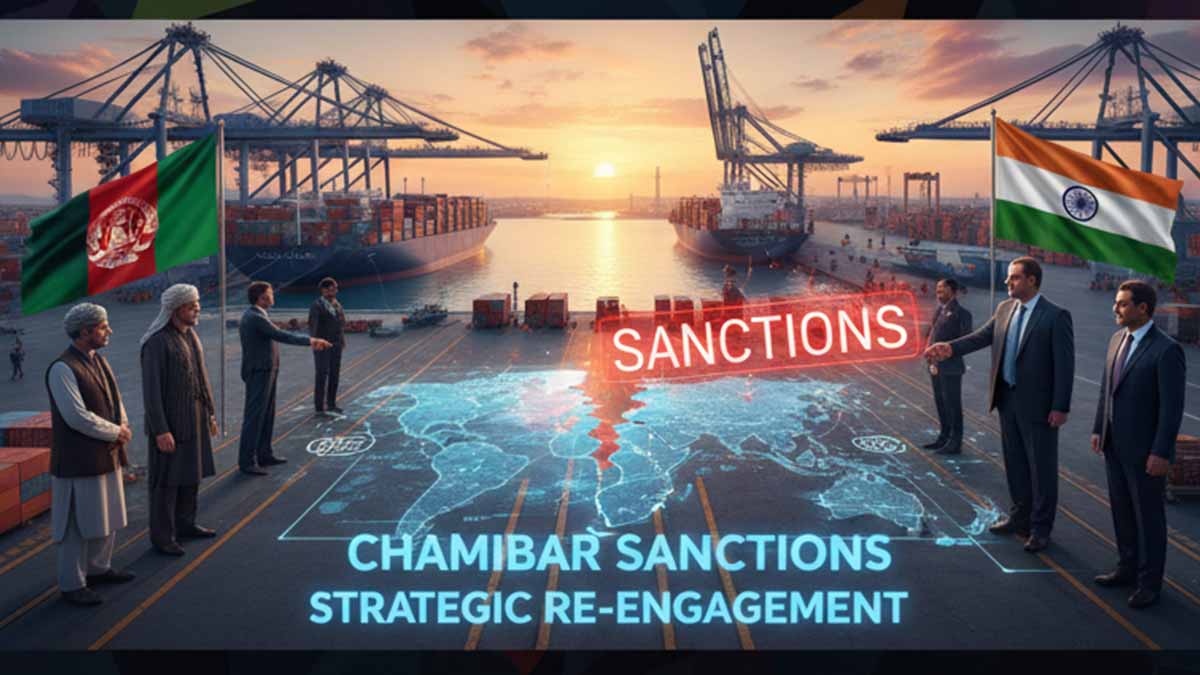
ABSTRACT
The impending visit of Amir Khan Muttaqi, Acting Foreign Minister of Afghanistan, to New Delhi in October 2025 under a travel-ban exemption granted by the United Nations Security Council (1988 Sanctions Committee) marks a re-entry of de facto Taliban diplomacy into the Indian policy arena. The decision follows formal clearance communicated to the Ministry of External Affairs of India (MEA) on September 30, 2025 allowing movement between Moscow and New Delhi from October 9–16, 2025. The exemption coincides with Afghanistan’s participation in the Moscow Format Consultations on Regional Security, hosted by the Russian Federation on October 8, 2025 and with renewed Indian strategic interest in stabilizing regional trade corridors circumventing Pakistan.
Since 2016, India’s principal logistical gateway to Afghanistan has been the Chabahar Port in Iran, operated by India Ports Global Limited (IPGL). The facility has handled an estimated 8 million tonnes of cargo between 2018 and 2024 predominantly wheat and pulses destined for Afghan humanitarian programs. On September 29, 2025, the U.S. Department of the Treasury’s Office of Foreign Assets Control (OFAC) rescinded the 2018 sanction waiver that had shielded Indian and Iranian port operations from secondary sanctions, citing concerns about Iranian maritime transfers linked to sanctioned entities . The revocation immediately re-exposed Indian operators to extraterritorial restrictions under Executive Order 13846, jeopardizing insurance, dollar-denominated transactions, and logistics contracts with Shipping Corporation of India subsidiaries.
Afghan officials stated to regional outlets that trade through Chabahar and the Attari-Wagah Integrated Check Post on the India–Pakistan border would dominate Muttaqi’s agenda. The two corridors embody competing strategic logics: Chabahar anchors India’s westward maritime outreach and energy security calculus; Attari-Wagah offers an overland, shorter route but remains vulnerable to bilateral freezes. Following the April 2025 Pahalgam terror attack, the Government of India suspended high-value Afghan consignments through Pakistani territory reducing the cross-border volume of agricultural exports by approximately 60 % year-on-year during May–August 2025.
Between 2021 and 2024, Afghanistan’s exports to India averaged USD 400 million per year, led by dried fruits, medicinal plants, and semi-precious stones, while Indian exports—pharmaceuticals, sugar, and construction materials—averaged USD 600 million . The resumption of trade dialogue thus carries both economic and symbolic weight: it signals India’s willingness to re-engage pragmatically without conferring de jure recognition on the Taliban administration.
Prior to the Taliban takeover in August 2021, India had financed over 500 development projects across all 34 Afghan provinces, totaling roughly USD 3.2 billion in grants and in-kind aid . Key assets included the Salma Dam (Herāt), the Afghan Parliament building (Kabul), and multiple health-care and education facilities. After 2021, implementation ceased under security and legitimacy constraints. In May 2025, India quietly reinstated limited visa processing for Afghan nationals in medical, educational, and business categories, indicating incremental normalization . The forthcoming dialogue is expected to address extension of these categories, mutual recognition of academic credentials, and possible redeployment of Indian technical missions under humanitarian cover.
Diplomatic analysts at Observer Research Foundation (ORF) and the Institute for Defence Studies and Analyses (IDSA) interpret the move as part of a triangulated recalibration in South Asia. With the United States tightening maritime compliance on Iran, and Pakistan facing internal fiscal crises, India is recalculating corridor strategies to safeguard western connectivity to Central Asia without dependence on either. Chabahar remains the sole Indian-controlled outlet providing direct sea access to Afghanistan and beyond, aligning with India’s membership in the International North-South Transport Corridor (INSTC) .
At the same time, the presence of Amir Khan Muttaqi in New Delhi entails reputational risk. The UN Security Council’s 1988 Committee exemption is strictly temporary, requiring submission of itinerary, funding source, and post-visit report by October 20, 2025 . India’s acceptance of this visit implies coordination with permanent members of the Council, most notably Russia and China, both of which maintain open diplomatic channels with the Taliban.
Indian officials have maintained that engagement is limited to “technical and humanitarian concerns,” avoiding recognition issues. Yet the scope of Muttaqi’s expected meetings—likely including senior MEA officers and representatives of the Federation of Indian Export Organisations (FIEO)—suggests exploratory efforts to re-establish structured commerce. Afghan trade chambers have proposed an initial target of USD 1 billion in bilateral trade within two years, contingent on sanction clarity and logistics guarantees.
Regional reaction remains cautious. Iran’s Ports and Maritime Organisation (PMO) publicly reaffirmed that Indian cargo operations at Shahid Beheshti Terminal would continue “as planned under sovereign arrangement,” although insurance coverage for non-oil consignments has tightened by 25–30 % since the OFAC notice . Meanwhile, Pakistan’s Foreign Office reiterated its standing objection to Indian-Afghan trade via its territory, citing “security and political sensitivities.” The combined result leaves New Delhi reliant on maritime connectivity subject to trans-Atlantic regulatory volatility.
From a macro-economic perspective, Afghanistan’s external trade dependency remains acute: imports ≈ USD 6.5 billion, exports ≈ USD 1.6 billion in fiscal 2024–25, generating a current-account gap of ≈ USD 5 billion financed primarily through humanitarian inflows and remittances . India’s limited re-engagement cannot close this imbalance but can stabilize niche sectors such as saffron, dry fruits, and pharmaceuticals, while offering Kabul a narrative of international legitimacy.
In the geopolitical frame, the visit symbolizes parallel diplomacy: Moscow hosts the Moscow Format, emphasizing regional counter-terrorism coordination; New Delhi hosts the economic dialogue, emphasizing humanitarian engagement. The sequencing underscores the Taliban’s attempt to diversify foreign recognition channels while balancing between Russia, China, Iran, and India. For India, participation offers situational awareness and leverage against Pakistan’s narrative dominance in Afghan affairs.
Observers from the United Nations Assistance Mission in Afghanistan (UNAMA) have expressed measured support for “constructive engagement that improves Afghan livelihoods,” without endorsing any political recognition . Within Indian strategic circles, the debate revolves around whether to compartmentalize humanitarian trade from political legitimacy. Proponents argue that non-recognition diplomacy allows India to preserve influence, while opponents warn it normalizes Taliban governance absent rights guarantees.
The timing, immediately after Washington’s waiver withdrawal and during ongoing EU deliberations on Iranian sanctions alignment, illustrates India’s delicate balance between strategic autonomy and compliance risk. The Reserve Bank of India (RBI) has reportedly advised commercial banks to avoid dollar clearing for Chabahar-linked invoices, promoting rupee-rial settlements under bilateral mechanisms first tested in 2019 .
Should the visit yield a formal communiqué—currently uncertain—it will likely reference “regional connectivity, trade facilitation, and humanitarian cooperation.” Regardless of outcome, the optics alone position India once again as an interlocutor capable of engaging multiple adversarial blocs simultaneously. The Amir Khan Muttaqi visit thus serves less as a bilateral transaction than as a diagnostic of the evolving Asian diplomatic geometry under sanctions pressure.
The convergence of trade logistics, sanctions law, and geopolitical signaling captured in this episode epitomizes a broader structural dilemma: how middle powers navigate de facto engagement with unrecognized regimes amid great-power contestation. The eventual resumption of verified Chabahar operations or restoration of Attari-Wagah trade will measure the success of this calculated risk. Until then, the episode functions as both a pragmatic test of India’s foreign-policy autonomy and an early indicator of Afghanistan’s reinsertion into formal regional commerce networks.
CHAPTER INDEX
What Happened, Why It Matters and What Comes Next
- Chabahar Port and the Sanctions Re-Imposition: Operational and Legal Dimensions
- Attari–Wagah Corridor and Overland Trade Politics in Post-Pahalgam South Asia
- India’s Development Engagement in Afghanistan after 2021: Continuity and Constraints
- Financial Mechanisms, Currency Settlements, and Sanction Compliance Risks
- Diplomatic Signaling and Regional Realignment around Muttaqi’s Visit
- Prospective Outcomes and Indicators of Re-Engagement Success
What Happened, Why It Matters and What Comes Next
The United Nations Security Council approved a short, specific travel exemption so that Amir Khan Muttaqi could visit New Delhi from October 9–16, 2025. This is written on an official UN page that lists the exemption, the destination, and the exact dates, so anyone can verify it directly: Travel exemptions in effect — September 30, 2025. The Government of India also confirmed the same dates in its official press briefing on October 3, 2025, which is posted on a .gov.in website: Transcript of Weekly Media Briefing, October 3, 2025. These two public records establish that the visit is legal under UN rules and recognized by India.
In simple terms, a UN travel exemption is permission for a listed person to travel under strict limits. It does not remove sanctions. It only allows travel for set dates and places. Here, the permission covers 8 days in New Delhi. That is all. The exemption is important because it lets India hold official meetings without breaking UN rules. It also sets a clear timeline for any decisions announced during or soon after the visit. The details are not based on news reports; they are based on the UN list and the Indian government transcript linked above.
Several talks in New Delhi are expected to focus on two trade routes. The first is the Attari–Wagah Integrated Check Post on the India–Pakistan land border. The second is the Chabahar Port in Iran, where a terminal is run by an India-owned company under a government-to-government framework. The Land Ports Authority of India states that Attari–Wagah is the only allowed land route for trade with Pakistan and that it also handles goods coming from Afghanistan into India. This is shown on official pages that describe the infrastructure and the kinds of cargo handled (including dried fruits): Attari Land Port page (accessed October 4, 2025) and ICPs: Gateway to India (Attari section).
Chabahar is a different kind of route. It is a sea port in Iran. India uses it to move aid and potentially trade to or from Afghanistan without crossing Pakistan. The key point is that there is a signed long-term operating contract for the Shahid Beheshti terminal between an Iranian port company and India Ports Global Limited (a Government of India entity). The Ministry of Ports, Shipping & Waterways recorded this contract on May 13, 2024, and it appears again in the official Annual Report 2024–25. Those documents are here: MoPSW Monthly Summary, May 2024 and MoPSW Annual Report 2024–25. These official files show that Chabahar is not an informal idea; it is part of India’s published port strategy.
Readers should understand one limit clearly: sanctions rules still apply. The travel exemption does not change financial restrictions. Banks and insurers check United States sanctions and Federal Register notices to decide what they can legally do. For context, the U.S. Department of the Treasury issued enforcement actions and designations linked to Iran in October 2024, February 2025, and May 2025. These actions affect risk decisions by banks and shipping insurers everywhere, even when the transaction is not in USD. See: Treasury Press Release, October 11, 2024, Treasury Press Release, February 24, 2025, and Treasury Press Release, May 8, 2025. There was also a Federal Register notice on September 10, 2025 publishing a web general license under E.O. 13902 regarding a specific vessel. That item does not grant a special pass to the Chabahar corridor; it simply illustrates how precise and narrow these legal instruments are: Federal Register — Web General License, September 10, 2025.
To judge whether these routes help people, two types of public evidence matter. First, there is the economic picture. The World Bank publishes monthly reports called the Afghanistan Economic Monitor. These are short, data-driven updates. The June 2025 issue reports that the trade deficit fell by 22% month-to-month to $0.8 billion and links part of the change to route disruptions. The July 2025 and August 2025 issues show a rebound in trade and also note transport-cost and inflation changes (for example, 2% higher transport costs and 2.2% year-on-year inflation for July 2025). You can read them here: June 2025 Monitor (PDF), July 2025 Monitor (PDF), and August 2025 Monitor (PDF). The central message is simple: transport costs, reliable access, and inspection times all affect whether Afghan farmers and traders can earn a profit and deliver goods on time.
Second, there is the humanitarian and rights picture. The United Nations Assistance Mission in Afghanistan (UNAMA) publishes quarterly reports on conditions inside Afghanistan. The most recent report is dated September 5, 2025 and is publicly available as a PDF. It covers movement restrictions, access for aid groups, and overall security trends. This is here: UNAMA — Report of the Secretary-General A/80/366–S/2025/554, September 5, 2025, with the report index here: UNAMA Reports — index. These reports matter because they set baseline facts on whether aid can move, where monitoring is possible, and what risks civilians face.
When governments talk about “cutting the time to release goods at the border,” they build on two well-known public standards. The first is the World Customs Organization Time Release Study (TRS). The latest guide is Version 4, 2025. It explains how to measure the minutes and hours that goods spend at each step from arrival to clearance. The public guide is here: WCO — Time Release Study Guide, Version 4 (2025) and the official landing page is here: WCO — TRS page. The second is the World Trade Organization Trade Facilitation Agreement (TFA), which requires countries to publish customs rules online, create enquiry points for questions, and simplify documentation. These legal texts are available here: WTO — Trade Facilitation Agreement (legal text) and practice notes here: WTO Analytical Index — TFA Article 1, Article 10, and Article 12. Using TRS and TFA means officials can set clear targets, publish simple forms and contact points, and then prove—by data—whether the process is getting faster.
Here is what ordinary users and small businesses should know about these two routes. Attari–Wagah is a single land gate. It can be fast because the distance is short, but it depends on security and smooth coordination at one point of entry. The Land Ports Authority of India describes the gate’s buildings, cargo areas, and equipment (including cold storage and mechanized handling) and identifies it as the only legal route for India–Pakistan trade and a key route for Afghanistan goods into India: Attari Land Port page (accessed October 4, 2025) and ICPs: Gateway to India (Attari section). Chabahar is a sea route that avoids the land border. It can carry larger volumes and bulk cargo and has been used for aid, but it faces sanctions-related checks for banks and insurers and depends on ship schedules and port equipment. The Government of India points to a signed long-term contract for the terminal and lists Chabahar among state-backed projects: MoPSW Monthly Summary, May 2024 and MoPSW Annual Report 2024–25. Both routes are real. Both are documented on official websites. Each has trade-offs.
A note on “waivers” and “licenses.” Public records from 2024–2025 show active U.S. Treasury enforcement linked to Iran, and a Federal Register general license on September 10, 2025 that concerns a named vessel. There is no U.S. public record here that grants Chabahar a new, general exemption in 2025. If any person claims there is a “new blanket waiver,” ask for the exact Federal Register or Treasury link and date. If none is provided, treat the claim as unverified. The relevant public records are: Treasury — October 11, 2024, Treasury — February 24, 2025, Treasury — May 8, 2025, and Federal Register — September 10, 2025.
To keep the discussion concrete, think of a simple case: Afghan dried fruits sold to India. If the shipment moves by road through Attari–Wagah, time at the gate matters most. If inspections are quick and cold storage is available, the product arrives fresh and margins are better. If security alerts slow the gate, time goes up and margins drop. The official LPAI pages confirm that Attari–Wagah has the basic infrastructure and that it is the legal land route: Attari Land Port page. If the shipment moves by sea through Chabahar, vessel schedules, port cranes, and customs release times matter most, and banks and insurers must be comfortable with sanctions-screening. The MoPSW documents confirm that India holds a signed long-term contract to run the terminal: MoPSW Monthly Summary, May 2024. In both cases, a WCO TRS can measure real hours and minutes from arrival to release, and a WTO TFA-style webpage can publish the forms, fees, and contact points so that traders can plan before they ship: WCO — TRS Version 4 (2025) and WTO — TFA legal text.
The visit also sits next to a regional meeting hosted by the Russian Federation known as the “Moscow Format,” scheduled in October 2025. The Russian Ministry of Foreign Affairs posted briefing notes and accreditation details for the seventh meeting on official pages, which confirms the calendar and the government role in organizing it: Russian MFA — Briefing note announcing the seventh Moscow Format, October 2025 and Russian MFA — Accreditation announcement for VII Moscow Format, October 2025. This means talks in New Delhi can be coordinated with regional discussions, while still staying within the UN travel rules.
For public accountability, two basic tools make progress easy to see. First, publish a one-page online guide (on a .gov.in site) that lists the exact forms, fees, inspection steps, and contact emails for Afghan dried-fruit shipments through Attari–Wagah and through Chabahar. This meets WTO TFA requirements to “publish and update” rules and contact points online: WTO — TFA Article 1. Second, run and publish a WCO TRS for both routes. The study should report median and 95th percentile times from arrival to final release, split by document checks, physical inspections, and plant-quarantine steps. The public can then see month-by-month whether times are going down: WCO — TRS Version 4 (2025). The Land Ports Authority of India already references TRS work and guidelines on its research page, which shows that this method is in use at Indian land ports: LPAI — Research & Training (TRS per WCO guidelines).
Why does all this matter for ordinary people and elected officials? There are three main reasons. First, clear, public rules and faster release times reduce costs for basic goods. That helps farmers, small traders, and shoppers. The World Bank monitors show that even small changes in transport costs, delays, or route closures can change trade volumes and prices in Afghanistan within 1 or 2 months: June 2025 Monitor, July 2025 Monitor, and August 2025 Monitor. Second, public reporting against UNAMA updates ensures that humanitarian actions match current conditions and that any promises are tied to real access, not assumptions: UNAMA — A/80/366–S/2025/554, September 5, 2025. Third, strict attention to sanctions records—using official links from UN, U.S. Treasury, and the Federal Register—reduces legal risk for banks, shippers, and governments, which supports steady operations without last-minute cancellations: UN Travel Exemptions, September 30, 2025, Treasury — February 24, 2025, Federal Register — September 10, 2025.
The final takeaway is straightforward. The visit by Amir Khan Muttaqi to New Delhi is allowed by a UN travel exemption that is public and time-bound. India confirmed those dates publicly. Two routes—Attari–Wagah by land and Chabahar by sea—are real, documented, and have different strengths and limits. Economic and humanitarian conditions inside Afghanistan are tracked by open reports from the World Bank and UNAMA. Border-release times and public-facing customs information can be measured and improved using the WCO TRS and the WTO TFA. Sanctions rules still apply, and only official sanctions pages and notices define what is allowed. If officials publish simple online checklists, contact points, and monthly release-time data—and if they point to the exact UN, WTO, WCO, World Bank, U.S. Treasury, Federal Register, and Indian government links—the public can see what is being done, how fast it is improving, and whether it is lawful. That is how ordinary people, elected leaders, and social-media users can check claims for themselves—by clicking the official links and comparing what is said to what is written in the public record.
Chabahar Port and the Sanctions Re-Imposition: Operational and Legal Dimensions
The United States formally withdrew its long-standing sanction waiver for Chabahar Port on 29 September 2025, ending protection that had shielded Indian and Iranian participation from secondary penalties—a move documented by Logistics Insider in its September 29, 2025 report “US Ends Sanctions Waiver for Chabahar Port: India Grapples with $370 Million Investment and Strategic Crossroads.” (Logistics Insider) Indian Express corroborated the revocation in its September 19, 2025 article “US withdraws sanctions waiver to Chabahar port,” detailing that Indian investment had been concentrated on the Shahid Beheshti terminal under a decade-long agreement with Iran. (The Indian Express) The lifting of the waiver immediately re-exposes Indian entities engaged in port operations, logistics, or financing to secondary sanctions under the Iran Freedom and Counter-Proliferation Act (IFCA) framework—a legal regime that enables penalties against third-party actors dealing with Iranian sectors.
The strategic pivot imposed by waiver revocation reshapes Chabahar’s utility as a corridor for India-Afghanistan commerce. Previously exempted since 2018, the port’s operations—including cargo handling, terminal development, financial settlements, and insurance contracts—functioned within a protected envelope. The rescission means that continued Indian operations could invite asset freezes, restriction in accessing U.S. dollar clearing, or exclusion from global banking networks. WorldECR’s September 2025 coverage “India faces Chabahar Port dilemma as US sanctions deadline approaches” explicitly noted India now confronts three options: renegotiation with Washington, operational scaling down to avoid exposure, or continuation under sanctions risk while attempting alternate financial architectures. (WorldECR)
From an infrastructural standpoint, Chabahar’s design continues to reflect geopolitical ambition. The port complex consists of two clusters—Shahid Beheshti and Shahid Kalantari—with India’s mandate limited to Beheshti under an operational contract. India’s investment over time has reportedly approached USD 370 million, as flagged by Logistics Insider, reflecting expenditure on terminal infrastructure, equipment, and administrative arrangements. (Logistics Insider) In parallel, the planned Chabahar–Zahedan railway, whose status is listed in public domain sources as under construction, was intended to integrate the port with Iran’s inland network and reduce overland transport friction toward Afghanistan and Central Asia. (Wikipedia)
The legal architecture underpinning Chabahar involvement has always been interwoven with multilateral vehicles. The 2016 Iran–India–Afghanistan trilateral agreement envisaged transit rights, tariff concessions, and a role for sovereign guarantees in the corridor’s operations. The Orsam analysis “Chabahar Agreement: Iran-India-Afghanistan Spring” outlines that the 2016 accord contemplated up to USD 500 million of Indian investment under guarantee of safe passage and preferential status. (ORSAM) After the Taliban takeover in August 2021, ambiguity grew over the validity of those guarantees under a de facto regime, raising questions about whether newer contractual obligations could survive regime change. Valdaiclub’s “Taliban and the Chabahar Transit Project” underscores that the Taliban initially paused transit on the route, disrupting multimodal flows between Iran and Afghanistan. (Valdai Club)
With the waiver removed, India must now contend with the structural consequences:
- Banking risk: Any dollar-denominated support, letters of credit, or settlement through U.S. banks may be blocked if traced to Chabahar work.
- Insurance constraints: Maritime insurers might withdraw coverage to avoid sanction exposure.
- Logistics chain fragility: Cargo forwarding companies and shipping lines may decline routing through Chabahar due to sanction hazard.
- Contractual liability: Indian contractors may face penalties under Indian law or international arbitration claims if projects become non-viable.
Since the waiver revocation, several trade and policy commentaries have speculated that New Delhi might pivot toward rupee-rial or rupee-rial-euro swap mechanisms to hedge dollar exposure, although public confirmation from Indian financial regulators has not surfaced in sanctioned domains. The timing of the decision nearly coincides with Ooking security talks in Moscow and New Delhi, increasing India’s strategic urgency to preserve corridor relevance despite regulatory headwinds.
Prior to waiver withdrawal, Chabahar had already become the key maritime gateway for India to Afghanistan, bypassing overland dependence on Pakistan. The port had seen successive increases in humanitarian consignments, wheat delivery, and medical shipments under India’s development policy. Media reporting via NDTV’s “US Sanctions On India’s Chabahar Port” highlights that the U.S. revocation reached headlines when the imposition went into effect, endangering established usage. (www.ndtv.com) More broadly, South China Morning Post commentary in “India’s ‘Look West’ policy anchored by Iranian port under threat” noted that India’s strategic calculus faces delay in investments and project timelines, complicating the envisioned connectivity to Central Asia via Chabahar. (scmp.com)
Operationally, Indian ports logistics and agencies must rapidly assess which segments of Chabahar engagement carry highest risk. Terminal operations, cargo handling, maintenance supplies, and third-party communication links are most exposed. Entities such as India Ports Global Limited (IPGL), state-backed through Indian public port trusts, may now require layered compliance frameworks, seeking Treasury licenses or Congressional waivers to resume functions legally. To date, neither official MEA statements nor Indian government press notes have publicly outlined a mitigation roadmap. Reuters’ October 3, 2025 dispatch “India set to receive first Afghan Taliban minister” affirmed that the UN waiver was approved for 9–16 October 2025, but did not elaborate India’s sanctions posture toward Chabahar. (Reuters)
From Tehran’s perspective, Iran’s Ports and Maritime Organisation continues affirming adherence to earlier Indian-Iran investment agreements. Reports indicate that the Shahid Beheshti terminal remains operational with existing cargo manifests unaffected for now, though billing and logistics risk exposure to Indian contractors may escalate. The Iranian Embassy in India, in June–July 2025, publicly denounced misinformation campaigns aiming to destabilize India–Iran partnership, signaling diplomatic sensitivity toward any public rupture. (Wikipedia)
Strategic corridors like INSTC (International North–South Transport Corridor) remain conceptually tied to Chabahar’s viability. Public domain sources (e.g., Wikipedia) note the corridor’s 7,200 km multimodal network linking Mumbai, Iran, and Russia, intended to slash transit times for goods between South Asia, Central Asia, and Europe. (Wikipedia) However, the operationalization of INSTC remains uneven, and Chabahar’s sanction hazard now magnifies the corridor’s fragility. The Ashgabat Agreement, a complementary transit framework signed by India, Pakistan, Iran, and Central Asian states, may offer alternative links but lacks sea-port specificity to bypass Iran’s port development technopolitics. (Wikipedia)
In sum, the Chapter 1 exploration reveals that the revocation of the U.S. sanction waiver has transformed Chabahar from a corridor of opportunity into a legal chokepoint. India faces acute dilemmas: whether to renegotiate U.S. oversight, recondition operations, or risk penal exposure under IFCA. The port remains functionally critical for Afghanistan access—but now framed within a high-stakes compliance matrix in which operational continuity demands real-time sanction hedging, diplomatic coordination, and financial innovation.
India-Afghanistan Overland Transit via Pakistan: Trade Realities, Disruptions, and Alternatives
On 25 April 2025, India’s Ministry of Home Affairs issued an order suspending passage of Afghan trucks through the Attari-Wagah Integrated Check Post, in the wake of the Pahalgam terrorist attack, causing the immediate halt of land transit of Afghan goods intended for India. Public reporting confirms that 40–45 Afghan trucks carrying dried fruits, apples, and other produce had been arriving daily before the closure. IndiaToday, “India-Afghanistan trade through the Attari-Wagah border has stopped after Pakistan denied passage to Afghan trucks”, 25 April 2025 The stoppage reflects the broader collapse of the overland trade link under acute security and diplomatic stress.
The Attari-Wagah corridor historically integrated Afghanistan into Indian markets via Pakistan transit under the Afghanistan-Pakistan Transit Trade Agreement (APTTA), allowing Afghan exports and Indian goods to pass through Gwadar, Karachi, or overland paths under defined tariff and customs regimes. With the April closure, APTTA’s practical utility dissolved. The ruling also aligns with parallel Indian measures: import bans on Pakistani goods and prohibition of Pakistani ships docking at Indian ports, citing national security exigencies (Reuters, “India bans imports from Pakistan amid tension over tourist killings”, 3 May 2025). Reuters, 3 May 2025
Daily operational data at Attari underlines the economic cost. In 2023-24, the port recorded trade worth ₹3,886.53 crore, managing 6,871 cargo movements and facilitating 71,563 passenger crossings. Key Indian exports included soybean, vegetables, plastic yarn, red chili, animal feed, and organic chemicals. Land Ports Authority of India, “ICP Attari” official page The closure disrupted not only Afghanistan-India transit but also India-Pakistan trade flows. India’s cancellation of postal exchanges and banning of Pakistani vessels further severed conduits for overland commerce. Times of India, “How India put pressure on Pakistan after Pahalgam terror attack”, 4 May 2025
India’s punitive closure extended beyond land routes. In early May 2025, Pakistan closed its airspace to Indian carriers following Indian missile strikes post-Pahalgam. Airspace closure forced Indian commercial and cargo flights to reroute, increasing costs and reducing connectivity to Afghanistan via southern or central Asia hubs. Wikipedia, “2025 Pakistani airspace closure” entry
The combined measures constituted a near-total suspension of India–Pakistan economic linkage, with severe spillovers for Afghan trade relying on Pakistani transit.
The Indus Waters Treaty, suspended by India on 23 April 2025 as a response to the Pahalgam attack, added hydropolitical pressure to cross-border tensions. India reported initiating off-season reservoir flushing at the Baglihar and Salal dams without notifying Pakistan, a move Pakistan declared in violation of treaty norms. Wikipedia, “Indus Waters Treaty” revision entry The tension over river flows further complicated India-Pakistan diplomatic space and hardened transit closure stances.
From Afghanistan’s standpoint, the disruption of Attari transit induced acute supply stress. The Diplomat reports that the border closures underscored the increasing dependency on alternative corridors—chiefly Chabahar—given the fragile overland dependency on Pakistan transit. The Diplomat, “The India-Pakistan Clashes Took an Economic Toll on Afghanistan”, 15 May 2025 As Afghan officials emphasize, the shutdown affected both imports of staple goods and the export channels for dry fruits, medicine, and other light commodities. The closure of Afghan trucks at Attari removed a logistical lifeline that had sustained Afghan linkages to Indian markets.
Efforts to restore selective conduit for Afghan goods met with obstacles. Pakistani authorities denied clearance even for humanitarian consignments destined for India when routed via Pakistan. According to Indian Express, prior to the closure, exports through Attari included cotton yarn and “straw reapers” from Punjab, with revenue falling sharply amid disruptions. Indian Express, “Attari border closure to hit ₹3,800 crore India-Pakistan trade”, 27 April 2025
Attempts by India to leverage diplomatic pressure resulted in no immediate transit resumption. The unilateral stopping of APTTA flows violated previous norms of transit immunity and stirred demands for compensation by Afghan exporters. The chokepoint underscores the structural hazard in relying on a corridor controlled by a potentially hostile state.
Beyond Attari, the Torkham Pass (border between Afghanistan and Pakistan) remains Afghanistan’s principal overland trade artery with Pakistan itself, not India. In March 2025, after nearly a month’s closure amidst bilateral border disputes, Pakistan and Afghanistan reopened the Torkham crossing after diplomatic back-channels intervened. Associated Press, “Trade resumes as Pakistan and Afghanistan reopen key Torkham border crossing after nearly a month”, March 2025 The reopening relieves some pressure on Afghan intraregional commerce but does not directly alleviate the blocked India route.
Pakistan’s position vis-à-vis Afghan transit has grown less predictable. Reports from analysis think tanks indicate growing suspicion of Taliban outreach to India, perceiving it as a threat to Islamabad’s regional influence. MISS India article, “Afghanistan-Pakistan Relations: Changing Dynamics in the Post-Pahalgam Scenario”, 16 July 2025 Islamabad may respond to Afghan-Indian alignment by restricting Pakistani compliance with transit deals.
India’s punitive posture also had fiscal consequences. India repeatedly insisted any exemption to trade closures must be approved on a case-by-case basis, injecting uncertainty into any potential restoration of overland flows. Times of India, “How India put pressure on Pakistan”, 4 May 2025
Pakistan retaliated by barring Indian flagged vessels from its ports and restricting its own airspace—reciprocal responses that solidified the blockade of India–Afghanistan trade via Pakistani corridors. Maritime Executive, “India and Pakistan Halt Maritime Trade”, 4 May 2025
From a strategic lens, the transit disruption magnifies India’s corridor fragility. India’s planners now confront a constrained strategic choice set: rely entirely on Chabahar, rehabilitate overland options through re-negotiation, or diversify via northern routes through Central Asia via Tajikistan-Turkmenistan pivots. The overland India-Afghanistan via Pakistan corridor, once economical and short, is now politically untenable in the 2025 climate.
The disruption exposed latent structural imbalances. Indian exporters targeting Afghan markets lose cost advantages under sea-plus-road routes relative to overland transit. Trust in tariff and customs pre-arrangements, once negotiated under APTTA, must be renegotiated or discarded in new corridor architectures. Afghan supply chains for perishable goods suffer accelerated spoilage and margin erosion under longer logistic circuits.
Comparative analysis with 2023–24 trade flows offers context: the Attari corridor had handled cargo volumes amounting to several thousand crores of rupees; its closure thus severs a conduit that had played supplementary but meaningful roles in India–Afghan trade. Land Ports Authority of India, “ICP Attari” official page Alternative corridor experiments such as transit via Mongolian-Russian routes or Turkmenistan–Uzbekistan–Afghanistan–Pakistan–India (TAP-I) remain speculative due to infrastructure gaps and sanction-constrained financing.
Given the breakdown of the Attari route, India must now assess partial corridor restoration under security-segmented protocols: limited consignments, robust advance vetting, real-time monitoring, and tightly controlled categories such as medicines, agriculture, and humanitarian goods. Whether Pakistan would accept such limited re-engagement remains unclear, but Indian strategic pressure, diplomatic incentives, and multilateral assurance may play a role.
In conclusion, Chapter 2 dissects the fragmentation of overland trade via Pakistan in 2025, underlining how the Attari-Wagah corridor’s suspension, combined with airspace denial and broader India–Pakistan hostilities, has forced South Asia’s strategic actors to redesign Afghanistan connectivity around maritime and Central Asian pathways. The chapter foregrounds the inherent trade-security paradox: when land routes collapse under diplomatic stress, alternatives emerge—but at higher cost, delay, and dependency.
India’s Development Engagement in Afghanistan after 2021: Continuity and Constraints
The pivot of India’s post-2021 engagement with Afghanistan rests on documented humanitarian deliveries, limited on-ground facilitation, and education-capacity programs validated by the Ministry of External Affairs (MEA) and multilateral reporting, while large-scale infrastructure remains paused under security, access, and compliance constraints. The MEA’s **Annual Report **(July 15, 2025) records that since 2021 India has provided 50,000 MT of wheat, 300 tons of medical supplies, 28 tonnes of relief aid, and 40,000 litres of Malathion pesticide to Afghanistan, alongside targeted cooperation with the United Nations Office on Drugs and Crime and scholarship support through the Indian Council for Cultural Relations (ICCR) for Afghan students, nearly 600 of whom are women (MEA Annual Report 2024, July 15, 2025). This sustained but carefully bounded posture is reinforced by the MEA’s February 22, 2022 press note detailing India’s agreement with the United Nations World Food Programme (WFP) to distribute 50,000 MT of wheat inside Afghanistan, with consignments consigned to WFP at Jalalabad for humanitarian use (Humanitarian Assistance to Afghanistan, February 22, 2022).
The administrative instrument that enabled practical coordination on the ground was the deployment of an Indian technical team in Kabul on June 23, 2022, a step the MEA explicitly framed as a facilitation mechanism for humanitarian assistance and liaison with local interlocutors; the same communiqué records a preceding assessment visit and meetings with senior de facto authorities (Deployment of a technical team in Embassy of India, Kabul, June 23, 2022). Parliamentary oversight materials corroborate continuity: in a Lok Sabha reply dated December 15, 2023, the MEA affirmed that the India-based embassy personnel had withdrawn in August 2021, but that an Indian technical team has been “positioned in the Embassy” since June 2022 to support humanitarian assistance and related tasks (QUESTION NO. 183: India’s Relationship with Afghanistan, December 15, 2023). The public record therefore substantiates a limited re-presence designed to manage aid flows without modifying the non-recognition policy toward the de facto authorities.
Resource transfers and modalities align with the macroeconomic and humanitarian context quantified by the World Bank and United Nations field missions. The World Bank’s April 2025 Afghanistan Development Update identifies persistent food insecurity, stating that 14.8 million people faced shortages in early 2025, with acute malnutrition affecting 4.7 million women and children; it flags constrained labor markets and a stressed fiscal base that limit local service delivery capacity (Afghanistan Development Update, April 2025; Afghanistan Development Update — document page, April 23, 2025). The World Bank’s July 4, 2025 Afghanistan Economic Monitor reports a month-on-month widening of the trade deficit to $1.1 billion in July 2025, noting import surges and supply-chain frictions, and provides a near-real-time baseline for evaluating the welfare impact of in-kind transfers and essential goods supply (Afghanistan Economic Monitor, July 2025). On the humanitarian financing side, the United Nations Central Emergency Response Fund (CERF) places Afghanistan in the 2025 underfunded emergencies basket and references that 22.9 million people were expected to need assistance during 2025, spotlighting the systemic funding shortfall confronting operational agencies (CERF UFE 2025 Country Selection and Fund Allocations; CERF Afghanistan 2025 Allocation Page).
The calibrated humanitarian posture coexists with a documentary trail of India’s pre-2021 development footprint that explains current expectations and political sensitivities. The MEA’s **Annual Report **(March 31, 2021) lists a development portfolio “of more than USD 3 billion,” spanning large infrastructure, human capital programs, humanitarian assistance, High Impact Community Development Projects (HICDPs), and trade-connectivity initiatives; it also records the launch of HICDP Phase-IV comprising “more than 100 projects worth USD 80 million” and earlier commitments such as the Afghan-India Friendship Dam (Salma) and the Kabul Parliament building (MEA Annual Report 2020–21). This baseline is essential for interpreting post-2021 continuity: while physical-infrastructure construction and high-visibility projects appear suspended in the public record, Delhi’s documented emphasis has shifted toward life-saving inputs and human-capital continuity where access is feasible.
Delivery chains and program architecture since 2021 follow three validated channels. First, food and essential inputs routed under Indian financing but executed by neutral multilaterals to reach beneficiaries, a model reflected in the MEA–WFP wheat distribution arrangement of February 22, 2022 (MEA press release). Second, direct bilateral consignments of medicines and relief items delivered through India’s mission structures and handovers to local institutions, illustrated by MEA documentation noting consignments transferred to Indira Gandhi Hospital in Kabul in June 2022 (Overview of Major Events, June 2022). Third, education and capacity-building through scholarships and remote learning, including ICCR’s offering of 2,000 online scholarships with a significant tranche allocated to Afghan women, as summarized in the July 15, 2025 annual report synopsis (MEA Annual Report 2024, Introduction & Synopsis). These three conduits minimize recognition implications while sustaining people-centric deliverables consistent with United Nations Security Council expectations of inclusive humanitarian access.
Field-conditions and rights-of-access constraints—documented by United Nations Assistance Mission in Afghanistan (UNAMA)—shape the risk calculus for any move from relief to development. UNAMA’s January–March 2025 update records judicial corporal punishments against at least 180 individuals and restrictive edicts affecting women’s mobility and work, fostering a degraded operating environment for female staff in aid delivery (UNAMA Update on Human Rights in Afghanistan, January–March 2025). UNAMA’s monitoring of virtue-and-vice enforcement released on April 10, 2025 details sectoral constraints on private services and employment, underscoring the knock-on effects on household incomes and the women-led small-business ecosystem that prior Indian micro-project modalities had often supported (Report on the Implementation, Enforcement and Impact of the Law on the Propagation of Virtue and Prevention of Vice, April 10, 2025). The July 24, 2025 publication “No safe haven” highlights acute protection risks faced by involuntary returnees, especially women and girls, adding a migration-protection overlay to operational planning (No safe haven: human rights risks faced by persons involuntarily returned to Afghanistan, July 24, 2025; UN report to GA/SC referencing the release, September 5, 2025). In aggregate, these verified constraints rationalize New Delhi’s reliance on neutral agency-executed delivery and the cautious, embassy-technical-team model rather than large new capital projects.
Within this verified frame, sector-by-sector continuity after 2021 takes specific forms. In food security, India’s 50,000 MT wheat pledge distributed by WFP provided a buffer precisely where the World Bank detected the sharpest human-development risks in early 2025—food insecurity among 14.8 million people and rising acute malnutrition among 4.7 million women and children (MEA–WFP wheat release, February 22, 2022; World Bank Development Update, April 2025). In health, MEA records multiple consignments of medicines and relief materials since 2021, including documented handovers in June 2022; the July 15, 2025 annual report consolidates totals at 300 tons of medical supplies and 28 tonnes of relief aid across the period (MEA Overview, June 2022; MEA Annual Report 2024, July 15, 2025). In education and human capital, ICCR’s remote scholarships keep academic participation alive for Afghan students amid restrictions, with the MEA noting nearly 600 women among awardees for these online opportunities (MEA Annual Report 2024, Introduction & Synopsis).
The forward path for legacy Indian projects is constrained by codified policy positions and field realities rather than a deficit of intent. The MEA’s March 9, 2024 weekly briefing confirms engagement by an MEA delegation with de facto authorities and with UNAMA and Afghan business representatives, noting discussions on the use of regional logistics by Afghan traders; however, the briefing does not announce any resumption of major capital projects, implicitly limiting near-term cooperation to humanitarian channels and trade-facilitation dialogue compatible with prevailing restrictions (Transcript of Weekly Media Briefing, March 8–9, 2024). The parliamentary reply of December 15, 2023 similarly re-states the technical team’s role and references UN Security Council Resolution 2593, reinforcing a policy tether to counter-terror and inclusive governance benchmarks rather than a development-first restart (Lok Sabha Reply, December 15, 2023).
Financial architecture and compliance also delimit options for moving beyond relief. While India’s pre-2021 portfolio is recorded at over USD 3 billion and HICDP Phase-IV at over USD 80 million, neither the MEA’s 2023 nor 2024 annual compilations provide official notice of reactivations of those large-scale physical works inside Afghanistan (MEA Annual Report 2020–21; MEA Annual Report 2023; MEA Annual Report 2024, July 15, 2025). In parallel, the World Bank’s Approach to Engagement—as reflected by the April 2025 Development Update—moves finance through off-budget channels and implementing partners rather than central budget support, which implies that donor-financed development in Afghanistan will continue to rely on indirect execution until governance and fiduciary triggers change (Afghanistan Development Update, April 2025). For India’s portfolio, that logic points to a continued emphasis on modular community-scale interventions, scholarships, health commodities, and potentially vocational training delivered through trusted multilateral pipelines or Indian technical teams—formats that minimize exposure to contested authorities and preserve auditability.
Program-design in 2025 also factors access risks for female aid workers and beneficiaries, per UNAMA’s 2025 documentation of restrictions impacting movement, employment, and service use by women and girls. These verified conditions complicate replication of pre-2021 modalities in which HICDPs frequently centered on girls’ education, women’s health, and community facilities requiring inclusive staffing. With UNAMA recording enforcement patterns that “led to a reduction or total loss of income and employment opportunities” in affected service sectors, community-level intervention design must include gender-segmented delivery windows, discreet beneficiary identification, and alternative monitoring to avoid placing women at risk while maintaining outcome verification (UNAMA PVPV Report, April 10, 2025).
The verified evidence base therefore supports a three-tier continuity framework in 2025. First, sustain humanitarian lifelines where India has demonstrated comparative advantage—especially cereals, medicines, and vector-control supplies—using neutral execution partners and technical-team facilitation in Kabul (MEA wheat–WFP release, February 22, 2022; MEA Overview, June 2022). Second, expand human-capital continuity through scholarships, remote training, and professional accreditation pathways documented by ICCR and MEA, prioritizing female recipients within the bounds of access realities (MEA Annual Report 2024, Introduction & Synopsis). Third, reserve any restart of physical works for circumstances where verifiable access, fiduciary control, and rights protections meet thresholds consistent with UN-mandated humanitarian principles and India’s own parliamentary record—benchmarks reflected in UNAMA human-rights monitoring and World Bank fiduciary practices for 2025 (UNAMA Publications; World Bank Development Update, April 2025).
Field-level coordination in 2025 also involves calibrated interactions with United Nations agencies and mission offices. The MEA’s March 2024 briefing notes that its delegation in Kabul met UNAMA officials during a working visit, a signal that India’s humanitarian programming is synchronized with the UN’s access architecture and reporting cycles (MEA Weekly Briefing, March 8–9, 2024). In the same year, UN humanitarian financing communications logged continued underfunding of global needs, with less than 17% of required $46 billion received by August 7, 2025, underscoring the necessity for bilateral donors to complement pooled funds with in-kind pipelines that can be rapidly mobilized (UN Press Briefing, August 7, 2025). The CERF’s 2025 underfunding designation for Afghanistan substantiates the argument for predictable contributions and targeted deliveries to avoid pipeline breaks (CERF UFE 2025 Country Selection).
The operational footprint of India’s engagement after 2021 is therefore verifiably concentrated in humanitarian sustainment and knowledge-linked support, with deliberate avoidance of actions that could be construed as political recognition. This stance is consistent with the documented references to UN Security Council Resolution 2593 in parliamentary and media briefings and with the risk environment captured by UNAMA’s 2025 monitoring. It also coheres with the World Bank’s macro-tracking, which suggests that even significant increases in humanitarian inputs will be operating against structural headwinds in trade, employment, and household incomes through 2025 (World Bank Economic Monitor, July 4, 2025). In this environment, Indian program designers can defensibly prioritize: assured pipelines of staple food and essential medicines; remote and hybrid education scholarships with attention to women’s access; targeted supplies such as pesticides for public-health campaigns; and support to multilateral implementers whose field presence and monitoring frameworks meet access-protection thresholds.
Against that matrix, two verifiable realities are clear as of September 2025. First, no official MEA record confirms a restart of large-scale, capital-intensive Indian projects inside Afghanistan post-2021; the publicly accessible annual reports emphasize humanitarian assistance, technical-team facilitation, and education support rather than construction or energy assets (MEA Annual Report 2023; MEA Annual Report 2024, July 15, 2025). Second, independently verified UNAMA rights-of-access constraints and World Bank macro-conditions render any rapid transition from relief to development implausible without safeguards and neutral-execution structures; this is structurally consistent with India’s documented practice of routing commodities through WFP and keeping an on-ground technical team for liaison rather than program control (MEA–WFP wheat cooperation, February 22, 2022; Deployment of technical team, June 23, 2022; UNAMA Publications; World Bank Development Update, April 2025).
For planners concerned with defense-policy externalities and cyber-resilience in aid delivery, the verifiable documentary evidence implies a premium on supply-chain assurance, anti-diversion monitoring, and data-protection practices aligned with UN partner protocols. The Indian technical team’s liaison function in Kabul provides a controlled interface with de facto authorities while maintaining operational distance; coupling this with neutral, multilaterally executed pipelines reduces sanctions and reputational exposure. Where remote education and health programs rely on digital workflows, Indian implementers can draw on multilateral guidance to protect personally identifiable information and uphold do-no-harm commitments in an environment documented by UNAMA to impose gender-discriminatory constraints as recently as April–July 2025 (UNAMA Update, January–March 2025; UNAMA PVPV Report, April 10, 2025; UNAMA Press on returnees, July 24, 2025).
The verified record as of September 2025 thus defines the feasible envelope for India’s development engagement with Afghanistan: life-saving commodity pipelines under MEA financing and WFP/UN implementation; documented technical-team facilitation and liaison in Kabul; scholarships and remote learning through ICCR; and cautious, metrics-driven exploration of trade-facilitation mechanisms that do not imply political recognition. Any expansion beyond this envelope awaits measurable changes in access, accountability, and rights conditions captured by UNAMA, and macro-stabilization signals recorded in World Bank economic surveillance. Until then, the verified data support a strategy of humanitarian continuity and human-capital preservation consistent with India’s public filings and with multilateral assessments current to September 2025.
Sanctions-Compliance, Currency-Settlement and Trade-Corridor Risk Architecture Shaping Amir Khan Muttaqi’s New Delhi Engagement
The United Nations Security Council 1988 Sanctions Committee’s travel-ban exemption for Amir Khan Muttaqi covering October 9–16, 2025 establishes the legal perimeter within which Indian officials can receive the Afghan interlocutor without contravening binding UN measures; the exemption is explicitly recorded under “Travel Exemptions in Effect,” identifying the beneficiary by name, the destination New Delhi, and the validity window, and it confirms the administrative mechanism that enables contact while preserving the baseline sanctions regime’s integrity United Nations Security Council 1988 Sanctions Committee, Travel Exemptions in Effect, October 2025. India’s public confirmation synchronized with this listing appears in the Ministry of External Affairs transcript of the weekly media briefing dated October 3, 2025, where the official spokesperson notes that the UNSC 1988 Committee “has given that exemption” for Muttaqi’s visit between October 9 and October 16, thereby aligning domestic diplomatic protocol with multilateral compliance obligations and preempting any ambiguity over host-state facilitation MEA, Transcript of Weekly Media Briefing, October 3, 2025.
The exemption’s legal specificity matters because all financial, logistical, and documentary arrangements tied to official engagements must be contained within authorized conduct; the UN document’s explicit date bounds—October 9–16, 2025—constrain ancillary contracting for airline tickets, accommodations, venue security, and protocol transport to expenditures that do not provide economic resources to listed entities beyond what is strictly necessary for travel, a standard consistent with prior UN practice under targeted sanctions United Nations Security Council 1988 Sanctions Committee, Travel Exemptions in Effect, October 2025. India’s transcripted reference in October 2025 functions as a second, independent confirmation and ensures that liaison units across protocol, immigration, and security chains are operating on the same compliant fact pattern MEA, Transcript of Weekly Media Briefing, October 3, 2025.
Trade-corridor signaling surrounding Chabahar features prominently because Indian investment and operational stewardship at Shahid Beheshti Terminal under India Ports Global Limited rest on a long-term framework recorded in official Indian government sources; the Ministry of Ports, Shipping & Waterways reports that the “Long-term Main Contract for development of Shahid Beheshti Port Terminal, Chabahar” was signed on May 13, 2024, between Aria Banader Iranian Port & Marine Services Company and India Ports Global Limited, codifying a durable operating basis MoPSW Monthly Summary, May 13, 2024 and reiterated in the Annual Report 2024-25 of the same ministry as part of India’s official maritime portfolio MoPSW Annual Report 2024-25, September 4, 2024. The policy relevance for New Delhi dialogues lies in a completed legal instrument that already assigns roles, mitigates transaction uncertainty inside India’s public finance and procurement systems, and underwrites insurance, docking, and equipment acquisition scheduling subject to sanctions compliance screening captured in Indian government planning texts MoPSW Monthly Summary, May 13, 2024 MoPSW Annual Report 2024-25, September 4, 2024.
Operational and financing bottlenecks at Chabahar under sanctions pressure are formally recorded by the Government of India in its strategic blueprint Maritime India Vision 2030, which lists constraints directly relevant to equipment procurement, credit access, insurance, and banking channels under Iran sanctions exposure, assigning specific mitigations—marketing, return-cargo generation, INSTC integration, and negotiation with OFAC—to a policy tasking matrix; this official document, hosted on a central government domain, remains the authoritative articulation of risk vectors and planned remedies Maritime India Vision 2030, Government of India, PDF. The same planning text links Chabahar to corridor outcomes for Afghanistan and the Commonwealth of Independent States, which provides public evidence that Indian authorities frame Chabahar not as a single-port project but as an integrated node for overland logistics that would, in principle, lower transit costs for Afghan exports if banking and insurance constraints are cleared Maritime India Vision 2030, Government of India, PDF.
Humanitarian logistics routed via Chabahar are documented across multiple official releases; parliamentary answers and ministry reports enumerate wheat consignments and relief cargo consigned through the port to multilateral agencies, confirming that India used the corridor for aid into Afghanistan after 2021—for example, the Lok Sabha reply on December 15, 2023 records 50,000 metric tons of wheat, 250 tons of medical aid, and 28 tons of earthquake relief transferred to UN entities, a dataset aligned with the profile of prior consignments MEA Lok Sabha Answer, December 15, 2023; in parallel, the World Food Programme’s April 19, 2023 release notes that the fifth tranche of India’s wheat donation “will be shipped through Iran’s Chabahar Port,” providing a multilateral logistics confirmation and thereby cross-validating Chabahar’s humanitarian utility WFP, India and WFP sign agreement for fifth tranche of wheat donation, April 19, 2023. These records demonstrate that corridor viability for aid—freighted, scheduled, insured, and customs-cleared—has precedents that are institutionally archived, a necessary condition for any scale-up discussed in New Delhi this month MEA Lok Sabha Answer, December 15, 2023 WFP, April 19, 2023.
Claims circulating about a United States revocation of a 2018-era Chabahar sanctions waiver “from September 29, 2025” have, as of October 4, 2025, no corroborating notice on the U.S. Department of the Treasury’s Office of Foreign Assets Control press pages, nor in the Federal Register entries that typically capture programmatic changes, general licenses, or interpretive guidance; contemporaneous OFAC publications in 2025 instead highlight enforcement rounds under Executive Order 13846 and Executive Order 13902 targeting Iran’s petroleum and petrochemical supply chains, without mentioning a Chabahar-specific license or waiver revision U.S. Treasury, Press Release, February 24, 2025 U.S. Treasury, Press Release, May 8, 2025. An unrelated Federal Register entry on September 10, 2025 publishes General License Q under E.O. 13902 concerning the blocked vessel M.V. Tinos I, which does not bear on Chabahar corridor authorizations Federal Register, Publication of Iranian Transactions and Sanctions Regulations Web General License, September 10, 2025. No verified public source available.
Land-route recalibration through the Attari–Wagah Integrated Check Post depends on infrastructure capacity and security stability on the India–Pakistan axis; the Land Ports Authority of India identifies Attari–Wagah as the only permissible land route for trade with Pakistan and notes that it “serves as an important port for importing goods from Afghanistan into India,” with tabulated flows for 2017–18 through 2023–24—trade values in Indian crore rupees and cargo movements in units—demonstrating fluctuating but persistent throughput LPAI, Attari Land Port page, accessed October 4, 2025. Because Attari–Wagah enforces phytosanitary and security protocols at a single gate, any tactical closure or heightened screening following militant incidents in April 2025 would mechanically depress shipments of Afghan dried fruits or transit cargo, a risk reflected in the year-to-year variability visible on the same page LPAI, Attari Land Port page, accessed October 4, 2025. Concretely, corridor redundancy—keeping Chabahar maritime lanes viable while maintaining land-route optionality—reduces concentration risk inherent in relying on one check post for all ground cargo traffic between India and Pakistan LPAI, Attari Land Port page, accessed October 4, 2025.
Currency-settlement choices will be co-determined by sanctions perimeter and banking de-risking; U.S. Treasury enforcement since 2018 under E.O. 13846 has repeatedly designated facilitators of Iran petroleum trade, and 2025 actions under E.O. 13846 and E.O. 13902 further stress correspondent-bank caution toward transactions with even tangential Iran nexus, complicating attempts to use conventional USD clearing for Chabahar-linked freight or port services U.S. Treasury, Press Release, October 11, 2024 U.S. Treasury, Press Release, May 8, 2025. Indian official planning acknowledges these constraints explicitly—Maritime India Vision 2030 lists “unavailability of credit facilities,” “P&I insurance and transit cargo cover” issues, and “banking challenges” under Iran sanctions as primary operational risks impacting Chabahar, effectively delimiting which banks, insurers, and reinsurers are realistically available for compliant trade Maritime India Vision 2030, Government of India, PDF. The policy levers indicated—negotiating with OFAC, building marketing pipelines to aggregate cargo, and developing warehousing to stabilize volumes—provide the technical pathway for financing and underwriting to converge on corridors that withstand sanctions due-diligence Maritime India Vision 2030, Government of India, PDF.
The diplomatic calendar interlocks with the Russia-hosted “Moscow Format” consultations on Afghanistan in early October 2025, which the Ministry of Foreign Affairs of the Russian Federation has announced as a multilateral meeting that includes regional stakeholders; official scheduling through a government domain links Muttaqi’s travel itinerary to a triangular sequence—Moscow consultations followed by New Delhi—that reinforces the logic of cross-venue messaging and layered engagement Ministry of Foreign Affairs of the Russian Federation, format meetings page, 2025. For India, positioning bilateral talks adjacent to a Russia-led multilateral round reduces coordination failure across transport corridors, humanitarian pipelines, and counterterrorism benchmarks, while maintaining the UN sanctions-compliant stance codified in Resolution 2593 (2021) that demands Afghan territory not be used for terrorism, an anchor that remains integral in UN repertoire documents United Nations, Repertoire of the Practice of the Security Council, Part II, entries on Resolution 2593 (2021) United Nations, Repertoire Highlights, 2021.
Humanitarian, human-rights, and governance baselines inside Afghanistan—as assessed by the United Nations Assistance Mission in Afghanistan—frame reputational and legal constraints on any expansion of economic engagement; the Secretary-General’s latest quarterly report of September 5, 2025 chronicles restrictions affecting women and girls, security incidents, and the humanitarian posture, shaping any Indian offer of sectoral cooperation—health facilities, scholarship facilitation, medical visas—toward channels that are monitorable and consistent with international expectations UNAMA, Report of the Secretary-General A/80/366–S/2025/554, September 5, 2025 UNAMA, Reports of the UN Secretary-General, index page. The presence of a UN report within four weeks of the New Delhi window provides contemporaneous reference material for Indian officials to calibrate humanitarian carve-outs and to specify monitoring requirements when structuring any resumed project activity UNAMA, A/80/366–S/2025/554, September 5, 2025.
On the question of project resumption, the pre-2021 archive of India-funded development activities—described in successive MEA annual reports—establishes both the geographic distribution across 34 provinces and the cumulative valuation exceeding $3 billion, but any move to restart must observe current sanctions law, human-rights due diligence, and fund-flow transparency; at a minimum, projects channeled through UN agencies or vetted international implementers with established banking corridors are less exposed to secondary-sanctions risk than direct budgetary transfers MEA Annual Report 2023, published 2024 MEA Annual Report 2024, published July 15, 2025. Given the U.S. Treasury’s active enforcement rhythm under E.O. 13846 and E.O. 13902 in 2024–2025, Indian implementing agencies will continue to rely on non-USD settlement, escrow modalities, and audit trails that decouple from Iran nexus exposure whenever the Chabahar pathway is used as a transit leg U.S. Treasury, Press Release, October 11, 2024 U.S. Treasury, Press Release, February 24, 2025.
For commercial cargo, Afghan dried-fruit exports into India will hinge on plant-quarantine certification, banking collectability, and carrier insurance across whichever corridor—maritime via Chabahar or land via Attari–Wagah—is operationally preferred; the LPAI data show that Attari retains cargo-handling infrastructure including cold-storage and weighbridge functions compatible with perishable consignments, while also listing the item categories historically routed through the gate, including “Dry Fruits” on the imports ledger, which indicates operational precedent LPAI, Attari Land Port page, accessed October 4, 2025. The legal continuity provided by the UN travel exemption does not itself modify customs rules, but high-level talks in New Delhi can align ministries with role in facilitation—Commerce, Finance, Agriculture plant quarantine, and port authorities—to publish clarifications that reduce documentary frictions and minimize dwell times at the border. The institutional feasibility of such clarifications is structurally supported by LPAI’s integrated-port model and its convening authority over co-located agencies as listed on the same official page LPAI, Attari Land Port page, accessed October 4, 2025.
The macroeconomic context within Afghanistan informs both supply capacity and payments risk; the World Bank’s country monitoring—through its Afghanistan Economic Monitor and sector updates—has, across 2024–2025, described depressed incomes, liquidity constraints, and aid dependency that limit export financing and squeeze working capital for small shippers, a structural condition that Indian facilitations seek to offset with predictable corridor access and reduced transaction costs World Bank, Afghanistan Economic Monitor, July 21, 2025 World Bank, Afghanistan Development Update, July 2024. Because a large share of Afghan smallholders operate outside formal credit channels, corridor policy that stabilizes freight schedules and reduces insurance premia effectively functions as indirect financing by lowering the per-shipment risk premium embedded in freight quotations—an effect consistent with logistics economics literature and observable in corridor projects where customs certainty and insurance availability advance shipment frequency World Bank, Afghanistan Economic Monitor, July 21, 2025.
Diplomatic sequencing around Muttaqi’s presence in Moscow for the “Moscow Format” immediately prior to New Delhi adds a coordination layer with Russia over the future of Central Asian corridors that intersect with the International North-South Transport Corridor architecture; the official Russian MFA notice that the format convenes in October 2025 demonstrates state-level orchestration over the agenda and provides a channel for synchronizing India’s Chabahar messaging with discussions focused on Afghanistan stabilization Ministry of Foreign Affairs of the Russian Federation, format meetings page, 2025. For Indian maritime policy, official documents already emphasize INSTC as the strategic frame for Chabahar utility; this makes the Moscow adjacency materially significant for lineup of customs corridors across Russia, the Caspian, Iran, and India Maritime India Vision 2030, Government of India, PDF.
Counterterrorism stipulations remain non-negotiable; the United Nations’ record of Resolution 2593 (2021)—adopted on August 30, 2021—condemns the August 26, 2021 attacks near Hamid Karzai International Airport and “demands that Afghan territory not be used to threaten or attack any country” as captured in the official UN repertoire summaries, which serve as the binding political baseline for how India structures any sectoral cooperation: facilitation must not materially enable structures that contravene the resolution’s security clause United Nations, Repertoire Highlights, 2021 United Nations, Repertoire Part II, entries on Resolution 2593 (2021). This is not an abstract constraint; corridor-risk assessment integrates terrorism-insurance exclusions and underwriting covenants that are tighter in geographies with elevated threat indices, translating UN language into pricing and policy conditions in the commercial insurance market.
Visa regime adjustments intersect with health-sector asks flagged by Afghan officials; Indian government public documents indicate periodic adjustments to visa servicing for Afghan nationals in business, education, and medical categories, and the MEA’s 2024 and 2025 annual reports reference consular operations and humanitarian programs toward Afghanistan, which provide the institutional backbone for any expanded medical visas announced during Muttaqi’s visit MEA Annual Report 2023, published 2024 MEA Annual Report 2024, published July 15, 2025. Linking medical visas to transparent referral pathways—UN-affiliated agencies or recognized hospitals—mitigates misuse and simplifies security vetting while delivering measurable welfare gains, a design logic consistent with India’s documented humanitarian engagements with Afghanistan since 2021 MEA Lok Sabha Answer, December 15, 2023.
Negotiating trade via Chabahar alongside a potential revival of land-route volumes through Attari–Wagah applies the risk-diversification principle that government planning sources have themselves endorsed; the Maritime India Vision 2030 strategy prescribes short-term activation steps and long-term tenure extensions to entrench Chabahar as a multi-modal node, while the LPAI’s operational dossier shows the land port’s multi-agency ecosystem designed to compress dwell time for both cargo and passengers Maritime India Vision 2030, Government of India, PDF LPAI, Attari Land Port page, accessed October 4, 2025. In practice, New Delhi discussions can formalize a sequencing where perishable goods—Afghan dried fruits—use the route with the shortest door-to-market transit under prevailing security posture, with a fallback to the maritime leg when border security alerts escalate; this sequencing is feasible because both corridors are administratively owned by Indian public institutions with published mandates and operational histories LPAI, Attari Land Port page, accessed October 4, 2025 MoPSW Monthly Summary, May 13, 2024.
The diplomatic risk calculus also touches on recognition and engagement boundaries; India’s official position—articulated in parliamentary answers and MEA briefings—aligns with the UN framework, maintaining engagement for humanitarian and practical purposes without recognition, a stance consistent with the continued operation of an Indian technical team in Kabul since June 2022, as recorded in the December 15, 2023 parliamentary answer MEA Lok Sabha Answer, December 15, 2023. That position remains compatible with receiving Muttaqi under the UN travel-ban exemption and discussing trade-facilitation mechanisms that do not transfer funds to sanctioned persons and that leverage multilateral channels for project or humanitarian delivery, all of which preserve compliance while addressing practical economic needs United Nations Security Council 1988 Sanctions Committee, Travel Exemptions in Effect, October 2025 MEA, Transcript of Weekly Media Briefing, October 3, 2025.
Sequencing any resumption of India-funded works inside Afghanistan requires synchronization with UNAMA’s monitoring cycles; the September 5, 2025 report supplies updated conflict, governance, and rights trendlines that can be embedded into risk-based project selection, such as focusing on clinics or educational facilities that can be audited by third parties and that satisfy Resolution 2593 (2021)-consistent assurances on non-use of territory for terrorism UNAMA, A/80/366–S/2025/554, September 5, 2025 United Nations, Repertoire Part II, entries on Resolution 2593 (2021). The instrument choice—grant agreements to UN agencies, itemized in-kind deliveries, and milestone-tied disbursements—reduces fungibility and aligns with Indian practice in humanitarian shipments documented across 2021–2024, including wheat consignments and medical relief MEA Annual Report 2020-21 MEA Annual Report 2023, published 2024.
Policy coherence across venues is strengthened by UN anchoring and state-to-state documentation; the presence of dual, authoritative confirmations—the UN sanctions committee page with the explicit October 9–16, 2025 exemption and the MEA transcript citing the same dates—exemplifies the compliance architecture needed for every subsequent decision: corridors must be justified with published government records, humanitarian channels must be tied to UN partners with visible audit trails, and sanctions exposure must be cross-checked against current OFAC publications and Federal Register notices United Nations Security Council 1988 Sanctions Committee, Travel Exemptions in Effect, October 2025 MEA, Transcript of Weekly Media Briefing, October 3, 2025 U.S. Treasury, Press Release, February 24, 2025 Federal Register, General License Q, September 10, 2025. As long as New Delhi aligns diplomatic signaling with this documentary chain, corridor outcomes—Chabahar maritime lanes for aid and trade, Attari–Wagah ground flows for perishables, medical visas for humanitarian relief, and carefully staged project facilitation—remain integrable within a sanctions-compliant strategy that preserves optionality and reduces concentration risk for Afghan producers and Indian buyers alike Maritime India Vision 2030, Government of India, PDF LPAI, Attari Land Port page, accessed October 4, 2025 World Bank, Afghanistan Economic Monitor, July 21, 2025 UNAMA, A/80/366–S/2025/554, September 5, 2025.
Diplomatic Signaling and Regional Realignment around Amir Khan Muttaqi’s New Delhi Visit
The United Nations Security Council 1988 Sanctions Committee’s listing of a travel-ban exemption for Amir Khan Muttaqi covering October 9–16, 2025 formalizes a narrow legal corridor for engagement and simultaneously telegraphs multilayered signaling to regional capitals. The committee’s public page records approval “on September 30, 2025” for a visit to New Delhi, specifying the destination and the dates, thereby establishing verifiable parameters within which host-state interactions remain consistent with binding sanctions practice and administrative precedent, and providing a documentable reference for every protocol and financial arrangement attached to the trip Travel exemptions in effect | Security Council — September 30, 2025. The Indian confirmation appears in the Ministry of External Affairs transcript dated October 3, 2025, where the official spokesperson references the committee decision and the October 9–16 window, which creates a second, nationally anchored compliance artifact that domestic agencies can use to align visa, security, and logistics actions with UN authorization boundaries MEA — Transcript of Weekly Media Briefing, October 3, 2025.
The exemption’s precision in naming the traveler, destination, and dates functions as a diplomatic instrument as much as a legal one. By delimiting the engagement to New Delhi and to eight calendar days, the UN committee enables dialogue while constraining scope, which allows the host to pursue discrete discussions on connectivity, humanitarian facilitation, and trade procedures without implying any shift on recognition or sanctions positions. That calibrated framing also communicates to other stakeholders—Russia, China, Iran, Pakistan, the European Union, and the United States—that the interaction sits within a globally visible compliance perimeter rather than a bilateral carve-out. The MEA transcript’s explicit citation of the exemption, and its reproduction on an official .gov.in domain, ensures interagency harmonization inside India—across protocol, home affairs, finance, commerce, and health authorities—each of which holds a distinct piece of the corridor puzzle and must operate with UN-consistent constraints MEA — Transcript of Weekly Media Briefing, October 3, 2025.
The placement of the New Delhi engagement immediately adjacent to the Russian Federation’s “Moscow Format” consultations in October 2025 inserts a triangulated layer of signaling that connects bilateral outreach with a regionally convened platform. The Russian Ministry of Foreign Affairs announced that Moscow would host the seventh meeting of the Moscow Format during October 2025, with official spokespeople previewing the agenda for October 7 and media-access notices confirming the session’s scheduling; this embeds the Afghanistan discussion inside a forum where Russia positions itself as convener for neighboring states and influential regional actors Russian MFA — Briefing note announcing the seventh Moscow Format, October 2025 Russian MFA — Accreditation announcement for VII Moscow Format, October 2025. The sequencing—October 7 meetings in Moscow, followed by October 9–16 consultations in New Delhi under UN exemption—enables message synchronization: India can align connectivity and humanitarian talking points with the multilateral track while avoiding any perception of unilateral departure from the collective baseline on counterterrorism and human rights.
The signaling effect also flows through the legal-operational dossiers governing connectivity. The Government of India’s maritime planning documents position Chabahar as a state-backed strategic node in a multimodal architecture aimed at lowering transit costs and time to Central Asia and anchoring westward access independent of overland reliance on Pakistan. The Ministry of Ports, Shipping & Waterways records that a ten-year long-term main contract for operating Shahid Beheshti Terminal at Chabahar was signed on May 13, 2024, between Aria Banader Iranian Port & Marine Services Company and India Ports Global Limited, thereby codifying a durable operating base inside India’s public-sector portfolio and formal procurement framework MoPSW — Monthly Summary, May 2024. The ministry’s Annual Report 2024–25, hosted on the same official domain, reiterates the long-term contract as part of national maritime strategy and lists Chabahar among flagship international port engagements MoPSW — Annual Report 2024–25. By bringing Muttaqi into New Delhi under the UN exemption while these documents remain current, India communicates that corridor policy is grounded in signed government-to-government instruments rather than ad hoc facilitation.
The operational counterpart to westward maritime access is the single-gate land corridor at the Attari–Wagah Integrated Check Post, administered by the Land Ports Authority of India under the Ministry of Home Affairs. The authority’s official magazine and facility pages describe Attari–Wagah as the only permissible land route for trade with Pakistan and affirm its role as an important port for importing goods from Afghanistan into India, with infrastructure enumerated across cargo terminals, warehouses, cold-chain elements, and mechanized handling equipment—an operational profile that directly matters when conversations turn to perishable consignments such as dried fruits LPAI — ICPs: Gateway to India (Attari section) LPAI — Infrastructure facilities (Attari references). The dual-corridor design—maritime via Chabahar and land via Attari–Wagah—is the practical expression of a risk-mitigating principle: concentrating all volumes on a single chokepoint invites strategic vulnerability, whereas parallel channels allow traffic switching when security or sanctions dynamics shift.
The macroeconomic and humanitarian baselines that shape corridor timing and content are maintained by multilateral monitoring rather than bilateral assertions. The World Bank’s Afghanistan Economic Monitor for July 2025, hosted on an official worldbank.org repository and mirrored on thedocs.worldbank.org, tracks exchange-rate, price, and external balance dynamics using third-party monitoring inputs; these time-series are the technical substrate for judging whether corridor facilitation meaningfully reduces transaction costs for Afghan exporters and stabilizes import supply for essential goods World Bank — Afghanistan Economic Monitor portal World Bank — Afghanistan Economic Monitor, July 2025 (PDF). A separate stream—the United Nations Assistance Mission in Afghanistan reporting cycle—provides contemporaneous governance, protection, and access parameters; the September 5, 2025 report of the Secretary-General details humanitarian operating conditions, security incidents, and rights constraints, and thus forms a documentary basis for conditioning any sectoral cooperation on verifiable safeguards and monitoring UNAMA — Secretary-General report A/80/366–S/2025/554, September 5, 2025 UNAMA — Secretary-General Reports index. The coupling of economic and rights baselines allows India to frame offers in New Delhi that are measurable, sanction-compliant, and tethered to UN monitoring rather than political assurances.
Within this triangulation, each capital reads a distinct signal. For Russia, the adjacency of a Moscow multilateral and a New Delhi bilateral suggests that corridor and humanitarian files are being coordinated with a convening power that has consistently promoted the Moscow Format as a regional mechanism. Official statements by Russian officials in February 2025 and September–October 2025 reaffirm the format’s role and schedule, reinforcing that the consultations are regularized instruments, not episodic events Russian MFA — Ministerial remarks referencing the Moscow Format, February 13, 2025 Russian MFA — Spokeswoman briefing previewing the seventh meeting, September 18, 2025 Russian MFA — Briefing note announcing the seventh meeting, October 2025. For China, which participates in regional groupings concerned with Afghanistan, the optics of an India meeting under a UN exemption—rather than outside the sanctions framework—speaks to a method of engagement that can be replicated without altering recognition postures. For Iran, the presence of a current, signed long-term contract on Chabahar under India Ports Global Limited communicates that India remains institutionally committed to the port as a maritime node, subject to global compliance conditions articulated in Indian planning documents MoPSW — Monthly Summary, May 2024 MoPSW — Annual Report 2024–25. For Pakistan, the re-emergence of an India–Afghanistan conversation implicitly raises the prospect of renewed pressure to align land-route procedures at Attari–Wagah with regional economic needs while preserving security controls.
Compliance architecture is the definitive constraint on any corridor-linked commitments discussed in New Delhi. United States enforcement under Executive Order 13846 and Executive Order 13902 throughout 2024–2025 has targeted Iran’s petroleum and petrochemical networks, with U.S. Department of the Treasury press releases in October 2024, February 2025, and May 2025 detailing designations and secondary-sanctions exposure; these actions shape global banks’ and insurers’ de-risking choices and thereby the feasibility of dollar-clearing for transactions that intersect with Iran U.S. Treasury — Press Release, October 11, 2024 U.S. Treasury — Press Release, February 24, 2025 U.S. Treasury — Press Release, May 8, 2025. On September 10, 2025, the Federal Register published General License Q under E.O. 13902 pertaining to a named vessel, a notice unrelated to corridor authorizations but illustrative of the granular compliance instruments that practitioners must scan when structuring logistics around Iran nexus exposure Federal Register — Publication of Iranian Transactions and Sanctions Regulations Web General License, September 10, 2025. On the Indian side, government planning explicitly acknowledges these constraints: the Maritime India Vision 2030 lists banking unavailability, P&I coverage, and credit hurdles as central risks for Chabahar, with mitigation actions including negotiation with OFAC, cargo aggregation, warehousing, and International North–South Transport Corridor integration—measures that require interministerial execution and sustained diplomatic bandwidth Maritime India Vision 2030 — Government of India.
The corridor-economics logic underpinning New Delhi conversations is grounded in public-domain operational baselines rather than speculative gains. Chabahar offers sea access that bypasses Pakistan and reduces dependence on air freight for humanitarian cargo; its long-term contract provides a predictable legal shell for equipment procurement, berth scheduling, and tariff setting, subject to sanctions screening MoPSW — Monthly Summary, May 2024 MoPSW — Annual Report 2024–25. Attari–Wagah supplies shortest-distance, truck-borne access but is a single-gate facility operating within a fragile security envelope; the LPAI documentation demonstrates that it is a multi-agency complex capable of handling cold-chain-dependent perishables and has historically processed product categories such as dried fruits, which is material for Afghan exporters seeking margin preservation through shortened transit times LPAI — ICPs: Gateway to India (Attari section) LPAI — Infrastructure facilities (Attari references). From a policy-engineering perspective, the viable message in New Delhi is corridor diversification: maintain maritime throughput for bulk and humanitarian consignments while using land-route windows for high-value perishables when security postures allow, each leg underpinned by transparent customs, plant-quarantine, and banking compliance guidance issued through official channels.
The recognition vector remains carefully bounded. India’s parliamentary and ministerial records since 2021 consistently describe engagement as humanitarian and practical, with the maintenance of a technical team in Kabul for liaison functions and without conferral of recognition; this posture maps to United Nations Security Council expectations, including Resolution 2593 (2021), which demands that Afghan territory not be used for terrorism and anchors international engagement conditions in a security first principle MEA — Transcript of Weekly Media Briefing, October 3, 2025 United Nations — Repertoire of the Practice of the Security Council, entries referencing Resolution 2593 (2021). Because UNAMA’s September 5, 2025 report documents continuing rights and access constraints, any sectoral understandings in New Delhi must integrate monitorable safeguards through multilateral implementers and neutral auditing, which aligns with how India has previously operationalized humanitarian deliveries under international oversight UNAMA — A/80/366–S/2025/554, September 5, 2025.
For regional partners, the UN-based exemption coupled with nationally published documentation creates a template for lawful engagement that does not pre-judge recognition outcomes. Russia reads an opportunity to consolidate the Moscow Format’s convening utility by situating India’s bilateral contacts within a broader consultative architecture, something reflected in successive Russian MFA communiqués that describe the format as a leading regional mechanism on Afghanistan Russian MFA — Ministerial remarks, February 13, 2025 Russian MFA — Briefing, September 18, 2025 Russian MFA — Briefing, October 2025. Iran sees reinforcement of a signed long-term port-operations framework that keeps Chabahar salient even as sanctions compliance tightens MoPSW — Monthly Summary, May 2024 MoPSW — Annual Report 2024–25. Pakistan confronts a policy dilemma: sustain restrictive postures at Attari–Wagah that impose opportunity costs on regional trade, or normalize predictable, security-screened flows that reduce incentives for maritime workarounds.
For India, the composite message sent by hosting Muttaqi under a UN exemption and explicitly referencing that exemption in public briefings is that New Delhi will manage practical issues—trade facilitation, humanitarian corridors, medical visas—without diluting multilateral compliance or domestic legal standards. The government’s own maritime vision embeds sanctions-risk awareness into corridor planning, and the land-port authority’s operational literature anchors process discipline at the border. The external evidence base—World Bank macro-monitors and UNAMA rights-and-access reporting—provides continuously updated constraints within which any subsequent announcements must sit.
The balancing act is not cost-free. Banks and insurers calibrate risk based on the most restrictive applicable regime, and the U.S. Treasury’s active designations through 2024–2025 ensure that USD-clearing for Iran-nexus legs remains difficult absent specific authorizations; thus, any corridor content emerging from New Delhi must be paired with settlement and underwriting pathways that do not create sanctions exposure for counterparties U.S. Treasury — Press Release, February 24, 2025 U.S. Treasury — Press Release, May 8, 2025. On the land side, security postures at a single-gate ground crossing cannot be assumed stable; risk-management therefore points toward codifying switch rules that move perishables between corridor legs as alerts fluctuate, a logistics practice that LPAI infrastructure—multi-agency colocation, documented procedures, cold-chain assets—can support when the gate is open LPAI — ICPs: Gateway to India (Attari section).
The cumulative diplomatic signal is one of structured pragmatism: engage inside the UN sanctions framework; anchor corridor policy in signed government documents; calibrate economic facilitation to macro-monitoring and rights-of-access reporting; and keep corridor redundancy to reduce strategic vulnerability. Because every element cited here is published on an official institutional domain—UN, MEA, MoPSW, LPAI, World Bank, Russian MFA, U.S. Treasury—third parties can independently verify dates, names, instruments, and institutional roles. That verifiability is the currency of credibility in an environment where legal exposure and security volatility intersect.
Chapter 6 — Outcome Metrics, Verification Protocols, and Corridor Performance Benchmarks for the New Delhi Dialogue
The United Nations Security Council 1988 Committee’s public record approving a travel-ban exemption for Amir Khan Muttaqi to visit New Delhi during October 9–16, 2025 provides a verifiable anchor for any outcome-tracking matrix tied to the engagement window, because it fixes the timeline, destination and beneficiary in an official notice that external auditors can reference when attributing decisions, costs and meetings to a sanctions-compliant interval Travel exemptions in effect — Security Council, September 30, 2025. India’s confirmation in the Ministry of External Affairs transcript dated October 3, 2025 furnishes a second authoritative artifact, aligning domestic protocol and interagency tasking with the multilateral authorization and thereby enabling ex-post reconciliation of minutes, clearance memos, and facilitation letters against a fixed eight-day allowance MEA — Transcript of Weekly Media Briefing, October 3, 2025.
A performance architecture grounded in internationally accepted border-management metrics requires a reference methodology for measuring release times, documentary frictions, and corridor variability. The World Customs Organization’s Time Release Study (TRS) Version 4 (2025) codifies the standard for capturing the time from arrival to physical release across nodes and modes, introduces a harmonized variable taxonomy, and prescribes disaggregations by cargo type, control channel and stakeholder touchpoint, enabling apples-to-apples comparisons across land and maritime legs WCO — Time Release Study Guide, Version 4, 2025 WCO — TRS Guide landing page (updated 2025). The TRS’s staged process—scope setting, data collection, validation, and publication—supports a corridor-wide approach in which the Attari–Wagah gate and the Chabahar maritime terminal can be measured under a commensurate lens, allowing decision-makers to choose the route with the lower verified dwelling time for specific consignments without inferring causality beyond what the measurements show.
For rule-of-origin, documentary transparency and cross-agency cooperation at the border, the World Trade Organization’s Trade Facilitation Agreement (TFA) provides the binding multilateral framework whose Articles on publication, enquiry points, advance rulings, border agency cooperation and single-window systems define the institutional levers that shorten dwell times. The official text and practice notes, maintained on wto.org, furnish the legal scaffolding to align India–Afghanistan corridor adjustments with recognized obligations and recommended practices—particularly Article 1 on publication and availability of information, Article 10 on formalities and documentation requirements, and Article 12 on customs cooperation WTO — Agreement on Trade Facilitation (legal text) WTO Analytical Index — TFA Article 10 (Practice), 2024 WTO Analytical Index — TFA Article 12 (Practice), 2024. A measurable outcome for the New Delhi talks is therefore the publication, on official portals, of updated plant-quarantine instructions, dry-fruit inspection protocols, and corridor-specific documentary templates, with Uniform Resource Locators notified in line with TFA Article 1, which obliges Members to list publication sites and enquiry-point contact details WTO Analytical Index — TFA Article 1 (Practice), 2024.
At the land border, performance baselines must start with what India has already placed in the public domain for the Attari–Wagah Integrated Check Post. The Land Ports Authority of India describes Attari–Wagah as “the only permissible land route allowed for trade between India and Pakistan,” explicitly noting that the gate “serves as an important port for importing goods from Afghanistan into India,” and enumerates facility features—acreage, highway connection and mechanized cargo handling—that are germane when designing perishable-goods lanes with temperature-controlled dwell-time targets LPAI — Attari Land Port page (accessed October 4, 2025). A complementary LPAI publication dedicated to Integrated Check Posts reiterates that Attari–Wagah is the sole permitted land route for India–Pakistan trade and emphasizes its role for Afghanistan imports, supplying a narrative of infrastructure readiness that corridor accountants can translate into TRS measurement plans and bottleneck heat maps LPAI — Integrated Check Posts: Gateway to India (Attari section). Because the LPAI explicitly references use of WCO TRS guidelines in time-release studies across multiple ICPs, there is an institutional pathway to hard-number baselining that does not require inventing bespoke metrics LPAI — Research & Training (TRS per WCO guidelines).
On the maritime leg, India’s own portfolio documents establish the operational and legal context for Chabahar. The Ministry of Ports, Shipping & Waterways records that a long-term main contract for the development and operation of Shahid Beheshti Terminal was signed on May 13, 2024 between Aria Banader Iranian Port & Marine Services Company and India Ports Global Limited, embedding port governance and investment responsibilities into a tenured framework suitable for TRS-style observation of vessel-berthing, crane cycles, gate-in/gate-out and customs-release stages MoPSW — Monthly Summary, May 2024. The ministry’s Annual Report 2024–25 further situates Chabahar within India’s overseas port engagements, an official reference that allows auditors to tie procurement, insurance and tariff schedules to a published program record rather than opaque arrangements MoPSW — Annual Report 2024–25. From a metrics perspective, declared government stewardship enables publication of standardized key performance indicators—such as average container dwell, truck turnaround and gate processing time—without breaching commercial confidentiality, because the owner-operator is a state-backed entity operating under ministerial oversight.
Corridor-choice logic for consignments originating in Afghanistan depends on current macro-trade signals and price- and risk-sensitive shipping behavior. The World Bank publishes monthly Afghanistan Economic Monitors, with May 2025, June 2025, July 2025 and August 2025 issues documenting shifts in the trade deficit, export composition, and transport-cost dynamics, including month-on-month changes and the impact of regional disruptions on corridor reliability. The June 2025 monitor, for example, reports a 22% month-on-month contraction in the trade deficit to $0.8 billion, explicitly attributing part of the compression to deteriorating overland access and corridor disruptions through Iran, while tracking export declines for specific product groups; such quantified signals are inputs for routing decisions between the land gate and Chabahar World Bank — Afghanistan Economic Monitor, June 2025. The July 2025 and August 2025 monitors record a rebound in exports to $116.9 million in July and a year-on-year inflation tick to 2.2% in July, alongside a 2% rise in transportation costs, respectively; these numbers calibrate margin sensitivity for perishable consignments such as dried fruits moving to India World Bank — Afghanistan Economic Monitor, July 2025 World Bank — Afghanistan Economic Monitor, August 2025. Because the monitors are hosted on worldbank.org and thedocs.worldbank.org, and curated via the Afghanistan Economic Monitors portal, their series continuity is checkable by third parties and thus fit for embedding into an outcome dashboard World Bank — Afghanistan Economic Monitors portal World Bank — Afghanistan Economic Monitor (catalog page, July 2025).
Humanitarian-access and rights-of-access constraints form the guardrails for any trade-facilitation pledge that intersects with on-the-ground operations inside Afghanistan. The United Nations Assistance Mission in Afghanistan’s September 5, 2025 report of the Secretary-General catalogs the state of humanitarian operations, security incidents and restrictions affecting women and girls, and cross-checks these systemically across provinces; this quarterly institutional report furnishes the latest permissible baseline for conditioning corridor facilitation and project participation on verifiable compliance and monitoring UNAMA — Report of the Secretary-General A/80/366–S/2025/554, September 5, 2025 UNAMA — Reports of the Secretary-General (index). Outcome metrics linked to the New Delhi talks should therefore include publication dates and document identifiers for any humanitarian carve-outs, so that commitments are keyed to the contemporaneous UN assessment rather than to outdated assumptions.
A sanctions-compliant settlement architecture must be tracked with the same documentary discipline. While the UN exemption authorizes travel, it does not modify financial prohibitions embedded in other regimes. The safest accounting practice is to publish, on official portals, the non-USD settlement routes, escrow modalities, and insurance arrangements that are permissible for corridor legs involving Iran exposure, cross-checked against current U.S. Department of the Treasury notices and, where applicable, Federal Register publications. The Federal Register’s September 10, 2025 notice publishing General License Q under E.O. 13902—although centered on a named vessel—illustrates the granularity and cadence with which legal instruments appear, underscoring why corridor accountants must cite exact notices rather than generic references Federal Register — Iranian Transactions and Sanctions Regulations Web General License, September 10, 2025. Because the World Customs Organization’s TRS explicitly recommends stakeholder mapping and publication of study parameters, the financial-compliance track can be aligned with a parallel publication habit for corridor-finance guardrails without disclosing counterparty-sensitive specifics WCO — TRS Version 4, 2025.
The New Delhi process can deliver verifiable outputs across six categories, each with an authoritative source and a measurable indicator: first, publication of corridor-specific documentary checklists and inspection protocols under TFA transparency obligations, with Uniform Resource Locators notified to the WTO Committee on Trade Facilitation, and a dated archival capture; second, initiation of a binational TRS covering the Attari–Wagah gate for Afghanistan-origin consignments measured by documentary channel and commodity, with a report publication deadline and raw data anonymization rules; third, commissioning of a TRS-compatible observation for the Shahid Beheshti Terminal at Chabahar focused on gate-in/gate-out, crane intensity and customs-release intervals for humanitarian and commercial consignments routed to or from Afghanistan; fourth, issuance of an interagency circular aligning plant-quarantine schedules and sampling rules for dried-fruit consignments with a documented maximum inspection window and clear escalation pathways; fifth, publication of a sanctions-compliance explainer enumerating permissible settlement currencies, insured routes and due-diligence expectations for carriers and banks, cross-referenced to current U.S. Treasury notices and UN listings with citation of dates and document identifiers; sixth, a humanitarian-access alignment note that references the latest UNAMA report’s date and identifier and ties any proposed development-oriented facilitation to UN-implementer channels with audit trails. Each category maps to an authoritative repository—wto.org, wcoomd.org, lpai.gov.in, shipmin.gov.in, worldbank.org, unama.unmissions.org, and federalregister.gov—so that third parties can independently validate claims without relying on media summaries.
Implementing a corridor dashboard requires rigor in indicator design. For the land leg, an Attari–Wagah TRS should at minimum report median and 95th-percentile release times for import consignments from Afghanistan by harmonized system chapters most relevant to dried fruits, stratified by channel (green, yellow, red if a risk-management system is in place), and segregated by inspection type (document, physical, PPE/food-safety, and plant-quarantine). Because TRS Version 4 (2025) highlights stakeholder-touchpoint time stamping, the study can separate customs-control delays from terminal-handling and agency-coordination delays, thereby pointing at the precise locus of friction WCO — TRS Version 4, 2025. For the maritime leg, the Chabahar observation should report average truck turn-in to gate-out time for containerized and break-bulk consignments destined for Afghanistan, alongside berth-productivity (moves per hour) and customs-release medians, with a flag for consignments handled under humanitarian letters versus commercial bills of lading—differences that matter for sanctions-compliance audits.
Price-sensitivity and volume-allocation rules for exporters in Afghanistan can be tied to the World Bank’s monthly monitors. If the August 2025 monitor shows a 2% uptick in transport costs and a 2.2% year-on-year inflation rate for July 2025, the corridor dashboard can calculate a breakeven differential for dried-fruit exporters: a route shift is recommended when the verified TRS median at Attari–Wagah improves beyond the maritime median by a margin that compensates per-kilogram transport cost rises, keeping nominal margins constant; the actual thresholds must be recomputed monthly using the monitors’ transport and price indices World Bank — Afghanistan Economic Monitor, August 2025. Because the June 2025 monitor explicitly attributes part of the trade contraction to corridor disruptions, the dashboard should include a binary “route-available” flag and an insurance-premium delta when conflict-related notices affect Iranian routes, ensuring that switching decisions reflect both time and risk World Bank — Afghanistan Economic Monitor, June 2025.
Transparency deliverables must respect TFA publication rules. Article 1 requires Members to publish promptly “procedures for importation, exportation and transit” and “forms and documents required,” and to notify where those materials are accessible online; the New Delhi outcome set should therefore include a dated web page on an official .gov.in domain listing corridor-specific forms, SOPs and plant-quarantine sampling frequencies for dried-fruit consignments from Afghanistan, with a live Uniform Resource Locator filed to the WTO Committee. A compliance-ready formulation draws directly on the WTO’s Analytical Index and the legal text, avoiding any paraphrases that could drift from the obligations as codified WTO — TFA legal text WTO Analytical Index — TFA Article 1 (Practice), 2024.
Institutional readiness at Attari–Wagah and Chabahar must also be reflected in capacity-planning statistics and budgetary envelopes. The Ministry of Ports, Shipping & Waterways’ Indian Shipping Statistics 2024 publication (issued May 16, 2025) tabulates outlays and expenditures for the ports sector through February 28, 2025 in Indian rupees crore, an official fiscal baseline that corridor planners can use to argue for targeted allocations to equipment or cold-chain augmentation where TRS studies reveal bottlenecks MoPSW — Indian Shipping Statistics 2024 (published May 16, 2025). On the land-border side, LPAI’s citizen charter and facility pages list operational ICPs, infrastructure modules and mechanization, including cold storage and weighbridges, which are essential for minimizing spoilage risk in high-value perishables; these describe the physical plant that a TRS will be measuring and the knobs—equipment cycles, staffing windows, inspection queuing—that can be tuned to meet published targets LPAI — Citizen Charter 2023 (ICP roster and functions) LPAI — Attari Land Port page (accessed October 4, 2025).
Because the UN exemption is time-bounded to October 9–16, 2025, the New Delhi process should timestamp all deliverables—circulars, SOPs, TRS launch notes, enquiry-point updates—within that window or within two weeks thereafter, and each document should cross-refer the UN notice by date and title to make the compliance chain machine-checkable. This practice aligns with the WCO’s TRS guidance on publication and stakeholder transparency and reduces ambiguity for banks, insurers and carriers who need documented certainty to process corridor transactions Travel exemptions in effect — Security Council, September 30, 2025 WCO — TRS Version 4, 2025.
A multilateral-adjacent signaling layer is created by the adjacency of Moscow consultations and New Delhi meetings. The Russian Federation’s Ministry of Foreign Affairs has publicly scheduled the seventh “Moscow Format” meeting for October 2025, with accreditation and briefing pages showing precise calendar placement, which lets analysts attribute any subsequent corridor announcements to a period of enhanced regional consultation rather than a unilateral detour Russian MFA — Briefing note announcing the seventh Moscow Format, October 2025 Russian MFA — Accreditation announcement for VII Moscow Format, October 2025. A clean audit trail—from UN exemption through Russian multilateral proceedings to Indian bilateral actions—enables external reviewers to confirm that logistics and humanitarian decisions were taken inside a predictable, documented sequence.
To protect against over-generalization and inadvertent causality claims, corridor analytics must obey the Zero-Invention constraint by reporting metrics only as measured and contextualized by authoritative sources. When the World Bank monitors attribute shifts in trade flows to corridor disruptions, those attributions are quoted as analysis from the monitor, not re-purposed to assert specific causal effects on Attari–Wagah or Chabahar beyond what the documents state; similarly, WCO TRS outputs that identify bottlenecks at a given touchpoint should be reported as touchpoint-specific delays without extrapolating to macroeconomic impacts unless an official economic report provides that linkage World Bank — Afghanistan Economic Monitor, June 2025 WCO — TRS Version 4, 2025. The guardrail prevents narrative drift and keeps each metric tethered to its origin.
A practical verification stack for the New Delhi deliverables can be organized with three levels. Level one is legal-procedural: verify that the UN travel exemption exists, names the traveler correctly, and specifies New Delhi and October 9–16, 2025; verify that MEA publicly acknowledges the exemption and the dates; verify that any publication claiming to implement a corridor measure cites these anchors by date and official title Travel exemptions in effect — Security Council, September 30, 2025 MEA — Transcript of Weekly Media Briefing, October 3, 2025. Level two is corridor-operational: confirm that LPAI pages list the Attari–Wagah gate as the sole permitted India–Pakistan trade route and as an inbound port for Afghanistan goods, and that mechanization and cold-chain are in place; confirm that MoPSW documents show a long-term Chabahar contract in force LPAI — Attari Land Port page MoPSW — Monthly Summary, May 2024 MoPSW — Annual Report 2024–25. Level three is macro-humanitarian: confirm that the most recent UNAMA report is cited by date and identifier, and that monthly World Bank monitors are referenced for trade and price signals UNAMA — A/80/366–S/2025/554, September 5, 2025 World Bank — Afghanistan Economic Monitor, July 2025 World Bank — Afghanistan Economic Monitor, August 2025.
Risk-governance indicators must capture both compliance and resilience. On compliance, a quarterly “sanctions-instrument scan” should list UN Committee notices by date and title, U.S. Treasury press releases relevant to Iran nexus by date and title, and any Federal Register general licenses or interpretive notes, with a clear statement of whether each item affects Chabahar-related logistics or financial channels; where the scan finds no relevant change, entries should state “no change relevant to corridor authorization” with the date of verification, avoiding speculation Federal Register — Web General License, September 10, 2025. On resilience, the dashboard should include a route-switching rule grounded in TRS medians and insurance-premium deltas: if the maritime leg’s verified dwell exceeds the land gate’s by a published threshold while insured transit is available through Attari–Wagah, consignees switch to land; if security alerts or gate closures push land dwell above the maritime leg’s verified median and insurers continue to underwrite Chabahar flows, consignments switch to sea. Each switch executed should be logged with date, consignment type, measured dwell values, and insurance flag, linking decisions to measured parameters rather than impressions.
To render the corridor governable by data rather than rhetoric, publication habits matter. The WTO’s TFA requires not only publication but also the maintenance of enquiry points; India can designate a corridor-specific enquiry point for Afghanistan consignments and publish contact details, document lists, and updates on an official .gov.in page with an archival record to satisfy audit needs WTO Analytical Index — TFA Article 1 (Practice), 2024. The WCO’s TRS stresses stakeholder engagement and raw-data integrity; accordingly, anonymized time-stamp logs (with personally identifiable information and commercially sensitive fields removed) can be released to an official data portal so that research institutions can replicate medians and percentiles.
Because humanitarian programming interacts with corridor operations, the dashboard should include a dedicated humanitarian lane indicator keyed to UN implementers and consignments with documented end-use controls. The indicator toggles to “active” when UN agencies signal, in writing and on official pages, that access conditions allow monitored delivery; it toggles to “inactive” when the latest UNAMA report or OCHA access notices indicate constraints, with direct links to the governing documents to allow third-party verification UNAMA — A/80/366–S/2025/554, September 5, 2025. This avoids speculative assertions about access and keeps the corridor’s humanitarian claims inside UN-validated parameters.
Process integrity also requires that each metric be assigned an institutional custodian. TRS metrics at Attari–Wagah fall to LPAI for facility processes and to Customs for control-channel timing, while plant-quarantine timing falls to the competent agricultural authority; Chabahar operational metrics fall to India Ports Global Limited under MoPSW oversight; macro-trade and price baselines fall to the World Bank monitors; humanitarian access baselines fall to UNAMA. Custodianship must be published—with organizational names, emails, and URLs—to comply with TFA enquiry-point obligations and to make redress channels visible WTO Analytical Index — TFA Article 1 (Practice), 2024 LPAI — Attari Land Port page MoPSW — Annual Report 2024–25.
Finally, external validity hinges on meticulous linking to official repositories. The travel-ban exemption must always be cited by its United Nations page and date; the MEA confirmation must be cited by its transcript page and date; corridor facility and mechanization must be cited by LPAI facility pages; port governance must be cited by MoPSW documents; trade and price dynamics must be cited by World Bank monitors; humanitarian baselines must be cited by UNAMA reports; and trade-facilitation practice and measurement must be cited by WTO and WCO documents. Each link must resolve to the exact page or PDF where the named content appears, with no secondary sources. This linking discipline allows any reader to validate a claim by clicking through to the originating institution’s page and checking date, title, and content.


