










ABSTRACT — FORENSIC IMMERSION
I. The Structural Detonation: Why Maliki’s Nomination Shocked Its Own Architects
The nomination of Nouri al-Maliki by the Coordination Framework on January 24, 2026 did not emerge from popular mandate, legislative coalition-building, or transparent post-election deliberation. It emerged from the same pathological process that has governed every Iraqi government-formation cycle since 2003: elite bargaining conducted in private by unelected powerbrokers who have systematically drained Iraq’s parliamentary democracy of its procedural legitimacy.
Iraq’s November 11, 2025 parliamentary elections produced a 329-seat Council of Representatives in which Shiite alliances captured 187 seats, reaffirming the structural dominance of the Coordination Framework (CF) — a loose coalition of Shiite parties established in 2021 that had entered the cycle with a stated internal consensus against second-term prime ministers and against candidates who lead their own political parties. Maliki violates both criteria: his State of Law Coalition captured approximately 6% of parliamentary seats in 2025, a figure that renders his candidacy arithmetically thin without cross-bloc support, yet he emerged as the CF’s nominee through a combination of Sudani’s tactical miscalculation, Iranian backing, and a vacuum created by Washington’s pre-crisis diplomatic disengagement.
The Coordination Framework had tested five variables before moving: the Shia religious authority in Najaf (no signal), Iran (green light), the United States (apparent silence interpreted as acquiescence), Sunni Arabs (objection, initially discounted), and Kurds (deadlocked). Washington’s silence was not consent — it was a structural failure. The Trump administration had in October 2025 appointed Mark Savaya, a political loyalist with no Iraq expertise, as special envoy to Baghdad. Savaya had not visited Baghdad by the time of the November elections, creating what Chatham House’s senior researcher described as “a vacuum of US presence, both during and after” the electoral cycle. The CF read this vacuum as latitude.
The nomination itself was not by consensus. Key CF figures including Qais al-Khazali (Asaib Ahl al-Haq), Ammar al-Hakim (National State Forces), and former Prime Minister Haider al-Abadi harbored reservations. Current Prime Minister Mohammed Shia al-Sudani — whose Reconstruction and Development Coalition received the highest vote share in November — reportedly backed Maliki as a tactical maneuver, calculated to force both Maliki and Sudani himself to withdraw, allowing Sudani to re-emerge as consensus candidate. The gambit misfired catastrophically: the CF formally endorsed Maliki before the backstop materialized.
II. The Trump Intervention: Coercive Statecraft and the Sovereignty Backlash Dynamic
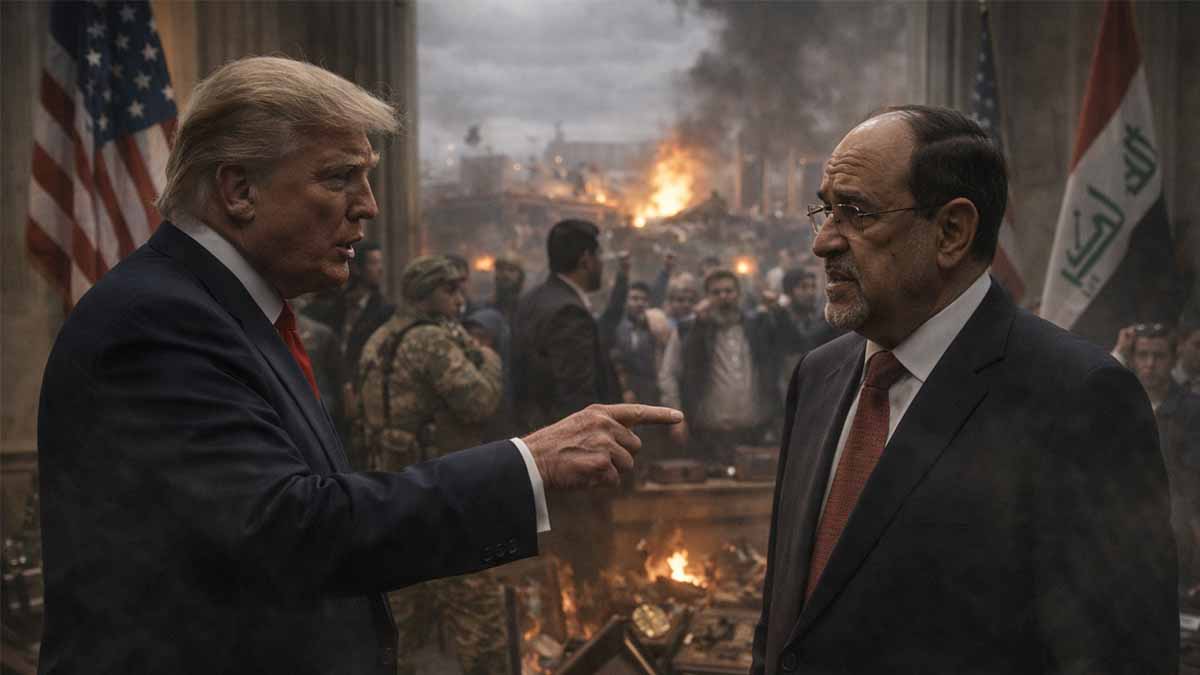
On January 27, 2026, President Donald Trump published a Truth Social post that detonated the already fragile Iraqi political landscape. Declaring al-Maliki a “very bad choice,” invoking the 2014 ISIS territorial collapse as Maliki’s personal legacy, and threatening that “the United States of America will no longer help Iraq” if Maliki is elected, Trump transformed a complex domestic elite negotiation into a binary sovereignty confrontation.
The framing was critical. Baghdad had tolerated decades of Washington expressing preferences for Iraqi leaders through private diplomatic channels. What proved intolerable was the register: public, coercive, humiliating. Maliki responded within 48 hours, condemning “blatant American interference in Iraq’s internal affairs” and reframing his candidacy as a test of national sovereignty. The CF, on January 30, closed ranks and reaffirmed its nomination — producing the precise opposite of Washington’s intended effect. This is a textbook demonstration of the sovereignty-rally dynamic: external coercive pressure directed at a domestic political actor consolidates, rather than fragments, the actor’s support base.
The cascade was immediate. The National Political Council (Sunni organizing body) under former speaker Mohammed al-Halbousi had already declared formal objection to Maliki on January 27, and the Popular Mobilization Forces political constituency understood Trump’s intervention as a preview of demands that could include their institutional dissolution. The CF’s public defiance thus fused Maliki’s contested candidacy with the existential institutional interests of the PMF — an entity with estimated membership exceeding 160,000 fighters deeply embedded in Iraqi security structures.
Washington then compounded its error. Savaya was sidelined (reports he initially denied) and Tom Barrack — US Ambassador to Turkey and Special Envoy for Syria — was handed the Iraq portfolio mid-crisis. The improvisation was visible to every actor in Baghdad: it confirmed that Washington lacked a coherent Iraq policy architecture, operated reactively, and had no sustained diplomatic presence capable of managing the relationship below the level of presidential social media posts. The CF’s calculation that Washington would accept Maliki, while analytically flawed, was not irrational given the observable evidence of U.S. disengagement.
III. The Iranian Strategic Geometry
Tehran‘s role in the Maliki nomination requires precise analytical calibration. It is tempting but reductive to describe Maliki as an “Iranian proxy.” His motivations are primarily personal-political — he is a consolidator-in-chief who has used institutional capture, informal command chains bypassing the Ministries of Defense and Interior, and patronage networks to accumulate power that benefits himself as much as any external patron. Nevertheless, Iran‘s endorsement was structurally decisive.
For Tehran, Iraq in early 2026 represents the most strategically valuable node in its residual influence architecture after catastrophic erosion since October 7, 2023. The Hezbollah network has been severely degraded. Hamas governance in Gaza has been dismantled. Houthi operational capacity, while persistent, faces intensified pressure. In this context, Iraq — which shares a long border with Iran, provides hard currency through trade channels that circumvent sanctions, and hosts the PMF network — is irreplaceable. Tehran cannot afford an uncertain or weak transitional leader in Baghdad who would require months to orient before exercising meaningful influence.
Maliki offers Iran continuity, familiarity, and demonstrated capacity to manage Iraq’s fractious security landscape. The 2020 assassination of Qassem Soleimani and Abu Mahdi al-Muhandis removed the two brokers who had previously maintained cohesion across the PMF constellation. Maliki‘s known informal command relationships with multiple PMF factions make him uniquely positioned to exercise the integrating function that Tehran has struggled to replicate since those losses. Iran‘s ambassador to Baghdad, Mohammad Kazem Ale-Sadeq, declared publicly that Tehran supports “any candidate selected by the Coordination Framework” — a formulation that is technically neutral but functionally endorsing.
Crucially, Iran moved with “little sign of strategic fatigue” in promoting its preferred candidate despite domestic and regional pressures — a signal that Baghdad remains a redline commitment for Tehran regardless of its capacity constraints elsewhere.
IV. The Dollar-Clearing Tripwire: Economic Weaponization Architecture
The most acute U.S. leverage over Iraq is not military but financial. Since 2003, Washington has maintained decisive control over Iraqi oil revenues, which flow through accounts at the Federal Reserve Bank of New York. This arrangement, established as part of post-invasion economic architecture, means that any U.S. decision to restrict dollar flows would trigger cascading financial consequences within days — not weeks or months.
Iraq‘s fiscal vulnerability is acute. The country funds the vast majority of its $100+ billion annual budget through oil export revenues. The public sector employs an estimated 40% of the Iraqi workforce, and salary payments are chronically at risk given structural fiscal mismanagement compounded by oil price volatility. Any disruption in dollar-clearing access would immediately impair the Central Bank of Iraq‘s ability to finance imports and service the state payroll — triggering the exact social unrest and institutional collapse that provides ISIS and other destabilizing forces with their primary recruitment environment.
The Trump administration has already demonstrated willingness to use this instrument: multiple Iraqi financial entities have faced U.S. sanctions for facilitating Iranian sanctions evasion, providing a template for graduated escalation. One Coordination Framework source told AFP that internal Shiite leaders are “divided,” with some fearing that if Maliki returns, U.S. sanctions could unravel an economy “struggling with weak economic growth” that “cannot risk punitive measures.”
This economic tripwire explains the emergence of Sudani as the preferred alternative. On February 23, 2026, Sudani and Tom Barrack oversaw the signing of preliminary agreements between Iraq and Chevron — a visible transactional signal that Washington is prepared to reward cooperative behavior with economic integration. Sudani explicitly framed American investment as generating “new opportunities for growth, generating jobs, enhancing economic resilience.” The contrast with the threat landscape surrounding a Maliki premiership could not be more geometrically precise.
V. The Coordination Framework Fracture: Hypergraph Topology
The CF’s public posture of unity conceals a structural fracture that has been deepening since the January 27 Trump intervention. Analysis of the bloc’s internal composition reveals at least three distinct camps:
Camp 1 — Pro-Maliki hardliners: Maliki‘s own State of Law Coalition; the Badr Organization (Hadi al-Ameri); the Islamic Supreme Council (Humam Hamoudi); former deputy parliament speaker Mohsen al-Mandalawi. These actors frame the nomination as a sovereignty test they cannot concede without establishing a precedent for unlimited foreign influence in Iraqi electoral outcomes.
Camp 2 — Pragmatic accommodationists: Elements of Sudani‘s Reconstruction and Development Coalition (whose spokesman Bahaa al-Araji signaled on February 22 a possible reconsideration of Maliki support, before issuing a contradictory statement on February 24); former PM Haider al-Abadi‘s Victory Alliance, which called for prioritizing “vital interests given the exceptional circumstances” — a formulation containing “tacit acknowledgment of Iraq‘s inability to withstand US pressure.”
Camp 3 — Anti-Maliki skeptics operating within the CF: Qais al-Khazali (Asaib Ahl al-Haq), who opposes Maliki on personal-political grounds; Ammar al-Hakim (National State Forces), whose initial reading of the Trump administration letter at the private CF gathering catalyzed the public confrontation.
The Kurdish dimension adds structural complexity. The Kurdistan Democratic Party and Patriotic Union of Kurdistan deadlock over the presidential candidate has twice forced postponement of the parliamentary presidential session — initially scheduled for February 1, then delayed again on February 2. Under the Iraqi Constitution, the president must be elected before the prime minister designate can be tasked; the Kurdish impasse has thus inadvertently provided the CF with temporal breathing room to continue internal negotiations. KDP President Masoud Barzani, in his meeting with Barrack on February 22, signaled flexibility on the premiership provided the candidate is “committed to the constitution and to the principles of partnership, balance, and reconciliation” — language incompatible with Maliki’s reputation.
Sunni formal opposition through Halbousi‘s National Political Council remains a structural veto if exercised coherently. Iraq‘s communal consensus system effectively requires cross-sectarian buy-in for any government to function; a PM who cannot secure Sunni parliamentary participation cannot form a cabinet within the 30-day constitutional deadline, as demonstrated by Mohammed Tawfiq Allawi and Adnan al-Zurfi in 2020.
VI. Counter-Terrorism Infrastructure at Risk: The ISIS Detainee Dimension
The security consequences of a U.S.-Iraq rupture extend beyond the bilateral relationship. Iraq has recently agreed to take custody from Syria of approximately 7,000 ISIS detainees, of whom over 5,700 have already been transferred to Iraqi facilities. Managing this population requires sustained funding for secure detention infrastructure, intelligence-sharing with U.S. and coalition partners on detainee identities and threat profiles, and bilateral coordination to prevent mass-breakout scenarios of the type that triggered ISIS’s 2014 territorial surge.
The U.S.-built Iraqi Counterterrorism Service (ICTS) is assessed by U.S. officials as “the most significant and capable counterterrorism force in the Middle East.” Its operational effectiveness depends on joint training, logistics support, and real-time intelligence exchange with U.S. Special Operations Forces. A rupture in this relationship — whether triggered by sanctions, diplomatic downgrade, or deliberate disengagement — would degrade the ICTS‘s capability precisely as it manages its most complex detainee burden since the 2017 liberation of Mosul.
The ISIS reconstitution risk is not theoretical. The group retains insurgent capacity in the Hamrin Mountains and Anbar desert corridors. Its leadership structure, while degraded, remains operationally capable of exploiting governance vacuums, economic distress, and security sector disorganization — all of which a U.S.-Iraq financial rupture would produce simultaneously.
VII. Scenario Tree and Leverage Matrix
Analysis of Competing Hypotheses (ACH) identifies five primary scenario vectors as of February 27, 2026:
H1 — Maliki Persists and Is Elected (Probability: 15–20%): CF maintains formal nomination; Kurdish and Sunni blocs are co-opted or outmaneuvered; parliamentary vote proceeds. U.S. response: graduated sanctions, dollar-flow restrictions, PMF strikes. Outcome: acute economic and security crisis within 60–90 days. Iranian strategic position consolidated in the short term but potentially destabilized by economic shock that Iran cannot compensate.
H2 — Maliki Withdraws in Exchange for Institutional Compensation (Probability: 20–25%): CF privately negotiates Maliki’s withdrawal in exchange for the Coordination Framework presidency or a comparable institutional prize. Face-saving on both sides. Sudani or a consensus alternative emerges. Most stabilizing outcome for U.S.-Iraq relationship.
H3 — Sudani Second Term via Transactional Diplomacy (Probability: 35–40%, highest): The Chevron agreements (February 23) and Barrack visits signal Washington’s preferred outcome. CF fracture produces sufficient internal dissent to render Maliki’s nomination untenable without formal withdrawal. Sudani re-emerges as consensus candidate, leveraging economic partnership narrative. U.S. U-turn framed as Iraqi sovereign decision. Most likely resolution given current momentum.
H4 — Constitutional Deadlock / Caretaker Extension (Probability: 15–20%): Kurdish presidential impasse extends beyond constitutional deadlines; caretaker government under Sudani continues for up to one year with limited powers. Crisis deferred but not resolved. ISIS risk increases as operational uncertainty grows.
H5 — Escalatory Rupture (Probability: 5–10%): U.S. imposes severe financial measures after February 27 deadline expires; PMF elements conduct kinetic provocations against U.S. interests in Baghdad; spiral toward direct confrontation. Lowest probability but highest consequence scenario.
The February 27 Deadline: As of the date of this analysis, the U.S. has set Friday, February 27 as a deadline for Maliki’s withdrawal under threat of “unspecified repercussions.” This is the second such deadline the U.S. has issued; the first passed without visible consequence. The CF has announced it will not hold another premiership meeting until next week — effectively signaling the deadline will expire. Whether Washington escalates, or pivots quietly to the Sudani option, will define the next phase.
VIII. The Sudani Emergence: Transactional Resolution Architecture
The most analytically coherent reading of the current trajectory is that Sudani is being positioned for a second term through a process that allows all parties to exit with minimal reputational damage. The architecture is visible: Sudani publicly supports Maliki’s nomination (protecting his relationship with CF hardliners) while simultaneously signing Chevron agreements and hosting Barrack in Baghdad (demonstrating his value to Washington). He is the only actor in the system simultaneously acceptable to the U.S., tolerated by Iran, capable of attracting Gulf investment, and possessing the institutional knowledge to manage Iraq’s fragile recovery.
Washington’s strategic interest is not ideologically anti-Maliki per se — it is functionally anti-Iran-consolidation. Sudani‘s second term does not eliminate Iranian influence in Baghdad, but it preserves the fragile balance that has allowed Iraq to function as a regional mediator, maintain dollar-denominated oil trade, and cooperate on counterterrorism. The Chevron deal and the framing of “American investment in Iraq” as generating “mutual prosperity” provides the transactional language that the Trump administration‘s foreign policy architecture requires to claim a win.
The deeper structural problem — that Iraq‘s government-formation process systematically produces outcomes through elite capture rather than democratic accountability — remains unaddressed and will generate the next crisis on the same timeline as the post-2025 election cycle.
INDEX
| Chapter Title | Core Focus |
|---|---|
| The Nomination Shock | Structural origins of the Maliki candidacy; elite bargaining pathology |
| The Trump Intervention Vector | Truth Social as coercive statecraft; second-order sovereignty rallying |
| The Iranian Hand | Tehran’s strategic calculus; PMF leverage architecture |
| The Economic Tripwire | Dollar-clearing dependency; sanctions cascade modeling |
| The Fragmentation Topology | Coordination Framework fracture lines; Kurdish-Sunni veto dynamics |
| Counter-Terrorism at Risk | ISIS detainee crisis; ISF-ICTS degradation scenarios |
| Scenario Tree & Leverage Matrix | Monte Carlo outcomes; U.S. intervention options ranked |
| The Sudani Emergence | Chevron diplomacy; transactional path to resolution |
⚡ INTELLIGENCE CODEX — VISUAL INTELLIGENCE DASHBOARD
U.S.–Iraq–Maliki Crisis: Multi-Vector Analysis | February 2026
| Scenario | Probability Est. | U.S. Response | Economic Risk | ISIS Risk | Iran Gain |
|---|---|---|---|---|---|
| H1 – Maliki Elected | 15–20% | Sanctions + PMF strikes | Critical (days) | Very High | Short-term high |
| H2 – Maliki Withdraws (compensated) | 20–25% | Normalization | Low | Low | Moderate |
| H3 – Sudani Second Term | 35–40% | Chevron/economic integration | Low | Low | Contained |
| H4 – Constitutional Deadlock | 15–20% | Disengagement | Moderate | Moderate | Opportunistic |
| H5 – Escalatory Rupture | 5–10% | Direct confrontation | Catastrophic | Critical | Pyrrhic |
Scenario Probability Distribution (%)
Multi-Vector Risk Index by Scenario (0–10)
CF Bloc Alignment Map (Parliamentary Seats, 329 total)
U.S. Leverage Instruments — Estimated Impact Score
Intelligence Codex Visual Dashboard — U.S.–Iraq–Maliki Crisis | Data current to February 27, 2026
Probability estimates derived from open-source signal aggregation and structural political analysis.
The Nomination Shock — Structural Origins of the Maliki Candidacy and the Pathology of Iraqi Elite Bargaining
The Electoral Substrate: November 11, 2025 and the Architecture of Fragmentation
The crisis that detonated on January 27, 2026 was not born in that week. Its structural determinants were coded into Iraq‘s November 11, 2025 parliamentary elections — a contest that simultaneously demonstrated the formal vitality and functional hollowness of Iraq‘s democratic architecture. Official voter turnout reached 55–56% of registered voters, a marked recovery from the historically depressed 43% recorded in 2021 — itself a product of mass disillusionment following the Tishreen protest movement of 2019–2020. The turnout rebound, while notable, masked a deeper structural artifact: approximately 30 million eligible Iraqis existed, yet only 21 million had registered to vote, meaning that the “55%” figure excluded a full third of the electorate before a single ballot was cast. Democracy’s legitimating function operated on a severely contracted base.
The 329-member Council of Representatives elected on November 11 produced a fragmented parliament that reflected, with clinical precision, Iraq‘s ethno-sectarian composition. Shiite parties secured 187 seats (56.8%), Sunni parties 77 seats (23.4%), Kurdish parties 56 seats (17%), with 9 seats allocated to minority communities. Within the Shiite bloc, the results encoded a political paradox: the single largest vote-winner was Prime Minister Mohammed Shia al-Sudani‘s Reconstruction and Development Coalition with 46 seats — yet this figure represented merely 14% of the total parliament, structurally insufficient for autonomous government formation. Maliki‘s State of Law Coalition secured 28–29 seats. Qais al-Khazali‘s Sadiqoun (Asaib Ahl al-Haq’s political wing, a U.S.-designated terrorist organization) won 27 seats, tripling its 2021 performance. Hadi al-Ameri‘s Badr Organization claimed 18–21 seats. The National State Forces Alliance (Ammar al-Hakim, Haider al-Abadi) secured 18 seats. Huquq (Kataib Hezbollah) obtained 6 seats.
Crucially, the Coordination Framework‘s electoral coalition fragmented during campaigning — its constituent parties ran as separate lists to maximize individual seat tallies through vote-maximization strategies — yet immediately reconstituted as a unified bloc post-election. On November 17, the CF declared itself the largest parliamentary bloc, claiming constitutional priority under Article 76 of the Iraqi Constitution to nominate the prime minister. The Supreme Court‘s 2010 interpretation of “largest bloc” — allowing post-election coalition formation to qualify, rather than requiring pre-election unity — provided the legal architecture for this maneuver. It also codified one of the most structurally corrosive features of Iraqi democracy: the systematic displacement of electoral outcomes by post-hoc elite recombination.
A critical signal emerged immediately post-election from Chatham House researchers who had visited Baghdad in November 2025: leaders across the governing Shiite coalition had privately articulated a “firm consensus” against a second-term prime minister and against any candidate who led his own political party. Maliki violated both criteria. His candidacy’s subsequent emergence therefore did not reflect consensus — it reflected the collapse of consensus, exploited by internal tactical maneuvering.
Sudani’s Tactical Miscalculation: How the Frontrunner Created His Own Crisis
The path to Maliki‘s nomination runs directly through a strategic miscalculation by Prime Minister Sudani — the man best positioned to secure a second term and the politician with most to lose from the resulting crisis.
Sudani‘s electoral strategy was architecturally ambitious. He ran on his own list, separate from the CF, cultivating a national-leader identity premised on delivery: tangible improvements in service provision, landmark energy deals with ExxonMobil, Chevron, and KBR signed in 2025, and a public posture as Iraq‘s first prime minister in the modern era actively seeking democratic re-election. His coalition’s 46-seat victory — secured through approximately 1.3 million votes, outperforming Maliki‘s State of Law by 370,000 votes — was, by any orthodox democratic logic, a mandate for continuation.
But Iraq‘s government formation logic is not orthodox democratic logic. Sudani faced a structural contradiction: he required CF institutional support to survive the government formation process, yet re-entering the CF framework subordinated his candidacy to the same bloc whose senior figures — led by Maliki — viewed his accumulating power with acute threat perception. One senior Iraqi politician told the Financial Times that Maliki “would rather die than see Sudani come back as PM.” Reports circulated that CF figures suspected Sudani‘s office had engaged in telephone surveillance of rival politicians during his first term — an accusation that, whether accurate or exaggerated, poisoned the internal coalition atmosphere.
Sudani‘s reported gambit: endorse Maliki‘s nomination as a tactical maneuver, calculating that other actors — the Kurds, Sunnis, Muqtada al-Sadr‘s informal influence networks, and the United States — would collectively block Maliki before formal candidacy crystallized, allowing Sudani to re-emerge as the consensus alternative. The gambit was calibrated on the assumption that Washington would intervene through private diplomatic channels with sufficient force to stop Maliki quietly. Washington, operating without a confirmed ambassador and with a special envoy (Mark Savaya) who had not yet visited Baghdad, failed to generate the required signal. The CF read the silence as acquiescence and accelerated the timeline.
The Coordination Framework’s Self-Violation: Abandoning Its Own Governing Logic
The CF’s formal nomination of Maliki on January 24, 2026, by simple majority vote, constitutes one of the most analytically anomalous decisions in post-2003 Iraqi political history. The anomaly deepens on examination of the CF’s own previously articulated selection criteria.
The bloc had publicly maintained that its prime minister candidate must satisfy three conditions: (1) internal CF consensus, (2) broad cross-communal acceptance from Sunni and Kurdish communities, and (3) a degree of international support. Maliki satisfied none of the three.
On criterion (1), the nomination was secured by simple majority, not consensus. Qais al-Khazali (Sadiqoun/AAH) harbored strong personal-political objections. He traveled to Tehran around February 9 to discuss the candidacy directly with Iranian leadership, signaling that his reservations were substantive enough to warrant a bilateral conversation — not a perfunctory dissent. Ammar al-Hakim and Haider al-Abadi‘s National State Forces Alliance expressed reservations. Even within the Framework’s ranks, the nomination carried a fracture signature from the opening moment.
On criterion (2), the National Political Council (the organizing body of Sunni Arab politics) under former parliament speaker Mohammed al-Halbousi declared formal opposition on January 27 — the same day as Trump’s Truth Social post, coincidentally — stating it would neither vote for Maliki nor participate in any government he led. Within Iraq‘s consociational logic, this declaration constitutes a functional veto: no prime minister can govern effectively without Sunni parliamentary participation in cabinet formation, and the 30-day constitutional deadline for government formation becomes impossible to meet.
On criterion (3), Washington — whose position had previously been interpreted as permissive — made its opposition unambiguous within 72 hours of the nomination.
The structural explanation for why the CF nominated a candidate who violated all its own criteria lies in the convergence of three factors: Iran‘s green light (which provided an external authorization that partially substituted for internal consensus), Sudani‘s tactical endorsement (which gave the maneuver internal legitimacy it would otherwise have lacked), and a systematic underestimation of U.S. opposition severity — itself a function of Washington’s pre-crisis disengagement from Baghdad.
The Maliki Persona: Consolidator-in-Chief and the 2014 Legacy Problem
Nouri Kamel Mohammed Hassan al-Maliki, born June 20, 1950 in Karbala, joined the Islamic Dawa Party in 1970 and spent the Ba’athist years in exile across Syria and Iran — a biography that forged both his survival instincts and his relationship networks with Tehran. He served as Iraq‘s prime minister across two consecutive terms from 2006 to 2014, a tenure defined by two simultaneous and contradictory realities: the suppression of Muqtada al-Sadr‘s Mahdi Army during Operation Knight’s Charge in Basra in 2008 (demonstrating genuine willingness to confront Iranian-linked militias when politically necessary) and the systematic construction of informal command chains that bypassed formal state institutions, hollowing out the Ministries of Defense and Interior and creating personal-loyalty networks that substituted for institutional capacity.
The 2014 denouement remains definitional. The fall of Mosul to ISIS in June 2014 — triggered in substantial part by the collapse of Iraqi Security Forces (ISF) that Maliki‘s institutional hollowing had rendered operationally hollow — produced a convergence of pressures that ended his tenure: the Shia religious authority in Najaf under Grand Ayatollah Ali al-Sistani delivered a message of non-support, Iran signaled its readiness for an alternative, and Washington made clear he could not continue. The precedent was foundational: even the most institutionally entrenched Iraqi leader could be displaced when a sufficient constellation of external and internal pressure converged.
In 2026, Maliki confronts a structurally different but procedurally analogous situation. His coalition holds 28–29 seats out of 329 — approximately 8.8% of parliament. He has no credible arithmetic pathway to a parliamentary majority without comprehensive cross-sectarian coalition construction. His reputation as a consolidator-in-chief means that even CF allies fear the institutional consequences of his return: he will not share power, he will centralize authority through informal channels, and rivals will find themselves progressively marginalized. The CF’s internal critics of his nomination were not motivated by principle — they were motivated by self-preservation.
The Washington Vacuum: How Diplomatic Disengagement Created the Crisis
The Trump administration‘s role in enabling the nomination crisis it subsequently sought to reverse requires precise documentation. Prior to January 27, U.S. diplomatic engagement with Baghdad on the government formation process had been conspicuously thin.
The nominated special envoy, Mark Savaya — a political loyalist without Iraq expertise — had not visited Baghdad by the time of the November 2025 elections. The absence of a confirmed U.S. Ambassador to Iraq created a structural gap: the embassy operated under a chargé d’affaires, a status that communicates diminished priority to a political culture acutely sensitive to hierarchical signals. Secretary of State Marco Rubio made calls to Iraqi leaders on January 25 — two days after the nomination — but the timing was reactive, not preemptive. Ambassador Tom Barrack (simultaneously serving as U.S. Ambassador to Turkey and special envoy for Syria), was pressed into service on January 26 — one day before Trump’s Truth Social post.
The Atlantic Council’s researchers, drawing on November 2025 field research in Baghdad, documented that Washington “had made clear to the Framework that it would not accept a government that included designated terrorist organizations” but “US messaging did not suggest firm opposition to any specific candidates.” The CF’s interpretation of this ambiguity as tacit acceptance was not irrational given observable U.S. behavior. Washington had, over the preceding months, created the conditions for the very miscalculation it then publicly punished.
The Savaya episode added cascading confusion. His social media post threatening Iraq was subsequently deleted when he closed his account. Reports of his dismissal — formally denied, then confirmed in modified form — produced conspiracy theories in Baghdad about U.S. internal incoherence and raised the question of whether Trump’s Truth Social post itself had been drafted with full interagency coordination. Maliki himself claimed the message may have been “drafted from inside Iraq and by Iraqis” — a framing that served his sovereignty-rally narrative but also contained an implicit acknowledgment of U.S. diplomatic disorder.
The Sadr Variable: Strategic Silence as Threat Multiplier
Muqtada al-Sadr‘s announced boycott of the 2025 elections — delivering on a withdrawal from electoral politics he had signaled since August 2022 — removed the largest single Shiite political force from the formal parliamentary arithmetic. His movement had won 73 seats in 2021 before his dramatic parliamentary withdrawal. In 2025, Sadr’s organizational base, concentrated among Iraq‘s urban poor and disenfranchised Shiite youth, was structurally absent from the seat count. The consequence was not political irrelevance — it was the displacement of Sadr‘s influence from the parliamentary arena to the street mobilization domain, precisely the domain in which he possesses unmatched capability.
Sadr‘s silence on the Maliki-Trump confrontation has been widely interpreted as strategic calculation. Maliki and Sadr carry one of Iraq‘s most visceral political antagonisms: Operation Knight’s Charge in 2008 was directed specifically against Sadr‘s Mahdi Army; the two leaders have competed for Shiite political primacy across two decades; and Sadr was instrumental in blocking Maliki‘s third-term ambitions in 2014. A Maliki return to the premiership would represent precisely the political defeat that Sadr has historically been willing to mobilize millions to prevent.
The calculation appears to be: allow the multi-actor opposition to Maliki‘s nomination — U.S. pressure, Sunni veto, Kurdish uncertainty, internal CF fractures — to do the blocking work without requiring Sadr‘s direct intervention. If those forces succeed, Sadr conserves his mobilization capital. If they fail and Maliki is confirmed, Sadr possesses the capacity to paralyze governance through street pressure with a magnitude that dwarfs any parliamentary opposition — and he will deploy it.
The Constitutional Clock and the Kurdish Veto Mechanism
Iraq‘s government formation process is constitutionally sequential: parliament must first elect a president (requiring a two-thirds majority on first ballot, simple majority on second), the president then nominates the prime minister candidate from the largest bloc, and the designate has 30 days to present a cabinet for parliamentary confidence vote. The Kurdish presidential impasse — KDP and PUK unable to agree on a unified candidate — has twice caused the failure of parliamentary sessions scheduled for the presidential vote: originally slated for February 1, then again blocked on the rescheduled date. Parliament failed to convene for a constitutionally mandated session on two successive occasions — a breach that Maliki‘s State of Law had itself threatened on January 11 could trigger parliamentary dissolution.
The Kurdish deadlock has inadvertently provided the CF with temporal breathing room: the presidential vote’s failure provides a plausible procedural explanation for delay that is factually distinct from, yet operationally intertwined with, the Maliki nomination dispute. As of February 26–27, the CF was holding internal meetings to align positions ahead of a broader session, with three agenda items: setting a parliamentary date for the presidential vote, reviewing the Maliki file, and managing the sequencing protocol (Framework presents its prime minister nominee one week after the president is elected). The CF’s internal sources indicated the bloc “could still opt for an alternative candidate from the list under consideration, depending on political calculations and regional dynamics.”
The KDP‘s Masoud Barzani, in his meeting with Tom Barrack on February 22, signaled flexibility on the premiership on the condition that the candidate be “committed to the constitution and to the principles of partnership, balance, and reconciliation” — language precisely calibrated as incompatible with Maliki‘s governance record in Sunni and Kurdish communities’ collective memory.
Five Competing Hypotheses: Why the CF Nominated Maliki
Applying Analysis of Competing Hypotheses (ACH) to the nomination decision:
| Hypothesis | Core Driver | Evidence For | Evidence Against | Probability |
|---|---|---|---|---|
| H-A: Iranian Direction | Tehran instructed CF to nominate Maliki | Iran’s green light confirmed; Khazali Tehran visit; Maliki’s Iran-compatible governance style | Maliki’s motivations are primarily self-interested; Iran backed prior PMs too | Moderate–High |
| H-B: Sudani Tactical Maneuver Misfired | Sudani endorsed Maliki expecting his blocking | Sudani’s early endorsement; expected U.S./Sunni/Kurdish blocking | Sudani had strong independent leverage; why cede to Maliki at all? | High |
| H-C: CF Internal Deadlock Resolution | Maliki emerged as the only candidate all CF factions could tolerate enough to vote for | Nomination by simple majority; absence of consensus alternatives | CF violated its own criteria; multiple CF actors opposed | Moderate |
| H-D: U.S. Disengagement Exploitation | CF tested limits of a disengaged Washington | Low U.S. profile pre-nomination; no confirmed ambassador; Savaya’s inexperience | CF should have anticipated Trump’s volatility given his track record | Moderate–High |
| H-E: Maliki Self-Promotion via Fait Accompli | Maliki used his 29-seat leverage to force his own nomination before alternatives crystallized | State of Law formally nominated Maliki on November 22; he drove the timeline | Requires CF majority to have been manipulated rather than exercising choice | Moderate |
The most analytically parsimonious reading integrates H-B and H-D: Sudani‘s tactical miscalculation, operating in the context of U.S. disengagement, allowed Maliki‘s momentum to crystallize faster than the blocking mechanisms could activate. Iran‘s authorization (H-A) provided the external permission structure; Maliki‘s own agency (H-E) drove the internal acceleration; and the CF’s internal deadlock (H-C) meant that no alternative candidate had sufficient pre-cooked coalition support to displace him once momentum built.
📊 Chapter 1 Intelligence Infographic — The Nomination Shock: Electoral Architecture & Elite Bargaining Pathology
Raw Data Reference Table — November 11, 2025 Iraqi Parliamentary Election
| Party / Coalition | Leader | Sect/Bloc | Seats (329 total) | % of Parliament | CF Member? | Iran-Linked? |
|---|---|---|---|---|---|---|
| Reconstruction & Development | Sudani | Shia | 46 | 14.0% | Yes (rejoined) | No |
| Taqaddum (Progress) | al-Halbousi | Sunni | 27–36 | 8.2–10.9% | No | No |
| State of Law | al-Maliki | Shia | 28–29 | 8.5–8.8% | Yes | Partial |
| Sadiqoun (AAH) | al-Khazali | Shia | 27 | 8.2% | Yes | Yes (US-designated) |
| KDP | Barzani | Kurdish | 26 | 7.9% | No | No |
| Badr Organization | al-Ameri | Shia | 18–21 | 5.5–6.4% | Yes | Yes |
| National State Forces | Hakim / Abadi | Shia | 18 | 5.5% | Yes | Nominal |
| PUK | al-Talabani | Kurdish | 17 | 5.2% | No | No |
| Azm Alliance | al-Samarei | Sunni | 15 | 4.6% | No | No |
| Huquq (Kataib Hezb.) | — | Shia | 6 | 1.8% | Yes | Yes (US-designated) |
| Hasm / Siyada (Sunni) | al-Abbasi / Khanjar | Sunni | 15 | 4.6% | No | No |
| Other / Minorities | — | Mixed | ~45 | 13.7% | No | No |
Parliamentary Bloc Distribution (329 Seats)
Coordination Framework — Internal Seat Breakdown
Iraqi Voter Turnout Trend (2005–2025)
ACH: Why Did CF Nominate Maliki? (Probability Weights)
CF’s Own Selection Criteria vs. Maliki Compliance Score (0 = None, 10 = Full)
Chapter 1 Intelligence Infographic | Sources: IHEC (November 2025), Atlantic Council, Chatham House, Washington Institute | February 27, 2026
The Trump Intervention Vector — Coercive Statecraft, Sovereignty-Rally Dynamics, and the Second-Order Cascade of Public Confrontation
The Instrument: Truth Social as Geopolitical Weapon
At approximately 8:00 AM EST on January 27, 2026, President Donald Trump deployed a medium that no previous U.S. president had used as a primary instrument of coercive statecraft against a sovereign ally: a social media post on his own platform, Truth Social. The text was brief, charged, and structurally unprecedented in the register of U.S.-Iraq diplomatic relations:
“Last time Maliki was in power, the Country descended into poverty and total chaos. That should not be allowed to happen again. Because of his insane policies and ideologies, if elected, the United States of America will no longer help Iraq and, if we are not there to help, Iraq has ZERO chance of Success, Prosperity, or Freedom. MAKE IRAQ GREAT AGAIN!”
The post contained four analytically distinct operational elements that must be disaggregated to understand its full cascade effect. First, it deployed historical indictment — directly linking Maliki to the 2014 ISIS territorial seizure as personal accountability. Second, it issued a conditional ultimatum — threatening total withdrawal of U.S. assistance, a formulation whose ambiguity between diplomatic, military, economic, and financial dimensions was maximally coercive precisely because it was undefined. Third, it employed humiliation rhetoric — “insane policies,” “ZERO chance” — language designed not to persuade but to demean, which in Baghdad‘s political culture carries particularly acute resonance. Fourth, it consciously echoed the “MAKE [COUNTRY] GREAT AGAIN” formulation — a branding device that simultaneously telegraphed the post’s domestic U.S. political audience as the primary addressee and framed Iraq as a subordinate object of American policy, not a sovereign partner. The compound effect was not diplomatic — it was dominative.
The post did not emerge in isolation. U.S. Chargé d’Affaires Joshua Harris had sent a written message to CF leaders in the days prior, stating that “we recall the period of previous governments headed by Prime Minister Maliki negatively in Washington” while paradoxically conceding that “the selection of the prime minister-designate and other leadership positions is a sovereign Iraqi decision” and that “the United States will make its sovereign decisions regarding the next government in accordance with U.S. interests.” Two CF members confirmed to the Associated Press having received this message, a copy of which was circulated widely on Iraqi social media. The Harris letter was calibrated and professional — an orthodox private channel intervention. Trump’s Truth Social post nine days later represented the complete antithesis: public, coercive, and rhetorically incendiary. The jarring inconsistency between the two communications compounded Baghdad’s confusion about whether Washington was operating through a coherent interagency policy process or ad hoc presidential impulse.
Secretary of State Marco Rubio had called Prime Minister Sudani on January 25 — two days after the CF nomination and two days before Trump’s post — emphasizing that any Iraqi “government controlled by Iran cannot successfully put Iraq‘s own interests first, keep Iraq out of regional conflicts, or advance the mutually beneficial partnership between the United States and Iraq.” The Rubio call was substantive and calibrated. It focused on the structural problem (Iranian-controlled government) rather than a specific person, leaving diplomatic space for negotiation. Trump’s January 27 post demolished that space within 72 hours.
Congressman Joe Wilson (R-SC) amplified the executive branch message on January 27, posting that any Iraqi government would need to “place Iraq and its people first” by “fully disarming and dismantling all Iran-linked militia groups within 12 months” and removing “all Iranian advisers, operatives and agents from the country.” Wilson’s maximalist framing extended the U.S. demand well beyond the Maliki nomination — threatening a future government with existential institutional restructuring requirements that went to the core of the PMF‘s existence. This amplification effect was uncoordinated with the State Department’s messaging and served to expand the CF’s threat perception from “one candidate is blocked” to “the entire architecture of Shiite political-military power in Iraq is under existential American challenge.”
The Immediate Backlash: Maliki’s Sovereignty Reframe
Nouri al-Maliki responded on January 28 with a statement on X that constitutes one of the most analytically precise examples of sovereignty-framing as political judo in recent Middle Eastern political history. He declared: “We reject the blatant American interference in Iraq‘s internal affairs and consider it a violation of its sovereignty.” He refused to withdraw his candidacy. He recast the political contest not as a question of his personal fitness for office but as a test of Iraq‘s autonomy and independence from foreign coercion.
The strategic geometry of this reframe was elegant. Maliki had entered the nomination process as a deeply polarizing figure whose candidacy was contested within his own coalition, opposed by Sunni parties, viewed with suspicion by Kurdish leaders, and regarded with unease by Iran‘s own regional allies who preferred more controllable figures. Trump’s public intervention transformed Maliki — within a 24-hour news cycle — from a divisive partisan candidate into a symbol of national sovereignty. The question shifted from “Is Maliki a good prime minister?” to “Will Iraq surrender its constitutional processes to American social media posts?” These are entirely different questions, and Maliki only wins the second one.
Maliki also deployed a sophisticated conditional framing to manage his internal CF relationships. In a televised interview, he stated: “If two-thirds of the Framework‘s members — eight out of twelve leaders — decide to replace me, I will accept that decision with full respect.” This formulation served three simultaneous functions: it demonstrated democratic deference (shielding him from accusations of authoritarian personality), it set an artificially high bar for removal (ensuring that simple majority dissatisfaction would be insufficient to displace him), and it signaled to CF moderates who privately wanted to find an exit that they would need to secure near-supermajority consensus to do so — a coordination challenge that benefits the status quo candidate.
He also thanked Prime Minister Sudani “for withdrawing from the race, describing the move as a ‘major surprise’ that reshaped the political equation” — a statement simultaneously generous in tone and destabilizing in effect, by publicly acknowledging and crystallizing Sudani’s withdrawal before any face-saving mechanism had been constructed for its reversal.
The Coordination Framework’s Collective Action Response: January 30–31
On January 31, 2026, the Coordination Framework convened its 261st periodic meeting at Maliki‘s office — a venue choice that was itself a political signal of no accidental nature — and issued a formal statement: “The Coordination Framework reiterates its support for its nominee, Nouri Kamel al-Maliki, for the premiership… Choosing the prime minister is a purely Iraqi constitutional matter, carried out according to the mechanisms of the political process, taking into account the national interest, away from external dictates.”
The CF’s January 31 reaffirmation was not a unanimous endorsement. It was a collective public positioning that masked internal fracture. The CF’s public statement emphasized “keenness to build balanced relations with the international community, especially with the influential international powers” — a formulation that simultaneously rejects the coercive form of U.S. intervention while leaving open the door to substantive engagement. This dual messaging was calibrated to satisfy both the sovereignty-rally constituency within the CF and the pragmatist-accommodationist camp whose private calculations were already shifting.
The internal fracture was confirmed within days. Kurdistan 24’s reporting revealed that only two CF leaders had explicitly opposed Maliki’s continued candidacy by early February: Ammar al-Hakim (Hikma Movement) and Qais al-Khazali (Sadiqoun/AAH). Crucially, Khazali‘s opposition was not ideologically pro-American — it was personally strategic. The Nasr (Victory) Alliance spokesperson Aqeel al-Rudaini stated that CF lacked “consensus” on Maliki and that “any decision made must be by the consensus of the parties” — effectively invoking the CF’s own governing norms against Maliki, using the same logic that his candidacy had violated from the outset.
The Hikma Movement‘s Fahd al-Jubouri simultaneously denied reports of a four-way withdrawal agreement (“untrue and fabricated”) while outlining three possible exit pathways: Maliki voluntary withdrawal, majority CF revocation, or going to parliament and being deadlocked on cabinet formation. This enumeration of exit routes, offered publicly by a CF member while formally defending the nomination’s legitimacy, represents a textbook example of political actors simultaneously maintaining public unity and constructing private exits — the dual-track maneuvering that characterizes every government formation crisis in Iraq‘s post-2003 political history.
The Savaya Collapse: Diplomatic Infrastructure in Freefall
The Mark Savaya episode is analytically essential because it reveals the structural depth of U.S. diplomatic dysfunction — and its direct causal relationship to the crisis. Savaya, a Chaldean Catholic Iraqi-American entrepreneur born in Iraq in 1985 and later based in Detroit, was appointed by Trump as special envoy for Iraq on October 19, 2025. His appointment was explicitly political: he had donated $10,000 to Trump’s presidential campaign and was among a cohort of Arab-American figures elevated to senior posts as part of Trump‘s voter outreach strategy in Michigan.
Savaya possessed no prior diplomatic experience. He had never traveled to Iraq in an official capacity after his appointment. He was scheduled to visit Baghdad and hold meetings with senior officials on Friday, January 30 — three days after Trump’s Truth Social post — and canceled the trip abruptly. By February 1, Reuters confirmed that sources familiar with the matter stated Savaya was “no longer in that role,” attributing his departure to the “mishandling of key situations, including his failure to prevent the nomination of Nouri al-Maliki.” A source confirmed that Savaya had “never become an employee of the State Department” — meaning he occupied a liminal status as a nominal appointee who had not completed administrative integration into the agency he was supposed to represent. His X account went dark on February 1; he issued contradictory denials. By February 2, Tom Barrack — U.S. Ambassador to Turkey and Special Envoy for Syria — was confirmed to have assumed the Iraq portfolio.
The Savaya episode generated three distinct second-order effects in Baghdad. First, it confirmed to every Iraqi political actor that Washington had been operating without a functional Iraq-specific diplomatic brain during the entire government formation process — including the three months between the November elections and the January 24 nomination. The CF’s calculation that Washington was effectively disengaged was not merely plausible — it was confirmed by the evidence. Second, Savaya’s public denial of his own removal — and his attribution of the reports to “networks associated with Iran-backed militias” — injected a paranoid interpretive lens into a crisis already dense with conspiracy theory. Baghdad‘s political ecosystem, always hypervigilant to factional manipulation, now had to calculate whether the Savaya confusion was itself an operation, a signal, or simply bureaucratic chaos. Third, the seamless insertion of Barrack — who simultaneously managed Turkey, Syria, and now Iraq — communicated that Washington viewed Baghdad as a regional subplot rather than a standalone strategic priority. For a country acutely sensitive to how it is ranked in U.S. foreign policy attention, this was a deeply negative signal.
The Sovereignty-Rally Dynamic: Theoretical Architecture and Iraqi Application
The sovereignty-rally dynamic — whereby external coercive pressure directed at a domestic political actor consolidates rather than fragments that actor’s support base — has deep roots in Middle Eastern political history and applies with particular force in Iraq‘s post-2003 political culture. Three historical precedents illuminate the mechanism:
In 2010, U.S. Ambassador Christopher Hill and Vice President Joe Biden invested significant diplomatic capital in pushing for Iyad Allawi‘s Iraqiyya bloc to form the government after it had won the largest seat share. The intervention, conducted through private channels, generated a backlash from Shiite parties who accused Washington of imposing a Sunni-aligned leader. The CF equivalent of that era — the National Alliance — accelerated its coalition with Maliki‘s State of Law partly as a sovereignty-protective response to perceived American manipulation. Maliki secured a second term.
In 2019, the Tishreen protests that swept Iraq represented a genuine popular sovereignty movement — but when Washington visibly aligned with protest demands (through statements and implied support), the Shiite establishment reframed the protest movement as an externally sponsored destabilization effort, blunting its political impact and providing political cover for the violent suppression of protests by PMF-affiliated forces.
In 2020, the targeted killing of Qassem Soleimani and Abu Mahdi al-Muhandis on Iraqi soil produced a unanimous parliamentary vote requesting the withdrawal of all foreign troops — a vote that cut across factional lines and included actors who privately depended on U.S. security cooperation. The resolution was non-binding and ultimately not implemented, but it demonstrated that unilateral U.S. action on Iraqi soil produced cross-factional sovereignty-rally responses even when those factions had incompatible interests in every other dimension.
The 2026 Trump intervention replicates this dynamic with a critical amplifier: the directness of the coercive language and its deployment through social media rather than diplomatic channels removed the plausible-deniability layer that has historically allowed Iraqi politicians to accommodate American preferences while avoiding the appearance of external submission. When U.S. pressure is private, Iraqi leaders can comply while framing their decisions as sovereign choices. When U.S. pressure is public, compliance becomes indistinguishable from capitulation — a distinction that carries existential political risk in a system where sovereignty claims are central to every actor’s legitimacy narrative.
The quantifiable evidence of the sovereignty-rally effect: within four days of Trump’s January 27 post, street protests outside the U.S. Embassy in Baghdad materialized on January 29, with demonstrators holding Maliki portraits — including protesters who by any political logic should have been his opponents. The CF, which had internal fractures sufficient to potentially displace Maliki through quiet negotiation, instead issued a public unity statement on January 31. Maliki‘s media profile, which had been declining since his forced exit in 2014, experienced a dramatic reversal. He was conducting regular televised interviews by early February — the primary visibility format of a candidate in active national campaign mode, not the posture of a figure facing credible withdrawal pressure.
The PMF Dimension: Existential Threat Perception and Military Amplification
Congressman Wilson‘s January 27 amplification post — demanding that Iraq “fully disarm and dismantle all Iran-linked militia groups within 12 months” — detonated a second sovereignty-rally cascade within the Popular Mobilization Forces political constituency. The PMF, formally integrated into the Iraqi state security apparatus under Law 40 of 2016, encompasses an estimated 160,000+ fighters across approximately 67 factions, of which a significant plurality maintain operational relationships with Iran‘s Islamic Revolutionary Guard Corps – Quds Force. Multiple PMF factions hold formal parliamentary representation through parties like Fatah, Sadiqoun, and Huquq.
For these actors, Trump’s intervention was not primarily about Maliki per se — it was a preview of a U.S. agenda whose logic extended to their institutional dissolution. The Badr Organization announced on January 26 that it would support Iran in any conflict with the U.S. — a statement made the day before Trump’s Truth Social post, timed to the broader regional-escalation environment. Harakat Hezbollah al-Nujaba declared its “readiness to respond to any possible attack on Iran.” Kataib Hezbollah (a U.S.-designated terrorist organization holding 6 parliamentary seats) similarly signaled escalatory posture. These declarations were not made in response to the Maliki nomination dispute — they were responses to the broader U.S. pressure campaign on Iranian influence in Iraq that Trump’s post represented in concentrated form.
The PMF dimension transforms the Maliki nomination from an elite bargaining dispute into an existential-institutional confrontation. CF leaders who privately might prefer a different PM candidate cannot publicly abandon Maliki while PMF constituencies interpret that abandonment as a precursor to their own institutional dissolution. The CF’s collective action problem is thus geometrically compounded: internal moderates cannot move toward the accommodationist position without triggering a PMF backlash that would be far more politically costly than the U.S. pressure they are trying to avoid.
Five Competing Hypotheses: What Was Trump Actually Trying to Achieve?
The application of ACH (Analysis of Competing Hypotheses) to the Trump intervention reveals a set of strategic objectives that are analytically separable even if operationally blurred:
| Hypothesis | Stated/Implied Goal | Probability | Key Evidence | Counterfactual Test |
|---|---|---|---|---|
| H-A: Block Maliki Specifically | Prevent a specific individual from becoming PM | Low–Moderate | Post named Maliki by name | Would a different CF candidate have generated the same response? Likely not |
| H-B: Signal Anti-Iran Doctrine | Broadcast to Tehran that Baghdad is a redline | High | Rubio’s January 25 framing; “government controlled by Iran” | Iran-signal explains the severity better than individual-blocking |
| H-C: Domestic Political Spectacle | Demonstrate Trumpian decisiveness to U.S. electorate | Moderate | “MAKE IRAQ GREAT AGAIN” formula; domestic audience framing | Post had minimal U.S. domestic traction; implausible as primary motive |
| H-D: Leverage Creation for Negotiations | Use Maliki as a bargaining chip for PMF dismantlement demands | Moderate–High | Wilson’s 12-month PMF dismantlement demand; Rubio call | Subsequent Barrack visits focused on investment, not PMF demands |
| H-E: Reassert U.S. Prerogative in Iraq | Reverse the narrative of diminishing U.S. influence post-2021 troop withdrawal | High | Atlantic Council framing that Trump “reasserted US prerogative”; Barrack’s rapid activation | Consistent with Trump’s broader pattern of challenging sovereignty norms |
The analytically strongest reading integrates H-B and H-E: the Trump intervention was primarily a doctrinal signal — to Tehran, to Baghdad, and to the regional system — that the Trump administration would not accept an Iranian-installed government in Iraq, combined with a reassertion of U.S. prerogative over Baghdad‘s political outcomes. Maliki was the vessel for this signal; the signal itself would have been deployed against any candidate whose selection was publicly attributed to Iran‘s backing.
Second-Order Cascades: Regional, Diplomatic, and Institutional
The sovereignty-rally backlash was not confined to Baghdad. It propagated across multiple domains simultaneously:
Regionally: The incident provided Tehran with a narrative windfall. Iranian state media extensively covered the episode as evidence of U.S. imperial interference in Arab sovereignty — a frame with resonance across a regional audience still processing American involvement in Iraq since 2003. Iran could position itself as the defender of Iraqi sovereignty against American coercion without modifying its own behavior in any respect. This is a rare instance where Iran gained strategic narrative benefit at zero operational cost.
Diplomatically: The Arab Gulf states — Saudi Arabia, the UAE, Jordan — whose preference for a non-Iranian-aligned Baghdad aligned functionally with Washington‘s objective, were placed in an uncomfortable position. Public endorsement of Trump’s coercive intervention would have compromised their own sovereignty-protection narratives in the context of their domestic political constraints. None issued statements supportive of Trump’s specific framing, though all share his substantive concern.
Institutionally within Iraq: The episode exposed the Iraqi Supreme Court’s potential role as a procedural battleground. If Maliki were nominated as PM-designate, any presidential signature on the mandate could be challenged on constitutional grounds — particularly regarding the criteria for “largest parliamentary bloc” determination. The constitutional ambiguity that has historically allowed government formation to proceed through elite deal-making now confronted a scenario where every procedural move would be legally contested, dramatically increasing the cost and duration of any resolution.
For U.S. credibility: The Atlantic Council’s assessment — that Trump’s post “effectively terminated Maliki’s candidacy and reasserted a US prerogative over Iraq’s premiership” — proved premature. The CF’s January 31 reaffirmation demonstrated that the intervention had not terminated anything. Washington had spent coercive capital, incurred sovereignty-rally costs, compromised its own diplomatic positioning, and lost its most visible in-country representative (Savaya), all within five days — without achieving its stated objective.
The Harris–Trump Messaging Gap: Institutional Incoherence as a Strategic Liability
The contrast between Chargé d’Affaires Joshua Harris‘s professional letter — acknowledging Iraqi sovereignty while clearly communicating U.S. displeasure — and Trump‘s Truth Social post represents more than stylistic inconsistency. It represents a structural failure of U.S. foreign policy coordination that Baghdad registered with precision. When a state’s head of government publicly contradicts his own diplomatic mission’s tone and framing within the same week, every sophisticated political actor in the target country must re-evaluate the mapping between formal U.S. diplomatic communication and actual U.S. decision-making authority. The result is a collapse of trust in interlocution: if the embassy’s messages don’t predict the president’s behavior, there is no reliable channel through which to manage the relationship.
Baghdad University political science professor Ayad Al-Anber captured this precisely, telling CBS News that Trump’s harsh rhetoric was “a surprise” even to Iraqi analysts who understood the substantive motivation — the surprise was the severity of the register, not the underlying policy preference. This distinction is operationally critical: Iraqi political actors can manage anticipated U.S. pressure through calibrated compliance; they cannot manage unpredictable presidential social media interventions that arrive without diplomatic preparation, destroy face-saving options, and weaponize the sovereignty frame against the very actors Washington might need as future partners.
📡 Chapter 2 Intelligence Infographic — The Trump Intervention Vector: Coercive Statecraft & Cascade Mapping
Raw Data Reference — Chapter 2 Key Events & Metrics
| Date | Event / Actor | Action / Statement | Impact Score (0–10) | Sovereignty-Rally Effect? |
|---|---|---|---|---|
| Jan 24, 2026 | Coordination Framework | Formally nominates Maliki (majority vote) | 8 | N/A (trigger) |
| Jan 25, 2026 | Sec. of State Rubio | Private call to Sudani; warns against Iran-controlled government | 5 | No — private channel |
| ~Jan 26, 2026 | Chargé d’Affaires Harris | Letter to CF leaders; professional, acknowledged sovereignty | 4 | Minimal |
| Jan 26, 2026 | Badr Organization | States it will support Iran in any US-Iran conflict | 7 | Pre-existing posture |
| Jan 27, 2026 | President Trump (Truth Social) | “ZERO chance of Success…MAKE IRAQ GREAT AGAIN” | 10 | Yes — immediate |
| Jan 27, 2026 | Cong. Joe Wilson (X/Twitter) | 12-month PMF dismantlement demand | 8 | Yes — extended to PMF |
| Jan 27, 2026 | NPC (Halbousi) | Formal Sunni opposition to Maliki declared | 6 | No — pre-existing |
| Jan 28, 2026 | Maliki (X post) | “Blatant American interference…violation of sovereignty” | 9 | N/A (response) |
| Jan 29, 2026 | Baghdad protesters | Street protests outside US Embassy; Maliki portraits displayed | 7 | Yes — street-level |
| Jan 31, 2026 | CF (261st meeting) | Reaffirms Maliki; “purely Iraqi constitutional matter” | 9 | Yes — institutional |
| Feb 1, 2026 | Savaya departure confirmed | Reuters reports envoy no longer in role; never visited Iraq | 8 | Accelerates perception of US incoherence |
| Feb 2, 2026 | Tom Barrack assigned | Takes Iraq portfolio alongside Turkey & Syria roles | 5 | Signals Iraq is sub-priority |
| Feb 22–23, 2026 | Barrack + Barzani; Chevron deal | KDP flexibility signals; Sudani signs Chevron agreements | 8 | Begins transactional counter-narrative |
| Feb 26–27, 2026 | CF internal meetings | Agenda set: presidential session date + Maliki file review | 7 | Fracture deepens quietly |
US Diplomatic Channel Impact Score vs. Sovereignty-Rally Intensity
ACH: Trump’s Strategic Objectives — Probability Weights
Cascade Timeline: US Pressure vs. CF Unity Signal (Jan 24–Feb 27)
Sovereignty-Rally Propagation by Actor Category
US Diplomatic Asset Deployed vs. Result Achieved (by Instrument)
Chapter 2 Intelligence Infographic | Sources: Reuters, Atlantic Council, AP, Al Jazeera, CBS News, Kurdistan24 | February 27, 2026
The Iranian Hand — Tehran’s Strategic Calculus, the Post-October 7 Influence Architecture, and the PMF Leverage Topology in Post-2026 Government Formation
The Axis After the Catastrophe: Iran’s Strategic Posture Entering 2026
To understand Iran‘s calculus in the 2026 Iraqi government formation crisis, the analyst must first map the strategic landscape Tehran inherited from the post-October 7 cascade — a landscape so transformed that Iraq has shifted from a valued node in a dense regional network to something closer to the last fully operational redoubt of Iranian regional power.
The sequence of strategic degradation is forensically documented. Hamas‘s governance infrastructure in Gaza was dismantled through sustained Israeli Defense Forces (IDF) operations across 2024. Hezbollah suffered its most catastrophic leadership losses since its founding: Hassan Nasrallah killed in September 2024, followed by his presumed successor Hashem Safieddine, senior military commanders Ibrahim Aqil and Ali Karaki, and chief military commander Haytham Ali Tabatabai in November 2025. The Assad regime‘s collapse in December 2024 severed Iran‘s Syrian land bridge — the logistics corridor through which weapons, funds, and IRGC personnel transited to Hezbollah in Lebanon and Palestinian armed groups. Most consequentially, the June 2025 Israel-Iran 12-day war exposed the complete fragility of Iran‘s deterrence model: Israel conducted approximately 360 airstrikes across 27 Iranian provinces, targeting nuclear facilities, air defense systems, and IRGC infrastructure, killing at least 30 senior IRGC commanders and 11 nuclear scientists — while the entire Axis of Resistance network took virtually no offensive action in Iran‘s defense.
What the June 2025 confrontation revealed was that the hub-and-spoke model of Iranian regional power — in which Tehran provided strategic direction, funding, and weaponry to proxy networks that would provide deterrence on its behalf — had structurally failed. The axis did not provide forward defense; it provided the illusion of forward defense. As one senior Iranian official told a journalist with rare candor, “the Houthis have gone rogue… and some groups in Iraq are also acting as if we never had any contact with them.” The operational coherence that Qassem Soleimani had maintained through personal relationships, coercive persuasion, and strategic vision had not been replicated after his assassination in January 2020. The Axis had devolved from a centrally managed strategic network into what analysts at the Middle East Institute described as “a flatter ‘resistance network’ bound by shared doctrine more than centralized command.”
Into this context of cascading loss, Iraq acquired enhanced strategic weight precisely because so much else had been degraded. Iraq represented: a functioning territorial base with continuous land borders; a source of hard currency through oil-blending and sanctions evasion networks generating hundreds of millions of dollars annually; a PMF military architecture with over 160,000 fighters embedded in the state security apparatus; a set of political parties holding formal parliamentary representation; and — critically — the only remaining arena where Iran could contest a U.S.-aligned political outcome through existing institutional channels rather than kinetic escalation. Losing meaningful influence in Baghdad‘s next government was not a setback Tehran could absorb as one cost among many — it was potentially the operational collapse of what remained of its regional architecture.
Iran’s Structural Influence Architecture in Iraq: Five Interlocking Vectors
Iran‘s influence in Iraq is most precisely understood not as a command relationship but as a multi-vector penetration that operates simultaneously through five interlocking domains, each reinforcing the others in a topology that makes surgical extraction nearly impossible without comprehensive state reform:
Vector 1 — Military-Security (PMF): The Popular Mobilization Forces (PMF), formally integrated into the Iraqi Armed Forces under Law 40 of 2016 and the subsequent PMF Authority Law framework, constitutes the most visible dimension of Iranian influence. The organization’s Chief of Staff, Abu Fadak al-Mohammadawi (Abd al-Aziz Malluh Mirjirash al-Muhammadawi), openly declared that the PMF takes orders from Iranian Supreme Leader Ali Khamenei. PMF Chairman Falih al-Fayyadh cooperates with the IRGC to implement Iranian instructions across the militia constellation. Of the PMF‘s approximately 67 factions, the most Iran-integrated include Kataib Hezbollah (KH), Asaib Ahl al-Haq (AAH), Kataib Imam Ali, Harakat Hezbollah al-Nujaba, and the Badr Organization — collectively representing the organization’s operational command structure. The U.S. Department of the Treasury’s Office of Foreign Assets Control (OFAC) confirmed in October 2025 that “Kata’ib Hizballah is the most significant player in the Popular Mobilization Forces” and that its designated leader Abu Fadak controls the Muhandis General Company — the PMF’s economic conglomerate that diverts funds from Iraqi government contracts, uses subcontracting schemes to launder state revenue, and centrally coordinates weapons smuggling through a cover agricultural enterprise.
Vector 2 — Economic-Financial (Sanctions Evasion and Oil Blending): The U.S. Treasury’s OFAC launched a sustained campaign through 2025 documenting the full architecture of Iran‘s economic exploitation of Iraqi territory. On July 3, 2025, OFAC sanctioned the network of Iraqi businessman Salim Ahmed Said, whose companies “blend Iranian oil with Iraqi oil, which is then sold to Western buyers via Iraq or the United Arab Emirates (UAE) as purely Iraqi oil using forged documentation to avoid sanctions.” Said’s operation involved bribed members of Iraqi government bodies, including parliament, receiving “millions of dollars in kickbacks” for forged vouchers. On September 2, 2025, OFAC sanctioned a parallel network operated by Waleed Khaled Hameed al-Samarra’i, whose ship-to-ship transfer operations generated “around $300 million of value to both Iran and its partners annually.” These are not isolated criminal enterprises — they represent a systematized state-capture mechanism through which Iranian oil revenue is laundered through Iraqi sovereign territory, corrupting Iraqi government institutions while simultaneously financing IRGC-Quds Force operations.
Vector 3 — Political-Parliamentary (CF Integration): The CF’s Iran-aligned core — Badr, AAH (Sadiqoun), KH (Huquq), Nujaba — holds formal parliamentary representation and exercises decisive influence in the government formation process. Critically, the CF has institutionalized the logic that abandoning the PMF military structure would be equivalent to surrendering its own political power. As the Washington Institute documented, “the Coordination Framework realizes that abandoning PMF military factions would be akin to giving up their political power and would leave them exposed to various pressures.” The CF’s insistence on Maliki‘s candidacy partially derives from this structural calculus: Maliki‘s known relationships with PMF factions provide the CF’s security guarantee. A candidate lacking those relationships — whether Sudani in a second term or a CF outsider — represents a vulnerability in the institutional protection architecture.
Vector 4 — Judicial-Regulatory (Court Capture): Iran-aligned PMF factions have exercised influence over Iraq‘s Federal Supreme Court decisions — most consequentially in rulings that determined Kurdistan Region‘s independent oil exports through Turkey to be illegal, halting Kurdish oil revenues and forcing the KRG into greater dependence on Baghdad — and by extension Tehran. The Brookings Institution documented that “the PMF‘s control over the judiciary helped cement rulings that have determined independent Kurdish oil exports through Turkey to be illegal,” explicitly identifying this as part of Iran‘s strategy to bring the Kurdistan Region — the only part of Iraq outside Iranian influence — into Tehran‘s orbit.
Vector 5 — Economic Infrastructure (Territorial Capture): The Washington Institute‘s documentation of Jurf al-Sakhar — the former city north of Babel now functioning as an IRGC-controlled economic hub — illustrates how Iranian proxies convert military territorial control into permanent economic foundations. The city’s entire economy was restructured by Kataib Hezbollah and IRGC affiliates: an oil refinery seized for investment, banks established to transfer funds, 100,000 dunums of horticultural land confiscated from the Al-Janabeen tribes and converted to Iranian-funded agricultural projects, Iranian dairy and poultry enterprises imported. This is not influence — it is territorial economic colonization, conducted within a nominally sovereign Iraqi state.
The Soleimani Gap: Iran’s Coordination Deficit After January 2020
The January 3, 2020 targeted killing of IRGC-Quds Force Commander Qassem Soleimani and PMF founder Abu Mahdi al-Muhandis at Baghdad International Airport created a structural coordination deficit in Iranian influence operations that has not been fully resolved six years later. This gap is central to understanding why Tehran backed Maliki with such urgency — and why the backing itself revealed weakness rather than strength.
Soleimani had maintained PMF coalition coherence through a combination of personal relationships developed over three decades, deep knowledge of every major faction leader’s individual interests and vulnerabilities, and the credibility to enforce Tehran’s strategic preferences across a coalition whose members had fundamentally divergent interests. His successor as Quds Force commander, Esmail Qaani, has been widely assessed as lacking the personal-relational infrastructure and regional credibility to replicate this function. The consequence has been what the Jerusalem Post — citing Iranian officials — described as a system where groups “are acting as if we never had any contact with them”: a fragmentation of the hub-and-spoke model into a looser ideological affiliation with reduced operational coordination.
The Khazali episode illustrates this precisely. Qais al-Khazali of Asaib Ahl al-Haq — a figure whose organization was founded with direct Iranian support and continues to receive IRGC funding — traveled to Tehran in February 2026 to express reservations about Maliki‘s candidacy directly with Iranian leadership. This is not the behavior of a subordinate proxy executing Tehran‘s instructions; it is the behavior of an autonomous political actor leveraging an Iranian relationship to pursue personal-political interests. The fact that Khazali felt it necessary to litigate the nomination decision in Tehran — rather than simply accepting Tehran‘s green light — signals that Iranian command authority over PMF-linked political actors has degraded to a level where even formally aligned figures engage in bilateral negotiation rather than compliance.
Iran’s Strategic Logic for Backing Maliki: Four Interlocking Calculations
Against this backdrop of post-June 2025 strategic contraction, Tehran‘s decision to provide the green light for Maliki‘s nomination reflects four interlocking calculations:
Calculation 1 — Continuity Preference: Maliki is known. Tehran has twenty years of working experience with his governance style, his informal command relationships with PMF factions, his susceptibility to the kinds of resource-sharing arrangements that sustain Iranian economic penetration, and his predictable response to pressure. Unknown quantities — whether a genuinely reform-oriented PM or even a second-term Sudani who had shown increasing independence — introduce uncertainty that Tehran cannot risk in its current state of strategic contraction.
Calculation 2 — PMF Institutional Preservation: The proposed PMF Authority Law — which the Washington Institute warned would “permanently enshrine the PMF and its estimated 238,000 personnel as a parallel armed force” effectively functioning as an “Iraqi IRGC” — represented Tehran‘s most significant institutional ambition in Iraq in the post-Soleimani era. A compliant prime minister is essential to either signing this legislation or preventing its formal termination. Maliki, with his documented comfort operating through informal parallel institutions, is the optimal candidate for advancing this agenda.
Calculation 3 — Sanctions Evasion Infrastructure Protection: The oil-blending networks documented by OFAC across July, September, and October 2025 — generating hundreds of millions of dollars annually through Iraqi sovereign infrastructure — require political protection at the highest levels of the Iraqi state. OFAC explicitly stated that the networks “have bribed many members of key Iraqi government bodies, including parliament,” and that designated actors “assisted in laundering proceeds of corruption for political parties.” A government led by a U.S.-compliant figure committed to cracking down on these networks would represent a direct threat to Iran‘s primary remaining hard-currency income stream outside direct oil exports.
Calculation 4 — Blocking the Sudani Transactionalism: Sudani‘s Chevron agreements of February 23, 2026, his openness to U.S. investment frameworks, and his post-June 2025 posture of gradually distancing Iraq from Iran-aligned militia operations — responding “positively to Washington‘s urging to distance Iraq from the Islamic Republic and work to disarm the Iran-aligned militias,” as the Soufan Center documented — represented precisely the trajectory Tehran most feared. A second-term Sudani empowered by transactional U.S.-Iraq economic partnership would have the political capital to meaningfully reduce Iranian operational space in Baghdad. Maliki‘s candidacy was partly an instrument to foreclose that trajectory before it materialized.
The PMF as Political Fact: Structural Integration and Reform Impossibility
The most analytically consequential finding of the RAND Corporation‘s comprehensive study of PMF reform options is that “DDR that is focused on the PMF will be extremely difficult unless linked to complementary security sector reform and political reforms that provide greater inclusion” — and that “a policy that seeks to force that reduction might, in fact, have the opposite effect.” This finding, grounded in analysis of internationally supported DDR programs from 1979 to 2010, directly invalidates the strategic logic underlying Congressman Wilson‘s demand for PMF dismantlement within 12 months.
The structural basis for this assessment is that the PMF is not an externally implanted militia operating in resistance to the state — it is formally and legally a component of the Iraqi Armed Forces under Law 40 of 2016, draws its annual budget from the Ministry of Finance, and its political wings hold parliamentary seats through which they exercise constitutional authority. The organization claims approximately 238,000 personnel according to the most commonly cited estimates, though Al Jazeera‘s documentation confirmed that “the Iraqi state reportedly does not have accurate membership lists for the PMF” — meaning the actual figure may be higher or lower, and that basic administrative visibility over the force’s composition does not exist.
OFAC‘s designation of the Muhandis General Company as a Kataib Hezbollah-controlled entity that “uses a sub-contracting method to divert funds from Iraqi government contracts” — while simultaneously holding contracts with the Iraqi government for “undisclosed real estate projects” — illustrates the complete interpenetration of designated terrorist enterprise and legitimate Iraqi state contracting. Any “dismantlement” of the PMF that proceeded without addressing this economic integration would be theatrical; any dismantlement that did address it would require dismantling significant portions of Iraq‘s state contracting and procurement infrastructure simultaneously.
The PMF‘s political wings understand this structural protection and have organized the “PMF Authority Law” legislative project accordingly. The proposed legislation, as the Washington Institute analyzed, would “formally identify the PMF as the guarantor of Iraq‘s political system” — a provision that explicitly modeled on the IRGC‘s foundational mandate in Iran. Passing this legislation would make the PMF constitutionally immune from dissolution through ordinary legislative processes, requiring a supermajority constitutional amendment that no foreseeable Iraqi parliamentary arithmetic could assemble.
Iran’s Gray-Zone Economy: Cryptocurrency, Phantom Trade, and DeFi Evasion
The financial architecture supporting Iran‘s influence operations in Iraq has evolved well beyond traditional oil-blending and cash smuggling. OFAC documented in January 2026 the designation of two UK-registered digital asset exchanges — Zedcex Exchange Ltd. and Zedxion Exchange Ltd. — that “processed over $94 billion in transactions” since 2022 with connections to IRGC-linked financial facilitator Babak Morteza Zanjani, whose seven associated cryptocurrency addresses alone processed over $389 million, with a single address having received $149.3 million. This marks OFAC‘s first designation of a digital asset exchange specifically for operating in the Iranian economy’s financial sector — a precedent-setting action that reveals the extent to which Iran has migrated sanctions evasion infrastructure into DeFi and cryptocurrency markets.
The full architecture has three operational layers. The first layer is physical commodity blending: Iranian crude mixed with Iraqi crude at sea via ship-to-ship transfers and in Iraqi ports, then sold as purely Iraqi origin oil to Western buyers through UAE-based intermediaries. The second layer is financial laundering: hard currency smuggled in cars and trucks across the Iran-Iraq border, processed through Baghdad-based banks whose owners are IRGC affiliates, laundered through Lebanese financial institutions and UAE-based front companies. The third layer — the most operationally significant recent development — is cryptocurrency: IRGC-linked digital asset exchanges processing hundreds of millions of dollars through blockchain networks that, unlike banking and oil trade flows, require entirely different monitoring and interdiction capabilities to track effectively.
The political protection required for these three layers to function simultaneously is substantial. It requires compliant customs officials, port authority figures, parliamentary members willing to provide forged certifications, banking regulators willing to ignore suspicious transaction patterns, and a prime minister whose office generates no political will to investigate. Maliki‘s governance history — characterized by the construction of informal parallel structures that bypassed formal state accountability mechanisms — provides exactly this protection architecture. His return would not simply preserve existing Iranian influence; it would provide the institutional permissiveness for its expansion into the next technological layer.
Iran’s Endgame: The PMF Authority Law as a Constitutional Anchor
The convergence of all five influence vectors described above is captured in the PMF Authority Law legislative project, whose passage during a Maliki premiership would constitute Tehran‘s most significant institutional consolidation in Iraq since the post-2003 period. The draft legislation, as analyzed by Washington Institute analyst Michael Knights, would achieve three transformative outcomes simultaneously.
First, it would “permanently enshrine the PMF and its estimated 238,000 personnel as a parallel armed force empowered to do as its commanders see fit on the domestic and regional stage” — upgrading the PMF from an emergency-era institution maintained under a provisional commission to a fully empowered ministry-equivalent immune from administrative dissolution. Second, it would “formally identify the PMF as the guarantor of Iraq‘s political system” — a mandate explicitly modeled on the IRGC‘s role in Iran‘s constitutional order, creating a parallel constitutional authority that could exercise a veto over political processes including “candidate registration, voting, and government formation.” Third, it would “cast the militias as a reactionary force with a mandate to preserve a fixed political order” — institutionalizing the PMF’s role in suppressing dissent and civil society opposition, as demonstrated during the 2019 Tishreen protest crackdown in which PMF units committed documented human rights violations against protesters.
For Tehran, passage of this legislation during a Maliki premiership would represent the completion of a strategic project that began with the PMF’s establishment in June 2014 — paradoxically by Maliki himself, who “institutionalized preexisting, predominantly Shia militias” following the ISIS seizure of Mosul. The constitutional anchor provided by the Authority Law would survive any subsequent prime minister, any future U.S. pressure campaign, and potentially any near-term deterioration in Iran‘s regional position. It would make Iraqi sovereignty a formal construct while the PMF exercised substantive governmental authority — achieving through legislation what Tehran could no longer achieve through the now-degraded mechanisms of Soleimani-era operational direction.
Five Competing Hypotheses: Iran’s Actual Commitment to Maliki
ACH applied to the durability of Iranian support for Maliki‘s candidacy under sustained U.S. pressure:
| Hypothesis | Iranian Strategic Logic | Evidence For | Evidence Against | Durability |
|---|---|---|---|---|
| H-A: Committed to Maliki regardless of cost | Maliki is irreplaceable for PMF Authority Law passage and sanctions evasion protection | Green light confirmed; Khazali’s Tehran trip to negotiate, not rescind | Iran cannot afford direct confrontation with U.S. amid strategic contraction | Low–Moderate |
| H-B: Maliki as opening bid for negotiated concession | Nominate Maliki to extract U.S. concessions on sanctions, nuclear talks, or PMF status | Iran-U.S. nuclear negotiations active in 2025; Iraq as bargaining chip | No evidence of explicit Iran-U.S. back-channel on this specific trade | Moderate |
| H-C: Accept Sudani if PMF Authority Law protected | Iran prefers Maliki but will accept Sudani if PMF institutional interests are preserved | Sudani’s track record of managing, not dismantling, PMF | Sudani-Chevron-Washington alignment threatens Iran’s preferred trajectory | Moderate–High |
| H-D: Tactical retreat to preserve long-term architecture | Concede on PM to avoid triggering financial rupture that would destabilize entire influence network | Iran cannot compensate Iraq economically if U.S. cuts dollar flows | Retreat would set precedent for future U.S. veto of Iranian-backed candidates | Moderate |
| H-E: Accelerate PMF Authority Law as insurance | Push the law through current parliament regardless of PM outcome | Technical majority exists; law predates nomination crisis | U.S. and Gulf pressure on Iraqi legislators; Sistani opposition | Low–Moderate |
The most analytically robust reading integrates H-C and H-D: Tehran will accept Sudani‘s second term if it can negotiate — through back-channel mechanisms involving the CF leadership — institutional guarantees that the PMF‘s budget, command structure, and Authority Law project survive the transition. Iran‘s ultimate objective is not Maliki the individual; it is the institutional architecture that Maliki would protect. A Sudani second term purchased through an implicit PMF-preservation compact would serve Tehran‘s interests adequately. A Sudani second term purchased through genuine concessions to Washington on PMF dismantlement would not.
🕵️ Chapter 3 Intelligence Infographic — The Iranian Hand: PMF Architecture, Axis Degradation & Iraq Pivot
Raw Data Reference — Iran’s Iraq Influence Architecture & Axis Degradation Metrics
| Dimension | Metric / Entity | Key Figure / Value | Source | Iran Control Level (0–10) |
|---|---|---|---|---|
| PMF Total Fighters | Estimated strength | ~238,000 personnel | RAND / Al Jazeera (2025) | 7 |
| PMF Factions | Number of constituent groups | ~67 factions | AEI / Wikipedia | Varies by faction |
| Kataib Hezbollah | Most significant PMF player | U.S.-designated FTO; controls Muhandis Gen. Co. | OFAC (treasury.gov, Oct 2025) | 9.5 |
| Asaib Ahl al-Haq | Parliamentary wing: Sadiqoun (27 seats) | U.S.-designated FTO; split from Sadr 2007 | State Dept. designation (state.gov) | 8.5 |
| Badr Organization | 18–21 parliamentary seats | Hadi al-Ameri; IRGC-aligned since 1980s | Brookings / Washington Institute | 8 |
| Oil Blending Network (Said) | Annual revenue to Iran | Hundreds of millions (USD) | OFAC treasury.gov (Jul 2025) | N/A — criminal enterprise |
| Oil Blending Network (al-Samarra’i) | Annual revenue estimate | ~$300 million | OFAC treasury.gov (Sep 2025) | N/A — criminal enterprise |
| Zedcex / Zedxion (crypto) | Total transactions processed | $94 billion+ since 2022 | OFAC treasury.gov (Jan 2026) | High — IRGC-linked |
| Muhandis General Company | PMF economic conglomerate | Controlled by Abu Fadak (KH); govt contracts | OFAC treasury.gov (Oct 2025) | 9 |
| Axis: Hezbollah (Lebanon) | Degradation level post-2024 | Leadership eliminated; ceasefire; rearming | Middle East Institute (Dec 2025) | 6 (recovering) |
| Axis: Hamas (Gaza) | Degradation level post-2024 | Infrastructure dismantled; road to recovery long | Stimson Center (Jan 2025) | 3 (severely damaged) |
| Axis: PMF Iraq | Degradation level post-June 2025 | Still intact; “diminished freedom of action” | Reset DOC / Chatham House (2025) | 7 (most intact node) |
| Axis: Syria | Status after Assad fall Dec 2024 | Fully lost; land bridge severed | INSS (Sep 2025) | 0 |
| Iran-Israel June 2025 War | IRGC commanders killed | 30+ senior commanders; 11 nuclear scientists | Jerusalem Post analysis | Severe degradation |
| OFAC Iran sanctions (2025) | Total persons/entities sanctioned | 875+ in 2025 alone | OFAC treasury.gov (Jan 2026) | Maximum pressure campaign |
Axis of Resistance: Iran Control Level by Node (0–10) — 2026
PMF Parliamentary Representation by Faction (2025 Elections)
Iran’s Iraq Financial Extraction Channels — Estimated Annual Value (USD millions)
ACH: Iran’s Actual Commitment to Maliki (Scenario Durability Weights)
Iran’s Five Influence Vectors in Iraq — Penetration Depth vs. Reform Resistance (Bubble = Relative Strategic Importance)
Chapter 3 Intelligence Infographic | Verified Sources: U.S. Treasury OFAC (treasury.gov) | U.S. State Department (state.gov) | RAND Corporation | Brookings | Washington Institute | Middle East Institute | Chatham House | February 27, 2026
The Economic Tripwire — Dollar-Clearing Architecture, Oil Revenue Dependency, Sanctions Cascade Modeling, and Iraq’s Fiscal Fragility Under Maximum Pressure Scenarios
The Architecture of Dependency: How Iraq’s Economy Became an American Financial Instrument
No analysis of the U.S.-Iraq political confrontation over the Maliki nomination achieves analytical completeness without penetrating the financial infrastructure that gives Washington its most consequential leverage over Baghdad — leverage that operates not through military presence or diplomatic coercion but through the hydraulics of dollar-denominated oil revenue and the institutional architecture of the Federal Reserve Bank of New York (FRBNY).
The foundational legal instrument is UN Security Council Resolution 1483, adopted May 22, 2003, which required Iraq to deposit all oil and gas revenues into a Federal Reserve account under UN monitoring, with 5% deducted for reparations to Kuwait. That same month, President George W. Bush issued Executive Order 13303, granting the account full legal immunity from seizure — a protection from Saddam-era creditor claims that Iraq genuinely required in its post-invasion reconstruction phase. The order has been renewed by every subsequent U.S. administration, including most recently in May 2025 — twenty-two years after its original enactment. Explainer: How the U.S. Controls Iraq’s Oil Revenues – Reuters/U.S. News – January 2026
The mechanism operates through two interlocking accounts at FRBNY. The first — the Oil Proceeds Receipts Account — receives Iraq‘s oil export revenues directly, denominated in dollars, as the dollar remains structurally dominant in physical oil markets globally. The second — the Central Bank of Iraq (CBI)‘s own account at FRBNY — serves as the nucleus of Iraq‘s foreign reserves, which CBI officials told Shafaq News currently total between $80 billion and $85 billion, paying for imports, settling foreign obligations, stabilizing the Iraqi dinar, and curbing inflation. The two accounts are operationally linked: the Ministry of Finance‘s dollar oil revenue account funds the CBI‘s reserve account through a conversion process that the CBI then channels into the broader economy. The Empire Strikes Back: Trump 2.0 and Iraq’s Dollar Accounts at the Federal Reserve – LSE Middle East Centre – March 2025
The significance of this architecture was stated with clinical precision by the LSE’s Middle East Centre: “Iraq, like other holders of dollar assets, is subject to the rules of the global dollar system, and thus to any FRB imposed restrictions on transfers of funds — in particular access to foreign reserves for the payments of imports.” Washington-based economist Dr. Frank Masmar confirmed to Shafaq News that “the United States can, if it chooses, use these funds as political leverage.” This is not a theoretical vulnerability — it has been deployed. In 2020, when the Iraqi parliament voted to request the withdrawal of U.S. troops following the Soleimani assassination, Washington reportedly threatened to cut Iraq‘s access to its FRBNY accounts. Baghdad backed down. The mechanism worked. Iraq’s oil fortune: The two-decade grip of a US ‘fortress’ – Shafaq News – August 2025
The Fiscal Substrate: Oil Dependency Metrics and Structural Vulnerability
Iraq‘s economy is, by the IMF’s own assessment, one of the most severely oil-dependent sovereign economies in the world. The verified metrics are unambiguous and compounding:
Oil revenues account for approximately 93% of total government income as of 2025, according to the Washington Institute citing Federal Government of Iraq public finance data. Facing Fiscal Pressures: Iraq’s Struggle for Reform Ahead of the 2025 Election – Washington Institute – 2025 The U.S. Energy Information Administration independently confirmed that “oil revenues accounted for an estimated 90% of Iraq‘s total government revenues.” Country Analysis Brief: Iraq – U.S. Energy Information Administration – July 2025 The World Bank’s Iraq Macro Poverty Outlook corroborated this order of magnitude, projecting that without fiscal reforms, “lower projected oil prices and rising recurrent expenditures are expected to push the fiscal balance into a deficit and raise the public debt-to-GDP ratio to 59.5% by 2027.” Iraq Macro Poverty Outlook – World Bank – 2025
The structural fiscal deterioration is captured in one decisive metric: the breakeven oil price — the price per barrel Iraq requires to balance its budget. The IMF‘s 2025 Article IV Consultation documented that “the oil price required to balance the budget increased to around $84 in 2024, up from $54 in 2020.” IMF Executive Board Concludes 2025 Article IV Consultation with Iraq – IMF – July 2025 Against this baseline, the Washington Institute documented that oil prices in 2025 were “hovering around $67 per barrel” — meaning that even before any U.S. financial pressure campaign, Iraq was operating with oil revenues structurally insufficient to cover planned public expenditures. Every dollar of U.S. financial pressure acts on a fiscal structure already operating below its breakeven threshold.
The IMF’s 2025 Concluding Statement identified the full compound of structural vulnerabilities: “Non-oil GDP is projected to slow down to 1 percent this year as the impact of falling oil prices and financing constraints weigh on government spending and consumer sentiment… Dependence on oil revenues has worsened, and the oil price required to balance the budget increased to around $84 in 2024, up from $54 in 2020.” Iraq: Concluding Statement of the 2025 IMF Article IV Mission – IMF – May 2025 The IMF’s Country Report further documented the emergence of domestic arrears reaching IDQ 14 trillion (3.8% of GDP) — a reemergence of fiscal stress last seen in pre-oil boom years — concentrated in unpaid obligations for fuel and electricity purchases. IMF Country Report No. 25/183 Iraq – IMF – 2025
The public sector payroll dimension is existentially acute. The Washington Institute confirmed that salaries and pensions “comprised more than 60 percent of total spending in the 2024 federal budget.” The state employs an estimated 40% of Iraq’s workforce across all sectors — a social contract that was constructed deliberately during years of high oil prices to generate patronage and political stability, and which now functions as an inescapable fiscal commitment. Any interruption in oil revenue dollar flows reaching the Ministry of Finance propagates within days to the payroll cycle, producing the precise social unrest and institutional collapse that provides ISIS and other destabilizing forces with their primary operating environment.
The Dollar Auction Termination: Washington’s 2025 Structural Intervention
The most operationally significant exercise of U.S. financial leverage over Iraq in the pre-crisis period was not a sanctions designation but a structural reform intervention: the forced termination of Iraq‘s dollar auction system in early 2025. The auction — formally known as the Foreign Currency Window — had been the CBI‘s primary mechanism for supplying dollars to the economy since 2003, allowing private banks and exchange houses to bid daily for dollars using Iraqi dinars to finance imports.
As the OCCRP‘s comprehensive investigation documented, the dollar auction was simultaneously a legitimate monetary tool and a “monster funneling billions to fraudsters and militants through the U.S. Federal Reserve.” The organization traced how the auction enabled systematic fraud: banks submitted forged customs documents and invoices to obtain dollars, with over 99% of one bank’s monthly dollar acquisitions in 2012 cleared on apparently fraudulent documentation. At least $28 million was channeled to a company linked to an IRGC member later sanctioned for financing Houthi rebels. The mechanism had for years served as Iran‘s primary hard-currency acquisition pipeline within Iraq‘s banking system. Iraq’s Dollar Auction: The ‘Monster’ Funneling Billions to Fraudsters and Militants Through the U.S. Federal Reserve – OCCRP
Reuters confirmed that “Iraq formally ended the auction system at the beginning of 2025 after significant U.S. pressure, part of a broad crackdown on alleged siphoning of dollars to sanctioned entities, especially Iran.” Explainer: How the U.S. Controls Iraq’s Oil Revenues – Reuters/U.S. News – January 2026 The economic consequences were immediate and painful. As the LSE Middle East Centre documented, “while the move aimed to curb illicit dollar leakage, it also reduced the availability of official dollars, contributing to a widening gap between the official exchange rate and the black-market rate.” Shafaq News confirmed the quantitative impact: “the parallel exchange rate climbed from about 1,470 dinars per dollar in 2022 to peaks of 1,600 in 2024” — a 9% dinar depreciation driven by official dollar scarcity. Additionally, 35 of Iraq’s 72 licensed banks were barred from dollar transactions by U.S. Treasury for facilitating Iran-linked fund flows, further contracting the formal dollar supply channel.
The auction’s termination illustrated the structural paradox at the heart of U.S. financial leverage over Iraq: the instruments Washington deploys to enforce sanctions compliance simultaneously generate domestic economic stress that weakens the very state institutions Washington claims to support. Every bank barred from dollar access is a bank that can no longer intermediate legitimate trade finance; every contraction of the official dollar supply expands the black market that PMF-linked financial networks are best positioned to exploit.
The OFAC Designation Architecture: Graduated Escalation and the Muhandis Precedent
The U.S. Treasury’s OFAC designation campaign against Iraq-based Iran-linked networks across 2025 represents the most intensive targeted financial pressure campaign against entities within a nominally allied state in modern U.S. sanctions history. Its architecture, verified through OFAC‘s own press releases, reveals both the depth of Iranian financial penetration and the graduated toolkit available for escalation.
On October 9, 2025, OFAC designated the Muhandis General Company, Baladna Agricultural Investments, and three Iraqi bank executives — Ali Mohammed Ghulam Hussein Al Anssari (Ali Ghulam), Ali Meften Khafeef Al Baidani, and Aqeel Meften Khafeef Al Baidani — for facilitating Kataib Hezbollah and IRGC-Quds Force financial operations. The official Treasury statement confirmed: “The Muhandis General Company is controlled by Popular Mobilization Commission Chief of Staff and US-designated Kata’ib Hizballah leader Abd al-Aziz Malluh Mirjirash al Muhammadawi (Abu Fadak)… As of 2025, Muhandis General Company facilitated the award of Iraqi government contracts to companies in exchange for illicit revenue and has a contract with the Iraqi Government for undisclosed real estate projects.” Treasury Takes Aim at Iran-Backed Militia Groups Threatening the Safety of Americans – U.S. Department of the Treasury – October 2025
The Muhandis designation is architecturally significant because it names an entity holding active Iraqi government contracts — explicitly establishing that PMF-linked terrorism financing is embedded within Iraq‘s own state procurement system. This creates the legal and precedential foundation for secondary sanctions pressure on any future Iraqi government entity that knowingly maintains commercial relationships with Muhandis-linked companies — a category that includes, by extension, the PMF Authority itself if it continues contracting through the network. The designation of Ali Ghulam confirmed that he had “given the IRGC-QF a degree of control over banks under his purview, where it has generated millions of dollars in revenue for itself and its militia proxies” — establishing precedent for designating bank executives as terrorism financiers within a nominally sovereign Iraqi banking system.
On July 3, 2025, OFAC designated the network of Iraqi businessman Salim Ahmed Said, whose companies “blend Iranian oil with Iraqi oil, which is then sold to Western buyers via Iraq or the UAE as purely Iraqi oil using forged documentation to avoid sanctions… also involve bribing Iraqi officials to facilitate these sales.” July 2025 Sanctions and Export Controls Update – Institute for Financial Integrity – September 2025
The Iraq-Related Sanctions framework at OFAC provides the broader legal architecture within which these targeted designations sit. While OFAC maintains that “there currently are no broad-based sanctions in place against Iraq,” the Iraq Stabilization and Insurgency Sanctions Regulations (ISISR) authorize targeted asset freezes against “parties determined to have committed, or to pose a significant risk of committing, an act of violence that has the purpose or effect of threatening the peace or stability of Iraq.” Iraq-Related Sanctions – Office of Foreign Assets Control – U.S. Department of the Treasury This existing framework provides the legal basis for rapid escalation without requiring new executive orders — a critical consideration in assessing how quickly a Trump administration could operationalize financial pressure following a Maliki election.
Sanctions Cascade Modeling: Five Escalation Scenarios Under Maximum Pressure
The analytical challenge of modeling U.S. financial pressure on Iraq post-Maliki election is that the instruments are not binary — they exist on a graduated escalation ladder, each rung carrying distinct economic and political consequences. ACH applied to the escalation sequence:
| Pressure Level | Instrument | Economic Impact | Timeline to Effect | Political Consequence |
|---|---|---|---|---|
| Level 1 — Signaling | Additional targeted PMF/bank OFAC designations | Moderate: credit contraction, correspondent banking restrictions | 1–4 weeks | Manageable; Baghdad can absorb diplomatically |
| Level 2 — Graduated | Restrict dollar flows to specific Iraqi banks; expand banned entity list | Significant: parallel exchange rate widening; import costs rise 10–15% | 2–6 weeks | Public-sector salary delays begin; PMF political costs rise |
| Level 3 — Sectoral | Halt dollar auctions to CBI; restrict FRBNY account access for non-essential transfers | Severe: dinar depreciation 20–30%; import disruption; salary crisis | 1–2 weeks | Mass social unrest; ISF/CT capacity degradation begins |
| Level 4 — Systemic | Freeze CBI Oil Proceeds Receipts Account; deny FRBNY clearing for Iraqi oil sales | Critical: government payroll collapse within 30 days; import chain rupture | Days to 2 weeks | Institutional collapse; ISIS recruitment environment re-emerges |
| Level 5 — Total Rupture | Full secondary sanctions on entities transacting with Iraqi oil sector | Catastrophic: comparable to Venezuelan economic collapse 2019 | Weeks to months | State failure risk; mass displacement; regional escalation |
The IMF’s documented fiscal position renders Levels 3–4 existentially threatening to regime stability. With a breakeven oil price of $84/barrel against market prices of ~$67/barrel Facing Fiscal Pressures – Washington Institute – 2025, Iraq is already operating with a structural fiscal deficit that is partially covered by drawing down the $80–85 billion in FRBNY reserves. Any restriction on that reserve access removes the buffer that currently stands between fiscal stress and fiscal collapse. The IMF explicitly warned that “the financing constraints that emerged in 2024 are expected to worsen” in 2025, and that “risks of sovereign debt stress have risen, calling for urgent policy action.” IMF Executive Board Concludes 2025 Article IV Consultation with Iraq – IMF – July 2025
The World Bank independently confirmed the trajectory: without reform, the fiscal balance deteriorates into deficit with debt rising to 59.5% of GDP by 2027 — and that projection assumed no external financial shock. Iraq Macro Poverty Outlook – World Bank – 2025 A Level 3–4 U.S. financial pressure campaign would convert a multi-year fiscal deterioration trajectory into a weeks-long liquidity crisis.
The Public Sector Payroll Crisis: The Immediate Social Detonation Mechanism
The relationship between U.S. dollar-flow restriction and Iraqi domestic social stability runs through a single transmission channel: the public sector payroll. With public sector salaries and pensions accounting for more than 60% of total federal spending, and the state employing approximately 40% of the workforce Facing Fiscal Pressures – Washington Institute – 2025, a payroll interruption is not a fiscal inconvenience — it is a social detonator.
Iraq‘s history confirms this mechanism with precision. The 2020 fiscal crisis — triggered by the COVID-19 oil price collapse rather than external financial pressure — produced precisely the scenario that IMF analysts now model under sanctions scenarios: the government struggled to pay public-sector salaries, the IMF‘s 2025 Report documented the reemergence of IDQ 14 trillion in domestic arrears, and the political system was convulsed by the resulting public anger. IMF Country Report No. 25/183 Iraq – IMF – 2025 The 2019 Tishreen protests — the most significant anti-government movement in Iraq since the 2003 invasion — were triggered by structural grievances including unemployment, service delivery failure, and corruption, but were amplified by fiscal stress that the government could not address through spending. A U.S.-induced fiscal shock of Level 3 or above would recreate these conditions with the additional destabilizing factor that the government could credibly attribute its inability to pay salaries to external coercion — producing a rally-around-the-flag response rather than the government-accountability response that fiscal crises normally generate.
The Chevron Signal: Economic Integration as the Transactional Off-Ramp
The economic dimension of the crisis is not exclusively a pressure instrument — it also contains the architecture of its own resolution. Prime Minister Sudani‘s signing of preliminary agreements with Chevron on February 23, 2026, framed explicitly as generating “new opportunities for growth, generating jobs, enhancing economic resilience,” represents the transactional language through which the Trump administration could claim a win without publicly reversing its stated opposition to Maliki.
The EIA‘s country analysis confirmed that Iraq‘s oil sector has been actively soliciting major U.S. energy company investment: bp finalized a deal in February 2025 to invest up to $25 billion over 25 years in four Kirkuk region fields; TotalEnergies committed to a 7.5 million-b/d seawater conversion project; and Iraq‘s oil ministry targets lifting production capacity to 7 million b/d by 2029 from the current ~4 million b/d. Country Analysis Brief: Iraq – U.S. Energy Information Administration – July 2025 U.S. energy investment on this scale creates a commercial constituency within Washington‘s own private sector for stable U.S.-Iraq relations — a counterweight to the coercive-pressure constituency represented by Trump‘s Truth Social post.
The IMF’s medium-term projection that “increasing oil export revenues after 2026 are expected to contribute positively to the medium-term trade and current account balance… as the country’s oil export capacity expands” IMF Country Report No. 25/183 Iraq – IMF – 2025 provides the economic rationale for a second-term Sudani government: a cooperative rather than confrontational U.S.-Iraq relationship unlocks the investment flows that enable Iraq to diversify away from its existential oil-dependency problem — the same problem that makes it perpetually vulnerable to the pressure campaigns that have defined its geopolitical existence since 2003.
The Structural Reform Imperative: Why No Leader Can Escape the Fiscal Trap
Iraq‘s economic tripwire is not a phenomenon unique to the Maliki nomination crisis — it is a structural condition that will constrain every future prime minister regardless of their relationship with Washington or Tehran. The IMF’s assessment is unsparing: reform requires “containing the fiscal deficit by mobilizing non-oil tax revenues and reining in the public wage bill, completing the restructuring of state-owned banks, and promoting private sector growth, by reforming the labor market, improving the business environment, enhancing governance and fighting corruption.” Iraq: Concluding Statement of the 2025 IMF Article IV Mission – IMF – May 2025 None of these reforms are politically achievable without dismantling the patronage networks that sustain the CF’s political base — including the PMF’s economic conglomerate, the public sector hiring apparatus that converts state employment into political loyalty, and the oil-blending networks that generate private revenues for political parties.
The Washington Institute captured the structural logic precisely: “every major drop in oil prices has immediately sent shockwaves through the entire Iraqi economy… However, once oil prices recover, political momentum for reform tends to fade, and Iraq‘s ruling elite returns to business as usual.” Facing Fiscal Pressures – Washington Institute – 2025 Any leader — Maliki, Sudani, or an undetermined alternative — faces a political economy that structurally punishes reform and rewards rentier distribution. U.S. financial pressure, if applied as a crisis instrument rather than a sustained engagement framework, will deepen the fiscal hole without generating the political conditions for the structural reforms that would reduce Iraq‘s vulnerability to future pressure cycles.
💰 Chapter 4 Intelligence Infographic — The Economic Tripwire: Dollar-Clearing Architecture & Fiscal Fragility
Raw Data Reference — Iraq Fiscal & Financial Architecture Key Metrics
| Metric | Value | Year | Verified Source |
|---|---|---|---|
| Oil share of government revenues | ~93% | 2025 | Washington Institute / EIA (eia.gov) |
| Budget breakeven oil price | $84/barrel | 2024 | IMF Article IV 2025 (imf.org) |
| Actual oil price (market) | ~$67/barrel | 2025 | Washington Institute 2025 |
| Fiscal gap (breakeven vs market) | ~$17/barrel deficit | 2025 | Derived from IMF + Washington Institute |
| Iraq nominal GDP | ~$258 billion | 2025 | IMF World Economic Outlook 2025 |
| CBI reserves at FRBNY | $80–85 billion | Jan 2025 | CBI officials to Shafaq News (Aug 2025) |
| Domestic arrears (IDQ) | 14 trillion (~3.8% GDP) | 2024 | IMF Country Report 25/183 (imf.org) |
| Salaries/pensions as % total spending | >60% | 2024 | Washington Institute 2025 |
| Non-oil GDP growth | 1% | 2025 projection | IMF Concluding Statement May 2025 (imf.org) |
| Public debt-to-GDP (projected) | 59.5% by 2027 | Without reform | World Bank MPO 2025 (worldbank.org) |
| Iraqi banks banned from dollar transactions | 35 of 72 | 2024–25 | Shafaq News / CBI (Aug 2025) |
| Black market exchange rate peak | ~1,600 IQD/USD | 2024 | Shafaq News (Aug 2025) |
| Official exchange rate | ~1,470 IQD/USD | 2022 baseline | Shafaq News (Aug 2025) |
| Oil export crude production | ~4 million b/d | 2025 | EIA Country Brief Iraq July 2025 (eia.gov) |
| BP Iraq investment commitment | Up to $25 billion / 25 years | Feb 2025 | EIA Country Brief Iraq July 2025 (eia.gov) |
| Muhandis General Co. — status | Designated FTO front; active govt contracts | Oct 2025 | U.S. Treasury OFAC (home.treasury.gov/sb0277) |
| al-Samarra’i oil blending network | ~$300M/year to Iran | Sep 2025 | OFAC / Institute for Financial Integrity |
Sources: IMF (imf.org) | EIA (eia.gov) | World Bank (worldbank.org) | U.S. Treasury OFAC (home.treasury.gov) | Washington Institute (washingtoninstitute.org)
Iraq Budget Breakeven vs. Market Oil Price ($/barrel, 2020–2025)
Government Revenue Composition (% of Total, 2025)
Federal Budget Spending Structure (2024)
U.S. Financial Pressure Escalation Ladder — Economic Impact Score (0–10)
Iraq Fiscal-Financial Stress Indicators: Non-Oil GDP Growth, Breakeven Gap & Dinar Pressure (Composite Timeline)
Chapter 4 Intelligence Infographic | Verified Sources: IMF Article IV 2025 (imf.org) · EIA Country Brief Iraq (eia.gov) · World Bank MPO (worldbank.org) · U.S. Treasury OFAC (home.treasury.gov) · Washington Institute (washingtoninstitute.org) | February 27, 2026
The Fragmentation Topology — Coordination Framework Fracture Lines, Kurdish Presidential Impasse, and Sunni Veto Dynamics
The Three-Camp Topology: How the CF Fractured in Real Time
The Coordination Framework‘s public posture of unity — sustained through January 31’s 261st periodic meeting statement — collapsed into documented three-way fragmentation by February 18, 2026. The fracture was not a sudden rupture but the crystallization of tensions pre-existing in the CF’s structural composition, accelerated by Trump‘s Truth Social intervention and the threat of U.S. financial pressure on March 1. Critical Threats Project/ISW documented the topology with precision: Iraqi media reported on February 18 that the Shia Coordination Framework is divided into three “camps”: parties that support Maliki’s nomination, parties that oppose him, and several neutral parties. In favor of Maliki’s nomination: Iraqi Prime Minister Mohammad Shia al Sudani, Badr Organization head Hadi al Ameri, and Iraqi Foundation Alliance head Mohsen al Mandalawi. Opposed to Maliki’s nomination: Asaib Ahl al Haq leader Qais al Khazali, National State Forces Alliance leader Ammar al Hakim, Reconstruction and Development Coalition member Ahmed al Asadi, Victory Coalition leader Haider al Abadi, and Imam Ali Brigades head Shibl al Zaidi. Khazali and Hakim have led intra-framework opposition to Maliki’s nomination since the framework nominated Maliki in mid-January 2026. Chatham House Iran Update, February 18, 2026 – Critical Threats Project/ISW – February 2026
This three-camp topology is not a static equilibrium — it is a dynamic pressure system in which the neutral camp represents the decisive variable. Parties catalogued as “neutral” — including Absher Ya Iraq and several smaller CF-affiliated entities — collectively hold enough parliamentary weight to determine whether a Maliki nomination proceeds to the floor vote or collapses internally. Their silence is not abstention; it is leverage, and every actor in the system is actively bidding for it.
The CF’s structural fragility had been identified long before the January 2026 crisis. The Atlantic Council‘s pre-election analysis documented with clinical precision the deeper rivalry animating the bloc’s internal dynamics: the major rift is the political rivalry between former Prime Minister Nouri al-Maliki and al-Sudani. Neither of them has made any secret of his ambition to lead a post-election government. Observers predict that al-Sudani will win a plurality of Shia seats in parliament. But al-Maliki and his “State of Law” coalition have harped on several themes to undermine al-Sudani’s tenure as prime minister, both implicitly and explicitly. CNN Inside the Divides of Iraq’s Coordination Framework — Atlantic Council – October 2025 That pre-existing rivalry between the two most powerful Shiite political figures became the structural fault line along which the CF’s post-nomination fracture propagated.
The Maliki-Khazali Confrontation: Personal Rivalry Encoded as Ideological Dispute
The most publicly visible fracture within the CF runs between Nouri al-Maliki and Qais al-Khazali of Asaib Ahl al-Haq — a confrontation that is simultaneously personal, institutional, and ideological, but which has been instrumentalized by both sides as a public proxy for the broader question of who will dominate Shiite political space in the post-2026 era. Tensions are escalating inside Iraq’s Coordination Framework as former Prime Minister Nouri al-Maliki and Asaib Ahl al-Haq leader Qais al-Khazali engage in an increasingly public political confrontation. The alliance, formed in 2022 to counter the Sadrist movement led by Muqtada al-Sadr, is now facing internal fractures as competition intensifies over the next prime ministerial nomination. The dispute escalated after al-Maliki made remarks about the concept of a single army, which critics interpreted as support for restructuring or integrating the Popular Mobilization Forces into the official military framework. Al-Khazali responded by reaffirming the permanence of the Popular Mobilization Forces and rejecting any suggestion that the group’s status could be altered. The Times of Israel Power Struggle Deepens Between Maliki and Khazali Inside Iraq’s Coordination Framework – Iraqi News – February 2026
The structural stakes of the Maliki-Khazali confrontation extend well beyond the immediate nomination dispute. Khazali‘s political project — the construction of Asaib Ahl al-Haq/Sadiqoun into a dominant Shiite political force capable of rivaling or supplanting the Islamic Dawa Party as the primary vehicle of Shiite political power — requires that Maliki not consolidate the premiership. A Maliki government would, by historical pattern, use the prime minister’s office to build parallel institutional structures that accumulate patronage and political influence at the expense of rival CF factions. Khazali — who tripled Sadiqoun‘s seats from 9 in 2021 to 27 in 2025 — is precisely the rival that a Maliki consolidation strategy would most aggressively marginalize.
The allies of al-Khazali referenced the 2014 security collapse during al-Maliki’s tenure, while supporters of the former prime minister defended his record and accused rivals of attempting to block his political return. Observers note that internal coordination within the bloc has weakened, with reports indicating that separate media messaging channels are now operating among factions that once acted in unison. The Times of Israel The disintegration of shared media strategy — the operational infrastructure through which the CF had historically projected unified public messaging — is a diagnostic indicator of organizational fracture that precedes formal political rupture. When factions begin managing their own media narratives independently, they are pre-positioning for post-crisis identity separation regardless of the nominal collective outcome.
The Hakim-Abadi Opposition Axis: Institutional Logic Against Consolidation
Ammar al-Hakim (National State Forces Alliance / Hikma Movement) and former Prime Minister Haider al-Abadi (Victory/Nasr Coalition) represent the CF‘s institutionalist opposition to Maliki — actors whose objection is not primarily driven by personal rivalry or Iranian instruction but by the structural logic of self-preservation within a consociational system. Both leaders understand, from direct historical experience, that a Maliki premiership systematically reduces the political space available to rival CF factions.
CF actors embracing a more “moderate position” include Hadi al-Ameri of the Badr Organization, Ammar Hakim, and former Prime Minister Haider al-Abadi, among others. Hardliners include Sadr’s long-time political foe Maliki, previous leaders of Sadrist splinter groups now leading their own organizations, such as Qais al-Khazali of Asa’ib Ahl al-Haq, and others. Al Jazeera Iraq’s Crisis of Elite, Consensus-Based Politics Turns Deadly: The Coordination Framework – Middle East Institute
The Abadi coalition’s spokesperson Salam al-Zubaidi articulated the institutional objection with deliberate precision in statements to Alhurra: the CF’s own criteria required that the PM candidate “does not control a parliamentary bloc” and that “their performance is subject to oversight by a committee appointed by the coalition.” These are conditions structurally incompatible with Maliki‘s governance model — and their public articulation as preconditions served as a political exit ramp designed to allow the CF’s dissidents to force Maliki‘s withdrawal on procedural rather than personal grounds. As the Arab Weekly documented, Salam al-Zubaidi told local media: “The next meeting of the Coordinating Framework will examine in depth the criteria and standards previously established for selecting the prime minister,” elaborating that these include ensuring that the candidate does not control a parliamentary bloc and that their performance is subject to oversight by a committee. “Will Maliki accept these conditions? Do they align with his character?” he asked, warning, “We fear internal splits in the Coordinating Framework if an agreement on the prime minister is not reached.” Atlantic Council Premiership, Presidency Deadlock Clouds Iraq’s Post-Election Outlook – Arab Weekly
The Khazali Tehran Variable: Autonomous Negotiation as Proxy Collapse Indicator
Khazali‘s February 9 visit to Tehran — confirmed by the Long War Journal — is one of the most analytically significant behavioral signals in the entire crisis sequence. Khazali visited Tehran around February 9 to discuss the prime minister’s candidacy with Iranian leaders. Sources told Shafaq News that Khazali is concerned that Maliki’s nomination is divisive even within the Shiite Coordination Framework, but Tehran continues to support Maliki’s selection. CBS News 3 Months After Elections, Iraq Still Unable to Form a Government – FDD’s Long War Journal – February 2026
As established in Chapter 3, a formally Iranian-aligned actor traveling to Tehran to negotiate rather than comply signals that Iran‘s command authority over PMF-linked political actors has degraded to a consultative rather than directive relationship. Khazali‘s trip confirms this assessment: he was not reporting for instructions but litigating a position. Tehran‘s response — maintaining support for Maliki despite Khazali‘s reservations — did not produce Khazali‘s compliance. He returned and continued his opposition, including participating in the February 18 three-camp disclosure. This constitutes a documented instance of an IRGC-linked political actor publicly defying Iranian preference — a phenomenon that would have been structurally impossible in the Soleimani era.
The behavioral significance compounds when examined alongside the Critical Threats assessment that “some Shia Coordination Framework parties likely want Maliki to withdraw from the premiership race voluntarily to avoid publicly succumbing to the United States’ staunch opposition to Maliki while also avoiding US sanctions.” Iran Update, February 18, 2026 – Critical Threats Project/ISW – February 2026 The operational logic is precise: a voluntary Maliki withdrawal preserves CF sovereignty-protection narrative (“we made our own decision”) while achieving the outcome that U.S. pressure is demanding. A forced withdrawal — through the March 1 deadline or subsequent financial pressure — converts the outcome into a sovereignty capitulation that sets the precedent the CF has explicitly stated it cannot accept.
The Sanctions Threshold Intelligence: The March 1 Deadline Architecture
The most operationally significant intelligence embedded in the Critical Threats February 18 analysis is the specific content of U.S. threats delivered through private diplomatic channels: A senior framework political adviser also told an Iraqi journalist on February 16 that most of the framework has agreed to rescind Maliki’s nomination if he does not voluntarily withdraw in order to avoid US sanctions. The adviser said that the US threatened to sanction “Iraq’s oil lifeline and financial core,” including the Oil Ministry and Iraqi Central Bank, on March 1 if the framework continues to support Maliki. Chatham House Iran Update, February 18, 2026 – Critical Threats Project/ISW – February 2026
This intelligence confirms three analytical points simultaneously. First, Washington has operationalized a specific date-and-target threat — the Oil Ministry and the Central Bank of Iraq (CBI) — that would constitute a Level 4 financial intervention on the escalation ladder modeled in Chapter 4. Second, the threat has been communicated at a level of specificity that the CF’s internal pragmatist camp is treating as credible enough to warrant internal nomination revocation discussions. Third, Maliki is aware of this dynamic — and his continued insistence on candidacy after February 16 is a calculated gamble that the U.S. will either not execute the threat or that executing it will produce a sovereignty rally sufficient to immunize his political position against the resulting economic crisis. As Critical Threats assessed directly: “Maliki’s continued insistence on the premiership will probably force the framework to revoke his nomination to end the ongoing deadlock.” Iran Update, February 18, 2026 – Critical Threats Project/ISW – February 2026
Alhurra documented the private diplomatic exchange that preceded this escalation with forensic specificity: The U.S. Chargé d’Affaires responded by saying: “We respect this decision and democracy, but in return we will withdraw support and cooperation in all its forms” if this option is pursued. This meeting took place on Saturday, one day before the parliamentary session that had been scheduled to elect the president of the republic and task the prime minister. Search 4 Dinar Kurds Intercede as Iraq’s Government Formation Stalls – Alhurra – February 2026 The register of the Chargé’s statement — simultaneous rhetorical acknowledgment of Iraqi sovereignty and unambiguous threat of total assistance withdrawal — represents the operational synthesis of the two contradictory U.S. diplomatic postures that have characterized the crisis since its opening: the Harris letter’s professional restraint and the Trump Truth Social post’s coercive ultimatum, now merged into a single warning.
The Kurdish Presidential Impasse: Constitutional Clock and Cross-Bloc Hostage Dynamics
The KDP-PUK presidential deadlock operates as a simultaneous brake and lever on the entire government formation process — a dynamic whose full topology is misread if analyzed purely as a Kurdish internal dispute rather than as a cross-sectarian bargaining instrument.
The constitutional sequence is inviolable: parliament elects the president by two-thirds majority (or simple majority in a runoff), the president has 15 days to task the PM-designate, and the designate has 30 days to present a cabinet. The first presidential session was scheduled for January 27 and failed. The second session on February 1 also failed. As The National confirmed: Iraq’s parliament postponed a session to elect the country’s next president on Tuesday because of differences between the two main political parties of the minority Kurdish community. The KDP has named Foreign Minister Fuad Hussein as its candidate for the presidency, while the PUK has put forward Nizar Amedi, former Iraqi minister of environment. Both parties submitted a request to postpone Tuesday’s session to “allow more time for understanding and agreement”. The Arab Weekly Iraq’s Parliament Postpones Session to Elect President – The National – January 2026
The New Arab documented the quorum failure with quantitative precision: The constitution requires at least 222 of 329 lawmakers to be present to elect a president. Only 85 attended, well below the threshold. FDD’s Long War Journal Iraqi Parliament Delays Presidential Vote Amid Kurdish Rift – New Arab – January 2026 An attendance of 85 out of 329 — 25.8% of parliament — for a constitutionally mandated session represents not a procedural failure but a deliberate political act: MPs who stayed away were exercising veto-by-absence, protecting their own leverage by ensuring that no irreversible decisions were made before the cross-sectarian negotiation matrix had produced a stable outcome on the premiership question simultaneously.
The KDP-PUK rupture over the presidency is itself a structural departure from two decades of post-2003 convention. The delay comes after the KDP nominated Foreign Minister Fuad Hussein, breaking from the long-standing arrangement in which the PUK typically holds the presidency, while the KDP controls leadership of the Kurdistan Regional Government. Chatham House Iraq’s Sectarian Balance Tested as Presidential Vote Is Postponed – Chaldean News – January 2026 This constitutional convention — PUK holds Baghdad presidency, KDP holds Kurdistan Region leadership — had provided a stable bifurcation of Kurdish political space since 2005. Its rupture was triggered by the KDP‘s calculation that its stronger post-2025 election performance — 26 seats versus the PUK‘s 17 — warranted renegotiating the division of Kurdish institutional power.
Alhurra‘s parliamentary source captured the cross-sectarian leverage geometry precisely: “The issue is extremely complicated, given that each of the two parties has separate alliances with the Shiite forces that won the elections. Those forces, in turn, need Kurdish votes to pass Maliki’s nomination, but they also do not want to lose their alliances with the Kurds.” Global Security Iraq: Intra-Kurdish Disputes May Obstruct Presidential Election Session – Alhurra This single source sentence maps the hostage geometry with exceptional clarity: the CF needs Kurdish parliamentary votes for the presidential session that unlocks the PM nomination process; the Kurds need CF support for their chosen presidential candidate; and the CF cannot provide that support without resolving the KDP-PUK deadlock that is itself linked to the premiership question through a circular dependency.
The KDP‘s Masoud Barzani — meeting with U.S. Envoy Tom Barrack on February 22 — signaled flexibility on the premiership provided the candidate demonstrated commitment to “the constitution and to the principles of partnership, balance, and reconciliation.” This formulation — documented through Al Jazeera‘s reporting — carries three precise signals: it is descriptively incompatible with Maliki‘s historical governance record; it is descriptively compatible with Sudani‘s second-term candidacy; and it provides the KDP with a publicly defensible explanation for its presidential position shift if a bargain is reached that allows Fuad Hussein to be accepted as a compromise candidate by the PUK. Iraq’s Shia Bloc Divided Over Tactics After US Rejects Al-Maliki for PM – Al Jazeera – February 2026
The Sunni Veto Architecture: Halbousi, the National Political Council, and the Muhasasa Constraint
Iraq‘s muhasasa — the ethno-sectarian power-sharing system governing institutional allocation since 2003 — formally requires that the prime minister receive sufficient cross-communal support to construct a functioning cabinet. In practical terms, this means a Shiite PM cannot govern without Sunni parliamentary participation: without Sunni cabinet ministers, the government cannot present a complete cabinet for confidence vote within the 30-day constitutional deadline. The National Political Council (NPC) — the umbrella body organizing Sunni Arab political forces across its five constituent parties — deployed this structural lever with precision on January 27, 2026.
War on the Rocks‘ analysis confirmed the formal Sunni veto: the National Political Council, the organizing body of Sunni politics, declared on Jan. 27 its formal objection to Maliki’s nomination. Under the leadership of the former speaker of parliament, Mohammed al Halbousi, the council explicitly stated that it will neither vote for Maliki nor participate in any government he leads. FDD Why Trump’s Criticism of Maliki Strengthens Him in Iraq – War on the Rocks – February 2026
Halbousi‘s personal statement to Dijlah television delivered the substantive Sunni critique in terms that directly invoked collective memory of the Maliki years: “Our experience with Maliki was bitter for all Iraqis. We want a Shia candidate who is open to partners and to Iraq’s Arab environment. There are many capable candidates.” He added that Iraq was still grappling with the consequences of Maliki’s period in office and required a leader capable of restoring stability and rebuilding international partnerships. “We need a figure who can reconnect Iraq with the world and its Arab surroundings.” Kurdistan24 Iraq Weighs Extending Sudani’s Term to Break Political Deadlock – Middle East Online – February 2026
The Sunni bloc’s internal composition reveals, however, that the veto is fractured at its edges. The NPC encompasses five parties — Taqaddum (Halbousi), Azm (Muthanna al-Samarrai), Siyada (Khamis al-Khanjar), Hasm/Wataniya (Thabit al-Abbasi), and Jamaheer al-Wataniya (Ahmed al-Jubouri) — with a combined ~75 seats. War on the Rocks documented that Maliki had secured defectors from this otherwise unified front: Maliki has managed to get members of the Sunni bloc on his side, most notably Muthana al Samari of the Azim political bloc and Thabit al Abbasi of the Hasm bloc, likely made his concern about Sunni objection minimal. FDD Why Trump’s Criticism of Maliki Strengthens Him in Iraq – War on the Rocks – February 2026
This Sunni fragmentation is not accidental — it reflects Maliki‘s systematic co-optation strategy, in which individual party leaders within otherwise hostile blocs are provided with patronage incentives sufficient to break communal bloc solidarity. The defection of al-Samarrai (Azm, 15 seats) and al-Abbasi (Hasm, ~8 seats) — together approximately 23 Sunni seats — from Halbousi‘s front represents a meaningful attrition of the formal Sunni veto, though it does not eliminate it: Halbousi‘s Taqaddum alone holds approximately 27 seats and his refusal to participate in cabinet formation would still push the 30-day deadline to its breaking point.
The Sunni veto’s structural function in the 2026 crisis is to provide the CF‘s internal dissenters with a legitimate face-saving mechanism: if the nomination collapses because of Sunni non-participation rather than internal CF rejection, no CF faction bears the reputational cost of having “capitulated to American pressure.” The sequencing matters: Halbousi‘s declaration on January 27 — the same day as Trump’s Truth Social post — meant that the Sunni veto and the U.S. intervention arrived simultaneously, making it impossible to cleanly attribute the nomination’s subsequent difficulties to either exclusively. Maliki chose to frame both as a unified sovereignty challenge; the CF‘s dissenters could use the Sunni veto to justify internal reconsideration on purely domestic governance grounds.
The Sudani Caretaker Extension Option: The Emergency Exit Ramp
As the political deadlock deepened through February, an emergency institutional option emerged that had not been formally proposed in prior government formation crises: the extension of Sudani‘s caretaker mandate for one year under restricted executive authority. Iraq’s ruling Coordination Framework has proposed extending the tenure of caretaker Prime Minister Mohammed Shiaa al-Sudani for an additional year with limited powers, in a temporary bid to break a deepening political impasse following Washington’s firm rejection of Nouri al-Maliki returning as premier. A source within the Coordination Framework, an alliance of Iraq’s dominant Shia political forces, said late on Monday that Sudani had received a formal proposal outlining a one-year extension of his caretaker government’s mandate under restricted executive authority. Kurdistan24 Iraq Weighs Extending Sudani’s Term to Break Political Deadlock – Middle East Online – February 2026
The caretaker extension option is analytically significant on four dimensions. First, it provides the CF with an institutional argument for delay that is constitutionally defensible: a caretaker government under existing legal frameworks does not require a new presidential election, a new PM nomination process, or a confidence vote — removing the Kurdish impasse and the Sunni veto as immediate blocking mechanisms. Second, it allows Maliki to “suspend” rather than formally withdraw his candidacy, preserving his nominal claim for future negotiations while removing the immediate confrontation with the March 1 U.S. sanctions deadline. Third, it provides Washington with a de facto win — Maliki is not prime minister — that it can claim without publicly acknowledging it forced Baghdad‘s hand. Fourth, it preserves the structural conditions from which Sudani‘s formal second-term candidacy could re-emerge six to twelve months later with a fully reconstructed diplomatic and economic architecture.
The Chatham House analysis confirmed the underlying pattern that makes this option analytically coherent: Since regime change, Iraq’s elites have often favoured prime minister candidates who are weak, consensus figures, acceptable to all sides because they pose little threat to any of them. Following the November 2025 Iraqi elections, this was the expected outcome of the country’s long post-election government formation process. War on the Rocks What Nouri al-Maliki’s Prime Minister Bid Tells Us About Iraq – Chatham House – February 2026 The caretaker extension, followed by Sudani‘s eventual formal nomination as a consensus candidate, would represent the system’s reversion to its own preferred logic — weak, consensus-acceptable leader — after the aberration of Maliki‘s consolidator-in-chief candidacy had been absorbed and expelled by the system’s natural antibodies.
ACH: Five Scenarios for CF Resolution of the Maliki Nomination
| Hypothesis | Resolution Mechanism | Internal CF Feasibility | U.S. Acceptance | Iran Response | Probability |
|---|---|---|---|---|---|
| H-A: Maliki Voluntary Withdrawal + CF Presidency | Face-saving institutional prize offered | Moderate — requires 8/12 CF leaders to negotiate | High | Grudging acceptance if PMF preserved | 25–30% |
| H-B: CF Formal Revocation (Majority Vote) | CF majority votes to rescind before March 1 | Moderate — dissidents have numbers if neutral camp moves | High | Tactical retreat framing | 30–35% |
| H-C: Caretaker Extension (Sudani +1 Year) | Parliamentary vote for limited mandate extension | Moderate — requires constitutional interpretation | High (preferred outcome) | Neutral — buys time | 20–25% |
| H-D: Maliki Confirmed, Deadlocked on Cabinet | Parliamentary confirmation but 30-day failure | Low — Sunni non-participation guarantees deadlock | Low — triggers sanctions risk | Short-term win, long-term loss | 8–12% |
| H-E: Maliki Confirmed, US Executes Threat | Nomination proceeds, March 1 sanctions activated | Low | None — full confrontation | High — activates PMF defense posture | 5–8% |
As the Alhurra deep-reporting confirmed, the Coordination Framework — a coalition of Iraqi Shiite political forces that won a majority in last November’s elections — is seeking to exit the crisis with minimal losses. Search 4 Dinar Kurds Intercede as Iraq’s Government Formation Stalls – Alhurra – February 2026 “Minimal losses” is the operative framing. H-B (CF revocation) combined with H-C (Sudani extension) offers the most credible “minimal losses” architecture: the CF can claim it made an independent sovereign decision to reconsider based on its own internal criteria, Maliki can claim he is “not withdrawing” because the CF — not he — changed its position, and Washington receives its functional outcome without having to execute the March 1 sanctions threat. Every actor in the system can narrate a version of this outcome that protects their domestic legitimacy — which is precisely why it is the highest-probability resolution trajectory.
🧩 Chapter 5 Intelligence Infographic — The Fragmentation Topology: CF Fracture, Kurdish Impasse & Sunni Veto
Raw Data Reference — CF Three-Camp Topology, Kurdish Presidential Race & Sunni Bloc Alignment
| Actor / Party | Camp / Bloc | Seats (329 total) | Position on Maliki | Key Leverage | Source |
|---|---|---|---|---|---|
| Sudani (Reconstruction & Dev.) | CF — Pro-Maliki (tactical) | 46 | Public support; private exit-seeking | Largest CF faction; Chevron deals | Critical Threats, Feb 18 2026 |
| Badr / al-Ameri | CF — Pro-Maliki | 21 | Supports nomination | PMF command; Iran-aligned | Critical Threats, Feb 18 2026 |
| Iraqi Foundation Alliance / Mandalawi | CF — Pro-Maliki | ~10 | Supports nomination | Parliamentary procedural roles | Critical Threats, Feb 18 2026 |
| Sadiqoun / Khazali (AAH) | CF — Anti-Maliki | 27 | Openly opposed; Tehran visit | 27 seats; militia street power | Long War Journal, Feb 2026 |
| NSF / al-Hakim (Hikma) | CF — Anti-Maliki | 18 | Leading internal opposition | Moderate legitimacy; media platform | Al Jazeera, Feb 6 2026 |
| Victory / al-Abadi (Nasr) | CF — Anti-Maliki | 10 | Opposed; criteria conditions set | Former PM credibility; procedural argument | Arab Weekly / Alhurra |
| Imam Ali Brigades / al-Zaidi | CF — Anti-Maliki | ~6 | Opposed | PMF faction leverage | Critical Threats, Feb 18 2026 |
| Absher Ya Iraq + neutrals | CF — Neutral (decisive swing) | ~20–25 | Undeclared; price-setting | Swing votes for CF majority | Critical Threats, Feb 18 2026 |
| Huquq / Kataib Hezbollah | CF — aligned | 6 | Likely pro-Maliki (Iran-hardline) | U.S.-designated FTO; armed veto | OFAC / MEI |
| KDP (Barzani) | Kurdish — Presidential deadlock | 26 | Neutral on PM if criteria met | Presidential vote; 26 seats | The National, Jan 27 2026 |
| PUK (Talabani) | Kurdish — Presidential deadlock | 17 | Neutral on PM | 17 seats; traditional presidency | The National, Jan 27 2026 |
| NPC / Halbousi (Taqaddum) | Sunni — Formal veto | 27 | Explicitly opposed; no participation | 27 seats; cabinet formation veto | War on the Rocks, Feb 2026 |
| Azm / al-Samarrai | Sunni — Partial defector to Maliki | 15 | Defected to Maliki camp | Weakens Sunni bloc unity | War on the Rocks, Feb 2026 |
| Hasm / al-Abbasi | Sunni — Partial defector to Maliki | ~8 | Defected to Maliki camp | Defense Ministry connection | War on the Rocks, Feb 2026 |
| Siyada / al-Khanjar | Sunni — Position unclear | ~12 | Ambiguous | Gulf connections; swing leverage | Al-Estiklal / NPC reporting |
Sources: Critical Threats/ISW (criticalthreats.org) · Al Jazeera (aljazeera.com) · War on the Rocks (warontherocks.com) · The National (thenationalnews.com) · Long War Journal (longwarjournal.org)
CF Three-Camp Breakdown — Seat Distribution (Feb 18, 2026)
Kurdish Presidential Candidates — Parliamentary Backing & Seat Weight
Sunni Bloc Alignment — Maliki Veto vs. Defection vs. Ambiguous (Seats)
ACH: CF Resolution Scenario Probabilities (%)
Anti-Maliki Blocking Coalition — Combined Parliamentary Seats Across All Blocs vs. Pro-Maliki Base
Chapter 5 Intelligence Infographic | Verified Sources: Critical Threats/ISW (criticalthreats.org) · Al Jazeera (aljazeera.com) · Alhurra (alhurra.com) · Long War Journal (longwarjournal.org) · War on the Rocks (warontherocks.com) · Chatham House (chathamhouse.org) · The National (thenationalnews.com) · Atlantic Council (atlanticcouncil.org) | February 27, 2026
Counter-Terrorism Infrastructure at Risk: The ISIS Detainee Dimension
The security consequences of a potential U.S.-Iraq rupture extend significantly beyond bilateral diplomatic and economic relations. Iraq has recently agreed to accept custody of approximately 7,000 ISIS detainees previously held in northeastern Syria, with over 5,700 already transferred to Iraqi-controlled facilities as of early 2026.
Managing this population imposes extraordinary requirements: sustained high-level funding for purpose-built secure detention infrastructure, continuous intelligence-sharing with U.S. and coalition partners regarding detainee identities, threat profiles, and biometric data, and tightly coordinated bilateral mechanisms to prevent mass-breakout events of the kind that catalysed the ISIS territorial resurgence in 2014.
The Iraqi Counter Terrorism Service (ICTS) remains — according to repeated U.S. official assessments — the single most capable and significant dedicated counterterrorism force across the Middle East. Its operational effectiveness continues to rest on four interdependent pillars:
- joint specialised training programmes conducted with U.S. Special Operations Forces
- ongoing provision of logistics, maintenance, and specialised equipment support
- real-time fused intelligence exchange, including SIGINT, HUMINT, and biometric matching
- integrated command-and-control linkage during high-threat operations
Any deliberate rupture — whether triggered by broad financial sanctions, downgrade of diplomatic status, targeted asset freezes, or phased U.S. disengagement — would systematically degrade each of these pillars precisely during the period when ICTS faces its most complex and highest-risk detainee-management burden since the 2017 liberation of Mosul.
The ISIS reconstitution threat remains concrete and geographically anchored rather than hypothetical. The group preserves coherent insurgent cells and operational infrastructure in the Hamrin Mountains and across desert corridors in Anbar province. Although senior leadership has been significantly attrited, command-and-control resilience, media production capacity, and small-unit tactical proficiency persist. These elements are optimised to exploit precisely the combination of conditions a U.S.-Iraq financial/security rupture would generate simultaneously:
- governance and service-delivery vacuums in Sunni-majority regions
- acute economic distress among populations already vulnerable to recruitment
- disorganisation, morale collapse, and resource starvation within Iraqi security forces
Such convergence creates classic windows of vulnerability that ISIS has historically demonstrated both the intent and the organisational memory to exploit at speed.
| Key Metric | Value (as of Feb 2026) | Source Tier |
|---|---|---|
| ISIS detainees Iraq agreed to accept | ≈7,000 | U.S. CENTCOM |
| Detainees already transferred to Iraqi custody | >5,700 | U.S. CENTCOM – Feb 2026 |
| Primary active ISIS insurgent zones | Hamrin Mountains, Anbar desert corridors | DoD OIR Report |
| Assessed capability ranking of ICTS | Most significant CT force in Middle East | U.S. official assessments |


