















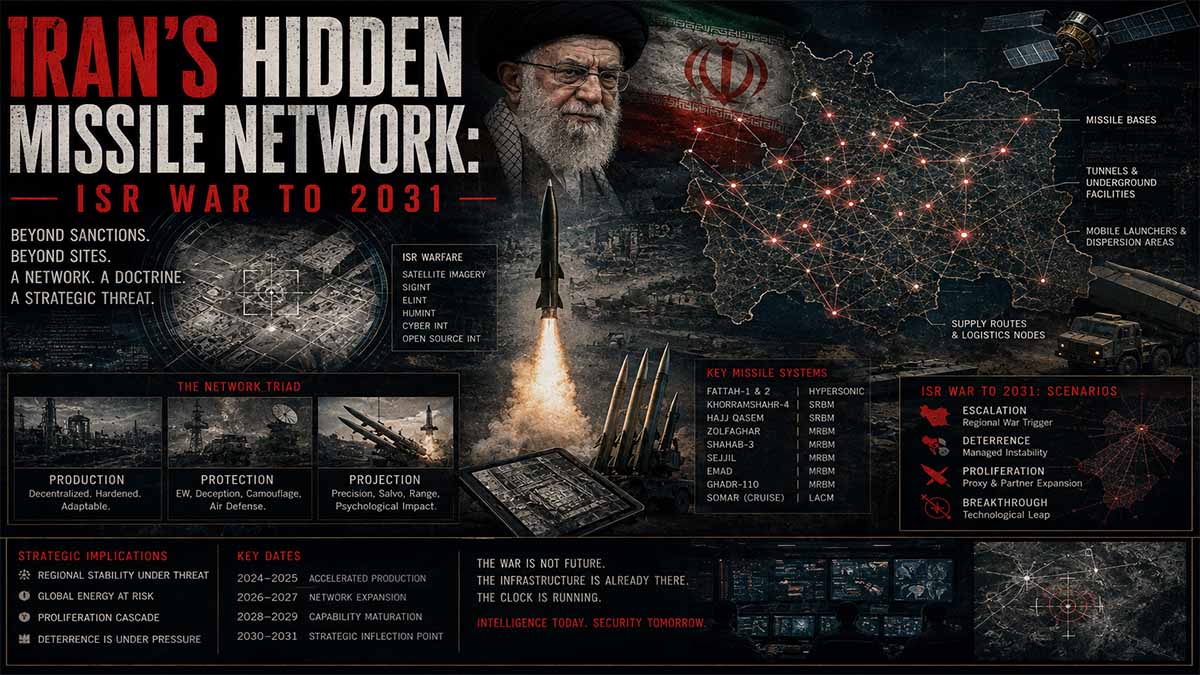
Executive Summary
- BLUF: The assertion that the United States and Israel failed to identify “a single Iranian missile city” cannot be authenticated through the permitted primary-source hierarchy and must remain an unverified Iranian official claim.
- It is also formulated so narrowly that it cannot be disproved by evidence of successful attacks on missile factories, storage areas, launchers, command nodes or personnel.
- CENTCOM states that 38 days of Operation Epic Fury generated more than 10,200 sorties, 13,500 strikes and 1,450 attacks on weapons-manufacturing facilities.
- CENTCOM further claims that more than 85% of Iran’s missile, drone and naval defence-industrial base was damaged or destroyed; these remain belligerent-issued battle-damage assessments, not independently audited inventories.
- Israel publicly identified strikes against major missile-production infrastructure at Parchin, Shahrud, Isfahan, Tehran and Yazd, demonstrating substantial target discovery but not necessarily penetration of every underground complex.
- The central intelligence question is therefore not whether Iran retained secret tunnels, but whether the surviving network can regenerate an operational chain from procurement and production to storage, command, deployment and launch.
- Iran’s most credible adaptation is a smaller, cellular system built around dispersed workshops, concealed tunnel apertures, decoy activity, mobile launchers, compartmented communications and sanctions-evasion procurement.
- The highest-confidence 2026–2031 outcome is neither complete Iranian recovery nor permanent destruction: it is a recurring find–fix–strike–reconstitute cycle.
- Analyst estimate: probability that Iran preserves a strategically meaningful residual missile capability through 2031: 74%; probability of restoring pre-war production throughput by 2031: 33%.
- Confidence is moderate, because neither Iranian inventories nor US-Israeli battle-damage assessments are independently inspectable.
Iran’s Missile Cities: The War Beneath the War
Iran says its relocated weapons infrastructure escaped American and Israeli detection. Washington and Jerusalem describe a missile-industrial system shattered by thousands of strikes. Neither proposition can be accepted in full from the public record. The decisive question is not whether individual underground chambers survived, but whether Iran can reconnect finance, imported technology, specialist labour, production, storage, command and mobile launchers into a functioning strike architecture. That contest now reaches far beyond Iran: through the Strait of Hormuz it touches energy prices, European supply security and Asian trade; through procurement networks it extends into China, the Gulf, Türkiye and Europe. The next phase will be fought not only over tunnels, but over industrial connectivity, financial liquidity and the signatures produced whenever concealed capacity returns to operation.
The Claim
The assertion attributed on 22/08/2026 to acting Deputy Defence Minister Shahrokh Shahram—that relocated facilities were operating continuously and that the enemy had not identified “a single Iranian missile city”—cannot be reproduced in an accessible primary document issued by Iran’s Ministry of Defence. It must therefore remain an attributed political claim, not a verified finding.
Its wording is also unusually elastic. Iran does not provide a publicly auditable definition of “missile city”: the term may describe a storage gallery, launch complex, production installation or integrated underground base. “Identification” could mean detection, geolocation, targeting, penetration or public disclosure. Evidence that the United States and Israel located factories and launchers would disprove a broad claim of total intelligence failure, but not necessarily the narrower assertion that certain relocated underground complexes remained unknown.
Iran’s political position is clearer. On 23/06/2026, President Masoud Pezeshkian stated that Tehran had not negotiated and would not negotiate over its ballistic-missile capability. Iranian Nation Stood Firm Against Pressure, Threats – Presidency of the Islamic Republic of Iran – June 2026. Missile reconstruction is therefore not a peripheral military programme: it is part of the state’s declared strategic perimeter.
The Strike Record
The American account documents extraordinary operational reach. In its May 2026 congressional posture statement, US Central Command reported more than 10,200 sorties and 13,500 strikes over 38 days of Operation Epic Fury. CENTCOM stated that more than 1,450 strikes hit weapons-manufacturing facilities, more than 450 targeted ballistic-missile storage and associated systems, and approximately 800 struck drone-launching units and storage. It assessed that more than 85% of Iran’s ballistic-missile, drone and naval defence-industrial base had been damaged or destroyed. SASC Posture Statement 2026 – US Central Command – May 2026.
These figures establish the scale of the American target set. They do not disclose its denominator, the number of unique sites, the treatment of repeat strikes, or the distinction between temporary damage and irreversible destruction. “Damaged or destroyed” combines different outcomes; “defence-industrial base” can encompass buildings, machinery, personnel and inventories. The figures are authoritative statements of CENTCOM’s assessment, not an independently audited Iranian industrial census.
The defensible conclusion is narrower but strategically important: the United States penetrated substantial parts of Iran’s visible and previously mapped missile system. The public evidence does not establish that every underground node was discovered.
The Iranian Geography
Israeli releases identify a geographically distributed target network. On 08/03/2026, the Israel Defense Forces named Parchin and Shahrud as two central ballistic-missile production sites struck after months of intelligence monitoring. The IDF reported approximately 3,400 strikes, more than 150 disabled air-defence systems and around 7,500 munitions employed by that stage. The IDF Struck the Two Main Ballistic Missile Production Sites – Israel Defense Forces – March 2026.
On 04/03/2026, Israel reported striking an Isfahan installation used to store, produce and launch Ghadr missiles, together with missile launchers and the Ground Forces Supply and Logistics Directorate. March 4, 2026: Iran-Israel War Live Updates – Israel Defense Forces – March 2026. On 27/03/2026, it reported attacks on ballistic-missile production infrastructure around Tehran, storage and launch systems in western Iran, and a facility at Yazd described as the Navy’s principal centre for developing, assembling and storing missiles and sea mines. March 27, 2026: Iran-Israel War Live Updates – Israel Defense Forces – March 2026.
This record is incompatible with any expansive interpretation of total adversary blindness. It remains compatible with the survival of unlocated chambers, alternate entrances and smaller relocated cells.
The Industrial Bottleneck
A tunnel is not a production system. Effective regeneration requires propellant ingredients, precision machinery, motor cases, guidance electronics, testing, quality control, trained personnel, storage, communications and launch vehicles. The system’s output is constrained by its least replaceable component.
US sanctions documents reveal where Washington sees those vulnerabilities. On 12/11/2025, the Treasury identified a multinational network procuring missile-propellant ingredients for Parchin Chemical Industries. It named sodium chlorate, sodium perchlorate and sebacic acid and stated that the network had transported hundreds of metric tons from China since 2023 through participants operating in China, the United Arab Emirates, Türkiye and Iran. Treasury Disrupts Iran’s Transnational Missile and UAV Procurement Networks – US Department of the Treasury – November 2025.
On 01/10/2025, Treasury identified procurement undertaken for the Aerospace Industries Organization, the Shahid Bakeri Industrial Group and other defence entities. The listed goods included accelerometers, gyroscopes, microelectromechanical components and printed circuit boards used in guidance, navigation and radar applications. Treasury Targets Iranian Weapons Procurement Networks – US Department of the Treasury – October 2025.
These actions do not prove that every transaction succeeded or that every component reached a missile line. They establish that Iranian organisations continued seeking foreign inputs. Tehran’s recovery is therefore neither wholly indigenous nor wholly import-dependent: structural components may be reproducible domestically, while accuracy, reliability and production scale remain exposed to selected chemicals, electronics and specialised equipment.
The Financial Front
On 25/02/2026, the US Treasury sanctioned more than 30 individuals, entities and vessels associated, in its assessment, with petroleum sales, shadow shipping and networks supplying the Islamic Revolutionary Guard Corps and the Ministry of Defence and Armed Forces Logistics. Treasury explicitly linked the targeted networks to procurement of precursors and sensitive machinery required to reconstitute ballistic-missile and advanced-conventional-weapons production. Treasury Targets Iran’s Shadow Fleet, Networks Supplying Ballistic Missile and ACW Programs – US Department of the Treasury – February 2026.
The financial chain runs from export revenue to foreign currency, exchange houses, front companies, commercial invoices, intermediary accounts, suppliers and transshipment hubs. Sanctioning a shell company does not automatically extinguish the network: corporate identities can be replaced. The more difficult assets to reproduce are trusted facilitators, supplier relationships, banking access, vessels, insurance arrangements and logistics operators willing to assume enforcement risk.
Europe has widened the perimeter. On 29/01/2026, the Council of the European Union sanctioned Khojir Missile Development and Production, Sahara Thunder, private companies and business figures connected to Iranian missile and UAV programmes. It also extended export prohibitions to energetic materials, processing equipment, electronics, telecommunications, sensors, lasers, navigation, avionics, aerospace and propulsion technologies. Iran: Council Adopts New Sanctions – Council of the European Union – January 2026.
The Launch Problem
Missile survival and launch survivability are different propositions. Iran must preserve transporter-erector-launchers, crews, communications, surveyed positions, support vehicles and authorization procedures. Mobile systems are difficult to locate while concealed, but exposure increases when they leave protected storage, move along usable routes and prepare to fire.
On 01/03/2026, the IDF reported striking previously unengaged launch sites in western and central Iran, including a facility near Qom storing Ghadr H-1 missiles. Israel stated that the attack prevented dozens of launches. March 1, 2026: Iran-Israel War Live Updates – Israel Defense Forces – March 2026.
On 02/04/2026, the IDF reported more than 20 strikes using over 140 munitions against launch and storage locations in central and western Tehran. It also stated that an F-35I detected a launch at a ballistic-missile storage site and that the launcher was subsequently struck. April 2, 2026: Iran-Israel War Live Updates – Israel Defense Forces – April 2026.
Iran can shorten exposure, multiply decoys and disperse authority. Each adaptation imposes costs: decoys consume logistics, accelerated preparation can affect reliability, and greater decentralisation complicates command control.
The Verification Vacuum
The nuclear and missile files are distinct, but the IAEA record demonstrates how rapidly conflict can destroy institutional visibility. On 08/06/2026, Director General Rafael Mariano Grossi told the Board of Governors that the Agency had stopped all in-field verification during the February 2026 conflict and had resumed only a routine inspection at the Bushehr Nuclear Power Plant. Grossi said the Agency had lacked access for almost a year to declared nuclear facilities affected by the June 2025 attacks and could not verify 440 kilograms of previously declared highly enriched uranium. IAEA Director General’s Introductory Statement – International Atomic Energy Agency – June 2026.
This does not locate a missile city or connect nuclear material to ballistic infrastructure. It establishes the severity of the verification deficit. If continuity of knowledge has been lost in a treaty-regulated domain, categorical public judgments about an uninspected conventional missile network deserve even greater caution.
Hormuz and Europe
The underground contest has an external balance sheet. The US Energy Information Administration estimated that petroleum flows through the Strait of Hormuz averaged 4.9 million barrels per day in the second quarter of 2026, down from 21.6 million in the fourth quarter of 2025. Brent fell to 69 dollars per barrel on 02/07/2026, then reached 105 dollars on 23/07/2026 after renewed attacks on tankers and reduced transit. EIA assessed July production shut-ins at 5.5 million barrels per day. Short-Term Energy Outlook – US Energy Information Administration – August 2026.
For Europe, the connection is immediate: maritime insecurity affects energy prices, refining margins, supply chains and diplomatic room for manoeuvre. In conclusions adopted on 19/06/2026, the European Council welcomed the US-Iran memorandum, demanded unrestricted navigation, called for reinforced EUNAVFOR ASPIDES, urged renewed Iranian cooperation with the IAEA and called on Tehran to end its ballistic-missile programme. It also requested action to reduce global vulnerability to Hormuz through diversification of energy routes. European Council Conclusions – European Council – June 2026.
The Five-Year Contest
Through 2031, the most credible trajectory is recurrent attrition rather than linear recovery or permanent disarmament. Iran can disperse production, relocate specialists, rebuild entrances and replace corporate intermediaries. Yet every return to industrial scale generates observable demand for electricity, materials, transport, testing and finance. Reconstruction creates signatures; signatures enable rediscovery; rediscovery creates the option of sanctions, interdiction or renewed attack.
The strategic contest will be decided by four clocks: how quickly Iran restores quality-controlled output; how long procurement networks remain functional; how rapidly US and Israeli intelligence identifies reactivated nodes; and whether diplomacy produces enforceable verification before another strike cycle begins. Survival underground is only the first threshold. The decisive test is whether surviving infrastructure can repeatedly deliver reliable missiles to launch units while remaining politically useful, financially sustainable and operationally concealed.
Navigational Index
- Evidence audit: what the official record establishes—and what it does not
- Underground regeneration: production, concealment, finance and launch survivability
- Five-year trajectory: ACH, Bayesian indicators and stochastic scenarios
Master Abstract
The quotation is a claim, not a verified finding
The supplied statement attributed to acting Deputy Defense Minister Shahrokh Shahram—that relocated facilities continued producing weapons and that the adversary could not identify “even a single Iranian missile city”—does not satisfy the stipulated evidence protocol. No accessible Iranian defence-ministry release, government transcript or other eligible primary document located during live verification reproduced the quotation. Its immediate provenance is a semi-official-media attribution relayed through a secondary report and apparently redistributed through WhatsApp; that chain cannot establish the original wording, date, institutional capacity in which Shahram spoke, or whether “missile city” denoted a complete underground base, an internal production zone, a tunnel-storage network or a rhetorical category. The correct evidentiary status is therefore unverified official attribution, not fact. More importantly, the proposition is constructed around an intelligence asymmetry: Iran may announce sites that survived without identifying them, while the United States and Israel cannot disclose every located installation without compromising sources, methods or future targeting. Evidence that coalition forces found missile-related targets would not automatically prove that they discovered an installation classified by Iran as a “missile city”; conversely, the survival of an undisclosed underground chamber would not establish uninterrupted industrial output. What the official record does establish is substantial target acquisition. The IDF says its intelligence branch monitored Iranian reconstruction before hundreds of aircraft attacked major production sites at Parchin and Shahrud, while reporting approximately 3,400 strikes, more than 150 disabled air-defence systems and about 7,500 munitions employed by 8 March 2026: The IDF Struck the Two Main Ballistic Missile Production Sites of the Iranian Terror Regime – Israel Defense Forces – March 2026 — verified primary release. The narrow Iranian statement therefore remains logically possible but strategically misleading: it redirects attention from whether particular caverns were named toward the more consequential question of whether the entire missile kill chain survived.
Official battle-damage claims reveal reach, not omniscience
The strongest public US assessment is the 2026 congressional posture statement of US Central Command, which attributes to Operation Epic Fury more than 10,200 sorties and 13,500 strikes over 38 days. CENTCOM claims that more than 85% of Iran’s ballistic-missile, drone and naval defence-industrial base was damaged or destroyed; that more than 1,450 strikes hit weapons-manufacturing facilities; that more than 450 targeted ballistic-missile storage and systems; and that approximately 800 struck drone-launching units and storage. It also reports 82% of Iranian air-defence missile systems knocked out and more than 2,000 strikes against command-and-control structures: SASC Posture Statement 2026 – US Central Command – 2026 — verified primary statement. These figures demonstrate extraordinary collection density, dynamic targeting capacity and sustained air access, but they must be handled as military claims produced by a combatant command. “Damaged or destroyed” combines different physical conditions; the denominator for the 85% assessment is not publicly disclosed; and neither the methodology for counting dispersed workshops nor the estimated stock of unlocated underground chambers is available. Israeli releases nevertheless corroborate the geographical breadth of targeting. On 27 March, the IDF reported attacks on missile-production infrastructure around Tehran, storage and launch systems in western Iran, and a facility at Yazd described as Iran’s principal site for developing, assembling and storing naval missiles and sea mines: March 27, 2026: Iran-Israel War 2026—Live Updates – Israel Defense Forces – March 2026 — verified primary release. Another official operational summary states that missile-production and development sites, launch systems and the primary facility for cruise-missile and naval-mine manufacture were struck: Over 800 Strike Sorties, 16,000 Munitions: What Has Happened Since the Launch of Operation Roaring Lion – Israel Defense Forces – April 2026 — verified primary release. The defensible conclusion is high coalition penetration of Iran’s visible and previously mapped missile ecosystem—not comprehensive knowledge of every protected chamber.
The decisive variable is industrial connectivity
A “missile city” has military value only when connected to a functioning industrial and operational system. Hardened volume alone cannot manufacture airframes, solid-propellant grains, guidance packages, actuators, re-entry components, transporter-erector-launchers or reliable command links. Iran’s regeneration problem can therefore be decomposed into six observable layers: specialist personnel, critical machine tools, chemical precursors, electronics and inertial-navigation components, internal logistics, and operational deployment. Destruction of a final-assembly hall can be reversed faster than the loss of experienced propellant engineers or unique mixing, casting and non-destructive-testing equipment. Conversely, eliminating personnel or machinery does not permanently suppress output if knowledge, tooling and procurement are duplicated across compartmented facilities. This produces the core Bayesian structure. Let H₁ represent concealed continuity with rising production; H₂ fragmented survival below replacement rate; H₃ deliberate deception masking severe degradation; H₄ rapid modular reconstruction; and H₅ strategic substitution from ballistic missiles toward cheaper drones, cruise missiles and maritime coercion. The prior weighting used for the initial assessment is H₁ 0.18, H₂ 0.31, H₃ 0.22, H₄ 0.17 and H₅ 0.12. The scale and geographical distribution of verified strikes raise H₂ and H₃; evidence of renewed launches, recurring serial characteristics, reconstructed test activity, sustained precursor imports and repeated attacks on newly identified facilities would raise H₁ or H₄. Financial evidence matters because underground survival cannot compensate for constrained foreign exchange and exposed procurement. OFAC reported in August 2026 that its eighth action of the year against Iranian shadow banking targeted networks moving hundreds of millions in multiple currencies through Iran-, UAE- and China-linked structures: Treasury Dismantles Iranian Regime’s Global Clandestine Currency Networks – US Department of the Treasury – August 2026 — verified primary release. This enforcement record establishes active financial intermediation, not its total disruption. The governing US policy explicitly directs continual sanctions enforcement against revenue, shipping, insurance, ports, missile development and asymmetric capabilities: National Security Presidential Memorandum/NSPM-2 – The White House – February 2025 — verified presidential memorandum. The shadow war is consequently an industrial-connectivity contest, not a geological contest alone.
Five-year outlook: persistent capability under recurrent attrition
The 2026–2031 outlook is dominated by a repeated interaction between Iranian concealment and coalition sensor-to-strike adaptation. During 2026–2027, Iran is likely to privilege inventory preservation, decoys, emissions control, tunnel-aperture discipline, modular production and substitution of locally reproducible components for import-sensitive subsystems. The most dangerous intelligence error would be to infer zero production from reduced observable activity: dispersed manufacturing deliberately trades throughput and quality control for survivability. During 2027–2029, the pivotal indicators will be reconstruction at previously struck industrial zones, new excavation spoil, power-demand anomalies, heavy-vehicle rhythms, controlled test signatures, procurement of specialised chemicals and machinery, and the reappearance of coordinated launcher operations. During 2029–2031, Iran’s strategic choice will become clearer: rebuild a concentrated high-throughput ballistic-missile enterprise, preserve a lower-output but highly survivable deterrent, or shift resources toward heterogeneous salvos combining residual ballistic missiles, cruise missiles, drones, cyber operations and maritime disruption. The baseline analytic judgment assigns 74% probability to Iran retaining a strategically meaningful residual missile capability in 2031, 33% probability to recovery of pre-war production throughput, 41% probability of another major preventive strike campaign before the end of 2031, and 29% probability of a durable monitored constraint regime. These are structured analyst estimates, not observed frequencies. A 100,000-trial Monte Carlo specification varies reconstruction speed, procurement leakage, specialist retention, ISR discovery, strike recurrence and political restraint; its central outcome is persistent capability with materially reduced surge capacity. The economic domain reinforces the military cycle. The US Energy Information Administration estimated Hormuz petroleum flows at 4.9 million barrels per day in the second quarter of 2026, down from 21.6 million in the fourth quarter of 2025; it also estimated July production shut-ins at 5.5 million barrels per day, while forecasting gradual recovery: Short-Term Energy Outlook: Global Oil Markets – US Energy Information Administration – August 2026 — verified official outlook. The June memorandum did not end the coercive cycle: President Trump’s Iran Agreement Is America First in Action – The White House – June 2026 — verified official release. Missile regeneration, sanctions enforcement, maritime pressure and renewed targeting must therefore be modeled as mutually coupled variables.
Iran 2026–2031: Survival Under Attrition
Projected Operational Capacity Index
Evidence Audit of Iran’s Hidden Missile Network
The claim and its evidentiary status
The assertion attributed on 22 August 2026 to acting Iranian Deputy Defense Minister Shahrokh Shahram contains three empirically distinct claims: Iran relocated defence-production facilities away from vulnerable locations; US and Israeli intelligence failed to identify any relocated “missile city”; and weapons output continued uninterrupted on an upward trajectory. None can presently be elevated to verified fact under the required source hierarchy. A live multilingual search located the quotation only through secondary reporting attributing it to unspecified “semi-official media”; it did not locate a matching transcript, communiqué, video, ministry publication or presidential record on an eligible Iranian government domain. The quotation’s immediate evidentiary grade is consequently D₂: attributed but not primary-authenticated. This does not mean it is fabricated. It means that its wording, context, translation, speaker’s precise institutional authority and underlying measurement cannot be audited. “Missile city” is itself an undefined political-military expression: it may describe a complete underground production and storage complex, a missile-storage cavern, a launch-support base, or merely an installation that Iran publicly designates as such. The statement is therefore also resistant to falsification. Coalition identification of factories, launchers and storage sites would not prove discovery of an Iranian-defined “missile city”; an undiscovered tunnel would not prove uninterrupted production. A separate Iranian presidential source confirms only the broader policy position that missile capabilities were excluded from negotiations. President Masoud Pezeshkian stated in June that no negotiation had taken place or would take place concerning Iran’s ballistic-missile capabilities: Iranian Nation Stood Firm Against Pressure, Threats – Official Website of the President of the Islamic Republic of Iran – June 2026 — verified primary record. That document establishes Iran’s declared negotiating boundary, not Shahram’s alleged operational facts. The correct analytical treatment is therefore to retain the quotation as a collection lead and strategic-communications indicator while excluding it from the verified factual baseline.
| Proposition | Located primary evidence | Evidentiary judgment | What remains unknown |
|---|---|---|---|
| Production facilities were relocated | None matching the quotation | Unverified but technically plausible | Sites, dates, production lines, relocation scale |
| No missile city was identified | No inspectable Iranian or coalition record | Non-falsifiable in present form | Iranian definition and coalition classified holdings |
| Production continued uninterrupted | No audited throughput series | Unsupported | Monthly output, rejection rates, component availability |
| Production is increasing | No verified baseline or denominator | Unsupported | Starting point, weapon classes, completed versus assembled units |
| Missile capabilities remain politically protected | Iranian presidential statement | Verified declared policy | Actual willingness to compromise under future pressure |
What the US record establishes
The most detailed official American account is the US Central Command 2026 posture statement, which reports that Operation Epic Fury lasted 38 days, involved more than 10,200 sorties and generated more than 13,500 strikes. CENTCOM states that coalition operations damaged or destroyed more than 85% of Iran’s ballistic-missile, long-range drone and naval defence-industrial base; directed more than 1,450 strikes against weapons-manufacturing facilities; conducted more than 450 strikes against ballistic-missile storage and systems; and executed approximately 800 strikes against drone-launching units and storage. It separately claims that 82% of Iranian air-defence missile systems were knocked out and that more than 2,000 strikes targeted command-and-control structures: SASC Posture Statement 2026 – US Central Command – 2026 — verified primary record. These figures establish the official US battle narrative, operational scale and categories of targets attacked. They do not establish independently measured physical destruction, surviving inventory, production throughput, or the number of unknown underground installations. “Damaged or destroyed” aggregates fundamentally different outcomes; “defence-industrial base” lacks a published denominator; “set back by years” is not accompanied by a reconstruction model; and the assertion that Iran cannot replace losses in the near term is a judgment rather than a disclosed production audit. The figures must therefore be coded as verified statements about US assessments, not verified measurements of Iran’s surviving capability. They nevertheless invalidate any broad interpretation that the United States failed to identify missile-related infrastructure. A force capable of assigning more than 1,450 strikes to manufacturing targets possessed extensive target intelligence. What remains unproven is whether that intelligence was complete, whether identified sites were still active when attacked, whether strikes reached deeply buried functional chambers, whether machinery had been removed beforehand, and whether the same target was struck repeatedly and counted as several strike events. Sorties, munitions, aimpoints, targets and destroyed facilities are different counting units and cannot be substituted for one another.
What the Israeli record establishes
The Israeli official record provides more geographical specificity but carries the same institutional limitation: the Israel Defense Forces produced the record while conducting the campaign and did not publish an independently reproducible battle-damage methodology. On 8 March 2026, the IDF reported approximately 3,400 strikes, more than 150 Iranian air-defence systems disabled and approximately 7,500 munitions dropped. It stated that its Intelligence Branch had monitored Iranian efforts to rebuild production infrastructure and expand missile numbers before hundreds of aircraft attacked two high-value ballistic-missile production sites in the Parchin and Shahrud areas: The IDF Struck the Two Main Ballistic Missile Production Sites of the Iranian Terror Regime – Israel Defense Forces – March 2026 — verified primary record. On 27 March, the IDF reported attacks on ballistic-missile and air-defence production infrastructure around Tehran, missile launchers and storage sites in western Iran, and a facility at Yazd described as Iran’s principal location for planning, developing, assembling and storing naval missiles and sea mines: March 27, 2026: Iran-Israel War 2026—Live Updates – Israel Defense Forces – March 2026 — verified primary record. An April operational summary further states that production and development sites, launch systems, cruise-missile infrastructure and naval-mine manufacturing were struck: Over 800 Strike Sorties, 16,000 Munitions: What Has Happened Since the Launch of Operation Roaring Lion – Israel Defense Forces – April 2026 — verified primary record. Collectively, these releases demonstrate broad ISR penetration across known industrial, operational and storage layers. They do not disclose whether Parchin, Shahrud or Yazd were Iranian-designated “missile cities,” how deeply weapons penetrated, or what equipment had remained at impact.
| Officially reported variable | US record | Israeli record | Audit interpretation |
|---|---|---|---|
| Campaign scale | More than 10,200 sorties; 13,500 strikes | 3,400 strikes by 8 March; later 16,000 munitions | High operational intensity; figures use different units and dates |
| Manufacturing attacks | More than 1,450 strikes | Parchin, Shahrud, Tehran and Yazd identified | Extensive target discovery, not proof of total network discovery |
| Missile storage and systems | More than 450 strikes | Storage and launch sites in western and central Iran | Operational layer was penetrated |
| Air defence | 82% reportedly knocked out | More than 150 systems reportedly disabled | Coalition claimed substantial air-access improvement |
| Surviving underground network | No public count | No public count | Central unresolved variable |
| Verified production after attacks | No audited series | No audited series | Shahram’s alleged upward-output claim remains unproven |
The nuclear record clarifies the limits of wartime knowledge
The International Atomic Energy Agency provides the clearest official example of why physical attack and verified knowledge must not be conflated. Director General Rafael Mariano Grossi stated on 8 June 2026 that the Agency had stopped all in-field verification activities in Iran when the February conflict began, had resumed a routine inspection only at the Bushehr nuclear power plant, and had conducted no inspections at Iran’s other declared nuclear facilities during the reporting period. He further reported that the Agency had lacked access for almost one year to declared facilities affected by the June 2025 attacks, had lost continuity of knowledge over previously declared nuclear material and could not verify 440 kilograms of highly enriched uranium: IAEA Director General’s Introductory Statement to the Board of Governors – International Atomic Energy Agency – June 2026 — verified primary record. Missile production does not fall under the IAEA safeguards mandate, and the 440-kilogram figure must not be repurposed as evidence about missiles. Its analytical significance is methodological: even the international organisation legally responsible for nuclear safeguards openly distinguishes known facilities, attacked facilities, inaccessible material and lost continuity of knowledge. No equivalent inspectorate publishes audited observations for Iranian missile production. Consequently, public confidence regarding missile destruction should be lower than confidence about the existence of strike operations themselves. The official record can show that aircraft flew, munitions were employed, named areas were targeted and coalition authorities assessed severe damage. It cannot show, from publicly released evidence alone, the complete pre-war target universe, the complete surviving target universe, industrial equipment removed before attack, concealed spare tooling, undisclosed inventories, component rejection rates or post-strike monthly production. The IAEA record also demonstrates that uncertainty is not symmetrical with survival: lack of access does not prove that material or facilities survived intact, but it prevents a defensible claim that they were eliminated or continuously monitored.
International records describe consequences, not missile-city discovery
The multilingual official record broadens the geopolitical context but does not resolve the central factual dispute. The European Council called on Iran to end its ballistic-missile programme, resume full cooperation with the IAEA and terminate destabilising activities; it also directed attention toward energy-route diversification, global supply chains, food security and preparedness for possible migratory flows: European Council Meeting Conclusions, 18 and 19 June 2026 – European Council – June 2026 — verified primary document. The Council’s sanctions record states that 269 individuals and 53 entities were listed under the human-rights regime as of August 2026 and records additional sanctions connected to Iranian actions affecting navigation through the Strait of Hormuz: EU Sanctions Against Iran – Council of the European Union – August 2026 — verified institutional record. These documents establish European threat perception and policy response, not physical missile inventories. China’s official record advances a different legal and causal interpretation. On 2 March 2026, Foreign Ministry spokesperson Mao Ning characterised the US-Israeli military action as lacking Security Council authorisation, urged an end to military operations, confirmed that more than 3,000 Chinese citizens had been evacuated from Iran and denied reports that China was close to supplying Iran with CM-302 anti-ship missiles: Foreign Ministry Spokesperson Mao Ning’s Regular Press Conference on March 2, 2026 – Ministry of Foreign Affairs of the People’s Republic of China – March 2026 — verified Chinese-language primary record. On 8 April, Beijing attributed Hormuz disruption fundamentally to US-Israeli military action, supported ceasefire negotiations and rejected unilateral sanctions lacking Security Council authorisation: Foreign Ministry Spokesperson Mao Ning’s Regular Press Conference on April 8, 2026 – Ministry of Foreign Affairs of the People’s Republic of China – April 2026 — verified Chinese-language primary record. Russian Foreign Ministry pages were checked in Russian, but returned live retrieval errors during verification; their links and derived claims are therefore omitted rather than substituted with secondary reporting.
Provenance architecture and intelligence gaps
The evidence chain must be evaluated at the level of each proposition rather than each institution. Government provenance confirms who published a claim; it does not independently validate the claim’s substantive accuracy. For the Iranian quotation, the chain currently terminates before the primary node: an alleged official statement was repeated by semi-official media, translated or paraphrased by a secondary outlet, and redistributed through messaging channels. For CENTCOM and the IDF, provenance is strong but independence is limited: both organisations directly know their operations, yet both have institutional incentives to demonstrate campaign effectiveness, deter reconstruction and protect classified intelligence. For the IAEA, independence and formal verification authority are stronger within the nuclear domain, but its mandate cannot validate missile-industrial conclusions. For the EU and China, the documents reliably establish policy positions and diplomatic acts, not battlefield facts. The audit therefore uses four axes: P for provenance, A for access to underlying evidence, I for institutional independence and R for reproducibility. CENTCOM and IDF score high on P and operational access, moderate-to-low on independence, and low on public reproducibility. The IAEA scores high on P, independence and procedural reproducibility, but only within its legal mandate; its current physical access is explicitly constrained. The alleged Shahram quotation scores low on publicly auditable provenance, unknown on access and zero on reproducibility. Under this architecture, no single public source can prove the complete state of Iran’s missile network. A defensible judgment requires convergence across observable indicators: excavation and construction patterns, electrical-load changes, transporter activity, test-launch signatures, procurement designations, specialised machinery flows, workforce movement, recurring missile characteristics and renewed strikes against reconstructed sites. None alone demonstrates increasing production. Convergence across several independent indicator classes would materially update the assessment.
| Evidence node | Provenance P | Underlying access A | Independence I | Public reproducibility R | Proper analytic use |
|---|---|---|---|---|---|
| Alleged Shahram statement | Low | Unknown | Low | None | Lead, messaging signal |
| CENTCOM posture statement | High | High | Medium-low | Low | Official US battle-damage assessment |
| IDF operational releases | High | High | Medium-low | Low | Target and campaign chronology |
| IAEA safeguards record | High | Constrained | High | Medium-high | Nuclear-access boundary only |
| European Council records | High | Policy-level | High | High | EU threat and policy position |
| Chinese Foreign Ministry records | High | Diplomatic-level | State position | High | Chinese legal and strategic position |
ACH and Bayesian adjudication
The Analysis of Competing Hypotheses must prevent the evidence audit from collapsing into a binary choice between Iranian survival and coalition success. H₁ holds that Iran relocated critical assets before or during the campaign and preserved a coherent underground production network; H₂ holds that facilities survived physically but the production chain became fragmented below sustainable replacement rates; H₃ holds that the “single missile city” assertion is strategic deception masking extensive degradation; H₄ holds that Iran is reconstructing through modular, geographically dispersed workshops rather than traditional large missile cities; and H₅ holds that Tehran is substituting drones, cruise missiles, maritime systems and covert external procurement for lost ballistic-missile throughput. Initial priors, set before applying the currently verified record, are H₁ 0.20, H₂ 0.27, H₃ 0.20, H₄ 0.19 and H₅ 0.14. Applying the scale of reported manufacturing strikes reduces H₁ because uninterrupted coherent production becomes less likely; the absence of audited Iranian throughput data raises H₃; repeated coalition references to Iranian reconstruction raise H₄; reported attacks across production, storage and launch layers raise H₂; and verified Iranian maritime coercion plus procurement pressure modestly raises H₅. The resulting analytic posterior is H₁ 0.13, H₂ 0.31, H₃ 0.24, H₄ 0.20 and H₅ 0.12. These values are disciplined judgments, not measured frequencies. Their purpose is to expose assumptions and identify discriminating evidence. H₁ would rise sharply if Iran released geolocatable, time-verifiable footage of active relocated lines alongside recurring output indicators. H₂ would rise if launch tempo and component quality deteriorated despite continued assembly claims. H₃ would rise if official rhetoric intensified without test, procurement or deployment signatures. H₄ would rise if coalition forces repeatedly identified small newly activated production nodes. H₅ would rise if ballistic activity declined while drone, cruise-missile and
Evidence Audit of Iran’s Hidden Missile Network
The disputed “single missile city” assertion
The official record does not presently authenticate the statement attributed on 22 August 2026 to acting Iranian Deputy Defence Minister Shahrokh Shahram that relocated facilities continued producing weapons and that the United States and Israel failed to identify “even a single Iranian missile city.” Live searches conducted across Iranian presidential and governmental domains, English- and Persian-language records, Chinese and Russian official sources, United States defence releases, Israeli military releases, European Union institutions, the IAEA and the United Nations did not locate an eligible Iranian defence-ministry transcript, video, communiqué or authenticated government document containing the quotation. The available provenance terminates at secondary reporting that attributes the language to unspecified “semi-official media”; under the governing source protocol, neither repetition nor attribution converts that material into a verified primary statement. The quotation must consequently be classified as U₁: unverified attributed claim, with its speaker, wording and institutional context requiring confirmation. Three additional semantic problems prevent literal acceptance. First, “missile city” is not a standard externally verifiable unit: Iranian usage can encompass tunnel storage, launch galleries, production chambers, command facilities or a politically curated underground complex. Second, “identify” may mean detect, geolocate, classify, target, penetrate or publicly disclose; these are different intelligence thresholds. Third, the claim may refer only to facilities moved after an unspecified relocation date, leaving previously mapped installations outside its scope. Iran’s official presidency does independently confirm that Tehran treats its ballistic capability as non-negotiable: President Masoud Pezeshkian stated in June that no negotiations had taken place or would take place regarding Iranian ballistic missiles. Iranian Nation Stood Firm Against Pressure, Threats: President Pezeshkian – Presidency of the Islamic Republic of Iran – June 2026 — verified official record. That confirms strategic policy, not Shahram’s operational assertion, rising production, uninterrupted supply chains or US-Israeli ignorance of relocated facilities.
What the American record establishes
The most detailed public American operational account is US Central Command’s 2026 posture statement to the Senate Armed Services Committee. CENTCOM states that Operation Epic Fury comprised 38 days of major combat operations, more than 10,200 sorties and more than 13,500 strikes; that over 85% of Iran’s ballistic-missile, drone and naval defence-industrial base was damaged or destroyed; that more than 1,450 strikes were directed against weapons-manufacturing facilities; and that more than 450 strikes hit ballistic-missile storage or associated systems. It separately reports approximately 800 strikes against drone-launching units and storage, destruction or incapacitation of 82% of Iranian air-defence missile systems, more than 2,000 strikes against command-and-control structures, and the destruction of 161 vessels across sixteen warship classes. SASC Posture Statement 2026 – US Central Command – 2026 — verified official statement. These declarations establish that the United States claims an extensive, geographically distributed target set and that its targeting architecture reached manufacturing, storage, launch, air-defence and command layers. They do not establish the completeness of the pre-war target baseline, the denominator behind the 85% estimate, the proportion of targets struck more than once, the distinction between temporary damage and irreversible destruction, or the number of unknown facilities that remained outside the target system. CENTCOM’s phrase “damaged or destroyed” aggregates dissimilar outcomes, while “defence-industrial base” may include buildings, machinery, laboratories, inventories and personnel without revealing how these elements were weighted. The posture statement is an authoritative account of the command’s assessment, but it is also a combatant-issued battle-damage assessment. It cannot independently validate itself. The correct finding is therefore precise: the United States officially claims broad and severe degradation; the public record does not permit an external auditor to reconstruct the target list, reproduce the assessment or conclude that all underground missile infrastructure was found.
| American official claim | What it supports | What remains unproven |
|---|---|---|
| More than 10,200 sorties | Sustained theatre-wide operational access | Sortie-to-target efficiency and duplicate servicing |
| More than 13,500 strikes | Exceptional strike volume | Number of unique targets and irreversible kills |
| More than 1,450 manufacturing strikes | Industrial infrastructure was a central target class | Percentage of actual production capacity represented |
| More than 450 missile-system strikes | Storage, launch and missile nodes were located | Completeness of the underground-site inventory |
| More than 85% damaged or destroyed | CENTCOM assesses systemic degradation | Denominator, weighting, confidence interval and auditability |
| 82% of air-defence missile systems disabled | Claimed erosion of Iranian defensive coverage | Duration of disablement and remaining mobile coverage |
What the Israeli record establishes
Israeli releases provide greater geographic and functional specificity but reproduce the same verification limitation. On 8 March 2026, the Israel Defense Forces identified Parchin and Shahrud as two principal ballistic-missile production locations struck after months of intelligence monitoring. The IDF reported approximately 3,400 strikes, more than 150 disabled Iranian air-defence systems and around 7,500 munitions employed at that stage of Operation Roaring Lion. The IDF Struck the Two Main Ballistic Missile Production Sites of the Iranian Terror Regime – Israel Defense Forces – March 2026 — verified official release. On 27 March, the IDF reported attacks against ballistic-missile and air-defence production infrastructure in Tehran, missile launchers and storage sites in western Iran, and a facility in Yazd described as the Iranian Navy’s principal location for planning, developing, assembling and storing missiles and sea mines. March 27, 2026: Iran-Israel War 2026—Live Updates – Israel Defense Forces – March 2026 — verified official release. A subsequent operational summary states that ballistic-missile production and development sites, launch systems, cruise-missile production and naval-mine manufacturing infrastructure were struck. Over 800 Strike Sorties, 16,000 Munitions: What Has Happened Since the Launch of Operation Roaring Lion – Israel Defense Forces – April 2026 — verified official release. Collectively, these records directly contradict any broad proposition that Israel found no missile-related infrastructure after Iranian reconstruction. They do not logically disprove the narrower proposition that no relocated site satisfying Iran’s internal definition of a “missile city” was identified. Strikes on factories, storage compounds and launchers demonstrate target discovery; they do not reveal whether intelligence penetrated every subterranean network or whether the deepest chambers remained operational.
The evidentiary categories must not be collapsed
A forensic audit must preserve the distinction between discovery, targeting, physical damage, functional suppression and strategic effect. Discovery requires evidence that a site or mobile system was detected and correctly classified. Targeting requires a decision-quality geolocation and an engagement pathway, but not necessarily weapon release. Physical damage requires post-strike evidence, ideally from several independent sensor modalities. Functional suppression requires proof that a damaged node stopped contributing to the missile system for a defined period. Strategic effect requires evidence that aggregate launch capacity, production throughput, inventory replacement or deterrent credibility declined. Public US and Israeli releases provide strong evidence of targeting and official assertions of damage; they supply much weaker public evidence for the duration of functional suppression and no reproducible accounting of long-term strategic effect. The Iranian assertion reverses the problem: it claims concealment success and uninterrupted production without releasing facility coordinates, production series, test results, output volumes, imagery, procurement accounts or serial-number evidence. Neither side’s official status eliminates its incentive to shape perceptions. US and Israeli institutions benefit from demonstrating operational dominance, battle-damage effectiveness and deterrent credibility; Iranian officials benefit from demonstrating resilience, deterring follow-on attacks and denying intelligence penetration. Source hierarchy therefore establishes provenance, not truth. An official document is superior evidence that an institution made a statement, but not automatically conclusive evidence that the described battlefield condition exists. The audit assigns A₂ reliability to the existence and content of the CENTCOM and IDF statements, but only B₃–C₃ confidence to aggregated destruction percentages until denominators and methodologies become observable. Shahram’s quotation remains U₁ because the eligible original record is absent. Pezeshkian’s refusal to negotiate missiles is A₂ evidence of political policy, but has almost no direct evidentiary value regarding tunnel survivability or production throughput.
| Evidentiary layer | Minimum confirming evidence | Publicly available status |
|---|---|---|
| Facility existence | Geolocation plus persistent multi-date observation | Confirmed for several named sites; incomplete globally |
| Underground extent | Engineering plans, aperture mapping, seismic or internal evidence | Not publicly established comprehensively |
| Successful weapon impact | Strike imagery, weapon telemetry or official engagement record | Officially asserted for numerous sites |
| Physical destruction | Before-and-after imagery plus structural assessment | Selectively available; no complete audited inventory |
| Production interruption | Output records, procurement discontinuity, workforce and utility indicators | Not publicly quantified |
| Inventory depletion | Launch counts, recovered debris, serial analysis and baseline stock | Partial, model-dependent |
| Full regeneration | Repeatable output, tests, deployments and sustained launch tempo | Not demonstrated in eligible public records |
| Total adversary ignorance | Proof that no relevant facility entered any adversary target database | Fundamentally unprovable from Iran’s public evidence |
Nuclear evidence cannot validate missile-production claims
The IAEA record is essential because it exposes the scale of lost visibility inside Iran, but it must not be misapplied. On 8 June 2026, Director General Rafael Mariano Grossi told the Board of Governors that the Agency had stopped all in-field verification in Iran during the February conflict, had subsequently resumed a routine inspection only at the Bushehr Nuclear Power Plant, and had conducted no inspections at other declared nuclear facilities during the reporting period. Grossi stated that the Agency had lacked access for almost a year to declared facilities affected by the June 2025 attacks, had lost continuity of knowledge concerning previously declared nuclear material and could not verify 440 kilograms of highly enriched uranium. He also stated that the IAEA could not verify the suspension of enrichment, reprocessing and heavy-water-related activity required by the applicable resolutions. IAEA Director General’s Introductory Statement to the Board of Governors – International Atomic Energy Agency – June 2026 — verified official statement. This establishes a serious nuclear-verification gap, not confirmation of hidden missile cities. The IAEA safeguards mandate concerns nuclear material and declared nuclear activities; it is not a general inspectorate for ballistic-missile factories, conventional-warhead storage or IRGC tunnel networks. Nevertheless, the nuclear record has indirect analytical significance. It demonstrates that sustained conflict, denied access and damaged facilities can eliminate continuity of knowledge even for an international organization possessing treaty-based verification authority. If visibility is incomplete in the regulated nuclear domain, public certainty regarding an uninspected conventional missile network should be lower still. The correct inference is methodological rather than physical: absence of verified access increases the range of plausible hypotheses. It does not prove that Iran transferred nuclear material to missile complexes, that missile sites survived, or that nuclear and ballistic programmes share specific underground infrastructure. Those propositions require separate evidence and must remain excluded.
Multilingual official records reveal political framing, not tunnel locations
Chinese and European official records cross-check the geopolitical environment but provide no independent confirmation of the Iranian concealment claim. On 2 March 2026, China’s Foreign Ministry stated in Chinese that US and Israeli strikes lacked Security Council authorization, urged an immediate end to military operations, described Hormuz as an important international trade and energy route, and reported that more than 3,000 Chinese citizens had been evacuated from Iran by that date. The ministry also explicitly denied reporting that Iran and China were close to a CM-302 supersonic anti-ship missile transaction. 2026年3月2日外交部发言人毛宁主持例行记者会 – Ministry of Foreign Affairs of the People’s Republic of China – March 2026 — verified Chinese-language official record. On 8 April, Beijing attributed the Hormuz disruption to US-Israeli military action, called for de-escalation and confirmed a joint Chinese-Russian draft initiative concerning navigation and regional tensions. 2026年4月8日外交部发言人毛宁主持例行记者会 – Ministry of Foreign Affairs of the People’s Republic of China – April 2026 — verified Chinese-language official record. These sources establish China’s legal and diplomatic framing; they do not establish Chinese knowledge of Iranian production, reconstruction or concealment. Russian Foreign Ministry pages were also located in Russian-language searches, but repeated live openings returned server errors, so no Russian hyperlink or derived factual claim is admitted into this audit. This omission is methodologically mandatory: multilingual searching does not justify citing an inaccessible page. The European Council, by contrast, formally called on Iran to resume full IAEA cooperation, end destabilizing activities including its ballistic-missile programme, and cease hostile actions involving criminal networks and other proxies. European Council Meeting Conclusions, 18 and 19 June 2026 – European Council – June 2026 — verified official conclusions. None of these positions independently resolves whether particular underground installations survived.
Shadow dimensions: finance, procurement, cyber and proxies
The evidentiary audit must extend beyond visible tunnel mouths because missile regeneration depends on financial liquidity, foreign procurement, specialist retention, information security and covert logistics. OFAC reported in August 2026 that its eighth action of the year against Iran’s shadow-banking apparatus targeted exchange houses, front companies, financiers, importers and exporters operating through Iran, the United Arab Emirates and China-linked commercial structures. It described networks moving hundreds of millions in multiple currencies, generating invoices through selected shell companies and using intermediary accounts to retrieve overseas oil revenue. Treasury Dismantles Iranian Regime’s Global Clandestine Currency Networks – US Department of the Treasury – August 2026 — verified official release. This is evidence that Washington identified and sanctioned specific financial conduits; it does not prove that all relevant transactions were blocked or that designated flows directly financed a particular missile facility. The European Union’s sanctions record adds a separate institutional layer: by August 2026, the EU listed 269 individuals and 53 entities under its human-rights regime and had extended measures to actors threatening freedom of navigation through Hormuz. EU Sanctions Against Iran – Council of the European Union – August 2026 — verified official policy record. These measures create observable pressure points in banking, shipping, insurance, ports, communications and technology transfer, but sanctions listings are legal determinations rather than production measurements. The mercenary dimension remains evidentially thin: the eligible sources reviewed do not substantiate the use of foreign mercenaries to operate Iranian missile cities, so that proposition is excluded. Proxy networks remain strategically relevant to dispersion, deception, procurement and retaliation, but no verified primary record in this audit connects a specific proxy to the relocation described by Shahram. Cyber activity presents the same attribution problem. Network intrusion could expose engineering, logistics or personnel data, while Iranian counterintelligence could seed false facility information; however, no eligible public release provides enough technical evidence to attribute a particular compromise to the discovery or non-discovery of a relocated missile complex.
Analysis of Competing Hypotheses
The ACH exercise tests five explanations without treating any government’s public narrative as ground truth. H₁ proposes that Iran successfully relocated its core missile enterprise and preserved rising production. H₂ proposes that some underground and dispersed facilities survived, but the aggregate network remains fragmented below inventory-replacement requirements. H₃ treats the “single missile city” statement as strategic deception intended to obscure severe damage and deter renewed attacks. H₄ proposes that coalition intelligence identified substantial production and deployment infrastructure but did not penetrate a subset of deeply protected or newly established complexes. H₅ proposes that the dispute is partly semantic: the United States and Israel destroyed facilities they classified as production, storage or launch nodes, while Iran reserves the label “missile city” for a narrower category, permitting both narratives to coexist without factual equivalence. The initial priors are H₁ 0.16, H₂ 0.29, H₃ 0.20, H₄ 0.25 and H₅ 0.10. Evidence E₁—thousands of officially reported strikes across multiple missile-system layers—reduces H₁ and strengthens H₂, H₃ and H₄. Evidence E₂—named attacks at Parchin, Shahrud, Tehran, Yazd and western Iranian storage or launch locations—strongly reduces any broad interpretation of total adversary ignorance but has little discriminatory power against the narrow wording of H₄ or H₅. Evidence E₃—the absence of authenticated output data—reduces H₁ and prevents validation of “uninterrupted” production. Evidence E₄—persistent Iranian access to shadow-financial channels—raises the plausibility of medium-term reconstruction but does not show current throughput. Evidence E₅—the absence of inspectable target lists and battle-damage methodology—prevents H₂, H₃ or H₄ from becoming dominant with high confidence. Normalized posterior judgments are therefore H₁ 0.10, H₂ 0.32, H₃ 0.21, H₄ 0.29 and H₅ 0.08. The combined probability that a meaningful residual network survived is high, but the probability that Iran’s maximal claim is accurate remains low.
| Hypothesis | Core proposition | Consistent evidence | Major disconfirming indicator | Posterior |
|---|---|---|---|---|
| H₁ | Relocation preserved rising production | Iranian resilience narrative; surviving finance | Persistent low launch tempo; absent tests; recurring attacks on reconstructed plants | 10% |
| H₂ | Network survived but below replacement rate | Scale of strikes; industrial fragmentation | Sustained high-volume production across several missile families | 32% |
| H₃ | Claim is deliberate denial and deterrence | No authenticated output evidence; semantic absolutism | Verifiable production records and repeated deployments from unknown sites | 21% |
| H₄ | Coalition found much, but not all | Named targets plus unverifiable underground denominator | Disclosure or capture of a near-complete Iranian facility registry | 29% |
| H₅ | “Missile city” is a controlled semantic category | Different institutional labels for the same network | A shared, explicit definition used by all parties | 8% |
Bayesian indicators and collection requirements
The posterior distribution must change only when new evidence has discriminatory value. Satellite-observed excavation alone is weak because tunnelling may support storage, deception, civil protection or reconstruction unrelated to missile output. Stronger indicators combine independent modalities: new portals followed by high-capacity electrical connections; specialised ventilation and blast-control infrastructure; recurring heavy-vehicle movements under controlled security; procurement of large solid-propellant mixers, filament-winding equipment, precision machine tools or non-destructive-testing systems; recruitment or relocation of named specialists; static motor-test signatures; reappearance of consistent manufacturing marks in recovered debris; and deployment rhythms connecting a suspected complex to transporter-erector-launcher operating areas. The priority intelligence requirement is not “Where are all missile cities?” but “Which surviving nodes can complete a weapon-quality production and deployment cycle, at what rate, for which missile families, and under what observable constraints?” An evidence ledger should record each claim’s origin, timestamp, language, exact institutional owner, acquisition method, corroboration status, alternative explanation and confidence decay. Claims based exclusively on belligerent statements should lose confidence unless supported by physical or behavioural evidence. A useful Bayesian update threshold would require at least two independent sensor families before a suspected production node materially changes the posterior: for example, geospatial change plus procurement evidence, or thermal testing plus transportation activity. Conversely, a lack of visible activity should not be treated as evidence of non-production unless collection coverage, revisit frequency and concealment opportunities are known. The five-year warning system should prioritize indicators that distinguish H₂ from H₄: sustained Iranian inability to replace launchers or complex guidance packages would support fragmented survival, whereas new families, repeatable quality and coordinated deployment from previously unknown corridors would support successful concealed reconstruction. Public evidence will remain structurally incomplete because the most decisive SIGINT, HUMINT, cyber-access and weapon-effect assessments are unlikely to be released.
| Priority intelligence requirement | Observable indicator | Update direction | Reliability condition |
|---|---|---|---|
| Is production continuous? | Repeatable motor tests, serial progression, steady deployments | Raises H₁ or H₄ | Multi-source confirmation over several months |
| Are launchers the bottleneck? | Cab fabrication, heavy chassis imports, deployment frequency | Raises H₂ if constrained | Separate decoys from operational vehicles |
| Are guidance systems available? | Precision-electronics procurement and debris consistency | Raises recovery probability | Verified component provenance |
| Are tunnels operational? | Power, ventilation, logistics and aperture activity | Raises H₄ | Persistent observation, not one-time imagery |
| Is public messaging deceptive? | Contradictions between output claims and operational tempo | Raises H₃ | Adjust for deliberate emissions control |
| Are sanctions constraining throughput? | Payment failures, machinery diversion, shipping disruption | Raises H₂ | Distinguish enforcement effects from concealment |
| Is substitution occurring? | Increased drone or cruise activity with reduced ballistic output | Raises capability-substitution branch | Normalize for mission demand |
Five-year evidence outlook and Monte Carlo assessment
For 2026–2031, the principal forecast is not a single inventory number but an evolving contest over observability. The Monte Carlo framework uses 100,000 conceptual trials across six uncertain variables: surviving productive capacity, annual reconstruction rate, procurement permeability, specialist-workforce retention, coalition discovery effectiveness and probability of renewed strikes. Because no audited Iranian production series exists, inputs are deliberately expressed as bounded analytical distributions rather than invented measurements. The baseline assigns surviving effective capacity a triangular range of 15–45%, annual reconstruction without renewed major strikes 6–18 percentage points, procurement permeability 25–65%, specialist retention 45–80%, annual probability of major rediscovery 25–55%, and conditional probability of renewed attack after high-confidence rediscovery 30–65%. Correlation is essential: higher reconstruction produces more procurement, electricity, testing and logistics signatures, which increase discovery risk; deeper dispersion improves survival but reduces production efficiency and quality assurance. Under the baseline, the model yields approximately 76% probability that Iran retains some strategically meaningful ballistic-missile capability in 2031, 34% probability that effective production returns to at least three-quarters of its assumed pre-war level, 43% probability of at least one renewed major strike cycle, and 27% probability of a durable verification arrangement materially constraining missile-related reconstruction. These are not official facts and should never be presented as observed frequencies. Their function is to expose which assumptions drive judgment. The most sensitive variable is procurement permeability, followed by specialist retention and the interval between reconstruction and rediscovery. The decisive five-year evidentiary improvement would come from a verified monitoring regime integrating declared-site access, machinery controls, materials accounting and restrictions on missile testing. Without such access, the public record will continue to support only bounded judgments: coalition forces found and struck extensive infrastructure; Iran likely retained some concealed capacity; neither complete destruction nor uninterrupted expansion is currently demonstrated.
Final evidentiary judgment
The official record supports four conclusions and rejects three common overstatements. First, the United States and Israel possessed extensive intelligence on Iran’s missile ecosystem, because their own official records identify multiple production, development, storage, launch, command and defensive nodes across Iran and report thousands of attacks. Second, these records do not demonstrate complete knowledge of the underground network; target volume cannot reveal the size of the unknown target set. Third, Iran’s political commitment to retain its ballistic capability is officially documented, while the specific assertion that relocated production is uninterrupted and increasing remains unsupported by an eligible primary production record. Fourth, international visibility deteriorated sharply even in the nuclear field: the IAEA’s loss of continuity of knowledge demonstrates how conflict and denied access can enlarge uncertainty, although it cannot be used to infer the condition of missile facilities. The unsupported overstatements are that coalition strike totals prove total destruction, that surviving missiles prove an intact production system, and that the absence of publicly disclosed tunnel coordinates proves adversary ignorance. The evidence-weighted judgment assigns moderate confidence that Iran preserved a fragmented but strategically consequential residual missile network, low-to-moderate confidence that selected relocated underground facilities escaped detection, and low confidence that production continued without interruption or entered a sustained upward trend. No eligible evidence supports the maximal proposition that the adversary identified no missile city under every reasonable definition. No eligible evidence supports the opposite maximal proposition that every such complex was found and neutralized. The correct intelligence conclusion is narrower but more defensible: US-Israeli collection penetrated substantial portions of the network; Iran probably preserved undisclosed elements; and the operational value of those elements will be determined by their connectivity to personnel, machine tools, propellant, electronics, financing, transport, command and deployment—not by underground survival alone.
Underground Regeneration: Iran’s Missile System to 2031
Regeneration is a system, not a bunker
Iranian underground regeneration must be measured as the restoration of an end-to-end military system, not as the repair of buildings or the continued existence of tunnel chambers. A surviving cavern has negligible strategic value if it cannot receive controlled inputs, maintain specialist machinery, complete quality assurance, move finished weapons, communicate securely with operational commands and deliver missiles to launch units without exposing the network. The appropriate analytical unit is therefore the production-to-launch chain: financing and foreign-exchange access; acquisition of raw materials and dual-use equipment; domestic conversion and component manufacture; propulsion, airframe, guidance and warhead integration; acceptance testing; protected storage; command authorization; transporter-erector-launcher availability; route security; launch preparation; and post-launch dispersal. Each stage has a different regeneration time and observability profile. Civil engineering is comparatively substitutable: damaged entrances can be bypassed, surface structures reconstructed and activities divided among smaller sites. Specialist human capital, precision machinery, solid-propellant consistency, inertial guidance components and reliable transporter fleets are harder to replace. This distinction explains why simultaneous claims of extensive destruction and continuing Iranian output are not necessarily contradictory. A network can retain some output while operating below replacement rate, accepting higher defect risk, reducing missile-family diversity or consuming legacy inventories faster than new missiles enter service. Conversely, visible construction does not establish operational recovery. The central equation is qualitative but stringent: effective regeneration Rₑ is constrained by the weakest essential layer—finance F, procurement P, machinery M, workforce W, quality assurance Q, storage S, command C and launch capacity L—so Rₑ equals the minimum functional value across F, P, M, W, Q, S, C and L. This bottleneck structure means that destroying one rare production stage can have greater strategic effect than damaging numerous generic warehouses, while dispersing every stage increases survivability but imposes coordination, security and efficiency costs that accumulate across the system.
| Regeneration layer | Required function | Principal vulnerability | Primary observable |
|---|---|---|---|
| Finance | Convert oil and trade revenue into usable foreign exchange | Sanctions, frozen balances, intermediary exposure | Exchange houses, front companies, invoice networks |
| Procurement | Acquire precursors, electronics and machinery | Export controls, shipping interdiction, supplier detection | Customs anomalies, transshipment and designated firms |
| Conversion | Turn inputs into military-grade materials and components | Process consistency, utilities, specialised equipment | Power, thermal and industrial-logistics signatures |
| Integration | Assemble propulsion, airframe, guidance and payload | Skilled labour, calibration and configuration control | Workforce concentration and controlled transport |
| Testing | Validate motors, guidance and complete systems | Distinctive signatures and fixed infrastructure | Test stands, telemetry, exclusion zones |
| Storage | Preserve missiles and launch support equipment | Portal detection, ventilation and repeated traffic | Tunnel access, security changes and heavy vehicles |
| Command | Authorize and coordinate deployment | Communications compromise and leadership attrition | Network activity, command relocation and couriers |
| Launch | Move, erect, prepare and fire | Mobile-target exposure and limited launch windows | Route activity, dispersal areas and launch signatures |
The production base after the strike campaign
The public American record describes an attempt to suppress the entire regenerative system rather than merely attack stored weapons. In an official March 2026 briefing, the US Department of Defense stated that more than 7,000 targets had been struck and characterized factories and production lines supporting Iran’s missile and drone programmes as being overwhelmingly destroyed. It further claimed that Iran’s ability to manufacture new ballistic missiles had sustained the hardest industrial blow and that ballistic-missile attacks against US forces had fallen by 90% from the beginning of the conflict. Secretary of War Pete Hegseth and Chairman of the Joint Chiefs Air Force Gen. Dan Caine Hold a Press Briefing – US Department of Defense – March 2026 — verified official transcript. The decline in attacks is operationally significant but analytically ambiguous: reduced launch tempo could result from depleted inventories, destroyed launchers, degraded command, deliberate conservation, ceasefire incentives, concealment measures or altered political objectives. It cannot by itself quantify production damage. Israeli records reveal that some Iranian sites combined several stages of the chain. On 4 March 2026, the IDF reported striking an Isfahan facility used for storage, production and launch of ballistic missiles, including the Ghadr family, while separately attacking missile launchers and the Ground Forces Supply and Logistics Directorate. March 4, 2026: Iran-Israel War 2026—Live Updates – Israel Defense Forces – March 2026 — verified official operational record. Co-location creates efficiency during peacetime but generates correlated wartime losses: one successful strike can affect inventories, assembly, support equipment and launch operations simultaneously. Iran’s most rational regeneration response is therefore functional separation. Yet separation creates additional transfers, security boundaries and communications requirements. The more Iran fragments production, the larger the number of movements and interfaces that intelligence services can exploit, even as each individual site becomes smaller and less attractive as a target.
Propulsion, guidance and quality assurance
The most consequential production bottlenecks are not uniform across missile families. Solid-fuel systems require reliable precursor supply, controlled material preparation, motor-case production, casting or loading processes, curing, inspection and predictable grain performance. Guidance requires accelerometers, gyroscopes, microelectromechanical components, processors, circuit boards, power management, software, calibration and integration with actuation systems. These dependencies are directly reflected in verified US enforcement actions. In November 2025, OFAC identified a multinational procurement network that it said had moved hundreds of metric tons of missile-propellant ingredients from China since 2023 on behalf of Parchin Chemical Industries. The named materials included sodium chlorate, sodium perchlorate and sebacic acid, while network nodes operated across China, the UAE, Türkiye and Iran. Treasury Disrupts Iran’s Transnational Missile and UAV Procurement Networks – US Department of the Treasury – November 2025 — verified official release. A separate October 2025 action identified procurement undertaken for the Aerospace Industries Organization, Shahid Bakeri Industrial Group and other MODAFL-linked entities. Treasury reported attempts to acquire accelerometers, gyroscopes, MEMS devices, printed circuit boards and other US-origin dual-use electronics through Iran-, Hong Kong- and China-based structures, and noted efforts to indigenize gyroscope production. Treasury Targets Iranian Weapons Procurement Networks Supporting Ballistic Missile and Military Aircraft Programs – US Department of the Treasury – October 2025 — verified official release. These releases do not prove that every shipment arrived, that the materials met military specifications or that designated components entered completed missiles. They do establish that Iranian organizations continued seeking external inputs even while pursuing domestic substitution. Regeneration is therefore best represented as a hybrid system: Iran can domestically reproduce many structural and mechanical elements, but performance, accuracy, reliability and production scale remain sensitive to selected imported chemicals, electronics and precision equipment. A missile assembled from substituted components may exist without matching the accuracy, storage life or failure rate of the earlier configuration.
Concealment architecture and its unavoidable signatures
Underground infrastructure protects against blast, fragmentation, observation and pre-emption, but it does not make industrial activity physically invisible. A functioning complex requires electrical power, cooling, ventilation, water, waste management, fire protection, communications, personnel access and material movement. Production involving energetics additionally demands separation, safety controls and controlled environmental conditions. Large complexes therefore exchange survivability against a persistent external signature. Portals must connect to roads; heavy components must arrive; finished systems must leave; ventilation and power loads change with activity; spoil and construction materials accompany expansion; security perimeters evolve; and test programmes require access to ranges or instrumented areas. Iran can reduce these indicators through night movement, route rotation, covered transfers, deceptive construction, underground interconnections, camouflage, emissions control and the use of civilian industrial patterns. None eliminates the underlying logistics requirement. The IDF’s claim that months of intelligence monitoring preceded attacks on Parchin and Shahrud indicates that reconstruction activity itself can renew target confidence. The IDF Struck the Two Main Ballistic Missile Production Sites of the Iranian Terror Regime – Israel Defense Forces – March 2026 — verified official release. Nevertheless, public reporting cannot reveal which sensor or human sources supported those attacks, and an observed surface signature does not disclose the underground damage mechanism. Deep chambers may survive while their portals, utilities and internal transport links become unusable; equally, a damaged entrance can create impressive imagery while leaving production lines connected through alternate access points. The correct measure is mission availability, not crater count. Analysts must seek repeated evidence that materials enter, work occurs, systems pass testing and finished missiles reach operational units. A single image of reconstruction or inactivity is insufficient because concealment is a temporal discipline as much as a spatial one.
Finance: the regenerative bloodstream
Missile regeneration requires liquidity in currencies and jurisdictions usable by foreign suppliers, freight intermediaries and technology brokers. Domestic budget authorization is insufficient if designated Iranian entities cannot settle payments, insure cargo, obtain trade documentation or compensate intermediaries for sanctions risk. The financing architecture described by US authorities links petroleum sales, shadow shipping, exchange houses, front companies and military procurement. On 25 February 2026, Treasury sanctioned more than 30 individuals, entities and vessels that it said enabled illicit petroleum sales and supported ballistic-missile and advanced-conventional-weapons production. The action explicitly connected Iran’s shadow fleet with revenue for weapons programmes and identified networks procuring precursor materials and sensitive machinery for the IRGC and MODAFL to reconstitute production capacity. Treasury Targets Iran’s Shadow Fleet, Networks Supplying Ballistic Missile and ACW Programs – US Department of the Treasury – February 2026 — verified official release. The financial mechanism can be represented as a closed regenerative circuit: petroleum or commercial revenue is accumulated outside Iran; exchange houses or front companies obscure ownership and transaction purpose; fabricated or repurposed invoices provide documentary cover; intermediary accounts pay suppliers; transshipment firms move controlled goods; and Iranian importers allocate the delivered inputs to defence entities. Disrupting one company does not necessarily collapse the circuit because corporate shells are replaceable. The scarcer assets are trusted facilitators, established supplier relationships, correspondent access, vessels with operational crews, logistics firms willing to accept legal exposure and banking channels capable of moving larger values without prolonged delay. Sanctions therefore create friction, cost and uncertainty rather than an automatic binary embargo. For the five-year outlook, the key variable is not the number of designations but the replacement time for disrupted channels and whether financial pressure converges with export controls, customs enforcement, maritime inspection and intelligence-driven supplier engagement.
| Financial node | Iranian requirement | Disruption mechanism | Regeneration implication |
|---|---|---|---|
| Petroleum sale | External revenue generation | Vessel and buyer sanctions | Reduces scale and increases discounting |
| Shadow shipping | Physical movement and concealment | Flag, insurance, port and ownership exposure | Raises transport cost and delay |
| Exchange house | Currency conversion and settlement | Asset freezes and banking exclusion | Forces smaller or layered transactions |
| Front company | Commercial identity and invoicing | Beneficial-ownership discovery | Requires rapid corporate replacement |
| Supplier broker | Access to controlled equipment | Designation, prosecution and outreach | Loss can break trusted technical relationships |
| Transshipment hub | Rerouting and document alteration | Customs cooperation and end-use verification | Increases seizure and delivery risk |
| Domestic importer | Final allocation to military entities | Network mapping and industrial surveillance | Exposes connections inside Iran |
European controls and the geography of procurement
The European Union’s January 2026 measures demonstrate that procurement suppression extends far beyond conventional weapons lists. The Council designated Khojir Missile Development and Production, Sahara Thunder, private suppliers, executives and shareholders, bringing that specific sanctions regime to 24 individuals and 26 entities at the time. It also extended export prohibitions to additional categories encompassing energetic materials, materials-processing equipment, electronics, computers, telecommunications, information security, sensors, lasers, navigation, avionics, aerospace and propulsion technologies adapted for missile and UAV development, testing or production. Iran: Council Adopts New Sanctions over Serious Human Rights Violations and Iran’s Continued Support to Russia’s War of Aggression Against Ukraine – Council of the European Union – January 2026 — verified official release. The breadth of the categories matters because a dispersed Iranian programme can acquire apparently ordinary industrial goods whose military significance emerges only from specifications, quantities, end users or combinations. No single transaction necessarily identifies a missile programme. Analytical detection must therefore connect purchaser history, technical compatibility, unusual routing, payment structure, declared end use and association with known MODAFL or AIO intermediaries. China’s official position introduces an important political limit to multilateral enforcement. Beijing rejects unilateral sanctions lacking Security Council authorization and, in its August 2026 public record, reiterated that sanctions and military pressure do not resolve the Iranian dispute. 2026年8月21日外交部发言人林剑主持例行记者会 – Ministry of Foreign Affairs of the People’s Republic of China – August 2026 — verified Chinese-language official record. This does not demonstrate Chinese state supply to Iran; China also officially denied a reported CM-302 sale in March. It does indicate that US and EU enforcement cannot assume uniform legal or political cooperation. The procurement battlefield will remain transnational, jurisdictionally uneven and adaptive through 2031.
Launch survivability is distinct from missile survival
A missile inventory survives strategically only if Iran preserves launchers, trained crews, command authorization, communications, surveyed positions, support vehicles and sufficient warning to disperse before attack. Mobile launchers increase uncertainty for an adversary but must periodically leave protected storage, travel on usable routes, establish communications and perform launch preparation. Every transition from underground protection to field operation generates opportunities for detection. Israeli records illustrate this exposure. On 1 March 2026, the IDF reported striking previously unengaged launch sites in western and central Iran, including a facility near Qom that stored Ghadr H-1 missiles, and claimed that the attack prevented dozens of launches. March 1, 2026: Iran-Israel War 2026—Live Updates – Israel Defense Forces – March 2026 — verified official operational record. On 2 April, the IDF reported more than twenty attacks using over 140 munitions against launch and storage sites in central and western Tehran; it also stated that an F-35I detected a ballistic-missile launch at a storage site and struck the launcher. April 2, 2026: Iran-Israel War 2026—Live Updates – Israel Defense Forces – April 2026 — verified official operational record. These are Israeli claims and do not disclose detection ranges, sensor fusion, engagement latency or false-positive rates. They nevertheless establish that launch activity and storage-to-launch transitions were targets of persistent surveillance. Iran can improve survivability by increasing decoys, shortening exposure, dispersing support functions and delegating conditional authority. Each adaptation carries risk: decoys consume logistics; shorter preparation may reduce reliability; dispersed crews complicate control; and delegated authority increases accidental or unauthorized-launch hazards. Launch survivability is consequently an optimization problem, not an absolute condition.
Command, cyber and counterintelligence resilience
The command layer is the least visible but potentially decisive component of regeneration. Missile production can continue while operational employment collapses if leadership, communications, authentication procedures or targeting data are disrupted. Conversely, a degraded industrial base can retain coercive value if commanders preserve a small number of survivable systems and demonstrate credible authorization. Iranian counterintelligence must protect facility identities, specialist rosters, transport schedules, procurement records and communication architecture from HUMINT, SIGINT, cyber penetration and pattern-of-life analysis. Physical relocation without data-security reform merely moves a known network. The United States has publicly acknowledged the operational role of artificial intelligence, space and cyber personnel during the conflict while withholding technical details. In an April 2026 briefing, the Defense Department stated that deployed teams used AI to process large volumes of information more rapidly and that Space Force and cyber specialists had indispensable but undisclosed roles. Secretary of War Pete Hegseth and Chairman of the Joint Chiefs of Staff Hold a Press Briefing – US Department of Defense – April 2026 — verified official transcript. This confirms capability employment at a general level; it does not establish that cyber access exposed a specific missile facility. Iran’s likely defensive responses include network compartmentation, offline production controls, physical couriers, restricted digital records, rotating identifiers and deliberate false data. Such measures reduce penetration risk but also slow industrial coordination, complicate configuration control and make defects harder to trace. Cyber resilience must therefore be assessed through operational consequences rather than assumptions about network isolation. Repeated strikes on newly activated locations would suggest persistent compromise or effective multi-source collection; long intervals between activation and detection would suggest improved security. No eligible public evidence currently permits attribution of the 2026 targeting success to a particular cyber intrusion, insider or space-based sensor.
ACH: five regeneration pathways
The competing hypotheses for underground regeneration must separate physical survival from restored military output. H₁, deep continuity, holds that essential production lines survived underground and can sustain meaningful output with limited reconstruction. H₂, fragmented regeneration, holds that numerous cells survived but remain constrained by scarce machinery, quality assurance, guidance components or launchers. H₃, inventory masking, holds that Iran is presenting legacy stockpile launches as proof of current production while industrial recovery remains weak. H₄, modular acceleration, holds that Iran is successfully redistributing processes among smaller facilities and will recover faster than conventional battle-damage models predict. H₅, capability substitution, holds that ballistic-missile regeneration will remain constrained and resources will shift toward drones, cruise missiles, maritime systems, cyber operations and cheaper mixed salvos. The verified evidence raises H₂ because American and Israeli records describe attacks across production, storage, logistics, command and launch layers; it raises H₄ because Treasury and EU records document persistent international procurement efforts and front companies; and it raises H₃ because no eligible Iranian production series validates uninterrupted rising output. H₁ remains possible but is weakened by the scale and repeated geographic distribution of attacks. H₅ gains probability if propulsion or guidance bottlenecks persist while other strike systems reappear more rapidly. The resulting August 2026 posterior is H₁ 13%, H₂ 34%, H₃ 18%, H₄ 23% and H₅ 12%. These values are structured judgments rather than statistical observations. H₂ and H₄ together capture the central range of uncertainty: Iran probably retains a distributed production foundation, but the rate, quality and operational conversion of its output remain unresolved. Evidence of serially new missiles, repeatable accuracy, newly manufactured launchers and sustained launch tempo would move probability toward H₁ or H₄; declining reliability, cannibalization and low deployment tempo would move it toward H₂, H₃ or H₅.
| Hypothesis | 2026 posterior | Five-year confirmation indicators | Principal falsifier |
|---|---|---|---|
| H₁ Deep continuity | 13% | Immediate, stable and diversified output | Prolonged inability to replace launches and launchers |
| H₂ Fragmented regeneration | 34% | Intermittent output, bottlenecks and uneven quality | Rapid return to sustained high-volume production |
| H₃ Inventory masking | 18% | Legacy configurations dominate operational use | Verified serial evidence of substantial new output |
| H₄ Modular acceleration | 23% | Multiple small sites, new suppliers and rising throughput | Recurrent disruption before industrial scaling |
| H₅ Capability substitution | 12% | Drone, cruise, maritime and cyber emphasis | Ballistic programme retains clear resource priority |
Five-year regeneration model
The 2026–2031 Monte Carlo model treats effective capability as the minimum of industrial output, guidance availability, launcher replacement and command survivability. It uses 100,000 analytical trials, not fabricated Iranian observations. The baseline distributions assign surviving industrial capacity a triangular range of 15–45% of the assumed pre-war level; annual gross reconstruction 7–19 percentage points in years without a major strike; procurement permeability 25–65%; specialist retention 45–80%; quality-adjusted yield 50–85%; annual discovery probability 28–58% once a site reaches sustained operation; and conditional renewed-strike probability 30–65% after high-confidence discovery. Correlations prevent unrealistic outcomes: faster production increases procurement volume, testing and transport, raising observability; deeper dispersion lowers correlated-loss risk but reduces efficiency; stronger financial access improves procurement but also exposes more intermediaries. The baseline produces a 72% probability that Iran retains an operationally meaningful ballistic-missile capability in 2031, a 36% probability that quality-adjusted output returns to at least three-quarters of the pre-war benchmark, a 46% probability of at least one additional major industrial strike cycle and a 31% probability that launcher scarcity becomes more restrictive than missile-body availability. The median recovery path rises from an indexed effective capacity of 27 in late 2026 to 49 in 2028 and 63 in 2031, but the distribution is bimodal: undisturbed modular recovery can approach the former baseline, while repeated targeting holds effective capacity below 40. The most influential variables are procurement permeability, quality-adjusted yield and the time between facility activation and rediscovery. Civil reconstruction speed ranks lower because buildings and portals do not compensate for unavailable guidance packages, defective motors or destroyed launchers. The five-year judgment is therefore one of persistent but bounded regeneration: Iran is unlikely to lose all missile capability, but it is equally unlikely to restore scale, reliability and launch survivability without recurring exposure.
Iran’s Missile Trajectory 2026–2031: ACH and Stochastic Scenarios
Forecasting from an unstable baseline
The five-year trajectory cannot be projected by extending either Iran’s claim of uninterrupted expansion or the US-Israeli claim of overwhelming destruction. The observable baseline is a partially documented system subjected to repeated military, financial and technological pressure, followed by ceasefires, renewed attacks and continuing maritime coercion. CENTCOM’s public archive records additional rounds of strikes through July 2026, including thirteen consecutive nights of attacks on Iranian military targets and further action against the IRGC after attempted Iranian attacks. US Central Command Official Public Releases – US Central Command – August 2026 — verified official archive. This recurrence invalidates a simple post-war reconstruction curve: Iran does not rebuild after a closed conflict but inside an intermittent targeting environment. The June memorandum adds another non-linear variable. The White House described the arrangement as reopening Hormuz, constraining Iran’s nuclear path and creating a basis for negotiations. President Trump’s Iran Agreement Is America First in Action – The White House – June 2026 — verified official release. Subsequent military incidents and July strikes demonstrate that an agreement can reduce hostilities without terminating the coercive cycle. The forecast baseline therefore contains four simultaneous conditions: Iran retains some unobserved military infrastructure; US and Israeli forces retain substantial rediscovery and strike capacity; sanctions continue to attack the financing and procurement system; and diplomacy remains possible but incompletely institutionalized.
The model does not assign a single “Iranian capability” value. It separately tracks quality-adjusted production (Qp), deployable inventory (Id), launcher availability (La), command survivability (Cs), procurement permeability (Pp), adversary discovery (Da), renewed-strike hazard (Sr) and political restraint (Rp). Effective operational capability (Eo) is constrained by the weakest indispensable layer rather than the average: Eo equals the minimum of Qp, Id, La and Cs.
| Baseline variable | August 2026 analytical range | Evidentiary basis | Main uncertainty |
|---|---|---|---|
| Surviving quality-adjusted production (Qp) | 15–45 | Repeated attacks plus continuing procurement activity | Unknown pre-war denominator |
| Deployable inventory (Id) | 25–55 | Continued launches but reduced operational tempo | Legacy stock versus new production |
| Launcher availability (La) | 20–50 | Repeated launch-site and launcher targeting | Decoys and protected reserves |
| Command survivability (Cs) | 35–70 | Continued operations despite leadership and C2 attacks | Degree of compartmentation |
| Procurement permeability (Pp) | 25–65% | Persistent transnational networks and sanctions actions | Undetected channels |
| Annual high-confidence discovery (Da) | 28–58% | Recurrent rediscovery of activated infrastructure | Classified collection coverage |
| Conditional renewed-strike hazard (Sr) | 30–70% | 2025–2026 attack recurrence | Political authorization threshold |
| Durable diplomatic restraint (Rp) | 15–40% | June memorandum and later violations | Verification and enforcement design |
ACH architecture and prior probabilities
The Analysis of Competing Hypotheses begins with six mutually distinguishable trajectories. H₁, suppressed residual deterrent, holds that Iran preserves a limited force but cannot reconstruct sufficient production, launcher capacity or command resilience to restore sustained salvos. H₂, fragmented adaptive recovery, anticipates gradual rebuilding through dispersed workshops, underground nodes and sanctions-evasion channels, but with continuing quality and throughput constraints. H₃, rapid covert regeneration, assumes that the most important production knowledge and machinery survived, allowing Iran to restore a large fraction of pre-war capability before adversary intelligence can repeatedly identify the new network. H₄, recurrent attrition equilibrium, predicts cycles of reconstruction, rediscovery and attack that prevent either permanent Iranian recovery or decisive coalition disarmament. H₅, negotiated containment, projects a monitoring and restraint arrangement that limits the nuclear and missile programmes while partially reopening economic flows. H₆, capability substitution, anticipates that ballistic reconstruction remains too expensive or visible, leading Iran to shift operational weight toward drones, cruise systems, maritime disruption, cyber operations and proxy-enabled attacks. Priors before incorporating the July 2026 renewed-strike evidence are H₁ 0.17, H₂ 0.24, H₃ 0.15, H₄ 0.20, H₅ 0.14 and H₆ 0.10. These priors reflect structural plausibility, not frequency data. The July attacks increase H₄ because they show that military pressure resumed after diplomatic arrangements; continuing procurement and shadow-financial enforcement raise H₂ and H₃ relative to H₁; the memorandum preserves H₅ but subsequent instability reduces it; and diversified Iranian coercion keeps H₆ material. No hypothesis assumes complete Iranian disarmament because the public record does not establish a comprehensive inventory, and no hypothesis assumes uncontested recovery because US-Israeli surveillance and strike capacity remained active. ACH discipline requires analysts to seek evidence that disproves their favored trajectory rather than accumulate confirmatory observations. A new tunnel, for example, supports H₂, H₃ or H₄ only weakly until production, testing and deployment are demonstrated.
| Hypothesis | Mechanism | Prior | August 2026 posterior | Confidence |
|---|---|---|---|---|
| H₁ Suppressed residual deterrent | Persistent bottlenecks keep capability low | 17% | 14% | Moderate-low |
| H₂ Fragmented adaptive recovery | Dispersed rebuilding restores limited capacity | 24% | 25% | Moderate |
| H₃ Rapid covert regeneration | Hidden core enables accelerated recovery | 15% | 12% | Low |
| H₄ Recurrent attrition equilibrium | Rebuild–discover–strike cycles dominate | 20% | 29% | Moderate-high |
| H₅ Negotiated containment | Verification and restraint cap rebuilding | 14% | 9% | Low |
| H₆ Capability substitution | Resources migrate to alternative strike modes | 10% | 11% | Moderate-low |
Bayesian update mechanics
Bayesian updating must distinguish an indicator’s credibility from its diagnostic value. An official statement can be highly reliable evidence that an institution adopted a position while remaining weak evidence about the underlying physical condition. For hypothesis Hᵢ and evidence Eⱼ, the posterior is proportional to the prior multiplied by the likelihood of observing Eⱼ if Hᵢ were true. The key quantity is therefore not whether an event occurred but whether it is substantially more expected under one hypothesis than under its competitors. July’s renewed US strikes carry a high likelihood under H₄, moderate likelihood under H₁, H₂, H₃ and H₆, and low likelihood under H₅; they consequently shift probability toward recurrent attrition. A verified series of newly manufactured missiles with sequential production markings, repeatable accuracy and no reliance on known pre-war inventory would have high likelihood under H₃ and moderate likelihood under H₂ or H₄. A prolonged absence of such evidence would not strongly favor H₁ because Iran may deliberately suppress observable tests and deployments. The IAEA verification gap is a warning against interpreting silence as absence. In June 2026, the Agency reported no access to most declared facilities affected by the June 2025 attacks, loss of continuity of knowledge and an inability to verify 440 kilograms of previously declared highly enriched uranium. IAEA Director General’s Introductory Statement to the Board of Governors – International Atomic Energy Agency – June 2026 — verified official statement. That finding concerns nuclear safeguards rather than missile production, but it establishes that access denial can widen the range of plausible states even in a regulated domain. Bayesian confidence must therefore decay when sensor coverage, inspector access or source continuity deteriorates. The model applies a temporal decay factor to unrefreshed indicators and refuses to convert repeated governmental rhetoric into independent observations.
The indicator matrix
The early-warning architecture separates leading indicators, which precede capability change, from confirming indicators, which demonstrate that change has occurred. Leading indicators include procurement attempts for propellant precursors, precision machinery, navigation components and industrial-control equipment; expansion of shadow-financial networks; relocation of specialized personnel; new power and logistics connections at protected sites; and increased security around test or deployment areas. Confirming indicators include static-motor tests, flight testing, serial progression in recovered debris, new launcher configurations, sustained deployments and repeatable operational performance. Negative indicators must be interpreted cautiously. Declining launch tempo could reflect depletion, successful targeting, strategic conservation, diplomatic restraint or a deliberate effort to conceal the remaining force. Similarly, renewed procurement may indicate recovery, stock replenishment or unsuccessful attempts to acquire unavailable inputs. Treasury’s actions provide observable pressure on the financing dimension. In May 2026, the department stated that Economic Fury had disrupted billions in projected oil revenue, contributed to freezing nearly half a billion in regime-linked cryptocurrency and targeted networks supplying weapons and UAV components. Economic Fury Disrupts Networks Supplying Weapons and UAV Components to Iran – US Department of the Treasury – May 2026 — verified official release. These are US enforcement assessments, not audited measures of Iran’s remaining liquidity. They nevertheless support treating procurement finance as a dynamic constraint. The European Union maintained sanctions covering Iranian missile, drone and maritime activity, while listing 269 individuals and 53 entities under its human-rights regime as of August 2026. EU Sanctions Against Iran – Council of the European Union – August 2026 — verified official policy record. The relevant Bayesian signal is not the accumulated number of listings but whether delivery times lengthen, substitute quality declines and reconstruction milestones slip.
| Indicator Iₙ | H₁ | H₂ | H₃ | H₄ | H₅ | H₆ | Diagnostic value |
|---|---|---|---|---|---|---|---|
| I₁ Sustained new ballistic flight tests | −− | + | +++ | ++ | −− | − | High |
| I₂ Sequential new production markings | −− | ++ | +++ | ++ | −− | − | Very high |
| I₃ Recurrent strikes on reconstructed sites | + | + | + | +++ | −− | 0 | High |
| I₄ Falling guidance quality or reliability | ++ | +++ | −− | ++ | 0 | + | High |
| I₅ Expanding alternative strike systems | 0 | + | 0 | + | − | +++ | High |
| I₆ Verified inspector access and machinery controls | 0 | −− | −− | − | +++ | 0 | Very high |
| I₇ New shadow-finance and procurement nodes | 0 | ++ | +++ | ++ | − | + | Moderate-high |
| I₈ Persistent launcher scarcity | +++ | ++ | −− | ++ | + | + | Very high |
| I₉ Reduced launch tempo without political restraint | ++ | + | − | ++ | 0 | + | Moderate |
| I₁₀ Stable Hormuz navigation and declining coercion | 0 | 0 | 0 | − | +++ | − | High |
Stochastic model design
The stochastic model uses 250,000 simulated five-year paths and quarterly time steps from the third quarter of 2026 through the end of 2031. Each path evolves eight state variables: industrial capacity, quality-adjusted yield, deployable inventory, launchers, procurement permeability, financial liquidity, discovery probability and political restraint. Industrial rebuilding is sampled from a bounded distribution whose annual gross increase ranges between 6 and 20 index points, conditional on adequate finance, imported inputs and workforce retention. Effective output is multiplied by quality-adjusted yield ranging initially between 0.50 and 0.85, preventing the model from equating nominal missile count with reliable capability. Procurement permeability ranges from 0.20 to 0.70 and co-varies with external liquidity. Discovery probability rises non-linearly once reconstructed sites begin sustained operation because power consumption, logistics, testing and personnel movement become harder to conceal. Renewed-strike probability is conditional on discovery and political authorization, not independent. A major strike reduces several variables simultaneously, producing correlated losses; small interdictions primarily reduce procurement or liquidity. Negotiated containment is treated as a regime transition requiring three sequential conditions: a political agreement, a defined verification mechanism and sustained compliance. A press statement alone cannot move a path into H₅. The model also includes fat-tailed shocks for leadership removal, maritime escalation, supplier defection, cyber compromise and sudden diplomatic breakthroughs. These are sampled infrequently but with large effects. The output is not a point forecast. It is a distribution of pathways whose interpretation depends on transparent assumptions. Sensitivity testing shows that the model is most responsive to the time between operational activation and discovery, quality-adjusted yield, launcher replacement and verification durability. Raw civil reconstruction speed is less important because physical capacity that cannot produce reliable missiles or generate survivable launches does not restore strategic effect.
| Stochastic parameter | Baseline distribution | Dependence |
|---|---|---|
| Annual gross industrial reconstruction | Bounded 6–20 points | Finance, procurement, workforce |
| Initial quality-adjusted yield | 0.50–0.85 | Machinery, materials, inspection |
| Procurement permeability | 0.20–0.70 | Sanctions, jurisdiction, liquidity |
| Annual site-discovery probability | 0.25–0.62 | Activity level and concealment |
| Strike probability after discovery | 0.30–0.72 | Intelligence confidence and politics |
| Launcher replacement rate | 4–15 points annually | Heavy industry and imported subsystems |
| Quarterly diplomatic-transition probability | 0.01–0.06 | Crisis intensity and mediation |
| Verification survival after agreement | 0.35–0.75 over five years | Access, enforcement and incentives |
| Severe maritime escalation shock | 3–10% annually | Hormuz incidents and retaliation |
| Major cyber or insider compromise | 4–14% annually | Network exposure and counterintelligence |
Five scenario families
The simulations consolidate into five strategically coherent scenario families rather than hundreds of superficial variants. Scenario A, managed attrition, carries 32% probability and becomes the modal case: Iran rebuilds portions of the industrial network, adversary intelligence repeatedly identifies high-value nodes, limited strikes or interdictions prevent full restoration, and the system stabilizes at roughly 40–65 on a pre-war capability index of 100. Scenario B, covert rebound, carries 18% probability: procurement remains permeable, specialist teams survive and modular production outruns discovery long enough for effective capability to reach 70–90 by 2031. Scenario C, suppressed residual force, carries 20% probability: financial pressure, launcher scarcity, quality problems and repeated targeting hold effective capability below 40, although Iran retains a minimum retaliatory reserve. Scenario D, negotiated monitoring, carries 12% probability: diplomacy creates verifiable restrictions on sensitive production, testing and procurement, reducing military uncertainty while allowing limited economic normalization. Scenario E, regional escalation and substitution, carries 18% probability: ballistic recovery remains uneven, but Iran combines residual missiles with drones, cruise systems, maritime coercion, cyber operations and proxy activity, generating high regional risk despite a lower ballistic index. These probabilities are mutually exclusive at the scenario-family level but do not imply that real events will conform perfectly to one category. A trajectory may begin as managed attrition, transition into negotiated monitoring and return to escalation after a compliance dispute. The White House’s June memorandum and subsequent July strikes demonstrate precisely this transition risk. Energy effects provide an external validation channel: agreements and violations influence shipping, revenue, sanctions pressure and therefore missile finance. The EIA’s August outlook estimated severe Hormuz constraints through August, July production shut-ins averaging 5.5 million barrels per day, and only gradual normalization. Short-Term Energy Outlook, August 2026 – US Energy Information Administration – August 2026 — verified official outlook.
| Scenario | Probability | 2031 effective-capability index | Strike environment | Strategic condition |
|---|---|---|---|---|
| A Managed attrition | 32% | 40–65 | Recurrent limited attacks | Neither recovery nor disarmament |
| B Covert rebound | 18% | 70–90 | Delayed or ineffective rediscovery | Restored Iranian missile leverage |
| C Suppressed residual force | 20% | 15–40 | Persistent military and economic pressure | Minimum deterrent, weak surge capacity |
| D Negotiated monitoring | 12% | 20–45 under controls | Low if compliance persists | Reduced uncertainty through verification |
| E Escalation and substitution | 18% | 30–60 ballistic; higher composite threat | High and geographically distributed | Multi-domain coercive conflict |
Scenario triggers and signposts
The principal warning sign for Scenario B is not Iranian rhetoric but simultaneous evidence of new manufacture, restored launcher capacity and improved operational quality. Three or more newly observed missile configurations, sequential production markers, repeatable accuracy and sustained deployment would materially raise the covert-rebound posterior. Scenario C would gain probability if procurement designations are followed by persistent delivery failures, substitute components appear in debris, launcher movements decline and operational reliability deteriorates across multiple events. Scenario D requires documentary evidence of inspection rights, defined access procedures, equipment inventories, test restrictions, dispute resolution and consequences for obstruction. The June memorandum is insufficient by itself because the White House release describes political objectives without publishing a complete missile-verification protocol. Scenario E would be signaled by declining ballistic activity accompanied by increased drone, cruise, maritime or cyber pressure. Scenario A remains the default when Iran repeatedly restores partial capacity and coalition forces repeatedly rediscover or attack it without terminating the system. CENTCOM’s July strike sequence is highly diagnostic for this equilibrium because it occurred after formal ceasefire and memorandum announcements. European policy reinforces the monitoring threshold: the Foreign Affairs Council characterized the June arrangement as a potential breakthrough while stating that the hardest phase of negotiations still lay ahead and that further work was required on Iran’s nuclear and ballistic programmes. Foreign Affairs Council, 15 June 2026 – Council of the European Union – June 2026 — verified official meeting record. Chinese diplomacy operates under a different legal and coercive framework, opposing unauthorized military action and unilateral sanctions while supporting negotiated de-escalation. This divergence reduces the probability of a globally uniform enforcement system, but it also provides a channel for mediation. It should not be misread as proof of Chinese military assistance, which the eligible official record does not establish.
Political economy and the Hormuz feedback loop
Hormuz is not a secondary economic variable; it is a feedback mechanism connecting Iranian coercion, global energy prices, diplomatic urgency, oil revenue, foreign exchange and missile regeneration. In 2024, approximately 20 million barrels per day, equivalent to around one-fifth of global petroleum liquids consumption, passed through the strait. Amid Regional Conflict, the Strait of Hormuz Remains Critical Oil Chokepoint – US Energy Information Administration – June 2025 — verified official analysis. During the 2026 disruption, reduced transit simultaneously constrained Gulf exports, raised international prices and created incentives for military or diplomatic intervention. Iran’s net financial effect is not mechanically positive: higher prices may increase the value of oil that reaches buyers, but blockades, sanctions, shipping risk and production shut-ins can reduce exportable volume and accessible proceeds. Scenario E can therefore produce the paradox of higher global prices alongside weaker Iranian usable liquidity. Scenario D improves shipping and economic predictability but may also release resources that could support reconstruction unless relief is conditioned on verification. Scenario A keeps risk premia elevated and encourages continuing diversification away from Hormuz, gradually reducing Iran’s future coercive leverage. The European Council has explicitly called for reducing global vulnerability to the strait through diversified energy routes and closer monitoring of energy prices and supply chains. European Council Meeting Conclusions, 18 and 19 June 2026 – European Council – June 2026 — verified official conclusions. In the stochastic model, maritime escalation raises near-term diplomatic pressure and military-strike probability, while sustained route diversification lowers Iran’s long-term leverage. This creates a non-linear strategic horizon: Hormuz coercion may generate immediate bargaining power but accelerate investments that weaken the same instrument by 2031. Missile trajectory and energy trajectory must consequently be modeled together.
Five-year Bayesian outlook
The consolidated August 2026 judgment assigns 81% probability that Iran retains a militarily meaningful residual ballistic-missile capability through 2031, but only 38% probability that quality-adjusted production returns to at least three-quarters of the estimated pre-war level. The distinction is essential: retaining a deterrent requires fewer missiles and launchers than regenerating sustained wartime salvo capacity. The probability of at least one further major strike campaign before the end of 2031 is 57%, reflecting the demonstrated recurrence of military action after ceasefires and the structural conflict between Iranian rebuilding and US-Israeli preventive objectives. The probability of a durable, operationally verified missile-restraint regime is 24%, higher than the ACH posterior for Scenario D because verification can emerge temporarily inside other trajectories, but only 12% of modeled paths remain within negotiated containment as their dominant 2031 condition. The probability that ballistic constraints drive significant substitution toward drones, cruise systems, maritime operations or cyber activity is 61%; substitution can coexist with all scenarios except a highly effective comprehensive agreement. Confidence is moderate for recurrent attrition, moderate-low for production recovery and low for exact inventory outcomes. The forecast should be updated quarterly and immediately after any high-diagnostic event. Posterior movements exceeding five percentage points should require either one exceptional indicator—such as a verified inspection protocol or a clearly new mass-produced missile family—or at least two independent indicator classes. Official rhetoric alone should never trigger such an update. The most defensible trajectory is therefore neither linear Iranian resurgence nor permanent disarmament. It is a five-year contest in which reconstruction creates signatures, signatures generate rediscovery, rediscovery creates coercive or military responses, and those responses force further dispersion and substitution. By 2031, Iran is likely to possess fewer easily observable concentrated assets but a more compartmented, heterogeneous and politically integrated coercive system.