
















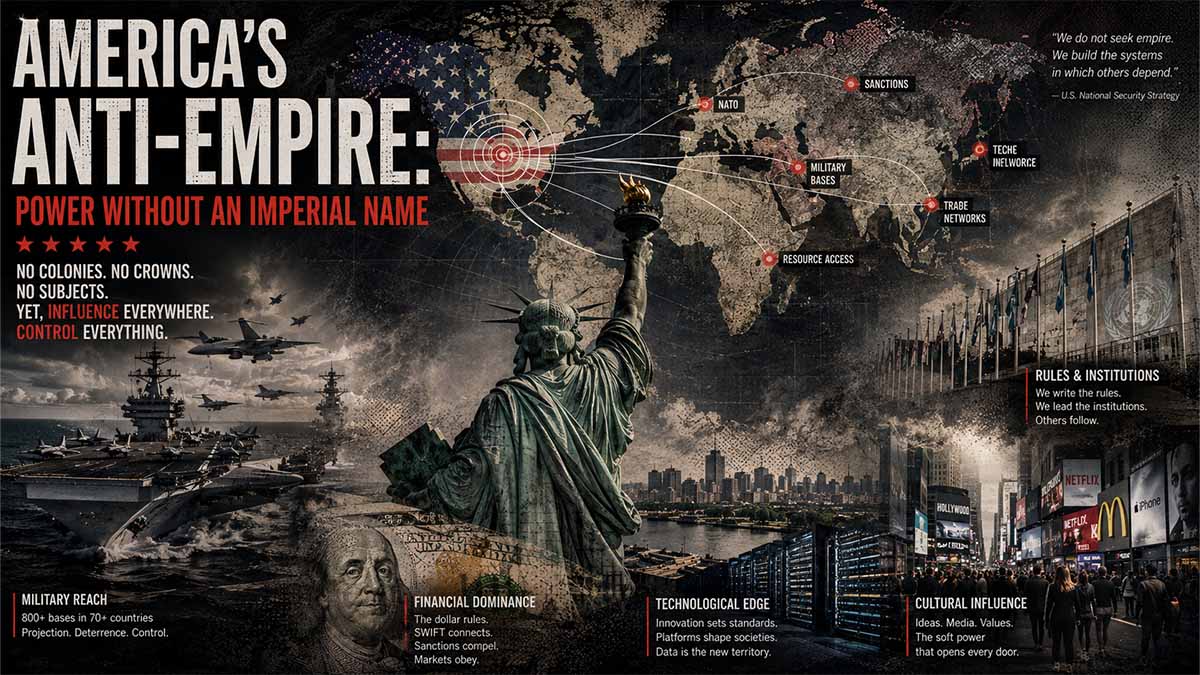
Executive Summary
- BLUF: The United States is not a territorial empire, but it performs systemic functions historically associated with empire.
- Its power rests on military reach, alliance architecture, technological chokepoints, capital markets, the dollar and rule-setting authority.
- Trumpism expresses the resistance of the American hinterland to bearing the visible costs of maintaining that order.
- America First does not necessarily terminate primacy; it seeks to convert protection, market access and security guarantees into measurable returns.
- The central tension is therefore not isolation versus empire, but subsidized hegemony versus transactional hegemony.
- Five competing hypotheses produce a baseline 41% probability of selective transactional primacy by 2031.
- Retrenchment remains possible, but a wholesale American withdrawal would destroy assets Washington still regards as essential.
- Europe will be pressed to finance more of the Western security system while remaining dependent on American strategic enablers.
- China and Russia will exploit the legitimacy crisis of US leadership, but neither yet reproduces the complete American power stack.
- The 2026–2031 danger is an unstable hybrid: narrower commitments, stronger coercion and less predictable rules.
America’s Anti-Empire: The Price of Ruling Without Saying So
The United States rejects the language of empire yet retains the machinery of systemic command: military reach, the dollar, technological chokepoints, capital markets and alliances spanning the world’s decisive regions. The Trump doctrine does not dismantle that architecture. It seeks to renegotiate its price. Global leadership must now produce identifiable returns for American workers, factories and taxpayers. This shift originates in the hinterland that absorbed the territorial costs of globalization and transforms hegemony into a balance sheet. Between 2026 and 2031, the central question will not be whether America abandons primacy, but whether it can make allies pay more without persuading them to build alternatives.
The imperial paradox
The American republic was founded against empire and cannot comfortably describe itself as one. Yet legal identity and strategic function are different matters. Washington does not need colonies to exercise hierarchical power when it can shape the conditions under which states obtain security, finance, technology, intelligence and access to global markets.
The architecture operates through alliances, military facilities, pre-positioned equipment, surveillance networks, nuclear deterrence, sanctions jurisdiction, export licences and private platforms. It is a network rather than a map of possessions. Allied governments retain sovereignty, but the cost of exercising it against Washington increases when their armed forces depend on American command systems, their banks require dollar liquidity and their industries rely on US-controlled technologies.
The White House’s National Security Strategy, dated November 2025, makes the contradiction explicit. It rejects “permanent American domination” while defining continued US pre-eminence through the world’s leading financial system, reserve currency, technology sector, military and alliance network. It also declares that allies must assume primary responsibility for their regions and spend more on defence — National Security Strategy – The White House – November 2025.
This is not retreat. It is a transition from subsidised leadership to transactional primacy.
The dollar’s invisible frontier
The dollar remains the least visible and most efficient component of American power. According to the International Monetary Fund, it represented 57.13% of allocated global foreign-exchange reserves in the first quarter of 2026, compared with 20.03% for the euro and 1.99% for the renminbi — Currency Composition of Official Foreign Exchange Reserves – International Monetary Fund – July 2026.
Foreign portfolio holdings of US securities reached 35.349 trillion US dollars on 30/06/2025: 19.860 trillion in equities, 13.840 trillion in long-term debt and 1.649 trillion in short-term securities — Report on Foreign Portfolio Holdings of US Securities at End-June 2025 – United States Department of the Treasury – 30/04/2026.
These figures do not make dollar supremacy irreversible. They show the scale of the system that any challenger must reproduce. A credible alternative requires more than a payment channel: it needs liquid assets, convertibility, reliable custody, legal predictability, hedging instruments and emergency financing. Washington’s vulnerability lies in overusing this advantage. Every financial sanction creates an incentive to develop settlement routes beyond US jurisdiction, even when those routes remain less efficient.
The revolt at home
American primacy was built on an internal bargain: overseas leadership would expand markets, prevent hostile control of Eurasia and support domestic prosperity. That bargain weakened when its benefits became concentrated in financial, technological and metropolitan centres while its disruptions became territorially visible.
Manufacturing employment fell from approximately 19.5 million at its 1979 peak to 12.8 million in June 2019, a reduction of 6.7 million jobs, or 35% — Forty Years of Falling Manufacturing Employment – United States Bureau of Labor Statistics – November 2020.
In 2025, manufacturing still generated 13.7% of US GDP but employed approximately 13 million people, only 9.8% of nonfarm business employment — Manufacturing and Mining Labor Productivity – United States Bureau of Labor Statistics – June 2026. America did not cease producing. It became more capital-intensive, technologically concentrated and less capable of distributing industrial employment across its territory.
This is the political geography of Trumpism. National wealth can rise while individual counties lose plants, suppliers, bargaining power, young workers and tax revenue. Voters do not experience GDP; they experience wages, housing, hospitals, schools and the availability of careers compatible with their skills.
Trade as household accounting
Economic nationalism translates complex international balances into a domestic ledger. Exports become earnings; imports become payments; deficits become losses; tariffs become recovery instruments. The interpretation is incomplete because trade balances also reflect investment flows, domestic demand, exchange rates and the dollar’s reserve role. It is nevertheless politically compelling.
On 30/06/2026, the monthly US goods deficit stood at 102.1 billion US dollars, partially offset by a 28.8 billion services surplus, producing a combined deficit of 73.3 billion. Across the first half of 2026, the goods-and-services deficit was 33.8% lower than in the corresponding 2025 period; exports increased by 198.3 billion US dollars, or 11.7%, while imports increased by 9 billion, or 0.4% — US International Trade in Goods and Services, June 2026 – Bureau of Economic Analysis and US Census Bureau – 04/08/2026.
These results document external rebalancing, not the reconstruction of every industrial community. The political durability of reindustrialisation will depend on whether investment creates operating jobs, domestic suppliers, technical training and local tax revenue—not merely automated plants and construction cycles.
The border and sovereignty
Migration became part of the same accounting framework because its labour-market benefits and fiscal pressures are distributed unequally. Employers may obtain workers rapidly, while housing, schools, hospitals and municipal services absorb local adjustment costs. Skilled immigration can strengthen globally connected cities without relieving stagnation elsewhere.
The US Census Bureau estimated net international migration at 2.7 million in 2024, 1.3 million in 2025 and approximately 321,000 in 2026 if the trends available when the estimate was produced continued — New Population Estimates Show Historic Decline in Net International Migration – US Census Bureau – January 2026.
The strategic transformation is conceptual. Border control, industrial policy, trade balances and defence burden-sharing are no longer separate dossiers. They form a single doctrine of sovereign preference: the federal state must visibly demonstrate that citizens come before external systems. Migration restriction therefore functions not only as enforcement but as proof that Washington can still impose political boundaries on globalization.
Europe pays more
The most immediate international consequence is the transfer of security costs to Europe. NATO’s Ankara Declaration of 08/07/2026 recorded that European allies and Canada had increased investment in core defence requirements by more than 139 billion US dollars during 2025 — Ankara Summit Declaration – North Atlantic Treaty Organization – 08/07/2026.
The European Defence Agency reported that the 27 EU member states spent 418 billion euros in 2025, equal to 2.2% of GDP and 20% more than in 2024. Its estimate for 2026 is 454 billion euros, or 2.4% of GDP. Equipment absorbed more than 28% of 2025 expenditure, while research and development received 17 billion euros, or 4% — Defence Data 2025–2026 – European Defence Agency – 16/07/2026.
The European Commission’s Readiness 2030 framework, presented on 19/03/2025, was designed to enable up to 800 billion euros in additional defence expenditure — White Paper for European Defence: Readiness 2030 – European Commission – 19/03/2025.
But expenditure is not sovereignty. If European budgets purchase American aircraft, missiles, cloud services and intelligence-dependent systems, Europe will become militarily stronger while remaining strategically subordinate. If they finance common European production, space-based warning, secure communications and command capabilities, burden transfer may gradually become authority transfer.
China builds redundancy
China does not need to replace the Western system everywhere. It needs enough parallel capacity to survive exclusion from its critical nodes. Its strategy combines trade corridors, domestic technology, renminbi settlement, currency swaps, infrastructure and alternative payment channels.
In the first half of 2026, Chinese non-bank cross-border receipts and payments reached 9.2 trillion US dollars, rising 21% year on year. The renminbi accounted for 52.9% of China’s cross-border settlements; China’s foreign-exchange reserves stood at 3.4163 trillion US dollars on 30/06/2026 — Foreign Exchange Receipts and Payments Data for the First Half of 2026 – State Administration of Foreign Exchange of the People’s Republic of China – 17/07/2026.
These numbers show growing insulation inside China-centred commerce, not global monetary succession. The renminbi’s 1.99% share of allocated reserves remains far below the dollar’s. Beijing’s nearer-term objective is therefore redundancy: the capacity to settle strategic trade, finance selected partners and protect supply chains if Western access is restricted.
Russia attacks the seams
Russia lacks the economic scale to organize a successor order but retains substantial ability to destabilize the transition. Its comparative advantage lies in exploiting thresholds below conventional war: cyber operations, information manipulation, infrastructure disruption, nuclear signalling and political interference.
NATO’s updated assessment, published on 29/01/2026, identifies political interference, malicious cyber activity, economic pressure, coercion and subversion among the hybrid instruments employed by the Russian Federation — Countering Hybrid Threats – North Atlantic Treaty Organization – 29/01/2026.
The strategic target is cohesion. A disputed cyberattack, damaged cable or manipulated information campaign can force allies to debate attribution, proportionality and collective response. Moscow gains leverage when European fiscal pressures, American transactional demands and domestic polarization weaken the ability to act jointly.
The succession contest
The period to 2031 is unlikely to produce a new hegemon. It is more likely to produce overlapping hierarchies. The United States will seek to retain the dollar, military command and technological control while transferring regional costs. Europe will spend more but struggle to convert money into common authority. China will expand parallel systems without matching the global liquidity and alliance depth of the United States. Russia will attempt to make every transition more dangerous.
Controlled fragmentation remains possible if competing systems preserve convertibility, targeted trade and crisis communication. Disorderly fragmentation would begin when military confrontation, sanctions, payment restrictions, export controls and maritime disruption occur together. At that point, interdependence would cease to absorb shocks and begin transmitting them.
America’s central problem is therefore not decline in the conventional sense. It is whether an anti-imperial republic can continue operating an imperial architecture after its own hinterland has demanded an invoice. If Washington makes primacy visibly profitable without destroying allied confidence, its leadership can survive in a harder form. If every alliance becomes a tariff negotiation and every dependency a coercive instrument, the United States may preserve its power while accelerating the construction of the world designed to escape it.
Navigational Index
- The concealed imperial architecture — military reach, dollar centrality, technological control, alliances and the contradiction between republican identity and systemic command.
- The revolt of the hinterland — deindustrialization, trade deficits, territorial inequality, migration politics and the transformation of hegemony into a domestic accounting problem.
- The 2026–2031 succession contest — transactional primacy, European burden transfer, Chinese parallel systems, Russian disruption and the probability of controlled or disorderly fragmentation.
Master Abstract
The proposition that the United States is “an empire that is not an empire” becomes analytically useful only after separating juridical form from systemic function. The United States does not normally govern allied societies through colonial administrations, formally annex their territory or abolish their sovereignty. It nevertheless sustains a geographically distributed structure of bases, security guarantees, intelligence relationships, financial infrastructures, technological controls and institutional privileges that constrains the strategic choices available to other states. This is better defined as networked primacy than as a conventional territorial empire. Its organizing assets are not provinces but access agreements; not imperial governors but interoperable commands, sanctions compliance systems, reserve assets, clearing channels, export-control coalitions and standards embedded in global supply chains. The contradiction is constitutional as much as geopolitical: American political culture derives legitimacy from rebellion against empire, while the post-1945 state derives power from administering an international order that no other country could secure at equivalent scale. The current administration’s own strategic language demonstrates that the contradiction has not disappeared. Washington simultaneously describes the current-account deficit as unsustainable, demands that allies assume larger burdens and preserves the objective of military and technological superiority. The US current-account deficit reached 1.12 trillion US dollars in 2025, equal to 3.6% of GDP, while exports and foreign-income receipts totaled 5.15 trillion and corresponding payments reached 6.26 trillion — U.S. International Transactions and Investment Position, Fourth Quarter and Year 2025 – Bureau of Economic Analysis – March 2026 — verified official release. Yet the 2026 National Defense Strategy did not translate economic grievance into strategic abdication. It coupled homeland defence and Indo-Pacific deterrence with allied burden redistribution — 2026 National Defense Strategy – United States Department of Defense – January 2026 — verified official document. The emerging doctrine is therefore not post-imperial. It is an attempt to make networked primacy pay for itself.
The political energy behind that conversion originates in the American hinterland: metropolitan peripheries, former industrial districts, small cities, energy-producing regions and communities that experienced globalization not as an abstract increase in aggregate welfare but as a redistribution of productive capacity, status and bargaining power. The crucial distinction is between the national balance sheet and territorial political experience. The United States can receive foreign capital, issue the principal reserve currency, import at scale, dominate high-margin services and own globally profitable intangible assets while specific regions lose factories, supplier networks, union density and confidence in intergenerational mobility. Aggregate wealth does not neutralize spatial humiliation. Trump’s political innovation was to translate this territorial divergence into a theory of international extraction: allies allegedly underpay for security; exporters exploit American openness; multilateral rules constrain Washington more than its competitors; immigration dilutes labour-market control; and foreign commitments transfer resources away from the domestic nation. The America First Trade Policy accordingly ordered reviews of persistent deficits, unfair practices, tariff collection, export controls and external economic security — America First Trade Policy – The White House – January 2025 — verified presidential memorandum. The subsequent reciprocal-tariff action explicitly connected persistent goods deficits to national and economic security — Regulating Imports with a Reciprocal Tariff to Rectify Trade Practices – The White House – April 2025 — verified presidential action. By June 2026, the year-to-date goods-and-services deficit had fallen 33.8% from the corresponding 2025 period, as exports rose 11.7% and imports increased only 0.4% — U.S. International Trade in Goods and Services, June 2026 – Bureau of Economic Analysis and US Census Bureau – August 2026 — verified official release. These figures cannot prove durable reindustrialization, but they demonstrate the operational priority: economic balances have become instruments for judging whether the external order serves the sovereign nation. The alleged imperial paradox is thus inverted. Washington is not allowing economics to replace geopolitics; it is weaponizing economics to renegotiate the price of geopolitical leadership.
Five competing hypotheses structure the 2026–2031 outlook. H₁, restored liberal primacy, anticipates that institutional inertia, corporate interests, military commands and allied demand eventually moderate transactionalism. H₂, transactional primacy, expects Washington to retain decisive alliances and global access while charging partners through defence targets, procurement, energy purchases, investment concessions and policy alignment. H₃, continental retrenchment, projects a genuine contraction toward homeland defence and selective denial in the Western Hemisphere. H₄, coercive techno-nationalism, foresees an intensified combination of tariffs, investment screening, semiconductor controls, digital leverage, arms exports and extraterritorial financial pressure. H₅, fragmented multipolarity, assumes that repeated bargaining shocks progressively weaken confidence in American guarantees and accelerate alternative payment, trade, security and technological systems. The present Bayesian baseline assigns 41% to H₂, 23% to H₄, 16% to H₅, 12% to H₁ and 8% to H₃. These are structured analytical estimates, not official forecasts. Evidence favouring H₂ includes NATO’s 2025 commitment to reach 5% of GDP by 2035, divided into at least 3.5% for core defence and up to 1.5% for wider security and resilience — The Hague Summit Declaration – North Atlantic Treaty Organization – June 2025 — verified official declaration. By the 2026 Ankara summit, European allies and Canada had reportedly increased core defence investment by more than 139 billion US dollars since The Hague — Overview of the 2026 NATO Summit in Ankara – North Atlantic Treaty Organization – July 2026 — verified NATO summit record. Evidence favouring H₄ includes the policy of using foreign arms purchases and capital to expand American production capacity — Establishing an America First Arms Transfer Strategy – The White House – February 2026 — verified presidential action. The crucial inference is that allied sovereignty will not necessarily increase in proportion to allied spending: Europe may finance more of the system while continuing to depend on American intelligence, nuclear deterrence, strategic lift, missile warning and high-end command infrastructure.
The external counternarrative strengthens because China, Russia and increasingly autonomous European institutions interpret American transactionalism as evidence that the post-1945 order was never neutral. Beijing’s official position argues that tariffs, export controls and investment restrictions are instruments for suppressing China’s development rather than correcting symmetrical market failures — China’s Position on China–US Economic and Trade Relations – State Council Information Office of the People’s Republic of China – April 2025 — verified official white paper. Its 2026 governance white paper presents unilateral tariffs and fragmented economic governance as threats to globalization while documenting 23.6 trillion yuan in 2025 trade with Belt and Road participants — More Just and Equitable Global Governance – State Council of the People’s Republic of China – June 2026 — verified official document. Moscow’s formulation is strategically motivated rather than neutral, but it matters as an indicator of adversarial doctrine: Russian diplomacy depicts multipolarity as irreversible and US unipolarity as historically anomalous — Southeast Asia in the Multipolar World – Ministry of Foreign Affairs of the Russian Federation – April 2026 — verified official text. Europe occupies the most difficult intermediate position. It rejected threatened 30% US tariffs as unjustified while continuing to seek a negotiated transatlantic settlement — Foreign Affairs Council, Trade – Council of the European Union – July 2025 — verified official meeting record. Simultaneously, the European Council ordered reductions in strategic dependencies and accelerated reinforcement of the European defence industrial base — European Council Conclusions on European Defence – European Council – March 2025 — verified official conclusions. The resulting structure is neither bipolar nor conventionally multipolar. It is a contested hierarchy in which Washington retains the deepest integrated power stack, Beijing builds scale-based alternatives, Moscow specializes in disruption, and Europe seeks autonomy without accepting the full fiscal, military and political costs of independence.
The five-year outlook therefore turns on whether American leaders can separate burden redistribution from confidence destruction. Under the modal H₂ trajectory, Washington remains militarily forward, preserves the dollar-centred financial system, expands controls over critical technologies and compels allies to purchase more defence, energy and industrial capacity from US suppliers. The system becomes more expensive for subordinate partners but does not cease to be American-led. Under H₄, coercive economic measures generate short-term concessions yet encourage long-term hedging: duplicate supply chains, non-dollar settlement channels, sovereign-cloud initiatives, indigenous defence production and more aggressive control over data and infrastructure. H₅ becomes dominant if three conditions coincide: repeated US threats against allies, a major failure of extended deterrence and a credible alternative ecosystem for payments, technology and physical security. H₁ requires a domestic political reversal plus a restoration of belief that leadership costs produce widely distributed American benefits. H₃ requires something more severe: fiscal crisis, military defeat, constitutional paralysis or sustained public refusal to support overseas commitments. Monte Carlo stress logic using correlated shocks across trade conflict, alliance cohesion, fiscal pressure, technological denial and regional war produces a broad 2031 range rather than a single endpoint. The principal tail risk is not peaceful withdrawal. It is imperial compression: fewer unconditional guarantees, more explicit tribute-like exchanges, higher sanctions intensity and greater uncertainty over where US power will actually be used. The United States would then remain the strongest state in the system while becoming a less reliable administrator of that system. That is the most dangerous interpretation of the “empire that is not an empire”: its capabilities survive, but its willingness to convert capability into predictable order becomes conditional.
American Primacy Conversion Model
Competing hypotheses
Systemic discontinuity index
Structural inputs
Shadow-dimension matrix
The Concealed Imperial Architecture of the United States
Systemic command without formal empire
The United States does not satisfy the classical legal definition of an empire: it does not describe its allies as possessions, administer most foreign territories through appointed governors or formally extinguish the sovereignty of subordinate states. Yet this juridical distinction obscures a more consequential strategic reality. American power operates through a distributed command architecture in which military access, alliance interoperability, dollar liquidity, capital-market depth, technological licensing, intelligence exchange and regulatory reach reinforce one another. Washington rarely needs direct government over another society when it can influence the external conditions under which that society finances debt, acquires advanced technology, secures maritime trade, communicates through digital infrastructure and protects its territory. The resulting formation is not a territorial empire but a network empire, or more precisely a system of hierarchical interdependence. Its nodes remain formally sovereign; their freedom of action nevertheless varies according to their dependence on American security guarantees, financial markets, software, cloud infrastructure, semiconductor intellectual property, aerospace systems, intelligence collection and diplomatic protection. This arrangement also explains why conventional measurements of imperial burden can mislead. Overseas forces constitute only the visible layer. Beneath them sit basing agreements, pre-positioned materiel, logistics contracts, space-based surveillance, nuclear consultation, foreign military sales, payment channels, sanctions compliance, export licences and private corporations whose platforms have acquired quasi-public infrastructural functions. The 2026 National Defense Strategy openly connects homeland defence, deterrence in the Indo-Pacific, allied burden redistribution and industrial capacity rather than treating them as separate policy domains — 2026 National Defense Strategy – United States Department of Defense – January 2026 — verified official document. The concealed architecture is therefore best understood as a conversion mechanism: military superiority produces confidence in American commitments; confidence supports alliances and demand for American systems; those systems generate technological dependence; technological and financial dependence, in turn, lowers the political and economic cost of sustaining military reach.
| Imperial function | Contemporary American instrument | Dependency transmitted to partners | Principal vulnerability |
|---|---|---|---|
| Territorial control | Bases, access agreements, rotational forces, pre-positioning | Reliance on US reinforcement and logistics | Host-state restrictions or denial of access |
| Tribute and resource extraction | Defence procurement, energy contracts, investment commitments | Transfer of allied expenditure into US capacity | Political backlash and industrial autonomy |
| Imperial currency | Dollar reserves, Treasury securities, correspondent banking | Exposure to US rates, liquidity and sanctions jurisdiction | Diversification, gold accumulation, parallel settlement |
| Technology hierarchy | Export controls, licences, cloud and AI stacks | Conditional access to advanced computing and software | Indigenous substitution and control evasion |
| Administrative coordination | Alliances, standards, intelligence-sharing networks | Policy alignment without formal loss of sovereignty | Confidence erosion and coalition fragmentation |
| Frontier management | Partner forces, security assistance, arms transfers | Local containment of threats before US intervention | Proxy escalation and moral hazard |
Military geography as a system of options
The military dimension of American primacy is less accurately represented by a static count of overseas bases than by the volume and diversity of options Washington can activate across theatres. A permanent installation, a rotational deployment, a logistics hub, an intelligence facility, a host-nation airfield cleared for contingency use and a maritime access agreement do not possess equal political visibility, but each can shorten warning-to-response time and complicate an adversary’s targeting calculus. This architecture produces four strategic effects. First, it extends surveillance and early warning by combining national technical means with allied sensors and regional intelligence. Second, it distributes sustainment through ports, airfields, fuel networks, maintenance facilities and pre-positioned stocks. Third, it creates coalition interoperability because partners train on American doctrine, communications, datalinks and weapons. Fourth, it establishes an escalatory gradient: Washington can move from intelligence support and force protection to reinforcement, strike operations or extended deterrence without constructing an expeditionary system from zero. The architecture is therefore an inventory of political-military options, not merely real estate. Its resilience derives from redundancy, but its legitimacy depends on consent. Host governments can restrict missions, impose caveats or reinterpret agreements if domestic opinion changes. Washington’s current response is not simply to withdraw; it is to increase the contribution demanded from partners while protecting US control over critical enablers. At NATO’s Hague summit, allies committed to reach 5% of GDP in defence and security-related expenditure by 2035, including at least 3.5% for core defence requirements and up to 1.5% for resilience, infrastructure and associated security expenditure — The Hague Summit Declaration – North Atlantic Treaty Organization – June 2025 — verified official declaration. By the 2026 Ankara summit, NATO reported that European allies and Canada had increased core defence investment by more than 139 billion US dollars since the Hague commitment — Overview of the 2026 NATO Summit in Ankara – North Atlantic Treaty Organization – July 2026 — verified summit record. Burden sharing, however, does not automatically equal command sharing: European expenditure may expand the alliance’s material base while the United States retains disproportionate control of nuclear, space, intelligence and long-range operational functions.
The Architecture of US Command and Control
Hierarchical cascade from national authority to partner integration and systemic friction
System Dynamics of the Network Empire
The command topology illustrated above maps the structural pathway through which American strategic intent translates into global operational capability. Initiating from the National Command Authority, strategic directives rely immediately upon capital-intensive assets—specifically global surveillance grids, space-based architectures, and centralized intelligence fusion centers.
This foundational layer bifurcates into four interdependent operational branches: multi-lateral alliance commands, bilateral access agreements, forward-deployed maritime postures, and pervasive cyber networks. Together, these channels feed into regional deterrence mechanisms, compelling dependent partners to adopt standard doctrinal frameworks and align their force structures with Washington’s operational needs. Ultimately, the framework results in a structural tension between sustained political alignment and prospective autonomy reactions as subordinate nodes navigate their relative constraints.
Dollar centrality as strategic infrastructure
Dollar centrality is not equivalent to a decree compelling states to hold American currency. It persists because the United States supplies an interconnected set of assets and services that competitors have not yet reproduced at comparable scale: a vast market for liquid government securities, deep private capital markets, globally integrated banks, legal institutions familiar to investors, extensive derivatives and collateral ecosystems, and a currency used across trade invoicing, debt issuance and precautionary reserves. This produces an imperial effect without requiring an imperial monetary administration. Foreign institutions demand dollar assets for their own liquidity and risk-management purposes; that demand lowers financing friction for the United States and transmits American monetary conditions outward. The International Monetary Fund reported that the dollar represented 57.13% of allocated foreign-exchange reserves in the first quarter of 2026, compared with 56.42% in the fourth quarter of 2025 — Currency Composition of Official Foreign Exchange Reserves, First Quarter 2026 – International Monetary Fund – July 2026 — verified IMF data brief. The movement does not establish a permanent reversal of longer-term diversification, but it demonstrates that geopolitical controversy has not eliminated the currency’s liquidity advantage. The asset side is equally important. Foreign portfolio holdings of US securities reached 35.349 trillion US dollars at the end of June 2025, including 19.860 trillion in equities, 13.840 trillion in long-term debt and 1.649 trillion in short-term debt — Report on Foreign Portfolio Holdings of US Securities at End-June 2025 – United States Department of the Treasury – April 2026 — verified Treasury release. This stock represents both power and vulnerability. It permits the United States to attract global savings, but it also makes confidence, fiscal governance and market depth strategic assets whose degradation would impose cumulative rather than instantaneous costs. De-dollarization is therefore not a binary event. It proceeds through marginal reserve reallocation, bilateral settlement, gold purchases, local-currency lending, alternative payment messaging and reduced exposure to sanctions-sensitive intermediaries. None alone displaces the dollar; together they can reduce the convenience premium that finances American systemic command.
| Dollar-system indicator | Observed reference point | Imperial effect | Five-year warning indicator |
|---|---|---|---|
| Dollar share of allocated reserves | 57.13%, 2026 Q₁ | Reserve demand and global liquidity preference | Persistent decline across both valuation-adjusted and nominal series |
| Foreign holdings of US securities | 35.349 trillion US dollars, June 2025 | External demand for American assets | Sustained official-sector selling not offset by private demand |
| Foreign equity holdings | 19.860 trillion US dollars | Capital-market attraction and corporate valuation support | Fragmentation of listings, custody or investment screening |
| Foreign long-term debt holdings | 13.840 trillion US dollars | Financing depth and collateral supply | Rising term premium combined with reserve diversification |
| Dollar sanctions exposure | Qualitative network effect | Extraterritorial coercive capacity | Growth of operationally scalable settlement alternatives |
Technological control as a licensing hierarchy
The technological layer transforms commercial superiority into geopolitical hierarchy because advanced systems are not isolated products. Artificial intelligence depends on accelerators, high-bandwidth memory, semiconductor fabrication equipment, electronic-design software, data-centre power, cloud orchestration, models, cybersecurity, networking and technical expertise. Control over several decisive layers allows Washington to grant, restrict or condition access even when final assembly occurs outside the United States. The Foreign Direct Product logic embedded in US export administration extends jurisdiction through American-origin technology and software, turning the supply chain itself into a regulatory surface. In May 2026, the Bureau of Industry and Security clarified that licensing requirements continued to apply to specified advanced-computing items supplied to entities headquartered in designated Country Group D:5 jurisdictions or Macau, including relevant entities operating in third countries — Guidance Regarding Enforcement of License Requirements for Advanced Computing Items – Bureau of Industry and Security – May 2026 — verified official guidance. Earlier controls had added restrictions covering 24 types of semiconductor-manufacturing equipment, three software categories, high-bandwidth memory and numerous entities associated with China’s military modernization — Commerce Strengthens Export Controls to Restrict China’s Capability to Produce Advanced Semiconductors for Military Applications – Bureau of Industry and Security – December 2024 — verified official release. The offensive counterpart is full-stack diffusion. Washington ordered the creation of an American AI Exports Program designed to promote integrated packages of hardware, models, software, applications, standards and financing abroad — Promoting the Export of the American AI Technology Stack – The White House – July 2025 — verified executive order. The strategic pattern is unmistakable: exclusion weakens adversarial capacity, while inclusion deepens allied dependence on an American ecosystem. This is not traditional colonial extraction. It is platform sovereignty, under which formal political independence coexists with operational dependence on technologies whose permissible use, upgrade path and transnational movement remain subject to external rules.
The Semiconductor Chokepoint and Technology Blocs
From foundational intellectual property to compute infrastructure and systemic bifurcation
and security integration
smuggling and indigenous R&D
The Mechanics of Technological Bifurcation
The structural architecture of modern technological power flows downward from foundational US research and intellectual property. Control over core electronic design automation (EDA) software, advanced lithography fabrication tools, and high-performance memory designs forms a tight bottleneck that governs the entire scale of global compute infrastructure.
Downstream from this compute threshold, global markets split into two distinct pathways. The approved ecosystem integrates compliant partners into standardized cloud architectures, security protocols, and frontier artificial intelligence models. Conversely, the restricted ecosystem triggers systemic evasion strategies—including supply-chain diversion, hardware smuggling, parallel substitution, and accelerated indigenous research and development—ultimately solidifying permanent global technological blocs.
Alliances as delegated administration
American alliances are frequently described either as communities of values or as instruments of domination. Neither formulation is sufficient. They are institutional bargains in which members exchange degrees of strategic discretion for deterrence, intelligence, interoperability, political access and reduced uncertainty. The United States receives forward presence, diplomatic alignment, access to infrastructure, demand for its military systems and the ability to shape regional security agendas without administering allied territory. Partners receive protection and capabilities they could not reproduce individually at an acceptable cost. This exchange creates asymmetric but real mutual benefit, which is why the system has survived recurrent disputes over trade, military interventions, burden sharing and leadership style. Its concealed imperial quality lies not in the absence of consent but in the structured inequality of exit costs. A state deeply integrated into American command-and-control, munitions, aircraft, missile defence, intelligence and nuclear planning cannot rapidly disengage without accepting capability gaps. Procurement decisions therefore acquire constitutional significance: they determine which external actor will retain access, maintenance influence and upgrade authority for decades. The emerging American doctrine adds explicit economic reciprocity. The 2026 arms-transfer strategy states that foreign purchases and capital should reinforce US production capacity and technological superiority — Establishing an America First Arms Transfer Strategy – The White House – February 2026 — verified presidential action. The April 2025 reform of foreign defence sales similarly instructed agencies to integrate exportability and technology-protection features earlier in acquisition — Reforming Foreign Defense Sales to Improve Speed and Accountability – The White House – April 2025 — verified executive order. Over the next five years this mechanism will likely make alliances more transactional without making them less militarily integrated. Washington can demand greater allied expenditure while ensuring that a substantial portion purchases systems compatible with US doctrine. The strategic question is whether partners interpret this as equitable burden redistribution or as compulsory capitalization of American power.
| Alliance variable | American return | Allied return | Latent conflict |
|---|---|---|---|
| Forward access | Operational reach and shorter response time | Deterrence and rapid reinforcement | Sovereignty, domestic legitimacy |
| Interoperability | Command influence and scalable coalitions | Higher combat effectiveness | Vendor lock-in |
| Intelligence sharing | Broader collection and regional access | Strategic warning and targeting support | Dependence and asymmetric disclosure |
| Nuclear umbrella | Political leadership of deterrence | Avoided cost of national nuclear forces | Credibility under selective US commitments |
| Defence procurement | Industrial demand and standards power | Access to mature systems | Technology transfer and local-content disputes |
| Burden sharing | Lower relative fiscal cost | Greater national capacity | Spending without proportional command authority |
Republican identity and the denial of empire
The contradiction between republican identity and systemic command is not rhetorical decoration; it shapes American strategic behaviour. The national political tradition defines legitimate government through popular sovereignty, anti-colonial revolution and suspicion of concentrated power. Explicit imperial identity would therefore impose a domestic legitimacy cost and conflict with the legal equality of sovereign states that Washington formally supports. American leaders consequently describe military expansion as defence, alliance direction as partnership, economic coercion as enforcement of rules, technological restriction as national-security protection and international leadership as the provision of public goods. These descriptions are not necessarily fraudulent: the United States has supplied genuine security guarantees, liquidity, market access, disaster assistance and institutional coordination. The analytical problem arises when public-good provision and hierarchical privilege are treated as mutually exclusive. They coexist. The same naval power that protects maritime access also provides Washington with escalation dominance; the same dollar market that supplies liquidity also enables sanctions; the same technological ecosystem that diffuses innovation also creates chokepoints; the same alliance that deters aggression also limits independent strategic action. Domestic denial of empire allows these contradictions to remain compartmentalized. Americans debate whether a particular deployment, tariff or alliance serves the national interest, but less frequently examine the integrated system through which apparently separate instruments preserve primacy. The Trumpian critique does not fully expose this architecture because it attacks its distributional terms rather than its commanding position. America First argues that the United States has paid too much and received too little; it does not conclude that Washington should accept strategic equality. The 2025 National Security Strategy identifies the country’s military, economic, innovative and soft-power assets while demanding rebalanced trade and greater allied contributions — National Security Strategy – The White House – December 2025 — verified official strategy. The implied objective is not the dismantling of hierarchy but its renegotiation around visible national returns.
Counter-system readings from China, Russia and Europe
Multilingual primary-source comparison reveals that rival and allied governments increasingly perceive the American architecture as a connected system, although they differ sharply over the appropriate response. China’s official white paper on bilateral economic relations argues that US tariffs, export controls and investment restrictions are interconnected instruments intended to constrain Chinese development rather than discrete responses to individual market distortions — China’s Position on Some Issues Concerning China–US Economic and Trade Relations – State Council Information Office of the People’s Republic of China – April 2025 — verified official English edition. Beijing’s response combines indigenous technological capacity, market diversification, renminbi settlement, Belt and Road connectivity and institutional narratives favouring sovereign equality. Its 2026 governance paper reported trade in goods with Belt and Road participants of 23.6 trillion yuan in 2025, an increase of 6.3%, illustrating the scale of the economic geography China seeks to organize beyond direct reliance on Western demand — More Just and Equitable Global Governance – State Council of the People’s Republic of China – June 2026 — verified official document. Russia, possessing less financial and technological scale, emphasizes political disruption and the delegitimization of unipolarity. Its Foreign Ministry characterizes multipolarity as an irreversible transformation rather than a policy preference — Southeast Asia in the Multipolar World – Ministry of Foreign Affairs of the Russian Federation – April 2026 — verified official text. The European Union occupies an intermediate category because it is simultaneously protected by, integrated with and exposed to American power. The European Council has called for reduced strategic dependencies, accelerated defence production and reinforcement of the European technological and industrial base while affirming NATO as the foundation of collective defence for its members — European Council Conclusions on European Defence – European Council – March 2025 — verified official conclusions. Europe is therefore not attempting complete separation. It seeks insurance against American conditionality while preserving access to American protection.
Shadow dimensions and systemic transmission
The least visible components of the architecture emerge where state power intersects private liquidity, cyber governance, irregular security actors and compliance systems. Dollar dominance magnifies the influence of US sanctions because banks, insurers, custodians, shipping firms and multinational corporations frequently avoid transactions whose legal status is uncertain rather than risk exclusion from American markets. This produces compliance beyond the narrow territorial reach of legislation. In cyberspace, the United States benefits from relationships among intelligence agencies, cloud operators, software companies, telecommunications providers and allied cyber commands, but this public-private structure also creates accountability gaps: offensive access, vulnerability disclosure and supply-chain intervention may cross jurisdictions without a universally accepted cyber norm. Mercenary or private-military dynamics occupy a different position than in Russian expeditionary practice. The American system more often externalizes logistics, training, maintenance, protective services and technical support through contractors operating inside formal state-led missions. Their strategic influence is substantial because sophisticated weapons and digital systems require continuous vendor support, yet their political visibility remains lower than that of deployed combat formations. Liquidity flows connect all these dimensions. Sovereign wealth, pension funds, venture capital and allied procurement can be channelled toward US technology and defence capacity, while investment screening restricts capital associated with adversarial jurisdictions. The America First Investment Policy explicitly links expedited access for allied capital to verifiable separation from Chinese or other adversarial technology-acquisition practices — America First Investment Policy – The White House – February 2025 — verified presidential memorandum. This creates a tiered investment order in which capital is not evaluated solely by commercial origin or return but by geopolitical affiliation. The concealed empire consequently operates through permissions: permission to access technology, clear payments, enter investment channels, receive intelligence, integrate weapons and participate in protected markets. Power is exercised by defining the conditions under which connectivity remains available.
| Shadow dimension | Observable mechanism | Imperial transmission channel | Early-warning metric, 2026–2031 |
|---|---|---|---|
| Liquidity | Treasury demand, custody, dollar clearing | Financing advantage and sanctions compliance | Official-sector sales, settlement diversification |
| Cyber norms | Intelligence alliances, vulnerability handling | Operational access and attribution leadership | Divergent allied doctrines or sovereign-cloud exclusion |
| Contractors | Logistics, maintenance, training, technical support | Persistent presence with reduced political visibility | Contractor concentration and mission-critical dependence |
| Investment screening | Fast tracks, restrictions, beneficial-ownership tests | Capital allocation by geopolitical alignment | Expansion from security sectors into general commerce |
| Technology licensing | End-user and parent-entity controls | Extraterritorial supply-chain authority | Evasion networks, indigenous alternatives, allied resistance |
| Insurance and shipping | Risk classification and compliance | Enforcement without direct military action | Non-Western insurance pools and fleet re-registration |
Bayesian assessment and competing hypotheses
The five-year estimate applies an Analysis of Competing Hypotheses structure rather than assuming either indefinite continuity or inevitable American decline. H₁, renewed institutional primacy, predicts that domestic political volatility moderates and Washington again emphasizes predictable alliance management; its current posterior probability is assessed at 14%. H₂, transactional network primacy, predicts continued military reach, dollar centrality and technological leadership combined with explicit demands for allied expenditure, market concessions and political alignment; its posterior probability is 43%. H₃, coercive techno-financial empire, predicts that tariffs, investment screening, sanctions, full-stack technology exports and extraterritorial controls become the primary instruments of hierarchy; its probability is 22%. H₄, selective continental retrenchment, predicts a substantial reduction of commitments outside the Western Hemisphere and a narrower Indo-Pacific denial posture; its probability is 7%. H₅, competitive systemic fragmentation, predicts that cumulative confidence shocks produce rival financial, technological and security blocs; its probability is 14%. These are analytical estimates, not official statistics. Bayesian updating increases H₂ when evidence shows simultaneous burden transfer and preservation of US enablers; increases H₃ when coercive economic measures expand faster than negotiated standard-setting; increases H₄ when forces, access arrangements and guarantees contract together; and increases H₅ when alternatives become operational rather than merely declaratory. Five structural techniques discipline the assessment: an assumptions check distinguishes necessary from convenient conditions; indicators-and-warnings analysis identifies observable transition markers; key-assumptions testing measures dependence on dollar resilience and allied confidence; red-team analysis models Chinese, Russian and European counter-strategies; and premortem analysis asks how the system could fail despite apparently favourable aggregate indicators. The most important diagnostic distinction concerns capacity versus convertibility. The United States may retain superior assets but lose the ability to convert them into coordinated outcomes if allies doubt guarantees, firms resist compliance or adversaries acquire sufficient alternative infrastructure.
| Hypothesis | Prior | Posterior, August 2026 | Evidence required for major upward revision |
|---|---|---|---|
| H₁ Renewed institutional primacy | 18% | 14% | Durable tariff stabilization, restored consultation and predictable guarantees |
| H₂ Transactional network primacy | 36% | 43% | Continued allied spending alongside preserved US command functions |
| H₃ Coercive techno-financial empire | 20% | 22% | Broader secondary sanctions and technology access conditioned on alignment |
| H₄ Selective continental retrenchment | 10% | 7% | Coordinated reduction of forward presence, guarantees and regional access |
| H₅ Competitive systemic fragmentation | 16% | 14% | Scalable alternative settlement, technology and defence ecosystems |
Five-year outlook, 2026–2031
The baseline trajectory is imperial compression, not imperial collapse. The United States is likely to preserve the components that generate the greatest strategic leverage per unit of direct expenditure: nuclear deterrence, space and intelligence assets, long-range strike, naval access, high-end command systems, dollar-market infrastructure and technological chokepoints. It will attempt to transfer the more politically visible and fiscally distributable costs of conventional territorial defence, industrial mobilization and regional resilience to allies. This produces a paradoxical outcome. Europe, Japan, South Korea, Australia and selected Gulf partners may become materially stronger while operating inside an architecture that remains disproportionately American at its highest layers. Between 2026 and 2028, the principal trend is likely to be contractual hardening: more local spending commitments, ammunition purchases, infrastructure investment, host-nation support and technology-security conditions. Between 2028 and 2029, implementation gaps will become decisive. If allied production expands but depends on US components, software and targeting architecture, burden transfer will reinforce American centrality. If allies develop autonomous command, space, cloud, missile and electronic-warfare capacity, burden transfer will gradually redistribute authority. Between 2029 and 2031, the interaction between fiscal stress and crisis performance will determine confidence. A successful American response to a major regional contingency would renew demand for the system; selective non-intervention after explicit commitments would accelerate fragmentation. The baseline Monte Carlo design uses correlated distributions for five drivers: dollar resilience D₁, alliance confidence A₂, technology-control effectiveness T₃, domestic retrenchment pressure R₄ and adversarial substitution S₅. It assigns the highest 2031 probability to transactional primacy, but the distribution widens materially after 2028 because alliance confidence and technological substitution are nonlinear. The principal tail risk is not the disappearance of US power. It is a world in which American coercive capacity remains global while American public-good provision becomes selective, producing more hedging, miscalculation and crisis bargaining around a still-dominant centre.
| Period | Dominant process | Key indicators | Principal European implication |
|---|---|---|---|
| 2026–2027 | Burden-transfer institutionalization | Defence budgets, procurement commitments, access negotiations | Higher expenditure without immediate strategic autonomy |
| 2027–2028 | Technology-bloc consolidation | AI-stack agreements, semiconductor licences, sovereign-cloud policies | Pressure to choose interoperability over autonomy |
| 2028–2029 | Fiscal and electoral stress | Treasury term premium, tariffs, force-posture reviews | Greater uncertainty over long-term US commitments |
| 2029–2030 | Alternative-system testing | Non-dollar settlement, indigenous chips, regional security mechanisms | Selective hedging and duplicated infrastructure |
| 2030–2031 | Crisis-driven validation | Response time, coalition cohesion, sanctions effectiveness | Confirmation or erosion of American systemic command |
Figure 1: Five-Year US Systemic-Power Scenario Projection
Monte Carlo distribution across five competing hypotheses, 2026–2031. Analytical model; not an official forecast.
The Revolt of the American Hinterland
Deindustrialization as territorial dispossession
The revolt of the American hinterland cannot be explained by treating deindustrialization as a simple decline in national manufacturing output. The United States did not cease to manufacture; it changed what it manufactured, where production occurred, how much labour it required and who captured the resulting income. High-productivity aerospace, pharmaceuticals, chemicals, advanced machinery, semiconductors and defence production coexist with the long contraction of labour-intensive industries and supplier networks that once anchored communities across the Great Lakes, Appalachia, the industrial Northeast and parts of the South. This distinction is fundamental because national production statistics can register technological sophistication while individual territories experience factory closures, weaker tax bases, declining union density, population loss and the disappearance of occupational pathways that did not require advanced academic credentials. Manufacturing employment stood at approximately 19.5 million at its 1979 peak but had fallen to 12.8 million by June 2019, a reduction of 6.7 million jobs, or 35% — Forty Years of Falling Manufacturing Employment – United States Bureau of Labor Statistics – November 2020 — verified official analysis. By 2025, manufacturing supported approximately 13 million jobs, representing 9.8% of nonfarm business employment, while generating 13.7% of US GDP — Manufacturing and Mining Labor Productivity – United States Bureau of Labor Statistics – June 2026 — verified official statistical release. These figures expose the political contradiction. Manufacturing remains systemically important, but its employment intensity and territorial reach are much smaller than during the period embedded in the country’s social memory. Productivity and capital intensity enable the United States to manufacture more value with fewer workers, yet communities judge economic order through accessible employment, wages, stability and status rather than aggregate efficiency. The hinterland revolt is therefore not an irrational rejection of national prosperity. It is a territorial response to the divergence between macroeconomic power and locally experienced economic security.
| Structural change | National-level interpretation | Hinterland experience | Political conversion |
|---|---|---|---|
| Higher manufacturing productivity | Greater output per labour hour | Fewer workers required per unit of output | Productivity interpreted as labour displacement |
| Shift to advanced manufacturing | Technological upgrading | Concentration in specialized regional clusters | Perception that reindustrialization excludes legacy regions |
| Global supply-chain integration | Lower input costs and larger markets | Exposure to closure and import competition | Tariffs framed as territorial protection |
| Declining union density | More flexible labour allocation | Reduced bargaining power and community institutions | Demand for state-led industrial intervention |
| Service-sector expansion | Employment diversification | Many replacement jobs carry lower status or weaker security | Resentment toward metropolitan professional economies |
| Automation | Improved competitiveness | Reduced employment multiplier from new investment | Skepticism toward headline factory announcements |
Trade deficits become a political ledger
A trade deficit is not, by itself, proof that a country has been exploited. It can reflect strong domestic demand, capital inflows, currency preferences, differences in savings and investment, imported intermediate inputs, and the position of the dollar within the international monetary system. The United States can sustain external deficits precisely because foreign governments, firms and investors demand American assets. Yet this macroeconomic interpretation has little political force in a county where imports replaced a locally visible plant while the offsetting benefits appeared as cheaper consumption, higher asset prices or service exports concentrated elsewhere. Trade statistics aggregate transactions that produce radically different territorial consequences. An imported component may increase the competitiveness of an American exporter, but an imported final product may eliminate a regional supplier chain; foreign capital may finance innovation, but it may also appreciate the dollar and make tradable production more difficult. Trumpism converts this complexity into a comprehensible ledger: exports are treated as national earnings, imports as payments to outsiders, deficits as losses and tariffs as recovery instruments. The simplification is analytically incomplete but politically powerful because it matches household accounting. In June 2026, the monthly goods deficit stood at 102.1 billion US dollars, partially offset by a 28.8 billion services surplus, producing a combined goods-and-services deficit of 73.3 billion — US International Trade in Goods and Services, June 2026 – Bureau of Economic Analysis and US Census Bureau – August 2026 — verified official release. During the first six months of 2026, the cumulative deficit was 33.8% lower than during the corresponding 2025 period; exports had increased by 198.3 billion US dollars, or 11.7%, while imports rose by 9 billion, or 0.4%. These changes provide the administration with evidence of rebalancing, but they do not establish that production has returned to the counties most damaged by earlier industrial restructuring. A deficit can fall because exports rise, imports contract, domestic demand weakens, inventories adjust or trade is rerouted. The political test is not the aggregate balance alone; it is whether the new balance reconstructs durable local productive capacity.
The Domestic Feedback Loop of External Deficits
From persistent trade imbalances to industrial erosion, populist interpretation, and policy redirection
The Domestic Political Economy of External Deficits
The mechanics of a network empire cannot be sustained purely through external leverage; they generate severe internal feedback loops. A persistent goods deficit driven by massive inward flows of consumer products, capital goods, and intermediate inputs accelerates domestic industrial hollow-out.
This territorial exposure directly translates into structural degradation—manifesting as factory shutdowns, localized tax-base erosion, supplier network collapse, and reduced labor bargaining power. At the household level, these economic shocks coalesce into a stark political perception: the conviction that the external order is extracting from us. This sentiment directly fuels aggressive policy demands, from tariff walls and border restrictions to domestic industrial subsidization and intense resistance to traditional foreign alliance commitments.
The geography hidden by national averages
Territorial inequality in the United States does not follow a single urban-rural or coastal-interior division. It consists of overlapping geographies: globally connected metropolitan centres; wealthy suburbs; energy-producing counties; agricultural exporters; logistics corridors; defence-industry clusters; university towns; former manufacturing districts; low-income rural areas; and rapidly growing Sun Belt regions that combine new investment with infrastructure and housing pressure. National aggregates compress these different political economies into an average citizen who does not exist. Real median household income reached 83,730 US dollars in 2024 and the official poverty rate fell to 10.6%, leaving 35.9 million people below the official threshold — Income, Poverty and Health Insurance Coverage in the United States, 2024 – US Census Bureau – September 2025 — verified official release. Those national values do not capture differences in housing costs, public services, property wealth, health access, labour-force participation, commuting time or exposure to a dominant local employer. County-level output data reveal the extent of dispersion: in 2024, real GDP increased in 2,273 counties, decreased in 809 and was unchanged in 24, with changes ranging from a 76.6% increase in Carter County, Montana, to a 46.3% decline in Baca County, Colorado — Gross Domestic Product by County and Personal Income by County, 2024 – Bureau of Economic Analysis – May 2026 — verified official county release. Extreme county movements can reflect small economic bases, commodity cycles or project-specific events, but the distribution demonstrates why national growth does not produce a uniform political response. A new semiconductor complex, battery plant or defence facility can transform one locality without affecting a former industrial town several hundred kilometres away. The hinterland revolt emerges when citizens observe national wealth, financial-market expansion and technological achievement while their own communities face hospital closures, depreciating housing, addiction, infrastructure decline or the loss of young workers. Territorial inequality becomes politically explosive when it is interpreted not as an unfortunate market outcome but as evidence that the governing class selected globalization, metropolitan growth and foreign commitments over national cohesion.
| Territorial archetype | Economic asset | Primary exposure | Likely political demand |
|---|---|---|---|
| Legacy manufacturing county | Skilled industrial workforce and supplier history | Automation, imports, corporate consolidation | Tariffs, subsidies, local-content rules |
| Energy-producing region | Oil, gas, coal, electricity or minerals | Price cycles and environmental regulation | Permitting, extraction rights, infrastructure |
| Agricultural exporter | Land, processing and commodity logistics | Retaliatory tariffs and input costs | Market access and income stabilization |
| Global metropolitan centre | Finance, technology, universities, services | Housing costs and infrastructure congestion | Skilled migration and global openness |
| Defence-industrial cluster | Federal procurement and engineering capacity | Budget volatility and labour shortages | Long-term contracts and workforce investment |
| Rapid-growth Sun Belt county | Population inflow and investment | Housing, water, transport and service pressure | Infrastructure expansion and border control |
| Persistently poor rural county | Land and low operating costs | Weak connectivity, health access and capital scarcity | Place-based development and fiscal transfers |
Productivity without social reconstruction
The reindustrialization debate is distorted when policymakers assume that capital expenditure automatically restores the social order associated with twentieth-century manufacturing. A modern semiconductor fabrication plant, automated battery facility, data centre or precision-machining complex may require enormous investment while directly employing fewer workers than an older integrated factory. Its employment multiplier depends on domestic suppliers, construction cycles, maintenance, research institutions, logistics and the degree to which profits and procurement remain within the region. The United States can therefore increase manufacturing investment, output and strategic resilience without recreating mass industrial employment. Official productivity data illustrate both potential and limitation. Manufacturing productivity rebounded during 2025 after an extended period of weakness, rising at annualized rates of 3.5%, 2.9% and 3.7% during the first three quarters respectively — Is Manufacturing Productivity Recovering? Evidence from the Past and Present – United States Bureau of Labor Statistics – March 2026 — verified official analysis. Yet the detailed 2025 industry results showed productivity gains in only 39 of 80 manufacturing industries, while output fell across 66 of 85 manufacturing and mining industries and hours declined in 52 — Productivity by Manufacturing and Mining Industry, 2025 – United States Bureau of Labor Statistics – June 2026 — verified official statistical summary. This combination warns against interpreting aggregate productivity improvement as generalized industrial revival. Productivity can rise because output expands faster than labour, but it can also improve during contraction when hours fall more rapidly than output. The political durability of industrial policy therefore depends on four conversion ratios: capital expenditure into operating employment; operating employment into locally accessible careers; factory demand into domestic supplier growth; and higher productivity into wages, tax revenue and community services. If these ratios remain weak, reindustrialization will be statistically visible but socially thin. The hinterland will see large subsidy announcements, advanced factories and rising corporate valuations without experiencing restoration of economic citizenship.
Migration as a distributional and sovereignty conflict
Migration politics becomes fused with economic nationalism when citizens interpret labour inflows, border control and public expenditure through the same territorial ledger used to judge trade. The economic effects of immigration are heterogeneous. Migrants can expand labour supply, entrepreneurship, consumption and the tax base; fill shortages in agriculture, construction, care, technology and hospitality; and partly offset population ageing. Costs and benefits, however, are not distributed evenly across jurisdictions or time. Employers may receive labour quickly, while local schools, housing systems, hospitals and municipal budgets absorb adjustment costs. Highly educated migrants can strengthen metropolitan innovation clusters, whereas lower-wage labour inflows may be perceived as increasing competition in sectors where bargaining power is already weak. The political conflict is intensified by the difference between stocks, flows, legal categories and border events: permanent residents, temporary workers, asylum applicants, irregular entrants, international students and naturalized citizens are frequently compressed into a single symbolic category. Official demographic data demonstrate how rapidly the flow environment changed. Net international migration was estimated at 2.7 million in 2024, fell to 1.3 million in 2025 and was projected to decline to approximately 321,000 in 2026 if prevailing trends continued — New Population Estimates Show Historic Decline in Net International Migration – US Census Bureau – January 2026 — verified official methodology update. The reduction from 2024 to 2025 was approximately 53.8% — US Population Growth Slows Due to Historic Decline in Net International Migration – US Census Bureau – January 2026 — verified official release. The administration framed the border not merely as an immigration-management problem but as a national-security emergency requiring military logistical support and additional barriers — Declaring a National Emergency at the Southern Border of the United States – The White House – January 2025 — verified presidential proclamation. This securitization converts migration control into proof that the federal state can still prioritize citizens, territory and bounded political membership.
| Migration dimension | Aggregate economic interpretation | Hinterland political interpretation | Analytical caution |
|---|---|---|---|
| Labour supply | Reduces shortages and supports output | May restrain wages in exposed sectors | Effects differ by occupation, skill and locality |
| Population growth | Expands demand and tax base | Adds pressure on housing and services | Costs and revenues occur at different government levels |
| Skilled migration | Supports innovation and research | Benefits concentrated in metropolitan clusters | National gains may widen territorial divergence |
| Irregular entry | Part of mixed humanitarian and labour flows | Evidence of lost sovereign control | Encounters are not equivalent to permanent settlement |
| Enforcement | Restores legal credibility | Demonstrates state preference for citizens | Labour shortages and implementation costs may rise |
| Rapid flow reversal | Reduces near-term pressure | Confirms efficacy of restriction | Ageing and workforce constraints may intensify |
From imperial privilege to household accounting
The transformation of hegemony into a domestic accounting problem occurs when voters cease to accept that the system’s indirect benefits justify its visible costs. Postwar American leadership was sustained by an implicit bargain: external openness and alliance management would expand markets, prevent hostile domination of Eurasia, stabilize currencies and trade, and reinforce domestic prosperity. That bargain becomes politically fragile when households observe trade deficits, industrial closures, migration pressure, military expenditure and allied free-riding without perceiving corresponding increases in wages, security or public services. Strategic policy is then evaluated with the language of a household or corporation: What does the United States pay? What does it receive? Who is taking advantage? Which commitments produce measurable returns? This accounting framework misunderstands some properties of hegemony because reserve-currency privilege, deterrence and institutional agenda-setting cannot be allocated to individual households with the clarity of a tax rebate. Yet it identifies a genuine distributional failure. Benefits from the American order accrue unevenly through asset ownership, multinational profits, professional services, technology rents, cheaper imported goods and capital inflows; costs may be concentrated through employment shocks, fiscal burdens, regional decline and exposure to foreign retaliation. Trumpism reorganizes foreign policy around making those transfers visible and reversible. The America First Trade Policy instructed the government to investigate deficits, unfair practices, tariff revenues, export controls and foreign economic barriers — America First Trade Policy – The White House – January 2025 — verified presidential memorandum. The reciprocal-tariff action explicitly linked persistent goods deficits to national and economic security — Regulating Imports with a Reciprocal Tariff to Rectify Trade Practices – The White House – April 2025 — verified presidential action. Alliance burden sharing, tariffs, arms purchases, energy agreements and migration restriction therefore belong to a single political grammar: the external system must demonstrate a positive domestic balance.
The Uneven Domestic Distribution of Global Power
From aggregate international position to polarized domestic beneficiaries and territorial filtering
Military protection + reserve currency + market access + technology
The Domestic Polarization of Imperial Power
Maintaining a global architecture anchored by military dominance, reserve currency status, capital market access, and advanced technology generates massive aggregate national wealth. However, the internal distribution of these gains is profoundly asymmetric.
Through territorial filtering, this wealth is concentrated into prosperous network nodes characterized by high-end skills, technology clusters, and global financial connectivity. Conversely, the domestic hinterland experiences factory closures, diminished labor bargaining power, and eroding public institutions. This geographic and economic bifurcation ensures that international grand strategy is ultimately evaluated by ordinary citizens through the lens of local domestic accounts.
The strategic danger of misdiagnosis
Two opposing analytical errors can destabilize American policy. The first dismisses the hinterland revolt as cultural irrationality, misinformation or hostility to openness. That interpretation ignores the documented contraction of manufacturing employment, the unequal county distribution of growth and the divergence between national productivity and local economic security. The second assumes that bilateral trade balances, migration restriction and factory announcements directly measure restoration. That approach ignores services exports, global value chains, automation, capital flows, demographic constraints and the distinction between the location of a factory and the location of its suppliers, ownership and intellectual property. A durable strategy must separate four questions that political rhetoric normally collapses: whether the United States possesses aggregate economic strength; whether it retains strategic productive capacity; whether the gains from that strength reach vulnerable territories; and whether citizens perceive the distribution as legitimate. The first can remain positive while the other three deteriorate. The labour market itself underscores the divergence. The Bureau of Labor Statistics projects total employment to rise from 170 million in 2024 to 175.2 million in 2034, an increase of 5.2 million, but identifies healthcare and social assistance rather than manufacturing as the central growth driver — Employment Projections, 2024–2034 – United States Bureau of Labor Statistics – August 2025 — verified official projections. Reindustrialization can improve resilience and trade performance without becoming the main source of net employment growth. Policy that promises a return to the employment structure of 1979 will therefore produce disappointment even if it successfully expands semiconductor, aerospace, defence or energy capacity. The relevant objective is not historical restoration but a new territorial compact combining strategic production, technical education, supplier finance, transport, housing, healthcare and mechanisms through which productivity gains raise local incomes. Without this conversion architecture, economic nationalism will become progressively more coercive because each macroeconomic success will fail to satisfy the social expectation attached to it.
Structural techniques and competing hypotheses
Five competing hypotheses organize the 2026–2031 assessment. H₁, inclusive reindustrialization, assumes tariffs, procurement, infrastructure and industrial incentives generate geographically broad supplier growth, higher labour-force participation and stronger wages; its posterior probability is assessed at 18%. H₂, capital-intensive reindustrialization, predicts expanding strategic capacity but limited mass employment because new facilities remain automated, skill-intensive and geographically concentrated; its probability is 38%. H₃, tariff-led stagflation and retaliation, anticipates that higher input costs, retaliatory measures and policy uncertainty weaken both consumers and exporters; its probability is 17%. H₄, metropolitan-hinterland divergence, predicts continued national growth alongside persistent territorial polarization and electoral volatility; its probability is 19%. H₅, demographic and labour constraint, anticipates that reduced migration, ageing and skills mismatches limit investment conversion despite political demand for domestic production; its probability is 8%. The posterior distribution results from five Structural Analytic Techniques. The assumptions check tests whether investment necessarily creates accessible local employment; it does not. The quality-of-information review distinguishes announcements, committed capital, construction expenditure, operating capacity and actual jobs. The indicators-and-warnings framework tracks manufacturing hours, county income, supplier formation, labour-force participation, housing costs and trade composition. Red-team analysis models retaliation, transshipment, currency adjustment and corporate supply-chain adaptation. Premortem analysis assumes the reindustrialization programme has politically failed by 2031 and asks which mechanisms caused the failure: automation, insufficient skills, high construction costs, retaliation, fiscal reversal or geographical concentration. The Bayesian baseline increases H₁ only when strategic investment produces measurable improvement across exposed counties rather than isolated megaprojects. It increases H₂ when output and investment rise faster than manufacturing employment. H₃ gains probability if consumer prices and input costs rise while exports face retaliation. H₄ rises when county-level divergence persists despite aggregate growth. H₅ strengthens if migration declines, vacancies remain difficult to fill and training systems fail to scale.
| Hypothesis | Prior | Posterior, August 2026 | Decisive confirming indicator |
|---|---|---|---|
| H₁ Inclusive reindustrialization | 20% | 18% | Broad supplier and wage growth across exposed counties |
| H₂ Capital-intensive reindustrialization | 33% | 38% | Manufacturing output rises substantially faster than employment |
| H₃ Tariff-led stagflation and retaliation | 18% | 17% | Persistent input inflation combined with weaker export volumes |
| H₄ Metropolitan-hinterland divergence | 20% | 19% | Aggregate growth with continued regional population and income gaps |
| H₅ Demographic and labour constraint | 9% | 8% | Vacancies and project delays despite high industrial investment |
Shadow dimensions: liquidity, coercion and informal adaptation
The shadow economy of the hinterland revolt extends beyond formal employment and trade statistics. Private-equity ownership, corporate debt structures, logistics real estate, hospital consolidation, opioid distribution legacies, informal labour, remittance flows and tax-base erosion shape whether a community can absorb economic shocks. Liquidity is geographically selective: firms in major metropolitan ecosystems can access venture capital, specialized legal services, university research and deep labour markets, while small manufacturers in peripheral counties may confront limited credit, succession problems and insufficient collateral. Large industrial subsidies can therefore attract global corporations without strengthening locally owned suppliers unless procurement, finance and technical assistance are explicitly designed to do so. Migration enforcement creates another shadow channel. Employers may respond to reduced labour availability through higher wages, automation, subcontracting, unauthorized work arrangements or relocation. The visible border can become more controlled while irregularity migrates into opaque domestic labour structures. Cyber and information operations also exploit the territorial divide. Foreign and domestic actors need not fabricate the underlying grievance; they can intensify it by connecting individual closures, migrant arrivals, foreign-aid packages and alliance expenditures into a unified narrative of elite betrayal. The narrative is effective because it joins verified local losses to causal claims that may be exaggerated or false. Private security and federal-state jurisdiction form a further shadow dimension as border enforcement, critical-infrastructure protection and political demonstrations increasingly involve overlapping federal, state, local and contracted capabilities. These dynamics turn economic dissatisfaction into a sovereignty crisis. The citizen does not merely demand a job; the citizen asks whether the state still controls capital, borders, technology and external commitments. When institutional explanations fail to connect macroeconomic benefits to local outcomes, coercive visibility becomes politically valuable: tariffs can be seen, barriers can be seen, deportations can be counted and defence purchases can be attributed. Preventive institutions and indirect benefits remain comparatively invisible.
| Shadow variable | Observable proxy | Political risk | Intelligence requirement |
|---|---|---|---|
| Local credit scarcity | Small-firm lending, closures, business succession | Subsidies bypass incumbent communities | Map beneficial ownership and supplier financing |
| Automation intensity | Capital expenditure per operating employee | Factory investment disappoints employment expectations | Track jobs by construction, operation and supply tier |
| Informal labour adaptation | Subcontracting, misclassification, wage anomalies | Enforcement displaces rather than resolves irregularity | Compare sector vacancies, wages and compliance actions |
| Fiscal fragility | Hospital, school and municipal service contraction | Economic grievance becomes institutional abandonment | Monitor county revenue, debt and service availability |
| Narrative exploitation | Coordinated amplification of real local shocks | Polarization and causal misattribution | Separate authentic grievance from manipulated attribution |
| Retaliatory exposure | Agricultural and industrial export concentration | Foreign countermeasures target politically sensitive counties | Map exports to county employment and electoral salience |
Five-year outlook: from revolt to governing doctrine
Between 2026 and 2031, the revolt of the hinterland will probably cease to be treated as a temporary populist disturbance and become a durable constraint on American grand strategy. The baseline pathway has four phases. During 2026–2027, the federal government will emphasize visible control: tariffs, border enforcement, domestic-content rules, industrial announcements and greater allied burden sharing. During 2027–2028, implementation quality will determine whether political confidence improves. Communities will distinguish temporary construction employment from permanent jobs and will test whether suppliers, wages, infrastructure and training expand around flagship investments. During 2028–2029, retaliation and cost transmission will become more visible. Agricultural exporters, retailers and manufacturers using imported inputs may pressure the administration for exemptions even as strategically protected sectors demand continued barriers. During 2029–2030, demographic constraints will intensify the contradiction between migration restriction and domestic production. Regions seeking factories, construction and healthcare workers may require labour inflows that national politics has made more difficult. During 2030–2031, the decisive variable will be territorial conversion: whether national strategic power has produced observable resilience in exposed counties. The baseline Monte Carlo model assigns a median 62% probability that economic nationalism remains central to US foreign policy through 2031, even if individual tariffs or migration measures change. It estimates a 38% probability that capital-intensive reindustrialization becomes the dominant economic outcome, 19% for persistent metropolitan-hinterland divergence, 18% for broadly inclusive reindustrialization, 17% for tariff-driven stagflation and retaliation, and 8% for a binding demographic-labour constraint. These estimates are analytical, not official. The deeper strategic consequence is that hegemony will increasingly be required to show a domestic profit-and-loss statement. Alliances will be judged through partner expenditure; trade through bilateral balances; migration through visible enforcement; technology through domestic capacity; and military commitments through direct returns to American security and industry. The empire that denies being an empire will be compelled to justify every external function as a transaction for the hinterland.
| Period | Governing pressure | Critical metric | Failure signal |
|---|---|---|---|
| 2026–2027 | Demonstrate sovereign control | Deficit composition, encounters, project commitments | Announcements without operating investment |
| 2027–2028 | Convert capital into local benefit | Permanent jobs, wages, suppliers, tax receipts | High automation with limited regional multiplier |
| 2028–2029 | Manage retaliation and inflation | Input prices, farm exports, real household income | Exemptions proliferate and policy credibility weakens |
| 2029–2030 | Reconcile labour demand and migration control | Vacancies, training completion, participation | Projects delayed by workforce shortages |
| 2030–2031 | Establish a new territorial compact | County income, population retention, service quality | National growth with entrenched local decline |
Figure 1: Hinterland Revolt Scenario Projection, 2026–2031
Monte Carlo mean probability across five competing economic-territorial outcomes. Analytical estimates, not official projections.
The 2026–2031 Succession Contest
Succession without a successor
The international system is entering a succession contest without yet possessing a plausible universal successor to the United States. China has acquired sufficient economic, industrial and technological scale to construct parallel infrastructures, but it does not reproduce the entire American power stack: globally trusted capital markets, an alliance network capable of combined operations, extensive overseas logistics, reserve-currency dominance, commercial technology platforms and political access across nearly every region. Europe possesses wealth, technological sophistication and regulatory power, but it remains strategically fragmented and dependent on American nuclear, intelligence, space, logistics and command capabilities. Russia retains nuclear parity in the strategic domain, a substantial military-industrial apparatus, energy and commodity leverage, intelligence reach and high tolerance for geopolitical risk, but it lacks the economic scale required to organize a comprehensive successor order. The probable outcome is therefore not a clean hegemonic transition of the British-American type. It is a prolonged contest over which functions remain centralized under American leadership, which are transferred to regional actors and which fragment into competing systems. Transactional primacy is the pivotal mechanism. Washington is attempting to retain the command advantages of hegemony while transferring more of its fiscal, industrial and territorial burdens to allies. Beijing is building alternatives that need not replace the dollar, Western markets or American technology everywhere; they need only reduce China’s vulnerability to exclusion at critical moments. Moscow acts as a disruptor whose comparative advantage lies in raising the cost of Western coordination through military pressure, sabotage allegations, cyber operations, information manipulation, nuclear signalling, proxy relationships and exploitation of political divisions. The succession contest is thus asymmetric: the United States monetizes an inherited hierarchy, Europe finances partial emancipation, China constructs redundancy and Russia attacks connective tissue. Controlled fragmentation remains possible if these systems overlap under stable rules. Disorderly fragmentation becomes more likely if economic coercion, military crises and technological exclusion interact faster than institutions can establish boundaries.
| Actor | Primary strategic objective | Principal instrument | Structural constraint | Preferred systemic outcome |
|---|---|---|---|---|
| United States | Retain command while reducing relative burden | Alliances, dollar, technology controls, arms and energy exports | Domestic resistance to open-ended costs | Transactional primacy |
| European Union | Increase capacity without losing US protection | Defence spending, common procurement, regulation, industrial policy | Fiscal and political fragmentation | Managed autonomy within the Atlantic system |
| China | Reduce exposure to American denial and coercion | Manufacturing scale, trade networks, renminbi settlement, technology substitution | Limited alliance depth and financial openness | Parallel, interoperable systems |
| Russia | Weaken Western cohesion and prevent strategic encirclement | Military force, nuclear signalling, cyber and hybrid disruption | Smaller economy and sanctions exposure | Fragmented multipolarity |
| Middle powers | Maximize autonomy and bargaining leverage | Hedging, multi-alignment, issue-specific coalitions | Dependence on competing external systems | Selective interoperability |
Transactional primacy as the American succession strategy
The American response to relative diffusion of power is not straightforward retrenchment. It is an attempt to change the commercial and fiscal terms of leadership while preserving its strategic architecture. Transactional primacy converts access to American security, technology, capital and markets into reciprocal obligations that can be reported domestically as measurable gains. Allies are expected to spend more on defence, purchase interoperable systems, support controls on adversarial technologies, open markets, contribute infrastructure, invest in US production and align their foreign economic policies with American security objectives. This differs from classical isolationism because Washington continues to value forward access, intelligence networks, allied geography and rule-setting power. It also differs from the post-Cold War liberal model because commitments are increasingly presented as conditional exchanges rather than durable public goods. The 2025 National Security Strategy connects American military, economic and technological power to rebalanced trade and greater partner contributions — National Security Strategy – The White House – December 2025 — verified official strategy. The America First Arms Transfer Strategy makes the conversion explicit by directing future arms sales to use foreign purchases and capital to expand American production capacity — Establishing an America First Arms Transfer Strategy – The White House – February 2026 — verified presidential action. Foreign defence sales are therefore no longer treated primarily as external assistance or alliance maintenance; they become instruments of domestic industrial mobilization. The same logic applies to foreign investment. Washington offers privileged access to allied capital while conditioning that access on distance from Chinese technology-acquisition practices — America First Investment Policy – The White House – February 2025 — verified presidential memorandum. The resulting order resembles a tiered commercial-security system. States receive different levels of technology, market access and political confidence according to their contribution and alignment. This can preserve American leadership efficiently, but it raises the probability that allies hedge against future conditionality.
The Conditional Access Regime and Transactional Alliances
From foundational systemic assets to tripartite alignment branches and strategic divergence
Dollar liquidity + military reach + technology + market access
The Mechanics of the Conditional Access Regime
The durability of American global power rests on foundational systemic assets—spanning dollar liquidity, military reach, technological leadership, and market access. Rather than offering unconditional protection or support, Washington structures these assets into a strict conditional access regime.
This regime branches into three core operational pillars: defence contributions (requiring local procurement and industrial capacity sharing), economic alignment (enforcing investment, energy agreements, and trade terms), and technology security (enforcing export controls and compliance with approved AI stacks). Operating through a transactional alliance tier, this architecture ultimately produces a bifurcated systemic result: either reinforced American global primacy or strategic allied hedging as partners seek alternative risk mitigations.
The financial resilience of the incumbent system
The strongest argument against an imminent American succession crisis is financial rather than rhetorical. The dollar remains embedded in reserve management, trade finance, debt issuance, derivatives, commodity pricing, banking, custody and collateral systems. The International Monetary Fund reported that the dollar accounted for 57.13% of allocated foreign-exchange reserves in the first quarter of 2026, compared with 20.03% for the euro and 1.99% for the renminbi — Currency Composition of Official Foreign Exchange Reserves, First Quarter 2026 – International Monetary Fund – July 2026 — verified IMF data brief. Foreign portfolio holdings of US securities reached 35.349 trillion US dollars at the end of June 2025, including 19.860 trillion in equities, 13.840 trillion in long-term debt and 1.649 trillion in short-term debt — Report on Foreign Portfolio Holdings of US Securities at End-June 2025 – United States Department of the Treasury – April 2026 — verified Treasury report. These stocks do not guarantee indefinite dominance, but they demonstrate the scale of the incumbent advantage. A challenger must offer more than an alternative messaging system or bilateral local-currency agreement. It must provide safe assets, liquidity under stress, legal predictability, convertibility, hedging markets, custody, payment finality and confidence that capital can exit. Fragmentation therefore proceeds first at the margins: sanctioned states, politically sensitive transactions, commodity arrangements, regional payment links and trade between partners seeking to limit dollar exposure. The crucial risk for Washington is cumulative self-erosion. Each use of financial centrality for coercive purposes increases incentives to build alternatives, even when those alternatives remain inferior under normal conditions. Conversely, every crisis that sends capital into American assets renews the dollar’s network advantage. The 2026–2031 succession contest will be determined not by announcements of de-dollarization but by performance during stress. If parallel systems provide liquidity, convertibility and legal settlement during a major sanctions or security crisis, fragmentation will cross from political intention into operational capability.
| Financial-system layer | American incumbent advantage | Chinese or regional alternative | Threshold for systemic fragmentation |
|---|---|---|---|
| Reserve assets | Deep Treasury market and dollar liquidity | Renminbi assets, gold, diversified reserves | Sustained reserve shift adjusted for valuation |
| Cross-border payments | Correspondent banks and established messaging | Renminbi clearing, local-currency settlement, digital platforms | High-volume operation during sanctions stress |
| Trade invoicing | Dollar network effects | Bilateral and regional local-currency invoicing | Broad third-country adoption beyond China-linked trade |
| Crisis liquidity | Federal Reserve-linked dollar system | Bilateral swaps and regional safety nets | Reliable emergency liquidity at comparable scale |
| Investment markets | Large, open equity and debt markets | Controlled access to Chinese markets | Greater convertibility and investor exit confidence |
| Sanctions enforcement | Compliance by global intermediaries | Non-Western insurers, banks and logistics networks | Complete transaction chains outside Western jurisdiction |
European burden transfer: capacity or subcontracting
Europe’s defence acceleration represents the largest test of whether burden transfer produces a stronger allied pillar or merely a better-financed subordinate tier. The financial change is substantial. Defence expenditure by the 27 EU member states reached 418 billion euros in 2025, a 20% increase from 2024, and was projected to reach 454 billion euros, or 2.4% of GDP, in 2026 — Defence Data 2025–2026 – European Defence Agency – July 2026 — verified official report. NATO reported that European allies and Canada increased core defence investment by more than 139 billion US dollars in 2025, nearly 20% above the previous year — Ankara Summit Declaration – North Atlantic Treaty Organization – July 2026 — verified official declaration. The EU’s Readiness 2030 architecture seeks to mobilize up to 800 billion euros in additional expenditure, including as much as 150 billion euros in SAFE loans supporting common procurement — White Paper for European Defence: Readiness 2030 – European Commission – March 2025 — verified Commission policy framework; SAFE: Council Adopts 150 Billion Euro Boost for Joint Procurement – Council of the European Union – May 2025 — verified Council regulation summary. The strategic outcome depends on where this money flows. If it purchases predominantly American aircraft, missiles, sensors, cloud services and command systems, Europe will gain military mass while reinforcing US industrial and technological centrality. If spending builds European production lines, common standards, secure communications, space-based warning, long-range strike and integrated command capacity, burden transfer will become authority transfer. The likely outcome is mixed: stronger European conventional capacity within a system whose nuclear, intelligence and high-end operational hierarchy remains Atlantic and disproportionately American.
| European burden-transfer pathway | Capability effect | Industrial effect | Strategic effect |
|---|---|---|---|
| Predominantly US procurement | Rapid access to mature systems | Capital flows toward US production | Deeper interoperability and dependence |
| Predominantly national procurement | Increased national capacity | Duplicated European production | Fragmented autonomy |
| Common EU procurement | Scale and standardized inventories | Stronger European supply chains | Greater European bargaining power |
| NATO-integrated European production | Higher alliance readiness | Transatlantic specialization | Shared capacity, unequal command may persist |
| Sovereign European enablers | Independent intelligence, space and command | High-cost strategic industrial development | Genuine authority transfer |
| Fiscal expansion without reform | Higher nominal expenditure | Cost inflation and fragmented orders | Limited improvement in deployable power |
The country-level European fault line
Burden transfer will not affect Europe uniformly. Germany possesses the largest economic and fiscal scale within the Union and can become the principal continental logistics, air-defence, land-systems and industrial mobilization hub, but procurement speed, infrastructure constraints and political tolerance for sustained military expenditure remain decisive. France retains nuclear forces, expeditionary experience, aerospace capacity, naval power and a strong conception of strategic autonomy; it will resist any arrangement in which higher European spending produces permanent dependence on US systems. Italy occupies a central Mediterranean position and combines aerospace, naval, electronics, helicopter, missile and space capabilities with high public debt and multiple southern and eastern security exposures. Rome will seek maximum access to European financing while protecting industrial participation and the transatlantic relationship. Poland and the eastern flank prioritize speed, mass and the credibility of American protection; they are more willing to purchase US and South Korean systems if those systems arrive faster than European alternatives. The United Kingdom, outside the EU but inside NATO, possesses nuclear forces, intelligence integration, advanced aerospace and a uniquely close relationship with Washington. It can function either as a bridge between EU initiatives and US command or as a competitor to continental industrial consolidation. Canada’s 2026 agreement to permit Canadian participation in SAFE illustrates the gradual emergence of a broader defence-industrial security area rather than a sealed EU market — SAFE: Council Concludes Agreement with Canada – Council of the European Union – June 2026 — verified official decision. These different priorities create a European succession dilemma. States closest to Russia value American guarantees most strongly; states with the greatest sovereign capabilities are most concerned about dependence; fiscally constrained states require common financing; and industrial powers seek local production. Washington can exploit these differences to preserve leadership, while European institutions can use common financing to consolidate demand. The battle is therefore not simply over spending levels but over who specifies requirements, owns intellectual property, controls upgrades and commands operations.
The European Defence Expansion and Control Dilemma
From accelerated spending to procurement pathways, structural duplication, and command authority
The Strategic Dilemma of European Rearmament
Following historic spending pledges at The Hague and subsequent capability delivery milestones reviewed at the Ankara summit, European defense budgets have expanded dramatically. However, this influx of capital faces a fundamental structural bifurcation across three procurement channels: purchasing pre-existing US systems (yielding rapid integration but locking in dependence), maintaining national silos (causing chronic industrial duplication), or investing in common European systems (targeting long-term scale and autonomy).
Ultimately, increased financial outlays converge on a single critical question: Who controls standards, data, upgrades and operations? Without indigenous authority over these critical software and logistical enablers, massive fiscal expansion risks resulting merely in a financial burden transfer rather than a genuine strategic authority transfer.
China’s parallel systems: redundancy before replacement
China’s strategic project is frequently mischaracterized as an immediate attempt to replace the entire Western order. A more precise interpretation is that Beijing seeks redundancy under pressure. It wants sufficient alternative capacity in payments, trade, technology, logistics, standards, development finance and commodity access to prevent Washington from converting interdependence into decisive denial. This does not require the renminbi to displace the dollar globally or Chinese alliances to reproduce NATO. It requires China and selected partners to complete critical transactions, access inputs and sustain political relationships even when Western channels become restricted. Official data show meaningful but bounded progress. China’s trade with Belt and Road partner countries reached 23.6 trillion yuan in 2025, increasing 6.3% and accounting for 51.9% of China’s total foreign trade — China’s Foreign Trade Shows Resilience and Reaches a Record High in 2025 – State Council Information Office of the People’s Republic of China – February 2026 — verified official briefing. In the first half of 2026, China’s non-bank cross-border receipts and payments reached 9.2 trillion US dollars, while the renminbi accounted for 52.9% of all Chinese cross-border settlements, an increase of 1.3 percentage points over the full-year 2025 share — Foreign Exchange Receipts and Payments Data for the First Half of 2026 – State Administration of Foreign Exchange – July 2026 — verified official briefing. These data demonstrate increased domestic use of the renminbi across China-linked transactions, not global reserve-currency equivalence. The renminbi represented only 1.99% of allocated global reserves in the first quarter of 2026. Parallelization is therefore asymmetric: China can build a large settlement ecosystem around its own commerce while the dollar remains dominant in global reserves and finance. The danger to US primacy lies in functional insulation, not immediate replacement.
| Chinese parallel-system component | Present function | Limitation | 2031 transition indicator |
|---|---|---|---|
| Belt and Road trade network | Diversifies markets and logistics | Uneven partner creditworthiness | Higher intra-network value-added production |
| Renminbi settlement | Reduces currency and sanctions exposure | Limited global reserve role | Third-country use without direct Chinese participation |
| Bilateral currency swaps | Provides contingent local-currency liquidity | Smaller scale than dollar facilities | Routine crisis activation and repayment |
| Domestic semiconductor ecosystem | Reduces technology-denial vulnerability | Advanced equipment and performance gaps | Competitive full-stack production at scale |
| Digital payments and CBDC experimentation | Shortens settlement chains | Regulatory and interoperability barriers | Cross-border wholesale adoption |
| Commodity and infrastructure agreements | Secures physical inputs and routes | Political, debt and security exposure | Redundant corridors resistant to external interdiction |
| Standards diplomacy | Expands compatibility with Chinese platforms | Resistance from established ecosystems | Adoption in markets not financially dependent on China |
Parallel finance and the convertibility barrier
The most consequential Chinese constraint is not the absence of payment technology but the political economy of convertibility. A payment system can transmit instructions efficiently while the currency it carries remains subject to capital controls, policy uncertainty or limited availability of trusted assets. Beijing recognizes the geopolitical vulnerability of a system dominated by one sovereign currency. In June 2025, People’s Bank of China Governor Pan Gongsheng argued that traditional payment infrastructure could be politicized and weaponized and described an emerging system of multiple currencies, regional mechanisms, digital technology and greater interoperability. He stated that China had established a cross-border renminbi payment and clearing network with multiple channels and broad coverage and had concluded bilateral currency-swap agreements with monetary authorities in more than 30 countries and regions — Keynote Speech on the Evolution of the International Monetary System – People’s Bank of China and State Administration of Foreign Exchange – June 2025 — verified official speech. Yet diversification encounters a structural trade-off. Greater international use of the renminbi requires foreign holders to obtain, invest and move the currency with confidence. Tighter capital control protects domestic financial stability but limits the currency’s attractiveness as a universal reserve and investment instrument. China can partially bypass this constraint through trade settlement, offshore clearing, swap lines and project finance, but a fully parallel financial system requires a much larger supply of internationally accessible safe assets and greater legal predictability. The succession contest will therefore generate a layered monetary system rather than a rapid dollar-renminbi replacement. Dollar finance will remain dominant for global savings, private capital and crisis liquidity; renminbi use will expand in China-centred commerce, sanctioned networks and transactions where counterparties value insulation from US jurisdiction. Regional currencies, gold, digital settlement and bilateral arrangements will occupy additional niches. Controlled fragmentation can accommodate these layers if conversion remains possible. Disorderly fragmentation begins when states must duplicate reserves, payment channels, compliance systems and liquidity buffers because political blocs no longer trust interoperability.
Russia as a disruption power
Russia’s role in the succession contest differs fundamentally from China’s. Moscow cannot construct a complete economic successor system, but it can exploit the vulnerabilities produced by transition. Its strategy is most effective where the threshold for disruption is lower than the threshold for defence: undersea infrastructure, logistics, elections, energy markets, migration routes, cyber networks, space services, border incidents, information environments and political financing. The objective need not be the physical defeat of NATO. It can be to increase uncertainty about attribution, create disagreement over proportional response, raise insurance and security costs, slow European decision-making and demonstrate that Western governments cannot protect critical systems without sacrificing openness. NATO states that Russia employs political interference, malicious cyber activity, economic pressure, coercion, subversion and military intimidation as elements of a hybrid strategy — Countering Hybrid Threats – North Atlantic Treaty Organization – January 2026 — verified NATO assessment. The Council of the European Union identifies sabotage, critical-infrastructure disruption, cyberattacks, information manipulation and interference with democratic processes as components of persistent Russian hybrid campaigns — Russia’s Hybrid Activities: EU Sanctions – Council of the European Union – March 2026 — verified official policy record. Russia rejects this framing and presents Western sanctions, NATO enlargement and EU pressure as hostile instruments directed against Russian sovereignty. Its official foreign-policy concept describes a transition toward a multipolar world and treats Western policy as a principal security threat — The Concept of the Foreign Policy of the Russian Federation – Ministry of Foreign Affairs of the Russian Federation – March 2023 — verified official doctrine. Analytical integrity requires preserving this distinction between documented Western attribution and Moscow’s own doctrine. Regardless of narrative, Russia benefits when transactional disputes weaken transatlantic trust and when European rearmament produces fiscal conflict or industrial rivalry.
| Russian disruption vector | Operational objective | Western vulnerability | Escalation danger |
|---|---|---|---|
| Cyber operations | Disrupt services, collect intelligence, impose uncertainty | Private ownership of critical networks | Attribution error or disproportionate retaliation |
| Infrastructure interference | Raise logistics and energy costs | Undersea cables, pipelines, rail and ports | Kinetic spillover |
| Information manipulation | Polarize electorates and weaken support for collective action | Open media systems and low institutional trust | Domestic delegitimization of security policy |
| Nuclear signalling | Deter direct intervention and divide allies | Different national risk tolerances | Misreading of thresholds |
| Proxy and covert action | Preserve deniability and reduce direct cost | Ambiguous legal response framework | Escalation through misidentification |
| Energy and commodity leverage | Affect inflation and industrial output | Import dependence and price sensitivity | Retaliatory sanctions spiral |
| Migration instrumentalization | Stress borders and domestic politics | Uneven burden sharing within Europe | Humanitarian and security crises |
Controlled fragmentation
Controlled fragmentation describes an international order in which competing blocs construct redundancy without eliminating interoperability. The United States would remain the central military and financial actor, but allies would acquire more conventional capacity and selective technological autonomy. China would expand renminbi settlement, indigenous technology and Belt and Road trade while maintaining access to dollar finance and Western markets where mutually beneficial. Europe would reduce critical dependencies without attempting autarky. Russia would remain contained by deterrence and sanctions while retaining limited economic interfaces and crisis-communication channels. Under this outcome, export controls, investment screening and sanctions would be targeted rather than universal; payment systems would remain convertible; technical standards would overlap in non-sensitive sectors; and military competition would coexist with arms-control or deconfliction mechanisms. Controlled fragmentation does not restore liberal globalization. It produces higher inventories, duplicated supply chains, strategic subsidies and regionalized data governance, but avoids a complete rupture of capital, technology and trade. Europe becomes the pivotal stabilizer because it has incentives to preserve both Atlantic security and economic exchange with the wider world. Its Readiness 2030 programme explicitly combines higher defence capacity with the reduction of strategic dependencies — European Defence Readiness Timeline – Council of the European Union – June 2026 — verified official policy timeline. Controlled fragmentation also requires Washington to distinguish resilience from obedience. If every use of Chinese technology, renminbi settlement or European industrial preference is treated as disloyalty, middle powers will accelerate hedging. Beijing must likewise avoid converting infrastructure and finance into politically coercive dependency, because aggressive conditionality would reproduce the behaviour it attributes to Washington. Russia presents the hardest problem: its strategic interest may lie in preventing consolidation of a stable divided order if continuing disorder creates leverage. The controlled scenario therefore depends on credible deterrence against disruption combined with narrowly defined channels for negotiation.
The Dual Trajectories of Global Systemic Fragmentation
Comparative analysis of managed competition versus systemic crisis in international order
1. Controlled Fragmentation
Competing blocs retain protected strategic cores
Trade, payments, climate, transport, basic standards
2. Disorderly Fragmentation
Security crisis + sanctions escalation + financial panic
Systemic Pathways of Global Reorganization
The structural evolution of the international system currently hovers between two divergent structural pathways. Controlled fragmentation allows competing economic and security blocs (Western, Chinese, and regional) to protect their core industrial and technological assets while preserving limited, selective interoperability across critical domains like global trade, shipping lanes, and basic ecological standards—maintaining managed competition with bounded coercion.
Conversely, a compounding sequence of security shocks, sanctions escalations, and financial panics risks triggering disorderly fragmentation. Under this severe stress scenario, global payment rails and technology stacks undergo abrupt, forced decoupling, driving extreme alliance polarization, aggressive hedging, and high systemic vulnerability to liquidity shocks and proxy escalations.
Disorderly fragmentation
Disorderly fragmentation begins when the components of interdependence cease to act as shock absorbers and become transmission channels for coercion. A Taiwan crisis, direct NATO-Russia confrontation, large-scale cyber event, disputed infrastructure attack or sanctions escalation could trigger simultaneous controls on payments, shipping, insurance, semiconductors, energy, data and investment. Firms would be forced to choose operational blocs before governments had defined stable rules. Markets would reprice political access; inventories would be hoarded; export licences would become strategic assets; and middle powers would face incompatible demands. The principal danger is nonlinear interaction. A semiconductor restriction alone can be absorbed through inventories and substitution. A financial sanction alone can be mitigated through alternative banks. A maritime disruption alone can be rerouted at additional cost. If all occur simultaneously, the system loses redundancy and political authorities may interpret economic failure as deliberate hostile action. The probability of military escalation then rises because economic instruments no longer appear reversible. Disorderly fragmentation would not affect all actors symmetrically. The United States would retain major financial, energy, agricultural, military and technological advantages but would face inflation, market losses and alliance-management pressures. Europe would confront the sharpest contradiction between security alignment and economic exposure. China would benefit from manufacturing depth but remain vulnerable in specific advanced technologies, energy routes and foreign demand. Russia would gain short-term leverage through disruption while risking intensified containment and technological isolation. Middle-income countries would face capital flight, food and energy volatility, debt stress and coercive alignment. The succession contest therefore becomes most dangerous not when one actor overtakes another, but when multiple actors believe that delay will worsen their relative position. Under those conditions, preventive restrictions and pre-emptive mobilization can produce the rupture they were intended to deter.
Bayesian update and competing hypotheses
Five competing hypotheses structure the outlook. H₁, renewed American institutional primacy, assumes Washington moderates transactional pressure and reconstructs predictable alliance leadership; its posterior probability is 12%. H₂, transactional American primacy, predicts that US command persists while allies finance more defence, industrial and regional security capacity; its posterior is 37%. H₃, European strategic pillar, predicts that European burden transfer produces meaningful authority, autonomous enablers and consolidated industrial capacity within NATO; its posterior is 17%. H₄, controlled fragmentation, anticipates parallel financial and technological systems with continued selective interoperability; its posterior is 22%. H₅, disorderly fragmentation, predicts interacting military, financial, technological and hybrid shocks that force accelerated bloc separation; its posterior is 12%. These are analytical probabilities, not official forecasts. The Bayesian update raises H₂ in response to the documented increase in European and Canadian defence expenditure, the US arms-transfer strategy and the continuing dollar advantage. H₃ rises when common European procurement, production and command capabilities grow faster than nationally fragmented or US-directed purchases. H₄ gains weight from expanding renminbi settlement and BRI-centred trade combined with the continued global dominance of dollar assets. H₅ increases when hybrid activity, sanctions, military incidents and export controls interact across domains. Five Structural Analytic Techniques constrain the estimate: key-assumptions testing examines dollar stability and alliance confidence; indicators-and-warnings analysis tracks system interoperability; red-team analysis models coercive choices by Washington, Beijing and Moscow; premortem analysis reconstructs a hypothetical 2031 systemic rupture; and high-impact-low-probability analysis tests crises involving Taiwan, NATO territory, payment networks and maritime chokepoints. The central finding is that neither peaceful succession nor immediate bipolarity is the modal outcome. Transactional primacy and controlled fragmentation together account for 59% of the posterior distribution.
| Hypothesis | Prior | Posterior, August 2026 | Primary confirming indicator |
|---|---|---|---|
| H₁ Renewed institutional primacy | 15% | 12% | Stable alliance consultation and reduced coercive conditionality |
| H₂ Transactional American primacy | 34% | 37% | Higher allied spending with preserved US command and technology control |
| H₃ European strategic pillar | 15% | 17% | Common procurement plus sovereign European strategic enablers |
| H₄ Controlled fragmentation | 23% | 22% | Parallel systems expand while convertibility and trade remain functional |
| H₅ Disorderly fragmentation | 13% | 12% | Simultaneous military, financial, technological and hybrid rupture |
Shadow dimensions and early warning
The decisive indicators of succession will frequently appear outside formal summits. Liquidity flows will show whether states and private institutions retain confidence in dollar assets even while governments promote alternative settlement. Shipping insurance and trade finance will reveal whether sanctions can still be enforced through private compliance. Cloud contracts, semiconductor-service agreements and data-localization rules will indicate whether technological blocs are separating beneath headline trade totals. Beneficial-ownership structures and transshipment networks will measure the growth of sanctions and export-control evasion. Private military and security actors will influence infrastructure protection, logistics and partner-force development without always appearing in national force counts. Cyber norms will become more important as states disagree over whether destructive attacks, espionage, pre-positioning in critical systems and private-sector retaliation cross thresholds for collective defence. NATO’s 2026 guidance called for public-private continuity planning against hybrid, sabotage and cyber threats, reflecting the fact that essential services are largely operated outside direct military control — Guidance for Enhancing Public-Private Cooperation for Resilience – North Atlantic Treaty Organization – July 2026 — verified official guidance. The most useful early-warning indicator is cross-domain coupling: whether an event in one system automatically triggers restrictions in others. A cyber incident that remains confined to technical remediation indicates resilience. A cyber incident that generates financial sanctions, export controls, military mobilization and payment exclusion indicates movement toward disorderly fragmentation. Analysts should therefore track not only the number of hostile actions but the speed at which governments connect finance, technology, trade and military response.
| Shadow indicator | Controlled outcome | Disorderly outcome | Warning threshold |
|---|---|---|---|
| Reserve diversification | Gradual portfolio adjustment | Politically directed rapid liquidation | Coordinated official sales across multiple states |
| Renminbi settlement | China-centred trade efficiency | Mandatory bloc settlement | Large third-country adoption under sanctions pressure |
| Export-control evasion | Contained enforcement problem | Permanent shadow technology market | Full alternative supply chains with sovereign protection |
| Hybrid incidents | Attributed and proportionately answered | Cascading retaliation across domains | Multiple simultaneous infrastructure disruptions |
| Private capital | Continues cross-bloc investment selectively | Rapid forced divestment and asset seizure | Broad beneficial-ownership exclusions |
| Defence procurement | Mixed transatlantic and European sourcing | Exclusive bloc procurement rules | Technology and sustainment decoupling |
| Cyber norms | Incident-specific consultation | Pre-authorized offensive retaliation | Collective-defence treatment of ambiguous cyber activity |
Five-year chronology and final probability judgment
The 2026–2031 trajectory is likely to unfold in stages. During 2026–2027, implementation of NATO’s burden commitments and EU defence financing will dominate; the critical question will be whether new orders expand American dependence or European authority. During 2027–2028, Chinese parallel systems will be tested through trade disputes, technology restrictions and cross-border settlement growth. Functional performance will matter more than announced memberships. During 2028–2029, domestic political cycles in the United States and Europe will determine whether defence and industrial spending remains fiscally sustainable. Russian disruption will target precisely this point of strain by raising the political cost of cohesion without necessarily crossing clear thresholds for conventional response. During 2029–2030, duplicated technology and payment architectures will become expensive enough to force choices about interoperability. Firms and middle powers will resist complete separation, while national-security institutions will demand tighter control. During 2030–2031, the system will face a validation event: either a geopolitical crisis demonstrating that parallel systems can coexist under bounded competition, or a cascading rupture revealing that duplication has become bloc separation. The baseline Monte Carlo model assigns 46% to a broadly controlled transition environment in 2031, combining transactional primacy with stable parallelization; 27% to intensified but manageable bloc competition; 15% to a stronger European pillar that redistributes authority within the Atlantic system; and 12% to disorderly fragmentation. The confidence interval is necessarily wide because the tail is driven by rare strategic events rather than smooth economic trends. The final judgment is that the United States will remain the system’s strongest integrated actor in 2031, China will possess substantially greater insulation from American coercion, Europe will spend more but remain divided over autonomy, and Russia will retain disproportionate disruption capacity. Succession will not produce a new emperor. It will produce a more expensive, conditional and heavily defended system of overlapping hierarchies.
| Year | Dominant contest | Key validation question | Fragmentation risk |
|---|---|---|---|
| 2026 | Financing and burden transfer | Who receives and controls new European capability? | Moderate |
| 2027 | Industrial implementation | Does procurement create deployable mass or cost inflation? | Moderate |
| 2028 | Payment and technology stress | Can Chinese alternatives function under intensified controls? | Moderate-high |
| 2029 | Political and fiscal sustainability | Can allies maintain expenditure and cohesion? | High |
| 2030 | Interoperability decisions | Do parallel systems remain convertible? | High |
| 2031 | Crisis validation | Does competition remain bounded across domains? | High with severe tail risk |
Figure 1: Succession-Contest Scenario Projection, 2026–2031
Monte Carlo mean probability across five competing systemic outcomes. Analytical estimates, not official projections.


