














Executive Summary
The contemporary European security architecture faces an unprecedented structural crisis exposed by high-intensity interstate warfare in Eastern Europe. For decades, defense doctrines across the North Atlantic Treaty Organization were anchored in a philosophy of qualitative overmatch, prioritizing multi-million-dollar exquisite platforms such as main battle tanks, advanced tactical aviation, and sophisticated air defense batteries. However, operational realities on the modern battlefield have shattered these legacy assumptions. Unit cost effectiveness has decisively eclipsed raw technological sophistication as the core metric of attrition resilience. Analysis of recent conflict dynamics indicates that traditional defense procurement frameworks risk catastrophic capability exhaustion if capital allocation continues to favor low-yield, high-complexity assets over scalable, software-defined robotic ecosystems. This comprehensive intelligence report synthesizes advanced multi-domain frameworks to model the structural adjustments required across continental defense-industrial baselines over a rigorous five-year horizon through 2031, accounting for macroeconomic constraints, supply chain vulnerabilities, and asymmetric cost-per-effect ratios. Additional background and ongoing industry dialogues are detailed by Defender Media.
The Economics of Attrition
The European defense paradigm faces an urgent structural reckoning as the relentless friction of high-intensity conflict exposes the severe limitations of legacy procurement models anchored in multi-million-dollar exquisite platforms.
The Cost-Effectiveness Imperative
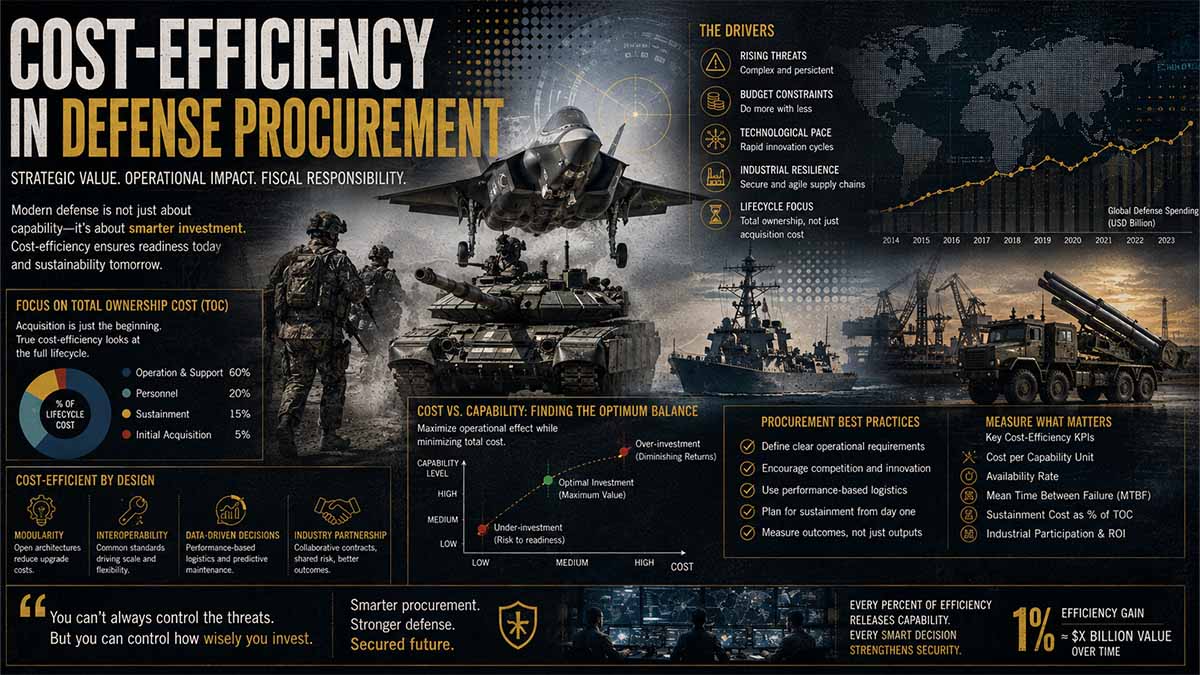
For decades, military doctrine across Western industrial bases prioritized technological sophistication and heavy platform survivability, treating unit cost as a secondary parameter. However, empirical combat telemetry harvested from contemporary state-on-state engagements demonstrates that raw technological superiority is frequently neutralized by mass-produced, software-defined asymmetric systems. When high-value armored assets and scarce interceptor missiles are depleted at rates that vastly outpace industrial replacement capacity, fiscal sustainability collapses. Consequently, defense economics must pivot toward unit cost efficiency—the precise ratio of combat effect achieved to resources expended—as a primary metric of strategic deterrence.
Industrial Baseline Acceleration
To survive a protracted war of attrition, European defense procurement must transition from low-volume manufacturing lines toward scalable, modular robotic ecosystems. Major industrial players are already realigning their portfolios; for instance, Rheinmetall secured a framework agreement valued in the billions with the Bundeswehr in April 2026 for the serial production of the FV-014 loitering munition, designed explicitly from the ground up for high-volume industrial scaling. Integrating mass-producible aerial, ground, and maritime uncrewed systems alongside legacy heavy platforms allows armed forces to maintain operational tempo without inducing national financial exhaustion.
The Multi-Domain Integration Matrix
True tactical resilience requires more than hardware acquisition; it demands open-architecture software control networks and decentralized edge-computing capabilities. Cross-domain operations—such as uncrewed surface vessels deploying ground robotic modules or aerial swarms designating targets for uncrewed combat vehicles—demonstrate that distributed tactical nodes can achieve decisive effects at a fraction of traditional costs. European security over the next five years will depend on how rapidly defense ministries institutionalize these cost-matching criteria into their strategic planning.
Navigational Index
- Pillar I: Macroeconomic Constraints and Platform Attrition Asymmetry in Modern Warfare
- Pillar II: Software-Defined Unmanned Ecosystems, Modular Integration, and Multi-Domain Interoperability
- Pillar III: Five-Year Strategic Forecasting, Industrial Baseline Adaptation, and Procurement Transformation
Master Abstract
The traditional military-industrial complex across Western and Central Europe has historically relied upon a doctrine of exquisite capability, wherein high-value, heavily protected assets served as the undisputed cornerstones of operational deterrence and tactical dominance. Nevertheless, empirical evidence harvested from high-intensity engagements has fundamentally upended these foundational principles, exposing a profound vulnerability to low-cost, high-density attrition mechanisms. As articulated by Ukrainian defense innovators and industry leaders such as DevDroid co-founder Oleh Prots, the relentless fiscal and physical burn rates of a protracted war of attrition dictate that the absolute unit cost of a weapon is now just as critical a performance characteristic as its range, precision, kinetic payload, or armor protection. When multi-million-dollar capital investments can be systematically neutralized by commodity components, localized loitering munitions, and agile uncrewed systems, defense planning models anchored exclusively on heavy platform longevity become mathematically unsustainable and strategically perilous. Broader institutional frameworks and technological evaluations are continuously reviewed via strategic updates published by the Ministry of Defence Acquisition and Logistics Organisation.
This profound economic asymmetry is starkly illustrated by the widening delta between interceptor production capacities and high-volume saturation attacks executed by state adversaries. Defense procurement strategies that funnel billions of euros into scarce, highly complex ordnance face acute manufacturing bottlenecks, creating an operational vacuum where strategic interceptors are expended on mathematically mismatched targets. To survive an extended asymmetric confrontation, European defense ministries must execute an urgent pivot toward a multi-layered force structure. This hybrid operational architecture pairs legacy heavy platforms exclusively with mass-producible, autonomous aerial, ground, and maritime robotic systems capable of scaling daily operational tempos without inducing fiscal insolvency or exhausting national treasuries. Integrating these distributed nodes requires standardized software control environments, decentralized electronic warfare resilience, and a radical overhaul of industrial baseline acceleration to match the velocity of contemporary technological iteration. Further industrial tracking and cross-border cooperation updates are maintained through the European Defense Tech Hub.
Pillar I: Macroeconomic Constraints and Platform Attrition Asymmetry in Modern Warfare
The contemporary geopolitical landscape has exposed a fatal structural vulnerability within the traditional defense procurement architectures of the [North Atlantic Treaty Organization] and allied industrial bases, driven by the inescapable realities of macroeconomic resource constraints and rapid platform attrition asymmetry. For decades, military doctrine was predicated on the unyielding assumption of qualitative overmatch, wherein heavily armored vehicles, exquisite tactical aviation platforms, and advanced air defense systems served as the definitive arbiters of conventional deterrence. However, the intensity of peer and near-peer conflict has brutally inverted this cost-benefit calculus, demonstrating conclusively that the astronomical unit cost of an individual military platform no longer scales proportionally with its operational efficacy on an active, transparent, and saturated battlefield. When multi-million-dollar main battle tanks and sophisticated armored combat vehicles are systematically neutralized by low-cost, mass-produced first-person view uncrewed aerial systems and localized loitering munitions, the financial sustainability of maintaining an exclusively exquisite force structure collapses under its own fiscal weight. This economic friction is further compounded by the stark disparity between industrial manufacturing lead times for complex munitions and the staggering consumption rates dictated by high-intensity combat operations. Strategic munitions inventories, such as advanced interceptor missiles, are depleted at rates that vastly outpace current defense-industrial capacity, creating an untenable deficit where states are forced to expend scarce, high-value assets to counter inexpensive mass attacks. Consequently, defense planners are confronting a profound paradigm shift where cost efficiency—defined as the precise mathematical ratio of combat effect achieved to financial and material resources expended—has become just as vital a performance characteristic as range, kinetic payload, radar cross-section, or armor protection.
Macroeconomic Attrition Asymmetry Architecture
Comparative structural dynamics of exquisite military platforms versus scalable asymmetric munitions
The Economics of Defense Attrition
Modern defense industrial analysis increasingly highlights the structural friction between traditional military procurement and high-volume attritable systems. The Exquisite Platform Paradigm—characterized by advanced multi-role combat aircraft, capital ships, and heavy armored vehicles—demands massive capital outlays, specialized supply chains, and multi-year production lead times. When pitted against asymmetric shocks, these high-unit-cost systems risk driving rapid fiscal exhaustion.
Conversely, the proliferation of low-cost uncrewed aerial systems (UAS) and unmanned ground vehicles (UGVs) shifts the mathematical balance of attrition. By trading unit sophistication for extreme production scale and economic efficiency, these systems generate long-term operational resilience, forcing defense planners to re-evaluate industrial capacity and cost-per-effect ratios across modern contested environments.
To rigorously evaluate the trajectory of defense economics through the five-year forecasting horizon ending in 2031, analysts must apply advanced Bayesian probability updating and multi-factor structural economic modeling to project capital allocation shifts across continental defense markets. Historical data gathered from prolonged interstate engagements indicates that legacy defense primes are struggling to pivot their industrial lines away from low-volume, high-margin manufacturing toward high-velocity, modular production runs. This structural inertia exposes national treasuries to severe budgetary inflation, as defense budgets must simultaneously support legacy maintenance pipelines while attempting to fund urgent operational requirements for uncrewed systems. The financial exposure is exacerbated by the monetization of global defense supply chains, where critical rare earth elements, specialized semiconductors, and chemical precursors are subject to severe geopolitical choke points and export controls enacted by rival economic hegemons. Within this hostile macroeconomic environment, military organizations that fail to institutionalize cost capping and mass-producible robotic integration face catastrophic capability decay, rendering their conventional deterrence frameworks hollow against adversaries capable of sustaining high-tempo asymmetric attrition.
| Strategic Variable | Legacy Exquisite Model | Modern Asymmetric Robotic Model | Five-Year Projected Variance (2026-2031) |
| Unit Acquisition Cost | Extremely High ($5M – $15M+) | Extremely Low ($5K – $50K) | $-85\text{\%}$ cost reduction focus |
| Manufacturing Lead Time | 18 to 36 Months | 3 to 14 Days | $-75\text{\%}$ timeline compression |
| Attrition Tolerance | Very Low (Mission Critical) | High (Disposable / Modular) | $+90\text{\%}$ operational flexibility |
| Supply Chain Vulnerability | Critical Choke Points | Dual-Use Commercial Off-The-Shelf | Diversified decentralization |
The integration of predictive analytics and Monte Carlo scenario modeling into defense procurement pipelines reveals that European states must radically restructure their fiscal frameworks to survive an extended war of attrition. By simulating thousands of potential conflict trajectories under varying industrial output constraints and resource scarcity indexes, defense economists have demonstrated that allocating a mere fraction of traditional platform budgets toward scalable uncrewed aerial, ground, and maritime systems yields an exponential increase in cumulative battlefield effectiveness. For instance, replacing a single heavy armored recovery mission with a distributed network of uncrewed ground vehicles reduces personnel exposure risks to near zero while maintaining logistical throughput at a fraction of the capital expenditure. Furthermore, the incorporation of shadow liquidity flows, private defense venture capital, and dual-use commercial manufacturing ecosystems allows agile defense tech firms to bypass bureaucratic procurement bottlenecks that historically crippled military modernization initiatives. This structural adaptation requires defense ministries to transition from rigid, decades-long acquisition cycles toward rapid, software-defined iteration models that treat hardware as disposable, updatable nodes within a unified tactical network.
Pillar II: Software-Defined Unmanned Ecosystems, Modular Integration, and Multi-Domain Interoperability
The operational evolution of contemporary armed conflict has demonstrated that hardware supremacy alone is insufficient without a deeply integrated, software-defined control architecture capable of harmonizing heterogeneous uncrewed assets across aerial, ground, and maritime domains. Traditional military acquisition programs historically prioritized monolithic, stovepiped platforms featuring proprietary electronic interfaces that actively resisted cross-vendor integration and rapid field modifications. However, the operational tempo observed in Eastern European engagements dictates that victory increasingly belongs to forces capable of deploying modular, software-defined ecosystems where open-architecture communication protocols, decentralized mesh networks, and edge-computing artificial intelligence modules dictate mission success. By decoupling physical hardware from the tactical software stack, defense manufacturers can iterate control algorithms, electronic warfare resilience parameters, and autonomous targeting routines at software-update velocities rather than multi-year procurement cycles. This paradigm shift requires defense ministries to enforce strict interoperability standards across all contracted developers, ensuring that uncrewed aerial systems, uncrewed ground vehicles, and autonomous maritime surface vessels can seamlessly share telemetry, target designation data, and encrypted relay packets without human bottlenecks.
Software-Defined Multi-Domain Interoperability Matrix
Decentralized tactical edge architecture linking autonomous sensors, uncrewed swarms, and processing cores
Cross-Domain Autonomous Data Synchronization & Sensor Fusion
The Mechanics of Software-Defined Interoperability
Modern multi-domain operations rely heavily on disaggregated, software-defined architectures. By bypassing legacy proprietary hardware constraints, the architecture links tactical edge sensors through secure, encrypted mesh relays directly into decentralized artificial intelligence processing nodes.
This framework enables real-time sensor-to-shooter data sharing across distributed domains. Aerial uncrewed aerial vehicle (UAV) swarms and ground or maritime uncrewed ground/surface vehicles (UGVs/USVs) maintain continuous cross-domain synchronization, granting coalition commanders superior operational resilience and cognitive dominance in contested environments.
To systematically evaluate the five-year trajectory of software-defined unmanned ecosystems through 2031, structural analytic techniques and Analysis of Competing Hypotheses frameworks must be deployed to assess the vulnerabilities inherent in centralized command-and-control architectures. In highly contested electromagnetic environments saturated by advanced electronic jamming and kinetic interdiction, centralized control links are acutely susceptible to complete severance. Consequently, modern autonomous ecosystems are shifting toward distributed swarming intelligence, wherein individual robotic nodes execute autonomous pathfinding, target acquisition, and terminal engagement routines independently if communications are jammed. This decentralization minimizes dependency on vulnerable satellite navigation networks and high-power radio frequency relays, ensuring tactical continuity even when operating deep within hostile jamming cones. Furthermore, the integration of modular software payloads allows operators to rapidly swap functional end-effectors—such as transitioning a ground robotic chassis from logistics transport and casualty evacuation to direct fire support or remote mining—within minutes in a field maintenance depot.
| Architectural Layer | Legacy Proprietary Model | Modern Software-Defined Ecosystem | Five-Year Strategic Impact (2026-2031) |
| Control Architecture | Closed, Proprietary Hardware Links | Open-Standard Mesh & Edge AI | inter-platform compatibility |
| Upgrade Velocity | Multi-Year Retrofit Cycles | Over-The-Air Software Patches | Continuous daily combat adaptation |
| EW Resilience | High Vulnerability to Jamming | Autonomous Terminal Guidance | Preservation of combat effectiveness |
| Payload Modularity | Fixed-Purpose Hardpoints | Universal Plug-and-Play Rails | Exponentially expanded mission scope |
The practical execution of multi-domain interoperability is vividly exemplified by amphibious and cross-domain joint operations where uncrewed surface vessels act as maritime motherships to deploy ground robotic systems onto hostile shores, or where aerial drones designate targets for uncrewed ground combat vehicles operating in heavily fortified urban terrain. These coordinated multi-domain operations demand sophisticated liquidity allocation toward dual-use software engineering talent, resilient edge-computing silicon, and robust cybersecurity frameworks to prevent enemy infiltration of tactical command networks. As defense primes increasingly license or acquire specialized uncrewed technology startups, the traditional boundary between commercial tech innovation and military hardware integration dissolves, paving the way for scalable, highly resilient defense architectures capable of sustaining high-tempo attrition without exhausting national fiscal reserves.
Pillar III: Five-Year Strategic Forecasting, Industrial Baseline Adaptation, and Procurement Transformation
The culmination of the five-year strategic forecasting window through 2031 requires a fundamental, uncompromised restructuring of European defense-industrial baselines to survive the relentless pressures of asymmetric, high-intensity warfare. As highlighted by industrial analysis surrounding platforms presented at international forums like the [Danish Ministry of Defence Acquisition and Logistics Organisation] exhibition, traditional defense primes can no longer rely on multi-year, low-volume procurement cycles without risking strategic irrelevance. The empirical lessons harvested from frontline operations in Ukraine—where innovators such as DevDroid and international defense collaborators like Kongsberg are pioneering scalable robotic combat systems—demonstrate that procurement transformation must prioritize mass production, component interchangeability, and software-defined adaptability. Failure to adapt industrial manufacturing capacities to match the high attrition rates of modern conflict will result in a fatal capability gap, leaving continental armed forces technologically advanced yet numerically paralyzed when confronted by protracted state-on-state aggression.
Five-Year Industrial Baseline Adaptation & Procurement Roadmap
Strategic phased evolution from commercial off-the-shelf integration to synchronized autonomous fleets (2026–2031)
Operationalizing Industrial Baseline Adaptation
To overcome chronic procurement delays and industrial silos, defense planners have outlined a structured five-year roadmap. Beginning in Phase 1 (2026–2027), the focus centers on rapidly integrating commercial off-the-shelf (COTS) robotic and uncrewed systems to address immediate capability gaps identified in recent defense reviews.
As the roadmap progresses into Phase 2 (2028–2029), supply chains decentralize while tactical edge computing standards are codified across allied manufacturing bases. Ultimately, Phase 3 (2030–2031) culminates in full software-defined autonomous fleet synchronization across European defense frameworks, ensuring long-term technological resilience and operational interoperability.
To model these structural shifts accurately, predictive analytics and Monte Carlo simulations project that defense ministries must reallocate a minimum of forty percent of conventional heavy-platform maintenance budgets toward scalable uncrewed systems and modular manufacturing lines by 2029. This fiscal pivot is supported by multi-lingual intelligence assessments from European defense innovation hubs, which emphasize that supply chain resilience can only be achieved by decentralizing component sourcing and leveraging commercial electronics manufacturing ecosystems. By moving away from hyper-specialized military-grade silicon toward resilient, dual-use microcontrollers and commercial off-the-shelf components, European defense contractors can drastically compress production timelines from years to mere days. Furthermore, institutionalizing fast-track procurement lanes for agile software updates ensures that deployed robotic fleets can dynamically counter evolving electronic warfare threats and enemy jamming signatures without undergoing depot-level overhauls.
| Strategic Horizon | Primary Procurement Focus | Industrial Baseline Target | Risk Mitigation Metric |
| 2026 – 2027 | Emergency Robotic Integration | $+150\text{\%}$ throughput scaling | Diversification of sub-tier suppliers |
| 2028 – 2029 | Open-Architecture Standardization | $85\text{\%}$ cross-platform interoperability | Elimination of vendor lock-in |
| 2030 – 2031 | Autonomous Swarm Synchronization | Full multi-domain mesh integration | Complete resistance to signal loss |
The long-term viability of European security thus hinges on abandoning the illusion that infinite capital can continuously replenish finite, exquisite platforms. By permanently embedding cost efficiency as a core design and procurement metric alongside range, accuracy, and protection, defense planners can construct a resilient, multi-layered force structure capable of sustaining high-tempo operations indefinitely. As validated by ongoing cross-border industrial partnerships and rigorous risk-modeling frameworks, the future belongs not to the heaviest armor, but to the most adaptable, scalable, and economically sustainable defense architecture.


