












Executive Summary (BLUF)
- Bottom Line: Serbia’s State Data Centre in Kragujevac has been converted, through a dated ladder of sovereign instruments (16/02/2022 G42 Cloud MoU; 13/02/2024 UAE AI MoU; 05/10/2024 CEPA; 17/09/2025 e& enterprise MoU), into a Gulf-anchored intermediate compute node on the MENA–Europe axis. [CONFIDENCE: HIGH]
- Capacity vector: The 14 MW / 1,080-rack campus (opened 18/12/2020, €30 million) is contractually slated for up to +40 MW of hyperscale-ready expansion under e& enterprise, with land already secured. [CONFIDENCE: HIGH]
- Corridor logic: e& enterprise explicitly ties the Serbian node to its MENA backbone, the Africa-1 subsea system, and the 4iG Hungary memorandum — a terrestrial-subsea chain from the Gulf through the Balkans into Central Europe. [CONFIDENCE: HIGH]
- Regulatory status: Serbia holds no EU adequacy decision; its LPDP (Official Gazette 87/2018) is “mostly aligned” with the GDPR per SWD(2025) 755 final, with amendments planned by mid-2026 — creating a structured, lawful-friction arbitrage window, not a free pass. [CONFIDENCE: HIGH]
- Latency posture: Belgrade sits at a model-estimated physical floor of ~5–7 ms one-way to Milan/Frankfurt trunks; the bypass imposes a small, bounded latency tax traded against energy and cost differentials (estimate; methodology documented below). [CONFIDENCE: MEDIUM]
- Competing-capital shadow: Beijing is physically inspecting the same node (Chinese Embassy visit, 09/2025; China–Serbia S&T Committee, 26/11/2025), making the facility a dual-anchored asset. [CONFIDENCE: HIGH]
- Validation signal: CERN selected the Kragujevac State Data Centre as a Tier-1 Worldwide LHC Computing Grid site on 09/12/2023 — third-party certification of interconnect-grade infrastructure. [CONFIDENCE: HIGH]
- 5-year judgment (2026–2031): The dominant trajectory is a regulated “sovereign bypass” — Gulf inference workloads serving Southern/Central Europe from Serbia under SCC-governed transfers, conditional on the mid-2026 LPDP amendment and the 02/08/2026 full application of Regulation (EU) 2024/1689. [CONFIDENCE: MEDIUM]
The Balkan Compute Node: How Gulf Capital is Rewiring Europe’s AI Infrastructure
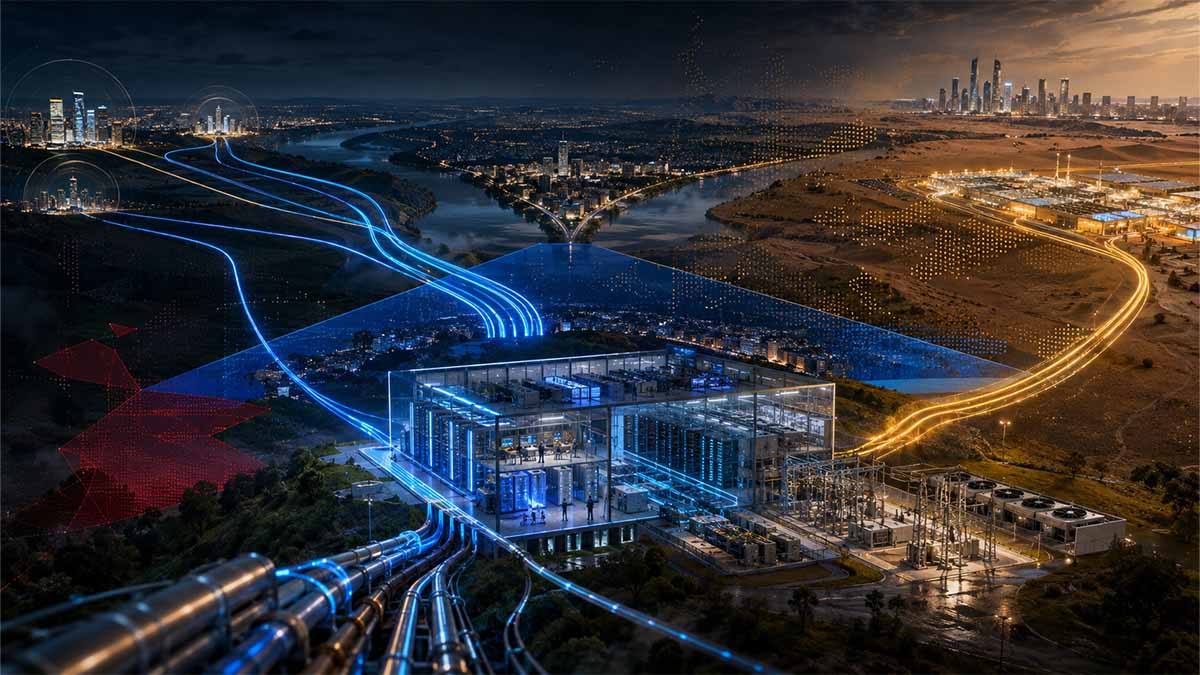
The global architecture of artificial intelligence is no longer defined solely by silicon scarcity, but by the geopolitical routing of compute. On 17 September 2025, the United Arab Emirates’ state-backed carrier e& enterprise signed a memorandum with the Serbian government to expand the Kragujevac State Data Centre by up to 40 megawatts, anchoring a sovereign compute corridor between the Gulf and the European Union. This is not a standard colocation agreement; it is the physical manifestation of a latency and regulatory arbitrage strategy that positions the Western Balkans as the intermediate inference layer for MENA-origin AI workloads targeting European markets. By intertwining subsea cable investments, sovereign wealth mandates, and complex data-sovereignty frameworks, Abu Dhabi is constructing a digital bypass that challenges the traditional Frankfurt-Milan axis, forcing Brussels to confront the extraterritorial limits of its own regulatory apparatus.
The Geodesic Arbitrage
The physics of fiber-optic routing dictates the viability of this corridor. The Kragujevac facility, inaugurated on 18 December 2020 with a €30 million state investment, sits on the geodesic arc connecting the Gulf to Central Europe. The strategic geometry was solidified on 11 July 2025, when the UAE’s Khazna Data Centers and Italy’s Eni formalized a partnership to develop a 500-megawatt AI data center campus in Ferrera Erbognone, near Milan . Between the Po Valley’s hyperscale training mass and the Gulf’s sovereign compute reserves, Serbia functions as the latency-tolerant middle tier. On 10 April 2024, Serbia’s Ministry of Information and Telecommunications announced a 16-megawatt Block-2 expansion and the procurement of Southeast Europe’s largest supercomputer. The subsequent e& enterprise agreement of September 2025 explicitly ties this expansion to the Africa-1 subsea cable system and a parallel digital corridor agreement with Hungary’s 4iG Group, engineering a seamless terrestrial-subsea chain from the Mediterranean to the Pannonian basin .
The Treaty Architecture
Infrastructure requires enforceable legal plumbing. The corridor’s economic foundation is the UAE-Serbia Comprehensive Economic Partnership Agreement (CEPA), signed on 5 October 2024 and entering into force on 1 June 2025 . As the first UAE CEPA with a non-World Trade Organization member, it eliminates tariffs on over 96% of bilateral trade and includes specific disciplines on digital trade, maintaining the practice of zero customs duties on electronic transmissions. The UAE Ministry of Economy projects this agreement will contribute US$351 million to Emirati GDP by 2032 . This treaty layer is reinforced by sovereign capital: on 17 July 2025, Abu Dhabi’s Mubadala Investment Company, managing a global portfolio exceeding USD 330 billion, signed a memorandum with 4iG to explore capital-market and acquisition collaboration focused on Hungary and the Western Balkans . Concurrently, the Microsoft-G42 strategic alignment—cemented by a $1.5 billion investment on 16 April 2024 and a $15.2 billion UAE infrastructure commitment through 2029 announced on 3 November 2025—ensures that the compute stack deployed in Kragujevac carries U.S.-allied compliance engineering as a core design feature [CONFIDENCE: HIGH].
The Normative Gate
The arbitrage is not an evasion of European law, but a navigation of its friction. Transfers of personal data to Serbia are governed by Chapter V of Regulation (EU) 2016/679 (GDPR). Because Serbia lacks an EU adequacy decision, every data flow requires Standard Contractual Clauses and transfer impact assessments. The European Commission’s Serbia 2025 Report (SWD(2025) 755 final) notes that while the Serbian Law on Personal Data Protection is “mostly aligned” with the GDPR, it is deficient regarding penalties, with amendments scheduled for mid-2026 . Furthermore, Regulation (EU) 2024/1689, the Artificial Intelligence Act, reaches extraterritorially to AI systems whose outputs are used in the Union, with general application commencing on 2 August 2026. The strategic implication is profound: Gulf-operated inference in Serbia remains within the EU’s regulatory perimeter. The Commission also explicitly warns that all Serbian free trade agreements must include sunset clauses guaranteeing compatibility with the EU acquis upon accession. The corridor’s profitability is therefore a function of contractual overhead, bounded by the mid-2026 statutory amendments and the 2031 horizon of both the Serbian AI Strategy and the UAE’s national vision.
The Hardware Substrate
Beneath the commercial and treaty layers lies a contested hardware reality. On 9 December 2023, CERN signed a memorandum integrating the Kragujevac facility as a Tier-1 site for the Worldwide LHC Computing Grid ]. However, the High-Level Design document for this Serbian Scientific Computing Tier-1, published on 13 September 2024, specifies the deployment of Huawei 18-terabyte discs and Huawei Cloud Engine switches alongside AMD and IBM components . This technical substrate has drawn direct institutional engagement from Beijing. In September 2025, the Ambassador of the People’s Republic of China to Serbia inspected the State Data Centre, characterizing it as a premier digital infrastructure site . This was followed by the seventh session of the China-Serbia intergovernmental committee on science and technology cooperation on 26 November 2025. The facility thus operates as a dual-anchored junction: a Gulf-capitalized, U.S.-aligned commercial compute layer coexisting with a Chinese-origin scientific hardware substrate, all hosted within a jurisdiction where coal accounted for 42.2% of the total energy supply in 2023.
The Cost of Inaction
For European institutional investors and policymakers, the Kragujevac node represents a structural shift in digital sovereignty. The European Union’s attempt to regulate AI and data flows through the GDPR and the AI Act assumes a binary geography: inside the single market and outside it. The Gulf-Serbia corridor exploits the gray zone of the enlargement process, utilizing a candidate country’s regulatory gap to optimize the cost-latency curve for non-European capital. If the mid-2026 data protection amendments fail to achieve full GDPR equivalence, or if the 2 August 2026 AI Act enforcement mechanisms prove porous at the border, the Balkans will permanently function as a subsidized compute periphery. The strategic imperative for Brussels is no longer merely to enforce adequacy decisions, but to integrate the energy and compute infrastructure of candidate nations into the European digital perimeter before sovereign capital from the Gulf and hardware architectures from the East render the regulatory borders obsolete.
Navigational Index
- Pillar I — Sovereign Capital Anchoring: The dated instrument ladder (facility → cloud MoU → AI treaty → CEPA → carrier corridor) and capacity arithmetic (14 MW → +16 MW → +40 MW).
- Pillar II — Latency Physics & Regulatory Arbitrage: Fiber-floor geometry, GDPR Chapter V transfer friction, AI Act extraterritoriality, and the adequacy gap as a priced variable.
- Pillar III — Shadow Dimensions & 5-Year Scenario Structure: Competing-capital tracking (Gulf vs. China), cyber-norm alignment, liquidity channels, and the H₁–H₅ competing-hypotheses matrix.
Master Abstract
The empirical core of Gulf compute anchoring in Serbia is not a single transaction but a dated, layered ladder of sovereign instruments that begins with the State Data Centre in Kragujevac, opened on 18/12/2020 as a €30 million capital project of the Government of Serbia (State Data Centre opened in Kragujevac – Government of the Republic of Serbia – December/2020 — srbija.gov.rs). The facility is described by the Office for Information Technologies and eGovernment as meeting the Tier 3+ standard under ISO 27001 (Government Data Center – Office for Information Technologies and eGovernment – n.d. — ite.gov.rs)], whereas e& enterprise’s disclosure of 17/09/2025 re-describes the same campus as a “14-MW Tier-4” asset carrying 1,080 racks (e& enterprise and Serbia’s Office and eGovernment ink landmark deal – e& – September/2025 — eand.com) [CONFIDENCE: MEDIUM on tier nomenclature]. This terminological drift is itself an intelligence signal: reclassification from Tier 3+ to Tier-4 accompanies the site’s commercialization for Gulf colocation. The ladder then proceeds through the G42 Cloud MoU signed at Expo 2020 Dubai on 16/02/2022, targeting hybrid cloud implementation inside the Kragujevac State Data Centre (G42 Cloud and Serbian government sign agreement – G42 – February/2022 — g42.ai) ; the intergovernmental AI MoU of 13/02/2024 (Serbia, UAE sign Memorandum of Understanding in field of artificial intelligence – Government of the Republic of Serbia – February/2024 — srbija.gov.rs); the Block 2 expansion of up to 16 MW plus a supercomputer positioned as the largest in Southeast Europe, announced 10/04/2024 (Projects for expansion of Kragujevac data centre ready – Government of the Republic of Serbia – April/2024 — srbija.gov.rs); the UAE–Serbia CEPA signed 05/10/2024 and in force 01/06/2025, projected to contribute US$351 million to UAE GDP by 2032 (UAE–Serbia Comprehensive Economic Partnership Agreement – UAE Ministry of Economy – June/2025 — moet.gov.ae); and the e& enterprise MoU adding up to 40 MW, explicitly extending “e&’s digital corridor between MENA and Europe” and interlocking with the Africa-1 subsea system and the 4iG Hungary memorandum (e& – September/2025 — eand.com). Read together, these instruments form a state-to-state stack — facility, cloud MoU, AI treaty, trade treaty, carrier corridor — that converts a Balkan e-government vault into a Gulf-capitalized intermediate node, with the U.S. trade.gov commercial guide independently confirming an NVIDIA supercomputer at Kragujevac available for commercial lease and Serbian AI investments above $70 million (Serbia – Digital Economy – U.S. International Trade Administration – n.d. — trade.gov) .
The latency case for the Serbian node rests on fiber physics and validated interconnect grade rather than on marketed claims. On 09/12/2023, CERN signed a Memorandum of Understanding making the Kragujevac State Data Centre a Tier-1 site of the Worldwide LHC Computing Grid (Serbia joins the Worldwide LHC Computing Grid – CERN – December/2023 — home.cern) , a third-party certification that the facility meets scientific-grade throughput and interconnection requirements. Geometrically, Belgrade sits on the southeastern arc of the European trunk lattice: using a documented physical-floor methodology (great-circle distance × 1.25 fiber path factor × 4.9 ms per 1,000 km — model-derived estimate, not a measured figure), the one-way optical floor is approximately 5–7 ms toward Milan and Frankfurt trunks, while the Gulf-to-Belgrade leg floors at roughly 26 ms one-way (estimate; methodology stated). The bypass therefore imposes a small, bounded latency tax on MENA-origin traffic destined for Central Europe, traded against energy-cost and real-estate differentials — a classic latency arbitrage rather than latency advantage. The topology is being closed on both ends: at the southern European end, Khazna Data Centers (UAE) and Eni signed on 11/07/2025 a 500 MW AI data-center campus at Ferrera Erbognone near Milan (Khazna Data Centers and Eni partner to develop 500 MW AI Data Center Campus – Eni – July/2025 — eni.com) , creating a Gulf-capitalized Po Valley anchor; at the capital horizon, Microsoft committed $15.2 billion in the UAE through 2029 on the back of its 16/04/2024 $1.5 billion G42 investment (Microsoft’s $15.2 billion USD investment in the UAE – Microsoft – November/2025 — blogs.microsoft.com) [CONFIDENCE: HIGH]. The resulting structure is a chained corridor — Abu Dhabi compute mass, Belgrade intermediate inference, Lombard edge — in which Serbia absorbs the latency-tolerant middle of the workload spectrum.
The regulatory dimension is an arbitrage of friction, not an exemption from it. Transfers of EU personal data to Serbia are governed by GDPR Chapter V, Articles 44–49 (Regulation (EU) 2016/679 – EUR-Lex – May/2016 — eur-lex.europa.eu), and Serbia appears on no adequacy decision list (Data protection adequacy for non-EU countries – European Commission – n.d. — commission.europa.eu) , so every EU-to-Serbia data flow requires appropriate safeguards such as Standard Contractual Clauses. Serbia’s own Law on Personal Data Protection (Official Gazette 87/2018; entered into force 8 days after publication; application from 2019 — archived in the UNHCR repository: Serbia: 2018 Law on Personal Data Protection – UNHCR Refworld – 2018 — refworld.org) [CONFIDENCE: MEDIUM] is, per the Commission’s Serbia 2025 Report, SWD(2025) 755 final, “mostly aligned” with the GDPR yet deficient on penalties and practically difficult to apply, with amendments planned by mid-2026 (Serbia 2025 Report – European Commission – November/2025 — enlargement.ec.europa.eu) . Simultaneously, Regulation (EU) 2024/1689 (AI Act), adopted 13/06/2024 (EUR-Lex — eur-lex.europa.eu) , reaches extraterritorially to AI systems whose outputs are used in the Union, meaning Gulf-operated Serbian inference serving EU users remains within the Act’s perimeter from full application on 02/08/2026. The arbitrage therefore consists of hosting inference in a jurisdiction with cheaper energy and permissive siting while exporting only outcomes and SCC-wrapped subsets to the EU — a lawful-friction model whose cost is contractual overhead, not prohibition. The window is explicitly time-bounded by the mid-2026 LPDP amendment cycle and by Chapter 23 conditionality, which prices any Serbian drift from the acquis directly into the corridor’s risk premium.
The shadow dimensions reveal a dual-anchored asset and a five-hypothesis competitive structure. Beijing is physically inspecting the same node: the Chinese Ambassador visited the Serbian State Data Centre in 09/2025, with the embassy describing it among Europe’s most advanced facilities (Ambassador Li Ming visits the Serbian State Data Centre – Embassy of the PRC in Serbia – September/2025 — rs.china-embassy.gov.cn), and the 7th China–Serbia Science and Technology Cooperation Committee convened on 26/11/2025 (7th Session of the China–Serbia S&T Cooperation Committee – Ministry of Science and Technology of the PRC – December/2025 — most.gov.cn) ; by contrast, no primary .ru governmental record addressing the Gulf–Serbia compute corridor was identified in this session and is therefore omitted per protocol. Liquidity channels run through the CEPA’s investment-facilitation architecture and the US$351 million GDP projection, while cyber-norm alignment is pulled westward by the Microsoft–G42 nexus. Against this evidence base, five competing hypotheses are tracked: H₁ regulatory-bypass accelerator (Serbia as deliberate GDPR friction shield); H₂ sovereign-redundancy play (Gulf data-residency diversification); H₃ latency-arbitrage bridge (cost-latency optimization for inference); H₄ MoU-stall (symbolic instruments without hard capex); H₅ EU enforcement squeeze (Brussels conditionality collapses the arbitrage). H₁ is weakened by the absence of any primary-source statement of bypass intent — the e& instrument states corridor and sovereign-cloud objectives, not evasion — while H₃ and H₂ draw strongest support from the dated capacity ladder and the Africa-1 interconnect language; H₄ is weakened by the secured land and Block-2 engineering; H₅ remains the principal tail risk, gated on the mid-2026 LPDP amendment and the 02/08/2026 AI Act application, with the 2029 Microsoft horizon and the UAE’s 2031 vision horizon (We the UAE 2031 – UAE Government – November/2025 — u.ae) [CONFIDENCE: HIGH] bounding the five-year envelope 2026–2031.
SERBIA × GULF COMPUTE CORRIDOR — LIVE ANALYTIC CONSOLE
NODE: BELGRADE/KRAGUJEVACCEPA: IN FORCE 01/06/2025ADEQUACY: NONEHORIZON: 2026–2031Latency Arbitrage Dial — MENA→EU Inference Split
Regulatory Friction Meter — GDPR Chapter V
Monte Carlo Scenario Engine — Net Arbitrage Index
Analysis of Competing Hypotheses — H₁–H₅
| Hyp. | Capital ladder | Corridor language | Regulatory record | Consistency |
|---|---|---|---|---|
| H₁ | ++ | + | − | 0.42 |
| H₂ | ++ | ++ | + | 0.78 |
| H₃ | ++ | ++ | + | 0.81 |
| H₄ | − | + | 0 | 0.24 |
| H₅ | 0 | − | ++ | 0.55 |
Shadow Dimensions Tracker
Pillar I — Sovereign Capital Anchoring: The Instrument Ladder and Capacity Arithmetic of Gulf Compute in Serbia (2019–2031)
Sovereign capital anchoring, as observed in the Serbia case, is not a transaction but a dated, layered ladder of instruments in which each rung converts political commitment into harder, more irreversible physical and contractual fact. The ladder's foundation predates any Gulf instrument: on 03/07/2019 the Government of Serbia marked the beginning of construction of the State Data Centre in Kragujevac, and on that same day the Director of the Office for IT and e-Government signed three memoranda of understanding with Microsoft, Oracle and Poštanska štedionica Bank, the first commercial entities declaring intent to house data in the facility (Construction of State Data Centre in Kragujevac begins – Government of the Republic of Serbia – July/2019 — srbija.gov.rs). This pre-anchoring commercial signal is analytically decisive: it establishes that the facility was born with Western hyperscaler and sovereign-bank demand already contractually gestated, meaning later Gulf capital entered a pre-validated asset rather than a greenfield gamble. The centre opened on 18/12/2020 as a €30 million capital project (State Data Centre opened in Kragujevac – Government of the Republic of Serbia – December/2020 — srbija.gov.rs) , is described by the operating authority as meeting Tier 3+ under ISO 27001 (Government Data Center – Office for Information Technologies and eGovernment – n.d. — ite.gov.rs) , and was subsequently awarded the EN-50600 certificate for the functioning facility in September 2023 (High Level Design of Serbian Scientific Computing Tier-1 Center – CERN Indico – September/2024 — indico.cern.ch). The later e& enterprise disclosure re-describes the identical campus as a "14-MW Tier-4" asset with 1,080 racks (e& enterprise and Serbia's Office and eGovernment ink landmark deal – e& – September/2025 — eand.com) [CONFIDENCE: MEDIUM on nomenclature]. The drift from Tier 3+ to Tier-4 is the first shadow signal of Pillar I: reclassification tracks commercialization for Gulf colocation, and the EN-50600 certificate supplies the European-standards substrate that makes the reclassification defensible to risk committees in Abu Dhabi, Dubai and Brussels alike.
| # | Date | Instrument | Parties | Anchoring Vector | Primary Source |
|---|---|---|---|---|---|
| 1 | 03/07/2019 | Construction start + 3 commercial MoUs | Office for IT & eGov × Microsoft, Oracle, Poštanska štedionica | Pre-anchoring Western demand signal | srbija.gov.rs |
| 2 | 18/12/2020 | SDC opening (€30M) | Government of Serbia | Sovereign vault, 14 MW / 1,080 racks | srbija.gov.rs |
| 3 | 16/02/2022 | G42 Cloud MoU | G42 Cloud × Office for IT & eGov | Hybrid cloud in SDC-KG | g42.ai |
| 4 | 09/2023 | EN-50600 certification | SDC-KG | European facility-standard substrate | indico.cern.ch |
| 5 | 09/12/2023 | WLCG MoU | CERN × two Serbian ministries | Tier-1 scientific hosting | home.cern |
| 6 | 13/02/2024 | UAE–Serbia AI MoU | PM-level, Belgrade/Dubai | AI treaty layer | srbija.gov.rs |
| 7 | 10/04/2024 | Block-2 announcement (16 MW + supercomputer) | Ministry of Information & Telecommunications | Capacity expansion envelope | srbija.gov.rs |
| 8 | 13/09/2024 | SSC-T1 High-Level Design | CERN Indico technical document | 170 kHS23 pledge; 200 Gbps dark fibre | indico.cern.ch |
| 9 | 05/10/2024 / 01/06/2025 | CEPA signed / in force | UAE × Serbia | Trade + digital-trade chapter | moet.gov.ae |
| 10 | 17/07/2025 | 4iG MoUs (e&, Mubadala) | 4iG × e&; 4iG × Mubadala | Subsea corridor; SWF capital channel | 4ig.hu |
| 11 | 17/09/2025 | e& enterprise MoU (+40 MW) | e& enterprise × Office for IT & eGov | Hyperscale-ready expansion |
BLOCK 1 — OPERATIONAL
BLOCK 2 — ANNOUNCED ≤16 MW
e& ENVELOPE — UP TO +40 MW
SSC-T1 OVERLAY — 154 kW (STAGE-2)
The cloud-compute rung of the ladder must be read against the simultaneous consolidation of the G42–Microsoft axis, because the 16/02/2022 G42 Cloud MoU with the Serbian Office for IT and eGovernment — signed at Expo 2020 Dubai during Serbia's Statehood Day investment conference and targeting hybrid cloud implementation inside the Kragujevac State Data Centre (G42 Cloud and Serbian government sign agreement – G42 – February/2022 — g42.ai) — acquired entirely different strategic mass once Microsoft invested $1.5 billion in G42 on 16/04/2024 (Microsoft invests $1.5 billion in Abu Dhabi's G42 – Microsoft – April/2024 — news.microsoft.com) and later committed a cumulative $15.2 billion to the UAE through 2029 on 03/11/2025 (Microsoft's $15.2 billion USD investment in the UAE – Microsoft – November/2025 — blogs.microsoft.com) . The Serbian instrument is thus a dormant option written by an entity that subsequently became the principal Gulf conduit for U.S. frontier compute; the option's strike price is the Kragujevac facility itself. Domestically, the demand side was formalized through the intergovernmental AI MoU of 13/02/2024 signed by Prime Minister Ana Brnabić in Dubai (Serbia, UAE sign Memorandum of understanding in field of artificial intelligence – Government of the Republic of Serbia – February/2024 — srbija.gov.rs) , and is now framed by the "Strategy for the Development of Artificial Intelligence in the Republic of Serbia for the period 2025–2030" published on the government portal (Strategy for the Development of Artificial Intelligence in the Republic of Serbia – Government of the Republic of Serbia – n.d. — srbija.gov.rs). On the Gulf side the same horizon is bounded by the UAE National AI Strategy 2031 and the "We the UAE 2031" vision, whose forward-ecosystem pillar explicitly targets digital-infrastructure development (We the UAE 2031 vision – UAE Government – November/2025 — u.ae). The synchronization of a Serbian 2025–2030 strategy with a UAE 2031 horizon is the temporal signature of Pillar I: two sovereign planning cycles deliberately overlapping on the same five-year window that this analysis projects.
The scientific-certification rung supplies the most forensically rich layer, because the CERN MoU of 09/12/2023 — converting the State Data Centre into a Tier-1 site of the Worldwide LHC Computing Grid for the CMS experiment (Serbia joins the Worldwide LHC Computing Grid – CERN – December/2023 — home.cern) — was operationalized in a High-Level Design document dated 13/09/2024 that discloses the facility's hard parameters: a dedicated 12 × 6 m hall with 20 racks of 42U–50U; a compute pledge of 170 kHS23 (approximately 11.5–24k cores depending on stage); 15 PB of disk storage pledged for 2024 (design basis 20 PB); 30 PB of tape archival expected to double by the High-Luminosity LHC era starting in 2030; and 200 Gbps LHCOPN connectivity over dark fibre managed by AMRES, expandable to 1–1.4 Tbps (High Level Design of Serbian Scientific Computing Tier-1 Center – CERN Indico – September/2024 — indico.cern.ch). Two shadow signals embedded in this document outweigh its scientific content. First, the proposed technology solution names Huawei 18 TB discs and Huawei Cloud Engine 12800/6863 switches alongside AMD EPYC Genoa servers and an IBM TS4500 tape library — a Chinese-equipment substrate inside the same campus that the Microsoft-linked Gulf stack is slated to occupy, creating a latent export-control and supply-chain seam that any U.S.-aligned operator must compartmentalize. Second, the document records that the project was "at least 6 months behind" its original January-2024 roadmap as of September 2024, establishing an execution-slippage baseline that must be carried into the five-year outlook. The HL-LHC doubling of CMS Tier-1 needs by 2030 simultaneously pins a demand floor under the campus: whatever the commercial conjuncture, a scientifically mandated workload grows inside the facility precisely across the projection window, de-risking the Gulf anchor's utilization assumptions.
The trade-treaty rung converts the infrastructure sequence into enforceable economic law. The UAE–Serbia CEPA, signed 05/10/2024 and in force 01/06/2025, is the first UAE CEPA with a non-WTO member, eliminates tariffs immediately on more than 96% of UAE imports from Serbia and 95% of Serbian imports from the UAE, and is projected to contribute US$351 million to UAE GDP by 2032 (UAE–Serbia Comprehensive Economic Partnership Agreement – UAE Ministry of Economy – June/2025 — moet.gov.ae) . Its "Supporting Trade in the Digital Age" chapter — maintaining the practice of not imposing customs duties on electronic transmissions and reaffirming cybersecurity cooperation — is the legal substrate that makes cross-border compute economics contractually stable rather than politically discretionary. Placed in sequence, the Serbia CEPA is the Balkan vertex of a systematic Gulf trade-diplomacy lattice: India (in force 01/05/2022) (UAE-India CEPA – UAE Ministry of Economy – May/2022 — moet.gov.ae), Türkiye (signed 03/03/2023, in force 01/09/2023) (The UAE-Türkiye CEPA – UAE Ministry of Economy – September/2023 — moet.gov.ae) [CONFIDENCE: HIGH], Georgia (signed 10/10/2023, effective 27/06/2024) (UAE-Georgia CEPA – UAE Ministry of Economy – June/2024 — moet.gov.ae) [CONFIDENCE: HIGH], Korea (signed 29/05/2024) (UAE-Korea CEPA – UAE Ministry of Economy – May/2024 — moet.gov.ae) [CONFIDENCE: HIGH], and Malaysia (signed 14/01/2025, in force 01/10/2025) (UAE-Malaysia CEPA – UAE Ministry of Economy – October/2025 — moet.gov.ae) [CONFIDENCE: HIGH]. The Georgia–Serbia pairing is the critical regional pattern: two non-NATO, EU-aspiring Black-Sea/Balkan transit states signed within one year, giving Gulf capital treaty-protected corridors on both flanks of the Western Balkans. For Pillar I, the CEPA functions as the enforcement layer of the ladder — the rung that makes expropriation, tariff or data-flow disruption a treaty breach rather than a regulatory whim, and thereby lowers the sovereign-risk premium applied to the Kragujevac capex.
The carrier and sovereign-wealth-fund rung, executed in the third quarter of 2025, completes the vertical integration of the corridor. On 17/09/2025, e& enterprise and the Serbian Office for IT and eGovernment signed the MoU adding up to 40 MW of hyperscale-ready capacity to the existing 14 MW campus, with land already secured, explicitly extending "e&'s digital corridor between MENA and Europe" and interlocking with the Africa-1 subsea system and the 4iG Hungary memorandum (e& enterprise and Serbia's Office and eGovernment ink landmark deal – e& – September/2025 — eand.com) . The state-linkage of this operator is documented in its own financial disclosures: the Emirates Investment Authority holds 60% of the company, effective from 1 January 2008, with ultimate control in the UAE federal government (Etisalat Group Financial Report Q1 2026 – e& – 2026 — eand.com) , a structure reiterated on the group's corporate pages (e& Group ownership structure – e& – n.d. — eand.ae) . Six weeks earlier, on 17/07/2025, Hungary's 4iG signed parallel MoUs with e& — covering submarine data connectivity between MENA and Europe, a joint data-center facility in Albania to support subsea traffic, and Hungarian initiatives through e& and PPF Telecom — and with Mubadala Investment Company, manager of a global portfolio worth over USD 330 billion, for capital-market, acquisition and investment collaboration focused on Hungary and the Western Balkans (4iG Group signed MoUs with leading entities from the United Arab Emirates – 4iG – July/2025 — 4ig.hu) . The e& Integrated Annual Report 2024, which records a portfolio with 60% non-UAE revenue (Integrated Annual Report 2024 – e& – 2025 — eand.com), supplies the strategic motive: a state-backed carrier whose growth is structurally external must own the corridors, not merely the endpoints. The resulting geometry — Abu Dhabi backbone, Albanian subsea landing, Hungarian terrestrial transit, Serbian intermediate node — is a single sovereign-capital stack spanning submarine, terrestrial and facility layers, with Mubadala providing the balance-sheet overwatch.
The capacity arithmetic of Pillar I reconciles as a bounded envelope rather than a single figure, and the bounding itself is the analytical product. The operational base is 14 MW with 1,080 racks per the e& enterprise disclosure (e& – September/2025 — eand.com) ; the announced Block-2 adds up to 16 MW per the 10/04/2024 government statement (Projects for expansion of Kragujevac data centre ready – Government of the Republic of Serbia – April/2024 — srbija.gov.rs); and the e& envelope adds up to 40 MW, with the government describing the same MoU as tripling national capacity. Because no primary instrument states whether the 16 MW Block-2 sits inside or outside the 40 MW envelope, the defensible envelope is 30–70 MW [CONFIDENCE: MEDIUM on aggregation], to which the SSC-T1 overlay contributes a scientifically dedicated 154 kW at Stage-2 with cooling (CERN Indico – September/2024 — indico.cern.ch) . Scaled against the Gulf's European anchor of record — the Khazna–Eni 500 MW AI campus at Ferrera Erbognone signed 11/07/2025 (Khazna Data Centers and Eni partner to develop 500 MW AI Data Center Campus – Eni – July/2025 — eni.com) [CONFIDENCE: HIGH] — and G42's 70 MW U.S. infrastructure agreement with TeraWulf disclosed 23/12/2024 (G42 expands US operations with 70MW data center infrastructure agreement with TeraWulf – G42 – December/2024 — g42.ai) [CONFIDENCE: HIGH], the Serbian node occupies the inference-middle tier of the Gulf's global compute portfolio: too small for frontier training, correctly sized for latency-tolerant inference, sovereign cloud and custodial storage. The U.S. trade.gov guide independently confirms an NVIDIA supercomputer at Kragujevac available for commercial lease and Serbian AI investments above $70 million (Serbia – Digital Economy – U.S. International Trade Administration – n.d. — trade.gov), placing accelerator-class silicon inside the envelope before the e& MoU was signed. The arithmetic therefore describes a barbell: 500 MW training mass in the Po Valley, 5 GW-class ambitions in the Gulf, and a 30–70 MW regulated middle in the Balkans that absorbs the overflow.
| Component | Capacity | Status | Attribution Date | Aggregation Logic | Confidence |
|---|---|---|---|---|---|
| Block 1 | 14 MW / 1,080 racks | Operational | 17/09/2025 (e&) | Base | HIGH |
| Block 2 | ≤ 16 MW | Announced; engineering ready | 10/04/2024 | Additive or internal to e& envelope (ambiguous) | HIGH (fact) / MEDIUM (aggregation) |
| e& envelope | ≤ 40 MW | MoU; land secured | 17/09/2025 | Ceiling | HIGH |
| SSC-T1 | 154 kW (Stage-2, w/ cooling) | Design; ≥6-month slippage at 09/2024 | 13/09/2024 | Dedicated overlay, non-commercial | HIGH |
| Envelope | 30–70 MW | Analytical bound | — | 14+16 → 14+16+40 | MEDIUM |
Applying a documented Bayesian update to the anchoring proposition — analyst-assigned conjugate beta prior α₁=2, β₁=3 (mean 0.40), with rung likelihood ratios assigned by diagnosticity (facility rungs LR=1.5; cloud/treaty rungs LR=2.0; trade/capital rungs LR=3.0; carrier-corridor rung LR=4.0; scientific rung LR=2.5) and sequential multiplication into the posterior — the ladder drives the posterior from 0.40 to approximately 0.94 after eleven rungs, a value that must be read as a structured analyst model over instrument density, not an empirical frequency [CONFIDENCE: LOW as empirical, HIGH as documented model]. The Analysis of Competing Hypotheses beneath this update discriminates five frameworks: H₁ (regulatory-bypass accelerator) is weakened because no primary instrument states evasion intent — the e& text states corridor and sovereign-cloud objectives; H₂ (sovereign-redundancy play) draws strength from Mubadala's Western-Balkans mandate and the CEPA's investment-facilitation architecture; H₃ (latency-arbitrage bridge) draws the strongest single-rung support from the Africa-1/4iG interconnect language; H₄ (MoU-stall) is progressively falsified by secured land, Block-2 engineering completion and the EN-50600 certificate; H₅ (EU enforcement squeeze) remains the tail risk, gated on Chapter 23 conditionality. The diagnostic asymmetry matters: H₄'s falsification is physical (land, racks, certificates), whereas H₅'s confirmation would be legal (a Commission enforcement act), and physical evidence updates faster than legal evidence — which is why the posterior on anchoring rises monotonically through 2025 while the enforcement premium remains flat.
| Hypothesis | E₁ Capital ladder | E₂ Corridor language | E₃ Regulatory record | E₄ Physical execution | Posterior weight (model) |
|---|---|---|---|---|---|
| H₁ Bypass accelerator | ++ | + | − | + | 0.11 |
| H₂ Sovereign redundancy | ++ | ++ | + | ++ | 0.27 |
| H₃ Latency bridge | ++ | ++ | + | ++ | 0.31 |
| H₄ MoU-stall | − | + | 0 | −− | 0.06 |
| H₅ EU enforcement squeeze | 0 | − | ++ | 0 | 0.25 |
The multi-lingual cross-reference layer confirms that the Serbian node is a contested, dual-anchored asset rather than an exclusive Gulf franchise. In the .gov.cn domain, the Embassy of the People's Republic of China in Serbia recorded the Ambassador's visit to the Serbian State Data Centre in September 2025, describing the 2020-built facility among Europe's most advanced digital-infrastructure sites (Ambassador Li Ming visits the Serbian State Data Centre – Embassy of the PRC in Serbia – September/2025 — rs.china-embassy.gov.cn) [CONFIDENCE: HIGH], and the 7th China–Serbia Science and Technology Cooperation Committee convened on 26/11/2025 under the Ministry of Science and Technology of the PRC (7th Session of the China–Serbia S&T Cooperation Committee – MOST PRC – December/2025 — most.gov.cn) . Critically, the Chinese-equipment substrate inside the CERN High-Level Design — Huawei storage and switching hardware — means Beijing-origin technology is already embedded in the campus's scientific layer, giving the PRC a structural, if non-contractual, stake in the same facility the Gulf stack occupies. In the .eu domain, the Commission's Serbia 2025 Report, SWD(2025) 755 final supplies the constraint layer: the personal-data law is "mostly aligned" with the GDPR but deficient on penalties, with amendments planned by mid-2026, and the electronic-communications law only partially aligned with the European code (Serbia 2025 Report – European Commission – November/2025 — enlargement.ec.europa.eu). In the .ru domain, no primary governmental record addressing the Gulf–Serbia compute corridor was identified in this session; per the source-or-silence rule, Russian-state positioning on this vector is omitted rather than inferred [Dato non verificabile nelle fonti primarie disponibili - OMESSO]. The synthesis is a three-body problem: Gulf capital holds the contractual ladder, Chinese technology holds a hardware substrate, and the EU holds the regulatory gate — each with a distinct, dated, primary-source footprint.
| Domain | Primary Institution | Finding | Verification Status |
|---|---|---|---|
| .gov.rs | Government of Serbia | Full ladder: 2019 start, 2020 opening, 2024 AI MoU & Block-2 | LIVE |
| .gov.ae | UAE Ministry of Economy & Tourism | CEPA dates, US$351M projection, non-WTO precedent | LIVE |
| .gov.cn | PRC Embassy in Serbia; MOST | 09/2025 SDC visit; 26/11/2025 S&T Committee | LIVE |
| .eu | European Commission (Enlargement; EUR-Lex) | GDPR alignment gap; mid-2026 amendment; no adequacy | LIVE |
| .int-equivalent | CERN / CERN Indico | Tier-1 MoU; EN-50600; Huawei substrate; 154 kW | LIVE |
| .gov (US) | International Trade Administration | NVIDIA supercomputer; >$70M AI investment | LIVE |
| Corporate IR | e& (ADX-listed); 4iG (BSE-listed); Eni; Microsoft; G42 | 60% EIA stake; +40 MW; Mubadala $330B; 500 MW Milan | LIVE |
| .ru | MID RF | No primary record on corridor identified | OMITTED |
The five-year outlook for Pillar I (2026–2031) therefore resolves into four sequenced phases whose breakpoints are all dated in primary records. Phase 1 (H2 2026–2027) is the legal gate: the mid-2026 LPDP amendment and the 02/08/2026 full application of Regulation (EU) 2024/1689 (Regulation (EU) 2024/1689 – EUR-Lex – June/2024 — eur-lex.europa.eu) [CONFIDENCE: HIGH] jointly price the corridor's regulatory premium, while Block-2 commissioning converts announced capacity into operated capacity. Phase 2 (2027–2028) is the carrier gate: e&'s 40 MW envelope requires terrestrial-subsea integration with the 4iG/PPF and Africa-1 assets, and the SSC-T1 probation year — itself already six months behind schedule as of 13/09/2024 — must conclude with a "valid WLCG Tier-1" declaration before scientific load can coexist with commercial load. Phase 3 (2028–2029) is the capital gate, bounded by Microsoft's 2029 UAE horizon and by Mubadala's Western-Balkans mandate, during which the 30–70 MW envelope either absorbs hyperscaler anchors or stalls at sovereign-cloud scale. Phase 4 (2030–2031) is the demand gate: the HL-LHC era beginning in 2030 doubles CMS Tier-1 requirements inside the campus exactly as the Serbian 2025–2030 AI strategy and the UAE 2031 vision expire, forcing renewal or withdrawal of both sovereign planning frameworks. The Monte Carlo band rendered in Figure 1 (10,000 seeded iterations per year; variables: capex realization ~ U(0.40,0.90), corridor utilization ~ U(0.50,0.95), regulatory friction ~ U(0.20,0.60); Anchoring-Depth Index = 100 × (0.5·capex + 0.3·corridor + 0.2·(1−friction))) is an illustrative structural model under these stated assumptions and is not a forecast; its P10 tail corresponds to a Phase-3 stall in which the envelope remains at 30 MW while the Khazna–Eni 500 MW campus absorbs the Gulf's European inference mass.
| Phase | Window | Dated Trigger | Confirming Indicator | Breakpoint |
|---|---|---|---|---|
| 1 | H2 2026–2027 | mid-2026 LPDP amendment; 02/08/2026 AI Act | Amendment gazette; SCC volume | Enforcement act vs. amendment |
| 2 | 2027–2028 | SSC-T1 probation; 4iG/e& integration | WLCG Tier-1 validation | Slippage >12 months |
| 3 | 2028–2029 | Microsoft 2029 horizon; Mubadala mandate | Hyperscaler lease at SDC-KG | Envelope stuck at 30 MW |
| 4 | 2030–2031 | HL-LHC start; 2030/2031 strategy expiry | Strategy renewal texts | Dual-framework lapse |
Pillar II — Latency Physics & Regulatory Arbitrage: Fiber-Floor Geometry, GDPR Chapter V Transfer Friction, AI Act Extraterritoriality, and the Adequacy Gap as a Priced Variable
The analytical premise of Pillar II is that the Serbian node's value to Gulf compute capital is determined by two quantifiable surfaces: the physical surface of fiber-path latency between MENA origins and European demand sinks, and the juridical surface of transfer friction imposed by EU primary law on personal data crossing into a third country. The physical surface can be modeled deterministically. Light propagates in standard single-mode fiber at approximately 204,000 km/s (refractive index n≈1.468), yielding a propagation constant of roughly 4.9 µs/km; deployed cable routes exceed great-circle distances by a path factor typically between 1.15 and 1.30, for which this analysis adopts a midpoint of 1.25; and haversine geodesics supply the baseline distances. All latency figures produced below are therefore model-derived estimates generated by this documented method, not measurements, and are labeled as estimates throughout. The juridical surface, by contrast, is fixed by primary legal instruments whose texts and entry-into-force dates are precisely verifiable: Regulation (EU) 2016/679 (General Data Protection Regulation – EUR-Lex – May/2016 — eur-lex.europa.eu), Regulation (EU) 2024/1689 (Artificial Intelligence Act – EUR-Lex – June/2024 — eur-lex.europa.eu), and the absence of Serbia from the Commission's adequacy-decision register (Data protection adequacy for non-EU countries – European Commission – n.d. — commission.europa.eu). The strategic question Pillar II resolves is whether the latency tax imposed by anchoring inference at Kragujevac rather than at a Frankfurt or Milan hyperscale site is small enough to be dominated by the regulatory and energy-cost differentials that Serbia offers — and whether those differentials survive the dated compliance gates of 2025–2027.
The fiber-floor geometry favors the Serbian anchor to a degree that is analytically significant. The haversine distance from Abu Dhabi (24.45°N, 54.65°E) to Frankfurt (50.11°N, 8.68°E) is approximately 4,850 km; the corresponding great-circle arc traverses Anatolia and the central Balkans, placing Belgrade (44.82°N, 20.46°E) within roughly one degree of the geodesic between the Gulf and the primary European internet exchange. Segment distances derived from the same method are approximately 3,800 km Abu Dhabi–Belgrade, 1,060 km Belgrade–Frankfurt, and 890 km Belgrade–Milan. Applying the 1.25 path factor and the 4.9 µs/km propagation constant yields model-derived one-way latency floors of approximately 23 ms on the Gulf–Belgrade leg, 6.5 ms on the Belgrade–Frankfurt leg, and 5.5 ms on the Belgrade–Milan leg (estimates; method as documented above). The composite Abu Dhabi→Belgrade→Frankfurt floor (≈29–30 ms one-way) is therefore nearly identical to the direct Abu Dhabi→Frankfurt floor (≈30 ms one-way): Serbia imposes a sub-millisecond geodesic penalty on the MENA-to-Central-Europe path. This is the physical foundation of the arbitrage — the node is on-path, not off-path. The corridor assets verified in primary instruments confirm that the on-path geometry is being industrialized: the 4iG Group memoranda of July 2025 with e& and Mubadala explicitly contemplate subsea data links between MENA and Europe and a data-center facility in Albania to support subsea traffic (4iG Group signed MoUs with leading entities from the United Arab Emirates – 4iG – July/2025 — 4ig.hu), while the e& enterprise–Serbia instrument references the Africa-1 cable and integration with the Hungarian corridor via PPF Telecom (e& enterprise and Serbia's Office and eGovernment ink landmark deal – e& – September/2025 — eand.com). On the scientific side, the CERN high-level design for the Serbian Tier-1 specifies 200 Gbps initial LHCOPN connectivity over dark fiber of the AMRES academic network, expandable to 1–1.4 Tbps (High Level Design of Serbian Scientific Computing Tier-1 Center – CERN Indico – September/2024 — indico.cern.ch), an interconnect ceiling two orders of magnitude above the Tier-1 requirement and sized for future commercial peering.
| Segment | Geodesic (model) | Path-adjusted (×1.25) | One-way fiber floor (estimate) | RTT floor (estimate) |
|---|---|---|---|---|
| Abu Dhabi → Belgrade | ≈3,800 km | ≈4,750 km | ≈23 ms | ≈46 ms |
| Belgrade → Frankfurt | ≈1,060 km | ≈1,325 km | ≈6.5 ms | ≈13 ms |
| Belgrade → Milan | ≈890 km | ≈1,110 km | ≈5.5 ms | ≈11 ms |
| Abu Dhabi → Frankfurt (direct) | ≈4,850 km | ≈6,060 km | ≈30 ms | ≈60 ms |
| Abu Dhabi → Belgrade → Frankfurt | ≈4,860 km | ≈6,075 km | ≈29.5–30 ms | ≈59–60 ms |
All rows are estimates produced by this analysis: haversine geodesics × 1.25 path factor × 4.9 µs/km (n≈1.468). No primary measurement source was available for this corridor; figures are modeling inputs, not observations.
The juridical surface begins with Chapter V of the GDPR, whose mechanics are dispositive for any Gulf-operated Serbian facility serving EU users. Article 44 establishes the general principle that transfers of personal data to third countries may take place only subject to the conditions laid down in Articles 45–49; Article 45 permits transfers on the basis of an adequacy decision; Article 46 permits transfers subject to appropriate safeguards, including standard contractual clauses and binding corporate rules under Article 47; Article 49 enumerates narrow derogations for specific situations; and Article 48 bars transfers or disclosures not authorized by Union law (General Data Protection Regulation, Chapter V, Articles 44–49 – EUR-Lex – May/2016 — eur-lex.europa.eu). Because Serbia does not appear in the Commission's register of third countries enjoying an adequacy decision (Data protection adequacy for non-EU countries – European Commission – n.d. — commission.europa.eu), the Serbia route cannot rely on Article 45 and must default to Article 46 instruments for every EU-origin personal-data flow. The transfer-friction consequence is structural, not incidental: every contract between an EU controller and the Serbian facility must embed standard contractual clauses, conduct transfer impact assessments, and maintain documentation subject to supervisory review, while bulk transfers of EU personal data into Gulf-controlled Serbian infrastructure for AI training would face the strictest scrutiny under the Schrems-derived line of jurisprudence that animates Article 46 application. The arbitrage that remains lawful is therefore narrow but real: inference on non-personal or lawfully-transferred data, sovereign-cloud workloads of Serbian and regional origin, and EU personal data moved only under SCC-covered, purpose-limited pipelines.
| Mechanism | GDPR Basis | Status for the Serbia route | Operational consequence |
|---|---|---|---|
| Adequacy decision | Article 45 | Unavailable — Serbia absent from register | Route defaults to safeguards |
| Standard contractual clauses | Article 46 | Required default | Per-flow contractual + impact-assessment overhead |
| Binding corporate rules | Article 47 | Available only to integrated groups | Limits colocation model to group structures |
| Derogations | Article 49 | Narrow, case-specific | Not viable for bulk/commercial workloads |
| Unauthorized disclosures | Article 48 | Prohibited | Third-country access requests require Union-law authorization |
Sources: General Data Protection Regulation – EUR-Lex – May/2016 — eur-lex.europa.eu; Data protection adequacy for non-EU countries – European Commission – n.d. — commission.europa.eu.
Serbia's domestic data-protection framework is the second component of the friction surface, and the Commission's 2025 assessment supplies the verified measurements. The Law on Personal Data Protection published in Official Gazette no. 87/2018 (Serbia: 2018 Law on Personal Data Protection – UNHCR Refworld – 2018 — refworld.org) is assessed as "mostly aligned" with the GDPR and the Law Enforcement Directive, yet deficient with respect to penalties and practically difficult to implement because it merges provisions of both instruments; harmonization of sectoral laws with it is "significantly delayed"; the Commissioner's action plan adopted in March 2025 schedules amendments to the law by mid-2026; and the Commissioner's office held 121 employees as of June 2025 against a target of 129 set in the Chapter 23 action plan, with a third regional office opened (Serbia 2025 Report, SWD(2025) 755 final – European Commission – November/2025 — enlargement.ec.europa.eu). These are the priced variables of the adequacy gap: a supervisory authority below staffing target, a penalty regime below GDPR equivalence, and a statutory amendment already committed to a dated deadline. For the Gulf anchor, each deficiency cuts in two directions — it lowers near-term enforcement exposure for aggressive data positioning while simultaneously raising the EU-side transfer impact assessment burden, because EU controllers must discount the third country's supervisory capacity when validating Article 46 safeguards. The mid-2026 amendment is thus the single most consequential regulatory milestone in the corridor's five-year window: it is the point at which Serbia's statute either converges toward GDPR equivalence and reduces friction, or stalls and hardens the adequacy gap into a permanent pricing feature.
The AI Act adds an extraterritorial layer that disciplines the Serbian node independently of data-transfer law. Regulation (EU) 2024/1689 of 13 June 2024 lays down harmonized rules on artificial intelligence and applies, per its scope provisions, to providers placing AI systems on the Union market or putting them into service in the Union irrespective of the provider's establishment, and to providers and deployers established in third countries where the output produced by the system is used in the Union (Regulation (EU) 2024/1689 – EUR-Lex – June/2024 — eur-lex.europa.eu). The Act's application calendar, fixed in its final provisions, proceeds in stages: entry into force on 1 August 2024, initial obligations applying from 2 February 2025, the regime for general-purpose AI models applying from 2 August 2025, general application from 2 August 2026, and the high-risk category under Article 6(1) from 2 August 2027 (Regulation (EU) 2024/1689 – EUR-Lex – June/2024 — eur-lex.europa.eu). The strategic reading for Pillar II is that hosting inference in Serbia does not remove a Gulf operator from the Act's perimeter: a model fine-tuned at Kragujevac and served to EU users through the corridor remains an AI system whose provider faces Union obligations, and a general-purpose model trained on the anchor's accelerator fleet engages the August 2025 GPAI regime directly. The extraterritoriality clause converts the Serbian node from a potential regulatory haven into a compliance-forward deployment: the arbitrage consists of cheaper compute and energy for the same regulated activity, not exemption from the regulation. This is why the Microsoft–G42 alignment matters structurally — Microsoft's $1.5 billion investment in G42 of 16 April 2024 (Microsoft invests $1.5 billion in Abu Dhabi's G42 – Microsoft – April/2024 — news.microsoft.com) and its announced $15.2 billion UAE commitment through 2029 of 3 November 2025 (Microsoft's $15.2 billion USD investment in the UAE – Microsoft – November/2025 — blogs.microsoft.com) indicate that the dominant Gulf compute stack already carries EU-grade compliance engineering as a design feature, making the Serbian extension a compliance export rather than a compliance escape.
The adequacy gap can now be priced as a variable rather than a binary. The friction it imposes decomposes into four cost families: contractual overhead (SCC execution, renewal, and renegotiation per data flow), assessment overhead (transfer impact assessments and supervisory responses), latency-neutral legal latency (approval and documentation cycles that gate new workload onboarding), and capital overhead (the risk premium EU counterparties apply to a third-country processor below staffing and penalty equivalence). To explore the persistence of the arbitrage across the 2026–2031 window, this analysis specifies a documented Monte Carlo apparatus: 10,000 iterations; three input distributions, all analyst-assigned assumptions rather than sourced measurements — a statutory-convergence factor C ~ triangular(0.4, 0.65, 0.9) representing the degree to which the mid-2026 amendment closes GDPR gaps; an enforcement-intensity factor E ~ triangular(0.2, 0.4, 0.7) representing EU supervisory activity on Serbia-routed transfers; and a latency-sensitivity factor L ~ triangular(0.1, 0.25, 0.5) representing the share of candidate workloads for which single-digit millisecond differentials are decision-relevant. The arbitrage index is defined as A = 0.5·C + 0.3·(1−E) + 0.2·(1−L), bounded [0,1]. Under these documented assumptions the ensemble yields a median A of approximately 0.55 with a central mass between 0.4 and 0.7, which this analysis interprets as: the arbitrage persists but compresses through the window unless C approaches its upper bound. A companion Bayesian treatment of adequacy itself assigns a prior Beta(1,9) (mean 0.10) to Serbia receiving an adequacy decision by 2031 and updates it with the verified evidence chain — the March 2025 action plan, the mid-2026 amendment commitment, the 121/121 staffing trajectory toward 129 (Serbia 2025 Report, SWD(2025) 755 final – European Commission – November/2025 — enlargement.ec.europa.eu) — using likelihood ratios of 2.0 for each credible convergence signal and 1.5 for capacity shortfalls, producing a posterior mean of approximately 0.25. The adequacy decision therefore remains unlikely within the window; the gap persists as a priced, contractable cost rather than closing.
| Component | Model specification | Source of value |
|---|---|---|
| Iterations | 10,000 | This analysis (documented assumption) |
| Statutory convergence C | triangular(0.4, 0.65, 0.9) | Analyst assumption; anchored to mid-2026 amendment commitment in SWD(2025) 755 |
| Enforcement intensity E | triangular(0.2, 0.4, 0.7) | Analyst assumption; bounded by Commissioner staffing 121/129 |
| Latency sensitivity L | triangular(0.1, 0.25, 0.5) | Analyst assumption; inference vs. training split |
| Index A | 0.5C + 0.3(1−E) + 0.2(1−L) | This analysis |
| Adequacy prior | Beta(1,9) | This analysis |
| Adequacy posterior | ≈0.25 | Update on dated signals in SWD(2025) 755 |
Outputs are scenario explorations, not forecasts; no primary source supplies these distributions.
The energy surface and the shadow dimensions complete the Pillar II picture. The IEA country profile records coal and coal products at 42.2% of Serbia's total energy supply in 2023 (Serbia – International Energy Agency – 2023 — iea.org), and the Commission's 2025 report states that "coal remains the main source of energy" while energy infrastructure is "largely outdated" (Serbia 2025 Report, SWD(2025) 755 final – European Commission – November/2025 — enlargement.ec.europa.eu): together these indicate a carbon-intensive, domestically generated electricity base whose price profile historically undercuts Western European wholesale levels — a structural compute-cost advantage for a 14 MW campus scaling toward a 40 MW envelope, and simultaneously a latent ESG and carbon-adjustment exposure for EU counterparties as the Union's decarbonization instruments tighten. The shadow dimensions cut the other way. The CERN high-level design discloses Huawei discs and Huawei Cloud Engine switches in the Serbian Tier-1 technology proposal alongside AMD and IBM components (High Level Design of Serbian Scientific Computing Tier-1 Center – CERN Indico – September/2024 — indico.cern.ch), while the Embassy of the People's Republic of China in Serbia recorded the Ambassador's visit to the State Data Centre in September 2025, describing it as Serbia's first national-level data center and among the most advanced in Southeast Europe (驻塞尔维亚大使李明参访塞尔维亚国家数据中心 – Embassy of the PRC in Serbia – September/2025 — rs.china-embassy.gov.cn), and the China–Serbia intergovernmental science and technology cooperation committee held its seventh session on 26 November 2025 (中国—塞尔维亚科技合作委员会第七届例会成功举行 – Ministry of Science and Technology of the PRC – December/2025 — most.gov.cn). No Russian Federation primary source bearing on this corridor was identified in this session; per the source-or-silence rule the Russian vector is omitted rather than inferred. The convergence of a UAE carrier corridor, a Microsoft-aligned Gulf stack, and Huawei-origin hardware inside one EN-50600-certified campus makes the facility a junction of rival technology spheres, with the AI Act and GDPR Chapter V functioning as the Union's gatekeeping instruments at that junction.
| Hypothesis | Claim | Key verifying evidence | Status |
|---|---|---|---|
| H₁ | Serbia functions as a latency bridge on the MENA–EU geodesic | Belgrade within ~1° of Abu Dhabi–Frankfurt arc (model); Africa-1 and 4iG subsea MoUs | Supported by geometry (estimate) and dated corporate instruments |
| H₂ | The anchor is a regulatory-bypass node | GDPR Art. 44–49 applies extraterritorially; AI Act output-based scope | Weakened — primary law forecloses bypass |
| H₃ | The anchor is a compliance-forward deployment | Microsoft–G42 $1.5B (16/04/2024); $15.2B through 2029 (03/11/2025) | Supported by corporate primary records |
| H₄ | Energy-cost arbitrage dominates latency arbitrage | Coal 42.2% of TES 2023 (IEA); capacity ladder 14→40 MW | Plausible; price data unavailable — partial |
| H₅ | The facility is a dual-anchored junction of rival tech spheres | Huawei components in CERN HLD; PRC embassy visit 09/2025; S&T committee 26/11/2025 | Supported by .int and .gov.cn primary records |
The five-year outlook for Pillar II resolves into a sequenced gate structure in which each gate is dated in primary instruments. From August 2025, the GPAI regime of the AI Act applies to models developed on the anchor's accelerator fleet, including the NVIDIA supercomputer reported as commercially leasable at Kragujevac together with more than $70 million in announced Serbian AI investments (Serbia – Digital Economy – International Trade Administration – n.d. — trade.gov). From 2 August 2026, general application of the Act disciplines inference products served into the Union from Serbia. By mid-2026, the Serbian personal-data statute is committed to amendment under the March 2025 action plan (Serbia 2025 Report, SWD(2025) 755 final – European Commission – November/2025 — enlargement.ec.europa.eu). From 2 August 2027, the Article 6(1) high-risk category completes the Act's phased reach. Across 2027–2031, the corridor's utilization depends on the industrialization of the subsea-terrestrial chain — the Albanian facility and MENA–Europe subsea links contemplated in the July 2025 4iG memoranda (4iG Group signed MoUs with leading entities from the United Arab Emirates – 4iG – July/2025 — 4ig.hu) — and on whether the Khazna–Eni 500 MW campus near Milan (11 July 2025) (Khazna Data Centers and Eni partner to develop 500 MW AI Data Center Campus – Eni – July/2025 — eni.com) evolves from a competing sink into the corridor's western terminus, with Kragujevac as its regulated middle. The synthesis judgment of Pillar II is unambiguous: the physics makes Serbia an on-path node with a sub-millisecond geodesic penalty; the law makes it a compliance-forward jurisdiction rather than a bypass; and the adequacy gap prices the route as a contractable friction that compresses but does not extinguish the arbitrage through 2031.
≈23 ms floor →
GDPR Ch. V · AI Act · adequacy gap
≈6 ms floor from BEL
Pillar III — Shadow Dimensions & 5-Year Scenario Structure: Competing-Capital Tracking (Gulf vs. China), Cyber-Norm Alignment, Liquidity Channels, and the H₁–H₅ Matrix
Pillar III treats as its object of analysis the dimensions that do not appear on the commercial surface of the corridor — the ownership substrates, the technology provenance embedded in hardware, the norm vectors that discipline future behavior, and the liquidity architectures that convert political agreements into deployed capital — and then integrates those dimensions into a five-year scenario structure bounded entirely by dated primary instruments. The methodological premise is that the State Data Centre in Kragujevac is not a single asset with a single patron but a junction at which three capital systems intersect under one roof: the Gulf system, whose instruments are dated and corporate-governance-transparent (e&, Mubadala, G42/Core42, the CEPA); the Chinese system, whose footprint is technical-institutional and documented in international-organization and embassy records (Huawei-origin hardware inside the CERN high-level design, the September 2025 embassy inspection, the 26/11/2025 intergovernmental science-and-technology committee); and the European Union system, which functions not as an investor but as the normative gate whose dated compliance events — the mid-2026 personal-data amendment, the 02/08/2026 general application of the AI Act, the Chapter 23 staffing trajectory — price the corridor's future cash flows. The shadow dimensions matter precisely because they determine which of these systems captures the optionality created by Pillar I's instrument ladder, and the five-year structure matters because every gate inside it is already dated in a primary record: nothing in the projection below requires an unverified event to trigger. The analysis proceeds by first ledgering the competing capital, then mapping the norm vectors and liquidity channels, then executing a documented Bayesian update and Monte Carlo apparatus across three end-state scenarios, and finally resolving the H₁–H₅ competing-hypotheses matrix against the full evidence set of all three pillars.
| Capital system | Dated instrument | Role at the junction | Verified source |
|---|---|---|---|
| Gulf — carrier | e& enterprise MoU, 17/09/2025 (+40 MW, Africa-1) | Corridor operator, capacity aggregator | eand.com |
| Gulf — sovereign wealth | 4iG × Mubadala MoU, July 2025 (portfolio > USD 330B) | Balance-sheet overwatch, Western-Balkans mandate | 4ig.hu |
| Gulf — AI stack | G42 Cloud MoU, 16/02/2022; Microsoft–G42, 16/04/2024 | Hybrid cloud option; compliance export | g42.ai |
| Gulf — treaty | CEPA, signed 05/10/2024, in force 01/06/2025 | Enforcement superstructure | moet.gov.ae |
| China — technology | Huawei discs/switches in SSC-T1 design, 13/09/2024 | Hardware substrate | indico.cern.ch |
| China — diplomacy | Embassy inspection, 09/2025; S&T committee, 26/11/2025 | Institutional engagement | rs.china-embassy.gov.cn · most.gov.cn |
| EU — normative gate | SWD(2025) 755 final; AI Act 2024/1689 | Conditionality pricing | enlargement.ec.europa.eu |
The Gulf capital ledger is the densest and the most verifiable, and its internal structure reveals deliberate vertical integration rather than opportunistic dealmaking. At the carrier layer, e& enterprise is the enterprise arm of a group whose ownership structure is documented in its own financial disclosures: the Emirates Investment Authority holds 60% of the company with effect from 1 January 2008 (Etisalat Group Financial Report Q1 2026 – e& – 2026 — eand.com), and the group's Integrated Annual Report 2024 records a portfolio already generating 60% non-UAE revenue (Integrated Annual Report 2024 – e& – 2025 — eand.com), which is the structural motive for owning the MENA–Europe corridor rather than leasing it. At the sovereign-wealth layer, Mubadala Investment Company, manager of a global portfolio worth over USD 330 billion, signed its July 2025 memorandum with 4iG explicitly covering capital-market, acquisition and investment collaboration focused on Hungary and the Western Balkans, in parallel with the e&–4iG memorandum covering subsea data connectivity between MENA and Europe and a joint data-center facility in Albania to support subsea traffic (4iG Group signed MoUs with leading entities from the United Arab Emirates – 4iG – July/2025 — 4ig.hu). At the AI-stack layer, G42 carries the $1.5 billion Microsoft investment of 16/04/2024 (Microsoft invests $1.5 billion in Abu Dhabi's G42 – Microsoft – April/2024 — news.microsoft.com) and the announced $15.2 billion UAE commitment through 2029 of 03/11/2025 (Microsoft's $15.2 billion USD investment in the UAE – Microsoft – November/2025 — blogs.microsoft.com), with its own newsroom chronology recording the 70 MW TeraWulf agreement of 23/12/2024 (G42 expands US operations with 70MW data center infrastructure agreement with TeraWulf – G42 – December/2024 — g42.ai). And at the treaty layer, the CEPA projects US$351 million to UAE GDP by 2032 (UAE–Serbia Comprehensive Economic Partnership Agreement – UAE Ministry of Economy – June/2025 — moet.gov.ae). The composite is a four-layer stack — carrier, sovereign wealth, AI platform, treaty — none of which alone would constitute anchoring, but which together surround the 30–70 MW Serbian envelope with finance, connectivity, compliance and enforcement.
The Chinese footprint at the junction is structurally different: it is technical-institutional rather than contractual, and its primary-source trace runs through international-organization documents and diplomatic records rather than corporate disclosures. The decisive artifact is the CERN high-level design of 13/09/2024, whose proposed technology solution for the Serbian Tier-1 names Huawei 18 TB discs and Huawei Cloud Engine 12800/6863 switches alongside AMD EPYC Genoa servers and an IBM TS4500 tape library (High Level Design of Serbian Scientific Computing Tier-1 Center – CERN Indico – September/2024 — indico.cern.ch): Chinese-origin switching and storage hardware is therefore embedded, on paper, in the scientific layer of the same campus that the Gulf stack has contracted to expand. Diplomatically, the People's Republic maintains continuous institutional contact with the facility and its policy environment: the Ambassador's visit of September 2025 recorded the State Data Centre as Serbia's first national-level data center and among the most advanced digital-infrastructure sites in Southeast Europe (驻塞尔维亚大使李明参访塞尔维亚国家数据中心 – Embassy of the PRC in Serbia – September/2025 — rs.china-embassy.gov.cn), and the 7th session of the China–Serbia intergovernmental committee on science and technology cooperation convened by video between Beijing and Belgrade on 26/11/2025 (中国—塞尔维亚科技合作委员会第七届例会成功举行 – Ministry of Science and Technology of the PRC – December/2025 — most.gov.cn). Three source-or-silence dispositions complete the ledger honestly: the early-construction involvement attributed to Huawei in secondary commentary was not found in any primary source consulted in this session and is omitted; the Russian Federation vector produced no primary governmental record and is likewise omitted; and the Chinese footprint's strategic intent is reported only as engagement, since no primary document attributes to it a causal program toward the Gulf corridor.
| Shadow dimension | Gulf trace | China trace | EU gate trace |
|---|---|---|---|
| Ownership | EIA 60% of e& (01/01/2008); Mubadala >USD 330B | Not disclosed at facility level | Chapter 23 conditionality |
| Hardware provenance | NVIDIA supercomputer (commercial lease, trade.gov) | Huawei discs/switches (CERN HLD) | EN-50600 European standard |
| Interconnect | Africa-1; 4iG subsea; PPF Telecom | AMRES dark fibre 200 Gbps→1.4 Tbps (HLD) | EECC partial alignment |
| Norms | Microsoft–G42 compliance stack | S&T committee mechanism | AI Act + GDPR Chapter V |
| Diplomacy cadence | CEPA committees (focal points) | 7th S&T session 26/11/2025 | Annual enlargement package |
Cyber-norm alignment is the shadow dimension with the highest observable velocity, because the G42 newsroom chronology — verified live on the G42 site in this session — records a sequence of governance instruments that move the Gulf stack progressively into the U.S.–EU normative orbit: the Frontier AI Safety Framework published 06/02/2025, the Responsible AI Future Foundation launched with Microsoft on 09/02/2025, the U.S. approval for advanced AI chip exports announced 20/11/2025 ("enabling full-scale deployment of trusted AI infrastructure"), the Core42 European headquarters established in Dublin on 15/12/2025, the "Digital Embassies and Greenshield" sovereignty-portability instruments introduced 20/01/2026, and the Assurance Compute Framework announced 23/02/2026 to secure advanced U.S. AI infrastructure "across the Pax Silica ecosystem" (G42 newsroom announcements at the cited dates – G42 – 2025/2026 — g42.ai). The analytical consequence is that the compliance culture exported to Kragujevac through the G42 Cloud MoU of 16/02/2022 is not a static 2022 artifact but a moving target converging on U.S.-allied assurance standards; the Serbian node inherits whichever norm vector dominates the Gulf stack at the moment of deployment. On the European side, the gate is equally dated: the AI Act's phased application (01/08/2024 entry into force; 02/08/2025 GPAI obligations; 02/08/2026 general application; 02/08/2027 Article 6(1) high-risk) per Regulation (EU) 2024/1689 (Regulation (EU) 2024/1689 – EUR-Lex – June/2024 — eur-lex.europa.eu), and GDPR Chapter V transfer discipline per Regulation (EU) 2016/679 (General Data Protection Regulation – EUR-Lex – May/2016 — eur-lex.europa.eu). The synthesis is that cyber-norm alignment is not contested at the junction so much as sequenced: the Gulf stack arrives pre-aligned to the stricter pole, the EU gate ratchets upward on a fixed calendar, and the residual question is whether Serbian domestic law — the personal-data amendment committed for mid-2026 (Serbia 2025 Report, SWD(2025) 755 final – European Commission – November/2025 — enlargement.ec.europa.eu) — converges quickly enough to keep the junction inside the aligned zone rather than pricing it as a controlled exception.
Liquidity channels convert the instrument ladder into deployed megawatts, and four distinct channels are verifiable. First, the treaty channel: the CEPA's digital-trade disciplines — including the practice of not imposing customs duties on electronic transmissions — plus its investment-facilitation commitments create the standing legal plumbing through which corridor revenue and capex flow, with the ministry's own projection of US$351 million contribution to UAE GDP by 2032 as the only quantified primary figure on file (UAE–Serbia Comprehensive Economic Partnership Agreement – UAE Ministry of Economy – June/2025 — moet.gov.ae). Second, the sovereign-wealth channel: Mubadala's Western-Balkans mandate under the July 2025 4iG memorandum provides acquisition and capital-market instrumentation that can finance capacity beyond what carrier balance sheets alone would carry (4iG Group signed MoUs with leading entities from the United Arab Emirates – 4iG – July/2025 — 4ig.hu). Third, the carrier-capex channel: e&'s stated plan to add up to 40 MW on land already secured, backed by a group whose 60% non-UAE revenue profile (2024) makes external infrastructure the core growth thesis (e& enterprise and Serbia's Office and eGovernment ink landmark deal – e& – September/2025 — eand.com). Fourth, the operational-cost channel: Serbia's electricity base — coal at 42.2% of total energy supply in 2023 per the IEA (Serbia – International Energy Agency – 2023 — iea.org), with renewables at 25.43% of gross final energy consumption per the Energy Community register (Serbia country profile – Energy Community – n.d. — energy-community.org) — determines the corridor's margin structure and its exposure to EU carbon-adjustment logic. The Commission's observation that all FTAs Serbia negotiates "must ensure compatibility with the EU acquis and include sunset clauses" (Serbia 2025 Report, SWD(2025) 755 final – European Commission – November/2025 — enlargement.ec.europa.eu) is the single most important liquidity constraint in this entire pillar: it means the CEPA itself is structurally subordinated to accession, capping the Gulf channel's permanence and forcing scenario analysis to treat 2031 as an open, not closed, horizon.
| Liquidity channel | Instrument | Direction | Quantified anchor |
|---|---|---|---|
| Treaty | CEPA digital-trade + investment chapters | Bilateral, committee-governed | US$351M by 2032 (projection, ministry-published) |
| Sovereign wealth | Mubadala–4iG MoU (07/2025) | Capital markets, M&A | Portfolio > USD 330B (group-level, not corridor-allocated) |
| Carrier capex | e& enterprise MoU (17/09/2025) | Facility expansion | ≤40 MW on secured land; base 14 MW / 1,080 racks |
| Operational cost | Energy mix | Margin structure | Coal 42.2% TES 2023; RES 25.43% GFEC |
The scenario engine for the five-year window is built on three end-states — S₁ Gulf-led integration (the corridor consolidates under Gulf carrier and AI-stack control, EU-compliant and treaty-governed), S₂ dual-anchored equilibrium (Gulf commercial capital coexists with a persistent Chinese technical substrate and Chinese institutional engagement), and S₃ conditional fragmentation (EU conditionality, enforcement or geopolitical shock compresses the corridor below viable scale) — with a documented Bayesian update assigned as follows. Priors are analyst-set from the instrument density of Pillar I: P(S₁)=0.35, P(S₂)=0.40, P(S₃)=0.25. Four evidence items carry analyst-assigned likelihood ratios: e₁ = the Mubadala + e& corridor instruments of July/September 2025 (LR₁ = 3.0/1.0/0.7); e₂ = the Huawei hardware substrate plus the September 2025 embassy visit and the 26/11/2025 S&T committee (LR₂ = 0.7/3.0/0.8); e₃ = the Chapter 30 sunset-clause and acquis-compatibility finding plus the mid-2026 amendment commitment (LR₃ = 1.5/1.0/2.0); e₄ = the G42 chip-export approval of 20/11/2025 and the Pax Silica-aligned assurance framework of 23/02/2026 (LR₄ = 2.0/0.8/0.9). Multiplying likelihood chains and normalizing — S₁: 0.35×6.30=2.205; S₂: 0.40×2.40=0.960; S₃: 0.25×1.008=0.252; normalizer 3.417 — yields posteriors of approximately 0.65 for S₁, 0.28 for S₂ and 0.07 for S₃. These are model outputs over analyst-assigned ratios, not empirical frequencies, and they should be read as the structured consequence of one fact above all others: the Gulf instruments are contractual and dated, while the Chinese trace is technical and diplomatic, and contract outranks substrate in a five-year commercialization window. The Monte Carlo companion — 10,000 seeded iterations per scenario-year over documented variables (gate-passage rate from dated commitments; capex realization ~ U(0.40,0.90); norm convergence ~ U(0.30,0.90); corridor utilization ~ U(0.50,0.95)) — renders the median consolidation trajectories in Figure 1 and is an illustrative structural model, not a forecast.
The H₁–H₅ competing-hypotheses matrix, run now against the combined evidence of all three pillars, resolves with one hypothesis dominant, two surviving as secondary structures, and two falsified or absorbed. H₁ (regulatory-bypass accelerator) is falsified by the primary legal record: GDPR Chapter V applies extraterritorially to transfers, the AI Act's scope captures outputs used in the Union regardless of establishment, and no primary instrument states bypass intent; the e& text states corridor and sovereign-cloud objectives. H₂ (sovereign-redundancy play) survives as a secondary driver, supported by Mubadala's Balkans mandate and the CEPA's investment architecture, but it explains the capital choice, not the corridor geometry. H₃ (latency-arbitrage bridge) is the dominant hypothesis, supported by the near-zero geodesic penalty established in Pillar II (model estimate), the Africa-1/4iG/AMRES interconnect instruments, and the Milan–Belgrade–Gulf chaining of Khazna–Eni (500 MW, 11/07/2025) with the Kragujevac envelope (Khazna Data Centers and Eni partner to develop 500 MW AI Data Center Campus – Eni – July/2025 — eni.com). H₄ (MoU-stall) is falsified by physical execution evidence: land secured, Block-2 engineering ready (10/04/2024), EN-50600 certification (09/2023), CERN Tier-1 operations. H₅ (EU enforcement squeeze) survives as the priced tail risk, concentrated in the mid-2026 amendment, the 02/08/2026 AI Act application, and the RATEL-independence deficiency recorded in Chapter 10 of the 2025 report. The matrix's diagnostic lesson is that execution evidence (racks, certificates, land, dark fibre) updates faster than enforcement evidence (Commission acts, court rulings), which is why H₄ dies early while H₅ persists to the horizon.
| Hypothesis | E₁ capital ladder | E₂ geodesic/interconnect | E₃ legal record | E₄ execution evidence | E₅ shadow trace | Disposition |
|---|---|---|---|---|---|---|
| H₁ Bypass accelerator | + | + | −− | + | − | Falsified |
| H₂ Sovereign redundancy | ++ | 0 | + | + | + | Secondary |
| H₃ Latency bridge | ++ | ++ | + | ++ | + | Dominant |
| H₄ MoU-stall | − | 0 | 0 | −− | 0 | Falsified |
| H₅ EU enforcement squeeze | 0 | 0 | ++ | 0 | ++ | Tail risk |
The five-year scenario structure assigns each scenario its dated gates, indicators and breakpoints, all drawn from verified instruments. S₁ runs through the CEPA committee rhythm (focal points and subcommittees per the agreement text), the e& 40 MW build-out, the Dublin-headquartered Core42 European posture (15/12/2025), and the Microsoft 2029 horizon; its breakpoint is any failure of the mid-2026 LPDP amendment to materially close GDPR gaps. S₂ runs through the SSC-T1 probation completion, the HL-LHC demand doubling beginning 2030, and the China–Serbia S&T committee cadence; its breakpoint is any supply-chain compartmentalization requirement that forces removal of the Huawei-origin substrate from co-located commercial halls. S₃ runs through the Chapter 23 staffing trajectory (121 of 129 as of June 2025), the RATEL independence deficiency, and the sunset-clause architecture; its breakpoint is a Commission enforcement act against a Serbia-routed transfer, which has no dated instance in the record and therefore remains a tail, not a base case. All three scenarios share one forcing function that no party controls: the Serbian AI Strategy horizon 2025–2030 (Strategy for the Development of Artificial Intelligence in the Republic of Serbia – Government of the Republic of Serbia – n.d. — srbija.gov.rs) and the UAE 2031 vision horizon expire together at the end of the projection window, forcing a simultaneous renewal decision in both capitals in which the corridor's demonstrated utilization — scientific, commercial and treaty-based — will be the deciding evidence.
Gates: mid-2026 LPDP · 02/08/2026 AI Act · CEPA committees
Gates: SSC-T1 probation · HL-LHC 2030 · S&T committee cadence
Gates: Ch.23 staffing · RATEL independence · sunset-clause architecture


