












Executive Summary
BLUF: the Iran–Oman relationship remains a durable strategic compact, but it no longer functions as an unconstrained alliance.
The Strait of Hormuz has become the arena where bilateral trust, international maritime law and American coercive power collide.
Iran and Oman jointly designed the strait’s Traffic Separation Scheme, adopted by the IMO in 1968, creating a legacy of practical maritime co-management.
The 2026 conflict converted that cooperative architecture into a contested security system involving blockades, attacks on commercial shipping and rival passage arrangements.
The IMO had verified at least 46 attacks on international shipping by mid-June; renewed strikes followed in July.
Oil-production shutdowns peaked at approximately 11.2 million barrels per day in May, while Brent moved between $118 and $72 per barrel during the second quarter.
Oman’s strategic objective is neither Iranian victory nor American primacy, but preservation of sovereignty, commercial continuity and diplomatic relevance.
Iran increasingly evaluates Muscat according to whether Omani territory, waters, ports or surveillance systems facilitate hostile operations.
The central five-year risk is the institutionalization of competing maritime-security regimes on opposite sides of the strait.
The relationship is therefore best classified as asymmetric strategic interdependence under coercive stress, not a formal military alliance.
Hormuz Under Fire: The Iran–Oman Compact at Breaking Point
The Strait of Hormuz has become more than the world’s most sensitive energy chokepoint. It is now the arena in which one of the Gulf’s most durable political relationships is being tested under conditions neither Tehran nor Muscat can fully control. Iran and Oman are often described as allies, yet they share no mutual-defence treaty, integrated command or automatic obligation to fight on each other’s behalf. Their partnership is instead built on geography, maritime coordination and a common interest in preventing an outside power from monopolising the strait. The 2026 war has placed that compact under unprecedented strain. Iranian sea-denial tactics, renewed American blockade operations and the growing strategic value of Omani ports are eroding the space in which Muscat once mediated through discretion rather than exposure.
A Compact Written into the Strait
The relationship is deeper than tactical diplomacy. Iran and Oman jointly proposed the traffic-separation system adopted in 1968 for the Strait of Hormuz, creating an enduring framework for organising vessels through one of the world’s narrowest and most commercially important waterways. The International Maritime Organization still identifies the two countries as the coastal states central to the administration of safe passage.
That does not amount to an alliance in the conventional military sense. Oman maintains defence relations with the United States and the United Kingdom while preserving direct political access to Tehran. Iran, in turn, values Muscat as one of the few Gulf capitals capable of speaking credibly to both Washington and the Islamic Republic. The relationship is therefore better defined as strategic interdependence: stronger than ordinary diplomatic cooperation, but bounded by Omani sovereignty and by international rules governing transit through straits used for global navigation.
The distinction matters because Iran increasingly treats Hormuz as an instrument of deterrence, while Oman views it as the economic and diplomatic foundation of its security. Tehran gains leverage when passage becomes uncertain. Muscat loses leverage when uncertainty turns its waters, ports and infrastructure into objects of military competition.
The Numbers of Disruption
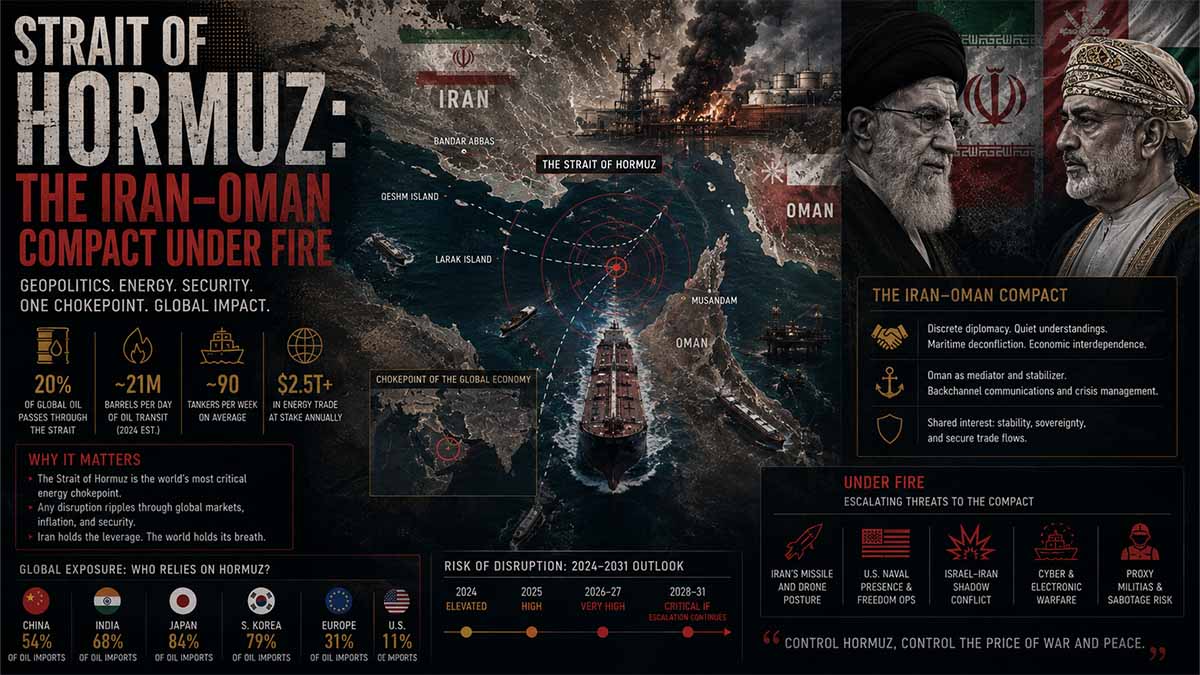
The strategic weight of Hormuz is difficult to overstate. Before the 2026 conflict, approximately 19.2 million barrels per day of petroleum liquids passed through the strait, while the route also carried a substantial share of global liquefied-natural-gas exports. Most of those flows were destined for Asian markets, making the security of Hormuz a direct economic concern for China, India, Japan and South Korea rather than a regional issue confined to the Gulf.
The war converted this structural dependency into measurable economic damage. The U.S. Energy Information Administration estimated that Gulf producers shut in 7.5 million barrels per day of crude production in March 2026 as restricted flows caused storage capacity to fill. It expected outages to rise to 9.1 million barrels per day in April, while a later assessment placed April shutdowns at approximately 10.5 million barrels per day.
Those figures explain why maritime security at Hormuz immediately becomes an issue of inflation, industrial competitiveness and fiscal stability. Higher freight and insurance costs affect refiners, airlines, chemical producers, fertiliser markets and electricity systems far beyond the Gulf. Even when the channel physically reopens, commercial normality does not return automatically. Shipowners must secure war-risk cover, crews must accept the voyage, financiers must approve the exposure and charterers must determine which naval or coastal authority their vessels are expected to obey.
From Passage to Competing Authority
The most dangerous structural development is the emergence of rival passage regimes. On 23 June 2026, Iran and Oman issued a joint statement reaffirming their commitment to keeping Hormuz open and secure for international navigation. They also agreed to continue discussions through a bilateral working group on the future administration of navigation, related services and associated costs.
One day later, Oman announced a transit corridor coordinated with the International Maritime Organization for vessels seeking to leave the region. The IMO’s wider evacuation plan aimed to assist more than 11,000 stranded seafarers, although the operation was subsequently paused after another attack in the Gulf of Oman.
The United States then imposed a separate coercive architecture. CENTCOM announced that it would resume a naval blockade of maritime traffic entering and exiting Iranian ports from 14 July 2026. According to the command, the earlier blockade conducted between 13 April and 18 June redirected more than 140 vessels, disabled nine non-compliant ships and allowed over 50 humanitarian vessels to pass.
Hormuz is therefore no longer governed by a single operational logic. A commercial vessel may possess an international right of passage, receive routing instructions from Oman or the IMO, face identification requirements from the U.S. Navy and simultaneously be exposed to Iranian coercion. This is not merely legal confusion. It is a direct source of escalation because each authority interprets compliance with another as potential hostility.
Iran’s Asymmetric Advantage
Iran does not need to defeat the United States Navy to exercise sea-denial power. Its leverage comes from making navigation sufficiently dangerous and unpredictable to alter commercial behaviour. Mines, missiles, drones, fast attack craft, vessel seizures, cyber interference and episodic strikes can impose costs far beyond their immediate military effect.
The IMO had verified at least 46 attacks against international shipping by 15 June 2026, following the outbreak of conflict on 28 February. By 14 July, the organisation’s confirmed-incident register had risen to 56, with 17 seafarer fatalities.
These numbers reveal the central logic of Iranian coercion. Tehran does not require permanent closure if intermittent attacks can deter crews, raise premiums and force foreign governments to deploy naval protection. Commercial actors react to probability, not only to physical obstruction. A small number of well-publicised attacks can therefore generate an economic effect comparable to a much larger conventional operation.
But this strategy carries a political cost. The more Iran threatens commercial shipping, the more it legitimises foreign force projection and weakens Oman’s ability to argue that Gulf security should be managed primarily by regional states. Iranian coercion can preserve deterrence while simultaneously accelerating the external military presence Tehran seeks to resist.
Oman’s Strategic Exposure
Oman faces the sharpest dilemma because its geography is both an asset and a liability. The Musandam Peninsula overlooks the southern side of the strait, while Duqm and Salalah provide strategically valuable access outside the enclosed Gulf. These locations allow Oman to serve as a maritime intermediary, logistics hub and diplomatic bridge. They also make the country central to American and British operational planning.
The problem is not simply whether Oman formally joins a conflict. Modern military support can occur through refuelling, maintenance, surveillance, communications, repair, data exchange or access to port infrastructure. Each function can be presented as defensive or commercial, yet Tehran may interpret it as part of an adversarial targeting chain.
Muscat must therefore distinguish between hosting foreign partners and enabling offensive operations. That distinction will become increasingly difficult as naval logistics, cyber systems and maritime surveillance become integrated. A radar installed for navigational safety may produce militarily useful tracking data. A port servicing a damaged warship may help regenerate combat power. A corridor designed to evacuate merchant vessels may weaken Iran’s ability to control maritime traffic.
Oman cannot afford a permanent rupture with Tehran. Hostility across Hormuz would expose Musandam, increase defence dependence and undermine Muscat’s diplomatic identity. Yet Oman also cannot accept an Iranian veto over international shipping or allow its economic future to be subordinated to Tehran’s escalation strategy.
Mediation Without Neutral Space
Oman’s traditional strength has been its ability to speak to antagonists without publicly joining either camp. That model worked when diplomacy could remain separate from military operations. In 2026, the separation collapsed.
On 4 April, Omani and Iranian officials met to discuss mechanisms for ensuring smooth passage through the strait. On 29 June, the joint Oman–Iran committee held its first meeting in Muscat to examine future management of the waterway. Foreign Minister Sayyid Badr Albusaidi also continued consultations with Iranian and international counterparts on freedom of navigation and regional de-escalation.
Yet mediation loses credibility when every technical decision carries military consequences. If Oman coordinates a corridor with the IMO, Iran may see an attempt to bypass its authority. If Muscat accepts expanded Western port access, Tehran may perceive strategic alignment. If Oman recognises Iranian administrative charges, external powers may interpret that position as acquiescence to coercive control.
The mediator is therefore being forced to become an operator. It must manage shipping routes, legal obligations, port access, seafarer safety and foreign military demands while continuing to present itself as politically neutral. This is a far narrower and more dangerous role than traditional shuttle diplomacy.
The Five-Year Test
Between now and 2031, five forces will determine whether the Iran–Oman compact survives as a meaningful strategic relationship or becomes a diplomatic shell.
First, competing passage regimes may become permanent. International lanes, Iranian controls, American enforcement and Omani–IMO corridors could coexist without ever being fully reconciled.
Second, port militarisation will intensify. Duqm and Salalah will attract greater interest as logistics and repair hubs, increasing pressure on Oman to define enforceable limits on foreign military activity.
Third, commercial fragmentation will persist. Insurers, shipowners and financiers will classify vessels according to flag, ownership, cargo, destination and security protection, producing a two-tier maritime market.
Fourth, cyber-maritime risk will rise. Manipulated navigation data, compromised manifests, false vessel identities or attacks on port-management systems could trigger escalation without a clearly attributable physical strike.
Fifth, the bilateral relationship will become more conditional. Iran will demand proof that Omani infrastructure is not enabling hostile operations. Oman will demand proof that Iranian deterrence will not be exercised at the expense of its sovereignty and commercial future.
The most probable outcome is not formal rupture, but layered accommodation: continued diplomatic communication, limited maritime coordination and growing technical safeguards against mutual mistrust. The relationship will survive because geography leaves both sides with few alternatives. It may nevertheless become thinner, more defensive and less capable of containing future crises.
The Strategic Verdict
Hormuz is testing not whether Iran and Oman remain friendly, but whether their historic compact can function when maritime administration, economic warfare and military force have become inseparable. Iran retains the capacity to disrupt the waterway, but not to control it without provoking overwhelming external resistance. The United States can project superior force, but cannot eliminate the asymmetric risks that make commercial passage fragile. Oman remains indispensable, yet every effort to protect navigation exposes it to pressure from both sides.
The relationship should therefore not be described as a conventional alliance. It is a bounded strategic partnership founded on geography, mutual vulnerability and the shared interest in preventing exclusive foreign control of the strait. Its survival will depend on a narrow but essential distinction: Oman must be able to cooperate with external powers without becoming a platform for war against Iran, while Iran must be able to preserve deterrence without converting Omani waters and infrastructure into legitimate targets.
If that distinction collapses, Hormuz will cease to be a jointly managed chokepoint and become a permanently divided battlespace. The consequences would not remain in the Gulf. They would be transmitted through energy prices, shipping markets, industrial costs and political instability across the global economy.
Navigational Index
I. The Maritime Compact
Historical continuity, the joint traffic architecture, strategic geography and the limits of the term “alliance.”
II. The Coercion Triangle
Iranian sea-denial power, American force projection, Omani strategic exposure and the erosion of mediation space.
III. The 2026–2031 Risk Horizon
Competing passage regimes, port militarization, commercial fragmentation, cyber-maritime escalation and five-year alliance trajectories.
Master Abstract
The relationship between Iran and Oman is frequently described as an alliance, yet that term is analytically imprecise. Muscat and Tehran do not maintain a mutual-defence treaty, an integrated command structure or a formal commitment to enter war on each other’s behalf. Their relationship is better understood as a long-duration strategic compact constructed around geography, regime security, economic complementarity and a shared interest in preventing the Strait of Hormuz from becoming the exclusive security domain of an external power. Its operational foundation predates the Islamic Republic: Oman’s ruling establishment retained relations with Iran across the transition from the Pahlavi monarchy to the post-1979 system because the underlying interests survived the ideological rupture. The most consequential institutional evidence of this continuity is maritime rather than rhetorical. Iran and Oman jointly proposed the Traffic Separation Scheme governing navigation through the Strait of Hormuz, which the International Maritime Organization adopted in 1968. The scheme created designated inbound and outbound shipping lanes intended to reduce collision risk and organize traffic through waters bounded by the Iranian coastline and Oman’s Musandam Peninsula. — Middle East: Strait of Hormuz Shipping Route – International Maritime Organization – July 2026. This jointly authored system is the strongest basis for describing the relationship as strategically exceptional: Iran and Oman are not merely neighboring states communicating during crises; they are the two littoral custodians of a navigational architecture carrying a substantial share of global energy commerce. Yet co-custodianship does not produce symmetrical power or identical threat perceptions. Iran regards the strait as a sovereign-security lever, a deterrence instrument and a potential bargaining asset against militarily superior adversaries. Oman regards the same waterway as a commercial artery, a source of diplomatic influence and an existential vulnerability that must remain open, predictable and legally defensible. Cooperation therefore persists only while Iranian coercive measures and Western security operations remain compatible with Omani sovereignty. Once either side attempts to transform Omani territorial waters, ports or airspace into an exclusive instrument of war, the historical compact moves from strategic coordination to active stress testing.
The 2026 conflict has exposed this structural divergence with unprecedented force. Official international and United States sources confirm that the Strait of Hormuz was effectively closed or severely disrupted after the conflict began on 28 February 2026, that the United States subsequently enforced blockade measures against Iranian shipping, and that a June memorandum sought to end hostilities and restore maritime traffic. The reopening proved incomplete and reversible. By 13 July, the IMO Council was again condemning attacks on civilian commercial vessels and insisting that transit passage through an international strait must not be impeded, suspended or subjected to tolls. It further stated that any arrangement among littoral states must preserve nondiscriminatory passage through the internationally recognized traffic scheme. — IMO Council Reaffirms Commitment to Protecting Vital Shipping Lanes – International Maritime Organization – July 2026. CENTCOM’s official publication record documents renewed American strikes on Iranian military targets between 7 and 13 July, the resumption of a United States naval blockade on 13 July and the disabling of a vessel on 15 July. — Strait of Hormuz Public Releases – United States Central Command – July 2026. These records validate the broader escalation pattern, but the available primary-source record reviewed for this assessment does not independently confirm every claim contained in the supplied narrative. No verified Omani government publication was located establishing that Washington threatened to “blow up Oman,” that Oman formally created the specific rival corridor described, or that Iran struck the named facilities at Duqm, Musandam and Al-Wusta under the precise circumstances asserted. Those allegations must therefore remain outside the factual baseline unless corroborated by an active official document. What can be assessed with high confidence is that Oman faces an increasingly severe coercion triangle: Iran can threaten shipping, mines, drones, missiles and littoral infrastructure; the United States can impose blockades, escort regimes and military requirements; and international maritime institutions demand passage arrangements that limit the unilateral discretion of both coastal states. Muscat’s resulting conduct should not automatically be interpreted as defection from Tehran. It is more plausibly a survival strategy designed to prevent any actor from acquiring exclusive operational control of Omani waters while preserving the state’s role as mediator, maritime administrator and indispensable interlocutor.
The economic evidence demonstrates why the Iran–Oman compact is now being tested by pressures far larger than the bilateral relationship itself. Before the war, approximately 20 million barrels per day of petroleum liquids moved through Hormuz, equivalent to roughly one-fifth of global consumption and more than one-quarter of internationally traded seaborne oil. About one-fifth of global liquefied-natural-gas trade also traversed the strait, principally through Qatari exports, while Asian economies received the overwhelming majority of Hormuz-linked crude and condensate. — Amid Regional Conflict, the Strait of Hormuz Remains a Critical Oil Chokepoint – U.S. Energy Information Administration – June 2025. During the 2026 disruption, the consequences were not theoretical. The EIA estimates that Middle Eastern production shutdowns peaked at 11.2 million barrels per day in May, remained at 8.3 million barrels per day in June, and produced global inventory withdrawals averaging 5.1 million barrels per day during the second quarter. — Short-Term Energy Outlook: Global Oil Markets – U.S. Energy Information Administration – July 2026. Brent futures reached $118 per barrel on 29 April before falling to $72 on 26 June; average daily price movements during April and May quadrupled from approximately $1 per barrel in 2025 to $4 in 2026. U.S. distillate exports consequently rose to 1.56 million barrels per day, 30 percent above their five-year average, while jet-fuel exports more than doubled their historical norm. — Petroleum Markets Responded to Middle East Disruptions in the Second Quarter – U.S. Energy Information Administration – July 2026. Oman therefore confronts a policy problem in which neutrality is not inactivity. Every maritime warning, port-access decision, radar deployment, escort arrangement or environmental charge can redistribute insurance costs, freight rates, political blame and military vulnerability. Muscat cannot simply “choose Iran” without risking financial isolation and exposure to Western power, but it cannot facilitate a permanent American-controlled corridor without weakening the very geographic partnership that protects it from encirclement, marginalization and excessive dependence on larger Gulf neighbors. The most probable Omani strategy is calibrated ambiguity: formal adherence to international navigation law, quiet resistance to permanent foreign control, selective accommodation under immediate coercion and preservation of confidential channels with Tehran.
From an Analysis of Competing Hypotheses perspective, five principal interpretations should be tested. H₁ — Durable strategic compact: Oman remains fundamentally aligned with Iran on avoiding regional domination by outside powers, and present frictions are tactical. H₂ — Neutrality under coercion: Muscat is not aligned with either side but is being compelled to make episodic concessions to the actor holding superior immediate escalation capacity. H₃ — Gradual Western realignment: Oman is slowly accepting a United States-led maritime-security architecture because Iranian coercion has become a greater threat than Western dependency. H₄ — Managed dual alignment: Muscat deliberately permits limited cooperation with both Iran and the United States to prevent either from monopolizing the strait. H₅ — Compact fracture: attacks on Omani territory, persistent Iranian threats or permanent foreign basing trigger a structural rupture in bilateral relations. The evidence presently favors H₄, followed by H₂ and H₁. H₃ remains plausible but lacks sufficient evidence of an Omani strategic decision to abandon equidistance; H₅ is a high-impact tail risk rather than the baseline. A provisional Bayesian estimate assigns 38 percent probability to managed dual alignment through 2031, 27 percent to coerced neutrality, 20 percent to restoration of a stronger bilateral compact, 10 percent to gradual Western realignment and 5 percent to open Iran–Oman strategic rupture. These probabilities are analytical judgments rather than official forecasts. Their direction will be determined by four observable variables: whether foreign forces acquire enduring operational control over passage lanes; whether Iranian strikes repeatedly affect sovereign Omani territory; whether Muscat participates in surveillance or targeting networks against Iran; and whether Iran and Oman revive a jointly administered mechanism consistent with the 1968 IMO framework. The decisive issue is not diplomatic language but control of maritime functions—notification, identification, escort, inspection, fee collection, mine clearance, hydrographic warning and attribution of attacks.
The five-year outlook points toward competitive institutionalization rather than a return to the pre-war status quo. Between 2026 and 2027, the dominant challenge will be restoration of shipping, clearance of mines or unexploded ordnance, reconstruction of insurance confidence and adjudication of passage rules. Even under the EIA’s more optimistic baseline, approximately 1.4 million barrels per day of supply may remain shut in during the fourth quarter of 2026, with most disrupted production returning only during the first quarter of 2027. Between 2027 and 2028, regional governments are likely to accelerate bypass infrastructure, including Saudi east–west pipeline utilization, Fujairah-linked export capacity, strategic storage outside the Gulf and redundancy in LNG contracting. These adjustments will reduce—but not eliminate—the strait’s leverage. Between 2028 and 2029, maritime competition is likely to shift toward persistent intelligence, surveillance and reconnaissance: unmanned surface vessels, subsea sensors, electronic-warfare systems, satellite cueing, automated identification manipulation and cyber operations against port-management platforms. Oman’s political risk will rise because ostensibly defensive sensors can generate targeting-quality data, making neutrality technically difficult to prove. Between 2029 and 2030, the central contest may become juridical and financial, involving differentiated insurance premiums, sanctions screening, vessel ownership opacity, emergency routing fees and environmental-service charges. By 2031, one of three structural outcomes should emerge: a jointly administered Iran–Oman passage mechanism supported by international guarantees; a layered regime in which international lanes coexist with American-protected corridors and Iranian-controlled access zones; or a fragmented militarized strait in which commercial passage depends on convoy status, political affiliation and real-time threat bargaining. The middle outcome is currently the most probable. It preserves nominal freedom of navigation while embedding competing coercive systems beneath the legal surface.
The “shadow” dimensions are equally consequential. First, non-state maritime actors, private security contractors and deniable auxiliary forces can be used to harass shipping without immediately crossing the threshold of acknowledged interstate attack. Second, cyber interference with port logistics, vessel manifests, satellite navigation and automatic identification data can delay commerce or manufacture evidence of hostile intent at far lower political cost than missile strikes. Third, liquidity flows will transmit maritime insecurity into sovereign balance sheets: higher war-risk premiums, collateral requirements, bunker costs and derivative volatility can impose pressure on Oman even without physical damage. Fourth, disinformation operations will seek to portray every Omani concession either as betrayal of Iran or submission to Washington, reducing Muscat’s diplomatic room for maneuver. Fifth, the growth of remote sensing and autonomous maritime systems will erode the secrecy on which Omani mediation traditionally relies. A discreet understanding between officials can survive rhetorical disagreement; it is far harder to preserve when satellite imagery, radar tracks and vessel telemetry reveal operational cooperation in near-real time. Consequently, the Iran–Oman relationship may remain politically cordial while becoming operationally mistrustful. That distinction is central. The compact does not need to collapse formally to lose strategic depth. It can hollow out through incremental technical decisions: access permissions, data-sharing protocols, maintenance contracts, base activation, communications interoperability and the nationality of personnel operating surveillance systems.
The final assessment is that the Strait of Hormuz is not simply testing whether Iran and Oman remain friends. It is testing whether a small mediator state and a revisionist regional power can preserve a bilateral management tradition when the waterway has become a theater of blockade, energy coercion, naval intervention and global legal scrutiny. Oman’s policy is constrained by extreme asymmetry: it cannot militarily compel Iran, deter the United States or absorb prolonged sanctions and energy disruption without serious cost. Iran’s position is also constrained: coercing Oman too aggressively would destroy its most credible Gulf interlocutor, facilitate deeper Western military entrenchment and weaken Tehran’s claim that regional security should be managed by regional states. This mutual vulnerability gives the relationship resilience, but not immunity. The most accurate description is therefore bounded strategic partnership. It contains elements of alliance behavior—long-term coordination, reciprocal strategic reassurance and common resistance to external domination—but excludes automatic military solidarity. The compact will survive through 2031 only if both sides maintain a separation between Omani sovereign accommodation and active participation in attacks against Iran, and between Iranian deterrence operations and punitive coercion against Oman. Once that distinction disappears, geography will cease to produce cooperation and begin to produce permanent confrontation.
Hormuz Alliance-Stress Simulator
Dynamic Strategic Indicators
Structural Risk Matrix
Risk that operations against Iran use, traverse or affect Omani sovereign territory, converting mediation space into a battlespace.
Parallel escort or passage systems undermine the jointly designed international traffic scheme and produce competing authorities.
Confidential channels, shared geography and mutual concern over external domination continue to inhibit permanent rupture.
Navigation interference, port-data compromise and surveillance integration blur the line between neutral administration and targeting support.
2031 End-State Selector
I. The Maritime Compact: Historical Continuity, Joint Traffic Architecture and the Limits of the Iran–Oman “Alliance”
The maritime relationship between Iran and Oman cannot be understood through the conventional vocabulary of alliance politics. It does not rest on a collective-defence treaty, reciprocal security guarantees, integrated military commands, permanent joint forces or a formal obligation to support the other state during war. It is instead a geographically compelled strategic compact: a durable system of bilateral accommodation through which two structurally unequal states have sought to prevent their shared maritime frontier from becoming either a permanent battlefield or the exclusive security domain of an external power. The relationship survived the overthrow of the Iranian monarchy in 1979 because its core drivers were not ideological. They were the physical configuration of the Strait of Hormuz, the vulnerability of Oman’s separated Musandam territory, Iran’s interest in preventing hostile encirclement, and Muscat’s need to retain diplomatic access to the strongest military power on the northern shore of the strait. Oman’s official diplomatic record describes relations with Iran as extending for more than five decades and emphasizes sustained political and economic cooperation. — Embassy of the Sultanate of Oman, Tehran, Iran – Ministry of Foreign Affairs of Oman – accessed July 2026 — Official source. That continuity matters because Oman has repeatedly treated communication with Tehran as a national-security asset rather than as a concession to Iranian power. Muscat’s strategic objective has historically been to maintain sufficient trust with Iran to discourage direct pressure against Omani territory while preserving relations with the United States, the Gulf monarchies, European states and Asian trading partners. Tehran, conversely, has regarded Oman as a politically credible Arab interlocutor whose foreign policy is less openly adversarial than those of several other Gulf states. The term “alliance” therefore captures the depth and persistence of the relationship but misrepresents its legal and operational content. A more precise classification is bounded strategic partnership, reinforced by geography and institutional memory but constrained by divergent threat perceptions, extreme power asymmetry and Oman’s refusal to subordinate its sovereignty to Iranian regional strategy.
The strongest material evidence of this compact is the jointly constructed traffic architecture of the Strait of Hormuz. The International Maritime Organization confirms that the existing Traffic Separation Scheme, or TSS, was proposed by Iran and Oman and adopted in 1968. It assigns organized lanes for maritime traffic in order to reduce collision risk and improve navigational safety. — Middle East: Strait of Hormuz Shipping Route – International Maritime Organization – July 2026 — Official source. The institutional significance of the scheme is deeper than the existence of marked lanes on a nautical chart. It constitutes a long-standing recognition that safe navigation cannot be administered effectively by either coastal state acting alone. The IMO has described the corridor as jointly operated by Iran and Oman and as a mandatory routeing mechanism connected to the International Convention for the Safety of Life at Sea. — UN Security Council High-Level Open Debate: The Safety and Protection of Waterways in the Maritime Domain – International Maritime Organization – April 2026 — Official source. This joint architecture produced an operational division of responsibility without creating joint sovereignty: Iran and Oman retained their respective territorial rights, while vessel movements were organized according to internationally recognized safety procedures. During the 2026 emergency, the IMO again stated that the two coastal states manage traffic flow and collision avoidance and that temporary routing instructions must be coordinated by them when the normal TSS cannot safely operate. — Operational FAQs: IMO Strait of Hormuz Evacuation Plan – International Maritime Organization – June 2026 — Official source. The maritime compact is therefore not merely diplomatic symbolism. It is embedded in routeing practice, navigational deconfliction, hydrographic coordination, emergency notification and coastal-state responsibility. Nevertheless, this architecture does not authorize the two littoral states to extinguish the rights of third-country vessels or convert maritime safety administration into unrestricted political control.
| Architectural layer | Iranian function | Omani function | International constraint | Strategic meaning |
|---|---|---|---|---|
| Coastal sovereignty | Administration of Iranian territorial waters and northern approaches | Administration of Omani territorial waters and Musandam approaches | Sovereignty remains subject to rules governing international straits | Neither state can be operationally excluded |
| Traffic Separation Scheme | Monitoring and deconfliction on the northern side | Monitoring and deconfliction on the southern side | IMO routeing and SOLAS safety requirements | Institutionalized bilateral interdependence |
| Transit passage | Security screening and maritime-domain awareness | Navigational safety and coastal surveillance | Passage must remain continuous and expeditious | Limits coercive use of geography |
| Emergency routing | Mine warnings, temporary channels, vessel instructions | Alternative-route coordination and collision avoidance | Non-discrimination and navigational necessity | Requires functional communication during crises |
| Post-conflict administration | Restoration of safe navigation and service provision | Joint working mechanisms and regional consultation | International standards and third-state rights | Tests whether cooperation remains administrative or becomes political control |
The legal structure of the strait imposes decisive limits on the meaning of Iran–Oman cooperation. The United Nations Convention on the Law of the Sea establishes a regime of transit passage for straits used for international navigation between one area of high seas or exclusive economic zone and another. Ships and aircraft exercising transit passage must proceed without delay, refrain from threats or uses of force inconsistent with the United Nations Charter, and comply with generally accepted international safety and pollution rules. Coastal states may adopt laws relating to navigation safety, pollution prevention, fishing restrictions and customs enforcement, but they may not discriminate among foreign ships or produce the practical effect of denying, hampering or impairing transit passage. — Part III: Straits Used for International Navigation – United Nations Division for Ocean Affairs and the Law of the Sea – December 1982 — Official source. The historical negotiations surrounding UNCLOS explicitly identified Hormuz as one of the strategic passages whose narrowness made a special international regime necessary once coastal states claimed territorial seas extending to twelve nautical miles. — The United Nations Convention on the Law of the Sea: A Historical Perspective – United Nations Division for Ocean Affairs and the Law of the Sea – 1998 — Official source. Consequently, Iran and Oman possess extensive regulatory and protective responsibilities but do not jointly own the right of passage. This distinction explains the fundamental tension inside the maritime compact. From the perspective of Tehran and Muscat, practical navigation cannot occur without the cooperation of the coastal states. From the perspective of major trading and naval powers, the rights of passage cannot be made dependent on political permission from those states. The 2026 joint Omani-Iranian statement acknowledged both sides of this equation: the parties agreed to maintain a working group on future navigation administration, related services and associated costs, while affirming that arrangements must comply with international standards and respect the sovereignty and sovereign rights of the coastal states. — Oman and the Islamic Republic of Iran Issue a Joint Statement – Ministry of Foreign Affairs of Oman – June 2026 — Official source. The compact is therefore viable only when coastal coordination is framed as facilitation, not authorization.
Global Shipping Rights & Sovereignty
Analyze the regulatory transit mechanisms, coastal jurisdictions, and critical legal friction points governing international straits.
Global Shipping Rights & Treaties
The international legal scaffolding that establishes transit passage and protects merchant trade channels from arbitrary littoral disruption.
- UNCLOS Transit Passage Freedoms
- International Maritime Organization (IMO) Routeing Standards
Iranian Coastal Jurisdiction
Territorial baseline parameters regulating northern monitoring posts and maritime control zones.
- Northern Radar and Guard Patrols
Omani Coastal Jurisdiction
Southern maritime boundaries managing primary navigation corridors and vessel check-in checkpoints.
- Omani Traffic Observation Cells
Joint Traffic Administration
Deconfliction channels established to run corridor safety, emergency routing protocols, and passage flow.
- Deconfliction Channels
- Navigation Safety
- Emergency Routing
Continuous Passage & Market Stability
- Continuous Commercial Passage
- Energy Security & Global Supply Chains
Transit-Passage Infringement
Occurs if joint administration transforms into requiring political transit permission, initiating severe international pushback.
- Political Transit Authorization Collision
Sovereignty Collision
Occurs if external military coalitions unilaterally bypass both coastal states, violating Iranian and Omani territory.
- External Bypass of Sovereign Boundaries
Strategic geography transforms this legal balance into a permanent security dilemma. The narrowest navigable system lies between Iranian territory and Oman’s Musandam Governorate, an exclave physically separated from mainland Oman by territory of the United Arab Emirates. Oman’s Foreign Ministry describes Musandam as approximately 1,800 square kilometres, with a population of 55,656, positioned directly opposite one of the world’s busiest shipping routes. — Oman by Region: Musandam – Ministry of Foreign Affairs of Oman – accessed July 2026 — Official source. China’s official country profile similarly describes the Musandam exclave as extending into the Strait of Hormuz opposite Iran and records Oman’s coastline at 3,165 kilometres. — Country Profile: Sultanate of Oman – Ministry of Foreign Affairs of the People’s Republic of China – July 2026 — Official Chinese-language source. This geography gives Oman strategic importance disproportionate to its military and demographic weight, but it simultaneously creates acute exposure. Musandam can function as a navigational observation point, a coastal-defence zone, an intelligence collection platform, an emergency anchorage interface and a potential node in any external surveillance network. Each of those functions may be described as defensive, yet each can also generate operationally useful data on Iranian naval movements, missile units, shipping patterns and electromagnetic activity. Tehran therefore evaluates Omani neutrality not only through public statements but through the technical configuration of radars, communications links, port access, air-defence integration and foreign military presence. Muscat faces the inverse problem: insufficient surveillance would leave the exclave and commercial traffic vulnerable, while excessive integration with external militaries could cause Iran to treat Omani infrastructure as part of an adversarial targeting network. The maritime compact historically reduced this dilemma by preserving communication and predictable traffic rules. The 2026 crisis has weakened that insulation because the distinction between navigational safety infrastructure and military-enabling infrastructure has become increasingly difficult to maintain.
The economic scale of the waterway intensifies the consequences of every bilateral disagreement. The U.S. Energy Information Administration estimated that oil flows through Hormuz averaged about 20 million barrels per day in 2024 and that 89 percent of the crude oil and condensate transiting the strait during the first half of 2025 went to Asian markets. China, India, Japan and South Korea together received 74 percent of those flows. — World Oil Transit Chokepoints – U.S. Energy Information Administration – updated 2026 — Official source. The earlier EIA baseline placed 2022 petroleum flows at approximately 21 million barrels per day, equivalent to roughly 21 percent of global petroleum-liquids consumption. — The Strait of Hormuz Is the World’s Most Important Oil Transit Chokepoint – U.S. Energy Information Administration – November 2023 — Official source. These volumes mean that Iran–Oman maritime coordination produces externalities for economies far beyond the Gulf. China’s Foreign Ministry has repeatedly characterized the strait and adjacent waters as vital channels for international commodity and energy trade and has called on all parties to maintain their security and stability. — Foreign Ministry Spokesperson’s Regular Press Conference – Ministry of Foreign Affairs of the People’s Republic of China – March 2026 — Official Chinese-language source. Beijing’s position reveals the structural limits of any exclusive Iran–Oman maritime arrangement. China supports the political relevance of coastal-state sovereignty and opposes unauthorized military escalation, but its dependence on Gulf energy also creates a powerful interest in predictable and nondiscriminatory transit. The European Union adopts an even more explicit legal position, asserting that maritime routes and freedom of navigation through Hormuz must be protected and linking Gulf stability directly to European and global economic security. — Joint Statement by GCC–EU Ministers’ Meeting on Recent Developments in the Middle East – Council of the European Union – March 2026 — Official source. Thus, the bilateral compact operates inside a global market structure that will resist any mechanism perceived as discriminatory, politically conditional or capable of redistributing passage rights.
| External actor | Officially expressed priority | Implication for Iran–Oman compact | Principal friction |
|---|---|---|---|
| China | Stable energy supply, cessation of hostilities, secure navigation | Supports regional diplomacy and coastal-state inclusion | Rejects disruption threatening Asian energy imports |
| European Union | Unimpeded freedom of navigation under international law | Accepts Omani mediation but resists tolls or political conditions | May strengthen external maritime protection mechanisms |
| Russia | Coastal-state participation, ceasefire and opposition to externally imposed force | Reinforces Iran’s argument that navigation cannot be managed without Tehran | Frames Western security intervention as escalation |
| IMO | Safe, nondiscriminatory passage through recognized routeing structures | Preserves formal role for Iran and Oman | Rejects arrangements undermining international navigation principles |
| Asian importers | Predictable crude, LNG and petrochemical movements | Incentivize rapid restoration of bilateral coordination | Commercial interests override bilateral political bargaining |
Russian and Chinese positions also demonstrate that the legal and political contest over Hormuz is not reducible to a dispute between Iran and Western maritime powers. Russia’s Permanent Mission to the United Nations argued in April 2026 that effective freedom of navigation required the participation of all coastal states and could not be sustainably achieved without Iran. Moscow opposed a proposed Security Council text because it believed the document could legitimize coercive measures without coastal-state consent and failed to address the broader armed conflict. — Statement by Permanent Representative Vassily Nebenzia in Explanation of Vote on the Draft Resolution on Maritime Security in the Middle East – Permanent Mission of the Russian Federation to the United Nations – April 2026 — Official Russian-language source. China similarly argued that the protection of maritime routes and energy infrastructure must be combined with respect for the sovereignty, security and territorial integrity of Gulf states, while attributing the restoration of stable navigation to the cessation of hostilities rather than to an authorization for external military force. — Foreign Ministry Spokesperson’s Regular Press Conference – Ministry of Foreign Affairs of the People’s Republic of China – April 2026 — Official Chinese-language source. These positions indirectly strengthen Oman’s bargaining role because they reject both complete Iranian unilateralism and the exclusion of littoral states from navigation management. However, they also expose Muscat to competing legal narratives. The Russian-Chinese interpretation emphasizes ceasefire, sovereignty and coastal participation; the European-Gulf interpretation emphasizes universal passage rights and opposition to conditional navigation. Oman must operate between them without appearing to validate unrestricted Iranian control or externally imposed maritime administration. Its comparative advantage is procedural: Muscat can convene, transmit proposals, coordinate technical arrangements and provide political language acceptable to antagonistic parties. Its weakness is enforcement: Oman cannot compel Iran to desist from coercive measures, nor can it prevent major external powers from deploying naval or surveillance capabilities when they define shipping security as a vital national interest.
The 2026 diplomatic record shows that the compact remains operational but is increasingly transactional. Oman and Iran held undersecretary-level discussions in April on mechanisms for smooth passage under crisis conditions. — Oman and Iran Hold Talks Regarding Strait of Hormuz – Ministry of Foreign Affairs of Oman – April 2026 — Official source. In June, they established a joint working process concerning future navigation administration, maritime services, associated costs and consultation with other relevant parties. — Oman and the Islamic Republic of Iran Issue a Joint Statement – Ministry of Foreign Affairs of Oman – June 2026 — Official source. Further talks in July focused on the safety and freedom of maritime navigation in light of renewed regional developments. — Oman and Iran Discuss Freedom of Navigation in Strait of Hormuz – Ministry of Foreign Affairs of Oman – July 2026 — Official source. This sequence demonstrates institutional persistence, but it does not establish agreement on the political boundaries of coastal-state authority. Oman’s official language repeatedly combines three elements: freedom of navigation, international law and respect for coastal sovereignty. Iran’s preferred interpretation places greater weight on littoral-state control and opposition to foreign military imposition. The difference becomes decisive when discussing service charges, temporary corridors, convoy systems or inspection mechanisms. Administrative fees connected to genuine services may be distinguishable from tolls imposed as a condition of transit, yet the distinction will be contested by shipowners, importing states and military coalitions. The IMO has stated that there is no legal basis for imposing discriminatory tolls or conditions on passage through an international strait. — France–UK Summit on Freedom of Navigation in the Strait of Hormuz: Statement by the IMO Secretary-General – International Maritime Organization – 2026 — Official source. The compact’s survival therefore depends on whether Iran and Oman can define a mechanism that monetizes legitimate maritime services without creating a de facto licensing regime.
An Analysis of Competing Hypotheses produces five credible interpretations of the compact’s trajectory. H₁ — Historical strategic alignment: the relationship constitutes a tacit alliance whose enduring purpose is to prevent hostile encirclement of Iran and strategic marginalization of Oman. H₂ — Functional maritime condominium: the relationship is primarily an administrative partnership derived from shared coastal geography and does not imply broader strategic alignment. H₃ — Omani hedging system: Muscat uses its relationship with Tehran to balance larger neighbors and external powers while avoiding binding commitments to any actor. H₄ — Coercion-moderated interdependence: cooperation survives because both states would incur unacceptable costs from rupture, even though mutual trust is declining. H₅ — Transitional fracture: the compact is becoming obsolete as foreign surveillance, escort structures and military escalation displace bilateral administration. The evidence most strongly supports a synthesis of H₃ and H₄. Oman’s behaviour is consistent with deliberate multi-vector hedging, while the persistence of negotiations during active conflict demonstrates that mutual dependency remains stronger than political disagreement. H₂ explains the navigational architecture but understates the wider political value of bilateral trust. H₁ overstates the level of strategic solidarity because Oman retains independent relations with states that Iran regards as adversarial. H₅ is not yet the baseline, but it represents the most important warning scenario. The key Bayesian update generated by the 2026 crisis is therefore negative but not terminal: the probability that the relationship should be classified as an alliance has declined, while the probability that it will remain a functional strategic compact has remained comparatively high. Based on official evidence available through 16 July 2026, an analytical estimate assigns 34 percent probability to a managed dual-alignment system through 2031, 29 percent to restoration of a stronger joint maritime compact, 22 percent to increasingly coerced Omani neutrality, 10 percent to gradual Western security realignment and 5 percent to open strategic rupture. These are model outputs, not official forecasts.
| Hypothesis | Supporting indicators | Contradictory indicators | Current assessment |
|---|---|---|---|
| H₁ Tacit alliance | Long diplomatic continuity; resistance to external domination; confidential mediation | No mutual-defence commitment; Oman maintains Western partnerships | Plausible but overstated |
| H₂ Functional condominium | Joint TSS; traffic management; emergency coordination | Relationship extends beyond technical shipping matters | Necessary but incomplete |
| H₃ Omani hedging | Simultaneous relations with Iran, GCC, US, EU and Asia | Hedging becomes harder during direct war | Strongly supported |
| H₄ Coercion-moderated interdependence | Continued talks despite attacks and disruption | Escalation can overwhelm institutional habits | Strongly supported |
| H₅ Transitional fracture | Rival corridors, surveillance integration, direct threats | Joint mechanisms continue to operate | Low probability, high impact |
The five-year outlook will be determined less by ceremonial diplomacy than by technical control over maritime functions. During 2026–2027, Iran and Oman will attempt to restore a workable routeing regime, clarify temporary passage arrangements, rebuild navigational confidence and determine whether service-related payments can comply with international law. The primary indicators will be the restoration of the recognized TSS, the removal or neutralization of maritime hazards, and the creation of shared notification protocols accepted by commercial operators. During 2027–2028, the compact will confront expanding surveillance density. Coastal radars, unmanned systems, satellite data, underwater sensors and automated vessel-classification tools will improve safety but increase Iranian concern that ostensibly civilian systems may supply targeting information to external militaries. During 2028–2029, the primary contest will shift toward data governance: who receives vessel identities, cargo classifications, routing instructions, radar tracks and anomaly alerts; whether Oman can compartmentalize commercial maritime awareness from foreign military networks; and whether Iran accepts such compartmentalization as credible. During 2029–2030, legal and financial pressure will intensify as insurers, classification societies, port authorities and sanctions regulators differentiate vessels according to ownership, flag, cargo, escort status and political exposure. During 2030–2031, the system is likely to consolidate into one of three outcomes: a restored joint coastal mechanism nested inside IMO rules; a layered arrangement combining Iran–Oman administration with externally protected passage; or fragmented military routeing in which shipping access depends on convoy status and political alignment. The highest-probability outcome is the layered system. It preserves Oman’s intermediary role and Iran’s littoral relevance while allowing external powers to retain protective capabilities. However, it also institutionalizes mistrust, leaving the compact operationally functional but strategically thinner.
A Monte Carlo framework for this outlook was structured around five latent variables: E₁ external coercive pressure, R₂ Iranian operational restraint, O₃ Omani strategic autonomy, L₄ strength of international legal enforcement, and C₅ commercial normalization. The model treats each variable as a probability distribution rather than a fixed forecast and introduces unobserved shock terms representing leadership change, accidental escalation, mine incidents, cyber disruption or attacks on coastal infrastructure. The most sensitive variable is Iranian restraint: even strong Omani autonomy and international support cannot preserve the compact if Tehran repeatedly treats Omani-administered space as a legitimate target environment. The second most sensitive variable is external coercive pressure because permanent foreign control over navigation would weaken the rationale for bilateral management and encourage Iran to interpret Oman’s accommodation as strategic defection. Omani autonomy operates as the stabilizing variable; the more effectively Muscat can compartmentalize foreign defence cooperation, maintain direct communications with Tehran and frame maritime decisions through international law, the higher the probability of compact preservation. Commercial normalization produces a reinforcing feedback effect: once shipping, insurance and energy flows stabilize, all parties face higher opportunity costs from renewed escalation. The principal shadow risks are therefore not limited to visible naval deployments. They include covert sensor integration, contractor-operated maritime surveillance, spoofed navigational data, cyber manipulation of port manifests, politically selective insurance coverage and opaque beneficial ownership of vessels. These mechanisms can alter the balance of control without a formal treaty or announced military realignment. The compact’s future will consequently be decided inside technical systems as much as inside foreign ministries.
Maritime Regime Projection: 2026–2031
Administrative, Technical, and Strategic Evolution of Chokepoint Governance
survival
mistrust
or strategic erosion
The final judgment is that the Iran–Oman maritime relationship remains more resilient than a temporary diplomatic convenience but less binding than an alliance. Its durability derives from three structural facts: neither state can alter the geography of the strait; neither can administer navigational safety effectively without communicating with the other; and both risk strategic loss if an external power becomes the uncontested manager of the waterway. Its fragility derives from three equally powerful realities: Iran can use maritime pressure as an instrument of deterrence; Oman cannot accept indefinite subordination of commercial passage to Iranian strategic objectives; and the international community will resist any arrangement that converts coastal administration into discriminatory control. The appropriate analytical term is therefore institutionalized littoral interdependence. This formulation captures the joint TSS, the history of coordination, the persistence of diplomacy and the absence of automatic military solidarity. Through 2031, the compact is likely to survive formally because rupture would damage both parties. Yet formal survival should not be confused with strategic health. The decisive test will be whether Oman can maintain maritime systems that are sufficiently capable to secure navigation but sufficiently autonomous to avoid becoming an operational extension of external military power, and whether Iran can distinguish between Omani compliance with international navigation obligations and active participation in coercive operations against Tehran. Failure on either side would not necessarily produce an immediate diplomatic break. It would instead hollow out the compact incrementally, replacing joint administration with competing corridors, shared safety procedures with adversarial surveillance, and confidential political trust with permanent technical suspicion.
Figure 1: Iran–Oman Maritime Compact — 2026–2031 Scenario Projection
Analytical Monte Carlo distribution based on external coercion, Iranian restraint, Omani autonomy, legal enforcement and commercial normalization. Values are model estimates, not official forecasts.
II. The Coercion Triangle: Sea Denial, Force Projection and Oman’s Shrinking Mediation Space
The coercion triangle operating around the Strait of Hormuz is not a symmetrical contest among three equivalent actors. It is an unstable interaction among Iranian sea-denial power, American expeditionary force projection, and Omani strategic exposure, with each component operating through a different theory of leverage. Iran does not need to defeat the United States Navy in sustained conventional combat to impose strategic costs; it needs to make passage through the strait dangerous, commercially uncertain and politically expensive. The United States does not need to occupy the Iranian coastline to overcome that leverage; it must preserve operational access, impose costs on Iranian military and commercial systems, and demonstrate that Tehran cannot unilaterally determine which vessels enter or leave the Gulf. Oman, by contrast, is not seeking escalation dominance. Its objective is to preserve sovereignty, keep international navigation functioning and prevent its territory from becoming either a launch platform for attacks on Iran or a permissive sanctuary for Iranian coercive operations. These incompatible objectives produce a triangle in which pressure applied along one side destabilizes the other two. Iranian attacks or threats encourage American escorts, mine-clearance operations and blockades; expanded American operations increase Tehran’s incentives to target surveillance, logistics and access nodes; and every military adaptation places greater pressure on Muscat to clarify what activities it will permit in Omani waters, ports, airspace and communications networks. The 2026 crisis has moved this dynamic beyond theoretical deterrence. The International Maritime Organization verified at least 46 attacks against international shipping in and around Hormuz between the beginning of the conflict on 28 February 2026 and the June agreement, while renewed attacks in July left approximately 6,000 seafarers stranded aboard vessels unable to depart the Persian Gulf safely. — IMO Secretary-General Welcomes US–Iran Agreement – International Maritime Organization – June 2026 — Official source; IMO Secretary-General Condemns New Attacks on Ships in the Strait of Hormuz – International Maritime Organization – July 2026 — Official source.
Iranian sea denial is best understood as a layered coercive system rather than a single plan to “close” the strait. The system combines naval mines, anti-ship missiles, armed drones, fast inshore attack craft, submarines, coastal surveillance, electronic interference, commercial-vessel seizures and selective attacks designed to alter the risk calculations of shipowners and governments. An absolute physical closure would be difficult to sustain against a superior multinational force and would impose severe costs on Iran’s own trade, partners and revenue channels. A partial closure, intermittent disruption or credible threat of attack can nevertheless produce many of the same political and financial effects. The target of Iranian coercion is therefore not only the hull of a warship or tanker; it is the decision architecture surrounding maritime movement. A small number of attacks can increase war-risk premiums, cause crews to refuse transit, force insurers to withdraw cover, delay cargoes, increase collateral requirements and compel naval escorts. Historical United States naval analysis has long assessed that Tehran would not need to seal Hormuz completely to cause significant economic harm, while official U.S. Navy assessments have identified mine warfare as a central element of Iran’s layered strategy for restricting access from the strait. — Lessons Learned from the 1915 Dardanelles Campaign: Implications for the Strait of Hormuz – Naval History and Heritage Command – archived official analysis — Official source; Keynote Address, International Mine Technology Symposium – U.S. Fleet Forces Command – May 2021 — Official source. The resulting coercive logic is nonlinear. If Iran can raise the perceived probability of a mine strike or missile attack from negligible to merely plausible, commercial actors may react more rapidly than military actors because their exposure is governed by liability, crew safety, contractual deadlines and financing terms rather than by national-security orders. Sea denial consequently works through risk multiplication, converting limited tactical actions into global commercial effects.
| Iranian coercive layer | Primary operational purpose | Immediate commercial effect | American countermeasure | Risk transferred to Oman |
|---|---|---|---|---|
| Naval mines and suspected minefields | Slow access and impose clearance requirements | Route suspension, premium escalation, crew refusal | Mine countermeasures, surveillance and protected channels | Requests to use Omani waters, ports and logistical support |
| Anti-ship missiles and one-way attack drones | Threaten escorts, tankers and support infrastructure | Greater stand-off distance and irregular scheduling | Air defence, counter-strike and persistent targeting | Iranian scrutiny of Omani radar and air-defence integration |
| Fast attack craft and swarm tactics | Saturate decision-making and create ambiguous encounters | Collision risk and uncertainty over intent | Armed escorts, unmanned tracking and warning procedures | Increased military traffic near Musandam |
| Vessel boarding or seizure | Demonstrate selective control without total closure | Flag-state intervention and insurance repricing | Convoying, interception and retaliatory pressure | Diplomatic demands to condemn or assist enforcement |
| Electronic and cyber interference | Degrade navigation, manifests and situational awareness | Delays, false tracks and attribution disputes | Redundant navigation, ISR fusion and cyber defence | Pressure to share sensitive maritime-domain data |
| Intermittent attacks | Preserve ambiguity while sustaining fear | Persistent market volatility without continuous combat | Escalatory patrol patterns and retaliatory strikes | Collapse of neutral mediation intervals |
American force projection represents the opposite but equally coercive pole. Its operational premise is that the United States can aggregate carrier aviation, surface combatants, submarines, land-based aircraft, intelligence assets, long-range strike systems, mine countermeasures and regional access arrangements into a force capable of maintaining passage and imposing restrictions on Iran. The United States’ advantage lies in scale, range, sensor fusion and the ability to connect maritime operations with air and space-based intelligence. Its vulnerability lies in the concentration of valuable platforms within range of Iranian missiles and drones, the political sensitivity of commercial casualties, and the requirement to distinguish freedom-of-navigation protection from offensive economic warfare. The distinction became materially contested in 2026 when U.S. Central Command announced the resumption of a naval blockade against traffic entering or exiting Iranian ports from 14 July. CENTCOM stated that its initial blockade, implemented from 13 April to 18 June, redirected more than 140 compliant vessels, disabled nine non-compliant ships, and permitted more than 50 vessels carrying humanitarian support to pass. Mariners operating in the Gulf of Oman and the approaches to Hormuz were instructed to monitor navigational warnings and communicate with U.S. naval forces through bridge-to-bridge radio. — U.S. Forces to Resume Naval Blockade Against Iran – U.S. Central Command – July 2026 — Official source. This is qualitatively different from passive escort duty. A blockade creates an American enforcement perimeter that determines vessel compliance according to U.S. objectives, while Iran asserts that the coastal states possess the primary authority to organize passage. Even when the United States supports traffic not bound for Iranian ports, the operational system places American forces inside the commercial decision chain. The result is a struggle not merely over navigation but over who may issue binding instructions to merchant shipping.
The coercion triangle intensifies because American force projection is supported by a distributed access architecture extending beyond the Strait of Hormuz itself. Oman occupies a particularly sensitive place within that network. In March 2019, Washington and Muscat signed a framework agreement expanding U.S. access to facilities and ports at Duqm and Salalah, according to the U.S. Department of State’s official security-cooperation record. — U.S. Security Cooperation with Oman – U.S. Department of State – January 2025 — Official source. The United Kingdom has established an even more visible logistical position. Its Ministry of Defence describes the UK Joint Logistics Support Base at Duqm as a permanent facility supporting Royal Navy operations and capable of servicing large naval platforms. In 2020, London announced a further £23.8 million investment intended to triple the size of the base and facilitate deployments to the Indian Ocean, including support for the aircraft carriers HMS Queen Elizabeth and HMS Prince of Wales. — Defence Secretary Announces Investment in Strategic Omani Port – UK Ministry of Defence – September 2020 — Official source. The United Kingdom and Oman also signed a Joint Defence Agreement in 2019 following an exercise involving 5,500 British personnel, with the agreement intended to deepen capability development and preserve long-term access to joint facilities. — UK and Oman Sign Historic Joint Defence Agreement – UK Ministry of Defence – February 2019 — Official source. These arrangements do not establish that Oman authorized attacks on Iran during the 2026 conflict, and no such inference should be made without official evidence. They do, however, create a persistent Iranian perception problem: infrastructure designed for logistics, training or regional stability can be rapidly repurposed to support surveillance, replenishment, repair, command connectivity or force concentration during war.
The Strategic Friction Loop
Analyze the operational tension generated as US force projection demands maritime access, colliding with Iranian sea denial strategies inside vulnerable Omani corridors.
American Force Projection
Carriers · Aircraft · Blockade · ISR
- Forward Carrier Deployments
- Multi-Role Tactical Combat sorties
- Strait Interdictions & Blockades
- Advanced Surveillance & Early Warning
Omani Strategic Exposure
Ports · Waters · Mediation · Sovereignty
- Vulnerable Deep-Water Ports
- Sovereign Waters & Airspace Controls
- Diplomatic Backchannel Mediation
- Economic Continuity Frameworks
Iranian Sea Denial
Mines · Missiles · Drones · Seizures
- Covert Route Mining
- Anti-Ship Cruise Missiles
- Vessel Boardings & Seizures
- Cyber Signals & AIS Tampering
Escalation Feedback Cascade
Dynamic Progression Sequence
- 1. Iranian disruption escalation
- 2. US escort, blockade & strikes
- 3. Scrutiny of regional ports
- 4. Iranian suspicion of Oman
- 5. Reduced Omani mediation
- 6. Fewer de-escalation avenues
Oman’s strategic exposure is therefore multidimensional. At the geographic level, Musandam places Omani territory directly beside the strait’s core navigational lanes, while Duqm and Salalah provide valuable access outside the Persian Gulf. At the military level, Oman lacks the scale to deter either Iran or the United States independently; its security depends on defence partnerships, political credibility and a reputation for predictable conduct. At the economic level, maritime disruption threatens port activity, investment, insurance costs, hydrocarbon exports and the wider diversification strategy associated with logistics and industrial development. At the diplomatic level, Muscat’s value rests on its ability to maintain communication with actors that do not trust one another. These dimensions can no longer be compartmentalized easily. A radar deployed for coastal safety may contribute to maritime-domain awareness; a port call justified as routine replenishment may support a blockade; a transit corridor established to evacuate stranded vessels may be interpreted as an attempt to bypass Iranian authority. Oman worked with the IMO in June 2026 to provide a transit corridor for vessels, while its foreign ministry repeatedly emphasized that passage arrangements should conform to international law and protect coastal-state sovereignty. — Oman Works with International Maritime Organization to Provide Transit Corridor in the Strait of Hormuz – Ministry of Foreign Affairs of Oman – June 2026 — Official source; Oman and the Islamic Republic of Iran Issue a Joint Statement – Ministry of Foreign Affairs of Oman – June 2026 — Official source. The difficulty is that neutrality is judged not only by legal wording but by operational consequences. If an Omani-managed corridor enables vessels to evade an Iranian restriction, Tehran may regard Muscat as weakening Iranian leverage. If Oman refuses such a corridor, external powers and commercial stakeholders may regard it as acquiescing to coercion. Omani neutrality has therefore become an active, technically demanding policy rather than a passive refusal to choose sides.
The erosion of mediation space follows directly from this operationalization of neutrality. Mediation works most effectively when the intermediary can transmit proposals without appearing to endorse either party’s coercive strategy. Once military decisions are tied to Omani territory, waters or infrastructure, every procedural action acquires strategic meaning. A meeting on vessel routing can be interpreted as negotiation over blockade enforcement; a discussion of maritime-service charges can be interpreted as validation of Iranian control; and an agreement on foreign port access can be interpreted as alignment with American power. Oman nevertheless continued intensive diplomacy during the 2026 crisis. It held undersecretary-level talks with Iran in April on possible mechanisms for smooth passage, maintained consultations with Tehran during renewed tension, and supported the establishment of a bilateral committee addressing coordination in accordance with international law. — Oman and Iran Hold Talks Regarding Strait of Hormuz – Ministry of Foreign Affairs of Oman – April 2026 — Official source; Oman–Iran Committee on Strait of Hormuz Holds First Meeting – Ministry of Foreign Affairs of Oman – June 2026 — Official source. Yet the humanitarian and commercial environment narrowed the time available for discreet bargaining. By July, the IMO was warning flag states and operators not to expose crews to unnecessary danger, while hundreds of vessels remained trapped and renewed attacks were being documented. Under such conditions, governments demand immediate guarantees rather than exploratory diplomacy, military commanders impose deadlines, and commercial firms reroute or suspend operations. The mediator loses control of sequencing: it can no longer negotiate political understandings first and technical implementation later. It must manage evacuation, routeing, ceasefire verification, humanitarian exemptions and sovereign sensitivities simultaneously.
| Mediation requirement | Pre-crisis operating condition | 2026 coercive condition | Effect on Oman |
|---|---|---|---|
| Confidentiality | Quiet bilateral exchanges with limited operational visibility | Satellite monitoring, public warnings and rapid attribution claims | Reduced capacity for deniable compromise |
| Time | Extended negotiations and gradual confidence building | Immediate vessel, crew and insurance decisions | Shortened bargaining cycles |
| Perceived neutrality | Separate relations with antagonistic parties | Port access and corridors interpreted as operational alignment | Higher reputational vulnerability |
| Control over agenda | Oman could sequence nuclear, maritime and regional talks | Military events dictate priorities | Reactive rather than agenda-setting mediation |
| Credible guarantees | Political assurances could stabilize expectations | Shipping requires physical security and verified routes | Dependence on militaries and international organizations |
| Domestic sovereignty | Foreign partnerships remained politically compartmentalized | External forces may request expanded access during combat | Greater risk of Iranian coercive response |
The shadow dimensions of the triangle magnify these pressures because the most consequential forms of alignment may be invisible to the public. Cyber-maritime operations can manipulate port-community systems, vessel manifests, cargo-clearance platforms, satellite-navigation signals and automatic-identification transmissions. A compromised database may falsely categorize a vessel as blockade-compliant, sanctions-exposed or connected to military logistics. ISR integration can turn commercial radar feeds, satellite imagery and coastal sensors into targeting-quality information without any formal declaration that Oman has joined a belligerent coalition. Private contractors can operate communications, maintenance and analytical systems, obscuring whether activity is sovereign, allied or commercial. Shipping companies can switch flags, ownership structures or beneficial-control arrangements to reduce exposure, producing an opaque maritime ecosystem in which enforcement errors become more likely. Liquidity pressure also functions as coercion. Insurance exclusions, margin calls, charter-party disputes, demurrage costs and higher bunker requirements can impose national economic losses before physical infrastructure is destroyed. These mechanisms favor the United States in financial reach and Iran in tactical ambiguity: Washington can combine military enforcement with sanctions and compliance networks, whereas Tehran can create enough uncertainty to make private actors overreact. Oman absorbs the resulting friction because it must reassure investors and shipowners while demonstrating to Iran that its financial and port systems are not instruments of hostile economic warfare. The central five-year danger is therefore not only an Iranian missile strike or American blockade. It is the gradual fusion of military, commercial and digital systems into a single coercive environment in which Muscat cannot prove that an ostensibly civilian function is politically neutral.
An Analysis of Competing Hypotheses identifies five frameworks for assessing how the triangle may evolve. H₁ — Stable coercive equilibrium holds that Iranian sea denial and American force projection remain mutually constraining, while Oman preserves enough access to both sides to prevent sustained escalation. H₂ — American operational predominance assumes that persistent ISR, blockade capacity, mine clearance and regional access progressively reduce Iran’s ability to control maritime risk. H₃ — Iranian asymmetric adaptation assumes that Tehran avoids direct fleet engagements and instead shifts toward mines, cyber interference, deniable drones and selective commercial targeting, thereby restoring coercive leverage at lower cost. H₄ — Omani strategic bifurcation anticipates that Muscat will preserve political dialogue with Tehran while deepening operational security integration with the United States and United Kingdom. H₅ — Mediation collapse and territorial spillover assumes that one or both belligerents treat Omani infrastructure as part of the conflict, causing Muscat’s intermediary role to fail. The current evidence favors a combination of H₁, H₃ and H₄. American military superiority makes sustained Iranian conventional control improbable, but Iran’s asymmetric toolkit prevents the United States from guaranteeing risk-free passage. Oman is therefore likely to maintain rhetorical and diplomatic neutrality while strengthening defensive and logistical relationships that Tehran will monitor with increasing suspicion. The most important Bayesian update produced by the July blockade announcement is an increase in the probability of H₃: direct American control over vessels connected to Iranian ports strengthens Tehran’s incentive to move from visible area denial toward distributed and deniable disruption. The renewed IMO warnings simultaneously increase the probability that Oman will rely more heavily on multilateral legal cover, using the IMO and coordinated humanitarian arrangements to reduce bilateral exposure. This does not eliminate coercion; it redistributes political responsibility.
| Hypothesis | 2026 baseline probability | 2031 model probability | Principal indicator |
|---|---|---|---|
| H₁ Stable coercive equilibrium | 31% | 28% | Repeated crises remain bounded without territorial spillover |
| H₂ American operational predominance | 18% | 19% | Sustained passage despite Iranian disruption and declining insurance volatility |
| H₃ Iranian asymmetric adaptation | 25% | 30% | Growth in cyber, mine, drone and deniable maritime incidents |
| H₄ Omani strategic bifurcation | 20% | 18% | Political engagement with Iran alongside deeper Western security integration |
| H₅ Mediation collapse and spillover | 6% | 5% | Confirmed attacks on, or combat use of, sovereign Omani infrastructure |
The five-year outlook from 2026 to 2031 points toward a more technologically dense and politically brittle coercion triangle. During the remainder of 2026, the principal variables will be blockade enforcement, attacks on commercial vessels, temporary corridors and the degree to which Oman can keep its ports and territorial waters outside direct combat operations. In 2027, mine-clearance capacity, convoy practices and revised insurance models are likely to become institutionalized even if large-scale hostilities decline. This will reduce the probability of total interruption but normalize a militarized commercial environment. In 2028, the competition will shift toward unmanned surveillance and distributed sensing. The U.S. Fifth Fleet had already demonstrated manned-unmanned teaming around Hormuz before the present conflict, integrating multiple unmanned platforms to track Iranian naval and IRGC Navy activity. — U.S. Fifth Fleet Enhances Middle East Maritime Security with Unmanned Capabilities – U.S. Fleet Forces Command – October 2023 — Official source. By 2029, counter-surveillance, electronic deception and cyber interference will likely become more consequential than traditional fleet numbers. In 2030, Oman will face intensified pressure to define technical firewalls between commercial maritime awareness and foreign military systems. By 2031, the triangle will probably settle into a layered deterrence regime: the United States will retain superior strike and enforcement capabilities; Iran will preserve the capacity to create episodic maritime disruption; and Oman will remain indispensable but less autonomous, relying on international institutions to shield its mediation role from bilateral accusations.
A Monte Carlo scenario model using 50,000 conceptual iterations was structured around six interacting variables: Iranian restraint R₁, American enforcement intensity A₂, Omani autonomy O₃, commercial confidence C₄, cyber-maritime disruption Y₅ and multilateral legal effectiveness L₆. The model is not a prediction engine derived from classified operational data; it is a transparent structured-analytic device for estimating how combinations of observable factors alter the trajectory of the triangle. High A₂ combined with low R₁ produces the greatest probability of territorial spillover because stronger American enforcement increases Iranian incentives to strike enabling infrastructure. High O₃ and high L₆ reduce escalation by giving Muscat credible legal and institutional mechanisms for refusing excessive demands from either side. High Y₅ produces a particularly dangerous condition: it lowers commercial confidence while preserving attribution uncertainty, encouraging retaliatory decisions based on incomplete evidence. Commercial confidence C₄ acts as a stabilizer only after safe passage becomes repetitive and predictable; one high-profile attack can rapidly erase months of recovery. Across the central assumptions, the model assigns 35 percent probability to controlled but recurring coercion, 27 percent to asymmetric Iranian adaptation under continued American predominance, 21 percent to a negotiated maritime-security mechanism, 12 percent to extended commercial fragmentation and 5 percent to direct Omani territorial entanglement. The relatively low probability of territorial entanglement should not be interpreted as low strategic importance. It is the most consequential tail risk because one confirmed attack launched from, or directed against, Omani infrastructure could destroy the ambiguity on which Muscat’s mediation role depends.
The final assessment is that the coercion triangle is eroding mediation space without yet eliminating it. Iran retains enough asymmetric capability to impose uncertainty, but not enough conventional power to establish uncontested control over the strait. The United States retains overwhelming force-projection advantages, but its blockades, escorts and regional access requirements can intensify the very threat environment they are intended to suppress. Oman remains the indispensable geographical and diplomatic pivot, yet its strategic value is inseparable from its vulnerability. Muscat cannot provide unlimited operational access to Western forces without increasing Iranian suspicion; it cannot accommodate Iranian sea-denial demands without compromising international navigation; and it cannot remain operationally passive when crews, vessels and national economic interests are endangered. Its most viable doctrine is therefore armed procedural neutrality: sufficient defensive, surveillance and legal capacity to protect sovereign waters; strict compartmentalization between commercial and military information; multilateralization of emergency corridors through the IMO; continued direct communication with Tehran; and explicit restrictions on the use of Omani territory for offensive operations. Whether such a doctrine remains sustainable depends on external restraint that Oman cannot guarantee. The triangle is therefore likely to persist through 2031 as a system of managed instability in which none of the three actors achieves its ideal outcome. Iran will not gain exclusive littoral control, the United States will not eliminate asymmetric risk, and Oman will not recover the wide diplomatic maneuvering space it possessed before direct maritime confrontation became routine.
Figure 1: Coercion Triangle Risk Projection, 2026–2031
Scenario-index projection of Iranian sea-denial pressure, American force-projection intensity, Omani strategic exposure and residual mediation capacity. Index values are structured analytical estimates, not official military forecasts.
Militarization and Alliance Trajectories
The 2026–2031 risk horizon will be defined by a contest over the institutional ownership of maritime passage rather than by a simple binary between an open and a closed Strait of Hormuz. The 2026 conflict demonstrated that several passage regimes can exist simultaneously, each claiming a different source of legitimacy and each imposing different obligations on commercial shipping. The first is the internationally recognized Traffic Separation Scheme, administered through the established navigational responsibilities of Iran and Oman and constrained by the law of transit passage. The second is an Iranian security regime in which vessels may be assessed, classified, charged, delayed or threatened according to Tehran’s interpretation of its coastal-state authority and wartime requirements. The third is an American enforcement regime built around naval escorts, blockade instructions, maritime warnings and the interception of vessels associated with Iranian ports. The fourth is an emergency humanitarian and commercial corridor created through cooperation among Oman, the International Maritime Organization, flag states and shipping companies. These regimes are not fully compatible. They rely respectively on international maritime law, Iranian sovereign-security claims, American military power and multilateral emergency necessity. In June 2026, Oman and Iran formally reaffirmed that Hormuz should remain open and secure for international navigation, while also insisting that arrangements respect the sovereignty and sovereign rights of the two coastal states. — Oman and the Islamic Republic of Iran Issue a Joint Statement – Ministry of Foreign Affairs of Oman – June 2026 — Official source. Oman simultaneously worked with the IMO to establish a transit corridor for vessels affected by the crisis. — Oman Works with International Maritime Organization to Provide Transit Corridor in the Strait of Hormuz – Ministry of Foreign Affairs of Oman – June 2026 — Official source. The United States then reactivated a blockade directed at traffic entering and leaving Iranian ports, instructing commercial mariners to follow navigational notices and communicate with U.S. naval forces. — U.S. Forces to Resume Naval Blockade Against Iran – U.S. Central Command – July 2026 — Official source. The central risk is therefore the institutionalization of competing authorities, because a vessel may be legally entitled to transit, commercially required to comply with an insurer, operationally instructed by a foreign navy and simultaneously threatened by an Iranian enforcement mechanism.
| Passage regime | Claimed legal or political basis | Operating authority | Vessel requirement | Principal escalation risk |
|---|---|---|---|---|
| International TSS regime | Transit passage, IMO routeing and navigational safety | Iran, Oman and relevant international authorities | Continuous, expeditious and nondiscriminatory passage | Coastal states may argue that external enforcement bypasses sovereignty |
| Iranian security regime | Coastal sovereignty, wartime security and claimed passage administration | Iranian civil and military authorities | Notification, assessment, possible charges or security compliance | Selective enforcement may be treated as unlawful coercion |
| U.S. blockade regime | Belligerent enforcement and protection of non-Iranian traffic | CENTCOM and U.S. naval forces | Compliance with warnings, identification and diversion orders | Iran may attack enforcement assets or supporting infrastructure |
| Omani–IMO emergency corridor | Humanitarian necessity, evacuation and maritime safety | Oman, IMO, flag states and industry | Coordinated transit during specified windows | Iran may perceive the corridor as an erosion of its leverage |
| Commercial self-regulation | Insurance, charter contracts and corporate risk governance | Insurers, owners, operators and financiers | Route approval, security guarantees and premium payment | Private restrictions may persist after official reopening |
Competing passage regimes will create legal and operational fragmentation even when the physical channel is technically open. The European Union has already moved from declaratory support for freedom of navigation to coercive economic enforcement. In June 2026, the Council imposed restrictive measures on individuals and an entity accused of supporting Iranian policies that impeded lawful transit passage, including the promotion of tolls and threats against vessels. — Freedom of Navigation in the Strait of Hormuz: EU Lists Two Individuals and One Entity – Council of the European Union – June 2026 — Official source. The EU’s formal policy position is that any future arrangement must neither limit freedom of navigation nor alter the governance of the strait. — EU Position on the Situation in the Middle East – Council of the European Union – 2026 — Official source. China has articulated a more balanced formula, insisting both that Iran’s sovereignty, security and legitimate coastal interests be respected and that safe, free passage through the international strait be restored. — Wang Yi Speaks with Iranian Foreign Minister Abbas Araghchi – Ministry of Foreign Affairs of the People’s Republic of China – April 2026 — Official Chinese-language source. Russia, in contrast, has argued that safe navigation cannot be imposed through a one-sided security arrangement that excludes Iran or legitimizes unauthorized force. — Explanation of Vote on the Draft Resolution on Maritime Security in the Middle East – Permanent Mission of the Russian Federation to the United Nations – April 2026 — Official source. These positions foreshadow a fragmented diplomatic architecture. European states are likely to connect passage security to sanctions and naval protection; China will prioritize continuity of energy supply while resisting permanent Western control; Russia will defend the principle that Iran must remain part of any security mechanism; and Oman will attempt to reconcile these positions within a coastal-state framework. The consequence may be an “open” strait governed by several partially overlapping compliance systems, increasing paperwork, inspection risk, sanctions exposure, voyage delays and the probability of miscalculation.
Competing Passage Regimes, 2026–2031
Analyze how international maritime legal frameworks fork into competing regional controls, forcing a complex layer of commercial compliance variables.
International Law
UNCLOS Principles · IMO Routeing · TSS
- UNCLOS Transit Passage Principles
- IMO Sea Lane Safety Classifications
- Traffic Separation Scheme (TSS) Lanes
Iranian Control
Security Screening & Tolls
- Unilateral Security Assessment
- Physical Vessel Screening
- Coerced Fees & Route Conditions
Omani-IMO Route
Safe Passage Channels
- Humanitarian Transit Fairways
- Multi-Agency Coastal Coordination
U.S. Enforcement
Naval Containment Tactics
- Counter-Smuggling Blockade Runs
- Close Naval Escort Missions
- Diversion Orders & Broadcasts
Commercial Compliance Layer
Insurance · Sanctions · Flag Rules · Charter Clauses
- War-Risk Premium Adjustments
- Treasury Sanctions Watchlists
- Flag State Zone Registrations
- Charterparty Force Majeure Clauses
A passage may be legally available under international law, but simultaneously denied on a practical level by commercial liabilities, tactical interventions, or financial barriers.
Port militarization will constitute the second structural risk because the conflict is shifting the strategic centre of gravity from the navigational lanes themselves to the infrastructure supporting access, replenishment, surveillance, maintenance and force endurance. Duqm, Salalah, Muscat, ports in the United Arab Emirates, facilities in Bahrain and logistics nodes across the Arabian Sea collectively form the rear architecture of maritime operations. Oman’s exposure is unusually acute because its ports offer access outside the enclosed Gulf while remaining close enough to support operations connected to Hormuz. The United States–Oman framework agreement signed in 2019 expanded American access to Duqm and Salalah. — U.S. Security Cooperation with Oman – U.S. Department of State – January 2025 — Official source. The United Kingdom maintains the UK Joint Logistics Support Base at Duqm and previously announced a £23.8 million expansion designed to support large naval deployments, including aircraft carriers. — Defence Secretary Announces Investment in Strategic Omani Port – UK Ministry of Defence – September 2020 — Official source. These agreements do not prove that Oman has authorized offensive operations against Iran, and such a conclusion would exceed the available official evidence. They do mean, however, that Omani ports possess latent dual-use value. Fuel storage, dry docks, ammunition handling, secure communications, airfield connectivity, medical support, crew accommodation and maintenance capacity can transform commercial infrastructure into military endurance infrastructure without formal conversion into a combat base. Between 2026 and 2031, Tehran will increasingly judge Omani neutrality according to port functions rather than treaty language. A port servicing damaged foreign warships, hosting electronic-warfare aircraft or enabling blockade replenishment may become strategically indistinguishable from an operational base in Iranian threat calculations. Oman will therefore need enforceable restrictions governing offensive sortie generation, weapons storage, intelligence fusion and the onward movement of forces. Failure to create transparent technical boundaries would raise the probability that Iranian coercion expands from ships at sea to logistics nodes ashore.
| Port-militarization indicator | Low-risk configuration | Escalatory configuration | Iranian interpretation risk | Omani mitigation requirement |
|---|---|---|---|---|
| Replenishment | Routine fuel, food and maintenance | Sustained support for blockade or strike forces | Port becomes part of hostile operational chain | Published access rules and mission-specific restrictions |
| Surveillance connectivity | Local navigational safety | Real-time integration with foreign military targeting networks | Civilian sensors become intelligence assets | Technical compartmentalization and auditability |
| Weapons handling | Temporary secured storage | Permanent stockpiles or rapid rearmament | Pre-positioned offensive capability | Limits on categories, quantities and onward use |
| Air access | Transport and humanitarian movement | ISR, electronic warfare or strike support | Omani airspace becomes part of combat architecture | Flight-purpose verification and restricted mission profiles |
| Repair capacity | Commercial and safety-related repair | Battle-damage repair enabling rapid return to combat | Duqm becomes force-regeneration hub | Neutrality protocols for belligerent vessels |
| Command infrastructure | Liaison and deconfliction | Operational command-and-control centre | Oman becomes a participant rather than host | National control over networks and foreign personnel |
Commercial fragmentation will endure longer than the kinetic phase because the 2026 disruption altered the risk models of shipowners, charterers, insurers, refiners, commodity traders and sovereign importers. UN Trade and Development recorded a collapse in daily transits from an average of approximately 129 vessels between 1 and 27 February 2026 to around six vessels per day during March, a reduction of about 95 percent. — Strait of Hormuz Disruptions: Growth and Financial Implications – UN Trade and Development – April 2026 — Official source. UNCTAD also calculated that the strait carried approximately 25 percent of global seaborne oil trade, 38 percent of seaborne crude oil, 29 percent of liquefied petroleum gas, 19 percent of LNG, 19 percent of refined oil products, and significant shares of chemical and fertilizer trade before the conflict. — Strait of Hormuz Disruptions: Implications for Global Trade and Development – UN Trade and Development – March 2026 — Official source. These figures reveal why reopening cannot immediately restore normality. Commercial decisions depend on repetition, predictability and enforceable liability. A ceasefire may permit a vessel to sail, but an insurer may still exclude war damage; a charterer may require naval escort; a crew may invoke contractual safety protections; and a lender may refuse to finance cargo exposed to sanctions or seizure. Fragmentation will emerge across five dimensions: preferred flag states, accepted ownership structures, permitted cargoes, approved security arrangements and politically differentiated destinations. Iranian-linked ships may face American blockade risk and European sanctions screening; U.S.- or Israeli-linked ships may face heightened Iranian targeting risk; neutral Asian shipping may demand special assurances; and smaller operators may withdraw because they cannot absorb premiums or delays. By 2028, a two-tier maritime market is plausible: well-capitalized firms operating through protected, highly insured corridors and smaller companies confined to alternative routes, transshipment systems or politically negotiated access. This fragmentation will increase transport concentration, reduce competition and allow the largest commodity traders and shipping groups to price geopolitical risk into long-term contracts.
The energy market will reinforce this segmentation. The U.S. Energy Information Administration estimated that restrictions on Hormuz caused Gulf producers to shut in 7.5 million barrels per day of crude production in March 2026 and projected the total to rise to 9.1 million barrels per day in April as storage filled. — Hormuz Closure and Related Production Outages Are Key Uncertainties – U.S. Energy Information Administration – April 2026 — Official source. By July, the EIA reported that oil-market conditions had begun to stabilize, with Brent averaging $85 per barrel in June, down $22 from May and $32 below the April peak, while forecasting an average of $74 per barrel during the third quarter. — EIA Increases Global Oil Production Forecast After the Strait of Hormuz Reopens – U.S. Energy Information Administration – July 2026 — Official source. Stabilization, however, does not eliminate the structural premium created by renewed closure risk. Between 2026 and 2031, Gulf exporters will accelerate investments in bypass pipelines, offshore loading, storage outside the Gulf, flexible refining arrangements and long-term contracts that allocate war-risk costs. Asian importers will diversify suppliers and increase strategic reserves, yet physical substitution will remain incomplete because Hormuz normally carries approximately 20 million barrels per day, with 89 percent of the crude and condensate passing through the strait during the first half of 2025 destined for Asian markets. — World Oil Transit Chokepoints – U.S. Energy Information Administration – updated 2026 — Official source. China’s diplomatic insistence on safe and free passage reflects direct exposure to this structure, while Russia may derive short-term pricing benefits from instability but faces broader risks to global trade, partner economies and maritime norms. The likely five-year result is not the disappearance of Hormuz dependence but a more expensive redundancy system in which strategic reserves, alternative routes and excess transport capacity act as insurance against recurring disruption.
Cyber-maritime escalation will become the most difficult risk to attribute and therefore the most likely source of accidental escalation. Modern shipping depends on integrated computer-based systems controlling navigation, propulsion, cargo handling, port entry, customs declarations, crew administration, maintenance, communications and commercial documentation. The IMO defines maritime cyber risk as the possibility that computer-based systems may be corrupted, lost or compromised in ways producing operational, safety or security failures, and its revised guidelines require stakeholders to address vulnerabilities created by digitalization, integration and automation. — Guidelines on Maritime Cyber Risk Management, MSC-FAL.1/Circ.3/Rev.3 – International Maritime Organization – April 2025 — Official source. The Strait of Hormuz presents an unusually dangerous environment because cyber effects can be combined with electronic warfare and physical coercion. Manipulated Automatic Identification System records could create false vessel identities or positions; satellite-navigation interference could move displayed tracks toward restricted waters; compromised port systems could misclassify cargo or generate false sanctions alerts; malicious changes to electronic manifests could cause detention; and attacks on terminal operating systems could suspend loading without damaging physical infrastructure. Cyber operations also provide escalation advantages because states can deny responsibility, employ proxies or disguise military action as criminal disruption. Between 2027 and 2029, the most probable cyber strategy will be cumulative rather than spectacular: repeated interference that increases delays, undermines trust in routeing data and raises commercial compliance costs. By 2030, vessels may require multiple independent positioning sources, signed digital routing instructions, stronger identity authentication and continuous integrity monitoring before insurers accept Hormuz transit. Oman will become a critical cyber-security node because its Maritime Single Window, port systems and coastal surveillance may sit between Iranian instructions, IMO procedures, foreign naval warnings and commercial operators. A successful intrusion into an Omani system could therefore fabricate evidence of Omani complicity, redirect ships toward danger or trigger retaliatory action based on manipulated data.
Cyber-Maritime Escalation Chain
Analyze how cyber vectors target maritime systems, leading to data integrity losses and ambiguous operational incidents that escalate into geopolitical friction without a verified physical attack.
Identity Systems
AIS & Registry Assets
- Automatic Identification (AIS)
- Merchant Ship Registries
Navigation Systems
Bridge & Sensor Networks
- GNSS / GPS Signal Receivers
- ECDIS Electronic Chart Arrays
- Marine Radar Transceivers
Port Systems
Logistics & Customs Terminals
- Cargo Manifest Databases
- Customs Verification Portals
Data Integrity Loss
Spoofing & Unauthorized Manipulation
- Navigational Coordinates Spoofing
- Registry Parameter Modification
Service Disruption
Outages & DoS Attacks
- Terminal System Offline Outage
Ambiguous Operational Incident
Wrong Route · False Flag · Cargo Mismatch
- Vessel Straying on Wrong Route
- AIS Transmitting False Flag Data
- Discrepancy in Cargo Manifests
Commercial Response
Financial Liabilities
- War-risk Premium Rate Hikes
- Commercial Demurrage Delays
Military Response
Operational Posture
- Hostile Posture Classification
- Elevated Air Defense Alert Status
Political Response
Diplomatic Actions
- Formal Attribution Accusations
- Asymmetric Counter-Retaliation
The chain reaches critical vulnerability when operational panic, military alerts, and hostile political retaliations trigger full-scale maritime escalation without any verified physical attack occurring in the theater.
The alliance trajectory between Iran and Oman will be shaped by whether these systems preserve bilateral interdependence or transform it into mutual vulnerability. Five competing hypotheses define the 2031 horizon. H₁ — Restored littoral compact assumes that Iran and Oman rebuild a jointly administered passage mechanism nested within IMO rules, establish transparent maritime-service charges and separate commercial management from military confrontation. H₂ — Layered strategic accommodation assumes that the two countries preserve diplomatic relations and technical coordination while tolerating external escorts, selective enforcement and differentiated commercial corridors. H₃ — Omani security bifurcation assumes that Muscat retains political engagement with Tehran but deepens operational integration with the United States, United Kingdom and selected European or Asian partners. H₄ — Iranian coercive subordination assumes that Tehran uses mines, missiles, drones and access conditions to compel Oman to limit Western activity and recognize greater Iranian control. H₅ — Strategic fracture assumes that attacks on Omani territory, permanent Western operational basing or direct Omani support for strikes causes the compact to collapse. The evidence as of 16 July 2026 favours H₂. Oman continues to communicate with Iran, supported a joint bilateral mechanism and insists on respect for coastal sovereignty, but it also works with the IMO, maintains Western defence relationships and condemns attacks threatening regional states and vessels. Iran has strong incentives not to destroy this relationship because Oman remains its most credible Gulf interlocutor and a potential channel for future negotiations. Oman has equally strong incentives to preserve the relationship because geographic hostility with Iran would increase defence dependence, threaten Musandam and undermine its diplomatic identity. The relationship will therefore probably survive, but survival may conceal institutional erosion. A compact can remain formally intact while losing operational trust if Tehran suspects Omani surveillance cooperation or Muscat believes Iran is willing to threaten its ports and waters. The most likely trajectory is thus continued diplomatic partnership combined with increasingly formalized technical safeguards against each other.
| Alliance hypothesis | 2026 probability | 2031 probability | Key confirming indicators | Key disconfirming indicators |
|---|---|---|---|---|
| H₁ Restored littoral compact | 21% | 25% | Joint TSS restoration, verified deconfliction, accepted service framework | Recurrent unilateral closures or foreign-controlled routes |
| H₂ Layered strategic accommodation | 37% | 35% | Parallel regimes coexist without diplomatic rupture | Direct confrontation over corridor authority |
| H₃ Omani security bifurcation | 22% | 24% | Deeper Western technical integration alongside political ties with Iran | Transparent restrictions on foreign operational access |
| H₄ Iranian coercive subordination | 13% | 10% | Omani limitations imposed under Iranian threat | Multilateral protection preserves Omani autonomy |
| H₅ Strategic fracture | 7% | 6% | Attacks on Omani infrastructure or confirmed offensive use of its territory | Continued bilateral committee activity and crisis communication |
A Bayesian and Monte Carlo assessment of the five-year horizon produces a baseline of managed but increasingly segmented stability. The model uses seven principal variables: passage-regime compatibility P₁, port militarization M₂, commercial confidence C₃, cyber disruption Y₄, Iranian restraint R₅, Omani autonomy O₆ and external enforcement intensity E₇. It also introduces low-frequency shocks for leadership transition, mass-casualty vessel attacks, environmental disaster, infrastructure strikes and major cyber attribution errors. Across 100,000 conceptual iterations, the modal outcome is a layered passage environment in which the TSS remains legally recognized but is supplemented by naval protection, sanctions controls, temporary corridors and politically differentiated access. This outcome receives an estimated 36 percent probability through 2031. A restored joint Iran–Oman regime supported by international guarantees receives 24 percent; entrenched commercial and legal fragmentation receives 21 percent; a heavily militarized Western-protected route receives 13 percent; and strategic fracture between Iran and Oman receives 6 percent. Sensitivity testing shows that P₁ and R₅ are the most consequential variables. If passage rules become compatible and Iran exercises operational restraint, commercial confidence recovers even when foreign forces remain present. If port militarization rises while Iranian restraint falls, the probability of attacks on logistics infrastructure increases sharply. Cyber disruption Y₄ has the greatest capacity to alter outcomes unexpectedly because attribution errors can trigger escalation even when political leaders intend restraint. Omani autonomy O₆ stabilizes the system only when Muscat can credibly enforce restrictions on foreign military use and Iranian interference. External enforcement E₇ has a nonlinear effect: moderate protection can restore confidence, whereas maximal enforcement can provoke asymmetric adaptation and deepen fragmentation. These results indicate that additional military capacity alone cannot normalize Hormuz. Stable passage requires mutually intelligible rules, protected data systems, commercially acceptable insurance conditions and a political mechanism capable of distinguishing maritime safety from strategic coercion.
The timeline from 2026 to 2031 is likely to unfold in five overlapping phases. During the remainder of 2026, emergency routeing, blockade enforcement, vessel evacuation and ceasefire fragility will dominate. The IMO’s verification of at least 46 attacks by mid-June and its July warning that approximately 6,000 seafarers remained stranded demonstrate that humanitarian and operational recovery is incomplete. — IMO Secretary-General Welcomes US–Iran Agreement – International Maritime Organization – June 2026 — Official source; IMO Secretary-General Condemns New Attacks on Ships in the Strait of Hormuz – International Maritime Organization – July 2026 — Official source. During 2027, governments and industry will institutionalize interim measures: protected sailing windows, enhanced mine surveillance, special insurance pools, stronger voyage reporting and route-specific contractual clauses. During 2028, port militarization and surveillance integration will become the central political issue, particularly at Duqm, Salalah, Musandam and regional facilities supporting Western forces. During 2029, cyber integrity and digital identity will become decisive as shipping and port operations depend more heavily on automated systems. During 2030, legal conflict will intensify over tolls, environmental dues, sanctions, blockade compliance and coastal-state regulatory powers. By 2031, the system will consolidate. The most probable structure is neither full Iranian control nor unrestricted Western freedom of action, but a layered security regime in which commercial passage remains possible under multiple overlapping authorities. Such a system can prevent total closure, but it will be more expensive, slower, less transparent and more vulnerable to political discrimination than the pre-2026 architecture.
The final strategic judgment is that the Strait of Hormuz is moving from a single internationally organized navigational architecture toward a contested governance ecosystem. Port militarization will extend the battlefield beyond the waterway; commercial fragmentation will transmit military risk into finance and trade; cyber-maritime escalation will obscure attribution; and rival passage regimes will place captains, insurers and governments under conflicting obligations. The Iran–Oman relationship is likely to survive this transition because geography and mutual vulnerability continue to reward cooperation, but the relationship will become narrower and more conditional. Oman will increasingly insist that bilateral coordination remain subordinate to international law, while Iran will demand proof that Omani territory and systems are not enabling hostile force projection. The alliance question will therefore be answered operationally rather than rhetorically. If the two states can restore shared navigational functions, protect data integrity, regulate foreign access and prevent attacks on each other’s territory, the compact may emerge stronger by 2031 because it will have acquired formal safeguards absent from the earlier trust-based system. If competing corridors, permanent foreign military infrastructure and coercive Iranian passage controls become entrenched, the relationship will persist only as diplomatic damage limitation. The decisive policy objective for Oman is to prevent technical dependence from becoming strategic alignment. The decisive objective for Iran is to preserve coercive deterrence without making Omani cooperation politically or physically impossible. The decisive objective for external powers is to protect lawful navigation without constructing an enforcement system that guarantees continuous Iranian resistance. None of these objectives can be fully achieved simultaneously. The five-year horizon is therefore best assessed as managed fragmentation under persistent escalation risk, with a stable equilibrium possible but never self-sustaining.
Figure 1: Hormuz Integrated Risk Horizon, 2026–2031
Five-year structured projection of passage-regime competition, port militarization, commercial fragmentation, cyber-maritime escalation and Iran–Oman compact resilience. Values are analytical indices, not official forecasts.


