













Executive Summary
New York City Mayor Zohran Mamdani has told The New York Times he remains committed to exploring an arrest of Israeli Prime Minister Benjamin Netanyahu if Netanyahu attends the UN General Assembly in New York this September, though he has said it remains unclear whether he has the legal authority to instruct the NYPD to detain a foreign leader, and that he is in “an active conversation” with the city’s Law Department on the matter. This is not a new position — Mamdani first pledged during his mayoral campaign to have Netanyahu taken into custody at the airport, framing it as fulfilling an ICC arrest warrant. The core legal obstacle is that the United States is not a party to the Rome Statute and does not recognize ICC jurisdiction, while New York Governor Kathy Hochul has said the mayor lacks authority to arrest Netanyahu. Realistically, any arrest attempt would collide almost immediately with federal supremacy over foreign affairs, diplomatic/head-of-state protections, and likely federal intervention. i24NEWSaol
Zorhan Mamdani’s Arrest Threat Against Netanyahu Tests the Limits of Municipal Power in U.S. Foreign Policy
New York City’s mayor has revived, from City Hall rather than the campaign trail, his pledge to examine arresting a sitting head of government of a close American ally. The stakes are not primarily about Gaza policy; they are about who controls foreign affairs in the American federal system, whether a municipality can act on an International Criminal Court warrant Washington rejects, and what happens to inter-institutional trust between a Democratic-led metropolis, an Albany governorship, and a hostile federal executive when all three collide over a single visit. The September UN General Assembly session in New York is now a live test case for constitutional federalism as much as for international criminal law.
The Institutional Fault Line
New York Mayor Zohran Mamdani said this week that an “active conversation” is underway with city lawyers over the scope of his authority to order Netanyahu’s arrest, an issue he has now carried from candidacy into governance. He took office on 1 January 2026, and by mid-July had not resolved the question ahead of Netanyahu’s expected September appearance. Mamdani’s administration continues weighing whether to order the arrest of Israeli Prime Minister Benjamin Netanyahu should he travel to the city for the UN General Assembly. Two figures with formal institutional standing have already contradicted him. New York Governor Kathy Hochul has stated the mayor lacks the authority to carry out such an arrest, distancing herself from the position during a press conference. Representative Jerry Nadler, the veteran Manhattan Democrat who chaired the House Judiciary Committee, told the New York Times the plan was “simply unrealistic,” adding that “the City of New York has no jurisdiction to do such a thing.” Even within Mamdani’s own governing coalition, Murad Awawdeh, executive director of the New York Immigration Coalition, told the Times the arrest was not a shared priority. The fault line, in other words, runs not between parties but within the same political family — a sign that the episode is less about partisan alignment than about competing theories of municipal versus federal constitutional authority. International Business TimesNew Arab
The Numbers and the Precedent
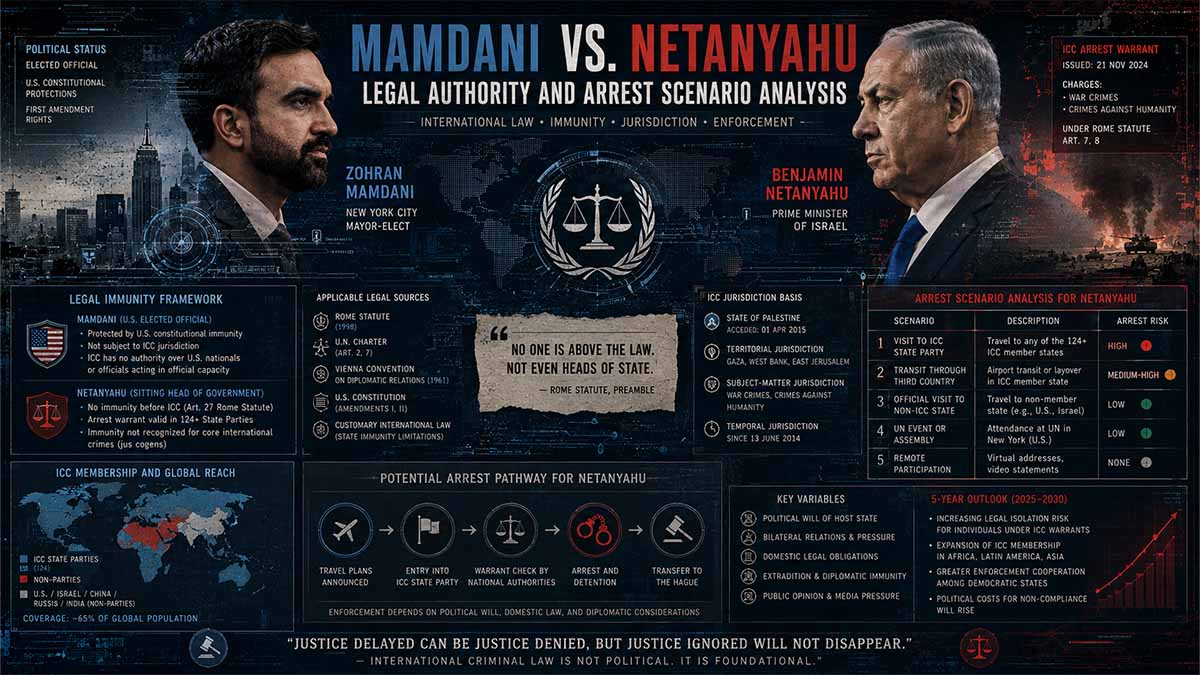
The underlying instrument is precise and dated. On 21 November 2024, Pre-Trial Chamber I of the International Criminal Court unanimously issued warrants of arrest for Benjamin Netanyahu and then-Defense Minister Yoav Gallant, after rejecting Israel’s jurisdictional challenges filed on 26 September 2024. The Chamber found reasonable grounds that from at least 8 October 2023 until at least 20 May 2024, Netanyahu and Gallant bore criminal responsibility as co-perpetrators for the war crime of starvation as a method of warfare, and for crimes against humanity including murder and persecution. That warrant is legally binding only on the 125 states parties to the Rome Statute — a treaty the United States never ratified. The precedent Mamdani must contend with is that Netanyahu has already tested New York once under this exact warrant: he addressed the 80th UN General Assembly on 26 September 2025, amid protests, without any arrest attempt, months before Mamdani’s inauguration. Israel’s Consul General in New York, Ofir Akunis, responded to Mamdani’s renewed comments this month by stating the mayor has “no authority” over the matter, adding that Mamdani “would be better off running New York City and only New York City.” Netanyahu himself, asked in mid-July whether the renewed threat concerned him, replied, “No, I’m not concerned,” a position consistent with his earlier public statement that he was “not afraid” to visit. ECCHRUnited Nations
The Federal Countermove
The dominant constraint is not municipal or even state law — it is Washington’s. In February 2025, the Trump administration imposed sanctions on the ICC itself specifically in response to the Netanyahu and Gallant warrants, formalizing federal non-recognition of the Court’s jurisdiction over Israeli or American nationals. When Mamdani, then mayor-elect, first restated the arrest pledge in a September 2025 interview, President Trump publicly condemned it as “inappropriate” and said he would personally interfere in any arrest attempt — a commitment that predates and directly overhangs the current September 2026 visit. This is significant because it converts what might otherwise be an abstract jurisdictional dispute into an explicit, pre-announced federal-versus-municipal confrontation. Constitutionally, the position of the executive branch has firm doctrinal grounding: control over foreign affairs sits with the federal government, not with cities, and courts have consistently struck down state or municipal actions found to intrude on that exclusive federal domain. Layered on top is the operational reality that protective security for foreign heads of government visiting UN Headquarters runs through the State Department’s Bureau of Diplomatic Security and the U.S. Secret Service, coordinating with, but not subordinate to, the NYPD — meaning Mamdani does not unilaterally control the security perimeter around Netanyahu’s visit even as police commissioner’s ultimate civilian superior.
The Diplomatic Exposure
A further legal layer works against the arrest scenario independent of the ICC warrant altogether. Representatives of UN member states are entitled, under the 1946 Convention on the Privileges and Immunities of the United Nations and the 1947 US–UN Headquarters Agreement, to immunity from personal arrest or detention while exercising their functions and travelling to and from UN meetings — a protection that covers a head of government attending the General Assembly in that capacity. Historically, the United States has tested the limits of that agreement only through executive-branch visa or entry decisions — denying Sudanese President Omar al-Bashir a visa to attend the General Assembly under the Obama administration despite his own ICC warrant, and barring Yasser Arafat’s entry in 1988 — never through a municipal police arrest of a leader already admitted to the country for UN business. The distinction matters diplomatically: a visa denial is an executive-to-executive act between sovereign governments; a municipal arrest would be an unprecedented insertion of city law enforcement into a protected multilateral diplomatic space, with consequences for how other states and the UN Secretariat evaluate New York’s reliability as host city for future sessions.
The Cost of Inaction — and of Action
For Mamdani, the political cost of doing nothing is limited: his own coalition, per Awawdeh’s comments to the Times, does not treat this as a governing priority, and Nadler’s public rebuke suggests continued escalation risks alienating the congressional Democratic establishment he will need on issues like federal funding and immigration enforcement disputes with the Trump administration — arguably higher-stakes fights for his mayoralty than a symbolic confrontation over a foreign leader’s UNGA appearance. For Washington and Jerusalem, the cost of Mamdani actually attempting an arrest — a low-probability but non-zero scenario given his repeated public commitments — would be a rapid federal court injunction, a constitutional foreign-affairs-preemption ruling against the city, and a diplomatic embarrassment for the UN’s host-country obligations, all without ever detaining Netanyahu. The more probable trajectory, consistent with the September 2025 precedent and with Hochul’s and Nadler’s public positioning, is that Mamdani’s Law Department review concludes what every other institutional actor in this dispute has already said publicly: the city lacks jurisdiction. What will persist regardless of that legal outcome is the political signal — a sitting American mayor publicly contesting his own country’s non-recognition of the ICC, and a foreign government publicly instructing him to confine himself to municipal governance. That signal, more than any arrest, is what will shape how Washington, Jerusalem, and the UN Secretariat calibrate expectations for New York as a diplomatic host city going forward.
Index
- Factual Background & Timeline
- Legal Authority Analysis (Municipal, State, Federal, International)
- Geopolitical & Diplomatic Scenario Modeling
ABSTRACT
1. Factual Background & Timeline
Mamdani’s position dates to a December 2024 interview with Mehdi Hasan, where, asked whether he would welcome Netanyahu to New York, he said no — that as mayor, New York City would arrest Netanyahu because the city’s values are in line with international law. He repeated this during the campaign; New York Times legal experts cited in that reporting judged an actual arrest “a practical impossibility” that could put Mamdani in direct conflict with the federal government. Reaction from his own political allies was mixed — figures like Murad Awawdeh of the New York Immigration Coalition told the Times arresting Netanyahu wasn’t a priority for them, and Rep. Jerry Nadler called the proposal “simply unrealistic,” saying the city has no jurisdiction to do it. Fox NewsFox News
The new reporting (mid-July 2026, ahead of the September UNGA) shows Mamdani softening the certainty of his earlier campaign pledge while keeping the door open. In an interview with the New York Times Magazine, he said the question was under “active conversation” with the city’s legal department but stopped short of repeating his earlier pledge outright, saying “whatever the law allows me to do in New York City, that’s what we will do”, while continuing to call Netanyahu a war criminal who belongs in The Hague. Israeli officials have responded sharply: a government spokesperson said Mamdani would be better off “running New York City and only New York City,” and that “if anyone should be arrested, it is Mamdani”. aolSnopes
2. Legal Authority Analysis
International law layer. The ICC issued its arrest warrant against Netanyahu in November 2024 over alleged war crimes and crimes against humanity connected to the Gaza war. Because the U.S. never joined the Rome Statute, that warrant has no automatic domestic legal force in American courts or against American police agencies — it binds ICC member states, not the NYPD. aol
Federal law layer. The Constitution assigns primary power over foreign affairs to the federal government, and the Trump administration sanctioned the ICC in February 2025 in response to the Netanyahu warrant, and has signaled it would almost certainly move to block or reverse any effort by Mamdani to act on the ICC warrant. Some analysts note a theoretical domestic hook — arguments have been raised that arresting authority could flow from the U.S. War Crimes Act (18 U.S.C.) applying a universal-jurisdiction theory — but this is a contested legal theory, not settled law, and federal prosecutors (not a city mayor) would control any such prosecution. A visiting head of government also typically carries diplomatic protections tied to UN headquarters agreements that further complicate any local arrest. Middle East Monitor + 2
State/city layer. Governor Hochul has previously said the mayor lacks the authority to arrest Netanyahu, and Nadler’s view that “the City of New York has no jurisdiction to do such a thing” reflects a broad consensus among legal commentators cited in this coverage. The mayor does control the NYPD as an operational matter — New York’s police commissioner serves at the mayor’s pleasure — but command authority over a domestic police force doesn’t itself create legal jurisdiction over a foreign head of government’s person, which is governed by international and federal, not municipal, law. aolFox News
Net assessment: the weight of legal opinion in the reporting is that an actual arrest is not legally viable through city channels alone, and would trigger immediate federal preemption if attempted.
3. Geopolitical & Diplomatic Scenario Modeling
- Scenario A — No action taken (highest probability). Mamdani’s Law Department review concludes there’s no viable legal path; Netanyahu attends UNGA without incident, and Mamdani limits himself to rhetorical condemnation. This aligns with his shift toward more conditional language (“whatever the law allows”).
- Scenario B — Symbolic/administrative gesture short of arrest. The city issues a formal statement, declines to provide certain courtesies or security cooperation, or refers the matter to federal/international bodies, without any physical detention attempt.
- Scenario C — Attempted arrest or detention order, blocked by state/federal authorities. If Mamdani directed the NYPD to act, Hochul, the State Department, Secret Service (which leads security for visiting heads of state under UN protocols), or federal law enforcement would very likely intervene to prevent it, producing an intergovernmental legal and constitutional clash rather than a completed arrest.
- Scenario D — Netanyahu alters travel plans. Israel could route Netanyahu’s UNGA participation through video address, a different U.S. entry point, or increased security coordination with federal agencies to sidestep New York City jurisdictional exposure entirely.
- Scenario E — Diplomatic/political escalation without legal action. The dispute becomes a sustained U.S.–Israel and Democratic-party political flashpoint (as seen already in sharp statements from Israeli officials), independent of any actual law-enforcement step.
The most consequential variable across these scenarios is federal posture: given the administration’s prior sanctions on the ICC and its stated non-recognition of the court, Washington’s practical veto power over any city-level enforcement action is the dominant constraint on Scenario C’s likelihood.
Netanyahu NYC Visit: Scenario Likelihood (Illustrative)
Chapter 1: Factual Background & Timeline
1.1 The Underlying Legal Trigger: The ICC Warrant
Everything in this dispute traces back to a single judicial act, so the details matter before the political timeline does.
| Detail | Data |
|---|---|
| Issuing body | ICC Pre-Trial Chamber I (judges from Benin, France, Slovenia) |
| Date issued | 21 November 2024 |
| Subjects | Benjamin Netanyahu (PM); Yoav Gallant (then-Defense Minister) |
| Original prosecution request filed | 20 May 2024 |
| Alleged conduct window | At least 8 October 2023 – at least 20 May 2024 |
| Alleged charges | War crime of starvation as a method of warfare; war crime of intentionally directing attacks against civilians; crimes against humanity of murder, persecution, and other inhumane acts |
| Legal theory of responsibility | Alleged co-perpetration / civilian superior responsibility |
| Companion warrant | Mohammed Diab Ibrahim Al-Masri (Deif), Hamas military commander, for war crimes/crimes against humanity from 7 October 2023; later noted by the Chamber as possibly deceased |
| Withdrawn warrants | Applications against Yahya Sinwar and Ismail Haniyeh withdrawn after their deaths were confirmed |
| Israel’s jurisdictional challenge | Rejected same day by the Chamber (Israel had filed challenges 26 September 2024 under Rome Statute Articles 18 and 19) |
The critical jurisdictional fact for the New York question: the ICC Pre-Trial Chamber unanimously rejected Israel’s challenges to the court’s jurisdiction over the Situation in the State of Palestine — but that ruling only binds ICC states parties. It does not, on its own, create any enforcement mechanism inside the United States, which brings us to the domestic political timeline. ECCHR
1.2 Domestic Timeline: Statement-by-Statement
| Date | Speaker/Venue | Substance |
|---|---|---|
| Dec 2024 | Mamdani, interview with Mehdi Hasan (then MSNBC) | Says as mayor, NYC would arrest Netanyahu; frames it as consistency between city values and international law |
| 21 Nov 2024 | ICC | Issues the underlying warrant (predates Mamdani’s first public comment by roughly two weeks) |
| Feb 2025 | Trump administration | Imposes sanctions on the ICC itself in response to the Netanyahu/Gallant warrants |
| 13 Oct 2025 | Mamdani, interview with NYT’s Astead Herndon (published) | Reaffirms the arrest pledge as Democratic mayoral nominee; says it matters that NYC comply with international criminal law |
| Oct 2025 (same reporting cycle) | Murad Awawdeh (NY Immigration Coalition) | Tells NYT that arresting Netanyahu is not a priority for his coalition |
| Oct 2025 (same reporting cycle) | Rep. Jerry Nadler (D-NY) | Calls the plan “simply unrealistic,” says the city has no jurisdiction to do it |
| Jul 2026 | Netanyahu, joint appearance with Trump | Says he is “not concerned” about Mamdani’s rhetoric; separately criticizes Mamdani over his Hamas-related comments |
| Jul 2026 (mid-month) | Mamdani, NYT Magazine interview | Confirms “active conversation” with city’s Law Department; softens to conditional language — “whatever the law allows me to do… that’s what we will do” — while still calling Netanyahu a war criminal who “belongs in The Hague” |
| Jul 2026 (same week) | Israeli government spokesperson (Akunis) | Says Mamdani should focus on “running New York City and only New York City,” and that “if anyone should be arrested, it is Mamdani” |
1.3 Rhetorical Shift: Campaign Pledge vs. Governing Position
This is the most analytically important thread in Chapter 1, because it’s the difference between a candidate’s promise and a sitting executive’s operational posture.
| Phase | Formulation | Certainty level |
|---|---|---|
| Candidate (Dec 2024 – Oct 2025) | “As mayor, New York City would arrest Benjamin Netanyahu” / “This is something that I intend to fulfill” | Categorical pledge |
| Mayor-elect / early mayoralty transition | Statements largely repeat campaign framing | Categorical, reaffirmed |
| Sitting mayor, pre-UNGA (Jul 2026) | “Whatever the law allows me to do in New York City, that’s what we will do”; declines to repeat the flat “would arrest” pledge; frames it as under active legal review | Conditional, contingent on Law Department findings |
The shift matters because it signals Mamdani is now bound by an actual governing apparatus — a corporation counsel’s office that has to give him a defensible legal opinion — rather than a campaign soundbite with no institutional check.
1.4 Institutional and Political Reactions Recorded So Far
| Actor | Position |
|---|---|
| NYT legal experts (cited in Oct 2025 reporting) | Arrest characterized as “a practical impossibility”; risk of direct conflict with the federal government |
| Gov. Kathy Hochul (NY) | Has said the mayor lacks authority to arrest Netanyahu |
| Rep. Jerry Nadler (D-NY) | City has no jurisdiction to do this |
| Murad Awawdeh / NY Immigration Coalition | Not a shared priority within Mamdani’s own coalition |
| Trump administration | Sanctioned the ICC itself (Feb 2025); does not recognize its jurisdiction over the U.S. or Israel |
| Israeli government (Akunis) | Dismissive/counter-accusatory; suggests Mamdani himself should be arrested |
| Netanyahu | Publicly unconcerned; frames Mamdani’s position as part of broader criticism of his stance on Hamas |
1.5 What’s Still Unconfirmed
To keep this factually disciplined rather than speculative: as of this reporting, there is no public confirmation of (a) what the NYC Law Department’s internal legal opinion concludes, (b) whether Netanyahu’s UNGA travel plans or security arrangements have been altered in response, or (c) any coordination between NYPD, the U.S. Secret Service, and State Department on security protocols for his visit. Those are the open variables Chapter 2’s legal analysis and Chapter 3’s scenario modeling have to work around.
Chapter 2: Legal Authority Analysis (Municipal, State, Federal, International)
This is genuinely a four-layer jurisdictional problem, and the layers don’t reinforce each other — they mostly work against the arrest scenario, each for a different reason. Below, each layer separately, then how they interact.
2.1 Municipal Layer: What the Mayor Actually Controls
| Power | Mamdani has it? | Limiting factor |
|---|---|---|
| Command authority over NYPD leadership | Yes — the police commissioner serves at the mayor’s pleasure | Command authority ≠ legal jurisdiction over the person being arrested |
| Ability to direct NYPD operational priorities | Yes, within normal policing | NYPD cannot lawfully execute an arrest with no underlying charge, warrant, or recognized legal basis |
| Legal opinion-drafting via Corporation Counsel / Law Department | Yes — this is the body Mamdani has said is in “active conversation” over the question | The Law Department can only work within existing law; it can’t manufacture jurisdiction that doesn’t exist |
| Formal charging authority | No | Criminal charging power in New York sits with District Attorneys (county-level, elected separately) and, for international/foreign-affairs matters, effectively with federal authorities |
The mayor’s practical authority here is best described as gatekeeping, not prosecutorial: he can decide whether NYPD cooperates, provides security, or stands down — but he cannot originate a valid legal basis for detaining a sitting foreign head of government. Rep. Jerry Nadler’s assessment — that “the City of New York has no jurisdiction to do such a thing” — reflects this gap between operational control and legal authority.
2.2 State Layer
Above the city sits the state, and Governor Hochul has already weighed in directly: she has said the mayor lacks the authority to arrest Netanyahu. This matters for two structural reasons:
- Gubernatorial oversight of NYPD in extraordinary circumstances. New York governors retain emergency and oversight powers over local law enforcement that could, in a live confrontation, be used to countermand a mayoral directive perceived as exceeding legal authority or triggering a federal crisis.
- State extradition and arrest law is built for interstate/domestic process, not foreign heads of state. New York’s Criminal Procedure Law governs arrests and extradition between U.S. states and, via federal statute, international extradition treaties — none of which contain a mechanism for a municipality to unilaterally detain a visiting foreign leader based on an ICC warrant the U.S. doesn’t recognize.
2.3 Federal Layer — the Dominant Constraint
This is where the arrest scenario meets its hardest wall, and it operates on at least four independent tracks:
(a) Foreign affairs preemption. The Constitution assigns primary control over foreign affairs to the federal government, not municipalities. This is one of the most settled doctrines in U.S. constitutional law (rooted in cases like Zschernig v. Miller and the general foreign-affairs preemption line); a city arresting a foreign head of state during a UN visit would almost certainly be treated by federal courts as an unconstitutional intrusion into exclusive federal territory, independent of anyone’s views on the underlying ICC allegations.
(b) The U.S. is not an ICC member and the executive branch has taken an adversarial posture toward the Court. The U.S. is not a party to the Rome Statute and does not recognize the ICC’s jurisdiction over America or Israel. Beyond mere non-membership, the Trump administration affirmatively sanctioned the ICC in February 2025 specifically in response to the Netanyahu/Gallant warrants — meaning the federal executive is not neutral on this question; it is actively hostile to enforcement of the warrant on U.S. soil.
(c) Security and protective jurisdiction sit with federal agencies, not NYPD alone. The State Department’s Bureau of Diplomatic Security coordinates protective security for foreign officials in the U.S., working with the Secret Service’s Uniformed Division and local police, and pursuant to a 1971 UN General Assembly resolution, the United States as host state bears the responsibility to protect the UN and UN missions and their personnel in New York City. In practice, this means Netanyahu’s physical security during a UNGA visit runs through a federally-coordinated protective apparatus that NYPD does not unilaterally control — a mayor ordering an arrest would be attempting to countermand a security operation federal agencies consider their own jurisdiction.
(d) The “domestic hook” theory — U.S. War Crimes Act. As noted in some legal commentary on this dispute, a theoretical argument exists that 18 U.S.C. § 2441 (the War Crimes Act) could provide a domestic statutory basis for prosecuting war crimes under a universal-jurisdiction-adjacent theory, independent of the ICC warrant itself. Two things limit this in practice: first, it’s a federal statute, meaning prosecutorial discretion rests with the U.S. Department of Justice, not a city government; second, given the same DOJ operates under an administration that sanctioned the ICC over these very warrants, invoking this statute against Netanyahu is not something the federal government shows any indication of pursuing.
2.4 International Layer — Immunity Actually Cuts Against the Arrest
This is the part most commentary on the Mamdani story tends to under-examine: even setting aside the ICC warrant entirely, there is a separate body of international law that affirmatively protects Netanyahu’s presence in New York — and it points the opposite direction from what Mamdani is proposing.
- UN Headquarters Agreement (1947) and the 1946 Convention on Privileges and Immunities. Representatives of UN member states, while exercising their functions and during travel to and from UN meetings, enjoy immunity from personal arrest or detention. Netanyahu attending the UN General Assembly as Israel’s head of government falls squarely within the category of protected UN-related activity, meaning the very treaty framework governing his presence in New York affirmatively shields him from arrest while there in that capacity — regardless of the ICC warrant.
- Historical precedent runs against interference with access, not toward it. The U.S., as host state, is generally barred under the Headquarters Agreement from denying entry to representatives of UN member states; Washington has previously tested the limits of that obligation (e.g., denying a visa to Sudan’s Omar al-Bashir despite a pending ICC warrant, and denying Yasser Arafat entry in 1988 on national-security grounds), but both of those were executive branch visa/entry actions — not a municipal police arrest of someone already inside the country to attend the UN. Notably, the same reporting observes the U.S. has, on many occasions, received leaders with pending ICC warrants — including, most recently, Netanyahu himself, who has already traveled to and met with President Trump since the warrant issued, without any arrest attempt.
- Head-of-state immunity under customary international law. Separate from the treaty-based UN immunity above, sitting heads of state and government traditionally enjoy immunity from the criminal jurisdiction of foreign domestic courts for official acts — a doctrine the ICC itself has had to litigate around, and which a U.S. municipal police force has no established legal footing to override.
2.5 Synthesis: Four Layers, One Direction
| Layer | Formal position on arrest | Strength of obstacle |
|---|---|---|
| Municipal | Mamdani commands NYPD but lacks jurisdiction to originate the arrest | High |
| State | Hochul has publicly stated the mayor lacks authority | High |
| Federal | Foreign-affairs preemption + active ICC sanctions + control of protective security | Very High (dominant constraint) |
| International | UN Headquarters Agreement immunity + head-of-state immunity doctrine | High — and notably, this layer isn’t neutral, it actively protects Netanyahu’s presence |
The striking thing about this case, legally, is that all four layers point the same direction. There’s no layer where Mamdani has an actual pathway — even the “domestic hook” theory (the War Crimes Act) still requires federal action he can’t compel. The Law Department review he’s cited is, in effect, likely to confirm what Hochul, Nadler, and the NYT’s own legal sourcing have already said: the city has no jurisdiction to execute this.
Chapter 3: Geopolitical & Diplomatic Scenario Modeling
3.1 Key New Inputs Since Chapter 1
Two additional facts materially reshape the scenario tree and are worth flagging before the modeling itself:
- Trump has already pre-committed to blocking any arrest. When Mamdani first made this threat as mayor-elect, Trump condemned it as “inappropriate” and stated he would personally interfere in the arrest if Mamdani attempted to follow through. That is not a hypothetical federal response — it’s a standing public commitment from the president, made months before the September visit in question. Trump has made no further comment on Mamdani’s most recent (July 2026) restatement.
- Netanyahu has already visited New York once under the warrant without incident. Photo documentation places Netanyahu addressing the 80th UN General Assembly on 26 September 2025 amid protests — meaning he has already tested this exact scenario once, prior to Mamdani taking office (1 January 2026), without any arrest attempt. He has also separately said he is “not afraid” and is “not concerned” about visiting under Mamdani’s mayoralty specifically, and Israel’s Consul General in New York, Ofir Akunis, has stated flatly that Mamdani has “no authority” to call for the arrest.
Both facts push probability mass toward the “no action” and “political theater” scenarios and away from any scenario involving an actual detention attempt.
3.2 Actor Incentive Matrix
| Actor | Stated position | Underlying incentive | Constraint on action |
|---|---|---|---|
| Mamdani | Reviewing legal authority via Law Department; rhetorically committed to ICC compliance | Base-pleasing signal to progressive/pro-Palestinian coalition; consistency with pre-mayoral pledges | Corporation Counsel unlikely to bless an unlawful order; risk of triggering direct federal confrontation and losing in court |
| Trump administration | Publicly condemned the threat as “inappropriate”; sanctioned the ICC itself | Protect close ally Israel; assert federal foreign-affairs supremacy over a Democratic-led city | Would need to act only if Mamdani actually moved to execute an order — otherwise no action required |
| Netanyahu / Israeli government | Dismissive, unconcerned; framed Mamdani as the one who should be arrested | Project strength; avoid appearing to cede ground to a hostile foreign municipal official | Domestic political pressure at home (see 3.4) cuts toward not skipping a high-profile UNGA appearance |
| Gov. Hochul | Publicly states Mamdani lacks authority | Manage a Democratic intraparty rift; avoid being pulled into a losing legal fight | Governor’s oversight powers over NYPD available if a real confrontation emerged |
| Congressional Democrats (e.g., Nadler) | Called plan “unrealistic”; city “has no jurisdiction” | Avoid the arrest threat becoming a national talking point against the party | Limited formal power to stop a mayor; influence is reputational/political only |
| Mamdani’s own coalition (e.g., NY Immigration Coalition) | Arresting Netanyahu “not a priority” | Preserve focus on affordability/immigration agenda that won the election | Internal pressure discourages Mamdani from actually spending political capital here |
3.3 Scenario Tree (Revised Probabilities)
| Scenario | Description | Relative likelihood | Key trigger/evidence |
|---|---|---|---|
| A — Status quo repeats: no action | Netanyahu attends UNGA as he did in Sept 2025; Mamdani limits himself to statements | High | Precedent of the Sept 2025 visit passing without incident; Law Department review likely to confirm no lawful path |
| B — Symbolic/administrative gesture | City withholds discretionary courtesies, issues formal condemnation, or refers matter to federal/international bodies, without physical detention | Moderate | Consistent with Mamdani’s shift to conditional language (“whatever the law allows”) |
| C — Attempted arrest order, federally blocked | Mamdani directs NYPD toward some detention action; federal agencies (State Dept./Secret Service/DOJ) intervene, citing Trump’s prior commitment to interfere | Low | Requires Mamdani to override his own coalition, Hochul’s stated position, and a near-certain federal court injunction |
| D — Netanyahu alters visit logistics | Israel adjusts security posture, entry point, or schedule to minimize exposure to NYC jurisdiction | Low-Moderate | Cuts against Netanyahu’s own public “not afraid”/”not concerned” framing, which is a domestic political asset for him |
| E — Sustained political/diplomatic escalation, no legal action | Dispute continues as a recurring US-Israel and intra-Democratic flashpoint independent of any arrest attempt | High (running concurrently with A or B) | Already underway — Akunis’s and Netanyahu’s sharp public statements, Nadler’s pushback, Trump’s prior “inappropriate” comment |
Scenarios A and E are not mutually exclusive — the most evidence-consistent outlook is Netanyahu appearing at UNGA without any arrest attempt (A), while the rhetorical conflict between Mamdani, Israeli officials, and possibly Trump continues in parallel (E).
3.4 Second-Order Effects Worth Tracking
- Israeli domestic politics. The New Arab’s analysis notes Netanyahu has waning public support domestically, making a high-profile UNGA appearance — potentially one of his last major international platforms — politically valuable to him personally, reinforcing his incentive to appear rather than avoid New York.
- U.S. intraparty Democratic dynamics. Nadler’s and Awawdeh’s pushback shows this is already a point of friction inside Mamdani’s own coalition; continued escalation (Scenario C in particular) carries real cost to Mamdani’s relationships with figures like Hochul and the House Democratic delegation, independent of the legal merits.
- Precedent-setting risk for future ICC-related visits. However this resolves, it will function as an informal precedent for how U.S. municipalities handle other ICC-indicted or sanctioned foreign officials visiting UN headquarters — a dynamic already flagged by legal commentators drawing analogies to the 2015 Bashir/Sudan visa dispute.
Netanyahu NYC Visit — Revised Scenario Likelihood
Illustrative analyst estimate, not a statistical model. A and E can co-occur.


