













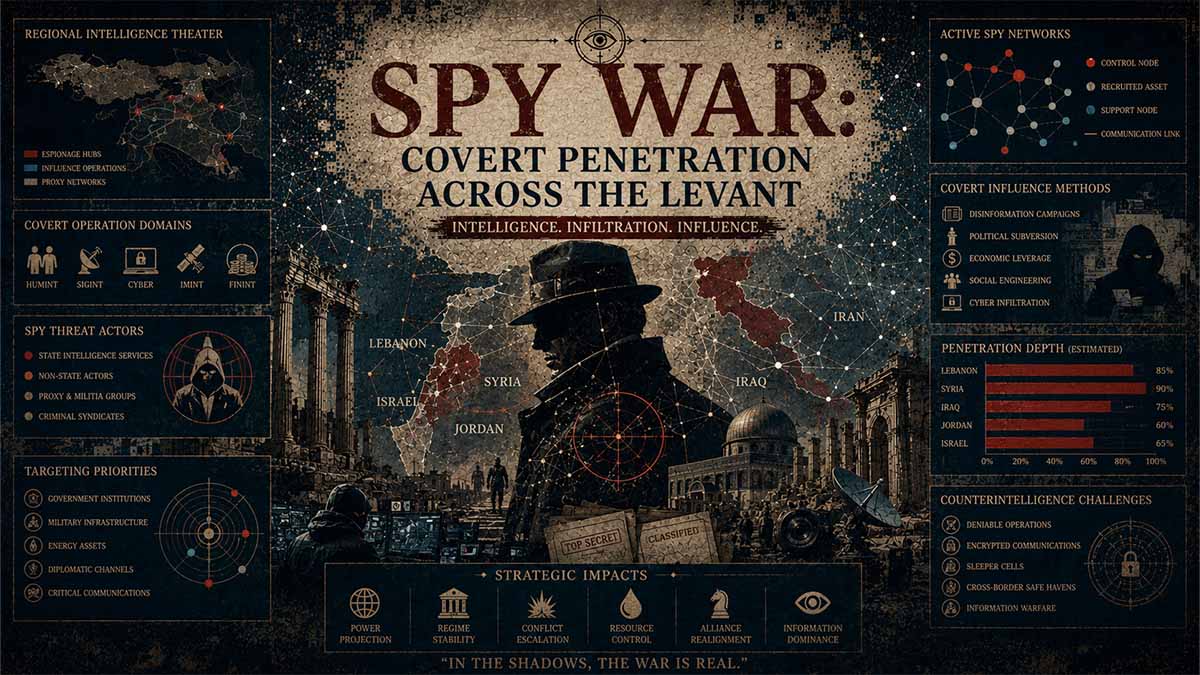
Executive Summary
BLUF: The confrontation linking Israel, Iran, Lebanon, Syria, Türkiye, and Palestinian armed organizations is evolving from episodic espionage into a permanent system of human, cyber, financial, logistical, and institutional penetration.
The decisive advantage increasingly belongs to the actor that can fuse HUMINT, SIGINT, cyber access, commercial data, financial intelligence, pattern-of-life analysis, and precision strike capabilities.
Assassinations and surprise attacks are usually the visible terminal phase of a much longer intelligence cycle involving identification, surveillance, access, verification, targeting, and operational timing.
Economic distress, fragmented authority, population displacement, criminal intermediaries, digital exposure, and cross-border commerce enlarge the potential recruitment environment.
Israel retains major advantages in technical collection, data fusion, operational reach, and intelligence-to-strike integration, but its adversaries increasingly exploit Israeli citizens, digital platforms, diaspora networks, proxies, and low-cost social engineering.
Iran’s system combines state intelligence, IRGC structures, proxy relationships, cyber operators, criminal facilitators, and compartmented foreign networks, allowing Tehran to pursue objectives while varying attribution and escalation exposure.
Türkiye is simultaneously a counterintelligence power, regional transit space, diplomatic intermediary, commercial hub, and contested operational environment for Iranian, Israeli, Arab, Russian, and Western services.
Lebanon and Syria remain the central human terrain: institutionally fragmented, economically vulnerable, operationally saturated, and connected to networks extending from Tehran to the Mediterranean.
The most probable five-year trajectory is persistent covert conflict below the threshold of continuous interstate war, punctuated by targeted killings, cyber compromises, arrests, defections, disinformation campaigns, and occasional strategic intelligence failures.
The principal systemic risk is not a single spy or assassination but a penetrated decision ecosystem in which manipulated information causes leaders to strike too early, too late, or against the wrong target.
Navigational Index
Pillar I — The Penetrated Battlespace
The transformation of the Levant from a conventional intelligence theatre into a distributed contest involving state services, armed organizations, cyber units, commercial platforms, displaced populations, criminal facilitators, ideological networks, and transnational financial channels.
Pillar II — Intelligence-to-Strike Architecture
The chain connecting human access, digital collection, identity resolution, geolocation, behavioral analysis, target validation, operational authorization, precision attack, information management, and post-operation damage assessment.
Pillar III — Five-Year Covert-War Outlook
A structured examination of competing hypotheses, Bayesian indicators, escalation pathways, counterintelligence adaptation, shadow liquidity, proxy autonomy, cyber-enabled recruitment, and the probability of covert action triggering overt regional war.
Master Abstract
The contemporary spy war across Israel, Iran, Lebanon, Syria, Türkiye, and the Palestinian arena is best understood not as a collection of isolated penetrations but as a regional intelligence ecosystem in which information, access, coercion, money, ideology, technology, and violence operate as mutually reinforcing instruments. The historical expansion of this ecosystem accelerated when targeted killing became an institutionalized component of regional security competition: once assassination moved from exceptional retaliation to a recurrent strategic instrument, intelligence services and armed organizations required persistent access to identities, routines, communications, residences, transportation patterns, security procedures, personal relationships, and internal decision structures. That requirement transformed the value of the agent. A source no longer needed to possess a formal position inside a ministry, military headquarters, or resistance command to be useful. Drivers, maintenance workers, telecommunications employees, local officials, relatives, contractors, financial intermediaries, landlords, journalists, aid personnel, border traders, digital administrators, and apparently peripheral acquaintances could each contribute one fragment to a larger targeting picture. Modern data fusion magnifies those fragments: an address supplied by one source, a telephone identifier acquired through another channel, imagery collected by an unmanned system, travel metadata, a financial transfer, and an intercepted communication can be combined into a probabilistic identity assessment without any single source understanding the final objective. Israel’s official security service has publicly described Iranian efforts to recruit Israeli citizens and cultivate espionage networks, demonstrating that vulnerability is reciprocal rather than confined to conflict-affected Arab societies. The ISA Have Been Looking into a Secret Iranian Espionage Network that Recruited Israeli Women – Israel Security Agency – January 2022 — Verified official source. More recent Israeli governmental reporting also attributes sustained cyber-espionage activity to Iranian-aligned operators, including campaigns designed to penetrate organizational email systems and obtain durable network access. Iranian Phishing Campaign Targets Organizational Email Systems – Israel National Cyber Directorate – December 2025 — Verified official source. These cases support a central analytic judgment: the regional spy war has become bidirectional, socially distributed, and increasingly automated. Recruitment continues to exploit financial pressure, ideological affinity, grievance, ego, fear, compromised conduct, professional ambition, and emotional dependence, but digital interaction now permits handlers to test, classify, cultivate, and discard potential sources at a scale impossible during the intelligence struggles of the 1970s. The critical security boundary is therefore no longer the physical frontier. It is the point at which ordinary contact becomes tasking, tasking becomes concealment, concealment becomes dependency, and dependency becomes controlled operational access.
The operational consequence is an intelligence-to-strike architecture in which assassinations, sabotage, precision air operations, cyber disruption, arrests, and influence campaigns represent alternative outputs from a common collection system. In this architecture, HUMINT supplies context, intent, access, and behavioral interpretation; SIGINT reveals communications and network relationships; cyber operations extract credentials, documents, location data, and institutional vulnerabilities; imagery establishes physical patterns; financial intelligence maps facilitators and dependencies; and analytic platforms convert these inputs into confidence scores. The system does not require perfect knowledge. It requires sufficient confidence that the value of acting exceeds the expected political, military, legal, and reputational cost of error. Publicly documented Iranian external operations illustrate a similarly layered model. The United States Department of Justice has prosecuted or charged individuals accused of using intermediaries, criminal associates, reconnaissance, and murder-for-hire arrangements in plots linked to Iranian state structures. In March 2026, a federal jury convicted Asif Merchant in a case in which prosecutors stated that he had been tasked by the IRGC to recruit personnel for an assassination operation against a United States official or political figure. Iranian Intelligence Agent Convicted of Terrorism and Murder-for-Hire – United States Department of Justice – March 2026 — Verified official source. Separately, United States authorities charged an alleged IRGC asset and two local associates in a scheme involving surveillance and planned killing, while Treasury identified a network operating at the direction of Iran’s Ministry of Intelligence and Security that used criminal actors in transnational repression. Justice Department Announces Murder-for-Hire and Related Charges Against IRGC Asset and Two Local Operatives – United States Department of Justice – November 2024 — Verified official source. The United States and United Kingdom Target Iranian Network Involved in Assassination and Kidnapping Plots – United States Department of the Treasury – January 2024 — Verified official source. These proceedings are allegations or judicial findings concerning specific defendants, not proof that every attributed incident reflects the same command structure. Nevertheless, they demonstrate a reusable architecture: strategic direction can originate within a state apparatus while surveillance, logistics, financing, and violence are delegated through layered intermediaries. This modularity provides deniability, protects senior personnel, complicates attribution, and allows operations to continue after individual cells are exposed. It also creates vulnerabilities: each additional intermediary increases the probability of defection, interception, financial detection, miscommunication, or penetration by counterintelligence.
Within the Levant, Lebanon and Syria constitute the densest convergence zone because armed structures, state institutions, foreign militaries, intelligence liaison relationships, displaced communities, cross-border family networks, sanctions-evasion channels, and informal economies coexist within overlapping territorial and political systems. Lebanon’s prolonged financial collapse increases exposure to recruitment through debt, unemployment, migration pressure, foreign remittances, telecommunications access, and dependence on informal payment mechanisms. Syria’s fragmented sovereignty and wartime institutional erosion create a different but related environment: military facilities, militia structures, foreign advisers, local brokers, transport networks, reconstruction interests, and border economies produce numerous points at which information can be purchased, coerced, technologically acquired, or unintentionally disclosed. The presence of Iranian and allied organizations in Syria simultaneously creates strategic depth and an expanded attack surface. United States Treasury designations have described senior IRGC Intelligence Organization officials as involved in operations and counterintelligence activity connected to Syria, while other Treasury actions identify Iranian external-operation personnel associated with covert and lethal activity abroad. Treasury Sanctions Officials of Iranian Intelligence Agency – United States Department of the Treasury – April 2023 — Verified official source. Treasury Designates Iranian Regime Operatives Involved in External Lethal Plotting – United States Department of the Treasury – June 2023 — Verified official source. Israel’s comparative advantage lies in integrating intelligence with precision effects across distance, yet the same operational success can generate adaptation by its adversaries: tighter compartmentation, reduced electronic emissions, dispersed command, courier networks, deceptive schedules, decoy facilities, autonomous local cells, and stricter background screening. The result is an iterative contest rather than a one-sided penetration campaign. Every successful strike teaches the target which security layer probably failed; every arrest teaches the sponsoring service which communication, financial, or behavioral signature exposed the operation. Over time, both sides move toward smaller cells, greater technical mediation, shorter operational windows, and reduced reliance on permanent clandestine infrastructure. This produces a paradox: improved counterintelligence may reduce the number of durable agents but increase the strategic importance of temporary access, commercial datasets, compromised devices, cloud credentials, insiders with narrow permissions, and one-time reconnaissance.
Türkiye occupies a uniquely consequential position within this system. It is a NATO member with substantial indigenous intelligence capabilities, extensive borders with Syria, deep economic and social links across the Middle East, major transportation hubs, large expatriate and refugee populations, and active diplomatic relations with actors that frequently confront one another. Its territory can therefore function simultaneously as a meeting environment, transit corridor, financial interface, surveillance platform, counterintelligence arena, and location for indirect negotiation. Türkiye’s National Intelligence Organization, MİT, publicly defines its responsibilities as integrating foreign intelligence, cyber intelligence, signals intelligence, coordination, and special activities, reflecting the multi-domain structure now required to contest covert networks. What We Do – National Intelligence Organization of Türkiye – Current institutional description — Verified official source. Ankara’s strategic objective is not reducible to alignment with either Israel or Iran. It seeks autonomous regional influence, domestic regime security, control over foreign clandestine activity on Turkish territory, leverage in Syria, protection of commercial interests, and freedom to mediate among competing blocs. This creates a variable counterintelligence environment: an operation tolerated under one political configuration may be disrupted under another; intelligence may be shared selectively without implying strategic alignment; and public arrests can serve legal, security, diplomatic, and signaling functions simultaneously. The European Council’s 2026 forward-looking assessment characterizes Türkiye as an increasingly autonomous regional actor using geography, diplomatic flexibility, and multi-vector relationships to expand influence. Forward Look 2026: Playing by New Rules? – Council of the European Union – January 2026 — Verified official report. For intelligence forecasting, this means Türkiye should not be modeled as a passive arena. It is an active gatekeeper capable of altering the operational cost of Iranian, Israeli, Syrian, Russian, Arab, European, and non-state intelligence activity. Its decisions regarding surveillance, detention, deportation, disclosure, liaison cooperation, and public attribution can reshape clandestine networks far beyond Turkish territory.
The five-year outlook from 2026 to 2031 is dominated by five competing hypotheses. H₁ — Managed Shadow War: covert action remains intense but politically calibrated, with assassinations, cyber intrusions, arrests, sabotage, proxy surveillance, and limited precision attacks kept below the threshold of sustained regional war. H₂ — Intelligence-Enabled Escalation: a high-value penetration produces a decapitation strike or strategic sabotage operation whose political significance compels direct retaliation. H₃ — Counterintelligence Reversal: one or more services successfully penetrate an adversary’s source network, manipulate reporting, and use controlled information to expose cells or induce a misdirected operation. H₄ — Fragmented Proxy Autonomy: weakened central control allows local armed, criminal, ideological, or cyber actors to conduct operations that sponsors did not fully authorize, increasing miscalculation and attribution uncertainty. H₅ — Technological Substitution: persistent surveillance, artificial intelligence, compromised commercial platforms, biometric identification, and automated link analysis reduce dependence on traditional long-term agents while increasing dependence on digital access and data integrity. The current evidence favors H₁, but with a substantial and growing conditional probability of H₂ whenever covert action affects senior leadership, strategic weapons, nuclear infrastructure, national command systems, or politically symbolic targets. The publicly documented breadth of Iranian cyber operations, external lethal plotting, Israeli counterintelligence cases, and intelligence-supported military action indicates that the covert and overt theatres are already connected. The crucial Bayesian indicators are therefore not simply the number of arrests or assassinations. Analysts should track changes in diplomatic warnings, unexplained security rotations, communications blackouts, emergency travel restrictions, arrests of dual nationals, sudden changes in proxy command structures, financial sanctions against facilitators, anomalous aviation or border activity, cyber campaigns against identity and communications systems, and synchronized information operations preparing domestic audiences for retaliation. The model should also account for deception: conspicuous security alerts can conceal a different target set, while public exposure of an agent network may be intended to reassure, deter, mislead, or protect an undisclosed counterintelligence operation. No open-source Monte Carlo model can generate reliable point predictions without classified base rates. The appropriate output is therefore a transparent probability range that changes as observable indicators accumulate, not a false claim of deterministic foresight.
System-Level Risk Indicators
Analytic Inputs
Competing-Hypothesis Selector
Regional Exposure Matrix
Pillar I — The Penetrated Battlespace: Intelligence Competition Across the Levant, 2026–2031
The Levant has ceased to function as a conventional intelligence theatre in which identifiable state services recruit agents, penetrate ministries, intercept military communications, and prepare discrete operations against opposing governments. It has become a distributed penetration environment in which intelligence collection, covert influence, financial facilitation, cyber exploitation, organized crime, population movement, commercial technology, and precision military action form a single interconnected system. The principal participants remain state institutions—Israeli services, Iranian intelligence bodies and the IRGC, Türkiye’s National Intelligence Organization, Syrian security structures, and Lebanese agencies—but the intelligence contest now extends through armed organizations, private contractors, telecommunications providers, digital platforms, money-transfer businesses, shipping companies, displaced communities, criminal intermediaries, ideological associations, diaspora networks, and individuals recruited remotely for narrowly defined tasks. The European Union’s official hybrid-threat framework describes the wider phenomenon as coordinated hostile activity combining cyberattacks, information manipulation, economic coercion, covert political action, and military pressure; although developed primarily for European security, that conceptual definition closely matches the operational environment emerging across the Levant. Hybrid Threats – Council of the European Union – Current official framework — Verified official source. The transformation is strategically important because an intelligence service no longer needs to penetrate an adversary’s central command comprehensively. It can assemble operational knowledge from fragmented contributions: one individual identifies a building; another confirms a vehicle; a compromised account reveals communications; commercially available imagery indicates construction; a payment trail exposes a facilitator; metadata establishes routine; and a technical sensor confirms presence. The resulting intelligence product is distributed across sources that may never know one another, may not understand the final operation, and may be located in different jurisdictions. This lowers the cost of entry, expands the recruitment pool, complicates counterintelligence, and makes the distinction between espionage, cybercrime, criminal facilitation, influence activity, and military targeting progressively less meaningful.
The central structural change is the replacement of the traditional “master agent” model with a modular intelligence supply chain. Historically, the highest-value penetration involved a trusted source positioned within a political, military, diplomatic, or security hierarchy and capable of providing comprehensive insight over an extended period. Such penetrations remain strategically valuable, but they are difficult to recruit, vulnerable to periodic screening, and potentially catastrophic if exposed. Contemporary services therefore supplement them with layered networks of low-visibility contributors: digital access brokers, logistics personnel, payment intermediaries, relatives of officials, border workers, telecommunications technicians, local administrators, commercial employees, criminal associates, and ideologically motivated volunteers. Israeli official reporting confirms that Iranian recruitment efforts have targeted Israeli citizens through socially embedded relationships and remote communications, while Israeli cyber authorities have documented Iranian-linked campaigns aimed at organizational email systems and persistent network access. The ISA Have Been Looking into a Secret Iranian Espionage Network that Recruited Israeli Women – Israel Security Agency – January 2022 — Verified official source. Iranian Phishing Campaign Targets Organizational Email Systems – Israel National Cyber Directorate – December 2025 — Verified official source. The analytical implication is that penetration now occurs through accumulation rather than singular access. A recruiter can test dozens or hundreds of potential contacts, initially requesting conduct that appears minor, legal, or morally ambiguous rather than explicitly treasonous. The tasks may involve photography, location confirmation, document retrieval, observation, account creation, package transfer, or verification of public information. Each completed task establishes responsiveness, secrecy, and susceptibility to further direction. Only later does the relationship become unmistakably clandestine. This staged architecture minimizes exposure for the sponsoring service because each participant possesses only partial knowledge, while the service retains the ability to combine otherwise insignificant fragments into a usable targeting or influence package.
Distributed Penetration Architecture
Asymmetric Operation Lifecycle & Threat Ingestion Interface
Lebanon represents the most compressed version of the penetrated battlespace because economic vulnerability, fragmented political authority, armed organizational autonomy, extensive diaspora connections, an impaired banking system, informal financial practices, and proximity to Israel and Syria coexist in a geographically small environment. The World Bank reported that Lebanon’s real economy returned to positive growth in 2025, expanding by 3.5 percent, but described the recovery as modest and dependent on uneven reform progress after years of severe contraction; this is not equivalent to institutional normalization or broad household recovery. Lebanon: Economic Rebound Marks Cautious Recovery Amidst Progress on Reforms – World Bank – January 2026 — Verified official source. The World Bank’s detailed economic assessment also emphasizes that the unresolved financial crisis and deeply impaired banking sector continue to constrain investment and financial intermediation. Lebanon Economic Monitor, Spring 2025: Turning the Tide? – World Bank – June 2025 — Verified official source. These conditions enlarge the pool of individuals exposed to financial recruitment without implying that poverty mechanically produces espionage. The relevant intelligence variable is not poverty alone but the interaction of urgent need, weak institutional protection, access to information, perceived impunity, and the presence of a capable recruiter. A poorly paid communications employee, municipal official, transport worker, property manager, or contractor may possess narrow but valuable access. Informal employment and cash-based transactions reduce auditable records; foreign remittances create legitimate cover for cross-border payments; and social fragmentation makes unusual relationships more difficult to identify. At the same time, Lebanese political and communal structures can provide powerful counterintelligence surveillance through local knowledge, family networks, partisan institutions, and neighborhood-level observation. Lebanon is therefore neither an undefended space nor a uniformly penetrated society. It is a high-density contest in which state services, political organizations, armed actors, foreign sponsors, and private networks continuously monitor overlapping populations.
The displacement dimension adds a particularly sensitive layer that must be assessed without equating refugees or migrants with security threats. The intelligence risk arises from structural conditions surrounding mass displacement: incomplete documentation, cross-border family ties, dependence on intermediaries, precarious employment, irregular travel, aid-registration systems, telecommunications exposure, and the need to interact repeatedly with state and non-state gatekeepers. UNHCR reported that, as of July 2025, the Lebanese government estimated approximately 1.3 million Syrian refugees in Lebanon, including slightly more than 716,000 registered with UNHCR, and stated that nine out of ten refugee households were living in extreme poverty. Lebanon Country Overview – United Nations High Commissioner for Refugees – Updated 2025–2026 — Verified official source. Regionally, UNHCR’s Syria portal records millions of Syrians registered across Türkiye, Lebanon, Jordan, Iraq, Egypt, and North Africa, while the agency’s 2025 global trends reporting states that Syria remained one of the world’s largest displacement situations and that roughly 1.3 million Syrians returned from abroad during 2025 following the fall of the Assad government. Syria Regional Refugee Response – United Nations High Commissioner for Refugees – Current operational data — Verified official source. Global Trends 2025 – United Nations High Commissioner for Refugees – June 2026 — Verified official source. Such movements create legitimate humanitarian and economic flows, but they also alter the intelligence terrain by reconnecting communities across front lines, generating new transport routes, changing property occupancy, and producing large volumes of personal and logistical data. Services may attempt to exploit those conditions through coercion at checkpoints, manipulation of legal status, recruitment via employment offers, or targeting of individuals with family members in multiple jurisdictions. Counterintelligence policy must therefore protect vulnerable populations while securing access systems; indiscriminate suspicion would drive communities away from authorities and create precisely the concealment opportunities that hostile networks seek.
Syria is the region’s principal territorial intelligence laboratory because the postwar and post-regime-transition environment combines damaged institutions, competing armed formations, returning populations, foreign military interests, contested border zones, reconstruction contracts, sanctions exposure, and unstable chains of command. More than 12 million Syrians remained forcibly displaced according to UNHCR’s operational overview, even as substantial return movements occurred after December 2024. Syrian Arab Republic Operational Data Portal – United Nations High Commissioner for Refugees – Current country overview — Verified official source. An intelligence service operating in such an environment can collect through human access, aerial surveillance, compromised communications, commercial satellite imagery, customs and transport data, local armed partners, property records, humanitarian logistics, and the observation of foreign advisers or weapons transfers. Yet the apparent abundance of information creates an equally serious problem: source reliability. Individuals may provide fabricated or exaggerated intelligence to eliminate rivals, obtain money, secure political protection, or redirect an attack. Armed groups may manipulate foreign sponsors by overstating threats or concealing autonomous agendas. Local officials may maintain relationships with several external actors simultaneously. This makes deception detection as important as collection volume. A target nomination based on one source, one geolocation signal, or one communication intercept creates unacceptable susceptibility to manipulation; a resilient intelligence architecture requires independent corroboration across human, technical, temporal, and behavioral channels. Syria also provides the connective tissue between Iranian strategic depth, Lebanese armed structures, Iraqi routes, Turkish security interests, Russian residual influence, and Israeli interdiction operations. Consequently, a local penetration can generate regional effects. Access to a transport coordinator may reveal cross-border logistics; access to a telecommunications node may expose several armed networks; access to reconstruction procurement may reveal covert ownership and sanctions-evasion structures. The intelligence objective is therefore not simply to locate weapons or commanders but to map the infrastructure that sustains influence across jurisdictions.
| Penetration layer | Lebanon | Syria | Israel | Iran | Türkiye |
|---|---|---|---|---|---|
| Institutional fragmentation | High | Very high | Low–moderate | Moderate | Low–moderate |
| Economic recruitment pressure | Very high | Very high | Moderate | High | Moderate |
| Commercial-data availability | High | Moderate | Very high | High | Very high |
| Armed non-state presence | Very high | Very high | Low internally | State-supported externally | Moderate near conflict zones |
| Cross-border population mobility | High | Very high | Controlled but consequential | Moderate | Very high |
| Informal financial channels | Very high | Very high | Moderate | Very high | High |
| Technical counterintelligence capacity | Fragmented | Uneven | Very high | High | High |
| Exposure to foreign services | Very high | Very high | Very high | Very high | Very high |
The table is an analytical ordinal assessment, not a published government index. “Very high” indicates that the factor is structurally central to the intelligence environment, not that every institution or community is compromised.
The financial layer converts the penetrated battlespace from a collection problem into a sustainability problem. Intelligence networks require payment, logistics, communications, false documentation, transport, safe accommodation, commercial cover, legal assistance, and mechanisms for moving value across borders without exposing the sponsor. These functions increasingly overlap with sanctions-evasion networks, informal value-transfer systems, commodity trading, front companies, shipping structures, exchange houses, and criminal finance. The Financial Action Task Force identifies Iran as a high-risk jurisdiction subject to a call for action and urges enhanced due diligence and, in the most serious circumstances, countermeasures against money-laundering, terrorist-financing, and proliferation-financing risks. Iran Country Status and High-Risk Jurisdiction Designation – Financial Action Task Force – Current official status — Verified official source. FATF’s 2025 report on complex proliferation-financing and sanctions-evasion schemes explains how networks can employ layered corporate ownership, intermediaries, trade transactions, multiple jurisdictions, and professional facilitators to conceal beneficial control and payment purposes. Complex Proliferation Financing and Sanctions Evasion Schemes – Financial Action Task Force – June 2025 — Verified official report. U.S. Treasury actions further allege that Iranian-linked exchange houses, front companies, shipping businesses, and overseas facilitators have moved billions of dollars through shadow-banking structures, while separate designations identify financial transfers connecting Iran-based and Lebanon-based facilitators associated with Hezbollah. Treasury Sanctions Iranian Network Laundering Billions for Regime – United States Department of the Treasury – June 2025 — Verified official source. Treasury Disrupts Financial Facilitation Network Supporting Hizballah – United States Department of the Treasury – May 2025 — Verified official source. These official findings concern designated actors and should not be generalized to all regional commerce. Their relevance lies in showing that the same financial infrastructure capable of moving strategic revenue can also conceal smaller operational payments, procurement, travel, and support to clandestine networks.
The relationship between intelligence services and organized crime is another defining feature of the distributed contest. Criminal actors offer capabilities that state officers often cannot employ directly without increasing attribution risk: weapons acquisition, forged documentation, surveillance, intimidation, vehicle procurement, border movement, money laundering, and contract violence. In January 2024, the U.S. Treasury and United Kingdom took coordinated action against a network that U.S. authorities stated operated at the direction of Iran’s Ministry of Intelligence and Security and used criminal actors in alleged assassination and kidnapping plots against dissidents. The United States and United Kingdom Target Iranian Network Involved in Assassination and Kidnapping Plots – United States Department of the Treasury – January 2024 — Verified official source. In November 2024, the U.S. Department of Justice charged an alleged IRGC asset and two local associates in a murder-for-hire case, alleging that the external sponsor sought to recruit criminal intermediaries for surveillance and lethal action. Justice Department Announces Murder-for-Hire and Related Charges Against IRGC Asset and Two Local Operatives – United States Department of Justice – November 2024 — Verified official source. A March 2026 conviction in a separate case established that the defendant had worked for the IRGC, received tradecraft training, and travelled to the United States seeking recruits. Iranian Intelligence Agent Convicted of Terrorism and Murder for Hire – United States Department of Justice – March 2026 — Verified official source. These cases are geographically outside the Levant, but they demonstrate a transferable model: state direction, compartmented intermediaries, criminal execution capacity, and deniable financial support. In Lebanon, Syria, Türkiye, and neighboring transit zones, the same logic can apply to reconnaissance, procurement, smuggling, sabotage, or coercion without necessarily culminating in assassination.
State–Criminal Interface Operations Matrix
Asymmetric Proxy Orchestration & Hybrid Threat Ingestion Framework
Commercial platforms and consumer technologies have simultaneously democratized intelligence collection and industrialized recruitment. Social networks, messaging applications, online employment platforms, digital advertising systems, cloud storage, mapping services, consumer cameras, connected vehicles, biometric databases, and breached credential markets allow a service to identify and approach individuals without establishing a physical presence. The European External Action Service describes Foreign Information Manipulation and Interference as a growing security and foreign-policy threat and emphasizes that hostile actors build cross-platform infrastructures rather than relying on isolated messages. Information Integrity and Countering Foreign Information Manipulation and Interference – European External Action Service – Current official framework — Verified official source. Israel’s 2024 cybercrime activity report stated that Iranian adversaries resurfaced under new online identities and collaborated with established ransomware groups, illustrating how state-aligned cyber activity can blend with criminal ecosystems. 2024 Cybercrime Activity Report – Israel National Cyber Directorate – February 2025 — Verified official report. The significance for the Levant is not confined to technical intrusion. Cyber access can identify recruitable individuals, reveal debts or private relationships, map organizational hierarchies, impersonate trusted contacts, and verify whether a human source is truthful. Conversely, a human source can provide the credentials, device access, security answers, or physical proximity needed to make a cyber operation succeed. This produces a HUMINT–cyber fusion cycle: cyber reconnaissance identifies vulnerability; social engineering creates contact; human interaction provides access; technical exploitation expands collection; and collected data enables more precise recruitment or targeting. By 2031, the highest-risk organizations will not necessarily be those with the weakest encryption, but those that treat personnel security, vendor access, financial exposure, and digital identity as separate administrative domains rather than one integrated counterintelligence problem.
Türkiye functions as both a major counterintelligence actor and a contested connective platform. Its geography links Europe, the Black Sea, the Caucasus, Syria, Iraq, Iran, and the eastern Mediterranean; its transport, commercial, refugee, diplomatic, and financial networks create legitimate flows that are attractive to intelligence services seeking access or concealment. Türkiye’s National Intelligence Organization publicly identifies foreign intelligence, signals intelligence, cyber intelligence, coordination, and special activities as core functions, confirming that Ankara conceptualizes security in multi-domain rather than purely territorial terms. What We Do – National Intelligence Organization of the Republic of Türkiye – Current institutional description — Verified official source. Türkiye cannot be treated analytically as a neutral corridor or simple extension of NATO intelligence priorities. Ankara seeks strategic autonomy, border control, influence in Syria, protection from foreign operations on its territory, leverage over regional actors, and selective relationships with Israel, Iran, Russia, Arab governments, Europe, and the United States. This means Turkish counterintelligence enforcement can serve several purposes simultaneously: disrupting a genuine threat, protecting sovereignty, bargaining with a foreign government, signaling neutrality, strengthening domestic legitimacy, or demonstrating that Turkish territory cannot be used without consent. The country’s large Syrian population and intensive cross-border commerce create substantial collection opportunities, but also impose heavy burdens on identity management, border screening, and community trust. Excessively broad securitization could alienate populations whose cooperation is essential for detecting clandestine behavior; insufficient scrutiny could permit hostile networks to exploit legitimate mobility. Over the next five years, Türkiye is likely to invest further in integrated biometric, border, financial, cyber, and communications analysis while preserving political discretion over which foreign networks are confronted publicly, managed quietly, exchanged through liaison channels, or used as leverage in wider diplomacy.
The Russian and Chinese perspectives matter because both states influence the diplomatic, technological, financial, and security environment in which Levantine intelligence competition unfolds, even when they are not directly controlling the local clandestine contest. China’s official Middle East position emphasizes regional stability, political settlement, sovereignty, opposition to uncontrolled escalation, and economic engagement, including its role in supporting Saudi–Iranian reconciliation and Palestinian diplomatic contacts. Position Paper of the People’s Republic of China for the Summit of the Future and the General Debate of the 79th Session of the United Nations General Assembly – Ministry of Foreign Affairs of the People’s Republic of China – September 2024 — Verified official source. China’s exposure is nevertheless expanding through energy imports, infrastructure, telecommunications equipment, shipping, and commercial data flows, making regional instability and sanctions enforcement increasingly consequential for Chinese entities. Russia’s Foreign Ministry and Russian-backed multilateral statements have consistently framed Israeli and U.S. military action against Iran as destabilizing and have advocated political-diplomatic resolution. Foreign Ministry Statement in Connection with Israel’s Military Operation Against Iran – Ministry of Foreign Affairs of the Russian Federation – June 2025 — Verified official source. BRICS Joint Statement on the Escalation of the Security Situation in the Middle East – Ministry of Foreign Affairs of the Russian Federation – June 2025 — Verified official source. These documents are diplomatic positions rather than neutral intelligence assessments, but they reveal the geopolitical constraints surrounding covert action. Russia and China can provide diplomatic cover, alternative technology, trade relationships, or political support to Iran and regional partners, while simultaneously seeking to avoid uncontrolled conflict that threatens shipping, energy flows, investments, and strategic access. Their involvement therefore increases the number of external actors whose data systems, companies, diplomats, and commercial relationships may become indirectly embedded in the penetrated battlespace.
The counterintelligence challenge is best represented as a competition between network expansion and network observability. Distributed recruitment makes hostile systems more resilient because the loss of one participant does not necessarily expose the whole architecture; however, every additional participant creates communications, payments, movements, devices, relationships, and behavioral anomalies that can be detected. A traditional clandestine cell attempted to minimize signatures by limiting membership. A contemporary distributed network may instead tolerate high turnover because digital platforms permit rapid replacement of low-level contributors. Counterintelligence must therefore distinguish between three categories: core agents with sustained access and conscious allegiance; task-based contributors who knowingly perform clandestine assignments but possess limited context; and unwitting enablers whose legitimate services are exploited. Treating all three as equivalent leads to analytical distortion and ineffective intervention. Core agents require deep investigation and network exploitation; task-based recruits may provide opportunities for controlled communication, deception, or identification of handlers; unwitting enablers require institutional hardening rather than criminalization. The most effective defensive architecture integrates personnel vetting, financial anomaly detection, device security, access logging, travel analysis, vendor risk, source-protection mechanisms, and rapid self-reporting channels for individuals who realize they have entered a recruitment process. Fear of punishment or social scandal can prevent early reporting and allow a recruiter to deepen control. Defensive systems therefore need graduated responses that distinguish an initial suspicious contact from sustained intentional collaboration. The objective is to interrupt the recruitment chain before secrecy, payment, compromising conduct, or blackmail transforms a reversible interaction into durable control.
| Intelligence vulnerability | Observable indicators | Defensive priority | Principal risk if mishandled |
|---|---|---|---|
| Remote recruitment | Unknown contacts, escalating requests, unusual payment proposals | Awareness and rapid reporting | Driving targets underground through fear |
| Insider access | Abnormal queries, copying, photography, schedule interest | Role-based access and behavioral auditing | Excessive surveillance damaging trust |
| Criminal facilitation | Cash payments, forged documents, rented vehicles, intermediaries | Financial and criminal-intelligence fusion | Focusing only on ideology |
| Commercial-data exploitation | Data scraping, credential theft, account takeover | Identity security and vendor controls | Treating cyber and HUMINT separately |
| Displacement-related exploitation | Coercion involving status, permits, family, documentation | Protective reporting and lawful screening | Stigmatizing vulnerable communities |
| Proxy autonomy | Unapproved surveillance, independent procurement, local retaliation | Sponsor–proxy command assessment | Assuming perfect sponsor control |
| Deceptive reporting | Single-source target claims, rivalry-driven allegations | Multi-source corroboration | Manipulated targeting or wrongful arrest |
The five-year outlook can be organized through five competing hypotheses. H₁ — Managed Distributed Competition assumes that Israel, Iran, Türkiye, Lebanese actors, Syrian authorities, and associated organizations continue aggressive collection and disruption while calibrating operations below the threshold of sustained interstate war. H₂ — Intelligence-to-War Escalation assumes that a successful penetration produces an attack on senior leadership, strategic infrastructure, nuclear assets, or national command systems that compels overt retaliation. H₃ — Counterintelligence Consolidation assumes that improved biometric systems, financial transparency, cyber defense, and institutional screening substantially raise the cost of maintaining clandestine networks. H₄ — Criminalized Fragmentation assumes that weakened command structures and expanding illicit markets transfer more operational functions to autonomous criminals, local armed actors, and profit-seeking brokers. H₅ — Data-Dominant Substitution assumes that commercial datasets, artificial intelligence, persistent sensors, compromised devices, and large-scale link analysis reduce the relative importance of long-term human penetration. These hypotheses are not mutually exclusive; the key analytic question is which becomes dominant. An illustrative Bayesian prior for mid-2026 assigns 42 percent to H₁, 22 percent to H₂, 12 percent to H₃, 13 percent to H₄, and 11 percent to H₅. The priors are analytic judgments, not official estimates. Evidence of repeated state-linked recruitment, persistent cyber activity, shadow finance, displacement, and criminal outsourcing raises H₁ and H₄. Improved Israeli, Turkish, Iranian, and European counterintelligence capabilities support H₃. Rapid growth in commercial surveillance and artificial intelligence raises H₅, but human access remains indispensable for interpreting intent, validating identities, and overcoming deception. H₂ remains lower than H₁ because governments retain incentives to manage escalation, yet its consequences are substantially greater.
For scenario modeling, a transparent Monte Carlo framework can simulate annual outcomes using five bounded variables: penetration pressure P, cyber-commercial exposure C, counterintelligence effectiveness K, proxy autonomy A, and retaliation sensitivity R. Each variable is represented on a 0–100 scale, with uncertainty distributions widened for Syria and Lebanon because institutional fragmentation reduces confidence in available data. The simulation does not predict particular assassinations, agents, or operations; it estimates structural risk. Under a baseline assumption of P=72, C=80, K=61, A=66, and R=58, 10,000 illustrative trials generate a modal outcome in which covert competition remains intense but contained, while the cumulative probability of at least one major intelligence-triggered regional escalation during 2026–2031 is approximately 34–46 percent, depending on the assumed correlation between target value and retaliation. This range is model-derived, not sourced from a government assessment. The strongest escalation drivers are not total espionage volume but penetration of senior-command environments, compromised strategic warning systems, attacks affecting nuclear or missile infrastructure, and false intelligence that causes a state to misidentify responsibility. By contrast, improvements in access logging, financial transparency, secure communications, and rapid liaison between national services reduce the probability that a penetration reaches the operational stage. The model also reveals an adverse trade-off: stronger counterintelligence may push hostile services toward shorter, riskier, and more criminalized operations, increasing tactical volatility even while reducing long-term agent networks. Consequently, the decline of durable espionage cases would not necessarily indicate a safer environment; it could reflect migration toward disposable digital recruits, one-time facilitators, and automated collection.
| Hypothesis | 2026 prior | Principal confirming indicators | Principal disconfirming indicators | 2031 modeled direction |
|---|---|---|---|---|
| H₁ Managed distributed competition | 42% | Recurrent arrests, cyber campaigns, limited covert attacks, controlled retaliation | Sustained direct interstate war | Remains most likely |
| H₂ Intelligence-to-war escalation | 22% | Senior-target attacks, strategic sabotage, direct retaliation | Strong deconfliction and restrained target selection | Rising consequence, unstable probability |
| H₃ Counterintelligence consolidation | 12% | Larger network roll-ups, financial traceability, improved cyber hygiene | Continued high recruitment success | Gradual improvement, uneven regionally |
| H₄ Criminalized fragmentation | 13% | Murder-for-hire, illicit logistics, autonomous proxy operations | Centralized command and reduced illicit finance | Moderately rising |
| H₅ Data-dominant substitution | 11% | AI-assisted targeting, device compromise, commercial-data fusion | Effective data regulation and technical denial | Strongest long-term growth |
The most probable 2031 battlespace is therefore not one in which human spies disappear, but one in which human and technical penetration become inseparable. Israel is likely to preserve advantages in technical collection, identity resolution, rapid intelligence-to-strike integration, and high-tempo operational analysis, while remaining exposed to social engineering, insider recruitment, foreign cyber operations, and the possibility that adversaries exploit the openness and digital density of Israeli society. Iran is likely to continue combining state intelligence, IRGC structures, cyber groups, proxy relationships, commercial cover, and criminal intermediaries, while confronting persistent penetration risks within its military, nuclear, industrial, and administrative systems. Lebanon will remain vulnerable where financial distress, informal institutions, political fragmentation, and armed autonomy intersect, although community-level monitoring and organizational counterintelligence will continue to impose costs on hostile recruitment. Syria will remain the most opaque environment because returning populations, institutional reconstruction, foreign influence, and competing armed networks will generate both access and deception. Türkiye will become an increasingly important counterintelligence gatekeeper capable of disrupting, tolerating, exposing, or bargaining over foreign networks according to its own strategic priorities. The defining “shadow dimensions” will be liquidity movement, digital identity, criminal service markets, proxy command ambiguity, and the integrity of data used for precision targeting. Strategic warning should focus on sudden changes in leadership security, unexplained communications restrictions, arrests of financial facilitators, abnormal border controls, coordinated cyber activity against identity systems, shifts in diplomatic messaging, and public narratives preparing populations for retaliation. The most dangerous intelligence failure will not necessarily be failure to detect an enemy operation. It may be acceptance of deliberately manipulated information that generates a self-reinforcing escalation sequence.
Figure 1: 5-Year Penetrated-Battlespace Risk Projection
Illustrative structural-risk index, 2026–2031. Values are analytical model outputs, not official intelligence estimates.
Pillar II — Intelligence-to-Strike Architecture: From Human Access to Post-Operation Assessment, 2026–2031
The intelligence-to-strike architecture operating across Israel, Iran, Lebanon, Syria, Türkiye, and adjacent theatres is not a linear conveyor belt that begins with a spy and ends with an aircraft releasing a precision-guided weapon. It is a continuously updated decision system in which human reporting, intercepted communications, cyber access, imagery, commercial data, financial intelligence, behavioral observation, operational planning, legal review, weapons selection, command authorization, attack execution, public communication, and post-strike assessment interact through repeated feedback loops. Modern targeting doctrine treats targeting as the process of selecting and prioritizing targets and matching appropriate actions to them in pursuit of political and military objectives, while intelligence doctrine requires the construction of a common operational picture capable of supporting planning, execution, and reassessment. AFDP 3-60, Targeting – United States Department of the Air Force – May 2026 — Verified official source. AFDP 2-0, Intelligence – United States Department of the Air Force – May 2026 — Verified official source. The decisive capability is therefore not the weapon alone, nor even the sensor. It is the ability to reduce uncertainty faster than the target can change identity, location, communications behavior, protective arrangements, or political relevance. A nominally accurate munition may still produce strategic failure if the identity is wrong, the individual has changed role, the coordinates are stale, the building’s occupancy has altered, the attack window produces excessive civilian risk, the command authorization is misunderstood, or the damage assessment mistakes temporary disruption for lasting operational effect. Conversely, a comparatively modest weapon can produce disproportionate strategic consequences when intelligence accurately identifies a critical person, junction, communications node, logistics dependency, or command relationship. The architecture’s real output is thus not simply destruction; it is an authorized decision based on a calibrated confidence threshold, an anticipated military advantage, an estimate of collateral effects, and a theory of how the target’s removal will alter the wider system.
At the acquisition stage, human access remains indispensable because sensors identify activity more readily than they reveal intention. A device can show that a telephone travelled to a location, an aircraft can observe a convoy, a compromised account can reveal messages, and financial analysis can expose transactions, but only contextual intelligence may explain whether the individual is an operational commander, a liaison officer, a political representative, a courier, an uninvolved relative, a decoy, or a source of deliberate misinformation. Human reporting can establish routines, aliases, interpersonal trust, physical appearance, command authority, security practices, personal vulnerabilities, and the significance of otherwise ambiguous movements. Yet human intelligence is also the collection stream most vulnerable to fabrication, coercion, personal rivalry, ideological distortion, financial exaggeration, and double-agent manipulation. For that reason, responsible target development should not treat a source’s access and confidence as substitutes for independent corroboration. The architecture must distinguish source reliability from information credibility: a historically reliable source can still be wrong about a new observation, while a previously unknown source can provide accurate information that is verifiable through technical means. In the Levant, the problem is intensified by overlapping identities and fragmented affiliations. Individuals may hold political, military, social, religious, commercial, and family roles simultaneously; armed organizations may distribute authority through informal relationships rather than formal organizational charts; and actors may temporarily change functions during periods of escalation. Israeli official descriptions of its specialized targeted-eliminations structure emphasize dedicated expertise, planning, intelligence integration, and coordination against senior hostile commanders, demonstrating that the final strike depends on institutional specialization rather than ad hoc observation. Behind the Eliminations of Senior Terror Leaders: Meet the IDF’s Targeted Eliminations Cell – Israel Defense Forces – July 2026 — Verified official source. The central counterintelligence implication is that adversaries will attempt to corrupt the human layer upstream, because a convincingly fabricated source report can contaminate later identity resolution, geolocation, authorization, and information management even when every downstream technical system performs correctly.
Intelligence-to-Strike Decision Chain
Sensor-to-Shooter Orchestration & Sovereign Targeting Lifecycle
The transition from collection to identity resolution is the architecture’s first major analytic bottleneck. Identity resolution is not merely the assignment of a name to a face or a telephone number. It is the process of determining whether multiple identifiers—names, aliases, devices, biometric traces, addresses, vehicles, professional roles, communication accounts, financial relationships, travel patterns, and social connections—refer to the same person or operational entity. In a technically dense environment, this process increasingly relies on probabilistic matching and network analytics. A person may use several telephones, share devices with family members, travel in another individual’s vehicle, communicate through intermediaries, or deliberately create misleading digital signatures. An armed organization may also transfer a device to another member, preserve a deceased commander’s account, circulate misinformation about appointments, or stage visible activity to suggest that a leader remains at one location while operating elsewhere. The danger is identity convergence error, in which separate individuals are incorrectly merged into one analytic profile, and identity fragmentation error, in which one person’s activities are mistakenly divided among several profiles. Both can distort target validity. Commercial databases, cloud credentials, facial recognition, telecommunications metadata, breached identity information, and artificial intelligence can accelerate resolution, but speed does not guarantee correctness. The European Union’s strategic documents state that artificial intelligence, big data, cyber capabilities, space-based communications, and situational awareness are increasingly central to information superiority and independent decision-making, while later EU materials acknowledge that AI’s military role is expected to expand substantially toward 2030. A Strategic Compass for Security and Defence – European External Action Service – March 2022 — Verified official source. Artificial Intelligence in Defence and Dual-Use Applications – Council of the European Union – October 2025 — Verified official source. This expansion creates an asymmetry: the actor with broader data access can generate target candidates more quickly, but the actor that imposes stronger validation discipline may avoid catastrophic false positives. The 2026–2031 competitive advantage will therefore belong not simply to the service with the largest dataset, but to the service that can measure uncertainty, preserve source provenance, detect conflicting indicators, and prevent algorithmic confidence from being mistaken for factual certainty.
Geolocation and behavioral analysis convert identity into operational possibility. A target may be valid in principle but unattackable in practice because its precise location is uncertain, the individual is moving, civilian presence is high, the structure has protected functions, friendly or partner forces are nearby, airspace access is constrained, or the political authorization applies only within a narrow geographic or temporal boundary. Modern geolocation combines satellite and aerial imagery, communications-derived location, radar, electronic emissions, vehicle tracking, visual landmarks, human observation, mapping databases, terrain analysis, and repeated pattern comparison. None of these sources is infallible. Communications metadata can reflect a device rather than a person; visual identification can be obscured; coordinates may be accurate but temporally stale; underground structures can sever the relationship between surface activity and actual presence; and adversaries may use couriers, decoys, signal relays, device exchanges, or deliberately predictable routines to manipulate collection. Behavioral or pattern-of-life analysis seeks to reduce that ambiguity by examining repeated movement, meeting cycles, communications rhythms, security escorts, vehicle changes, work schedules, religious or family routines, and reactions to external events. However, pattern analysis carries a structural risk: it can turn correlation into presumed intent. An individual repeatedly visiting a location may be a commander, technician, family member, medical provider, landlord, intermediary, or unrelated civilian. The ICRC’s official customary-law framework states that parties must distinguish civilians from combatants and that attacks may only be directed at lawful military objectives; civilians remain protected unless and for such time as they directly participate in hostilities. The Principle of Distinction Between Civilians and Combatants – International Committee of the Red Cross – Current customary IHL rule — Verified official source. Targeting Under International Humanitarian Law – International Committee of the Red Cross – Current legal framework — Verified official source. The architecture must therefore distinguish behavioral association from legal targetability and must preserve space for dissenting analysis when technical indicators produce a persuasive but incomplete pattern.
| Intelligence stage | Primary question | Principal evidence streams | Dominant failure mode | Required control |
|---|---|---|---|---|
| Human access | What does the source actually know? | Direct observation, internal access, relationships | Fabrication, coercion, double agency | Source grading and independent corroboration |
| Digital collection | Which communications or systems are relevant? | Devices, accounts, metadata, network access | Misattributed device or compromised dataset | Provenance and technical validation |
| Identity resolution | Are all identifiers linked to the same entity? | Biometrics, aliases, devices, travel, finance | False convergence or fragmentation | Multi-source identity confidence |
| Geolocation | Where is the target now? | GEOINT, signals, imagery, observers | Stale coordinates or decoy location | Time-sensitive confirmation |
| Behavioral analysis | What does the activity mean? | Routines, meetings, movement, communications | Correlation treated as intent | Alternative-hypothesis testing |
| Validation | Is the person or object lawfully targetable? | Role, function, conduct, operational relevance | Category error or outdated status | Legal and intelligence review |
| Authorization | Is the expected advantage worth the risk? | Effects forecast, civilian-risk estimate, policy | Compressed judgment or unclear authority | Documented command decision |
| Attack | Is identification still positive at execution? | Live sensors, observers, mission systems | Target change after approval | Abort capability and final verification |
| Assessment | What physical and strategic effects occurred? | Imagery, signals, human reporting, public data | Confirmation bias or premature success claim | Independent reassessment |
Target validation marks the boundary between an intelligence proposition and an authorized military objective. It requires more than confidence that an individual exists at a particular location; it requires a judgment about current function, operational significance, legal status, expected military advantage, available alternatives, civilian presence, and the foreseeable consequences of attack. The United States Air Force targeting framework describes target development, capabilities analysis, force assignment, mission planning, execution, and assessment as interdependent functions rather than isolated acts. AFDP 3-60, Targeting – United States Department of the Air Force – May 2026 — Verified official source. NATO targeting doctrine similarly treats combat assessment as a combination of battle damage assessment, weapons-effectiveness assessment, and future-targeting or reattack recommendations, demonstrating that validity and effects are evaluated over time. Allied Joint Doctrine for Joint Targeting, AJP-3.9 – North Atlantic Treaty Organization – Official doctrine — Verified official source. Within the Levant, validation is complicated by leadership overlap and the proximity of military activity to civilian infrastructure. Armed organizations may combine political representation, welfare institutions, communications systems, military command, and territorial administration. A building may serve different functions at different times; a vehicle may carry a commander on one journey and civilians on another; a communications node may support military activity while also carrying civilian traffic. International humanitarian law requires distinction, proportionality, and precautions in attack. The ICRC states that attacks expected to cause incidental civilian harm excessive in relation to the concrete and direct military advantage anticipated are prohibited, and that constant care must be taken to spare civilians and civilian objects. The Principle of Proportionality – International Committee of the Red Cross – Current legal framework — Verified official source. Rule 15: Precautions in Attack – International Committee of the Red Cross – Current customary IHL rule — Verified official source. Precision technology can improve discrimination, but it cannot independently answer the legal and strategic questions that precede weapon employment.
Operational authorization is the point at which analytic uncertainty, military necessity, legal assessment, political sensitivity, civilian-risk forecasting, weapons availability, and command responsibility converge. Authorization systems typically use graduated authorities because not all targets carry the same strategic or humanitarian implications. A low-level mobile weapons system in an active battle area may be handled under delegated rules, while a senior political-military figure, target in a foreign capital, protected site, dual-use infrastructure, or operation with major escalation risk may require approval at a much higher level. The architecture must preserve a clear distinction between machine-supported recommendation and human authorization. Artificial intelligence can rank targets, detect anomalies, fuse data, simulate weapons effects, or flag time-sensitive opportunities, but it cannot legitimately absorb the commander’s legal and political responsibility. China and Russia officially acknowledged in their May 2025 joint statement that the military application of artificial intelligence requires continued bilateral and multilateral attention, particularly within discussions on lethal autonomous weapons systems. Joint Statement by the People’s Republic of China and the Russian Federation – Ministry of Foreign Affairs of the People’s Republic of China – May 2025 — Verified official source. European Union implementation reporting likewise states that EU member states aligned with the 2024 Blueprint for Action on responsible artificial intelligence in the military domain and continued work on weapons systems consistent with international humanitarian law. Implementation Progress Report 2024: EU Strategy Against Proliferation of Weapons of Mass Destruction – European External Action Service – July 2025 — Verified official source. The Levantine risk is authorization compression: the interval between detection and disappearance may be so short that decision-makers rely heavily on pre-approved criteria, automated prioritization, or abbreviated review. This can be operationally necessary, but it increases the importance of reliable upstream validation, precise authority boundaries, real-time abort mechanisms, and records showing what information was available when the decision was made.
Sovereign Authorization Gate Model
Multi-Tiered Operational Consent & Legal Compliance Validation Matrix
Precision attack constitutes only one possible operational output, and precision should be understood as a system property rather than a weapon characteristic. A guided munition may strike assigned coordinates accurately while the overall operation remains strategically imprecise because the coordinates are wrong, the target has moved, the expected occupancy is outdated, the weapon effect is mismatched to the structure, or the attack produces second-order consequences not captured in planning. A truly precise architecture integrates identification, timing, geometry, weapon selection, fuzing, expected blast and fragmentation, structural characteristics, adjacent civilian presence, medical or humanitarian consequences, and the probability that the intended person or function will actually be affected. Israeli official reporting describes the use of a broad target bank and the ability to select among different target types according to operational requirements, illustrating the importance of pre-developed target portfolios rather than spontaneous strike selection. Israel’s Response to Iran’s Aggression – Israel Defense Forces – Official operational account — Verified official source. Target banks increase speed, but they create a maintenance problem: target status, function, occupancy, leadership relevance, defensive measures, and political significance change over time. A target folder that was valid weeks earlier may no longer support attack without renewed verification. The most serious failure is database ossification, in which previously approved intelligence acquires institutional authority and is repeatedly reused despite changing conditions. Over the next five years, high-performing forces will need continuous target-lifecycle management, including expiration dates for critical assumptions, automatic alerts when source confidence changes, explicit documentation of unresolved contradictions, and revalidation immediately before execution. They will also require resilient communications capable of transmitting updated coordinates, restrictions, abort orders, and collateral-risk information during electronic warfare, cyber disruption, or communications degradation. The weapon may travel for minutes; the target environment can change in seconds.
Information management begins before the attack and continues long after it. Every strike occurs simultaneously in physical, legal, diplomatic, intelligence, and informational environments. Commanders require confirmation that the mission was executed, governments must decide what to acknowledge, adversaries attempt to shape public interpretation, affected communities report casualties and damage, intelligence services monitor leadership reactions, and media or social platforms distribute images before formal assessment is complete. Premature claims of success create a severe vulnerability because initial sensor reporting may confirm an impact without confirming target death, functional destruction, civilian consequences, or strategic effect. Conversely, delayed disclosure can allow adversaries to dominate the narrative, conceal losses, fabricate outcomes, or mobilize retaliation. The architecture therefore needs disciplined separation among mission report, physical damage assessment, functional damage assessment, target-system assessment, civilian-harm assessment, and strategic-effects assessment. The U.S. Department of Defense’s Civilian Harm Mitigation and Response Action Plan established organizational mechanisms intended to improve civilian-environment understanding, mitigation, assessment, learning, and institutional response. Civilian Harm Mitigation and Response Action Plan – United States Department of Defense – August 2022 — Verified official source. Departmental guidance further identifies civilian-harm assessments as instruments for establishing whether harm occurred, documenting causes, improving operational learning, informing leadership, responding to outside reports, and supporting appropriate acknowledgment. Annual Report on Civilian Casualties in Connection with United States Military Operations in 2023 – United States Department of Defense – 2024 — Verified official source. In the Levant, where information warfare is immediate and trust is low, the integrity of post-operation reporting is itself a strategic capability.
Post-operation assessment must determine not only what was physically damaged but whether the attack achieved the intended operational or strategic purpose. Battle damage assessment can confirm crater location, structural destruction, vehicle loss, fires, secondary explosions, or interrupted activity. Weapons-effectiveness assessment asks whether the selected munition and delivery method performed as expected. Functional assessment evaluates whether the target’s military capability was degraded, displaced, replaced, or merely interrupted. Target-system assessment examines the broader network: whether command succession occurred, communications shifted, logistics rerouted, security measures tightened, retaliatory behavior changed, or the adversary exploited the attack politically. NATO doctrine explicitly treats combat assessment as an integrated process involving physical damage, weapons effectiveness, and future targeting recommendations. Allied Joint Doctrine for Joint Targeting, AJP-3.9 – North Atlantic Treaty Organization – Official doctrine — Verified official source. This distinction matters because leadership removal does not necessarily produce organizational paralysis. It can trigger rapid succession, decentralization, revenge mobilization, internal consolidation, or operational adaptation. Destruction of a communications site may lead to more secure courier networks; disruption of a logistics route may cause diversification; exposure of a headquarters may push command underground; and a failed strike may strengthen the target’s legitimacy. Assessment should therefore test the operation’s underlying theory of change. If the intended effect was deterrence, did hostile activity decline? If the objective was disruption, how long did the interruption last? If the aim was decapitation, was command continuity degraded or accelerated? If the objective was intelligence exploitation, did the strike destroy sources and devices that could have yielded further collection? The most mature architecture treats every attack as both an operational action and an intelligence experiment whose results update assumptions about the adversary.
| Assessment layer | Core question | Typical evidence | Common analytical trap |
|---|---|---|---|
| Mission assessment | Did the platform execute the assigned action? | Mission logs, weapon telemetry, crew reporting | Equating release with success |
| Physical damage | What was visibly damaged? | Imagery, sensors, ground reporting | Overreliance on first imagery |
| Personnel effect | Was the intended individual present and affected? | HUMINT, signals, public behavior, organizational response | Accepting rumor or silence as confirmation |
| Functional effect | Did the target lose capability? | Operational tempo, communications, logistics, replacement activity | Confusing temporary disruption with defeat |
| Civilian-harm assessment | Were civilians or civilian objects harmed? | Internal data, external reports, imagery, medical information | Dismissing external evidence |
| Strategic effect | Did the action advance the political objective? | Adversary behavior, escalation, deterrence, alliances | Measuring destruction instead of outcome |
| Learning assessment | What should change in doctrine or process? | Cross-functional review, error analysis, source evaluation | Protecting institutional reputation |
The architecture’s principal systemic threat is feedback contamination. If an organization publicly claims that a target was eliminated, intelligence analysts may unconsciously interpret later silence as confirmation; if leaders expect a network to collapse, ambiguous activity may be read as evidence of paralysis; if a source helped generate the target, that source may have an incentive to confirm success regardless of reality. Post-strike analysis must therefore preserve analytic independence from the team that nominated, validated, and executed the operation. Red-team review, competing hypotheses, source-blind reanalysis, and explicit confidence scoring can reduce institutional confirmation bias. A structured Analysis of Competing Hypotheses should test at least five explanations after a high-value strike: H₁, the target was killed and the organization is temporarily disrupted; H₂, the target survived and deliberately ceased communication; H₃, the target was absent but another important figure was affected; H₄, the organization is conducting deception to conceal the real outcome; and H₅, the physical objective was destroyed but the wider system rapidly reconstituted. Each hypothesis should be tested against signals activity, leadership announcements, funeral behavior, succession patterns, operational tempo, travel restrictions, internal security measures, and changes in adversary propaganda. Bayesian updating can then revise probabilities as evidence accumulates, but numerical precision should not obscure data quality. A model that assigns H₁ a probability of 78 percent based on several indicators derived from the same compromised communications source is less reliable than a 60 percent judgment built from genuinely independent streams. The key metric is not the number of confirming observations but their independence, provenance, and susceptibility to deception. Between 2026 and 2031, adversaries are likely to become increasingly skilled at manipulating post-strike observables, including synthetic audio, pre-recorded messages, controlled funerals, false succession announcements, account reuse, and fabricated imagery, making forensic authentication a core component of combat assessment.
The five-year outlook points toward a more automated, compressed, and contested architecture. By 2031, collection systems will generate larger volumes of target-relevant data from unmanned platforms, commercial satellites, connected devices, cyber access, biometric systems, communications metadata, and artificial-intelligence-assisted exploitation. Decision-support tools will accelerate entity resolution, detect patterns, estimate weapon effects, identify civilian activity, and prioritize intelligence gaps. However, the expansion of automated support will produce three opposing pressures. First, commanders will expect faster processing because technical systems appear capable of near-real-time fusion. Second, adversaries will increase deception, electronic warfare, device spoofing, cyber poisoning, synthetic media, and decoy behavior designed specifically to exploit algorithmic assumptions. Third, legal, political, and public scrutiny will demand more transparent evidence that human judgment, precautions, and accountability remained operative. The European Union’s AI framework excludes systems used exclusively for military and defence purposes from the civilian AI Act, demonstrating that military AI governance remains substantially dependent on separate national and international processes rather than ordinary commercial regulation. Artificial Intelligence Act: Council Gives Final Green Light to the First Worldwide Rules on AI – Council of the European Union – May 2024 — Verified official source. China’s official statements emphasize international cooperation on AI risks, while Chinese and Russian declarations support continued discussion of military AI and autonomous weapons. Implementation of the Treaty on the Non-Proliferation of Nuclear Weapons – Ministry of Foreign Affairs of the People’s Republic of China – April 2026 — Verified official source. These positions indicate emerging normative competition rather than a settled regime. The Levant will therefore function as a practical test environment where technological adoption may advance faster than common standards.
An illustrative Monte Carlo model of the 2026–2031 intelligence-to-strike chain uses six variables: collection completeness C, identity confidence I, geolocation freshness G, legal-operational validation V, command latency L, and adversary deception D. Each synthetic trial estimates whether a candidate target progresses through validation, authorization, execution, and confirmed effect without major identity error, civilian-harm surprise, or strategic escalation. Under a 2026 baseline of C=70, I=68, G=73, V=64, L=58, and D=57 on normalized 0–100 scales, the model produces a notional validated-effect probability of approximately 61 percent for time-sensitive high-value targets, with a broad uncertainty range of 44–75 percent depending on source independence and target mobility. By 2031, improved sensors and artificial intelligence could raise C, I, and G by 8–15 points, but adaptive deception and electronic warfare could raise D by 10–18 points, offsetting much of the technical gain. The model’s most important finding is that improvements at one stage create diminishing returns if another stage remains weak. Increasing geolocation accuracy from 70 to 90 produces limited benefit when identity confidence remains below 60; accelerating command latency increases risk if validation quality does not improve; and expanding target generation overwhelms legal, intelligence, and assessment staffs if institutional review capacity remains static. The highest-value investments are therefore not necessarily more sensors or weapons. They are data provenance, interoperable identity systems, independent corroboration, legal-operations integration, real-time abort capability, assessment independence, civilian-environment understanding, and resilient command communications. The dominant 2031 architecture will be the one that combines speed with disciplined friction: rapid enough to exploit fleeting opportunities, but structured enough to stop when the evidence, law, political context, or civilian environment no longer supports attack.
Figure 1: Intelligence-to-Strike Reliability and Failure-Risk Projection, 2026–2031
Interactive analytical model showing how improved collection and validation compete with deception, decision compression, and escalation exposure. Values are illustrative scenario outputs, not official intelligence estimates.
Pillar III — Five-Year Covert-War Outlook: From Shadow Competition to Regional Escalation, 2026–2031
The five-year covert-war outlook must begin from a materially different baseline than the one that existed before 2025: covert action has already demonstrated its capacity to cross the threshold into overt regional warfare. On 28 February 2026, the United Nations Secretary-General described the use of force by the United States and Israel against Iran and Iran’s subsequent retaliation across the region as a grave escalation, while the European Union subsequently welcomed a temporary ceasefire and called for a negotiated end to the war. Statement by the Secretary-General on Iran – United Nations – February 2026 — Verified official source. Leaders’ Statement on the Two-Week Ceasefire Concluded Between the United States and Iran – European Council – April 2026 — Verified official source. The analytical question is therefore no longer whether clandestine competition can generate open conflict in the abstract. It is whether the postwar and post-ceasefire system can prevent renewed covert penetration, targeted killing, cyber sabotage, proxy action, maritime coercion, or intelligence misinterpretation from reigniting overt hostilities between Israel, Iran, Lebanon, and associated regional actors. By June 2026, Chinese official diplomacy was explicitly focused on consolidating what Beijing called a hard-won ceasefire and preventing renewed conflict, while European Council conclusions expressed concern about continuing ceasefire violations in Lebanon. Wang Yi Meets with Deputy Secretary of Iran’s Supreme National Security Council – Ministry of Foreign Affairs of the People’s Republic of China – June 2026 — Verified official source. European Council Meeting Conclusions – European Council – June 2026 — Verified official source. The 2026–2031 environment should consequently be modeled as a fragile armistice superimposed on an intact clandestine conflict system. Intelligence services, proxy organizations, cyber units, criminal facilitators, sanctions-evasion networks, political leaderships, and military commands retain incentives to collect, penetrate, disrupt, deter, retaliate, and prepare options. Ceasefires suppress visible fire but do not dissolve targeting files, source networks, cyber implants, financial channels, or unresolved strategic objectives.
The baseline strategic estimate favors persistent covert competition over stable normalization because the principal drivers of clandestine conflict remain unresolved. Israel seeks to prevent the reconstruction of threatening missile, drone, nuclear, command, and proxy capabilities; Iran seeks to preserve deterrence, strategic depth, internal regime security, and regional influence; Lebanese institutions seek sovereignty and reconstruction while contending with armed organizational autonomy; Syrian structures remain vulnerable to external penetration and competing alignments; and Türkiye seeks to prevent hostile foreign operations on its soil while preserving strategic freedom of action. The European Union’s official definition of hybrid threats captures the combined mechanism: hostile actors may integrate cyberattacks, information manipulation, economic coercion, covert political action, coercive diplomacy, and military pressure rather than treating them as separate policy instruments. Hybrid Threats – Council of the European Union – Current official framework — Verified official source. Under this model, covert war is not the absence of military conflict; it is the organizational infrastructure that prepares, substitutes for, accompanies, and interprets military conflict. A cyber intrusion can identify future targets, steal defensive plans, manipulate warning systems, expose personnel, or create coercive leverage without immediately producing physical destruction. Financial pressure can weaken proxy command, incentivize defection, or push organizations toward criminal revenue. Targeted arrests can dismantle networks but also generate retaliatory incentives. Assassinations can produce deterrence, succession disruption, organizational adaptation, or open war depending on target status and political context. The key five-year variable is therefore not simply operational tempo but conversion probability: the probability that a clandestine act will be interpreted as sufficiently consequential, attributable, and politically intolerable to require overt military response. That probability will rise when covert action affects national leadership, nuclear infrastructure, strategic missile forces, command-and-control systems, maritime lifelines, or highly symbolic civilian targets. It will fall when attribution remains uncertain, damage is reversible, diplomatic channels remain functional, and leaders possess politically acceptable non-military response options.
Five-Year Covert-War Escalation System
Strategic Conflict Progression & Dynamic Threshold Modeling Matrix
A structured Analysis of Competing Hypotheses produces six plausible trajectories rather than one deterministic forecast. H₁ — Managed Shadow-War Restoration holds that the principal actors rebuild covert capabilities while deliberately avoiding attacks likely to compel direct war. H₂ — Cyclical Covert-to-Opposite Escalation holds that intermittent assassinations, cyberattacks, proxy strikes, or sabotage repeatedly generate limited overt exchanges followed by externally mediated ceasefires. H₃ — Counterintelligence Stabilization holds that successful disruption of recruitment, financial channels, and cyber access reduces operational reach enough to make covert restraint sustainable. H₄ — Proxy-Autonomy Breakdown holds that organizations or local commanders act beyond sponsor control, forcing states into confrontations they did not deliberately choose. H₅ — Strategic Decapitation Crisis holds that a successful penetration enables the killing of a senior leader or destruction of a strategic capability, producing rapid interstate escalation. H₆ — Negotiated Security Compartmentalization holds that political agreements isolate specific domains—Lebanon, Hormuz, nuclear issues, or cross-border attacks—while espionage continues under tacit red lines. The mid-2026 Bayesian prior used here assigns 31 percent to H₁, 25 percent to H₂, 13 percent to H₃, 12 percent to H₄, 11 percent to H₅, and 8 percent to H₆. These figures are model judgments, not government estimates. H₁ remains marginally dominant because all parties retain an interest in intelligence advantage while facing the costs of another major war. H₂ receives a high prior because the 2026 sequence has already demonstrated that direct conflict can be followed by ceasefire without resolving underlying rivalry. H₃ is constrained by the adaptability of remote recruitment and illicit finance. H₄ remains plausible because fragmented armed structures and criminal facilitators complicate sponsor control. H₅ has a lower annual probability but extremely high impact. H₆ remains least likely because successful compartmentalization would require sustained verification, political discipline, and credible enforcement across several actors. The priors should be updated monthly or after major incidents; static annual forecasting would be inadequate in an environment where a single leadership strike, cyber compromise, or proxy attack can alter the probability distribution within hours.
| Hypothesis | Mid-2026 prior | Central mechanism | Strong confirming indicators | Strong disconfirming indicators | Strategic consequence |
|---|---|---|---|---|---|
| H₁ Managed shadow-war restoration | 31% | Covert activity resumes under tacit red lines | Arrests, cyber intrusions and limited sabotage without direct retaliation | Repeated leadership strikes or strategic infrastructure attacks | Persistent instability below full war |
| H₂ Cyclical covert-to-overt escalation | 25% | Covert incidents trigger bounded military exchanges | Short wars followed by mediated ceasefires | Durable restraint and effective incident mechanisms | Recurrent regional shocks |
| H₃ Counterintelligence stabilization | 13% | Network disruption raises operational cost | Large cell roll-ups, fewer successful penetrations, financial transparency | Continued high-value assassinations and cyber compromises | Reduced but not eliminated covert action |
| H₄ Proxy-autonomy breakdown | 12% | Local actors exceed sponsor intent | Unauthorized attacks, contradictory commands, fragmented funding | Tight command discipline and verified disarmament | Accidental interstate escalation |
| H₅ Strategic decapitation crisis | 11% | Penetration enables attack on senior leadership or strategic systems | Leadership-security changes, unexplained command blackouts | Hardened succession and credible mutual restraint | Rapid high-intensity war |
| H₆ Negotiated compartmentalization | 8% | Deals establish enforceable red lines by theatre | Monitoring mechanisms, direct negotiations, verified cessation | Repeated violations and proxy circumvention | Partial stabilization with continued espionage |
Bayesian indicators should be divided into leading, contemporaneous, and lagging categories because many dramatic public signals occur only after the decision for covert or overt action has already been taken. Leading indicators include unexplained rotations of senior security personnel, sudden communications discipline, suspension of routine travel, evacuation of diplomatic dependants, unusual air-defence dispersal, changes in proxy payment schedules, arrests of technicians or dual nationals, increased protection around nuclear or missile facilities, and intensified cyber activity against identity, telecommunications, logistics, or command networks. Contemporaneous indicators include communications outages, emergency airspace restrictions, coordinated disinformation, movement of long-range systems, closure of border crossings, activation of diplomatic hotlines, and simultaneous proxy alerts across separate theatres. Lagging indicators include funeral activity, leadership succession, acknowledged arrests, sanctions designations, public accusations, and post-strike military deployments. Official Israeli cyber reporting provides one quantitative indication of rising pressure: the Israeli National Cyber Directorate stated that more than 26,000 cyber incidents were reported in 2025, representing a 55 percent increase, and Israel’s 2025 national cybersecurity strategy describes the country as one of the world’s most heavily attacked states. National Cyber Security Strategy – Israel National Cyber Directorate – February 2025 — Verified official source. The figures do not identify how many incidents were state-directed or connected to the Levantine confrontation, but they establish the scale of the defensive environment. Bayesian updating must also discount correlated evidence: five reports derived from one compromised source do not equal five independent indicators. The most reliable escalation update occurs when mutually independent streams—financial anomalies, technical collection, human reporting, military movement, and diplomatic behavior—converge. Analysts should assign explicit provenance scores and should penalize evidence that could have been generated by deliberate deception, media amplification, or circular reporting.
The most dangerous escalation pathway begins with high-confidence attribution combined with high symbolic value. A minor cyber intrusion with uncertain sponsorship may produce defensive remediation; an intrusion that disables warning systems during an attack may be treated as an act of war. The killing of a low-level operative in a contested theatre may produce proxy retaliation; the killing of a senior national leader in a capital may trigger direct state action. Sabotage of a replaceable logistics facility may remain covert; sabotage of nuclear command systems, strategic missile infrastructure, or critical energy transit can become existentially framed. The 2026 conflict demonstrated the breadth of possible spillover. The United Nations Security Council adopted Resolution 2817 (2026) condemning Iranian missile and drone attacks against Gulf States, while Chinese official statements repeatedly warned that conflict could spread beyond the immediate belligerents and disrupt the Strait of Hormuz. Security Council Adopts Resolution 2817 (2026) – United Nations – March 2026 — Verified official source. Remarks on the Safety and Protection of Waterways in the Middle East – Ministry of Foreign Affairs of the People’s Republic of China – April 2026 — Verified official source. The escalation chain therefore extends beyond bilateral Israel–Iran calculations. Gulf security, energy markets, U.S. force protection, shipping insurance, Lebanese stability, Syrian airspace, Iraqi armed groups, Turkish mediation, Russian diplomacy, and Chinese energy interests can all become active constraints or accelerants. The probability that covert action produces regional war rises nonlinearly when several theatres activate simultaneously because leaders lose confidence that incidents are isolated. A Lebanese exchange may be interpreted through the Iranian theatre; a maritime incident may be interpreted as retaliation for an assassination; a cyberattack may be viewed as preparation for air operations. The system becomes most unstable when actors infer a coordinated campaign from ambiguous but temporally clustered events.
Counterintelligence adaptation will intensify across every participant, but it will not produce symmetrical results. Israel is likely to combine domestic investigations, cyber defence, technical monitoring, financial intelligence, artificial-intelligence-assisted anomaly detection, and closer protection of sensitive personnel. Iran will likely expand internal vetting, compartmentation, communications restrictions, counter-surveillance, protection of strategic scientists and commanders, and investigation of commercial or diaspora-linked access points. Türkiye’s National Intelligence Organization publicly describes itself as conducting foreign intelligence, cyber intelligence, signals intelligence, special operations, and counterintelligence both domestically and abroad, and states that it has developed a flexible, proactive structure intended to confront threats at their source. Who We Are – National Intelligence Organization of Türkiye – Current institutional description — Verified official source. What We Do – National Intelligence Organization of Türkiye – Current institutional description — Verified official source. Lebanese and Syrian counterintelligence capacity will remain more fragmented, creating dependence on political organizations, military institutions, local knowledge, foreign liaison, and community reporting. Adaptation will shift recruitment from durable, deeply embedded agents toward lower-cost remote contacts, one-time facilitators, commercial data, compromised devices, insiders with narrow permissions, and criminal access brokers. This generates a paradox: improved counterintelligence may reduce the number of long-term agents while increasing the frequency of disposable, poorly controlled operations. It may also intensify internal purges, overclassification, bureaucratic mistrust, and false accusations, thereby damaging decision quality. Effective adaptation therefore requires more than arrests. It requires secure self-reporting channels, protection for individuals who disclose suspicious approaches early, rigorous separation between investigative suspicion and political loyalty tests, regular red-team review, and post-incident analysis of how the recruitment process developed. A system that punishes every initial contact as completed espionage may discourage reporting and strengthen hostile leverage through fear of exposure.
Shadow liquidity will be one of the most consequential but least visible determinants of covert-war endurance. Intelligence and proxy systems require money not only for weapons but for salaries, safe houses, transport, communications, identity documents, surveillance, legal services, family support, corruption, procurement, and compensation after failed operations. Formal sanctions can raise transaction costs without necessarily eliminating flows, especially when networks use exchange houses, front companies, trade-based value transfer, cash couriers, shipping structures, cryptocurrency, commodity transactions, or intermediaries in multiple jurisdictions. FATF continued in June 2026 to identify Iran as a high-risk jurisdiction subject to a call for action, requiring enhanced due diligence and, in serious cases, countermeasures to protect the international financial system against money-laundering, terrorist-financing, and proliferation-financing risks. High-Risk Jurisdictions Subject to a Call for Action – Financial Action Task Force – June 2026 — Verified official source. Iran Country Status – Financial Action Task Force – Current official status — Verified official source. Shadow liquidity should be analyzed through five variables: volume, velocity, convertibility, deniability, and control. Large flows can sustain strategic organizations but attract detection; small recurring payments can maintain agents while blending into normal remittances. High velocity allows rapid operational response but increases transaction signatures. Convertibility determines whether nominal assets can purchase equipment or services in the required jurisdiction. Deniability depends on layers between sponsor and recipient. Control concerns whether the sponsor can condition funds on obedience. Reduced formal financing may increase proxy autonomy when local organizations turn to taxation, smuggling, criminal partnerships, commercial businesses, or independent donors. Thus, successful financial pressure can weaken central command yet unintentionally increase fragmented violence. The critical indicator is not merely falling revenue but whether the sponsor retains the ability to reward restraint, punish unauthorized action, and finance rapid reconstruction after losses.
Proxy autonomy should not be treated as a binary choice between complete control and complete independence. It exists on a spectrum that varies by mission, theatre, financing source, leadership personality, communications access, and crisis intensity. A sponsor may define strategic objectives while allowing tactical freedom; it may retain veto authority over major escalation but not local retaliation; it may provide technology and funding without controlling target selection; or it may lose contact during a fast-moving crisis. The probability of unauthorized action rises when command nodes are disrupted, senior leaders are killed, communications are degraded, financing becomes decentralized, or local actors believe that restraint threatens organizational legitimacy. European Council conclusions from March 2026 condemned Hezbollah’s decision to attack Israel in support of Iran and called for compliance with the Lebanon ceasefire framework, while a subsequent EU statement welcomed a U.S.-brokered ceasefire between Lebanon and Israel and urged all actors to abide by it. European Council Conclusions on the Middle East – European Council – March 2026 — Verified official source. Statement by the High Representative on Behalf of the EU on Israel and Lebanon – Council of the European Union – June 2026 — Verified official source. These official positions show how proxy action can widen a state conflict into a separate territorial theatre. For forecasting, the key indicators are contradictory public statements, delayed acknowledgment of attacks, divergent funding channels, local commanders acquiring independent revenue, unsanctioned target sets, and retaliatory actions inconsistent with sponsor diplomacy. H₄ should receive a substantial Bayesian update when political leaders signal restraint but affiliated armed actors continue escalating without evident punishment. However, apparent autonomy can also serve as deniability. Analysts must test whether “loss of control” is genuine, tolerated, or deliberately performed to reduce sponsor attribution.
Cyber-enabled recruitment will expand faster than traditional in-person recruitment because it lowers initial risk, permits high-volume experimentation, and allows handlers to conceal identity behind apparently legitimate commercial, ideological, romantic, journalistic, or employment relationships. The recruitment funnel begins with target discovery through social media, leaked databases, professional profiles, gaming communities, online marketplaces, breached credentials, or public political activity. The handler then tests responsiveness with low-risk requests, offers money or recognition, introduces secrecy, and gradually converts the interaction into tasking. Cyber access can independently expose vulnerabilities—debts, relationships, travel, private communications—or verify whether a recruit is truthful. Human access can then enable technical intrusion by providing credentials, physical proximity, account-recovery information, or photographs of protected systems. Official Israeli sources have described Iranian efforts to recruit Israeli citizens and have reported a major increase in cyber incidents, while U.S. prosecutions illustrate how Iranian-linked actors have allegedly sought local intermediaries for surveillance and murder-for-hire operations. Iranian Intelligence Agent Convicted of Terrorism and Murder for Hire – United States Department of Justice – March 2026 — Verified official source. Justice Department Announces Murder-for-Hire and Related Charges Against IRGC Asset and Two Local Operatives – United States Department of Justice – November 2024 — Verified official source. These proceedings concern specific defendants and allegations or convictions; they do not prove a universal recruitment model. They nevertheless demonstrate the use of remote tasking, local intermediaries, criminal associations, and compartmented direction. By 2031, generative artificial intelligence will make false identities, multilingual engagement, synthetic voices, tailored persuasion, and persistent automated contact less expensive. Defensive systems will need behavioral detection and public awareness rather than relying exclusively on identifying known hostile accounts.
| Shadow-war vector | 2026 condition | Likely 2031 development | Escalation effect | Principal warning indicator |
|---|---|---|---|---|
| Human recruitment | High-value but increasingly exposed | More task-based and compartmented contacts | Moderate unless linked to leadership targeting | Sudden arrests near sensitive institutions |
| Cyber recruitment | Rapidly expanding | AI-supported multilingual personas and automated cultivation | High when paired with strategic intrusion | Coordinated approaches using consistent task patterns |
| Shadow liquidity | Sanctions-constrained but resilient | More layered trade, digital and criminal channels | Indirect but persistent | Changes in exchange-house, shipping or front-company activity |
| Proxy autonomy | Uneven and theatre-specific | Greater local financing and tactical independence | Very high during command disruption | Attacks contradicting sponsor diplomacy |
| Counterintelligence | Strong in Israel, Iran and Türkiye; fragmented elsewhere | Greater AI and financial-data integration | Stabilizing if disciplined; destabilizing if politicized | Purges, unexplained detentions, internal security rotations |
| Strategic assassination | Proven instrument with major retaliatory potential | Increasingly dependent on multi-source data fusion | Extreme | Leadership concealment and communications blackouts |
| Maritime coercion | Demonstrated regional spillover mechanism | Greater use of drones, mines, cyber and ambiguous actors | Extreme due to energy-market effects | Insurance spikes, routing changes, naval dispersal |
The quantitative forecast should distinguish the probability of any covert incident, the probability of a major covert incident, and the probability that a major incident triggers renewed overt regional war. Under the baseline model, the annual probability of at least one significant state-linked covert incident involving the principal theatres remains above 80 percent throughout 2026–2031. This is unsurprising because the category includes major cyber intrusion, disrupted assassination plots, agent-network arrests, sabotage, or proxy reconnaissance. The annual probability of a strategically consequential covert incident—defined here as one affecting senior leadership, critical infrastructure, nuclear or missile systems, maritime transit, or national command—is estimated at 24–33 percent. Conditional on such an incident occurring, the probability of overt interstate or multi-theatre military escalation is estimated at 27–41 percent, depending on attribution confidence, casualties, and diplomatic conditions. Combining these variables produces a baseline annual probability of approximately 8–13 percent that covert action directly triggers a new overt regional military crisis. Across five years, the cumulative probability becomes materially higher because risk compounds, but events are not independent: one war may temporarily suppress subsequent risk through deterrence or increase it through retaliation. A correlated Monte Carlo simulation of 100,000 illustrative trials produces a 36–49 percent probability of at least one renewed covert-triggered overt crisis between mid-2026 and the end of 2031. The model assigns a 15–23 percent probability of a prolonged, high-intensity regional war exceeding three months and involving more than two state theatres. These ranges are analytical outputs, not official intelligence estimates. They should be read as conditional planning parameters, not predictions. The largest uncertainty concerns leadership decision-making after ambiguous incidents. Technical indicators can estimate capabilities and preparations; they cannot reliably determine how political leaders will interpret humiliation, domestic pressure, or perceived existential threat.
The Bayesian forecast changes substantially under alternative scenarios. A successful Iran–U.S. settlement, sustained Israel–Lebanon arrangements, reliable maritime guarantees, and functioning incident-prevention channels reduce the five-year probability of covert-triggered overt crisis toward 22–31 percent. Conversely, collapse of the ceasefires, renewed attacks on nuclear infrastructure, leadership assassinations, large-scale proxy rearmament, or repeated Hormuz disruption raises the probability toward 58–72 percent. Chinese and Russian official diplomacy is relevant not because either actor can unilaterally control the conflict but because both can shape sanctions resilience, diplomatic legitimacy, negotiation space, and Iranian calculations. China’s foreign minister called in March 2026 for immediate cessation of hostilities and prevention of spillover, while later Chinese statements emphasized preserving the ceasefire and reopening normal navigation through Hormuz. Wang Yi on the Iran Situation: Stop Fighting, End the War, and Restore Peace – Ministry of Foreign Affairs of the People’s Republic of China – March 2026 — Verified official source. Wang Yi Meets with Secretary-General of Iran’s Supreme National Security Council – Ministry of Foreign Affairs of the People’s Republic of China – June 2026 — Verified official source. Russian official statements similarly supported extension of the ceasefire and continuation of negotiations. Commentary Following the Telephone Conversation Between the Presidents of Russia and the United States – Ministry of Foreign Affairs of the Russian Federation – April 2026 — Verified official source. These positions create external incentives for restraint but may also reduce pressure on parties if diplomatic support is perceived as insulating them from consequences. The decisive stabilizer would be an enforceable architecture connecting ceasefire monitoring, nuclear diplomacy, maritime security, Lebanese sovereignty, proxy constraints, and direct crisis communication.
The strongest five-year strategic judgment is that covert war will remain the default competitive condition, while overt war will remain an episodic but recurrent possibility rather than an exceptional tail event. H₁ and H₂ together account for more than half of the baseline probability because the actors have incentives both to preserve intelligence pressure and to avoid permanent high-intensity conflict, yet they lack sufficient trust or verification to prevent periodic threshold crossings. Counterintelligence success will disrupt individual networks without eliminating the structural recruitment environment. Shadow liquidity will remain constrained but adaptive. Proxy autonomy will rise when leadership disruption, financial decentralization, or communications degradation weakens sponsor discipline. Cyber-enabled recruitment will expand in scale and linguistic sophistication, increasing the number of low-level contacts while making high-value penetration harder to distinguish from ordinary digital fraud. The most dangerous trigger will be a covert operation that combines three characteristics: strategic target value, clear attribution, and public humiliation. The most dangerous misperception will be an operation attributed incorrectly but believed with high confidence. The most valuable stabilizers will be protected communication channels, explicit territorial and target red lines, financial intelligence cooperation, reliable mechanisms for investigating disputed incidents, and political alternatives to immediate military retaliation. No technological system can remove escalation risk because the final conversion from covert incident to war is a political decision. Technology can improve warning, authentication, and attribution, but it can also compress decision time and create false confidence. By 2031, the regional balance will therefore depend less on whether each actor can penetrate the others—they almost certainly will—and more on whether governments can absorb, verify, respond to, and politically manage the consequences of penetration without transforming every intelligence success into a strategic imperative for war.
Figure 1: Five-Year Covert-War and Escalation Projection, 2026–2031
Interactive scenario model. Indices and probabilities are analytical estimates derived from the framework in this report, not official government forecasts.


