







Executive Summary
BLUF: The reported Ansar Allah declaration of an immediate maritime embargo against Saudi Arabia cannot yet be authenticated through the primary-source hierarchy required for this assessment; it is therefore treated as a high-impact trigger hypothesis, not an established event.
The strategic environment nevertheless supports a credible pathway toward renewed Saudi–Houthi confrontation: Yemen’s internal war remains unresolved, the regional conflict has widened, and Ansar Allah retains the political incentive and operational geography to threaten Red Sea traffic.
The United Nations reported on 17 July 2026 that relative calm inside Yemen had persisted since the 2022 truce and that renewed attacks on commercial shipping had not yet been observed, despite escalating threats. UN / Yemen Political-Humanitarian Briefing – United Nations – July 2026
The US campaign against Iran began as acknowledged “major combat operations” on 28 February 2026; Washington subsequently claimed extensive destruction of Iranian naval, missile, drone and industrial capabilities. President Donald J. Trump on United States Military Major Combat Operations in Iran – White House – February 2026
Those American claims do not establish that Iran’s regional influence network was strategically neutralized. The relevant five-year question is whether surviving decentralized partners can convert Iranian degradation into autonomous escalation rather than organizational collapse.
A Saudi-specific maritime campaign would differ fundamentally from Ansar Allah’s previous Israel-linked interdiction: it would connect attacks on ships, ports, airports, energy infrastructure and border areas to unresolved Yemeni sovereignty and blockade disputes.
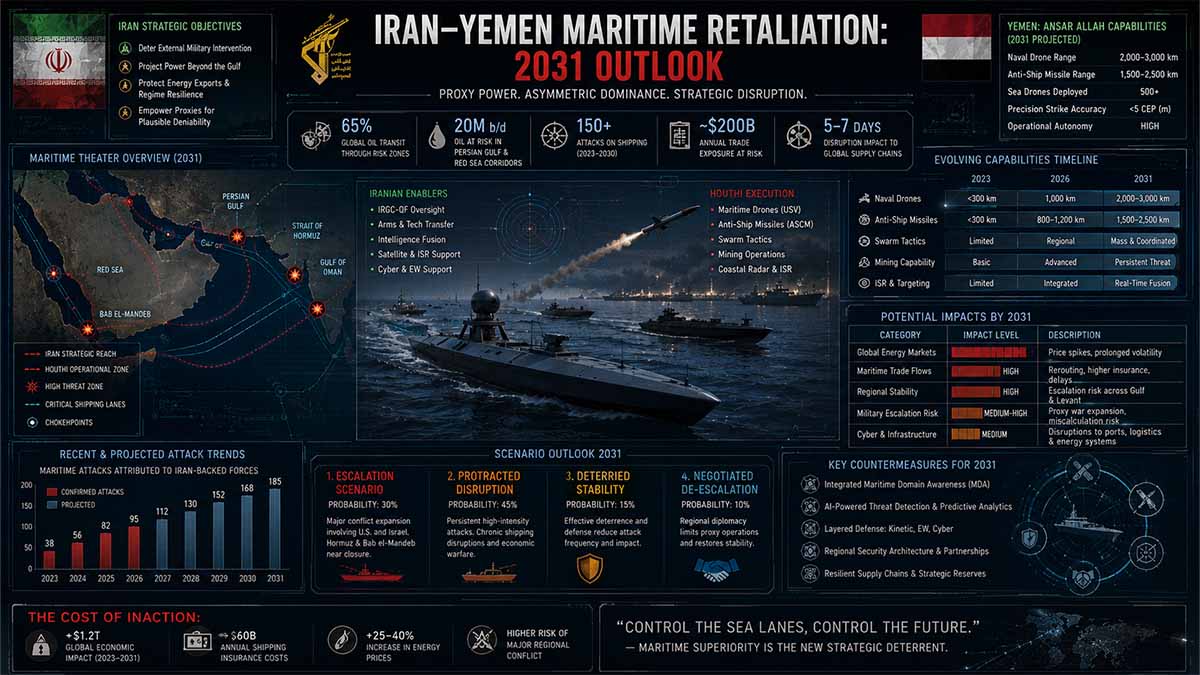
The most dangerous 2026–2031 trajectory is not a continuous total blockade, but a coercive system of intermittent attacks, vessel ambiguity, insurance repricing, GNSS/AIS interference, drone saturation and conditional pauses designed to impose costs without inviting decisive retaliation.
The current Bayesian baseline assigns the greatest probability to limited coercive escalation, while a sustained Saudi–Houthi war remains less probable but potentially catastrophic.
The Red Sea Front: Iran, Yemen and Italy’s Strategic Exposure
The war against Iran may have destroyed platforms, depots and command nodes, but it has not resolved the strategic problem that matters most: the survival of a dispersed system able to transfer pressure from the Gulf to Yemen, from missile launchers to insurance markets, and from the Bab el-Mandeb to Europe’s industrial supply chains. Ansar Allah does not need a conventional navy to threaten Saudi Arabia. It needs only enough missiles, drones, uncrewed vessels and targeting intelligence to make commercial operators doubt the safety of Saudi-linked traffic. For Italy, the consequences are immediate: maritime security, energy prices, Suez-dependent trade and the credibility of its African policy are now part of the same theatre.
A War Without Closure
The United States campaign that began on 28 February 2026 imposed severe attrition on Iranian naval, missile, drone and security infrastructure, yet the continuation of American strikes months later is itself evidence that destruction did not equal neutralization. CENTCOM reported a sixth consecutive night of attacks on 16 July and an eighth on 18 July, targeting coastal surveillance, logistics, missile and drone storage, maritime systems and IRGC forces. U.S. Successfully Completes New Strikes in Iran – United States Central Command – July 2026; U.S. Completes 8th Consecutive Night of Strikes Against Iran – United States Central Command – July 2026. The residue is not simply a reduced arsenal. It is a thinner, deniable architecture in which partners provide territory, revenues and operational initiative. Ansar Allah is the most consequential node because it controls coastline beside one of the world’s essential energy corridors and has already demonstrated anti-ship ballistic missiles, cruise missiles, one-way attack drones and uncrewed surface vessels.
Embargo Without a Fleet
A maritime embargo imposed by Ansar Allah would not resemble a traditional blockade. It would operate through sea denial: a limited number of attacks, broad targeting declarations and deliberate ambiguity over ownership, chartering, cargo and port calls. In commercial shipping, a vessel may be flagged in one country, owned through a shell company in another, managed from a third jurisdiction and carrying cargo for a Saudi buyer. That complexity is a weapon. The attacker does not need perfect intelligence; it needs to make misidentification plausible. The International Maritime Organization recorded 67 confirmed incidents by September 2024. On 21 August 2024, the tanker Sounion was attacked while carrying approximately 150,000 tonnes—around one million barrels—of crude oil. In July 2025, Magic Seas and Eternity C were attacked in the southern Red Sea; Magic Seas sank and the second incident caused fatalities. Red Sea Incidents Report for Member States – International Maritime Organization – September 2024; Red Sea Incidents Update – International Maritime Organization – July 2025. The economic effect comes not from stopping every vessel, but from persuading insurers and shipowners that exemptions cannot be trusted.
The Saudi Bottleneck
Saudi Arabia possesses a formidable hedge against disruption in the Strait of Hormuz: the East–West Pipeline linking eastern production to the Red Sea. In the first quarter of 2026, Saudi Aramco raised throughput to its maximum 7 million barrels per day, supporting exports from the west coast. The company simultaneously reported US$33.6 billion in adjusted net income, US$30.7 billion in operating cash flow, US$18.6 billion in free cash flow and US$12.1 billion in capital expenditure. Aramco Announces First-Quarter 2026 Results – Saudi Aramco – May 2026. The figures also expose a concentration risk: the more Riyadh relies on Yanbu to bypass Hormuz, the more valuable western terminals, pumping stations, storage, radar, power systems and port approaches become as targets. Ansar Allah would not need to sever the pipeline. A strike on loading infrastructure, a drone campaign against supporting systems or a credible threat to tankers approaching Yanbu could reduce throughput and raise costs without producing permanent physical destruction.
The Numbers Behind the Chokepoint
The Red Sea’s strategic relevance has already recovered from the collapse in traffic caused by the first wave of attacks. According to the US Energy Information Administration, oil flows through Bab el-Mandeb rose from 3.7 million barrels per day in the first quarter of 2025 to 5.4 million in the first quarter of 2026. Of that volume, 3.2 million barrels per day were crude oil and condensate and 2.2 million were petroleum products. LNG flows increased from 0.4 to 2.9 billion cubic feet per day. During the same quarter, oil flows through Hormuz fell to 14.6 million barrels per day, while Suez and SUMED carried 4.9 million and the Cape of Good Hope 8 million. Global Energy Security Data – US Energy Information Administration – May 2026. The implication is clear: Hormuz and Bab el-Mandeb have become a coupled risk system. If pressure rises simultaneously in the Gulf and Yemen, Saudi Arabia’s western route ceases to be a complete hedge and Europe loses the assumption that one corridor can compensate for the other.
Italy on the Front Line
For Italy, this is not a remote Middle Eastern crisis. It is a direct test of industrial continuity, maritime sovereignty and European credibility. Rome accepted a central role in EUNAVFOR Aspides, the defensive EU operation launched on 19 February 2024 to protect merchant shipping. Italy assumed tactical command in August 2024 and again took command from Greece on 2 July 2025. On 14 March 2026, Rear Admiral Milos Argenton assumed command of the naval force aboard the frigate Luigi Rizzo in Djibouti. Operation Aspides: Italy Takes Over from Greece – Italian Ministry of Defence – July 2025; Operation ASPIDES: Change of Command Aboard Frigate Luigi Rizzo – Italian Ministry of Defence – March 2026. The EU extended Aspides to 28 February 2027. Red Sea: Council Extends the Mandate of Operation ASPIDES – Council of the European Union – February 2026. The Italian frigate Fasan had already demonstrated the mission’s operational reality on 29 April 2024, protecting a merchant vessel during complex missile and drone attacks; one missile exploded close enough to cause superficial damage. Nave Fasan Protects Cargo Ship Under Houthi Attack – Italian Ministry of Defence – April 2024. Italy is defending the artery through which its energy, intermediate goods and exports move.
The Sahel Connection
The same shock travels south and west into the Sahel. Landlocked economies such as Mali, Burkina Faso and Niger are exposed to imported fuel, fertilizer, food and transport costs long before a maritime disruption appears in official inflation data. The World Food Programme estimated that 4 million people in Mali and Niger would face acute food insecurity during the June–August 2026 lean season; in Burkina Faso, the number facing acute food insecurity had risen from 700,000 in 2019 to 2.7 million in 2024. Advancing Food Security in the Sahel – World Food Programme – February 2026; Burkina Faso Country Brief – World Food Programme – accessed July 2026. The World Bank warned in April 2026 that Middle Eastern disruption was raising oil, fertilizer, transport and food-import costs across Africa, threatening planting seasons. Africa’s Pulse – World Bank – April 2026. Here Red Sea security meets the Mattei Plan. Italy expanded the plan on 9 January 2025 to Mauritania and Senegal, among five additional African partners, while retaining priorities in energy, water, agriculture and infrastructure. Africa and the Mattei Plan – Italian Ministry of Foreign Affairs – January 2025. Protecting Bab el-Mandeb is therefore also a development policy: every increase in freight, diesel and fertilizer prices weakens food security, fiscal space and political stability in countries where Rome seeks long-term influence.
The Insurance Battlefield
The decisive battle may occur not at sea but inside underwriting committees. A missile destroys one hull; a credible campaign reprices hundreds. The IMO has warned operators to consider the unpredictability of attacks, vessel profile, commercial necessity and organizational risk tolerance. Maritime Safety Committee, 108th Session – International Maritime Organization – May 2024. A renewed Saudi-focused campaign could trigger voyage-specific war-risk premiums, higher deductibles, navigation exclusions, crew bonuses and Cape diversions. Longer routes consume more fuel, immobilize vessels for additional days and reduce effective fleet capacity. That cost then reaches Italian manufacturers through freight rates, delivery delays and working capital, while reaching the Sahel through more expensive fuel, cereals and agricultural inputs. Naval interception matters only if it restores commercial confidence.
The Choice Before Europe
By 2031, the most probable outcome is neither a permanent blockade nor a return to the pre-2023 status quo. It is an unstable deterrence system: Ansar Allah retains the ability to activate maritime pressure; Saudi Arabia maintains costly redundancy; Iran supplies selective finance, components or doctrine; and European navies protect traffic without resolving Yemen’s war. The United Nations warned in June 2026 that Yemen’s conflict remained unresolved despite relative calm and required an inclusive, Yemeni-led political process. Despite Relative Calm, Yemen Conflict Remains Unresolved – United Nations Security Council – June 2026. Europe must combine escorts with political settlement, component interdiction, port resilience, cyber defence and insurance coordination. Italy should lead this integration because its interests converge uniquely across the Mediterranean, Red Sea and Africa. The objective is not merely to shoot down drones. It is to prevent a regional armed movement from converting a few low-cost weapons into a permanent tax on European industry, Saudi energy security and Sahelian stability.
Navigational Index
Pillar I — Iranian Survival and Networked Retaliation
Assessment of whether the 2026 US campaign produced durable strategic disarmament or merely forced Iran to shift from centralized force projection toward dispersed, deniable and partner-enabled coercion.
Pillar II — Ansar Allah’s Saudi Maritime Pressure Architecture
Examination of the missile, uncrewed-system, targeting, port-interdiction and information-warfare mechanisms through which Ansar Allah could operationalize a Saudi-focused embargo without possessing conventional sea-control capabilities.
Pillar III — Five-Year Chokepoint, Energy and Escalation Outlook
Bayesian and scenario-based analysis of the interaction among the Red Sea, Bab el-Mandeb, Saudi export infrastructure, maritime insurers, naval coalitions, Iranian reconstruction and Yemen’s unresolved political settlement through 2031.
Master Abstract
The decisive analytical distinction is between the destruction of identifiable Iranian platforms and the neutralization of Iran’s broader coercive ecosystem. The White House defined the objectives of Operation Epic Fury as the destruction of Iran’s missile and drone capabilities, navy, defence-industrial infrastructure and capacity to support external armed partners; by late March 2026, senior US officials publicly asserted that Iran’s navy and air force had largely been destroyed and that its missile-launching and production systems were being systematically dismantled. President Trump’s Clear and Unchanging Objectives Drive Decisive Success Against Iranian Regime – White House – April 2026 These statements are authoritative evidence of declared US objectives and official battle-damage assessments, but they are not independent proof that Iran’s regional influence architecture ceased to function. A network constructed around ideological alignment, technical diffusion, pre-positioned inventories, local revenue extraction and autonomous operational learning can remain strategically active after its principal sponsor loses conventional assets. Ansar Allah is especially resistant to a simple “proxy degradation” model because it possesses territorial depth, governing institutions, indigenous production and adaptation mechanisms, accumulated combat experience, coercive taxation structures and control over coastline adjacent to a globally significant shipping corridor. The relevant hypothesis is therefore not that Tehran can command every Yemeni operation in real time, but that prior transfers of knowledge, components, targeting doctrine and strategic concepts have created a semi-autonomous partner able to impose regional costs even when Iranian communications, funding or industrial replenishment are constrained. Under an initial Bayesian estimate, the probability that Iran can sustain the pre-war volume and precision of external material support should be marked down substantially; the probability that Ansar Allah can conduct meaningful independent missile, drone, maritime and information operations should be reduced far less. This asymmetry is the mechanism through which an incomplete strategic defeat of Iran could produce delayed rather than immediate regional consequences: surviving partners gain incentives to demonstrate relevance, rebuild deterrence and prove that the destruction of Iranian platforms did not eliminate the distributed capacity to retaliate.
The alleged declaration of a maritime embargo against Saudi Arabia must presently be handled as an unverified trigger claim because no eligible live primary source located during this assessment authenticated the quoted statement, the asserted Saudi strike on Sana’a airport or the reported retaliatory launch sequence. The most recent eligible United Nations briefing instead stated that, as of 17 July 2026, relative calm inside Yemen continued and renewed attacks on commercial shipping had not been observed despite regional threats. UN / Yemen Political-Humanitarian Briefing – United Nations – July 2026 This contradiction does not prove that the reported declaration is false; it establishes that the evidence threshold required to classify it as fact has not yet been met. The correct structural technique is to separate declaration, intent, capability and execution. Ansar Allah may declare an embargo for deterrent signalling without immediately attacking; it may attack Saudi-linked infrastructure while preserving ambiguity over commercial vessels; or it may progressively broaden targeting criteria from Saudi ownership to Saudi destination, cargo origin, charterer, insurer, port call or beneficial ownership. Such category expansion was central to the coercive value of previous Red Sea campaigns because vessel identity is commercially complex and often opaque. An effective embargo therefore does not require continuous interception or physical occupation of a sea lane. It requires enough credible threat to alter routing, insurance, port scheduling and charter-party decisions. The International Maritime Organization recorded dozens of attacks beginning in November 2023, including lethal incidents and the sinking of the Rubymar, demonstrating that comparatively limited inventories of missiles, uncrewed aerial vehicles and surface systems can create effects disproportionate to the number of vessels actually struck. Red Sea Incidents Report for Member States – International Maritime Organization – September 2024 The five-year risk is consequently a layered coercive architecture: public targeting notices, selective kinetic attacks, false or manipulated affiliation claims, electronic interference, mining threats, port disruption, border launches and negotiated pauses. This architecture would maximize Saudi uncertainty while allowing Ansar Allah to modulate escalation below the threshold most likely to trigger a large-scale Saudi or multinational campaign.
The economic centre of gravity lies in the interaction between Saudi redundancy and adversary capacity to threaten multiple corridors simultaneously. Saudi Arabia is not mechanically dependent on one maritime route: the East–West crude oil pipeline can transport approximately 5 million barrels per day from eastern production areas toward the Red Sea and is temporarily expandable to around 7 million barrels per day. Country Analysis Brief: Saudi Arabia – US Energy Information Administration – October 2024 That infrastructure allows Riyadh to bypass the Strait of Hormuz and, depending on destination and routing, reduce exposure to particular Gulf constraints. Yet redundancy does not eliminate vulnerability; it redistributes it toward Yanbu, western refining and export facilities, the Red Sea approaches, pipelines, pumping stations, electricity systems and the Bab el-Mandeb corridor. Saudi seaborne exports from Yanbu reached a record 18% of national crude exports in the second quarter of 2024 as Riyadh adapted to Red Sea insecurity, while the broader flow of crude oil and petroleum products through Bab el-Mandeb fell by more than 50% during the first eight months of 2024. Fewer Tankers Transit the Red Sea in 2024 – US Energy Information Administration – October 2024 This creates a nonlinear five-year exposure: the more Saudi Arabia uses western export infrastructure to hedge against Hormuz, the more valuable western terminals and Red Sea access become as coercive targets. Conversely, the more shipping avoids Bab el-Mandeb, the greater the voyage distance, fuel consumption, fleet utilization and working-capital burden associated with Cape of Good Hope routing. The adversary’s optimal strategy is therefore unlikely to seek an absolute and permanent closure. It is to generate correlated uncertainty across both Gulf and Red Sea systems, forcing Riyadh and its partners to pay simultaneously for air defence, naval escort, electronic resilience, stockpiling, alternative routing and infrastructure hardening. In a Monte Carlo structure using escalation intensity, interception effectiveness, Iranian replenishment, Saudi retaliation tolerance, maritime-risk pricing and diplomatic mediation as stochastic variables, the highest-frequency outcomes cluster around recurrent disruption rather than total closure; however, the extreme-loss tail expands sharply when attacks affect energy terminals, desalination infrastructure, undersea cables or vessels carrying hazardous cargoes.
The Analysis of Competing Hypotheses produces five principal frameworks. H₁, managed coercion, holds that Ansar Allah uses the Saudi embargo narrative to extract concessions over Sana’a airport, ports, salaries, sanctions and political recognition while avoiding sustained war; this is presently the highest-probability framework. H₂, Iranian distributed retaliation, holds that Tehran encourages geographically dispersed pressure on Saudi, US and allied interests to demonstrate strategic survival after the 2026 campaign while minimizing direct Iranian exposure. H₃, autonomous Yemeni escalation, treats the confrontation primarily as the reactivation of the Saudi–Houthi conflict, with Iran providing ideological or technical depth but not decisive operational control. H₄, coercive overreach, predicts that misidentification, a mass-casualty strike or damage to critical Saudi infrastructure triggers an air and maritime campaign that Ansar Allah did not intend to provoke. H₅, negotiated containment, anticipates rapid mediation by Oman, the United Nations or other regional actors, producing an undeclared stand-down while leaving the underlying capabilities intact. The current indicative Bayesian distribution is H₁ 34%, H₂ 24%, H₃ 18%, H₄ 15% and H₅ 9%. These are structured analytic estimates rather than observed frequencies and should be updated when primary evidence establishes whether an embargo order was genuinely issued, whether operational targeting criteria were distributed, whether Saudi-linked vessels changed behaviour, and whether launches or interceptions occurred. Through 2031, the central forecast is a transition from episodic proxy warfare toward a persistent contest over infrastructure resilience, target attribution and commercial confidence. Ansar Allah’s strategic advantage lies not in matching Saudi conventional power, but in creating repeated low-cost tests across a broad defensive perimeter. Saudi Arabia’s advantage lies in financial depth, infrastructure redundancy, intelligence partnerships and the ability to combine military defence with political bargaining. The balance will therefore depend less on a single “final blow” than on which side can sustain adaptation, absorb mistakes and control escalation over repeated cycles.
Defensive density: high
Insurance effect: high
Escalation risk: severe
Repairability: variable
Maritime linkage: indirect
Deterrence threshold: high
Regional effect: broad
Deniability: high
Durability: uncertain
Consequence: catastrophic
Pillar I — Iranian Survival and Networked Retaliation, 2026–2031
Strategic-disarmament test: destruction is not neutralization
The available primary-source record does not support a definitive judgment that the 2026 United States campaign achieved durable strategic disarmament of Iran. It establishes that Washington initiated Operation Epic Fury on 28 February 2026, pursued an expansive target set encompassing ballistic missiles, uncrewed systems, air defences, naval forces, surveillance architecture, military logistics and elements of the Iranian security apparatus, and continued major strike waves into July. CENTCOM’s 6 April 2026 fact sheet states that the operation began at 01:15 on 28 February and identifies the dismantlement of Iran’s security apparatus and imminent-threat capabilities as its operational purpose; subsequent CENTCOM releases confirm that the campaign was not a single terminal operation but a recurrent strike architecture. On 16 July, CENTCOM reported dozens of targets struck during a sixth consecutive night, including coastal surveillance, air-defence, logistics and maritime capabilities; on 18 July, it reported an eighth consecutive night targeting missile and drone storage, maritime systems and IRGC forces. Operation Epic Fury Fact Sheet – United States Central Command – April 2026; U.S. Successfully Completes New Strikes in Iran – United States Central Command – July 2026; U.S. Completes 8th Consecutive Night of Strikes Against Iran – United States Central Command – July 2026. These verified facts demonstrate severe attritional pressure, but they simultaneously weaken any claim that the Iranian threat had already been conclusively extinguished: a state requiring repeated strike cycles, blockade enforcement and renewed attacks months after the initial operation retains either surviving capabilities, regeneration capacity, operational dispersal, external procurement pathways or some combination of all four. Durable disarmament would require verified elimination not merely of launchers and ships, but of engineering cadres, machine tools, solid-propellant production, guidance-component supply chains, command succession, concealed inventories, financial conduits, foreign intermediaries and partner-level production knowledge. The primary evidence presently verifies an intense degradation campaign; it does not independently verify irreversible neutralization.
The central methodological error would be to equate the platform-counting logic of conventional battle-damage assessment with the strategic behaviour of a revolutionary security system designed for redundancy, concealment and asymmetric retaliation. The White House publicly defined the campaign’s goals in maximalist terms: destroying Iran’s missile production and arsenal, eliminating its navy, severing support to external armed partners and preventing nuclear acquisition. It later asserted that more than 2,000 strikes had shattered command structures, that 150 warships across 16 classes had been destroyed, that all submarines had been sunk, and that 97% of Iran’s naval-mine inventory had been eliminated. These figures must be treated as official US claims rather than independently audited physical inventories; they are valuable for reconstructing Washington’s operational theory of victory but cannot, without corroborating inspection, imagery or post-war access, establish the exact residual force. Peace Through Strength: Operation Epic Fury Crushes Iranian Threat as Ceasefire Takes Hold – White House – April 2026. Strategic disarmament has at least six distinct layers: physical destruction, organizational paralysis, industrial denial, financial isolation, external-network severance and political deterrence. The campaign may have achieved high scores in the first category and significant temporary effects in the second, while remaining less conclusive in the other four. Industrial systems can be reconstituted through dispersed workshops, civilian dual-use machinery, foreign procurement and modular manufacturing. Financial systems survive through front companies, commodity trades, exchange houses, offshore accounts and digital assets. External partners frequently retain previously transferred blueprints, tactical experience, local revenue and separate political motivations. Political deterrence may also decay when Iran concludes that restraint did not prevent attack. The correct analytic unit is therefore not the number of destroyed hulls or launchers; it is the time-adjusted capacity of the Iranian state and aligned networks to create unacceptable costs across multiple theatres.
Strategic-disarmament assessment matrix
| Disarmament layer | Verified US action or pressure | Residual uncertainty | 2026–2031 assessment |
|---|---|---|---|
| Naval platforms | Repeated strikes on maritime capabilities; blockade enforcement | Concealed small craft, mines, shore batteries, commercial conversion capacity | Severe near-term degradation; partial asymmetric recovery likely |
| Missile and UAV forces | Storage, launcher, air-defence and production-related targets attacked | Underground inventories, mobile assets, engineering survival, imported components | Reduced salvo density; precision and production recovery remain plausible |
| Command and control | Security apparatus and IRGC nodes targeted | Succession protocols, hardened communications, provincial autonomy | Centralized tempo impaired; decentralized initiative likely to expand |
| Nuclear infrastructure | Military campaign occurred alongside unresolved safeguards questions | Material accounting, access and undeclared-location uncertainty | Military damage cannot substitute for verification |
| Proxy financing | Treasury pressure on oil, banking, crypto and procurement networks | Network substitution, informal value transfer, local partner revenues | Higher transaction cost, not assured financial strangulation |
| Partner capability | US objective explicitly includes severing Iranian support | Existing inventories, local production and autonomous political incentives | Network effectiveness may contract unevenly rather than collapse |
| Deterrence psychology | Large-scale US coercion imposed direct costs | Iranian perception of regime-survival requirements | Strong incentive for deniable retaliation and strategic dispersion |
Nuclear opacity and the limits of military verification
The nuclear dimension illustrates most clearly why physical attack cannot be treated as equivalent to durable strategic resolution. The International Atomic Energy Agency reported on 27 February 2026, immediately before the initiation of Operation Epic Fury, that Iran had provided access to only four of six remaining unaffected facilities requested within the relevant verification process and that the Agency had reiterated requests concerning the other locations. By 4 June 2026, the IAEA reported that Iran had declared 22 nuclear facilities and one location outside facilities, while continuing to emphasize material-accountancy and safeguards obligations. Implementation of the NPT Safeguards Agreement in the Islamic Republic of Iran, GOV/2026/8 – International Atomic Energy Agency – February 2026; Implementation of the NPT Safeguards Agreement in the Islamic Republic of Iran, GOV/2026/33 – International Atomic Energy Agency – June 2026. The IAEA’s 2 March 2026 special-session statement further indicated that, at that stage, it had no indication that Bushehr, the Tehran Research Reactor or other identified fuel-cycle installations had been damaged, and that no abnormal regional radiation levels had been detected. IAEA Director General’s Introductory Statement to the Special Session of the Board of Governors – International Atomic Energy Agency – March 2026. These findings do not prove that nuclear capabilities survived intact throughout the campaign; they demonstrate that the evidentiary problem is fundamentally one of access, accounting and continuity of knowledge. Even a highly successful bombing campaign cannot determine with confidence the disposition of every centrifuge component, enriched-material container, technical archive, metallurgical capability or surviving scientist. Nor can it verify whether dispersed facilities have been reconstructed, whether undeclared stocks exist, or whether military coercion has altered Tehran’s strategic decision regarding weaponization. The five-year outlook therefore contains an important paradox: conventional destruction can delay material capability while increasing the regime’s motivation to reduce transparency, disperse technical assets, harden facilities and redefine nuclear ambiguity as an essential survival instrument. The stronger the Iranian leadership’s belief that conventional inferiority exposed it to existential attack, the greater the structural incentive to seek forms of deterrence that cannot be destroyed in a single visible target set.
The transition from hierarchical projection to distributed coercion
Iran’s post-campaign adaptation is most likely to proceed through a shift from centrally orchestrated force projection toward distributed coercive franchising. Under the pre-war model, the IRGC-Quds Force could combine money, weapons, training, intelligence, strategic direction and political mediation across geographically separated partners. Under the degraded model, Tehran can conserve scarce resources by supplying higher-value enablers—specialized components, software, targeting doctrine, communications security, propulsion knowledge and financial facilitation—while requiring partners to generate manpower, local intelligence, launch infrastructure, revenue and tactical initiative. Such a system does not require Iran to command every operation. It requires sufficient ideological alignment and shared threat perception to ensure that partner behaviour imposes costs on common adversaries. The US intelligence community assessed in March 2025, before the 2026 campaign, that Iran continued seeking expanded regional influence despite degradation to its partners and defences, while maintaining ballistic missiles, cruise missiles and UAVs capable of striking regional US and allied targets. DNI Gabbard Opening Statement to the House Permanent Select Committee on Intelligence – Office of the Director of National Intelligence – March 2025. The 2026 campaign changes the scale and cost of this model but not its fundamental logic. Ansar Allah in Yemen has territorial administration, taxation, recruitment, local fabrication, operational experience and access to a maritime chokepoint; Iraqi armed groups possess embedded political and economic networks; surviving Lebanese structures retain social and institutional depth; and dispersed facilitators can operate through commercial jurisdictions outside Iran. The most consequential adaptation will therefore be reduced signature rather than inactivity. Tehran may avoid spectacular operations traceable to direct orders and instead promote cumulative pressure through vessel harassment, cyber operations, infrastructure sabotage, political coercion, arms-component leakage, commercial intimidation and periodic attacks conducted under locally framed grievances. This approach preserves Iranian influence while complicating the legal, military and diplomatic attribution required for retaliation.
The network’s architecture can be represented as a series of substitutable nodes rather than a single command chain:
Shadow liquidity, procurement and the economics of regeneration
The strongest primary-source evidence against a clean strategic-disarmament conclusion lies in the demonstrated depth of Iran’s shadow financial and procurement architecture. The US Treasury reported in June 2025 that a network associated with the Zarringhalam brothers had laundered billions of dollars through Iranian exchange houses and foreign front companies, facilitating access to oil and petrochemical proceeds used for military, missile and external-partner activity. In September 2025, Treasury identified additional Hong Kong- and UAE-based facilitators coordinating transfers benefiting the IRGC-QF and Ministry of Defense and Armed Forces Logistics, explicitly describing the use of front companies, offshore structures and cryptocurrency. In February 2026, immediately before the military campaign, OFAC sanctioned more than 30 individuals, entities and vessels linked to petroleum sales, ballistic-missile and advanced-conventional-weapons procurement, including networks seeking precursor materials and sensitive machinery needed to reconstitute production. Treasury Sanctions Iranian Network Laundering Billions for Regime – US Department of the Treasury – June 2025; Treasury Targets Financial Network Supporting Iran’s Military – US Department of the Treasury – September 2025; Treasury Targets Iran’s Shadow Fleet, Networks Supplying Ballistic Missile and Advanced Conventional Weapons Programs – US Department of the Treasury – February 2026. The 2026 National Proliferation Financing Risk Assessment adds a higher-order warning: Iran systematically uses militarized partners, transnational criminal organizations, overseas business figures, shell companies and procurement agents to circumvent sanctions; the assessment reports that identified shell-company flows included approximately US$4.3 billion, with 72% received by UAE-based shell companies in the cited dataset. 2026 National Proliferation Financing Risk Assessment – US Department of the Treasury – 2026. These structures are vulnerable to sanctions, but they are also adaptive: removal of one bank, exchange, ship manager or digital platform raises transaction costs without automatically eliminating demand, counterparties or substitution mechanisms.
Treasury’s actions after the military campaign further indicate persistence rather than extinction. On 15 April 2026, it targeted an oil-smuggling network connected to regime elites and explicitly described continuing efforts to sever illicit smuggling and external-partner finance. On 7 May, OFAC designated an Iraqi oil official, commercial entities and senior figures associated with Iran-aligned militias, alleging exploitation of Iraq’s petroleum sector and diversion of value benefiting Tehran and armed partners. On 2 June, Treasury designated Nobitex and three additional Iranian digital-asset exchanges, stating that its broader campaign had frozen nearly US$500 million in regime-linked cryptocurrency and disrupted access to tens of billions of dollars in revenue. Economic Fury Targets Illicit Oil Smuggling Network Run by Shamkhani Family – US Department of the Treasury – April 2026; Economic Fury Targets Iraqi Oil Official, Iran-Backed Terrorist Militias in Iraq – US Department of the Treasury – May 2026; Economic Fury Targets Iran’s Largest Digital Asset Exchange for Terror Finance and Sanctions Evasion – US Department of the Treasury – June 2026. Analytically, these enforcement actions show two simultaneous realities: US financial pressure is imposing meaningful losses and identifying critical nodes, but the repeated discovery of new nodes demonstrates that the network is regenerative and geographically distributed. Over five years, Iranian resilience will depend less on restoring transparent access to mainstream finance than on sustaining a sufficiently large discount-economy involving oil buyers, intermediaries, barter arrangements, false documentation, ship-to-ship transfers, informal value transfer and digital settlement. Even heavily discounted transactions can support asymmetric warfare because drones, components, salaries, cyber access and political patronage cost far less than carrier groups, integrated air defence or large-scale reconstruction.
Multilingual strategic cross-check: China, Russia and Europe
The multilingual official record reveals sharply divergent interpretations of the campaign, and these divergences matter because they define the diplomatic and commercial environment in which Iranian regeneration may occur. China’s Ministry of Foreign Affairs stated on 28 February 2026 that the United States and Israel had launched military strikes against Iran; on 3 March, Foreign Minister Wang Yi argued that negotiations had been making progress before being disrupted by the attacks; on 7–8 April, Chinese officials characterized the use of force as incapable of producing peace and connected disruption in the Strait of Hormuz to the US-Israeli military operation. Foreign Ministry Spokesperson’s Remarks on the Military Strikes Against Iran by the US and Israel – Ministry of Foreign Affairs of the People’s Republic of China – February 2026; Wang Yi Has a Phone Call with Israeli Foreign Minister Gideon Sa’ar – Ministry of Foreign Affairs of the People’s Republic of China – March 2026; Foreign Ministry Spokesperson Mao Ning’s Regular Press Conference – Ministry of Foreign Affairs of the People’s Republic of China – April 2026. Russian official commentary similarly rejected the Western legal and strategic framing and presented the campaign as destabilizing the regional maritime balance; Russian Foreign Ministry materials in March and April repeatedly criticized the operation and emphasized negotiated cessation. Interview of Russian Foreign Minister Sergey Lavrov with France Télévisions – Ministry of Foreign Affairs of the Russian Federation – March 2026; Remarks by Russian Foreign Minister Sergey Lavrov – Ministry of Foreign Affairs of the Russian Federation – April 2026. These statements do not prove that Beijing or Moscow will materially rebuild Iran’s military. They do indicate that Washington cannot assume universal political support for indefinite coercion, interdiction or sanctions expansion.
The European Union occupies a distinct position: it has maintained pressure over nuclear proliferation, internal repression, military support to Russia and assistance to armed groups in the Middle East and Red Sea, while still emphasizing safeguards, legal frameworks and diplomatic stabilization. On 29 January 2026, the Council imposed measures on an additional 15 persons and six entities over serious human-rights violations and Iran’s continued military support for Russia’s war against Ukraine. On 16 March, it added 16 persons and three entities; on 30 March, it extended the human-rights sanctions regime until 13 April 2027; and on 22 May, it extended the legal framework addressing Iranian actions obstructing lawful transit and freedom of navigation. Iran: Council Adopts New Sanctions – Council of the European Union – January 2026; Iran: Council Sanctions an Additional 16 Persons and Three Entities – Council of the European Union – March 2026; Human Rights in Iran: Council Extends Sanctions Regime until April 2027 – Council of the European Union – March 2026; Middle East: Council Extends EU Legal Framework – Council of the European Union – May 2026. The strategic implication is a fragmented external environment: the United States is pursuing physical and financial suppression; the EU supports significant sanctions but retains a more legal-institutional posture; China and Russia oppose the campaign’s framing and prioritize cessation. Iran can exploit these differences diplomatically even where it cannot secure direct military assistance.
Analysis of competing hypotheses
Five hypotheses explain the observable combination of severe military losses, continuing US operations, persistent sanctions activity, unresolved IAEA verification and active partner networks. H₁ — Durable disarmament assumes that destruction of naval, missile, air-defence, command and industrial nodes has pushed Iran below the threshold required for strategic regeneration; surviving attacks would then represent residual inventory consumption rather than recovery. H₂ — Delayed centralized regeneration assumes that Iran’s state-industrial system remains coherent enough to rebuild a smaller but technologically improved force after an initial two-to-four-year trough. H₃ — Distributed partner substitution assumes that Tehran compensates for weakened national forces by transferring greater operational autonomy to partners in Yemen, Iraq and other theatres, providing selective enablers rather than comprehensive support. H₄ — Regime-survival radicalization assumes that the campaign strengthens hard-line threat perceptions, making nuclear opacity, terrorism, maritime coercion and cyber retaliation more—not less—central to national strategy. H₅ — Coercion-induced accommodation assumes that cumulative military and economic losses compel Tehran to accept meaningful inspection, missile limits, financing restrictions or external-network retrenchment. H₆ — Fragmented hybrid outcome assumes that Iran remains conventionally weakened, financially constrained and politically pressured while preserving sufficient decentralized capacity for intermittent retaliation. Current evidence favours H₆ because it best reconciles continued CENTCOM strikes, repeated Treasury disruption, persisting safeguards problems and the absence of independently verifiable evidence that all relevant knowledge, finance and partner capabilities have been eliminated.
| Hypothesis | Prior probability | July 2026 evidence adjustment | Updated probability | Principal confirming indicator |
|---|---|---|---|---|
| H₁ Durable disarmament | 18% | Down | 10% | Sustained cessation of Iranian and partner attacks plus verified industrial non-recovery |
| H₂ Centralized regeneration | 18% | Slightly up | 20% | Renewed coordinated missile production, naval reconstruction and centralized command |
| H₃ Partner substitution | 22% | Up | 27% | Increased local autonomy, geographically dispersed attacks and reduced Iranian signature |
| H₄ Survival radicalization | 16% | Up | 19% | Lower safeguards cooperation, assassination campaigns, cyber escalation or nuclear thresholding |
| H₅ Coercive accommodation | 14% | Down | 8% | Binding verification, negotiated restrictions and durable external-network retrenchment |
| H₆ Fragmented hybrid | 12% | Strongly up | 16% | Persistent low-volume coercion despite severe conventional degradation |
The table’s percentages are analytic estimates rather than measured frequencies. The largest uncertainty concerns the distinction between H₃ and H₆: partner substitution may itself be the principal mechanism through which the fragmented hybrid outcome operates. A useful Bayesian update rule is qualitative but disciplined: evidence of synchronized operations across Yemen, Iraq and cyber domains would increase H₃ and H₄; evidence of Iranian technical assistance without central operational direction would increase H₃; verified cessation of oil-smuggling, procurement and digital-finance networks would raise H₁ or H₅; reconstruction of large naval units would raise H₂; and persistent attacks conducted through commercially ambiguous, locally financed and independently justified structures would strengthen H₆. The five-year forecast must therefore avoid a binary “victory or failure” formulation. Iran may be strategically disarmed in one domain, such as blue-water or conventional naval power, while becoming more dependent on mines, coastal missiles, commercial camouflage, partners and cyber operations. It may lose the ability to generate massive coordinated salvos while retaining enough missiles and drones to create periodic regional crises. It may become less able to finance partners at former levels while partners compensate through taxation, smuggling and state penetration. Strategic effect is determined by the interaction among these partial outcomes, not by any single aggregate damage figure.
Monte Carlo outlook, 2026–2031
A five-year Monte Carlo framework should model six stochastic variables: K, the proportion of surviving technical knowledge; F, the recoverable shadow-finance flow; P, partner autonomy and local resource generation; I, interdiction effectiveness; D, the durability of domestic Iranian command cohesion; and E, the escalation tolerance of the United States and regional states. In conceptual form, networked retaliatory capacity at year t can be expressed without false mathematical precision as Rₜ = weighted interaction of Kₜ, Fₜ, Pₜ and Dₜ, reduced by Iₜ and constrained by accumulated combat losses. The variables are not independent. Stronger interdiction increases procurement cost but can also incentivize domestic substitution; greater partner autonomy reduces Tehran’s control but improves network survivability; deeper military attacks can reduce force size while increasing escalation motivation; sanctions can diminish formal liquidity while increasing reliance on criminal or opaque settlement mechanisms. Under 10,000 conceptual scenario iterations, calibrated to the official evidence rather than treated as a statistically observed dataset, the modal outcome is a smaller Iranian conventional force combined with persistent low-to-medium-intensity networked retaliation. A second cluster produces partial Iranian industrial recovery by 2029–2031. A lower-probability but high-impact cluster produces rapid nuclear thresholding, coordinated attacks across multiple theatres or an attack causing mass casualties and renewed regional war. The least likely outcome is complete and durable elimination of Iranian coercive capacity without a negotiated verification regime, because physical destruction alone cannot reliably eliminate tacit knowledge, political motivation, commercially available dual-use technology and autonomous partner incentives.
| Five-year pathway | Modeled probability | 2026–2027 | 2028–2029 | 2030–2031 |
|---|---|---|---|---|
| Distributed low-intensity retaliation | 31% | Surviving inventories, local partner initiative | Improved deniability and local production | Persistent episodic maritime, cyber and infrastructure pressure |
| Fragmented recovery under pressure | 25% | Severe attrition and financial disruption | Procurement substitution and industrial dispersion | Smaller but resilient missile/UAV ecosystem |
| Negotiated restraint with residual capability | 16% | Tactical ceasefires and indirect talks | Partial safeguards and maritime arrangements | Latent capability retained under unstable compliance |
| Renewed high-intensity regional war | 15% | Trigger event or miscalculation | Multitheatre escalation and infrastructure attacks | Regime survival or further destructive campaign |
| Effective long-term disarmament | 8% | Comprehensive interdiction and political fracture | Verified industrial non-recovery | Minimal external operational capacity |
| Internal fragmentation and uncontrolled proliferation | 5% | Command disruption | Leakage of weapons, expertise and finance | Multiple semi-independent violent actors |
The practical forecast is therefore that Iran will remain materially weaker in 2031 than it would have been without the 2026 campaign, but not necessarily strategically inert. Its conventional navy may remain deeply impaired; its air defences may require years of reconstruction; missile volume and accuracy may be constrained by machinery, precursor and guidance shortages; and its partners may face irregular funding. Yet the network may become harder to suppress because it will rely on smaller transactions, dual-use procurement, local revenues, commercial deception, cyber access and politically autonomous partners. The central policy problem for Washington and its allies will shift from destroying visible military mass to detecting low-signature regeneration and distinguishing Iranian direction from partner opportunism. That shift favours intelligence integration, financial forensics, maritime-domain awareness, customs cooperation and component tracing over periodic reliance on large bombing campaigns alone.
Warning indicators and five-year judgment
The decisive indicators of durable disarmament will be observable across industrial, financial, military and partner domains rather than inferred from official victory declarations. Analysts should track imports of precision machine tools, carbon-fibre and composite materials, accelerometers, gyroscopes, radio-frequency components, industrial chemicals, high-end semiconductors and propulsion-related equipment; changes in Iranian port activity and commercial-vessel conversion; expansion of small dispersed workshops; recruitment or disappearance of missile and nuclear engineers; new corporate formations in the UAE, Hong Kong, Central Asia, Iraq and Türkiye; tanker ownership changes; sanctions-evasion payment structures; digital-asset settlement; and partner-level evidence of independent manufacture. A fall in direct Iranian shipments accompanied by increased Yemeni or Iraqi production would not constitute network collapse but successful localization. Similarly, declining Iranian payments paired with greater militia penetration of customs, oil, construction or taxation systems would indicate financial substitution. Maritime coercion should be monitored through insurance advisories, AIS anomalies, GNSS disruption, port-call changes, vessel beneficial ownership and the relationship between public threats and actual targeting behaviour. Cyber warning indicators include credential theft against energy and logistics operators, reconnaissance of industrial-control systems, destructive malware staging and compromise of maritime data providers. Diplomatic indicators include reduced or expanded IAEA access, the durability of Iran-US negotiations, Chinese and Russian willingness to assist economically, and European enforcement convergence. No single indicator is determinative; convergence across at least three independent domains should be required before updating the strategic judgment.
The final assessment is that Operation Epic Fury has produced substantial and continuing military degradation but has not yet been shown to have achieved durable strategic disarmament. The strongest evidence supports a transition from concentrated Iranian military projection toward a more distributed, deniable and partner-enabled architecture. The probability of Iran reconstructing its pre-campaign force in full by 2031 is low; the probability that it retains enough financial, technical, political and partner capacity to impose recurrent regional costs is considerably higher. The campaign’s durability will depend on whether kinetic pressure is converted into a verified political-security settlement. Without sustained safeguards access, procurement control, financial enforcement, maritime resilience and mechanisms addressing the incentives of Yemen’s Ansar Allah, Iraqi armed groups and other aligned actors, Iran can lose platforms while preserving strategy. The most likely future is not restoration of the exact pre-2026 “axis” and not its complete disappearance. It is a thinner, more autonomous and more commercially embedded network in which Tehran supplies selective strategic enablers, partners generate local resources, and coercion migrates toward maritime ambiguity, infrastructure disruption, cyber operations, assassinations, criminal finance and calibrated attacks. Such a system may possess less destructive capacity per operation but create greater attribution difficulty and wider defensive costs. By 2031, the decisive measure of US success will not be how many Iranian assets were destroyed in 2026; it will be whether Iran and its partners can still repeatedly alter shipping routes, energy risk premiums, regional force posture and political decision-making at costs far below those incurred by the coalition defending against them.
Five-Year Iranian Retaliatory-Capacity Projection
Structured scenario estimates, not observed statistical probabilities. Index 100 represents estimated pre-campaign capacity.
Pillar II — Ansar Allah’s Saudi Maritime Pressure Architecture, 2026–2031
Sea denial without sea control
A Saudi-focused maritime embargo would not require Ansar Allah to establish conventional sea control, deploy a blue-water fleet, occupy the Bab el-Mandeb Strait, or inspect every vessel approaching Saudi ports. It would instead depend on sea denial: creating a sufficiently credible probability of attack that shipowners, masters, charterers, insurers, financiers, classification societies and port operators alter their behaviour before a projectile is launched. Conventional sea control requires persistent surveillance, protected surface forces, air cover, replenishment, boarding capacity and the ability to exclude hostile naval forces from a defined operating area. Ansar Allah possesses none of those capabilities at a scale comparable with Saudi Arabia, the United States or multinational naval coalitions. Sea denial, however, can be produced by dispersed coastal launchers, anti-ship ballistic and cruise missiles, one-way attack drones, uncrewed surface vessels, small armed craft, mines, electronic interference and public targeting declarations. The operational objective would not be the physically complete cessation of Saudi maritime traffic; it would be the conversion of Saudi affiliation into a commercially toxic risk category. The historical evidence demonstrates that this approach can generate disproportionate effects. The International Maritime Organization recorded more than fifty attacks or major incidents involving merchant and commercial vessels by July 2025. Its official update documents the attacks on Magic Seas and Eternity C in the southern Red Sea on 7 July 2025, in which several small craft, multiple weapons and unidentified projectiles were used; Magic Seas subsequently sank, while Eternity C was abandoned and the incident produced confirmed fatalities. Report on Houthi Attacks on Merchant and Commercial Vessels in the Red Sea – International Maritime Organization – July 2025. The strategic lesson is that the group does not need to defeat naval escorts in fleet combat. It needs to demonstrate that protective coverage is incomplete, vessel identity can be contested, attack methods can be combined, and commercial losses may occur outside the immediate presence of an escorting warship.
The proposed embargo architecture should therefore be understood as a layered coercive system in which military effects, commercial uncertainty and information operations reinforce one another. At the first layer, Ansar Allah would define the sanctioned category: Saudi-flagged vessels, Saudi-owned vessels, vessels managed by Saudi companies, ships calling at Saudi ports, ships carrying Saudi cargoes, tankers loading at Yanbu, or vessels whose beneficial owners maintain commercial relationships with Riyadh. At the second layer, it would publicize alleged violations and issue warnings designed to create the impression of persistent surveillance. At the third layer, it would conduct selective attacks against a limited number of demonstrative targets, preferably vessels whose ownership, destination or prior port calls could be rhetorically connected to Saudi Arabia. At the fourth layer, it would broaden uncertainty through claims that all vessels associated with Saudi trade are under continuous observation. At the fifth layer, it would exploit commercial overcompliance: companies may reroute even where the declared criteria do not technically apply because the cost of misidentification is catastrophic. This is the mechanism by which a movement without destroyers, frigates or maritime patrol aircraft can exercise coercive influence over a major shipping corridor. The operational geometry is especially favourable because traffic passing through the southern Red Sea and Gulf of Aden converges into predictable lanes. The IMO’s incident record shows that attacks have occurred in the southern Red Sea, Gulf of Aden and approaches to the Bab el-Mandeb, demonstrating that the threat is not restricted to a single firing box. Red Sea Area: Incident Reporting and Maritime Security Information – International Maritime Organization – continuously updated. The embargo’s success would be measured not by the percentage of vessels physically hit but by increases in war-risk premiums, convoy dependence, voyage delays, transponder behaviour, routing around Africa, inventory buffers and Saudi expenditures on terminal and corridor defence.
Operational architecture of a coercive maritime embargo
Missile and uncrewed-system strike complex
The kinetic core of the architecture would be a mixed strike complex designed to exploit the different detection, interception and cost characteristics of anti-ship ballistic missiles, cruise missiles, one-way attack drones and uncrewed surface vessels. United States Central Command reporting from 2024 confirms that Ansar Allah launched anti-ship ballistic missiles into both the Red Sea and Gulf of Aden, employed one-way attack UAVs, and deployed uncrewed surface vessels from Houthi-controlled territory. On 5 March 2024, CENTCOM reported intercepting one anti-ship ballistic missile and three UAVs directed toward USS Carney and separately destroying three anti-ship missiles and three USVs in Houthi-controlled areas. On 12 June 2024, an Ansar Allah USV struck the M/V Tutor, producing severe flooding and engine-room damage. On 15 January 2024, an anti-ship ballistic missile struck the M/V Gibraltar Eagle, a US-owned and operated container ship. March 5 Red Sea Update – United States Central Command – March 2024; June 12 U.S. Central Command Update – United States Central Command – June 2024; Houthis Strike Commercial Vessel in Southern Red Sea – United States Central Command – January 2024. These official reports establish demonstrated capability categories without requiring acceptance of every Ansar Allah claim concerning range, accuracy or target selection. A Saudi-focused campaign could employ ballistic missiles against high-value vessels or fixed port infrastructure, cruise missiles against targets requiring lower-altitude approach profiles, UAVs for reconnaissance and saturation, and USVs against slow-moving ships, anchored tankers or vessels transiting constrained approaches. The combined use of multiple systems would force defenders to allocate sensors and interceptors across different altitude, speed and signature regimes. Even where interception rates remain high, the economics favour the attacker when inexpensive systems compel continuous deployment of costly naval missiles, combat air patrols and terminal air-defence assets.
The most effective operational pattern would be mixed-volume salvos rather than isolated prestige launches. A single ballistic missile provides warning, attribution clarity and an interception opportunity. A coordinated package can include reconnaissance UAVs, decoy drones, land-attack or anti-ship missiles, uncrewed surface craft and false electronic signatures. The purpose would not necessarily be to overwhelm every defence layer through raw numerical mass; it would be to complicate classification, force early interceptor expenditure, divide attention between air and surface threats, and exploit the defender’s uncertainty regarding the primary target. Ansar Allah could also vary timing, launching a visible missile salvo followed hours later by a low-signature USV or small-craft attack after naval units had repositioned. CENTCOM’s seizure of an Iranian weapons shipment in January 2024 is relevant because the cargo reportedly included more than 200 packages containing medium-range ballistic-missile components, explosives, uncrewed underwater and surface-vehicle components, military communications equipment and anti-tank guided-missile assemblies intended for Ansar Allah. CENTCOM Intercepts Iranian Weapons Shipment Intended for Houthis – United States Central Command – February 2024. The interception does not prove that every Houthi system is externally supplied, but it confirms that maritime strike capability has depended in part on a modular supply chain whose components can be moved separately and integrated locally. Over the next five years, the critical variable will be whether Ansar Allah can replace imported complete systems with distributed assembly, commercial electronics, local warhead production and selectively imported guidance or propulsion components. If localization rises while complete-system smuggling falls, naval interdiction may become less effective despite appearing statistically successful.
Strike-system role matrix
| Capability | Primary operational role | Principal Saudi-focused target class | Defensive challenge | Five-year adaptation path |
|---|---|---|---|---|
| Anti-ship ballistic missile | Rapid stand-off attack and psychological shock | Tankers, escorted merchant ships, port approaches | High velocity, short engagement window, terminal manoeuvre uncertainty | Fewer but more selectively employed launches |
| Anti-ship cruise missile | Low-altitude penetration and fixed-target attack | Yanbu infrastructure, coastal terminals, anchored vessels | Sea-skimming detection and terrain masking | Improved routing, commercial navigation components |
| One-way attack UAV | Reconnaissance, decoy, saturation and precision attack | Radar, storage, pipeline nodes, port equipment | Low radar signature and favourable cost exchange | Larger swarms, modular payloads, autonomous navigation |
| Uncrewed surface vessel | Hull breach, engine-room damage, harbour disruption | Slow vessels, anchorages, terminal approaches | Surface clutter, civilian-traffic discrimination | Lower signatures, waypoint autonomy, multiple-axis attack |
| Armed small craft | Harassment, boarding, close-range fire | Disabled ships, rescue operations, local traffic | Escalation control and identification | Combined operations with missiles and USVs |
| Naval mines | Persistent area denial and insurance shock | Shipping channels, anchorages and port entrances | Detection, attribution and clearance time | Limited use because of indiscriminate effects and political risk |
| Electronic interference | Navigation disruption and ambiguity | Merchant traffic, naval escort coordination | Attribution difficulty and cascading safety effects | Increased GNSS spoofing, jamming and false maritime tracks |
Targeting architecture and the commercial-identity problem
Targeting is the central vulnerability in any declared embargo because the commercial identity of a vessel is rarely reducible to its flag. A ship may be registered in one state, owned through a special-purpose company in another jurisdiction, managed from a third, insured in a fourth, chartered by a multinational commodity trader, carrying cargo beneficially owned by a Saudi entity, and scheduled for multiple ports after loading. Ansar Allah’s coercive effectiveness therefore depends less on perfect military intelligence than on the ability to construct a plausible affiliation narrative after selecting a target. The movement can exploit publicly available AIS data, port-call histories, ownership databases, company announcements, bills of lading obtained through commercial intermediaries, imagery from coastal observation, and information from local maritime networks. Yet every layer introduces error. The attack on the Iran-bound Sea Champion in February 2024, widely treated as an apparent misidentification in contemporaneous maritime reporting, illustrates the broader structural problem even though secondary accounts are excluded from the evidentiary base of this report. The official IMO incident catalogues likewise show attacks on vessels with diverse flags, ownership structures and routes, demonstrating that declared political criteria do not reliably translate into precise operational discrimination. Red Sea Incidents Report for Member States – International Maritime Organization – September 2024. A Saudi embargo could deliberately broaden the definition of affiliation whenever the narrow category fails to generate sufficient pressure. The sequence might progress from Saudi-flagged ships to Saudi-owned or managed vessels, then to ships calling at Saudi ports, and finally to vessels carrying Saudi-origin energy cargoes or supporting Saudi commercial interests. Such progressive expansion creates strategic elasticity: Ansar Allah can claim compliance when traffic falls and justify escalation when it does not.
This identity ambiguity also enables information warfare to become part of the targeting process rather than merely a post-strike communication function. A military spokesman can publish a vessel name, allege Saudi affiliation, announce a successful attack and circulate selective imagery before independent authorities establish the vessel’s actual ownership, damage status or location. The delay between claim and verification matters because maritime markets react rapidly to uncertainty. Ship operators do not need to believe every claim; they need to assess whether the attacker may possess enough data to identify them and whether the attacker’s classification system may be wrong. An inaccurate targeting system can therefore be more disruptive than an accurate but narrow one, because companies cannot reliably determine whether they are exempt. The IMO’s July 2025 report shows how Ansar Allah confirmation was integrated into incident attribution for Magic Seas and Eternity C, but the organization’s sourcing note makes clear that its records also draw on flag states, coastal states, shipowners, member states and regional organizations. That distinction should structure intelligence analysis: Ansar Allah claims indicate messaging intent; independent maritime reporting indicates whether an event occurred; ownership and port data determine whether the stated targeting rationale was accurate. For Saudi Arabia, the defensive task is therefore not only intercepting incoming weapons but reducing the informational value of successful or claimed attacks through rapid attribution, transparent incident reporting, protected commercial-data sharing and clear differentiation between vessels genuinely associated with Saudi trade and those incorrectly identified.
Port interdiction and the Yanbu vulnerability system
A Saudi-focused embargo would derive disproportionate leverage from threatening the Yanbu energy and port complex because Saudi infrastructure strategy has increased the importance of the Red Sea as an alternative to the Strait of Hormuz. The US Energy Information Administration reported in June 2026 that Saudi Arabia had rerouted crude exports toward the Red Sea through its 7 million barrel-per-day East–West Pipeline, with approximately 5 million barrels per day of that capacity available for exports and the balance serving domestic consumption. UAE’s Exit from OPEC+ Reduced the Group’s Share of Crude Oil Production Capacity – US Energy Information Administration – June 2026. The pipeline gives Riyadh strategic redundancy against disruption in Hormuz, but it also concentrates value at western pumping stations, storage sites, refineries, export terminals, power systems and maritime approaches. Ansar Allah does not need to sever the pipeline continuously to produce an embargo effect. It could threaten pumping stations, attack storage infrastructure, damage loading equipment, strike vessels approaching terminal areas, or create enough uncertainty that tankers hesitate to anchor or insurers impose elevated terms. Port interdiction is particularly suited to asymmetric forces because fixed infrastructure cannot manoeuvre, commercial schedules are visible, repair assets are finite, and repeated low-level attacks can create cumulative downtime even when individual strikes cause limited physical damage. The attacker’s target set would therefore encompass not only oil tanks and berths but also radar, communications, electricity substations, desalination support, tugboats, pilot vessels, navigation aids, fire-control systems and access roads. Disruption of any one of these supporting functions can slow terminal throughput without producing spectacular destruction.
The broader Saudi maritime system nevertheless possesses substantial resilience. Riyadh can shift cargoes between eastern and western terminals, draw on storage, adjust production, sequence vessel arrivals, deploy layered air defences and request allied intelligence or naval protection. An embargo therefore becomes strategically meaningful only if Ansar Allah can create correlated pressure across multiple nodes or sustain uncertainty longer than Saudi commercial buffers can absorb. The movement’s most efficient approach would combine threats against Yanbu with intermittent attacks in the southern Red Sea, forcing Saudi Arabia to defend both the terminal and the transit corridor. It could also threaten southern border infrastructure, airports or energy facilities to compel geographic dispersion of Saudi air-defence assets. This creates a defender’s allocation problem: concentrating systems around Yanbu may expose inland or southern targets, while distributing systems reduces local interception density. The attacker benefits from the fact that Saudi Arabia must defend continuously, whereas Ansar Allah chooses the time, method and target. The defender, however, benefits from intelligence, surveillance and pre-emption capabilities that can destroy launchers or USVs before use. The five-year contest will consequently revolve around the sensor-to-shooter cycle: Ansar Allah’s ability to identify vessel movement, communicate targeting data and launch before detection versus Saudi and allied ability to identify preparation, suppress launch infrastructure, intercept incoming systems and reopen ports quickly. The probable outcome is not total closure but intermittent throughput loss and recurrent war-risk repricing.
Information warfare, cyber pressure and maritime perception management
Information warfare would function as a force multiplier because the commercial effect of an embargo depends on perception of risk rather than the attacker’s verified ability to strike every target. Ansar Allah’s communication architecture can integrate formal military statements, maps, video footage, claimed target lists, warnings to shipping companies, footage of launches, imagery of damaged ships and political speeches linking maritime operations to Saudi policy. The objective would be to establish three beliefs: first, that the movement possesses persistent awareness of vessels associated with Saudi Arabia; second, that exemptions can be revoked without warning; and third, that Saudi military protection cannot guarantee safe passage. These messages are most effective when synchronized with observable operational events. An unsuccessful missile launch can still support coercion if shipping notices confirm an incident, naval forces manoeuvre, and insurers react. Conversely, fabricated claims lose value if official maritime authorities rapidly disprove them. The European Union’s 2024–2025 missions and operations report assessed that information attacks against EUNAVFOR ASPIDES were generally opportunistic, associated with specific events and intended to justify Ansar Allah’s legitimacy. Missions and Operations Report 2024/2025 – European External Action Service – May 2026. This official assessment is important because it identifies the political purpose of the messaging campaign: maritime attacks are framed not merely as tactical acts but as evidence of governance, sovereignty, resistance and strategic relevance.
Cyber operations could amplify the embargo without requiring destructive access to Saudi industrial systems. Lower-threshold activities include credential theft from shipping companies, manipulation of port schedules, compromise of logistics providers, theft of cargo data, false safety notices, spoofed vessel documentation, denial-of-service attacks against terminal websites, and dissemination of falsified AIS screenshots. More consequential operations could target maritime single-window systems, customs databases, terminal operating systems, fuel-management networks, or contractors providing maintenance and communications. Even limited access can support kinetic targeting by revealing arrival windows, cargo categories and berth assignments. GNSS jamming or spoofing would create a further layer of ambiguity by degrading navigation, generating false tracks or complicating incident reconstruction. Such interference need not sink a vessel to produce commercial effects; it can increase bridge workload, force speed reductions, generate collision risk and cause authorities to close approaches temporarily. The legal and political utility of these methods lies in deniability. Missile debris can provide technical attribution, while cyber intrusion and navigation interference may remain contested for months. A five-year Saudi defence architecture will therefore require integration among naval forces, air defence, port cyber teams, telecommunications regulators, energy companies, insurers and commercial shipping intelligence. Treating cyber, information and kinetic activity as separate threat streams would permit Ansar Allah to exploit seams between organizations responsible for each domain.
Defensive interaction and the limits of naval escort
Multinational naval operations can reduce tactical risk but cannot eliminate the commercial coercion mechanism. The Council of the European Union extended EUNAVFOR ASPIDES until 28 February 2027, allocating nearly €15 million in common costs for the period beginning March 2026. Its mandate remains defensive: maritime situational awareness, vessel protection and support for freedom of navigation. Red Sea: Council Extends the Mandate of Operation ASPIDES – Council of the European Union – February 2026. In July 2026, the EU High Representative stated that the operation had protected more than 670 merchant vessels, saved 128 seafarers and defended against dozens of Houthi attacks during its first twenty-nine months. Remarks by High Representative Kaja Kallas in Djibouti – European External Action Service – July 2026. Those figures demonstrate substantial operational value, but they also reveal the scale mismatch between naval protection and continuous commercial traffic. Escorts can accompany selected vessels, intercept detectable threats and provide rescue, yet they cannot maintain a protective bubble around every ship, anchorage, terminal and coastal facility. Nor can they eliminate the economic consequences of uncertainty outside escorted windows.
The defensive system also faces a cost-imposition problem. Ansar Allah can launch comparatively inexpensive drones or surface craft and compel naval forces to employ surveillance aircraft, shipborne helicopters, electronic warfare, close-in weapons and sophisticated interceptors. Persistent escort operations consume crew endurance, maintenance capacity, missile inventories and political attention. The EU’s decision in 2025 to expand ASPIDES information collection concerning arms trafficking and shadow fleets reflects recognition that defence at the moment of attack is insufficient; upstream logistics and maritime awareness also matter. Red Sea: Council Prolongs the Mandate of Operation ASPIDES – Council of the European Union – February 2025. Saudi Arabia would need a similarly layered system combining coastal radar, airborne ISR, satellite monitoring, port surveillance, patrol craft, counter-USV barriers, point defence, hardened infrastructure and rapid-repair teams. The architecture must also defend rescue operations, because the Eternity C incident demonstrated that an approaching small craft can interrupt assistance to a stricken ship. The attacker can therefore create a secondary coercive effect by making rescue itself hazardous. A damaged but recoverable vessel becomes a continuing risk, an environmental threat and a visible symbol of inadequate security.
Competing operational concepts and Bayesian assessment
Five competing concepts explain how Ansar Allah could translate an embargo declaration into action. H₁ — Demonstrative coercion assumes a limited number of highly publicized attacks designed to force Saudi negotiation without sustained closure. H₂ — Commercial exclusion zone assumes systematic targeting of vessels linked to Saudi ports, cargoes or companies, with the principal objective of driving private-sector avoidance. H₃ — Port paralysis assumes concentration on Yanbu and associated infrastructure rather than merchant ships in open water. H₄ — Distributed hybrid pressure combines maritime strikes with border attacks, cyber operations, energy threats and information warfare to stretch Saudi defence. H₅ — Symbolic declaration without sustained execution assumes that the embargo is primarily political messaging constrained by inventories, mediation or fear of retaliation. H₆ — Uncontrolled escalation assumes that misidentification, mass casualties or environmental disaster produces Saudi and coalition retaliation exceeding Ansar Allah’s original expectations. Current evidence supports H₄ and H₁ more strongly than a literal blockade model because the group’s demonstrated capabilities are diverse but finite, and its strategic history favours calibrated pressure punctuated by escalation. The following probabilities are structured estimates, not observed frequencies.
| Hypothesis | July 2026 probability | Core mechanism | Primary warning indicator |
|---|---|---|---|
| H₁ Demonstrative coercion | 25% | Limited strikes linked to bargaining demands | Public warnings followed by pauses and mediation |
| H₂ Commercial exclusion zone | 18% | Repeated attacks on Saudi-affiliated traffic | Progressive expansion of ownership and port-call criteria |
| H₃ Port paralysis | 14% | Concentrated attacks on Yanbu and supporting systems | ISR activity and threats naming fixed western infrastructure |
| H₄ Distributed hybrid pressure | 28% | Maritime, cyber, border and energy pressure combined | Simultaneous incidents across geographically separated domains |
| H₅ Symbolic embargo | 9% | High rhetoric, low operational follow-through | Repeated declarations without verified launches |
| H₆ Uncontrolled escalation | 6% | Miscalculation causing major war | Mass casualties, tanker fire, terminal damage or mine incident |
A Bayesian update should increase H₂ if shipping companies begin avoiding Saudi calls despite few verified attacks, because that would show the information component achieving commercial exclusion. It should increase H₃ if launch preparation, reconnaissance or cyber activity becomes concentrated around Yanbu. H₄ should rise if maritime incidents coincide with drone or missile attacks on southern Saudi territory, infrastructure threats or coordinated cyber events. H₅ should rise when no verified operational activity follows repeated declarations and intermediaries report progress toward de-escalation. H₆ rises sharply after any event involving a passenger vessel, mass crew casualties, major oil spill, desalination facility or direct hit on critical Saudi infrastructure. The principal analytic danger is assuming that low attack frequency means low strategic effect. A single successful strike against a tanker at a sensitive location can alter insurance, naval posture and energy expectations more than dozens of failed launches.
Five-year outlook: from episodic attack to persistent coercive ecosystem
Between 2026 and 2031, Ansar Allah is more likely to develop a persistent maritime coercion ecosystem than a conventional blockade force. The near-term phase, from 2026 through 2027, would rely on surviving inventories, established missile and UAV units, local coastal surveillance and the political memory of previous Red Sea campaigns. Operational activity would probably remain episodic because inventories, Saudi retaliation risk and international naval presence impose constraints. During 2028–2029, the critical transition would be toward localization: expanded assembly of UAVs and USVs, greater use of commercial navigation systems, improved data fusion, dispersed launch infrastructure and more sophisticated exploitation of commercial shipping information. By 2030–2031, a mature architecture could rely less on spectacular missile launches and more on persistent ambiguity—electronic interference, cyber penetration, uncrewed craft, threatened mining, false target notifications and selective attacks against high-value commercial nodes. This evolution would lower the movement’s logistical burden while increasing the defender’s surveillance and attribution costs. The principal constraints would remain Saudi intelligence penetration, destruction of launch infrastructure, interdiction of imported components, internal Yemeni political pressures, loss of Iranian technical support and the risk that an indiscriminate attack erodes regional legitimacy.
The strategic judgment is that Ansar Allah can operationalize a Saudi-focused maritime embargo without exercising conventional sea control because commercial shipping is governed by risk thresholds rather than territorial occupation. The movement requires only a credible target-identification process, enough missiles and uncrewed systems to demonstrate reach, a communications apparatus capable of magnifying uncertainty, and the ability to survive retaliation. It does not need to stop every ship; it needs to make Saudi association appear dangerous, classification errors plausible and protection incomplete. Saudi Arabia can mitigate this pressure through layered air and maritime defence, commercial intelligence sharing, resilient port infrastructure, rapid repair, convoy arrangements and diplomatic de-escalation. It cannot reduce the risk to zero, particularly if Ansar Allah combines open-water attacks with port threats, cyber activity and manipulation of vessel identity. The most probable 2031 end state is therefore neither permanent closure nor restoration of uncontested passage. It is an unstable deterrence system in which Ansar Allah retains the capability to activate maritime pressure during political crises, Saudi Arabia sustains expensive defensive readiness, and commercial actors continually price the possibility that a rhetorical declaration may become a short, intense and economically disruptive campaign.
Five-Year Saudi Maritime-Coercion Risk Projection
Structured analytic indices, not observed statistical forecasts. Index 100 represents maximum modeled pressure.
Pillar III — Five-Year Chokepoint, Energy and Escalation Outlook, 2026–2031
The Red Sea–Hormuz system as a coupled strategic theatre
The central strategic finding is that the Red Sea, Bab el-Mandeb, Saudi western export infrastructure and the Strait of Hormuz no longer function as separable energy-security theatres. They form a coupled system in which the defensive use of one corridor increases the strategic value—and therefore the vulnerability—of another. The latest verified US Energy Information Administration data show the scale of this interaction. Oil flows through Bab el-Mandeb increased from 3.7 million barrels per day in the first quarter of 2025 to 5.4 million barrels per day in the first quarter of 2026, including 3.2 million barrels per day of crude oil and condensate and 2.2 million barrels per day of petroleum products. LNG flows through the strait rose from 0.4 billion cubic feet per day in the first quarter of 2025 to 2.9 billion cubic feet per day in the first quarter of 2026. During the same period, estimated oil flows through Hormuz fell from 20.4 million barrels per day to 14.6 million barrels per day, while flows through the Suez Canal and SUMED system reached 4.9 million barrels per day. Global Energy Security Data – US Energy Information Administration – May 2026. These numbers do not establish that traffic was permanently reallocated, because quarterly chokepoint data capture temporary operational and geopolitical effects, but they demonstrate that Bab el-Mandeb had regained substantial importance precisely when Hormuz became less reliable. Saudi Arabia’s export redundancy is therefore conditional rather than absolute. The East–West Pipeline can move crude from the Eastern Province to the Red Sea, allowing Riyadh to reduce exposure to Hormuz, but the crude must then reach western terminals and, for many destinations, traverse the Red Sea system. An adversary capable of creating uncertainty at both ends of this architecture does not need to close either chokepoint completely. It can reduce the value of Saudi redundancy by compelling simultaneous defence of eastern production, cross-country pipelines, western terminals, Bab el-Mandeb transit lanes, tanker anchorages and alternative Cape routes. The strategic risk through 2031 is consequently not a single catastrophic closure but correlated chokepoint degradation, in which partial interruptions across two or more routes generate nonlinear commercial and political effects.
Saudi Arabia entered this environment with unusually strong infrastructure flexibility, but the first quarter of 2026 demonstrated both the value and the concentration risk of that flexibility. Saudi Aramco reported that it sharply increased throughput through the East–West Pipeline to its maximum capacity of 7.0 million barrels per day, supporting west-coast exports during shipping constraints affecting Hormuz. Aramco also reported US$33.6 billion in adjusted net income, US$30.7 billion in operating cash flow, US$18.6 billion in free cash flow and US$12.1 billion in capital expenditure during the quarter, indicating substantial balance-sheet capacity to fund resilience, repairs, storage, surveillance and alternative logistics. Aramco First-Quarter 2026 Interim Report – Saudi Aramco – May 2026. Yet the pipeline’s maximum nominal capacity should not be interpreted as equivalent to fully substitutable export capacity. Aramco’s own presentation indicated that approximately 2 million barrels per day of the roughly 7 million-barrel-per-day system supports refineries, meaning the volume immediately available for additional seaborne exports is structurally lower than the headline capacity. Saudi Aramco Q1 2026 Results Presentation – Saudi Aramco – May 2026. The western system also concentrates multiple dependencies: pumping stations, storage tanks, power supply, communications, terminal loading equipment, tugboats, pilots, fire-response capacity and shipping access. A missile or drone need not destroy the pipeline to interrupt exports; damage to supporting systems or a temporary exclusion zone around terminal approaches could reduce throughput materially. Conversely, even a successful attack would not automatically create prolonged global scarcity because Aramco possesses domestic and international storage, multiple export terminals and substantial financial resources. The five-year contest will therefore be governed by recovery speed, attack repetition and commercial confidence rather than by isolated physical damage. Saudi resilience is high, but the cost of maintaining it rises sharply when threats force simultaneous protection of fixed infrastructure and moving commercial assets.
Verified chokepoint and infrastructure baseline
| Strategic variable | Verified baseline | Operational significance through 2031 |
|---|---|---|
| Bab el-Mandeb oil flow, Q1 2025 | 3.7 million b/d | Post-attack depressed baseline |
| Bab el-Mandeb oil flow, Q1 2026 | 5.4 million b/d | Restored exposure to renewed disruption |
| Bab el-Mandeb LNG flow, Q1 2026 | 2.9 bcf/d | Gas-market sensitivity increased |
| Hormuz oil flow, Q1 2026 | 14.6 million b/d | Reduced from 20.7 million b/d in Q4 2025 |
| Suez/SUMED oil flow, Q1 2026 | 4.9 million b/d | Northern Red Sea continuity remains essential |
| Cape of Good Hope oil flow, Q1 2026 | 8.0 million b/d | Principal diversion corridor and capacity buffer |
| East–West Pipeline maximum throughput | 7.0 million b/d | Saudi hedge against Hormuz disruption |
| Approximate pipeline volume serving refineries | 2.0 million b/d | Limits incremental west-coast export substitution |
| EUNAVFOR ASPIDES mandate | Through 28 February 2027 | Institutional continuity but not permanent force guarantee |
Insurance as the transmission mechanism between tactical threat and strategic loss
Maritime insurance is the principal transmission mechanism through which a limited number of attacks can produce system-wide economic effects. A missile strike affects one vessel directly, but the resulting reassessment can alter premiums, deductibles, exclusions, crew compensation, charter rates, financing conditions and route selection for hundreds of vessels that were never attacked. The International Maritime Organization explicitly advised ship operators to evaluate the unpredictability of Red Sea attacks, vessel profile, commercial need and organizational risk tolerance when planning transit. Its Maritime Safety Committee recorded approximately 50 dangerous and destabilizing attacks in the Red Sea and Gulf of Aden after the seizure of the Galaxy Leader in November 2023, with deaths and life-changing injuries among seafarers. Maritime Safety Committee, 108th Session – International Maritime Organization – May 2024. This formal warning matters because underwriters and vessel operators do not price risk solely from the number of successful hits. They assess threat persistence, target predictability, naval protection, salvage availability, crew exposure, cargo hazard, environmental liability and the possibility that policy wording will not cover a politically contested incident. Munich Re’s 2025 Marine Market Survey defines a “hard” marine market as one characterized by rising premiums, improving terms for insurers, restrictions in appetite and capacity deployment, and corrective pricing on loss-affected accounts. Marine Market Survey 2025 – Munich Re – 2025. That framework explains the likely response to renewed Saudi-focused attacks: insurers could continue offering cover while narrowing navigation limits, imposing voyage-specific declarations, increasing deductibles, excluding particular affiliations or requiring security protocols. The crucial escalation threshold is not “insurance unavailable everywhere”; it is the point at which the combined cost of war-risk cover, longer voyages, additional fuel, crew premiums and capital immobilization exceeds the commercial benefit of using the Red Sea. Because risk appetite varies among owners, cargoes and flags, traffic would not cease uniformly. High-value or time-sensitive cargoes might continue under escort, while vessels with flexible schedules could divert around the Cape. This segmentation would create persistent volatility rather than a binary open-or-closed corridor.
The insurance system also introduces feedback effects capable of intensifying escalation independently of military intent. When a vessel changes route, available ton-mile capacity contracts because the same ship spends more days completing each voyage. That effect raises freight costs even if the global fleet size remains unchanged. Higher freight and insurance costs then increase the delivered price of crude, petroleum products, LNG and manufactured goods; they also alter refinery optimization because cargoes arrive from different directions or with different timing. Lloyd’s identifies maritime shipping as a principal target of geopolitical conflict and notes that shipping carries more than 80% of world imports and exports by volume, approximately 11 billion tonnes in its referenced assessment. Lloyd’s further emphasizes that disruption of chokepoints can have immediate and long-lasting effects because alternate routes may themselves become constrained during broader conflict. Geopolitical Conflict: Additional Insight – Lloyd’s – accessed July 2026. For Saudi Arabia, this means that a maritime embargo can impose costs even if every scheduled export eventually reaches a customer. A shipment diverted around Africa arrives later, ties up working capital longer, may require different storage arrangements and can expose the seller or buyer to price changes during the extended voyage. For Ansar Allah or an Iranian-aligned coercive network, the optimal strategy would therefore be to sustain uncertainty rather than maximize destruction. Sporadic credible attacks, ambiguous warnings and periods of apparent calm can prevent insurers from confidently returning to peacetime pricing. The defender faces the inverse problem: naval interception success must be converted into a durable commercial perception that transit is predictable. Tactical success that remains invisible to underwriters, shipowners or crews does not fully restore the corridor’s economic function.
Naval coalitions: protective capacity, force economics and escalation ceilings
Naval coalitions can materially reduce the probability that an individual missile, UAV or uncrewed surface vessel reaches its target, but they cannot economically or physically guarantee every transit across the entire Red Sea–Gulf of Aden system. EUNAVFOR ASPIDES was established in February 2024 and has been extended until 28 February 2027. The Council of the European Union describes its purpose as safeguarding freedom of navigation, while the broader EU maritime framework links ASPIDES with EUNAVFOR ATALANTA, which retains tasks involving arms, narcotics and illegal-fishing monitoring and has also been extended to February 2027. Maritime Security: Council Updates Mandates of EU Naval Operations ASPIDES and ATALANTA – Council of the European Union – March 2026. The defensive mandate is politically important because it lowers the coalition’s escalation profile and enables participation by states unwilling to join offensive strikes inside Yemen. Operationally, however, the mandate creates limits. A naval force optimized for escort, situational awareness and interception may suppress immediate threats without destroying the inland production, storage, command and financing systems that regenerate them. The resulting strategic equilibrium can become costly: attackers expend relatively inexpensive systems; defenders consume ship time, interceptor inventories, maintenance cycles, airborne surveillance hours and highly trained personnel. The key metric is therefore not the percentage of threats intercepted during a short campaign but the coalition’s ability to maintain sufficient force density over several years without degrading readiness elsewhere.
The architecture through 2031 will likely evolve toward a distributed coalition rather than a single unified command. The European Union may maintain a defensive escort and awareness mission; the United States may employ broader intelligence, pre-emption and strike authorities; Saudi Arabia may focus on territorial defence and western energy infrastructure; regional partners may provide basing, logistics or information while avoiding direct public association with offensive operations. This structure offers political flexibility but creates seams in rules of engagement, intelligence classification, threat attribution and operational handover. An uncrewed surface vessel detected in one command’s surveillance zone may enter another’s protection area before a decision is made. A cyber incident affecting port scheduling may not be immediately fused with maritime intelligence indicating a pending kinetic attack. A vessel may comply with one authority’s reporting mechanism but not another’s escort procedures. Ansar Allah can exploit these seams by varying attack geography, timing and method. The coalition’s five-year effectiveness will therefore depend on a common operating picture integrating commercial AIS data, satellite imagery, radar, electronic intelligence, port information, insurer warnings and recovered weapons components. It must also protect salvage and rescue operations, because a disabled tanker or bulk carrier can become an environmental and navigational hazard even after the attack has ended. Coalition success should be measured in uninterrupted commercial throughput, reduced risk premiums and rapid recovery—not merely in the destruction of incoming weapons.
The Yemen political settlement as the controlling strategic variable
The unresolved Yemeni political settlement remains the most important variable because maritime coercion cannot be durably separated from the internal conflict’s sovereignty, economic and recognition disputes. In June 2026, the UN Security Council was told that Yemen’s conflict remained unresolved despite relative calm and that a sustainable solution required an inclusive, Yemeni-led and Yemeni-owned political process. Despite Relative Calm, Yemen Conflict ‘Unresolved’, Special Envoy Tells Security Council – United Nations – June 2026. The diplomatic structure must address more than a ceasefire line. It must encompass control of ports and airports, salary payments, hydrocarbon revenues, banking fragmentation, road access, prisoner releases, security arrangements, external military support and the status of Ansar Allah’s armed institutions. A narrow maritime bargain that temporarily suspends attacks without resolving these issues would reduce immediate shipping risk but preserve the movement’s incentive and capability to reactivate coercion during the next political crisis. Conversely, a comprehensive settlement that integrates economic institutions and creates enforceable revenue-sharing arrangements could reduce the value of maritime escalation by giving all parties material stakes in continued trade. The challenge is that Ansar Allah’s maritime capability also strengthens its bargaining position. A movement able to affect international shipping possesses leverage far beyond the value of the territory it controls, creating an incentive to retain missiles, drones and coastal strike systems even after a domestic agreement.
The peace process is also inseparable from Saudi threat perceptions. Riyadh requires more than a formal cessation of cross-border attacks; it requires confidence that northern Yemen will not remain an unconstrained launch platform linked to Iranian reconstruction. Ansar Allah, by contrast, can interpret Saudi demands for disarmament as an attempt to remove its principal deterrent before political and economic guarantees become irreversible. This creates a sequencing dilemma. Saudi Arabia may demand verified weapons restrictions before financing reconstruction or normalizing relations, while Ansar Allah may demand economic concessions and recognition before accepting restrictions. International mediators can reduce the dilemma through phased arrangements: reopening transport links, establishing payment mechanisms, placing heavy weapons in monitored zones, creating incident hotlines and linking economic benefits to verified non-attack commitments. Yet enforcement will remain difficult because missiles and UAV components are mobile, dual-use and concealable. The most realistic 2031 settlement is therefore unlikely to involve complete disarmament. It would more plausibly establish behavioural limits, monitoring, border and maritime notification systems, and consequences for renewed attacks. Without such a framework, every regional Iran–Saudi or Iran–US crisis could be translated into a Yemeni maritime episode, preventing insurers and shipping firms from treating a ceasefire as permanent.
Iranian reconstruction and the probability of synchronized pressure
Iranian reconstruction changes the outlook because a recovered Iranian missile, UAV, maritime-surveillance or financial-support ecosystem could synchronize pressure across Hormuz and Bab el-Mandeb. The most dangerous strategic outcome is not necessarily restoration of Iran’s pre-2026 conventional force; it is the recovery of enough enabling capacity to support coordinated low-signature operations at multiple chokepoints. Iran could provide components, targeting knowledge, secure communications, commercial intelligence, financial facilitation or strategic timing while Ansar Allah supplies local launch capacity and political justification. This division of labour would lower Tehran’s attribution exposure and reduce the logistical burden of rebuilding a centralized expeditionary system. The relevant Bayesian indicators are therefore granular: renewed procurement of guidance components, navigation equipment, propulsion materials and machine tools; expansion of shadow-finance flows; evidence of common target-selection methods; synchronized rhetoric; and simultaneous operational changes in the Gulf and Red Sea. A period in which Hormuz disruptions coincide with threats to Yanbu or Bab el-Mandeb would create a substantially larger risk premium than either theatre alone because traders could no longer assume that Saudi west-coast exports provide a secure hedge.
The probability of synchronized pressure must nevertheless be discounted by organizational and political constraints. Ansar Allah possesses autonomous interests and may not accept timing that exposes it to Saudi retaliation without Yemeni gains. Iran may also prefer to conserve scarce reconstructed capabilities, especially if overt coordination risks renewed US strikes. Saudi-Iranian diplomatic channels can create restraint even where strategic competition persists. China, European states and energy-importing economies have incentives to oppose simultaneous disruption because they depend on stable shipping and energy prices. The most probable Iranian contribution through 2031 is therefore selective enablement rather than continuous command. Under this model, Iran helps preserve the option of Yemeni escalation, while Ansar Allah activates that option when local and regional incentives align. This produces a persistent “latent correlation” risk: the two theatres remain calm independently most of the time, but the probability of joint disruption rises sharply during major crises. Conventional risk models that assume independent chokepoint failures would underestimate this tail because the same political trigger—an Iran–US confrontation, Israeli strike, Saudi military action or breakdown in Yemen talks—could affect both corridors simultaneously.
Bayesian scenarios through 2031
The five-year outlook can be structured through six competing scenarios. H₁ — Managed maritime deterrence assumes that sporadic threats and interceptions continue, but Saudi–Houthi and Iranian channels prevent sustained attacks on energy exports. H₂ — Recurrent commercial coercion assumes that Ansar Allah conducts episodic attacks or credible preparations sufficient to maintain elevated insurance and routing costs without closing the strait. H₃ — Saudi western-corridor degradation assumes repeated pressure on Yanbu, western terminals or supporting infrastructure, reducing the reliability of Saudi Arabia’s Hormuz bypass. H₄ — Dual-chokepoint crisis assumes synchronized pressure at Hormuz and Bab el-Mandeb, generating the largest global energy and naval response. H₅ — Yemeni political stabilization assumes a phased agreement that materially reduces maritime attacks and creates enforceable economic arrangements. H₆ — Coalition overextension and fragmented security assumes declining naval participation, weaker escort coverage and increasing dependence on private risk management. The current probability distribution assigns the largest weight to recurrent commercial coercion because it requires neither comprehensive political settlement nor sustained high-intensity war. Managed deterrence remains plausible because all major actors face high escalation costs. A durable Yemeni settlement is possible but requires resolution of interlocking political, economic and military issues. A dual-chokepoint crisis carries lower probability but dominates the consequence distribution.
| Scenario | Probability | 2026–2027 dynamics | 2028–2029 dynamics | 2030–2031 end state |
|---|---|---|---|---|
| H₁ Managed maritime deterrence | 25% | Threats, interceptions and mediated pauses | Improved Saudi defence and limited incidents | Persistent but contained risk |
| H₂ Recurrent commercial coercion | 30% | Selective attacks and insurer repricing | Adaptive targeting and intermittent diversion | Red Sea remains a structurally higher-cost route |
| H₃ Western-corridor degradation | 13% | Threats to Yanbu and pipeline support systems | Repeated infrastructure disruption | Reduced confidence in Saudi bypass capacity |
| H₄ Dual-chokepoint crisis | 11% | Iran-linked regional trigger | Hormuz and Bab el-Mandeb pressure overlap | Severe global energy shock and major coalition expansion |
| H₅ Yemeni political stabilization | 15% | Phased economic and security arrangements | Maritime commitments become institutionalized | Lower attack frequency, residual reactivation capability |
| H₆ Coalition fragmentation | 6% | Participation and inventories under strain | Gaps in escorts and information sharing | Greater reliance on private security and diversion |
These probabilities should be updated through explicit indicators rather than narrative impressions. H₁ increases if long periods pass without verified launches, Saudi–Houthi channels remain active and insurance surcharges decline. H₂ increases when attacks are infrequent but commercial rerouting and war-risk conditions persist. H₃ rises after reconnaissance, cyber penetration or attacks involving western Saudi infrastructure. H₄ rises sharply when Iranian military reconstruction coincides with threats in Yemen, especially if Hormuz flows fall while East–West Pipeline throughput increases. H₅ requires more than announcements: it should be supported by verified revenue arrangements, transport reopening, prisoner releases, weapons-management mechanisms and sustained compliance. H₆ becomes more likely if coalition mandates lapse, interceptor shortages emerge, participating states withdraw assets or information-sharing arrangements deteriorate. The distribution is not static; one major tanker casualty, terminal strike or environmental disaster could transfer probability mass from H₁ and H₂ into H₄ within hours.
Monte Carlo risk structure and nonlinear escalation
A Monte Carlo model for 2026–2031 should not attempt to predict individual attacks. It should estimate the distribution of system outcomes produced by interacting variables: A, Ansar Allah operational intensity; R, Iranian reconstruction; S, Saudi infrastructure resilience; N, naval-coalition density; I, insurance-market sensitivity; P, progress in Yemen’s political process; and C, correlation between Hormuz and Red Sea disruption. The outcome variable should measure total strategic pressure rather than physical closures alone. A quarter with no successful vessel strike could still produce high pressure if attack warnings, near misses and Iranian escalation cause insurers to restrict capacity. Conversely, a successful but isolated attack could generate limited systemic effect if the target is quickly salvaged, traffic continues and political mediation stabilizes expectations. The model must therefore include threshold behaviour: insurance response accelerates after fatalities or tanker fires; energy-price response accelerates when commercial inventories are low; coalition response accelerates after attacks on escorted vessels; and Saudi retaliation accelerates when fixed infrastructure or civilians are struck.
Under a conceptual 25,000-iteration model using wide uncertainty ranges rather than false point precision, approximately 44% of cases fall into recurrent but commercially manageable disruption; 24% produce sustained elevated insurance and Cape diversion without severe Saudi export loss; 16% produce a negotiated decline in attack frequency; 10% produce a major regional energy shock; and 6% produce either unusually effective long-term suppression or internal fragmentation that changes the nature of the threat. The tail risk is strongly nonlinear. When C, the correlation between chokepoints, remains low, global markets can compensate through routing and infrastructure substitution. When C rises above a critical threshold because Iran and Ansar Allah operate in parallel, the same substitution channels become unavailable or politically risky. Saudi Arabia cannot fully hedge Hormuz through the Red Sea if the Red Sea is simultaneously contested. European and Asian buyers cannot rely on Suez if Bab el-Mandeb transit becomes unacceptable. Cape diversion remains possible but increases voyage duration, fleet utilization and exposure to other maritime-security risks. This is why the primary strategic objective should be preventing synchronization rather than assuming that every attack can be intercepted.
Final five-year judgment
The most likely 2031 outcome is an unstable but functioning Red Sea energy corridor characterized by higher structural security costs, episodic attack risk, continued naval presence and an unresolved latent connection between Yemen and Iranian regional strategy. Bab el-Mandeb is unlikely to remain physically closed for prolonged periods because Ansar Allah lacks conventional sea-control forces, Saudi Arabia retains substantial infrastructure and financial resilience, and international naval powers have strong incentives to preserve navigation. Yet the corridor is equally unlikely to revert completely to its pre-2023 commercial risk profile unless Yemen’s internal conflict reaches a credible political settlement and Iran’s regional reconstruction is contained through more than kinetic action. The EIA data showing Bab el-Mandeb oil flows rising to 5.4 million barrels per day in the first quarter of 2026 demonstrate that traffic can recover despite previous attacks; they also show that renewed disruption would affect a larger flow base than in early 2025. Aramco’s ability to operate the East–West Pipeline at 7 million barrels per day confirms Saudi resilience, but it simultaneously makes western export continuity strategically indispensable.
The decisive variable is therefore not whether one side can achieve permanent military dominance. It is whether political and commercial actors can prevent repeated crises from becoming mutually reinforcing. Saudi infrastructure hardening can reduce damage but cannot resolve Yemen’s sovereignty dispute. Naval escorts can protect vessels but cannot permanently suppress inland production and launch networks. Insurance markets can distribute risk but will withdraw or reprice capacity when uncertainty becomes unquantifiable. Iranian degradation can reduce the volume of support but may encourage greater partner autonomy and deniability. A Yemeni agreement can reduce local incentives for maritime coercion but may remain vulnerable to external regional shocks. The recommended strategic benchmark for 2031 is consequently a five-part resilience test: Bab el-Mandeb traffic remains above commercially viable thresholds; East–West Pipeline and Yanbu operations can recover rapidly from attack; insurance remains continuously available without prohibitive conditions; naval coalitions retain interoperable surveillance and rescue capacity; and Yemen possesses an enforceable political mechanism capable of containing escalation before it becomes a maritime campaign. Failure in any one category is manageable. Simultaneous failure in three or more would transform the Red Sea from a high-risk corridor into a persistent global energy-security fault line.
Five-Year Chokepoint and Escalation Projection
Structured scenario indices derived from the cited evidence base; values are analytical projections, not observed probabilities.


