


















Strategic assessment of the French political and sovereign-debt crisis, the emerging Franco-German sovereignist alternative, and Italy’s capacity to influence European institutional and financial policy through 2031.
Executive Summary — Bottom Line Up Front
Principal judgment: France’s current crisis constitutes a more structurally consequential challenge to European integration than the peripheral sovereign-debt emergencies of 2011–2012 or the externally generated pandemic shock of 2020. The immediate danger is not an imminent dissolution of the euro, but the possibility that prolonged fiscal weakness and political instability within a founding member state undermine the political coalition required to strengthen the Union.
The decisive evidence is the convergence of domestic mobilisation, sovereign-risk repricing and competing institutional programmes. On 17 October 2026, the French Interior Ministry counted approximately 550,000 demonstrators, while organisers estimated 800,000. The subsequent rise of the ten-year French OAT–German Bund spread above 150 basis points exposed a deterioration in France’s relative financing conditions. Moody’s maintained France’s Aa3 rating on 23 October, with a negative outlook, without eliminating the market premium. Ministère de l’Intérieur+1
The fiscal divergence is material. Eurostat recorded French government debt at 119.1% of GDP in the second quarter of 2026, against 139.9% in Italy, yet French sovereign yields have recently exceeded Italian yields. Italy therefore enjoys a relative market advantage despite a substantially higher debt ratio. Eurostat+1
This inversion creates a diplomatic opportunity for Rome, but does not establish Italian fiscal superiority. France’s projected deficits remain considerably larger than Italy’s, while Italian growth and debt sustainability remain exposed to adverse financing conditions.
The institutional question is equally significant. Marine Le Pen and Alice Weidel have articulated an alternative that seeks to retain European economic cooperation while restoring greater national sovereignty. Their proposals must be distinguished from actual legal or institutional change. No verified evidence establishes that the Union has adopted this model.
The most defensible five-year assessment is a contested institutional rebalancing within the existing Treaties, rather than either a comprehensive federal breakthrough or a rapid sovereignist dismantling of the EU. This is a qualitative judgment, not a probability-based forecast.
Italy’s practical priorities should be the completion of the Savings and Investments Union, a fiscally disciplined framework for common defence borrowing, and accelerated removal of single-market barriers. These offer potentially important integration gains without requiring a new constitutional settlement.
The decisive uncertainty is whether France can restore credible fiscal governability before sovereign-market pressure erodes the political capacity of Paris and Berlin to coordinate European reform.
France’s Sovereign Crisis: When Europe’s Political Centre Becomes Its Financial Risk
France’s crisis has exposed a weakness that neither the euro-area debt emergency nor the pandemic forced Europe to confront in quite the same form: what happens when a founding power becomes a source of financial instability while losing the political capacity to negotiate its resolution? The demonstrations of 17 October 2026, the widening French sovereign spread and the institutional alternatives articulated by Marine Le Pen and Alice Weidel have converged at a moment when Europe requires investment, defence financing and stronger economic coordination. France’s borrowing costs have overtaken Italy’s despite a substantially smaller public-debt ratio. The European Central Bank possesses instruments to protect monetary transmission, but not to manufacture parliamentary consent. Italy has acquired room to influence the response, although its own debt burden sharply limits that advantage. Europe’s next institutional settlement will be determined less by constitutional declarations than by which governments can finance and implement common commitments.
France’s fiscal weakness has become a problem of political authority
On 17 October 2026, France experienced a mobilisation that the Interior Ministry estimated at 550,000 participants across 441 public-road actions, while organisers claimed approximately 800,000 demonstrators. A week later, on 24 October, the ministry still counted 410,000 participants across 289 actions, including 110,000 in Paris. The decline in attendance did not establish the disappearance of the underlying grievances. An Elabe survey published on 16 October found that 69% of respondents supported or sympathised with the mobilisation, rising to 79% among financially constrained households, 77% among respondents aged 18–24 and 75% among manual workers. The movement also crossed partisan boundaries: support or sympathy reached 83% among New Popular Front voters, 70% among National Rally voters, 55% among Les Républicains voters and 51% among Ensemble voters. France was confronting a social constituency broader than any single opposition party, but without a common agreement on how the state should distribute the cost of adjustment. French Interior Ministry — Mobilisation Assessment, October 2026 · Elabe — Social Mobilisations, October 2026.
The distinction between rejecting government policy and endorsing disorder is equally revealing. Elabe’s 21 October survey found that 91% condemned violence associated with the demonstrations, while 24% expressed understanding of it; 90% supported tougher sanctions against perpetrators and 87% favoured reinforcing police and gendarmerie staffing. These figures undermine any interpretation of the crisis as a straightforward confrontation between an anti-state electorate and public authority. French citizens may demand effective enforcement while refusing the fiscal choices advanced by their government. The central difficulty is consequently not the state’s capacity to restore order, but its capacity to secure durable consent for spending reductions, taxation and the restructuring of public commitments. Elabe — Demonstrations and Violence, October 2026.
That difficulty was already visible in the European Commission’s May 2026 economic forecast, which projected French government deficits of 5.1% of GDP in 2026 and 5.7% in 2027, with public debt rising from 115.6% of GDP in 2025 to a projected 120.2% in 2027. Real growth was expected to reach only 0.8% in 2026 and 1.1% in 2027, while unemployment was projected to rise to 8.7% by 2027. Interest expenditure was expected to increase from 2.6% to 2.8% of GDP between 2026 and 2027. The demonstrations did not create this deterioration. They exposed the political difficulty of correcting it: measures substantial enough to satisfy creditors may be precisely those least capable of surviving domestic opposition. European Commission — Economic Forecast for France, May 2026.
The bond market has reversed a European hierarchy, not eliminated Italian risk
The repricing of French sovereign debt began before the October demonstrations. Institutional market observations examined in the dossier recorded an increase of approximately 135 basis points in the French ten-year yield since the beginning of 2026. Around the demonstrations, the yield moved from approximately 4.80% on 16 October to 4.94% on 19 October, while the OAT–Bund spread reached the 146–150 basis-point range before exceeding 150 basis points, returning to levels associated with the 2011–2012 sovereign-debt crisis. On 23 October, Moody’s maintained France’s Aa3 rating with a negative outlook. The decision did not reverse the elevated market premium: a credit rating evaluates sovereign creditworthiness under an institutional methodology, whereas bond yields also reflect liquidity, monetary expectations, investor positioning and the credibility of future fiscal decisions. Agence France Trésor — France’s Credit Ratings, October 2026.
By late October, the indicative ten-year spreads stood near 157 basis points for France and 117 for Italy. The approximately 40-basis-point inversion is striking because Eurostat recorded French general government debt at 119.1% of GDP in the second quarter of 2026, compared with Italy’s 139.9%. In nominal terms, France owed €3,595.525 billion and Italy €3,208.524 billion. Together, their government-debt stocks represented approximately 47% of the euro-area total of €14,438.114 billion. The implications extend beyond national credit rankings: instability in either market affects an economically substantial portion of Europe’s sovereign securities, with potential consequences for financial intermediaries, collateral values and private financing conditions. Eurostat — Government Debt, October 2026.
Italy’s advantage nevertheless remains conditional. The Commission projected an Italian deficit of 2.9% of GDP in both 2026 and 2027, substantially below France’s corresponding forecasts, but Italian real growth was expected to reach only 0.5% and 0.6%. Its debt ratio was still projected to rise to 139.2% by 2027 in the May forecast. The subsequent second-quarter Eurostat observation of 139.9% came from a different statistical reference period and cannot simply replace that annual projection. The lesson is that investors are distinguishing accumulated debt from prospective fiscal governability. Italy is benefiting from relative confidence in its policy trajectory, not from the disappearance of its debt problem. European Commission — Economic Forecast for Italy, May 2026.
The next rescue cannot simply reproduce 2012 or 2020
Europe’s two defining crisis responses rested on institutional conditions that France’s present difficulties do not reproduce. During the sovereign-debt crisis, Mario Draghi, then President of the European Central Bank, helped change market expectations through his July 2012 commitment to preserve the euro, followed by the September framework for Outright Monetary Transactions. OMT connected potential sovereign-bond purchases to strict conditionality under appropriate European financial-assistance programmes. The mechanism addressed the threat that sovereign-market disruption could undermine the singleness of monetary policy, while preserving a distinction between monetary stabilisation and national fiscal responsibility. European Central Bank — Technical Features of Outright Monetary Transactions, September 2012.
The pandemic permitted a different response because the shock was external and broadly shared. The ECB’s Pandemic Emergency Purchase Programme ultimately reached an authorised envelope of €1.85 trillion, with approximately €1.718 trillion in cumulative net purchases. The European Union complemented monetary intervention with Next Generation EU, worth €750 billion in 2018 prices, comprising €390 billion in grants and €360 billion in loans. The Union accepted exceptional common borrowing because the crisis could be presented as a collective emergency, rather than primarily as the consequence of one government’s fiscal decisions. The financing arrangement remained purpose-specific, with repayment obligations extending to 2058. Council of the European Union — A Recovery Plan for Europe.
France presents a more uncomfortable configuration. The state requiring renewed fiscal credibility is also one of the governments historically central to negotiating European compromises. Supporting a large French sovereign market through collective mechanisms raises questions about financing, conditionality and the allocation of responsibility that are politically harder to resolve when adjustment is obstructed domestically. The ECB’s Transmission Protection Instrument, established in July 2022, provides a framework for addressing unwarranted and disorderly market developments threatening monetary transmission, but its eligibility considerations include fiscal sustainability and relevant policy commitments. It is not an unconditional facility for financing national deficits. European Central Bank — Transmission Protection Instrument, July 2022.
The historical conclusion is narrower than the familiar assertion that crises strengthen Europe. The 2012 and 2020 emergencies generated institutional advances because governments could agree on specific instruments, safeguards and obligations. The French episode increases the need for collective capacity while potentially weakening the political agreement necessary to authorise it.
Sovereignism offers political control but leaves the market’s legal machinery unresolved
The proposals attributed to Marine Le Pen in Brussels on 14 October and Alice Weidel in Strasbourg on 21 October add a constitutional dimension to the financial dispute. Both envisage an association of sovereign states with reduced supranational authority and greater national control, particularly over defence and foreign policy. Their positions nevertheless differ. Le Pen has moved away from immediate Frexit toward transformation from within the Union, whereas the AfD retains the possibility of a future consultation on German withdrawal should its preferred reforms fail. The distinction changes their bargaining positions: one seeks to alter an institutional system it intends to retain; the other preserves withdrawal as a possible subsequent choice.
The difficulty lies in the legal architecture. Article 17 of the Treaty on European Union assigns the Commission responsibilities extending beyond administrative coordination, including oversight of the application of Union law. Article 14 establishes a directly elected European Parliament. Article 48 provides procedures for Treaty revision, including the possibility of reducing conferred competences, but substantive constitutional changes require agreement and ratification through the applicable procedures. A government can influence legislative priorities, seek narrower regulations or organise more intergovernmental cooperation without rewriting the Treaties. It cannot simply abolish core institutional responsibilities through a Council declaration. Consolidated Treaty on European Union — EUR-Lex.
The economic contradiction is more important than the constitutional terminology. An association promising the advantages of the single market while allowing governments unrestricted discretion over common obligations must explain who enforces product standards, competition rules, market access and cross-border financial commitments. Removing central enforcement without replacing it with a credible mechanism would increase uncertainty for businesses and investors. A more intergovernmental Union could remain economically effective if it preserved common rules where cross-border effects demand them. An arrangement that permitted repeated unilateral exceptions would progressively reduce the value of the market it purported to protect.
Nor would a Franco-German sovereignist coalition necessarily possess a coherent financial programme. France’s need for affordable borrowing and strategic investment could conflict with German demands for disciplined common liabilities. Shared opposition to the Commission does not settle disagreements over fiscal transfers, industrial competition, energy or defence financing. Political convergence is easier than institutional construction.
Europe’s industrial answer already has legislation, money and deadlines
The most substantial alternative to constitutional confrontation lies in reforms already operating within the Treaties. The European Commission’s Savings and Investments Union agenda identifies approximately €1.2 trillion in annual investment needs across strategic economic sectors, including advanced technology, clean technologies, defence, artificial intelligence and biotechnology. This is an estimate of investment requirements, not financing already committed. The Commission has also identified approximately €10 trillion in EU household savings held in bank deposits, illustrating the scale of financial resources whose allocation could be improved through broader investment opportunities, investor protection and more effective cross-border markets. European Commission — Savings and Investments Union, 2026.
The programme reached a concrete milestone on 21 October 2026, when the Council and European Parliament achieved political agreement on securitisation reform. The measures aim to simplify due diligence, transparency and prudential requirements while maintaining financial safeguards. Their purpose is to improve the distribution of financial risk and potentially expand lending capacity; the agreement is not evidence that additional investment has already occurred. Italy’s interest lies in ensuring that financial-market reform improves access to capital for productive enterprises rather than merely increasing transactions among financial intermediaries. European Commission — Political Agreement on the Securitisation Framework, October 2026.
Defence financing provides a second opening. The Council’s Security Action for Europe instrument authorises up to €150 billion in loans for eligible defence investment. Between February and April 2026, financial assistance was approved for 18 member states. The framework encourages multinational procurement while preserving defined national repayment obligations. Its eligibility provisions also limit the estimated cost of components originating outside designated European and associated jurisdictions to 35% of the end product, subject to the detailed rules. The industrial question is whether common financing can generate production capacity, secure critical technologies and deliver equipment, rather than simply enlarge procurement announcements. Financing approval, contract signature and usable military capability remain separate achievements. Council of the European Union — Security Action for Europe.
The third opening is regulatory. On 24 April 2026, the Parliament, Council and Commission adopted the One Europe, One Market roadmap, with major reform objectives extending to the end of 2027. It targets barriers to cross-border business activity, administrative simplification, energy, digital infrastructure and competitiveness. The Commission estimates that simplification measures could generate €37.5 billion in savings for EU businesses by 2029, a projected benefit that will require verification. Measures addressing defence-related administrative procedures had already advanced by October 2026. These are not substitutes for national industrial policy; they determine whether investment and procurement can be converted into operating factories, services and infrastructure without unnecessary regulatory duplication. European Commission — One Europe, One Market Roadmap, April 2026.
Italy’s window will close if relative stability produces no European decisions
Italy can influence these reforms because its present financing position makes it a more credible participant in negotiations over fiscal responsibility and common investment. Its role should not be confused with replacing Franco-German leadership. Rome’s leverage would come from assembling coalitions around enforceable legislation, limited financial obligations and measurable industrial outcomes. Germany and other fiscally cautious governments may support common defence loans when repayment responsibilities are defined. France may favour instruments that strengthen strategic industrial capacity without requiring unlimited national expenditure. The United Kingdom, outside EU legislative authority, remains relevant through external defence and security cooperation, including the partnership established in May 2025 and the EU–UK summit scheduled for 20 November 2026. The latter remains a future negotiation, not an accomplished agreement. Council of the European Union — United Kingdom Relations.
The next 12–24 months, from October 2026 through October 2028, will determine whether the present divergence becomes a source of reform or merely another episode of European institutional delay. The immediate tests are France’s ability to enact credible fiscal measures, the finalisation and application of capital-market legislation, the delivery of the 2027 single-market programme and the conversion of SAFE approvals into financed procurement contracts and industrial output. A renewed integrative response would strengthen common capacity through these instruments. Managed intergovernmental rebalancing would preserve enforceable market rules while allowing more differentiated national participation. Progressive fragmentation would emerge through repeated fiscal exceptions, stalled legislation and increasingly inconsistent obligations, without necessarily requiring formal withdrawal from the Union.
The costs of inaction would be distributed unevenly but would not remain confined to France. French taxpayers would face the consequences of persistent fiscal deficits and higher refinancing costs. Italian taxpayers would remain exposed through a debt stock exceeding €3.2 trillion and an economy projected to grow by only 0.5–0.6% annually in 2026–2027. European manufacturers would bear the costs of fragmented capital markets, delayed investment and duplicative procurement. Defence ministries would confront financing commitments that do not necessarily produce equipment on schedule. Smaller enterprises, less able to absorb regulatory and financing costs, would be particularly vulnerable to incomplete single-market reform.
The decisive choice is therefore not between a federal Europe and a Europe of sovereign states. It is between governments capable of maintaining enforceable economic commitments and governments that preserve the language of cooperation while allowing its financial and industrial foundations to deteriorate. France’s fiscal crisis has made that distinction measurable. Italy’s relative stability gives Rome a limited opportunity to influence the response. By October 2028, the evidence will lie in enacted rules, financed investments, industrial deliveries and the credibility of public accounts—not in another declaration about Europe’s institutional destiny.
Navigational Index
Pillar I — France’s Domestic Crisis and the Repricing of European Sovereign Risk
- Chapter 1. The October Mobilisations: Social Legitimacy, Governability and Political Authority
- Chapter 2. From French Political Instability to OAT–Bund Spreads: Fiscal Fundamentals, Market Transmission and Euro-Area Contagion
- Chapter 3. The Lessons of 2011–2012 and 2020: Why a Crisis at Europe’s Political Centre May Produce Different Outcomes
Pillar II — Sovereignism and the Contest for Europe’s Institutional Architecture
- Chapter 4. Le Pen, Weidel and the Association of Sovereign States: Political Proposals, Legal Constraints and Strategic Differences
- Chapter 5. The Economic and Security Consequences: Single Market, Monetary Union, Common Borrowing and Defence
- Chapter 6. France, Germany, Italy and the United Kingdom: National Interests, Institutional Coalitions and the Limits of European Consensus
Pillar III — Italy’s Strategic Opportunity and Europe’s Five-Year Policy Choices
- Chapter 7. Italy’s Relative Financial Stability: Credibility, Debt Sustainability and Agenda-Setting Capacity
- Chapter 8. Reform Without Treaty Change: Capital Markets, Common Defence Financing and the Single Market
- Chapter 9. The 2026–2031 Strategic Outlook: Integration, Managed Intergovernmentalism or Progressive Fragmentation
- Chapter 10. Policy Options, Implementation Priorities, Early-Warning Indicators and Final Net Assessment
Master Abstract
A crisis at the political centre of European integration
The French crisis of October 2026 confronts the European Union with a challenge that differs in both origin and strategic significance from the emergencies that previously accelerated institutional integration. During the sovereign-debt crisis, instability concentrated on several euro-area debtors exposed deficiencies in the monetary union’s financial architecture. The European response ultimately strengthened common crisis-management mechanisms and the European Central Bank’s capacity to preserve monetary transmission. During the pandemic, an external public-health emergency generated a common economic shock and facilitated extraordinary monetary intervention and European borrowing. In both episodes, institutional innovation could be presented as a collective response to a threat that exceeded individual national capacities.
The current French episode is different because the financial and political pressure affects one of the Union’s two historic political engines. The weakness of France does not merely increase the vulnerability of a large sovereign issuer; it potentially compromises the Franco-German coordination that has traditionally provided political legitimacy and negotiating capacity for major European initiatives. A fiscal adjustment considered necessary by financial markets may be politically unacceptable to a substantial part of the French electorate, while the measures needed to preserve domestic stability may weaken confidence in medium-term debt sustainability.
The demonstrations of 17 October illustrate the breadth of the underlying social conflict. The Interior Ministry’s account of 550,000 participants, against 800,000 claimed by organisers, confirms a mobilisation of considerable national scale. A pre-demonstration Elabe survey reported 69% approval or sympathy toward the movement, although this should not be confused with endorsement of violence or support for a particular party. Subsequent polling identified substantial public opposition to the violence that accompanied the demonstrations. Ministère de l’Intérieur+1
The sovereign-bond market reflects a related but distinct process. France’s OAT–Bund spread rose above 150 basis points after the demonstrations, while its ten-year yield exceeded Italy’s equivalent. Yet political demonstrations do not mechanically cause sovereign repricing. Fiscal deficits, debt dynamics, inflation and interest-rate expectations, bond-market liquidity, perceived institutional capacity and the credibility of future corrective measures all influence yields. The significance of the October mobilisation lies in its potential to reduce the feasibility of fiscal consolidation, rather than in any direct economic cost proportional to the number of demonstrators.
The comparison with Italy is revealing. France’s debt ratio remains lower than Italy’s, but its fiscal trajectory is weaker on the European Commission’s May 2026 projections. France’s government deficit was forecast at 5.1% of GDP in 2026 and 5.7% in 2027, compared with 2.9% in both years for Italy. Conversely, Italian real GDP growth was forecast at only 0.5% in 2026 and 0.6% in 2027. A narrower Italian spread therefore signals a conditional market assessment, not the disappearance of Italy’s structural vulnerabilities. European Commission+1
The sovereignist alternative and the limits of institutional transformation
The emergence of a more explicitly articulated Franco-German sovereignist alternative transforms the crisis from a question of fiscal surveillance into a contest over the Union’s operating model. The proposals attributed to Marine Le Pen and Alice Weidel converge around the idea of an association of sovereign states, with reduced supranational authority and greater national control over political decisions. Le Pen’s departure from a strategy of direct French withdrawal makes internal institutional transformation more politically conceivable; the AfD’s continued willingness to contemplate a future German exit consultation in the event of failed reform creates a different and potentially more disruptive negotiating position.
There is, however, an essential distinction between the political coherence of these propositions and their legal implementability. The Treaties already reserve substantial authority to national governments in common foreign and security policy, where unanimity remains a central decision-making principle. Conversely, the single market relies on enforceable common legislation, judicial oversight, competition disciplines and regulatory consistency. Substantially weakening the Commission’s enforcement functions while preserving all the advantages of an integrated market would create a governance problem that cannot be resolved by transferring competences to capitals alone. The relevant legal boundary is established by the existing Treaty on European Union, particularly its provisions on institutional powers, foreign and security policy and Treaty revision. EUR-Lex+1
A sovereignist programme could therefore gain influence without achieving comprehensive constitutional change. Governments may pursue greater Council control, more discretionary national implementation, restrictive approaches to common borrowing and selective cooperation in defence. Such developments could produce a durable intergovernmental rebalancing even if the formal architecture remains unchanged. Alternatively, if national derogations begin to undermine the uniform application of internal-market rules or the credibility of common financial commitments, the same process could become progressive fragmentation.
Neither outcome is inevitable. Political declarations by opposition leaders, even when coordinated across major member states, are not equivalent to governmental authority, a parliamentary majority, Council agreement or Treaty amendment. The present record supports the existence of an institutional political alternative, but not its adoption.
Italy’s opportunity: influence through implementation rather than constitutional confrontation
Italy’s most consequential opportunity may arise from the gap between ambitious European institutional debates and the considerable reforms still possible under existing legal powers. Financial-market integration, defence financing and removal of internal-market barriers can be advanced through secondary legislation, Council decisions, coordinated national implementation and existing budgetary instruments, although specific measures may require unanimity, legislative agreement or additional national financial commitments.
The European Commission’s Savings and Investments Union agenda offers a basis for mobilising European savings toward productive investment, broadening financing beyond bank credit and reducing national capital-market segmentation. The Council’s Security Action for Europe instrument provides an existing precedent for EU borrowing in support of defence investment, with lending capacity of up to €150 billion. The Commission’s single-market strategy identifies major regulatory, administrative and cross-border barriers whose removal would reinforce European productive capacity without replacing the Treaties. European Commission+2
These initiatives offer a possible political compromise between states favouring deeper integration and governments seeking stronger national control. Joint defence procurement can preserve national operational authority while creating economies of scale. More integrated capital markets can strengthen private investment without automatically introducing unlimited fiscal mutualisation. Single-market enforcement can be combined with administrative simplification rather than further institutional centralisation in every sector.
The strategic danger is that such compromises may remain too slow to respond to the deterioration of political legitimacy. If French market pressure produces exceptions that weaken European fiscal rules, and sovereignist political arguments gain acceptance more rapidly than governments can implement effective reforms, the Union may enter a period of increasing national discretion accompanied by diminishing collective capacity. Italy’s relative market stability would then offer little protection against a broader increase in European financing costs.
The central five-year issue is consequently not whether Europe will become federal or sovereignist through a single institutional decision. It is whether a series of financial, legislative, budgetary and political decisions produces a Union that is more capable of collective action, selectively rebalanced toward national governments, or progressively less coherent despite preserving its formal structures.
Key Evidence Table
The following table separates official observations, official forecasts and reference market indications. Spread values are date-specific and should not be interpreted as permanent national risk rankings.
| Indicator | Value/status | Reference date | Definition/scope | Issuer | Exact source |
|---|---|---|---|---|---|
| French mobilisation | 550,000 participants | 17 October 2026 | Government count; later ministry retrospective | French Interior Ministry | Official mobilisation assessment |
| French mobilisation | 800,000 claimed | 17 October 2026 | Organisers’ estimate; not independently certified | Mobilisation organisers | Not established in the ministry retrospective |
| Actions versus processions | 441 actions; approximately 110 processions initially reported | 17 October 2026 | Different counting categories; not interchangeable | Interior Ministry and ministerial reporting | Interior Ministry retrospective |
| Public support for mobilisation | 69% | 16 October 2026 | Approval or sympathy; pre-event polling | Elabe for BFMTV | Poll finding reported publicly; original pre-event questionnaire not independently retrieved |
| French sovereign rating | Aa3, negative outlook; unchanged | 23 October 2026 | Long-term sovereign credit rating | Moody’s | Agence France Trésor rating register |
| France OAT–Bund spread | Above 150 bp; approximately 157 bp on 28 October | October 2026 | Ten-year yield differential; indicative market observations | Market quotations | Official daily matched series not independently retrieved |
| Italy BTP–Bund spread | Approximately 116–117 bp | 27–28 October 2026 | Ten-year yield differential; indicative market observations | Market quotations | Official daily matched series not independently retrieved |
| France government debt | 119.1% of GDP | 2026 Q2 | Maastricht general government gross debt | Eurostat | Eurostat debt release — Oct 2026 |
| Italy government debt | 139.9% of GDP | 2026 Q2 | Same definition and period | Eurostat | Eurostat debt release — Oct 2026 |
| France fiscal deficit | 5.1% in 2026; 5.7% in 2027 | May 2026 forecast | General government balance, deficit magnitude | European Commission | France economic forecast — May 2026 |
| Italy fiscal deficit | 2.9% in 2026 and 2027 | May 2026 forecast | Same definition | European Commission | Italy economic forecast — May 2026 |
| Italy real GDP growth | 0.5% in 2026; 0.6% in 2027 | May 2026 forecast | Annual real GDP growth | European Commission | Italy economic forecast — May 2026 |
| Common defence financing | Up to €150 billion in loans | Instrument operational since 2025 | EU borrowing to finance eligible defence investment | Council of the EU | SAFE official instrument description |
Evidence qualification: the approximately 157 bp French and 117 bp Italian spreads are the reference market configuration under examination. They are not presented as an independently reconstructed official end-of-day series. The 69% polling figure is likewise distinguished from post-event polling and from endorsement of political violence.
Competing Explanations and Institutional Pathways
The three pathways below are analytically distinct as dominant medium-term outcomes, although elements of one could appear during a transition toward another. Their standing is qualitative and conditional.
| Hypothesis | Diagnostic support | Disconfirming evidence or constraints | Indicators | Current standing |
|---|---|---|---|---|
| H1 — Renewed integrative response | Existing ECB protective architecture; EU borrowing precedents; Savings and Investments Union agenda | National fiscal constraints, political resistance to common liabilities and weakened Franco-German coordination | Enacted capital-market legislation; new common financing arrangements; enforceable single-market reforms | Plausible, conditional on political coalition-building |
| H2 — Managed intergovernmental rebalancing | Stronger sovereignty-based political programmes; existing national authority in security; scope for selective cooperation | Operational dependence on common legal enforcement, monetary institutions and regulatory consistency | Greater Council direction, differentiated participation, more nationally controlled implementation | Principal working hypothesis |
| H3 — Progressive fragmentation | Persistent French fiscal and political instability; elevated spreads; national exceptions that weaken collective commitments | High economic costs of disintegration; existing ECB safeguards; deep single-market interdependence | Repeated fiscal-rule exemptions, sustained widening of sovereign spreads, erosion of market enforcement | Material downside risk, not established trajectory |
The evidence currently provides stronger support for institutional contestation than for either a decisive federal advance or an imminent breakdown of European structures. A managed rebalancing remains the central assessment because governments have incentives to retain the benefits of monetary and economic integration while disputing the distribution of authority. Its viability depends, however, on preserving credible enforcement of commitments that cannot function solely through voluntary cooperation.
Principal Gaps and Watch Indicators
French fiscal governability. The decisive issue is whether the French authorities can adopt and implement a medium-term fiscal programme compatible with both parliamentary viability and debt sustainability. The relevant observations are enacted budget measures, the European Commission’s fiscal surveillance assessments, sovereign issuance conditions and updated rating-agency decisions. A temporary decline in spreads would be insufficient evidence of structural recovery without improvement in those underlying conditions.
Sovereign-risk transmission. Market surveillance should distinguish France-specific repricing from euro-area-wide rate movements through matched ten-year spreads, auction demand, liquidity measures, funding conditions and bank-sovereign exposure. A further widening in OAT–Bund spreads accompanied by persistent deterioration in government financing conditions would strengthen the assessment of structural sovereign vulnerability. A normalisation of spreads following credible fiscal action would weaken that interpretation.
Sovereignist institutional convergence. The public political presentations by Le Pen and Weidel warrant examination as competing institutional programmes, not as a common legally executable blueprint. A complete, verified primary-text comparison of their October speeches remains a consequential evidence gap. Priority should be given to original party documents, parliamentary records and subsequent formal proposals, especially on EU withdrawal, defence competences, the Commission and common financing.
Italy’s policy conversion capacity. Italy’s relative market advantage becomes strategically meaningful only if Rome can secure measurable progress on specific European measures. Evidence would include published negotiating proposals, Council coalition support, legislative compromises and financing agreements rather than general political declarations. Failure to convert relative stability into such outcomes would weaken the claim that Italy has gained durable agenda-setting capacity.
ECB institutional safeguards. The Transmission Protection Instrument offers a mechanism for addressing unwarranted and disorderly market dynamics that threaten monetary-policy transmission, but its use involves policy and eligibility considerations, including fiscal sustainability. It is not an unconditional guarantee of sovereign financing. The Transmission Protection Instrument — ECB — Jul 2022.
Strategic Visualisation
This schematic illustrates the institutional transmission mechanisms established or under examination. It is a causal framework, not an estimated econometric model.
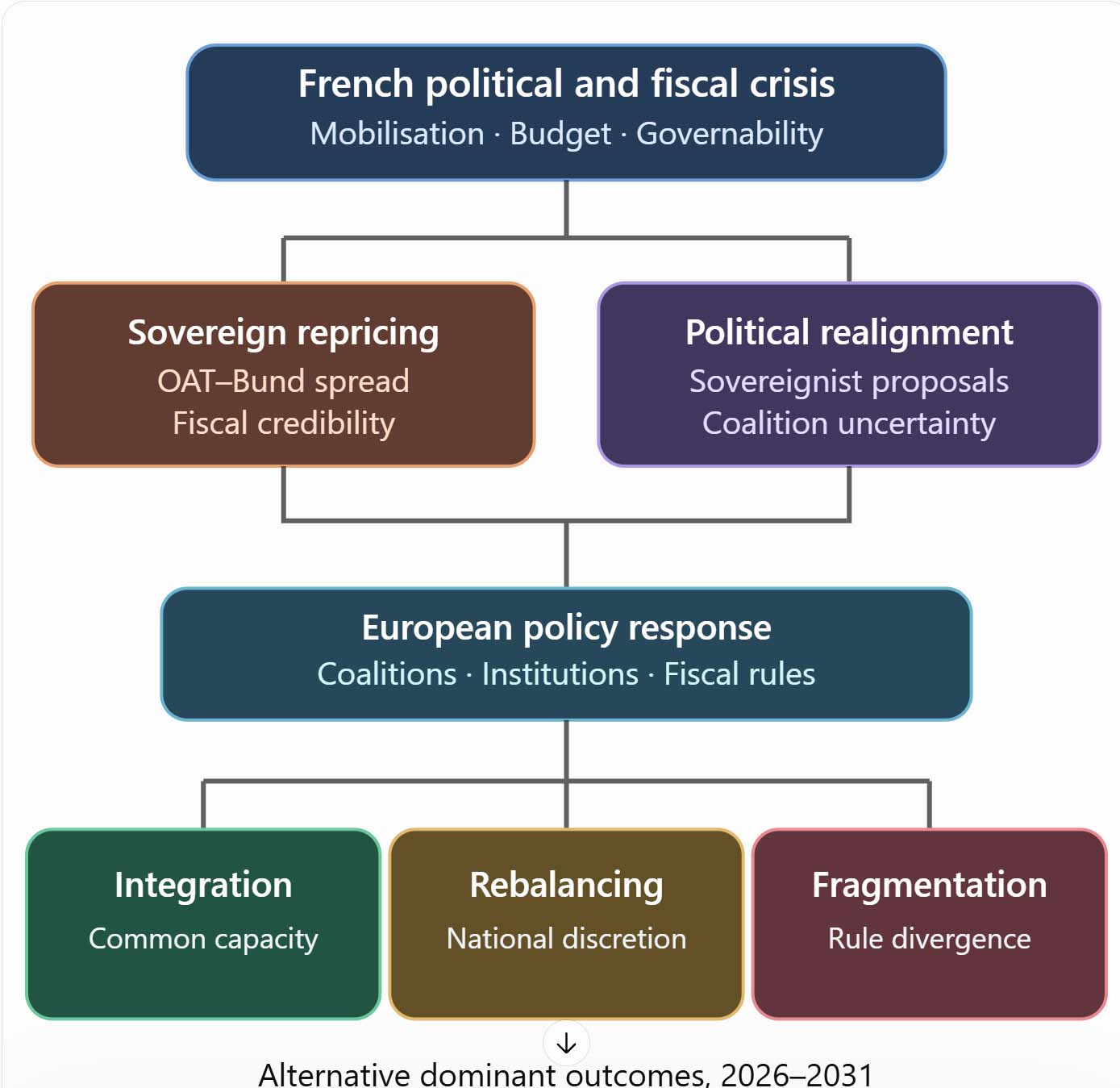
Analytical synthesis using the official fiscal, institutional and policy records cited above. Arrows represent possible transmission pathways; they do not establish measured causation or assign probabilities.
The significance of this framework is the existence of two reinforcing pressures: deteriorating national fiscal credibility can constrain the resources available for European policy, while institutional uncertainty can itself increase the premium required by sovereign investors. Conversely, credible fiscal adjustment, effective ECB monetary transmission and deliverable European reforms could interrupt that feedback mechanism.
The outcome will depend less on the intensity of institutional rhetoric than on the ability of France, Germany, Italy and their European partners to sustain common commitments while redistributing political responsibilities. That distinction is central to judging whether October 2026 represents the beginning of a further integration cycle or the emergence of a more nationally controlled European order.
FRANCE’S SOVEREIGN CRISIS: EUROPE AT AN INSTITUTIONAL CROSSROADS
Sovereign-debt repricing, domestic political pressure, the rise of intergovernmental alternatives and Italy’s opportunity to influence the next phase of European integration.
The pressure has moved to the centre of Europe
Unlike previous crises concentrated in smaller member states or triggered by external shocks, the present disruption directly affects France, one of the historic political engines of European integration.
The principal risk is not immediate euro-area dissolution, but a prolonged weakening of the political capacity to coordinate fiscal, industrial, financial and institutional reform.
01 | The October 2026 Shock
Different counts of the same mobilisation; neither is an economic-loss estimate.
Polling support is not equivalent to endorsement of violence or of any political party.
The ministry retrospective reports 441 actions on 17 October. The approximately 110 processions described in initial accounts use a different classification. Actions and processions must not be treated as interchangeable observations.
02 | Sovereign Risk Repricing
Indicative ten-year government-bond yield spreads over the German Bund, late October 2026.
French versus Italian sovereign spreads
Vertical bar height uses a common zero baseline: 1 pixel per basis point. Three-dimensional shading is decorative and does not alter the underlying values.
Analytical significance: France’s higher market premium despite its lower government debt ratio suggests that investors are distinguishing fiscal stock from expected fiscal trajectory and political governability.
Approximate market reference values, 27–28 October 2026. They are not presented as a reconstructed official end-of-day dataset. Differences in exact observation times can affect the comparison.
03 | The Sovereign Debt Paradox
Maastricht general government gross debt, second quarter of 2026, measured as a percentage of GDP.
Government debt-to-GDP ratios
Common zero baseline; bar scale 1.2 pixels per percentage point of GDP.
Italy’s public debt ratio exceeded France’s by 20.8 percentage points of GDP in Q2 2026.
Italy’s relative spread advantage therefore cannot be interpreted as evidence that its underlying debt burden is smaller.
04 | Fiscal Trajectories, 2026–2027
European Commission May 2026 forecasts, general government deficit as a percentage of GDP.
Deficit comparison
Deficit comparison
Both panels use a common zero baseline and a scale of 30 pixels per percentage point. Values are projected deficit magnitudes, not actual outturns. Italy’s projected real GDP growth is only 0.5% in 2026 and 0.6% in 2027.
05 | Franco-Italian Financial Comparison
| Indicator | France | Italy | Interpretation |
|---|---|---|---|
| Government debt / GDP, Q2 2026 | 119.1% | 139.9% | Italy carries the larger debt stock. |
| 2026 fiscal deficit forecast | 5.1% | 2.9% | France faces the wider projected fiscal imbalance. |
| 2027 fiscal deficit forecast | 5.7% | 2.9% | The projected divergence persists. |
| Ten-year spread over Bund | Approx. 157 bp | Approx. 117 bp | France carries the higher indicative market premium. |
| 2026 real GDP growth forecast | Not compared here | 0.5% | Italian growth remains a structural constraint. |
| Market position | Higher relative risk premium | Lower relative risk premium | Relative stability is not immunity from contagion. |
06 | Crisis Transmission Architecture
A structured representation of how domestic political constraints can interact with sovereign financing and European institutional confidence.
The arrows describe possible transmission channels, not econometrically established causation. ECB policy, market liquidity and credible fiscal measures may mitigate these pressures.
07 | Why 2026 Differs from Earlier Crises
| Dimension | 2011–2012 | 2020 | 2026 French Episode |
|---|---|---|---|
| Primary pressure | Euro-area sovereign debt and monetary architecture | External pandemic shock | Domestic political and fiscal instability in France |
| Major policy response | ESM and ECB crisis-management measures | Emergency ECB measures and European recovery borrowing | Institutional outcome remains unresolved |
| Integration incentive | Protect monetary union integrity | Finance collective recovery | Reconcile national legitimacy and European stability |
| Political constraint | Debtor-creditor divergence | Burden-sharing and implementation | Potential weakening of a founding political engine |
08 | The Institutional Competition
Rule-Based Integration
Common single-market law, competition rules, monetary institutions, European judicial enforcement and shared legislative competences.
Strategic strength: consistency, legal predictability and scale.
Strategic constraint: complex political bargaining and uneven national acceptance.
Association of Sovereign States
A reduced supranational role, stronger national authority, greater intergovernmental decision-making and selective European cooperation.
Strategic strength: a possible increase in perceived national political control.
Strategic constraint: maintaining uniform market rules and credible common commitments.
The sovereignist model is a political proposal, not adopted European law. Le Pen’s move away from Frexit and the AfD’s retention of a possible future German exit consultation are distinct positions and should not be conflated. Definitive evaluation of the October speeches requires their complete primary texts.
09 | Three Institutional Pathways, 2026–2031
Conditional strategic scenarios, not forecasts with numerical probabilities.
Renewed Integration
Member states respond to French vulnerability by improving common fiscal coordination, investment financing and European capabilities.
Required conditions:
Credible French adjustment, workable financing compromises and durable Council majorities.
Observable indicators:
New market-integration legislation, common instruments and improved fiscal compliance.
Managed Rebalancing
The Union preserves its core economic and monetary framework while expanding national discretion and selective cooperation.
Required conditions:
Sufficient shared-rule enforcement, negotiated national discretion and continued financial cooperation.
Observable indicators:
Greater Council leadership, differentiated participation and targeted reforms.
Principal qualitative working hypothesis.
Progressive Fragmentation
Political concessions weaken common rules, reform stalls and national divergence increasingly impairs collective action.
Required conditions:
Persistent market pressure, unresolved fiscal conflict and declining political commitment.
Observable indicators:
Repeated derogations, sustained spread deterioration and weakening enforcement.
Material downside risk, not an established outcome.
10 | National Strategic Positions
| Actor | Primary strategic concern | Policy opportunity | Principal limitation |
|---|---|---|---|
| France | Fiscal credibility and domestic political governability | Restore financing confidence and European negotiating capacity | Social resistance to adjustment and policy instability |
| Germany | Fiscal discipline, EU governance and industrial competitiveness | Shape financing rules and institutional compromises | Coalition constraints and divisions over sovereignty |
| Italy | Debt sustainability, investment and European influence | Build coalitions around market, defence and industrial reforms | High debt stock and weak growth |
| United Kingdom | European security and economic relations outside the EU | Selective defence, industrial and financial cooperation | No EU legislative vote or internal Council authority |
| EU Institutions | Preserve common rules and monetary stability | Implement existing legal and financing instruments | Competence boundaries and political agreement requirements |
This section presents analytical policy positions, not identical official government commitments.
11 | Italy’s Three Actionable Policy Openings
Savings & Investments Union
Reduce capital-market fragmentation, improve cross-border investment and diversify financing beyond traditional bank lending.
Implementation: EU secondary legislation, supervisory cooperation and national market reforms.
Constraint: divergent national legal and tax systems and resistance to supervisory convergence.
Common Defence Financing
Use the existing SAFE framework as a basis for deeper cooperation in procurement and defence industrial capacity.
Established instrument: up to €150 billion in EU-supported loans.
Constraint: repayment responsibility, eligibility, procurement coordination and cautious member states.
Single-Market Deepening
Remove regulatory, administrative and cross-border barriers that restrict European business expansion and investment.
Implementation: targeted regulations, enforcement, harmonisation and domestic administrative reforms.
Constraint: national incumbent interests, sectoral resistance and uneven implementation.
These initiatives can pursue substantial progress within the existing Treaty architecture. This does not imply that every proposal can be implemented without unanimity, new legislation, budgetary decisions or national approvals.
12 | Strategic Risk and Early-Warning Matrix
| Risk | Transmission mechanism | Observable signal | Potential response |
|---|---|---|---|
| French fiscal deterioration | Weaker financing confidence and adjustment capacity | Persistent spread elevation and deteriorating forecasts | Credible national adjustment and EU fiscal surveillance |
| Ad-hoc rule concessions | Reduced predictability and inconsistent common commitments | Repeated fiscal exceptions without credible corrective measures | Transparent, consistently applied EU fiscal governance |
| Sovereignist political gains | Institutional reform loses political support | Formal coalition agreements and legislative proposals | Deliver practical reforms with demonstrable benefits |
| Italian market reversal | Higher borrowing costs limit policy discretion | Sustained BTP spread widening and weaker debt projections | Preserve fiscal credibility while advancing specific EU proposals |
| Failure of Franco-German coordination | Delayed financial, industrial and institutional decisions | Persistent Council deadlock on major files | Construct alternative coalitions within EU legal procedures |
| Financial fragmentation | Uneven financing conditions impair monetary transmission | Wider sovereign and private financing divergence | Maintain credible fiscal policies and applicable ECB safeguards |
Europe’s Next Crisis Response Is Not Predetermined
Previous European crises strengthened integration when a sufficiently broad political coalition concluded that common institutional capacity was indispensable.
The present French episode introduces a different configuration: a major founding state faces domestic constraints that may limit its ability to support precisely the reforms financial stability requires.
Italy’s strategic opportunity depends on turning temporary relative market confidence into executable European proposals, not on treating France’s difficulties as an enduring Italian advantage.
By 2031, the critical distinction will be whether Europe has strengthened collective capabilities, established a stable intergovernmental balance, or allowed repeated national exceptions to erode the effectiveness of its common rules.
Official Data and Institutional Sources
- French Interior Ministry — National Mobilisation Retrospective, October 2026
- Agence France Trésor — Sovereign Credit Ratings
- Eurostat — Government Debt and Deficit, October 2026 Release
- European Commission — France Economic Forecast, May 2026
- European Commission — Italy Economic Forecast, May 2026
- Council of the EU — Security Action for Europe (SAFE)
- European Central Bank — Transmission Protection Instrument, July 2022
Source qualification: the October 2026 spread comparisons are indicative market quotations and are not independently verified official closing-price series. The 69% opinion measure reflects a pre-event polling reference; its full original questionnaire has not been independently retrieved for this dashboard. Scenario assessments are analytical judgments, not institutional forecasts.
PILLAR I — FRANCE’S DOMESTIC CRISIS AND THE REPRICING OF EUROPEAN SOVEREIGN RISK
Chapter 1 — The October Mobilisations: Social Legitimacy, Governability and Political Authority
A crisis of governability rather than a conventional episode of social protest
The French demonstrations of 17 October 2026 must be understood as an expression of a deeper conflict between the economic adjustments increasingly demanded by the country’s fiscal position and the political legitimacy required to implement them. Their significance does not derive exclusively from the number of demonstrators, the disruption of public order or the confrontation between protesters and security forces. It derives from the coincidence of three developments that, taken together, substantially constrain the capacity of the French state to formulate and execute a credible economic programme: a broad social mobilisation against declining purchasing power and perceived inadequacies in public provision, a political environment in which parliamentary agreement on difficult fiscal choices remains uncertain, and a sovereign-debt market increasingly sensitive to the possibility that announced measures may not survive the legislative process or prove enforceable after adoption. The October mobilisation therefore raises a question more consequential than whether the government can restore order in the streets. It raises the question of whether the French political system can generate sufficient consent to reconcile social expectations, public expenditure, economic growth and the long-term sustainability of sovereign obligations.
The distinction matters because France is not confronting a sudden loss of market access or an isolated disturbance in public order. It is confronting a deterioration in the relationship between policy commitments and the capacity to deliver them. A government can announce reductions in expenditure, increases in taxation or the restructuring of public programmes, yet the credibility of those announcements depends on parliamentary authorisation, administrative implementation, public acceptance and the ability to maintain the policy over successive budgets. Where that political capacity is uncertain, markets may demand additional compensation for holding sovereign debt even before a significant change in the underlying stock of liabilities takes place. Conversely, a large demonstration does not necessarily imply fiscal instability if institutions remain capable of negotiating and delivering a credible policy response. The October episode becomes economically important because the social conflict coincides with an already deteriorating French fiscal outlook, rather than because protest participation itself constitutes a measurable sovereign-credit shock.
The French Interior Ministry’s retrospective published on 25 October confirms the scale and continuity of the mobilisation. For 17 October, the ministry recorded 441 public-road actions involving 550,000 participants. On 24 October, it counted 289 actions and 410,000 participants, including 110,000 in Paris. The official figures therefore indicate a reduction of 140,000 participants, equivalent to approximately 25.5%, and a decline of 152 recorded actions, equivalent to approximately 34.5%, between the two dates. These are calculations from the ministry’s published totals, not estimates of changes in the number of distinct individual protesters. They demonstrate that mobilisation continued on a substantial scale one week after the initial demonstrations, although participation declined according to the official count. The organisers’ estimate of 800,000 participants on 17 October, supplied in the political record under examination, would indicate a larger mobilisation than the ministry’s figure; it is important to preserve the disagreement rather than average the two counts or imply that their methodologies are equivalent. The initial description of roughly 110 processions also concerns a narrower category than the ministry’s 441 public-road actions and should not be substituted for the latter. Bilan de la journée de mobilisation nationale du 24 octobre 2026 — French Interior Ministry — October 2026.
The significance of the second mobilisation is particularly important for assessing governability. If the authorities had faced a single exceptional demonstration followed by a rapid return to normal political activity, the episode could more readily have been treated as a temporary disturbance with limited consequences for medium-term policy. The persistence of hundreds of coordinated actions a week later instead suggests that the grievances underpinning the protests had not been fully absorbed by the initial institutional response. At the same time, the reduction in the official number of participants warns against treating the movement as necessarily expanding or escalating. The appropriate assessment is that France was experiencing a continuing and geographically distributed mobilisation, with uncertain implications for its subsequent political development. Whether such mobilisation becomes a durable constraint on fiscal legislation depends on the behaviour of parliamentary parties, organised social constituencies, the government’s capacity to negotiate and the extent to which public opinion continues to associate fiscal adjustment with an unacceptable distribution of economic burdens.
The social foundations of the mobilisation: purchasing power, expectations and distributive conflict
The most revealing evidence about the movement’s political significance comes from the relationship between public sympathy and the material circumstances of different social groups. An Elabe survey published on 16 October found that 69% of French respondents approved of the mobilisation against the rising cost of living, comprising 36% who expressed support and another 33% who expressed sympathy. This distinction is essential. Approval or sympathy does not establish willingness to participate in demonstrations, endorse disruption, accept violence or support a particular political organisation. Nevertheless, the combined measure indicates that the economic grievances behind the movement extended well beyond the population physically present in the streets. The same survey found approval among 79% of households reporting that they had to restrict expenditure to make ends meet, compared with 62% among households that did not report such restrictions. Support was also particularly pronounced among younger respondents, reaching 77% among those aged 18–24, and among manual workers, at 75%. These differences provide evidence that the mobilisation was connected to perceived material insecurity rather than being reducible to a single party’s political strategy. Les Français et les mobilisations sociales — Elabe — October 2026.
The distributive dimension is central to any assessment of French fiscal governability. Public expenditure is not merely an accounting aggregate: it finances services, transfers and public employment arrangements that create identifiable beneficiaries and expectations. Taxation similarly distributes adjustment costs across households and enterprises, with consequences that depend on income, wealth, consumption and the structure of the tax base. When a government seeks to reduce a large deficit, the composition of the adjustment can become politically more important than its total nominal value. Cuts to politically sensitive expenditure may provoke opposition disproportionate to their contribution to deficit reduction, while tax measures targeting narrow economic groups may be administratively feasible but insufficient in scale or potentially damaging to the investment base. France’s predicament is therefore not simply that consolidation is economically necessary and socially unpopular. It is that the political process must determine which groups bear the adjustment, how quickly the burden is imposed and which expenditures remain protected, all while financial markets evaluate whether the resulting programme is credible.
Elabe’s social breakdown also cautions against interpreting the protests as a movement confined to the economically most vulnerable. Approval among households that did not report having to restrict expenditure remained at 62%, a clear majority. This indicates that concern about the cost of living and the direction of national policy cannot be mapped mechanically onto immediate household deprivation. Individuals may sympathise with demonstrations because they anticipate future deterioration, perceive inequalities in the distribution of public burdens, distrust political institutions or believe that essential services are inadequately provided. The survey does not independently determine the relative importance of these explanations, but the breadth of support suggests that the government cannot assume that narrowly targeted relief for the most financially constrained households would necessarily eliminate wider political dissatisfaction. This creates a significant policy-design problem: measures sufficiently generous to influence public opinion may weaken the fiscal adjustment, whereas measures compatible with fiscal consolidation may be too limited to restore confidence.
A second result from the same survey illustrates the difficulty of identifying interventions that citizens regard as economically effective. Eighty-eight per cent of respondents believed that releasing strategic fuel reserves would not genuinely improve purchasing power, against 12% who expected a concrete benefit for motorists. This finding does not establish the actual price effect of a reserve release, which would require separate analysis of quantities, market conditions, distribution and the duration of the intervention. It does, however, indicate limited public confidence in that particular measure as a solution to household cost pressures. The political implication is that visible government activity and perceived policy effectiveness are not synonymous. Measures announced in response to social mobilisation may fail to produce legitimacy gains if the electorate regards them as temporary, poorly targeted or incapable of addressing the causes of its economic insecurity. Les Français et les mobilisations sociales — Elabe — October 2026.
The political distribution of public sympathy
The partisan composition of approval makes the French crisis more complex than a conventional confrontation between the government and a unified opposition. Elabe recorded support or sympathy for the mobilisation among 83% of respondents identifying with the New Popular Front electorate, 70% among those associated with the National Rally, 55% among Les Républicains voters and 51% among supporters of Ensemble. These figures demonstrate that the movement’s underlying grievances crossed the boundaries separating left-wing, nationalist and more government-oriented electoral constituencies, but they do not establish agreement on the reforms that should follow. On the contrary, the convergence of dissatisfaction may conceal sharply incompatible preferences concerning taxation, public expenditure, social protection, migration, economic regulation and the relationship between national and European institutions.
This difference between agreement on dissatisfaction and agreement on remedies constitutes one of the central mechanisms of political fragmentation. A broad negative coalition can make it difficult for a government to implement an unpopular programme without providing a viable alternative capable of commanding sufficient parliamentary support. Different opposition forces may reject the same budget for contradictory reasons. Some may regard proposed expenditure reductions as excessive, while others consider them insufficient; some may advocate additional public intervention, while others demand reductions in taxation or changes in the allocation of existing resources. The government is therefore exposed to the possibility that concessions designed to satisfy one constituency intensify opposition among another. In a fragmented legislature, this problem can become cumulative, because each proposed adjustment must survive not only public criticism but also negotiations among parties with different electoral incentives.
The survey findings provide a clear basis for this interpretation, although they do not by themselves establish the voting intentions of individual legislators. The important strategic distinction is between a shared diagnosis of social dissatisfaction and the formation of an effective governing coalition. The former can be demonstrated through opinion polling; the latter requires observable parliamentary agreements, adopted legislation and continuity of implementation. Financial markets ultimately care more about the second because sovereign-credit assessments depend on the state’s ability to collect revenue, control expenditure and maintain a predictable policy framework. The October mobilisation is therefore politically consequential not because it reveals a uniform national programme but because it demonstrates the breadth of the constituencies that may oppose different aspects of the fiscal adjustment required by France’s debt trajectory.
Public-order legitimacy and the distinction between protest and violence
The events of 17 October also exposed a second conflict that should not be confused with the social claims driving the mobilisation: the tension between the protection of democratic protest and the state’s obligation to maintain public order. The Interior Ministry’s communication of 23 October described violent attacks against institutional sites, businesses and law-enforcement personnel during the preceding demonstrations and instructed prefects to assess the risk associated with subsequent gatherings, taking account of the reliability of organisers, proposed arrangements and preventive measures. The official account is evidence of the government’s public-order assessment and administrative instructions; it should not automatically be taken as an independently adjudicated determination of responsibility for every incident. Equally, the occurrence of violence at or around demonstrations does not establish that all participants shared responsibility for it. Journée de mobilisation du samedi 24 octobre 2026 — French Interior Ministry — October 2026.
The distinction is supported by subsequent public-opinion research. Elabe’s 21 October survey found that 91% of French respondents condemned the violence associated with the demonstrations, while 24% said they understood it. Nineteen per cent expressed both condemnation and understanding, demonstrating why the two measures must not be treated as mutually exclusive. The distinction between explaining or understanding violent behaviour and approving it is important for an accurate reading of social attitudes. A respondent may consider violence unacceptable while interpreting its occurrence as a symptom of severe economic or institutional frustration. The government, for its part, may receive substantial support for effective law enforcement without gaining comparable support for its economic programme. Les Français, les manifestations du 17 octobre et les violences — Elabe — October 2026.
That same research recorded considerable support for stronger public-order measures: 90% favoured faster judicial procedures and tougher sanctions against perpetrators of violence and looting, 87% supported reinforcing police and gendarmerie numbers, 77% supported geographically targeted curfews in areas at risk, and 71% favoured declaring a state of emergency in the most affected zones. These are reported survey preferences, not findings that particular measures would be legally proportionate, necessary or effective in the circumstances. Their significance lies in the divergence between approval of the economic mobilisation and condemnation of associated violence. A political strategy that treats public-order enforcement as a substitute for addressing economic grievances would risk misunderstanding this distinction. Conversely, a strategy that assumes the popularity of social demands legitimises violent disruption would also contradict the available polling evidence. Les Français, les manifestations du 17 octobre et les violences — Elabe — October 2026.
| Public-opinion indicator | Reported share | Source date | Analytical significance |
|---|---|---|---|
| Support or sympathy for cost-of-living mobilisation | 69% | 16 Oct 2026 | Broad legitimacy of underlying grievances |
| Explicit support for mobilisation | 36% | 16 Oct 2026 | Stronger category than sympathy alone |
| Sympathy toward mobilisation | 33% | 16 Oct 2026 | Does not imply participation |
| Approval among financially constrained households | 79% | 16 Oct 2026 | Strong association with material pressure |
| Approval among other households | 62% | 16 Oct 2026 | Grievances extend beyond immediate hardship |
| Approval among 18–24-year-olds | 77% | 16 Oct 2026 | Pronounced younger-cohort support |
| Approval among manual workers | 75% | 16 Oct 2026 | Significant occupational dimension |
| Respondents condemning demonstration-related violence | 91% | 21 Oct 2026 | Broad rejection of violence |
| Respondents expressing understanding of violence | 24% | 21 Oct 2026 | Not equivalent to approval |
| Support for tougher sanctions against perpetrators | 90% | 21 Oct 2026 | Public-order demands coexist with social sympathy |
| Support for increased police and gendarmerie staffing | 87% | 21 Oct 2026 | Security response has broad public support |
| Support for targeted curfews | 77% | 21 Oct 2026 | Stronger intervention receives substantial support |
| Support for an emergency declaration in affected areas | 71% | 21 Oct 2026 | Preference does not establish legal necessity |
Source: Les Français et les mobilisations sociales — Elabe — 16 October 2026 and Les Français, les manifestations du 17 octobre et les violences — Elabe — 21 October 2026. The figures describe distinct questions and should not be combined into a single approval index.
The institutional consequence is that French authorities face two different tests of legitimacy operating on different timescales. Public-order decisions must often be taken immediately and assessed against the applicable legal standards of necessity, proportionality and public safety. Fiscal adjustment requires negotiation over a longer horizon, with effects distributed among households, enterprises and public institutions. Success in the first field does not guarantee success in the second. Indeed, the risk of political miscalculation increases when authorities use a short-term restoration of order as evidence that the economic conflict has been resolved. For sovereign investors, the relevant distinction is whether the state retains the capacity not only to enforce public order but also to secure durable consent for policies that affect the budget balance and debt trajectory.
The political economy of fiscal adjustment: why the French government faces an unusually narrow corridor
France’s fiscal position helps explain why the social confrontation has consequences beyond domestic politics. In its economic forecast of 21 May 2026, the European Commission projected real GDP growth of 0.8% in 2026 and 1.1% in 2027, alongside a general government deficit equivalent to 5.1% of GDP in 2026 and 5.7% in 2027 under unchanged policies. The Commission identified continuing primary deficits, expiring revenue measures and rising interest expenditure as important drivers of the deterioration. Its projections anticipated government debt increasing from 115.6% of GDP in 2025 to 118.1% in 2026 and 120.2% in 2027. These figures describe a fiscal trajectory already problematic before the October demonstrations; they should not be presented as forecasts produced in response to the mobilisation. Economic Forecast for France — European Commission — May 2026.
The Commission’s assessment is especially consequential because it identifies a structural difficulty that cannot be eliminated through temporary political concessions. France’s projected deficit is not solely the consequence of an exceptional one-year expenditure shock. The forecast indicates that certain revenue measures adopted for 2026 would cease to apply in 2027, while expenditure and interest costs would continue increasing. Even in the absence of the October demonstrations, that configuration would require policymakers to decide whether to replace expiring taxes, reduce expenditure growth, undertake deeper structural reforms or accept a further deterioration in borrowing requirements. The political mobilisation adds a constraint to those choices by making the distributive and social consequences more visible and potentially increasing the political cost of implementing them.
The projected increase in interest expenditure illustrates the interaction between market conditions and budgetary choices. According to the Commission’s May forecast, French government interest payments were expected to reach 2.6% of GDP in 2026 and 2.8% in 2027. The difference of 0.2 percentage points of GDP represents a further deterioration in the annual budgetary balance if it is not offset elsewhere. It is particularly important that the Commission anticipated rising interest costs before the sharp October repricing. Subsequent market developments therefore risk intensifying an existing trend, although the extent of the eventual budgetary effect depends on the government’s issuance calendar, the maturity profile of outstanding debt, inflation-indexation provisions and the persistence of higher yields. Economic Forecast for France — European Commission — May 2026.
| French macroeconomic indicator | 2025 | 2026 forecast | 2027 forecast | Interpretation |
|---|---|---|---|---|
| Real GDP growth | 0.8% | 0.8% | 1.1% | Limited growth contribution to fiscal adjustment |
| Inflation | 0.9% | 2.4% | 1.8% | Purchasing-power and nominal-budget effects |
| Unemployment | 7.7% | 8.3% | 8.7% | Deteriorating labour-market outlook |
| Government balance, % GDP | −5.1% | −5.1% | −5.7% | Persistently large fiscal deficit |
| Government debt, % GDP | 115.6% | 118.1% | 120.2% | Increasing debt burden |
| Interest expenditure, % GDP | — | 2.6% | 2.8% | Rising debt-service burden |
Source: Economic Forecast for France — European Commission — 21 May 2026. Figures for 2026–2027 are projections made in May, not October outcomes. The debt measure in this table follows the forecast vintage and is not interchangeable with Eurostat’s subsequently published quarterly observations.
The growth and employment forecasts impose a further constraint on fiscal policy. With growth projected at only 0.8% in 2026 and unemployment increasing to 8.3%, a sharp withdrawal of fiscal support could produce adverse short-term demand effects depending on the composition of adjustment, household responses and monetary conditions. Such effects are not inevitable or uniform: reducing inefficient expenditure, changing the structure of taxation and protecting high-productivity investment can have different consequences from across-the-board reductions. Nevertheless, the combination of weak activity and widespread social dissatisfaction makes the design of consolidation especially important. Policies that improve the fiscal balance arithmetically may prove politically unsustainable if their immediate distributional effects are severe, while measures intended to protect consumption and employment may have limited credibility if they substantially increase the government’s financing requirement.
The practical problem for France is therefore not simply choosing between austerity and expansion. It is constructing a sequence of measures that allows the state to maintain essential functions, preserve the foundations of growth, contain borrowing requirements and distribute the adjustment in a manner that remains politically defensible. The ability to achieve that sequence is a matter of political authority as much as economic technique. An adjustment package that is internally coherent but cannot obtain legislative approval has limited value as a fiscal commitment; a package that survives Parliament but cannot be implemented consistently may be only marginally more credible. Conversely, a negotiated programme supported by durable administrative and parliamentary arrangements can improve confidence without requiring the immediate elimination of every fiscal imbalance.
Political authority, parliamentary uncertainty and the credibility of public commitments
The October crisis should also be examined through the distinction between formal constitutional authority and effective governing capacity. France possesses established executive, legislative, judicial and administrative institutions, and the existence of demonstrations does not imply that those institutions have ceased to function. The question is whether they can coordinate decisions sufficiently predictably to manage a difficult fiscal adjustment over several years. When a government’s survival, the parliamentary passage of budgets and the continuity of economic policy are uncertain, official objectives may be discounted by economic actors even when the state retains its legal powers. Such discounting can affect firms considering investment, households anticipating changes in taxes and benefits, and investors deciding how much compensation to require for longer-term sovereign exposure.
The difference between policy announcement and implementation is particularly important in the French case because the adjustment cannot be assessed solely through the next annual budget. France’s debt dynamics extend beyond one legislative cycle, and repeated temporary measures can complicate fiscal forecasting. For example, an exceptional tax adopted for one year may improve the immediate balance but create an additional financing requirement when it expires. Deferring expenditure may achieve an accounting benefit without permanently changing the trajectory of commitments. Conversely, reforms that alter expenditure growth or expand the tax base may have longer-term effects but require time to implement and may generate stronger immediate opposition. The European Commission’s expectation that the deficit would widen in 2027 partly because of expiring revenue measures illustrates why the credibility of medium-term commitments matters more than a single budget headline. Economic Forecast for France — European Commission — May 2026.
In assessing the French government’s options, three institutional capacities should therefore be distinguished. The first is decision capacity, meaning the ability to formulate a fiscal package, obtain the necessary political and legal authority and enact measures. The second is implementation capacity, meaning the ability of ministries, tax authorities and public administrations to translate those measures into actual financial outcomes. The third is continuity capacity, meaning the ability to preserve a coherent adjustment strategy despite changes in government, electoral incentives or economic conditions. The October demonstrations are relevant primarily to the first and third dimensions, although prolonged disruption could also affect implementation. Their effects cannot be estimated from participation numbers alone; the decisive evidence will be observable legislative outcomes, fiscal execution data and the durability of adopted policies.
These distinctions also explain why the political response to mobilisation may influence European negotiations. France’s ability to make commitments at EU level depends not only on the formal powers of its representatives in the Council but also on the credibility of those commitments within the domestic political system. A government facing serious parliamentary constraints may be reluctant to accept measures involving additional national contributions, restrictive fiscal obligations or politically sensitive regulatory changes. Alternatively, it may favour European initiatives that reduce the immediate national cost of investment or redistribute financial burdens. Neither behaviour is automatic; both depend on the content of the proposal and the domestic coalition necessary to support it. The institutional risk arises when a country central to European compromise-making cannot reliably translate international agreement into domestic implementation.
The second mobilisation as an indicator of persistence rather than escalation
The 24 October demonstrations offer a useful observation for distinguishing temporary protest intensity from enduring political constraint. As recorded by the Interior Ministry, participation fell from 550,000 to 410,000, while the number of actions declined from 441 to 289. The decline in recorded actions was proportionately greater than the decline in participation. Calculating participants per recorded action produces approximately 1,247 for 17 October and 1,419 for 24 October, although these figures are simple arithmetic ratios rather than measured average procession sizes, because the ministry’s category of actions includes different types of public mobilisation. The result should therefore not be interpreted as evidence that individual demonstrations necessarily became larger or more concentrated. The stronger conclusion is that substantial participation persisted even as the number of recorded actions declined. Bilan de la journée de mobilisation nationale du 24 octobre 2026 — French Interior Ministry — October 2026.
| Official mobilisation measure | 17 October | 24 October | Change |
|---|---|---|---|
| Participants | 550,000 | 410,000 | −140,000 |
| Recorded public-road actions | 441 | 289 | −152 |
| Participants, percentage change | — | — | −25.5% |
| Actions, percentage change | — | — | −34.5% |
| Paris participants | Not established in the cited retrospective | 110,000 | Not calculated |
| Nationwide participation trend | Initial reference | Lower but substantial | Continued mobilisation |
Source: Bilan de la journée de mobilisation nationale du 24 octobre 2026 — French Interior Ministry — 25 October 2026. Percentage changes are calculated from the published ministry counts.
For policy assessment, the value of these observations lies in the questions they permit analysts to monitor. If participation continues declining while parliamentary agreement becomes more achievable and fiscal measures advance, the probability of the protests developing into a sustained institutional crisis would be reduced. If smaller demonstrations remain accompanied by severe disruption, legislative paralysis or expanding opposition to specific economic reforms, the political constraint could persist despite declining attendance. Conversely, if participation rises again in response to budget measures, the movement may become directly linked to fiscal decisions rather than remaining principally focused on the cost of living. None of these developments can be inferred confidently from two national observations alone. A longer, consistently defined official series, combined with parliamentary and fiscal outcomes, would be necessary to distinguish the movement’s social durability from the immediate consequences of specific incidents.
The strategic consequence: a widening gap between fiscal necessity and political consent
The principal institutional lesson of October 2026 is that France’s fiscal problem and its legitimacy problem cannot be addressed as independent policy questions. A large deficit and rising debt ratio create pressure for corrective measures; broad public dissatisfaction limits the range of politically acceptable instruments; weak economic growth reduces the ease with which adjustment can be achieved through expanding revenues; and parliamentary uncertainty can prevent even economically defensible measures from becoming durable policy. The resulting interaction is potentially self-reinforcing. If investors doubt the political feasibility of consolidation, they may demand higher yields. Rising financing costs then make the adjustment more difficult, potentially requiring additional measures that intensify social resistance. That is a plausible institutional-economic mechanism, not evidence that such a cycle has already become irreversible.
The French state retains substantial resources and institutional capabilities, and the October evidence does not establish a general collapse of political authority. The important concern is narrower but strategically more consequential: the ability to maintain the credibility of future fiscal commitments has become increasingly dependent on a difficult domestic negotiation over who should bear the cost of adjustment. This creates vulnerabilities that cannot be solved through public-order measures alone, although public safety remains a separate legitimate responsibility. Nor can the state rely exclusively on temporary financial reassurance if the budgetary path continues deteriorating. The necessary policy response must generate credible fiscal outcomes while maintaining sufficient political acceptance to ensure that those outcomes survive implementation.
For European institutions and neighbouring states, the issue is not whether the demonstrations should be interpreted as support for integration or sovereignism. The available data do not permit that conclusion. The issue is whether prolonged domestic conflict will reduce France’s capacity to support common European decisions at a time when financial stability, defence investment, industrial competitiveness and institutional reform require sustained coordination. That possibility makes the October mobilisation a European strategic concern even before any formal constitutional or Treaty dispute emerges.
Key judgments — Chapter 1
The 17 October demonstrations were a major national mobilisation, but the most significant evidence is the breadth of social approval, the divergence between support for economic grievances and rejection of violence, and the continuation of substantial mobilisation on 24 October. The political system’s ability to formulate and implement a durable fiscal strategy is the decisive variable, rather than demonstration attendance considered in isolation.
France’s adjustment problem is structurally more difficult because the European Commission had already projected large fiscal deficits, increasing public debt and rising interest expenditure before the protests. The mobilisation therefore constrains policy choices within an existing deterioration rather than creating the deterioration itself.
The principal uncertainty is whether government and parliamentary institutions can construct a politically sustainable adjustment programme that restores fiscal credibility without producing a new and potentially larger wave of opposition.
What would change the assessment
The assessment would improve with evidence of a durable fiscal agreement, enacted and implemented budget measures, stabilisation of social opposition and a credible medium-term debt trajectory. It would deteriorate if demonstrations became directly linked to repeated fiscal-policy reversals, if parliamentary decisions prevented necessary financing measures, or if political uncertainty made adopted commitments increasingly unreliable.
Chapter 2 — From French Political Instability to OAT–Bund Spreads: Fiscal Fundamentals, Market Transmission and Euro-Area Contagion
The repricing of French sovereign debt: a structural deterioration intensified by political events
The widening of French sovereign-bond spreads during October 2026 represents a significant change in how financial markets assess the relative creditworthiness, liquidity and political stability of the euro area’s major government issuers. The central development is not simply that French borrowing costs increased, but that the ten-year yield premium over German federal debt moved back into a range associated with the European sovereign-debt crisis, while French government securities became more expensive to finance than their Italian equivalents at comparable maturities. Such a configuration challenges a long-established hierarchy in European sovereign markets, in which Italian debt has typically attracted a higher risk premium because of its exceptionally large public-debt burden and historically weaker growth performance. The inversion does not establish that Italy has become structurally safer than France in every dimension, nor does it imply that the French state is approaching an imminent inability to meet its obligations. It indicates that investors are placing increasing weight on the direction of fiscal policy, the credibility of future budgetary adjustments, political uncertainty and the liquidity characteristics of national debt markets, rather than ranking sovereign issuers according to debt-to-GDP ratios alone.
The timing of the repricing is important because it prevents a simplistic causal interpretation of the October demonstrations. Market analysis published on 21 October by J.P. Morgan Asset Management reported that the French ten-year OAT yield had already increased by approximately 135 basis points since the beginning of 2026, before the full financial consequences of the 17–18 October unrest had been absorbed. The same analysis recorded a movement from approximately 4.80% on Friday 16 October to around 4.94% on Monday 19 October, with the ten-year OAT–Bund spread moving into a range of approximately 146–150 basis points. By 20 October, the French ten-year yield remained close to 4.93%, and the spread had moved above 150 basis points, returning to levels last observed around January 2012. These quotations come from a first-party financial-market assessment rather than an official harmonised daily yield series; they are useful for reconstructing the immediate episode, but they should not be treated as exact closing observations for every market or compared with later figures without matching the time of quotation and calculation method. France Update: Our Take on Equity, Bond and Policy Implications — J.P. Morgan Asset Management — October 2026.
The distinction between a pre-existing deterioration and a subsequent political catalyst changes the interpretation of the crisis. If French government securities had traded with a stable and historically low premium until 17 October, the subsequent rise might have been interpreted primarily as an abrupt reaction to unexpected domestic violence. Instead, the observed increase in yields over the preceding months indicates that investors were already demanding higher compensation for French exposure. The demonstrations supplied additional information about the political feasibility of fiscal consolidation, potentially worsening expectations concerning the government’s capacity to secure legislative support and implement a credible medium-term adjustment. They therefore amplified risks already embedded in the sovereign-market outlook. This interpretation is consistent with the distinction between cyclical financial disturbances, which may dissipate when immediate uncertainty declines, and structural repricing, which persists because the expected path of fiscal balances, growth or political implementation has deteriorated.
The French equity market provides a further indication of the interaction between domestic events and broader financial conditions. According to the same institutional market assessment, the CAC 40 declined by approximately 1.2% on 19 October, compared with a decline of 0.9% in the STOXX Europe 600, while the French index fell by another approximately 0.2% on 20 October. The immediate equity reaction was therefore negative and somewhat more pronounced than the broader European movement on the first trading day following the unrest, but the figures cannot establish that all of the difference was caused by French political developments. European equities were also responding to wider market conditions, including global risk aversion and developments affecting technology-related sectors. The evidence is better interpreted as a simultaneous repricing of French sovereign and equity risks, with the sovereign-bond market providing the more direct observation of changing perceptions of public-finance credibility. France Update: Our Take on Equity, Bond and Policy Implications — J.P. Morgan Asset Management — October 2026.
Reconstructing the October market sequence
| Date or period | Documented market observation | Analytical relevance | Evidentiary qualification |
|---|---|---|---|
| Beginning of 2026 to October | French ten-year yield increased by approximately 135 bp before the October protest-related repricing | Structural market deterioration preceded the demonstrations | Institutional market estimate |
| 16 October 2026 | Ten-year OAT yield around 4.80% | Immediate pre-demonstration reference | Approximate Friday quotation |
| 17–18 October 2026 | Widespread mobilisation and public-order disruption | Potential deterioration in perceived governability | Political event, not a yield observation |
| 19 October 2026 | Ten-year OAT yield around 4.94% | Approximately 14 bp above the rounded Friday quotation | Source describes movement as roughly 13 bp |
| 19 October 2026 | OAT–Bund spread around 146–150 bp | Higher French relative risk premium | Indicative range |
| 19 October 2026 | CAC 40 approximately −1.2%; STOXX Europe 600 approximately −0.9% | French equities underperformed during the initial reaction | Daily market observation |
| 20 October 2026 | Ten-year OAT yield around 4.93%; spread above 150 bp | Continued sovereign-market pressure | Approximate figures |
| 23 October 2026 | Moody’s maintained Aa3 with negative outlook | No immediate downgrade despite deterioration in market conditions | Official rating status |
| Late October 2026 | French spread near 157 bp and Italian spread near 117 bp in the reference comparison | Approximately 40 bp French premium over Italy | Indicative, not independently matched official closing series |
Sources: France Update: Our Take on Equity, Bond and Policy Implications — J.P. Morgan Asset Management — 21 October 2026 and France’s Credit Ratings — Agence France Trésor — October 2026. The late-October Franco-Italian comparison is retained as an indicative reference from the analytical mandate; a directly comparable official series at identical timestamps is required before treating the 40 bp difference as a precise closing-market result.
Understanding the OAT–Bund spread: what the market is actually measuring
The ten-year OAT–Bund spread is the difference between the yield on a French government bond and the yield on a German federal bond of comparable maturity. Although frequently described as a sovereign-risk indicator, it is not a pure measure of default probability. The yield differential incorporates several factors: perceptions of credit risk, the expected sustainability of fiscal policy, differences in market liquidity, the relative scarcity or abundance of particular securities, demand for safe collateral, investor positioning and the characteristics of the bonds used in the comparison. Germany’s federal securities benefit from their central role as benchmark instruments in euro-denominated fixed-income markets and from their importance as highly liquid collateral. Consequently, movements in the spread can arise from changes in the French yield, changes in the German yield, or a combination of both. A widening spread is therefore evidence of relative repricing, but determining its cause requires examining the separate yield movements and their relationship with other financial indicators.
This distinction becomes particularly important during periods of political uncertainty. If investors seek the perceived safety and liquidity of German debt, German yields may fall relative to French yields even when the expected fiscal position of France has not changed materially. Conversely, if France’s fiscal outlook deteriorates while Germany’s remains stable, the spread may widen primarily through an increase in French yields. A third possibility is that common euro-area monetary expectations raise yields in both countries, with an additional France-specific premium widening the differential. These mechanisms can operate simultaneously and are not reliably separable using a single spread observation. A rigorous assessment must therefore compare OAT and Bund yields, other major sovereign securities, yield-curve movements, credit-default-swap prices, auction performance and funding-market conditions over the same observation period.
The difference between market prices and fiscal fundamentals also explains why a spread should not be interpreted as a direct measure of the annual cost of servicing all outstanding government debt. The yield on a newly issued ten-year security determines the financing cost of that transaction, but existing fixed-rate bonds generally continue to carry their contractual coupons until maturity. Higher market yields are transmitted progressively into interest expenditure as debt is refinanced, new borrowing is undertaken or floating-rate and inflation-linked obligations adjust. The pace of transmission therefore depends on the maturity structure of outstanding debt and the size of future financing requirements. For a highly indebted sovereign, even a moderate persistent rise in funding costs can eventually become material, but applying the full change in the ten-year yield immediately to the entire debt stock would materially exaggerate the short-term budgetary effect.
The same distinction applies when comparing France and Italy. The relative yield premium reflects the current pricing of financial claims, whereas the debt-to-GDP ratio describes the accumulated stock of general government liabilities relative to economic output. These quantities interact, but they are not substitutes. A state with a higher debt ratio may finance itself at lower marginal rates if investors consider its future primary balances, political commitments, debt structure and market functioning more credible than those of a state with a smaller debt stock. Equally, a temporary shift in relative yields does not demonstrate that the higher-debt country has achieved a permanently more sustainable fiscal position. The French-Italian inversion of October 2026 should therefore be interpreted as a significant change in marginal market assessments, not a definitive reversal of every dimension of sovereign-credit quality.
From fiscal arithmetic to sovereign vulnerability: France’s debt dynamics
The scale of France’s debt stock makes the interaction between fiscal deficits and financing conditions especially important. Eurostat’s publication of 21 October 2026 recorded French consolidated general government gross debt of €3,595.525 billion at the end of the second quarter, equivalent to 119.1% of GDP. The corresponding figures for the first quarter were €3,535.929 billion and 117.7% of GDP, while the second-quarter 2025 observation was €3,417.162 billion and 115.4% of GDP. The debt stock therefore increased by approximately €178.363 billion between the second quarters of 2025 and 2026, while the debt ratio rose by 3.7 percentage points. These are official quarterly observations, which differ in reference period and statistical vintage from the Commission’s May forecasts. Government Debt at 88.8% of GDP in the Euro Area — Eurostat — 21 October 2026.
The importance of these numbers lies in the interaction between continued borrowing and the economy’s capacity to generate sufficient nominal growth to stabilise the ratio. Public debt can increase in nominal terms without increasing as a percentage of GDP if the denominator grows sufficiently quickly; conversely, weak growth can cause the ratio to deteriorate even when the nominal increase in debt is comparatively limited. The fiscal balance determines a major part of changes in government debt, but stock-flow adjustments and differences between cash and national-accounts measurements can also affect the observed result. Consequently, the increase in the debt stock between two quarters cannot be equated mechanically with the deficit recorded during the same interval. The relationship requires reconciliation of the financing balance, debt issuance, transactions in financial assets and other statistical adjustments.
At a conceptual level, the sustainability problem is governed by the relationship among the existing debt ratio, the effective interest rate on the debt, nominal GDP growth and the primary budget balance. When the effective interest rate exceeds nominal growth, a positive primary surplus is generally necessary to stabilise a positive debt ratio in the absence of favourable stock-flow effects. When nominal growth exceeds the effective interest rate, some primary deficit may be compatible with a stable debt ratio, depending on the magnitude of the difference and the existing debt stock. The European Commission’s May 2026 assessment of France explicitly anticipated a rising debt ratio because sizeable primary deficits and increasing interest payments would more than offset the debt-reducing contribution of nominal growth. The result is important because it identifies a fiscal weakness that does not depend on predicting a sovereign-market panic or assuming that every recent increase in market yields will persist. Economic Forecast for France — European Commission — May 2026.
Official government-debt comparison: levels, changes and relative exposure
| Jurisdiction | 2025 Q2 debt, €bn | 2026 Q1 debt, €bn | 2026 Q2 debt, €bn | 2025 Q2 ratio | 2026 Q2 ratio | Annual ratio change |
|---|---|---|---|---|---|---|
| Euro area, EA21 | 13,705.629 | 14,245.798 | 14,438.114 | 87.3% | 88.8% | +1.5 pp |
| European Union | 15,048.285 | 15,707.443 | 15,950.729 | 81.4% | 82.9% | +1.5 pp |
| France | 3,417.162 | 3,535.929 | 3,595.525 | 115.4% | 119.1% | +3.7 pp |
| Italy | 3,072.197 | 3,159.453 | 3,208.524 | 137.6% | 139.9% | +2.3 pp* |
| Greece | 368.613 | 360.123 | 358.647 | 152.0% | 140.8% | −11.2 pp |
Source: Government Debt at 88.8% of GDP in the Euro Area — Eurostat — 21 October 2026. Amounts are converted from millions to billions of euros. *Italy’s displayed rounded ratios give a difference of 2.3 percentage points; Eurostat’s publication reports an annual increase of 2.2 percentage points, reflecting calculations from the underlying unrounded data. The official published change takes precedence over subtraction of displayed rounded ratios.
France’s position within the euro-area aggregate demonstrates why the problem cannot be evaluated exclusively through the lens of a national fiscal adjustment. The country’s debt stock of approximately €3.596 trillion represented about 24.9% of the euro area’s €14.438 trillion in consolidated general government gross debt at the end of the second quarter of 2026, calculated from Eurostat’s published figures. Italy accounted for approximately 22.2% of the same aggregate. These ratios are comparisons of national gross-debt stocks with the euro-area total; they do not measure the share of euro-area securities currently held by private investors, the Eurosystem or financial institutions. Nevertheless, the sheer scale of French and Italian sovereign debt means that a deterioration in the functioning of either market could have consequences for euro-area financial conditions far beyond the issuing country’s borders.
The distribution of debt instruments is also relevant. Eurostat recorded that debt securities accounted for 84.5% of the euro area’s consolidated government debt at the end of the second quarter of 2026, while loans accounted for 13.1% and currency and deposits for 2.4%. These figures describe the euro-area aggregate, not the precise instrument composition of France or Italy. Their significance is that the financial system’s exposure to publicly traded sovereign securities provides an important channel through which changing yields can affect portfolio valuations, collateral prices and the balance sheets of financial institutions. The size of the securities component strengthens the case for monitoring market functioning separately from fiscal solvency. Government Debt at 88.8% of GDP in the Euro Area — Eurostat — October 2026.
The financing transmission mechanism: refinancing, duration and fiscal feedback
A persistent increase in French yields can influence public finances through several distinct mechanisms, which unfold over different horizons. The first concerns the cost of issuing new debt. When a government finances a deficit through marketable securities, higher yields increase the cost of the marginal borrowing requirement. The second concerns refinancing. As existing securities mature, their principal must be repaid using available resources or refinanced through new issuance, so a higher rate environment gradually replaces the cost of older fixed-rate debt with that of new obligations. The third concerns the market valuation of outstanding securities. Existing bonds with fixed coupons generally decline in price when market yields rise, potentially creating accounting or economic losses for holders and influencing their demand for additional sovereign exposure. A fourth channel operates through inflation-linked debt, where changes in the relevant price indices can affect contractual cash flows independently of changes in nominal market yields.
These mechanisms are often compressed into the assertion that a given rise in bond yields immediately adds a particular amount to a country’s annual interest bill. That formulation is insufficiently precise. A hypothetical sustained increase of 100 basis points applied to €100 billion of newly issued fixed-rate debt would imply approximately €1 billion in additional annual coupon-equivalent financing cost, abstracting from issuance-price conventions and other terms. This is an arithmetic illustration, not an estimate of the actual impact on France. The relevant fiscal effect requires knowing the volume, maturity and conditions of new and refinanced obligations, the pre-existing coupons and the extent to which the yield increase persists. The distinction is particularly important for a large sovereign issuer because its total debt stock can be several times larger than the annual amount refinanced.
Higher yields also have consequences for fiscal strategy beyond the direct interest bill. When financing costs rise, the government may attempt to strengthen confidence through expenditure restraint or additional revenue measures. If these measures weaken economic activity, the tax base may expand more slowly and certain expenditure categories may become more difficult to reduce, potentially offsetting part of the intended consolidation. Conversely, an adjustment regarded as credible could reduce the sovereign-risk premium and partly compensate for its initial economic cost through improved financing conditions. The relationship is therefore conditional on policy composition, credibility, economic expectations and the market’s assessment of the government’s implementation capacity. It cannot be modelled reliably by assuming that every fiscal reduction has the same multiplier or that every improvement in the primary balance produces an identical decline in yields.
A further transmission channel concerns private-sector financing. Government bond yields often serve as reference points for pricing corporate debt, bank liabilities and other euro-denominated financial instruments, although the relationship varies across issuers and maturities. A sustained increase in the French sovereign curve may contribute to higher financing costs for domestic borrowers, particularly where investors perceive a connection between sovereign and private-sector risk. This is not a mechanical one-for-one pass-through: multinational firms with diversified revenues and strong balance sheets may retain market access on comparatively favourable terms, while domestic banks and economically cyclical enterprises may be more sensitive to local funding conditions. The transmission becomes more serious if sovereign repricing is accompanied by deteriorating collateral valuations, weaker market liquidity or changes in the risk appetite of financial intermediaries.
Moody’s decision of 23 October: rating stability does not eliminate market risk
Moody’s decision to maintain France’s Aa3 sovereign rating on 23 October 2026, while retaining a negative outlook, is important precisely because it did not produce a complete convergence between the rating assessment and the prevailing market conditions. The official rating register maintained by Agence France Trésor records Moody’s Aa3 negative assessment alongside Fitch’s A+ stable rating, Standard & Poor’s A+ stable rating, DBRS Morningstar’s AA negative rating, Scope’s A+ stable rating and other agency assessments. The differences demonstrate that the agencies do not evaluate French sovereign creditworthiness identically, although every listed rating must be interpreted within its own methodology and scale. The unchanged Moody’s rating is evidence that the agency had not made a further downward rating adjustment at that review. It is not evidence that the risks identified by financial markets had disappeared or that future rating actions had become irrelevant. France’s Credit Ratings — Agence France Trésor — October 2026.
A sovereign credit rating and a bond-market yield are related but fundamentally different forms of information. A rating is an institutional assessment of creditworthiness under an agency’s methodology, generally intended to capture medium- or longer-term credit characteristics. A market yield is the price at which investors are willing to hold or acquire a financial claim at a particular moment, and therefore incorporates liquidity, monetary expectations, technical positioning and risk premia in addition to credit considerations. A sovereign rating can remain unchanged while yields rise sharply; conversely, spreads may narrow even when a rating has been lowered if the downgrade was anticipated or other conditions improve. For this reason, the absence of a downgrade on 23 October should not be presented as proof that markets overreacted. It establishes only that the formal rating decision and contemporaneous market pricing conveyed different aspects of the risk environment.
The negative outlook is itself material because it indicates that the unchanged rating was not equivalent to a positive reassessment of France’s fiscal trajectory. Investors evaluating French bonds must consider the probability and consequences of future changes in credit assessments, but those consequences are not uniform across all portfolios. Some investment mandates and internal risk frameworks incorporate rating thresholds, while others rely on independent credit models or broader portfolio criteria. A downgrade could affect eligible investor demand, collateral treatment or internal limits in certain circumstances, but it would be inaccurate to assert that every future downgrade would automatically trigger a large or uniform wave of forced selling. The actual effect would depend on the rating threshold crossed, the relevant contractual and regulatory provisions, investors’ existing positioning and the extent to which the change had already been incorporated into market prices.
Official rating configuration for France
| Agency | Rating recorded | Outlook | Latest recorded decision |
|---|---|---|---|
| Moody’s | Aa3 | Negative | 23 Oct 2026 |
| Fitch | A+ | Stable | 28 Aug 2026 |
| Standard & Poor’s | A+ | Stable | 29 May 2026 |
| DBRS Morningstar | AA | Negative | 18 Sep 2026 |
| Scope | A+ | Stable | 18 Sep 2026 |
| KBRA | AA− | Stable | 12 Jun 2026 |
| R&I | AAA | Negative | 30 Mar 2026 |
| JCR | AAA | Negative | 12 Dec 2025 |
Source: France’s Credit Ratings — Agence France Trésor — accessed 29 October 2026. Ratings are reproduced on their respective agency scales; identical symbols do not necessarily imply identical methodologies or risk assessments.
The rating configuration reinforces the need to distinguish market stress from a sovereign solvency event. France continues to possess an established institutional financing framework, substantial market access and ratings within the investment-grade range. The October repricing is serious because it changes financing conditions and may constrain future policy, not because a formal default or restructuring has occurred. The threshold for a broader euro-area stability concern would be crossed if deterioration in France’s sovereign market began impairing monetary transmission, destabilising major financial intermediaries or producing persistent financing divergence that could not be explained by fiscal fundamentals alone. Establishing that condition would require a wider set of financial observations than an elevated OAT–Bund spread.
France and Italy: why a lower debt ratio can coexist with a higher yield premium
The comparison with Italy is unusually revealing because it separates two concepts frequently conflated in public debate: accumulated sovereign liabilities and the expected credibility of future fiscal policy. At the end of the second quarter of 2026, Italy’s government debt stood at 139.9% of GDP, substantially above France’s 119.1%, according to Eurostat. Yet the indicative late-October market configuration placed the French ten-year spread near 157 basis points and the Italian spread near 117 basis points, with French ten-year yields exceeding their Italian equivalents. In the reference comparison, France therefore carried a risk premium approximately 40 basis points higher than Italy’s despite having a government-debt ratio approximately 20.8 percentage points lower. Because the market quotations have not been independently reconciled to identical official timestamps, the precise differential should be treated as indicative; the broader inversion is nevertheless analytically relevant.
The fiscal forecasts help explain why investors might distinguish the two countries. The European Commission’s May 2026 projection put the French general government deficit at 5.1% of GDP in 2026 and 5.7% in 2027, against 2.9% in both years for Italy. In contrast, Italy’s projected real growth was weaker, at 0.5% in 2026 and 0.6% in 2027, compared with 0.8% and 1.1% respectively for France. The fiscal difference is therefore not reducible to stronger Italian economic growth. It reflects the Commission’s expectation of significantly smaller Italian annual budget deficits, alongside France’s larger projected financing imbalance. This combination provides a plausible foundation for relative market confidence in Italy’s near-term fiscal management while preserving serious concerns about Italy’s debt burden and weak growth prospects. Economic Forecast for France — European Commission — May 2026 and Economic Forecast for Italy — European Commission — May 2026.
Italy’s position therefore requires a careful interpretation. Its comparatively lower spread may reflect confidence in fiscal discipline, debt-market liquidity, investor positioning or several other factors, but it cannot eliminate the mathematical implications of a debt ratio close to 140% of GDP. With growth forecast to remain below 1%, the government has limited scope to rely on real economic expansion alone to improve debt sustainability. Persistent interest costs, a large stock of liabilities and exposure to adverse changes in financing conditions remain material vulnerabilities. The Commission’s forecast anticipated a government debt ratio of 139.2% in 2027, confirming that even under its projected budget path Italy was not expected to achieve a sustained reduction in the debt burden over the forecast period. Economic Forecast for Italy — European Commission — May 2026.
For France, the comparison is politically uncomfortable because it undermines any assumption that historical standing within the euro area’s financial hierarchy necessarily guarantees lower borrowing costs. France remains a founding member, a major economy and a large sovereign issuer, but investors are not obliged to preserve a favourable yield differential when they perceive a deterioration in fiscal management or political predictability. For Italy, the inversion creates an opportunity to argue that credible fiscal commitments and consistent participation in European institutions can matter as much as the legacy debt stock when determining marginal borrowing conditions. That argument would become less persuasive if Italy treated its relative advantage as evidence that structural reforms were unnecessary or that the risks associated with high debt had been permanently overcome.
The bank–sovereign channel and the potential for euro-area financial contagion
The financial consequences of French sovereign repricing extend beyond the government’s direct financing costs because government securities perform several functions in the European financial system. Banks and other institutional investors hold sovereign bonds as investment assets, liquidity reserves, collateral and instruments for managing interest-rate exposure. When yields rise and bond prices fall, the effect on a financial institution depends on the size and accounting classification of its holdings, its hedging arrangements, regulatory treatment and funding structure. Not every market-value decline produces an immediate realised loss or an equivalent reduction in regulatory capital. Nevertheless, sufficiently large or persistent repricing can affect the institution’s economic position, collateral availability and capacity to provide financing.
The historically important bank–sovereign feedback mechanism arises when deterioration in sovereign credit conditions weakens domestic financial institutions, while the prospect of public support for those institutions adds to concerns about the sovereign balance sheet. The mechanism is not unique to France and does not require a formal bank failure to influence market expectations. If investors begin pricing domestic banks partly according to the perceived creditworthiness of their sovereign, financial-sector borrowing costs may increase at the same time as government financing costs. Banks may then face incentives to reduce risk, preserve liquidity or adjust lending conditions, potentially weakening investment and growth. Slower economic activity can, in turn, make fiscal consolidation more difficult. This feedback is a recognised structural vulnerability of monetary unions in which bank balance sheets and sovereign obligations remain interconnected, but the existence of the channel does not establish that it is currently operating at crisis intensity in France.
A comprehensive evaluation of the October episode would therefore require more than observing French bank share prices. It would require consistent evidence on the sovereign exposures of major banking groups, changes in wholesale funding spreads, liquidity conditions, collateral valuations, credit-default-swap pricing, lending standards and relevant supervisory assessments. The absence of a verified dataset covering those variables in the present assessment prevents a quantitative conclusion that the French sovereign shock has already generated systemic banking contagion. The appropriate judgment is that a deterioration in one of the euro area’s largest sovereign-bond markets creates a plausible transmission risk requiring close monitoring, especially if market liquidity weakens or financing conditions diverge persistently across countries.
The international dimension is particularly important because the euro area is a single monetary jurisdiction with multiple national sovereign issuers. A French financial disturbance can affect investors holding diversified European portfolios, banks with cross-border operations and companies borrowing in euro-denominated markets. Yet cross-border financial integration also provides mechanisms for absorbing shocks through diversified portfolios, private risk-sharing and common monetary institutions. Whether integration amplifies or reduces a particular disturbance depends on the distribution of exposures, the availability of liquidity and the effectiveness of institutional safeguards. It would therefore be misleading to infer automatic contagion simply from France’s debt-market size. The issue is whether a country-specific repricing remains concentrated in French securities or begins impairing the financing and monetary transmission conditions of the wider euro area.
ECB intervention: the distinction between market fragmentation and fiscal rescue
The European Central Bank’s existing instruments are central to understanding the limits of the current crisis. The Transmission Protection Instrument, approved on 21 July 2022, was designed to address unwarranted and disorderly market dynamics that pose a serious threat to the transmission of monetary policy across euro-area countries. Its purpose is not to guarantee that every sovereign issuer can finance itself at a preferred yield, nor to prevent markets from pricing differences in fiscal fundamentals. The ECB states that the scale of potential purchases is not restricted in advance, but its assessment incorporates fiscal and macroeconomic criteria, including compliance with the EU fiscal framework, the absence of severe macroeconomic imbalances, debt sustainability and adherence to sound macroeconomic policies. The instrument therefore combines the possibility of substantial monetary intervention with explicit attention to the underlying policy position of the jurisdiction concerned. The Transmission Protection Instrument — European Central Bank — July 2022.
This distinction is decisive for France because elevated borrowing costs can reflect both changing fiscal fundamentals and market dynamics that affect monetary transmission. If the rise in OAT yields primarily reflects a deterioration in expected budget balances or political capacity, there is a legitimate question about how much of that repricing monetary authorities should offset. If the market becomes disorderly and causes an impairment of monetary transmission unrelated to fundamental credit conditions, the case for protective intervention becomes different. The ECB must therefore distinguish between preserving the single monetary-policy stance and providing financial accommodation for a national government’s fiscal choices. The distinction is not always straightforward in real time, but it is central to maintaining the institutional separation between monetary policy and national fiscal responsibility.
France’s fiscal trajectory creates a particularly important issue for eligibility assessment because the Commission’s May forecast already projected deficits well above 3% of GDP. The TPI framework, however, cannot be reduced to a mechanical rule under which every state with an excessive deficit is automatically excluded. The ECB’s published criteria refer to compliance with the relevant EU fiscal procedures and whether a country has failed to take effective action in response to Council recommendations. Debt sustainability and broader policy commitments are also considered. Consequently, whether France would qualify for a particular intervention cannot be established from its headline deficit ratio alone. Nor can a possible future decision be inferred from the fact that its OAT–Bund spread exceeded a historical threshold. The Governing Council would need to assess the specific market conditions, their implications for monetary transmission and the applicable eligibility considerations. The Transmission Protection Instrument — European Central Bank — July 2022.
For Italy, the ECB framework matters in a different way. A country carrying a very high debt ratio may benefit from a credible institutional commitment to prevent disorderly market fragmentation, but that protection does not eliminate the incentive to maintain sound fiscal policies. If investors believed that the central bank would permanently suppress all sovereign-risk differences irrespective of fundamentals, the distinction between national fiscal responsibility and monetary stabilisation would weaken. If, conversely, investors believed that the ECB was incapable of addressing a disorderly fragmentation shock, even countries with credible fiscal policies could face destabilising funding conditions. The institutional challenge is to preserve both market discipline and the effectiveness of common monetary policy without converting one into a substitute for the other.
The European cost of prolonged French sovereign weakness
The broader European consequence of the French crisis is that the financial vulnerability of a major sovereign issuer can constrain the Union’s collective policy options even without producing a formal financial emergency. Higher French borrowing costs may limit the political acceptability of additional national expenditure or contributions to common programmes, while fiscal uncertainty can reduce the government’s willingness to support proposals involving long-term commitments. Other member states may respond by demanding stronger safeguards, narrower spending mandates or greater national control over financing instruments. The resulting bargaining process can delay measures that might otherwise strengthen European financial integration, industrial investment or defence capabilities. These are plausible political-economic effects, rather than outcomes already established by the market data.
The risk is compounded if national governments respond to French fiscal pressure by weakening common rules through repeated discretionary exceptions. A well-designed adjustment framework may require flexibility to accommodate economic conditions and country-specific circumstances, but flexibility without credible enforcement can weaken expectations that common commitments will be implemented consistently. That would be particularly damaging in a monetary union where national fiscal decisions interact through shared financial markets and a common central bank. The institutional response must therefore distinguish between economically justified flexibility and concessions that erode the predictability of the fiscal framework.
The October evidence does not yet establish that such erosion has occurred as a consequence of the French protests. It establishes a marked deterioration in France’s relative financing conditions, a fiscal outlook already considered weak before the demonstrations and substantial uncertainty regarding the political feasibility of adjustment. Whether these developments become a wider challenge to euro-area cohesion depends on the persistence of market repricing, the credibility of subsequent fiscal decisions and the response of European institutions. A recovery in confidence would reduce the danger of systemic transmission; prolonged financial pressure combined with deteriorating political coordination would increase it.
Key judgments — Chapter 2
French sovereign repricing began before the demonstrations of 17 October and was subsequently intensified by political events. The protests were therefore a catalyst acting on existing fiscal and institutional vulnerabilities, not the sole explanation for the widening OAT–Bund spread.
The inversion of French and Italian ten-year financing conditions illustrates the increasing importance of expected fiscal trajectories and political governability relative to historical assumptions about national credit hierarchies. It does not demonstrate that Italy’s exceptionally high public debt has ceased to be a major vulnerability.
Moody’s unchanged Aa3 rating with a negative outlook confirms that rating stability and elevated sovereign yields can coexist. The ECB’s protective instruments remain potentially significant, but their existence does not constitute an unconditional guarantee against market repricing driven by fiscal fundamentals.
The principal systemic risk is not the level of the French spread considered in isolation, but the possibility that persistent sovereign weakness, constrained national policy and deteriorating financial conditions undermine the functioning of euro-area markets and the credibility of common institutions.
What would change the assessment
A durable reduction in French financing premia accompanied by credible fiscal legislation, favourable debt-market liquidity and improved medium-term fiscal forecasts would weaken the assessment of structural deterioration. Persistent divergence from German and Italian sovereign yields, adverse funding conditions for French financial institutions or evidence of broader euro-area monetary fragmentation would strengthen it. A defensible conclusion about systemic contagion requires matched market series and financial-exposure data, not extrapolation from one sovereign spread.
Chapter 3 — The Lessons of 2011–2012 and 2020: Why a Crisis at Europe’s Political Centre May Produce Different Outcomes
The historical paradox of European integration: institutional progress through repeated crises
The development of European economic and monetary integration has repeatedly been shaped by crises that exposed deficiencies in the Union’s institutional architecture and compelled national governments to reconsider arrangements previously regarded as politically sufficient. The sovereign-debt emergency of 2011–2012 revealed the vulnerability of a monetary union whose member states shared a currency but retained separate fiscal responsibilities, uneven financial-market conditions and different degrees of exposure to sovereign funding pressures. The pandemic of 2020 subsequently demonstrated that a common external shock could overwhelm national economic capacities simultaneously, encouraging monetary and fiscal responses of a scale that would have been difficult to obtain under ordinary political conditions. In both episodes, governments accepted additional forms of coordination or common institutional capacity because the perceived cost of inaction became greater than the political cost of modifying established arrangements. The resulting integration was neither comprehensive nor irreversible, but it created mechanisms that continue to influence the Union’s ability to respond to subsequent emergencies.
The French crisis of October 2026 raises a more difficult question because the origin and distribution of the shock differ fundamentally from those earlier precedents. France is not a peripheral debtor confronting an isolated loss of market confidence, nor is it the victim of an entirely external emergency affecting the euro area on broadly comparable terms. It is a major founding state whose domestic political constraints, fiscal trajectory and rising financing costs may undermine its own capacity to support the collective solutions that previous emergencies produced. The problem is therefore potentially recursive: the Union may need stronger financial and institutional mechanisms at precisely the moment when one of the countries historically central to negotiating those mechanisms is less able to provide the necessary political leadership.
The central analytical conclusion is that European crises do not automatically generate deeper integration. They create incentives for institutional change, but the direction and extent of that change depend on the distribution of economic costs, the legitimacy of proposed remedies, the existence of operational instruments and the political coalitions capable of adopting them. The historical record demonstrates that institutional innovation is possible under extreme pressure. It does not establish that innovation will necessarily take the form of greater supranational authority, particularly when the crisis originates inside a country central to the Union’s decision-making system.
The sovereign-debt crisis of 2011–2012: from national funding emergencies to monetary-union protection
The sovereign-debt crisis demonstrated that euro-area membership did not eliminate the possibility of severe divergences in national financing conditions. Although participating countries issued liabilities in the same currency, investors could distinguish among sovereign issuers according to fiscal sustainability, economic performance, institutional credibility and the risk that disruptions in one market would affect the wider monetary union. The crisis exposed the consequences of an incomplete institutional framework: national governments remained responsible for their debts, while the common monetary authority faced growing threats to the transmission of its policy across countries experiencing sharply different financial conditions.
The initial European response relied on a combination of national adjustment programmes, financial assistance mechanisms and monetary measures. These instruments evolved as the crisis demonstrated that limited and fragmented responses were insufficient to restore confidence in the integrity of the monetary union. The European Financial Stability Facility and the subsequent European Stability Mechanism established frameworks for providing financial assistance under agreed conditions. Their importance was not simply the quantity of financing potentially available, but the creation of institutional arrangements through which member states could coordinate support for countries facing severe market pressure while imposing policy obligations intended to address underlying vulnerabilities.
The decisive monetary development occurred in 2012. Mario Draghi’s intervention of 26 July became a defining moment because it communicated the ECB’s determination to preserve the euro within its mandate, but the subsequent institutional framework is more important than the speech considered in isolation. On 6 September 2012, the ECB published the technical features of Outright Monetary Transactions, establishing a framework for potential purchases of sovereign securities in secondary markets to safeguard appropriate monetary transmission and the singleness of monetary policy. Access was connected to strict and effective conditionality under an appropriate EFSF or ESM programme, including specified forms of macroeconomic adjustment or precautionary assistance. The design therefore attempted to combine the credibility of potentially substantial central-bank intervention with safeguards against removing incentives for fiscal adjustment. Technical Features of Outright Monetary Transactions — European Central Bank — September 2012.
The significance of OMT extends beyond its potential purchases. Its announcement changed the relationship between market expectations and the institutional capacity of the monetary union. Investors no longer had to assess sovereign funding risk exclusively through the resources of individual national governments or the limited assistance previously available. They also had to consider an ECB framework intended to address disruptions threatening monetary-policy transmission, subject to conditions. The credibility of that framework was itself economically consequential, independently of the volume of purchases that might eventually occur. This is an example of how an institutional commitment can affect market expectations without necessarily requiring immediate intervention on the scale implied by the underlying risk.
At the same time, the framework illustrates the limits of the integration achieved during the crisis. OMT did not replace national fiscal responsibility with an unlimited common guarantee, abolish differences in sovereign creditworthiness or convert the ECB into an institution authorised to finance governments without restriction. Its conditionality preserved the principle that monetary stabilisation and fiscal adjustment had different institutional functions. The subsequent development of euro-area crisis-management arrangements therefore represented a strengthening of common mechanisms within a system that continued to rely heavily on national fiscal decisions. That distinction is important when using the 2012 precedent to evaluate France: a credible European response may strengthen the ability to manage financial instability without necessarily providing a solution to the domestic political conflict responsible for persistent fiscal imbalances.
Why the 2012 precedent cannot be transferred mechanically to France
The principal difference between the earlier sovereign-debt crisis and the present French episode concerns the political location of the underlying vulnerability. During the earlier crisis, major policy initiatives could be organised around the need to stabilise countries whose financing conditions threatened the broader euro area. The political difficulties were considerable, particularly because the costs and conditions of assistance were distributed unevenly between countries providing financial support and those receiving it. Nevertheless, the basic institutional distinction between the principal sources of assistance and the states requiring adjustment provided an identifiable framework for negotiation.
A crisis centred on France complicates this distinction. France is simultaneously a major sovereign issuer, an important participant in European financial assistance and borrowing arrangements, and one of the countries whose political agreement is central to significant institutional reforms. Its financial weakness may therefore affect both the demand for common support and the political capacity to authorise that support. Other governments considering additional financial commitments may ask whether a proposal is designed to protect the functioning of the euro area as a whole or to reduce the consequences of French fiscal choices. French policymakers, meanwhile, must reconcile any European commitments with domestic constraints already intensified by social mobilisation. The conflict between national adjustment and collective stabilisation consequently moves closer to the centre of European decision-making.
The second difference concerns the scale of the market involved. At the end of the second quarter of 2026, France accounted for approximately one-quarter of the euro area’s reported consolidated general government gross debt stock, calculated from Eurostat’s official totals. This does not imply that a French crisis would be four times as severe as a crisis affecting a sovereign with one-quarter of its debt stock, because systemic consequences depend on market structure, financial exposures and institutional responses rather than debt volume alone. It does indicate, however, that disturbances affecting French sovereign securities have the potential to influence a large part of the euro-denominated public-debt market. Any common assistance arrangement aimed at a sovereign issuer of this scale would raise materially different financing, implementation and political questions from one designed for a much smaller economy. Government Debt at 88.8% of GDP in the Euro Area — Eurostat — October 2026.
A third difference is the relationship between the existing ECB instruments and the nature of the French problem. Monetary intervention can help preserve market functioning when financing conditions become disorderly, but it cannot determine the distribution of domestic fiscal adjustment, supply a parliamentary majority or establish political consent for spending and taxation decisions. The October crisis concerns precisely those areas in which monetary policy has limited authority. A hypothetical ECB intervention could therefore mitigate market dysfunction without resolving the factors that led investors to question French fiscal governability. If the political system remained unable to deliver a credible adjustment, the distinction between immediate market stabilisation and durable sovereign-credit improvement would become increasingly important.
The 2012 experience thus provides two simultaneous lessons. It demonstrates that European institutions can develop credible tools for preventing national sovereign-market difficulties from threatening the common currency. It also demonstrates that effective financial protection requires a distinction between market fragmentation and underlying fiscal problems. The French episode tests whether that distinction can be maintained when the sovereign under pressure is a central participant in the political construction and financing of the European system itself.
The pandemic of 2020: why an external and broadly shared shock produced a different political bargain
The pandemic presented a different institutional problem because the economic shock did not originate in the fiscal or political choices of a single member state. The public-health emergency disrupted production, consumption, employment and financial conditions across the Union, creating a powerful argument that extraordinary measures were justified by an exceptional external event. Although individual member states entered the crisis with different debt levels, economic structures and administrative capacities, governments could recognise a shared exposure to a disruption whose immediate origins lay outside ordinary fiscal policymaking. This common character helped support measures that would otherwise have encountered greater resistance over national responsibility, burden-sharing and moral hazard.
The ECB’s response illustrates the monetary dimension of that political and economic environment. On 18 March 2020, the Governing Council announced the Pandemic Emergency Purchase Programme with an initial envelope of €750 billion. The programme was designed to address serious risks to monetary-policy transmission and the economic outlook arising from the pandemic. Its purchases covered eligible private- and public-sector securities and were structured to permit flexibility over time, across asset categories and among jurisdictions. Subsequent decisions increased the envelope by €600 billion in June 2020 and another €500 billion in December, bringing the total to €1.85 trillion. The ECB’s later assessment recorded cumulative net purchases of approximately €1.718 trillion during the programme’s net-purchase phase, equivalent to around 93% of the overall envelope. These figures distinguish the maximum authorised programme size from actual cumulative purchases, a difference essential to any accurate historical comparison. The Pandemic Emergency Purchase Programme: An Initial Review — European Central Bank — 2023.
The flexibility of PEPP was particularly important because the pandemic generated a risk that financing conditions would diverge sharply across the euro area even though the underlying shock affected the entire currency union. The ECB sought to preserve the effective transmission of its monetary stance by adjusting the pace and distribution of purchases in response to market conditions. The programme therefore addressed not only the overall availability of monetary accommodation but also the risk that fragmentation among national sovereign markets would prevent that accommodation from reaching households and enterprises on sufficiently consistent terms. The institutional reasoning was that the effectiveness of a single monetary policy depended on avoiding disorderly differences in financing conditions among its member states.
The fiscal response represented an additional and politically significant development. In July 2020, European leaders agreed to a package combining the 2021–2027 multiannual financial framework of €1,074.3 billion with the extraordinary €750 billion Next Generation EU recovery effort, expressed in 2018 prices. The resulting package amounted to €1,824.3 billion on that price basis. The Council’s official account distinguishes these amounts from the broader €2,018 billion headline expressed in current prices, preventing an erroneous comparison between different price bases. The recovery arrangement authorised the Commission to borrow on behalf of the Union for a defined purpose, while the own-resources decision required ratification by member states and was completed by 31 May 2021. The financing was therefore both an institutional innovation and a legally bounded response to a specific emergency. A Recovery Plan for Europe — Council of the European Union.
The original Next Generation EU financing architecture provided for €390 billion in grants and €360 billion in loans, both expressed in 2018 prices. These two categories had different fiscal and legal implications. Grants transferred financing to eligible programmes without creating an equivalent repayment obligation for the recipient government under a national loan agreement, while loans involved borrowing and repayment obligations under the applicable arrangements. The common issuance framework nonetheless created EU-level financial liabilities and required a credible basis for repayment. The Council states that repayment is scheduled until 31 December 2058, illustrating the long-term commitments associated with what was originally designed as a temporary crisis response. A Recovery Plan for Europe — Council of the European Union.
The institutional financing record of the pandemic response
| Instrument or commitment | Announced or authorised amount | Price basis | Institutional function | Important limitation |
|---|---|---|---|---|
| PEPP initial envelope, March 2020 | €750bn | Nominal programme envelope | Monetary-policy transmission and asset purchases | Authorisation, not purchases completed |
| PEPP increase, June 2020 | €600bn additional | Nominal programme envelope | Expansion of monetary protection | Added to initial envelope |
| PEPP increase, December 2020 | €500bn additional | Nominal programme envelope | Further expansion | Added to prior decisions |
| PEPP final envelope | €1,850bn | Nominal programme envelope | Maximum net-purchase envelope | Not fully utilised |
| PEPP cumulative net purchases | Approximately €1,718bn | Recorded purchases | Actual net-purchase execution | Approximately 93% of envelope |
| Next Generation EU | €750bn | 2018 prices | EU recovery borrowing | Exceptional and purpose-specific |
| NGEU grants | €390bn | 2018 prices | Non-loan programme financing | Subject to programme rules |
| NGEU loans | €360bn | 2018 prices | Loan financing | Repayment obligations apply |
| 2021–2027 MFF | €1,074.3bn | 2018 prices | Ordinary multiannual EU budget | Distinct from NGEU |
| Combined MFF and NGEU | €1,824.3bn | 2018 prices | Overall agreed package | Not an additional instrument |
Sources: The Pandemic Emergency Purchase Programme: An Initial Review — European Central Bank — 2023 and A Recovery Plan for Europe — Council of the European Union.
The political significance of Next Generation EU lies in the willingness of member states to permit substantial common borrowing without establishing a general, permanent and unlimited fiscal union. The arrangement demonstrated that the Union possessed a legal and political capacity to create exceptional financing instruments, provided that governments could agree on their purpose, amount, repayment framework and implementation conditions. It also demonstrated that common borrowing and national sovereignty were not necessarily mutually exclusive. Member states retained important budgetary and policy responsibilities while accepting a temporary common framework in response to an emergency.
That compromise cannot be transferred automatically to the French crisis. The pandemic could be presented as an exceptional external shock, whereas France’s fiscal difficulties involve longstanding domestic expenditure, revenue and governance questions. Other governments may therefore be less willing to regard additional common borrowing as a proportionate response to the financing problems of a single large state. They may fear that common financing would weaken incentives for national adjustment or establish a precedent for addressing recurring deficits through mutual obligations. Conversely, prolonged French weakness could create broader economic and financial costs that make some common measures attractive even to cautious governments. The crucial political distinction is whether a proposed instrument addresses a clearly defined European public good or appears primarily to relieve one country’s fiscal constraints.
Why the external origin of a shock matters for European coalition formation
The origin of an economic disturbance influences both the legitimacy of collective action and the distribution of responsibility among governments. In 2020, policymakers could argue that every member state had an interest in restoring activity and preventing the fragmentation of financial conditions following an external emergency. The common nature of the shock did not eliminate disputes over financing, conditionality or distribution, but it created a shared premise for negotiation. In the sovereign-debt crisis, by contrast, disagreements over responsibility and adjustment were more pronounced, and assistance was closely connected to conditions governing recipient countries. These differences influenced the legal and institutional design of the respective responses.
France’s current crisis combines elements of both precedents without reproducing either. Like the earlier sovereign-debt emergency, it involves concerns about national fiscal sustainability and the credibility of policy commitments. Like the pandemic, it affects a major economy whose financing conditions are important for the wider euro area. Yet it differs from both because domestic political mobilisation constrains the adjustment process inside a country whose agreement is central to collective decision-making. This creates a more complex bargaining environment in which the potential beneficiary of European stabilisation is also an indispensable participant in negotiating the terms, financing and institutional consequences of that stabilisation.
The resulting political problem is not necessarily insoluble. The Union has existing procedures for financial surveillance, monetary-policy transmission and common legislative action, while national governments retain incentives to avoid a disorderly crisis in one of the euro area’s largest economies. However, the historical conditions that supported earlier integration advances cannot simply be assumed to exist again. The strongest arguments for new common instruments would need to demonstrate that they address identifiable European vulnerabilities, that their costs and obligations are allocated transparently, and that they do not substitute indefinitely for credible national fiscal policy.
The changing institutional environment: integration no longer has an uncontested political direction
The political context surrounding the French crisis also differs from that of earlier emergency responses because the future distribution of authority between the Union and national governments has become a more explicit subject of political competition. The proposals articulated by Marine Le Pen and Alice Weidel around a more intergovernmental Europe are relevant in this respect, although a detailed examination of their programmes belongs to Pillar II. Their significance for the historical comparison is that future crises may be interpreted not only as evidence that European institutions require additional powers, but also as evidence that existing institutional arrangements have become insufficiently responsive to national electorates. Those interpretations can coexist within the same political environment, producing different proposed remedies from the same observed economic difficulties.
The distinction between political programme and institutional outcome remains essential. The presentation of a sovereignist alternative does not establish its legal feasibility, its acceptance by other member states or its capacity to command the majorities necessary for reform. Equally, the existence of established European institutions does not guarantee that further integration will receive sufficient political support. The relevant question is whether governments can assemble a coalition around reforms that preserve the economic advantages of cooperation while addressing concerns about accountability, national discretion and the distribution of adjustment costs.
A crisis affecting France could therefore produce an outcome that does not correspond to either comprehensive federalisation or formal fragmentation. Governments might preserve the core architecture of the single market and monetary union while increasing intergovernmental control over selected policies, limiting the scope of future common borrowing or introducing more differentiated forms of cooperation. Such a development would represent a political rebalancing rather than a straightforward repetition of the 2012 and 2020 integration pattern. Its feasibility would depend on the legal competences involved and on whether greater national discretion remained compatible with the uniform enforcement required by common economic arrangements.
Comparing the three crises: the institutional mechanisms that matter
| Analytical dimension | 2011–2012 | 2020 | French crisis, October 2026 |
|---|---|---|---|
| Principal origin | Sovereign funding and monetary-union vulnerabilities | External public-health emergency | Domestic political instability interacting with fiscal weakness |
| Geographic distribution | Severe pressure concentrated in vulnerable sovereign markets, with systemic spillover risk | Broad economic shock across the Union | Pressure centred on a major founding member |
| Principal institutional weakness | Incomplete sovereign crisis-management and monetary transmission architecture | Insufficient capacity for extraordinary simultaneous economic support | Weak fiscal governability within a central political actor |
| Monetary response | OMT framework and other ECB interventions | PEPP and exceptional monetary accommodation | Existing instruments available, but no automatic intervention |
| Common financing | EFSF/ESM assistance arrangements | NGEU common borrowing | Potential reforms must be negotiated; no equivalent crisis-specific decision established |
| Political justification | Preserve the integrity of the monetary union | Respond to an exceptional shared emergency | Prevent national weakness from destabilising European financial and political coordination |
| Conditionality | Central to assistance design | Programme-specific requirements and recovery commitments | Would depend on the instrument and applicable fiscal rules |
| Central political constraint | Debtor-creditor disagreements | Allocation and execution of common recovery financing | Domestic legitimacy of adjustment within a major member state |
| Integration mechanism | Strengthened financial assistance and monetary safeguards | Expanded common borrowing and emergency monetary capacity | Direction remains politically contested |
| Risk of incomplete response | Financial fragmentation and sovereign funding distress | Uneven economic recovery and financial disruption | Persistent fiscal instability combined with weakened collective decision-making |
The comparison shows that the success of previous institutional responses depended not on crisis severity alone but on the ability to link a concrete vulnerability with a politically acceptable instrument. OMT addressed threats to monetary transmission under a conditional framework; PEPP addressed pandemic-related fragmentation; Next Generation EU financed an exceptional collective recovery. Each arrangement had a defined operational purpose and legal structure. The French episode has not yet generated an equivalent consensus about the instrument required or the distribution of responsibility for implementing it.
The Franco-German relationship: why financial weakness at the political centre carries different consequences
France’s position within the European institutional system makes its crisis qualitatively different from a disturbance affecting a country whose principal role in negotiations is to seek assistance or protect a narrow set of national interests. For decades, Franco-German cooperation has been a major source of political compromise across European integration, although the Union’s decisions have always depended on broader coalitions and formal legal procedures. The two governments have frequently approached European questions from different fiscal, economic and institutional traditions, but their ability to negotiate mutually acceptable arrangements has helped create the conditions for wider agreement. A crisis that limits the French government’s political discretion can therefore alter the balance of negotiations even when Germany and other member states retain substantial institutional capacity.
Germany’s role is particularly sensitive because a weakening of French fiscal credibility can increase political demands for stronger discipline, more clearly defined financial obligations and tighter limits on common liabilities. Those demands may be compatible with some forms of European integration, particularly reforms that improve enforceability and financial stability. They may also constrain proposals for additional common borrowing if German political actors regard national fiscal responsibility as insufficiently protected. The outcome would depend on the nature of the financing proposal and the political coalition supporting it; Germany should not be treated as having a single unchanging position across all forms of fiscal, industrial and defence cooperation.
France, in turn, may have incentives to preserve common financial capacity while seeking sufficient national flexibility to accommodate domestic opposition. If these positions become increasingly difficult to reconcile, European reform could slow even without an explicit decision to weaken supranational institutions. The danger is that the Union’s collective capacity deteriorates through delays, exceptions and the absence of agreement rather than through a single formal constitutional rupture. Such a trajectory would be especially difficult to reverse because each unresolved policy issue could reinforce doubts about the institutions’ ability to respond to common challenges.
The possibility of alternative coalitions therefore becomes more important. Italy, Spain, the Netherlands, Poland and other member states may seek to influence individual policy files through combinations of financial, industrial and security interests. Yet the formation of alternative coalitions does not eliminate the importance of French and German participation, particularly where major budgetary decisions, political legitimacy or Treaty-related requirements are involved. The relevant institutional question is whether a broader group of states can compensate for weakened Franco-German coordination by advancing practical reforms within existing legal procedures, or whether differences among national interests will themselves prevent progress.
Italy’s strategic position in a Europe without automatic Franco-German leadership
Italy enters this debate with an unusually mixed financial and political position. Its relative sovereign-market performance in October 2026 offers the government an opportunity to argue that credible fiscal management and consistent European participation can strengthen a member state’s negotiating position even when its debt stock remains exceptionally large. Yet Italy’s weak growth outlook and substantial refinancing exposure limit its ability to assume new financial obligations without careful assessment. Its most effective contribution is therefore unlikely to consist of proposing unrestricted fiscal mutualisation or presenting itself as a substitute for France in every dimension of European leadership. Rather, Italy may gain influence by identifying reforms that reconcile the priorities of fiscally cautious governments with the economic and security needs of states seeking additional European capacity.
The institutional lessons of 2012 and 2020 suggest that the most successful initiatives will be those that connect a specific European vulnerability with a clearly bounded legal and financial instrument. A proposal to strengthen private capital-market financing, for example, can be framed around the need to mobilise investment without automatically requiring an unlimited common fiscal guarantee. A defence-financing initiative can be structured around common procurement, industrial capacity and identifiable security requirements while preserving national responsibility for military decisions. Measures to remove internal-market barriers can improve the economic capacity of member states without requiring a comprehensive redistribution of Treaty competences. These opportunities will be assessed in detail in Pillar III; their relevance here is that they provide possible mechanisms for institutional progress even in the absence of a broad political agreement on the final constitutional character of the Union.
The main constraint is time. Relative market confidence can improve a government’s diplomatic credibility, but it does not automatically create the legislative coalitions, administrative capacity or financial resources required to implement reforms. If Italian borrowing costs rise in response to broader European uncertainty, the room for ambitious policy may narrow. If France restores fiscal stability and the Franco-German relationship regains momentum, Italy’s temporary relative advantage may become less distinctive. Rome’s strategic opportunity is therefore contingent on converting financial positioning into specific proposals before market conditions or political circumstances change.
The United Kingdom: external cooperation without internal institutional authority
The United Kingdom occupies a different position in the present crisis because it is no longer a member of the European Union and therefore cannot participate as a member state in the Union’s legislative and institutional decisions. Its relevance nevertheless remains significant in areas where European economic and security policy intersects with British interests, including financial markets, defence cooperation, industrial supply chains and strategic relations with continental governments. A period of weakened European coordination could complicate practical cooperation with London, while a more selective and intergovernmental model of European action might create opportunities for arrangements involving non-EU partners.
The British position should not, however, be conflated with the sovereignist proposals emerging within the Union. A government outside the EU operates under a fundamentally different legal framework from a member state seeking to repatriate competences while retaining the advantages of membership. The United Kingdom cannot directly determine the distribution of powers between the Commission, Council and member states, nor can it vote on EU legislation or participate in euro-area monetary governance. Its influence depends on external agreements, diplomatic coordination and the practical value of cooperation. This distinction matters because a more intergovernmental European Union would not necessarily resemble the UK’s institutional relationship with Europe, and greater national discretion within the Treaties would not automatically reproduce the rights and obligations associated with withdrawal.
For Italy, France and Germany, the British dimension is therefore primarily a question of how institutional uncertainty affects cooperation in areas where collective capabilities extend beyond EU membership. If the Union remains capable of adopting coherent decisions, it can negotiate external partnerships from a stronger position. If internal fragmentation weakens its negotiating capacity, bilateral arrangements may become more important, but they could also produce inconsistencies in industrial policy, procurement standards and strategic commitments. The historical lessons of European integration suggest that effective external cooperation depends not simply on the number of participating governments but on the predictability of the commitments they can make and implement.
The three institutional outcomes: what history supports and what remains uncertain
The historical record supports three broad possibilities for the development of the French crisis into a wider European institutional question. The first is a renewed integrative response in which governments conclude that a large founding member’s financial vulnerability requires stronger common mechanisms. Such a response could involve improved financial-market integration, more credible fiscal coordination or common financing for clearly defined European priorities. Its feasibility would depend on agreement that the proposed instruments address collective risks without eliminating incentives for responsible national policymaking. The 2012 and 2020 precedents demonstrate that substantial innovations can be achieved under pressure, but they do not establish that the necessary political coalition currently exists.
The second possibility is a managed intergovernmental rebalancing, in which member states preserve the core economic architecture of the Union while seeking greater control over selected policy choices and the design of common commitments. Such an outcome could emerge through ordinary legislative negotiations, differentiated participation and more restrictive financing arrangements rather than comprehensive Treaty revision. Its principal advantage would be the possibility of accommodating national political demands without dismantling the single market or the euro. Its principal vulnerability would be the risk that increased national discretion weakens implementation or enforcement in areas where uniform rules are economically necessary.
The third possibility is progressive fragmentation, in which unresolved fiscal pressures, weakened political coordination and repeated exceptions gradually reduce the effectiveness of common institutions. This need not begin with formal withdrawal from the EU or the euro. It could develop through increasingly divergent national policies, delays in shared programmes, weakened regulatory consistency and financial-market segmentation. Such developments would be economically important even if the Union retained its formal legal structure. The risk is therefore better understood as a potential loss of institutional effectiveness than as an immediate prediction of constitutional dissolution.
These outcomes are not equally supported by current evidence, and they should not be assigned numerical probabilities without a defensible forecasting basis. The existing institutional architecture, the economic costs of disintegration and the continuing incentives for cooperation make abrupt formal fragmentation a more demanding scenario than gradual political rebalancing. Conversely, a comprehensive integrative breakthrough would require a level of political agreement not demonstrated by the October developments. A contested, selective rebalancing therefore remains the principal qualitative working hypothesis, subject to changes in French fiscal governability, German and wider European political preferences, and the ability of member states to deliver practical reforms.
Historical and forward-looking institutional comparison
| Dimension | Renewed integration | Managed intergovernmental rebalancing | Progressive fragmentation |
|---|---|---|---|
| Principal political premise | Common capacity is necessary to contain shared risks | National legitimacy requires greater discretion | Common rules lose political support and effectiveness |
| Relation to 2012 precedent | Strong institutional continuity | Selective borrowing from conditional coordination | Failure to preserve credible common safeguards |
| Relation to 2020 precedent | Potential expansion of jointly financed priorities | Narrower and more conditional cooperation | Resistance to future common instruments |
| Monetary-union implications | Stronger transmission and financial integration | Monetary framework retained with differentiated fiscal choices | Higher risk of financial-market divergence |
| Fiscal governance | More credible common enforcement and coordination | Greater political negotiation over implementation | Repeated derogations and declining consistency |
| Common borrowing | Possible additional purpose-specific instruments | Strictly bounded and politically negotiated | Increasing resistance or institutional deadlock |
| Single market | Deeper harmonisation and implementation | Core rules maintained with selective national discretion | Growing regulatory divergence |
| Political requirement | Broad coalition favouring common solutions | Negotiated compromise among divergent national preferences | Persistent inability to sustain common commitments |
| Principal economic opportunity | Greater scale and investment capacity | Increased national political acceptance | No clear structural economic gain |
| Principal downside | Political resistance to expanded common authority | Inconsistent implementation and delayed decisions | Higher transaction costs and reduced collective capacity |
| Assessment as of October 2026 | Plausible but politically demanding | Principal working hypothesis | Material downside risk |
The table describes conditional institutional pathways rather than confirmed programmes or probability-weighted forecasts. Its purpose is to distinguish mechanisms and consequences without implying that any scenario has already become inevitable.
The danger of drawing the wrong lesson from Europe’s crisis history
One of the most consequential errors in European policy analysis would be to assume that the institutional innovations associated with 2012 and 2020 establish a general rule that every subsequent crisis will deepen integration. That interpretation confuses a historical outcome with the political mechanism that produced it. Earlier crises generated particular reforms because identifiable problems could be linked to instruments that secured sufficient governmental support. Their success depended on negotiations over risk-sharing, conditionality, institutional authority and the economic cost of inaction. None of those agreements emerged automatically from market pressure.
The opposite assumption would be equally problematic. The emergence of sovereignist political programmes and the weakening of French fiscal credibility do not demonstrate that the Union is entering an irreversible period of disintegration. The existing single market, common currency, financial institutions and legal obligations create powerful incentives for continuity. Governments may strongly disagree over the distribution of authority while continuing to recognise the economic costs of dismantling common arrangements. The relevant question is therefore not whether Europe has entered a predetermined federal or nationalist phase, but whether political actors can translate competing preferences into a sustainable institutional compromise.
The distinction between the preservation of formal structures and the preservation of effective collective capacity is particularly important. An EU that retains its Treaties but repeatedly fails to enforce commitments, coordinate investment or address financial fragmentation may become less capable without undergoing formal constitutional change. Conversely, an EU that gives member states greater discretion in selected areas while strengthening market enforcement and operational cooperation may remain economically integrated despite a more intergovernmental political balance. Institutional outcomes must therefore be assessed through enacted rules, financing arrangements, implementation records and observable capabilities rather than political declarations alone.
Final strategic assessment of Pillar I
The three chapters establish that the French crisis of October 2026 is not adequately described as a sequence in which demonstrations automatically caused sovereign spreads to widen and thereby threatened the future of European integration. The evidence supports a more complex interpretation. France entered October with a weak fiscal outlook and financial markets already demanding higher compensation for sovereign exposure. The 17 October mobilisation revealed the breadth of social dissatisfaction and intensified doubts about the political feasibility of adjustment. The subsequent widening of the OAT–Bund spread and the persistence of elevated yields demonstrated that investors were reassessing French financing conditions, while the unchanged Moody’s rating showed that formal credit assessments and market pricing could diverge without implying either immediate insolvency or the absence of material risk.
The historical comparison places this development within the evolution of the European monetary and institutional system. In 2012, European authorities strengthened crisis-management arrangements to protect the integrity of the euro while maintaining conditionality. In 2020, an exceptional external shock supported extraordinary monetary intervention and common borrowing for recovery. The French episode shares elements of sovereign-risk instability with the first crisis and potential wider European consequences with the second, but its political origin creates a distinctive difficulty: one of the Union’s central negotiating actors is itself subject to the domestic constraints that make collective reform more difficult.
The consequences cannot be determined from the October financial indicators alone. A credible French adjustment programme, stabilisation of sovereign spreads and renewed capacity for European compromise could transform the episode into another catalyst for institutional improvement. Persistent fiscal deterioration, political fragmentation and an inability to agree on enforceable common commitments could instead produce a slower shift toward selective intergovernmentalism or progressive institutional weakening. The central policy challenge is to preserve the distinction between the management of financial-market instability and the responsibility of national governments to address underlying fiscal and political problems.
The decisive strategic judgment is that France’s crisis increases the demand for credible European collective action while potentially weakening one of the political coalitions historically responsible for supplying it. Whether that contradiction produces deeper integration, managed rebalancing or fragmentation will depend on the quality of subsequent decisions rather than on the historical tendency of Europe to innovate under pressure.
Key judgments — Chapter 3
The 2011–2012 and 2020 precedents demonstrate that European crises can generate substantial institutional innovation, but only where governments agree on a common problem, a credible instrument and an acceptable distribution of responsibility.
The October 2026 French crisis differs because financial vulnerability and political constraints are concentrated in a major founding state whose participation is central to European negotiation and implementation.
Existing monetary and financial arrangements provide important safeguards, but they cannot substitute for credible national fiscal adjustment or domestic political consent.
A managed intergovernmental rebalancing is the principal qualitative working hypothesis, while renewed integration remains possible and progressive fragmentation represents a material downside risk. None of these outcomes is established by the available evidence.
What would change the assessment
The assessment would shift toward renewed integration if governments reached concrete agreements on enforceable financial-market reforms, additional narrowly defined common financing instruments and stronger implementation of shared economic rules. It would shift toward fragmentation if major member states increasingly adopted incompatible fiscal or regulatory arrangements, if sovereign-market divergence became persistent and systemically disruptive, or if common institutions proved unable to implement agreed decisions. A managed rebalancing would be supported by observable agreements that preserve the common economic framework while reallocating selected responsibilities toward national governments without undermining legal enforceability.
Open official record
The most consequential outstanding requirements are a matched official daily series of French, German and Italian sovereign yields covering the pre- and post-demonstration period; detailed French parliamentary and budget-execution records establishing the credibility of the emerging fiscal programme; updated financial-stability assessments identifying the actual transmission of French sovereign repricing into banks and other euro-area intermediaries; and complete primary texts of the October institutional proposals attributed to Le Pen and Weidel. These records are necessary to distinguish financial-market volatility from persistent structural repricing and to evaluate whether the political contest over European governance has moved beyond declarations into proposals capable of legal implementation.
PILLAR II — SOVEREIGNISM AND THE CONTEST FOR EUROPE’S INSTITUTIONAL ARCHITECTURE
Chapter 4 — Le Pen, Weidel and the Association of Sovereign States: Political Proposals, Legal Constraints and Strategic Differences
The sovereignist challenge has moved from withdrawal to the redistribution of European political authority
The institutional significance of the proposals advanced by Marine Le Pen in Brussels on 14 October 2026 and Alice Weidel in Strasbourg on 21 October lies in a development that may ultimately prove more consequential than the demand for national withdrawal that previously characterised parts of the European sovereignist movement. Both political leaders are seeking to change the allocation of powers within the European Union while preserving, at least as an immediate political objective, forms of European economic cooperation that their respective countries would find costly to abandon. Their approach challenges the established distribution of authority among the European Commission, European Parliament, Council, European Council and national governments. It also raises a fundamental question concerning whether the Union can retain the economic advantages of a legally integrated single market and common monetary institutions while substantially weakening the supranational mechanisms that make those arrangements enforceable.
The change in political strategy is significant. A programme centred on withdrawal presents voters with a relatively identifiable institutional choice: remaining within the existing legal framework or accepting the economic, political and legal consequences of leaving it. A programme centred on internal transformation is more difficult to evaluate because it can promise continuity in the benefits of integration while proposing changes to the institutions responsible for producing those benefits. Such an approach may appeal to voters who are dissatisfied with the Union’s distribution of authority but remain economically dependent on market access, cross-border investment and monetary stability. It also permits sovereignist parties to participate in European institutional negotiations without immediately confronting every consequence of withdrawal.
This does not mean that the French and German proposals are identical. Le Pen’s abandonment of an immediate Frexit strategy creates a programme more explicitly focused on transforming the Union from within. The AfD’s position retains a possible future consultation on German withdrawal if its preferred reform proves impossible. That difference matters because the two parties consequently approach European bargaining with different exit options and potentially different levels of tolerance for institutional disruption. Their common criticism of supranational authority does not establish a common economic model, a shared financing policy or agreement on the future of the euro.
The October presentations have been documented through contemporary reporting and attributed public statements, but the complete authoritative primary texts of both presentations were not independently recovered in the current research. Their precise programme provisions must consequently be distinguished from the legal rules established by the Treaties and from analytical implications inferred from the reported proposals. The principal institutional conclusions below rest on the Treaties, official EU policy records and the identifiable structure of the political demands, rather than treating secondary descriptions as conclusive evidence of an agreed Franco-German sovereignist programme.
Marine Le Pen’s proposed Europe of nations: an institutional transformation without immediate withdrawal
Le Pen’s political repositioning reflects an important strategic calculation concerning the relationship between French national sovereignty and membership of the European economic system. France is embedded in the euro, the single market, common trade arrangements and a broad network of European legal obligations. A strategy based on immediate withdrawal would require the country to confront the difficult consequences of changing those relationships simultaneously. A strategy based on institutional transformation instead seeks to alter the balance of authority while retaining access to established economic structures. It is politically less disruptive as a declared objective, but it can become legally complex when the proposed transformation touches institutions whose powers are directly defined by the Treaties.
The principal reported objective of the Brussels initiative was to reduce the European Commission to a more administrative and coordinating institution serving sovereign member states, while restricting its role in areas regarded as belonging to national political authority, particularly security, diplomacy and related strategic functions. The proposition contains two different components that must be analysed separately. The first is a political demand that member states exercise greater control over the direction of European policy. The second is an institutional demand to reduce the autonomous functions of the Commission. The first can often be pursued through political coordination among governments within the existing framework. The second encounters more fundamental legal constraints because the Commission’s responsibilities are not merely products of administrative convention; they are defined in the Treaties and include functions essential to the implementation and enforcement of Union law.
Article 17 of the Treaty on European Union assigns the Commission responsibilities for promoting the general interest of the Union, overseeing the application of the Treaties and measures adopted pursuant to them, executing the budget and managing programmes, exercising coordinating, executive and management functions, and exercising legislative initiative subject to the exceptions provided by the Treaties. A government coalition may seek to redirect policy priorities, negotiate narrower legislation, reject Commission proposals or influence the appointment of political leadership. It cannot, however, simply remove the Commission’s Treaty-defined responsibilities through an ordinary political declaration. The difference between changing how an institution uses its powers and legally abolishing those powers is the central constraint on the sovereignist project. Consolidated Version of the Treaty on European Union — EUR-Lex — March 2025.
The Commission’s enforcement responsibility is especially important because it helps prevent the single market from becoming a system in which national governments decide unilaterally whether common economic obligations should be observed. The legal consistency of cross-border trade, competition rules and internal-market legislation depends on the ability to identify violations and pursue the procedures established by Union law. If the Commission became an administrative secretariat without meaningful enforcement authority, an alternative mechanism would be necessary to ensure compliance. Sovereignist programmes frequently place emphasis on national democratic legitimacy, but the institutional question cannot be resolved solely by asserting that national governments possess greater electoral legitimacy than supranational bodies. It must also establish how commitments made collectively would remain binding when their implementation imposes costs on an individual government.
The French proposal nevertheless contains a politically plausible element: substantial changes in the practical balance of European policymaking can occur without a comprehensive revision of the Treaties. National governments can form coalitions around more restrictive legislative programmes, oppose the expansion of common competences, strengthen scrutiny over subsidiarity, negotiate budget priorities and demand greater political control over the implementation of existing policies. A future French government pursuing a sovereignist agenda could therefore materially influence the Union even if it failed to secure the constitutional transformation of the Commission. This distinction between constitutional ambition and operational leverage is crucial. The legal impossibility of implementing the most radical demands through ordinary legislation does not imply that sovereignist participation in the Council would have negligible effects.
Alice Weidel and the AfD: a more disruptive institutional design
The AfD’s initiative is distinguished by its wider challenge to the relationship between European legislative authority and national democratic institutions. The proposals presented in Strasbourg have been described as seeking a fundamental reconstruction of the Union around national governments and parliaments, with a substantial reduction of Commission powers and a corresponding increase in the authority of member states. The programme reportedly goes further than the French approach by questioning the European Parliament’s direct electoral basis and proposing a chamber composed of delegates appointed by national parliaments. Such an arrangement would not merely shift policy priorities. It would change the democratic architecture of the Union by replacing direct European electoral representation with a form of indirect representation through domestic legislatures.
The legal consequences would be substantial. Article 14 of the Treaty on European Union establishes the European Parliament as an institution composed of representatives of Union citizens elected by direct universal suffrage. The Parliament exercises legislative and budgetary functions jointly with the Council, alongside political-control and consultative functions. Replacing directly elected members with national parliamentary delegates would therefore require changing the Treaty framework rather than merely adopting a different European electoral law. Such a reform would also raise questions concerning the allocation of representation among countries, the relationship between national electoral outcomes and European legislative mandates, and the capacity of the Parliament to exercise independent scrutiny over the executive institutions of the Union. Consolidated Version of the Treaty on European Union — EUR-Lex — March 2025.
The AfD’s position also reportedly seeks wider possibilities for national exemptions from common European obligations. Such a system could be politically attractive to governments seeking to retain market access while reducing their exposure to policies they oppose. However, the economic feasibility of differentiated participation depends on the policy area concerned. Differences in selected administrative practices or voluntary cooperation programmes may be manageable. Exemptions affecting common product standards, competition rules, customs obligations or the freedoms of the single market can have broader consequences because one country’s regulatory choices may directly affect enterprises and citizens in other member states.
The possible future consultation on German withdrawal is strategically important for a different reason. It creates a potential bargaining instrument based on the costs that the Union would face if one of its largest economies sought to leave. Yet exit threats are not automatically credible or effective. Their influence depends on whether the threatening government possesses the domestic authority to carry them out, whether voters would support the economic consequences, whether other member states believe the threat and whether the concessions sought can legally be granted. A government threatening withdrawal in order to obtain reforms that require unanimous agreement could find itself constrained both by its domestic electorate and by the refusal of other states to accept changes they consider incompatible with the Union’s basic structure.
The distinction between a contingent exit consultation and an actual withdrawal decision must therefore be preserved. Article 50 TEU provides a legal process under which a member state may decide to withdraw in accordance with its constitutional requirements. It does not turn the public discussion of a referendum into a withdrawal notification, nor does it create a general right to suspend obligations selectively while continuing to exercise all membership rights. Germany’s future institutional position would depend on actual governmental decisions and the relevant domestic and European legal procedures. Consolidated Version of the Treaty on European Union, Article 50 — EUR-Lex — March 2025.
The fundamental legal problem: national sovereignty already exists within the Treaties, but it is not unlimited discretion
The sovereignist argument frequently begins from the proposition that political authority should reside principally with democratically accountable nation-states. The current European legal order does not reject that principle. Article 4 TEU provides that competences not conferred on the Union remain with the member states, while Article 5 establishes the principle of conferral and regulates the exercise of Union competences through subsidiarity and proportionality. The Union therefore has no unrestricted authority to legislate in any field it chooses. Its powers must be grounded in the Treaties, and the scope of intervention depends on the nature of the competence concerned. Consolidated Version of the Treaty on European Union, Articles 4–5 — EUR-Lex — March 2025.
The real controversy concerns the consequences of competences that member states have already conferred. A government may argue politically that a particular competence should return to the national level, but the existing legal obligations remain operative until changed through the applicable procedures. In fields of exclusive Union competence, individual states cannot simply replace common rules with incompatible national arrangements. In fields of shared competence, national legislative capacity depends in part on the extent to which the Union has exercised its competence. In areas where the Union supports or coordinates national action, national governments retain a broader operational role. The distinction among these categories is indispensable because an indiscriminate programme of repatriation would encounter very different legal and economic barriers across policy domains.
Article 48 TEU expressly permits proposals to increase or reduce the competences conferred upon the Union. Consequently, the Treaties do not make institutional decentralisation legally inconceivable. They provide procedures through which it may be proposed and negotiated. Under the ordinary revision procedure, governments, the European Parliament or the Commission may submit amendments; the process can involve a Convention and an intergovernmental conference; and amendments require ratification by all member states in accordance with their constitutional requirements. Simplified revision procedures exist for specified Treaty provisions but are subject to their own limitations and cannot be treated as a general mechanism for transferring all European competences back to national governments. The political difficulty is therefore not that the legal system contains no route to decentralisation. It is that constitutional change requires a level of agreement extending far beyond the electoral success of a party in France or Germany. Revision of EU Treaties — EUR-Lex, European Union.
Legal feasibility of the principal sovereignist proposals
| Proposed institutional change | Existing legal constraint | Possible route | Treaty revision required? | Main implementation obstacle |
|---|---|---|---|---|
| Reduce Commission policy priorities | Commission retains Treaty responsibilities | Political programme, appointment choices and legislative negotiation | Not necessarily | Commission independence and other institutions’ powers |
| Remove Commission enforcement functions | Article 17 TEU and Treaty enforcement framework | Formal institutional amendment | Generally yes | Unanimous Treaty agreement and ratification |
| Return specified competences to member states | Principle of conferral and existing competence allocations | Article 48 TEU | Generally yes for formal transfer | Agreement of every member state |
| Increase national scrutiny of EU legislation | Existing subsidiarity and parliamentary procedures | Enhanced scrutiny and procedural reform | Not always | Political coordination and procedural limits |
| Replace direct European Parliament elections | Article 14 TEU | Ordinary Treaty revision | Yes | Constitutional ratification and democratic legitimacy |
| Expand differentiated cooperation | Existing instruments and applicable sectoral provisions | Specific legal arrangements | Depends on the exemption | Uniform market obligations and equal treatment |
| Restore national control over foreign-policy decisions | CFSP already heavily intergovernmental | Council procedures and national policy decisions | Often unnecessary for greater political restraint | Unanimity, alliance obligations and operational coordination |
| Remove EU institutions from all defence-related activity | Existing Treaty provisions and secondary instruments | Repeal, amendment or Treaty reform according to measure | Depends on scope | Existing legal commitments and common programmes |
| Replace Union law primacy with unrestricted national discretion | EU legal order and Court jurisprudence | Fundamental constitutional restructuring | Yes, with extensive consequences | Legal coherence of the single market |
| Establish a withdrawal process | Article 50 TEU | National constitutional decision and notification | No EU Treaty amendment required to initiate withdrawal | Domestic authority, negotiations and economic consequences |
The table distinguishes formal changes to competence from changes in policy priorities or methods of cooperation. Actual feasibility also depends on the legal basis of each implementing measure. Consolidated Version of the Treaty on European Union — EUR-Lex — March 2025.
The institutional contradiction of a market without enforceable supranational rules
The strongest economic objection to the most radical version of an association of sovereign states concerns the relationship between market access and regulatory obligations. A single market is not merely a collection of countries that agree to reduce tariffs. It is an institutional arrangement in which goods, services, capital and people can move under common or mutually recognised legal conditions, with mechanisms for preventing discriminatory restrictions, resolving disputes and enforcing obligations. Its economic value depends partly on firms’ ability to plan investment and production without treating every national border as a separate regulatory jurisdiction.
If national governments could suspend common rules whenever those rules became politically inconvenient, the predictability of cross-border economic activity would deteriorate. Enterprises could face increased uncertainty over product authorisation, professional qualifications, market access, public procurement and competition. The resulting costs would not necessarily be distributed equally. Large companies might preserve access to multiple markets through additional administrative and legal resources, while smaller firms could find compliance costs increasingly prohibitive. The purported restoration of national economic sovereignty could consequently strengthen domestic regulatory discretion at the cost of reducing the effective market available to national producers.
This is not an argument that every European rule is economically efficient or that the present allocation of competences cannot be improved. Unnecessary harmonisation, excessive administrative burdens and poorly designed legislation can themselves restrict productivity and innovation. The Commission’s 2025 single-market strategy acknowledges persistent barriers to cross-border activity and identifies the removal of major obstacles to trade and investment as a central economic priority. The policy question is therefore not whether European rules should always be expanded. It is which rules are required to preserve mutual market access, which requirements can be simplified and which decisions can be exercised nationally without creating negative effects for other member states. Bringing Down Barriers to the Single Market — European Commission — May 2025.
A coherent intergovernmental alternative would need to answer four practical questions. It would need to identify who proposes common rules, who adopts them, who interprets disputes and who ensures compliance when a national government refuses implementation. National governments could negotiate common obligations directly, but direct negotiation does not eliminate the need for administrative capacity or impartial enforcement. An association could establish new institutions to perform these functions, yet doing so would recreate elements of supranational governance under a different constitutional description. Alternatively, it could rely on political negotiation and reciprocal retaliation, but that would increase uncertainty and potentially reduce the economic advantages of integration.
The central contradiction is therefore not between national democracy and European administration as abstract principles. It is between the desire for maximum national discretion and the economic requirement for credible common commitments. The more extensive the shared market, the greater the need to define how disagreements are resolved without undermining the rights of participants. A sovereignist model can be institutionally coherent if it accepts a narrower level of economic integration in exchange for greater national control. It becomes less coherent when it promises the full benefits of a deeply integrated market while removing the legal instruments necessary to sustain those benefits.
The conditions under which the sovereignist programme could gain governing influence
Sovereignist influence should not be measured solely by whether Le Pen or Weidel secures enough support to amend the Treaties. A party can shape European outcomes through national government participation, Council bargaining, parliamentary alliances, coalition vetoes, budget negotiations and the political pressure it places on competing parties. The institutional implications depend on whether that influence remains oppositional or becomes part of actual executive decision-making.
A sovereignist government in France would possess substantial political leverage because France participates in decisions across major areas of Union policy and because its economic scale makes its cooperation important for collective initiatives. Nevertheless, France would not acquire a unilateral right to rewrite the Treaties or disregard existing obligations. It would need partners to achieve formal institutional change and would remain exposed to the economic consequences of conflict with other member states. The same applies to Germany, although the economic and political consequences of a dispute involving Germany could be particularly significant given its central position in European industrial production, financial markets and Union decision-making.
The most plausible mechanism for near-term influence is therefore selective rather than comprehensive. Sovereignist governments could oppose particular legislative initiatives, seek narrower common financing instruments, resist increases in common expenditure, favour national discretion in industrial and energy policies and negotiate reforms to administrative procedures. They might also use unanimity requirements in specified fields to obtain concessions. Such actions could alter the direction of European policymaking without producing the association of sovereign states described in their broader political rhetoric.
A more comprehensive transformation would require durable cooperation among governments with substantially different economic structures and national interests. Sovereignist parties may converge in opposing institutional centralisation while disagreeing over fiscal transfers, energy policy, Russia, agriculture, trade, industrial competition or the allocation of defence expenditure. Those disagreements are not secondary. They determine whether an institutional coalition can progress from shared criticism to a governing programme. A model built principally on national sovereignty must explain how conflicts among sovereign states will be resolved when each regards its own national preference as politically paramount.
Chapter 4 — Principal judgment
The sovereignist alternative has become more strategically significant because it increasingly seeks to transform the Union from within rather than relying exclusively on withdrawal. Its practical influence may grow through ordinary institutional negotiations even if its most ambitious constitutional demands remain legally and politically difficult to implement. The central weakness of the model is the unresolved relationship between increased national discretion and the enforceability of common economic commitments. A more intergovernmental Union is legally and politically conceivable; a fully integrated market without credible common enforcement is substantially harder to sustain.
Chapter 5 — The Economic and Security Consequences: Single Market, Monetary Union, Common Borrowing and Defence
The economic viability of sovereignism depends on preserving institutions that its strongest advocates seek to weaken
The economic consequences of an association of sovereign states cannot be assessed simply by comparing the administrative costs of European institutions with the political advantages of returning decisions to national governments. The more fundamental question is whether such an association could preserve the economic functions currently performed by supranational institutions while substantially reducing their authority. European integration has created relationships among national economies that extend beyond the elimination of tariffs and the coordination of diplomatic positions. The single market rests on enforceable rules governing market access, competition, product standards, professional and commercial activities, capital movements and the treatment of enterprises operating across borders. Monetary integration adds a common currency, a central bank and a system of financial obligations whose credibility depends on the relationship between national fiscal policies and the shared monetary framework. European defence cooperation, while retaining a predominantly national and intergovernmental operational character, increasingly involves joint procurement, common financing instruments and industrial arrangements designed to address dependencies that individual national budgets may struggle to overcome.
These functions are not constitutionally identical. The Union can preserve the euro while changing elements of its industrial policy, maintain common market legislation while allowing differentiated participation in defence programmes, or expand joint procurement without establishing a common European army. Consequently, the economic effects of sovereignist reform depend less on whether an initiative is described as centralising or decentralising than on the precise competences, legal obligations and financing mechanisms affected. A reform that simplifies regulation and improves national accountability while maintaining enforceable cross-border obligations could strengthen economic performance. A reform that permits unilateral exemptions from core market disciplines could increase fragmentation, even if it reduced the apparent scope of European administration.
The decisive policy issue is therefore the identification of an institutional minimum: the functions that must remain common for the economic and monetary system to operate coherently. This minimum need not imply political integration in every field. It does, however, require mechanisms capable of preventing individual governments from transferring the costs of national choices onto other member states while continuing to claim the benefits of cooperation.
The single market: economic scale, regulatory consistency and the cost of differentiated obligations
The European Commission’s May 2025 single-market strategy provides a useful starting point because it acknowledges that significant economic barriers persist despite decades of integration. The Commission describes a market serving approximately 450 million consumers and identifies ten particularly harmful barriers reported by businesses, alongside difficulties affecting services, administrative procedures and the ability of enterprises to operate across national borders. The existence of these barriers demonstrates that preserving the formal single-market framework is not equivalent to completing economic integration. National rules and implementation practices can still restrict cross-border activity even where common European legislation has already established market rights. Bringing Down Barriers to the Single Market — European Commission — May 2025.
For sovereignist policymakers, this creates both an opportunity and a contradiction. The opportunity is to support the simplification of burdensome European legislation, the elimination of duplicative procedures and a stronger application of subsidiarity. Such reforms can be compatible with the objectives of businesses seeking lower compliance costs and national governments seeking more administratively effective regulation. The contradiction arises when national discretion is expanded in ways that recreate precisely the regulatory differences that the single-market strategy seeks to reduce. If one country introduces national product requirements that differ materially from those accepted elsewhere, firms may face additional testing, certification or documentation costs. If governments impose distinctive restrictions on service providers, the economic market available to those providers may become fragmented. If public procurement increasingly favours domestic suppliers without a lawful common framework, cross-border competition and economies of scale may weaken.
The services economy illustrates the problem particularly clearly. Unlike goods, which can often be traded across borders after production, services may involve professional authorisation, national administrative rules, insurance requirements, establishment rights and ongoing relationships with local regulators. A sovereignist programme that returns broad authority over these matters to national governments may increase domestic political control but could make it more difficult for service providers to expand into other European markets. Conversely, a programme that retains mutual recognition, limits unnecessary national restrictions and improves administrative interoperability could reduce barriers without establishing a central European administration for every operational decision.
The impact would vary across economic sectors. Manufacturing companies operating integrated supply chains are particularly sensitive to differences in product standards and customs-related procedures. Financial institutions depend on regulatory predictability, recognition of market access rights and the treatment of cross-border activities. Digital services require consistent approaches to data, consumer rights and commercial liability. Professional services may be constrained by qualification requirements and national licensing systems. An institutional model that permits differentiated obligations without defining which divergences are economically acceptable would expose these sectors to different combinations of legal uncertainty and transaction costs.
The single market therefore requires a distinction between two types of sovereignty. The first is the ability of governments to determine national policy priorities within a common legal framework. The second is the ability to suspend or override common obligations whenever a domestic political interest arises. The former is extensively compatible with current European arrangements; the latter can threaten the functioning of integrated markets. A coherent reform programme must identify which decisions genuinely require collective enforcement and which can be exercised nationally without creating economic distortions across borders.
Capital markets: why national regulatory autonomy can conflict with European investment capacity
The problem of regulatory fragmentation is especially consequential for capital markets because the European economy continues to rely heavily on bank intermediation while substantial household savings remain outside securities markets. In March 2025, the European Commission reported that approximately 70% of EU household savings, representing around €10 trillion, were held in bank deposits. This observation underpinned the Savings and Investments Union strategy, which sought to improve households’ opportunities to participate in capital markets and increase the financing available to European businesses. The figure does not mean that €10 trillion could or should be transferred immediately into equities or investment funds. Bank deposits provide liquidity and financial security, and their economic role cannot be eliminated without consequences for bank funding. It does, however, indicate the scale of household financial resources potentially affected by policies governing savings, investment distribution and financial-market integration. Savings and Investments Union: Better Financial Opportunities for EU Citizens and Businesses — European Commission — March 2025.
A sovereignist model prioritising national autonomy in financial supervision, taxation and investor-protection rules would need to confront the possibility that such autonomy increases the cost of cross-border investment. Investors evaluate legal predictability, insolvency procedures, supervisory standards, taxation and disclosure requirements when deciding where to allocate capital. Divergent national arrangements can reduce the ability of enterprises to attract financing from investors in other member states, particularly where the costs of understanding and complying with multiple legal systems are high relative to the size of the transaction. Larger companies may overcome those obstacles through specialised legal and financial structures, but smaller firms often lack comparable resources.
This distinction matters for industrial competitiveness because European enterprises compete not only through production costs and technology but also through access to capital at different stages of development. A company seeking to finance research, expand production or acquire a competitor may require forms of risk capital that bank lending alone does not efficiently provide. Fragmented securities markets can limit the available investor base and complicate the creation of larger financing ecosystems. Reforms improving disclosure consistency, market infrastructure, supervisory coordination and cross-border distribution may therefore strengthen national economic capacity even when they require common rules.
The political argument for financial-market integration should not, however, be reduced to a demand for uniform central supervision in every activity. National regulators possess knowledge of domestic markets, legal structures and financial institutions that can be valuable for effective supervision. The policy question is where national diversity improves resilience and where it imposes avoidable costs. A balanced framework could retain substantial domestic supervisory responsibilities while strengthening coordination, common reporting and enforcement where cross-border activity makes fragmentation particularly costly. That approach could offer a politically feasible alternative to both unrestricted national discretion and comprehensive institutional centralisation.
The same analysis applies to the treatment of sovereign debt. More diversified European financial markets may improve the capacity to absorb country-specific financial shocks by distributing exposures across investors and jurisdictions. Yet private financial integration also creates channels for transmitting losses when assets held across borders decline in value. The net effect depends on the structure of holdings, the resilience of intermediaries and the legal framework governing financial institutions. The existence of cross-border investment alone is therefore not proof that financial stability has improved. The strategic objective must be to increase the efficiency and resilience of capital allocation while maintaining transparent risk-bearing and credible supervision.
Monetary union: why the euro imposes institutional constraints on national fiscal discretion
The monetary consequences of the sovereignist alternative are more fundamental than those affecting many other European policy areas because euro-area member states share a currency while retaining responsibility for their national budgets. The monetary union cannot be managed as a conventional arrangement of fully independent national currencies. Its members participate in a common system of monetary policy, central-bank liquidity and euro-denominated financial obligations. Decisions by individual governments can therefore influence financing conditions and financial stability beyond their own borders.
A proposal to weaken the European Central Bank’s independence or subject monetary decisions directly to individual national governments would confront the institutional principles established by the Treaties. The ECB’s primary objective is price stability, and its independence is intended to protect monetary policy from direct political instructions. The distribution of responsibilities between the ECB, the Eurosystem and national central banks is legally defined rather than determined through ad hoc intergovernmental negotiation. Changing the fundamental monetary architecture would therefore require substantially more than political agreement among selected governments.
Even without altering the ECB’s formal status, a more intergovernmental model could influence monetary union indirectly through fiscal policy. If member states demanded greater discretion to depart from common fiscal commitments, investors might reassess the relationship between national borrowing requirements and the credibility of the shared financial framework. Such effects would not necessarily be immediate or uniform. A government could obtain additional flexibility while maintaining credible debt sustainability, particularly where temporary expenditure served a justified purpose and was accompanied by a coherent medium-term plan. Problems arise when flexibility becomes unpredictable or when national decisions impose potential financial costs on other member states without corresponding mechanisms of accountability.
The euro also limits the economic adjustment options available to national governments. A state issuing debt in its own independently managed currency may respond to certain shocks through movements in its nominal exchange rate, although such adjustment carries its own costs and risks. Euro-area members do not possess independent national exchange rates against one another. Differences in competitiveness and economic conditions must therefore be addressed through prices, wages, productivity, fiscal policies, investment and other structural adjustments. A sovereignist programme that promises broad national economic autonomy while preserving euro membership must acknowledge these constraints rather than assuming that political repatriation restores monetary instruments that no longer exist at national level.
The resulting institutional question is whether greater national autonomy would strengthen the credibility of fiscal policy through improved domestic accountability or weaken it by reducing the consistency of common commitments. Both mechanisms are conceivable. National control may improve the perceived legitimacy of decisions when governments clearly bear responsibility for their outcomes. Conversely, unilateral departures from agreed rules may create uncertainty concerning future obligations and the distribution of financial risks. The determining factor is the credibility of the resulting governance framework, not the constitutional label attached to it.
Common borrowing: the difference between shared financing capacity and unrestricted fiscal mutualisation
The debate over European borrowing requires particular precision because the expression common debt encompasses instruments with very different legal purposes and repayment arrangements. EU-level borrowing may finance loans to member states, support programmes providing expenditure to beneficiaries or provide exceptional assistance under specific legal conditions. These arrangements differ in their effect on national budgets, the distribution of repayment obligations and the financial risks borne by participating governments. It would therefore be inaccurate to treat every proposal for common borrowing as equivalent to the permanent mutualisation of all existing national sovereign liabilities.
The Security Action for Europe instrument provides a concrete example. Adopted by the Council in May 2025, SAFE authorises up to €150 billion in EU borrowing to finance loans supporting eligible defence investment. The funds are raised through the Union’s borrowing capacity and made available to participating member states under the applicable conditions. The beneficiary states remain responsible for repaying their loans. The instrument therefore combines common market funding with national repayment obligations and defined procurement purposes. This structure differs fundamentally from an unlimited arrangement under which national fiscal deficits would be financed collectively without corresponding repayment responsibilities. SAFE: Council Adopts €150 Billion Boost for Joint Procurement on European Security and Defence — Council of the European Union — May 2025.
The design is politically significant because it addresses several concerns raised by fiscally cautious governments. The authorised amount is limited, the financing is directed toward specified defence purposes, and the obligations of beneficiaries are defined. The instrument does not eliminate all financial risk, since the Union must maintain the credibility of its borrowing framework and manage the relevant budgetary guarantees, but it avoids treating national defence expenditure as an unrestricted entitlement to transfers from other member states. This architecture illustrates how European financing can be structured to preserve national responsibility while benefiting from common issuance and procurement coordination.
The sovereignist alternative faces a strategic choice in this area. It can oppose common borrowing as an undesirable expansion of European financial authority, accepting the possibility that national governments will face different borrowing costs when financing common security requirements. Alternatively, it can support narrowly defined common instruments when the economic and operational advantages exceed the political costs of joint administration. The latter approach is compatible with a significant degree of national sovereignty, provided that the legal structure clearly defines borrowing authority, eligible activities, repayment responsibility and oversight. The former approach may preserve greater national fiscal discretion but could reduce the ability to coordinate investment in areas where fragmented expenditure creates duplication or insufficient scale.
A third possibility would involve voluntary arrangements among groups of participating governments outside a general EU financing framework. Such cooperation might provide flexibility where all member states cannot agree, but it would require separate legal and financial structures, clear guarantees and arrangements governing procurement and oversight. The economic efficiency of those structures would depend on participation, credit quality, governance and the degree to which the arrangements duplicated existing institutions. They should not be assumed to deliver lower borrowing costs simply because fewer governments participate.
Common financing models and their institutional consequences
| Financing model | Borrowing authority | Repayment responsibility | Political advantage | Principal constraint |
|---|---|---|---|---|
| National sovereign issuance | Individual government | Issuing state | Maximum national budgetary control | Different financing costs and limited coordination |
| EU borrowing for member-state loans | EU under specific authorisation | Beneficiary state under loan terms | Common funding with national repayment | Requires legal authorisation, safeguards and eligibility |
| EU borrowing for budget-supported expenditure | EU under applicable legal framework | EU budget and agreed resources | Financing of collective priorities | Distribution of costs and long-term budget commitments |
| Joint financing among selected governments | Participating states or agreed vehicle | Defined by participant agreement | Flexible coalition formation | Legal complexity, guarantees and potential duplication |
| Permanent general debt mutualisation | Would require an appropriate new framework | Collective obligations according to design | Potential reduction in sovereign fragmentation | Major political, legal and fiscal obstacles |
| Private capital mobilisation | Households, firms and financial intermediaries | Private borrowers and investors | Reduces reliance on public budgets | Investor protection, market risk and regulatory consistency |
The table describes distinct financing structures rather than asserting that every model is currently available under existing EU law. The legal feasibility of a specific instrument depends on its purpose, Treaty basis, budgetary implications and institutional safeguards. The established SAFE framework is described in the Council’s official instrument documentation — Security Action for Europe.
European defence: national command authority and collective industrial capacity are different questions
Defence policy is an area in which the distinction between political sovereignty and operational cooperation is particularly important. European governments retain primary responsibility for national security, armed forces and decisions concerning the employment of military capabilities, subject to their constitutional arrangements and international obligations. The European Union possesses frameworks for foreign, security and defence cooperation, but it does not operate as a unitary state exercising comprehensive command over the armed forces of its members. Consequently, a sovereignist demand to restore national control over defence can imply different things depending on whether it concerns operational deployment, industrial procurement, financial instruments or the institutional conduct of foreign policy.
Operational military authority and defence-industrial coordination should not be treated as interchangeable. A government may retain control over the deployment of its armed forces while participating in joint procurement programmes, shared technical standards, multinational logistics and industrial development projects. These arrangements can strengthen national capabilities precisely because they pool resources in areas where purely domestic procurement would be inefficient. Joint acquisition does not automatically create a supranational chain of command, and common financing does not necessarily transfer the political decision to use military force to an EU institution.
The Council’s SAFE framework illustrates this distinction through its detailed eligibility structure. The programme covers two broad categories of defence products. The first includes ammunition, missiles, artillery systems, ground combat capabilities, critical infrastructure protection, cybersecurity and military mobility. The second includes air and missile defence systems, maritime capabilities, drones and counter-drone systems, strategic enablers, space-related capabilities, artificial intelligence and electronic warfare. The second category is subject to stricter requirements concerning the ability of contractors to control the definition, adaptation and evolution of the relevant product designs. These provisions reflect an industrial-security objective: European governments are seeking not only to purchase equipment but also to preserve sufficient control over the technological capabilities on which future operational autonomy depends. SAFE: Council Adopts €150 Billion Boost for Joint Procurement on European Security and Defence — Council of the European Union — May 2025.
A further important condition concerns supply-chain origin. SAFE procurement contracts must ensure that components originating outside the EU, EEA-EFTA states and Ukraine do not exceed 35% of the estimated component cost of the end product, subject to the programme’s detailed eligibility provisions. This is not equivalent to a requirement that every element of the finished system be manufactured within the Union, nor does it establish that European industry already possesses every required capability. It creates a procurement incentive intended to strengthen the European and associated defence-industrial base while imposing constraints that participating companies must satisfy. The practical consequences depend on supplier availability, the maturity of domestic technologies, manufacturing capacity, product architecture and the ability of contractors to document compliance. SAFE: Council Adopts €150 Billion Boost for Joint Procurement on European Security and Defence — Council of the European Union — May 2025.
The programme also places emphasis on multinational procurement. As a general principle, qualifying purchases involve at least two participating countries, although temporary exceptions permit procurement by a single member state under specified conditions. The objective is to reduce fragmentation and improve economies of scale, interoperability and industrial planning. This framework is particularly relevant to the institutional debate because national governments may retain substantial authority over military requirements while accepting collective procurement rules that make industrial investment more efficient.
Defence cooperation: national authority and European mechanisms
| Function | Principal level of authority | Existing cooperation mechanism | Sovereignist policy choice | Economic or operational consequence |
|---|---|---|---|---|
| National force deployment | National constitutional authorities, within applicable commitments | Bilateral, multinational, EU and NATO arrangements | Preserve national deployment decisions | National political accountability retained |
| Defence capability planning | National governments and relevant alliance structures | EU coordination, NATO planning and multinational programmes | Selective coordination or wider common planning | Affects interoperability and duplication |
| Ammunition and missile procurement | National purchasers or joint procurement groups | SAFE and other procurement arrangements | National acquisition or joint purchasing | Scale, delivery schedules and industrial capacity |
| Air and missile defence | National and allied authorities | Multinational procurement and integrated defence arrangements | National systems or interoperable procurement | Integration and technical compatibility |
| Military mobility | National infrastructure and regulatory authorities | EU-supported coordination | Domestic discretion or harmonised procedures | Cross-border deployment efficiency |
| Cyber defence capabilities | National and allied organisations | EU and multinational cooperation | Sovereign infrastructure with shared coordination | Information exchange and interoperability |
| Defence-industrial investment | Governments, enterprises and financing institutions | EU loans, national budgets and private investment | National financing or defined common instruments | Capital availability and supply-chain scale |
| Research and technological development | National and European programmes | Collaborative development frameworks | National projects or pooled innovation | Duplication and technological autonomy |
| External defence partnership | National governments and EU institutions within their respective powers | EU partnership arrangements and NATO cooperation | Bilateral emphasis or common frameworks | Coalition flexibility and coordination |
The institutional mechanisms are documented through the Council’s Common Defence Procurement Framework and Security Action for Europe. The table identifies the general distribution of authority; individual projects may operate under additional national, international or contractual arrangements.
The industrial consequences of replacing European procurement with predominantly national programmes
A more nationally controlled defence model could provide governments with greater flexibility to favour domestic industrial capabilities, select politically preferred suppliers and align procurement with national strategic priorities. These objectives can be legitimate where they concern security of supply, classified technologies or essential national capabilities. However, the economic consequences of fragmented procurement must be considered carefully because defence production involves substantial fixed costs, specialised supply chains, long development cycles and requirements for interoperability.
Where several countries develop substantially similar systems independently, manufacturers may face smaller production runs and weaker opportunities to distribute research and development costs across larger order volumes. Maintenance arrangements, spare parts inventories and training requirements may also become more fragmented. Conversely, a single multinational programme can encounter delays and cost increases when participating governments insist on different technical requirements, industrial workshares or procurement schedules. Cooperation is therefore not automatically more efficient in every case. Its advantages depend on stable requirements, effective governance, credible financing and the ability of participants to avoid politically driven complexity.
The relevant choice is consequently not between complete national independence and unrestricted European centralisation. It is between different structures for allocating technical, financial and political responsibilities. A programme may preserve national ownership of equipment while standardising components; governments may retain separate budgets while negotiating a common contract; or states may establish joint research arrangements while reserving decisions concerning operational use. These distinctions are particularly important for France, Germany and Italy because each possesses industrial interests that may favour cooperation in some technological areas and national control in others.
A sovereignist strategy that indiscriminately rejects common procurement could therefore weaken the industrial autonomy it seeks to protect if national production volumes are insufficient to sustain competitive suppliers. Conversely, a strategy that preserves national operational authority while pursuing carefully selected joint programmes could reconcile significant elements of national sovereignty with European industrial scale. The determining factors would be the design of the contracts, the stability of requirements, access to technology and the distribution of industrial benefits.
Common defence financing as a possible institutional compromise
The SAFE instrument offers an important example of how the Union can develop common capabilities without requiring a comprehensive federal settlement. The programme involves EU borrowing, but national governments submit investment plans and remain responsible for repayment under the applicable loan arrangements. Procurement cooperation is encouraged through eligibility conditions rather than imposed through a general transfer of defence command authority. The framework also permits participation by eligible third countries under specified conditions, reflecting the practical reality that European defence-industrial cooperation extends beyond the EU’s membership.
The instrument had advanced beyond legislative adoption by 2026. According to the Council’s official programme record, between 11 February and 10 April 2026 the Council approved financial assistance under SAFE for 18 EU member states, following positive assessment of national defence investment plans. The Council also recorded that 15 of the 19 national plans submitted to the Commission included projects involving Ukraine. These figures demonstrate implementation activity, but approval of a national plan must not be equated with the full disbursement of funds or completion of the equipment concerned. Loan agreements, pre-financing and procurement implementation represent distinct stages. Security Action for Europe — Council of the European Union — 2026 Programme Record.
The relevance for the sovereignist debate is that cooperation can be structured around enforceable, narrowly defined purposes rather than open-ended political integration. A government may oppose the expansion of supranational political authority while accepting a financing instrument that improves access to equipment and strengthens national defence production, provided that repayment obligations and operational control remain clearly defined. Yet the same example demonstrates that some common administrative capacity is indispensable. Eligibility must be assessed, loan agreements negotiated, compliance monitored and obligations enforced. A programme that removes the institutions responsible for these functions would need to establish alternative mechanisms, potentially recreating the very administrative structures it seeks to dismantle.
The strategic distinction between European defence autonomy and national defence sovereignty
European strategic autonomy is frequently discussed as though it requires a single political or military authority, but industrial and operational autonomy are different objectives. European countries may seek to reduce dependence on external suppliers for critical components, expand domestic production capacity, improve interoperability and secure access to essential technologies without transferring all military command decisions to Brussels. Equally, national control over military deployment does not necessarily guarantee autonomy if weapons systems, software, maintenance services or essential components depend on external suppliers whose governments may restrict their availability.
The SAFE provisions concerning component origin and control over product design illustrate this difference. Their objective is to influence the industrial and technological foundations of military capability rather than to determine which government authorises operational deployment. Such provisions can improve strategic resilience where they support genuinely available European technologies and production capacity. They may also create procurement difficulties if eligible suppliers lack sufficient capacity, if compliance increases costs or if restrictions limit access to essential external technologies. An effective policy must therefore balance supply security, technological control, procurement speed and affordability.
A sovereignist defence programme can be coherent if it distinguishes between the political right to decide how national forces are employed and the economic need to cooperate in their development and supply. It becomes less coherent if it treats every common industrial instrument as an unacceptable surrender of sovereignty while simultaneously demanding greater national military capability and lower dependence on external suppliers. The industrial evidence suggests that selective cooperation may increase the effective autonomy of participating states even when it requires common rules.
The institutional consequences of policy differentiation across economic and security domains
The most plausible economic effect of a managed intergovernmental rebalancing would be uneven across sectors. The single market and monetary union require relatively strong common legal and financial structures because national decisions can immediately affect participants elsewhere. Defence procurement permits more variable participation because joint programmes can be organised among selected states with compatible requirements. Foreign policy already contains substantial intergovernmental elements, though national disagreement can reduce the ability to reach common positions. Capital-market integration occupies an intermediate position: many reforms can preserve national institutional responsibilities, but cross-border financing requires consistent investor rights and credible supervision.
This unevenness suggests that a single constitutional formula cannot efficiently govern every policy area. A viable rebalanced Union would need to distinguish the competences necessary for market integrity from areas where national choice can coexist with voluntary cooperation. The economic consequences would depend on the precision of that distinction. Excessive centralisation could impose unnecessary uniformity and weaken political legitimacy; excessive decentralisation could fragment markets, reduce investment capacity and undermine collective security.
Institutional requirements by policy domain
| Policy area | Minimum common function | Scope for national discretion | Consequence of excessive fragmentation | Reform feasibility without Treaty change |
|---|---|---|---|---|
| Single market | Enforceable market-access and competition rules | Domestic administration and non-harmonised matters | Higher cross-border costs and legal uncertainty | Substantial for targeted legislation and implementation |
| Capital markets | Investor protection, disclosure consistency and cross-border coordination | Taxation, some supervision and domestic legal structures | Smaller investor pools and higher financing costs | Significant but politically and technically complex |
| Monetary policy | Single monetary authority and transmission framework | National fiscal and structural policies | Monetary fragmentation and financial instability | Fundamental monetary architecture cannot be replaced through ordinary legislation |
| Fiscal governance | Credible common commitments and surveillance | National budget composition | Spillovers and weaker confidence | Adjustment possible within applicable legal framework |
| Common borrowing | Authorised issuer, repayment rules and oversight | Participation and eligible national investment plans | Funding uncertainty and disputed obligations | Purpose-specific instruments may be feasible under existing powers |
| Defence procurement | Procurement rules, interoperability and contract enforcement | Requirements, budgets and operational deployment | Industrial duplication and weaker scale | Extensive scope for cooperation |
| Foreign policy | Agreed procedures for common positions | National diplomacy within applicable obligations | Reduced external coherence | Considerable political flexibility, subject to Treaty provisions |
| Security partnerships | Defined commitments and implementation procedures | Bilateral and multinational cooperation | Duplication and inconsistent commitments | Broad scope for agreements within existing competences |
The table synthesises the Treaty framework and established European instruments rather than treating every possible reform as legally authorised. The applicable baseline is the Consolidated Treaty on European Union — EUR-Lex — March 2025, together with the Council’s SAFE Framework and the European Commission’s Savings and Investments Union Strategy — March 2025.
Chapter 5 — Strategic conclusion
The economic viability of the sovereignist alternative depends on its willingness to preserve institutions whose functions remain necessary even under a more nationally controlled political model. Common market access requires enforceable obligations, monetary union requires a credible shared monetary framework, and common financing requires clear legal and repayment arrangements. Defence cooperation offers greater scope for differentiated participation, but its industrial advantages still depend on agreed procurement standards and enforceable commitments. The strongest practical model is therefore not the elimination of European institutions but a more selective allocation of common and national responsibilities. Whether such a model would improve European performance depends on the quality of its legal design, financing structure and implementation, rather than on the extent to which it is described as sovereignist or supranational.
Chapter 6 — France, Germany, Italy and the United Kingdom: National Interests, Institutional Coalitions and the Limits of European Consensus
Europe’s institutional future will be determined by national bargaining rather than a single ideological confrontation
The contest over the European Union’s institutional architecture cannot be understood as a confrontation between a unified group of integrationist governments and an equally unified sovereignist opposition. The economic interests, constitutional traditions, fiscal positions, industrial structures and security obligations of European states differ substantially, and those differences cut across ideological boundaries. Governments that favour stronger European defence cooperation may oppose additional common fiscal liabilities. States seeking greater national discretion in industrial policy may continue to support strict enforcement of single-market rules against competitors. Political movements demanding the reduction of supranational authority may disagree sharply over energy supplies, relations with Russia, migration, budget contributions and the institutional future of the euro. The direction of European reform will consequently depend on the formation of issue-specific coalitions capable of reconciling these interests within the existing legal framework.
The French crisis increases the importance of such coalition-building because it may reduce the effectiveness of the bilateral compromises that have historically facilitated European institutional development. However, the weakening of Franco-German coordination would not automatically transfer leadership to another country or political bloc. The Union’s legislative and budgetary procedures remain multilateral, and many important decisions require combinations of national governments, European institutions and parliamentary support. A country capable of blocking a proposal does not necessarily possess the coalition required to replace it with a workable alternative. This distinction between veto capacity and agenda-setting capacity is central to assessing the practical influence of France, Germany and Italy.
The four national perspectives considered here illustrate different relationships between sovereignty and integration. France combines significant strategic ambitions with a difficult domestic fiscal and political position. Germany possesses substantial economic and institutional influence but faces disagreements over the future balance between national and European authority. Italy seeks to strengthen its economic and diplomatic influence while managing high sovereign debt and weak growth. The United Kingdom, having withdrawn from the Union, retains major economic and security interests in European cooperation but exercises influence principally through external agreements rather than internal EU decision-making. These positions create opportunities for coordination, but they do not produce a predetermined institutional coalition.
France: strategic autonomy constrained by fiscal and parliamentary credibility
France’s institutional preferences have traditionally combined support for European cooperation with an emphasis on the political and strategic role of the state. In defence, industrial policy and foreign affairs, French political traditions attach considerable importance to national decision-making capacity and the ability to pursue strategic objectives independently. At the same time, France benefits from European market integration, common financial institutions and the scale available through coordinated industrial and regulatory policies. The resulting position is not intrinsically contradictory: a government may seek to preserve national political authority while supporting collective instruments that strengthen its economic and strategic capabilities.
The current crisis makes this balance more difficult because the domestic political system must reconcile the fiscal costs of strategic ambition with the demand for economic adjustment. Major industrial and defence initiatives frequently require sustained public commitments, while a large sovereign deficit constrains the capacity to expand expenditure without affecting financing conditions. A government attempting to restore fiscal credibility may therefore seek European cooperation as a means of obtaining economies of scale or improving access to financing. Yet the same government may encounter domestic opposition to arrangements perceived as transferring further authority to European institutions. The political feasibility of European initiatives consequently depends on whether their benefits can be linked convincingly to national economic and security interests.
A sovereignist French administration would face an additional challenge. Reducing the Commission’s authority might satisfy part of its domestic political programme, but the government would still need a predictable European legal framework for French enterprises, investors and public institutions. France’s participation in the euro would also continue to expose it to the monetary and financial consequences of decisions taken at European level. The government could use its position in the Council to influence legislative programmes, contest budgetary priorities and resist particular initiatives, but unilateral departures from existing obligations would create legal and economic disputes rather than automatically producing a rebalanced settlement.
France’s practical influence would therefore depend on three conditions. It would need to restore sufficient fiscal credibility to negotiate from a position not dominated by immediate financing concerns. It would need to secure stable domestic authority for the European commitments it undertakes. It would also need partners willing to accept the particular reforms proposed. Failure in any of these areas could produce a paradoxical outcome in which an administration seeking to restore national influence finds its European negotiating capacity reduced by the consequences of its own economic and institutional confrontation.
Germany: financial discipline, industrial competitiveness and the difficulty of a sovereignist coalition
Germany’s institutional position differs from France’s because its European role is closely associated with the importance of monetary stability, enforceable fiscal commitments and a rules-based economic framework. These priorities do not exclude support for common European instruments, but they increase the political significance of the conditions attached to financing and institutional obligations. German governments evaluating proposals for European borrowing or fiscal flexibility must consider not only the potential economic advantages of collective action but also the distribution of financial responsibility, the credibility of repayment arrangements and the consequences for domestic political acceptance.
The AfD’s sovereignist programme introduces a different kind of institutional pressure by questioning whether the current European allocation of authority sufficiently reflects the preferences of national electorates. Its proposals to strengthen national parliaments and governments, reduce the role of the Commission and reconsider aspects of European parliamentary representation would require a profound change in the Union’s constitutional arrangements if implemented in full. However, opposition to supranational authority does not automatically imply agreement with the institutional preferences of France or other states. A Germany pursuing stronger national economic control could simultaneously resist financing arrangements benefiting countries with weaker fiscal positions, while a France seeking greater political discretion might favour continued access to collective financial capacity.
The euro constitutes a particularly important constraint on such cooperation. Germany’s economic interests are deeply connected to monetary integration, cross-border financial markets and European industrial supply chains. A programme that threatens monetary fragmentation would therefore need to demonstrate how the benefits of regained national discretion would compensate for potential disruption to trade, investment and financing. The economic case would differ substantially depending on whether the proposal involves changes to fiscal governance, a greater national role in economic coordination or a fundamental restructuring of the monetary system. Treating all these objectives as equivalent would obscure the very different costs and legal requirements associated with them.
The political viability of a Franco-German sovereignist coalition is consequently uncertain even where parties agree on the need to reduce the Commission’s authority. Their national interests may diverge over fiscal transfers, energy policy, defence expenditure, industrial competition and external relations. A coalition based on institutional criticism may be sufficient to obstruct certain initiatives but insufficient to produce a comprehensive alternative. The decisive evidence would be a common legal programme specifying the future competences of Union institutions, the financial obligations of member states, the monetary framework and the dispute-resolution mechanisms required to preserve economic cooperation.
A further limitation concerns the structure of European decision-making. Germany and France are influential participants, but neither can unilaterally impose comprehensive institutional reform. Their agreement may facilitate coalition formation, while their disagreement can impede it, yet the interests and legal rights of other member states remain decisive. A project that materially alters the single market or redistributes Treaty competences must obtain the required broader consent. Any German sovereignist programme aspiring to transform the Union would therefore need to develop support among governments whose economic priorities may differ substantially from its own.
Italy: the opportunity to act as an institutional broker rather than a substitute European hegemon
Italy’s position is distinguished by the coexistence of high public indebtedness, substantial industrial capabilities, a major position within the European economy and an unusually favourable relative sovereign-market configuration in late October 2026. These characteristics create an opportunity for diplomatic influence, but not an unrestricted mandate to reshape European institutions. Italy’s negotiating strength depends on its capacity to identify reforms that address the interests of several member states simultaneously, while preserving confidence in its own fiscal commitments.
The most promising role for Rome is that of an institutional broker capable of connecting different European priorities. Governments favouring strict fiscal discipline may be willing to support programmes that preserve clearly defined national repayment obligations and transparent financial safeguards. Countries seeking stronger industrial capacity may support common procurement and investment frameworks that increase production scale without requiring comprehensive centralisation. Member states concerned about national political legitimacy may accept administrative simplification and greater domestic implementation responsibility where common economic rights remain enforceable. Italy could potentially build coalitions around these overlapping interests without requiring every participant to accept a shared constitutional vision.
This opportunity is particularly relevant to defence-industrial policy. Italy has incentives to support European procurement arrangements that expand production opportunities, strengthen supply chains and preserve access to advanced technologies. Yet the distribution of industrial benefits within multinational programmes can become politically contentious. Participating governments may disagree over which companies receive contracts, where production facilities are located, how technological responsibilities are distributed and whether common procurement conditions favour established suppliers in particular countries. Italy’s influence would depend on its ability to negotiate arrangements that produce genuine collective benefits while protecting legitimate national industrial interests.
The same reasoning applies to financial-market integration. Italy could support reforms that expand access to capital for enterprises and improve cross-border investment, particularly where fragmented European markets restrict financing opportunities for smaller businesses. However, its ability to influence the agenda would depend on technical proposals addressing supervision, market infrastructure, disclosure and the relationship between national legal systems. General support for completing Capital Markets Union would be insufficient without negotiating positions capable of overcoming the concerns of other member states.
Italy must also consider the risk that relative market confidence proves temporary. A favourable spread comparison with France does not eliminate the implications of a government debt ratio close to 140% of GDP or a weak growth outlook. An institutional strategy requiring substantial additional public borrowing could weaken the fiscal credibility on which Italy’s temporary negotiating advantage partly depends. The more sustainable approach would emphasise policies capable of mobilising private investment, reducing duplicated expenditure and improving the effectiveness of existing European instruments before assuming large new national liabilities.
Italy’s coalition-building opportunities
| Policy objective | Potential coalition logic | Necessary Italian contribution | Main negotiation obstacle | Observable measure of progress |
|---|---|---|---|---|
| Capital-market integration | Connect investment-oriented states with governments favouring private financing over fiscal transfers | Detailed proposals on market access, supervision and financing infrastructure | National regulatory and tax differences | Adopted cross-border market legislation |
| Defence procurement | Unite states seeking industrial scale and improved military readiness | Procurement cooperation, industrial partnerships and credible demand | National supplier preferences and workshare disputes | Joint contracts and funded production programmes |
| Common defence loans | Reconcile investment needs with national repayment responsibility | Support bounded borrowing and enforceable safeguards | Fiscal risk perceptions | Approved plans, signed loans and actual disbursements |
| Single-market simplification | Build agreement among governments seeking competitiveness and lower administrative costs | Targeted barrier-removal proposals | Protected national sectors and inconsistent implementation | Measurable removal of identified barriers |
| Energy and industrial resilience | Coordinate states exposed to strategic dependencies | Cross-border infrastructure and industrial proposals | Different energy systems and national priorities | Implemented investment agreements |
| EU institutional accountability | Connect subsidiarity concerns with preservation of common market rules | Procedural reforms and stronger implementation oversight | Disagreement over Commission powers | Enacted procedural improvements |
| EU–UK security cooperation | Support external partnership arrangements that strengthen European capabilities | Diplomatic and industrial coordination | Third-country eligibility and access conditions | Operational cooperation and agreed procurement arrangements |
The relevant European programmes include the Savings and Investments Union Strategy — European Commission — March 2025, Single-Market Strategy — European Commission — May 2025, and Security Action for Europe — Council of the European Union. The coalition configurations are analytical possibilities, not documented agreements among the governments listed.
The United Kingdom: an external European power whose cooperation remains strategically consequential
The United Kingdom’s position demonstrates why European sovereignty and European Union membership must be distinguished. The UK left the Union on 31 January 2020 and therefore no longer participates as a member state in EU legislative decisions, the Council’s internal voting procedures or the Union’s common budgetary governance. Nevertheless, its financial markets, defence capabilities, industrial base and security relationships remain closely connected to continental Europe. The practical consequences of European institutional reform would therefore extend beyond the Union’s formal membership, especially where changes affect trade, investment, financial regulation, defence procurement and strategic cooperation.
The legal framework of the current relationship is significantly different from that of a member state seeking greater national discretion. The EU–UK Trade and Cooperation Agreement provides preferential arrangements across a broad range of economic activities, together with governance mechanisms and cooperation provisions, but it does not reproduce the comprehensive rights and obligations of single-market membership. The Council records that the agreement applied provisionally from 1 January 2021 and entered into force on 1 May 2021. The distinction illustrates a broader institutional principle: countries may negotiate extensive cooperation outside the Union, but such cooperation operates through different legal arrangements and may provide a different level of market integration. Post-Brexit Agreements — Council of the European Union.
The first EU–UK summit on 19 May 2025 established a renewed strategic partnership, accompanied by a security and defence partnership intended to provide a framework for cooperation in areas including maritime security, cyber threats, space, crisis management, critical infrastructure resilience and other common security concerns. The partnership demonstrates that European security cooperation can extend beyond EU membership without requiring third countries to participate in every institution of the Union. It also shows why sovereignist proposals should not be assessed exclusively through a binary distinction between membership and withdrawal. Different forms of cooperation can exist, but the rights and decision-making powers associated with them must be specified. United Kingdom — Council of the European Union.
The relationship has continued developing. The Council announced on 12 October 2026 that a further EU–UK summit was scheduled for 20 November 2026 in Brussels, with discussions expected to address defence and security cooperation, energy, agricultural and food rules, climate, mobility and migration-related issues. As of the report’s 29 October cut-off, the summit remained a future event; no conclusions or agreements from that meeting can be treated as established. Its agenda nevertheless illustrates the breadth of the relationship and the practical importance of maintaining predictable cooperation even where political and institutional membership differ. EU–UK Summit to Take Place in Brussels on 20 November — Council of the European Union — October 2026.
Defence procurement provides an additional example of the relationship’s potential development. The SAFE framework permits countries with qualifying security and defence partnerships, including the United Kingdom, to participate in common procurement under the applicable rules. Such participation does not automatically make a third country’s entire industrial production eligible for every financing arrangement. The relevant conditions, including procurement eligibility and the treatment of components originating outside specified jurisdictions, remain decisive. This distinction is important for British and European defence manufacturers evaluating cross-border projects because the commercial value of cooperation depends on the precise legal and contractual conditions rather than the political existence of a partnership alone. Security Action for Europe — Council of the European Union.
A more intergovernmental European Union might create additional opportunities for direct cooperation with London, particularly in defence and foreign policy. However, it could also complicate negotiations if increased national discretion produced inconsistent regulatory or procurement arrangements. The UK would benefit from predictable European partners capable of honouring agreements, regardless of whether their internal decision-making became somewhat more intergovernmental. Conversely, a fragmented Union might encourage bilateral negotiations but increase the transaction costs of dealing with multiple national frameworks.
The different national meanings of sovereignty
The institutional debate becomes clearer when sovereignty is treated as a collection of practical capabilities rather than a single political attribute. For France, sovereignty is closely associated with strategic decision-making capacity and the ability to pursue national and European ambitions. For Germany, it involves democratic accountability and the relationship between domestic constitutional authority and European financial obligations. For Italy, it concerns the capacity to influence external decisions affecting economic, industrial and fiscal interests despite structural financial constraints. For the United Kingdom, sovereignty operates through an independent legal relationship with the Union, combined with the necessity of negotiating cooperation in areas of mutual dependence.
These perspectives can produce convergent policy preferences in some areas and conflict in others. A government favouring national military command may nevertheless support multinational procurement. A state seeking stronger parliamentary accountability may also favour common financial-market regulation when that regulation benefits domestic enterprises. A country resisting permanent fiscal transfers may support EU borrowing for narrowly defined loans. The practical meaning of sovereignty therefore changes with the policy domain.
The political danger is that the language of national autonomy can obscure these differences. If governments negotiate primarily through broad constitutional declarations, they may fail to identify agreements that would be economically and legally feasible. Conversely, if institutions disregard concerns about political accountability, even technically sound reforms may lack durable public support. An effective negotiating framework must translate general political positions into defined competences, decision procedures, financial responsibilities and enforcement mechanisms.
Comparative national institutional positions
| Dimension | France | Germany | Italy | United Kingdom |
|---|---|---|---|---|
| Position in EU | Founding member, euro area | Founding member, euro area | Founding member, euro area | Non-member |
| Principal economic constraint | Fiscal trajectory and governability | Competitiveness and domestic policy constraints | High debt and weak growth | Trade and regulatory relationship with EU |
| Institutional leverage | Major Council participant and strategic actor | Major Council participant and economic influence | Coalition-building and policy negotiation | External agreements and diplomatic cooperation |
| Core financial interest | Restore sovereign credibility | Preserve monetary and fiscal predictability | Maintain financing confidence and mobilise investment | Preserve market access and financial cooperation |
| Defence interest | Strategic autonomy and industrial capacity | Readiness and industrial capability | Procurement, production and technological access | NATO commitments and European security partnerships |
| Sovereignist policy exposure | Potential internal EU transformation | Potential fundamental Treaty and institutional reform | Institutional coalitions and competing national priorities | External relationship affected by EU reform |
| Principal opportunity | Restore leadership through credible commitments | Shape financially disciplined cooperation | Broker deliverable reforms | Expand practical security and economic arrangements |
| Principal limitation | Domestic fiscal and political constraints | Coalition politics and divergent European preferences | Limited fiscal room for manoeuvre | No EU membership vote or internal legislative authority |
The table is an analytical comparison of the countries’ institutional positions, not a claim that their governments have formally endorsed the policy programmes described. The legal framework is established by the Treaty on European Union — EUR-Lex — March 2025, while the UK’s external position is documented by the Council’s United Kingdom Relationship Framework.
Why agreement among sovereignist parties would not necessarily produce agreement among sovereign states
One of the principal weaknesses in the political assumption underlying a European association of sovereign states is that the reduction of supranational authority does not eliminate conflicts among national interests. It changes the forum and mechanisms through which those conflicts are managed. When governments possess greater discretion to pursue nationally preferred policies, disagreements over financial contributions, industrial subsidies, trade restrictions, migration, energy and defence expenditure can become more explicit. Those disagreements may be manageable through negotiation, but negotiations require procedures, enforceable outcomes and incentives for compliance.
The same problem applies to institutional coalitions based on shared opposition to the Commission. Governments may agree that European administration has become too intrusive without agreeing on which competences should be returned to national authorities. A manufacturing economy may favour common product standards because they reduce barriers to export markets. A government seeking industrial protection may prefer national regulatory discretion. A fiscally cautious state may demand strict controls on common borrowing, while a country seeking investment may support expanded financing instruments. These differences can prevent a common constitutional programme from progressing even when its participants share a broad political vocabulary.
The question of national parliamentary representation provides a particularly clear example. Replacing directly elected European representatives with delegates from national parliaments might be presented as a means of restoring national democratic accountability. Yet it would also alter the independence and electoral basis of European legislative representation. National parliamentary majorities could change at different times, potentially affecting the composition of the European chamber without a common European election. The resulting system would require detailed decisions concerning representation, mandates, voting rights and political accountability. These are not minor procedural matters; they determine whether an intergovernmental legislature could provide predictable lawmaking and meaningful oversight.
A sovereignist coalition’s viability therefore depends on its capacity to specify common answers to these questions. Shared criticism of the existing system is a necessary but insufficient condition for institutional reform. The coalition must be capable of producing a legal design that participating governments regard as preferable to the present arrangements, including the economic consequences of implementation and the mechanisms governing disputes.
The limits of European consensus: why partial agreements may become the dominant operating model
The present configuration suggests that future European cooperation may increasingly depend on agreements constructed around individual policy objectives rather than a comprehensive consensus about the Union’s political destination. Such an approach is not necessarily evidence of institutional failure. Different integration speeds and forms of cooperation can reflect genuine differences in national preferences and capabilities. Problems arise when differentiation undermines common obligations, creates uncertainty for economic actors or prevents the implementation of commitments regarded as essential for the functioning of the broader system.
A practical European strategy would therefore distinguish between areas requiring uniformity and those permitting differentiated participation. Monetary-policy authority and the core legal principles of the single market require a high degree of common consistency. Defence procurement, industrial development and selected external partnerships can often accommodate more varied combinations of participants, subject to applicable legal and financial rules. Fiscal cooperation occupies a more difficult middle ground because national budgets remain politically sovereign while their consequences can extend beyond national borders.
This differentiation also changes the meaning of institutional leadership. A government that cannot secure agreement on a comprehensive constitutional programme may still influence the Union by building coalitions around technically specific measures. Italy’s opportunity is especially relevant here, but it is not exclusive to Rome. France and Germany can regain influence through credible policy compromises, while smaller member states may exercise considerable leverage where their agreement is necessary or their technical expertise is decisive. The European Commission and Parliament also retain their respective roles in the legislative process, preventing the Union from being understood solely as a negotiation among national executives.
The strategic consequence is that institutional influence must be measured through actual decisions rather than public declarations. A government that announces an ambitious European vision but fails to secure legislation, financing or implementation has not necessarily increased its effective authority. Conversely, a coalition that achieves narrowly defined but economically important reforms may substantially change the Union’s operating capacity without altering its formal constitutional identity.
The economic and political risks of a prolonged institutional stalemate
A prolonged dispute over the future allocation of European authority could have material consequences even if no formal reform were adopted. Enterprises making long-term investment decisions depend on predictable market rules, financing arrangements and regulatory obligations. Governments planning infrastructure, defence procurement or industrial programmes require clarity concerning financing conditions and the continuation of existing commitments. If institutional negotiations become dominated by uncertainty over the future of common rules, investment decisions may be delayed or redirected.
The effect would depend on the duration and credibility of the uncertainty. Political debate alone does not necessarily deter investment, and reform proposals can improve confidence if they identify credible solutions to existing inefficiencies. The danger arises when market participants cannot determine which rules will apply or whether governments will continue honouring agreed commitments. This distinction is important because democratic debate over institutional arrangements is a legitimate feature of European politics; uncertainty becomes economically damaging when it materially impairs the predictability of legal and financial obligations.
A similar problem affects defence-industrial cooperation. Procurement programmes often involve long development and production horizons, substantial upfront investment and complex contractual responsibilities. If governments become uncertain about future eligibility rules, shared financing arrangements or the political continuation of multinational projects, suppliers may face difficulties planning capacity and managing risk. Conversely, clearly defined agreements that preserve national operational authority while committing governments to stable procurement schedules could improve investment confidence even within a more intergovernmental framework.
The general lesson is that institutional credibility depends on the predictability of commitments rather than on centralisation as an end in itself. A decentralised system can be economically effective when its rules are clear and its participants reliably comply. A formally integrated system can perform poorly when implementation is inconsistent or political agreement is repeatedly deferred. The Union’s future will therefore depend on whether changes in governance improve or weaken the practical capacity to make and enforce collective decisions.
The conditions for a viable European institutional compromise
A durable compromise between integrationist and sovereignist preferences would require an explicit division between common obligations necessary for economic and monetary stability and policy choices that can legitimately remain under national control. Such a compromise would not satisfy the most ambitious objectives of either side. Advocates of deeper integration might regard it as insufficient to address structural weaknesses, while advocates of national sovereignty might regard the continued authority of European institutions as unacceptable. Its advantage would be the possibility of preserving economic continuity while responding to political demands for accountability and discretion.
The first requirement would be legal clarity. Any transfer or modification of competences must follow the procedures applicable to the relevant Treaty provisions or legislation. The second would be financial transparency. Common instruments must define their purpose, scale, repayment arrangements, oversight and risks. The third would be enforceable market obligations, so that additional national discretion does not permit governments to undermine the rights of economic actors operating across borders. The fourth would be differentiated participation where appropriate, particularly in security and industrial cooperation, provided that such differentiation does not impair the functioning of the Union’s core economic framework.
The fifth requirement would be political legitimacy. Institutional reform cannot be durable if national governments view its obligations as incompatible with their domestic democratic mandates. Equally, legitimacy cannot be reduced to national consent at the moment an agreement is concluded; citizens and businesses require assurance that commitments will continue to be honoured when political majorities change. The challenge is therefore to establish arrangements that are both democratically accountable and sufficiently stable to sustain long-term economic activity.
These conditions suggest that a practical rebalancing would be incremental rather than revolutionary. It might involve stronger scrutiny over subsidiarity, more efficient legislative procedures, targeted reductions in administrative burdens, clearer national responsibilities within common financing instruments and improved coordination among governments in areas of strategic importance. Such changes could produce meaningful institutional consequences without requiring a wholesale replacement of the Union’s constitutional framework.
Pillar II — Final Institutional Assessment
The political programmes associated with Marine Le Pen and Alice Weidel represent a consequential challenge to the direction of European governance, but their significance should not be confused with proof of their institutional viability. Their common emphasis on national sovereignty and a reduced Commission conceals substantial differences concerning the future of European parliamentary representation, the monetary framework and the possibility of withdrawal. The practical influence of these positions may increase through national elections, coalition negotiations and Council bargaining, while their most ambitious constitutional objectives remain subject to demanding legal and political requirements.
The economic analysis demonstrates that a more intergovernmental Union is not inherently incompatible with market integration, monetary stability or collective defence investment. Compatibility depends on the scope of national discretion, the preservation of enforceable common commitments and the design of financing and cooperation mechanisms. The principal danger is not decentralisation in itself, but the possibility that governments seek the benefits of shared markets and collective instruments without accepting the obligations necessary to sustain them.
France, Germany, Italy and the United Kingdom illustrate why institutional outcomes cannot be inferred from a single ideological division. Each country faces different fiscal, economic and security constraints, and each possesses different channels of influence. France’s ability to shape European reform depends increasingly on the restoration of domestic fiscal and political credibility. Germany’s influence remains considerable, but its competing preferences over financial discipline, democratic authority and common responsibilities complicate the construction of a coherent sovereignist coalition. Italy may gain agenda-setting capacity through technically specific coalitions, provided that it preserves its own financing credibility. The United Kingdom can expand cooperation from outside the Union, but its external position does not provide a direct model for reallocating authority among EU members.
The most defensible institutional assessment remains that selective intergovernmental rebalancing is more immediately feasible than comprehensive constitutional reconstruction, while the preservation of the single market, monetary framework and enforceable common obligations remains a powerful economic incentive for continuity. Such an outcome would neither confirm a new federal phase nor necessarily constitute fragmentation. Its success would depend on whether political decentralisation could be combined with a stronger capacity to implement common decisions.
Final key judgments
The sovereignist challenge has evolved from a predominantly withdrawal-oriented argument into a more complex demand to redistribute European authority. That change may increase its ability to influence ordinary policymaking even without Treaty reform.
The most radical institutional proposals, including the removal of essential Commission responsibilities and the replacement of direct European Parliament elections, cannot be implemented through ordinary political agreement alone. They encounter explicit Treaty requirements and demanding ratification procedures.
The economic viability of a rebalanced Union depends on retaining credible single-market enforcement, monetary institutions, legally bounded financing arrangements and reliable mechanisms for resolving conflicts among national governments.
European defence offers substantial scope for selective cooperation without comprehensive political centralisation, as illustrated by SAFE’s €150 billion loan framework, multinational procurement requirements and industrial eligibility conditions.
Italy’s greatest potential influence lies in forming coalitions around specific economic and institutional reforms rather than attempting to replace Franco-German leadership through political declarations.
What would change the assessment
The assessment would shift toward a more comprehensive sovereignist transformation if governments controlling the relevant national institutions developed a detailed common legal programme, secured broad support among member states and initiated credible Treaty-revision procedures. It would shift toward renewed integration if member states agreed to expand common economic and security capabilities while preserving or strengthening enforceable European obligations. It would shift toward fragmentation if national governments increasingly rejected common legal commitments, obstructed implementation or pursued incompatible economic arrangements without establishing effective alternatives.
Open official record
The principal unresolved evidentiary requirement is the complete authoritative documentation of the October 2026 programmes presented by Le Pen and Weidel, including their exact proposals concerning Commission competences, European parliamentary representation, national opt-outs, monetary governance and withdrawal. Subsequent parliamentary initiatives, party-government agreements and formal Council positions would be necessary to assess whether these programmes are moving from political declaration toward institutional implementation. The 20 November 2026 EU–UK summit is also a future observation relevant to external European cooperation; its outcomes cannot be anticipated as established facts.
PILLAR III — ITALY’S STRATEGIC OPPORTUNITY AND EUROPE’S FIVE-YEAR POLICY CHOICES
Chapter 7 — Italy’s Relative Financial Stability: Credibility, Debt Sustainability and Agenda-Setting Capacity
Italy’s financial advantage is real in market pricing, but conditional in economic substance
Italy enters the final quarter of 2026 in an unusual position within the European political economy. A country long regarded as one of the euro area’s principal sovereign-debt vulnerabilities has acquired a relative financing advantage over France, despite continuing to carry one of the Union’s largest public-debt burdens. This development creates a potentially important opening for Italian diplomacy because financial-market confidence affects not only the cost of public borrowing but also the credibility with which governments negotiate collective investment, fiscal rules and institutional reform. Yet the transformation is more fragile than a simple comparison between French and Italian sovereign yields might suggest. The Italian government has not eliminated its structural debt problem, secured a sustained acceleration in productivity or acquired the capacity to finance major European initiatives without regard to domestic budgetary consequences. Its opportunity consists instead in the possibility of converting comparatively predictable fiscal management into political influence at a moment when France’s capacity to provide financial and institutional leadership has weakened.
The central distinction is between relative market credibility and absolute fiscal resilience. Relative credibility concerns the premium demanded by investors when comparing Italian government securities with alternatives of similar maturity. Absolute resilience concerns the government’s ability to finance its obligations under adverse economic and financial conditions while preserving essential public functions and economic growth. A lower Italian spread than France’s can improve Rome’s negotiating position without fundamentally changing the stock of obligations that Italy must manage. The distinction is particularly consequential because the euro-area financial environment is not uniformly favourable. Eurostat reported on 21 October 2026 that the aggregate general government debt ratio had risen to 88.8% of GDP in the euro area and 82.9% across the European Union at the end of the second quarter. The corresponding seasonally adjusted general government deficits were 3.3% and 3.5% of GDP respectively. Italy’s relative advantage is therefore emerging within a European fiscal environment characterised by increasing public liabilities and continuing borrowing requirements, rather than within a period of generalised debt reduction. Government Debt at 88.8% of GDP in the Euro Area — Eurostat — October 2026 and Seasonally Adjusted Government Deficit at 3.3% of GDP in the Euro Area — Eurostat — October 2026.
The financial configuration examined in this dossier, with the Italian ten-year spread around 117 basis points and the French equivalent near 157 basis points, indicates a difference of approximately 40 basis points in favour of Italy. These figures remain indicative October market observations rather than a verified pair of official end-of-day quotations matched by timestamp, bond characteristics and pricing convention. Their significance is the reversal of relative financing conditions, not an assertion that the exact difference remained constant throughout the period. The market comparison becomes particularly striking when placed beside the second-quarter public-debt figures: Italy’s ratio was 139.9% of GDP, against 119.1% for France. The gap between their outstanding debt ratios and the direction of their market premia demonstrates that investors cannot be assumed to rank sovereign issuers according to their accumulated liabilities alone.
That conclusion does not require attributing the entire divergence to the demonstrations of 17 October. The previous chapters established that France’s repricing reflected financial and fiscal developments already under way before the mobilisation. The additional question for Italy is whether its apparent relative stability reflects improvements in fiscal expectations that can survive a prolonged period of weak growth, or whether the comparison is temporarily favourable principally because France’s political and economic outlook has deteriorated more rapidly. The answer is likely to involve both elements, but their relative importance cannot be quantified without comparable yield series, investor-flow data, primary-budget execution and updated debt-sustainability assessments. A credible Italian strategy must therefore avoid treating another member state’s difficulties as a substitute for domestic reform.
The Italian debt stock: nominal liabilities, debt ratios and the limits of favourable spread comparisons
Eurostat’s second-quarter figures provide a more precise measure of the financial burden confronting Italy. General government gross debt reached €3,208.524 billion at the end of June 2026, compared with €3,159.453 billion three months earlier and €3,072.197 billion one year earlier. Italy therefore added approximately €49.071 billion to its nominal government debt stock during the second quarter and €136.327 billion over the twelve months ending in June. The year-on-year increase was approximately 4.4% of the previous year’s nominal debt stock. The official debt ratio increased from 137.6% of GDP in the second quarter of 2025 to 139.9% in the corresponding quarter of 2026, while Eurostat reported a year-on-year increase of 2.2 percentage points using the unrounded underlying values. Government Debt at 88.8% of GDP in the Euro Area — Eurostat — October 2026.
These figures are particularly important because they prevent a misleading interpretation of Italy’s relative market position. A sovereign issuer with more than €3.2 trillion in gross public liabilities remains sensitive to changes in financing conditions, inflation, economic growth and the budget balance, even when investors currently require a smaller premium than that demanded for another large country. The relationship between these variables depends on the structure of debt, its effective interest cost, future refinancing and the government’s ability to generate sufficient primary resources. An improvement in the spread over German securities can reduce marginal financing costs, but it does not automatically reduce the nominal amount of debt outstanding or reverse the debt-to-GDP trajectory.
The comparison with Greece illustrates an additional distinction. At the end of the second quarter of 2026, Greece’s government debt ratio was 140.8% of GDP, only 0.9 percentage points above Italy’s 139.9%. Yet Greece’s ratio had declined substantially over the preceding year, whereas Italy’s had increased. The difference shows why two countries with similar current debt ratios can exhibit different trajectories. Italy’s position cannot be evaluated exclusively by comparing its debt stock with the highest ratios in the Union; it must also be evaluated through the direction and drivers of change. Government Debt at 88.8% of GDP in the Euro Area — Eurostat — October 2026.
Italy’s public-debt position within the European system
| Indicator | Italy | France | Germany | Euro area |
|---|---|---|---|---|
| Government debt, Q2 2026 | €3,208.524bn | €3,595.525bn | — | €14,438.114bn |
| Debt-to-GDP ratio, Q2 2026 | 139.9% | 119.1% | 63.4% | 88.8% |
| Debt-to-GDP ratio, Q1 2026 | 138.6% | 117.7% | — | 88.4% |
| Debt-to-GDP ratio, Q2 2025 | 137.6% | 115.4% | — | 87.3% |
| Annual change in debt ratio, official unrounded calculation | +2.2 pp | +3.7 pp | — | +1.5 pp |
| Share of euro-area gross government debt, calculated | 22.2% | 24.9% | — | 100% |
| Indicative ten-year spread over Bund, late October | ~117 bp | ~157 bp | 0 bp by benchmark definition | Not applicable |
Source: Government Debt at 88.8% of GDP in the Euro Area — Eurostat — 21 October 2026. Germany’s ratio is included as reported in the same Eurostat release. Shares of euro-area debt are calculated from the published gross-debt stocks and rounded to one decimal place. The spread entries are indicative reference quotations, not an official harmonised market series.
The 22.2% Italian share of the euro area’s gross government debt is significant for European policymaking. It means that financial confidence in Italy is not a purely national concern. A sustained deterioration in the Italian sovereign market would affect a substantial portion of the euro area’s public-debt universe and could influence the balance sheets, collateral management and portfolio decisions of investors holding Italian securities. Conversely, a stable Italian market contributes to the resilience of the wider financial system. The implication is that Italian fiscal credibility has a European public-interest dimension, even though responsibility for the national budget remains principally domestic.
The comparison should not, however, be interpreted as establishing the distribution of privately held debt or the direct exposure of banks to each sovereign. Gross government-debt statistics are not investor-position datasets. A more complete financial-risk assessment requires information concerning the maturity profile of outstanding securities, the composition of creditors, domestic and foreign holdings, the role of the Eurosystem and the sensitivity of financial institutions to changes in bond values. Those distinctions are essential when moving from national fiscal statistics to conclusions about financial contagion.
Italy’s fiscal adjustment is more credible in the near term than its growth outlook is reassuring
The European Commission’s forecast of 21 May 2026 provides a useful assessment of the strengths and weaknesses of Italy’s economic position, although it precedes the October market developments and should not be treated as an updated forecast incorporating them. The Commission expected Italy’s general government deficit to decline from 3.1% of GDP in 2025 to 2.9% in 2026 and remain at 2.9% in 2027. This indicated progress toward a smaller annual financing imbalance. Yet the same forecast projected the public-debt ratio rising from 137.1% in 2025 to 138.5% in 2026 and 139.2% in 2027, demonstrating that a deficit below 3% of GDP would not, by itself, be sufficient to put the debt ratio on a sustained downward path. Economic Forecast for Italy — European Commission — May 2026.
The growth outlook represents the most important constraint. Real GDP growth was projected at just 0.5% in 2026 and 0.6% in 2027, while inflation was forecast at 3.2% in 2026 before declining to 1.8% in 2027. The Commission attributed the weak growth environment partly to international tensions, purchasing-power pressures and the negative contribution of net exports, while investment supported by the Recovery and Resilience Plan provided an important counterweight. The significance is that Italy’s fiscal adjustment occurs in an economy with little room to rely on rapid real output expansion. Even if inflation increases nominal GDP, the resulting effect on debt sustainability must be considered alongside interest-rate developments, public expenditure, the distribution of price increases and their consequences for real household and business activity.
The Commission also projected a current-account surplus of 0.5% of GDP in 2026 and 0.6% in 2027, compared with 1.2% in 2025. This provides a useful distinction between external economic balances and the government’s fiscal balance. A current-account surplus indicates that the country’s aggregate transactions with the rest of the world generate a positive net external balance under the relevant national-accounts definition, but it does not mean that the government itself is running a surplus or that public debt is automatically declining. Italy can therefore possess a comparatively supportive external position while remaining fiscally vulnerable. These characteristics matter because investors assessing national financing risks may consider a broader set of public and private economic relationships than the government deficit alone. Economic Forecast for Italy — European Commission — May 2026.
Italian macroeconomic conditions relevant to debt sustainability
| Indicator | 2025 | 2026 forecast | 2027 forecast | Strategic implication |
|---|---|---|---|---|
| Real GDP growth | 0.5% | 0.5% | 0.6% | Limited real growth contribution to debt reduction |
| Inflation | 1.7% | 3.2% | 1.8% | Changes nominal growth and purchasing power |
| Unemployment | 6.1% | 5.7% | 5.7% | Labour-market resilience despite weak output growth |
| Government balance | −3.1% | −2.9% | −2.9% | Moderate improvement in fiscal balance |
| Government debt | 137.1% | 138.5% | 139.2% | Debt burden still rising |
| Current-account balance | +1.2% | +0.5% | +0.6% | External surplus, but narrower than in 2025 |
All percentages are relative to the relevant annual measure: growth and inflation are annual rates, while fiscal, debt and current-account balances are percentages of GDP. Source: Economic Forecast for Italy — European Commission — 21 May 2026.
The distinction between deficit reduction and debt stabilisation is particularly important for an Italian policy strategy based on preserving financial credibility. A reduction in the deficit can improve market confidence because it lowers the annual addition to public liabilities relative to what would otherwise occur. But unless that improvement is large enough relative to the effects of interest expenditure, growth and other debt adjustments, the debt ratio may continue increasing. In an economy with weak productivity and limited real growth, debt sustainability therefore requires more than maintaining a headline deficit near a politically attractive threshold. It requires a credible medium-term path capable of containing the accumulation of liabilities while protecting investments that can increase productive capacity.
The arithmetic of debt sustainability: how much fiscal space does Italy actually possess?
The debt-dynamics problem can be represented without assuming that the October market conditions will persist indefinitely. Let the debt ratio be the stock of government debt divided by nominal GDP. Its evolution depends principally on the effective nominal interest rate paid on outstanding debt, nominal GDP growth, the primary budget balance and stock-flow adjustments. When the effective interest rate exceeds nominal growth, an indebted country generally requires a primary surplus to prevent its debt ratio from increasing, unless favourable stock-flow effects compensate. When nominal growth exceeds the effective interest rate, the debt ratio benefits from a denominator effect that can partially offset a primary deficit.
To illustrate the scale of the sensitivity, consider Italy’s observed second-quarter 2026 debt ratio of 139.9% of GDP. Holding that ratio as the initial condition, the table below shows the approximate primary balance required to stabilise debt under alternative illustrative effective-interest and nominal-growth conditions. These are calculations using a simplified one-period debt-dynamics identity, assuming zero stock-flow adjustment; they are not forecasts of future Italian interest rates, nominal growth or fiscal policy.
| Effective interest rate | Nominal GDP growth | Approximate primary balance required for debt stabilisation | Interpretation |
|---|---|---|---|
| 3% | 2% | +1.37% of GDP | Positive primary surplus required |
| 3% | 3% | 0.00% of GDP | Approximate primary balance sufficient |
| 3% | 4% | −1.35% of GDP | A limited primary deficit may be compatible |
| 4% | 2% | +2.74% of GDP | Stronger consolidation requirement |
| 4% | 3% | +1.36% of GDP | Primary surplus required |
| 4% | 4% | 0.00% of GDP | Primary balance approximately sufficient |
| 5% | 2% | +4.11% of GDP | Substantial fiscal effort required |
| 5% | 3% | +2.72% of GDP | Significant surplus required |
| 5% | 4% | +1.35% of GDP | Growth partly offsets interest costs |
Calculated from the initial debt ratio of 139.9% reported in Government Debt at 88.8% of GDP in the Euro Area — Eurostat — October 2026. The simplified calculation uses the effective interest rate minus nominal GDP growth, divided by one plus nominal GDP growth, multiplied by the initial debt ratio. Positive balances are primary surpluses; negative balances are primary deficits. Figures are rounded and omit stock-flow adjustments.
This sensitivity analysis illustrates why Italy’s relative financing advantage can matter even without implying that the country has resolved its debt problem. A persistent reduction in the effective financing cost can lower the primary surplus required for debt stabilisation, provided that growth and other conditions remain unchanged. Conversely, an increase in interest costs or a decline in nominal growth can substantially increase the necessary fiscal adjustment. The effect is particularly pronounced when the initial debt ratio is large. Italy’s strategic vulnerability therefore lies in the interaction between modest growth and a debt stock sufficiently large to amplify changes in the relationship between interest costs and nominal economic expansion.
The distinction between the effective interest rate and the yield on a newly issued ten-year bond remains essential. The illustrative table does not assume that the entire Italian debt stock immediately refinances at current market yields. A persistent change in market financing conditions would affect the effective interest rate progressively through new issuance, refinancing and other contractual mechanisms. The pace of that transmission would depend on the maturity distribution and composition of outstanding obligations. For policymaking, this implies that a temporary period of favourable market conditions offers an opportunity to preserve fiscal credibility and improve long-term fundamentals, but should not be interpreted as permanent protection against changes in borrowing costs.
What agenda-setting capacity actually means for Italy
The term agenda-setting capacity is frequently used without distinguishing political visibility from effective institutional influence. For Italy to exercise genuine influence over European outcomes, it must do more than occupy a comparatively favourable position in sovereign-market rankings or participate prominently in public debates. It must identify issues on which it can formulate operationally credible proposals, assemble sufficient support among other governments, navigate the relevant legislative and financial procedures, and secure outcomes that produce observable economic or institutional effects.
This process involves several distinct forms of leverage. Financial credibility can increase the willingness of other governments to consider Italian proposals because it reduces concern that the proposals are designed primarily to transfer national financing risks to the European level. Industrial capacity can provide leverage where Italy contributes suppliers, technology, infrastructure or production assets essential to common projects. Diplomatic credibility can facilitate compromises among governments with different preferences. Administrative capability determines whether Italy can implement agreements and demonstrate the benefits of cooperation. None of these elements alone is sufficient; their combination determines whether market confidence becomes actual European influence.
The difference between influence and symbolism is especially relevant when France’s position weakens. Italy cannot assume that difficulties affecting Paris automatically transfer Franco-German negotiating authority to Rome. European decisions still depend on Treaty-defined procedures and coalitions among member states. France’s weakened fiscal position may make some forms of compromise more difficult, but it does not remove the country’s voting rights, industrial significance or diplomatic influence. Similarly, Germany and other fiscally cautious governments remain capable of resisting proposals they consider inconsistent with their national interests. Italy’s opportunity therefore consists in identifying issues where its preferred solution also offers benefits to other participants.
An effective Italian agenda would emphasise reforms for which the economic rationale is clear, the legal basis is established and the financial risks are bounded. It would avoid proposals whose apparent attractiveness depends on assuming that European borrowing automatically lowers every participant’s total cost of financing, that regulatory centralisation invariably increases efficiency or that national discretion can be expanded without consequences for common market rights. Institutional credibility is strengthened when a government demonstrates that it understands these trade-offs and can negotiate workable solutions.
The conditions under which Italy’s opportunity could disappear
Italy’s favourable relative position is vulnerable to several developments. A deterioration in its fiscal outlook could increase the borrowing premium required by investors, particularly if nominal growth remains weak or planned expenditure reductions prove difficult to implement. A broader euro-area financial disturbance could increase yields and risk premia even if Italy’s domestic policies remain unchanged. Changes in the ECB’s monetary stance, investor demand for sovereign securities or the relative liquidity of government-bond markets could also alter financing conditions. Finally, an improvement in French fiscal credibility could narrow the Franco-Italian spread difference without indicating any deterioration in Italy itself.
These possibilities demonstrate why the relevant policy window should not be measured exclusively by the number of basis points separating French and Italian securities. A stable or narrowing Italian spread would be encouraging, but the stronger evidence of lasting improvement would be a debt ratio moving onto a sustainable downward trajectory, resilient economic growth, credible medium-term primary balances and stable financing conditions under adverse scenarios. Italy’s diplomatic strategy should therefore be designed to remain credible even if the particular market comparison of October 2026 changes.
The consequences for European policy are direct. Proposals requiring large additional national contributions or permanent fiscal commitments could become more difficult to sustain if Italian financing conditions deteriorate. Reforms that improve private capital allocation, reduce unnecessary administrative costs or increase the efficiency of existing expenditure may remain politically feasible under a wider range of financial conditions. The latter offer a more robust foundation for agenda-setting because their value does not depend entirely on continued favourable sovereign-market pricing.
Chapter 7 — Key judgments
Italy’s relative financial advantage is meaningful but conditional. Its credibility rests on the interaction between fiscal expectations and market confidence, not on a smaller accumulated debt burden.
Weak growth is the decisive structural constraint. A debt ratio close to 140% of GDP makes Italy particularly sensitive to persistent changes in the relationship between effective borrowing costs and nominal economic expansion.
Agenda-setting capacity must be demonstrated through credible proposals, legislative agreements, financial arrangements and implementation outcomes. Relative market stability alone does not establish such capacity.
Italy’s most defensible European strategy is to pursue reforms that increase productive investment and the efficiency of collective expenditure while preserving national fiscal credibility.
What would change the assessment
A sustained reduction in the Italian debt ratio, stronger productivity and growth, stable primary fiscal performance and successful European legislative initiatives would support the conclusion that Italy has acquired more durable strategic influence. A deterioration in borrowing conditions, persistent economic stagnation or failure to translate negotiating positions into adopted measures would weaken it.
Chapter 8 — Reform Without Treaty Change: Capital Markets, Common Defence Financing and the Single Market
The European reform opportunity is already institutionalised, but implementation remains the decisive test
The most important opportunity available to Italy and like-minded European governments is not the launch of another abstract debate over the Union’s final constitutional identity, but the implementation of reforms for which legal frameworks, legislative proposals and operational instruments already exist. The distinction is particularly relevant in October 2026 because the Union is not beginning from an institutional vacuum. The Savings and Investments Union has progressed beyond a general strategy into legislative negotiations; defence cooperation has acquired a defined EU borrowing instrument; and the Parliament, Council and Commission have adopted a joint roadmap intended to accelerate single-market reform by the end of 2027. These initiatives create a practical agenda around which governments can negotiate without first securing unanimous agreement on a comprehensive Treaty revision.
The existence of an applicable Treaty basis does not eliminate political or procedural difficulties. Ordinary legislation may require agreement between the Council and the European Parliament, member states may resist supervisory changes or measures affecting national legal systems, and financing instruments may create obligations that require careful budgetary treatment. Nevertheless, the legal and political threshold is different from that associated with replacing core European institutions or reallocating fundamental Treaty competences. A government seeking to influence the Union can therefore make progress through a sequence of defined legislative and administrative measures, even when the larger constitutional debate remains unresolved.
The European Commission’s October 2026 Savings and Investments Union policy record identifies investment needs of approximately €1.2 trillion annually, drawing on the Draghi competitiveness assessment and covering strategic fields including advanced technology, clean technologies, defence, artificial intelligence and biotechnology. This is an estimate of additional investment requirements, not an EU expenditure appropriation, a budget commitment or the amount of financing already secured. The economic problem is consequently larger than the capacity of any single public borrowing programme. It requires a combination of private investment, functioning capital markets, banking intermediation, national budgets and targeted European instruments. Savings and Investments Union — European Commission — October 2026.
The challenge for Italy is to ensure that European reforms improve the actual financing available to productive enterprises rather than merely increasing the number of institutions and programmes involved in allocating it. That requires attention to the economic mechanisms through which investment is mobilised, the incentives affecting savers and financial intermediaries, the legal barriers to cross-border activity and the operational capacity of industrial projects to absorb financing efficiently. It also requires a distinction between reforms producing measurable benefits within a few years and those whose effects depend on long-term changes in financial behaviour or market structure.
Capital Markets Union: from institutional ambition to a functioning European investment system
The evolution of Capital Markets Union into the broader Savings and Investments Union reflects an important change in policy emphasis. The objective is no longer confined to developing particular categories of securities markets or harmonising selected financial regulations. It is to improve the entire process through which European savings become productive investment, taking account of household behaviour, institutional investors, banks, capital-market infrastructure, supervision and the financing requirements of enterprises. Such an approach is economically important because additional investment cannot be generated simply by increasing the volume of securities available for purchase. Investors must possess suitable instruments, reliable information, adequate protection and confidence that the legal framework governing their investments is predictable.
For Italy, the policy opportunity is particularly relevant to enterprises whose financing needs exceed the practical capacity of traditional bank lending but remain too small or specialised to attract substantial international capital without an improved investment environment. Access to venture capital, growth equity, private debt, corporate bonds and other instruments can affect the ability of companies to expand production, commercialise research and participate in industrial consolidation. Yet the success of such financing depends on more than regulation. Investors require credible corporate governance, reliable financial reporting, efficient dispute resolution and realistic prospects for realising returns. The quality of financial infrastructure must therefore be assessed together with the investment readiness of enterprises.
The Commission’s March 2025 strategy identified four broad areas of intervention: increasing citizens’ opportunities to invest their savings, improving the financing available to businesses, strengthening market integration and scale, and improving the effectiveness of supervision. By April 2026, the Commission was explicitly urging member states to implement complementary national reforms, including measures intended to improve market access and encourage the development of investment products. This division of responsibility is important because European legislation cannot by itself eliminate every obstacle created by national taxation, insolvency procedures, pension arrangements or administrative practices. A genuine capital-market reform requires coordinated action at both levels. Savings and Investments Union — European Commission — March 2025 and From Strategy to Delivery: Member States Must Now Act on the SIU — European Commission — April 2026.
The policy challenge can be divided into four interacting markets. The first is the market for household savings, where investor participation depends on financial literacy, product transparency, distribution costs, tax treatment and confidence in the protection of assets. The second is the market for institutional capital, including pension funds, insurers and other long-term investors whose investment horizons may support infrastructure, innovation and industrial expansion. The third is the market for business financing, where enterprises must have access to instruments appropriate to their size, risk and development stage. The fourth is the market infrastructure connecting investors and issuers across national borders, including trading, clearing, settlement, custody and supervisory arrangements. Weakness in any one of these markets can limit the benefits generated by improvements elsewhere.
The economic advantages of stronger capital-market integration should not be overstated through an assumption that all bank deposits represent investable surplus. Households retain deposits for legitimate liquidity and precautionary reasons, while banks rely on deposits as an important source of financing. The relevant objective is to expand suitable voluntary investment opportunities and improve the allocation of risk capital without undermining household financial security or destabilising bank funding. The distributional implications also matter: wealthier households may be better positioned to invest in financial assets, while less affluent households may require liquidity, protection against losses and accessible financial advice. An effective policy must therefore combine investment mobilisation with consumer protection and financial inclusion.
The October 2026 securitisation agreement: a concrete legislative opening
The most important immediate development in the Savings and Investments Union is the political agreement reached by the Council and European Parliament on 21 October 2026 concerning reform of the EU securitisation framework. The Commission welcomed the agreement on 22 October and identified it as the first legislative deliverable of the Savings and Investments Union. The measures are intended to simplify regulatory and operational requirements while preserving financial stability and investor protection. They address due-diligence obligations, transparency requirements and elements of the prudential treatment of securitisation exposures. The Commission Welcomes the Political Agreement Reached on the Review of the Securitisation Framework — European Commission — 22 October 2026.
The importance of securitisation derives from its ability to transform pools of financial claims into securities held by investors. A bank originating loans may transfer or distribute some of the associated credit risk through a securitisation structure, potentially affecting the amount of capital and funding required to support its lending activities. The economic result depends on the quality of the underlying assets, the structure of the transaction, retained risk, capital requirements and actual investor demand. If designed appropriately, securitisation can diversify funding sources and support additional lending to households and enterprises. If regulation becomes excessively permissive or investors lack sufficient information, it can instead weaken risk assessment and create financial vulnerabilities.
The European agreement therefore represents a concrete test of the broader reform philosophy. Simplifying compliance requirements may reduce costs and make securitisation more economically attractive, but the benefits should be evaluated against the preservation of transparency and prudential standards. The objective is not to maximise securitisation volumes irrespective of credit quality. It is to improve the market’s capacity to distribute risks efficiently without undermining financial stability.
The institutional status of the agreement is equally important. A political agreement between the co-legislators is not identical to final publication and entry into force of the amended legal texts. The remaining procedural steps must be completed, and the effects on actual issuance and lending will depend on implementation and market conditions. For Italy, the immediate opportunity is to support rapid completion of the legal process while developing domestic measures that enable banks and investors to use the framework effectively. The policy should be assessed through observed issuance, financing conditions, risk retention, investor participation and lending outcomes rather than solely through the adoption of legislation.
Savings and Investments Union: legislative and operational status at 29 October 2026
| Initiative | Documented development | Date | Status at cut-off | Principal economic mechanism |
|---|---|---|---|---|
| SIU strategy | Commission strategy adopted | 19 Mar 2025 | Active policy programme | Connect savings and productive investment |
| Securitisation reform proposal | Legislative package proposed | 17 Jun 2025 | Advanced through negotiations | Reduce unnecessary costs while maintaining safeguards |
| Savings and investment accounts | Commission strategy and guidance | 30 Sep 2025 | Requires national follow-through | Increase voluntary household investment |
| Supplementary pensions | Legislative package presented | 20 Nov 2025 | Legislative development | Mobilise long-term retirement savings |
| Market integration and supervision | Legislative package presented | 4 Dec 2025 | Negotiation and implementation pending | Reduce cross-border market fragmentation |
| Private-equity exits | Targeted consultation | Mar–May 2026 | Consultation completed; policy consequences pending | Improve exit opportunities and investment recycling |
| Banking competitiveness | Commission communication | 17 Jul 2026 | Policy framework published | Improve banking efficiency and financing conditions |
| Securitisation agreement | Parliament–Council political agreement | 21 Oct 2026 | Political agreement; final legal completion to be verified | Strengthen securitisation market under prudential safeguards |
Source: Savings and Investments Union — European Commission — October 2026 Policy Timeline and The Commission Welcomes the Political Agreement on Securitisation — European Commission — October 2026.
The table demonstrates that capital-market reform is no longer merely a strategic aspiration. It is a sequence of measures with different degrees of legal maturity. This has practical consequences for Italy’s negotiating priorities. Measures that have already reached political agreement should be assessed through finalisation and implementation. Proposals still under negotiation require coalition-building and the resolution of outstanding institutional disagreements. National reforms concerning household savings, pension investment and administrative procedures require domestic decisions that cannot be delegated entirely to Brussels. An Italian strategy that fails to distinguish these stages risks concentrating political attention on new announcements while neglecting the measures already capable of producing operational results.
Market integration and supervision: the central political resistance
The Commission’s market integration and supervision package of December 2025 addresses a particularly sensitive element of European financial architecture: the extent to which cross-border markets can operate efficiently under fragmented national supervisory arrangements. National authorities possess legitimate expertise and responsibility, but the multiplication of regulatory interpretations and administrative requirements can increase costs for financial institutions operating in several member states. The resulting fragmentation may discourage market integration and reduce the ability of European financial intermediaries to achieve sufficient scale.
A more consistent supervisory framework could reduce duplicated obligations, improve the treatment of cross-border operations and strengthen the credibility of investor protection. Yet institutional reform in this field directly affects national authorities and domestic financial industries, creating political resistance that cannot be resolved through technical argument alone. Governments may fear losing influence over financial institutions central to their domestic economies, while market participants may prefer familiar national arrangements even where those arrangements impose broader inefficiencies. A successful reform therefore requires a credible division of responsibilities, clear accountability and evidence that the proposed changes improve supervision rather than simply relocate it.
Italy’s negotiating position should focus on measurable economic outcomes. If a supervisory reform reduces the time or cost required for an Italian company to raise capital across multiple European jurisdictions, its value can be demonstrated through investment and transaction data. If it merely changes the identity of the supervisory authority without improving market access, the economic case is weaker. This suggests that Rome should support reforms accompanied by implementation metrics, clear transition arrangements and protections against unnecessary duplication.
The relationship between capital-market integration and national sovereignty is particularly significant in the present political environment. Governments sceptical of institutional centralisation may nevertheless support common financial infrastructure if it strengthens domestic investment and reduces costs. The most workable compromise would preserve national responsibilities where local knowledge is important while providing stronger common arrangements where cross-border activity requires consistency. Such an approach would not eliminate political disagreement, but it could shift negotiations away from abstract institutional authority toward identifiable economic benefits.
Common defence financing: how to satisfy fiscally cautious member states
The second actionable reform field concerns the financing of European defence capabilities. The Union’s challenge is not simply to increase the amount of money available for military expenditure, but to ensure that financing produces capabilities that are delivered on time, interoperable, industrially sustainable and consistent with national security requirements. A common financing instrument can support that objective, but it cannot substitute for procurement planning, production capacity or agreement on the equipment to be acquired.
The SAFE framework provides a legal and operational precedent. The Council describes an instrument capable of providing up to €150 billion in loans to member states for eligible defence investments through common procurement. By the period from 11 February to 10 April 2026, the Council had approved financial assistance for 18 member states after positive assessments of their national defence investment plans. These approvals demonstrate institutional progression, but they must be distinguished from signed loan agreements, actual disbursements, contracts awarded and equipment delivered. Each stage presents different risks and should be measured separately. What Is Security Action for Europe? — Council of the European Union — 2026.
For fiscally cautious governments, three characteristics of common borrowing are particularly important. The first is the limitation of liability through clearly defined repayment obligations. The second is the restriction of financing to identifiable purposes, preventing the instrument from becoming a general facility for national budget support. The third is the establishment of procedures that connect financing to credible procurement plans, legal compliance and measurable outputs. These principles can support common borrowing while preserving national fiscal responsibility.
The design of any additional instrument should therefore begin with an assessment of procurement needs rather than a political negotiation over the largest possible borrowing envelope. Governments should identify capabilities that benefit from multinational scale, estimate their financing requirements, establish realistic industrial delivery schedules and determine the extent to which existing national budgets and European instruments can support them. Only after those elements are established should policymakers consider whether further EU borrowing offers a material advantage over national or coalition-based financing.
A larger common facility would not necessarily be more effective. If industrial production is constrained by shortages of specialised components, limited manufacturing capacity or insufficient technical personnel, additional borrowing may increase demand without producing a corresponding increase in deliveries. Conversely, long-term procurement commitments supported by predictable financing can encourage industrial investment and expansion. The critical relationship is between financing certainty and the capacity to transform orders into usable military capability.
Defence financing structures: balancing collective capacity and national responsibility
| Financing design | National repayment obligation | Common financial exposure | Procurement coordination | Principal advantage | Principal risk |
|---|---|---|---|---|---|
| National budget financing | Full | No new common liability | Optional | National control | Higher dispersion of financing costs |
| SAFE-type EU loans | Defined by loan agreement | EU issuance and applicable safeguards | Strongly encouraged through eligibility | Common funding with bounded national responsibility | Implementation and repayment risks |
| Joint national guarantees | Shared under contract | Limited to agreed guarantees | Determined by participants | Flexible coalition structure | Complexity and unequal credit quality |
| EU budget-supported grants | Depends on applicable financing framework | EU budgetary resources | May be linked to common projects | Supports collective priorities without equivalent recipient loan | Budgetary allocation and political resistance |
| Industrial financing guarantees | Depends on guarantee terms | Contingent obligations | Can support projects and suppliers | Mobilises financing without immediate full expenditure | Calls on guarantees and credit losses |
| Public-private investment structures | Contractually allocated | Depends on public commitments | Project-specific | Combines industrial capital and public demand | Commercial risk and complex governance |
Source framework: Security Action for Europe — Council of the European Union. The table compares financing models analytically; only specific established instruments should be treated as presently authorised. Any additional structure requires verification of its legal basis and financial obligations.
The political feasibility of common defence borrowing depends heavily on whether participating governments regard the instrument as reducing procurement costs or merely redistributing financial liabilities. A country already capable of borrowing at relatively favourable rates may be reluctant to support a common arrangement if it perceives additional contingent obligations without corresponding operational benefits. Such a government may nevertheless favour the same arrangement if it provides access to joint production, strengthens supply security or reduces duplication in strategically important programmes. The economic argument must therefore incorporate the total cost and capability benefits of procurement, not only the nominal interest rate on the financing.
Italy could play a constructive role by promoting a modular system in which governments participate in specific procurement programmes according to their operational requirements, industrial capabilities and financing preferences. Common standards and contractual structures could preserve interoperability, while national authorities retain control over force employment and agreed repayment responsibilities. This approach would be more politically robust than an instrument requiring all member states to accept identical procurement priorities.
The United Kingdom and other eligible external partners add another dimension. Cooperation with non-EU countries can expand industrial capacity and technological access, but it must remain consistent with the eligibility conditions governing European funds and the strategic objective of preserving control over critical technologies. A financing model that maximises geographic restrictions without considering industrial capacity could delay procurement, while unrestricted external sourcing could undermine efforts to reduce strategic dependencies. The appropriate balance requires product-specific analysis, transparent procurement rules and verifiable supply-chain arrangements.
The single market: Europe has adopted a reform deadline that Italy can use as negotiating leverage
The third reform field has a more immediate legislative and administrative character. On 24 April 2026, the European Parliament, Council and Commission signed the One Europe, One Market roadmap, committing to advance a programme of competitiveness and market-integration measures with a central deadline at the end of 2027. The roadmap covers five strategic areas: simplification of rules, deeper single-market integration, trade policy, energy costs and decarbonisation, and digital and artificial-intelligence transformation. It also identifies the removal of the ten most harmful single-market barriers as a priority. The Commission’s published roadmap associates simplification measures with an expected €37.5 billion in savings for EU businesses by 2029. This is a policy estimate, not an audited amount already realised. One Europe, One Market Roadmap — European Commission — April 2026.
The relevance for Italy is that the roadmap provides an already agreed institutional timetable. A government seeking to demonstrate European leadership can use that timetable to demand progress on specific barriers, monitor implementation and build coalitions around identifiable business concerns. This approach avoids making institutional reform dependent on agreement over the future of the Commission or Parliament. It also creates a basis for accountability: measures can be assessed against the announced deadlines and their economic effects.
The roadmap includes legislative initiatives affecting business administration, product regulation, professional mobility, digital networks, energy infrastructure and defence-related regulatory procedures. Their economic significance differs considerably, and it would be misleading to assume that each proposal has the same expected effect on productivity or investment. Nevertheless, the programme demonstrates that the Union possesses a substantial reform agenda within its existing legal architecture.
The Commission’s 2026 competitiveness reporting also identifies public procurement as a major field of economic activity, referring to expenditure equivalent to approximately 15% of EU GDP. This figure provides a measure of the scale of markets affected by procurement rules, but it is not an estimate of potential savings or of the value of contracts available to Italian enterprises. Improving procurement efficiency can affect market access, administrative costs, competition and the pace at which public investment is delivered. 2026 Annual Single Market and Competitiveness Report — European Commission — 2026.
The implications are particularly important for manufacturing and infrastructure. Enterprises frequently operate through supply chains crossing national borders, and compliance differences can impose costs disproportionate to the apparent significance of an individual national rule. A harmonised procedure for documentation, product approval or professional qualification may offer modest savings in a single transaction but substantial benefits when multiplied across large numbers of businesses. Conversely, a regulatory simplification that weakens safety, financial stability or environmental protections without addressing unnecessary duplication may generate costs elsewhere. The purpose of reform should therefore be to reduce avoidable administrative burdens while preserving the substantive protections necessary for market confidence.
The 2026 implementation record: reforms are advancing, but not all are complete
The official roadmap records several developments already achieved by October 2026. In particular, it lists the adoption on 9 October of the defence-readiness simplification package, covering measures intended to accelerate permit-granting for defence projects, facilitate defence investment and simplify aspects of intra-EU transfers of defence-related products and security procurement. These measures are strategically relevant because administrative delays can prevent financing commitments from translating into additional productive capacity. Their adoption should not, however, be treated as proof that permitting times have already fallen or that industrial output has increased. The operational effects will require evidence from national implementation and completed projects.
The roadmap also records partial adoption of digital simplification measures during 2026 and sets out further legislative objectives extending into 2027. This distinction between adopted legislation, proposals awaiting agreement and future initiatives is important because policy announcements can create an exaggerated impression of progress when they are aggregated without regard to status. A credible assessment must follow the chain from proposal to agreement, publication, entry into force, national application and measurable economic outcome. One Europe, One Market Roadmap — European Commission — October 2026 Status.
Single-market reform: documented milestones and implementation significance
| Policy measure | Official reference date | Status at 29 Oct 2026 | Intended economic effect | Evidence needed to establish success |
|---|---|---|---|---|
| Joint One Europe, One Market roadmap | 24 Apr 2026 | Signed political and operational roadmap | Accelerate reform and coordination | Delivery against deadlines |
| Defence-readiness simplification | 9 Oct 2026 | Adopted measures recorded | Reduce administrative obstacles to defence investment | Reduced permitting delays and project completion |
| Digital simplification package | 29 Jun 2026 | Partially adopted | Simplify relevant digital requirements | Lower compliance costs without loss of protections |
| Fair labour mobility and skills portability | 15 Sep 2026 | Proposals under legislative development | Reduce obstacles to cross-border employment | Faster recognition and fewer administrative barriers |
| European business wallet | 19 Nov 2025 | Proposal under negotiation | Facilitate digital business administration | Adoption and cross-border usability |
| Digital Networks Act | 21 Jan 2026 | Proposal under legislative development | Improve telecommunications market conditions | Investment and infrastructure outcomes |
| European cybersecurity legislation | 20 Jan 2026 | Proposal under legislative development | Strengthen relevant security framework | Adopted standards and implementation |
| Public procurement reform | 2026 policy programme | Further legislative action required | Improve efficiency and market access | Transaction costs, participation and delivery |
| Single-market barrier removal | 2025–2027 programme | Implementation ongoing | Reduce national and EU-level obstacles | Verified removal of specific barriers |
| Simplification savings objective | By 2029 | Projected, not realised | €37.5bn in estimated business savings | Ex post measurement of realised reductions |
Source: One Europe, One Market Roadmap — European Commission. The status descriptions distinguish documented adoption from proposals and intended outcomes.
For Italy, the strategic value of this programme lies partly in the ability to influence implementation before the end-2027 deadline. The country could identify barriers particularly consequential for exporters, industrial suppliers, logistics operators and smaller enterprises, then develop proposals supported by evidence of administrative cost, implementation delay or lost market access. Such an approach would provide a stronger basis for European negotiation than a general demand for deregulation, because it would identify the specific rule or administrative practice to be changed and the expected effect on economic activity.
Integrating the three reforms into a coherent Italian policy position
Capital-market integration, defence financing and single-market deepening should not be treated as unrelated European initiatives. They address different stages of a common economic problem: the mobilisation of financial resources, the conversion of financing into industrial investment and the ability of enterprises to operate efficiently across national markets. A company that gains access to additional investment capital may still be unable to expand if administrative barriers delay production facilities or if its potential customers face fragmented procurement markets. Conversely, simplified regulations cannot generate the expected industrial expansion if financing remains unavailable or demand is too uncertain to justify investment.
A coherent Italian proposal would therefore connect the reforms through measurable investment outcomes. Capital-market legislation should improve access to financing; defence programmes should provide credible procurement demand and transparent industrial conditions; single-market reforms should reduce the administrative and regulatory obstacles affecting implementation. The combined objective would be to increase the productive capacity of the European economy rather than simply expand the number of financial or legislative initiatives.
This integrated approach could also provide a politically useful response to sovereignist criticism. Governments concerned about excessive supranational authority might support reforms that produce visible national economic benefits while preserving clear lines of fiscal and political responsibility. Governments favouring deeper integration could support the same measures because they strengthen common markets and operational cooperation. The resulting coalition would not require agreement on a comprehensive constitutional settlement, but it would require a shared commitment to enforceable rules and transparent financing.
Combined reform architecture: technical feasibility and political conditions
| Reform area | Main instrument | Treaty change required? | Essential political agreement | Main technical obstacle | Earliest meaningful evidence of effect |
|---|---|---|---|---|---|
| Savings and investment accounts | National measures and EU policy coordination | Generally no | Domestic fiscal and regulatory decisions | Product design and investor participation | Account adoption and investment flows |
| Securitisation reform | EU secondary legislation | No new Treaty required for current framework | Completion of legislative process | Risk treatment, transparency and investor demand | Issuance and lending data |
| Market supervision integration | EU legislative package | Depends on precise institutional design; current package uses existing framework | Council–Parliament agreement | Supervisory allocation and cross-border consistency | Lower market-entry and compliance costs |
| Defence loans under SAFE | Existing EU instrument | No additional Treaty change for established instrument | Approved plans and loan agreements | Procurement and industrial execution | Disbursement, contracts and deliveries |
| Additional common defence financing | New purpose-specific legal instrument | Depends on proposed legal basis | Agreement on liability and repayment | Credit structure and fiscal safeguards | Signed financing agreements |
| Single-market simplification | Existing legislative procedures | Generally no | Co-legislator agreement and national application | Administrative and regulatory differences | Reduced documented compliance burdens |
| Professional mobility | EU legislation and national implementation | Generally no | Agreement on recognition and oversight | Administrative interoperability | Reduced recognition delays |
| Defence industrial permitting | Adopted simplification measures | No new Treaty required for recorded measures | National implementation | Permit administration and environmental safeguards | Verified time reductions and completed capacity |
The operative policy records are the Savings and Investments Union — European Commission, Security Action for Europe — Council of the European Union and One Europe, One Market Roadmap — European Commission. Treaty-change assessments concern the identified instruments, not hypothetical unlimited transfers of competence.
Chapter 8 — Key judgments
The European Union already possesses a substantial reform programme capable of producing meaningful economic and institutional changes without comprehensive Treaty revision. The main constraint is implementation rather than the absence of strategic objectives.
The October 2026 securitisation agreement is a concrete legislative opening, but its economic significance will depend on final legal completion, market participation and the preservation of financial safeguards.
Common defence borrowing is politically more feasible when limited to clearly defined purposes, supported by credible procurement plans and structured around transparent national repayment responsibilities.
The April 2026 single-market roadmap gives Italy an opportunity to influence a programme with measurable deadlines extending to the end of 2027 and projected simplification benefits extending to 2029.
The greatest potential gain lies in linking investment financing, procurement demand and regulatory implementation into a coherent programme for productive economic capacity.
Chapter 9 — The 2026–2031 Strategic Outlook: Integration, Managed Intergovernmentalism or Progressive Fragmentation
The future of European integration will be determined by implementation rather than institutional rhetoric
The period from October 2026 to the end of 2031 presents the European Union with three broad and potentially competing institutional trajectories: a renewed integrative response driven by the perceived need for stronger collective capacity; a managed rebalancing in which national governments acquire greater political discretion while preserving the core legal and economic arrangements of the Union; or progressive fragmentation through the erosion of common commitments, increasingly differentiated regulatory practices and persistent disagreement over financial responsibilities. These pathways should not be interpreted as predictions of specific electoral outcomes, nor should they be assigned numerical probabilities without a defensible base rate or forecasting model. They are conditional scenarios intended to identify the mechanisms through which present decisions could produce materially different institutional outcomes.
The five-year horizon is important because the consequences of the present crisis will not necessarily become visible through a single dramatic constitutional decision. European institutional change can occur cumulatively through legislation, budgetary choices, administrative implementation, judicial decisions and the negotiating practices of national governments. A Union that retains its existing Treaties but increasingly permits incompatible national arrangements could become less economically coherent without a formal withdrawal. Conversely, one that improves capital-market integration, coordinates defence investment and removes internal-market barriers could increase its practical capacity for collective action without adopting a comprehensive federal constitution. The defining question is therefore whether the effective ability to make and implement common decisions increases, remains stable or deteriorates.
The present record supports a cautious preference for managed institutional rebalancing as the principal working hypothesis, but it does not establish that outcome as inevitable. Its comparative plausibility reflects the coexistence of strong economic incentives to preserve the euro and single market, significant political resistance to further centralisation, and a substantial agenda of reforms that can be implemented through existing institutions. The French crisis may encourage governments to seek additional safeguards and national discretion while continuing to depend on common market and monetary arrangements. Yet the balance could change if France restores fiscal governability, if wider financial conditions deteriorate or if political coalitions form around a more ambitious programme of common European investment.
Pathway A — Renewed integration through economic and financial necessity
The renewed integration scenario assumes that member states increasingly interpret the French crisis as evidence that fragmented financial markets, weak investment capacity and insufficient collective coordination increase the Union’s vulnerability to shocks originating within major national economies. Rather than focusing exclusively on the redistribution of political authority, governments would seek to improve the effectiveness of common instruments already available under the Treaties. The primary developments would likely involve financial-market integration, more consistent implementation of fiscal commitments, stronger industrial coordination and additional cooperation in defence procurement and financing. A comprehensive fiscal federation would not be a necessary condition for this pathway; significant integration could occur through legally bounded instruments addressing specific economic and security needs.
The scenario’s principal economic mechanism is the reduction of fragmentation costs. More efficient capital markets could improve the allocation of savings, while stronger cross-border investment capacity could reduce dependence on national banking systems and improve the financing available to enterprises. Coordinated defence procurement could provide more predictable industrial demand and reduce duplication where participating governments share technical requirements. Single-market reforms could improve productivity by reducing administrative costs and expanding the effective market available to firms. These effects would be complementary, but they would not be automatic. Each requires functioning legislation, credible supervision, private investment and implementation capable of generating measurable outcomes.
The political precondition is the formation of a coalition that regards common capacity as a means of protecting national economic interests rather than replacing them. Fiscally cautious governments would need assurance that common financial instruments contain credible limits and that national governments remain accountable for their obligations. States seeking investment would need confidence that the mechanisms produce usable financing rather than additional administrative complexity. Countries concerned about national sovereignty would need evidence that collective action does not require transferring operational authority beyond what is necessary for the policy objective.
The existing policy programme provides a plausible route. The Savings and Investments Union is already progressing through legislative stages, SAFE provides an operational borrowing framework, and the One Europe, One Market roadmap establishes a timetable for competitiveness measures. These initiatives provide potential institutional foundations for an integrative response even if agreement on comprehensive constitutional reform remains absent. The distinguishing feature of this scenario would be the speed and coherence with which those instruments are implemented, followed by evidence of improved economic outcomes. Savings and Investments Union — European Commission — October 2026, Security Action for Europe — Council of the European Union and One Europe, One Market Roadmap — European Commission — April 2026.
The principal risk is that governments agree to expand common instruments without establishing sufficiently strong implementation and accountability arrangements. Additional financing can increase borrowing commitments without improving productivity if projects are delayed, procurement requirements remain fragmented or private investment fails to respond. Similarly, more uniform financial rules may not produce deeper markets if national taxation, insolvency practices and institutional incentives continue discouraging cross-border activity. Under this scenario, integration should therefore be evaluated through delivered capabilities and economic outcomes rather than the number of legislative initiatives announced.
Conditions required for Pathway A
| Necessary condition | Institutional mechanism | Observable evidence | Consequence if absent |
|---|---|---|---|
| Credible French fiscal adjustment | National budget execution and EU surveillance | Improving fiscal forecasts and durable implementation | Persistent doubts about common financial commitments |
| Agreement on financial-market reforms | Council–Parliament legislation | Adopted rules and improved market activity | Continued fragmentation |
| Defence financing discipline | Purpose-specific loans and procurement plans | Contracts, disbursements and deliveries | Financing without capability gains |
| Single-market implementation | EU and national regulatory action | Documented removal of barriers | Limited productivity improvement |
| Cross-country political coalition | Council and parliamentary agreements | Repeated successful legislative compromises | Reform delays |
| Private investment response | Financial markets and enterprise investment | Increased productive financing | Weak economic impact despite institutional reform |
This pathway would be strengthened by evidence of simultaneously improving French fiscal credibility and European implementation performance. It would be weakened by persistent financing disputes, legislative stalemate or a widening gap between announced investment programmes and realised productive capacity.
Pathway B — Managed intergovernmental rebalancing
The managed rebalancing scenario assumes that the political demand for greater national discretion remains strong, but governments conclude that dismantling the Union’s core economic and monetary framework would impose excessive costs. The resulting settlement would preserve the euro, single-market obligations and the essential institutional capacities required for their functioning, while shifting greater emphasis toward Council bargaining, national implementation, differentiated cooperation and narrowly defined common financing. Political authority would become more explicitly negotiated among governments, but the Union would retain legal mechanisms capable of enforcing obligations necessary for collective economic activity.
The economic viability of this arrangement would depend on the distinction between policy areas requiring uniform rules and those permitting variable participation. The single market would continue to require credible enforcement against discriminatory restrictions and unjustified barriers, while capital-market integration might proceed through targeted harmonisation and supervisory coordination rather than comprehensive centralisation. Defence procurement could expand through coalitions of participating governments with compatible requirements. Foreign and security policy could remain primarily intergovernmental, with collective action concentrated where sufficient agreement exists.
The political advantage would be the possibility of accommodating different national preferences without requiring every member state to accept the same level of integration across all policy fields. A government favouring strong national control over military decisions could participate in joint equipment procurement. A fiscally cautious government could support purpose-specific EU lending while opposing permanent generalised debt mutualisation. A government seeking administrative simplification could accept common market enforcement while resisting unnecessary expansion of European regulation. Such arrangements might reduce the pressure for formal withdrawal by demonstrating that membership does not require identical participation in every policy initiative.
The principal vulnerability would be the accumulation of exceptions and differentiated obligations to a degree that weakens predictability. If governments interpret national discretion as a right to suspend common market commitments, legal fragmentation could undermine the economic basis of the settlement. Similarly, if collective programmes become dependent on repeated unanimous political negotiations over operational details, implementation may slow. The scenario therefore requires a relatively strong distinction between core obligations that remain enforceable and areas where differentiated participation is permitted.
Its feasibility rests partly on the continued functioning of existing institutions. The Commission would still need sufficient authority to perform its Treaty-defined functions, the Court of Justice would remain central to the interpretation and enforcement of Union law, and the ECB would retain its monetary responsibilities. National governments could seek greater political direction over legislative priorities, but the core institutional structure would not be replaced. The scenario is consequently more feasible than a comprehensive association of sovereign states requiring extensive Treaty change, yet it remains politically demanding because governments may disagree over which competences should be treated as essential.
Conditions required for Pathway B
| Necessary condition | Implementation mechanism | Principal benefit | Main vulnerability |
|---|---|---|---|
| Preservation of core market law | Existing enforcement procedures | Economic continuity | Political resistance to common obligations |
| Greater national policy discretion | Council agreements and national implementation | Domestic political legitimacy | Regulatory divergence |
| Bounded common financing | Purpose-specific legal instruments | Collective capacity with defined risk | Disputes over repayment and eligibility |
| Differentiated defence cooperation | Participating-state arrangements | Flexible capability development | Fragmented standards |
| Continued monetary credibility | ECB independence and applicable safeguards | Financial stability | Tension with national fiscal preferences |
| Predictable dispute resolution | EU courts and established procedures | Enforceable commitments | Attempts to politicise compliance |
This pathway would be supported by evidence of stable financial markets, selective cooperation and continuing legal consistency despite more assertive national political preferences. It would be weakened if negotiated flexibility became systematic non-compliance or if institutions lost the ability to enforce core economic rules.
Pathway C — Progressive fragmentation without immediate constitutional rupture
The fragmentation scenario assumes that domestic political instability, fiscal pressures and institutional disagreements increasingly prevent member states from maintaining coherent common commitments. It does not require an immediate decision by France, Germany or another major country to withdraw from the Union. Instead, fragmentation could proceed through a combination of delayed legislation, weakened fiscal compliance, divergent national regulations, contested financial obligations and increasing reliance on bilateral arrangements that fail to preserve the benefits of common European scale.
The economic mechanism would be cumulative. Regulatory divergence could increase the cost of cross-border activity; financial-market segmentation could reduce the efficiency of capital allocation; uncertainty over common borrowing might limit investment programmes; and prolonged sovereign-risk differences could complicate monetary transmission. These effects could reinforce one another. Weak investment might reduce productivity growth, slower growth could worsen fiscal sustainability, and deteriorating fiscal positions might further reduce governments’ willingness to accept common obligations. Such a process would represent a deterioration in effective integration even if the Treaties remained formally unchanged.
The French crisis could become a catalyst if fiscal adjustment remains politically blocked and governments respond to financing pressures through concessions that undermine common rules without restoring confidence. Other states might then demand equivalent exceptions or adopt protective national measures. The resulting pattern could weaken the credibility of the Union’s fiscal and regulatory framework. However, this outcome remains conditional. European institutions retain important legal powers, member states have strong economic incentives to preserve market access, and the ECB possesses mechanisms designed to address specified threats to monetary transmission. Fragmentation should therefore be assessed through observable institutional deterioration rather than assumed from political rhetoric or elevated sovereign spreads alone.
The consequences for Italy would be particularly serious. A country with a debt ratio near 140% of GDP and limited real growth could experience higher borrowing costs even if the original institutional disturbance arose elsewhere. Italian businesses might face greater barriers when operating across Europe, while defence-industrial projects dependent on multinational demand could become less predictable. The relative financial advantage observed in October 2026 would offer limited protection if market participants began reassessing the coherence of the euro-area system more broadly.
A fragmentation trajectory could also reduce European bargaining capacity in relations with external partners. The United Kingdom, for example, might find additional opportunities for bilateral cooperation, but a less coherent Union could become a more difficult counterpart for arrangements requiring consistent market access, procurement rules or long-term financial commitments. The economic consequences would not necessarily favour countries outside the EU if their commercial and security interests depend on stable continental institutions.
Conditions associated with Pathway C
| Potential deterioration | Transmission mechanism | Observable indicator | Consequence |
|---|---|---|---|
| Persistent French fiscal instability | Weakens credibility of sovereign commitments | Repeated budgetary failure and worsening projections | Higher financing uncertainty |
| Repeated national exemptions | Weakens common legal predictability | Systematic derogations and non-compliance | Regulatory fragmentation |
| Stalled financial-market reform | Preserves national capital-market barriers | Failure to complete agreed measures | Lower investment efficiency |
| Defence procurement fragmentation | Reduces industrial scale and predictability | Cancellation or prolonged delay of joint projects | Higher capability costs |
| Sovereign-market divergence | Impairs financial integration | Persistent widening of spreads and funding differences | Monetary-transmission risk |
| Institutional deadlock | Prevents collective policy execution | Repeated failure to reach necessary agreements | Reduced common capacity |
The scenario would become more credible if several of these indicators appeared simultaneously and persisted despite available corrective mechanisms. A temporary increase in sovereign spreads or an isolated legislative delay would not establish progressive fragmentation.
The five-year sequence: why the timing of reforms matters
The three scenarios are best assessed through a sequence of institutional decisions rather than treated as outcomes that will appear abruptly in 2031. The first phase, extending from late 2026 through 2027, is likely to be decisive for the credibility of the existing reform programme because the Union has already established legislative milestones in capital-market integration and single-market policy. A failure to meet those milestones would not automatically imply fragmentation, but it would weaken confidence in the ability of existing institutions to deliver improvements without constitutional reform.
The second phase, approximately 2028–2029, would be more relevant for assessing implementation and economic effects. Legislation adopted earlier should begin generating observable changes in administrative costs, cross-border financial activity, investment conditions and procurement outcomes. The Commission’s stated objective of €37.5 billion in business savings by 2029 provides one example of a policy claim that should eventually be assessed against measured results rather than repeated as a completed achievement. If reforms produce demonstrable benefits, political support for practical integration may strengthen. If implementation remains slow or benefits prove uneven, arguments favouring greater national discretion may acquire additional legitimacy.
The third phase, extending toward 2030–2031, would provide a stronger basis for evaluating structural outcomes. The debt sustainability of major member states, the maturity of capital-market reforms, the capacity of European defence industry and the consistency of common rules would reveal whether earlier political choices had strengthened or weakened the Union’s effective capacity. The five-year horizon is therefore sufficient for a conditional institutional assessment, but it is not a basis for precise forecasts of election results, sovereign yields or the constitutional decisions of individual countries.
Scenario signposts by phase
| Period | Renewed integration signposts | Managed rebalancing signposts | Fragmentation signposts |
|---|---|---|---|
| Late 2026–2027 | Legislative progress and credible fiscal agreements | Selective Council compromises and bounded cooperation | Fiscal-policy stalemate and repeated blocked reforms |
| 2028 | Improving market integration and procurement execution | Differentiated programmes with stable common rules | Persistent regulatory divergence |
| 2029 | Realised simplification and investment benefits | Measurable national flexibility without loss of market coherence | Reform targets missed and weak implementation |
| 2030 | Stronger common financing and industrial capacity | Stable mixed governance architecture | Higher cross-border transaction costs and financing fragmentation |
| 2031 | Durable increase in collective economic capability | Sustainable intergovernmental equilibrium | Diminished effectiveness of common commitments |
The dates represent analytical assessment windows, not claims that particular events will occur. The underlying reform timetable is grounded in the One Europe, One Market Roadmap — European Commission — April 2026 and the Savings and Investments Union Policy Timeline — European Commission — October 2026.
The comparative consequences for France, Germany, Italy and the United Kingdom
The three pathways would affect national interests differently. France would benefit from renewed integration if stronger common financial and industrial mechanisms complemented a credible domestic fiscal adjustment, but such mechanisms could not substitute indefinitely for political governability. A managed intergovernmental settlement might increase domestic policy discretion while preserving access to the economic institutions on which French firms and public finances depend. Progressive fragmentation would risk increasing financing uncertainty and weakening the European coordination through which France exercises significant strategic influence.
Germany would face a different set of trade-offs. Renewed integration could strengthen European competitiveness and security but might require new financial commitments or supervisory arrangements requiring domestic political justification. Managed rebalancing could preserve fiscal discipline and national political authority, provided that market rules remained enforceable. Fragmentation could undermine the integrated economic conditions supporting German industry and complicate the management of monetary and financial risks.
Italy would benefit most from a scenario combining credible common market reform with financially disciplined investment and procurement arrangements. Managed rebalancing could also be advantageous if Rome successfully shaped selective cooperation and preserved fiscal credibility. Fragmentation would pose considerable risks because high public debt and weak growth limit the country’s ability to absorb prolonged adverse financing conditions.
The United Kingdom would remain outside EU decision-making but could benefit from effective cooperation in defence, energy and other strategic areas under either renewed integration or managed rebalancing. Fragmentation might increase the role of bilateral diplomacy, yet would also create uncertainty for economic and security agreements dependent on predictable European counterparts.
National exposure to the three scenarios
| Country | Renewed integration | Managed rebalancing | Progressive fragmentation |
|---|---|---|---|
| France | Greater common financial capacity, conditional on domestic credibility | Increased national discretion while retaining key economic institutions | Higher sovereign and institutional uncertainty |
| Germany | Stronger collective markets and capabilities, with financing obligations | Fiscal discipline and national policy discretion | Industrial and financial fragmentation |
| Italy | Improved capital allocation and European investment capacity | Opportunity for coalition-building and bounded financing | High exposure through public debt and low growth |
| United Kingdom | More coherent EU external partner | Wider selective cooperation opportunities | More complex bilateral and market arrangements |
| EU institutions | Stronger implementation and operational capacity | Preservation of core functions with differentiated participation | Weaker enforcement and policy coherence |
These are conditional consequences, not official national positions or quantified welfare effects.
Chapter 9 — Key judgments
The historical record does not establish that the French crisis will automatically deepen European integration. It creates incentives for reform while simultaneously weakening political conditions necessary for collective agreement.
Managed intergovernmental rebalancing remains the principal qualitative working hypothesis because it offers a possible compromise between national political demands and the economic incentives to preserve common institutions.
Renewed integration is a credible alternative if the existing legislative and financing agenda produces measurable benefits and governments agree on enforceable commitments.
Progressive fragmentation is a material downside risk, particularly if fiscal instability, regulatory divergence and institutional deadlock become mutually reinforcing.
The most useful indicators concern enacted legislation, actual financing and procurement outcomes, debt sustainability, cross-border market conditions and the consistent enforcement of common obligations.
Chapter 10 — Policy Options, Implementation Priorities, Early-Warning Indicators and Final Net Assessment
From strategic opportunity to institutional execution: the decisions Italy must prioritise
The principal policy challenge for Italy is to convert a temporary period of relative financial credibility into improvements in European economic and institutional capacity that remain valuable even if the favourable comparison with French sovereign yields disappears. That objective requires a disciplined distinction between initiatives capable of producing operational results within existing legal frameworks and constitutional proposals that would demand prolonged negotiation among governments with fundamentally different preferences. The most effective Italian strategy would not seek influence through a general claim to European leadership, nor would it rely on the expectation that France’s fiscal and political difficulties will persist indefinitely. It would identify areas in which Italian economic interests overlap with those of other member states, develop technically credible reforms, and connect diplomatic negotiations to measurable legislative, financial and industrial outcomes.
The three priority fields established in the preceding analysis—capital-market integration, common defence financing and single-market reform—provide the basis for such a strategy. Their common advantage is that they address identifiable European economic weaknesses without requiring the wholesale replacement of the Union’s institutional architecture. Their common difficulty is that implementation depends on coordinated decisions by national governments, European institutions and private economic actors. The existence of a legal basis is necessary but insufficient; reforms also require political agreement, administrative execution, financing and the ability to demonstrate that their intended benefits have materialised.
Italy should therefore organise its European strategy around an implementation programme with defined authorities, deadlines, dependencies and evidence requirements. The objective should be to obtain durable economic benefits while limiting additional fiscal exposure. A reform programme whose success depends on large unfinanced national commitments would be vulnerable to the very market developments that currently make Italy’s relative position attractive. Conversely, one focused solely on reducing expenditure without strengthening growth and investment could preserve short-term fiscal credibility while leaving the underlying debt dynamics unresolved.
Establishing a national European reform mandate
The first requirement is a coherent national negotiating position that connects fiscal sustainability, industrial policy, financial-market development and European institutional reform. These areas are frequently negotiated through different ministries, regulatory authorities and political channels, but their economic consequences overlap. Decisions affecting financial supervision can influence enterprise investment, defence procurement can affect industrial capacity, and single-market rules can determine whether firms can scale production across European jurisdictions. A fragmented national negotiating strategy risks securing concessions in one area that are undermined by decisions taken elsewhere.
The Italian government would therefore benefit from establishing a coordinated framework for evaluating European initiatives against a common set of criteria. Each proposal should identify its legal basis, economic objective, estimated fiscal effect, implementation requirements, distribution of benefits and principal risks. It should also distinguish between expenditure authorisations, financial guarantees, actual cash disbursements and private investment commitments. These categories cannot be combined into a single headline financing amount without obscuring the resulting obligations.
The relevant authority would remain with the national institutions legally responsible for each decision. A coordinated policy framework would not displace parliamentary budgetary powers, ministerial responsibilities or the competences of independent regulators. Its function would be to improve the consistency of negotiating positions and ensure that proposed European commitments are evaluated before they become politically difficult to revise.
Such coordination would also strengthen Italy’s ability to negotiate with fiscally cautious member states. Governments are more likely to consider a proposal credible when its financial exposure, repayment arrangements and implementation requirements are explicit. A proposal that promises large economic benefits without identifying the relevant funding mechanism may attract political attention but is unlikely to survive detailed negotiation. The discipline of specifying fiscal and legal consequences should therefore be regarded as a source of diplomatic leverage rather than merely an administrative requirement.
The first policy priority: converting savings into productive investment
The Savings and Investments Union offers Italy an opportunity to address weaknesses in the financing of growth without relying exclusively on additional public borrowing. The central objective should be to improve the availability of long-term capital for enterprises capable of generating productive investment, while preserving investor protection and financial stability. That requires coordinated reforms affecting household investment participation, institutional capital, market infrastructure, supervisory consistency and the ability of firms to access appropriate financing instruments.
The immediate legislative opportunity is the securitisation reform agreed politically in October 2026. Italy should support the completion of the legislative process while ensuring that simplification does not weaken the transparency and prudential safeguards necessary for a sustainable market. The economic benefits should be evaluated through changes in securitisation issuance, investor participation, risk distribution and lending conditions, with particular attention to whether additional financing reaches productive enterprises rather than remaining concentrated in transactions that do not materially increase economic activity.
A second priority concerns the market integration and supervision package. Italy should seek reforms that reduce duplication and improve cross-border market access, while preserving clear accountability for financial supervision. The practical objective is not centralisation for its own sake, but a reduction in the cost and complexity of financing enterprises across the Union. Evidence of success would include lower administrative burdens, more efficient cross-border transactions, broader investor participation and improved access to financing for firms that previously faced fragmented national markets.
A third priority concerns the domestic environment for investment. European legislation cannot by itself ensure that Italian enterprises are attractive to investors or that households possess suitable investment products. National reforms affecting administrative processes, financial education, corporate governance and the practical operation of investment markets remain important. These should complement European initiatives rather than substitute for them.
The institutional foundation for this programme is already documented in the Commission’s strategy and implementation timetable. The policy challenge is to complete and apply measures under negotiation rather than repeatedly announce a new capital-market union under different political descriptions. Savings and Investments Union — European Commission — October 2026 and The Commission Welcomes the Political Agreement on Securitisation — European Commission — October 2026.
The second priority: defence financing tied to industrial delivery
Common defence financing should be evaluated according to its ability to produce capabilities rather than the nominal value of the borrowing authorised. The SAFE instrument provides an established framework, but its effectiveness depends on the execution of national plans, loan agreements, procurement contracts and industrial production. The distinction between approval and delivery is essential. An approved financing allocation demonstrates that a government has satisfied a relevant institutional stage; it does not establish that equipment has been manufactured, tested, accepted or made operationally available.
Italy’s policy should therefore emphasise procurement programmes in which multinational cooperation offers measurable advantages. Such advantages may include larger production runs, compatible technical standards, more predictable demand, improved supply-chain resilience and reduced duplication of development costs. They should be demonstrated project by project rather than assumed to exist in every multinational arrangement. Joint programmes can themselves generate delays and inefficiencies if participating governments impose incompatible technical requirements, politically determined industrial workshares or unstable financing schedules.
The financial structure should preserve a clear relationship between borrowing and repayment obligations. Fiscally cautious states are more likely to support common instruments when the amount, eligible purposes, maturity arrangements and contingent liabilities are transparent. Italy should therefore avoid making the case for common financing primarily through the assertion that EU borrowing is inherently cheaper or politically preferable to national financing. The more defensible argument is that common funding may improve overall project economics when it supports procurement cooperation and reduces industrial inefficiencies.
Italy should also seek to preserve opportunities for external defence-industrial cooperation where such cooperation is legally eligible and strategically valuable. The United Kingdom and other qualified partners may contribute technologies, production capacity or specialised capabilities, but participation must respect the conditions governing EU funds and the objective of reducing critical dependencies. Procurement policy should be based on demonstrated capability and supply resilience rather than indiscriminate geographic preferences.
The Council’s SAFE programme record establishes the relevant operational starting point: a €150 billion loan instrument and approved financial assistance for 18 member states by April 2026. The next meaningful observations are the progression of loan agreements, financing disbursements, procurement contracts, industrial production and eventual equipment deliveries. What Is Security Action for Europe? — Council of the European Union — 2026.
The third priority: treating single-market implementation as industrial policy
The European single market is frequently discussed as a legal framework governing trade, but its operational efficiency is also a central determinant of industrial competitiveness. A manufacturer deciding whether to expand production across European borders must evaluate regulatory requirements, administrative procedures, transport and energy conditions, access to financing and the legal predictability of its commercial relationships. Barriers affecting any one of these areas can reduce the effective scale available to firms even when tariffs have been eliminated.
Italy’s single-market strategy should therefore focus on identifying specific obstacles that prevent enterprises from operating efficiently across national jurisdictions. The Commission’s One Europe, One Market roadmap provides an institutional basis for this work, including the objective of addressing ten major barriers and achieving progress by the end of 2027. Its estimated €37.5 billion in business savings by 2029 offers a benchmark that should eventually be tested through independent measurement of actual administrative cost reductions. One Europe, One Market Roadmap — European Commission — April 2026.
A credible Italian contribution would include evidence from enterprises concerning the costs of cross-border compliance, delays in administrative procedures, restrictions affecting professional mobility and barriers to participation in public procurement. Such evidence could support proposals that are more difficult for other governments to dismiss as general demands for national industrial advantage. The objective would be to distinguish measures that genuinely reduce unnecessary costs from those that merely transfer costs or weaken necessary protections.
The reform programme should also recognise that the distribution of benefits will vary among sectors and countries. Enterprises already capable of operating across several jurisdictions may benefit differently from smaller companies entering foreign markets for the first time. Some national industries may experience stronger competition as barriers decline. A politically sustainable strategy should therefore identify transition requirements and avoid presenting aggregate economic benefits as though they were distributed uniformly among all participants.
A decision matrix for Italy’s European policy options
| Policy option | Principal authority | Expected effect | Implementation burden | Time-to-effect | Reversibility | Principal downside |
|---|---|---|---|---|---|---|
| Complete securitisation reform | EU co-legislators; national and EU supervisors | Improve market functioning and potential lending capacity | Medium: final legislation, supervision and market adaptation | Near to medium term after implementation | Legislative changes possible; market effects less reversible | Excessive risk-taking if safeguards weaken |
| Advance market integration and supervision | EU co-legislators, regulators and member states | Reduce cross-border financing barriers | High: complex legal and institutional coordination | Medium term | Moderate, depending on institutional design | Political resistance and transition costs |
| Encourage household investment participation | National governments, financial regulators and market participants | Broaden voluntary access to capital markets | Medium | Medium to long term | High for policy design; investment outcomes market-dependent | Household exposure to unsuitable products |
| Execute existing SAFE financing | Commission, Council framework and participating governments | Support defence procurement and industrial capacity | High: loans, contracts and production | Medium term | Low after major contractual commitments | Delivery delays and fiscal obligations |
| Develop additional bounded defence financing | EU institutions and participating governments | Expand financing where common procurement is justified | High: legal basis, repayment and safeguards | Medium to long term | Limited once debt issued | Contingent financial exposure |
| Remove identified single-market barriers | EU legislators and national administrations | Reduce compliance costs and expand effective markets | Medium to high | Near to medium term | Depends on measure | Uneven sectoral adjustment |
| Coordinate Italian European negotiating positions | National executive within constitutional powers | Improve policy coherence and coalition-building | Low to medium | Near term | High | Bureaucratic duplication if poorly designed |
| Strengthen fiscal credibility | National budgetary institutions | Preserve financing confidence | High political burden | Continuous | Fiscal decisions revisable, credibility slower to rebuild | Growth effects if adjustment poorly designed |
These are policy assessments, not measures already adopted by Italy. The feasibility of each option depends on the relevant legal and institutional authority. Source frameworks include the Savings and Investments Union — European Commission, Security Action for Europe — Council of the European Union and One Europe, One Market Roadmap — European Commission.
Implementation sequencing: what should happen first
The success of the policy programme depends on the order in which decisions are taken. A government that commits to large financing instruments before identifying feasible projects may create liabilities without ensuring productive expenditure. A government that negotiates regulatory changes without preparing domestic implementation may obtain legal agreements whose economic benefits are delayed. A government that announces ambitious European objectives without securing fiscal credibility may find its negotiating position weakened when financial conditions change.
The first stage should therefore concentrate on institutional preparation and the completion of measures already advanced. Italy should establish a coordinated negotiating position, identify the most economically consequential single-market barriers and participate actively in finalising the financial legislation already under discussion. At the same time, existing defence investment plans should be assessed against procurement requirements, industrial capacity and financing conditions. The objective is to move from political declarations to a portfolio of technically prepared initiatives.
The second stage should focus on negotiated commitments and early implementation. By the end of 2027, the Union’s own roadmap calls for agreement on major single-market initiatives. Italy should use that timetable to assess which measures have been adopted, which remain blocked and which require domestic administrative action. Progress should be evaluated through the removal of specific barriers and the operational readiness of financing and procurement arrangements, not merely the number of meetings or political statements.
The third stage should measure economic effects. By 2028–2029, reforms adopted earlier should begin generating observable changes in market functioning, investment conditions, administrative costs and procurement delivery. These effects may vary in timing and magnitude, but the absence of measurable improvement would require reconsideration of policy design. The Commission’s simplification objective for 2029 provides one benchmark, although realised savings must be measured rather than inferred from legislative adoption.
The final stage, extending toward 2031, should assess whether the reforms have improved Europe’s structural economic capacity and whether Italy has secured a more durable role in European policymaking. This would require evidence of improved investment access, industrial performance, fiscal sustainability and institutional implementation. A favourable diplomatic position that does not translate into economic outcomes would not constitute strategic success.
Implementation timetable and accountability framework
| Period | Priority action | Responsible institutions | Required evidence | Decision consequence |
|---|---|---|---|---|
| Q4 2026 | Consolidate Italian negotiating priorities | Italian government and competent authorities | Written policy positions and fiscal assessment | Establish coherent national mandate |
| Q4 2026–2027 | Complete pending SIU legislation | Parliament, Council and Commission | Final adopted legal texts | Move from political agreement to enforceable rules |
| 2027 | Implement priority single-market measures | EU institutions and member states | Verified administrative and legal changes | Reduce identified barriers |
| 2027–2028 | Progress SAFE financing into procurement | Participating governments and EU institutions | Loan agreements, contracts and disbursements | Test operational feasibility |
| 2028–2029 | Evaluate capital-market outcomes | Regulators and statistical authorities | Market activity, financing and risk indicators | Determine whether reforms produce economic benefits |
| By 2029 | Assess simplification savings | Commission and national authorities | Measured business cost reductions | Test €37.5bn policy estimate |
| 2030–2031 | Review debt, investment and institutional performance | National and EU institutions | Fiscal, market and implementation records | Reassess institutional trajectory |
The 2027 and 2029 milestones originate in the One Europe, One Market Roadmap — European Commission — April 2026. Other periods are proposed policy-assessment windows, not official deadlines.
Early-warning indicators: separating market volatility from structural deterioration
The most important monitoring requirement is to distinguish temporary financial volatility from developments that alter the underlying institutional trajectory. A rise in sovereign yields may reflect changing monetary expectations, market liquidity or country-specific fiscal concerns. A political dispute may be intense without preventing legislation from being adopted. Conversely, a prolonged period of apparently calm markets may conceal deterioration in fiscal implementation or investment capacity. The assessment should therefore combine financial, fiscal, legislative and operational indicators rather than relying on any one measure.
For France, the decisive observations concern the credibility of fiscal adjustment and its relationship with sovereign financing conditions. Updated government accounts, the implementation of budget measures, official European fiscal assessments and matched sovereign-yield series would provide a stronger basis for judging whether the October repricing represents a persistent structural change. A decline in the OAT–Bund spread without corresponding improvement in fiscal policy might indicate temporary market reassurance rather than a durable restoration of credibility.
For Italy, the priority is to monitor whether relative stability is accompanied by progress in debt sustainability and growth. The annual deficit, primary balance, debt ratio, nominal GDP growth and effective financing cost should be assessed together. An improvement in the spread cannot compensate indefinitely for weak growth and an increasing debt burden. Similarly, a deterioration in Italian yields should not automatically be interpreted as evidence of domestic fiscal failure if it occurs alongside a broader change in euro-area interest rates or global risk appetite.
At European level, the most important indicators concern implementation. Legislative agreements must be distinguished from adopted law, and adopted law from actual economic effects. Common defence financing should be monitored through loan agreements, commitments, disbursements, procurement contracts and delivered capabilities. Single-market progress should be measured through the removal of identifiable barriers and changes in administrative burdens. Capital-market integration should be assessed through cross-border activity, market depth, financing costs, investor participation and supervisory consistency.
Early-warning and decision-indicator matrix
| Indicator | Relevant official record | Deterioration signal | Improvement signal | Policy response |
|---|---|---|---|---|
| French fiscal trajectory | Budget execution and European Commission surveillance | Repeated deviation from credible adjustment | Durable implementation and improved forecasts | Reinforce credible fiscal commitments |
| OAT–Bund spread | Matched official or authoritative yield series | Persistent widening beyond changes explained by common rates | Stable normalisation with improved fundamentals | Assess fiscal and financial transmission |
| Italian debt ratio | Eurostat and national accounts | Sustained increase without improving primary balances | Credible downward trajectory | Review fiscal and growth strategy |
| Italian nominal growth | Official national accounts | Weak denominator growth relative to effective interest costs | Stronger sustainable nominal expansion | Prioritise productivity and investment |
| Financial-market integration | EU legislation and market statistics | Reforms stalled or market fragmentation persists | More efficient cross-border activity | Adjust SIU implementation |
| SAFE execution | Council, Commission and national procurement records | Approved funding without contracts or deliveries | Procurement progressing to usable capabilities | Address industrial and contractual bottlenecks |
| Single-market roadmap | Commission implementation monitoring | Missed deadlines and persistent barriers | Verified barrier removal | Escalate national and EU implementation |
| Institutional coherence | Treaty compliance and legislative record | Repeated non-compliance or unenforceable exceptions | Consistent implementation | Strengthen dispute resolution and legal clarity |
| EU–UK cooperation | Official bilateral and Council records | Agreements delayed or implementation inconsistent | Operational cooperation under agreed rules | Improve external coordination |
The quantitative fiscal reference framework is provided by Eurostat’s October 2026 Government Debt Release and Eurostat’s Second-Quarter Government Deficit Release. Legislative and operational indicators should be taken from the relevant competent institutions rather than inferred from political announcements.
Decision thresholds: when should governments change strategy?
An effective strategic assessment must identify circumstances under which the preferred policy approach should be reconsidered. These thresholds should not be confused with invented numerical trigger points. Without a validated model linking a particular spread level or debt ratio to a specific institutional outcome, assigning arbitrary numbers would create false precision. The more defensible approach is to define thresholds in terms of observable changes in policy credibility, market functioning and institutional implementation.
For Italy, the first threshold concerns a material deterioration in the debt outlook accompanied by higher financing costs and weak nominal growth. Under such conditions, proposals involving additional national liabilities should face a more demanding fiscal assessment, and priority should shift toward reforms that strengthen investment without creating excessive immediate borrowing requirements. A second threshold concerns repeated failure to complete European legislation already politically agreed. Such failure would indicate that the existing coalition is insufficient and that the negotiating strategy requires modification. A third threshold concerns defence programmes in which financing is available but industrial delivery remains constrained. In those circumstances, additional borrowing may be less valuable than measures addressing production capacity, supply chains or procurement governance.
For France and the euro area, the most important threshold concerns the transition from country-specific market repricing to financial fragmentation that threatens the consistent transmission of monetary policy. Such a judgment would require evidence across sovereign markets, financial institutions and funding conditions, and it would fall within the institutional responsibilities of the ECB and other competent authorities. It should not be inferred solely from the fact that French yields exceed Italian yields or that a spread has returned to a historically significant level.
At the institutional level, a shift toward fragmentation would become more credible if governments repeatedly failed to honour common obligations while declining to establish effective alternative arrangements. Conversely, a sustained pattern of adopted legislation, credible financing and measurable economic benefits would support the renewed integration or managed rebalancing pathways. The distinction between those two would depend on whether common authority expands materially or whether cooperation remains more narrowly controlled by national governments.
The risks of policy overreach
Italy’s opportunity could be weakened by an excessively ambitious programme that promises more than existing fiscal and institutional capacities can deliver. One risk is the pursuit of common borrowing arrangements whose financial obligations are not sufficiently defined. Such proposals could provoke opposition among fiscally cautious governments and undermine confidence in Italian fiscal discipline. Another risk is the promotion of extensive regulatory reform without adequate consideration of national administrative capacity, resulting in commitments that remain ineffective after adoption. A third risk is the concentration of diplomatic attention on symbolic constitutional debates while technically feasible reforms remain delayed.
The opposite danger is excessive caution. A government that preserves favourable market conditions but fails to advance any significant European initiative may lose the opportunity to influence the institutional response to the French crisis. Relative financial stability is valuable partly because it permits a government to negotiate without appearing immediately dependent on external support. That advantage diminishes if it is not converted into credible proposals and partnerships.
A balanced strategy should therefore combine fiscal restraint with institutional ambition of a carefully bounded kind. Italy can support improvements in financial-market integration, common defence procurement and single-market implementation without assuming that every European problem requires a new supranational institution or permanent common liability. Equally, it should recognise that some common rules are necessary to preserve the economic benefits of integration. The objective is not to maximise national discretion or common authority in the abstract, but to improve the capacity to deliver identifiable economic and security outcomes.
The final strategic balance: what Italy can realistically achieve
Italy cannot determine the future constitutional direction of the European Union independently, nor can it eliminate the financial consequences of instability in France or other major member states. It can, however, influence the practical choices through which the Union responds. Its leverage derives from the credibility of its fiscal commitments, the economic relevance of its industrial base, its participation in European institutions and its ability to assemble coalitions around proposals with clearly distributed benefits and obligations.
The appropriate measure of success is therefore not whether Italy becomes the dominant political voice in Europe, but whether it helps secure reforms that improve investment, industrial capacity and institutional effectiveness while protecting national debt sustainability. That objective is ambitious but more realistic than attempting to replace the Franco-German relationship with a new permanent hierarchy of member states.
The three reform priorities provide complementary opportunities. Financial-market integration can improve the allocation of capital without requiring general fiscal mutualisation. Common defence financing can strengthen industrial and security capabilities when attached to credible procurement and repayment arrangements. Single-market reform can reduce the barriers preventing enterprises from operating efficiently across Europe. Their combined value lies in improving productive capacity and the resilience of the European economy, which are essential to the long-term sustainability of both national budgets and collective institutions.
Final Net Assessment — Europe’s Crisis of Political Capacity
The French crisis of October 2026 reveals a tension that extends beyond France’s sovereign-debt market. The European Union’s economic and security requirements increasingly demand coordinated investment, credible financial institutions and effective common rules, while domestic political constraints in major member states can reduce the willingness or ability of governments to make binding collective commitments. Previous European crises demonstrated that institutional innovation can emerge under financial and economic pressure, but the present episode shows why the mechanism cannot be treated as automatic. A crisis affecting one of the Union’s historic political engines may simultaneously increase the demand for European action and weaken the political coalition capable of producing it.
The sovereignist alternative articulated by Marine Le Pen and Alice Weidel adds a further dimension by challenging the distribution of authority rather than simply the design of individual policies. Its practical significance may grow through political bargaining and selective reforms, but comprehensive constitutional transformation remains constrained by the Treaties and the economic requirements of an integrated market. A more nationally controlled Union is conceivable, provided that the enforceability of essential common commitments is preserved. A system that promises full market integration while allowing unrestricted national exceptions would face substantially greater problems of economic coherence.
Italy’s relative market stability provides an opportunity to shape this debate, but the opportunity is conditional. The country’s exceptionally high debt ratio and weak growth restrict the financial room available for ambitious initiatives, while the possibility of wider European instability limits the value of a favourable comparison with France. Rome’s most credible strategy is therefore to promote reforms that strengthen productive investment, improve the efficiency of common expenditure and preserve fiscal responsibility.
The existing European policy programme supplies a practical foundation. By October 2026, the Savings and Investments Union had progressed to a political agreement on securitisation reform, SAFE had established an operational defence-loan framework, and the European institutions had committed to a substantial programme of single-market improvements with deadlines extending into 2027 and projected economic benefits through 2029. These measures do not eliminate the need for political compromise, but they demonstrate that institutional progress does not depend entirely on comprehensive Treaty change. Savings and Investments Union — European Commission — October 2026, Security Action for Europe — Council of the European Union and One Europe, One Market Roadmap — European Commission — April 2026.
The principal five-year assessment remains that a contested but managed intergovernmental rebalancing is more immediately plausible than either a comprehensive federal transformation or an abrupt disintegration of the Union. This judgment rests on the continuing economic value of the single market and euro, the legal durability of existing institutions, the political demand for national discretion and the availability of selective cooperation mechanisms. It would change if governments developed a sufficiently strong coalition for additional common powers, or if repeated non-compliance and financial fragmentation made the existing arrangements increasingly ineffective.
Europe’s decisive challenge through 2031 is not to choose an abstract constitutional identity before addressing its economic weaknesses. It is to demonstrate that its institutions and member states can deliver credible fiscal adjustment, productive investment, industrial capability and enforceable cooperation under conditions of political disagreement. Italy’s influence will depend on its contribution to that capacity, not on the persistence of another country’s difficulties.
Final policy judgments
Italy should preserve fiscal credibility as the foundation of its European negotiating position and avoid treating relative sovereign-market stability as permanent financial space.
The Savings and Investments Union, SAFE and the single-market roadmap constitute the most actionable reform fields under the existing institutional framework. Their economic significance depends on implementation and measurable results.
Common borrowing is most politically defensible when its purpose, repayment obligations, guarantees and operational outcomes are explicitly defined.
European institutional rebalancing can be compatible with economic integration if national discretion is exercised within enforceable common rules. Repeated exceptions that weaken the functioning of the single market or monetary framework would increase fragmentation risk.
The ultimate measure of European resilience is whether political agreements produce functioning markets, financially sustainable commitments, deliverable industrial capabilities and institutions capable of implementing their decisions.
What would change the final assessment
The conclusion would shift toward renewed integration if France restored fiscal credibility, member states completed the financial and single-market reform agenda, and additional common instruments demonstrated measurable economic or security benefits. It would shift toward progressive fragmentation if national fiscal and regulatory commitments became increasingly unreliable, sovereign-market divergence persisted alongside broader financial stress, and common institutions repeatedly failed to implement their decisions. The central managed-rebalancing hypothesis would be strengthened by stable core market rules combined with greater national discretion and selective cooperation that continues to produce credible results.
Open official record
A definitive retrospective assessment will require updated Italian and French medium-term fiscal plans, comparable sovereign-yield and funding series, national debt-maturity and refinancing data, final enacted texts of the Savings and Investments Union measures, implementation records for the single-market roadmap, and detailed SAFE financing and procurement outcomes. The most important future evidence will concern the transformation of political commitments into financial obligations, investment, industrial production and effective institutional cooperation.


