

















Saudi Arabia, the Arabian Peninsula, Iraq, the Red Sea, the Eastern Mediterranean and the emerging architecture of alternative energy corridors
Scope: A geopolitical, engineering, financial and institutional assessment of how Saudi Arabia, other Gulf producers and consuming economies could develop alternative petroleum export corridors to reduce simultaneous exposure to Iranian pressure in the Strait of Hormuz and conflict-related disruption around Yemen and Bab el-Mandeb, distinguishing immediately available infrastructure, officially proposed projects and new investment concepts through 2031.
Executive Summary / BLUF
The principal strategic conclusion is that the Arabian Peninsula requires an integrated, multi-directional oil export system rather than further dependence on any single maritime passage, coastal terminal or pipeline. The problem cannot be resolved solely by increasing naval protection or expanding existing westward transport capacity.
The International Energy Agency estimated that approximately 20 million barrels per day of crude oil and petroleum products passed through Hormuz in 2025, representing about one-quarter of global seaborne oil trade. Yet only 3.5–5.5 million barrels per day of potential rerouting capacity was available through Saudi Arabian and Emirati pipelines under its February 2026 assessment. IEA+1
These figures expose a structural deficiency: the world’s principal oil-producing region concentrates its export capacity in a maritime system whose vulnerability cannot be eliminated by conventional military deterrence alone.
The Saudi East–West Pipeline and the UAE’s Habshan–Fujairah corridor provide essential alternatives to Hormuz, but neither establishes a completely independent global distribution system. Yanbu offers access to the Red Sea, while Fujairah remains exposed to wider Gulf of Oman security conditions. Oil shipped from Yanbu to Asian markets through Bab el-Mandeb remains vulnerable to disruption farther south.
The strategic response must therefore distinguish three separate objectives: bypassing Hormuz, bypassing Bab el-Mandeb and securing reliable access to major consuming markets without either passage.
The strongest near-term option is to improve the reliability, operating flexibility, protection and export handling capacity of infrastructure already built.
The strongest medium-term opportunity is a coordinated network linking Gulf production to multiple exits, potentially including Oman’s Arabian Sea coast, Jordan’s Gulf of Aqaba, Egypt’s Mediterranean terminals and Türkiye’s Mediterranean infrastructure.
The most consequential longer-term possibility is a new Arabian Peninsula-to-Mediterranean energy corridor, developed through intergovernmental agreements and commercial underwriting rather than through a single politically vulnerable transit state.
The governing uncertainty is not whether such infrastructure can be constructed. It is whether participating states can align sovereignty, transit fees, security obligations, financing, climate-policy exposure and control over export volumes over several decades.
Beyond Hormuz and Yemen: The New Geography of Oil Power and Saudi Arabia’s Strategic Dilemma
Saudi Arabia has demonstrated that it can move millions of barrels of crude oil across its territory to avoid the Strait of Hormuz. It has not demonstrated that it can guarantee their delivery when the Red Sea becomes a second theatre of conflict. This distinction is now a question of fiscal sovereignty, industrial continuity and international economic security. The 2026 Middle Eastern energy crisis has exposed the limitations of an export architecture in which alternative pipelines still converge on vulnerable terminals, maritime passages and processing facilities. Riyadh’s strategic choice is no longer confined to protecting existing routes or expanding military deterrence. It must determine whether to finance a geographically diversified petroleum network extending toward the Arabian Sea and Mediterranean, accepting new sovereign partnerships without exchanging dependence on Iran and instability around Yemen for dependence on another transit state.
The numbers expose the limits of military protection
The scale of the vulnerability is established by the US Energy Information Administration’s October 2026 data. Petroleum movements through the Strait of Hormuz fell from 21.6 million barrels per day in the fourth quarter of 2025 to 4.9 million in the second quarter of 2026, a reduction of approximately 77.3%. The disruption was not simply a temporary interruption of shipping schedules. It altered production, cargo availability, refining economics and the distribution of petroleum across international markets.
The International Energy Agency reported that Gulf crude exports recovered to 13.9 million barrels per day in September 2026, increasing by 4.4 million barrels per day during the month. Yet Hormuz traffic reached only 10.9 million barrels per day, while alternative export routes carried approximately 5.6 million. The return of physical supply did not restore normal market conditions: global petroleum inventories remained 509 million barrels below their end-February level, and North Sea Dated crude averaged $116.89 per barrel in September.
The consequences extended well beyond crude oil. Middle Eastern refined-product exports stood at approximately 1.9 million barrels per day in September, against 4.7 million before the conflict. Liquefied petroleum gas exports recovered to only 670,000 barrels per day, compared with approximately 1.5 million previously. These differences reveal a structural problem: restoring crude transportation does not automatically restore refineries, petrochemical operations or fuel distribution.
The International Maritime Organization reported at least 70 verified attacks against international shipping since the outbreak of the conflict on 28 February 2026, with 19 seafarer deaths. By August, as many as 400 ships carrying approximately 6,000 seafarers had been affected by the crisis in the Persian Gulf.
The economic significance is clear. A state may possess substantial petroleum reserves, advanced air defences and functioning export pipelines while remaining unable to guarantee deliveries at predictable commercial costs. Maritime security, industrial production and financial stability have become inseparable.
Petroline has changed Saudi Arabia’s options, but not eliminated its exposure
Saudi Aramco demonstrated the importance of existing infrastructure when its East–West Pipeline reached 7 million barrels per day of throughput during the first quarter of 2026. Extending approximately 1,200 kilometres across Saudi territory, the system transports crude from the eastern producing region toward Yanbu on the Red Sea. Roughly 2 million barrels per day of its stated capacity serves refining requirements, making the distinction between total pipeline throughput and directly exportable crude particularly important.
This infrastructure provides Riyadh with an alternative to Hormuz, but the advantage depends on the destination of the cargo. Crude shipped from Yanbu toward Mediterranean markets can proceed northward through Egyptian transport infrastructure without entering Bab el-Mandeb. Cargoes moving southward toward India and East Asia remain exposed to the southern Red Sea.
Egypt’s SUMED pipeline, with nominal capacity of approximately 2.5 million barrels per day, gives the Saudi system an additional westbound connection. Aramco’s disclosed 15% equity participation in SUMED reinforces the commercial importance of that relationship. But ownership does not guarantee unlimited access or spare capacity during simultaneous disruption.
The vulnerability became concrete again with the 11 September 2026 attack on the East–West Pipeline, identified by the IEA as a factor aggravating international petroleum-market instability. The lesson is not that Petroline has failed. It is that concentrating emergency diversion volumes within one principal trunk creates another critical dependency.
The UAE offers a different example. Its approximately 400-kilometre Habshan–Fujairah pipeline provides an outlet beyond Hormuz, with reported enhanced capacity approaching 1.8 million barrels per day. Fujairah can serve Asian markets without requiring eastbound cargoes to cross either Hormuz or Bab el-Mandeb.
Saudi Arabia does not possess an equivalent independently accessible Arabian Sea outlet for its eastern crude production. That geographical difference is central to the next generation of infrastructure decisions.
Oman could provide the second exit that Saudi Arabia lacks
A Saudi–Oman crude corridor terminating on the Arabian Sea deserves examination because it could create a genuinely different export direction rather than merely increase capacity within the existing system. Such a project has not been established as an approved or financed construction programme. Its strategic value must therefore be distinguished from its current institutional maturity.
Oman nevertheless possesses relevant industrial infrastructure. Duqm has a commercial quay of approximately 2.2 kilometres, an 18-metre guaranteed alongside draft and a liquid-bulk development incorporating seven berths. The associated OQ8 refinery was originally designed for 230,000 barrels per day and reported processing capability of approximately 255,000 barrels per day in February 2025. Ras Markaz provides approximately 4.5 million barrels of crude storage through eight tanks.
These facilities do not amount to an available Saudi export terminal. A pipeline capable of transporting large additional volumes would require dedicated engineering, pumping, storage, tanker-loading capacity and long-term commercial agreements.
The political calculation would be equally significant. Oman would provide sovereign territory and maritime access, while Saudi Arabia would provide potential throughput and investment. Riyadh would require enforceable transportation rights; Muscat would need to protect its regulatory independence, environmental interests and wider diplomatic relationships.
The economic case would depend on whether the corridor could offer Asian refiners reliable deliveries at a competitive total cost. India is particularly relevant: an earlier IEA projection anticipated its oil demand rising toward 6.6 million barrels per day by 2030, supported by industrial growth and domestic consumption.
An Arabian Sea pipeline cannot be justified merely because it avoids two dangerous waterways. It must demonstrate that the value of independently available exports exceeds construction, financing and long-term operating costs.
The Mediterranean alternative already has an industrial history
Saudi Arabia’s potential northern export geography has a historical precedent in the Trans-Arabian Pipeline. The original system crossed Jordan, Syria and Lebanon to reach the Mediterranean. Its section beyond Jordan ceased operating in 1976, while the remaining Saudi–Jordanian connection continued limited operations until 1990.
The historical experience establishes two propositions. Long-distance Arabian–Mediterranean petroleum transport is technically possible; maintaining it across several sovereign jurisdictions is a considerably more difficult political undertaking.
A modern northern corridor would require an entirely new legal, commercial and engineering assessment. Jordan has no Mediterranean coastline, making an additional transit connection unavoidable. Egyptian infrastructure, established Turkish export networks and historical northern alignments offer different possibilities, but none can be assumed to constitute an approved Saudi export project.
The more immediately documented development is Iraq’s proposed Basra–Aqaba pipeline. Jordan’s Ministry of Energy and Mineral Resources describes a configuration comprising an Iraqi section designed for 2.25 million barrels per day and a Haditha–Aqaba section designed for one million barrels per day, supported by proposed storage of seven million barrels at Aqaba. Historical project documentation identified approximately $5.6 billion for the investment section under a Build–Own–Operate–Transfer arrangement.
Its limitation is geographical. Aqaba provides Red Sea access, not an independent Mediterranean terminus. A connection through Egyptian facilities could improve westbound security, but would require additional agreements and verified transport capacity.
Türkiye presents another alternative. Following the termination of the previous Iraq–Türkiye pipeline agreement on 27 July 2026, BOTAŞ announced a new one-year arrangement on 3 August, allocating 750,000 barrels per day to Iraqi counterparties. The existing Silopi–Ceyhan network has nominal capacity of approximately 1.52 million barrels per day.
Actual transportation remained substantially lower. BOTAŞ recorded approximately 7.854 million barrels in September 2026, equivalent to about 261,800 barrels per day. The difference between installed capacity and actual exports reflects why pipelines cannot be evaluated independently of upstream supply, commercial contracts and sovereign authority.
For Saudi Arabia, these northern systems represent possible future connections, not immediately available substitutes. For Iraq, however, greater utilisation of existing Mediterranean infrastructure could provide export diversification without requiring every component to be constructed from the beginning.
The cost of independence will be determined by contracts, not maps
A pipeline crossing several countries can reduce exposure to a maritime chokepoint while creating another form of vulnerability: dependence on the governments controlling transit, tariffs and operating permissions. The more capital committed to a fixed international route, the greater the potential consequences of political disagreement after construction.
The financial problem is equally demanding. A hypothetical $8 billion pipeline, financed over 25 years, requires approximately $568 million annually in capital recovery at 5%, rising to $749 million at 8% and $965 million at 11%, before operating costs and taxes. At one million barrels per day of full utilisation, those assumptions imply capital recovery of approximately $1.56–$2.64 per transported barrel. At half utilisation, the burden roughly doubles.
These calculations are illustrative, not project valuations. They demonstrate why commercial throughput and strategic reserve capacity must be financed differently.
A pipeline intended to remain partly unused until a crisis may be commercially unattractive despite providing national-security benefits. Governments would need to compensate operators for maintaining available capacity, while importing companies could participate through long-term transportation commitments.
International law cannot remove this difficulty. The United Nations Convention on the Law of the Sea establishes protections for transit passage through qualifying international straits, including the principle in Article 44 that transit passage must not be suspended. It does not grant a state the right to construct or operate pipelines across another state’s territory.
Such rights require negotiated agreements covering ownership, tariffs, regulation, environmental obligations, commercial access, liability and dispute settlement.
China, India, Japan and South Korea would have a direct interest in the reliability of new Asian-facing corridors. The United States, whose Hormuz-linked crude imports averaged approximately 400,000 barrels per day during the first half of 2025, would benefit principally through international market stability and allied supply security.
Europe’s exposure is different. Eurostat recorded a 55.8% increase in the value of EU petroleum oil imports during the second quarter of 2026, compared with the 2025 monthly average, against a volume increase of only 1.2%. The leading suppliers remained the United States, Norway and Kazakhstan.
Italy and France could benefit from more reliable Mediterranean deliveries; Germany would remain exposed through industrial energy costs; and the United Kingdom could participate through international finance, maritime services and infrastructure contracting. None would escape a global oil-price shock merely because its direct Gulf import dependence was comparatively limited.
The next 24 months will determine who finances the next oil geography
Between October 2026 and October 2028, the decisive developments will be contractual rather than architectural. Saudi Arabia can strengthen the reliability of its existing system while examining a Saudi–Oman corridor; Iraq and Türkiye can seek a durable successor to their one-year transportation agreement; and Iraq, Jordan and potentially Egypt can determine whether a documented pipeline proposal can become a financially viable export chain.
The immediate expenditure would fall on petroleum operators, project sponsors and governments financing engineering studies, infrastructure improvements, storage and contractual reserve capacity. Large construction commitments would become justified only after technical feasibility, sovereign rights and customer demand had been established.
The cost of inaction is already visible in the 2026 figures. Asian refiners remain exposed to interrupted Gulf deliveries, European manufacturers absorb higher petroleum prices, and producing states face the prospect that temporary transport failures can threaten fiscal revenues and downstream industrial operations.
The IEA’s March 2026 decision to coordinate the release of 400 million barrels from emergency stocks illustrates the scale of the financial and institutional response required when normal supply routes become unreliable. Such inventories can bridge an interruption; they cannot permanently replace an export network.
Saudi Arabia’s decision is therefore not whether to abandon Hormuz or the Red Sea. Both will remain economically indispensable. It is whether to preserve a transportation structure in which disruptions to those passages can repeatedly determine the country’s export revenues, or develop a network in which additional routes remain commercially available when the existing system is constrained.
Over the next 12–24 months, postponing the necessary engineering, commercial and diplomatic decisions would leave governments with fewer credible choices when the next disruption occurs. Exporters would bear the fiscal consequences, Asian refiners and European industry the supply and price consequences, and national governments the cost of emergency intervention.
The contest over Middle Eastern oil is shifting from control of production toward control of reliable access to international markets. Whoever can finance and govern genuinely independent export corridors will possess an advantage that neither petroleum reserves nor military protection can provide alone.
Navigational Index
Pillar I — Strategic Geography, Existing Infrastructure and Systemic Vulnerabilities
- Chapter 1. The Dual-Chokepoint Problem: Hormuz, Bab el-Mandeb and the Limits of Maritime Security
- Chapter 2. Saudi Arabia’s East–West System: Petroline, Yanbu and the Economics of Redundancy
- Chapter 3. The Gulf of Oman Alternative: Fujairah, Duqm, Sohar and the Southern Arabian Peninsula
- Chapter 4. Maritime Exposure, Infrastructure Protection and the Limits of Military Deterrence
Pillar II — Alternative Oil Routes, Engineering Feasibility and Geopolitical Competition
- Chapter 5. A Saudi–Oman Arabian Sea Corridor: Engineering a Second Southern Exit
- Chapter 6. Iraq–Jordan–Egypt: Aqaba, SUMED and the Mediterranean Option
- Chapter 7. Iraq–Türkiye and the Northern Mediterranean: Reassessing Ceyhan and Regional Pipeline Integration
- Chapter 8. Saudi Arabia–Jordan–Mediterranean: The Case for a New Trans-Arabian Energy Corridor
- Chapter 9. Ports, Storage, Refining, Financing and Corridor Security: From Conceptual Capacity to Bankable Infrastructure
Pillar III — Global Power, Institutional Architecture and the 2027–2031 Outlook
- Chapter 10. Iran, Saudi Arabia, Yemen, Oman, Iraq, Jordan, Egypt and Türkiye: Competing Strategic Interests
- Chapter 11. China, India, Japan, South Korea and the United States: Energy Security Beyond Naval Deterrence
- Chapter 12. Europe and the Mediterranean: Italy, France, Germany, the United Kingdom and EU Strategic Autonomy
- Chapter 13. Investment Economics, Sovereign Financing, Transit Governance and International Law
- Chapter 14. Strategic Scenarios, Early-Warning Indicators and the 2031 Energy Geography
- Chapter 15. Decision Architecture: Priority Investments, Diplomatic Agreements and the Final Net Assessment
Master Abstract
Energy security has become a problem of geographic concentration
The strategic vulnerability of Gulf petroleum exports has traditionally been understood as a question of control over the Strait of Hormuz. That interpretation is no longer sufficient. The more consequential challenge is the interaction between multiple geographically distinct vulnerabilities: production and processing facilities concentrated around the Gulf, pipelines dependent on finite pumping and terminal capacity, maritime export routes exposed to conflict at separate points, and international energy markets whose ability to absorb rerouted shipments is constrained by storage, tanker availability, refining configuration and insurance.
The existing Saudi Arabian solution demonstrates both the value and the limitations of infrastructural diversification. The East–West Pipeline permits crude oil to reach Yanbu without entering Hormuz, transferring part of the export system from the Gulf to the Red Sea. However, a cargo leaving Yanbu toward South or East Asia normally faces the southern Red Sea passage unless it is redirected through alternative transport arrangements. Conversely, crude leaving Yanbu northward can reach Egypt and the Mediterranean without crossing Bab el-Mandeb, provided the Suez and associated transit infrastructure remain available and commercially suitable.
This distinction is fundamental. A pipeline is not a strategic bypass unless its receiving port, onward maritime routes and destination-market connections remain accessible under the same disruption scenario.
The appropriate analytical unit is therefore the entire export chain, from producing field to processing installation, pumping station, storage terminal, ship-loading facility, maritime transit passage and final refinery. A failure at any non-substitutable link can reduce the usable capacity of the whole system, irrespective of nominal pipeline specifications.
The critical investment choice is between redundancy and relocation
Saudi Arabia faces a consequential choice between expanding existing transport infrastructure and distributing the national export system across genuinely independent geographic exits. Expansion can improve throughput and provide economic benefits when oil demand and production justify additional capacity, but additional barrels routed through a common terminal or contested maritime corridor do not necessarily provide proportional improvements in security.
The economically stronger architecture would combine independently accessible export outlets, strategically located inventories, flexible scheduling and secure transit arrangements. It would also avoid treating all potential infrastructure as equivalent. A Gulf-to-Oman pipeline would materially change the kingdom’s exposure to Hormuz, but would not eliminate security risks in the Gulf of Oman and adjacent Arabian Sea. A route toward Aqaba could avoid Hormuz, but eastbound cargoes would remain exposed to Bab el-Mandeb unless an alternative onward connection was available. A direct Mediterranean connection could bypass both chokepoints for westbound exports, but would introduce other vulnerabilities associated with land transit, diplomatic relations, and Mediterranean maritime access.
This analysis consequently identifies a diversified export network as the strongest strategic architecture, while recognising that individual corridors must be independently justified through their incremental resilience, commercial utilisation, construction economics and geopolitical feasibility.
The international dimension is decisive
The necessary transformation cannot be financed or governed by Saudi Arabia alone if it is intended to create genuine regional redundancy. Jordan, Iraq, Egypt, Oman and Türkiye possess geography, existing infrastructure or diplomatic relationships that could support different parts of a broader network. The European Union and major Asian importers have direct interests in secure supply but different incentives concerning long-lived fossil-fuel infrastructure.
The resulting geopolitical issue is not simply how to escape coercion by any one regional actor. It is how to ensure that avoiding one chokepoint does not create a new monopoly over transit, a new military liability, or a new dependency on a state whose future policies may diverge from those of oil producers and buyers.
An effective 2027–2031 strategy must therefore place route diversification, market access, institutional governance and physical security under a common investment framework. Energy sovereignty will depend increasingly on the ability to switch between corridors, not merely on the possession of large reserves or nominal transport capacity.
Key Evidence Table
The following table separates existing physical capabilities from announced or conceptual infrastructure. Capacities are not interchangeable with spare capacity, actual throughput or volumes available during a conflict.
| Indicator | Value / status | Reference date | Definition / scope | Issuer | Exact source |
|---|---|---|---|---|---|
| Hormuz oil transit | 20 million b/d | 2025 | Crude and petroleum products | IEA | Strait of Hormuz Factsheet — Feb 2026 |
| Hormuz alternative capacity | 3.5–5.5 million b/d | Feb 2026 | Potential rerouting, not guaranteed operational throughput | IEA | Strait of Hormuz Factsheet — Feb 2026 |
| Saudi Petroline | 5 million b/d original design; 7 million b/d reported enhanced capability | Feb 2026 | Abqaiq–Yanbu crude corridor; sustained enhanced throughput requires qualification | IEA | Strait of Hormuz Factsheet — Feb 2026 |
| UAE Habshan–Fujairah | 1.5 million b/d original; approximately 1.8 million b/d reported | Feb 2026 | Route outside Hormuz | IEA | Strait of Hormuz Factsheet — Feb 2026 |
| SUMED pipeline | 2.5 million b/d | Mar 2026 | Ain Sukhna–Sidi Kerir, Red Sea to Mediterranean | EIA | World Oil Transit Chokepoints — Mar 2026 |
| Bab el-Mandeb transit | 9.3 to 4.1 million b/d | 2023–2024 | Decline in measured oil flows amid Red Sea disruptions | EIA | World Oil Transit Chokepoints — Mar 2026 |
| Basra–Aqaba pipeline proposal | 1 million b/d | 2022 framework announcement | Proposed cross-border export system, not operational | Jordanian Energy Ministry | Framework Agreement Announcement — Jan 2022 |
| Proposed Basra–Aqaba investment | US$7–9 billion | 2022 estimate | Historical project estimate, not validated 2026 construction cost | Jordanian Energy Ministry, citing Iraq | Same official announcement |
| Silopi–Ceyhan system | 1.52 million b/d | Current operator description | Nominal combined capacity of two Turkish pipeline sections | BOTAŞ | Crude Oil Infrastructure — BOTAŞ |
| IEA emergency oil response | 400 million barrels initially agreed | Mar 2026 | Collective stock release, not permanent replacement capacity | IEA | Collective Action — 11 Mar 2026 |
| IEA released inventory | Approximately 330 million barrels reported; further releases planned | 15 Oct 2026 | Cumulative emergency releases, subject to updated pledges | IEA | Governing Board Statement — Oct 2026 |
The distinction between corridor capacity and commercially available incremental capacity is decisive. A system can possess several million barrels per day of installed nameplate capacity without having equivalent spare capacity during a crisis. The latter depends on existing utilisation, pumping reliability, storage, berth capacity, vessel access and physical security.
Quantitative comparison of the existing vulnerability
Selected oil transit volumes: pre-crisis reference
Millions of barrels per day. Hormuz and Bab el-Mandeb are maritime flows; SUMED/Suez is combined corridor flow. These are not additive.
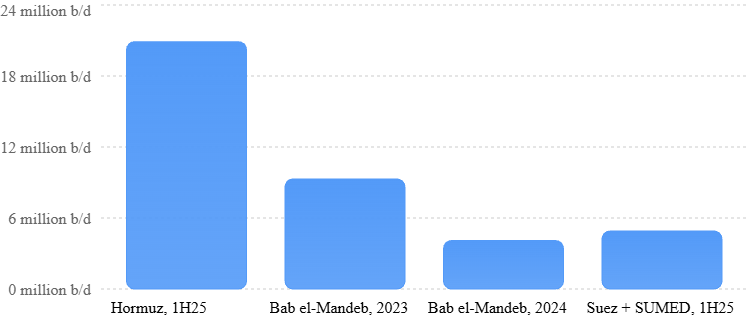
Source: US Energy Information Administration, World Oil Transit Chokepoints, updated March 2026. Historical flow measurements, not forecasts or pipeline capacities.
The reduction in traffic through Bab el-Mandeb illustrates the ability of attacks and heightened maritime risk to redirect oil movements even without a permanent closure of the strait. However, the figures do not directly measure lost oil production: shipments may be rerouted around Africa, deferred, redirected to other markets or replaced by alternative supplies.
Competing Strategic Pathways
Three broad strategic responses can be distinguished. They are not mutually exclusive and should be evaluated as components of an integrated system rather than as competing political slogans.
| Strategic pathway | Diagnostic support | Principal limitations | Decisive indicators | Current assessment |
|---|---|---|---|---|
| A. Reinforce existing export corridors | Existing Saudi and Emirati pipelines; established ports and operator capabilities | Shared infrastructure dependencies, limited spare capacity, persistent maritime exposure | Verified sustained throughput, storage availability, terminal recovery times | Highest near-term implementability |
| B. Develop cross-border alternatives | Official Basra–Aqaba proposal; functioning Turkish Mediterranean pipeline infrastructure; Egyptian Red Sea–Mediterranean connection | Financing, transit sovereignty, commercial commitments, physical security | Binding host-state agreements, financial close, procurement, construction progress | Strong medium-term strategic potential, uncertain delivery |
| C. Establish a diversified Arabian energy-export network | Multiple geographically distinct coastal exits could reduce common-mode failure | High capital commitment, complex governance, long construction lead times and demand uncertainty | Multilateral treaty, independent feasibility studies, long-term shipper commitments | Potentially greatest structural benefit, lowest immediate readiness |
Route dependence must be measured across the complete export chain
Conceptual evaluation of five corridor configurations
Analytical geography, not a representation of commissioned infrastructure
| Configuration | Avoids Hormuz? | Avoids Bab el-Mandeb? |
| Eastern Saudi Arabia → Yanbu → Suez/Mediterranean | Yes | Yes, westbound |
| Eastern Saudi Arabia → Yanbu → Indian Ocean | Yes | No, on the usual southbound route |
| UAE → Fujairah → Indian Ocean | Yes | Yes, for eastbound exports |
| Proposed Saudi → Oman → Arabian Sea | Yes, conditional on alignment | Yes, for eastbound exports |
| Proposed Saudi → Jordan → Mediterranean | Yes | Yes, conditional on a Mediterranean connection |
“Avoids” refers only to the named chokepoints, not immunity from attacks, other sea passages or political disruption. The two Saudi cross-border routes in the final rows are investment concepts evaluated here, not verified approved projects.
A central implication follows: Saudi Arabia’s future export architecture should be designed around destination-specific resilience rather than one universally preferred replacement route. Arabian Sea exits are particularly relevant to Asian buyers; Mediterranean access is particularly relevant to European and Atlantic buyers. Red Sea infrastructure can serve both, but the security characteristics of its northbound and southbound exports are different.
Principal Gaps and Watch Indicators
The most consequential uncertainty concerns operational capacity under sustained disruption. Official capacity figures alone are insufficient to establish whether a corridor could function at its published limit while neighbouring production, pumping stations or terminal facilities were damaged. A credible infrastructure programme should require verified stress-testing, restoration standards, alternate electricity supply and demonstrated independent shipping access.
A second unresolved issue is project bankability. Cross-border pipeline announcements do not establish a binding allocation of tariff revenues, sovereign liabilities, guaranteed throughput or responsibility for repairs after armed attacks. The historical Basra–Aqaba proposal, for example, included an estimated US$7–9 billion investment and a proposed capacity of one million barrels per day, but these figures cannot establish its final cost or implementation readiness in 2026. Jordan’s Energy Ministry was still identifying the project as a strategic bilateral opportunity in September 2025.
A third issue is demand risk. Infrastructure reaching commercial operation after 2030 must remain economically viable under differing assumptions about global oil consumption, fuel substitution, refinery investment and the geography of Asian and European imports. Security benefits may justify capacity that is not continuously utilised, but such reserve capacity requires an explicit funding mechanism rather than optimistic assumptions about permanent full throughput.
A fourth issue concerns strategic concentration. Multiple pipelines converging on the same processing centre, electrical network, tanker-loading area or sovereign transit authority may reproduce vulnerabilities that route diversification was intended to eliminate.
The primary official records requiring continuing examination are updated Saudi Aramco pipeline and terminal disclosures, Jordanian and Iraqi project agreements, Turkish pipeline operating data, Egyptian SUMED capacity and access arrangements, and actual rather than nominal diversion volumes reported by the IEA and EIA.
Preliminary Strategic Priorities for 2027–2031
The analysis identifies a phased investment hierarchy rather than a single megaproject.
First, strengthen the infrastructure already in service. Saudi Arabia should prioritise independently recoverable pumping and storage systems, export-terminal flexibility and the demonstrated ability to maintain alternative flows when one link fails. These measures offer the clearest opportunity for near-term improvements because they do not require constructing an entirely new cross-border network.
Second, examine an Arabian Sea export alternative with Oman. A Saudi–Omani oil corridor merits formal engineering and commercial evaluation because it could give Saudi crude direct access to Indian Ocean shipping without passing through either Hormuz or Bab el-Mandeb. Its feasibility depends on the precise route, Oman’s consent, coastal terminal development, geological constraints and the ability to avoid concentration at another vulnerable loading hub. No approved Saudi–Omani crude pipeline of this design has been established by the official evidence examined here.
Third, reassess the Iraq–Jordan–Egypt axis as a Mediterranean access system. The existing Basra–Aqaba proposal provides a documented starting point, but Aqaba should not automatically be treated as the final strategic destination. A Mediterranean connection would offer a different level of westbound route diversification. Such a development requires a separate technical and diplomatic assessment and cannot be assumed to follow from existing project agreements.
Fourth, undertake a regional feasibility study for a direct northern Arabian export corridor. A Saudi–Jordan–Mediterranean system would potentially provide the strongest physical separation from the two principal maritime vulnerabilities, but its strategic value must be compared against construction costs, political risks and the possible use of existing Egyptian or Turkish infrastructure.
Fifth, finance resilience explicitly. Sovereign institutions, infrastructure investors, exporting companies and major importers should distinguish commercial transport capacity from strategic reserve capacity. Otherwise, economically efficient utilisation may eliminate the very redundancy that new infrastructure is intended to create.
The resulting investment principle is that no single corridor should be considered sufficient. A portfolio of physically and politically distinct routes, supported by storage and emergency oil arrangements, would offer the strongest protection against disruption arising from more than one theatre at the same time.
No decision-useful visualisation beyond the documented flow comparison and route-dependence matrix is supportable from the verified record at this stage. In particular, the official evidence reviewed does not yet establish sufficiently precise engineered alignments for a reliable map of the proposed Saudi–Oman or Saudi–Mediterranean pipelines.
Beyond Hormuz and Bab el-Mandeb
Reengineering the Global Oil Transit System: Saudi Arabia, the Arabian Peninsula, Iraq, the Red Sea and the Mediterranean.
An institutional assessment of existing export capacity, alternative pipeline corridors, maritime chokepoint exposure and the infrastructure required to reduce strategic dependence on vulnerable transit routes.
Two Chokepoints, One Structural Vulnerability
Gulf petroleum security must be evaluated across the complete supply chain. The Strait of Hormuz concentrates access from major Gulf exporters, while Bab el-Mandeb creates a separate exposure for Red Sea shipments bound for the Indian Ocean. An alternative pipeline can avoid one strait without eliminating dependence on the other.
The Current Export System and Its Capacity Limits
Installed capacity, operational throughput and spare capacity are different measures. The figures below are reported specifications or assessed potential diversion capabilities, not guarantees of uninterrupted delivery under wartime conditions.
| Infrastructure | Capacity / status | Strategic function | Principal constraint |
|---|---|---|---|
| Saudi East–West Pipeline | 5 million b/d original design; 7 million b/d enhanced capability reported | Eastern Saudi oil to Yanbu on the Red Sea | Terminal capacity, sustained throughput, pipeline integrity and Red Sea access |
| Habshan–Fujairah Pipeline | 1.5 million b/d original; approximately 1.8 million b/d reported | UAE access to the Gulf of Oman, outside Hormuz | Coastal security, utilisation and terminal availability |
| Egyptian SUMED Pipeline | 2.5 million b/d nominal | Red Sea to Mediterranean crude transfer | Availability of receiving facilities, storage, loading capacity and access |
| Silopi–Ceyhan System | 1.52 million b/d nominal combined capacity | Northern Iraq–Türkiye Mediterranean oil export infrastructure | Supply agreements, transit governance and effective operational availability |
| Basra–Aqaba Proposal | 1 million b/d in the documented project framework | Proposed Iraqi export diversification toward Jordan | Financing, binding agreements, construction and regional security |
Existing Saudi Red Sea Alternative
Established infrastructureThis system bypasses Hormuz, but its onward security depends on the export destination. Mediterranean-bound shipping may avoid Bab el-Mandeb; typical southbound Asian shipments do not.
Existing UAE Indian Ocean Alternative
Established infrastructureThis route bypasses Hormuz and can support eastbound exports without Bab el-Mandeb. It does not eliminate risks at coastal facilities or in surrounding waters.
Four Strategic Directions for Oil Export Diversification
The following configurations represent distinct development pathways. Proposed connections are analytical investment concepts unless explicitly identified as documented projects. They must not be interpreted as operational pipelines or approved construction programmes.
Route A — Saudi Arabia to Oman
Establishing an export outlet on Oman’s Arabian Sea coast could provide Saudi crude with an Indian Ocean pathway bypassing both named chokepoints for eastbound trade.
Required: Feasibility study, host-state agreement, pipeline alignment, marine terminal and commercial commitments.
Route B — Iraq, Jordan and the Mediterranean
The Basra–Aqaba pipeline is a documented proposal. A further Mediterranean connection is a separate development concept requiring its own diplomatic, regulatory and engineering evaluation.
Required: Updated costs, financing, transit guarantees and an approved Mediterranean extension.
Route C — Saudi Arabia, Jordan, Mediterranean
A northern Trans-Arabian export network could provide westbound access without either Hormuz or Bab el-Mandeb, conditional on securing a feasible final Mediterranean connection.
Required: Multilateral agreements, route selection, political-risk allocation and long-term throughput contracts.
Route D — Iraq and Türkiye to Ceyhan
The Turkish Mediterranean pipeline system offers a distinct outlet from Gulf maritime passages for oil that can lawfully and commercially access the network. Broader regional integration would require new connections and agreements.
Required: Export agreements, operating availability, transit coordination and any new connecting infrastructure.
Which Routes Actually Bypass Both Chokepoints?
This matrix evaluates geographic dependence only. It does not assign numerical security scores or claim immunity from strikes, sabotage, political interference or maritime disruption elsewhere.
| Export configuration | Hormuz bypass | Bab el-Mandeb bypass | Remaining strategic dependency |
|---|---|---|---|
| Saudi Petroline → Yanbu → Mediterranean | YES | YES | Northern Red Sea, Suez/SUMED access and export facilities |
| Saudi Petroline → Yanbu → Asian markets | YES | NO | Southbound Red Sea passage and maritime security |
| UAE Habshan → Fujairah → Asia | YES | YES | Gulf of Oman and terminal infrastructure |
| Proposed Saudi Arabia → Oman → Asia | CONDITIONAL | CONDITIONAL | Alignment, Oman agreement and Arabian Sea terminal location |
| Proposed Iraq → Jordan → Mediterranean | CONDITIONAL | CONDITIONAL | Completion of both the land system and Mediterranean connection |
| Proposed Saudi Arabia → Jordan → Mediterranean | CONDITIONAL | CONDITIONAL | Transit diplomacy, construction, sovereign guarantees and endpoint |
Three Models of Energy Security
Reinforce the Existing System
Near-term priorityImprove Petroline reliability, export storage, loading flexibility, pumping resilience and the capacity to restore operations following disruption.
Strength: Existing industrial assets and established operating organisations.
Limitation: Expansion may preserve shared geographic vulnerabilities.
Develop Cross-Border Alternatives
Medium-term developmentAssess the commercial viability of Arabian Sea routes, Mediterranean access and coordinated pipeline extensions among regional states.
Strength: Greater geographic separation between export corridors.
Limitation: Treaty obligations, tariffs, financing, construction and security responsibilities.
Build a Regional Energy Network
Structural transformationIntegrate multiple independently accessible coastal outlets, storage systems and transit agreements into a flexible regional petroleum network.
Strength: Reduces dependence on individual corridors and allows destination-specific rerouting.
Limitation: Capital intensity, complex governance and long-term demand uncertainty.
Investment and Governance Priorities to 2031
Stress-Test Existing Pipeline and Terminal Networks
Establish usable rather than nominal capacity under simultaneous failures. Evaluate emergency power, storage, pump availability, alternative berths, restoration arrangements and export dispatch flexibility.
Commission a Saudi–Oman Corridor Feasibility Study
Evaluate viable alignments and Arabian Sea terminal options with Oman, covering geology, environmental approval, construction costs, host-state agreements, throughput commitments and maritime access.
Reassess the Basra–Aqaba Project
Update the historical business case and examine whether a separate Mediterranean connection would create sufficient incremental resilience to justify its cost and political complexity.
Assess a Northern Arabian Export Corridor
Compare Saudi–Jordan–Mediterranean configurations against existing Red Sea, Egyptian and Turkish alternatives. Require route-specific transit and terminal agreements before estimating bankable capacity.
Finance Strategic Redundancy Explicitly
Separate commercially utilised pipeline throughput from deliberately maintained reserve capacity. Allocate the cost of resilience among producers, transit states, investors and beneficiaries.
What Would Change the Assessment?
| Indicator | Evidence required | Strategic implication |
|---|---|---|
| Saudi diversion capability | Verified sustained Petroline and Yanbu export throughput | Determines how much capacity is truly available during disruption |
| Saudi–Oman cooperation | Official feasibility mandate, route studies and binding agreements | Establishes whether the Arabian Sea concept is becoming an implementable project |
| Basra–Aqaba financing | Updated cost, financing structure, contracts and procurement | Distinguishes political commitment from funded implementation |
| Mediterranean corridor integration | Intergovernmental access agreements, routing approvals and technical plans | Tests the feasibility of a genuinely independent westbound export pathway |
| Global oil demand | Updated IEA demand scenarios, refinery plans and shipper commitments | Determines the commercial viability of long-lived pipeline investments |
| Emergency energy reserves | IEA stock levels, releases and replenishment decisions | Indicates the capacity to absorb temporary disruption without immediate supply replacement |
From Chokepoint Dependence to Network Resilience
The central engineering and geopolitical problem is not simply the location of an alternative pipeline. It is the concentration of energy exports across systems whose security, capacity and commercial availability are not independently assured.
The most credible long-term architecture combines strengthened Saudi Red Sea infrastructure, access to Indian Ocean export terminals, selective Mediterranean connections, geographically distributed storage and binding arrangements with participating transit states.
These measures would not abolish geopolitical exposure. They would distribute it among different routes and jurisdictions, reducing the likelihood that disruption at one chokepoint renders the entire export system unusable.
PILLAR I — STRATEGIC GEOGRAPHY, EXISTING INFRASTRUCTURE AND SYSTEMIC VULNERABILITIES
Chapter 1. The Dual-Chokepoint Problem: Hormuz, Bab el-Mandeb and the Limits of Maritime Security
The Strategic Transformation of Global Petroleum Geography
The central vulnerability of the international petroleum system is no longer adequately described by the possibility that one state might close one maritime strait. It is the simultaneous exposure of production, processing, transportation, maritime insurance, terminal operations and international refining to geographically separate disruptions that can reinforce each other. The war affecting the Gulf and the renewed instability of the southern Red Sea have demonstrated that even a major exporter possessing substantial financial reserves, sophisticated military equipment and established alternative pipelines can suffer serious limitations in its capacity to maintain reliable deliveries. The resulting problem is structural rather than exclusively military: a disruption affecting the Persian Gulf can reduce production and prevent cargoes from reaching global markets, while insecurity around the southern Red Sea can compromise the commercial usefulness of the principal westward alternative. In such circumstances, the conventional distinction between maritime security and energy infrastructure policy becomes increasingly artificial. Both are components of the same strategic problem, and neither can be resolved independently of the other.
The magnitude of the exposure can be established through the official international petroleum statistics. The US Energy Information Administration recorded an average of 20.9 million barrels per day of petroleum and other liquids passing through the Strait of Hormuz during the first half of 2025, against total global petroleum liquids supply of approximately 104.4 million barrels per day and worldwide maritime petroleum trade of 79.8 million barrels per day. Hormuz consequently carried about one-quarter of seaborne oil trade, but its importance to the international economy exceeded the physical proportion of global supply represented by those movements. The region supplies crude grades needed by highly specialised refining systems, ships substantial quantities of petroleum products and condensates, and serves customers whose short-term substitution opportunities are restricted by refinery configurations, contractual arrangements and transport distances. The EIA further determined that approximately 89% of crude oil and condensate passing through Hormuz in the first half of 2025 was destined for Asian markets, with China, India, Japan and South Korea collectively accounting for approximately 74% of those flows. The geographical concentration of consumption means that a Gulf disruption is transmitted directly into the industrial economies of Asia before spreading through global petroleum prices and international trade. World Oil Transit Chokepoints — US Energy Information Administration — March 2026
By October 2026, this exposure had become measurable through a far more severe interruption of regional supply and maritime trade. The EIA’s October Short-Term Energy Outlook reported Hormuz flows of 14.9 million barrels per day in the first quarter of 2026, declining to 4.9 million barrels per day in the second quarter, compared with 21.6 million barrels per day in the final quarter of 2025. These figures represent actual reported maritime flows rather than hypothetical estimates of a blockade. The second-quarter measurement therefore implies a reduction of approximately 77.3% relative to the fourth quarter of 2025, calculated from the EIA series. Because the figures are quarterly averages, they should not be interpreted as the maximum instantaneous loss or as the precise quantity of production permanently removed from global markets. They nevertheless establish the extraordinary scale of the disruption and expose the limitations of a system historically organised around the expectation of continuing access to the Gulf’s principal maritime exit. Short-Term Energy Outlook: Energy Security and Global Chokepoints — US Energy Information Administration — October 2026
Table 1 — Petroleum Flows Across the Principal Maritime Corridors, 2025–2026
All values are million barrels per day and represent measured oil and petroleum liquids movements, not pipeline nameplate capacities.
| Maritime corridor | Q1 2025 | Q2 2025 | Q3 2025 | Q4 2025 | Q1 2026 | Q2 2026 |
|---|---|---|---|---|---|---|
| Strait of Hormuz | 20.9 | 21.0 | 21.3 | 21.6 | 14.9 | 4.9 |
| Strait of Malacca | 22.3 | 23.8 | 23.4 | 24.9 | 21.3 | 16.6 |
| Suez Canal and SUMED | 4.6 | 5.1 | 5.6 | 5.9 | 5.7 | 5.8 |
| Bab el-Mandeb | 3.9 | 4.5 | 4.6 | 5.4 | 5.6 | 8.1 |
| Turkish Straits | 3.8 | 3.7 | 3.7 | 3.7 | 3.3 | 4.1 |
| Cape of Good Hope | 9.0 | 9.3 | 9.0 | 9.9 | 8.2 | 9.4 |
| World oil supply | 105.0 | 107.7 | 108.2 | 103.9 | 96.1 | 99.7 |
Source: Short-Term Energy Outlook — US Energy Information Administration — October 2026. Quarter-specific movements through separate corridors are not additive, because cargoes can pass through more than one passage during the same voyage.
The table requires an interpretation more sophisticated than a simple comparison between total Gulf exports and existing pipeline capacities. Hormuz traffic declined sharply during the first half of 2026, but Bab el-Mandeb traffic increased from 5.6 million barrels per day in the first quarter to 8.1 million barrels per day in the second. This does not demonstrate that the southern Red Sea had become secure. Rather, it illustrates the importance of distinguishing the total traffic using a passage from the specific origin, destination and vulnerability of individual shipments. Maritime flows can shift in response to changes in production, the availability of alternative routes, vessel positioning and the commercial decisions of shipowners. The international market can therefore exhibit rising traffic through a politically dangerous passage at the same time that the perceived risks of crossing that passage are increasing. The implication for government planning is that traffic volumes alone cannot establish energy security; they must be examined together with operating restrictions, insurance conditions, the incidence of attacks and the availability of alternative voyages.
Hormuz as a Concentrated Export System
The Strait of Hormuz connects the Persian Gulf with the Gulf of Oman and the Arabian Sea. According to the International Energy Agency, the passage is approximately 21 nautical miles wide at its narrowest point, with designated navigational channels of approximately two nautical miles in each direction, separated by a traffic buffer. These dimensions do not make a complete physical closure inevitable, but they create a geographically concentrated environment in which interference with commercial navigation can rapidly become an international market event. A relatively small proportion of the total maritime area contains an exceptionally large share of high-value energy traffic, while tankers must operate in proximity to coastal territories, navigation controls and potentially contested military activity. This concentration reduces route flexibility during a crisis, especially where shipowners, insurers and terminal operators adopt different judgments about acceptable exposure. Strait of Hormuz Factsheet — International Energy Agency — February 2026
The strategic significance of Hormuz also differs among producers. Saudi Arabia and the United Arab Emirates possess alternative crude-export pipeline systems, although the capacity available for emergency diversion is limited. Iraq, Kuwait, Qatar and Bahrain remain considerably more dependent on Gulf maritime access for their principal hydrocarbon exports, while Iran’s geographical position creates a different combination of commercial exposure and potential maritime leverage. For Qatar in particular, a strategy designed exclusively around crude oil pipelines would be inadequate because liquefied natural gas requires specialised liquefaction facilities, cryogenic storage, terminals and carriers. An oil export diversification programme therefore cannot be confused with a comprehensive solution to Gulf energy vulnerability. The IEA’s February 2026 assessment estimated only 3.5–5.5 million barrels per day of potentially available alternative crude-export capacity through the principal Saudi Arabian and Emirati systems, while warning that the logistical arrangements required to reroute very large volumes had not been robustly tested at that time. Strait of Hormuz Factsheet — International Energy Agency — February 2026
The difference between the nominal capacity of an infrastructure system and the capacity actually available during a disruption is essential. A pipeline carrying four million barrels per day in normal operation cannot automatically provide seven million barrels per day of additional relief merely because its published maximum is seven million. The emergency contribution is the difference between its usable maximum and the throughput already committed, reduced where necessary by bottlenecks at terminals, storage tanks, pumps and receiving facilities. This means that resilience cannot be calculated by adding every published pipeline capacity in the Arabian Peninsula. A proper calculation must identify the production origins served by each line, the grades it can transport, the volumes already committed to domestic refineries, and whether the relevant export terminals can load sufficient vessels during the assumed crisis.
Bab el-Mandeb and the Strategic Ambiguity of the Red Sea
Bab el-Mandeb creates a separate geographical vulnerability because it connects the southern Red Sea to the Gulf of Aden and the wider Indian Ocean. For petroleum transported from the Saudi west coast toward southern and eastern Asian markets, it is a potentially indispensable passage even after the cargo has bypassed Hormuz through the East–West Pipeline. For shipments departing Yanbu toward the Mediterranean through the Suez Canal or the SUMED pipeline, however, Bab el-Mandeb need not be crossed. This difference is fundamental to any serious analysis of the Saudi transport system. The same infrastructure can offer a strong strategic alternative for one export destination and a significantly weaker alternative for another.
The EIA’s historical series recorded Bab el-Mandeb petroleum flows of 9.3 million barrels per day in 2023, falling to 4.1 million barrels per day in 2024 and averaging 4.2 million barrels per day during the first half of 2025. Traffic through the combined Suez Canal and SUMED system declined from 8.8 million barrels per day in 2023 to 4.8 million in 2024 and 4.9 million during the first half of 2025. These changes reflect the commercial consequences of heightened insecurity in the southern Red Sea and the diversion of some voyages around southern Africa. The EIA also reported that approximately 9.1 million barrels per day of petroleum liquids moved around the Cape of Good Hope during the first half of 2025, compared with 6.2 million barrels per day in 2023. The Cape route provides a real maritime alternative, but the EIA estimates that a diversion from Arabian Sea–Europe transport around southern Africa can add approximately 15 days where the Red Sea and Egyptian corridor are unavailable. World Oil Transit Chokepoints — US Energy Information Administration — March 2026
The consequence is a transformation of shipping economics. A longer voyage increases the time during which a tanker is unavailable for another cargo, increases fuel consumption and operating expenditures, and changes the relationship between tanker supply and tonne-mile demand. At the same time, elevated maritime risks can alter the commercial availability of vessels even without physical damage to a pipeline or oil terminal. Shipowners may refuse particular routes, insurers may reassess coverage, and refiners may choose alternative crude grades rather than accept delivery uncertainty. The effective result can be a reduction in market access without a corresponding physical destruction of export capacity. The International Maritime Organization’s July 2026 statements emphasised that renewed attacks in the Red Sea threatened seafarer safety, commercial shipping and global supply chains, reinforcing the conclusion that the problem has implications extending beyond petroleum producers. Statement on Recent Attacks on Ships in the Red Sea — International Maritime Organization — July 2026
The Geopolitical Significance of Simultaneous Disruption
The political consequences of the dual-chokepoint structure are asymmetrical. Iran occupies a strategic position adjacent to Hormuz, but it also depends on the region’s maritime and commercial infrastructure. Yemen’s armed conflict creates a distinct threat environment around the southern Red Sea, where attacks against commercial shipping can impose costs on parties that are not directly participating in the conflict. These actors do not have identical objectives, command structures or incentives, and their relationship must not be reduced to the assumption of a perfectly coordinated regional blockade. Nevertheless, separate disruptions can interact economically. A ship diverted from one danger area may face another; a producer seeking to export from an alternative coast may encounter new threats; and rising freight rates can reduce effective supply accessibility even when production begins to recover.
The October 2026 IEA Oil Market Report provides particularly important evidence of this interaction. It reported that global oil supply increased by 2.5 million barrels per day in September, reaching 102.3 million barrels per day, as Gulf producers recovered some output, while crude exports from Gulf producers rose by 4.4 million barrels per day to 13.9 million barrels per day. The IEA simultaneously reported that average Hormuz flows reached 10.9 million barrels per day in September, while overall bypass exports increased by approximately 970,000 barrels per day to 5.6 million barrels per day. This recovery did not eliminate the crisis. The agency reported September global oil inventories approximately 509 million barrels below their end-February level, while North Sea Dated crude averaged $116.89 per barrel in September, compared with significantly lower prices before the renewed disruption. The principal lesson is that a temporary recovery in throughput does not immediately restore system resilience when commercial inventories, tanker availability and refined-product markets have already suffered sustained stress. Oil Market Report — International Energy Agency — October 2026
Table 2 — Principal International Oil-Market Effects Recorded in October 2026
| Indicator | Verified value | Reference period | Strategic significance |
|---|---|---|---|
| Global oil supply | 102.3 million b/d | September 2026 | Partial production recovery |
| Monthly supply increase | 2.5 million b/d | September 2026 | Recovery remains exposed to renewed disruption |
| Gulf crude exports | 13.9 million b/d | September 2026 | Significant but incomplete recovery |
| Monthly increase in Gulf crude exports | 4.4 million b/d | September 2026 | Rapid change in available exports |
| Hormuz oil flows | 10.9 million b/d | September 2026 | Passage remained substantially below pre-war levels |
| Overall bypass exports | 5.6 million b/d | September 2026 | Alternative routes were materially employed |
| Monthly increase in bypass exports | 970,000 b/d | September 2026 | Evidence of operational diversion |
| Global inventory change | −509 million barrels | End-February to end-September 2026 | Reduced accumulated supply buffer |
| North Sea Dated average price | $116.89/barrel | September 2026 | Severe pressure on crude purchasers |
| Forecast global oil demand | 102.4 million b/d | 2026 annual average | IEA forecast, not final observed demand |
| Forecast annual demand change | −2.6 million b/d | 2026 versus 2025 | Expected demand destruction and economic adjustment |
Source: Oil Market Report — International Energy Agency — 14 October 2026.
The data demonstrate why simply reproducing the largest possible physical export capacity is not necessarily the optimal strategic policy. The economic problem involves the interaction of petroleum production, refining and final demand. Even when more crude becomes available, refineries may be unable to purchase or process it economically because product demand has weakened, margins have deteriorated or freight costs have increased. Conversely, a shortage of diesel or aviation fuel may persist even as crude oil exports recover. The IEA’s October assessment anticipated a global reduction in oil demand of 2.6 million barrels per day during 2026, followed by a partial recovery of 2 million barrels per day in 2027. New infrastructure must therefore be evaluated against multiple demand trajectories, including a market in which geopolitical threats remain severe while commercial petroleum consumption becomes weaker than investors originally expected.
International Maritime Law and the Limits of Sovereign Control
The international legal framework provides an important distinction between coastal-state jurisdiction and a claimed right to interrupt passage through a strait used for international navigation. Under the law of the sea, the regime of transit passage protects navigation through qualifying international straits, subject to the applicable treaty provisions and customary international law. The legal obligations of particular states require attention to their treaty participation and the relevant rules, but the central institutional position is clear: maritime security concerns do not create an unrestricted entitlement to suspend international navigation. In July 2026, the IMO Council reaffirmed that transit passage in straits used for international navigation must not be threatened, obstructed or suspended, and called for respect for navigational rights and the safety of seafarers. IMO Council Reaffirms Commitment to Protecting Vital Shipping Lanes — International Maritime Organization — July 2026
Legal protections nevertheless cannot ensure physical availability. Commercial shipping can be interrupted by armed attacks, threats, military escalation or market withdrawals even when interference with navigation is unlawful. International courts, diplomatic institutions and maritime regulators can establish obligations, condemn violations and facilitate remedies, but cannot guarantee that tankers will continue sailing through an active conflict environment. Infrastructure diversification therefore complements rather than replaces international law. It reduces the economic leverage created by geographical concentration while preserving the importance of freedom of navigation as an international public good.
Chapter 1 — Key judgments. The dual-chokepoint problem is a measurable systemic vulnerability, not simply an anticipated military scenario. Its consequences depend on the interaction of maritime geography, export infrastructure, destination markets and commercial behaviour. The sharp decline in Hormuz flows during the second quarter of 2026, followed by only partial recovery, demonstrates why nominal transport capacity and naval protection cannot independently guarantee energy security. The most important proposition to test in subsequent chapters is whether alternative infrastructure can preserve commercially deliverable exports when two geographically separate maritime environments remain unstable at the same time.
What would change the assessment: sustained restoration of Hormuz traffic near pre-crisis levels, durable improvements in Red Sea maritime safety, verified emergency throughput from existing pipelines and a demonstrable increase in independently available export capacity would reduce the immediate urgency of new corridors. They would not eliminate the underlying value of geographic diversification.
Chapter 2. Saudi Arabia’s East–West System: Petroline, Yanbu and the Economics of Redundancy
Petroline as an Instrument of Saudi Strategic Sovereignty
Saudi Arabia’s East–West Pipeline represents one of the most consequential examples of a major petroleum exporter investing in geographical independence from its traditional maritime outlet. The system’s significance cannot be captured solely by its length or installed pumping capacity. It changes the relationship between Saudi territory, its principal oil-producing regions and the international maritime economy by allowing crude produced in the eastern part of the kingdom to move across the Arabian Peninsula toward the Red Sea. The resulting capability reduces dependence on the Strait of Hormuz and provides Saudi Aramco with an alternative direction for export operations, but it does not eliminate the consequences of conflict. The strategic value of the system depends on the simultaneous availability of upstream processing facilities, cross-country pipeline infrastructure, western storage installations, coastal industrial facilities, tanker berths and onward shipping routes. The East–West system is therefore best understood as a national energy-security network rather than an isolated transportation asset.
Saudi Aramco’s first-quarter 2026 results offer unusually significant evidence of the system’s operational potential. The company announced that the East–West Pipeline had reached its maximum capacity of 7.0 million barrels per day during the quarter, supporting crude exports through the kingdom’s western coast. Aramco’s associated investor presentation described an approximately 1,200-kilometre pipeline network and indicated that the seven-million-barrel capacity included approximately two million barrels per day serving refineries. It also identified the importance of the Red Sea terminal, Egyptian transport connections and contingency arrangements for maintaining deliveries during maritime disruption. These are first-party corporate statements about achieved operational performance and infrastructure capability, not independent guarantees that every component would remain available throughout a future conflict. Nevertheless, they establish that the East–West system has progressed beyond an emergency route existing only on engineering drawings: its capacity has been employed at scale under crisis conditions. Aramco First Quarter 2026 Interim Report — Saudi Aramco — 2026; Saudi Aramco Q1 2026 Results Presentation — Saudi Aramco — 2026
The distinction between total pipeline capacity and exportable crude volumes becomes particularly important in this case. If a corridor has seven million barrels per day of physical capacity while approximately two million barrels per day are allocated to downstream refining, the entire seven-million figure cannot be interpreted as the amount of crude available for direct seaborne export. Under a simplified operating arrangement with two million barrels per day committed to domestic refining, the theoretical balance would be five million barrels per day before considering further processing, storage and terminal constraints. This is not a verified maximum for exports, because actual refinery intake and operational allocation vary. It demonstrates instead why government assessments must separate pipeline throughput from crude directly loaded onto tankers. A system can be operating near its maximum physical capacity while possessing considerably less additional capacity to accommodate sudden diversions from eastern export ports.
The commercial relevance of Petroline also extends beyond emergency transport. Moving crude toward western refining and export installations creates options for allocating production between domestic consumption, international crude customers and refined-product markets. It enables Aramco to adjust supply chains according to regional operating conditions, refinery demand and customer geography. However, such flexibility entails trade-offs. Oil transported through the cross-country system requires pumping energy, asset maintenance, storage capacity and operational coordination. It also imposes an opportunity cost when emergency reserve capacity is deliberately preserved rather than continuously employed for commercial throughput. The economic value of strategic redundancy is consequently not identical to the revenue generated by transporting oil under normal market conditions. Its most important benefit appears during exceptional events, when the existence of an alternative route can prevent the loss of export revenue, preserve customer relationships and reduce broader macroeconomic disruption.
Yanbu, Western Industrial Capacity and the Mediterranean Connection
Yanbu provides Saudi Arabia with something more valuable than an alternative port: it offers access to a different maritime basin and, for westbound cargoes, to a transportation architecture capable of avoiding both Hormuz and Bab el-Mandeb. Crude delivered to the Saudi Red Sea coast can be shipped northward toward Egypt and transferred through the Suez Canal or the SUMED system into the Mediterranean. This combination makes the western Saudi export network strategically relevant to European and Atlantic energy security. Yet the extent of its independence must be assessed across the entire transportation sequence. Pipeline availability does not establish that sufficient tanker-loading capacity exists at every moment; a Red Sea terminal does not guarantee access to Egyptian transit infrastructure; and a cargo transferred into the Mediterranean must still be transported to a refinery able and willing to process the relevant crude grade.
The Egyptian SUMED pipeline, connecting Ain Sukhna on the Gulf of Suez with Sidi Kerir on the Mediterranean coast, has a reported nominal capacity of approximately 2.5 million barrels per day. It provides an alternative to moving certain crude cargoes through the Suez Canal itself, particularly where vessel characteristics or transport economics favour a pipeline transfer. From the perspective of Saudi Arabia, the significance of SUMED lies in its ability to connect Red Sea exports to the Mediterranean without requiring vessels to proceed southward through Bab el-Mandeb. Saudi Aramco’s first-quarter 2026 corporate presentation also identified a 15% equity interest in SUMED, confirming that the company’s international infrastructure position includes a direct financial relationship with a transit asset supporting this geographical option. This ownership interest should not be confused with a guarantee of exclusive capacity, preferential access or immunity from operational restrictions; those commercial rights depend on the relevant agreements. World Oil Transit Chokepoints — US Energy Information Administration — March 2026; Saudi Aramco Q1 2026 Results Presentation — Saudi Aramco — 2026
From an investment perspective, this route demonstrates the potential benefits of combining pipeline systems across national borders without constructing a continuous new line from the oilfield to the final consuming market. Saudi Arabia can use its own territorial infrastructure to reach Yanbu, then rely on maritime transport and Egyptian infrastructure to connect with Europe. The resulting system is potentially less capital-intensive than an entirely new Saudi-to-Mediterranean cross-country corridor, particularly when existing terminals and pipeline facilities possess genuinely available capacity. Its disadvantages are associated with the number of interfaces between independently managed systems. Every transfer introduces scheduling, storage, documentation, quality-control and commercial obligations. A pipeline may deliver crude faster than the receiving maritime system can load it; vessels may arrive before terminal storage is available; and congestion can develop even when all major facilities remain technically operational. The correct engineering question is therefore not whether Saudi Arabia possesses a Red Sea outlet, but how many barrels per day can be delivered reliably to a specific Mediterranean customer under a defined disruption scenario.
Table 3 — Petroline and the Western Saudi Export Chain: Functional Capacity Assessment
| Infrastructure component | Established evidence | Operational role | Limitation requiring assessment |
|---|---|---|---|
| Eastern Saudi production and processing | Existing major upstream system | Supplies exportable crude | Processing availability and grade-specific flows |
| East–West Pipeline | Maximum 7.0 million b/d reached in Q1 2026 | Cross-peninsula transport | Allocation between refineries and export terminals |
| Pipeline route | Approximately 1,200 km, Aramco corporate description | Long-distance crude transfer | Pumping, power, integrity and restoration requirements |
| Western refinery allocation | Approximately 2 million b/d included in the stated 7 million b/d system capacity | Domestic downstream supply | Actual intake and grade allocation vary |
| Yanbu export infrastructure | Established western coastal export facilities | Maritime crude loading | Storage, berths, scheduling and terminal continuity |
| Saudi–Egyptian connection | Existing maritime and pipeline arrangements | Mediterranean-bound supply chain | Interoperability and Egyptian receiving capacity |
| SUMED | 2.5 million b/d nominal | Red Sea–Mediterranean crude movement | Available capacity, storage and terminal access |
| Aramco’s SUMED participation | 15% equity interest disclosed by Aramco | Strategic infrastructure relationship | Contractual rights cannot be inferred from ownership alone |
Sources: Saudi Aramco Q1 2026 Results Presentation — Saudi Aramco — 2026; World Oil Transit Chokepoints — US Energy Information Administration — March 2026.
The September 2026 Disruption and the Economics of a Single Strategic Trunk
The September 2026 disruption of the East–West Pipeline is particularly consequential because it demonstrates the difference between bypassing a maritime chokepoint and obtaining an infrastructure system capable of remaining operational under a broader regional conflict. In its October Oil Market Report, the IEA identified the 11 September bombing of the Saudi East–West Pipeline as one of the factors aggravating global petroleum market conditions, alongside exceptional freight costs and wider supply uncertainty. The same report recorded a subsequent recovery in bypass exports, illustrating that restoration was possible but that even a strategically important alternative corridor could become a source of market instability when attacked. The evidence does not establish that the pipeline is permanently unreliable. It does establish that concentrating large diversion volumes in one principal trunk line can create a new high-value dependency. Oil Market Report — International Energy Agency — October 2026
The strategic problem is magnified when infrastructure serves multiple functions simultaneously. A crude pipeline supporting international exports and domestic refining cannot necessarily prioritise both at maximum levels following a disruption. If transport capacity is reduced, the operator may need to decide how to allocate constrained flows among refining requirements, existing international contracts, strategic export customers and storage facilities. Such decisions have consequences beyond short-term revenue. Domestic refineries support the availability of transport fuels and industrial feedstocks, while crude exports generate foreign-currency earnings and maintain long-standing commercial relationships. An emergency operational plan must therefore address the allocation of scarce capacity, rather than merely stipulate that maximum throughput should be restored as quickly as possible.
This introduces the concept of common-mode failure, which is particularly relevant to large energy networks. Two nominally separate pipelines can share electrical supply, processing facilities, terminal access or other infrastructure whose disruption affects both routes. Similarly, expanded storage at Yanbu cannot compensate indefinitely for the loss of crude inflow, and additional pumping equipment cannot solve a restriction imposed by the receiving port. Redundancy should therefore be defined according to the independence of the components that maintain delivered exports. A second line sharing every critical supporting dependency with the first may improve maintenance flexibility but provide substantially less wartime resilience than a genuinely separate corridor with independent terminal access.
Measuring the Economic Value of Redundancy
Infrastructure investment decisions ordinarily compare expected capital costs, operating expenses, throughput revenues and future utilisation. Strategic energy projects require an additional dimension: the expected economic losses avoided because an emergency route remains available during a severe disruption. These avoided losses may include export revenues otherwise foregone, domestic shortages, increased procurement costs, refinery interruptions, contractual penalties and financial-market effects. However, it would be inappropriate to equate every transported barrel with a permanent addition to national revenue. Some oil that cannot leave one terminal may be exported later; some can be placed into storage; and some may be diverted through another route at higher cost. The economically relevant benefit is the difference between outcomes with and without the proposed investment under the same conditions, including delayed deliveries, alternative uses and the opportunity cost of investment capital.
An illustrative framework can be constructed without inventing a probability of war or a project-specific financial return. The gross sales value associated with one million barrels per day is determined by the crude price and the number of days during which deliveries are maintained. At a hypothetical price of $80 per barrel, one million barrels per day corresponds to $80 million of gross daily sales value. At $120 per barrel, the same physical flow corresponds to $120 million. These are arithmetic illustrations, not forecasts, and they exclude production costs, tariffs, transportation expenses, taxes, discounts, financing and the possibility that the cargo could be sold at another time. Their significance is to show why infrastructure with modest normal-time utilisation could nevertheless have substantial economic value during prolonged interruption.
Table 4 — Illustrative Gross Sales Value Preserved by Maintaining Export Throughput
The values below are calculated from assumed prices and sustained daily throughput. They represent gross sales values, not net profits, fiscal revenues or measured historical losses.
| Sustained export flow | At $80/barrel, per day | At $120/barrel, per day | At $80/barrel, 30 days | At $120/barrel, 30 days |
|---|---|---|---|---|
| 250,000 b/d | $20 million | $30 million | $600 million | $900 million |
| 500,000 b/d | $40 million | $60 million | $1.2 billion | $1.8 billion |
| 1 million b/d | $80 million | $120 million | $2.4 billion | $3.6 billion |
| 2 million b/d | $160 million | $240 million | $4.8 billion | $7.2 billion |
| 3 million b/d | $240 million | $360 million | $7.2 billion | $10.8 billion |
Calculation: daily throughput × assumed crude price × number of days. The prices are analytical assumptions, not market observations or IEA projections.
The investment decision cannot be derived from these figures alone. A pipeline capable of moving one million barrels per day is not automatically worth the gross sales value of that flow over a particular number of disruption days, because oil may have alternative delivery opportunities and the event itself may be relatively infrequent. A complete appraisal would estimate normal commercial utilisation, emergency utilisation, tariffs, construction expenditure, operating cost, financing cost, demand risk and the likelihood of different interruption durations. It would also distinguish the private value accruing to the pipeline operator from the broader economic value accruing to the state through stable exports, domestic fuel availability and reduced exposure to price volatility. The difference is important because a strategically useful pipeline may not be independently profitable under ordinary commercial arrangements, requiring explicit government payments for reserve capacity.
A further difficulty is the anticipated duration of the asset. Pipelines and marine terminals are long-lived infrastructure, while oil demand over their operating lives is uncertain. The IEA’s October 2026 assessment forecast global petroleum demand of approximately 102.4 million barrels per day during 2026, followed by a partial recovery in 2027, but it did not provide a basis for treating a single future demand trajectory as certain through the operating lifetime of a new pipeline. Strategic investment must therefore be tested against both prolonged high oil demand and weaker demand resulting from technological substitution, economic adjustment, energy policy or persistent high prices. A facility justified only by the assumption of perpetual full-capacity use would be financially vulnerable. Conversely, a facility designed explicitly as strategic reserve infrastructure could retain considerable security value even at relatively modest normal utilisation, provided that reserve service is transparently funded. Oil Market Report — International Energy Agency — October 2026
Petroline’s Strategic Investment Implications
The most defensible near-term strategy is not necessarily to reproduce the existing Saudi corridor through a parallel megaproject. It is to establish where the current system’s actual constraints lie, including whether additional storage, terminal arrangements, operating flexibility, physical separation of critical support systems or enhanced restoration capacity would preserve more deliverable barrels at lower cost than extending pipeline length. This requires an engineering assessment of the complete route and its service obligations rather than a procurement programme defined primarily by the ambition to increase published nameplate capacity. The economic priority should be measured in terms of assured export delivery under specified disruptions, with an explicit distinction between capacity available immediately, capacity recoverable after repair, and capacity requiring substantial new construction.
Chapter 2 — Key judgments. Petroline is an operationally demonstrated strategic asset whose maximum reported throughput reached seven million barrels per day during the first quarter of 2026. Its critical limitation is not the absence of a western export route, but the concentration of substantial national transport volumes within a system exposed to infrastructure failure and downstream capacity constraints. The September 2026 disruption reinforces the case for independent redundancy, while the Yanbu–Egypt connection demonstrates that existing infrastructure already supports a westbound route capable of avoiding both principal Gulf and southern Red Sea chokepoints.
What would change the assessment: independently audited operating data establishing sustained emergency export capacity, precise refinery allocation, available terminal capacity, inventory coverage and restoration performance could materially change the relative attractiveness of further Petroline expansion compared with new geographically separate pipelines. These operational details are essential to investment prioritisation and should not be inferred from nameplate capacity.
Chapter 3. The Gulf of Oman Alternative: Fujairah, Duqm, Sohar and the Southern Arabian Peninsula
The Arabian Sea as an Alternative Energy-Export Frontier
The geography of the Arabian Peninsula creates a distinction that has become central to international energy security: petroleum exported from the eastern Gulf coast must ordinarily pass through Hormuz to reach the Indian Ocean, whereas petroleum reaching suitably located terminals on the external coast of the Arabian Peninsula can enter international shipping routes without crossing the strait. The distinction transforms the strategic role of the United Arab Emirates and Oman. Fujairah provides an existing demonstration of the commercial value of a pipeline terminating outside Hormuz, while Oman’s industrial and maritime infrastructure offers a potential geographical foundation for broader export diversification. Yet these locations are not interchangeable. Fujairah, Sohar and Duqm differ in their relationships to the Gulf of Oman, the Arabian Sea, existing petroleum installations, industrial customers and international shipping. Their suitability for future development must therefore be assessed according to the economic and security performance of specific export configurations rather than the general attractiveness of possessing additional coastal territory.
The UAE’s Habshan–Fujairah system provides the strongest operational precedent for this approach. The International Energy Agency identifies the Abu Dhabi Crude Oil Pipeline as a connection of approximately 400 kilometres between the Habshan production and pumping area and Fujairah, with original nameplate capacity of 1.5 million barrels per day and subsequently reported capacity approaching 1.8 million barrels per day. Its February 2026 assessment recorded approximately 1.1 million barrels per day of domestic crude exports through the route, indicating potential additional diversion capacity of up to 700,000 barrels per day, subject to operational conditions. Those figures illuminate both the strategic benefit and the limitation of the infrastructure. A pipeline terminating outside Hormuz allows crude to be loaded without passing through the strait, but its capacity remains finite, and its availability cannot be expanded merely by redirecting ships toward the receiving port. Strait of Hormuz Factsheet — International Energy Agency — February 2026
The more important conclusion is that Fujairah represents a different model of petroleum export security from the Saudi East–West system. A shipment loaded at Fujairah can proceed eastward toward India and the broader Asian market without entering either Hormuz or Bab el-Mandeb. This gives the UAE a geographically distinct option for serving Asian customers. The same route does not necessarily offer an equivalent advantage for Mediterranean-bound trade, because westbound voyages may still require access through the Gulf of Aden and the southern Red Sea or a longer diversion around southern Africa. Export security is therefore not an absolute characteristic of a port. It depends on the relationship between the port’s location and the destination market. This is particularly relevant for Saudi Arabia because any future southern alternative should be designed according to the expected distribution of customers rather than simply the shortest available connection to a coastline.
Fujairah: Established Infrastructure and the Problem of Coastal Concentration
Fujairah’s strategic advantage derives from its location on the Gulf of Oman, outside the maritime restriction imposed by Hormuz. Its pipeline connection to Abu Dhabi’s onshore oil network makes it an established crude export terminal rather than a hypothetical alternative. An ADNOC financing memorandum published in 2026 describes a 404-kilometre, 48-inch pipeline, commissioned in July 2012, connecting Habshan with Fujairah. The same corporate record describes the Fujairah export facilities as including a tank farm connected to three single-point moorings, providing important details about the relationship between pipeline transport and tanker loading. The memorandum lists pipeline capacity at approximately 1.5 million barrels per day, while the IEA reports a higher subsequent operating-capability figure approaching 1.8 million. These should be interpreted as differently framed reported capacities, not silently reconciled into a single independently verified sustained maximum. ADNOC Sukuk Programme 2026 Base Offering Memorandum — ADNOC — 2026; Strait of Hormuz Factsheet — International Energy Agency — February 2026
The existence of a pipeline and several marine loading connections does not establish unlimited terminal flexibility. The number of moorings, crude storage capacity, vessel scheduling, pipeline pumping capability and operating conditions determine the amount of oil that can actually be exported over a given period. Moreover, the concentration of storage and export operations around a coastal area creates a different security problem from that associated with the maritime chokepoint itself. A terminal outside Hormuz may remain exposed to regional escalation, interruption of coastal traffic, damage to support infrastructure or temporary commercial restrictions imposed by insurers and shipowners. From an engineering perspective, the consequence is that redundancy must be evaluated inside the export terminal as well as between alternative geographical locations. Multiple loading positions provide useful operational flexibility, but their independence depends on whether they share the same storage, power, control and product-transfer systems.
An additional dimension is the potential role of strategic inventories. ADNOC’s February 2019 announcement of an underground crude-storage project in Fujairah established the ambition to construct 42 million barrels of storage capacity, organised in three caverns of 14 million barrels each, under an engineering, procurement and construction contract valued at approximately AED 4.4 billion, or US$1.21 billion at the conversion cited by the company. This announcement is a relevant historical example of an investment strategy combining export geography with protected inventory capacity. It does not, by itself, prove that the entire originally announced storage volume was completed, commissioned and operationally available by October 2026. The distinction matters because storage plans and actual usable inventory must not be treated as equivalent. Underground Oil Storage Project Agreement — ADNOC — February 2019
Table 5 — Fujairah’s Documented Infrastructure and Its Strategic Interpretation
| Component | Documented specification | Evidence period | Strategic function | Qualification |
|---|---|---|---|---|
| Habshan–Fujairah pipeline | 404 km, ADNOC filing | 2026 corporate record | Connects Abu Dhabi’s onshore system with external coast | Alignment does not confer complete security |
| Pipeline diameter | 48 inches | 2026 corporate record | Major crude transmission system | Diameter alone cannot establish delivered capacity |
| Original pipeline capacity | Approximately 1.5 million b/d | Original specification | Baseline transport capability | Distinct from reported enhanced capability |
| Reported current capacity | Close to 1.8 million b/d | IEA February 2026 | Higher estimated operating capability | Operational availability must be verified |
| Reported exports | Approximately 1.1 million b/d | IEA February 2026 | Existing commercial utilisation | Not necessarily constant through a crisis |
| Potential additional diversion | Up to 700,000 b/d | IEA February 2026 | Emergency bypass opportunity | Conditional estimate, not guaranteed exports |
| Fujairah loading infrastructure | Three single-point moorings | ADNOC 2026 memorandum | Tanker-loading access | Shared dependencies require further assessment |
| Underground storage programme | 42 million barrels announced | ADNOC 2019 announcement | Planned strategic inventory capability | Completion and usable capacity not established by announcement |
| Storage EPC contract | AED 4.4 billion | 2019 announcement | Historical investment commitment | Not a 2026 replacement-cost estimate |
Sources: ADNOC Sukuk Programme 2026 Base Offering Memorandum — ADNOC — 2026; Strait of Hormuz Factsheet — International Energy Agency — February 2026; ADNOC Underground Storage Project Announcement — February 2019.
Fujairah therefore offers two transferable lessons for regional infrastructure planning. The first is that an export pipeline terminating outside the principal maritime chokepoint creates a genuine physical option that would otherwise not exist. The second is that an external coastal terminal must itself be developed as a resilient industrial system, with sufficient inventories, alternative loading arrangements and independent support infrastructure to preserve operations during exceptional conditions. A proposed Saudi connection to Oman would need to satisfy both requirements. Merely laying a pipeline to the Arabian Sea would not reproduce Fujairah’s commercial capabilities unless equivalent terminal, storage and maritime infrastructure were developed.
Oman and the Distinction Between a Refining Hub and a Crude Export Corridor
Oman’s principal strategic attraction lies in the possibility of creating additional energy export outlets outside Hormuz, supported by its existing maritime and industrial infrastructure. However, the country cannot be treated as an empty geographical surface awaiting pipeline construction. Duqm, Sohar and the established oil and industrial systems serving Omani markets already have their own commercial purposes, infrastructure commitments and sovereign development priorities. Any future pipeline carrying Saudi crude across Omani territory would have to coexist with these interests and provide Oman with economic returns sufficient to justify the responsibilities associated with transit, marine operations and infrastructure protection. The host country would not simply be providing land. It would be participating in a long-term industrial partnership whose significance could extend to refining, storage, logistics, taxation, industrial employment and relations with other Gulf states.
Duqm is especially relevant because it combines an Arabian Sea location with existing liquid-bulk infrastructure and a major refinery. The Port of Duqm’s official terminal description records that the first phase of its liquid-bulk terminal was handed over by the end of 2019, adding approximately 70 hectares of reclaimed land and seven berths intended for liquid-bulk operations. The port also reports a commercial quay approximately 2.2 kilometres long, with a guaranteed 18-metre draft alongside and a deeper approach channel. These figures demonstrate the scale of Duqm’s industrial maritime development, although they cannot be interpreted as proof that every berth is suitable for crude carriers of every size or that the port possesses unlimited additional crude-loading capacity. Actual vessel compatibility depends on berth design, underwater clearance, loading systems, marine operating rules and the specific cargo facilities. Port of Duqm Terminals — Port of Duqm Company — Official Operator Information
The industrial significance of Duqm is reinforced by the OQ8 refinery, a joint venture between Oman’s OQ and Kuwait Petroleum International. OQ8 identifies its original refinery design capacity as 230,000 barrels per day and its ownership structure as 50% OQ and 50% Kuwait Petroleum International. In February 2025, the operator reported increasing refining capability to approximately 255,000 barrels per day, equivalent to roughly 110% of original nameplate capacity. These figures refer to crude processed by an existing refinery and must not be counted as crude export pipeline capacity. Their significance lies in demonstrating that Duqm already possesses a functioning industrial petroleum ecosystem capable of receiving feedstock, processing crude and marketing products. OQ8 Company Profile — OQ8 — Official Operator Information; OQ8 Refining Capacity Announcement — OQ8 — February 2025
The refinery’s associated storage infrastructure provides additional evidence of Duqm’s commercial development. OQ8’s published operational materials describe the Ras Markaz crude storage facilities as comprising eight tanks with approximately 4.5 million barrels of storage capacity, alongside the refinery’s original 230,000-barrel-per-day processing configuration. This storage capacity serves an established industrial chain and is not automatically available for third-party strategic reserves or future Saudi exports. Its importance is that the basic engineering and operational disciplines associated with crude reception, inventory management and marine logistics already exist within the wider development area. OQ8 Operational Partners and Infrastructure — OQ8 — Official Operator Information
A future Saudi–Oman corridor could theoretically take advantage of such an industrial environment, but the appropriate configuration would depend on whether Saudi crude was intended for refinery processing, direct export, strategic storage or some combination of these functions. Each requires different commercial agreements and infrastructure. Supplying an existing refinery would create a feedstock relationship rather than an independent export route of large national significance. A crude export corridor capable of handling several million barrels per day would require a separate assessment of tank farms, pipeline reception, metering, berth availability, vessel sizes and loading rates. Existing refinery capacity should not be used as a proxy for the feasibility of that much larger system.
Table 6 — Oman’s Industrial Energy Infrastructure Relevant to Future Corridor Development
| Location / asset | Verified evidence | Existing function | Potential relevance to Saudi diversification | Essential limitation |
|---|---|---|---|---|
| Duqm commercial port | 2.2 km commercial quay; 18 m guaranteed alongside draft | Multipurpose maritime operations | Established industrial port environment | Not equivalent to approved crude-export megaterminal capacity |
| Duqm liquid-bulk development | 70 hectares and seven berths in first-phase description | Liquid-bulk infrastructure | Potential industrial support for expanded petroleum logistics | Current berth-specific capacity requires verification |
| OQ8 refinery | Original 230,000 b/d capacity | Petroleum refining | Established crude-processing ecosystem | Refining throughput is not export-pipeline capacity |
| OQ8 enhanced performance | 255,000 b/d reported in 2025 | Enhanced refinery operations | Demonstrates operator-reported performance | Not a permanent guarantee of capacity |
| Ras Markaz storage | Approximately 4.5 million barrels, eight tanks | Crude inventory serving the industrial chain | Experience with crude storage and feedstock management | Existing storage has commercial commitments |
| Sohar | Existing port-industrial complex | Industrial, petroleum and logistics activity | Possible complementary logistics and processing role | No verified dedicated Saudi crude-export corridor |
| Potential Saudi–Oman pipeline | No approved configuration established in the examined record | Proposed future infrastructure | Could create an additional Arabian Sea export direction | Requires complete engineering and treaty framework |
Sources: Port of Duqm Terminals — Port of Duqm Company; OQ8 Company Profile; OQ8 Operational Partners and Infrastructure; OQ8 Refining Capacity Announcement — February 2025.
Sohar and the Limits of Treating Oman’s Ports as Interchangeable
Sohar occupies a distinct position within Oman’s industrial geography. It is located on the country’s northern coast, within the Gulf of Oman maritime environment, and forms part of an established industrial and logistics system. Its economic advantages include proximity to major Gulf commercial centres and the possibility of integration with industrial supply chains serving domestic and international markets. For a future regional petroleum corridor, however, the location of Sohar creates a different strategic assessment from that of Duqm. Although it is outside the Strait of Hormuz, its proximity to the wider Gulf of Oman security environment means that a proposed export configuration would need to be examined for exposure to regional maritime instability and the concentration of activity in northern coastal waters. These considerations do not establish that Sohar is unsuitable for petroleum investment. They establish that it should not be regarded as strategically identical to a terminal farther along Oman’s Arabian Sea coast.
A Saudi export strategy might find a northern Omani industrial connection commercially attractive because of geographical and infrastructure considerations, but the shorter or less expensive route would not necessarily provide the strongest strategic independence. The decision would require comparative analysis of inland pipeline distances, elevation changes, terminal development costs, prospective cargo volumes, vessel movements, environmental requirements and exposure to geographically correlated disruption. Sohar could prove advantageous for particular petrochemical or refined-product operations while a different coastal location offers greater independence for large-scale crude exports. The appropriate conclusion cannot be determined from port location alone, and the absence of a verified Saudi–Sohar export pipeline specification prevents a defensible numerical capacity or cost comparison at this stage.
The Southern Arabian Peninsula and the Problem of Transit Sovereignty
A wider southern Arabian Peninsula strategy must also distinguish technically feasible transport geography from politically feasible infrastructure. A route through Saudi Arabia and Oman would cross sovereign territory under an agreement with an established state. Other conceptual alignments involving different southern territories would introduce distinct questions of political authority, territorial control, armed conflict and enforceable transit rights. It would be analytically unsound to propose infrastructure through a conflict-affected area merely because it appears shorter on a geographical map. Pipelines require stable operating rights, legal access for maintenance, insurance arrangements, emergency repair procedures and enforceable obligations covering decades rather than individual political negotiations. An alignment that reduces construction distance but multiplies unresolved sovereignty and security obligations may be considerably more expensive in risk-adjusted terms.
The commercial terms of a Saudi–Oman corridor would also be more complex than a conventional domestic pipeline investment. Oman would need to determine the value of granting long-term passage, the environmental and industrial consequences of additional crude infrastructure, and the implications of hosting a strategic asset serving another state’s exports. Saudi Arabia would have to decide whether it preferred sovereign ownership, a joint venture, shipper-based financing or a regulated transit model. Potential Asian customers might participate through long-term throughput agreements, but such arrangements would expose them to changes in oil demand, crude sourcing and political conditions. Consequently, the principal obstacle to corridor development may be less the physical ability to lay pipe than the construction of institutions capable of maintaining predictable commercial rights across changes in government, market conditions and regional security.
The strongest preliminary strategic proposition is that an Arabian Sea corridor could supply Saudi Arabia with an export direction materially different from its existing eastern and western outlets. Its value would be greatest if it terminated at a coastal facility whose export operations were genuinely independent of the infrastructure needed for Gulf and Red Sea shipments. Yet that same independence would increase the infrastructure that must be constructed and maintained. A project that shares extensive existing facilities might be cheaper but offer weaker redundancy; a completely separate system could provide stronger resilience but require greater capital and long-term commercial commitments. The trade-off must be made explicit before a preferred alignment is chosen.
Chapter 3 — Key judgments. Fujairah demonstrates the operational value of crude export infrastructure terminating outside Hormuz, while the evidence from Duqm shows that Oman possesses significant existing petroleum processing, storage and marine infrastructure that could support further industrial development. These assets do not establish that a Saudi–Omani crude export pipeline is approved, financed or technically ready. A credible feasibility programme must distinguish the suitability of Fujairah, Sohar and Duqm according to their location, independent export capacity, existing commercial commitments and exposure to regional disruption. The strongest strategic case for an Arabian Sea outlet is not the addition of another port, but the creation of a transport system whose critical dependencies are physically separate from Saudi Arabia’s existing Gulf and Red Sea export chains.
What would change the assessment: a formal Saudi–Omani intergovernmental mandate, verified route surveys, port-specific crude terminal engineering, binding commercial commitments and a jointly approved environmental framework would elevate a southern corridor from strategic concept to an implementable project. Until those records exist, precise capacity, construction cost and delivery dates remain unresolved rather than implied by existing Omani port development.
Chapter 4. Maritime Exposure, Infrastructure Protection and the Limits of Military Deterrence
Why Energy Infrastructure Cannot Be Protected by Air Defence Alone
The security of the Gulf’s petroleum export system cannot be measured exclusively by the number of naval vessels, combat aircraft, missile interceptors or air-defence batteries available to participating states. Energy infrastructure is a geographically distributed industrial network that depends on production installations, pipelines, pumping stations, electrical systems, storage facilities, refineries, terminals, maritime transport and commercial communications. Protecting one installation does not automatically preserve the functioning of the larger system if another essential component becomes unavailable. This is the structural difficulty confronting Saudi Arabia and other regional producers: their defence establishments must protect geographically dispersed facilities against different categories of threats, while the civilian operators of those facilities must preserve production quality, industrial safety, contractual deliveries and the capacity to restore operations after disruption. Military protection and infrastructure resilience are therefore related but fundamentally different activities. The former seeks to prevent or limit hostile interference; the latter seeks to preserve or recover essential economic functions when prevention is incomplete.
The events of 2026 show why this distinction has become consequential. The International Maritime Organization reported in August that at least 70 attacks on international shipping had been verified since the beginning of the conflict on 28 February 2026, resulting in 19 seafarer deaths. The organisation also warned that large numbers of ships and their crews remained unable to leave the Persian Gulf safely, reporting that up to 400 ships carrying approximately 6,000 seafarers had been affected by the continuing maritime crisis. These figures describe a serious operational and humanitarian disruption, not merely a theoretical possibility of future confrontation. They demonstrate that the consequences of maritime insecurity are distributed across shipowners, crews, cargo purchasers, insurers, terminal operators and governments. Even when an individual energy installation remains physically undamaged, uncertainty about safe navigation can prevent petroleum from reaching its intended destination. Six Months of Uncertainty for Seafarers in the Strait of Hormuz — International Maritime Organization — August 2026
The problem is aggravated by the diversity of potential threats. A major oil export terminal may be exposed to aerial attack, maritime interference, temporary loss of power, disruption of communications, accidental industrial failure and deliberate interference with operational technology. These categories do not have identical causes or consequences, and they cannot be addressed through a uniform security instrument. A maritime escort may reduce certain risks faced by tankers at sea, but it cannot guarantee that a receiving refinery will remain available or that the pipeline supplying the export port will continue operating. An air-defence system may intercept some incoming threats, but it does not independently provide alternative electrical supply, restore damaged industrial equipment or ensure contractual continuity. The operational requirement is therefore to combine credible protection with resilience measures capable of limiting the consequences of a successful attack or other infrastructure failure.
The Distinction Between Tactical Interception and Strategic Resilience
Modern air and missile defence operates under physical, technological and organisational constraints. Different threats can present different detection, tracking and interception challenges, and the effectiveness of a system depends on the specific engagement circumstances rather than its advertised maximum performance. For a state protecting multiple oilfields, airports, industrial complexes, pipelines, ports and military installations, the geographical distribution of important facilities creates an allocation problem. Even where defensive equipment is sophisticated, governments must decide which assets require permanent protection, which can rely on partial protection or industrial resilience, and which functions can be restored through alternative infrastructure. This is not an argument for abandoning military protection. It is an argument against assuming that every strategically important facility can receive identical protection or that the successful defence of individual sites establishes continuity of the national energy system.
The economic difference between intercepting an attack and preserving system operations is considerable. If a pipeline becomes temporarily unavailable, its consequences depend partly on the volume of crude already stored downstream, the ability to reroute flows, existing customer inventories and the duration of the interruption. A short disruption affecting an installation with substantial usable storage and alternative delivery arrangements may have limited market consequences. A similar interruption at a facility serving several otherwise independent networks may produce much greater effects. The strategic value of industrial resilience is therefore determined not just by the likelihood of physical damage but by the duration and geographical extent of the economic functions lost. For this reason, the appropriate objective is not the unrealistic elimination of every potential failure. It is the preservation of essential output, followed by timely and safe recovery where interruptions occur.
This distinction also changes the way infrastructure protection should be financed. Procurement of defensive systems is normally justified through national defence programmes, while storage, backup power, industrial maintenance and terminal redundancy may fall within corporate investment budgets or regulated infrastructure expenditure. The separation can create an institutional gap: the military may have responsibility for territorial defence without controlling industrial operating standards, while the energy company may control essential infrastructure without possessing the authority to coordinate national security measures. Effective protection therefore requires formal arrangements among the defence establishment, civilian security authorities, petroleum operators, port authorities, maritime regulators and emergency-management institutions. Their responsibilities should be clearly divided, particularly concerning incident reporting, temporary suspension of operations, industrial safety, restoration priorities and the release of strategic reserves.
The Financial Transmission of Maritime Insecurity
The market impact of a conflict affecting energy transportation can exceed the immediate reduction in physical petroleum production because the financial system prices uncertainty over future deliveries. Freight rates, insurance conditions, refinery margins and inventory decisions respond to expectations about the reliability of supply. In the October 2026 Oil Market Report, the International Energy Agency described exceptionally high crude transportation costs and substantial disruption to refined-product availability. It reported that global refinery runs were expected to average 81.7 million barrels per day in 2026, a reduction of 2.3 million barrels per day from the previous year, before increasing by an estimated 2.8 million barrels per day in 2027. These forecasts were made in a market where oil supply, tanker movements and refinery economics had all been affected by the same geopolitical crisis. The broader implication is that energy security cannot be judged solely by the quantity of crude physically available. The effective supply of transport fuels, petrochemical feedstocks and other products depends on the capacity of international refining and distribution systems to convert and deliver that crude economically. Oil Market Report — International Energy Agency — October 2026
The IEA also reported that September 2026 refined-product exports from Middle Eastern producers had recovered to approximately 1.9 million barrels per day, compared with pre-war levels of approximately 4.7 million barrels per day, while liquefied petroleum gas exports reached approximately 670,000 barrels per day, compared with approximately 1.5 million before the conflict. These differences demonstrate that the restoration of crude exports did not produce an equivalent restoration of all energy-product markets. Industrial processing facilities, feedstock availability, product inventories and maritime distribution networks can recover at different speeds. For governments examining alternative oil corridors, the consequence is important: constructing new crude pipelines can improve crude-export security without necessarily ensuring uninterrupted fuel supplies. Strategic infrastructure planning must preserve the distinction between crude evacuation, domestic refining, refined-product exports and the separate logistical requirements of LPG and other products. Oil Market Report — International Energy Agency — October 2026
Table 7 — Recovery of Middle Eastern Energy Exports in September 2026
| Energy category | Pre-war reference | September 2026 | Approximate recovery against reference | Principal interpretation |
|---|---|---|---|---|
| Refined petroleum products | 4.7 million b/d | 1.9 million b/d | 40.4% | Product supply recovery substantially lagged |
| Liquefied petroleum gas | 1.5 million b/d | 0.67 million b/d | 44.7% | Separate logistical and processing constraints persisted |
| Gulf crude exports | Pre-war exact comparator not stated in this table | 13.9 million b/d | IEA reported over 75% of pre-war levels | Crude recovered more strongly than products |
| Overall bypass exports | Not a directly comparable pre-war series | 5.6 million b/d | Not applicable | Measures use of alternative export routes |
| Total global observed inventories | End-February 2026 baseline | 509 million barrels below baseline | Not applicable | Global supply buffers remained depleted |
Source: Oil Market Report — International Energy Agency — 14 October 2026. Recovery percentages for refined products and LPG are calculated from the IEA’s published pre-war and September figures and rounded to one decimal place.
The divergence between crude and refined-product recovery has implications for the architecture of future energy corridors. A pipeline leading to an export terminal may be sufficient to deliver crude to foreign refineries, but it cannot replace a damaged domestic refinery or restore unavailable petrochemical feedstock processing. An effective resilience programme must identify which economic function each infrastructure investment is intended to preserve. It must also avoid the risk of constructing large new crude-export capacity while leaving product supply chains exposed to a different class of bottleneck. In the context of Saudi Arabia’s industrial diversification, the importance of domestic refining and petrochemical operations means that the objective cannot simply be to export the greatest possible quantity of unprocessed crude during a conflict. Maintaining domestic industrial activity and critical fuel supplies may justify allocating a portion of transport capacity to national refining even when export prices are exceptionally high.
Critical Infrastructure Dependencies and Restoration Capability
The engineering reliability of petroleum infrastructure depends on systems that are often less visible than the principal pipelines and export tanks. Electrical supply, industrial control systems, communication networks, monitoring equipment, marine loading arrangements, maintenance personnel and access to replacement equipment all contribute to sustained operation. Their importance becomes greater when a facility is expected to function during regional conflict. A pipeline constructed across a large territory may contain multiple individually important support facilities, but the precise vulnerabilities of those installations depend on the operating configuration and should not be inferred without verified engineering records. A national resilience assessment can nevertheless identify the required functions: reliable energy supply, safe control of pipeline operations, accurate monitoring and measurement, independent communications, emergency shutdown capability and timely restoration of essential industrial services.
Cybersecurity belongs within this framework because petroleum infrastructure increasingly depends on digital systems used for industrial monitoring, scheduling, operational management and commercial coordination. However, cyber risk must not be presented as interchangeable with physical attack. A disruption affecting an administrative network may have different consequences from interference with industrial control equipment, and neither necessarily produces the same outcome as damage to a pumping installation. The appropriate policy response involves segmented operational systems, tested continuity arrangements, reliable manual procedures where technically appropriate and clearly established responsibility for incident response. The objective is to prevent digital disruption from unnecessarily propagating into wider loss of industrial function. Specific vulnerabilities, configurations or operational weaknesses should be established through authorised security assessments rather than publicly inferred from general descriptions of a facility.
Restoration is equally important. Governments and operators should distinguish the time required to identify a fault, make the system safe, repair or replace affected components, inspect industrial integrity and return to full operation. The relevant recovery time is not necessarily the interval between an attack and the first movement of oil. Partial operation may resume before normal throughput is restored, and additional inspections may be required before sustained high-volume operation is safe. Consequently, reports that a pipeline has reopened should be evaluated alongside actual transported volumes, terminal export data and the duration of subsequent stable operations. The market may react to an announced reopening, but an infrastructure investment decision requires a more precise measure of restored service.
Table 8 — Functional Resilience Requirements for Petroleum Export Networks
| Infrastructure function | Consequence of interruption | Appropriate resilience objective | Evidence required for evaluation |
|---|---|---|---|
| Crude production and processing | Reduced deliverable feedstock | Maintain safe production and alternative processing flexibility where feasible | Verified processing availability and production allocation |
| Cross-country transmission | Inability to move crude between regions | Preserve usable transport capacity and safe restoration capability | Actual flow records and recovery performance |
| Electrical supply | Interruption of pumping and industrial operations | Maintain independently recoverable essential services | Tested continuity and restoration records |
| Industrial control and communications | Reduced operational visibility or control | Maintain safe operation and prevent wider propagation | Authorised operational assurance and recovery testing |
| Crude storage | Limited capacity to absorb interruptions | Maintain accessible, commercially usable inventory | Working capacity, inventory and withdrawal capability |
| Tanker-loading terminals | Restricted conversion of pipeline flows into exports | Preserve loading flexibility and operational safety | Berth utilisation, cargo-loading data and downtime |
| Refineries | Reduced domestic fuel or export-product supply | Preserve critical processing and product availability | Throughput, inventories and product production |
| Maritime transportation | Cargoes unable to reach customers | Maintain feasible alternative voyages and commercial access | Vessel availability, freight conditions and verified movements |
| Emergency governance | Delayed allocation or restoration decisions | Establish clear authority and coordinated response | Approved contingency and interagency arrangements |
Analytical classification derived from the functional requirements of petroleum export systems. The table identifies necessary operating functions and assessment evidence; it does not assert the existence of particular undisclosed vulnerabilities at any named installation.
Maritime Insurance and the Commercial Withdrawal of Capacity
One of the most consequential distinctions in maritime security is the difference between a route remaining physically navigable and remaining commercially usable. A tanker operator must consider the safety of its crew, vessel and cargo, the availability of insurance, contractual conditions and the practical ability to complete the voyage. An exporter may therefore retain a functioning port while losing access to part of the commercial tanker fleet willing to serve it. The resulting constraint is not captured by calculations of pipeline capacity or marine channel depth. It arises from the decisions of shipping companies, insurers, financial institutions and cargo owners responding to a common threat environment.
International petroleum markets transmit these effects through freight rates and delivered crude costs. Higher transport costs can change the relative attractiveness of geographically distant suppliers, encourage the use of inventories and affect refining margins. The same crude grade may become economically less competitive for a particular refinery if its delivery route requires a lengthy diversion or a significant increase in transportation expenditure. The IEA’s October 2026 report identified exceptional freight costs as an important contributor to global oil-market pressures, confirming that the commercial functioning of transport networks was a significant part of the crisis rather than a secondary consideration. Oil Market Report — International Energy Agency — October 2026
This dimension is particularly relevant when considering new Arabian Sea or Mediterranean export corridors. The economic advantage of an alternative route cannot be measured solely by its pipeline tariff. The complete comparison must include crude transportation from the production field, pipeline operation, storage and terminal fees, marine loading, tanker availability, insurance and the voyage to the consuming refinery. Where crude grades differ, the comparison must also account for refinery compatibility and quality-related commercial adjustments. An alternative corridor could justify higher inland transportation costs if it substantially reduced exposure to maritime disruption; alternatively, a politically complex new pipeline might prove less economically attractive than maintaining larger inventories and using existing maritime routes. The decision must be established through route-specific evidence rather than a general assumption that pipelines are always more secure or less expensive than tankers.
The Financial and Institutional Architecture of Energy Protection
The protection of strategic energy infrastructure creates a public-finance problem because private operating companies and national governments do not necessarily receive the same benefits from resilience investment. A petroleum company may prefer to maximise utilisation of a pipeline that generates immediate revenue, while the state may prefer to reserve a portion of capacity for exceptional events. A port operator may favour concentrated loading infrastructure because it reduces normal operating costs, while national security authorities may regard geographical separation as more valuable. Importing countries may benefit substantially from emergency capacity built in an exporting state without directly contributing to its construction. These differences create an opportunity for contractual arrangements under which beneficiaries pay for assured availability, emergency transport rights or inventories that would not otherwise be commercially justified.
For Saudi Arabia, the problem is especially significant because energy infrastructure contributes simultaneously to fiscal revenues, domestic industrial production and the credibility of long-term economic diversification plans. The construction of additional pipelines should therefore be compared with investments in existing-system resilience, emergency inventories, terminal flexibility and international supply agreements. A large new corridor may have considerable strategic appeal, but its implementation could divert resources from other economically productive investments and create long-term operating obligations. The appropriate capital-allocation criterion is the expected improvement in deliverable energy supply under clearly defined disruption conditions, adjusted for construction cost, financing obligations, geopolitical risk and future demand uncertainty.
The institutional dimension extends beyond the exporting country. Cross-border pipelines require agreements specifying jurisdiction, ownership, access rights, operating standards, tariffs, taxation, liability, environmental protection, dispute resolution and termination conditions. They must also establish which authorities can order a temporary suspension of operations and what obligations apply when infrastructure is damaged or unavailable. The absence of such provisions can transform an apparently independent export route into a source of long-term political dependence. Consequently, the security benefits of new pipelines depend as much on the durability of transit governance as on engineering design.
Why the Diversification of Risk Must Replace the Pursuit of Absolute Security
A coherent regional energy strategy should reject two equally inadequate assumptions. The first is that sufficiently advanced military systems can protect every economically significant installation and commercial vessel from all relevant threats. The second is that constructing additional pipelines automatically eliminates the coercive potential of regional conflict. Neither proposition follows from the evidence. Defence capabilities can reduce exposure, while pipelines can provide alternative physical routes, but both remain subject to technical, economic and political constraints. A stronger strategy combines geographically distinct export outlets, industrial recovery capability, commercial inventories, enforceable transit rights and maritime protection proportional to the remaining exposure.
The geographical distribution of routes also matters because the independence of failures determines how much redundancy is genuinely available. Two export routes located in different regions may be affected by separate local events, reducing the probability that one incident interrupts both. Yet regional escalation, financial sanctions, widespread insurance withdrawal or a shared upstream processing constraint can affect multiple routes simultaneously. Physical diversification therefore reduces some common dependencies without eliminating all systemic risks. The objective is to ensure that the failure of one component does not automatically prevent alternative systems from functioning, while recognising that certain economy-wide or region-wide disruptions cannot be removed by infrastructure design alone.
The ultimate implication is that regional energy security requires defence in depth across the entire petroleum supply chain, with different instruments assigned to different functions. Military protection should reduce the likelihood and consequences of hostile interference; infrastructure investment should preserve alternative physical capacity; industrial management should maintain safe operations and restoration capability; international agreements should protect transit rights; and inventories should provide time for adjustment when deliveries are interrupted. The system should be assessed through its ability to maintain actual supply rather than through the number of assets or nominal capacities it possesses.
Table 9 — Strategic Protection Models and Their Limits
| Protection model | Primary benefit | Principal limitation | Relevant authority | Appropriate performance measure |
|---|---|---|---|---|
| Military and maritime protection | Reduces exposure to hostile interference | Cannot ensure interception or safe passage in every case | Defence and maritime-security authorities | Operational security and freedom of navigation |
| Pipeline route diversification | Creates alternative land transport | May introduce common terminals or new transit dependencies | Energy ministries, operators and transit states | Independently deliverable throughput |
| Distributed petroleum storage | Absorbs temporary supply interruptions | Finite withdrawal rate and inventory | Petroleum operators and reserve authorities | Usable barrels and withdrawal capability |
| Refinery and product-supply resilience | Protects domestic and international fuel availability | Grade-specific processing and industrial constraints | Refinery operators and energy regulators | Sustained product output and inventory |
| Maritime commercial diversification | Provides alternative voyages and carrier relationships | Freight, insurance and vessel-availability constraints | Shipowners, charterers, insurers and regulators | Completed deliveries and effective transport cost |
| Cross-border transit agreements | Establishes enforceable operating rights | Political change, disputes and sovereign obligations | Participating governments | Compliance, continuity and dispute outcomes |
| Emergency coordination | Reduces delays in response and recovery | Depends on tested authority and interagency cooperation | Civilian and military emergency authorities | Restoration time and continuity of essential services |
The comparison illustrates why strategic infrastructure projects should not be selected according to the apparent simplicity of individual solutions. A new pipeline may be useful, but a protected storage system may offer greater short-term resilience in particular circumstances. A maritime escort may preserve an existing trade route without requiring a new international pipeline, but cannot independently restore an unavailable refinery. A cross-border transit treaty may create commercial certainty but requires physical infrastructure and dependable enforcement to produce operational results. Effective national strategy depends on integrating these instruments and assigning investment to the functions whose interruption would create the largest economic consequences.
The Strategic Consequence for Saudi Arabia and Its Energy Partners
The principal lesson for Riyadh is that reducing exposure to Hormuz and Bab el-Mandeb requires more than choosing between existing export routes. The kingdom already possesses a substantial westward crude transport system, while the UAE demonstrates the value of an eastern coastal outlet outside Hormuz. Oman possesses industrial and maritime assets that could provide a foundation for further regional diversification, and the Egyptian connection illustrates the commercial significance of linking Red Sea infrastructure to the Mediterranean. These systems differ in ownership, geography, purpose and operating constraints. Their combined existence does not establish a fully integrated regional network, but it demonstrates that significant components of a more diversified system are already available.
The strongest investment strategy would assess the independence of these components and identify where relatively limited improvements could provide meaningful increases in emergency deliverability before committing to entirely new transnational corridors. Such an approach does not diminish the potential value of Saudi–Omani or northern Arabian pipeline concepts. Instead, it provides the evidence necessary to compare them against achievable improvements in existing assets and to determine which projects would genuinely transform the geography of regional exports. The essential strategic objective is to reduce the concentration of failure, rather than simply increase the quantity of infrastructure.
Chapter 4 — Key judgments. The 2026 crisis demonstrates that maritime protection, industrial infrastructure and commercial energy markets form an interconnected security system. The IMO’s verified shipping incidents, the IEA’s observed disruptions to crude and refined-product trade, and the demonstrated interruption and recovery of alternative pipeline flows establish that military deterrence and existing transport infrastructure cannot individually guarantee supply continuity. A resilient national architecture must combine effective protection with physical route independence, reliable inventories, industrial restoration capacity and enforceable international operating agreements.
What would change the assessment: sustained evidence that regional shipping can operate safely under heightened political tension, independently verified recovery performance for critical petroleum infrastructure, greater redundancy in terminal and pipeline systems, and demonstrable improvements in the commercial availability of emergency transport would reduce the expected consequences of future disruptions. Conversely, recurring interruptions affecting multiple apparently independent assets would strengthen the case for constructing new export corridors whose geography and institutional governance are deliberately separate from the existing system.
Pillar I — Consolidated Net Assessment
The evidence developed across the four chapters establishes a distinction between three different forms of petroleum security: the physical capability to move crude away from its production region, the commercial capability to deliver that crude to an appropriate foreign market, and the strategic capability to preserve those functions during a multi-location disruption. Saudi Arabia has demonstrated substantial physical export flexibility through Petroline, reaching seven million barrels per day of reported pipeline throughput in the first quarter of 2026, while the UAE has established an alternative outside Hormuz through its Habshan–Fujairah system. Egypt offers a connection between the Red Sea and Mediterranean, and Oman possesses an increasingly developed petroleum and maritime industrial base. Yet none of these facts establishes that the region possesses adequate, independently available capacity to withstand simultaneous interference with major maritime routes, critical processing infrastructure and international shipping.
The quantitative evidence from 2026 is particularly important. Hormuz oil movements declined dramatically during the second quarter before recovering only partially; bypass exports subsequently increased, while refined-product trade remained severely impaired and global inventories fell substantially below pre-war levels. These developments demonstrate that energy-security capacity cannot be measured by pipeline nameplates alone. It depends on whether production, transportation, processing, storage, terminal operations and international delivery can function together under stress. The simultaneous presence of operating infrastructure and severe market disruption is not a contradiction. It is evidence that the infrastructure system contains dependencies that cannot be eliminated simply by redirecting crude toward the nearest alternative coastline.
For Saudi Arabia, the highest-value strategic question is therefore not whether to construct another pipeline in isolation. It is whether a genuinely independent network linking the kingdom to multiple maritime basins can create sufficient additional security to justify its cost, diplomatic obligations and long-term commercial commitments. Oman’s Arabian Sea coast offers one potential direction; northern land corridors connecting Arabian production to Mediterranean infrastructure offer another. Neither should be presumed feasible merely from geographical proximity, nor rejected because existing pipelines already provide some diversion capacity. Each must be evaluated according to the additional exports it could preserve under the same disruption scenarios, the degree of independence it would provide from existing facilities, the financing required and the durability of the relevant international agreements.
The controlling conclusion of Pillar I is that the geography of Saudi oil exports must be evaluated as a network of independent supply pathways, rather than as a collection of individual pipelines and ports. The appropriate next analytical stage is the detailed appraisal of alternative corridors, their engineering requirements, feasible terminal connections, sovereign transit arrangements, financing structures and implications for the distribution of geopolitical influence across the Arabian Peninsula and the Eastern Mediterranean.
PILLAR II — ALTERNATIVE OIL ROUTES, ENGINEERING FEASIBILITY AND GEOPOLITICAL COMPETITION
Chapter 5. A Saudi–Oman Arabian Sea Corridor: Engineering a Second Southern Exit
From Geographic Opportunity to a New Transnational Petroleum System
The most consequential unanswered question in the development of a Saudi–Omani petroleum corridor is whether a new export system could provide sufficient additional commercial and strategic value to justify the construction of a large, capital-intensive pipeline across two sovereign territories. Its attraction is evident: Saudi Arabia possesses considerable crude production in the eastern part of the Arabian Peninsula, while Oman offers access to maritime locations outside the Strait of Hormuz, including the Arabian Sea coast near Duqm. However, geographical proximity is only the beginning of an infrastructure investment case. The economic viability of the proposal depends on the relationship between the route’s engineered length, elevation profile, land requirements, crude characteristics, required pumping energy, storage and loading facilities, construction costs and predictable commercial utilisation. The geopolitical viability depends on Oman’s willingness to host a strategic export facility whose economic importance would extend well beyond domestic Omani production, together with a binding framework for transit rights, ownership, fiscal returns and emergency operating authority.
A crucial distinction must be established immediately. No officially approved, financed and construction-ready Saudi–Oman crude export megaproject has been established in the public records examined for this assessment. The corridor analysed here is therefore an original strategic development concept, not a description of an existing intergovernmental construction commitment. This does not weaken its relevance. It means that the appropriate starting point is a structured comparative feasibility programme rather than the announcement of an unsupported construction timetable or nominal capacity.
Oman’s existing industrial infrastructure provides a useful foundation for such an examination. The Port of Duqm officially describes a commercial quay approximately 2.2 kilometres long, an 18-metre guaranteed draft alongside, a 19-metre approach channel and a liquid-bulk development incorporating approximately 70 hectares of reclaimed land and seven berths. These specifications establish the existence of substantial maritime infrastructure, but they do not establish the capacity to export several million barrels of additional Saudi crude per day. A major export programme would require a dedicated study of crude reception, tankage, loading facilities, vessel compatibility and port operating constraints. Terminals — Port of Duqm Company — Official Operator Record
The distinction is reinforced by the existing OQ8 industrial system. The refinery’s official operational description identifies the Ras Markaz crude storage facilities as comprising eight tanks with approximately 4.5 million barrels of capacity, while its refinery was originally configured for 230,000 barrels per day. The operator also documents a dedicated crude import chain and associated export infrastructure. This demonstrates that large-scale petroleum logistics already operate in the area, but neither the existing tank capacity nor refinery throughput should be treated as uncommitted infrastructure available to a hypothetical Saudi pipeline. A project whose potential throughput could substantially exceed the needs of the existing refinery would require an additional marine export configuration, with its own commercial and operating obligations. Overview of Operations and Partners — OQ8 — Official Corporate Record
Three Alternative Saudi–Oman Development Configurations
The appropriate engineering programme should examine three conceptually different configurations. The first would connect Saudi production and processing infrastructure to a dedicated Omani terminal on the Arabian Sea, establishing a direct export system intended primarily for Asian markets. This would offer the clearest strategic purpose but could require extensive new investment along the entire route. The second would connect Saudi infrastructure to an existing Omani petroleum hub, potentially reducing some capital expenditure through the use of established industrial services while increasing dependence on shared facilities and commercial commitments. The third would establish a jointly operated crude transportation and storage network capable of serving both Saudi exports and Omani industrial customers, distributing investment benefits more broadly but introducing additional complexity in crude allocation and governance.
The choice among these alternatives cannot be reduced to distance. A route following existing industrial and transportation corridors may simplify land access, logistics and maintenance, yet it could also share dependencies with infrastructure that would be affected by a wider regional emergency. An alignment providing greater physical independence might require higher construction expenditure, additional pumping capability or a wholly new marine terminal. These are matters for route-specific studies using surveyed geography and independently verified cost estimates. No reliable engineering basis currently permits the assignment of a precise capital expenditure, construction duration or pumping-energy requirement to the proposed Saudi–Omani corridor.
Table 10 — Saudi–Oman Corridor Engineering Alternatives
| Configuration | Proposed infrastructure | Principal commercial advantage | Engineering burden | Strategic limitation | Documentary maturity |
|---|---|---|---|---|---|
| Direct Saudi–Arabian Sea export pipeline | New cross-border crude pipeline, receiving tanks and dedicated marine export facilities | Independent export direction for Saudi crude | Full route engineering, pumping, storage and loading development | Major capital commitment and host-state obligations | Conceptual |
| Connection to an established Omani petroleum hub | Cross-border pipeline integrated with selected existing industrial services | Potential use of established industrial infrastructure | Interoperability, additional capacity and commercial access | Shared facilities may limit independence | Conceptual |
| Joint Saudi–Omani crude and storage network | Cross-border transportation, jointly developed storage and customer-specific dispatch | Broader commercial participation and possible joint investment | Multiple commercial interfaces and allocation rules | Greater operating and governance complexity | Conceptual |
| Direct export system with reserved emergency capacity | Dedicated corridor incorporating contracted normal and reserve capacity | Explicit national energy-security service | Spare capacity must be maintained and financed | Lower commercial utilisation may weaken returns | Conceptual |
| Saudi crude supply to Omani refining | Pipeline connection sized to contracted refinery requirements | Industrial feedstock integration | Crude quality, blending, delivery and refinery compatibility | Does not independently create a major seaborne crude bypass | Conceptual |
Analytical alternatives developed from the official industrial baseline documented by the Port of Duqm Company and OQ8. None represents an approved Saudi–Omani construction programme.
Pipeline Hydraulics, Crude Compatibility and the Cost of Operating Flexibility
The first technical decision would concern the volume and characteristics of crude that the proposed system should transport. The choice of design capacity determines pipeline diameter, pumping requirements, intermediate storage, terminal dimensions and maintenance obligations. Larger diameter and greater pumping capability can support higher throughput, but the economic relationship is not linear because construction materials, terrain, pressure requirements, energy consumption and terminal capacity contribute differently to total costs. An oversized pipeline may offer valuable strategic reserve capacity while imposing significant capital and operating expenditure over decades. An undersized pipeline may be commercially efficient during normal conditions but fail to deliver the emergency capability that justified international cooperation.
Crude composition is equally important. Pipeline operation depends on fluid density, viscosity, temperature, pressure and the range of products authorised for transport. A corridor intended to carry several Saudi crude grades would require suitable operational arrangements to maintain quality specifications, manage batches and limit contamination where different grades share a common line. The receiving terminal would need storage and loading systems capable of preserving the contractual quality of delivered crude. If the project were integrated with Omani refinery infrastructure, the operating requirements would become more complex because the facility’s crude diet, blending capability and contractual supply arrangements would have to be respected. These requirements should be established during front-end engineering rather than treated as adjustments to be made after the principal pipeline route has been selected.
A further consideration is the difference between annual throughput and emergency deliverability. A new corridor might carry a modest contracted volume during normal market conditions while reserving additional capacity for disruption events. This arrangement would provide national security benefits but create difficulties for project financing because the infrastructure’s maximum physical capability would not generate equivalent normal-time revenue. The financing contract would therefore require a mechanism for remunerating availability, potentially through a government-backed capacity payment or long-term shipper commitments. Without such arrangements, the project company would face an incentive to sell spare capacity commercially, progressively reducing the emergency reserve originally intended.
Oman as a Sovereign Transit Partner
The political relationship between the two states would determine whether a Saudi–Oman pipeline becomes a mutually beneficial industrial project or a source of long-term strategic dependence. Oman would have legitimate interests in regulating land use, environmental impacts, employment, customs procedures, taxation and the security of critical infrastructure on its territory. Saudi Arabia would require predictable transport rights, enforceable access to marine loading facilities and safeguards against unexpected interruption of commercially contracted flows. These interests are compatible in principle but must be converted into binding obligations. A general memorandum of understanding would not provide sufficient protection for an investment with a multi-decade operating life.
The most durable model would separate sovereign transit rights from commercial pipeline operations. A bilateral framework could establish the general principles of transit and jurisdiction, while a project company would operate under detailed contracts defining capacity allocation, tariff methodology, maintenance obligations, environmental liability and termination provisions. An independent dispute mechanism would be particularly important because disagreements could affect both national fiscal interests and the continuity of international energy deliveries. The arrangement should also distinguish ordinary commercial suspension from emergency restrictions imposed for legitimate safety or national-security reasons, ensuring that neither party possesses an unlimited discretionary ability to interrupt contractual transit.
Oman’s strategic interests must be assessed independently rather than assuming that Saudi energy security automatically provides sufficient incentive for Omani participation. The kingdom could offer long-term transport volumes, investment, industrial employment and associated logistics opportunities. Oman could seek a role in storage, crude marketing, refining supply or export services. However, those benefits would need to be weighed against the environmental and security obligations associated with hosting additional strategic petroleum infrastructure. A project that primarily transfers foreign geopolitical risk onto Omani territory without providing proportionate economic benefits would be difficult to sustain politically.
Indicative Development Requirements and 2031 Feasibility
A defensible project timetable would begin with an intergovernmental feasibility mandate, followed by alternatives screening, environmental and social studies, crude transport modelling, preliminary route surveys and port-capacity assessment. Only after the parties have selected a technically credible configuration should detailed engineering and commercial negotiation determine the appropriate design throughput and investment structure. The subsequent decision to proceed would require binding transport commitments, agreed tariffs, land and marine permissions, financing arrangements and a procurement strategy capable of managing long-distance construction risk.
The 2027–2031 horizon should therefore be treated primarily as a period for project maturation, investment decisions and potentially early construction rather than as an automatically achievable deadline for full commercial operation. A smaller connection to existing industrial infrastructure could face different requirements from a dedicated national-scale export system. Without approved engineering studies, it would be speculative to assign either configuration a precise opening date.
The economic opportunity must also be examined against the International Energy Agency’s medium-term assessment of petroleum demand. In Oil 2025, the IEA projected that global demand would approach a plateau of approximately 105.5 million barrels per day by 2030, with growth in emerging economies offset by declining demand in advanced economies. It also projected that India’s oil demand could increase by approximately one million barrels per day between 2024 and 2030, while demand in OECD economies would decline by approximately 1.7 million barrels per day. These projections predate the subsequent deterioration in the regional market and should not be treated as definitive October 2026 forecasts. They nevertheless illustrate the importance of designing an Indian Ocean corridor around credible Asian customer demand rather than assuming that all displaced Gulf exports will retain their existing market destinations. Oil 2025: Executive Summary — International Energy Agency — June 2025
Chapter 5 — Key judgments. A Saudi–Oman Arabian Sea corridor merits serious intergovernmental feasibility work because it could establish a geographically distinct export direction serving Asian petroleum markets. The central engineering challenge is to provide independent capacity without constructing an economically unsustainable system dependent on exceptional future crises. The central geopolitical challenge is to establish durable Saudi–Omani transit governance, while the commercial challenge is to secure sufficient committed throughput and remuneration for strategically reserved capacity. The evidence supports formal project exploration, not an assertion that an approved or bankable development already exists.
What would change the assessment: an official bilateral project mandate, published route alternatives, independently reviewed pre-feasibility results, port-specific engineering and binding shipper commitments would materially advance the project. Conversely, evidence of prohibitive construction costs, insufficient long-term customer demand or unresolved sovereign transit rights would weaken its commercial justification.
Chapter 6. Iraq–Jordan–Egypt: Aqaba, SUMED and the Mediterranean Option
The Basra–Aqaba Project as a Foundation for a New Regional Export Architecture
The Iraq–Jordan oil corridor is one of the most important documented infrastructure proposals relevant to the future diversification of Middle Eastern petroleum exports because it is supported by official project descriptions containing proposed engineering dimensions, transport capacities, financing structures, storage requirements and host-country economic benefits. Unlike a purely conceptual new Saudi–Omani route, the Iraqi–Jordanian proposal has progressed through formal governmental discussions and project-development procedures, although this does not establish that construction has been completed or that an operational pipeline exists. Its strategic importance lies in connecting Iraq’s substantial southern petroleum-producing region to an alternative western maritime outlet, reducing reliance on Gulf export infrastructure and creating possibilities for broader regional integration.
The Jordanian Ministry of Energy and Mineral Resources describes the project as comprising two principal sections. Its published configuration identifies an Iraqi section intended to connect Basra with Haditha through an approximately 347-kilometre, 56-inch pipeline with a proposed capacity of 2.25 million barrels per day. A second section would connect Haditha with Aqaba through an approximately 1,000-kilometre, 42-inch pipeline with a proposed capacity of one million barrels per day. The ministry’s more detailed project description also refers to approximately 900 kilometres for the investment section, illustrating a difference between planning-level route descriptions that must be resolved through final alignment engineering. The project envisages seven million barrels of crude storage at Aqaba, five pumping stations, including three in Jordan, metering facilities and a marine export berth. These specifications are unusually valuable because they allow the project to be analysed as a complete system rather than as an abstract geopolitical proposal. Iraqi Oil Export Pipeline through Jordan to Aqaba — Jordanian Ministry of Energy and Mineral Resources — Official Project Record
The different capacities proposed for the two sections reveal an important engineering issue. A northern Iraqi trunk capable of moving 2.25 million barrels per day would not automatically deliver the entire volume to Aqaba if the downstream cross-border section were designed for one million barrels per day. The remaining capacity would require other destinations, domestic allocations, storage or additional connections. Consequently, the two capacities must not be added together or treated as a single end-to-end export capability of 3.25 million barrels per day. If the documented configuration were constructed exactly as described, the Aqaba-bound flow would remain limited by the one-million-barrel-per-day section, before allowance for pumping performance, terminal utilisation and operating restrictions.
The Investment Structure and Its Political Economy
The official Jordanian project description identifies distinct financing arrangements for the Iraqi and cross-border sections. The internal Iraqi development was envisaged through an engineering, procurement, construction and financing structure, while the Haditha–Aqaba investment section was described under a Build–Own–Operate–Transfer (BOOT) model. This distinction matters because it separates state-financed national infrastructure from an investment arrangement in which a project entity would construct and operate the cross-border asset before transferring it under agreed conditions. The ministry records a historical Iraqi estimate of approximately US$5.6 billion for the Haditha–Aqaba investment section, excluding the separate costs of the Iraqi upstream connection. This figure is an earlier project estimate, not an independently verified October 2026 construction budget, and cannot be used without adjustment as the financing requirement for a project launched in 2027 or later. Iraqi Oil Export Pipeline through Jordan to Aqaba — Jordanian Ministry of Energy and Mineral Resources — Official Project Record
The BOOT structure also creates specific fiscal and political questions. The project company would require predictable tariff revenue, appropriate sovereign protections and mechanisms for managing changes in construction costs, regulatory obligations and operating conditions. Jordan would need to define its rights concerning infrastructure ownership, land use, domestic crude supply and eventual transfer of the asset. Iraq would seek secure export access and a commercially acceptable balance between the cost of transportation and the revenue generated through alternative deliveries. The commercial interests of the two countries could align if the pipeline provided reliable Iraqi exports, Jordanian energy supplies, transit revenue and industrial employment, but an agreement allocating these benefits would have to be sufficiently durable to survive changes in international oil prices and regional political conditions.
The Jordanian official project description specifies an expected supply of approximately 150,000 barrels per day to Jordan, together with transit fees, local employment benefits and transfer of ownership after 25 years under the described framework. These are proposed project benefits, not established operating results. If the domestic allocation and overall capacity were ultimately implemented as described, the volume available for onward crude exports would depend on whether Jordan’s supply was taken from within the one-million-barrel-per-day capacity or delivered through additional arrangements. This cannot be assumed without the final contractual and engineering design. Iraqi Oil Export Pipeline through Jordan to Aqaba — Jordanian Ministry of Energy and Mineral Resources — Official Project Record
Table 11 — Official Basra–Haditha–Aqaba Project Parameters
| Parameter | Official planning specification | Analytical consequence |
|---|---|---|
| Iraqi upstream section | Basra–Haditha | Establishes inland crude transport from southern production |
| Proposed upstream diameter | 56 inches | Large-capacity trunk configuration |
| Proposed upstream length | Approximately 347 km in the ministry’s description | Requires route and scope reconciliation during engineering |
| Proposed upstream capacity | 2.25 million b/d | Exceeds the capacity proposed for the Aqaba section |
| Haditha–Aqaba section | Approximately 900–1,000 km in different official descriptions | Exact alignment remains a project-development requirement |
| Proposed cross-border diameter | 42 inches | Principal proposed route to Aqaba |
| Proposed cross-border capacity | 1 million b/d | End-to-end Aqaba flow constraint |
| Pumping stations | Five, including three in Jordan | Adds operating and maintenance responsibilities |
| Aqaba storage | 7 million barrels | Provides proposed receiving and loading buffer |
| Marine infrastructure | Proposed export berth | Required to convert pipeline throughput into seaborne exports |
| Jordanian crude supply | Proposed 150,000 b/d | Host-country economic benefit |
| Investment arrangement | BOOT for the Haditha–Aqaba section | Requires long-term investor and sovereign agreements |
| Historical investment estimate | US$5.6 billion for investment section | Not a complete contemporary project budget |
| Proposed ownership transfer | After 25 years | Requires detailed asset-transfer and maintenance provisions |
Source: Iraqi Oil Export Pipeline through Jordan to Aqaba — Jordanian Ministry of Energy and Mineral Resources — Official Project Record. The historical official description contains differences in route-length terminology; these are preserved rather than artificially reconciled.
Why Aqaba Is Not Equivalent to the Mediterranean
The most consequential strategic limitation of the proposed corridor is that Aqaba is a Red Sea port, not a Mediterranean outlet. A pipeline reaching Aqaba would give Iraq access to the Red Sea independently of Hormuz, but crude shipped from Aqaba toward India, China, Japan or South Korea would ordinarily need to cross Bab el-Mandeb. For European destinations, tankers leaving Aqaba could proceed northward through the Gulf of Aqaba and into the wider Red Sea, subsequently using the Suez system. However, the feasibility and cost of this option depend on port operating conditions, navigational access, vessel dimensions and the suitability of onward transport arrangements. The creation of a cross-border pipeline therefore changes Iraq’s export geography without necessarily producing full independence from the region’s maritime vulnerabilities.
This limitation provides the foundation for a broader Iraq–Jordan–Egypt strategic concept. Rather than treating Aqaba as the definitive destination of Iraqi crude, participating states could investigate an arrangement connecting Iraqi exports through Jordanian infrastructure to Egyptian receiving facilities and then to the Mediterranean. Such a system might use combinations of maritime transport and existing Egyptian infrastructure, with particular consideration of the SUMED pipeline connecting Ain Sukhna and Sidi Kerir. It would not necessarily require construction of an entirely continuous overland pipeline from Iraq to the Mediterranean, but it would require commercial agreements and sufficient operating capacity throughout the transport chain. The relevant question is whether a combined Iraq–Jordan–Egypt system could deliver crude to Mediterranean customers reliably and at a competitive cost when existing Gulf routes are disrupted.
The economics of this approach depend heavily on actual available Egyptian capacity. A nominal pipeline specification does not establish that spare capacity exists for additional Iraqi crude, especially when Saudi and other petroleum producers may simultaneously seek increased access to the same facilities. The system would also require consideration of tanker logistics between Jordanian and Egyptian terminals, storage obligations, metering and custody transfer, and the financial consequences of moving oil between several independently operated facilities. The potential advantage is that the countries could develop additional export flexibility by integrating infrastructure already operating in different jurisdictions. The potential disadvantage is that such integration may create multiple commercial and operational interfaces that prove difficult to coordinate during a crisis.
Aqaba Storage: Seven Million Barrels as a Commercial and Strategic Buffer
The proposed seven-million-barrel storage system at Aqaba is more significant than a peripheral engineering feature because it would determine the ability of the port to accommodate differences between continuous pipeline inflows and intermittent tanker-loading schedules. Pipeline systems generally operate most efficiently when throughput is relatively stable, while tanker loading depends on vessel arrival, berth availability, marine conditions and commercial schedules. Storage provides the buffer necessary to prevent temporary shipping delays from immediately forcing a reduction in pipeline operation. It also allows the operator to accumulate cargo parcels, manage crude grades and coordinate sales.
The size of the proposed storage system can be interpreted arithmetically. At a pipeline flow of one million barrels per day, seven million barrels corresponds to seven days of throughput. At 750,000 barrels per day, it corresponds to approximately 9.3 days; at 500,000 barrels per day, to fourteen days. These figures are theoretical equivalents derived by dividing total stated capacity by assumed daily flow. They do not represent the number of days for which the facility could continue operations during a particular emergency, because commercial storage cannot necessarily be filled or emptied completely, and usable capacity depends on operating inventories, tank allocation, crude characteristics and safety requirements.
Table 12 — Proposed Aqaba Storage Capacity Under Alternative Throughput Assumptions
| Pipeline throughput | Proposed storage | Theoretical throughput equivalent | Interpretation |
|---|---|---|---|
| 250,000 b/d | 7 million barrels | 28 days | Greater inventory flexibility at lower flow |
| 500,000 b/d | 7 million barrels | 14 days | Intermediate operating buffer |
| 750,000 b/d | 7 million barrels | 9.3 days | Reduced buffer at higher utilisation |
| 1 million b/d | 7 million barrels | 7 days | Original proposed maximum corridor throughput |
Calculated from the Jordanian Ministry of Energy and Mineral Resources project specification. Values are gross theoretical equivalents, not verified working-inventory autonomy.
The comparison demonstrates that storage and pipeline capacity should be selected jointly. Increasing pipeline throughput without expanding receiving capacity can reduce the time available to manage shipping disruptions. Conversely, constructing a large storage facility without reliable pipeline inflow or adequate marine loading can create an expensive asset whose strategic value remains constrained by another part of the system. The appropriate investment programme would therefore optimise the entire crude-handling chain instead of separately maximising each component.
Jordan’s Strategic Position and the Political Economy of Transit
Jordan’s interest in the project extends beyond tariff revenue. A reliable crude supply relationship with Iraq could influence the kingdom’s energy import costs, refining arrangements, industrial development and fiscal exposure to international petroleum markets. Hosting a major pipeline would also create employment and industrial-service opportunities, while reinforcing Jordan’s position as a regional transport intermediary. However, these benefits would come with obligations concerning security, environmental protection, land access, infrastructure maintenance and political relations with neighbouring states. Jordan would become a more important participant in the regional petroleum system, but it would also become responsible for infrastructure whose interruption could produce significant consequences for both Iraq and international purchasers.
For Iraq, the project offers an opportunity to diversify the international outlets available to southern production. Yet its commercial viability depends on the relationship between export volumes, transport tariffs and expected crude-market prices. A major pipeline constructed primarily for emergency security could be difficult to finance if normal commercial flows remain insufficient. Conversely, committing a large portion of Iraq’s exports to the corridor could expose the country to new dependencies on Jordanian territory and Red Sea maritime conditions. Iraq would therefore need to preserve competitive access to several export routes rather than treating the Aqaba project as a replacement for every other outlet.
The existence of project documentation does not establish that the parties have completed the agreements necessary for final investment approval. The official Jordanian record includes historical milestones concerning Iraqi approval and contractor prequalification in 2019, but these procedural events cannot be treated as evidence that subsequent construction or commissioning has occurred. A contemporary project appraisal would require an updated financial model, current engineering studies, confirmed permits, a definitive allocation of sovereign risks and publicly verifiable construction status.
Egypt and the Prospect of a Coordinated Red Sea–Mediterranean System
Egypt’s participation could fundamentally change the economic significance of the Iraqi–Jordanian corridor by connecting it with the Mediterranean petroleum market. This would create a possible three-state transport structure in which Iraqi crude moves across land to Jordan, enters the northern Red Sea transport system and continues through Egyptian infrastructure toward European or Atlantic customers. The strategic advantage would be the use of several national assets to reduce reliance on the main Gulf export outlet without requiring a completely new direct land route through a separate country. The commercial difficulty would be securing reliable access across all links at a cost lower than the expected economic value of diversification.
The distinction between adding a physical connection and adding commercially independent capacity remains critical. If an Iraqi–Jordanian corridor relied on Egyptian infrastructure already heavily committed to other users, its additional emergency capability might be considerably lower than the nominal throughput of the Iraqi or Jordanian sections. Similarly, a system dependent on tanker transfers between Aqaba and Ain Sukhna would not constitute a continuous overland corridor. It would be a multimodal transport arrangement, combining pipelines and maritime movement, and should be evaluated accordingly.
Chapter 6 — Key judgments. The Basra–Haditha–Aqaba project possesses a documented engineering and commercial framework that makes it considerably more mature than an entirely new conceptual regional corridor. Its proposed one-million-barrel-per-day Aqaba section, seven-million-barrel storage system and BOOT financing model provide a concrete basis for updated feasibility work. Its principal strategic limitation is geographical: Aqaba does not itself provide Mediterranean access, and eastbound shipping remains exposed to Bab el-Mandeb. A separate Egyptian integration programme could improve westbound diversification, but would require new commercial arrangements and verified access to the complete transport chain.
What would change the assessment: an updated and binding Iraqi–Jordanian agreement, current procurement and construction records, revised capital costs, committed export volumes and a formal Egyptian transit arrangement would materially strengthen the case for implementation. Evidence that Egyptian receiving and Mediterranean export infrastructure lacks economically usable capacity would weaken the proposed three-state integration model.
Chapter 7. Iraq–Türkiye and the Northern Mediterranean: Reassessing Ceyhan and Regional Pipeline Integration
The Strategic Importance of Türkiye’s August 2026 Agreement with Iraq
The northern Iraqi export system underwent an important institutional change in 2026 that materially alters the assessment of future petroleum corridors toward the Mediterranean. The original Iraq–Türkiye pipeline agreement, signed in 1973, reached its termination date on 27 July 2026, following a Turkish governmental decision published in July 2025. The physical infrastructure nevertheless remained in operation under the designation Silopi–Ceyhan Crude Oil Pipeline. On 3 August 2026, BOTAŞ announced that it had signed a new one-year crude transportation agreement with Iraq’s State Organization for Marketing of Oil, SOMO, and the North Oil Company, NOC. The agreement allocated 750,000 barrels per day of pipeline capacity to the Iraqi counterparties while the countries continued discussions concerning a longer-term commercial and institutional framework. These developments are significant because they distinguish the termination of the previous international agreement from the continued existence and operation of the pipeline itself. The 2026 change did not eliminate the northern export route; it created a new contractual basis for its use while leaving important longer-term questions unresolved. Türkiye and Iraq Sign a New One-Year Agreement — BOTAŞ — 3 August 2026; Crude Oil Infrastructure — BOTAŞ — Official Operator Record
The physical system is substantial. According to BOTAŞ, the Silopi–Ceyhan network comprises two pipelines extending approximately 652 kilometres each through Turkish territory, with respective diameters of 40 and 46 inches, together with six pumping stations, twelve storage tanks and a marine loading facility. The operator reports a combined capacity of approximately 1.52 million barrels per day. These specifications establish that Türkiye possesses an existing high-capacity Mediterranean crude corridor, but the total figure must not be confused with the capacity guaranteed to Iraqi shippers under the August 2026 agreement. The former is a physical system specification; the latter is a contractual allocation. Neither necessarily equals the volume actually transported, which depends on available Iraqi supply, operating arrangements, commercial agreements and the wider functioning of connected infrastructure. Crude Oil Infrastructure — BOTAŞ — Official Operator Record
The institutional distinction matters because the new agreement provides a framework for near-term operation but does not settle every strategic question associated with expanded use of the system. A one-year arrangement may help preserve existing trade during negotiations, but it provides less long-term certainty than the multi-decade transport commitments ordinarily required to finance major new upstream pipeline connections. For an infrastructure investor, the most important uncertainty is therefore not whether Ceyhan exists as a crude-export terminal, but whether the countries can establish predictable transportation rights, tariffs, operating responsibilities and dispute-resolution arrangements extending across the useful life of additional infrastructure.
The Difference Between Physical Capacity, Contractual Allocation and Actual Transportation
The BOTAŞ operating statistics provide a particularly valuable empirical basis for assessing the underutilisation of the northern route. The operator’s published figures show that the Iraq–Türkiye crude system transported 174.121 million barrels in 2022, followed by 38.608 million barrels in 2023 and no reported transportation in 2024. Its 2025 annual figure was 19.440 million barrels, while the 2026 cumulative figure through September reached 51.243 million barrels. These values show that the pipeline’s actual utilisation has been highly variable and, in recent years, substantially below nominal capacity. However, the significance of the data lies in their ability to identify the scale of potential recovery, not in establishing that all unused capacity could immediately be supplied with commercially available crude. Crude Oil Infrastructure and Official Transportation Statistics — BOTAŞ — 2026
A more precise examination of the monthly figures demonstrates the distinction. BOTAŞ reports that approximately 7.854 million barrels were transported through the system in September 2026. Dividing this volume by the month’s thirty days produces an average of approximately 261,800 barrels per day. Compared with the nominal combined capacity of 1.52 million barrels per day, the observed monthly flow represented approximately 17.2% of nameplate capacity. The difference is large, but it cannot be interpreted automatically as an immediately available reserve of roughly 1.26 million barrels per day. Additional oil would have to be produced, transported to the system’s accessible entry points, commercially allocated and accepted under the relevant agreements. The August 2026 allocation of 750,000 barrels per day to Iraqi counterparties is also not equivalent to a confirmed commitment that this quantity would flow continuously.
Table 13 — Iraq–Türkiye Pipeline Transportation and Capacity Utilisation
| Reference period | Reported transported volume | Calculated average flow | Approximate share of 1.52 million b/d nominal capacity |
|---|---|---|---|
| 2022 | 174.121 million barrels | 477,000 b/d | 31.4% |
| 2023 | 38.608 million barrels | 105,800 b/d | 7.0% |
| 2024 | 0 reported | 0 | 0% |
| 2025 | 19.440 million barrels | 53,300 b/d | 3.5% |
| January 2026 | 6.283 million barrels | 202,700 b/d | 13.3% |
| February 2026 | 5.856 million barrels | 209,100 b/d | 13.8% |
| March 2026 | 3.176 million barrels | 102,500 b/d | 6.7% |
| April 2026 | 5.504 million barrels | 183,500 b/d | 12.1% |
| May 2026 | 5.924 million barrels | 191,100 b/d | 12.6% |
| June 2026 | 6.422 million barrels | 214,100 b/d | 14.1% |
| July 2026 | 5.504 million barrels | 177,500 b/d | 11.7% |
| August 2026 | 4.720 million barrels | 152,300 b/d | 10.0% |
| September 2026 | 7.854 million barrels | 261,800 b/d | 17.2% |
Source: BOTAŞ Official Crude Oil Transportation Statistics — 2026. Daily averages and utilisation percentages are calculated from the operator’s published volumes and calendar days, rounded appropriately. The 2026 annual total in the operator’s record is year-to-date through September.
These observations provide a valuable warning against treating installed capacity as an independent forecast of export growth. The absence of physical utilisation may be caused by circumstances outside the pipeline operator’s direct control, including upstream production limitations, legal disputes, transportation agreements and commercial decisions. A policy designed to increase northern Iraqi exports must therefore address the entire supply chain from producing fields and Iraqi domestic gathering systems to the Turkish pipeline and Ceyhan terminal. Investment in terminal expansion or pumping equipment would provide limited additional value if insufficient crude could reach the entry point.
The Northern Corridor as a Mediterranean Alternative to Gulf Exports
The geopolitical attraction of the Iraq–Türkiye system is that crude reaching Ceyhan can enter the Mediterranean without traversing Hormuz or Bab el-Mandeb. For northern Iraqi production, this route is geographically distinct from the country’s principal southern maritime export system. It also provides Türkiye with transit revenue, crude access and an enhanced position within regional energy diplomacy. Yet the northern route does not offer an automatic solution for crude produced in southern Iraq. To transform Ceyhan into a major alternative for Basra-origin exports, Iraq would require substantial internal transport connectivity linking southern production and gathering systems with an appropriate northern pipeline entry point. The design, financing and security of such an internal connection would be a separate infrastructure project.
The distinction is increasingly relevant because Turkish official statements have explicitly raised the possibility of using the broader corridor for additional Iraqi production and potentially oil from other Gulf states. In its August 2026 announcement, BOTAŞ recorded Energy Minister Alparslan Bayraktar’s interest in achieving higher utilisation of the approximately 1.5-million-barrel-per-day system and considering future use for oil originating beyond the existing northern supply area. Such statements demonstrate a governmental policy direction, not a completed international agreement or an approved engineering development. The strategic significance lies in the possibility that Türkiye could become the Mediterranean receiving point for a larger regional oil transportation network, provided the necessary upstream connections and cross-border commitments are established. Türkiye and Iraq Sign a New One-Year Agreement — BOTAŞ — 3 August 2026
The potential inclusion of southern Iraqi crude would materially change the commercial balance of the project. Southern Iraq possesses the production geography necessary to support substantial export volumes, but transporting that oil northward would require comparison against the costs of existing Gulf exports and alternative western routes. A southern-to-northern connection could provide valuable diversification under maritime disruption, while exposing Iraq to construction costs, internal transit security obligations and a greater dependence on Turkish export infrastructure. Its value would consequently depend on whether the additional resilience justified the investment compared with other options, including the documented Basra–Aqaba proposal.
Ceyhan as a Multi-System Energy Hub
Ceyhan’s relevance extends beyond the Iraq–Türkiye connection because it already participates in a wider network of international and domestic crude transportation. BOTAŞ identifies the Baku–Tbilisi–Ceyhan pipeline as a separate system with nominal capacity equivalent to approximately 365 million barrels per year, while the Ceyhan–Kırıkkale line and other domestic connections serve Turkish refining and distribution requirements. These assets establish a substantial concentration of petroleum logistics expertise and facilities around the eastern Mediterranean. They do not establish that crude can move freely between all pipelines, because each system has its own technical, commercial and contractual arrangements. The ability to integrate additional regional supplies would need to be assessed specifically, rather than inferred from geographical proximity between terminals. Crude Oil Infrastructure — BOTAŞ — Official Operator Record
Ceyhan’s existing scale creates potential economies of industrial concentration. Marine services, maintenance capabilities, transportation operators and established crude handling procedures could reduce some implementation burdens associated with new connections. At the same time, concentrating additional volumes in the same coastal industrial area could increase exposure to shared disruptions. This introduces a strategic trade-off: the commercial advantages of using an established terminal may reduce construction costs, but a regional energy-security programme should avoid placing a disproportionate share of newly diversified oil exports in a single receiving location.
Table 14 — Turkish Crude Infrastructure Relevant to Mediterranean Integration
| System | Published capacity | Existing function | Relevance to regional integration |
|---|---|---|---|
| Silopi–Ceyhan | 1.52 million b/d | Iraq-linked and Turkish crude transportation | Principal candidate for expanded Iraqi Mediterranean exports |
| Iraq contractual allocation, August 2026 | 750,000 b/d | One-year allocation to SOMO/NOC | Provides near-term commercial framework |
| Baku–Tbilisi–Ceyhan | 365 million barrels/year | Caspian crude exports | Demonstrates Ceyhan’s wider energy infrastructure role |
| Ceyhan–Kırıkkale | 7.2 million tonnes/year | Domestic Turkish crude transportation | Connects Mediterranean logistics with inland refining |
| Batman–Dörtyol | 4.5 million tonnes/year | Domestic crude movement | Additional regional pipeline infrastructure |
| Dörtyol–Ceyhan | 10 million tonnes/year | Domestic crude connection | Supports movement between established facilities |
Source: BOTAŞ Crude Oil Infrastructure — Official Operator Record. Annual tonnes and barrels are preserved in their original units rather than converted using an assumed crude density.
Türkiye’s Bargaining Position and Iraq’s Export Sovereignty
A substantial increase in Iraqi oil exports through Türkiye would create mutual economic advantages but also distribute strategic influence differently. Iraq would obtain another Mediterranean outlet capable of reducing exclusive reliance on southern maritime routes, while Türkiye would strengthen its role in international petroleum logistics and regional trade. However, the relative bargaining power of the countries would depend on the availability of alternative export options. If Iraq invested heavily in a single northern connection without developing comparable alternatives, the resulting physical diversification could create a different form of transit dependence. Conversely, if Iraq maintained commercially usable outlets toward the Gulf, Jordan and Türkiye, it could negotiate transit terms from a stronger position and respond more flexibly to disruptions.
The evolution of the 2026 agreement provides an institutional opportunity to address these questions. A durable successor framework could define long-term capacity access, tariff determination, investment obligations and dispute resolution, while distinguishing existing infrastructure from any future extension to southern Iraq. It would also need to clarify the commercial relationship among the national oil marketing authorities, producing entities and pipeline operators. Without these provisions, the difference between available physical capacity and actual exports could remain substantial.
Chapter 7 — Key judgments. The August 2026 Iraq–Türkiye agreement is a material development because it preserves an operating framework after the termination of the previous agreement and allocates 750,000 barrels per day of capacity to Iraqi counterparties. BOTAŞ transportation statistics demonstrate significant underutilisation of the existing 1.52-million-barrel-per-day system, but this does not establish that the unused capacity can immediately be filled with southern Iraqi crude. The strongest near-term opportunity is to improve reliable utilisation of existing infrastructure, while the longer-term opportunity is to evaluate a new internal Iraqi connection capable of extending Ceyhan’s strategic role beyond its traditional northern supply base.
What would change the assessment: a binding long-term Iraqi–Turkish agreement, documented investment in upstream pipeline connections, sustained growth in actual transportation volumes and clarified access rights would materially strengthen the corridor’s strategic importance. Continued contractual uncertainty or a failure to secure sufficient crude supply would limit the economic justification for major expansion.
Chapter 8. Saudi Arabia–Jordan–Mediterranean: The Case for a New Trans-Arabian Energy Corridor
Reconsidering a Historical Strategic Route
The possibility of transporting Saudi petroleum directly to the Mediterranean is not a new geographical idea. It has an important historical precedent in the Trans-Arabian Pipeline, commonly known as Tapline, whose construction began in 1947 and whose original route connected the eastern Saudi oil-producing region with the Mediterranean through Jordan, Syria and Lebanon. The project established that large-scale crude transportation across this part of the Middle East was technically achievable, even under the engineering and logistical conditions of the mid-twentieth century. Its subsequent decline demonstrates something equally important: the long-term operation of an international pipeline depends on political and commercial relationships that may change fundamentally over the life of the infrastructure. The historical corridor therefore provides evidence of geographical feasibility, but it does not establish that reactivating or reproducing its original route would be commercially, legally or politically desirable in 2026.
Saudi Arabia’s industrial-heritage submission to UNESCO records that the pipeline extended approximately 1,213 kilometres from its Saudi starting point to the Mediterranean connection and crossed Jordan and Syria before reaching Lebanon. The same official historical description records that the section beyond Jordan ceased operation in 1976, while the remaining Saudi–Jordanian section continued transporting limited quantities until operations ended in 1990. These details are especially relevant to contemporary investment planning because they illustrate how a transnational pipeline can lose its original export function while certain portions remain useful under modified arrangements. Historical physical infrastructure does not, however, confer contemporary legal access, operating certification or the right to rehabilitate a route across sovereign territories. The Oil Industrial Heritage in Saudi Arabia — Saudi Arabian Submission to the UNESCO World Heritage Centre — January 2023
The contemporary investment case differs from the original project in several important respects. Saudi Arabia now possesses a substantial Red Sea export system, while the Eastern Mediterranean contains several established energy and maritime centres. The market for petroleum products and crude oil is also undergoing structural change, with long-term demand uncertainty influencing the financial appraisal of new hydrocarbon infrastructure. The objective of a new northern route should therefore not be to reproduce Tapline for historical or political reasons. It should be to determine whether a contemporary, fully engineered Saudi-to-Mediterranean system would provide a level of independently accessible export capacity that cannot be obtained more economically through existing Red Sea and Egyptian infrastructure.
The Question of the Mediterranean Terminus
The most important design decision concerns the actual location of the Mediterranean terminus. Jordan does not possess a Mediterranean coastline, which means that any Saudi–Jordan–Mediterranean project must also involve either additional sovereign transit territory or an engineered connection to another existing transportation system. This is not a minor technical detail. It determines the corridor’s diplomatic structure, infrastructure cost, legal complexity, construction exposure and strategic reliability.
One broad option would be to evaluate a northern alignment using established or former regional transportation corridors through territories with Mediterranean access. Such a configuration would need to confront sovereignty, current infrastructure availability, political relations, environmental obligations and the commercial rights of participating states. A second option would connect Saudi production to infrastructure capable of delivering crude toward the Egyptian Mediterranean coast, potentially using combinations of Jordanian territory, existing Egyptian systems and new connecting investments. A third option would assess integration with northern Iraqi and Turkish infrastructure, although this could substantially increase geographical complexity and require additional pipeline construction.
These possibilities should not be presented as interchangeable alternatives. They involve different sovereign actors, transit distances and commercial markets. An alignment reaching a Mediterranean terminal through an existing industrial corridor might reduce certain construction requirements but introduce dependence on the operator and host governments controlling that infrastructure. A new direct connection could offer greater independence but require considerably higher capital expenditure and a more demanding diplomatic framework. The appropriate selection must follow an objective assessment of complete route feasibility rather than a political preference for any particular state.
The historical Tapline provides a particularly important warning concerning the distinction between geographical and institutional continuity. The presence of an old right-of-way, identifiable historical pumping stations or disused sections of pipeline does not establish that modern operators could simply restore the system. Land rights may have changed, environmental obligations differ, safety standards have evolved and the original transport specifications may no longer meet contemporary requirements. Some historical structures may also possess heritage significance. A serious feasibility programme could examine whether sections of the original corridor offer useful geographical information or potential infrastructure access, but it should not treat the former pipeline as an available modern petroleum asset.
Three Northern Development Models
The most defensible comparative approach is to evaluate three broad models. The first would use a modernised version of the historical northern orientation, subject to new international agreements and a completely updated engineering design. The second would connect Saudi production to Jordanian territory and then seek access to existing Mediterranean-oriented infrastructure through an additional sovereign partner. The third would place greater emphasis on integration among Saudi Arabia, Jordan, Iraq and Türkiye, potentially linking separate national pipeline systems where the commercial benefits justified the additional distance and institutional complexity.
Table 15 — Potential Northern Arabian Petroleum Corridors
| Development model | Principal jurisdictions | Potential Mediterranean endpoint | Main strategic advantage | Principal obstacle | Current status |
|---|---|---|---|---|---|
| Modern northern route based on historical Tapline geography | Saudi Arabia, Jordan, Syria, Lebanon | Lebanese Mediterranean coast | Historical precedent for cross-regional land transport | Multiple transit jurisdictions, political security and complete modern redevelopment | Conceptual; historical infrastructure is not an active corridor |
| Saudi–Jordan connection with onward Egyptian integration | Saudi Arabia, Jordan, Egypt | Egyptian Mediterranean coast | Potential use of established Egyptian energy infrastructure | Continuous connection, technical design and marine/land interface arrangements | Conceptual |
| Saudi–Jordan–Iraq–Türkiye integration | Saudi Arabia, Jordan, Iraq, Türkiye | Ceyhan | Potential relationship with established Turkish crude export assets | Additional connections, longer transit chain and multiple sovereign agreements | Conceptual |
| Direct Saudi connection toward existing northern transport infrastructure | Saudi Arabia and required intermediate states | Dependent on selected alignment | Could consolidate selected infrastructure investments | Route-specific political, environmental and engineering feasibility | Conceptual |
Analytical alternatives informed by the Saudi Arabian Tapline heritage record — UNESCO and BOTAŞ’s official Mediterranean pipeline infrastructure description. No row represents an approved new construction programme.
The comparative table reveals why proposals for a direct Saudi–Mediterranean pipeline often appear simpler in strategic commentary than they would in implementation. A northern export route is not one project until its terminus and sovereign transit geography have been selected. Each additional national jurisdiction introduces customs, regulatory, environmental, fiscal and legal obligations. Even where participating governments support the broad objective of export diversification, disagreements can arise over tariff structures, ownership, security responsibilities and the location of associated industrial investments.
The Political Economy of a Trans-Arabian Corridor
A modern trans-Arabian pipeline would represent a major intergovernmental economic relationship rather than a narrowly technical petroleum project. Saudi Arabia would seek secure access to Mediterranean buyers, while transit states would expect compensation for land use, infrastructure responsibilities and the strategic significance of the asset. Participating governments might also seek domestic crude allocations, refining opportunities or industrial investment. These demands could strengthen political support by distributing economic benefits, but they could also reduce the volume available for direct export and increase the difficulty of negotiating commercially viable tariffs.
The economic structure would need to reconcile three different objectives. The first is commercial efficiency: minimising the total cost of transporting Saudi crude to an end customer under normal market conditions. The second is strategic redundancy: preserving access to a separate route during exceptional interruptions. The third is regional political durability: distributing the benefits and responsibilities of the project in a way that encourages participating states to maintain cooperation over several decades. A configuration that performs well against one objective may perform poorly against another. A comparatively short route could present serious institutional risks; a more geographically independent system could require substantially more capital; and a project offering attractive transit revenue to host states might become uncompetitive against conventional tanker transport.
A further strategic issue concerns the geographical distribution of customers. Mediterranean access is especially valuable for European refiners and, under certain conditions, Atlantic markets. However, the IEA’s medium-term demand outlook anticipated a decline in OECD petroleum demand of approximately 1.7 million barrels per day through 2030, accompanied by stronger demand growth in emerging and developing markets. These pre-crisis projections do not determine the profitability of any individual crude pipeline, but they demonstrate that a major westbound asset should not be financed solely on the assumption of expanding European oil consumption. Its commercial case would have to incorporate destination-specific refinery requirements, substitution among crude suppliers, existing Mediterranean production and transportation infrastructure, and demand scenarios extending well beyond 2031. Oil 2025: Executive Summary — International Energy Agency — June 2025
Why Mediterranean Access Could Still Possess Exceptional Strategic Value
The strongest argument for a northern corridor is not necessarily its expected normal-time profitability. It is the potential creation of an export path whose geography differs from both Saudi Arabia’s existing Gulf system and its western Red Sea outlet. An independent Mediterranean route could allow Saudi production to reach certain international buyers without reliance on the two principal maritime chokepoints examined in this report. It could also provide an alternative if the Red Sea coast experienced disruptions affecting existing export terminals.
That benefit must be compared with the cost of introducing new transit dependencies. Saudi Arabia could exchange exposure to maritime disruption for exposure to political decisions taken by several sovereign transit authorities. The appropriate objective is therefore not merely to eliminate passage through a particular strait, but to ensure that a new corridor improves the overall independence of the national export network. A pipeline crossing multiple jurisdictions would only satisfy this requirement if its operating rights, security framework and commercial obligations were sufficiently robust to prevent ordinary political disagreements from producing prolonged interruptions.
The project’s relevance to Mediterranean energy security would also depend on the ability of receiving terminals and refineries to absorb its crude. Additional pipeline capacity arriving at an unsuitable or congested terminal would provide limited value. A bankable project would therefore require commitments from terminal operators, shipping companies and potentially refiners, supported by technical analysis of crude grades, delivery volumes and the capacity of the receiving maritime system.
Strategic Feasibility Through 2031
A realistic approach would begin with a multinational route-options study rather than immediate commitment to a preferred alignment. The study should compare historical northern geography, Egyptian integration and connections through existing regional networks, measuring each against common technical and economic criteria. These should include construction feasibility, sovereign transit risk, independently available marine access, total delivered cost and compatibility with the markets expected to purchase the crude.
The first investment decision should concern whether the strategic benefit of a fully independent Mediterranean outlet is sufficiently large to justify the additional political and financial obligations. If the same emergency delivery capability could be obtained by expanding western Saudi terminal flexibility and securing additional Egyptian capacity, the construction of a new international pipeline might not be justified. Conversely, if existing Red Sea–Mediterranean connections were unable to accommodate critical Saudi exports during simultaneous disruption, a separate northern route could merit more advanced engineering.
Chapter 8 — Key judgments. The historical Tapline proves that an overland Arabian–Mediterranean petroleum connection has a real industrial precedent, while its closure demonstrates the importance of political durability. A contemporary project could provide valuable geographic independence, but Jordan’s lack of a Mediterranean coastline makes a third-country connection indispensable. No specific modern Saudi–Jordan–Mediterranean route should be treated as approved or commercially viable until its final geography, sovereign rights and receiving infrastructure have been established. The strategic opportunity is substantial, but its complexity exceeds that of simply connecting two petroleum facilities.
What would change the assessment: a formal multinational feasibility mandate, agreement on a Mediterranean endpoint, independently verified route and cost comparisons, long-term purchaser commitments and legally enforceable transit rights would strengthen the case for development. Evidence that existing western Saudi and Egyptian infrastructure can provide equivalent resilience at much lower cost would weaken the economic justification for a completely new northern corridor.
Chapter 9. Ports, Storage, Refining, Financing and Corridor Security: From Conceptual Capacity to Bankable Infrastructure
The Financial Architecture of a Regional Petroleum Corridor
The creation of alternative petroleum export routes will depend less on the political announcement of new pipeline projects than on the capacity of participating governments and investors to transform strategic objectives into enforceable, technically credible and commercially sustainable infrastructure programmes. Pipeline construction is only one component of that transformation. A major export corridor requires access to reliable crude supply, long-distance transmission capability, storage, metering, marine loading, shipping services, commercial purchasers and a financing structure capable of absorbing substantial capital expenditure before revenues begin. It must also remain viable under changes in international oil prices, interest rates, energy policy and the political relationships among participating states. The greatest danger in regional infrastructure planning is consequently the confusion between a strategically attractive route and a project capable of reaching financial close.
A government may reasonably conclude that additional export capacity possesses substantial national-security value even if its normal-time commercial utilisation is relatively low. A private investor, however, ordinarily requires predictable cash flows from transportation tariffs, storage fees or contracted availability payments. The difference creates a financing problem that cannot be resolved through optimistic production forecasts alone. Strategic capacity must be remunerated explicitly if investors are expected to construct and maintain infrastructure that may remain partially unused for extended periods. The parties could establish long-term ship-or-pay transportation contracts, capacity reservation arrangements, regulated availability payments or other contractual mechanisms, but each would allocate risks differently among producers, transit states and financiers.
The appropriate financial structure also depends on the maturity of the project. An existing pipeline expansion supported by established operating data may be suitable for financing through corporate borrowing or internally generated cash flow. A cross-border pipeline with a new marine terminal may require project finance supported by long-term contracts, sovereign agreements and independent due diligence. A multinational strategic corridor involving several politically distinct jurisdictions could require more extensive government participation or guarantees, particularly during construction and initial operation. These are alternative financial structures to be evaluated, not arrangements already agreed for the proposed projects in this report.
A Common Engineering and Commercial Standard for Comparing Corridors
The most important methodological requirement is to compare each proposed corridor on the basis of complete deliverable capacity rather than nominal pipe diameter or politically announced throughput. The evaluation should begin with the crude available for transport, proceed through the physical pipeline and its pumping requirements, and end with the volume that can actually reach suitable foreign customers. It should include the availability of storage, refinery allocations, marine-loading systems and commercially acceptable tanker services. Every component must be assessed against a consistent operating scenario, including normal utilisation, planned maintenance, temporary disruption and prolonged emergency operation.
This approach would prevent the principal weakness of many regional infrastructure proposals: the presentation of a single large capacity figure without establishing whether the rest of the supply chain can support it. A pipeline capable of transporting two million barrels per day would not provide that volume of effective export capacity if its receiving terminal could only handle one million barrels per day. Similarly, additional storage would not independently increase long-term throughput unless the port and pipeline were capable of replenishing and loading the stored oil. Engineering appraisal must therefore identify the limiting component under each operating condition.
Table 16 — Minimum Evidence Required Before a Major Oil Corridor Can Reach Final Investment Decision
| Evaluation domain | Required documentation | Principal decision question | Consequence of insufficient evidence |
|---|---|---|---|
| Crude supply | Field production forecasts, quality specifications and allocation contracts | Is sufficient crude commercially available for the pipeline? | Overstated utilisation and revenue |
| Route engineering | Surveyed alignment, geology, environmental and land studies | Can the pipeline be safely constructed and operated? | Construction delays and unpriced costs |
| Hydraulic design | Crude properties, diameter, pumping and pressure calculations | Is the proposed throughput technically sustainable? | Unrealistic capacity assumptions |
| Port development | Approved terminal design, berth analysis and vessel compatibility | Can the receiving port export the planned volumes? | Pipeline-to-port bottleneck |
| Storage | Working capacity, inventory policies and crude segregation | Can pipeline and shipping operations be coordinated? | Interruptions and cargo-quality problems |
| Commercial demand | Binding shipper commitments and customer arrangements | Will sufficient revenue be generated? | Financing failure or low utilisation |
| Transit governance | Ratified agreements, land access and operating rights | Are long-term transportation rights enforceable? | Sovereign and regulatory uncertainty |
| Environmental obligations | Impact assessment, mitigation and restoration provisions | Can the asset be lawfully permitted and operated? | Delays, liabilities and reputational risk |
| Security and continuity | Approved protection, emergency and recovery arrangements | Can essential service be maintained or restored? | Loss of strategic resilience |
| Financing | Financial model, debt terms, sponsor commitments and risk allocation | Can the project reach financial close? | Unfunded construction programme |
| Market scenarios | Alternative oil-demand, crude-price and utilisation cases | Does the project remain viable under adverse conditions? | Stranded or economically impaired asset |
The table establishes the difference between engineering feasibility and investment readiness. A technically possible pipeline may be commercially unattractive, while a financially attractive project may fail to provide meaningful strategic independence if its critical infrastructure remains concentrated in a vulnerable region. The final investment decision should therefore consider both conventional financial performance and the incremental security service provided by the asset.
Ports and Marine Terminals: The Hidden Capital Requirement
Marine export infrastructure can represent a substantial part of the total investment required for a new petroleum corridor, particularly where the receiving location does not already possess crude-loading facilities suitable for the planned throughput. A major terminal may require breakwaters, dredging, berths or offshore loading arrangements, navigation systems, crude metering, storage tanks, pumping facilities, product handling and connections to the inland pipeline. Its capacity also depends on operational factors that cannot be derived from the number of berths alone, including average cargo size, loading rates, marine conditions and the proportion of time during which vessels can safely operate.
For a proposed Saudi–Omani corridor, the existence of established port infrastructure at Duqm could reduce some development burdens, but it would not remove the need to demonstrate additional crude-loading capacity. For Iraq’s proposed Aqaba outlet, the official project includes construction of a marine export berth and seven million barrels of storage, indicating that the historical proposal already recognised the necessity of developing the receiving terminal alongside the pipeline. For a northern Mediterranean corridor, using an existing terminal could potentially reduce capital expenditure, but access would remain conditional on commercial arrangements, operational capacity and crude compatibility. Port of Duqm Terminals — Official Operator Record; Iraqi Oil Export Pipeline through Jordan to Aqaba — Jordanian Ministry of Energy and Mineral Resources
Storage as a Design Variable Rather Than a Secondary Asset
Storage requirements should be determined according to the function of the corridor and the expected variation between pipeline inflow and marine loading. A continuously operating pipeline can be disrupted if the receiving terminal becomes congested, while sufficient storage may permit the pipeline to continue delivering crude during a temporary delay in vessel availability. Storage can also support crude segregation and provide time for commercial responses to changing international conditions. However, storage is not an independent substitute for production or transport capacity, and its value depends on inventory management, withdrawal capability and its contractual availability during emergencies.
The design problem can be illustrated using proposed rather than existing project capacities. A one-million-barrel-per-day export corridor supported by seven million barrels of nominal storage has a gross throughput equivalent of seven days. If policymakers seek a longer emergency buffer at the same transport rate, they must provide additional accessible storage or alternative arrangements. Yet a decision to increase inventory capacity should account for the financing cost of the crude held in storage, tank construction and maintenance, evaporation and quality-management requirements, and the possibility that strategic inventories remain commercially unavailable for extended periods. In some configurations, additional tankage may be more economical than building another pipeline; in others, the main constraint may be loading capacity rather than inventory.
Table 17 — Illustrative Storage Requirements for Different Export Rates
The figures are calculated gross storage quantities, not engineering design recommendations or existing terminal capacities.
| Export rate | 5 days of throughput | 10 days | 15 days | 20 days |
|---|---|---|---|---|
| 250,000 b/d | 1.25 million barrels | 2.5 million | 3.75 million | 5 million |
| 500,000 b/d | 2.5 million barrels | 5 million | 7.5 million | 10 million |
| 1 million b/d | 5 million barrels | 10 million | 15 million | 20 million |
| 1.5 million b/d | 7.5 million barrels | 15 million | 22.5 million | 30 million |
| 2 million b/d | 10 million barrels | 20 million | 30 million | 40 million |
Calculation: assumed export rate multiplied by the specified number of days. Actual working storage requirements may be higher because of unusable tank volume, operating inventories and safety constraints.
This comparison demonstrates why crude transport and storage should be evaluated together. A very large pipeline connected to limited receiving storage can be economically inefficient when tanker schedules are irregular. Conversely, extensive inventories cannot compensate for a sustained inability to export crude through available marine facilities. The design should establish the amount of storage required to maintain commercially viable operations under a specified range of loading and delivery conditions, while identifying which inventory is available for ordinary commercial use and which is contractually reserved for emergencies.
Refining Integration and the Strategic Choice Between Crude and Products
The decision to build a crude export corridor also affects the distribution of refining and petrochemical activity. A route designed exclusively to export unprocessed crude may generate transport and terminal revenues while providing relatively limited direct industrial development for the transit state. Integrating refining, storage or petrochemical operations could expand the economic benefits but substantially change capital requirements and exposure to petroleum-product markets. Participating governments should therefore distinguish the commercial case for transporting crude from the separate case for building downstream industrial capacity.
This distinction is becoming more important because the medium-term structure of global petroleum demand is changing. The IEA’s Oil 2025 assessment projected that petrochemical feedstocks would account for a growing share of demand, while global refined-product consumption could reach a peak around 86.3 million barrels per day in 2027 under the report’s assumptions. It also projected approximately 4.2 million barrels per day of new refining capacity by 2030, partly offset by 1.6 million barrels per day of closures. These figures indicate that new downstream capacity cannot automatically be assumed to generate attractive returns, particularly where regional refining investment is already substantial and consumption of some transport fuels is expected to decline. Oil 2025: Executive Summary — International Energy Agency — June 2025
A proposed Saudi–Omani industrial partnership might nevertheless find value in integrating crude transport with selective storage, refining or product logistics if such activities corresponded to credible market demand and local economic priorities. Similarly, Jordan could benefit from domestic crude availability without necessarily requiring the development of an entirely new major export refinery. The appropriate allocation of investment would depend on whether the intended industrial output could compete commercially and whether it enhanced rather than compromised corridor resilience.
Financing Instruments and Allocation of Sovereign Risk
The financing of a regional pipeline requires a clear distinction between project risks that private investors can reasonably evaluate and sovereign risks that must be addressed through governmental agreements. Construction cost overruns, contractor performance and ordinary operating expenditure can be allocated through established commercial contracts. The risk that a transit state changes access rights, imposes exceptional restrictions or fails to honour essential obligations raises different questions concerning international agreements, political-risk protection and dispute resolution. The presence of several sovereign jurisdictions can increase the complexity because each government may possess different regulatory procedures, taxation rules and requirements for foreign investment.
A financing structure based on long-term transportation contracts could provide relatively predictable revenue if the shippers possess strong creditworthiness and binding payment obligations. A regulated utility-style model could offer an alternative where the infrastructure primarily serves national or regional energy-security objectives. Joint sovereign participation might improve political alignment but could also expose the project to changing fiscal priorities and disagreements over investment contributions. Multilateral financing institutions could potentially support eligible infrastructure components, subject to their mandates and environmental and climate policies, although eligibility cannot be assumed. The appropriate structure should follow a transparent assessment of commercial revenue, sovereign support and the distribution of construction and operating risks.
Table 18 — Financing Structures for Alternative Oil Corridor Development
| Structure | Principal revenue or funding source | Appropriate project characteristics | Main financial risk | Principal governance requirement |
|---|---|---|---|---|
| Corporate balance-sheet financing | Petroleum company cash flow and borrowing | Expansion of existing company-controlled assets | Corporate leverage and competing investment needs | Corporate investment approval |
| Project finance | Long-term transport and storage revenues | Defined corridor with committed shippers | Construction and utilisation risk | Bankable contracts and risk allocation |
| BOOT concession | Contracted revenue during operating concession | Cross-border infrastructure with eventual transfer | Regulatory, tariff and transfer obligations | Detailed concession agreement |
| Joint sovereign investment | Government capital and agreed project revenues | Strategic multi-state infrastructure | Fiscal exposure and political coordination | Binding intergovernmental framework |
| Capacity-reservation model | Payments for guaranteed available capacity | Infrastructure with a strategic reserve function | Cost of maintaining partly unused capacity | Transparent availability and performance rules |
| Hybrid corporate–sovereign model | Commercial tariffs plus defined public support | Projects combining revenue and security benefits | Allocation of commercial and strategic costs | Separate commercial and public-service obligations |
These structures should not be compared exclusively according to the cost of borrowed capital. A project financed cheaply but exposed to uncertain transit rights may ultimately prove less robust than one with a higher financing cost and stronger contractual protections. Likewise, the presence of government guarantees may reduce the financing rate while transferring substantial contingent liabilities to taxpayers. National governments must therefore evaluate the complete fiscal consequences, including potential obligations arising from construction delay, revenue shortfall, operational suspension and asset termination.
Commercial Throughput and the Revenue Problem
Transportation revenue depends on the volume delivered and the tariff charged for moving that volume. A simple illustrative calculation demonstrates the scale of the issue without pretending to estimate actual tariffs for a project that has not been engineered. Assuming uninterrupted utilisation over 365 days, a one-million-barrel-per-day pipeline would transport 365 million barrels annually. At a hypothetical transport tariff of $2 per barrel, this would produce $730 million in annual gross transportation revenue; at $4 per barrel, the corresponding figure would be $1.46 billion. These amounts exclude operating expenditure, depreciation, debt service, taxes, maintenance, insurance, storage charges and any requirement to share revenue among multiple national jurisdictions. They should be treated as financial sensitivity calculations, not project forecasts.
Table 19 — Illustrative Annual Gross Pipeline Transportation Revenue
Assumes 365 operating days and the utilisation rates shown. Tariffs are hypothetical analytical inputs, not quotations from any existing or proposed project.
| Nameplate capacity | Utilisation | Annual transported volume | At $2/barrel | At $4/barrel |
|---|---|---|---|---|
| 500,000 b/d | 50% | 91.25 million barrels | $182.5 million | $365 million |
| 500,000 b/d | 75% | 136.88 million barrels | $273.75 million | $547.5 million |
| 1 million b/d | 50% | 182.5 million barrels | $365 million | $730 million |
| 1 million b/d | 75% | 273.75 million barrels | $547.5 million | $1.095 billion |
| 1 million b/d | 100% | 365 million barrels | $730 million | $1.46 billion |
| 2 million b/d | 50% | 365 million barrels | $730 million | $1.46 billion |
| 2 million b/d | 75% | 547.5 million barrels | $1.095 billion | $2.19 billion |
Calculated revenue sensitivity. Values assume the specified annual utilisation without separate allowance for maintenance downtime, quality adjustments or commercial disputes.
The significance of this table lies in demonstrating the importance of utilisation. A corridor capable of transporting two million barrels per day but used at 50% capacity would generate the same transported volume as a one-million-barrel-per-day corridor operating continuously. The larger system might offer valuable emergency reserve capacity, but its economic justification would require explicit recognition of that benefit. It would be misleading to estimate its investment return using maximum capacity while assuming that the same unused capacity would remain available during a crisis.
For this reason, government-backed strategic corridors should distinguish the payment for ordinary transport from the payment for maintaining emergency availability. The former compensates the operator for moving oil; the latter compensates it for ensuring that specified infrastructure remains capable of providing additional service when required. Such a structure could improve transparency by making the cost of strategic resilience visible rather than disguising it within optimistic throughput assumptions.
Corridor Security as an Investment and Operating Requirement
The security of a new international petroleum corridor should be treated as a lifecycle obligation, not as an additional activity introduced after construction. Environmental and industrial safety requirements, operational continuity, lawful physical protection and emergency restoration all affect the asset’s ability to provide the service for which it was financed. The responsibilities of the pipeline operator must be distinguished from those of the governments exercising sovereignty over the territories through which the pipeline passes. The project company would ordinarily possess responsibility for industrial maintenance and safe operation, while national authorities retain their respective public-security and regulatory powers. Cross-border agreements should clarify how these responsibilities interact during disruptions and how affected parties are informed of changes in operating conditions.
A particularly important issue is the allocation of liability following an interruption. If an event prevents one section of a multinational corridor from operating, the commercial consequences may affect every downstream participant. The agreements should therefore establish how transportation obligations are suspended, when force-majeure provisions apply, which party bears repair costs and how capacity is restored and allocated after operations resume. Such rules cannot eliminate the possibility of geopolitical conflict, but they can reduce the danger that an initial physical interruption develops into an extended commercial or legal dispute.
The financing model must also incorporate the cost of maintaining adequate technical and organisational capabilities over the operating life of the asset. Deferred maintenance, insufficient replacement equipment and weak emergency coordination can undermine resilience even in the absence of military activity. An infrastructure programme should therefore demonstrate how lifecycle expenditure will be funded and monitored rather than focusing exclusively on initial construction cost. This is especially important in concession arrangements where ownership transfers after a defined operating period, because incentives concerning long-term maintenance and asset condition must be aligned before the transfer occurs.
Comparative Project Maturity and Investment Readiness
The principal corridors considered in Pillar II occupy different positions in the development cycle. The Iraq–Jordan proposal possesses a documented technical and commercial framework but requires confirmation of its contemporary implementation status and updated financial viability. The Turkish Mediterranean system already operates and has a new 2026 contractual arrangement, but its future expansion depends on the availability of additional crude supplies and the negotiation of longer-term arrangements. A Saudi–Omani corridor and a modern Saudi–Mediterranean network remain conceptual developments requiring formal governmental sponsorship and engineering studies. These differences should determine the allocation of feasibility expenditure and the sequencing of investment decisions.
Table 20 — Comparative Maturity and Principal Investment Barriers
| Corridor | Physical infrastructure status | Institutional basis | Evidence needed for next investment decision | Dominant implementation risk |
|---|---|---|---|---|
| Saudi–Oman Arabian Sea | New corridor not established as an operating asset | No approved project framework verified | Bilateral mandate, route study and commercial assessment | Construction economics and sovereign transit agreement |
| Basra–Haditha–Aqaba | Proposed project with published specifications | Historical Iraqi–Jordanian project framework | Updated costs, current approvals, final contracts and financing | Financial close and implementation |
| Aqaba–Egypt–Mediterranean integration | Would use selected existing assets plus new arrangements | No complete integrated corridor agreement verified | Marine and pipeline access, contracts and complete logistics study | Commercial and operating interfaces |
| Northern Iraq–Ceyhan | Existing pipeline infrastructure | August 2026 one-year agreement | Sustained throughput and long-term transit arrangements | Supply access and contractual durability |
| Southern Iraq–Ceyhan expansion | Requires additional upstream connectivity | Official policy interest in wider utilisation | Engineering design, crude supply and new financing | Internal infrastructure investment |
| Modern Saudi–Mediterranean corridor | New international system required | Historical precedent only; no new approval verified | Endpoint selection, treaty, route and business case | Multilateral political complexity |
| Existing Saudi Red Sea–Egyptian transport integration | Existing infrastructure in multiple jurisdictions | Established commercial arrangements | Verified spare capacity and emergency access | Shared bottlenecks and capacity availability |
Sources: Jordanian Ministry of Energy and Mineral Resources — Iraqi Oil Pipeline Project; BOTAŞ — August 2026 Iraq Agreement; BOTAŞ — Crude Oil Infrastructure; Saudi Arabian Oil Industrial Heritage — UNESCO.
The 2027–2031 Investment Sequence
The evidence supports differentiated project sequencing rather than simultaneous construction commitments across every potential corridor. Existing infrastructure offers the most immediate opportunities because its physical systems, operators and commercial relationships are already established. In the Turkish case, the August 2026 agreement provides an institutional basis for increasing utilisation, although the supply required to support that increase must be established. For the Iraq–Jordan corridor, the priority should be to determine whether the historical project framework remains economically and politically viable under contemporary market conditions, followed by an updated financing and implementation decision. For Saudi Arabia and Oman, the appropriate near-term objective is the creation of a formal feasibility process capable of comparing alternative coastlines, engineering configurations and commercial structures. The modern Saudi–Mediterranean concept requires a broader multinational appraisal because its viability depends on the selection of a legally and geographically credible terminal connection.
This sequence would allow governments to allocate relatively limited development expenditure before assuming irreversible construction obligations. It would also create opportunities to identify projects whose strategic value is substantial but whose normal commercial revenue is insufficient to support private financing. In such cases, policymakers would face an explicit choice between providing a defined public security subsidy, redesigning the project to improve commercial utilisation, or selecting a less capital-intensive alternative. That choice is preferable to committing large sums on the assumption that any additional pipeline automatically strengthens national sovereignty.
Chapter 9 — Key judgments. The transformation of alternative oil corridors into bankable infrastructure requires a common appraisal framework incorporating crude supply, hydraulic engineering, ports, storage, contractual demand, sovereign transit rights, environmental obligations and lifecycle financing. The most commercially mature opportunities are associated with existing infrastructure and documented project frameworks, while the largest potential changes in regional export geography would require substantial new international agreements and investment. Strategic reserve capacity may warrant public funding, but its cost should be explicit and supported by measurable availability obligations.
What would change the assessment: independently reviewed project costs, verified customer commitments, binding government agreements, evidence of available receiving-terminal capacity and credible financing offers would permit a more definitive ranking of competing corridors. Without those records, numerical investment returns or opening dates would create false precision.
Pillar II — Integrated Strategic Assessment
The five chapters establish that the development of alternative petroleum export routes across the Arabian Peninsula and the Eastern Mediterranean is technically plausible but institutionally and commercially heterogeneous. The Saudi–Oman concept offers the possibility of creating an additional Arabian Sea outlet; the Iraqi–Jordanian project provides a documented framework for reaching Aqaba; the Iraq–Türkiye system demonstrates the value of established Mediterranean infrastructure and the importance of its commercial operating agreements; and the historical trans-Arabian route establishes a precedent for long-distance petroleum transportation between Saudi Arabia and the Mediterranean. Yet these projects cannot be treated as equivalent components of an already integrated system, because they differ fundamentally in construction status, sovereign participation, capacity, ownership and access to destination markets.
The most important development in the current evidence is the August 2026 Iraqi–Turkish agreement, which allocated 750,000 barrels per day of capacity to Iraqi counterparties within an existing system whose operator reports 1.52 million barrels per day of nominal capacity. The resulting opportunity to increase actual transportation is supported by official operating statistics showing considerable historical underutilisation. In contrast, the proposed Iraqi–Jordanian pipeline offers substantial potential but remains dependent on contemporary financing and implementation evidence. A Saudi–Omani export corridor would require a new international development programme, while a Saudi–Mediterranean route would require resolution of the additional geographical and sovereign challenges associated with reaching a suitable Mediterranean endpoint.
The strongest overall strategy is therefore a portfolio approach in which commercially viable improvements to established infrastructure proceed alongside formal feasibility work for geographically independent new corridors. This would avoid the fiscal and industrial risks of committing simultaneously to multiple megaprojects whose investment cases remain incomplete, while preserving the opportunity to develop transformative infrastructure if the relevant agreements and economics can be established.
The evidence also demonstrates that a petroleum corridor should not be declared strategically effective merely because its proposed alignment avoids a particular maritime passage. A route only provides meaningful independence when crude can reach its receiving terminal, be stored and loaded, and proceed to a commercially accessible customer through a transportation chain whose critical dependencies are not identical to those of the routes it is intended to replace. This principle applies equally to an Arabian Sea terminal, the proposed Aqaba system and a future Mediterranean connection.
For the 2027–2031 horizon, the central decision is consequently not the immediate selection of one preferred megaproject. It is the establishment of a coordinated regional investment process capable of distinguishing documented operating capacity, commercially recoverable unused capacity, approved but incomplete infrastructure and genuinely new strategic concepts. The countries most directly involved possess different interests and levels of implementation readiness. Saudi Arabia requires additional geographical flexibility; Iraq seeks a wider distribution of export outlets; Jordan could derive substantial benefits from transit and domestic crude supply; Oman has an interest in industrial development and sovereign control over strategic infrastructure; and Türkiye is positioned to expand the commercial role of established Mediterranean petroleum networks.
The decisive conclusion of Pillar II is that the Middle East possesses several credible foundations for a more diversified petroleum export architecture, but no single new corridor can be judged superior without comparing its complete delivered cost, long-term political durability and independently available emergency capacity. The next phase of assessment must determine how these infrastructure opportunities would redistribute influence among regional states and major consuming economies, and which combination of diplomatic agreements, financial instruments and strategic investments would provide the greatest improvement in international energy security through 2031.
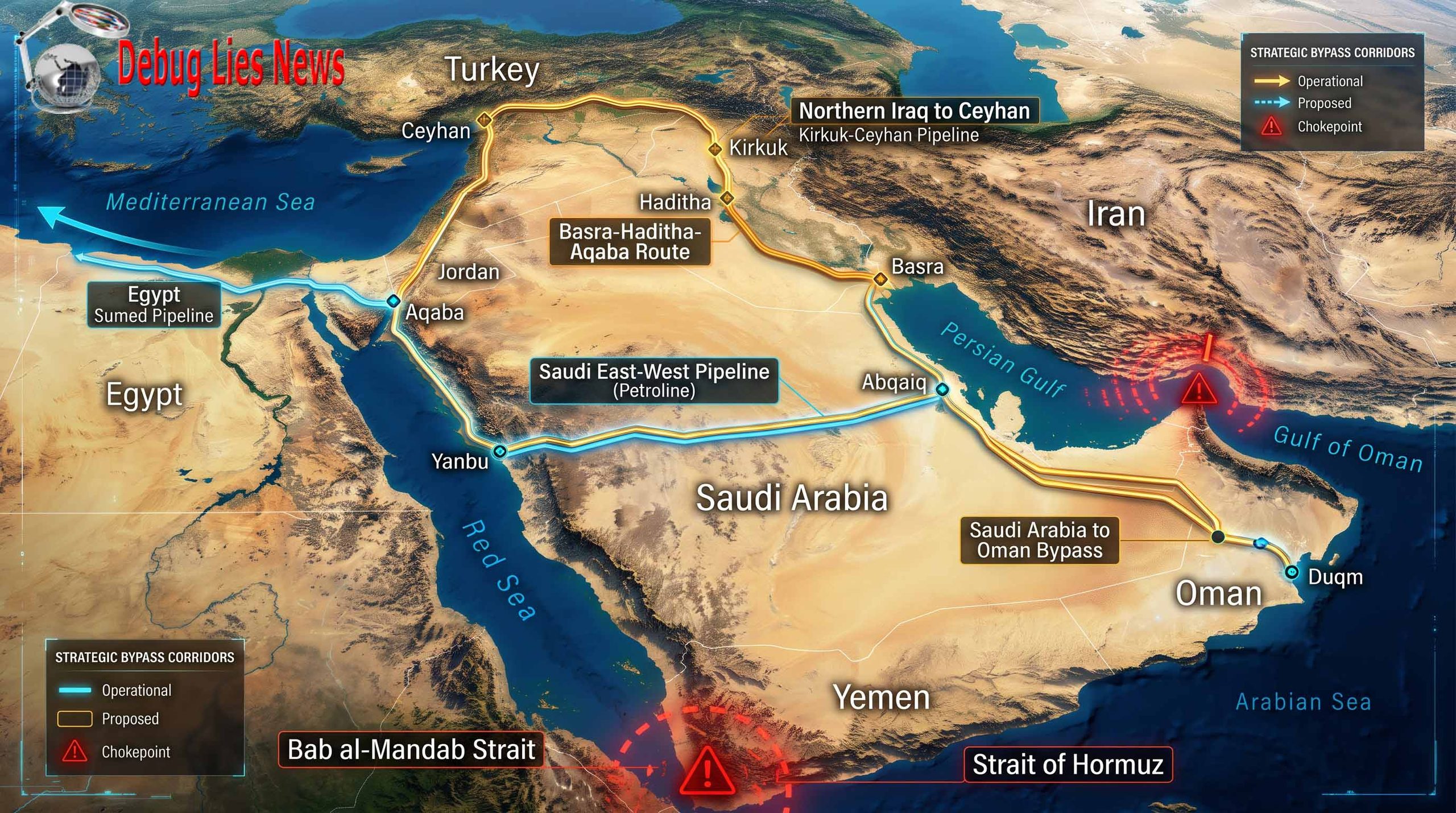
PILLAR III — GLOBAL POWER, INSTITUTIONAL ARCHITECTURE AND THE 2027–2031 OUTLOOK
Chapter 10. Iran, Saudi Arabia, Yemen, Oman, Iraq, Jordan, Egypt and Türkiye: Competing Strategic Interests
The Emerging Geopolitics of Petroleum Transit Sovereignty
The development of alternative oil export corridors across the Arabian Peninsula would constitute a redistribution of geopolitical influence rather than a purely technical reorganisation of energy transportation. Infrastructure determines not only where petroleum can move, but which governments possess authority over its movement, which territories receive investment, which states collect transit revenue and which diplomatic relationships become essential to maintaining international deliveries. For Saudi Arabia, the central objective would be to reduce the economic consequences of disruption affecting the Persian Gulf and the southern Red Sea. For Iraq, it would be to diversify the outlets available to its producing regions. For Oman, Jordan, Egypt and Türkiye, the emergence of new corridors could create transit revenue, industrial development and greater diplomatic significance. For Iran, any substantial reduction in regional dependence on Hormuz would alter the economic leverage associated with its geographical position. For Yemen, the consequences would depend on the interaction between regional maritime security, territorial governance and any eventual political settlement.
These interests are neither identical nor necessarily antagonistic. A pipeline can create benefits for both exporting and transit states, while a reduction in the vulnerability of oil transportation can benefit countries that compete politically. Yet infrastructure also generates new asymmetries: the producer owns the commodity, the transit state exercises sovereignty over the territory and the destination market ultimately determines whether the transported crude possesses sufficient commercial value. A country seeking independence from one maritime passage can therefore become dependent on another state’s regulatory decisions or political stability. The strategic objective should consequently be the distribution of transit exposure across legally and commercially distinct routes rather than its concentration in a new geographical monopoly.
The international energy market provides the economic background against which these decisions must be assessed. According to the International Energy Agency’s October 2026 report, Gulf crude exports recovered to approximately 13.9 million barrels per day in September, but the agency continued to describe the recovery as fragile because of renewed attacks on infrastructure and shipping. The same report recorded substantial pressure on global inventories, freight costs and refined-product markets. These conditions imply that transport reliability has become an increasingly important determinant of export value, beyond the volume of petroleum a country is technically capable of producing. Oil Market Report — International Energy Agency — October 2026. IEA
Saudi Arabia: From Production Power to Network Power
Saudi Arabia’s strategic position would change materially if it developed the ability to distribute substantial crude volumes among several geographically separate export systems without depending on one coastal region or one foreign transit authority. Its traditional advantage derives from its petroleum resources, production capabilities, export infrastructure and role within OPEC+. A diversified transportation network would add another dimension: the capacity to select export routes according to market conditions, maritime security and customer requirements. Such flexibility could strengthen the kingdom’s commercial relationships with Asian and European refiners, particularly where buyers increasingly assign value to delivery reliability as well as crude quality and price.
The country’s challenge is that transportation diversification requires capital and diplomatic commitments that compete with other national development priorities. A direct Arabian Sea outlet would require cooperation with Oman; a Mediterranean land corridor would require one or more additional transit partners; and expanded use of existing Egyptian facilities would require negotiated commercial access. The most effective arrangement would avoid creating an exclusive dependence on any one partner. Saudi Arabia should therefore regard infrastructure diplomacy as a portfolio of complementary relationships rather than a search for a single substitute for its existing Red Sea route.
The relevant distinction is between sovereign ownership and sovereign control of the full export chain. Saudi Arabia may own a pipeline and the crude transported through it, but the terminal receiving that crude, the land traversed and the onward maritime passage can remain subject to different jurisdictions. Economic independence depends on enforceable access to the complete chain. The strategic value of a foreign corridor is consequently determined by its legal durability and operational availability, not merely by whether Saudi investors control a majority of the project company.
Iran: The Limits of Geographic Leverage
Iran’s geographical position adjacent to Hormuz gives it a distinctive relationship with Gulf maritime security. However, the country’s interests must be understood in two different dimensions. A disruption affecting the strait can impose substantial costs on regional competitors and international consuming economies, but instability can also restrict Iran’s own exports, weaken regional economic activity and increase the likelihood of international confrontation. It would therefore be inaccurate to interpret the long-term development of alternative oil pipelines as evidence that Iran necessarily benefits from maintaining permanent maritime instability.
Nevertheless, a credible network of alternative Gulf export routes would reduce the amount of international petroleum trade whose movement depends directly on Hormuz. That would change the strategic consequences of future crises. It would not remove Iran’s military capabilities, eliminate the importance of the strait or prevent wider regional disruption. Nor would it make Gulf petroleum infrastructure invulnerable to attacks elsewhere. It would instead reduce the degree to which an interruption in one maritime passage could affect the revenues of neighbouring producers and the supply security of their customers.
This produces a potentially stabilising consequence that should not be overlooked. When all parties recognise that maritime escalation imposes severe mutual costs, diplomacy may become more attractive. Infrastructure diversification could complement that incentive by limiting the ability of a single disruption to produce an exceptionally large economic shock. It could also be perceived politically as an attempt to diminish Iran’s influence, creating opposition to certain regional arrangements. The effect would depend on the diplomatic context and the extent to which new infrastructure was presented as a commercial security measure rather than an instrument of confrontation.
The appropriate strategic objective is therefore resilience without dependence on permanent hostility. Saudi Arabia and its partners should be able to preserve essential energy deliveries during a crisis without making the economic success of new infrastructure contingent on the assumption that conflict with Iran will continue indefinitely.
Yemen: Maritime Security and the Economics of Political Settlement
Yemen occupies a different position in the strategic geography of oil exports because its importance derives principally from its proximity to Bab el-Mandeb and the Gulf of Aden rather than from control over the principal Gulf production system. Insecurity affecting commercial shipping can impose international economic costs substantially larger than those associated with Yemen’s own petroleum output. The commercial consequences can be transmitted through higher insurance costs, diversion of vessels, longer transit times and disruption to Red Sea port activity. In this sense, the southern Red Sea creates a form of geographical leverage independent of the scale of a state’s domestic economy.
The policy implications must distinguish the actions of armed groups, the responsibilities of internationally recognised authorities and the broader population’s interests. These are not interchangeable actors. A durable reduction in maritime insecurity ultimately requires political arrangements that address the relevant conflict conditions, rather than assuming that maritime patrols or alternative oil pipelines can substitute for a settlement.
The development of new Arabian Sea and Mediterranean corridors would alter the economic consequences of Red Sea disruption, but it would not remove the importance of maritime security for commercial shipping, humanitarian access and regional trade. Even if Saudi Arabia succeeded in exporting a substantial share of its petroleum through alternative routes, the protection of navigation around Yemen would remain an international interest. Infrastructure diversification and diplomatic de-escalation should therefore be treated as complementary objectives.
Oman: The Strategic Value of Remaining a Trusted Transit Partner
Oman’s economic opportunity differs from Saudi Arabia’s. Its potential role is not primarily to replace Saudi production, but to supply geography, industrial services and a predictable legal environment through which additional petroleum volumes could reach the Arabian Sea. That position could generate substantial commercial benefits if the country hosted pipelines, storage systems and marine terminals serving regional exporters. However, Oman’s diplomatic value also depends on preserving an international reputation for maintaining relationships across competing regional interests.
Hosting a major Saudi export corridor could provide industrial investment and long-term revenues while creating a new strategic exposure. The country would need to balance these benefits against the risk that infrastructure on its territory could become associated with disputes involving other states. This makes the legal and political presentation of the project important. A commercially governed energy transport system, open to agreed users and supported by transparent transit obligations, could be more consistent with a policy of economic diversification than an arrangement explicitly framed around military rivalry.
Oman’s negotiating position would depend on the availability of alternative port locations, the scale of associated industrial development and the degree to which the corridor served domestic economic objectives. A proposal offering only transit fees might be less attractive than one incorporating storage, industrial services, domestic energy security and employment. However, the addition of downstream investments would increase capital requirements and should be justified through independent commercial analysis.
Iraq: Export Diversification and Federal Governance
Iraq’s interest in alternative petroleum corridors has a distinct political dimension because the organisation of crude production, marketing and transportation intersects with the division of authority between federal institutions and the Kurdistan Region. International investors require clarity concerning who may legally commit crude volumes, negotiate transportation contracts and authorise exports. Without such clarity, physical pipeline capacity cannot guarantee commercial utilisation.
For Baghdad, the development of additional western and northern outlets could reduce reliance on southern maritime export infrastructure and improve bargaining flexibility among transit partners. Yet every route introduces new dependencies. The Jordanian corridor would require sustained bilateral cooperation and investment; the Turkish corridor requires durable contractual arrangements and alignment between the relevant Iraqi authorities; and any broader northern integration would require additional infrastructure connecting producing regions to the selected export system.
The strongest Iraqi strategy would preserve multiple viable options while avoiding excessive capital commitments to infrastructure whose utilisation remains uncertain. A project should be evaluated according to its contribution to the federal petroleum revenue system, not simply the strategic advantages of reaching an additional coastline.
Jordan: Transit Revenues Versus Strategic Exposure
Jordan’s geographical position offers the opportunity to become a more important participant in regional petroleum transportation. Its potential benefits include energy supply, employment, fiscal revenue and industrial investment. Yet its role as a transit state would expose it to disputes concerning tariffs, operating rights, security responsibilities and the allocation of economic benefits.
The central Jordanian interest would be the creation of an infrastructure arrangement whose value persists even when international crude prices fall or regional diplomatic relations change. Stable contracted revenues and access to energy supplies could provide greater economic benefits than uncertain participation in speculative megaprojects. The allocation of sovereign risk would consequently be decisive. Jordan should not be expected to bear unlimited responsibility for interruptions arising from conflicts or events beyond its control, while exporting states would require effective remedies for unjustified interference with contracted transport rights.
Egypt and Türkiye: Competing Mediterranean Gateways
Egypt and Türkiye possess different but potentially competing advantages as destinations for regional crude transportation. Egypt offers an established Red Sea–Mediterranean connection and a geographically natural relationship with Arabian Peninsula exports moving northward through the Red Sea. Türkiye offers existing Mediterranean crude infrastructure and established transportation relationships with Iraq. Both could potentially receive additional regional investment, but their commercial positions would depend on available capacity, transit costs, legal arrangements and the geographical origin of the crude.
Egypt’s advantage is particularly relevant for Saudi westbound exports using existing Red Sea facilities. Türkiye’s advantage is more directly associated with northern Iraqi production and potential expansion of inland transport networks. These relationships could change if new pipelines were constructed, but a Gulf-wide network connecting every producer to every Mediterranean outlet would not automatically be economically justified.
The competitive effect would extend to transit tariffs and diplomatic influence. Exporting states possessing credible alternatives could negotiate more effectively, while transit countries would face incentives to maintain reliable services and commercially attractive conditions. This suggests that regional energy security may be improved not only by the physical construction of additional corridors but also by competition among accessible transit systems.
Table 21 — Strategic Interests of the Principal Regional Actors
| State / actor | Principal interest | Potential benefit from diversification | Principal concern | Likely policy preference |
|---|---|---|---|---|
| Saudi Arabia | Reliable exports and fiscal stability | Multiple independent export directions | Capital cost and new foreign dependencies | Portfolio of complementary corridors |
| Iran | Security, exports and regional influence | More stable regional commerce under de-escalation | Reduced leverage associated with Hormuz geography | Diplomacy shaped by broader security relationships |
| Yemeni authorities and armed actors | Political authority and conflict outcomes | Reduced economic instability from a durable settlement | Conflict-related maritime and territorial disputes | Positions differ by actor; cannot be treated as unitary |
| Oman | Industrial development and diplomatic autonomy | Transit, storage and port investment | Strategic exposure and sovereignty | Commercially governed cooperation |
| Iraq | Export sovereignty and revenue | Western and northern outlets | Federal coordination and financing | Multiple export options |
| Jordan | Energy supplies and transit revenue | Industrial investment and fiscal benefits | Security and contingent liabilities | Long-term contractual guarantees |
| Egypt | Suez-related energy services and Mediterranean access | Additional crude flows and terminal utilisation | Capacity constraints and competition | Integration with established infrastructure |
| Türkiye | Mediterranean transit and regional influence | Higher pipeline utilisation and logistics revenue | Supply uncertainty and contractual disputes | Long-term Iraq-related transportation agreements |
Assessment based on the documented infrastructure and institutional relationships examined in Pillar II, the International Energy Agency’s October 2026 Oil Market Report and US Energy Information Administration analysis of regional oil transit. The stated preferences are analytical judgments, not attributed official government declarations.
Regional Competition, Cooperation and the Risk of New Monopolies
The long-term structure of petroleum transit could evolve toward either competitive diversification or a new concentration of geopolitical leverage. Under a competitive model, exporting states would maintain access to several routes, while transit countries would obtain revenue by providing reliable service under predictable rules. Under a more concentrated model, large investments might direct substantial volumes toward one new terminal or one indispensable transit state, replacing the dependence on a maritime chokepoint with dependence on a political or commercial intermediary.
The institutional design should favour interoperability, transparent tariffs and non-discriminatory access within the limits of contracted capacity. This would allow participating states to benefit from transportation investment without requiring every project to become an instrument of exclusive geopolitical influence. A regional framework would also help reduce the risk of competing national investments producing excess capacity in some locations while leaving critical gaps elsewhere.
Chapter 10 — Key judgments. The redistribution of petroleum export routes would also redistribute geopolitical influence. Saudi Arabia and Iraq would seek greater freedom of export choice, while Oman, Jordan, Egypt and Türkiye would acquire opportunities to expand their roles as transit and industrial partners. Iran’s geographical leverage would be modified but not eliminated, and Red Sea maritime security would remain important regardless of pipeline development. The strongest diplomatic architecture would distribute commercial benefits and preserve independent transport options without transforming new infrastructure into an exclusive political dependency.
What would change the assessment: binding regional transport agreements, changes in sovereign energy policy, sustained diplomatic de-escalation, or the emergence of exclusive transit arrangements would materially alter the relative incentives of participating governments.
Chapter 11. China, India, Japan, South Korea and the United States: Energy Security Beyond Naval Deterrence
Asia’s Structural Exposure and the Redistribution of Energy-Security Responsibilities
The most important international consequence of alternative Gulf oil corridors is that their principal beneficiaries would not necessarily be the countries hosting them. Petroleum markets are global, but the physical dependence on Gulf maritime routes is concentrated heavily in Asia. This creates a disparity between the countries possessing the strongest incentives to secure alternative supplies and those possessing the sovereign authority to construct the necessary infrastructure. Saudi Arabia, Oman and other regional governments control the territory and facilities on which new export routes would depend, while China, India, Japan and South Korea represent major markets whose economic security could improve if those routes became reliable. The central question is how the benefits of enhanced supply security can be converted into financing commitments without transferring excessive political influence over critical infrastructure to foreign buyers.
The EIA calculated that 89% of crude oil and condensate passing through Hormuz in the first half of 2025 was destined for Asia, with China, India, Japan and South Korea collectively receiving 74% of total Hormuz crude and condensate flows. The IEA’s February 2026 assessment, using its own reference period and definitions, recorded that China and India together received approximately 44% of the crude exported through Hormuz in 2025. These are distinct statistical measures and should not be treated as identical series, but they establish the same strategic conclusion: the economic security of major Asian industrial economies is directly connected to the operating reliability of Gulf petroleum transportation. World Oil Transit Chokepoints — US Energy Information Administration — March 2026; Strait of Hormuz Factsheet — International Energy Agency — February 2026. U.S. Energy Information Administration (EIA)+1
This dependence creates a potential international financing coalition, although its members possess different strategic interests. China has a large and diversified petroleum consumption and refining system, India expects substantial future demand growth, Japan remains heavily dependent on imported energy and South Korea combines significant import requirements with internationally competitive refining and industrial capabilities. The United States occupies a different position because domestic petroleum production reduces its direct dependence on Gulf crude compared with earlier decades. Yet the American economy remains exposed to international prices, allied energy security and the commercial consequences of disruptions affecting global petroleum products.
China: Physical Supply Diversification and Strategic Commercial Optionality
China’s petroleum security cannot be reduced to its ability to purchase crude from a large number of producing countries. The relevant question is whether those purchases can continue to reach Chinese refineries during simultaneous maritime and regional disruptions. A producer may be geographically diversified while the relevant cargoes remain dependent on vulnerable international shipping corridors. China therefore has a potential interest in the development of new Indian Ocean outlets for Saudi and other Gulf crude, particularly where these facilities reduce exposure to Hormuz and preserve direct access to Asian markets.
The economic argument for Chinese participation would be strongest where Chinese refiners or petroleum companies could obtain long-term transportation rights associated with clearly defined crude supply commitments. Such arrangements could provide greater delivery certainty without requiring China to exercise sovereign control over the infrastructure. Participation might take the form of long-term purchase agreements, contracted transportation capacity, minority infrastructure investment or commercially structured financing. Each option would create different obligations. A purchase contract would primarily allocate supply and delivery risks, while equity investment could expose Chinese investors to construction, operational and political risks associated with the host state.
China’s wider energy-transition policies also complicate investment decisions. A new pipeline reaching commercial operation around 2031 could remain active for several decades, during which transport electrification, petrochemical demand and industrial efficiency may change the composition of petroleum consumption. Consequently, Chinese purchasers could prefer flexible long-term contracts rather than commitments that assume uninterrupted growth in crude requirements. The project would need to demonstrate commercial advantages even under conditions in which total national petroleum demand stabilises or particular refined-product markets decline.
The most defensible Chinese role would therefore be that of a major commercial participant within a sovereign regional transport system, rather than an exclusive controlling investor. Such an arrangement could strengthen the corridor’s financial credibility while reducing concerns among host governments that their infrastructure might become an instrument of foreign strategic competition.
India: Rising Demand and the Case for an Arabian Sea Partnership
India presents a different commercial opportunity because its medium-term petroleum requirements are closely linked to economic development, industrial activity, mobility and the expansion of refining and petrochemical industries. The IEA’s India Oil Market Report projected that Indian oil demand could increase by almost 1.2 million barrels per day between 2023 and 2030, reaching approximately 6.6 million barrels per day, while domestic crude production could decline from approximately 700,000 barrels per day in 2023 to 540,000 barrels per day in 2030. These are projections from an earlier IEA study, not observations of 2030 outcomes. They nevertheless indicate that India could remain an important source of demand for imported crude even as technological change reduces petroleum consumption in other economies. India Oil Market Report: Executive Summary — International Energy Agency. IEA
This demand outlook strengthens the commercial case for an Arabian Sea outlet serving India. A Saudi–Oman corridor could create a direct export direction toward Indian refineries without requiring normal eastbound shipments to traverse either Hormuz or Bab el-Mandeb. Its value would depend on delivered cost, crude compatibility and contractual reliability, not merely on the shorter apparent geographical relationship between Oman’s coastline and the Indian subcontinent.
Indian participation could involve refinery purchase commitments, storage partnerships or investment in marine logistics. However, a project designed around Indian demand would need to account for competition from other suppliers and changes in the crude grades processed by domestic refineries. India’s oil companies would be unlikely to justify major long-term obligations solely on the basis of strategic geography if the resulting deliveries were consistently uncompetitive with alternative sources.
Japan: Strategic Inventories and the Economics of Reliable Supply
Japan’s dependence on imported petroleum gives it a particularly strong interest in the reliability of Middle Eastern supply routes. The IEA’s oil-security assessment describes Japan as having negligible domestic petroleum production and historically obtaining approximately 80–90% of its crude imports from the Middle East. This exposure has encouraged the development of a substantial emergency stockholding framework. The same assessment describes a system combining government-owned reserves with compulsory industry stocks, including a government stockholding objective equivalent to 90 days of net imports and an industry obligation historically equivalent to 70 days of consumption. The historical figures should not be interpreted as a freshly verified October 2026 inventory position, but they demonstrate the institutional importance Japan assigns to petroleum supply continuity. Japan Oil Security Policy — International Energy Agency. IEA
Japan’s interest in alternative petroleum corridors could therefore be expressed through commercial access rights and reserve arrangements rather than direct control over pipeline assets. A new export terminal capable of reliably serving Japanese refineries would complement domestic inventories by reducing the probability that strategic reserves must be drawn down during disruptions. The distinction is important because emergency inventories can bridge interruptions but cannot permanently replace a sustained loss of international crude supply.
Japan’s broader energy policy also seeks to reduce long-term dependence on fossil fuels. The IEA’s 2026 country review reported an energy self-sufficiency rate of 16.3% in 2024, with fossil fuels continuing to represent more than 80% of total energy supply. These figures illustrate why reliable petroleum imports remain significant even as the country invests in energy transformation. Japan 2026: Executive Summary — International Energy Agency. IEA
South Korea: Refining Exposure and Industrial Supply Chains
South Korea’s vulnerability arises from the interaction between imported crude, large-scale refining, petrochemical production and energy-intensive manufacturing. The country’s strategic interest is therefore not limited to purchasing sufficient barrels of crude. It must also preserve the predictable supply of appropriate grades to industrial facilities and the functioning of domestic distribution systems.
The country could benefit from alternative Gulf outlets through long-term crude contracts, shipping partnerships and selectively located emergency inventories. However, its refining industry would need to compare the costs of crude obtained through new pipeline-supported routes with existing maritime supplies. The value of a new corridor would be especially significant where it reduced the risk of prolonged feedstock interruption or allowed refineries to preserve production during regional disruption.
South Korea’s investment incentives may consequently differ from those of a country primarily concerned with direct consumption of transport fuels. Refining margins, petrochemical feedstock requirements and export-market conditions would influence the commercial value of any infrastructure partnership. A reliable pipeline-supported supply arrangement could improve industrial resilience without necessarily increasing total crude import volumes.
The United States: Global Price Exposure Despite Lower Direct Import Dependence
The United States occupies a distinctive position because its domestic production base reduces direct dependence on imported Gulf crude, but it does not insulate the American economy from international petroleum prices. The EIA estimated that US crude oil and condensate imports passing through Hormuz averaged approximately 400,000 barrels per day during the first half of 2025, representing approximately 7% of US crude imports and 2% of petroleum liquids consumption. The physical import exposure was therefore considerably smaller than that of major Asian buyers. Nevertheless, disruptions affecting globally traded crude and products can influence American refinery economics, transport-fuel prices, inflation and the economic performance of allies. World Oil Transit Chokepoints — US Energy Information Administration — March 2026. U.S. Energy Information Administration (EIA)
The American Strategic Petroleum Reserve provides an additional form of resilience. The Department of Energy’s official data recorded 282.2 million barrels of crude oil in the reserve on 16 October 2026, against an authorised storage capacity of 714 million barrels. The department reported a maximum nominal drawdown capability of 4.4 million barrels per day, while noting that oil entering the market following a presidential decision involves operational lead time. These figures distinguish inventory quantity from the speed at which emergency supply can actually be delivered. Strategic Petroleum Reserve Quick Facts — US Department of Energy — October 2026. Department of Energy
The American interest in alternative Gulf pipelines would therefore be indirect but significant. Infrastructure diversification could reduce the risk of severe international supply shocks, support allied economies and limit the need for expensive emergency responses. However, the United States would also have to assess such projects against its wider policy concerning regional security, sanctions, investment and international energy markets.
Table 22 — Principal Importer Interests in Alternative Gulf Petroleum Corridors
| Country | Documented structural exposure | Main commercial interest | Potential infrastructure participation | Principal constraint |
|---|---|---|---|---|
| China | Major destination for Hormuz crude | Reliable access to diversified supply | Long-term purchases, financing, transportation commitments | Demand uncertainty and strategic investment sensitivities |
| India | IEA projected demand near 6.6 million b/d by 2030 in earlier outlook | Reliable Arabian Sea imports | Refinery contracts, storage and shipping investment | Price competitiveness and crude compatibility |
| Japan | Historically 80–90% of crude imports from Middle East | Delivery continuity and emergency resilience | Reserve partnerships, long-term access agreements | Long-term demand decline and capital allocation |
| South Korea | Import-dependent refining and petrochemical system | Industrial feedstock security | Refining contracts, storage and logistics | Refinery margins and commercial flexibility |
| United States | Approximately 0.4 million b/d of Hormuz-linked imports in H1 2025 | Global stability and allied energy security | Investment facilitation and commercial participation | Domestic policy, sanctions and financing priorities |
Sources: US Energy Information Administration — World Oil Transit Chokepoints; International Energy Agency — India Oil Market Report; International Energy Agency — Japan Oil Security Policy; US Department of Energy — Strategic Petroleum Reserve.
Financing Energy Security Through Long-Term Importer Participation
The most promising institutional development would be a financing arrangement connecting the benefits of improved energy security with the costs of constructing and maintaining alternative infrastructure. Major consuming countries could participate through long-term crude purchase commitments, contracted transport capacity and strategically located inventories. Such instruments would provide predictable revenue to project operators while giving importers greater certainty concerning delivery routes.
However, there are important limits to this approach. A government cannot guarantee that its national refiners will purchase a particular crude grade indefinitely, while private petroleum companies must retain sufficient commercial flexibility to respond to changes in demand and refining economics. Project agreements should therefore avoid rigid arrangements that become financially unsustainable under plausible future market conditions.
A more resilient model would distribute commercial participation among several buyers and preserve contractual mechanisms for transferring capacity rights when demand patterns change. This could reduce the likelihood that a project becomes dependent on one importing country or one national petroleum company.
Chapter 11 — Key judgments. Asian importing economies possess a direct interest in the development of geographically independent Gulf export routes, while the United States has a substantial indirect interest through global prices and allied security. India provides a particularly relevant demand-growth case for Arabian Sea infrastructure, whereas Japan and South Korea place significant value on dependable crude supplies for established industrial systems. A credible financing model should translate these interests into diversified long-term commercial commitments without transferring exclusive strategic control over critical infrastructure to any foreign buyer.
What would change the assessment: binding importer participation, refinery-specific supply commitments, updated national petroleum-demand forecasts and commercially viable transportation tariffs would alter the relative attractiveness of alternative routes for individual consuming economies.
Chapter 12. Europe and the Mediterranean: Italy, France, Germany, the United Kingdom and EU Strategic Autonomy
The European Paradox: Reduced Direct Gulf Dependence, Persistent Exposure to Global Petroleum Shocks
Europe’s strategic interest in new Middle Eastern oil export corridors cannot be determined solely by calculating the share of its crude imports originating in the Persian Gulf. The region’s energy security has been transformed by the diversification of suppliers following Russia’s invasion of Ukraine, the expansion of imports from Atlantic Basin producers and the continuing transition toward alternative energy technologies. Yet the European economy remains exposed to international petroleum prices, refined-product availability, maritime transport costs and the industrial consequences of disruptions affecting Asian refining markets. The central distinction is between direct supply dependence and systemic market exposure. Europe may receive a relatively limited share of its crude directly through Hormuz while nevertheless suffering substantial inflationary and industrial consequences when that passage becomes unavailable.
The European Commission reports that oil accounted for approximately 38% of the European Union’s energy mix in 2024, demonstrating that petroleum continues to occupy a major position despite the energy transition. The Commission further records a reduction in Russia’s share of EU oil imports from 25.8% in 2021 to 2.2% in 2025, reflecting a major transformation in the geographical composition of European supply. This restructuring has reduced one category of external dependence but has not eliminated the exposure of European industry and consumers to global crude and refined-product prices. Security of Oil Supply — European Commission. Energy
The economic consequences became particularly clear during the second quarter of 2026. Eurostat reported that the value of EU petroleum oil imports increased by 55.8% compared with the monthly average of 2025, while the quantity imported increased by only 1.2%, reaching 36.7 million tonnes over the reported quarterly period. The principal suppliers remained the United States, Norway and Kazakhstan, accounting for 18.8%, 14.3% and 13.4%, respectively. This combination demonstrates that the European economy can experience a major increase in its petroleum import bill without a corresponding increase in physical demand or a decisive change in its principal suppliers. The price shock is therefore transmitted through the international market rather than exclusively through direct dependence on Middle Eastern crude. EU Oil Imports Value Up by 56%, Volume Stable in Q2 2026 — Eurostat — September 2026. Eurostat
The implication for European policy is that Gulf corridor diversification should be considered a contribution to international market stability rather than simply an alternative source of additional crude. European governments should not assume that financing a new Mediterranean pipeline would automatically reduce domestic petroleum prices or increase national energy sovereignty. The benefit would depend on whether the infrastructure materially increases the volume of crude accessible to global markets during disruption and whether European refiners can purchase and process that crude competitively.
Italy: Mediterranean Geography, Refining Capacity and Industrial Exposure
Italy occupies a particularly important geographical position because its ports and refineries connect Mediterranean petroleum trade with the industrial economy of continental Europe. The country has the potential to benefit from greater reliability of crude deliveries entering the Mediterranean, particularly through eastern and southern maritime approaches. Yet its strategic value is not reducible to the possibility of receiving additional Saudi or Iraqi oil. Italy’s industrial system depends on the availability of transport fuels, refinery products and petrochemical feedstocks, while its refineries require crude grades compatible with their technical configurations and commercial operating arrangements.
The Italian policy problem has three components. The first concerns diversification of crude supply. Additional Mediterranean access from Saudi Arabia or Iraq could increase the number of economically feasible supply routes available to Italian refiners, provided the crude grades, transport costs and contractual terms were competitive. The second concerns industrial resilience. A global shortage of diesel, aviation fuel or petrochemical feedstocks could affect Italy even when crude imports remained available, because the disruption might originate in refining and product-export markets rather than the initial movement of crude. The third concerns maritime logistics. Increased crude flows toward Mediterranean destinations would create opportunities for ports, storage operators and maritime service providers, but could also require investment in terminal capacity, environmental protection and transport connections.
Italy’s strategic interest would therefore be strongest in projects that improve the availability of commercially usable crude and refined products without requiring the state to assume disproportionate financial or geopolitical liabilities. The government could support feasibility cooperation involving Mediterranean terminals and regional exporters, while private companies would assess individual purchase contracts and infrastructure participation. Such arrangements should be examined separately from national defence or diplomatic commitments.
The opportunity for Italian industry could also extend to engineering, pipeline equipment, marine infrastructure, industrial automation, maintenance services and environmental monitoring. These activities would create potential economic benefits even if relatively little additional crude were ultimately refined in Italy. However, project participation would depend on competitive procurement, financing and the technical requirements of the selected corridor. It would be inappropriate to assume that Italian companies would automatically receive contracts from projects developed by Saudi Arabia, Oman, Iraq or other participating states.
France: Strategic Reserves, Refining and Mediterranean Diplomacy
France’s interests differ from Italy’s because its energy-security framework combines petroleum supply obligations with a national energy mix in which nuclear electricity plays a major role. This reduces certain forms of exposure associated with electricity generation but does not eliminate petroleum dependence in transportation, aviation, industrial processes and petrochemicals. French policy must therefore distinguish the security of the electricity system from the availability and price of oil products.
A new Mediterranean crude corridor could provide additional purchasing options for French refining and trading companies, but the commercial value would depend on the relationship between transport costs, refinery requirements and the availability of competing supplies. France also possesses significant diplomatic interests in the Mediterranean and the Middle East, creating a potential role in discussions concerning transit governance, maritime law and regional infrastructure investment.
The strongest French contribution could involve the institutional and financial aspects of corridor development rather than direct state ownership of petroleum pipelines. Public authorities could support international agreements and regulatory cooperation, while qualified investors and industrial companies would evaluate financing, marine engineering and operating opportunities. Such participation would need to remain consistent with European climate policy and the financial mandates of relevant institutions.
France’s experience with strategic energy planning also illustrates the importance of preserving separate emergency arrangements for crude and refined products. A new supply corridor might improve the availability of crude but would not directly replace inventories of fuels needed for immediate domestic distribution. National resilience therefore depends on coordinated refinery operations, inventories and commercial supply arrangements rather than a single international pipeline project.
Germany: Industrial Cost Transmission and Supply Diversification
Germany’s relationship with Middle Eastern oil infrastructure is principally industrial and macroeconomic. The country possesses a large manufacturing base and significant demand for petroleum products, petrochemical feedstocks and industrial logistics. Consequently, energy price volatility can affect production costs, transportation and international competitiveness even where crude supplies are obtained from geographically diversified sources.
The German strategic question is whether new Mediterranean or Arabian Sea infrastructure would reduce the frequency and severity of global petroleum shocks sufficiently to justify commercial or financial participation. Direct investment in a distant pipeline might not be the most efficient instrument for German energy security, particularly where existing European refining and transport networks can obtain supplies from alternative regions. Germany could instead benefit from international market stabilisation, stronger product inventories and investments reducing the petroleum intensity of its industrial economy.
The technological dimension is particularly important. German engineering and industrial companies could compete for equipment and services associated with pipeline construction, pumping systems, measurement equipment, industrial control and energy efficiency. These opportunities would depend on technical specifications and procurement decisions, not on automatic political allocation.
A further consideration is the relationship between long-lived hydrocarbon infrastructure and European decarbonisation. Germany would need to assess whether participation in new petroleum transportation projects risks creating financial commitments extending beyond anticipated demand, while recognising that petroleum supply security remains relevant during the transition. The appropriate response would involve careful evaluation of project duration, contracted revenues and alternative industrial investments.
United Kingdom: Global Finance, Shipping and Energy-Market Services
The United Kingdom’s strategic position differs from that of the principal continental European refining economies. Its international financial services, commercial shipping relationships, maritime insurance market and legal-services sector create potential interests in the commercial governance of new petroleum corridors. The country is also exposed to international crude and petroleum-product prices, although its direct import arrangements differ from those of individual EU member states.
A major Saudi–Omani or trans-Arabian infrastructure programme could create opportunities for British financial institutions, engineering companies and commercial advisers. These might include project financing, political-risk analysis, maritime services and contractual structuring. However, participation would depend on the legal and financial characteristics of individual projects and applicable policy constraints.
The United Kingdom also has an interest in the international legal regime governing maritime navigation. The development of alternative pipelines should not be interpreted as a substitute for supporting lawful passage through international straits. A policy that relies exclusively on rerouting could weaken the broader principle that commercial navigation should remain protected under international law.
British policy would therefore need to combine maritime security, international diplomatic engagement and selective commercial participation in infrastructure that improves market resilience. Its investment role would be strongest where projects offer credible cash flows and enforceable transit rights rather than depending on permanent geopolitical confrontation.
The European Union: Energy Security Without a New Dependency
The EU’s central objective should be to increase the resilience of international petroleum supply without recreating the strategic dependencies that have previously constrained European energy policy. This requires a distinction between supporting foreign infrastructure development and becoming financially committed to particular crude suppliers or transit states.
The Union already possesses a common framework for emergency oil stocks. Directive 2009/119/EC requires member states to maintain stocks equivalent to at least 90 days of average daily net imports or 61 days of average daily inland consumption, whichever is greater. These reserves serve a different function from new foreign pipelines: they provide an immediate emergency buffer rather than permanent transportation capacity. The two instruments should therefore be assessed as complementary rather than competing investments. Security of Oil Supply — European Commission. Energy
The European policy challenge is especially clear when the composition of imports is examined. In 2025, the EU imported approximately €336.7 billion of energy products, corresponding to 723.3 million tonnes, while its principal petroleum oil suppliers were the United States, Norway and Kazakhstan. These figures demonstrate that the EU’s energy-security strategy is increasingly based on diversified global suppliers rather than exclusive dependence on Middle Eastern production. Nevertheless, the 2026 price shock shows that diversification of suppliers cannot fully insulate the Union from disruption in the world’s largest petroleum export region. EU Imports of Energy Products Decreased Again in 2025 — Eurostat — March 2026. Eurostat
Table 23 — European Petroleum Import Exposure and the 2026 Price Shock
| Indicator | Verified figure | Reference period | Policy significance |
|---|---|---|---|
| Oil share of EU energy mix | 38% | 2024 | Continued petroleum relevance |
| Russian share of EU oil imports | 25.8% | 2021 | Historical concentration |
| Russian share of EU oil imports | 2.2% | 2025 | Major supplier diversification |
| Total EU energy product imports | €336.7 billion | 2025 | Scale of external energy expenditure |
| Total imported energy products | 723.3 million tonnes | 2025 | Physical import dependence |
| Petroleum oil import value change | +55.8% | Q2 2026 versus 2025 monthly average | Severe price-related increase |
| Petroleum oil import volume change | +1.2% | Q2 2026 versus 2025 monthly average | Limited corresponding volume growth |
| United States share of petroleum oil imports | 18.8% | Q2 2026 | Principal supplier |
| Norway share | 14.3% | Q2 2026 | Important European supply source |
| Kazakhstan share | 13.4% | Q2 2026 | Significant non-Gulf source |
| EU emergency-stock obligation | 90 days of net imports or 61 days of consumption, whichever higher | Current legal framework | Emergency supply protection |
Sources: European Commission — Security of Oil Supply; Eurostat — EU Energy Imports, March 2026; Eurostat — Second Quarter 2026 Petroleum Imports. Import measures use different reference periods and should not be combined without reconciliation.
European Industrial Participation and the Mediterranean Infrastructure Opportunity
The development of new Mediterranean oil corridors could create opportunities for European engineering, financial and maritime industries, but the extent of those opportunities would depend on the design and procurement structure of individual projects. Italy and France possess geographical and commercial interests associated with Mediterranean energy flows; Germany has strong industrial and engineering interests; and the United Kingdom has significant international finance and maritime-service capabilities. These interests could complement one another, but there is no reason to assume that the four countries would adopt identical financing or diplomatic positions.
A coordinated European approach could establish common technical and environmental standards for participation in foreign petroleum infrastructure, encourage transparent procurement and support international agreements protecting commercial transit rights. However, the Union should avoid treating new fossil-fuel infrastructure as an end in itself. Its strategic interest is the resilience of energy supplies during a period of economic and technological transition. Investments should therefore demonstrate that they address a genuine security requirement and remain financially viable under credible demand scenarios.
Chapter 12 — Key judgments. Europe’s exposure to Gulf petroleum disruption is transmitted increasingly through global prices, refined products and industrial supply chains rather than exclusive direct dependence on Middle Eastern crude. Italy and France possess particular Mediterranean interests, Germany is strongly exposed through industrial costs, and the United Kingdom can contribute through international finance and maritime services. EU policy should combine emergency stocks, market diversification, industrial resilience and selective commercial engagement in new corridors without creating another geographically concentrated supply dependency.
What would change the assessment: updated country-specific refinery and crude-import statistics, confirmed European participation in corridor projects, changes in EU investment policy and measurable shifts in long-term petroleum demand would alter the relative attractiveness of Mediterranean infrastructure opportunities.
Chapter 13. Investment Economics, Sovereign Financing, Transit Governance and International Law
The Central Financial Problem: Who Pays for Capacity That May Remain Unused?
The financial viability of new Arabian and Mediterranean oil corridors depends on resolving a fundamental conflict between commercial efficiency and strategic resilience. Conventional petroleum transportation projects generate revenue by moving contracted volumes, while emergency infrastructure creates value partly through its availability when ordinary routes fail. The investment therefore contains two economically different services: routine transportation and contingent emergency transportation. If both are remunerated exclusively through ordinary pipeline tariffs, investors may seek maximum utilisation during normal conditions, leaving insufficient capacity available during crises. If governments require significant spare capacity without compensating the operator, the project may be unable to attract financing at reasonable cost. The appropriate institutional solution is to identify and price these services separately.
This distinction matters because the additional capital required for strategic redundancy can be substantial. A new pipeline may need greater design capacity than normal commercial demand would justify, while associated storage and terminal infrastructure must be maintained even during periods of limited utilisation. The investment’s security value is therefore similar in some respects to an insurance service: its benefit arises principally when an adverse event occurs. Yet unlike an ordinary financial insurance contract, the infrastructure requires physical construction, maintenance and long-term operating expenditure irrespective of whether the event occurs.
An economically defensible project must consequently demonstrate that the combined value of ordinary transportation revenues and explicitly funded security services is sufficient to cover construction, operation, maintenance and financing. The relevant calculation should be performed across several demand and disruption scenarios rather than relying on a single assumed probability of war. Because the public record does not establish a reliable statistical distribution for future regional conflict or the operating availability of proposed corridors, assigning precise probabilities would create unjustified certainty. The better method is to identify the conditions under which each project remains financially viable and the circumstances in which its security value becomes decisive.
Financing Structures and the Distribution of Risk
The allocation of risks is as important as the total investment cost. Construction contractors can assume defined responsibilities for engineering and delivery, but they cannot reasonably guarantee the future stability of relations among sovereign transit states. Pipeline operators can manage normal maintenance and industrial safety, but cannot independently resolve disputes concerning territorial access or the interruption of international commerce. Lenders therefore require a contractual framework separating risks that can be managed commercially from risks requiring sovereign undertakings or political-risk protection.
The central financing instruments could include long-term transportation agreements, government-backed capacity payments, project-finance debt, equity participation by producing and transit countries, and selective participation by major importing companies. Their suitability would vary according to the project. A relatively limited expansion of existing infrastructure could potentially be financed through an established operator’s balance sheet. A new Saudi–Oman corridor might require a bilateral project company with long-term shipping commitments. A multinational Mediterranean route would require a more complicated arrangement, particularly if several governments exercised authority over different sections.
A project should not be judged bankable merely because a government announces political support. Bankability requires enforceable rights to revenue, credible forecasts of transport demand, completed technical studies, permits and acceptable arrangements for construction, operation and dispute resolution. A memorandum of understanding may establish negotiating intentions but does not necessarily provide lenders with adequate contractual protection.
Table 24 — Allocation of Financial and Sovereign Risks
| Risk category | Principal exposure | Preferred contractual allocation | Government responsibility | Evidence required before financing |
|---|---|---|---|---|
| Construction cost escalation | Project company and investors | Defined contractor obligations with contingency arrangements | Permits and lawful site access | Independent engineering cost estimate |
| Insufficient throughput | Pipeline operator and lenders | Long-term transportation commitments | Avoid unsupported revenue guarantees | Binding shipper contracts |
| Changes in transit regulation | Exporters and investors | Stabilisation and change-in-law provisions where lawful | Predictable regulation | Ratified agreements and legal opinions |
| Political interruption | Entire transportation system | Defined suspension and restoration provisions | Sovereign cooperation and lawful security measures | Intergovernmental framework |
| Environmental damage | Operator and affected communities | Liability, insurance and remediation obligations | Enforcement and oversight | Environmental and social approvals |
| Terminal unavailability | Exporters and terminal operator | Service-level agreements and capacity rights | Port regulation | Verified operating-capacity study |
| Crude-price volatility | Producers and buyers | Commercial pricing and credit protections | Generally indirect | Market sensitivity analysis |
| Long-term demand decline | Investors and sponsors | Contract flexibility and conservative financing | Transparent treatment of contingent liabilities | Multiple demand scenarios |
| Early termination | Investors and participating states | Pre-agreed compensation and dispute procedures | Respect for contractual and public-law obligations | Termination framework |
| Currency and transfer restrictions | Cross-border project company | Currency, payment and transfer arrangements | Applicable monetary and fiscal authority | Banking and regulatory due diligence |
This is a proposed allocation framework, not a description of agreements executed for the conceptual projects.
Capital Cost, Financing Cost and the Value of Strategic Availability
The cost of capital can materially influence which corridor is economically preferred. Two projects with similar construction requirements can generate different investor returns if one operates under a stable legal framework with long-term contracts while the other depends on politically uncertain transit rights. Investors may demand higher returns for the latter, increasing the tariff necessary to recover capital. This creates a direct connection between diplomatic cooperation and transportation economics: credible international agreements can reduce financing costs, while unresolved sovereignty questions can make otherwise attractive infrastructure commercially unviable.
An illustrative calculation demonstrates the importance of financing assumptions. Consider a hypothetical investment of US$8 billion, financed over twenty-five years. If the capital recovery calculation uses an annual rate of 5%, the resulting annualised capital charge is approximately US$568 million. At 8%, it rises to approximately US$749 million, and at 11% to approximately US$965 million. These figures are calculated using a standard constant annual capital-recovery formula; they are not estimates for any actual project. They exclude operating costs, taxes, maintenance, insurance, additional working capital and residual value.
Table 25 — Illustrative Annual Capital Recovery for an $8 Billion Project
| Annual financing rate | Period | Annualised capital recovery | Annual capital recovery per barrel at 1 million b/d, full utilisation | At 50% utilisation |
|---|---|---|---|---|
| 5% | 25 years | $568 million | $1.56/barrel | $3.11/barrel |
| 8% | 25 years | $749 million | $2.05/barrel | $4.10/barrel |
| 11% | 25 years | $965 million | $2.64/barrel | $5.29/barrel |
Illustrative calculation using an $8 billion initial capital amount, a 25-year annuity and assumed financing rates. The annual capital charge is divided by 365 million barrels at full utilisation or 182.5 million barrels at 50% utilisation. No existing corridor is assigned these costs.
The implications are considerable. The cost of financing can change the transportation tariff required for commercial viability, while lower utilisation increases the capital burden per transported barrel. Governments seeking strategic reserve capacity must therefore decide whether to compensate the operator through an availability payment or accept higher commercial tariffs. A capacity-payment system could provide more transparent accounting by separating the cost of national resilience from the price of routine transport.
The financial assessment must also consider demand uncertainty. In the IEA’s World Energy Outlook 2025, the Stated Policies Scenario projected a peak in global oil demand around 102 million barrels per day near 2030, followed by gradual decline. This is a policy-conditioned scenario, not a prediction that excludes other outcomes. Its relevance is that an export corridor reaching commercial operation after 2030 could operate during a period of weaker global demand growth, particularly in advanced economies. Investment agreements should therefore avoid relying exclusively on high-utilisation assumptions extending for several decades. World Energy Outlook 2025: Stated Policies Scenario — International Energy Agency. IEA
International Law: Transit Passage Is Not Pipeline Transit
A central legal distinction concerns the difference between rights of maritime navigation and the construction and operation of pipelines across sovereign territory. The law of the sea establishes rules for navigation through international straits, but it does not create a general right for one country to construct an oil pipeline across another country’s territory. Such a project requires valid consent, applicable domestic approvals and enforceable international or commercial agreements.
The United Nations Convention on the Law of the Sea establishes the regime of transit passage for qualifying international straits. Article 38 defines the right of transit passage, while Article 44 imposes duties on states bordering straits and provides that transit passage must not be suspended. These provisions concern maritime navigation and must be interpreted according to the applicable legal status of the states and waters involved. They do not determine ownership, tariffs or access rights for an overland crude pipeline. United Nations Convention on the Law of the Sea, Part III — United Nations. Nazioni Unite
For cross-border petroleum transportation, the relevant legal architecture would instead include intergovernmental agreements, domestic petroleum and investment law, environmental regulation, land rights, corporate contracts and applicable dispute-resolution arrangements. Depending on the parties and the legal instruments, investment treaties or international arbitration provisions might also become relevant. Their applicability cannot be assumed without reviewing the actual agreements.
The difference is particularly important for projects involving multiple states. A government may agree politically to support an international corridor, but an operating company still requires permission to acquire or use land, construct infrastructure, cross borders and transport petroleum. Commercial shippers require clarity concerning ownership and custody of the crude, customs procedures, taxation and the point at which delivery obligations are fulfilled. The system also requires rules addressing interruption, maintenance and restoration.
Sovereign Transit Rights and the Prevention of Political Hold-Up
The greatest institutional danger in a cross-border pipeline is that one participant could acquire disproportionate leverage after large investments have become irreversible. Before construction, exporters and investors can compare alternative projects. After construction, the capital is largely committed to a particular route, making relocation expensive or impossible. A transit state might consequently possess bargaining power not apparent during initial negotiations.
This creates a classic infrastructure hold-up problem. The project is jointly beneficial before construction, but the distribution of bargaining power changes once the asset is installed. A durable agreement should therefore specify tariffs, access rights and permissible regulatory changes sufficiently clearly to reduce opportunities for opportunistic renegotiation.
However, absolute contractual rigidity would also be undesirable. Governments must retain lawful authority to protect public safety, the environment and legitimate national interests. The institutional objective is consequently to distinguish permissible regulation from arbitrary interference, supported by transparent procedures and independent dispute resolution.
Table 26 — Essential Provisions of a Cross-Border Petroleum Transit Agreement
| Legal instrument or clause | Required function | Principal risk addressed |
|---|---|---|
| Intergovernmental transit agreement | Establishes sovereign rights and obligations | Withdrawal of political consent |
| Project concession | Authorises construction and operation | Uncertain operating rights |
| Land and access arrangements | Provides lawful infrastructure access | Property and territorial disputes |
| Capacity allocation agreement | Defines shipper entitlements | Discriminatory or unpredictable access |
| Tariff methodology | Establishes transport charges | Opportunistic tariff increases |
| Customs and fiscal provisions | Clarifies taxation and cross-border procedures | Unexpected fiscal burdens |
| Environmental obligations | Allocates prevention and remediation responsibilities | Environmental damage and liability |
| Force-majeure provisions | Defines consequences of qualifying interruptions | Uncertain contractual suspension |
| Restoration and continuity obligations | Establishes recovery responsibilities | Prolonged disruption |
| Dispute resolution | Provides enforceable legal remedies | Political escalation of commercial disputes |
| Termination and asset transfer | Defines end-of-term obligations | Asset valuation and ownership uncertainty |
| Transparency and audit provisions | Enables verification of capacity and charges | Information asymmetry |
Strategic Petroleum Reserves and Cross-Border Storage Agreements
The international oil-security framework provides a relevant precedent for the use of cross-border arrangements. The IEA requires member countries to maintain emergency oil stocks equivalent to at least 90 days of net oil imports, while allowing qualifying stocks to be held in another country under bilateral arrangements that guarantee access during emergencies. The IEA also recognises stockholding tickets, under which a purchaser contracts for the right to take delivery of specified inventories during a crisis. These mechanisms demonstrate that energy security can be supported through enforceable rights to infrastructure and inventories located outside national territory. Oil Stocks of IEA Countries — International Energy Agency. IEA
The same principle could inform new Gulf export corridors. Importing countries might participate in strategically located petroleum storage without necessarily acquiring ownership of the entire terminal. Such arrangements would need to specify the quantity, grade, location and withdrawal rights of the stored oil, together with restrictions on double counting and the procedures applicable during emergencies.
A storage agreement would not provide the same service as an independent pipeline, because inventories are finite. However, strategically located stocks could reduce the urgency of immediate transport restoration and improve the economic value of a diversified network.
Chapter 13 — Key judgments. The principal obstacle to bankable transnational oil infrastructure is not the absence of possible financial instruments, but the difficulty of allocating commercial and sovereign risks across assets intended to remain operational for decades. Separate remuneration for commercial throughput and strategic availability could improve financial transparency, while durable transit agreements would reduce political hold-up risk. Maritime passage rights do not substitute for negotiated land-transit rights, and international reserve arrangements provide a useful precedent for cross-border energy-security contracts.
What would change the assessment: completed project-finance models, signed transportation contracts, ratified transit agreements, sovereign credit assessments and independent legal opinions would permit project-specific evaluation of financing costs and investment risks.
Chapter 14. Strategic Scenarios, Early-Warning Indicators and the 2031 Energy Geography
The Five-Year Outlook: Between Infrastructure Development and an Uncertain Global Oil Market
The outlook for Middle Eastern petroleum transportation through 2031 must be constructed around two uncertainties that operate on different timescales. The first concerns the evolution of geopolitical conflict, maritime security and the reliability of existing export systems. These conditions can change abruptly, with immediate consequences for shipping, production and financial markets. The second concerns the long-term commercial demand necessary to support investment in new pipelines, terminals and storage systems. These developments occur over years and can be altered by economic growth, electrification, refining investment, environmental policy and changes in the geographical distribution of petroleum consumption. A credible strategy must accommodate both: infrastructure should remain capable of providing economically valuable service during a severe regional crisis, but its financial justification should not depend on the assumption that the exceptional market conditions observed in 2026 will continue throughout its operating life.
The October 2026 IEA Oil Market Report illustrates the challenge of extrapolating from a period of extreme disruption. The agency forecast world petroleum supply averaging 100.7 million barrels per day during 2026, followed by an increase of approximately 7.7 million barrels per day in 2027 as production recovered. It also projected that global oil demand would fall by approximately 2.6 million barrels per day in 2026 before recovering by approximately 2 million barrels per day in 2027. These are conditional forecasts, not completed annual observations. Their significance is that the same geopolitical crisis can simultaneously reduce supply, increase prices and weaken demand, producing a market in which short-term scarcity does not necessarily translate into permanently greater commercial demand for new transportation infrastructure. Oil Market Report — International Energy Agency — October 2026. IEA
A strategy that assumes uninterrupted expansion of petroleum consumption would consequently be exposed to substantial financial risk. Yet an approach that assumes an immediate and irreversible collapse in petroleum demand would also be inconsistent with the continuing requirements of transport, aviation, petrochemicals and industrial activity. The appropriate investment horizon must therefore incorporate several possible demand trajectories rather than treat the central forecast of any single institution as a guaranteed outcome.
The IEA’s World Energy Outlook 2025 provides a further basis for considering this uncertainty. Under its Stated Policies Scenario, global oil demand reaches a peak of approximately 102 million barrels per day around 2030, after which it declines gradually. This trajectory reflects the policies and market conditions included in that scenario and differs from the short-term crisis forecasts developed during 2026. The difference is analytically important: a new pipeline may be justified as a security asset even if overall oil demand approaches a plateau, but its financial model must explain how the investment will recover its cost when growth becomes weaker. World Energy Outlook 2025: Stated Policies Scenario — International Energy Agency. IEA
Scenario One: Managed Regional Stabilisation and Incremental Infrastructure Integration
Under the first scenario, diplomatic arrangements reduce the frequency and severity of maritime disruption, allowing existing Gulf and Red Sea export routes to return progressively toward more predictable commercial operation. The strongest incentive for governments and petroleum companies would be to improve the efficiency and resilience of infrastructure already in service rather than immediately commit to multiple expensive new corridors. Saudi Arabia would continue to rely on its established national export network, Iraq and Türkiye would have opportunities to strengthen transportation agreements, and Egypt could benefit from continued use of established Red Sea–Mediterranean connections.
The economic logic of this scenario is that normal commercial conditions reduce the immediate value of emergency diversification, while the memory of disruption continues to justify selective investment. Governments could therefore prioritise storage, port flexibility, reserve-capacity agreements and engineering studies for projects that might be needed during future crises. Larger greenfield pipelines would proceed only where long-term transport commitments and financing conditions were sufficiently attractive.
This is not necessarily a scenario of declining geopolitical competition. States could continue to disagree over security, regional influence and commercial policy while preserving maritime navigation and petroleum exports. The defining characteristic would be the ability of commercial institutions to operate without recurring large-scale interruption.
Observable indicators would include sustained reductions in maritime incidents, more predictable tanker operations, recovery of petroleum-product exports, declining exceptional freight costs and stabilisation of international inventories. The IEA’s October 2026 evidence shows why these measures matter: the partial restoration of Gulf crude exports had not yet produced an equivalent normalisation of petroleum-product markets, meaning that a durable recovery would require improvement across several segments of the supply chain rather than crude transportation alone. Oil Market Report — International Energy Agency — October 2026. IEA
Scenario Two: Recurrent Disruption and Competitive Regional Diversification
Under the second scenario, periods of reduced tension alternate with renewed disruption affecting maritime routes or petroleum infrastructure. Commercial operators remain able to transport substantial volumes, but the probability of interruption is sufficiently consequential to influence investment, shipping costs and national energy policies. Governments respond by accelerating selected infrastructure projects, especially those capable of improving access to alternative export outlets without requiring the creation of an entirely new regional system.
Saudi Arabia could pursue additional Arabian Sea options while reinforcing the flexibility of its existing western infrastructure. Iraq could seek stronger contractual arrangements with Türkiye and renewed investment in western export projects. Jordan, Oman and Egypt would have incentives to participate in transit negotiations, although their willingness to accept associated obligations would depend on project economics and regional political conditions.
This scenario offers the strongest commercial rationale for incremental redundancy, but it also creates the danger of uncoordinated national investment. Each state might pursue its preferred corridor without adequately considering whether the resulting infrastructure duplicates available capacity elsewhere or converges on common receiving terminals. The risk would be the construction of expensive systems whose nominal capacities appear impressive but whose actual independence is limited.
An integrated regional planning mechanism could reduce this problem by establishing shared methods for capacity assessment, commercial access and emergency coordination. Such cooperation would not require states to surrender control over national assets; it would require agreement on comparable operating standards and the conditions under which contracted capacity could be used during severe disruption.
Scenario Three: Fragmented Security and the Acceleration of Overland Export Networks
The third scenario involves persistent instability severe enough to make the commercial availability of existing maritime corridors materially uncertain over several years. Under these conditions, the economic value of independent export geography would increase substantially, while governments and importing companies might become willing to support projects whose normal-time transportation economics would otherwise appear unattractive.
The strategic response could involve accelerated development of cross-border pipelines, larger geographically distributed inventories and greater use of long-term transportation commitments. A Saudi–Oman Arabian Sea corridor could become more attractive for Asian-bound crude, while Mediterranean-oriented projects could receive increased attention from exporters seeking to preserve westbound deliveries. Iraq’s northern and western export options could also acquire greater strategic importance, provided the relevant countries were able to establish durable agreements.
However, persistent conflict would simultaneously make these projects harder to finance and construct. Investors would face greater political-risk exposure, insurers might impose more restrictive conditions, and governments could redirect resources toward immediate security and fiscal requirements. The result could therefore be a paradox: the projects with the greatest strategic value might become the least commercially financeable without substantial sovereign support.
This scenario also raises the danger of strategic overinvestment. Governments responding to exceptional market conditions could approve infrastructure whose utilisation falls sharply if maritime stability returns or international oil demand weakens. The correct response would be to distinguish projects that remain economically useful under several outcomes from projects whose justification depends almost entirely on the continuation of severe disruption.
Scenario Four: Weak Petroleum Demand and Selective Infrastructure Consolidation
A fourth pathway combines gradual improvement in regional security with weaker international petroleum demand, reflecting technological substitution, economic restructuring and changes in refining and petrochemical consumption. Under this scenario, the financial case for constructing large new crude-export corridors would become more difficult, particularly where existing infrastructure already possesses significant unused capacity.
Investment would likely concentrate on improving established networks, adapting storage and terminal infrastructure, and preserving selected strategic reserve capabilities. New cross-border pipelines would require particularly strong commercial commitments or explicit public-security financing. Some projects might be postponed, redesigned at smaller scale or integrated with broader industrial and logistics developments.
This scenario would not eliminate the security value of alternative routes. A smaller petroleum market can remain vulnerable to geographically concentrated disruptions, particularly where demand for specific products or crude grades persists. However, the appropriate level of investment would be lower than under a scenario of sustained global demand growth and recurrent regional conflict.
The central implication is that energy-security planning must avoid confusing the importance of resilience with a requirement to maximise new construction. Security can sometimes be improved through better inventories, contracting arrangements and operational flexibility at lower cost than a major greenfield pipeline.
Comparison of the Four Strategic Pathways
The scenarios are designed as distinct analytical pathways rather than mathematically exhaustive forecasts. No numerical probability is assigned because a defensible statistical base rate for the combined geopolitical, commercial and infrastructure outcomes has not been established.
Table 27 — Alternative Developments Through 2031
| Scenario | Geopolitical environment | Petroleum-market conditions | Infrastructure development | Principal financial consequence | Strategic outcome |
|---|---|---|---|---|---|
| Managed stabilisation | More predictable maritime security | Lower exceptional transport costs | Improvements to existing networks | Reduced urgency of expensive new corridors | Greater operational stability |
| Recurrent disruption | Alternating stability and regional incidents | Persistent security premiums | Selective new corridors and storage | Higher value assigned to redundancy | Gradual diversification |
| Persistent fragmentation | Severe and repeated disruption | High volatility and constrained supply | Pressure for major overland alternatives | Large sovereign financing burden | Potential structural reorganisation |
| Weak-demand consolidation | Improving security with slower oil demand | Reduced long-term utilisation expectations | Selective upgrades and project postponements | Greater stranded-asset risk | Smaller but potentially more efficient network |
These scenarios demonstrate why an effective strategy should preserve decision flexibility. Feasibility studies and international transit negotiations can advance without requiring immediate full construction commitments. Existing infrastructure can be improved while governments collect the evidence needed to decide whether larger projects remain economically justified. A phased approach allows investment decisions to respond to changes in market conditions without abandoning the objective of energy security.
Leading Indicators and Decision Thresholds
A forecasting system is only useful if it identifies observations that could change policy decisions. For petroleum export corridors, the most important indicators concern actual transport performance, commercial availability, investment readiness and long-term demand. Their interpretation should distinguish temporary changes from sustained structural developments.
A reduction in maritime incidents over several weeks may improve immediate shipping conditions but would not necessarily justify cancelling a long-term feasibility programme. Conversely, a single major attack would not independently establish that a multibillion-dollar pipeline should be constructed. Governments should evaluate persistent patterns, the economic consequences of disruption and the availability of less expensive alternatives.
The appropriate decision thresholds must therefore be tied to project-specific evidence rather than arbitrary risk scores.
Table 28 — Early-Warning Indicators for the 2027–2031 Outlook
| Indicator | Source or competent institution | Observation | Strategic interpretation | Potential policy consequence |
|---|---|---|---|---|
| Hormuz petroleum flows | IEA and EIA | Sustained deviation from pre-crisis levels | Measures remaining maritime restriction | Reassess emergency capacity requirements |
| Red Sea shipping incidents | IMO and competent maritime authorities | Persistent attacks or material navigational restrictions | Measures maritime operating risk | Review destination-specific routing |
| Pipeline throughput | Operators and regulators | Sustained actual transport versus committed capacity | Measures operational flexibility | Prioritise bottleneck removal |
| Export-terminal utilisation | Operators and port authorities | Storage and loading availability | Identifies downstream constraints | Evaluate terminal investment |
| Freight and insurance costs | Documented commercial market records | Persistent route-related cost increases | Measures commercial consequences of insecurity | Reassess delivered-cost competitiveness |
| Crude-grade availability | Producers, refiners and market institutions | Changes in deliverable feedstock | Measures refinery compatibility | Adjust supply contracts |
| Project financial close | Sponsors, lenders and competent authorities | Binding financing commitments | Establishes investment maturity | Move from development to construction |
| Transit agreements | Governments and official legal records | Ratified rights and obligations | Measures institutional durability | Permit detailed project structuring |
| Global oil-demand outlook | IEA and other competent statistical institutions | Material revision of consumption projections | Measures long-term utilisation risk | Reassess capacity and financing |
| Strategic inventory coverage | IEA and national reserve authorities | Changes in accessible emergency stocks | Measures short-term resilience | Adjust reserve and release policy |
The Geography of 2031: Three Possible Structural Changes
By 2031, the most consequential geographical transformation may not be the completion of an entirely new international pipeline. It may instead be the emergence of a more coordinated system connecting existing infrastructure with improved terminal capacity, commercially reserved transportation rights and strategically located inventories. This would strengthen resilience without requiring every potential corridor to be constructed immediately.
A second possible development is the conversion of at least one conceptual cross-border route into a formally approved and financed project. The Saudi–Oman option would be particularly significant because it could create an additional Arabian Sea outlet for Saudi production. However, the development of a bankable project would require several independently verifiable milestones, including engineering, sovereign agreements, customer commitments and financing.
A third development could involve greater integration of northern Iraqi petroleum transportation with Turkish Mediterranean infrastructure, potentially supported by new internal Iraqi connections. This would depend on long-term agreements and commercially available crude supply, not merely the existence of nominal pipeline capacity.
The most plausible structural outcome is therefore a gradual expansion of flexibility rather than the immediate creation of a completely integrated Arabian petroleum network. The pace of development will depend on whether governments can convert strategic interest into enforceable agreements and commercially supportable investments.
Chapter 14 — Key judgments. The 2027–2031 outlook is dominated by the interaction between geopolitical uncertainty and long-term oil-demand risk. Recurrent disruption would strengthen the strategic case for alternative corridors, but could simultaneously increase construction and financing costs. Stable maritime conditions and weaker petroleum demand would favour incremental improvements to existing infrastructure. The strongest policy response is a staged investment programme supported by observable indicators and reversible decisions wherever possible.
What would change the assessment: sustained changes in maritime security, binding project-finance commitments, major revisions to oil-demand forecasts or evidence that existing infrastructure cannot meet defined emergency requirements would alter the relative attractiveness of the scenarios.
Chapter 15. Decision Architecture: Priority Investments, Diplomatic Agreements and the Final Net Assessment
The Decision Facing Riyadh: Constructing Sovereignty Without Creating New Dependencies
Saudi Arabia’s strategic problem is not fundamentally a shortage of petroleum resources or an absence of engineering capability. It is the concentration of export access within a regional system whose physical and commercial functioning can be interrupted by events outside the kingdom’s direct control. The appropriate policy response must therefore be judged by its ability to preserve deliverable petroleum exports, domestic industrial activity and fiscal stability under conditions in which more than one transportation route or infrastructure component becomes unavailable. The objective is not absolute independence from international geography, which no large petroleum exporter can achieve, but the reduction of the economic consequences associated with dependence on individual chokepoints, transit states and critical facilities.
The strongest decision architecture would begin by distinguishing immediate measures that can improve existing infrastructure from longer-term projects requiring new sovereign agreements. This distinction should determine the allocation of government attention and financial resources. Existing assets offer opportunities for operational improvement, while greenfield corridors offer potentially greater geographical transformation at significantly higher investment and political cost. A disciplined investment programme must avoid the temptation to treat the largest proposed pipeline as automatically the most strategically valuable option.
The governing metric should be independently deliverable export capacity under defined disruption conditions. This means the amount of crude that can reach a commercially suitable customer through an alternative chain whose essential dependencies remain available when the primary route fails. It differs from installed pipeline capacity, storage capacity or the volume a terminal can load under ideal conditions. A project should receive strategic credit only for the additional commercially deliverable barrels it preserves relative to the infrastructure already available.
Priority One: Establish a National Export-Resilience Investment Programme
The first decision should be institutional rather than purely industrial. Saudi Arabia should establish a coordinated investment process bringing together the competent energy authorities, national petroleum operators, transport and port institutions, financial authorities and relevant security bodies. Its purpose would be to evaluate the national export system as an integrated network, identify commercially significant constraints and determine which investments provide the greatest resilience per unit of capital committed.
The immediate analytical requirement would be a verified assessment of the operating performance of existing infrastructure under different disruption conditions. This would include independently supported information on transport capacity, refinery allocations, storage availability, terminal operations and the ability to maintain deliveries through alternative arrangements. The results should inform a programme of improvements whose benefits can be measured against defined service requirements.
Such a programme could identify investments that are comparatively limited in cost but substantial in value, particularly where operational flexibility or storage arrangements can improve the use of already installed capacity. It could also identify cases where additional domestic construction would provide insufficient independence, supporting the decision to examine foreign corridors.
Priority Two: Launch a Formal Saudi–Oman Arabian Sea Feasibility Programme
The second priority should be a bilateral investigation of the commercial and strategic feasibility of an additional Saudi export outlet on Oman’s Arabian Sea coast. The project should not begin with a politically selected route or an unsupported target capacity. Its first phase should compare alternatives according to complete delivered cost, engineering feasibility, destination markets, sovereign obligations and the degree of independence from existing Saudi export systems.
The institutional framework should establish joint oversight of feasibility work while preserving separate commercial and sovereign responsibilities. Oman would require credible economic benefits and protection of its regulatory authority, while Saudi Arabia would seek enforceable transportation rights and reliable access to the resulting marine infrastructure.
The first investment gate should be the completion of a comparative pre-feasibility assessment. The second should concern the selection of a preferred route and a binding framework for transit negotiations. Final construction approval should follow only after detailed engineering, environmental approvals, commercial commitments and financing arrangements have been established.
The project should remain explicitly conditional. If its total delivered cost and geopolitical exposure prove excessive relative to existing alternatives, postponement or redesign would be the appropriate decision rather than construction for symbolic reasons.
Priority Three: Develop the Iraq–Jordan–Mediterranean Option Through Existing Project Institutions
The documented Basra–Aqaba project provides a more advanced starting point than wholly new conceptual routes. Its principal advantage is the existence of official project parameters and a history of governmental engagement. Its principal weakness is that the historical specifications and financing assumptions require comprehensive updating before contemporary investment decisions can be made.
A coordinated Iraqi–Jordanian review should establish the current status of approvals, engineering and commercial commitments, while separately evaluating whether access to Egyptian Mediterranean infrastructure would provide sufficient additional value. This should not be framed as an automatic extension of the original Aqaba project. Mediterranean integration would represent an additional undertaking requiring its own contracts, receiving capacity and technical feasibility.
Egyptian participation could improve westbound market access, but the resulting system should be evaluated as a complete multimodal chain rather than as a single continuous pipeline unless such infrastructure is actually constructed.
Priority Four: Consolidate the Iraqi–Turkish Operating Framework
The northern Iraqi export system offers an opportunity to obtain additional value from infrastructure already built. The August 2026 BOTAŞ agreement allocating 750,000 barrels per day to Iraqi counterparties provides a documented basis for near-term cooperation, while published operating statistics indicate substantial differences between nominal capacity and actual historical throughput. The immediate priority should therefore be the creation of a durable commercial framework that supports reliable utilisation, not the assumption that additional construction is automatically necessary.
A longer-term agreement would need to address transportation rights, tariffs, investment obligations and the allocation of operating risks. Only after these issues have been resolved should governments examine whether new connections from southern Iraqi producing regions would be commercially justified.
The strategic objective would be to strengthen Iraq’s access to Mediterranean markets while avoiding a new concentration of export dependence on one route.
Priority Five: Establish an International Importer Participation Framework
The fifth priority should involve major consuming economies whose energy security would improve through reliable alternative Gulf exports. China, India, Japan, South Korea and European importing countries possess different demand profiles and investment preferences, but they share an interest in reducing the economic consequences of major international petroleum disruptions.
A structured participation framework could allow commercial companies to reserve transportation capacity, enter long-term purchase agreements or invest in strategically located storage. The framework should avoid assigning exclusive control of critical infrastructure to any single foreign investor and should preserve host-state sovereignty over essential regulatory functions.
International financial participation would provide the strongest support where it is based on identifiable commercial benefits. Governments should not assume that buyers will finance infrastructure solely because it possesses geopolitical significance.
Priority Six: Connect Corridor Development With International Maritime and Reserve Arrangements
New pipelines should complement existing maritime and emergency oil-security institutions rather than substitute for them. International shipping will remain essential even if additional overland corridors are constructed, because crude must ordinarily be transported from coastal export terminals to international consuming markets.
The IEA’s March 2026 decision to coordinate the release of 400 million barrels of emergency petroleum stocks demonstrates the scale of international intervention possible during a severe disruption. The decision was adopted by the agency’s 32 member countries, and the IEA reported that members possessed more than 1.2 billion barrels of emergency stocks, together with approximately 600 million barrels of industry stocks held under government obligation. These figures establish the importance of inventories as a collective response instrument, while also demonstrating that strategic stocks provide a temporary buffer rather than permanent replacement production or transport capacity. IEA Member Countries to Carry Out Largest Ever Oil Stock Release — International Energy Agency — 11 March 2026. IEA
A future regional corridor architecture could draw on this precedent by establishing bilateral or multilateral arrangements for reserve inventories located at strategically useful terminals. Such agreements would require clear ownership, withdrawal rights and emergency operating procedures. Their value would lie in providing time for operators and governments to respond to supply interruptions without immediately reducing domestic consumption or industrial activity.
Implementation Authority and Project Sequencing
The six priorities require different authorities, financing sources and decision timelines. Treating them as one national megaproject would create unnecessary administrative complexity and reduce accountability. A differentiated governance framework would allow operational improvements to proceed through established institutions while reserving sovereign negotiations for genuinely international projects.
Table 29 — Recommended 2027–2031 Decision Programme
| Priority | Lead authority | Initial deliverable | Principal burden | Time to potential effect | Reversibility | Principal risk |
|---|---|---|---|---|---|---|
| National export-resilience programme | Saudi energy authorities and operators | Verified system-wide capacity and continuity assessment | Technical audits and coordination | Near term for some improvements | Relatively high before major capital commitments | Misidentification of critical constraints |
| Saudi–Oman feasibility programme | Saudi and Omani governments | Joint alternatives and pre-feasibility study | Bilateral negotiation and engineering | Medium term for investment decisions; construction uncertain | High during studies, low after construction | Uncompetitive economics or transit disagreement |
| Iraq–Jordan project renewal | Iraqi and Jordanian authorities | Updated project and financing framework | Contract revision and financial appraisal | Medium term if financing secured | High before final investment | Failure to reach financial close |
| Egyptian Mediterranean integration | Egypt and participating exporters | Complete transport-chain feasibility | Capacity agreements and terminal coordination | Medium term for contractual arrangements | Depends on new infrastructure required | Shared bottlenecks |
| Iraqi–Turkish commercial consolidation | Iraq, Türkiye and competent operators | Long-term transportation framework | Sovereign and commercial negotiation | Potentially near term using existing assets | Moderate | Insufficient crude supply or contractual instability |
| Importer participation | Exporters, infrastructure sponsors and commercial buyers | Binding purchase and transport commitments | Credit and market-risk evaluation | Medium term | Contract-dependent | Future demand decline |
| Strategic storage arrangements | National reserve authorities and operators | Verified emergency inventory access | Storage financing and operating rights | Potentially shorter than new pipeline construction | Moderate to high | Inaccessible or commercially unavailable stocks |
This table is a proposed policy architecture. It does not assert that the participating governments have approved the listed programmes.
The Investment Decision Matrix
The final investment ranking should distinguish project maturity from strategic potential. A project can be highly promising in geopolitical terms while remaining too immature for construction approval. Conversely, an existing system may offer a smaller improvement in geographical independence but provide a faster and more reliable return on investment.
The highest near-term priority should therefore be placed on investments supported by operating evidence and established contractual arrangements. New cross-border corridors should advance through feasibility and legal development until their commercial and strategic performance can be compared with those established alternatives.
Table 30 — Comparative Strategic Decision Assessment
| Infrastructure pathway | Present maturity | Potential resilience benefit | Main financing difficulty | Recommended decision |
|---|---|---|---|---|
| Improvements to established Saudi transport systems | Operational assets | Improves reliability and available flexibility | Prioritising the correct constraints | Advance evidence-based investments |
| Expansion of Egyptian-linked westbound arrangements | Existing infrastructure and commercial relationships | Improves Mediterranean access | Confirming available capacity and tariffs | Negotiate and verify |
| Greater utilisation of Iraqi–Turkish infrastructure | Operational system with 2026 agreement | Strengthens northern Iraqi export options | Commercial supply and long-term contracts | Consolidate agreements first |
| Basra–Aqaba project | Documented but incomplete project | Additional Iraqi western outlet | Contemporary project bankability | Update feasibility and financing |
| Saudi–Oman Arabian Sea corridor | Conceptual | New Saudi Indian Ocean export direction | Large capital commitment and transit treaty | Begin formal bilateral feasibility |
| Modern Saudi–Mediterranean corridor | Conceptual with historical precedent | Potentially strong independent westbound access | Multinational geography and financing | Conduct comparative route study |
| International reserve and capacity agreements | Institutional precedents exist | Improves emergency flexibility | Allocation of costs and withdrawal rights | Develop alongside infrastructure |
Final Net Assessment: The End of the Single-Chokepoint Energy Model
The strategic importance of alternative Middle Eastern petroleum corridors arises from the interaction of three developments: the demonstrated vulnerability of international maritime energy transportation, the continuing economic importance of Gulf production and the growing possibility of reorganising export geography through pipelines, storage, ports and international commercial agreements. The crisis of 2026 has exposed the limitations of treating maritime protection and petroleum infrastructure as separate matters. Energy security depends on the ability of production, transportation, refining and commercial markets to function together when individual routes become unavailable.
The evidence also places important limits on what infrastructure can achieve. A new pipeline cannot guarantee the absence of future conflict, eliminate sovereign transit risks or preserve demand for petroleum over its entire operating life. Its usefulness depends on whether it creates additional commercially deliverable capacity that remains accessible when other systems are disrupted. In this respect, the construction of infrastructure and the creation of legal and financial institutions are inseparable.
The strongest near-term opportunities are associated with improving existing systems, securing commercially enforceable access and increasing the utilisation of assets whose physical capabilities are already established. These measures can provide incremental resilience without requiring governments to assume all the risks of new construction. At the same time, Saudi Arabia and its partners have a legitimate strategic interest in developing the feasibility of additional geographically independent outlets, particularly toward the Arabian Sea and the Mediterranean. Such projects may eventually transform the structure of Gulf petroleum trade, but their economic justification must be established through engineering, commercial commitments and durable international agreements.
The distribution of geopolitical benefits is also important. Saudi Arabia would acquire greater export flexibility; Iraq could expand the range of outlets available to its production; Oman, Jordan, Egypt and Türkiye could obtain transit and industrial opportunities; and major consuming economies would benefit from improved supply reliability. Yet the creation of new infrastructure would also redistribute influence among states. A project intended to escape one chokepoint should not create a new exclusive dependence on a single transit authority or receiving terminal.
The long-term value of diversification is therefore greatest when the resulting infrastructure is competitive, geographically independent and governed through transparent agreements. The objective is not to construct the maximum possible number of pipelines, but to ensure that the failure of one route does not automatically prevent petroleum from reaching international customers.
The analysis supports a phased regional energy-security strategy in which established infrastructure is strengthened immediately, documented projects are reassessed commercially, conceptual routes undergo rigorous feasibility studies and international importers participate through transparent contractual arrangements. Final construction decisions should remain conditional on verified capacity, independent engineering, long-term demand and enforceable sovereign commitments.
The decisive strategic conclusion is that Saudi Arabia and the wider Gulf region should not accept permanent dependence on the simultaneous stability of Hormuz and Bab el-Mandeb. Nor should they assume that military protection alone can eliminate the economic consequences of disruption. The realistic objective is to develop a petroleum transportation system capable of shifting exports among several independently accessible routes while preserving fiscal sustainability and commercial competitiveness.
Energy sovereignty in the coming decade will be determined less by the quantity of crude a state can produce than by its capacity to deliver that crude reliably through a network of legally secure, geographically distinct and economically sustainable export corridors.


