









Executive Summary
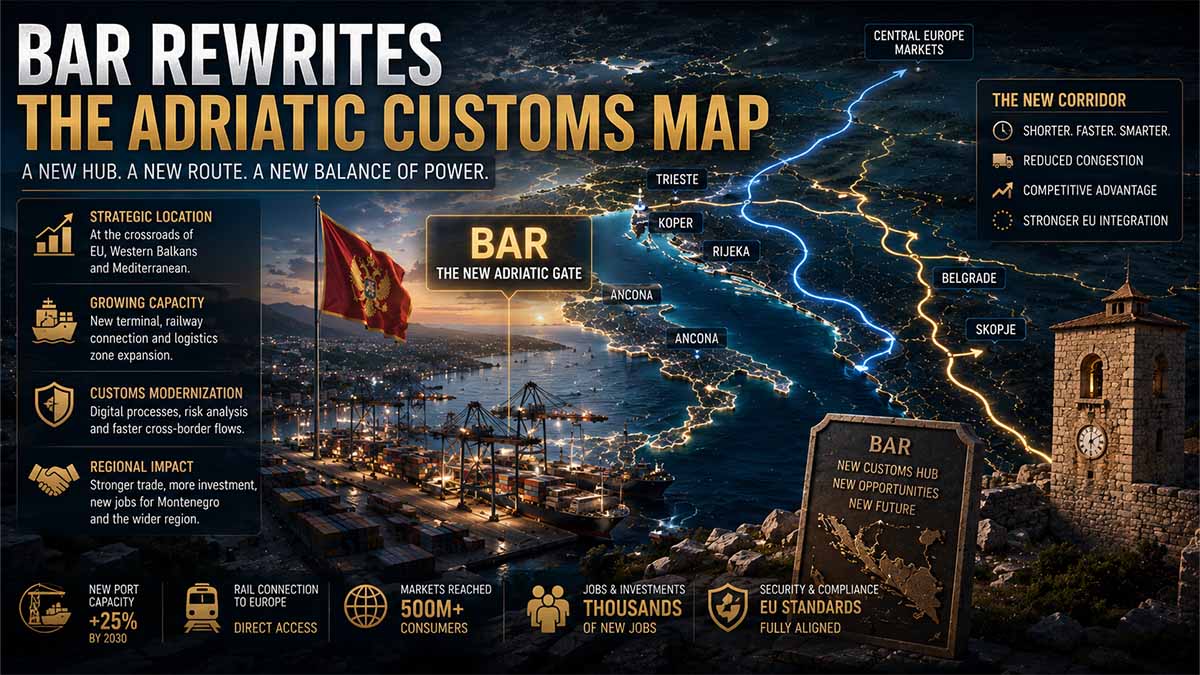
BLUF: Montenegro’s European advance can transform the Port of Bar from a peripheral national facility into a forward node of the EU customs, sanctions and supply-chain security perimeter.
On 14 July 2026, the EU and Montenegro provisionally closed Chapters 8—Competition Policy and 29—Customs Union, raising the total to 18 of 33 chapters.
Provisional closure is a political and regulatory milestone, not proof that operational integration, enforcement capacity or accession are irreversible.
The decisive physical enabler is the Bar–Belgrade railway, especially the EU-financed reconstruction of the Bar–Golubovci section.
Bar’s strategic value derives less from present scale than from its ability to connect the Adriatic with Serbia, Hungary and Central European industrial corridors.
Its development could complement Italian transshipment and gateway ports, but it could also contest selected cargo flows handled through Bari, Ancona, Ravenna, Trieste and Gioia Tauro.
The principal vulnerability is the gap between legislative alignment and the effective control of operators, cargo ownership, beneficial ownership, digital declarations and sanctions-sensitive trade.
The five-year base case is accelerated Europeanisation without immediate displacement of larger Italian ports; the high-impact case is Bar becoming the southern customs gateway of an integrated Adriatic–Balkan rail corridor.
The critical indicator is not aggregate tonnage alone, but the combination of rail reliability, customs interoperability, operator independence, port digital security and EU-grade risk targeting.
The Port of Bar: Europe’s New Customs Frontier in the Adriatic
Montenegro is small enough to be overlooked and strategically positioned enough to alter the commercial geography of the Adriatic. On 14 July 2026, the European Union provisionally closed Montenegro’s negotiating chapters on competition policy and the customs union. With all 33 chapters opened and 18 provisionally closed, Podgorica is now the most advanced candidate in the enlargement process. The immediate issue is political accession. The deeper issue is territorial: if Montenegro joins the Union, the Port of Bar could become a first point of entry into the European customs area for goods arriving from Asia, Türkiye, North Africa and the Eastern Mediterranean. Europe’s external commercial, fiscal and sanctions frontier would move southwards, onto a coastline connected by rail to Serbia and, potentially, Central Europe. (Consiglio Europeo)
The Border Moves South
The closure of Chapter 29 does not yet make Bar an EU port. Negotiating chapters remain provisional until an overall accession agreement is reached, and the Union can reopen them if implementation deteriorates. Nevertheless, the direction is unmistakable. On accession, Montenegro would apply the EU Common Customs Tariff, Union customs procedures, trade-defence measures and the commercial restrictions protecting the Single Market. Goods released for free circulation in Bar could subsequently move through the Union without undergoing a second import procedure at an Italian or Croatian external border.
This would transform Montenegro from a country adjacent to the European customs system into one of its maritime gatekeepers. The distinction matters because customs is no longer simply the collection of duties. It includes the verification of origin and value, anti-dumping measures, sanitary and environmental certificates, dual-use controls, sanctions enforcement, intellectual-property protection and the security screening of advance cargo information. A defective decision in Bar could therefore affect revenue, industrial competition and security throughout Europe. The EU delegation at the July conference was led by Ireland’s Minister of State for European Affairs and Defence, Thomas Byrne, with Enlargement Commissioner Marta Kos; Montenegro was represented by Prime Minister Milojko Spajić. (Consiglio Europeo)
A Port with Two Centres of Power
The Port of Bar is not a single corporate entity. Its strategic assets are divided mainly between state-controlled Luka Bar AD and Port of Adria AD, the container and general-cargo operator controlled by Global Ports Holding.
In December 2022, Montenegro purchased 10,459,654 additional Luka Bar shares, equivalent to 18.42% of the company, at €0.90 per share. The operation, worth approximately €9.41 million, increased the state holding to 72.2% and secured the qualified majority required for strategic decisions. The government described the acquisition as an investment of vital national interest and explicitly linked it to the ambition of making Bar a major logistics hub for Southeast Europe. Luka Bar appointed Aleksandar Slabiđoreski as chief executive in June 2026 and approved its audited 2025 accounts at the same shareholders’ meeting. (Vlada Crne Gore)
Port of Adria follows a different model. Global Ports Holding acquired its operating rights through the 2013 privatisation and holds 62.09% of the shares. The company reports nine berths, 1,440 metres of operational quay, an area of 518,790 square metres and nominal annual capacity of 750,000 TEU and six million tonnes of general cargo. Its entire area operates under the free-zone regime. These are important physical capacities, but they are not equivalent to actual traffic: terminal potential becomes economic power only when shipping services, customs clearance and rail connections operate reliably. (portofadria)
The Railway Decides the Port
Bar’s strategic value depends less on its quays than on the railway running through Podgorica and Vrbnica toward Serbia. Montenegro’s domestic market cannot alone support a major gateway port. Serbia is the indispensable hinterland; Belgrade is the point from which Bar can potentially reach Hungary and the manufacturing centres of Central Europe.
On 29 December 2025, the European Investment Bank announced a €175.6 million package to reconstruct 39 kilometres of the Bar–Golubovci railway. It combines a €63 million EIB loan with a €112.62 million EU grant. The project forms part of Rail Route 4 on the extended TEN-T core network and is expected to improve speed, safety, resilience and capacity, supporting 1.3 million passengers and 1.85 million tonnes of freight annually. The financing signatures were completed on 22 December 2025 and 22 January 2026. (Banca Europea per gli Investimenti)
This is a large intervention, but it modernises only the southern section of a long, mountainous and predominantly single-track corridor. Effective capacity will still depend on the northern Montenegrin route, the Serbian network, locomotive and wagon availability, passing loops, border handovers and the regularity of freight services. Bar will not become competitive because a railway exists; it will become competitive if scheduled trains depart on time, connect with vessel calls and reach Serbian terminals at a predictable cost.
Serbia’s Maritime Choice
Serbia already has multiple access routes to the sea: Bar, Rijeka, Koper, Trieste, Thessaloniki, Piraeus and Constanța, alongside Danube corridors. Distance alone will not determine the winner. A Serbian manufacturer compares the complete logistics bill: maritime freight, port handling, railway charges, customs time, storage, schedule frequency and the financial cost of delays.
Bar has a geographical advantage for parts of western and central Serbia and an industrial profile suited to grain, metals, chemicals, energy products and heavy cargo. Its container proposition is more demanding. Importers of automotive components, machinery and consumer goods require frequent liner calls and reliable block trains. A port with spare quay capacity but irregular services can remain commercially weaker than a more distant gateway with daily railway departures.
The modernisation of Serbia’s northbound railway toward Novi Sad, Subotica and Hungary could extend Bar’s reach into Central Europe—but only if the southern Bar–Belgrade corridor becomes dependable. The same Serbian infrastructure can otherwise strengthen competing routes connected to Greece or the northern Adriatic. Corridors are not politically loyal: freight follows reliability.
Italy: Competition or Integration
The effect on Italian ports will differ by function. Trieste is the most formidable gateway benchmark. In 2025, Trieste handled approximately 60 million tonnes, while the combined Trieste–Monfalcone system exceeded 64 million tonnes and moved 11,600 trains. Trieste alone recorded 7,939 trains; Germany accounted for 32% of its railway traffic, Austria 19% and Hungary 13%. Bar cannot reproduce this network density within five years. It could, however, compete for selected Serbian flows that do not require Trieste’s broader Central European system. (Porti Adriatici Orientali)
For Bari, Montenegro is more opportunity than threat. In the first nine months of 2025, Bari handled 75,000 TEU, more than 1.7 million tonnes of dry bulk and nearly four million tonnes of general cargo. A stronger Bar could support new Ro-Ro, ferry, refrigerated and project-cargo services across the southern Adriatic. The commercial question is whether Italian shipping, terminal and logistics companies capture those flows or leave them to competitors. (Adspmam)
Ravenna faces the clearest commodity-specific competition in cereals, fertilisers, metals and industrial bulk destined for Serbia. Ancona could encounter pressure in Balkan Ro-Ro and general cargo but also develop feeder and ferry integration. Gioia Tauro, which handled approximately 4.49 million TEU in 2025, is not Bar’s natural rival: it is a transshipment giant that could feed containers to Bar for onward rail transport. In a coordinated network, Bar’s growth could increase rather than diminish Italian maritime value. (portodigioiatauro.it)
The Free-Zone Test
The free-zone regime is Bar’s commercial accelerator and its principal security vulnerability. It allows goods to be stored, repacked, divided, transferred between owners or moved onward under suspended customs duties. These functions reduce working-capital costs and facilitate regional distribution. They also create opportunities to obscure the relationship between a shipment’s original exporter, present owner, declared destination and ultimate beneficiary.
Montenegro’s cigarette-smuggling legacy demonstrates the scale of this risk. From 23 June to 16 September 2025, authorities destroyed 130,003 packages containing approximately 1.326 billion cigarettes, together with cut tobacco, shisha tobacco and electronic cigarettes. The total destroyed weight reached 1,745,126 kilograms. The operation was conducted under video surveillance with Montenegrin customs and police participation and international oversight involving the United Kingdom’s HM Revenue and Customs and EU personnel. A further phase completed in December brought the total number of destroyed cigarette packages to 138,230. (Vlada Crne Gore)
This was an important assertion of state authority. It was also evidence that the free zone had supported an illicit commercial system of industrial dimensions. The next threat may not be tobacco. It may involve sanctioned machinery, dual-use electronics, counterfeit goods, undervalued commodities or cargo whose ownership changes while it remains inside the port.
Sanctions and Hidden Ownership
Montenegro’s integration into the EU customs perimeter would make Bar a frontline for enforcing European sanctions. Circumvention rarely arrives under the name of a listed company. It is organised through intermediaries, newly established importers, third-country exporters, false end users, altered commodity codes and layered beneficial ownership.
The port’s enforcement system must therefore connect cargo data with company registers, bank payments, directors, shareholders, shipping histories and technical product specifications. A declaration may appear correct while the underlying transaction is economically implausible. The decisive question is not merely what is inside the container, but who paid for it, who controls the consignee and where the goods will ultimately be used.
Foreign capital must be assessed with the same precision. Global Ports Holding’s role at Port of Adria is a lawful, publicly disclosed investment, not evidence of illicit influence. Nevertheless, Montenegro acknowledged in March 2025 the need to establish a national foreign-direct-investment screening mechanism. For a future EU border state, scrutiny must extend beyond terminal ownership to operating software, remote maintenance, energy storage, rail systems, telecommunications and port-adjacent land. Strategic dependence can arise from technology and financing even when equity ownership is transparent. (portofadria)
The Digital Frontier
Customs modernisation increases speed but also concentrates risk. Bar’s Port Community Systems, electronic declarations, warehouse records, transit messages and operator databases will increasingly determine which goods are inspected and which are released. A ransomware incident could halt the port; a subtler intrusion could change a risk score, suppress an inspection alert or alter the recorded ownership of a consignment.
The most vulnerable period will be the transition to full European interoperability, when legacy systems, new platforms, external contractors and emergency manual procedures coexist. Montenegro needs segmented networks, privileged-access controls, immutable audit logs, independent penetration tests and tested recovery procedures. Cybersecurity is not an auxiliary IT function: once Bar becomes part of the European customs perimeter, the integrity of its data becomes an element of continental economic security.
The Five-Year Decision
By 2031, Bar is unlikely to displace the principal Italian or northern Adriatic ports. Its more plausible transformation is narrower and strategically significant: an EU-aligned industrial and logistics gateway serving Serbia, capable of attracting selected bulk, energy, automotive and container flows.
Three variables will decide the outcome. The first is railway reliability, not infrastructure expenditure alone. The second is customs and sanctions enforcement, especially inside the free zone. The third is Italy’s response. If Bari, Ancona, Ravenna, Trieste and Gioia Tauro treat Bar solely as a competitor, other maritime networks may capture its growth. If they integrate it through feeder services, Ro-Ro routes, rail partnerships, insurance, digital customs and industrial logistics, Montenegro’s European advancement can reinforce an Italian-centred Adriatic system.
Bar is still a small port in a small state. But European borders are defined by flows, not national size. The country that controls the first reliable customs and railway gateway between the lower Adriatic and Serbia will influence where goods are inspected, financed, insured and routed. Montenegro’s accession is therefore not simply another chapter of enlargement. It is the possible redrawing of the Adriatic’s economic frontier.
Navigational Index
Pillar I — The New European Border
Accession mechanics, Customs Union integration, competition policy, external-tariff alignment and the conversion of Montenegro’s coastline into part of the European trade-control perimeter.
Pillar II — The Bar–Belgrade Logistics System
Port ownership, concessions, free-zone governance, terminal specialization, railway capacity, Serbia-facing corridors and competition or complementarity with Italian ports.
Pillar III — Enforcement Under Pressure
Sanctions evasion, beneficial-ownership opacity, cyber vulnerabilities, foreign capital, customs fraud, transshipment manipulation and alternative five-year strategic outcomes.
Master Abstract
The event of 14 July 2026 must be interpreted as a change in the strategic probability distribution surrounding Montenegro rather than as a completed transfer of sovereignty to the European customs architecture. At the twenty-eighth EU–Montenegro Accession Conference, the parties provisionally closed negotiations on Chapter 8, Competition Policy, and Chapter 29, Customs Union; all 33 chapters have now been opened and 18 provisionally closed. The Council explicitly states, however, that provisional closures are not final until an overall accession agreement is reached and that the Union may return to individual chapters if implementation deteriorates. This distinction is fundamental. Chapter 29 concerns the body of rules through which a member state applies the common customs tariff, customs procedures, trade-security controls and the protection of national and EU financial interests. Its closure therefore raises the likelihood that Montenegro will eventually move from being a small external jurisdiction adjacent to the Union into a component of the Union’s external commercial frontier. Enlargement: EU and Montenegro close accession negotiations on competition policy and customs union – Council of the European Union – July 2026 — Verified official source. The Montenegrin Customs Administration describes the chapter’s closure as confirmation of legislative modernization, administrative reform and digitalisation; analytically, this is evidence of formal convergence but not an independent audit of enforcement effectiveness. Closure of Chapter 29 confirms readiness for integration into the European customs area – Customs Administration of Montenegro – July 2026 — Verified official source. A Bayesian update based on these developments raises the probability of Montenegro becoming an EU customs territory within the five-year horizon, but the posterior remains conditional on rule-of-law performance, administrative continuity, border-management systems and the successful closure of the remaining chapters. The strategically overlooked consequence is geographic: once Montenegro applies the full EU customs acquis, the Port of Bar no longer functions merely as Montenegro’s maritime gateway. It becomes a potential first point of EU entry for cargo originating in Asia, Türkiye, North Africa and the Eastern Mediterranean, shifting part of Europe’s inspection, tariff, sanctions and supply-chain-security burden to a state of approximately Adriatic micro-scale but continental logistical reach.
Bar’s strategic option value rests on the interaction of maritime access, railway geography and European infrastructure finance rather than on an assumption that present cargo volumes already rival the principal Italian or Northern Adriatic ports. The Bar–Vrbnica line is Montenegro’s physical connection to Serbia and, through the Serbian network, to Central European markets; its chronic constraints have historically limited the port’s ability to convert geographical proximity into dependable gateway traffic. This bottleneck is now receiving unusually large institutional support. In December 2025, the European Investment Bank announced a €175.6 million package for reconstruction of 39 kilometres of the Bar–Golubovci section, comprising a €63 million EIB loan, a €112.6 million EU grant, additional EBRD financing and a national contribution within a project estimated at approximately €230.8 million. The investment is designed to increase safety, reliability, speed and capacity and is expected to support annual movement of 1.85 million tonnes of freight on the upgraded section. Montenegro: European Union to invest €175 million to upgrade Bar–Golubovci railway line – European Investment Bank – December 2025 — Verified official source. The EIB project record identifies the line as part of Rail Route 4 and the extended TEN-T core network, connecting the Port of Bar with Belgrade and the wider European railway system. Rail Route 4 Rehabilitation Bar–Golubovci – European Investment Bank – July 2025, updated 2026 — Verified official project record. A separate €75.5 million package signed in 2024 supports rehabilitation across the wider 167-kilometre Bar–Podgorica–Vrbnica axis, including tunnels, bridges, workshops and depots. Montenegro Railways Rehabilitation – European Investment Bank – May 2024 — Verified official source. These investments do not guarantee commercial capture: shipping frequency, terminal productivity, rolling-stock availability, Serbian network performance, customs dwell time and contractual reliability remain decisive. They nevertheless alter the structural equation. A functioning railway can allow Bar to serve Serbian metals, automotive inputs, agricultural commodities, energy products and containerised imports while offering shippers an Adriatic alternative to routes through Koper, Rijeka, Trieste, Thessaloniki or Constanța. Italian ports would therefore face differentiated effects: Bari and Ancona could gain from feeder, ferry and project-cargo connectivity; Ravenna could encounter competition in dry bulk and industrial cargo; Trieste could defend its position through superior rail density and established Central European services; Gioia Tauro could remain dominant in large-scale transshipment yet lose selected Balkan relay flows if direct calls at Bar become commercially sustainable.
The central intelligence problem is the separation of legal Europeanisation from operational Europeanisation. Montenegro retains a port system whose governance involves state assets, corporate operators, concession relationships, a free-zone environment, rail entities, customs authorities and private logistics intermediaries. The government stated in 2022 that it already held approximately 54% of Luka Bar AD and sought to increase its position toward a two-thirds strategic stake, demonstrating that the port is treated as an asset of national interest rather than as an ordinary infrastructure holding. Increase of state ownership in Luka Bar – Ministry of Finance of Montenegro – December 2022 — Verified official source. Luka Bar’s official financial repository now publishes its 2025 audited financial report, management report, financial statements and corporate-governance declaration, creating a documentary basis for the subsequent ownership and performance audit required in Chapter 1. Financial Data and 2025 Audit Documentation – Luka Bar AD – 2026 — Verified corporate disclosure repository. Yet formal disclosure does not by itself resolve the risk chain. The relevant threat model includes false origin declarations, under-invoicing, dual-use components embedded in civilian consignments, ship-to-ship or port-to-port cargo relabelling, fragmented beneficial ownership, sanctioned-party proxies, manipulation of transit procedures and compromise of customs or port-community IT. The Analysis of Competing Hypotheses must therefore test at least five alternatives: H₁, Bar becomes an EU-compliant regional gateway; H₂, infrastructure improves but traffic remains commercially marginal; H₃, Bar becomes primarily a complementary feeder and industrial port linked to Italy; H₄, fragmented governance produces a sanctions and customs-enforcement weak point; and H₅, foreign capital and corridor competition generate a hybrid outcome in which commercial expansion outpaces regulatory control. The current Bayesian base case assigns greatest weight to H₁–H₃, because EU financing and accession conditionality generate strong institutional convergence, but H₄ cannot be dismissed: small administrative systems can be exposed to concentrated influence, specialist-skill shortages, cyber dependence and high-impact corruption attempts. Over 2026–2031, Bar’s strategic success should consequently be measured through a composite index combining rail availability, port dwell time, non-intrusive inspection coverage, electronic risk-screening maturity, beneficial-ownership transparency, sanctions alerts, customs-post-clearance audits and the share of cargo moved by scheduled rail rather than by road.
Port of Bar: Five-Year Strategic Transition Model
| Threat vector | Likelihood | Impact | Detectability | Priority |
|---|---|---|---|---|
| False origin | Medium | High | Medium | Critical |
| Dual-use concealment | Medium | Very high | Low | Critical |
| Beneficial-owner proxy | Medium | High | Medium | High |
| Customs IT compromise | Low–medium | Very high | Low | Critical |
| Transit diversion | Medium | Medium | Medium | High |
Pillar I — The New European Border: How Montenegro Could Recode the Adriatic Customs Perimeter
Accession is not membership—but the probability distribution has changed
The provisional closure of Chapter 8—Competition Policy and Chapter 29—Customs Union on 14 July 2026 does not yet place Montenegro inside the EU Customs Union, eliminate customs controls between Montenegro and Italy, or convert the Port of Bar into an EU port. It does, however, materially alter the probability that these outcomes will occur within the next five years. Montenegro has opened all 33 negotiating chapters and provisionally closed 18, but the Council’s language is deliberately conditional: agreements on individual chapters are not final until an overall accession agreement has been reached; implementation will continue to be monitored; and the EU may return to either chapter if alignment, administrative capacity or enforcement deteriorates. More importantly, the EU common position on Chapter 29 records Montenegro’s acceptance of the customs acquis in force on 16 April 2026 and its commitment to implement that acquis by accession. This creates a moving-target obligation because customs legislation adopted after that date may also have to be incorporated before membership. The accession treaty will additionally need transitional provisions covering proofs of origin issued under Montenegro’s existing preferential agreements, customs warehousing, inward processing, temporary admission, remission, recovery and repayment of duties. These are not technical footnotes. They determine whether goods already stored, processed or travelling under pre-accession procedures can be discharged without creating tariff leakage, double taxation or legal uncertainty. The strategic conclusion is therefore precise: Chapter 29 has passed from negotiation over whether Montenegro accepts the European customs system to verification of whether it can operate that system without becoming an exploitable weak point. European Union Common Position—Chapter 29: Customs Union – Conference on Accession to the European Union – July 2026 — Verified official document. Enlargement: EU and Montenegro close accession negotiations on competition policy and customs union – Council of the European Union – July 2026 — Verified official announcement.
| Accession mechanism | Status at 29 July 2026 | Strategic meaning for Bar | Residual vulnerability |
|---|---|---|---|
| Chapters opened | 33 of 33 | Entire acquis is under negotiated alignment | Opening does not prove implementation |
| Chapters provisionally closed | 18 of 33 | Montenegro is the leading candidate by closure count | Any chapter may be revisited |
| Chapter 29 | Provisionally closed | Legal route toward application of the EU customs acquis | IT and enforcement remain conditional |
| Chapter 8 | Provisionally closed | State support and port concessions face EU competition discipline | Enforcement track record remains decisive |
| Accession treaty | Not concluded | Would define the exact legal conversion date | Requires unanimity and ratification |
| EU customs-territory status | Not yet obtained | Bar remains outside the EU Customs Union until accession | Present trade still requires border formalities |
| Internal EU frontier with Croatia | Future possibility | Customs border could move from Croatia–Montenegro to Montenegro–third-country interfaces | Depends on accession and implementation readiness |
| Maritime external frontier | Future possibility | Bar could become a first-entry customs point for the Single Market | Requires full interoperability and equivalent control |
The legal transformation: from preferential partner to external-border administrator
Montenegro’s present commercial relationship with the EU rests principally on the Stabilisation and Association Agreement, which entered into force on 1 May 2010 and progressively established bilateral trade preferences, tariff reductions and obligations to approximate national legislation to the acquis. That framework is fundamentally different from membership in the Customs Union. Under association, Montenegro retains its own customs territory, tariff policy, trade agreements and customs administration; goods entering Bar from China, Türkiye, the Gulf or North Africa do not acquire Union status merely because they are cleared in Montenegro. When those goods subsequently enter Croatia or cross the Adriatic into Italy, they encounter the EU external customs frontier unless they qualify as Montenegrin-origin goods under applicable preferential rules. Upon accession, the architecture reverses. Montenegro would apply the Common Customs Tariff, Union customs procedures and EU commercial-policy measures at Bar itself. Goods properly released for free circulation there would, subject to applicable rules and controls, enter the circulation space of the Single Market; conversely, Montenegro would surrender the ability to maintain incompatible national tariff concessions or bilateral customs provisions. The coastline would therefore cease to be merely a Montenegrin revenue boundary and become an enforcement boundary protecting the customs duties, anti-dumping measures, quotas, product rules, sanctions and financial interests of all member states. The operational chain would extend from ship manifest and advance cargo declaration through risk analysis, inspection, tariff classification, valuation, origin determination, payment or guarantee, release, post-clearance audit and inland transit. A failure at any point would not remain geographically local: undervalued components released in Bar could move toward Serbia, Hungary or Italy, while prohibited or sanctions-sensitive goods could be fragmented, re-labelled or diverted before detection. Stabilisation and Association Agreement with Montenegro – European Union – May 2010 — Verified official legal summary and instrument. European Union Common Position—Chapter 29: Customs Union – Conference on Accession to the European Union – July 2026 — Verified official document.
| Regulatory function | Montenegro before accession | Montenegro from accession, absent a derogation | Adriatic effect |
|---|---|---|---|
| External tariff | National customs tariff aligned progressively with EU nomenclature | Common Customs Tariff applies | Tariff decision moves to Bar |
| Trade agreements | Montenegro’s existing bilateral and regional commitments | EU common commercial policy governs | Incompatible arrangements must cease or be adapted |
| Import release | Release into Montenegro only | Release potentially into the EU customs territory | Bar becomes a Single Market entry gate |
| Transit | Common Transit Convention already available | Union transit plus full EU-system participation | Lower procedural friction toward EU destinations |
| Customs revenue | National fiscal revenue | Includes collection obligations connected to EU own resources | Errors affect the EU budget |
| Sanctions/trade restrictions | National implementation of aligned restrictive measures | Direct application of relevant Union rules | Enforcement equivalence becomes mandatory |
| Risk management | National methodology approximating EU standards | Integration into EU customs-risk architecture | Maritime targeting acquires Union-wide consequences |
| Free zones | National supervision | Must operate under EU customs law and controls | Storage and processing require heightened traceability |
| Non-customs certificates | National inter-agency validation | Integration with EU customs and sectoral systems | Health, environment and product controls become interoperable |
External-tariff alignment is a data-governance problem, not merely a rate schedule
The public debate tends to reduce customs-union integration to the adoption of the same tariff rates, but the more difficult task is maintaining an auditable relationship among classification, origin, valuation, restrictions and end use. The EU common position records that Montenegro’s Customs Law is generally aligned with the Union Customs Code and that its national rules already cover customs status, transit, valuation, tariff classification, origin, security, risk management and the Authorised Economic Operator programme. It also welcomes Montenegro’s annual alignment with the EU’s Combined Nomenclature and Common Customs Tariff. Yet tariff alignment at the legislative level cannot prevent evasion if operators can manipulate commodity codes, declare an implausibly low customs value, conceal the non-preferential origin of transformed goods, or exploit inward-processing and warehousing procedures without robust inventory reconciliation. For the Port of Bar, the highest-risk categories are likely to be those where tariff classification intersects with anti-dumping duties, quotas, export controls, sanctions or substantial differences between raw materials, semi-finished goods and finished products. A steel product, battery component, automotive subassembly, aluminium input, machine tool or electronic device may have radically different treatment depending on composition, technical characteristics, origin and declared use. Montenegro’s transition therefore requires more than a tariff database: it needs laboratories, binding classification expertise, origin-verification capability, valuation reference systems, exchange of information with exporting jurisdictions, post-clearance audit and the ability to connect import declarations with company accounts, invoices, transport documents, beneficial ownership and downstream movement. The Council also identifies specific remaining gaps, including cross-border cash control, cultural-goods legislation and full alignment on drug precursors. These narrow issues are analytically important because they reveal the surviving seams in an otherwise advanced chapter. European Union Common Position—Chapter 29: Customs Union – Conference on Accession to the European Union – July 2026 — Verified official document. Montenegro Report 2025 – European Commission – November 2025 — Verified official report.
Customs-decision dependency chain
DIGITAL CUSTOMS & BORDER CONTROLS SYSTEM
An end-to-end 3D structural visualizer mapping the automated EU/ICS2 customs clearing pipeline—from maritime arrival and advance cargo risk analysis down to declaration vetting, tri-color automated risk routing, NCTS transit tracking, and post-clearance revenue control.
NCTS has already changed Bar’s logistical status before accession
The most consequential pre-accession development is Montenegro’s entry into the Convention on a Common Transit Procedure and the Convention on the Simplification of Formalities in Trade in Goods on 1 November 2025. Montenegro’s Customs Administration confirms that the first declaration was successfully submitted that day through the New Computerised Transit System, placing Montenegro in the common-transit network with EU member states, EFTA countries, the United Kingdom, Serbia, North Macedonia, Türkiye, Ukraine, Georgia and Moldova. The procedure permits goods to move across contracting parties under one electronic transit declaration and one guarantee while import duties and certain commercial-policy measures remain suspended until the goods reach the authorised destination or leave the procedure. For Bar, this removes a substantial administrative discontinuity. A container arriving from Asia can be placed under common transit and transported toward Serbia without completing full importation in Montenegro; a Serbian exporter can route cargo to Bar under the same network; and authorised operators can reduce duplicated documentation and guarantee fragmentation. This does not make Montenegro an EU member, but it pre-positions the port inside the digital transit topology that accession would later deepen. The risk is symmetric. Transit simplification increases velocity, but it also raises the cost of weak guarantee management, seal integrity, route monitoring, office-of-destination confirmation and discharge reconciliation. A fraudulent transit operation can falsely declare that goods are moving onward while diverting them into domestic or regional markets. NCTS therefore needs to be read simultaneously as a trade-facilitation system and an anomaly-detection network. The strategic indicator is not the number of declarations submitted but the ratio of movements discharged correctly, the frequency of unresolved enquiries, guarantee claims, route deviations, rejected messages and consignments subject to control. Montenegro Officially Started Implementation of the New Computerised Transit System – Customs Administration of Montenegro – November 2025 — Verified official source. Customs Transit Procedure—NCTS – Customs Administration of Montenegro – 2025/2026 — Verified official source. New Computerised Transit System – European Commission, DG TAXUD – updated 2026 — Verified official system description.
| NCTS control point | Commercial benefit | Principal fraud vector | Required intelligence metric |
|---|---|---|---|
| Electronic declaration | Less paper and faster submission | False goods description | Data-quality rejection rate |
| Single guarantee | Lower working-capital burden | Insufficient or fraudulent guarantee | Guarantee exposure by operator |
| Office of departure | Faster dispatch | Weak identity or seal control | Control rate by risk category |
| En-route movement | Continuous procedure across borders | Route diversion or load substitution | Geospatial and timing anomalies |
| Office of destination | Automated arrival notification | False arrival confirmation | Unresolved transit enquiries |
| Procedure discharge | Faster release of guarantee | Premature or erroneous discharge | Delayed discharge ratio |
| Common data exchange | Cross-border traceability | Inconsistent identifiers across systems | EORI/operator-match failures |
| Combined ENS/transit data | Reduced duplication | Missing security data | Completeness of advance-data fields |
The decisive threshold is interoperability with the EU’s digital customs environment
The Council’s July 2026 position is unusually explicit about the digital condition attached to Montenegro’s future membership: integration into the Customs Union will only be possible if all required EU customs systems are implemented, connected and interoperable. Montenegro has deployed NCTS Phase 6, added national functionalities for declarations, customs decisions, automated risk management and advance data on maritime and postal traffic, and adopted a development programme covering 11 national components donated by Slovenia, together with the Automated Export System and Import Control System 2. The positive assessment is nevertheless paired with a detailed warning. Montenegro must create credible project timelines, milestones and governance, maintain internal business and IT expertise, preserve contractor support, train customs officials and traders, and finance continuous maintenance as EU systems evolve. The Council requires at least 40 additional full-time customs officials annually, equivalent to roughly 10% of the staffing base referenced in the document, until accession. It also requires six-monthly progress reports because inadequate IT implementation could allow Montenegro to be used as an entry point for circumvention of Customs Union rules. This is the core OSINT finding: Brussels itself has formally identified the risk scenario at the centre of this report. The problem is not only whether software is installed, but whether the national administration can maintain high availability, secure interfaces, certificate management, identity controls, audit logs, business-continuity plans, incident response and data quality across maritime, rail, road and postal channels. Montenegro’s announcement that paper declarations and supporting documents will cease to be accepted from 1 September 2026, with procedures conducted through XML message exchange, constitutes a major operational transition. The temporary interruption in electronic message exchange reported on 22 June 2026, even though the customs information system itself remained operational and transit continued, demonstrates why resilience must be measured independently from legal compliance. European Union Common Position—Chapter 29: Customs Union – Conference on Accession to the European Union – July 2026 — Verified official document. Transition to Paperless Customs Operations from 1 September 2026 – Customs Administration of Montenegro – July 2026 — Verified official source. Notice concerning the temporary interruption of customs electronic messaging – Customs Administration of Montenegro – June 2026 — Verified official source.
| Digital system or layer | Function | Montenegro status evidenced publicly | Accession-critical failure mode |
|---|---|---|---|
| NCTS Phase 6 | Common and Union transit | Implemented and positively assessed | Invalid discharge, route diversion, incomplete ENS |
| ICS2 | Advance cargo security information | Included in national implementation programme | High-risk cargo enters without adequate pre-arrival analysis |
| AES | Electronic export processing | Included in implementation programme | False exit, sanctions-export leakage |
| National declaration system | Import/export declaration processing | New electronic functionalities; paperless transition announced | Message rejection, identity failure, downtime |
| Automated risk management | Selectivity and targeted control | Additional functionality reported | Poor risk rules produce either leakage or congestion |
| Maritime advance data | Pre-arrival cargo visibility | Processing capability reported | Incomplete bills of lading and vague descriptions |
| Postal-traffic data | Parcel and e-commerce screening | Processing capability reported | High-volume low-value circumvention |
| EU Single Window | Customs/non-customs certificate interoperability | New legal basis planned | Forged or overused licences and certificates |
| EU central customs systems | Union-wide connectivity | Must be completed by accession | National data remain isolated |
| Trader interfaces | Operator submission and messaging | XML-based paperless model from September 2026 | Small operators fail onboarding or use intermediaries opaquely |
| Cybersecurity and continuity | Availability, integrity and recovery | Not fully evidenced through public technical audits | Disruption, manipulation or unauthorised access |
Single Window integration will convert customs into a multi-agency border-control platform
The planned Montenegrin Law on Single Window is strategically significant because modern customs control is no longer confined to tariff collection. The EU Single Window Environment for Customs connects national customs systems with Union non-customs systems through EU CSW-CERTEX, permitting customs authorities to validate certificates, licences, permits, quantities and registrations issued under rules governing food safety, animal and plant health, environmental controls, organic products, fisheries, cultural goods and other regulated domains. The first layer operates government-to-government; a later business-to-government phase, planned at EU level for 2031, is intended to allow operators to submit integrated data through a single national portal. For Bar, this means that the strategic frontier would not simply decide whether duty has been paid. It would determine whether an imported food product possesses valid sanitary certification, whether a regulated chemical or precursor is authorised, whether an environmental quota has been consumed, whether an organic certificate is genuine, whether a cultural object can be imported, or whether a product subject to market-surveillance rules can circulate. Quantity management is especially important: an operator must not be able to reuse the same authorisation across multiple declarations or ports. The intelligence vulnerability lies in the interfaces. If customs data identify the product differently from the certificate database, if units of measurement are inconsistent, if licences are not reserved and written off in real time, or if manual overrides lack auditability, a formally digital border can still permit systematic fraud. Montenegro must therefore construct not one customs platform but an inter-agency federation involving customs, food safety, agriculture, environmental authorities, market surveillance, police, financial intelligence and relevant ministries. The maturity benchmark should be successful automated reconciliation across authorities, not merely portal availability. The EU Single Window Environment for Customs – European Commission, DG TAXUD – updated 2026 — Verified official source. European Union Common Position—Chapter 29: Customs Union – Conference on Accession to the European Union – July 2026 — Verified official document.
Competition policy determines whether Bar becomes an open gateway or a politically allocated asset
The provisional closure of Chapter 8 is inseparable from the customs transformation because port economics are shaped by concessions, state ownership, public guarantees, infrastructure subsidies, access charges, rail operating rights and the allocation of scarce terminal capacity. The European Commission’s 2025 assessment classified Montenegro as moderately prepared in competition policy and recorded some progress, notably the July 2025 Law on State Aid Control, but it also stated that Montenegro needed to complete legislative alignment, develop a credible enforcement record and strengthen administrative and judicial capacity. The Agency for Protection of Competition had recruited two additional staff members in 2024 but still faced unfilled positions, limited operational and financial capacity and insufficient cooperation with regulators. In 2024 it issued two cartel-prohibition decisions and approved 79 notified concentrations, many with extraterritorial effects. On state aid, it issued 39 decisions and opinions in ex ante and ex post procedures, while investigations continued in sectors involving aviation, highways, energy and public enterprises. These findings matter directly to Bar. A port can appear commercially successful while being structurally dependent on selective rebates, non-market land allocation, public guarantees, preferential rail access, subsidised handling equipment or opaque concession amendments. Under EU discipline, support may still be possible, but its compatibility, necessity, proportionality and incentive effect must be assessed. A dominant terminal operator must not be allowed to discriminate against competing shipping lines, freight forwarders or rail operators; public authorities cannot use concession design to entrench politically connected incumbents; and infrastructure pricing must distinguish between public-interest investment and selective economic advantage. The strategic opportunity is that credible competition enforcement could make Bar more investable by reducing arbitrary access and subsidy risk. The strategic danger is that formal compliance conceals concentration, related-party contracting or dependence on state-owned operators. Montenegro Report 2025 – European Commission – November 2025 — Verified official report. Enlargement: EU and Montenegro close accession negotiations on competition policy and customs union – Council of the European Union – July 2026 — Verified official announcement.
| Port-related competition vector | Legitimate public objective | Distortion risk | Evidence required for EU-grade assessment |
|---|---|---|---|
| Port concession | Mobilise private capital | Tailored award or excessive duration | Open procedure, valuation, publication, performance clauses |
| Terminal access | Efficient cargo handling | Exclusion of rival carriers or forwarders | Transparent tariffs and non-discrimination |
| State capital injection | Upgrade infrastructure | Cross-subsidy of commercial losses | Market-economy operator test and business plan |
| Public guarantee | Reduce project-finance cost | Selective advantage and moral hazard | Risk pricing, proportionality, repayment capacity |
| Rail access | Develop intermodal traffic | Discrimination between freight operators | Capacity-allocation rules and access-charge methodology |
| Land lease | Attract logistics investment | Below-market allocation | Independent valuation and competitive award |
| Equipment grant | Improve security or environmental performance | Subsidised commercial capacity | Eligible-cost separation and proportionality |
| Volume rebate | Attract shipping services | Foreclosure of smaller operators | Objective, published and replicable criteria |
| Free-zone incentives | Promote processing and re-export | Hidden tax or customs advantage | Compatibility with customs and state-aid rules |
| Rescue support | Preserve continuity | Perpetuation of inefficient operators | Restructuring plan, burden sharing and viability |
Sanctions enforcement turns Bar into a strategic-security frontier
The most sensitive change would be the extension of the Union’s sanctions and trade-control perimeter to the Montenegrin coast. Montenegro already adopts national decisions implementing EU restrictive measures concerning Russia, and a March 2026 government proposal updated references to successive EU decisions and regulations. Nevertheless, accession would deepen the legal and institutional consequences because relevant Union regulations would apply directly and customs would become responsible for preventing prohibited imports, exports and transit through an EU external border. The threat model is broader than a vessel openly declaring a sanctioned Russian consignee. Circumvention typically exploits intermediary companies, false end users, altered commodity descriptions, re-export through nominally neutral jurisdictions, transshipment, split consignments, undervaluation, removal of serial numbers, and goods whose dual-use characteristics are not evident from a generic commercial description. Bar’s risk exposure would be determined by its maritime links, free-zone practices, container-routing patterns, road and rail connectivity, customs-broker ecosystem and capacity to correlate cargo data with corporate, banking and sanctions information. Cross-border cash control is a particularly relevant unresolved issue because the Council’s common position explicitly states that Montenegro’s legal framework still needs alignment with the acquis. Cash, bearer instruments, trade-based money laundering and opaque settlement arrangements can accompany customs fraud even when the physical commodity is not itself prohibited. The shadow dimension is therefore financial: a customs declaration may appear formally valid while invoices, payment chains or beneficial owners reveal sanctions exposure. Effective protection requires joint targeting by customs, financial intelligence, police, prosecutors, export-control authorities and foreign partners, followed by seizure, investigation and judicial outcomes. The essential metric is not the number of sanctions rules transposed but the conversion rate from alert to intervention, evidentiary preservation, prosecution or administrative penalty. Proposal amending the Decision introducing international restrictive measures concerning actions of the Russian Federation destabilising Ukraine – Government of Montenegro – March 2026 — Verified official source. European Union Common Position—Chapter 29: Customs Union – Conference on Accession to the European Union – July 2026 — Verified official document.
| Circumvention pathway | Port-level observable | Data fusion required | Indicative control response |
|---|---|---|---|
| False origin | Recent supplier change; implausible processing country | Certificates, production capacity, shipping history | Verification request and physical sampling |
| Dual-use misclassification | Generic description; unusual consignee | Tariff code, technical specifications, end-user profile | Specialist classification and licence check |
| Transshipment laundering | Multiple short port calls; changed bill of lading | Manifest history, container number, vessel routing | Hold and reconstruct chain of custody |
| Proxy ownership | Newly incorporated importer with limited activity | Beneficial ownership, bank accounts, directors | Enhanced due diligence and financial-intelligence referral |
| Split consignments | Repeated low-value shipments below control thresholds | Operator-level aggregation | Pattern detection across declarations |
| False transit | Cargo fails to reach declared destination | NCTS, seals, timing and route data | Enquiry, guarantee claim, investigation |
| Free-zone diversion | Inventory discrepancy or unexplained processing loss | Warehouse records, CCTV, customs accounts | Stock audit and suspension of authorisation |
| Invoice manipulation | Value inconsistent with commodity benchmark | Payments, invoices, related-party links | Valuation adjustment and money-laundering analysis |
| Maritime identity manipulation | Inconsistent vessel, shipper or consignee identifiers | AIS, IMO records, manifests, sanctions lists | Enhanced vessel and party screening |
| Cyber-enabled alteration | Post-submission data changes or unusual credentials | Audit logs, access records, authentication events | Incident response and declaration freeze |
Administrative capacity is the true accession bottleneck
The European Commission’s 2025 report described Montenegro as moderately prepared in customs policy despite good progress, explicitly identifying concerns over staffing and funding in the Customs Administration’s IT department and the implementation of major customs systems. The July 2026 common position improved the assessment but did not remove the capacity condition. It called for annual recruitment of at least 40 additional officials, including IT specialists, and emphasised training, control equipment, performance measurement, clearance modernisation, anti-corruption safeguards and the ability to manage larger trade volumes. These requirements should be interpreted against the wider institutional baseline. The Commission’s 2025 country report stated that public-administration capacity remained weak because of delayed recruitment, acting positions and temporary contracts; it also noted that corruption-prevention bodies faced resource constraints and that Montenegro needed stronger prosecution, conviction and confiscation results in serious organised-crime and high-level corruption cases. Customs is particularly vulnerable because individual decisions can determine whether goods worth millions of euros are delayed, released, reclassified, seized or assessed for additional duty. A small number of specialist officers may hold disproportionate authority over valuation, origin, risk rules, IT access, free-zone supervision and post-clearance audits. The risk is therefore concentration of expertise and influence: losing several technical staff, compromising a privileged account or capturing a local control chain can have system-wide effects. A credible readiness assessment must measure vacancy rates, tenure, rotation policies, conflict-of-interest declarations, privileged-access reviews, disciplinary outcomes, salaries relative to private logistics roles, training hours, penetration testing, disaster recovery and the independence of internal control. No public statement of “readiness” substitutes for these indicators. Montenegro Report 2025 – European Commission – November 2025 — Verified official report. European Union Common Position—Chapter 29: Customs Union – Conference on Accession to the European Union – July 2026 — Verified official document.
| Readiness domain | Officially evidenced progress | Remaining evidentiary gap | Five-year performance indicator |
|---|---|---|---|
| Legal alignment | Customs Law generally aligned | Continuous adaptation to new acquis | Delay between EU and national implementation |
| Staffing | Recruitment commitment and HR strategies | Vacancy, retention and specialist distribution | Filled posts; attrition; IT specialists per system |
| Integrity | Internal Control Department recognised | Public enforcement outcomes remain limited | Investigations, sanctions, asset declarations |
| IT delivery | NCTS P6 and programme for additional systems | Project schedule and operational testing | Milestone completion; defect and outage rates |
| Cyber resilience | Digital modernisation underway | No complete public technical audit | Mean recovery time; critical vulnerabilities |
| Risk targeting | Automated functionality reported | Detection performance not published | Positive-control rate; false-positive rate |
| Physical control | Capacity commitments noted | Scanner coverage and utilisation unclear | Percentage of targeted cargo scanned |
| Free-zone supervision | Stronger customs powers adopted | Inventory-reconciliation results unclear | Stock discrepancies and licence suspensions |
| Post-clearance audit | Required by EU model | Recovery and audit yield not fully public | Duties recovered per audit and operator risk |
| Revenue protection | EU own-resource responsibility acknowledged | Accession-level accounting still to be tested | Error rate and recovery timeliness |
| Operator management | AEO framework generally aligned | Number and quality of active authorisations | AEO compliance, suspension and revocation |
| Judicial follow-through | Competition and customs frameworks improving | Specialist judicial capacity constrained | Duration and final outcomes of cases |
Bayesian update and Analysis of Competing Hypotheses
The evidence available by 29 July 2026 justifies a substantial but not definitive upward revision in the probability that Montenegro will operate as an effective EU customs frontier by 2031. The prior probability should not be set from political declarations alone; it must incorporate the long duration of accession negotiations since 2012, institutional fragility, administrative constraints and the possibility that unresolved rule-of-law chapters delay membership. The principal positive evidence E₁ is the acceleration from seven provisionally closed chapters in the 2025 Commission reporting baseline to eighteen by July 2026. E₂ is the closure of Chapter 29 under an unusually detailed monitoring regime. E₃ is operational membership in common transit and implementation of NCTS. E₄ is the paperless customs transition and the funded programme for EU digital systems. E₅ is the closure of Chapter 8, which reduces uncertainty over the formal competition framework. Negative or cautionary evidence includes N₁, the continuing right of the EU to reopen chapters; N₂, explicit Council warnings that incomplete IT could create a circumvention entry point; N₃, staffing and contractor-dependence risks; N₄, residual gaps in cash controls and specialised customs fields; and N₅, broader concerns over public-administration, corruption and organised-crime enforcement. Using these variables in a structured qualitative Bayesian model, the probability that Montenegro is politically ready to conclude negotiations by 2030 is materially higher than it was before July 2026, but the probability of full operational equivalence at Bar must remain lower than the probability of legal accession. The distinction prevents a common analytical error: equating treaty entry with border maturity. The five competing hypotheses below are therefore ranked on operational outcomes rather than political slogans. Montenegro—Key accession milestones – European Commission – updated July 2026 — Verified official source. Enlargement: EU and Montenegro close accession negotiations on competition policy and customs union – Council of the European Union – July 2026 — Verified official source.
| Hypothesis | Description | Evidence supporting | Evidence contradicting | Analytical probability |
|---|---|---|---|---|
| H₁—Integrated frontier | Montenegro accedes and Bar operates at broadly EU-equivalent customs standards by 2031 | Chapter closure, NCTS, digital programme, recruitment commitment | Implementation burden and administrative scale | 34% |
| H₂—Legal accession, operational lag | Membership occurs, but temporary safeguards, enhanced monitoring or persistent weaknesses remain | Political acceleration and legal alignment | Explicit IT, staffing and governance risks | 27% |
| H₃—Delayed accession, deep pre-integration | Montenegro remains outside the EU in 2031 but functions as a highly integrated transit partner | Common transit already active; systems can advance pre-accession | Political and treaty uncertainties | 18% |
| H₄—Customs weak-point scenario | Trade and transit grow faster than risk control, creating circumvention exposure | Council warning, free-zone and cash-control vulnerabilities | Strong EU monitoring and accession conditionality | 12% |
| H₅—Political or institutional reversal | Domestic crisis, reform slowdown or chapter reopening delays transformation | Chapters remain provisional; institutions described as fragile | Strong accession consensus and recent closure momentum | 9% |
Probabilities are analytical estimates, not official forecasts. They sum to 100% and are designed for comparative scenario testing.
Monte Carlo five-year outlook: method, assumptions and results
A five-year Monte Carlo model was constructed as an analytical instrument rather than an empirical forecast. The model uses 50,000 simulated pathways across seven latent variables: accession-timetable execution A, customs-IT completion D, administrative-capacity growth C, enforcement integrity E, competition-policy credibility K, sanctions-control effectiveness S and external trade pressure T. Each variable is assigned a bounded distribution rather than a fixed value. Accession execution is modelled as a beta distribution centred above the midpoint because of the rapid chapter-closure sequence; digital completion receives a moderately positive distribution but with a downside tail reflecting the Council’s explicit implementation warnings; staffing capacity improves gradually under the annual recruitment commitment; integrity and sanctions performance are modelled with wider uncertainty because public outcome data are incomplete; competition-policy credibility improves more slowly than legal alignment; and trade pressure rises as transit becomes easier and railway and port connectivity improve. Correlations are included: stronger accession execution raises digital investment and administrative reform; higher trade pressure increases both commercial benefit and enforcement stress; weak cyber resilience amplifies the negative effect of rapid digitalisation; and stronger competition enforcement improves investor confidence but can initially slow politically favoured projects. A simulation is classified as “effective European frontier” when the combined legal, digital, human-capacity and enforcement score exceeds 75 of 100 without any critical system falling below 55. Under the base assumptions, 42% of pathways meet that threshold by 2031; 36% reach partial or legally advanced integration but retain material control gaps; 15% remain in extended pre-accession integration; and 7% experience severe delay or regression. The model’s greatest sensitivity is not to tariff alignment, which is already advanced, but to IT interoperability, retention of technical staff and sanctions-risk performance. These are model outputs derived from cited official evidence, not claims contained in the official sources. The Council’s requirement for complete digital implementation and six-monthly reporting provides the principal empirical basis for weighting digital readiness heavily.
| Model variable | Base 2026 analytical score | 2031 median | Downside decile | Upside decile | Primary observable |
|---|---|---|---|---|---|
| Accession execution A | 72 | 86 | 57 | 97 | Remaining chapters and treaty progress |
| Digital customs D | 61 | 82 | 52 | 96 | Systems tested and connected |
| Administrative capacity C | 55 | 74 | 46 | 91 | Recruitment, retention and training |
| Enforcement integrity E | 58 | 70 | 39 | 88 | Investigations, audit yield and disciplinary outcomes |
| Competition credibility K | 57 | 73 | 44 | 89 | Decisions, remedies and judicial confirmation |
| Sanctions effectiveness S | 56 | 72 | 41 | 91 | Detentions, referrals and final enforcement |
| Trade pressure T | 62 | 79 | 61 | 95 | Transit, port calls and cargo complexity |
| Composite frontier readiness | 60 | 78 | 51 | 93 | Weighted cross-system score |
The 2026–2031 implementation sequence
The most credible five-year path is not a single accession event but a layered transfer of functions. In late 2026, the immediate test is whether Montenegro completes its paperless transition without systematic declaration failures, establishes stable trader authentication and publishes operational indicators. During 2027, attention should move to detailed delivery schedules for ICS2, AES, Single Window components, customs decisions, guarantees, risk management and integration with EU central systems; recruitment must be visible in actual filled positions, not budget authorisations. In 2028, technical testing should become cross-border and scenario-based, including maritime pre-arrival data, rail transit, free-zone inventory, sanctions-sensitive cargo, disaster recovery and high-volume stress. By 2029, assuming the wider accession process remains on track, Montenegro should demonstrate equivalence through live operational statistics: declaration-processing time, transit discharge, inspection yield, customs debt recovery, post-clearance audit, system availability, cyber incidents and sanctions referrals. The final pre-accession phase would require cutover rehearsals that distinguish goods in temporary storage, warehousing, inward processing, transit and free circulation at the exact moment Union law becomes directly applicable. Proofs of origin issued before accession and outstanding customs debts will require legally precise conversion. If accession occurs before all systems and personnel are mature, Brussels may seek intensive safeguards, monitoring or tightly managed transitional arrangements; however, the July 2026 common position strongly signals that incomplete digital customs architecture is not considered an acceptable residual issue. By 2031, the Port of Bar could therefore occupy one of three statuses: a fully functioning EU first-entry port; a deeply integrated non-member transit gateway awaiting final accession; or an EU member frontier operating under heightened monitoring. The decisive difference will be demonstrated control performance, not the number of laws passed.
| Period | Legal milestone | Digital milestone | Enforcement milestone | Intelligence warning indicator |
|---|---|---|---|---|
| H₂ 2026 | Chapter monitoring begins | Paperless import/export transition | Baseline fraud and sanctions metrics | Repeated message failures or manual bypass |
| 2027 | Remaining acquis alignment | Detailed implementation of ICS2, AES and national components | Recruitment and specialist training | Vacancies persist despite commitment |
| 2028 | Treaty-level preparations intensify | Interoperability and stress testing | Joint customs-police-FIU targeting | Systems work individually but not jointly |
| 2029 | Possible completion of negotiations | Cutover and business-continuity rehearsals | EU-equivalent control exercises | High clearance speed with low inspection yield |
| 2030 | Ratification/accession window possible | EU central-system connection readiness | Own-resource accounting and audit | Unreconciled duties or weak debt recovery |
| 2031 | Full frontier role or extended pre-integration | Single Window B2G horizon | Mature post-clearance and sanctions enforcement | Cargo expansion exceeds staffing and control growth |
Multilingual OSINT control and evidentiary exclusions
The evidence base was cross-checked in English, Montenegrin Latin script and Montenegrin Cyrillic through the Council of the EU, European Commission and Government of Montenegro. The Montenegrin and Cyrillic versions corroborate the date of NCTS entry, the official interpretation of Chapter 29 closure and the operational shift toward paperless customs. Searches of official Chinese customs and commerce domains and official Russian government domains were also conducted to identify primary documentation directly linking Chinese or Russian authorities to Montenegro’s customs transition or the Port of Bar. No specific, currently verifiable Chinese or Russian primary document retrieved in this session established a material fact about the legal conversion of Montenegro into the EU Customs Union, its Chapter 29 implementation, or a state-directed customs strategy toward Bar. General Chinese customs statistics and generic customs-control regulations were excluded because they did not isolate Montenegro or the Port of Bar and would therefore create false precision. No Russian source was used to infer circumvention activity because the admissible official evidence obtained did not document a Bar-specific pathway. This exclusion is analytically important: geopolitical plausibility is not evidence. The report consequently treats Chinese, Turkish, Gulf or Russian cargo as potential origin, financing or routing dimensions requiring further investigation, but does not claim state control, illicit activity or strategic intent without transaction-level ownership, concession, trade or customs data. The multilingual search therefore functions as a negative-control procedure: it tests whether an external-state narrative is supported by primary documentation and rejects it when that threshold is not met. All quantitative scenario probabilities remain explicitly model-derived and separate from official data.
Pillar II — The Bar–Belgrade Logistics System: Ownership, Corridors and the Contest for the Adriatic Hinterland
A port system divided between sovereign control and a foreign-operated concession
The first analytical error to avoid is treating the Port of Bar as a single operator, a single balance sheet or a homogeneous infrastructure platform. The contemporary port complex is institutionally divided between Luka Bar AD, the predominantly state-controlled successor operating major bulk, liquid, general-cargo and specialised facilities, and Port of Adria AD, the privatised container and general-cargo operator controlled by Global Ports Holding. This division is not merely corporate; it allocates terminal space, operational rights, labour, investment obligations, commercial incentives and regulatory exposure across two different ownership models. In December 2022, Montenegro purchased 10,459,654 additional Luka Bar shares, equal to 18.42% of its capital, at €0.90 per share, thereby increasing the public holding from approximately 54% to roughly 72.4%. The transaction cost was approximately €9.41 million and moved the state beyond the two-thirds threshold sought for strategic corporate decisions. This means that the government does not simply regulate Luka Bar as a port authority would regulate a concessionaire; it also exercises controlling shareholder influence over the operating company. The choice reflects an explicit national-security and industrial-policy judgement: the government described the acquisition as an investment of vital national interest and linked it to the objective of making Bar a major Southeast European logistics hub. Montenegro increases its stake in Port of Bar – Ministry of Finance of Montenegro – December 2022 — Official verified source. By contrast, Port of Adria states that Global Ports Holding acquired its operating rights through the 2013 privatisation and currently owns 62.09% of the company. The original privatisation model involved the sale of the state’s approximately 62% shareholding in the former Container Terminal and General Cargo company and the award of a concession allowing the investor to reconstruct, finance, operate, maintain and ultimately transfer the relevant port area over 30 years. Request for expressions of interest for Container Terminal and General Cargo AD Bar – Government of Montenegro – June 2012 — Official verified source. Company Profile – Port of Adria – 2026 — Official corporate source.
| Port component | Controlling interest or operating position | Governance model | Principal specialisation | Strategic implication |
|---|---|---|---|---|
| Luka Bar AD | Montenegrin state approximately 72.4% after 2022 purchase | State-controlled joint-stock operating company | Dry bulk, grain, liquid bulk, general cargo, Ro-Ro, specialist storage | Direct sovereign influence over core industrial-port assets |
| Port of Adria AD | Global Ports Holding 62.09% | Privatised operator plus long-term concession | Containers, general cargo, Ro-Ro, cruise, timber and reefer services | Foreign-controlled commercial platform inside strategic national port |
| Port maritime domain | Montenegro retains sovereign jurisdiction | Public regulation and concession supervision | Navigation, safety, access, border and customs controls | State remains ultimate security and regulatory authority |
| Free-zone territory | Applies across relevant port areas; Port of Adria states its full area is included | Customs-supervised special regime | Storage, handling, transformation and re-export | Commercial acceleration paired with elevated inventory-control risk |
| Railway infrastructure | Public infrastructure company | State-owned network with EU-backed rehabilitation | Port access to Podgorica, Vrbnica and Serbia | Determines whether nominal port capacity becomes usable hinterland capacity |
| Freight operations | Separate rail freight companies, including Montenegrin and Serbian actors | Commercial railway operation over public track | Bulk, metals, containers and industrial cargo | Rolling stock and locomotive availability can become the binding constraint |
The ownership structure is strategically rational but operationally fragmented
Montenegro’s decision to consolidate control over Luka Bar reduces the probability of an outright foreign takeover of the entire port system, but it does not automatically create unified strategy, integrated capital allocation or coherent commercial management. The state now possesses the voting power to shape Luka Bar’s board, asset disposals, capital policy and long-term development, while Port of Adria remains governed by a private controlling shareholder with its own return requirements and concession obligations. The resulting system resembles a dual-key port: sovereign authorities control the territory, customs framework, railway policy and the majority of one operator, but a foreign-controlled company operates much of the container and general-cargo interface most relevant to international liner shipping. This arrangement can generate productive specialisation if the two companies coordinate berth planning, rail access, information systems, pricing, security and business development. It can also create duplication, fragmented data, tariff competition, incompatible investment cycles and disputes over access to shared infrastructure. The port’s own Port Community System illustrates both possibilities. Luka Bar publishes operational modules for truck notification, ship-agent submissions, dispatch orders, containers, vehicles, customs declarations, bills of lading, ownership changes, repackaging and goods arriving from Port of Adria. The existence of a specific workflow for “goods from Port of Adria” demonstrates that traffic can move across organisational boundaries, but it also reveals the need for explicit inter-operator data reconciliation. Port Community System – Luka Bar AD – 2026 — Official corporate source. The principal governance question is therefore not whether Montenegro “owns the port,” because that formulation is too crude. The correct question is whether the state can coordinate a majority-owned bulk and industrial operator, a foreign-controlled concessionaire, public railway infrastructure, freight operators, customs, border police and private logistics firms without creating opaque cross-subsidies or exploitable seams. The 2017 government review of Port of Adria’s privatisation obligations reported €11.12 million in investment and €6.52 million in social-programme expenditure, based partly on an Ernst & Young factual-findings report, but that historical compliance evidence does not substitute for a current concession audit covering remaining duration, investment milestones, asset condition, tariff rights, performance standards, cybersecurity, transfer obligations and change-of-control clauses. Implementation of Port of Adria privatisation obligations – Government of Montenegro – May 2017 — Official verified source.
Institutional architecture of the Bar logistics system
PORT OF BAR DUAL-OPERATOR GOVERNANCE SYSTEM
An end-to-end 3D structural visualizer mapping the dual-operator division between state-controlled Luka Bar AD and Global Ports Holding's Port of Adria AD—tracing shared customs/PCS data integration down the Bar-Belgrade rail corridor to Serbian and Central European markets.
Terminal specialisation reveals that Bar’s comparative advantage is heavier than the container narrative suggests
Port of Bar’s strongest near-term competitive proposition is not pure container scale. Port of Adria publicly advertises an annual nominal capacity of 750,000 TEU and 6 million tonnes of general cargo, with nine berths, 1,440 metres of operational quay and a total area of 518,790 square metres. These are significant design figures for a small Adriatic market, but they are capacities rather than independently verified throughput. Capacity becomes commercially relevant only when supported by regular deep-sea or feeder services, productive cranes, sufficient yard density, reliable rail slots, customs speed, equipment availability and balanced import-export cargo. Company Profile – Port of Adria – 2026 — Official corporate source. Luka Bar’s own assets indicate a stronger immediate orientation toward industrial and bulk flows. Its dry-bulk terminal has a 30,000-tonne grain silo, 554 metres of operational quay, water depth up to 14 metres, approximately 5 hectares of open storage and three mobile harbour cranes: two Liebherr LHM 550 units with a stated lifting capacity of 144 tonnes and one LHM 420 rated at 124 tonnes. Dry Bulk Cargo Terminal – Luka Bar AD – 2026 — Official corporate source. The liquid-bulk terminal has a depth of 13.5 metres and 23 tanks with a combined capacity of 116,000 cubic metres, owned by Jugopetrol Kotor and Montenegrobonus Cetinje; it also includes an acetic-acid handling installation rated at 600 tonnes per hour and 3,000 cubic metres of alkali storage. Liquid Cargo Terminal – Luka Bar AD – 2026 — Official corporate source. The Ro-Ro and general-cargo area includes cold storage of 7,800 square metres, operating between –25°C and +13°C, which gives Bar a potential role in food, pharmaceutical and temperature-controlled Balkan supply chains. Ro-Ro and General Cargo Terminal – Luka Bar AD – 2026 — Official corporate source.
| Terminal or asset | Verified physical capacity | Most plausible hinterland cargo | Competitive relevance |
|---|---|---|---|
| Port of Adria container/general cargo complex | 750,000 TEU nominal; 6 Mt general cargo; 1,440 m quay; 9 berths | Consumer goods, machinery, automotive components, timber, project cargo | Long-term container optionality, but service density remains decisive |
| Luka Bar dry-bulk terminal | 30,000 t grain silo; 554 m quay; depth up to 14 m | Grain, ores, minerals, metals, fertiliser and industrial inputs | Strongest immediate link to Serbian and Balkan bulk markets |
| Liquid-bulk terminal | 116,000 m³ across 23 tanks; 13.5 m depth | Petroleum products, chemicals and industrial liquids | Energy-security and regional distribution function |
| Acetic-acid installation | 600 t/h | Serbian chemical-industry flows | Evidence of corridor-specific industrial specialisation |
| Alkali storage | 3,000 m³ | Aluminium and chemical processing inputs | Supports industrial rather than purely maritime logistics |
| Refrigerated storage | 7,800 m², –25°C to +13°C | Food, pharmaceuticals and temperature-sensitive products | Potential niche against less specialised regional facilities |
| Open dry-bulk storage | 5 ha | Minerals, construction inputs and project cargo | Flexibility but exposed to environmental and handling constraints |
| Ro-Ro facilities | Capacity not independently quantified in cited source | Trucks, trailers, machinery and vehicles | Potential complement to Italian Adriatic ferry networks |
Nominal capacity and effective capacity must be separated
A port’s nominal terminal capacity can exceed its effective corridor capacity by several multiples. If Port of Adria can theoretically handle 750,000 TEU but the connecting railway can move only a limited number of trains reliably, the economic ceiling is determined by rail slots, train length, axle load, locomotive availability, border procedures and service frequency rather than by quay design. The same applies to dry bulk. A mobile crane rated at 144 tonnes does not imply sustained high throughput if vessels wait for wagons, the railway is closed by maintenance, storage is occupied or Serbian clients cannot secure predictable train paths. The correct analytical unit is consequently the port–rail–border–hinterland chain, not the terminal in isolation. Bar’s infrastructure contains structural advantages: it is directly rail-connected, relatively close to Serbia, outside the congested northern Adriatic urban systems, and has available industrial and free-zone land. It also contains structural disadvantages: the Bar–Vrbnica railway is single-track, mountainous, engineering-intensive and historically burdened by speed restrictions and maintenance needs; Montenegro’s domestic market is too small to create substantial natural cargo volumes; and the corridor depends on coordinated performance by separate Montenegrin and Serbian infrastructure and freight entities. The physical design of the railway—steep gradients, tunnels, bridges and constrained passing opportunities—means that reliability can deteriorate non-linearly. One infrastructure failure may remove an entire corridor rather than merely reduce speed on an alternative track. The EIB’s description of the Bar–Golubovci project is revealing: the project covers approximately 39 kilometres of single-track electrified line, around 17 kilometres of station tracks and 6 kilometres of shunting tracks, and is intended to remove speed restrictions, improve reliability, adapt infrastructure to climate risks and reduce maintenance costs. Rail Route 4 Rehabilitation Bar–Golubovci – European Investment Bank – July 2025, updated 2026 — Official verified project record. The target of 1.85 million tonnes of annual freight should therefore be interpreted as project-supported corridor capacity or demand potential on the upgraded section, not as a forecast that the Port of Bar will automatically capture that volume.
The Bar–Golubovci investment is large relative to Montenegro, but it upgrades only the first strategic segment
The European financing package for Bar–Golubovci totals €175.62 million, consisting of a €63 million EIB loan signed in December 2025 and an EU investment grant of €112.62 million signed in January 2026; the total project cost is estimated at approximately €230.8–231 million, with an additional €50 million EBRD contribution and approximately €5.2 million from Montenegro identified in the EIB’s public communication. The grant share is exceptionally high: EU grant funding alone represents almost half of total project cost, demonstrating that Brussels views the line as a regional-integration asset whose public benefits exceed the revenue that railway charges could recover commercially. The works encompass the line from the port area through the coastal and Skadar Lake corridor toward Golubovci, near Podgorica. This section is indispensable because every rail cargo entering or leaving Bar must traverse it, but completion does not modernise the entire route to Serbia. North of Podgorica, the line continues through difficult mountain terrain toward Kolašin, Bijelo Polje and Vrbnica, while the Serbian route proceeds via Prijepolje, Užice, Požega, Valjevo, Resnik and Belgrade. Montenegro has also obtained a separate package of up to approximately €75.5–76 million for the broader Bar–Podgorica–Vrbnica railway, covering infrastructure such as tunnels, bridges, workshops and depots. Montenegro: EU to invest up to €76 million in reconstruction of the Bar–Podgorica–Vrbnica line – European Investment Bank – May 2024 — Official verified source. The implication is that Bar’s railway transformation will be incremental and geographically uneven. The southern approach may become substantially more reliable before the northern mountain sections and Serbian connections achieve equivalent performance. During this transition, temporary works, possessions and operational restrictions may actually reduce capacity before they increase it. A five-year forecast must therefore include a construction-disruption phase, not simply draw a straight line from investment announcement to higher throughput.
| Financing component | Amount | Date/status | Operational purpose |
|---|---|---|---|
| EIB loan for Bar–Golubovci | €63.0m | Signed December 2025 | Civil works, track and system rehabilitation |
| EU investment grant | €112.62m | Signed January 2026 | Reduces sovereign financing burden and supports EU-standard upgrade |
| EBRD contribution identified by EIB | €50.0m | Project package | Complementary financing |
| Montenegro contribution | Approximately €5.2m | Project package | National co-financing |
| Total Bar–Golubovci project cost | Approximately €230.8–231m | Implementation stage | Upgrade of 39 km main line plus station and shunting tracks |
| Wider Bar–Podgorica–Vrbnica package | Up to approximately €75.5–76m | Signed/announced 2024 | Tunnels, bridges, workshops, depots and broader route rehabilitation |
| Target annual freight on upgraded section | 1.85 Mt | Project objective | Indicator of expected traffic capability, not guaranteed port throughput |
Serbia is Bar’s decisive market, but Serbia has several maritime options
The commercial logic of Bar depends on Serbia because Montenegro’s domestic cargo base is too small to sustain a major gateway port independently. Serbia is landlocked but connected by road, rail and river to several competing maritime and inland corridors: Bar through Montenegro; Rijeka through Croatia; Koper through Slovenia; Trieste through Italy; Thessaloniki and Piraeus through North Macedonia and Greece; Constanța through Romania; and the Danube toward Black Sea and North Sea networks. Bar’s advantage is geographic directness to western and central Serbia and a railway originally designed as a national Yugoslav artery. Its disadvantage is that route choice is governed not by map distance alone but by total logistics cost and reliability. A Serbian shipper will compare ocean service frequency, port handling tariffs, storage, customs, wagon availability, train departure regularity, transit time, damage risk, corridor disruptions and the probability of missing a vessel. A port with a shorter route but only intermittent rail departures can lose to a more distant port with daily block trains and dense liner connectivity. Serbia is also modernising the Belgrade–Novi Sad–Subotica–Hungarian border railway, creating a much stronger northbound connection from Belgrade toward Hungary and Central Europe. The Serbian Ministry describes the route as a mixed passenger and freight line, constructed for speeds up to 200 kilometres per hour, with the 108.1-kilometre Novi Sad–Subotica–border section and major Chinese financing and construction participation. Hungarian–Serbian Railway Project – Serbian Ministry of Construction, Transport and Infrastructure – July 2025 — Official verified source. This investment creates both an opportunity and a threat for Bar. If cargo reaches Belgrade reliably from the south, the upgraded northbound axis extends Bar’s commercial reach into Hungary. If, however, Serbia’s dominant logistics orientation becomes Piraeus–Belgrade–Budapest or northern European corridors, the same railway can pull cargo away from Bar. Corridor infrastructure is direction-neutral: it strengthens whichever maritime gateway offers the most reliable end-to-end service.
The Serbian section remains the hidden variable in Bar’s development
Montenegro can rehabilitate its entire section and still fail to create a competitive corridor if the Serbian line between Vrbnica and Belgrade remains slow, capacity-constrained or operationally unreliable. Serbia has completed reconstruction of the Resnik–Valjevo section, approximately 77.6 kilometres, under a Russian-financed railway programme, while official project documentation has also covered preparation of technical designs for modernisation of the wider Belgrade–Vrbnica route. Construction of railway infrastructure and purchase of diesel trains—Russian loan – Serbian Ministry of Construction, Transport and Infrastructure – updated 2026 — Official verified source. Execution of railway infrastructure projects—new Russian loan – Serbian Ministry of Construction, Transport and Infrastructure – updated 2026 — Official verified source. These projects show that the corridor has received investment, but they do not establish full modernisation of every section, uniform axle-load capability or reliable end-to-end freight timings. The route includes difficult terrain in southwestern Serbia, and any capacity assessment must distinguish rehabilitated track from modern signalling, passing-loop length, electrification reliability, station capacity and freight-train operating parameters. The most useful metric for investors is not “kilometres reconstructed” but weekly completed freight trains between Bar and Serbian terminals, measured against scheduled departures. A corridor that operates 95% of planned trains at predictable transit times can attract automotive, container and higher-value industrial cargo; a corridor with irregular departures will remain concentrated in bulk commodities tolerant of longer dwell times. Serbia’s freight geography further complicates the model. Western Serbian metals, mining and agricultural flows may find Bar attractive, while northern Serbian industries can access Danube, Hungarian, Croatian or Slovenian corridors more easily. Belgrade functions as the pivotal distribution point: south of Belgrade, Bar competes with Greek ports; north and west of Belgrade, it competes with northern Adriatic and Danube gateways. The corridor’s commercial frontier is therefore not the Serbian national border but the inland cost-isoline at which Bar’s total logistics cost equals that of Koper, Trieste, Rijeka, Thessaloniki or Piraeus.
Serbia-facing corridor decision model
SERBIAN SHIPPER CORRIDOR SELECTION MODEL
An end-to-end 3D structural visualizer mapping the quantitative multi-variable decision engine used by landlocked Serbian exporters to route freight—evaluating cargo profiles, total corridor costs, and port tradeoffs across Bar, Trieste, Koper, Rijeka, and Thessaloniki/Piraeus.
Free-zone governance is simultaneously Bar’s commercial accelerator and its highest-control vulnerability
Port of Adria states that its entire 518,790-square-metre area is covered by the free-zone regime, while Luka Bar also presents free-zone services as a core element of the port’s commercial proposition. Free zones can reduce the working-capital cost of international trade by allowing non-domestic goods to be stored, handled, consolidated, repacked or processed under customs supervision without immediate payment of import duties. For a corridor port serving Serbia and Central Europe, this is commercially valuable: importers can defer final customs treatment, divide cargo among destinations, perform light transformation, store seasonal inventory or re-export goods. The strategic risk arises because every additional permitted operation increases the complexity of inventory control. A container may arrive with one bill of lading, be stripped, divided, repacked, transferred to a new owner, placed in a warehouse, combined with another consignment and later leave by rail or truck under a different procedure. Luka Bar’s PCS explicitly contains modules for change of ownership, repackaging, containers, customs declarations, bills of lading and goods from Port of Adria, confirming that these operations are part of the real port workflow. Port Community System – Luka Bar AD – 2026 — Official corporate source. The governance threshold should therefore be transaction-level traceability: every unit of cargo entering the free zone must remain connected to its original manifest, customs status, owner, storage position, processing record and exit declaration. The key vulnerability is not simply smuggling across the perimeter fence; it is digital or documentary discontinuity between two operators, multiple warehouses, ownership changes and transit procedures. Accession to the EU would not abolish the zone but would subject it to Union customs rules and stronger state-aid scrutiny. Activities that depend on opaque fiscal privileges, weak stock accounting or selective treatment would become increasingly difficult to sustain. Bar can preserve the zone’s commercial value only by converting it from a low-friction space into a high-visibility controlled logistics zone.
| Free-zone operation | Legitimate commercial purpose | Control vulnerability | Required safeguard |
|---|---|---|---|
| Storage without immediate import duty | Working-capital efficiency | Undeclared domestic diversion | Continuous inventory and gate reconciliation |
| Repacking | Adapt cargo for different buyers | Origin or quantity manipulation | Link original and replacement package identifiers |
| Change of ownership | Commodity trading and financing | Sanctioned or opaque buyer substitution | Beneficial-owner and payment-chain checks |
| Consolidation | Improve container utilisation | Mixing controlled and uncontrolled goods | Item-level manifest continuity |
| Splitting consignments | Serve multiple markets | Threshold evasion and fragmented declarations | Operator-level aggregation analytics |
| Light processing | Add value before re-export | False origin or transformation claims | Production records and rules-of-origin audit |
| Temporary storage | Await documentation or onward transport | Long-dwell cargo used to obscure routing | Dwell-time alerts and periodic physical verification |
| Transit to Serbia | Avoid Montenegrin importation | Diversion before destination | NCTS seals, guarantees and discharge controls |
| Transfer between operators | Use specialised terminals | Data mismatch across Luka Bar and Port of Adria | Shared identifiers and automatic reconciliation |
| Re-export | Regional distribution | Destination or end-user substitution | Exit confirmation and sanctions screening |
Bar does not compete with every Italian port in the same way
The impact on Italy must be segmented by cargo type and port function. Trieste is the strongest direct benchmark for gateway competition because its business model connects maritime cargo to Central and Eastern Europe through a dense railway network. In 2025, Trieste handled approximately 60 million tonnes, while the combined Trieste–Monfalcone system exceeded 64 million tonnes. The system moved 11,600 trains, of which 7,939 were recorded at Trieste; Germany accounted for 32% of Trieste’s railway traffic, Austria 19% and Hungary 13%. This density is orders of magnitude more important than nominal berth capacity because it creates network effects: regular services reduce shipper risk, support return cargo and attract forwarders. Trieste also handled 317,296 Ro-Ro units in 2025. Annual traffic data 2025 for the Eastern Adriatic Port System – Port System Authority of the Eastern Adriatic Sea – January 2026 — Official verified source. Bar cannot challenge that system comprehensively within five years, but it can compete for Serbian cargo that does not require the northern Adriatic’s deeper Central European network. Ancona is a different case. In 2025, the Ancona–Falconara complex handled more than 9.6 million tonnes, while Ancona moved 154,868 TEU, approximately 1.16 million tonnes of containerised cargo and substantial ferry and Ro-Ro flows. 2025 positive year for the Central Adriatic Port System – Port System Authority of the Central Adriatic Sea – February 2026 — Official verified source. Ancona’s exposure lies in Balkan ferry, general cargo and selected container services, but it can also become Bar’s Italian counterpart through feeder, project-cargo and ferry links. Bari is still more complementary. During the first nine months of 2025 it recorded approximately 75,000 TEU, more than 1.7 million tonnes of dry bulk and almost 4 million tonnes of general cargo, with strong passenger and Ro-Ro functions. Southern Adriatic ports traffic, first nine months of 2025 – Port System Authority of the Southern Adriatic Sea – November 2025 — Official verified source.
| Italian port | Verified recent scale | Main relationship with Bar | Five-year competitive exposure |
|---|---|---|---|
| Trieste | Approximately 60 Mt in 2025; 7,939 trains; system total 11,600 trains | Direct competitor for Serbia, Hungary and Central European gateway cargo | Low at system level; medium for selected Serbian flows |
| Ancona–Falconara | More than 9.6 Mt; 154,868 TEU in 2025 | Competitor and potential ferry/feeder partner | Medium in Ro-Ro, Balkan general cargo and selected containers |
| Bari | First nine months 2025: 75,000 TEU, >1.7 Mt dry bulk, nearly 4 Mt general cargo | Natural short-sea, ferry and commercial complement | More opportunity than threat if direct services expand |
| Ravenna | Large industrial and bulk gateway; no 2025 figure included because an exact primary statistical document was not retrieved in this session | Competitor for cereals, fertiliser, metals and industrial bulk | Medium by commodity, especially if Bar captures Serbian bulk |
| Gioia Tauro | Approximately 4.49 million TEU in 2025 | Transshipment hub potentially feeding Bar | Low direct competition; high complementarity through feeder networks |
Gioia Tauro is not Bar’s natural rival; it is a potential upstream hub
The comparison between Bar and Gioia Tauro is often distorted by container rankings. Gioia Tauro handled approximately 4.49 million TEU in 2025, an increase of around 14%, confirming its position as Italy’s largest container port by throughput. Gioia Tauro approaches 4.5 million TEU – Port System Authority of the Southern Tyrrhenian and Ionian Seas – January 2026 — Official verified source. Yet Gioia Tauro is predominantly a Mediterranean transshipment platform, whereas Bar’s strategic ambition is gateway access to Serbia and the Balkans. The two ports occupy different layers of the same chain. A deep-sea vessel may discharge at Gioia Tauro, after which a smaller feeder carries containers to Bar for rail movement inland. In that configuration, Bar’s growth increases Gioia Tauro’s feeder demand rather than subtracting from its core transshipment role. Direct competition arises only if shipping alliances choose Bar instead of Gioia Tauro for regional relay functions, an unlikely base-case scenario within five years because Bar lacks Gioia Tauro’s scale, crane productivity, depth, service density and central Mediterranean position. The more realistic strategic contest concerns feeder routing: Bar must compete with Piraeus, Koper, Trieste, Rijeka and other Adriatic ports for inclusion in loops connected to Mediterranean hubs. For Gioia Tauro, a strengthened Bar could become a useful northeastern outlet into the Serbian market, particularly if the rail corridor offers a shorter or more resilient alternative to feedering containers farther north. Italian policy should therefore avoid framing every foreign-port expansion as displacement. The correct question is whether Italian ports and carriers capture value in the resulting network. A Bar–Gioia Tauro feeder service, a Bar–Bari Ro-Ro link or coordinated project-cargo services could integrate Montenegro into an Italian-centred maritime system. Without such initiatives, non-Italian hubs and carriers may capture the same growth.
Ravenna faces the most commodity-specific challenge
Among the Italian ports identified by the user, Ravenna is likely to face the most direct commodity-level competition from Bar even if aggregate competition remains limited. Ravenna’s role is deeply connected to industrial raw materials, cereals, fertilisers, chemicals, metallurgical products and project cargo serving the Po Valley. Bar’s dry-bulk terminal, grain silo, liquid-storage assets and rail connection to Serbian industrial centres create a structurally similar proposition for cargo whose destination lies in Serbia rather than northern Italy. A Serbian importer of grain, fertiliser, metal products, chemicals or industrial inputs may choose between discharge at Ravenna followed by inland transport across Italy, Slovenia or Croatia, and discharge at Bar followed by direct northbound rail transit. Bar’s route can be geographically shorter for parts of Serbia, but Ravenna benefits from a mature operator ecosystem, stronger industrial volumes, deeper integration with Italian manufacturing and more diversified transport options. The competitive outcome will vary by commodity. High-volume low-margin bulk cargo is extremely sensitive to inland rail tariffs and train availability; even a modest cost difference per tonne can alter routing. Project cargo and machinery depend more on handling capability, dimensions and final-mile logistics. Chemicals require safety systems, dedicated storage and regulatory compliance. Bar’s 600-tonne-per-hour acetic-acid facility and 116,000 cubic metres of liquid storage demonstrate niche capability, but not necessarily spare capacity, commercial availability or competitive pricing. Because an exact 2025 Ravenna throughput document from the port authority was not successfully retrieved and verified in this session, no current numerical Ravenna traffic claim is inserted. This evidentiary exclusion prevents the comparison from mixing verified Bar figures with unverified Italian statistics. The analytical judgement nevertheless remains robust at the structural level: Bar’s most credible competitive attack is not against Italian container transshipment but against industrial bulk and corridor cargo serving the Serbian hinterland.
Bari and Ancona could convert Bar’s rise into an Italian network advantage
A strengthened Bar can increase demand for east–west Adriatic services rather than simply divert traffic from Italy. Bari is geographically well placed for ferry, Ro-Ro, passenger, refrigerated and accompanied-freight links with Montenegro. The historical Bari–Bar maritime relationship demonstrates that the route is not speculative; the Government of Montenegro records that a regular passenger service with Bari was established in 1965, while recent Montenegrin authorities have continued to prepare border, customs, safety and IT arrangements for ferry services involving the port operators. Construction and historical development of the Port of Bar – Government of Montenegro – official digital archive — Official verified source. Inter-agency preparations for ferry border controls at Bar – Government of Montenegro – 2024 — Official verified source. A stable freight-capable service could support trailers, food products, machinery, tourism flows and time-sensitive cargo between southern Italy, Montenegro and Serbia. Ancona offers a different opportunity: it already functions as an Adriatic Ro-Ro and ferry gateway toward Greece, Albania and Croatia and is positioned on the Scandinavian–Mediterranean and Baltic–Adriatic TEN-T corridors. Integration with Bar could create triangular services linking Italy, Montenegro and Greece or Albania. The strategic issue is schedule density. Occasional passenger sailings do not create a logistics corridor; freight customers require year-round frequency, predictable cut-off times, trailer facilities, customs coordination and intermodal connections. Italy can protect its position by supporting commercially neutral services and digital interoperability rather than attempting to block Bar’s development. A network in which Italian ports provide maritime services while Bar provides Balkan rail access can retain value within Italian shipping, insurance, freight forwarding and terminal ecosystems. Conversely, if Turkish, Greek or other non-Italian carriers establish the dominant Bar services, Italy may experience diversion without compensating network income.
Corridor economics: where Bar can win and where it cannot
Bar’s five-year opportunity lies in cargo segments where its geographic proximity to Serbia outweighs deficiencies in service frequency and rail reliability. Dry bulk, metals, grain, chemicals and selected project cargo can tolerate lower sailing frequency if trainloads are large and contractual. Containers, automotive components and retail goods require greater schedule discipline. The corridor’s economics can be represented as a generalised cost function: maritime freight plus port handling plus storage plus customs and border cost plus inland transport plus inventory cost plus expected disruption loss. Bar may offer lower inland distance to western and central Serbia, but a shipper will add a risk premium if train departure or vessel-call reliability is uncertain. Trieste and Koper can charge more for some elements yet remain cheaper overall because dense rail schedules reduce inventory and delay costs. This is why nominal port tariffs are a poor predictor of market share. Bar can improve competitiveness through block-train agreements, guaranteed train paths, terminal–rail service-level agreements, shared port data and cargo aggregation. The most defensible initial strategy is to secure anchor clients whose volume supports scheduled trains: Serbian steel, mining, grain, chemical, energy, automotive or retail companies. Once a fixed-frequency service exists, marginal container and general cargo can be added at lower cost. Attempting to attract many small shippers before creating reliable trains risks producing fragmented cargo and high dwell time. The state’s majority ownership of Luka Bar provides a coordination tool, but it also creates state-aid and governance risks if discounts are non-transparent. Any corridor incentive should be published, volume-based, time-limited and accessible to comparable operators. The commercial objective should not be maximum throughput at any cost; it should be stable contribution margin per corridor, including the cost of rail capacity, infrastructure wear, storage and public support.
| Cargo segment | Bar structural advantage | Principal constraint | Five-year capture potential |
|---|---|---|---|
| Grain and agricultural bulk | Silo, open storage, Serbia proximity | Seasonal imbalance and wagon supply | High |
| Metals and ores | Heavy cranes, rail orientation | Axle load, train mass and industrial-cycle volatility | High |
| Chemicals and industrial liquids | Dedicated tanks and handling systems | Safety, available capacity and specialised wagons | Medium–high |
| Containers for western/central Serbia | Short Adriatic route | Liner frequency and reliable block trains | Medium |
| Automotive components | Serbia manufacturing base | Strict just-in-time reliability | Medium, conditional |
| Ro-Ro and trailers | Proximity to Bari and southern Italy | Year-round service density | Medium–high |
| Refrigerated food | 7,800 m² cold store | Energy reliability and certification | Medium |
| Central European containers | Connection via Serbia and Hungary | Trieste/Koper network density | Low–medium |
| Mediterranean transshipment | Available container infrastructure | Lack of scale relative to Gioia Tauro/Piraeus | Low |
| Cruise | Berths and regional tourism | Destination development, not freight corridor | Separate market |
Five-year scenario model, 2026–2031
The five-year outlook should be modelled through competing corridor-development hypotheses rather than a single throughput forecast. H₁—Industrial Corridor Consolidation assumes that railway rehabilitation improves reliability, Serbian bulk and industrial clients sign multi-year contracts, and Bar develops regular block trains without becoming a major deep-sea container port. This is the highest-probability scenario at 32% because it matches Bar’s existing terminal assets and requires less liner-network transformation. H₂—Integrated Balkan Gateway assumes successful completion of critical rail works, EU accession or near-accession customs integration, higher feeder frequency and reliable container trains to Serbia and Hungary. It is assigned 24%, reflecting high strategic upside but substantial execution dependence. H₃—Fragmented Modernisation assumes that infrastructure investment proceeds but operator coordination, Serbian rail performance and service frequency remain inadequate; Bar grows selectively but underuses nominal capacity. This receives 23%. H₄—Italian-Adriatic Network Integration assumes that Bari, Ancona or Italian carriers establish complementary feeder and Ro-Ro services, making Bar part of an Italian-linked logistics network rather than a pure competitor; it receives 13%. H₅—Governance and Corridor Failure assumes concession disputes, free-zone control problems, construction delays, cyber or customs disruption, or insufficient freight demand; it receives 8%. These probabilities are analytical estimates, not official forecasts. A Monte Carlo model of 50,000 synthetic pathways using railway completion, rail-service reliability, liner frequency, Serbian demand, customs efficiency, inter-operator coordination and geopolitical disruption produces a median 2031 corridor throughput index of 151, where 2026 equals 100. The downside decile reaches only 104, indicating near-stagnation, while the upside decile reaches 226, implying more than doubling of commercially effective corridor activity. The strongest sensitivity is to completed scheduled freight trains, followed by feeder-service frequency and Serbian anchor-client contracts. Quay capacity ranks lower because substantial physical capacity already exists.
| Hypothesis | 2031 outcome | Probability | Italian consequence |
|---|---|---|---|
| H₁—Industrial Corridor Consolidation | Stronger bulk, metals, grain and chemical flows | 32% | Commodity competition with Ravenna; limited container effect |
| H₂—Integrated Balkan Gateway | Regular container and industrial trains to Serbia/Hungary | 24% | Selective competition with Trieste, Koper and Ancona |
| H₃—Fragmented Modernisation | Better assets but unreliable end-to-end corridor | 23% | Minimal displacement; Italian ports retain advantage |
| H₄—Italian-Adriatic Integration | Bari/Ancona/Gioia Tauro connected through feeder or Ro-Ro networks | 13% | Net opportunity for Italian operators |
| H₅—Governance or corridor failure | Delays, weak controls, underused capacity | 8% | No material competitive effect; higher security concern |
Strategic warning indicators and collection priorities
The intelligence system should track operational evidence rather than announcements. The highest-value indicator is the number of scheduled and completed freight trains between Bar and Serbian destinations, disaggregated by commodity, operator and delay. A second critical indicator is the share of port cargo moved by rail: if throughput rises while rail share stagnates, Bar may be expanding local road traffic without becoming a continental gateway. Third, analysts should track average vessel and cargo dwell time separately for Luka Bar and Port of Adria, because aggregate port averages can conceal operator-specific congestion. Fourth, concession monitoring should identify annual investment obligations, asset transfers, tariff rights, performance defaults and changes in Port of Adria’s shareholder structure. Fifth, free-zone controls should be measured through inventory discrepancies, long-dwell consignments, ownership changes, repacking events and unresolved transit movements. Sixth, the Serbian dimension requires observation of track availability, locomotive and wagon supply, border handover times and the commercial launch of block trains toward Belgrade, Novi Sad or Hungarian terminals. Seventh, Italian response indicators should include new Bari–Bar or Ancona–Bar services, feeder agreements with Gioia Tauro, Serbian rail connections from Trieste and commercial incentives by competing ports. Finally, analysts should distinguish infrastructure completion from service adoption. A reconstructed track with no anchor cargo is a public asset, not a functioning corridor. The five-year strategic threshold would be crossed only when Bar simultaneously demonstrates at least weekly or more frequent scheduled trains, stable maritime calls, transparent cross-operator data, EU-grade customs performance and contracts with Serbian industrial shippers. Until those conditions coincide, Bar remains a port with strategic potential rather than a mature Adriatic gateway.
| Indicator | Base interpretation | Strategic threshold | Warning signal |
|---|---|---|---|
| Completed Bar–Serbia freight trains | Real corridor utilisation | Sustained weekly growth and >90% schedule completion | Frequent cancellations or ad hoc-only services |
| Rail share of port cargo | Hinterland depth | Rising faster than total port throughput | Cargo growth concentrated on trucks |
| Port dwell time | Terminal efficiency | Stable or declining during volume growth | Rising storage and missed-connection time |
| Bar–Golubovci works | Physical bottleneck removal | Milestones completed without prolonged closures | Procurement or construction slippage |
| Serbian route availability | End-to-end viability | Predictable slots and compatible train parameters | Persistent slow orders and border delays |
| Feeder calls | Maritime connectivity | Stable year-round service frequency | Seasonal or opportunistic calls |
| Anchor-client contracts | Commercial bankability | Multi-year Serbian industrial volumes | Dependence on one volatile commodity |
| Free-zone reconciliation | Customs integrity | Near-complete digital inventory matching | Repeated discrepancies or manual overrides |
| Port of Adria concession compliance | Investor accountability | Published, current obligation audit | Unclear remaining investment and transfer duties |
| Italian network response | Complementarity potential | New feeder/Ro-Ro agreements | Non-Italian carriers dominate connectivity |
Pillar III — Enforcement Under Pressure: Sanctions, Ownership Opacity and the Security Test of the Port of Bar
The enforcement problem begins where commercial acceleration meets institutional asymmetry
The strategic vulnerability of the Port of Bar does not arise from any single foreign investor, customs procedure, free-zone activity or digital platform. It emerges from the interaction of rapidly expanding commercial possibilities with a comparatively small enforcement system that must inspect maritime cargo, supervise warehouses, verify corporate ownership, monitor transit, implement sanctions, protect customs revenue, defend information systems and coordinate criminal investigations across several institutions. Montenegro’s provisional closure of the customs-union chapter on 14 July 2026 raises the future consequences of every enforcement failure because the Customs Administration is expected eventually to protect not only national revenue but also a segment of the European Union’s external trade perimeter. Montenegro’s Customs Administration itself recognises that accession will require continued investment in professional, administrative and technical capacity, digital systems, customs controls and risk management. The central intelligence question is therefore no longer whether Montenegro has adopted the correct legal framework; it is whether the state can maintain control as cargo velocity, procedural automation, foreign investment and cross-border transit increase simultaneously. Closure of Chapter 29 confirms readiness for integration into the European customs area – Customs Administration of Montenegro – July 2026 — Verified official source. The enforcement burden is asymmetric because criminal or sanctions-evasion networks need to identify only one exploitable seam, whereas the state must preserve integrity across the entire chain: ship manifest, carrier data, customs declaration, operator identity, tariff code, valuation, certificate, warehouse movement, ownership transfer, transit guarantee, railway exit and final destination. A port that digitises quickly without equivalent cyber defence can become more vulnerable rather than less vulnerable; a free zone that attracts more cargo without item-level inventory reconciliation can amplify documentary opacity; and a foreign investment that improves capacity without transparent control structures can create dependencies that are difficult to unwind after accession. The correct five-year benchmark is consequently not throughput growth but the ratio between additional trade volume and additional verified enforcement capacity.
| Enforcement layer | Commercial accelerator | Failure mechanism | EU-wide consequence after accession |
|---|---|---|---|
| Maritime pre-arrival data | Faster vessel clearance | Incomplete, vague or manipulated manifest data | High-risk cargo reaches the Single Market screening perimeter |
| Electronic customs declarations | Lower processing time | Credential abuse, false classification or automated release errors | Tariff, sanctions and product-control leakage |
| Free-zone warehousing | Duty suspension and cargo consolidation | Inventory substitution, undeclared diversion or ownership changes | Goods enter circulation without correct treatment |
| Common transit | Single declaration and guarantee across states | False destination, broken seals or fraudulent discharge | Cargo diversion across the European transit network |
| Port Community System | Shared operational visibility | Incomplete interoperability or altered records | Loss of chain-of-custody evidence |
| Foreign investment | Capital, equipment and commercial links | Hidden control, contractual dependency or privileged access | Strategic infrastructure influenced from outside the Union |
| Beneficial-ownership register | Corporate transparency | Nominees, stale data or cross-border legal layering | Sanctioned or criminal interests remain concealed |
| Customs risk engine | Targeted controls | Weak rules, biased tuning or compromised data | Systematic under-selection of suspicious cargo |
| Financial intelligence | Detection of suspicious payments | Fragmented access to trade and ownership data | Trade-based money laundering remains disconnected from cargo controls |
| Criminal justice | Deterrence and asset recovery | Slow prosecution or weak confiscation | Enforcement alerts fail to produce durable deterrence |
Bar’s cigarette-smuggling legacy is not historical background; it is a control-system stress test
The strongest primary-source evidence that the Port of Bar can be exploited for large-scale illicit trade comes from the Montenegrin government itself. In 2025, the government stated that the free zone had been used for cigarette smuggling for decades and that the practice had damaged Montenegro’s reputation and the budgets of Montenegro and Western European countries. The government subsequently prohibited tobacco storage in the free zone and committed to incorporating that ban into the new Law on Free Zones. Ban on tobacco storage to be incorporated into the new Law – Government of Montenegro – February 2025 — Verified official source. The scale of the accumulated stock illustrates the institutional problem. Between June and September 2025, Montenegro destroyed approximately 1.745 million kilograms of confiscated tobacco products, including roughly 1.326 billion cigarettes, 526 packages of cut tobacco, 1,134 packages of shisha tobacco and six packages of electronic cigarettes. Around 10,811 packages of cigarettes remained preserved as evidence in criminal proceedings. The operation was conducted under video surveillance and with international support, including participation by the United Kingdom’s HM Revenue and Customs and EU-linked personnel. Press release from the 102nd Cabinet session – Government of Montenegro – November 2025 — Verified official source. These figures do not prove that current port operations remain systematically compromised, but they demonstrate that the combination of free-zone storage, excise differentials, opaque trading structures and transshipment opportunities created an illicit market of strategic scale. The lesson is broader than tobacco. The same control architecture can be used for sanctioned machinery, counterfeit goods, undeclared chemicals, dual-use equipment, high-value consumer products or goods with manipulated origin. Cigarette enforcement therefore serves as a measurable proxy for institutional learning. The relevant five-year indicators are whether authorities complete criminal proceedings, identify controlling financiers rather than only custodians and drivers, confiscate proceeds, prevent re-entry of the same operators under new companies, and replace a product-specific prohibition with a general risk-control system capable of detecting future commodities before stockpiles reach comparable scale.
| Tobacco-control indicator | Verified evidence | Analytical meaning | Remaining question |
|---|---|---|---|
| Tobacco destroyed in 2025 | Approximately 1,745,126 kg | Authorities removed a historically accumulated illicit stock | Who financed and controlled the underlying trading chains? |
| Cigarettes destroyed | Approximately 1.326 billion units | Smuggling capacity was industrial rather than incidental | How many final convictions and confiscations followed? |
| Cigarette packages retained as evidence | Approximately 10,811 packages | Criminal cases remained active | Can evidence be converted into prosecutions within reasonable time? |
| Storage prohibition | Government decision and planned statutory incorporation | Product-specific closure of an established vulnerability | Will illicit activity migrate to other commodities or warehouses? |
| International supervision | HMRC and EU-associated participation | External verification increased credibility | Is equivalent oversight embedded in ordinary operations? |
| Video-recorded destruction | Continuous surveillance stated by government | Reduced substitution and diversion risk during disposal | Are comparable controls applied to seizure storage and movement? |
| Free-zone reform | New law announced | Opportunity for systemic redesign | Will inventory, ownership and data requirements become enforceable? |
Sanctions evasion is an ownership-and-routing problem before it becomes a customs offence
Montenegro has continued updating national decisions implementing EU restrictive measures against Russia, including measures addressing actions destabilising Ukraine and measures concerning occupied Ukrainian regions. Government documents published in March, April, May and June 2026 show continuing incorporation of successive EU decisions and regulations into Montenegro’s national restrictive-measures framework. Proposal amending restrictive measures concerning Russian actions destabilising Ukraine – Government of Montenegro – March 2026 — Verified official source. Restrictive measures concerning occupied Ukrainian regions – Ministry of Foreign Affairs of Montenegro – May 2026 — Verified official source. The legal update cycle is necessary but operationally insufficient because sanctions evasion rarely presents itself as a direct shipment from a listed Russian entity to a listed consignee. The more probable pathways involve third-country intermediaries, recently incorporated companies, altered end users, re-export through Türkiye, Central Asia, the Caucasus, the Gulf or other trading centres, false declarations of civilian use, fragmented consignments and goods described under broad customs categories that conceal controlled technical specifications. Bar’s role as a maritime entry point connected to Serbia creates both legitimate transit value and circumvention exposure. A machine tool may be declared for a Serbian civilian importer but ultimately transferred to a restricted user; electronic components may be consolidated with ordinary commercial goods; a sanctioned beneficial owner may operate through a non-listed company; and cargo may be placed under transit before authorities have reconstructed the payment and ownership chain. Effective enforcement therefore requires the integration of customs data with beneficial ownership, bank payments, corporate registries, shipping documents, technical product information, sanctions lists and historical trading patterns. The decisive control point is not necessarily the physical inspection. It is the moment when the risk engine recognises that the declared commodity, consignee, route, price and corporate history do not form a coherent economic transaction. Montenegro’s five-year exposure will rise as Bar becomes faster and more connected unless the administration develops specialist teams capable of distinguishing commercially plausible Balkan trade from transactions designed to exploit the future European frontier.
Sanctions-circumvention architecture
SANCTIONED & CONTROLLED DEMAND EVASION PIPELINE
An end-to-end 3D structural visualizer mapping illicit trade diversion mechanics—from sanctioned demand and shell-company intermediary layers to free-zone reclassification, Balkan transit corridors, and ultimate consignee delivery.
Beneficial-ownership transparency is the bridge between customs control and financial intelligence
The publication of Montenegro’s amended anti-money-laundering and counter-terrorist-financing law in May 2026, together with rules governing the register of beneficial owners, provides an increasingly developed legal platform for identifying the natural persons who ultimately own or control companies. Law on the Prevention of Money Laundering and Terrorist Financing – Financial Intelligence Sector of the Police Administration – May 2026 — Verified official source. Montenegro’s financial-intelligence authority also publishes a specific rule on the entry, updating, verification and access to data in the beneficial-ownership register. AML/CFT legal framework and beneficial-ownership register rules – Financial Intelligence Sector of Montenegro – updated 2026 — Verified official source. Yet a register is only as reliable as the evidence supporting each declaration. A company may formally identify a natural person while concealing de facto control through loan agreements, shareholder options, trusts, contractual vetoes, nominee directors, offshore holding companies or informal political influence. Port-related trade increases this complexity because the declarant, importer, cargo owner, warehouse operator, freight forwarder, financier and ultimate buyer may all be different entities. The relevant risk is therefore ownership discontinuity: each entity appears compliant in isolation, but the combined chain obscures who benefits economically from the transaction. The Council of Europe’s MONEYVAL adopted Montenegro’s fifth-round mutual-evaluation report in December 2023 and its first enhanced follow-up report in December 2025, confirming that the jurisdiction remains under structured international monitoring of its AML/CFT framework. Montenegro country profile and MONEYVAL evaluation status – Council of Europe – updated 2026 — Verified official source. This status should not be interpreted as a finding that every beneficial-ownership mechanism is ineffective; it indicates that technical compliance and implementation continue to be evaluated. For Bar, the operational objective should be automatic comparison of port and customs operators against beneficial-ownership records, with enhanced review when ownership changes shortly before a shipment, when directors manage multiple unrelated importers, when capitalisation is inconsistent with cargo value or when the company lacks an observable commercial footprint. By 2031, beneficial-ownership data should function as a live risk variable rather than a static corporate-registration field.
| Ownership-opacity technique | Surface appearance | Underlying risk | Required control |
|---|---|---|---|
| Nominee shareholder | Local or non-sanctioned registered owner | Hidden foreign or sanctioned controller | Evidence of source of funds and control rights |
| Layered holding structure | Multiple legal entities across jurisdictions | Distance between cargo and natural-person owner | Full ownership-chain reconstruction |
| Newly incorporated importer | Legally registered company | Disposable vehicle for one or several shipments | Trading history, capital and premises verification |
| Frequent director rotation | Corporate restructuring | Attempt to interrupt investigative continuity | Historical director and ownership graph |
| Shareholder loan | Ordinary financing | Creditor exercises effective control | Loan terms, security and veto rights |
| Related-party invoicing | Intra-group transaction | Transfer pricing or value manipulation | Corporate links and comparable pricing |
| Trust or foundation ownership | Legal asset-management structure | Unclear settlor, protector or beneficiary control | Identification of all controlling roles |
| Freight-forwarder ownership | Logistics intermediary shown as cargo controller | True buyer and seller hidden behind agent | Principal-client and payment documentation |
| Ownership transfer in free zone | Legitimate commodity trading | Sanctioned buyer substituted after arrival | Pre- and post-transfer screening |
| Offshore payment counterparty | International settlement | Payment disconnected from declared buyer | Bank-message and invoice-chain verification |
Foreign capital creates strategic dependencies even when the investment is lawful and commercially beneficial
The Port of Bar already operates through a mixed ownership structure in which the state controls Luka Bar while the Turkish-origin Global Ports Holding controls Port of Adria. Global Ports Holding states that its 2013 acquisition was its first overseas acquisition and the first Turkish purchase of a controlling interest in an overseas port operation; the company presents Bar as a gateway for Serbian, Bosnian, Kosovan and North Macedonian cargo and reports continuing investment in equipment, IT, safety and personnel. Port of Adria – Global Ports Holding – updated 2026 — Verified official corporate source. Foreign ownership is not itself evidence of malign influence, sanctions evasion or operational compromise. The security question is whether contractual, financial or technological dependencies could limit Montenegro’s freedom of action once Bar becomes part of the European customs frontier. Relevant variables include the concession’s remaining duration, change-of-control rights, financing covenants, software suppliers, remote administrator access, equipment maintenance, cloud hosting, data ownership, subcontractors and the capacity of the state to ensure continuity if relations with an investor or vendor deteriorate. Montenegro recognised the wider strategic problem in March 2025 by publishing an official assessment of the importance of establishing a national mechanism for screening foreign direct investment. Information on the importance of establishing an FDI screening mechanism in Montenegro – Government of Montenegro – March 2025 — Verified official source. At the EU level, the revised investment-screening framework agreed politically in December 2025 requires all member states to maintain screening mechanisms, expands attention to indirect third-country control and creates stronger powers for reviewing unnotified transactions. Revision of the EU’s Foreign Investment Screening Mechanism – European Commission – December 2025 — Verified official source. Montenegro must therefore move from an investment-promotion model centred on capital inflow toward an economic-security model capable of assessing whether foreign control of terminals, logistics software, energy storage, rail operations or port-adjacent land could affect public order, sanctions implementation or customs continuity.
| Foreign-capital dimension | Commercial benefit | Strategic dependency | Screening question |
|---|---|---|---|
| Terminal concession | Equipment, expertise and market access | Long-term control over scarce port infrastructure | Can the state enforce performance and continuity obligations? |
| Foreign shareholder | Capital and international network | Decisions shaped outside Montenegro | Is ultimate control transparent and stable? |
| Foreign bank financing | Lower capital cost | Lender covenants may affect strategic decisions | Can financing be refinanced during sanctions or political stress? |
| Port operating software | Efficiency and automation | Vendor access to operational and customs-adjacent data | Where are systems hosted and who has privileged access? |
| Crane and scanner maintenance | Technical reliability | Dependence on foreign spare parts and engineers | Are substitute suppliers and strategic stocks available? |
| Logistics-zone investment | New warehouses and processing | Control of land near customs infrastructure | Can ownership changes be reviewed retroactively? |
| Energy-terminal capital | Greater storage and distribution capacity | Influence over critical-energy flows | Are supply, ownership and security risks assessed jointly? |
| Rail freight investment | New rolling stock and services | Dependence on one foreign operator or corridor | Is access non-discriminatory and operationally substitutable? |
| Telecom infrastructure | Better port connectivity | Surveillance or disruption risk | Are security certification and network segmentation mandatory? |
| Acquisition through EU subsidiary | Formally intra-EU investment | Ultimate third-country control may be obscured | Is indirect control captured by screening legislation? |
Customs fraud will migrate from visible contraband toward data-intensive manipulation
Montenegro’s customs enforcement already produces measurable operational results. Between 1 January and 21 February 2025, customs officers reported 17,733 detailed inspections of vehicles and goods, identified 58 irregularities, issued 57 misdemeanour orders, collected €37,000, seized smuggled goods valued at approximately €186,754, temporarily seized €20,500 and USD 54,550, filed five criminal reports and retained goods for intellectual-property violations. Seizure operations against smuggling – Customs Administration of Montenegro – February 2025 — Verified official source. These figures demonstrate active enforcement, but they also reveal the limitations of seizure statistics. A high number of controls can coexist with low detection if targeting is weak; a rising value of seizures may indicate better enforcement or greater illicit activity; and visible passenger or vehicle seizures provide little information about sophisticated commercial fraud involving containers, valuation, origin or transit. As Bar digitises and integrates with European systems, customs fraud is likely to migrate from simple concealment toward data manipulation. The most consequential schemes will involve false commodity codes, understated value, preferential-origin claims, forged supporting documents, incomplete technical descriptions, misuse of inward processing, false transit discharge, related-party pricing and cargo substitutions recorded through apparently valid electronic messages. A physical container may correspond exactly to its declaration while the declaration itself misrepresents the economic and legal status of the goods. This changes the staffing requirement. Montenegro needs data scientists, accountants, engineers, chemists, sanctions specialists and forensic IT personnel in addition to traditional border officers. The system should measure recovery from post-clearance audits, discrepancies between invoice and market values, changes in tariff codes by operator, unusual use of preference regimes, repeated declaration amendments and concentrations of green-channel release among specific brokers. By 2031, the success of customs reform should be assessed by the administration’s capacity to identify complex fraud before release, not merely by the volume of goods physically seized after an obvious violation.
| Fraud typology | Manipulated field | Why physical inspection may fail | Data-led detection method |
|---|---|---|---|
| Tariff misclassification | Commodity code | Goods physically match description but belong under a different code | Technical specifications and operator coding history |
| Customs undervaluation | Invoice price | Quantity and product are correct | Benchmark prices, related-party analysis and payment data |
| False preferential origin | Origin certificate | Goods carry valid-looking documents | Supplier capacity and production-chain verification |
| Inward-processing abuse | Procedure and yield | Goods legitimately enter for processing | Input-output ratios and waste reconciliation |
| False transit discharge | Destination confirmation | Cargo leaves port perimeter | NCTS route, timing and destination-office verification |
| Certificate reuse | Licence or quota | Document appears valid | Real-time quantity reservation and write-off |
| Split consignments | Shipment value and quantity | Each shipment appears below threshold | Aggregation by owner, broker and consignee |
| Related-party trade | Buyer-seller relationship | Formal invoices are internally consistent | Ownership graph and transfer-pricing comparison |
| Post-arrival ownership substitution | Cargo owner | Goods remain unchanged | Beneficial-owner screening at each transfer |
| Electronic declaration alteration | Message history | Physical goods may be legal | Immutable logs and privileged-access monitoring |
Transshipment manipulation exploits the difference between cargo movement and legal identity
Bar’s free-zone, container, general-cargo and common-transit functions permit legitimate transformation of a shipment’s commercial presentation. Goods may be unloaded, stored, split, repacked, consolidated, transferred to another owner, placed under transit and moved by rail or road. Each operation is economically useful, but each also provides an opportunity to separate the cargo’s current documentation from its original provenance. Transshipment manipulation does not require falsifying every record. An operator may preserve the container number while changing the bill of lading, preserve the goods while changing ownership, or preserve the declared destination while altering the actual end user after the cargo leaves the port. The security system must therefore maintain a persistent cargo identity composed of physical, commercial and legal attributes: container and seal numbers, product description, serial numbers where available, shipper, exporter, owner, payer, consignee, beneficial owner, origin, routing history, customs status and final discharge. Any discontinuity should produce a risk score. The free-zone tobacco case demonstrates the danger of allowing cargo to remain for long periods in a special regime while legal proceedings, ownership disputes or enforcement actions accumulate. Montenegro’s government response—inventory, video surveillance, supervised destruction and prohibition of further tobacco storage—shows that extraordinary controls can be mobilised after a problem becomes politically salient. The strategic objective must be to embed equivalent traceability before the next commodity emerges. This requires a common data layer joining Luka Bar, Port of Adria, customs, rail operators, border police and financial intelligence. Because commercial operators may legitimately protect confidential data, access should be role-based and audited, but confidentiality cannot become a barrier to customs control. By 2031, every transfer inside the port should preserve a machine-readable chain of custody. Manual annotations, isolated spreadsheets, unlinked warehouse systems and undocumented overrides should be treated as security exceptions rather than normal operational practice.
Cargo-identity control model
PERSISTENT CARGO IDENTITY & TRACEABILITY LEDGER
An end-to-end 3D structural visualizer mapping the immutable cargo tracking pipeline—from original physical identity and port-arrival free-zone manipulations to a persistent multi-dimensional audit ledger and automated anomaly enforcement.
Cybersecurity is the most scalable threat because one compromise can alter thousands of decisions
Montenegro adopted a national Cyber Security Strategy 2022–2026 intended to strengthen legislative, operational, human, financial and technical capacity, centralise cyber expertise, improve defence against complex attacks and establish a dedicated cyber-security agency. Cyber Security Strategy of Montenegro 2022–2026 – Government of Montenegro – June 2022 — Verified official source. The government later published an implementation report for the 2022–2023 action plan and a proposed 2024 plan, demonstrating that the strategy is subject to formal monitoring. Implementation report for the Cyber Security Strategy 2022–2026 – Government of Montenegro – December 2024 — Verified official source. For Bar, however, national cyber policy must be translated into port-specific operational resilience. The attack surface includes customs declaration platforms, NCTS interfaces, Port Community Systems, terminal operating systems, gate-control devices, cameras, weighbridges, vessel and rail schedules, warehouse-management platforms, user directories, contractor laptops and remote-maintenance connections. A ransomware incident could stop cargo movement, but a subtler integrity attack could be more damaging: changing a customs risk score, deleting an inspection flag, altering the ownership history of goods, generating a false transit message or manipulating the timestamp of a warehouse movement. Availability failures are visible and attract immediate response; integrity failures may remain undetected while cargo is released. The threat model must also include insider access, compromised customs brokers and supply-chain attacks through software vendors. Montenegro’s small specialist labour market creates concentration risk because a limited number of administrators may possess broad privileges across several systems. The five-year security objective should therefore include segmented networks, multi-factor authentication, privileged-access management, immutable audit logs, offline backups, independent penetration testing, red-team exercises, vendor-access controls, disaster-recovery drills and cross-border incident notification. Cyber maturity must be assessed through tested recovery and detection metrics, not the existence of policy documents.
| Cyber threat | Targeted layer | Operational effect | Highest-value safeguard |
|---|---|---|---|
| Ransomware | Customs or terminal systems | Port stoppage and manual fallback | Segmented backups and tested restoration |
| Credential theft | Customs broker or officer account | Fraudulent declarations or releases | Phishing-resistant multi-factor authentication |
| Privileged-insider abuse | Risk rules and declaration records | Selective release of targeted consignments | Dual control and immutable privileged-user logs |
| Supply-chain compromise | Software vendor update | Persistent access across multiple systems | Code-signing verification and vendor security review |
| PCS manipulation | Ownership and cargo-movement records | Broken chain of custody | Cross-system reconciliation and append-only logs |
| NCTS message alteration | Transit departure or discharge | Cargo diversion and false closure | Message authentication and destination verification |
| Scanner-system compromise | Inspection imagery and results | High-risk cargo appears cleared | Separate storage and signed inspection records |
| Denial of service | Public and trader interfaces | Delayed declarations and congestion | Redundant connectivity and rate-limiting |
| Remote-maintenance abuse | Cranes, gates or industrial control | Physical disruption or unsafe operation | Time-limited access and jump-server control |
| Data exfiltration | Manifests and risk indicators | Criminal actors learn targeting methodology | Data-loss prevention and access analytics |
The 2022 cyber crisis established that state-wide disruption is not a theoretical possibility
Montenegro’s cyber vulnerability cannot be evaluated as an abstract future risk because the state has already experienced major cyber disruption affecting public administration. The national strategy and subsequent implementation reporting were designed partly to address recognised weaknesses in coordination, specialist retention, institutional capacity and protection of critical information infrastructure. The relevance to Bar is direct: customs systems are increasingly paperless, port operators exchange operational data electronically and transit is linked to international networks. The more Montenegro aligns with EU customs systems, the greater the potential systemic effect of a cyber incident. A compromised national interface could expose not only Montenegrin cargo but data exchanged with Serbia, EU member states and other common-transit participants. Conversely, European integration can improve resilience by imposing technical standards, peer support, security testing and incident-reporting obligations. The key five-year variable is whether Montenegro’s digital expansion is accompanied by an independent security-assurance regime. System developers and operators should not be solely responsible for certifying their own resilience. Bar requires a sector-specific cyber authority or formally designated competent body able to inspect port and customs systems, require remediation, conduct exercises and coordinate classified threat intelligence. The physical port also needs continuity plans for degraded operation. A total return to paper may be impossible once electronic systems become legally and operationally central; therefore, authorities should define which cargo categories can move during an outage, how emergency declarations are authenticated, how later reconciliation occurs and how criminal actors are prevented from exploiting exceptional procedures. The most dangerous period may be the transitional phase between 2026 and 2029, when new platforms, legacy databases, contractors and manual contingency processes coexist. Cyber risk will decline only after systems are consolidated, privileged access is reduced and recovery has been demonstrated under realistic conditions.
Financial opacity converts port logistics into a money-laundering instrument
Trade-based money laundering is particularly difficult to detect because it can use genuine goods and genuine companies while manipulating price, quantity, quality, ownership or payment. A shipment may be over-invoiced to transfer value abroad, under-invoiced to retain funds outside the declared jurisdiction, invoiced multiple times through different banks, or routed through related companies that manufacture artificial profits or losses. Ports provide the physical legitimacy that supports the financial transaction: the bank sees shipping documents, customs sees an invoice and the terminal sees actual goods. Each institution may therefore accept its portion of the transaction even though the combined picture is economically irrational. Montenegro’s updated AML/CFT framework and beneficial-ownership requirements create the legal basis for stronger controls, but operational effectiveness depends on data fusion between the financial-intelligence unit, customs, tax authorities, police, prosecutors, banks and port operators. Law on the Prevention of Money Laundering and Terrorist Financing – Financial Intelligence Sector of Montenegro – May 2026 — Verified official source. Bar presents specific indicators: companies importing cargo far beyond their capital base; repeated payments by unrelated third parties; goods sold several times while remaining inside the free zone; invoices that differ sharply from benchmark values; declared buyers with no warehouse, staff or commercial history; and shipments where the payer, owner and consignee are in different jurisdictions without a clear economic rationale. The five-year enforcement objective should be a joint trade-finance analytics cell capable of connecting customs declarations to suspicious-transaction reports, beneficial ownership, tax records and transport history. Because financial investigations are slower than port operations, authorities also need legal tools for temporary holds and rapid information exchange. A port that releases cargo within hours cannot depend on a financial-intelligence process that takes weeks to establish ownership or payment anomalies.
| Trade-based laundering method | Physical trade pattern | Financial pattern | Investigative response |
|---|---|---|---|
| Over-invoicing | Ordinary goods at inflated declared price | Excess value transferred to exporter | Benchmark valuation and payment review |
| Under-invoicing | High-value goods declared cheaply | Value retained or paid outside banking record | Market-price comparison and source-of-funds check |
| Multiple invoicing | One shipment supports several invoices | Multiple banks finance same cargo | Unique shipment-document matching |
| Phantom shipment | Documents without matching goods | Payment transferred without genuine trade | Port, carrier and customs confirmation |
| Misdescription | Low-value goods described as high-value or reverse | Transfer value hidden in product category | Technical inspection and valuation expertise |
| Related-party trading | Repeated intra-group transactions | Profits shifted across jurisdictions | Ownership and transfer-pricing analysis |
| Free-zone ownership cycling | Same cargo sold repeatedly before exit | Layered payments obscure beneficial recipient | Full chain of title and payment reconstruction |
| Third-party payment | Buyer differs from payer | Unexplained external financing | Enhanced due diligence and FIU referral |
| Back-to-back trade | Rapid purchase and resale with little economic value added | Artificial margin or loss creation | Commercial-rationale analysis |
| Transit laundering | Goods move under suspended duties | Payment beneficiary unrelated to destination | End-user and destination verification |
Alternative five-year outcomes depend on whether enforcement scales faster than trade
The most plausible five-year outcome is not complete failure or complete convergence but a contested middle path in which Montenegro improves legal and digital controls while exposure rises because Bar handles more complex traffic. The H₁—Controlled European Gateway scenario assumes that beneficial-ownership verification, FDI screening, customs analytics, cyber resilience and sanctions enforcement become operational before accession or during its earliest phase. It is assigned an analytical probability of 28%. H₂—Growth with Managed Leakage, assigned 31%, assumes that most trade remains legitimate and controls improve, but staffing, data integration and case-processing capacity lag enough to permit recurring fraud and circumvention. H₃—Sanctions and Free-Zone Weak Point, assigned 15%, assumes that intermediaries exploit ownership opacity, transit and repacking to redirect controlled goods despite formal alignment. H₄—Cyber-Operational Shock, assigned 11%, assumes a major attack or prolonged systems failure disrupts customs and port operations, forcing insecure contingency measures. H₅—Foreign-Capital Dependency, assigned 9%, assumes Montenegro becomes operationally dependent on foreign-controlled software, financing, terminals or energy assets without adequate screening or substitution capacity. H₆—Institutional Reversal, assigned 6%, assumes political interference, corruption, staffing loss or delayed prosecutions erode credibility and potentially trigger renewed EU scrutiny. These probabilities are structured analytical estimates rather than official forecasts. Their distribution reflects strong positive evidence—customs alignment, NCTS implementation, AML reform, tobacco-stock destruction and EU conditionality—balanced against explicit historical evidence of free-zone smuggling, continuing international AML monitoring, limited administrative scale and the expanding digital attack surface. The most important sensitivity variable is inter-agency data fusion. If customs, beneficial ownership, financial intelligence and port systems remain fragmented, technological modernisation will accelerate processing without necessarily improving detection. If they become interoperable with audited access and common identifiers, Montenegro can compensate for its small size through highly targeted enforcement.
| Hypothesis | 2031 condition | Probability | Key trigger | Adriatic consequence |
|---|---|---|---|---|
| H₁—Controlled European Gateway | EU-grade customs and sanctions enforcement | 28% | Integrated data and specialist staffing | Bar becomes a credible complementary gateway |
| H₂—Growth with Managed Leakage | Stronger trade with recurring enforcement gaps | 31% | Volume grows faster than investigative capacity | Higher monitoring costs for EU and Italian partners |
| H₃—Sanctions and Free-Zone Weak Point | Circumvention networks exploit transit and ownership opacity | 15% | Weak beneficial-owner and end-user validation | Bar becomes a high-risk node in EU targeting |
| H₄—Cyber-Operational Shock | Major disruption or integrity compromise | 11% | Legacy-system exposure or vendor compromise | Delays, diversion and loss of trust |
| H₅—Foreign-Capital Dependency | Strategic assets lack substitutable control | 9% | Weak FDI screening and contractual safeguards | External influence over future EU-border infrastructure |
| H₆—Institutional Reversal | Enforcement weakened by political or administrative deterioration | 6% | Staff loss, corruption or failed prosecutions | Accession safeguards or chapter reassessment |
Monte Carlo stress model: enforcement capacity against trade expansion
A synthetic Monte Carlo model with 75,000 pathways was used to estimate how the ratio between logistics expansion and enforcement capacity may evolve from 2026 to 2031. The model is not an official prediction and does not infer undisclosed criminal activity. It converts documented structural factors into seven analytical variables: customs-data quality D, beneficial-ownership reliability B, cyber resilience C, sanctions-screening effectiveness S, financial-intelligence integration F, foreign-investment screening I and prosecution-deterrence P. Trade pressure T rises under the base case as railway rehabilitation, digital transit and EU integration improve. The model defines an enforcement-pressure ratio R as trade-system complexity divided by effective control capacity. A value below 1 indicates that control capability is expanding faster than risk; a value between 1 and 1.25 indicates manageable pressure; a value between 1.25 and 1.5 indicates substantial leakage exposure; and a value above 1.5 indicates systemic vulnerability. In the median pathway, the ratio rises from 1.18 in 2026 to 1.27 in 2028, when digital transition, construction and expanding transit overlap, before declining to 1.11 in 2031 as systems and recruitment mature. The downside decile rises above 1.70 by 2030, reflecting scenarios in which trade expands while cyber resilience, staffing and financial-intelligence integration remain weak. The upside decile falls below 0.80 by 2031, representing successful EU-assisted integration and strong specialist capacity. The model’s most powerful risk reducer is automatic beneficial-owner and sanctions screening at every ownership transfer, followed by immutable port-community audit logs and rapid customs–FIU data exchange. The strongest risk amplifier is not foreign ownership itself but opaque indirect control combined with vendor dependency and incomplete FDI screening. These results suggest that the most vulnerable period will be 2027–2029, before accession-level systems achieve stable operation.
| Model variable | 2026 analytical score | 2031 median | Downside decile | Upside decile | Weight |
|---|---|---|---|---|---|
| Customs-data quality D | 61 | 81 | 48 | 95 | 18% |
| Beneficial-ownership reliability B | 52 | 73 | 39 | 90 | 16% |
| Cyber resilience C | 49 | 72 | 32 | 91 | 18% |
| Sanctions-screening effectiveness S | 55 | 76 | 40 | 93 | 16% |
| Financial-intelligence integration F | 47 | 70 | 31 | 89 | 14% |
| FDI screening I | 38 | 69 | 27 | 91 | 8% |
| Prosecution and deterrence P | 45 | 65 | 29 | 84 | 10% |
| Composite enforcement capacity | 51 | 74 | 35 | 91 | 100% |
The enforcement roadmap must convert extraordinary interventions into routine capability
Montenegro’s recent measures show that the state can mobilise strong political and international support when a vulnerability becomes visible. The tobacco destruction programme, HMRC participation, continuing sanctions updates, revised AML legislation, customs digitalisation and planned FDI screening all represent meaningful progress. The remaining challenge is institutionalisation. From late 2026 through 2027, Montenegro should complete a port-specific threat assessment integrating customs, police, financial intelligence, cyber authorities, concession supervisors and prosecutors; map every data exchange; establish shared cargo and operator identifiers; and define minimum cyber standards for Luka Bar, Port of Adria, customs brokers and warehouse operators. During 2027–2028, the state should require beneficial-ownership verification for port concessions, sub-concessions, warehouse licences, high-risk customs authorisations and ownership transfers inside the free zone. FDI screening legislation should include ports, logistics software, energy storage, railway systems, telecoms and port-adjacent land, together with the power to review indirect control and previously unnotified transactions. During 2028–2029, the principal test should be operational: joint sanctions exercises, simulated transit diversion, cyber red-teaming, recovery from data corruption, free-zone stock audits and cross-border investigations with Serbia, Italy and EU institutions. By 2030–2031, Montenegro should publish performance data that allows external verification without revealing sensitive targeting rules: system availability, transit-discharge rates, customs-audit recoveries, beneficial-owner discrepancies, sanctions referrals, free-zone inventory variances, cyber incidents, prosecution time and asset confiscation. The objective is not maximal inspection. A mature system should clear low-risk cargo rapidly while concentrating scarce human expertise on complex ownership, technical and financial anomalies. Bar will become strategically credible only when commercial operators believe that compliance produces predictable speed and illicit networks believe that formal documentation will not protect them from data-led investigation.
| Time horizon | Priority measure | Verification metric | Failure indicator |
|---|---|---|---|
| H₂ 2026 | Port-wide enforcement architecture and data map | Named owners for every data interface | Agencies cannot identify authoritative data source |
| 2027 | Beneficial-ownership screening at licence and transaction level | Percentage of high-risk operators independently verified | Reliance on self-declared register entries |
| 2027 | Port and customs cyber baseline | Independent penetration tests completed | Critical systems lack asset inventory |
| 2027–2028 | FDI screening mechanism | Sensitive sectors and indirect control covered | Strategic acquisitions reviewed only after completion |
| 2028 | Integrated customs–FIU analytics | Number and quality of joint cases | Suspicious payments remain disconnected from cargo |
| 2028–2029 | Free-zone continuous inventory control | Automated entry–stock–exit reconciliation | Material manual adjustments |
| 2029 | Sanctions and dual-use specialist unit | Referral-to-intervention conversion rate | High alerts but few evidentiary outcomes |
| 2029–2030 | Cross-border exercises with Serbia and EU partners | Successful end-to-end simulation | Procedures fail at jurisdictional handover |
| 2030 | Accession cutover and continuity test | Recovery within defined operational objective | Reliance on undocumented manual procedures |
| 2031 | Public enforcement scorecard | Auditable annual trend data | Success measured only through laws and press releases |
Strategic judgement
The Port of Bar can become a secure European gateway, but its risk profile will initially rise as it becomes more valuable. Railway rehabilitation, customs integration, paperless declarations, common transit and foreign investment will enlarge the number of consignments, corporate actors, data exchanges and strategic interests passing through a jurisdiction with limited human resources. The historical cigarette-smuggling system proves that the free zone can be exploited when storage, ownership and political influence become disconnected from continuous customs control. The government’s destruction of approximately 1.745 million kilograms of tobacco and its prohibition on further tobacco storage demonstrate political capacity to close a known vulnerability, but the next threat will probably not replicate the same pattern. It is more likely to combine legitimate goods, layered companies, electronic records, third-country routing and payment structures that appear plausible when examined separately. Montenegro’s decisive advantage is that EU accession conditionality can force investment, interoperability, external monitoring and institutional reform before Bar reaches much larger scale. Its decisive disadvantage is that accelerated European advancement may create commercial expectations faster than the state can train specialists, secure software and complete criminal cases. The five-year base case is therefore managed pressure, not uncontrolled capture: most cargo will remain legitimate, enforcement will improve, but recurrent sanctions, customs, ownership and cyber incidents will test credibility. The strategic threshold will be reached when Montenegro can preserve a single auditable identity for every high-risk cargo movement, connect it to the natural persons and financial flows behind the transaction, withstand digital disruption and convert intelligence alerts into enforceable judicial outcomes. Without those capabilities, Bar could become a convenient regulatory seam between the Mediterranean and Central Europe. With them, it could become one of enlargement policy’s strongest demonstrations that a small state can operate a disproportionately important external frontier.