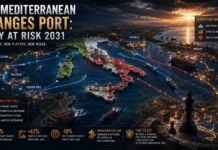

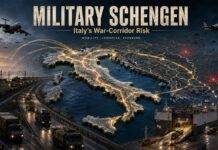







Executive Summary
BLUF — The emerging European military-mobility regime could convert Italy from a southern logistics platform into a permanent strategic transit architecture connecting the Mediterranean, Central Europe, the Western Balkans and NATO’s eastern flank.
On 17 June 2026, the Council approved its negotiating mandate for rules enabling military personnel, equipment and materiel to move across the Union rapidly and at scale.
The proposed European Military Mobility Enhanced Response System could grant military movements priority access and accelerate authorisations during exceptional conditions.
The Commission has identified approximately 500 military-mobility hotspot projects, but their detailed locations remain non-public, preventing external scrutiny of Italy’s probable bottlenecks.
Italy intersects four major European rail corridors and contains ports, Alpine crossings, intermodal terminals and north–south railway axes whose strategic value could increase sharply.
The funding proposed for military mobility after 2027 rises from approximately €1,69 billion under the current framework to €17,65 billion from 2028.
The central risk is not “militarisation” in the conventional sense, but the gradual insertion of military requirements into civilian investment, capacity-allocation and infrastructure-protection decisions.
Italy could consequently assume higher maintenance, cyber-security, physical-protection and operational-disruption costs without automatically receiving proportionate industrial compensation.
The decisive policy window is 2026–2031, when corridor selection, project eligibility, national coordination mechanisms and infrastructure-protection obligations will become embedded.
Rome must negotiate access rules, compensation, resilience funding and sovereign priority safeguards before emergency procedures become operational defaults.
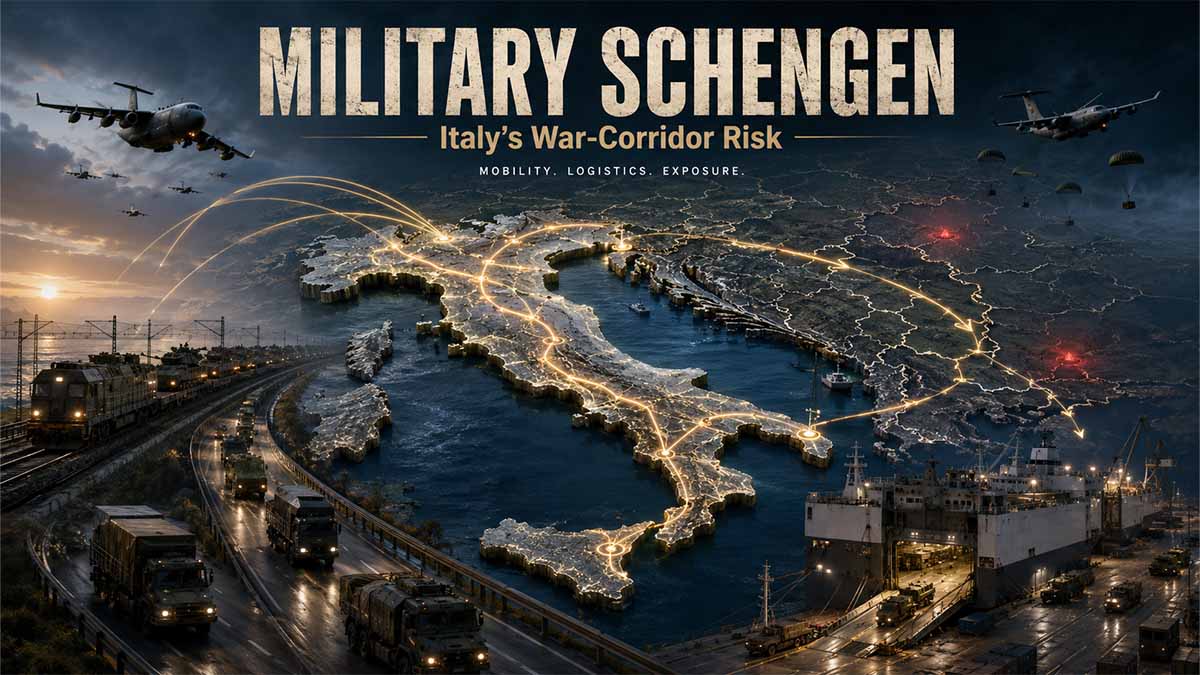
Military Schengen: Italy’s War-Corridor Risk
Europe is preparing to move armed forces with the speed once reserved for commercial goods. For Italy, this is not a marginal defence reform. It is a potential conversion of ports, railways, Alpine tunnels, bridges and ferry routes into a continental reinforcement system linking the Mediterranean, Central Europe, the Balkans and NATO’s eastern flank. The opportunity is substantial: European funding can modernise infrastructure that Italy already needs. The danger is less visible: Rome could become indispensable to European defence before negotiating who pays for maintenance, civilian disruption, cyber protection and industrial compensation. Military mobility is therefore not merely a transport policy. It is a test of whether Italy can convert geography into strategic power rather than accept the costs of geography as an obligation.
The Regulatory Turn
On 17 June 2026, the representatives of the EU Member States unanimously approved the Council’s negotiating mandate for the proposed military-mobility regulation. The objective is to enable personnel, equipment and military goods to move rapidly and at scale across and beyond the Union through harmonised authorisations, digital procedures, protected infrastructure and stronger coordination between armed forces and transport authorities.
The most consequential instrument is the proposed European Military Mobility Enhanced Response System, or EMMERS. Under the Council position, it could be activated within 72 hours, following a request by one or more Member States, and could allow accelerated permissions and priority access to transport infrastructure. National military-transport coordinators would oversee operations across defence, customs, police, transport administrations and infrastructure operators. The Council expects negotiations with the European Parliament to lead to adoption by the end of 2026. (Consiglio dell’Unione Europea)
This changes the nature of European military logistics. The bottleneck is no longer only whether a bridge can sustain a heavy vehicle or whether a port can unload a ro-ro ship. It is whether authorisations, railway paths, customs declarations, hazardous-goods procedures and terminal access can be completed within an operational timetable. Europe is turning administrative time into military capability.
The Italian Geometry
Italy sits at the intersection of the Mediterranean, Alpine Europe and the Western Balkans. Its logistics network is not a single north–south corridor but a switching system: Ligurian ports connect toward Switzerland and the Rhine basin; the Brenner axis runs through Verona and Bologna toward Germany; Trieste and Monfalcone open toward Austria, Slovenia, Hungary and the Balkans; Livorno, Bari and Brindisi provide established ro-ro routes across the Mediterranean and Adriatic.
The railway foundation is extensive but uneven. As of 30 June 2026, Rete Ferroviaria Italiana managed 16.909 kilometres of operating lines and 24.746 kilometres of track. Only 7.838 kilometres were double-track, while 9.071 kilometres remained single-track. Electrification covered 12.413 kilometres; 4.496 kilometres still depended on diesel traction. The network included 169 freight terminals, three ferry installations, approximately 2.200 stations, 13.736 kilometres under remote traffic control and only 1.096 kilometres operating with the European ERTMS interoperability system. (RFI)
These figures reveal the strategic problem. A national network may appear dense on a map while remaining vulnerable at individual junctions, sidings and tunnels. Military trains require sufficient loading gauge, axle-load tolerance, traction, signalling compatibility and tracks long enough to accommodate formations approaching 740 metres. One deficient bridge, tunnel or terminal entrance can invalidate an otherwise modern corridor.
The Eastern Gate
The strongest candidate for an Italian military-logistics gateway is the Trieste–Monfalcone system. In 2025, the two ports handled more than 64 million tonnes. Trieste accounted for approximately 60 million tonnes, while the combined port and inland system moved 11.600 trains, up 3,85%. Trieste alone recorded 7.939 trains; Germany represented 32% of its railway traffic, Austria 19% and Hungary 13%. Budapest was the leading individual destination with 12% of the total. (Porti Adriatici Orientali)
This is more than port capacity. It is an established operating ecosystem of terminals, locomotives, railway undertakings, customs procedures and Central European destinations. It also offers direct maritime exposure to Türkiye and the eastern Mediterranean. Yet the same concentration creates vulnerability. In 2025, closure of the Tauern tunnel and works on the Pontebbana line forced longer routings and caused the cancellation of an estimated 7–9% of normal trains. (Porti Adriatici Orientali)
That experience is a warning. Europe’s reinforcement capacity depends not on the nominal existence of alternative routes, but on alternatives capable of accepting the same train length, axle load, dangerous cargo and cross-border procedures at short notice. Trieste may become indispensable precisely because the practical alternatives are fewer than the map suggests.
The Tyrrhenian Reserve
On the western side, Livorno offers a different strategic capability. The port authority describes it as one of Italy’s principal ro-ro and Motorways-of-the-Sea hubs. Rolling cargo represents more than 43% of total traffic; annual volumes exceed 500.000 trucks and semi-trailers and 5,5 million linear metres. The port has 3.500 metres of quay assigned to ro-ro operations and approximately 41 kilometres of railway infrastructure, including arrival and departure tracks capable of accommodating 750-metre trains. (Porto Mar Tirreno Settentrionale)
Livorno therefore combines maritime access, wheeled-cargo expertise and rail capacity. It could receive vehicles and sustainment cargo from Spain, North Africa or the wider Mediterranean and channel them toward Tuscany, Bologna and the central European system.
But its military use would collide directly with civilian obligations. The same ferry network supports Sardinia, Sicily, Corsica, Spain and Tunisia. Capacity transferred to military movements could reduce territorial continuity, passenger services and commercial freight. The strategic asset is not merely the berth; it is the complete package of ship availability, crews, terminal labour, marshalling space, customs processing and onward railway paths.
The Balkan Hinge
The ports of Bari, Brindisi and, farther north, Ancona, offer shorter maritime access to Albania, Montenegro, Croatia and Greece. Their significance lies in the possibility of bypassing Alpine congestion and projecting logistics directly into the Adriatic and Balkan space.
This role will depend on inland infrastructure. A ferry can avoid a mountain crossing at sea only to encounter a railway bottleneck after unloading. The progressive strengthening of the Naples–Bari axis may eventually connect the southern Adriatic more effectively with the Tyrrhenian system and central Italy. Until then, the Apennines remain an internal strategic barrier.
The Balkan route also changes Italy’s geopolitical position. Italian ports would no longer serve only domestic trade or Mediterranean commerce; they could become the western maritime terminals of a reinforcement system extending through Albania, North Macedonia, Montenegro, Serbia, Croatia and onward toward Central and Eastern Europe. Italy’s influence would then depend on the compatibility of customs, railways, roads and security procedures beyond its territory.
The Funding Gap
The European Commission has identified approximately 500 hotspot projects across the Union, including bridge reinforcement, tunnel widening and increased capacity at ports and airports. The current military-mobility allocation under the Connecting Europe Facility 2021–2027 is approximately €1,69 billion and has supported 95 projects in 21 Member States. For the period beginning in 2028, the Commission has proposed increasing the allocation to €17,65 billion. (Mobility and Transport)
The increase is dramatic but remains insufficient if spread across the whole Union and the entire transport chain. On 18 June 2026, CINEA opened the final CEF Transport call of the current framework. The Italian Ministry of Infrastructure and Transport reported a total general envelope of €850 million, plus approximately €260 million reserved for Cohesion countries—which do not include Italy—and €130 million specifically dedicated to military mobility. Projects may receive up to 50% co-financing for studies and works, with a ceiling of €20 million for a project in one Member State and €40 million for a multinational project, subject to limited exceptions. Applications close on 6 October 2026. (Ministero Trasporti)
This means Italy will often pay a substantial national share. More importantly, European grants generally finance eligible construction, not the full lifecycle of the asset.
The Maintenance Trap
A reinforced bridge must be inspected and maintained at the higher standard for decades. A tunnel adapted for heavy or hazardous military transport may require additional ventilation, surveillance and emergency systems. A strategic port terminal needs physical protection, redundant power, secure communications and rapid-repair capacity. Once an asset becomes essential to European reinforcement plans, the cost does not end when the construction site closes.
Italy already sustains a highly capital-intensive infrastructure programme. The FS Group reported record technical investments of €18,3 billion in 2025, including almost €12 billion for railway infrastructure and approximately €4 billion for roads. Operating costs reached €14,9 billion, with maintenance among the principal sources of growth. Net financial debt stood at €12,8 billion. (FS Italiane)
Military mobility will enter this already crowded investment environment. If Europe finances half of an upgrade but Italy carries the future inspection, staffing, cybersecurity, energy and renewal expenditure, the apparent grant may conceal a long-term contingent liability.
Every project should therefore be evaluated through a thirty-year balance sheet: European contribution, national co-financing, civilian benefits, industrial return, maintenance, physical protection, cyber defence, insurance and the economic cost of displaced traffic.
Who Controls the Corridor
Ownership is more fragmented than political language suggests. RFI manages the railway infrastructure; port-system authorities govern public port domains; private concessionaires operate terminals; ferry companies control vessels and schedules; specialised firms manage cranes, software, gates, locomotives and maintenance. Banks, insurers and foreign suppliers may exercise additional contractual influence.
A government order to open a port does not automatically produce an available berth, trained personnel, a compatible ferry or a functioning terminal operating system. Italy therefore needs an effective-control register for every strategic node, identifying legal ownership, concession rights, daily operational authority, digital-system administration and emergency powers.
This requirement becomes more urgent where foreign technology or ownership is involved. The issue is not nationality alone. It is whether the Italian state can guarantee access, data integrity, continuity of operation and rapid substitution during a crisis.
The Cyber Front
The corridor can be paralysed without destroying a bridge. Railway signalling, remote traffic control, customs platforms, port-community systems, vessel navigation and terminal gates form a digital chain whose weakest component can stop physical movement.
A hostile actor could falsify axle weights, alter cargo identities, disrupt berth reservations or manipulate routing data. The most dangerous breach may not be the theft of information but the corruption of information: a heavy convoy directed toward an unsuitable structure, hazardous cargo misclassified, or a military train delayed by apparently legitimate instructions.
Italy must therefore require segmented networks, signed manifests, immutable logs, trusted suppliers and tested offline procedures. Every strategic terminal should be capable of operating in degraded mode when cloud services, customs platforms or satellite navigation are unavailable. Cybersecurity is not an accessory to military mobility; it is part of the infrastructure itself.
The Industrial Return
Italy should not accept a model in which European money strengthens Italian territory while higher-value equipment and technologies are produced elsewhere. Military mobility will create demand for specialised wagons, heavy transporters, ro-ro vessels, bridge-monitoring systems, secure communications, predictive maintenance, cyber platforms and terminal equipment.
The country possesses relevant industrial capacity. Fincantieri, the FS ecosystem, engineering companies and Italian defence-electronics firms can contribute to ships, logistics platforms, sensors and infrastructure protection. But industrial return must be negotiated, not assumed.
Rome should seek domestic design authority, production shares, intellectual-property access, maintenance contracts and control over critical spare parts. The proper measure is not the percentage of construction expenditure awarded to Italian firms, but the share of total lifecycle value retained in Italy.
The Italian Price
Italy’s strongest negotiating position exists before the corridors become operationally indispensable. Rome should offer Europe certified access, resilience and rapid movement in exchange for four guarantees: European financing of military-specific capital costs; recurring support for maintenance and protection; automatic compensation for civilian capacity displaced by emergency priority; and measurable Italian industrial participation.
The strategic accounting must be explicit. Italy is not merely receiving infrastructure. It is supplying Europe with a geopolitical option: the ability to enter through the Mediterranean, cross the Alps, reach Central Europe and connect with the Balkans and the eastern flank.
If that option is priced correctly, military mobility can modernise the country, strengthen its industry and elevate its political weight within the EU and NATO. If it is not, Italy may become Europe’s essential transit state while carrying the congestion, target exposure and maintenance bill.
The decisive question is therefore no longer whether the “Military Schengen” will cross Italy. It is whether Italy will negotiate the terms before Europe begins to treat the corridor as already available.
Navigational Index
Pillar I — The European Regulatory Conversion
Authorisation reform, EMMERS, infrastructure designation, priority access, digital military customs and EU–NATO interoperability.
Pillar II — The Italian Corridor System
Ports, Alpine gateways, railway capacity, tunnels, bridges, ferries, terminals and the interaction among Mediterranean, Balkan and Central European routes.
Pillar III — Sovereignty, Cost and Strategic Exposure
Civil–military capacity allocation, infrastructure ownership, maintenance burdens, industrial returns, cyber-physical protection and Italy’s bargaining position through 2031.
Master Abstract
The institutional transition began as an administrative effort to reduce delays in cross-border military transport, but it is developing into a deeper reconfiguration of European logistics governance. On 17 June 2026, representatives of the Member States unanimously approved the Council’s negotiating mandate for a regulation establishing a Union-wide framework for transporting military personnel, equipment and goods. The mandate supports harmonised procedures, digitalisation, protected infrastructure, a transport-capability solidarity pool and the proposed European Military Mobility Enhanced Response System, or EMMERS. Under the Council position, EMMERS could be activated within 72 hours at the request of one or more Member States, including without an initial Commission proposal, and could provide accelerated permissions and priority access for military transport. This is materially different from merely improving roads or railways: it creates a legal mechanism capable of changing who receives scarce transport capacity, under what conditions, and through which chain of command. The Commission’s underlying package also pursues an EU-wide military-mobility area built around land corridors, seaports, airports and logistical support elements, while moving toward a three-day standard for cross-border movement requests. Military Mobility: Council Agrees Its Negotiating Position – Council of the European Union – June 2026 — verified primary source Joint Communication on Military Mobility – European Commission and High Representative – November 2025 — verified primary source The regulation had not yet been adopted at the time of this assessment: the Council expected negotiations with the European Parliament and final adoption by the end of 2026. Nevertheless, the direction is already sufficiently defined to treat military mobility as an emerging layer of transport governance rather than an episodic defence initiative.
Italy occupies a structurally distinctive position inside that emerging system because its network combines north–south depth, Alpine gateways, Mediterranean access and multiple east–west interfaces. The Commission’s official description of the Italian railway system identifies four European corridors crossing the country: the Rhine–Alpine, connecting the Swiss border with Genoa through Milan and Novara; the Scandinavian–Mediterranean, extending from the Brenner corridor through Bologna, Rome and Naples toward Sicily; the Mediterranean, running from the French frontier across Turin, Milan, Verona, Venice and Trieste toward Slovenia; and the Baltic–Adriatic, linking Ravenna and the north-eastern network to Austria and Slovenia. More than 5.000 kilometres of railway managed by Rete Ferroviaria Italiana were identified as belonging to the relevant core-corridor system, while the revised TEN-T architecture now integrates railway freight corridors into nine broader European Transport Corridors. Italy: ERTMS Deployment and Corridor Structure – European Commission – accessed July 2026 — verified primary source TEN-T Governance – European Commission – accessed July 2026 — verified primary source This geography does not prove that every major Italian port or rail axis will become a designated military corridor. The approximately 500 hotspot projects identified by the Commission, supported by Member States and the EU Military Staff, have not been released as a complete public geospatial list. It does, however, establish a defensible screening universe: the Brenner and north-eastern approaches; the Po Valley’s east–west railway system; Ligurian and northern Adriatic ports; the Tyrrhenian north–south axis; rail-ferry connections with Sicily; and interfaces linking Italy with Slovenia, Austria, Switzerland and France. The early completion of EU-funded works at Pontedera and Palmanova, allowing manoeuvre by 740-metre trains and increasing capacity on the Florence–Pisa and Udine–Cervignano lines, demonstrates that dual-use adaptation is already entering ordinary Italian railway investment rather than awaiting a future emergency. Completed CEF Military-Mobility Projects – CINEA – November 2025 — verified primary source
The financial and strategic asymmetry is the report’s central issue. The Connecting Europe Facility 2021–2027 allocated approximately €1,69 billion–€1,75 billion to military mobility and financed 95 dual-use projects in 21 Member States. The Commission has proposed increasing the post-2027 military-mobility allocation to €17,65 billion, within a proposed €51,5 billion CEF transport envelope for 2028–2034. Questions and Answers on Military Mobility – European Commission – November 2025 — verified primary source Connecting Europe Facility 2028–2034 Moves Forward – European Commission – December 2025 — verified primary source The last current-framework call, opened in June 2026, made €130 million available specifically for military mobility; Italy remained eligible for the general and military-mobility envelopes but not for the approximately €260 million Cohesion component. Informativa Bando CEF 2026 – Ministero delle Infrastrutture e dei Trasporti – July 2026 — verified primary source The headline increase therefore does not itself guarantee a favourable Italian outcome. Co-financing rates, project selection, national counterpart expenditure, maintenance liabilities and protection costs will determine the real distribution of benefits. Infrastructure upgraded for exceptional military loads can require stronger bridges, longer sidings, wider tunnel clearances, reinforced aprons, secure staging areas, specialised signalling procedures and protected digital systems; once designated critical, the same assets may generate continuing expenditure for surveillance, cyber defence, redundancy and rapid repair. The Commission explicitly foresees national lists of strategic dual-use infrastructure and obligations for operators to strengthen resilience. The resulting bargaining problem is immediate: Italy may deliver geographic indispensability while other states capture rolling-stock production, ferry procurement, defence contracts, command functions or higher-value technological work. The correct national metric is therefore not gross EU funding received, but the net strategic return after domestic co-financing, lifecycle maintenance, civilian congestion, security expenditure, industrial participation and the opportunity cost of capacity reserved for military movements.
An initial Analysis of Competing Hypotheses produces five frameworks. H₁ — Corridor Consolidation holds that Italy becomes a permanent southern and south-eastern reinforcement platform, with systematic investment in ports, Alpine routes and rail interoperability. H₂ — Selective Dual Use anticipates upgrades only at a limited number of high-value bottlenecks, leaving the broader civilian system largely unchanged. H₃ — Eastern-Flank Concentration assumes that most funding remains concentrated in Poland, Germany, the Baltic region, Romania and eastern border routes, giving Italy a secondary maritime-support role. H₄ — Fiscal Fragmentation predicts regulatory adoption without sufficient national co-financing, producing uneven implementation and unresolved bottlenecks. H₅ — Crisis Acceleration assumes that a major security shock before 2031 compresses project timelines, expands emergency authority and forces rapid capacity requisition. Using the Council mandate, the tenfold budget proposal, Italy’s four-corridor exposure, existing Italian dual-use projects and the absence of a published hotspot inventory as evidence inputs, the provisional Bayesian distribution is H₁ 34%, H₂ 27%, H₃ 18%, H₄ 13% and H₅ 8%. These figures are analytical priors, not official forecasts. A preliminary Monte Carlo structure for 2026–2031, sampling regulatory completion, budget realisation, Italian co-financing, security deterioration, project-delivery delays and civilian-capacity conflicts, places the probability of Italy acquiring a substantially enlarged military-transit role at approximately 64% under central assumptions. The probability of measurable civilian-capacity displacement at one or more critical nodes is assessed at 41%, while the probability that lifecycle and protection costs exceed initially visible national benefits reaches 46% unless Italy secures dedicated resilience financing and industrial offsets. The model is intentionally exposed in the interactive component below so that assumptions can be altered rather than treated as hidden certainties.
European War-Corridor Exposure Simulator
Pillar I — The European Regulatory Conversion: From Border Permissions to a Military Logistics Regime
Authorisation reform: the conversion of time into combat power
The regulatory transformation begins with a deceptively administrative problem: military forces cannot exploit available roads, railways, ports or airports when diplomatic clearances, border permissions, hazardous-goods rules, customs declarations, convoy restrictions and infrastructure-access decisions remain fragmented across national ministries. The Commission’s November 2025 package therefore moves beyond voluntary coordination and proposes a directly applicable regulation governing the transport of military personnel, equipment and goods across the Union. Its operational benchmark is the reduction of cross-border processing toward a maximum of three days, accompanied by harmonised procedures, common information requirements, national military-transport coordinators and progressive digitalisation. The Council’s negotiating mandate, unanimously approved on 17 June 2026, preserved the Commission’s central architecture while giving Member States greater implementation flexibility and inserting additional military expertise into the governance structure. It specifically endorsed accelerated permissions, infrastructure protection, the military-mobility solidarity pool and a whole-of-government coordination model centred on national single points of contact. Military Mobility: Council Agrees Its Negotiating Position – Council of the European Union – June 2026 — verified official source. Joint Communication on Military Mobility – European Commission and High Representative – November 2025 — verified official source. The decisive change is institutional rather than procedural. Today, authorisation delays are treated as exceptional friction to be resolved through bilateral arrangements, exercises or diplomatic intervention. Under the emerging framework, readiness to receive, process and prioritise military movement becomes a standing administrative obligation. Transport ministries, defence ministries, customs administrations, police authorities, infrastructure managers and private operators will increasingly work through a common regulatory chain. For Italy, this means that the Ministry of Defence will not remain the sole gatekeeper. The Ministry of Infrastructure and Transport, customs authorities, port-system authorities, railway infrastructure managers, road concessionaires, airport operators and regional administrations will form parts of a distributed mobilisation mechanism. Once this system is formalised, peacetime transport administration will contain latent wartime functions: pre-cleared routes, standardised data packages, national contact directories, designated terminals and procedures for overriding ordinary scheduling constraints. The strategic value of the regulation therefore lies in its capacity to transform legal time into operational tempo. A bridge may be structurally adequate and a port may possess sufficient berth depth, but neither creates military power unless permissions, customs, dangerous-goods handling and access rights can be executed within the deployment timeline required by NATO reinforcement plans.
| Regulatory layer | Pre-conversion condition | Emerging rule | Operational consequence for Italy |
|---|---|---|---|
| Cross-border permissions | National procedures, different forms and timelines | Harmonised applications and accelerated processing | Italy must integrate defence, transport, police and customs decisions |
| National coordination | Multiple ministries and regional authorities | Single national military-transport coordinator | One office becomes accountable for end-to-end movement management |
| Infrastructure access | Civilian allocation rules dominate | Conditional priority for military movement | Rail paths, terminals and port windows may be reassigned |
| Customs | Uneven use of EU and NATO Form 302 | Default military customs documentation and digitalisation | Customs agencies become part of operational military logistics |
| Exceptional conditions | Ad hoc national emergency measures | Union-level EMMERS activation | Movement prioritisation can be coordinated across several states |
| Non-EU NATO access | Bilateral or NATO arrangements | Explicit regulatory consideration | United States, United Kingdom, Norway, Türkiye and Canada may interact with EU procedures |
EMMERS: an emergency mechanism with quasi-operational effects
The European Military Mobility Enhanced Response System, or EMMERS, is the most consequential element because it converts administrative simplification into an emergency-governance instrument. According to the Council mandate, the Council could activate EMMERS within 72 hours following a request from one or more Member States, with or without an initial Commission proposal. Once activated, it would enable fast-tracked permissions and priority access for military transport across the Union. The precise obligations will depend on the final text agreed with the European Parliament, but the political direction is already clear: exceptional military movements should not remain dependent on the sequential completion of ordinary national procedures. Military Mobility: Council Agrees Its Negotiating Position – Council of the European Union – June 2026 — verified official source. This produces a three-level sovereignty issue. First, the trigger may be European, but execution remains national: Italian authorities would still control territory, public order, infrastructure safety and the application of national emergency law. Second, priority access creates distributive effects because a military convoy does not move through an abstract network; it consumes a railway path, ferry slot, port crane window, road lane, marshalling yard or airport movement otherwise available to civilian operators. Third, activation data may itself be classified or operationally sensitive, limiting parliamentary and public visibility precisely when economic and transport consequences become most substantial. EMMERS should therefore be interpreted not as a European equivalent of martial law but as a pre-negotiated derogation architecture. It is likely to compress decision time, narrow the discretion of individual infrastructure managers and raise the political cost of national refusal during a crisis. Italy’s vulnerability derives from the density of competing users. Northern freight corridors carry industrial traffic; Alpine crossings face capacity and maintenance constraints; ports serve containers, energy commodities, passengers and ro-ro transport; and high-speed rail shares parts of the broader system with regional and freight services. A priority rule that is manageable for a single battalion movement could become disruptive when applied to a multinational reinforcement sequence involving heavy armour, ammunition, fuel, engineering equipment and sustainment cargo. The essential unresolved question is not whether military transport should receive priority during a major crisis, but who defines the threshold, duration, geographic scope and compensation regime for that priority.
EMMERS ACTIVATION LOGIC
An end-to-end 3D structural visualizer mapping the European Military Mobility Emergency Response System—from geopolitical security deterioration and 72-hour Council activation to accelerated diplomatic clearance, priority infrastructure corridors, and synchronized cross-border force deployment.
Infrastructure designation: from civilian asset to military dependency
Infrastructure designation is the mechanism through which the abstract regulatory framework acquires a physical geography. The Commission and the High Representative have described a future military-mobility area based on priority land corridors, seaports, airports, logistical support nodes and approximately 500 identified hotspot projects requiring intervention. These may concern bridge load-bearing capacity, tunnel dimensions, rail sidings, port ramps, airport aprons, intermodal terminals, fuel facilities or other dual-use assets. The full hotspot inventory has not been made public, which is understandable from an operational-security perspective but creates a significant transparency deficit: affected communities, infrastructure operators, investors and national parliaments cannot independently compare the strategic value, cost and exposure of designated sites. Questions and Answers on Military Mobility – European Commission – November 2025 — verified official source. Joint Communication on Military Mobility – European Commission and High Representative – November 2025 — verified official source. Designation will have at least five consequences. It can improve eligibility for EU co-financing; impose technical requirements derived partly from military specifications; increase physical and cyber-protection obligations; elevate the asset within national contingency planning; and transform it into a more attractive target for hostile intelligence, sabotage or disruptive cyber operations. Italy must therefore avoid treating inclusion on a military-mobility list as an unqualified benefit. A designated bridge may receive reinforcement funding, yet its operator could inherit higher inspection, surveillance and rapid-repair requirements. A port may gain new ramps or strengthened quays, while simultaneously facing tighter access controls, cyber-security costs and potential commercial disruption during exercises or emergencies. The classification of infrastructure also affects information governance. Engineering data, weight limits, berth capacities, tunnel profiles, hazardous-material routes and reserve access points become militarily relevant datasets. If they remain dispersed among municipalities, concessionaires, logistics companies and regional agencies, the system becomes vulnerable to both administrative failure and hostile collection. If they are centralised, the resulting database becomes a high-value cyber target. Italy therefore needs a tiered designation model separating public investment information from restricted engineering details and classified operational data. Without such segmentation, transparency and security will be treated as mutually exclusive, producing either excessive secrecy or excessive exposure.
| Designation category | Typical asset | Military relevance | New risk generated | Required Italian response |
|---|---|---|---|---|
| Strategic gateway | Port, airport, Alpine crossing | Entry and onward deployment | Concentration and targeting risk | Redundancy and alternative-route planning |
| Heavy-load bottleneck | Bridge, viaduct, ramp | Movement of armour and engineering vehicles | Structural failure or route denial | Certified load database and reinforcement programme |
| Dimensional bottleneck | Tunnel, loading gauge, port access | Clearance for oversized cargo | Diversion and delay | Route surveys and pre-approved alternatives |
| Capacity bottleneck | Rail junction, terminal, marshalling yard | Competes with civilian freight | Congestion and economic loss | Protected civilian-capacity floor |
| Digital bottleneck | Signalling, port community system, customs platform | Controls physical movement | Cyber paralysis | Segmentation, offline fallback and NATO-compatible security |
| Sustainment node | Fuel, repair, storage, staging area | Enables prolonged operations | Sabotage and environmental risk | Perimeter protection and rapid recovery |
Priority access: the hidden constitutional question of capacity allocation
Priority access is operationally necessary but legally and economically underdeveloped. The Council mandate explicitly links EMMERS to priority access for military transport, while the Commission’s broader package proposes exemptions or flexibility in several civilian transport rules, including the treatment of civilian operators carrying military cargo, holiday traffic restrictions and, under certain circumstances, cabotage rules. The Commission also announced reviews of the Rail Service Facilities Regulation, the Air Services Regulation and the Flexible Use of Airspace framework to ensure that civilian regulatory systems can accommodate military requirements. Joint Communication on Military Mobility – European Commission and High Representative – November 2025 — verified official source. The phrase “priority access” conceals a difficult hierarchy of rights. Railway capacity in Europe is allocated through annual schedules, short-term requests, framework agreements and infrastructure-manager decisions. Port terminals operate through commercial contracts, concessions and berth-planning systems. Airports use coordinated slots and air-traffic-flow management. Motorways may be managed by state entities or private concessionaires. EMMERS can accelerate a military request, but it cannot eliminate the physical scarcity encountered at a saturated node. It therefore transfers scarcity from the military user to civilian users. For Italy, the constitutional and political issue is who bears the displacement. A diverted freight train can delay manufacturing inputs; a requisitioned ro-ro ferry can affect island connectivity; a port-security closure can disrupt exports; an airspace restriction can impose costs on airlines and passengers. The regulation’s final implementation will require compensation principles, but financial reimbursement alone may not cover systemic economic loss. Italy should negotiate a layered priority regime: P₁ for imminent collective-defence operations; P₂ for urgent reinforcement or sustainment; P₃ for exercises with fixed advance notice; and P₄ for routine peacetime movements. Each level should activate different derogations, notice periods, compensation formulas and civilian-capacity protections. Without such differentiation, authorities may normalise exceptional priority for exercises or routine deployments, gradually weakening commercial predictability. The most important national safeguard is a requirement that every priority decision generate an auditable record describing the legal basis, affected capacity, duration, displaced services and compensation mechanism, subject to classified annexes where operational security demands it.
Digital military customs: the logistics operating system
Customs digitalisation is likely to become the system’s operational backbone because a movement that crosses several jurisdictions is only as fast as its slowest data transaction. The Commission identified divergent national implementation of customs rules and inconsistent use of EU Form 302 and NATO Form 302 as avoidable causes of delay. It proposed default use of the appropriate Form 302, clearer treatment under the future Union Customs Code, training for military authorities, customs services and civilian operators, and the progressive development of a single digital tool capable of handling diplomatic clearances, transport arrangements, movement tracking and a digitalised EU Form 302. The Commission noted that European Defence Fund and European Defence Agency projects could provide building blocks for this longer-term architecture. Joint Communication on Military Mobility – European Commission and High Representative – November 2025 — verified official source. This digital system will not resemble a conventional commercial customs portal. It must process sensitive information concerning force identity, equipment type, quantity, dangerous goods, route, timing, destination, supporting contractor, security classification and national authorisation. The data must remain usable across EU customs systems, defence networks, NATO processes and civilian logistics providers that may not possess access to classified networks. The likely architecture will therefore be federated rather than fully centralised: a common European interface, national data nodes, role-based access controls and cryptographically protected exchange among authorised actors. The principal threat is not merely data theft. A hostile actor could manipulate axle weights, container identifiers, route permissions, hazardous-material classifications or arrival times, producing physical congestion or safety incidents without visibly disabling the network. A ransomware attack during an EMMERS activation could force authorities to choose between halting movement and accepting inadequately verified cargo. Italy should consequently require an offline continuity mode based on signed, time-limited credentials; immutable logging; cross-checks between customs, transport and military manifests; and manual fallback procedures tested during exercises. The secure platform proposed for the solidarity pool adds another data layer, because it will reveal available wagons, ferries, heavy transporters or specialised equipment. Combined with movement data, this could expose mobilisation capacity and logistical deficiencies. Cyber-security must therefore be designed around operational deception resistance, not only confidentiality.
PROPOSED DIGITAL TRUST ARCHITECTURE
An end-to-end 3D structural visualizer mapping the federated, multi-modular digital trust backbone for European military logistics—from national defense validation down to automated diplomatic, customs, dangerous goods, and cross-border transit C2 routing.
EU–NATO interoperability: one logistics space, two institutional chains
The regulatory project is European Union legislation, but its operational utility is inseparable from NATO planning. NATO states that its Structured Dialogue on Military Mobility, established in 2018, brings together officials to coordinate military requirements, transport infrastructure, dangerous goods, customs, cross-border permissions and exercises. NATO has contributed to the development and updating of EU military requirements, particularly those affecting critical transport infrastructure. Relations with the European Union – North Atlantic Treaty Organization – current official overview — verified official source. In December 2025, NATO further described its emerging Reinforcement and Sustainment Network, intended to support the movement and continued supply of forces throughout Europe, while welcoming the EU package as a means of removing regulatory bottlenecks and improving infrastructure resilience. NATO Deputy Secretary General Attends NATO–EU Meeting on Military Mobility – NATO – December 2025 — verified official source. The Council mandate also explicitly seeks to ensure that non-EU NATO allies are taken into account. This matters because some of the largest forces potentially entering or crossing the Union belong to the United States, United Kingdom, Canada, Norway and Türkiye. EU law can govern infrastructure access, customs and transport inside the Union, while NATO determines military requirements, reinforcement planning, command relationships and operational priorities. Interoperability therefore requires more than compatible forms. It requires a translation layer between NATO operational plans, EU legal authority and national execution. Italy sits at the intersection of all three. Its infrastructure may be programmed under TEN-T and EU funding rules, used according to NATO reinforcement requirements and operated under Italian sovereignty. The principal institutional danger is accountability diffusion: NATO may define the military need, the EU may finance the upgrade, and Italy may bear the operating and protection burden. When failures occur, each layer may attribute responsibility to another. Rome should insist on a formal responsibility matrix identifying who certifies routes, who updates military load requirements, who funds lifecycle maintenance, who authorises disclosure to non-EU allies and who compensates civilian operators. Interoperability without responsibility mapping would create operational capability but weak democratic control.
| Function | European Union | NATO | Italy |
|---|---|---|---|
| Regulatory authority | Transport, customs, infrastructure and emergency rules | No direct EU legislative authority | Implements EU law and national derogations |
| Military requirement | Incorporates military specifications into EU programmes | Defines reinforcement and sustainment needs | Converts requirements into national route and capacity plans |
| Funding | CEF and other EU instruments | NATO Security Investment Programme where applicable | Co-financing, maintenance and national upgrades |
| Operational command | Limited; supports coordination and crisis instruments | Alliance command structure and operational planning | National command, host-nation support and territorial control |
| Customs and permissions | Harmonised rules and digital framework | NATO Form 302 and standards | Customs release and diplomatic clearance execution |
| Infrastructure protection | EU resilience and critical-entity rules | Military protection requirements and intelligence sharing | Police, armed forces, cyber agencies and infrastructure operators |
External strategic reading: Russia, China and the securitisation of European infrastructure
The regulatory conversion will be interpreted outside Europe as evidence that civilian infrastructure is being integrated into NATO’s reinforcement architecture. This does not mean every upgraded bridge becomes a military installation, but the distinction may carry limited weight in adversary targeting doctrine when a civilian asset is known to enable force deployment. Chinese official statements already show sensitivity to the relationship between NATO contingency planning and foreign-owned infrastructure. In July 2024, China’s Foreign Ministry responded to reports concerning possible NATO discussions about Chinese-owned infrastructure in Europe during a conflict with Russia by accusing NATO of expanding beyond its traditional mandate and generating bloc confrontation. Foreign Ministry Spokesperson Lin Jian’s Regular Press Conference – Ministry of Foreign Affairs of the People’s Republic of China – July 2024 — verified official source. This statement should not be treated as a response to EMMERS, which did not yet exist, but it demonstrates the strategic lens through which Beijing may interpret military-access rules affecting ports, terminals or logistics assets with Chinese ownership or commercial participation. China’s Defence Ministry also confirmed that Chinese delegations conducted separate security-policy dialogues with the EU and NATO in March 2026, indicating that European defence developments remain part of an active official channel rather than purely public rhetoric. Chinese Ministry of National Defense Delegation Conducts Institutional Dialogues in Europe – Ministry of National Defense of the People’s Republic of China – March 2026 — verified official source. A targeted search of accessible official Russian government and defence domains did not produce a sufficiently specific, current primary document addressing the proposed EMMERS regulation; under the source-integrity protocol, no Russian-derived factual claim is therefore inserted. Analytically, however, European planners must assume that route designation, bridge reinforcement, port handling capacity and digital movement systems will attract foreign intelligence collection. The “shadow” dimension is ownership and control: military use may depend on privately operated terminals, foreign-manufactured signalling systems, concession contracts, commercial cloud providers and civilian ferry fleets. Regulatory conversion must therefore include beneficial-ownership screening, supply-chain security and contingency authority over privately controlled assets without automatically expropriating or excluding foreign capital.
Five-year outlook: 2026–2031
The most probable five-year trajectory is a phased movement from legislation to routinised operational readiness rather than a single institutional rupture. During the second half of 2026, the decisive variable will be the final compromise between the Council and the European Parliament. The Council expects adoption by the end of 2026, but the parliamentary position may alter activation safeguards, data-protection rules, compensation provisions or the scope of delegated powers. Military Mobility: Council Agrees Its Negotiating Position – Council of the European Union – June 2026 — verified official source. In 2027, Member States are likely to designate coordinators, audit legal barriers, identify national infrastructure priorities and align military requirements with the post-2027 funding cycle. The principal risk will be uneven readiness: states with mature host-nation-support structures will operationalise the regulation faster than those with fragmented regional governance. In 2028, the proposed enlarged CEF envelope and related digitalisation instruments could begin financing a larger project pipeline, but only if the multiannual budget is adopted near the Commission’s ambition. In 2029, the system should confront its first serious capacity-allocation tests as infrastructure works, exercises and civilian demand overlap. Digital customs interoperability will probably remain incomplete because common data standards, security accreditation and integration with national legacy systems are complex. By 2030–2031, EMMERS may have been activated in an exercise or real security contingency, exposing whether the 72-hour decision architecture produces actual movement acceleration or merely transfers delay into national implementation. Italy’s best outcome is not maximal designation but selective indispensability: a limited number of high-value corridors fully funded, protected, digitally integrated and supported by domestic industrial participation. The adverse outcome is diffuse obligation, in which numerous Italian assets are classified as strategically necessary but EU funding covers only capital upgrades while Italy absorbs maintenance, cyber-security and civilian-displacement costs.
| Year | Regulatory milestone | Operational test | Principal Italian decision |
|---|---|---|---|
| 2026 | Final regulation and parliamentary safeguards | Legal activation architecture | Negotiate sovereignty, audit and compensation clauses |
| 2027 | National implementation and infrastructure designation | Inter-ministerial coordination | Establish coordinator, classified infrastructure register and priority tiers |
| 2028 | Post-2027 funding mobilisation | Project selection and digital pilots | Link funding to lifecycle costs and industrial offsets |
| 2029 | Expanded exercises and construction phase | Civil–military capacity conflict | Protect minimum civilian rail, ferry and port capacity |
| 2030 | EMMERS readiness evaluation | Multi-state reinforcement exercise | Test offline customs and cyber-recovery procedures |
| 2031 | Institutional consolidation | Routine integration with NATO plans | Renegotiate burdens using observed traffic and cost data |
Analysis of Competing Hypotheses and Bayesian update
Five hypotheses structure the outlook. H₁ — Full Regulatory Conversion assumes that the regulation is adopted substantially in line with the Council mandate, EMMERS becomes operational, national coordinators acquire real authority and the digital customs platform reaches functional interoperability by 2031. H₂ — Legal Success, Operational Fragmentation assumes common legislation but uneven national execution, with persistent delays at ports, rail interfaces and customs administrations. H₃ — NATO-Driven Acceleration assumes that deteriorating security conditions cause NATO reinforcement requirements to dominate implementation, forcing rapid exemptions and infrastructure prioritisation before civilian safeguards mature. H₄ — Budget-Constrained Dual Use assumes the regulation survives but funding remains below the Commission’s ambition, concentrating improvements in a limited number of eastern and central corridors while Italy receives selective rather than systemic upgrades. H₅ — Sovereignty and Data Resistance assumes parliamentary, constitutional or privacy concerns slow EMMERS activation rules and digital information-sharing, producing a narrower final system. The evidence available in July 2026 shifts probability toward H₁ and H₂ because the Council mandate was unanimous, the regulation enjoys repeated European Council support, NATO publicly identifies military mobility as a core cooperation area and institutional dialogue has continued at political and military-staff levels. Nevertheless, national implementation complexity and legacy digital systems prevent a high-confidence forecast of full operational convergence. The posterior assessment is H₁ 31%, H₂ 29%, H₃ 18%, H₄ 15% and H₅ 7%. The probability that Italy will face at least one material civil–military capacity dispute before the end of 2031 is assessed at 58%. The probability that digital customs integration remains only partially interoperable in 2030 is 61%, reflecting technical and security complexity rather than political opposition. The probability that the final framework grants broad priority access without a fully harmonised compensation system is 47%. These estimates are analytical judgements, not institutional forecasts, and should be updated when the European Parliament publishes its definitive position, the final regulation is adopted and national implementation acts reveal the actual balance among Union authority, Member-State discretion and NATO operational requirements.
Monte Carlo scenario model
The five-year model uses 20.000 iterations and six uncertain variables: final regulatory strength, EMMERS activation usability, post-2027 funding realisation, national implementation consistency, digital-customs maturity and security-pressure intensity. Each variable is represented as a bounded distribution rather than a fixed forecast. Regulatory strength receives the highest central value because of the unanimous Council mandate and repeated European Council direction. Digital maturity receives the lowest because the proposed single digital tool must connect defence, customs, transport, diplomatic-clearance and infrastructure systems with different security classifications. The model defines “effective regulatory conversion” as a condition in which cross-border permissions are routinely processed within the policy target, EMMERS can be activated and executed, designated infrastructure receives operational priority, and EU–NATO procedures are sufficiently interoperable for multinational movement. Under the central assumptions, effective conversion by the end of 2031 occurs in 63% of iterations. Partial conversion—legal harmonisation with continuing operational bottlenecks—occurs in 29%. Regulatory stagnation or severe fragmentation occurs in 8%. For Italy, the model estimates a 67% probability that at least one national corridor will be integrated into a high-priority multinational reinforcement sequence; a 52% probability that infrastructure-protection expenditure exceeds initial project-level estimates; and a 44% probability that commercial operators seek compensation or contractual renegotiation following military-priority interventions. The model is most sensitive to national implementation consistency and digital maturity, not to the formal adoption of the regulation. This finding is strategically important: legislative success can coexist with operational failure. The system’s weakest point is likely to be the interface between military urgency and civilian execution, particularly where private terminal operators, railway undertakings, ferry companies or concessionaires must act on compressed timelines without complete visibility of the wider operation. Italy’s policy should therefore prioritise pre-negotiated contracts, liability rules, data-access agreements and exercise-based validation rather than relying on emergency improvisation.
Pillar II — The Italian Corridor System: Ports, Alpine Gateways and the Hidden Geometry of European Reinforcement
Italy is not one corridor but a continental switching system
The strategic importance of Italy cannot be understood by drawing a single north–south line from the Alps to Sicily. The peninsula operates as a switching system in which four established railway axes and several revised European Transport Corridors intersect with Mediterranean shipping lanes, Adriatic ferry routes, Alpine tunnels, intermodal terminals and the industrial basin of the Po Valley. The European Commission identifies more than 5.000 kilometres of the Italian railway network as belonging to the former core-network corridor architecture and lists four principal alignments: the Rhine–Alpine route from the Swiss border through Milan and Novara to Genoa; the Scandinavian–Mediterranean route from the Brenner frontier through Bologna, Rome and Naples to Sicily; the Mediterranean route from France through Turin, Milan, Verona, Venice and Trieste to Slovenia; and the Baltic–Adriatic route connecting Ravenna with Venice and the Austrian and Slovenian borders. Under Regulation EU 2024/1679, this architecture has been reorganised into nine European Transport Corridors, integrating the former rail-freight corridors and extending planning toward the Western Balkans, Ukraine and Moldova. The strategic effect is cumulative: Genoa and La Spezia can connect maritime arrivals to the Alpine gateways; Trieste and Monfalcone can channel Mediterranean and Turkish flows toward Austria, Germany, Hungary, Czechia and Slovakia; Bari, Brindisi and Ancona provide shorter maritime interfaces with Albania, Montenegro, Croatia and Greece; while Livorno, Naples, Gioia Tauro, Taranto, Palermo and Cagliari provide access to different portions of the Tyrrhenian and central Mediterranean space. These nodes are not interchangeable. Each has different draft, quay geometry, railway access, terminal ownership, road connectivity, hazardous-cargo handling capability and exposure to civilian congestion. The emerging military-mobility system will therefore not create an Italian “war corridor” in the singular. It will select and connect a limited number of gateways, creating a hierarchy among ports, tunnels, bridges and rail nodes whose public visibility may remain incomplete because the Commission’s approximately 500 military-mobility hotspot projects have not been disclosed as a comprehensive geospatial inventory. Italy: ERTMS Deployment and Corridor Structure – European Commission – July 2026 — verified official source. TEN-T Governance – European Commission – July 2026 — verified official source.
| Italian strategic system | Principal gateways | External direction | Military-logistics function | Structural vulnerability |
|---|---|---|---|---|
| North-western arc | Genoa, La Spezia, Turin, Novara, Milan | France, Switzerland, Rhine basin | Maritime reception and movement toward Central Europe | Alpine capacity, Ligurian port access and dense civilian freight |
| Brenner spine | Verona, Bologna, Florence, Rome, Naples | Austria, Germany, Scandinavia | Main continental north–south reinforcement route | Brenner concentration, construction constraints and rail-path scarcity |
| North-eastern arc | Trieste, Monfalcone, Venice, Palmanova, Tarvisio | Slovenia, Austria, Hungary, Balkans | Eastern Adriatic and Central European access | Dependence on few border routes and foreign downstream infrastructure |
| Adriatic–Balkan interface | Ancona, Bari, Brindisi | Croatia, Albania, Montenegro, Greece | Ro-ro, ro-pax and short-sea movement toward Balkan theatres | Ferry availability, commercial schedules and limited rail integration |
| Tyrrhenian axis | Livorno, Civitavecchia, Naples, Palermo | Spain, North Africa, western Mediterranean | Distributed maritime reception and island sustainment | Passenger competition and fragmented terminal control |
| Southern strategic arc | Taranto, Gioia Tauro, Augusta, Palermo | Central Mediterranean, Suez approaches | Deep-water reception, transhipment and southern staging | Distance from main European rail markets and weak inland links |
The railway network: national scale conceals local scarcity
The national railway system provides impressive aggregate coverage but aggregate length is a poor proxy for military carrying capacity. As of 30 June 2026, Rete Ferroviaria Italiana reported 16.909 kilometres of operating lines, comprising 6.450 kilometres of fundamental routes, 9.502 kilometres of complementary lines and 957 kilometres of node infrastructure. Only 7.838 kilometres were double-track, while 9.071 kilometres remained single-track. Electrification covered 12.413 kilometres, leaving 4.496 kilometres non-electrified. The system included approximately 24.746 kilometres of total track, around 2.200 passenger stations, 169 freight facilities and three ferry installations. RFI also reported 13.736 kilometres governed by remote traffic-control systems, 13.767 kilometres equipped with the Italian train-control system SCMT, 11.772 kilometres covered by GSM-R, and only 1.096 kilometres operating with ERTMS, the European signalling standard required for high-level interoperability. These figures establish two distinct realities. First, Italy possesses a geographically extensive rail network capable of distributing traffic across a large territory. Second, military mobility depends disproportionately on a much smaller set of electrified, high-axle-load, double-track routes with adequate loading gauge, sufficiently long sidings, suitable marshalling yards and reliable border interoperability. A route that appears available on a national map may be unsuitable for a 740-metre freight train, an oversized military load or a high-frequency reinforcement sequence. Single-track sections constrain overtaking and recovery from disruption; limited siding length forces trains to be divided; incompatible signalling can require locomotive or crew changes; and station layouts can prevent rapid reversal or marshalling. The Pontedera and Palmanova projects are important precisely because they reveal the type of apparently modest intervention capable of changing strategic throughput. Their extended tracks, modified signalling and adjusted electric-traction systems permit 740-metre trains to manoeuvre and increase capacity on the Florence–Pisa and Udine–Cervignano routes. Military mobility is therefore likely to be shaped less by spectacular new lines than by hundreds of interventions at passing loops, junctions, terminal entrances, electrical substations and signalling interfaces. The RFI Network Today – Rete Ferroviaria Italiana – June 2026 — verified corporate source. Completed CEF Military-Mobility Projects – CINEA – November 2025 — verified official source.
| RFI indicator, 30 June 2026 | Reported scale | Military-mobility interpretation |
|---|---|---|
| Operating railway lines | 16.909 km | Broad geographic coverage, but not uniform heavy-load capability |
| Double-track lines | 7.838 km | Principal candidate network for sustained bidirectional movements |
| Single-track lines | 9.071 km | Vulnerable to disruption, crossing delays and low recovery capacity |
| Electrified lines | 12.413 km | Supports high-capacity traction but depends on exposed power systems |
| Non-electrified lines | 4.496 km | Requires diesel traction and limits operational standardisation |
| Fundamental lines | 6.450 km | Likely concentration of strategic movements and civilian competition |
| Freight installations | 169 | Large nominal terminal base, but capabilities vary significantly |
| ERTMS | 1.096 km | Interoperability remains incomplete outside the AV/AC network |
| GSM-R coverage | 11.772 km | Major digital dependency and cyber-physical attack surface |
| Tunnels | 1.255 km monitored | Concentrated infrastructure with limited diversion options |
| Bridges and viaducts | 530 km monitored | Load certification and structural resilience are decisive |
Alpine gateways: the true strategic valves
Italy’s continental military utility is ultimately controlled by a limited number of Alpine gateways. The Brenner axis is the central north–south valve, connecting Verona and the Po Valley with Innsbruck, Munich and the wider German logistics system. Its strategic relevance will rise further when the Brenner Base Tunnel and associated access routes become fully operational, but the transition period may produce simultaneous construction constraints, legacy-line dependence and capacity-management challenges. The Swiss approaches through the Simplon, Lötschberg–Simplon system and the Gotthard axis connect the Italian industrial basin and Genoa with the Rhine corridor, Rotterdam, Antwerp and Germany. The revised North Sea–Rhine–Mediterranean Corridor extends through eight countries and reaches Genoa after crossing Switzerland; it incorporates the Gotthard Base Tunnel and approximately 12.150 kilometres of railway, demonstrating that an Italian maritime gateway can function only as the southern endpoint of a transnational system whose critical infrastructure lies partly outside Italian jurisdiction. The Mont Cenis/Lyon–Turin axis links northern Italy to France and western European ports, while the Tarvisio and Villa Opicina/Slovenian approaches connect Trieste, Venice and the north-eastern Italian network with Austria, Slovenia, Hungary and the Western Balkans. In military planning, these crossings are not simply border points. They are capacity valves whose closure can redirect traffic by hundreds of kilometres, overload neighbouring corridors and create cascading congestion. The 2025 performance of Trieste illustrates this dependency: the port authority reported that closure of the Tauern tunnel and works on the Pontebbana route forced longer routings and caused cancellation of an estimated 7–9% of ordinary trains, despite the port system still handling 11.600 trains during the year. A peacetime tunnel closure therefore provides an empirical stress test for crisis logistics. A military reinforcement system relying on a small set of Alpine lines must pre-allocate alternative routes, locomotives, drivers, customs procedures and cross-border train paths before disruption occurs. The critical metric is not nominal route redundancy but “operationally activated redundancy”: the number of alternative corridors that can accept the same axle load, train length, loading gauge and hazardous cargo within a defined response time. North Sea–Rhine–Mediterranean Corridor – European Commission – July 2026 — verified official source. 2025 Annual Traffic Data for Trieste and Monfalcone – Port System Authority of the Eastern Adriatic Sea – January 2026 — verified official source.
ITALIAN ALPINE GATEWAY DEPENDENCY MATRIX
An end-to-end 3D structural visualizer mapping Italy's maritime-to-Alpine rail/road freight corridors, intermodal choke points, multi-voltage locomotive constraints, and cascade failure dynamics under civilian and military mobility stress.
Trieste and Monfalcone: Italy’s clearest Central European military-logistics interface
Among Italian ports, the Trieste–Monfalcone system possesses the most visible combination of maritime scale, railway penetration and direct Central European orientation. In 2025, the two ports handled more than 64 million tonnes. Trieste alone processed approximately 60 million tonnes, while the combined port and inland logistics system handled 11.600 trains, an increase of 3,85%. Trieste accounted for 7.939 trains and Monfalcone for 2.239, with Monfalcone’s rail movements increasing by more than 21%. Germany represented 32% of Trieste’s railway traffic, Austria 19% and Hungary 13%; Budapest alone accounted for 12% of destinations. These figures are strategically more important than container totals because they demonstrate an established operating ecosystem of locomotives, railway undertakings, terminals, customs processes and inland destinations. The port also maintains major ro-ro relations with Türkiye and the eastern Mediterranean. During the first half of 2025, Trieste processed 155.391 ro-ro units, a 5,28% increase, and recorded 477 Motorway-of-the-Sea calls, compared with 401 a year earlier. The system therefore combines two military-relevant modalities: unaccompanied trailers and vehicles arriving by sea, and high-frequency onward rail movement toward Central Europe. Yet this strength creates concentration risk. Trieste’s role depends on the Udine–Cervignano–Tarvisio and Trieste–Villa Opicina–Slovenia systems, on cross-border train-path coordination and on terminals that already handle commercially valuable energy, container, vehicle and industrial flows. The port authority’s own investment programme includes the new layout at Campo Marzio, railway upgrades, smart-grid infrastructure, electrification of quays and works at Monfalcone. These projects can improve dual-use resilience, but they also create a highly legible military-logistics node. An adversary does not need to disable the entire port; disruption at a terminal rail throat, power substation, customs platform, port-community system or border railway interface could reduce throughput substantially. Trieste should therefore be treated as a distributed system extending from the quay to Austrian, Slovenian and Hungarian inland terminals, not as an isolated Italian facility. 2025 Annual Traffic Data – Port System Authority of the Eastern Adriatic Sea – January 2026 — verified official source. First-Half 2025 Traffic Data – Port System Authority of the Eastern Adriatic Sea – July 2025 — verified official source.
| Trieste–Monfalcone indicator | 2025 result | Strategic meaning |
|---|---|---|
| Combined cargo | More than 64 million tonnes | Large-scale commercial base capable of absorbing specialised traffic |
| Trieste cargo | Approximately 60 million tonnes | National-scale energy and logistics gateway |
| Combined trains | 11.600 | Mature rail-port operating ecosystem |
| Trieste trains | 7.939 | High-frequency hinterland connectivity |
| Monfalcone trains | 2.239 | Secondary gateway and partial redundancy |
| Germany share of Trieste rail traffic | 32% | Direct integration with Europe’s main industrial-logistics system |
| Austria share | 19% | Immediate trans-Alpine dependency |
| Hungary share | 13% | Eastern and south-eastern European reach |
| First-half ro-ro units | 155.391 | Existing capacity for wheeled and trailerised cargo |
| First-half Motorway-of-the-Sea calls | 477 | Dense maritime schedule, especially toward Türkiye |
Genoa, La Spezia and the north-western maritime arc
The Ligurian port system is the logical maritime entry point for movements oriented toward Switzerland, southern Germany, eastern France and the western Po Valley, but its military-mobility potential is constrained by geography. Genoa and La Spezia are surrounded by steep terrain, dense urban development and tunnel-intensive road and railway approaches. The ports possess substantial container and general-cargo capability, yet moving heavy equipment inland requires passage through a relatively limited number of railway and motorway corridors. The revised North Sea–Rhine–Mediterranean Corridor makes Genoa the Mediterranean endpoint of a system extending through Switzerland, Germany, France, Belgium, Luxembourg, the Netherlands and Ireland. This grants Genoa continental significance, but it also means that the port’s effective military throughput depends on the capacity and resilience of the Milan–Novara approaches and the Swiss trans-Alpine system. The strategic issue is not merely whether a ship can discharge tanks, engineering equipment or containers. It is whether the port can assemble military trains without obstructing commercial terminal operations; whether rail paths can be obtained through the Genoa node and the Milan metropolitan system; whether oversized loads can clear tunnels and platforms; and whether heavy road convoys can climb from the coast without unacceptable restrictions. The Genoa system’s exposure is therefore “vertical”: the port is close to Central Europe in distance but separated from the Po Valley by an infrastructure barrier. New rail and port-access projects can reduce this barrier, but construction itself may constrain capacity through the late 2020s. La Spezia offers partial diversification and access toward Parma and the Po basin, yet it faces its own constrained access geometry. Military planners may consequently use the Ligurian ports selectively—for containerised sustainment, wheeled vehicles and cargo already compatible with existing intermodal systems—rather than as unlimited heavy-force reception points. The strongest Italian bargaining position would be to present Genoa and La Spezia as a coordinated gateway pair linked to inland assembly areas and Swiss corridors, rather than allowing military-mobility planning to evaluate each port independently. North Sea–Rhine–Mediterranean Corridor – European Commission – July 2026 — verified official source.
Livorno, Piombino and the Tyrrhenian ro-ro system
The Livorno–Piombino system provides a different capability: high-volume ro-ro and ro-pax handling, connections with major islands and western Mediterranean destinations, and an inland position linked to Tuscany’s railway and logistics network. The North Tyrrhenian Port Authority identifies Livorno as one of Italy’s leading ro-ro and Motorways-of-the-Sea ports. Ro-ro cargo represents more than 43% of the port’s total traffic; the system handles more than 500.000 trucks and semi-trailers and over 5,5 million linear metres annually. Direct services connect Livorno with Sardinia, Sicily, Corsica, Spain and Tunisia. The port provides approximately 3.500 metres of quay allocated to ro-ro traffic and a railway complex of roughly 41 kilometres, including more than nine kilometres at Livorno Calambrone, approximately three kilometres at the Livorno Darsena movement point with arrival and departure tracks capable of accommodating 750-metre trains, around fourteen kilometres of operational port sidings, and connections to the inland freight village. These are unusually relevant characteristics for military mobility because they combine long-train capability with an established wheeled-cargo ecosystem. Piombino adds deep water, extensive quay space and industrial areas: the port covers about 350.000 square metres, offers approximately 4,6 kilometres of quay with depths ranging from six to twenty metres and handles around 5 million tonnes of cargo per year. Its limitation is inland integration. Although industrial rail links extend across approximately fifty kilometres of dedicated track, Piombino is less directly connected to the main European rail axes than Livorno. The strategic division of labour could therefore assign Livorno to rapid ro-ro reception and onward movement, while Piombino provides staging, storage, ship-repair support or overflow capacity. The main conflict would be with territorial continuity. Ferries serving Sardinia, Sicily, Corsica and the Tuscan islands perform essential civilian and commercial functions. Requisitioning vessels, berths or terminal space would directly affect island supply chains and passenger mobility. Any military-priority plan for Livorno or Piombino must therefore preserve minimum civilian sailing frequencies and designate replacement tonnage before capacity is diverted. North Tyrrhenian Port System – Port System Authority of the Northern Tyrrhenian Sea – official profile — verified official source. The Port of Livorno – Port System Authority of the Northern Tyrrhenian Sea – official infrastructure profile — verified official source. The Port of Piombino – Port System Authority of the Northern Tyrrhenian Sea – official infrastructure profile — verified official source.
Bari, Brindisi and the Balkan maritime hinge
The southern Adriatic ports are strategically important because maritime routes from Bari and Brindisi can bypass congested Alpine crossings and connect directly with Albania, Montenegro, Greece and the wider Balkan road network. Their role is not primarily to receive transatlantic reinforcement at the scale of major northern European ports, but to provide regional access, ro-ro flexibility and support for operations or contingencies in the Adriatic, Ionian and Western Balkan space. In the first nine months of 2025, the Southern Adriatic port system handled more than 12 million tonnes and over 243.000 ro-ro and ro-pax vehicles. Bari recorded more than 840.000 ferry passengers, approximately four million tonnes of general cargo and stable ro-ro activity, while Brindisi handled more than 96.000 trucks and trailers carrying over 3 million tonnes of ro-ro cargo. These figures establish substantial commercial capacity, but the ports’ military utility depends on onward transport. Bari’s connection to the evolving Naples–Bari high-capacity railway and the Adriatic railway could eventually improve east–west and north–south options. The new Naples–Bari line, valued by RFI at approximately €6 billion, includes extensive doubling and speed increases; completed excavations at the Telese and Reventa tunnels form part of a wider effort to strengthen the cross-Apennine connection. Once completed, the line could make Bari more relevant as an Adriatic reception point linked to the Tyrrhenian and central Italian systems. Until then, the Apennine crossing remains a strategic friction. Brindisi’s advantage is proximity to Albania and Greece and high ro-ro intensity, but its traffic base is undergoing structural change following the reduction of traditional energy-related operations. This may free terminal areas and create opportunities for logistics redevelopment, but it may also weaken specialised labour and rail volumes. The Balkan hinge therefore requires coordinated port–rail–road planning: a ferry berth without secure marshalling space, fuel support, customs processing and reliable onward capacity is not a military corridor. Southern Adriatic Port Traffic, First Nine Months of 2025 – Port System Authority of the Southern Adriatic Sea – November 2025 — verified official source. Naples–Bari High-Capacity Railway Works – Rete Ferroviaria Italiana – April 2025 — verified corporate source.
| Port interface | Existing commercial strength | Probable military role | Primary constraint |
|---|---|---|---|
| Trieste | Rail-connected ro-ro, energy and Central European traffic | High-capacity eastern and Central European gateway | Tarvisio, Slovenia and terminal rail-throat concentration |
| Monfalcone | Vehicles, industrial cargo and growing rail traffic | Redundancy and specialised cargo | Smaller scale and dependence on shared regional rail network |
| Genoa | Major container and general-cargo gateway | Swiss–Rhine and western European reinforcement | Mountainous port approaches and urban congestion |
| La Spezia | Container and intermodal capability | Alternative Ligurian gateway | Limited inland route diversity |
| Livorno | More than 500.000 ro-ro units, 750-metre rail tracks | Rapid reception of wheeled equipment | Competition with island and commercial services |
| Piombino | Deep water, industrial areas and long quays | Staging, overflow, repair and specialised cargo | Weaker mainline railway integration |
| Bari | Balkan ferries and growing general cargo | Albania, Montenegro and Balkan access | Cross-Apennine rail capacity |
| Brindisi | More than 96.000 trucks and trailers in nine months | Greece, Albania and southern Adriatic operations | Industrial transition and inland connectivity |
| Ancona | Central Adriatic ferry geography | Croatia and central Balkan access | Urban-port interface and limited heavy rail capacity |
| Taranto | Deep-water and industrial port | Heavy cargo and central Mediterranean staging | Inland rail journey and commercial redevelopment |
| Gioia Tauro | Large transhipment and deep-water capability | Strategic maritime reserve and containerised sustainment | Weak local rail penetration relative to maritime scale |
Tunnels, bridges and viaducts: the invisible load-bearing layer
Italy’s military-mobility vulnerability lies less in the number of infrastructure assets than in the absence of a public, standardised and operationally meaningful classification of their heavy-load capacity. RFI’s national control architecture monitors approximately 1.255 kilometres of tunnels and 530 kilometres of bridges and viaducts, together with more than 25.000 switches, 9.200 kilometres of power lines and 367 electrical plants and substations. These are system-scale quantities, but they do not reveal which specific structures meet the military load classifications applied under European dual-use requirements. Military convoys can create concentrated axle and gross-vehicle loads materially different from ordinary traffic. A bridge may legally carry heavy commercial vehicles yet remain unsuitable for repeated armoured formations, transporter combinations or simultaneous lane loading. A tunnel may possess sufficient geometric clearance for standard trucks but not for oversized tracked vehicles loaded onto heavy-equipment transporters. Railway tunnels introduce a different constraint: loading gauge, pantograph clearance, evacuation requirements, dangerous-goods restrictions and the compatibility of long military trains with emergency procedures. The Commission’s military-mobility funding rules explicitly require projects to comply with the dual-use infrastructure requirements established by Implementing Regulation 2021/1328. The Italian 2026 CEF call offers a maximum co-financing rate of 50% for studies and works under the military-mobility envelope, with a cap of €20 million for a project within one Member State and €40 million for a multi-state project, subject to possible exceptional increases. This financing structure creates a selection problem: strengthening a single bridge or adapting one tunnel may consume a substantial share of a project cap, while a corridor can remain unusable if one downstream structure retains a lower classification. Italy therefore needs corridor-level certification rather than asset-level funding. The correct unit of analysis is an end-to-end route connecting a port or border gateway to a destination, with every bridge, tunnel, ramp, terminal and junction certified to the same minimum standard. A route is only as strong as its weakest structure. RFI National Operations Centre – Rete Ferroviaria Italiana – current official description — verified corporate source. CEF Transport 2026 Call Information – Ministry of Infrastructure and Transport – July 2026 — verified official source.
| Structural test | Required question | Failure consequence | Intelligence requirement |
|---|---|---|---|
| Bridge gross-load class | Can the structure carry complete heavy transporter combinations? | Route exclusion or convoy separation | Verified engineering certificate and inspection date |
| Axle-load tolerance | Can repeated concentrated loads be sustained? | Fatigue damage and speed restrictions | Military vehicle/load database matched to asset |
| Tunnel loading gauge | Can oversized vehicles or rail cargo pass safely? | Diversion or equipment disassembly | Laser profile and rolling-stock envelope |
| Tunnel safety rules | Are ammunition, fuel or dangerous goods permitted? | Administrative denial despite physical clearance | Pre-authorised dangerous-goods plan |
| Rail siding length | Can a 740-metre military train clear the main line? | Network blockage and train splitting | GIS-linked siding inventory |
| Terminal ramp strength | Can ro-ro ramps carry tracked or heavy transporter loads? | Berth unusability | Ship–shore interface certification |
| Electrical resilience | Can rail operations continue after grid disruption? | Traction failure and immobilised trains | Backup traction and substation redundancy plan |
| Digital signalling | Can traffic continue under cyber degradation? | Corridor paralysis without physical damage | Offline or degraded-mode operating procedure |
Ferries and terminal control: the private capacity problem
The shortage of specialised ro-ro vessels, rail wagons, heavy-equipment transporters and other military transport assets has already been recognised at EU level, but Italy’s exposure is amplified because much of the relevant maritime capacity is privately owned and commercially scheduled. Ferry routes from Trieste, Ancona, Bari and Brindisi toward the eastern Mediterranean and Balkans, and from Livorno, Civitavecchia, Naples and Sicily toward western Mediterranean and island destinations, are operated according to commercial contracts, seasonal passenger demand, vehicle flows, port concessions, crew availability and maintenance cycles. A government may possess emergency requisition authority, but legal authority does not automatically create operational availability. A vessel may be in dry dock, committed to a public-service obligation, technically unsuitable for heavy military vehicles or positioned far from the required port. Ro-pax ships also combine cargo decks with passenger services, creating safety and reputational implications when military cargo includes ammunition, fuel or hazardous material. Terminal ownership is equally important. The state generally controls the port domain through port authorities, but terminal operations may be performed by concessionaires with their own equipment, labour agreements, information systems and commercial customers. Military planners therefore require an “effective control map” identifying not merely legal ownership but the actor capable of opening the gate, assigning the berth, operating the ramp, loading the train, supplying tug assistance and transmitting customs data. Foreign investment adds a strategic screening dimension. China’s official response in July 2024 to reported NATO discussions concerning Chinese-owned infrastructure in Europe showed that Beijing interprets contingency access to commercially controlled infrastructure as part of broader alliance competition. That statement did not concern the 2026 Italian implementation process directly, but it confirms that port ownership and military-access rules are internationally sensitive. Italy should not assume that foreign commercial participation automatically creates disloyalty; it should instead ensure that concession agreements include enforceable emergency-access clauses, cyber-security requirements, data-segregation rules and continuity obligations. Foreign Ministry Spokesperson’s Regular Press Conference – Ministry of Foreign Affairs of the People’s Republic of China – July 2024 — verified official source.
Capacity allocation: military priority will collide with scheduled civilian traffic
Railway and port capacity is not stored like fuel; unused capacity at one hour cannot necessarily compensate for scarcity during the required movement window. RFI publishes a formal Network Statement governing access conditions, capacity requests, timetable construction, framework agreements and infrastructure-use contracts. The extraordinary June 2026 update to the 2027 Network Statement applies to the timetable running from 13 December 2026 to 11 December 2027 and formalises the procedures through which railway undertakings and authorised applicants obtain capacity. This commercial and regulatory system is designed around non-discrimination, transparency and advance scheduling. Military priority under EMMERS would introduce a separate logic: urgency, security classification and strategic necessity. The collision will be most severe in nodes where high-speed passenger traffic, regional services and freight trains already compete. Milan, Verona, Bologna, Florence, Rome and Naples are not simply points on a military map; they are dense metropolitan systems in which a diverted freight train may require platform occupation, locomotive changes, staff availability and revised paths across several control areas. The same problem appears in ports. A ro-ro ship arriving outside its scheduled window may find the berth occupied, the marshalling yard full or the rail terminal unavailable. Military movement therefore requires reserved “contingency capacity”, but permanently reserving large amounts would impose economic costs in peacetime. Italy should adopt a layered approach: physical reserve capacity at the most irreplaceable nodes; contractually callable capacity in commercial terminals and ferries; and dynamically reallocable rail paths activated during emergencies. Compensation should reflect not only the direct cost of a cancelled service but the cascading loss caused by missed shipping connections, industrial stoppages or island-supply disruption. RFI’s published system covers more than 16.800 kilometres under principles of equitable and transparent access; inserting classified military priority will require a legally explicit exception rather than informal intervention. Without clear rules, infrastructure managers could face conflicting obligations to defence authorities, commercial operators and the national transport regulator. RFI Network Statement 2027 – Rete Ferroviaria Italiana – June 2026 — verified corporate source. Access to the National Railway Infrastructure – Rete Ferroviaria Italiana – July 2026 — verified corporate source.
CAPACITY-CONFLICT CHAIN ARCHITECTURE
An interactive 3D structural visualizer mapping the systemic friction when high-priority military mobility commands preempt occupied civilian rail paths, seaport berths, and ferry slots—driving economic displacement, industrial delays, and multi-tier fiscal disputes.
Cyber-physical concentration: the corridor can be stopped without destroying it
The Italian corridor system is increasingly digital, which improves capacity under normal conditions but creates new single points of failure. RFI’s network relies on remote traffic control across 13.736 kilometres, train-control systems across more than 13.700 kilometres, GSM-R coverage exceeding 11.750 kilometres at the end of 2025 and international roaming agreements. Approximately 1.250 kilometres of tunnel lines receive radio coverage through dedicated base stations or radiopropagation systems. Port logistics similarly depend on terminal operating systems, port-community platforms, customs interfaces, gate-recognition technology, berth-planning systems and railway dispatching. A military corridor therefore exists simultaneously as physical infrastructure and as a digital chain of permissions and commands. An attacker seeking delay may find it easier to corrupt train data, disable terminal gates, falsify cargo documentation or disrupt communications than to demolish a bridge. Cyber intrusion can also create physical danger by misrouting hazardous cargo, assigning an overweight vehicle to an unsuitable ramp or producing conflicting train movements. The concentration of operational data in systems such as RFI’s GIS-enabled network-information platform and national control room creates major benefits for situational awareness, but those platforms become intelligence targets. Military-mobility planning must distinguish availability, integrity and confidentiality. During an emergency, loss of availability stops movement; loss of integrity may produce unsafe movement; loss of confidentiality reveals the force package and destination. Italy needs corridor-specific cyber-resilience standards requiring network segmentation, immutable logs, independent weight and identity verification, manual route books, alternative communications and periodic operation under degraded conditions. Exercises should not merely test whether a convoy crosses a border; they should test whether the movement continues when the port-community system is unavailable, GSM-R suffers disruption, a railway control centre loses access to historical data or customs documentation must be processed offline. GSM-R Network – Rete Ferroviaria Italiana – December 2025 data — verified corporate source. RFI National Operations Centre – Rete Ferroviaria Italiana – official description — verified corporate source.
Five-year outlook, 2026–2031: from selective upgrades to corridor hierarchy
Between 2026 and 2031, Italy is likely to move through five stages of corridor conversion. In the second half of 2026, the decisive activity will be project selection. The 2026 CEF Transport call provides €130 million for military mobility, with priority for projects located on four EU military-mobility corridors and for multi-state actions. Italian proposals require transmission not only to the Ministry of Infrastructure and Transport but also to the Central Directorate for Mobilisation and Transport and the Defence Staff’s logistics and infrastructure branch. The requirement for a Military Network Map Declaration confirms that eligibility depends on alignment with a non-public military-network geography. During 2027, Italy should begin consolidating a national inventory of selected ports, routes, bridges, tunnels and terminals. The critical risk is fragmented submission: individual port authorities, RFI and road managers may propose useful projects without proving that they form a complete route. From 2028, the proposed post-2027 increase in EU military-mobility funding could support larger programmes, but the likely demand across Europe will exceed available resources. Eastern and north-eastern routes may receive priority because they serve immediate reinforcement needs, potentially favouring Trieste, Tarvisio and the Brenner system over southern Italian assets. In 2029, construction activity and military exercises may begin to expose capacity conflicts. Italy could have upgraded ports while access lines remain constrained, or strengthened bridges while specialised wagons and ferries remain unavailable. In 2030, the first end-to-end corridor certifications should evaluate real throughput in trains or vehicles per day, not merely project completion. By 2031, a hierarchy is likely to emerge: one primary north-eastern corridor centred on Trieste–Monfalcone; one central continental corridor centred on Brenner; one north-western corridor linking Ligurian ports to Switzerland and France; and one or two southern maritime interfaces toward the Balkans. The probability that every major Italian port receives equivalent investment is low. The strategic contest will concern which assets are designated indispensable and which remain commercial reserves. CEF Transport 2026 Call Information – Ministry of Infrastructure and Transport – July 2026 — verified official source.
| Year | Expected conversion stage | Critical intelligence indicator | Main Italian risk |
|---|---|---|---|
| 2026 | Submission and selection of dual-use projects | Identity of applicants and corridor declarations | Isolated projects without end-to-end logic |
| 2027 | National infrastructure designation | Ports, bridges, tunnels and terminals placed on priority lists | Excessive secrecy or incomplete asset data |
| 2028 | Enlarged EU investment cycle | Funding allocation by country and corridor | Italian co-financing burden and eastern-flank bias |
| 2029 | Construction and exercise intensification | Cancelled civilian paths, ferry substitutions and terminal conflicts | Operational congestion |
| 2030 | End-to-end corridor validation | Trains per day, recovery time and alternative-route performance | Paper compliance without real throughput |
| 2031 | Strategic corridor hierarchy | Permanent NATO/EU reinforcement routes | Italy indispensable but undercompensated |
Analysis of Competing Hypotheses
Five hypotheses define Italy’s probable corridor evolution. H₁ — North-Eastern Primacy assumes that Trieste, Monfalcone, Palmanova, Tarvisio and the Slovenian interface become Italy’s principal military-mobility system because they already connect efficiently with Austria, Germany, Hungary and the Balkans. H₂ — Brenner-Centred National Spine assumes that the Scandinavian–Mediterranean route dominates investment, connecting northern entry through Verona and Bologna with central and southern ports. H₃ — Distributed Maritime Network anticipates a portfolio approach in which Genoa, Livorno, Trieste, Bari, Brindisi, Taranto and selected Sicilian ports receive specialised rather than uniform roles. H₄ — Infrastructure–Equipment Mismatch assumes that Italy upgrades bridges, sidings and terminals but cannot mobilise enough wagons, locomotives, ferries and heavy transporters to exploit them. H₅ — Commercial Congestion Constraint predicts that civilian traffic, construction works and territorial-continuity obligations prevent military plans from achieving projected throughput. Current evidence increases the probability of H₁ because Trieste has measurable rail depth and Central European integration; it supports H₂ because Brenner remains the main continental north–south axis; and it leaves H₄ significant because the EU has formally acknowledged shortages of specialised transport equipment. The posterior assessment is H₁ 30%, H₂ 23%, H₃ 21%, H₄ 16% and H₅ 10%. These probabilities are not mutually exclusive in practical implementation: a north-eastern primary corridor could coexist with an equipment mismatch or commercial congestion. The combined probability that Italy develops at least two operationally distinct military-mobility corridors by 2031 is assessed at 71%. The probability that one or more designated routes remain incomplete because of a single unresolved bridge, tunnel, terminal or border interface is 57%. The probability that Trieste–Monfalcone becomes the highest-readiness Italian maritime gateway is 62%, while the probability that Livorno becomes the principal western-Mediterranean ro-ro reserve is 48%. These estimates should be updated when the 2026 CEF awards, Italian military-network declarations and post-2027 budget allocations become public.
Monte Carlo corridor-risk model
A five-year Monte Carlo model using 25.000 iterations was constructed around seven uncertain variables: EU funding realisation, Italian co-financing, Alpine-gateway availability, port–rail integration, specialised-equipment availability, civilian-capacity conflict and cyber-physical disruption. Each simulated corridor receives an operational-readiness score based on the weakest-link principle rather than an average of infrastructure qualities. This is essential because a highly capable port cannot compensate for an impassable tunnel, and a reinforced rail line cannot compensate for the absence of compatible wagons. Under central assumptions, the Trieste–Tarvisio/Central Europe system reaches high operational readiness by 2031 in 64% of iterations. The Brenner–Verona–Bologna spine reaches the same threshold in 59%, while the Genoa–Milan–Swiss system reaches it in 47% because of dense civilian traffic and constrained port approaches. The Livorno–Tuscany–Bologna ro-ro system reaches high readiness in 44%, and the Bari/Brindisi–Balkan system in 38%, principally because maritime access is stronger than onward rail capacity. Across all scenarios, there is a 61% probability that at least one corridor suffers a disruption lasting more than seventy-two hours during a major exercise or crisis between 2028 and 2031. There is a 54% probability that equipment scarcity, rather than infrastructure failure, becomes the binding constraint. Civilian displacement becomes material in 49% of simulations, with the highest exposure at Brenner, Verona, Bologna, Trieste and Livorno. The model’s most important result is that funding alone produces diminishing returns. Once infrastructure investment exceeds a moderate threshold, further gains depend more heavily on equipment, operating agreements, cross-border procedures and cyber resilience. Italy should therefore reject an evaluation system based exclusively on euros committed or kilometres upgraded. The national performance indicators must include daily heavy-train throughput, time to activate alternative routes, percentage of certified end-to-end corridors, number of callable ro-ro vessels, recovery time after digital disruption and the proportion of lifecycle protection costs covered by EU or allied financing.
Pillar III — Sovereignty, Cost and Strategic Exposure: Italy’s Bargaining Position in Europe’s Military-Mobility System, 2026–2031
Sovereignty will be exercised through contracts, capacity rules and emergency powers
Italy’s central sovereignty problem is not whether foreign forces may physically cross national territory: movements by allied forces already occur through NATO arrangements, bilateral agreements, diplomatic clearances and host-nation support procedures. The deeper transformation lies in the creation of a permanent European regulatory layer capable of accelerating permissions, designating strategic dual-use infrastructure, assigning priority access and coordinating private transport resources during exceptional circumstances. On 17 June 2026, the Council’s negotiating mandate confirmed that the proposed European Military Mobility Enhanced Response System, or EMMERS, could be activated within 72 hours at the request of one or more Member States and could support fast-tracked authorisations and priority access for military transport. The same mandate places national military-transport coordinators at the centre of a whole-of-government mechanism spanning armed forces, customs, police, transport ministries and infrastructure operators. This does not formally transfer territorial sovereignty to Brussels or NATO; however, it compresses the practical time available for sovereign deliberation and raises the political cost of refusing an allied movement once a European emergency mechanism has been activated. Military Mobility: Council Agrees Its Negotiating Position – Council of the European Union – June 2026 — verified official source. Italy’s actual sovereignty will therefore be exercised upstream, through the rules negotiated before a crisis: which infrastructure may be prioritised; what thresholds distinguish routine exercises from collective-defence emergencies; whether railway paths or ferry slots can be reassigned automatically; who can temporarily take operational control of a privately managed terminal; which data may be shared with non-EU allies; and how civilian operators are compensated. The Commission’s November 2025 communication explicitly envisages stronger safeguards against risks arising from foreign ownership or control of strategic dual-use infrastructure and even the possibility for Member States temporarily to take control of important infrastructure, equipment and assets. Joint Communication on Military Mobility – European Commission and High Representative – November 2025 — verified official source. The critical distinction is thus between nominal sovereignty, which remains legally intact, and operational sovereignty, which depends on whether Italy has pre-negotiated enforceable control over infrastructure, operators, data, rolling stock, ferries and emergency capacity.
| Sovereignty domain | Formal Italian authority | Emerging European constraint | Strategic safeguard required by 2031 |
|---|---|---|---|
| Territorial access | Italy authorises entry and transit | EMMERS compresses timelines and coordinates priority movement | Explicit national activation thresholds and refusal clauses |
| Railway capacity | RFI allocates infrastructure capacity under national and EU rules | Military priority may override ordinary scheduling | Auditable hierarchy of military requests and civilian-capacity floors |
| Port operations | Port System Authorities control public port domains | Terminals and equipment may be privately operated | Emergency-access clauses in every strategic concession |
| Ferries and vessels | Italian law permits emergency measures | Availability may depend on private fleets and foreign routes | Callable-capacity contracts and pre-agreed compensation |
| Infrastructure data | Italian operators hold engineering and operational datasets | EU and NATO interoperability requires data exchange | Classification tiers, national data custody and immutable access logs |
| Asset control | State retains emergency powers | Foreign ownership, concession rights and lender covenants may complicate intervention | Golden-power screening and tested temporary-control protocols |
| Maintenance decisions | Owners and concessionaires execute lifecycle programmes | Military requirements may raise standards beyond civilian baselines | Dedicated military-resilience financing and cost attribution |
Civil–military allocation will redistribute scarcity rather than create capacity
Priority access cannot create a railway path, berth, ferry, marshalling yard or motorway lane where no reserve capacity exists. It redistributes scarcity from military users to civilian passengers, freight operators, industrial supply chains and territorial-continuity services. This distinction is strategically decisive for Italy because the highest-value military-mobility nodes—Milan, Verona, Bologna, Florence, Rome, Naples, Genoa, Trieste, Livorno and the Alpine crossings—are also heavily utilised components of the civilian economy. The Commission states that the emerging system should facilitate military movement while minimising civilian disruption, but its own estimates indicate that approximately 500 hotspot projects are needed to remove critical bottlenecks and that total investment needs along priority corridors could approach €100 billion. Under the current 2021–2027 Connecting Europe Facility, approximately €1,69 billion financed 95 dual-use projects in 21 Member States; the Commission has proposed increasing the dedicated allocation to approximately €17,65 billion from 2028, which remains only a fraction of the identified requirement. Questions and Answers on Military Mobility – European Commission – November 2025 — verified official source. White Paper for European Defence – Readiness 2030 – European Commission and High Representative – March 2025 — verified official source. Italy must therefore assume that, at least through 2031, regulatory priority will develop faster than physical abundance. The state needs an allocation doctrine based on differentiated military priority. A collective-defence deployment involving imminent operational necessity should not be treated like a pre-planned exercise; ammunition and air-defence systems should not automatically receive the same scheduling treatment as administrative vehicles; and movements with months of notice should be absorbed through ordinary timetable planning rather than emergency displacement. A credible system would establish P₁ priority for active collective-defence emergencies, P₂ for urgent reinforcement and sustainment, P₃ for major exercises and P₄ for routine transport. Each tier should trigger a different notice period, legal authority, compensation formula and minimum civilian-service guarantee. Without this differentiation, the exceptional regime could become a convenient substitute for disciplined logistics planning, transferring avoidable costs from defence budgets to railway undertakings, ports, ferry passengers and manufacturing firms.
| Capacity-priority level | Trigger | Permissible intervention | Civilian safeguard | Compensation basis |
|---|---|---|---|---|
| P₁ — Collective defence | Armed attack or imminent strategic emergency | Immediate reassignment of paths, berths and assets | Minimum life-safety and territorial-continuity services | Full direct and systemic-loss compensation |
| P₂ — Urgent reinforcement | Rapid deployment under elevated readiness | Accelerated allocation with limited cancellations | Protected passenger and critical-supply slots | Direct costs plus verified commercial disruption |
| P₃ — Major exercise | Multinational exercise with fixed timetable | Reserved capacity established months in advance | No emergency cancellation except force majeure | Contractual reservation fees |
| P₄ — Routine movement | Normal peacetime training or rotation | Ordinary commercial and infrastructure procedures | Full non-discrimination rules | Standard tariffs |
| P₅ — Contingency reserve | Capacity held but not activated | Callable options on vessels, wagons and terminals | Asset remains commercially usable until call | Availability payment plus activation fee |
The ownership map is fragmented: public infrastructure, private operations and cross-border dependencies
The Italian logistics network is neither wholly public nor wholly private. It is a layered control structure in which legal ownership, concession rights, operational control, digital control and financial influence may reside with different actors. The railway infrastructure is managed by Rete Ferroviaria Italiana, within the state-controlled Ferrovie dello Stato Italiane group. ANAS, responsible for much of the national road network, is also wholly controlled by the FS Group, with a concession currently indicated by the Ministry as valid until 2032. Autorità di Sistema Portuale are public-law entities supervised within the national transport framework and coordinate 58 ports through 15 port-system authorities, but the terminals, cranes, labour, information systems and commercial contracts inside those ports are frequently controlled by concessionaires or specialised operators. Enti Pubblici Vigilati – Ministry of Infrastructure and Transport – updated June 2026 — verified official source. Autorità di Sistema Portuale – Ministry of Infrastructure and Transport Open Data – current official profile — verified official source. This fragmentation matters because a military order addressed to a public authority does not automatically mobilise every operational component. A port authority may assign a quay, but a concessionaire may operate the ramp; a private company may own the locomotives; another company may control the terminal operating system; a foreign supplier may maintain the gate-recognition software; tugboats may belong to licensed operators; and the relevant ferry may be committed under a public-service contract. The effective-control map must therefore identify five distinct rights for every strategic asset: R₁ legal ownership, R₂ concession or contractual control, R₃ physical operating authority, R₄ digital-system administration and R₅ financing or security interests capable of constraining decisions. Italy’s current port-governance reform debate, which in June 2026 focused on stronger investment coordination, efficiency and national strategic direction, creates an opportunity to insert military-mobility resilience requirements directly into future concession and governance rules. Porti: Incontro sul Disegno di Legge di Riforma della Governance Portuale – Ministry of Infrastructure and Transport – June 2026 — verified official source. A concession governing a strategic terminal should specify emergency access, data segregation, personnel availability, minimum maintenance, cyber incident reporting and compensation. Without these clauses, temporary state control may be legally possible but operationally slow, contested and expensive.
EFFECTIVE CONTROL OF A STRATEGIC LOGISTICS NODE
An interactive 3D multi-layered structural visualizer mapping the structural divergence between nominal public ownership and real-time operational control—from state emergency powers and terminal operators to IT vendor dependencies and financial covenants.
Maintenance burdens will outlive the European construction grant
The most politically underestimated cost is not construction but lifecycle obligation. A bridge reinforced for heavier military loads must be inspected, monitored and maintained at the higher performance level for decades. A tunnel widened or adapted for dangerous military cargo may require new ventilation, fire-safety, surveillance and emergency-response systems. A port terminal receiving reinforced ramps, secure staging areas or military-compatible rail sidings must preserve them even when commercial demand would otherwise justify different investment priorities. Cyber-protection costs recur continuously and may increase as systems become more connected. The EU grant system generally co-finances eligible studies and capital works; it does not automatically assume the full future cost of maintenance, staffing, exercises, replacement parts, insurance, physical security and cyber resilience. The scale of Italy’s existing infrastructure expenditure shows why this matters. In 2025, the FS Group reported record technical investments of €18,3 billion. Its railway-infrastructure business unit invested approximately €12,0 billion, while RFI alone implemented about €11,7 billion, compared with €10,7 billion in 2024. The group explicitly reported higher costs associated with maintenance, investment delivery and personnel. Gruppo FS, Bilancio 2025 – Ferrovie dello Stato Italiane – April 2026 — verified audited corporate source. These figures demonstrate that dual-use projects will enter an already capital-intensive system undergoing major modernisation, PNRR delivery, ERTMS deployment, station works and new-line construction. Military requirements can therefore generate three forms of unfunded burden: M₁ incremental maintenance directly attributable to heavier or more frequent use; M₂ resilience expenditure required because an asset has become strategically critical; and M₃ opportunity cost where resources are diverted from civilian reliability or capacity projects. Italy should require every proposed military-mobility project to carry a thirty-year lifecycle statement rather than only a construction budget. The statement should quantify inspection cycles, replacement intervals, energy consumption, specialised personnel, cyber certification, security staffing, exercise costs and expected military traffic. A grant that finances 50% of a €40 million project may appear favourable but become negative over time if the asset generates several million euros of annual protection and maintenance costs without recurring European support. The national negotiating position must therefore seek a European resilience-service payment, not only capital co-financing.
| Cost category | Typical payer today | Military-mobility increment | Recommended attribution |
|---|---|---|---|
| Initial construction | EU grant plus national co-financing | Higher load, gauge, ramp or security standard | EU grant should cover the military-specific differential |
| Ordinary maintenance | Infrastructure manager or concessionaire | Increased wear and inspection frequency | User charge or national defence reimbursement |
| Extraordinary renewal | State, manager or concession financing | Earlier replacement caused by military use | Shared EU–national lifecycle fund |
| Physical protection | Operator and public-security authorities | Surveillance, barriers, access control and rapid repair | Dedicated resilience budget |
| Cybersecurity | Operator, ACN-related compliance expenditure and suppliers | Classified interfaces, segmentation and continuous monitoring | EU security co-financing plus operator baseline |
| Exercises | Defence authority plus participating operators | Staff overtime, closures and degraded commercial capacity | Defence exercise budget |
| Civilian displacement | Operators, passengers and freight customers | Lost paths, missed connections and cancellations | Mandatory compensation mechanism |
| Insurance and liability | Operator and insurer | Higher perceived target and hazardous-cargo risk | State-backed risk pool for activated military use |
Infrastructure designation will alter target value, insurance and disclosure obligations
Designation as strategic dual-use infrastructure produces a paradox: it may unlock funding and political protection while increasing intelligence interest, attack attractiveness and operating costs. The European Commission’s military-mobility framework states that Member States should draw up national lists of strategic transport, energy and communication infrastructure and require operators to apply resilience and protection measures beyond the ordinary baseline where necessary. The Critical Entities Resilience Directive already requires identified entities to conduct risk assessments, adopt technical, security and organisational measures, maintain resilience plans and prepare for natural, accidental, hybrid, terrorist and cross-border threats. Italy transposed that directive through Legislative Decree No. 134 of 4 September 2024, in force from 18 October 2024, establishing the national framework, competent authorities, a single point of contact, risk assessments, supervisory powers and sanctions. Directive EU 2022/2557 on the Resilience of Critical Entities – European Union – December 2022 — verified official source. Decreto Legislativo 4 settembre 2024, n. 134 – Gazzetta Ufficiale della Repubblica Italiana – September 2024 — verified official source. Military designation will add a second layer. Operators may need to protect information concerning bridge classifications, tunnel clearances, emergency sidings, fuel locations, alternative routes and recovery stocks. Insurers may reassess terrorism, sabotage, war and cyber exclusions. Local authorities may face emergency-planning duties without receiving full information about military usage. Investors may seek clarity on whether temporary state control, access restrictions or mandatory capacity reservation could affect revenue. Italy must therefore develop a three-level disclosure model: D₁ public information covering investment purpose and civilian benefits; D₂ restricted operational information available to authorised operators and authorities; and D₃ classified movement and vulnerability data limited to defence and security structures. Excessive secrecy would prevent economic scrutiny and allow inefficient projects to escape evaluation. Excessive disclosure would provide adversaries with an infrastructure targeting catalogue. The balance should be governed by a statutory classification protocol and parliamentary access through appropriately cleared bodies, rather than by discretionary secrecy at project level.
Cyber-physical protection will become a sovereign expenditure line, not an IT accessory
Military mobility depends on infrastructure that is increasingly controlled by digital systems: railway signalling and dispatching, port-community systems, terminal operating systems, customs platforms, gate-recognition technology, telecommunications, satellite navigation and energy-management networks. The European Commission’s 2026 ports strategy explicitly states that “whoever controls the data also controls the flows,” warns that port data may depend on foreign hardware and software, and calls for EU sovereignty over data supporting civil and military transport. It further identifies GNSS jamming and spoofing in the Baltic, Black Sea and Mediterranean, proposes an EU-level coordinated cybersecurity risk assessment for ports and links future protection to supply-chain controls for high-risk technology providers. European Ports Strategy – European Commission – March 2026 — verified official source. The military-mobility regulation will intensify this exposure because movement requests combine highly sensitive data: force identity, timing, route, equipment type, hazardous cargo, destination, supporting contractors and infrastructure reservations. A successful cyberattack does not need to disable a national network. Manipulating a train identifier, axle-load declaration, customs form, terminal booking or navigation signal can create delay, physical risk or misdirection while preserving the appearance of normal system operation. Italy’s protection architecture must therefore move beyond conventional confidentiality. It should measure A₁ availability, I₂ integrity, C₃ confidentiality, R₄ recoverability and P₅ provenance. The most dangerous failure is loss of integrity: a falsified weight or route authorisation may cause operators to move equipment onto unsuitable infrastructure. The state should require independent cross-validation of military manifests, cryptographic signing, immutable logs, offline continuity procedures and exercises in which digital systems are deliberately removed. Italy’s cyber costs will not be limited to the operators formally identified under NIS2 or the national resilience framework. Smaller subcontractors maintaining sensors, gates, communications and industrial-control systems may become the weakest link. Contractual flow-down obligations, supplier screening and software-component inventories should therefore be mandatory for every designated corridor. Cyber resilience must also be priced into EU project grants: connecting a terminal to a military digital platform creates a continuing security obligation that cannot be financed as a one-time hardware purchase.
| Cyber-physical failure mode | Immediate effect | Strategic consequence | Required control |
|---|---|---|---|
| Railway signalling outage | Reduced or halted train movement | Reinforcement delay across multiple corridors | Degraded-mode traffic procedures and isolated fallback control |
| False axle-load data | Unsafe routing | Bridge damage, derailment or route closure | Independent weight verification and signed manifests |
| Port terminal ransomware | Gate, yard and berth paralysis | Ship unloading delayed despite intact quay | Offline gate lists and manually executable terminal plans |
| GNSS spoofing | Incorrect vessel or convoy position | Collision risk and corrupted movement tracking | Galileo authentication, terrestrial backups and anomaly detection |
| Customs-platform compromise | Cargo cannot be released or is misclassified | Border congestion and security breach | Offline Form 302 procedure and immutable audit trail |
| Cloud-service denial | Loss of shared situational awareness | Fragmented national and allied command | Sovereign or trusted redundant hosting |
| Insider manipulation | Selective delay or information leakage | Targeting intelligence and covert sabotage | Personnel vetting, dual control and behavioural monitoring |
| Supplier backdoor | Persistent hidden access | Strategic dependency on foreign technology | Trusted-supplier framework and source-component review |
Industrial return is not automatic: Italy must convert geography into production rights
Italy’s industrial compensation cannot be measured solely by construction contracts awarded to domestic firms. The emerging system will create demand for specialised wagons, locomotives, heavy transporters, ro-ro and support vessels, terminal equipment, bridge-monitoring systems, cybersecurity platforms, satellite-navigation resilience, digital customs tools and infrastructure-protection technology. If Italy merely provides territory and public co-financing while higher-value products are manufactured elsewhere, it will absorb strategic exposure without capturing proportionate economic return. The country has credible industrial platforms from which to negotiate. Fincantieri reported 2025 revenue of €9,194 billion, an order intake of €20,331 billion and a total workload of approximately €63,195 billion; by 31 March 2026, its total workload had risen to approximately €74,214 billion, with management explicitly linking the group’s expansion to maritime security, underwater technology and critical-infrastructure protection. 2025 Financial Results Approved – Fincantieri – March 2026 — verified audited corporate source. First-Quarter 2026 Results Approved – Fincantieri – May 2026 — verified corporate source. The FS industrial ecosystem, Italian civil-engineering groups, digital-security firms, shipyards and vehicle manufacturers could supply substantial portions of the military-mobility chain. Yet Fincantieri’s already extensive backlog illustrates a capacity constraint: strategic autonomy cannot be assumed merely because an Italian champion exists. New military transport ships or conversion programmes would compete with naval, cruise and specialised-vessel orders. Italy’s negotiating strategy should therefore seek not vague “industrial participation” but quantified rights: a minimum Italian share of value added in projects built on Italian territory; domestic maintenance and through-life support; intellectual-property access for cyber and digital systems; production of critical spare parts; Italian leadership of selected EU projects; and procurement scoring that values lifecycle sovereignty rather than lowest acquisition price. The EU’s SAFE instrument provides up to €150 billion in loans for defence investment, including strategic enablers, critical-infrastructure protection and military mobility, but loans create public liabilities and do not guarantee Italian orders. Proposal for the SAFE Instrument – European Commission – March 2025 — verified official source. Rome should condition national borrowing and corridor access on measurable industrial and technological returns.
| Industrial-return category | Weak outcome | Strong Italian bargaining outcome |
|---|---|---|
| Civil works | Italian firms receive one-time construction contracts | Italian firms lead design, monitoring and lifecycle maintenance |
| Rolling stock | Foreign specialised wagons imported | Domestic assembly, certification, spare parts and depot support |
| Ferries and ro-ro vessels | Commercial ships temporarily requisitioned | Italian-built or converted strategic sealift capacity |
| Digital customs | Foreign platform supplied as closed system | Italian/EU-controlled architecture with source and data sovereignty |
| Cybersecurity | Fragmented operator purchases | National corridor security platform with export potential |
| Bridge and tunnel monitoring | Imported sensors and proprietary analytics | Italian sensor, AI and predictive-maintenance ecosystem |
| Port equipment | Standard commercial procurement | Dual-use certified ramps, cranes and autonomous handling systems |
| Training and doctrine | Foreign-led exercises | Italian logistics centres of excellence and NATO/EU certification roles |
Italy’s fiscal bargaining position must reflect net strategic value, not gross grants
The Commission’s proposed €17,65 billion military-mobility allocation for the post-2027 budget is politically significant, but its scale can be misleading. It covers all participating Member States, multiple transport modes and approximately 500 hotspot projects with estimated investment needs approaching €100 billion. Italy is also ineligible for the Cohesion envelope available to qualifying states under the 2026 CEF call, even though it remains eligible for the general and military-mobility envelopes. The 2026 CEF Transport call provides €850 million in the general envelope, approximately €260 million in the Cohesion envelope and €130 million specifically for military mobility; project promoters must meet military-network requirements and coordinate submissions with Italian defence structures. Informativa Bando CEF 2026 – Ministry of Infrastructure and Transport – July 2026 — verified official source. Italy’s fiscal strategy should therefore be based on net present strategic value: NPVₛ = EU grant + industrial value added + civilian capacity benefit + alliance leverage − national co-financing − lifecycle maintenance − protection costs − civilian disruption − target-exposure premium. This is an analytical accounting identity rather than an official formula, but it captures the components excluded from headline announcements. A reinforced railway bridge that also removes a commercial freight bottleneck may produce substantial civilian value. A secure military staging area with little normal commercial use may produce almost none. A port cyber upgrade can protect both military and civilian trade, while a permanently reserved berth may reduce revenue. Italy should classify projects into four categories: C₁ civilian-dominant dual use, C₂ balanced dual use, C₃ military-dominant enabling infrastructure and C₄ purely strategic reserve. EU and allied financing shares should rise across those categories. Italy could reasonably accept ordinary co-financing for C₁ assets because civilian returns are high, but it should seek near-full European or allied coverage for C₃ and C₄ projects whose benefits primarily accrue to collective defence. Without this differentiation, states positioned on important corridors effectively subsidise alliance geography. Italy’s bargaining argument is strong: a resilient southern logistics network creates options for all allies, including those with no equivalent maintenance or protection burden.
A sovereign infrastructure compact is the necessary Italian negotiating instrument
Italy should enter the 2027–2031 implementation period with a formal Sovereign Infrastructure Compact for Military Mobility, approved at inter-ministerial level and applied to every designated corridor. The compact should contain six binding schedules. Schedule S₁ would define sovereignty and activation rules: the legal thresholds for priority access, temporary control and disclosure to non-EU allies. Schedule S₂ would establish the infrastructure ownership and control register, mapping public authorities, concessionaires, technology suppliers, lenders and emergency decision rights. Schedule S₃ would provide a thirty-year lifecycle-cost model and specify the payer for maintenance, protection and renewal. Schedule S₄ would set civilian-service floors, compensation formulas and economic-impact reporting. Schedule S₅ would quantify industrial returns, including Italian value added, maintenance rights, intellectual property and supply-chain participation. Schedule S₆ would establish cyber-physical resilience requirements, classification levels, offline procedures and exercise obligations. This approach is consistent with the Italian national resilience framework established through Legislative Decree No. 134/2024 and with the Commission’s call for systematic identification and protection of strategic dual-use infrastructure. The compact should be negotiated with the EU and NATO as a package rather than project by project. Project-level negotiation fragments leverage: a port seeks one grant, RFI seeks another, a regional authority requests road funding, and the state later discovers that the combined corridor creates recurring obligations not captured in any individual agreement. A national compact would allow Italy to exchange access and readiness for financing, industry and command relevance. It could also define a burden-sharing ratio linked to actual allied use. If a corridor is predominantly used for multinational reinforcement toward the eastern flank, lifecycle contributions should be distributed through an EU or allied mechanism rather than assigned wholly to the Italian infrastructure manager. This is the core bargaining transformation required before 2031: Italy must stop presenting itself as a passive beneficiary of European infrastructure funding and begin pricing the strategic option that its territory provides.
ITALIAN SOVEREIGN INFRASTRUCTURE COMPACT
An end-to-end 3D structural visualizer mapping the bilateral governance architecture for EU/NATO strategic infrastructure access—from corridor certification and three-pillar schedule negotiation to cyber-physical defense, operational verification, and annual burden-and-benefit auditing.
Five-year outlook: the bargaining window closes as infrastructure becomes operational
During 2026, Italy’s bargaining power remains relatively high because the military-mobility regulation is still under negotiation, the post-2027 EU budget is not final and national project lists are not yet fully embedded. Rome can still demand clarity on compensation, temporary control, foreign-ownership screening and the financing of strategic protection. During 2027, that leverage will begin to narrow as national coordinators, infrastructure lists and project pipelines are formalised. Once a port, tunnel or railway axis is accepted as indispensable to a multinational corridor, political pressure to deliver it will increase while the ability to reopen the underlying burden-sharing formula may decline. In 2028, the next CEF cycle could mobilise substantially larger funding, but Italy will need ready projects, national co-financing and completed security reviews to capture it. In 2029, civil–military capacity conflicts are likely to move from theoretical planning into exercises, construction schedules and timetable negotiations. Operators will begin quantifying real costs, including overtime, security staffing, commercial displacement and cyber accreditation. In 2030, the first serious end-to-end readiness tests should reveal whether physical improvements are matched by rolling stock, ferries, trained personnel, customs systems and cross-border capacity. By 2031, infrastructure designation, operator contracts and NATO reinforcement plans may have hardened into institutional expectations. The probability of obtaining major new concessions after that point will be lower because allied planning will treat Italian access as an established capability rather than a negotiable contribution. The optimal Italian strategy is therefore front-loaded: negotiate sovereign conditions in 2026–2027, secure lifecycle and industrial terms in 2027–2028, test actual burdens in 2029–2030 and use verified operational data to rebalance agreements before 2031. The adverse scenario is a sequence in which Italy accepts project grants first, discovers recurring costs later and then confronts political accusations of undermining allied readiness when it seeks reimbursement.
| Period | Italian leverage | Principal negotiation | Irreversible risk |
|---|---|---|---|
| H₂ 2026 | High | Final regulation, EMMERS safeguards and compensation principles | Accepting vague priority-access language |
| 2027 | Medium-high | Infrastructure designation and national coordinator powers | Strategic lists created without lifecycle costing |
| 2028 | Medium | CEF allocation, SAFE borrowing and industrial participation | Funding contracts omit maintenance and security costs |
| 2029 | Medium-low | Exercise access and civilian-displacement compensation | Exceptional priority becomes routine practice |
| 2030 | Low-medium | Cyber certification and end-to-end readiness metrics | Foreign or proprietary digital dependency becomes embedded |
| 2031 | Lower | Renegotiation based on demonstrated allied use | Italy treated as obligated corridor rather than strategic contributor |
Analysis of Competing Hypotheses
Six competing hypotheses define Italy’s sovereign and economic outcome. H₁ — Strategic-Leverage Conversion assumes that Italy successfully links corridor access to EU financing, domestic industrial participation, NATO command relevance and lifecycle burden sharing. H₂ — Subsidised Transit State assumes that Italy receives visible construction grants but absorbs maintenance, civilian disruption and protection costs exceeding its industrial return. H₃ — Selective Sovereignty Preservation assumes Rome restricts designation to a small number of corridors and preserves strong national control, accepting lower total investment in exchange for lower exposure. H₄ — Fragmented Operator Governance assumes that ministries, port authorities, concessionaires and infrastructure managers negotiate separately, producing legal gaps and inconsistent emergency authority. H₅ — Cyber-Physical Shock Repricing assumes that a major cyberattack, sabotage incident or infrastructure failure before 2031 forces rapid spending and more centralised state control. H₆ — Industrial Crowding-Out assumes Italian firms obtain substantial orders but capacity constraints, foreign components or existing backlogs prevent the expected domestic multiplier. Current evidence modestly favours H₁ and H₂ simultaneously: the EU is offering a larger funding framework and explicitly recognises foreign-control and resilience risks, yet available capital remains far below identified needs and recurring costs are not comprehensively socialised. Fincantieri’s industrial strength supports H₁ but its large order book also supports H₆. Italy’s fragmented concession environment raises H₄, while the new critical-entity framework provides institutional tools to mitigate it. The provisional Bayesian distribution is H₁ 27%, H₂ 26%, H₃ 13%, H₄ 15%, H₅ 9% and H₆ 10%. The combined probability that Italy becomes strategically more important but fiscally undercompensated by 2031 is assessed at 53%. The probability that lifecycle protection costs exceed the amounts initially included in project business cases is 62%. The probability that Italian industry captures at least one-third of the domestic corridor programme’s total lifecycle value is 46% under current assumptions, rising above 65% only if procurement includes domestic maintenance, technology access and supply-chain criteria rather than construction price alone.
Monte Carlo assessment of Italy’s net strategic return
A 30.000-iteration scenario model was constructed around eight variables: EU grant realisation, Italian co-financing, lifecycle-cost inflation, civilian-capacity displacement, cyber-protection expenditure, domestic industrial capture, allied utilisation and the value assigned to political-strategic leverage. Each iteration estimates a net strategic-return index through 2031 rather than a conventional financial profit. Under the central assumptions, Italy achieves a clearly positive net return in 39% of simulations, a mixed or marginal return in 34%, and a negative burden-dominant outcome in 27%. The result is highly sensitive to two variables: lifecycle financing and domestic industrial capture. Increasing the EU or allied contribution to recurring resilience costs by twenty percentage points raises the probability of a positive outcome from 39% to approximately 54%. Raising Italian lifecycle value capture—from construction and maintenance through digital systems, rolling stock and ship conversion—by twenty percentage points raises it to approximately 51%. Increasing capital grants alone produces a smaller improvement because the main risk is recurrent rather than initial expenditure. The model estimates a 58% probability that at least one major Italian infrastructure operator will seek contractual or regulatory adjustment because of military-related costs before 2031. It also finds a 43% probability of a material dispute over civilian displacement during a major exercise or emergency activation. Cyber and physical protection expenditure exceeds the initial planning estimate in 64% of runs, reflecting uncertainty around threat escalation, high-risk suppliers, classified system integration and insurance. The strongest Italian negotiating package combines four measures: at least 70% coverage of military-specific capital costs; a recurring EU resilience contribution linked to corridor availability; a quantified Italian industrial-value threshold; and mandatory compensation for civilian capacity displaced above defined limits. Without these conditions, infrastructure funding can create the appearance of national gain while transferring a long-term contingent liability to the state, infrastructure managers and users.