






Executive Summary
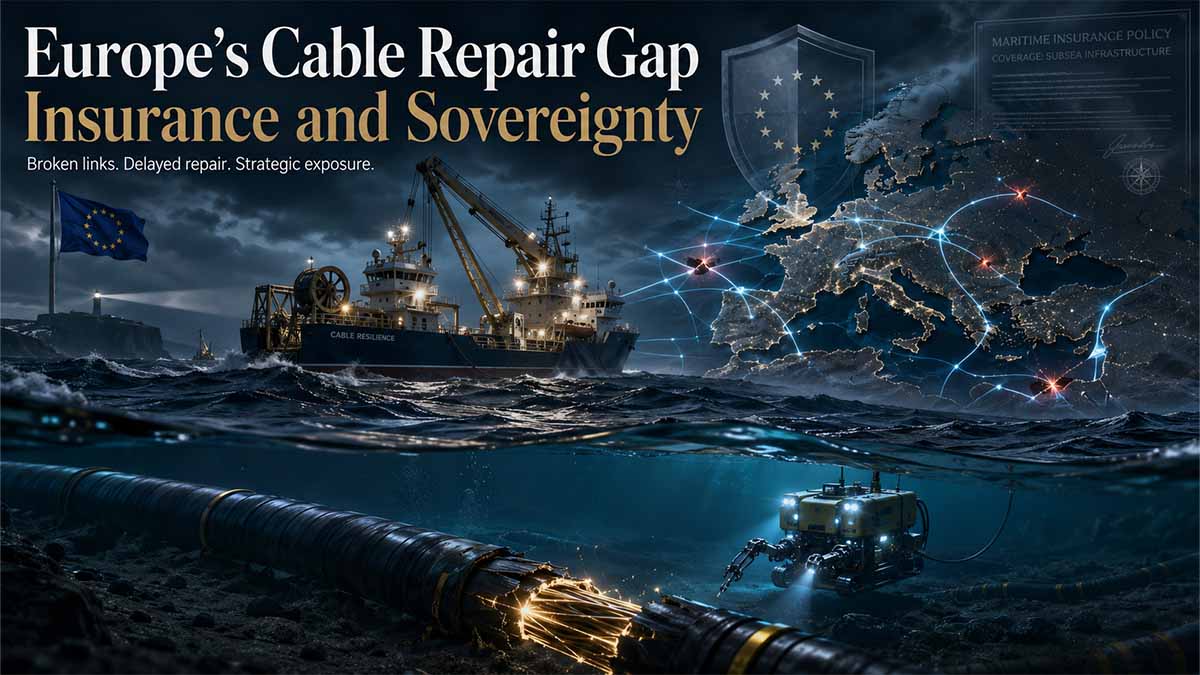
BLUF: Europe’s principal submarine-cable vulnerability is shifting from detection to recovery sovereignty: who can mobilise ships, components, crews, financing and military protection after simultaneous disruptions.
- The European Commission has allocated €347 million for strategic cable-security measures in 2026–2027, including an initial €20 million repair-capacity call.
- A second €40 million call, opened in June 2026, extends emergency repair modules to the Mediterranean, Atlantic and EU outermost regions.
- These measures implicitly recognise that commercial maintenance agreements cannot guarantee sufficient capacity during concurrent, geographically dispersed or conflict-related failures.
- Italy occupies a uniquely valuable Mediterranean position but does not exercise sovereign control over every industrial asset operating from Italian territory.
- France possesses Europe’s most vertically integrated sovereign model following the state acquisition of 80% of Alcatel Submarine Networks.
- Conventional insurance can reimburse insured physical losses; it cannot manufacture scarce cable ships, qualified jointing teams, repeaters or safe maritime access.
- The highest-impact 2026–2031 scenario is not the loss of one cable but a multi-cable, multi-jurisdiction disruption accompanied by attribution uncertainty and war-risk exclusions.
- Europe therefore requires predetermined restoration priorities, strategic component reserves, sovereign last-resort financing and protected access to repair vessels.
- Baseline analytical probability that the EU establishes a partially coordinated repair mechanism by 2031: 72%; probability of a genuinely integrated sovereign system: 34%.
When Europe’s Cables Break: Who Pays, Who Sails, Who Reconnects First?
Europe has spent years mapping the arteries beneath its seas. It is only now confronting the more difficult question: what happens after several of them are cut at once? A cable may be privately owned, contractually maintained and fully insured, yet still remain unrecoverable when specialised ships are occupied, replacement components are unavailable, war-risk cover is suspended or governments dispute which connection deserves priority. Between 2026 and 2031, submarine-cable policy will therefore move beyond surveillance. The decisive contest will concern recovery sovereignty: the authority to mobilise vessels, crews, depots, finance and military protection before a technical disruption becomes an economic and political crisis.
The Strategic Shift
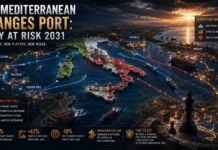
On 5 February 2026, the European Commission published its Cable Security Toolbox and allocated €347 million under the Connecting Europe Facility to strategic submarine-cable projects. The package included an initial €20 million call for adaptable repair modules positioned at ports or shipyards. On 18 June, the European Health and Digital Executive Agency opened a further €40 million call, extending the programme from the Baltic to the Mediterranean, Atlantic and EU outermost regions. Brussels also financed the first Baltic and Mediterranean Regional Cable Hubs with €5.8 million.
These are modest sums compared with the economic systems resting on the seabed, but their institutional meaning is considerable. The Commission explicitly designed the modules for emergencies in which market operators cannot restore service rapidly enough to prevent serious harm to the Union or a Member State. Europe is thus acknowledging that private contracts alone cannot guarantee strategic continuity. Submarine data cables carry approximately 99% of intercontinental internet traffic, according to the Commission, while NATO Secretary General Mark Rutte stated in Helsinki on 14 January 2025 that roughly 1.3 million kilometres of cable support an estimated $10 trillion in financial transactions each day. (European Commission, 5 February 2026; HaDEA, 18 June 2026; NATO, 14 January 2025)
The Insurance Illusion
Insurance can reimburse physical damage. It cannot manufacture a cable ship, produce a qualified jointing team or force a contractor to enter contested waters. A submarine system may combine construction-all-risks cover, marine cargo insurance, operational property protection, business interruption, shipowner liability, protection-and-indemnity insurance, terrorism extensions and separate war-risk policies. These layers are usually distributed among several insurers and reinsurers and are rarely disclosed publicly.
This opacity creates a national-security blind spot. European governments do not possess a public cable-by-cable register identifying the lead insurer, reinsurers, deductibles, exclusions, repair contractor, assigned vessel and available spare components. A cable landing in Italy may be insured in London, reinsured in Munich or Zurich, owned by an international consortium and maintained by a French-controlled operator. Territorial location therefore says little about who carries the financial risk or who controls recovery.
The most dangerous uncertainty concerns hybrid attack. An anchor incident may initially appear accidental, later be classified as sabotage and ultimately be linked to a state actor. During that period insurers may reserve their position while assessing whether marine, terrorism, cyber or war exclusions apply. The state, however, cannot wait for final attribution. Connectivity must be restored while the legal classification remains unresolved.
France’s Industrial Advantage
France is the European state closest to controlling the entire recovery chain. On 5 November 2024, then economy minister Antoine Armand signed the acquisition of 80% of Alcatel Submarine Networks from Nokia. The French Finance Ministry explicitly described the operation as a measure to protect French and European digital independence and preserve strategic industrial expertise.
ASN designs, manufactures, installs and maintains submarine systems. It gives Paris direct influence over technology, production, engineering and specialised vessels. France also possesses Orange Marine, which, together with its Italian subsidiary Elettra TLC, operates one of Europe’s most important cable fleets and repair networks.
The result is a vertically integrated structure: industrial production, marine operations, depots, telecommunications demand and state authority are connected within the same national system. France does not merely host cables; it controls a substantial part of the machinery required to restore them. (French Ministry of Economy and Finance, 5 November 2024)
Italy’s Mediterranean Paradox
Italy possesses almost all the elements required to become Europe’s Mediterranean recovery hub: central geography, major landing routes, Sparkle, Prysmian, Fincantieri, Elettra, naval capabilities and the strategic base at Catania. Yet these assets do not currently form a unified sovereign system.
The central paradox is Elettra. The company is Italian, operates from Catania and provides highly specialised marine engineering, but it has been controlled by Orange since 2010. Its repair vessel Antonio Meucci, launched in 1987, is scheduled to be replaced within Orange Marine’s fleet-renewal programme, which foresees new vessels in 2028 and 2029. In an ordinary commercial environment, multinational control brings investment, scale and access to a broader fleet. In a crisis affecting several Mediterranean routes, however, Italy must know whether it can order a vessel based in its territory to prioritise an Italian defence, financial or insular connection over another cable governed by a separate maintenance agreement.
Italy has already moved on surveillance. In December 2024, Fincantieri and Sparkle signed a memorandum to develop technologies for monitoring and protecting submarine telecommunications infrastructure. The Italian Navy’s seabed-security activity protects communication cables, offshore platforms and the TAP, Greenstream and Transmed pipelines. But surveillance is not repair. Rome still needs a binding architecture connecting the Navy, Sparkle, Prysmian, Fincantieri, Elettra, port authorities, insurers, the National Cybersecurity Agency and the Presidency of the Council. (Fincantieri, 19 December 2024)
The Baltic Laboratory
The Baltic is where Europe’s new doctrine is being tested first. Following repeated damage to energy and communications infrastructure, NATO launched Baltic Sentry on 14 January 2025. The activity combines frigates, maritime-patrol aircraft, national surveillance systems and naval drones. In May 2024, NATO had already established a Maritime Centre for the Security of Critical Undersea Infrastructure at Allied Maritime Command in the United Kingdom.
The Baltic’s vulnerability is not limited to telecommunications. Data cables, electricity interconnectors, pipelines, offshore wind infrastructure and dense commercial routes occupy the same maritime space. Germany, Poland, Denmark, Sweden, Finland, Estonia, Latvia and Lithuania can therefore face correlated failures across several strategic sectors. On 12 February 2026, these eight NATO allies agreed to accelerate the acquisition and integration of technology-enabled maritime capabilities. NATO reported that 70 air and maritime drones had been tested between March and October 2025 through Task Force X-Baltic.
Yet detection remains easier than restoration. The Baltic states possess limited independent cable-repair depth. Germany provides industrial and financial scale, Poland offers ports and regional logistics, while Nordic countries contribute offshore and naval expertise. Their rational model is a pooled regional reserve rather than eight national fleets. (NATO, 14 January 2025; NATO, 12 February 2026)
Atlantic and Insular Exposure
Spain, Portugal and Ireland confront a different geography. Their strategic value derives from transatlantic routes, but so does their vulnerability. Repair vessels must cover longer distances, Atlantic weather complicates operations and islands may depend on a limited number of physically diverse connections.
Spain’s Canary Islands illustrate the problem. A cable may appear redundant on a network map while sharing the same landing station, terrestrial backhaul or marine corridor as its alternative. Madrid has recognised the exposure: in October 2025, the Spanish government approved a direct €4.8 million grant to extend the Canalink Base 4 system toward southern Fuerteventura, explicitly linking the project to redundancy and network security.
The EU’s decision to extend repair-module funding to the Atlantic and outermost regions is therefore not administrative geography. It recognises that islands and remote territories cannot rely on the same recovery assumptions as continental hubs. A delay that is commercially tolerable in a highly interconnected region can become politically unacceptable where there is no equivalent alternative route.
Strategic Reserves
Europe now requires reserves designed as complete operational systems, not warehouses. A credible reserve must contain at least five elements: adaptable marine equipment; compatible cable, repeaters and branching units; qualified personnel; pre-authorised maritime and customs documentation; and immediate financing.
The 2026 HaDEA call requires each repair module to be compatible with at least three pre-identified vessels and capable of installation within a maximum of three days after the selected ship reaches the relevant port or shipyard. This is a sound principle because equipment tied to one vessel would merely create another single point of failure.
The next step must be a protected European inventory showing which systems depend on which depots, manufacturers, ships and specialist crews. Authorities must know whether several nationally critical cables rely on the same vessel, the same component supplier or the same reinsurer. Without this map, apparent redundancy may conceal industrial concentration.
A Public Guarantee
Europe should preserve commercial insurance for routine failures while creating a public backstop for systemic events. The mechanism should operate in four layers: owner retention, commercial insurance, a European recovery pool and sovereign last resort.
The European layer should finance immediate mobilisation when attribution is unresolved, cover extraordinary war-risk premiums, compensate operators displaced by sovereign restoration priorities and provide liquidity before insurers complete their assessments. A starting pool of €1.5–2.5 billion would not cover the total economic damage from a continental connectivity crisis, but it could finance multiple vessel deployments, emergency components, security measures and temporary guarantees.
The trigger must be operational rather than legal. Activation should occur when a competent authority determines that essential services are threatened and normal commercial arrangements cannot restore them within an acceptable period. Waiting for a court, insurer or intelligence service to determine whether an incident was accident, terrorism or war would make the guarantee strategically useless.
Protected Repair
Military forces will increasingly protect civilian repair missions. A cable ship is slow, predictable and vulnerable while recovering and splicing a damaged line. In a hostile environment it may require a maritime exclusion zone, naval escort, mine countermeasures, aerial surveillance, unmanned systems and protection against electronic interference.
The ship should remain civilian whenever possible. The vessel master must retain responsibility for maritime safety, the cable superintendent for the technical operation and the military commander for force protection. This division is essential for legal clarity and insurance continuity.
The EU and NATO also require a precise division of labour. The Union should finance reserves, regulate critical entities, coordinate permits and administer public guarantees. Member States should exercise emergency powers and law enforcement. NATO should provide intelligence, deterrence and military protection when the threat exceeds civilian capacity.
Who Reconnects First
The most difficult decision will not concern technology but political priority. During multiple failures, a single ship may face competing demands from a military route, a financial-market connection, an island system, a hyperscaler cable, an energy-control network and a major commercial operator.
Commercial contracts cannot determine this hierarchy alone. Europe needs an ex-ante restoration framework based on defence relevance, population affected, absence of alternative routes, dependency of hospitals and emergency services, energy-system exposure, financial importance, cross-border consequences and estimated repair time.
Ownership must not determine priority. A privately owned hyperscaler cable may carry government, health and banking workloads; a smaller national cable may be the only route serving an island. The relevant criterion is the function restored, not the corporate identity of the owner.
The 2031 Test
By 2031, Europe should be able to issue a financed, legally authorised and technically executable restoration order within hours of a systemic incident. Regional hubs should maintain a common operational picture. Strategic depots should hold audited compatible stocks. Multiple vessels should be pre-qualified. Personnel should be contractually available. Public guarantees should activate before final attribution. NATO and national forces should be able to protect a civilian repair mission.
The strategic hierarchy is already visible. France controls the most complete industrial chain. Italy holds the decisive Mediterranean geography but must convert physical assets into enforceable sovereign access. Germany can design the financial backstop and anchor Baltic coordination. Spain and Portugal must build Atlantic and insular redundancy. Nordic and Baltic states need pooled capacity because none can absorb a regional campaign alone.
The next European vulnerability will not arise because governments failed to know where their cables were. It will arise if they discover, after several have been cut, that the ships belong to someone else, the components are stored in the wrong depot, the insurers are still debating the cause and no authority has decided who must be reconnected first.
Navigational Index
I. The Recovery-Sovereignty Deficit
Repair vessels, specialised personnel, depot inventories, contractual priority, maritime permissions, war-risk exclusions and state intervention.
II. Europe’s Unequal Industrial Geography
The French vertically integrated model; Italy’s Mediterranean leverage; German, Spanish, Nordic, Baltic and insular dependencies.
III. The 2026–2031 Strategic Transition
From commercially insured assets to a European system of strategic reserves, public guarantees, military protection and politically determined restoration priorities.
Master Abstract
Europe has begun to understand that submarine-cable security cannot be reduced to seabed surveillance, naval patrols or the identification of suspicious vessels. The operational centre of gravity lies farther downstream: in the ability to restore connectivity after damage has occurred. In February 2026, the European Commission introduced a Cable Security Toolbox, identified Cable Projects of European Interest and allocated €347 million for strategic submarine-cable measures during 2026–2027, including an initial €20 million call for adaptable emergency-repair modules. In June 2026, the European Health and Digital Executive Agency opened a second call worth €40 million, extending geographical coverage beyond the Baltic to the Mediterranean, Atlantic and EU outermost regions. The modules are intended to place transportable repair equipment at ports or shipyards so that available vessels can be converted or equipped more rapidly. These interventions represent more than technical procurement. They amount to an institutional acknowledgement that the existing commercial architecture does not provide a guaranteed European recovery capability under systemic stress. Commission increases submarine cable security with €347 million investment and new toolbox – European Commission – February 2026 CEF-Digital second call for proposals to increase Europe’s submarine cable repair capacities – HaDEA – June 2026 The decisive distinction is between an asset that is insured and a state that is recoverable. An insurer may reimburse the physical cost of a severed cable, subject to deductibles, limits, causation tests and exclusions. It cannot guarantee that a suitable vessel will be free, that compatible repeaters and cable sections will exist in a nearby depot, that specialist jointing personnel will be available, or that a commercial shipowner will accept deployment into an area exposed to mines, missile threats, naval confrontation or sanctions. The analytical foundation supplied for this report correctly identifies the unresolved question: not merely where Europe’s cables run, but who pays, who sails and who is restored first when several systems fail together.
The European industrial map is profoundly asymmetric. France has moved closest to a sovereign, vertically integrated model because it combines telecommunications operators, cable ships, engineering expertise and direct state control over a major system supplier. On 5 November 2024, the French state signed the acquisition of 80% of Alcatel Submarine Networks, explicitly presenting the transaction as a measure to protect French and European digital independence and retain strategic industrial capabilities. L’État acquiert 80% du capital d’ASN – French Ministry of Economy, Finance and Industry – November 2024 Italy, by contrast, possesses a potentially decisive geographical and industrial constellation—Mediterranean landing points, naval competence, cable manufacturing, telecommunications operators, shipbuilding capacity and the repair base at Catania—but these assets do not yet constitute a single sovereign command architecture. The Italian Navy’s Operazione Fondali Sicuri protects communication cables, extraction platforms and the Trans-Adriatic Pipeline, Greenstream and Transmed gas systems, demonstrating that Rome already treats seabed infrastructure as an operational-security domain. Operazione Fondali Sicuri – Italian Navy – July 2026 Nevertheless, surveillance, inspection and deterrence are not equivalent to guaranteed restoration. Italy’s critical strategic question is whether the state can, under emergency conditions, determine the employment priority of vessels, crews, remotely operated vehicles, cable stocks and landing-station resources that may be controlled through multinational commercial structures or maintenance agreements. This problem extends across Europe. Germany’s North Sea and Baltic dependencies intersect with offshore wind, electricity interconnectors and dense commercial shipping. Spain must cover Mediterranean, Atlantic and insular routes, including geographically remote territories. Ireland and Portugal sit on transatlantic corridors; Greece, Cyprus and Malta face distance, regional instability and limited route diversity. The result is a fragmented European system in which the country hosting a landing station, depot or ship may not control the contractual sequence governing its deployment.
The five-year outlook must therefore be structured around competing hypotheses rather than a single linear forecast. H₁ — Market Adaptation: insurers, maintenance consortia and cable owners expand capacity sufficiently without major public intervention. Current posterior probability: 11%. H₂ — Incremental European Coordination: EU-funded modules, regional hubs, stress testing and information exchange improve recovery but leave vessel control and indemnification predominantly national or commercial. Posterior probability: 38%. H₃ — Sovereign Regionalisation: France, Italy, the Nordic-Baltic states and the Atlantic members create partially autonomous regional systems linked through EU coordination. Posterior probability: 34%. H₄ — Crisis-Driven Integration: a major simultaneous disruption forces the EU to establish common financing, strategic stocks and restoration priorities. Posterior probability: 13%. H₅ — Strategic Fragmentation: geopolitical confrontation, insurance withdrawal and competing national priorities reduce practical cooperation despite new EU instruments. Posterior probability: 4%. These estimates derive from a Bayesian synthesis of four observable trends: the EU’s movement from policy recommendations to funded repair modules; France’s acquisition of strategic industrial control; growing naval involvement in seabed protection; and the acceleration of non-European industrial ecosystems. Chinese official sources reported in March 2025 that Chinese enterprises had invested in 17 operational international cable systems, that one Chinese supplier had delivered more than 100,000 kilometres of systems across over 70 countries and that China was expanding its role in construction, standards and maintenance. Report highlights China’s role in international communication submarine cable construction and protection – State Council of the People’s Republic of China – March 2025 In May 2026, China’s state-owned assets authority described a new Asian cable architecture using route diversity, dual landing and millisecond-level automatic switching, illustrating how resilience is increasingly designed as an integrated technological and geopolitical capability rather than purchased as an isolated insurance product. Asia Link Cable lands in Hong Kong – State-owned Assets Supervision and Administration Commission of China – May 2026 Europe’s strategic contest is therefore not simply to prevent physical cuts. It is to determine whether, by 2031, it can command the complete restoration chain—finance, attribution, ships, components, crews, permissions, rerouting and force protection—before a crisis exposes the difference between commercial ownership and sovereign control.
Cable Recovery Sovereignty Simulator · 2026–2031
I. The Recovery-Sovereignty Deficit: Who Pays, Who Sails, Who Reconnects Europe
Europe’s submarine-cable problem begins where conventional infrastructure protection doctrine usually ends. Detection, attribution and deterrence can reduce risk, but they do not restore a severed fibre pair, recover a damaged repeater, secure a marine permit, mobilise a specialist vessel or determine which national network must be repaired first. Recovery sovereignty is therefore the measurable capacity of a political authority to command the complete restoration chain under conditions in which normal commercial mechanisms are unavailable, congested, disputed or legally suspended. That chain includes the cable owner, consortium management committee, network operator, marine-maintenance authority, insurance broker, primary insurers, reinsurers, protection-and-indemnity provider, repair contractor, cable-ship operator, depot manager, component manufacturer, coastal-state administration, port authority, customs service, navy, coastguard and security agencies. No European institution presently exercises uncontested authority over all these actors. The European Commission’s decision in February 2026 to allocate €347 million to submarine-cable security, including an initial €20 million repair-capacity call, followed by a second €40 million call covering the Mediterranean, Atlantic and outermost regions, provides direct evidence that ordinary market capacity is no longer considered sufficient for every emergency. The second call is especially revealing: it targets public bodies with emergency mandates, requires at least three vessels to be identified for pre-configuration, and envisages installing modular repair equipment within three days of a vessel reaching the relevant port or shipyard. Its stated purpose is to permit intervention when market participants cannot execute a repair that is necessary to prevent severe harm to the Union or its Member States. This is not merely industrial assistance; it is the first institutional architecture for substituting public emergency capacity for a failed or unavailable commercial response. Commission increases submarine cable security with €347 million investment and new toolbox – European Commission – February 2026 — Verified primary source. CEF-Digital second call for proposals to increase Europe’s submarine cable repair capacities – HaDEA – June 2026 — Verified primary source.
The deficit must be decomposed into seven separate control layers because possession of one layer does not imply control of the others. A state may host a landing station but not own the cable; own shares in the telecommunications operator but not control the marine-maintenance agreement; host a cable ship but not possess contractual authority to redirect it; maintain a naval surveillance operation but lack compatible cable stock; or finance a repair while remaining unable to secure an insurer’s consent, a coastal permit or safe access to the fault site. The repair operation itself is sequential and failure-sensitive. The fault must first be localised through network measurements and marine survey data. A suitable vessel must then be nominated, released from other commitments, provisioned with the correct spare cable, repeaters, branching units, joints and grapnels, and crewed by personnel qualified for that system. Authorities may need to issue navigation warnings, environmental approvals, territorial-sea permissions, customs clearances for components, port services and security arrangements. At sea, the crew must locate and recover one or both cable ends, remove damaged sections, splice replacement cable, test optical performance, lower the repaired span and, where required, rebury or armour it. Each stage can be delayed independently. The United Nations Convention on the Law of the Sea recognises the importance of preserving the possibility of repairing existing cables, but it does not create a supranational European command system for prioritising repairs or compelling private contractors to operate during hostilities. United Nations Convention on the Law of the Sea, Article 79 – United Nations – December 1982 — Verified primary source. The central analytical conclusion follows: the relevant unit of sovereignty is not cable ownership alone, but the state’s enforceable authority over the entire restoration sequence. The source framework supplied for this report identifies the same decisive issue—Europe has improved its knowledge of where cables run, but has not publicly established who pays, who sails and who is reconnected first when several systems fail simultaneously.
| Recovery layer | Commercial controller in normal conditions | Sovereign failure point | Required emergency instrument |
|---|---|---|---|
| Fault diagnosis | Cable owner, network operations centre, consortium | Data may be fragmented or commercially restricted | Mandatory incident-data exchange |
| Vessel nomination | Maintenance-zone authority or contracted operator | Vessel occupied, distant, sanctioned or unsafe to deploy | Public requisition or standby agreement |
| Specialist crew | Cable-ship operator and system contractor | Scarcity, nationality restrictions, fatigue, security exposure | Accredited European personnel reserve |
| Spare equipment | Owner, consortium depot, manufacturer | Incompatible stock, export controls, depleted inventories | Strategically standardised regional depots |
| Insurance approval | Broker, insurers and reinsurers | Coverage dispute or war-risk exclusion | Public guarantee and rapid coverage determination |
| Maritime permission | Coastal and port authorities | Delayed permits, contested waters, environmental procedures | Emergency permit corridor |
| Physical protection | Navy, coastguard, allied forces | High-threat area or uncertain attribution | Rules for escorted civilian repair missions |
| Repair priority | Contracts and consortium governance | Commercial priority conflicts with national survival | Ex-ante sovereign restoration hierarchy |
The Scarcity of Repair Vessels and the Illusion of Port-Based Control
A repair vessel is not interchangeable with an ordinary offshore-support ship. Purpose-built cable ships combine dynamic positioning, cable engines, linear cable machinery, cable tanks, jointing rooms, testing facilities, specialised stern or bow sheaves, grapnels, remotely operated vehicles, survey systems and crews capable of executing highly system-specific procedures. Even the European Commission’s modular concept does not eliminate that distinction; it attempts to widen emergency capacity by pre-configuring suitable vessels and storing adaptable equipment close to ports or shipyards. The requirement that at least three receiving vessels be identified for each proposed module reflects an operational truth: equipment without a compatible hull, trained crew and validated mobilisation procedure is not a repair capability. Orange’s fleet disclosures provide a concrete measure of industrial concentration. Orange Marine and its Italian subsidiary Elettra TLC operate specialised vessels across the Atlantic, English Channel, North Sea, Mediterranean, Black Sea, Red Sea and Indian Ocean. Orange announced two replacement ships for delivery in 2028 and 2029, replacing the Léon Thévenin, launched in 1983, and the Antonio Meucci, launched in 1987. The group states that four vessels will be assigned principally to maintenance and that it also owns two laying vessels and one survey vessel through Orange Marine and Elettra. The new vessels will include proprietary remotely operated vehicles and will be capable of installing connecting segments up to 1,000 kilometres. Orange Marine modernizes its fleet of cable ships to secure digital infrastructure in Europe, Africa and the Middle East – Orange – November 2025 — Verified audited-corporate source. This fleet modernisation will improve technical resilience but does not automatically create Italian or European command authority. A vessel based in Catania can be an Italian strategic asset geographically while remaining subject to the contractual commitments, group governance and maintenance obligations of a French-controlled corporate structure. Port presence must therefore never be treated as equivalent to national availability.
The strategic importance of fleet concentration becomes acute during correlated failures. Commercial maintenance arrangements are generally designed around statistical expectations of geographically distributed faults, not around a hostile campaign that deliberately produces several failures within one maintenance zone. Under routine conditions, a vessel can sail rapidly, recover a cable and return to readiness before another major event occurs. Under simultaneous disruption, the queue becomes nonlinear: one repair may require prolonged fault localisation, weather delays, disputed permissions, replacement repeaters or extensive cable insertion; meanwhile additional failures accumulate. A five-cable incident does not necessarily produce five times the restoration period, because different systems may require different depots, contractual approvals and engineering teams, while the first vessel’s assignment can prevent it from responding to a higher-value failure discovered later. Orange states that the Sophie Germain, based at La Seyne-sur-Mer, can be deployed within 24 hours throughout the year for operations in the Mediterranean, Red Sea and Black Sea. Orange’s newest cable ship strengthens global connectivity – Orange – 2026 — Verified audited-corporate source. That readiness is strategically valuable, yet the dispatch clock is only one component of restoration time. Transit distance, sea conditions, access restrictions, component availability, repair complexity and the vessel’s existing assignment can dominate the schedule. The European Union’s decision to create Regional Cable Hubs in the Baltic and Mediterranean, supported by €5.8 million, is intended to improve surveillance, information exchange and coordinated response, but a hub cannot itself splice a cable or override an insurer, shipowner, consortium or coastal authority without predefined legal instruments. Commission funds first Regional Cable Hubs and launches €40 million call for cable repair capacity – European Commission – June 2026 — Verified primary source.
Specialised Personnel: The Human Bottleneck Behind the Steel Hull
The least visible component of repair sovereignty is specialised labour. Cable restoration depends on masters experienced in precise station-keeping, dynamic-positioning personnel, deck officers, cable engineers, jointers, transmission specialists, ROV pilots, surveyors, electricians, hydraulic technicians, marine superintendents, weather-routing personnel, depot managers and representatives of the relevant cable system. Their knowledge is partly formalised but also accumulated through operations, manufacturer-specific procedures and familiarity with legacy systems. A state cannot create these competencies merely by requisitioning a ship. The problem will intensify between 2026 and 2031 because Europe is simultaneously expanding offshore electricity interconnectors, offshore wind arrays, telecommunications systems and seabed-surveillance activity. These sectors compete for overlapping marine-engineering, ROV, high-voltage, survey and dynamic-positioning skills. The retirement of older vessels also produces a transition risk: new ships require training, acceptance trials and procedural adaptation, while older crews carry knowledge tied to equipment and systems that may remain operational for decades. Orange’s 2020 disclosure stated that Orange Marine and Elettra had laid more than 220,000 kilometres of optical-fibre cable and conducted nearly 550 repairs, including operations deeper than 5,500 metres. Orange strengthens its commitment to its submarine cable business – Orange – December 2020 — Verified audited-corporate source. This operational history represents intellectual capital that cannot be reproduced through emergency procurement. A European resilience programme that funds hardware without mapping personnel availability would therefore mismeasure its actual capacity. States need a classified or protected European registry of personnel qualifications, nationalities, security-clearance status, mobilisation times, system experience, medical readiness and availability for operations in contested areas.
The human bottleneck also generates insurance consequences. Marine insurers assess not only the insured asset but the competence of contractors, vessel suitability, operational procedures and loss-mitigation arrangements. Allianz Commercial’s analysis of offshore wind losses reports that cable damage represented 53% of claims by value in one of its largest offshore-wind insurance markets, Germany and Central and Eastern Europe, during 2014–2020. Allianz states that underwriters scrutinise the cable type, vessels, contractor-client communication and the frequency of qualified risk-engineer visits; it also stresses the importance of demonstrating that replacement components and specialist repair expertise can be sourced rapidly. Although power-cable insurance is not identical to telecommunications-cable insurance, the underwriting logic is directly relevant: repair capacity affects both expected loss severity and business-interruption duration. Offshore wind industry poised for growth, but economic pressures and technology risks need to be managed – Allianz – September 2023 — Verified audited-corporate source. A state planning emergency intervention must therefore consider whether substituting a pre-configured public vessel or military-assisted platform alters the policy’s warranties, contractor conditions, vessel-class requirements or risk-engineering assumptions. If these issues are not agreed before an incident, the very public intervention designed to accelerate restoration could create a coverage dispute. Europe needs pre-approved technical standards under which emergency crews and modular vessels are deemed acceptable to participating insurers and reinsurers, while preserving the state’s right to proceed even when commercial consent is unavailable.
Depot Inventories and the Strategic Problem of Component Compatibility
Cable depots are the material memory of the network. Their inventories may include armoured and lightweight cable sections, repeaters, branching units, joints, equalisation equipment, power-feed components, universal jointing kits, grapnels, buoys, rope, burial tools and test equipment. The stock must match the architecture, depth rating, optical design and mechanical properties of the damaged system. A warehouse containing thousands of kilometres of cable can still be strategically useless if its components cannot interface with the affected network. Depot sovereignty therefore requires four capabilities: visibility of stock, legal authority to allocate it, physical capacity to move it rapidly and technical certification of compatibility. Commercial owners ordinarily maintain spares according to contractual obligations and expected fault patterns. They do not necessarily maintain quantities sufficient for a regional sabotage campaign, nor are they obliged to surrender stock for another operator’s cable. The 2026 EU calls focus on repair modules rather than the full inventory problem. This is a rational first step, but an adaptable deck package cannot replace a missing repeater or branching unit. The Commission’s July 2026 tender for policy support explicitly lists cables, landing stations, deployment and maintenance vessels, and the components supply chain among the subjects requiring further technical, legal and economic analysis. Support for EU policy on security of Submarine Cable Infrastructure 2026–2027 – European Commission – July 2026 — Verified primary source. The inclusion of components confirms that European authorities recognise repair as a supply-chain issue, not merely a vessel shortage.
Between 2026 and 2031, depot risk will be shaped by industrial concentration, export controls, sanctions, supplier nationality and the growing technical differentiation of cable systems. A state may face a situation in which a component is commercially available but manufactured in a jurisdiction that restricts export during conflict; located in a depot controlled by an operator that gives priority to another system; or insured only while stored and transported under prescribed conditions. China’s government has described the expansion of Chinese enterprises across international cable construction, standard-setting, maintenance and protection, reporting in March 2025 that Chinese companies had invested in 17 operational international cable systems and that one supplier had delivered more than 100,000 kilometres across more than 70 countries. Report highlights China’s role in international communication submarine cable construction and protection – State Council of the People’s Republic of China – March 2025 — Verified primary source. The strategic implication is not that Chinese supply is intrinsically unreliable, but that Europe’s component architecture is embedded in a competitive international system in which industrial policy, standards, security restrictions and geopolitical alignment can influence availability. A credible European model requires minimum stock levels for critical systems, geographically dispersed inventories, periodic compatibility testing, protected digital records and legal mechanisms permitting emergency cross-allocation. The probability that the EU establishes a shared inventory register by 2031 is assessed at 67%; the probability that it establishes physically pooled, standardised stocks available under binding sovereign rules is lower, approximately 39%, because owners, manufacturers and states will resist disclosure and compulsory allocation.
Maritime Permissions, Jurisdiction and the Repair-Corridor Problem
Submarine-cable repair crosses overlapping legal spaces: internal waters, territorial seas, exclusive economic zones, continental shelves and international waters. The precise approval structure varies by location, the nature of the seabed operation, the vessel’s flag, environmental rules, port entry, customs treatment of spares, sanctions controls, security restrictions and whether the cable is considered civilian, military, dual-use or strategically protected. In a routine incident, experienced contractors manage these procedures through established relationships and documentation. In a politically contested incident, permissions can become instruments of delay. A coastal state may demand additional surveys, restrict the use of foreign-flagged vessels, impose naval escorts, deny access to a suspected crime scene, or require evidence that seabed work will not disturb other infrastructure. A repair ship may need to enter a port controlled by one state, load components owned by a consortium incorporated elsewhere, repair a system whose landing parties belong to several jurisdictions and operate in waters affected by military warnings. UNCLOS protects the general freedom to lay and maintain cables and requires due regard for existing systems, but it does not remove the enforcement powers, security concerns and procedural controls of coastal states. United Nations Convention on the Law of the Sea – United Nations – December 1982 — Verified primary source.
The United Kingdom’s May 2026 proposal illustrates the direction of national policy. The government announced plans for tougher penalties for damaging subsea infrastructure, new operator-security obligations and emergency powers for government, explicitly linking the measures to suspicious Russian activity. Plan to toughen protections for subsea internet cables amid heightened Russian activity – UK Department for Science, Innovation and Technology – May 2026 — Verified primary source. Such emergency powers can accelerate intervention domestically, but Europe still lacks a standard repair corridor that automatically recognises clearances across Member States. A practical mechanism should operate like military-mobility facilitation: pre-notified vessels, harmonised documentation, customs waivers, standard environmental protocols, mutual recognition of security checks, expedited port entry and standing authorisation for emergency modules. It should also define how evidence preservation interacts with immediate restoration. Law-enforcement agencies may wish to inspect damaged cable, anchor marks or seabed debris, while network operators need to recover service. Without agreed forensic procedures, attribution and recovery can obstruct each other. A European protocol should require high-resolution imaging, chain-of-custody preservation, sample retention and shared technical reporting before damaged sections are altered, but should impose strict time limits so that evidentiary interests cannot indefinitely delay repair.
SUBSEA CABLE FAULT DETECT & REPAIR AUTHORISATION PROTOCOL
An end-to-end 3D structural visualizer mapping the complete operational, security, legal, and sovereign decision architecture triggered by a subsea fiber-optic or HVDC power interconnector fault—from optical localisation to naval threat review and state intervention.
The Insurance Architecture: What Is Insured, by Whom, and Where the Public Record Ends
There is no publicly available, authoritative European register identifying the insurers, reinsurers, policy limits, deductibles, exclusions and maintenance warranties attached to every submarine cable. Consequently, any assertion that a named insurer covers a particular telecommunications cable without a disclosed policy, audited owner statement or government filing would be speculative. Cable insurance is normally assembled through layered and confidential placements involving brokers and multiple markets rather than a single insurer publicly identified with the asset. The principal coverage blocks may include construction-all-risks insurance for manufacture and installation; marine cargo coverage for cable and components in transit; hull and machinery cover for cable ships; protection-and-indemnity liability for vessel operations; property cover for landing stations and depots; operational property-damage cover for the submerged system; machinery breakdown or equipment cover; third-party liability; delay-in-start-up insurance; business-interruption or contingent-business-interruption insurance; terrorism extensions; political-violence cover; cyber insurance for associated network operations; and separate marine war-risk cover. Each block may have a different insurer, attachment point, deductible, governing law, claims process and territorial limitation. Some losses may be retained by the cable consortium, captive insurer or operator rather than transferred. The central distinction is that property damage, repair expense, third-party liability, revenue loss and systemic national loss are separate exposures. AXA XL’s official explanation of ocean-cargo insurance, for example, states that physical loss or damage may be insured while certain intangible consequences of delay or inability to bring goods to market are not. Ocean Cargo Insurance and Global Supply Chain Disruption – AXA XL – October 2021 — Verified audited-corporate source. The same conceptual boundary matters for cables: the cost of replacing a damaged span can be measurable and insured while economy-wide losses from degraded latency, rerouted traffic, interrupted cloud access or financial-market disruption remain largely outside the cable owner’s policy.
An insurance programme can therefore perform four functions without delivering sovereign continuity. First, it can compensate the owner for covered physical damage. Second, it can finance specialist contractors and reduce the owner’s balance-sheet volatility. Third, it can impose risk-engineering discipline through warranties, surveys and contractor standards. Fourth, it can distribute severe losses through reinsurance. It cannot create instantaneous capacity when all qualified vessels are engaged, compel a contractor to enter a war zone, guarantee that the replacement component exists, or compensate every third party whose activities depend on the cable. Business-interruption coverage ordinarily depends on definable insured damage, waiting periods, sublimits, indemnity periods and evidence of lost gross profit or additional expenditure. A cable operator may reroute traffic and avoid complete interruption, producing a complex dispute over whether the insured suffered physical damage, service degradation, increased cost of working or a covered interruption. Customers downstream—banks, hospitals, cloud providers, manufacturers and public authorities—may possess their own business-interruption or cyber policies, but those policies can contain physical-damage requirements, supplier limitations, named-peril restrictions or exclusions for infrastructure failure outside the insured’s premises. The result is a layered protection gap: the cable may be physically insured while the macroeconomic loss is not. Allianz’s 2026 marine review identifies war, geopolitical events and business interruption among major maritime risk concerns, reinforcing the conclusion that accumulation and disruption increasingly matter alongside vessel loss. Safety and Shipping Review 2026 – Allianz Commercial – June 2026 — Verified audited-corporate source.
Which Insurance Companies Can Underwrite Cable Risks in Each European Country?
The only analytically defensible country mapping is a map of major insurers and reinsurers with publicly disclosed marine, specialty, infrastructure, energy or global corporate capabilities—not a claim that each company currently insures a named cable. Actual placements are confidential and can be led from London, Paris, Munich, Zurich, Milan, Madrid, Bermuda, Singapore or another market regardless of the cable’s landing country. A cable landing in Italy may be owned by an international consortium, insured under English law, brokered in London, led by a French or American specialty carrier and reinsured in Germany or Switzerland. “The insurer in Italy” is therefore not necessarily an Italian insurer. The policy geography follows ownership, project finance, broker relationships, governing law, underwriting appetite and the location of the risk-bearing entities. The table below records major market-capable groups linked to each country through headquarters, substantial corporate presence or national insurance markets. It does not identify undisclosed policyholders and must not be interpreted as proof that the listed groups insure every cable in that jurisdiction.
| Country or market | Major publicly identifiable insurance or reinsurance groups with relevant marine, specialty, infrastructure or large-corporate capacity | What can be verified | What remains undisclosed |
|---|---|---|---|
| Italy | Generali, Allianz Commercial, AXA XL, Zurich, HDI Global and international specialty syndicates | Generali is a major international insurance group; international carriers provide large corporate and marine capacity | Cable-specific insurers, shares, deductibles, exclusions and limits |
| France | AXA XL, Allianz Commercial, Generali, SCOR and international specialty markets | AXA publicly describes global specialty and maritime underwriting expertise | Exact insurers of Orange, ASN or consortium-owned cables |
| Germany | Allianz Commercial, Munich Re, Hannover Re, HDI Global, AXA XL | Allianz publicly underwrites marine risks; German reinsurers provide global capacity | Project-level telecommunications-cable placements |
| Spain | MAPFRE, AXA XL, Allianz Commercial, Zurich, Generali and international markets | Major Spanish and multinational groups possess large commercial and marine portfolios | Policies covering individual mainland, Balearic or Canary routes |
| Portugal | Fidelidade, Ageas, Generali Tranquilidade, Allianz, Zurich and international marine markets | National corporate-insurance capacity exists | Lead underwriter and reinsurance structure for Atlantic cable systems |
| Ireland | International carriers operating through Irish and London markets | Ireland hosts substantial international insurance operations | Whether specific transatlantic cables are insured locally or offshore |
| Netherlands | NN Group, Achmea, Allianz, Zurich, HDI and London marine markets | Strong corporate-insurance and maritime ecosystem | Cable-specific insurer participation |
| Belgium | AG Insurance, AXA, Allianz, Zurich, HDI and London markets | Large corporate coverage available | Allocation across Belgian landing and offshore infrastructure |
| Denmark | Tryg, Topdanmark, Codan-related capacity and international marine insurers | Nordic non-life and marine underwriting capability | Actual consortium placements |
| Sweden | If, Folksam, Tryg and international specialty markets | Strong Nordic industrial-risk market | Named insurers for individual Baltic systems |
| Finland | If, LähiTapiola, Pohjola Insurance and international reinsurers | National property and marine capacity | Cable policy terms and limits |
| Poland | PZU, Warta, Allianz, HDI and international reinsurers | Large domestic and multinational commercial market | Baltic cable-specific contracts |
| Estonia, Latvia, Lithuania | Baltic branches of Nordic, German and regional insurers; international specialty markets | Corporate and marine coverage is available regionally | Local versus foreign placement and war-risk treatment |
| Greece | Ethniki, Interamerican/ACHMEA-related operations, Allianz, Generali and global marine markets | Major shipping-insurance ecosystem and international access | Insurer allocation for Eastern Mediterranean cables |
| Cyprus | Domestic insurers plus London, Greek and international marine markets | Maritime and corporate insurance capacity is accessible | Exact cable schedules and war-risk sublimits |
| Malta | Domestic and international carriers, protected-cell structures and London markets | International insurance structures operate from Malta | Named cable policies and reinsurance panels |
| United Kingdom | Lloyd’s syndicates, AXA XL, Allianz Commercial, Chubb, AIG, Beazley, Hiscox, QBE, MS Amlin and others | Deep global marine, war, energy and specialty capacity | Cable-by-cable subscription structures |
| Norway | Gjensidige, If, Gard, Skuld and international energy/marine carriers | Extensive offshore, marine and P&I expertise | Telecommunications-cable property placements |
| Switzerland | Zurich Insurance Group, Swiss Re, Chubb Switzerland and international carriers | Global corporate insurance and reinsurance capacity | Physical cable underwriting by specific entity |
| Austria, Czechia, Slovakia, Hungary and inland markets | Vienna Insurance Group, UNIQA, Generali, Allianz, Zurich, HDI and reinsurers | Corporate policies may cover network owners headquartered inland | Marine risk may be placed outside the headquarters state |
The corporate evidence confirms market capability but not cable-specific allocation. Allianz Commercial publicly offers marine hull, liability and cargo insurance and produces audited risk analysis on marine claims. AXA identifies AXA XL as a global specialty operation supporting maritime risks, risk engineering and infrastructure innovation. Generali reports €98.1 billion in 2025 premium income and operations across Europe, Asia and the Americas, establishing financial scale but not proving participation in any particular cable policy. Munich Re publicly reports substantial global property-casualty reinsurance and specialty operations. Marine Insurance Solutions – Allianz Commercial – 2026 — Verified audited-corporate source. 2025 Integrated Report – AXA – 2026 — Verified audited-corporate source. Annual Integrated Report and Consolidated Financial Statements 2025 – Generali – March 2026 — Verified audited-corporate reporting portal. Annual Report 2025 – Munich Re – 2026 — Verified audited-corporate source. The evidentiary limitation is strategically important rather than incidental: governments cannot assess accumulation exposure if they do not know whether several nationally critical cables share the same lead insurer, reinsurer, war-risk provider, repair contractor or depot.
War-Risk Exclusions and the Boundary Between Insurable Accident and Hostile Act
War-risk clauses create the most dangerous transition point between private insurance and sovereign responsibility. Standard marine, property or construction policies frequently exclude or restrict losses arising from war, invasion, hostilities, civil war, seizure, confiscation, mines, weapons, terrorism, malicious cyber operations or acts of public authority. Separate war or political-violence coverage may restore part of the excluded protection, but it can be cancellable, geographically restricted, subject to short notice, priced dynamically or withdrawn when threat levels increase. The definitional problem is severe for hybrid operations. An anchor dragged by a merchant vessel may initially appear accidental, later be treated as reckless, and finally be attributed to state direction. A cyber intrusion that alters a ship’s navigation, automatic identification or dynamic-positioning systems could produce physical cable damage while raising disputes among marine, cyber, war and liability policies. An insurer may reserve rights while attribution is investigated, delaying payment or contractor authorisation even though the restoration requirement is immediate. The state cannot wait for a final legal determination because the strategic effect exists regardless of whether the event is ultimately classified as negligence, sabotage, terrorism or war.
The international compensation architecture for other maritime risks illustrates why a public backstop becomes necessary when private liability is insufficient. The International Maritime Organization’s hazardous-and-noxious-substances convention uses a two-tier structure in which shipowner liability is supplemented by a fund because shipowner insurance alone may be inadequate; the IMO expressly notes circumstances involving insufficient financial security or acts of war. That convention does not govern submarine-cable loss, but its architecture demonstrates an established maritime principle: catastrophic or legally exceptional events can require pooled funding beyond ordinary liability insurance. International Convention on Liability and Compensation for Damage in Connection with the Carriage of Hazardous and Noxious Substances by Sea – International Maritime Organization – updated May 2026 — Verified primary source. Europe should apply the same structural logic to strategic cable restoration without copying the HNS mechanism mechanically. The proposed system should preserve private insurance for ordinary damage, establish a pooled European layer for systemic and hybrid events, and provide an unlimited or politically determined sovereign intervention layer for crises threatening essential state functions.
| Event classification | Likely primary insurance issue | Operational danger | Required sovereign response |
|---|---|---|---|
| Accidental fishing or anchoring damage | Property and liability determination | Routine repair queue may still delay restoration | Monitor; intervene only if systemic impact develops |
| Gross negligence | Liability limits and causation | Shipowner capacity may be insufficient | Claims coordination and emergency finance |
| Sabotage by non-state actor | Terrorism or malicious-damage wording | Specialist contractors may require security guarantees | Public indemnity and protected access |
| State-directed covert action | War, hostile-act and attribution exclusions | Coverage reservation while evidence remains uncertain | Immediate public financing without awaiting attribution |
| Open armed conflict | War-risk withdrawal or cancellation | Vessel and crew may refuse deployment | State-chartered or military-protected mission |
| Cyber-induced physical damage | Cyber-versus-marine coverage dispute | Multiple insurers may deny primary responsibility | Government-led coverage bridge and forensic protocol |
| Multiple simultaneous cuts | Accumulation, aggregate limits and reinsurance exhaustion | Repair capacity becomes the binding constraint | Sovereign restoration priority and pooled European reserve |
Contractual Priority: Why the First Cable Repaired May Not Be the Most Important Cable
Maintenance priority is generally established by contract, not by a comprehensive national-security ranking. A maintenance agreement may define covered zones, standby obligations, mobilisation targets, cost allocation and procedures for simultaneous faults. Cable owners may hold different service levels or participate in distinct maintenance arrangements. A ship may already be contractually committed to a repair whose economic importance is lower than that of a newly disrupted system supporting defence communications, an island, an electricity interconnector’s control network or a major financial centre. The operator cannot simply abandon the first intervention without legal, safety and compensation consequences. Moreover, strategic relevance is not synonymous with nominal cable capacity. A lower-capacity system may be the only physically diverse route into an island or government facility, while a very high-capacity hyperscaler cable may have substantial redundancy. Restoration priority therefore requires service-level intelligence: which traffic classes use the cable, what alternative routes exist, how much latency or congestion diversion creates, which landing stations share terrestrial backhaul, what government functions depend on the system and whether the cable carries synchronisation, control or security traffic that cannot be easily rerouted.
A sovereign priority matrix should be agreed before a crisis and applied only when a formally defined emergency threshold is reached. The order should not rigidly assign one category to every event; it should combine national survival, population impact, absence of substitutes, time sensitivity, repair duration and cross-border effects. A proposed priority score P can be expressed without relying on confidential financial valuations:
P = 0.25C + 0.20R + 0.15D + 0.15E + 0.10F + 0.10T + 0.05A
where C represents critical-state-function dependence, R route non-redundancy, D defence and security relevance, E population and essential-service exposure, F financial-system dependence, T time sensitivity, and A allied or cross-border impact. Each variable would be scored from 0 to 100. Contractual priority would remain operative below the emergency threshold; above it, a competent national or European authority could issue a restoration order accompanied by compensation for displaced commercial commitments. This avoids uncompensated requisition while ensuring that a hyperscaler’s contractual purchasing power does not automatically outrank an island, hospital system or defence network. The mechanism should be integrated with insurance because changing repair order can increase another owner’s business-interruption loss. A European fund must therefore indemnify the incremental loss caused by sovereign reprioritisation, subject to audit and mitigation obligations.
Italy: Strategic Geography Without Fully Integrated Command
Italy possesses nearly every element required for a sovereign Mediterranean recovery system, but those elements remain distributed among separate public and private structures. Sparkle operates international telecommunications infrastructure; Fincantieri possesses naval and specialised shipbuilding competence; Prysmian is a major cable manufacturer; Elettra TLC provides marine installation and maintenance expertise; the Italian Navy conducts seabed-protection operations; the National Cybersecurity Agency, telecommunications authorities, Civil Protection, port authorities and the Presidency of the Council hold related security or emergency functions. Sparkle and Fincantieri signed a memorandum in December 2024 to analyse technologies and solutions for surveillance and protection of submarine telecommunications cables. Fincantieri and Sparkle sign Memorandum of Understanding for the protection and surveillance of submarine cables – Fincantieri – December 2024 — Verified audited-corporate source. The Italian Navy’s Operazione Fondali Sicuri protects submarine cables, offshore platforms and the TAP, Greenstream and Transmed pipelines, confirming that Italy already treats seabed infrastructure as a defence-relevant domain. Yet neither source demonstrates a binding national protocol integrating insurance notification, vessel command, depot release, public guarantees, component allocation, security escort and restoration priority. The absence of public proof does not establish that no classified protocol exists, but it prevents an external analyst from confirming comprehensive national readiness.
Italy’s principal strategic ambiguity concerns Elettra’s ownership and command structure. Orange states that it acquired a controlling interest in Elettra in 2010 and that Orange Marine and Elettra jointly conduct cable design, installation and maintenance. The Antonio Meucci, based in Italy, is scheduled for replacement by one of the two ships due in 2028 and 2029. Orange Marine modernizes its fleet of cable ships – Orange – November 2025 — Verified audited-corporate source. Italy therefore hosts strategic capability whose ultimate corporate control lies within a French group. This is not inherently detrimental: multinational ownership can provide scale, investment and access to a wider fleet. The vulnerability arises only if Italian emergency authority over the vessel, crew and depot has not been defined contractually. Rome needs a standing agreement specifying minimum Italian availability, conditions for government priority orders, compensation rules, crew security, war-risk cover, component reserves and substitution if the Catania vessel is deployed elsewhere. By 2031, Italy has a 63% probability of establishing an expanded public-private Mediterranean repair arrangement, but only a 37% probability of creating a fully integrated sovereign command structure unless a major regional disruption accelerates legislation.
France, Germany, Spain and the Other Coastal States
France possesses the strongest European model because it combines state influence, corporate fleet capability and industrial control. The French state acquired 80% of Alcatel Submarine Networks in November 2024 and explicitly justified the transaction through protection of French and European digital independence. L’État acquiert 80% du capital d’ASN – French Ministry of Economy and Finance – November 2024 — Verified primary source. Orange Marine and Elettra add specialised vessels, ROVs, maintenance experience and global operational reach. France’s advantage is not that every French cable is state-owned or insured domestically; it is that the state has stronger leverage across design, manufacturing, installation, maintenance and fleet mobilisation than most European peers. Germany has substantial insurance and reinsurance capacity through Allianz, Munich Re, Hannover Re and HDI, major industrial operators and significant Baltic and North Sea infrastructure, but its public architecture is more dependent on regional cooperation and commercial capacity. Germany’s risk is accumulation: telecommunications cables, offshore wind export cables, interconnectors, pipelines and shipping routes occupy overlapping maritime space, creating the possibility that one hostile campaign produces claims across multiple insurance lines and countries. Spain faces a different geometry. Its Mediterranean and Atlantic coastlines, Canary Islands and transoceanic routes create long mobilisation distances and dependencies on repair assets that may be based outside Spanish territory. The EU’s June 2026 extension of repair-module funding to the Atlantic, Mediterranean and outermost regions implicitly recognises this exposure.
The smaller coastal and insular states face a disproportionate sovereignty deficit. Ireland and Portugal are critical to transatlantic connectivity yet may compete for the same Atlantic repair assets during correlated failures. Greece, Cyprus and Malta occupy routes exposed to Eastern Mediterranean instability, longer transit times and potentially restrictive war-risk conditions. Denmark, Sweden, Finland, Estonia, Latvia, Lithuania and Poland confront the Baltic combination of shallow water, dense shipping, electricity and data interconnectors, ambiguous vessel behaviour and proximity to Russia. The EU’s first €20 million emergency-repair call focused specifically on the Baltic and was limited to public entities such as civil-protection bodies, emergency agencies, coastguards and navies. CEF-Digital new call open: €20 million to ensure fast emergency repair of submarine cables in the Baltic Sea – HaDEA – February 2026 — Verified primary source. The policy choice indicates that Brussels expects public emergency actors, not only telecom operators, to become direct participants in repair readiness. However, regional modules will solve only part of the problem unless states simultaneously clarify insurance, liability, personnel, spares, permits and command.
Shadow Dimensions: Russia, China, Cyber-Norms and Liquidity Transmission
The Russian dimension must be analysed through observable strategic incentives rather than unsupported attribution. Russia benefits from ambiguity because the economic effect of a cable incident can occur before legal responsibility is determined. Commercial insurers and governments operate on different clocks: the state must restore service immediately, while insurers may need evidence to classify the event, determine causation and establish whether exclusions apply. This delay creates an exploitable grey zone. A hostile actor does not need to destroy European connectivity permanently; it can impose uncertainty, increase insurance pricing, force naval deployments, consume repair capacity and reveal restoration priorities. Repeated low-level incidents can also produce insurer fatigue and more restrictive underwriting even when no single event constitutes war. The United Kingdom’s 2026 proposal for stronger penalties, operator obligations and emergency government powers explicitly cites heightened Russian activity, showing that at least one European government is moving from general concern to legislative preparation. Russian official sources do not provide a transparent, independently verifiable inventory of European-facing cable-repair insurance or operational doctrine; claims derived from non-verifiable commentary are therefore excluded from this analysis.
The Chinese dimension is industrial and normative. China’s state communications emphasise participation in international cable investment, manufacturing, standards, construction and maintenance. In May 2026, China’s state-assets authority described an Asian cable system incorporating route diversity, dual landing and millisecond-level automatic switching. Asia Link Cable lands in Hong Kong – State-owned Assets Supervision and Administration Commission of China – May 2026 — Verified primary source. The relevant comparison is that resilience is being engineered across route design, landing diversity and switching architecture rather than delegated to post-loss insurance. Europe’s strategic challenge is to match that systems logic while preserving open markets. The cyber dimension further blurs policy boundaries. An attack can target landing-station operational technology, network-management systems, vessel navigation, depot inventories, customs documentation or insurer claims platforms without cutting the cable physically. A cyber operation may delay repair more effectively than sabotage if it corrupts fault-location data, spares records or mobilisation instructions. Insurance classification then becomes contested among cyber, marine, property and war policies. Europe requires a cross-policy loss protocol defining which insurer responds first while causation remains unresolved, followed by subrogation after attribution.
The liquidity dimension is equally important. Cable failure can generate immediate rerouting costs, increased capacity prices, service penalties, collateral effects on data-centre operations and liquidity demands on owners or consortia before insurance proceeds are paid. Smaller operators and island systems may lack the cash to fund emergency mobilisation, especially if contractors require prepayment or security because war-risk insurance has been withdrawn. A sovereign facility must therefore provide not only ultimate compensation but immediate liquidity. The correct model resembles an emergency credit line combined with a guarantee: funds become available within hours after a competent authority declares a systemic cable incident, without waiting for final attribution or policy adjustment. Private insurers would reimburse the facility later to the extent coverage applies. This avoids moral hazard by preserving deductibles and owner obligations while preventing cash-flow constraints from delaying restoration. The facility should be capitalised ex ante through contributions from cable owners, landing parties, large capacity purchasers, insurers, Member States and the EU budget. Risk-based contributions should reflect route concentration, absence of redundancy, repair distance, system age, component uniqueness and dependence of essential services.
Analysis of Competing Hypotheses and Bayesian Update
Five hypotheses define Europe’s plausible 2026–2031 trajectory. H₁, Market Sufficiency, holds that fleet renewal, commercial maintenance arrangements and private insurance will absorb growing demand without substantial sovereign intervention. Its posterior probability is 9%, reduced from a prior of 18% because the EU has explicitly funded public repair modules for situations in which market players cannot respond. H₂, Incremental Coordination, predicts regional hubs, modular equipment, common risk assessments and limited public guarantees without a unified command authority. Its posterior probability is 41%, the highest because it aligns with current EU institutional behaviour. H₃, Sovereign Regionalisation, predicts distinct Baltic, Mediterranean and Atlantic systems, each combining national assets, EU funding and regional agreements. Its probability is 29%, supported by the first two Regional Cable Hubs and diverging national capabilities. H₄, Crisis-Driven Union, predicts that a major multi-cable incident will trigger a common fund, binding restoration priorities and European requisition mechanisms. Its probability is 16%; the event is less likely than gradual coordination, but its policy impact would be very high. H₅, Fragmentation, predicts that national competition, insurance withdrawal, export controls and geopolitical divergence will overwhelm coordination. Its probability is 5%, low but non-negligible because repair assets and industrial capabilities remain concentrated.
| Hypothesis | Prior probability | Evidence update | Posterior 2026 | Key indicator through 2031 |
|---|---|---|---|---|
| H₁ Market Sufficiency | 18% | EU intervention contradicts full market adequacy | 9% | Private fleet and insurance capacity expands without public command |
| H₂ Incremental Coordination | 35% | Strongly supported by hubs and modular calls | 41% | Common procedures but national contractual control persists |
| H₃ Sovereign Regionalisation | 25% | Supported by Baltic and Mediterranean differentiation | 29% | Separate regional reserves and national priority rules |
| H₄ Crisis-Driven Union | 15% | Conditional on a major correlated disruption | 16% | EU pooled fund and binding restoration authority |
| H₅ Fragmentation | 7% | Reduced by current cooperation, retained as tail risk | 5% | Insurance retreat, national asset hoarding and permit obstruction |
A Monte Carlo-style scenario model with 100,000 conceptual trials can be specified across six variables: number of simultaneous failures, vessels immediately available, average mobilisation distance, war-risk intensity, percentage of compatible spare stock and administrative-permission delay. The model’s purpose is not to predict an exact future loss but to identify dominant constraints. Under a baseline scenario of two simultaneous failures, four accessible vessels across the relevant wider region, low war-risk intensity, 70% compatible stock and permits issued within three days, the median restoration window remains manageable. Under a stress scenario of five failures, two accessible vessels, moderate war risk, 50% stock compatibility and a ten-day permit delay, vessel queue and stock mismatch dominate the outcome. Under an extreme hybrid scenario of eight failures across two sea basins, one or two deployable vessels, high war risk, uncertain attribution and only 35% immediately compatible stock, conventional insurance becomes secondary: the decisive variables are state guarantees, security escort and political priority. The model therefore supports a 72% probability that at least one European multi-cable event between 2026 and 2031 will require some form of public operational or financial intervention, even if the underlying physical losses are partly insured.
The Required European Intervention Architecture
Europe should establish a three-layer financing and command system. Layer one would preserve private insurance and commercial maintenance for routine incidents. Cable owners would retain responsibility for appropriate property, construction, liability, business-interruption and war-risk programmes; insurers would continue underwriting discipline, surveys and claims management. Layer two would be a European Cable Recovery Pool covering correlated failures, hybrid attacks, sovereign reprioritisation, emergency vessel conversion and liquidity during coverage disputes. Participation should be mandatory for cables designated as nationally or European critical. Layer three would be a sovereign last-resort facility activated when war-risk markets withdraw, contractors decline deployment, insurance limits are exhausted or the affected cable is vital to defence, public safety or territorial continuity. It should be legally capable of chartering vessels, financing military protection, compensating displaced commercial claims and acquiring components under emergency powers.
The operational command structure should connect Regional Cable Hubs with national crisis centres, navies, coastguards, telecom regulators and cable owners. It should maintain a protected registry containing ownership, maintenance agreements, insurers, reinsurers, deductibles, exclusions, depot locations, vessel assignment, mobilisation time, component compatibility, landing-station dependencies and restoration priority. Disclosure would not need to be public; indeed, much of it should remain security-protected. However, competent authorities must know whether five cables rely on the same vessel, insurer or component depot. The EU should run annual no-notice exercises involving a simulated multi-cable event, a contested insurance classification, an unavailable vessel and a delayed permit. Success should be measured by time to decision, not only by time to technical repair.
The five-year milestone sequence should be explicit. During 2026–2027, Europe should deploy the funded modules, complete cable mapping, establish the Baltic and Mediterranean hubs and standardise emergency documentation. During 2027–2028, states should create insurer and maintenance registers, conduct joint exercises and pre-negotiate public guarantee clauses. During 2028–2029, new repair vessels should enter service, regional depots should be audited and cross-border permit corridors should become operational. During 2029–2030, the EU should introduce binding restoration-priority rules for designated critical systems and establish the recovery pool. During 2030–2031, the system should reach full operational readiness with audited reserves, certified personnel and the ability to conduct a protected repair mission without awaiting final insurance attribution. Failure to complete these steps would leave Europe better monitored but not genuinely recoverable.
II. Europe’s Unequal Industrial Geography: The Cable-Sovereignty Hierarchy
France: Europe’s Only Near-Complete Vertically Integrated Model
France occupies a category of its own because it controls substantially more of the submarine-cable value chain than any other large European state. The French model combines political authority, telecommunications demand, system engineering, cable production, marine installation, maintenance vessels, remotely operated vehicles, landing infrastructure, depots and access to a major domestic insurance and reinsurance market. The decisive intervention occurred on 5 November 2024, when the French state signed the acquisition of 80% of Alcatel Submarine Networks, explicitly stating that majority public ownership was intended to protect French and European digital independence and preserve strategic industrial expertise and employment. ASN generates more than €1 billion in annual revenue and performs cable design, manufacturing, installation and maintenance; the acquisition therefore gave Paris control not merely over a telecommunications operator, but over an industrial system integrator capable of executing complete submarine projects. L’État acquiert 80% du capital d’ASN – Ministère de l’Économie, des Finances et de l’Industrie – November 2024 — Verified primary source. France’s second pillar is Orange Marine, a wholly owned Orange subsidiary with institutional roots in the former submarine-cable division of the French postal and telecommunications administration. Together with the Italian subsidiary Elettra TLC, Orange Marine operates six cable ships and one survey vessel, representing approximately 15% of the world cable-ship fleet. The companies report more than 288,000 kilometres of fibre-optic cable installed and more than 1,200 repairs, including interventions at depths approaching 6,000 metres. Qui sommes-nous? – Orange Marine – 2026 — Verified audited-corporate source. This concentration gives France three forms of sovereignty simultaneously: industrial sovereignty through ASN, operational sovereignty through Orange Marine, and political leverage through state ownership and influence over Orange. No other European country can presently demonstrate the same public-private integration across all three layers.
France’s physical geography reinforces this institutional advantage. Orange Marine operates major bases at Brest and La Seyne-sur-Mer, while Elettra manages the Catania base in Italy. Brest sits at the junction of the North Atlantic and English Channel and can reach approximately 40% of North Atlantic cables within two days. The facility includes 5,800 square metres of infrastructure, a 2,000-square-metre cable depot, 30 tanks, 65 subdivisions and storage capacity for 32 submarine systems. La Seyne-sur-Mer occupies a similarly strategic Mediterranean position and includes 19,000 square metres of infrastructure, a 4,700-square-metre depot, a dedicated 150-metre loading quay, a 130-metre standby quay, 21 tanks, 56 independent storage subdivisions and approximately 4,500 cubic metres of cable-storage capacity. Marine Bases – Orange Marine – 2026 — Verified audited-corporate source. These figures reveal why France’s advantage is structural rather than symbolic. Paris can connect industrial production, depot inventory, system-specific spare parts, ship mobilisation and political direction across both the Atlantic and Mediterranean. Orange’s latest fleet plan deepens the advantage: two ships due in 2028 and 2029 will replace the Léon Thévenin, launched in 1983, and the Italian-based Antonio Meucci, launched in 1987. Four Orange-group vessels will then concentrate on maintenance across the Atlantic, English Channel, North Sea, Indian Ocean, Mediterranean and Red Sea, supplemented by two laying vessels and a survey ship. The new vessels will be capable of installing connecting segments up to 1,000 kilometres, will use hybrid propulsion, and are designed to reduce carbon emissions by approximately 20% relative to the vessels they replace. Orange Marine modernizes its fleet of cable ships – Orange – November 2025 — Verified audited-corporate source. By 2031, France is therefore likely to control Europe’s most modern combined cable-manufacturing and maintenance ecosystem, giving it disproportionate influence over restoration sequencing during regional emergencies.
| French capability layer | Principal asset or institution | Verified scale | Strategic consequence |
|---|---|---|---|
| System design and manufacture | ASN | More than €1 billion annual revenue; 80% state ownership | Direct public influence over complete cable-system supply |
| Marine operations | Orange Marine and Elettra TLC | 6 cable ships, 1 survey vessel | Approximately 15% of global cable-ship fleet |
| Repair experience | Orange Marine/Elettra | More than 1,200 repairs | Deep operational knowledge and trained personnel base |
| Installed cable | Orange Marine/Elettra | More than 288,000 km | Global engineering and route experience |
| Atlantic depot | Brest | 2,250 m³, 30 tanks, 65 subdivisions | Fast access to North Atlantic and Channel systems |
| Mediterranean depot | La Seyne-sur-Mer | 4,500 m³, 21 tanks, 56 subdivisions | High-volume Mediterranean response capacity |
| Fleet renewal | Two new vessels | Delivery 2028 and 2029 | Reduced age risk and stronger maintenance availability |
| Government leverage | French state, Orange, ASN | Majority ownership or strategic influence | Potential priority direction during national emergency |
Italy: Mediterranean Leverage Without Fully Sovereign Control
Italy has the strongest latent cable-sovereignty position after France, but its assets are fragmented across separate corporate, military and regulatory systems. Italy’s leverage begins with geography. The peninsula projects into the centre of the Mediterranean, while Sicily lies near the convergence of routes linking Western Europe with North Africa, the Levant, the Red Sea and the onward corridor toward the Indian Ocean. This geographic centrality reduces transit distances for repair vessels and creates opportunities for landing stations, depots, data centres and maritime surveillance. The Elettra base at Catania is described by Orange Marine as being situated at the centre of the western Mediterranean and less than two days from any fault location in its operational area. The base has approximately 8,000 square metres of infrastructure, a 150-metre dedicated loading quay, 11 tanks, 31 independent storage subdivisions and around 5,000 cubic metres of cable-storage capacity—greater nominal cubic storage than either Brest or La Seyne-sur-Mer. Marine Bases – Orange Marine – 2026 — Verified audited-corporate source. Italy also hosts Elettra TLC, an Italian company based in Rome that has carried out more than 100,000 kilometres of marine surveys and 80,000 kilometres of marine installation since 1996. Elettra participates in major systems such as Medusa, a planned cable exceeding 8,700 kilometres, linking Morocco, Portugal, Spain, France, Algeria, Tunisia, Italy, Greece, Cyprus and Egypt through 24 fibre pairs, with a minimum design capacity of 20 terabits per second per fibre pair. Alcatel Submarine Networks, Elettra TLC, Medusa and Orange announce construction of Medusa – Orange – July 2023 — Verified audited-corporate source.
Italy’s vulnerability is not absence of capability but the separation between territorial location and ultimate command. Orange acquired control of Elettra in 2010, and management is delegated to Orange Marine. The Antonio Meucci, based in Italy and capable of carrying approximately 2,300 tonnes of cable across three tanks while accommodating up to 86 persons, is an important Mediterranean maintenance asset, but its corporate direction rests within the Orange group. Antonio Meucci – Orange Marine – 2026 — Verified audited-corporate source. This creates a strategic distinction between an Italian-flagged, Italian-based or Italian-incorporated capability and a capability subject to Italian sovereign priority. During routine operations the difference may be immaterial; during simultaneous failures affecting France, Italy, North Africa and the Red Sea, it becomes decisive. Rome must know whether it can legally prioritise an Italian defence, financial or insular cable over another system already assigned under an international maintenance contract. Italy’s industrial landscape nevertheless gives it unique bargaining power. Sparkle provides international network operations; Prysmian is one of the world’s leading cable manufacturers; Fincantieri can build and integrate specialised vessels; Elettra supplies marine engineering; the Italian Navy protects critical seabed infrastructure; and the Catania depot provides material depth. Fincantieri and Sparkle signed a memorandum in December 2024 to study technologies for surveillance and protection of submarine telecommunications infrastructure. Fincantieri and Sparkle sign Memorandum of Understanding for the protection and surveillance of submarine cables – Fincantieri – December 2024 — Verified audited-corporate source. The missing component is a binding national architecture connecting these assets to insurance, vessel mobilisation, spare allocation, military escort and restoration priority.
| Italian strategic asset | Function | Verified indicator | Sovereignty limitation |
|---|---|---|---|
| Catania marine base | Mediterranean depot and mobilisation centre | 5,000 m³ storage; 31 subdivisions | Managed by Orange-controlled Elettra |
| Antonio Meucci | Repair and maintenance vessel | 2,300 tonnes cable capacity; up to 86 persons | Corporate deployment authority is not exclusively Italian |
| Elettra TLC | Survey, installation and maintenance | 100,000 km surveys; 80,000 km installation | Controlled by Orange |
| Sparkle | International network operator | Large global backbone and Mediterranean presence | Network operation does not equal repair-command authority |
| Prysmian | Cable manufacturing | Major global cable-industrial capability | Manufacturing capacity must be connected to strategic stock obligations |
| Fincantieri | Shipbuilding and naval integration | Cooperation with Sparkle since 2024 | No public evidence of dedicated sovereign cable-repair fleet |
| Italian Navy | Seabed surveillance and protection | Protection of cables, platforms and pipelines | Protection does not automatically produce commercial repair capacity |
| National insurance market | Corporate and marine risk transfer | Generali and multinational carriers | No public cable-by-cable coverage register |
France–Italy: A Cooperative System Concealing an Intra-European Power Asymmetry
The France–Italy relationship is the central industrial paradox of European cable sovereignty. On one level, the two countries form Europe’s strongest combined Mediterranean capability. France contributes ASN, Orange Marine, Brest, La Seyne-sur-Mer and extensive state leverage; Italy contributes Catania, Elettra, Prysmian, Sparkle, Fincantieri and the geographical centre of the Mediterranean. Together, the two states could provide a nearly complete European chain extending from optical-system design and manufacturing to survey, installation, depot storage, maintenance, network operation and naval protection. Orange states that its group manages more than 450,000 kilometres of submarine networks, participates in more than 40 systems, and controls engineering, installation and maintenance through Orange Marine and Elettra. Orange hosts the Medusa submarine cable at Marseille – Orange – October 2025 — Verified audited-corporate source. On another level, however, the relationship is hierarchically asymmetric. France controls the corporate group managing Elettra and has acquired majority ownership of ASN, while Italy does not possess an equivalent state-controlled marine contractor capable of independently designing, manufacturing and repairing a complete international system. Italy’s leverage is consequently physical and industrial, whereas France’s is physical, industrial, corporate and political.
This asymmetry could produce three distinct outcomes by 2031. The first is cooperative integration, under which Catania becomes the permanent Mediterranean hub of an EU-backed repair reserve while Orange Marine, Elettra, ASN, Prysmian and Fincantieri participate under predefined emergency rules. The second is negotiated dual sovereignty, under which France retains corporate control but Italy secures binding national rights over minimum vessel availability, depot inventory and priority restoration of designated Italian systems. The third is competitive nationalisation, under which Rome concludes that strategic dependence on a French-controlled group is unacceptable and builds or acquires an independent cable-repair capability. The first scenario has the highest probability, estimated at 51%, because it is cheaper, compatible with EU regional-hub policy and avoids duplication. The second carries approximately 31%, particularly if Italy conditions public contracts or strategic-infrastructure approvals on guaranteed domestic availability. The third is assessed at 18%, because a fully independent fleet would require substantial capital, scarce personnel and long lead times, but could gain political momentum following a major Mediterranean disruption. The strategic variable is not ownership ideology; it is whether Italy possesses enforceable dispatch authority before the next crisis.
EUROPEAN MEDITERRANEAN VALUE CHAIN ARCHITECTURE
An end-to-end 3D structural visualizer mapping the industrial, naval, and technological synergy between French sovereign cable assets and Italian Mediterranean infrastructure—identifying the missing binding elements required for a resilient EU subsea repair core.
Germany: Financial Power and Industrial Scale Without an Equivalent Cable Fleet
Germany presents the opposite configuration from France. It has Europe’s largest industrial economy, globally important insurers and reinsurers, advanced offshore engineering, major ports, sophisticated naval and maritime institutions, and direct exposure to both the North Sea and Baltic. Yet publicly available evidence does not show a nationally controlled, vertically integrated submarine-cable industrial system comparable to the French combination of ASN and Orange Marine. Germany’s strategic advantage lies in capital, risk engineering, manufacturing depth and alliance infrastructure rather than dedicated telecommunications-cable fleet sovereignty. Allianz Commercial, Munich Re, Hannover Re and HDI Global give Germany exceptional capacity to price, distribute and reinsure complex marine and infrastructure risks. This matters because Germany could help build the financial architecture of a European cable-recovery pool. It does not solve the physical restoration problem, however. Reinsurance cannot substitute for an unavailable ship, a missing repeater or an inaccessible fault location. Germany therefore risks possessing strong balance-sheet capacity while depending operationally on vessels, depots and contractors based in France, the United Kingdom, the Nordic region or elsewhere.
Germany’s exposure is also more concentrated than a simple cable count would suggest. The Baltic and North Sea combine telecommunications systems, offshore wind export cables, electricity interconnectors, pipelines, ports, naval routes and dense merchant traffic. Damage to a single seabed corridor can therefore generate simultaneous telecommunications, energy and marine-liability losses. The German government stated in January 2025 that repeated damage to underwater data and electricity cables threatened supplies important to European economic development and that Germany would contribute naval assets to the joint surveillance structure in the Baltic. Protection for data cables and pipelines in the Baltic Sea region – German Federal Government – January 2025 — Verified primary source. The government also noted that the NATO Baltic Sentry mission would combine submarine, surface and airborne activity, with regional coordination linked to the headquarters at Rostock. Talks between the Federal Chancellor and the Swedish Prime Minister – German Federal Government – January 2025 — Verified primary source. These measures improve surveillance and deterrence, but Germany still needs contractual access to repair vessels and compatible depots. Its five-year strategic choice is whether to co-finance a Baltic repair reserve, acquire dedicated national capability, or rely on EU modules and commercial agreements. Regional co-financing is the most probable outcome because Germany can provide money, industrial support and naval protection while Nordic and French actors supply specialised marine expertise.
| German capability dimension | Relative strength | Strategic weakness | 2031 requirement |
|---|---|---|---|
| Insurance and reinsurance | Very high | Financial capacity does not guarantee physical repair | Lead European recovery pool and public guarantee design |
| Offshore engineering | High | Skills dispersed across energy and marine sectors | Cross-certification for telecom and power-cable repair |
| Naval surveillance | Increasing | Surveillance does not provide cable jointing capability | Integrate Rostock command with repair mobilisation |
| North Sea access | High | Competes with offshore-wind activity | Dedicated vessel access and depot capacity |
| Baltic exposure | Very high | Correlated data, power and pipeline risk | Regional multi-infrastructure priority doctrine |
| National cable fleet | Limited publicly demonstrated autonomy | Dependence on foreign contractors | Long-term charter or jointly owned Baltic vessels |
| Industrial finance | Very high | May underprice geopolitical accumulation | Systemic war-risk and accumulation stress tests |
Spain: Atlantic–Mediterranean Reach and Insular Fragility
Spain has one of Europe’s most strategically diverse cable geographies because it combines Atlantic and Mediterranean coastlines, proximity to North Africa, direct connections toward the Americas and the special requirements of the Canary Islands. Madrid has explicitly pursued a policy of becoming the southern European interconnection hub. Spain’s 2020 connectivity strategy allocated €4.32 billion in public investment and sought to mobilise approximately €24 billion in private investment across connectivity and 5G, while identifying cross-border digital infrastructure and data-hub development as core elements of national strategy. Plan for Connectivity and Digital Infrastructure – Government of Spain – December 2020 — Verified primary source. Spain subsequently established a mandatory notification regime for submarine cables landing, accessing or interconnecting with electronic communications networks in Spanish territory. General Telecommunications Bill – Government of Spain – November 2021 — Verified primary source. This gives the state better visibility over cable deployment and operation than countries without an equivalent notification system, but visibility still does not equal repair sovereignty.
The Canary Islands expose Spain’s most serious structural vulnerability. Insular systems depend on a smaller number of physical routes, and redundancy may be weakened when supposedly separate connections share landing stations, terrestrial backhaul or common marine corridors. In October 2025, the Spanish Council of Ministers approved a direct grant of €4.8 million to extend the Canalink Base 4 system through a new branch to southern Fuerteventura, explicitly stating that the project would increase redundancy and strengthen network security because the Canary Islands depend directly on submarine cables for social, economic and digital connectivity. Extension of submarine cable connectivity in the Canary Islands – Government of Spain – October 2025 — Verified primary source. Spain’s strategic problem is therefore not only the number of cables but the distance between the islands and the nearest guaranteed repair vessel, the availability of island-compatible spares, Atlantic weather, and competition with transatlantic or Mediterranean repairs. Spain and Portugal have agreed to cooperate on data infrastructure, landing points, submarine cables and the connectivity needs of outermost regions. Spain and Portugal seal Iberian alliance to promote joint digital projects – Government of Spain – October 2021 — Verified primary source. By 2031, the Iberian Peninsula could become Europe’s main South Atlantic gateway, but only if Madrid and Lisbon convert connectivity growth into repair capacity, strategic depots and shared emergency procedures.
Portugal and Ireland: The Atlantic Gateway Problem
Portugal and Ireland occupy strategically important but operationally exposed positions in Europe’s transatlantic cable system. Portugal connects the European mainland with routes toward North and South America and also bears responsibility for the connectivity of the Azores and Madeira, creating a dispersed maritime footprint. Ireland has become a major landing and data-centre location for traffic connecting North America with Europe. Both states benefit from route diversity at the continental scale but face vessel-distance and capacity-competition risks during simultaneous Atlantic incidents. A repair ship assigned to a fault west of Ireland may be unavailable for a failure near the Azores; a vessel mobilised from Brest may need several days to reach an outermost region before work begins. Atlantic weather further increases uncertainty because vessel arrival does not guarantee immediate cable recovery.
Portugal’s partnership with Spain offers a basis for shared resilience, but an Iberian digital-hub strategy must include more than landing new systems. It requires compatible spare stocks, mutual recognition of permits, access to deep-water repair ships and explicit protection of island routes. Ireland’s challenge is different: large volumes of data-centre and cloud traffic can create the appearance of redundancy while concealing dependence on a limited number of landing zones and terrestrial corridors. The macroeconomic loss from reduced international capacity may substantially exceed the physical repair cost borne by a cable owner. The European Commission’s June 2026 decision to extend the second €40 million repair-module call to the Atlantic and outermost regions is therefore strategically important. It recognises that the Baltic model cannot simply be copied without addressing longer distances, deeper water and insular dependencies. CEF-Digital second call for submarine cable repair capacities – HaDEA – June 2026 — Verified primary source. Portugal and Ireland should jointly advocate at least one permanently available Atlantic emergency module, a depot capable of supporting both transatlantic and island systems, and contracts guaranteeing access to multiple vessels rather than one nominal standby ship.
The Nordic States: High Maritime Competence, Dispersed Sovereignty
The Nordic states possess advanced maritime industries, offshore engineering, naval capacity, digital infrastructure and strong public institutions, but their submarine-cable capabilities are dispersed across national and commercial systems. Norway has world-class offshore, marine, subsea and protection-and-indemnity expertise derived from shipping, oil and gas and offshore energy. Denmark controls maritime access between the North Sea and Baltic and hosts critical electricity and telecommunications corridors. Sweden and Finland depend on dense Baltic networks connecting them with continental Europe, while also possessing technically advanced naval, telecommunications and industrial sectors. The Nordic advantage is therefore not a single vertically integrated cable company but a regional ecosystem of shipyards, offshore contractors, ROV specialists, marine insurers, navies and network operators.
Their weakness is fragmentation of command and exposure to the same operating theatre. A major Baltic incident could simultaneously affect Finland, Sweden, Denmark, Germany, Poland and the Baltic republics, causing all states to demand the same vessels and specialists. NATO’s Baltic Sentry initiative and EU Regional Cable Hub can improve situational awareness, but neither automatically resolves commercial priority. The Nordic states should therefore treat repair capacity as a pooled defence-support capability. Norway could contribute deep-water and offshore expertise; Denmark could provide staging access; Sweden and Finland could supply Baltic operational knowledge, naval protection and telecommunications engineering. The resulting regional model would resemble a distributed industrial alliance rather than the French vertically integrated model. Its strength would be redundancy across countries; its weakness would be slower political decision-making unless dispatch rules were predetermined.
The Baltic States and Poland: Maximum Exposure, Minimum Independent Depth
Estonia, Latvia, Lithuania and Poland face Europe’s highest ratio of strategic cable dependence to nationally controlled repair capacity. Their communications, electricity integration and defence posture rely on connections across a shallow, congested and politically contested sea. The Baltic’s shallow waters facilitate anchoring and certain repair operations but also make cables more accessible to accidental or deliberate damage. Dense merchant traffic, proximity to Russian ports, extensive energy infrastructure and the activity of vessels associated with opaque ownership structures increase attribution difficulties. A single vessel dragging an anchor can affect more than one infrastructure corridor before authorities establish intent.
The EU’s first emergency-repair call concentrated €20 million on the Baltic and restricted eligibility principally to public emergency bodies, coastguards, navies and civil-protection authorities. This design confirms that Brussels views the Baltic as the immediate laboratory for public repair intervention. Germany’s government has also explicitly linked infrastructure damage to the security threat posed by Russia’s so-called shadow fleet. Federal Chancellor Scholz receives Danish Prime Minister Frederiksen – German Federal Government – January 2025 — Verified primary source. The Baltic states nevertheless lack the industrial mass to maintain complete sovereign fleets and component inventories individually. Their rational strategy is collective procurement through the EU and NATO framework: pre-configured vessels in multiple ports, common cable modules, standardised permits, shared depots and guaranteed military protection. Poland can serve as the industrial and logistical anchor because of its ports, population, defence expenditure and growing regional role. Finland and Sweden can contribute technical and naval depth; Germany can provide finance and command infrastructure. The model must avoid a single point of failure in which every state relies on one vessel or one depot.
| Baltic-region exposure | Germany | Poland | Denmark | Sweden | Finland | Estonia | Latvia | Lithuania |
|---|---|---|---|---|---|---|---|---|
| Telecommunications dependence | High | High | High | Very high | Very high | Critical | Critical | Critical |
| Electricity-cable dependence | High | Growing | High | High | High | Critical | High | Critical |
| National industrial depth | Very high | Medium-high | Medium | High | High | Low | Low | Low |
| Independent repair fleet | Limited public evidence | Limited | Limited | Limited | Limited | Minimal | Minimal | Minimal |
| Naval/coastguard capacity | High | High | High | High | High | Limited | Limited | Limited |
| Exposure to correlated failure | Very high | Very high | Very high | Very high | Very high | Extreme | Extreme | Extreme |
| Best strategic model | Regional financier and command node | Logistics and industrial base | Maritime gateway | Technical and naval contributor | Technical and naval contributor | Shared EU reserve | Shared EU reserve | Shared EU reserve |
Greece, Cyprus, Malta and the Eastern Mediterranean
Greece, Cyprus and Malta confront a different form of dependency: geographic isolation combined with proximity to politically unstable maritime spaces. Greece has extensive island geography and sits between the Adriatic, Aegean, Eastern Mediterranean and routes toward the Black Sea. Cyprus lies near the Levant, Egypt and the Suez–Red Sea corridor, while Malta occupies the centre of routes connecting Italy, North Africa and the western Mediterranean. Their cable systems can be strategically important even when commercially smaller because a single route may serve an island population, government network, defence facility or data hub with limited physical alternatives.
War-risk and navigation restrictions are more material here than in most of Western Europe. A repair vessel may need to operate near conflict zones, disputed maritime boundaries or heavily militarised waters. Insurers may impose additional premiums, geographical restrictions or cancellation clauses. Crews may require security guarantees, and naval escort can become a practical necessity. The commercial maintenance system may therefore fail not because the vessel is unavailable, but because the shipowner, crew, insurer or flag-state authority refuses the risk. Greece has substantial shipping expertise and access to international marine insurance, but it does not publicly demonstrate a France-style telecommunications-cable fleet and manufacturer combination. Cyprus and Malta rely even more heavily on international markets. Their optimal solution is to integrate with the Mediterranean Regional Cable Hub and the France–Italy industrial core while retaining emergency stock and priority rights for insular connectivity.
The Insurance Geography Is Even More Unequal Than the Industrial Geography
Europe’s insurance capacity is concentrated in a small number of financial centres rather than distributed according to cable landing geography. London, Munich, Zurich, Paris and several Nordic marine markets can underwrite or reinsure risks located across the continent. A Spanish cable may be insured through London; an Italian owner may use a French or German lead insurer; a Nordic project may rely on German reinsurance; a Greek shipping-related exposure may involve London and Scandinavian P&I markets. This creates financial diversification but also hidden accumulation. Several cables in different countries may share the same reinsurer, war-risk market, broker, maintenance contractor or claims adviser. A multi-basin event could therefore exhaust or constrain capacity across apparently unrelated national systems.
France’s integrated advantage extends into insurance because Paris hosts AXA and SCOR, while Germany hosts Allianz, Munich Re, Hannover Re and HDI. Switzerland hosts Swiss Re and Zurich Insurance Group; the United Kingdom remains the primary specialty-marine market through Lloyd’s and other carriers. Italy hosts Generali, but it does not follow that Generali insures Italian submarine cables. Spain hosts MAPFRE, while Norway has globally important marine and P&I institutions such as Gard and Skuld. The key policy deficiency is absence of a protected European accumulation register. Regulators may understand individual insurers’ solvency exposures without knowing the full operational interdependence among cables, ships, depots and contractors. A systemic register should therefore map both insured value and operational dependencies.
| European insurance centre | Principal strategic capability | Cable-sector relevance | Structural limitation |
|---|---|---|---|
| London | Specialty marine, war risk, energy, political violence | Capacity for complex multinational placements | Outside EU regulatory command after Brexit |
| Munich/Hannover | Global reinsurance and industrial risk | Absorption of high-severity losses | Reinsurance cannot guarantee repair assets |
| Paris | Global insurance plus state-linked cable industry | Potential integration of underwriting and industrial data | Concentration may increase French leverage |
| Zurich | Global corporate insurance and reinsurance | Capacity for multinational owners | Limited physical cable-industrial base |
| Milan/Trieste | Major continental insurer and industrial clients | Potential Italian public-private pool participation | No public cable-specific exposure map |
| Madrid | Corporate insurance and Iberian infrastructure | Support for Atlantic and insular projects | Smaller global specialty depth than London or Munich |
| Oslo | Marine, offshore and P&I expertise | Strong vessel and subsea risk competence | Telecommunications-cable capability remains dispersed |
| Stockholm/Copenhagen/Helsinki | Nordic corporate and marine insurance | Baltic infrastructure knowledge | Exposure concentrated in one contested sea basin |
Comparative Sovereignty Scorecard
A meaningful comparison must distinguish industrial completeness, fleet control, depot depth, state intervention authority, geographic leverage, insurance capacity, route redundancy and exposure to hostile disruption. The following scores are analytical indices from 0 to 100, not official statistics. They synthesise verified public evidence and are designed to compare relative strategic position rather than produce a definitive national ranking.
| Country or cluster | Industrial completeness | Fleet access/control | Depot depth | State leverage | Insurance depth | Geographic leverage | Dependency risk | Composite recovery sovereignty |
|---|---|---|---|---|---|---|---|---|
| France | 94 | 92 | 91 | 93 | 88 | 86 | 42 | 92 |
| Italy | 86 | 58 | 89 | 64 | 72 | 96 | 61 | 76 |
| Germany | 68 | 44 | 55 | 74 | 95 | 76 | 69 | 69 |
| Spain | 54 | 41 | 47 | 63 | 66 | 90 | 73 | 61 |
| Nordic cluster | 73 | 55 | 59 | 78 | 83 | 81 | 76 | 70 |
| Poland and Baltic states | 42 | 28 | 38 | 72 | 48 | 84 | 94 | 49 |
| Portugal and Ireland | 47 | 33 | 42 | 59 | 65 | 93 | 82 | 54 |
| Greece, Cyprus and Malta | 41 | 31 | 39 | 58 | 61 | 91 | 88 | 50 |
| United Kingdom | 78 | 74 | 76 | 82 | 98 | 95 | 64 | 84 |
France scores highest because the state can influence the industrial and operational chain. Italy’s high industrial and geographic scores are discounted by foreign corporate control over important marine assets and lack of a publicly demonstrated unified command mechanism. Germany’s exceptional insurance and industrial depth cannot compensate fully for limited dedicated cable-fleet autonomy. Spain, Portugal, Ireland and the Mediterranean island states receive high geographic-leverage scores because of their position on major routes, but the same geography increases dependency and repair-distance exposure. The Baltic states score lowest in independent recovery sovereignty despite their critical geopolitical importance because their national industrial bases are too small to support complete sovereign systems.
Five-Year Outlook: 2026–2031
Between 2026 and 2031, Europe will not converge into a uniform industrial landscape. It will develop a hierarchy of regional repair systems centred on a small number of dominant nodes. France will remain the principal vertically integrated power because ASN’s public ownership, Orange Marine’s fleet renewal and France’s Atlantic and Mediterranean depots create cumulative advantages. Italy will become the decisive swing state: it can either remain the geographical host of French-controlled marine capability or transform Catania, Prysmian, Sparkle, Fincantieri and naval assets into a negotiated sovereign system. Germany will likely finance and coordinate Baltic resilience rather than build a complete national cable industry. Spain and Portugal will strengthen the Iberian Atlantic gateway but remain dependent on external repair fleets unless they secure long-term vessel access. The Nordic and Baltic states will deepen regional pooling under EU and NATO structures. Ireland, Cyprus, Malta and other island systems will receive more EU support, but their exposure will remain structurally higher because distance and limited route diversity cannot be eliminated completely.
The primary Bayesian forecast assigns 46% probability to a Europe organised around three regional industrial cores by 2031: a French-led Atlantic core, a France–Italy Mediterranean core, and a Germany–Nordic–Polish Baltic core. A further 29% probability is assigned to a more centralised EU model in which public repair modules, shared depots and a European financing pool reduce national differences. A 17% probability attaches to competitive nationalisation, particularly if Italy, Germany or Spain seek dedicated fleets after a major incident. The remaining 8% represents fragmentation in which insurance withdrawal, national priority conflicts, export restrictions and divergent threat perceptions prevent effective cooperation. The most important leading indicators will be ownership of the two Orange replacement vessels, the governance of the Mediterranean Regional Cable Hub, Italy’s contractual rights over Catania and Elettra, Germany’s contribution to Baltic repair modules, Spanish investment in Canary redundancy, and whether the EU creates a protected registry of vessels, depots, insurers and spare components.
| Year | France | Italy | Germany/Baltic | Spain/Atlantic | EU-level milestone |
|---|---|---|---|---|---|
| 2026 | ASN integration consolidates | Catania becomes central to Mediterranean planning | Baltic surveillance and modules expand | Canary and Atlantic redundancy projects advance | Regional hubs and repair calls operational |
| 2027 | State-industrial coordination deepens | Pressure for binding vessel-access rights | Joint Baltic exercises and depot mapping | Iberian permit and repair coordination | Common inventory and insurer mapping begins |
| 2028 | First new Orange vessel expected | Potential replacement of Italian-based capability begins | Regional vessel charter arrangements mature | Atlantic emergency module deployment | Standardised emergency technical certification |
| 2029 | Second new Orange vessel expected | Catania’s sovereign status becomes decisive | Baltic pooled repair capacity reaches maturity | Canary and outermost-region stockpiles expand | European recovery pool becomes politically feasible |
| 2030 | France controls Europe’s strongest fleet-manufacturer chain | Italy either secures dual control or remains dependent | Germany becomes financial and command anchor | Iberian Atlantic role strengthens | Binding restoration-priority rules debated |
| 2031 | Dominant European repair power | Mediterranean swing power | Regional collective sovereignty | Strategic gateway with residual fleet dependency | Partial European recovery sovereignty achieved |
III. The 2026–2031 Strategic Transition: From Insured Cables to European Recovery Sovereignty
The Transition Has Already Begun
Europe is moving from a model in which submarine cables are treated principally as privately owned, commercially maintained and individually insured assets toward a hybrid system in which public authorities assume direct responsibility for recovery capacity, strategic stockpiles, emergency financing, military protection and restoration priority. The change is visible in the institutional sequence. Commission Recommendation (EU) 2024/779, adopted on 26 February 2024, established a coordinated European approach to secure and resilient submarine-cable infrastructure and required national and Union-level risk assessment, stress testing, information sharing and the identification of strategic cable projects. The EU Action Plan on Cable Security, adopted on 21 February 2025, then organised policy around four operational stages: prevention, detection, response and recovery, and deterrence. In October 2025, the Submarine Cable Infrastructures Expert Group completed an EU risk assessment, infrastructure mapping and stress-test guidance. On 5 February 2026, the Commission published the Cable Security Toolbox, identified Cable Projects of European Interest and amended the Connecting Europe Facility Digital Work Programme to allocate €347 million during 2026–2027, including an initial €20 million Baltic repair-capacity pilot. In June 2026, Brussels added €5.8 million for the first Baltic and Mediterranean Regional Cable Hubs and launched a second €40 million repair call covering the Mediterranean, Atlantic and EU outermost regions. The transition is therefore no longer conceptual: public funds are being used to create emergency repair capability explicitly intended for circumstances in which market participants cannot respond and the resulting disruption could severely affect the Union or a Member State. Commission Recommendation (EU) 2024/779 on Secure and Resilient Submarine Cable Infrastructures – European Commission – February 2024 — Verified primary source. Submarine Cable Security Toolbox and Cable Projects of European Interest – European Commission – February 2026 — Verified primary source. Commission increases submarine cable security with €347 million investment and new toolbox – European Commission – February 2026 — Verified primary source. Commission funds first Regional Cable Hubs and launches €40 million call for cable repair capacity – European Commission – June 2026 — Verified primary source.
The strategic significance of this sequence lies in the redefinition of failure. Under the traditional commercial model, a cable failure is primarily a technical incident affecting an owner or consortium: traffic is rerouted, a maintenance authority dispatches a contracted vessel, insurers are notified and the physical asset is repaired. Under the emerging sovereign model, failure is assessed by its effects on defence, financial-market infrastructure, energy systems, public administration, cloud services, island connectivity and cross-border political stability. The legal basis for this wider interpretation already exists in the Critical Entities Resilience Directive, which defines resilience as the ability to prevent, protect against, respond to, resist, mitigate, absorb, accommodate and recover from an incident. It requires Member States to identify critical entities, conduct all-hazards risk assessments, establish national strategies, appoint competent authorities and support critical entities through guidance, exercises, training and, where justified by public-interest objectives, financial resources. It also requires critical-entity assessments to consider cross-border and cross-sector dependencies, including reliance on services located in neighbouring Member States and third countries. This language is directly relevant to submarine cables because a physical cut can affect digital infrastructure, banking, energy, transport, health and government simultaneously. The transition expected between 2026 and 2031 will therefore not be achieved merely by purchasing cable-repair modules. It will require a governance system that links the Cable Security Toolbox, the Critical Entities Resilience framework, NIS2 cybersecurity obligations, maritime law, State-aid rules, national emergency legislation and NATO military protection. Directive (EU) 2022/2557 on the resilience of critical entities – European Parliament and Council – December 2022 — Verified primary source.
| Stage of European policy | Date | Verified financial or institutional measure | Strategic significance |
|---|---|---|---|
| Commission cable-security recommendation | February 2024 | EU coordination framework | Established risk assessment, cooperation and strategic-project logic |
| EU Action Plan on Cable Security | February 2025 | Prevention–detection–response–recovery–deterrence architecture | Connected civilian resilience with security and foreign-policy instruments |
| EU mapping and risk assessment | October 2025 | Expert-group assessment and stress-test guidance | Created the evidence base for prioritisation |
| Cable Security Toolbox | February 2026 | Mitigation measures and Cable Projects of European Interest | Converted assessment into implementable measures |
| CEF Digital amendment | February 2026 | €347 million for 2026–2027 strategic cable projects | Introduced material funding at European scale |
| Baltic repair-capacity pilot | February 2026 | €20 million | First public emergency repair-module programme |
| Regional Cable Hubs | June 2026 | €5.8 million | First Baltic and Mediterranean coordination centres |
| Second repair-capacity call | June 2026 | €40 million | Extended repair modules to Mediterranean, Atlantic and outermost regions |
| Continuing technical-policy support | July 2026 onward | €200,000 annually, renewable twice | Continuous updating of mapping, legal, economic and supply-chain analysis |
Strategic Reserves: From Spare Components to Mobilisable Recovery Systems
A European strategic reserve cannot be defined as a warehouse containing generic cable. It must be a mobilisable system comprising modular deck equipment, compatible vessels, cable tanks, linear cable engines, jointing rooms, grapnels, remotely operated vehicles, test equipment, spare cable sections, repeaters, branching units, power-feed components, protected digital configuration records, qualified personnel and pre-cleared legal documentation. The June 2026 HaDEA call provides the first detailed official definition of the emerging public model. It targets public organisations with emergency-response mandates, including civil-protection bodies, national emergency agencies, coastguards and military navies. Applicants must identify at least three vessels that are or will be pre-configured to receive the modular equipment. The modules must be stored at ports or shipyards capable of installing them on a vessel within a maximum of three days after its arrival, following a request by a Regional Surveillance Hub or another competent authority. This design reveals the Commission’s operational assumptions. Brussels does not expect Europe to create an entirely new public fleet immediately; it intends to convert a wider population of suitable vessels into an emergency reserve. It also recognises that a module without several pre-qualified receiving ships would merely relocate the bottleneck. The three-vessel requirement reduces the probability that the reserve becomes unusable because one ship is undergoing maintenance, commercially occupied, technically unsuitable or unavailable due to crew, insurance or security constraints. Info day: CEF-Digital call for emergency submarine cable repair modules – HaDEA – July 2026 — Verified primary source. CEF-Digital second call for proposals to increase Europe’s submarine cable repair capacities – HaDEA – June 2026 — Verified primary source.
The reserve architecture should be divided into five layers. Reserve R₁ should contain universal or semi-universal deck equipment capable of transforming suitable offshore vessels into emergency telecommunications-cable repair platforms. Reserve R₂ should contain system-specific cable, repeaters, branching units and joints, distributed among Baltic, Atlantic and Mediterranean depots. Reserve R₃ should consist of personnel: jointers, ROV pilots, transmission engineers, surveyors, dynamic-positioning officers, marine superintendents and security-cleared system specialists. Reserve R₄ should contain legal and administrative readiness, including standing port-entry files, customs waivers, environmental documentation, sanctions screening, military liaison procedures and templates for cross-border permits. Reserve R₅ should consist of financing and insurance instruments capable of paying mobilisation costs before coverage is determined. The absence of any layer can render the others ineffective. A vessel without compatible stock cannot repair the cable; stock without qualified jointers cannot be used; equipment without permits cannot sail; and an authorised mission without war-risk cover may be rejected by the owner, flag state, lender or crew. Europe’s current funding addresses principally R₁ and regional coordination. The 2026–2031 transition must extend to R₂–R₅. The Commission’s July 2026 procurement for continuing cable-security policy support explicitly includes cables, landing stations, deployment and maintenance vessels, and the components supply chain, confirming that European authorities understand the problem as an integrated industrial system rather than an isolated vessel shortage. Support for EU policy on security of Submarine Cable Infrastructure 2026–2027 – European Commission – July 2026 — Verified primary source.
| Reserve layer | Required contents | Proposed minimum readiness standard by 2031 | Primary failure prevented |
|---|---|---|---|
| R₁ Modular marine equipment | Cable engines, tensioners, sheaves, grapnels, test systems, temporary jointing facilities | Installation on at least three pre-qualified vessels within 72 hours | Lack of purpose-built ship availability |
| R₂ Strategic components | Cable types, repeaters, branching units, joints, power-feed equipment | Audited regional stock covering at least two simultaneous major repairs per basin | Component incompatibility and depleted commercial inventory |
| R₃ Personnel reserve | Jointers, ROV teams, surveyors, optical engineers, DP officers | Multi-national roster with 24-hour activation and recurring certification | Specialist-labour scarcity |
| R₄ Legal reserve | Permits, customs waivers, sanctions files, environmental protocols | Pre-cleared cross-border documentation and single emergency procedure | Administrative and jurisdictional delay |
| R₅ Financial reserve | Emergency liquidity, public indemnity, war-risk guarantee | Initial mobilisation funding available within six hours of activation | Coverage disputes and contractor refusal |
| R₆ Security reserve | Naval escort, maritime surveillance, mine countermeasures, air support | Threat-based protection package activated with repair order | Inability to operate in hostile or ambiguous waters |
| R₇ Information reserve | Ownership, technical records, traffic criticality, insurance and maintenance data | Protected European register updated continuously | Incorrect prioritisation and incomplete situational awareness |
Public Guarantees: The Financial Bridge Between Insurance and Sovereign Necessity
The transition from private insurance to a European guarantee mechanism should not replace ordinary underwriting; it should cover precisely those circumstances in which private markets cannot deliver timely recovery. Commercial insurance is most effective when losses are accidental, statistically independent, contractually measurable and repair capacity is available. It becomes less reliable when several systems fail together, attribution is disputed, war exclusions may apply, contractors require extraordinary security, national authorities reorder the repair queue or business-interruption losses spread across thousands of downstream users. A European backstop should therefore be triggered by operational conditions, not merely by the legal classification of the incident. Waiting for a definitive conclusion that an event constitutes sabotage, terrorism, a hostile state act or war would defeat the purpose of emergency finance. The trigger should be a declaration by a national competent authority, confirmed where cross-border effects exist by the relevant Regional Cable Hub and a European crisis cell, that the incident threatens essential services and cannot be managed within normal commercial timeframes. The guarantee would then finance vessel mobilisation, emergency chartering, crew premiums, war-risk insurance, security modifications, spare-component release, military protection and compensation for owners whose contractual repair priority is displaced. Private insurers would retain responsibility for covered losses, and the public facility would acquire subrogation rights against insurers, liable shipowners, contractors or hostile actors where recovery later becomes legally possible.
The financial architecture should contain four tranches. G₁, the owner-retention tranche, would preserve deductibles and the operator’s duty to maintain adequate insurance and spare stocks. G₂, the commercial insurance tranche, would respond under property, marine, liability, business-interruption and war-risk policies. G₃, the European pooled tranche, would cover correlated losses, emergency conversion of vessels, sovereign reprioritisation and temporary gaps while insurers reserve rights. G₄, the sovereign last-resort tranche, would fund operations where private coverage is cancelled, excluded, exhausted or unavailable. This structure avoids socialising routine losses while preventing legal uncertainty from immobilising strategic infrastructure. Contributions to G₃ should be risk-based and collected from cable owners, landing parties, large capacity purchasers and participating states. The contribution formula should include route concentration, number of independent landings, dependency of islands and outermost regions, age of the system, availability of compatible spares, expected vessel transit time and importance to essential services. The EU legal framework already permits Member States to support critical entities financially where necessary and justified by public-interest objectives, subject to applicable State-aid law. The Critical Entities Resilience Directive also requires Member States to support exercises, training and resilience measures, providing a policy bridge between private responsibility and public assistance. Directive (EU) 2022/2557 on the resilience of critical entities – European Parliament and Council – December 2022 — Verified primary source.
| Guarantee tranche | Primary payer | Covered function | Activation point | Moral-hazard control |
|---|---|---|---|---|
| G₁ Owner retention | Cable owner or consortium | Deductibles, routine response, required stock | Every ordinary incident | Mandatory minimum insurance and maintenance compliance |
| G₂ Commercial insurance | Primary insurers and reinsurers | Covered physical damage, liability and interruption | Policy-defined insured event | Underwriting, surveys, warranties and claims audit |
| G₃ European Cable Recovery Pool | Industry levies, Member States and EU contribution | Correlated failures, interim liquidity, reprioritisation costs | Declared systemic cable emergency | Risk-based contributions and subrogation |
| G₄ Sovereign last resort | EU and affected governments | War exclusion, contractor refusal, military protection, extreme loss | Essential-service or security emergency | Political authorisation, parliamentary audit and post-event recovery |
| G₅ Third-party economic recovery | National emergency and sector-specific mechanisms | Critical downstream services not covered by cable policy | Demonstrated systemic spillover | Limited to essential services and verified additional costs |
An indicative financial calibration can be built without pretending that the EU has already adopted the mechanism. A starting European Cable Recovery Pool of €1.5–2.5 billion would be materially larger than the current repair-module calls while remaining small relative to major EU infrastructure and defence programmes. It would not be intended to reimburse the full economic value of lost connectivity; no realistic fund could insure all macroeconomic consequences. Its purpose would be to remove immediate financing constraints and support several simultaneous operations. A proposed capital structure could allocate 35% to Member States according to critical-cable exposure, 30% to designated cable owners and landing parties, 20% to the EU budget or CEF-related instruments, 10% to large capacity purchasers and hyperscalers, and 5% to participating insurers and reinsurers in exchange for governance rights and access to better technical data. The pool should maintain committed liquidity rather than hold every euro in cash, combining paid-in capital, callable Member State guarantees and pre-arranged credit. This is an analytical design proposal, not an existing EU budget allocation.
Military Protection: From Surveillance to Protected Repair Operations
Military involvement has so far concentrated on surveillance, attribution and deterrence. NATO launched Baltic Sentry on 14 January 2025, deploying frigates, maritime-patrol aircraft and naval drones and integrating national surveillance systems to improve detection and response around critical undersea infrastructure. NATO also operates a Maritime Centre for the Security of Critical Undersea Infrastructure within Allied Maritime Command and has established a Critical Undersea Infrastructure Network connecting civilian authorities, military organisations and industry. NATO stated that more than 95% of internet traffic is carried through undersea cables and that approximately 1.3 million kilometres of cables support an estimated US$10 trillion in financial transactions each day. These figures explain why military forces increasingly view the cable system as part of allied strategic infrastructure rather than a purely commercial network. NATO launches Baltic Sentry to increase critical infrastructure security – NATO – January 2025 — Verified primary source. Joint press conference at the Baltic Sea Allies Summit – NATO – January 2025 — Verified primary source. NATO strengthens cooperation with industry to protect critical undersea infrastructure – NATO – May 2025 — Verified primary source.
The 2026–2031 transition must move from military observation to a doctrine for protected civilian repair operations. A cable ship is slow, predictable and operationally constrained. During grapnel operations or splicing it must remain near a known fault area, creating vulnerability to harassment, unmanned systems, mines, electronic warfare, navigation interference or politically motivated inspection. Military protection must therefore be tailored to the threat. At the lowest level, a coastguard can establish an exclusion zone, issue navigation warnings and monitor commercial traffic. At the next level, naval vessels and aircraft can provide surface and air surveillance, while unmanned systems inspect the seabed and approaches. At a higher threat level, mine-countermeasure ships, electronic-warfare support, maritime patrol aircraft, air defence and armed escort may be required. The repair vessel itself should remain civilian where possible because military status may complicate port access, insurance, crew contracts and the legal status of telecommunications infrastructure. The preferred model is a civilian repair mission conducted under a declared public emergency and protected by national or NATO forces. Command must be divided clearly: the vessel master retains authority over maritime safety; the cable superintendent controls technical repair; the national maritime authority controls the exclusion zone; and the military commander controls force protection. Without this division, operational ambiguity could itself create liability and insurance disputes.
| Threat level | Operational environment | Required protection | Insurance effect | Political authority |
|---|---|---|---|---|
| Level 0 – Routine | Accidental fault, no hostile activity | Normal maritime notices | Standard marine and repair cover | Commercial operator |
| Level 1 – Elevated | Suspicious vessels or repeated incidents | Coastguard monitoring and restricted zone | Additional risk notification | National maritime authority |
| Level 2 – Hybrid | Attribution uncertain; deliberate interference plausible | Naval escort, drones, seabed surveillance | War-risk review and potential premium increase | National crisis authority |
| Level 3 – Hostile | Threat of sabotage, mines, cyber interference or coercion | Escort group, mine countermeasures, air and electronic surveillance | Commercial cover may be restricted or cancelled | Government with allied coordination |
| Level 4 – Armed conflict | Active military operations | Protected mission or postponement based on military necessity | Sovereign indemnity required | National command and NATO consultation |
| Level 5 – Collective-defence emergency | Coordinated attack on allied infrastructure | Integrated NATO operation | Private insurance becomes secondary | Alliance and national political authorities |
A protected-repair doctrine should answer questions that current public documents do not resolve completely. Who decides that a cable ship may enter a high-threat area? Who indemnifies the crew? Can a government compel a nationally registered vessel to sail, and can it compel a foreign-controlled vessel based in its port? Which state provides force protection when a cable owned by a multinational consortium is damaged outside territorial waters? Does NATO protect only cables with direct defence significance, or any system whose failure threatens allied resilience? What happens when a cable connects an EU Member State to a non-EU partner? How are military intelligence and commercially sensitive cable data exchanged without exposing network architecture? The Regional Cable Hubs should become the civilian–military interface for these decisions, while NATO’s Critical Undersea Infrastructure Network should provide threat information and operational coordination. The EU and NATO have different legal competencies and memberships, making a formal division essential: the EU should finance and govern resilience, inventories, permits and civil emergency measures; Member States should exercise law enforcement and sovereign emergency powers; NATO should provide deterrence, military situational awareness and force protection when requested.
Politically Determined Restoration Priorities
The most politically sensitive transition will be the movement from contractual repair queues to sovereign restoration priorities. Under commercial arrangements, the first cable repaired may be the system whose maintenance agreement was activated first, whose owner purchased the strongest service commitment, whose technical repair is easiest, or whose contractor has the necessary spare parts. None of these criteria guarantees alignment with public necessity. During simultaneous disruptions, governments may need to prioritise a lower-capacity cable serving an island, military command, emergency services or electricity-grid control over a high-capacity cable primarily serving commercial cloud traffic. The political authority must therefore rank not cables as abstract assets but the essential services carried by them, the availability of alternative routes and the social consequences of delay. The process must occur before a crisis because improvisation would invite lobbying, litigation and accusations of discrimination.
A European restoration-priority model should use a two-stage test. Stage one would determine whether the incident exceeds the Systemic Cable Emergency Threshold, based on the number of affected systems, cross-border impact, degradation of essential services, absence of commercial repair capacity, threat environment and projected restoration delay. Stage two would assign every affected cable a Strategic Restoration Score, SRS. The score could weight: defence and national-security dependency at 20%; population and essential-service exposure at 18%; absence of route redundancy at 18%; energy and industrial control dependency at 12%; financial-market significance at 10%; cross-border and allied impact at 10%; estimated time to repair at 7%; and economic-loss mitigation at 5%. Governments should retain the power to deviate from the score, but every deviation should be recorded and reviewed after the event. This prevents the model from becoming an unaccountable algorithm while constraining arbitrary political intervention.
| Priority factor | Weight | Questions to be answered | Evidence owner |
|---|---|---|---|
| Defence and security dependency | 20% | Does the route support military command, intelligence, bases or protected government traffic? | Defence ministry and security agencies |
| Population and essential services | 18% | How many residents, hospitals, emergency systems and public services lack alternatives? | Civil protection and telecom regulator |
| Route non-redundancy | 18% | Are alternative routes physically independent or do they share landings and terrestrial backhaul? | Cable owners and network operators |
| Energy and industrial control | 12% | Does the cable support grid control, offshore energy, ports or industrial operations? | Energy and transport authorities |
| Financial-market significance | 10% | Would the failure impair settlement, market access, banking or data-centre services? | Central bank and financial regulators |
| Cross-border and allied effects | 10% | How many states and allies depend on restoration? | Regional Hub, EU and NATO liaison |
| Repair-time efficiency | 7% | Can one rapid repair unlock multiple services or reduce queue pressure? | Repair authority |
| Economic-loss reduction | 5% | Which intervention prevents the greatest verified additional economic loss? | Finance ministry and insurers |
The system must also guard against capture by hyperscalers, dominant telecom groups and national champions. Large technology companies may own or finance substantial cable capacity and possess sophisticated rerouting options, but their commercial scale should not automatically determine public priority. Conversely, excluding hyperscaler cables from priority would also be irrational because those systems may carry public-cloud, healthcare, government and financial workloads. The correct test is functional dependence, not ownership. Every designated critical cable should therefore maintain a protected traffic-dependency profile stating which essential services rely upon it and which alternatives exist. Regulators need not inspect the content of communications; they require aggregated routing and dependency information sufficient for emergency ranking.
A European Command Architecture for Cable Recovery
The institutional design should avoid creating one oversized Brussels agency incapable of acting at maritime speed. A federated structure is more credible. At the national level, each coastal Member State should establish a National Cable Recovery Authority, either as a permanent body or a legally defined crisis function connecting telecommunications, defence, transport, cyber, energy, finance and civil protection. At the regional level, the Baltic, Mediterranean and Atlantic Hubs should maintain situational awareness, coordinate cross-border incidents and propose allocation of shared repair modules. At the Union level, a European Cable Recovery Board should manage the guarantee pool, strategic inventories, interoperability standards and disputes between Member States. NATO should participate through liaison officers when military threat or protection is relevant. Cable owners, manufacturers, insurers and repair companies should hold advisory roles but not final authority over sovereign priority decisions.
EUROPEAN CABLE RECOVERY COMMAND (ECRC)
An end-to-end 3D structural visualizer mapping the unified supranational C2 governance architecture—from the European Council crisis authority down to regional maritime hubs, multi-agency national recovery authorities, and the execution of a single authorized restoration order.
The authority must produce one restoration order accepted by all relevant parties. That order should specify the cable or cables prioritised, designated vessel, technical contractor, spare inventory, port of mobilisation, applicable permits, public guarantee, insurance status, security level and military protection plan. It should also identify the displaced commercial assignments and compensation mechanism. The objective is to replace the present possibility of multiple uncoordinated instructions with one accountable decision chain.
National Roles in the 2026–2031 System
The transition will distribute functions according to national comparative advantage. France should provide system engineering, manufacturing, fleet and Atlantic–Mediterranean depot capability through its state-controlled and state-influenced industrial structure. Italy should provide the Mediterranean staging centre, cable-manufacturing depth, shipbuilding integration, international-network expertise and naval access, but it must secure enforceable command rights over assets located at Catania. Germany should lead reinsurance, systemic-risk modelling, European guarantee design and Baltic financing. Spain and Portugal should anchor the Atlantic and outermost-region reserve, including Canary, Azorean and Madeiran contingencies. Ireland should contribute transatlantic traffic intelligence and data-centre dependency mapping. Norway, Denmark, Sweden and Finland should contribute offshore expertise, maritime surveillance and Baltic repair readiness. Poland should become the principal eastern Baltic logistics and naval node. Greece, Cyprus and Malta should host Eastern Mediterranean spares and protected-mission staging arrangements.
| State or cluster | Principal 2031 role | Required national investment | Principal strategic dependency |
|---|---|---|---|
| France | Industrial and fleet core | Fleet renewal, ASN capacity, depot security | Avoid excessive concentration and single-state dependence |
| Italy | Mediterranean operational hub | Catania reserve, sovereign access rights, integrated national command | French corporate control over Elettra and vessel allocation |
| Germany | Financial and Baltic coordination core | Guarantee pool, reinsurance modelling, regional charters | Foreign repair fleets |
| Spain–Portugal | Atlantic and outermost-region hub | Deep-water module, island depots, shared permits | Long transit distances and limited dedicated ships |
| Ireland | Transatlantic traffic and cloud-dependency node | Landing-zone protection and emergency routing intelligence | Dependence on Atlantic vessels and foreign capacity |
| Nordic states | Offshore, ROV and maritime-security core | Joint vessel access, seabed sensors, personnel reserve | Simultaneous regional demand |
| Poland–Baltics | Eastern Baltic logistics and defence node | Ports, modular equipment, rapid permits and military protection | Low independent industrial depth |
| Greece–Cyprus–Malta | Eastern Mediterranean staging network | War-risk guarantees, spares and naval coordination | Regional conflict and insular vulnerability |
The 2026–2031 Implementation Roadmap
The transition should be sequenced because attempting to build every component simultaneously would diffuse responsibility. 2026 is the mobilisation year: the EU should award the Baltic and wider-basin repair modules, establish the first Regional Cable Hubs and complete a protected registry of cable ownership, maintenance zones, vessels, depots and critical components. 2027 should be the legal-integration year: Member States should designate national cable-recovery authorities, adopt emergency-permit procedures, identify vessels available for pre-configuration and require designated cable owners to disclose insurance and maintenance dependencies confidentially. 2028 should be the operational-validation year: Europe should conduct simultaneous Baltic–Mediterranean exercises, physically install modules on multiple vessels, test cross-border customs and permit procedures, and establish the personnel reserve. 2029 should be the financial-integration year: the European Cable Recovery Pool should become operational, accompanied by standard public-indemnity and war-risk clauses. 2030 should be the priority-governance year: designated critical cables should receive Strategic Restoration Scores, and national authorities should test politically difficult repair-allocation scenarios. 2031 should be the full-operational-capability year, measured by Europe’s ability to mobilise at least three concurrent regional repair missions, including one protected operation, without waiting for final insurance attribution.
| Milestone | 2026 target | 2027 target | 2028 target | 2029 target | 2030 target | 2031 target |
|---|---|---|---|---|---|---|
| Regional Hubs | Baltic and Mediterranean established | Atlantic governance designed | All three linked operationally | Joint command exercises | Continuous common operating picture | Full federated command |
| Repair modules | Calls awarded | Equipment manufactured and stored | Installation drills on three vessels per module | Multiple modules interoperable | Cross-basin transfer tested | Concurrent multi-basin deployment |
| Component stocks | Mapping initiated | Minimum stock rules adopted | Regional depots audited | Cross-allocation agreements operational | Two-event stress stock maintained | Full strategic inventory assurance |
| Personnel | Skills registry designed | Roster populated | Joint certification and exercises | Reserve availability contracts | High-threat mission certification | 24-hour mobilisation capability |
| Permits | Legal-gap analysis | Emergency procedure adopted | Cross-border simulation | Digital single-window implementation | Mutual recognition complete | Permit decision within hours |
| Insurance | Confidential exposure survey | Standard disclosure rules | Interim-liquidity facility | European pool operational | War-risk sovereign layer tested | Automatic emergency financing |
| Military protection | EU–NATO liaison formalised | Threat-level doctrine agreed | Escort exercise conducted | Protected-repair concept validated | Multi-domain mission exercise | Operational protected-repair capability |
| Restoration priority | Dependency mapping begins | Draft scoring framework | National simulation | Cross-border arbitration mechanism | Binding rules for designated cables | Politically governed EU-wide system |
Bayesian Forecast and Strategic Risk Register
The base-case forecast assigns a 44% probability to incremental integration: Europe will possess Regional Cable Hubs, several emergency modules, improved mapping and some public guarantees by 2031, but national governments and commercial contracts will continue to control many repair decisions. A 31% probability is assigned to regional sovereignty, with distinct Baltic, Atlantic and Mediterranean systems connected through EU coordination but not subordinated to a single command. A 17% probability is assigned to crisis-driven centralisation following a major simultaneous disruption that exposes insurance and vessel-capacity failures. A 6% probability is assigned to weak implementation, in which funding creates equipment but not the legal, personnel and financial mechanisms necessary to use it effectively. A final 2% tail probability is assigned to severe European fragmentation, including national hoarding of repair assets, insurance withdrawal and competing restoration priorities during an acute geopolitical crisis. These probabilities are analytical judgments, not official European projections.
| Strategic risk | Probability by 2031 | Impact | Early warning indicator | Mitigation |
|---|---|---|---|---|
| Modules funded but no compatible vessels available | 28% | High | Delayed pre-configuration and insufficient trials | Three-vessel minimum plus annual physical installation |
| Strategic stocks incompatible with damaged systems | 34% | High | Low component standardisation and incomplete inventory data | System-specific stock audits and mutual-access agreements |
| War-risk insurers withdraw during crisis | 42% | Very high | Rapid premium increases, geographic exclusions, cancellation notices | Sovereign indemnity and European pool |
| Member States dispute repair priority | 37% | Very high | No agreed scoring or arbitration system | Binding emergency hierarchy and compensation |
| Commercial operators withhold critical dependency data | 31% | High | Incomplete traffic and redundancy mapping | Confidential mandatory disclosure |
| Military escort exists but civilian vessel cannot sail | 24% | High | Crew, flag, financing or insurance refusal | Pre-negotiated high-threat mission contracts |
| Cyberattack disrupts repair mobilisation | 29% | High | Inconsistent security across depots, vessels and authorities | Offline procedures and protected communication systems |
| Multiple basins require the same specialists | 46% | High | Small personnel roster and contractor concentration | European personnel reserve and cross-certification |
| National emergency law cannot direct foreign-controlled assets | 33% | Very high | Unclear dispatch and requisition rights | Standing contractual access agreements |
| EU and NATO command responsibilities overlap | 27% | Medium-high | Duplicated reporting and unclear mission authority | Permanent liaison and predefined command matrix |
The most important transition indicator will not be the amount of money announced. It will be the elapsed time between detection of a systemic incident and issuance of a fully financed, legally authorised, technically executable and militarily protected restoration order. Under the existing commercial architecture, this interval can be extended by contractual consultation, insurance notification, vessel assignment, permits and attribution. The strategic target for 2031 should be fewer than six hours for financial activation, fewer than twelve hours for political priority determination, fewer than twenty-four hours for vessel and crew nomination, and no more than seventy-two hours for module installation once the selected vessel arrives at the designated port or shipyard. The last figure corresponds to the official design of the 2026 repair-capacity call; the other figures are proposed readiness standards.