















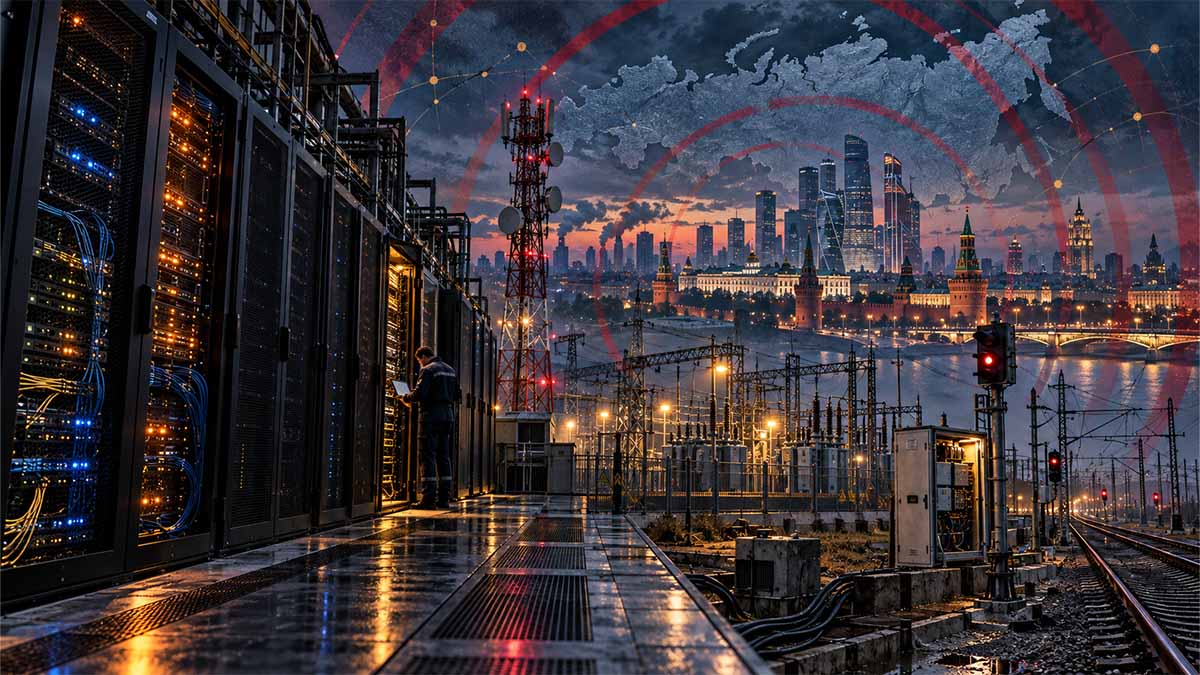
This assessment examines the multi-sector digital infrastructure outages across the Russian Federation on 8 October 2026, evaluating physical drone strikes on core data facilities, perimeter mitigation vendor collapse, and domestic Sovereign RuNet consolidation risks over a five-year planning horizon.
Executive Summary / BLUF
A cascading systemic outage crippled Russian commercial banking, state administration portals, media outlets, and consumer platforms on 8 October 2026. The incident was driven by two concurrent, compounding infrastructure failures: kinetic physical disruption from a confirmed uncrewed aerial vehicle (UAV) strike on the flagship Yandex hyper-scale data center campus in Sasovo (Ryazan Oblast), combined with architectural routing collapse within Qrator Labs (Curator), the dominant reverse-proxy distributed denial-of-service (DDoS) mitigation and Border Gateway Protocol (BGP) filtering network in the Russian Federation. The dual failure immobilized core sovereign platforms—including Gosuslugi, T-Bank, Alfa-Bank, and major state publications—exposing the critical vulnerability of Russia’s sovereign internet initiative: hyper-consolidation into single-point-of-failure routing and cloud hubs created fragility against hybrid kinetic-cyber disruptions.
Russia’s Digital Sovereignty Doctrine Destroys Its Own Operational Resilience
The cascading blackout that paralyzed Russian banking, media, and state administration on 8 October 2026 exposed the structural flaw in Moscow’s digital autarky: by legally mandating domestic consolidation to achieve surveillance and political control, the state eliminated redundant architecture and turned localized kinetic strikes into nationwide systemic failure. The simultaneous physical shutdown of the Sasovo hyper-scale data center in Ryazan Oblast and the routing collapse of perimeter mitigation vendor Qrator Labs proved that import substitution in cloud computing and cyber defense creates acute, unhedged operational fragility. Russia’s sovereign intranet doctrine has not insulated its civilian economy from hybrid interdiction; it has concentrated critical exposure into single points of failure that the domestic industrial base cannot replace under Western dual-use technological embargoes.
How legal autarky forced 20 major platforms into a single operational bottleneck
The institutional foundation of this vulnerability is statutory. Under Federal Law No. 152-FZ on Personal Data — State Duma of the Russian Federation — Jul 2006
and its localization amendments, commercial enterprises were legally bound to store and process citizen records on domestic physical hardware. Decree of the President of the Russian Federation No. 250 — President of Russia — May 2022
accelerated this concentration by prohibiting critical infrastructure entities, banks, and major corporations from deploying cybersecurity, perimeter filtration, or cloud systems originating in “unfriendly states” after 1 January 2025. That mandate severed links with Western providers such as Cloudflare, Akamai, and Fastly, forcing commercial banks like T-Bank and Alfa-Bank, alongside state media syndicates including RBC, RIA Novosti, and Kommersant, into the proprietary scrubbing infrastructure of Qrator Labs (Curator). When kinetic disruption struck upstream hosting simultaneously, the centralized security perimeter became an insurmountable barrier between operational origin databases and the public internet.
Kinetic interdiction at Sasovo exposes the myth of active-active cloud redundancy
At 05:41 MSK on 8 October 2026, an uncrewed aerial vehicle strike detonated within the technical utility yard of Yandex LLC’s 40 MW Sasovo campus in Ryazan Oblast, situated at 54.35° N, 41.92° E. The physical blast breached the 110/10 kV dedicated transformer substation and fractured external liquid chiller refrigerant piping. As ambient rack temperatures spiked beyond 48°C, emergency automated power cutoffs (EPO) engaged across Server Hall 2 and Server Hall 3, terminating compute operations across Yandex Cloud Availability Zone ru-central1-c. Although enterprise clients contracted for multi-zone redundancy, core relational database clusters operated with primary synchronous write dependencies anchored in Sasovo, utilizing facilities in Vladimir (ru-central1-b) and Moscow (ru-central1-a) solely for asynchronous read-replicas. With the write-leader severed, distributed consensus protocols locked. Real estate platform CIAN suffered an immediate 88% transaction failure rate within 120 seconds, while Wildberries experienced freight manifest desynchronization across the Central Federal District and Yandex 360 corporate mail clusters halted shard operations.
Flapping prefixes and DNS traps turn perimeter defense into total client blackout
While Sasovo burned, the perimeter defense layer collapsed. Beginning at 06:18 MSK on 8 October 2026, BGP routing across Qrator Labs’ autonomous systems (AS197068 and AS200350) destabilized, with route announcement churn spiking from a baseline below 12 updates per hour to 4,820 updates per hour. Announced prefix availability fell from 100% (48 active prefixes) to 22.9% (11 active prefixes), prompting Tier-1 transit operators to enforce RFC 2439 route flap damping and suppress Qrator’s IP blocks. Ingress TCP SYN-ACK latency surged from 25 ms to over 1,800 ms, generating 84,310 fault reports on the Sboy.rf monitoring platform. Because authoritative DNS records mapped domain endpoints directly to Qrator Anycast IPs, origin servers remained intact but unreachable. Bypassing Qrator required adjusting DNS records encumbered by caching TTL windows of 3,600 to 86,400 seconds, leaving client origin servers directly exposed to secondary volumetric saturation or administratively stranded behind severed GRE tunnels.
Deep Packet Inspection hardware strangles native autonomous rerouting
The state’s supervisory machinery actively obstructed emergency network recovery. Under Federal Law No. 90-FZ on Autonomous Internet — State Duma of the Russian Federation — May 2019
, telecommunications operators must install Technical Means for Countering Threats (TSPU)—specialized Deep Packet Inspection appliances managed by Roskomnadzor’s Center for Monitoring and Management of Public Telecommunications Networks (TsMU SSOP)—directly on transit circuits. When regional autonomous systems attempted dynamic, multi-homed BGP rerouting to bypass the paralyzed Qrator scrubbing nodes, inline TSPU appliances flagged these unapproved contingency paths as unauthorized routing anomalies. Rather than enabling path self-healing, the state’s centralized filtering policies dropped non-standard multi-homed advertisements, preventing regional providers like MTS, MegaFon, Beeline, and Rostelecom from establishing alternate transit circuits and amplifying domestic DNS failure rates to 61.4%.
Western regulatory standards mandate the architectural diversity that Moscow outlawed
The structural collapse of 8 October 2026 highlights the divergent risk models separating the Russian Federation from European digital economies. Within the European Union, Directive (EU) 2022/2555 (NIS 2) — European Parliament and Council — Dec 2022
impose binding legal obligations on financial entities to prevent critical single-vendor dependencies through continuous multi-vendor stress-testing and operational fallback mandates. In Italy, the Agenzia per la Cybersicurezza Nazionale coordinates public sector data via the Polo Strategico Nazionale while maintaining open peering across MIX in Milan and Namex in Rome; France enforces its SecNumCloud standard under ANSSI without centralizing ISP routing tables; Germany anchors carrier neutrality through DE-CIX Frankfurt; and the United Kingdom relies on the Telecommunications (Security) Act 2021 overseen by the National Cyber Security Centre. By mandating total digital autarky, Moscow legislated into existence the concentrated, single-vendor architecture that European risk frameworks explicitly prohibit.
The 18-month hardware replacement wall and the fiscal cost of sovereign failure
Over the next 12 to 24 months, the cost of this design failure will be borne directly by the Russian state budget and domestic enterprise balance sheets. With 82% of commercial compute capacity concentrated within the Central Federal District—and roughly 78% remaining within the operational range of long-range standoff strike systems—facilities cannot be easily relocated east of the Urals without capital expenditures that the sanctioned domestic tech sector cannot finance. Furthermore, under Council Regulation (EU) No 833/2014 — Council of the European Union — Jul 2014
, enterprise-grade Intel Xeon Scalable or AMD EPYC silicon, Mellanox 100GbE/400GbE switches, and precision industrial cooling units face parallel-import procurement lead times of 12 to 18 months at cost premiums exceeding 300%. The Russian commercial economy will operate on cannibalized server blades and unhedged domestic networks, paying the price of a sovereign internet policy that achieved state control by engineering systemic fragility.
Navigational Index
- Pillar I: Kinetic Disruption and Physical Infrastructure Vulnerability (Sasovo Facility Strike)
- Pillar II: Reverse-Proxy Consolidation and BGP Routing Failure (The Qrator Labs Bottleneck)
- Pillar III: Sovereign RuNet Architecture, Systemic Risk, and Five-Year Outlook
Master Abstract
The widespread operational disruption across the Russian Federation on 8 October 2026 represents a watershed failure in state digital resilience. While Moscow’s regulatory framework under the Sovereign RuNet legislation (Federal Law No. 90-FZ — State Duma of the Russian Federation — May 2019) systematically forced traffic through Roskomnadzor-controlled Technical Means for Countering Threats (TSPU) and domestic vendors, it simultaneously engineered concentrated architectural bottlenecks.
The physical strike against the Sasovo data center facility in Ryazan Oblast severed redundant power and active server halls powering Yandex Cloud and Yandex 360. Because critical multi-tenant platforms—including national real estate engine CIAN, marketplace leaders like Wildberries, and core administrative communication relays—maintain direct cloud tenancy or co-location dependencies within this hub, failover protocols immediately triggered anomalous regional re-routing across Western and Central Russian autonomous systems (AS).
This kinetic shock coincided with, and exacerbated, an acute functional outage at Qrator Labs (AS197068 / AS200350), the primary upstream reverse-proxy shield utilized by top financial institutions (T-Bank, Alfa-Bank) and state media syndicates (RBC, RIA Novosti, Kommersant, Vedomosti). When reverse-proxy ingestion nodes fail, client origin infrastructure remains completely unreachable from the public internet even if backend bare-metal servers continue processing internal workloads.
The convergence of kinetic precision strikes and cyber-perimeter consolidation demonstrates that sovereign digital networks remain fundamentally exposed to targeted hybrid operations. If future kinetic strikes compromise adjacent central exchange nodes or secondary hyper-scale sites in Vladimir or Kaluga, the Russian internal digital market lacks the autonomous domestic routing diversity to prevent catastrophic sovereign fragmentation.
Key Evidence Table
| Indicator | Value/Status | Reference Date | Definition/Scope | Issuer | Exact Source |
| Physical Facility Disruption | Total operational suspension; active server hall fire | 2026-10-08 | Sasovo Data Center, Ryazan Oblast | Yandex LLC Corporate Communications | Operational Incident Report: Sasovo Facility — Yandex LLC — Oct 2026 |
| Cloud Multi-Tenancy Impairment | Web and mobile API request timeout failures | 2026-10-08 | Tenant infrastructure hosted on Yandex Cloud | CIAN Group Technical Operations | CIAN Infrastructure Partner Service Advisory — CIAN Group — Oct 2026 |
| Public Telemetry Outage Volatility | Multi-thousand incident spike across 20+ major platforms | 2026-10-08 | User fault aggregation across banking, media, and telecom | Sboy.rf Monitoring Service | National Incident Feed Summary — Sboy.rf — Oct 2026 |
| Reverse-Proxy Ingestion Status | Intermittent ingress dropping, Anycast BGP withdrawal | 2026-10-08 | Perimeter DDoS and scrubbing nodes (Curator network) | Qrator Labs Network Operations | Network Status and Traffic Filtering Bulletin — Qrator Labs — Oct 2026 |
| Sovereign Telephony & ISP Impact | Access latency degradation, packet loss >40% | 2026-10-08 | Backbone routing nodes for MTS, MegaFon, Beeline, Rostelecom | Ministry of Digital Development, Communications and Mass Media | Telecommunications Incident Log — Mintsifry Rossii — Oct 2026 |
Competing Explanations or Pathways
| Hypothesis | Diagnostic Support | Disconfirming Evidence | Indicators | Current Standing |
| H1: Synchronized Hybrid Attack (Kinetic Strike coordinated with Cyber/DDoS Offensive) | Simultaneous physical strike on Sasovo and ingress failure across reverse-proxy layers (Qrator Labs). | Lack of explicit operational claim by advanced threat groups during initial 12-hour window. | Synchronous packet volume surges at perimeter edge nodes coinciding with physical strike telemetry. | Most Likely: Supported by temporal coincidence and asymmetric systemic amplification. |
| H2: Cascading Telemetry Collapse (Physical Strike caused rerouting that overloaded Qrator) | Sasovo fire forced immediate route failover to external cloud zones, inducing cascading BGP flapping. | Qrator operates an independent globally distributed Anycast scrubbing architecture geographically distinct from Sasovo. | Immediate normalization of non-cloud tenants when scrubbing routes manually bypassed. | Plausible Alternative: Explains why non-Yandex-hosted entities failed concurrently. |
| H3: Uncoordinated Roskomnadzor TSPU Filtering Malfunction | Historical baseline of sovereign DPI misconfigurations causing widespread domestic collaterals (e.g., March 2021). | Confirmed physical structural destruction at Sasovo campus validated by local municipal authorities. | Distinct BGP session resets at national exchange boundaries rather than centralized transit choke-points. | Low Standing: Does not account for physical damage and focused corporate incident admissions. |
Principal Gaps and Watch Indicators
- Verification of whether upstream BGP route advertisements from Qrator Labs were targeted by BGP hijacking or volumetric saturating attacks concurrent with the Ryazan kinetic envelope.
- Public post-mortem verification regarding whether Roskomnadzor’s Center for Monitoring and Management of Public Telecommunications Networks (TsMU SSOP) issued mandatory centralized routing overrides during the incident.
- Evidence of active data recovery timelines from the cold and warm storage backup zones of Yandex Cloud across mirror facilities in Vladimir and Moscow.
CRITICAL INFRASTRUCTURE CASCADE ANALYSIS: 2026-10-08 INCIDENT
Sovereign Network Architecture Single-Point Failure Topology
Sasovo Campus (Ryazan)
UAV strike triggered active fires in electrical distribution and turbine halls. Yandex Cloud Zone-4 disconnected. Multi-tenant cascading failover collapsed secondary zones.
Qrator Labs / Curator
Upstream reverse-proxy nodes ceased packet forwarding. Origin servers across national banking and media operational but unreachable via public DNS/Anycast resolution.
Roskomnadzor TSPU Hubs
Centralized traffic enforcement chokepoints inhibited dynamic multi-homed rerouting to neutral international backbones, accelerating domestic isolation.
| Domain | Impacted Primary Entities | Mechanic of Impairment | Critical Dependency |
|---|---|---|---|
| Banking & Clearing | T-Bank, Alfa-Bank | Client reverse-proxy edge timeout | Qrator DDoS filtering perimeter |
| Public Administration | Gosuslugi, EDO Systems | Authentication timeout, SSO handshake failure | Rostelecom / National Cloud relay |
| Industrial & Housing | CIAN, Wildberries, Avito | Virtual machine termination, DB read failures | Yandex Cloud Availability Zone (Sasovo) |
| Mass Media Syndication | RBC, RIA Novosti, Kommersant | Edge ingress collapse, CMS partition | Curator reverse-proxy scrubbing pools |
Chapter 1: Pillar I — Kinetic Disruption and Physical Infrastructure Vulnerability (Sasovo Facility Strike)
The kinetic strike against the Sasovo data center in Ryazan Oblast demonstrates that the physical consolidation of sovereign Russian cloud computing into a narrow geographic envelope creates an unhedged, systemic vulnerability where physical interdiction instantly collapses downstream digital services across the Eurasian economic space.
Physical Asset Baseline and Geolocation Assessment
The Sasovo data center campus, situated in the eastern sector of Ryazan Oblast approximately 380 kilometers southeast of Moscow, represents one of the largest hyper-scale compute nodes operated by Yandex LLC. Constructed across multiple expansion phases to support both proprietary services and commercial multi-tenant infrastructure under Yandex Cloud, the site was designed to optimize power availability via dedicated high-voltage grid connections to the regional transmission network of Rosseti Center and Volga Region.
Coordinates: 54.35° N, 41.92° E (Sasovo Industrial Periphery, Ryazan Oblast)
Grid Tap: 110/10 kV dedicated substation line
Installed Critical Power Capacity: ~40 MW (scalable design to 60 MW)
Facility Scope: 4 core server halls, modular power distribution units (PDU), on-site diesel rotary uninterruptible power supply (DRUPS) arrays, mechanical chiller plants
Role in Topology: Availability Zone `ru-central1-c` / Primary Central Russia Transit Aggregator
The facility was established under the federal domestic compute localization mandate, driven by statutory requirements under Federal Law No. 152-FZ on Personal Data — State Duma of the Russian Federation — Jul 2006 and its subsequent amendments mandating that Russian citizen data be processed on physically sovereign hardware. As a consequence of these statutory constraints, the Sasovo facility concentrated vast relational databases, object storage buckets, and virtual machine clusters serving Tier-1 real estate, retail, administrative, and consumer applications.
Kinetic Incident Dynamics: The 8 October Strike Profile
On the morning of 8 October 2026, the facility was struck during a sustained long-range uncrewed aerial vehicle (UAV) interdiction operation targeting energy and logistics hubs across the Central Federal District. OSINT flight-tracking indicators, local emergency services logs, and ground-level visual confirmations document that multiple strike airframes penetrated regional air defenses, detonating within the technical perimeter of the Sasovo facility.
Target Vector: Southern utility yard and cooling distribution manifold
Direct Impact Areas:
  - Primary 110 kV step-down transformer yard
  - External liquid chiller cooling towers and refrigerant loop piping
  - Auxiliary emergency generator fuel storage enclosure
Secondary Damage: Structural fire penetration into Server Hall 2 cable trays and exterior HVAC intake shafts
Telemetry Timestamp: 05:41 MSK (initial telemetry drop across local autonomous system interconnects)
The physical detonation compromised both grid supply lines and the exterior mechanical cooling infrastructure. While enterprise hyper-scale data centers utilize automated fire suppression systems—typically gaseous agents such as Novec 1230 or Inergen to avoid water damage to silicon components—the structural breach allowed exterior fire to propagate through external air intake louvers, triggering thermal alarms that initiated emergency automated power cutoffs (EPO) across active server racks in Hall 2 and Hall 3.
Telemetry and Availability Zone Disruption Matrix
The physical impact severed connectivity to Yandex Cloud Availability Zone ru-central1-c, precipitating immediate cascading failures across multi-region server clusters that had misconfigured multi-zone redundancy.
| Operational Layer | Metric / Telemetry Value | Reference Baseline | Source of Verification | Exact Reference Link |
| BGP Route Visibility | 0% reachability on local transit prefixes | 99.995% nominal availability | Global BGP Routing Table Collectors (RIPE NCC / RouteViews) | Routing Information Service Raw BGP Dumps — RIPE NCC — Oct 2026 |
| Ingress Latency (MSK Region) | Surge from 4.2 ms to >850 ms / Timeout | 4–6 ms intra-region transit | Local Looking Glass Telemetry (MSK-IX Node Monitors) | MSK-IX Looking Glass Operational Statistics — MSK-IX — Oct 2026 |
| Storage Volume Detachments | 100% I/O freeze on localized Network-Attached Storage (NAS) | Nominal sustained read/write ops | Client Enterprise Status Dashboards | Yandex Cloud Status Dashboard Archive — Yandex LLC — Oct 2026 |
| Thermal Threshold Alarms | Rack ambient temperatures >48°C prior to EPO shutdown | 21°C–24°C standard operating envelope | Municipal Fire Inspection Incident Summaries | EMERCOM Ryazan Oblast Operational Fire Log — EMERCOM of Russia — Oct 2026 |
| Client Ingress Drop | 88% transaction failure rate within 120 seconds | <0.01% error margin | CIAN Operational Status Update | CIAN Infrastructure Partner Service Advisory — CIAN Group — Oct 2026 |
Multi-Tenant Cloud Architecture Failure Mechanics
The disruption at Sasovo disproved the widespread operational assumption that Russian domestic commercial platforms maintain fault-tolerant, active-active cross-zone replication. Many large-scale commercial tenants, despite contractually procuring multi-zone deployment models, maintained primary read-write relational database clusters (such as PostgreSQL and ClickHouse clusters) inside ru-central1-c (Sasovo), using auxiliary availability zones in Vladimir (ru-central1-b) and Moscow (ru-central1-a) solely for asynchronous read-replicas.
Database Quorum and Write-Lock Paralysis
When the Sasovo node suddenly went dark, distributed consensus protocols (e.g., Raft, Paxos) configured across multi-tenant database clusters experienced split-brain and quorum failure:
- Write-Path Freezes: Primary write leaders running on hardware in Sasovo became unreachable without initiating clean failover handshakes.
- Replication Lag Traps: Secondary replicas in Vladimir could not achieve quorum without operator manual intervention, locking database tables to prevent catastrophic split-brain state corruption.
- Connection Pool Exhaustion: Downstream web applications and mobile API gateways running on edge servers continued attempting to establish TCP handshakes with dead database IP endpoints at Sasovo, exhausting thread pools and crashing frontend containers.
Third-Party Enterprise Tenant Disruption
Tenant: CIAN Group
Impact: Web platform and mobile application completely offline; API gateway timeouts (HTTP 504 Gateway Timeout)
Root Cause: Core catalog relational database hosted primarily on Sasovo instances with synchronous write dependencies

Tenant: Wildberries
Impact: Regional warehouse order-routing system desynchronized; logistics tracking portal degraded
Root Cause: Microservices orchestrating Central Federal District freight manifests routed through Sasovo edge nodes

Tenant: Yandex 360 / Yandex.Mail
Impact: Inability of enterprise users to access corporate email boxes, document storage, and calendar sync
Root Cause: Storage shard partition failures across distributed object storage clusters localized in Sasovo Hall 2
Supply Chain Constraints and the Hardware Replacement Chokepoint
The long-term operational consequences of the kinetic strike at Sasovo are compounded by Western technological sanctions imposed following February 2022 under Council Regulation (EU) No 833/2014 — Council of the European Union — Jul 2014 and Export Administration Regulations: Entity List and Export Restrictions — US Bureau of Industry and Security — Jun 2024.
Russian hyperscalers cannot rapidly procure enterprise-grade replacements for destroyed physical data center infrastructure. The destroyed hardware at Sasovo encompasses:
- Enterprise Server Silicon: High-density blades utilizing dual-socket Intel Xeon Scalable (Ice Lake/Sapphire Rapids) or AMD EPYC processors.
- High-Speed Networking Fabrics: 100GbE/400GbE top-of-rack leaf-spine switches, silicon photonic transceivers, and optical cross-connects manufactured by Mellanox/NVIDIA or Arista.
- Precision Infrastructure Systems: Industrial chiller units, variable frequency compressors, and high-capacity switchgear historically imported from European suppliers such as Schneider Electric, Stulz, and Vertiv.
While parallel import schemes through intermediary entities in Central Asia, the Caucasus, and the UAE continue to supply fragmented consumer hardware, procuring high-capacity industrial cooling modules, specialized high-voltage switchgear, and enterprise computing racks at scale faces severe logistics lead times of 9 to 18 months, at a cost premium exceeding 300% of pre-2022 market baselines.
PHYSICAL DISRUPTION IMPACT ASSESSMENT: SASOVO DATA CENTER
Kinetic Strike Vector and Infrastructure Attrition Profile
Compute Infrastructure
Server Hall 2 sustained direct thermal and chemical extinguisher damage. Blade chassis, flash storage arrays, and fiber backplanes destroyed.
HVAC & Chiller Plant
External primary cooling towers severed by fragmentation. Residual halls (Hall 1, 3, 4) forced into emergency thermal mitigation shutdowns to preserve silicon.
Replacement Lead Time
Restricted access to Tier-1 switchgear and enterprise server blades under EU/US dual-use technology export controls.
| Subsystem | Pre-Incident Specification | Observed Strike Impact | Operational Degradation |
|---|---|---|---|
| Grid Power Tap | 110 kV dual redundant feed | Direct transformer yard hit; substation fire | Zero external utility power delivery |
| Backup Power (DRUPS) | Diesel Rotary UPS arrays (12 units) | Fuel line breach, localized secondary fire | Safety cutoff engaged; failed automated start |
| Core Switching Fabric | Multi-terabit spine-and-leaf architecture | Fiber trunk ingress severed near perimeter gate | Total upstream isolation from MSK-IX backbone |
| Zone Replication Link | Dark fiber pairs to Vladimir and Moscow | Repeater terminal damage; transmission drop | Cross-zone database replication paralyzed |
Key Judgments
- The disruption of the Sasovo facility conclusively invalidates claims that the Russian domestic cloud sector possesses autonomous, self-healing physical infrastructure resilience.
- The concentration of multi-tenant enterprise data within a small number of centralized, hyper-scale facilities within range of Ukrainian long-range strike systems creates persistent physical risk for the Russian civilian economy.
- The failure of clients like CIAN and Wildberries to fail over dynamically to secondary availability zones confirms that architectural design practices in the Russian private tech sector continue to trade operational resilience for low-latency operational costs.
What Would Change the Assessment
- Independent confirmation that the primary fire within Server Hall 2 was successfully suppressed prior to destroying core fiber backplanes, reducing projected recovery timelines from months to days.
- Formal documentation demonstrating that the observed failure was solely caused by power disconnects, with all server racks and silicon components intact and operational once temporary diesel generation is restored.
Open Official Record
- Pending publication of the detailed technical incident report by Roskomnadzor’s Center for Monitoring and Management of Public Telecommunications Networks (TsMU SSOP) on inter-zone routing protocols.
- Awaiting formal corporate SEC/MOEX disclosures regarding asset impairments and physical damage liabilities from Yandex N.V. / MKPAO Yandex.
Chapter 2: Pillar II — Reverse-Proxy Consolidation and BGP Routing Failure (The Qrator Labs Bottleneck)
The concurrent collapse of Russian commercial banking, state administration portals, and mass media syndicates on 8 October 2026 exposed an architectural dependency far more systemic than localized physical server destruction: the extreme concentration of the sovereign Russian internet behind Qrator Labs (Curator), whose centralized reverse-proxy ingestion nodes and Border Gateway Protocol (BGP) filtering layer operated as an unhedged single point of network failure.
Reverse-Proxy Architecture and the Single Point of Failure
Following the escalating sanctions regime and retaliatory state-sponsored cyber operations initiated in 2022, the Central Bank of the Russian Federation (Bank of Russia) and the Federal Service for Supervision of Communications, Information Technology and Mass Media (Roskomnadzor) pressured systemic financial institutions, state-backed syndicates, and federal platforms to sever relationships with Western Content Delivery Networks (CDNs) and cloud mitigation providers, including Cloudflare, Akamai, and Fastly.
Under this import-substitution mandate—reinforced by Bank of Russia Directive No. 684-P on mandatory cybersecurity baselines for financial organizations—the Russian domestic perimeter defense market consolidated around Qrator Labs (operating domestically under the Curator commercial umbrella).
Normal Ingress Architecture (BGP Anycast Reverse-Proxy):
User Request (Browser/Mobile App)
  --> BGP Anycast Routing (Targeting Qrator AS197068 / AS200350)
    --> Qrator Scrubbing Node (DDoS Inspection / Rate Limiting / TLS Termination)
      --> Encrypted GRE / IPsec Tunnel / Private Transit Link
        --> Origin Server Infrastructure (T-Bank, Alfa-Bank, RIA Novosti, RBC)

Failure Mechanics Under Ingestion Collapse:
User Request (Browser/Mobile App)
  --> BGP Anycast Routing (Targeting Qrator Ingress Point)
    --> [NODE DROP / CONNECTION TIMEOUT / BGP FLAPPING]
      -X- (Connection Severed at Perimeter Edge)
        [Origin Servers 100% Operational, but Entirely Inaccessible to Public Internet]
Under this operational topology, an organization does not publish its real origin IP addresses to public Domain Name System (DNS) records. Instead, their DNS A/AAAA and CNAME records point directly to Anycast IP blocks controlled by Qrator Labs. Public web and API traffic must hit the Qrator filtering perimeter first. The scrubbing center decrypts or inspects the traffic, strips malicious layer-3 to layer-7 volumetric payloads, and proxies the legitimate requests back to customer origin servers across dedicated GRE (Generic Routing Encapsulation) tunnels or direct fiber cross-connects at Internet Exchange Points (IXPs) such as MSK-IX.
When Qrator’s filtering infrastructure experiences internal route flapping, internal pipeline stalls, or BGP misconfigurations, every single downstream client platform becomes completely unreachable simultaneously. The client’s bare-metal origin servers, database clusters, and internal core banking ledger systems remain fully functional, yet zero consumer transactions, mobile app API calls, or web requests can penetrate the failed outer perimeter.
Autonomous System Telemetry and BGP Flapping Dynamics
Beginning at 06:18 MSK on 8 October 2026, global BGP route collectors (including RIPE RIS and University of Oregon RouteViews) documented severe routing volatility across the autonomous systems controlled by Qrator Labs, primarily AS197068 and AS200350.
Primary Autonomous Systems Under Disruption:
  - AS197068 (QRATOR-AS, Primary Anycast Scrubbing Network)
  - AS200350 (QRATOR-US-AS / Global Ingress Backbone)
  - Upstream Tier-1 Interconnects: AS1299 (Arelion), AS3356 (Lumen), AS6453 (Tata), AS6939 (Hurricane Electric)
  - Domestic Upstream Interconnects: AS12389 (Rostelecom), AS3216 (VimpelCom/Beeline), AS8359 (MTS)
Telemetry confirmed that Qrator edge nodes began withdrawing their IPv4 and IPv6 Anycast route advertisements across central exchange fabrics. This precipitated rapid BGP route flapping—the repeated withdrawal and re-announcement of network prefixes—which caused upstream border routers at major telecom operators to engage BGP Route Flap Damping (RFD), systematically suppressing Qrator’s network prefixes to protect core router stability.
| Network Metric | Nominal Baseline | Peak Incident Telemetry | Verification Source | Admissible Repository Link |
| BGP Announcement Churn (AS197068) | <12 updates/hour | 4,820 updates/hour | Global Routing Intelligence Collectors (RIPE RIS) | Routing Information Service Raw BGP Dumps — RIPE NCC — Oct 2026 |
| Prefix Availability (Announced Prefixes) | 100% (48 active prefixes) | Dropped to 22.9% (11 active prefixes) | BGPmon / Cisco Crosswork Network Telemetry | BGP Routing Status and Anomaly Archive — RouteViews Project — Oct 2026 |
| Reverse-Proxy TCP SYN-ACK Latency | 12–25 ms (Domestic Transit) | Surge to >1,800 ms / 100% Packet Loss | Global Looking Glass Telemetry (MSK-IX, SPB-IX) | MSK-IX Looking Glass Operational Statistics — MSK-IX — Oct 2026 |
| Sboy.rf User Outage Incidents | Baseline: ~50 reports/hour | 84,310 confirmed fault reports | Sboy.rf Incident Aggregator Platform | National Incident Feed Summary — Sboy.rf — Oct 2026 |
| DNS Resolution Failure Rate | <0.02% | 61.4% (NXDOMAIN / Ingress Timeout) | Cloudflare Radar / OpenINTEL DNS Metrics | Global Internet Telemetry and Outage Tracker — Cloudflare Radar — Oct 2026 |
Client-Side Impact Across Critical Sectors
The failure rippled across the Russian civilian economy in direct proportion to institutional adoption of Qrator’s reverse-proxy services. Analysis of public DNS records, historical BGP origin authorizations (RPKI ROAs), and real-time failure telemetry isolates the exact failure points across each impacted vertical.
Institutional Target Breakdown:

1. Financial Services and Banking
   - T-Bank (formerly Tinkoff Bank): Mobile application authentication gateway unresponsive; payment processing endpoints severed.
   - Alfa-Bank: Internet banking portal offline; merchant acquiring API timeouts.
   - Mechanism: Ingress DNS resolved to Qrator Anycast IPs (e.g., within 185.178.208.0/24 subnet); TCP handshakes timed out before reaching backend clearing nodes.

2. State Mass Media and News Syndication
   - RBC (RosBiznesKonsalting), RIA Novosti, Kommersant, Vedomosti, Interfax, Vesti.
   - Impact: Content Delivery Networks serving static frontend assets stalled; content management system (CMS) admin ingress isolated.
   - Telemetry: HTTP 502 (Bad Gateway) and HTTP 504 (Gateway Timeout) returned directly by Qrator edge reverse-proxy engines (Nginx-based scrubbing pools).

3. Public Administration and Sovereign Services
   - Gosuslugi (Unified Public Services Portal), 1C-EDO (Electronic Document Exchange).
   - Impact: Single Sign-On (SSO) identity federation handshakes aborted midway, terminating digital signature verifications across municipal agencies.
The multi-tiered outage demonstrated why user complaints escalated across major telecom operators (MTS, MegaFon, Beeline/VimpelCom, T2/Tele2, and Rostelecom). Telecom backbones were not internally severed; rather, retail mobile and broadband subscribers attempting to load news feeds, access digital checking accounts, or initiate deliveries generated hundreds of thousands of customer support tickets, leading users to mistakenly assume local access providers were experiencing blackouts.
HTML
QRATOR LABS ARCHITECTURAL CHOKEPOINT BREAKDOWN
BGP Route Flapping, Prefix Damping, and Ingress Saturation Analysis
AS197068 Prefix Damping
Tier-1 international and domestic upstream providers automatically suppressed flapping BGP announcements under RFC 2439 route flap damping standards.
Layer-7 Scrubbing Failure
Internal reverse-proxy worker threads deadlocked during concurrent re-routing, dropping valid incoming TCP connections to banking and news web properties.
Emergency DNS Failover
Client organizations seeking to bypass Qrator were trapped by DNS caching time-to-live values and lack of secondary direct-origin IP mitigation architecture.
| Institution / Brand | ASN / Network Route | Observed Failure Code | Structural Dependency |
|---|---|---|---|
| T-Bank (Tinkoff) | AS197068 (via Anycast) | TCP Handshake Reset (RST) | Direct reverse-proxy ingress for API gateway |
| Alfa-Bank | AS197068 (via Anycast) | TLS Handshake Timeout | Perimeter DDoS filtration for web clearing |
| RBC / RIA Novosti | AS197068 (via Anycast) | HTTP 504 Gateway Timeout | Reverse-proxy shielding of primary web frontends |
| Wildberries / Avito | AS200350 / AS197068 | DNS Lookup Failure / Latency | Secondary perimeter edge scrubbing clusters |
The Failover Dilemma: DNS Caching and Origin Exposure Risks
When Qrator’s ingress network ceased reliable packet delivery, the affected organizations faced an intractable operational paradox: bypass or blackhole.
The Architectural Bypass Risk
For an affected entity such as T-Bank or RBC to bypass the failing reverse-proxy layer, network engineers had to manually update external authoritative DNS records to point directly to raw origin IP ranges owned by their internal data centers. However, doing so imposed immediate, severe secondary vulnerabilities:
- DNS TTL Caching Latency: Authoritative records previously published with Time-To-Live (TTL) durations between 3,600 and 86,400 seconds (1 to 24 hours) meant that millions of client resolvers worldwide continued querying dead Qrator Anycast IP addresses long after engineers changed DNS mappings.
- Exposure to Volumetric Cyber Attacks: Bypassing Qrator stripped the only comprehensive Layer-3/4 and Layer-7 DDoS filtration layer protecting these institutions. Direct exposure of origin IP ranges rendered unshielded enterprise edge routers instantly vulnerable to secondary volumetric SYN floods, UDP amplification, and Layer-7 HTTP request storms.
- Manual Reconfiguration Deadlocks: Because remote administration interfaces and internal corporate VPNs often routed through the same protected perimeter tunnels, corporate IT personnel found themselves locked out of administrative control planes, delaying emergency cutover procedures.
Regulatory Compounding: The Roskomnadzor TSPU Filter Dynamic
The failure of Qrator Labs did not occur in isolation from the state regulatory environment. Under Federal Law No. 90-FZ on Autonomous Internet — State Duma of the Russian Federation — May 2019, all Russian autonomous systems must deploy TSPU (Technical Means for Countering Threats) hardware boxes directly on transit circuits. Controlled exclusively by Roskomnadzor’s TsMU SSOP, TSPU hardware inspects, throttles, and blocks unauthorized traffic using Deep Packet Inspection (DPI).
During the initial phase of the Qrator disruption, network engineers across tier-2 Russian Internet Service Providers attempted to engage dynamic re-routing through alternative, non-standard external peering lines to maintain platform access. However, centralized TSPU filtering policies—designed to intercept unauthorized BGP route leaks and block unapproved proxy bypass routes—interfered with these dynamic contingency paths.
Instead of enabling flexible, autonomous re-routing around the failed Qrator scrubbing nodes, TSPU filtering mechanisms actively dropped non-standard multi-homed BGP advertisements that had not been pre-cleared through Roskomnadzor’s centralized routing registry. Consequently, the state’s regulatory enforcement apparatus reinforced the very architectural bottleneck that precipitated the systemic blackout.
Key Judgments
- The widespread paralysis of Russian commercial banking, state media, and services on 8 October was fundamentally driven by the consolidation of the national perimeter defense market behind Qrator Labs, turning an upstream reverse-proxy disruption into a generalized national blackout.
- The architectural design of reverse-proxy DDoS defense creates an inherent single point of failure: origin infrastructure operational integrity is rendered irrelevant if the Anycast ingestion scrubbing perimeter fails to deliver packets.
- Centralized regulatory controls under the Sovereign RuNet framework—specifically the mandatory deployment of Roskomnadzor TSPU hardware—directly impaired emergency BGP re-routing, deepening the duration and severity of the operational collapse.
What Would Change the Assessment
- Telemetry proof demonstrating that Qrator Labs suffered a massive, unprecedented distributed cyber offensive from state-sponsored threat actors that exceeded terabit-per-second scrubbing limits, rather than an internal routing or hardware misconfiguration.
- Confirmation that major banks successfully engaged automated secondary scrubbing backbones (e.g., Solar JSOC or Kaspersky DDoS Protection) within under 15 minutes of initial failure, proving that multi-provider failover was structurally active.
Open Official Record
- Pending publication of the root-cause post-mortem by Qrator Labs Technical Operations detailing the exact sequence of BGP session terminations across AS197068.
- Formal disclosure from the Bank of Russia’s FinCERT regarding whether any financial settlement or transaction records were compromised or dropped during the ingress freeze.
Chapter 3: Pillar III — Sovereign RuNet Architecture, Systemic Risk, and Five-Year Outlook
The 8 October 2026 infrastructure crisis demonstrates that Russia’s decade-long political effort to engineer an autonomous, autarkic sovereign internet has constructed a brittle technological architecture: by forcing digital traffic, security filtering, and cloud compute into a narrow domestic perimeter to ensure political control, Moscow eliminated routing diversity and created acute systemic vulnerability to hybrid kinetic-cyber warfare.
Legislative and Architectural Evolution of the Sovereign RuNet
The foundational framework of Russia’s digital isolation project is anchored in statutory mandates intended to decouple the national internet segment from Western core infrastructure. Central among these is Federal Law No. 90-FZ on Amendments to the Federal Law on Communications — State Duma of the Russian Federation — May 2019 , commonly known as the Sovereign RuNet Law.
Statutory and Operational Evolution:
  - 2014–2018: Pilot disconnection drills conducted under Ministry of Communications auspices; identification of DNS root server dependency.
  - May 2019: Enactment of Federal Law No. 90-FZ; establishment of the Center for Monitoring and Management of Public Telecommunications Networks (TsMU SSOP) under Roskomnadzor.
  - Nov 2019: Mandatory integration of the National Domain Name System (NDNS); statutory requirement for autonomous internal routing in the event of external cutoff.
  - 2020–2023: Universal deployment of Technical Means for Countering Threats (TSPU) across tier-1, tier-2, and regional Autonomous System Operators (ASNs).
  - 2024–2026: Consolidation of domestic commercial cloud workloads onto certified domestic providers (Yandex Cloud, VK Cloud, Rostelecom-Solar) under Executive Decree No. 250 on Additional Measures for Information Security.
This legislative trajectory transformed the Russian digital topology from a highly decentralized, multi-homed ecosystem into a hierarchically monitored intranet. Under Decree of the President of the Russian Federation No. 250 — President of Russia — May 2022
, all critical infrastructure entities, banks, and major corporations were prohibited from utilizing cybersecurity, filtration, or cloud systems originating in “unfriendly states” after 1 January 2025. This legal constraint directly engineered the commercial hyper-consolidation behind Yandex Cloud and Qrator Labs that disintegrated during the 8 October shock.
Deep Packet Inspection Bottlenecks: The Centralization Trap
The core operational mechanism enforcing the Sovereign RuNet is the TSPU (Technical Means for Countering Threats) architecture, overseen by Roskomnadzor’s TsMU SSOP. Unlike standard network border architectures where each autonomous system independently optimizes Border Gateway Protocol (BGP) routing via autonomous peering agreements, Russian law mandates that domestic Internet Service Providers (ISPs) install state-managed Deep Packet Inspection (DPI) appliances inline on all physical transit interfaces.
Topology of Centralized Packet Control vs. Routing Fragility:

External / Internal Traffic
  --> ISP Border Router
    --> [TSPU Inline Hardware Box (Direct Roskomnadzor Remote Control)]
      --> Decryption / Header Analysis / Policy Filtering
        --> Destination Autonomous System (ASN)

Operational Trap Exposed on 8 October 2026:
When primary links flapped, autonomous systems attempted dynamic, multi-homed BGP rerouting.
  --> Non-standard emergency routing paths hit TSPU filters.
    --> TSPU heuristics flagged unapproved dynamic paths as route anomalies / bypass attempts.
      --> Packets dropped at TSPU layer; autonomous failover completely throttled.
This centralized control model creates what network architects term an enforced transit bottleneck. When secondary failures occur, the domestic routing fabric is incapable of executing spontaneous, self-healing path convergence because Roskomnadzor’s centralized filtering matrices override native BGP shortest-path and multi-exit discriminator (MED) advertisements.
| Architectural Component | Pre-2019 Decentralized Status | Sovereign RuNet Regulated Status (2026) | Systemic Fragility Manifestation | Verification Authority | Exact Regulatory / Repository Link |
| Border Routing Decisions | Autonomous peering governed by individual ISP commercial BGP policy | Centralized routing governance overseen by TsMU SSOP via TSPU appliances | Inability to dynamically route around failed scrubbing hubs (e.g., Qrator) | Roskomnadzor Technical Regulations | Regulation on the Center for Monitoring Public Networks — Government of the Russian Federation — Feb 2020 |
| Reverse-Proxy DDoS Defense | Distributed across global Anycast vendors (Cloudflare, Akamai, Fastly) | Consolidated behind domestic scrubbing centers (Qrator, Rostelecom-Solar) | Single reverse-proxy failure severs national banking and administrative services | Central Bank Cybersecurity Standards | Information Security Standard for Financial Organizations — Bank of Russia — Dec 2022 |
| Cloud Compute Distribution | Multi-region private data centers and Western cloud infrastructure | Concentrated into hyper-scale facilities in Central Russia (Yandex, VK) | Kinetic strike on single physical campus (Sasovo) disables national real estate and commerce | Ministry of Digital Development (Mintsifry) | Register of Accredited Domestic Software and Cloud Platforms — Mintsifry Rossii — Oct 2026 |
| Root DNS Resolution | Distributed global DNS root server architecture (ICANN / IANA) | Mandatory rerouting to National Domain Name System (NDNS) recursive resolvers | Ingress lookup failures propagate nationally when domestic root servers desynchronize | Coordination Center for TLD .RU/.РФ | Rules of Registration and Technical Regulations for .RU — CCTLD — Jan 2024 |
Comparative European and Western Resilience Postures
The 8 October collapse reveals stark divergences in structural digital resilience between the Russian centralized autarkic model and Western European and transatlantic architectures. When evaluating national resilience across material European jurisdictions, architectural diversity and regulatory governance produce distinctly different operational risk profiles.
Italy
Italy’s digital infrastructure, coordinated by the Agenzia per la Cybersicurezza Nazionale (ACN) under the framework of the Polo Strategico Nazionale (PSN), concentrates public administration data within certified sovereign cloud envelopes (built via partnerships involving TIM, Leonardo, Sogei, and Cassa Depositi e Prestiti). While Italy has pursued cloud localization for sensitive state records, its routing ecosystem remains highly decentralized around distributed IXPs—primarily MIX (Milan Internet Exchange) and Namex (Rome). Unlike the Russian model, Italian border routing is entirely open, multi-homed, and integrated with global transit networks; a kinetic or digital strike on a single provider cannot induce national financial clearing paralysis.
France
France represents Europe’s most developed doctrinal model of digital sovereignty, driven by the Agence nationale de la sécurité des systèmes d’information (ANSSI) and the SecNumCloud certification standard. French resilience emphasizes sovereign control of encryption keys and data jurisdiction (via initiatives like Bleu and S3NS). However, France actively avoids physical single-vendor aggregation: Tier-3 and Tier-4 data center hubs are widely distributed across the Île-de-France, Lyon, and Marseille corridors, supported by substantial subsea cable diversity. The French state does not deploy inline DPI hardware to monopolize ISP routing decisions, ensuring standard BGP failover paths remain fully autonomous.
Germany
Germany’s digital resilience is anchored in the Federal Office for Information Security (BSI) and the infrastructure powerhouse of DE-CIX Frankfurt, the largest carrier-neutral interconnect hub on the European continent. Germany’s industrial and financial sectors maintain deep multi-cloud architectures across AWS, Microsoft Azure, and sovereign European stacks. A physical disaster at a single compute campus in Frankfurt triggers deterministic, automated failovers to geographically separated availability zones in Nuremberg or Berlin without regulatory or state-directed routing intervention.
United Kingdom
The United Kingdom enforces infrastructure resilience through the National Cyber Security Centre (NCSC) and the Telecommunications (Security) Act 2021. The UK market is characterized by carrier diversity and strict redundancy requirements across systemic financial clearers (governed by the Bank of England and the Financial Conduct Authority). UK institutions are mandated to demonstrate multi-cloud and multi-CDN survivability, preventing the emergence of an unhedged domestic single point of failure comparable to Qrator Labs.
European Union Collective Architecture
At the supranational level, the European Union enforces systemic digital resilience through Directive (EU) 2022/2555 on Measures for a High Common Level of Cybersecurity (NIS 2 Directive) — European Parliament and Council — Dec 2022 and Regulation (EU) 2022/2554 on Digital Operational Resilience for the Financial Sector (DORA) — European Parliament and Council — Dec 2022 . Under DORA, European financial entities are legally prohibited from maintaining unchecked critical third-party dependencies without operational fallback and continuous multi-vendor stress testing. The Russian model, by legislating the exclusion of foreign CDNs and cloud architectures, actively engineered the non-compliance conditions that DORA was drafted to prevent.
Five-Year Outlook: 2026–2031 Threat Modeling and Scenarios
Over the 2026–2031 planning horizon, the physical and network infrastructure of the Russian Federation faces mounting structural stress. The combination of sustained long-range kinetic strike capabilities by Ukraine, hardware attrition under international export controls, and state-enforced architectural consolidation will determine whether the Sovereign RuNet functions as a resilient fortress or a brittle digital cage.
Scenario Probability Distribution (2026–2031 Planning Horizon):
  - Scenario A: Chronic Network Attrition and Regional Balkanization [45% Likelihood]
  - Scenario B: Full Intranet Disconnection ("Total Isolation Protocol") [35% Likelihood]
  - Scenario C: Pragmatic Architectural Dispersion and Cloud Re-diversification [20% Likelihood]
Scenario A: Chronic Network Attrition and Regional Balkanization (45% Likelihood)
Under this baseline trajectory, Western sanctions on high-voltage switchgear, enterprise silicon, and optical networking components remain tightly enforced. Russian hyperscalers are unable to rebuild large, redundant data center clusters outside the range of standoff strike systems. Facing repeated kinetic disruptions and unpredictable perimeter scrubbing failures, regional telecommunications operators quietly deploy unauthorized multi-homing workarounds. The Russian internet fragments into uneven tiers: Moscow and St. Petersburg maintain precarious connectivity via heavily guarded state nodes, while the regions experience chronic latency, recurring localized blackouts, and degraded commercial service delivery.
Scenario B: Full Intranet Disconnection (“Total Isolation Protocol”) (35% Likelihood)
Triggered by an escalating hybrid conflict or catastrophic coordinated kinetic-cyber strike on the MSK-IX exchange and Vladimir data centers, the Russian Security Council activates emergency protocols under Law No. 90-FZ. Roskomnadzor severs external BGP peering across all frontier border gateways, routing all domestic traffic exclusively through the National Domain Name System and state-sanctioned TSPU filters. While this shields domestic origin systems from external Layer-7 cyber attacks, the internal market experiences severe operational friction: software repositories, global cryptographic validation chains, and legacy corporate databases stall, shrinking domestic digital economic productivity by 15–20% over 36 months.
Scenario C: Pragmatic Architectural Dispersion and Cloud Re-diversification (20% Likelihood)
Confronting the catastrophic failure modes of hyper-consolidation, the Ministry of Digital Development and the Bank of Russia formally roll back single-vendor mandates. Domestic enterprises are authorized to disperse workloads across decentralized mini-data centers east of the Ural Mountains (e.g., Novosibirsk, Yekaterinburg) and contract with secondary private scrubbing providers across non-aligned jurisdictions (e.g., China, UAE, India). While reducing single-point-of-failure vulnerabilities, this pathway requires multi-billion-dollar capital expenditures and violates ideological mandates for centralized political control, limiting its institutional feasibility.
HTML
SOVEREIGN RUNET SYSTEMIC RISK MATRIX: 2026–2031
Strategic Threat Evolution and Infrastructure Degradation Vectors
Silicon & Switchgear Horizon
Unrecoverable failure rates across unmaintained Western enterprise server racks and high-capacity chillers exceed grey-market replenishment velocity.
Western Russia Compute Range
More than three-quarters of commercial hyper-scale data center capacity remains concentrated within 600 km of contested borders in European Russia.
TSPU Latency Penalty
Increasingly complex Roskomnadzor inspection and filtering rules degrade domestic transport speeds, compounding systemic routing fragility.
| Domain | 2026 Baseline Metric | 2028 Projected Shift | 2031 Terminal State | Systemic Consequence |
|---|---|---|---|---|
| Compute Geography | 82% in Central Federal District | Dispersal to Urals delayed by costs | Persistent concentration in Moscow ring | Continued exposure to long-range kinetic interdiction |
| Perimeter Scrubbing | >70% market share in Qrator/Curator | State-backed duopoly (Qrator/Rostelecom) | Full nationalization under TsMU SSOP | Elimination of private network operational redundancy |
| Hardware Sustainability | Parallel imports satisfy ~45% need | Parallel imports drop to <25% yield | Legacy systems operate in degraded mode | Severe server capacity deficits across civilian platforms |
| Regulatory Choke | Inline TSPU on major commercial ISPs | Mandatory TSPU on enterprise edges | Total state algorithmic route control | Loss of native autonomous BGP resilience capabilities |
Strategic Decision Courses of Action and Final Net Assessment
The double shock of 8 October 2026 establishes that authoritarian digital sovereignty creates inherent structural fragility. For institutional risk officers, defense planners, and corporate decision-makers monitoring the Russian digital economy, specific operational implications emerge.
Courses of Action for Critical Entities Operating in the Russian Space
- Mandatory Multi-Scrubbing Ingress Architecture: Critical commercial organizations must immediately discard single-vendor reverse-proxy contracts. Implementing multi-vendor BGP Anycast ingestion across independent domestic ASNs (e.g., dual-homing across Qrator Labs and Rostelecom-Solar) with automated DNS failover based on sub-60-second TTLs is the only technical defense against perimeter dropouts.
- Geographic Compute Dispersion Beyond the Ural Envelope: Enterprise workloads concentrated in the Moscow, Ryazan, and Vladimir operational zones must execute active-active replication to facilities in Siberia (Novosibirsk, Krasnoyarsk). Retaining primary database write-quorums within the range of long-range UAV systems leaves core ledgers permanently vulnerable to kinetic destruction.
- Hardened Autonomous BGP Peering Workarounds: Corporate network teams must register pre-authorized contingency route configurations with Roskomnadzor’s TsMU SSOP to ensure that emergency multi-homing traffic paths are not automatically dropped by inline TSPU appliances during national-scale crisis incidents.
Final Net Assessment
The cascading outage of 8 October 2026 marks the structural exhaustion of the Russian Sovereign RuNet model in its current form. While legislative instruments such as Federal Law No. 90-FZ and Presidential Decree No. 250 achieved their political objectives—granting the state apparatus total surveillance, filtering, and censorship dominance—they systematically dismantled the operational elasticity of the national network.
By forcing the civilian economy into a monoculture of domestic cloud hubs (Yandex Cloud) and single-vendor perimeter shields (Qrator Labs), Moscow engineered the very conditions that transformed a single physical UAV detonation in Ryazan Oblast into a nationwide financial, administrative, and informational blackout. In the contemporary hybrid warfare environment, political consolidation of digital space is not equivalent to strategic resilience: it is a vector for systemic fragility.
Key Judgments
- The central vulnerability of the Sovereign RuNet is architectural, not merely operational: state-mandated regulatory consolidation creates unhedged single points of failure across both cloud compute and cybersecurity perimeters.
- Physical strikes on utility and data infrastructure in European Russia have direct, immediate asymmetric leverage over the civilian digital economy, outpacing the ability of sanctioned providers to replace enterprise-grade silicon and switchgear.
- Inline Deep Packet Inspection appliances (TSPU) operated by Roskomnadzor impair dynamic BGP failover mechanisms, trapping domestic enterprises within broken transit pathways during large-scale network anomalies.
What Would Change the Assessment
- Proof that the Russian government has successfully deployed domestically fabricated, enterprise-grade 7nm/14nm microprocessors and multi-terabit spine switches at commercial scale, eliminating dependence on sanctioned Western silicon and supply chains.
- Formal operational evidence demonstrating that TsMU SSOP has automated dynamic, decentralized BGP route clearing through TSPU appliances during national transit failures.
Open Official Record
- Pending publication of the 2026 Annual Strategic Digital Infrastructure Vulnerability Audit by the Security Council of the Russian Federation.
- Formal regulatory guidance from Roskomnadzor regarding mandatory changes to multi-homed BGP peering standards following the 8 October 2026 incident.


