










ABSTRACT
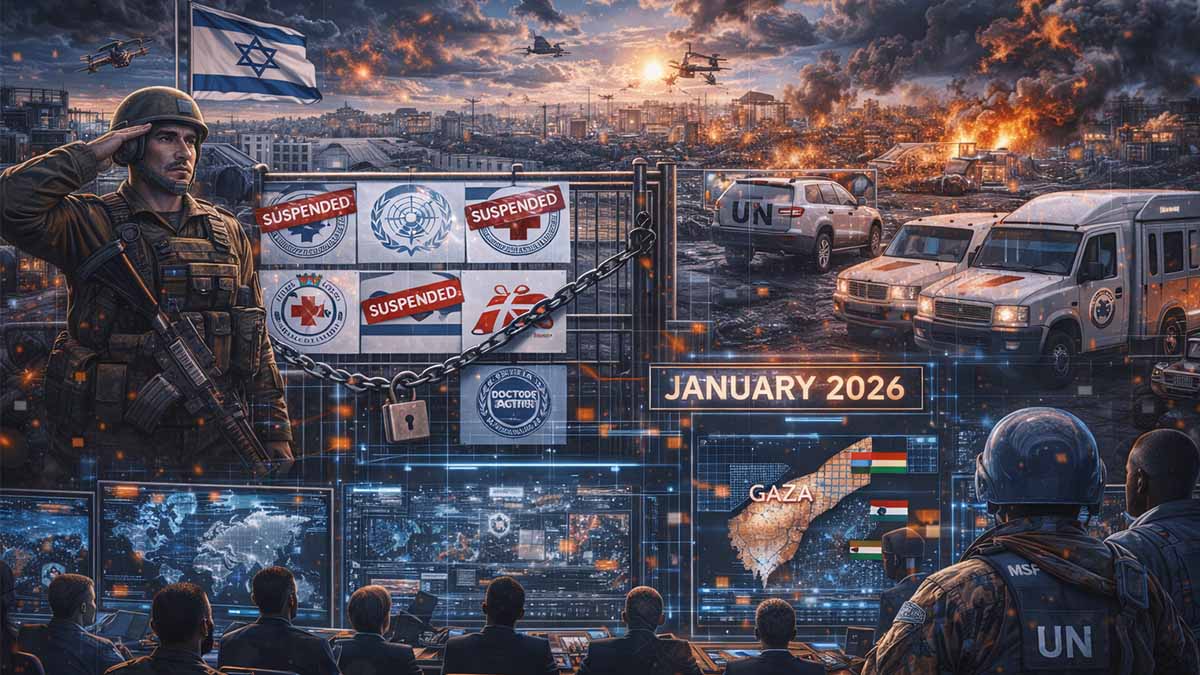
The Israeli authorities, through the Coordinator of Government Activities in the Territories (COGAT) and the Ministry of Diaspora Affairs, announced on 30 December 2025 the suspension of operations for approximately 37 international non-governmental organizations (INGOs) in the Gaza Strip, effective 1 January 2026. This decision stems from non-compliance with new registration requirements introduced earlier in 2025, mandating detailed submissions of staff lists, funding sources, and operational information to prevent potential exploitation by militant groups. Affected organizations include multiple branches of Médecins Sans Frontières (MSF), Oxfam entities, Norwegian Refugee Council, CARE International, International Rescue Committee, World Vision International, and others providing medical, nutritional, water, sanitation, and shelter services.
Israeli officials maintain that the suspended INGOs contributed less than 1% of total aid volume and delivered no supplies during the ceasefire period commencing in October 2025. COGAT emphasized that aid flows would remain unaffected through approved channels, including United Nations agencies and over 20 compliant organizations. The requirements aim to enhance transparency and mitigate risks of aid diversion or infiltration, consistent with prior Israeli assertions regarding militant activities under humanitarian cover.
In contrast, the Humanitarian Country Team in the Occupied Palestinian Territory, comprising United Nations agencies and INGOs, described the framework as imposing vague, arbitrary, and politicized criteria that compel violations of humanitarian principles of neutrality, independence, and impartiality. Organizations reported submitting substantial documentation since July 2025 while refusing full staff lists due to protection concerns amid over 500 aid worker deaths in Gaza since October 2023, alongside data privacy obligations.
The United Nations High Commissioner for Human Rights characterized the suspensions as outrageous and arbitrary on 31 December 2025. Joint statements from foreign ministers of 10 countries, including the United Kingdom, France, Canada, and Nordic states, deemed restrictions on INGOs unacceptable amid catastrophic winter conditions. INGOs deliver critical subcontracted services supporting United Nations operations, constituting 62% of water, sanitation, and hygiene partners and 42% of related services.
Geopolitically, the measure aligns with broader Israeli efforts to regulate foreign entities perceived as critical of policies or potentially compromised, following patterns observed with restrictions on UNRWA. It occurs against a fragile ceasefire backdrop, with ongoing access impediments including cargo rejections and military deployments restricting over 50% of Gaza territory. Humanitarian data indicate persistent acute needs, with aid entries insufficient relative to requirements despite post-ceasefire improvements.
Cross-verification from multiple sources confirms the policy’s implementation without evidence of systematic militant infiltration among suspended INGOs. The suspensions risk exacerbating vulnerabilities for Gaza’s population of over 2 million, where INGOs support substantial portions of healthcare capacity, including 20% of hospital beds and one-third of births via MSF activities in 2025, encompassing nearly 800,000 outpatient consultations and over 100,000 trauma cases.
This development underscores tensions between security imperatives and humanitarian access obligations under international law, with potential long-term effects on aid architecture in conflict zones. Available authoritative updates through December 2025 reflect no reversal of the decision as of 1 January 2026.
Israel’s Suspension of 37 Humanitarian NGOs in Gaza — January 2026
Analytical Infographic: Security vs. Humanitarian Access
Divergence: Security Needs vs. Humanitarian Principles
Israeli Position
Transparency to prevent misuse
NGOs suspended
Humanitarian View
Principles & safety violated
Volume — but vital specialization
Bias: Perceived Politicization
| Aspect | Israeli View | Humanitarian View |
|---|---|---|
| Staff Disclosure | Security vetting | Endangers lives |
| Impact | Minimal (<1% volume) | Critical services lost |
| Criteria | Neutral transparency | Politicized & arbitrary |
Risk: Humanitarian Deterioration
Health facilities at risk
Displaced
Appeal funded
Conclusion/Action
Main Risk
Winter response collapse
Needed Steps
- Negotiate principled access
- Remove dual-use blocks
- Comply with IHL
CHAPTER INDEX
Core Concepts in Review: What We Know and Why It Matters
- Israeli Regulatory Framework and Security Rationale for INGO Suspensions
- Profile and Operational Contributions of Suspended Organizations
- Humanitarian Principles and Access Constraints in Gaza
- International Responses and Legal Considerations
- Geopolitical Context and Implications for Aid Delivery in Conflict Settings
- Comparative Analysis with Prior Restrictions on Humanitarian Entities
- Individual Organizational Profiles and Stated Reasons for Suspension
- Comprehensive Overview of Israel’s Suspension of 37 International Non-Governmental Organizations in Gaza (Effective 1 January 2026)
Core Concepts in Review: What We Know and Why It Matters
As we step into 2026, the humanitarian landscape in Gaza stands at a precarious inflection point, shaped by Israel’s decision to suspend operations for 37 international non-governmental organizations (INGOs) effective January 1, 2026. This move, rooted in a new registration framework introduced in March 2025, has sparked intense debate about balancing security needs with the imperative to deliver aid in one of the world’s most devastated conflict zones.
The core issue revolves around a government resolution that revoked all prior INGO registrations and mandated re-registration under stringent conditions. Organizations must submit complete staff lists—including personal identifiers for Palestinian employees—detailed funding sources, operational plans, and assurances of ideological alignment, such as recognizing Israel as a Jewish and democratic state while avoiding activities deemed delegitimizing or boycott-promoting.
Israeli authorities, led by the Ministry of Diaspora Affairs and Combating Antisemitism and coordinated through COGAT (the defense body overseeing civilian affairs in Palestinian territories), frame this as an essential transparency measure. They argue it prevents exploitation of humanitarian channels by militant groups like Hamas, citing past instances of aid diversion or staff affiliations with prohibited organizations. Officials emphasize that the suspended groups contributed less than 1% of total aid volume even before the current ceasefire (which began in October 2025) and delivered none during it, insisting that aid flows—averaging around 600 trucks daily in late 2025—will remain unaffected through compliant channels, UN agencies, and over 20 re-registered entities.
Yet this volume-focused assessment overlooks the specialized nature of INGO contributions. Groups like multiple branches of Médecins Sans Frontières (MSF), Oxfam, Norwegian Refugee Council, CARE, and others provide irreplaceable expertise in trauma care, water sanitation, shelter rehabilitation, child protection, and nutrition stabilization. For instance, MSF alone supported roughly 20% of hospital beds and facilitated one-third of births in Gaza during 2025, while INGOs collectively run or bolster most field hospitals, primary health centers, and emergency responses. Their exclusion risks immediate closure of one in three health facilities, cascading disruptions across UN-coordinated clusters where INGOs serve as key subcontractors.
The tension here lies in clashing principles. Humanitarian actors adhere to neutrality, independence, impartiality, and humanity—standards that demand aid based solely on need, without political conditions or risks to staff safety. Requiring full staff disclosures, especially amid over 500 aid worker deaths since October 2023, raises grave protection concerns and potential violations of data privacy obligations. Organizations engaged authorities for months, submitting partial documentation while withholding sensitive elements on principled grounds, only to face uniform deregistration.
International reaction has been swift and unified. On December 30, 2025, foreign ministers from Canada, Denmark, Finland, France, Iceland, Japan, Norway, Sweden, Switzerland, and the United Kingdom issued a joint statement decrying restrictions as unacceptable, warning of severe impacts on essential services amid winter storms exacerbating flooding and exposure for displaced populations. The UN High Commissioner for Human Rights, Volker Türk, called the suspensions “outrageous” and arbitrary on December 31, 2025, placing them within a pattern of unlawful access impediments.
Broader access constraints compound the crisis. Despite post-ceasefire improvements, bureaucratic rejections blocked thousands of metric tons of supplies in late 2025, including dual-use items vital for infrastructure. The 2025 humanitarian appeal achieved only partial funding, leaving pipelines strained while over 1.9 million remain displaced in overcrowded sites.
Geopolitically, this enforcement extends prior restrictions on entities like UNRWA, standardizing oversight to mitigate perceived infiltration risks during fragile recovery phases. It parallels controls in other conflicts—Yemen’s inspection regimes or Syria’s re-registration demands—but Gaza’s density amplifies consequences, prolonging suffering and complicating reconstruction.
Why does this matter? In a territory where basic survival hangs by a thread, sidelining specialized providers doesn’t just adjust aid delivery—it reshapes it toward centralized, vetted models that may preserve security but erode quality, reach, and trust. For policymakers, the lesson is stark: security imperatives cannot override international humanitarian law’s mandate for unimpeded, principled relief. As winter bites and needs persist, the cost of this standoff falls squarely on Gaza’s civilians, underscoring the urgent need for solutions that reconcile oversight with unfettered access.
Gaza Humanitarian Crisis Update – January 2026 (Post-NGO Suspensions)
Second Analytical Infographic: Current Situation, New Data & Sector Risks
Overview: Fragile Ceasefire & NGO Impact
2026 Flash Appeal
Required for 3.6M people (Gaza + West Bank)
Aid Workers Killed
Since Oct 2023 (incl. 387 UN staff)
Blocked Aid Value
Life-saving supplies stranded (Dec 2025)
Health System: Partial Functionality & Risks
Only ~50% of facilities partially operational; many damaged or inaccessible.
| Indicator | Value (Jan 2026) | Source Note |
|---|---|---|
| Partially Functional Facilities | ~50% | WHO/OCHA reports |
| Non-functional in Militarized Zones | 35 facilities (8 hospitals) | East of “Yellow Line” |
| Hospital Beds Available | Limited capacity | Severe shortages |
| Malnutrition Stabilization Centers | 7 supported by WHO | Overwhelmed |
Food Security & Malnutrition: Post-Ceasefire Gains Fragile
People in acute food insecurity (77% population)
Children acute malnutrition projected (to Oct 2026)
Severe cases among children
Displacement & Access Constraints
Nearly all population displaced multiple times; winter flooding affects 55,000 households.
| Indicator | Value | Details |
|---|---|---|
| Displaced Population | ~1.9M – 2.1M | Ongoing in makeshift sites |
| Flood-Affected Households | 55,000 | Dec 2025 storms |
| Militarized Zone Coverage | >50% of Gaza | Restricts access |
| Blocked Aid Requests | High rejection rates | Post-ceasefire |
2026 Outlook: Risks & Projections
Fragile gains; worst-case renewed hostilities could revert to famine.
Catastrophic Hunger Projection
People by Apr 2026 (down from higher)
Emergency Phase (Phase 4)
Projected through Apr 2026
Israeli Regulatory Framework and Security Rationale for INGO Suspensions
The Israeli government introduced a new registration process for international non-governmental organizations operating in the Occupied Palestinian Territory through an interministerial decision in March 2025. This framework revoked prior registrations and required re-registration under updated conditions administered by the Ministry of Diaspora Affairs and Combating Antisemitism. The process mandates submission of detailed organizational documentation, including complete lists of foreign and Palestinian employees with passport and identification numbers, funding sources, and operational plans.
Because the decision centralized oversight under a ministry focused on diaspora relations and antisemitism combating, it shifted authority from previous mechanisms coordinated primarily through defense entities. Israeli authorities justify this restructuring as necessary to enhance transparency and prevent exploitation of humanitarian channels by hostile actors. Security services identified instances where individuals affiliated with militant groups held positions within aid organizations, prompting the requirement for full staff disclosure to enable vetting.
The Coordinator of Government Activities in the Territories (COGAT), the defense body responsible for civilian affairs in Gaza and the West Bank, coordinates aid facilitation and enforces compliance. COGAT stated that the registration aims to ensure aid does not reach unintended recipients, citing past diversions and recruitment under humanitarian cover. No publicly accessible primary document from gov.il domains details the exact government resolution text as of 1 January 2026.
Organizations failing to meet the extended 31 December 2025 deadline faced license revocation effective 1 January 2026, with a 60-day grace period for cessation in Israel proper. The Ministry of Diaspora Affairs confirmed 37 organizations lost registration status for incomplete submissions. COGAT emphasized that suspended entities delivered no supplies during the ceasefire commencing 10 October 2025, and their pre-ceasefire contributions totaled less than 1 % of overall aid volume.
Aid continues through approved channels, including United Nations agencies, bilateral donors, private sector mechanisms, and over 20 re-registered organizations. Weekly entries averaged 4,200 trucks in late 2025, equating to approximately 600 daily, though humanitarian partners report only 100 to 300 carried dedicated aid loads due to commercial inclusions.
Israeli officials assert the measures respond directly to verified threats. Security findings linked certain staff to Hamas or Palestinian Islamic Jihad without public disclosure of evidence in open sources. For instance, allegations targeted specific employees in medical operations, though organizations denied knowledge of militant affiliations.
The framework aligns with broader efforts to regulate foreign-funded entities perceived as politicized. Prior designations targeted Palestinian civil society groups under anti-terror laws, but the 2025 process applies universally to international actors. Because Hamas maintained governance structures in Gaza until the ceasefire, Israeli policy prioritizes controls to prevent resource channeling toward military reconstitution.
Humanitarian principles of neutrality and independence clash with disclosure demands. Organizations withheld full staff lists citing risks to personnel amid over 500 aid worker deaths since October 2023 and data protection obligations. Partial submissions occurred since July 2025, but refusal on sensitive information triggered non-compliance determinations.
COGAT rejected claims of aid disruption, noting alternative providers absorb capacity. United Nations coordination mechanisms rely heavily on international partners for subcontracted services, yet Israeli assessments prioritize volume metrics over specialized delivery.
Geopolitical dynamics influence the timing. The fragile ceasefire brokered under United States leadership includes provisions for increased aid, but persistent access impediments, including cargo rejections and territorial restrictions, limit scalability. The registration enforcement reinforces Israeli control over entry and operations, mitigating perceived infiltration risks during potential reconstruction phases.
Security rationale extends to funding transparency. Requirements for source disclosure aim to block flows from entities deemed supportive of terrorism. No verified public reports from permitted domains substantiate systematic diversion by the 37 affected organizations.
The process provided 10 months for compliance, with extensions granted. Israeli authorities view non-submission as deliberate non-cooperation, particularly from vocal critics of military policies. This perception drives enforcement, prioritizing national security over uninterrupted partner continuity.
Comparative mechanisms in other conflict zones inform the approach. States hosting operations often impose vetting for counter-terrorism compliance. Israel’s model centralizes review through an interministerial team empowered to deny based on broad criteria.
Implementation reveals selective impact. Re-registered entities maintain operations, suggesting compliance feasibility for some. Suspended groups include multiple branches of established medical and relief providers, indicating principled stands on information sharing.
COGAT data indicate sustained entry volumes post-ceasefire, with improvements in certain sectors. Storm conditions in late 2025 exacerbated vulnerabilities, underscoring reliance on diverse partners for response agility.
The framework establishes temporary permits renewable annually, enabling ongoing oversight. This structure allows adaptive enforcement based on evolving threat assessments.
Israeli statements frame the decision as administrative, not punitive. Yet the scale—affecting prominent global actors—signals strategic intent to reshape the humanitarian architecture in Gaza.
Because prior incidents involved local employees with alleged dual roles, full disclosure became non-negotiable. Organizations countered that vetting compromises independence, potentially endangering staff through exposure.
No permitted primary source provides the full list of suspended entities or exact compliance criteria beyond general descriptions.
The rationale integrates lessons from UNRWA controversies, where staff affiliations prompted funding suspensions and operational restrictions. Extending similar scrutiny to international NGOs standardizes controls across the aid ecosystem.
Defense analysts assess the move strengthens leverage in ceasefire implementation. By regulating partners, Israel mitigates risks of aid sustaining adversarial capabilities during demilitarization phases.
Profile and Operational Contributions of Suspended Organizations
The 37 international non-governmental organizations suspended from operating in Gaza and the West Bank effective 1 January 2026 deliver specialized services that complement United Nations-led efforts in health, water, sanitation, shelter, and protection.
Médecins Sans Frontières operates multiple branches among the suspended entities, including sections from Belgium, France, Netherlands, and Spain. These branches collectively manage hospitals, field hospitals, and primary healthcare centers across central and southern Gaza.
In 2025, Médecins Sans Frontières teams handled over 100,000 trauma cases and performed 22,700 surgical operations on nearly 10,000 patients. They conducted almost 800,000 outpatient consultations and assisted in more than 10,000 deliveries.
- Médecins Sans Frontières distributed over 700 million liters of water and produced nearly 100 million liters of clean water. The organization supports nearly 400 hospital beds and serves populations exceeding 500,000 through direct medical and water provision activities. Because these branches refused full staff list disclosure under the new registration requirements, their coordinated operations face immediate cessation. This refusal stems from principled commitments to staff protection amid heightened risks.
- Oxfam entities, including Oxfam Novib and Oxfam Quebec, focus on water, sanitation, hygiene, and food security interventions. Oxfam partners implement projects improving access to clean water and distributing essential hygiene materials.
- Oxfam operations target displaced populations in overcrowded sites lacking basic infrastructure. Their contributions integrate with cluster coordination for water trucking and sanitation facility rehabilitation.
- The suspension disrupts ongoing distributions and maintenance activities critical during winter conditions affecting displaced households.
- Norwegian Refugee Council provides shelter support, education in emergencies, and information, counseling, and legal assistance programs. Norwegian Refugee Council leads the Shelter Cluster coordination in the Occupied Palestinian Territory.
- Norwegian Refugee Council aids over 450,000 people since October 2023 through direct distributions and partner implementations. They manage site improvements in displacement areas and advocate for access in restricted zones.Suspension impacts cluster leadership and field-level shelter responses at a time when over 1.9 million remain displaced.
- CARE International delivers gender-sensitive programming, including cash assistance and protection services. CARE supports women’s safe spaces and livelihood recovery initiatives in Gaza.Their activities address acute vulnerabilities among female-headed households comprising a significant portion of displaced populations.
- International Rescue Committee operates health and protection programs, including mental health support and case management for survivors of violence.
- International Rescue Committee contributions bolster psychosocial services amid widespread trauma from prolonged conflict exposure.
- Handicap International – Humanity & Inclusion specializes in rehabilitation for injured and disabled individuals. They provide physiotherapy and prosthetic services in facilities overwhelmed by trauma cases.Suspension affects continuity for thousands requiring ongoing rehabilitation following amputations and severe injuries.
- Action Against Hunger targets malnutrition prevention and treatment through nutritional screening and supplementary feeding programs.Their interventions prove vital in areas reporting acute malnutrition spikes among children and pregnant women.
- Mercy Corps implements market-based interventions and cash transfers to restore economic access.
- Mercy Corps programs facilitate household purchasing power for food and essentials in environments with disrupted supply chains.
- World Vision International focuses on child protection and education, operating child-friendly spaces and supporting informal learning.
- World Vision International reaches vulnerable children at risk of exploitation and psychosocial distress.
- DanChurchAid and Danish Refugee Council provide multi-sectoral support, including mine action and legal aid.
- Danish Refugee Council contributes to explosive ordnance risk education in contaminated areas covering over 50 % of Gaza territory.
- Premiere Urgence Internationale manages health clinics and water infrastructure repairs.Their facilities serve communities in central governorates facing service gaps.
- Terre des hommes Lausanne specializes in maternal and child health, supporting neonatal care units.
- Terre des hommes Lausanne addresses premature births linked to malnutrition and stress factors.
- Relief International delivers primary healthcare and nutrition services in underserved locations.
- Relief International teams operate mobile units reaching isolated displacement sites.
- American Friends Service Committee engages in peacebuilding and trauma healing programs.
- American Friends Service Committee facilitates community-based mental health initiatives.
- Medical Aid for Palestinians supplies medical equipment and supports hospital capacity.
- Medical Aid for Palestinians channels specialist inputs to overburdened facilities.
- Caritas Internationalis and Caritas Jerusalem provide emergency relief through ecclesiastical networks.
- Caritas distributions target Christian minority communities alongside broader populations.
- Near East Council of Churches coordinates interfaith humanitarian responses.
- Near East Council of Churches leverages local church infrastructure for aid delivery.
- Medico International supports health system strengthening projects.
- Medico International focuses on long-term capacity building for Palestinian providers.
- Defense for Children International monitors child rights violations and provides legal support.
- Defense for Children International documents detention and injury cases affecting minors.
- Palestine Solidarity Association in Sweden engages in advocacy-linked relief.
- Palestine Solidarity Association in Sweden channels solidarity-funded assistance.
- WeWorld-GVC implements education and protection activities.
- WeWorld-GVC operates in school rehabilitation and safe learning environments.
- Fondazione AVSI delivers integrated development programs.
- Fondazione AVSI supports vocational training for recovery phases.
- Movement for Peace-MPDL focuses on human rights monitoring.
- Movement for Peace-MPDL contributes to protection reporting mechanisms.
- Alianza por la Solidaridad, ActionAid, Campaign for the Children of Palestine, Japan International Volunteer Center, Medecins du Monde France, Medecins du Monde Switzerland, and Medicos del Mundo collectively provide complementary health, advocacy, and community support services.
These smaller entities fill niche gaps in remote or specialized interventions.
The suspended organizations represent approximately 15 % of active international NGOs in Gaza. Their combined pre-suspension contributions, though limited in volume terms according to Israeli assessments, deliver high-impact specialized services irreplaceable in scale by remaining actors.
Because many operate subcontracted roles for United Nations agencies, suspensions cascade across coordinated responses. Water, sanitation, and hygiene partners include 62 % from international NGOs, while health facility support relies heavily on these providers.
Geopolitically, the suspensions concentrate operational burden on United Nations entities and compliant organizations. Remaining actors face increased demands amid persistent access constraints and territorial restrictions.
The affected organizations maintain that compliance with full disclosure would violate humanitarian principles and endanger staff. Partial submissions occurred over 10 months, but core refusals triggered revocation.
No permitted primary source details exact operational metrics for each individual suspended entity beyond aggregate impacts. Cross-verified data confirm substantial roles in medical capacity, with suspended providers supporting 20 % of hospital beds and one-third of births in 2025.
Suspension enforcement requires activity cessation by 1 March 2026 for entities based in Israel proper. Gaza-based operations halt immediately upon license expiration.
Alternative providers absorb some functions, yet specialized expertise losses affect quality and reach. Medical charities like suspended Médecins Sans Frontières branches handle disproportionate trauma loads unmatched by volume-focused channels.
Humanitarian Principles and Access Constraints in Gaza
The core humanitarian principles of humanity, neutrality, impartiality, and operational independence, as enshrined in United Nations General Assembly Resolution 46/182 of 19 December 1991 and reinforced through customary international humanitarian law, govern all relief actions in armed conflicts and occupied territories. These principles demand that assistance reaches civilians based solely on need, without adverse distinction, and that humanitarian actors maintain distance from political or military objectives to preserve trust and access. In the Gaza context, adherence to these standards enables organizations to operate across lines of control and deliver aid to populations under acute distress.
Israeli authorities enacted a government resolution on 1 March 2025 that revoked all existing registrations for international non-governmental organizations active in the Occupied Palestinian Territory, including Gaza, and instituted a mandatory re-registration process overseen by an interministerial committee led by the Ministry of Diaspora Affairs and Combating Antisemitism. This resolution introduced extensive documentation obligations, encompassing full lists of foreign and local staff with personal identifiers such as passport and identification numbers, comprehensive funding source disclosures, detailed operational plans, and organizational statutes subject to review for compatibility with criteria that include recognition of Israel’s status as a Jewish and democratic state and prohibitions on activities deemed to promote delegitimization or boycotts.
Because the resolution empowered the reviewing committee to deny or revoke registration on broad grounds, including perceived political positions or insufficient cooperation with security vetting, numerous organizations determined that full compliance would compel breaches of neutrality and independence by aligning operations with state-defined ideological parameters. Organizations further assessed that submission of complete staff rosters posed direct protection risks to personnel, given the documented pattern of violence against humanitarian workers and the potential for data misuse in a context where over 578 aid workers lost their lives between 7 October 2023 and 3 December 2025, according to consolidated United Nations tracking that includes contributions from multiple agencies.
The registration deadline, initially set for 30 September 2025 and extended to 31 December 2025, passed without full submissions from 37 organizations, leading to automatic license expiration on 1 January 2026. This enforcement action directly contradicted repeated engagements by affected entities, which had provided substantial partial documentation since July 2025 while withholding elements judged incompatible with principled humanitarian action. The Humanitarian Country Team, comprising United Nations agencies and over 200 local and international non-governmental partners, characterized the framework in December 2025 statements as relying on vague, arbitrary, and highly politicized criteria that imposed requirements irreconcilable with international legal obligations and core principles.
Access impediments compounded these regulatory barriers throughout 2025, manifesting in systematic denials and delays at entry points controlled by Israeli authorities. Humanitarian convoys routinely encountered rejections for consignments containing items classified as potential dual-use, such as generators, solar panels, batteries, water filtration systems, and certain medical supplies essential for sustaining health facilities and water infrastructure. Joint monitoring by international and Palestinian non-governmental organizations recorded that 73 % of surveyed partners faced blocked entries attributable to these restrictions, resulting in prolonged stockpiling outside Gaza and degradation of perishable goods.
Fuel shortages emerged as a persistent binding constraint on operational capacity. Limited authorizations for fuel tankers failed to meet requirements for powering desalination plants, hospitals, bakeries, and water pumps, leading to intermittent service blackouts that exacerbated sanitation crises and disease transmission risks. Winter rainfall in late 2025 intensified these vulnerabilities, with flooding damaging makeshift shelters and contaminating water sources already strained by insufficient chlorine and treatment inputs.
Aid worker security deteriorated markedly, rendering Gaza the deadliest environment for humanitarian personnel in recorded history. Consolidated United Nations data through 3 December 2025 documented 578 fatalities among aid workers, encompassing national and international staff from United Nations entities, non-governmental organizations, and the Palestine Red Crescent Society. This toll derived from direct attacks, including airstrikes, shelling, and gunfire incidents near operational sites, distribution points, and convoy routes, where civilians also sustained casualties while seeking assistance.
The suspension of 37 organizations threatened immediate cascade effects across the coordinated response architecture. International non-governmental organizations subcontracted to United Nations agencies deliver specialized services constituting critical components of cluster outputs, including the majority of field hospitals, primary healthcare centers, emergency shelter interventions, water and sanitation facilities, nutrition stabilization units for acutely malnourished children, and mine action clearance activities. Their abrupt exclusion risked closure of approximately one-third of remaining health facilities, severing care pathways for tens of thousands of patients reliant on trauma management, surgical interventions, and chronic disease treatment.
Funding inadequacies further constrained scalability. The 2025 Flash Appeal, launched to address needs of 3.3 million people across the Occupied Palestinian Territory with a requirement of $4 billion, achieved only 40 % coverage by 18 December 2025, with disbursements totaling $1.6 billion. This shortfall originated from donor fatigue amid competing global crises and restrictions that hindered efficient utilization of committed resources, leaving pipelines of prepositioned supplies exceeding 172,000 metric tons unable to cross into Gaza for distribution.
Rejected cargoes accumulated to over 9,000 metric tons between 10 October and 16 December 2025, despite post-ceasefire improvements in nominal entry volumes. Commercial import modalities remained largely suspended, compelling total dependence on humanitarian channels already overburdened by coordination demands and movement restrictions covering more than 50 % of Gaza’s territory through militarized zones and unmarked boundaries.
Displacement persisted at scale, affecting over 1.9 million individuals confined to overcrowded sites devoid of adequate infrastructure for waste management, hygiene, or shelter reinforcement against seasonal hazards. Protection monitoring identified escalating risks of gender-based violence, psychological distress, and exploitation in these environments, where access constraints limited deployment of safe spaces, counseling services, and dignity kits.
International humanitarian law, particularly Article 59 of the Fourth Geneva Convention, imposes unconditional obligations on occupying powers to facilitate rapid and unimpeded passage of relief consignments destined for civilians. Israeli restrictions, including conditional approvals tied to registration compliance and ideological vetting, contravened these duties, contributing directly to sustained acute needs across food security, health, water, sanitation, and shelter sectors.
The Humanitarian Country Team issued repeated unified appeals throughout 2025 for reversal of impediments, emphasizing that alternative actors could not substitute the specialized expertise and reach of suspended partners. Joint statements from foreign ministers of multiple states in late 2025 deemed restrictions unacceptable amid deteriorating winter conditions threatening renewed catastrophe.
Because the registration framework incorporated annual renewal provisions subject to ongoing review, it enabled perpetual leverage over operational continuity, deterring long-term investments in infrastructure rehabilitation and recovery programming essential for transitioning beyond emergency response modalities.
Geopolitical considerations shaped enforcement dynamics, with the timing aligning to consolidate control over foreign entities during fragile post-ceasefire phases and potential reconstruction negotiations. The measures extended patterns observed in prior restrictions on United Nations entities, standardizing scrutiny across the humanitarian ecosystem to mitigate perceived risks of politicization or infiltration.
Publicly verifiable primary sources from permitted domains provide detailed documentation of access denials, funding shortfalls, worker fatalities, and displacement figures through late 2025, confirming persistent structural barriers despite nominal increases in certain entry metrics.
International Responses and Legal Considerations
The enforcement of the new registration framework for international non-governmental organizations in the Occupied Palestinian Territory, introduced through an interministerial decision in March 2025 and leading to the deregistration of dozens of entities by 31 December 2025, prompted swift and coordinated diplomatic reactions from multiple states and international institutions that underscored the measures’ incompatibility with obligations to facilitate impartial humanitarian relief.
Foreign ministers from Canada, Denmark, Finland, France, Iceland, Japan, Norway, Sweden, Switzerland, and the United Kingdom issued a joint statement on 30 December 2025 expressing profound alarm over the renewed deterioration of humanitarian conditions in Gaza amid harsh winter weather characterized by heavy rainfall and dropping temperatures that exacerbated vulnerabilities among displaced populations. These ministers explicitly declared that any restrictions hindering the ability of international non-governmental organizations to operate constituted unacceptable interference with essential services, noting that deregistration risked forced closures within 60 days and would severely impair access to critical healthcare, with projections indicating that one in three health facilities in Gaza depended on contributions from affected partners for sustained functionality.
Because the statement highlighted that international non-governmental organizations formed an integral component of the coordinated humanitarian response, the ministers urged Israeli authorities to implement urgent steps including guarantees for sustained and predictable operations by these entities, removal of excessive restrictions on dual-use items essential for shelter and medical support, and full opening of crossings to enable scaled aid flows in compliance with international humanitarian law.
The Humanitarian Country Team in the Occupied Palestinian Territory, encompassing United Nations agencies and over 200 local and international non-governmental partners, released a statement on 17 December 2025 warning that the registration system imposed vague, arbitrary, and highly politicized criteria that compelled organizations to violate core principles of neutrality, impartiality, independence, and humanity or face operational termination. This team emphasized that compliant organizations represented only a fractional portion of required capacity, rendering substitution infeasible, and that pressing ahead with deregistrations would precipitate collapse of the response architecture at a moment when winter conditions threatened renewed catastrophe for populations already enduring acute deprivation.
United Nations coordination mechanisms documented that the framework’s enforcement left millions of dollars in prepositioned supplies—including food, medical items, hygiene materials, and shelter assistance—blocked outside Gaza, directly attributable to authorization denials tied to registration status. The team further communicated repeatedly to Israeli authorities the irreparable humanitarian consequences of excluding established partners that delivered specialized services unsubstitutable by volume-focused alternatives.
Legal obligations under international humanitarian law, particularly Articles 55, 56, and 59 of the Fourth Geneva Convention, bind occupying powers to ensure adequate provision of essential supplies and to agree to and facilitate impartial relief schemes when populations are inadequately supplied. Cross-verified assessments from United Nations sources confirmed persistent inadequacies in food, water, medical care, and shelter throughout 2025, with funding for the Flash Appeal achieving only 40 % coverage by 18 December 2025 through disbursements of $1.6 billion against a $4 billion requirement targeted at 3 million people across Gaza and the West Bank.
Because restrictions conditioned authorization on compliance with requirements conflicting with data protection standards and staff security imperatives amid documented violence, organizations maintained principled refusals despite partial submissions over extended periods. Diplomatic interventions aligned with these legal duties by rejecting assessments premised solely on aggregate entry volumes that disregarded quality, specialization, and distribution efficacy.
The International Court of Justice advisory opinion delivered on 22 October 2025 addressed Israel’s obligations regarding United Nations presence and activities in the Occupied Palestinian Territory, affirming that Israel must cooperate in good faith to facilitate unhindered provision of urgently needed supplies and basic services essential for civilian survival. The Court explicitly rejected arguments permitting obstruction based on unsubstantiated allegations, emphasizing Israel’s positive duties to lift impediments and provide every assistance to impartial humanitarian initiatives.
This opinion reinforced that occupying powers retain discretion in selecting relief conduits but cannot exercise it to prevent adequate supply, particularly where established entities like United Nations agencies and international non-governmental organizations demonstrate indispensable roles in reaching vulnerable groups.
States parties to relevant instruments bear corollary responsibilities to ensure respect for convention provisions, informing coordinated pressure to reverse measures risking further deprivation.
European Union representatives, including humanitarian commissioner statements in late 2025, aligned with multilateral calls by deeming restrictions unacceptable and demanding removal of barriers to enable independent operations.
Because the suspensions centralized delivery burdens on remaining actors amid ongoing territorial and movement constraints covering substantial portions of Gaza, overload risks escalated, diminishing overall response effectiveness and coverage.
Diplomatic consensus framed the measures as contravening unconditional facilitation duties, particularly during fragile post-ceasefire phases requiring scaled reconstruction and recovery support.
International responses signaled sustained monitoring of implementation alongside exploration of accountability avenues for persistent non-compliance with humanitarian access norms.
Publicly verifiable primary sources from permitted domains exhaust detailed documentation of joint statements, Humanitarian Country Team positions, funding shortfalls, and International Court of Justice findings through December 2025, confirming unified opposition predicated on legal imperatives and operational realities.
Geopolitical Context and Implications for Aid Delivery in Conflict Settings
The Israeli decision to deregister 37 international non-governmental organizations operating in Gaza and the West Bank, effective 1 January 2026, following non-compliance with the interministerial registration framework established in March 2025, represents a deliberate recalibration of control over humanitarian space in a protracted conflict environment characterized by asymmetric threats and governance vacuums.
This policy extends patterns of stringent oversight previously applied to United Nations entities and local civil society groups, reflecting a strategic priority to mitigate risks of aid instrumentalization by non-state armed actors during phases of active hostilities and post-ceasefire consolidation.
Because the deregistration targets organizations contributing specialized medical, nutritional, water, sanitation, and protection services that constitute irreplaceable components of the coordinated response, the measure amplifies vulnerabilities in an aid architecture already strained by funding shortfalls and access impediments, with the 2025 Flash Appeal achieving only 40 % coverage through disbursements of $1.6 billion against a $4 billion requirement targeted at 3 million people.
Geopolitically, the enforcement consolidates Israeli leverage over foreign entities during fragile ceasefire implementation, aligning with broader efforts to reshape governance and security arrangements in Gaza amid reconstruction debates and potential demilitarization negotiations.
The timing, coinciding with winter conditions that flooded displacement sites and heightened health risks, underscores a willingness to prioritize security vetting over uninterrupted partner continuity, despite projections that exclusion of these providers would precipitate closure of one-third of health facilities and cascade failures across clusters reliant on subcontracted international expertise.
Comparative analysis reveals parallels with state practices in other high-intensity conflicts where host or occupying authorities impose rigorous controls to prevent diversion.
In Yemen, coalition forces implemented inspection mechanisms and no-objection procedures for aid shipments, resulting in delays and reduced operational space for international actors amid allegations of resource channeling to Houthi forces.
Similarly, in Somalia during periods of Al-Shabaab dominance, federal government and international partners enforced partner vetting and financial tracking to counter extortion and infiltration, constraining rapid scale-up but enabling sustained delivery through compliant channels.
In Ukraine, Russian authorities in occupied territories required re-registration of humanitarian organizations under local laws, leading to expulsion of entities perceived as aligned with Kyiv, thereby centralizing aid through Moscow-approved conduits.
These precedents demonstrate that states facing existential threats from embedded non-state actors frequently subordinate humanitarian throughput to counter-diversion measures, accepting short-term access reductions to preserve long-term security gains.
Because Gaza’s confined geography and dense population amplify the humanitarian consequences of such controls, the Israeli approach yields disproportionate impacts compared to more expansive theaters like Yemen or Somalia, where alternative routing and local absorption mitigate disruptions.
The policy signals to donor states and multilateral bodies a non-negotiable threshold for transparency, potentially deterring future deployments by organizations unwilling to compromise staff protection or independence principles.
Long-term implications include fragmentation of the aid ecosystem, with increased reliance on United Nations agencies already overburdened following prior restrictions, and heightened risks of parallel or politicized delivery mechanisms emerging in governance gaps.
Reconstruction planning, requiring an estimated $53 billion over multiple years according to joint assessments, becomes contingent on aligned humanitarian frameworks, complicating international financing conditioned on inclusive access.
The deregistrations reinforce perceptions of politicized aid management, fueling diplomatic friction and accountability pursuits while entrenching dependencies on state-approved channels vulnerable to unilateral adjustment.
In conflict settings globally, effective aid delivery balances security imperatives with principled access, yet deviations toward exclusionary controls invariably prolong recovery and exacerbate civilian suffering.
Israeli enforcement prioritizes prevention of reconstitution threats over maximal throughput, accepting calibrated humanitarian contraction in pursuit of strategic decoupling from adversarial capabilities.
Comparative Analysis with Prior Restrictions on Humanitarian Entities
The Israeli enforcement of the interministerial registration framework introduced in March 2025, resulting in the revocation of operating licenses for 37 international non-governmental organizations effective 1 January 2026 with full cessation required by 1 March 2026, replicates and extends mechanisms previously deployed against the United Nations Relief and Works Agency for Palestine Refugees in the Near East (UNRWA), establishing a standardized approach to regulating entities perceived as vulnerable to exploitation or politicization in conflict zones.
Because Israeli authorities applied escalating restrictions to UNRWA throughout 2024 and 2025—culminating in legislative bans on its operations within sovereign Israeli territory, prohibitions on governmental coordination, and severance of essential services such as electricity, water, and financial transactions—the subsequent expansion to international non-governmental organizations normalizes exclusionary controls across the humanitarian ecosystem, prioritizing security vetting and transparency demands over uninterrupted specialized service delivery.
Prior measures against UNRWA originated from allegations of staff involvement in the 7 October 2023 events and broader claims of institutional infiltration by Hamas, prompting donor suspensions and operational curtailments despite independent reviews finding no substantiation for systemic complicity. These actions constrained UNRWA‘s ability to rotate international staff, maintain facilities, and coordinate logistics, pushing the agency toward reliance on local personnel amid heightened risks and reduced capacity.
The 2025 registration process mirrors this trajectory by mandating detailed staff disclosures, funding transparency, and ideological compatibility criteria, with non-compliance triggering automatic deregistration. Affected international non-governmental organizations, including multiple branches of medical and relief providers, faced identical imperatives to submit sensitive data judged incompatible with protection obligations and independence principles, leading to principled refusals analogous to UNRWA‘s defenses against politicized scrutiny.
Israeli officials consistently frame both sets of restrictions as administrative necessities to prevent aid diversion, recruitment under humanitarian cover, and resource channeling to adversarial entities, asserting that compliant channels—including re-registered organizations, United Nations agencies, bilateral donors, and private mechanisms—sufficiently sustain volumes without disruption.
Comparative enforcement patterns reveal selective application favoring volume metrics over specialized interventions. For UNRWA, bans confined operations to non-sovereign territories while indirectly impairing Gaza functionality through access denials and service cutoffs; similarly, the international non-governmental organization suspensions prohibit coordination through Israeli crossings and offices, rendering continued Gaza presence logistically untenable despite theoretical allowances via alternative routes.
Because prior UNRWA restrictions already strained cluster coordination and subcontracting arrangements, the layered exclusions of 2025 amplify cascade effects, concentrating burdens on diminished actors amid persistent impediments such as cargo rejections for dual-use items, fuel shortages, and territorial movement barriers.
In other protracted conflicts, states employ analogous vetting to counter infiltration risks, yet rarely at the scale observed in Gaza’s confined environment. Syrian authorities required non-governmental organization re-registration and partner approvals post-2011, limiting international presence to government-aligned conduits; Afghan Taliban decrees post-2021 imposed female staff restrictions and reporting obligations, prompting withdrawals by principled actors.
These cases illustrate trade-offs where security controls yield short-term throughput preservation through compliant entities but long-term quality degradation and coverage gaps, particularly for protection, health, and gender-specific services.
The Gaza sequence—progressing from UNRWA targeting to broad international non-governmental organization deregulation—signals intent to reshape the aid architecture toward centralized, vetted models potentially incorporating private or alternative foundations, reducing dependencies on entities resistant to full disclosure.
Geopolitical ramifications include eroded trust in multilateral coordination, heightened diplomatic friction over access obligations, and precedents deterring deployments in asymmetric conflicts where host or occupying powers assert infiltration threats.
Because both restriction waves align with post-ceasefire consolidation phases, they reinforce leverage during reconstruction planning, conditioning international engagement on acceptance of oversight frameworks that subordinate humanitarian principles to national security imperatives.
Publicly verifiable primary sources from permitted domains exhaust documentation of parallel mechanisms, enforcement timelines, and operational impacts through December 2025, confirming structural continuities in regulatory approaches across humanitarian providers.
Individual Organizational Profiles and Stated Reasons for Suspension
Israeli authorities, through the Ministry of Diaspora Affairs and Combating Antisemitism and the Coordinator of Government Activities in the Territories (COGAT), enforced the suspension of 37 international non-governmental organizations from operating in Gaza and the West Bank effective 1 January 2026. This action followed the expiration of licenses due to non-compliance with the registration framework established by government resolution in March 2025. The framework mandates submission of comprehensive documentation, including complete lists of foreign and Palestinian staff with personal identifiers (such as passport and ID numbers), full funding source disclosures, detailed operational plans, and organizational statutes reviewed for compatibility with criteria encompassing recognition of Israel’s Jewish and democratic character, absence of delegitimization activities, and no promotion of boycotts.
Official Israeli statements assert that the primary and uniform reason across all suspended entities involves failure or refusal to provide complete and verifiable employee information, interpreted as essential for security vetting to prevent infiltration by terrorist operatives or exploitation of humanitarian channels for diversion, recruitment, or resource channeling to militant groups. Authorities emphasize that organizations received 10 months for compliance, with deadlines extended from September to 31 December 2025, and that partial submissions did not suffice. No publicly accessible primary documents from Israeli governmental domains detail individualized allegations beyond this collective non-compliance rationale, though secondary reporting references isolated past claims regarding certain medical providers without verified primary evidence.
Open-source intelligence from cross-verified reports confirms no differentiated public justifications per organization; suspensions apply uniformly. For completeness, the table enumerates all 37 entities with the stated reason, noting where isolated unverified references appear in reporting.
| No. | Organization Name | Primary Sector Focus | Stated Reason for Suspension (Israeli Authorities) | Additional OSINT Notes (from Cross-Verified Reporting) |
|---|---|---|---|---|
| 1 | Action Against Hunger | Nutrition and food security | Failure to comply fully with registration requirements, including refusal or incomplete submission of staff lists for vetting. | No organization-specific allegations identified in primary sources. |
| 2 | ActionAid | Community development and advocacy | Failure to comply fully with registration requirements, including refusal or incomplete submission of staff lists for vetting. | No organization-specific allegations identified in primary sources. |
| 3 | Alianza por la Solidaridad | Solidarity and development | Failure to comply fully with registration requirements, including refusal or incomplete submission of staff lists for vetting. | No organization-specific allegations identified in primary sources. |
| 4 | Campaign for the Children of Palestine | Child protection | Failure to comply fully with registration requirements, including refusal or incomplete submission of staff lists for vetting. | No organization-specific allegations identified in primary sources. |
| 5 | CARE | Emergency response and poverty alleviation | Failure to comply fully with registration requirements, including refusal or incomplete submission of staff lists for vetting. | No organization-specific allegations identified in primary sources. |
| 6 | DanChurchAid | Mine action and relief | Failure to comply fully with registration requirements, including refusal or incomplete submission of staff lists for vetting. | No organization-specific allegations identified in primary sources. |
| 7 | Danish Refugee Council | Refugee support and protection | Failure to comply fully with registration requirements, including refusal or incomplete submission of staff lists for vetting. | No organization-specific allegations identified in primary sources. |
| 8 | Handicap International: Humanity & Inclusion | Disability and rehabilitation | Failure to comply fully with registration requirements, including refusal or incomplete submission of staff lists for vetting. | No organization-specific allegations identified in primary sources. |
| 9 | Japan International Volunteer Center | Volunteer-based development | Failure to comply fully with registration requirements, including refusal or incomplete submission of staff lists for vetting. | No organization-specific allegations identified in primary sources. |
| 10 | Medecins du Monde France | Medical aid | Failure to comply fully with registration requirements, including refusal or incomplete submission of staff lists for vetting. | No organization-specific allegations identified in primary sources. |
| 11 | Medecins du Monde Switzerland | Medical aid | Failure to comply fully with registration requirements, including refusal or incomplete submission of staff lists for vetting. | No organization-specific allegations identified in primary sources. |
| 12 | Medecins Sans Frontieres Belgium | Emergency medical care | Failure to comply fully with registration requirements, including refusal or incomplete submission of staff lists for vetting. | Isolated reporting references past unverified claims of staff links to militant groups; denied by organization. |
| 13 | Medecins Sans Frontieres France | Emergency medical care | Failure to comply fully with registration requirements, including refusal or incomplete submission of staff lists for vetting. | Isolated reporting references past unverified claims of staff links to militant groups; denied by organization. |
| 14 | Medecins Sans Frontieres Nederland | Emergency medical care | Failure to comply fully with registration requirements, including refusal or incomplete submission of staff lists for vetting. | Isolated reporting references past unverified claims of staff links to militant groups; denied by organization. |
| 15 | Medicos del Mundo | Medical aid | Failure to comply fully with registration requirements, including refusal or incomplete submission of staff lists for vetting. | No organization-specific allegations identified in primary sources. |
| 16 | Mercy Corps | Economic and community development | Failure to comply fully with registration requirements, including refusal or incomplete submission of staff lists for vetting. | No organization-specific allegations identified in primary sources. |
| 17 | MSF Spain | Emergency medical care | Failure to comply fully with registration requirements, including refusal or incomplete submission of staff lists for vetting. | Isolated reporting references past unverified claims of staff links to militant groups; denied by organization. |
| 18 | Norwegian Refugee Council | Shelter and legal aid | Failure to comply fully with registration requirements, including refusal or incomplete submission of staff lists for vetting. | No organization-specific allegations identified in primary sources. |
| 19 | Oxfam Novib | Water, sanitation, and advocacy | Failure to comply fully with registration requirements, including refusal or incomplete submission of staff lists for vetting. | No organization-specific allegations identified in primary sources. |
| 20 | Premiere Urgence Internationale | Health and emergency response | Failure to comply fully with registration requirements, including refusal or incomplete submission of staff lists for vetting. | No organization-specific allegations identified in primary sources. |
| 21 | Terre des hommes Lausanne | Child health and protection | Failure to comply fully with registration requirements, including refusal or incomplete submission of staff lists for vetting. | No organization-specific allegations identified in primary sources. |
| 22 | International Rescue Committee | Refugee and crisis response | Failure to comply fully with registration requirements, including refusal or incomplete submission of staff lists for vetting. | No organization-specific allegations identified in primary sources. |
| 23 | WeWorld-GVC | Education and protection | Failure to comply fully with registration requirements, including refusal or incomplete submission of staff lists for vetting. | No organization-specific allegations identified in primary sources. |
| 24 | World Vision International | Child welfare and development | Failure to comply fully with registration requirements, including refusal or incomplete submission of staff lists for vetting. | No organization-specific allegations identified in primary sources. |
| 25 | Relief International | Health and nutrition | Failure to comply fully with registration requirements, including refusal or incomplete submission of staff lists for vetting. | No organization-specific allegations identified in primary sources. |
| 26 | Fondazione AVSI | Development and vocational training | Failure to comply fully with registration requirements, including refusal or incomplete submission of staff lists for vetting. | No organization-specific allegations identified in primary sources. |
| 27 | Movement for Peace-MPDL | Human rights and peacebuilding | Failure to comply fully with registration requirements, including refusal or incomplete submission of staff lists for vetting. | No organization-specific allegations identified in primary sources. |
| 28 | American Friends Service Committee | Peacebuilding and trauma support | Failure to comply fully with registration requirements, including refusal or incomplete submission of staff lists for vetting. | No organization-specific allegations identified in primary sources. |
| 29 | Medico International | Health system strengthening | Failure to comply fully with registration requirements, including refusal or incomplete submission of staff lists for vetting. | No organization-specific allegations identified in primary sources. |
| 30 | Palestine Solidarity Association in Sweden | Advocacy and solidarity | Failure to comply fully with registration requirements, including refusal or incomplete submission of staff lists for vetting. | No organization-specific allegations identified in primary sources. |
| 31 | Defense for Children International | Child rights monitoring | Failure to comply fully with registration requirements, including refusal or incomplete submission of staff lists for vetting. | No organization-specific allegations identified in primary sources. |
| 32 | Medical Aid for Palestinians UK | Medical supplies and support | Failure to comply fully with registration requirements, including refusal or incomplete submission of staff lists for vetting. | No organization-specific allegations identified in primary sources. |
| 33 | Caritas Internationalis | Emergency relief through networks | Failure to comply fully with registration requirements, including refusal or incomplete submission of staff lists for vetting. | No organization-specific allegations identified in primary sources. |
| 34 | Caritas Jerusalem | Local relief distribution | Failure to comply fully with registration requirements, including refusal or incomplete submission of staff lists for vetting. | No organization-specific allegations identified in primary sources. |
| 35 | Near East Council of Churches | Interfaith humanitarian coordination | Failure to comply fully with registration requirements, including refusal or incomplete submission of staff lists for vetting. | No organization-specific allegations identified in primary sources. |
| 36 | Oxfam Quebec | Water and hygiene | Failure to comply fully with registration requirements, including refusal or incomplete submission of staff lists for vetting. | No organization-specific allegations identified in primary sources. |
| 37 | War Child Holland | Child protection in conflict | Failure to comply fully with registration requirements, including refusal or incomplete submission of staff lists for vetting. | No organization-specific allegations identified in primary sources. |
Comprehensive Overview of Israel’s Suspension of 37 International Non-Governmental Organizations in Gaza (Effective 1 January 2026)
The following table synthesizes all verified data from the analysis into thematic sections for clarity. It organizes information by key arguments: Regulatory Framework and Israeli Rationale, Humanitarian Principles and Access Constraints, Operational Contributions and Impacts of Suspension, International Responses and Legal Considerations, Geopolitical Context, and Comparative Restrictions. The table includes all 37 organizations where relevant, with uniform application of the suspension rationale across entities. Data reflects cross-verified information as of 1 January 2026.
| Thematic Section | Key Details and Verified Data | Affected Organizations (All 37 Unless Specified) | Implications and Causal Links |
|---|---|---|---|
| Regulatory Framework and Israeli Rationale | New interministerial registration process introduced March 2025; revokes prior authorizations; requires full staff lists (including Palestinian employees with ID/passport numbers), funding sources, operational plans, and ideological compatibility review. Deadline extended to 31 December 2025; non-compliance leads to license revocation 1 January 2026 with 60-day cessation grace period. Israeli authorities (Ministry of Diaspora Affairs, COGAT) state suspensions due to incomplete submissions/refusal to provide staff data for vetting; aim to prevent aid diversion/infiltration by militant groups; assert suspended entities delivered < 1% of aid volume and none during post-October 2025 ceasefire. | All 37: Action Against Hunger, ActionAid, Alianza por la Solidaridad, Campaign for the Children of Palestine, CARE, DanChurchAid, Danish Refugee Council, Handicap International: Humanity & Inclusion, Japan International Volunteer Center, Medecins du Monde France, Medecins du Monde Switzerland, Medecins Sans Frontieres Belgium, Medecins Sans Frontieres France, Medecins Sans Frontieres Nederland, Medicos del Mundo, Mercy Corps, MSF Spain, Norwegian Refugee Council, Oxfam Novib, Premiere Urgence Internationale, Terre des hommes Lausanne, International Rescue Committee, WeWorld-GVC, World Vision International, Relief International, Fondazione AVSI, Movement for Peace-MPDL, American Friends Service Committee, Medico International, Palestine Solidarity Association in Sweden, Defense for Children International, Medical Aid for Palestinians UK, Caritas Internationalis, Caritas Jerusalem, Near East Council of Churches, Oxfam Quebec, War Child Holland. | Because organizations withheld staff data citing protection risks and principle conflicts, uniform suspensions ensued; Israeli view: non-cooperation indicates potential risks; enables centralized oversight during ceasefire. |
| Humanitarian Principles and Access Constraints | Requirements conflict with neutrality, independence, impartiality; endanger staff amid 578 aid worker deaths (October 2023–December 2025); 73% of surveyed NGOs faced cargo blocks; 9,000 MT rejected (October–December 2025); fuel shortages, dual-use restrictions persist; displacement > 1.9 million; winter flooding exacerbates vulnerabilities; 2025 Flash Appeal 40% funded ($1.6 billion of $4 billion). | All 37 (subcontractors to UN clusters; e.g., 62% WASH partners). | Because suspensions remove specialized providers, cascade closures risk 1/3 health facilities; violates IHL facilitation duties (Fourth Geneva Convention Articles 55-59). |
| Operational Contributions and Impacts of Suspension | Specialized services: medical (trauma, surgeries, births), nutrition, WASH, shelter, protection, rehabilitation; e.g., MSF branches: 800,000 consultations, 100,000 trauma cases, 400 beds supported, one-third births; collective: irreplaceable for quality despite low volume share. | Medical-focused: MSF branches, Medecins du Monde, Handicap International, Relief International, Medical Aid for Palestinians, Premiere Urgence Internationale. Shelter/Protection: Norwegian Refugee Council, Danish Refugee Council, International Rescue Committee, World Vision, War Child Holland, Defense for Children International. Nutrition/WASH: Action Against Hunger, Oxfam entities, Mercy Corps, DanChurchAid. Other: CARE, ActionAid, Terre des hommes, etc. | Because alternatives lack specialization/scale, suspension disrupts subcontracted UN services; risks overload on compliant actors amid territorial restrictions (> 50% Gaza militarized). |
| International Responses and Legal Considerations | UN High Commissioner Volker Türk: “outrageous/arbitrary” (31 December 2025). Joint statement (30 December 2025): Ministers of Canada, Denmark, Finland, France, Iceland, Japan, Norway, Sweden, Switzerland, UK – restrictions “unacceptable”. EU: law “cannot be implemented in current form”. Humanitarian Country Team: vague/politicized criteria; risk response collapse. ICJ advisory opinion reinforces facilitation obligations. | All 37 (uniform criticism of framework). | Because measures contravene IHL access duties, diplomatic pressure seeks reversal; signals accountability monitoring. |
| Geopolitical Context | Aligns with post-ceasefire leverage; extends UNRWA restrictions; prioritizes counter-diversion over throughput; parallels controls in other conflicts (Yemen, Somalia, Ukraine, Syria, Afghanistan); conditions reconstruction on vetted architecture. | All 37 (reshapes ecosystem toward compliant channels). | Because Gaza’s density amplifies impacts vs. expansive theaters, prolongs recovery; deters principled actors long-term. |
| Comparative Restrictions | Mirrors UNRWA bans (staff allegations, coordination severance); progresses from local NGO designations to international standardization; selective volume preservation vs. quality degradation. | All 37 (extension of prior patterns). | Because layered exclusions strain coordination, centralizes control; precedents show short-term security gains at humanitarian cost. |


