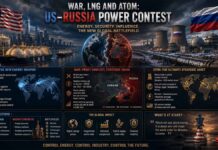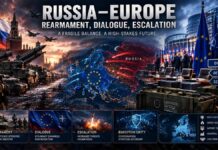
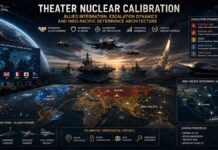








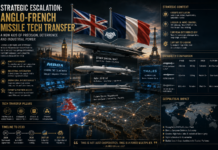


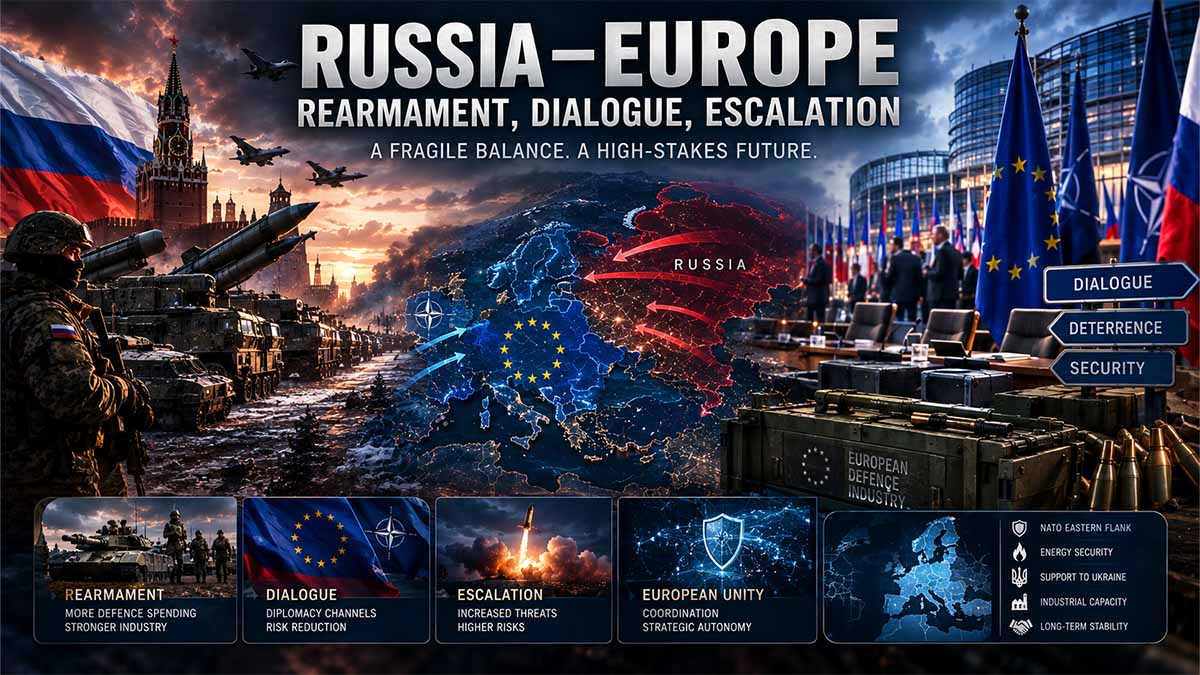
Executive Summary
- BLUF: Europe’s military expansion and Washington’s contacts with Moscow are not contradictory; they are parallel instruments of coercive diplomacy.
- No verified official source documents a current visit to Moscow by the serving CIA Director; Kremlin records identify presidential envoy Steve Witkoff.
- European defence expenditure rose to €418 billion in 2025 and is projected at €454 billion in 2026.
- Rearmament is becoming structural: industrial capacity, air defence, drones, military mobility, cyber resilience and infrastructure now extend beyond the Ukrainian theatre.
- Russia combines conventional pressure, nuclear signalling, hybrid operations and controlled diplomatic access to shape Western risk calculations.
- The expiry of New START on 5 February 2026 removes the last bilateral treaty directly limiting United States–Russian strategic arsenals.
- The most likely five-year outcome is neither general war nor comprehensive peace, but armed bargaining under persistent escalation risk.
- Baseline 2026–2031 estimate: 40% managed confrontation, 24% militarised settlement, 21% prolonged attrition, 10% contained NATO–Russia incident, 5% uncontrolled escalation.
Europe and Russia: The Architecture of Managed Escalation
Europe is not moving mechanically toward war with Russia, nor is Moscow’s nuclear language proof that conflict has become inevitable. A more exact interpretation is emerging: both sides are constructing stronger instruments of coercion while preserving channels capable of preventing uncontrolled escalation. Rearmament, sanctions, nuclear deterrence, cyber pressure and confidential diplomacy are not contradictory policies; they are components of the same bargaining system. The danger lies in their interaction. Europe is converting political alarm into industrial capacity, while Russia is widening the uncertainty surrounding its response thresholds. Meanwhile, the expiration of the last treaty limiting American and Russian strategic arsenals has reduced transparency precisely when drones, hypersonic systems, cyber operations and space dependence are compressing decision time. The decisive question is no longer whether escalation exists, but whether governments can still control it.
The Rearmament Decision
The institutional point of no return came at the NATO Summit in The Hague on 25 June 2025. The 32 allies committed to invest 5% of GDP annually by 2035: at least 3.5% for core defence requirements and up to 1.5% for critical infrastructure, network protection, civil preparedness, innovation and the defence-industrial base. NATO reported that European allies and Canada increased real defence expenditure by almost 20% in 2025, reaching more than USD 571 billion at 2021 prices. The spending trajectory will be formally reviewed in 2029. Defence Investment and NATO’s 5% Commitment – NATO – 29/06/2026.
This is not merely a budgetary correction. It represents an attempt to reconstruct the material foundations of European power: ammunition reserves, integrated air and missile defence, long-range precision systems, military mobility, protected communications, drones, space services and industrial surge capacity. Yet appropriations are not capabilities. The strategically relevant sequence runs from fiscal authorization to contracts, production lines, deliveries, trained personnel, maintenance and operational integration. Europe’s credibility will be determined not by announced totals but by whether fragmented national programmes become deployable multinational formations.
The European Industrial Pivot
The European Union added a financial architecture to NATO’s military commitment. The Commission’s Readiness 2030 framework provides mechanisms capable of supporting up to EUR 800 billion in additional defence expenditure. This includes as much as EUR 650 billion potentially enabled through national fiscal flexibility and EUR 150 billion in loans under SAFE, the Security Action for Europe instrument. White Paper for European Defence – Readiness 2030 – European Commission – 2026.
The distinction between potential and realized expenditure is essential: the Commission explicitly makes the final scale dependent on national decisions. The economic contest will therefore concern procurement discipline as much as financial volume. Common specifications, multi-year orders and predictable demand can support investment in energetics, rocket motors, interceptors, secure electronics and advanced materials. Continued national fragmentation would instead produce overlapping platforms, weak economies of scale and persistent dependence on non-European supply chains.
The national roles are complementary. Germany will be central to financing, logistics and industrial scale; France brings an independent nuclear deterrent, aerospace capacity and a tradition of strategic autonomy; the United Kingdom connects nuclear deterrence, intelligence integration and Atlantic reinforcement; Italy controls infrastructure of central importance in the Mediterranean and contributes through aerospace, naval systems, electronics, nuclear sharing and logistics. Europe’s rearmament will become strategically meaningful only if these assets function as a connected system rather than as parallel national inventories.
Moscow’s Threshold Strategy
Russia’s response is based partly on force and partly on uncertainty. Presidential Decree No. 991 of 19 November 2024 broadened the publicly declared conditions under which nuclear use could be considered. The doctrine includes aggression by a non-nuclear state undertaken with the participation or support of a nuclear-armed state, a conventional attack creating a critical threat to Russian or Belarusian sovereignty or territorial integrity, and reliable warning of a massive aerospace attack involving aircraft, missiles, hypersonic systems or unmanned vehicles. Decree No. 991 on the Fundamentals of State Policy on Nuclear Deterrence – President of the Russian Federation – 19/11/2024.
The document does not establish automatic launch conditions. It enlarges the range of contingencies entering presidential consideration while preserving political discretion. That distinction is crucial. Stronger declaratory language can serve deterrence and bargaining without indicating that nuclear employment is imminent. Operational warning would require a correlated pattern: exceptional warhead-custody activity, unscheduled strategic-force dispersal, leadership relocation, hardened command networks, emergency civil-defence measures and interruption of crisis communications.
Moscow’s objective is to make external intervention appear inseparable from nuclear risk. Europe’s objective is the opposite: to demonstrate that conventional reinforcement can deny coercive gains without precipitating nuclear escalation. The collision between these two propositions defines the emerging security order.
NATO’s Nuclear Counterweight
On 18 June 2026, NATO’s Nuclear Planning Group reaffirmed that the alliance’s strategic nuclear forces remain the supreme guarantee of allied security and underpin extended deterrence. 2026 Nuclear Planning Group Statement – NATO – 18/06/2026. NATO’s structure deliberately complicates adversary calculations: the United States, United Kingdom and France retain separate national decision centres, while the United States maintains custody of its forward-deployed nuclear weapons in Europe. NATO also integrates nuclear deterrence with conventional forces, missile defence, cyber capabilities and space systems. NATO’s Nuclear Deterrence Policy and Forces – NATO – 20/05/2026.
This architecture strengthens deterrence but increases the importance of interpretation. Dual-capable aircraft, long-range conventional systems and missile defences may have defensive purposes while still entering Russian calculations about a possible disarming strike. NATO, in turn, may interpret Russian dispersal or exercises as preparation rather than signaling. The critical vulnerability is entanglement: the same satellites, communications networks and command systems increasingly support civilian, conventional and nuclear functions. An operation intended to disrupt one mission may be interpreted as preparation to neutralize another.
The Arms-Control Vacuum
The New START Treaty expired on 5 February 2026, ending its central numerical limits on deployed strategic warheads and delivery systems. The United Nations Secretary-General described the expiration as a grave moment for international peace and security. Statement on the Expiration of New START – United Nations Secretary-General – 05/02/2026. The United States formally confirmed the expiration before the Conference on Disarmament on 6 February 2026. Statement to the Conference on Disarmament – U.S. Department of State – 06/02/2026.
The loss is not limited to numerical ceilings. Arms-control arrangements create predictability through notifications, data exchanges, inspections and established vocabularies for discussing unusual activity. Their disappearance encourages worst-case planning. The strategic relationship is also no longer purely bilateral. China’s modernization increasingly affects American force planning, while Washington’s global posture influences Russian calculations.
In a joint statement issued on 9 May 2025, Beijing and Moscow identified short-flight-time missiles, deep precision strike, missile defence, nuclear sharing and military space capabilities as sources of strategic concern. The document simultaneously reaffirmed that nuclear war cannot be won and must never be fought. These are the declared positions of the two governments, not independent evidence of Western offensive intent. Joint Statement on Global Strategic Stability – Ministry of Foreign Affairs of the People’s Republic of China – 09/05/2025.
The Hybrid Front
The most likely field of sustained confrontation lies below direct war. The European Union’s hybrid-threat framework covers sabotage, cyber operations, attacks on critical infrastructure, foreign information manipulation, interference with electoral processes and the instrumentalization of migration. Hybrid Threats – Council of the European Union – 16/03/2026.
By 13 July 2026, the EU sanctions regime addressing Russian destabilizing activities applied to 80 individuals and 20 entities. Its scope had been widened to include vessels, aircraft, real estate, physical components of digital and communications networks, financial institutions and crypto-asset service providers. Russia’s Hybrid Activities: EU Sanctions – Council of the European Union – 13/07/2026.
The strategic objective of hybrid pressure is not necessarily spectacular destruction. It is the imposition of recurring costs while complicating attribution and political response. Cyber access to an energy operator, reconnaissance near an undersea cable, opaque political finance and manipulation of logistics can force governments and companies to spend continuously on protection. The risk arises when an operation affects systems serving both civilian society and military command. At that point, an incident designed to remain below the threshold of war may be interpreted as preparation for a larger attack.
Financial Warfare
Sanctions have evolved from broad restrictions into network warfare directed at banks, vessels, insurers, commodity intermediaries, technology suppliers and digital settlement platforms. On 23 July 2026, the EU’s twenty-first package imposed asset restrictions on 94 banks and major financial institutions, extended transaction prohibitions to 33 additional Russian credit and financial institutions, targeted 14 crypto-service platforms, and added 41 vessels to measures covering a shadow-fleet population the Council stated already included 632 vessels. Twenty-First Package of Sanctions – Council of the European Union – 23/07/2026.
These totals measure legal coverage, not strategic effectiveness. Effectiveness depends on beneficial-ownership transparency, insurance access, port enforcement, commodity discounts, replacement vessels, intermediary jurisdictions and the willingness of third-country institutions to accept compliance risk. Russia’s adaptation includes substitution, reflagging, layered corporate ownership and alternative settlement channels. The contest increasingly concerns who can identify and validate transactions faster: enforcement authorities or evasion networks.
The same pressure carries European costs. The European Central Bank’s Financial Stability Review of May 2026 identified geopolitical risk, energy disruption, shipping stress, defence expenditure and elevated public debt as interacting vulnerabilities. Financial Stability Review – European Central Bank – May 2026. Security policy and fiscal policy can no longer be considered separately.
The Quiet Channel
Confidential diplomacy is not evidence that confrontation is ending. It is evidence that governments understand the danger of operating without communication. Intelligence and military channels can clarify whether an incident was deliberate, communicate prohibited targets, test negotiating conditions or construct narrow arrangements that neither side is prepared to defend publicly.
Only officially acknowledged contacts belong in the factual record. Their strategic value should be judged through subsequent conduct: modified targeting, altered exercise schedules, prisoner arrangements, restored notifications or restrained retaliation. A meeting without observable policy effects demonstrates communication, not accommodation.
The dual track is therefore rational. Public deterrence seeks to shape expectations across alliances and domestic constituencies; confidential bargaining addresses information that cannot safely be exchanged in public. The two tracks reinforce each other when credible pressure creates incentives for negotiation. They become destabilizing when public commitments eliminate the flexibility required to accept a private compromise.
The Five-Year Test
Between 2026 and 2031, five outcomes remain structurally plausible: managed deterrence; entrenched hybrid and financial confrontation; a contained kinetic incident; coercive nuclear repositioning without detonation; or uncontrolled direct conflict. No defensible official model assigns verified probabilities to these outcomes. The leading strategic hypothesis, based on observable institutional behavior, is continued competition below general war—supported by stronger forces, persistent sanctions and protected communication.
The decisive warning indicators are not speeches. They are costly operational deviations: warhead movement, strategic dispersal outside established patterns, continuity-of-government activation, large-scale medical and logistics preparation, cross-sector cyber pre-positioning, diplomatic evacuation and interruption of hotlines. Stabilizing indicators would include reciprocal exercise notifications, protected nuclear communications, restored data exchanges and explicit understandings against interference with command-and-control systems.
Europe’s task is not to choose between defence and dialogue. It is to make both credible. Rearmament without communication increases the risk of misinterpretation; dialogue without military resilience invites coercion. The emerging order will be stable only if Europe can deny a rapid military gain, absorb hybrid and financial shocks, preserve political unity and maintain channels capable of stopping a local crisis before it becomes a strategic one.
Navigational Index
- The Dual Track — Rearmament, deterrence and confidential bargaining
- The Escalation System — Nuclear thresholds, hybrid pressure and financial warfare
- The Five-Year Horizon — Competing hypotheses, warning indicators and strategic consequences
Master Abstract
The apparent contradiction
The central analytical error is to treat European rearmament and United States–Russian diplomatic contact as mutually exclusive policies. They are components of the same bargaining architecture. Governments rarely negotiate only after military pressure has disappeared; they negotiate while altering the balance of expected costs, preserving escalation options and attempting to deny the adversary confidence in a favourable future. The available primary evidence therefore does not support the simplified proposition that Europe is preparing for war while Washington secretly expects peace. It supports a more complex conclusion: Europe is attempting to rebuild deterrent capacity precisely because negotiations occur under conditions of military coercion, strategic uncertainty and declining arms-control transparency. The identity of the American interlocutor is important. No currently accessible official record verified in this session establishes that the serving CIA Director recently travelled to Moscow. The Kremlin instead records that President Vladimir Putin received Steve Witkoff, special envoy of the President of the United States, on 6 August 2025 and again on 22 January 2026. Official Meeting with the Special Envoy of the President of the United States – President of Russia – August 2025 — Verified Kremlin record. Official Meeting with the Special Envoy of the President of the United States – President of Russia – January 2026 — Verified Kremlin record. This distinction changes the interpretation: an intelligence-service channel would primarily imply warning transmission, deconfliction or highly compartmented negotiation, whereas a presidential envoy represents direct political bargaining under executive authority. In either case, contact itself would not demonstrate convergence. It would demonstrate that both sides perceive the uncontrolled escalation cost as sufficiently serious to preserve communication. The operational reality is therefore a dual track: public deterrence strengthens negotiating leverage, while confidential diplomacy protects against misperception and explores whether limited agreements can be separated from the unresolved political settlement.
Rearmament as structural transformation
Europe’s defence expansion is no longer adequately described as a temporary procurement reaction to Ukraine. It is becoming a fiscal, industrial and institutional transformation extending into the next decade. The European Defence Agency reports that the 27 EU member states spent €418 billion in 2025, an increase of 20% over 2024 in constant 2025 prices, equivalent to 2.2% of combined GDP; it projects €454 billion and 2.4% of GDP for 2026, while explicitly warning that the projection partly incorporates estimates and that the contribution of new European financing mechanisms cannot yet be fully quantified. Defence Data 2025–2026 – European Defence Agency – July 2026 — Verified official report. At the alliance level, NATO members committed in The Hague to a 2035 objective of 5% of GDP, divided into at least 3.5% for core defence requirements and up to 1.5% for infrastructure, resilience, networks, civil preparedness, innovation and the defence-industrial base. The Hague Summit Declaration – NATO – June 2025 — Verified official declaration. The European Commission’s complementary framework seeks to enable as much as €800 billion in additional defence expenditure, including up to €150 billion in EU-backed SAFE loans and temporary fiscal flexibility potentially reaching 1.5% of national GDP. White Paper for European Defence—Readiness 2030 – European Commission and High Representative – March 2025 — Verified official document. These figures do not mean that Europe will rapidly acquire an integrated autonomous war-fighting system. Expenditure is an input, not a capability. Fragmented procurement, production lead times, personnel shortages, ammunition replenishment, maintenance capacity, command interoperability, strategic lift and dependence on non-European intelligence and air-defence assets remain conversion constraints. Nevertheless, the political signal is durable: even a ceasefire in Ukraine would probably slow only part of this trajectory because European governments are now planning against a wider risk portfolio encompassing Russian regeneration, uncertain American force allocation, infrastructure vulnerability, cyber operations and the depletion of inventories accumulated during the post-Cold War period.
Russia’s escalation grammar
Russia’s posture should be analysed as a calibrated system of deterrence, compellence and ambiguity rather than as a sequence of isolated threats. Moscow seeks simultaneously to prevent direct NATO entry into the conflict, constrain the range and employment of Western-supplied weapons, preserve freedom of action in Ukraine, fracture European political cohesion and increase the perceived cost of any long-term Western strategy. Nuclear language is one layer of that system, not proof that a nuclear decision has been taken. On 19 November 2024, Presidential Decree No. 991 formally approved revised foundations of Russian state policy on nuclear deterrence, broadening the declaratory environment in which Moscow may present conventional, coalition and externally supported attacks as relevant to nuclear decision-making. Decree No. 991 on the Foundations of State Policy in the Field of Nuclear Deterrence – Official Russian Legal Information Portal – November 2024 — Verified official legal record. The greater structural danger emerged on 5 February 2026, when New START reached the end of its lifecycle, eliminating the last bilateral international agreement directly limiting the two largest strategic nuclear arsenals. Statement in Connection with the Expiration of the New START Treaty – Ministry of Foreign Affairs of the Russian Federation – February 2026 — Verified official statement. The loss is not merely numerical: treaty-based notifications, inspections, definitions and predictable force-accounting reduce worst-case assumptions even when political relations are hostile. Their absence increases uncertainty concerning upload potential, new delivery systems, exercises and future force structure. Below the nuclear level, NATO identifies political interference, malicious cyber activity, economic pressure, subversion, sabotage and coercive rhetoric as parts of the Russian hybrid repertoire, while stressing that attribution and response require continuous intelligence assessment. Countering Hybrid Threats – NATO – January 2026 — Verified official assessment. The correct inference is not that every disruption constitutes a centrally directed Russian operation. It is that the strategic competition occupies a continuum in which deniable action can modify risk, impose security costs and test thresholds without automatically triggering conventional retaliation. This makes the intermediate space between peace and declared war the most active and potentially misread part of the confrontation.
Shadow systems and coercive liquidity
The confrontation is equally conducted through shipping, financial intermediation, sanctions evasion, crypto-assets, industrial supply chains, intelligence-linked networks and cyber operations. These “shadow” dimensions are not peripheral: they determine whether military pressure can be financed, whether export controls can be circumvented and whether the political cost of confrontation can be transmitted into European societies. In July 2026, the EU’s twenty-first sanctions package imposed asset freezes or funding prohibitions on 94 banks and major financial institutions, expanded transaction bans to 33 additional Russian financial institutions, targeted 14 crypto-service platforms outside Russia and listed 41 additional vessels beyond the 632 vessels already sanctioned. Twenty-First Package of Sanctions against Russia – Council of the European Union – July 2026 — Verified official release. In the cyber and covert-action domain, the Council simultaneously sanctioned individuals and entities linked in its legal assessment to malicious cyber activity, destabilisation, covert operations and networks extending into Africa, Iran and the former Wagner ecosystem. Russian Cyber-Attacks and Destabilising Activities: Council Sanctions Nine Individuals and Four Entities – Council of the European Union – July 2026 — Verified official release. ENISA’s 2025 threat landscape, based on approximately 4,900 curated incidents between July 2024 and June 2025, separately documents the growing difficulty of attribution, the convergence of criminal and state-aligned techniques, the targeting of public administration and infrastructure, and Russian-aligned information manipulation. ENISA Threat Landscape 2025 – European Union Agency for Cybersecurity – October 2025 — Verified official report. These mechanisms create feedback loops: sanctions pressure stimulates alternative settlement channels and opaque ownership; circumvention produces new enforcement; enforcement increases transaction costs; and those costs encourage deeper Russian integration with non-Western logistics, finance and technology networks. China’s official position welcomes United States–Russian contacts while continuing to call for negotiations and a settlement addressing the security concerns of Russia, Ukraine and Europe. Xi Jinping–Vladimir Putin Telephone Call – Ministry of Foreign Affairs of the People’s Republic of China – August 2025 — Verified official record. Beijing is therefore neither a neutral observer nor reducible to an automatic war participant: it benefits strategically from Russian endurance, opposes Western sanctions architecture and nevertheless has strong interests in preventing uncontrolled escalation, nuclear use and systemic market disruption.
Competing hypotheses and Bayesian assessment
A structured Analysis of Competing Hypotheses produces five principal trajectories for 2026–2031. H₁—managed coercive confrontation assumes continuing military pressure, sanctions, European capability growth and episodic high-level diplomacy without a comprehensive settlement. H₂—a militarised armistice anticipates a ceasefire or partial political arrangement backed by heavily armed lines, external security guarantees and unresolved sovereignty claims. H₃—prolonged attritional war assumes that both parties continue to believe that time, mobilisation, industrial adaptation or external support can improve their bargaining position. H₄—a contained NATO–Russia incident covers a kinetic or hybrid event involving allied territory, maritime infrastructure, airspace, cyber systems or deployed personnel, followed by emergency deconfliction. H₅—uncontrolled escalation includes sustained direct NATO–Russia combat or nuclear employment. A Bayesian-style update begins with the empirical rarity of direct great-power war, then adjusts upward for the disappearance of New START constraints, Russian nuclear signalling, long-range strike interaction, hybrid operations and the density of military activity; it adjusts downward for preserved political channels, reciprocal second-strike vulnerability, repeated efforts to control thresholds and the evident interest of Washington, Moscow, Beijing and European capitals in avoiding a strategic exchange. The resulting baseline assigns 40% to H₁, 24% to H₂, 21% to H₃, 10% to H₄ and 5% to H₅. These are structured estimates, not measured frequencies. They should be revised when indicators change. A verified ceasefire architecture, monitoring regime and restoration of strategic-arms transparency would shift probability from H₁, H₃ and H₅ toward H₂. A collapse of diplomatic channels, force dispersal suggesting imminent NATO engagement, changes in nuclear readiness, attacks producing mass casualties on allied territory or simultaneous disruption of command-and-control systems would shift weight toward H₄ and H₅. The key judgement is that public alarmism overstates the imminence of general war, while complacent interpretations of diplomacy understate the danger created by compressed decision time, ambiguous attribution and eroding arms-control infrastructure. The most probable future is a heavily armed negotiation process—not peace, but a contested mechanism for preventing political conflict from crossing into strategic catastrophe.
Five-year strategic outlook
Between 2026 and 2031, Europe will probably move from emergency expenditure toward permanent defence-industrial planning, with the decisive variable being conversion efficiency rather than headline budgets. Ammunition, integrated air and missile defence, uncrewed systems, electronic warfare, secure communications, space-enabled intelligence, military mobility and infrastructure protection will absorb a growing share of capital. Russia will seek to exploit the interval between European spending authorisation and operational delivery, while rebuilding forces, expanding domestic production, acquiring external components and maintaining pressure below the threshold that would unify NATO around direct intervention. The United States will continue to combine selective diplomatic engagement with alliance burden-sharing demands and strategic prioritisation across Europe, the Middle East and the Indo-Pacific. A ceasefire, if achieved, is therefore unlikely to restore the pre-2022 security order. It would more plausibly produce an armed frontier, recurrent verification disputes, continuing sanctions and competing attempts to shape Ukraine’s military and economic orientation. The largest escalation risk may emerge not from an intentional decision to begin a NATO–Russia war, but from a compound event: an unattributed infrastructure attack, civilian mass casualties, misidentified missile trajectory, cyber interference with warning systems, or rapid political pressure to retaliate before attribution is complete. Conversely, the most consequential stabilising development would be a layered arrangement separating immediate cessation of hostilities, humanitarian and infrastructure protections, conventional force transparency, incident-prevention mechanisms and renewed strategic-arms negotiations. Chinese diplomacy can support such a structure but cannot substitute for enforceable commitments among Russia, Ukraine, the United States and European governments. Europe’s strategic challenge is accordingly dual: it must build enough credible capability to prevent coercion from succeeding while preserving enough diplomatic and institutional space to stop deterrence from becoming a self-accelerating security dilemma. Rearmament without arms control increases capability but may also increase ambiguity; dialogue without capability reduces immediate tension but may invite coercive revision. Stability requires both.
Deterrence–Diplomacy Probability Engine
Driver Controls
Five-Year Outcome Distribution
ACH Diagnostic Matrix
The Dual Track: Rearmament, Deterrence and Confidential Bargaining
The strategic logic behind the apparent contradiction
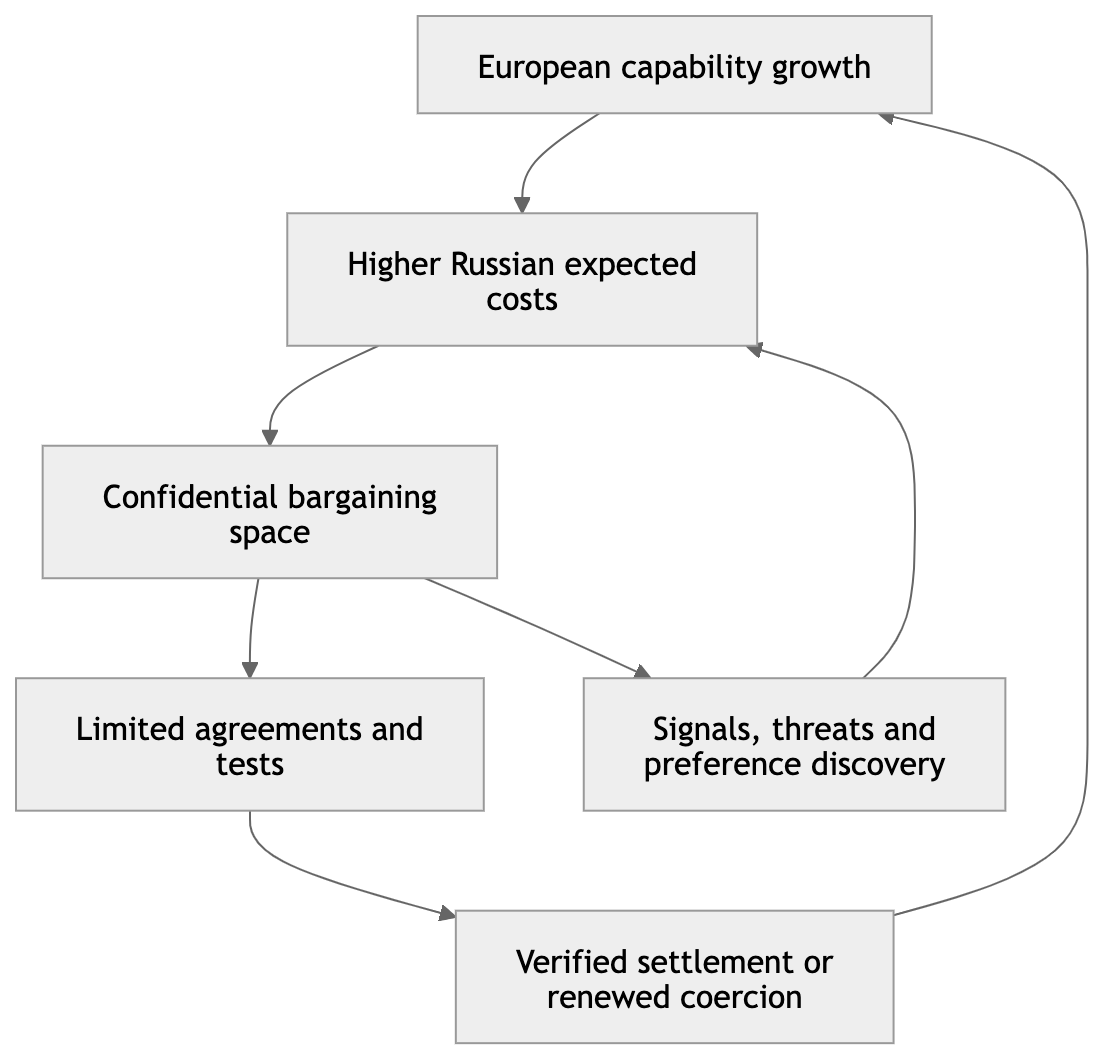
The simultaneous acceleration of European rearmament and preservation of United States–Russian negotiating channels does not reveal a divided Western policy. It constitutes a classical dual-track strategy in which military preparedness establishes the bargaining boundary while confidential diplomacy tests whether the adversary will accept an arrangement inside that boundary. The decisive analytical distinction is between negotiations intended to produce reconciliation and communications intended to control competition. Current contacts belong predominantly to the second category. Washington can explore ceasefire conditions, maritime arrangements, prisoner exchanges, strategic-risk reduction and possible sanctions sequencing without accepting Moscow’s territorial claims or suspending European force development. Moscow can receive American envoys while continuing military operations because diplomatic access provides information about Western cohesion, American priorities, Ukrainian negotiating limits and the possible economic value of concessions. Europe can support negotiations while increasing expenditure because political leaders must plan against several outcomes simultaneously: continued war, a fragile ceasefire, Russian military regeneration, reduced American force availability and a breakdown of any settlement. The result is not a binary transition from war to peace but armed bargaining, in which capability creation, political signalling and diplomatic communication operate concurrently. Official evidence supports that interpretation. United States and Russian expert groups reached limited understandings concerning Black Sea navigation and energy infrastructure while Washington explicitly stated that it would continue facilitating negotiations. Outcomes of the United States and Russia Expert Groups on the Black Sea – White House – March 2025 — Verified official record. Such arrangements are technically narrow because narrow agreements reduce the number of veto points, allow reciprocal performance to be tested and create limited compliance data without requiring immediate agreement on sovereignty, borders, alliance status, reparations or post-war military deployments. Confidential bargaining therefore signals neither trust nor capitulation. It is an instrument for discovering the adversary’s real reservation price while keeping the cost of miscalculation below the threshold of direct strategic confrontation.
Rearmament is an insurance structure, not a declaration of imminent war
The European defence trajectory must be measured by expenditure, industrial conversion and operational output rather than by political vocabulary. The European Defence Agency reports that the 27 EU member states spent €418 billion in 2025, representing a 20% real increase over 2024 and 2.2% of combined GDP, while expenditure is projected to reach €454 billion, or 2.4% of GDP, in 2026. Defence Data 2025–2026 – European Defence Agency – July 2026 — Verified official report. NATO’s Hague commitment establishes a longer horizon: allies agreed to move toward 5% of GDP by 2035, comprising at least 3.5% for core defence requirements and up to 1.5% for infrastructure, networks, resilience, civil preparedness, innovation and industrial development. The Hague Summit Declaration – NATO – June 2025 — Verified official declaration. These numbers demonstrate political commitment, but they do not prove that Europe has already generated equivalent military power. Budget appropriations must pass through procurement authorities, contracting cycles, production queues, testing, certification, personnel formation, stockpiling, maintenance and operational integration before they become usable capability. The European Commission’s Readiness 2030 framework explicitly identifies capability gaps, industrial fragmentation and sustained underinvestment, while the SAFE mechanism offers as much as €150 billion in loans intended to accelerate common procurement. White Paper for European Defence—Readiness 2030 – European Commission and High Representative – March 2025 — Verified official document. Security Action for Europe – Council of the European Union – May 2025 — Verified official instrument. The relevant five-year variable is consequently not expenditure growth alone but the conversion coefficient connecting financial input to deployable output. A Europe that spends more while retaining incompatible requirements, duplicated production lines, limited munitions depth and national procurement barriers will communicate political resolve without achieving proportional deterrence. A Europe that aggregates demand, standardises systems and secures long-term contracts will alter Moscow’s expectations about the post-war balance even if frontline operations cease.
| Conversion layer | Observable input | Operational bottleneck | Bargaining effect by 2031 |
|---|---|---|---|
| Fiscal commitment | €418 billion in 2025; €454 billion projected in 2026 | Debt capacity, national fiscal divergence, political continuity | Raises the expected long-term cost of Russian military regeneration |
| Industrial mobilisation | Multiyear ammunition, missile, drone and air-defence demand | Skilled labour, energetics, propellants, semiconductors, certification | Reduces Moscow’s expectation that European stocks will exhaust first |
| Force generation | Recruitment, training, reserves and readiness | Demography, retention, housing, maintenance and training areas | Determines whether purchased equipment creates sustainable formations |
| Strategic enablers | Space, ISR, airlift, secure communications and command systems | Dependence on American platforms and intelligence | Controls Europe’s ability to act if United States allocation changes |
| Resilience | Ports, railways, energy grids, cyber defence and civil preparedness | Fragmented ownership and uneven national protection | Decreases the coercive value of sabotage and infrastructure disruption |
| Joint procurement | SAFE, EDIP and multinational programmes | National industrial protection and divergent specifications | Converts national budgets into scale, interoperability and negotiating credibility |
The bargaining architecture: coercion, information and controlled access
Confidential bargaining performs four functions that public diplomacy cannot perform efficiently. First, it enables preference discovery: each side can distinguish absolute constraints from positions adopted for domestic consumption or initial bargaining leverage. Second, it supports escalation management by communicating how particular military actions would be interpreted, which thresholds remain ambiguous and which events could trigger retaliation. Third, it permits package construction across domains that cannot be openly connected at an early stage, including territorial administration, force deployments, sanctions, infrastructure protection, maritime access, economic reconstruction, detained persons and political sequencing. Fourth, it allows leaders to withdraw from an exploratory proposition without paying the reputational price that would follow a public reversal. This explains why the existence of contact cannot be treated as evidence that a settlement is near. The negotiating channel may be used to transmit threats, test coalition divisions, delay decisions, gather intelligence or stabilise a confrontation that all parties expect to continue. The White House record shows that negotiations have operated through multiple formats: technical expert groups, direct presidential engagement, talks with Ukraine and the use of designated presidential representatives. The same institutional multiplicity appears on the Russian side, where the Kremlin records President Vladimir Putin receiving Steve Witkoff, special envoy of the President of the United States, in Moscow on 22 January 2026. Meeting with the Special Envoy of the President of the United States – President of Russia – January 2026 — Verified official Kremlin record. The strategic significance lies less in the title of the visitor than in access to presidential decision-making. An envoy authorised to explore cross-domain trades is different from a conventional diplomatic delegation limited by a fixed mandate. Yet personalisation creates its own vulnerability: a channel dependent on a small number of individuals may transmit political intent rapidly but lacks the institutional redundancy, written verification mechanisms and implementation bureaucracy required for a durable security settlement. The five-year outlook therefore depends on whether personalised diplomacy evolves into formal working groups, military deconfliction procedures, monitoring bodies and enforceable implementation protocols.
The intelligence-channel claim and the problem of attribution
The proposition that the serving head of the CIA “flew to Moscow” requires correction because institutional identity changes the meaning of an event. The official records verified for this analysis document Steve Witkoff meeting Putin in Moscow, not CIA Director John Ratcliffe conducting that Moscow mission. Ratcliffe was officially photographed as part of the United States delegation during the Trump–Putin meeting at Joint Base Elmendorf–Richardson in Anchorage on 15 August 2025. President Donald Trump Meets with Russian President Vladimir Putin in Anchorage – White House – August 2025 — Verified official photographic record. This is not a semantic correction. A presidential envoy’s visit indicates executive-level political negotiation; the presence of an intelligence director at a summit provides intelligence assessment, counterintelligence support, warning expertise and advice concerning adversary credibility, but does not establish that the intelligence director independently negotiated in Moscow. Conflating the two encourages an unsupported narrative in which publicly confrontational governments supposedly conduct a hidden peace policy through intelligence chiefs. The more defensible interpretation is that intelligence, diplomacy and coercive capability are integrated inside a single decision system. Intelligence services assess force movements, leadership intentions, deception risks and compliance possibilities; special envoys explore politically sensitive trades; military authorities maintain deterrence; economic agencies design sanctions or relief options; and heads of government decide whether partial convergence justifies institutionalised negotiations. From a forensic perspective, analysts must classify each interaction by participant, location, mandate, agenda, confirmation level and implementation consequence. A meeting produces evidence of communication, not evidence of agreement. A summit photograph establishes attendance, not the content of advice. An envoy’s access establishes authorisation, not Russian acceptance of an American proposal. This discipline prevents the observable existence of a channel from being inflated into claims about concealed strategic realignment.
Moscow’s calculus: bargaining before Europe’s capabilities mature
Russia has a strong incentive to negotiate during the interval in which European budgets are rising faster than European deployable capability. This interval creates a temporary bargaining window. Moscow can calculate that Europe’s announced programmes will require several years to overcome production bottlenecks and therefore seek arrangements that lock in favourable military or territorial conditions before the new capacity materialises. At the same time, Russia must consider that continued operations could accelerate precisely the European consolidation it seeks to prevent. This produces a strategic tension between short-term operational exploitation and long-term coalition activation. If Moscow applies insufficient pressure, it may fail to improve its position; if it applies excessive pressure, it may strengthen NATO cohesion, expand European procurement and make a future settlement less favourable. Confidential contact allows Russian decision-makers to estimate where this inflection point lies. It also allows them to determine whether Washington seeks a durable European balance, a rapid ceasefire, reduced American resource commitments, commercial normalisation or a combination of those objectives. Russian bargaining strategy is therefore likely to remain modular: limited concessions may be offered in humanitarian, maritime or tactical domains, while questions involving occupied territory, Ukrainian military alignment, sanctions architecture and the broader European security order remain linked to higher prices. Moscow can additionally use the existence of negotiations to influence Western political time by encouraging the belief that further pressure could destroy an imminent agreement. Conversely, the United States can use diplomatic access to test whether Russian maximalist demands are negotiable and to warn that delay will leave Russia confronting a better-armed Europe. The process resembles a dynamic auction in which neither side knows the opponent’s final valuation and both can change the future value of the contested object. Rearmament alters the expected balance; battlefield developments alter urgency; sanctions affect liquidity; and domestic electoral cycles change the credibility of long-term promises. The most important indicator is consequently not the number of meetings but whether the positions transmitted through them narrow, acquire implementation details and survive changes in military conditions.
Beijing’s role: strategic stabiliser, Russian enabler and independent beneficiary
China’s official position provides a multilingual cross-check on how the dual track is perceived outside the Euro-Atlantic institutional system. Beijing publicly welcomed contacts between Russia and the United States as conducive to improving bilateral relations and advancing a political settlement, while maintaining its strategic coordination with Moscow. Xi Jinping–Vladimir Putin Telephone Call – Ministry of Foreign Affairs of the People’s Republic of China – August 2025 — Verified official record. In May 2026, China’s permanent representative stated that the door to negotiations had opened but that complex disputes could not be resolved rapidly, simultaneously calling for restraint, protection of civilians and attention to the security concerns of Russia, Ukraine and Europe. Remarks on Ukraine by Ambassador Fu Cong – Ministry of Foreign Affairs of the People’s Republic of China – May 2026 — Verified official statement. Beijing’s strategic interest is neither identical to Moscow’s nor aligned with Europe’s preferred outcome. China benefits when Russia prevents complete American concentration on the Indo-Pacific, supplies commodities through non-Western channels and contributes to a multipolar diplomatic architecture. It does not benefit from nuclear escalation, uncontrolled European economic contraction, major disruption of Eurasian transport, or a Russian collapse that could destabilise its northern strategic environment. China therefore has incentives to support a settlement that preserves Russia as a consequential power, limits escalation and weakens the extraterritorial reach of Western sanctions without producing a decisive Western strategic victory. Over the next five years, Beijing may become more important as an indirect guarantor of economic performance rather than as a formal security guarantor. Its leverage will operate through trade, industrial inputs, financial channels, diplomatic legitimacy and its ability to encourage or discourage Russian acceptance of particular formulations. European policymakers must consequently distinguish mediation rhetoric from enforceable leverage. China can help create political space, but monitoring territorial arrangements, guaranteeing Ukrainian security and managing NATO–Russia incidents require mechanisms in which the principal military actors remain directly engaged.
The shadow track: liquidity, cyber operations and coercion below war
The visible dual track rests on a less visible competitive infrastructure. Russian military endurance depends on export revenue, access to transport, payment networks, industrial components, insurance structures and third-country intermediaries; Western coercion depends on the ability to identify and disrupt those connections without imposing unsustainable costs on its own economies or alienating enforcement partners. The EU’s twenty-first sanctions package illustrates the expanding breadth of this contest: it targeted more than one hundred banks and crypto operators, over forty additional shadow-fleet vessels, refineries and more than fifty military-industrial entities associated with long-range drone production. Twenty-First Package of Sanctions against Russia – Council of the European Union – July 2026 — Verified official release. This pressure affects bargaining through two opposing mechanisms. When enforcement credibly constrains future revenue, Moscow’s incentive to secure relief increases; when Russia develops durable circumvention networks, the marginal coercive value of additional sanctions declines and its willingness to wait rises. Cyber and covert activity form a parallel bargaining substrate because they can impose costs, test defences and signal access without the unmistakable signature of conventional force. In July 2026, the Council imposed measures against individuals and entities that it assessed as supporting cyberattacks conducted by GRU Unit 29155 against EU member states. Russian Cyber-Attacks and Destabilising Activities – Council of the European Union – July 2026 — Verified official release. ENISA separately identifies diversified activity by Russia-nexus groups against diplomatic entities, ministries, law-enforcement bodies, political parties and other public institutions. ENISA Threat Landscape 2025 – European Union Agency for Cybersecurity – October 2025 — Verified official report. Such findings require disciplined language: state nexus, technical attribution and legal designation are not interchangeable. Nevertheless, persistent intrusion activity raises the possibility that crisis bargaining will occur while networks used for communications, logistics or public administration are already contested.
| Shadow dimension | Russian strategic utility | Western countermeasure | Effect on confidential bargaining |
|---|---|---|---|
| Energy revenue | Sustains fiscal space and military production | Price restrictions, refinery measures, shipping enforcement | Determines how costly delay becomes for Moscow |
| Shadow fleet | Preserves export volume through opaque ownership and flags | Vessel listing, port denial, insurance and service restrictions | Creates negotiable pressure points but also enforcement friction |
| Alternative payments | Reduces exposure to Western banking controls | Transaction bans, crypto-platform measures, secondary-risk signalling | Changes the credibility and sequencing of sanctions relief |
| Cyber access | Enables espionage, pre-positioning, disruption and coercive ambiguity | Attribution, sanctions, network hardening and joint response frameworks | Raises misperception risk during negotiations |
| Irregular networks | Provides deniable influence, security services and external reach | Financial tracing, travel restrictions and partner-state pressure | Allows cross-theatre retaliation against diplomatic pressure |
| Information operations | Exploits uncertainty and political fragmentation | Attribution, platform resilience and public evidence disclosure | Can weaken domestic support for either settlement or rearmament |
ACH assessment and Bayesian update
The Analysis of Competing Hypotheses must prevent the preferred explanation—controlled deterrence leading to negotiation—from absorbing every piece of evidence. Five hypotheses remain viable. H₁ holds that both sides are pursuing managed confrontation: diplomacy limits escalation while neither side expects a comprehensive settlement. H₂ anticipates a militarised armistice supported by external guarantees, monitoring and continuing rearmament. H₃ interprets talks primarily as tactical instruments within prolonged attritional war. H₄ expects a partial United States–Russian accommodation that leaves Europe carrying a larger share of containment and Ukrainian security. H₅ describes bargaining failure followed by a contained or uncontrolled NATO–Russia incident. The baseline prior distribution used here assigns 34% to H₁, 18% to H₂, 25% to H₃, 14% to H₄ and 9% to H₅. Evidence E₁—repeated authorised contacts—raises H₁, H₂ and H₄. Evidence E₂—continued European expenditure growth—raises H₁, H₂ and H₃ because it is compatible with both preparation for prolonged confrontation and enforcement of a future armistice. Evidence E₃—technical limited agreements—raises H₂ but only moderately because narrow agreements may coexist with strategic deadlock. Evidence E₄—continuing sanctions expansion and cyber confrontation—raises H₁ and H₃ and weakens any hypothesis of rapid normalisation. Evidence E₅—Chinese support for negotiations combined with sustained Russia–China coordination—raises the probability of managed bargaining but also increases Moscow’s capacity to resist time pressure. Applying structured likelihood weights to these observations produces a current posterior of approximately 38% H₁, 24% H₂, 21% H₃, 11% H₄ and 6% H₅. The relationship is P(Hᵢ|E) proportional to P(E|Hᵢ) × P(Hᵢ), but the numerical values are analytic judgements rather than statistically observed frequencies. Their function is auditability: future evidence should change the distribution instead of being retrofitted into a fixed narrative.
| Diagnostic evidence | H₁ Managed confrontation | H₂ Militarised armistice | H₃ Tactical talks, prolonged war | H₄ US–Russia accommodation | H₅ Bargaining failure |
|---|---|---|---|---|---|
| Authorised presidential channels | Strongly consistent | Strongly consistent | Consistent | Strongly consistent | In tension |
| Rising European capability investment | Strongly consistent | Strongly consistent | Strongly consistent | Consistent | Consistent |
| Narrow maritime or infrastructure arrangements | Consistent | Strongly consistent | Weakly consistent | Consistent | In tension |
| Expanding sanctions and cyber confrontation | Strongly consistent | Consistent | Strongly consistent | In tension | Consistent |
| Institutional monitoring architecture | Not yet decisive | Required confirmation | Contradictory if robust | Compatible | Contradictory |
| Verified force-separation mechanisms | Compatible | Required confirmation | Contradictory | Compatible | Contradictory |
| Current posterior | 38% | 24% | 21% | 11% | 6% |
Monte Carlo design and five-year risk propagation
The five-year projection uses a Monte Carlo architecture in which annual outcomes depend on four interacting latent variables: European capability conversion, diplomatic-channel resilience, Russian economic adaptation and the frequency of high-consequence hybrid or military incidents. Each simulated year begins with the preceding year’s strategic state rather than treating annual outcomes as independent. Successful limited agreements increase the probability that channels survive the following year; repeated violations reduce it. Higher European conversion improves deterrence but may temporarily increase crisis intensity if Moscow believes that its relative position is deteriorating. Strong Russian sanctions adaptation reduces the immediate probability of compromise but may also lower incentives for high-risk military escalation by sustaining confidence in long-term endurance. Incident frequency has the most nonlinear effect: isolated deniable events normally reinforce H₁, while clustered incidents involving casualties, warning systems or critical infrastructure move simulations rapidly toward H₅. In the baseline run, 25,000 paths generate the same broad conclusion as the Bayesian assessment. Managed confrontation remains the modal outcome through 2031, but its probability gradually declines as accumulated military capacity and diplomatic learning create either a militarised settlement or a sharper breakdown. H₂ rises if monitoring, force separation and security guarantees acquire institutional form. H₃ declines only slowly because attritional incentives persist whenever both sides believe time may improve their position. H₄ remains a minority but strategically consequential possibility because American burden reallocation could produce an arrangement that transfers enforcement risk to Europe. H₅ stays numerically small but cannot be dismissed: catastrophic risk is governed by consequence as well as probability. The principal warning indicators are suspension of authorised channels, dispersal of dual-capable systems, attacks on decision-support infrastructure, abrupt evacuation or continuity measures, simultaneous cyber disruption and kinetic incidents, and political deadlines that compress decision time. Conversely, verified monitoring, military hotlines, transparent exercise notifications and staged compliance would move probability mass toward H₂.
Outlook to 2031: from emergency mobilisation to armed settlement management
The most probable sequence is a transition from emergency rearmament to permanent security competition. During 2026–2027, Europe will prioritise procurement decisions, industrial contracting, air defence, drones, ammunition, infrastructure resilience and the institutional use of SAFE financing. The bargaining advantage will still favour actors capable of producing immediate battlefield or diplomatic effects because much European expenditure will remain inside the conversion pipeline. During 2028–2029, delivery schedules, trained formations and multinational procurement should become more visible; this is the period in which Russia may face a stronger incentive either to institutionalise an armistice or to test Western cohesion before the new posture fully matures. The 2029 NATO review of the Hague spending trajectory will become an important credibility event: sustained plans will communicate strategic persistence, whereas fiscal retreat or national fragmentation will reinforce Russian expectations that political time remains favourable. During 2030–2031, the central question will no longer be whether Europe spends more but whether it can sustain readiness, replenish stocks, protect infrastructure and operate high-end capabilities with reduced dependence on American enablers. A ceasefire reached anywhere along this timeline would not terminate the dual track. It would change its operational purpose from compelling negotiation to enforcing compliance. Rearmament would support the credibility of guarantees; confidential bargaining would handle violations, inspections, detainees, maritime access and force adjustments; sanctions would become conditional leverage rather than purely punitive pressure. The greatest policy error would be to demobilise politically before a settlement becomes verifiable. The opposite error would be to allow capability growth to proceed without crisis-management mechanisms, thereby increasing the number of forces, exercises and sensors operating in proximity while leaving interpretation rules ambiguous. Durable stability requires deterrence by denial, punishment options, arms-risk communication, verification and politically survivable off-ramps. None can substitute for the others.
Strategic judgement
The dual track should be understood as a competitive control system rather than a peace process concealed beneath war rhetoric. Europe is building the capacity to make Russian coercion less effective; Washington is preserving access to the Russian decision centre; Moscow is bargaining before European capability conversion fully changes the balance; and Beijing is supporting negotiations that prevent escalation while preserving Russia’s strategic relevance. These policies overlap without becoming identical. Rearmament strengthens bargaining only when it produces usable capability, coalition endurance and credible political authority. Diplomacy reduces risk only when communication develops into specified obligations, monitoring, attribution procedures and consequences for non-compliance. Confidentiality can improve exploratory bargaining, but excessive secrecy creates democratic and alliance vulnerabilities if affected governments cannot assess what has been discussed on their behalf. The optimal architecture therefore has three layers: a confidential presidential channel for politically sensitive trade-offs; an institutional diplomatic channel for drafting, verification and legal commitments; and a military-technical channel for deconfliction, notifications and incident management. Europe must be present in the second and third layers because it will finance, arm, monitor and potentially enforce much of any post-conflict arrangement. Ukraine must remain a principal negotiating actor because no durable settlement can be implemented against the sustained resistance of the state whose territory and security are directly affected. The current evidence justifies neither the alarmist conclusion that European rearmament makes direct war inevitable nor the complacent conclusion that repeated meetings indicate approaching peace. The stronger judgement is narrower and more consequential: rearmament and bargaining are reinforcing instruments until one side concludes that the other’s future capability, political endurance or escalation tolerance has been fundamentally mispriced. Preventing that repricing from occurring through a catastrophic incident is the central strategic task through 2031.
The Escalation System — Nuclear Thresholds, Hybrid Pressure and Financial Warfare
Escalation as an interacting system
The central strategic problem is not whether Russia has decided to escalate in a simple, linear progression from rhetoric to hybrid action, conventional war, and nuclear employment. Contemporary escalation instead functions as a coupled system in which nuclear messaging, military readiness, covert disruption, cyber operations, economic coercion, sanctions enforcement, diplomatic contacts, and confidential bargaining operate simultaneously. Each instrument changes the perceived credibility, cost, and reversibility of the others. Publicly intensified nuclear language can therefore coexist with intelligence-channel negotiations without constituting a contradiction: the language alters the bargaining environment, while confidential contacts test whether the altered environment has produced concessions, red lines, or viable off-ramps. This model differs fundamentally from the classical “escalation ladder.” A ladder implies clearly separated rungs, observable upward movement, and a reasonably shared understanding of position. The present system resembles a network of thresholds with imperfect attribution, compressed decision time, and feedback loops across military and non-military domains. A cyberattack on energy infrastructure may remain formally below the threshold of armed attack but still affect nuclear risk by degrading communications, producing false indications of wider attack, or causing leaders to question whether critical command systems are being prepared for follow-on operations. Financial restrictions may look remote from nuclear doctrine but can influence Moscow’s expected endurance, coalition cohesion, and incentives to demonstrate resolve. Conversely, sanctions circumvention networks create logistical infrastructure that can support procurement, covert finance, influence operations, and irregular security actors. The analytical unit must consequently be the complete escalation architecture rather than any isolated speech, exercise, diplomatic visit, or sanctions package. The most probable five-year pathway is persistent competition below direct war, but the same instruments used to control escalation also generate ambiguity capable of producing unintended threshold crossings.
| System layer | Principal instruments | Immediate purpose | Escalatory transmission mechanism | Principal source of ambiguity |
|---|---|---|---|---|
| Nuclear | Doctrine, exercises, deployments, readiness messaging | Deter intervention and reinforce bargaining leverage | Alters expectations about intolerable losses | Declaratory conditions do not reveal operational decision rules |
| Conventional | Force posture, air defence, long-range strike, exercises | Denial, punishment and battlefield advantage | Creates incidents capable of activating alliance commitments | Dual-capable platforms obscure payload and mission |
| Hybrid | Cyber operations, sabotage, influence, proxy networks | Impose costs while contesting attribution | Can impair critical infrastructure or warning systems | Sponsorship, intent and damage thresholds remain uncertain |
| Financial | Sanctions, asset restrictions, payment controls, export controls | Reduce revenue, procurement and strategic endurance | Encourages retaliation, evasion and bloc fragmentation | Economic damage is delayed and difficult to attribute precisely |
| Diplomatic | Intelligence contacts, backchannels, prisoner exchanges, negotiations | Identify red lines and construct off-ramps | Can stabilize crises or conceal coercive preparation | Secrecy permits incompatible public narratives |
Russia’s declaratory nuclear perimeter
The November 2024 revision of Russian nuclear doctrine broadened the publicly declared circumstances in which nuclear use could be considered, but it did not create a mechanical launch trigger. The document identifies aggression by a non-nuclear state undertaken with the participation or support of a nuclear-armed state as a joint attack, extends deterrence considerations to aggression against Belarus as a Union State partner, and includes conventional aggression producing a “critical threat” to sovereignty or territorial integrity. It also incorporates receipt of reliable information concerning a massive launch or take-off of aerospace attack systems—including aircraft, cruise missiles, unmanned systems and hypersonic weapons—crossing the Russian border. These provisions expand the declaratory perimeter around Russia’s ultimate threshold because they connect nuclear consideration to coalition support, large conventional attack, and potentially ambiguous aerospace indicators. They nevertheless preserve substantial executive discretion: the doctrine describes conditions under which nuclear use may be contemplated, not conditions that automatically require it. The critical analytical distinction is therefore between a wider set of contingencies entering presidential consideration and a demonstrably lower operational threshold for actual employment. The former is evidenced; the latter cannot be established from public doctrine alone. The expansion serves at least four purposes: discouraging deeper external participation in attacks on Russian territory; increasing uncertainty among coalition decision-makers; compensating rhetorically for vulnerabilities exposed by precision strike and unmanned warfare; and improving bargaining leverage by making adversaries internalize low-probability, extreme-loss outcomes. Decree No. 991 – President of the Russian Federation – November 2024 — Fundamentals of the State Policy of the Russian Federation on Nuclear Deterrence. The operational meaning of the doctrine must therefore be inferred from the conjunction of readiness changes, force dispersal, command activity, unusual warhead-custody indicators, strategic communications and crisis-channel behavior—not from verbal intensity alone.
| Declaratory condition | Strategic function | Observable warning indicators | What would remain unproven |
|---|---|---|---|
| Ballistic-missile attack warning | Preserve retaliatory credibility under time pressure | Strategic-force dispersal, command-aircraft activity, warning-network alerts | Whether warning data are judged authentic |
| Nuclear or other mass-destruction attack | Establish an unambiguous retaliation category | Confirmed detonation, contamination, national command activation | Intended response scale and timing |
| Disabling attack on critical state or military facilities | Protect command continuity and retaliatory capability | Hardened-site activation, communications redundancy, leadership relocation | Whether disruption meets the doctrinal severity threshold |
| Critical conventional threat to sovereignty or territory | Deter strategically consequential conventional defeat | Reserve mobilization, theatre reinforcement, heightened strategic-force protection | Meaning of “critical,” which remains politically determined |
| Massive aerospace attack indication | Deter saturation strike and exploit adversary uncertainty | Wide-area air-defence activation, bomber dispersal, warning-system correlation | Whether drones or missiles alone could precipitate nuclear action |
| Coalition-supported attack | Impose shared risk on external supporters | Attribution statements, diplomatic warnings, force-protection changes | Whether support would be treated as sufficient for nuclear retaliation |
The doctrine’s principal danger lies not in any single clause but in interaction between ambiguous conventional systems and compressed warning time. Long-range conventional missiles, dual-capable aircraft, hypersonic vehicles, unmanned saturation attacks, electronic warfare, and cyber operations against communications may be interpreted through the same early-warning architecture used to evaluate attacks with strategic implications. A defender cannot reliably infer payload, target set, or terminal objective at launch. An attacker may intend a bounded conventional strike against logistics or air defence, while the defender observes a coordinated penetration attempt whose scale resembles preparation for leadership decapitation or degradation of retaliatory forces. This is the domain of “entanglement”: conventional and nuclear command, sensing, communications, and delivery systems overlap sufficiently that operations directed against one mission can affect the other. The risk intensifies if leaders believe delay could eliminate response options. Russian nuclear exercises should consequently be read as both military preparation and strategic communication, while avoiding the categorical error of treating every exercise as evidence of imminent use. The May 2026 Russian-Belarusian nuclear-forces exercise, officially described as part of the preparation of the Union State’s joint grouping, demonstrates continued incorporation of nuclear signaling into allied military planning but does not by itself establish deployment status, custody arrangements, or operational intent. Nuclear Forces Exercise – President of Russia – May 2026 — Official Kremlin record of the exercise. The most meaningful escalation indicators would be deviations from established exercise patterns: unscheduled force dispersal, warhead-custody activity, interruption of normal communications, emergency civil-defence measures, or concurrent conventional operations designed to suppress adversary reconnaissance.
NATO’s counter-threshold architecture
NATO approaches the same problem through an integrated posture combining nuclear forces, conventional capabilities, missile defence, space systems, cyber defence, resilience and forward-deployed multinational forces. The alliance’s nuclear policy emphasizes continuous political control, consultation through the Nuclear Planning Group, separate decision centres among the United States, United Kingdom and France, and continuing United States custody of forward-deployed nuclear weapons. NATO characterizes the circumstances in which nuclear weapons might be used as extremely remote, while preserving deliberate uncertainty about the precise threshold. NATO’s Nuclear Deterrence Policy and Forces – North Atlantic Treaty Organization – May 2026 — NATO nuclear policy and force structure. This produces a countervailing architecture of ambiguity: Moscow cannot assume that limited conventional or hybrid escalation would remain compartmentalized, yet no automatic mechanism converts a cyber incident, sabotage operation, or conventional strike into collective nuclear action. NATO’s broader deterrence policy states that a major cyberattack or hostile operation affecting space systems could, depending on circumstances, lead the North Atlantic Council to consider an Article 5 response; it does not establish automatic collective defence for every intrusion or disruption. The alliance also reports nine multinational battlegroups on its eastern flank as of 2026 and explicitly integrates conventional and nuclear dimensions in planning and exercises. Deterrence and Defence – North Atlantic Treaty Organization – June 2026 — NATO integrated deterrence posture. This architecture seeks to prevent Russia from isolating one ally, one operational domain, or one level of conflict, but integration also produces reciprocal suspicion: measures designed as defensive reinforcement may be interpreted as preparation for offensive action, while Moscow’s countermeasures confirm the alliance’s original threat assessment.
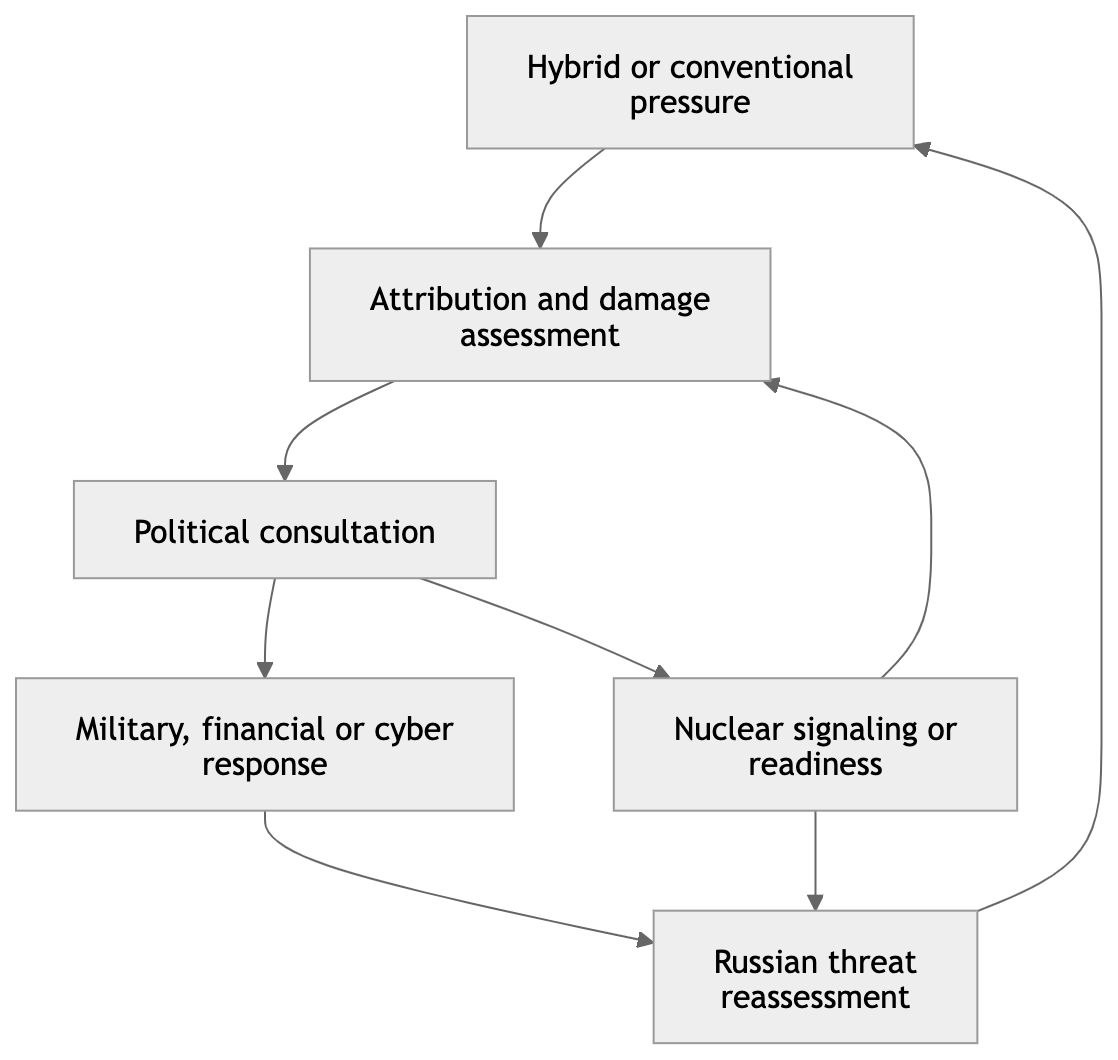
The result is a recursive security dilemma in which both sides can describe their actions as responses to the other’s prior measures. European rearmament, expanded air defence, hardened logistics and reinforcement capacity increase the credibility of conventional deterrence by denial. Over time, however, stronger conventional capabilities can also heighten Russian concern that NATO could conduct deep conventional strikes while relying on missile defence and dispersed command systems to manage retaliation. Russian nuclear signaling then seeks to restore perceived deterrence by raising the expected cost of such an operation, which in turn strengthens European political support for further military investment. Confidential intelligence contacts become most important precisely under these conditions. Their purpose is not necessarily reconciliation or a comprehensive settlement; they may instead communicate narrow prohibitions, test interpretations of doctrine, manage detainee or intelligence issues, verify whether public signaling has been understood, or determine whether an incident resulted from policy or unauthorized action. The existence of such contacts should therefore update assessments toward continued bargaining, but only modestly: states routinely negotiate during periods of acute confrontation, and the same channel can support coercive communication as well as de-escalation. The diagnostic question is not whether contact occurred but whether it produced observable restraint—changes in target selection, exercise timing, force posture, sanctions implementation, or public conditions. Without such effects, the contact is evidence of risk management, not evidence that the underlying conflict has entered resolution. In systemic terms, private communication is a circuit breaker, not an electrical shutdown: it can prevent an uncontrolled cascade while leaving every competitive generator operating.
Arms-control erosion and warning-time compression
The post–New START environment removes an important element of predictability at the same time that conventional precision, cyber operations, space dependence and artificial-intelligence-assisted sensing are accelerating military decision cycles. The treaty’s expiration in February 2026 does not itself create an arms race, but it weakens the combination of aggregate limits, notifications, data exchanges and verification practices that helped each party estimate the other’s strategic posture. China’s official position described the treaty’s expiration as regrettable, called the agreement important to global strategic stability, and urged renewed United States-Russian dialogue; that statement represents China’s diplomatic position rather than an independently verified judgment about responsibility. Ministry of Foreign Affairs Regular Press Conference – Ministry of Foreign Affairs of the People’s Republic of China – February 2026 — Official Chinese statement on New START expiration. Beijing’s 2026 national implementation report under the Nuclear Non-Proliferation Treaty simultaneously restates a no-first-use policy, describes China’s arsenal as maintained at the minimum level required for national security, and acknowledges modernization intended to improve survivability, command and control, penetration and rapid response. National Report on Implementation of the Treaty on the Non-Proliferation of Nuclear Weapons – Ministry of Foreign Affairs of the People’s Republic of China – April 2026 — China’s official NPT implementation report. The strategic implication is a progressively more complex deterrence geometry: Washington must allocate attention across Russian and Chinese forces; Moscow must consider NATO, United States global capabilities and China’s long-term trajectory; and European governments must weigh extended-deterrence credibility against demands for greater strategic autonomy. Multipolar deterrence is harder to stabilize through bilateral numerical parity because one actor’s restraint can alter its position relative to a third party.
Hybrid pressure as threshold engineering
Hybrid pressure is best understood as deliberate threshold engineering: the use of disruptive instruments calibrated to impose cumulative strategic costs while complicating attribution, legal classification, coalition consensus, and proportional response. The European Union’s official framework includes cyberattacks, information manipulation, economic coercion, covert political activity, coercive diplomacy, sabotage and threats of military force within the hybrid-threat spectrum. It emphasizes that such campaigns exploit vulnerabilities while remaining, where possible, below the clearly recognized threshold of war. Hybrid Threats – Council of the European Union – March 2026 — European Union framework for countering hybrid threats. The operational advantage of this approach is asymmetry: a sponsor can generate recurring security expenditures, political distrust and infrastructure uncertainty at a cost lower than that imposed on the defender. Its strategic weakness is cumulative attribution. Repeated operations using related infrastructure, malware, procurement patterns or personnel can gradually reduce plausible deniability, allowing states to coordinate sanctions, indictments, expulsions or covert countermeasures. ENISA’s review of approximately 4,900 curated incidents covering July 2024 through June 2025 identified persistent activity affecting diplomatic institutions, ministries, law enforcement, political parties and core government functions, while also stressing the continuing difficulty of reliable attribution in a threat environment involving state-linked groups, hacktivists, criminal actors and opportunistic reuse of tools. ENISA Threat Landscape 2025 – European Union Agency for Cybersecurity – October 2025 — Official ENISA threat assessment. The analytical danger is mirror imaging: not every hostile intrusion is centrally directed, yet treating every operation as isolated can obscure a coordinated campaign assembled from deniable intermediaries.
| Hybrid vector | Operational objective | Escalatory crossover | High-value indicators | Primary analytical caution |
|---|---|---|---|---|
| Cyber intrusion | Espionage, pre-positioning or disruption | Effects spread into military command or public safety | Persistence in operational technology, credential theft, destructive modules | Intrusion does not prove intent to execute disruption |
| Physical sabotage | Raise protection costs and interrupt logistics | Casualties or damage to defence infrastructure | Reconnaissance, proxy travel, explosive procurement, synchronized incidents | Criminal activity may be misclassified as state direction |
| Information manipulation | Fracture public consent and alliance cohesion | Triggers unrest or obstructs mobilization | Coordinated amplification, forged documents, cross-language narratives | Persuasion effects are difficult to measure |
| Political finance | Influence parties, intermediaries or policy debates | Undermines electoral legitimacy | Opaque donors, shell entities, synchronized lobbying | Legal influence and covert direction must be separated |
| Maritime interference | Threaten energy, communications and trade infrastructure | Collision, cable damage or naval confrontation | AIS anomalies, loitering, ownership opacity, seabed activity | Accident and intentional action can initially appear identical |
| Proxy or irregular force | Extend reach while limiting formal exposure | Attack on protected personnel or allied territory | Recruitment, transport, payment and command links | Sponsorship may be layered across commercial entities |
The European response increasingly joins cyber and hybrid attribution to restrictive financial measures. In July 2026, the Council sanctioned individuals and entities it associated with technical or material support for cyber operations attributed to Russian military intelligence Unit 29155. Russian Cyber-Attacks and Destabilising Activities – Council of the European Union – July 2026 — Council decision concerning Unit 29155 support networks. This illustrates the convergence of domains: cyber activity creates an evidentiary record; attribution converts technical indicators into political responsibility; sanctions translate responsibility into economic cost; and targeted actors respond through concealment, substitution or renewed coercion. The European Union’s separate regime addressing Russian hybrid activities had, by 2026, expanded beyond natural and legal persons to cover tangible assets, vessels, aircraft, real estate, digital and communications assets, and certain financial or cryptocurrency transactions. Russia’s Hybrid Activities: EU Sanctions – Council of the European Union – 2026 — Official EU hybrid-activities sanctions framework. The broader the regime becomes, the greater its potential reach—but also the greater the enforcement burden. A designation has limited strategic effect unless banks, insurers, ports, corporate registries, exchanges, customs authorities and partner jurisdictions can identify beneficial owners and block substitution. Hybrid conflict therefore migrates toward compliance architecture itself: document forgery, front companies, flag changes, wallet migration, layered ownership and intermediary jurisdictions become operational capabilities. The contest is no longer simply between attacker and target; it is also between rival systems for producing, obscuring and validating identity.
Financial warfare and liquidity adaptation
Financial warfare operates through time rather than immediate battlefield shock. Sanctions, export controls, asset freezes, payment restrictions, price mechanisms and maritime enforcement seek to change the target’s intertemporal calculation by reducing accessible revenue, increasing procurement cost, immobilizing capital, constraining technology acquisition and amplifying uncertainty for counterparties. Their effects are neither binary nor automatically decisive. A sanctioned economy adapts through fiscal reprioritization, domestic substitution, barter-like structures, alternative currencies, opaque intermediaries, transshipment, reflagging, cryptocurrency channels and acceptance of larger transaction discounts. The July 2026 European Union package illustrates the expanding enforcement perimeter: it applied asset restrictions to 94 banks and major financial institutions, extended transaction prohibitions to 33 additional Russian credit and financial institutions, targeted non-Russian banks and 14 crypto-service platforms, and added 41 vessels to measures affecting a shadow-fleet population the Council stated already included 632 vessels. Twenty-First Package of Sanctions: EU Hits Russian Energy, Financial Services and Crypto Hard – Council of the European Union – July 2026 — Official Council description of the twenty-first sanctions package. The United States had previously sanctioned 183 vessels in a January 2025 action directed at Russian oil production and exports. Treasury Intensifies Sanctions Against Russia by Targeting Russia’s Oil Production and Exports – U.S. Department of the Treasury – January 2025 — Official United States Treasury action. These figures show widening coverage, not independently measured strategic success. Effectiveness depends on freight rates, insurance access, discounts, port acceptance, replacement capacity, enforcement consistency, energy prices and the willingness of third-country institutions to absorb secondary risk.
The “shadow” financial dimension is strategically important because evasion infrastructure can become multi-purpose. A corporate vehicle created to obscure vessel ownership may also facilitate procurement payments; a broker moving sanctioned commodities can provide trade-based money-laundering services; a cryptocurrency platform used for settlement may become useful to cybercriminals, intelligence intermediaries or irregular forces. This does not mean every sanctions-evasion network is state-commanded. It means that durable evasion ecosystems create optionality for multiple actors whose interests overlap without fully converging. The relevant unit of analysis is consequently the service network: incorporation agents, nominee directors, brokers, freight managers, insurers, payment processors, exchange houses, port agents and technical suppliers. Financial restrictions can produce three competing effects. First, they can diminish strategic capacity by raising the cost and lowering the reliability of revenue and procurement. Second, they can centralize economic control, because access to scarce foreign exchange and sanctioned trade becomes dependent on politically connected intermediaries. Third, they can accelerate fragmentation by shifting trade into less transparent channels and encouraging partner states to build mechanisms less exposed to Western jurisdiction. The net strategic effect changes over time. Short-run resilience can coexist with long-run technological erosion; headline revenue can coexist with declining margins; and nominal trade continuity can conceal a worsening quality of imported components. High-confidence assessment requires physical-flow, customs, shipping, pricing, corporate-ownership and payment evidence rather than sanctions counts alone.
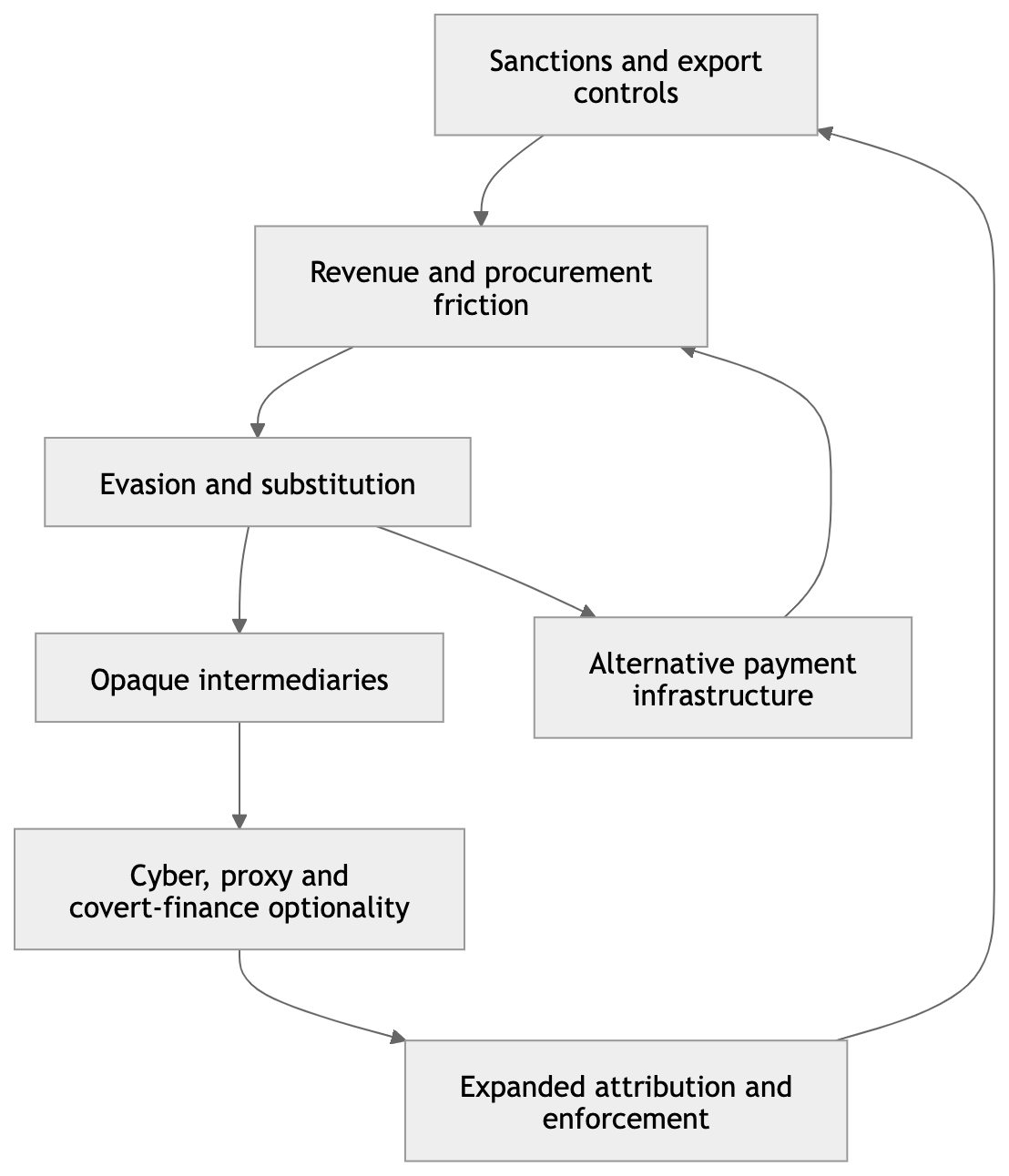
Cross-domain escalation pathways
The greatest five-year risk is not deliberate progression to nuclear war but cross-domain misclassification. Consider a plausible sequence: a state-linked cyber group compromises a logistics network for espionage and contingency access; an uncontrolled tool or subcontracted actor causes physical disruption; the affected government attributes the operation during a period of military reinforcement; it responds with financial designations and a covert cyber operation against infrastructure supporting sanctions evasion; Russian authorities interpret the intrusion as reconnaissance for broader attack; strategic messaging and force-protection measures increase; NATO detects the change but cannot determine whether it is signaling or preparation; both sides shorten decision timelines. Every step can be locally rational while the aggregate system becomes less stable. The decisive variables are attribution confidence, reversibility, command control, civilian casualties and proximity to nuclear or national-command infrastructure. Thresholds are especially vulnerable when attacks affect dual-use systems. Commercial satellites support civilian communications and military operations; undersea cables carry finance, government data and ordinary commerce; electric grids serve cities and military installations; port systems sustain trade and reinforcement. An operation directed against one function can therefore be interpreted as an attack on several. The stabilizing response is not to eliminate ambiguity—an impossible objective—but to create differentiated channels for incident communication, technical attribution, military deconfliction and political bargaining. Confidential intelligence engagement has particular value because intelligence leaders can discuss capabilities and indicators that governments cannot publicly disclose. Its limitations are equally clear: the channel may convey a warning without producing agreement, and neither party can assume that the counterpart’s representative controls every military, intelligence, proxy or cyber actor relevant to the crisis.
Analysis of competing hypotheses
A structured Analysis of Competing Hypotheses supports five distinct five-year pathways rather than a single forecast. H₁ is managed multi-domain coercion: nuclear signaling, rearmament, sanctions, hybrid operations and confidential bargaining persist, but both sides avoid direct major combat. H₂ is intensified hybrid-financial confrontation: covert disruption and economic enforcement expand sufficiently to fragment payment, shipping, technology and infrastructure systems without sustained NATO-Russia combat. H₃ is a contained kinetic incident: an air, maritime, missile, sabotage or proxy event causes casualties and a limited military response, followed by negotiated containment. H₄ is coercive nuclear demonstration without nuclear detonation: exceptional exercises, dispersal, deployment revision, testing activity or an overt readiness change is used to compel restraint. H₅ is nuclear employment or uncontrolled direct war. Using a baseline Bayesian prior informed by the continued operation of deterrence, the persistence of military competition, the absence of publicly confirmed nuclear employment preparation, expanding hybrid sanctions, ongoing nuclear exercises and the continued availability of state communication, a defensible illustrative posterior allocates 44% to H₁, 28% to H₂, 15% to H₃, 8% to H₄ and 5% to H₅ over the 2026–2031 horizon. These are analytical estimates, not measured frequencies. Their purpose is disciplined comparison and explicit updating. The posterior should move toward H₄ or H₅ if unusual warhead-custody activity, sustained strategic-force dispersal, leadership relocation, degraded hotlines and attacks on nuclear command systems appear together. It should move toward H₁ if military operations remain bounded while confidential channels produce observable restraint. It should move toward H₂ if attribution-linked sanctions and infrastructure incidents rise without exceptional strategic-force changes.
| Evidence or indicator | H₁ Managed coercion | H₂ Hybrid-financial intensification | H₃ Contained kinetic incident | H₄ Nuclear demonstration | H₅ Nuclear use/direct war |
|---|---|---|---|---|---|
| Regular nuclear exercises without exceptional readiness changes | Strongly consistent | Consistent | Neutral | Weakly consistent | Inconsistent |
| Persistent confidential state or intelligence contacts | Strongly consistent | Consistent | Consistent after incident | Weakly inconsistent | Strongly inconsistent |
| Expanding sanctions on finance, crypto and shipping networks | Consistent | Strongly consistent | Neutral | Neutral | Weakly inconsistent |
| Repeated sabotage or cyber disruption with contested attribution | Consistent | Strongly consistent | Consistent | Weakly consistent | Neutral |
| Direct casualties involving NATO and Russian forces | Weakly inconsistent | Weakly inconsistent | Strongly consistent | Consistent | Consistent |
| Unscheduled strategic dispersal plus command-continuity measures | Inconsistent | Inconsistent | Weakly consistent | Strongly consistent | Strongly consistent |
| Warhead-custody anomalies plus degraded crisis communication | Strongly inconsistent | Inconsistent | Weakly consistent | Strongly consistent | Strongly consistent |
| Negotiated restraint reflected in target selection or exercise timing | Strongly consistent | Weakly consistent | Consistent | Inconsistent | Strongly inconsistent |
The illustrative Monte Carlo model embedded below operationalizes these hypotheses as mutually exclusive system states and evolves them through 30,000 simulated paths per run. It does not purport to predict classified decisions. Instead, it exposes how four variables—nuclear-signaling intensity, hybrid operational tempo, sanctions pressure and crisis-channel reliability—alter the relative distribution of outcomes when shocks compound across five annual transitions. The most important modeling result is nonlinear interaction. Increased nuclear signaling alone may remain coercive theater when crisis-channel reliability is high, but the same signaling produces a materially larger tail risk when hybrid tempo is elevated and communications reliability declines. Sanctions pressure primarily raises the probability of prolonged hybrid-financial confrontation, yet it also modestly raises escalation risk if enforcement intersects with maritime seizure, critical revenue infrastructure or covert retaliation. The model intentionally preserves a low but nonzero probability of nuclear use because deterrence failure is a tail event: historical non-use does not demonstrate impossibility, while doctrinal language does not establish imminence. Model outputs should therefore be interpreted as scenario weights for resource allocation, warning design and contingency planning. They should never be represented as objective probabilities derived from a complete data-generating process. A government-grade implementation would require classified readiness indicators, force-disposition data, communications intelligence, leadership-behavior baselines, economic network models and repeated calibration against expert elicitation.
Five-year outlook, 2026–2031
From 2026 through 2027, the escalation system will probably remain dominated by force regeneration, European defence investment, Russian adaptation, sanctions enforcement and attempts to map the opponent’s thresholds. The most immediate risks will arise from air and maritime proximity, attacks affecting dual-use infrastructure, long-range conventional strikes, and attribution disputes surrounding sabotage or cyber activity. From 2027 through 2029, production and deployment choices will become more consequential than speeches. European ammunition capacity, integrated air and missile defence, hardened mobility corridors and unmanned systems will strengthen denial, while Russia will seek counters through strike volume, electronic warfare, deception, dispersal and nuclear signaling. Financial warfare will increasingly target service providers rather than only nominal asset owners: insurers, registries, port agents, exchanges, refiners, component brokers and cryptocurrency intermediaries. This will intensify jurisdictional competition and encourage trade networks designed to minimize Western compliance exposure. From 2029 through 2031, the central question will be whether the strategic relationship develops replacement transparency mechanisms or normalizes unconstrained force planning. In the absence of renewed verification, both sides may plan against worst-case inventories, reducing the political value of restraint and increasing incentives for mobile, survivable and dual-capable systems. The strongest warning indicators will not be rhetorical volume but correlated operational anomalies: unusual strategic-force movement, nuclear-custody activity, command relocation, interruption of normal hotlines, broad civil-defence measures, cyber activity against nuclear-related communications, simultaneous conventional dispersal and emergency diplomatic messaging. The strongest stabilizing indicators will be reciprocal exercise notifications, revived data exchanges, protected crisis channels, explicit non-interference understandings for nuclear command systems, and observable restrictions on attacks near strategically sensitive infrastructure.
The final strategic judgment is that nuclear deterrence, hybrid pressure and financial warfare will remain mutually reinforcing instruments of bargaining rather than separate theatres. Russia is likely to preserve an expanded declaratory nuclear perimeter because ambiguity compensates for conventional uncertainty and imposes decision costs on external supporters of Ukraine. NATO will continue strengthening integrated deterrence while insisting that political control and proportional decision-making remain intact. The European Union and United States will move sanctions toward enforcement networks, shipping services, payment channels and third-country facilitators, while Russian and partner-linked actors will invest in opacity, substitution and jurisdictional diversification. Direct nuclear use remains the least likely of the five modeled outcomes, but it carries the greatest consequence and cannot be assessed from rhetoric alone. The most probable equilibrium is neither peace nor an uninterrupted march toward general war. It is managed instability: high military expenditure, repeated hybrid confrontation, financial fragmentation, intermittent nuclear signaling and recurring confidential contacts intended to prevent local actions from cascading into strategic exchange. The main policy failure would be to confuse communication with détente or rhetoric with a launch decision. The correct posture combines credible denial, resilient infrastructure, enforceable financial measures, protected crisis channels and continuous distinction between observed capability, declared doctrine and inferred intent. The system becomes most dangerous when those distinctions collapse under time pressure.
The Five-Year Horizon — Competing Hypotheses, Warning Indicators and Strategic Consequences
The forecast problem
The 2026–2031 horizon should not be treated as a countdown to a predetermined Russian-European war, nor as evidence that military rearmament will necessarily produce political stabilization. The relevant object of analysis is a dynamic equilibrium in which Russia, NATO, the European Union, Ukraine, the United States and increasingly China adjust their behavior in response to anticipated rather than merely observed actions. European procurement decisions influence Russian force planning before the new capabilities become operational; Russian nuclear declarations affect European political coalitions even when no corresponding readiness change occurs; confidential diplomatic and intelligence contacts can contain individual incidents without resolving the underlying confrontation; and sanctions may weaken specific procurement pathways while simultaneously accelerating alternative payment, shipping and technology networks. Forecasting must therefore separate three analytical layers. The first is the structural baseline: geography, nuclear arsenals, alliance commitments, industrial capacity and the continuing incompatibility of political objectives. The second is the behavior of the system: exercises, deployments, cyber operations, sabotage, financial enforcement, bargaining and strategic communications. The third is the shock layer: an air or maritime collision, erroneous attribution, political succession, infrastructure failure, battlefield collapse, or attack affecting nuclear command-and-control assets. The five hypotheses assessed below are not mutually exclusive descriptions of daily activity; they are alternative dominant strategic conditions into which the system could settle by 2031. The objective is not to select the most dramatic hypothesis. It is to determine which observations discriminate among them, how probability should change when those observations appear, and what strategic consequences follow if governments mistake routine coercion for preparation for general war—or, conversely, misclassify exceptional mobilization as routine signaling.
Structural baseline: deterrence reinforced, predictability reduced
The baseline combines strengthened deterrence with declining predictability. NATO’s current posture deliberately integrates nuclear, conventional, missile-defence, space and cyber capabilities, while retaining political control over nuclear decision-making through allied consultation and the separate national decision centres of the United States, United Kingdom and France. The alliance describes the circumstances of possible nuclear use as extremely remote, but it also treats nuclear forces as the supreme guarantee of allied security and continues exercises involving dual-capable aircraft without live weapons. NATO’s Nuclear Deterrence Policy and Forces – North Atlantic Treaty Organization – May 2026 — NATO’s nuclear deterrence policy and forces. At the conventional and resilience levels, the 2025 Hague commitment requires allies to develop annual pathways toward defence and defence-related expenditure equal to 5% of GDP by 2035, divided into at least 3.5% for core military requirements and up to 1.5% for infrastructure, network protection, civil preparedness, innovation and industrial capacity. European allies and Canada increased combined real defence expenditure by nearly 20% in 2025, reaching more than USD 571 billion in 2021 prices, with the trajectory scheduled for review in 2029. Defence Investment and NATO’s 5% Commitment – North Atlantic Treaty Organization – June 2026 — Official NATO defence-investment framework. These decisions strengthen denial and reinforcement but also create anticipatory pressure: Moscow will not wait until 2031 to evaluate capabilities that procurement plans indicate could exist by then. Consequently, the danger period can precede full European readiness, particularly if Russian planners perceive a closing window of relative advantage.
The European rearmament trajectory is substantial but should not be confused with immediately deployable combat power. The European Commission’s Readiness 2030 framework provides political and financial mechanisms capable of supporting up to EUR 800 billion in additional defence expenditure, including up to EUR 650 billion potentially enabled through national fiscal flexibility and EUR 150 billion in SAFE loans. The Commission explicitly states that the realized amount will depend on member-state decisions, while identifying air and missile defence, ammunition, drones, military mobility, cyber capabilities, artificial intelligence, quantum systems and space technologies as central areas of transformation. White Paper for European Defence – Readiness 2030 – European Commission – 2026 — European defence readiness framework. The critical distinction is between authorized financing, contracted orders, industrial throughput, delivered equipment, trained formations and integrated operational capability. Strategic forecasting must track each stage separately. A headline allocation does not intercept a missile; a factory expansion does not generate immediate ammunition stocks; and national platforms do not automatically produce interoperable alliance formations. Conversely, industrial bottlenecks can be more strategically revealing than budget totals. Persistent constraints in energetics, rocket motors, air-defence interceptors, secure electronics, trained personnel, maintenance and hardened logistics would support a hypothesis of slow deterrence consolidation. Rapid multi-year contracting, common specifications, surge-capacity agreements and recurring large-scale reinforcement exercises would indicate that European rearmament is becoming a durable force-production system. The strategic consequence is paradoxical: successful rearmament should reduce Moscow’s confidence in limited conventional coercion, yet the transition period may intensify Russian incentives to test alliance cohesion before the new architecture matures.
Five competing hypotheses
The evidence supports five competing strategic hypotheses. H₁, managed competitive deterrence, holds that all principal actors expect the costs of direct war to exceed obtainable benefits and will therefore maintain military pressure, sanctions, hybrid activity and nuclear signaling while protecting confidential channels capable of containing crises. H₂, entrenched hybrid-financial confrontation, predicts that direct war remains deterred but the volume and severity of cyber operations, sabotage, information interference, sanctions enforcement, maritime opacity, covert procurement and infrastructure pressure rise sufficiently to form a semi-permanent sub-war conflict. H₃, contained kinetic rupture, anticipates at least one direct or plausibly attributable incident involving Russian and NATO forces, territory or protected infrastructure, followed by a bounded military or coercive response and negotiated containment. H₄, coercive nuclear reconfiguration, anticipates a demonstrative change—exceptional strategic-force dispersal, altered basing, new forward posture, unusual exercise activity, a test, or another visible readiness measure—without nuclear detonation. H₅, uncontrolled direct war or nuclear employment, covers sustained NATO-Russia combat, deliberate nuclear use, or an escalation cascade that leaders fail to terminate. The hypotheses differ primarily in mechanism rather than rhetoric. H₁ depends on continued control, H₂ on exploitable ambiguity, H₃ on a locally severe but containable incident, H₄ on deliberate manipulation of nuclear risk, and H₅ on either intentional expansion or catastrophic command failure. The leading estimate remains H₁, but confidence must be limited because H₂ activity can conceal preparations relevant to H₃ or H₄, and because the same military indicators may have different meanings depending on timing, scale and accompanying diplomatic behavior.
| Hypothesis | Dominant 2031 condition | Initial five-year weight | Principal mechanism | Highest-value discriminator |
|---|---|---|---|---|
| H₁ | Managed competitive deterrence | 43% | Reciprocal caution supported by credible forces and crisis channels | Observable restraint following confidential contact |
| H₂ | Entrenched hybrid-financial confrontation | 29% | Persistent pressure below the generally recognized armed-conflict threshold | Expansion from episodic operations to coordinated cross-sector campaigns |
| H₃ | Contained kinetic rupture | 15% | Incident, limited retaliation and negotiated termination | Direct casualties combined with bounded rather than general mobilization |
| H₄ | Coercive nuclear reconfiguration | 8% | Exceptional readiness or deployment signaling intended to compel restraint | Correlated nuclear-custody, dispersal and command-continuity activity |
| H₅ | Direct war or nuclear employment | 5% | Deliberate expansion, miscalculation or cascading command failure | Sustained multi-theatre operations and breakdown of crisis communications |
These weights are Bayesian judgments rather than historical frequencies. The prior distribution begins with the strong record of non-use, the continuing operation of alliance deterrence, the economic and military costs of general war, and the demonstrated coexistence of confrontation with diplomatic contact. The likelihood functions then incorporate current evidence: sustained European force investment increases both long-run deterrence and short-run security-dilemma pressure; expanding European hybrid sanctions support H₂ more than H₅; normal nuclear exercises support H₁ and H₄ only weakly unless accompanied by abnormal operational measures; and confidential contacts support H₁ only when followed by observable policy restraint. The European Union’s hybrid framework currently covers interference with elections, sabotage of economic activity and critical infrastructure, coordinated information manipulation, cyber operations, migration instrumentalization, tangible assets, financial institutions and crypto-asset services. As of July 2026, the associated sanctions regime covered 80 individuals and 20 entities. Russia’s Hybrid Activities: EU Sanctions – Council of the European Union – July 2026 — Official EU hybrid-sanctions framework. This broadening is diagnostic of institutionalized H₂ competition, but designations alone do not prove that disruptive activity is increasing or that the measures are effective. The posterior probability of H₂ should rise only when legal action converges with independently attributable incidents, repeated infrastructure targeting, cross-border operational coordination and expanding circumvention networks. Similarly, the probability of H₄ should not rise because of stronger nuclear language alone. It should rise when declaratory escalation is synchronized with costly, operationally meaningful and difficult-to-reverse behavior.
Bayesian updating rules
The central forecasting discipline is to update on clusters rather than isolated indicators. A single strategic bomber movement may reflect maintenance, training, dispersal or signaling; a single cyber intrusion may be criminal, intelligence-driven or preparation for disruption; and a single confidential meeting may concern detainees, deconfliction, arms control or political bargaining. Evidence becomes discriminating when multiple indicators with different collection pathways appear within an operationally coherent time window. For example, unusual strategic-force dispersal combined with leadership relocation, hardened-network activation, warhead-custody anomalies and emergency diplomatic warnings should sharply increase H₄ and H₅. Dispersal combined with routine notifications, unchanged civilian posture and functioning crisis channels should produce a smaller update. The same rule applies to hybrid activity: malware discovery in a power distributor raises concern, but pre-positioned access across energy, telecommunications, transport and financial messaging—combined with physical reconnaissance and state-linked procurement—would indicate a campaign designed for cross-sector effects. The 2026 United States intelligence assessment states that Russian cyber actors present a persistent advanced cyber and foreign-intelligence threat and that state cyber actors possess capabilities to pre-position or execute disruptive attacks against critical infrastructure. It also judges disruptive attacks against space services likely to become more normalized during crises. Annual Threat Assessment of the U.S. Intelligence Community – Office of the Director of National Intelligence – March 2026 — 2026 unclassified threat assessment. These are official United States intelligence judgments, not neutral certainties; they should establish collection priorities, not substitute for incident-specific attribution.
| New evidence cluster | H₁ update | H₂ update | H₃ update | H₄ update | H₅ update |
|---|---|---|---|---|---|
| Routine exercises plus advance notification and active hotlines | Strong increase | Neutral | Decrease | Decrease | Strong decrease |
| Coordinated cyber pre-positioning across several critical sectors | Decrease | Strong increase | Moderate increase | Moderate increase | Moderate increase |
| Direct fatalities followed by limited retaliation and emergency talks | Moderate decrease | Neutral | Strong increase | Moderate increase | Small increase |
| Strategic-force dispersal without warhead or command anomalies | Neutral | Neutral | Small increase | Moderate increase | Small increase |
| Dispersal, custody activity, leadership relocation and hotline interruption | Strong decrease | Decrease | Moderate increase | Strong increase | Very strong increase |
| Broad sanctions evasion without exceptional military movement | Neutral | Strong increase | Neutral | Neutral | Neutral |
| Reciprocal exercise limits, notifications and protected command networks | Strong increase | Moderate decrease | Decrease | Strong decrease | Strong decrease |
Warning architecture: indicators that matter
A government-grade warning system should use five interlocking indicator families. The first is nuclear operations: strategic-force dispersal, warhead storage and transport activity, command-aircraft behavior, continuity-of-government measures, changes in communications patterns, unusual submarine or bomber posture, and deviations from established exercise baselines. The second is conventional force generation: reserve call-ups, medical preparation, logistics accumulation, fuel and ammunition movement, air-defence reconfiguration, bridging assets, rail prioritization and restrictions around operating areas. The third is hybrid pre-positioning: persistent access to operational technology, reconnaissance of cables and energy facilities, procurement of specialized equipment, proxy travel, false corporate identities and coordinated narrative preparation. The fourth is financial adaptation: sudden changes in correspondent banking, cryptocurrency settlement, vessel ownership, insurance, commodity discounts, capital controls, reserve management and emergency liquidity measures. The fifth is diplomatic behavior: hotline availability, intelligence contacts, evacuation warnings, withdrawal of dependants, changes in embassy staffing, abrupt suspension of negotiations and private messages conveyed through third states. No family is independently decisive. The warning system must evaluate conjunction, sequence and cost. Indicators that impose genuine costs or reduce flexibility are more credible than speeches. Moving protected command structures, disrupting ordinary economic activity or exposing sensitive capabilities provides stronger evidence than public rhetoric because such behavior cannot be reversed without operational consequences. Conversely, even expensive action may be coercive rather than preparatory. The discriminator is whether the action preserves a negotiated exit and whether force posture is configured for controlled signaling, limited action or sustained operations.
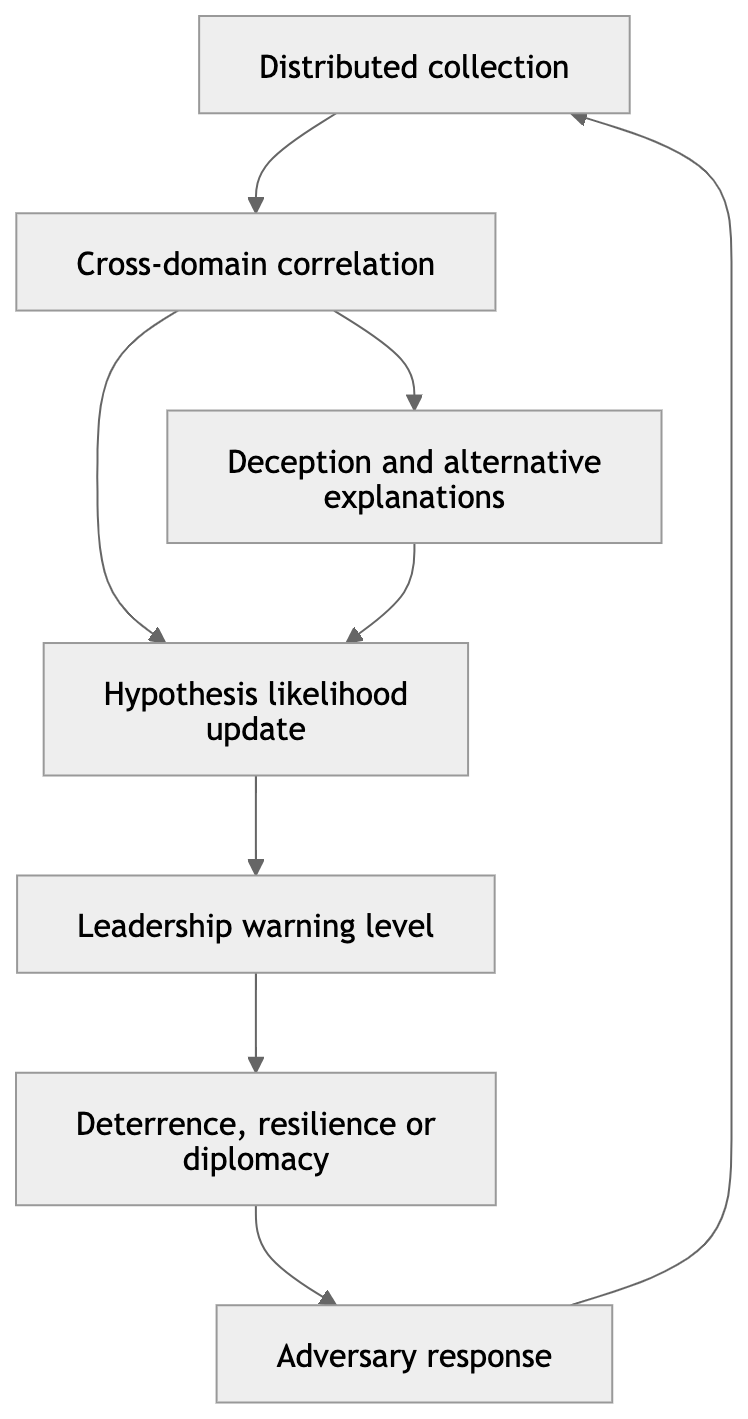
The highest-risk warning failure would involve an attack on systems that support both civilian and strategic military functions. Space services, communications networks, electric grids, undersea cables and positioning systems increasingly serve mixed constituencies. The 2026 United States threat assessment identifies growing cyber and jamming risks to satellite communications and warns that a nuclear detonation in space would damage both national-security and commercial infrastructure. Annual Threat Assessment of the U.S. Intelligence Community – Office of the Director of National Intelligence – March 2026 — Official assessment of space and cyber risks. A conventional or cyber operation intended to degrade battlefield connectivity could therefore be interpreted as preparation to blind strategic warning or retaliatory systems. This is where H₂ can convert rapidly into H₄ or H₅. Warning methodology must distinguish access, preparation and execution: unauthorized presence inside a network is not equivalent to imminent disruption, but persistent access to several redundant systems may create a latent strategic capability. The response should prioritize eviction, segmentation, redundancy and confidential warning before destructive counteraction. Public attribution may strengthen deterrence and coalition cohesion, but premature attribution can narrow diplomatic space and create pressure for retaliation unsupported by sufficient evidence. The appropriate standard is graduated confidence with explicit alternatives: confirmed technical activity, assessed sponsorship, inferred strategic purpose and estimated decision authority should be reported separately rather than fused into a single categorical accusation.
Competing strategic narratives
Chinese and Russian official strategic narratives must be incorporated as evidence of how those governments frame risk, not adopted as objective descriptions of Western intent. Their May 2025 joint statement argues that forward military infrastructure, intermediate-range systems, deep precision strike, integrated missile defence, nuclear sharing and military space capabilities can undermine strategic stability and create incentives for arms competition. It simultaneously reiterates the formula that nuclear war cannot be won and must never be fought and calls for avoidance of military confrontation among nuclear-armed states. Joint Statement on Global Strategic Stability – Ministry of Foreign Affairs of the People’s Republic of China – May 2025 — Official China-Russia strategic-stability statement. The document is analytically valuable because it identifies the capability combinations Beijing and Moscow publicly characterize as threatening: short flight times, counterforce-capable conventional systems, missile interception, space-based capabilities and integrated allied operations. It is not evidence that NATO intends a disarming first strike. It is evidence that these capability categories can shape Russian and Chinese worst-case planning. China continues to declare a defensive nuclear posture and a no-first-use commitment while linking military modernization to survivability and strategic stability. Remarks Marking the 99th Anniversary of the Founding of the People’s Liberation Army – Ministry of Foreign Affairs of the People’s Republic of China – July 2026 — Official Chinese statement on nuclear policy. The five-year consequence is a triangular rather than bilateral strategic environment: United States decisions concerning Russia influence Chinese calculations, while Chinese force modernization affects the resources and posture Washington can allocate to Europe.
Monte Carlo scenario model
An illustrative Monte Carlo model was constructed around 100,000 five-year pathways, with annual transitions among the five hypotheses and shocks representing cyber disruption, direct-force incidents, sanctions circumvention, nuclear signaling and degradation of crisis communications. This is a structured decision-support model, not an empirically validated prediction engine. Initial weights are 43% for H₁, 29% for H₂, 15% for H₃, 8% for H₄ and 5% for H₅. The transition architecture incorporates persistence—systems tend to remain in their existing strategic condition—while permitting escalation or de-escalation after shocks. High crisis-channel reliability increases the probability that H₃ returns toward H₁; high hybrid intensity shifts pathways from H₁ toward H₂ and raises the frequency with which ambiguous disruptions produce H₃; exceptional nuclear-operational indicators move probability toward H₄; and the conjunction of nuclear anomalies, direct combat and communication failure produces the largest H₅ update. Under the central calibration, the terminal 2031 distribution remains concentrated in H₁ and H₂, while H₅ remains a low-probability tail. Sensitivity testing shows that communications reliability is not sufficient by itself to prevent escalation, but its deterioration sharply magnifies the effect of other shocks. The model also produces an important policy conclusion: improving crisis communications without strengthening resilience can invite continued sub-threshold coercion, while strengthening military capability without protected communications can increase misinterpretation. Stability requires both denial and signaling control. Any numerical output should consequently be presented as conditional on assumptions and accompanied by indicator-based rules for revision.
| Model variable | Central assumption | Stress assumption | Primary effect |
|---|---|---|---|
| Crisis-channel reliability | 60% | Below 30% | Determines probability that incidents are clarified before retaliation |
| Hybrid-pressure intensity | 65% | Above 80% | Moves system from H₁ toward H₂ and increases attribution disputes |
| Major kinetic shock | One bounded event possible | Repeated or multi-theatre events | Raises H₃ and creates pathways toward H₄ |
| Exceptional nuclear indicator cluster | Absent | Present across three or more independent families | Produces the strongest H₄ update |
| Financial fragmentation | Gradual | Accelerated payment and commodity separation | Sustains H₂ and increases enforcement friction |
| Political control | Intact | Fragmented or succession-disrupted | Expands variance and raises H₅ tail risk |
Strategic consequences for Europe
For Europe, H₁ would still require sustained expenditure because managed deterrence is not a low-cost peace. Governments would need to finance stockpiles, readiness, air defence, cyber resilience, military mobility and industrial surge capacity while preserving fiscal credibility. The European Central Bank’s May 2026 Financial Stability Review identifies geopolitical and geoeconomic uncertainty, energy disruption, shipping stress, defence requirements and high public debt as interacting vulnerabilities. It warns that persistent deficits and debt constrain governments’ ability to respond to future shocks and notes that defence and infrastructure packages can increase fiscal pressure even when they support long-term security. Financial Stability Review – European Central Bank – May 2026 — ECB assessment of geopolitical and financial-stability risks. Under H₂, spending would shift toward internal security, counterintelligence, redundancy, election protection, cyber recovery, port monitoring and ownership transparency. Under H₃, the immediate priority would be preventing a limited incident from generating uncontrolled alliance mobilization while maintaining enough resolve to avoid rewarding aggression. H₄ would force European capitals to demonstrate political continuity under nuclear pressure, protect decision-making and resist both panic and complacency. H₅ would overwhelm normal fiscal and institutional planning. The strategic implication is that resilience investments cannot remain secondary to conventional procurement: hardened communications, spare transformers, alternative logistics, secure public warning, continuity of government and financial-market contingency arrangements directly influence deterrence because they reduce the coercive value of disruption.
The consequences will differ across the major European powers. France will face growing demands to clarify how its independent deterrent contributes to wider European security without converting national nuclear sovereignty into an automatic supranational guarantee. The United Kingdom will remain central through its independent deterrent, intelligence integration and Atlantic reinforcement role, but will have to balance European commitments with global and maritime requirements. Germany will determine whether financial authorization becomes sustained industrial capacity, military mobility and operationally ready conventional forces. Italy will be strategically important through the central Mediterranean, NATO nuclear-sharing arrangements, air and maritime infrastructure, defence industry, energy terminals, undersea connections and logistics linking southern and eastern theatres. Poland, the Baltic states, Finland and Romania will remain central to forward defence, warning and reinforcement. The principal political vulnerability will be uneven exposure: eastern allies will prioritize immediate military denial; highly indebted members will face sharper fiscal constraints; energy-intensive economies will remain sensitive to commodity shocks; and maritime states will bear disproportionate responsibility for ports, cables and shipping security. A Russian strategy need not defeat Europe militarily if it can separate these risk perceptions. European cohesion should therefore be assessed through practical tests—common procurement, reinforcement rights, intelligence sharing, sanctions enforcement and crisis consultation—rather than summit language alone.
Decision points, 2026–2031
The horizon contains three decision windows. Between 2026 and 2027, governments will convert political commitments into contracts, fiscal pathways and force-generation plans. The main warning question will be whether Russia tests the transition through intensified hybrid activity or calibrated conventional pressure while European capabilities remain incomplete. Between 2028 and 2029, production throughput and alliance integration will become measurable. NATO’s scheduled 2029 review of the Hague spending trajectory will constitute a major political indicator: sustained plans would reinforce deterrence, whereas fiscal retreat, fragmented procurement or failure to meet capability targets could invite coercive testing. Between 2030 and 2031, the central issue will be whether the confrontation has acquired stabilizing rules or hardened into unconstrained military competition. Stabilizing evidence would include protected crisis channels, reciprocal exercise notifications, rules concerning interference with nuclear command systems, improved incident communications, transparent treatment of dual-capable deployments and limited restoration of arms-control verification. Destabilizing evidence would include continuous strategic dispersal, new short-flight-time deployments, pervasive cyber pre-positioning, normalized attacks on space services, recurring direct incidents, broad economic separation and domestic political narratives that make compromise synonymous with defeat. The decisive judgment will not be whether tensions remain high; they almost certainly will. It will be whether institutions can keep operational shocks from crossing domains faster than political leaders can interpret and contain them.
Final assessment
The most likely five-year outcome is a heavily armed and economically fragmented system that remains below direct NATO-Russia war through a combination of deterrence, exhaustion, uncertainty and confidential risk management. This does not represent durable peace. It is a condition of managed strategic hostility in which H₁ and H₂ coexist: military deterrence constrains overt attack while cyber, financial, information, maritime and covert instruments carry a growing share of competitive pressure. H₃ is the principal bridge scenario because a limited kinetic incident is more plausible than a deliberate decision for general war and can move the system toward either containment or wider escalation. H₄ becomes credible only when nuclear rhetoric is joined by abnormal, costly operational behavior. H₅ remains the least probable hypothesis but demands disproportionate attention because its consequences are existential and because its probability can change abruptly when several warning families converge. The core strategic requirement is disciplined differentiation: capability is not intent; rhetoric is not readiness; contact is not détente; sanctions volume is not sanctions effectiveness; and a cyber intrusion is not automatically an attack order. Governments that preserve these distinctions while building military denial, civil resilience, financial contingency capacity and reliable crisis communications will have the strongest probability of keeping competition within controllable bounds. Governments that collapse them—either through alarmism or complacency—will make the escalation system more dangerous than the intentions of any single actor.