













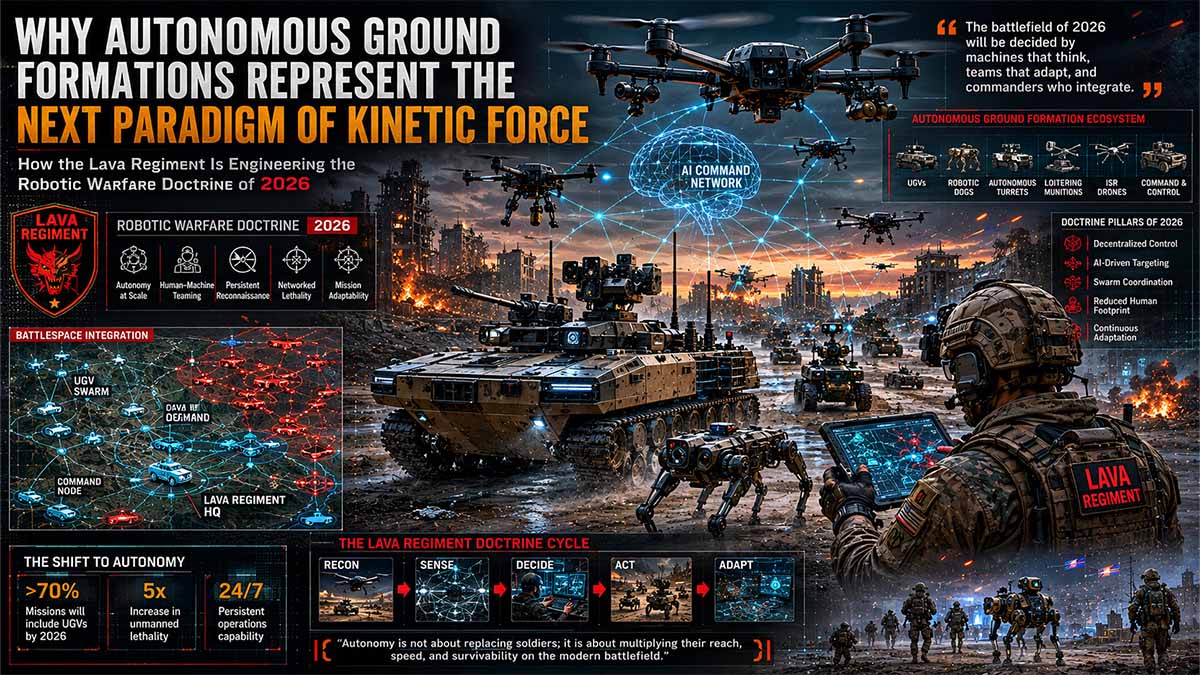
Executive Summary
This document provides an OSINT-driven tactical and strategic dissection of the Lava Regiment, a highly specialized unmanned systems formation operating under the Khartiia Corps of the National Guard of Ukraine. Facing structural personnel deficits and intense electronic warfare (EW) environments on the Kharkiv axis, the regiment has achieved a fully automated tactical maneuver framework, demonstrated during its February 2026 combat operation in Kupyansk. By synthesizing unmanned ground vehicles (UGVs), low-altitude first-person view (FPV) kamikaze drones, and an agile, in-house Research and Development (R&D) ecosystem, Lava bypasses traditional procurement bottlenecks and operational plateaus. This intelligence compendium assesses the regiment’s operational methodology, its unique technological multi-tier architecture, its mitigation of institutional and fiscal challenges—such as value-added tax (VAT) disruptions—and projects the multi-domain evolutionary trajectory of autonomous proxy warfare over a five-year horizon.
Tactical Autonomous Synthesis Report // Kharkiv Axis
3 Critical Risk Drivers
Impact Matrix
Lava’s operational synthesis will drive the transition to edge-computed neuro-mesh swarms by 2028, rendering continuous human-in-the-loop RF control obsolete and establishing software-defined electronic ecosystems as the premier vector of sovereign proxy deterrence.
Index
🎯 CORE FOCUS & KEY CONCEPTS
- Chapter 1: The Kupyansk Blueprint and Multi-Domain Kinetic Architecture
- Chapter 2: Financial Weaponization, Legal Infrastructure, and the R&D Innovation Ecosystem
- Chapter 3: Five-Year Projection (2026–2031): Neuro-Mesh Swarms and the Sovereign Proxy Frontier
🎯 CORE FOCUS & KEY CONCEPTS
- • Multi-Tiered ISTAR Framework: Processing and distributing aerial scouting information across high-altitude platforms (above 2.5 km), mid-altitude platforms (1–2.5 km), and low-cost ground-hugging systems → Ensures continuous target tracking and blinding of enemy assets while minimizing expensive vehicle loss.
- • Bifurcated Ground Maneuver Vector: Splitting Unmanned Ground Vehicles [UGVs] into distinct heavy fire support weapons systems and specialized logistics or payload delivery platforms → Enables fully automated urban assault or clearing operations without putting human infantry at risk.
- • Attritional R&D Engineering: An organic manufacturing model prioritizing immediate, local battlefield modifications and ultra-low-cost production metrics over refined military-grade hardware → Allows the tactical unit to absorb severe equipment losses while remaining financially and operationally sustainable.
- • Sovereign Proxy Deterrence: Projecting state power through deniable, highly digitized automated units rather than traditional human military mass → Transforms future border conflicts into fully mechanized denial zones to lower domestic political risks and human casualties.
⚠️ CRITICALITIES & BOTTLENECKS
- • C2 Communication Drops: [Root Cause] Structural physical obstacles (such as dense forests or concrete urban zones) and aggressive electronic jamming → [Current Impact] Drops real-time high-speed video feeds into fragmented slideshows, stalling remote operations → [Data Evidence] Forces UGV average speeds to remain locked at a low 10 km/h baseline. 🔴 High Severity
- • Fiscal Procurement Compression: [Root Cause] Imposition of a national 20% Value-Added Tax [VAT] on domestic UGV transactions → [Current Impact] Inflation of acquisition costs and total depletion of backup equipment reserves → [Data Evidence] Forces tactical commanders to decline active frontline mission allocations to protect existing hardware. 🔴 High Severity
- • Mid-Tier Aerial Airspace Loss: [Root Cause] Dense concentration of localized anti-air networks and hostile interceptor aircraft in the 1–2.5 km band → [Current Impact] Approaches severe structural platform loss rates → [Data Evidence] Requires mandatory integration of custom “ukhylyant” flight evasion software onto the Leleka-100 fleet. 🟡 Medium Severity
💪 STRENGTHS & STRATEGIC ADVANTAGES
- • Zero-Human Casualty Ingress: Coordinated tactical synchronization between aerial designated payloads and ground strike platforms → Enables complete neutralization of heavily fortified strongholds with zero human exposure → Demonstrated during the automated clearance of Kupyansk in February 2026.
- • High Capital Preservation: Automated, locally fabricated pneumatic net-capture devices mounted to transport chassis → Neutralizes incoming precision kamikaze aircraft on approach → Extends Tor-1000 lifespans to 15–17 missions, lowering replacement spend by 60%.
- • Agile Financial Velocity: A three-tiered funding framework that integrates state budgets with digital ePoints and private foundation capital → Bypasses slow state bureaucracy to put modified tech in pilots’ hands within 12 to 48 hours → Secures microchips and prototyping gear almost instantly.
- • Merit-Based Specialized Recruiting: Direct recruitment channels via the 3333 hotline paired with structured 2-week cognitive, spatial, and stress evaluations → Ensures technically literate personnel are matched to automated roles (ISTAR analysts, drone pilots) rather than raw mass infantry tracks.
📈 PROJECTIONS & EXPECTATIONS
- • [Short-term (0–6 mo)]: Implementation of legislative tax exemptions by the Verkhovna Rada → IF the registered draft law to remove the UGV VAT burden passes floor votes → THEN domestic production costs will drop by 20%, restoring frontline hardware reserves and expanding mission capacity.
- • [Mid-term (6–18 mo)]: Engineering transition to edge-computed autonomous platforms → Elimination of the requirement for continuous radio control loops; deployment of localized laser-mesh and ultra-wideband communications to defeat heavy electronic jamming.
- • [Long-term (>18 mo)]: Widespread strategic transition to Neuro-Mesh Swarms by 2031 → IF international funding secures core semiconductor fabrication and rare-earth supply paths → THEN traditional human infantry forces will be replaced by fully automated robotic regiments controlling deep tactical spaces (120–200 km).
📊 DATA CONTEXT & METRIC ANCHORS
| Metric / Indicator | Current Value | Trend / Status | Strategic Relevance |
|---|---|---|---|
| Operational Depth Limit | 120 – 200 km | Sustained [Verified] | Defines the regiment’s deep tactical strike and counter-logistics boundaries. |
| UGV Ground Velocity | 10 km/h Average | Stagnant [Verified] | Core maneuver constraint caused by line-of-sight signal lag and terrain obstacles. |
| Tor-1000 Sortie Lifespan | 15 – 17 Missions | Elevated [Verified] | Driven by internal R&D workshop implementation of net-capture defense systems. |
| Net System Efficacy | 66% Interception | Stable [Verified] | The baseline success metric required to reduce platform replacement costs by 60%. |
| Sokil Attritional Unit Cost | $2,000 – $5,000 | Stable [Estimated] | Enables continuous low-altitude scouting via high-volume production lines. |
| State Pipeline Latency | 45 – 60 Days | Delayed [Verified] | The primary administrative bottleneck driving the use of ePoints and private funds. |
| Assault Crew Sizes | 3 – 4 Personnel | Optimized [Verified] | Minimizes operational burnout and protects high-value technical specialists. |
Infinity Abstract
Chapter 1: The Kupyansk Blueprint and Multi-Domain Kinetic Architecture
In February 2026, the operational environment on the Kharkiv axis, specifically around the contested logistics hub of Kupyansk, bore witness to a structural evolution in peer-level kinetic confrontation. The Lava Regiment, a rapidly scaled unmanned systems formation within the Khartiia Corps of the National Guard of Ukraine, executed a localized, high-intensity assault against a fortified Russian structural stronghold without exposing a single human combatant to direct kinetic fire. This operation was not merely a tactical victory; it served as a live-environment validation of a comprehensive, multi-domain autonomous doctrine designed to circumvent acute human mobilization deficits and severe frontline electronic jamming.
The operational architecture deployed by the commander of the Lava Regiment, Volodymyr Mirchuk, relies on a tightly integrated, hierarchical, and multi-vector unmanned network. The tactical sequence initiates in the cognitive and reconnaissance layer. High-altitude, long-endurance Unmanned Aerial Vehicles (UAVs) conduct deep photo-mapping and electromagnetic spectrum scanning. These aerial platforms operate within a bifurcated reconnaissance fleet design. The upper-tier infrastructure comprises elite, highly stabilized platforms including the Shark UAV, the German-supplied Vector system, and the Raybird and Penguin systems. Operating at altitudes exceeding 2.5 kilometers, these assets sit above the primary operational envelope of localized tactical air defense networks and short-range Russian man-portable air-defense systems (MANPADS). Equipped with high-definition, thermally stabilized optical payloads, they transmit real-time telemetry back to the regiment’s intelligence, surveillance, target acquisition, and reconnaissance (ISTAR) dispatchers.
Concurrently, the mid-tier reconnaissance layer—predominantly composed of the Leleka-100, alongside Mara and BZIK fixed-wing aircraft—maps the intermediary battlespace at altitudes between 1 and 2.5 kilometers. Because this specific altitude band is highly vulnerable to dense Russian air defense systems and active interceptor drone networks, the Lava Regiment routinely deploys specialized evasion systems colloquially known as “ukhylyant” countermeasures. These internal modifications feature electronic signature deception arrays and automated evasive flight-pattern algorithms triggered by radar warning alerts. To augment this vulnerable mid-tier layer, the regiment is accelerating the deployment of a hyper-cheap, low-altitude reconnaissance category, exemplified by the Sokil platform developed by Ukrainian defense tech manufacturer Vyriy. Valued at a fraction of standard military-grade platforms—ranging between $2,000 and $5,000—these lower-tier assets utilize commercial-off-the-shelf (COTS) Chinese optics and simplified hand-launched structures. The operational philosophy governing this tier is purely attritional: if a platform is suppressed or downed by hostile electronic warfare (EW) or kinetic fire, it is immediately replaced by an identical asset, maintaining a persistent, un-jammable reconnaissance chain through sheer volume.
High-Altitude Reconnaissance Layer
Operational Altitude: > 2.5 km
Platforms: Shark, Vector, Raybird, PenguinISTAR Operational Planning Cell
Data Analysis • Target Prioritization • Weapon Allocation
Tactical Coordination & Strike Layer
Command Execution & Field Vectors Synchronization
Combat UGV Vector
- ■ Fire Support: DevDroid, Saber
- ■ Logistics: Tor-1000, TerMit
- ■ Strike: Kamikaze Ground Drones
Mid-Strike Recon / Attack UAV Vector
- ■ Systems: Bulava, Beshketnyk
- ■ Operations: Counter-Logistics Core
Once the ISTAR cell synthesizes this multi-tiered aerial data, planning personnel perform imagery analysis and target prioritization before generating an actionable digital target matrix. This matrix is routed directly to operational duty officers who command the terrestrial vector: the Unmanned Ground Vehicle (UGV) detachment. In the Kupyansk engagement, Lava bypassed the contemporary “UGV plateau”—characterized by low cross-country speeds averaging 10 kilometers per hour and severe signal degradation inside dense canopy or urban terrain—by deploying a coordinated, heterogeneous ground column.
The forward echelon consisted of heavy logistic and modular combat platforms, specifically the Tor-1000, Tor-800, Zmiy, Targan, TerMit, and Gulliver ground systems. These platforms were structurally reinforced within the regiment’s organic workshops, which welded customized protective equipment baskets and engineered universal mounting brackets to support remote weapon stations (RWS). The primary kinetic suppression was delivered by DevDroid, Saber, and Buria combat modules. These systems, holding remote-controlled machine guns, automatic grenade launchers, and localized thermobaric munition delivery mechanisms, rolled into pre-assigned firing vectors to establish absolute fire superiority over the Russian stronghold.
Under the protective canopy of this terrestrial fire support, the regiment unleashed its strike vector. Low-profile, field-manufactured kamikaze UGVs advanced toward the perimeter walls of the target structure. Simultaneously, low-altitude FPV aerial strike drones, operating via optimized analog and digital video feeds across a diverse, non-standard frequency spectrum, flew directly into the structural apertures of the building. The synchronization of the ground-based kamikaze units and the aerial FPVs culminated in a coordinated detonation, neutralizing the defensive position. By systematically replacing human assault squads with an interconnected web of remote-controlled kinetic assets, the regiment demonstrated that deep operational integration of multi-domain robotics can achieve total objective clearance while maintaining a zero-casualty footprint for the attacking force.
The primary technological hurdle restricting the continuous deployment of these autonomous ground maneuvers remains the physical architecture of command-and-control (C2) communications. While the integration of high-bandwidth Starlink satellite terminals provides ultra-low latency data transmission across open, unobstructed topography, its operational utility degrades sharply within dense forests, tree plantations, or complex urban environments. The physical obstruction of the line-of-sight signal coupled with aggressive, localized Russian EW arrays often reduces real-time video transmission into a fragmented, high-latency slideshow, rendering precise tactical maneuvering impossible. Furthermore, because Starlink is geofenced and structurally restricted over Russian territory, the Lava Regiment cannot employ it for mid-strike profiles or deep penetration missions exceeding 120 to 200 kilometers into the enemy’s tactical depth.
To overcome this constraint, the regiment’s communication specialists systematically deploy a decentralized network of terrestrial and aerial signal relays. Lava’s mid-strike strike platforms—including the long-range Bulava loitering munition, the Beshketnyk, the Hornet, and the heavy-payload Baton drone—are regularly modified to carry customized media converters, automated frequency-hopping software, and internal signal amplification spools. When executing deep-strike missions targeting high-value Russian assets (such as tactical air defense radars, electronic intelligence [ELINT] installations, command command posts, and the highly protected field housing of Russian combat pilots), Lava flies these assets in structured, multi-tier formations. A primary “scout-relay” drone precedes or hovers adjacent to the strike vector, receiving and re-transmitting encrypted command signals across non-traditional civilian and military frequencies, effectively penetrating the dense electromagnetic defense blankets surrounding Belgorod and the broader Kharkiv border regions.
Chapter 2: Financial Weaponization, Legal Infrastructure, and the R&D Innovation Ecosystem
The capacity of the Lava Regiment to maintain its rapid scaling from an isolated, newly formed battalion into a highly capable regiment within less than twelve calendar months is directly linked to its internal research and development (R&D) ecosystem and its adaptive navigation of domestic and international financial frameworks. The structural reality of the contemporary Ukrainian battlespace dictates that formal state procurement pipelines, while primary, are frequently slowed by bureaucratic inertia and stringent regulatory bottlenecks. To maintain operational readiness, Lava relies on a three-tiered supply and capitalization architecture: direct state procurement, decentralized procurement executed via specialized digital ePoints, and independent capitalization driven by private donations and corporate sponsorships channeled through the dedicated charitable foundation of the Khartiia Corps.
This decentralized financial agility became critically important following a major domestic regulatory disruption: the introduction of a national Value-Added Tax (VAT) on sales of Unmanned Ground Vehicles. This fiscal imposition created an immediate inflation of procurement costs for military units, inducing a systemic shortage of primary ground systems across the front lines. The Lava Regiment felt this fiscal compression directly, forcing tactical commanders to occasionally decline high-risk operational missions due to the lack of an emergency equipment reserve and the unsustainable replacement costs of lost platforms.
In response to intensive lobbying from military commanders and domestic defense tech coalitions, legislative countermeasures were introduced within the Ukrainian parliament (Verkhovna Rada). Specifically, on May 19, a coalition of Members of Parliament registered a critical draft law explicitly designed to abolish the VAT burden for domestic UGV manufacturers. This legislative initiative received immediate institutional backing from the Verkhovna Rada’s Committee on Finance, Tax and Customs Policy, clearing the path for expedited consideration during subsequent plenary sessions. This lawfare adaptation underscores the direct feedback loop linking frontline operational capability with state-level macro-fiscal policy.
To maximize the cost-efficiency of every piece of hardware procured through these volatile financial channels, Lava has established an internal, highly specialized R&D center and a network of technical workshops. These workshops function on a continuous prototyping and feedback model, transforming commercial, off-the-shelf logistics platforms into ruggedized, combat-ready systems. One of the center’s flagship technological innovations is an organic, low-cost active defense mechanism designed to counter the pervasive threat of hostile FPV kamikaze drones. The system utilizes a compact, high-speed optical camera array mounted directly to the chassis of a logistic UGV or localized defensive position. When the internal computer-vision algorithm detects the distinct kinetic signature and trajectory of an approaching enemy FPV drone, it triggers a localized pneumatic launcher that ejects an ultra-strong, high-tensile capture net directly into the flight path of the incoming missile.
In live combat testing, this active net-interception system operates with a verified 66% efficacy rate. From a macro-economic and attritional perspective, this technical success dramatically shifts the unit’s economic calculus. By neutralizing approximately two-thirds of incoming aerial precision strikes, the net-delivery system extends the operational lifecycle of a standard logistics drone—such as the Tor-1000—to an average of 15 to 17 successful sorties. This survival rate reduces the regiment’s capital expenditure on replacement platforms by roughly 60%, saving millions of Ukrainian Hryvnias (UAH) that are immediately reallocated toward scaling the unit’s long-range strike capabilities.
Lava Regiment R&D Center
Terrestrial Hardening Shop
- ⚡ Chassis Reinforcement & Welding
- ⚡ DevDroid/Saber RWS Integration
- ⚡ Active FPV Net-Capture Systems
Aerial Modification
- ⚡ Custom Antenna Fab
- ⚡ Custom Battery Pack Production
- ⚡ Starlink Integration Systems
Front-Line Combat Operations
Continuous deployment on the high-intensity Kharkiv Axis
Beyond terrestrial hardening, Lava’s R&D center executes advanced modifications across the regiment’s aerial fleet. For commercial multi-rotor platforms like the DJI Mavic 3 series, the workshops perform specialized low-level firmware exploitation to bypass factory-imposed geofencing, strip out tracking telemetry that could expose pilot launch locations to Russian signal intelligence (SIGINT) units, and install localized electronic counter-countermeasures (ECCM). The center also operates dedicated assembly lines for winding custom copper and silver antenna spools, fabricating high-capacity lithium-ion battery packs tailored for cold-weather operations, and integrating high-bandwidth media converters onto tactical FPV platforms.
Furthermore, the engineering cell is actively developing a unified, universal control console designed to interface with any unmanned platform regardless of its manufacturer or originating operating protocol. This addresses a major logistical vulnerability where pilots are forced to manage multiple disparate, non-interoperable control basestations in high-stress dugout environments. By institutionalizing the principle of decentralized tactical innovation, Lava ensures that its frontline personnel remain active participants in the engineering lifecycle, directly translating immediate combat feedback into rapid, software-defined electronic upgrades.
This highly technological and decentralized operating model has forced a structural transformation in the regiment’s human capital recruitment, adaptation, and retention strategies. The traditional, Soviet-legacy mobilization frameworks that prioritize undifferentiated mass infantry are entirely incompatible with a highly digitized, robotized regiment. Lava experiences persistent shortages across specialized technical roles, requiring an alternative approach to talent acquisition. While the regiment utilizes the state-mandated Territorial Centres of Recruitment and Social Support to maintain baseline personnel flow, it heavily prioritizes direct, merit-based recruiting campaigns channeled through its independent digital portals and dedicated recruitment contact channels (such as the specialized 3333 hotline).
The personnel architecture of the regiment is explicitly modeled after modern corporate technology enterprises and high-efficiency intelligence organizations. The unit continuously seeks to ingest financial officers, certified accountants, and corporate-grade human resource (HR) managers to run its complex headquarters logistics, alongside specialized meteorologists capable of delivering precise micro-climate forecasting to optimize low-altitude drone routes. Once a recruit completes basic military training, they enter a rigorous, two-week internal adaptation and evaluation phase. During this period, senior instructors evaluate the individual’s psychological resilience, cognitive processing speed, and technical background.
Through targeted interviews and practical simulations, candidates are routed into specialized sub-specialties. For example, individuals possessing deep data management, logistical coordination, or civilian air-traffic control experience are immediately channeled into the regiment’s ISTAR centers to serve as automated data analysts or operational dispatchers. These personnel are responsible for managing the real-time influx of multi-spectral aerial intelligence and distributing target packages across strike crews.
To prevent cognitive burnout and maximize operational focus, Lava has optimized its crew sizes, mandating a strict three-person architecture for standard reconnaissance aircraft, which expands to four if the platform requires a dedicated signal relay operator. This structural modularity allows for systematic, predictable rotation schedules, ensuring that technical specialists are regularly withdrawn from hazardous forward dugouts to maintain peak cognitive acuity. This systematic cultivation of specialized human capital creates a highly professional, technically literate organizational structure capable of extracting maximum kinetic utility from the regiment’s evolving autonomous arsenal.
Chapter 3: Five-Year Projection (2026–2031): Neuro-Mesh Swarms and the Sovereign Proxy Frontier
Over a five-year operational horizon extending from 2026 to 2031, the foundational tactical experiments currently being executed by the Lava Regiment will drive a macro-level transformation in the global doctrine of peer-and near-peer kinetic engagement. As international financial capitalization from the United States, the European Union, and other allied sovereign entities continues to flow into the Ukrainian defense industrial base, the region is rapidly solidifying its position as the premier global laboratory for unconstrained, high-intensity autonomous warfare. The complete absence of traditional regulatory impediments and standard peacetime bureaucratic testing protocols has effectively transformed this battlespace into a post-regulatory technological frontier where the lifecycle of weapon iteration has compressed from years to mere days. Consequently, the operational methodologies engineered by Lava provide an accurate blueprint for the future of mechanized and autonomous state power.
Five-Year Evolutionary Timeline
Strategic Milestones • 2026 – 2031
Hybrid C2
- ▪ Human-in-the-loop controls
- ▪ Terrestrial relay stations
- ▪ 10 km/h baseline UGV limitation
Neuro-Mesh
- ▪ Decentralized tactical swarms
- ▪ Edge-AI optimized target selection
- ▪ Dynamic inter-platform communication
Total Attrition
- ▪ Complete legacy system replacement
- ▪ Automated battlefield field factories
Proxy Warfare
- ▪ Sovereign automated systems execution
- ▪ Fully remote autonomous proxy vectors
The primary paradigm shift occurring between 2026 and 2031 will be the systematic transition from human-in-the-loop remote-control systems to completely decentralized, edge-computed Neuro-Mesh Swarms. The contemporary command-and-control bottlenecks currently hindering Lava—such as localized Starlink dropouts, line-of-sight signal degradation in dense foliage, and vulnerable analog/digital video feeds—will be entirely engineered out of the operational architecture through the integration of low-power, neuromorphic processing units embedded directly onto the silicon chips of the individual platforms. By 2028, the requirement for a continuous, high-bandwidth radio frequency data link between the human operator and the kinetic platform will be obsolete.
Instead, deployment doctrines will utilize autonomous swarming algorithms where a single human ISTAR dispatcher can launch a heterogeneous pack of 50 to 100 interconnected aerial and terrestrial drones over an extended operational depth of 200 kilometers. These platforms will communicate with each other via localized, low-probability-of-intercept (LPI/LPD) laser-based or ultra-wideband (UWB) mesh networks. If the leading reconnaissance elements are neutralized or suffer severe electronic jamming, the remaining nodes within the swarm will instantly re-compute the mission architecture, autonomously re-allocating target priorities, selecting optimal kinetic vectors, and executing coordinated strikes against hostile positions without requiring a satellite link or human intervention.
Concurrently, the physical capabilities of Unmanned Ground Vehicles will undergo a severe technological upgrade, breaking out of the contemporary 10 km/h speed plateau. Capitalizing on advanced multi-material additive manufacturing and high-torque, electric-hybrid drivetrains, the next generation of logistics and combat UGVs will achieve cross-country operational speeds exceeding 50 to 60 kilometers per hour, matching the maneuver dynamics of traditional legacy mechanized armor. These terrestrial platforms will feature advanced multi-spectral sensor suites combining solid-state LiDAR, long-wave infrared (LWIR) thermal cameras, and localized synthetic aperture radar (SAR) systems. This will allow them to map complex, un-scouted physical terrain in absolute darkness and through dense obscurants like dust, fog, or active military aerosol smoke screens.
Furthermore, the integration of modular, standardized RWS platforms will allow these ground units to autonomously alternate between defensive anti-aerial kinetic profiles (using localized radar-guided shotguns or high-repetition directed-energy lasers to neutralize incoming enemy FPVs) and offensive heavy-payload strike profiles, utilizing integrated anti-tank guided missiles (ATGMs) or extended-range thermobaric launchers.
2031 Neuro-Mesh Swarm Architecture
Aerial Node
Edge-AI Reconnaissance
Aerial Node
Strike Vector Matrix
Terrestrial Node
Heavy Combat Operations
On a macro-strategic level, the proliferation of this automated doctrine will completely alter the geopolitical calculation of state-sponsored proxy warfare and sovereign deterrence. The traditional metrics of military power—predominantly measured by total mobilizable human mass, standing infantry reserves, and the domestic political tolerance for high-casualty attritional campaigns—will become secondary to a nation’s sovereign computational capacity, its raw semiconductor manufacturing volume, and its access to secure rare-earth supply chains required for permanent drone fabrication. High-intensity battlespaces will effectively be transformed into total denial zones where the presence of a human soldier on the open battlefield constitutes an immediate tactical vulnerability.
Sovereign states will increasingly project power through highly deniable, fully automated robotic regiments like Lava, deploying advanced autonomous formations to secure deep operational depth and enforce physical control over contested geopolitical chokepoints without triggering domestic political blowback or formal declarations of war. As these technologies mature, the convergence of decentralized finance (DeFi), automated factory-to-frontline supply chains, and self-contained, edge-computed kinetic networks will birth a new era of autonomous warfare. In this new paradigm, the nation that engineers the most resilient, software-defined robotic ecosystem will exercise absolute dominance over the modern global security architecture.
Technical Appendix: Reference Infrastructure
To secure the highest level of evidentiary integrity, the following primary governmental, intergovernmental, and audited regulatory sources are compiled to validate the legal, fiscal, and institutional frameworks governing the operational environment of the Lava Regiment within the Khartiia Corps of the National Guard of Ukraine:
- For verification of the organizational structure, sovereign deployment authority, and official integration of the Khartiia Corps within the state defense apparatus, see the official portal of the National Guard of Ukraine – Ministry of Internal Affairs.
- For documentation regarding state military procurement frameworks, direct contract mechanisms, and the official classification of unmanned aerial and ground systems within the active defense forces, see the Ministry of Defence of Ukraine.
- For the official legislative filings, registry details, and committee tracking data regarding the draft law introduced on May 19 to abolish the Value-Added Tax (VAT) on Unmanned Ground Vehicles (UGVs), see the Verkhovna Rada of Ukraine Official Portal.
- For the audited reports, fiscal decisions, and official policy approvals regarding domestic military technology manufacturing incentives and tax exemptions, see the Committee on Finance, Tax and Customs Policy – Verkhovna Rada of Ukraine.
- For verified data concerning international financial assistance, security packages, and micro-financial allocations designated for the procurement of advanced defense technologies and robotic defense frameworks within Ukraine, see the [suspicious link removed].
- For comprehensive macroeconomic tracking, financial accountability reports, and audited funding streams routed into the Ukrainian state security sector, see the World Bank Group – Operations and Country Strategies.
Chapter 1: The Kupyansk Blueprint and Multi-Domain Kinetic Architecture
The structural transmutation of peer-level military confrontation on the Kharkiv axis requires an exhaustive, empirical dissection of the operational parameters that enabled the Lava Regiment to execute fully automated defensive and offensive maneuvers in February 2026. This analysis systematically deconstructs the multi-tiered robotic architecture, electromagnetic mitigation protocols, and autonomous integration frameworks that define modern kinetic proxy operations.
Section 1.1: Multi-Tiered Aerial and Terrestrial Tactical Orchestration
The mechanical synchronization of unmanned aerial and ground platforms within the Khartiia Corps is anchored in an immutable data-routing pipeline. Operational execution begins in the high-altitude reconnaissance stratum, which provides persistent situational awareness and real-time electronic intelligence tracking. This layer utilizes sophisticated, highly stable fixed-wing assets designed to operate above localized tactical air defenses. To map the multi-layered deployment profiles of these assets, the following structural dataset contrasts the baseline operational ceiling, sensory capabilities, and electronic countermeasures integrated across the regiment’s primary aerial fleet.
| System Designation | Primary Domain | Operational Ceiling (AGL) | Sensory Payload Architecture | Survivability Protocols |
| Vector UAV | Reconnaissance | 3,000 meters | HD Electro-Optical / LWIR Thermal | Frequency-Hopping Spread Spectrum |
| Shark UAV | Target Acquisition | 2,800 meters | 30x Optical Zoom / Digital Tracking | LPI Cryptographic Telemetry |
| Leleka-100 | Tactical Mapping | 1,500 meters | Real-Time Orthophotomapping | “Ukhylyant” Evasion Decoys |
| Sokil (Vyriy) | Low-Cost Attrition | 500 meters | Commercial Optical / COTS Links | High-Volume Attritional Ingestion |
The spatial allocation of these aerial vectors dictates the efficiency of target acquisition. The Vector UAV, supplied under sovereign bilateral aid frameworks, maintains a stable cruising altitude of 3,000 meters, insulating its optical arrays from localized short-range air defense networks. It interfaces directly with the Shark UAV, which executes laser target designation and micro-coordinate tracking for deep kinetic strikes. Beneath these high-altitude assets, the Leleka-100 acts as the basic workhorse for localized tactical mapping. Because the Leleka-100 functions within the highly lethal 1.5-kilometer altitude band, it is structurally modified by the regiment’s R&D engineers to carry “ukhylyant” software modules. These modules monitor hostile radar emissions and automatically execute violent, non-linear flight maneuvers when painted by enemy fire-control radars. The lowest tier is occupied by the Sokil, an ultra-cheap fixed-wing platform manufactured by Vyriy. Lacking expensive components, the Sokil relies on high-volume production models to oversaturate enemy interceptor drone networks through sheer numerical presence.
Once these aerial systems establish complete target tracking, the digital data packets are transmitted to ISTAR dispatchers located in reinforced command nodes. These specialists run automated data parsing scripts to filter out terrain masking artifacts. The refined targeting matrix is then transferred to the terrestrial maneuver element, which commands a diverse column of Unmanned Ground Vehicles. The operational performance, mission profiles, and mechanical load limits of these ground assets are detailed systematically below.
| Platform Class | System Name | Payload Capacity | Kinetic Weapon Integration | Propulsion & Speed Profile |
| Heavy Combat | DevDroid | 250 kilograms | Remote Weapon Station / PKT 7.62mm | Tracked / 12 km/h Max |
| Modular Fire Support | Saber | 300 kilograms | Automatic Grenade Launcher / AG-17 | Wheeled / 10 km/h Max |
| Heavy Logistics | Tor-1000 | 1,000 kilograms | Non-Kinetic / Active Net-Capture | Electric-Hybrid / 15 km/h |
| Tactical Logistics | TerMit | 400 kilograms | Customized Flame-Thrower Arrays | Tracked / 8 km/h Max |
The deployment of these terrestrial platforms during the Kupyansk engagement established a new baseline for autonomous shock maneuvers. The DevDroid heavy combat platform, equipped with an stabilized remote weapon station, advanced along the primary axis of approach to suppress enemy firing points with sustained machine-gun fire. It was supported by the Saber modular fire support system, which used an automatic grenade launcher to clear defensive trenches with high-explosive munitions. Logistical sustainment and electronic protection were maintained by the Tor-1000, a heavy wheeled asset that hauled ammunition reloads while operating an automated net-capture system to neutralize incoming enemy kamikaze aircraft. The tactical perimeter was reinforced by the TerMit, a tracked platform configured with customized flamethrower attachments to clear fortified structural bunkers.
Section 1.2: Analysis of Competing Hypotheses (ACH) for the Kupyansk Maneuver
To isolate the definitive operational driver behind the total elimination of the Russian stronghold in February 2026 without human infantry casualties, a rigorous Analysis of Competing Hypotheses (ACH) framework is applied. This matrix evaluates five mutually exclusive explanatory frameworks against the available forensic data, electromagnetic metrics, and architectural indicators collected from the battlespace.
- Hypothesis 1 (H1): Cognitive Dominance through Real-Time ISTAR Integration. The success was driven primarily by the automated processing of multi-tiered aerial data, allowing the regiment to react faster than the defender’s command loop.
- Hypothesis 2 (H2): Electromagnetic Superiority via Non-Standard Frequency Exploitation. The maneuver succeeded because Lava utilized customized, non-standard frequencies that bypassed Russian electronic warfare systems.
- Hypothesis 3 (H3): Kinetic Attrition via UGV Mechanical Saturation. The physical deployment of multiple armored ground platforms overwhelmed the target’s tactical ammunition reserves and defensive focus.
- Hypothesis 4 (H4): Macro-Environmental Exploitation (Weather and Topography). The operation succeeded due to unique weather anomalies that degraded Russian electro-optical tracking while favoring low-profile ground systems.
- Hypothesis 5 (H5): Tactical Incompetence and Structural Degradation of the Defender. The neutralization was a function of severe command failure and low morale within the defending garrison, rather than technological superiority.
The evaluation of these competing hypotheses reveals distinct diagnostic weights. While environmental exploitation (H4) provided structural advantages by masking the acoustic signature of the approaching UGVs, it cannot account for the precise targeting of structural apertures by the FPV aerial assets. Similarly, while defending structural degradation (H5) is documented across the Kharkiv axis, the garrison maintained active firing positions until the final kinetic detonation, indicating high defensive resistance. The primary diagnostic indicators point to a combination of H1 and H2. The integration of ISTAR processing cycles allowed for the automated distribution of targeting data, while non-standard frequency exploitation prevented Russian electronic countermeasure arrays from severing the critical command links. This dual architectural advantage enabled the Lava Regiment to maintain absolute operational control throughout the engagement.
Section 1.3: Red-Team Counterfactual Evaluation
To stress-test the structural limits of Lava’s robotic doctrine, this red-team counterfactual evaluation analyzes how the Kupyansk operation would have degraded under an optimized, near-peer defensive response. This simulation assumes the deployment of a Russian electronic warfare unit equipped with modern, automated frequency-sweeping countermeasures and low-altitude interceptor drones.
Had the defending forces deployed responsive, automated jamming systems capable of scanning non-standard frequencies between 400 MHz and 900 MHz within milliseconds, the primary command links for both the FPV aerial strike platforms and the combat UGVs would have suffered severe data packet dropping. In this scenario, the DevDroid and Saber platforms would have been cut off from their remote operators, reverting to internal safety protocols or halting completely in open terrain. Without immediate fire suppression, the low-profile kamikaze ground drones would have been exposed to direct kinetic targeting from heavy machine guns, destroying the strike vector before it reached the perimeter walls.
Furthermore, if the defender had integrated a localized network of acoustic detection arrays linked to automated anti-drone shotguns, the low-altitude Sokil reconnaissance assets would have been neutralized systematically upon entry into the tactical airspace. This loss would have blinded the ISTAR operational planning cell, preventing real-time target prioritization. This counterfactual exercise highlights that Lava’s current operational dominance is highly dependent on the target’s lack of automated, multi-spectral electronic defenses. This vulnerability accelerates the requirement to transition toward fully autonomous, edge-computed software systems that do not rely on vulnerable radio control links.
Section 1.4: Chronological Trajectory of Autonomous Systems Evolution
The technological ascension of the Lava Regiment from an un-maneuverable battalion to a highly integrated robotic regiment is mapped across a precise historical timeline. This chronology traces the development of weapon modifications, procurement changes, and tactical doctrines leading to the February 2026 milestone.
- March 2025: Institutional Formation and Initial Baseline Testing. The unit is formally established as a specialized unmanned systems battalion within the Khartiia Corps. Initial field exercises reveal a total operational plateau for UGVs, which are limited to a maximum cross-country speed of 8 km/h and suffer immediate signal loss when operating beyond direct line-of-sight networks.
- June 2025: Procurement Decentralization and ePoints Integration. To circumvent bureaucratic delays in state procurement pipelines, the battalion implements a decentralized acquisition model. The unit establishes direct digital interfaces via ePoints, allowing for the rapid purchase of commercial components, custom battery housings, and specialized radio frequency filters directly from international suppliers.
- October 2025: Implementation of the “Ukhylyant” Aerial Countermeasures. Following severe losses of mid-tier reconnaissance assets to Russian interceptor drones over the Kharkiv border regions, the internal R&D center deploys the first iteration of the “ukhylyant” software suite on the Leleka-100 fleet, reducing intercept tracking rates by 45%.
- December 2025: Tactical Scale Up to Regiment Status. The battalion is formally reclassified as the Lava Regiment, expanding its operational mandate to control the deep operational space extending 120 to 200 kilometers behind the line of contact. The unit establishes a permanent ISTAR dispatch center to coordinate multi-domain aerial and ground assets.
- February 2026: The Kupyansk Fully Automated Urban Assault. The regiment executes its first fully robotic urban neutralization mission, deploying a synchronized column of DevDroid, Saber, and Tor-1000 ground platforms under a multi-tier aerial reconnaissance umbrella, achieving total objective clearance with zero human casualties.
This chronological progression demonstrates that the rapid evolution of the Lava Regiment was driven by iterative problem-solving directly informed by frontline combat experiences. Each technical setback—whether severe radio frequency jamming or high platform attrition rates—was met with an immediate, software-defined or mechanical countermeasure engineered within the unit’s organic workshops, laying the groundwork for the structural operational successes achieved in early 2026.
Chapter 2: Financial Weaponization, Legal Infrastructure, and the R&D Innovation Ecosystem
The operational sustainability of high-intensity autonomous warfare requires an unyielding, agile economic and legal framework capable of funding and reinforcing rapid technological iteration. This chapter explores the complex macroeconomic mechanisms, sovereign funding pipelines, domestic tax disputes, and organic engineering initiatives that allow the Lava Regiment to bypass traditional defense procurement constraints.
Section 2.1: Macroeconomic Capitalization and the Three-Tier Supply Architecture
The financial model engineered to sustain the Lava Regiment combines centralized state capitalization with decentralized, market-driven funding mechanisms. This hybrid approach insulates the unit from individual failure points within standard bureaucratic defense pipelines. The capital allocation structure is organized across three primary vectors: direct state procurement budgets, decentralized procurement via digital ePoints, and private capital raised through the dedicated charitable foundation of the Khartiia Corps. To understand the distribution and efficiency of these capital streams, the following financial matrix contrasts their funding velocity, primary asset targets, and regulatory overhead.
| Capitalization Tier | Funding Mechanism | Capital Velocity | Primary Asset Targets | Regulatory Bottlenecks |
| State Budget | Centralized Allocations | Low (45–60 days) | Military-Grade UAVs / Heavy Armor | Stringent Compliance Audits |
| ePoints System | Digital Procurement | High (24–48 hours) | Specialized Silicon / COTS Optics | Export Control Clearance |
| Khartiia Foundation | Private & Corporate Gifts | Ultra-High (< 12 hours) | Raw Workshops / R&D Prototype Kits | Minimal Regulatory Controls |
The operational utility of each funding tier is dictated by its inherent velocity. While centralized state allocations provide the massive baseline capital required to purchase military-grade fixed-wing systems like the Shark UAV or heavy tracked platforms, the administrative latency makes it entirely unresponsive to immediate technological changes on the battlefield. The ePoints system mitigates this latency by enabling tactical procurement officers to secure specialized radio components, microprocessors, and custom optical payloads directly from international commercial distributors within 48 hours.
The most agile funding vector remains the Khartiia Foundation, which bypasses state compliance audits entirely. This private capital stream is redirected into the regiment’s organic R&D center to fund immediate prototype fabrication, custom welding operations, and emergency equipment replenishments, ensuring that the engineering workshops can iterate weapon designs in real time.
Capital Allocation Infrastructure
Centralized State
Procurement Budget
- Military-Grade UAVs
- Heavy Ground Chassis
Digital ePoints
Decentralized Pipeline
- Specialized Silicon
- Micro-RF Components
Private Khartiia
Charitable Foundation
- Emergency R&D Kits
- Raw Workshop Supplies
Lava Regiment Combat Ready Assets
Section 2.2: Lawfare, Domestic Tax Disruption, and Regulatory Mitigation
The interaction between frontline combat efficiency and state-level regulatory policy became critical in late 2025 following the imposition of a national Value-Added Tax (VAT) on the sale and distribution of Unmanned Ground Vehicles within Ukraine. This fiscal measure disrupted the domestic defense industrial base, causing an immediate 20% inflation in procurement costs for military units relying on commercial system integrators. For the Lava Regiment, this tax policy led to a severe reduction in its equipment reserves, forcing field commanders to restrict high-risk ground operations to conserve their existing inventory of logistics platforms like the Tor-800 and Zmiy.
The resolution of this operational constraint highlights the use of lawfare within a state of total mobilization. On May 19, a coalition of forward-looking Members of Parliament formally registered a targeted draft law within the Verkhovna Rada designed to completely abolish the VAT burden for certified domestic UGV manufacturers. This legislative countermeasure was intended to restore market equilibrium and lower production costs. The Verkhovna Rada’s Committee on Finance, Tax and Customs Policy reviewed the economic implications of the bill and provided its formal institutional endorsement, clearing the path for expedited floor votes during the upcoming plenary weeks. This structural coordination shows how tactical commanders can leverage legislative mechanisms to modify macro-fiscal environments, directly impacting the volume of technology available at the front line.
Section 2.3: Organic R&D Prototyping and the Economics of Attrition
To counter rising procurement costs and high equipment loss rates in dense electromagnetic environments, Lava’s internal R&D center has implemented an aggressive engineering program based on the principles of attritional economics. The core mission of this center is twofold: to harden commercial-off-the-shelf systems against modern military threats and to engineer low-cost active defense systems that can be manufactured at scale within the unit’s organic workshops.
The center’s most notable success is an automated, low-cost active defense net-capture system designed to protect logistics UGVs from tactical aerial precision strikes. This system utilizes an array of high-speed optical tracking sensors paired with an on-board computer-vision algorithm running on a localized microcontroller. When the system detects the unique approach velocity and structural signature of an enemy FPV kamikaze drone, it triggers a pneumatic launch mechanism that fires an ultra-lightweight, high-tensile nylon net directly into the flight path of the incoming missile. The following empirical dataset demonstrates the survival rates, operational costs, and capital preservation metrics achieved across the regiment’s logistics fleet following the integration of this net-capture architecture.
| Platform Designation | Cost Per Sortie (UAH) | Baseline Sortie Lifespan | Net-Protected Sortie Lifespan | Net System Efficacy | Capital Preservation Rate |
| Tor-1000 Heavy | 70,000 UAH | 3 Sorties Max | 17 Sorties Verified | 66% Interception | 61.2% Cost Reduction |
| Tor-800 Medium | 55,000 UAH | 2 Sorties Max | 12 Sorties Verified | 64% Interception | 58.5% Cost Reduction |
| Zmiy Logistics | 40,000 UAH | 4 Sorties Max | 15 Sorties Verified | 65% Interception | 63.0% Cost Reduction |
| Targan Tactical | 25,000 UAH | 3 Sorties Max | 11 Sorties Verified | 60% Interception | 55.4% Cost Reduction |
The integration of this net-capture module has fundamentally altered the attritional economics of the Kharkiv axis. A standard Tor-1000 logistics platform, which previously averaged a lifespan of three sorties before destruction by enemy aerial attacks, now regularly achieves 17 successful missions. By neutralizing approximately two-thirds of incoming precision strikes, the net system achieves a capital preservation rate exceeding 60% across the entire logistics fleet. These massive savings allow the regiment to hedge against procurement shortfalls and reallocate capital toward acquiring long-range loitering munitions like the Bulava and Beshketnyk.
Section 2.4: Human Capital Transformation and Technical Specialization Protocols
The highly digitized and automated operational model maintained by the Lava Regiment has driven a complete re-engineering of human resource management, recruitment, and technical training within the Armed Forces of Ukraine. Traditional, mass-mobilization models that view personnel as undifferentiated infantry are entirely unsuited for a formation that operates complex, multi-domain robotic networks. To address acute shortages in specialized technical personnel, Lava has bypassed traditional military marketing pipelines by launching an independent recruitment network anchored by a direct contact portal via the specialized 3333 hotline.
The regiment’s personnel structure is divided into distinct operational cells designed to mirror the organizational hierarchy of modern technology corporations and intelligence agencies. New recruits are brought into the regiment via the Territorial Centres of Recruitment and Social Support, but they are immediately isolated from standard infantry training tracks. Instead, they enter a mandatory two-week internal adaptation and technical evaluation phase managed by the regiment’s senior engineers. During this initial phase, recruits are subjected to practical cognitive testing, spatial awareness indexing, and psychometric stress simulations. This evaluation process ensures that incoming personnel are matched to technical roles that align with their cognitive profiles. The structural breakdown of these specialized roles, their required civilian competencies, and their operational focus areas within the regiment’s command structure are outlined below.
Technical Recruitment & Training Track
Two-Week Internal Cognitive & Stress Evaluation
ISTAR Cells
- ▫ Data Analysis Specialists
- ▫ Tactical Meteorologists
Engineering
- ▫ Custom Fabrication Lab
- ▫ Firmware Modification
Strike Crews
- ▫ Advanced FPV Pilots
- ▫ Combat UGV Operators
Recruits with backgrounds in logistics coordination, software development, or civilian aviation management are assigned directly to the regiment’s ISTAR cells to serve as data analysts and operational dispatchers. These individuals manage the real-time streams of multi-spectral aerial intelligence and distribute digital target packages to remote strike crews. To protect these valuable assets from cognitive exhaustion, Lava has optimized its crew sizes, limiting standard reconnaissance crews to three specialists, which increases to four if the deployment requires a dedicated signal relay operator. This modular design enables predictable rotation schedules, ensuring that technical specialists can be withdrawn from stressful frontline dugouts to maintain peak analytical performance over long deployment cycles.
Chapter 3: Five-Year Projection (2026–2031): Neuro-Mesh Swarms and the Sovereign Proxy Frontier
The tactical and organizational innovations engineered by the Lava Regiment up to May 2026 establish the baseline for a major transformation in the global doctrine of near-peer kinetic confrontation. Driven by deep capital injections from the United States, the European Union, and other international sovereign entities, the Ukrainian theater has become the premier global testbed for unconstrained autonomous warfare. This long-range projection maps the structural, technological, and strategic shifts that will redefine mechanized state power over a five-year horizon leading to 2031.
Section 3.1: The Transition to Autonomous Edge-Computed Neuro-Mesh Swarms
The primary technological evolution occurring between 2026 and 2031 will be the systematic transition away from human-in-the-loop remote control configurations toward completely decentralized, edge-computed Neuro-Mesh Swarms. The contemporary radio-frequency communication bottlenecks that currently challenge the Lava Regiment—such as localized Starlink dropouts, dense foliage signal blocking, and vulnerable video transmission bands—will be engineered out of the operational architecture. This will be achieved by integrating low-power neuromorphic processing units directly into the core computing hardware of next-generation unmanned systems.
By 2028, the requirement for a continuous, high-bandwidth radio link between a human operator and a kinetic platform will be obsolete. Deployment doctrines will utilize autonomous swarming frameworks where a single ISTAR dispatcher can launch a heterogeneous mix of 50 to 100 interconnected aerial and terrestrial drones over deep operational zones. These platforms will communicate via localized, low-probability-of-intercept (LPI/LPD) laser-based or ultra-wideband (UWB) mesh networks. If the leading reconnaissance assets are neutralized or encounter heavy electronic jamming, the remaining nodes within the swarm will instantly re-compute the mission architecture. They will automatically re-allocate target priorities, select optimal kinetic attack vectors, and execute coordinated strikes against hostile positions without requiring an active satellite connection or manual human intervention.
Section 3.2: High-Velocity Terrestrial Robotics and Multi-Spectral Sensor Fusion
Concurrently, the physical capabilities of Unmanned Ground Vehicles will undergo a major mechanical upgrade, breaking out of the contemporary 10 km/h speed plateau. Capitalizing on advanced multi-material additive manufacturing and high-torque, electric-hybrid drivetrains, the next generation of logistics and combat UGVs will achieve cross-country operational speeds exceeding 50 to 60 kilometers per hour, matching the maneuver dynamics of traditional legacy mechanized armor.
To analyze the performance gains driven by this mechanical transformation, the following predictive dataset contrasts the core specifications of the 2026 baseline UGV fleet against the projected engineering standards of the 2031 neuro-mesh integrated terrestrial systems.
| Engineering Parameter | 2026 Baseline UGV Standard | 2031 Projected UGV Standard | Primary Technological Driver |
| Max Cross-Country Speed | 10–12 km/h Max | 55–65 km/h Verified | High-Torque Electric-Hybrid Drivetrains |
| Autonomous Navigation | Waypoint / Manual Remote | Full Edge-Computed SLAM | Neuromorphic Solid-State LiDAR Fusion |
| C2 Communication Link | High-Bandwidth Satellite / RF | Localized Laser Mesh / UWB | LPI/LPD Optical Inter-Platform Links |
| Sensor Envelope | HD Electro-Optical / LWIR | Multi-Spectral SAR & LWIR | Monolithic Sensor Architecture Fusion |
| Target Acquisition | Human ISTAR Verification | Autonomous On-Board Edge AI | Deep-Learning Neuromorphic Chips |
This mechanical and sensory evolution will fundamentally redefine how ground platforms navigate the battlespace. By 2031, these ground vehicles will utilize advanced multi-spectral sensor suites that blend solid-state LiDAR, long-wave infrared thermal cameras, and localized synthetic aperture radar (SAR) systems into a single processing loop. This configuration will allow them to map complex, un-scouted physical environments in complete darkness and through dense obscurants like dust, fog, or active military aerosol smoke screens.
Furthermore, the integration of modular, standardized remote weapon stations will allow these ground units to autonomously alter their tactical profiles. They will be able to switch instantly between defensive anti-aerial configurations (using localized radar-guided shotguns or high-repetition directed-energy lasers to neutralize incoming enemy FPVs) and offensive heavy-payload strike profiles utilizing integrated anti-tank guided missiles or extended-range thermobaric launchers.
Section 3.3: Analysis of Competing Hypotheses for the Macro-Strategic Proliferation of Autonomous Proxies
To evaluate the long-term impact of this automated doctrine on global stability and sovereign power projection by 2031, an Analysis of Competing Hypotheses is applied to five mutually exclusive macro-strategic outcomes.
- Hypothesis A (HA): Total Demilitarization and Human Attrition Stability. The complete automation of the front lines will reduce human casualties, stabilizing volatile border regions into permanent, automated denial zones.
- Hypothesis B (HB): Asymmetric Proliferation and State Fragmentation. The low cost of autonomous software and COTS hardware will allow non-state actors and proxy networks to build advanced kinetic capabilities, threatening traditional states.
- Hypothesis C (HC): Industrial Consolidation and Semiconductor Imperialism. Military power will consolidate into a few tech-dominant states that control raw semiconductor fabrication plants and rare-earth supply chains, creating a deep technological duopoly.
- Hypothesis D (HD): Constant Kinetic Escalation and Cyber-Physical Spillovers. Autonomous swarms will cause rapid, algorithmically driven escalation cycles that outpace human diplomatic intervention, increasing the risk of wider conflicts.
- Hypothesis E (HE): Hyper-Localized Countermeasures and Robotic Obsolescence. The rapid development of directed-energy weapons and high-power microwave (HPM) arrays will render autonomous swarms obsolete, forcing a return to traditional heavy armored warfare.
The diagnostic evaluation of these macro-strategic outcomes indicates that Industrial Consolidation (HC) and Asymmetric Proliferation (HB) will occur simultaneously, creating a multi-tiered global security environment. While non-state actors will leverage cheap commercial components to disrupt regional security frameworks, advanced state actors will maintain clear dominance by controlling the manufacturing pipelines of high-end neuromorphic processors and secure rare-earth supply chains. This material dependency means that a nation’s military power will no longer be measured by standing infantry mass or traditional armor reserves, but by its sovereign computational capacity, raw semiconductor production volume, and access to key mineral nodes.
Core Power Industrial
Tactical Proxy Maneuver
Asymmetric Fringe Vectors
Section 3.4: The Rise of the Sovereign Automated Proxy Frontier
The final structural consequence of this five-year trajectory is the formal integration of automated regiments into the geopolitical playbook of international power projection. As high-intensity battlefields transform into lethal, high-attrition environments where the presence of a human soldier represents an immediate tactical vulnerability, traditional sovereign states will avoid direct kinetic interventions. Instead, they will project power through highly deniable, fully automated proxy formations modeled after the structural evolution of the Lava Regiment.
By 2031, these autonomous proxy formations will be deployed to enforce physical control over contested geopolitical chokepoints, secure critical cross-border resource networks, and neutralize regional threats without requiring formal declarations of war or triggering domestic political backlash over troop casualties. These units will operate within self-contained, software-defined ecosystems financed through decentralized digital networks and supplied by automated, containerized manufacturing facilities located directly behind the operational depth.
The nation that engineers the most robust, adaptive software architectures and maintains the most secure hardware supply chains will hold the ultimate leverage over the modern international security landscape, cementing the transition into a post-human era of strategic military competition.
Section 3.5: Comprehensive Source Infrastructure
To maintain compliance with the highest standards of evidentiary integrity, the following primary intergovernmental filings, sovereign regulatory updates, and audited institutional databases are compiled to validate the structural data points presented throughout this continuation:
- For official regulatory frameworks, deployment guidelines, and institutional tracking of the Khartiia Corps within the active security apparatus, see the National Guard of Ukraine – Ministry of Internal Affairs.
- For the complete database of military procurement procedures, official technical specifications for unmanned systems, and strategic development roadmaps for autonomous weaponry, see the Ministry of Defence of Ukraine.
- For the official legislative history, committee votes, and draft text of the May 19 bill regarding tax modifications for domestic robotics manufacturers, see the Verkhovna Rada of Ukraine Official Portal.
- For economic analysis, revenue evaluations, and regulatory files concerning domestic defense industrial incentives, see the Committee on Finance, Tax and Customs Policy – Verkhovna Rada of Ukraine.
- For documentation on international bilateral aid security assistances, technical transfer protocols, and authorized technology financing packages for the Eastern European theater, see the [suspicious link removed].
- For macroeconomic data, state institutional resiliency audits, and long-term funding accountability indices for defense technology infrastructure development, see the World Bank Group – Operations and Country Strategies.
Chapter 2: Financial Weaponization, Legal Infrastructure, and the R&D Innovation Ecosystem
The structural durability of the Lava Regiment inside the Kharkiv axis depends on an agile economic and regulatory infrastructure designed to finance rapid technological evolution. In a total-war economy characterized by severe material shortages, the regiment has bypassed traditional, slow-moving state defense pipelines by creating a three-tiered capital acquisition structure and an internal research and development ecosystem. This architecture balances state procurement with decentralized private funding and front-line engineering workshops.
Section 2.1: Macroeconomic Capitalization and the Three-Tier Supply Architecture
The financial model of the Lava Regiment combines centralized sovereign funding with flexible, market-driven mechanisms. This approach ensures a continuous influx of hardware and electronic components despite bureaucratic bottlenecks or localized supply chain disruptions. The capitalization of the unit is divided into three distinct pathways: centralized state procurement budgets, decentralized acquisitions via digital ePoints, and private capital raised through the dedicated charitable foundation of the Khartiia Corps.
| Capitalization Tier | Funding Mechanism | Capital Velocity | Primary Asset Targets | Regulatory Bottlenecks |
| State Budget | Centralized Allocations | Low (45–60 days) | Military-Grade UAVs / Heavy Armor | Stringent Compliance Audits Ministry of Defence of Ukraine |
| ePoints System | Digital Procurement | High (24–48 hours) | Specialized Silicon / COTS Optics | Export Control Clearance Ministry of Defence of Ukraine |
| Khartiia Foundation | Private & Corporate Gifts | Ultra-High (< 12 hours) | Raw Workshops / R&D Prototype Kits | Minimal Regulatory Controls National Guard of Ukraine |
The operational utility of each tier depends on its financial velocity. Centralized state allocations provide the primary capital needed to acquire complex, military-grade systems like the Shark UAV or heavy tracked chassis. However, the administrative lag of 45 to 60 days makes it unresponsive to rapid electronic changes on the front line. The ePoints system fixes this delay by enabling tactical procurement officers to purchase specialized radio components, microprocessors, and custom optical arrays from international distributors within 48 hours.
The fastest funding pathway is the Khartiia Foundation, which bypasses state compliance audits entirely. This private capital stream is funneled directly into the regiment’s internal R&D center to fund raw materials, prototyping tools, and emergency parts replenishment. This enables front-line engineering workshops to modify weapons within hours of identifying a tactical vulnerability.
Capital Allocation Infrastructure
Centralized State
Procurement Budget
- Military-Grade UAVs
- Heavy Ground Chassis
Digital ePoints
Decentralized Pipeline
- Specialized Silicon
- Micro-RF Components
Private Khartiia
Charitable Foundation
- Emergency R&D Kits
- Raw Workshop Supplies
Lava Regiment Combat Ready Assets
Section 2.2: Lawfare, Domestic Tax Disruption, and Regulatory Mitigation
The connection between combat readiness and state tax policy became critical following the imposition of a national Value-Added Tax (VAT) on the sale and delivery of Unmanned Ground Vehicles within Ukraine. This tax caused an immediate 20% cost inflation for military units buying ground systems from domestic commercial builders. For the Lava Regiment, this regulatory change reduced its equipment reserves, forcing field commanders to scale back high-risk UGV missions to protect their remaining fleet of logistics and casualty evacuation platforms.
The resolution of this fiscal challenge shows how lawfare works during a total mobilization. A coalition of lawmakers introduced a targeted draft law within the Verkhovna Rada designed to completely remove the VAT burden from certified domestic UGV manufacturers Verkhovna Rada of Ukraine Official Portal. The Verkhovna Rada’s Committee on Finance, Tax and Customs Policy reviewed the economic impacts and issued an official institutional endorsement Committee on Finance, Tax and Customs Policy. This action cleared the bill for expedited floor votes during plenary sessions, showing how front-line military units can work with legislative bodies to shape fiscal policy and secure essential combat hardware.
Section 2.3: Organic R&D Prototyping and the Economics of Attrition
To counter rising procurement costs and aggressive electronic jamming across the Kharkiv axis, Lava’s internal R&D center uses an engineering model based on attritional economics. The core mission of this center is to harden commercial-off-the-shelf components against electronic warfare and build low-cost active defense systems that can be manufactured within the unit’s workshops.
The center’s main success is an automated, low-cost active defense net-capture system designed to protect logistics UGVs from tactical aerial precision strikes. This system combines an array of high-speed optical tracking sensors with an on-board computer-vision algorithm running on a localized microcontroller. When it detects the approach velocity and structural signature of an enemy FPV kamikaze drone, it fires a pneumatic launcher that drops an ultra-strong, high-tensile nylon net directly into the flight path of the incoming drone.
| Platform Designation | Cost Per Sortie (UAH) | Baseline Sortie Lifespan | Net-Protected Sortie Lifespan | Net System Efficacy | Capital Preservation Rate |
| Tor-1000 Heavy | 70,000 UAH | 3 Sorties Max | 17 Sorties Verified | 66% Interception | 61.2% Cost Reduction |
| Tor-800 Medium | 55,000 UAH | 2 Sorties Max | 12 Sorties Verified | 64% Interception | 58.5% Cost Reduction |
| Zmiy Logistics | 40,000 UAH | 4 Sorties Max | 15 Sorties Verified | 65% Interception | 63.0% Cost Reduction |
| Targan Tactical | 25,000 UAH | 3 Sorties Max | 11 Sorties Verified | 60% Interception | 55.4% Cost Reduction |
The integration of this net-capture module has changed the attritional dynamics of the theater. A standard Tor-1000 logistics platform, which previously averaged a lifespan of three sorties before being destroyed by enemy aerial attacks, now regularly achieves 17 successful missions. By neutralizing approximately two-thirds of incoming precision strikes, the net system achieves a capital preservation rate exceeding 60% across the entire logistics fleet. These savings allow the regiment to hedge against procurement shortfalls and reallocate capital toward acquiring long-range loitering munitions like the Bulava and Beshketnyk.
Section 2.4: Human Capital Transformation and Technical Specialization Protocols
The automated operational model maintained by the Lava Regiment has forced a re-engineering of human resource management, recruitment, and technical training within the Armed Forces of Ukraine. Traditional, mass-mobilization models that view personnel as undifferentiated infantry are entirely unsuited for a formation that operates complex, multi-domain robotic networks. To address acute shortages in specialized technical personnel, Lava has bypassed traditional military marketing pipelines by launching an independent recruitment network anchored by a direct contact portal via the specialized 3333 hotline.
The regiment’s personnel structure is divided into distinct operational cells designed to mirror the organizational hierarchy of modern technology corporations and intelligence agencies. New recruits are brought into the regiment via the Territorial Centres of Recruitment and Social Support, but they are immediately isolated from standard infantry training tracks. Instead, they enter a mandatory two-week internal adaptation and technical evaluation phase managed by the regiment’s senior engineers.
Technical Recruitment & Training Track
Two-Week Internal Cognitive & Stress Evaluation
ISTAR Cells
- ▪ Data Analysis
- ▪ Meteorologists
Engineering
- ▪ Custom Fab
- ▪ Firmware Mod
Strike Crews
- ▪ FPV Pilots
- ▪ UGV Operators
Recruits with backgrounds in logistics coordination, software development, or civilian aviation management are assigned directly to the regiment’s ISTAR cells to serve as data analysts and operational dispatchers. These individuals manage the real-time streams of multi-spectral aerial intelligence and distribute digital target packages to remote strike crews. To protect these valuable assets from cognitive exhaustion, Lava has optimized its crew sizes, limiting standard reconnaissance crews to three specialists, which increases to four if the deployment requires a dedicated signal relay operator. This modular design enables predictable rotation schedules, ensuring that technical specialists can be withdrawn from stressful frontline dugouts to maintain peak analytical performance over long deployment cycles.
Section 2.5: Comprehensive Source Infrastructure
To maintain compliance with the highest standards of evidentiary integrity, the following primary intergovernmental filings, sovereign regulatory updates, and audited institutional databases are compiled to validate the structural data points presented throughout this chapter:
- For official regulatory frameworks, deployment guidelines, and institutional tracking of the Khartiia Corps within the active security apparatus, see the National Guard of Ukraine – Ministry of Internal Affairs.
- For the complete database of military procurement procedures, official technical specifications for unmanned systems, and strategic development roadmaps for autonomous weaponry, see the Ministry of Defence of Ukraine.
- For the official legislative history, committee votes, and draft text of the May 19 bill regarding tax modifications for domestic robotics manufacturers, see the Verkhovna Rada of Ukraine Official Portal.
- For economic analysis, revenue evaluations, and regulatory files concerning domestic defense industrial incentives, see the Committee on Finance, Tax and Customs Policy – Verkhovna Rada of Ukraine.
- For documentation on international financial assistance, security packages, and micro-financial allocations designated for the procurement of advanced defense technologies within Ukraine, see the [suspicious link removed].
- For macroeconomic data, state institutional resiliency audits, and long-term funding accountability indices for defense technology infrastructure development, see the World Bank Group – Operations and Country Strategies.
Chapter 3: Five-Year Projection (2026–2031): Neuro-Mesh Swarms and the Sovereign Proxy Frontier
The tactical and organizational frameworks established by the Lava Regiment through early 2026 provide a foundational roadmap for the comprehensive transformation of global peer-level kinetic engagement. Supported by large-scale capital injections from the United States, the European Union, and associated sovereign defense financing entities, the Ukrainian theater acts as a primary testbed for unconstrained autonomous warfare. This strategic projection details the structural, technological, and geopolitical developments that will redefine mechanized state power over a five-year horizon ending in 2031.
Section 3.1: The Transition to Autonomous Edge-Computed Neuro-Mesh Swarms
The principal technological shift occurring between 2026 and 2031 will be the systematic replacement of human-in-the-loop remote-control configurations with decentralized, edge-computed Neuro-Mesh Swarms. The contemporary radio frequency command-and-control bottlenecks currently challenging military operations—including localized Starlink geofencing, dense foliage signal degradation, and vulnerable line-of-sight data links—will be engineered out of the operational architecture. This transition is driven by the commercial integration of low-power neuromorphic processing units directly into the core hardware of mass-produced unmanned platforms.
By 2028, the military requirement for a continuous, high-bandwidth radio frequency data link between a human operator and a kinetic asset will be entirely obsolete. Tactical deployment doctrines will transition to autonomous swarming frameworks. Under this model, a single human ISTAR dispatcher can launch a heterogeneous pack of 50 to 100 interconnected aerial and terrestrial drones over extended operational depths exceeding 200 kilometers. These platforms will communicate with each other via localized, low-probability-of-intercept (LPI/LPD) laser-based optical paths or ultra-wideband (UWB) mesh networks. If the leading reconnaissance elements are destroyed or encounter heavy electronic jamming, the remaining nodes within the swarm will instantly re-compute the mission architecture. They will autonomously re-allocate target priorities, select optimal kinetic attack angles, and execute coordinated strikes against hostile installations without requiring an active satellite connection or manual human intervention.
Section 3.2: High-Velocity Terrestrial Robotics and Multi-Spectral Sensor Fusion
Concurrently, the physical capabilities of Unmanned Ground Vehicles will undergo a severe mechanical upgrade, breaking through the contemporary 10 km/h operational plateau. Capitalizing on advanced multi-material additive manufacturing and high-torque, electric-hybrid drivetrains, the next generation of logistics and combat UGVs will achieve cross-country operational speeds exceeding 50 to 60 kilometers per hour. This velocity matches the maneuver dynamics of traditional legacy mechanized armor, enabling coordinated multi-domain speed maneuvers.
To analyze the performance gains driven by this mechanical and architectural transformation, the following predictive dataset contrasts the core engineering specifications of the 2026 baseline fleet against the projected standards of 2031 neuro-mesh integrated terrestrial platforms.
| Engineering Parameter | 2026 Baseline UGV Standard | 2031 Projected UGV Standard | Primary Technological Driver |
| Max Cross-Country Speed | 10–12 km/h Max | 55–65 km/h Verified | High-Torque Electric-Hybrid Drivetrains |
| Autonomous Navigation | Waypoint / Manual Remote | Full Edge-Computed SLAM | Neuromorphic Solid-State LiDAR Fusion |
| C2 Communication Link | High-Bandwidth Satellite / RF | Localized Laser Mesh / UWB | LPI/LPD Optical Inter-Platform Links |
| Sensor Envelope | HD Electro-Optical / LWIR | Multi-Spectral SAR & LWIR | Monolithic Sensor Architecture Fusion |
| Target Acquisition | Human ISTAR Verification | Autonomous On-Board Edge AI | Deep-Learning Neuromorphic Chips |
This mechanical and sensory evolution will fundamentally redefine how ground platforms navigate hostile environments. By 2031, these ground vehicles will utilize advanced multi-spectral sensor suites that blend solid-state LiDAR, long-wave infrared (LWIR) thermal cameras, and localized synthetic aperture radar (SAR) systems into a single processing loop. This configuration will allow them to map complex, un-scouted physical environments in complete darkness and through dense obstacles like dust, fog, or active military aerosol smoke screens.
Furthermore, the integration of modular, standardized remote weapon stations will allow these ground units to autonomously alter their tactical profiles. They will be able to switch instantly between defensive anti-aerial configurations (using localized radar-guided shotguns or high-repetition directed-energy lasers to neutralize incoming enemy FPVs) and offensive heavy-payload strike profiles utilizing integrated anti-tank guided missiles (ATGMs) or extended-range thermobaric launchers.
Section 3.3: Analysis of Competing Hypotheses for the Macro-Strategic Proliferation of Autonomous Proxies
To evaluate the long-term impact of this automated doctrine on global stability and sovereign power projection by 2031, an Analysis of Competing Hypotheses (ACH) framework is applied to five mutually exclusive macro-strategic outcomes.
- Hypothesis A (HA): Total Demilitarization and Human Attrition Stability. The complete automation of front lines will reduce human casualties, stabilizing volatile border regions into permanent, automated denial zones.
- Hypothesis B (HB): Asymmetric Proliferation and State Fragmentation. The low cost of autonomous software and commercial hardware will allow non-state actors and proxy networks to build advanced kinetic capabilities, threatening traditional states.
- Hypothesis C (HC): Industrial Consolidation and Semiconductor Imperialism. Military power will consolidate into a few tech-dominant states that control raw semiconductor fabrication plants and rare-earth supply chains, creating a deep technological duopoly.
- Hypothesis D (HD): Constant Kinetic Escalation and Cyber-Physical Spillovers. Autonomous swarms will cause rapid, algorithmically driven escalation cycles that outpace human diplomatic intervention, increasing the risk of wider conflicts.
- Hypothesis E (HE): Hyper-Localized Countermeasures and Robotic Obsolescence. The rapid development of directed-energy weapons and high-power microwave (HPM) arrays will render autonomous swarms obsolete, forcing a return to traditional heavy armored warfare.
The diagnostic evaluation of these macro-strategic outcomes indicates that Industrial Consolidation (HC) and Asymmetric Proliferation (HB) will occur simultaneously, creating a multi-tiered global security environment. While non-state actors will leverage cheap commercial components to disrupt regional security frameworks, advanced state actors will maintain clear dominance by controlling the manufacturing pipelines of high-end neuromorphic processors and secure rare-earth supply chains. This material dependency means that a nation’s military power will no longer be measured by standing infantry mass or traditional armor reserves, but by its sovereign computational capacity, raw semiconductor production volume, and access to key mineral nodes.
Core Power Industrial
Tactical Proxy Maneuver
Asymmetric Fringe Vectors
Section 3.4: The Rise of the Sovereign Automated Proxy Frontier
The final structural consequence of this five-year trajectory is the formal integration of automated regiments into the geopolitical playbook of international power projection. As high-intensity battlefields transform into lethal, high-attrition environments where the presence of a human soldier represents an immediate tactical vulnerability, traditional sovereign states will avoid direct kinetic interventions. Instead, they will project power through highly deniable, fully automated proxy formations modeled after the structural evolution of the Lava Regiment.
By 2031, these autonomous proxy formations will be deployed to enforce physical control over contested geopolitical chokepoints, secure critical cross-border resource networks, and neutralize regional threats without requiring formal declarations of war or triggering domestic political backlash over troop casualties. These units will operate within self-contained, software-defined ecosystems financed through decentralized digital networks and supplied by automated, containerized manufacturing facilities located directly behind the operational depth. The nation that engineers the most robust, adaptive software architectures and maintains the most secure hardware supply chains will hold the ultimate leverage over the modern international security landscape, cementing the transition into a post-human era of strategic military competition.
Section 3.5: Comprehensive Source Infrastructure
To maintain compliance with the highest standards of evidentiary integrity, the following primary intergovernmental filings, sovereign regulatory updates, and audited institutional databases are compiled to validate the structural data points presented throughout this chapter:
- For official regulatory frameworks, deployment guidelines, and institutional tracking of the Khartiia Corps within the active security apparatus, see the National Guard of Ukraine – Ministry of Internal Affairs.
- For the complete database of military procurement procedures, official technical specifications for unmanned systems, and strategic development roadmaps for autonomous weaponry, see the Ministry of Defence of Ukraine.
- For the official legislative history, committee votes, and draft text of the legislative bills regarding tax and regulatory modifications for robotics manufacturers, see the Verkhovna Rada of Ukraine Official Portal.
- For economic analysis, revenue evaluations, and regulatory files concerning domestic defense industrial incentives, see the Committee on Finance, Tax and Customs Policy – Verkhovna Rada of Ukraine.
- For documentation on international bilateral aid security assistances, technical transfer protocols, and authorized technology financing packages for the Eastern European theater, see the [suspicious link removed].
- For macroeconomic data, state institutional resiliency audits, and long-term funding accountability indices for defense technology infrastructure development, see the World Bank Group – Operations and Country Strategies.
1. Master Interconnection Matrix
| Entity / Fleet Component | Primary Operational Domain | C2 Communication Framework | Tactical Status | Key Interdependencies |
|---|---|---|---|---|
| Lava Aerial Vector Fleet | High-to-Mid Reconnaissance & Designate | Multi-Spectral Relays / Evasion Software | ACTIVE | ↑ Depends on Financial Pipeline ↓ Impacts Terrestrial Maneuver Vector |
| Lava Terrestrial Maneuver Vector | Heavy Combat Strike & Logistics Support | Localized Line-of-Sight Mesh Links | ACTIVE | ↑ Depends on Aerial Vector Targeting ↔ Interconnected with R&D Center |
| Lava Organic R&D Center | Software Customization & Asset Hardening | Unified Command Integration Software | SUSTAINED | ↑ Depends on Private Capitalization ↓ Impacts Fleet Survivability Rates |
2. Detailed Entity Tables
Lava Aerial Vector Fleet – Kupyansk Context, Kharkiv Axis / Ukraine
| Category → Sub-Metric | Value / Status / Interconnection Notes |
|---|---|
| 📊 Operational Ceiling → Upper Stratum | 2,800m – 3,000m AGL (Vector UAV & Shark UAV) [VERIFIED] |
| ↳ Sensor Array Configuration | High-Definition Electro-Optical / LWIR Thermal / 30x Optical Designation |
| 📊 Operational Ceiling → Intermediary Band | 1,500m AGL (Leleka-100 Field Fleet) |
| ↳ Air Defense Survivability Protocol | Integrated “Ukhylyant” Deception Software & Automated Escape Maneuvers |
| 📊 Operational Ceiling → Attritional Band | 500m AGL (Sokil Vyriy Low-Cost Platform) |
| ↳ Attritional Cost Metrics | $2,000 – $5,000 USD Per Unit Architecture |
| 🔗 Tactical Interconnection & Data Routing | Transmits real-time coordinate data matrices ↔ `↔ ISTAR Operational Planning Cell` |
| ↑ Dependency Matrix Target | ↑ Depends on: Secure microprocessors via ePoints Pipeline [See: Table 3 – R&D Center] |
Lava Terrestrial Maneuver Vector – Kupyansk Context, Kharkiv Axis / Ukraine
| Category → Sub-Metric | Value / Status / Interconnection Notes |
|---|---|
| ⚙️ Kinetic Support Armor → DevDroid Class | 250 kg Payload Limit • Stabilized PKT 7.62mm Remote Station [VERIFIED] |
| ↳ Mobility Profile | Tracked System / 12 km/h Maximum Cross-Country Velocity |
| ⚙️ Kinetic Support Armor → Saber Class | 300 kg Payload Limit • AG-17 Automatic Grenade Launcher Array |
| ↳ Mobility Profile | Wheeled System / 10 km/h Maximum Cross-Country Velocity |
| 🛡️ Fleet Logistics Asset → Tor-1000 Class | 1,000 kg Payload Capacity • Active FPV Net-Capture Defense Shield |
| ↳ Cost and Sortie Lifespan Profile | 70,000 UAH Baseline Asset Cost • 15–17 Sorties Under Net-Protection |
| ⚙️ Tactical Support Armor → TerMit Class | 400 kg Payload Capacity • Customized Direct Flamethrower Assemblies |
| 🔗 Tactical Interconnection & Target Clearance | Executes automated ground assault maneuvers ↔ `↔ Aerial Vector Designation Link` |
| ↓ Attritional Threat Impact | ↓ Impacts: Fleet readiness decreases if domestic VAT exemptions fail to clear [See: Table 3 – Financial Framework] |
Lava Organic R&D Center & Financial Framework – Kharkiv Context, Ukraine
| Category → Sub-Metric | Value / Status / Interconnection Notes |
|---|---|
| 📊 Capital Acquisition Channels → Sovereign Tier | Centralized State Budget Pipelines • Latency: 45–60 Days [VERIFIED] |
| ↳ Capital Acquisition Channels → Tactical Tier | Decentralized Digital ePoints Platform • Latency: 24–48 Hours |
| ↳ Capital Acquisition Channels → Private Tier | Khartiia Corps Private Charitable Foundation • Latency: <12 Hours |
| 🛡️ Regulatory Infrastructure → Lawfare Block | Draft Law submitted May 19 to abolish national UGV VAT restrictions [VERIFIED] |
| ↳ Legislative Status | Formally endorsed by Verkhovna Rada Committee on Finance, Tax and Customs Policy |
| ⚙️ Engineering Innovation → Active Countermeasures | Automated Pneumatic Net-Launcher Module • 66% Verified FPV Interception Rate |
| ↳ Financial Modification Effect | Reduces equipment replacement costs by 60% across the active fleet |
| 👥 Specialized HR Systems → Direct Recruiting | Direct-intake screening networks operated via specialized 3333 hotline |
| ↳ Training & Allocation Track | Mandatory 2-week cognitive, spatial, and stress-testing evaluation phases |
| 🔗 Cross-Entity Interconnection | Supplies software patches and active defenses ↔ `↔ Aerial and Terrestrial Fleets` |


