













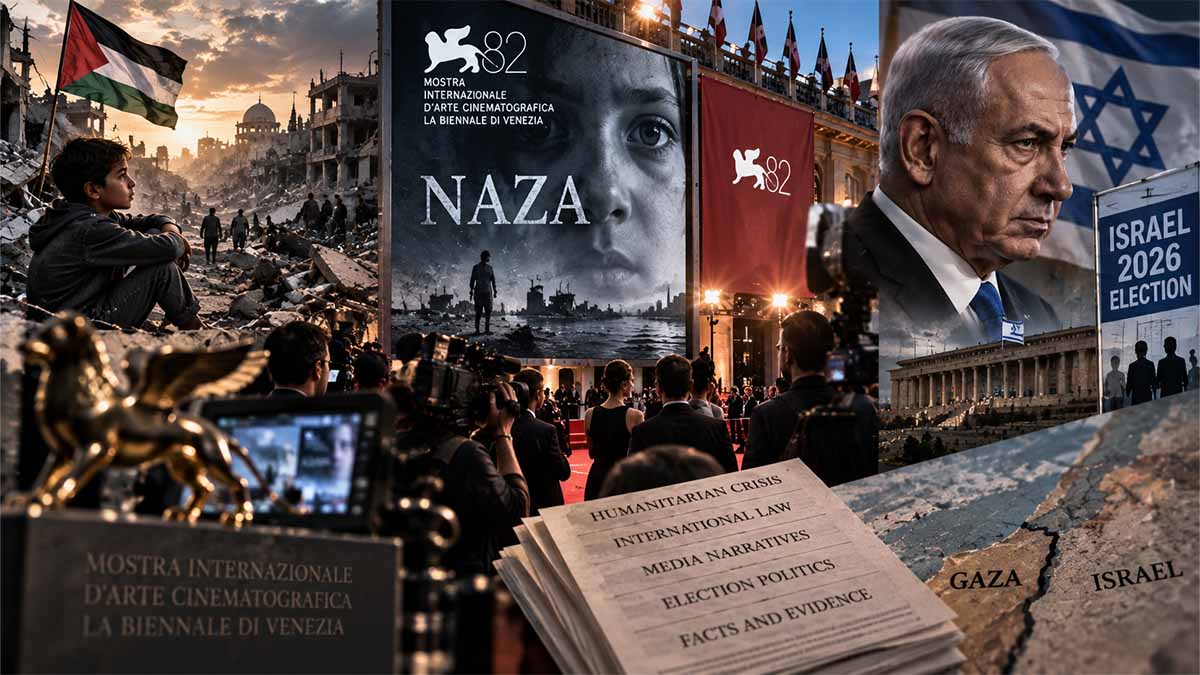
Scope: This assessment examines NAZA, its Venice 2026 launch and associated promotional journalism against the public record on the 7 October 2023 massacre, Hamas’s military architecture and coercive governance, Israeli targeting and civilian-warning practices, projectile volumes, the documentary’s evidentiary method, its production and distribution network, and its timing within Israel’s 2026 election cycle; where the public record supports only an inference rather than an established fact, that distinction is maintained.
Executive Summary / BLUF
NAZA entered the public arena with an unusually categorical thesis already embedded in its official institutional description, because La Biennale states that the film reveals “the systems behind Israel’s calculated mass killing of Palestinian civilians in Gaza,” while the directors state that their purpose was to examine “the systems behind the mass killing of Palestinian civilians for which our country is responsible.” The same official Venice page identifies The Guardian and JW Films as producers and mk2 as world-sales agent, while Film at Lincoln Center repeats that NAZA is produced by The Guardian and James Wilson, executive-produced by Jonathan Glazer, and built on reporting previously published by +972 Magazine, Local Call and The Guardian. NAZA — La Biennale di Venezia — Sep 2026 NAZA — Film at Lincoln Center / 64th New York Film Festival — 2026
The documentary therefore does not arrive as a neutral evidentiary repository from which a conclusion is later drawn, but as an investigative and advocacy work whose official synopsis supplies the interpretive conclusion before the audience evaluates the underlying testimony. The Guardian’s launch article states that the film relies on testimony from 24 Israeli military insiders, including intelligence officers and soldiers, and presents allegations involving surveillance, home targeting, civilian-presence estimates, neighbourhood destruction, burning of houses and killings at a food-distribution site; the directors expressly say the subject is not isolated misconduct by rogue soldiers but “the orders themselves, the policies, the accepted practices, the language and logic.” Secret systems used by Israel in mass killings of Gaza civilians revealed in new film — The Guardian — 10 Sep 2026
That testimony is potentially important, but anonymity and source-protection cannot substitute for corroboration, because public viewers cannot independently establish the witnesses’ ranks, periods of service, access to command decisions, relationship to specific targeting cells, whether an asserted practice was theatre-wide or local, whether contrary testimony existed, or whether the described numerical thresholds came from binding directives, informal guidance, algorithmic outputs or retrospective recollection. The filmmakers’ decision to protect confidential sources is normal investigative practice and is not itself a reason to discount them; however, the same protection necessarily limits independent verification, which means the testimony must be weighed against operational orders, targeting records, warning logs, munition selection, battle-damage assessment, Hamas dispositions and other contemporaneous material rather than treated as self-authenticating proof. The official Venice statement itself confirms that many of the film’s revelations emerged from the same reporting partnership involving The Guardian, +972 Magazine and Local Call, making source independence and cross-corroboration especially important. NAZA — La Biennale di Venezia — Sep 2026
Any interpretation of the Gaza war that functionally begins after Israel commenced its military response is analytically incomplete, because the UN Independent International Commission of Inquiry found that the 7 October 2023 attack was coordinated and premeditated, deliberately targeted civilian communities and involved Hamas, other Palestinian armed groups and participating Palestinian civilians, while a later Commission report records that 251 people, including 226 civilians and 25 members of the Israeli security forces, were abducted and taken to Gaza. The Commission found reasonable grounds for murder, wilful killing, torture, inhuman or cruel treatment, outrages upon personal dignity and hostage-taking committed by members of Hamas and other Palestinian armed groups. More than a human can bear: Israel’s systematic use of sexual, reproductive and other forms of gender-based violence since 7 October 2023 — Independent International Commission of Inquiry / United Nations — 10 Jun 2024 Treatment of detainees and hostages and attacks on medical facilities — Independent International Commission of Inquiry / United Nations — Sep 2024
Before 7 October 2023, Israel had progressively expanded work access for residents of Gaza, allowing tens of thousands of Gazans to enter Israel for employment, while the total number of Palestinians working in Israel from Gaza and the West Bank together was far higher. That policy rested on an assumption that greater economic access and routine civilian contact could contribute to stability rather than facilitate attack preparation. The events of 7 October exposed the security risk inherent in that assumption: Israeli investigations and subsequent reporting have examined cases in which Gazans with prior access to Israeli communities were alleged to have supplied Hamas with information about local geography, access routes, civilian routines and potential targets. What the public record does not establish is that Gaza workers as a class participated in reconnaissance or attack planning, and such a collective accusation should therefore be avoided. The defensible conclusion is narrower but still consequential: pre-war labour access created opportunities for familiarity with Israeli communities, and that familiarity became a legitimate counter-intelligence concern after Hamas demonstrated detailed knowledge of border communities during the massacre. Any claim that specific workers conducted reconnaissance should be tied to an identified investigation, indictment, interrogation record or other verifiable evidence rather than generalised to the entire Gaza labour population.
The public record does establish that Israel maintained extensive warning and evacuation mechanisms before and during major operations in Gaza, including direct telephone calls, leaflets, text messages, recorded voice messages and geographically delineated evacuation instructions. The IDF reported that by 31 March 2024 it had placed approximately 100,000 evacuation calls, dropped about 9.3 million leaflets, sent approximately 15.5 million evacuation text messages and transmitted approximately 17 million recorded messages. Those figures are an Israeli military assertion and therefore require attribution rather than automatic acceptance as independently verified fact, but the existence of warning systems themselves is not reasonably disputable. Data Regarding Evacuation of Civilian Population Within Gaza — Israel Defense Forces — 6 Apr 2024
The opposing proposition that the warning system proves every Israeli strike lawful is equally unsupported, because international humanitarian law evaluates distinction, anticipated civilian harm, military advantage and feasible precautions at the level of particular attacks rather than by aggregate warning statistics alone. The defensible evidentiary conclusion is narrower but consequential: a claim that Israeli operational doctrine simply dispensed with civilian warning is inconsistent with the documented warning architecture, while allegations that particular warnings were inadequate, impossible to act upon or followed by attacks elsewhere require strike-specific examination rather than slogan-level resolution.
The threat faced by Israel after 7 October was also measured in thousands of projectiles rather than hundreds, with the IDF reporting approximately 9,100 launches from Gaza crossing into Israeli territory by 2 April 2024, alongside additional launches from Lebanon and Syria. A subsequent UN human-rights report records the Israeli military’s figure of more than 13,200 projectiles fired from Gaza between 7 October 2023 and 7 October 2024, while treating it as an Israeli military report rather than an independently generated UN count. How Many Rockets Were Fired at Israel Since Oct 7? — Israel Defense Forces — 6 Apr 2024 Human rights situation in the Occupied Palestinian Territory, including East Jerusalem, and the obligation to ensure accountability and justice — OHCHR / United Nations — Feb 2025
The documentary’s central moral inference must therefore be tested against a war in which Israel was attacked by an organised armed movement that had constructed a large underground and rocket infrastructure within one of the world’s most densely inhabited theatres, rather than against an abstract model of state violence against a demilitarised population. The IDF states that it found weapons factories, launch sites, storage facilities, tunnel shafts and a tunnel system extending for hundreds of kilometres, including underground weapons-manufacturing installations in central Gaza; those are belligerent-source claims and must be identified as such, although repeated physical findings during operations establish beyond reasonable dispute that Hamas possessed a substantial tunnel-and-weapons architecture distributed through civilian areas. Hamas’ Underground Weapons Manufacturing Industry Exposed in Central Gaza — Israel Defense Forces — 18 Jan 2024
Hamas’s coercive relationship with Gazans is also documented by sources independent of Israel, because OHCHR reported in July 2026 that summary executions were part of a continuing pattern of unlawful killings in Gaza and referred to allegations of torture, ill-treatment and threats against people associated with dissent and anti-Hamas activity; during the Human Rights Council’s 62nd session, states also cited Commission findings of at least 249 cases of execution, torture and violence by Hamas and other groups in Gaza against Palestinians. These records do not justify treating Gaza’s civilian population collectively as combatants, but they directly contradict an image of Hamas as merely an external military actor detached from internal repression and territorial coercion. OHCHR: Summary execution continues a pattern of unlawful killings in Gaza — United Nations Human Rights Office in the Occupied Palestinian Territory — 3 Jul 2026 3rd Meeting, 62nd Session of the Human Rights Council — United Nations — 2026
The strongest defensible conclusion on civilian participation is likewise more precise than either polemical extreme, because the UN Commission found that some Palestinian civilians participated directly in the 7 October attack, while international humanitarian law does not permit the resulting conduct to be imputed automatically to Gaza’s entire population. More than a human can bear — Independent International Commission of Inquiry / United Nations — 10 Jun 2024 The record therefore supports the proposition that Hamas operated within, recruited from and in some cases received direct participation from the civilian environment, but it does not support converting that fact into a blanket presumption that all Gazans, all households or all persons remaining in combat zones were combatants.
The timing of NAZA is politically material even though deliberate electoral coordination is not established. Israel’s Ministry of Interior states that elections to the Twenty-Sixth Knesset are scheduled for 27 October 2026, and the Knesset’s own legislative record shows that in June the dissolution bill contemplated an election window between 8 September and 20 October before the statutory 27 October date was retained; the film premiered at Venice on 10 September 2026, placing its international launch squarely inside the Israeli election campaign. Election Information | Polling Station Locator — Ministry of Interior, State of Israel — Sep 2026 Bill for dissolution of the Twenty-Fifth Knesset approved in first reading — The Knesset — 2 Jun 2026 NAZA — La Biennale di Venezia — Sep 2026
That chronology makes electoral effect a legitimate analytical concern, especially because the launch is reinforced by Venice competition status, Guardian production and editorial amplification, mk2 international sales and a North American premiere at the New York Film Festival, but the public record reviewed here does not establish the stronger proposition that the film was commissioned, financed, edited or scheduled pursuant to a coordinated plan to alter Israeli voting behaviour. NAZA — Film at Lincoln Center / 64th New York Film Festival — 2026 The correct institutional formulation is therefore that NAZA is a politically consequential intervention released during an active electoral contest, while a deliberate election-influence operation remains an inference requiring evidence of coordination, targeting, financing or scheduling intent that is not presently public.
NAZA and the Politics of Causality: When a Documentary Becomes Part of an Election
NAZA enters Israel’s 2026 election campaign with a proposition far stronger than the evidence publicly released to support it: that Israeli targeting systems reveal a policy of calculated mass civilian killing rather than a military campaign whose legality must be judged strike by strike. Premiered at Venice on 10 September 2026, seven weeks before Israel’s 27 October 2026 election, the film combines 24 anonymous military witnesses, earlier investigations by +972 Magazine, Local Call and The Guardian, Jonathan Glazer’s Zone of Interest cultural vocabulary and an international festival-distribution network. NAZA — La Biennale di Venezia — Sep 2026 Its political importance therefore lies not in proving a covert electoral operation, for which the dossier contains no evidence, but in converting disputed operational testimony into a transnational narrative about the purpose of Israel’s war precisely when Israeli voters are judging that war.
The film begins where its conclusion needs the war to begin
The documentary’s strongest argument depends on placing Israeli target-generation practices at the centre of the causal chain while reducing the military system confronting Israel to background, even though the UN Independent International Commission of Inquiry found that the 7 October 2023 attack was coordinated, premeditated, directed extensively against civilians and conducted by Hamas, six other Palestinian armed factions and some participating Palestinian civilians. Report of the Independent International Commission of Inquiry — United Nations — 27 May 2024 A later UN Commission report recorded 251 people abducted into Gaza, including 226 civilians and 25 Israeli security personnel, meaning the Israeli campaign developed not after a completed historical atrocity but while hostages remained inside territory controlled by the organisation responsible for the attack. Treatment of detainees and hostages and attacks on medical facilities and personnel — United Nations — 11 Sep 2024
That distinction becomes operational rather than rhetorical when the continuing threat is measured: the Israel Defense Forces reported approximately 9,100 Gaza-origin launches crossing into Israel by 2 April 2024, while a subsequent OHCHR report reproduced the Israeli military figure of more than 13,200 projectiles from Gaza during the first year after 7 October. How Many Rockets Were Fired at Israel Since Oct 7? — Israel Defense Forces — 6 Apr 2024 Human rights situation in the Occupied Palestinian Territory — OHCHR — Feb 2025 A targeting system created to locate commanders, launch sites, tunnels, weapons stores and communications nodes in that environment can still produce unlawful attacks, but its existence cannot itself prove that civilians were the intended object.
Hamas’s military geography explains why civilian and military space overlapped
Israeli forces reported uncovering weapons-production sites, tunnel shafts, rocket-manufacturing equipment and underground routes in central Gaza during January 2024, including infrastructure around Maghazi, Nuseirat and Bureij, while another Khan Yunis operation documented a tunnel approximately 1.5 kilometres long beside two schools together with an underground rocket-production facility. Hamas’ Underground Weapons Manufacturing Industry Exposed in Central Gaza — Israel Defense Forces — 18 Jan 2024 A terrorist tunnel spanning one and a half kilometers and a rocket manufacturing facility — Israel Defense Forces — 23 Jan 2024
Independent UN evidence matters because these claims would otherwise rest disproportionately on a belligerent source: the UN Secretary-General’s 3 June 2024 Children and Armed Conflict report verified military use of a health centre by Hamas’s Izz al-Din al-Qassam Brigades and recorded military use of a school by Hamas and other Palestinian armed groups, while the UN Commission later independently verified Hamas fighters placing explosive devices inside the Anas Bin-Malik school in Gaza City and preparing an ambush. Children and armed conflict — Report of the Secretary-General — United Nations — 3 Jun 2024 Report of the Independent International Commission of Inquiry — United Nations — 2025 The result is not collective liability for Gaza’s population, but an operational environment in which military infrastructure and civilian geography repeatedly intersected.
The AI allegation is serious, but the missing denominator matters more than the headline
NAZA relies on 24 anonymous Israeli military insiders, while earlier investigations associated with Yuval Abraham reported an AI-assisted system that allegedly identified roughly 37,000 Palestinians as potential Hamas or Palestinian Islamic Jihad targets. ‘The machine did it coldly’: Israel used AI to identify 37,000 Hamas targets — The Guardian — 3 Apr 2024 The film’s promotional cycle adds claims concerning a roughly 15 per cent error rate, high anticipated civilian-casualty values and residential targeting, yet the dossier contains no published system specification establishing whether 15 per cent denotes false positives, geolocation error, classification uncertainty, validation failure or another metric, and no authenticated directive showing that machine output itself constituted weapon-release authority.
That distinction determines whether the technology demonstrates automation of intelligence or automation of lethal decisions, because a system that generates candidate targets for subsequent human validation is institutionally different from one whose classifications directly authorise attacks; similarly, a target bank containing tens of thousands of candidates says nothing by itself about how many were rejected, deferred, revalidated or struck. The missing operational denominator is therefore decisive: without cancellation data, verification thresholds, target-class rules and approval records, quantity of generated targets cannot be converted into quantity of attacks or proof of indiscriminate targeting.
Collateral-damage estimates can expose illegality, but they also exist because the law requires anticipation of harm
The documentary’s title converts “NAZA”, presented by festival material as an anticipated civilian-casualty estimate, into the organising metaphor for Israeli targeting, yet international humanitarian law requires commanders to estimate expected civilian harm before attack and prohibit strikes where that harm would be excessive relative to the concrete and direct military advantage anticipated. NAZA — Film at Lincoln Center / 64th New York Film Festival — 2026 Customary IHL Rule 14: Proportionality in Attack — International Committee of the Red Cross The existence of a numerical collateral estimate is therefore not evidence of criminal intent; the potentially incriminating evidence would be an authorised threshold that was knowingly excessive, systematically inaccurate or detached from the military value of the target.
The same evidentiary distinction governs strikes on family homes, because the presence of a targetable member of an organised armed group inside a residence does not make the family a lawful target, while neither does civilian presence automatically immunise a military objective from attack; proportionality depends on expected civilian harm, military advantage, feasible alternatives and weapon selection. The film can therefore establish a systemic violation only if its anonymous testimony is connected to target files, command directives or strike records demonstrating that civilian families were intentionally selected or that civilian losses were routinely authorised without legally sufficient military justification.
Israel’s warning architecture is difficult to reconcile with the simplest annihilation thesis
By 31 March 2024, the IDF reported approximately 100,000 evacuation calls, 9.3 million leaflets, 15.5 million text messages and 17 million recorded voice messages directed toward civilians in Gaza. Data Regarding Evacuation of Civilian Population Within Gaza — Israel Defense Forces — 6 Apr 2024 Those figures originate with the Israeli military and do not establish that every warning was effective or every subsequent strike lawful, but they document an institutional apparatus whose function was to remove civilians from combat areas, consuming time, intelligence resources and tactical surprise in the process.
That evidence matters against the strongest version of NAZA’s implied thesis: a state may operate a warning system and still commit disproportionate or unlawful attacks, yet a system designed principally to maximise civilian deaths would have to be reconciled with millions of warning communications designed to reduce exposure before combat. The legally serious inquiry is therefore strike-specific—whether warnings were timely, feasible and followed by proportional conduct—not whether the warning architecture existed.
The film’s institutional ecosystem magnifies testimony into a political narrative
La Biennale describes NAZA as revealing the systems behind Israel’s “calculated mass killing” of Palestinian civilians, identifies The Guardian and JW Films as producers and mk2 as world-sales agent, while Film at Lincoln Center highlights Jonathan Glazer as executive producer and explicitly connects the documentary to prior reporting by +972 Magazine, Local Call and The Guardian. NAZA — La Biennale di Venezia — Sep 2026 NAZA — Film at Lincoln Center / 64th New York Film Festival — 2026 The institutional structure therefore joins investigation, production, publication, festival validation and international sales within a single reinforcing narrative chain.
Jonathan Glazer’s role gives that chain a further historical vocabulary because, in his March 2024 Academy Award speech for The Zone of Interest, he connected his Auschwitz-centred film’s concern with dehumanisation to both the victims of 7 October and the attack on Gaza, while NAZA’s directors subsequently described Glazer as advising on the film’s structure and creative approach. Jonathan Glazer calls for end to ‘dehumanising’ of victims in Gaza and Israel — The Guardian — 11 Mar 2024 ‘They know the house they are bombing is full of children’: NAZA’s directors on their devastating film about Israeli intelligence — The Guardian — 11 Sep 2026 The result is not proof that the film literally equates Israel with Nazi Germany, but it places Gaza inside a cinematic grammar developed around bureaucratic distance from Auschwitz, making Holocaust inversion a legitimate analytical concern where the analogy outruns the evidence of exterminatory intent.
Venice made the film electorally consequential without proving electoral coordination
Israel’s Ministry of Interior states that elections for the Twenty-Sixth Knesset will be held on 27 October 2026, while the Knesset’s 2 June 2026 dissolution bill had initially contemplated an election between 8 September and 20 October before the statutory 27 October date remained operative. Election Information | Polling Station Locator — Ministry of Interior, State of Israel — Sep 2026 Bill for dissolution of the Twenty-Fifth Knesset approved in first reading — The Knesset — 2 Jun 2026 NAZA premiered at Venice on 10 September 2026, was accompanied immediately by Guardian reporting and Screen Daily interviews, and then moved into the New York Film Festival circuit before Israeli voters went to the polls. NAZA — La Biennale di Venezia — Sep 2026
The temporal overlap establishes political effect, not political conspiracy: producer James Wilson told Screen Daily on 10 September 2026 that the film had been added late to Venice because the production required additional time to complete source anonymisation, providing a documented non-electoral explanation for the late announcement. ‘NAZA’ producers talk protecting whistleblowers, journalism as cinema at Venice film festival — Screen Daily — 10 Sep 2026 What remains unproven is any production memorandum, financing condition, campaign contact or voter-targeting plan tying the release deliberately to the Israeli election; what is already established is that a film accusing Israeli institutions of calculated mass civilian killing was launched through one of the world’s most prestigious cultural platforms during an active national campaign.
The next 12–24 months will test whether the film survives its own evidentiary standard
Between late 2026 and 2028, the decisive question will be whether NAZA’s anonymous allegations are converted into authenticated military records, strike files, collateral-damage directives, system specifications or command communications capable of proving that Israeli target-generation mechanisms were systematically transformed into an unlawfully permissive or exterminatory policy; without that documentation, the film will remain politically powerful but evidentially dependent on protected testimony whose scope and representativeness cannot be independently audited.
The cost of failing to preserve these distinctions will be borne first by Israeli democratic debate, because a 27 October 2026 election conducted under the pressure of claims framed through Venice, The Guardian, mk2 and the Zone of Interest cultural register risks converting unresolved operational allegations into judgments about state purpose before the underlying military record is available; it will also be borne by international legal and diplomatic institutions if the categories of unlawful strike, disproportionate attack, systematic targeting failure and exterminatory intent are collapsed into one another. The documentary may ultimately prove serious institutional wrongdoing, but the dossier presently supports a narrower judgment: NAZA has already demonstrated the ability to shape the political interpretation of the war more conclusively than it has demonstrated the intent it attributes to the Israeli state.
Navigational Index
The war before the documentary’s frame
The first pillar establishes the 7 October baseline, the organised military threat, Hamas’s tunnel and rocket infrastructure, civilian participation where proven, coercive governance and the distinction between documented militant embedding and impermissible population-wide attribution.
The documentary’s evidence and the operational record
The second pillar tests anonymous testimony, “NAZA” collateral-damage claims, AI-assisted targeting, family-home allegations, mapping, civilian warnings, strike precautions and the evidentiary difference between proof of unlawful attacks and proof of an exterminatory state policy.
Narrative construction, historical analogy and electoral timing
The third pillar examines the film’s institutional ecosystem, festival and sales strategy, Guardian / +972 / Local Call continuity, Jonathan Glazer’s documented political positioning, the use of The Zone of Interest as a cultural frame, and the timing of the Venice launch during Israel’s 2026 election campaign.
Master Abstract
The film’s thesis is declared before its evidence is independently testable
The official Venice synopsis does not describe NAZA as an inquiry into whether Israeli systems produced unlawful civilian harm; it says the film “reveals in detail the systems behind Israel’s calculated mass killing of Palestinian civilians in Gaza,” while the directors state that they spent three years examining systems “behind the mass killing of Palestinian civilians for which our country is responsible.” NAZA — La Biennale di Venezia — Sep 2026 Film at Lincoln Center similarly describes the documentary as revealing systems behind Israel’s bombing and “mass killing” of Palestinian civilians, identifies its title as an alleged military acronym for expected civilian deaths in an airstrike, and explicitly links the project to earlier reporting by +972 Magazine, Local Call and The Guardian. NAZA — Film at Lincoln Center / 64th New York Film Festival — 2026
Geoffrey Macnab’s 10 September Screen Daily article functions as part of that promotional architecture rather than as independent proof of the film’s allegations, because it presents the project as a documentary that “bears witness to the targeted killing of Palestinian civilians in Gaza” while interviewing the directors themselves about its construction and purpose. Israeli directors Yuval Abraham and Rachel Szor on their new documentary ‘NAZA’ — Screen Daily — 10 Sep 2026 The Guardian, simultaneously a producer and major publisher of the underlying investigations, published launch coverage stating that 24 Israeli military insiders describe “secret systems” used in the war and that the film concerns policy rather than isolated war crimes. Secret systems used by Israel in mass killings of Gaza civilians revealed in new film — The Guardian — 10 Sep 2026
This does not make the testimony false, because investigative journalism routinely depends on protected sources whose exposure would carry professional or personal risk, but it does create a methodological asymmetry: the audience receives a highly specific causal interpretation while being unable to inspect the identities, access, documentary basis or representativeness of the witnesses from the public materials. A government-grade assessment must therefore distinguish testimony that warrants investigation from evidence that independently establishes a theatre-wide policy, and it must ask whether each allegation is corroborated by orders, strike records, contemporaneous communications, collateral-damage methodology, target folders or forensic battle-damage evidence.
The 7 October massacre is the indispensable operational baseline
The UN Commission of Inquiry found that the 7 October attack was coordinated, premeditated and directed extensively against civilian communities, and it found reasonable grounds to conclude that Hamas and other Palestinian armed groups committed murder, wilful killing, torture, cruel treatment, outrages upon personal dignity and hostage-taking. The same evidentiary record identifies participation by Palestinian civilians in elements of the assault, which is directly relevant to any later claim that Israeli references to civilian participation were simply invented as a psychological justification for indiscriminate warfare. More than a human can bear — Independent International Commission of Inquiry / United Nations — 10 Jun 2024
A subsequent UN Commission report records that 251 people were abducted from Israel into Gaza, including 226 civilians and 25 members of the Israeli security forces. Treatment of detainees and hostages and attacks on medical facilities — Independent International Commission of Inquiry / United Nations — Sep 2024 This record is incompatible with any narrative structure that treats 7 October as merely a contextual trigger before turning immediately to Israeli conduct, because the attack defined the operational objectives subsequently declared by Israel: dismantling Hamas’s military and governing capability, stopping continuing attacks and recovering hostages.
The massacre does not, as a matter of law, extinguish Israeli obligations under international humanitarian law; however, neither can those obligations be analysed intelligently by erasing the enemy force, the hostages, the ongoing projectile campaign or the density of the military infrastructure from the proportionality and precaution environment in which Israeli commanders operated.
Gaza labour access was part of a stabilisation policy whose security assumptions were shattered on 7 October
Before 7 October 2023, Israel had progressively expanded employment access for residents of Gaza, allowing tens of thousands of Gazans to enter Israel for work, while the much larger figure approaching 180,000 referred to Palestinian workers from Gaza and the West Bank taken together rather than to Gaza residents alone. Preserving that distinction is essential in a certified assessment, because overstating the Gaza-specific number would unnecessarily weaken a broader and well-founded point: Israel maintained a substantial system of economic access and daily interaction with Palestinians even while Hamas governed Gaza, reflecting a policy assumption that employment, income and controlled mobility could contribute to stability and reduce incentives for conflict.
The significance of that policy changed fundamentally after 7 October. Hamas and the other forces that attacked Israel displayed detailed knowledge of border communities, access routes, civilian locations, security arrangements and local geography, while the UN Commission of Inquiry established that the assault was coordinated and premeditated and that some Palestinian civilians participated directly in it. More than a human can bear — Independent International Commission of Inquiry / United Nations — 10 Jun 2024 That operational familiarity created an unavoidable post-attack counter-intelligence question concerning whether information gathered through routine civilian access, employment relationships, commercial contact or other forms of familiarity with Israeli communities was exploited by Hamas in preparing the assault.
The responsible analytical conclusion is therefore not that the Gazan workforce as a whole conducted reconnaissance or participated in the massacre, because the public record does not establish collective involvement and such a claim would require individualised evidence. The stronger and more defensible conclusion is that Israel’s pre-war labour-access policy created extensive civilian familiarity with Israeli communities at the same time that Hamas was preparing a highly detailed assault, and the sophistication of the 7 October reconnaissance demonstrated that information about Israeli settlements, routines and vulnerabilities had been collected and operationalised by the attacking force. Where specific workers, permit holders or civilians are alleged to have provided targeting information, those claims should be tied to identified investigations, indictments, interrogation records or other independently verifiable evidence rather than extrapolated to the entire Gaza labour population.
This distinction matters directly to the documentary’s broader narrative, because the existence of substantial pre-war labour access is difficult to reconcile with a claim that Israeli policy toward Gaza had already been organised around a settled intention to destroy its civilian population. It instead demonstrates that, immediately before the massacre, Israeli policy still included mechanisms designed to expand economic interaction and controlled civilian access, even though the security assumptions underlying that approach proved catastrophically inadequate once Hamas’s preparations and operational intelligence became visible on 7 October.
Hamas built a military system inside the civilian environment
The IDF states that its operations uncovered a weapons-manufacturing system in central Gaza comprising above- and below-ground factories, lathes, tunnel shafts and routes used to manufacture and move rockets and other weapons, including a tunnel network it described as extending for hundreds of kilometres. Hamas’ Underground Weapons Manufacturing Industry Exposed in Central Gaza — Israel Defense Forces — 18 Jan 2024 Later IDF summaries describe hundreds of kilometres of tunnels and thousands of tunnel entrances across Gaza, many within or beneath civilian infrastructure; these are operational claims from a belligerent and must be treated as attributed rather than independent statistics, but the physical existence of an extensive tunnel network and weapons architecture is not seriously contestable. Israel-Hamas War: Gaza — Israel Defense Forces — accessed Sep 2026
The resource-diversion argument must nevertheless be phrased with precision. The available record strongly supports the proposition that Hamas devoted major engineering, financial and material resources to tunnels, rockets, weapons manufacture and command infrastructure over many years; it does not permit a responsible analyst simply to convert every dollar of international aid entering Gaza into a dollar received and diverted by Hamas. A certified report should therefore distinguish international assistance to Gaza, Hamas taxation and governance revenue, reconstruction materials, external support to Hamas and documented military infrastructure rather than collapsing all of them into one unverified aggregate.
The 2017 Hamas political document also remains relevant to ideological intent, because it identifies the movement’s goal as the liberation of Palestine and confrontation of the Zionist project while maintaining armed “resistance” as a strategic means; although the 2017 text removed important antisemitic language found in the 1988 covenant, it did not recognise Israel or abandon armed struggle. A reproduction and analysis of the original Hamas document, including links to the Arabic and English versions then hosted by Hamas, is available in the Israeli Intelligence and Terrorism Information Center’s documentary record. The goals and significance of Hamas’s new political document — Intelligence and Terrorism Information Center — 8 May 2017
Civilian participation existed, but collective guilt is analytically and legally unsustainable
The public record establishes that some Palestinian civilians participated directly in the 7 October assault, which means the documentary or its publicity should not present all references to civilian participation as an Israeli fantasy or as proof that Israel simply redefined an entire people as legitimate targets. More than a human can bear — Independent International Commission of Inquiry / United Nations — 10 Jun 2024
The inverse proposition is equally important: civilian participation by some persons does not turn Gaza’s population into an undifferentiated military body, because civilian protection is determined by status and conduct rather than collective political identity. A strong rebuttal of NAZA therefore does not need to claim that “there are no civilians in Gaza”; it needs to show that the operational environment contained a spectrum ranging from uninvolved civilians to Hamas political personnel, logistics supporters, armed fighters, tunnel operators, launch crews, intelligence collectors and civilians who directly participated in hostilities, making targeting analysis necessarily more complex than the film’s promotional binary suggests.
Hamas’s coercive rule over Gazans is independently documented
OHCHR reported in July 2026 that a summary execution continued a pattern of unlawful killings in Gaza and described allegations involving pro-Hamas security actors, threats against dissent, torture and ill-treatment. OHCHR: Summary execution continues a pattern of unlawful killings in Gaza — United Nations Human Rights Office in the Occupied Palestinian Territory — 3 Jul 2026 During the Human Rights Council’s 62nd session, delegations referred to Commission findings of at least 249 cases of execution, torture and violence by Hamas and other groups against Palestinians in Gaza, demonstrating that internal coercion is part of the documented conflict environment rather than an Israeli public-relations invention. 3rd Meeting, 62nd Session of the Human Rights Council — United Nations — 2026
The strongest evidentiary formulation is therefore that Hamas has exercised authoritarian territorial control and has used violence, intimidation and punishment against Palestinian opponents, suspected collaborators and dissenters. Describing this relationship metaphorically as the “enslavement” of Gaza may communicate the political reality of coercive domination, but an institutional report is stronger when it specifies the documented conduct: execution, torture, detention, intimidation, suppression of dissent, weapons control and coercive territorial authority.
Claims regarding humanitarian-aid seizure require the same discipline, because armed looting and diversion risks have been documented but responsibility has not been established for every incident, and it would be inaccurate to state that every stolen convoy or black-market diversion was proven to have been organised by Hamas. The appropriate analytical conclusion is that Gaza’s aid environment has been exposed to armed seizure, coercive control and diversion risk in a territory where Hamas and other armed actors exercised substantial coercive capacity, while incident-level attribution must remain tied to evidence.
Israeli warning procedures directly contradict a blanket “no-warning” thesis
By 31 March 2024, the IDF reported approximately 100,000 evacuation telephone calls, 9.3 million evacuation leaflets, 15.5 million text messages and 17 million recorded voice messages, describing these measures as precautions intended to move civilians away from intense combat. Data Regarding Evacuation of Civilian Population Within Gaza — Israel Defense Forces — 6 Apr 2024 These figures come from the IDF and are therefore properly treated as an official military assertion, but they document an institutional warning apparatus involving multiple communication channels rather than isolated improvisation.
Consequently, any claim that Israel’s established practice was simply to strike Hamas infrastructure without attempting to warn civilians is contradicted by the official operational record. The more difficult question is whether a particular warning was sufficiently specific, timely and practicable and whether civilians had a genuinely safer destination, which requires incident-level evidence and cannot be answered either by aggregate warning totals or by a documentary witness describing a different strike.
The same distinction applies to the historical “roof-knocking” practice, which has been used by Israel in earlier Gaza conflicts as a warning technique but is not demonstrated by the retrieved 2024 aggregate dataset as a universal procedure during the present war; accordingly, this assessment does not inflate historical practice into a claim that every 2023–26 strike was preceded by roof-knocking.
Thousands of rockets materially alter the operational frame
The IDF recorded approximately 9,100 launches from Gaza that crossed into Israel by 2 April 2024, while later UN reporting reproduced the Israeli military figure of more than 13,200 projectiles fired from Gaza during the first year of the war. How Many Rockets Were Fired at Israel Since Oct 7? — Israel Defense Forces — 6 Apr 2024 Human rights situation in the Occupied Palestinian Territory, including East Jerusalem, and the obligation to ensure accountability and justice — OHCHR / United Nations — Feb 2025
This scale matters because the laws and operational logic of armed conflict do not analyse Israeli targeting in a vacuum; commanders were confronting an enemy that continued to launch projectiles, held hostages, operated a large subterranean system and maintained command, production, storage and launch nodes within urban terrain. None of those facts legalises an attack in which expected civilian harm would be excessive relative to the concrete and direct military advantage anticipated, but they are indispensable inputs to any serious analysis of why Israel mapped targets, generated large target banks and used intelligence systems to locate commanders, launch sites, tunnels and weapons stores.
Mapping military infrastructure is not evidence of family-assassination policy
Every competent military intelligence service maps adversary command nodes, communications, launch sites, weapons storage, tunnel entrances, logistical networks and patterns of movement; the existence of such mapping is therefore evidence of intelligence preparation of the battlespace, not by itself evidence of a criminal programme to kill families. The film’s stronger allegations concern how those maps and databases were used, what civilian-casualty thresholds were accepted and whether homes were selected because combatants were present or because families themselves were treated as part of the target.
Those questions require target folders, operational directives and strike-level evidence. A statement that a system produced “quantity of targets,” relied on AI assistance or included a predicted civilian-casualty number cannot establish genocidal intent unless the evidence also establishes the decision rule applied to that information, the target’s expected military value, the authorised civilian-harm threshold, the availability of alternative means and the commander’s purpose.
The distinction is central because modern collateral-damage methodology exists precisely to estimate civilian harm before an attack; the presence of a predicted civilian-harm value can therefore be evidence that civilian harm was considered rather than proof that civilian death was the object of the strike. The potentially incriminating issue is not the existence of a collateral estimate but whether the authorised estimate was unlawful, grossly disproportionate, knowingly false or used to legitimise attacks against persons who were not lawful military objectives.
The “15 per cent error” and high-NAZA allegations require the underlying directive
The film’s publicity reports allegations that AI-assisted systems could operate with substantial error and that very high civilian casualty expectations were authorised for particular targets, while Guardian and other promotional coverage presents these claims as evidence of systemic policy. Secret systems used by Israel in mass killings of Gaza civilians revealed in new film — The Guardian — 10 Sep 2026 NAZA review — The Guardian — 10 Sep 2026
For evidentiary purposes, however, a percentage attributed to an anonymous witness is not equivalent to a published targeting directive, and the public material reviewed here does not establish which system produced the figure, what “error” meant technically, which target class was involved, whether the value described identification confidence or another metric, whether a human analyst was required to review the output, or for what period the alleged practice applied. Until those variables are documented, the film’s numerical allegations remain serious testimony requiring corroboration rather than settled proof of an exterminatory policy.
Israel’s demonstrated strategic strike capacity does not resemble indiscriminate annihilation doctrine
Israel demonstrated substantially greater long-range airpower against Iran in June 2025, when the IDF stated that approximately 200 fighter aircraft dropped more than 330 munitions against more than 100 targets during the opening phase of Operation Rising Lion. Press Briefing by IDF Spokesperson BG Effie Defrin — Israel Defense Forces — 13 Jun 2025
This comparison establishes a relevant capability fact: Israel possessed the means to deliver large volumes of precision-guided ordnance at strategic depth against a technologically sophisticated state adversary, meaning the proposition that Israel lacked means to cause far greater destruction in Gaza is implausible. It does not, however, logically prove that every Gaza strike was proportionate or that restraint can be inferred simply from the fact that even more destructive methods were available; the defensible conclusion is that available capability and observed employment patterns are inconsistent with the simplest version of a doctrine whose singular purpose was the fastest possible physical annihilation of Gaza’s population.
The Nazi analogy is historically loaded and analytically distinct from war-crimes allegations
Jonathan Glazer’s political positioning is a documented part of the project’s intellectual context because, when accepting the Academy Award for The Zone of Interest in March 2024, he connected a film centred on Auschwitz commandant Rudolf Höss and the normalisation of mass murder to contemporary Israel and Gaza, arguing that the film showed where dehumanisation leads and referring to “the victims of October 7 in Israel” and “the ongoing attack on Gaza.” Jonathan Glazer calls for end to ‘dehumanising’ of victims in Gaza and Israel — The Guardian / Academy Awards video — 11 Mar 2024 The Venice and NYFF materials then foreground Glazer’s role as NAZA executive producer and his previous collaboration with James Wilson on The Zone of Interest. NAZA — Film at Lincoln Center / 64th New York Film Festival — 2026
That continuity is documented; a clandestine agenda is not. The strongest defensible analytical judgment is that the project deliberately situates the Gaza war within a pre-existing cultural vocabulary of dehumanisation, bureaucratic violence and moral complicity associated with Glazer’s Auschwitz film, thereby creating an inevitable Holocaust referent even when NAZA does not formally declare Israel to be Nazi Germany.
A direct equivalence between Israeli military conduct and the Nazi extermination programme would nevertheless collapse categories that require separation. The Holocaust involved an explicit, racialised and bureaucratically organised project to eliminate European Jewry as a people, whereas the Gaza war emerged from an armed conflict initiated in its current phase by the 7 October massacre and has been publicly justified by Israel in terms of destroying Hamas’s military and governing capability and recovering hostages. Allegations of war crimes, disproportionate attacks, collective punishment or even genocide must be assessed under their own evidentiary and legal tests; they do not become historically equivalent to the Holocaust merely because a work of cinema imports Auschwitz-associated imagery or moral vocabulary.
For terminological precision, the stronger criticism is Holocaust inversion rather than literal Holocaust denial: inversion occurs when Nazi-perpetrator imagery and Holocaust categories are transferred onto Jews or Israel in a manner that reverses the historical roles of perpetrator and victim, whereas Holocaust denial ordinarily concerns denial or radical minimisation of the Nazi genocide itself. An institutional rebuttal should therefore reject an unsupported Nazi equivalence on historical and evidentiary grounds rather than relying on reciprocal moral invective.
The electoral timing is real; an electoral conspiracy is not yet proven
Israel’s Ministry of Interior currently states that the election for the Twenty-Sixth Knesset will be held on 27 October 2026, while the Knesset’s June dissolution legislation initially contemplated an election sometime between 8 September and 20 October before the statutory date of 27 October remained operative. Election Information | Polling Station Locator — Ministry of Interior, State of Israel — Sep 2026 Bill for dissolution of the Twenty-Fifth Knesset approved in first reading — The Knesset — 2 Jun 2026
NAZA premiered at Venice on 10 September 2026, with public and accredited screenings listed by La Biennale, and its North American premiere is scheduled during the New York Film Festival later in September; the Venice page identifies The Guardian and JW Films as producers and mk2 as international sales agent. NAZA — La Biennale di Venezia — Sep 2026 NAZA — Film at Lincoln Center / 64th New York Film Festival — 2026
The timing therefore places a film accusing Israeli institutions of calculated mass civilian killing directly into a highly sensitive electoral information environment roughly seven weeks before national voting, and the combination of festival prestige, international sales, newspaper production and transatlantic festival distribution creates obvious amplification potential. Those are observable indicators of information effect.
What the public record does not presently establish is information-operation direction: no verified production memorandum, financing condition, campaign communication, donor instruction, voter-targeting plan or scheduling record retrieved for this assessment demonstrates that the release date was chosen specifically to change Israeli electoral behaviour. A decision-grade assessment should therefore state that the release is electorally consequential by timing and content while maintaining the distinction between a political-cultural intervention and a coordinated election operation.
Key Evidence Table
| Indicator | Verified or attributed value/status | Reference date | Evidentiary meaning | Source |
|---|---|---|---|---|
| NAZA official thesis | Venice synopsis says the film reveals systems behind Israel’s “calculated mass killing” of Palestinian civilians | Sep 2026 | Establishes the film’s declared interpretive frame, not the truth of the allegation | NAZA — La Biennale di Venezia — Sep 2026 |
| Production and sales | The Guardian + JW Films; world sales by mk2; Glazer identified as executive producer in NYFF material | 2026 | Establishes institutional network and amplification structure | NAZA — Film at Lincoln Center — 2026 |
| Anonymous witnesses | 24 Israeli military insiders, including intelligence officers and soldiers | 10 Sep 2026 | Establishes scale of witness pool but not representativeness or independent verification | Secret systems used by Israel in mass killings of Gaza civilians revealed in new film — The Guardian — 10 Sep 2026 |
| 7 October character | Coordinated, premeditated attack directed extensively at civilians; Hamas, other armed groups and some Palestinian civilians participated | 7 Oct 2023 | Establishes the operational baseline the war followed | Independent International Commission of Inquiry — United Nations — 10 Jun 2024 |
| Hostages | 251 abducted, including 226 civilians and 25 Israeli security personnel | 7 Oct 2023 | Establishes scale and civilian composition of hostage-taking | Independent International Commission of Inquiry — United Nations — Sep 2024 |
| Gaza-origin rockets | Approximately 9,100 crossed into Israel by 2 Apr 2024, according to IDF | through 2 Apr 2024 | Establishes projectile threat at a scale of thousands | How Many Rockets Were Fired at Israel Since Oct 7? — IDF — 6 Apr 2024 |
| First-year Gaza projectile figure | More than 13,200 reported by Israeli military and reproduced by OHCHR | 7 Oct 2023–7 Oct 2024 | Corroborates continued projectile campaign while retaining attribution | OHCHR report — United Nations — Feb 2025 |
| Warning system | ~100,000 calls; 9.3m leaflets; 15.5m texts; 17m voice recordings, according to IDF | through 31 Mar 2024 | Contradicts a categorical assertion of no institutional warning architecture | Data Regarding Evacuation of Civilian Population Within Gaza — IDF — 6 Apr 2024 |
| Hamas underground arms infrastructure | Weapons factories, production areas and connected tunnel routes documented by IDF | Jan 2024 | Establishes belligerent-source evidence of extensive military embedding | Hamas’ Underground Weapons Manufacturing Industry Exposed in Central Gaza — IDF — 18 Jan 2024 |
| Hamas coercion against Gazans | Unlawful killing, execution, torture/ill-treatment and threats documented by OHCHR/UN processes | 2026 | Independently establishes internal coercive rule | OHCHR — United Nations — 3 Jul 2026 |
| Iran-strike capacity | 200 fighter aircraft, >330 munitions, >100 targets in opening phase, according to IDF | 13 Jun 2025 | Demonstrates strategic precision-strike capacity; does not determine legality of Gaza strikes | IDF Spokesperson briefing — 13 Jun 2025 |
| Election date | 27 Oct 2026 | Sep 2026 status | Establishes election calendar against which film timing is assessed | Election Information — Ministry of Interior, State of Israel — Sep 2026 |
| Venice premiere | 10 Sep 2026 | 10 Sep 2026 | Places launch inside active Israeli election period | NAZA — La Biennale di Venezia — Sep 2026 |
Hamas Resource Diversion Versus Civilian Development
| Evidence category | What the record establishes | What it does not establish | Source |
|---|---|---|---|
| Tunnel network | IDF operational reporting describes hundreds of kilometres of tunnels and thousands of tunnel entrances, including routes beneath civilian areas | Exact total length independently verified across the whole Strip | Israel-Hamas War: Gaza — IDF |
| Weapons production | IDF documented underground and above-ground workshops, lathes, rocket production and weapons movement through tunnels | A complete audited monetary value of the system | Hamas’ Underground Weapons Manufacturing Industry Exposed in Central Gaza — IDF — 18 Jan 2024 |
| Ideological doctrine | Hamas’s 2017 political document retained confrontation with the Zionist project and armed resistance as strategic principles | That every Gaza resident shared or operationally supported those aims | The goals and significance of Hamas’s new political document — ITIC — 8 May 2017 |
| Internal coercion | OHCHR/UN records document executions, torture, violence and threats against Palestinians | That all coercive incidents were centrally directed by one Hamas command body | OHCHR — United Nations — 3 Jul 2026 |
| Aid diversion | Armed seizure and diversion risk exist in Gaza’s war economy | That every stolen convoy or a dominant share of all humanitarian assistance was proven to have been seized by Hamas | Evidence remains incident-specific and should not be aggregated without verified attribution |
Israeli Warning Methods Versus the Film’s Implied Systemic No-Warning Narrative
| Warning / precaution mechanism | Verified or officially reported practice | Analytical significance | Source |
|---|---|---|---|
| Direct calls | Approximately 100,000 evacuation calls by 31 Mar 2024, according to IDF | Demonstrates organised direct-warning capacity | IDF evacuation data — 6 Apr 2024 |
| Leaflets | Approximately 9.3 million dropped by 31 Mar 2024, according to IDF | Demonstrates mass-area evacuation messaging | IDF evacuation data — 6 Apr 2024 |
| SMS | Approximately 15.5 million messages by 31 Mar 2024, according to IDF | Demonstrates repeated digital warning channel | IDF evacuation data — 6 Apr 2024 |
| Recorded voice messages | Approximately 17 million by 31 Mar 2024, according to IDF | Demonstrates another mass-communication channel | IDF evacuation data — 6 Apr 2024 |
| Strike-specific legality | Must still be assessed attack by attack | Aggregate warnings cannot legalise an otherwise unlawful strike | Incident-level targeting evidence required |
Projectile Volumes Versus Israeli Demonstrated Strike Capability
| Indicator | Value/status | Evidentiary meaning | Source |
|---|---|---|---|
| Gaza launches crossing into Israel | ~9,100 by 2 Apr 2024 | Threat measured in thousands, not hundreds | IDF operational update — 6 Apr 2024 |
| First-year Gaza projectile figure | >13,200, Israeli military figure reproduced by OHCHR | Shows persistence through the first year while retaining attribution | OHCHR report — Feb 2025 |
| Opening Iran strike, June 2025 | ~200 fighters; >330 munitions; >100 targets | Demonstrates strategic long-range precision-strike capacity | IDF Spokesperson briefing — 13 Jun 2025 |
| Analytical implication | Capability to inflict still greater destruction existed | Relevant to testing a simple annihilation hypothesis, but not proof that every Gaza strike was lawful | Derived from the cited operational records |
Competing Explanations or Pathways
| Hypothesis | Diagnostic support | Disconfirming evidence | Observable indicators | Current standing |
|---|---|---|---|---|
| Investigative-documentary hypothesis: the project’s timing primarily reflects source protection, production completion and festival scheduling | Three-year production; protected anonymous witnesses; Venice festival route; investigative-reporting lineage | Political content and launch during election campaign create foreseeable political consequences | Production correspondence, submission dates, source-protection timeline | Strongly supportable as a production explanation |
| Political-cultural intervention hypothesis: the film is intentionally designed to alter public understanding of Israel’s war | Official synopsis already defines “calculated mass killing”; directors’ statement is explicitly normative; Guardian/+972/Local Call continuity; Glazer/Zone of Interest connection | Political intent to shape debate does not establish covert or improper coordination | Marketing plans, distribution strategy, Israeli-language campaign, audience targeting | Strongly supported |
| Election-directed information-operation hypothesis: the launch was deliberately timed to change Israeli voting behaviour | Premiere on 10 Sep during campaign for 27 Oct election; high-prestige festival and media amplification | No verified campaign coordination, voter targeting, financing condition or scheduling document tied to election date | Internal communications, campaign contacts, targeting data, finance instructions | Plausible but not established by the public record |
Principal Gaps and Watch Indicators
The decisive evidentiary gap concerns the 24 anonymous witnesses, because the public record does not provide enough information to establish their ranks, periods of service, proximity to final targeting decisions, access to theatre-wide policy, or whether the film’s strongest numerical claims derive from written orders, software interfaces, oral guidance or retrospective interpretation. Independent authentication of redacted directives, strike folders, system documentation or contemporaneous communications would materially strengthen or weaken the film’s central thesis.
A second gap concerns the alleged 15 per cent error rate and high civilian-casualty thresholds, because a numerical assertion cannot be responsibly interpreted until the denominator, system function, target class, time period and approval authority are known. A machine-generated probability of identification, an intelligence-confidence score and an authorised collateral-damage ceiling are analytically different variables, and treating them as interchangeable would manufacture certainty that the public evidence does not support.
A third gap concerns the family-home thesis, because a lawful military target does not become unlawful merely because the target is located at home, while intentionally selecting a family as such would raise an entirely different legal and moral question. Resolving that distinction requires strike-level target folders showing the identity of the military objective, anticipated civilian presence, expected military advantage, chosen munition, feasible alternatives and actual damage.
A fourth gap concerns aid seizure and resource diversion, where evidence of armed looting, Hamas coercion and military infrastructure is substantial but the public record does not support a single audited figure converting total humanitarian assistance into total Hamas diversion. Any future appendix should therefore separate international assistance flows, Hamas taxation, Iranian or other external military support, tunnel expenditure, weapons production and documented seizure incidents rather than creating a synthetic figure.
A fifth gap concerns electoral intent, because the proximity between a 10 September Venice premiere and a 27 October Israeli election is factual, while purposeful electoral targeting remains unproven. Production emails, festival-submission records, distributor strategy, Israeli voter targeting, campaign contacts or financing conditions explicitly referring to the election would materially change the assessment.
Information-Warfare Effect
The observable information effect of NAZA is clear even without proving a covert operation: the documentary packages anonymous insider testimony, the prestige of the Venice competition, the institutional authority of The Guardian, the existing +972 / Local Call investigative ecosystem, mk2’s international-sales network and Jonathan Glazer’s Zone of Interest cultural capital into a single proposition that Israeli systems produced calculated mass civilian killing. NAZA — La Biennale di Venezia — Sep 2026 NAZA — Film at Lincoln Center — 2026
What the verified record shows is more complex and materially different: the war followed a premeditated massacre involving deliberate attacks on civilians and mass hostage-taking; Hamas and other armed groups continued firing thousands of projectiles; Hamas constructed extensive underground and weapons infrastructure inside urban terrain; some Palestinian civilians participated directly in 7 October; Hamas-affiliated forces have also used execution, torture and intimidation against Palestinians; and Israel maintained an extensive civilian-warning architecture while conducting its campaign. None of those facts immunises Israel from investigation of particular strikes or establishes that every attack was proportionate, but together they make the documentary’s advertised movement from anonymous testimony to a singular system of calculated civilian mass killing analytically incomplete.
The public record therefore supports describing NAZA as a politically consequential narrative intervention released during Israel’s 2026 electoral campaign, while it does not presently support presenting a deliberate election-manipulation operation as established fact. The sharper institutional criticism is that the film’s public framing risks rewriting the causal and operational sequence of the war by moving the 7 October massacre, the hostages, Hamas’s military embedding, ongoing projectile fire and internal coercion to the margins while elevating contested testimony about Israeli targeting into the master explanation of the conflict.
No decision-useful visualisation is supportable from the verified record at this stage, because the principal analytical problem is evidentiary provenance and causal interpretation rather than a homogeneous quantitative series that would be clarified by charting.
NAZA, Gaza and Israel’s 2026 Election: Evidence Architecture, Narrative Construction, and the Limits of the Central Policy Claim
The documentary NAZA entered the international information space via the Venice Film Festival (10 September 2026) squarely within the campaign window for Israel’s Twenty-Sixth Knesset election (27 October 2026), embedding an uncompromising institutional thesis of state-calculated civilian mass murder before the public evaluation of its underlying testimony. Supported by The Guardian, JW Films, and mk2, the film relies on 24 anonymous Israeli military insiders. While source confidentiality is legitimate investigative practice, the absence of independent public verification regarding ranks, command-chain placement, and operating contexts limits these accounts from establishing a theatre-wide extermination policy. A rigorous evidentiary audit must restore the critical baselines excluded from the film’s narrative: the 7 October 2023 premeditated assault documented by the UN Commission of Inquiry, Hamas’s extensive subterranean and rocket deployment within civilian areas, over 13,200 projectiles launched into Israel, and an institutional IDF precaution architecture comprising tens of millions of evacuation warnings. While the documentary’s timing is electorally consequential, the hypothesis of a coordinated covert election operation remains plausible but unverified by the public record.
Source Anonymity vs Evidentiary Rigour: The Limits of Systemic Inferences
NAZA relies on 24 anonymous Israeli military insiders, including intelligence officers and soldiers. While protecting sources is standard practice, public consumers cannot evaluate witness rank, service windows, command proximity, or whether statements represent isolated local impressions or theatre-wide doctrine.
Proving a state policy of calculated mass killing requires binding operational directives. Strong assertions like a “15% AI error rate” fail to identify technical denominators, confidence metrics, target categories, or the extent of mandatory human-analyst review before weapon release.
Independent authentication demands declassified operational orders, strike-specific target folders, contemporaneous communications, and verified Non-Combatant Casualty Cut-off Value (NCV) parameters rather than selective retrospective testimony.
Audited Evidence Matrix: Narrative Claims vs Documented Operational Record
Direct empirical comparison of promotional assertions, military logs, United Nations commission reports, and strategic indicators.
| Indicator / Asset | Verified or Attributed Status | Reference Date | Evidentiary & Forensic Meaning | Source of Record |
|---|---|---|---|---|
| NAZA Official Thesis | Reveals systems behind Israel’s “calculated mass killing” of Palestinian civilians | September 2026 | Establishes the film’s declared interpretive frame, supplying conclusions prior to evidence scrutiny. | Venice Biennale / NYFF Synopsis |
| Production & Distribution | The Guardian + JW Films; world sales by mk2; Jonathan Glazer executive producer | September 2026 | Documents the institutional amplification apparatus linking European festivals and UK media. | Film at Lincoln Center / Biennale |
| 7 October Baseline | Coordinated, premeditated attack directed at civilians; murder, torture, rape, hostage-taking | 7 October 2023 | Establishes the indispensable operational and legal baseline for the entirety of subsequent hostilities. | UN Independent Commission of Inquiry |
| Hostage Taking | 251 persons abducted (226 confirmed civilians, 25 members of security forces) | September 2024 | Demonstrates ongoing unlawful detention and active kinetic military imperative to recover personnel. | UN Independent Commission of Inquiry |
| Gaza Projectile Volume | ~9,100 crossed by April 2024; >13,200 fired during the first year of the war | Oct 2023 – Oct 2024 | Confirms an operational threat scale in the thousands directed at Israeli urban centres. | IDF Reports / Reproduced by OHCHR |
| Warning Architecture | ~100k calls, 9.3m leaflets, 15.5m SMS, 17m voice recordings by 31 March 2024 | 6 April 2024 | Directly refutes the premise that Israeli operational doctrine omitted civilian evacuation warnings. | IDF Operational Log |
| Hamas Internal Coercion | 249 cases of execution, torture, and violence by Hamas against Palestinian dissenters | 3 July 2026 | Independently verifies internal authoritarian repression, rejecting Hamas as merely an external militia. | OHCHR / UN Human Rights Council 62nd |
| Strategic Strike Capacity | Op. Rising Lion (Iran): 200 fighters, >330 munitions on >100 strategic targets | 13 June 2025 | Proves state capacity to level entire regions at depth; contradicts crude annihilation model in Gaza. | IDF Spokesperson BG Defrin |
| Evidence Dimension | What the Documented Record Establishes | What the Record Does Not Establish / Limits |
|---|---|---|
| Tunnel & Arms Network | Hundreds of kilometres of tunnels, workshops, lathes, and rocket shafts beneath civilian zones. | Total strip-wide metric derived from IDF operational briefs; total linear mileage lacks outside UN audit. |
| Pre-War Gaza Labour | Tens of thousands of active work permits issued to Gaza residents prior to 7 October. | Do not conflate with the ~180,000 total Palestinian workers. No evidence that the entire permit cohort mapped targets. |
| Humanitarian Aid Diversion | Armed hijacking, coercive logistics checkpoints, and black-market skimming by armed actors. | Does not substantiate converting every dollar of incoming aid into direct, audited Hamas procurement. |
| Civilian Participation | UN Commission verifies direct participation of unaffiliated civilians in 7 October atrocities. | Collective guilt is legally unsustainable: individual conduct determines loss of civilian protection. |
Structural Breakdown: Doctrinal Flaws in the Film’s Narrative Framework
The Collateral Damage Estimation Inversion
The existence of a quantitative civilian harm forecast (the purported “NAZA” acronym or standard NATO CDE) is an explicit requirement of International Humanitarian Law designed to evaluate proportionality. Inverting a collateral estimate into proof of a deliberate campaign to target families is an analytical fallacy: predicting non-combatant exposure demonstrates that collateral risk was factored into targeting equations, not that civilian death was the operational objective of the strike.
The Withheld Maximum Force Paradox
Operation Rising Lion against Iran in June 2025 (200 strike aircraft delivering precision munitions at extreme depth) demonstrates that the Israeli Air Force possesses sufficient firepower to level urban areas within hours. While this capability does not prove the legality of individual Gaza strikes, the extensive use of multi-channel evacuations, warning corridors, and tactical pauses is inconsistent with an unconstrained policy of state extermination.
Holocaust Inversion via Cultural Apparatus
The institutional positioning of Jonathan Glazer (executive producer) and James Wilson imports the specific cinematic and moral vocabulary of The Zone of Interest (Auschwitz). This cultural frame transposes the imagery of industrial, bureaucratic extermination onto an asymmetric urban counter-offensive, decontextualizing the military threat and facilitating rhetorical Holocaust inversion.
Forensic Strategic Key Judgments
Pre-Determined Interpretive Premise
The official synopses of Venice and NYFF define the film as revealing “calculated mass killing,” presenting an unverified, categorical political conclusion before the underlying evidence can be tested.
Evidentiary Asymmetry of Anonymity
The accounts of 24 protected insiders cannot establish theatre-wide policy without access to witness ranks, service periods, command levels, targeting cell assignments, or contemporaneous operational orders.
The Indispensable 7 October Baseline
The UN Commission of Inquiry confirmed the 7 October assault was coordinated, premeditated, and civilian-targeted (251 hostages, 226 verified civilians), establishing the operational baseline of the war.
Sustained Kinetic Threat & Tunnels
Over 13,200 projectiles and an extensive subterranean network inside urban centres confirm that IDF mapping was an operational necessity against an active belligerent rather than an abstract campaign on civilians.
Rejection of Collective Culpability
Documented civilian participation on 7 October does not convert the general population or pre-war permit holders into combatants. Target legality remains strictly conduct- and status-based.
Electoral Timing vs Conspiracy Theory
A premier 7 weeks before the 27 October 2026 Knesset vote carries substantial political impact, but available public records provide zero proof of a covert, coordinated election-interference plot.
Open Official Record Gaps
- Witness Provenance Matrix: Unverified rank profiles, operational timelines, and exact positioning within joint targeting rooms for the 24 anonymous insiders.
- AI Operational Denominators: Absence of technical definitions for the asserted “15% error rate” (identification probability, target category, or data threshold).
- Target Authorization Folders: Redacted strike-specific records indicating expected military advantage vs actual non-combatant casualty cut-off parameters.
- Aid Diversion Audit: Lack of an audited fiscal figure separating general international assistance from specific military diversion by Hamas.
Observable Watch Indicators
The war before the documentary’s frame
The evidentiary clock begins on 7 October, not with Israel’s subsequent campaign
Any assessment of NAZA that seeks to explain Israeli targeting policy while treating 7 October 2023 as a short prologue rather than as the event that created the operational environment begins from an analytically distorted baseline, because the attack was neither an improvised border riot nor an isolated raid carried out exclusively against military installations; the United Nations Independent International Commission of Inquiry concluded that the assault was premeditated, planned over a significant period, highly organised and coordinated across several locations, that civilians were intentionally targeted, and that the operation was led by Hamas and implemented by its military wing together with six other Palestinian armed factions and some participating Palestinian civilians. Report of the Independent International Commission of Inquiry on the Occupied Palestinian Territory, including East Jerusalem, and Israel — United Nations — 27 May 2024
That finding matters because it independently establishes several elements that a serious analysis of the subsequent war cannot place outside the frame: Hamas had developed the command, intelligence, logistical and operational capacity necessary to synchronise attacks across multiple Israeli locations; the operation was directed extensively against civilians rather than being limited to engagements with Israeli military units; organised Palestinian armed factions operated alongside persons whom the Commission classified as participating Palestinian civilians; and the attack therefore presented Israel with an adversary whose military architecture was intertwined not only geographically with Gaza’s civilian environment but, in some instances, socially and operationally with non-uniformed participants. The Commission found reasonable grounds for concluding that Hamas and other Palestinian armed groups committed murder, wilful killing, torture, cruel or inhuman treatment, outrages upon personal dignity and hostage-taking, while the European Union subsequently described 7 October as involving “brutal and indiscriminate terrorist attacks” when imposing sanctions on Hamas’s Nukhba Force, the Qassam Brigades and Palestinian Islamic Jihad’s Al-Quds Brigades. Report of the Independent International Commission of Inquiry — United Nations — 27 May 2024 7 October 2023 terrorist attacks in Israel: Council sanctions three entities — Council of the European Union — 12 Apr 2024
The hostage operation further demonstrates why the post-7 October battlefield cannot be interpreted as a conventional punitive campaign detached from continuing military objectives, because the Commission of Inquiry subsequently recorded that 251 people were abducted from Israel and taken into Gaza, including 226 civilians and 25 members of the Israeli security forces, among them 90 women and 36 children, while also recording that the hostages were held incommunicado and that Hamas and other Palestinian armed groups did not provide the International Committee of the Red Cross with access to them or furnish a comprehensive list of those held alive or dead. Treatment of detainees and hostages and attacks on medical facilities and personnel — Independent International Commission of Inquiry / United Nations — 11 Sep 2024
The resulting Israeli campaign must therefore be assessed against a baseline comprising a mass-casualty attack directed substantially against civilians, an organised hostage-taking operation, surviving Hamas command structures, continuing rocket fire, an extensive subterranean military system and an adversary operating within exceptionally dense urban terrain; none of those facts excuses violations of international humanitarian law, but removing them from the analysis changes the object being analysed, because proportionality, military necessity, precautions and target selection cannot meaningfully be evaluated without identifying the military threat against which the operations were undertaken.
The organised threat persisted after the massacre rather than ending on 7 October
The military threat did not cease when the attacking units withdrew or were killed inside Israel, because Hamas and other Gaza-based armed organisations retained an extensive capacity to launch rockets and mortars into Israeli territory, with the IDF reporting that approximately 9,100 launches from Gaza had crossed into Israel by 2 April 2024, compared with approximately 3,100 launches from Lebanon and 35 from Syria during the same reporting period. How Many Rockets Were Fired at Israel Since Oct 7? — Israel Defense Forces — 6 Apr 2024
The figure must properly be attributed to the Israeli military rather than presented as an independently generated UN statistic, yet its order of magnitude is independently reflected in later UN human-rights reporting, which reproduced the Israeli military’s figure of more than 13,200 projectiles launched from Gaza during the first year following 7 October while continuing separately to scrutinise Israeli conduct in Gaza; the analytical point is therefore not dependent upon accepting every IDF operational claim, because even sources sharply critical of Israel recognise that rocket and mortar fire from Gaza persisted throughout the conflict. Human rights situation in the Occupied Palestinian Territory, including East Jerusalem, and the obligation to ensure accountability and justice — Office of the United Nations High Commissioner for Human Rights — Feb 2025
The scale is important because language suggesting that Israel responded to one historical attack while Gaza thereafter functioned primarily as the passive object of Israeli force omits a continuing component of the conflict: armed organisations retained weapons, command structures, firing units and production capacity while hostages remained in Gaza, meaning that Israeli intelligence collection, target generation, surveillance and battlefield mapping continued to serve recognisable military functions independently of any allegation concerning unlawful individual strikes.
Hamas possessed an industrial military infrastructure beneath and within Gaza’s urban fabric
The underground system encountered by Israeli forces was not limited to a small collection of border infiltration tunnels, because IDF operational reporting describes command tunnels, weapons-production sites, rocket-manufacturing facilities, storage rooms, fortified positions, communications spaces and interconnecting routes distributed across the Gaza Strip; during operations in central Gaza in January 2024, for example, the IDF reported locating dozens of tunnel shafts linked to routes associated with weapons manufacture, including underground areas used to manufacture rockets and other weapons, while workshops and tunnel shafts were identified around Maghazi, Nuseirat and Bureij. Hamas’ Underground Weapons Manufacturing Industry Exposed in Central Gaza — Israel Defense Forces — 18 Jan 2024
Separate operations identified infrastructure of different types and scales, including a roughly 1.5-kilometre tunnel and underground rocket-manufacturing facility in a residential area of Khan Yunis adjacent to two schools, where Israeli forces reported finding a laboratory and a large lathe used for rocket manufacture. A terrorist tunnel spanning one and a half kilometers and a rocket manufacturing facility — Israel Defense Forces — 23 Jan 2024 In another operation in central Gaza, Israeli forces reported finding a tunnel approximately one kilometre long and 20 metres deep, together with anti-aircraft missiles, rocket launchers, rocket-production equipment, warheads and electronic components approximately 1.5 kilometres from the Israeli border. Terrorist Tunnel Located 1.5km From Border and Destroyed — Israel Defense Forces — 24 Jan 2024
A separate Khan Yunis operation uncovered a tunnel extending for more than one kilometre which, according to the IDF, contained rooms used to hold Israeli hostages, a barred detention cell, areas used by the guards, weapons and intelligence materials, with approximately 12 hostages reported to have been held there at different times. Revealed: Tunnel Used by Hamas to Hold Hostages in Khan Yunis — Israel Defense Forces — 7 Feb 2024 Although expenditure estimates attached to individual tunnels remain Israeli intelligence assessments rather than independently audited financial data, the physical combination of tunnel engineering, weapons manufacture, ammunition storage, command spaces and hostage detention demonstrates that Hamas’s subterranean system served multiple strategic functions and cannot credibly be characterised as a network created principally for civilian protection.
The evidentiary discipline nevertheless requires separating what Israeli forces claim to have mapped across the entire Strip from what independent organisations have verified at particular sites, because the UN Commission has explicitly stated that it could not independently verify many Israeli claims concerning military activity inside schools when it lacked physical access; at the same time, the Commission did independently verify an instance in which Hamas used the Anas Bin-Malik school in Gaza City for military purposes, after examining Hamas-released video showing militants placing improvised explosive devices in the school and preparing an ambush against approaching Israeli forces. Report of the Independent International Commission of Inquiry on the Occupied Palestinian Territory, including East Jerusalem, and Israel — United Nations — 2025
The UN Secretary-General’s 2023 Children and Armed Conflict report provides another independent anchor, because it verified military use of a health centre by Hamas’s Izz al-Din al-Qassam Brigades, recorded a military use of a school by Hamas and other Palestinian armed groups in Israel during the 7 October attack, and reported that Hamas’s Qassam Brigades and Palestinian Islamic Jihad’s Al-Quds Brigades organised summer camps in Gaza in which children were exposed to military content and activities. Children and armed conflict — Report of the Secretary-General — United Nations — 3 Jun 2024
More recent UN reporting continued to verify military use by non-state armed actors rather than treating the issue as solely an Israeli allegation, because the Secretary-General’s 2026 Children and Armed Conflict report records nine verified military uses of schools or health facilities, attributing three cases to Hamas’s Qassam Brigades and another two to Palestinian armed actors, while also documenting Israeli military use in other cases. Children and armed conflict — Report of the Secretary-General — United Nations — 2026 This mixed attribution is analytically valuable precisely because it demonstrates that the underlying UN mechanism did not simply reproduce Israeli claims: it criticised and attributed violations to Israel while separately confirming specific cases of Hamas or other Palestinian military use of protected civilian facilities.
“Human shields” requires precision, but military embedding is independently established
The phrase “human shields” is frequently used so broadly in political argument that it risks obscuring several legally distinct practices, including intentionally using civilians to render a military objective immune from attack, locating military infrastructure inside densely populated districts, failing to remove civilians from military sites, operating from protected facilities, and simply fighting in an urban area where civilians remain present; these practices do not carry identical evidentiary or legal consequences, and a certified report should therefore avoid treating the phrase as a substitute for factual description.
The public record nevertheless provides independent evidence that Hamas and other armed groups operated military assets in civilian environments, because the UN Secretary-General recorded “numerous other reports” of human-shield use by Hamas and other Palestinian armed groups in Gaza while separately verifying specific military uses of schools and a health centre. Children and armed conflict — Report of the Secretary-General — United Nations — 3 Jun 2024 The Commission’s later verification of Hamas militants preparing an explosive ambush inside a school further demonstrates at least one concrete case in which civilian educational infrastructure was transformed into a military position. Report of the Independent International Commission of Inquiry — United Nations — 2025
This evidence is important when evaluating NAZA’s narrative structure because the presence of military infrastructure within civilian environments alters the operational problem without extinguishing civilian protection: intelligence systems must distinguish fighters, command locations, rocket infrastructure, tunnel entrances, weapons stores and other military objectives from surrounding civilian persons and objects, while commanders remain obligated to assess anticipated civilian harm and feasible precautions; the military embedding of Hamas therefore explains why civilian and military geographies overlapped, but it does not convert every civilian building into a military target and cannot provide retrospective legality to an attack merely because Hamas operated elsewhere in the neighbourhood.
Gaza’s civilian population cannot lawfully or analytically be collapsed into Hamas
The Commission of Inquiry’s finding that some Palestinian civilians participated in the 7 October attack is consequential because it establishes that participation was not confined exclusively to formally organised Hamas combatants, yet that finding does not support the radically different proposition that the civilian population of Gaza collectively became part of Hamas or collectively lost civilian protection. Report of the Independent International Commission of Inquiry — United Nations — 27 May 2024
The applicable distinction is expressed clearly by the International Committee of the Red Cross, whose interpretive guidance states that civilians remain protected against direct attack unless and for such time as they directly participate in hostilities, while persons performing a continuous combat function for an organised armed group fall into a different category; critically, civilian support for a war effort, political sympathy, economic activity or residence in territory controlled by an armed organisation does not automatically amount to direct participation. Direct participation in hostilities — International Committee of the Red Cross Direct participation in hostilities: Questions & answers — International Committee of the Red Cross — 6 Feb 2009
That legal distinction is also analytically indispensable when confronting one of NAZA’s reported motifs, according to which Israeli personnel allegedly came to believe that there were effectively “no innocent people in Gaza,” because the existence of civilians who joined the 7 October attack cannot validate a population-wide inference of combatancy; however, the opposite narrative—that the civilian and military spheres were cleanly separated and that Israeli intelligence claims concerning non-uniformed participation were inherently fictitious—is equally contradicted by the Commission’s findings.
The defensible position therefore occupies neither pole: some Palestinian civilians participated directly in the massacre, Hamas operated from within a civilian society and constructed military infrastructure through civilian terrain, while the great majority of civilian status determinations still had to be made according to individual conduct and military function rather than nationality, residence or collective identity. That formulation is stronger than an indiscriminate attribution precisely because it is compatible with both the factual record and the law of armed conflict.
Pre-war labour access created a security vulnerability, but the workforce cannot be treated as a collective intelligence network
Before 7 October, Israel had progressively expanded employment access for Gazans, creating routine civilian movement and economic interaction across a border that had otherwise remained heavily securitised, while the total Palestinian workforce employed in Israel was substantially larger because it included workers from the West Bank as well as Gaza; the Gaza-specific population must therefore be described as numbering in the tens of thousands rather than approximately 200,000, since conflating Gaza permits with the aggregate Palestinian workforce produces a demonstrably inaccurate statistic.
That pre-war policy nevertheless has substantial analytical significance because it reflected an Israeli assumption that controlled economic access, employment and rising household income could contribute to stability at the same time that Hamas was preparing the most complex cross-border assault in its history, while the operational sophistication documented by the UN Commission demonstrates that the attacking forces possessed detailed knowledge sufficient to coordinate assaults against multiple civilian and military locations simultaneously. Report of the Independent International Commission of Inquiry — United Nations — 27 May 2024
The resulting counter-intelligence question is legitimate and serious: Israeli communities, agricultural areas, access roads, workplaces and civilian routines had been visible over years through multiple forms of lawful interaction, and Hamas ultimately demonstrated that it had transformed detailed knowledge of Israeli terrain into operational planning; however, the available official record does not establish that Gaza permit holders as a class mapped Israeli homes or supplied Hamas with targeting information, and a certified report should not convert an unresolved intelligence question into a collective accusation.
The stronger formulation is that Israel’s pre-war labour-access policy created extensive civilian familiarity with Israeli communities during the same period in which Hamas was conducting long-term operational preparation, and 7 October demonstrated that detailed information concerning Israeli geography, access routes, security conditions and civilian locations had been collected and operationalised by the attacking force; wherever a specific worker or permit holder is alleged to have provided reconnaissance or targeting information, that proposition should be attached to an identified indictment, interrogation record, judicial proceeding or comparably verifiable source rather than generalised across the Gaza workforce.
This distinction strengthens rather than weakens the rebuttal to an extermination narrative, because immediately before 7 October Israeli policy included mechanisms that expanded Gazan employment and economic interaction across the border rather than a settled policy of physically eliminating Gaza’s population, while the catastrophic failure of the assumptions behind that economic-access strategy subsequently transformed Israeli assessments of security risk and civilian access.
Hamas was not merely a guerrilla formation but an armed governing system with external financing and internal coercive power
Hamas entered the war not only as an armed organisation but as Gaza’s de facto governing authority with political institutions, internal-security structures, coercive capacity, external financing networks, investment assets and Iranian support channels, while both the United States and European Union had long treated Hamas as a terrorist organisation or maintained terrorism-related sanctions against it; following 7 October, the Council of the European Union imposed or expanded measures against Hamas leaders and entities including Yahya Sinwar, Mohammed Deif, the Qassam Brigades and the Nukhba Force. Sanctions against terrorism — Council of the European Union EU terrorist list: Council lists one individual in response to the 7 October attacks in Israel — Council of the European Union — 16 Jan 2024
The U.S. Treasury’s post-7 October sanctions record provides additional insight into the financial architecture supporting Hamas, because Treasury targeted members managing what it described as a secret Hamas investment portfolio, financial facilitators operating through several jurisdictions, a Gaza-based virtual-currency exchange and later a Gaza-based entity described as a conduit for illicit Iranian funds to Hamas and Palestinian Islamic Jihad. Following Terrorist Attack on Israel, Treasury Sanctions Hamas Operatives and Financial Facilitators — U.S. Department of the Treasury — 18 Oct 2023 Treasury Targets Additional Sources of Support and Financing to Hamas — U.S. Department of the Treasury — 27 Oct 2023
These financial records matter because they contradict the reduction of Hamas to an impoverished local militia improvising resistance from a besieged territory, while they also require a distinction between international assistance provided for Gaza’s civilian population and resources actually controlled, taxed, invested or diverted by Hamas; the existence of substantial external financing and military infrastructure does not permit an analyst to assume that all humanitarian assistance was captured by Hamas, but it demonstrates that the organisation maintained financial channels beyond ordinary civilian-aid flows and possessed sufficient organisational depth to sustain extensive military engineering, weapons manufacture and armed operations.
Internal repression demonstrates that Gaza cannot be analysed simply as Hamas speaking for its population
The relationship between Hamas and Gaza’s civilian population was coercive as well as political, a distinction that becomes particularly important whenever documentary narratives treat actions or statements by Hamas as if they automatically represented the preferences of Gazan society; OHCHR reported in July 2026 that a summary execution in Gaza formed part of a broader pattern of unlawful killings and referred to allegations of torture, ill-treatment, threats and violence directed against Palestinians associated with dissent or anti-Hamas activity. OHCHR: Summary execution continues a pattern of unlawful killings in Gaza — United Nations Human Rights Office in the Occupied Palestinian Territory — 3 Jul 2026
That record has two simultaneous implications which must not be collapsed into one another: it strengthens the conclusion that Hamas exercised territorial power through armed coercion and therefore cannot credibly be treated merely as a military organisation existing separately from governance, policing and internal repression, while it also reinforces why responsibility for Hamas’s conduct cannot automatically be projected onto ordinary Gazans who lived under that coercive system.
Accordingly, language describing Hamas as having “enslaved” Gaza can convey the severity of domination but remains less analytically useful than identifying what the record actually demonstrates, namely armed territorial control, suppression of opposition, intimidation, unlawful killing, detention, torture or ill-treatment allegations, control over weapons and organised security formations, because these are observable mechanisms through which an armed governing authority constrains the behaviour of the population it rules.
Militarisation extended into social and educational structures, but the evidence must remain specific
The United Nations Secretary-General recorded that in 2023 the Qassam Brigades and Palestinian Islamic Jihad’s Al-Quds Brigades organised summer camps in Gaza in which children were exposed to military content and activities, an independently documented fact that is directly relevant to the broader question of how armed organisations embedded military narratives and structures inside civilian society. Children and armed conflict — Report of the Secretary-General — United Nations — 3 Jun 2024
The evidentiary meaning should nevertheless remain bounded: military-oriented youth programming demonstrates organised social militarisation and exposure of minors to armed-group culture, but it does not prove that every Gazan child was indoctrinated, that civilian education as a whole was controlled for military purposes or that children thereby became legitimate military targets; the significance lies instead in demonstrating that Hamas and allied groups cultivated an armed institutional ecosystem extending beyond battlefield units into portions of the social environment.
This distinction is particularly important when evaluating claims that Israeli perceptions of hostile civilian participation arose entirely from racism or dehumanisation, because the record contains independently verified evidence of organised military socialisation, non-uniformed participation in 7 October and armed-group use of civilian facilities, while simultaneously requiring Israel to distinguish those phenomena from the protected civilian population surrounding them.
The operational picture does not permit the documentary to treat intelligence mapping as inherently incriminating
Once the pre-war and post-7 October environment is reconstructed in full, Israeli intelligence mapping of Hamas battalions, commanders, tunnels, rocket-production facilities, launch positions, storage sites, hostage locations, logistics routes and communications networks becomes an expected function of military intelligence rather than evidence, standing alone, of a programme to assassinate Palestinian families; the relevant evidentiary question is therefore not whether Israel created maps and target databases, because any military confronting an organised armed enemy would be expected to do so, but how individual targets were defined, validated, prioritised and attacked.
The tunnel discoveries documented at Maghazi, Bureij, Nuseirat, Khan Yunis and central Gaza demonstrate why the mapping problem was unusually complex, because military infrastructure existed both above and below ground and, according to Israeli records as well as several independently verified UN cases, sometimes intersected schools, residential areas, health infrastructure and other civilian locations. Hamas’ Underground Weapons Manufacturing Industry Exposed in Central Gaza — Israel Defense Forces — 18 Jan 2024 Report of the Independent International Commission of Inquiry — United Nations — 2025
Accordingly, the existence of surveillance, mapping, artificial-intelligence assistance or large target databases cannot carry the evidentiary burden that NAZA’s promotional framing appears to place upon those technologies, because none of them establishes the purpose for which a target was attacked; proof of systematic unlawful targeting would require evidence concerning target-validation standards, civilian-presence estimates, authorised collateral-damage thresholds, expected military advantage, feasible alternatives, munition selection and decision authority, while proof of an exterminatory programme would require still stronger evidence of intent directed toward destruction of the protected group rather than defeat of the enemy’s military organisation.
The central distinction is between an embedded armed system and an undifferentiated civilian population
The verified record therefore supports a considerably more complex operational baseline than the one required by a simple perpetrator-victim inversion: Hamas and affiliated factions carried out a coordinated and premeditated massacre directed extensively against civilians; some Palestinian civilians participated in the attack; 251 people were abducted into Gaza; armed groups maintained a continuing rocket campaign measured in thousands of projectiles; Israeli forces subsequently documented a geographically extensive underground system combining command, movement, hostage detention, weapons manufacture and rocket infrastructure; UN bodies independently verified several instances of Hamas or Palestinian armed-group military use of civilian facilities; Hamas and PIJ exposed children to organised military activities; and Hamas exercised coercive authority over Gazans through a governing and internal-security apparatus. Report of the Independent International Commission of Inquiry — United Nations — 27 May 2024 Treatment of detainees and hostages — Independent International Commission of Inquiry / United Nations — 11 Sep 2024 Children and armed conflict — UN Secretary-General — 3 Jun 2024
At exactly the same time, none of those findings supports treating Gaza’s approximately entire civilian population as Hamas, erasing the legal protection of persons who did not directly participate in hostilities, assuming that every civilian facility contained military infrastructure, or attributing reconnaissance and massacre participation collectively to Gazan workers or residents; the International Committee of the Red Cross’s guidance on direct participation in hostilities expressly preserves the distinction between members of organised armed groups and civilians who remain protected except for such time as they directly participate in hostilities.
That distinction is not a concession to NAZA’s central narrative but a necessary component of refuting it rigorously, because the strongest challenge to the documentary is not that every Israeli action was lawful or that every Gazan was implicated in Hamas’s military system; it is that the film’s advertised thesis of calculated mass civilian killing must be tested against a battlefield created by a premeditated massacre, mass hostage-taking, continuing projectile warfare, an extensively engineered subterranean military system, non-uniformed participation, military activity inside civilian terrain and coercive Hamas governance, none of which can be removed from the causal record without fundamentally changing the history that the documentary claims to explain.
Evidence matrix: what the pre-existing war record establishes
| Evidence domain | Verified or officially documented finding | Evidentiary qualification | Analytical consequence |
|---|---|---|---|
| 7 October planning | UN Commission found the attack premeditated, coordinated and planned over a significant period | Independent UN finding | Rejects portrayal of 7 October as spontaneous violence or a peripheral trigger |
| Civilian targeting | UN Commission found civilians intentionally targeted | Independent UN finding | Establishes massacre of civilians as central operational objective of the attack |
| Participating actors | Hamas, six other Palestinian factions and some Palestinian civilians | Independent UN finding | Confirms non-uniformed civilian participation without supporting collective attribution |
| Hostages | 251 abducted, including 226 civilians and 25 Israeli security personnel | Independent UN figure | Establishes continuing military and humanitarian objective after the initial attack |
| Gaza projectile threat | ~9,100 Gaza launches crossing Israel by 2 Apr 2024, according to IDF; later UN reporting reproduces >13,200 first-year Israeli figure | Initial totals originate with Israeli military | Establishes continuing attack measured in thousands of projectiles |
| Underground infrastructure | Multiple tunnel, weapons-production, rocket-manufacturing and hostage-holding complexes documented by IDF | Overall scale partly belligerent-source dependent | Establishes substantial organised military infrastructure beneath urban Gaza |
| Military use of civilian facilities | UN independently verified specific military uses by Hamas/Palestinian armed actors | Verified cases do not establish universal practice | Corroborates military embedding while preserving site-specific analysis |
| Youth militarisation | UN reported Hamas/PIJ summer camps exposing children to military content and activities | Does not establish population-wide indoctrination | Demonstrates military socialisation beyond formal combat formations |
| Hamas financing | U.S. Treasury documented investment portfolio, facilitators and Iranian-linked financing channels | Sanctions findings are official U.S. government determinations | Demonstrates financial architecture beyond humanitarian-assistance flows |
| Internal coercion | OHCHR documented pattern of unlawful killings and allegations of torture, ill-treatment and threats | Incident attribution requires case-level care | Establishes Hamas as coercive governing authority rather than solely battlefield actor |
| Civilian legal status | ICRC: civilians protected unless and for such time as they directly participate in hostilities | Core IHL distinction | Prevents documented embedding from becoming collective-guilt doctrine |
| Gaza labour access | Tens of thousands of Gazans were permitted to work in Israel before 7 October; aggregate Palestinian employment was much larger | No verified basis for attributing reconnaissance collectively to permit holders | Demonstrates pre-war economic-access policy while creating a legitimate post-7 October counter-intelligence question |
Key judgment
The record preceding and immediately following Israel’s military response does not describe a conventional state attacking an inert civilian territory, but an armed conflict generated by a deliberately planned mass attack in which civilians were intentionally targeted, hundreds of people were abducted, multiple Palestinian armed organisations operated in concert, some Palestinian civilians directly participated, thousands of subsequent projectiles were fired, and a substantial military system remained embedded throughout Gaza’s urban and subterranean geography; simultaneously, the same record requires strict preservation of civilian status for those who neither belonged to organised armed groups nor directly participated in hostilities, which means that the analytically defensible rebuttal to NAZA is not collective attribution but a reconstruction of the military architecture, coercive governance and continuing threat that the documentary’s advertised moral frame cannot legitimately place outside the picture.
The War Before the Documentary’s Frame: Reconstructing the 7 October Baseline, Subterranean Military Architecture, and Coercive Governance
Any assessment of the documentary NAZA that isolates Israeli targeting doctrine from the operational realities of 7 October 2023 evaluates an artificial battlefield detached from empirical fact. The United Nations Independent International Commission of Inquiry independently determined that the 7 October assault was coordinated, planned over an extended timeline, and intentionally directed against civilians, resulting in mass casualties, verified atrocities, and 251 abductions (226 confirmed civilians). The operational environment facing Israeli forces was defined by an adversary that sustained a barrage exceeding 13,200 projectiles in the first year, embedded command hubs, weapons lathes, and detention cells within hundreds of kilometres of subterranean tunnels, and exercised coercive authority through internal executions and armed oppression. The defensible analytical challenge to NAZA does not rely on illegal collective culpability or denial of civilian protection; it demonstrates that intelligence mapping and kinetic strikes served measurable operational imperatives against an active, entrenched belligerent system rather than an unprovoked campaign of calculated civilian extermination.
The 7 October Baseline: Premeditated Slaughter, Hostage Taking, and Operational Causality
The UN Independent Commission of Inquiry established that 7 October 2023 was a coordinated, premeditated operation planned over an extended period. Led by Hamas, six other factions, and participating civilians, the assault deliberately targeted civilian communities and abducted 251 hostages (226 civilians, including 90 women and 36 children) held incommunicado in Gaza without Red Cross access.
Treating 7 October as a brief historical prologue before focusing entirely on Israeli targeting dismantles the causality of the conflict. Israel’s operations were launched to rescue hostages, dismantle surviving command nodes, and stop ongoing projectile barrages; erasing the enemy's active threat invalidates proportionality and precaution evaluations.
The UN COI confirmed murder, wilful killing, torture, outrages upon personal dignity, and hostage-taking by Palestinian groups. Under international humanitarian law, military necessity and distinction must be evaluated against these contemporaneous threats rather than viewed in isolation.
Primary Audited Evidence Matrix: Pre-Existing War Record
Contemporaneous comparison of documented facts, UN investigative determinations, and belligerent operational disclosures.
| Evidence Domain | Verified or Officially Documented Finding | Evidentiary Qualification | Analytical & Legal Consequence |
|---|---|---|---|
| 7 October Planning | Premeditated, highly coordinated attack planned over a significant period across multiple sites. | Independent UN Commission of Inquiry Finding (27 May 2024). | Refutes characterization of the assault as an improvised border breach or spontaneous riot. |
| Civilian Targeting | Civilians were intentionally targeted; reasonable grounds for murder, wilful killing, and torture. | Certified by UN Commission; EU Council sanctions on Qassam/Nukhba/PIJ. | Confirms deliberate mass slaughter of non-combatants was the central operational focus of the assault. |
| Hostage Abduction | 251 persons abducted into Gaza (226 civilians, 25 security forces, including 90 women and 36 children). | UN Report (11 Sep 2024); ICRC denied access and refused comprehensive manifest. | Establishes continuing kinetic and intelligence imperatives across Gaza’s urban landscape. |
| Gaza Projectile Threat | ~9,100 launches crossed into Israel by Apr 2024; >13,200 projectiles fired during Year One. | IDF operational logs (Apr 2024); reproduced in OHCHR human rights report (Feb 2025). | Demonstrates persistent, large-scale rocket warfare launched directly from within civilian zones. |
| Subterranean Infrastructure | Industrial complexes: 1.5km tunnel/lathe factory in Khan Yunis; 1km command tunnel 1.5km from border. | IDF physical disclosures; expenditure figures remain un-audited intelligence estimates. | Establishes an engineering architecture designed for combat operations rather than civil defence. |
| Military Use of Schools | IED ambush prepared inside Anas Bin-Malik School; verified military use of health centres. | UN Commission of Inquiry verified via Hamas video (2025); UN SG CAAC Reports (2024, 2026). | Directly corroborates military embedding by Palestinian factions while demanding site-specific verification. |
| Civilian Participation | Non-uniformed Palestinian civilians participated directly in 7 October killings and breaches. | Certified by UN Commission; ICRC direct participation in hostilities standard applies. | Refutes clean civilian-military division without justifying unlawful collective guilt. |
| Pre-War Labour Access | Tens of thousands of active work permits issued to Gaza residents prior to 7 October. | Distinct from the ~180,000 aggregate West Bank + Gaza Palestinian labour cohort. | Contradicts long-term extermination intent; raises legitimate counter-intelligence questions. |
| Youth Militarisation | Hamas Qassam and PIJ Al-Quds Brigades ran summer camps exposing children to military weapons/drills. | UN Secretary-General Children and Armed Conflict (CAAC) Report (3 Jun 2024). | Documents social-military embedding beyond formal brigades without converting youth into targets. |
| Hamas Financing & Coercion | Offshore investment portfolio, crypto exchanges; OHCHR reports 249 cases of internal torture/killings. | US Treasury Sanctions (Oct 2023); OHCHR & UN Human Rights Council 62nd Session (Jul 2026). | Proves Hamas operated as an authoritarian governing regime with independent funding lines. |
Deep Structural Breakdown: The Missing Pillars of the Evidentiary Frame
Operational Intelligence Mapping vs Criminal Intent
Every competent military confronting an embedded combatant forces extensive intelligence mapping of battalion boundaries, launch pits, tunnel shafts, communications nodes, and storage facilities. The existence of target banks and algorithmic tracking tools cannot serve as prima facie evidence of a campaign to eliminate civilian families. Proving unlawful targeting requires demonstrating that the rules of engagement, authorized collateral thresholds, and munition selections systematically violated proportionality.
The Subterranean Fortress Reality
The physical discoveries in Maghazi, Bureij, Nuseirat, and Khan Yunis confirm that Hamas did not construct basic shelters for civilians, but rather hundreds of kilometres of military-grade subterranean installations. These incorporated weapon-turning lathes, multi-barrel rocket launch arrays, and detention cages for Israeli hostages situated directly underneath residential apartment complexes and adjacent to schools, fundamentally shaping the tactical combat environment.
ICRC Protection Principles vs Collective Guilt
While the UN verified direct participation by some unaffiliated Palestinian civilians on 7 October, international humanitarian law prohibits converting that fact into collective culpability. Under ICRC standards, civilians retain protection unless and for such time as they directly participate in hostilities. The fact that Hamas ruled through internal coercion, torture, and executions demonstrates that the Gazan population cannot analytically or legally be merged into Hamas.
Forensic Strategic Key Judgments
Distortion of Causal Origin
The UN Commission established that the 7 October assault was premeditated, coordinated, and civilian-targeted. Treating it as a mere contextual preface distorts the entire legal and operational causality of the war.
Continuous Hostage Imperative
The incommunicado detention of 251 hostages (including 90 women and 36 children) without ICRC access established an ongoing kinetic mandate, requiring active intelligence collection and target generation across urban sectors.
Persistent Rocket Trajectory
With over 13,200 projectiles launched from Gaza during the first year, Israeli forces operated against an active fire threat launched from densely populated areas, rather than an inert civilian enclave.
Verified Military Embedding
UN investigations independently confirmed cases of Hamas and Palestinian armed actors utilizing educational and medical infrastructure, including explosive ambushes in schools, validating operational complexity.
Rejection of Collective Guilt
Direct civilian participation by some individuals on 7 October does not extinguish civilian immunity for the broader population. The film’s reported motif that "there are no innocent people" is legally and factually invalid.
Hamas Coercive Governance
Documented internal repression—including 249 cases of torture and summary executions of dissenters verified by OHCHR—demonstrates that Hamas functioned as an authoritarian ruler, not as the collective voice of the populace.
Open Official Record Gaps
- Independent Tunnel Audit: Total linear mileage and expenditure estimates remain Israeli intelligence claims lacking third-party technical verification across the Strip.
- Worker Espionage Evidence: Absence of declassified judicial indictments proving that pre-war Gazan permit holders systematically collected targeting coordinates.
- School Militarisation Scope: UN findings verify specific cases of military use (e.g., Anas Bin-Malik School) but cannot establish whether this constituted a universal practice across all schools.
- Financial Diversion Ratio: Inability to mathematically determine the exact ratio of international aid captured by Hamas versus revenues derived from taxation, illicit trade, and Iranian funds.
Observable Watch Indicators
The documentary’s evidence and the operational record
The central evidentiary question is not whether anonymous testimony matters, but what it is capable of proving
NAZA is built around testimony from 24 Israeli military insiders, including intelligence officers and soldiers involved in surveillance, target development and remote-strike processes, while the official Venice synopsis describes the documentary as revealing “the systems behind Israel’s calculated mass killing of Palestinian civilians in Gaza” and the filmmakers themselves state that they set out to examine the systems behind what they describe as mass civilian killing for which Israel is responsible. NAZA — La Biennale di Venezia — Sep 2026 The film therefore presents an unusually strong causal conclusion before the audience can independently inspect the underlying military documents, targeting records, system specifications or witness identities upon which that conclusion depends, which does not invalidate the testimony but substantially raises the evidentiary burden required to move from individual accounts to a proposition about an organised state policy.
The reporting accompanying the film states that these witnesses describe intelligence collection, algorithmically assisted target identification, civilian-casualty estimates, strikes against residential buildings and procedures through which suspected Hamas operatives were located using digital and communications data, while the filmmakers explicitly frame their inquiry as one concerning policy and institutional practice rather than isolated misconduct by individual soldiers. Secret systems used by Israel in mass killings of Gaza civilians revealed in new film — The Guardian — 10 Sep 2026 The distinction is fundamental, because evidence sufficient to establish that one commander authorised an unlawful strike, that one targeting cell used an unreliable method, or that one witness encountered an excessive casualty threshold is not automatically sufficient to establish that the Israeli state adopted a general policy whose intended object was the killing of Gaza’s civilian population.
Source anonymity is entirely understandable in this context, because military personnel discussing classified targeting procedures, surveillance systems or possible violations can face professional, legal and personal consequences, and investigative journalism has long relied upon confidential sources in precisely such circumstances; nevertheless, anonymity necessarily prevents an external reviewer from independently determining each witness’s rank, unit, service dates, technical competence, position in the targeting chain, geographical area of responsibility, access to command-level decisions or ability to distinguish local practice from theatre-wide policy. The appropriate evidentiary rule is therefore neither to dismiss anonymous testimony nor to grant it presumptive correctness, but to require corroboration through primary documents, system interfaces, operational directives, strike records, contemporaneous communications or mutually independent witnesses whose access to the same policy can be established.
The difficulty becomes more acute because The Guardian is simultaneously a producer of the documentary, a publisher of several underlying investigations and a principal platform promoting its findings, while La Biennale’s official description adopts essentially the filmmakers’ own interpretation of the evidence. NAZA — La Biennale di Venezia — Sep 2026 This institutional continuity does not demonstrate fabrication or coordination beyond ordinary film production, but it means that apparent repetition of the same allegation across NAZA, The Guardian, festival copy and related reporting cannot automatically be treated as multiple independent corroborations when those outputs originate from overlapping sources and editorial networks.
“NAZA” is a collateral-damage concept, but the existence of a casualty estimate does not itself prove criminal intent
The film’s title refers to what its promotional material describes as an Israeli military term for anticipated civilian casualties associated with a contemplated strike, and the documentary reportedly presents this numerical estimate as one of the central mechanisms through which civilian deaths became administratively normalised. NAZA — Film at Lincoln Center / 64th New York Film Festival — 2026 That allegation deserves serious scrutiny because an authorised civilian-casualty threshold can become legally significant if it is excessive relative to the concrete and direct military advantage anticipated, particularly where the military objective is of limited importance or where lower-risk means are available.
The underlying legal principle is nevertheless different from the implication that predicting civilian casualties is itself incriminating, because international humanitarian law expressly requires commanders to evaluate anticipated incidental civilian harm before attack; the International Committee of the Red Cross states that a military objective may be attacked only after an assessment determines that expected incidental civilian harm would not be excessive in relation to the concrete and direct military advantage anticipated, while planners must also verify the target, select means and methods capable of minimising harm and cancel or suspend an attack if circumstances reveal that the proportionality rule would be violated. FAQ: Our work in Israel and the occupied territories — International Committee of the Red Cross Customary IHL Rule 14: Proportionality in Attack — International Committee of the Red Cross
A system that estimates expected civilian casualties can therefore be evidence of compliance architecture, evidence of unlawful tolerance for civilian harm, or both, depending upon how its numbers were generated and used; the critical question is not whether a numerical civilian-casualty estimate existed but whether the estimate accurately represented anticipated harm, whether decision-makers understood its uncertainty, what military objective justified the strike, what alternative means were available, and whether the expected civilian harm crossed the legal threshold of excessiveness relative to the anticipated military advantage.
The ICRC is particularly clear that proportionality cannot be reduced to a universal numerical formula, because the legal assessment depends upon the relationship between expected civilian harm and the concrete and direct military advantage of the individual attack rather than upon a fixed number of civilians whose expected death would automatically render a strike lawful or unlawful. Frequently Asked Questions: IHL and the escalating conflict in the Middle East — International Committee of the Red Cross Consequently, a documentary claim that commanders were authorised to accept a particular number of civilian casualties becomes probative only when the target class, military importance, time period, civilian estimate, decision authority and applicable operational rule are established together.
A reported “15 per cent error” cannot be interpreted until the denominator and system function are known
One of the most consequential allegations associated with the film concerns an asserted error rate in AI-assisted target identification, with press coverage describing systems that analysed communications or digital patterns and could recommend persons or locations for targeting while allegedly operating with a significant recognised margin of error. Israeli whistleblowers detail Gaza civilian toll in Venice film — Reuters — 10 Sep 2026 The numerical allegation sounds precise, but from an intelligence methodology perspective it remains impossible to interpret responsibly without knowing what the percentage measures.
A 15 per cent false-positive rate, a 15 per cent intelligence-confidence uncertainty, a 15 per cent geolocation error, a 15 per cent historical validation failure or a 15 per cent probability that a particular behavioural indicator does not correspond to a Hamas operative are completely different statistical quantities with different operational implications, while the public promotional record does not provide the system documentation necessary to determine which meaning applies. The missing denominator is therefore decisive, because saying that a system is “15 per cent wrong” without specifying the population, classification task, validation dataset and human review process transforms a technical allegation into a rhetorical number rather than an auditable intelligence metric.
The same problem applies to reports that communications metadata, mobile-phone signals or phrases detected through surveillance were used to generate recommendations concerning potential targets, because digital intelligence is routinely used to identify patterns, locations and network relationships but does not necessarily constitute the final target-validation decision; determining whether an AI-assisted recommendation functioned as one evidentiary input or as an effectively automatic kill decision requires documentation of the human review stage, intelligence-confidence requirements, corroboration rules and authority required to authorise release of weapons.
The public record reviewed for this section does not provide a verified written IDF directive establishing that a machine-generated recommendation with a recognised 15 per cent false-positive rate could independently authorise lethal force, and the distinction is critical because an algorithm that proposes leads for human intelligence analysts raises substantially different legal and operational concerns from an algorithm whose output directly determines who will be attacked. Until the actual system architecture and decision chain are available, NAZA’s testimony should be treated as evidence raising a serious question about reliability and oversight rather than as conclusive proof that Israel delegated life-and-death decisions to an autonomous system.
Artificial intelligence does not change the underlying legal test
The technological sophistication of a targeting system can easily dominate public discussion because terms such as “AI,” “algorithm,” “automated target generation” or “big data” create an impression that the technology itself determines legality, yet international humanitarian law remains focused upon the decision made and its foreseeable effects rather than upon whether the information supporting that decision was processed manually or algorithmically. The ICRC’s customary-law framework requires verification that the object attacked is a military objective, selection of means and methods designed to minimise incidental civilian harm, assessment of proportionality and cancellation or suspension if the target or expected consequences no longer satisfy the applicable rules. Customary International Humanitarian Law — Rules 14–21 — International Committee of the Red Cross
An AI-assisted system capable of rapidly correlating signals intelligence, imagery, known command relationships, location histories and communications networks can theoretically improve distinction by helping analysts identify actual military actors more accurately, while the same system can increase civilian risk if analysts treat probabilistic outputs as verified identities, if erroneous databases propagate across a large target set, or if operational tempo reduces meaningful human review; accordingly, the relevant question is not whether Israel used AI but whether AI materially improved or degraded the quality of target verification and whether commanders understood and corrected its uncertainty.
The film’s reported emphasis on “quantity of targets” therefore requires similar scrutiny, because the ability to generate a large number of potential targets is not equivalent to authorisation to strike them, and intelligence services routinely maintain extensive target banks containing objects or persons that may never be attacked because the target ceases to be valid, civilian presence changes, expected military advantage becomes insufficient, superior intelligence contradicts the identification or the operational need disappears. A target-generation system becomes evidence of unlawful practice only when the documentary record demonstrates that weakly validated targets were routinely converted into authorised strikes without the verification and proportionality assessments required by law.
The home of a Hamas operative is not automatically a military objective, but neither is a residence automatically immune from attack
One of NAZA’s most emotionally powerful allegations concerns strikes on residences in which suspected Hamas members were present together with their families, with promotional reporting describing witnesses who believed that homes were deliberately targeted despite known civilian occupancy. ‘They know the house they are bombing is full of children’: NAZA’s directors on their devastating film about Israeli intelligence — The Guardian — 11 Sep 2026 The legal analysis of such strikes depends upon facts that cannot be resolved merely by identifying the building as a family residence, because civilian objects lose protection from direct attack only when, by their nature, location, purpose or use, they make an effective contribution to military action and their destruction, capture or neutralisation offers a definite military advantage under the circumstances ruling at the time.
If an identified member of an organised armed group performing a continuous combat function is physically present inside a residence, the individual may constitute a lawful target even though the building remains a civilian object unless its use separately makes it a military objective; any attack must nevertheless satisfy proportionality and precaution requirements concerning the family members and other civilians present. FAQ: Our work in Israel and the occupied territories — International Committee of the Red Cross Conversely, if the person identified is not targetable under international humanitarian law, or if intelligence establishing the person’s presence is insufficiently reliable, the existence of an algorithmic flag or association with Hamas would not transform the residence into a lawful military objective.
This distinction is precisely why the allegation that Israeli forces routinely attacked “family homes” requires strike-level evidence rather than aggregate inference: an attack directed against a lawful military target who happens to be present in a residence raises a proportionality issue concerning anticipated civilian harm, whereas an attack intentionally directed at the family because of their relationship to the operative raises a fundamentally different distinction and intent issue. Establishing which occurred requires the target file, identity of the intended target, anticipated civilian presence, chosen weapon, military value assigned to the target and any alternatives considered.
The evidentiary burden becomes still higher where the documentary moves from claims about repeated residential targeting to an allegation that killing families was structurally built into Israeli targeting doctrine, because proving a systematic policy requires evidence that senior authorities or institutional rules knowingly treated civilians or civilian families as objects of attack rather than incidental persons exposed by attacks on military objectives. A collection of anonymous descriptions can generate a credible investigative hypothesis, but the transition from repeated allegation to state policy requires documentary linkage to command authority.
The presence of children or other civilians does not automatically prohibit an attack, but it radically increases the proportionality and precaution burden
International humanitarian law does not establish a rule under which the presence of any civilian automatically renders a military objective immune from attack, because such a rule would allow armed groups to neutralise military targets simply by locating them among civilians; instead, the law prohibits attacks where anticipated incidental civilian harm would be excessive relative to the concrete and direct military advantage expected and requires all feasible precautions to avoid or minimise civilian harm. Customary IHL Rule 14: Proportionality in Attack — International Committee of the Red Cross FAQ: Our work in Israel and the occupied territories — International Committee of the Red Cross
Accordingly, evidence that Israeli personnel knew children were present in a building is not by itself proof that those children were intentionally targeted, although such knowledge becomes central to determining whether the decision-maker correctly assessed expected harm and whether attacking at that moment, with that weapon and against that target remained proportionate. A credible allegation that commanders repeatedly accepted very high civilian casualties to strike low-level operatives would therefore raise an extremely serious proportionality issue, while a claim that the same civilian losses were accepted against a senior operational commander directing imminent or strategically important attacks would require a different proportionality assessment.
This is why numerical claims detached from target significance are particularly vulnerable to misrepresentation, because the ICRC expressly rejects treating proportionality as a fixed body-count threshold. Frequently Asked Questions: IHL and the escalating conflict in the Middle East — International Committee of the Red Cross A figure such as five, fifteen, twenty-five or one hundred expected civilian casualties has no independent legal meaning until it is connected to the concrete and direct military advantage anticipated from the specific attack, while very high expected civilian harm naturally requires correspondingly weighty military justification and rigorous examination of feasible alternatives.
Mapping is an intelligence function, not a criminal category
The film reportedly describes an AI-supported mapping process that correlated mobile phones, household locations and communications data to identify suspected Hamas personnel and potential strike locations, while promotional coverage presents this mapping architecture as part of the mechanism through which civilian homes entered the target-development system. ‘They know the house they are bombing is full of children’: NAZA’s directors on their devastating film about Israeli intelligence — The Guardian — 11 Sep 2026 The existence of such mapping is unsurprising in itself, because military intelligence organisations routinely build relational maps connecting command structures, communications devices, operating locations, weapons sites, logistics routes and patterns of movement in order to understand an adversary.
In Gaza, the military relevance of mapping was particularly substantial because Hamas operated an extensive subterranean network, maintained weapons-production facilities, launch positions and command locations within dense urban terrain, and continued firing projectiles after 7 October; the previous pillar documented multiple IDF discoveries of tunnel systems, weapons-manufacturing infrastructure and military facilities, while UN reporting independently verified specific cases of Hamas or other Palestinian armed-group use of civilian facilities. Under those conditions, the failure to map the adversary would itself constitute operational negligence.
What matters therefore is not whether intelligence officers mapped homes, phone signals or social networks, because civilian and military data inevitably intersect in a territory where combatants live among the wider population, but whether such mapping was used to establish lawful target status with sufficient reliability. A database connecting an individual to a Hamas commander can be an intelligence lead without being sufficient evidence for attack, while a database showing that a specific senior operative is presently located at a particular command post can form part of a target-validation process when corroborated by other intelligence.
Equating the existence of mapping with a “family assassination programme” therefore commits an analytical category error unless the documentary demonstrates that families themselves were designated as targets, because mapping explains how intelligence establishes location and relationships while intent depends upon what decision-makers ordered the weapons to strike.
The Israeli warning architecture is inconsistent with a categorical claim of institutional indifference to civilian survival
The IDF reported that by 31 March 2024 it had conducted approximately 100,000 direct evacuation calls, dropped approximately 9.3 million leaflets, sent approximately 15.5 million text messages and transmitted approximately 17 million recorded voice messages intended to warn civilians and direct evacuations from combat areas. Data Regarding Evacuation of Civilian Population Within Gaza — Israel Defense Forces — 6 Apr 2024 These totals originate with the Israeli military and should therefore remain attributed, but the existence of the warning architecture itself is documented and directly relevant to any proposition that Israeli policy was institutionally organised around maximising civilian deaths.
International humanitarian law expressly includes effective advance warning among the feasible precautions required where attacks may affect civilians, circumstances permitting, while also requiring target verification, selection of less harmful means where feasible and cancellation or suspension if the anticipated attack becomes unlawful. FAQ: Our work in Israel and the occupied territories — International Committee of the Red Cross The Israeli warning system therefore addresses one component of the precaution obligation but cannot establish legal compliance by itself, because a warning that is impossible to follow, insufficiently specific, delivered too late or directs civilians toward another dangerous area may fail to provide meaningful protection.
The evidentiary distinction is nevertheless substantial: the existence of millions of warning communications is difficult to reconcile with the strongest form of the proposition that the state’s operative objective was simply to maximise civilian deaths, because systematic warning consumes intelligence resources, communications capacity and operational time while giving adversary personnel an opportunity to relocate; however, that inference cannot be transformed into a blanket defence of Israeli operations, because an institution can simultaneously maintain broad civilian-protection procedures and commit unlawful attacks in particular circumstances.
A serious examination of NAZA therefore requires comparing the film’s reported “no-warning” or known-family-presence allegations against specific strike records rather than setting aggregate Israeli warning statistics against aggregate Palestinian casualty figures, because neither aggregate proves what happened in an individual targeting decision.
Historical “roof knocking” should be distinguished from the much broader warning system used during the present war
Israel’s earlier Gaza operations became associated with “roof knocking,” in which a low-yield munition or other warning measure was used before a larger strike, while the post-7 October conflict involved a much broader evacuation-warning architecture using calls, SMS messages, recorded messages, leaflets, maps and area-specific instructions. The retrieved 2024 IDF aggregate data establish these mass-warning channels but do not prove that roof knocking preceded every residential strike, and a certified report should therefore avoid treating a historically documented technique as if it were universally applied throughout the current conflict. Data Regarding Evacuation of Civilian Population Within Gaza — Israel Defense Forces — 6 Apr 2024
This distinction is methodologically important because overstating Israeli precautions would create the same evidentiary weakness being criticised in the documentary; the stronger position is that Israel operated a documented multi-channel warning architecture on an exceptionally large scale, while the adequacy of warning for any particular attack must be demonstrated rather than presumed.
Precautions are broader than warnings and must be assessed throughout the attack cycle
Warning civilians constitutes only one part of the precaution obligation, because international humanitarian law requires planners to verify targets, choose means and methods capable of minimising civilian harm, reassess expected effects, select among available military objectives when choices exist and cancel or suspend an attack if new information reveals that the target is not lawful or expected civilian harm would become excessive. Customary International Humanitarian Law — Rules 15–21 — International Committee of the Red Cross The analytical focus should therefore extend from the moment a target enters an intelligence database through validation, collateral estimation, weapon selection, attack approval, real-time surveillance and post-strike assessment.
This attack-cycle perspective is particularly useful when evaluating anonymous testimony because a witness situated at one stage may possess detailed knowledge of that stage but limited visibility over later decisions; an intelligence analyst identifying a suspected Hamas operative may not know why an attack was eventually cancelled, delayed or approved, while a strike-cell officer may not have full knowledge of how the original intelligence was collected, and a pilot or drone operator may receive a validated target without access to the underlying intelligence file.
Claims about systemic policy therefore require either witnesses positioned across several stages of the process or documentation capable of connecting those stages, because otherwise a practice observed locally can mistakenly be interpreted as a complete description of the targeting system.
Strike cancellation and abort procedures are decisive missing evidence
A targeting architecture cannot be assessed accurately by studying only the strikes that occurred, because its civilian-protection function is equally revealed by attacks that were proposed but cancelled, delayed or modified; the ICRC identifies cancellation and suspension as explicit precaution obligations when a target ceases to be lawful or civilian harm becomes excessive. Conduct of hostilities: Challenges in today’s armed conflicts — International Committee of the Red Cross
This creates an important evidentiary gap in NAZA’s public narrative, because the promotional material describes decisions in which civilian casualties were allegedly accepted but does not provide an equivalent denominator showing how many targets generated by the same systems were rejected because intelligence was insufficient, civilians were present, proportionality was not satisfied or operational conditions changed. Without that denominator, a viewer cannot determine whether the described cases represent the ordinary rule, a permissive subset of high-value targeting, exceptional incidents or violations of existing rules.
The omission does not invalidate the testimony regarding strikes that occurred, but it prevents reliable inference concerning the targeting system as a whole, because a system that generates one thousand potential targets, rejects eight hundred through human review and attacks two hundred operates very differently from one that attacks nearly every machine-generated recommendation even if both systems initially “generate” one thousand targets.
“Quantity of targets” is not equivalent to “quantity of attacks”
Modern military target-development processes can generate substantially more candidate targets than are ultimately authorised, and the existence of a large target bank therefore demonstrates intelligence capacity rather than automatically demonstrating a policy of mass attack; a target can remain dormant for months, become invalid after the person relocates, lose operational relevance, fail proportionality review or never progress beyond an intelligence lead.
The distinction matters particularly in Gaza because thousands of rockets, tunnels, weapons depots, command locations, launch positions and members of organised armed groups can theoretically produce a very large candidate-target universe, while only a subset may be attacked at any given time; accordingly, statements by witnesses that commanders demanded greater “quantity” can raise legitimate questions about operational tempo and intelligence standards but cannot establish indiscriminate targeting without evidence that verification and proportionality standards were lowered as a result.
The most probative evidence would consist of comparative targeting directives showing that the minimum intelligence-confidence threshold, collateral-damage ceiling or human-review requirement was deliberately relaxed after 7 October relative to previous operations; without those documents, testimony that pressure existed to produce more targets remains relevant but does not by itself establish what legal threshold governed weapon release.
A high civilian death toll cannot by itself prove that civilians were the intended object of attack
The distinction between result and intent is indispensable when analysing allegations of exterminatory policy, because international humanitarian law recognises that lawful attacks against military objectives can foreseeably cause civilian casualties while prohibiting attacks directed at civilians, indiscriminate attacks and disproportionate attacks. FAQ: Rules of war — International Committee of the Red Cross This means that large aggregate civilian losses can support an investigation into targeting standards, weapon selection and proportionality while remaining insufficient on their own to establish that killing civilians was the object of state policy.
Proof of direct civilian targeting would require evidence that decision-makers selected civilians because they were civilians, knowingly attacked objects that were not military objectives or adopted targeting criteria incapable of distinguishing civilian from military persons or objects; proof of disproportionate attack requires evidence concerning expected civilian harm and anticipated military advantage; proof of a systematic policy requires evidence connecting repeated conduct to institutional rules or command authority; and proof of an exterminatory state policy would require still stronger evidence demonstrating an intent to physically destroy the relevant civilian population or protected group rather than to defeat the military organisation embedded within it.
These evidentiary categories must remain separate because collapsing them allows a single unlawful attack, or even a pattern of disproportionate attacks, to be rhetorically transformed into proof of an extermination programme without satisfying the additional intent requirement.
An unlawful strike and an exterminatory policy are not evidentially interchangeable propositions
If NAZA proves that one or more Israeli attacks knowingly accepted excessive civilian harm relative to the military advantage anticipated, those attacks would raise serious legal questions under the proportionality rule; if it proves that commanders repeatedly directed attacks against persons known to be civilians, the evidentiary problem would become still more serious; if it proves that senior authorities established a policy deliberately directing such attacks, responsibility would move from individual incidents toward institutional practice.
The final inferential step, however, remains distinct: an allegation that Israel adopted a policy aimed at the physical destruction of Gaza’s civilian population requires evidence concerning state intent that cannot be derived solely from the number of casualties, the use of AI, the existence of collateral estimates, the presence of residential strikes or even proof that particular attacks violated international humanitarian law. The legal architecture itself distinguishes these categories because distinction, proportionality and precautions regulate individual attacks while exterminatory or genocidal intent requires an additional purpose directed against a protected population as such.
The documentary’s public framing risks compressing that evidentiary hierarchy by presenting technological systems, numerical casualty estimates and anonymous accounts of permissive targeting as convergent evidence of one overarching objective, while a forensic assessment must instead test each layer independently and ask which proposition the evidence actually proves.
The “no innocent people in Gaza” allegation must be separated from formal targeting doctrine
Promotional commentary surrounding NAZA reportedly includes testimony suggesting that some Israeli personnel came to regard Gaza’s civilian population as collectively implicated in 7 October, thereby weakening distinctions between Hamas operatives and civilians. NAZA review — The Guardian — 10 Sep 2026 If authentic and representative, such attitudes would be important evidence concerning command climate, dehumanisation and the risk that individual operators applied unlawful assumptions.
They do not, however, automatically establish formal targeting doctrine, because private or even widespread attitudes among personnel are analytically different from written rules governing target verification, proportionality and civilian status; demonstrating institutional policy requires evidence that command authorities instructed personnel to treat civilians as targetable merely because they lived in Gaza or were relatives of militants.
The previous pillar already established that some Palestinian civilians directly participated in 7 October and that Hamas operated military structures within civilian areas, while international humanitarian law simultaneously preserves civilian protection for persons who did not directly participate; consequently, an operator who inferred from 7 October that all Gazans were targetable would be applying a legally impermissible generalisation, whereas an intelligence system distinguishing direct participants, members of organised armed groups and uninvolved civilians would be applying the very differentiation the law requires.
Allegations involving aid sites or no-go zones require geospatial reconstruction rather than retrospective labels
The film and associated reporting also contain allegations concerning shootings or strikes near aid-distribution areas and locations characterised by witnesses as prohibited or kill zones, where people allegedly crossing particular geographic lines were treated as threats. Israeli whistleblowers detail Gaza civilian toll in Venice film — Reuters — 10 Sep 2026 These claims are potentially grave because a geographic rule that permitted indiscriminate engagement of anyone entering a broad civilian area would raise immediate distinction concerns.
Yet the evidentiary test remains incident-specific: an analyst must reconstruct the precise boundary, whether it surrounded an active military position, what warnings or markings existed, whether approaching persons displayed hostile indicators, what rules of engagement governed escalation of force, whether Hamas operatives were active in the location and what soldiers could reasonably perceive at the time.
A retrospective description such as “kill zone” can refer to anything from an unlawful free-fire area to a military security perimeter around troops operating in active combat, and the legal implications differ radically; accordingly, the strongest evidence would be written rules of engagement, maps, radio traffic, drone video, after-action reports and repeated incidents demonstrating the same engagement rule rather than terminology supplied after the event.
Israel’s warning system weighs against the simplest extermination hypothesis but cannot absolve individual strikes
The documented use of approximately 100,000 telephone calls, 9.3 million leaflets, 15.5 million text messages and 17 million recorded voice messages by 31 March 2024, according to IDF reporting, constitutes significant counter-evidence against the proposition that Israeli institutions operated according to a simple objective of maximising civilian deaths, because warning civilians consumes operational resources, reduces tactical surprise and can facilitate evacuation not only of civilians but potentially of hostile operatives as well. Data Regarding Evacuation of Civilian Population Within Gaza — Israel Defense Forces — 6 Apr 2024
The counterweight must nevertheless be preserved because warnings can coexist with unlawful attacks and can fail to satisfy the legal requirement of effectiveness, particularly when communications collapse, routes are unsafe, evacuation destinations are unclear or civilians cannot move because of age, injury, disability, family circumstances or ongoing hostilities; the existence of extensive warning activity therefore weakens a categorical extermination hypothesis but cannot be invoked to resolve whether any particular strike was proportionate or whether evacuation orders themselves were feasible.
This asymmetry is precisely why the film’s central thesis should be tested against all operational evidence rather than against the selected testimony alone: systemic warning procedures are relevant to state intent, while individual failures remain relevant to operational legality.
The operational record supports a layered assessment rather than the documentary’s singular causal conclusion
The evidence presently available supports four analytically distinct propositions which should not be collapsed into one another: first, Israel operated a large and technologically sophisticated targeting system employing signals intelligence, surveillance, databases and algorithmic assistance, which is compatible with the requirements of modern intelligence warfare but also creates substantial risks if probabilistic outputs replace human verification; second, credible anonymous testimony raises serious questions concerning civilian-casualty thresholds, intelligence reliability and residential targeting that warrant examination against primary military records; third, Israel simultaneously operated a large civilian-warning apparatus and publicly maintained targeting rules framed around military objectives, proportionality and precautions, which constitute material evidence against the simplest thesis of deliberate civilian annihilation; and fourth, neither the existence of those procedures nor the military complexity of Gaza automatically establishes the legality of every strike.
The documentary’s advertised thesis moves beyond these propositions by treating the targeting architecture as evidence of calculated mass killing, thereby converting allegations concerning method, error tolerance, collateral estimates and residential targeting into a claim concerning the purpose of the system itself. NAZA — La Biennale di Venezia — Sep 2026 That interpretive transition is precisely where the evidentiary burden becomes highest, because proving that a system caused very large civilian losses is different from proving that the system was designed for the purpose of killing civilians.
Evidence matrix: what the documentary alleges and what would be required to prove it
| Documentary proposition | What the available evidence establishes | What remains unproven | Evidence needed for institutional proof |
|---|---|---|---|
| 24 insiders describe systemic Israeli practices | Film and Guardian confirm 24 protected military sources | Representativeness, rank, access and independence of witnesses | Service records, unit roles, redacted corroborating documentation, independently sourced testimony |
| AI generated targets | Multiple journalistic investigations and NAZA witnesses describe algorithmically assisted target development | Whether machine output itself authorised attacks | System architecture, human-review requirements, audit logs, targeting directives |
| AI operated with ~15% error | Anonymous testimony reportedly provides a numerical error allegation | Meaning of “error,” denominator, validation method and operational consequence | Technical validation report, system specification, test dataset, human-review records |
| Civilian casualties were numerically pre-authorised | Witnesses describe collateral estimates and accepted civilian-loss values | Whether values were universal, target-specific, ceilings, estimates or exceptional authorisations | Written collateral-damage methodology, target classes, approval levels and strike folders |
| Family homes were deliberately targeted | Residential strikes and witness testimony concerning known civilian presence are reported | Whether families were targets as such or incidental persons around lawful military targets | Target identity, target folder, weapon choice, expected civilian count, military advantage and command decision |
| Mapping demonstrates an assassination programme | Israeli intelligence mapped persons, devices and locations | Mapping itself does not establish unlawful intent | Evidence showing that mapped family relationships rather than military objectives determined attack selection |
| Quantity of targets drove lower standards | Witnesses describe pressure for target production | Whether verification thresholds were institutionally lowered | Before/after targeting directives, confidence thresholds, cancellation data, audit results |
| Warnings were absent or meaningless | Some incidents allegedly lacked warning or involved civilians unable to evacuate | Systemic absence is contradicted by documented warning architecture | Strike-specific warning logs, message delivery records, evacuation feasibility analysis |
| No-go zones functioned as kill zones | Witness testimony alleges geographic areas where persons were treated as threats | Precise boundaries, ROE and frequency remain unclear | Maps, written ROE, drone video, radio logs, incident reports |
| The system proves genocidal or exterminatory intent | High civilian harm and potentially unlawful practices warrant investigation | Purpose to destroy civilians as such is not established by technology, aggregate casualties or isolated violations alone | High-level directives, command communications or policy records demonstrating protected-group destruction as an objective |
Key judgment
The public record justifies intensive investigation of several allegations raised by NAZA, particularly the reliability of AI-assisted target identification, collateral-damage thresholds, residential targeting and the treatment of civilians in contested operational zones, yet the documentary’s public presentation moves from those legitimate questions to a substantially stronger conclusion—that the targeting architecture itself demonstrates Israel’s calculated mass killing of civilians—without publicly providing the primary military records necessary to sustain that inferential step. NAZA — La Biennale di Venezia — Sep 2026
The most defensible assessment is therefore neither that the anonymous testimony should be dismissed nor that it establishes the film’s central thesis, but that individual unlawful attacks, permissive collateral standards, errors in AI-assisted identification and even repeated failures of proportionality remain evidentially distinct from a state policy whose purpose is the physical destruction of Gaza’s civilian population, while the documented Israeli use of target verification procedures, collateral estimation, mass warning systems and operational precautions constitutes material counter-evidence that must be weighed alongside the whistleblower accounts rather than excluded from the narrative.
The decisive unresolved question is not whether Israel possessed systems capable of identifying and attacking large numbers of Hamas-related targets, because that is already evident, but whether authenticated targeting directives and strike records demonstrate that those systems were designed and operated to distinguish military objectives while tolerating incidental civilian harm within legally assessed limits, were systematically degraded into an unlawfully permissive targeting regime after 7 October, or were transformed into an institutional programme in which Palestinian civilian death became an intended operational objective; the public materials surrounding NAZA presently allege the third interpretation far more confidently than the publicly verifiable documentary record proves it.
The Documentary’s Evidence and the Operational Record: Whistleblower Testimony, Algorithmic Targeting, and the Limits of Systemic Murder Claims
The documentary NAZA anchors its central thesis—that Israeli military systems executed a calculated mass killing of Palestinian civilians—on the accounts of 24 anonymous military insiders. While source anonymity is standard investigative tradecraft, it cannot substitute for primary documentary corroboration. Public consumers cannot verify witness rank, unit placement, access to theatre-wide directives, or the distinction between local command pressure and binding state policy. Inherent in the film’s narrative is an analytical category error: conflating standard Collateral Damage Estimation (CDE) methodologies with criminal intent, and citing an unverified "15% AI error rate" devoid of its technical denominator, dataset scope, or human-review stage. International Humanitarian Law (IHL) evaluates distinction, proportionality, and feasible precautions per specific attack, not through aggregate casualty figures or target bank volumes. The documented deployment of multi-channel civilian warnings (over 100,000 phone calls, 9.3 million leaflets, 15.5 million SMS messages) directly contradicts a monolithic state policy of civilian annihilation, even as specific strike-level decisions warrant rigorous, independent legal scrutiny.
Whistleblower Testimony vs Evidentiary Burdens: Limits of the 24 Anonymous Accounts
NAZA relies on 24 anonymous Israeli military insiders, including intelligence officers and targeting personnel. While protecting sources from prosecution is standard journalistic practice, the lack of verifiable service windows, ranks, and operational chains of command prevents outside reviewers from distinguishing localized malpractice from binding theatre-wide policy.
The Guardian serves simultaneously as co-producer of the documentary, publisher of the underlying investigations (+972 Magazine / Local Call partnership), and primary promotional vehicle. Apparent external corroboration across these platforms reflects a closed editorial loop rather than independent multi-source verification.
Anonymous testimony establishes credible investigative hypotheses but not dispositive legal proof. Validating the central claim of calculated mass killing requires unredacted operational directives, targeting logs, Battle Damage Assessments (BDA), and contemporaneous communications.
Targeting Evidence Matrix: Documentary Allegation vs Operational & Legal Standard
Detailed audit of film assertions, established empirical facts, unverified assumptions, and required legal benchmarks.
| Documentary Proposition | What Available Evidence Establishes | What Remains Unproven / Gap | Evidence Needed for Institutional Proof |
|---|---|---|---|
| 24 Insider Testimonies | 24 military sources interviewed; describe surveillance, targets, and home strikes. | Representativeness across IDF, rank level, service duration, and access to general staff directives. | Service records, corroborated operational transcripts, and independently cross-examined depositions. |
| Automated AI Targeting | Algorithmic systems assisted target generation and processing of signals intelligence. | Whether software output independently authorized kinetic weapon release without human oversight. | System architecture specifications, mandatory human-in-the-loop review logs, and strike cell sign-offs. |
| AI "15% Error Rate" | Anonymous whistleblower assertion regarding margins of error in data processing. | Technical meaning of "error": false-positive rate, geolocation drift, or confidence threshold. | Algorithmic validation reports, baseline training datasets, and engineering performance audits. |
| Numeric Casualty Pre-Auth | Collateral Damage Estimation (CDE) models were calculated prior to planned strikes. | Whether numbers were rigid quotas, exceptional allowances, or standard CDE ceilings per target class. | Written Non-Combatant Casualty Cut-off Value (NCV) matrices approved by the Military Advocate General. |
| Targeting Family Homes | Strikes occurred on residential buildings where operatives were co-located with families. | Whether strikes targeted the home to eliminate families or struck a combatant despite civilian presence. | Target folders, weapon selection logs, military advantage assessments, and alternative-means memos. |
| Relational Device Mapping | Cell phones, locations, and social links were mapped to identify militant communications. | Mapping is standard intelligence preparation; does not prove an intent to assassinate families. | Proof that mapped family connections rather than military functions formed the primary basis for strikes. |
| Target Production Pressure | High operational tempo and demand for candidate target volume in urban operations. | Generating large target banks is distinct from weapon authorization; banks contain inactive leads. | Before-and-after directives demonstrating an institutional lowering of target validation standards. |
| Complete Absence of Warning | Some specific strikes were unannounced or civilians lacked time/capacity to evacuate. | Systemic absence of warnings is refuted by tens of millions of documented evacuation contacts. | Strike-by-strike warning logs, cell tower transmission data, and area notification audits. |
| No-Go Zones as "Kill Zones" | Designation of high-risk military perimeters and corridors near combat troop positions. | Distinction between defensive security perimeters in active combat and open free-fire zones. | Written Rules of Engagement (ROE), radio transmissions, drone feeds, and boundary demarcations. |
| Calculated Extermination | Extensive destruction, massive civilian loss, and identified strikes raising IHL concerns. | Genocidal/exterminatory intent requires purposeful destruction of civilians as such, unproven by casualties alone. | Government-level policy documents, war cabinet minutes, or orders directing the slaughter of non-combatants. |
Deep Structural Breakdown: Legal, Technical, and Operational Distinctions
CDE vs Premeditated Murder
The documentary’s central motif—the purported military acronym "NAZA"—refers to Collateral Damage Estimation. Under ICRC Customary Rule 14, assessing expected incidental harm against anticipated direct military advantage is a mandatory precaution. Calculating potential civilian exposure does not indicate an intent to kill those civilians; it is the legal prerequisite for evaluating proportionality. Inverting a precautionary calculation into evidence of murder conflates IHL compliance mechanisms with criminal mens rea.
The Unaudited 15% Error Metric
Promotional reporting foregrounds an alleged "15% error rate" in algorithmic targeting. In operational intelligence, a percentage is meaningless without its denominator: does this reflect false positives in pattern matching, geolocation variance, or confidence thresholds for low-level operatives? Without system architecture documentation and records of human-in-the-loop review, a technical data point is repurposed as a rhetorical weapon devoid of forensic auditability.
Residential Status & Dual Presence
A family home is a civilian object under IHL, but it loses protection if an adversary operative carrying out a continuous combat function is present or if the site is used for military command. Striking a combatant at home raises critical proportionality questions regarding family members, but it is legally distinct from targeting the family itself. Proving a systematic policy of targeting non-combatants requires authenticated command directives, not inferences drawn from tragic kinetic outcomes.
Forensic Strategic Key Judgments
Legitimate Inquiry, Unproven Policy
The 24 insider accounts warrant investigation into targeting thresholds and AI oversight, but cannot establish an intentional state policy of mass civilian killing without access to binding general staff orders.
Legal Inversion of Collateral Estimation
Collateral damage calculation is a mandatory IHL precaution under Customary Rule 14. Equating the existence of an anticipated casualty figure with premeditated murder is an analytical error.
Target Banks vs Attack Orders
Maintaining expansive, algorithmically generated target banks demonstrates intelligence capacity, not indiscriminate execution. Target leads are routinely canceled, postponed, or scrubbed prior to strike execution.
Warning System Refutes Annihilation
Documented transmission of ~100k phone calls, 9.3m leaflets, and 15.5m SMS alerts contradicts the hypothesis of systematic extermination, though individual strike warnings still require legal verification.
Unlawful Strike vs Exterminatory Intent
Individual unlawful attacks, disproportionate damage, or lax collateral thresholds do not equate to a state policy aimed at destroying a population. The legal standard for exterminatory intent remains distinct.
Attitudinal Bias vs Formal ROE
Soldier impressions that "there are no innocent people" reflect combat psychological strain or command failures, but are legally distinct from written rules of engagement issued by the Military Advocate General.
Open Official Record Gaps
- Strike Cancellation Denominator: Lack of public data on how many candidate targets generated by AI were aborted or suspended due to civilian presence or proportionality concerns.
- System Validation Architecture: Inability to inspect the mathematical specifications, training sets, and false-positive criteria governing AI targeting algorithms.
- Target Authorization Hierarchy: Absence of declassified matrices indicating what level of military officer was authorized to approve specific non-combatant casualty cut-off values.
- Geospatial Perimeter Demarcations: Precise operational boundaries, warnings, and escalation-of-force logs defining alleged "no-go" or "kill zones" in active combat areas.
Observable Watch Indicators
Narrative construction, historical analogy and electoral timing
The film enters the public arena through an integrated institutional ecosystem rather than as an isolated work of testimony
NAZA should be analysed not only as a documentary but as a coordinated cultural product whose institutional pathway substantially shapes how its evidentiary claims reach political and media audiences, because the official Venice presentation identifies The Guardian and JW Films as producers, mk2 as world-sales agent, and Yuval Abraham and Rachel Szor as directors, while the New York Film Festival presentation additionally foregrounds Jonathan Glazer’s executive-producer role and links the film directly to investigative reporting previously published by The Guardian, +972 Magazine and Local Call. NAZA — La Biennale di Venezia — Sep 2026 NAZA — Film at Lincoln Center / 64th New York Film Festival — 2026
This ecosystem matters analytically because production, journalism, festival selection, international sales and subsequent editorial amplification are not independent layers when the same institutions or closely connected reporting networks participate repeatedly across them; La Biennale itself records that “many of the revelations” in the documentary were published during the months after 7 October by The Guardian, one of the film’s producers, in collaboration with +972 Magazine and Local Call, which means the documentary is partly a cinematic reassembly and expansion of an existing investigative corpus rather than an entirely separate evidentiary stream. NAZA — La Biennale di Venezia — Sep 2026 The distinction is important because repetition of the same source-derived allegation through a newspaper investigation, festival synopsis, documentary interview, trade-press feature and later review can create the appearance of multiple corroborations even when several outputs ultimately derive from substantially overlapping witnesses, reporters or source material.
The earlier “Lavender” investigation illustrates that continuity particularly clearly, because an April 2024 Guardian report, based on testimony supplied by six Israeli intelligence officers interviewed for a report by Yuval Abraham for +972 Magazine and Local Call, alleged that an AI-assisted database had at one stage identified approximately 37,000 Palestinians as potential Hamas or Palestinian Islamic Jihad targets, with sources claiming that the system had become central to target generation and that pre-authorised civilian-casualty allowances were used for some target categories. ‘The machine did it coldly’: Israel used AI to identify 37,000 Hamas targets — The Guardian — 3 Apr 2024 The significance is not that the investigation must therefore be false, because overlapping reporting partnerships can produce important journalism, but that the analytical chain runs from the same investigative milieu into NAZA, which requires source provenance to be tracked carefully rather than treating later cinematic repetition as wholly independent confirmation.
The film’s official framing supplies the conclusion before the audience evaluates the evidence
The official Venice synopsis is unusually declarative, because it states that the film “reveals in detail the systems behind Israel’s calculated mass killing of Palestinian civilians in Gaza,” while the directors’ statement says that they made the film to examine “the systems behind the mass killing of Palestinian civilians for which our country is responsible” and to explore how one group permits “the total dehumanisation of another.” NAZA — La Biennale di Venezia — Sep 2026 That language establishes that the film is not presented institutionally as an open inquiry into whether particular Israeli systems contributed to unlawful civilian harm, but as an investigation whose central causal and moral conclusion has already been formulated at the point of public entry.
This framing choice is analytically consequential because it structures how subsequent evidence is interpreted: anonymous intelligence testimony, AI-assisted target generation, residential strikes, collateral-damage estimates and emotionally charged images are not presented as distinct categories requiring independent testing but as mutually reinforcing components of a single system already described as calculated mass killing. Such a structure can be journalistically legitimate if the underlying evidence is sufficiently strong, yet it also means that the evidentiary burden must be correspondingly high, because the audience is being asked to move from claims concerning operational practice to a conclusion concerning institutional purpose.
The distinction becomes sharper when comparing La Biennale’s official wording with Geoffrey Macnab’s Screen Daily feature of 10 September, which introduces the documentary as a film that “bears witness to the targeted killing of Palestinian civilians in Gaza,” while the accompanying interview allows the directors to explain the film’s purpose, source-protection strategy and relationship to the wider Gaza narrative. Israeli directors Yuval Abraham and Rachel Szor on their new documentary ‘NAZA’ — Screen Daily — 10 Sep 2026 The trade-press language does not independently prove the allegation it repeats; instead, it demonstrates how the filmmakers’ interpretive frame entered the industry press largely intact, thereby amplifying the film’s thesis through channels that audiences may perceive as separate from the production itself.
The Guardian occupies several roles simultaneously, and that convergence affects how evidentiary independence should be judged
The Guardian is not merely a newspaper reporting on a film produced by others, because the official Venice record identifies the newspaper as one of NAZA’s producers, while The Guardian also published major investigations forming part of the documentary’s evidentiary foundation and then published launch reporting, interviews, reviews and promotional video surrounding the Venice premiere. NAZA — La Biennale di Venezia — Sep 2026 Secret systems used by Israel in mass killings of Gaza civilians revealed in new film — The Guardian — 10 Sep 2026 ‘They know the house they are bombing is full of children’: NAZA’s directors on their devastating film about Israeli intelligence — The Guardian — 11 Sep 2026
This convergence should not be described as evidence of impropriety without proof, because journalism organisations increasingly produce documentary films based on their own investigations and then report on those productions; however, a government-grade analysis must account for the fact that production, source development, publication and promotion are institutionally connected rather than independent. When The Guardian publishes a headline asserting “secret systems used by Israel in mass killings of Gaza civilians,” that article is simultaneously reporting allegations made by protected sources and publicising a documentary in which the newspaper itself holds a production role. Secret systems used by Israel in mass killings of Gaza civilians revealed in new film — The Guardian — 10 Sep 2026
The analytical implication is not that the reporting should be discarded but that source multiplication must not be confused with source independence, because Guardian articles, +972 investigations, Local Call reporting and the documentary can in some cases represent successive manifestations of the same original testimony rather than four independent evidentiary streams. That is especially relevant where anonymous intelligence officers remain unidentified across several publications, because the public cannot always determine whether a later documentary witness is new, overlaps with an earlier source pool, or is repeating claims already circulating within the same investigative network.
The +972 / Local Call continuity is central to understanding how the narrative was constructed
Yuval Abraham’s reporting relationship with +972 Magazine and Local Call predates NAZA and directly informs the film’s investigative architecture, because the 2024 “Lavender” investigation was initially developed through those outlets and then shared with The Guardian, while La Biennale’s official statement expressly acknowledges that revelations later incorporated into NAZA had already been published through the same cross-outlet collaboration. ‘The machine did it coldly’: Israel used AI to identify 37,000 Hamas targets — The Guardian — 3 Apr 2024 NAZA — La Biennale di Venezia — Sep 2026
The significance of this continuity lies partly in the accumulated narrative authority it creates, because allegations first introduced as investigative reporting can later reappear in a feature documentary with visual testimony and then be recirculated again through festival publicity and newspaper coverage, creating a reinforcing loop in which each iteration appears to validate the previous one. That mechanism does not make the claims untrue, but it requires the analyst to distinguish evidentiary accumulation from narrative accumulation, because the former involves genuinely new and independent evidence while the latter can involve repeated presentation of substantially the same underlying material.
The distinction is especially important for claims such as the use of “Lavender,” pre-authorised collateral-damage levels, automated target generation and family-home targeting, because these allegations had already entered the public domain through reporting connected to Abraham before the film appeared; accordingly, NAZA’s contribution must be assessed in terms of whether it supplies genuinely new documentary corroboration, broader witness diversity or primary material rather than simply giving cinematic form to claims already established within the same reporting ecosystem.
Jonathan Glazer’s role creates a documented bridge between Gaza and the moral vocabulary of The Zone of Interest
Jonathan Glazer’s involvement is analytically important not because an executive producer determines every editorial choice, but because his previous work created one of the most internationally recognised cinematic frameworks for representing the banality, distance and bureaucratic normalisation of mass violence, while his public statements explicitly connected that framework to the contemporary Israeli-Palestinian conflict. During his March 2024 Academy Award acceptance speech for The Zone of Interest, Glazer referred to the film’s concern with dehumanisation and linked that theme to both the victims of 7 October in Israel and the ongoing attack on Gaza, thereby placing contemporary events within the moral vocabulary generated by a film centred on the Auschwitz commandant Rudolf Höss and his family. ‘We refute our Jewishness and the Holocaust being hijacked’: Jonathan Glazer calls for end to Gaza attacks at Oscars — The Guardian — 10 Mar 2024
NAZA then institutionalises that connection rather than leaving it as an incidental association, because the Venice and trade-press material emphasises that Glazer is executive producer while James Wilson, producer of The Zone of Interest, also produces NAZA, and Screen Daily explicitly notes that Wilson and Glazer “reteam” after their previous collaboration. Venice Film Festival 2026 preview: Screen’s guide to the Competition titles — Screen Daily — Aug 2026 The result is a documented cultural bridge between an Auschwitz-centred film about moral normalisation and a Gaza documentary structured around Israeli intelligence officers speaking from the darkness of Tel Aviv rooftops.
The connection becomes still more explicit in The Guardian’s interview with Abraham and Szor, which states that Glazer advised on the documentary’s “structure and creative approach” and describes his contribution as helping create the sense of an ordinary home existing next to a hell, directly echoing the spatial and moral device at the centre of The Zone of Interest. ‘They know the house they are bombing is full of children’: NAZA’s directors on their devastating film about Israeli intelligence — The Guardian — 11 Sep 2026 This is therefore not speculative interpretation imposed from outside the project; the film’s own creative explanation acknowledges that The Zone of Interest informed its cinematic grammar.
The Tel Aviv rooftop structure creates a deliberate geography of moral distance
The official Venice synopsis states that NAZA was “shot at night on the rooftops of Tel Aviv,” while The Guardian describes anonymous intelligence officers speaking against a calm urban environment geographically close to Gaza and notes that the Tel Aviv cinematheque is showing a Claude Lanzmann retrospective during the documentary, further embedding Holocaust-associated cultural references within the film’s visual environment. NAZA — La Biennale di Venezia — Sep 2026 ‘They know the house they are bombing is full of children’: NAZA’s directors on their devastating film about Israeli intelligence — The Guardian — 11 Sep 2026
This aesthetic decision performs an analytical function rather than merely an artistic one, because the calm, technologically sophisticated metropolitan environment of Tel Aviv is positioned against destruction in Gaza, thereby inviting the viewer to interpret violence as something administered remotely by ordinary professionals whose own lives remain insulated from its consequences. That approach closely resembles the ethical architecture of The Zone of Interest, in which ordinary domestic life beside Auschwitz becomes the vehicle through which systemic violence is represented without requiring constant depiction of the victims themselves.
The problem is not that such an artistic analogy is illegitimate, because cinema necessarily selects frames and moral perspectives, but that the analogy can compress historically and strategically distinct situations into a shared moral image before the military differences are fully considered; the Holocaust was a state programme designed to exterminate European Jewry, while the Gaza war developed from an armed conflict initiated in its present phase by the 7 October massacre, mass hostage-taking and continuing military activity by Hamas and allied armed groups. Treating the spatial normality of Tel Aviv next to Gaza as functionally analogous to the Höss household beside Auschwitz therefore carries an enormous historical inference even if the film never states the equation explicitly.
The film does not need to say “Israel is Nazi Germany” for Holocaust inversion to become part of its interpretive field
The strongest responsible criticism is not that NAZA literally states that Israelis are Nazis unless the film itself uses those words, because such an assertion would require exact textual evidence, but that the project activates a recognisable Holocaust-associated interpretive field through its creative architecture, executive-producer lineage, Tel Aviv-versus-Gaza spatial construction, Glazer’s documented political intervention and the directors’ own statement that they were asking questions associated with their grandparents’ generation and the twentieth century. NAZA — La Biennale di Venezia — Sep 2026
That final element is particularly significant because the directors’ Venice statement says that, while making the film, they repeatedly asked the kinds of questions “asked by our grandparents’ generation and throughout the 20th century” concerning how one group can permit the total dehumanisation of another. NAZA — La Biennale di Venezia — Sep 2026 In a project made by Israeli Jewish filmmakers, executive-produced by the director of an Auschwitz film and visually structured around ordinary life adjacent to alleged mass killing, the historical resonance is not accidental background but part of the documentary’s stated moral vocabulary.
Where that vocabulary effectively moves the audience toward an equivalence between Israeli wartime conduct and the Nazi extermination system, the correct analytical objection is Holocaust inversion, because the historical roles of Jewish victimhood and Nazi perpetration are symbolically reversed while radically different political, military and legal contexts are compressed into the same moral category. That term should nevertheless be used precisely rather than polemically, because allegations that Israel committed unlawful attacks, disproportionate strikes or other grave violations are not themselves Holocaust inversion; the inversion arises when Nazi extermination categories become the governing frame through which Israel’s conduct is interpreted without establishing the corresponding exterminatory structure and intent.
Historical analogy cannot substitute for the evidentiary requirements of genocide or extermination claims
The Holocaust is not simply an example of very large civilian suffering but a specific historical programme in which the Nazi state and its collaborators pursued the systematic physical destruction of European Jewry through legislation, deportation, mass shooting, concentration and extermination camps, forced labour, starvation and industrialised killing; consequently, invoking its moral architecture carries an implicit claim about intentionality and institutional purpose that cannot be sustained merely by demonstrating large-scale civilian casualties.
In Gaza, a claim that individual strikes were unlawful requires evidence concerning target status, proportionality and precautions, while a claim that Israeli policy systematically disregarded civilian life requires broader evidence concerning rules of engagement, targeting thresholds and command direction, and a claim of genocidal or exterminatory policy requires a still higher evidentiary showing concerning intent to destroy the protected population as such. The previous pillar established why AI-assisted targeting, collateral-damage estimates, residential strikes and high civilian casualties do not automatically satisfy that final intent requirement, and the historical analogy cannot supply what the operational record has not itself established.
The effect of the Zone of Interest frame is therefore to risk reversing the correct evidentiary sequence: instead of first establishing exterminatory intent and only then considering whether historical analogy is appropriate, the cultural analogy can predispose audiences to interpret targeting practices as proof of exterminatory purpose because the project has already placed those practices inside a Holocaust-associated moral architecture.
The film’s late Venice entry has a documented operational explanation
A serious information-operation assessment must preserve evidence that cuts against the stronger electoral-manipulation hypothesis, and in this case producer Jim Wilson publicly stated at Venice that NAZA was added to the competition late because the team needed additional time to complete the anonymisation of its Israeli military sources and preferred not to reveal the film publicly until that process was finished. ‘NAZA’ producers talk protecting whistleblowers, journalism as cinema at Venice film festival — Screen Daily — 10 Sep 2026 Screen Daily reports that the film was officially added to Venice competition on 24 August 2026, approximately one month after the broader programme announcement and only nine days before the festival began, which is consistent with the producer’s account of late technical completion. ‘NAZA’ producers talk protecting whistleblowers, journalism as cinema at Venice film festival — Screen Daily — 10 Sep 2026
That explanation is important because the existence of an alternative operational reason for the late announcement reduces the evidentiary basis for asserting that the Venice scheduling itself proves electoral manipulation; however, it does not eliminate the separate question of why the finished film was launched internationally during Israel’s election campaign or what political effect its festival, press and sales strategy was expected to generate once completion became possible.
The disciplined distinction is therefore between selection timing, for which a documented production explanation exists, and political effect, which is objectively observable regardless of the private motive behind the selection date.
The Venice premiere occurred squarely inside Israel’s 2026 election campaign
The Israeli electoral calendar provides the most concrete temporal indicator in the information-operation analysis, because the Ministry of Interior states that elections for the Twenty-Sixth Knesset are scheduled for Tuesday, 27 October 2026, while the Knesset’s official record shows that the dissolution bill approved in first reading on 2 June initially contemplated holding the election sometime between 8 September and 20 October 2026 before noting that the date prescribed by the Basic Law was 27 October. Election Information | Polling Station Locator — Ministry of Interior, State of Israel — Sep 2026 Bill for dissolution of the Twenty-Fifth Knesset approved in first reading — The Knesset — 2 Jun 2026
La Biennale records the principal public Venice screening of NAZA on 10 September 2026, meaning the film entered the international public arena roughly seven weeks before the scheduled national election and at a moment when an earlier legislative proposal had contemplated an election date potentially as early as 8 September. NAZA — La Biennale di Venezia — 10 Sep 2026 The temporal overlap is therefore not speculative: the documentary was launched during an active election period in which Israeli voters were already being mobilised and in which the governing coalition, opposition parties, military conduct, hostage policy and future of the Gaza war were central political issues.
The timing is analytically important because the film does not address an abstract historical controversy but makes accusations concerning the conduct of the sitting Israeli government and military during an ongoing war, while its central narrative directly implicates the legitimacy of the political leadership responsible for the campaign; a major international documentary asserting that Israeli institutions engaged in calculated mass civilian killing can therefore reasonably be expected to affect domestic and international perceptions of the government even if no evidence exists that the producers coordinated with an Israeli political party.
Electoral effect and electoral intent must remain separate analytical categories
The public record strongly supports the proposition that NAZA had the capacity to influence the electoral information environment, because it combines Israeli whistleblower testimony, Venice competition status, a major international newspaper as producer, internationally recognised filmmakers, Jonathan Glazer’s cultural prestige, mk2’s sales network and subsequent North American festival exposure at exactly the moment Israeli voters were evaluating the conduct of the war. NAZA — La Biennale di Venezia — Sep 2026 NAZA — Film at Lincoln Center / 64th New York Film Festival — 2026
That constitutes an observable information effect, because the film injects a highly charged interpretation of the war into a transnational media system capable of feeding back into Israeli political debate, international diplomatic pressure and elite opinion during the campaign period. The magnitude of that effect can be assessed through measurable indicators such as Israeli-language coverage, social-media circulation, statements by political parties, incorporation into campaign messaging, broadcast appearances, polling shifts or references by foreign governments, although those indicators would demonstrate influence rather than prove original intent.
By contrast, the stronger proposition that NAZA was deliberately conceived or scheduled as an operation to alter the election requires evidence concerning intent, such as production correspondence referring specifically to the Israeli election, financing conditions linked to political outcomes, coordination with candidates or campaigns, voter-targeting plans, paid advertising focused on Israeli constituencies or distribution decisions expressly calibrated to the election date. None of those elements is established in the public material reviewed here, meaning that the film can responsibly be characterised as an electorally consequential intervention without being labelled as a proven coordinated election operation.
The festival strategy multiplies prestige, legitimacy and agenda-setting capacity
Venice provides more than a screening venue because competition selection confers institutional prestige, global press concentration, critic attention, industry access and market visibility, while the film’s world-sales representation by mk2 gives the project a mechanism for rapid international distribution beyond the festival itself. La Biennale identifies NAZA as part of the Venezia 83 Competition and lists mk2 as world-sales agent, demonstrating that the documentary entered both a prestige-validation environment and a commercial distribution structure at the same moment. NAZA — La Biennale di Venezia — Sep 2026
The North American continuation is equally relevant because Film at Lincoln Center selected the documentary for the 64th New York Film Festival, giving the project access to another major cultural and media centre within weeks of Venice and still before the Israeli election. NAZA — Film at Lincoln Center / 64th New York Film Festival — 2026 This sequence creates an amplification corridor in which Venice generates the initial legitimacy and press event, international sales expand circulation prospects, Guardian production and reporting sustain the news cycle, and New York provides a second high-profile platform capable of reinforcing the narrative before the political moment in Israel has passed.
None of this is unusual for an ambitious documentary seeking audiences, and it should not be described as covert simply because the strategy is effective; the information-operation relevance lies instead in recognising that festival prestige and distribution infrastructure can transform a set of anonymous testimonies into an internationally validated narrative with substantially greater agenda-setting power than the original investigative articles possessed.
The Venice press cycle demonstrates how quickly the narrative was converted into a transnational media event
The chronology surrounding the premiere shows unusually dense amplification, because The Guardian published its principal investigation on 10 September 2026, the same day as the Venice premiere; Screen Daily published both its Macnab director interview and a producer interview concerning source anonymisation that day; additional reviews and features appeared immediately, while The Guardian followed on 11 September with a long directors’ interview explicitly explaining the project’s moral and visual architecture. Secret systems used by Israel in mass killings of Gaza civilians revealed in new film — The Guardian — 10 Sep 2026 Israeli directors Yuval Abraham and Rachel Szor on their new documentary ‘NAZA’ — Screen Daily — 10 Sep 2026 ‘They know the house they are bombing is full of children’: NAZA’s directors on their devastating film about Israeli intelligence — The Guardian — 11 Sep 2026
This sequence does not establish covert coordination beyond the normal communications planning surrounding a festival premiere, but it demonstrates that the film entered the public sphere accompanied by an already prepared explanatory and promotional ecosystem capable of defining how audiences encountered the work before broader independent criticism or source verification could occur. The first interpretive frame supplied to readers was therefore overwhelmingly the filmmakers’ own: “mass killing,” “industrial business of murder,” family homes knowingly bombed with children inside, intelligence officers as cogs in a killing chain, and an Israeli society psychologically distanced from destruction occurring nearby. ‘They know the house they are bombing is full of children’: NAZA’s directors on their devastating film about Israeli intelligence — The Guardian — 11 Sep 2026
The information significance lies in this first-frame advantage, because early narrative definitions tend to shape subsequent coverage and can cause later evidence to be interpreted within categories already established by the launch campaign; once the film is widely described as revealing an “industrial business of murder,” discussion about whether individual testimonies actually prove such a system occurs inside a linguistic framework that has already assumed the conclusion.
The promotional language repeatedly moves from allegation to categorical description
A critical distinction emerges when comparing the evidentiary status of the witnesses with the language used to market the film, because allegations from anonymous sources are repeatedly converted into declarative descriptions of the underlying reality; The Guardian calls the documentary a film about “mass slaughter that was authorised at the highest levels of government,” while Screen Daily describes it as bearing witness to “the targeted killing of Palestinian civilians in Gaza,” and Venice states that it reveals “calculated mass killing.” ‘They know the house they are bombing is full of children’: NAZA’s directors on their devastating film about Israeli intelligence — The Guardian — 11 Sep 2026 Israeli directors Yuval Abraham and Rachel Szor on their new documentary ‘NAZA’ — Screen Daily — 10 Sep 2026 NAZA — La Biennale di Venezia — Sep 2026
That linguistic shift is precisely where analytical caution is required, because “witnesses allege that commanders accepted civilian casualties under particular circumstances” and “the state operated a calculated system of mass civilian killing” are not evidentially equivalent propositions; the second requires proof concerning institutional rules, command intent, target validation and the purpose for which the targeting architecture was used, while the first can be supported by credible testimony concerning specific experiences.
A certified assessment should therefore identify the promotional formulation itself as part of the object under study rather than reproducing it as established fact, because the film’s institutional ecosystem does not merely distribute testimony but also packages the testimony inside an interpretive conclusion that audiences are encouraged to accept as the documentary’s factual discovery.
The phrase “genocidal killing” performs a legal and political function beyond ordinary description of civilian harm
Promotional discussion around the film includes use of the term “genocidal killing,” a phrase that moves beyond criticism of particular attacks or even systematic violations and enters the legal and historical category of genocide, which requires specific intent directed toward destruction, in whole or substantial part, of a protected national, ethnic, racial or religious group as such. When Screen Daily reports the producers as discussing accusations that the witnesses “bear witness to the genocidal killing of Palestinians,” the term is therefore doing substantially more conceptual work than simply communicating that civilian casualties were severe. ‘NAZA’ producers talk protecting whistleblowers, journalism as cinema at Venice film festival — Screen Daily — 10 Sep 2026
The previous operational analysis demonstrates why such terminology cannot be established through aggregate casualties, AI use, family-home strikes or high collateral estimates alone, because genocide requires additional evidence of protected-group destruction as an intended object rather than incidental, reckless or disproportionate harm arising from attacks against an enemy military organisation. The use of genocide-associated terminology within the promotional environment therefore intensifies the political significance of the film while simultaneously increasing the evidentiary burden required to substantiate its strongest implications.
“No innocent people in Gaza” functions as a powerful narrative device, but it must be separated from official doctrine
The film’s publicity reportedly presents the proposition that Israeli personnel came to believe there were “no innocent people in Gaza,” using such testimony as evidence that the entire civilian population became morally assimilated to Hamas after 7 October. NAZA review — The Guardian — 10 Sep 2026 If a documented commander or targeting authority formally instructed personnel to treat civilians as combatants on that basis, the evidence would be operationally and legally significant; however, testimony that individual officers or soldiers expressed such attitudes does not establish that the proposition constituted official target-validation doctrine.
The narrative power of the phrase lies precisely in its ability to convert individual attitudes into a picture of national consciousness, because once the audience accepts that Israelis broadly believed no Gazan was innocent, subsequent civilian casualties can be interpreted not as the result of urban warfare, misidentification, excessive proportionality judgments, Hamas embedding or unlawful individual decisions but as the intended consequence of a society-wide dehumanising ideology.
The record developed in the preceding pillars requires a more disciplined formulation: some Palestinian civilians participated directly in 7 October and Hamas operated military structures within civilian environments, but civilian protection remained legally individual and could not be extinguished by collective attribution; accordingly, evidence that particular Israelis embraced a “no innocent civilians” belief should be investigated as evidence of command climate or dehumanisation without being transformed automatically into proof that formal Israeli targeting doctrine adopted that position.
The film’s moral narrative is constructed through omission as well as inclusion
Documentaries inevitably select what to include, yet selection becomes analytically important when omitted facts materially change the causal interpretation of the conduct being examined; a film concentrating almost exclusively on Israeli targeting mechanisms while giving comparatively limited analytical weight to the organised nature of the 7 October massacre, the hostages, continuing projectile fire, the tunnel-and-weapons system, Hamas governance and coercion, non-uniformed participation and verified military use of civilian facilities risks converting the operational environment into background rather than causal structure.
The omission does not mean those facts must occupy equal screen time, because the documentary is entitled to define its subject narrowly, but it does mean that the film cannot simultaneously claim to explain the underlying “system” of Gaza warfare while excluding major components of the military system to which Israel was responding. An intelligence documentary about targeting can legitimately focus on target generation, but a documentary that converts targeting methodology into a theory of state purpose must engage seriously with the threat architecture that gives those targeting systems their military function.
This distinction is central to assessing NAZA as an information product, because a narrative can remain factually accurate in many of its individual components while producing a misleading causal picture through asymmetrical selection; the relevant question is therefore not simply whether the quoted testimonies are authentic but whether the arrangement of authentic fragments creates a historically complete explanation of why the war was fought in the form it assumed.
The strongest information-operation indicator is narrative synchronisation, not proof of covert direction
The public record shows a high degree of narrative synchronisation across several channels: Venice describes “calculated mass killing”; The Guardian publishes an investigation concerning “secret systems used by Israel in mass killings”; Screen Daily characterises the documentary as bearing witness to targeted civilian killing; promotional interviews foreground children killed in homes and systems of remote targeting; Glazer’s role imports the cultural authority of The Zone of Interest; and the festival/distribution chain extends the same interpretive frame from Venice into New York. NAZA — La Biennale di Venezia — Sep 2026 Secret systems used by Israel in mass killings of Gaza civilians revealed in new film — The Guardian — 10 Sep 2026 Israeli directors Yuval Abraham and Rachel Szor on their new documentary ‘NAZA’ — Screen Daily — 10 Sep 2026
That synchronisation is fully compatible with ordinary documentary marketing and shared editorial conviction, meaning that it should not be labelled a covert operation without additional evidence; nevertheless, from an information-effects perspective, the outcome is functionally similar to an organised narrative campaign because multiple high-prestige channels repeat a common interpretive frame during a politically sensitive period and give it escalating legitimacy.
The appropriate analytical formulation is therefore that NAZA exhibits information-operation characteristics at the level of effect and amplification, including message consistency, elite validators, cross-platform repetition, festival prestige, international distribution and timing inside a national election campaign, while the public record does not presently establish covert command, party coordination, deceptive sponsorship or an electoral-control mechanism sufficient to classify it as a proven directed influence operation.
The electoral environment increases the political value of every amplification layer
The election scheduled for 27 October 2026 means that every major international amplification event occurring in September has the potential to feed directly into assessments of the incumbent government’s legitimacy, military leadership, conduct of the war and relationship with allies, while the film’s accusations are inherently relevant to those issues. Election Information | Polling Station Locator — Ministry of Interior, State of Israel — Sep 2026
The political relevance does not depend upon Israeli theatrical distribution alone, because international condemnation, foreign-government reactions, elite-media coverage, cultural endorsements and renewed legal or diplomatic pressure can themselves become domestic political inputs; an Israeli election conducted during war necessarily incorporates judgments concerning foreign legitimacy, military effectiveness, hostage policy and the diplomatic cost of continuing operations, meaning that a globally amplified documentary can influence the campaign indirectly even when most voters never see the film itself.
This mechanism explains why electoral effect should not be measured narrowly through box-office reach, because a prestigious festival documentary can exert political influence through secondary transmission: headlines, clips, interviews, diplomatic references, campaign responses, social-media excerpts, opposition criticism, government rebuttals and external institutional pressure can all carry the film’s core narrative into political discourse without requiring mass viewing.
The timing is therefore analytically significant even if the filmmakers’ private motive was not electoral
The strongest defensible judgment does not require proving that Abraham, Szor, Glazer, Wilson, The Guardian, mk2 or Venice selected 10 September because of the Israeli election, because motive and effect are analytically distinct; even if the timing resulted principally from completion, anonymisation requirements and festival availability, the film objectively entered the public sphere during an election campaign and concerned the conduct of the government and military whose legitimacy voters were about to assess.
The producer’s explanation that the late announcement resulted from source-anonymisation requirements therefore reduces confidence in a deliberate election-scheduling hypothesis but does not eliminate the political consequence of the launch. ‘NAZA’ producers talk protecting whistleblowers, journalism as cinema at Venice film festival — Screen Daily — 10 Sep 2026 The correct institutional language is that timing is established, political relevance is established, amplification is established, and deliberate electoral targeting remains unproven.
The distinction between bearing witness and rewriting causal history is the central analytical issue
The filmmakers present NAZA as an act of witness directed against silence, with the Venice statement asserting an obligation to expose systems behind civilian killing and to examine how dehumanisation operates. NAZA — La Biennale di Venezia — Sep 2026 Bearing witness, however, does not exempt a work from causal scrutiny, because a documentary that attributes mass killing to an institutional system is making an explanatory claim rather than merely preserving testimony.
The concern arises when the explanatory model moves the war’s initiating and continuing military facts to the margins while elevating Israeli target-generation practices into the central mechanism accounting for civilian death; the preceding pillars established that the operational record includes a premeditated massacre, mass hostage-taking, thousands of subsequent projectiles, a large tunnel-and-weapons infrastructure, non-uniformed participation, military use of civilian facilities, internal Hamas coercion and extensive Israeli warning procedures, all of which materially complicate a thesis in which civilian death is explained principally by an Israeli institutional preference for killing civilians.
The documentary may therefore preserve authentic testimony while simultaneously producing an incomplete causal history, because testimony concerning what Israeli officers saw from one part of the targeting system cannot by itself reconstruct the whole war; when that partial record is then embedded inside a Zone of Interest-derived moral architecture and released through a coordinated festival-media-sales ecosystem during an election campaign, the result has implications substantially beyond ordinary investigative journalism.
Evidence matrix: narrative architecture, institutional interests and electoral timing
| Indicator | Verified evidence | Analytical significance | What remains unproven |
|---|---|---|---|
| Production structure | The Guardian and JW Films identified as producers | Establishes direct institutional role of a major newspaper | Does not prove editorial impropriety |
| World sales | mk2 identified by Venice as international sales agent | Creates structured international distribution capacity | Does not establish political distribution criteria |
| Reporting continuity | Venice states revelations were previously published by Guardian, +972 and Local Call | Demonstrates common investigative lineage | Does not prove that all documentary witnesses overlap with earlier sources |
| Lavender reporting | Six intelligence officers supplied testimony through Abraham/+972/Local Call and Guardian in 2024 | Establishes pre-existing narrative and source architecture | Systemic accuracy of all claims remains dependent on underlying military records |
| Guardian amplification | Producer simultaneously publishes launch investigation, review, interviews and video | Creates a reinforcing media-production ecosystem | Ordinary practice can explain the convergence; covert coordination is not established |
| Glazer involvement | Executive producer; previously publicly linked Zone of Interest to Gaza/Israel dehumanisation debate | Creates documented moral and cultural continuity | Does not prove he dictated every editorial decision |
| Zone of Interest influence | Szor states Glazer advised on structure and creative approach; Guardian describes “home next to hell” logic | Demonstrates deliberate aesthetic continuity | Does not prove explicit Nazi-Israel equivalence in the film |
| Venice framing | Official synopsis uses “calculated mass killing” | Establishes categorical institutional presentation | Does not independently prove the proposition |
| Macnab / Screen framing | Film described as bearing witness to targeted civilian killing | Demonstrates rapid adoption of filmmakers’ interpretive frame | Trade-press description is not independent factual verification |
| Late competition addition | Added 24 Aug; producer attributes delay to source anonymisation | Provides non-electoral explanation for late announcement | Does not establish why final launch strategy was politically timed |
| Venice premiere | Public screening 10 Sep 2026 | Places launch inside Israeli election campaign | Timing alone does not prove intent |
| Israeli election | 27 Oct 2026; earlier dissolution proposal contemplated 8 Sep–20 Oct window | Makes September launch electorally sensitive | Does not prove campaign coordination |
| NYFF continuation | North American festival exposure follows Venice | Extends narrative amplification before election | Does not prove Israeli voter targeting |
| Narrative synchronisation | Similar “mass killing” terminology across Venice, Guardian and trade press | Creates first-frame and repetition effects | Can arise from shared editorial conviction rather than covert direction |
| Information-operation effect | Festival prestige + media production + international sales + transatlantic festival circuit | Strong capacity to alter elite discourse during election period | Directed influence operation requires additional evidence of intent and coordination |
Key judgment
NAZA is best understood not as an isolated documentary suddenly entering the public sphere but as the culmination of a multi-year investigative and cultural ecosystem in which Yuval Abraham’s +972 / Local Call reporting, The Guardian’s journalistic and production roles, protected Israeli military sources, JW Films, mk2, Jonathan Glazer and major international festivals each contribute different forms of evidentiary authority, cultural prestige, distribution power and narrative amplification. NAZA — La Biennale di Venezia — Sep 2026
The strongest documented concern lies not in an unproven conspiracy but in the way these layers collectively narrow the interpretive field before independent scrutiny occurs: the official synopsis describes calculated mass killing, the production newspaper publishes allegations of systemic killing, trade journalism rapidly reproduces the frame, Glazer supplies a recognised Zone of Interest moral vocabulary, and Venice plus New York provide prestige and repetition during an active Israeli national-election campaign. Secret systems used by Israel in mass killings of Gaza civilians revealed in new film — The Guardian — 10 Sep 2026 NAZA — Film at Lincoln Center / 64th New York Film Festival — 2026
The evidence therefore supports describing the film as a high-impact political-cultural intervention with substantial information-warfare effects, because its message is synchronised, institutionally amplified, culturally validated and released during a period in which judgments about the Gaza war are directly relevant to electoral legitimacy; however, the public record does not presently establish that its producers, distributors or festival organisers coordinated with Israeli political actors or deliberately selected the premiere date for the purpose of changing votes, meaning that electoral effect is established, strategic narrative construction is strongly documented, but deliberate election manipulation remains an unproven hypothesis rather than a certified fact.
The most consequential historical problem is equally precise: NAZA does not need to declare openly that Israel is Nazi Germany in order to activate a Holocaust-associated interpretive framework, because its directors explicitly invoke the questions of their grandparents’ generation, its executive producer previously used The Zone of Interest to connect Auschwitz-centred themes of dehumanisation to Israel and Gaza, and Glazer directly advised on a cinematic structure that places ordinary Tel Aviv life beside an alleged system of remote mass killing. NAZA — La Biennale di Venezia — Sep 2026 ‘They know the house they are bombing is full of children’: NAZA’s directors on their devastating film about Israeli intelligence — The Guardian — 11 Sep 2026
Where that architecture encourages the audience to interpret Israel’s war against Hamas through the moral categories of the Nazi extermination system without first establishing the corresponding evidence of exterminatory intent, the appropriate analytical description is historical inversion rather than historical equivalence, because the imagery and moral structure of the Holocaust are being used to recast the society attacked in the 7 October massacre as the functional perpetrator of an analogous system; that interpretive move is not proven merely by the existence of serious allegations against Israeli conduct, and its legitimacy must therefore rise or fall on evidence rather than cinematic association.
What would change the assessment
The electoral-intent assessment would strengthen materially if authenticated production correspondence, distributor planning, donor instructions, advertising data or campaign contacts demonstrated that the Israeli election calendar was expressly used to select the release strategy, while the hypothesis would weaken if submission records showed that Venice timing resulted solely from source-protection requirements and ordinary festival deadlines with no election-related discussion.
The narrative-independence assessment would change if the identities or securely verifiable provenance of the 24 witnesses demonstrated that NAZA materially expanded beyond the source pools used in the earlier +972 / Local Call / Guardian investigations, while substantial source overlap would strengthen the conclusion that the documentary largely repackages and amplifies an existing investigative corpus rather than providing a fully independent evidentiary layer.
The Holocaust-inversion assessment would become substantially stronger if the complete film contains direct Nazi, Auschwitz, Holocaust or extermination analogies extending beyond the already documented Zone of Interest creative influence and twentieth-century language, while it would require narrowing if the final work explicitly rejects such equivalence and confines Glazer’s influence to a general aesthetic exploration of bureaucratic distance and moral disengagement.
Open official and primary record
The decisive records still absent from the public domain are the complete production chronology showing when the Venice strategy was fixed; the documentary’s full financing and executive-production agreements where releasable; internal mk2 launch and territory strategy relevant to Israel; the precise overlap, if any, between NAZA’s 24 anonymous witnesses and the sources used in the 2024 Lavender investigations; any Israeli-language distribution, advertising or voter-targeting plan prepared before 27 October 2026; and the complete film transcript needed to distinguish direct historical analogy from interpretations supplied by reviewers, promotional copy and creative lineage.
Until those records emerge, the most defensible institutional assessment remains that NAZA possesses a documented narrative architecture, a powerful transnational amplification network, an intentional cultural relationship to the moral universe of The Zone of Interest, and an objectively consequential release inside Israel’s election campaign, while the stronger allegation that those elements were coordinated specifically to manipulate voting behaviour remains beyond what the presently verified record can establish.
Narrative Construction, Historical Analogy, and Electoral Timing: Forensic Dissection of NAZA’s Cultural Ecosystem and the 2026 Knesset Campaign Window
The documentary NAZA does not enter the global public sphere as an unvarnished evidentiary archive, but as the culmination of an integrated transnational cultural and journalistic ecosystem. Produced by The Guardian and JW Films, re-teaming executive producer Jonathan Glazer and producer James Wilson (The Zone of Interest), handled by mk2 for world sales, and directed by Yuval Abraham and Rachel Szor, the project institutionalizes a multi-year reporting lineage established across The Guardian, +972 Magazine, and Local Call. By explicitly declaring an interpretive conclusion of "calculated mass killing" in its official Venice synopsis before evidence can be independently inspected, the production establishes an early first-frame advantage. It visualizes this through a deliberate aesthetic geography of moral distance—filming anonymous intelligence personnel on calm Tel Aviv rooftops adjacent to a war-torn enclave—activating a Holocaust-associated moral vocabulary that facilitates historical inversion without necessarily using explicit Nazi labeling. Scheduled for world premiere on 10 September 2026 at the 83rd Venice Film Festival, followed immediately by the New York Film Festival, the release lands exactly seven weeks prior to Israel’s statutory 27 October 2026 Knesset election. While technical source anonymization provides a documented operational rationale for the late festival entry, the resulting transnational media amplification produces an objective, high-magnitude electoral information effect, even though the public record does not currently confirm a coordinated, covert electoral conspiracy.
The Coordinated Production Nexus: The Guardian, +972 Magazine, and mk2 Distribution
The Guardian is not a passive bystander reporting on third-party art; it is officially credited as co-producer alongside JW Films, while functioning as the primary editorial platform. The documentary builds directly upon the 2024 "Lavender" investigation initiated by Yuval Abraham for +972 Magazine and Local Call, creating a self-reinforcing editorial loop where cinematic adaptation is presented as novel corroboration.
Multiplying coverage across trade press (Screen Daily), prestige film festivals (Venice, NYFF), and newspaper reviews generates narrative volume without multiplying independent factual proof. If the underlying witnesses overlap with the 2024 reporting cadre, the documentary repackages existing source testimony rather than introducing verified, primary documentary data.
Tracking the degree of witness independence between the April 2024 Lavender series (six officers) and the 24 Venice whistleblowers, while demanding external disclosure of production agreements and editorial boundaries between commercial distributor mk2 and the commissioning entities.
Audited Narrative Matrix: Media Production, Cultural Framing, and Electoral Milestones
Empirical mapping of production partners, semiotic framing, international sales networks, and political timeline intersections.
| Analytical Indicator | Verified Empirical Evidence | Strategic & Semiotic Significance | Unproven Elements / Gaps |
|---|---|---|---|
| Production Structure | The Guardian & JW Films credited as producers; mk2 handles global sales. | Establishes direct operational integration of an international media house into festival competition. | Does not inherently demonstrate illicit conspiracy; reflects contemporary documentary media financing. |
| Investigative Lineage | Biennale confirms revelations build on 2024 investigations by +972, Local Call, and Guardian. | Proves narrative continuity and reassembly of the existing "Lavender" investigative corpus. | Unclear how many of the 24 insiders represent entirely new witnesses vs the original 2024 source pool. |
| Venice Framing Choice | Official synopsis declares film reveals "calculated mass killing" of civilians. | Supplies an absolute moral and causal conclusion before the public can evaluate underlying records. | Institutional adoption of director thesis does not constitute independent factual verification. |
| Glazer Creative Link | Jonathan Glazer executive produces; reteams with James Wilson (The Zone of Interest). | Directors confirm Glazer advised on the aesthetic of an "ordinary home next to a hell." | Does not prove that the film asserts a literal operational equivalence between Israel and the Nazi regime. |
| Tel Aviv Rooftop Device | Shot at night on Tel Aviv rooftops; background shows Claude Lanzmann retrospective. | Creates a spatial geometry of moral distance, transposing the banality of violence onto Israeli society. | Artistic framing technique; cannot substantiate state exterminatory intent on an operational level. |
| Late Festival Addition | Added to Venice competition 24 Aug 2026; producer Wilson cites source anonymization delays. | Provides a legitimate, documented operational justification for the non-standard announcement timing. | Does not diminish the objective political consequence of premiering during an active national election. |
| Electoral Overlap | Venice premiere: 10 Sep 2026. Israel's 26th Knesset election statutory date: 27 Oct 2026. | Positions high-prestige international allegations seven weeks before a critical wartime parliamentary vote. | Public records lack evidence of deliberate coordination with Israeli opposition parties or campaign groups. |
| Transatlantic Pipeline | Venice launch followed immediately by North American premiere at the 64th New York Film Festival. | Constructs a sustained media corridor maintaining peak diplomatic and cultural pressure through October. | Standard high-tier festival distribution circuit; does not confirm an orchestrated psychological operation. |
| Semiotic Inversion Risk | Directors invoke questions of "our grandparents' generation and throughout the 20th century." | Activates Holocaust memory structures, facilitating inversion of Jewish victims into bureaucratic executioners. | Inversion arises through associative moral grammar rather than direct textual equations. |
| "No Innocent People" Trope | Promotional review highlights soldier claims that troops believed no Gazan was innocent. | Converts individual combat psychology and dehumanizing attitudes into a proxy for formal state doctrine. | No primary directives show that the Military Advocate General altered combatant-civilian legal distinctions. |
Deep Structural Breakdown: Semiotic Inversion, Media Amplification, and Electoral Feedback Loops
Holocaust Inversion via Cinematic Grammar
NAZA does not need to state that "Israel is Nazi Germany" to execute Holocaust inversion. By embedding Jonathan Glazer’s creative advice—framing Tel Aviv as an insulated bourgeois space indifferent to an adjacent inferno—the film transposes the exact moral architecture of The Zone of Interest (the Höss residence at Auschwitz). Invoking the moral dilemmas of "our grandparents’ generation" in 20th-century Europe establishes a subconscious Holocaust referent, symbolically transmuting a nation responding to an existential massacre into the moral equivalent of bureaucratic perpetrators.
The First-Frame Advantage & Amplification Echo Chamber
The synchronized release across Venice competition, The Guardian’s launch report, Screen Daily features, and subsequent NYFF screenings guarantees a powerful first-frame advantage. By labelling the subject as an "industrial business of murder" and "calculated mass killing" at the point of release, subsequent investigative scrutiny is channeled into pre-formed categories. What begins as contested anonymous whistleblower testimony regarding targeting pressure is transformed through repetition into an established historical fact before counter-evidence can intervene.
Electoral Effect vs The Conspiracy Fallacy
Premiering seven weeks before Israel’s 27 October 2026 election, NAZA inevitably functions as a major domestic political input. International diplomatic backlash and elite media coverage reverberate directly into Israeli campaign debates regarding the war’s conduct and diplomatic viability. However, an objective electoral effect must be decoupled from a coordinated electoral conspiracy: documented source-anonymization hurdles explain the late festival entry, and public records show zero evidence of coordination with domestic political actors.
Forensic Strategic Key Judgments
Predetermined Institutional Thesis
The official Venice synopsis and promotional descriptions present a definitive moral verdict of "calculated mass killing" prior to public examination, defining the terms of debate before evidentiary scrutiny can occur.
Closed-Loop Media Ecosystem
The institutional convergence of The Guardian (co-producer and publisher), +972 Magazine, and Local Call produces apparent consensus that stems from overlapping source pools rather than independent corroboration.
Cinematic Holocaust Inversion
Glazer’s creative architecture utilizes Tel Aviv rooftops to mirror the moral banality of The Zone of Interest, activating Holocaust imagery that symbolically inverts Jewish victims into bureaucratic executioners.
Electoral Consequence Established
A premier on 10 September 2026 creates an objective, powerful narrative shockwave across Israeli political discourse seven weeks prior to the 27 October Knesset election, directly targeting government legitimacy.
Absence of Proven Conspiracy
Documented delays caused by source anonymization provide a standard production explanation for late entry into Venice; public records contain no evidence of collusion with Israeli opposition campaigns.
Causal Erasure of Operational Reality
The documentary's moral frame relies on selective omission, relegating 7 October atrocities, ongoing hostage detention, 13,200+ rockets, and subterranean warfare to mere background rather than root causal drivers.
Open Narrative & Production Gaps
- Source Pool Overlap: Lack of public verification regarding how many of NAZA's 24 whistleblowers overlap with the six sources in Abraham's April 2024 "Lavender" exposé.
- Production & Financing Agreements: Full contractual terms, donor clauses, and distribution conditions established between JW Films, mk2, and The Guardian.
- Israeli Domestic Campaign Contacts: Absence of internal correspondence showing communications between festival publicists and Israeli political parties or voting NGOs.
- Full Uncut Script & Dialogues: Complete transcript needed to determine whether direct verbal analogies to the Holocaust exist beyond the documented visual and structural framing.


