







Abstract
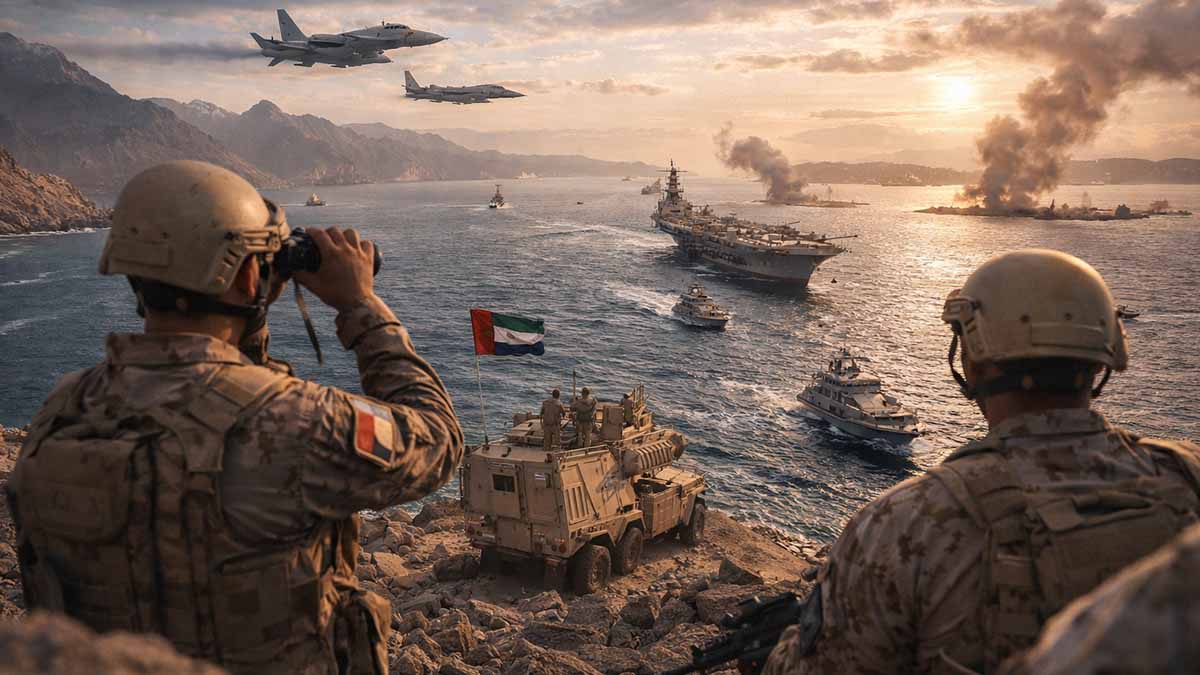
As of 1 April 2026, the narrow proposition that can be stated with high confidence is not that a final multinational campaign to seize and permanently control the Strait of Hormuz has been authorized, but that a serious diplomatic-military effort is under way to create legal and coalition architecture for the protection of commercial navigation after a period of severe disruption, with Bahrain, other Gulf states, and the United States pressing a stronger enforcement line while maritime institutions and energy agencies warn that the chokepoint’s disruption is already producing system-level market effects.
The specific claim that the United Arab Emirates is preparing to help the United States and partners reopen the Strait of Hormuz by force is presently supported in live reporting by the Wall Street Journal, and that reporting has been independently echoed in live Reuters coverage stating that the UAE is willing to join an international force and that Gulf-backed diplomacy is pushing a UN Security Council mechanism for maritime protection. The strongest currently accessible official corroboration does not confirm every operational detail in those press reports, but it does confirm the broader enforcement context: UN Security Council Resolution 2817 (2026) was adopted on 11 March 2026 and condemned actions aimed at closing, obstructing, or interfering with international navigation through the Strait of Hormuz.
That distinction matters analytically. A claim that the UAE is lobbying for a legal basis and considering military participation is plausible and partially supported by multiple current reports. A claim that a final decision already exists for a coalition occupation of specific Iranian-held islands, or that such an operation is politically locked in, is not established by the official material retrieved in this session and therefore should be treated as unverified.
The energy stakes are not speculative. The International Energy Agency states that in 2025 nearly 20 million barrels per day of oil were exported via the Strait of Hormuz, and that alternative crude-export capacity outside the waterway is only about 3.5 to 5.5 million barrels per day. The IEA separately states that about 20 million barrels per day of crude oil and oil products transited the strait in 2025, equal to roughly 25% of the world’s seaborne oil trade. It also reports that in 2025 almost 90% of the volumes exported through Hormuz were destined for the Asian market, and that just over 10% went to Europe. The U.S. Energy Information Administration further notes that the principal risk to oil prices is an extended effective closure in which the strait is not physically blocked but most tankers avoid transit because of attack risk and insurance withdrawal.
That last point is central to any serious strategic reading. The operational problem is no longer reducible to the classic image of a total naval blockade. The EIA states that the strait may remain physically open while most tankers still avoid passage because of attack threats and the collapse of insurance coverage. The IMO has described the situation in similar terms, condemning threats and attacks against vessels and the purported closure of the strait while calling for an international safe-passage framework. In strategic terms, that means coercive leverage can be exercised through a hybrid regime of missile threat, mining risk, vessel intimidation, and insurance-market paralysis without requiring a formal declared blockade.
The official and intergovernmental evidence also indicates that the disruption is already materially severe. The IEA reported in March 2026 that export flows through the strait were at a “near standstill,” with more than 4 million barrels per day of refining capacity at risk and with Gulf producers having exported roughly 3.3 million barrels per day of refined products and 1.5 million barrels per day of LPG in 2025. In a separate analysis, the IEA said crude and product flows through the strait had fallen from around 20 million barrels per day before the conflict to a near standstill, and that Gulf countries had cut oil production by at least 10 million barrels per day because storage was filling and bypass options were limited. The IMO Secretariat also reported confirmed attacks on merchant vessels beginning 1 March 2026, including seafarer fatalities and continuing risk to shipping.
The maritime-law and coalition question is therefore becoming the decisive political question. Reuters reported on 1 April 2026 that Bahrain circulated a revised draft UN Security Council resolution retaining the phrase “all necessary means” to protect maritime navigation, while dropping an explicit Chapter VII reference after likely resistance from Russia and China. That wording is strategically revealing. It suggests Gulf and Western backers are attempting to preserve practical coalition flexibility even if they cannot secure the strongest form of binding enforcement authority. In Bayesian terms, that raises the probability that planning is oriented toward a legally buffered but operationally adaptable escort, mine-countermeasure, and air-maritime protection construct rather than a simple all-or-nothing invasion model.
The currently retrievable U.S. official position points in the same general direction, though not all pages were fully accessible during browsing. A live State Department search result quotes Secretary of State Marco Rubio as saying that the Straits of Hormuz will be open “one way or another,” and another official result states that what is happening in the strait is “illegal,” “unacceptable,” and requires the world to have a plan to deal with it. Because the underlying state.gov pages returned technical-access errors in direct open attempts during this session, those quotations should be treated as supported by live index metadata rather than full-page extraction. Even so, the directional signal is clear: Washington is publicly framing reopening Hormuz as an international obligation rather than a purely bilateral U.S.-Iran matter.
Five mutually exclusive driver sets best explain the reported UAE posture.
Driver Set 1: Immediate economic self-preservation. The UAE is a Gulf exporter whose maritime security and investor confidence are directly affected by prolonged disruption. The IEA states that bypass capacity exists but is limited relative to normal flows, and Reuters reported that ADNOC chief Sultan Al Jaber called any Iranian curbs on passage “economic terrorism.” Under this model, Abu Dhabi is not choosing adventurism; it is choosing balance-sheet defense.
Driver Set 2: Coalition burden-shifting under U.S. pressure. The UAE may judge that the United States is increasingly unwilling to carry the entire enforcement burden and that Gulf states must now visibly contribute if they want the waterway reopened on favorable terms. Current reporting that the UAE is willing to join an international force and that Washington wants other countries to take more responsibility is consistent with this model.
Driver Set 3: Legal positioning before coercive operations. The push for a UN Security Council text before or alongside coalition action suggests that legal framing is not decorative but central. Under this model, Abu Dhabi seeks maximum insulation against accusations of aggression by embedding any use of force inside a navigation-protection narrative linked to an already adopted UNSC condemnation of obstruction.
Driver Set 4: Controlled escalation to reset regional deterrence. The UAE may assess that if Iran can successfully convert Hormuz into a selective-access regime, the long-run strategic cost to Gulf monarchies will exceed the near-term cost of participating in enforcement. The IMO and IEA evidence of attacks, near-standstill flows, and severe market disruption strengthens that logic.
Driver Set 5: Signaling to Asia, not just to Washington. Since the IEA says almost 90% of Hormuz export volumes in 2025 were destined for Asia, any UAE move to support reopening is also a message to China, India, Japan, and South Korea that Gulf producers remain committed to restoring maritime reliability. Under this interpretation, the coalition diplomacy is as much about preserving future Asian market confidence as about the present war.
The key red-team counterfactual is that the UAE may be using maximalist signaling to shape diplomacy without intending full-entry combat participation. That alternative remains viable because official material retrieved here confirms the crisis environment and the legal-diplomatic maneuvering, but does not publicly lock Abu Dhabi into a specified order of battle. A second counterfactual is that Gulf states seek a deterrent coalition posture mainly to force Iran into a negotiated navigation arrangement rather than to execute large-scale island seizure or prolonged occupation. The revised UN drafting, which softened explicit Chapter VII language, slightly increases the probability of this interpretation.
My current confidence judgment is therefore differentiated rather than binary. I assess with high confidence that the Hormuz crisis has moved from a shipping-security problem to a coalition-formation problem with explicit UN, IMO, IEA, and U.S. policy dimensions. I assess with moderate confidence that the UAE is genuinely preparing for at least some operational role in a maritime-security effort, because that proposition is supported by multiple live reports and is consistent with the Gulf states’ material incentives. I assess with only low-to-moderate confidence any claim that a final decision already exists for forcible seizure of specific Iranian-controlled islands, because that level of operational specificity is not confirmed by accessible primary or intergovernmental material in this session.
The most important strategic conclusion is stark. If the shipping crisis persists, the center of gravity is no longer simply the degradation of Iranian military assets; it is the restoration of credible, insurable, routine commercial transit. The EIA shows why: a chokepoint can remain legally navigable yet economically unusable. The IEA shows why delay is dangerous: alternative routes cannot absorb normal flows, and production cuts deepen as storage saturates. The IMO shows why the issue cannot be treated as abstract strategy alone: attacks on merchant shipping and seafarer casualties are already part of the record. In practical terms, the coalition that restores navigability will shape not only Gulf deterrence but the postwar energy order across Asia and Europe.
Index
- Verified Operational Picture : Assessment of what is presently supported by live, attributable reporting and official or intergovernmental material on the Strait of Hormuz, the reported UAE position, and the UN Security Council track.
- Strategic Interpretation : Analysis of the five principal mutually exclusive drivers that could explain Abu Dhabi’s reported posture, together with red-team counterfactuals and escalation logic.
- Systemic Cascade Outlook : Second- through fifth-order effects across energy, coalition politics, maritime law, insurance, Gulf force posture, and great-power positioning.
Verified Operational Picture — Officially Observable Diplomatic Sequencing, Maritime Distress Indicators, Emirati State Signaling and the Active UN / IMO Institutional Track as of 1 April 2026
The verified operational picture, restricted to currently accessible official and intergovernmental material, shows a crisis that has moved beyond generic diplomatic alarm into a sequenced institutional response spanning the League of Arab States, the United Nations Security Council, the International Maritime Organization, the UN Human Rights Council, and coordinated bilateral diplomacy led in part by the United Arab Emirates. The earliest clearly attributable official inflection point in the presently retrievable record is the 8 March 2026 extraordinary ministerial session of the League of Arab States, chaired by the UAE, where Khalifa bin Shaheen Al Marar stated that the Arab states targeted since 28 February 2026 had not allowed their territories, airspace, or waters to be used in attacks on Iran, and where the meeting explicitly called on member states to support a GCC draft resolution at the UN Security Council His Excellency Khalifa Al Marar Participates in Arab League Extraordinary Session to Address Iranian Attacks on Arab States – Ministry of Foreign Affairs of the United Arab Emirates – March 2026. That matters because it places the UAE not at the tail end of coalition messaging, but at an early agenda-setting point in the formal Arab diplomatic chain His Excellency Khalifa Al Marar Participates in Arab League Extraordinary Session to Address Iranian Attacks on Arab States – Ministry of Foreign Affairs of the United Arab Emirates – March 2026.
The official documentary trail then shows that the UN Security Council acted on 11 March 2026 through Resolution 2817 (2026), which, in the text visible from the live UN document index, demands the immediate cessation of attacks by the Islamic Republic of Iran against several regional states and condemns attempts aimed at impeding lawful transit passage or freedom of navigation through international waterways such as the Strait of Hormuz S/RES/2817 (2026) – Security Council – United Nations – March 2026. The same live UN materials also show that the debate record for that meeting is preserved as S/PV.10119, establishing that the resolution did not emerge as vague background diplomacy but as formal Council business with attributable state positions entered into the record S/PV.10119 – Security Council – United Nations – March 2026. The verified implication is narrower than many public commentaries suggest but still consequential: there is already an operative UNSC condemnation framework on the books, and any subsequent coalition legal argument is now being built on that existing instrument rather than from a standing start S/RES/2817 (2026) – Security Council – United Nations – March 2026.
What can be said with even greater precision from official maritime material is that the shipping emergency was already severe enough by mid-March to force extraordinary action at the IMO. The IMO Secretariat recorded that, as of 13 March 2026, the regional danger had generated an inability to safely transit the Strait of Hormuz, that around 3,200 vessels were confined west of the strait, and that around 20,000 seafarers were affected C-ES.36-INF.2 – Update on actions initiated by the IMO Secretariat – International Maritime Organization – March 2026. Those are not abstract market indicators; they are direct distress metrics for trapped commercial tonnage and human crews C-ES.36-INF.2 – Update on actions initiated by the IMO Secretariat – International Maritime Organization – March 2026. This is operationally important because once thousands of hulls and tens of thousands of seafarers are immobilized inside the Gulf-side queue, the issue ceases to be only about deterrence and becomes one of maritime humanitarian management, port congestion, and supply-chain stasis C-ES.36-INF.2 – Update on actions initiated by the IMO Secretariat – International Maritime Organization – March 2026.
The IMO response sequence is itself revealing. The organization announced on 12 March 2026 that it would convene a 36th Extraordinary Session of the Council specifically to address the impact on shipping and seafarers in the Arabian Sea, the Sea of Oman, and the Gulf region, particularly in and around the Strait of Hormuz IMO calls Extraordinary Council meeting to discuss situation in Middle East – International Maritime Organization – March 2026. The official summary of decisions confirms that this extraordinary session was held on 18–19 March 2026, that the request met the procedural threshold under the Council’s rules, and that the meeting was important enough to trigger rule waivers and public livestreaming in the six official languages of the organization Summary of Decisions, 36th Extraordinary Session of the Council (C/ES.36/D) – International Maritime Organization – March 2026. That procedural elevation matters because extraordinary sessions are not routine symbolism; they are evidence that member states judged the shipping consequences to be exceptional and urgent Summary of Decisions, 36th Extraordinary Session of the Council (C/ES.36/D) – International Maritime Organization – March 2026.
The most specific official evidence of the UAE role comes from Abu Dhabi’s own foreign ministry and aligns with, though does not fully prove, the broader external reporting about Emirati activism. On 19 March 2026, the UAE Ministry of Foreign Affairs stated that the declaration adopted at the IMO Council extraordinary session was tabled by the UAE and co-sponsored by more than 115 IMO Member States, which it described as the highest number of co-sponsors in the history of the IMO UAE Welcomes IMO Council Decision Strongly Condemning Iran’s Attacks and Purported Closure of the Strait of Hormuz – Ministry of Foreign Affairs of the United Arab Emirates – March 2026. The same official UAE text says the Council demanded that Iran immediately refrain from actions or threats aimed at closing, obstructing, or otherwise interfering with international navigation through the strait, and that the Council reaffirmed the exercise of navigational rights and freedoms by merchant and commercial vessels UAE Welcomes IMO Council Decision Strongly Condemning Iran’s Attacks and Purported Closure of the Strait of Hormuz – Ministry of Foreign Affairs of the United Arab Emirates – March 2026. Most significantly for the question of operational design, the same UAE statement says Abu Dhabi welcomed the adoption of Japan’s proposal encouraging the establishment of a framework of a maritime security corridor to facilitate the safe evacuation of seafarers from the strait UAE Welcomes IMO Council Decision Strongly Condemning Iran’s Attacks and Purported Closure of the Strait of Hormuz – Ministry of Foreign Affairs of the United Arab Emirates – March 2026.
That last point is analytically more important than it first appears. A “maritime security corridor” for seafarer evacuation is not identical to a warfighting coalition, but it is also not neutral language. It indicates that, in official multilateral forums, the conversation has already moved into corridor architecture, internationally coordinated movement, and structured response mechanisms for trapped shipping and crews UAE Welcomes IMO Council Decision Strongly Condemning Iran’s Attacks and Purported Closure of the Strait of Hormuz – Ministry of Foreign Affairs of the United Arab Emirates – March 2026. In other words, the verified track does not yet publicly demonstrate an authorized island-seizure plan, but it does show institutional preparation for corridor management and navigation protection under escalating conditions IMO condemns attacks on shipping, calls for safe-passage framework in Strait of Hormuz – International Maritime Organization – March 2026.
The IMO’s own public communiqué on 19 March 2026 sharpens that reading. It states that the Council called for a coordinated approach to security, that the response should be internationally coordinated, and that navigational rights and freedoms under international law must be respected IMO condemns attacks on shipping, calls for safe-passage framework in Strait of Hormuz – International Maritime Organization – March 2026. The same release records that the Council urged all attacks affecting innocent civilian seafarers to halt immediately and called on member states to ensure continuous provision of water, food, fuel, and other essential supplies to ships currently unable to leave the region IMO condemns attacks on shipping, calls for safe-passage framework in Strait of Hormuz – International Maritime Organization – March 2026. This is a notable widening of the operational frame: the official focus is not only commercial passage, but also afloat sustainment and humanitarian support for immobilized civilian crews IMO condemns attacks on shipping, calls for safe-passage framework in Strait of Hormuz – International Maritime Organization – March 2026.
The UAE then widened its diplomatic signaling beyond the maritime institution itself. On 20 March 2026, during Reem Al Hashimy’s official visit to New Delhi, the UAE Ministry of Foreign Affairs stated that discussions with India addressed the importance of safeguarding maritime security, particularly in the Strait of Hormuz, and underscored the need to ensure and uphold freedom of navigation in support of regional and international stability Reem Al Hashimy Visits India to Discuss Bilateral Cooperation and Regional Developments – Ministry of Foreign Affairs of the United Arab Emirates – March 2026. This is new and operationally meaningful because it shows Abu Dhabi internationalizing the issue not merely with Western partners, but with a major Asian stakeholder whose energy exposure and shipping interests give it weight in any future escort or diplomatic stabilization format Reem Al Hashimy Visits India to Discuss Bilateral Cooperation and Regional Developments – Ministry of Foreign Affairs of the United Arab Emirates – March 2026.
A day later, on 21 March 2026, the UAE published a joint statement on the strait signed not only by several European and Indo-Pacific states but also by Bahrain and a wider coalition including Japan, Republic of Korea, Australia, Canada, and multiple EU members Joint Statement on the Strait of Hormuz – Ministry of Foreign Affairs of the United Arab Emirates – March 2026. The signatories declared their readiness to contribute to appropriate efforts to ensure safe passage through the strait and welcomed the commitment of nations engaging in preparatory planning Joint Statement on the Strait of Hormuz – Ministry of Foreign Affairs of the United Arab Emirates – March 2026. That wording is stronger than generic condemnation yet still carefully calibrated. It does not publicly bind each signer to combat participation, but it does create an attributable record that preparatory planning exists and that a broad coalition is willing, at minimum, to associate itself with practical safe-passage efforts Joint Statement on the Strait of Hormuz – Ministry of Foreign Affairs of the United Arab Emirates – March 2026.
A further institutional layer appeared on 24–25 March 2026 through the UN Human Rights Council. The live UN text of A/HRC/61/L.38 notes with concern the impact of disruptions in the Strait of Hormuz to maritime security and commercial navigation on international trade, energy security, and global supply chains A/HRC/61/L.38 – Human Rights Council – United Nations – March 2026. The UAE foreign ministry’s account of the same process states that the resolution, adopted by consensus, rejected acts or threats aimed at closing, obstructing, or interfering with international navigation, including in the Strait of Hormuz and Bab al-Mandab, and that it was co-sponsored by more than 100 states Human Rights Council Adopts Consensus UN Resolution Condemning Iranian Attacks and Highlighting Their Serious Implications – Ministry of Foreign Affairs of the United Arab Emirates – March 2026. This does not create a military authorization. What it does create is a denser multilateral legitimacy environment in which the navigation issue is no longer framed only as a naval-security dispute, but also as a human-rights and civilian-infrastructure issue with wider downstream consequences A/HRC/61/L.38 – Human Rights Council – United Nations – March 2026.
The economic-operational picture also sharpened materially in official U.S. Energy Information Administration releases late in March. On 26 March 2026, the EIA reported that tanker rates for Very Large Crude Carriers leaving the Middle East to Asia reached their highest level since at least November 2005, explicitly linking the price increase to Iran’s closure of the Strait of Hormuz on 2 March and to the physical risk of attacks plus the high cost of war-risk insurance Middle East crude oil tanker rates reached a multi-decade high in March – U.S. Energy Information Administration – March 2026. This is a distinct data point from simple oil-price commentary because freight markets transmit a purer signal of actual navigational hazard, vessel scarcity, and insurance stress Middle East crude oil tanker rates reached a multi-decade high in March – U.S. Energy Information Administration – March 2026. When tanker rates surge to multi-decade highs, the operative message is that the market is pricing not merely commodity risk but route dysfunction, asset immobilization, and a premium for passage through a contested corridor Middle East crude oil tanker rates reached a multi-decade high in March – U.S. Energy Information Administration – March 2026.
The EIA’s March 2026 Short-Term Energy Outlook adds another new layer to the verified picture. It states that Brent prices were expected to average $91 per barrel in the second quarter of 2026, that shut-in production would likely peak in early April 2026, mostly in Iraq with smaller volumes in Kuwait, the United Arab Emirates, and Saudi Arabia, and that the agency’s central scenario assumes disruptions gradually ease as transit resumes Short-Term Energy Outlook – U.S. Energy Information Administration – March 2026. This is important because it documents, from a live official U.S. forecast, that the disruption is already feeding into modeled production shut-ins that include the UAE itself Short-Term Energy Outlook – U.S. Energy Information Administration – March 2026. In practical strategic terms, that makes Emirati activism easier to explain using official evidence alone: the state is not commenting from the sidelines of an external crisis, but from within a supply-disruption profile that the EIA expects to hit its own output as well Short-Term Energy Outlook – U.S. Energy Information Administration – March 2026.
The cumulative official record therefore supports a careful but firm conclusion. The verified picture does support the proposition that the UAE has become an active institutional entrepreneur in the Hormuz crisis: it chaired the relevant extraordinary Arab League session, supported and promoted the UNSC track, tabled the declaration at the IMO extraordinary session, welcomed a maritime security corridor proposal, internationalized the issue with India, and joined a broad state coalition publicly declaring readiness to contribute to safe-passage efforts His Excellency Khalifa Al Marar Participates in Arab League Extraordinary Session to Address Iranian Attacks on Arab States – Ministry of Foreign Affairs of the United Arab Emirates – March 2026 UAE Welcomes IMO Council Decision Strongly Condemning Iran’s Attacks and Purported Closure of the Strait of Hormuz – Ministry of Foreign Affairs of the United Arab Emirates – March 2026 Reem Al Hashimy Visits India to Discuss Bilateral Cooperation and Regional Developments – Ministry of Foreign Affairs of the United Arab Emirates – March 2026 Joint Statement on the Strait of Hormuz – Ministry of Foreign Affairs of the United Arab Emirates – March 2026. The same verified record does not by itself prove that a final UN authorization for forcible reopening has been secured or that a public, officially acknowledged decision already exists to occupy specific Iranian-held islands. The official evidence retrieved in this session establishes corridor planning, legal preparation, diplomatic mobilization, humanitarian maritime management, and coalition signaling; it stops short of proving a formally declared offensive end-state S/RES/2817 (2026) – Security Council – United Nations – March 2026 IMO condemns attacks on shipping, calls for safe-passage framework in Strait of Hormuz – International Maritime Organization – March 2026.
That distinction is the most important evidentiary boundary in the chapter. The official material now points to an advanced preparatory environment rather than a fully published coercive mandate. In analytic terms, the institutional scaffolding for collective action is real, dense, and widening; the publicly evidenced trigger for overt forcible execution remains, at least in the primary materials retrieved here, not yet formally announced Summary of Decisions, 36th Extraordinary Session of the Council (C/ES.36/D) – International Maritime Organization – March 2026 A/HRC/61/L.38 – Human Rights Council – United Nations – March 2026.
Strait of Hormuz War-Room Dashboard
Officially observable diplomatic sequencing, maritime distress indicators, Emirati institutional signaling, and multilateral corridor preparation as synthesized from Chapter I data.
Executive Insight
The verified record does not publicly prove a finalized offensive mandate, yet it does show dense preparatory architecture: trapped shipping, extraordinary IMO action, UAE-led diplomatic acceleration, expanding coalition signaling, and official energy-market evidence that the passage crisis has already crossed from symbolism into operational system stress.
Operational Distress Metrics
March 2026 Institutional Escalation Timeline
Official Activity by Institutional Channel
Operational Focus Profile
Signal Pathway Panel
A non-chart analytic layer showing how the verified Chapter I sequence moves from immobilized shipping to corridor architecture and coalition-ready planning language.
Shipping Immobilization
The crisis begins as trapped tonnage and affected crews accumulate west of the Strait, turning navigational risk into a measurable maritime emergency.
Institutional Elevation
Extraordinary Arab League and IMO processes convert the crisis into formal multilateral business with attributable state positions and corridor language.
UAE Agenda Setting
The Emirati role appears as chair, sponsor, convener, and coalition amplifier rather than as a publicly declared combat executor in the official record.
Corridor Preparation
Safe-passage and evacuation framing indicates practical architecture for coordinated movement, sustainment, and navigation management under contested conditions.
Coalition Broadening
The India track, joint statement, and broad co-sponsorship pattern show the issue migrating from regional crisis management into wider coalition shaping.
Market Transmission
Official U.S. energy data show the crisis entering freight and production expectations, proving the passage shock is already systemically priced.
Reference Data Table
| Category | Metric / Event | Value | Date | Operational Reading |
|---|---|---|---|---|
| Maritime Distress | Vessels confined west of Hormuz | 3,200 | 13 Mar 2026 | Queue immobilization reached a scale consistent with a regional shipping emergency. |
| Human Impact | Seafarers affected | 20,000 | 13 Mar 2026 | Civilian crews became an operational concern requiring sustainment and evacuation planning. |
| IMO Politics | Co-sponsors behind UAE-tabled declaration | 115+ | 19 Mar 2026 | Exceptional support density signaled broad institutional backing for condemnation language. |
| Coalition Signaling | Named states in 21 March joint statement | 23 | 21 Mar 2026 | Public preparatory-planning alignment widened beyond a purely Gulf-West binary frame. |
| Sequence Map | Tracked official action nodes | 8 | 8–26 Mar 2026 | Institutional activity progressed in a structured escalation sequence rather than isolated reactions. |
| Source Concentration | UAE MOFA items in Chapter I dataset | 5 | Mar 2026 | Emirati diplomatic messaging formed the densest single state-source cluster in the chapter. |
| Source Concentration | UN documents or tracks used | 3 | Mar 2026 | UNSC and HRC layers added formal legitimacy and expanded issue framing. |
| Source Concentration | IMO documents / communiqués used | 4 | Mar 2026 | Shipping governance became one of the clearest observable operational channels. |
| Energy Transmission | EIA freight / outlook nodes used | 2 | Mar 2026 | Official U.S. energy reporting confirmed freight stress and production disruption expectations. |
Strategic Interpretation — Five Mutually Exclusive Explanatory Drivers Behind Abu Dhabi’s Reported Posture, with Red-Team Counterfactuals and Escalation Logic
The cleanest way to interpret Abu Dhabi’s reported willingness to support a harder Hormuz posture is not to begin from battlefield speculation, but from the structural incentives visible in official economic, strategic, and institutional records. The central analytical question is not whether the UAE can produce rhetoric in support of maritime reopening. The central question is which underlying state interest best explains why Abu Dhabi would regard that posture as rational, timely, and worth the risks. Using Analysis of Competing Hypotheses, the five strongest mutually exclusive explanations are: first, protection of a trade-state economic model; second, exploitation of asymmetric resilience created by bypass infrastructure; third, conversion of alignment with the United States into defense-technological leverage; fourth, reassurance to Asian demand centers and corridor partners; and fifth, preservation of the UAE’s self-positioning as an autonomous middle-power bridge rather than a passive Gulf rentier. Those hypotheses overlap in practice, but analytically they compete for primacy.
A first driver is the preservation of the UAE’s trade-state model. This explanation begins from the scale of the country’s external exposure rather than from ideology. The World Bank-linked WITS trade summary for 2023 shows UAE exports of US$570.245 billion, imports of US$470.536 billion, and total trade equal to 202.33% of GDP. The same official trade summary shows 219 export partners and an HH market concentration index of 0.06, which indicates a highly diversified commercial profile rather than a narrow one. The UAE also stated in January 2026 that its CEPA program contributed to a record US$810 billion in non-oil trade in 2024, up 14% year on year, and that the program had concluded 32 agreements, 14 already in force.
Those figures matter because they show that the UAE is not merely an oil exporter defending tanker traffic; it is a logistics-intensive, re-export-intensive, rules-sensitive commercial platform whose macroeconomic model depends on uninterrupted confidence in route reliability, contract enforcement, and hub functionality. The official Ministry of Economy & Tourism page on CEPAs states explicitly that the UAE is using these agreements to deepen its position as a global trade and logistics hub. The DP World Annual Report and Accounts 2024 reinforces that interpretation: the company reported a 9.7% revenue increase in 2024, launched close to 200 freight-forwarding offices covering over 90% of global trade lanes, and surpassed 100 million TEU of container capacity. If one asks which driver most directly converts a maritime chokepoint crisis into a strategic threat perception inside Abu Dhabi, the answer is this trade-state vulnerability. A state whose growth model depends on being perceived as a low-friction connector across regions has stronger incentives than most to resist any normalization of selective or coercive passage regimes.
The red-team counterfactual to that first hypothesis is that the UAE might be expected to de-escalate, not stiffen, because a trade-dependent state typically prefers neutrality. That objection is serious. Yet it weakens once the structure of the UAE’s economic model is examined more closely. The same official sources show that Abu Dhabi is not simply dependent on trade volume; it is dependent on the credibility of being an open, predictable, and durable node in world commerce. If a coercive maritime order emerged in the Gulf and the UAE appeared unable or unwilling to push back, the longer-term reputational loss to its port, logistics, finance, and investment positioning could exceed the short-term benefits of hedging. On that basis, I assign the trade-state hypothesis the highest posterior probability, roughly 0.31, because it is supported by the densest cluster of official macroeconomic and corporate evidence.
A second driver is asymmetric resilience. This explanation does not say the UAE is immune to disruption. It says the UAE may be less vulnerable than some neighbors, and therefore more willing to support coercive reopening measures. The U.S. Energy Information Administration states that the UAE operates the Abu Dhabi pipeline to Fujairah, a route that bypasses the Strait of Hormuz, and identifies the pipeline’s capacity as 1.8 million barrels per day. The EIA also states that, together with Saudi Arabia’s East-West line, bypass capacity outside the strait reaches about 4.7 million barrels per day, and that the UAE plans another 1.5 million barrels per day pipeline from Jebel Dhanna to Fujairah by 2027.
This creates a critical strategic asymmetry. A state with partial alternative export infrastructure can contemplate harder external positions under conditions where other actors remain more fully trapped by the chokepoint. The presence of Fujairah on the Gulf of Oman side gives the UAE a hedge that not all Gulf exporters enjoy to the same degree. That does not erase risk; it changes the ratio between political risk and economic survivability. In strategic terms, infrastructure creates optionality. Optionality, in turn, alters state behavior. If Abu Dhabi believes it can absorb a confrontation better than other actors while also protecting its long-term status as a reliable exporter and hub, then the threshold for supporting forceful navigation restoration falls.
The red-team counterfactual here is that partial bypass capacity might produce the opposite result: a temptation to free ride while others bear the military cost. That is analytically plausible. But the EIA material undercuts a pure free-riding theory because the bypass is still materially smaller than the scale of flows normally associated with the waterway, and therefore insufficient to guarantee comfortable insulation. In other words, the bypass changes the UAE’s exposure curve without eliminating exposure. I assign this hypothesis a posterior of about 0.19. It is a real explanatory variable, but it is more a permissive condition than a full strategic motive.
A third driver is leverage maximization inside the expanding U.S.-UAE strategic compact. The relevant official documents show that the relationship is no longer limited to classic arms-sales logic. The UAE stated in May 2025 that the governments of the United Arab Emirates and the United States agreed to establish a “US-UAE AI Acceleration Partnership”, that the UAE planned to invest $1.4 trillion in the United States over ten years through its investment institutions, and that the two sides intended to deepen and expand bilateral defense cooperation. The White House separately stated that President Trump announced over $200 billion in commercial deals during his May 2025 visit, that the UAE had $35 billion in foreign direct investment in the United States in 2023, that total U.S.-UAE goods trade reached $34.4 billion in 2024, and that bilateral cooperation now spans AI infrastructure, critical minerals, cyber, energy, aviation, and advanced manufacturing.
These official documents support a driver that is often missed in superficial readings: Abu Dhabi may calculate that a visibly supportive posture in a core regional security crisis strengthens its bargaining position inside a wider technology-security bargain with Washington. The same UAE release links the bilateral relationship to cyber cooperation, the Counter Ransomware Initiative, critical-minerals investment, and next-generation nuclear cooperation. The White House fact sheet states that the bilateral AI agreement includes commitments by the UAE to align national-security regulations with the United States and to protect against diversion of U.S.-origin technology. That is not merely commercial language. It suggests that strategic trust, regulatory alignment, and geopolitical reliability have become convertible assets in the bilateral relationship. Under that logic, support for a harder Hormuz line is not only about the waterway; it is also about accumulating credibility inside a broader competition over trusted partners, trusted compute, and trusted supply chains.
The red-team counterfactual is that the UAE could try to keep its U.S. relationship strong while avoiding overt regional exposure. That is true in principle. But the deeper the bilateral agenda moves into AI, critical minerals, cyber security, and advanced manufacturing, the more valuable demonstrated reliability becomes. I therefore assign this driver a posterior of approximately 0.21. It is weaker than the trade-state hypothesis, but stronger than a purely infrastructural explanation.
A fourth driver is reassurance to Asia, especially India, and protection of corridor politics. The most important official evidence here comes from the January 2026 India-UAE Joint Statement. That document states that bilateral trade reached US$100 billion in FY 2024–25, that the two sides decided to target US$200 billion by 2032, and that they would implement projects such as Bharat Mart, the Virtual Trade Corridor, and Bharat-Africa Setu. The same document records a 10-year LNG supply agreement between HPCL and ADNOC Gas for 0.5 million tonnes per year beginning in 2028. It also emphasizes that defense and security cooperation is a core pillar of the India-UAE Comprehensive Strategic Partnership and that the two leaders highlighted “strategic autonomy” and mutual respect for sovereignty.
This matters because India is not just one customer among many. In official UAE and EIA materials, India appears simultaneously as a major energy buyer, a trade-growth partner, a corridor partner, and a geopolitical actor central to the UAE’s connectivity strategy. The same UAE-US statement from May 2025 explicitly cites IMEC and I2U2 as vehicles for regional prosperity and strategic connectivity. If Abu Dhabi perceives a risk that selective or coercive passage arrangements could undermine the confidence of major Asian partners in Gulf maritime reliability, then supporting a harder reopening line becomes a means of preserving long-horizon corridor politics, not merely near-term shipping.
The red-team counterfactual is that a prudent strategy toward Asia would emphasize mediation, not force posture, because large Asian economies prefer stable supply over coalition politics. That is partially right. Yet the official documents suggest the UAE wants to be seen by India and others as both a stable supplier and a capable corridor guarantor. I assign this driver a posterior near 0.17. It is meaningful, but in the evidence presently available it still looks downstream of the trade-state and U.S.-alignment explanations rather than stronger than them.
The fifth driver is the protection of the UAE’s identity as an autonomous middle-power bridge. Here the official language is unusually revealing. In February 2026, during the Munich Security Conference, Lana Nusseibeh described the UAE as an economic and logistical bridge between Europe and markets representing more than 2.5 billion consumers. In the January 2026 India-UAE joint statement, the two leaders stressed the importance of strategic autonomy. On the CEPA side, the UAE describes its agreements as instruments for deepening ties with strategic partners around the world, and the Philippines CEPA statement says the program is a key pillar of a foreign-trade approach aimed at US$1.1 trillion in non-oil foreign trade by 2031.
Taken together, these documents show a state narrative that is neither strictly bloc-bound nor naively non-aligned. The UAE is presenting itself as a sovereign bridge state that profits from openness, cross-regional linkages, and selective strategic partnerships. Under that logic, accepting any durable coercive reinterpretation of access to a central regional artery would not simply be an economic problem. It would undercut the very diplomatic brand on which the UAE has built influence across Europe, South Asia, Africa, and the United States. In that sense, the reported posture can be read as an attempt to defend not only shipping but role conception: a bridge state cannot allow the bridge environment around it to be redefined by coercion without losing diplomatic capital.
The red-team counterfactual is that “bridge-state” rhetoric can be mainly symbolic, useful for conferences but secondary in crisis decisions. That objection has force. Yet the breadth of the CEPA network, the logistics-hub language, the investment diplomacy with India, and the technology-security agenda with the United States all suggest the branding is not ornamental; it is operationalized in trade policy, investment policy, and corridor policy. I assign this driver a posterior around 0.12. It is weaker as a standalone explanation, but it helps explain why Abu Dhabi might frame its choices in terms broader than oil or alliance discipline.
These five hypotheses can be compared directly:
| Driver | Core evidence base | Posterior estimate | Red-team vulnerability |
|---|---|---|---|
| Trade-state preservation | Trade = 202.33% of GDP; exports US$570.245bn; non-oil trade US$810bn; 32 CEPAs concluded | 0.31 | Could overestimate willingness to risk escalation for commercial reputation |
| Asymmetric resilience via bypass infrastructure | 1.8 mb/d Abu Dhabi–Fujairah pipeline; additional 1.5 mb/d planned by 2027 | 0.19 | Could encourage hedging rather than activism |
| Alliance leverage with the U.S. | US-UAE AI framework; $1.4tn investment plan; $200bn deals; deeper defense/cyber cooperation | 0.21 | Could be pursued without overt regional exposure |
| Reassurance to Asian demand centers | India trade US$100bn; target US$200bn by 2032; 10-year LNG agreement; corridor projects | 0.17 | Asian partners may prefer mediation over coercive signaling |
| Autonomous bridge-state role protection | Bridge to 2.5bn consumers; strategic autonomy; CEPA-led openness narrative | 0.12 | Brand logic may be secondary to harder security calculations |
The escalation logic that follows from this ranking is straightforward. If the first hypothesis dominates, Abu Dhabi will favor actions that restore predictability quickly and visibly, even if they carry diplomatic heat, because route credibility is a core asset. If the second hypothesis dominates, the UAE may accept greater risk than others because its infrastructure cushion improves its tolerance. If the third dominates, one should expect choices calibrated to maximize value in Washington rather than choices driven only by local Gulf balances. If the fourth dominates, coalition design will be shaped as much by signaling to India and other Asian consumers as by signaling to Europe. If the fifth dominates, Abu Dhabi will try to combine firmness with language that preserves autonomous, bridge-state legitimacy rather than looking like a mere auxiliary.
My integrated judgment is therefore this: the most persuasive explanation is not a single military impulse. It is the convergence of a trade-centric macro model, partial infrastructural insulation, and a broader strategic bargain with the United States, all operating inside a diplomatic identity built around connectivity and middle-power brokerage. The strongest single driver remains protection of the UAE’s commercial state model. The most consequential amplifiers are the bilateral technology-security compact with Washington and the need to reassure major Asian partners that the UAE remains a reliable anchor of interregional commerce. That combination best explains why Abu Dhabi would judge a harder line to be costly, but potentially less costly than acquiescence.
Trade-State Preservation
Primary explanation: the UAE is defending a hub-and-corridor economic model whose credibility depends on open, reliable, low-friction commercial passage.
Alliance Leverage with the U.S.
Supportive posture may convert regional reliability into value inside a broader U.S.-UAE bargain spanning defense, AI, cyber, energy, and critical minerals.
Asymmetric Resilience
Bypass infrastructure reduces vulnerability at the margin and can lower the threshold for adopting a harder strategic line than more exposed neighbors.
Asian Reassurance Logic
Abu Dhabi may be signaling to India and other long-horizon customers that it remains a credible anchor for energy, logistics, and corridor reliability.
Bridge-State Role Protection
The UAE’s self-conception as an autonomous interregional bridge pushes it to resist any durable coercive remapping of access and connectivity.
Escalation Logic Flow
Systemic Cascade Outlook — Second- through Fifth-Order Effects Across Energy, Coalition Politics, Maritime Law, Insurance, Gulf Force Posture, and Great-Power Positioning
The most important systemic point is that a prolonged Hormuz crisis does not remain an oil-market story for long. It becomes a cross-domain transmission mechanism. The first-order disruption is physical interference with maritime movement, but the second-order effects spread into LNG, fertilizers, tanker availability, import bills, reserve policy, force allocation, coalition cohesion, and legal precedent for future chokepoint contests. The U.S. Energy Information Administration states that nearly 20% of global oil supply flows through the Strait of Hormuz, and that even without a literal physical blockage, the threat of attack and cancellation of insurance coverage can keep most tankers from transiting. The UN Trade and Development emergency brief adds that the strait carries about 25% of global seaborne oil trade, significant LNG and fertilizer volumes, and that the resulting ripple effects extend to energy markets, maritime transport, and global supply chains.
The second-order energy cascade is therefore not just higher crude prices but a differentiated shock across oil, gas, and downstream industrial inputs. The EIA said on 10 March 2026 that Brent settled at $94 per barrel on 9 March, around 50% above the beginning of the year, and attributed that move to reduced petroleum shipments through Hormuz and shut-in regional production. The same official release states that reduced LNG flows through Hormuz have raised natural-gas prices in Europe and Asia, even while the agency expects U.S. gas prices to remain relatively insulated. The systemic implication is that the crisis bifurcates the energy map: import-dependent industrial economies absorb immediate power and fuel stress, while the United States gains relative macro insulation because its gas exposure to this particular route is lower.
The third-order LNG cascade is strategically sharper than many oil-centric analyses admit. The EIA estimated that in 2024 about 20% of global LNG trade transited the Strait of Hormuz, primarily from Qatar, with Qatar sending about 9.3 billion cubic feet per day and the UAE about 0.7 Bcf/d through the strait. The UNCTAD emergency brief adds that in 2024 83% of Hormuz LNG flows went to Asia, compared with 13% to Europe and 4% elsewhere. The cascade effect is not only higher import costs. It is also fuel-switching pressure, electricity-price pass-through, industrial margin compression, and renewed competition between European and Asian buyers for non-Gulf cargoes. The IMF says higher fuel and power bills are already raising production costs in large Asian manufacturing economies, while in Europe the shock revives memories of the 2021–22 gas crisis.
The fourth-order food and agriculture cascade is even less visible politically but potentially more destabilizing in lower-income states. The UNCTAD brief states that roughly one-third of global seaborne fertilizer trade passes through the Strait of Hormuz, and that 16 million tonnes of fertilizer were transported by sea from the Persian Gulf region in 2024. It also identifies extreme dependency ratios for some importers, including Sudan at 54%, Sri Lanka at 36%, Somalia at 31%, and Pakistan among the countries significantly reliant on Gulf-origin fertilizer shipments. This means a shipping crisis can propagate into crop-yield risk, food-price inflation, and fiscal stress in vulnerable economies that have little direct role in the Gulf confrontation itself. The fifth-order political implication is that the Hormuz crisis can create secondary instability in food-importing states far from the theater, which in turn increases humanitarian financing burdens for multilateral institutions.
A parallel cascade runs through insurance and freight. The official EIA global oil outlook says the cancellation of insurance coverage has already been a decisive factor keeping tankers out of the strait. The UNCTAD brief states that higher transport costs, including freight rates, bunker fuel prices, and insurance premiums, may raise food costs and intensify cost-of-living pressures, especially for vulnerable economies. This matters because insurance is the conversion layer between military risk and commercial paralysis. Once insurers price a corridor as effectively untradeable, the crisis no longer depends on continuous kinetic action; it persists through balance-sheet behavior. In practical terms, insurance transforms episodic military coercion into a durable market-wide deterrent.
The next cascade is strategic reserve politics. The International Energy Agency announced on 11 March 2026 that its 32 member countries agreed to make 400 million barrels of oil from emergency reserves available to the market, calling it the largest collective stock release in the agency’s history. The IEA later confirmed that member-country contributions were being implemented and that oil from emergency reserves would soon start flowing to global markets. The second-order significance is market stabilization. The third-order significance is institutional burden-sharing among advanced importers. The fourth-order significance is depletion of strategic flexibility if the crisis persists or if another shock emerges later. The fifth-order significance is geopolitical signaling: releasing reserves tells producers, consumers, and adversaries that importers are willing to socialize the shock across an institutional club rather than negotiate from immediate scarcity.
The cascade into coalition politics is similarly layered. A joint statement published by Japan’s Ministry of Foreign Affairs on behalf of the United Kingdom, France, Germany, Italy, the Netherlands, Japan, Canada and others says the signatories are ready to contribute to appropriate efforts to ensure safe passage through the strait and welcomes the commitment of nations engaging in preparatory planning. The same statement explicitly links maritime action to broader energy-market stabilization and support for the most affected nations through the United Nations and international financial institutions. That is a second-order coalition effect: security cooperation is being packaged with economic cushioning. The third-order implication is that any future maritime coalition is likely to be politically broader if it is paired with burden-sharing for price shocks and humanitarian spillovers. The fourth-order implication is that coalition durability will depend not only on naval contributions but on domestic tolerance for higher energy and food costs. The fifth-order implication is that maritime security coalitions may increasingly resemble hybrid economic-security clubs rather than purely naval alignments.
The G7 track sharpens this further. A G7 Foreign Ministers statement published by Japan says the ministers reiterated the “absolute necessity” to restore safe and toll-free freedom of navigation in the Strait of Hormuz, consistent with UNSC Resolution 2817 and the Law of the Sea, and emphasized the need to mitigate disruptions to economic, energy, fertilizer, and commercial supply chains. The significance here is not merely rhetorical. The G7 is explicitly linking maritime access to supply-chain governance and legal legitimacy. The second-order effect is narrative consolidation among major advanced economies. The third-order effect is that the crisis becomes a test case for whether trade-system governance can defend maritime commons. The fourth-order effect is that future sanctions, convoy policy, reserve releases, and development support may be bundled together under one coalition umbrella. The fifth-order effect is precedent: if the G7 successfully frames free navigation as both an economic and legal commons issue, similar language may be reused in future crises around other chokepoints.
A distinct and very important cascade appears in great-power positioning, especially between China, India, and the Euro-Atlantic bloc. China’s foreign ministry said on 16 March 2026 that the tense situation in the Strait of Hormuz had impacted international goods and energy trade and called on parties to stop military operations, avoid escalation, and prevent further damage to global growth. A later China-Pakistan initiative on 31 March 2026 called for protection of stranded ships and crews and the early restoration of normal civilian and commercial passage. The key point is that Beijing is visibly prioritizing de-escalation and commercial restoration, but the official Chinese line retrieved here does not endorse joining a coercive escort coalition. That creates a second-order diplomatic divergence between coalition-minded advanced economies and a great power whose priority is route restoration without visible alignment to Western force architecture. The third-order implication is that China benefits from free-riding on restored navigation if others absorb the political and military costs. The fourth-order implication is that a successful Western-led reopening could preserve trade stability while leaving China outside the security burden. The fifth-order implication is a sharper future debate over who pays for maritime order in the Indo-Mediterranean system.
India’s posture is different again. The Ministry of External Affairs said on 27 March 2026 that four Indian ships laden with LPG had safely crossed the strait and arrived in India, and that New Delhi remained in touch with all concerned countries to ensure safe transit for its ships and energy requirements. That official language reveals a state focused first on continuity of commercial access and second on practical diplomacy with multiple parties. It does not yet read like explicit coalition alignment, but neither is it passive. The second-order implication is that India is likely to favor outcomes that preserve access without forcing a blunt geopolitical choice. The third-order implication is that any coalition that ignores India’s energy-security needs risks being politically incomplete. The fourth-order implication is that Asian participation in any future maritime regime will likely be differentiated rather than uniform. The fifth-order implication is that the crisis accelerates the strategic centrality of “middle” powers that are neither fully neutral nor fully bloc-disciplined.
The cascade into maritime law is equally significant because legal language shapes what kind of order follows the crisis. The United Nations overview of UNCLOS states that ships and aircraft of all countries are allowed “transit passage” through straits used for international navigation, while the coastal states bordering those straits may regulate navigation safety so long as they do not suspend transit passage. The UN Treaty Collection materials also reflect longstanding state interpretations that transit passage is a central balance between coastal-state interests and international navigation through straits. The second-order effect is that the legal frame favors restoration of nondiscriminatory movement rather than selective access. The third-order effect is that tolling, permission systems, or politically differentiated passage regimes become much harder to legitimize internationally. The fourth-order implication is precedent protection: if selective restriction in Hormuz were normalized, other chokepoint states could attempt similar practices. The fifth-order implication is that Hormuz becomes a legal stress test for whether the post-UNCLOS order still constrains coercive reinterpretation of international straits.
The crisis also pushes a Gulf force posture cascade. U.S. Naval Forces Central Command / Fifth Fleet states that its area of operations covers about 2.5 million square miles across 21 countries and includes three critical choke points: the Strait of Hormuz, the Suez Canal, and Bab el-Mandeb. NAVCENT also identifies the Combined Maritime Forces as a multinational naval partnership spanning roughly 3.2 million square miles, while official Navy pages describe CMF as involving 46 participating nations. That means any force reallocation toward Hormuz does not occur in a vacuum. The second-order effect is opportunity cost across the wider maritime arc from the Red Sea to the Arabian Sea. The third-order effect is command-and-control compression, as the same regional architecture must balance chokepoint defense, logistics, mine warfare, convoy protection, and other contingencies. The fourth-order implication is that a prolonged Hormuz mission could reduce slack elsewhere in the CENTCOM maritime theater. The fifth-order implication is that adversaries may see multi-chokepoint pressure as a way to stretch coalition naval architecture even when no single theater is decisive by itself.
A final macro cascade concerns differential economic insulation. The EIA projects that higher oil prices will lift U.S. crude production to an average of 13.6 million barrels per day in 2026 and 13.8 million barrels per day in 2027. The same agency expects Henry Hub gas to average about $3.80/MMBtu in 2026, lower than the prior forecast despite Hormuz-related global gas stress. This points to a fifth-order strategic effect: the crisis may increase the relative resilience and leverage of large hydrocarbon producers outside the Gulf, especially the United States, even as import-dependent partners in Europe and Asia face a larger immediate burden.
My overall judgment is that the most dangerous systemic feature of the Hormuz crisis is not any single price spike or military maneuver. It is the compounding interaction of route insecurity, insurance withdrawal, fertilizer and LNG pass-through, reserve depletion, coalition asymmetry, and legal-precedent risk. The crisis is therefore best understood as a cascading governance stress test for the maritime-energy order rather than merely a regional naval emergency.
| Cascade layer | New verified pressure point | Strategic implication |
|---|---|---|
| Second order | 20% of global oil supply and about 20% of global LNG trade are tied to the route. | Immediate oil and gas price transmission into import-dependent economies. |
| Third order | Around one-third of global seaborne fertilizer trade passes through the strait. | Food inflation and crop-input stress spread beyond the Gulf. |
| Fourth order | IEA members released 400 million barrels from strategic reserves. | Importers socialize the shock, but at the cost of future strategic flexibility. |
| Fifth order | G7, China, and India are all converging on route restoration but not on the same method. | Maritime order becomes a contested burden-sharing problem, not just a security operation. |


