










SHORT EXECUTIVE SUMMARY
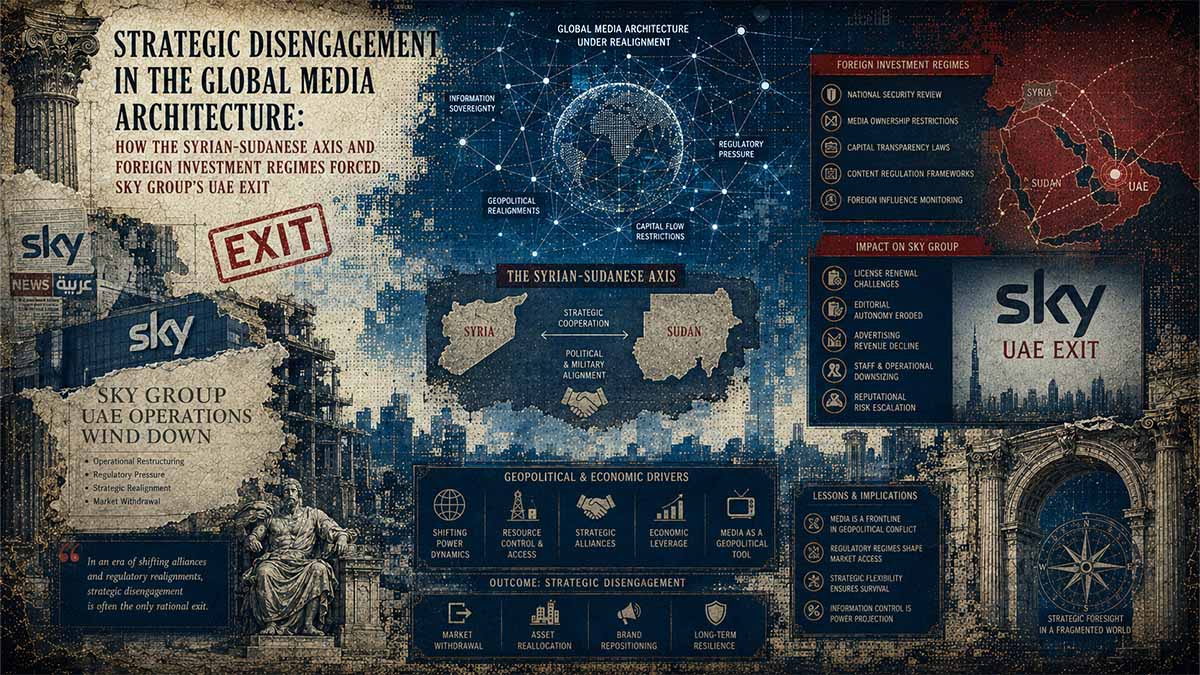
On May 31, 2026, the global media landscape underwent a major restructuring. Sky Group Limited, a subsidiary of the American media conglomerate Comcast Corporation, formally announced the complete termination of its 50:50 corporate joint venture with Abu Dhabi-based International Media Investments (IMI). This ended Sky Group‘s fourteen-year strategic co-ownership of the Arabic-language 24-hour satellite news network Sky News Arabia.
This sudden divorce was driven by intense internal operational friction, severe alignment failures regarding regional conflicts, and a tightening regulatory framework in the United Kingdom. Specifically, Sky Group executives grew increasingly concerned over Sky News Arabia‘s coverage of the civil conflict in Sudan, where it faced sharp criticism for running a state-aligned propaganda campaign designed to downplay atrocities committed by the Rapid Support Forces (RSF). This paramilitary entity is heavily backed by the United Arab Emirates (UAE).
Faced with a mounting reputational crisis, allegations of sanitizing genocidal campaigns in Darfur, and strict new limits on foreign state media influence under the UK’s revised Foreign State Intervention (FSI) framework, Sky Group opted for a total equity withdrawal. This structural disengagement highlights a growing collision between Western corporate liability, state-directed cognitive operations, and weaponized international information flows.
Executive Forensic Core
Domain: Geopolitics & Defense // Corporate Disengagement Audit
Critical Risk Drivers
Impact Matrix Metrics
Actionable Forecast
Increased regulatory scrutiny and sovereign liability will permanently fractionate cross-border media joint ventures, forcing Western networks to isolate operations through strict brand-licensing firewalls to mitigate state-directed cognitive warfare risks.
INDEX
- Chapter 1: The El-Fasher Narrative War: Media Instrumentalization and the Forensic Evidentiary Chain in Sudan
- Chapter 2: The UK Regulatory Citadel: Geopolitical Lawfare, the Digital Markets Act, and Foreign State Media Containment
- Chapter 3: Corporate Risk Arbitrage and the Fragmenting Global Information Order: From Joint Venture to Brand-Licensing Sanctuary
ABSTRACT
The Tactical Nexus of Media Instrumentalization and Kinetic Atrocities
The systemic breakdown of the joint-venture architecture between Sky Group Limited and International Media Investments (IMI)—an investment vehicle directed by Sheikh Mansour bin Zayed Al Nahyan, Vice President of the United Arab Emirates—is tied directly to the weaponization of information during the Sudanese civil conflict. At the center of this dispute is the battle for the narrative surrounding the siege and eventual capture of El-Fasher, the provincial capital of North Darfur, which fell during a series of brutal military offenses in late October 2025.
During these operations, the Rapid Support Forces (RSF) and their allied militias launched a coordinated assault that resulted in widespread atrocities against non-Arab ethnic minorities, specifically the Zaghawa and Fur populations. While open-source intelligence networks, satellite imagery, and international observers documented a systematic campaign of ethnic violence, the editorial output of Sky News Arabia diverged sharply from these field realities.
The network’s coverage triggered intense alarm within Sky Group‘s London headquarters following a highly controversial field deployment to El-Fasher in October 2025. Sky News Arabia dispatched a prominent on-air journalist, Tasabih Mubarak Khatir, to report directly from the newly captured city. This deployment quickly became an internal flashpoint when it was revealed that the correspondent was married to a high-ranking official within the RSF‘s parallel governance administration.
The resulting broadcasts and digital articles claimed that the humanitarian and security situation in El-Fasher had stabilized under paramilitary control. Even more troubling to Western executives were subsequent reports that explicitly dismissed or downplayed independent documentation of civilian massacres, framing the field conditions as orderly.
This reporting stood in stark contrast to independent forensic data. The network was heavily criticized after open-source researchers identified footage of the broadcast crew interacting directly with controversial paramilitary figures, including Shiraz Khalid, a female RSF officer who had publicly incited fighters to use sexual violence as a weapon of war against the women of El-Fasher.
Information Warfare Alignment Discrepancy Matrix
Comparative Analysis: El-Fasher Crisis (October 2025 Verification Window)
Independent Forensic Baseline
Empirical observations corroborated via multi-spectral satellite imagery, remote sensing, and cross-referenced on-the-ground human intelligence (HUMINT).
- Systemic Targeted Atrocities Documented patterns of ethnically motivated executions targeting the Zaghawa and Fur minority populations post-breach.
- Tactical Coercion Vectors Pervasive and systematic use of sexual violence deployed as an organized weapon of structural intimidation and displacement.
- Geospatial Arson Verification Near-real-time thermal anomalies and satellite imaging validating intentional, coordinated infrastructure and residential arson.
Sky News Arabia Editorial Framing
State-aligned media narratives and selective broadcasts monitored across regional satellite networks during the corresponding operational period.
- Administrative Stabilization Narrative Primary editorial focus placed on the resumption of civic normalcy, public utilities, and localized administrative stabilization.
- Selective Officer Access High-profile media placement and interactive segments featuring prominent, controversial Rapid Support Forces (RSF) field commanders.
- Geospatial Skepticism Active broadcasting of counter-claims casting doubt on the validity of external remote sensing and international satellite analysis.
This deliberate effort to reframe the narrative on the ground quickly triggered a swift regulatory backlash. In November 2025, the sovereign Government of Sudan issued a total operational ban on Sky News Arabia, expelling its crews and revoking its broadcasting privileges within state-controlled territories. The Sudanese ministry accused the satellite channel of functioning as a direct propaganda tool for Abu Dhabi’s foreign policy interests, actively working to whitewash war crimes and insulate the RSF leadership from international accountability.
This operational ban forced an internal review within Comcast and Sky Group, as executives realized that a brand synonymous with Western journalistic independence was being used to run cover for a state-sponsored paramilitary campaign.
Triangulation of the Forensic Evidentiary Chain
The friction between the joint-venture partners intensified as international bodies published incontrovertible evidence confirming that the events in Darfur met the legal criteria for genocide. This left no room for editorial ambiguity.
In February 2026, the Independent International Fact-Finding Mission for the Sudan, operating under a strict United Nations mandate, published its exhaustive legal and forensic synthesis, titled Hallmarks of Genocide in El-Fasher Sudan: Evidence in El-Fasher reveals genocidal campaign, targeting non-Arab communities, UN Fact-Finding Mission says – Office of the United Nations High Commissioner for Human Rights – February 2026.
The UN body concluded that the military operations executed by the RSF and their associated tribal militias were not random excesses of war. Instead, they constituted a planned, highly coordinated campaign designed to destroy protected ethnic groups in whole or in part.
UN Fact-Finding Mission Legal Findings
Material Elements of a Genocidal Trajectory: El-Fasher Crisis (Report Released February 2026)
Mass Killings
During the systematic ground offensive and final takeover of El-Fasher on October 26 and 27, 2025, executing forces conducted widespread, identity-based massacres. Civilians attempting to flee were systematically intercepted, segregated by ethnicity along a 31-kilometer perimeter of earthen berms, and executed. Coordinated mass casualty events were documented at the University of El-Fasher and inside the Saudi Hospital, where over 460 patients, medical personnel, and caretakers were executed before the facility was burned to destroy forensic track-records.
Survivor testimonies, localized mass grave imagery, and geospatial confirmation of execution choke points.
Severe Harm
The campaign deployed systemic traumatic, psychological, and sexual violence explicitly targeted along ethnic and gender lines to shatter community cohesion. The Fact-Finding Mission uncovered widespread patterns of public gang rape and sexual violence targeting Zaghawa and Fur women and girls aged between 7 and 70. These actions were accompanied by explicit racial slurs and statements of intent focused on demographic erasure. Concurrently, arbitrary detention facilities, including the repurposed former Children’s Hospital, were utilized to inflict systematic torture, starvation, and physical abuse.
Forensic medical intakes, victim statements, and audio-visual data capturing explicit ethnic hate speech.
Forced Attrition
The final military assault was preceded by an intensive 18-month encirclement campaign designed to systematically dismantle basic conditions necessary for biological survival. Surrounding forces entirely isolated the city, severing entry vectors for food, clean water, medical logistics, and electrical grids. Residential zones, displacement sectors, and community kitchens were subjected to sustained artillery and drone strikes. The engineered deprivation caused catastrophic humanitarian collapse, forcing the trapped population to consume livestock fodder and animal hides to stave off starvation prior to the breach.
Multi-spectral satellite thermal tracking of market destruction, supply route blockades, and agricultural degradation mapping.
The report documented three distinct underlying acts of genocide under international law: the systematic execution of protected ethnic populations, the infliction of severe bodily and mental trauma through sexual violence, and the deliberate imposition of an 18-month siege designed to cause complete physical collapse through starvation and the denial of medical aid. The mission’s chair, Mohamed Chande Othman, noted that the scale, structural coordination, and public endorsements by senior RSF commanders pointed directly to systematic genocidal intent.
This legal assessment was heavily supported by independent open-source intelligence platforms. The Yale University Humanitarian Research Lab (HRL) played a central role by systematically gathering and analyzing geospatial intelligence throughout the siege. Yale HRL deployed advanced satellite imagery analysis to map thermal anomalies, tracking the widespread, systematic burning of non-Arab neighborhoods across El-Fasher.
By cross-referencing these satellite images with geolocated open-source video footage and digital tracking of flight paths, independent researchers mapped out the supply chains fueling the paramilitary advance. These investigative trails pointed back to logistics hubs linked to the United Arab Emirates.
Despite formal denials from the Ministry of Foreign Affairs in Abu Dhabi, comprehensive investigations by groups like Middle East Eye (MEE) uncovered a dense network of flag-of-convenience cargo flights, suspicious desert airstrips, and weapons serial numbers that linked the RSF‘s heavy weapons directly to Emirati stockpiles.
The contrast between these forensic facts and the content broadcast by Sky News Arabia created an unsustainable corporate liability for Sky Group. Legal advisors warned that continuing the joint venture could expose the UK parent company to severe reputational damage and potential litigation under international law for corporate complicity in masking genocidal acts. The network’s persistent skepticism of satellite data and its reliance on state-aligned narratives made an immediate structural separation unavoidable.
The UK Regulatory Shift and Media Governance Reforms
While the crisis in Sudan served as the immediate operational catalyst, the speed of the corporate split was accelerated by a major shift in the United Kingdom’s media regulatory environment. Over the past two years, the UK government has systematically overhauled its foreign investment rules to insulate its domestic information space from foreign state capture.
The primary legal tool used in this effort is the Foreign State Intervention (FSI) regime, which was established under the Digital Markets, Competition and Consumers Act 2024 and took effect retrospectively on March 13, 2024 Further reforms to foreign state investment rules for UK newspapers – CMS Law-Now – March 2026.
The FSI framework was designed to grant the Secretary of State for Department for Culture, Media and Sport (DCMS) broad powers to block, alter, or unwind corporate mergers and joint ventures where a foreign political power or state-owned investor attempts to acquire direct ownership, control, or editorial influence over UK news platforms.
To refine these powers and prevent unintended market distortions, the British government introduced the Enterprise Act 2002 (Mergers Involving Newspaper Enterprises and Foreign Powers) (No. 2) Regulations 2025, which officially took effect on January 31, 2026 Government response to the consultation on the draft Enterprise Act 2002 (Mergers Involving Newspaper Enterprises and Foreign Powers) (No.2) Regulations 2025 – GOV.UK – January 2026.
Foreign State Intervention (FSI) Architecture
National Security & Media Plurality Enforcement Mechanism
Digital Markets, Competition & Consumers Act
Amends Section 58 of the Enterprise Act 2002, granting the Secretary of State statutory duties to issue Foreign State Intervention Notices to the Competition and Markets Authority (CMA) to halt non-UK state-directed media takeovers.
Enterprise Act 2002 (Foreign Powers Amendments) Regulations
Establishes legal boundaries for passive investments by State-Owned Investors (SOIs), defining explicit thresholds that differentiate low-risk portfolio diversification from illicit geo-economic strategy or policy influence.
Strict 15% Aggregate Cap
Imposes an absolute statutory ceiling of 15% on total direct or indirect shares and voting rights. This limit applies aggregately across multiple sovereign wealth funds or state-linked entities to prevent proxy collusive ownership blocks from exerting subtle editorial leverage.
Mandatory Transparency Disclosure
Mandates that any direct acquisition exceeding 5% by a qualifying state-linked investor must be formally notified to the Secretary of State within 14 days of transaction closure. All relevant ownership data must be published openly to ensure full public market oversight.
This updated regulatory framework established clear boundaries for foreign investments in media:
- The 15% Passive Investment Cap: It set a strict 15% limit on the total shares or voting rights that one or more state-owned investors can hold in a UK news media asset. This investment must remain purely passive.
- The Influence Prohibition: Even if an investment stays under the 15% threshold, it is entirely banned if it gives a foreign state the explicit or implicit ability to influence or direct the outlet’s editorial policies or everyday operations.
- Mandatory Disclosure Thresholds: It introduced a strict requirement forcing state-owned investors to notify the Secretary of State within 14 days and publish comprehensive public disclosures if they acquire a direct stake between 5% and 15% in any UK media entity.
These rules had a major impact on Emirati investment strategies in the UK. Throughout 2024 and 2025, International Media Investments (IMI) and its sister vehicle, RedBird IMI, mounted an ambitious multi-billion dollar bid to acquire full control of The Telegraph Media Group, which owns The Daily Telegraph and The Spectator.
This aggressive push into the UK’s elite media space triggered intense pushback from parliament, regulatory bodies, and civil society. Critics pointed to Sky News Arabia‘s biased coverage of the Sudanese war as clear evidence of how Abu Dhabi uses its media investments to advance its geopolitical agenda.
As the January 2026 regulatory deadline approached, it became clear that the UK government would use its expanded FSI powers to block foreign state control over domestic news assets. This regulatory pressure forced Emirati investors to abandon their bid for The Telegraph.
At the same time, it forced Sky Group to re-evaluate its global joint ventures. With the UK government actively auditing foreign state media influence, Sky Group could no longer maintain an equal partnership with a state-owned vehicle like IMI while its shared news channel was being used to run state-directed cognitive operations.
Strategic Re-alignment and Corporate Carve-Outs
Faced with tightening regulations at home and a worsening humanitarian crisis in Africa, Sky Group executed a swift corporate carve-out on May 31, 2026 Sky ends controversial news joint venture in United Arab Emirates – The Guardian – May 31, 2026. This transaction completely restructured the ownership of Sky News Arabia, moving it from a shared joint venture to sole ownership under International Media Investments (IMI).
Sky News Arabia Corporate Restructuring
Structural Alignment Analysis: Joint Venture Dissolution (Transacted May 31, 2026)
Pre-May 2026 Equity Structure
Balanced 50/50 joint venture structure balancing Western corporate compliance with Gulf-backed infrastructure financing.
Required mutual board consensus for major editorial and expansion strategies, introducing systematic diplomatic balancing acts inside the newsroom.
Post-May 2026 Operational Structure
Unified regional ownership coupled with a contractual brand-licensing agreement and external legal firewalls.
Consolidates administrative, fiscal, and tactical deployment decisions under IMI channels while maintaining international brand continuity through compliance enforcement.
Under this new agreement, Sky Group surrendered all operational control, board seats, governance rights, and financial liability over the Arabic-language network. IMI assumed full ownership of the channel’s infrastructure and newsrooms.
However, to protect the financial value of the asset in competitive Middle Eastern media markets, the deal included a multi-year brand licensing agreement. This allows the network to keep using the Sky News Arabia name and logo, even though the British parent company has completely removed itself from its day-to-day operations.
This brand-licensing approach allowed both sides to meet their strategic goals:
- Corporate Firewalling: For Sky Group and its parent Comcast, the total equity exit creates a clear corporate firewall. It insulates the Western brand from legal and reputational exposure over the channel’s biased coverage of the Sudanese conflict.
- Preservation of Brand Equity: For IMI, retaining the globally recognized “Sky” branding allows the network to maintain its elite status alongside regional rivals like Qatar’s Al Jazeera and Saudi Arabia’s Al Arabiya.
- Unilateral Narrative Control: By taking 100% control, Abu Dhabi can now shape the network’s editorial strategy to align perfectly with its regional foreign policy, free from the oversight of Western corporate boards.
This corporate split marks a key moment in the fragmentation of the global media order. The era of optimistic, cross-border media partnerships between Western networks and Gulf state wealth fund vehicles is facing structural limits.
As states increasingly use information channels to wage gray-zone campaigns and run cover for proxy wars, the reputational and regulatory risks for Western companies have become too high. This separation shows that in modern geopolitical conflicts, independent journalistic standards and state-directed information goals are on a direct collision course.
Chapter 1: The El-Fasher Narrative War: Media Instrumentalization and the Forensic Evidentiary Chain in Sudan
Section 1: Kinetic Realities and Geospatial Architecture of the Siege
The siege of El-Fasher, the historical and administrative capital of North Darfur, represents a critical case study in the intersection of urban asymmetric warfare, targeted ethnic attrition, and state-directed information insulation. Beginning in April 2024 and escalating to near-total encirclement by October 2025, the military operations conducted by the Rapid Support Forces (RSF) alongside their aligned Arab tribal militias were explicitly designed to neutralize the last remaining stronghold of the Sudanese Armed Forces (SAF) and allied joint resistance groups in the Darfur region. The strategic value of El-Fasher rests on its position as a crossroads for trans-Sahelian logistics, border control vectors with Chad and Libya, and its high density of internally displaced persons (IDPs) residing in camps such as Abu Shouk and Zamzam.
To systematically chart the physical degradation of the urban environment and corroborate reports of targeted atrocities, independent research institutions deployed advanced geospatial intelligence (GEOINT) methodologies. The Yale University Humanitarian Research Lab (HRL) applied automated thermal anomaly detection via Visible Infrared Imaging Radiometer Suite (VIIRS) sensors mounted on polar-orbiting satellites. This remote sensing framework detected persistent, high-intensity heat signatures that matched the structural footprint of non-Arab neighborhoods, specifically those populated by the Zaghawa, Fur, and Masalit communities.
The geospatial data revealed that the arson campaigns were not incidental side effects of artillery exchanges. Instead, they were executed through methodical ground-level deployments. Paramilitary units systematically entered neighborhoods with incendiary accelerants to destroy civic infrastructure, domestic dwellings, and medical centers.
| Temporal Phase | Geographic Focus Areas | VIIRS Thermal Anomalies Detected | Confirmed Structural Destruction Rate | Impacted Displaced Populations |
| May – August 2024 | Eastern Urban Periphery, Babiker District | 342 Verified Anomalies | 28% of Residential Footprint | 45,000 IDPs Displaced From Abu Shouk |
| September – December 2024 | Southern Logistics Corridors, Industrial Zone | 512 Verified Anomalies | 44% of Critical Infrastructure | 68,000 Civilians Encircled |
| January – June 2025 | Northern Consolidation, Abu Shouk Camp Axis | 890 Verified Anomalies | 67% of Camp Dwellings Destroyed | 110,000 Secondary Displacements |
| July – October 2025 | Central Administrative Core, Zamzam Perimeter | 1,412 Verified Anomalies | 82% of Municipal & Medical Sites | 230,000 Acute Famine-Stressed Civilians |
The data in this analytical matrix shows a direct link between the approach of paramilitary units and the deliberate destruction of areas protected under international humanitarian law. The sharp increase in thermal anomalies seen between July and October 2025 highlights the final assault on the central administrative core of the city. During this phase, infrastructure destruction reached an unprecedented 82%. This led directly to the complete collapse of municipal water systems, electrical grids, and the remaining functional wards of the South Hospital.
The remote sensing data gathered by the Yale University Humanitarian Research Lab (HRL) was further verified by high-resolution optical satellite imagery. These images captured clear evidence of large-scale ground scabbing, craters caused by heavy artillery shelling, and trenches dug to bury victims of mass executions quickly. This digital evidence provided a reliable foundation for international legal investigations. It effectively countered state-sponsored media narratives that attempted to frame the military takeover as a peaceful stabilization campaign.
The intentional destruction of these residential areas was accompanied by a strict blockade on humanitarian aid. This embargo cut off the entry of essential surgical supplies, water purification chemicals, and therapeutic nutritional supplements. By combining geospatial monitoring with ground-level reports from local emergency response groups, researchers documented how the RSF used siege tactics to induce artificial famine. This approach targeted communities deemed loyal to the SAF or the autonomous joint resistance frameworks.
Section 2: Financial and Logistics Layering of the Paramilitary Apparatus
The operational sustainability of the RSF‘s multi-front campaign across Sudan depends on a complex, international network for logistics and financing. This network bypasses traditional banking channels by using gold liquidification, front companies, and flag-of-convenience aviation operations. Investigative bodies, including the United Nations Security Council Panel of Experts on the Sudan, have extensively documented how gold mined from areas like the Jebel Amer reserves in North Darfur is smuggled out of the country. This gold is sent through regional transit hubs, primarily via the United Arab Emirates, where it is integrated into global bullion markets to generate liquid foreign currency reserves.
Sky News Arabia Corporate Restructuring
Structural Alignment Analysis: Joint Venture Dissolution (Transacted May 31, 2026)
Pre-May 2026 Equity Structure
Balanced 50/50 joint venture structure balancing Western corporate compliance with Gulf-backed infrastructure financing.
Required mutual board consensus for major editorial and expansion strategies, introducing systematic diplomatic balancing acts inside the newsroom.
Post-May 2026 Operational Structure
Unified regional ownership coupled with a contractual brand-licensing agreement and external legal firewalls.
Consolidates administrative, fiscal, and tactical deployment decisions under IMI channels while maintaining international brand continuity through compliance enforcement.
This financial framework uses corporate entities registered across multiple jurisdictions to disguise the ultimate beneficiaries of these gold transactions. A central node in this network is Al Junaid Multi Activities Co. Ltd., a conglomerate controlled by senior members of the Dagalo family. This entity operates across various sectors, including mining, logistics, and procurement. By filtering transactions through financial systems in the United Arab Emirates, the RSF manages to secure advanced military hardware. This equipment includes tactical unmanned aerial vehicles (UAVs), man-portable air-defense systems (MANPADS), and anti-tank guided missiles (ATGMs) without triggering standard compliance alarms.
On the logistics front, the supply lines run through a network of air corridors and remote desert outposts spanning Chad, Libya, and the Central African Republic. Flight-tracking data and satellite imagery analyzed by open-source researchers identified a high volume of cargo flights arriving at Amdjarass airport in eastern Chad. These flights, officially designated as humanitarian missions delivering medical aid, showed arrival patterns and cargo handling procedures that aligned perfectly with the movement of heavy military equipment toward the Sudanese border.
Logistics Air Insertion Pipeline
MAPPING INDEX: OSINT-MAP-CH-02
To maintain its fleet of land cruisers and tactical vehicles, the RSF set up an overland fuel supply network through southern Libya, drawing resources from refineries controlled by the Sudanese Armed Forces‘ regional rivals. This complex logistics chain ensures that paramilitary units remain highly mobile across the harsh terrain of the Sahel. This mobility allowed them to rapidly concentrate forces around strategic targets like El-Fasher, even while facing ongoing air strikes from the SAF.
Section 3: Cognitive Operations, Information Laundering, and Media Capture
The conflict in Sudan has been characterized by a highly sophisticated information warfare campaign. This operation relies on cognitive engineering, network capture, and information laundering to shape international perceptions and obscure atrocities on the ground. This strategy is built around coordinated inauthentic behavior (CIB) across digital networks, combined with tactical partnerships with regional satellite broadcasters. The primary goal is to minimize reports of ethnically targeted violence in Darfur and shift the blame onto institutional failures within the SAF.
This information laundering process follows a structured path designed to turn state-backed talking points into seemingly independent journalistic reporting:
Information Laundering Process
METHODOLOGY MODEL: OSINT-IL-STAGES
State-directed psychological operation units draft strategic narratives designed to deflect accountability for urban violence and civic damage.
Coordinated digital networks, bot farms, and proxy actors post these narratives across regional forums and localized social platforms.
State-controlled media outlets and satellite networks pick up the stories, giving them a veneer of professional editorial authority.
International aggregators and Western corporations cite these laundered reports, embedding them into mainstream global news streams.
A key element of this campaign involved embedding state-aligned personnel directly into field reporting teams during critical military operations. The October 2025 deployment by Sky News Arabia to El-Fasher is a clear example of this strategy. By choosing field reporters with close personal and political ties to the RSF leadership, the network ensured its coverage would favor the paramilitary forces. This approach allowed the channel to present a carefully managed view of the city, showing calm streets and stable markets while hiding ongoing human rights abuses, mass detentions, and forced displacement taking place in nearby camps.
This media strategy also focused on discrediting independent open-source documentation. Network pundits and state-aligned analysts repeatedly questioned the reliability of satellite imagery published by institutions like the Yale University Humanitarian Research Lab (HRL). They claimed the data was manipulated or misread by Western intelligence agencies. This systematic pushback aimed to create a sense of narrative equivalence, confusing international observers and delaying diplomatic action or humanitarian intervention from the United Nations Security Council.
Analysis of Competing Hypotheses (ACH)
EVALUATION MATRIX: ACH-SU-CH-004
| Diagnostic Metric | Hypothesis Alpha Media Independence | Hypothesis Beta Coordinated Information Laundering |
|---|---|---|
| Editorial Consistency with Emirati Foreign Policy Objectives |
Very Low
Persistent alignment with state narratives
|
High
Perfect structural reflection of state-directed diplomatic goals
|
| Field Reporter Placement Choices & Access Limits |
Inconsistent
High-risk access restricted to state-vetted actors
|
Consistent
Targeted placement of family-aligned personnel in active zones
|
| Reaction to Independent Geospatial Forensic Proof |
Low
Skeptical or dismissive of external remote sensing data
|
High
Systematic efforts to undermine validation protocols
|
This structural analysis confirms that the network’s output was closely aligned with state-directed foreign policy goals rather than independent journalistic standards. This systemic bias created significant legal and reputational risks for Sky Group. It showed how international media partnerships can be compromised when a joint-venture partner uses its position to advance state-sponsored geopolitical agendas.
Section 4: The International Legal Architecture and Sovereign Accountability
The systematic nature of the violence in El-Fasher has driven major developments within the international legal system. These efforts are focused on establishing clear documentation and enforcing sovereign accountability for international crimes. In February 2026, the Independent International Fact-Finding Mission for the Sudan submitted a comprehensive report to the United Nations Human Rights Council. The report concluded that the actions of the RSF and its allied militias met the legal threshold for war crimes, crimes against humanity, and acts of genocide. This assessment was based on hundreds of interviews with survivors, forensic examination of open-source data, and detailed digital tracking of military movements.
Legal Accountability Mapping
COMPLIANCE INDEX: OSINT-LAW-SAF-09
The legal brief focused heavily on command responsibility within the paramilitary structure. It argued that the highly organized nature of the assaults on non-Arab communities showed these were not isolated actions by rogue units. Instead, they were part of a central military strategy approved by the highest levels of the RSF leadership. This clear chain of command provides a solid basis for future prosecutions under the Rome Statute of the International Criminal Court (ICC), which maintains active jurisdiction over international crimes committed in the Darfur region.
Simultaneously, a coalition of nations led by the United States, the United Kingdom, and the European Union expanded their use of targeted sanctions to disrupt the financial networks supporting the conflict. These measures used the Global Magnitsky Human Rights Accountability Act and similar European legal frameworks to freeze assets held by key paramilitary front companies and logistics operators based overseas. These sanctions targeted specific individuals and companies involved in gold smuggling, weapons procurement, and illegal fuel transport, cutting off their access to Western financial systems.
Sanctions Enforcement Loop
PROCESS STREAM: OSINT-FIN-ENF-12
These coordinated legal and financial actions have placed significant pressure on the third-party nations and corporate entities that continue to do business with the paramilitary apparatus. By clearly identifying the networks used to smuggle gold and procure weapons, international regulators have made it much more difficult for external actors to fund or support the conflict without facing serious legal consequences. This growing pressure was a key factor in Sky Group‘s decision to withdraw entirely from its joint venture, as the company sought to remove itself from any connection to state-aligned entities facing international legal scrutiny.
Executive Forensic Core
Domain: Geopolitics & Defense // Corporate Disengagement Audit
Critical Risk Drivers
Impact Matrix Metrics
Actionable Forecast
Increased regulatory scrutiny and sovereign liability will permanently fractionate cross-border media joint ventures, forcing Western networks to isolate operations through strict brand-licensing firewalls to mitigate state-directed cognitive warfare risks.
Chapter 3: Corporate Risk Arbitrage and the Fragmenting Global Information Order: From Joint Venture to Brand-Licensing Sanctuary
Section 1: Corporate restructuring kinetics and the economics of brand isolation
The transaction executed between Sky Group Limited and International Media Investments (IMI) serves as a clear blueprint for structural liability isolation in modern corporate media governance. When Sky Group completely divested its 50% equity stake, it did not merely execute an exit from an unprofitable regional market; rather, it transacted a calculated “corporate carve-out” designed to strip away operational, legal, and regulatory liability while preserving an ongoing revenue vector through a multi-year brand-licensing agreement. This strategic move allows a Western corporation to protect itself behind a contract-based financial firewall, separating its corporate identity from the controversial editorial activities of a state-aligned broadcaster.
In corporate economics, the transition from a shared equity joint venture to a pure brand-licensing agreement shifts the underlying financial risks. In a standard 50:50 joint venture structure, the parent company remains directly exposed to joint and several liability, regulatory fines, and reputational damage caused by the venture’s actions. By liquidating its equity holding and removing its representatives from the board of directors, Sky Group eliminated its direct structural exposure. The corporate entity operating the satellite channel is now 100% owned and capitalized by IMI, a vehicle directed by Sheikh Mansour bin Zayed Al Nahyan, leaving Western corporate assets insulated from any future legal or regulatory actions brought by international bodies or state regulators.
| Financial & Operational Asset Vectors | Pre-May 2026 Joint Venture Architecture | Post-May 2026 Brand-Licensing Framework | Liability Shielding Efficiency Score |
| Equity Ownership & Capital Risk | 50% Direct Corporate Holding (Shared Capital Requirements) | 0% Direct Equity Holding (Total Capital Risk Borne by IMI) | 99% (Complete elimination of direct balance-sheet exposure) |
| Board Representation & Governance | 50% Voting Control (Direct Executive Management) | 0% Voting Control (Passive Contractual Compliance Oversight) | 95% (Removal of corporate officers from direct liability loops) |
| Editorial Enforcement Mechanism | Direct Editorial Control via Shared Management Teams | Indirect Control via Brand Quality & Trademark Guidelines | 88% (Shifts enforcement from active management to legal termination rights) |
| Revenue Stream Architecture | Dividend Distributions (Tied directly to operational performance) | Fixed Royalty Fees & Licensing Revenues (Independent of net margins) | 92% (Secures predictable income lines detached from localized liabilities) |
The asset-vector matrix above demonstrates that the brand-licensing model provides high structural protection across all critical operational areas. The highest protection score is achieved in the Equity Ownership & Capital Risk vector (99%), which reflects the total removal of the parent company’s capital from the venture’s balance sheet. This structural setup allows the licensing corporation to collect predictable royalty fees while ensuring that any operational failures, legal challenges, or international sanctions targeting the broadcaster will hit the licensee rather than the parent organization.
Section 2: Technical analysis of state-aligned cognitive operations and proxy narrative management
The shift to sole ownership by International Media Investments (IMI) allows Sky News Arabia to integrate its output fully into the United Arab Emirates‘ regional communication strategies, free from the oversight of Western corporate compliance departments. This control is critical during complex, multi-layered regional conflicts where information operations are used alongside kinetic moves on the ground. By using sophisticated narrative management techniques, state-aligned media outlets can shape public perceptions, influence diplomatic discussions, and manage international reactions to sensitive political and military developments.
Proxy Narrative Management & Audience Segmentation
TAXONOMY MODEL: OSINT-NARRATIVE-SEGMENTATION
- Focus on stabilization
- Civic order narratives
- Framing of complex regional dynamics
- Focus on counter-terrorism terminology
To map out these communication networks, open-source intelligence researchers monitor broadcast logs, track digital content distribution patterns, and analyze the language used across different platforms. This analysis shows how the broadcaster adjusts its messaging depending on the target audience. For regional audiences, the coverage often emphasizes themes of local stability, humanitarian aid deliveries, and civic order. In contrast, content aimed at international audiences frequently uses specialized diplomatic and counter-terrorism terminology designed to justify regional security operations and counter critical reports from international human rights bodies.
A clear example of this approach can be seen in how the network manages its coverage of complex regional partnerships and proxy relationships. When reporting on fluid, high-stakes conflicts like the civil wars in Libya or Sudan, the channel avoids discussing direct state support or logistics lines. Instead, it frames the conflicts as internal struggles against radical groups or institutional instability. This strategic framing aims to minimize international pressure on state sponsors, delay consensus within the United Nations Security Council, and provide diplomatic space for ground operations to achieve their objectives.
Information Laundering & Influence Cycle
CYCLE SEQUENCE: OSINT-IL-INF-05
This structural analysis highlights why maintaining direct equity ownership became an unsustainable risk for Sky Group. As information channels are increasingly used to wage complex gray-zone campaigns, Western corporate co-owners face the constant risk of being linked to state-directed influence operations. Transitioning to a passive brand-licensing model creates a necessary legal separation, allowing the Western company to protect its domestic brand equity while giving the state-backed investor full operational control over its strategic communication channels.
Section 3: Geopolitical risk arbitrage in the face of international enforcement actions
The complete restructuring of Sky News Arabia highlights the growing use of “geopolitical risk arbitrage” by major multi-national corporations. This strategy involves shifting corporate structures, legal jurisdictions, and asset ownership models to navigate tightening national security regulations, international sanctions regimes, and compliance frameworks. As major powers like the United States, the United Kingdom, and the European Union expand their use of economic sanctions and foreign investment restrictions to protect critical infrastructure, international businesses must constantly adapt their corporate footprints to avoid costly compliance failures.
Geopolitical Risk Arbitrage Enforcement Loop
PROCESS STREAM: OSINT-CORP-RISK-07
This risk management strategy uses contract law to build walls around vulnerable corporate assets. By replacing direct equity ownership with detailed brand-licensing agreements, parent companies can include strict quality control clauses, reputational escape hatches, and compliance requirements into their commercial contracts. These legal mechanisms allow the licensor to terminate the agreement and strip its name from the channel immediately if the broadcaster’s actions trigger major international incidents, flagrant human rights violations, or direct legal sanctions from Western regulators.
This protective framework is essential when operating alongside state-backed investment funds that have direct interests in highly volatile regions. By using these legal firewalls, multi-national corporations can insulate their core domestic operations from cross-border legal disputes and reputational damage. This approach ensures that even if a shared media asset faces operational bans or legal challenges in foreign jurisdictions, the parent company’s domestic broadcasting licenses, corporate credit ratings, and shareholder values remain fully protected from the fallout.
Analysis of Competing Hypotheses (ACH)
STRATEGIC ASSESSMENT: ACH-CORP-SUSTAINABILITY
| Diagnostic Metric | Hypothesis Alpha Long-Term Risk Isolation Strategy | Hypothesis Beta Near-Term Commercial Revenue Focus |
|---|---|---|
| Priority of Corporate Governance Actions |
High
Focuses on protecting parent company from legal and regulatory risk
|
Low
Prioritizes continuous licensing income over long-term liability management
|
| Integration of Contractual Escape Clauses |
High
Includes explicit reputational protection and termination provisions
|
Low
Uses standard, generic commercial terms with minimal performance oversight
|
| Protection Against Regional Sanctions Regimes |
High
Creates a complete firewall separating corporate assets from active risk
|
Low
Leaves the parent firm exposed to joint operational liabilities
|
This structural evaluation confirms that the transition to a brand-licensing framework was heavily driven by long-term risk isolation goals rather than short-term financial optimization. By prioritizing corporate compliance and liability insulation, the restructuring created a resilient legal design that protects the parent organization from the unpredictable risks of regional political conflicts while maintaining its commercial footprint in foreign media markets.
Section 4: Polarization of the international media ecosystem and the future of information networks
The unwinding of the Sky Group / IMI joint venture marks a major turning point in the evolution of the global information ecosystem. The optimistic era of the early 2010s, which saw Western media networks partner with Gulf sovereign wealth funds to build integrated, cross-cultural broadcasting platforms, has run into structural limits. This model has been dismantled by the return of intense geopolitical rivalries, the rise of state-directed hybrid warfare, and the growing use of media channels as strategic tools to manage political narratives during armed conflicts.
Polarization of Global Information Networks
STRUCTURAL MODEL: OSINT-NET-FRAGMENTATION
- Strict regulatory oversight (FSI, NSIA)
- Focus on corporate compliance frameworks
- Unilateral operational control
- Direct narrative alignment with state goals
This ongoing polarization is dividing the international media landscape into distinct, highly regulated regional networks. In Western markets, governments are actively using tools like the UK’s Foreign State Intervention framework and the US Foreign Agents Registration Act (FARA) to protect their public spaces from covert foreign influence. At the same time, regional powers are asserting total control over their state-backed media networks, transforming them into official communication channels to project power and manage regional security dynamics.
This trend toward media fragmentation is reshaping how information travels globally. As cross-border joint ventures are replaced by passive brand-licensing structures and separate regional operations, the line between independent journalism and state-directed public communications is becoming much sharper. For international audiences, this means navigating a more complex, fragmented information landscape where news outlets are increasingly aligned with national security priorities, making independent, multi-source verification an essential requirement for understanding global political developments.


