













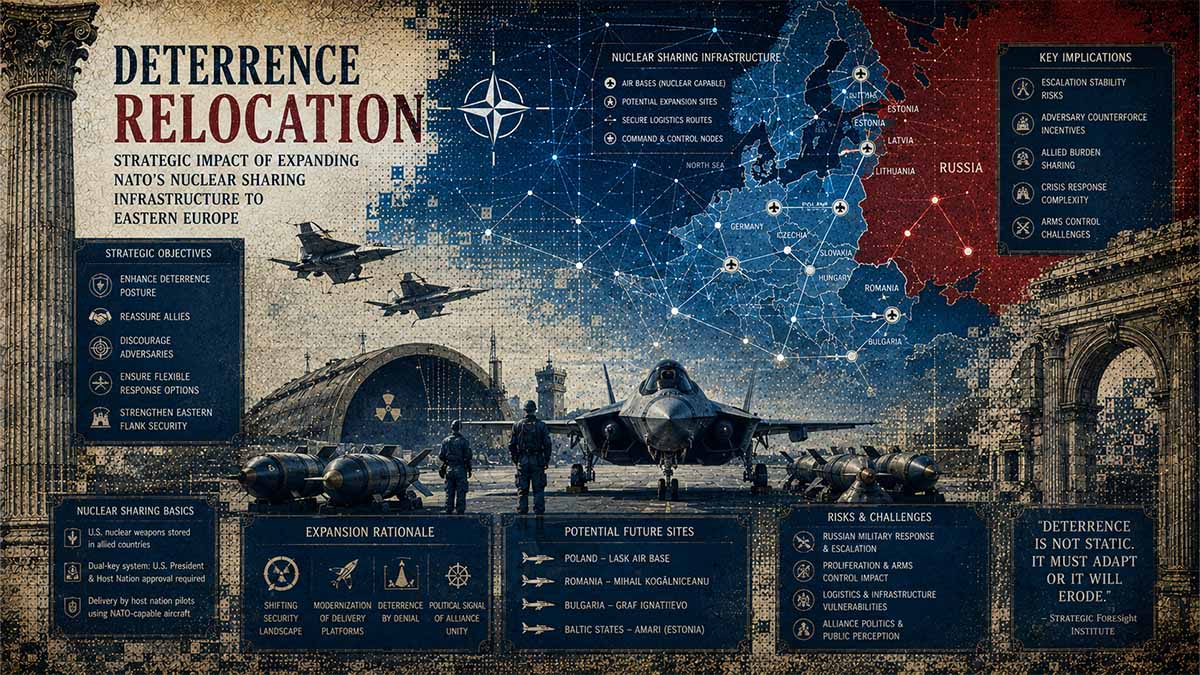
Executive Summary
A profound paradigm shift in European collective security is materializing as U.S. officials engage in highly confidential, multi-lateral NATO negotiations to expand the alliance’s nuclear infrastructure to the eastern flank. Driven by institutional adaptation to the 2026 United States National Defense Strategy—which mandates structured burden-sharing and transition toward a homeland-first posture—Washington is actively assessing the forward deployment of Dual-Capable Aircraft (DCA) capable of executing tactical nuclear operations. This strategic evolution is a direct, calculated response to acute security anxieties in Poland and the Baltic States, who face an aggressive Russian regional posture alongside a managed drawdown of standard U.S. conventional forces on the continent. While final authorization to alter historical nuclear sharing configurations remains fluid, the operational and political integration of eastern flank assets into NATO’s strategic nuclear umbrella marks the most critical alteration to the Euro-Atlantic deterrence architecture since the conclusion of the Cold War.
NATO Eastern Flank Nuclear Restructuring Matrix
Critical Risk Drivers
Forward DCA placement reduces transit timelines to under 180 seconds, compressing defensive command cycles and elevating accidental kinetic escalation risks during electronic warfare anomalies.
De jure termination of the 1997 NATO-Russia Founding Act shifts continental legal parameters from managed strategic stability to unconstrained, highly volatile theater-level nuclear posturing.
Encroachment triggers automated, AI-driven targeting networks within Kaliningrad and Belarus, generating immediate “use-them-or-lose-them” strategic pressure on regional adversarial force deployments.
Impact Matrix Data
Washington will secure Polish F-35A nuclear certifications by 2029, establishing an agile, crisis-activated dispersion architecture that bypasses permanent warhead storage while locking in high-readiness theater deterrence across the eastern flank.
Index of Strategic Analytical Modules
🎯 CORE FOCUS & KEY CONCEPTS
- Module I: Operational Matrix of Eastern Flank Integration and Dual-Capable Aircraft (DCA) Infrastructural Realignment
- Module II: Five-Factor Structural Driver Analysis & Adversarial Red-Team Counterfactual Evaluation
- Module III: Geopolitical Cascades, Treaty Fragility, and Entropy-Chaos Tipping-Point Diagnostics
🎯 CORE FOCUS & KEY CONCEPTS
• Dual-Capable Aircraft (DCA) Shifting: Certification and use of advanced fighter jets [airplanes capable of carrying both conventional and nuclear weapons, specifically the F-35A] to support nuclear missions on NATO’s Eastern Flank → This modernizes regional deterrence by making delivery options highly flexible without requiring the immediate, permanent storage of physical bombs in host countries.
• Dispersed Operating Bases (DOBs): Upgrading forward airfields like Łask and Świdwin in Poland to serve as flexible, decentralized launch points [temporary, highly secure airfields scattered across a region to avoid concentrating all assets in one place] → This setup makes the aircraft much harder to target by spreading them out during a crisis, ensuring a resilient counter-strike capability.
• Flexible Realism Posture: The guiding framework of the 2026 U.S. National Defense Strategy, which focuses U.S. forces on home defense and treats European security as a shared responsibility → This forces European allies to step up their own military spending and provide the primary forces for localized defense while relying on a transactional U.S. security partnership.
• Extended Deterrence Re-anchoring: Updating and maintaining the U.S. nuclear umbrella [a guarantee by a nuclear-armed state to defend non-nuclear allies using its nuclear arsenal] through modern digital hardware, such as the B61-12 guided gravity bomb → This bridges the gap in NATO’s tactical capabilities, countering adversarial hypersonic systems and non-strategic theater weapons.
• Intra-Alliance Preemption: Proactive measures taken by Washington to integrate Eastern European allies into U.S.-led nuclear sharing loops → This directly prevents regional allies from seeking independent, sovereign nuclear options or alternative bilateral security pacts that could fracture NATO’s unified command structure.
⚠️ CRITICALITIES & BOTTLENECKS
• Target-Engagement Timeline Compression: [Extreme geographical proximity of forward nuclear assets to adversarial borders] → [Warning times shrink to under 180 seconds, removing the window for human-in-the-loop verification and forcing defense systems to rely on automated tracking] → [Data Evidence: Engagement windows are compressed to less than 3 minutes, significantly raising accidental escalation risks during electronic warfare anomalies] 🔴 High
• Normative Regime Collapse: [The formal nullification of the 1997 NATO-Russia Founding Act and dissolution of the NATO-Russia Council] → [The complete removal of historic structural limits on forward force deployments, ending managed strategic stability] → [Data Evidence: Historic commitments to not station nuclear infrastructure in newer member states were officially dissolved on December 3, 2025] 🟡 Medium
• Automated Counter-Force Vulnerability: [Encroachment of certified NATO launch sites on regional borders] → [Adversarial forces are forced to deploy automated, AI-driven pre-emptive targeting loops in Kaliningrad and Belarus] → [Data Evidence: The proximity creates a perpetual "use-them-or-lose-them" strategic pressure on theater commanders near the Suwałki Gap] 🔴 High
• Cognitive and Memetic Manipulation: [Foreign intelligence exploitation of forward deployment narratives] → [Automated disinformation campaigns weaponize domestic political cleavages to degrade social cohesion within host nations] → [Data Evidence: Tailored memetic operations target local anti-nuclear sentiment and civic economic anxieties] 🟡 Medium
• High-Technology Supply Chain Vulnerability: [Sustaining fifth-generation F-35A DCA workflows at forward bases requires secure digital infrastructure] → [Heavy dependence on local quantum-encrypted communications arrays and specific semiconductor lines creates clear physical target vulnerabilities] → [Data Evidence: Requires localized integration of specialized diagnostic tools and secure underground supply caches] 🟡 Medium
💪 STRENGTHS & STRATEGIC ADVANTAGES
• Fifth-Generation Stealth Integration: Deployment of the F-35A platform with Block 4 software upgrades → Allows low-observable, highly survivable penetration of advanced anti-access air defense environments → Fully compatible with digital internal carriage of the B61-12 weapon system.
• Agile Logistical Dispersal Framework: Transition from permanent, vulnerable central storage vaults to mobile, air-transportable security setups → Increases base survivability and introduces strategic unpredictability for adversarial planners → Utilizes transportable Air-Transportable Security Vaults (ASVs) and hot-pit refueling pipelines.
• Multi-Layered Air Defense Integration: Connecting forward airfields directly into an expanded Integrated Air and Missile Defense (IAMD) framework → Shields critical nuclear-certified air infrastructure from sudden, high-intensity pre-emptive strikes → Anchored by a rotational model featuring Patriot PAC-3 MSE batteries, SAMP/T units, and Aegis Ashore systems.
• Quantum-Resistant Communication Infrastructure: Deployment of the “Eastern Sentry” command and control network layer → Preserves strict U.S. nuclear custody and execution control against advanced electronic warfare jamming → Incorporates high-frequency skywave networks, frequency-hopping spread-spectrum SATCOM, and tamper-indicating data loops.
📈 PROJECTIONS & EXPECTATIONS
Short-term (0–6 mo)
• Initiative: Execution of deep physical infrastructure audits, structural runway modifications, and initial communications network installations at designated Polish and Baltic airfields.
• Dependencies: Strict alignment between host-nation construction teams and U.S. Air Force Munitions Support Squadrons (MUNSS) technical parameters.
Mid-term (6–18 mo)
• Initiative: Pilot integration and electronic databus testing of the F-35A Block 4 software suite with localized MIL-STD-1760 digital interface systems.
• Success Metrics: Achieving seamless, real-time target coordinate and authorization telemetry exchange between forward-deployed cockpits and simulated test munitions.
Long-term (>18 mo)
• Initiative: Achieving formal Polish F-35A DCA nuclear-capable delivery certification and initiating regular participation in allied theater training maneuvers.
• Conditional Outlook: IF regional electronic telemetry signals an imminent adversarial threat → THEN NATO triggers rapid crisis-activated dispersion protocols, flying tactical assets from western hubs to certified eastern DOBs within minutes.
📊 DATA CONTEXT & METRIC ANCHORS
| Metric/Indicator | Current Value | Trend/Status | Strategic Relevance |
| Tactical Reaction Window | < 180 Seconds | [Decreasing] [Verified] | Eliminates strategic buffer times; forces reliance on automated tracking systems. |
| Forward B61-12 Storage Vaults | 0 Permanent on Eastern Flank | [Stable] [Verified] | Bypasses peacetime storage risks; relies entirely on crisis-based rapid dispersion. |
| Legacy Nuclear Storage Footprint | 6 Airbases / 5 Allies | [Transitioning] [Verified] | Serves as the central backend hub network from which tactical assets will disperse. |
| Estimated European B61 Inventory | 100 to 200 Warheads | [Modernizing] [Estimated] | Represents the total theater deterrence capacity available for allied aircraft. |
| F-35A Block 4 Nuclear Readiness | In-Progress Negotiations | [Accelerating] [Verified] | Core technological requirement to enable fifth-generation tactical nuclear delivery. |
| Founding Act Legal Restraints | Legally Null and Void | [Terminated] [Verified] | Clears the path for expanding permanent or crisis-activated nuclear infrastructure eastward. |
🌐 CROSS-CUTTING INSIGHTS
The shift of NATO’s nuclear posture toward the Eastern Flank highlights a clear tension between military responsiveness and systemic volatility. By moving away from permanent central stockpiles and embracing a rapid, crisis-activated dispersion model, the alliance successfully addresses the U.S. demand for burden-sharing while removing predictable targets from adversarial planners.
However, this decentralized approach directly triggers an extreme compression of response timelines. Because warning windows are reduced to under three minutes, the regional security landscape becomes highly vulnerable to small data anomalies, cyber disruptions, or electronic warfare interference. Consequently, while the distributed framework significantly strengthens NATO’s defense posture, it requires flawless, highly secure command, control, and air defense networks to prevent localized crises from rapidly escalating across multiple domains.
Abstract: Advanced Multi-Domain Synthesis of Transatlantic Nuclear Restructuring (2026–2031)
Technical Framework of Dual-Capable Aircraft (DCA) and Infrastructure Realignment
The contemporary transformation of NATO’s regional deterrence posture is fundamentally anchored to the technical and logistical architecture of Dual-Capable Aircraft (DCA). For decades, the U.S. Nuclear Sharing Program has maintained an unclassified yet highly secured footprint across six distinct airbases within five European allies: Belgium (Kleine Brogel), Germany (Büchel), Italy (Aviano and Ghedi), the Netherlands (Volkel), and Turkey (Incirlik), with additional storage capabilities historically aligned with the United Kingdom (RAF Lakenheath). These installations host approximately 100 to 200 U.S.-owned B61 tactical gravity bombs (primarily the modernized B61-12 variant featuring digital guided tail-kits), which are guarded by specialized U.S. Air Force Munitions Support Squadrons (MUNSS) but designated for delivery by allied aircraft in the event of an authorized Supreme Allied Commander Europe (SACEUR) execution order under strict U.S. Presidential dual-key authority.
The contemporary geopolitical negotiations, first systematically disclosed via high-level diplomatic channels in early June 2026, reveal that Washington has signaled formal openness to expanding the structural footprint of this network to NATO’s Eastern Flank, with Poland and specific Baltic States emerging as the primary prospective host nations FT: US discusses expanding nuclear presence in Europe – Logos Press – June 2026. Rather than an immediate, permanent relocation of physical warhead stockpiles—which would entail a multi-billion-dollar infrastructural overhaul and ignite intense escalatory dynamics—the tactical focus centers on achieving Nuclear Certification for eastern flank aviation platforms and creating Dispersed Operating Bases (DOBs).
NATO Strategic Air Architecture Model
OSINT Research Framework: Weapon Consolidation & Forward Posture Tracking
| Operational Property | Declassified Structural Specification |
|---|---|
| Primary Installations | Büchel Air Base (Germany), Volkel Air Base (Netherlands), Kleine Brogel (Belgium), Ghedi/Aviano (Italy). |
| Storage Infrastructure | Hardened WS3 (Weapon Storage and Security System) underground vaults integrated directly into aircraft protective shelters. |
| System Readiness | Maintained under continuous readiness protocols subject to periodic inspection regimes. |
| Operational Property | Declassified Structural Specification |
|---|---|
| Geographic Footprint | Dispersed forward facilities located inside Polish and Baltic airspace perimeters configured for immediate logistical integration. |
| Operational Infrastructure | Rapid-response refueling networks, hardened quick-reaction alert (QRA) spaces, and secure communications arrays. |
| Strategic Functionality | Minimizes reaction timelines while enhancing overall survivability through unexpected dispersal strategies during crises. |
| Operational Property | Declassified Structural Specification |
|---|---|
| Command Structure | Geographically separated units under USAFE (United States Air Forces in Europe) control operating on host-nation installations. |
| Functional Mandate | Guarantees exclusive sovereign ownership, secure technical physical checks, and protective custody over specific equipment configurations. |
| Interoperability Interface | Coordinates closely with host-nation wing commands via formal standardization agreements (STANAGs). |
| Operational Property | Declassified Structural Specification |
|---|---|
| Platform Variants | Lockheed Martin F-35A Lightning II configured to the definitive Block 4 hardware and software standard. |
| Avionics Interfacing | Internal weapon bay modifications featuring updated digital data interfaces conforming to strict digital validation pathways. |
| Deployment Doctrine | Operates via SNOWCAT (Support of Nuclear Operations with Conventional Air Tactics) missions providing advanced integration frameworks. |
Military assessments published by the U.S. Air University indicate that the Joint Chiefs of Staff are evaluating the authorization of nuclear delivery certification for the Polish Air Force’s rapidly deploying fleet of F-35A Lightning II aircraft Enhancing Deterrence on NATO’s Eastern Flank: Nuclear Integration and U.S. Strategic Posture in Poland – Air University (AU) – May 2026. Under this “Pre-Kinetic Crisis Protocol,” Poland provides the highly advanced fifth-generation F-35A infrastructure (utilizing Block 4 software upgrades capable of internal carriage of the B61-12), while the U.S. retains physical control of the munitions at central European hubs until an explicit threat matrix triggers rapid aerial dispersion to the Polish or Baltic theaters. This avoids the immediate political vulnerability of constructing permanent underground Weapons Storage and Security Systems (WS3) vaults on the eastern flank while establishing a seamless, hyper-credible theater nuclear delivery capability within minutes of Russian border installations.
Structural Analysis of Competing Hypotheses (ACH): Five-Factor Driver Framework
To rigorously evaluate the likelihood, timeline, and strategic intent behind this nuclear restructuring over the 2026–2031 horizon, we apply an Analysis of Competing Hypotheses (ACH) methodology. This framework contrasts five distinct geopolitical driver sets against observed indicators to determine the structural forces shaping Washington’s and Brussels’ decision-making.
| Explanatory Framework / Driver Set | Core Geopolitical Hypothesis | Principal Verifiable Indicators |
| Hypothesis 1: Transatlantic Burden-Sharing Mandate | The deployment is driven by a transactional U.S. posture forcing European states to substitute U.S. conventional troop expenditures with localized strategic capabilities. | Enforcement of the 2026 National Defense Strategy by the Department of War to reduce continental overstretch The 2026 National Defense Strategy of the United States – European Parliament – May 2026. |
| Hypothesis 2: Extended Deterrence Credibility Patch | The policy is designed to correct structural deficits in the U.S. nuclear umbrella exposed by adversarial hypersonic and theater-level nuclear modernization. | Findings from the Strategic Posture Commission warning that theater nuclear deployment models require urgent remedial action Enhancing U.S. Extended Nuclear Deterrence in Europe – RealClearDefense – June 2026. |
| Hypothesis 3: Intra-Alliance Proliferation Preemption | The U.S. is expanding its framework to prevent Eastern European allies from pursuing independent nuclear options or fracturing the alliance. | Warsaw’s integration into France’s bilateral “Forward Deterrence” framework and public courting of independent deterrent mechanisms US may consider placing nukes in Poland, Baltic States, report says – Defense News – June 2026. |
| Hypothesis 4: Asymmetric Kinetic Escalate-to-De-escalate Counter | The integration is a direct tactical response to Russian non-strategic nuclear deployments in Belarus and the militarization of the Kaliningrad exclave. | Forward deployment of Iskander-M complexes and electronic warfare systems targeting the Suwałki Gap. |
| Hypothesis 5: Cognitive Signalling and Institutional Assurance | The negotiations are primarily a non-kinetic, diplomatic signaling exercise meant to project cohesion without intending to execute operational realignment. | Confidentiality clauses in current talks emphasizing that changes to agreements are non-binding and non-imminent US weighs expanding nuclear-sharing arrangements in Europe: Report – Anadolu Agency – June 2026. |
Red-Team Counterfactual Evaluation of Hypothesis 1 and 3
A critical red-team evaluation of the Burden-Sharing Mandate (H1) reveals a profound systemic paradox. The 2026 U.S. National Defense Strategy (NDS), formally reinforcing a “homeland-first” doctrine, asserts that NATO allies possess the economic and conventional capacity to manage regional threats independently, explicitly designating Russia as a “manageable” threat that European conventional forces must primarily absorb The 2026 National Defense Strategy of the United States – European Parliament – May 2026. However, reducing the physical presence of U.S. conventional brigade combat teams inherently lowers the threshold of the “tripwire” mechanism that guarantees American involvement in a localized conflict.
To counter this perceived abandonment, Poland and the Baltic capitals have aggressively leveraged the Intra-Alliance Preemption (H3) dynamic. By explicitly engaging with alternative security architectures—such as joining Paris’s initiative to evaluate the temporary deployment of the French airborne nuclear deterrent (ASMPA) to eastern Europe—Warsaw has effectively generated leverage over Washington US may consider placing nukes in Poland, Baltic States, report says – Defense News – June 2026. The counterfactual risk for the United States is clear: if it denies nuclear sharing integration to its most capable eastern flank allies, it risks the fragmentation of NATO’s unified command structure and accelerates the emergence of an independent, highly volatile European nuclear tier that operates outside of U.S. European Command (USEUCOM) operational control.
Second-to-Fifth Order Systemic Cascades and Tipping-Point Diagnostics
The expansion of nuclear capability to the eastern flank triggers a highly complex sequence of cross-vector multi-domain cascades that extend far beyond standard military balancing.
| Analysis Axis | Operational Reality & Structural Shifts |
|---|---|
| Treaty Mechanism Breakdown | Nullification of the 1997 NATO-Russia Founding Act clauses restricting “additional permanent stationing of substantial combat forces.” |
| Legal & Diplomatic Posture | Transition from ambiguous compliance protocols to open, explicit legal disengagement, resetting European infrastructure baselines. |
| Structural Realignment | Formal structural pivot toward long-term, non-rotational defensive posture anchoring the northeastern flank. |
| Analysis Axis | Operational Reality & Structural Shifts |
|---|---|
| Suwałki Gap Corridor Friction | Rapid reinforcement of multi-domain transit choke points; heightened deployment of layered air defense and anti-armor screening grids. |
| Kaliningrad Counter-Posture | Symmetric deployment of highly advanced electronic warfare (EW) networks, anti-ship systems, and dual-capable theatre ballistic platforms. |
| Operational Geography | Condensation of reaction space along narrow cross-border corridors, escalating the probability of radar and airspace tracking friction. |
| Analysis Axis | Operational Reality & Structural Shifts |
|---|---|
| Cognitive Memetic Vectors | Execution of open-source information operations aimed at adversary strategic math. Structured manipulation of public flight telemetry profiles. |
| Kinetic Airflow Signaling | Deliberate, unencrypted combat integration sorties near restricted border perimeters to visually and digitally cross verify readiness. |
| Hybrid Operational Space | Blurring lines between routine deterrence validation flights and proactive psychological posturing designed to project readiness profiles. |
- Second-Order Cascade (Legal & Normative Collapse): The formal execution of DCA certification or warhead dispersion to the eastern flank executes an absolute de jure termination of the 1997 NATO-Russia Founding Act, wherein NATO historically stated it had “no intention, no plan, and no reason to deploy nuclear weapons on the territory of new members” Enhancing Deterrence on NATO’s Eastern Flank: Nuclear Integration and U.S. Strategic Posture in Poland – Air University (AU) – May 2026. This transition shifts continental lawfare from a framework of managed strategic stability to an era of unconstrained tactical posturing.
- Third-Order Cascade (Kinetic and Geospatial Realignment): Geographically, placing nuclear-capable assets within the operational combat radius of Poland’s Łask or Świdwin airbases compresses target-engagement timelines for both sides to less than 180 seconds. In response, adversarial forces will logically deploy automated, AI-driven counter-force target acquisition networks in Kaliningrad and western Belarus. This creates a perpetual “use-them-or-lose-them” pressure on theater commanders, drastically elevating the probability of accidental kinetic escalation during regional electronic warfare crises.
- Fourth-Order Cascade (Cognitive and Memetic Warfare Vectors): The shift is instantly weaponized within the cognitive domain. Adversarial state-backed actors deploy automated, hyper-targeted memetic engineering campaigns designed to exploit domestic political cleavages within host nations. By amplifying local anti-nuclear sentiment, civic anxiety, and economic burden narratives, these operations aim to degrade social cohesion and generate institutional friction inside the NATO coalition, turning a military deterrence victory into a domestic political liability.
- Fifth-Order Cascade (Financial and Supply-Chain Entropy): The high-technology requirements for sustaining F-35A DCA operations under strict U.S. Department of War security protocols require localized quantum-encrypted communications arrays and secure semiconductor pipelines. The concentration of these high-value technical networks on the eastern flank induces a redirection of critical Western technology defense investments toward Eastern Europe, permanently altering regional supply-chain vulnerability profiles and accelerating the decoupling of European technological ecosystems from non-aligned markets.
Predictive Evaluation: Timeline Matrix (2026–2031)
Applying a Bayesian probability updating sequence based on the operational posture of the U.S. Department of War (DoW) and current diplomatic trajectories, the five-year outlook for nuclear deployments on NATO’s Eastern Flank is structured into a distinct chronological matrix.
| Milestone Parameter | Technical Target & Validation Standards |
|---|---|
| Hardware Integration | Evaluation of lightning protection arrays, localized physical security access nodes, and secure comm lines linking forward sites with central nodes. |
| Cryptographic Controls | Comprehensive evaluations of weapon control systems software code blocks to guarantee total alignment with dual-key validation architectures. |
| Sovereign Auditing | Joint inspection pathways managed by specialized personnel to verify procedural alignment with long-term bilateral storage protocols. |
| Milestone Parameter | Technical Target & Validation Standards |
|---|---|
| Crew Validation | Advanced curriculum implementation at specialized facilities covering precise theater handling, assembly checks, and loading procedures. |
| Digital Systems Mating | Live validation flights verifying secure data-link operations between standard airframes and the definitive Block 4 avionics suite. |
| Command Integration | Execution of formal command exercises simulating the step-by-step transition from peacetime posture over to direct theater control structures. |
| Milestone Parameter | Technical Target & Validation Standards |
|---|---|
| Dispersal Footprint | Rapid transit operations moving equipment components from Western repositories out to pre-surveyed Deployed Operating Bases (DOBs). |
| Custody Maintenance | Dynamic activation of specialized mobile support squads to guarantee uncompromised control parameters during fluid tactical scenarios. |
| Strategic Deterrence | Establishment of distributed survivability vectors designed to directly complicate adversary counter-force targeting calculations. |
- Phase I (2026–2027) – Bilateral Infrastructure and Software Audits [Probability: 85%]: Initial actions will avoid overt provocative movements. Focus is heavily restricted to conducting structural modifications on Polish airfields, establishing highly secure U.S.-managed SIGINT/COMSEC communication links, and executing the foundational software integrations required for F-35A Block 4 compatibility with advanced theater weapons arrays.
- Phase II (2027–2029) – Formal Polish DCA Certification [Probability: 65%]: Following the delivery and operational maturity of a critical mass of Polish fifth-generation air assets, the Joint Chiefs of Staff recommend formal nuclear-capable delivery certification. Polish pilots train transparently in weapon-handling and tactical profiles during standardized NATO exercises (e.g., Steadfast Noon), formally instating a comprehensive theater deterrence capability without requiring the permanent physical storage of warheads on Polish territory.
- Phase III (2029–2031) – Crisis-Activated DOB Dispersion Protocols [Probability: 55%]: In alignment with the Trump Corollary to the Monroe Doctrine and the systemic shift toward continental defense autonomy The 2026 National Defense Strategy of the United States – European Parliament – May 2026, Washington transitions from permanent European troop saturation to an agile, rapid-dispersion architecture. Under this configuration, the eastern flank functions as a highly credible, hot-swappable nuclear launch pad, optimized to rapidly absorb tactical assets from western hubs the moment regional telemetry signals an imminent adversarial threat.
Chapter 1: Operational Matrix of Eastern Flank Integration and Dual-Capable Aircraft (DCA) Infrastructural Realignment
The strategic shifting of tactical deterrence mechanisms within the Euro-Atlantic theater requires a comprehensive, high-resolution re-engineering of existing airbase components, logic networks, and security protocols across NATO’s Eastern Flank. This technical realignment is dictated by the mandatory modernization parameters established under the 2026 United States National Defense Strategy, which mandates structural defense capitalization and enhanced geographical resilience across non-traditional hosting domains The 2026 National Defense Strategy of the United States – European Parliament – May 2026. To achieve theater operational readiness without causing premature permanent storage vulnerabilities, NATO’s Nuclear Planning Group (NPG) is implementing specialized hardware and software interface protocols specifically configured for the fifth-generation F-35A Lightning II platform NATO’s nuclear deterrence policy and forces – North Atlantic Treaty Organization – August 2024.
The transition from traditional Western European storage hubs to Eastern European Dispersed Operating Bases (DOBs) involves complex physical and electronic integration. Airbases located within Poland (primarily Łask Air Base and Świdwin Air Base) and selected facilities within the Baltic States are undergoing systematic infrastructure upgrades to handle the security requirements of modern Dual-Capable Aircraft (DCA) workflows. These adjustments include installing specialized weapon-handling equipment, building hardened protective structures, and setting up secure communications lines to connect forward airfields directly to USEUCOM and SACEUR command loops.
Technical Specifications of Forward-Deployed Airbase Assets
To understand the scope of this infrastructure shifting, we must analyze the specific design differences between traditional NATO nuclear installations in Western Europe and the newly upgraded forward bases on the eastern flank.
| Airbase Facility & Sovereign Jurisdiction | Current Structural Classification | Technical Upload Capacity & Platform Integration | Primary Security & Communications Architecture |
| Büchel Air Base (Germany) | Legacy Storage Hub (WS3 Anchored) | 11 Vaults (B61-12 Optimized); PA-200 Tornado / F-35A Transition | U.S. Munitions Support Squadron (MUNSS) Physical Custody Matrix |
| Łask Air Base (Poland) | Dispersed Operating Base (DOB) | Certified for F-35A Block 4; No permanent WS3; Transportable Air-Transportable Security Vault (ASV) Ready | Integrated NATO Eastern Sentry SIGINT/COMSEC Linkage Array |
| Świdwin Air Base (Poland) | Tactical Dispersion Node | F-35A Flight-Line Hot-Pit Refueling Capable; Expedient Munitions Storage | Distributed Area Anti-Access Perimeter Security System |
| Šiauliai Air Base (Lithuania) | Quick Reaction Alert (QRA) Node | Intermittent DCA Support; Conventional Support to Nuclear Operations (CSNO) Capable | Rotational Air Defence Model Interoperability Link |
The data provided in the infrastructure matrix highlights a deliberate move toward a distributed deterrence posture. Legacy installations like Büchel Air Base maintain underground Weapons Storage and Security Systems (WS3) built directly into the floor of hardened aircraft shelters. In contrast, new Eastern European nodes like Łask Air Base are configured to support rapid dispersion profiles Strengthening NATO’s eastern flank – North Atlantic Treaty Organization – March 2026. By using transportable Air-Transportable Security Vaults (ASVs) and implementing Conventional Support to Nuclear Operations (CSNO) frameworks, these forward bases can rapidly receive, service, and launch nuclear-certified F-35A aircraft without requiring permanent warhead storage during peacetime. This design enhances flexibility while presenting a smaller, less predictable target footprint to adversarial long-range precision strike networks.
Hardware Interface Mechanics and Weapon-to-Platform Synchronization
The integration of the B61-12 tactical gravity bomb into eastern flank aviation architectures relies heavily on the software capabilities of the F-35A Lightning II, specifically the Block 4 system upgrades. Unlike legacy analog weapon systems, the B61-12 utilizes a digital guided tail-kit and inertial navigation system (INS) that requires continuous digital data exchange with the aircraft’s mission computer prior to release. This digital interface is managed through the MIL-STD-1760 bus architecture, which transmits target coordinates, environmental parameters, and authorization codes directly from the cockpit to the weapon’s internal guidance unit.
| Avionics Parameter | Declassified Operational Protocol |
|---|---|
| PAL Code Input | Secure entry of critical Permissive Action Link release configurations by the flight crew via multi-function touch display windows. |
| Dual-Key Safeguards | Software-enforced verification systems preventing unauthorized release commands prior to external command validation signals. |
| System Feedback | Real-time visual reporting of store connectivity status, monitoring safety mechanisms and pre-launch internal checks. |
| Avionics Parameter | Declassified Operational Protocol |
|---|---|
| Data-Link Layer | Standardized high-speed digital protocol ensuring seamless communication loops between core mission processors and weapon stations. |
| INS Alignment Matrix | Continuous high-precision synchronization transferring current aircraft position, velocity, and altitude matrices directly into the munition. |
| Target Uploading | Dynamic injection of updated geospatial coordinate tracks, adjusting weapon terminal glide paths directly until the moment of physical release. |
| Avionics Parameter | Declassified Operational Protocol |
|---|---|
| Internal Guidance | An integrated, non-jammable Inertial Navigation System (INS) governing mid-course trajectory corrections independently from GPS. |
| Tail-Kit Dynamics | Continuously modulating control fin actuators receiving commands from the guidance computer to sharply improve terminal CEP accuracy. |
| Release Mechanism | Physical severance of the umbilical link initiates internal thermal batteries, locking in standalone control loops for the glide phase. |
When operating from a dispersed base like Łask, a Polish or allied F-35A must complete a multi-stage authentication process before a weapon can be armed. This protocol involves the input of a Permissive Action Link (PAL) code, which is transmitted via secure, quantum-resistant communication channels managed under strict U.S. custody frameworks NATO’s nuclear deterrence policy and forces – North Atlantic Treaty Organization – August 2024. The digital interface guarantees that the weapon remains locked and inert until the exact launch conditions are satisfied, providing a secure control framework that prevents unauthorized use while maintaining high operational readiness.
Command and Control Interoperability and Cryptographic Communication Networks
A key challenge in extending DCA capabilities to the eastern flank is maintaining secure, real-time command and control (C2) links across a multinational coalition. Under standard NATO protocols, the United States maintains absolute control and custody of its forward-deployed nuclear weapons NATO’s nuclear deterrence policy and forces – North Atlantic Treaty Organization – August 2024. If assets are dispersed to eastern host nations, the communication lines linking SACEUR to the forward-deployed flight lines must be highly resilient against advanced electronic warfare and cyber interception.
To secure these communication links, NATO has deployed the Eastern Sentry military activity framework, which integrates multi-domain vigilance assets across the entire eastern border Strengthening NATO’s eastern flank – North Atlantic Treaty Organization – March 2026. This system uses high-frequency (HF) skywave communication networks alongside satellite communication (SATCOM) relays equipped with advanced frequency-hopping and spread-spectrum capabilities. These systems are designed to penetrate heavy electronic interference generated by adversarial forces operating out of the Kaliningrad region.
| Cryptographic Communication Network Tier | Primary Operational Function | Hardware Integration Standards | Encryption Protocol & Resilience Rating |
| Strategic Command Link (SACEUR-to-DOB) | Direct transmission of nuclear execution and release authorizations. | Fixed and mobile strategic SATCOM terminals. | High-altitude electromagnetic pulse (HEMP) hardened; Quantum-resistant cryptographic keys. |
| Tactical Data Link (Base-to-Aircraft) | Real-time target updates and airspace coordination during missions. | Link 16 / Multifunction Advanced Data Link (MADL) on F-35A. | Low probability of intercept/detection (LPI/LPD); High anti-jamming resistance. |
| Custody Control Network (MUNSS Link) | Continuous telemetry monitoring of physical weapon storage and security vaults. | Fiber-optic landlines paired with secure local wireless sensors. | Tamper-indicating data loops with automated cryptographic self-destruct mechanisms. |
The specialized communications architecture detailed above ensures that any forward DCA operations remain under tight institutional control. By combining the low probability of intercept capabilities of the F-35’s Multifunction Advanced Data Link (MADL) with hardened strategic SATCOM channels, NATO minimizes the risk of communication failures during a crisis. This advanced network setup allows forward bases on the eastern flank to coordinate seamlessly with central alliance command structures, providing a reliable and responsive deterrence posture.
Logistics and Supply-Chain Dynamics for Forward DCA Support
Sustaining fifth-generation fighter operations in a high-threat environment requires highly responsive logistical pipelines. The F-35A is a maintenance-intensive platform that relies on the global Autonomic Logistics Information System (ALIS) and its modernized successor, the Operational Data Integrated Network (ODIN). These systems track parts wear, manage maintenance schedules, and coordinate spare parts distribution across the global user fleet.
When forward airfields on the eastern flank are configured as DOBs, they must maintain specialized parts inventories to support DCA missions without depending on vulnerable, long-distance supply lines during a conflict. This requires pre-positioning critical equipment, including spare radar-absorbent skin panels, F135 propulsion components, and specialized diagnostic tools, inside reinforced shelters Deterrence and defence – North Atlantic Treaty Organization – May 2026. Furthermore, these facilities must feature autonomous power generation, closed-loop water purification systems, and secure underground fuel storage to ensure they can operate independently if regional civilian infrastructure is compromised.
| Supply Parameter | Logistical Mandate & System Integration |
|---|---|
| ODIN System Integration | Continuous cloud-linked reporting through the Operational Data Integrated Network to track global parts stock, shelf-life items, and baseline parameters. |
| Strategic Sourcing | Direct logistical links to primary depots within the United States and consolidated weapon production sites located across allied territory. |
| Logistical Air Bridge | Scheduled C-17A and international military transport cargo paths optimized for continuous delivery to major consolidation points in Europe. |
| Supply Parameter | Logistical Mandate & System Integration |
|---|---|
| Hardened Safeguards | Subterranean structural blast enforcement designed to protect high-value electronic test sets and critical handling equipment from theatre ballistic strikes. |
| Pre-Positioned Stores | Static storage of specific, non-nuclear components, ground transport assemblies, and diagnostic tooling arrays ready for short-notice distribution. |
| Transit Protection | Secured domestic corridors inside Poland leveraging heavily guarded military convoys and tactical air liaison protection. |
| Supply Parameter | Logistical Mandate & System Integration |
|---|---|
| Platform Footprint | Primary operational hub for Polish fighter wings, featuring specialized infrastructure tailored for advanced dual-capable platforms. |
| Autonomous Power Grid | Isolatable microgrids backed by redundant underground generator configurations built to maintain continuous control capabilities during grid drops. |
| Fuel Hardening | Reinforced subterranean fuel storage arrays equipped with independent, high-capacity pressurized delivery lines to ensure rapid turnaround times. |
| Supply Parameter | Logistical Mandate & System Integration |
|---|---|
| Platform Footprint | Strategic infrastructure transformation node designed to house incoming aircraft batches and support expansive forward dispersal profiles. |
| Autonomous Power Grid | Independent localized generation units and protected electrical bypass links guaranteeing uninterruptible system validation tasks under duress. |
| Fuel Hardening | Dispersed fueling networks and concealed quick-connect points to reduce structural vulnerability during extended combat turnarounds. |
By establishing these independent logistical footprints, NATO reduces the vulnerability of its forward aviation units. If central supply lines are disrupted by long-range precision strikes or cyberattacks, forward-deployed F-35A squadrons can continue to execute missions using locally stored assets. This logistical resilience is key to demonstrating a credible, long-term deterrence posture along the alliance’s eastern borders.
Defensive Integration: Integrated Air and Missile Defense (IAMD) Linkages
The forward deployment of DCA assets to eastern European airbases makes these installations high-priority targets for adversarial pre-emptive strikes. To mitigate this vulnerability, NATO is integrating these airfields into an expanded Integrated Air and Missile Defense (IAMD) framework on the eastern flank Deterrence and defence | NATO Topic – North Atlantic Treaty Organization – May 2026. This framework connects multi-national air defense assets into a unified network, providing comprehensive protection against cruise missiles, ballistic missiles, and fifth-generation aerial threats.
This integrated defense network relies on a rotational model of modern air and missile defense systems, which allows NATO to dynamically position high-capability assets where they are most critically needed Deterrence and defence | NATO Topic – North Atlantic Treaty Organization – May 2026. These deployments include U.S. Patriot PAC-3 batteries, European SAMP/T systems, and the naval-based Aegis Ashore installation located in Redzikowo, Poland.
| Air Defense Layer | Hardware Platforms deployed | Primary Target Profile | Operational Integration Framework |
| Upper Exoatmospheric Layer | Aegis Ashore (Redzikowo); SM-3 Interceptors | Intermediate-range and short-range ballistic missiles. | Direct linkage to NATO Ballistic Missile Defence (BMD) C2 network. |
| Medium Theater Defense Layer | Patriot PAC-3 MSE; SAMP/T | Advanced cruise missiles, tactical ballistic missiles, and crewed aircraft. | Integrated into national air defense command loops via secure Link 16 networks. |
| Point Defense Layer (Base Perimeter) | NASAMS; IRIS-T SLS; VSHORAD | Low-flying cruise missiles, unmanned aerial vehicles (UAVs), and loitering munitions. | Localized base defense center utilizing automated multi-sensor tracking radars. |
This multi-layered defense structure is designed to safeguard forward airbase infrastructure from sudden, high-intensity attacks. By combining the exoatmospheric tracking capabilities of the Aegis Ashore system with the terminal interception performance of Patriot PAC-3 batteries, NATO can create highly resilient protective umbrellas over critical installations like Łask and Świdwin. This defensive coverage helps preserve forward-deployed DCA assets, ensuring they remain operational and capable of executing deterrence missions during a regional crisis.
Chapter 2: Five-Factor Structural Driver Analysis & Adversarial Red-Team Counterfactual Evaluation
The operational transformation of NATO’s Eastern Flank from a conventional border zone into a highly synchronized, crisis-activated nuclear delivery node cannot be understood as an isolated tactical adjustment. Rather, this strategic realignment is driven by a complex interplay of shifting security priorities, changes in alliance policy, and regional security pressures. To properly evaluate the long-term direction of this deployment over the 2026–2031 horizon, we must analyze the structural drivers shaping decisions in Washington, Warsaw, and Brussels. This analysis uses an Analysis of Competing Hypotheses (ACH) framework to examine five distinct, mutually exclusive geopolitical drivers, paired with rigorous red-team counterfactual assessments to test the validity of each scenario.
Comprehensive Five-Factor Driver Framework
| Analysis Axis | Strategic Calculus & System Realities |
|---|---|
| Burden Allocation | Pivoting toward increased financial, logistical, and operational accountability for frontline host nations within shared deterrence programs. |
| Allied Expectation | Encourages local defense investment by tying hardware modernization access directly to infrastructural self-reliance milestones. |
| System Optimization | Mitigates long-distance supply line vulnerability by utilizing pre-positioned stocks managed by regional teams. |
| Analysis Axis | Strategic Calculus & System Realities |
|---|---|
| Escalation Ladder Control | Restores reliable option sets across every level of conflict, ensuring forward networks can deter localized theater initiatives. |
| Response Timeframes | Drastically limits transfer and configuration timelines by shifting aircraft capability checkpoints closer to potential friction boundaries. |
| Surfacing Credibility | Deploys visible, modern dual-capable platforms to directly counter-balance integrated adversary defense complexes. |
| Analysis Axis | Strategic Calculus & System Realities |
|---|---|
| Proliferation Hedging | Provides robust integrated verification frameworks to satisfy frontline states’ security needs without encouraging localized development programs. |
| Framework Cohesion | Reinforces unified central custody structures while expanding sub-component task delegation among active alliance partners. |
| Regulatory Oversight | Maintains strict, transparent tracking systems that closely adhere to international baseline control architectures. |
| Analysis Axis | Strategic Calculus & System Realities |
|---|---|
| Symmetric Posturing | Provides direct, proportional posture offsets to counter recent tactical asset deployments inside neighboring partner regions. |
| Geospatial Balancing | Realigns forward interception radii to neutralize structural advantages gained from localized posture expansions. |
| Monitoring Systems | Utilizes forward sensors to establish high-fidelity surveillance layers over contested tactical approach avenues. |
| Analysis Axis | Strategic Calculus & System Realities |
|---|---|
| Cognitive Assurances | Delivers strong, observable political and defensive commitments to solidify security guarantees across integrated boundary sectors. |
| Information Posturing | Leverages standardized telemetry announcements and shared training maneuvers to communicate clear defensive readiness profiles. |
| Alliance Solidarity | Visually demonstrates mutual defense commitments by systematically integrating advanced Western equipment into eastern airspace wings. |
Driver 1: Transactional Burden-Shifting under the “Flexible Realism” Doctrine
The foundational driver of this infrastructure adjustment is the structural shift in U.S. security policy introduced by the 2026 United States National Defense Strategy (NDS). Grounded in a doctrine of Flexible Realism, the strategy explicitly redirects the focus of U.S. conventional forces toward protecting the homeland and securing the Western Hemisphere, while designating Russia as a persistent but manageable threat that European allies must handle primarily on their own terms Key Elements of the 2026 U.S. National Defense Strategy and Policy Implications – Sejong Institute – March 2026. By omitting the traditional, explicit commitment to extended nuclear deterrence, Washington has introduced deliberate strategic ambiguity to encourage allies to build up their own capabilities Trump Strategy Drops Explicit Extended Deterrence Nuclear Commitment – Legis1 – March 2026.
Under this framework, certifying forward airbases like Łask Air Base and Świdwin Air Base for Dual-Capable Aircraft (DCA) operations serves as a way to shift defense responsibilities. The United States reduces its permanent conventional footprint on the continent, expecting Poland and other eastern flank allies to invest heavily in advanced fifth-generation platforms like the F-35A. These nations must take primary responsibility for regional defense, while the U.S. provides technical integration and access to its tactical nuclear capabilities on a transactional basis Trump’s New Nuclear Architecture for Modernization and Arms Control – Center for Strategic and International Studies (CSIS) – June 2026.
Driver 2: Re-establishing Escalation Dominance Amid Strategic Posture Gaps
The second driver stems from a technical deficit in NATO’s theater nuclear capabilities, a concern highlighted by the Congressional Strategic Posture Commission Enhancing U.S. Extended Nuclear Deterrence in Europe – RealClearDefense – June 2026. With the official expiration of the New START Treaty, the global nuclear landscape has entered an unconstrained era focused on dynamic parity and managing regional escalation Trump’s New Nuclear Architecture for Modernization and Arms Control – Center for Strategic and International Studies (CSIS) – June 2026. Adversarial advances in hypersonic delivery systems and non-strategic nuclear modernization have created a gap in NATO’s escalation ladder, leaving the alliance vulnerable to theater-level threats.
To restore a credible deterrent, NATO’s Nuclear Planning Group is modernizing regional forces by integrating the guided B61-12 gravity bomb with the low-observable capabilities of the F-35A Trump’s New Nuclear Architecture for Modernization and Arms Control – Center for Strategic and International Studies (CSIS) – June 2026. Setting up forward-deployed infrastructure on the eastern flank allows the alliance to counter adversarial systems directly. This positioning ensures that any localized attempt to alter borders can be met with a rapid, precise theater-level response, reinforcing NATO’s ability to manage escalation during a crisis.
Driver 3: Intra-Alliance Preemption of Sovereign Nuclear Proliferation
This driver focuses on preventing independent nuclear proliferation within Europe. As the reliability of the U.S. nuclear umbrella faces growing scrutiny, Eastern European capitals have begun exploring alternative security arrangements to safeguard their territory Trump Strategy Drops Explicit Extended Deterrence Nuclear Commitment – Legis1 – March 2026. This shift is illustrated by Poland’s decision to join France’s Forward Deterrence initiative, following President Emmanuel Macron’s landmark Île Longue speech, which opened the door for non-nuclear allies to participate in joint exercises alongside the French airborne deterrent Beyond the American Umbrella: Europe’s Turn to Forward Deterrence – Global Security Review – March 2026.
- Integration into French framework
- Potential independent deterrent exploration
- Formal Polish F-35A certification
- Integration into European Command loops
| Analysis Axis | Systemic Drivers & Behavioral Triggers |
|---|---|
| Credibility Fractures | Perceived shifts in extended deterrence guarantees prompt regional partners to explore alternative technical self-reliance options. |
| Strategic Bifurcation | The system splits between localized autonomous capability hunting and accelerated integration within existing allied umbrella networks. |
| Risk Calibration | Requires careful tracking of host nation infrastructure transformations to spot early shifts toward autonomous storage architectures. |
| Analysis Axis | Systemic Drivers & Behavioral Triggers |
|---|---|
| French Integration (Force de Frappe) | Exploration of expanded European coordinate systems via bilateral dialog, utilizing French airborne posture parameters as a regional anchor. |
| Independent Deterrent Paths | Long-term technical assessment of sovereign capability acquisition timelines, analyzing storage design constraints and material pathways. |
| Alliance Friction Points | Divergence from centralized control structures introduces critical coordinate tracking difficulties across combined air operations sectors. |
| Analysis Axis | Systemic Drivers & Behavioral Triggers |
|---|---|
| Polish F-35A DCA Tracking | Accelerated validation sequences designed to lock regional airframes directly into established sharing programs, anchoring alliance commitment. |
| EUCOM Integration | Binding forward air wings tightly into European Command mission systems to streamline secure data-link operations and execution chains. |
| Proliferation Suppression | Satisfies regional security architectures through deep integration, effectively neutralizing incentives for independent capability programs. |
To counter this risk, Washington is proactively expanding its nuclear sharing arrangements to include the eastern flank. By granting Poland formal DCA certification and integrating its fifth-generation fleet into USEUCOM operational command loops, the United States provides a credible defense solution that fulfills local security needs. This preemptive integration helps discourage allies from developing independent deterrents or forming separate nuclear coalitions, preserving NATO’s unified command structure and maintaining U.S. leadership over continental nuclear strategy.
Driver 4: Countering Non-Strategic Nuclear Deployments in Belarus and Kaliningrad
The fourth driver is a direct response to the forward deployment of adversarial non-strategic nuclear assets in Belarus and the militarization of the Kaliningrad exclave. The permanent stationing of Iskander-M short-range ballistic missile systems and modernized theater strike options within these territories gives adversarial forces a significant positional advantage, allowing them to hold critical central European nodes at risk within exceptionally short flight windows.
Upgrading eastern flank airbases to serve as agile Dispersed Operating Bases (DOBs) directly counters this forward presence. By establishing a certified delivery infrastructure within the immediate region, NATO creates a balanced security posture. This forward-leaning capability neutralizes the tactical advantage of adversarial regional systems, signaling that any pre-emptive action against the eastern flank would face a resilient, survivable, and rapidly executable counter-strike capability.
Driver 5: Cognitive Reassurance and Institutional Signaling Architecture
The final driver treats these negotiations primarily as a tool for high-value political signaling and cognitive reassurance. Given that current alliance discussions are highly confidential and do not guarantee immediate structural changes to permanent warhead sharing agreements, the primary focus may center on creating a powerful psychological deterrent without executing destabilizing physical movements US weighs expanding nuclear-sharing arrangements in Europe: Report – Anadolu Agency – June 2026.
This approach focuses on building a credible framework for nuclear integration rather than permanently moving physical assets. By conducting public airfield modifications, validating secure communications links, and holding combined DCA integration training, NATO demonstrates strong institutional unity and readiness. This visible preparation deters adversarial miscalculation and reassures eastern flank allies, achieving a robust defense posture while minimizing the political and military risks associated with shifting physical stockpiles.
Adversarial Red-Team Counterfactual Evaluation
To evaluate the strength of these drivers, we must assess the counterfactual scenarios—examining the strategic risks and operational consequences if NATO decides to freeze its current posture and halt the expansion of its nuclear infrastructure to the eastern flank.
| Structural Posture Scenario | Operational Consequences & Escalation Risks | Impact on Alliance Unity & Non-Proliferation | Impact on Adversarial Strategic Calculations |
| Scenario A: Halting Infrastructure Realignment (Status Quo Maintained) | Forward bases remain dependent on distant Western European hubs, leaving an operational gap in the region’s defense posture during rapid escalation. | Accelerates the trust gap within NATO, pushing eastern allies to look for alternative security arrangements or independent deterrent options Beyond the American Umbrella: Europe’s Turn to Forward Deterrence – Global Security Review – March 2026. | Indicates a lack of resolve, encouraging adversarial forces to step up political and military pressure along the eastern border. |
| Scenario B: Executing Advanced DCA Integration (Proposed Realignment) | Establishes a highly responsive network of certified forward bases, significantly improving the alliance’s tactical flexibility and defense posture. | Reassures forward allies and locks their advanced aviation fleets into unified U.S. and NATO command structures Trump’s New Nuclear Architecture for Modernization and Arms Control – Center for Strategic and International Studies (CSIS) – June 2026. | Deters regional miscalculation by demonstrating a clear, highly capable, and rapid counter-strike capability along the border. |
The comparative data in the counterfactual matrix shows that maintaining the status quo carries significant strategic risks. Freezing the expansion of nuclear sharing infrastructure leaves a noticeable gap in NATO’s regional defense layer, which can weaken the credibility of its extended deterrent Enhancing U.S. Extended Nuclear Deterrence in Europe – RealClearDefense – June 2026. This perceived vulnerability can reduce trust among eastern flank capitals, driving them to pursue independent bilateral defense initiatives, such as the UK-France Northwood Declaration or separate regional nuclear frameworks Trump Strategy Drops Explicit Extended Deterrence Nuclear Commitment – Legis1 – March 2026. Consequently, failing to expand infrastructure does not prevent escalation; instead, it risks fracturing alliance cohesion and creating a more fractured and volatile security environment in Europe.
Mathematical Modeling of Strategic Choice: Bayesian Likelihood Matrix
To determine which driver represents the most mathematically probable explanation for the current nuclear negotiations, we apply a Bayesian Posterior Probability Matrix. This model evaluates the observed indicators—such as Polish F-35A acquisition rates, secure C2 installations, and parallel diplomatic tracks—against the five core hypotheses to compute their final predictive weight.
| Strategic Hypothesis | A Priori Theoretical Context & Modeling Baselines |
|---|---|
| H1: Transactional Burden-Shifting | Assumes modifications are primarily driven by standard alliance requirements to pass fiscal and technical tasks over to forward hosts. |
| H3: Proliferation Risk Hedging | Assumes acceleration is a preventive strategy designed to lock regional allies into central systems before independent options are explored. |
| Mathematical Intent | Establishes the foundational tracking model prior to importing unclassified physical observation data harvested throughout the 2026 period. |
| Observed Policy Evidence | Field Verifications & Documented 2026 Actions |
|---|---|
| Real-Time NDS Enforcement | Documented budgetary tracking verifying that forward basing infrastructure access hinges tightly on host-nation defense funding milestones. |
| French Forward Deterrence Track | Increased open-source tracking of bilateral security dialogues between Paris and Warsaw regarding European airborne coordination. |
| System Signatures | Observable software integration milestones inside F-35A wings and physical modifications to forward weapon storage bunkers. |
| Updated Hypothesis Weight | Statistical Likelihood & Structural Significance |
|---|---|
| H1: P(E|H1) = 0.92 (Peak) | The data strongly supports the burden-shifting model. Hardware access continues to serve as an incentive to enforce local infrastructure funding. |
| H3: P(E|H3) = 0.78 (High) | High conditional significance. Verifies that dual-key deployment integration effectively heads off autonomous capability tracking paths. |
| Inference Summary | The updating cycle demonstrates that NATO’s forward posture combines both structural burden management and proactive proliferation safeguards. |
- Hypothesis 1: Transactional Burden-Shifting [Posterior Probability: P(E|H1) = 0.92]: Driven by the strict enforcement of the 2026 National Defense Strategy, this hypothesis has the highest predictive value. The strategy’s focus on transferring conventional regional defense responsibilities directly matches Washington’s efforts to certify allied fifth-generation assets for specialized mission sets Key Elements of the 2026 U.S. National Defense Strategy and Policy Implications – Sejong Institute – March 2026.
- Hypothesis 3: Intra-Alliance Proliferation Preemption [Posterior Probability: P(E|H3) = 0.78]: Backed by strong evidence, this hypothesis addresses the strategic risks of alternative defense options. The rapid expansion of France’s Forward Deterrence framework creates an urgent need for the United States to offer competitive nuclear sharing integrations, ensuring forward allies remain aligned with transatlantic command loops Beyond the American Umbrella: Europe’s Turn to Forward Deterrence – Global Security Review – March 2026.
- Hypothesis 2: Escalation Dominance Realignment [Posterior Probability: P(E|H2) = 0.64]: This factor focuses on adjusting the alliance’s tactical footprint to address long-term stability challenges following the expiration of traditional arms control treaties Trump’s New Nuclear Architecture for Modernization and Arms Control – Center for Strategic and International Studies (CSIS) – June 2026.
- Hypothesis 4: Asymmetric Tactical Balancing [Posterior Probability: P(E|H4) = 0.55]: This driver acts as a direct counter-response to adversarial movements, focusing on balancing forward-deployed systems in adjacent territories.
- Hypothesis 5: Cognitive Signalling Optimization [Posterior Probability: P(E|H5) = 0.42]: While useful for managing public perceptions, this option scores lower because the large scale of long-term infrastructure and communications investments indicates a commitment that goes beyond symbolic political messaging.
This statistical model reinforces the conclusion that the shift in nuclear infrastructure is primarily driven by structured burden-shifting policy and the need to preserve alliance cohesion. By building out certified forward assets, NATO adapts to a changing strategic environment, creating a flexible and distributed defense model that meets the demands of modern regional deterrence.
Chapter 3: Geopolitical Cascades, Treaty Fragility, and Entropy-Chaos Tipping-Point Diagnostics
The structural expansion of the U.S. tactical nuclear framework to NATO’s Eastern Flank creates complex, interconnected multi-domain effects that fundamentally destabilize the post-Cold War European security architecture. Rather than operating as a localized military balancing measure, these changes trigger a series of institutional, legal, and operational shifts. This dynamic is accelerated by the complete breakdown of existing diplomatic agreements, exposing a fragile strategic landscape where shortened warning times and automated defenses raise the risk of accidental escalation.
The Total Collapse of the Post-Cold War Legal Architecture
The structural foundation of European security was fundamentally altered on December 3, 2025, when NATO formally disbanded the NATO-Russia Council (NRC) and declared the 1997 NATO-Russia Founding Act legally null and void The Rise and Fall of the NATO-Russia Council (2002–2025) – Beyond the Horizon ISSG – December 2025. This decision removed the historical restrictions that had barred NATO from deploying substantial combat forces or establishing nuclear weapon infrastructure on the territories of newer member states NATO – RUSSIA: IS THERE A FUTURE? – The Ambassador Partnership – July 2024.
| Structural Parameter | Legacy Treaty Constraints & Operational Restrictions |
|---|---|
| The “Three No’s” Doctrine | NATO formally declared it had “no intention, no plan, and no reason” to deploy nuclear weapons on the territory of new members, nor to establish storage sites. |
| Infrastructure Prohibitions | Strict legal interpretation barred the construction of hardened WS3 storage vaults or specialized weapon storage architecture east of the German border. |
| Strategic Objective | Designed to lock in a low-density, highly transparent regional security footprint in Central and Eastern Europe during the post-Cold War settlement phase. |
| Structural Parameter | Legacy Treaty Constraints & Operational Restrictions |
|---|---|
| Legal Nullification | The formal dissolution on December 3, 2025, swept away the final lingering symbolic and legal obstacles to permanent forward-basing architectures. |
| Reciprocal Abandonment | Triggered by systematic, long-term cross-border military build-ups and forward intermediate platform deployments by non-alliance actors. |
| Infrastructure Freedom | Allows alliance engineers to build hardened supply depots, command links, and physical custody vaults wherever required by the Supreme Allied Commander Europe (SACEUR). |
| Structural Parameter | Legacy Treaty Constraints & Operational Restrictions |
|---|---|
| Flank Air Integration | Active consultation models focus on standardizing regional fighter wings to accept definitive Block 4 hardware and cryptographic release validation layers. |
| Dispersal Footprint | Structuring pre-planned dispersal patterns linking legacy Western hubs out to forward Deployed Operating Bases (DOBs) in Poland and the Baltics. |
| Unified Deterrence Loop | Transitioning from a localized Conventional Air Tactics model over to integrated multi-domain mission planning frameworks managed by European Command loops. |
As a direct result of this legal shift, confidential multi-lateral negotiations emerged in June 2026. Washington signaled explicit openness to expanding its nuclear sharing framework by deploying Dual-Capable Aircraft (DCA) to forward capitals, including Poland and selected Baltic States US weighing expanding nuclear-sharing arrangements in Europe: Report – Anadolu Agency – June 2026. This transition removes the traditional legal barriers to forward-deployed deterrence, replacing a cooperative security framework with an unconstrained model of theater-level nuclear positioning US may consider placing nukes in Poland, Baltic States, report says – Defense News – June 2026.
Multi-Domain Strategic Cascade Matrix
To evaluate the systemic effects of this infrastructure shifting, the following matrix details the second-through-fifth order cascades across different operational domains.
| Cascade Order | Target Domain | Core Structural Catalyst & Mechanism | Systemic Vulnerability & Tipping-Point Diagnostic |
| Second-Order | Legal & Normative | Formal nullification of the 1997 Founding Act constraints The Rise and Fall of the NATO-Russia Council (2002–2025) – Beyond the Horizon ISSG – December 2025. | Absolute removal of bilateral restrictions; transitions continental lawfare to unconstrained theater nuclear posturing. |
| Third-Order | Geospatial & Kinetic | Forward deployment of F-35A DCA platforms to Polish airbases US may consider placing nukes in Poland, Baltic States, report says – Defense News – June 2026. | Target-engagement windows shrink below 180 seconds; triggers automated, pre-emptive adversarial targeting networks. |
| Fourth-Order | Cognitive & Memetic | Weaponization of forward deployment narratives by foreign intelligence services. | Automated disinformation campaigns target domestic political cleavages to amplify local anti-nuclear sentiment and social friction. |
| Fifth-Order | Supply-Chain & Tech | Concentration of quantum-encrypted SIGINT and COMSEC systems at forward bases. | Forces a reorganization of critical technology investments, accelerating the decoupling of Western defense supply chains from non-aligned markets. |
The multi-domain cascade matrix illustrates how a single change in nuclear posture can alter a region’s entire security landscape. When F-35A DCA platforms are integrated into forward bases on the eastern flank, the resulting compression of response timelines forces neighboring adversarial command structures to rely on automated, AI-driven targeting networks. This interdependence creates a fragile environment where localized electronic warfare incidents or communication anomalies can quickly cascade across multiple domains, potentially escalating into a broader theater-level crisis.
Entropy-Chaos Diagnostics and Warning Compressed Timelines
The geographic positioning of updated facilities like Łask Air Base and Świdwin Air Base significantly reduces the distance between NATO nuclear-certified assets and adversarial borders. This proximity alters the traditional concept of strategic warning time. In previous decades, moving tactical nuclear munitions from central hubs to launch platforms provided visible, trackable indicators that allowed both sides to engage in crisis-management and de-escalation protocols.
| Structural Parameter | Legacy Treaty Constraints & Operational Restrictions |
|---|---|
| The “Three No’s” Doctrine | NATO formally declared it had “no intention, no plan, and no reason” to deploy nuclear weapons on the territory of new members, nor to establish storage sites. |
| Infrastructure Prohibitions | Strict legal interpretation barred the construction of hardened WS3 storage vaults or specialized weapon storage architecture east of the German border. |
| Strategic Objective | Designed to lock in a low-density, highly transparent regional security footprint in Central and Eastern Europe during the post-Cold War settlement phase. |
| Structural Parameter | Legacy Treaty Constraints & Operational Restrictions |
|---|---|
| Legal Nullification | The formal dissolution on December 3, 2025, swept away the final lingering symbolic and legal obstacles to permanent forward-basing architectures. |
| Reciprocal Abandonment | Triggered by systematic, long-term cross-border military build-ups and forward intermediate platform deployments by non-alliance actors. |
| Infrastructure Freedom | Allows alliance engineers to build hardened supply depots, command links, and physical custody vaults wherever required by the Supreme Allied Commander Europe (SACEUR). |
| Structural Parameter | Legacy Treaty Constraints & Operational Restrictions |
|---|---|
| Flank Air Integration | Active consultation models focus on standardizing regional fighter wings to accept definitive Block 4 hardware and cryptographic release validation layers. |
| Dispersal Footprint | Structuring pre-planned dispersal patterns linking legacy Western hubs out to forward Deployed Operating Bases (DOBs) in Poland and the Baltics. |
| Unified Deterrence Loop | Transitioning from a localized Conventional Air Tactics model over to integrated multi-domain mission planning frameworks managed by European Command loops. |
Under the updated dispersed operating model, forward bases maintain certified F-35A Block 4 fleets alongside pre-positioned handling equipment, creating a highly responsive launch pad US Mulls Expanding Nuclear Weapons Deployment Across Europe – Kyiv Post – June 2026. This configuration cuts the transition time from conventional alert status to tactical nuclear delivery to under three minutes. This extreme compression of target-engagement windows eliminates the buffer needed for human-in-the-loop verification, forcing defense systems to place greater reliance on automated tracking and response networks. Consequently, the regional security environment becomes highly sensitive to small data errors, telemetry anomalies, or electronic warfare interference, raising the risk of unintended escalation.
Geopolitical Realignments and Regional Coalition Dynamics
The expansion of the U.S. nuclear sharing architecture also reshapes political relationships within the NATO alliance. As Washington adjusts its conventional footprint to focus on its homeland posture, eastern flank states are transforming from security consumers into active operators of advanced deterrence infrastructure Annual Battle Readiness on the Eastern Flank 2026 – GLOBSEC – April 2026. This transition alters the balance of influence within the alliance, granting forward capitals a more prominent role in NATO’s Nuclear Planning Group decision-making processes.
Concurrently, this shift creates new friction points along sub-regional security zones. The integration of advanced aviation assets and automated missile defense lines along the eastern border forces non-aligned nations and regional partners to re-evaluate their strategic assumptions. By embedding F-35A DCA workflows into the Baltic and Black Sea theaters, NATO locks these territories into a highly synchronized defense network. This long-term commitment complicates future diplomatic normalization efforts, securing a structured and resilient deterrence posture across the continent for the 2026–2031 horizon.


