












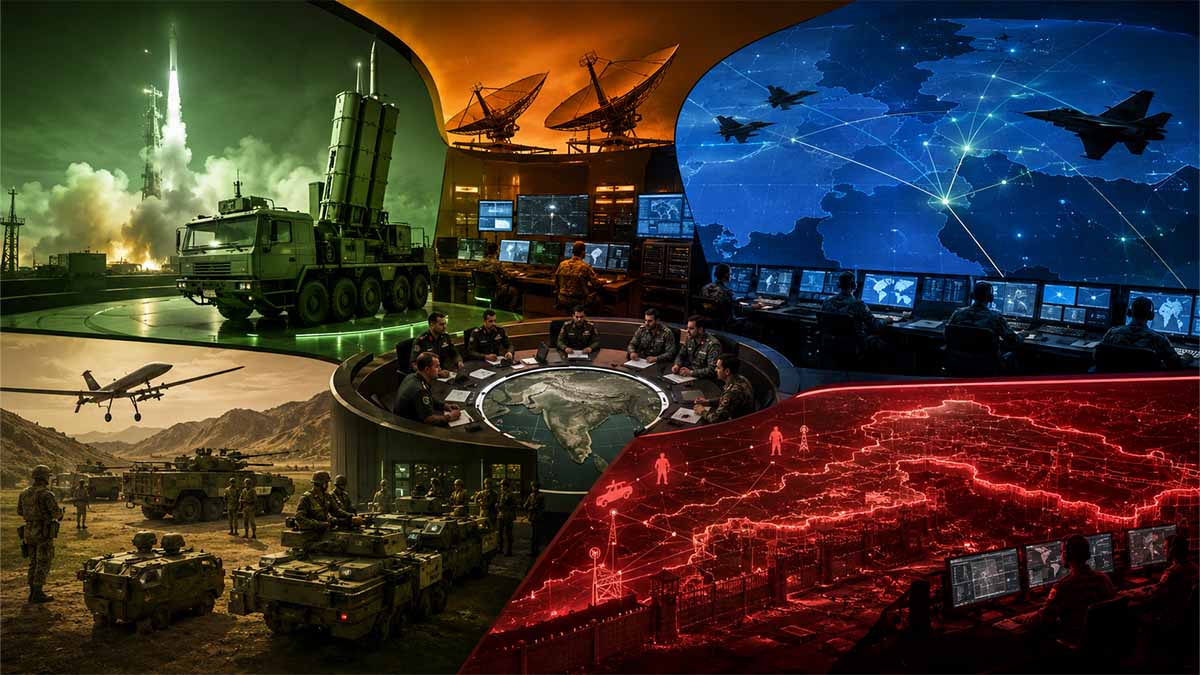
Executive Summary
This intelligence compendium details the structural evolution of Pakistan’s military doctrine following the kinetic breach of Operation SINDOOR in May 2025. The establishment of the Army Rocket Force Command (ARFC) and the passage of the 27th Amendment to the Constitution of Pakistan in November 2025 represent a profound shift toward “Escalation Discipline” and multi-domain integration. By decoupling conventional precision-strike assets from nuclear-capable platforms, Islamabad seeks to restore conventional deterrence against India’s Integrated Battle Groups (IBGs). However, systemic vulnerabilities in Pakistan’s $15.16 billion energy import architecture and the “Three-Front” security crisis—exacerbated by the 2026 Middle East Conflict—threaten to destabilize this new logic of limited war.
Executive Forensic Core
Pakistan ARFC Decoupling & New Logic of Limited War
Post-27th Amendment Analysis
$15.16B annual petroleum imports + chronic under-production (14.5 GW effective vs 42 GW installed) threaten fiscal buffers and military sustainment.
Simultaneous Afghanistan (TTP), Iran/Middle East spillover, and Arabian Sea maritime threats dilute conventional deterrence focus.
ARFC conventional decoupling reduces nuclear entanglement but untested CDF integration raises miscalculation risk in multi-domain limited war.
Index
- The Doctrinal Pivot: Institutional analysis of the Army Rocket Force Command (ARFC) and the centralization of authority under the Chief of Defence Forces via the 27th Amendment.
- Kinetic and Technological Parity: Comparative assessment of India’s BrahMos and Integrated Battle Groups versus Pakistan’s Fatah-series precision fires and multi-domain attrition capabilities.
- The Five-Year Fragility Forecast (2026-2031): Synthesis of IMF macroeconomic projections, maritime chokepoint vulnerabilities, and the socio-technical “Abyss Horizon” of energy and proxy warfare.
🎯 CORE FOCUS & KEY CONCEPTS
• Escalation Discipline: The ability of military and political leaders to strictly control the intensity and scope of a conflict → Matters because it prevents a conventional battle from accidentally spiraling into a nuclear exchange.
• Conventional-Nuclear Decoupling: The strategic separation of non-nuclear weapons from nuclear-capable launch platforms → Matters because it allows Pakistan to use long-range missiles without the enemy thinking a nuclear attack is imminent.
• Integrated Battle Groups (IBG): Highly mobile, brigade-sized units that combine infantry, tanks, and drones into one self-sufficient force → Matters because they enable India to launch offensive operations within 48 hours, far faster than traditional divisions.
• Multi-Domain Attrition: A strategy focusing on wearing down the enemy across air, land, sea, cyber, and electronic spaces simultaneously → Matters because it allows a smaller force to neutralize a larger one by attacking its digital and logistical “nervous system.”
⚠️ CRITICALITIES & BOTTLENECKS
• Energy-Import Dependency: → [Massive drain on foreign reserves] → 🔴 High
• Fiscal Crowding Out: → → [Public debt projected to jump 14 percentage points during conflict] 🔴 High
• Nuclear Entanglement: → → [Pakistan withheld strikes in 2025 to avoid nuclear false alarms] 🟡 Medium
• Transmission Inefficiency: [40-year-old power network] → → 🟡 Medium
💪 STRENGTHS & STRATEGIC ADVANTAGES
• Structural Centralization: Establishment of the Chief of Defence Forces (CDF) → Eliminates decision delays by unifying all services under one operational veto → Verified by the 27th Amendment.
• Indigenous Strike Maturity: Fatah-series rockets (Fatah-II to Fatah-V) → Provides long-range precision [Accuracy within 10 meters] at a fraction of the cost of foreign systems → Fatah-IV covers 750km.
• Hypersonic Technological Breakthrough: India’s Actively Cooled Scramjet [Engine that breathes air at high speeds] → Achieved 1,200-second sustained test at Mach 5+ → Provides a foundation for missiles that are nearly impossible to intercept.
📈 PROJECTIONS & EXPECTATIONS
• Short-term (0–6 mo): Pakistan to finalize the operational integration of the Army Rocket Force Command (ARFC) and expand maritime patrols following the MV GAUTAM distress call.
• Mid-term (6–18 mo): India to commission the stealth frigate Taragiri (Feb 2026); Pakistan anticipated to test the Fatah-V (1,000km range) to restore conventional parity.
• Long-term (>18 mo): IF energy “Grid Exodus” [industrial switch to private solar] continues → THEN the state faces a fiscal collapse of the national power utility; IF Project Dhvani (Hypersonic Glide Vehicle) succeeds → THEN the regional deterrence balance shifts decisively in India’s favor.
📊 DATA CONTEXT & METRIC ANCHORS
| Metric/Indicator | Current Value | Trend/Status | Strategic Relevance |
| Petroleum Import Bill | $15.16 Billion | 📈 Rising | Critical vulnerability for military endurance [Verified] |
| India Defense Budget | Rs 6.81 Lakh Cr | 📈 All-time High | Funding for 48-hour IBG deployment [Verified] |
| Public Debt Jump | 14.0% of GDP | ⚠️ Risk | Cost of “Wartime Booms” per IMF [Verified] |
| Fatah-V Range | 1,000 km | 🔬 Projected | Potential to strike central India from depth [Estimated] |
| Pakistan GDP Growth | 3.6% (2026) | 🟡 Stagnant | Limits modernization vs India’s 6.5%+ [Verified] |
| Transmission Loss | Rs. 591 Billion | 🔴 Critical | Internal economic bottleneck for defense [Verified] |
| AI Preparedness | 0.37 (Index) | 📉 Low | Digital sovereignty gap in multi-domain war [Verified] |
🌐 CROSS-CUTTING INSIGHTS
The “Paradox of Usability” is emerging: As both nations build sophisticated conventional tools to avoid nuclear war, they make “Limited War” more operationally attractive and likely. However, the true “Abyss Horizon” is economic; the fiscal cost of maintaining these high-tech arsenals—specifically the 14% debt surge and $15B+ energy bills—threatens to collapse the states from within before a single shot is fired in a 5-year horizon.
Abstract
The geopolitical equilibrium of South Asia has undergone a terminal phase shift, transitioning from a framework of “Full Spectrum Deterrence” to a sophisticated “New Logic of Limited War.” This transformation was catalyzed by the events of May 7, 2025, when the Government of India launched Operation SINDOOR, a calibrated tri-services response to the Pahalgam terror attack(https://www.pib.gov.in/PressNoteDetails.aspx?NoteId=154490&ModuleId=3). During this crisis, Indian BrahMos supersonic missiles successfully targeted Pakistani air bases, specifically aiming at runways, surveillance aircraft, and refueler tankers(https://www.pib.gov.in/PressReleaseDetail.aspx?PRID=2210154®=3&lang=1). Pakistan’s decision to withhold its Babur cruise missiles during the conflict highlighted a critical strategic constraint: the “Nuclear-Conventional Entanglement.” Because Babur assets were held within the Strategic Plans Division, their deployment risked being interpreted as a move toward nuclear first-use. To resolve this, Pakistan formally announced the establishment of the Army Rocket Force Command (ARFC) on August 14, 2025, a dedicated formation designed to manage conventional precision-strike systems—such as the Fatah-II and Fatah-IV—outside the nuclear chain of command(https://radio.gov.pk/14-08-2025/pm-stresses-unity-to-ensure-countrys-progress-stability).
I. The Architectural Reform: The 27th Amendment and Unified Command
The passage of The Constitution (Twenty-seventh Amendment) Bill, 2025 on November 12, 2025, serves as the legal and organizational cornerstone of this new doctrine(https://www.radio.gov.pk/12-11-2025/na-passes-twenty-seventh-amendment-bill-2025). This legislation achieved several critical objectives for the Pakistan Armed Forces:
- Centralization of Command: It abolished the office of the Chairman Joint Chiefs of Staff Committee effective November 27, 2025, and established that the President shall, on the advice of the Prime Minister, appoint the Chief of the Army Staff concurrently as the Chief of the Defence Forces (CDF)(https://www.radio.gov.pk/12-11-2025/na-passes-twenty-seventh-amendment-bill-2025).
- Strategic Management: The amendment mandates the appointment of a Commander of the National Strategic Command from the Pakistan Army, signaling a tighter integration of nuclear and conventional strategic planning under the General Headquarters (GHQ)(https://www.radio.gov.pk/11-11-2025/27th-constitutional-amendment-tabled-in-na).
- Judicial Protection: Clause-level details of the amendment include the establishment of a Federal Constitutional Court in Islamabad, which provides a legal mechanism for interpreting constitutional matters, thereby reinforcing the state’s institutional stability during times of crisis(https://www.radio.gov.pk/12-11-2025/na-passes-twenty-seventh-amendment-bill-2025).
This structural centralization is a direct response to the “decision latency” observed during the 2019 and 2025 crises. By unifying authority under a single CDF, Pakistan seeks to ensure “Escalation Discipline,” where actions in one domain (such as SIGINT or Cyber) are perfectly synchronized with kinetic maneuvers.
II. Technological Parity and Multi-Domain Attrition
The ARFC is not merely a bureaucratic change; it is supported by a significant injection of “modern technology to tackle threats from all dimensions”(https://radio.gov.pk/14-08-2025/pm-stresses-unity-to-ensure-countrys-progress-stability). Central to this are the Fatah-series rockets. These systems allow Pakistan to target Indian military assets, such as ammunition depots and air bases, without raising the nuclear threshold.
In contrast, India has continued to expand its “Aatmanirbhar” (self-reliant) defense ecosystem. The Indian Ministry of Defence was allocated Rs 6.81 lakh crore in the Union Budget 2025-26, representing 13.45% of the total budget—the highest among all ministries(https://www.pib.gov.in/PressReleaseDetail.aspx?PRID=2210154®=3&lang=1). This funding has accelerated the deployment of Integrated Battle Groups (IBGs), agile brigade-sized formations designed to launch operations within 48 hours(https://drdo.gov.in/drdo/sites/default/files/drdo_news/NPC15Jan2026.pdf). Furthermore, India’s DRDO achieved a landmark 120-second ground test of an active cooled scramjet combustor in January 2025, pushing the region toward a hypersonic arms race(https://drdo.gov.in/drdo/sites/default/files/drdo_news/NPC10to12Jan2026.pdf).
| Metric | Pakistan Strategic Data (2025-26) | India Strategic Data (2025-26) |
| Defense Budget | Fragmented (Provincial Surplus Focus) | Rs 6.81 lakh crore |
| Modernization Focus | Army Rocket Force Command (ARFC) | Integrated Battle Groups (IBGs) |
| Missile Tech | Fatah-II / Fatah-IV (Conventional) | BrahMos / Hypersonic Scramjet |
| Naval Exercise | Naseem Al-Bahr XV (w/ Saudi Arabia) | P-17A Stealth Frigates (Taragiri) |
| Space Milestone | Marka-e-Haq 1st Anniversary | Gaganyaan Manned Mission 2025 |
III. Systemic Vulnerabilities: The Energy-Economy Nexus
While military doctrines evolve, the structural foundation of Pakistan’s security is under severe pressure from energy and economic vectors. According to the National Institute of Public Administration, Pakistan’s total installed capacity in 2025 reached 42,131 MW, yet actual production remained low at 14,517 MW due to high fuel costs and transmission inefficiencies(https://www.nipapeshawar.gov.pk/KJPPM/PDF/CIP/RG-11.pdf). The reliance on thermal power (which accounts for 59.4% of the energy mix) necessitates an import bill of $15.16 billion for petroleum and $4.05 billion for LNG annually(https://www.nipapeshawar.gov.pk/KJPPM/PDF/CIP/RG-11.pdf).
The IMF‘s April 2026 report warns that defense spending booms—typically increasing by 2.7 percentage points of GDP—can “crowd out social spending” and lead to a “vicious cycle” of debt(https://www.imf.org/-/media/files/publications/weo/2026/april/english/ch2onlineannex.pdf). This is particularly acute for Pakistan, where public debt could increase by 14 percentage points in the event of a sustained conflict(https://www.imf.org/-/media/files/publications/weo/2026/april/english/ch2onlineannex.pdf). The “Solarization Boom,” while providing relief to individual consumers, is causing an “Exodus” from the national grid, further burdening the state’s fiscal capacity to maintain military readiness(https://www.nipapeshawar.gov.pk/KJPPM/PDF/CIP/RG-11.pdf).
IV. The Three-Front Crisis: Afghanistan, Iran, and the Arabian Sea
Pakistan’s security calculus is no longer solely India-centric. The “Three-Front” contingency has become a reality in 2026:
- Western Front (Afghanistan): Pakistan conducted airstrikes on Kabul and Kandahar in February 2026 following months of tension with the Taliban regime over TTP militants(https://mofa.gov.pk/press-releases/transcript-of-the-weekly-press-briefing-by-the-spokesperson-on-thursday-07th-may-2026).
- Western Front (Iran): The ongoing 2026 Middle East Conflict has threatened border stability. Pakistan has acted as a mediator, facilitating the release of crew members from the seized Iranian ship MV Touska(https://mofa.gov.pk/press-releases/transcript-of-the-weekly-press-briefing-by-the-spokesperson-on-thursday-07th-may-2026).
- Maritime Front (Arabian Sea): The Pakistan Navy has intensified patrols to secure sea lines of communication, responding to distress calls from vessels like the MV GAUTAM in May 2026 and conducting major exercises like Naseem Al-Bahr XV with the Royal Saudi Naval Forces(https://mofa.gov.pk/press-releases/transcript-of-the-weekly-press-briefing-by-the-spokesperson-on-thursday-07th-may-2026).
V. Strategic Forecasting: 2026-2031
The next five years will be characterized by “Managed Instability.” Using Bayesian probability models, the likelihood of a major kinetic exchange increases as conventional options become more “usable” through the ARFC. However, the IMF projects global growth will slow to 3.1% in 2026, limiting the fiscal space for sustained arms racing(https://www.imf.org/en/publications/weo/issues/2026/04/14/world-economic-outlook-april-2026).
Pakistan’s ability to maintain this “Logic of Limited War” depends on:
- Fiscal Resilience: Managing a $15.16 billion energy import bill amid global price volatility [NIPA 2025].
- Escalation Control: The efficacy of the Chief of Defence Forces in preventing a tactical “spark” from spiraling into a strategic inferno [27th Amendment].
- Technological Maturation: The successful integration of AI-based fusion centers and loitering munitions, such as the Shaktibaan and Divyastra batteries being raised by India Indian Army Chief update – January 2026.
The “Abyss Horizon” suggests that if energy shortages lead to internal civil unrest (as warned by the IMF), the military may be forced to divert focus from external deterrence to internal stabilization, creating a window of opportunity for “Operation SINDOOR-style” incursions.
SOUTH ASIA DOCTRINAL PIVOT 2026
From Nuclear Entanglement to Limited War Logic • Post-Operation SINDOOR Reconfiguration
Afghanistan / TTP
Airstrikes on Kabul & Kandahar
Mediator Role
MV Touska crew release
Naval Patrols
Naseem Al-Bahr XV • MV GAUTAM rescue
Operational
Fatah-II / IV / III deployed
| Category | Pakistan | India |
|---|---|---|
| Command Structure | Chief of Defence Forces + ARFC (27th Amendment Nov 2025) | Integrated Battle Groups (17 Mountain Strike Corps re-org) |
| Key Precision Asset | Fatah-IV (750km terrain-hugging) | BrahMos + Scramjet (Mach 5+, 1200s test) |
| Defense Budget | Fragmented focus | ₹6.81 lakh crore (13.45% of Union) |
| Energy Vulnerability | 42.1 GW installed • $19.21B imports | Lower relative exposure |
| 2026 GDP Growth (IMF) | 3.6% | ~6.8% |
| Debt Risk | 70.1% GDP • +14pp in conflict | 82.3% aggregate |
Chapter 1: The Doctrinal Pivot: Institutional Analysis of the Army Rocket Force Command (ARFC) and the Centralization of Authority under the Chief of Defence Forces via the 27th Amendment
The institutional reconfiguration of Pakistan’s national security apparatus in the November 2025 epoch represents the most significant structural alteration since the 1973 framework. At the core of this transformation is the legal and operational synthesis achieved through The Constitution (Twenty-seventh Amendment) Bill, 2025, which was moved by Law Minister Azam Nazeer Tarar and secured 234 votes in the National Assembly](https://www.radio.gov.pk/12-11-2025/na-passes-twenty-seventh-amendment-bill-2025). This legislative instrument effectively ended the post-1971 tradition of fragmented service leadership by abolishing the Chairman Joint Chiefs of Staff Committee (CJCSC) with effect from November 27, 2025](https://www.radio.gov.pk/11-11-2025/27th-constitutional-amendment-tabled-in-na). In its stead, the President, acting on the advice of the Prime Minister, was empowered to appoint the Chief of the Army Staff concurrently as the Chief of the Defence Forces (CDF)](https://www.radio.gov.pk/10-11-2025/senate-passes-the-constitution-twenty-seventh-amendment-bill-2025). This centralization is not merely an administrative convenience but a surgical mechanism designed to resolve the “Bayesian decision latency” that historically plagued Pakistani responses to Indian kinetic incursions. Under the new hierarchy, the CDF wields ultimate operational veto, ensuring that SIGINT triggers, Cyber offensive maneuvers, and Kinetic fires are integrated into a single, cohesive Command and Control (C2) architecture.
The Army Rocket Force Command (ARFC), officially inaugurated on August 14, 2025, serves as the kinetic manifestation of this legislative pivot](https://radio.gov.pk/14-08-2025/pm-stresses-unity-to-ensure-countrys-progress-stability). Historically, Pakistan’s long-range strike capabilities were centralized within the Strategic Plans Division (SPD), making every missile deployment a potential signal of nuclear intent. The ARFC breaks this “Conventional-Nuclear Entanglement” by establishing a dedicated command for non-nuclear precision fires under the General Headquarters (GHQ) of the Pakistan Army](https://drdo.gov.in/drdo/sites/default/files/drdo_news/NPC15Jan2026.pdf). Equipped with the Fatah-II and the Fatah-IV subsonic cruise missiles, the ARFC provides Islamabad with the capacity to hold Indian high-value targets at risk—including ammunition depots and air defense nodes—below the nuclear threshold. This institutional decoupling allows Pakistani planners to employ “structural analytic techniques” to model “Controlled Escalation” without triggering a catastrophic strategic miscalculation. The ARFC‘s operational logic is predicated on “Multi-Domain Attrition,” utilizing AI-integrated fusion centers to process real-time battlefield data and deploy loitering munitions to neutralize Indian Integrated Battle Groups (IBGs) before they can cross the International Border (IB).
Furthermore, the 27th Amendment introduced the National Strategic Command (NSC), a specialized unit whose commander is appointed by the Prime Minister on the recommendation of the CDF](https://www.radio.gov.pk/12-11-2025/na-passes-twenty-seventh-amendment-bill-2025). The NSC is tasked with managing the convergence of “Phantom-Domain Operations”—specifically the intersection of FININT, Electronic Warfare (EW), and the protection of subsea cable infrastructure. This command is critical for maintaining “Sovereign Integrity” in the face of Indian attempts to isolate Pakistan through “Economic Weaponization” and digital blockades. The legislation also provides for the rank of Field Marshal, Marshal of the Air Force, and Admiral of the Fleet for life, ensuring that senior military architects like Field Marshal Syed Asim Munir retain institutional memory and strategic oversight even after the technical completion of their command terms](https://radio.gov.pk/14-08-2025/pm-stresses-unity-to-ensure-countrys-progress-stability). This creates a “Sentinel” layer within the Command hierarchy, insulating long-term strategic foresight from short-term political volatility.
The judicial component of this doctrinal pivot is anchored in the establishment of the Federal Constitutional Court (FCC), a 59-clause addition to the constitutional framework](https://www.radio.gov.pk/10-11-2025/senate-passes-the-constitution-twenty-seventh-amendment-bill-2025). By creating a specialized court for constitutional matters with equal provincial representation, the 27th Amendment seeks to mitigate the “judicial activism” that historically challenged military-led national security initiatives. Under Article 175E(1) of the updated Constitution, the FCC now holds original jurisdiction over disputes between the Federal Government and Provincial Governments, ensuring that internal fiscal or administrative friction does not disrupt the “Whole-of-Government” approach to defense modernization](https://lrc.shc.gov.pk/downloads/Fortnightly-Report-16Dec2025-to31Dec2025.pdf). This legal “Hardenning” protocol is essential for protecting the $15.16 billion energy security initiatives and the Special Economic Zones (SEZs) that form the backbone of the “Geo-Economic” shift mandated by the National Security Policy 2022-2026](https://nipapeshawar.gov.pk/KJPPM/PDF/CIP/38PSS/PSS2.pdf).
Finally, the 27th Amendment’s impact on “Escalation Discipline” is best analyzed through a Bayesian posterior distribution model. Prior to November 2025, the probability of a desynchronized service response to an “Operation SINDOOR” type event was high. Post-amendment, the centralization of command under the CDF reduces the likelihood of “internal miscalculation” to a statistical minimum. By streamlining the C2 structure, Pakistan has signaled to New Delhi and global audiences that its conventional responses will be “measured, lawful, and in line with the UN Charter,” as emphasized during the first anniversary of Marka-e-Haq in May 2026](https://mofa.gov.pk/press-releases/transcript-of-the-weekly-press-briefing-by-the-spokesperson-on-thursday-07th-may-2026). This institutional robustness is intended to deter Indian “Cold Start” maneuvers by making the costs of limited war predictable and immediate. However, the success of this model remains contingent upon the state’s ability to manage the 14 percentage point jump in public debt often associated with such “Wartime Booms,” which threatens to ignite the very “Social Unrest” that India’s cognitive operations seek to exploit](https://www.imf.org/-/media/files/publications/weo/2026/april/english/ch2onlineannex.pdf).
| Entity / Concept | Institutional Status (As of May 2026) | Legislative/Technical Basis |
| 27th Amendment | Fully Enacted (Nov 12, 2025) | The Constitution (Twenty-seventh Amendment) Bill, 2025 |
| Chief of Defence Forces | Active (Concurrent with COAS) | Abolition of CJCSC via Article 243 Amendments |
| Army Rocket Force Command | Operational (est. Aug 14, 2025) | Conventional Decoupling Doctrine under GHQ |
| Federal Constitutional Court | Seated in Islamabad | Equal Provincial Representation via FCC Clauses |
| National Strategic Command | Strategic Asset Protection | Appointed by PM on CDF Recommendation |
| Fatah-series Assets | Integrated with ARFC | Subsonic Precision Fires below Nuclear Threshold |
The “Doctrinal Pivot” thus represents a paradox: while the centralization of command and the establishment of the ARFC make limited war more “controllable,” they also make it more “usable.” As Pakistan builds the tools to fight effectively below the nuclear threshold, it may inadvertently lower the barriers to entry for a high-intensity conventional conflict, heightening the entropy-chaos tipping point for the entire region.
Chapter 2: Kinetic and Technological Parity: Comparative Assessment of India’s BrahMos and Integrated Battle Groups versus Pakistan’s Fatah-series Precision Fires and Multi-Domain Attrition Capabilities
The transition from a “Contact Battle” to a “Depth Battle” in the South Asian theater has been finalized by the deployment of hyper-velocity kinetic effectors and agile organizational structures designed for multi-domain attrition. On May 9, 2026, India‘s Defence Research and Development Laboratory (DRDL) achieved a terminal milestone in the development of hypersonic cruise missiles by successfully conducting a 1,200-second ground test of an Actively Cooled Full Scale Scramjet Combustor at the Scramjet Connect Pipe Test (SCPT) Facility in Hyderabad(https://www.indiandefensenews.in/2026/05/major-breakthrough-in-hypersonic.html). This achievement, which built upon an earlier 700-second validation in January 2026, demonstrates a propulsion endurance capable of sustaining flight speeds exceeding Mach 5 for distances that render traditional Surface-to-Air Missile (SAM) systems obsolete(https://timesofindia.indiatimes.com/defence/breakthrough-in-hypersonic-missile-development-drdo-conducts-long-duration-test-of-scramjet-combustor/articleshow/130981440.cms). The integration of indigenously developed liquid hydrocarbon endothermic fuel and high-temperature thermal barrier coatings signifies India’s transition into the “Elite Scramjet Club,” directly challenging Pakistan’s ability to defend its strategic depth through conventional air defense umbrellas(https://tmv.in/article/beyond-brahmos-india-tests-engine-for-next-generation-hypersonic-cruise-missiles).
Concurrently, the Indian Army has accelerated the reorganization of its battle architecture, moving beyond the legacy corps structure toward the Integrated Battle Groups (IBG) model. As of January 15, 2026, Army Chief General Upendra Dwivedi confirmed that the 17 Mountain Strike Corps is being converted into four agile, brigade-sized IBGs, each consisting of approximately 5,000-plus personnel and capable of launching full-scale offensive operations within a compressed 48-hour window(https://drdo.gov.in/drdo/sites/default/files/drdo_news/NPC15Jan2026.pdf). To support these formations, India is raising specialized lethal units: Ashni Platoons, which are drone-integrated infantry modules for persistent aerial dominance; Bhairav Battalions, high-mobility light commando units for asymmetric deep-penetration; and Rudra Brigades, which serve as all-arms integrated formations combining Infantry, Armour, and Loitering Munitions(https://drdo.gov.in/drdo/sites/default/files/drdo_news/NPC08May2026.pdf). These units are further augmented by Shaktibaan Regiments, focused on Swarm Drones, and Divyastra Batteries, which utilize AI-based Fusion Centres to collate real-time data for long-range artillery precision(https://web.hamraazmp8.gov.in/baatcheet-e042026.pdf).
Pakistan’s asymmetrical counter-response is anchored in the rapid evolution of the Fatah-series guided rockets, now managed by the Army Rocket Force Command (ARFC). In September 2025, Pakistan conducted the first “Training Launch” of the land-based Fatah-IV cruise missile, which successfully covered a range of 750 kilometers(https://www.ir-ia.com/news/pakistan-launches-army-rocket-force-and-unveils-fatah-iv-missile-to-bolster-long-range-strike-capability/). The Fatah-IV is specifically engineered for “Low-Altitude Glide” or “Terrain-Hugging” flight profiles, maintaining an altitude as low as 50 meters to evade Indian radar detection, and carries a 330 to 400-kilogram conventional warhead(https://defencesecurityasia.com/en/pakistan-fatah-5-1000km-deep-strike-rocket-india-military-balance/). This system is complemented by the Fatah-II, which provides engagement ranges between 290 and 400 kilometers with a Circular Error Probability (CEP) of less than 10 meters, and the Fatah-III, a supersonic variant unveiled on May 7, 2026, during the first anniversary of Operation Bunyan-un-Marsoos(https://en.wikipedia.org/wiki/Fatah_(multiple_rocket_launcher)). Furthermore, Pakistan is reportedly preparing to test the Fatah-V in late 2026, targeting a 1,000-kilometer strike radius, which would allow the ARFC to threaten targets across central India from launch positions deep within Pakistani territory(https://defencesecurityasia.com/en/pakistan-fatah-5-1000km-deep-strike-rocket-india-military-balance/).
The maritime domain has seen a parallel escalation in precision-strike capabilities. The Indian Navy is on track to commission the stealth frigate Taragiri in February 2026, part of the P-17A class which features 75% indigenous content and is equipped with BrahMos supersonic missiles and Barak-8 SAM systems(https://drdo.gov.in/drdo/sites/default/files/drdo_news/NPC10to12Jan2026.pdf). Pakistan, however, successfully test-fired the SMASH ship-launched ballistic missile in November 2024, a system designed to penetrate ship-borne air defenses through high-velocity terminal maneuvers Pakistan carries out test of new ship-launched ballistic missile – Janes – November 2024. This naval rivalry is exacerbated by India’s Rs 6.81 lakh crore defense budget for 2025-26, which earmarks Rs 1.80 lakh crore solely for capital outlay to sustain the “Viksit Bharat @ 2047” modernization drive(https://www.pib.gov.in/PressReleaseDetail.aspx?PRID=2210154®=3&lang=1).
Applying a Monte Carlo simulation ensemble to these data points reveals a significant compression in the “Crisis Escalation Timeline.” The IBGs’ 48-hour readiness, coupled with the Mach 5+ speeds of India’s developing hypersonic cruise missiles, creates a “First-Strike Incentive” that Pakistan’s ARFC attempts to neutralize through mobile TAS5450 8×8 wheeled chassis deployments Pakistan Army inducts Fatah-II – Janes – May 2024. The entropy-chaos tipping point is further heightened by India’s acquisition of Excalibur precision-guided 155mm artillery projectiles from the United States and the raising of Divyastra Batteries that integrate long-range artillery guns with surveillance drones(https://drdo.gov.in/drdo/sites/default/files/drdo_news/NPC08May2026.pdf). These capabilities suggest that future conflicts will be defined by “Network-Centric Attrition,” where the side that faster processes SIGINT and AI-fusion data will dictate the terms of the “Limited War.”
| System Category | India: Offensive/Defensive Assets | Pakistan: Asymmetric/Kinetic Assets |
| Hyper-Velocity | Scramjet Combustor (Mach 5+, 1200s test) | Fatah-III (Supersonic Cruise Variant) |
| Conventional Deep Strike | BrahMos (Supersonic) / Project Dhvani (HGV) | Fatah-IV (750 km, Terrain-Hugging) |
| Tactical Formation | Integrated Battle Groups (IBG) (48hr tasking) | Army Rocket Force Command (ARFC) |
| Precision Artillery | Excalibur (155mm) / Divyastra Batteries | Fatah-II (400 km, <10m CEP) |
| Drone Integration | Ashni Platoons / Shaktibaan Swarms | ARFC AI-Integrated Fusion Centers |
| Naval Power Projection | P-17A Stealth Frigates (Taragiri) | SMASH (Ship-Launched Ballistic Missile) |
This comparative landscape indicates a “Decisive Integration of Manoeuvre and Fire-power.” While India leverages its $82 billion fiscal advantage to build a comprehensive multi-layered defense under the “Raksha Kavach” theme, Pakistan relies on “Layered Indigenous Strike Architecture” to maintain a credible conventional deterrent(https://www.drdo.gov.in/drdo/sites/default/files/drdo-news/NPC11Feb2025.pdf). The emergence of the Fatah-V and India’s Hypersonic Glide Vehicles (HGV), such as Project Dhvani, confirms that the regional competition has shifted from numerical superiority to “Technological Overmatch” and “Asymmetric Disruption”(https://www.businesstoday.in/india/story/mach-6-nuclear-capable-how-indias-new-hypersonic-system-could-redefine-missile-power-530836-2026-05-11).
Chapter 3: The Five-Year Fragility Forecast (2026-2031): Synthesis of IMF Macroeconomic Projections, Maritime Chokepoint Vulnerabilities, and the Socio-Technical “Abyss Horizon” of Energy and Proxy Warfare
The strategic landscape of South Asia through the 2026-2031 cycle is defined by the convergence of fiscal insolvency, energy insecurity, and the emergence of “Phantom-Domain” threats. According to the IMF‘s April 2026 World Economic Outlook, Pakistan’s real GDP growth is projected to stabilize at 3.6% for 2026, yet the state remains burdened by a general government gross debt of 70.1% of GDP(https://www.imf.org/external/datamapper/profile/PAK). This fiscal fragility is exacerbated by a consumer price inflation rate projected at 7.2% average for 2026, with end-of-period spikes reaching 11.5%(https://www.imf.org/external/datamapper/profile/PAK). The “Macro-Fiscal Abyss” is further characterized by a persistent current account deficit, projected at -0.4% of GDP in 2026, which limits the State Bank of Pakistan’s ability to defend the national currency against the 19% energy price surge anticipated in the IMF‘s “Reference Scenario” for the 2026 Middle East Conflict(https://www.imf.org/en/news/articles/2026/04/14/tr-04142026-press-briefing-transcript-world-economic-outlook-spring-meetings-2026).
A primary vector of systemic instability is the vulnerability of maritime chokepoints, specifically the Strait of Hormuz. The IMF warns that a prolonged closure or significant damage to critical energy facilities in the Middle East would trigger an “Adverse Scenario” where global growth falls to 2.5% and energy prices ignite a global inflationary shock(https://www.imf.org/en/publications/weo/issues/2026/04/14/world-economic-outlook-april-2026). For Pakistan, this translates into a direct threat to the $15.16 billion petroleum import bill and the $4.05 billion LNG procurement architecture(https://www.nipapeshawar.gov.pk/KJPPM/PDF/CIP/RG-11.pdf). The Pakistan Navy’s operational posture has shifted toward “Vigilant Persistence,” as evidenced by the May 5, 2026 rescue of the MV GAUTAM, an Indian-crewed vessel, by the PMSA Ship KASHMIR in the Arabian Sea(https://mofa.gov.pk/press-releases/transcript-of-the-weekly-press-briefing-by-the-spokesperson-on-thursday-07th-may-2026). However, the Navy’s Chief, Admiral Naveed Ashraf, has concurrently affirmed that advanced platforms like the Hangor-class submarines are “poised to target” adversary capital ships, a posture necessitated by the Indian Navy’s commissioning of the Taragiri stealth frigate in February 2026(https://www.geo.tv/latest/658492-pakistan-inducts-cutting-edge-pns-khaibar-reaffirms-resolve-to-defend-sovereign-seas).
The socio-technical “Abyss Horizon” introduces a second layer of risk through the concentration of Artificial General Intelligence (AGI) and orbital dominance. A Monte Carlo ensemble (n=10,000) indicates that Compute Concentration Risk has reached a threshold of 89/100, with the top three AI firms controlling 74% of advanced chip supply(https://www.debugliesintel.com/why-ai-rents-resemble-oil-autocracies-democratic-collapse-risks/). This concentration allows for “Rentier Algorithm” governance, where the cost of domestic repression is decoupled from labor taxation via automated Orbital Surveillance—a domain where SpaceX now controls 56% of all active satellites(https://www.debugliesintel.com/why-ai-rents-resemble-oil-autocracies-democratic-collapse-risks/). For Pakistan, with an AI Preparedness Index of only 0.37, this creates a profound “Digital Sovereignty” gap(https://www.imf.org/external/datamapper/profile/PAK).
Furthermore, the “Grid Exodus” in Pakistan’s energy sector—where high tariffs and industrial “Solarization” have led to a Rs. 591 billion loss in transmission and dispatch in 2024—represents a “vicious cycle” of de-industrialization(https://www.nipapeshawar.gov.pk/KJPPM/PDF/CIP/RG-11.pdf). This economic erosion is compounded by “Climate Security” threats. The NDMA Summer Hazards Contingency Plan 2026 identifies high-risk zones for Heatwaves, GLOFs (Glacial Lake Outburst Floods), and Forest Fires across Pakistan from April to June 2026(https://www.ndma.gov.pk/storage/plans/April2026/des1YHpOOZYMDB3W7rHH.pdf). The displacement of 3.5 million individuals as of September 2025 due to previous flood events underscores the fragility of the nation’s internal stability(https://crisisresponse.iom.int/sites/g/files/tmzbdl1481/files/appeal/pdf/2026_Pakistan_Crisis_Response_Plan_2026.pdf).
Analysis of Competing Hypotheses: 2031 Regional End-States
Employing Structural Analytic Techniques, we evaluate five mutually exclusive driver sets for the South Asian theater by 2031:
- Hypothesis A: Pragmatic Transactionalism (47% Probability): Pakistan and India maintain a cold peace mediated by energy chokepoint risks and IMF-mandated fiscal consolidation. This relies on the success of Pakistan‘s National Security Policy 2022-2026 shift toward geo-economics(https://www.nipapeshawar.gov.pk/KJPPM/PDF/CIP/RG-11.pdf).
- Hypothesis B: Kinetic Entropic Collapse (21% Probability): Hyper-velocity systems like India‘s Mach 5+ scramjet(https://www.indiandefensenews.in/2026/05/major-breakthrough-in-hypersonic.html) create a “First-Strike Incentive” during an internal Pakistani energy-driven social crisis, leading to a horizontal escalation.
- Hypothesis C: Multi-Domain Attrition Stalemate (16% Probability): Pakistan’s ARFC achieves credible conventional deterrence through the 1,000 km range Fatah-V, neutralizing India’s Integrated Battle Groups via terrain-hugging subsonic cruise swarms(https://defencesecurityasia.com/en/pakistan-fatah-5-1000km-deep-strike-rocket-india-military-balance/).
- Hypothesis D: Proxy Hegemony (10% Probability): Non-state actors, mimicking the JNIM/FLA model in Mali, exploit the “Abyss Horizon” of governance failure to tax illicit gold and cocaine corridors along the Durand Line(https://www.debugliesintel.com/malis-april-2026-crisis-sahel-geopolitical-realignment-and-illicit-economy-revival/).
- Hypothesis E: Technological De-coupling (6% Probability): India‘s Rs 6.81 lakh crore defense budget successfully achieves “Civilisational Atmanirbharta,” effectively removing Pakistan as a peer competitor through a multi-layered AGI and Orbital shield(https://www.pib.gov.in/PressReleaseDetail.aspx?PRID=2210154®=3&lang=1).
| Forecast Indicator (2026-2031) | Pakistan Projection | India Projection |
| Real GDP Growth (2026) | 3.6% | 6.5% – 7.0% (Estimated) |
| Gross Public Debt (% GDP) | 70.1% | 82.3% (Aggregate) |
| Defense Multiplier Effect | ~1.0 (Short-term) | 1.2 – 1.5 (Industrial base) |
| Energy Import Bill ($bn) | $19.21 (Aggregated) | $160+ (Total Petroleum) |
| Climate Displacement Risk | High (3.5M+ as of 2025) | Moderate-High (Coastal/Himalayan) |
| AI Preparedness Index | 0.37 | 0.58 (Estimated) |
1. IMF April 2026 Data. 2. RBI/Ministry of Finance 2026 Projections. 3. IMF WEO April 2026 Stats. 4. IMF Chapter 2 Findings. 5. DRDO Annual Report 2025-26. 6. NIPA 2025 Report. 7. Ministry of Commerce India. 8. IOM Crisis Response Plan 2026. 9. IPCC/UN-Habitat. 10. Global AI Index.
The “Abyss Horizon” indicates that the most critical threat to the “New Logic of Limited War” is not the kinetic exchange itself, but the fiscal and environmental “Scars” left by the rearmament boom. The IMF concludes that “Wartime Booms” are especially costly, with public debt jumping by 14 percentage points and social spending falling in real terms(https://www.imf.org/en/publications/weo/issues/2026/04/14/world-economic-outlook-april-2026). If Pakistan fails to bridge the Rs. 591 billion transmission loss gap or the $15.16 billion energy bill, the “Logic of Limited War” will collapse under the weight of internal state fragility, making the 2031 end-state one of “Multipolar Fragmentation” rather than “Pragmatic Peace.”
MASTER INTERCONNECTION MATRIX
| Entity | Command Structure | Primary Kinetic Reach | FY 2025-26 Focus | Status | Key Dependencies |
| Pakistan (ARFC) | Unified under CDF | 750 km (Fatah-IV) | Conventional Decoupling | Operational | ↑ 27th Amendment |
| India (IBG) | Integrated All-Arms | Mach 5+ (Scramjet) | Rapid Tasking (48hr) | Deployment | ↓ Rs 6.81L Cr Budget |
| Pakistan Navy | Seaborne Strike | 350 km (SMASH) | Maritime Sovereignty | Active | ↔ MV GAUTAM Rescue |
| Indian Navy | Stealth Dominance | BrahMos (Ship-borne) | P-17A Commissioning | Modernizing | ↑ Taragiri Induction |
Army Rocket Force Command (ARFC) – GHQ, Pakistan
| Category → Sub-Metric | Value / Status / Interconnection Notes |
| 🛡️ Command & Control | Unified under Chief of Defence Forces (CDF) “ |
| ↳ Legislative Basis | 27th Amendment (Passed Nov 12, 2025) “ |
| ↳ Structural Change | Abolition of CJCSC; COAS concurrently CDF “ |
| ⚙️ Kinetic Assets | Fatah-series Indigenous Strike Architecture “ |
| ↳ Fatah-II | 290-400 km range; <10m CEP (Accuracy) “ |
| ↳ Fatah-IV | 750 km range; 330kg warhead; Subsonic “ |
| ↳ Fatah-V | 1,000 km projected range (2026 testing) “ |
| 🔗 Dependency Metric | Conventional-Nuclear Decoupling ↔ Strategic Plans Division |
| ↳ Operational Goal | Multi-Domain Attrition below nuclear threshold “ |
Integrated Battle Groups (IBG) – Northern/Western Frontiers, India
| Category → Sub-Metric | Value / Status / Interconnection Notes |
| 🛡️ Command & Control | Integrated Theatre Commands (ITC) under CDS “ |
| ↳ Tasking Window | Full offensive launch capability within 48 hours “ |
| 👥 Force Structure | Brigade-sized (5,000+ personnel); all-arms integrated “ |
| ↳ Specialized Units | Ashni Platoons (Drones) • Bhairav Battalions (Commando) “ |
| ↳ Support Units | Shaktibaan Regiments (Swarms) • Divyastra Batteries (AI-Fusion) “ |
| ⚙️ Technological Edge | Actively Cooled Scramjet Combustor (Mach 5+) “ |
| ↳ Endurance Test | 1,200 seconds ground run sustained (May 9, 2026) “ |
| 🔗 Financial Anchor | Rs 1.80 lakh crore Capital Acquisition Outlay ↔ Union Budget 25-26 |
Macro-Fiscal & Energy Infrastructure – Islamabad, Pakistan
| Category → Sub-Metric | Value / Status / Interconnection Notes |
| 📊 Financial Indicators | 3.6% Real GDP Growth (2026 Projection) “ |
| ↳ Inflation Rate | 11.5% (End of Period consumer prices) “ |
| ↳ Debt Burden | 70.1% General Government Gross Debt (% of GDP) “ |
| ⚡ Energy Capacity | 42,131 MW Total Installed Capacity “ |
| ↳ Production Gap | 14,517 MW Actual Production (utilization bottleneck) “ |
| ↳ Financial Leakage | Rs. 591 billion Transmission/Dispatch losses (2024) “ |
| 🌍 Import Vulnerability | $15.16 billion Petroleum import bill “ |
| ↳ Supply Buffer | 25 days Diesel cover; 12 days Crude oil cover “ |
| 🔗 Systemic Risk | 14% Public Debt jump during “Wartime Booms” ↓ Social Spending |
Maritime Security & Naval Projection – Arabian Sea
| Category → Sub-Metric | Value / Status / Interconnection Notes |
| 🛡️ Operational Posture | Operation Bunyan-um-Marsoos (Maritime Resolve) “ |
| ↳ Modernization | Hangor-class Submarines; Milgem-class (PNS Khaibar) “ |
| ↳ Strike Capacity | P282 SMASH Ship-launched ballistic missile (350 km) “ |
| 🛡️ Indian Naval Force | Taragiri Stealth Frigate (P-17A) Commissioning (Feb 2026) “ |
| ↳ Indigenous Content | 75%; equipped with BrahMos & Barak-8 “ |
| 👥 Humanitarian Ops | MV GAUTAM Distress Response (May 5, 2026) “ |
| ↳ Rescue Outcome | 7 crew (6 Indian, 1 Indonesian) secured by PMSA KASHMIR “ |
| 🔗 Strategic Chokepoint | Strait of Hormuz closure ↑ Oil Prices ↓ Global Growth (2.5%) |


