











Scope: Assessment of Syria’s post-Assad diplomatic and security autonomy from December 2024 to 9 September 2026, with a five-year outlook and specific consideration of Türkiye, Israel, the European Union, Italy, France, Germany and the United Kingdom.
Executive Summary / BLUF
Damascus operates under severe external constraints, but the public record does not support describing Syria as devoid of sovereign agency.
Türkiye is the transitional government’s principal security patron: it supports Syrian military reconstruction, supplies equipment and training, and treats the integration of Kurdish-led forces as a core national-security requirement.
Israel exercises a different and more coercive form of leverage through territorial presence, repeated incursions, air strikes and demands for the demilitarisation of southern Syria.
These pressures intersect: Israeli military action can restrict Turkish-supported Syrian force development, while Ankara’s expanding defence role intensifies Israeli threat perceptions.
The 1974 disengagement architecture remains the legal baseline, but its operational integrity has been fundamentally impaired by the Israeli presence east of the ceasefire line.
Damascus has nonetheless diversified its external relationships through the Gulf states, United States, European Union, World Bank and renewed contacts with European governments.
Saudi and Qatari financial intervention, Western sanctions relief and restored multilateral financing reduce—but do not eliminate—Syrian dependence on Ankara.
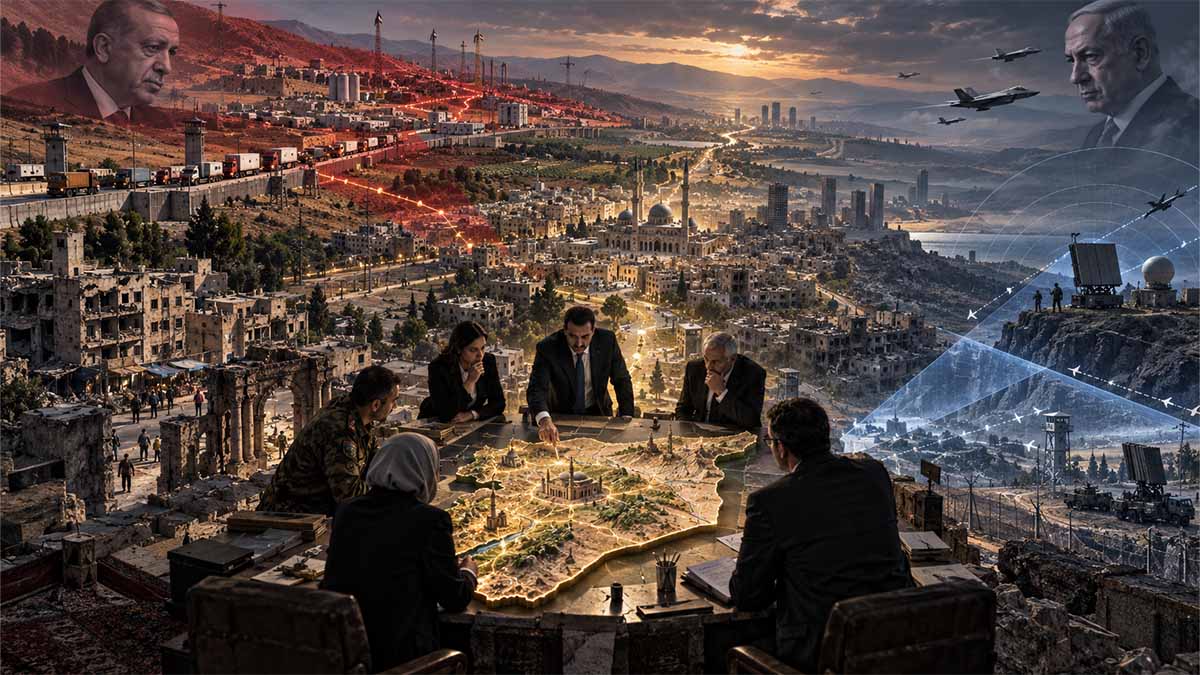
The central judgment is therefore constrained multi-vector sovereignty, not exclusive Turkish tutelage: Türkiye shapes the means through which Damascus rebuilds power, while Israel limits where and how that power can be exercised.
Syria Can Diversify Its Diplomacy, but Europe Cannot Buy Back Its Sovereignty
The central contradiction of Syria’s transition is no longer diplomatic isolation but the mismatch between widening international recognition and narrowing security autonomy. The European Union lifted most economic sanctions in May 2025, restored the EU–Syria Cooperation Agreement in May 2026 and allocated €620 million for humanitarian assistance and socioeconomic recovery in 2026–27. Yet none of those decisions can replace Türkiye’s immediate security role or prevent Israeli military coercion. Damascus is therefore diversifying by function: Turkish support for security, United States decisions for financial normalisation, Gulf capital for infrastructure and European money and expertise for civilian institutions. This is not equidistance. It is an attempt to stop dependence in one domain from becoming subordination across the state. Europe can shape the terms of Syrian recovery; it cannot guarantee the territory on which that recovery must occur.
Sanctions relief created access, not sovereignty
On 28 May 2025, the Council of the European Union lifted Syria’s economic restrictive measures except those based on security grounds and removed 24 entities—including the Central Bank of Syria and companies in energy and telecommunications—from asset-freeze restrictions. Measures against Assad-linked actors remained, and the Council added human-rights sanctions following the March 2025 coastal violence. The decision lowered the legal barrier to commerce while preserving instruments against repression and destabilisation: it gave Damascus economic room without granting unconditional political rehabilitation.
On 11 May 2026, the Council restored the full application of the EU–Syria Cooperation Agreement, reversing trade-related suspensions introduced in 2011 and 2012. The European Commission simultaneously advanced the first EU–Syria High-Level Political Dialogue and a Syria Partnership Coordination Forum. These decisions move Brussels from crisis management towards negotiated reintegration, but their leverage depends on benefits still to be delivered. Once restrictions are lifted, Europe cannot repeatedly sell the same concession; it must generate bankable projects, functioning payment channels and staged incentives tied to observable Syrian conduct.
The reconstruction arithmetic limits European ambition
The World Bank estimated Syria’s physical reconstruction requirement at $216 billion in October 2025, with a range of $140 billion to $345 billion and damage to nearly one-third of the pre-conflict capital stock. Against that requirement, the European Union’s €620 million package for 2026–27 combines humanitarian aid and socioeconomic recovery rather than constituting a national reconstruction fund. The comparison defines Europe’s role: Brussels can finance preparation, standards, monitoring and selected services, but it cannot underwrite Syria’s reconstruction alone.
The European Commission’s May 2026 programme shows where its influence can travel. A proposed €15 million Team Europe Technical Assistance Hub is intended to strengthen Syrian institutions; €14 million was assigned to the rehabilitation of Al-Rastan Hospital; and a further €280 million was being prepared for 2026–27 within the wider package. These amounts are small beside the World Bank estimate, yet administrative assistance can determine whether larger capital flows produce operating infrastructure or another layer of patronage. Europe’s highest-return instrument is not the cheque itself but the procurement, regulatory and public-finance machinery attached to it.
Gulf and US decisions have broken Europe’s monopoly
Saudi Arabia and Qatar paid approximately $15.5 million in May 2025 to clear Syria’s arrears to the International Development Association, restoring eligibility for new World Bank operations. One month later, the World Bank approved a $146 million grant for electricity transmission, substations and institutional capacity—the institution’s first Syrian project in almost four decades. A relatively small Gulf payment thus unlocked a multilateral financing channel larger than many individual European programmes and demonstrated that Damascus possesses alternatives to a Brussels-centred recovery process.
The United States altered the risk environment more decisively when President Donald Trump revoked broad Syria sanctions in June 2025. European sanctions relief facilitated trade, but United States policy affects dollar transactions, bank compliance and the calculations of international investors. Damascus’s diversification therefore has a hierarchy: Gulf states can mobilise capital quickly, Washington can change systemic financial risk, and Europe can make projects more governable. If Brussels treats its historical donor role as market power, Syrian authorities will retain European engagement for legitimacy while placing priority infrastructure elsewhere.
Rome gains access, but only Europe supplies scale
Italian Foreign Minister Antonio Tajani travelled to Damascus on 10 January 2025 to meet Ahmed al-Sharaa and Foreign Minister Asaad al-Shaibani, while also consulting Christian communities, civil society and humanitarian organisations. The Italian Foreign Ministry then described Italy as the only G7 state with an operational embassy in Damascus and reported average annual allocations above €40 million since 2019 for Syrians and refugees in neighbouring countries. Early presence gives Rome better political access and project intelligence than governments operating from outside Syria; it does not give Italy an independent security guarantee or a reconstruction balance sheet.
In 2025, the Italian Agency for Development Cooperation reported 26 Syrian initiatives worth €85.5 million, comprising €64.5 million in emergency programmes and €21 million for resilience. That mix gives Italy a credible role in health, essential services and local recovery, where diplomatic access can be converted into implementation. The constraint is transmission: without EU banking clarity, common guarantees and coordinated procurement, Italian relationships remain bilateral footholds rather than instruments capable of changing Syria’s national financing conditions.
Paris sets conditions; Berlin holds the heavier balance sheet
French President Emmanuel Macron received Ahmed al-Sharaa at the Élysée Palace on 7 May 2025 and linked French support to an inclusive transition, Lebanese sovereignty and counterterrorism. Foreign Minister Jean-Noël Barrot had travelled to Syria with his German counterpart on 3 January 2025 under an EU mandate, prioritising chemical-weapons destruction under the Organisation for the Prohibition of Chemical Weapons, accommodation with Kurdish forces and a sovereign Syrian state. France reported approximately €50 million in annual assistance since 2018, but its embassy in Syria remained formally closed in the government’s April 2026 update, with representation conducted from Beirut. Paris can convene and condition; its physical access still trails its political ambition.
German Chancellor Friedrich Merz received President Ahmed al-Sharaa in Berlin on 30 March 2026 and announced more than €200 million for stabilisation and reconstruction during the year, including water systems in Hasakah, Suwayda and Aleppo and hospital rehabilitation. Germany and Syria also created a joint task force on investment conditions, legal certainty and functioning administration. This gives Berlin the strongest European combination of finance, technical capacity and influence over the commercial rules that determine whether private capital enters.
Germany’s leverage also carries the sharpest domestic constraint. Chancellor Merz connected cooperation with Damascus to returns after almost one million Syrians had received protection in Germany. Managed voluntary return can transfer skills and capital to Syria; political pressure that runs ahead of security and public services transfers costs to weak Syrian municipalities. Berlin must therefore decide whether migration is treated as the dividend of reconstruction or as an accelerated condition imposed before reconstruction has produced durable capacity.
London adds financial reach, not coercive protection
United Kingdom Foreign Secretary David Lammy restored diplomatic relations during his Damascus visit on 5 July 2025 and announced an additional £94.5 million for humanitarian assistance, education, livelihoods and refugee-hosting states. The British government reported £4.5 billion in assistance to Syria and the region since 2011 and £837,300 for Organisation for the Prohibition of Chemical Weapons missions after Assad’s fall. London’s autonomous sanctions regime, financial-sector reach and permanent seat on the United Nations Security Council give it tools distinct from those of EU institutions.
The United Kingdom removed restrictions affecting trade, finance, aviation and energy in April 2025 while retaining controls on chemical and biological weapons, internal repression, surveillance and military or paramilitary goods. In August 2026, its Security Council representative welcomed direct Syrian–Israeli talks held in Jordan and warned that further strikes could undermine Syria’s progress. The formulation captured Britain’s position precisely: it can support dialogue, shape compliance and raise diplomatic costs, but it cannot enforce restraint on the actors determining Syria’s immediate security environment.
Europe must choose leverage it can deliver
Over the next 12–24 months, the decisive test will be whether the May 2026 Cooperation Agreement, the €620 million EU package and Germany’s €200 million commitment become operating payment channels, supervised contracts and functioning water, electricity and health services. If France and the United Kingdom connect diplomatic conditions to EU programmes, Germany supplies scale and Italy supplies field access, Europe can become the institutional organiser of a wider Gulf- and World Bank-financed recovery. That would give Damascus alternatives without pretending that European grants can replace Turkish security functions or deter Israeli force.
If coordination fails by September 2028, the cost will fall first on Syrian households receiving intermittent services, municipalities absorbing returnees and ministries unable to convert announcements into capacity. European taxpayers will finance recurring humanitarian relief instead of durable assets; host countries will carry continued refugee pressures; and European companies will surrender early contracts to competitors able to finance and execute faster. Damascus will also pay: diplomatic diversification without administrative delivery increases the number of partners while leaving the state dependent on whichever actor controls the next urgent security or financing decision.
Navigational Index
- Security dependence and the reconstruction of Syrian state power
- Israeli coercion, the southern security zone and escalation geometry
- Diplomatic diversification and the European margin of influence
Master Abstract
A state rebuilding power through external support
The transitional authorities inherited neither a cohesive national army nor uncontested territorial control. The Constitutional Declaration of 13 March 2025 reserves the establishment of armed forces to the state and defines their mission as protecting Syrian security and territorial integrity, but the legal assertion of a monopoly on force preceded its operational achievement. The declaration also created a five-year transition dominated by the presidency, concentrating responsibility for military integration, external agreements and institutional reconstruction around President Ahmad al-Sharaa. Constitutional Declaration of the Syrian Arab Republic — Syrian Arab Republic — Mar 2025
Türkiye became indispensable because Syrian sovereignty first had to be reconstructed as a capability. On 13 August 2025, the Turkish and Syrian defence ministers signed the Joint Training and Consultancy Memorandum of Understanding. The Turkish Ministry of National Defence identified military planning, training, consultancy, technical assistance, experience-sharing and the prospective supply of equipment, weapons systems and logistical materials as fields of cooperation. Millî Savunma Bakanlığında Haftalık Basın Bilgilendirme Toplantısı — Turkish Ministry of National Defence — Aug 2025
Implementation moved beyond political declaration. In October 2025, Ankara announced that 49 Syrian students would begin training in Turkish military academies, alongside training provided to Syrian personnel in Turkish facilities. Millî Savunma Bakanlığında Haftalık Basın Bilgilendirme Toplantısı — Turkish Ministry of National Defence — Oct 2025
This relationship gives Türkiye long-duration influence over doctrine, officer formation, procurement compatibility and command culture. It also aligns Syrian military consolidation with Ankara’s demand that armed Kurdish structures be incorporated into a unitary Syrian state. Yet the available instruments do not publicly establish a Turkish veto over Syrian foreign policy, permanent basing rights under the new authorities or an exclusive defence guarantee. “Security patronage” is therefore supportable; “client-state control” is not yet demonstrated.
Israel constrains the territory on which sovereignty can operate
Israeli leverage does not depend principally on Syrian consent. Following the collapse of Assad-era positions in December 2024, Israeli forces entered the UN-supervised area of separation and occupied positions including the Syrian side of Mount Hermon. Subsequent UNDOF reporting documented the continued Israeli presence, restrictions on mission activity and violations of the 1974 disengagement arrangements. United Nations Disengagement Observer Force — UN Secretary-General — Jun 2026
The governing legal baseline remains the Agreement on Disengagement of 31 May 1974, which created a zone without Israeli or Syrian military forces and placed supervision under UNDOF. Separation of Forces Agreement between Israel and Syria — United Nations Peacemaker — May 1974 Security Council resolution 497 also declared Israel’s imposition of its laws, jurisdiction and administration in the occupied Syrian Golan null and void and without international legal effect. Resolution 497 (1981) — United Nations Security Council — Dec 1981
Israel articulates a broader security requirement than restoration of the pre-December 2024 arrangement. Prime Minister Benjamin Netanyahu stated in July 2025 that Israeli policy requires the area south of Damascus, extending from the Golan toward the Druze Mountain region, to remain demilitarised. He also linked Israeli military intervention to the protection of Syria’s Druze population. These are Israeli policy positions, not provisions of the 1974 agreement. Statement by Prime Minister Netanyahu — Prime Minister’s Office of Israel — Jul 2025
The Independent International Commission of Inquiry on Syria stated on 8 September 2026 that Israel’s presence had become further entrenched within and beyond the area of separation. It characterised the situation as belligerent occupation and raised concerns that particular conduct might constitute war crimes. These are findings and legal assessments of a UN investigative commission, not a judgment of an international court. Oral Update by Commissioner Fionnuala Ní Aoláin of the Independent International Commission of Inquiry on the Syrian Arab Republic — OHCHR — Sep 2026
Israel therefore possesses the more immediate negative instrument: it can destroy, delay or geographically restrict Syrian military reconstruction. Türkiye possesses the stronger positive instrument: it can train, equip and help institutionalise Syrian forces. Damascus is caught between these two mechanisms, but they are neither equivalent nor perfectly coordinated.
The Turkish–Israeli interaction
The most dangerous pathway is not a deliberate interstate war initiated by Damascus. It is cumulative escalation arising from incompatible security projects. Türkiye seeks a territorially unified Syrian state capable of suppressing separatist structures and controlling its borders. Israel seeks a weak or tightly constrained military environment in southern Syria and rejects the establishment there of forces it regards as hostile or Turkish-enabled.
The August 2026 Israeli strike against Abu al-Duhur airbase in northern Syria demonstrated that the zone of Israeli concern is not necessarily confined to the southern disengagement area. In its 27 August briefing, the Office of the UN Special Envoy condemned the strike and reported continued Israeli ground incursions, searches, property destruction and detentions in southern Syria. The same meeting recorded support for direct Syrian–Israeli contacts, US and Jordanian mediation and a security deconfliction mechanism. The Situation in the Middle East — United Nations Security Council, 10215th meeting — Aug 2026
The evidentiary record supports an emerging dual structure: coercion remains active, but negotiation has not collapsed. Deconfliction can reduce accidental confrontation without resolving the underlying questions of Israeli withdrawal, Syrian force deployment, Druze security, the status of the Golan or the permissible scale of Turkish military assistance.
Damascus retains alternatives
Syria’s economic vulnerability makes foreign policy autonomy inseparable from reconstruction finance. The World Bank estimates the cost of physical reconstruction at US$216 billion, with a reported range of US$140–345 billion. This scale prevents any single partner from financing recovery without assuming exceptional exposure. Syria’s Post-Conflict Reconstruction Costs Estimated at $216 Billion — World Bank — Oct 2025
Saudi Arabia and Qatar cleared approximately US$15.5 million in Syrian arrears to the International Development Association in May 2025, restoring eligibility for new World Bank operations. The Bank subsequently approved a US$146 million electricity grant. Syria’s Arrears to the World Bank Group Cleared — World Bank — May 2025 Syria: World Bank US$146 Million Grant to Improve Electricity Supply and Support Sector Development — World Bank — Jun 2025
The European Union lifted its broad economic restrictive measures in May 2025, while retaining security-based sanctions and targeted measures against Assad-linked and human-rights-designated actors. In May 2026, the Council restored the full application of the 1977 EU–Syria Cooperation Agreement. Syria: EU Adopts Legal Acts to Lift Economic Sanctions on Syria — Council of the European Union — May 2025 Syria: Council Restores Full Application of EU–Syria Cooperation Agreement — Council of the European Union — May 2026
The United States terminated the comprehensive Syria sanctions programme through Executive Order 14312, effective 1 July 2025, while preserving measures against Assad-linked actors, human-rights abusers, drug traffickers, terrorist organisations, Iranian proxies and other destabilising actors. Further measures in August 2026 removed the State Sponsor of Terrorism designation. Providing for the Revocation of Syria Sanctions — White House — Jun 2025 Sanctions and Export Controls Relief for Syria — US Departments of Commerce, State and Treasury — Aug 2026
These measures materially weaken the proposition that Damascus has no option other than Turkish sponsorship. Ankara remains the leading security partner, but Gulf capital, Western market access and multilateral financing provide counterweights that Damascus can use to avoid complete dependence.
The European margin
Europe cannot presently match Türkiye’s proximity or Israel’s military reach. Its comparative leverage lies in sanctions policy, banking access, institutional reconstruction, refugee policy, development finance and diplomatic legitimacy.
Italy established early political access. Foreign Minister Antonio Tajani met al-Sharaa and Foreign Minister Asaad al-Shaibani in Damascus on 10 January 2025, while also engaging Christian communities, civil society and humanitarian organisations. Italy is positioned to connect reconstruction, Mediterranean security and minority protection, but it lacks an independent coercive instrument capable of altering the Turkish–Israeli military balance. Minister Tajani Meets with the New Syrian Authorities — Italian Ministry of Foreign Affairs and International Cooperation — Jan 2025
France supplies high-level political recognition and convening power. President Emmanuel Macron received al-Sharaa at the Élysée on 7 May 2025, while Paris has tied engagement to counterterrorism, minority protection and an inclusive transition. France can reinforce Syrian diversification and maintain dialogue with Kurdish actors, but must reconcile that role with Türkiye’s security priorities. Meeting with Ahmed Al-Charaa, Interim President of the Syrian Transitional Authorities — Presidency of the French Republic — May 2025
Germany combines humanitarian weight, reconstruction capacity and direct exposure to Syrian migration. Berlin reopened its Damascus embassy in March 2025 after thirteen years and has committed to supporting economic recovery, administration, rule of law and civil society. Its influence is potentially substantial but conditioned by domestic migration politics and the credibility of Syrian guarantees on security and inclusion. Germany and the Syrian Arab Republic: Bilateral Relations — Federal Foreign Office — Jul 2026
The United Kingdom has eased economic restrictions while preserving controls on military, repression, chemical and surveillance-related goods. London has explicitly stated that increasing Israeli military activity and violations of the 1974 agreement risk destabilisation, urged renewed Israeli–Syrian negotiations and maintained that the Golan is Israeli-occupied Syrian territory. Supporting a Secure and Prosperous Future for Syria — UK Government — Apr 2026 We Urge Israel to Resume Negotiations with the Syrian Government — UK Foreign, Commonwealth & Development Office — Jun 2026
European influence will become strategically consequential only if these national channels are converted into a coordinated package linking reconstruction finance, security-sector governance, border management, minority guarantees and compliance with the 1974 framework.
Key Evidence Table
| Indicator | Value/status | Reference date | Definition/scope | Issuer | Exact source |
|---|---|---|---|---|---|
| Turkish–Syrian defence framework | Signed | 13 Aug 2025 | Training, consultancy, technical support, equipment and logistics | Turkish Ministry of National Defence | Weekly Press Briefing — Aug 2025 |
| Syrian cadets entering Turkish academies | 49 | 31 Oct 2025 | Initial documented officer-training cohort | Turkish Ministry of National Defence | Weekly Press Briefing — Oct 2025 |
| Israeli policy for southern Syria | Demilitarisation south of Damascus | 17 Jul 2025 | Israeli national-security position; not a bilateral settlement | Israeli Prime Minister’s Office | Statement by Prime Minister Netanyahu — Jul 2025 |
| Israeli presence in UNDOF area | Continuing | 14 Feb–14 May 2026 reporting period | Presence east of the ceasefire line and related violations | UN Secretary-General | UNDOF Report S/2026/458 — Jun 2026 |
| Syrian humanitarian caseload | 15.6 million | 2026 | People requiring humanitarian assistance | OCHA | Syrian Arab Republic — OCHA — 2026 |
| Estimated reconstruction requirement | US$216 billion | Oct 2025 | Conservative central estimate; range US$140–345 billion | World Bank | Syria’s Post-Conflict Reconstruction Costs — Oct 2025 |
| Multilateral arrears cleared | US$15.5 million | 12 May 2025 | IDA arrears paid by Saudi Arabia and Qatar | World Bank | Syria’s Arrears Cleared — May 2025 |
| First new World Bank operation | US$146 million | 24 Jun 2025 | IDA electricity-sector grant | World Bank | Syria Electricity Grant — Jun 2025 |
| EU economic sanctions | Broad measures lifted | 28 May 2025 | Security-based and targeted measures retained | Council of the EU | EU Legal Acts on Syria — May 2025 |
| EU–Syria Cooperation Agreement | Full application restored | 11 May 2026 | Reinstatement of previously suspended trade provisions | Council of the EU | EU–Syria Cooperation Agreement — May 2026 |
Competing Explanations or Pathways
| Hypothesis | Diagnostic support | Disconfirming evidence | Indicators | Current standing |
|---|---|---|---|---|
| H1 — Syria is becoming a Turkish client state | Turkish role in military training, equipment, advisory support and pressure for a unitary settlement of the Kurdish question | No public evidence of an exclusive alliance, Turkish veto over Syrian diplomacy or comprehensive dependence on Turkish finance | Permanent basing agreement; Turkish control of senior appointments; exclusive procurement commitments | Partially supported but overstated |
| H2 — Syria is pursuing constrained multi-vector sovereignty | Parallel engagement with Türkiye, Gulf states, US, EU, World Bank, Russia and direct Israel-related diplomacy | Syrian military weakness and dependence on foreign finance substantially limit bargaining freedom | Diversified contracts; balanced defence partnerships; independent Syrian negotiating positions | Best supported by the current record |
| H3 — Israel is converting temporary security measures into an open-ended southern control regime | Entrenched forces, expanded infrastructure, incursions and demands exceeding the 1974 arrangements | Direct talks and deconfliction mechanisms leave open a negotiated withdrawal or revised security formula | New permanent infrastructure; civilian administration; annexation measures; refusal of withdrawal timetable | Strong operational support; final political objective unresolved |
| H4 — A negotiated regional security compact will restore meaningful Syrian autonomy | Syrian–Israeli contacts, US/Jordanian mediation and continuing UNDOF framework | Recurrent strikes, incompatible demilitarisation positions and absence of a published settlement | Verified withdrawal sequence; monitored force limitations; Druze guarantees; Turkish–Israeli deconfliction | Possible, but not yet established |
Principal Gaps and Watch Indicators
- Turkish military presence: no publicly accessible post-Assad treaty defines the number, legal status, geographic disposition or duration of Turkish forces in Syria.
- Defence memorandum: the complete ratified text, implementation schedule, procurement annexes and command arrangements are not publicly available.
- Israeli end-state: official statements establish demilitarisation demands and an open-ended security presence, but not a definitive boundary, withdrawal formula or mutually accepted security regime.
- Syrian–Israeli negotiations: no authenticated public text records the content of the reported talks, deconfliction mechanism or prospective security arrangement.
- Southern governance: the degree to which Damascus, local Druze authorities and external mediators can agree on policing, weapons control and representation remains decisive.
- Military reconstruction: Turkish-supported air-defence deployment, rehabilitation of northern or central airbases, and Israeli interdiction of those capabilities would be leading indicators of escalation.
- Economic diversification: the distribution of major reconstruction contracts among Turkish, Gulf, European, US, Russian and Chinese actors will reveal whether diplomatic diversification becomes structural.
- SDF integration: durable transfer of command, border crossings, energy assets and detention facilities to nationally accountable institutions would increase Syrian territorial autonomy; renewed autonomous force structures would strengthen Turkish leverage.
- UNDOF access: restored freedom of movement, removal of unauthorised positions and verified compliance with the separation regime would materially weaken the assessment of an entrenched Israeli control zone.
Syria Between Turkish Dependence and Israeli Coercion: Constrained Multi-Vector Sovereignty
Forensic strategic assessment of post-Assad Syria’s security autonomy from December 2024 to September 2026. Evaluating Turkish institutional defence patronage, Israeli operational coercion east of the 1974 Alpha Line, Gulf financial interventions, and European diplomatic re-engagement across a five-year horizon.
Diagnostic Balance: Constrained Multi-Vector Sovereignty (H2)
Tracking diplomatic diversification, Turkish institutional patronage, and Israeli coercive interdiction boundaries.
H2 — Constrained Multi-Vector Sovereignty: Diversified Balancing Under Strategic Asymmetry
Parallel engagement with Ankara, Gulf states (Saudi/Qatari arrears clearance), the US (sanctions termination via EO 14312 and SST removal), the EU (restoration of 1977 Cooperation Agreement), the World Bank ($146M electricity grant), and direct Israel-related security channels confirm that Damascus retains autonomous foreign policy choices.
Severe military weakness, reliance on Turkish training and advisory structures, and an immense $216B reconstruction requirement significantly constrain genuine freedom of action. The Israeli military presence east of the 1974 ceasefire line actively impairs territorial control.
Diversified reconstruction tenders awarded to European and Gulf firms, independent Syrian positions during indirect border talks, balanced defence acquisitions, and institutional integration of the SDF without exclusive Turkish oversight.
Key Evidence Table: Official Memoranda, Disengagement Baselines & Multilateral Instruments
Systematic reconciliation of verified defence protocols, international commission findings, reconstruction benchmarks, and sanctions revocations.
| Indicator | Value / Status | Ref. Date | Definition and Analytical Scope | Issuer | Exact Source Citation |
|---|---|---|---|---|---|
| Turkish–Syrian Defence Framework | Signed MoU | 13 Aug 2025 | Joint Training and Consultancy Memorandum; covers planning, technical support, equipment, and logistics. | Turkish Ministry of National Defence | Millî Savunma Bakanlığında Haftalık Basın Bilgilendirme Toplantısı — Aug 2025 |
| Syrian Cadets in Turkish Academies | 49 Cadets | 31 Oct 2025 | Initial documented cohort of Syrian military students enrolled in Turkish armed forces academies. | Turkish Ministry of National Defence | Millî Savunma Bakanlığında Haftalık Basın Bilgilendirme Toplantısı — Oct 2025 |
| Israeli Policy for Southern Syria | Demilitarisation South of Damascus | 17 Jul 2025 | Unilateral strategic requirement extending from the Golan to Druze Mountain; not an agreed treaty settlement. | Israeli Prime Minister’s Office | Statement by Prime Minister Netanyahu — Jul 2025 |
| Israeli Presence in UNDOF Area | Active Presence / Violations | Feb–May 2026 | Occupied positions on Syrian side of Mount Hermon and buffer zone east of the 1974 ceasefire line. | UN Secretary-General | UNDOF Report S/2026/458 — Jun 2026 |
| Syrian Humanitarian Caseload | 15.6 million people | 2026 Baseline | Total population inside Syria assessed as requiring multi-sectoral emergency humanitarian assistance. | UN OCHA | Syrian Arab Republic — OCHA — 2026 |
| Estimated Reconstruction Requirement | US$216 billion | Oct 2025 | Conservative central estimate of physical damage recovery; broader range assessed at $140–345B. | World Bank | Syria’s Post-Conflict Reconstruction Costs — Oct 2025 |
| Multilateral Arrears Cleared | US$15.5 million | 12 May 2025 | Settlement of IDA arrears paid jointly by Saudi Arabia and Qatar, unblocking World Bank grant access. | World Bank | Syria’s Arrears Cleared — May 2025 |
| First New World Bank Grant | US$146 million | 24 Jun 2025 | IDA emergency grant financing designed to rehabilitate critical electrical infrastructure and utilities. | World Bank | Syria: World Bank US$146 Million Grant to Improve Electricity Supply — Jun 2025 |
| EU Economic Sanctions Relief | Broad Measures Lifted | 28 May 2025 | Repeal of horizontal economic and trade embargos; targeted measures against Assad associates retained. | Council of the EU | Syria: EU Adopts Legal Acts to Lift Economic Sanctions on Syria — May 2025 |
| EU–Syria Cooperation Agreement | Full Application Restored | 11 May 2026 | Reinstatement of the 1977 bilateral cooperation treaty covering commercial, technical, and trade ties. | Council of the EU | Syria: Council Restores Full Application of Cooperation Agreement — May 2026 |
Comprehensive Analysis of Competing Pathways (ACH Framework)
| Pathway | Diagnostic Support | Disconfirming Evidence | Observable Indicators | Current Standing |
|---|---|---|---|---|
| H2 — Constrained Multi-Vector Sovereignty | Active diplomatic diversification across Ankara, Riyadh, Doha, Washington, Brussels, and the World Bank alongside direct deconfliction talks with Israel. | Extreme military vulnerability, reliance on Turkish doctrine, and $216B reconstruction deficit constrain true independence. | Balanced procurement awards, Gulf equity stakes in reconstruction, and autonomous diplomatic posture in multilateral forums. | Best Supported Baseline. Captures pragmatic balancing between Turkish patrons, Western capital, and Israeli deterrence. |
| H1 — Turkish Client State | Deep Turkish integration in officer training (49 cadets in academies), military planning, consultancy, equipment pipelines, and pressure on SDF integration. | Zero evidence of an exclusive alliance treaty, formal Turkish foreign-policy veto, or complete financial dependence on Ankara. | Permanent Turkish base leases, appointment of Turkish-vetted commanders across all divisions, and rejection of non-Turkish aid. | Partially Supported but Overstated. Reflects defence dependence without proving complete client-state subordination. |
| H3 — Open-Ended Southern Buffer Zone | IDF presence entrenched on Mount Hermon and east of the Alpha Line, ongoing ground raids, surveillance towers, and demands for total southern demilitarisation. | Ongoing indirect security talks mediated by the US and Jordan; Israel’s reluctance to absorb permanent civilian governance burdens. | Construction of permanent Israeli military bases east of the ceasefire line, formal administrative decrees, and refusal to negotiate. | Strong Operational Support. Tactical reality is established, though Israel’s ultimate political endgame remains unresolved. |
| H4 — Regional Security Compact | Direct Syrian–Israeli technical contacts, active US and Jordanian mediation, and formal preservation of the UNDOF mandate. | Recurrent Israeli air strikes (e.g., Abu al-Duhur airbase in Aug 2026), maximalist Israeli demilitarisation demands, and Turkish-Israeli friction. | Phased Israeli withdrawal timetable, verified force limitations, Druze community autonomy guarantees, and formal 1974 protocol updates. | Plausible Contingency. Highly desirable for regional de-escalation, but currently obstructed by operational friction. |
The European Margin of Influence: National Diplomatic and Economic Roles
While European powers cannot match Türkiye’s geographical proximity or Israel’s kinetic reach, their leverage in sanctions relief, reconstruction finance, and diplomatic legitimacy provides Damascus with vital strategic optionality:
• FM Antonio Tajani established early direct access in Damascus on 10 Jan 2025.
• Focus on Christian minority protection, humanitarian corridors, and cultural heritage.
• Positions Italy as a Mediterranean bridge for EU development funds.
• Constrained by lack of autonomous coercive instruments in the Levant.
• President Emmanuel Macron hosted Ahmad al-Sharaa at the Élysée on 7 May 2025.
• Champions inclusive constitutional governance and civil society protections.
• Maintains historical dialogue channels with Kurdish-led SDF leadership.
• Faces delicate friction balancing Kurdish rights against Turkish security red lines.
• Reopened Damascus Embassy in March 2025 after a 13-year diplomatic freeze.
• Heavily exposed to Syrian refugee return dynamics and domestic migration policy.
• Leverages substantial bilateral development aid tied to rule-of-law benchmarks.
• Focuses on administrative capacity-building and municipal utility restoration.
• Eased general economic sanctions while maintaining chemical/weapons embargoes.
• Explicitly condemned Israeli military violations of the 1974 UNDOF zone.
• Firmly upholds international law designating the Golan as occupied territory.
• Calls for structured bilateral Israeli-Syrian negotiations to preserve regional stability.
The Turkish–Israeli Security Collision: Escalation Geometry
The primary operational risk confronting post-Assad Syria is not internal civil relapse, but an unmanaged clash between incompatible external security projects:
• The Turkish Objective: Establishing a unified Syrian military capable of securing borders, containing Kurdish autonomy, and enabling large-scale refugee returns under ankara’s institutional guidance.
• The Israeli Objective: Enforcing a weak, demilitarized buffer zone south of Damascus, preventing Turkish-backed forces or air defense assets from deploying near the Golan, and protecting local Druze communities.
• The Northern Airbase Flashpoint: The August 2026 Israeli airstrike against Abu al-Duhur airbase in Idlib demonstrated that Israeli interdiction will strike Turkish-supported military infrastructure far beyond the southern separation zone if it perceives long-range threats emerging.
Türkiye provides the organizational architecture for the new army: officer training academies, logistics supply, technical consultancy, and administrative doctrine.
Israel wields kinetic veto power: precision airstrikes, armored patrols east of the Alpha Line, and artillery interdiction that restrict where and how Syrian forces can deploy.
Forensic Strategic Key Judgments
Principal Evidentiary Gaps & Operational Unknowns
- Turkish Military Status Treaty: The absence of a published, ratified Status of Forces Agreement (SOFA) defining the duration, bases, and troop limits of Turkish units in Syria.
- Unpublished Defence MoU Text: Full annexes, procurement commitments, and operational command hierarchies under the August 2025 Turkish-Syrian defence pact remain classified.
- Israeli Territorial End-State: Whether Israel intends to maintain permanent fortified outposts on Mount Hermon or will trade them for verified demilitarisation protocols.
- Indirect Deconfliction Records: The specific parameters, inspection protocols, and draft security guarantees discussed in US- and Jordanian-brokered talks.
- SDF Integration Terms: The exact mechanism for integrating Kurdish YPG/SDF fighters into the Syrian national army under the 2025 Constitutional Declaration.
Threshold Watch Indicators
Security Dependence and the Reconstruction of Syrian State Power
Principal judgment. Syria has made substantial progress toward reconstructing a formally unified security state, but it has not yet demonstrated a fully institutionalised monopoly of force. The dissolution or absorption of major armed formations, the extension of central authority into the northeast, and the creation of a national military framework have strengthened Damascus. Yet operational cohesion, disciplined command, minority confidence, detention security, professional training, logistics and advanced military capability remain uneven. Türkiye is the principal external enabler of this reconstruction. Its role is deeper than ordinary defence cooperation because it reaches officer formation, military planning, technical support, equipment and potentially weapons-system architecture. The result is not proven Turkish command over Syria, but a durable dependence capable of influencing how Syrian state power is organised and exercised.
A legal monopoly before an operational monopoly
The March 2025 Constitutional Declaration established an unambiguous centralising model. Article 9 defines the army as a professional national institution, reserves the establishment of armed forces to the state, prohibits military and paramilitary formations outside it, and restricts weapons to state control. It also subjects the armed forces’ mission to the rule of law and protection of human rights. Article 32 designates the president commander-in-chief, while the transitional framework concentrates extensive appointment and executive authority in the presidency. The declaration sets a five-year transitional period. Constitutional Declaration of the Syrian Arab Republic — Presidency of the Syrian Arab Republic — Mar 2025
This created a legal monopoly of force, not an immediately effective one. The post-Assad authorities inherited neither a cohesive national army nor a politically neutral security bureaucracy. They inherited former opposition factions, locally embedded armed networks, remnants of previous institutions, autonomous Kurdish-led structures, community self-defence forces and security actors with different sponsors, command cultures and territorial constituencies.
The central challenge therefore has three layers:
| Layer of state power | Requirement | Current assessment |
|---|---|---|
| Formal sovereignty | One legal military authority and prohibition of autonomous forces | Established in the constitutional framework |
| Organisational sovereignty | Personnel, units, budgets and facilities subordinated to central ministries | Substantial progress, but incompletely documented |
| Operational sovereignty | Reliable orders, discipline, logistics, deployment and accountability across all units | Partial and not publicly verifiable nationwide |
Damascus has moved furthest on the first layer. It has also made consequential gains on the second, particularly through the formal restructuring of the armed forces and the 2026 settlement with the Syrian Democratic Forces (SDF). The third remains the decisive test. A force may carry a national designation while retaining local loyalties, factional leadership, informal financing or a distinct operational culture.
The distinction matters because state power is not reconstructed merely by changing insignia. It is reconstructed when the centre can assign commanders, move units across regions, control heavy weapons, administer salaries and promotions, investigate misconduct, secure detention facilities and enforce orders against politically connected personnel.
From factional victory to state command
The transitional government’s initial military advantage came from armed organisations that had succeeded where the former state’s institutions collapsed. This provided an immediate coercive base but also created a difficult institutional inheritance: the victorious coalition’s cohesion was partly personal, ideological and wartime-based rather than bureaucratic.
Absorption into a defence ministry can reduce open fragmentation while preserving it internally. Three risks follow.
First, entire formations may be incorporated with their commanders and internal chains of loyalty intact. This accelerates integration but can produce a military composed of ministry-branded factional blocs.
Second, rapid recruitment can outrun vetting, training and record-keeping. Commanders may know the political or combat credentials of personnel without possessing reliable service records, disciplinary histories or standardised qualifications.
Third, wartime effectiveness may be mistaken for suitability to perform state-security functions. Combat units trained to defeat adversaries are not automatically prepared for policing, detention management, civilian protection or operations in communally sensitive areas.
The constitutional declaration places human rights and the rule of law inside the armed forces’ mandate. That is a substantive condition of reconstructed sovereignty, not an ancillary liberal commitment. Where units cannot be disciplined or held accountable, the state may possess coercive capacity without possessing institutional control.
This problem was exposed by violence in Syria’s coastal and western-central regions in March 2025. The UN Commission of Inquiry found that violations against civilians were widespread and systematic and documented conduct attributable both to government-affiliated forces and to pro-Assad armed elements. The findings demonstrated the dangers created by mobilisation, local retaliation and incomplete control over affiliated forces, even where no central policy ordering the full pattern of abuses was established. UN Syria Commission finds March coastal violence was widespread and systematic: outlines urgent steps to prevent future violations and restore public confidence — Office of the United Nations High Commissioner for Human Rights — Aug 2025
The July 2025 violence in Suwayda presented a related problem: state forces, local armed groups and community protection structures operated in an environment of contested authority and severe communal distrust. The resulting violations showed that deploying forces into disputed areas is not equivalent to establishing legitimate security governance. UN Syria Commission releases report on July massacres and other grave violations in Suwayda — Office of the United Nations High Commissioner for Human Rights — Mar 2026
These episodes do not establish that Damascus lacks command over every government-affiliated unit. They establish that command discipline, accountability and civilian protection have not yet become reliably uniform attributes of the reconstructed state.
The northeast: territorial reunification and its price
The northeast was the most important test of whether Damascus could convert the principle of one army into territorial authority. The SDF possessed organised military forces, civilian institutions, external relationships, revenue-producing territory and responsibility for facilities containing suspected Islamic State members and their families. Its integration was therefore not comparable to incorporating a small faction. It required the transfer of a partially autonomous security-administrative system.
The initial integration process did not prevent renewed conflict. According to a January 2026 statement to the UK Parliament, clashes began in northern Aleppo on 6 January and spread across northeastern Syria. Government forces took control of substantial former SDF territory, approximately 146,000 people were displaced, and the fighting threatened facilities holding Daesh detainees. Syria — UK Parliament — Jan 2026
The subsequent settlement was consequently both a state-consolidation agreement and a crisis-containment mechanism. The UK described the late-January agreement as a critical step toward a stable and unified Syria, while noting that the full integration of SDF military and civilian structures still had to be completed in a timely and equitable manner. It also called for a transition plan for camps and detention facilities because of reported escapes and continuing security risks. The UK welcomes the agreement reached between the Syrian Government and the Syrian Democratic Forces to bring an end to the fighting in North-East Syria: UK statement at the UN Security Council — Foreign, Commonwealth & Development Office — Feb 2026
By 27 August 2026, the United Kingdom publicly welcomed the announced dissolution of the SDF into central government structures. This is strong official evidence that the integration process had crossed an important formal threshold. It does not, by itself, prove that every formation had disarmed, that all personnel had entered standardised national units, or that Damascus had achieved uniform operational command throughout the northeast. We welcome the recent announcement on the dissolution of the Syrian Democratic Forces into central government structures: UK statement at the UN Security Council — Foreign, Commonwealth & Development Office — Aug 2026
The settlement strengthened Damascus in four ways:
- It reduced the existence of a formally autonomous military competitor.
- It expanded central access to territory, public institutions and strategic infrastructure.
- It brought Kurdish military and administrative personnel within a national framework.
- It weakened the argument that Syria’s territorial division had become permanent.
But it also transferred liabilities to the central state. Damascus became increasingly responsible for local security in Kurdish-majority areas, equitable personnel integration, Kurdish rights, service continuity and management of the Islamic State detention problem. A coercive reunification that generated renewed insurgency or communal resistance would produce nominal centralisation at the cost of effective sovereignty.
Türkiye welcomed the January ceasefire and full-integration agreement explicitly in terms of Syria’s unity and territorial integrity. No: 9, 18 January 2026, Regarding the Ceasefire and Full Integration Agreement Announced in Syria — Ministry of Foreign Affairs of the Republic of Türkiye — Jan 2026 Ankara’s support aligned with Damascus’s centralising objective, but it also gave Türkiye influence over the environment in which Kurdish integration occurred. This dual role—as supporter of Syrian territorial unity and as the regional power most directly opposed to autonomous Kurdish armed structures—is central to Syria’s security dependence.
Türkiye as the enabling security power
The August 2025 Turkish-Syrian Joint Training and Consultancy Memorandum of Understanding created the most consequential publicly acknowledged bilateral mechanism for rebuilding Syria’s armed forces. According to the Turkish Ministry of National Defence, the memorandum covers the coordination and planning of military training and cooperation, consultancy, exchanges of information and experience, and the prospective provision of military equipment, weapons systems, logistics, related services, technical support and training. Millî Savunma Bakanlığında Haftalık Basın Bilgilendirme Toplantısı — Republic of Türkiye Ministry of National Defence — Aug 2025
This scope extends well beyond episodic exercises. It potentially affects five foundations of military power:
- Human capital. Training establishes professional standards, staff procedures and assumptions about command.
- Institutional design. Consultancy can influence force structure, headquarters functions, planning cycles and the division of authority between services.
- Operational doctrine. Shared instruction shapes how units understand manoeuvre, intelligence, counterterrorism, border security and civil-military coordination.
- Technical architecture. Equipment and weapons provision can determine communications standards, maintenance systems, ammunition requirements and future interoperability.
- Organisational reproduction. Training academies shape not only current personnel but successive generations of officers.
The last mechanism is especially important. In October 2025, Türkiye’s Defence Ministry announced that 49 Syrian students were scheduled to begin education in Turkish military academies, while other Syrian personnel were already using Turkish military facilities for training. Millî Savunma Bakanlığında Haftalık Basın Bilgilendirme Toplantısı — Republic of Türkiye Ministry of National Defence — Oct 2025
The immediate number of cadets is modest. The institutional significance is larger. Academy training creates professional networks, shared vocabulary and familiarity with Turkish doctrine. If repeated and expanded, it can make Türkiye the reference institution for Syria’s postwar officer corps.
This represents path-dependent dependence. Once a military adopts a supplier’s communications, training, logistics and weapons ecosystem, diversification becomes expensive. Dependence may persist even without explicit political conditions because maintenance, spare parts, ammunition, software, technical instruction and career development become tied to the original partner.
Türkiye also possesses advantages that other potential partners do not combine:
- geographic proximity;
- extensive knowledge of Syrian armed actors;
- an established military presence and cross-border operational experience;
- direct security interests in northern Syria;
- the capacity to train personnel in Turkish facilities;
- a defence-industrial base capable of supplying equipment and technical support;
- political access to the leadership in Damascus.
Gulf states can provide finance. Western governments and international organisations can support governance, recovery and specialised stabilisation. Russia retains legacy relationships and facilities. None currently matches Türkiye’s publicly acknowledged access to the reconstruction of Syria’s military institution.
Patronage without proven command
The available official record supports the judgment that Türkiye is Syria’s leading security patron. It does not establish that Ankara exercises command authority over Syrian forces or possesses a general veto over Syrian national-security decisions.
Three distinctions are essential.
Assistance is not command. Training and supplying an army can produce influence without transferring the legal power to issue orders.
Dependence is not exclusivity. Syria may rely heavily on Türkiye while still obtaining political, financial or specialised security support from Arab, Western or multilateral partners.
Alignment is not subordination. Damascus and Ankara share interests in territorial centralisation, border control and ending autonomous SDF military power. Policy convergence on these issues does not prove that Syrian decisions are dictated by Türkiye.
Publicly accessible official material does not disclose the full memorandum, its annexes or implementation arrangements. There is no adequate public basis to determine:
- whether Türkiye receives basing or access rights under the agreement;
- whether Turkish advisers operate inside Syrian headquarters;
- whether procurement obligations are exclusive;
- who controls supplied weapons and end-use monitoring;
- whether Syrian operational plans require consultation with Ankara;
- the duration and termination provisions of the cooperation framework;
- whether Turkish personnel possess any operational authority over Syrian units.
These gaps prevent a defensible conclusion that Syria is a Turkish client state in the strict sense. The more precise assessment is that Damascus is rebuilding coercive capacity through an asymmetric relationship in which Türkiye controls resources that Syria cannot quickly reproduce domestically.
The political effect may still be considerable. Even without a contractual veto, Damascus must account for the preferences of the partner that trains its officers, supports its force design and may sustain key equipment. Influence can arise from anticipated costs of disagreement rather than direct instructions.
The counterterrorism burden
The transfer of northeastern territory and institutions created a further test of central authority: whether Damascus could assume the SDF’s counter-Islamic State responsibilities without producing a security vacuum.
During the January 2026 fighting, the UK warned that instability threatened detention facilities holding Daesh detainees. It subsequently called for continued international coordination, the prevention of security vacuums around detention centres and sustained collective action against ISIS. Syria — UK Parliament — Jan 2026 In February, the UK again referred to reported detainee escapes and urged the Syrian government to develop a robust plan for securing and managing camps with the UN and international partners. The UK welcomes the agreement reached between the Syrian Government and the Syrian Democratic Forces to bring an end to the fighting in North-East Syria: UK statement at the UN Security Council — Foreign, Commonwealth & Development Office — Feb 2026
This mission requires capabilities different from territorial conquest:
- high-security detention;
- biometric and documentary records;
- intelligence-led disruption;
- judicial processing;
- camp administration;
- prevention of radicalisation and recruitment;
- coordination with Iraq and detainees’ states of nationality;
- protection of children and other vulnerable residents;
- continuity during military and administrative handovers.
The institutional risk is circular. Damascus needs rapid integration to remove competing armed authority, but rapid integration can disrupt the local personnel and intelligence networks previously responsible for detention and counterterrorism. International assistance can reduce that risk, but reliance on foreign intelligence, funding and custodial transfers creates another form of security dependence.
The counterterrorism burden also affects legitimacy. Collective punishment, indefinite arbitrary detention or failure to distinguish fighters from family members would undermine the rule-of-law foundation claimed in the constitutional declaration. Conversely, uncontrolled releases or insecure facilities would weaken domestic and international confidence in the state’s competence.
Security legitimacy as the binding constraint
Syria’s central government can expand territorial control faster than it can build trust. This imbalance is particularly dangerous in Alawite, Druze and Kurdish communities, where security forces may be judged through memories of conflict, fear of factional domination and the conduct of individual units.
A durable monopoly of force requires more than defeating rival formations. It requires affected communities to believe that surrendering autonomous protection will not leave them vulnerable. That makes the following institutional functions central to security consolidation:
- transparent chains of command;
- standardised recruitment and promotion;
- exclusion or suspension of personnel credibly implicated in serious abuses;
- enforceable rules governing detention and use of force;
- an independent or credibly insulated complaints process;
- publication of investigation outcomes;
- minority participation in local security institutions;
- civilian judicial authority over security offences.
Failures in these areas have strategic consequences. They encourage communities to retain hidden weapons, sustain informal protection networks, seek external patrons or resist deployment by national forces. Abuse by nominally integrated units can therefore reverse centralisation by recreating the social demand for autonomous security.
This is why accountability should be treated as an indicator of state capacity rather than as a separate human-rights file. A government unable to investigate its own forces does not exercise a complete monopoly of force; it shares power with commanders who can act outside enforceable rules.
External diversification cannot yet replace Ankara
Syria’s external options have widened. The European Union lifted its broad economic restrictive measures in May 2025 while retaining measures grounded in security concerns. Syria: EU adopts legal acts to lift economic sanctions on Syria, enacting recent political agreement — Council of the European Union — May 2025 The United Kingdom similarly removed or relaxed significant economic restrictions while retaining controls relevant to military goods, internal repression, chemical weapons and interception technology. Supporting a secure and prosperous future for Syria: guidance for businesses and NGOs — UK Government — 2025
These changes can help rebuild the fiscal, infrastructural and administrative foundations on which security institutions depend. They do not yet provide a substitute military patron. Western engagement remains more constrained in the provision of lethal capability and politically conditioned by accountability, inclusion and counterterrorism concerns.
Syria’s fiscal weakness reinforces the asymmetry. The World Bank estimates physical reconstruction costs at approximately $216 billion, with a range of $140–345 billion—nearly ten times projected 2024 GDP. Syria’s Post-Conflict Reconstruction Costs Estimated at $216 billion — World Bank — Oct 2025 A state facing demands of this magnitude cannot easily finance a modern military, rebuild civilian infrastructure, restore salaries and maintain public services simultaneously.
This makes externally supplied defence goods attractive even when they generate long-term dependence. Türkiye can offer military assistance linked to a strategic interest in Syria’s stability and centralisation; Damascus can accept it without bearing the full immediate cost of independent capability development.
Economic diversification may nevertheless prevent defence dependence from becoming total political dependence. Saudi, Qatari, European, US and multilateral support gives Damascus alternative relationships and resources. These partners cannot presently replace Türkiye in military reconstruction, but they can raise Syria’s capacity to resist exclusive alignment by reducing dependence in finance, energy and reconstruction.
Five-year outlook
The likely trajectory is a more centralised Syrian security state whose institutional strength increases faster than its strategic autonomy.
In the near term, Damascus will prioritise incorporation, territorial presence and basic force generation. This favours Turkish support because Türkiye can provide training and equipment quickly and can connect assistance to immediate border and counterterrorism objectives.
In the medium term, the decisive question will shift from whether armed groups formally join the state to whether the state can transform them into professional institutions. Salary systems, promotion standards, unit rotation, common doctrine, military justice and central control of procurement will become more important than announcements of dissolution.
Over the full transitional period, Syria has three plausible directions:
| Direction | Defining features | Implication |
|---|---|---|
| Institutional consolidation | Unified command, accountable forces, diversified partnerships and regularised procurement | Stronger state with manageable Turkish dependence |
| Patron-supported centralisation | Improved coercive capacity but Turkish-centred training, logistics and strategic consultation | Stronger state, limited external autonomy |
| Fragmented recentralisation | Formal unity masking factional blocs, communal distrust and recurring local violence | Brittle state dependent on repeated foreign intervention |
The second direction currently appears most consistent with the official record. Syria is centralising, and Türkiye is helping it do so. The key uncertainty is whether Turkish assistance becomes a bridge to self-sustaining Syrian institutions or the permanent operating system of Syrian security power.
Key judgments
- Syria has established a clear constitutional claim to an exclusive state monopoly of force, but nationwide operational control remains less certain than formal institutional integration.
- The announced dissolution of the SDF into central structures is a major centralising achievement. It should not yet be treated as proof of complete disarmament, uniform command or the disappearance of local security autonomy.
- Türkiye is the principal external architect of Syria’s military reconstruction because its role covers training, consultancy, technical support, officer education, logistics and prospective weapons provision.
- The relationship constitutes significant security dependence but does not, on the public evidence, establish Turkish command, an explicit veto or a legally defined protectorate/client relationship.
- Türkiye’s influence is likely to become structural through officer formation, doctrine, procurement compatibility and maintenance dependencies.
- Counter-Islamic State detention and camp management are immediate tests of whether territorial expansion can be converted into competent state administration.
- Accountability and minority confidence are operational requirements for centralisation. Abuses by government-affiliated forces strengthen incentives for autonomous armament and external patronage.
- Western, Gulf and multilateral engagement can diversify Syria’s economic and diplomatic dependencies, but none currently offers a publicly documented alternative to Türkiye’s role in rebuilding hard-security capacity.
- Syria is therefore becoming more capable and more dependent at the same time. Reconstructed state power does not automatically produce reconstructed strategic autonomy.
What would change the assessment
The assessment would shift toward greater Syrian autonomy if official evidence showed:
- diversified officer education and military assistance involving several external partners;
- competitively sourced procurement rather than reliance on a Turkish-centred equipment ecosystem;
- Syrian control of maintenance, training and logistics without continuing foreign personnel;
- published and functioning national command, military-justice and parliamentary oversight arrangements;
- routine rotation of formerly factional units outside their original territorial bases;
- credible investigations and prosecutions involving government-affiliated personnel;
- secure Syrian management of former SDF detention and camp responsibilities;
- evidence that Damascus can reject important Turkish preferences without losing essential military support.
The assessment would shift toward client-state dependence if evidence established:
- permanent or open-ended Turkish basing rights;
- Turkish participation in Syrian operational command;
- mandatory consultation before Syrian deployments or defence agreements;
- exclusive procurement or interoperability requirements;
- Turkish control over intelligence, airspace or critical command-and-control systems;
- appointment of senior Syrian officers conditional on Turkish approval;
- deployment of Syrian units in support of Turkish objectives without an independently articulated Syrian mandate.
The assessment would shift toward renewed fragmentation if:
- formerly integrated formations resumed autonomous mobilisation;
- Kurdish military structures re-emerged outside central command;
- local communities created or expanded armed protection forces;
- state forces repeatedly failed to obey ceasefires or central orders;
- detention failures enabled a major Islamic State resurgence;
- communal violence produced durable territorial enclaves or new external sponsorship.
Open official record
Several matters cannot presently be resolved from publicly accessible official documentation:
- the full text, annexes, duration and termination clauses of the Turkish-Syrian defence memorandum;
- the number, location, mandate and legal status of Turkish military personnel in Syria;
- the scale and types of equipment or weapons transferred under bilateral arrangements;
- the internal order of battle of the reconstructed Syrian armed forces;
- the degree to which former factions remain intact as units;
- the procedures used for recruitment, vetting, rank equivalence and promotion;
- the exact operational arrangements governing former SDF personnel;
- the disposition and central control of heavy weapons previously held by non-state formations;
- the current division of responsibility for Islamic State prisons, camps and intelligence files;
- the existence and independence of military disciplinary and civilian oversight mechanisms;
- the budgetary sustainability of the reconstructed defence and internal-security institutions;
- whether any external state possesses formal consultation, access or veto rights over Syrian security policy.
Security Dependence and the Reconstruction of Syrian State Power: Legal Monopoly vs. Operational Autonomy
Forensic evaluation of post-Assad Syria’s military consolidation under the March 2025 Constitutional Declaration. Dissecting the gap between formal legal sovereignty and uneven operational command, the absorption of the Syrian Democratic Forces (SDF), path-dependent Turkish defence-industrial integration, counter-IS detention burdens, and the limits of state coercive legitimacy.
Diagnostic Balance: Patron-Supported Centralisation (Trajectory 1)
Tracking formal legal authority against operational command gaps, officer formation dependency, and custodial risk.
Patron-Supported Centralisation: Coercive Scaling with Path-Dependent Alignment
Damascus expands domestic coercive capacity and territorial reach, but remains heavily dependent on Turkish training institutions, staff doctrine, advisory teams, and maintenance networks. Turkish academies establish the baseline officer culture, while SDF integration progresses under Ankara’s security oversight.
The state possesses improved physical coercive power but restricted external strategic autonomy. While not proving direct Turkish command or an exclusive veto over foreign policy, operational decisions in northern and eastern Syria remain tightly bounded by anticipated costs of friction with Ankara.
Standardized deployment of Turkish-trained Syrian officers to senior division commands; bilateral coordination during northeastern counter-IS operations; adoption of Turkish-compatible logistics systems; and absence of competing Western or Gulf hard-defence training programmes.
The Three Layers of Reconstructed Syrian State Power
Distinguishing constitutional declarations of sovereignty from bureaucratic ministerial absorption and nationwide operational command.
| Layer of State Power | Constitutional / Structural Requirement | Current Verified Assessment |
|---|---|---|
| Formal Sovereignty | One legal military authority; strict prohibition of armed formations outside the state; presidential command-in-chief under Arts 9 & 32. | Established. Anchored unambiguously in the March 2025 Constitutional Declaration. |
| Organisational Sovereignty | Personnel, combat units, payroll budgets, logistics depots, and facilities subordinated directly to central ministries. | Substantial Progress. Accelerated by August 2026 SDF dissolution announcement, but incompletely documented. |
| Operational Sovereignty | Uniform execution of orders, standardized military discipline, inter-regional unit rotation, minority protection, and institutional accountability. | Partial & Non-Uniform. Impaired by coastal violence (Mar 2025), Suwayda tensions (Jul 2025), and residual factional loyalties. |
The Five Pillars of Turkish Hard-Security Enablement
Forensic breakdown of the August 2025 Joint Training and Consultancy MoU and its path-dependent institutional ramifications.
| Pillar | Mechanism of Bilateral Delivery | Long-Duration Dependency Consequence |
|---|---|---|
| Human Capital | Officer training programmes, staff college instruction, and technical courses in Turkish military facilities. | Establishes shared professional standards, staff methodology, and command culture aligned with Turkish operational models. |
| Institutional Design | Consultancy on General Staff restructuring, ministerial branch divisions, and headquarters workflows. | Embeds Turkish administrative templates inside the Syrian Ministry of Defence, shaping chain-of-command protocols. |
| Operational Doctrine | Joint exercises, counterterrorism methodology, tactical intelligence integration, and border-zone security regimens. | Aligns Syrian border security prioritisation with Ankara’s primary national objective: the suppression of autonomous Kurdish military networks. |
| Technical Architecture | Prospective provision of military hardware, communications systems, small arms, ordnance, and maintenance contracts. | Path dependency: adopting Turkish electronic standards, ammunition calibres, and software makes subsequent supplier switching cost-prohibitive. |
| Organisational Reproduction | Enrollment of initial cohort of 49 Syrian cadets into Turkish military academies (announced October 2025). | Shapes future generations of senior commanders, institutionalising pro-Ankara professional networks across the postwar Syrian military hierarchy. |
Postwar Directional Analysis: Three Five-Year Trajectories (2026–2031)
| Trajectory | Defining Institutional Features | Sovereignty & Security Implications | Public Record Alignment |
|---|---|---|---|
| 1. Patron-Supported Centralisation | Rapid coercive scaling backed by Turkish doctrine, logistics, weapons, and advisory structures; SDF dissolved into national brigades. | Stronger domestic coercive capacity; limited external strategic autonomy; Turkish-dependent operating system. | Leading Baseline. Matches the current combination of centralisation and Turkish military assistance. |
| 2. Institutional Consolidation | Unified command, multi-partner training (Gulf, Western, Arab), diversified defence procurement, and independent military justice. | Stronger state power with manageable external dependence; genuine sovereign agency and reduced alignment friction. | Aspirational Target. Constrained by Syrian fiscal weakness ($216B reconstruction deficit) and Western hesitation. |
| 3. Fragmented Recentralisation | Formal ministerial unity masking autonomous factional fiefdoms; communal distrust; coastal/Druze insurgencies; detention security collapses. | Brittle, hollowed-out statehood dependent on repeated external foreign military intervention to prevent territorial collapse. | High-Impact Downside. Triggered if integrated units abuse minority populations or lose control of IS camps. |
The Counterterrorism Imperative: Managing the Custodial Burden
Dissolving autonomous Kurdish security structures in the northeast transfers an immense custodial burden to central authorities in Damascus. Maintaining state credibility depends on successfully managing high-security detention facilities holding thousands of suspected Islamic State fighters and displaced families without triggering security voids or mass escapes:
A sustainable monopoly of force requires minority communities (Alawite, Druze, Kurdish) to trust that relinquishing autonomous protection will not leave them exposed to factional reprisal. Transparent military justice and independent civilian complaint mechanisms are operational necessities for stable centralisation.
Abuse by nominally integrated state forces (as documented by the UN Commission of Inquiry in the coastal region in March 2025 and Suwayda in July 2025) directly reverses centralisation by recreating the social incentive for local armed self-defence groups and external sponsorship.
Forensic Strategic Key Judgments
Threshold Triggers Altering the Assessment
- Shifting to Greater Autonomy: Diversified military training programmes involving Arab or European partners; competitive non-Turkish defence procurement; routine rotation of formerly factional units across regional boundaries.
- Shifting to Client-State Subordination: Formal ratification of long-term Turkish basing treaties; direct Turkish participation in Syrian operational military command; mandatory consultation clauses before Syrian deployments.
- Shifting to Renewed Fragmentation: Re-emergence of autonomous Kurdish military formations outside central command; recurring communal violence producing durable armed enclaves; failure of detention security enabling an IS resurgence.
Open Official Record Gaps
- Unpublished Defence MoU Annexes: The full text, duration, equipment schedules, and termination clauses of the August 2025 Turkish-Syrian defence pact remain non-public.
- Syrian Order of Battle: The internal command hierarchy, unit dispositions, and extent of factional command retention within the reconstructed armed forces are classified.
- SDF Operational Integration Protocols: The precise status, weapons control, rank equivalence, and deployment rules governing former SDF fighters remain unpublished.
- Detention Camp Administration: The formal division of responsibility between Damascus, local tribal authorities, and international bodies for managing northeastern IS camps is unclarified.
Israeli Coercion, the Southern Security Zone and Escalation Geometry
Principal judgment. Israel has constructed a layered coercive regime in southern Syria rather than a single, legally defined security zone. Its components are a forward military presence in and around the 1974 area of separation, an interdiction policy against Syrian military deployments and capabilities, and a broader political-security claim extending from the occupied Golan toward Damascus and the Druze areas of Suwayda. This gives Israel an effective capacity to restrict how Damascus reconstructs state authority in the south without assuming responsibility for governing the territory. The resulting arrangement is strategically unstable: Israel can enforce red lines by air and ground action, but those same actions weaken the Syrian institutions expected to prevent disorder, armed fragmentation and Iranian re-entry.
An armistice architecture under pressure
The relevant legal-security baseline remains the 31 May 1974 Agreement on Disengagement between Israeli and Syrian Forces. The agreement ended active military confrontation on the Golan front, established agreed separation lines and created an area in which no military forces other than the United Nations Disengagement Observer Force were to operate. It also established areas of limitation on armaments and forces on both sides. Agreement on Disengagement between Israeli and Syrian Forces — Governments of Israel and the Syrian Arab Republic — May 1974
Security Council Resolution 350 welcomed the agreement and established UNDOF to supervise it. The mission was designed to monitor disengagement, not to resolve sovereignty over the Golan Heights or create a permanent international border. Resolution 350 (1974) — United Nations Security Council — May 1974
The territorial architecture has three essential elements:
- the Alpha Line, which Israeli forces were not to cross eastward;
- the Bravo Line, which Syrian forces were not to cross westward;
- the area of separation between them, monitored by UNDOF.
Areas of limitation extend outward from the separation zone and impose graduated restrictions on forces and weapons. The arrangement is therefore more precise than the generic expression “buffer zone” suggests. It is a bilateral military-disengagement system with mapped lines, force limitations and UN supervision.
The collapse of the Assad government in December 2024 altered the balance on which this system depended, but it did not produce a replacement agreement. Israel argued that the abandonment of Syrian positions had invalidated the practical security assumptions of the 1974 framework. It subsequently deployed forces into the area of separation and additional locations on the Syrian side.
The United Nations has continued to treat the 1974 agreement as operative. In June 2026, the Security Council renewed UNDOF’s mandate until 31 December 2026, maintaining the institutional framework for supervising the disengagement agreement rather than accepting that the agreement had ceased to exist. Resolution 2824 (2026) — United Nations Security Council — Jun 2026
This produces a fundamental legal and operational divergence. Israel treats its post-December 2024 posture as a necessary interim security response to a transformed Syrian state. Syria and the United Nations framework continue to treat the pre-existing lines and disengagement obligations as the controlling baseline. No publicly available bilateral instrument has reconciled those positions.
One label, three security rings
The term “southern security zone” risks conflating three geographically and legally different Israeli policies.
| Security ring | Principal instrument | Geographic logic | Israeli objective | Effect on Syria |
|---|---|---|---|---|
| Forward-control ring | Ground forces, positions, patrols and local incursions | Area of separation, Mount Hermon sector and adjoining territory | Early warning, observation and physical denial | Direct loss of territorial control |
| Military-interdiction ring | Airstrikes, artillery and threats against deployments | Quneitra, Daraa, western Damascus approaches and other military sites | Prevent threatening forces and capabilities from consolidating | Limits deployment and reconstruction of the Syrian military |
| Political-protection ring | Declared protection of Syrian Druze and demand for demilitarisation | Suwayda and the wider territory south of Damascus | Prevent violence against Druze communities and exclude hostile armed forces | Constrains Damascus’s authority over internal security and minority governance |
The rings overlap but are not equivalent. The first concerns territory physically occupied or repeatedly entered by Israeli forces. The second concerns areas where Israel claims an ability to prevent Syrian military activity without permanent ground occupation. The third is a political red line linked to the treatment of the Druze and can be activated by events far from the original disengagement zone.
This layered structure gives Israel strategic flexibility. It can escalate from warning and surveillance to a limited ground operation, a strike against deploying forces or an attack on national command infrastructure. It does not need to announce a fixed border for the zone because uncertainty itself deters Syrian deployment.
For Damascus, the ambiguity is restrictive. A formal line can be negotiated and monitored. An elastic security doctrine—defined by Israeli threat perception, force composition and communal events—is more difficult to satisfy because its boundaries can change with circumstances.
The forward-control ring
The forward Israeli posture provides tactical depth and observation over approaches to the occupied Golan. The Mount Hermon sector has particular military value because elevation improves surveillance and early warning. Israel’s physical presence also creates a platform for patrols, checkpoints, searches and limited incursions beyond static positions.
Syrian official reporting describes continuing ground operations in Quneitra during 2026. On 3 June, SANA reported separate Israeli incursions involving military vehicles, house searches and a temporary checkpoint in the northern and southern Quneitra countryside. Because SANA is affiliated with the Syrian Ministry of Information, these are Syrian official claims rather than independent verification; they nevertheless document the incidents Damascus formally attributes to Israel. Israeli forces conduct incursions in northern and southern Quneitra countryside — Syrian Arab News Agency — Jun 2026
On 1 September, Syrian Foreign Minister Asaad Hassan al-Shaibani stated that Israel had conducted 65 incursions during July and 52 during the first 18 days of August 2026. He also claimed that 147 people had been detained since the beginning of the year and that 49 remained in detention. These figures are official Syrian assertions and should not be treated as independently verified totals. Syria, Denmark to prepare bilateral partnership agreement — Syrian Arab News Agency — Sep 2026
The frequency claimed by Damascus indicates a pattern different from a conventional static buffer. If accurate, the posture combines permanent or semi-permanent positions with repeated mobile activity inside Syrian territory. Such operations can serve several purposes simultaneously:
- gathering intelligence on local armed networks;
- preventing military construction or weapons movement;
- demonstrating freedom of action;
- detaining suspected hostile personnel;
- testing local and Syrian government reactions;
- keeping communities uncertain about the limits of Damascus’s protection.
The strategic effect exceeds the territory physically held. A small forward presence can influence a substantially larger area if Syrian forces expect that movement, construction or weapons deployment will trigger Israeli action.
Airpower as the enforcement mechanism
Israel’s principal coercive advantage is not the size of the ground zone but its ability to strike Syrian forces and infrastructure beyond it. Ground positions create proximity and surveillance; airpower gives the security doctrine national reach.
This produces a form of coercive asymmetry. Syria does not need to attack Israel to trigger action. An Israeli assessment that a Syrian deployment, weapons system, external partnership or transfer route could create a future threat may be sufficient. Israeli policy therefore operates partly through preventive interdiction rather than retaliation for completed attacks.
The distinction is critical for Syrian state reconstruction. Damascus must rebuild military institutions, consolidate weapons under state authority and deploy national forces across its territory. Israel seeks to prevent the re-emergence of military capabilities that it regards as threatening. The two projects conflict even if neither government seeks a conventional war.
In July 2025, this conflict became explicit. Fighting in Suwayda among Druze, Bedouin and government-aligned forces was followed by Israeli attacks on Syrian military targets. The British Foreign Secretary described the sequence as an escalation from local clashes to fighting involving government forces and further Israeli strikes on the Syrian military. The United Kingdom simultaneously called for civilian protection, investigation of the violence and respect for Syrian sovereignty. Foreign Secretary statement on the Middle East, 21 July 2025 — Foreign, Commonwealth & Development Office — Jul 2025
Israel’s stated policy was more expansive than preserving the original disengagement zone. Prime Minister Benjamin Netanyahu declared that Israel required demilitarisation of the region south of Damascus, extending from the Golan Heights to the Druze Mountain area. He also identified protection of the Syrian Druze as a separate Israeli rule. Statement by Prime Minister Netanyahu — Prime Minister’s Office, State of Israel — Jul 2025
The statement established a declared relationship between military geography and communal protection. Syrian force entry into Suwayda was not treated solely as an internal deployment. Israel interpreted it as a breach of both its demilitarisation demand and its commitment to protect Druze communities.
This changed the escalation threshold. Syrian deployments in the south became subject not only to the 1974 lines but also to an Israeli assessment of the deploying units’ intentions, identity and conduct.
Suwayda as an escalation trigger
The Druze issue transforms the southern security problem from a conventional border dispute into a transnational communal-security contest.
Israel’s Druze citizens serve in Israeli institutions, including the armed forces, and maintain religious and family connections with Druze communities across the region. Violence against Syrian Druze therefore produces domestic political pressure inside Israel as well as a stated external-security concern.
In a joint statement issued during the July 2025 crisis, Prime Minister Netanyahu and Defence Minister Israel Katz said Israel was acting to prevent harm to the Druze and to enforce demilitarisation near the Syrian border. Joint statement by PM Netanyahu and Defense Minister Katz — Prime Minister’s Office, State of Israel — Jul 2025
The protection rationale cannot be assessed independently of the conduct that triggered it. The UN Commission of Inquiry’s subsequent report on the July 2025 violence documented grave violations by several categories of actors, including Syrian government forces, tribal fighters and Druze armed groups. This establishes that Israeli claims of danger to Druze civilians arose in a setting of real and extensive communal violence. It does not, by itself, establish the legality, necessity or proportionality of every Israeli military response. International Human Rights Law and International Humanitarian Law Violations Committed During the July 2025 Violence in Suwayda, Syria — Independent International Commission of Inquiry on the Syrian Arab Republic — Mar 2026
The Druze-protection doctrine creates four strategic complications.
First, it can weaken the Syrian state’s claim to be the sole guarantor of minority security. If Israel can compel government-force withdrawal through strikes, local actors have an incentive to seek external protection rather than negotiate exclusively with Damascus.
Second, it can encourage Damascus to keep lightly armed or locally recruited security structures in Suwayda rather than deploy national forces. This reduces immediate escalation risk but limits central authority.
Third, it creates a moral-hazard problem. Local armed actors may believe Israeli intervention will protect them from the full consequences of confrontation with Damascus. That does not mean Israel controls those actors; it means the expectation of intervention can alter their calculations.
Fourth, the threshold is inherently political. Unlike a mapped ceasefire line, “protection” depends on contested judgments about imminent harm, responsible actors and acceptable Syrian forces. Misperception can therefore activate military escalation before facts are agreed.
Coercion against reconstructed sovereignty
Israel’s southern policy imposes a negative constraint on Syrian state-building. Türkiye provides capabilities and institutional support; Israel determines which capabilities Damascus can deploy without incurring military costs.
The tension appears across four domains.
Territorial authority
Damascus cannot claim a complete monopoly of force while foreign units occupy, patrol or raid areas it considers sovereign territory. Even if the physical footprint is limited, repeated incursions demonstrate that the Syrian government cannot reliably exclude another state’s armed forces.
Force deployment
A national government normally assigns military and internal-security forces within its own territory. Israel’s demand for demilitarisation south of Damascus reserves an external power’s claim to determine which Syrian forces may enter a large part of the country.
Capability reconstruction
Israeli interdiction increases the cost of rebuilding air defence, missile, surveillance and heavy-force capabilities. Systems acquired for national defence can be treated as future threats before becoming operational. Syria consequently faces a reconstruction trap: military weakness exposes it to coercion, while military reconstruction can trigger further attacks.
Minority integration
Damascus needs to persuade the Druze that national institutions can provide security without collective punishment or factional abuse. Israeli military protection can offer an immediate deterrent against government-aligned violence, but it can also make a nationally negotiated settlement harder by internationalising local security arrangements.
The result is a constrained sovereignty model. Syria retains legal authority, diplomatic recognition and growing institutional control, but Israel possesses a demonstrated ability to impose costs when Damascus exercises that authority in ways Israel considers dangerous.
This does not mean Israel controls Syrian domestic government. It means that in the south, Syrian authority operates within an externally enforced threat environment.
The coercion paradox
Israel’s policy seeks to prevent a hostile military threat from re-emerging across its northeastern frontier. The mechanism—forward positions, demilitarisation demands and preventive strikes—is intelligible as a response to uncertainty over the composition and future alignment of Syria’s new security forces.
But the policy contains an internal contradiction. A permanently weak Syrian state may be less able to suppress precisely the threats Israel identifies:
- Iranian-linked clandestine networks;
- weapons transfers to Lebanon;
- jihadist cells;
- unauthorised armed factions;
- cross-border smuggling;
- communal violence that draws in external actors.
Effective border security requires a Syrian counterpart capable of enforcing commitments. Repeated attacks on national command structures, military facilities and deploying forces can reduce that capability. Israel may therefore obtain tactical denial while making strategic stabilisation more difficult.
The paradox becomes sharper when applied to Suwayda. Preventing abusive government units from entering can protect civilians in the short term. Preventing any credible central security presence can leave the province dependent on fragmented local forces whose discipline, political cohesion and capacity to control territory are also uncertain.
The sustainable distinction is therefore not between Syrian forces and no Syrian forces. It is between forces that Israel considers threatening and a monitored, accountable Syrian security presence capable of maintaining order. No public agreement has yet converted that distinction into mutually accepted categories, deployment limits or verification procedures.
Türkiye enters the southern equation
Israeli coercion and Turkish security patronage intersect inside the reconstruction of the Syrian armed forces.
Türkiye supports the principle of “one state, one army,” provides training and technical assistance, and has offered access to equipment and weapons systems. Syria’s centralisation therefore tends to expand institutions shaped by Turkish cooperation. Israel’s insistence on southern demilitarisation tends to restrict where those institutions can deploy.
The two external relationships create opposing pressures:
| Turkish-supported objective | Israeli concern | Escalation mechanism |
|---|---|---|
| Stronger national military | Reconstitution of a future conventional threat | Preventive strikes on facilities or systems |
| Central deployment throughout Syria | Armed presence near the Golan and Suwayda | Interdiction of Syrian units moving south |
| Integrated air defence and surveillance | Reduced Israeli freedom of action | Early destruction or political prohibition |
| Elimination of autonomous armed formations | Loss of locally separated security actors | Resistance to full centralisation in the south |
| Turkish advisers, equipment or facilities | Turkish military influence near Israel’s operating area | Direct diplomatic crisis or indirect military confrontation |
Neither Ankara nor Israel has an evident interest in direct war with the other. Both possess reasons to compartmentalise their differences: bilateral economic interests, US mediation, wider regional commitments and the high costs of uncontrolled escalation.
The danger lies below the threshold of intended war. A Turkish-supported Syrian unit, Turkish-origin system or facility associated with Syrian force reconstruction could be struck because Israel classifies it by location or capability rather than by sponsor. Türkiye could then face pressure to protect the credibility of its assistance without escalating directly against Israel.
Syria would be the exposed arena. The August 2026 Syrian account of US-mediated talks stated that the parties discussed efforts to bridge differences between Türkiye and Israel and prevent their tensions from spilling into Syrian territory. The fact that this subject entered the talks confirms that the Türkiye–Israel interface is not a peripheral issue; it is part of the emerging southern-security architecture. Diplomatic source: Syrian-Israeli meeting held under U.S. mediation to de-escalate — Syrian Arab News Agency — Aug 2026
Negotiation without normalisation
Diplomatic engagement has moved beyond indirect crisis messaging. On 23 August 2026, a Syrian delegation headed by Foreign Minister al-Shaibani and including the heads of General Intelligence and Military Intelligence met a high-level Israeli delegation under US mediation in Jordan, according to a Syrian Foreign Ministry source quoted by SANA. Diplomatic source: Syrian-Israeli meeting held under U.S. mediation to de-escalate — Syrian Arab News Agency — Aug 2026
The Syrian account identified several negotiating priorities:
- mechanisms to halt Israeli attacks, arrests and targeting operations;
- revival of negotiations toward a security agreement;
- Israeli withdrawal to positions held before 8 December 2024;
- full implementation of the 1974 disengagement agreement;
- preservation of Syria’s right to rebuild its army and choose its partnerships;
- prevention of Türkiye–Israel tensions from spilling into Syria.
The United Kingdom independently confirmed that direct Israel–Syria talks had been held in Jordan during the same period and described them as a positive step toward long-term peace. It simultaneously warned that further Israeli strikes risked undermining Syria’s progress. We welcome the recent announcement on the dissolution of the Syrian Democratic Forces into central government structures: UK statement at the UN Security Council — Foreign, Commonwealth & Development Office — Aug 2026
The talks should not be characterised as a peace or normalisation process on the present official evidence. Their immediate object is narrower: de-escalation and the reconstruction of a security mechanism.
The negotiating positions remain materially different.
Syria seeks restoration of the pre-December 2024 baseline, an end to attacks and freedom to rebuild national military institutions. Israel has conditioned an agreement on southern demilitarisation and security protections for Syrian Druze. In September 2025, the Israeli Prime Minister’s Office explicitly stated that concluding negotiations depended on ensuring these interests. Prime Minister’s Office announcement — Prime Minister’s Office, State of Israel — Sep 2025
The distance between these positions is not semantic. A return to the 1974 agreement would impose defined limitations adjacent to the separation zone. Israel’s publicly declared demand extends the demilitarisation principle across a broader area of southwestern Syria. Syria rejects arrangements that would constrain its sovereign right to construct and deploy a national army.
A workable interim agreement would therefore need to distinguish among categories of Syrian security presence rather than choose between unrestricted deployment and complete exclusion.
Requirements of a sustainable security arrangement
A durable mechanism would require at least six elements.
Verified withdrawal lines
The parties would need agreed maps identifying Israeli positions occupied after 8 December 2024 and a sequenced withdrawal or redeployment process. Ambiguous terms such as “buffer zone” would be insufficient.
Permitted Syrian forces
The agreement would need to specify whether Syrian police, border guards, internal-security units and military formations could operate in each area. Personnel ceilings, heavy-weapons restrictions and unit-notification requirements would need to be explicit.
UNDOF access and verification
UNDOF would require freedom of movement, access to relevant positions and the technical resources to investigate alleged violations. A monitoring mission that cannot reach contested locations cannot provide reliable reassurance.
Threat-prevention guarantees
Syria would need enforceable commitments preventing Iranian or other foreign armed networks, unauthorised militias and weapons-transfer infrastructure from using southern territory. Israel would need to accept verified compliance as an alternative to unilateral action.
Druze protection mechanisms
Civilian protection would require Syrian commitments on force composition, command accountability, investigations and local participation. It would also require limits on unilateral external intervention so that minority protection does not become a permanent competing sovereignty.
Incident management
Direct or mediated military communication would be needed to address movements, arrests, weapons sightings and alleged violations before they trigger strikes. The July 2025 sequence demonstrated the danger of allowing local violence and national military action to merge without a reliable deconfliction mechanism.
The principal negotiating obstacle is verification. Israel is unlikely to rely solely on Syrian assurances during an unfinished transition. Syria is unlikely to accept an arrangement that formalises unlimited Israeli surveillance and strike rights. UNDOF provides an existing mechanism, but its mandate and access would have to be operationally restored rather than merely renewed.
Escalation geometry
Escalation does not follow a single ladder. It can move horizontally across territory, vertically through levels of force, or politically through communal and external relationships.
| Pathway | Initial trigger | First escalation | Strategic danger |
|---|---|---|---|
| Border friction | Patrol, checkpoint, detention or construction | Fire involving local residents or Syrian personnel | Rapid reinforcement around forward positions |
| Syrian deployment | Movement of national forces or heavy weapons south | Israeli warning or strike | Attacks on Syrian command infrastructure |
| Communal violence | Renewed Druze–Bedouin or Druze–government clashes | Israeli intervention under the protection doctrine | Fragmentation of Syria and prolonged external involvement |
| Capability reconstruction | Deployment of air defence, missiles or Turkish-origin systems | Preventive Israeli attack | Türkiye–Israel confrontation on Syrian territory |
| Iranian re-entry | Evidence of personnel, weapons or transfer networks | Israeli interdiction campaign | Expansion from southern Syria to national and regional targets |
| Negotiation failure | Collapse of withdrawal or verification talks | Entrenchment and continued incursions | De facto security regime becomes indefinite |
| Misidentification | Ambiguous unit, convoy or facility | Strike based on perceived threat | Retaliation driven by political pressure rather than prior intent |
The highest-risk interaction is not necessarily a deliberate Syrian attack on Israel. It is a Syrian attempt to exercise normal state functions—deploying a unit, establishing a base or integrating a local force—that Israel interprets as creation of an unacceptable future threat.
The second major danger is communal escalation. Local violence in Suwayda can activate Syrian government intervention, Israeli protection commitments, mobilisation among Israeli Druze and responses from tribal or factional actors. A provincial security incident can therefore become interstate within hours.
The third is sponsor interaction. As Turkish support becomes embedded in Syrian military reconstruction, distinguishing a purely Syrian target from a Turkish-enabled capability will become harder. The political consequences of an Israeli strike will depend on Turkish personnel exposure, ownership, notification and the visibility of Ankara’s association with the asset.
Five-year outlook
The most plausible trajectory is neither immediate Israeli withdrawal nor formal annexation of all territory affected by the southern doctrine. It is an extended period of coercive bargaining in which Israel retains sufficient presence and strike freedom to enforce its red lines while negotiations seek a narrower, monitored arrangement.
Three pathways remain credible.
Monitored disengagement
Israel withdraws from positions occupied after December 2024 in exchange for force limitations, verified exclusion of hostile networks, a controlled Syrian security presence and strengthened UNDOF monitoring. This would reduce tactical friction while preserving Israeli warning time and Syrian formal sovereignty.
Its principal obstacle is mutual distrust. Israel doubts the durability and alignment of Syria’s new institutions; Damascus doubts that Israel would treat compliance as sufficient reason to end incursions and strikes.
Indefinite coercive buffer
Israel retains forward positions, conducts recurring operations and prevents selected Syrian deployments without assuming civil administration. Syria avoids direct retaliation while using diplomacy to contest the arrangement.
This pathway is operationally attractive to Israel in the short term because it preserves freedom of action. Over time, it creates accumulated risks: local resistance, civilian grievances, international legal pressure and repeated opportunities for miscalculation.
Escalatory collision
A major communal crisis, Iranian-linked re-entry, Syrian military deployment or Turkish-supported capability triggers extensive Israeli attacks. Damascus responds directly or through newly integrated forces, while Türkiye becomes involved politically or operationally.
A full conventional war is not required for this pathway to produce strategic damage. A limited confrontation could derail reconstruction, fracture the Syrian security apparatus and convert the south into a competitive arena for external powers.
The balance of the official record currently supports the second pathway, with intermittent diplomatic movement toward the first. The August 2026 talks are significant because they establish a channel and identify concrete subjects. They do not yet demonstrate agreement on withdrawal, demilitarisation, force categories or enforcement.
Key judgments
- The Israeli “southern security zone” is not one bounded area. It consists of a physical forward presence, a wider military-interdiction zone and an elastic political-protection perimeter connected to Suwayda.
- The 1974 disengagement agreement remains the operative international framework. Israel’s broader demand for demilitarisation south of Damascus goes beyond the original area of separation and its adjacent force-limitation regime.
- Israel can constrain Syrian sovereignty without administering most of the affected territory because surveillance, airpower and uncertainty over red lines extend the effect of its physical presence.
- The Druze-protection doctrine creates an escalation trigger outside traditional border geometry. Internal Syrian violence can activate Israeli military action even without a direct cross-border attack.
- Israeli coercion restricts the rebuilding and deployment of Syrian forces. It therefore interacts directly with Türkiye’s effort to construct a stronger and more centralised Syrian military.
- Israel’s policy contains a strategic contradiction: weakening Syrian military institutions can reduce immediate conventional risk while impairing the state’s ability to exclude militias, jihadist cells, smugglers and Iranian-linked networks.
- The August 2026 direct talks establish a meaningful de-escalation channel but do not constitute a publicly documented peace or normalisation process.
- A sustainable settlement requires verified territorial lines, defined categories of permitted Syrian forces, an operational UNDOF role, minority-protection guarantees and an incident-management mechanism.
- The present equilibrium remains coercive rather than contractual. Israel enforces its preferred security conditions; Syria contests them diplomatically while avoiding a direct military response.
What would change the assessment
The assessment would shift toward stabilisation if official evidence showed:
- an agreed Israeli withdrawal schedule from positions occupied after 8 December 2024;
- published or officially confirmed maps of permitted forces and weapons;
- restored UNDOF access to the complete area of separation;
- a joint or mediated incident-prevention mechanism;
- monitored Syrian police or border-force deployment accepted by Israel;
- verifiable exclusion of Iranian-linked forces and unauthorised weapons networks;
- functioning Syrian accountability mechanisms for abuses against Druze and Bedouin civilians;
- sustained cessation of Israeli strikes and incursions following Syrian compliance.
The assessment would shift toward an indefinite security zone if:
- Israel constructed additional permanent military infrastructure;
- Israeli officials abandoned the description of the deployment as security-contingent;
- withdrawal became conditional on requirements unrelated to the 1974 framework;
- incursions, searches and detentions became routine administrative practices;
- Israel prevented even lightly armed Syrian police or border forces from operating in the south;
- negotiations continued without producing maps, timelines or verification procedures.
The assessment would shift toward major escalation if:
- Syrian forces deployed heavy weapons or air-defence systems in the southern governorates;
- Turkish personnel or high-value Turkish-origin systems were present at a target struck by Israel;
- renewed mass violence in Suwayda triggered large Syrian and Israeli force movements;
- Iranian or Hezbollah-linked networks re-established an observable southern infrastructure;
- Israeli or Syrian personnel suffered substantial casualties in a direct exchange;
- Damascus concluded that continued restraint threatened regime or state survival more than retaliation would.
Open official record
The following matters remain unresolved in publicly accessible official documentation:
- the exact number, location, permanence and legal status of Israeli positions established after 8 December 2024;
- the complete geographic scope Israel assigns to the term “demilitarised southern Syria”;
- the force and weapons categories Israel would permit in Quneitra, Daraa, Suwayda and the Damascus approaches;
- the rules governing Israeli patrols, searches, arrests and detention of Syrian nationals;
- the verified number and status of Syrians held by Israel following southern operations;
- the operational restrictions experienced by UNDOF and the extent of its present access;
- the content of proposals exchanged in US-mediated Israeli-Syrian talks;
- whether negotiations include a binding withdrawal timetable;
- the status of Mount Hermon under any proposed arrangement;
- the intended role of Syrian police, border guards and military units in the south;
- the verification mechanism for excluding Iranian-linked or other foreign armed networks;
- whether Türkiye and Israel have established a dedicated deconfliction channel concerning Syria;
- the protection, ownership and notification arrangements for Turkish-supported Syrian military facilities;
- the legal basis Israel asserts for operations outside the 1974 area of separation;
- the full written findings underlying the Independent International Commission of Inquiry’s September 2026 update concerning Israeli military activity in southern Syria.
Israeli Coercion, the Southern Security Zone, and Escalation Geometry: Constraining Syrian Sovereign Reconstruction
Forensic strategic assessment of Israel’s three-ring coercive regime in southern Syria following the December 2024 collapse of Assad-era lines. Dissecting the operational impairment of the 1974 Disengagement Agreement, kinetic air interdiction, the Suwayda Druze-protection doctrine, the coercion paradox, and five-year escalation pathways.
Coercive Reach Across the Three Security Rings
Measuring physical presence, air interdiction scope, communal trigger sensitivity, and sovereign impairment.
One Label, Three Security Rings: Unpacking the “Southern Security Zone”
Operates via physical IDF ground presence, fortified observation towers on Mount Hermon, patrols, and forward searches east of the 1974 Alpha Line into Quneitra. Objectives: tactical observation, early warning, and denying physical staging. Consequence: immediate deprivation of Syrian territorial control.
Enforced through precision airstrikes and artillery across Quneitra, Daraa, and the southern approaches to Damascus. Objectives: pre-emptively interdicting air defence radars, heavy weapons, and Turkish- or Iranian-linked deployments. Consequence: limits state military reconstruction in the south.
Defined by unilateral demands for complete demilitarisation south of Damascus and declared protection for Syrian Druze in Suwayda. Objectives: prevent communal violence from crossing the border. Consequence: restricts central internal-security deployments and governance.
Structural Anatomy of Israel’s Layered Coercive Regime
Comparative analysis of geographic logic, coercive mechanisms, declared Israeli objectives, and direct impacts on Syrian state consolidation.
| Security Ring | Principal Instrument | Geographic Logic | Israeli Objective | Effect on Syria |
|---|---|---|---|---|
| Forward-Control Ring | Ground forces, static outposts, patrols, checkpoints, and localized incursions. | Area of separation, Mount Hermon crest, and adjoining Quneitra territory. | Early warning, physical denial, tactical observation, and border defense. | Direct loss of sovereign territorial control and disruption of border security. |
| Military-Interdiction Ring | Precision airstrikes, artillery strikes, and threats against forward-moving units. | Quneitra, Daraa, western Damascus approaches, and logistical hubs. | Prevent military consolidation, heavy weapon positioning, and proxy presence. | Constrains deployment, equipment movement, and military reconstruction. |
| Political-Protection Ring | Declared protection of Syrian Druze and demands for demilitarisation south of Damascus. | Suwayda governorate and the wider southern desert approaches. | Deter harm to Druze communities and prevent hostile military presence. | Limits central internal security operations and minority reintegration. |
Escalation Geometry: Pathways from Local Friction to Strategic Conflict
Mapping potential operational flashpoints, initial triggers, military escalation dynamics, and systemic strategic outcomes.
| Pathway | Initial Trigger | First Escalation Phase | Strategic Danger |
|---|---|---|---|
| Border Patrol Friction | Checkpoint dispute, detention, or fortified construction in Quneitra. | Armed exchange involving local residents or newly integrated Syrian soldiers. | Rapid reinforcement around forward positions and expanded ground buffer. |
| Syrian Troop Deployment | Movement of central army formations or heavy artillery south of Damascus. | Pre-emptive Israeli warning strikes on columns and staging bases. | Direct strikes on national command facilities and military infrastructure. |
| Communal Violence (Suwayda) | Renewed clashes between local Druze, Bedouin tribes, or government units. | Israeli air and artillery intervention under the Druze-protection doctrine. | Breakdown of central authority and fragmented external proxy intervention. |
| Capability Reconstruction | Deployment of air-defence radars or Turkish-origin weapons to central airbases. | Pre-emptive Israeli strike (replicating the Aug 2026 Abu al-Duhur raid). | Direct Turkish–Israeli military friction on Syrian sovereign territory. |
| Iranian / Proxy Re-Entry | Discovery of covert weapons-transfer nodes, transit routes, or proxy personnel. | Intensive Israeli air campaign targeting supply lines across southern Syria. | Expansion of strikes from southern borders to national logistical hubs. |
| Negotiation Breakdown | Collapse of US- and Jordanian-brokered talks over withdrawal timelines. | Permanent fortification of Israeli forward outposts east of the Alpha Line. | Indefinite de facto buffer zone and recurring low-level border conflict. |
| Target Misidentification | Ambiguous convoy movement or internal security sweep misread as an attack. | Pre-emptive Israeli strike on non-threatening Syrian forces. | Retaliation driven by public and political pressure rather than intent. |
The Coercion Paradox: Tactical Denial vs. Strategic Instability
Israel’s coercive strategy aims to deny hostile actors a staging ground near the Golan. However, the policy contains an inherent structural contradiction:
• The Stabilisation Dilemma: Effective border control requires a capable, disciplined Syrian counterpart able to dismantle smuggling rings, deter Iranian proxies, and police jihadist cells. Striking Syrian military infrastructure and restricting troop movements weakens the very state institutions needed to provide that security.
• The Suwayda Moral-Hazard Trap: Enforcing demilitarisation and protecting Druze communities deters immediate abuses by government-aligned forces. However, keeping central security institutions out leaves the province reliant on fragmented local militias, creating governance vacuums that invite external meddling.
• The Sustainable Alternative: The viable security divide is not between Syrian forces and no Syrian forces, but between threatening offensive capabilities and an accountable, monitored security presence operating under verified limitation protocols.
Ankara trains officers, provides equipment, and supports a unified military under state control, pushing central authority southward toward the borders.
Tel Aviv restricts where and how forces deploy, using airstrikes and forward positions to block capabilities it considers future threats.
Direct August 2026 security talks in Jordan provide an essential channel to prevent Turkish-Israeli friction from turning Syria into an active proxy battleground.
Forensic Strategic Key Judgments
Threshold Triggers Altering the Assessment
- Shift Toward Stabilisation: An agreed Israeli withdrawal schedule to pre-8 December 2024 positions; restored UNDOF access across the separation zone; and an agreed-upon deployment of Syrian internal security units.
- Shift Toward Permanent Buffer: Construction of permanent Israeli military bases east of the Alpha Line, integration of local councils into Israeli civil systems, and the indefinite exclusion of Syrian police forces.
- Shift Toward Major Escalation: Heavy Syrian weapons or air-defence systems deploying south of Damascus; Israeli strikes on Turkish personnel or systems in Syria; or renewed mass violence in Suwayda drawing in outside forces.
Open Official Record Gaps
- Status of Forward Positions: The exact number, coordinates, and legal standing of Israeli positions established east of the Alpha Line after December 2024.
- Demilitarisation Boundaries: Official Israeli maps specifying the geographic limits and permitted weapon categories for a “demilitarised southern Syria.”
- Mediated Proposals: The specific texts and security conditions exchanged during US- and Jordanian-brokered talks between Syrian and Israeli delegations.
- UNDOF Access Limitations: The exact scope of operational movement restrictions currently imposed on UN observers in contested areas.
Diplomatic Diversification and the European Margin of Influence
Principal judgment
Damascus is pursuing diplomatic diversification not as equidistance, but as insurance. The Syrian authorities need Türkiye for immediate security functions, the United States for financial and strategic normalisation, Gulf states for scalable capital, and Europe for sanctions relief, grants, technical capacity and international legitimacy. No single relationship satisfies all four requirements. Diversification therefore seeks to prevent dependence in one domain from becoming political subordination across the entire state.
Europe occupies a consequential but bounded position in this portfolio. It can accelerate economic reintegration, improve state capacity and attach political conditions to assistance. It cannot replace Türkiye as a security enabler, shield Syrian forces from Israeli strikes or unilaterally determine the southern security settlement. Its leverage is strongest over the terms of normalisation and recovery, weakest over the coercive environment in which that recovery occurs.
The concise assessment is: Europe has transactional leverage over Syrian normalisation and reconstruction, but no security veto.
Diversification as sovereignty policy
The Syrian strategy is best understood as a separation of external functions:
| External relationship | Principal Syrian requirement | Main dependency risk |
|---|---|---|
| Türkiye | Military organisation, border security, logistics and influence over armed networks | Penetration of Syrian command structures and strategic dependence |
| United States | Dollar-system access, sanctions closure, counterterrorism accommodation and mediation | Reversibility of policy and exposure to wider US regional bargaining |
| Gulf states | Infrastructure finance, liquidity, energy and investment | Project-level political influence and competition among sponsors |
| European states and EU | Grants, trade access, administrative assistance, diplomatic legitimacy and refugee cooperation | Conditionality, fragmentation and slow implementation |
| Multilateral institutions | Technical standards, monitored project finance and institutional rehabilitation | Fiduciary conditions and limited absorption capacity |
The purpose is not to balance every actor equally. It is to ensure that concessions made to one partner do not close all alternative channels. A Syrian government dependent on Ankara for security can still seek European administrative support, Gulf capital and US diplomatic protection. Conversely, greater engagement with Europe gives Damascus negotiating space with Türkiye, but does not eliminate the underlying Turkish security dependence.
This diversification is already producing institutional results. Saudi Arabia and Qatar paid approximately $15.5 million to clear Syria’s arrears to the International Development Association, restoring its eligibility for new World Bank operations. The World Bank subsequently approved a $146 million electricity grant—the institution’s first Syrian project in almost four decades. Syria’s Arrears to the World Bank Group Cleared — World Bank — May 2025 Syria: World Bank US$146 Million Grant to Improve Electricity Supply and Support Sector Development — World Bank — Jun 2025
This matters for Europe. Brussels is an important source of resources, but no longer the only credible route to financed recovery.
The European leverage stack
European influence is substantial only when its instruments are combined.
| Instrument | European leverage | Principal limitation |
|---|---|---|
| Sanctions and trade access | High | Much of the economic opening has already occurred; US restrictions remain more systemically important |
| Grants and humanitarian finance | High | Scale remains far below reconstruction requirements |
| Technical and administrative support | Medium–high | Depends on Syrian access, implementation capacity and monitoring |
| Diplomatic recognition and convening | Medium–high | Symbolic access does not compel Syrian compliance |
| Refugee and migration cooperation | Medium | Can create incentives, but premature-return pressure may undermine stabilisation |
| Accountability and chemical-weapons mechanisms | Medium | Depends on access, documentation and sustained political backing |
| Security-sector influence | Low | Europe is not the principal trainer, protector or military supplier |
| Restraint of Israel | Low and indirect | European governments cannot independently impose an effective operational constraint |
The EU’s comparative advantage is therefore regulatory and institutional. It can make investment more legally possible, organise donors, rehabilitate public administration and condition benefits on governance. It cannot credibly promise that compliant Syrian behaviour will prevent Israeli military action.
The EU: gatekeeper without guarantee
The European Union has moved beyond humanitarian containment towards structured engagement. In May 2025, it lifted economic restrictive measures while retaining sanctions grounded in security concerns, measures against Assad-linked actors and the capacity to designate individuals responsible for serious abuses. It also removed 24 entities—including the Syrian Central Bank and firms in energy and telecommunications—from asset-freeze restrictions. Syria: EU adopts legal acts to lift economic sanctions on Syria, enacting recent political agreement — Council of the European Union — May 2025
The subsequent restoration of the full EU–Syria Cooperation Agreement reopened trade provisions suspended since 2011. This was not merely economic housekeeping. It signalled that Brussels was prepared to treat the post-Assad authorities as an interlocutor capable of entering a longer-term institutional relationship. Syria: Council restores full application of EU-Syria Cooperation Agreement — European Commission — May 2026
The EU has also established a High-Level Political Dialogue and a Syria Partnership Coordination Forum. Its 2026 programme includes a proposed €15 million technical-assistance hub, a €14 million contribution to rehabilitate Al-Rastan Hospital, additional health programming and a €620 million package for humanitarian assistance and socioeconomic recovery over 2026–27. EU coordinates international support for the recovery of Syria’s economy and reconstruction process — European Commission — May 2026
These instruments can affect how Syrian ministries function, how procurement and investment frameworks are designed, and whether local services become more reliable. The proposed technical hub is potentially more strategically important than its modest budget suggests: assistance embedded in ministries can shape administrative routines, transparency standards and investment rules.
The limitation is scale. The World Bank estimates Syria’s physical reconstruction requirement at approximately $216 billion, with a broad range of $140–345 billion. The EU’s €620 million package combines humanitarian and recovery spending and therefore cannot be treated as a reconstruction fund of comparable scope. Syria’s Post-Conflict Reconstruction Costs Estimated at $216 billion — World Bank — Oct 2025
The EU can make projects governable and investable. It cannot finance national reconstruction by itself.
European conditionality is also strongest when attached to prospective benefits. Once sanctions have been removed and diplomatic access normalised, restoring leverage requires credible staged incentives: additional trade facilitation, guarantees, technical programmes and investment mobilisation tied to specific outcomes. Broad political demands without sequenced benefits will have diminishing influence.
Italy: access and bridge diplomacy
Italy has attempted to occupy the role of an early-access European partner. Foreign Minister Antonio Tajani travelled to Damascus in January 2025 and met Ahmed al-Sharaa and Foreign Minister Asaad al-Shaibani, while also engaging Christian representatives, civil society and humanitarian organisations. Rome stated at the time that it was the only G7 country operating an embassy in Damascus and reported average annual allocations exceeding €40 million since 2019 for Syrians and refugees in neighbouring countries. Il Ministro Tajani incontra le nuove autorità siriane — Ministero degli Affari Esteri e della Cooperazione Internazionale — Jan 2025
AICS reported 26 initiatives in Syria during 2025, valued at €85.5 million, divided between emergency programming and resilience measures. Siria — Agenzia Italiana per la Cooperazione allo Sviluppo — 2025
Italy’s advantage is practical presence. An operating mission, humanitarian networks and experience in health, local services and cultural heritage allow Rome to identify projects and communicate with authorities earlier than states maintaining more restrictive representation. Its Mediterranean orientation also links Syrian stabilisation to migration management, Lebanon’s stability and regional trade.
Its weakness is leverage concentration. Italy cannot independently offer the financing of Germany, the global diplomatic reach of France and the UK, or the regulatory weight of the EU. Commercial engagement will remain constrained by security, payment, insurance and legal risks. Italian influence is therefore greatest when Rome converts bilateral access into European initiatives rather than using access primarily to compete with other European capitals.
Italy can be a bridge. It cannot become the external guarantor of Syria’s transition.
France: strategic access and political conditionality
France has combined direct presidential engagement with explicit demands. President Emmanuel Macron received al-Sharaa at the Élysée in May 2025 and linked French support to an inclusive transition, regional stability—particularly Lebanese sovereignty—and counterterrorism cooperation. Meeting with Ahmed Al-Charaa, Interim President of the Syrian Transitional Authorities — Presidency of the French Republic — May 2025
Paris had already reopened dialogue through the joint French-German visit to Damascus in January 2025, undertaken under an EU mandate. French priorities included destruction of chemical-weapons stocks under OPCW supervision, accommodation with Kurdish forces in the northeast and restoration of a sovereign and stable Syrian state. France reports maintaining approximately €50 million in annual assistance since 2018. Its embassy in Syria nevertheless remained formally closed as of the French government’s April 2026 update, with representation conducted from Beirut. Syrie — Politique et économie — Ministère de l’Europe et des Affaires étrangères — Apr 2026
France’s influence comes from presidential access, its permanent seat on the UN Security Council, counterterrorism capacity and ability to connect Syrian questions to Lebanon, the northeast and accountability mechanisms. Paris can convene coalitions and confer political legitimacy more effectively than most individual European governments.
But French leverage has a structural ceiling. Damascus can accept high-level engagement without satisfying every French demand. Paris also lacks an autonomous mechanism to protect Syrian territory or force Israel to accept a particular security arrangement. Its most effective posture is to translate strategic dialogue into coordinated EU, UN and US measures. Purely bilateral conditionality is more visible than enforceable.
Germany: scale, administration and migration
Germany possesses the strongest European combination of fiscal scale, reconstruction expertise and migration-related leverage. Berlin reopened its embassy in Damascus in March 2025, although operations initially remained restricted. It identified health, water, education, infrastructure, administrative capacity and rule-of-law support as reconstruction priorities, while conditioning engagement on inclusion, human rights and counterterrorism. The Federal Government supports the Syrian transition process — Federal Government of Germany — Nov 2025
During al-Sharaa’s March 2026 visit to Berlin, Germany and Syria established a joint economic task force focused on investment conditions, legal certainty and functioning administration. Chancellor Friedrich Merz announced more than €200 million for Syrian stabilisation and reconstruction in 2026, including water systems in Hasakah, Suwayda and Aleppo and hospital rehabilitation. The same meeting linked bilateral relations to cooperation on returns, in the context of roughly one million Syrians having received protection in Germany. Support for Syria’s stability and growth — Federal Government of Germany — Mar 2026
Germany can influence the transition at three levels:
- through grants and reconstruction programming;
- through technical demands concerning administration and investment;
- through the political and economic implications of refugee return.
The third instrument is powerful but hazardous. A gradual, voluntary and sustainable return process can provide Syria with skilled labour, capital and diaspora networks. Return pressure that moves faster than security and service recovery could instead intensify local competition, increase demands on weak institutions and damage European credibility. Migration cooperation should therefore be treated as an outcome of stabilisation, not as proof that stabilisation has already succeeded.
Germany’s principal constraint is the same as the EU’s: it can help construct a functioning civilian state but cannot guarantee the coercive conditions under which that state must operate.
United Kingdom: autonomous sanctions and Security Council diplomacy
The United Kingdom has developed a separate post-Brexit track while remaining broadly aligned with European objectives. Foreign Secretary David Lammy’s July 2025 visit formally re-established diplomatic relations and was accompanied by an additional £94.5 million for humanitarian needs, education, livelihoods and refugee-hosting states. The UK reported £4.5 billion in assistance to Syria and the region since 2011 and additional support for OPCW operations after Assad’s fall. UK re-establishes diplomatic relations with Syria in first ministerial visit for 14 years — Foreign, Commonwealth & Development Office — Jul 2025
London has lifted restrictions affecting trade, finance, aviation and energy while retaining controls concerning chemical and biological weapons, internal repression, surveillance and military or paramilitary goods. Its government now explicitly supports compliant British trade and investment in Syria, while warning firms of sanctions, corruption and malign-actor risks. Supporting a secure and prosperous future for Syria: guidance for businesses and NGOs — UK Government — Apr 2026
The UK’s distinctive assets are its autonomous sanctions regime, financial-sector reach, permanent UN Security Council seat and chemical-weapons and counterterrorism focus. It can also use UN diplomacy to support institutional integration and criticise actions that weaken the transition. In August 2026, the UK welcomed direct Syrian-Israeli talks in Jordan and warned that further strikes could undermine Syrian progress. We welcome the recent announcement on the dissolution of the Syrian Democratic Forces into central government structures: UK statement at the UN Security Council — Foreign, Commonwealth & Development Office — Aug 2026
That statement illustrates both British utility and its limit: London can legitimise negotiations and increase diplomatic costs, but it cannot enforce de-escalation.
The competitive financing environment
European influence must be assessed against the choices available to Damascus. Gulf-backed clearance of World Bank arrears demonstrated that relatively small, strategically timed payments can unlock much larger institutional pathways. Gulf states can also act more rapidly than European collective mechanisms and may impose fewer public governance conditions.
The United States retains still greater systemic leverage. Its revocation of broad Syria sanctions changed the international risk environment in a way no individual European decision could replicate. Providing for the Revocation of Syria Sanctions — White House — Jun 2025
This does not make Europe marginal. It changes the source of European leverage. The EU cannot rely on exclusivity; it must compete through reliability, transparency, technical quality and access to a large regulated market. European programmes become more attractive when they help Syrian institutions absorb Gulf and multilateral investment without losing financial control or generating predatory patronage networks.
Where Europe can move outcomes
European influence can be material in five areas.
First, it can convert sanctions relief into operational banking and investment by issuing clear guidance, facilitating compliance and supporting viable payment channels.
Second, it can strengthen civilian institutions whose weakness feeds security fragmentation: public finance, municipal administration, health, electricity regulation, border customs and accountable policing.
Third, it can coordinate grants with Gulf and World Bank finance, using European technical assistance to prepare, supervise and audit projects financed at greater scale by others.
Fourth, it can make inclusion and accountability measurable. Assistance can be sequenced against access for monitoring, local representation, documented investigation of abuses and non-discriminatory service provision.
Fifth, France and the UK can use the Security Council, while the EU and member states support the OPCW, UN agencies and structured dialogue, to keep Syrian sovereignty, chemical-weapons elimination and civilian protection on the diplomatic agenda.
None of these instruments supplies air defence, deters Israeli strikes or substitutes for Turkish military access. European policy will fail if it promises political rewards for conduct that Damascus cannot deliver under existing coercive constraints.
Five-year outlook
The most plausible trajectory is a fragmented European partnership: growing trade and assistance, deeper bilateral contacts and selected reconstruction projects, but uneven political conditionality and little direct influence over Syria’s military balance.
A stronger outcome would require a coordinated European recovery compact that combines grants, technical support, trade access and investment guarantees with a short list of verifiable Syrian commitments. Such a compact should be interoperable with Gulf and World Bank financing rather than designed as a competing donor architecture.
A weaker outcome would emerge if member states pursue access independently, sanctions relief is not followed by viable finance, or migration pressure drives premature declarations of safety. Under those conditions, Damascus would retain European relations for diplomatic legitimacy while directing priority infrastructure and security partnerships elsewhere.
Europe’s margin of influence will therefore be determined less by the total money announced than by whether it can convert regulation, finance and institutional expertise into timely implementation.
Key judgments
- Syrian diplomatic diversification is an insurance strategy against excessive dependence, not a move towards genuine equidistance.
- The EU is a major gatekeeper for trade, technical assistance and political normalisation, but not a security guarantor.
- Germany has the broadest bilateral leverage because it combines finance, administrative assistance, investment potential and migration politics.
- France has the strongest European strategic-diplomatic profile, but its demands require EU, UN or US reinforcement to become enforceable.
- Italy’s early presence gives it valuable access and project-level influence; its strategic effect depends on converting bilateral relationships into wider European initiatives.
- The UK adds autonomous sanctions policy, financial reach, Security Council diplomacy and chemical-weapons expertise, but has limited coercive leverage inside Syria.
- Gulf financing, World Bank re-entry and US sanctions decisions prevent Europe from exercising a monopoly over Syrian recovery.
- Europe can shape the quality and conditions of reconstruction. It cannot determine Syria’s external security environment.
What would change the assessment
The assessment would become more favourable to European influence if:
- the EU operationalises investment guarantees and banking channels rather than stopping at formal sanctions relief;
- European and Gulf financing is placed within a functioning joint coordination mechanism;
- technical assistance becomes embedded in Syrian fiscal, regulatory and service-delivery institutions;
- France, Germany, Italy and the UK align their political conditions and project sequencing;
- Syrian-Israeli security arrangements reduce the risk that externally financed infrastructure will be struck or politically paralysed.
It would become less favourable if:
- Gulf states finance major reconstruction outside common transparency frameworks;
- European migration policy becomes detached from conditions inside Syria;
- member-state competition fragments conditionality;
- renewed violence produces broad sanctions reimposition;
- continued Israeli coercion prevents the Syrian government from translating diplomatic recognition into territorial authority and public services.
Open official record
The official record remains incomplete on the disbursement rate of announced European packages, the commercial exposure of European firms, the precise division between humanitarian and state-capacity spending, and the conditions attached to Gulf-financed projects. Public sources also provide limited evidence on whether European political dialogue has changed Syrian decisions rather than merely recording access.
Diplomatic Diversification and the European Margin of Influence: Transactional Leverage Without Security Guarantees
Forensic strategic assessment of post-Assad Syria’s multi-vector external balancing architecture. Dissecting Damascus’s functional separation of foreign patrons, the European Union’s regulatory gatekeeper role, national European diplomatic avenues (Italy, France, Germany, UK), and the structural limits of European influence against regional coercive actors.
Comparative Leverage Across European National Tracks
Tracking diplomatic access, fiscal contribution, migration nexus, and coercive projection capacity.
European Capitals: Distinct Capabilities and Strategic Constraints
Combines broad fiscal capacity (>€200M in 2026 stabilisation funds, joint economic task force) with domestic migration leverage (roughly 1 million Syrian nationals hosted). Influence is substantial across public administration, water grids (Hasakah, Suwayda, Aleppo), and legal certainty, but bounded by the absence of hard-security instruments.
High-level presidential access (Macron received al-Sharaa in May 2025), permanent UNSC seat, and historical dialogue with northeastern Kurdish actors. Connects Syrian rehabilitation to Lebanese sovereignty, chemical-weapons elimination under OPCW oversight, and counterterrorism, though unilateral demands lack direct enforcement mechanisms.
Italy offers early presence as the first G7 nation maintaining an active embassy (FM Tajani Damascus visit Jan 2025; 26 AICS initiatives worth €85.5M), serving as a Mediterranean bridge. The UK leverages autonomous post-Brexit sanctions, financial reach, and UNSC diplomacy (£94.5M in 2025 aid, backing direct Syrian-Israeli talks in Jordan).
Diversification as Sovereignty Policy: Functional Separation of External Partners
How Damascus avoids total alignment by distributing operational requirements across competing external centres of gravity.
| External Relationship | Principal Syrian Requirement | Main Dependency Risk |
|---|---|---|
| Türkiye | Military organisation, border security, logistics, officer training, and influence over armed networks. | Penetration of Syrian command structures, path-dependent alignment, and strategic tutelage. |
| United States | Dollar-system access, sanctions termination (EO 14312, SST delisting), counterterrorism accommodation, mediation. | Reversibility of US executive policy and high exposure to broader American regional bargaining. |
| Gulf States (Saudi Arabia, Qatar) | Scalable infrastructure capital, liquidity injections, energy imports, and clearing multilateral debts ($15.5M IDA arrears). | Project-level political conditionality and competing geopolitical agendas among Gulf sponsors. |
| European Union & Member States | Grants, 1977 trade treaty restoration, technical assistance, administrative reform, and international legitimacy. | Cumbersome political conditionality, fragmented member-state agendas, and slow disbursement speeds. |
| Multilateral Institutions (World Bank) | Fiduciary project standards, monitored public utility grants ($146M electricity grant), and institutional rehabilitation. | Rigid compliance audits, prolonged project incubation, and domestic administrative absorption limits. |
The European Leverage Stack: Capability vs. Operational Constraint
Systematic assessment of European policy instruments, degrees of leverage, and structural limits in the Levantine operating environment.
| Policy Instrument | European Leverage Level | Principal Structural Limitation |
|---|---|---|
| Sanctions & Trade Access | High (May 2025 lifting; 1977 pact) | Much economic opening has already occurred; US dollar restrictions remain more systemically critical. |
| Grants & Humanitarian Finance | High (€620M EU package 2026–27) | Aggregate funding scale remains far below the World Bank’s $216B physical reconstruction estimate. |
| Technical & Administrative Support | Medium–High (€15M technical hub) | Dependent on ground access, ministerial implementation capacity, and independent monitoring. |
| Diplomatic Recognition & Convening | Medium–High (High-Level Dialogue) | Symbolic engagement and legitimacy conferment do not compel compliance on non-vital dossiers. |
| Refugee & Migration Cooperation | Medium (German returns agenda) | Creates incentives, but premature-return pressure risks reigniting local instability and services collapse. |
| Accountability & Chemical Weapons | Medium (OPCW funding) | Requires physical site access, secure chain-of-custody documentation, and sustained political backing. |
| Security-Sector Influence | Low | Europe is not the primary arms supplier, military adviser, or defense protector (Ankara holds this role). |
| Restraint of Israeli Operations | Low and Indirect | European capitals cannot independently impose an operational constraint on IDF air or ground strikes. |
Reconstruction Finance Dynamics: The Scale Gap and Donor Interoperability
European conditionality operates within a competitive international financing environment where alternative patrons can deploy capital more rapidly with fewer governance hurdles:
World Bank central projections estimate physical damage reconstruction at $216B ($140–345B range), almost ten times annual GDP. The EU’s €620M recovery envelope covers humanitarian and early-recovery needs, not macro-infrastructure rebuilding.
The EU’s proposed €15M technical hub carries strategic importance beyond its budget: placing technical experts in ministries shapes public finance rules, auditing, and procurement transparency across all donor funding.
Saudi Arabia and Qatar’s $15.5M payment clearing IDA arrears unlocked the $146M World Bank electricity grant, demonstrating how Gulf capital can rapidly open multilateral channels alongside European mechanisms.
Forensic Strategic Key Judgments
Threshold Triggers Altering the Assessment
- Operational Banking Channels: The EU establishing functioning financial conduits and investment guarantees, moving beyond formal sanctions removal.
- Joint Western-Gulf Mechanism: Institutionalizing coordination between European technical grants and Gulf sovereign capital.
- Aligned European Conditions: Unified political criteria and project sequencing maintained jointly across Paris, Berlin, Rome, and London.
- Migration-Driven Detachment: European domestic political pressure forcing uncoordinated return policies disconnected from safety realities inside Syria.
- Bypassed Governance: Gulf states funding large-scale infrastructure without international transparency or auditing standards.
Open Official Record Gaps
- Disbursement Velocity: Public registries do not yet confirm actual disbursement rates for announced European aid envelopes.
- European Commercial Exposure: Limited official data on private European corporate contracts and supply-chain footprints in Syria.
- Gulf Investment Conditions: The specific political and commercial terms attached to direct bilateral Gulf financing remain non-public.
- Policy Impact Verification: Limited verifiable evidence demonstrating whether European political dialogues have altered Syrian domestic decisions.


