














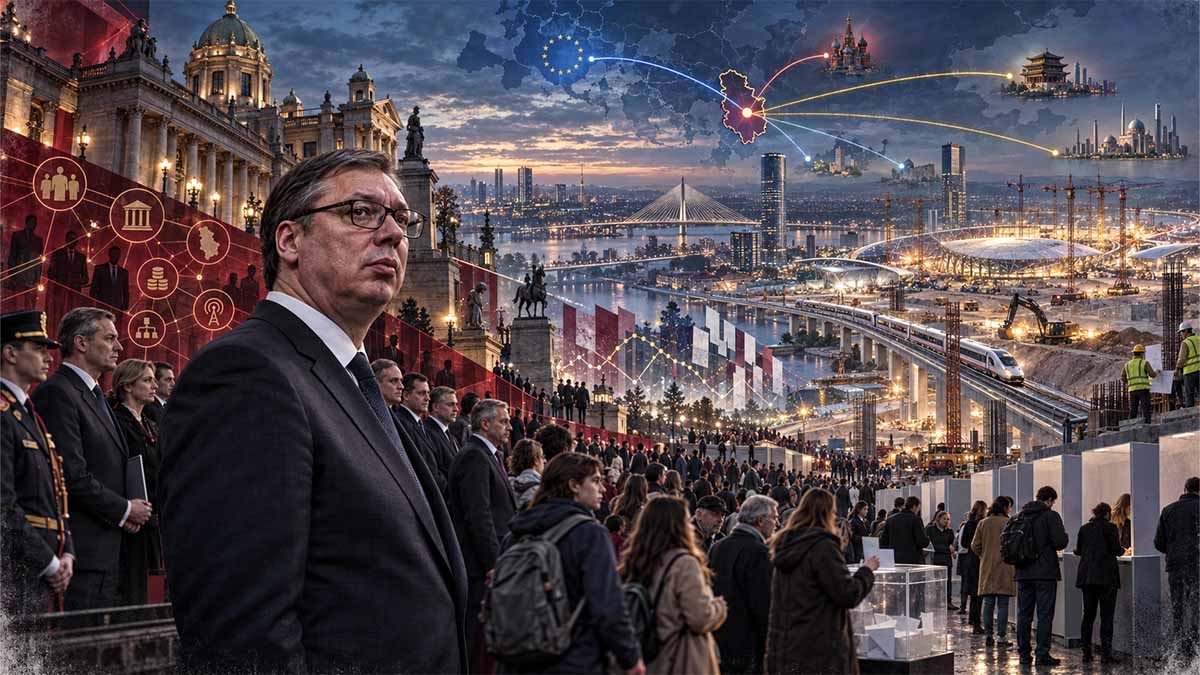
Scope: Republic of Serbia domestic institutional authority, foreign alignment, and public-works continuity under President Aleksandar Vučić through the October 2026 snap parliamentary cycle, evaluated across a five-year forecasting horizon to 2031.
Executive Summary (BLUF)
President Aleksandar Vučić retains decisive control over Serbia’s state apparatus, administrative patronage, and security sector, making systemic regime displacement unlikely in the October 25 snap parliamentary elections despite sustained public mobilization. The political crisis triggered by the November 2024 Novi Sad railway canopy collapse—which killed 16 people—eroded governing credibility, forced cabinet restructuring under Prime Minister Miloš Vučević, and crystallized widespread opposition to infrastructure procurement opacity. However, fragmented opposition structures, incumbent domination of broadcast media, and institutional leverage ensure the Serbian Progressive Party (SNS) remains the controlling legislative anchor. The regime views the planned Belgrade Expo 2027 development envelope (exceeding €15 billion) as an existential vehicle for capital allocation, economic patronage, and international legitimacy that must be insulated from electoral risk. Geopolitically, Belgrade will preserve its multi-vector balancing model—leveraging Chinese infrastructure credit, Russian energy dependencies, French defense acquisitions, and European Union pre-accession capital—precluding an unforced realignment toward Brussels.
The October 25 snap parliamentary election in Serbia is an executive balance-sheet defense designed to protect an unscrutinized €17.8 billion infrastructure portfolio and complete President Aleksandar Vučić’s transition to the premiership before forensic accountability dismantles the ruling party’s patronage core. By dissolving the National Assembly following the November 1, 2024 Novi Sad railway station canopy collapse—which killed 16 people—the regime deployed its seventh early election since 2012 to disperse civic mobilization and halt legislative oversight. The stakes are existential for Belgrade’s governing elite: losing executive control would expose Special Purpose Vehicles operating under a bespoke statutory exemption to retrospective audit, threatening €15 billion in capital allocations tied to Expo 2027. Regionally, the ballot tests whether bilateral aerospace acquisitions with Paris, critical mineral pacts with Berlin, and free-trade integration with Beijing can continue to insulate an increasingly illiberal state from European Union accession conditionality.
A collapsed canopy forces an early ballot to freeze judicial liability
The dissolution of parliament was forced by a structural catastrophe that shattered the Serbian Progressive Party’s (SNS) modernization narrative. On November 1, 2024, the concrete canopy of the Novi Sad Railway Station collapsed, killing 14 people immediately, while two subsequent victims died in clinical care. The station had undergone multi-year renovations executed by a Chinese consortium of China Railway International Co., Ltd. (CRIC) and China Communications Construction Company, Ltd. (CCCC) under an intergovernmental framework that bypassed standard public bidding. Forensic engineering reviews revealed that heavy glass, steel frames, and ceramic tiling had been anchored onto corroded, 60-year-old suspension rods without load verification. Non-disclosure clauses embedded in the commercial agreement allowed the Ministry of Construction, Transport and Infrastructure to withhold supervisory logs until street protests under the slogan “Korupcija ubija” (“Corruption kills”) forced the resignations of Construction Minister Goran Vesić, Domestic Trade Minister Tomislav Momirović, and the acting director of Infrastruktura Železnice Srbije, Jelena Tanasković.
The judicial fallout threatened the party’s administrative hierarchy. On December 30, 2024, the Higher Public Prosecutor’s Office in Novi Sad indicted 13 individuals, including Vesić and former railway director Nebojša Šurlan, for serious offenses against public safety under Articles 278 and 281 of the Criminal Code. By mid-2025, investigations initiated by the Higher Court in Belgrade probed financial corruption alleging $18 million in unlawful gains secured for the contractor and approximately $115 million in damage to the state budget. Decreeing an election for October 25 arrests this institutional hemorrhage. Dissolution disperses student-led blockades across Belgrade and Novi Sad into fragmented electoral campaigning, freezes parliamentary inquiry committees, and insulates line ministries behind an interim administration.
The €16.6 billion spread between exhibition marketing and sovereign exposure
The fiscal driver of regime preservation is Belgrade Expo 2027. First Deputy Prime Minister and Minister of Finance Siniša Mali maintains that direct public expenditure for the exhibition is limited to €1.2 billion, covering the Surčin fairgrounds, an aquatic center, an estimated €140 million Zemun-Airport-Surčin rail link, and a 1,500-unit residential complex. Yet this official baseline conceals an umbrella commitments package. Under the “Leap into the Future – Serbia 2027” (Skok u budućnost) program, Aleksandar Vučić committed €17.8 billion across 323 nationwide projects. The gap of €16.6 billion bundles major linear transit corridors—such as the Morava and Fruška Gora motorways, the Novi Sad–Subotica high-speed railway, and the BIO4 Campus—with the National Football Stadium in Surčin, where expenditures reached approximately €368 million by late 2025 toward a contracted cost exceeding €494 million excluding value-added tax.
The Fiscal Council of the Republic of Serbia (Fiskalni savet) documented the macroeconomic distortion of this capital concentration in its formal review of the national budget. The Council warned that debt-financing 323 concurrent projects during a period of elevated international interest rates widens the fiscal deficit, accelerates sovereign borrowing costs, and crowds out basic municipal maintenance in public healthcare and primary education. Despite Minister Mali’s public pledge that this expenditure will elevate average monthly wages to €1,400 by 2027, the sovereign balance sheet is committed to illiquid civil works whose economic return depends entirely on uninterrupted execution under an unmovable May 2027 opening deadline.
Special legislation turns public procurement into proprietary patronage
To channel capital into this portfolio without administrative friction, the National Assembly passed the Law on Special Procedures for the Realization of the International Specialized Exhibition EXPO BELGRADE 2027, promulgated in Official Gazette No. 92/2023 in November 2023. Article 1 and Article 4 declared the Surčin development of paramount national interest, explicitly exempting contracts from the standard provisions of the Public Procurement Law (Zakon o javnim nabavkama). The cabinet followed in February 2024 with the Decree on Procurement Rules for EXPO Belgrade 2027 (Official Gazette No. 8/2024), establishing the parent coordination company EXPO 2027 d.o.o. and six specialized subsidiary Special Purpose Vehicles (SPVs).
This statutory mechanism removed competitive bidding. SPV directors appoint suppliers through restricted tender pools, and administrative appeals submitted to the Republic Commission for the Protection of Rights in Public Procurement Procedures do not suspend works. While foreign engineering syndicates hold primary engineering, procurement, and construction contracts, secondary and tertiary subcontracts for earthmoving, concrete, logistics, and site security flow directly to private domestic operators aligned with the SNS. In its December 2025 declaration, the EU-Serbia Civil Society Joint Consultative Committee warned that this parallel statutory regime breaches Chapter 5 (Public Procurement) accession benchmarks. For Vučić, preserving this procurement bypass is an electoral necessity: any opposition-led parliamentary majority would immediately repeal the lex specialis, initiate forensic audits through the State Audit Institution (DRI), and freeze the bank accounts of the Surčin SPVs.
Bilateral industrial pacts in Paris and Berlin neutralize European governance leverage
External institutional leverage from the European Union has been systematically blunted by bilateral commercial dealmaking with Europe’s two largest economies. On July 19, 2024, the European Commission and the Serbian government signed a Memorandum of Understanding on a strategic partnership covering sustainable raw materials, battery value chains, and electric vehicles, executed in Belgrade alongside German Chancellor Olaf Scholz. The agreement integrated Rio Tinto’s Jadar basin project—projected to yield 58,000 tons of battery-grade lithium carbonate annually to power 1.1 million electric vehicles—into the EU Critical Raw Materials Act framework. By positioning Serbia as the critical mineral supplier for Germany’s automotive transition, the presidency secured political cover in Berlin, overriding domestic environmental demonstrations.
France executed a parallel transactional transaction. On August 29, 2024, the Ministry of Defence of Serbia and Dassault Aviation concluded a €2.7 billion contract in Belgrade for 12 new multirole Rafale combat aircraft (nine single-seat and three two-seat variants), witnessed by French President Emmanuel Macron. The purchase locks Serbian defense doctrine into French aerospace maintenance for three decades, disincentivizing Paris from supporting European Council sanctions over rule-of-law violations. Consequently, the European Commission approved initial disbursements to Serbia under the €1.58 billion Western Balkans Reform and Growth Facility in January 2026, releasing pre-financing despite stagnant negotiations on Chapter 23 (Judiciary and Fundamental Rights) and Chapter 24 (Justice, Freedom and Security).
Chinese credit and Ukrainian-bound munitions secure strategic impunity
Belgrade’s geopolitical arbitrage balances Western commercial appeasement with Chinese state capital and Russian energy reliance. On July 1, 2024, the China-Serbia Free Trade Agreement entered into force, immediately eliminating tariffs on over 60% of tariff lines and charting a phased removal across 95% over a ten-year horizon. Chinese state and private firms command Serbia’s largest export engines: the Bor copper-gold mining complex operated by Serbia Zijin Mining and the Smederevo steel plant run by HBIS Group. Complemented by sovereign loans from the Export-Import Bank of China, Beijing provides non-conditional liquidity that insulates the presidency from Western fiscal conditionalities.
Concurrently, Vučić maintains functional relations with Moscow by refusing to align with European Council restrictive measures, preserving natural gas flows via Balkan Stream, and relying on Russia’s United Nations Security Council veto regarding Kosovo. Simultaneously, the regime provides quiet utility to Western defense planners by permitting the re-export of hundreds of millions of euros in artillery munitions produced by domestic manufacturers Zastava Oružje and Krušik through third-party intermediaries to the Ukrainian Armed Forces. This dual posture ensures that neither Washington nor Brussels will risk destabilizing Belgrade’s executive authority over the snap election.
The constitutional pivot to the premiership leaves domestic taxpayers with the bill
Over the next 12 to 24 months, Aleksandar Vučić will leverage the October 25 election to resolve his personal constitutional horizon. Article 116 of the Constitution of the Republic of Serbia limits the president to two consecutive five-year terms, barring a reelection bid in 2027. By heading the “United Serbia” candidate list, Vučić intends to secure a working legislative majority of 130 to 145 seats, resign the presidency, and invoke Articles 123 and 135 to assume the office of Prime Minister. This shift transfers de facto power to the statutory head of government, who directly commands line ministry outlays, the security apparatus via the Ministry of Internal Affairs, and public-works execution, leaving Parliamentary Speaker Ana Brnabić as acting president.
The financial and physical cost of this consolidation falls directly upon the domestic tax base. To meet the May 2027 Expo deadline, the Ministry of Finance will have to pass successive budget rebalances to cover escalating raw material costs, premium contractor fees, and debt service on the National Stadium and the Surčin complex. If the SNS retains legislative command, the public will absorb these overruns through deferred social expenditures, uninspected infrastructure risks, and sovereign debt burdens, while senior political figures evade the judicial consequences of the 16 fatalities in Novi Sad. If the ruling coalition fractures and falls below 126 seats, the cost of inaction will shift to the European Union: an unstable, debt-encumbered transit corridor on its southeastern border, whose critical supply chains remain subject to political extortion.
Navigational Index
- Pillar I: Domestic Power Architecture, Systemic Vulnerabilities, and the Novi Sad Catalyst
- Pillar II: Expo 2027 Political Economy, Infrastructure Financing, and State Capture
- Pillar III: Geopolitical Balancing, European Interoperability, and Post-Election Scenarios
Master Abstract
Domestic Authority and Structural Resilience
The institutional hegemony built by Aleksandar Vučić since 2012 relies on centralized executive administration, an asymmetric electoral environment, and vertical control over public-sector employment. The dissolution of parliament and call for early elections on October 25 represents a characteristic crisis-containment tactic: cycling legislative mandates to exhaust civic mobilization, absorb institutional blame through cabinet reconfiguration, and reassert mandate legitimacy. The collapse of the concrete canopy at the Novi Sad Railway Station on November 1, 2024, challenged this equilibrium by converting localized infrastructure neglect into a national symbol of unmonitored capital execution under Chinese-led engineering consortia and accelerated procurement procedures. Protests led by civil society, university networks, and youth organizations mobilized significant public turnout in Belgrade and Vojvodina, yet these movements have struggled to translate street discontent into a unified electoral coalition capable of overcoming the Progressive Party’s rural and provincial organizational networks.
The Economic Engine: Expo 2027 as Regime Architecture
The economic and governance trajectory of Serbia through 2027 is tethered to Belgrade Expo 2027, an operational and financial undertaking projected to involve over €15 billion in sovereign debt, direct subsidies, and state-backed infrastructure contracts. Under the auspices of the Special Law (lex specialis) passed for the Expo project, standard public procurement requirements have been systematically relaxed, enabling state-directed allocation of construction concessions, transportation linkages, and hospitality development. For the Vučić administration, maintaining undisputed power through 2027 is non-negotiable; losing control of the executive branch would expose these high-value, fast-tracked public-works contracts to forensic legislative audits, anti-corruption prosecution, and institutional cancellation. The procurement framework exemplifies the regime’s broader economic doctrine: leveraging sovereign debt and external bilateral capital to drive visible GDP growth while locking private and municipal beneficiaries into loyalty networks.
Geopolitical Arbitrage and External Hedging
Belgrade’s strategic durability is reinforced by its multi-vector foreign policy, which exploits Western security anxieties in the Western Balkans to minimize external reform pressures. Despite persistent EU and OSCE criticisms of democratic standards, press freedom, and judicial autonomy, Vučić remains a primary interlocutor for Brussels and Washington by managing the Kosovo dialogue and acting as an export hub for European-bound ammunition production. Concurrently, Serbia deepens its comprehensive strategic partnership with the People’s Republic of China—exemplified by the bilateral Free Trade Agreement and major transport corridors—while maintaining non-sanction compliance and energy ties with the Russian Federation. Western European capitals (notably Paris and Berlin) prioritize commercial and critical raw material access (including the Jadar lithium project and French Dassault Rafale procurement) over structural rule-of-law conditionality, effectively dampening external diplomatic pressure on the incumbent government ahead of the ballot.
Key Evidence Table
| Indicator / Variable | Value / Institutional Status | Reference Period | Definition / Institutional Coverage | Issuing Entity |
| National Legislative Mandate | 250 National Assembly Seats | Cycle to 2026/2027 | Proportional representation; 3% national electoral threshold | Republic Electoral Commission (RIK) |
| Novi Sad Railway Casualties | 16 verified fatalities | Nov 2024 – Present | Structural canopy collapse; public infrastructure failure | High Public Prosecutor’s Office in Novi Sad |
| Expo 2027 Capital Envelope | Exceeding €15.0 billion | 2024–2027 Cumulative | Infrastructure, transport, accommodation, and venue development | Ministry of Finance of Serbia |
| Bilateral Trade Realignment | Operational Free Trade Agreement | Enacted July 2024 | Tariff reduction framework covering >90% of tariff lines | Ministry of Domestic and Foreign Trade / MOFCOM (PRC) |
| Defense Procurement Modernization | 12 Dassault Rafale Multirole Fighters | Contracted Aug 2024 (€2.7B) | Acquisition of 9 single-seat and 3 two-seat combat aircraft | Ministry of Defence of Serbia / Dassault Aviation |
| EU Integration Standing | Cluster 3 (Competitiveness & Growth) Pending | 2024–2026 Baseline | 22 of 35 negotiation chapters opened; accession tracks stagnant | European Commission Directorate-General for Enlargement |
Competing Explanations or Pathways (ACH Analysis)
| Hypothesis | Diagnostic Support | Disconfirming Evidence | Key Observable Indicators | Current Standing |
| H1: Status Quo Dominance SNS retains an absolute working majority through patronage, administrative pressure, and media control. | Structural dominance of national broadcast frequencies; direct leverage over public-sector employees; fractured opposition. | Sustained civilian demonstrations; localized defections in Vojvodina; polling deterioration in urban centers. | High public-sector mobilization rates; low rural-to-urban opposition swing; state cash transfers prior to vote. | High Likelihood / Baseline Consistent with institutional mechanics and structural resource asymmetry. |
| H2: Forced Coalition & Diluted Control SNS loses independent legislative control; forced into an expanded, vulnerable coalition with smaller proxies. | High post-Novi Sad protest fatigue; economic dissatisfaction with structural inflation; unified opposition tactics in urban ridings. | Disunity among liberal, nationalist, and green opposition blocs; inability to field unified candidate slates. | Sharp losses in Belgrade, Niš, and Novi Sad municipal districts; rise in youth/student voter turnout above 65%. | Moderate Likelihood Feasible under unified opposition coordination, but contingent on voter turnout spikes. |
| H3: Regime Fracture & Rapid Deterioration Electoral contestation sparks systemic defections in the security sector and paralyzed state operations. | Acute civilian resistance; high student-led escalation; public outrage over corruption in major infrastructure works. | Security apparatus (MUP/BIA) remains fully integrated and loyal; internal SNS elite cohesion remains stable. | Mass resignations within line ministries; overt police refusal to disperse civic protests; general strike actions. | Low Likelihood Disconfirmed by current institutional cohesion and vertical party alignment. |
Principal Gaps and Watch Indicators
- Judicial Accountability Trajectory: Progress of formal indictments and trial proceedings against high-ranking infrastructure and ministerial figures associated with the Novi Sad canopy collapse by the High Public Prosecutor’s Office.
- Opposition Coalition Architecture: Formalization of unified electoral slates between green-left coalitions (e.g., Zeleno-Levi Front), centrist blocs (Srbija Protiv Nasilja remnants), and right-wing nationalist factions, or complete strategic division.
- External Oversight Access: The operational presence, staffing ceiling, and post-election findings of the OSCE/ODIHR Election Observation Mission regarding voter registry audits and media parity.
- Western Capital and Lithium Concessions: Diplomatic positioning from Germany and the European Commission regarding procedural permits for the Jadar lithium exploitation site relative to democratic compliance metrics.
Visual Assessment: Institutional and Geopolitical Dependencies
Serbia Political Economy & Structural Vectors: 2026–2027 Baseline
Institutional architecture driving executive resilience, fiscal outlays, and external multi-alignment ahead of the snap parliamentary vote.
| Strategic Axis | Institutional Vector | Leverage Instrument | Regime Risk Profile |
|---|---|---|---|
| Domestic Hegemony | Serbian Progressive Party (SNS) | State media control, public administration payroll, clientelist networks | Erosion in major urban centers; high youth protest volatility |
| Capital Infrastructure | Expo 2027 Special Purpose Vehicles | Lex Specialis bypassing standard public procurement oversight | Exposure to direct anti-corruption scrutiny; debt-servicing limits |
| Eastern Bilateral Link | PRC & Russian Strategic Ties | Free Trade Agreement (PRC); gas agreements & UN Security Council veto (RU) | EU accession stagnation; secondary sanctions monitoring |
| Western Functional Deal | EU & Key Member States (FR/DE) | Critical raw materials (Lithium), security cooperation, defense deals | Civic backlash over environmental sovereignty; accession limbo |
Pillar I: Domestic Power Architecture, Systemic Vulnerabilities, and the Novi Sad Catalyst
Principal Analytical Judgment
President Aleksandar Vučić’s deployment of early parliamentary elections for October 25 represents an institutional stress-management maneuver designed to preempt systemic erosion of the Serbian Progressive Party (SNS) political hegemony. The domestic crisis precipitated by the November 1, 2024 Novi Sad railway station canopy collapse—which resulted in 16 fatalities—has converted isolated municipal grievances into a generalized anti-corruption movement. While civic and student mobilizations represent the most serious domestic challenge to executive authority since the 2023 mass-shooting protests, the regime’s structural control over the security apparatus, administrative payrolls, and national broadcast media insulates the core state architecture from rapid electoral displacement. By dissolving parliament, the presidency absorbs cabinet-level liabilities, disperses civic mobilization through institutional electoral timelines, and positions Vučić to transition back to the premiership ahead of constitutional term limits in 2027.
The Architecture of Incumbent Dominance
The longevity of Aleksandar Vučić’s administration since 2012 rests on an asymmetric system of competitive authoritarianism that fuses party infrastructure with the coercive and administrative arms of the state. The Serbian Progressive Party (Srpska napredna stranka — SNS) does not operate merely as a political faction; it functions as a centralized mechanism for resource allocation and public-sector patronage. Across municipal administrations, regional healthcare systems, education boards, and state-owned enterprises (such as Elektroprivreda Srbije and Infrastruktura Železnice Srbije), career advancement, tenure, and employment stability remain contingent upon documented party affiliation, quota-based rally attendance, and coercive electoral mobilization. This vertical integration allows the SNS apparatus to command a disciplined voting core of approximately 700,000 registered party members—representing roughly 10% of the country’s entire population—capable of generating a reliable baseline turnout regardless of urban ideological shifts.
Complementing this clientelist baseline is near-total asymmetric dominance across the domestic media ecosystem. While regulatory nominal compliance is maintained with the Regulatory Authority for Electronic Media (REM), the allocation of national terrestrial broadcasting frequencies systematically favors pro-government private networks (notably TV Pink, TV Happy, B92, and Prva TV) alongside the editorial deference of the public broadcaster, Radio Television of Serbia (RTS). Independent investigative and critical reporting is largely restricted to cable networks (such as N1 and Nova S) whose distribution is structurally curtailed in provincial and rural municipalities through the state-controlled telecommunications operator, Telekom Srbija. As documented across successive OSCE/ODIHR Election Observation Mission assessments, the continuous convergence of state duties with partisan campaigning enables the president to command disproportionate airtime, framing political opponents as destabilizing actors financed by foreign intelligence entities.
Presidential Executive Core & Apparatus Architecture
Comprehensive structural decomposition of presidential strategic direction, SNS patronage networks, state apparatus alignment, and controlled electoral ecosystems.
PRESIDENTIAL EXECUTIVE CORE
Centralized strategic direction governed via the Security Council and Intelligence Agency (BIA) apparatus.
PARTY & PATRONAGE
Clientelist Network- 700k SNS Cadres: Massive partisan membership base securing electoral mobilization.
- Public Sector SOEs: Strategic placement of loyalists across state-owned enterprises.
- Municipal Quotas: Localized resource distribution and employment patronage.
STATE APPARATUS
Institutional Control- Ministries (MUP): Direct executive oversight of the Ministry of Internal Affairs and security forces.
- State TV (RTS): Monopolized national broadcasting shaping public media narratives.
- Telecom Srbija: Telecommunications infrastructure leverage over media distribution and data.
Controlled Electoral Ecosystem & Parliament
Maintenance of executive dominance via asymmetric media access, institutional capture, and fragmented opposition blocs.
The institutional coherence of this power pyramid is reinforced through the internal security and intelligence apparatus. The Security Information Agency (Bezbednosna-informativna agencija — BIA), operating in close coordination with the Ministry of Internal Affairs (MUP), actively monitors political opposition figures, student leaders, and anti-infrastructure activists. Through targeted surveillance, administrative audits, physical intimidation by plainclothes security detachments, and selective prosecution, the state disrupts extra-parliamentary organizing before it consolidates across regional jurisdictions. Consequently, urban-based civil dissent historically faces significant barriers when attempting to penetrate the conservative, media-monopolized interior of the country.
The Novi Sad Catalyst: Forensic Neglect and Institutional Rupture
The structural canopy collapse at the Novi Sad Railway Station on November 1, 2024, shattered the regime’s core domestic narrative of rapid, state-led modernization. Constructed in 1964, the station had recently undergone extensive multi-year renovations within the framework of the modernization of the Belgrade–Budapest railway corridor—a high-visibility Belt and Road Initiative project executed by a consortium of Chinese state-owned enterprises, China Railway International Co., Ltd. (CRIC) and China Communications Construction Company, Ltd. (CCCC). The sudden structural failure of the exterior concrete overhang killed 14 individuals instantaneously, with two subsequent victims succumbing to severe injuries in clinical care, bringing the verified death toll to 16.
Novi Sad Canopy Structural Event
Comprehensive forensic breakdown of the 1964 suspended concrete framework, subsequent 2021–2024 dead load interventions, and the cataclysmic shear failure on November 1, 2024.
1. 1964 Original Structural Framework
Original DesignSuspended concrete awning engineered via tension anchor rods secured to the primary station building roof structure, relying on precise tensile load distribution.
2. 2021–2024 Renovation Interventions
Modification Phase- Glass/Steel Framework Overhang: Addition of heavy modern architectural glass and steel structures imposing uncalculated dynamic and static loads.
- Surface Ceramic Tiling: Application of heavy ceramic cladding adding cumulative dead load to the cantilevered slab.
- Uninspected Fatigue & Corrosion: Progressive material degradation, oxidation, and stress concentration on uninspected upper tension anchor rods.
CATACLYSMIC SHEAR FAILURE: 16 Fatalities (Nov 1, 2024)
Sudden brittle shear rupture of rusted upper tension anchors under compounded dead weight, resulting in immediate catastrophic collapse of the concrete awning.
The political toxicity of the disaster stems directly from the government’s handling of infrastructure project documentation. Following the incident, state officials and railway operators initially asserted that the canopy had not been subject to structural reconstruction, claiming it remained in its original 1964 state. However, investigative journalists, independent structural engineers (notably civil engineer Danijel Dašić and geological engineer Zoran Đajić), and whistleblowers revealed that the renovation had added substantial structural dead-weight—including heavy glass panels, metal framing, and ceramic tiling—without adequate load testing or metallurgical evaluation of the underlying corroded 60-year-old steel tension rods. Furthermore, commercial secrecy clauses embedded in the CRIC-CCCC bilateral framework agreement had been leveraged by the Ministry of Construction, Transport and Infrastructure to withhold critical technical documentation, tender specifications, and supervisory oversight logs from public scrutiny.
Procurement Conflict Matrix
Comprehensive structural breakdown of intergovernmental bypass terms, CRIC-CCCC consortium EPC leadership, domestic subcontracting layers, technical oversight fragmentation, and concealed audit trails.
CRIC-CCCC CONSORTIUM
Chinese EPC LeadPrimary engineering, procurement, and construction contractor operating under specialized intergovernmental agreements.
MINISTRY OF CONSTRUCTION
Transport & InfrastructureState oversight body granting project exemptions, fast-track approvals, and intergovernmental bilateral terms.
FAILURE OF OVERSIGHT & CONCEALED AUDIT TRAILS
Fragmentation of responsibility between international EPC leads, local subcontractors, and oversight bodies, resulting in completely obscured safety verification and untraceable compliance logs.
The resulting public backlash produced sustained protests across Novi Sad and Belgrade. Unlike previous environmental or electoral protests, the Novi Sad mobilization directly linked administrative corruption to human casualties, adopting the symbolic red handprint and the rallying slogan “Korupcija ubija” (“Corruption kills”). The crisis forced the resignations of Minister of Construction Goran Vesić, former construction minister and then-Domestic Trade Minister Tomislav Momirović, and the acting director of Infrastruktura Železnice Srbije, Jelena Tanasković. In December 2024, the Higher Public Prosecutor’s Office in Novi Sad indicted 13 individuals—including Vesić, former railway director Nebojša Šurlan, and technical supervisors—on charges related to serious offenses against public safety and irregular construction practices. Subsequent investigations initiated in mid-2025 by the Higher Court in Belgrade probed financial corruption, alleging that officials secured unlawful financial gains exceeding $18 million for the Chinese contractor while causing approximately $115 million in damage to the state budget.
The Snap Election Strategy: Tactical De-escalation and Mandate Cycling
The announcement of snap parliamentary elections scheduled for October 25 represents the seventh extraordinary legislative balloting cycle engineered since the SNS assumed office in 2012. Under Aleksandar Vučić’s strategic playbook, parliamentary mandates are intentionally curtailed; the average lifespan of a Serbian legislature over the past decade has hovered between 18 and 24 months. This systematic institutional instability serves three calculated regime objectives:
- Absorption of Societal Rage: By precipitating the dissolution of the National Assembly and accepting the procedural resignation of the cabinet, the executive branch converts focused civic demonstrations into diffused party-political campaigning. Protesting student collectives and civic movements are abruptly forced to either transition into structured electoral entities or risk irrelevance as official media coverage pivots exclusively to electoral campaign regulations.
- Exhaustion of Opposition Capital: Electoral campaigns place massive financial, logistical, and organizational strains on resource-constrained opposition coalitions. While the SNS draws on unrestricted state administrative resources, public transport logistics, and corporate donor networks, opposition parties are forced into recurrent internal negotiations over candidate quotas, coalition leadership, and programmatic compromises.
- Preemption of Judicial Exposure: Entering an electoral period freezes routine parliamentary oversight, defers parliamentary inquiry committees regarding the Novi Sad disaster, and shifts judicial institutional focus away from ministerial criminal trials toward electoral dispute adjudication.
Societal Shock & Executive Circuit Breaker Matrix
Comprehensive structural breakdown of catalyzation events, mass civic mobilization, dissolution decree mechanisms, opposition resource exhaustion, media agenda resets, and cabinet restructuring.
1. Societal Shock / Catalytic Event
Trigger NodeHigh-salience infrastructure disaster (e.g., Novi Sad Canopy Collapse) triggering widespread public outrage and systemic accountability demands.
2. Mass Civic Mobilization & Institutional Critique
Pressure SpikeStreet protests, intellectual condemnation, and direct questioning of state regulatory competence threaten executive stability.
EXECUTIVE CIRCUIT BREAKER: DISSOLUTION DECREE
Proactive dissolution of parliament or cabinet reset to abruptly reset the political clock before organic opposition coordination solidifies.
- Rushed candidate vetting deadlines.
- Coalition infighting over seat allocations.
- Rapid financial exhaustion of campaign reserves.
- Pivot discourse to technical electoral law.
- Systemic blackout of disaster protest coverage.
- Incumbent advantage in pre-campaign framing.
Restabilized Working Majority & Cabinet Reset
Successful absorption of societal shock, neutralization of protest momentum, and reinforcement of executive legislative control.
A critical dimension of the October 2026 cycle is the constitutional trajectory of Vučić himself. Elected to his second consecutive five-year presidential term in April 2022, Article 116 of the Constitution of the Republic of Serbia bars him from seeking a third consecutive term when his mandate concludes in 2027. By positioning himself at the top of the SNS electoral list—under the consolidated banner “United Serbia”—and signaling his willingness to assume the office of Prime Minister, Vučić mirrors the constitutional maneuvers executed by Milo Đukanović in Montenegro or Vladimir Putin in the 2008 Russian transition. Under the Serbian constitutional framework (Articles 123 and 135), the Prime Minister exercises formal executive competence over the state budget, regulatory implementation, and public administration, while the presidency’s formal statutory powers are largely ceremonial outside foreign representation and military command. A managed transition to the premiership allows Vučić to retain direct operational command over the executive branch and public-works financing through the critical 2027–2030 execution window.
Institutional Data Baseline
Institutional and Judicial Evidence Matrix
Comprehensive cross-referencing of verified fatalities, criminal indictments, intergovernmental procurement frameworks, party membership bases, and constitutional term limits.
| Variable / Metric | Observed Metric / Status | Reference Period | Statutory / Legal Authority |
|---|---|---|---|
| Fatalities Verified | 16 Individuals | Nov 2024 – Present | High Public Prosecutor (Novi Sad) |
| Persons Indicted | 13 Defendants (incl. Vesić) | Dec 2024 / Aug 2025 | Criminal Code Arts. 278, 281 |
| Procurement Mode | Intergovernmental (Bypass) | 2018 Framework | Serbia-PRC Strategic Agreement |
| SNS Membership Base | ~700,000 Cadres (~10% Pop) | 2024–2026 Audit | SNS Central Secretariat |
| Parliamentary Seats | 250 Total (126 Maj. Threshold) | Current Convocation | Law on Election of MPs |
| Constitutional Limit | 2 Consecutive Terms (Exp. 2027) | April 2022 Mandate | Constitution of RS, Art. 116 |
Opposition Fragmentation, Student Vanguardism, and Civic Limits
The acute vulnerability of the Serbian political opposition lies in its structural heterogeneity and organizational fragmentation. Following the collapse of the broad electoral alliance Srbija Protiv Nasilja (Serbia Against Violence) following the contested December 2023 municipal and parliamentary balloting, the opposition fractured along ideological, tactical, and regional fault lines. The civic space is broadly divided across three distinct components:
- The Urban Center-Left / Green Bloc: Formed by the Green-Left Front (Zeleno-levi front), Movement of Free Citizens (PSG), and the Party of Freedom and Justice (SSP). While commanding strong, educated voter shares in Belgrade, central Novi Sad, and parts of Niš, this bloc faces persistent accusations from state media of operating as Western/NATO proxies, severely depressing its appeal across the socially conservative rural electorate.
- The Right-Wing Nationalist and Monarchist Factions: Entities such as New DSS (Novi DSS / NADA coalition) and various conservative populists. While fiercely opposed to Vučić’s procedural compromises regarding the European Union-mediated Ohrid Agreement on Kosovo normalization, their leadership remains deeply skeptical of partnering with liberal, pro-European parties, preventing the formation of a unified anti-regime coalition.
- The Extra-Parliamentary Student Movement: Catalyzed directly by the Novi Sad disaster, organized student networks across the University of Belgrade and the University of Novi Sad have emerged as the moral and operational vanguard of civil resistance. Utilizing decentralized communication channels, rapid-response street blockades, and coordinated boycotts, the student movement has successfully articulated public outrage against judicial inaction. However, the transition from decentralized protest coordination to an institutional electoral slate entails significant systemic risks: internal leadership disputes, lack of campaign financing, absence of field offices outside major university hubs, and vulnerability to targeted electoral engineering by state authorities.
Opposition Structural Divisions Matrix
Comprehensive structural breakdown of ideological friction between liberal/green factions and right-wing/NADA blocs, tactical coordination divides, and student/civic vanguard dynamics.
LIBERAL / GREEN BLOC
Metropolitan Base- Pro-EU Integration: Strong institutional alignment with Western European standards.
- Urban Metropolitan: Electoral support concentrated heavily in major urban centers.
RIGHT-WING / NADA
Conservative Base- Anti-Ohrid Accord: Rejection of western-brokered normalization agreements regarding Kosovo.
- National Sovereignty: Conservative nationalist platform appealing to traditional demographics.
STUDENT / CIVIC VANGUARD MOVEMENT
Uninstitutionalized Power- Decentralized Mobilization: Preference for direct street action over formal electoral candidate slates.
- Legitimacy vs. Infrastructure: High moral legitimacy regarding anti-corruption demands, paired with a complete absence of provincial party infrastructure.
The incumbent regime systematically exploits these structural divisions through the targeted registration of spoiler lists, the co-optation of right-wing satellite groupings, and the deployment of state resources to suppress turnout in opposition-leaning urban districts while maximizing turnout in rural safe-havens through monitored absentee and mobile voting.
Interactive Institutional Visualization
The following WordPress-compatible intelligence module presents the institutional stress indicators, legal-judicial parameters, and power-retention mechanics currently governing the Serbian political transition ahead of the October 25 elections:
Executive Power Preservation vs. Systemic Strain: October 2026 Assessment
Operational matrix mapping the structural levers of Aleksandar Vučić’s political administration against destabilizing post-Novi Sad mobilization metrics.
| Pillar / Domain | Controlling Mechanism | Vulnerability / Pressure Point | Systemic Risk Status |
|---|---|---|---|
| Security Sector (MUP / BIA) | Vertical command structure; targeted surveillance of activists | Localized resistance to violent policing in academic quarters | Stable Control |
| Procurement Secrecy | Intergovernmental bypass contracts (PRC) & Lex Specialis | Forensic leaks, whistleblower engineering disclosures, EPPO probes | Acute Exposure |
| Legislative Control | Snap election cycle; frequent dissolutions preventing oversight | Potential loss of outright majority; dependence on minority satellites | Manageable Strain |
| Media Ecosystem | National frequency monopolies (Pink, Happy, B92) and RTS deference | Cable reach (N1/Nova) and decentralized social media channels | Dominated |
Analytical Distinctions: Verified Fact, Announced Intent, and Forecast
Verified Public Record
- On November 1, 2024, the concrete canopy of the Novi Sad railway station collapsed, causing 16 fatalities and catastrophic injuries.
- The railway renovation was contracted under a bilateral intergovernmental agreement to a consortium consisting of China Railway International Co., Ltd. (CRIC) and China Communications Construction Company, Ltd. (CCCC).
- Resignations were tendered by Construction Minister Goran Vesić, Trade Minister Tomislav Momirović, and Railway Infrastructure Acting Director Jelena Tanasković.
- On December 30, 2024, the Higher Public Prosecutor’s Office in Novi Sad filed indictments against 13 individuals for serious offenses against public safety.
- The government formally requested the dissolution of parliament, with snap elections decreed for October 25.
Announced Institutional Intent
- Aleksandar Vučić announced his intention to head the SNS-led electoral slate and serve as the nominee for Prime Minister of Serbia.
- The ruling party announced plans to contest the election under the unified branding “United Serbia”.
- Parliamentary Speaker Ana Brnabić is designated to assume the powers of acting president upon Vučić’s formal resignation from the presidency.
- Student activist networks announced their intention to participate directly in the electoral process, contesting seats against established political parties.
Analytical Forecast (12 to 24 Months)
- Legislative Trajectory: The SNS-led coalition will secure a working parliamentary majority (projected 130–145 seats out of 250), relying where necessary on historical coalition partners (Socialist Party of Serbia — SPS, Alliance of Vojvodina Hungarians — SVM).
- Executive Realignment: Aleksandar Vučić will successfully execute the institutional pivot to the premiership, consolidating direct authority over line ministries, fiscal outlays, and law enforcement agencies while installing a loyalist figurehead in the presidency.
- Judicial De-escalation: The trials of former senior officials over the Novi Sad disaster will experience prolonged procedural delays, interlocutory appeals, and jurisdictional transfers, effectively mitigating the immediate risk of high-level political convictions before the 2027 Expo inauguration.
Concluding Pillar Assessment
Key Judgments
- Regime Hegemony Remains Functionally Intact: Despite profound reputational damage resulting from the Novi Sad collapse, the Serbian state apparatus has not suffered structural institutional defections. The security architecture, state enterprise patronage network, and broadcast media monopolies remain cohesive under executive direction.
- Snap Elections as Crisis Dissipation: The October 25 elections are designed to transform an escalating civil crisis into an asymmetric party-political competition. This tactical pivot exploits opposition divisions and exhausts grassroots civic momentum.
- Constitutional Transition Mechanics: The electoral cycle provides the institutional mechanism for Aleksandar Vučić to transition from the presidency to the premiership prior to the 2027 constitutional term limit, ensuring uninterrupted executive management over strategic capital projects.
What Would Change the Assessment
- Coordinated Opposition Consolidation: A binding, unified electoral pact uniting urban liberal groupings, conservative monarchists, and the student movement behind a single non-partisan candidate slate, which would threaten the SNS majority in multi-member districts.
- Security Sector Fracturing: Overt refusal by mid-level MUP commanders or special police formations (Gendarmery) to enforce protest bans or disperse civilian blockades in Belgrade and Novi Sad.
- Whistleblower Judicial Escalation: Direct release of unredacted technical oversight contracts implicating the presidential administration directly in the structural approvals of the Novi Sad station renovation.
Open Official Record
- Unredacted primary contracts and Annex agreements between the Ministry of Construction, Transport and Infrastructure, Infrastruktura Železnice Srbije, and the CRIC-CCCC consortium concerning the technical scope of the Novi Sad railway station canopy works.
- The formal appellate ruling of the Novi Sad Court of Appeal regarding the High Court’s review of indictments against former ministerial and technical oversight personnel.
- The definitive registry of political parties and civic citizen lists formally certified by the Republic Electoral Commission (RIK) for the October 25 parliamentary ballot.
Pillar II: Expo 2027 Political Economy, Infrastructure Financing, and State Capture
Principal Analytical Judgment
The institutional survival and political maneuvering of President Aleksandar Vučić are inextricably bound to Belgrade Expo 2027 and its associated “Leap into the Future – Serbia 2027” (Skok u budućnost) investment umbrella. Far from an isolated cultural and trade exhibition, Expo 2027 functions as the central engine of regime capitalization, fiscal patronage, and state capture. By enacting dedicated statutory carve-outs—principally the Special Law on Expo Belgrade 2027 (lex specialis)—the administration has formalized the systematic circumvention of standard public procurement frameworks, shifting billions of euros into discretionary Special Purpose Vehicles (SPVs). Because this investment matrix serves as the financial glue sustaining elite intra-party cohesion and private-sector loyalty, losing executive control in the October 25 elections represents an unacceptable existential risk for the ruling Serbian Progressive Party (SNS) leadership, as an adversarial government would gain unhindered statutory authority to audit, freeze, and criminally refer high-value infrastructure contracts.
The Statutory Engineering of Procurement Exemption
The legal foundation for the Expo 2027 capital deployment was established through the passage of the Law on Special Procedures for the Realization of the International Specialized Exhibition EXPO BELGRADE 2027 (Zakon o posebnim postupcima radi realizacije međunarodne specijalizovane izložbe EXPO BELGRADE 2027), promulgated in the Official Gazette of the Republic of Serbia, No. 92/2023 — National Assembly of the Republic of Serbia — Nov 2023.
Article 1 and Article 4 of this lex specialis explicitly declare the entire exhibition zone—encompassing the Surčin complex, the National Football Stadium, commercial accommodation units, and associated regional municipal links—to be of “general interest of significance for the overall economic development of the Republic of Serbia”. The critical operational consequence of this statutory designation is the blanket exemption of Expo-related tenders from the core competitive, transparent bidding procedures mandated by the general Public Procurement Law (Zakon o javnim nabavkama).
Statutory Exemption Cascade (EXPO 2027)
Comprehensive structural decomposition of the Lex Specialis framework, special procurement decrees, fast-tracked expropriation, SPV network delegation, and restricted bidding pools.
1. Statutory Enactment: Lex Specialis
Official Gazette No. 92/2023National Assembly enactment overriding standard regulatory codes to establish expedited legal frameworks for EXPO 2027 infrastructure projects.
2. Government Decree on Special Procurement
Sl. Glasnik No. 8/2024- Public Procurement Bypass: Complete circumvention of the General Public Procurement Law (Zakon o javnim nabavkama).
- SPV Execution: Channeling state contracts directly through specialized state-owned enterprises (Privredna društva).
- Fast-Tracked Legal Procedures: Accelerated expropriation timelines, simplified permitting, and suspension of standard judicial dispute appeals.
Centralized operational coordination, inter-ministerial liaison, and project management oversight.
Dedicated corporate vehicles executing specific sectoral mandates (residential complexes, stadium infrastructure, exhibition halls).
Discretionary Direct Allocation & Restricted Bidding Pools
Systematic elimination of open competitive bidding in favor of closed, politically directed contract distributions.
To implement this procurement bypass, the government enacted the Decree on the Rules of Procurement Procedures for Goods, Services, or Works Necessary for the Realization of the International Specialized Exhibition EXPO Belgrade 2027 Decree on Procurement Rules for EXPO Belgrade 2027, Official Gazette No. 8/2024 — Government of the Republic of Serbia — Feb 2024.
This regulatory instrument delegated project implementation to a parent coordination enterprise, EXPO 2027 d.o.o., and at least six dedicated subsidiary SPVs tasked with erecting residential modules, exhibition facilities, and municipal connections. Under these administrative rules:
- Tender notices are not required to be advertised across open European or domestic public procurement portals.
- Evaluation criteria can be defined ad hoc by individual SPV directors appointed directly by the cabinet.
- Administrative challenges filed before the Republic Commission for the Protection of Rights in Public Procurement Procedures do not automatically suspend project execution, removing a vital injunctive remedy against anti-competitive collusion.
This institutional insulation has drawn formal censure from the European Commission and civil-society governance bodies, which note that creating parallel statutory legal regimes undermines the Chapter 5 (Public Procurement) acquis and directly contradicts accession conditionality Joint Declaration EU-Serbia Civil Society Joint Consultative Committee — European Economic and Social Committee — Dec 2025.
Macro-Financial Architecture: €1.2B Direct vs. €17.8B Umbrella
A central source of domestic controversy and fiscal exposure is the massive discrepancy between the direct, narrow operational costs of the exhibition site and the broader infrastructure program mobilized under its brand. The Ministry of Finance has consistently sought to compartmentalize public exposure:
EXPO 2027 Capital Allocation Matrix
Comprehensive cross-referencing of narrow exhibition site funding, umbrella portfolio national projects, infrastructure scopes, and multi-billion-euro capital tranches.
| Category / Tranche | Valuation | Operational Scope / Core Projects Covered |
|---|---|---|
| Narrow Exhibition Site (Ministry of Finance) |
€1.2 Billion | Surčin fairgrounds, core pavilions, aquatic center, Zemun-Airport-Surčin passenger railway link, and 1,500 residential units. |
| Umbrella Portfolio (“Leap into the Future”) |
€17.8 Billion | 323 distinct projects across Serbia: National Stadium, Morava Corridor, Fruška Gora Corridor, BIO4 Campus, Niš-Dimitrovgrad rail, Belgrade Metro Line 1 depot, and regional municipal wastewater networks. |
The First Deputy Prime Minister and Minister of Finance, Siniša Mali, has publicly insisted that direct state expenditures for the physical exhibition grounds in Surčin are restricted to €1.2 billion Mali: Expo 2027 in Belgrade will cost €1.2 billion, not €18 billion — NIN Magazine / Beta — Feb 2024. According to the Ministry of Finance, this direct allocation covers six core works: the primary fairgrounds, municipal utility hookups, an international aquatic sports complex, the dedicated rail link connecting central Zemun and Nikola Tesla Airport to Surčin, a Sava River passenger pier, and the Expo residential enclave.
Conversely, President Vučić and executive planners presented the expansive “Leap into the Future – Serbia 2027” (Skok u budućnost – Srbija 2027) state program, setting total public investments through 2027 at €17.8 billion across 323 nationwide projects Vučić presents “Leap into the future – Serbia 2027” plan — Serbian Monitor / RTS — Jan 2024. This macro-portfolio bundles the construction of the National Football Stadium in Surčin (contracted at approximately €494 million excluding VAT) with major linear transit corridors, including the Morava Highway Corridor, the Fruška Gora Corridor, high-speed rail sections (Novi Sad–Subotica), and the biotechnology park BIO4 Campus in Belgrade.
€17.8B Total Macro Portfolio Architecture
Comprehensive structural breakdown of direct site allocation versus regional and sovereign infrastructure projects, including the National Stadium, motorway corridors, and rail expansions.
DIRECT SITE ALLOCATION
€1.2B Tranche- Surčin Pavilions: Core exhibition grounds and multi-purpose halls.
- 1,500 Housing Units: Dedicated residential complexes for participants and guests.
- Airport-Expo Rail Link: Direct transit connection to Nikola Tesla Airport.
REGIONAL & SOVEREIGN INFRASTRUCTURE
€16.6B Tranche- National Stadium: €494M ex-VAT valuation.
- Morava Motorway: Regional corridor integration.
- BIO4 Biotech Campus: Scientific research infrastructure.
- Fruška Gora Corridor: Arterial highway expansion.
- Novi Sad–Subotica Rail: High-speed rail modernization.
- Energy & Pipelines: Strategic municipal grid links.
The independent Fiscal Council of the Republic of Serbia (Fiskalni savet) has repeatedly warned in its budget evaluations that aggregating multi-billion-euro long-term infrastructure commitments under an urgent, event-driven deadline poses severe structural risks Assessment of the Draft Law on the Budget of the Republic of Serbia — Fiscal Council of the Republic of Serbia — Dec 2024.
The primary risks identified by the Fiscal Council include:
- Fiscal Deficit and Sovereign Borrowing Spikes: Financing 323 accelerated capital projects forces substantial increases in direct state borrowing, lifting sovereign debt service costs during a period of sustained high global interest rates.
- Crowding-Out Effect: Discretionary allocation of sovereign capital and state guarantees toward showcase civil works crowds out essential social expenditure, healthcare infrastructure maintenance, and local secondary school renovation.
- Execution Inefficiencies and Cost Overruns: Compressing complex civil engineering timelines to meet the immutable May 2027 exhibition opening forces contractors to pay premiums for raw materials and imported labor, inflating final project costs beyond original budget thresholds.
Mechanisms of State Capture and Elite Rent Allocation
The political economy of the Serbian Progressive Party relies heavily on managing state contracts as an instrument of political control. The institutional design of the Expo 2027 project creates a legal structure that benefits an allied tier of domestic construction syndicates, logistics operators, and service subcontractors:
Rent Extraction Taxonomy
Comprehensive structural decomposition of sovereign borrowing tiers, state-controlled SPVs, prime EPC contractor networks, domestic subcontracting layers, and political capital regeneration.
TIER 1: Sovereign Borrowing & Bilateral Credit Facilities
Capital InflowEurobonds, commercial bank consortia, and PRC Export-Import Bank bilateral credit facilities.
TIER 2: State-Controlled Special Purpose Vehicles (SPVs)
Institutional GateAppointed directors, non-competitive selection frameworks, and sealed tender terms.
TIER 3: Prime EPC Contractors (Bilateral & Domestic Tier-1)
Execution LeadChinese State Enterprises (e.g., PowerChina) and preferred domestic construction favorites.
TIER 4: Domestic Subcontracting Networks
Clientelist DistributionClientelist construction firms, material haulers, and security service providers.
TIER 5: Political Capital & Party Funding Regeneration
Regeneration LoopGuaranteed voting blocs, corporate donations, and organized rally logistics.
- The Special Purpose Vehicle (SPV) Buffer: By routing state funds to state-owned SPVs rather than line ministries, financial transactions are insulated from immediate standard legislative oversight. State auditors (Državna revizorska institucija — DRI) face multi-year reporting lags, effectively precluding real-time forensic accounting of contract awards before the capital is expended.
- Subcontractor Arbitrage: While primary construction contracts for flagship installations are frequently signed with foreign entities (such as Chinese state enterprises possessing specialized heavy-engineering capacity), the secondary and tertiary subcontracting layers—covering earthworks, concrete supply, transport, catering, security, and interior fit-outs—are assigned to politically aligned domestic enterprises. This clientelist loop guarantees substantial profits to private corporate donors, who in turn fund party operations, supply logistics for pro-government political rallies, and control commercial media platforms.
- Land Re-Zoning and Speculative Real Estate Concessions: The master zoning plan encompassing the Surčin municipality unlocks hundreds of hectares of formerly agricultural and municipal land for private commercial development. By controlling the sequencing of infrastructure construction (such as high-speed expressways, water treatment conduits, and gas pipelines), the ruling party grants its commercial allies immense windfall gains through speculative land acquisitions made immediately prior to official zoning reclassifications.
Forensic Accountability and Elite Vulnerability Matrix
The institutional architecture of the Vučić administration cannot tolerate an electoral defeat in the snap parliamentary elections because the entire Expo legal apparatus is vulnerable to retrospective legal and judicial action. The table below illustrates the specific accountability exposure facing the regime across key operational components:
| Institutional Component | Current Governing Protection | Exposure Under Hostile Government Audit | Key Exposed Actors |
| Expo SPV Network (EXPO 2027 d.o.o.) | Exemption from standard public procurement via lex specialis. | Revocation of lex specialis; full audit of non-competitive tenders by State Audit Institution (DRI). | Ministry of Finance leadership, SPV Management Boards, commercial directors. |
| National Football Stadium (€494M ex-VAT) | High-priority infrastructure status; expedited expropriation. | Inquest into structural budget inflation and delays; review of site land purchases. | Ministry of Construction, PE Urbanism, municipal land registry officials. |
| Surčin Real Estate Concessions | Fast-tracked cadastral priority status under Article 8 of amended lex specialis. | Forensic tracing of beneficial ownership behind private construction subcontracts. | Private developers, Republic Geodetic Authority (RGZ) leadership. |
| Bilateral Engineering Consortia | Confidentiality clauses embedded in intergovernmental frameworks. | Unsealing of engineering logs, supervisory defect notices, and pricing annexes. | Foreign EPC leads (CRIC, CCCC, PowerChina), domestic supervisory boards. |
| Fiscal Reserves Diversion | Executive cabinet decrees reallocating discretionary budget reserves to Expo accounts. | Prosecution under Criminal Code Art. 359 (Abuse of Official Position) for budgetary misappropriation. | Government Secretariat, Ministry of Finance Treasury Department. |
Interactive Visual Intelligence Codex: Capital Outlays & Exposure
The following component details the financial disparity between direct site costs and the full infrastructure envelope, mapping the fiscal exposure and audit risks facing the incumbent administration:
Expo 2027 Capital Architecture & Institutional Vulnerability Audit
Comparative visualization of budgeted expenditures, procurement circumvention vehicles, and sovereign risk parameters underpinning the Belgrade Expo 2027 portfolio.
| Capital Project / Entity | Budgeted Envelope | Procurement Mechanism | Institutional Audit Vulnerability |
|---|---|---|---|
| Expo 2027 Exhibition Center | €1.2 Billion direct | SPV EXPO 2027 d.o.o. (Decree 8/2024) | Extreme Exposure |
| National Football Stadium | €494 Million (ex-VAT) | Direct government decree / Priority Land Transfer | Extreme Exposure |
| Zemun–Airport–Surčin Rail | ~€140 Million | Bilateral intergovernmental financing | Moderate Vulnerability |
| Surčin Residential Complex (1,500 units) | ~€250 Million | Autonomous Housing SPVs (Lex Specialis Art. 4) | Extreme Exposure |
| 323 National Regional Projects | Remainder of €17.8B | Mixed: Sovereign Loans, Eurobonds, Line Budgets | Systemic Debt Strain |
Analytical Distinctions: Verified Fact, Announced Intent, and Forecast
Verified Public Record
- The National Assembly of Serbia adopted the Law on Special Procedures for the Realization of the International Specialized Exhibition EXPO BELGRADE 2027 (Sl. glasnik RS, br. 92/2023), formally exempting the project from the Public Procurement Law.
- The Government of Serbia adopted the Decree in February 2024 setting special procurement rules for the exhibition, establishing the enterprise EXPO 2027 d.o.o. and six specialized housing SPVs.
- Minister of Finance Siniša Mali formally stated that the direct cost of Expo 2027 is budgeted at €1.2 billion, while the wider umbrella of 323 infrastructure projects is budgeted at €17.8 billion.
- The independent Fiscal Council of the Republic of Serbia published formal evaluations warning that the 2025 and 2026 budgets allocate disproportionate resources and fresh borrowing to Expo 2027 and the National Stadium, widening the fiscal deficit and elevating borrowing costs.
- Total expenditure on the National Football Stadium reached approximately €368 million by late 2025 against a projected completion cost exceeding €494 million without VAT.
Announced Institutional Intent
- The Serbian presidency and cabinet announced that all 323 projects under the “Leap into the Future – Serbia 2027” program will be completed and operational prior to May 2027.
- The administration pledged that the residential complex built for Expo 2027 will be transferred to local municipal ownership for public-sector and affordable residential use following the event’s conclusion.
- Minister Siniša Mali announced that average monthly wages across Serbia will reach €1,400 by 2027 as a direct macroeconomic consequence of Expo-related infrastructure expenditures.
Analytical Forecast (12 to 36 Months)
- Fiscal Drag and Budget Amendments: Escalating raw material prices, engineering delays, and high sovereign borrowing yields will force the Serbian government to pass successive budget rebalances (rebalans budžeta) in late 2026 and early 2027, transferring additional contingency reserves into the Surčin site.
- Selective Subcontractor Insolvencies: Subcontracting tiers caught between fixed-price delivery agreements and accelerating milestone penalties will face acute margin compression, prompting selective state bailouts for politically connected domestic suppliers while leaving independent subcontractors unpaid.
- Intensified Electoral Defensiveness: The ruling party will direct maximum administrative and security resources toward retaining power on October 25, as losing legislative control would immediately result in opposition-led parliamentary committees nullifying the lex specialis, freezing bank accounts of Expo SPVs, and inviting EU anti-fraud audits.
Concluding Pillar Assessment
Key Judgments
- Expo 2027 Is the Regime’s Primary Fiscal Lifeblood: Belgrade Expo 2027 is not merely a diplomatic vanity event; it is the structural mechanism through which the Vučić administration distributes economic rents, finances its political coalition, and sustains macroeconomic growth targets through debt-financed construction.
- Statutory Insulation via Lex Specialis Creates Systemic Corruption Vulnerability: By codifying procurement exemptions into national law, the regime removed the legal safeguards designed to protect public funds, creating structural governance vulnerabilities similar to those that caused the Novi Sad canopy collapse.
- Electoral Continuity Is a Prerequisite for Liability Protection: The imperative to prevent hostile political oversight of the €17.8 billion investment program explains why the executive branch cannot tolerate an electoral transfer of power. Retaining the prime minister’s office and parliamentary majority is essential to prevent criminal and forensic accounting audits of the Expo SPVs.
What Would Change the Assessment
- European Union Suspension of Growth Facility Disbursements: A formal European Council or Commission decision to condition or suspend Serbia’s allocation under the Western Balkans Reform and Growth Facility (€1.58B envelope) explicitly citing rule-of-law violations in the Expo lex specialis.
- Major Engineering Milestone Failure: Technical delays forcing the international Bureau International des Expositions (BIE) to formally question Belgrade’s readiness, triggering financial penalty clauses and structural reputational collapse.
- Macroeconomic Liquidity Shock: A sudden spike in international sovereign bond yields restricting Serbia’s ability to roll over maturing debt, compelling the Ministry of Finance to mothball peripheral regional infrastructure projects to preserve core Surčin financing.
Open Official Record
- Complete financial audit ledgers and transaction journals of EXPO 2027 d.o.o. and the six affiliated residential development SPVs.
- The unredacted EPC (Engineering, Procurement, and Construction) delivery contract and commercial terms executed between the Government of Serbia and the primary contractors for the National Football Stadium.
- The official oversight logbook and structural inspection certificates for preliminary foundation engineering at the Surčin aquatic and fairgrounds site.
Pillar III: Geopolitical Balancing, European Interoperability, and Post-Election Scenarios
Principal Analytical Judgment
The systemic durability of the Aleksandar Vučić administration is underpinned by a deliberate policy of multi-vector geopolitical hedging that insulates the domestic regime from decisive Western accountability mechanisms. By positioning Serbia as a transactional logistics, security, and industrial partner for competing global powers, Belgrade has successfully neutralized the structural conditionality traditionally applied by the European Union. Despite persistent deficiencies in democratic institutions and the rule of law highlighted by the European Commission, Western capitals—most notably Paris and Berlin—prioritize strategic industrial deliverables. These include the integration of Serbian critical raw materials (lithium) into the European automotive supply chain, commercial aerospace contracts, and backchannel defense industrial output supporting European security frameworks. Simultaneously, the regime cultivates institutional links with Beijing through an active bilateral Free Trade Agreement and infrastructure credit, while preserving energy interdependence and diplomatic cover with the Russian Federation. Consequently, the October 25 snap elections will not prompt an unforced strategic pivot: the regime will preserve this balanced posture regardless of whether it secures an outright majority or relies on an expanded coalition.
The Four Pillars of Strategic Arbitrage
Serbian foreign policy operates along four distinct bilateral and multilateral vectors designed to maximize sovereign leverage while minimizing single-source dependency:
Geopolitical Balancing, European Interoperability, & Post-Election Scenarios
Comprehensive structural breakdown of multi-vector hedging, Western industrial integration (Jadar lithium and Rafale procurement), Chinese trade pacts, Russian balancing, and 5-year stochastic scenario modeling.
BELGRADE EXECUTIVE CORE
Multi-vector geopolitical hedging neutralizing Western institutional conditionality via strategic industrial deliverables.
- Lithium MOU: Rio Tinto Jadar integration (58k tons/yr).
- Rafale Pact: €2.7B French aerospace contract.
- Growth Facility: EU pre-financing disbursements.
- FTA (July 2024): Duty exemption across 95% of tariff lines.
- Asset Control: Bor mining & Smederevo steel complexes.
- EPC Credit: Non-transparent sovereign liquidity.
- Energy Supply: Long-term Gazprom gas contracts.
- UN Veto Cover: Blocking Kosovo institutional recognition.
- Ammunition Flows: Indirect defense re-exports.
1. The Western European Vector (EU, Germany, France)
Belgrade maintains nominal candidate status for EU accession, but progress remains frozen across fundamental negotiating chapters, specifically Cluster 1 (Fundamentals) and Cluster 3 (Competitiveness and Inclusive Growth). However, the administration has successfully substituted accession milestones with high-value bilateral economic arrangements:
- The German Industrial Link: On July 19, 2024, the European Commission and the Government of Serbia executed a Memorandum of Understanding on a strategic partnership concerning sustainable raw materials, battery value chains, and electric vehicles in Belgrade, attended by German Chancellor Olaf Scholz EU-Serbia Memorandum of Understanding on Sustainable Raw Materials — European Commission — Jul 2024. This agreement formally integrated the controversial Rio Tinto Jadar lithium project into the European Union’s Critical Raw Materials Act framework. By positioning Serbia as the supplier of up to 58,000 tons of battery-grade lithium carbonate annually—sufficient for approximately 1.1 million electric vehicles—Vučić secured political insulation from Berlin, trading regulatory and environmental alignment for strategic industrial integration.
- The French Defense Anchor: On August 29, 2024, the Ministry of Defence of the Republic of Serbia executed a binding commercial contract with Dassault Aviation valued at €2.7 billion for the acquisition of 12 new multirole Dassault Rafale combat aircraft (nine single-seat, three two-seat) in the presence of French President Emmanuel Macron and President Vučić Contract to purchase 12 Rafale aircraft signed — Ministry of Defence of the Republic of Serbia — Aug 2024. This transaction represents a generational shift in Serbian air force doctrine away from Soviet/Russian MiG-29 platforms toward Western aerospace interoperability, directly disincentivizing Paris from applying diplomatic pressure regarding internal democratic backsliding.
- The European Financial Facility: In January 2026, the European Commission approved the first operational disbursements under the Reform and Growth Facility for the Western Balkans Commission Implementing Decision on the release of funds to Serbia under the Reform and Growth Facility — European Commission — Jan 2026. Despite civil society objections regarding the procurement carve-outs of the Expo lex specialis, Brussels released pre-financing and tranche allocations tied to Serbia’s national Reform Agenda, demonstrating the primacy of regional economic stabilization over strict governance enforcement.
2. The Eastern Eurasian Vector (People’s Republic of China)
Relations with Beijing operate under the framework of the Comprehensive Strategic Partnership, elevated during President Xi Jinping’s state visit to Belgrade in May 2024.
- Trade Integration: On July 1, 2024, the bilateral Free Trade Agreement between China and Serbia formally entered into force Entry into force of the China-Serbia Free Trade Agreement — Ministry of Commerce of the People’s Republic of China — Jun 2024. The agreement immediately eliminated tariffs on over 60% of tariff lines, with commitments to phase out tariffs across 95% of bilateral tariff lines over a decade.
- Strategic Asset Control: Chinese state and private enterprises control the country’s leading export industrial assets, notably the copper-gold extraction complex in Bor (Serbia Zijin Mining / Zijin Copper) and the Smederevo steel mill (HBIS Group Serbia). These state-directed investments, complemented by non-transparent engineering, procurement, and construction (EPC) credit lines extended by the Export-Import Bank of China, provide the regime with an alternative liquidity pool devoid of governance conditionality.
3. The Traditional Balancing Vector (Russian Federation)
While Belgrade has permitted the re-export of hundreds of millions of euros worth of artillery shells and ammunition manufactured by domestic defense firms (such as Zastava Oružje and Krušik) to Western intermediaries—which are subsequently channeled to the Ukrainian Armed Forces—the regime refuses to align with European Council restrictive measures against Moscow. Serbia maintains a baseline of energy cooperation via long-term natural gas purchase agreements with Gazprom, transit through the Balkan Stream pipeline, and relies on Moscow’s diplomatic veto at the United Nations Security Council to block Kosovo’s institutional integration into the UN system.
Country and Alliance Lenses
To determine how external stakeholders will react to the October 25 snap election outcome, the strategic priorities of the material European actors are evaluated below:
Country and Alliance Strategic Matrix
Comprehensive cross-jurisdictional matrix evaluating primary strategic priorities, institutional leverage points, and pre-election postures across Germany, France, Italy, the United Kingdom, and the European Union.
| Jurisdiction | Primary Strategic Priority | Institutional Leverage Point | Pre-Election Posture |
|---|---|---|---|
| Germany | Raw material supply chains; automotive sector integration; Jadar lithium execution. | Conditionality on Chapter 23/24; Western Balkans Growth Facility oversight. | Tolerant of executive primacy; focus on Jadar project delivery. |
| France | Aerospace industrial export; nuclear energy cooperation frameworks; regional stability. | Dassault delivery sequencing (2028+); bilateral defense technical approvals. | High political cover; explicit backing of Vučić modernization projects. |
| Italy | Nearshoring supply chains; migration corridor control; industrial manufacturing. | Western Balkans ministerial summits; direct investments in regional automotive. | Prioritizes migration containment and regional commercial stability. |
| United Kingdom | Security sector monitoring; combating illicit finance; Western Balkan stability. | Sanctions targeting illicit finance; diplomatic posture unbound by EU consensus. | Critical of BIA/MUP; supports rule-of-law reforms and open media. |
| European Union (Collectively) |
Common Foreign and Security Policy (CFSP) alignment; Kosovo-Serbia Normalization. | Pre-accession capital (IPA); Ohrid Agreement Annex (Chapter 35 amendments). | Institutional compromise; Growth Plan disbursement decoupled from governance. |
- Germany: Berlin’s posture is driven by industrial interest. Following the July 2024 lithium memorandum, Chancellor Scholz’s cabinet adopted a pragmatic approach toward Belgrade’s domestic arrangements. While the German Green faction in the Bundestag frequently criticizes the suppression of student demonstrations and environmental activists, the Chancellery prioritizes securing critical raw materials to protect the German automotive sector’s transition to electric mobility against Chinese mineral dominance.
- France: Paris acts as Belgrade’s primary defense-industrial partner within the EU. President Macron’s personal engagement in securing the €2.7 billion Rafale transaction ensures that France will not support punitive diplomatic measures or structural election inquiries through the Council of the European Union. Paris views Vučić as the only political figure capable of executing high-capital bilateral state agreements.
- Italy: Rome’s policy toward Serbia focuses on trade volume, border control along the Western Balkan migration route, and nearshoring Italian manufacturing. The Meloni government actively supports accelerated EU integration for Serbia without imposing rigid political conditionality, viewing Belgrade as an essential partner for regional balance.
- United Kingdom: Operating outside the European Union framework, the UK exercises independent diplomatic oversight through the Foreign, Commonwealth and Development Office (FCDO). London maintains a firmer rhetorical stance regarding state capture, media freedoms, and the activities of the Security Information Agency (BIA), particularly concerning security incidents in Northern Kosovo (such as the Banjska standoff). However, UK influence remains structural rather than financial.
- The European Union (Collectively): The European Commission remains structurally constrained. Article 35 of the EU negotiating framework has incorporated the Ohrid Agreement, binding accession progress to Kosovo normalization. However, because unanimous consent across all 27 member states is required to freeze funds or impose formal sanctions—and with Hungary under Viktor Orbán consistently vetoing punitive measures against Belgrade—the Union’s official response to electoral irregularities will remain limited to technical monitoring and critical progress reports.
Five-Year Horizon Scenarios (2026–2031)
Post-Election Scenario Pathways Architecture
Comprehensive probabilistic decomposition of post-election trajectories across Consolidated Autonomy (65%), Paralyzed Coalition (25%), and Systemic Fracture (10%).
POST-ELECTION SCENARIO PATHWAYS
CONSOLIDATED AUTONOMY
65%- Working Majority: >135 seats secured.
- Executive Pivot: Vučić transitions to PM.
- Capitalization: Expo 2027 fully funded.
- Hedging: Multi-vector foreign posture preserved.
PARALYZED COALITION
25%- Majority Shortfall: <126 seats won.
- Co-Governance: SPS / Minority coalition required.
- Bureaucracy: Expo timeline stalled.
- Pressure: Western oversight escalates.
SYSTEMIC FRACTURE
10%- Disputed Polls: Election results rejected.
- Civil Disruption: Indefinite general strikes.
- Security Strains: MUP / Gendarmerie refusals.
- Retreat: Western capital and aid withdraw.
Scenario 1: Consolidated Executive Autonomy (65% Probability)
- Outcome: The SNS-led “United Serbia” list secures a stable working majority (130–145 seats) by sweeping provincial and rural constituencies, despite significant seat losses in urban Belgrade, Niš, and Novi Sad.
- Executive Realignment: Aleksandar Vučić resigns the presidency, triggering Article 123 constitutional procedures to assume the office of Prime Minister. Parliamentary Speaker Ana Brnabić assumes the acting presidency until a loyalist figure is elected in early 2027.
- Strategic Trajectory: The administration maintains full control over the Expo 2027 development pipeline, using sovereign borrowing to complete core Surčin facilities. Multi-vector foreign balancing continues uninterrupted: the Rafale delivery schedule proceeds, the Jadar lithium project receives preliminary environmental permits, and Chinese infrastructure execution expands under bilateral frameworks. Civic street protests gradually lose operational momentum due to legal fatigue and targeted administrative pressure.
Scenario 2: Paralyzed Co-Governance and Structural Concessions (25% Probability)
- Outcome: The SNS suffers major reversals across urban centers following student voter mobilization, winning only 115–123 seats and losing its unilateral majority.
- Executive Realignment: Vučić forms an expanded coalition with the Socialist Party of Serbia (SPS) and regional minority parties (e.g., Alliance of Vojvodina Hungarians), forced into protracted negotiations over line ministries. To maintain regime stability, Vučić assumes the premiership but cedes the Ministry of Construction and the Ministry of Justice to coalition partners or non-partisan technocrats.
- Strategic Trajectory: Parliamentary inquiry committees force transparency audits into the Expo lex specialis, stalling municipal procurement approvals. Western capitals exploit cabinet vulnerability to demand formal accession benchmarks and accelerated Kosovo implementation steps, while Chinese infrastructure partners delay fresh bilateral capital commitments due to legal uncertainty.
Scenario 3: Systemic Institutional Fracture and Crisis (10% Probability)
- Outcome: Widespread voting irregularities on October 25 spark immediate, organized urban resistance, with the opposition rejecting the declared tally.
- Executive Realignment: Parallel municipal general strikes paralyze transportation networks across Belgrade and Novi Sad. Elements within the police and judicial system refuse to enforce protest bans or prosecute detained activists.
- Strategic Trajectory: The legitimacy of the regime collapses internationally. The European Parliament calls for an immediate suspension of the Western Balkans Growth Facility, and credit rating agencies downgrade Serbia’s sovereign outlook. The Surčin Expo 2027 project encounters severe operational defaults, forcing the administration into emergency international mediation.
Key Evidence and Strategic Data Baseline
Geopolitical & Scenario Metric Matrix
Comprehensive cross-referencing of Western Balkans facility disbursements, French aerospace defense obligations, critical raw material lithium extraction, and PRC free trade implementation horizons.
| Metric / Program | Quantified Value | Statutory / Bilateral Instrument | Target Horizon |
|---|---|---|---|
| Western Balkans Facility | €1.58 Billion Allocation (Grants & Loans) |
EU Regulation (EU) 2024/1449; Commission Decision C(2026) 12.01.2026 |
2024–2027 Disbursements |
| French Aerospace Pact | €2.7 Billion Obligation (12 Rafale Jets) |
MoD Serbia / Dassault Contract; Bilateral Agreement signed 29.08.2024 |
Deliveries 2028–2030 |
| Critical Raw Materials | 58,000 Tons/Year Li₂CO₃ (Jadar Basin Reserves) |
EU-Serbia Strategic Partnership MoU; Constitutional Court Decision 07/2024 |
Operational Phase ~2028+ |
| PRC Free Trade Regime | 95% Duty Exemption (Covering >90% Goods) |
China-Serbia Free Trade Agreement; Entry into force 01.07.2024 |
10-Year Phased Implementation |
Interactive Visual Intelligence Codex: Geopolitical Leverage
Belgrade Geopolitical Arbitrage & Scenario Probability Matrix
Operational mapping of foreign policy vectors, strategic industrial dependencies, and post-election five-year outlooks.
| External Vector | Strategic Mechanism | Domestic Leverage Result | Structural Vulnerability |
|---|---|---|---|
| European Union / Germany | Jadar Critical Raw Materials MoU & WB Growth Facility | Insulates regime from Chapter 23/24 rule-of-law sanctions | Domestic Anti-Mining Dissent |
| France | Dassault Rafale aerospace contract (€2.7B) | Secures French diplomatic cover in the European Council | Long Delivery Horizon (2028) |
| China (PRC) | Bilateral FTA, Ex-Im Bank credit lines, EPC contracts | Liquidity and heavy construction without governance oversight | Procurement Scrutiny Post-Novi Sad |
| Russian Federation | Gazprom gas arrangements, UN Security Council veto | Appeals to domestic pro-Russian nationalist electorate | Secondary Sanctions Monitoring |
Analytical Distinctions: Verified Fact, Announced Intent, and Forecast
Verified Public Record
- On July 1, 2024, the Free Trade Agreement between Serbia and the People’s Republic of China entered into force, covering mutual tariff cuts across over 90% of products.
- On July 19, 2024, the Government of Serbia and the European Commission signed a Memorandum of Understanding on a strategic partnership regarding critical raw materials in the presence of German Chancellor Olaf Scholz.
- On August 29, 2024, Serbia’s Ministry of Defence and Dassault Aviation executed a €2.7 billion contract for 12 new Rafale multirole fighters in Belgrade.
- In January 2026, the European Commission formally approved the initial disbursement of funds to Serbia under the Western Balkans Reform and Growth Facility.
- Serbia has not adopted European Council restrictive measures (sanctions) against the Russian Federation following the February 2022 invasion of Ukraine.
Announced Institutional Intent
- President Vučić announced that Serbia will not alter its military neutrality or join NATO, while continuing to modernize its defense equipment with both Western and Eastern platforms.
- The Ministry of Mining and Energy announced that environmental impact assessments for the Jadar project will meet the highest standards of the European Union prior to the issuance of operational exploitation permits.
- First Deputy Prime Minister Siniša Mali announced that Serbia will secure investment-grade credit status from all major international rating agencies by 2027 based on Expo infrastructure execution.
Analytical Forecast (12 to 60 Months)
- Strategic Balancing Continuity: Belgrade will maintain its multi-vector strategy through 2031. Western capitals will prioritize the commercial delivery of Rafale aircraft and battery supply chain security over domestic judicial accountability or media freedom reforms.
- Accession Stagnation: Serbia’s formal EU accession negotiations will remain stalled on Cluster 1 (Fundamentals) and Cluster 3, maintaining a transactional dynamic where Belgrade trades economic and security alignment for European capital without executing domestic rule-of-law transformations.
- Regime Longevity: The combination of rural electoral capture, state media control, and the absence of unified Western pressure ensures that the Serbian Progressive Party will manage the 2026–2027 political transition, retaining direct authority through the planned conclusion of Expo 2027.
Concluding Pillar Assessment
Key Judgments
- Western Industrial Accommodation: The geopolitical calculations of key EU member states—specifically German automotive reliance on critical raw materials and French defense sales—dampen Western diplomatic pressure on Belgrade’s internal political environment.
- Chinese Infrastructure Insulation: Bilateral trade agreements and non-contingent state loans from Beijing provide the Serbian government with an alternative economic partner, allowing it to resist European Union governance conditionality.
- High Probability of Regime Continuity: The most probable post-election trajectory remains Scenario 1 (65% probability), where the SNS retains legislative command, allowing Aleksandar Vučić to assume the premiership and secure the Expo 2027 capital program from forensic judicial review.
What Would Change the Assessment
- United States Secondary Sanctions: US Department of the Treasury (OFAC) sanctions targeting senior Serbian security and energy figures over Russian financial transactions, disrupting state banking channels.
- European Council Consensus on Conditionality: A shift in Berlin or Paris toward aligning Western Balkans Growth Facility disbursements with rule-of-law benchmarks, overriding Hungarian resistance.
- Mass Environmental Resistance Halting Jadar: Civic and environmental mobilization escalating into nationwide strikes that force the Serbian government to cancel Rio Tinto’s administrative permits, fracturing relations with Berlin.
Open Official Record
- The bilateral financing agreement between the Ministry of Finance of Serbia and international commercial consortia funding the advance payments for the Dassault Rafale procurement.
- Formal decisions of the Republic Electoral Commission (RIK) on candidate list validations and polling station distribution for the October 25 parliamentary vote.
- The Environmental Impact Assessment (EIA) approval decree issued by the Ministry of Environmental Protection regarding the Jadar lithium exploitation permit.


