


















Diplomatic influence, economic asymmetry, technological sovereignty and the redistribution of geopolitical power
Scope: This assessment examines the emerging configuration of global power following the November 2026 Shenzhen meetings, integrating US–China–Russia relations, European strategic autonomy, Chinese industrial and financial developments, technological competition and climate diplomacy. The geographical focus is China, the United States, Russia and Europe, with separate treatment of Italy, France, Germany and the United Kingdom. The forward-looking horizon extends through 2031.
Executive Summary — Bottom Line Up Front
Principal judgment: China’s increasing international influence is not adequately explained by its economic scale or military capabilities alone. Its strategic position increasingly depends on Beijing’s ability to combine diplomatic convening power, industrial competitiveness, technological capacity, domestic political coordination and leverage over international economic relationships.
The 19 November 2026 meeting between Xi Jinping, Donald Trump and Vladimir Putin marks a significant diplomatic event, but does not establish a new three-power system of collective global governance. Its published commitments concern institutional reform, energy supplies, nuclear-risk dialogue and state-official immunities. They do not constitute an agreement on Ukraine, nuclear disarmament or the allocation of geopolitical spheres of influence.
The central strategic development is the intersection of five pressures: China’s expanding manufacturing and export capacity; Washington’s effort to preserve technological and security advantages; Moscow’s pursuit of diplomatic legitimacy; Europe’s exposure to competitive industrial restructuring; and the growing connection between trade policy and international climate finance.
China’s official January–October 2026 merchandise data show exports of CNY 25.99 trillion and imports of CNY 18.82 trillion, with a calculated positive balance of CNY 7.16 trillion. The figures point to substantial external competitiveness, but do not independently establish the sustainability of that advantage or its distribution among trading partners.
Europe’s principal challenge is not simply choosing between the United States and China. It is preserving strategic decision-making capacity while managing security dependence, industrial competition, decarbonisation, capital investment and access to advanced technologies.
Decision consequence: European governments should evaluate diplomatic commitments and industrial dependencies together, distinguishing genuine diversification from arrangements that merely transfer strategic dependence from one supplier, technology platform or jurisdiction to another.
Decisive uncertainty: Whether the diplomatic engagement of November 2026 produces enforceable commitments and observable changes in policy, or remains a largely symbolic accommodation among states whose structural interests continue to diverge.
China’s Industrial Power Is Redrawing the Global Order — and Europe Is Paying for Its Dependencies
Beijing’s diplomatic influence, manufacturing dominance and control over critical supply chains are converging into a new form of geopolitical leverage. Europe’s problem is not simply Chinese competition, but the growing cost of preserving industrial sovereignty while financing decarbonisation and remaining dependent on American technology.
The most consequential change in the international balance of power is occurring not through military confrontation, but through the interaction of industrial production, technological restrictions and economic dependence. China ended 2025 with a merchandise trade surplus of approximately USD 1.19 trillion, while the European Union recorded a €359.8 billion goods deficit with Beijing. At the same time, China controls approximately 85% of global solar photovoltaic supply-chain production capacity and 80% of lithium-ion battery supply-chain capacity. Europe is consequently attempting to protect its industrial base while accelerating an energy transition that relies heavily on Chinese manufacturing. The United States, meanwhile, is extending semiconductor controls from physical exports to remote computing infrastructure. The governing contradiction is clear: economic interdependence is increasingly becoming an instrument of geopolitical influence, while the cost of reducing that interdependence is rising.
China’s Trade Surplus Is Becoming an Instrument of Industrial Power
China’s external economic position has moved beyond the conventional model of a manufacturing economy competing principally through low production costs. In 2025, merchandise exports reached USD 3.77 trillion, against imports of approximately USD 2.58 trillion, generating a surplus of USD 1.19 trillion, 19.8% above the previous year. During January–October 2026, exports increased 17.6% and imports 23.6% in yuan-denominated official statistics. The faster percentage growth of imports did not eliminate the imbalance because exports continued to operate from a substantially larger base.
The underlying industrial structure is changing. Chinese exports of mechanical and electrical products increased 25.2% during the first ten months of 2026, while the combined category of electric vehicles, photovoltaic products and lithium batteries expanded 46.5%. These figures describe an economy increasingly capable of supplying technologies associated with electrification, automation and industrial infrastructure. They also indicate why trade disputes with China are becoming more difficult for advanced manufacturing economies: competition increasingly involves the same product categories on which European industrial employment and future investment depend.
Yet China’s external strength conceals domestic vulnerabilities. Retail sales increased only 0.4% year on year in October 2026, compared with industrial value-added growth of 4.8%. Fixed-asset investment declined 8.1% during January–October, while real-estate development investment fell 21.6%. Manufacturing expansion and subdued domestic absorption are therefore operating simultaneously, reinforcing the importance of foreign markets to China’s industrial system.
The fiscal picture introduces an additional constraint. During January–October 2026, Chinese general public budget revenue increased 4.9% to CNY 19.5671 trillion, but government-managed fund revenue declined 15.5%, while proceeds from state-owned land-use rights fell 25.8%. Beijing’s industrial ambitions must therefore coexist with uneven public finances and pressures on local authorities responsible for implementing investment and infrastructure policies.
The international consequence is not that every Chinese exporting industry necessarily suffers from overcapacity. It is that China’s manufacturing expansion is taking place alongside weak components of domestic demand, increasing the commercial importance of external markets and intensifying competition with established industrial producers.
Germany’s Industrial Model Faces Competition on Both Sides of the Trade Relationship
The European Union imported €559.4 billion in goods from China during 2025 while exporting €199.6 billion. Its resulting €359.8 billion deficit reflects more than the consumption of inexpensive finished products. Electrical machinery and equipment accounted for €164.9 billion of Chinese imports, while mechanical machinery and parts represented another €106.5 billion. These are industrially consequential product categories, affecting manufacturing inputs, capital equipment and technological supply chains.
Germany is particularly exposed to this transition. China returned as Germany’s largest trading partner in 2025, with bilateral merchandise turnover of €251.8 billion. German manufacturers face increasing competition in automotive production, electric mobility and industrial machinery, while remaining commercially interested in Chinese investment demand and consumer markets.
The structural difficulty is that German enterprises can lose export competitiveness as Chinese manufacturers develop domestic alternatives, while simultaneously encountering those same manufacturers in European and third-country markets. Local production by German companies inside China further complicates the picture: declining exports from Germany do not necessarily imply an equivalent reduction in German corporate sales, but may indicate a geographical redistribution of manufacturing activity.
France faces a different configuration. Its merchandise deficit with China reached approximately €15 billion in the third quarter of 2026, even as French exports increased 15% year on year to approximately €6.7 billion. Pharmaceuticals and luxury-related products supported export performance, while imports increased more rapidly in sectors including vehicles, batteries, electrical equipment and computing technology.
Italy’s exposure is particularly significant within manufacturing supply networks. ISTAT reported that Italian imports from China increased 17.2% in 2025 and that China accounted for 10.3% of total Italian goods imports, compared with 7.5% in Germany and 6.6% in France. Chinese suppliers also represented 11.3% of Italy’s strategically classified imports during 2023–2025, according to ISTAT’s separate product classification.
One sector illustrates the limitations of headline trade statistics. Italian pharmaceutical imports from China increased from approximately €680 million to more than €7.7 billion in 2025, with multinational enterprises accounting for over 90% of the relevant sectoral trade. The increase cannot automatically be interpreted as equivalent growth in Italian pharmaceutical consumption; it also requires examination of multinational production and distribution arrangements.
The United Kingdom presents another contrast. Total trade in goods and services with China reached £108.9 billion during the four quarters ending June 2026. British goods imports amounted to £70.6 billion against exports of £20.3 billion, while services exports of £14.3 billion exceeded services imports of £3.8 billion. The merchandise imbalance therefore coexists with a substantial services surplus.
Europe does not have one Chinese dependency. It has multiple national and sectoral dependencies with different economic consequences, regulatory constraints and substitution costs.
Washington Is Extending Technology Controls From Chips to Computing Access
The US–China semiconductor confrontation demonstrates how technological sovereignty is increasingly determined by legal jurisdiction and access to computing capability rather than physical manufacturing alone.
On 13 January 2026, the US Bureau of Industry and Security revised its licensing policy for specified advanced processors, including Nvidia’s H200 and AMD’s MI325X, introducing case-by-case review under defined security conditions. This did not constitute unrestricted export authorisation: eligibility for review, approval of a licence and completed delivery remain separate stages.
On 31 May 2026, BIS guidance clarified the relevance of corporate headquarters and ultimate-parent ownership to licensing requirements for covered advanced computing items. A data centre’s geographical location therefore cannot, by itself, establish whether a transaction is permitted.
The regulatory perimeter expanded further on 16 November 2026, when BIS announced measures addressing remote access to advanced American computing technologies through third-country data centres. The strategic concern is that foreign users may obtain access to restricted computational capabilities without physically importing the underlying processors.
This changes the economics of international AI infrastructure. A computing facility may operate in one country, use American-origin processors, belong to a company controlled from another jurisdiction and provide services to customers elsewhere. Compliance and access consequently depend on hardware classifications, corporate structures, licensing conditions and permitted services.
China’s response includes the development of domestic semiconductor alternatives, but functional substitution does not necessarily mean equivalent performance or independence across the entire production chain. Advanced computing remains dependent on memory, fabrication, networking, packaging, software and supporting infrastructure.
Europe’s position is equally contradictory. The EU recorded a €32.4 billion high-technology trade surplus in 2025, with exports of €566.5 billion and imports of €534.1 billion. Yet China supplied €150.4 billion, or 28%, of European high-technology imports, while the United States supplied €131.4 billion, or 25%.
The European Commission’s Chips Act 2.0 proposal of 3 June 2026 seeks to address strategic semiconductor dependencies. However, legislation and investment announcements cannot substitute for operational manufacturing capacity. European technological sovereignty will ultimately be determined by which components, services and capabilities remain available during a disruption, not by the nominal nationality of individual projects.
Europe’s Climate Policy Depends on the Manufacturing System It Wants to Diversify
The energy transition exposes an even sharper contradiction between Europe’s environmental objectives and its industrial-security interests.
According to the International Energy Agency’s 2026 assessments, China accounts for approximately 85% of solar photovoltaic supply-chain production capacity and 80% of lithium-ion battery supply-chain production capacity. It produced more than 80% of global electric-vehicle battery cells in 2025 and commissioned approximately 370 GW of solar capacity and 117 GW of wind capacity during that year.
Chinese manufacturing scale has helped expand the availability of clean-energy technologies. Yet supplier concentration creates vulnerabilities when governments and enterprises must obtain equipment, batteries or specialised materials from a limited industrial ecosystem.
The European Union’s Carbon Border Adjustment Mechanism entered its definitive regime on 1 January 2026, initially covering cement, iron and steel, aluminium, fertilisers, electricity and hydrogen. Its carbon-certificate reference prices reached €75.36 per tonne of CO₂ in the first quarter of 2026, €75.28 in the second and €82.32 in the third.
CBAM seeks to address carbon leakage by connecting specified imports to the carbon costs faced by European production. It does not amount to a general tariff on Chinese products. Its implementation depends on embedded-emissions calculations, applicable certificate requirements and eligible deductions for carbon prices already paid.
Nevertheless, the mechanism creates a direct relationship between environmental regulation and international industrial competitiveness. Foreign producers with limited access to affordable finance, low-carbon energy or reliable emissions-verification systems may face additional compliance costs, even when their countries support international decarbonisation objectives.
The EU’s Clean Industrial Deal State Aid Framework, applicable until 31 December 2030, provides additional possibilities for supporting clean manufacturing and industrial decarbonisation. Its effectiveness will depend on actual investment, national fiscal capacity and the commercial competitiveness of resulting production.
This leaves European governments managing conflicting requirements: accelerate affordable renewable deployment, preserve domestic manufacturing, comply with international trade obligations and avoid exchanging fossil-fuel dependence for excessive reliance on concentrated clean-technology supply chains.
Climate Finance Has Become a Contest Over Who Funds Industrial Transformation
The financial dimension became central at COP31 in Antalya, scheduled for 9–20 November 2026, where negotiations concerned climate finance, adaptation, mitigation and the alignment of financial flows with the Paris Agreement.
The Baku-to-Belém Roadmap seeks to mobilise at least USD 1.3 trillion annually by 2035 for developing countries from public and private sources. The COP30 Presidency’s November 2026 implementation assessment identified conditional pathways reaching USD 1.27–1.41 trillion annually by 2035, compared with USD 458–461 billion under its business-as-usual assumptions.
These figures are not equivalent to government appropriations or disbursed finance. They describe a mobilisation objective and modelled financing pathways involving grants, loans, guarantees and private investment.
The distinction matters because developing countries need affordable clean technologies but may lack the capital and infrastructure required to deploy them. China’s manufacturing capacity can supply equipment, while European governments and development institutions face pressure to finance projects and support decarbonisation.
The potential imbalance is structural: the country supplying industrial technology, the institution financing its deployment and the government regulating market access may capture different economic benefits while carrying different financial risks.
Europe’s climate-finance commitments must also coexist with domestic industrial support, energy infrastructure expenditure and other fiscal obligations. The availability of public guarantees or concessional lending does not eliminate those constraints; it changes how costs and risks are allocated.
The outcome will depend less on financing announcements than on signed commitments, disbursements, completed projects and the ability to prevent double counting across public and private instruments.
The 2027–2031 Test Is Whether Europe Can Pay for Resilience
The 19 November 2026 Shenzhen meeting between Chinese President Xi Jinping, US President Donald Trump and Russian President Vladimir Putin demonstrated that diplomatic engagement can continue despite major security and economic disagreements. Its joint declaration addressed UN reform, energy supplies, state-official immunities and nuclear-risk dialogue, but established no comprehensive settlement of the war in Ukraine or binding nuclear-arms reduction framework.
The geopolitical implication is that selective accommodation and industrial rivalry can proceed simultaneously. Governments may cooperate on particular diplomatic questions while maintaining technology controls, trade-defence measures and competing industrial investment programmes.
For Europe, the next 12–24 months will be an important period for translating policy instruments into operational capability. CBAM compliance requirements, the evolving US semiconductor-control regime, European clean-industry support and international climate-finance programmes will affect investment decisions and supply-chain structures.
The costs of inaction will not be evenly distributed. German automotive and machinery producers face continued competitive adjustment; Italian manufacturers and their suppliers confront concentrated input dependencies; French exporters must balance Chinese market access against European industrial protection; and British enterprises must manage technology controls alongside extensive goods and services relationships.
European governments will face higher adjustment costs where alternative suppliers require lengthy qualification, new manufacturing capacity demands substantial investment or critical infrastructure remains dependent on narrowly concentrated technologies.
The alternative is not comprehensive economic separation. It is selective resilience built around identifiable critical functions, realistic substitution costs, commercially viable industrial capacity and clearly assigned regulatory responsibility.
By 2031, Europe’s strategic position will depend less on how forcefully it declares industrial sovereignty than on how much functioning production, technological access and infrastructure resilience its investments have actually delivered. The price of failing that test will be borne by manufacturers through lost competitiveness, by taxpayers through inefficient industrial support, and by consumers and energy users through higher costs and reduced supply flexibility.
Navigational Index — Three Strategic Pillars
PILLAR I — GEOPOLITICAL POWER, DIPLOMATIC AUTHORITY AND THE INTERNATIONAL ORDER
Purpose: Determine whether China’s growing diplomatic role is changing the distribution of decision-making authority among major powers, and identify the consequences for international security and institutions.
| Chapter | Analytical scope |
|---|---|
| 1. Shenzhen 2026: The Strategic Meaning of Trilateral Diplomacy | Xi–Trump–Putin relations, negotiating asymmetries, diplomatic outcomes, national interests and the limits of great-power accommodation. |
| 2. Russia, Ukraine and the Future of International Security Governance | Moscow’s diplomatic position, nuclear deterrence, international criminal accountability, the UN Security Council and European security interests. |
| 3. China’s Domestic Political Consolidation and External Strategic Capacity | Central–local governance, party discipline, fiscal authority, political continuity and the relationship between domestic control and international action. |
PILLAR II — ECONOMIC POWER, TECHNOLOGICAL COMPETITION AND INDUSTRIAL DEPENDENCE
Purpose: Establish how trade imbalances, supply chains, technological restrictions and domestic economic conditions translate into strategic influence or vulnerability.
| Chapter | Analytical scope |
|---|---|
| 4. China’s Export Expansion and the Structural Rebalancing of World Trade | Trade composition, export competitiveness, domestic demand, industrial overcapacity hypotheses, fiscal revenues and financial vulnerabilities. |
| 5. The US–China Technology Confrontation and the Global Semiconductor System | AI infrastructure, semiconductor export controls, third-country computing infrastructure, Chinese domestic substitution and international technology governance. |
| 6. Europe’s Industrial Exposure: Germany, France, Italy and the United Kingdom | National differences in automotive manufacturing, advanced machinery, strategic technology, supply chains, investment, industrial policy and economic security. |
PILLAR III — CLIMATE DIPLOMACY, STRATEGIC AUTONOMY AND THE 2031 OUTLOOK
Purpose: Integrate diplomatic, technological, economic and regulatory developments into European and international decision options.
| Chapter | Analytical scope |
|---|---|
| 7. Climate Finance, Carbon Border Policies and China’s Clean-Technology Influence | COP31, climate-finance negotiations, CBAM, clean-technology supply chains, developing-country interests and competing industrial-policy frameworks. |
| 8. Strategic Scenarios for 2027–2031 | Managed competition, selective accommodation, accelerated fragmentation, disruption pathways, leading indicators and conditions that would change the assessment. |
| 9. Global Net Assessment and Government Decision Framework | Integrated strategic judgment, differentiated European responses, institutional coordination, implementation priorities and decision thresholds. |
Master Abstract
China’s influence is expanding across interconnected systems, not through diplomacy alone
The first trilateral meeting of the Chinese, American and Russian presidents on 19 November 2026 provides an important test of Beijing’s ability to host consequential diplomacy among states with competing interests. Its significance lies partly in the meeting’s existence, but more importantly in the boundaries of what the participants accepted. The published joint text sets out four broad areas of cooperation without establishing operational mechanisms for nuclear reductions, a settlement of the Ukraine war or a binding reorganisation of global institutions. Meanwhile, the separate Xi–Trump discussions produced a Chinese announcement of an action plan for a constructive strategic-stability relationship, including bilateral communication on artificial-intelligence safety and trade. These are distinct diplomatic processes, with different participants and different implementation requirements. interfax.com+1
The resulting pattern suggests selective accommodation rather than comprehensive geopolitical alignment. China can pursue stabilisation with Washington while maintaining its relationship with Moscow, but this does not eliminate fundamental disagreements over Taiwan, European security, technological access or the authority of international institutions. Nor does the participation of three permanent UN Security Council members provide them with a legal power to determine the rights and obligations of third countries. The existence of diplomatic dialogue must therefore be separated from the capacity to produce legitimate, enforceable agreements. This distinction is particularly important for European governments, whose interests may be affected by negotiations in which they do not participate directly.
Industrial competitiveness is becoming inseparable from geopolitical leverage
China’s trade performance demonstrates the scale of its international economic position. Official statistics for January–October 2026 record total merchandise trade of CNY 44.81 trillion, with exports rising 17.6% and imports 23.6% year on year. Exports of mechanical and electrical products increased 25.2%, while the electric-vehicle, photovoltaic and lithium-battery grouping increased 46.5%. These developments indicate that strategic competition now extends beyond the traditional distinction between low-cost manufacturing and advanced Western technology. It increasingly concerns industrial ecosystems able to combine scale, productivity, capital investment and technical capabilities. english.www.gov.cn+1
Yet external competitiveness does not automatically demonstrate balanced domestic economic performance. Export growth can coexist with weak consumption, financial strains or declining margins in particular industries. The central issue is whether China’s manufacturing advantages provide durable economic resilience or increase its dependence on foreign demand at a time when trading partners are adopting defensive measures. For Europe, this question is especially consequential: a policy response focused exclusively on import restrictions may leave unresolved underlying weaknesses in innovation, investment, energy costs and industrial adaptation. Equally, unrestricted dependence on foreign suppliers may create vulnerabilities in politically sensitive sectors. The appropriate assessment must distinguish competitive products, concentrated dependencies and genuinely irreplaceable technologies.
Technology and climate policy increasingly operate as instruments of strategic competition
The technological relationship between China and the United States illustrates how international economic integration can coexist with restrictions on strategically sensitive capabilities. The US Bureau of Industry and Security revised its semiconductor licensing policy in January 2026, allowing case-by-case review for certain advanced processors under specified security conditions. This confirms that technology controls are not necessarily a binary choice between unrestricted trade and complete exclusion: licensing, end-user compliance, third-country access and technological substitution can all influence the resulting balance. Bureau of Industry and Security+1
Climate policy presents a parallel tension. Europe’s Carbon Border Adjustment Mechanism entered its definitive regime on 1 January 2026, connecting the carbon content of covered imports to regulatory and financial obligations. At COP31, climate finance remained a central negotiating issue. These two developments expose a structural difficulty: industrial competitiveness, decarbonisation and development finance increasingly interact, but their political objectives do not always coincide. Taxation and Customs Union+1
The strategic question for 2027–2031 is therefore not whether China will simply replace the United States as the dominant global power. It is whether international economic and institutional systems become sufficiently fragmented that governments must negotiate access to technology, capital, energy, industrial inputs and diplomatic cooperation across increasingly distinct centres of power. The outcome will depend on implementation choices, technological innovation, domestic economic performance and the willingness of major states to preserve common rules where their interests overlap.
Key Evidence Table
| Indicator | Value / status | Reference date | Definition / scope | Issuer and source |
|---|---|---|---|---|
| Trilateral leaders’ meeting | Held in Shenzhen; four broad commitments reported | 19 Nov 2026 | China, Russia, United States | Joint declaration reported by Interfax; official Russian MFA publication interfax.com+1 |
| APEC leaders’ declaration | Adopted by 21 member economies | 21 Nov 2026 | Regional economic cooperation | APEC Secretariat APEC+1 |
| Chinese merchandise exports | CNY 25.9866 trillion; +17.6% year on year | Jan–Oct 2026 | Goods exports | National Bureau of Statistics / GAC english.www.gov.cn |
| Chinese merchandise imports | CNY 18.8234 trillion; +23.6% year on year | Jan–Oct 2026 | Goods imports | National Bureau of Statistics / GAC english.www.gov.cn |
| Merchandise trade balance | CNY 7.1632 trillion | Jan–Oct 2026 | Calculated exports minus imports, yuan basis | Calculated from official NBS figures english.www.gov.cn |
| Mechanical and electrical exports | +25.2% year on year | Jan–Oct 2026 | Export category | GAC / Chinese State Council reporting english.www.gov.cn |
| New-three exports | +46.5% year on year | Jan–Oct 2026 | Electric vehicles, photovoltaic products, lithium batteries | GAC / Chinese State Council reporting english.www.gov.cn |
| CCP local committee regulations | Revised; central issuance dated 7 Nov | Nov 2026 | Party governance | CCP Central Committee, published in official government records shbb.gov.cn |
| EU CBAM | Definitive regime applicable | 1 Jan 2026 | Covered carbon-intensive imports | European Commission Taxation and Customs Union |
| US advanced-chip licensing | Case-by-case review for specified processors subject to conditions | 13 Jan 2026 | Exports to China | US Department of Commerce, BIS Bureau of Industry and Security |
| ICC warrant concerning Putin | Issued 17 March 2023 | Continuing legal relevance | Alleged unlawful deportation and transfer of Ukrainian children | International Criminal Court International Criminal Court |
Quantitative qualification: The yuan-denominated trade balance above is reproducible from the official figures reviewed. It should not be equated mechanically with a separately reported US-dollar surplus without checking the original dollar-denominated customs series, its reporting convention and any revisions.
Competing Strategic Pathways
The evidence supports three materially different pathways. These are not presented as mutually exclusive forecasts; limited diplomatic cooperation can occur alongside technological and industrial rivalry.
| Pathway | Supporting evidence | Countervailing evidence | Key indicator | Current assessment |
|---|---|---|---|---|
| Selective great-power accommodation | Trilateral engagement, bilateral US–China dialogue and stated interest in nuclear-risk reduction | No enforceable settlement on central security disputes demonstrated | Follow-up agreements, working groups, implementation records | Supported as a diplomatic possibility; practical depth remains uncertain |
| Persistent competitive interdependence | Expanding merchandise trade, advanced industrial exports and conditional technology licensing | Strategic restrictions, market-access disputes and security tensions | Trade composition, licenses, investment, substitution outcomes | Strongest current structural explanation |
| Accelerated strategic fragmentation | Industrial-policy tensions, export controls and divergent approaches to international law | Shared interests in economic stability, energy supply and risk reduction | Broadening restrictions, duplicated critical infrastructure, failed negotiations | Credible downside pathway, not an established outcome |
Principal Gaps and Watch Indicators
Diplomatic implementation
Watch for legally or operationally meaningful follow-up to the Shenzhen declaration, particularly on nuclear-risk communication, energy policy and UN reform. The publication of an agreement is not equivalent to its implementation.
International legal divergence
Assess whether statements concerning state-official immunities lead to concrete legal positions or institutional action. The 2023 ICC warrant remains a distinct judicial matter; diplomatic criticism of the Court does not itself invalidate its decisions.
European industrial exposure
Obtain reconciled Eurostat and national data on Chinese trade balances, sector-specific competition and import dependencies, especially for Germany, France, Italy and the United Kingdom. Aggregate bilateral balances alone cannot establish industrial displacement or causation.
Semiconductor and AI controls
Track published export-control rules, licensing outcomes, verified third-country arrangements and the performance of domestic alternatives. Unresolved personal allegations involving industry executives should not be treated as established evidence of espionage or policy causation.
Climate finance and trade policy
Monitor final adopted COP31 decisions, actual climate-finance commitments and CBAM implementation. Negotiating drafts and proposed financial targets must remain separate from binding decisions and disbursements.
Chinese domestic economic resilience
Compare export expansion with domestic consumption, private investment, local-government finances, fiscal receipts and credit conditions. Export performance alone is insufficient to judge the stability of the broader economic model.
Strategic Dependency Framework
The key analytical relationships can be summarised without assigning unsupported numerical risk scores.
CENTRAL STRATEGIC VARIABLE
China’s capacity to convert national resources into international influence
Diplomatic access
Negotiation and institutional influence
Industrial capacity
Production, trade and supply-chain leverage
Technology systems
Chips, AI and infrastructure access
Domestic governance
Fiscal resources and policy implementation
Interaction with international constraints
US security policy · Russian strategic interests · European industrial capacity · International law · Climate and trade governance
2027–2031 outcomes to monitor
Selective accommodation · Competitive interdependence · Strategic fragmentation
Qualitative analytical framework, not a measured causal model or probabilistic forecast. The links express mechanisms to test in subsequent chapters.
The opening evidence supports a cautious conclusion: China’s strategic influence is becoming more multidimensional, but its diplomatic achievements, industrial strengths and domestic political controls should not be mistaken for unlimited geopolitical freedom of action. The most consequential question for Europe is which dependencies are manageable through cooperation and which require investment, diversification or institutional safeguards.
China and the New Architecture of Global Power
An integrated assessment of diplomatic leverage, industrial power, technological competition and European strategic autonomy.
01 / China’s Economic Power
Source: NBS / GAC · Jan–Oct 2026Goods trade: a 3D comparative view
CNY trillion. Bar heights use a common zero baseline.
Export-category growth
Year-on-year growth rates; distinct product categories, not additive shares.
02 / Strategic Power Architecture
Select a node to examine its strategic mechanismInterdependent instruments of influence
Conceptual relationships; no numerical influence weights are assigned.
Selected strategic mechanism
External constraints
The three full-width tracks are categorical markers, not measurements of impact, severity or comparative power.
03 / Strategic Pathway Explorer
Qualitative outlook · 2027–2031These pathways may overlap. No numerical probability or unsupported forecast is implied by the selection.
04 / European Strategic Exposure
Country lenses · qualitative decision areas05 / Verifiable Evidence Matrix
Official figures, documented status and calculated values| Indicator | Value / status | Period | Source |
|---|
The central issue is the management of strategic dependency.
China is combining diplomatic access, industrial scale, technological development and domestic policy coordination. For European governments, the challenge is to preserve freedom of action without confusing economic integration with strategic security, or diversification with genuine resilience. The 2027–2031 outlook remains conditional on implementation, innovation and the choices of competing powers.
PILLAR I — GEOPOLITICAL POWER, DIPLOMATIC AUTHORITY AND THE INTERNATIONAL ORDER
Chapter 1 — Shenzhen 2026: The Strategic Meaning of Trilateral Diplomacy
Principal judgment: The Shenzhen summit of 19 November 2026 established a new channel of direct trilateral diplomacy involving China, the United States and Russia, but it did not establish a new international security regime, a negotiated settlement of the war in Ukraine or a binding redistribution of geopolitical authority. The most consequential outcome is the institutional and diplomatic precedent of three major powers conducting negotiations within a Chinese-hosted framework, while retaining substantive disagreements over strategic stability, international law, territorial security and the international economic order.
The central question is whether this format will become a recurring mechanism capable of producing verifiable policy coordination or remain an exceptional diplomatic event whose political symbolism exceeds its practical consequences.
Shenzhen as a Test of Diplomatic Power
The encounter between Xi Jinping, Donald Trump and Vladimir Putin in Shenzhen on 19 November 2026 was an unusually concentrated demonstration of contemporary great-power diplomacy. It brought together the leaders of three permanent members of the United Nations Security Council within a framework organised by China, during the Asia-Pacific Economic Cooperation meetings. The significance of the location extended beyond the immediate diplomatic occasion. China’s chairmanship of APEC provided Beijing with a multilateral setting in which to host the American and Russian presidents while retaining a formal position as convenor. That distinction matters because diplomatic power does not consist exclusively of the capacity to impose outcomes. It also includes the ability to structure meetings, establish negotiating settings, influence the international agenda and create channels through which other governments must communicate.
The primary documentary record confirms that the three leaders adopted the China–Russia–U.S. Heads of State Declaration toward Peace, published on 19 November 2026 by both the Chinese Ministry of Foreign Affairs and the White House. The substantive commitments cover four areas: reform of the United Nations, plans to increase production and supplies of refined petroleum products, recognition of state consent and immunities of state officials alongside criticism of potential judicial overreach, and dialogue on nuclear-risk reduction and non-proliferation. The declaration’s scope is unusually important to its interpretation. Its language identifies common diplomatic positions and intentions, but does not provide a detailed implementation timetable, quantitative targets, enforcement arrangements or a new permanent negotiating institution. China–Russia–U.S. Heads of State Declaration toward Peace — Ministry of Foreign Affairs of China — 19 November 2026. U.S.–Russia–China Heads of State Declaration toward Peace — The White House — 19 November 2026. mfa.gov.cn+1
The summit therefore needs to be understood through three distinct analytical dimensions: diplomatic access, meaning the capacity to bring otherwise competing governments together; negotiating output, meaning the actual commitments recorded in official documents; and implementation capacity, meaning the authority, institutional arrangements and political willingness necessary to transform those commitments into observable outcomes. Shenzhen demonstrably produced the first two. The third remains an open question. Failing to distinguish these dimensions would inflate an important diplomatic event into evidence of a transformation in the international order that the published record does not yet substantiate.
The Chinese Position: Convening Power Without Automatic Control
China’s role as host gave Beijing a distinctive position in the diplomatic configuration. The meeting took place under conditions in which Washington, Moscow and Beijing each had reasons to maintain channels of communication, but their strategic interests were not identical. China’s ability to accommodate these different relationships within a single international event demonstrates diplomatic access across competing centres of power. It does not, however, demonstrate that China can determine the policies of the United States or Russia, or that participation in the summit implies acceptance of a Chinese conception of global governance.
An important feature of the summit is that its common declaration was considerably narrower than the range of controversies involving the participants. Although nuclear stability, institutional reform, energy supplies and immunity were included, the document contained no negotiated resolution of the war in Ukraine, no comprehensive strategic-arms reduction agreement, no settlement concerning Taiwan and no new joint framework for advanced-technology trade. These omissions are substantive. They demonstrate the limits of the common language on which the three governments were prepared to agree at this stage. Yet omission must be interpreted carefully: the absence of a subject from a joint declaration establishes that the published declaration did not address that subject; it does not demonstrate that the matter was excluded from private discussions or that no bilateral exchange took place.
The wider setting reinforces the distinction between China’s position as host of a trilateral meeting and its broader role in Asia-Pacific economic diplomacy. The 2026 APEC Leaders’ Declaration, published on 21 November, addresses trade and investment, connectivity, innovation and economic growth, and reaffirms APEC’s voluntary, non-binding, consensus-based approach. That declaration is institutionally different from the trilateral statement: APEC involves 21 member economies, whereas the Shenzhen security declaration involved three heads of state. Their proximity in time and place should not result in their diplomatic or legal authority being conflated. 2026 APEC Leaders’ Declaration — APEC Secretariat — 21 November 2026. APEC Leaders Issue Joint Statement — APEC Secretariat — 21 November 2026. APEC+1
This distinction carries an important consequence for assessing China’s international position. Hosting simultaneous or closely connected diplomatic processes can amplify international visibility and increase opportunities for agenda formation. It does not combine the legal powers of those processes into a single new institution. The trilateral declaration cannot bind other APEC members by virtue of its location, and APEC’s consensual economic commitments do not become strategic-security obligations because three major powers meet during the same summit.
Washington and Moscow: Different Interests Within a Common Diplomatic Format
For the United States, participation in the Shenzhen meeting provided a direct channel for discussing strategic stability with two major nuclear powers while preserving the possibility of separate bilateral negotiations. The common declaration’s emphasis on dialogue over nuclear risks is consistent with a limited shared interest in reducing the possibility of catastrophic escalation. It does not establish agreement over force structures, nuclear inventories, verification or the conditions under which nuclear weapons might be reduced. The difference between accepting dialogue and accepting enforceable limitations is fundamental: a government may recognise the value of communication without accepting constraints that it considers incompatible with its security requirements.
The American publication of the same four-point declaration as the Chinese government is a particularly useful evidentiary fact. It demonstrates that the common text is not solely a Chinese description of the meeting’s outcome. Nevertheless, agreement on wording should not be mistaken for agreement on each state’s interpretation of international institutions, security interests or subsequent obligations. The publication establishes common language; it does not eliminate the need to examine how that language is applied. U.S.–Russia–China Heads of State Declaration toward Peace — The White House — 19 November 2026.
For Russia, the value of participation must be assessed against the background of the continuing war in Ukraine and the international legal and diplomatic disputes arising from it. Direct participation in a meeting involving the American and Chinese presidents is a form of high-level diplomatic engagement, but does not establish a change in the legal status of Russian conduct or the international positions of other governments. Nor does a public meeting demonstrate that sanctions, military assistance to Ukraine or international judicial proceedings have been modified. Any such conclusions would require separate evidence of an applicable decision, legal instrument or completed policy action.
The declaration’s reference to state-official immunities and the International Criminal Court is therefore especially sensitive. The text records a position adopted by the three leaders concerning state consent, immunities and the exercise of judicial authority. It does not, by itself, settle contested questions under international law or invalidate an existing judicial decision. The distinction between an interstate political statement and an operative judicial act must remain explicit when assessing its consequences. The broader legal issues, including the relationship between immunities and international criminal jurisdiction, belong to the dedicated legal and security analysis in Chapter 2.
The negotiating structure thus contains an important asymmetry. China was the host, the United States participated while retaining its independent security and technology policies, and Russia participated without the summit producing a published resolution of the principal European conflict in which it is engaged. These different positions prevent a simplistic interpretation of Shenzhen as the birth of an equal and unified geopolitical bloc.
Documentary Commitments and the Difference Between Political Agreement and Operational Change
The four provisions of the Shenzhen declaration should be evaluated individually because they involve different legal instruments, different institutions and different conditions for implementation. They are not four equivalent policy achievements. United Nations reform involves the structures and procedures of an existing universal organisation; petroleum production and distribution involve states, producers, commercial infrastructure and markets; international immunities concern legal doctrines and judicial jurisdiction; and nuclear-risk reduction involves military establishments, technical communication arrangements, arms-control principles and potentially verifiable operational measures. The common feature is that the summit declaration expresses an intention or position on each subject without supplying a complete operational framework.
The United Nations provision illustrates the institutional problem. The three participants occupy permanent seats on the Security Council, but their agreement cannot alone amend the United Nations Charter or establish reforms binding on the organisation’s wider membership. Article 108 of the Charter provides a specific procedure for amendments involving approval by the General Assembly and ratification by the required membership, including all permanent Security Council members. Accordingly, a common intention to reform the UN may influence subsequent diplomacy, but cannot substitute for the legal process necessary to change the organisation’s constitutional arrangements. The crucial record to monitor is not another general statement about reform, but the emergence of a specific amendment proposal, institutional negotiating text or formally adopted procedural change. Charter of the United Nations — United Nations, Chapter XVIII: Amendments.
The energy provision creates a different analytical problem. A plan to increase the production and supply of refined petroleum products does not identify participating companies, facilities, production volumes, destinations, financing or the timing of deliveries. Nor does it establish that all three governments exercise equivalent control over their domestic petroleum industries. The economically significant variables would be incremental production, actual refinery output, export permissions, transport capacity, available shipping and realised deliveries. Until these are documented, the declaration represents an announced policy intention rather than evidence of additional physical supply. This distinction matters for market analysis because an announcement involving large energy-producing and consuming economies can attract attention without immediately changing the volume or price of goods available to purchasers. China–Russia–U.S. Heads of State Declaration toward Peace — Ministry of Foreign Affairs of China — 19 November 2026.
The provision concerning international judicial authority presents a further category of complexity. The declaration’s position on state consent and immunities must be distinguished from the jurisdictional rules, treaty obligations and judicial determinations applicable to particular proceedings. A political declaration expressing concern about an international court’s exercise of jurisdiction is evidence of the signatories’ stated position; it is not an appellate judgment, a treaty amendment or a universally binding interpretation. Its eventual significance would depend on whether governments introduce concrete legal measures, change their cooperation with judicial institutions, adopt legislation or initiate proceedings in competent forums.
Finally, the nuclear provision is meaningful because it records agreement on the importance of avoiding nuclear conflict and conducting dialogue on nuclear risk and proliferation. Yet it is not a disarmament treaty. The declaration does not specify numerical warhead reductions, verification arrangements, inspection obligations, deployment limitations, reporting protocols or a timetable for negotiations. These are not minor technical omissions: they are among the mechanisms through which arms-control arrangements acquire operational substance. The appropriate interpretation is therefore that the meeting created a publicly acknowledged basis for further discussion, while the practical depth of that discussion remains to be established.
Trilateral commitments, evidentiary status and implementation matrix
Commitment and Implementation Matrix
Four published commitments. Different implementation requirements.
| Policy domain | Documentary status | Implementation actor / mechanism | Verification test |
|---|
Diplomatic Architecture: Why the Trilateral Meeting Does Not Establish an Exclusive Three-Power Order
The meeting’s political importance is inseparable from an institutional limitation: the three participants hold permanent seats on the UN Security Council, but do not exclusively possess the legal, economic or political authority necessary to govern the international system. France and the United Kingdom also hold permanent seats on the Council; other UN members participate in Charter amendment procedures; the European Union possesses regulatory and commercial competences of considerable relevance to international economic relations; and regional organisations, treaty institutions and sovereign governments retain responsibilities that cannot be displaced simply through an agreement among Washington, Moscow and Beijing.
This creates an important difference between a trilateral consultation format and a trilateral governance system. A consultation format permits its members to exchange positions, explore agreements and coordinate particular policies. A governance system would require identifiable rules, assigned authority, membership arrangements, implementation structures and a defensible legal relationship with existing institutions. The declaration published in Shenzhen supplies no such comprehensive structure. Its adoption is therefore evidence of diplomatic engagement at the highest level, not proof of a newly established mechanism through which three powers can exercise collective authority over the rest of the world.
For European governments, the distinction is operationally significant. A negotiating format in which European states are absent can nevertheless affect their security interests, economic expectations or international negotiating environment. Such indirect influence may be important even when no legal obligations arise. Governments therefore need to monitor not only whether agreements are legally binding, but also whether subsequent bilateral negotiations, energy policies or institutional positions create material consequences for European security, industrial investment or diplomatic leverage.
The Shenzhen declaration also illustrates how major powers can cooperate on general principles while maintaining divergent interpretations of those principles. United Nations reform, strategic stability, energy security and sovereign authority are all formulations capable of attracting agreement at a high level of abstraction. Their practical meaning becomes apparent when governments propose particular reforms, accept specified obligations, allocate resources or take actions affecting other states. This is why the relevant analytical unit is not the apparent breadth of a diplomatic statement, but the connection between its wording and subsequent implementation.
APEC and the Distinction Between Security Diplomacy and Economic Multilateralism
APEC’s institutional architecture provides an instructive contrast. Its 2026 declaration advances economic integration, trade and investment cooperation, supply-chain connectivity, digitalisation, innovation and macroeconomic stability through a voluntary, non-binding, consensus-building framework. This is not an incidental procedural characteristic: it defines the nature of the organisation’s commitments and the limits of its capacity to compel implementation. The declaration also welcomes the APEC Trade Digitalization Cooperation Framework for 2027–2030, providing an example of a defined future cooperation mechanism with a stated period and subject matter. 2026 APEC Leaders’ Declaration — APEC Secretariat — 21 November 2026.
The contrast highlights two different dimensions of China’s international engagement. The trilateral meeting demonstrates China’s ability to host direct political exchanges between states whose security relationships are frequently adversarial or competitive. APEC demonstrates participation in a wider regional economic framework where policy coordination requires accommodation among a substantially larger membership. Neither mechanism should be treated as automatically replacing the other. Their concurrent existence instead illustrates the complexity of international governance, where security interests, economic integration and institutional memberships overlap without producing a single hierarchy of political authority.
This becomes especially relevant when trade, technology and security policies intersect. A government may support more resilient supply chains within APEC while maintaining restrictions on exports of specified military or dual-use technologies. Such positions are not necessarily contradictory. The former concerns the general conditions of economic cooperation; the latter concerns the assessment of particular security risks and controlled transactions. The relevant questions involve product scope, licensing rules, enforcement and the actual effects of government measures, rather than an assumed opposition between multilateralism and national security.
For China, the opportunity created by hosting both forms of diplomacy is to maintain engagement across different institutional settings. For other participants, the important question is whether that engagement creates practical cooperation without weakening their ability to maintain independent national and collective policies. The existence of economic interdependence can generate incentives for continued dialogue, while technological controls, military disputes and divergent legal positions can limit the areas in which agreements are achievable.
The European Security Consequence: Participation, Consultation and Authority
The absence of European governments from the trilateral declaration does not establish their exclusion from all relevant diplomatic processes, nor does it demonstrate a reduction in their formal international legal rights. It does, however, identify a specific problem of representation: a diplomatic format can discuss matters affecting European states without giving those states a direct role in producing the resulting common text.
This concern is especially acute for the security consequences of the war in Ukraine. A statement addressing nuclear risks or diplomatic stability may influence the political environment in which European security decisions are made, even when it imposes no identifiable obligations on European states. Accordingly, European institutions and national governments need to distinguish consultation, negotiation, agreement and implementation. These categories are often collapsed in political commentary, yet they carry different consequences for government planning. Consultation provides access to another state’s intentions; negotiation attempts to reconcile positions; agreement creates a common political or legal text; implementation changes institutions, policies, resources or operational behaviour.
The institutional problem is not solved simply by insisting that every relevant state attend every high-level meeting. Different diplomatic formats can legitimately serve different functions. The more significant question is whether decisions taken through restricted formats are subsequently integrated into processes involving the competent institutions and affected states, particularly where treaty obligations, territorial security or collective security commitments are implicated.
For Italy, France, Germany and the United Kingdom, this creates shared but not identical interests. France and the United Kingdom possess permanent Security Council seats, while Germany and Italy participate in European and Atlantic security structures and have their own diplomatic, economic and military responsibilities. The European Union also possesses distinct competences, especially in trade and economic regulation. Consequently, a coordinated European response must account for the difference between national diplomatic authority, EU institutional competence and NATO’s collective defence arrangements. These differences will receive dedicated treatment in the country and alliance chapters rather than being reduced to a single undifferentiated European position.
Diplomatic power and institutional authority scheme
Power, Access and Legal Authority
Select a state or institution to examine its actual diplomatic role.
A meeting can create channels for negotiation without a binding outcome.
A common declaration records positions and intentions within its stated scope.
Observable action requires competent authorities, procedures and evidence.
Sources: Trilateral Declaration, 19 November 2026; APEC Leaders’ Declaration, 21 November 2026; United Nations Charter, Article 108. The connecting layout illustrates institutional relationships, not a transfer of authority between the organisations.
Strategic Significance and the Conditions for Durable Change
The immediate diplomatic outcome at Shenzhen is best understood as a new point of contact among three governments rather than evidence of a completed reorganisation of global power. The three leaders established common written positions on four subjects, and China exercised a visible role in convening the encounter. Whether the event acquires lasting importance depends on the consequences that follow, particularly the establishment of negotiating mechanisms, the adoption of concrete policy measures and the extent to which future agreements engage the institutions and states whose authority or interests are affected.
The diplomatic architecture contains several potential sources of continuity. Each participating government has reasons to avoid uncontrolled nuclear escalation, maintain some degree of predictability in international energy markets and preserve channels for managing disagreements. These overlapping interests can support limited cooperation even where wider geopolitical relations remain adversarial. At the same time, cooperation may become difficult when general principles must be converted into detailed commitments. Disagreements over verification, jurisdiction, implementation, economic restrictions or the security of third states could constrain the practical scope of any subsequent agreement. Neither outcome can be inferred solely from the summit’s ceremonial significance.
For China, the longer-term value of the meeting will depend on whether diplomatic access generates sustained influence over international negotiations while preserving relationships with states whose interests diverge. For the United States, the relevant test is whether communication with Beijing and Moscow improves the management of security risks without requiring concessions that conflict with other declared policy commitments. For Russia, the practical consequences must be assessed through subsequent diplomatic agreements, sanctions decisions, military developments and international legal processes rather than the symbolism of participation. For European governments, the priority is to distinguish direct legal consequences from indirect political effects and to maintain institutional capacity to respond when negotiations conducted elsewhere affect European interests.
The international system is not organised exclusively around a single diplomatic format. The UN, APEC, NATO, the European Union and sovereign governments possess different memberships, responsibilities and legal powers. Understanding the consequences of Shenzhen therefore requires attention to the interaction among these institutions rather than assuming that the three participating governments can unilaterally replace them. The ability to convene a negotiation is meaningful; the ability to conclude an agreement is a separate question; the authority to implement that agreement may depend on additional institutions and governments.
Key Judgments
Shenzhen established a high-level diplomatic precedent with a limited, identifiable documentary result. Its four substantive commitments concern UN reform, refined petroleum supplies, state-official immunities and nuclear-risk dialogue. The declaration contains neither an agreed settlement on Ukraine nor a comprehensive nuclear-arms reduction framework. This conclusion concerns the published record, not the complete content of any private exchanges. China–Russia–U.S. Heads of State Declaration toward Peace — Ministry of Foreign Affairs of China — 19 November 2026.
China demonstrated diplomatic convening power, but the record does not establish exclusive geopolitical authority. Hosting the trilateral meeting created opportunities for negotiation and agenda formation. It did not displace the legal competences of the United Nations, the rights of other sovereign states or the institutional responsibilities of regional organisations.
The practical value of the declaration remains implementation-dependent. The absence of quantitative targets, defined delivery schedules and complete institutional mechanisms limits what can currently be concluded about operational results. Subsequent formal agreements, reported actions and independently checkable institutional decisions will be more informative than additional expressions of general diplomatic intent.
The European consequence is principally one of representation, consultation and strategic monitoring. Discussions among Washington, Moscow and Beijing may affect Europe’s security environment, but their existence does not automatically alter European treaty rights or institutional competences. The distinction between diplomatic influence and binding authority is essential.
What Would Change the Assessment
The most consequential development would be a subsequent agreement creating a continuing trilateral consultation mechanism with clearly defined subjects, participating authorities and procedures. A formal nuclear-risk communication arrangement or a specific negotiation mandate would provide stronger evidence of institutional development than the initial declaration alone. An agreement containing measurable arms-control obligations would represent a qualitatively different development, requiring separate assessment of its legal status, verification arrangements and security implications.
In the institutional domain, the submission of specific UN reform proposals through the competent procedures would indicate movement beyond general political declarations. For the energy provision, evidence of additional realised production and deliveries would establish whether the announced intention produced an identifiable market effect. For international judicial questions, the relevant evidence would consist of applicable legal acts, judicial decisions and formally documented cooperation policies.
A further change would occur if a recurring diplomatic mechanism began making decisions or preparing agreements directly relevant to European security without meaningful consultation with affected European governments. Such a development would require examination of the resulting legal instruments, negotiating mandates, treaty obligations and implementation arrangements rather than immediate assumptions concerning the creation of an exclusive great-power order.
Open Official Record
The principal records requiring continuing examination are the subsequent official communications of the Chinese Ministry of Foreign Affairs, the White House and the Russian government; any formally announced trilateral working arrangements; competent United Nations documents concerning institutional reform; published nuclear-risk dialogue mandates; and documented energy production or delivery measures linked explicitly to the declaration. The authoritative baseline remains the Chinese publication of the trilateral declaration, the corresponding White House publication, the 2026 APEC Leaders’ Declaration, and the United Nations Charter amendment provisions.
The analytical conclusion of Chapter 1 is consequently bounded but consequential: Shenzhen demonstrated the capacity to initiate direct high-level engagement among competing powers under Chinese diplomatic auspices. Whether that engagement becomes a lasting instrument of international governance depends on institutional development, lawful authority and observable implementation—not merely the status of the participants or the visibility of the summit.
PILLAR I — GEOPOLITICAL POWER, DIPLOMATIC AUTHORITY AND THE INTERNATIONAL ORDER
Chapter 2 — Russia, Ukraine and the Future of International Security Governance
Principal judgment: The diplomatic engagement among China, Russia and the United States has reopened an important channel for discussing international security at a time when the institutional foundations of nuclear arms control have weakened. Its potential significance must nevertheless be evaluated against three distinct realities: Russia’s continuing war against Ukraine and the legal status of Ukrainian sovereignty; the expiry of New START on 5 February 2026, which eliminated the last binding bilateral framework limiting US and Russian strategic nuclear arsenals; and the unresolved disagreement between the governments participating in the Shenzhen declaration and international judicial institutions concerning state-official immunities and criminal jurisdiction. The immediate issue is not the creation of a new security order, but whether diplomatic engagement can produce verifiable risk-reduction arrangements without weakening the legal and institutional distinctions on which international security depends.
Ukraine and the Limits of Great-Power Security Diplomacy
The war in Ukraine presents a decisive test of the relationship between geopolitical negotiation and the sovereign rights of states directly affected by military conflict. Russia’s full-scale invasion in February 2022 transformed European security planning, generated extensive diplomatic disputes and brought renewed attention to the foundations of the United Nations Charter. Any serious assessment of negotiations involving Moscow, Washington and Beijing must therefore distinguish between their ability to discuss the conflict, their capacity to influence its military and diplomatic environment, and their authority to produce a settlement consistent with applicable international law.
The United Nations General Assembly’s February 2026 documentation on support for lasting peace in Ukraine reaffirmed the principles of sovereignty, independence, unity and territorial integrity within internationally recognised borders. The proposed text called for an immediate, full and unconditional ceasefire, a comprehensive peace consistent with international law, prisoner exchanges and the return of civilians who had been forcibly transferred or deported, including children. These provisions show why a ceasefire and a comprehensive settlement are analytically distinct: a ceasefire addresses the immediate conduct of hostilities, whereas a durable peace must address territorial status, legal obligations, humanitarian arrangements, security guarantees and mechanisms for implementing the agreement. Support for Lasting Peace in Ukraine — United Nations General Assembly, A/ES-11/164 — February 2026. documents.un.org
The diplomatic significance of a potential arrangement involving the United States, Russia and China would depend primarily on what the parties actually agreed and how any proposed terms related to Ukraine’s participation and rights. A common position among external powers might influence incentives for negotiation, the availability of diplomatic channels, the structure of international assistance or expectations concerning military escalation. It could not, merely by virtue of the participants’ geopolitical weight, replace the international legal framework applicable to sovereignty and territorial integrity. This distinction remains fundamental even when powerful states possess military, economic or diplomatic leverage over the parties to a conflict.
Three dimensions of a possible settlement require separate consideration. The first concerns the cessation of military operations and arrangements for monitoring compliance. The second involves the political and territorial conditions of a broader peace, including the relationship between existing claims and international legal obligations. The third concerns enforcement and durability: the capacity to detect violations, respond to renewed hostilities, protect civilians and prevent a settlement from becoming an interval before renewed military confrontation. These dimensions can be negotiated together, but they do not become interchangeable simply because governments seek a rapid diplomatic outcome.
The Ukrainian position and the authority of Ukrainian institutions are indispensable to any analysis of settlement terms. A diplomatic statement by governments not including Ukraine may reveal the preferences of those governments, but it cannot alone establish Ukrainian acceptance of territorial, political or security obligations. Equally, the absence of Ukraine from a particular consultation does not prove that the consultation has no practical effect. External governments can influence military assistance, sanctions, reconstruction finance and diplomatic coordination. The analytical requirement is to identify the exact mechanism through which such influence operates, rather than treating a summit declaration as either irrelevant or automatically decisive.
New START’s Expiry and the Loss of Binding Strategic Nuclear Limits
The expiry of the New START Treaty on 5 February 2026 is among the most important verified developments affecting the strategic background of the November diplomatic meetings. In his official statement marking the treaty’s expiration, United Nations Secretary-General António Guterres observed that the international system had entered a period without binding limits on the strategic nuclear arsenals of Russia and the United States. His statement called for a successor framework capable of restoring verifiable limits and reducing risks. This is a material institutional change, independent of the political symbolism of any later summit. Statement on the Expiration of New START — United Nations Secretary-General — 5 February 2026. Secretary-General
New START’s importance lay not merely in the political commitment of two governments to avoid nuclear confrontation, but in the existence of an identifiable arms-control structure. The treaty’s original framework included limits relating to deployed strategic nuclear warheads and strategic delivery systems, alongside data exchanges and verification arrangements. Its expiration therefore cannot be adequately described as the loss of a diplomatic symbol. It removed a binding legal framework through which the two principal nuclear powers had previously constrained specified categories of strategic capability and established mechanisms for monitoring compliance.
The consequences must not be exaggerated in the opposite direction. The expiration of a treaty does not establish that its former participants have immediately increased their deployed nuclear forces, nor does it prove that all military communication channels have ceased to exist. Treaty expiration changes the legal and institutional framework. Actual force changes must be established through separate evidence concerning deployments, procurement, weapons production, testing and the operational posture of the respective armed forces.
This distinction is especially important when evaluating the participation of China in nuclear-risk discussions. The United States and Russia possess historically much larger strategic nuclear arsenals than China, while China maintains its own nuclear policy, force-development priorities and negotiating positions. A trilateral discussion may therefore be useful for preventing misunderstandings among nuclear powers, even without establishing a common numerical limitation framework. But a future agreement would need to confront difficult questions of comparability: which categories of nuclear weapons would be covered, whether deployed and non-deployed systems would be distinguished, whether missile defence and emerging strategic technologies would be included, and what inspection or information-sharing obligations would be acceptable to the participants.
The Shenzhen commitment to dialogue can be understood as a potential starting point for managing such questions, not as their resolution. A meaningful successor arrangement to New START would require substantive negotiation on defined weapons categories, counting rules, verification, duration, compliance and the consequences of withdrawal or violation. A broader trilateral framework would additionally require agreement on the relationship between states with materially different nuclear inventories and strategic doctrines. Without those features, a general statement against nuclear war remains politically significant but cannot perform the same legal or operational function as a verifiable arms-control agreement.
Strategic Stability Beyond Warhead Numbers
Nuclear stability cannot be reduced to inventories. The risk of nuclear escalation is also affected by military doctrines, the reliability of communications, warning systems, command-and-control procedures, the interaction between conventional and nuclear forces, cyber vulnerabilities and the possibility that a conventional confrontation may be interpreted as threatening a state’s strategic deterrent. The practical benefits of nuclear-risk dialogue therefore depend on whether governments develop mechanisms for communicating intentions and managing incidents, not solely on whether they negotiate numerical reductions.
In an environment where binding bilateral arms-control arrangements have expired, confidence-building measures can assume greater importance. These may include agreed channels for crisis communication, notifications concerning specified activities, procedures for preventing incidents and exchanges designed to reduce the likelihood of misinterpretation. Such measures are not equivalent to disarmament, and they cannot eliminate the underlying possibility of strategic competition. They can, however, address particular pathways through which miscalculation might escalate a crisis.
The relationship between transparency and deterrence creates a further difficulty. Military authorities may recognise the benefit of communicating enough information to reduce accidental escalation while remaining unwilling to disclose capabilities, vulnerabilities or operational arrangements considered central to national security. This is why arms-control and confidence-building frameworks require carefully defined information requirements. Too little information may leave the parties unable to distinguish routine developments from threatening actions; excessive disclosure may be considered unacceptable by participating governments. The workable balance depends on the actual threat environment and the ability to verify commitments without creating disproportionate security risks.
An additional challenge arises from the interaction of advanced conventional weapons, artificial intelligence and nuclear command-and-control systems. Improvements in sensing, targeting and automated analysis may affect strategic assessments without being nuclear weapons themselves. The relevant policy concern is whether new technological capabilities increase uncertainty regarding an opponent’s intentions or create incentives for rapid decision-making during a crisis. This is an analytical risk mechanism, not evidence that any particular government has deployed an autonomous nuclear-launch capability. Claims about actual deployment would require separate authoritative documentation.
For European security, these questions have concrete implications. European countries operate within security arrangements involving the United States, possess different national military capabilities and face different geographic exposures. France and the United Kingdom have national nuclear forces, while other European allies rely in part on NATO’s collective deterrence framework. Consequently, US–Russian nuclear discussions and possible Chinese participation may influence Europe’s security environment without directly determining the legal or operational status of national European capabilities. The relevant issue is how future negotiations interact with allied consultation, force posture and existing obligations.
International Criminal Jurisdiction and State-Official Immunities
The judicial dimension of the international security dispute is especially important because it illustrates the difference between diplomatic recognition and legal accountability. On 17 March 2023, Pre-Trial Chamber II of the International Criminal Court issued arrest warrants against Russian President Vladimir Putin and Maria Lvova-Belova, Russia’s Commissioner for Children’s Rights. According to the Court’s official announcement, the warrants concerned alleged responsibility for the war crimes of unlawful deportation and unlawful transfer of children from occupied Ukrainian territory to the Russian Federation. The issuance of an arrest warrant is a judicial act based on the relevant legal threshold; it is not a criminal conviction, and the alleged offences must not be described as findings of guilt. Situation in Ukraine: ICC Judges Issue Arrest Warrants — International Criminal Court — 17 March 2023. International Criminal Court
The legal dispute concerning state-official immunities must be analysed within the structure of the Rome Statute and the wider rules of international law. Article 27 addresses the irrelevance of official capacity to criminal responsibility under the Statute and provides that immunities attached to official capacity do not bar the Court from exercising jurisdiction. Article 98 addresses cooperation requests where compliance may raise issues involving the international-law obligations of a requested state concerning the immunity of a person or property of a third state. The relationship between these provisions and the obligations of states in particular circumstances has been the subject of important judicial and legal disputes. It cannot be resolved merely by asserting that immunities always prevail or that they never matter.
The distinction is especially relevant when a person subject to an ICC warrant travels internationally. The applicable obligations and potential consequences can depend on the receiving state’s treaty status, relevant judicial decisions and the particular legal circumstances. The existence of an arrest warrant does not produce identical domestic enforcement procedures in every jurisdiction. Conversely, political statements questioning the Court’s authority do not automatically remove obligations that arise from applicable treaties or binding legal decisions.
The Shenzhen declaration’s criticism of possible judicial overreach is therefore best treated as an attributed diplomatic position. It does not constitute a judicial determination concerning the warrants, nor does it amend the Rome Statute. The international consequences of that position would become clearer if participating governments adopted specific national legal measures, changed judicial cooperation practices or advanced formal arguments before competent institutions. Even then, the appropriate analysis would require examination of the actual measures and relevant law rather than assuming a single political declaration had settled the legal question.
The wider strategic consequence is that geopolitical diplomacy and international criminal justice operate through different forms of authority. Diplomatic engagement may be important for managing armed conflict and creating conditions for negotiations. International criminal proceedings address individual responsibility under defined legal rules. The two processes may interact politically, but neither should be described as automatically extinguishing the other. Maintaining this distinction is essential for evaluating claims concerning immunity, accountability and the legal implications of high-level diplomacy.
Europe’s Nuclear and Conventional Security Interests
European security planning must account for a fundamental asymmetry between geographical exposure and negotiating authority. European NATO members are directly affected by Russian military developments, yet a US–Russian or US–Russian–Chinese strategic dialogue may be conducted through channels that do not include every affected ally. This is neither a new legal category nor an automatic violation of existing commitments. It creates, however, a practical requirement for consultation, particularly where the subjects under discussion involve strategic forces, theatre security, crisis management or potential changes to military posture.
France and the United Kingdom possess independent nuclear forces and permanent seats on the United Nations Security Council, but their nuclear postures and national command authorities are not identical to those of the United States. Germany and Italy participate in NATO’s collective security system without possessing nationally controlled nuclear arsenals. Their security interests therefore include allied deterrence, conventional force availability, defence-industrial capacity, military logistics and the credibility of consultation arrangements. These distinctions are important because European states would not necessarily bear the same consequences from a change in US–Russian strategic arms policy.
The principal transmission mechanisms are military, institutional and financial. Changes in Russian force posture can affect European defence planning; changes in US strategic priorities can affect allied consultation and capability development; and uncertainty concerning the long-term architecture of arms control can influence investment in surveillance, missile defence, civil protection and conventional military readiness. These mechanisms should not be converted into predetermined outcomes. Their significance depends on actual military developments, procurement decisions, budgetary commitments and the political arrangements governing allied security.
For the European Union, the problem extends beyond military capability into the coordination of national and collective decisions. The Union’s powers in economic regulation, industrial support, sanctions and external financing differ from NATO’s collective defence functions and from the sovereign military authority of member states. A coherent response to strategic instability therefore depends on allocating decisions to the institutions legally and practically capable of implementing them. Treating European strategic autonomy as a single military or financial variable would conceal these institutional differences.
Security Decision and Verification Matrix
| Strategic issue | Established baseline | Missing evidence for a stronger conclusion | Decision relevance |
|---|---|---|---|
| Ukraine settlement | Continuing conflict; internationally recognised sovereignty remains central | Accepted settlement terms, implementation arrangements and Ukrainian participation | Territorial security, ceasefire monitoring and durability |
| Nuclear arms control | New START expired on 5 February 2026 | Successor treaty, agreed limits and verification provisions | Strategic predictability and deterrence |
| Trilateral nuclear dialogue | Public commitment to risk-reduction dialogue | Negotiating mandates, communication arrangements and operational procedures | Crisis management |
| International criminal jurisdiction | ICC warrants issued in March 2023 | Any subsequent competent legal decision altering their status | Treaty obligations and judicial cooperation |
| European security participation | European states possess differentiated NATO, EU and national responsibilities | Specific consultation arrangements associated with future negotiations | Alliance coordination and institutional authority |
| Military posture | National capabilities and deployments must be assessed separately | Verified deployment, readiness and operational changes | Defence planning and escalation assessment |
The table is an analytical comparison of different evidence categories, not an assessment that all questions carry equal probability or strategic weight. The underlying official records include the UN Secretary-General’s statement on New START), the ICC’s announcement concerning the Ukraine warrants, and the UN documentation on support for lasting peace in Ukraine.
Key Judgments
The central security consequence of the November diplomatic engagement is the possibility of re-establishing structured communication among major nuclear powers after a significant deterioration in the formal arms-control framework. The expiration of New START is an established institutional fact; the creation of a replacement regime remains an unresolved policy question. The distinction is decisive because strategic dialogue can help manage immediate risks without necessarily producing legally enforceable limits on military capabilities.
Ukraine remains a separate and indispensable dimension of European security. A diplomatic arrangement among external powers may influence negotiations or the wider security environment, but the applicable legal questions concern sovereignty, territorial integrity, treaty obligations and the participation of the states whose rights would be affected. No assessment of a proposed peace arrangement can be complete without examining its actual terms and the authorities responsible for implementing them.
International criminal justice introduces a further distinction between political agreement and legal competence. The ICC warrants constitute judicial acts, while diplomatic declarations concerning immunities represent positions adopted by governments. The legal consequences of those positions depend on the relevant treaty provisions, judicial decisions and applicable international law, not solely on the diplomatic significance of the governments expressing them.
What Would Change the Assessment
A formal successor to New START, with defined ceilings and verifiable compliance provisions, would materially change the international strategic baseline. A trilateral nuclear-risk mechanism could also improve predictability if its functions, operating procedures and responsible authorities were documented. A negotiated settlement involving Ukraine would require separate examination of its territorial, security, humanitarian and legal provisions, together with the mechanisms intended to sustain compliance.
The assessment of international criminal accountability would change only in response to relevant judicial or legal developments, not to diplomatic statements alone. European security implications would become more concrete if negotiations produced identifiable changes to force posture, allied obligations, sanctions, consultation procedures or military assistance arrangements.
Open Official Record
The principal records to monitor are successor arms-control proposals, published nuclear-risk negotiation mandates, official communications concerning Ukraine settlement terms, subsequent decisions of competent international judicial bodies and documented NATO or European consultation arrangements. The analytical purpose is to identify actual changes in legal obligations, military behaviour and institutional procedures rather than extrapolating such changes from diplomatic rhetoric.
The security assessment therefore establishes a specific conclusion: international diplomatic engagement may provide mechanisms for controlling escalation, but lasting security arrangements require verifiable military commitments, competent legal authority and participation appropriate to the obligations being created.
Chapter 3 — China’s Domestic Political Consolidation and External Strategic Capacity
Principal judgment: China’s revised November 2026 regulations governing local Communist Party committees provide concrete evidence of an effort to strengthen central policy transmission, formalise decision-making procedures, enforce political discipline and increase the accountability of local authorities. Their strategic importance lies in the relationship between centralised political direction and the economic, administrative and financial capacity required to implement national priorities. The ability to issue instructions through an increasingly structured party hierarchy does not automatically guarantee effective implementation. China’s October 2026 fiscal data reveal why this distinction is essential: tax revenues have increased, but local-government revenue growth remains comparatively restrained, land-related revenues are contracting, and expenditure commitments continue to impose pressure on public resources.
The November 2026 Regulatory Revision: Strengthening the Central–Local Political Relationship
On 7 November 2026, the Central Committee of the Chinese Communist Party issued a revised version of the Regulations on the Work of Local Committees of the Communist Party of China, published through official government channels on 16 November. The regulations had previously been issued in December 2015, and the revised text records a March 2026 Politburo review. Their scope includes provincial, municipal and county-level party committees and their standing committees, making them particularly relevant to the operation of Chinese territorial administration.
The regulations do not create a new political system. Rather, they amend the formal rules governing the existing party hierarchy, specifying responsibilities for policy implementation, cadre management, collective decision-making, reporting, internal supervision and the relationship between local party organisations and state institutions. Their strategic significance comes from the level of administration they address. National policy objectives concerning industrial investment, economic development, financial stability and technological advancement ultimately require decisions by provincial and local authorities that manage implementation, public resources and relationships with enterprises.
The revised text explicitly emphasises the authority of the Party Central Committee with Xi Jinping at its core and requires local committees to implement central directives. Article 5 sets out the responsibilities of local committees in directing major aspects of territorial governance, including economic development, political and social affairs, cadre management and the implementation of party policy through appropriate legal procedures. Article 15 requires political alignment and establishes reporting obligations to higher party authorities, including regular reporting and escalation of significant matters. These provisions strengthen the formal chain linking central policy direction with provincial and municipal decisions. Regulations on the Work of Local Committees of the Communist Party of China — CCP Central Committee, 7 November 2026; official publication, 16 November 2026. samr.gov.cn
The regulatory framework also defines important procedural constraints. Article 17 requires collective decision-making within the appropriate party bodies, while Article 18 instructs party secretaries not to substitute personal authority for collective decisions. Article 21 requires major decisions to be supported by investigation, consultation, risk assessment and checks of legality and compliance. Article 22 specifies procedural requirements for plenary meetings, including a quorum of at least two-thirds of committee members and approval by more than half of members entitled to participate in the relevant decision. These provisions demonstrate that the regulatory model combines central political authority with formalised internal procedures rather than simply replacing all collective deliberation with unilateral local executive authority. CCP Local Committee Regulations — Official Text, Articles 17–22. samr.gov.cn
The distinction is analytically important. Strong central leadership and institutionalised decision procedures are not necessarily opposites. Within the party’s governance framework, collective decision-making can operate under rules requiring political conformity and adherence to higher-level directives. The practical question is whether these procedures improve the quality of information reaching senior decision-makers, identify implementation problems before they become systemic and provide sufficient incentives for officials to report adverse conditions accurately.
A regulatory requirement to conduct risk assessments or consult relevant parties is evidence that such a process is formally required. It is not, on its own, evidence that the process is performed effectively in every jurisdiction. Evaluating implementation requires examination of local decisions, supervisory reports, enforcement actions and the actual economic results of policies introduced under the revised framework.
Centralisation, Information Quality and Administrative Incentives
A governance system in which local officials face strong requirements to implement national priorities can produce several different outcomes. It may improve coordination by reducing contradictory local measures, standardising procedures and clarifying responsibility for major decisions. It may also concentrate accountability at identifiable levels of administration, making it easier for higher authorities to intervene when national directives are not followed. The same institutional design, however, can create incentives for officials to prioritise demonstrable compliance over accurate reporting of policy difficulties if the administrative or political consequences of acknowledging problems are sufficiently severe.
This is not a claim that Chinese local officials necessarily conceal information, nor an assertion that such behaviour is unique to China’s political system. It is an institutional risk mechanism requiring separate empirical evidence. Reporting systems must transmit two kinds of information: whether instructions have been implemented and whether the instructions are producing their intended results. A government can obtain detailed information about procedural compliance while retaining incomplete information about economic effectiveness. The quality of central decision-making therefore depends partly on whether the administrative system distinguishes successful policy implementation from favourable-looking reports.
Article 21’s emphasis on investigation, risk assessment and the consistency of policy decisions with broader macroeconomic objectives is relevant here. These provisions formally recognise that major policy decisions require more than political instructions. Economic development, public investment, fiscal stability and industrial transformation involve technical assessments, uncertainty and trade-offs that cannot be resolved through administrative discipline alone.
The regulations also require important matters to be reported through the party hierarchy. Such reporting can improve coordination when local governments face problems extending beyond their individual jurisdictions, including interregional infrastructure, industrial supply chains or financial vulnerabilities. The potential limitation is that additional reporting and approval requirements may increase administrative burdens or slow some decisions. The actual balance between coordination and delay is an empirical question, not something that can be determined from regulatory wording alone.
For international economic and security analysis, this matters because foreign governments and businesses often assess Chinese policy through announcements made at the national level. Central policy may identify priorities, but implementation can depend on local financing, land availability, utility infrastructure, administrative permissions, procurement, labour markets and enterprise-level investment decisions. The revised governance framework is therefore relevant to China’s capacity to act internationally, but cannot be used as a direct measure of realised technological development, military production or economic performance.
The Fiscal Reality: Stronger Tax Receipts, Uneven Revenue Growth and Land-Finance Pressure
The Ministry of Finance’s official figures for January–October 2026 provide a more quantitative basis for evaluating the resources available to China’s public administration. National general public budget revenue reached CNY 19.5671 trillion, representing growth of 4.9% from the corresponding period of 2025. Tax revenue reached CNY 16.2622 trillion, increasing 6%, while non-tax revenue reached CNY 3.3049 trillion and decreased 0.2%. Central general public budget revenue increased 7.5%, compared with 2.9% growth in revenue collected at the local level. These differences show that the growth of public revenues was not uniform across levels of government. China’s National Fiscal Revenue and Expenditure, January–October 2026 — Ministry of Finance — 20 November 2026. bgt.mof.gov.cn
The composition of tax receipts is particularly important. Domestic value-added tax contributed CNY 6.1996 trillion, growing 5.3%; corporate income tax contributed CNY 4.1480 trillion, growing 5.9%; and personal income tax contributed CNY 1.6428 trillion, growing 22.9%. The exceptionally stronger growth of personal income-tax revenue is significant, but should not be interpreted as evidence that the entire fiscal system is becoming more progressive or that household incomes are increasing at a comparable rate. Revenue growth can reflect changes in taxable income, market conditions, compliance and the timing or composition of collections. The underlying drivers need to be distinguished before drawing distributional conclusions.
The personal income-tax increase is accompanied by a substantial fiscal-policy development affecting offshore trusts, examined below. Nevertheless, the published aggregate revenue series does not, by itself, establish how much of the increase came from those arrangements. Attribution requires a separately identified and reconciled tax collection series.
Expenditure data reveal a different aspect of fiscal capacity. General public budget spending reached CNY 22.8042 trillion during the first ten months, increasing 1%. Local public expenditure amounted to CNY 19.1434 trillion, increasing only 0.2%, while central expenditure reached CNY 3.6608 trillion, growing 5.4%. These differences matter because local governments perform many functions necessary for economic and social administration, including implementation of infrastructure and public-service policies. A low growth rate in local spending does not necessarily demonstrate a reduction in the quality or quantity of services, but it does indicate that the aggregate increase in local expenditure was limited during the period.
A more pronounced pressure appears in the government-managed fund budget, which is institutionally distinct from the general public budget. National government-managed fund revenue declined 15.5%, while local fund revenue fell 20.4%. Revenue from transfers of state-owned land-use rights declined 25.8% to CNY 1.8526 trillion. These figures are significant because land-related revenue has historically been important to local fiscal arrangements. A sustained contraction can limit financing flexibility, although the consequences differ among jurisdictions according to their exposure, liabilities and access to alternative funding. Ministry of Finance — National Fiscal Accounts, January–October 2026.
It would be incorrect to treat the difference between general public budget revenue and expenditure as a complete measure of China’s public-sector deficit, because financing arrangements, transfers, government-managed funds and other relevant accounts must be considered. Similarly, central and local revenue figures cannot be interpreted without distinguishing own-source receipts from intergovernmental transfers. The appropriate conclusion is narrower but consequential: the public finances show growing tax collections alongside material pressure on certain local and land-related revenue sources, creating a complex environment for implementing national industrial and administrative priorities.
Fiscal Evidence Table — Official January–October 2026 Results
| Fiscal indicator | CNY trillion | Year-on-year change | Interpretation |
|---|---|---|---|
| General public budget revenue | 19.5671 | +4.9% | National general budget receipts |
| Tax revenue | 16.2622 | +6.0% | Taxes within general public budget |
| Non-tax revenue | 3.3049 | −0.2% | Non-tax receipts |
| Central general public budget revenue | 8.8036 | +7.5% | Revenue assigned to central level |
| Local general public budget own revenue | 10.7635 | +2.9% | Local-level receipts before relevant transfer accounting |
| Domestic VAT | 6.1996 | +5.3% | Major consumption and production-linked tax |
| Corporate income tax | 4.1480 | +5.9% | Enterprise profit taxation |
| Personal income tax | 1.6428 | +22.9% | Personal tax receipts |
| General public budget expenditure | 22.8042 | +1.0% | National general budget spending |
| Local general public budget expenditure | 19.1434 | +0.2% | Local expenditure aggregate |
| Government-managed fund revenue | 2.9123 | −15.5% | Separate budget category |
| Local government-managed fund revenue | 2.4566 | −20.4% | Local component of managed funds |
| State-owned land-use rights transfer revenue | 1.8526 | −25.8% | Land-related government-managed fund receipts |
All values cover January–October 2026 and are expressed in CNY trillion, with four decimal places. The categories are not all additive because some are component totals, some are subsets and some belong to different budgets. The values above are drawn from the Ministry of Finance’s official fiscal release dated 20 November 2026. bgt.mof.gov.cn
Offshore Trust Taxation and the Expansion of Fiscal Visibility
China’s July 2026 regulation concerning offshore trusts introduces an additional dimension of domestic economic governance: the relationship between tax collection, beneficial ownership, capital held through foreign legal arrangements and the authorities’ ability to identify taxable economic interests. The Ministry of Finance and State Taxation Administration issued Announcement No. 21 of 2026 on 24 July, establishing rules concerning individual income tax on assets transferred into offshore trusts and income arising from those arrangements. The regulation addresses both the initial transfer of assets and the continuing receipt or accrual of income, with provisions concerning residents, non-residents, beneficial control, foreign entities and reporting obligations. Announcement on Individual Income Tax Matters Concerning Offshore Trusts — Ministry of Finance and State Taxation Administration — 24 July 2026. hq.mof.gov.cn
The definition of an offshore trust is relatively broad, extending to arrangements established under foreign law with substantially comparable functions. The rules also contain important exclusions, including certain regulated financial products and commercially substantive entities meeting specified conditions. That qualification matters because the existence of an offshore structure does not necessarily imply an improper purpose, and not every international financial arrangement is treated identically.
For resident individuals transferring assets into an offshore trust, the rules address taxable gains measured by reference to market value, original cost and allowable expenses. They also address income generated during the trust’s existence, including circumstances in which earnings have not actually been distributed to the individual. The regulation contains provisions relating to transfers of beneficial interests, changes in tax residence, succession, liquidation and the treatment of controlled foreign entities. Its scope demonstrates that the measure concerns more than the collection of tax on distributed investment returns: it creates a framework for identifying taxable interests across arrangements that may separate formal legal ownership from economic benefit.
The regulation’s treatment of control is particularly significant. Article 14 includes ownership or equivalent rights above a specified threshold, as well as substantive control exercised through financial, operating or distribution arrangements. The rules also address situations in which an offshore structure makes economic benefits available to resident individuals through loans, payments, guarantees or related-party arrangements. These provisions indicate an effort to examine the economic substance of certain transactions rather than relying exclusively on their formal legal description.
The transitional provisions are also important. Article 17 addresses previously unpaid tax arising from specified offshore-trust activities during earlier periods and establishes reporting treatment that includes a 90-day compliance window for certain historical liabilities. The announcement provides rules for determining tax obligations and filing deadlines, rather than simply introducing a uniform tax on the gross value of all offshore assets. This is an essential distinction for financial analysis: the tax base, taxpayer, relevant transaction and permitted deductions can differ by circumstance. Offshore Trust Individual Income Tax Announcement — Articles 3–17 — Ministry of Finance and State Taxation Administration — July 2026. hq.mof.gov.cn
The strategic relevance of the policy extends beyond the direct fiscal receipts it may generate. Rules requiring disclosure and assessment of offshore structures can improve the tax administration’s visibility of certain cross-border assets and financial relationships. That information may assist tax enforcement and the identification of taxable benefits, subject to the information actually available to authorities and the implementation of the relevant reporting requirements. Yet it would be analytically excessive to conclude that the regulation gives the Chinese state comprehensive visibility over all offshore assets or full control over international capital movements. Different jurisdictions, legal arrangements and information-sharing mechanisms create practical limitations, and actual administrative effectiveness must be established through collection, audit and enforcement data.
The available Ministry of Finance figures establish that personal income-tax revenue increased substantially in the first ten months of 2026. They do not provide a separately audited breakdown attributing a specified amount of those collections to offshore trusts. The observed revenue increase and the new regulation are therefore connected as policy developments but should not be presented as a proven causal relationship of a particular numerical magnitude. This distinction is necessary when assessing claims about exceptional revenue gains, the distributional impact of the rules or the extent of wealth held through offshore structures.
Political Authority and Economic Implementation: Where Central Control Meets Local Constraints
The interaction between the November party regulations and the October fiscal accounts illuminates the central problem of China’s administrative capacity. The revised regulations strengthen the formal transmission of national priorities through the party hierarchy, while the fiscal accounts show that local authorities face heterogeneous revenue conditions. Political direction and financial resources are therefore related but distinct components of implementation capability.
A central authority may direct local governments to prioritise industrial upgrading, infrastructure development, technological innovation or financial stability. The effectiveness of such instructions depends partly on whether the institutions responsible for implementation have access to financing, qualified personnel, public infrastructure and reliable economic information. If local revenue sources contract, national priorities may increasingly require transfers, changes to expenditure allocation, new financing arrangements or adjustments to implementation schedules. The possibility of such mechanisms is inherent in the fiscal structure, but no particular transfer or intervention should be assumed without examining its official authorisation and execution.
The regulations’ provisions on collective decision-making and policy evaluation can also be understood in relation to public investment quality. Formal consultation, financial assessment and legality reviews may reduce poorly designed projects when they are effectively applied. Conversely, the existence of procedures does not demonstrate that investment selection is economically optimal or that political objectives will always be reconciled with local financial constraints. For this reason, the quality of governance should be assessed through implementation records and results rather than by simply counting regulatory requirements.
This distinction is relevant to international industrial competition. China’s ability to support strategically important sectors depends not only on central planning but also on local industrial ecosystems, research institutions, skilled labour, infrastructure, enterprises and financing. Provincial and municipal administrations can be important participants in these systems. However, more centralised reporting and discipline do not automatically create greater technological productivity or eliminate financial risks. They can modify the incentives and administrative pathways through which resources are allocated, while the effectiveness of those decisions remains subject to economic conditions.
The external strategic implications are consequently conditional. A more coordinated domestic governance structure could improve China’s ability to sustain particular national priorities across regions if it reduces contradictory implementation and supports efficient allocation. It could also become less adaptive if formal conformity were to inhibit the timely communication of local problems or reduce the flexibility required to respond to changing economic circumstances. Both mechanisms are plausible; the public record examined here establishes the regulatory design, not a measured net productivity effect.
WordPress HTML component — Chinese fiscal capacity and governance controls
This is a single embeddable HTML table and analytical scheme for Chapter 3, containing the thirteen fiscal indicators above, an interactive chart of documented annual changes and a governance-mechanism selector. It does not alter WordPress theme variables, does not call external services and updates its headings, tables and explanations in all five requested languages. It deliberately distinguishes between positive and negative growth and does not represent distinct fiscal budgets as additive components.
<div id="cngov26" class="cngov26">
<style>
#cngov26{
 isolation:isolate;position:relative;overflow:hidden;box-sizing:border-box;
 --g-blue:#53cfff;--g-ink:#e8f5ff;--g-edge:#345778;
 width:100%;padding:clamp(15px,3vw,30px);border-radius:15px;
 border:1px solid #325579;background:linear-gradient(145deg,#000,#071526 60%,#02050b);
 color:var(--g-ink);font:13px/1.55 system-ui,Arial,sans-serif;color-scheme:dark
}
#cngov26 *{box-sizing:border-box}
#cngov26 h2,#cngov26 h3{color:#fff!important;margin:0}
#cngov26 h2{font-size:clamp(19px,3vw,29px)}
#cngov26 h3{font-size:16px}
#cngov26 p{color:#bed2e8;margin:9px 0}
#cngov26 .g-header{display:flex;justify-content:space-between;flex-wrap:wrap;gap:12px}
#cngov26 .g-label{font-size:10px;letter-spacing:2px;color:#69d9ff;font-weight:800}
#cngov26 select,#cngov26 button{
 font:inherit;color:white;border:1px solid #477399;
 border-radius:9px;padding:10px;background:#102b46;cursor:pointer
}
#cngov26 :focus-visible{outline:3px solid #83e6ff;outline-offset:3px}
#cngov26 .g-grid{display:grid;grid-template-columns:1fr 1fr;gap:14px;margin-top:22px}
#cngov26 .g-panel{
 padding:18px;border:1px solid #2f5272;border-radius:12px;
 background:linear-gradient(135deg,#0b2340,#06101e)
}
#cngov26 .g-selectors{display:flex;gap:7px;flex-wrap:wrap;margin:13px 0}
#cngov26 .g-selectors button{font-size:11px}
#cngov26 .g-selectors button[aria-pressed=true]{border-color:#63dcff;background:#185077}
#cngov26 .g-detail{min-height:94px}
#cngov26 .g-detail strong{color:#83e4ff}
#cngov26 .g-bars{display:flex;flex-direction:column;gap:13px;margin-top:17px}
#cngov26 .g-barlabel{display:flex;justify-content:space-between;gap:12px;margin-bottom:5px}
#cngov26 .g-track{
 display:grid;grid-template-columns:1fr 1fr;gap:0;
 position:relative;min-height:15px;background:#071320;border:1px solid #355575
}
#cngov26 .g-track:after{
 content:"";position:absolute;left:50%;top:-3px;bottom:-3px;
 border-left:1px solid #b4d8f7
}
#cngov26 .g-negative{justify-self:end;background:linear-gradient(90deg,#9f2e4b,#ff8194);height:13px}
#cngov26 .g-positive{justify-self:start;background:linear-gradient(90deg,#138fbd,#78e7ff);height:13px}
#cngov26 .g-chartnote{font-size:11px}
#cngov26 .g-tablebox{overflow-x:auto;margin-top:18px;border:1px solid #355776;border-radius:11px}
#cngov26 table{width:100%;border-collapse:collapse;min-width:650px;font-size:12px}
#cngov26 th{background:#10304d;color:#fff;text-align:left;padding:12px}
#cngov26 td{padding:10px 12px;border-top:1px solid #253e59;color:#bdd3e9}
#cngov26 td:first-child{color:white}
#cngov26 tr:nth-child(even){background:#0c1e30}
#cngov26 .g-up{color:#7ceac0}#cngov26 .g-down{color:#ff9bac}
#cngov26 .g-foot{font-size:11px;margin-top:14px;overflow-wrap:anywhere}
@media(max-width:680px){#cngov26 .g-grid{grid-template-columns:1fr}}
@media(prefers-reduced-motion:reduce){#cngov26 *{animation:none!important;transition:none!important}}
</style>
<div class="g-header">
 <div>
  <div class="g-label" data-k="label">CHINA / GOVERNANCE AND FISCAL CAPACITY</div>
  <h2 data-k="title">Fiscal Conditions and Policy Implementation</h2>
  <p data-k="intro">Official January–October 2026 data and November governance rules.</p>
 </div>
 <select id="cngov26-lang" aria-label="Language">
  <option value="en">English</option><option value="it">Italiano</option>
  <option value="es">Español</option><option value="fr">Français</option>
  <option value="de">Deutsch</option>
 </select>
</div>
<div class="g-grid">
 <div class="g-panel">
  <h3 data-k="chart">Selected fiscal growth rates</h3>
  <p data-k="chartIntro">Year-on-year change, percent. A common symmetric scale from −30% to +30%.</p>
  <div class="g-bars" id="cngov26-bars"></div>
  <p class="g-chartnote" data-k="barNote">Positive and negative growth are shown on opposite sides of zero; not budget shares.</p>
 </div>
 <div class="g-panel">
  <h3 data-k="governance">Governance and implementation mechanisms</h3>
  <div class="g-selectors" id="cngov26-buttons"></div>
  <div class="g-detail" aria-live="polite">
   <strong id="cngov26-name"></strong>
   <p id="cngov26-desc"></p>
  </div>
 </div>
</div>
<div class="g-tablebox">
 <table>
  <thead><tr>
   <th data-k="th1">Indicator</th>
   <th data-k="th2">CNY trillion</th>
   <th data-k="th3">YoY change</th>
  </tr></thead>
  <tbody id="cngov26-body"></tbody>
 </table>
</div>
<p class="g-foot" data-k="foot">Source: Chinese Ministry of Finance, 20 November 2026. The categories belong to different budgets or represent subsets; figures must not be summed indiscriminately.</p>
<p class="g-foot">bgt.mof.gov.cn/zhuantilanmu/rdwyh/czszsj/202611/t20261119_4004986.htm</p>
</div>
<script>
(function(){
 const root=document.getElementById("cngov26");
 if(!root||root.dataset.init)return;root.dataset.init="yes";
 const $=s=>root.querySelector(s);
 const values=[
 ["revenue",19.5671,4.9],["tax",16.2622,6],
 ["nontax",3.3049,-0.2],["central",8.8036,7.5],
 ["local",10.7635,2.9],["vat",6.1996,5.3],
 ["corporate",4.1480,5.9],["personal",1.6428,22.9],
 ["spending",22.8042,1],["localSpend",19.1434,0.2],
 ["fund",2.9123,-15.5],["localFund",2.4566,-20.4],
 ["land",1.8526,-25.8]
 ];
 const locales={
 en:{
 label:"CHINA / GOVERNANCE AND FISCAL CAPACITY",
 title:"Fiscal Conditions and Policy Implementation",
 intro:"Official January–October 2026 data and November governance rules.",
 chart:"Selected fiscal growth rates",
 chartIntro:"Year-on-year change, percent. A common symmetric scale from −30% to +30%.",
 barNote:"Positive and negative growth occupy opposite sides of zero; not budget shares.",
 governance:"Governance and implementation mechanisms",
 th1:"Indicator",th2:"CNY trillion",th3:"YoY change",
 foot:"Source: Chinese Ministry of Finance, 20 November 2026. Categories belong to different budgets or represent subsets; they must not be summed indiscriminately.",
 names:["General budget revenue","Tax revenue","Non-tax revenue","Central budget revenue","Local own revenue","Domestic VAT","Corporate income tax","Personal income tax","General budget expenditure","Local budget expenditure","Government-managed fund revenue","Local fund revenue","Land-use rights transfer revenue"],
 stages:[
 ["Central directives","Articles 3–5 and 15 require political alignment and implementation of central policy."],
 ["Collective decisions","Articles 17–22 specify collective deliberation, risk review, quorum and voting procedures."],
 ["Local execution","Articles 10–14 define responsibilities for local decisions, cadres and supervision."],
 ["Fiscal constraints","Declining land-related revenue may constrain local flexibility; this is not proof of implementation failure."]
 ]
 },
 it:{
 label:"CINA / GOVERNANCE E CAPACITÀ FISCALE",
 title:"Condizioni fiscali e attuazione delle politiche",
 intro:"Dati ufficiali gennaio–ottobre 2026 e regole di novembre.",
 chart:"Variazioni fiscali selezionate",
 chartIntro:"Variazione annua in percentuale, scala simmetrica da −30% a +30%.",
 barNote:"Crescita e contrazione ai lati opposti dello zero; non sono quote di bilancio.",
 governance:"Meccanismi di governo e attuazione",
 th1:"Indicatore",th2:"Migliaia di miliardi CNY",th3:"Variazione annua",
 foot:"Fonte: Ministero delle Finanze cinese, 20 novembre 2026. Le voci appartengono a bilanci diversi o sono sottoinsiemi; non vanno sommate.",
 names:["Entrate bilancio generale","Entrate tributarie","Entrate non tributarie","Entrate centrali","Entrate proprie locali","IVA interna","Imposte societarie","Imposte personali","Spesa bilancio generale","Spesa locale","Entrate fondi governativi","Entrate fondi locali","Proventi da diritti d'uso dei terreni"],
 stages:[
 ["Direttive centrali","Gli articoli 3–5 e 15 impongono allineamento politico e attuazione centrale."],
 ["Decisioni collegiali","Gli articoli 17–22 definiscono collegialità, valutazione dei rischi, quorum e voto."],
 ["Esecuzione locale","Gli articoli 10–14 disciplinano decisioni, quadri e supervisione."],
 ["Vincoli fiscali","Il calo delle entrate fondiarie può ridurre flessibilità, senza dimostrare un fallimento delle politiche."]
 ]
 },
 es:{
 label:"CHINA / GOBERNANZA Y CAPACIDAD FISCAL",
 title:"Condiciones fiscales y aplicación de políticas",
 intro:"Datos oficiales enero–octubre de 2026 y normas de noviembre.",
 chart:"Variaciones fiscales seleccionadas",
 chartIntro:"Variación interanual, escala simétrica de −30% a +30%.",
 barNote:"Los crecimientos y descensos se muestran a ambos lados de cero; no son cuotas.",
 governance:"Mecanismos de gobernanza y ejecución",
 th1:"Indicador",th2:"Billones de CNY",th3:"Cambio interanual",
 foot:"Fuente: Ministerio de Hacienda de China, 20 de noviembre de 2026. Las partidas pertenecen a presupuestos distintos o son subconjuntos; no deben sumarse.",
 names:["Ingresos presupuestarios generales","Ingresos fiscales","Ingresos no fiscales","Ingresos del nivel central","Ingresos propios locales","IVA interno","Impuesto de sociedades","Impuesto sobre la renta personal","Gasto presupuestario general","Gasto local","Ingresos de fondos gubernamentales","Ingresos de fondos locales","Ingresos por derechos de uso del suelo"],
 stages:[
 ["Directrices centrales","Los artículos 3–5 y 15 exigen alineamiento y aplicación de las políticas centrales."],
 ["Decisiones colegiadas","Los artículos 17–22 regulan deliberación, revisión de riesgos, quórum y votación."],
 ["Ejecución local","Los artículos 10–14 establecen decisiones locales, cuadros y supervisión."],
 ["Restricciones fiscales","La caída de ingresos del suelo puede limitar la flexibilidad sin probar fracaso de ejecución."]
 ]
 },
 fr:{
 label:"CHINE / GOUVERNANCE ET CAPACITÉ BUDGÉTAIRE",
 title:"Conditions budgétaires et mise en œuvre",
 intro:"Données officielles janvier–octobre 2026 et règles de novembre.",
 chart:"Évolutions budgétaires sélectionnées",
 chartIntro:"Variation annuelle, échelle symétrique de −30 % à +30 %.",
 barNote:"Croissance et contraction apparaissent de part et d'autre de zéro ; ce ne sont pas des parts.",
 governance:"Mécanismes de gouvernance et d'exécution",
 th1:"Indicateur",th2:"Billions de CNY",th3:"Variation annuelle",
 foot:"Source : ministère chinois des Finances, 20 novembre 2026. Les rubriques relèvent de budgets différents ou constituent des sous-ensembles ; elles ne doivent pas être additionnées.",
 names:["Recettes budgétaires générales","Recettes fiscales","Recettes non fiscales","Recettes centrales","Recettes propres locales","TVA intérieure","Impôt sur les sociétés","Impôt sur le revenu des personnes","Dépenses budgétaires générales","Dépenses locales","Recettes des fonds gouvernementaux","Recettes des fonds locaux","Revenus des droits d'usage des terrains"],
 stages:[
 ["Directives centrales","Les articles 3–5 et 15 imposent l'alignement et la mise en œuvre des décisions centrales."],
 ["Décisions collectives","Les articles 17–22 définissent délibération, évaluation des risques, quorum et vote."],
 ["Exécution locale","Les articles 10–14 précisent les décisions locales, les cadres et la supervision."],
 ["Contraintes fiscales","La baisse des recettes foncières peut limiter la flexibilité sans démontrer un échec de mise en œuvre."]
 ]
 },
 de:{
 label:"CHINA / STEUERUNG UND FISKALISCHE KAPAZITÄT",
 title:"Haushaltslage und Politikumsetzung",
 intro:"Amtliche Daten Januar–Oktober 2026 und Regeln vom November.",
 chart:"Ausgewählte Haushaltsveränderungen",
 chartIntro:"Jahresveränderung in Prozent; symmetrische Skala von −30 % bis +30 %.",
 barNote:"Positive und negative Veränderungen liegen beiderseits der Nulllinie; keine Budgetanteile.",
 governance:"Steuerungs- und Umsetzungsmechanismen",
 th1:"Indikator",th2:"Billionen CNY",th3:"Jahresveränderung",
 foot:"Quelle: Chinesisches Finanzministerium, 20. November 2026. Positionen gehören zu unterschiedlichen Budgets oder sind Teilmengen und dürfen nicht einfach addiert werden.",
 names:["Allgemeine Haushaltseinnahmen","Steuereinnahmen","Nichtsteuereinnahmen","Zentrale Einnahmen","Lokale Eigeneinnahmen","Inländische Mehrwertsteuer","Körperschaftsteuer","Einkommensteuer","Allgemeine Haushaltsausgaben","Lokale Ausgaben","Staatliche Fondseinnahmen","Lokale Fondseinnahmen","Einnahmen aus Landnutzungsrechten"],
 stages:[
 ["Zentrale Vorgaben","Artikel 3–5 und 15 verlangen politische Ausrichtung und Umsetzung zentraler Beschlüsse."],
 ["Kollektive Entscheidungen","Artikel 17–22 regeln Beratung, Risikoprüfung, Quorum und Abstimmung."],
 ["Lokale Umsetzung","Artikel 10–14 bestimmen lokale Entscheidungen, Kaderverwaltung und Aufsicht."],
 ["Fiskalische Grenzen","Sinkende Grundstückserlöse können Spielräume einschränken, beweisen aber kein Scheitern."]
 ]
 }
 };
 let lang="en",stage=0;
 function draw(){
  const t=locales[lang];
  root.querySelectorAll("[data-k]").forEach(el=>{
   if(t[el.dataset.k])el.textContent=t[el.dataset.k];
  });
  const bar=$("#cngov26-bars");bar.replaceChildren();
  [7,10,11,12].forEach(i=>{
   const [key,amount,pct]=values[i];
   const item=document.createElement("div");
   const heading=document.createElement("div");heading.className="g-barlabel";
   const name=document.createElement("span");name.textContent=t.names[i];
   const val=document.createElement("strong");val.textContent=(pct>0?"+":"")+pct+"%";
   heading.append(name,val);
   const track=document.createElement("div");track.className="g-track";
   const neg=document.createElement("div");neg.className="g-negative";
   const pos=document.createElement("div");pos.className="g-positive";
   neg.style.width=(pct<0?Math.abs(pct)/30*100:0)+"%";
   pos.style.width=(pct>0?pct/30*100:0)+"%";
   track.append(neg,pos);item.append(heading,track);bar.append(item);
  });
  const buttons=$("#cngov26-buttons");buttons.replaceChildren();
  t.stages.forEach((x,i)=>{
   const b=document.createElement("button");b.type="button";
   b.textContent=x[0];b.setAttribute("aria-pressed",String(stage===i));
   b.addEventListener("click",()=>{stage=i;draw()});
   buttons.append(b);
  });
  $("#cngov26-name").textContent=t.stages[stage][0];
  $("#cngov26-desc").textContent=t.stages[stage][1];
  const body=$("#cngov26-body");body.replaceChildren();
  values.forEach((v,i)=>{
   const tr=document.createElement("tr");
   [t.names[i],v[1].toFixed(4),(v[2]>0?"+":"")+v[2]+"%"].forEach((x,j)=>{
    const td=document.createElement("td");td.textContent=x;
    if(j===2)td.className=v[2]<0?"g-down":"g-up";
    tr.append(td);
   });body.append(tr);
  });
  root.setAttribute("lang",lang);
 }
 $("#cngov26-lang").addEventListener("change",e=>{lang=e.target.value;draw()});
 draw();
})();
</script>
Governance, Political Continuity and the Limits of Succession Forecasting
The November regulatory revision has implications for political continuity because it formalises expectations concerning the relationship between local officials and the Party Central Committee under Xi Jinping’s leadership. The importance of this development should be understood within the existing structure of the Chinese Communist Party and its five-year political cycle. Xi’s third term as General Secretary is due to conclude within the 2027 leadership cycle, but the revision of local committee regulations is not itself a formal decision on future national leadership appointments.
The regulatory text provides evidence of the political and administrative principles the current leadership seeks to embed within local governance. It also indicates how local party secretaries, standing committees and higher party authorities are expected to interact. But it does not independently establish future personnel decisions or guarantee continuity in the allocation of senior offices. Those conclusions require evidence from the competent party institutions and formal personnel decisions.
It is therefore necessary to distinguish three propositions. The first is documented: the revised regulations reinforce the formal authority of the central party leadership and explicitly affirm Xi Jinping’s position within that structure. The second is analytical: institutionalising such principles may increase continuity in administrative practices and expectations even as individual officeholders change. The third concerns future leadership outcomes, which cannot be established from the regulations alone. These propositions have different evidentiary foundations and should not be collapsed into a claim that the revised text predetermines the next leadership cycle.
This matters for foreign governments and enterprises because political continuity and policy predictability are related but not synonymous. A stable leadership structure may support sustained implementation of long-term priorities, but individual policies can still change in response to financial conditions, technological developments, diplomatic negotiations or domestic economic pressures. Conversely, a leadership transition does not necessarily imply a fundamental reversal of existing national priorities. The more reliable indicators are adopted policy instruments, executed budgets, regulatory changes and observable administrative decisions.
Implications for China’s External Strategic Capacity
The connection between domestic governance and international influence operates through several channels. A country’s ability to sustain external diplomatic commitments depends partly on the coordination of its institutions; its industrial competitiveness depends on the interaction among firms, infrastructure, finance and government; and its capacity to respond to international crises depends on reliable information, administrative authority and access to resources. China’s revised party regulations are relevant because they define important features of the administrative structure through which national decisions are communicated and implemented.
There is a potentially reinforcing relationship between central coordination and strategic capacity. Where policies require the participation of numerous regional authorities, consistent objectives and clearly allocated responsibilities may help prevent conflicting implementation. National infrastructure, strategically important industries and administrative risk controls can benefit from coordination across local boundaries. Yet the extent of these benefits depends on policy design, adequate financial resources and the ability to incorporate relevant local information into central decisions.
There is also a possible countervailing relationship. Economic conditions differ substantially across Chinese regions. A uniform directive may produce different results depending on local revenues, enterprise structure, indebtedness, land availability and access to skilled labour. If decision-making procedures do not adequately account for those differences, stronger central coordination may fail to produce proportionate improvements in economic performance. The updated regulations contain requirements for risk assessment, consultation and collective deliberation, but the effectiveness of these safeguards remains an implementation question.
The fiscal accounts demonstrate why this balance deserves attention. Growth in personal income-tax receipts and total tax revenues can strengthen public finances, while declines in government-managed fund revenues and land-use rights transfers create pressures elsewhere. The simultaneous presence of positive and negative fiscal developments prevents an interpretation of China’s finances as either uniformly strengthening or uniformly deteriorating. A decision-grade assessment must identify which government level, budget category and expenditure responsibility is affected.
China’s domestic governance reforms therefore constitute one component of strategic capacity rather than a definitive measure of it. Their international importance becomes clearer when they are considered alongside trade competitiveness, technological development, industrial supply chains and public finance. These relationships will be analysed in Pillar II using sector-specific evidence, rather than treating political centralisation as a substitute for economic or technological performance.
Key Judgments
The November 2026 regulations represent a documented strengthening and formalisation of central–local party governance. They define responsibilities for political alignment, implementation, decision-making, reporting and supervision. The text also preserves formal collective-decision procedures and instructs local secretaries not to displace those procedures with personal authority. These features should be assessed together. CCP Local Committee Regulations — Central Committee, issued 7 November 2026.
China’s fiscal position contains materially divergent developments. National tax receipts increased in January–October 2026, while local government-managed fund revenues and land-use rights transfer receipts declined. These are different categories of public revenue, and their economic implications cannot be inferred from one aggregate series alone. National Fiscal Revenue and Expenditure — Ministry of Finance — 20 November 2026.
Offshore-trust taxation strengthens the regulatory framework for identifying and taxing specified cross-border economic interests. The July 2026 announcement establishes detailed rules for ownership, control, income, filing and historical liabilities. Its actual incremental revenue effect cannot be quantified from the aggregate fiscal series reviewed here. Offshore Trust Individual Income Tax Announcement No. 21 — Ministry of Finance and State Taxation Administration — July 2026.
Political centralisation must not be equated with automatic economic efficiency or predetermined leadership succession. The regulations document administrative and political requirements, but economic outcomes depend on implementation and financial conditions. Future national personnel decisions require separate evidence from competent party institutions.
What Would Change the Assessment
The assessment of administrative effectiveness would strengthen if subsequent official records demonstrated measurable improvements in policy execution, local financial management, investment quality or the resolution of identified governance problems. Conversely, persistent implementation delays, financial pressures or documented inconsistencies between national objectives and local outcomes would indicate limitations in the revised framework’s practical operation.
The fiscal assessment would change with evidence of sustained improvement or deterioration in local revenue sources, particularly land-related receipts, together with comparable information on local expenditure obligations, intergovernmental transfers and debt servicing. A separately published and reconciled series identifying offshore-trust-related tax collections would permit a more precise evaluation of the July regulation’s fiscal effect.
The political assessment would change in response to formal national leadership decisions, amendments to relevant party rules or documented changes to the distribution of responsibilities among central and local institutions. Such developments should be evaluated on their own terms rather than inferred in advance from the regulatory changes already adopted.
Open Official Record
The most important records for further verification include Ministry of Finance fiscal releases for subsequent months, official reports on local-government financial conditions, implementation guidance concerning the revised local committee regulations, enforcement and compliance statistics relating to offshore-trust taxation, and formal party decisions relevant to the 2027 leadership cycle. The relevant primary sources remain the CCP Central Committee’s revised local governance regulations, the Ministry of Finance’s January–October 2026 fiscal report, and the Ministry of Finance and State Taxation Administration’s offshore-trust tax announcement.
Pillar I — Integrated Net Assessment
The first pillar establishes three interconnected conclusions about the distribution of contemporary strategic power.
Chapter 1 demonstrates that China’s diplomatic convening role can create channels for negotiation among governments with divergent interests, but that high-level engagement does not automatically produce enforceable agreements or confer exclusive authority over international institutions. Chapter 2 demonstrates that the practical consequences of such engagement are constrained by the existing international security environment, including the continuing war in Ukraine, the expiration of New START and the distinct legal authority of international judicial institutions. Chapter 3 establishes that China’s capacity to sustain national strategic priorities also depends on domestic governance, fiscal resources and the effectiveness of implementation across different administrative levels.
Together, these findings support a more differentiated understanding of Chinese power. Diplomatic access, institutional authority, military capability, fiscal resources and industrial performance are related but cannot be treated as interchangeable forms of influence. A state may possess extensive diplomatic relationships without controlling the outcomes of negotiations; it may establish detailed administrative procedures without securing their intended economic results; and it may increase revenues in one part of its fiscal system while encountering financial pressures elsewhere.
The central analytical transition to Pillar II concerns the relationship between these political and institutional capabilities and China’s position in the international economy. The next stage will examine whether the country’s industrial scale, export competitiveness and technological development create durable strategic advantages, and how those advantages interact with domestic financial conditions, foreign trade restrictions and the economic security priorities of the United States and Europe.
PILLAR II — ECONOMIC POWER, TECHNOLOGICAL COMPETITION AND INDUSTRIAL DEPENDENCE
Chapter 4 — China’s Export Expansion and the Structural Rebalancing of World Trade
Principal judgment: China’s economic position in November 2026 is defined by an increasingly consequential divergence between the international competitiveness of its manufacturing system and the comparatively weak performance of important components of domestic demand. The resulting external surplus is not simply a story of low-cost goods entering foreign markets. It reflects the interaction of industrial upgrading, a changing export structure, international supply-chain reconfiguration, domestic investment conditions and the continuing dependence of certain advanced Chinese industries on imported technology. This combination gives China substantial commercial influence while simultaneously exposing it to trade restrictions, demand fluctuations and technological bottlenecks.
The most important implication is that China’s external competitiveness and domestic economic resilience must be measured separately. Strong export performance does not establish that household consumption is recovering, just as restrictions on direct exports to the United States do not necessarily eliminate Chinese value added from products ultimately purchased by American consumers.
The Structural Imbalance Between Chinese External Production and Domestic Absorption
China’s merchandise trade trajectory has entered a phase in which the magnitude of its external surplus is itself becoming a central international economic-policy concern. According to the European Commission’s economic assessment published on 17 November 2026, China exported goods worth USD 3.77 trillion in 2025, while imports amounted to approximately USD 2.58 trillion. The resulting surplus reached approximately USD 1.19 trillion, an increase of 19.8% on the previous year. This was the first time China’s annual merchandise surplus exceeded USD 1 trillion. The same assessment records a substantial acceleration during 2026, including September exports worth USD 447.2 billion and a monthly surplus of USD 133.5 billion. These figures establish the scale of the imbalance but do not independently determine whether it results from competitiveness, insufficient domestic demand, exchange-rate developments, industrial support or a combination of these mechanisms. China’s Export and Import Performance Amidst Escalating US–China Trade Tensions — European Commission, Directorate-General for Economic and Financial Affairs — 17 November 2026. Economy and Finance
The official Chinese statistics provide a complementary picture in renminbi rather than dollars. The National Bureau of Statistics reported that merchandise exports increased 17.6% during January–October 2026 and imports grew 23.6%, giving total trade growth of 20.0%. The rise in imports deserves particular attention because a rapidly growing trade surplus might otherwise be misinterpreted as evidence that imports were contracting. Instead, both exports and imports expanded, but from different bases and with different product compositions. The result is an external imbalance sustained by the level and structure of trade rather than a universal collapse in demand for imported goods. National Economy in October 2026 — National Bureau of Statistics of China — 16 November 2026. 国家统计局
A rigorous interpretation must therefore examine the relationship between the level of economic activity and its rate of change. Imports increasing more rapidly than exports in percentage terms do not automatically eliminate a surplus when exports begin from a substantially higher level. Conversely, rapid export growth does not guarantee an improvement in company profitability, because revenue can increase alongside production costs, financing requirements or pricing pressure. Aggregate trade statistics also do not reveal how much value is captured domestically at each stage of production, whether exporters are using imported components or how demand is distributed among foreign markets.
The difference between gross exports and domestic value added has particular consequences for assessing economic dependence. A product exported from one country may include components, intellectual property, equipment or services originating elsewhere. The recorded trade flow identifies the immediate exporting economy, but does not fully describe the geography of value creation. This distinction matters when assessing whether changes in bilateral trade relationships represent genuine diversification or merely the relocation of final assembly operations.
Why the International Trade Balance Is Becoming a Strategic Variable
The scale of China’s merchandise surplus has consequences extending beyond bilateral trade disputes. A sustained surplus means that the value of goods sold abroad substantially exceeds the value of goods purchased from foreign suppliers. From the perspective of importing economies, this creates questions about domestic production, market access and the competitive position of particular industries. From China’s perspective, export revenues support manufacturing activity and employment in externally oriented sectors, while foreign demand can help absorb production that domestic markets may not purchase at comparable levels or prices.
The European Commission identifies manufacturing competitiveness, cost advantages, industrial policy and subdued domestic demand as important structural contributors to China’s external imbalance. It also points to the real effective depreciation of the renminbi since 2020 and the increasing domestic production of components previously imported from foreign suppliers. These mechanisms can reinforce one another. Improved manufacturing capabilities may reduce production costs, while a lower real effective exchange rate can strengthen price competitiveness. Domestic substitution can reduce the imported content of production, allowing a larger share of industrial value to remain within China. When domestic absorption does not expand sufficiently, the incentive to seek additional foreign markets becomes greater. European Commission — China’s Export and Import Performance — 17 November 2026.
However, the existence of a large trade surplus does not prove that every exporting industry possesses excess production capacity. Overcapacity is a sector-specific proposition. It requires evidence concerning installed capacity, actual output, utilisation rates, inventories, domestic and foreign demand, margins and the economic sustainability of production. A manufacturer may increase exports because it is more efficient, because foreign demand is expanding, because domestic sales have weakened or because public support changes commercial incentives. These explanations can overlap, and their relative importance cannot be established from trade balances alone.
This distinction has important consequences for trade remedies. Under the rules governing anti-dumping and countervailing measures, governments must assess the legally relevant conditions rather than imposing restrictions solely because a foreign country records a large surplus. Evidence of subsidisation, injury and causation has a different legal meaning from evidence of price competitiveness or structural trade imbalance. The European Union’s investigation concerning Chinese battery electric vehicles illustrates the difference: the resulting countervailing measures were adopted through a specified trade-defence process rather than through a general decision to equalise bilateral trade balances. EU–China Battery Electric Vehicle Price Undertaking Guidance — European Commission — 12 January 2026. Trade and Economic Security
Domestic Demand: The Weakness Beneath the Export Expansion
The weakness of Chinese domestic consumption is one of the most consequential factors in the present external economic configuration. Official figures show that retail sales of consumer goods grew only 0.4% year on year in October 2026, while cumulative growth during January–October was 1.0%. Retail sales excluding automobiles increased 2.5% in October and 2.8% over the first ten months, indicating that the aggregate weakness cannot be attributed uniformly across all categories. These figures describe retail sales of consumer goods, not the entirety of household consumption or services expenditure, and must not be treated as equivalent to final household consumption in national accounts. Total Retail Sales of Consumer Goods from January to October 2026 — National Bureau of Statistics — 17 November 2026. stats.gov.cn
The compositional differences reveal an economy in which consumer behaviour and retail distribution are evolving unevenly. During January–October, online retail sales of goods and services increased 3.7%, while online goods sales alone increased 2.9% and online services sales grew 5.0%. Within online goods, food sales expanded considerably faster than clothing and daily-use products. This variation makes it misleading to describe Chinese consumption as universally stagnant. Certain distribution formats and service categories continue to grow, while others face weak sales or declining turnover.
The National Bureau of Statistics also reported that industrial value added among enterprises above the designated size increased 4.8% year on year in October, with manufacturing value added increasing 5.4%. For January–October, the industrial value-added aggregate increased 5.3%. These are real growth measures for industrial production, whereas the retail sales rates are based on sales values under their own statistical conventions. They are therefore not perfectly comparable indicators of the supply–demand gap, but their different trajectories help identify a broader issue: manufacturing production continues to expand in an environment where retail demand is growing much more slowly. Industrial Production Operation in October 2026 — National Bureau of Statistics — 17 November 2026. stats.gov.cn
The investment picture adds a further dimension. China’s official January–October figures report a decline of 8.1% in fixed-asset investment excluding rural households and a fall of 21.6% in real-estate development investment. The reported residential and commercial property indicators also show pressure in new construction, completed floor area and sales. These developments are material because property activity, public investment, household balance sheets and local-government revenues interact through several channels, including construction employment, consumer confidence, land transactions and the financing of local infrastructure. The measured contraction does not establish that all manufacturing investment has weakened at the same rate, but it limits the argument that domestic investment as a whole is offsetting weakness in retail demand. National Economy in October 2026 — National Bureau of Statistics — Detailed Statistical Tables. stats.gov.cn
Together, these indicators identify the policy challenge facing Beijing: how to preserve industrial competitiveness while increasing the role of domestic demand, without aggravating financial vulnerabilities through investment that fails to generate adequate economic returns. The export system can provide an important outlet for production, but foreign demand is not completely under the control of Chinese policymakers. Trade restrictions, changes in consumer preferences, geopolitical events and investment cycles in importing economies can all affect external sales. A domestic rebalancing strategy would therefore need to address income expectations, services, private investment confidence, financial stability and the incentives governing production rather than relying exclusively on adjustments to export policy.
The Global Reconfiguration of Chinese Exports
One of the most significant developments identified by the European Commission is the changing geography of China’s exports. The United States accounted for approximately 14% of Chinese exports in 2024, compared with 10.2% during the first nine months of 2026. This decline in the direct destination share is a substantial change, but it should not be interpreted as an equivalent decline in the Chinese content of goods ultimately sold in the American market. The Commission points to the importance of supply-chain reorganisation through economies that serve as intermediate production and assembly locations, including Vietnam, Taiwan and Mexico. European Commission — China’s Export and Import Performance — 17 November 2026.
This distinction is central to understanding the effectiveness and limits of trade restrictions. When firms move final assembly to another country while retaining Chinese suppliers for important components, the recorded country of origin of the final product may change, subject to the applicable rules of origin, without an equivalent relocation of the entire value chain. Such arrangements can reflect legitimate production diversification, changes in tariff incentives or the search for operational resilience. Their existence does not itself prove unlawful circumvention. Determining whether particular transactions violate trade rules requires examination of applicable origin provisions, transformation requirements and actual production processes.
For importing governments, this creates a measurement challenge. Bilateral customs statistics are necessary but insufficient to understand dependencies that extend across several jurisdictions. The relevant indicators include imported intermediate goods, domestic value added, ownership of essential technologies, production concentration and the ability to replace suppliers when disruptions occur. A country may appear to reduce direct imports from China while continuing to depend on Chinese inputs through suppliers in third countries.
For China, this evolving structure provides both opportunities and risks. Diversification of export destinations may reduce exposure to individual foreign markets, while the continued use of Chinese intermediate products can preserve commercial relationships beyond direct bilateral trade. At the same time, greater geographical complexity introduces additional regulatory environments, logistical dependencies and potential vulnerabilities to changes in tariffs, sanctions or export-control enforcement. The net outcome depends on the structure of particular value chains, not simply the number of countries through which goods pass.
The European Market as a Structural Destination
The European Union occupies a central position in this rebalancing because the bilateral relationship combines large import volumes, significant European exports in selected industrial sectors and growing concern over competitiveness. According to Eurostat, the EU imported €559.4 billion in goods from China during 2025 and exported €199.6 billion, producing a merchandise deficit of €359.8 billion under the referenced statistical release. Compared with 2024, EU exports to China declined 6.5%, while imports increased 6.4%. Trade in Goods with China in 2025 — Eurostat — 10 April 2026. Eurostat
The product structure is more revealing than the aggregate balance alone. Electrical machinery and associated equipment represented €164.9 billion, or 29.5%, of the EU’s imports from China in 2025, while mechanical machinery and parts represented €106.5 billion, or 19.0%. Vehicles accounted for €29.9 billion, while organic chemicals represented €34.1 billion. These product groups demonstrate that EU imports from China are heavily concentrated in manufactured inputs, equipment and technologically relevant goods, rather than being restricted to basic consumer products.
The EU’s exports to China have a different composition. Mechanical machinery and parts reached €45.3 billion, electrical machinery and equipment €29.0 billion, vehicles €16.4 billion, medical and precision instruments €15.1 billion, and pharmaceuticals €13.6 billion. This structure reveals an economy that retains important areas of technological and industrial specialisation while facing intensifying competition in categories where China is increasing its own capabilities.
Eurostat’s quarterly series indicates that the EU’s merchandise deficit with China reached approximately €103 billion in the second quarter of 2026, the largest quarterly deficit recorded since the third quarter of 2022. EU imports from China reached approximately €154 billion during that quarter. This reinforces the importance of examining changing trade volumes, prices and sectoral composition rather than relying exclusively on annual balances. EU Trade with China — Latest Developments — Eurostat Statistics Explained. Eurostat
The European Commission’s November 2026 economic assessment adds an important qualification: the growing Chinese share of European imports is part of a longer-term trend and cannot automatically be attributed entirely to the latest US trade restrictions. The Commission estimates that China’s share of overall EU imports averaged 9.5% during the first eight months of 2026, compared with approximately 3% in the early 2000s. Some sectors, including vehicle imports, have accelerated more rapidly, but the wider increase in China’s role in European supply chains began long before the current phase of trade conflict. European Commission — China’s Export and Import Performance — 17 November 2026.
This matters for the interpretation of European industrial policy. If increasing import dependence reflects long-term production specialisation and structural competitiveness, tariffs alone may not restore lost capabilities. Conversely, policies designed to support domestic investment, innovation and supply-chain resilience may require years before generating results. The relevant policy question is therefore which capabilities must be retained or developed domestically, which dependencies can be diversified among trusted commercial partners and which forms of economic integration remain beneficial under appropriate regulatory safeguards.
Chinese Industrial Overcapacity: Establishing What the Evidence Can and Cannot Prove
The industrial overcapacity debate occupies a particularly important position in EU–China relations because it connects domestic Chinese policy decisions with the competitive conditions faced by foreign manufacturers. The European Commission has explicitly identified Chinese industrial support, weak domestic demand and structural distortions as sources of external economic imbalances. These are the Commission’s institutional assessments, and their significance must be distinguished from independent proof that every Chinese manufacturer benefits from an unlawful subsidy or that every sector has excess productive capacity. EU Trade Relations with China — European Commission, Directorate-General for Trade. Trade and Economic Security
The correct unit of analysis is the industry, product and relevant market. Overcapacity may exist when installed productive capacity substantially exceeds demand that can sustain commercially viable output, but its measurement requires more than recording a large number of exports. High capacity utilisation, profitable exports and growing foreign demand may indicate an internationally competitive sector rather than economically wasteful capacity. Conversely, falling utilisation, accumulating inventories, prolonged below-cost pricing and persistent financing of commercially unviable operations may provide evidence of distortion. An appropriate assessment must also distinguish temporary excess capacity during an investment cycle from a structural condition sustained by policy incentives or persistent demand weakness.
A central analytical issue is the difference between industrial competition and strategic dependence. Increased imports can benefit consumers and downstream manufacturers through lower prices and better access to equipment. At the same time, excessive concentration in the supply of indispensable components can create vulnerability if production or exports are interrupted. These effects may occur within the same industry. Governments therefore face a trade-off between the efficiency benefits of international specialisation and the costs of inadequate resilience. An industrial strategy that ignores the former may impose unnecessarily high costs; one that ignores the latter may expose critical economic functions to disruption.
This is particularly consequential in electric vehicles, batteries, renewable-energy equipment, industrial machinery and semiconductor-related supply chains. These industries combine large capital requirements, rapid technological development and important relationships with public policy. Their international competitiveness can be affected by subsidies, economies of scale, intellectual property, energy prices, access to raw materials and the integration of upstream and downstream producers. No single aggregate measure can isolate all these influences. A defensible assessment must therefore proceed from official investigations, disclosed industry data and sector-specific evidence rather than attributing every change in market share to a single policy.
Chapter 4 — Quantitative Evidence Matrix
| Indicator | Verified value | Period | Analytical significance |
|---|---|---|---|
| China merchandise exports | USD 3.77 trillion | 2025 | Record annual export scale |
| China merchandise imports | USD 2.58 trillion | 2025 | Import base for external balance |
| China merchandise surplus | USD 1.19 trillion | 2025 | External imbalance |
| China merchandise export growth | +17.6% | Jan–Oct 2026 | Official yuan-denominated series |
| China merchandise import growth | +23.6% | Jan–Oct 2026 | Imports also expanding |
| Chinese retail sales growth | +0.4% | Oct 2026 | Weak monthly domestic retail demand |
| Chinese industrial value-added growth | +4.8% | Oct 2026 | Real industrial production growth |
| Chinese fixed-asset investment growth | −8.1% | Jan–Oct 2026 | Investment contraction |
| Chinese real-estate development investment | −21.6% | Jan–Oct 2026 | Property-sector pressure |
| US share of Chinese exports | 14% → 10.2% | 2024 → Jan–Sep 2026 | Changing direct export destinations |
| EU imports from China | €559.4 billion | 2025 | European goods-import exposure |
| EU exports to China | €199.6 billion | 2025 | European goods-export exposure |
| EU goods deficit with China | €359.8 billion | 2025 | Merchandise imbalance |
| EU goods deficit with China | €103 billion | Q2 2026 | Quarterly imbalance |
Sources: European Commission, China Trade Assessment, 17 November 2026; National Bureau of Statistics, October 2026; Eurostat, 2025 EU–China Merchandise Trade; Eurostat, Quarterly EU–China Trade.
The table deliberately preserves different statistical periods, currencies and concepts rather than presenting them as if they were directly interchangeable. In particular, the US-dollar 2025 figures and yuan-denominated 2026 growth rates come from different reporting conventions and should not be combined to calculate an unaudited dollar surplus for 2026.
Key Judgments — Chapter 4
The available evidence demonstrates a large and growing Chinese presence in international merchandise trade, increasing export specialisation in technologically relevant manufactured goods and a continuing imbalance between strong external production and weak components of domestic demand. The central policy problem for China is to sustain industrial upgrading while increasing domestic absorption and managing investment-related financial pressures. For foreign economies, the corresponding problem is to distinguish the benefits of competitive imports from vulnerabilities associated with supplier concentration and the possible displacement of strategically important productive capabilities.
The most important unresolved propositions concern sector-specific excess capacity, the relationship between Chinese industrial support and foreign market prices, the domestic value added embedded in products passing through third countries, and the sustainability of export growth if external restrictions intensify.
A material change in this assessment would require sustained improvement in household consumption and investment conditions, evidence that export growth has become less dependent on particular industrial groups, or documented changes in foreign demand and import regulation that significantly alter China’s access to international markets.
Chapter 5 — The US–China Technology Confrontation and the Global Semiconductor System
Principal judgment: The strategic contest over advanced computing has evolved beyond the physical shipment of semiconductor chips. By November 2026, the relevant regulatory perimeter includes processor classification, export licensing, the location and ownership of computing infrastructure, remote access to advanced computing services, third-country data centres and the ability of domestic semiconductor ecosystems to replace restricted foreign technologies. The decisive question is no longer simply whether a particular processor can be exported to China, but who may legally obtain its computational capabilities, under what technical and organisational conditions, and through which jurisdictions.
The Semiconductor Supply Chain as a System of Interdependent Strategic Capabilities
The global semiconductor system is not a single industry in which one country controls all relevant technological resources. It comprises several interconnected activities: chip architecture and design, electronic design automation, manufacturing equipment, semiconductor fabrication, advanced packaging, high-bandwidth memory, server integration, networking infrastructure, cloud computing and the software required to operate large-scale computing systems. These functions have different technological barriers, production economics, intellectual-property structures and geographic concentrations. As a result, a restriction affecting one stage may have consequences throughout the system without necessarily preventing every downstream activity.
An advanced AI computing system requires considerably more than a processor. Its performance depends on the interaction among computing chips, memory, interconnect bandwidth, network architecture, power delivery, cooling, storage and software. A data centre may face constraints because processors are unavailable, because memory supply is insufficient, because high-speed networking cannot be deployed at the necessary scale or because electricity and cooling infrastructure are inadequate. Consequently, nominal access to a particular chip model is not an adequate measure of operational AI computing capacity.
This distinction matters for assessing China’s technological position. The European Commission’s November 2026 analysis identifies strong Chinese capabilities in electronic components, electrical and mechanical equipment used in data-centre construction, while also observing continued Chinese demand for certain higher-value imported memory chips and other advanced inputs. Imports of electrical machinery and machinery and equipment increased by approximately 47% and 48%, respectively, during the first nine months of 2026, reflecting in part the demand for components associated with AI-related infrastructure. The Commission’s assessment therefore points to an industrial system that is highly capable in several downstream activities while retaining dependencies in selected upstream components. European Commission — China’s Export and Import Performance — 17 November 2026.
The strategic importance of this configuration comes from the interaction between technological bottlenecks and industrial scale. A country able to manufacture and integrate substantial quantities of data-centre equipment may still face restrictions on specific high-performance processors. Conversely, a country possessing advanced processor design capabilities may depend on foreign manufacturing capacity, specialised materials or component suppliers. Strategic autonomy is therefore a multidimensional property of the supply chain rather than a binary distinction between countries that possess semiconductor technology and those that do not.
January 2026: Conditional Semiconductor Licensing Replaces a Simpler Binary Narrative
On 13 January 2026, the US Department of Commerce’s Bureau of Industry and Security announced a revision of licensing policy for specified advanced semiconductors exported to China. Under the rule, applications involving the Nvidia H200, AMD MI325X and comparable processors would be reviewed individually, provided specified security conditions were met. These conditions included requirements concerning the availability of global semiconductor production capacity to American customers, compliance procedures adopted by Chinese purchasers and independent testing in the United States to verify relevant product characteristics. Department of Commerce Revises License Review Policy for Semiconductors Exported to China — Bureau of Industry and Security — 13 January 2026. bis.gov
The policy is significant because it demonstrates that export-control decisions may operate through differentiated licensing criteria rather than comprehensive prohibitions applying identically to all chips and transactions. A case-by-case review policy is not equivalent to unrestricted export authorisation. Neither is it proof that particular shipments were approved or completed. The regulation establishes the conditions governing the review of applications; individual licensing decisions and physical deliveries must be verified separately.
For firms operating in the sector, these distinctions affect the economic value of a potential sale. The ability to manufacture a processor, receive a purchase order, apply for an export licence and complete an authorised shipment are different stages. A commercial announcement may precede regulatory approval, and regulatory approval may be subject to conditions affecting permitted customers, performance characteristics or the intended use of the product. A decision-grade assessment therefore needs to separate product availability from legal eligibility and realised transactions.
The January rule also demonstrates the interaction between national security policy and industrial competitiveness. Restricting access to advanced semiconductors can limit the capabilities available to foreign customers, but it can also affect the revenues, economies of scale and investment decisions of companies supplying those technologies. Allowing controlled exports can preserve commercial relationships while maintaining regulatory oversight, although the effectiveness of oversight depends on the appropriateness of licensing conditions and subsequent compliance.
The central policy trade-off is therefore more complex than a choice between technological isolation and unrestricted global integration. Governments are attempting to influence the distribution of advanced computing capabilities while preserving domestic innovation, manufacturing incentives and supply-chain access. The outcome depends on the substitutability of restricted products, the enforcement of controls and the speed with which competing technological ecosystems develop alternatives.
May 2026: Corporate Headquarters and Ultimate Ownership Become Critical Control Variables
The geographic complexity of semiconductor controls became particularly clear in the BIS guidance issued on 31 May 2026. The guidance clarified that licensing requirements for covered advanced computing items can apply to entities headquartered in specified restricted-country groups or Macau, or to entities whose ultimate parent company is headquartered in those jurisdictions, even when the immediate recipient is physically located elsewhere. This is an important shift in analytical perspective from the destination of a shipment alone to the legal and organisational identity of its intended recipient. Guidance Regarding Enforcement of License Requirements for Advanced Computing Items for Entities Headquartered in Country Group D:5 and Macau — BIS — 31 May 2026. bis.gov
The relevance to multinational corporate structures is substantial. A subsidiary may operate in a jurisdiction not otherwise subject to the same restrictions while being controlled by a parent company located in a restricted jurisdiction. Under the specified rules, the legal requirements cannot be determined solely from the address of the subsidiary or the location of the server. Export-control compliance therefore depends on corporate ownership, ultimate parentage, product classification and applicable licence exceptions.
This does not mean that every subsidiary of a Chinese company is automatically prohibited from accessing every form of foreign computing technology. The specific rules apply to defined products, entities and circumstances, with relevant licensing provisions and exceptions. The legally meaningful question is whether the transaction falls within the scope of the applicable export administration regulations, not whether it involves a company whose name or ownership appears politically sensitive.
The guidance also addressed existing operations of bona fide data-centre operators, recognising that certain ongoing activities should not automatically cease merely because additional regulatory clarification had been issued. This qualification is operationally significant because data-centre infrastructure involves substantial installed capital, long-term service contracts and complex maintenance requirements. A regulatory measure directed at prohibited transfers must be distinguished from the treatment of previously installed equipment and continuing lawful operations.
The broader lesson is that international supply-chain dependence increasingly operates through corporate control structures and legal jurisdiction as well as physical geography. A company may diversify its facilities across several countries while remaining exposed to the same regulatory requirements because its ultimate ownership, products or end users remain within the scope of a controlling legal regime.
November 2026: Remote Computing Becomes Part of the Export-Control Perimeter
The BIS announcement of 16 November 2026 introduced a further development: an interim final rule addressing remote access to advanced computing chips and servers through data centres located in third countries. According to the Department of Commerce, the measure is designed to address the possibility that restrictions on physical shipments of controlled technology could be circumvented through remote computing arrangements. The associated regulatory text was published on 19 November 2026. BIS Issues Rule Addressing Remote Access to American Super Intelligence Technology — Bureau of Industry and Security — 16 November 2026. bis.gov
This development illustrates the difference between possession of a controlled item and access to its capabilities. In traditional export-control analysis, authorities frequently examine the physical movement of goods across borders. Cloud computing introduces a different arrangement: computing resources may remain installed in one jurisdiction while users located elsewhere submit workloads and receive results through network services. The economic value transferred to the user can therefore include access to advanced computing capacity without transferring ownership or physical custody of the underlying processor.
The practical implementation of remote-access controls requires careful definition. An ordinary commercial cloud service, a dedicated computing lease, a managed AI-training environment and access to controlled hardware through a corporate subsidiary may create different legal and technical circumstances. Regulatory coverage must be assessed against the actual rule, relevant definitions and any applicable exceptions. It would be inaccurate to state that all international cloud services have become prohibited or that all data centres serving Chinese customers are automatically unlawful.
Nevertheless, the strategic direction is clear from the official announcement: American authorities are examining the ability to obtain advanced computing capabilities through foreign infrastructure as a separate regulatory concern. This expands the importance of customer identification, beneficial ownership, end-use verification, service contracts, data-centre governance and the technical boundaries of computing access.
For commercial operators, this can create compliance burdens extending beyond conventional semiconductor distributors. Cloud providers, data-centre operators, equipment resellers, system integrators and companies managing high-performance computing infrastructure may need to evaluate how their activities interact with export controls. The precise obligations depend on the final applicable legal requirements, and no uniform compliance duty should be inferred for every participant in the computing ecosystem.
For countries that host internationally connected data centres, the policy may affect investment decisions and the legal assessment of services provided to customers in other jurisdictions. Hosting advanced computing infrastructure can generate economic opportunities, but it can also expose operators to export-control requirements whose application depends on technology origin, ownership and end-user characteristics. The resulting governance questions concern the interaction between domestic jurisdiction, foreign-origin technology controls and the commercial operation of international infrastructure.
China’s Domestic Substitution Strategy and the Limits of Technological Autonomy
China’s pursuit of domestic alternatives to foreign semiconductor technology must be understood as an attempt to reduce exposure across multiple layers of the computing ecosystem. Substituting a foreign processor with a domestically designed alternative may address one dependency, but the resulting system can still rely on imported fabrication equipment, memory, advanced packaging, software tools or materials. Conversely, domestic strength in manufacturing equipment, electronic components or systems integration may improve resilience even without achieving equivalence with the highest-performance foreign processors.
A useful distinction is between functional substitution, performance equivalence and strategic independence. Functional substitution occurs when an alternative component or system can perform a required task adequately. Performance equivalence requires comparable results under specified workloads, energy consumption, operational conditions and total system costs. Strategic independence requires a sufficiently secure and reliable set of upstream and downstream dependencies to sustain the intended capability under plausible disruptions. A domestic product can satisfy the first condition without meeting the second or third.
These differences are important for AI infrastructure. Training a large model, conducting lower-intensity inference, operating a specialist scientific workload and deploying AI-enabled industrial systems can impose different computational requirements. A processor that is less competitive in demanding training applications may still be useful in other contexts. The economic viability of substitution also depends on software optimisation, developer support, compatibility and the costs of changing infrastructure.
Huawei and other Chinese technology companies are relevant to this transition, but assertions about their actual ability to replace restricted foreign processors must be based on specific products, tested workloads and independently checkable performance evidence. Announced production, a manufacturer’s nominal performance specification and widely available deployment are different facts. Without comparable evidence, it is not possible to assign a defensible percentage to China’s overall semiconductor self-sufficiency or to conclude that restrictions have either succeeded completely or become irrelevant.
China’s continuing imports of higher-value electronic components provide evidence that technological dependence remains heterogeneous. At the same time, growing Chinese exports of machinery, electrical equipment and semiconductor-related products demonstrate that the country is not simply an importer of sophisticated technology. The relationship is reciprocal but asymmetric across particular production stages. European Commission — China Trade and AI Supply-Chain Assessment — 17 November 2026.
Europe’s Technological Position: A Concentrated but Incomplete Form of Strategic Strength
The European Union’s position in the global high-technology economy is more complex than a general narrative of technological decline suggests. Eurostat’s figures for 2025 show that the EU exported €566.5 billion in high-technology products and imported €534.1 billion, producing a high-technology trade surplus of €32.4 billion. The high-technology definition used in the series is based on product categories associated with research-and-development-intensive manufacturing; it is not a measure of technological leadership in every product or of independence from foreign manufacturing. EU High-Tech Trade Surplus Up to €32.4 Billion in 2025 — Eurostat — 6 October 2026. Eurostat
The same statistics illustrate substantial exposure to China and the United States. China supplied €150.4 billion, or 28%, of the EU’s high-technology imports in 2025, while the United States supplied €131.4 billion, or 25%. Together, these two countries represented more than half of EU high-technology imports. The product composition differed: Chinese high-technology deliveries were concentrated in electronics, telecommunications equipment and computers, whereas American deliveries were more concentrated in aerospace and pharmaceuticals.
On the export side, the United States accounted for €195.1 billion, or 34%, of EU high-technology exports. The United Kingdom accounted for €52.5 billion, or 9%, and China for €48.1 billion, or 8%. These figures indicate that Europe’s technological economy depends on several external markets and suppliers whose strategic interests are not identical. A policy aimed at reducing one dependency could create new pressures elsewhere if it does not address the underlying structure of production and trade.
The product breakdown matters more than the headline surplus. A high-technology trade surplus can coexist with critical dependencies in advanced semiconductor fabrication or design. Similarly, substantial imports of computer equipment do not demonstrate a complete absence of domestic expertise. The relevant analytical question is which functions can be maintained during a disruption, which inputs are difficult to replace and how much time and investment would be required to develop alternatives.
On 3 June 2026, the European Commission presented a proposal for Chips Act 2.0, intended to strengthen the European semiconductor ecosystem, address strategic dependencies and support more advanced chip production. The initiative builds on the existing European Chips Act and seeks to reinforce established capabilities alongside the development of new ones. Its status as a proposal is essential: proposed instruments, anticipated investments and future production capacity cannot be presented as completed manufacturing capabilities. Proposal for the Chips Act 2.0 — European Commission — 3 June 2026. Shaping Europe’s digital future
For Europe’s technology policy, the central objective is not necessarily to replicate every stage of the global semiconductor industry within European territory. Such an approach would require enormous investment and may not provide the most efficient route to resilience. More targeted alternatives include strengthening critical upstream capabilities, diversifying manufacturing partnerships, maintaining strategic inventories for particular applications, supporting advanced packaging and improving the ability to design systems that can accommodate multiple qualified suppliers. The appropriate mix depends on the actual costs, technological feasibility and security significance of the affected components.
Technological Sovereignty as a Question of Control Over Capability
The evolution of US semiconductor controls highlights three forms of technological control that need to be analysed separately. The first concerns the physical control of equipment and components, including export permissions and the location of manufacturing facilities. The second concerns the legal control of transactions through ownership, licensing, corporate relationships and applicable export administration rules. The third concerns the operational control of computing resources, including access to cloud services, administrative privileges, workloads and infrastructure governance.
These dimensions increasingly overlap. A data centre may be physically located in one country, owned by an entity headquartered in another, equipped with processors manufactured elsewhere and operated for customers distributed internationally. Determining its strategic exposure therefore requires a comprehensive view of the corporate and technical system, not simply a map of where servers are installed.
This creates a broader governance challenge for multinational enterprises and governments. Concentration in advanced computing may result from limited suppliers of high-performance hardware, dependence on particular software ecosystems, restricted cloud-service options or the need to satisfy several potentially overlapping regulatory regimes. A firm can diversify physical locations without eliminating its dependence on the same technology provider. Equally, a company can procure equipment from several manufacturers while remaining dependent on a common upstream fabrication process.
The most effective measure of technological resilience is consequently the ability to maintain a defined service or capability under specified disruptions. That assessment should identify the critical functions, relevant dependencies, replacement options, implementation times and acceptable performance losses. Without these parameters, descriptions such as fully sovereign, independent or secure remain too broad to support government procurement or investment decisions.
Semiconductor Control and Industrial Competition — Evidence Matrix
| Policy or industrial variable | Verified position as of 21 November 2026 | Practical significance | Critical distinction |
|---|---|---|---|
| Nvidia H200 and AMD MI325X | Case-by-case US licensing review under specified conditions | Conditional access to advanced processors | Review eligibility ≠ approved shipment |
| Corporate headquarters and ultimate parent | BIS guidance clarifies covered end-user licensing requirements | Legal control extends beyond destination alone | Subsidiary location ≠ exemption |
| Third-country remote computing | BIS issued a November interim final rule addressing remote access | Cloud access becomes an export-control concern | Remote service ≠ physical shipment |
| Existing data-centre operations | May 2026 BIS guidance includes treatment of bona fide ongoing operations | Continuity and compliance must be considered | New transfer ≠ ongoing lawful use |
| Chinese technology substitution | Domestic alternatives developing across multiple functions | Potential reduction in selected dependencies | Functional use ≠ complete equivalence |
| EU high-tech exports | €566.5 billion in 2025 | Significant European technological production and trade | Aggregate surplus ≠ independence |
| EU high-tech imports from China | €150.4 billion in 2025 | Concentration in electronic and computing products | Gross import value ≠ irreplaceable input |
| EU high-tech imports from US | €131.4 billion in 2025 | Exposure to a second major supplier | Supplier diversification requires product-level analysis |
| Chips Act 2.0 | European Commission proposal published June 2026 | Prospective industrial policy | Proposal ≠ operational production |
Sources: US BIS, January Semiconductor Licensing Revision; US BIS, May Advanced Computing Licensing Guidance; US BIS, November Remote Computing Rule; Eurostat, EU High-Technology Trade 2025; European Commission, Chips Act 2.0 Proposal.
Key Judgments — Chapter 5
The US–China technology confrontation is increasingly defined by control over access to advanced computing capability rather than ownership of individual semiconductor products alone. American policy has moved through differentiated licensing, clarification of end-user and ultimate-parent requirements, and regulation of remote access through third-country infrastructure. These developments demonstrate that national-security concerns now intersect directly with international cloud services, corporate structures and data-centre investment.
China possesses substantial capabilities in electronic equipment manufacturing and systems integration, while remaining exposed to selected advanced components and technologies. The strategic effect of domestic substitution must therefore be assessed by workload, performance, production availability and supply-chain resilience rather than by declarations of national self-sufficiency.
Europe remains an important high-technology producer and exporter, but its aggregate trade performance conceals dependencies in particular semiconductor and computing functions. The appropriate response requires product-level evidence, realistic investment choices and a clear distinction between announced policy, funded projects, installed capacity and commercially available output.
What would change the assessment: documented changes in US licensing practice, the operational application of remote-access controls, independently verified performance and availability of Chinese alternatives, and evidence of completed European semiconductor manufacturing capabilities. The relevant records include final regulations, licensing guidance, company filings, official procurement outcomes and measurable production data.
Chapter 6 — Europe’s Industrial Exposure: Germany, France, Italy and the United Kingdom
Principal judgment: European exposure to Chinese industrial competition is substantial but differs across countries and sectors. Germany faces a particularly important adjustment in automotive manufacturing and capital goods; France combines manufacturing competition with significant technology, luxury, pharmaceutical and aerospace interests; Italy is exposed through machinery, electrical equipment, manufacturing supply chains and the competitive conditions facing smaller industrial firms; and the United Kingdom combines a large merchandise trade imbalance with substantial services exports and a distinctive technological and regulatory position outside the European Union. The consequence is that a uniform European response to Chinese industrial growth would overlook important differences in production structures, investment incentives and national policy authority.
The European Industrial Problem: Competitive Exposure Is Not the Same as Strategic Vulnerability
Europe’s relationship with China is often described through aggregate import growth and the bilateral merchandise deficit. These figures are important because they reveal the scale of trade and the changing geographic distribution of production. They do not, however, establish the complete economic consequences of the relationship. Imports may consist of final consumer goods, intermediate components, industrial machinery or capital equipment used to improve European productivity. Their effects depend on whether they replace domestic production, complement it or provide inputs that domestic manufacturers cannot economically obtain elsewhere.
A distinction must also be drawn between exposure to Chinese competition and dependence on Chinese supply. Competition concerns the effect of Chinese producers on prices, market shares, investment returns and the viability of European enterprises. Dependence concerns the difficulty of maintaining an economic or strategic function if supplies from China are disrupted. These are not identical conditions. An industry may face intense Chinese competition while retaining diversified sources of critical components. Another industry may face relatively little Chinese competition in its final markets but rely heavily on Chinese materials or intermediate goods.
The European Commission’s official trade policy continues to frame China simultaneously as a partner, an economic competitor and a systemic rival, while emphasising a policy of reducing critical vulnerabilities rather than comprehensively severing economic relations. That approach is relevant because European enterprises operate within an integrated market, but industrial structures, national fiscal capacities and exposure to external demand differ among member states. EU Trade Relations with China — European Commission, Directorate-General for Trade.
For decision-makers, the central question is therefore not whether every Chinese import should be reduced. It is which imports create material concentrations of risk, which industries face demonstrable distortions under applicable trade law, and which domestic capabilities justify investment on economic-security grounds. These questions require product-level assessment and cannot be answered by the aggregate trade deficit alone.
Germany: The Automotive and Capital-Goods Adjustment
Germany’s relationship with China is exceptionally important because of the scale and industrial composition of their bilateral trade. The German Federal Statistical Office reported that China was once again Germany’s largest trading partner in 2025, with total merchandise trade turnover of €251.8 billion, an increase of 2.1% from 2024. China had previously occupied first place during 2016–2023, while the United States was Germany’s leading trading partner in 2024. The return of China to the top position reflects both the scale of the bilateral relationship and changes in trade with other partners. China Is Germany’s Most Important Trading Partner Once Again in 2025 — Destatis — 20 February 2026. destatis.de
This relationship cannot be assessed solely by the value of goods crossing German borders. German manufacturers have also developed substantial commercial relationships with the Chinese domestic market through local production, distribution and investment. When a German company manufactures a vehicle inside China and sells it to Chinese customers, that transaction does not appear as a German merchandise export. Conversely, a vehicle or component imported from China may be produced by a Chinese enterprise, a European multinational or a joint venture. The nationality of corporate ownership, the country of production and the location of value creation are distinct concepts.
Germany’s automotive sector illustrates the resulting complexity. Chinese producers have expanded their capabilities in electric vehicles, battery technologies and integrated supply chains, while German manufacturers face the challenge of maintaining competitiveness during the transition from combustion-engine platforms toward electrified and software-intensive vehicles. The economic consequences depend on vehicle category, price segment, technology, production location and consumer demand. A change in Germany’s automotive exports to China may reflect stronger Chinese competition, the increased localisation of German production, shifts in model demand or broader market conditions. It cannot automatically be assigned to a single cause.
The capital-goods relationship is equally consequential. German industrial specialisation in machinery, manufacturing equipment and precision systems has historically been important to investment-oriented production across international markets. As China develops domestic alternatives in these sectors, German firms may encounter stronger competition not only in China but also in third-country markets. This creates a dual adjustment: maintaining access to Chinese industrial demand while responding to Chinese manufacturers capable of competing in increasingly sophisticated product categories.
The strategic challenge for Germany is therefore to distinguish between mature industrial segments facing price competition and specialised capabilities where German firms retain important technological advantages. Industrial policy that focuses only on protecting existing production volumes could fail to address the changing basis of competitiveness. Conversely, policies that assume all production can be relocated or substituted without significant cost could damage the commercial ecosystems supporting European manufacturing.
Germany’s investment requirements consequently extend across vehicle technologies, software integration, electrical systems, manufacturing automation, advanced materials and workforce capabilities. The relevant policy test is whether investments improve the productivity and resilience of actual production systems. Announced industrial strategies or funding allocations are insufficient evidence of success until they result in functioning capacity, commercially viable output and sustainable technological advantages.
France: Manufacturing Competition Alongside Differentiated Export Strengths
France’s relationship with China differs from Germany’s because of the composition of its industrial and commercial interests. French exposure includes manufactured imports, automotive supply chains, electronic equipment, chemicals and consumer products, while French exports include pharmaceuticals, luxury goods, cosmetics, aerospace-related activities and other specialised products. The relative importance of these sectors creates a distinct balance between market-access interests and concerns about industrial competition.
French customs statistics show that the overall national merchandise balance improved in 2025, with the annual deficit declining to €69.2 billion, although this aggregate includes France’s trade with all partners rather than China specifically. The improvement was associated with energy and transport equipment, while other manufacturing categories continued to face difficulties. This is important because a country’s total trade performance can improve even when its bilateral relationship with a particular partner deteriorates. Results of France’s Foreign Trade for December and Full-Year 2025 — French Customs Administration — 9 February 2026. douane.gouv.fr
The latest French Treasury analysis for the third quarter of 2026 identifies a deterioration in France’s merchandise balance with China. The reported quarterly deficit reached approximately €15 billion, while French exports to China increased 15% year on year to approximately €6.7 billion. The Treasury attributes important elements of export growth to pharmaceuticals and selected luxury-related industries, while imports expanded more rapidly, including in automotive products, electrical equipment, batteries and computing equipment. This evidence shows that French exports can perform strongly in certain categories while the overall bilateral balance deteriorates. France–China Trade Relations: Further Deterioration of the Bilateral Deficit in Q3 2026 — French Treasury — November 2026. tresor.economie.gouv.fr
France’s position therefore combines two economic objectives that need not be contradictory but can create difficult policy choices. The first is to preserve access to the Chinese market for industries where French firms maintain commercial strength. The second is to protect the conditions for investment and competition within the European market, especially in sectors undergoing technological transition. A policy that increases restrictions on Chinese industrial products may affect import competition, but it can also generate diplomatic or commercial responses affecting French exporters. The scale of those effects depends on the products concerned and any measures actually adopted by the relevant governments.
French industrial policy also intersects with the European Union’s competences in trade defence, state aid, competition and economic regulation. France cannot independently replace the common EU customs tariff with a national tariff regime for goods imported from China. It can, however, participate in the formation of EU policy and exercise national responsibilities over industrial investment, research, public procurement subject to applicable rules and other areas of domestic economic policy.
The strategic objective is therefore to maintain a credible relationship between national industrial capabilities and collective European instruments. Supporting domestic technology development without access to competitive supply chains may increase costs; relying heavily on foreign components without assessing concentration risks may create vulnerabilities. The appropriate balance must be determined by sector-specific evidence, including the significance of imports to domestic manufacturing and the availability of alternative suppliers.
Italy: Industrial Specialisation, Machinery and the Vulnerability of Manufacturing Networks
Italy’s exposure to China requires separate treatment because its production system includes numerous specialised manufacturers, intermediate suppliers, machinery producers and small and medium-sized industrial enterprises. These firms do not all compete directly with Chinese final-product exporters. Many participate in European and international value chains in which Chinese firms may be competitors, suppliers or customers depending on the product and stage of production.
ISTAT’s 2026 report on the competitiveness of productive sectors identified a particularly important development: the value of Italy’s goods imports from China reached its highest level in 2025, increasing 17.2% compared with 2024 and exceeding the 2022 level by 4.3%. These are official measurements of import values and establish a substantial increase in direct trade exposure. They do not determine whether the entire increase came from larger physical volumes, higher prices or changes in the composition of imported goods. Rapporto sulla Competitività dei Settori Produttivi — ISTAT — March 2026. EDIZIONE 2026
For Italian manufacturing, the relevant consequences depend on the position of firms within value chains. Producers of industrial machinery may benefit from Chinese capital investment as a source of export demand, while simultaneously encountering competition from increasingly sophisticated Chinese machinery manufacturers. Italian companies importing Chinese electronics, electrical systems or components may improve production costs but become exposed to supply disruptions or changes in trade regulation. Firms specialising in intermediate goods may experience competitive pressure indirectly when their European customers change suppliers, relocate production or reduce investment.
This means that a strategy for Italy based exclusively on finished-product trade statistics would be incomplete. Industrial exposure should be examined at the level of supplier networks, production specialisation, value added and the availability of technically qualified alternative inputs. The economic significance of a component is not determined solely by its purchase price. A relatively inexpensive part may be essential to the operation of a costly industrial system, while a high-value imported machine may improve domestic productivity rather than displace equivalent local production.
The Italian policy challenge also concerns investment capacity. Smaller industrial firms may have fewer resources than large multinationals to diversify suppliers, maintain inventories, develop alternative technologies or absorb prolonged supply interruptions. This is not an assertion that Italian SMEs are inherently less innovative or productive. It is a financing and organisational mechanism whose importance must be evaluated against sector-level balance sheets, investment patterns and available support instruments.
Italian industrial policy therefore needs to distinguish companies facing unfairly distorted competition from those whose resilience depends on affordable access to imported inputs. Trade defence may be relevant to the former, while supplier diversification, access to capital, technological upgrading and coordination across industrial districts may be more relevant to the latter. In practice, the same company can face both conditions, importing components from China while exporting competing finished machinery to third-country markets.
ISTAT’s September 2026 trade release adds a qualification: Italian exports to China were among the contributors to Italy’s year-on-year export growth during that month. The release reported a 32.1% increase associated with China as a destination in the relevant comparison, demonstrating that the bilateral relationship cannot be described as a uniform contraction of Italian sales. Yet the performance of a single month cannot establish a sustained trend or offset the broader evidence of import growth without comparing periods and product categories consistently. Foreign Trade and Import Prices — September 2026 — ISTAT. Istat
The resulting strategic priority is to preserve the productive capabilities and supplier relationships supporting Italian manufacturing while identifying the precise sources of risk. This requires information about firms’ dependence on particular suppliers, the feasibility of replacing components, the exposure of industrial customers to Chinese competition and the financial capacity to invest in alternative production arrangements.
United Kingdom: Merchandise Dependence and Services-Sector Integration
The United Kingdom occupies a different institutional position because it is no longer part of the European Union’s customs and commercial-policy framework. It retains independent trade-policy competences, while continuing to participate in international security and technology relationships involving European and American partners. This gives the UK different policy instruments but does not insulate its firms from the economic consequences of European regulation, international supply-chain concentration or US-origin technology controls.
The UK government’s trade statistics show that total trade in goods and services with China reached £108.9 billion during the four quarters ending June 2026, an increase of 7.2% compared with the previous corresponding period. UK exports to China reached £34.6 billion, while imports amounted to £74.3 billion. The resulting combined goods-and-services trade deficit was approximately £39.7 billion, calculated from the published rounded values. These figures demonstrate that the UK’s economic relationship with China includes a substantial imbalance, but the composition differs meaningfully between goods and services. China: UK Trade and Investment Factsheet — Department for Business and Trade — 6 November 2026. assets.publishing.service.gov.uk
During the same period, UK goods exports to China amounted to £20.3 billion, compared with £70.6 billion in goods imports. In services, by contrast, the UK exported approximately £14.3 billion and imported £3.8 billion. The combined figures therefore conceal a substantial positive UK services balance alongside a much larger merchandise deficit. Services represent a strategically important dimension of the bilateral relationship because their economic drivers, regulatory requirements and exposure to physical supply-chain disruption differ from those of manufactured goods.
The United Kingdom’s position is also relevant to the international technology contest. British firms and research institutions participate in advanced computing, semiconductor design, scientific research, financial services and software-related activities, while access to particular computing components can be subject to US-origin export controls. The existence of an independent UK trade policy does not automatically create independence from foreign technology rules. The relevant constraints depend on product origin, licensing jurisdiction, corporate ownership, contractual obligations and the technical nature of the service being provided.
For national industrial strategy, the central issue is therefore not merely whether to reduce imports from China. The UK must consider the competitiveness of its domestic manufacturing base, the importance of Chinese inputs to local enterprises, the opportunities associated with services exports and the extent to which strategic technology capabilities depend on foreign-controlled infrastructure. Different instruments may be appropriate for trade defence, research security, foreign investment screening and industrial support.
The UK relationship also illustrates why a comparison based exclusively on merchandise trade balances can distort an assessment of economic dependence. A country may run a large deficit in goods while maintaining a significant surplus in services. This does not eliminate vulnerabilities in manufactured products, but it changes the broader economic interpretation of the bilateral relationship and the potential consequences of regulatory disruption.
Italy’s Quantified Import Dependence: The Strategic Findings of ISTAT’s 2026 Competitiveness Report
The Italian case warrants a deeper assessment because the 2026 ISTAT competitiveness report provides evidence extending beyond aggregate import growth. It records that China’s share of total Italian imports reached 10.3% in 2025, compared with 7.5% for Germany and 6.6% for France, using the report’s national statistical comparisons. This is a consequential finding: among these three large European manufacturing economies, Italy had the highest recorded direct Chinese share of total imports. The figures measure country-of-origin exposure within total merchandise imports, not the proportion of Italian industrial production that would cease in the event of a supply interruption. Rapporto sulla Competitività dei Settori Produttivi — ISTAT — March 2026, introductory synthesis and Section 1.3.
ISTAT also reports that the penetration of Chinese imports relative to Italian manufacturing production increased by approximately 60% from 2017, indicating that the rise in Chinese participation in Italian industrial supply is not confined to short-term fluctuations following recent American tariff changes. The report describes the increasing importance of Chinese intermediate inputs, making it particularly important to examine production networks rather than final-goods competition alone. Intermediate-goods dependence affects the ability of manufacturers to maintain output, honour contracts and meet technical specifications when a supplier becomes unavailable.
The pharmaceutical sector provides an especially striking illustration of how aggregate trade figures can conceal highly concentrated changes. ISTAT reports that Italian pharmaceutical imports from China rose from approximately €680 million to more than €7.7 billion in 2025, an increase of approximately 933.7%. The report also explains that multinational enterprises account for a dominant proportion of these flows, with more than 90% of the relevant sectoral trade generated by such firms. Consequently, the extraordinary increase requires examination of multinational supply-chain and intra-group trade arrangements before it can be interpreted as a proportionate increase in Italy’s final consumption of Chinese pharmaceutical products. ISTAT Competitiveness Report 2026 — Sections 1.3 and 2.2.
This observation has wider relevance for industrial-security analysis. A sharp increase in imports may reflect the relocation of manufacturing stages, corporate sourcing decisions or the reorganisation of multinational distribution systems. It may increase direct exposure to a country of origin without necessarily implying a comparable change in domestic consumption. The underlying vulnerability depends on the technical and commercial characteristics of the imported products, the availability of alternative qualified suppliers and the regulatory requirements governing substitution.
ISTAT’s broader assessment of strategic imports provides another important measure. The report estimates that goods classified as strategically relevant account for approximately one-fifth of Italian imports, broadly comparable with the other major European economies examined. During 2023–2025, China accounted for 11.3% of the value of Italy’s strategic imports, compared with 9.3% across the principal European comparison economies. These figures should be interpreted using ISTAT’s specific classification of strategic products; they do not represent the share of all Italian imports from China and must not be substituted for that separate 10.3% figure. ISTAT Competitiveness Report 2026 — Strategic Import Dependencies.
For public policy, the distinction between direct Chinese import share and Chinese participation in strategically relevant inputs is essential. The first identifies trade concentration; the second identifies dependence within a selected category of products considered strategically important. Neither measure alone determines the economic cost of interruption. That requires additional information about inventories, substitute suppliers, qualification requirements, switching periods, contract structures and the ability to redesign products or production processes.
The appropriate Italian industrial-security assessment should therefore proceed at the level of critical industrial functions and supplier chains. A manufacturer relying on a highly specialised imported input with a long qualification cycle can be more vulnerable than one importing much larger amounts of easily replaceable standard goods. Strategic dependence is therefore not equivalent to high import value, and an effective public response should distinguish supplier concentration from the mere presence of foreign goods in domestic markets.
European Trade Defence and the Industrial-Policy Response
The European Commission’s countervailing measures concerning battery electric vehicles imported from China illustrate how the EU has moved from general concern over industrial competitiveness to the application of specific trade-law instruments. On 29 October 2024, the Commission concluded its anti-subsidy investigation and imposed definitive countervailing duties ranging from 7.8% to 35.3% on covered imported battery electric vehicles. These are the countervailing-duty rates identified by the Commission; they should not be confused with the total tariff burden applicable to every vehicle or with a universal rate covering all Chinese manufactured goods. European Commission Guidance on Price Undertaking Offers for Battery Electric Vehicles from China — 12 January 2026.
On 12 January 2026, the Commission published guidance concerning possible price-undertaking offers from Chinese exporters. The guidance addresses minimum import prices, distribution arrangements, cross-compensation and potential future investment commitments within the EU. Each offer is to be evaluated individually under the relevant legal requirements. This development matters because it demonstrates that the EU’s trade-defence framework can accommodate legally structured alternatives to the simple payment of a countervailing duty, provided the relevant conditions are satisfied.
The distinction between a price undertaking and an industrial investment commitment is particularly important. A minimum import price concerns the conditions under which covered products enter the market. An investment commitment may concern future production or commercial activity within the EU. The two can interact, but neither guarantees that a manufacturing facility will become operational, that a particular level of European value added will be achieved or that strategic dependencies will disappear. Such outcomes require actual investment, construction, production, staffing and commercially sustainable operations.
The policy challenge for the EU is that trade defence and industrial development operate on different timelines. A trade measure may change competitive conditions relatively quickly once applicable, but the construction of factories, development of new technologies and creation of alternative supply networks can require substantially longer periods. Trade restrictions may therefore provide some adjustment space without creating the productive capabilities needed for long-term competitiveness.
The Commission’s broader policy of de-risking rather than decoupling is consistent with this distinction. Reducing specific strategic vulnerabilities does not necessarily require eliminating economically beneficial trade. It requires identifying the products, technologies and supplier relationships whose disruption could produce unacceptable costs, and then determining whether diversification, domestic production, international partnership or other measures offer the most defensible solution. EU Trade Relations with China — European Commission, Directorate-General for Trade.
Comparative European Industrial Exposure — Evidence Table
| Indicator | Germany | France | Italy | United Kingdom |
|---|---|---|---|---|
| Principal verified trade figure | €251.8bn bilateral goods turnover | €15bn goods deficit in Q3 2026 | Chinese imports +17.2% in 2025 | £108.9bn total goods-and-services trade |
| Reference period | 2025 | Q3 2026 | 2025 | Four quarters ending June 2026 |
| Chinese share of total national goods imports | 7.5% | 6.6% | 10.3% | Not established on the same basis |
| Principal industrial concerns | Automotive, machinery, industrial equipment | Automotive products, batteries, electronics, chemicals | Machinery, intermediate inputs, pharmaceuticals, industrial SMEs | Manufactured imports, advanced technology and research-related controls |
| Relevant distinguishing evidence | China returned as largest goods-trade partner | French exports increased despite worsening bilateral deficit | Strategic imports from China account for 11.3% of relevant import category | Goods deficit coexists with a services surplus |
| National policy constraint | EU common commercial policy | EU common commercial policy | EU common commercial policy | Independent national trade policy |
| Priority for further measurement | Export competition and localised production | Sector-specific import growth and market access | Product-level supplier concentration and substitutability | Goods/services exposure and technology dependencies |
Sources: Destatis, Germany–China Trade 2025; French Treasury, China–France Bilateral Trade, November 2026; ISTAT, Competitiveness Report 2026; UK Government, China Trade Factsheet, 6 November 2026.
Comparability warning: The table intentionally separates different periods and definitions. Its national indicators must not be read as a numerical ranking of overall dependence. The reported bilateral balances, import shares and trade turnovers are not identical metrics.
Europe’s Exposure to China’s Industrial Expansion
Comparative trade, strategic import concentration, manufacturing dependencies and national industrial exposure.
01 / Direct Chinese Share of National Imports
2025 · % of total goods importsComparable Import Exposure — 3D View
Italian, German and French import shares from China, as reported in ISTAT’s 2026 competitiveness assessment. The UK is excluded because no equivalent statistic is established here.
National Industrial Exposure
Select a country to examine the documented trade baseline, industrial mechanisms and strategic decision implications.
02 / Comparative Industrial Evidence Matrix
Source periods and statistical definitions are preserved| Country / region | Indicator | Value | Period | Source |
|---|
03 / Strategic Dependency Transmission Scheme
Qualitative causal mechanisms, not quantified probabilitiesCompetitive final products, intermediate components, electrical equipment, batteries and advanced manufacturing inputs.
Imports may support European production, compete with European manufacturers or create concentrated sourcing requirements.
Trade measures, supplier substitution, domestic investment, qualification delays and changes in production costs.
A meaningful assessment requires the critical function, supplier concentration, available alternatives, switching time, economic cost and applicable regulatory authority.
PILLAR III — CLIMATE DIPLOMACY, STRATEGIC AUTONOMY AND THE 2031 OUTLOOK
Chapter 7 — Climate Finance, Carbon Border Policies and China’s Clean-Technology Influence
Principal judgment: The international climate transition has become an arena in which the industrial, financial and regulatory interests of major economies increasingly overlap. China occupies a substantial position in clean-technology manufacturing and deployment; the European Union seeks to combine decarbonisation with industrial competitiveness and carbon-leakage prevention; developing economies seek affordable technologies, greater access to finance and protection against disproportionate compliance costs. The strategic tension is not between climate action and industrial policy as mutually exclusive objectives. It concerns how the benefits, costs, technologies and financial obligations of decarbonisation are distributed internationally.
By November 2026, three developments have made that tension especially consequential: the operation of the EU’s definitive Carbon Border Adjustment Mechanism, the concentration of critical clean-technology supply chains in China, and the continuing international negotiations over climate finance at COP31 in Antalya. Taken together, they demonstrate that the instruments intended to accelerate decarbonisation can also redistribute industrial advantage, affect trade relationships and create new dependencies.
COP31 and the Shift From Climate Commitments to Implementation
The 31st United Nations Climate Change Conference convened in Antalya, Türkiye, from 9 to 20 November 2026, under a distinctive presidency arrangement. Türkiye hosted the conference, with Murat Kurum nominated as COP President, while Australia’s Chris Bowen served as President of Negotiations. This arrangement reflected an effort to combine conference organisation with the negotiation of substantive decisions on mitigation, adaptation, climate finance and the institutional implementation of the Paris Agreement. UN Climate Change Conference — Antalya, November 2026 — UNFCCC. UNFCCC
The conference’s substantive importance derives from the growing gap between the international agreement on the necessity of climate action and the practical distribution of the costs of achieving it. Governments can share a long-term objective of reducing greenhouse-gas emissions while disagreeing about the allocation of financing, the responsibilities of different categories of countries, the legitimacy of unilateral trade measures and the affordability of the technologies required for industrial transformation. These disagreements become more pronounced when climate policy interacts with electricity prices, public debt, economic development and international competition.
The negotiations in Antalya should therefore be distinguished from the implementation of earlier commitments. An agenda item establishes that a question is under consideration; a negotiating draft records possible language; an adopted conference decision establishes an agreed political or procedural outcome within the relevant treaty framework; and financial disbursement requires separate resources and implementation. These stages are not interchangeable. The conference Presidency’s official communication of 19 November identified climate finance, Article 2.1(c) of the Paris Agreement, adaptation finance, mitigation and just transition as matters still requiring political agreement at that time. The negotiations subsequently extended beyond their scheduled conclusion. Accordingly, a final COP31 finance settlement cannot be treated as verified merely from a negotiating proposal or an earlier Presidency statement. COP31 Presidency and Presidency of Negotiations — Official Organisation-of-Work Update, 19 November 2026. UNFCCC+1
This distinction is indispensable for government and financial analysis. International climate negotiations often generate large nominal funding objectives, but such objectives may include public finance, private investment, concessional lending, guarantees and other instruments with different economic and legal characteristics. A commitment to mobilise private capital cannot be treated as equivalent to a government budget appropriation. Similarly, the face value of a loan cannot automatically be equated with the fiscal cost of a grant, and an announced financing facility does not prove that a project has received funding.
The material question is therefore whether the international financial architecture can produce additional, accessible and appropriately structured resources at a scale sufficient to support decarbonisation and adaptation without aggravating unsustainable debt burdens.
The USD 1.3 Trillion Climate-Finance Objective: Scale, Structure and Credibility
The Baku-to-Belém Roadmap provides the clearest official quantitative framework for examining that challenge. Under the decisions emerging from COP29 and COP30, the international process seeks to scale climate finance for developing countries from all public and private sources to at least USD 1.3 trillion annually by 2035. The Roadmap is not a commitment by one government to transfer USD 1.3 trillion from its national budget. It describes a wider mobilisation objective involving public institutions, private investors and international financial mechanisms. Baku to Belém Roadmap to 1.3T — UNFCCC. UNFCCC
The COP30 Presidency’s implementation report, presented in November 2026, examined pathways under which the annual financing volume could reach approximately USD 1.27–1.41 trillion by 2035, compared with USD 458–461 billion under the report’s business-as-usual assumptions. These amounts are outputs of a conditional financing-pathway assessment, not observed 2026 financial flows or guaranteed commitments. The modelled gap between the pathways illustrates the scale of policy and financial changes contemplated, but it does not establish that all proposed reforms will be enacted or that the forecast financing will materialise. Implementing the Baku to Belém Roadmap to 1.3T — COP30 Presidency — November 2026. cop30.br
The implementation framework identifies five connected areas of reform: replenishing grants and concessional resources, rebalancing fiscal space and debt sustainability, rechanneling private investment, improving institutional capacity and coordination, and reshaping financial systems. These areas have different transmission mechanisms. Concessional finance can improve project affordability by reducing borrowing costs or extending repayment periods; grants can support activities with high public value but limited commercial revenue; guarantees can reduce specified risks borne by lenders; institutional reforms can address delays, information deficiencies or project-preparation weaknesses; and private investment can expand deployment where risks and expected returns are compatible with investor requirements.
A critical limitation is that these instruments cannot simply be added together without identifying their financial relationships. A public guarantee may support a private loan, while concessional finance may accompany the same project. Counting the nominal value of every instrument as independent finance would risk overstating the total economic resources mobilised. A credible monitoring framework needs to distinguish public expenditure, committed lending, gross investment, grant equivalents, guarantees and actual disbursements, while addressing double counting.
The 2035 horizon also needs to remain explicit. The roadmap’s USD 1.3 trillion objective is four years beyond this dossier’s 2031 forecasting horizon. Its relevance to 2027–2031 lies in whether governments and financial institutions establish mechanisms that make the subsequent 2035 target operationally credible. Intermediate evidence would include fund replenishments, development-bank capital and lending decisions, project preparation, sovereign borrowing conditions, private-investment commitments and actual capital deployment.
The distribution of finance is as important as its aggregate scale. A country with relatively developed financial markets may attract commercially oriented clean-energy investment more easily than a highly indebted or climate-vulnerable state. Adaptation infrastructure, resilience programmes and projects in low-income regions may produce substantial social benefits without generating revenue streams sufficient to attract private investors on ordinary commercial terms. Consequently, a financing framework dominated by private investment could mobilise large headline amounts while leaving some of the most vulnerable communities comparatively underserved unless appropriate public and concessional instruments address the gap.
The European Union’s Position on Climate Finance
The European Union’s official negotiating position must be understood within the relationship between its international climate commitments, member-state fiscal capacity and industrial decarbonisation obligations. The Council’s conclusions of 9 October 2026 reaffirmed the Union’s commitment to implementing the Paris Agreement and supported the objective of mobilising at least USD 1.3 trillion annually by 2035 for developing countries through public and private sources. They also emphasised the importance of aligning financial flows with low-emissions and climate-resilient development under Article 2.1(c) of the Paris Agreement. Council Conclusions on International Climate Finance Ahead of COP31 — Council of the European Union — 9 October 2026. consilium.europa.eu
The financial challenge is not simply whether European governments are willing to make additional public commitments. It also concerns how public funds can be used effectively, whether private investment can be mobilised without excessive fiscal exposure, how debt sustainability is protected and which institutions have the capacity to manage complex international projects. Public resources devoted to climate finance compete with other fiscal priorities, including domestic infrastructure, energy affordability, social expenditure and security-related commitments. These competing uses do not negate international climate obligations, but they make the design and accounting of financial commitments particularly important.
The international distributional problem is equally significant. Developing countries may require access to imported clean technologies while seeking to establish their own productive capabilities. Industrialised economies may support the transition through financing and technical assistance while simultaneously applying trade and regulatory measures intended to protect domestic industries or prevent carbon leakage. The resulting policy framework can be economically coherent in principle, but its practical legitimacy depends on transparency, proportionality, implementation capacity and whether affected trading partners can comply without unreasonable administrative or financing burdens.
This is the central connection between climate diplomacy and industrial competition: decarbonisation can increase global demand for clean technologies, but the countries capable of supplying those technologies, financing their deployment and determining the standards governing their use may capture different forms of economic and strategic influence.
Carbon Border Adjustment: From Environmental Accounting to International Trade Governance
The European Union’s Carbon Border Adjustment Mechanism entered its definitive phase on 1 January 2026, creating a direct link between the carbon intensity of specified imported goods and the EU’s emissions-trading framework. The mechanism initially covers selected goods in six sectors: cement, iron and steel, aluminium, fertilisers, electricity and hydrogen. Its purpose is to address carbon leakage by reducing the incentive to relocate carbon-intensive production to jurisdictions with less stringent carbon-pricing requirements or to replace European production with more emissions-intensive imports. CBAM Definitive Regime — European Commission, Directorate-General for Taxation and Customs Union. Taxation and Customs Union
CBAM is not a universal tax on goods imported from China. It applies to specified covered products imported into the EU, subject to the relevant legal conditions. Nor is it a tariff calculated simply as a percentage of customs value. Its economic mechanism is connected to embedded emissions, the applicable carbon-price benchmark, permitted deductions and the rules governing the number of certificates to be surrendered.
The Commission’s official guidance identifies a 50-tonne single mass-based threshold for covered goods, subject to the applicable legislative provisions and sector-specific treatment. Importers exceeding the relevant threshold must obtain the status of authorised CBAM declarants. The declarant is responsible for the required reporting and certificate obligations, while the competent national authority provides the relevant administrative interface. The mechanism also permits a deduction where the importer can demonstrate that an eligible carbon price was already paid during the production of the goods. European Commission — CBAM Definitive-Regime Obligations. European Commission
The carbon-certificate price is tied to EU Emissions Trading System auction prices. In 2026 the Commission calculates quarterly CBAM reference prices; from 2027 the methodology moves to weekly prices. The published values for 2026 are €75.36 per tonne of CO₂ for the first quarter, €75.28 for the second quarter and €82.32 for the third quarter. The corresponding fourth-quarter value is not yet known at the 21 November 2026 cut-off and must not be presented as an observed figure. The Commission also identifies February 2027 as the starting point for purchases on the common central platform. Price of CBAM Certificates — European Commission. Taxation and Customs Union
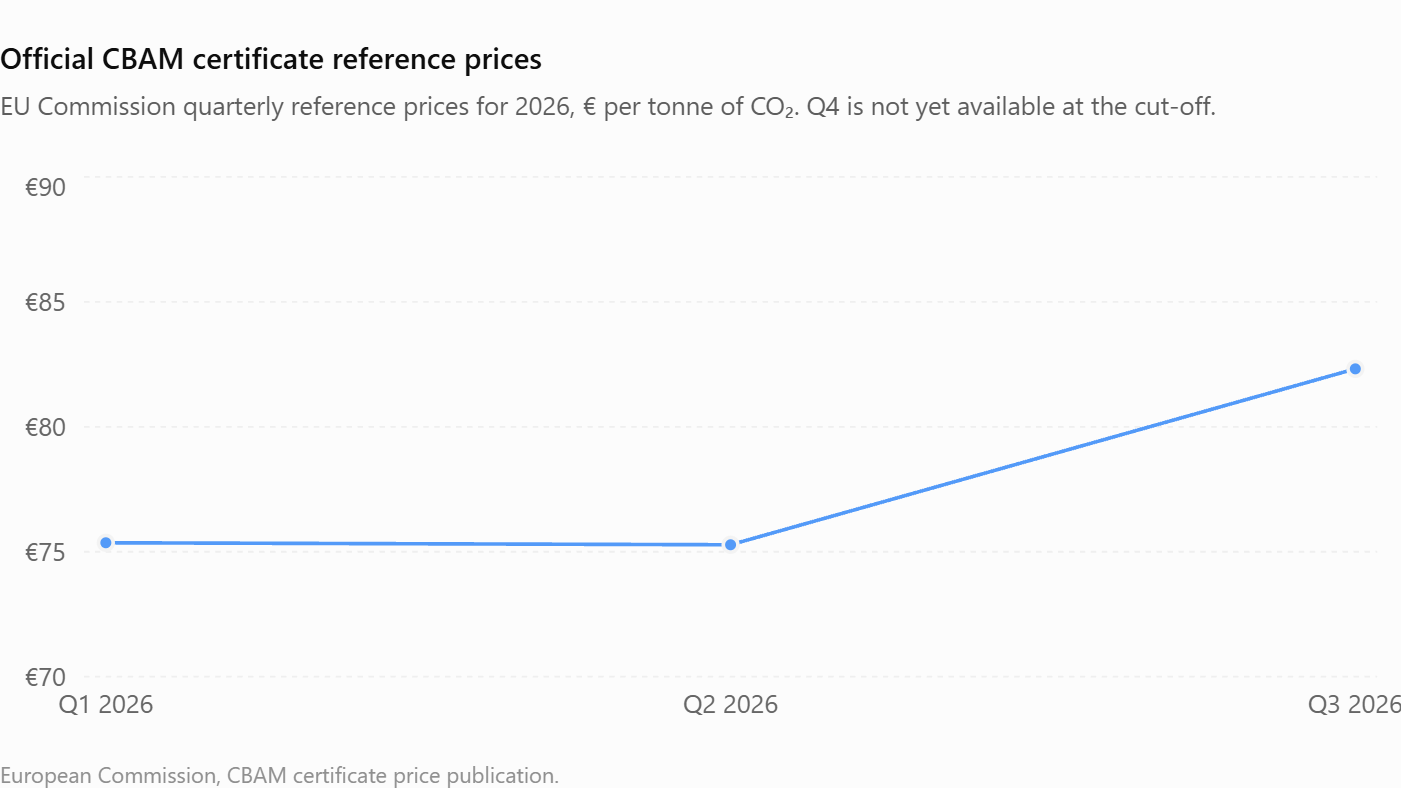
An importer-specific financial obligation cannot be calculated accurately from these prices alone. It requires the applicable embedded-emissions calculation, the covered product quantity, any relevant free-allocation adjustment and eligible carbon-price deductions, together with the timing and rules for surrendering certificates. Multiplying the certificate price by the entire gross weight of a shipment would therefore be incorrect. Likewise, applying the full reference price to a product without examining the applicable certificate obligation could materially misstate the cost.
The distinction is consequential for trade negotiations because exporters may respond to CBAM through several different mechanisms. Producers can reduce the emissions intensity of manufacturing, improve carbon-data collection, seek recognition of eligible carbon prices paid in the country of production or alter commercial arrangements to accommodate reporting costs. Some may benefit from access to lower-carbon electricity or more efficient processes. Others may encounter difficulties because emissions data are unavailable, third-party verification is costly or the required administrative systems are underdeveloped.
The mechanism can therefore influence production decisions outside Europe even when it does not directly regulate foreign factories. Its effects operate through the conditions under which covered products enter the EU market. This is a form of regulatory influence, but it should not be equated automatically with unlawful extraterritorial regulation. The legal analysis turns on the applicable EU instruments, relevant trade-law obligations and any particular dispute raised through competent institutions.
Developing Countries and the Conflict Between Decarbonisation and Market Access
For developing economies, CBAM creates an important distinction between environmental objectives and the distribution of compliance costs. A country may possess opportunities to expand low-carbon industrial production but lack reliable electricity infrastructure, affordable capital or technical systems for measuring verified embedded emissions. In those circumstances, meeting the requirements of a sophisticated carbon-accounting regime can impose costs that are proportionately more difficult for smaller firms and less-developed administrative systems.
This does not establish that CBAM is inherently incompatible with climate cooperation. A well-designed carbon-border mechanism can create incentives for lower-emission production and reduce differences in carbon costs between domestic and imported covered goods. Yet those benefits depend partly on the availability of credible emissions measurement, transparent rules and feasible decarbonisation options. If compliance becomes prohibitively expensive for producers lacking technical or financial capacity, the mechanism may restrict market access without producing a correspondingly efficient reduction in emissions.
The European Commission explicitly recognises the importance of supporting developing countries and least-developed countries in greening industrial production, building carbon-pricing capability and implementing CBAM-related requirements. This acknowledgement is important because it creates a direct connection between the credibility of European trade-related climate policy and the financial and technical support available to foreign producers. CBAM — Support for Developing Countries and Least Developed Countries — European Commission.
Three types of support are analytically distinct. Technical assistance can improve emissions accounting, verification and administrative compliance. Investment finance can support cleaner energy sources, more efficient industrial equipment and changes in production processes. Market-access arrangements can address specific procedural or commercial obstacles where the applicable law permits. No one category substitutes completely for the others. A producer may possess adequate reporting systems but lack capital for decarbonisation, while another may have relatively low-emission production but be unable to demonstrate that performance in the required format.
The broader geopolitical issue concerns whether climate policy becomes a source of mutually beneficial technological upgrading or a further point of friction between industrialised and developing economies. The outcome depends on the actual design and implementation of policies, not merely on their declared environmental purpose.
China’s Clean-Technology Position: Manufacturing Concentration and Its Strategic Implications
China’s position in clean-technology supply chains is a major structural feature of the global energy transition. The International Energy Agency’s 2026 assessment estimates that China accounts for approximately 85% of solar photovoltaic supply-chain production capacity and 80% of lithium-ion battery supply-chain production capacity, with even higher concentrations in selected stages such as photovoltaic wafers and battery anode materials. The figures describe production capacity within specified supply-chain definitions and reference periods; they should not be confused with annual final-product sales, realised output or the percentage of every component installed globally. Energy Technology Perspectives 2026 — Supply-Chain Risks and Industrial Competitiveness — IEA. IEA
The IEA’s Global EV Outlook 2026 provides complementary evidence from actual production. China accounted for more than 80% of global electric-vehicle battery-cell production in 2025, while Chinese producers represented almost 75% of global electric-car battery deployment. Within the European Union, Chinese producers supplied more than half of the electric-car battery market in 2025, reflecting a combination of imported batteries and local production by Chinese-owned manufacturers. The distinction between producer nationality and production geography matters: a battery produced in Europe by a Chinese-owned enterprise contributes to European manufacturing activity, while corporate ownership and selected technological dependencies remain international. Global EV Outlook 2026 — Electric Vehicle Batteries — IEA. IEA
China’s industrial role also extends to renewable-energy deployment. According to the IEA, the country commissioned approximately 370 GW of solar photovoltaic capacity and 117 GW of wind capacity in 2025, accounting for more than 60% of global renewable-capacity growth that year. These figures indicate the scale of China’s domestic market as well as its manufacturing capabilities. Domestic renewable deployment can support industrial learning, infrastructure development and production ecosystems, although the relationship between installation volumes and manufacturer profitability is not automatic. Global Energy Review 2026 — Solar PV and Wind — IEA. IEA
The most important qualification concerns the economic sustainability of that manufacturing concentration. In its Renewables 2026 assessment, the IEA describes persistent financial pressure within the Chinese solar sector, including widespread manufacturer losses and more than 70 corporate bankruptcy filings since 2024. It estimates that more than 90% of major Chinese solar photovoltaic manufacturers reported losses in 2026, while supply-chain concentration remains exceptionally high. This coexistence of technological scale and financial weakness is central to the international economic assessment. A country may possess dominant manufacturing capacity even when many individual producers face declining margins, excessive competition or financial distress. Renewables 2026 — Executive Summary — IEA. IEA
These developments create a strategic paradox for importing economies. Low-cost Chinese clean-technology products can accelerate renewable deployment and reduce investment costs, but excessive concentration in one manufacturing ecosystem can expose governments and firms to future disruptions. A policy that rapidly eliminates those imports may increase the cost of decarbonisation. A policy that relies on them without assessing supply-chain resilience may create long-term dependence. Industrial strategy must consequently examine both affordability and security of supply.
The IEA’s 2026 renewable-energy outlook also shows that China is not guaranteed to maintain the same share of future capacity additions as in earlier years. Its central forecast projects that China’s contribution to global renewable-capacity growth will moderate to approximately 53% during 2026–2031, compared with more than 60% in 2025, as India and other emerging markets expand deployment. This is a forecast of future installed-capacity growth, not a forecast that China will lose its manufacturing position or that every foreign market will reduce purchases from Chinese suppliers. Renewables 2026 — IEA. IEA
The Industrial-Policy Challenge for Europe
European policymakers face an institutional and economic problem that cannot be solved exclusively through border measures. Maintaining competitive clean-technology manufacturing requires access to affordable energy, financing, qualified labour, infrastructure, raw materials, specialised equipment and sufficiently predictable markets. Trade defence may address particular legally established distortions, but it cannot independently create the industrial ecosystems required for sustained production.
The European Commission’s Clean Industrial Deal State Aid Framework, adopted on 25 June 2025, provides a relevant instrument. It facilitates specified categories of national state support for clean-energy deployment, electricity costs for energy-intensive industries, industrial decarbonisation, clean-technology manufacturing and the reduction of risks associated with private investment. The framework remains applicable until 31 December 2030, making its implementation particularly relevant to this dossier’s 2031 horizon. Clean Industrial Deal State Aid Framework — European Commission. Competition Policy
Its existence does not establish that all eligible member states have equivalent fiscal capacity or that all authorised investment will be commercially successful. State-aid rules determine the conditions under which specified public support may be provided; actual economic effects depend on national programmes, approved measures, funding execution, private co-investment and industrial outcomes. Wealthier member states may have greater ability to finance national measures, while smaller or more fiscally constrained economies may face difficulties supporting comparable projects without wider European financing arrangements.
The international implications extend to China. A European strategy aimed at expanding domestic clean-technology manufacturing may create greater competitive pressure for Chinese suppliers, but it may also encourage investment by Chinese companies within Europe. Such investment can contribute to local production and employment while raising separate questions concerning corporate control, technology, procurement, supplier concentration and the application of investment-screening rules. The appropriate assessment should distinguish beneficial local production from dependencies that persist because of ownership or indispensable imported inputs.
For developing countries, European and Chinese clean-technology offers may provide alternative suppliers, financing models and project structures. The commercial attractiveness of these alternatives depends on delivered electricity costs, financing terms, technical performance, maintenance requirements, local capability development and debt sustainability. Their comparative value cannot be determined solely from political alignment with the exporting country.
Chapter 7 — Consolidated Quantitative and Regulatory Evidence
| Indicator | Verified figure or status | Reference period | Interpretation |
|---|---|---|---|
| COP31 | Antalya, Türkiye | 9–20 Nov 2026 scheduled conference | Negotiations extended beyond scheduled finish |
| Climate-finance mobilisation objective | At least USD 1.3 trillion annually | 2035 | International mobilisation objective, not paid funds |
| COP30 Presidency implementation pathway | USD 1.27–1.41 trillion annually | 2035, conditional model | Modelled pathway, not committed finance |
| Business-as-usual financing pathway | USD 458–461 billion annually | 2035, conditional model | Comparison scenario |
| CBAM definitive regime | Applicable | From 1 Jan 2026 | Specified imported goods |
| CBAM certificate reference price | €75.36/tCO₂ | Q1 2026 | Published quarterly reference |
| CBAM certificate reference price | €75.28/tCO₂ | Q2 2026 | Published quarterly reference |
| CBAM certificate reference price | €82.32/tCO₂ | Q3 2026 | Published quarterly reference |
| China solar PV supply-chain capacity | Approximately 85% | IEA 2026 assessment | Supply-chain production capacity |
| China lithium-ion battery supply-chain capacity | Approximately 80% | IEA 2026 assessment | Supply-chain production capacity |
| China global EV battery-cell production | More than 80% | 2025 | Realised battery-cell output |
| China solar PV additions | Approximately 370 GW | 2025 | Installed capacity additions |
| China wind additions | Approximately 117 GW | 2025 | Installed capacity additions |
| China’s share of global renewable-capacity growth | Approximately 53% | IEA forecast, 2026–2031 | Forecast, not observed outcome |
| EU Clean Industrial State Aid Framework | Applicable through 31 Dec 2030 | Adopted June 2025 | Enabling framework, not a spending total |
Sources: UNFCCC COP31, Baku-to-Belém Roadmap, European Commission CBAM, CBAM Certificate Prices, IEA Energy Technology Perspectives 2026, IEA Global EV Outlook 2026, IEA Renewables 2026, European Commission CISAF.
The figures encompass different measurement universes. Manufacturing capacity, realised production, installed renewable capacity, future financing scenarios and carbon-certificate prices must remain separate variables. Their presentation together is intended to clarify the interaction of industrial and regulatory systems, not to imply direct mathematical comparability.
Key Judgments — Chapter 7
The international clean-energy transition is generating a system of interdependence in which manufacturing scale, access to capital, carbon-accounting rules and technological capability increasingly determine the economic conditions under which countries decarbonise. China’s concentration in solar and battery supply chains is a documented source of commercial importance, but should not be equated with guaranteed profitability or permanent technological leadership. Europe’s carbon-border framework seeks to address carbon leakage through a legally defined mechanism, while its industrial-policy instruments seek to support domestic decarbonisation and production capabilities. Developing economies face the additional challenge of obtaining technologies and capital at terms compatible with their economic and fiscal circumstances.
The most significant unresolved issue at the November 2026 cut-off is the practical conversion of climate-finance objectives into committed, additional and disbursed resources. COP31’s negotiating process must be distinguished from earlier decisions and conditional financing pathways. The success of international climate cooperation cannot be evaluated from a headline funding objective without examining who supplies the finance, how it is structured, where it is invested and whether the investment produces measurable outcomes.
What would change the assessment: a final authenticated COP31 decision materially altering finance obligations or institutional arrangements; sustained changes in clean-technology manufacturing concentration; documented reductions in the cost of alternative suppliers; CBAM implementation evidence demonstrating substantial changes in embedded industrial emissions; and verified climate-finance disbursement data showing material progress beyond announced objectives.
Chapter 8 — Strategic Scenarios for 2027–2031
Principal judgment: The most defensible method for assessing the international environment through 2031 is to examine distinct but potentially overlapping strategic pathways rather than claim that a single geopolitical outcome is predetermined. Diplomatic cooperation, industrial competition and technological restrictions may coexist for extended periods. The direction of change depends on whether governments preserve workable institutional channels, whether economic interdependence continues to generate benefits sufficient to offset political friction, and whether concentrated technologies and supply chains can be diversified without unacceptable costs.
The forecast horizon contains substantial structural uncertainty. It would be misleading to assign precise numerical probabilities to geopolitical pathways without an explicit model, defensible historical reference classes and comparable outcome definitions. The scenarios below therefore identify causal mechanisms, observable indicators, possible policy consequences and conditions that would materially weaken each interpretation.
The Analytical Baseline: Interdependence Under Institutional Stress
The international system entering 2027 contains economic and technological relationships that cannot be reduced to a simple division between mutually isolated geopolitical blocs. China participates extensively in world merchandise trade and clean-technology manufacturing; the United States retains considerable influence over advanced computing technologies and associated regulatory requirements; Europe combines significant industrial production with dependence on external markets and critical inputs; and international financial institutions, development banks and treaty organisations continue to mediate activities that cross national boundaries.
At the same time, these relationships are subject to increasing legal and political differentiation. Export controls can restrict access to particular technologies without preventing all commercial transactions. Carbon-border measures can impose new compliance obligations without constituting general import prohibitions. Climate-finance commitments can support common international objectives while leaving governments in disagreement over burden-sharing. The existence of competition does not therefore establish that cooperation has ended, and the existence of cooperation does not establish that structural rivalry has been resolved.
A useful forecasting approach must distinguish the variables that are comparatively slow to change from those that may change rapidly. Manufacturing capacity, electricity infrastructure, technological ecosystems and supplier networks are capital-intensive and often require several years to alter materially. Regulatory controls, diplomatic positions, export permissions and financial conditions can sometimes change more quickly. Political announcements may precede these changes or fail to produce them. Strategic analysis consequently needs separate indicators for intent, authorisation, financing, installed capacity and operational results.
Scenario A — Managed Competition and Institutional Coordination
Under this pathway, major economies continue to pursue distinct industrial, technological and security policies while retaining sufficient institutional cooperation to avoid uncontrolled disruption. Export controls remain targeted to defined technologies and users; carbon-related trade measures continue under published regulatory frameworks; climate-finance negotiations produce implementable programmes; and governments preserve diplomatic channels for addressing strategic disagreements.
The underlying mechanism is not the disappearance of conflicting interests. It is the recognition that complete economic separation would impose costs on governments, firms and consumers, while the absence of reliable security communication could increase the danger of miscalculation. Selective arrangements may therefore emerge in areas where the participants recognise mutual benefits, even as competition continues in advanced manufacturing, AI infrastructure and strategically sensitive industries.
The economic consequences would depend on the predictability of applicable rules. Firms could continue investing across borders where transactions remain lawful and commercially viable, while redirecting particular high-risk activities toward alternative suppliers or locations. European industrial policy would continue to face competition from Chinese manufacturers but could operate within a relatively stable environment for trade and capital investment.
The scenario would be supported by sustained operation of major international institutions, continued trade in non-restricted products, transparent regulatory licensing processes, a measured expansion of climate-finance deployment and the absence of large-scale interruptions to critical international supply chains. It would be weakened by repeated failures of diplomatic communication, broad restrictions on previously unrestricted commercial activities or evidence that international institutions are no longer able to perform important coordinating functions.
A central limitation is that institutional coordination does not guarantee equal economic outcomes. Even under a relatively predictable international environment, some industries may lose competitiveness while others expand. The appropriate European response would remain focused on productivity, critical dependencies and investment quality rather than assuming that economic integration alone guarantees resilience.
Scenario B — Selective Great-Power Accommodation and Uneven Regional Adjustment
A second pathway involves more extensive diplomatic accommodation among certain major powers while regional economic and security interests remain imperfectly aligned. Governments may reach agreements concerning particular risks or market arrangements without establishing a comprehensive shared international strategy. Such arrangements could reduce uncertainty in the covered domains while leaving other states to manage indirect consequences through their own diplomatic and institutional channels.
The mechanism is transactional and issue-specific. Governments may find it advantageous to cooperate over strategic stability, energy-market disruptions, defined technology transactions or particular international initiatives, while continuing to disagree over territorial conflicts, human-rights obligations, trade policy and the authority of international institutions. The resulting pattern would not constitute a unified geopolitical bloc. Instead, it would create a network of agreements whose membership, legal status and practical effects differ by subject.
For Europe, the relevant concern would be whether these arrangements materially alter the conditions governing European security, industrial investment or international regulation. A limited agreement could improve strategic predictability without reducing European autonomy. Alternatively, arrangements negotiated without adequate consultation could create uncertainty concerning the interests of affected European countries. The practical consequence would depend on the actual provisions rather than the diplomatic status of the participants.
This pathway would be supported by published bilateral or trilateral agreements with defined implementation mechanisms, followed by observable changes in the covered policy areas. It would be weakened if agreements remained general, frequently contradicted one another or failed to produce operational results.
The distinguishing feature is that diplomatic accommodation could increase while industrial rivalry remains intense. European decision-makers should therefore avoid assuming that improved high-level relations among governments necessarily imply an easing of competition in electric vehicles, advanced machinery, clean technologies or semiconductor-related systems.
Scenario C — Accelerated Strategic Fragmentation
A third pathway involves an intensification of restrictions on technology, investment, trade and access to critical infrastructure, accompanied by reduced institutional cooperation and increasing duplication of production systems. Firms would face growing incentives to reorganise supply chains according to jurisdictional exposure rather than primarily according to cost and efficiency.
The mechanism begins when the perceived risks of dependence increase sufficiently that governments or enterprises accept substantial additional costs to reduce exposure. This may occur through broader export controls, investment screening, sanctions, procurement restrictions, technology standards or security requirements. The cumulative effect can be larger than any individual measure because firms must respond to the interaction of multiple legal regimes and uncertain future restrictions.
Such fragmentation could reduce efficiency and increase capital requirements. Duplicating advanced manufacturing facilities, qualifying replacement components and building alternative logistics networks may require significant investment. However, fragmentation does not necessarily eliminate international trade. Some sectors may continue to operate across borders, while others become more geographically restricted. The degree of separation would vary by technology, product and jurisdiction.
For Europe, the principal vulnerabilities would arise where critical functions depend on a narrow group of suppliers or where necessary alternatives cannot be established within the available time. These could include particular semiconductor inputs, battery materials, industrial components, specialist equipment or digital infrastructure. The economic damage would depend on available inventories, substitutability, demand conditions and the ability of public and private institutions to coordinate responses.
The scenario would be supported by broadening legal restrictions, substantial relocations undertaken primarily for geopolitical reasons, increasing duplication of strategic infrastructure, prolonged disruption of important trade relationships and declining effectiveness of international coordination mechanisms. It would be weakened by successful commercial adaptation, stable licensing systems, continuing investment and evidence that cross-border cooperation remains operational in critical areas.
Scenario D — Disruption Through a Critical Supply Chain or Financial Channel
A fourth pathway is better treated as a potential disruption superimposed on one of the three broader strategic environments. A concentrated supplier may experience an operational interruption, a major financial institution may withdraw support from a category of projects, or a regulatory decision may abruptly change access to a particular technology. Such events can occur under otherwise managed competition, selective diplomatic accommodation or an already fragmented international system.
The impact of a disruption depends on the system’s structural characteristics. A supply chain with several qualified alternatives may absorb a temporary interruption. A system relying on one specialised material, one fabrication process or a small number of certified suppliers may experience more severe consequences. The duration of the interruption, available inventory, substitution time and technical compatibility determine the operational outcome more directly than the political importance attributed to the supplier.
The distinction between a shock and a structural vulnerability is essential. A concentrated supply chain can operate reliably for years, while a diversified network can still be disrupted by transport failures or correlated risks. A shock becomes strategically consequential when it affects a function that cannot be restored within an acceptable period or at an acceptable cost.
This pathway calls for scenario testing at the level of critical services and industrial processes. Governments need to know which components are indispensable, what replacement capacity exists, how quickly alternative suppliers can be qualified and which authorities could intervene. Without those details, a general description of supply-chain risk provides insufficient guidance for preparedness.
The 2027–2031 Energy Transition as a Structural Constraint
The International Energy Agency’s Renewables 2026 outlook introduces an important quantitative constraint on longer-term scenario construction. The agency expects global renewable electricity capacity to increase by almost 85% between 2025 and 2031, with solar photovoltaic systems contributing more than three-quarters of that increase. It also anticipates a changing geographical distribution of new installations, including increasing contributions from India, Southeast Asia, Africa and the Middle East. Renewables 2026 — Executive Summary — International Energy Agency. IEA
This forecast provides evidence of the scale of the energy-system transformation contemplated under the IEA’s modelling assumptions. It does not guarantee that electricity generation, grid investment or storage capacity will increase at identical rates. Installed generation capacity, actual output, network connection, dispatchability and reliable delivered electricity are distinct variables. Rapid deployment of solar capacity can require accompanying investments in grids, flexibility, storage and system management, depending on the characteristics of the electricity network.
For industrial competitiveness, electricity-system performance is relevant because energy-intensive production requires reliable power at economically viable prices. Expanding renewable generation can reduce exposure to imported fuels in suitable circumstances, but the total industrial cost of electricity depends on network charges, financing, market design, system integration and other factors. Consequently, the strategic benefits of renewable investment cannot be assessed from installed gigawatts alone.
The IEA’s projection of changing geographical contributions to renewable growth also matters for China. As additional countries expand domestic installation, new markets and manufacturing opportunities may develop. Yet geographic diversification of electricity deployment does not necessarily imply diversification of the equipment supply chain. A country may install renewable generation domestically while importing most of the relevant modules, inverters, batteries or materials.
This distinction creates a useful test for all four scenarios: whether the expansion of renewable electricity capacity is accompanied by a broader distribution of industrial capabilities and supply-chain resilience, or whether new energy infrastructure increases dependence on a relatively narrow set of equipment-producing ecosystems.
Scenario Comparison and Observable Signposts
| Dimension | Managed competition | Selective accommodation | Strategic fragmentation | Disruption pathway |
|---|---|---|---|---|
| Diplomacy | Regular institutional communication | Issue-specific agreements | Reduced cooperation | Crisis-driven engagement |
| Technology | Targeted controls and continued lawful trade | Negotiated exceptions in defined areas | Expanding restrictions | Sudden loss of a critical capability |
| Industrial supply chains | Gradual diversification | Selective commercial cooperation | Accelerated restructuring | Emergency substitution |
| Climate finance | Incremental institutional implementation | Specific negotiated initiatives | Fragmented funding and standards | Project delays or liquidity stress |
| European challenge | Improve competitiveness and resilience | Protect consultation and authority | Finance costly adjustment | Maintain critical services |
| Confirmation indicator | Stable rules and operational cooperation | Implemented agreements | Broad restrictions and duplicated systems | Verified interruption to a critical function |
| Disconfirming evidence | Persistent systemic disruption | Agreements fail to take effect | Deepening functional integration | Rapid restoration through alternatives |
The four pathways are not assigned numerical probabilities. The disruption pathway can occur within any of the three broader environments and therefore must not be treated as a mutually exclusive fourth share in a scenario distribution.
Key Judgments — Chapter 8
The decisive uncertainty through 2031 concerns the institutional and economic capacity of governments and enterprises to preserve functioning international relationships while reducing exposure to unacceptable strategic vulnerabilities. Large-scale manufacturing systems, energy infrastructure and advanced-technology ecosystems are expensive to duplicate, creating incentives for continued cooperation even under conditions of political rivalry. At the same time, concentrated production and jurisdiction-dependent technology access provide reasons for governments to pursue diversification and national capability development.
The three principal geopolitical-economic pathways can coexist across different sectors. A government may participate in climate finance and international trade while imposing national-security restrictions on selected advanced technologies. An enterprise may increase investment in foreign markets while simultaneously diversifying critical suppliers. Such patterns should not be forced into a single binary classification.
What would change the assessment: legally implemented and sustained international agreements; substantial changes in export-control coverage; measurable diversification of critical manufacturing capacity; significant revisions to official energy-transition forecasts; and verified disruptions revealing unexpectedly high or low supply-chain resilience.
Chapter 9 — Global Net Assessment and Government Decision Framework
Principal judgment: The central strategic challenge for governments through 2031 is the preservation of decision-making capacity in an increasingly interconnected but legally and technologically differentiated international economy. Economic openness, industrial resilience, climate policy, technological sovereignty and international security cannot be treated as independent objectives. They interact through investment costs, legal authority, market access, infrastructure and the concentration of critical capabilities.
An effective government framework must therefore avoid two simplifying assumptions: that every international dependency is strategically unacceptable, and that commercial efficiency alone provides sufficient protection against disruption. The relevant objective is to identify dependencies whose interruption could create intolerable consequences, distinguish them from ordinary commercial relationships, and select measures proportionate to the actual risk, economic burden and institutional authority.
From Dependence to Resilience: A Functional Definition of Strategic Autonomy
Strategic autonomy is often used to describe the ability of a government or economic region to act without excessive reliance on external actors. For operational policy, this description is insufficient. A government cannot establish meaningful autonomy in every product, technology or service without confronting substantial financial, technological and geographical constraints. Modern industrial systems depend on specialisation, and attempting to recreate every production stage within one jurisdiction may increase costs without necessarily eliminating vulnerability.
A more useful definition is the capacity to maintain specified essential functions, preserve lawful decision-making authority and restore disrupted capabilities within an acceptable period and cost. This definition shifts analysis from the nationality of suppliers to the performance of the underlying system. It asks whether essential industrial production can continue, whether electricity and digital infrastructure remain available, whether public institutions possess the legal powers needed to respond and whether replacement options can be activated when normal arrangements fail.
The definition also makes clear that strategic autonomy and international cooperation are not mutually exclusive. A government may strengthen resilience through diversified foreign suppliers, bilateral agreements, common standards, joint investments and shared emergency arrangements. Domestic production is one potential instrument, not the only instrument. Its value depends on the characteristics of the critical function and the costs of alternative arrangements.
For advanced technology, this approach requires identification of indispensable hardware, software, intellectual property, maintenance services and regulatory permissions. For clean energy, it requires assessment of generation, grid infrastructure, batteries, specialist materials and replacement components. For international finance, it requires examination of access to liquidity, credit enhancement, settlement arrangements and the distribution of contractual risks. In each case, the policy question is operational continuity rather than symbolic self-sufficiency.
European Institutional Coordination: Allocating Authority Correctly
European policy must begin with the allocation of legal and administrative responsibility. The EU’s common commercial policy provides an institutional framework for trade measures involving third countries. Competition and state-aid rules govern important aspects of industrial support, while national governments retain distinct responsibilities concerning public investment, infrastructure, industrial development and national security. NATO performs collective-defence functions that are legally and institutionally separate from EU economic regulation.
This division of authority can create coordination challenges, but it also permits specialised responses. A trade-distortion concern may require action through EU trade-defence instruments. A shortage of industrial skills may require national education and workforce policies. A critical-energy-infrastructure vulnerability may involve national regulators, system operators and cross-border coordination. A problem concerning military readiness belongs to the appropriate national and allied defence authorities. A response that assigns every problem to a single institution risks delay or measures beyond that institution’s competence.
The European Commission’s Clean Industrial Deal State Aid Framework provides an example of an enabling EU instrument whose actual implementation depends on national programmes and financing decisions. The framework permits specified categories of support under defined conditions, but does not itself equal an executed common European investment programme. Clean Industrial Deal State Aid Framework — European Commission.
Institutional coordination should therefore be organised around specific functions and records. Each strategic dependency should have an identifiable competent authority, a documented legal basis, relevant data, an implementation pathway and measurable outcomes. The objective is not to create a new layer of reporting for its own sake, but to ensure that decisions affecting critical systems can be implemented through the correct institutions.
Italy, France, Germany and the United Kingdom: Differentiated Government Responses
Italy’s industrial response should reflect the structure of its manufacturing networks and the significance of imported intermediate goods. The most useful operational assessment would identify dependencies within machinery, electrical equipment, pharmaceutical inputs and specialised industrial components, including the feasibility of sourcing qualified alternatives. Industrial support can then be directed toward situations in which market incentives alone are unlikely to maintain an essential capability within an acceptable adjustment period. Such intervention would require clear criteria, transparent financing and an assessment of its effects on firms that benefit from competitive imported inputs.
France’s position requires integration of industrial competitiveness, advanced technologies and national investment capabilities within the EU regulatory framework. The relevant decision challenge concerns the relationship between nationally important sectors, access to international markets and the costs of strengthening domestic production. Investments in strategic capabilities must be assessed against actual production outcomes and their relationship to wider European supply networks, rather than assuming national ownership alone creates resilience.
Germany’s industrial adjustment is particularly important in capital goods, vehicle manufacturing and industrial systems. Its policy challenge includes the maintenance of international market access alongside investment in productivity, software-intensive manufacturing, electrification and supply-chain diversification. The economic consequences of restrictions must be evaluated across both domestic manufacturing and German enterprises producing abroad. A measure that supports one part of the automotive value chain may impose costs on another, making sector-specific consultation and value-chain analysis indispensable.
The United Kingdom’s position differs because it possesses an independent commercial-policy framework while remaining connected to European industrial networks and US-origin technology regulations. The principal government challenge is to coordinate economic-security measures, investment screening, access to advanced technologies and commercial relationships without assuming that independent trade authority eliminates international technology dependence. Its substantial services relationship with China also requires that manufactured-goods vulnerabilities be assessed separately from the wider bilateral balance.
Although these countries have different industrial profiles, the underlying analytical method should be consistent. Each should identify critical functions, the concentration of suppliers, the cost and availability of alternatives, the legal authority to intervene and the expected effect of intervention. Differentiation of policy does not require incompatible evidence standards.
Government Decision Options and Implementation Requirements
A decision-grade framework should compare concrete actions rather than general policy preferences. The alternatives below identify their likely operational purpose, competent authority, implementation burden, speed and potential downside. They are not presented as a universal ranking, and the appropriate choice depends on the affected sector and the evidence available.
| Government action | Principal authority | Intended effect | Time-to-effect | Main implementation burden | Reversibility | Principal downside |
|---|---|---|---|---|---|---|
| Critical-supply-chain mapping | National economic-security bodies, competent sector regulators and EU institutions within their remits | Identify concentration and substitution constraints | Months for initial assessment; ongoing updates | Confidential commercial data and technical classification | High | Administrative burden, incomplete or stale information |
| Supplier diversification | Enterprises, supported where justified by public authorities | Reduce single-source dependence | Months to years | Qualification, contracting, logistics and investment | Medium | Higher costs and reduced economies of scale |
| Strategic domestic manufacturing investment | National governments under applicable EU rules, EU programmes and private investors | Establish selected production capabilities | Years | Capital, skills, infrastructure and market demand | Low after major investment | Uncompetitive capacity or poor returns |
| Targeted trade-defence action | European Commission and competent EU institutions | Address legally established trade distortions | Depends on procedure and measure | Investigation, evidence and legal compliance | Medium | Higher costs or commercial retaliation |
| Carbon-accounting and CBAM technical cooperation | European Commission, national authorities and foreign competent institutions | Improve compliance and lower measurement barriers | Months to years | Measurement systems, training and verification | High | Uneven access and administrative complexity |
| Climate-finance de-risking | Development banks, governments and authorised financial institutions | Improve financeability of suitable projects | Project-dependent | Capital, guarantees and risk controls | Medium | Contingent public liabilities and weak additionality |
| International technology-access arrangements | Competent export-control authorities and participating enterprises | Preserve lawful access to selected capabilities | Variable | Licensing, verification and legal coordination | Medium | Security concerns and compliance failures |
| Critical-service continuity planning | Relevant national regulators, infrastructure operators and enterprises | Reduce disruption duration | Months for planning; longer for new capacity | Inventories, testing and substitute infrastructure | High for plans; lower for sunk investment | Carrying costs and stranded assets |
These options require detailed sectoral application. Supplier diversification is inappropriate if no technically qualified alternative exists within a reasonable period; domestic manufacturing investment is difficult to justify if its costs substantially exceed the economic and security value of the capability; and regulatory controls may create larger costs than benefits if they are too broad or poorly targeted. The proper decision process must establish the risk mechanism and the available alternatives before selecting an instrument.
Decision Thresholds and Early-Warning Indicators
Government monitoring systems should be designed to identify conditions requiring review rather than generate arbitrary geopolitical scores. The relevant thresholds can be quantitative where authoritative data permit or conditional where the decision concerns a legal or institutional event.
For supply chains, a useful threshold is the point at which a disruption would exhaust available inventory before a technically qualified alternative could become operational. The calculation requires actual inventory, consumption rates, replacement lead times and the consequences of production interruption. A fixed universal percentage of imports from one country would be an inadequate substitute for those variables.
For industrial investment, a decision threshold may arise when expected private returns are insufficient to maintain a capability whose interruption would impose a demonstrable public cost. Such decisions require transparent estimates of investment expenditure, operating costs, market demand, technological feasibility and the nature of the public benefit. They also require examination of whether the proposed investment is compatible with applicable state-aid and procurement rules.
For climate finance, a useful indicator is the conversion of announced mobilisation targets into signed financing arrangements, actual disbursements and completed investments. Monitoring should distinguish public grants, loans, guarantees, private capital and financing commitments, while preventing the same project from being counted multiple times through different instruments. The Baku-to-Belém implementation framework identifies the scale and institutional challenges, but each monitoring measure must preserve the distinction between modelled pathways and realised flows.
For CBAM, the material indicators include reported embedded emissions, the number of authorised declarants, certificate prices, compliance costs, applicable deductions and changes in emissions intensity among covered imports. The European Commission’s definitive-regime guidance provides the regulatory basis, but the effect on individual sectors must be established through subsequent data rather than inferred from the presence of the mechanism.
For semiconductor and advanced-computing dependence, the decisive threshold concerns the interruption of a required capability because an import, licence, cloud service or indispensable component becomes unavailable. The relevant variables are the exact technical function, the applicable legal restriction, available alternatives and the time necessary to restore operations.
Integrated Decision Framework
| Strategic question | Necessary evidence | Decision trigger | Responsible response |
|---|---|---|---|
| Can an essential industrial function survive supplier disruption? | Supplier map, inventories, lead times, alternatives | Recovery time exceeds acceptable interruption | Diversification, inventory or capability investment |
| Is a trade remedy justified? | Competent investigation and legal findings | Applicable trade-law conditions established | Relevant trade authority applies proportionate measure |
| Does an announced clean-tech investment provide resilience? | Financing, milestones, output and critical inputs | Project fails specified delivery or viability tests | Review support, sourcing or design |
| Is carbon-border compliance materially affecting access? | Covered trade, emissions data, verified costs | Compliance or finance becomes a documented barrier | Technical cooperation and lawful adjustment |
| Are climate-finance commitments becoming available resources? | Signed agreements, disbursements and project outcomes | Persistent implementation gap | Revise instruments and institutional arrangements |
| Is advanced computing becoming inaccessible? | Licensing status, service contracts, technical substitutes | Critical workload cannot be performed lawfully | Activate qualified alternatives and legal review |
| Are international agreements producing practical change? | Operative text, authorities and implementation records | Binding or operational measure adopted | Reassess affected national and collective policies |
The framework does not assign common weights or numerical scores to unrelated risks. Such an approach would imply comparability that has not been established. Instead, it links identifiable conditions to evidence requirements and the authorities responsible for decisions.
Climate, Global Power and Strategic Autonomy
Clean-technology concentration, climate finance, carbon-border regulation and the 2027–2031 strategic outlook.
01 / Clean-Technology Concentration
Manufacturing capacity estimates, not salesChina’s Global Supply-Chain Position
Illustrative 3D comparison of IEA capacity estimates.
2035 Climate-Finance Pathways
Conditional modelling from the COP30 Presidency. These are not delivered or legally committed amounts.
Visualisation normalised to USD 1.5 trillion. Bars represent range midpoints, not probabilities.
02 / 2027–2031 Scenario Explorer
Select a pathway for its mechanisms and indicatorsScenarios are not mutually exclusive and have no assigned numerical probabilities.
03 / Official Evidence Table
Observed, modelled and regulatory values distinguished| Indicator | Value / status | Reference period | Evidence type | Institution |
|---|
04 / Government Decision Matrix
Responsibilities, triggers and responses| Policy area | Decision trigger | Responsible response | Principal risk |
|---|
05 / Strategic Dependency Architecture
Functional relationships, not numerical risk scoresManufacturing capacity, specialised components, production ecosystems and qualified suppliers.
Carbon requirements, market access, export licensing and investment rules.
Public investment, private capital, financing costs and implementation constraints.
Preserve critical functions through proportionate diversification, investment, international cooperation and verified implementation.
Fixed analytical snapshot, 21 November 2026. No invented risk scores, probabilities or real-time claims.
IEA — Energy Technology Perspectives 2026
COP30 Presidency — Baku-to-Belém Roadmap


