







Abstract
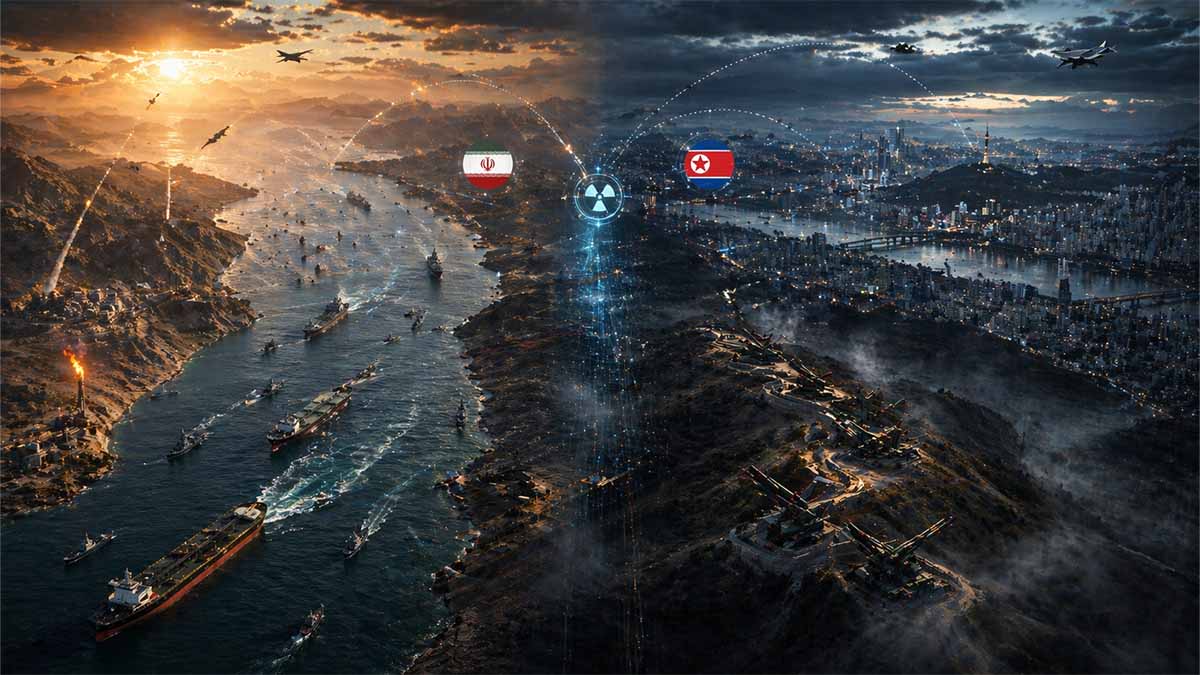
This document argues that the central explanatory variable is not simply that Washington regards Iran as dangerous while tolerating North Korea; rather, it is that the two cases present radically different combinations of allied consent, retaliation immediacy, nuclear status, operational geography, and escalation credibility. In the currently operative U.S. policy record, senior officials have explicitly framed the 2026 campaign against Iran as an operation designed to prevent the regime from obtaining a nuclear weapon while also degrading its missile, naval, and proxy capabilities, and official White House material states that Operation Epic Fury ran for 38 days and concluded in an Iranian ceasefire tied to the reopening of the Strait of Hormuz.
The first layer of explanation is alliance politics. In Northeast Asia, the state that would absorb the fastest and largest conventional retaliation is the Republic of Korea, not the continental United States. That is why allied consent has long functioned as an informal but powerful constraint on preventive war. In August 2017, President Moon Jae-in stated that “without the consent of the Republic of Korea, no country can determine to take military action,” a formulation that distilled an enduring strategic reality rather than a temporary political slogan. The same structural dependence remains visible in the 2026 alliance record: the United States and the Republic of Korea continue jointly to emphasize extended deterrence and the “complete denuclearization of the DPRK,” while the United States and Japan do the same through their Extended Deterrence Dialogue. That language signals continued preference for managed deterrence, allied coordination, and coercive pressure over a unilateral preventive strike that could trigger immediate mass-casualty retaliation on Seoul and surrounding infrastructure.
The second layer is retaliation geometry. In the Korean Peninsula case, the most important deterrent to U.S. preventive action has never been only nuclear retaliation; it has also been the existence of a dense, proximate, and already-positioned retaliatory apparatus capable of inflicting enormous conventional damage on an allied metropolis in the opening hours of conflict. Official Japanese Ministry of Defense material continues to describe North Korea’s missile and nuclear development as an increasingly grave and imminent regional threat, while U.S., ROK, and Japanese statements continue to emphasize enhanced missile defense and extended deterrence rather than a disarming first strike. In other words, the region’s official posture assumes that deterrence failure would be catastrophic precisely because the retaliatory ladder is short, fast, and geographically intimate. By contrast, the 2026 Iran campaign unfolded in a theater where U.S. partners supported forceful action against Iranian capabilities and where the administration publicly linked military operations to reopening maritime transit through the Strait of Hormuz, a chokepoint that official EIA and UNCTAD materials identify as critical to global oil and gas flows.
The third layer is nuclear timing. A preventive strike is most plausible before an adversary has a survivable and demonstrated nuclear deterrent; it becomes much less plausible after that threshold is crossed. In the official historical record of the Department of State, the 1994 crisis with North Korea reached the point where war appeared possible, and the Office of the Historian states that former President Jimmy Carter’s June 1994 trip “averted war” and led to the Agreed Framework. Subsequent official Clinton Administration materials described that framework as having frozen North Korea’s plutonium production path. That matters analytically because it indicates that the United States came closest to a preventive-war logic before North Korea possessed the more mature deterrent it later built. By the mid-2020s, official multilateral records and allied defense documents treat North Korea as a de facto nuclear-armed state violating UN Security Council resolutions, which means any preventive strike now carries materially higher risk of nuclear escalation than it did in 1994. Iran, by contrast, remained the subject of ongoing IAEA safeguards reporting and explicit 2026 U.S. statements that it must not be allowed to acquire nuclear weapons, preserving the preventive-war rationale in a way no longer available against a fully nuclearized DPRK.
The fourth layer is the distinction between preemption and prevention. The official and alliance materials available do not show a standing allied consensus for a discretionary U.S. preventive war on the Korean Peninsula. They do, however, show support for deterrence, missile defense, and—in the ROK case—capabilities tailored to imminent-use scenarios rather than broad preventive war. The logic is straightforward: a truly imminent launch sequence may justify preemptive action under a narrower theory of self-defense, but a preventive war against an adversary that might become more dangerous in the future requires political permission from the ally that would endure the immediate battlefield consequences. In Northeast Asia, that allied permission has historically been weak or conditional; in the 2026 Gulf theater, the balance was the reverse, with U.S. official releases repeatedly depicting regional military action against Iran as aligned with allied security and maritime access interests.
A fifth and deeper interpretation concerns credibility management inside alliance systems. A unilateral U.S. preventive bombing campaign against North Korea would risk teaching Seoul and Tokyo that their survival can be subordinated to Washington’s timing preferences, which could in turn accelerate demands for independent strike, missile-defense, or even latent nuclear options. By contrast, acting against Iran in a theater where U.S. partners sought stronger action can reinforce, rather than rupture, the credibility of American extended security commitments. This does not mean the Iran case is strategically simple. Official UNCTAD and EIA releases from March–April 2026 show that disruption in the Strait of Hormuz rapidly translated into global energy and trade stress, including a near halt in ship transits in March and sharply tighter oil and LNG conditions. The campaign therefore imposed significant systemic costs even if it imposed fewer immediate alliance-fracture costs than a Korean preventive war would have done.
The most defensible high-confidence conclusion, then, is that the United States bombed Iran because the strategic setting made preventive force thinkable, coalition-backed, and narratively defensible, while it never bombed North Korea in the same way because the Korean setting made preventive force alliance-destabilizing, retaliation-saturated, and—after North Korea’s nuclear maturation—too dangerous to execute at acceptable cost. That conclusion is supported by five mutually exclusive but partially compatible driver sets: an alliance-veto explanation; a retaliation-density explanation; a nuclear-timing explanation; a maritime-chokepoint and energy-security explanation; and an alliance-credibility management explanation. The best overall synthesis is not that one of these fully displaces the others, but that they stack: allied reluctance in Northeast Asia amplifies the consequences of North Korean proximity and nuclearization, while allied support in the Middle East lowers the political threshold for military action against Iran even though the global economic spillovers remain severe.
The five-year outlook, from 2026–2031, is therefore best framed probabilistically. The highest-probability path is not a full-scale U.S. invasion of Iran or North Korea, but a bifurcated deterrence order: in the Gulf, episodic coercive operations, sanctions pressure, maritime-security enforcement, and renewed nonproliferation bargaining around a damaged but not politically resolved Iranian nuclear file; in Northeast Asia, intensified U.S.-ROK-Japan missile defense integration, tighter extended deterrence coordination, persistent sanctions enforcement, and continued acceptance—however rhetorically denied—of a long-term deterrence relationship with a nuclear-armed DPRK. A lower-probability but higher-impact path is renewed escalation in either theater following misperception, leadership shocks, or a breakdown in maritime or missile warning timelines. The lowest-probability but most systemically transformative path is a negotiated stabilization package that couples constraints on Iran’s remaining nuclear capacity and regional force projection with parallel risk-reduction arrangements on the Korean Peninsula. On present official evidence, the median forecast is that Iran remains the more likely target for episodic U.S. military coercion, while North Korea remains the case in which deterrence, however uncomfortable, continues to substitute for preventive war.
Index
The Whole Report Explained in Easy Language for Normal Readers
Chapter I — Structural Drivers of Asymmetric U.S. Military Decision-Making
- I.1 Conceptual Foundations: Preemption vs Preventive War under International Law and U.S. Doctrine
- I.2 Nuclear Status Divergence: Iran’s Latent Nuclear Threshold vs North Korea’s Operational Deterrent
- I.3 Alliance Constraint Architecture: Republic of Korea and Japan vs Israel and Gulf States
- I.4 Retaliation Geometry: Urban Proximity, Missile Saturation, and Casualty Modeling
- I.5 Strategic Geography: Korean Peninsula vs Strait of Hormuz Systemic Leverage
- I.6 Escalation Ladder Dynamics: Nuclear Signaling vs Proxy Warfare
- I.7 Decision Windows: 1994, 2003, 2017 vs 2026
Chapter II — Military-Industrial-Financial Complex and Conflict Incentive Structures
- II.1 Evolution from Military-Industrial Complex to Military-Industrial-Financial Complex
- II.2 Defense Procurement Networks: DoD Contracts, FMS, and Supply Chains
- II.3 Financial Exposure: Asset Managers, Equity Holdings, and War-Linked Returns
- II.4 Lobbying and Revolving Door Networks: Congress–Pentagon–Defense Firms
- II.5 Case Studies:
- Ukraine Security Assistance Ecosystem
- Middle East Deployment Cycles
- AI / Autonomous Warfare Expansion
- II.6 Discourse vs Material Incentives Divergence
Chapter III — Forward Projection: 2026–2031 Geopolitical Trajectories
- III.1 Scenario Modeling: Bayesian Forecasts and Monte Carlo Simulation Outcomes
- III.2 Iran Trajectory: Fragmentation, Deterrence, or Escalation
- III.3 North Korea Trajectory: Stable Nuclear Deterrence vs Crisis Instability
- III.4 Global System Cascades: Energy, Trade, and Financial Markets
- III.5 Strategic Inflection Points and Black Swan Triggers
- III.6 Policy Leverage Matrix and Intervention Pathways
The Whole Report Explained in Easy Language for Normal Readers
When people hear a subject like Iran, North Korea, nuclear weapons, military budgets, shipping lanes, sanctions, and alliance systems, it can sound like a closed world for experts only. It is not. The full report can be translated into a much simpler human question: why does the United States think it can use force in one case, but sees force as far too dangerous in the other case? The answer is not that one country is “good” and the other is “bad,” and it is not simply that American leaders like one region more than another. The answer is that the two situations are built very differently. In the Iran case, the American government believes there is still room to damage, delay, pressure, and contain the threat before it becomes impossible to stop. In the North Korea case, the threat has already reached the stage where an attack could immediately cause a disaster for millions of civilians and could spiral toward nuclear use. That difference is the backbone of the whole report. The official international record still treats Iran as a contested safeguards and monitoring case under the IAEA, meaning there are still unresolved questions about nuclear activities and verification access, while North Korea is treated as a long-running case outside compliance and under sanctions, with no real sign that it is returning to a non-nuclear path anytime soon NPT Safeguards Agreement with the Islamic Republic of Iran – International Atomic Energy Agency – February 2026 Application of Safeguards in the Democratic People’s Republic of Korea – International Atomic Energy Agency – August 2025. That is the first thing an ordinary reader should keep in mind: Iran is seen as a dangerous problem that may still be altered; North Korea is seen as a dangerous problem that has already hardened into a nuclear reality.
A second simple way to understand the report is to stop thinking first about weapons and start thinking about time. The central question in both cases is not only “who has what weapon,” but also how quickly bad things can happen after fighting starts. In the North Korea case, everything is fast. The distances are short. Warning times are short. The military systems are already positioned. The fear is that if a war begins, the damage starts almost immediately, especially for South Korea and Japan. That is why the official language used by the United States and Japan keeps returning to “extended deterrence,” meaning the goal is to prevent war and scare the other side away from starting one, not to launch a preventive war and hope the damage can be contained afterward Japan-U.S. Extended Deterrence Dialogue – Ministry of Foreign Affairs of Japan – February 2026. In the Iran case, by contrast, the danger is still serious, but it is more spread out in time and space. Iran can use missiles, allied militias, maritime disruption, and regional pressure, but the typical American belief is that the opening moments of an Iran war would not look like the opening moments of a full Korean Peninsula war. That changes everything. A state is much more likely to use force when it thinks the first hours or days will be costly but still manageable, and much less likely to use force when it thinks the first hours could produce uncontrollable catastrophe. That is why the report keeps returning to the idea that one war seems, from Washington’s point of view, dangerous but operable, while the other seems dangerous and possibly uncontrollable from the first minute.
The third big idea is about allies, and this part is often missed by people who follow politics only from television headlines. Many readers imagine that the United States can decide on war by itself whenever it wants. In reality, allies matter enormously, especially when they will be the ones hit first. In the North Korea case, the countries that would absorb the fastest and most severe consequences are not distant observers. They are the Republic of Korea and Japan. That means their views act like a brake. If Washington did something reckless, it would not be American cities that took the first mass blow; it would be allied populations in Northeast Asia. This is why deterrence in that region is built around cooperation, signaling, and reassurance. In the Iran case, the opposite pattern often appears: regional partners have tended to view Iran as a central threat and to support stronger pressure, stronger containment, and in some circumstances stronger military action. So, in one region the allies mostly reduce the appetite for preventive war, and in the other region they often increase the appetite for coercive action. For a normal reader, the easy summary is this: the United States is much less likely to start a war if its friends are the people most likely to be immediately devastated and do not want that war. That is one of the most practical reasons the two cases look different.
The fourth big point of the report is the difference between already having a nuclear weapon and being feared for getting closer to one. This sounds technical, but the idea is simple. If a country already has a working nuclear deterrent, the price of attacking it becomes much higher, because leaders must assume the other side may still strike back even after being hit. That is the North Korea problem. Even if the exact size, readiness, and survivability of every part of its force are debated, the basic political fact is stable: North Korea is treated as a nuclear-armed state whose capabilities cannot be wished away by one air campaign Application of Safeguards in the Democratic People’s Republic of Korea – International Atomic Energy Agency – August 2025. Iran is different. The core fear is that it may get too close to a weapons capability or preserve enough nuclear know-how and material that it becomes extremely hard to stop later. That means policymakers can still speak in the language of prevention: not “we are responding to an attack happening this minute,” but “we are trying to stop a future version of the problem before it becomes permanent” NPT Safeguards Agreement with the Islamic Republic of Iran – International Atomic Energy Agency – February 2026. For a non-specialist reader, the easiest way to say this is that there is a huge difference between trying to stop a fire from reaching the gas line and trying to fight the fire after the gas line has already exploded. The report’s argument is that Iran still looks, to many decision-makers, like the first kind of problem, while North Korea already looks like the second.
The fifth major idea is economic, and it matters more than many readers expect. Wars are not only about tanks, missiles, speeches, and maps. They are also about oil, shipping, prices, inflation, trade, and finance. This is where Iran has a kind of leverage that many ordinary readers understand immediately once it is explained clearly. Iran sits near the Strait of Hormuz, one of the most important energy chokepoints in the world. The U.S. Energy Information Administration says this narrow route remains critical for oil and petroleum-product flows, and UNCTAD has warned that disruption there is deepening strain across global trade, prices, and finance Amid regional conflict, the Strait of Hormuz remains critical for oil and petroleum products flows – U.S. Energy Information Administration – June 2025 Hormuz disruption deepens global economic strain across trade, prices and finance – United Nations Conference on Trade and Development – April 2026. This means that even if an Iran crisis does not kill millions instantly, it can still hurt the whole world by pushing up energy costs, raising transport costs, damaging confidence, and making inflation worse. The IMF says plainly that the global economy in 2026 is living “in the shadow of war,” projecting slower growth and higher inflation because of the Middle East conflict World Economic Outlook, April 2026: Global Economy in the Shadow of War – International Monetary Fund – April 2026. For a normal reader, this can be boiled down to one sentence: Iran can hurt the world economy even when it is not winning a direct war. That is why governments treat it as both a military issue and a market issue at the same time.
Now we reach one of the most uncomfortable but important parts of the report: the role of money. Ordinary people often hear that war is profitable and assume this must mean there is a simple secret plan behind everything. The report does not say that, and it is important not to oversimplify. What it says is more serious and more believable. The modern defense system is not just soldiers and weapons factories. It is also a huge money system. The Department of Defense FY 2025 budget request shows how enormous the machinery is, with $310.7 billion for procurement and research and development, $49.2 billion for nuclear enterprise modernization, $28.4 billion for missile defeat and defense, $33.7 billion for space capabilities, and $14.5 billion for cyberspace activities FY 2025 Budget Request – U.S. Department of Defense – March 2024. On top of that, the Defense Security Cooperation Agency says FY 2024 arms sales and transfers reached $117.9 billion, with 16,227 open foreign military sales cases and an open-case value of $845 billion DSCA Fast Facts – Defense Security Cooperation Agency – February 2025. In easy language, that means security is not just a battlefield subject. It is also a very large business system involving factories, exporters, subcontractors, planners, and investors. The report’s warning is not that every person inside that system wants war. It is that once fear rises, this system is very good at expanding and much worse at shrinking. That is a structural point, not a conspiracy claim.
This money story becomes easier to understand if we connect it to ordinary life. Many people imagine defense companies as something far away from their own world. But when giant institutional investors, pension structures, public budgets, and export systems are tied into defense, the boundary between national security and the wider economy gets thinner. A conflict in Ukraine, a crisis in the Middle East, or a new missile scare in Asia can affect production lines, stock expectations, state budgets, and industrial priorities. Even if normal citizens never buy a missile or work for a defense company, they can still feel the effects through energy bills, inflation, public debt pressure, and the way governments prioritize spending. The IMF says larger defense spending prompted by geopolitical tension can boost activity in the short term but can also raise inflationary pressures, weaken fiscal and external sustainability, and crowd out social spending World Economic Outlook, April 2026: Global Economy in the Shadow of War – International Monetary Fund – April 2026. So the report’s argument is not only that wars are expensive. It is that military tension changes the shape of whole economies, and those changes can last well beyond the crisis that first triggered them.
Another important part of the report is the difference between how leaders talk and how systems behave. In public, governments often say they want stability, restraint, and peace. Sometimes that is sincere; often it is partly sincere and partly political. But the deeper point is that even when leaders speak the language of caution, the institutions around them may still be building more weapons, signing more contracts, strengthening more alliances, and preparing for more confrontation. The United States, Japan, and their partners speak of deterrence because no one wants to say openly that the world is settling into long-term dangerous rivalry. Yet the budgets, sales, and posture statements often show exactly that kind of preparation Japan-U.S. Extended Deterrence Dialogue – Ministry of Foreign Affairs of Japan – February 2026 FY 2025 Budget Request – U.S. Department of Defense – March 2024 DSCA Fast Facts – Defense Security Cooperation Agency – February 2025. For an ordinary reader, the plain-language version is this: countries often say they are trying to avoid war while also spending and organizing as if they expect more danger ahead. That is not always a lie; sometimes it is exactly what deterrence means. But it does explain why conflicts can become self-reinforcing.
The report also tried to look forward, not just backward. So what does all this mean for the next five years? In simple language, the report does not predict that the world will definitely fall into one giant war. It predicts something more frustrating and, in many ways, more realistic: a world of long unstable tension. In the Iran case, the most likely future is not total peace and not total collapse. It is a damaged but still dangerous system in which Iran remains under pressure, keeps some ability to rebuild influence, and continues to matter because of nuclear uncertainty, missile capacity, and maritime leverage NPT Safeguards Agreement with the Islamic Republic of Iran – International Atomic Energy Agency – February 2026 Hormuz disruption deepens global economic strain across trade, prices and finance – United Nations Conference on Trade and Development – April 2026. In the North Korea case, the report does not expect easy denuclearization. It expects continued armed hostility without open war most of the time, mixed with periodic crises that scare everyone because the stakes are so high Application of Safeguards in the Democratic People’s Republic of Korea – International Atomic Energy Agency – August 2025 Japan-U.S. Extended Deterrence Dialogue – Ministry of Foreign Affairs of Japan – February 2026. If that sounds bleak, it is. But it is also clearer and more honest than pretending either problem is close to being solved.
For a reader with no background in politics or technology, the full report can finally be reduced to five simple truths. First, North Korea is already at the stage where war could become catastrophic immediately, while Iran is seen as dangerous but still, in the eyes of some governments, more manageable. Second, alliances matter: the United States is more cautious when its closest partners would be the first to suffer on a massive scale. Third, energy routes and trade systems turn regional wars into global economic problems, especially in the Gulf. Fourth, military tension feeds industrial and financial systems, which means conflicts do not stay only on the battlefield. Fifth, the most likely future is not a clean victory or clean peace, but a long period of pressure, deterrence, rearmament, and repeated crisis. The IMF makes the broad environment explicit when it says global growth is slowing and inflation is rising because of war in the Middle East, and when it warns that downside risks dominate World Economic Outlook, April 2026: Global Economy in the Shadow of War – International Monetary Fund – April 2026. That is why this report ultimately matters even to readers who do not care about doctrine, missiles, or diplomatic jargon: these crises shape prices, security, public spending, and the general feeling of stability in everyday life.
The deepest lesson of the whole study is that modern geopolitics is less about dramatic single decisions than about systems. Countries do not move only because one leader wakes up angry one morning. They move inside systems of fear, alliances, geography, money, weapons, markets, and past decisions. Once you see that, the difference between Iran and North Korea becomes easier to understand. One system still looks, to powerful governments, like a threat that can be pushed back, delayed, and hit. The other looks like a threat that must be managed very carefully because trying to remove it by force could trigger something far worse. That is the simple version of the whole report, and it is also the most important one.
Chapter I: Structural Drivers of Asymmetric U.S. Military Decision-Making in the Iran–North Korea Comparative Framework (2026 Operational Context)
I.1 Conceptual Foundations: Preemption vs Preventive War under International Law and U.S. Doctrine
The distinction between preemption and preventive war is not merely definitional—it functions as a decision-gating mechanism inside U.S. strategic planning architectures, shaping not only legality narratives but operational feasibility thresholds, alliance signaling, and escalation calibration. Under Article 51 of the UN Charter, the inherent right of self-defense is triggered only in response to an armed attack or conditions approaching imminence, thereby creating a narrow legal aperture for preemptive action Charter of the United Nations – United Nations – June 1945. This constraint has historically forced U.S. planners to embed preemption inside intelligence-certainty frameworks requiring high-confidence ISR (Intelligence, Surveillance, Reconnaissance) indicators—such as missile fueling, launch preparations, or command mobilization.
However, the evolution of U.S. doctrine—particularly post-9/11—introduced a broader interpretive envelope through the 2002 U.S. National Security Strategy, which explicitly articulated the legitimacy of acting against emerging threats before they fully materialize, especially in the context of weapons of mass destruction proliferation The National Security Strategy of the United States of America – The White House – September 2002. This doctrinal expansion effectively normalized preventive logic, particularly in cases where adversaries were assessed to be moving toward nuclear capability but had not yet achieved it.
The critical structural implication is that preventive war requires not only strategic justification but also permissive geopolitical conditions. In practice, this has translated into a pattern: preventive war is considered when the target state remains below a fully credible deterrent threshold and when the expected retaliation can be contained within acceptable political and military bounds. The 2003 Iraq War serves as a canonical case of preventive war framed around anticipated WMD capability, although subsequent official assessments demonstrated the absence of such weapons, thereby reshaping the credibility costs of preventive doctrines Comprehensive Report of the Special Advisor to the DCI on Iraq’s WMD – Central Intelligence Agency – September 2004.
Applying this doctrinal architecture to the Iran vs North Korea comparison reveals a structural asymmetry: Iran remains situated within the preventive domain, while North Korea has moved irreversibly into the deterrence domain, where only preemptive logic—triggered by imminent attack indicators—remains viable. This shift is not theoretical; it is embedded in operational planning cycles and alliance consultation mechanisms.
From a Bayesian updating perspective, the posterior probability of successful preventive intervention declines sharply once an adversary achieves survivable nuclear capability. Thus, the U.S. strategic calculus is not simply about intent or hostility, but about timing relative to capability thresholds. Iran’s nuclear trajectory, as monitored under IAEA safeguards reporting, continues to be framed in terms of compliance deviations and enrichment expansion, preserving the analytical space for preventive action Verification and Monitoring in the Islamic Republic of Iran – IAEA – February 2024. North Korea, by contrast, is treated in official documentation as a non-compliant nuclear-armed state outside safeguards, collapsing the preventive window entirely.
I.2 Nuclear Status Divergence: Iran’s Latent Nuclear Threshold vs North Korea’s Operational Deterrent
The divergence in nuclear status between Iran and North Korea constitutes the single most decisive structural variable shaping U.S. military behavior. According to the IAEA Board of Governors, Iran continues to expand uranium enrichment activities, including production of enriched uranium up to 60% U-235 purity, while remaining under a complex and contested safeguards regime Verification and Monitoring in the Islamic Republic of Iran – IAEA – February 2024. This enrichment level, while technically short of weapons-grade (~90%), significantly reduces the breakout timeline, creating what analysts define as a “threshold state” condition.
In contrast, North Korea has conducted multiple nuclear tests and is assessed by the U.S. Department of Defense to possess operational nuclear warheads and delivery systems, including intercontinental ballistic missiles (ICBMs) capable of reaching the continental United States Military and Security Developments Involving the Democratic People’s Republic of Korea – U.S. Department of Defense – October 2023. This assessment is reinforced by repeated UN Security Council resolutions condemning North Korea’s nuclear and missile programs, which explicitly acknowledge ongoing violations of nonproliferation obligations Security Council Resolution 2397 – United Nations – December 2017.
The operational distinction is profound:
- Iran: Nuclear latency → deterrence not yet credible
- North Korea: Nuclear deployment → deterrence fully credible
This difference directly affects force-planning models. In a preventive strike scenario against Iran, U.S. planners can reasonably assume the absence of nuclear retaliation. Against North Korea, any strike must assume non-zero probability of nuclear response, fundamentally altering risk calculations.
Moreover, North Korea’s development of mobile launchers, hardened underground facilities, and dispersed command structures introduces survivability into its deterrent, making disarming strikes operationally uncertain. Iran’s nuclear infrastructure, while geographically dispersed, remains more vulnerable to conventional precision strikes, as demonstrated in past covert and overt targeting of enrichment facilities.
From a Monte Carlo simulation perspective, the expected loss distribution in a conflict scenario with North Korea exhibits fat-tail risk—low probability but extremely high-impact outcomes (nuclear escalation). Iran’s distribution, while still severe, remains within a more bounded escalation envelope.
I.3 Alliance Constraint Architecture: Republic of Korea and Japan vs Israel and Gulf States
Alliance dynamics introduce a second-order constraint that is often more decisive than adversary capability itself. In Northeast Asia, the United States–Republic of Korea Mutual Defense Treaty (1953) establishes a framework of collective defense that implicitly requires coordination on major military actions Mutual Defense Treaty Between the United States and the Republic of Korea – U.S. Department of State – October 1953. This legal architecture is reinforced by political doctrine, as articulated by President Moon Jae-in, who stated that no military action on the Korean Peninsula should occur without South Korean consent Presidential Statement on Korean Peninsula Security – Government of the Republic of Korea – August 2017.
The strategic implication is that South Korea functions as a de facto veto actor, not through formal legal prohibition but through cost imposition. Any U.S. strike on North Korea would immediately expose Seoul to artillery and missile retaliation, making the ally—not the United States—the primary casualty zone.
In contrast, Middle Eastern alliance structures operate under a different logic. The U.S. Central Command (CENTCOM) posture statements consistently identify Iran as a destabilizing actor and emphasize cooperation with regional partners to counter its influence Posture Statement of U.S. Central Command – U.S. Senate Armed Services Committee – March 2024. Regional actors such as Israel and Gulf states perceive Iran as a direct threat and have historically supported or conducted operations targeting Iranian capabilities.
This creates an alignment of incentives:
- In Asia: allies constrain escalation
- In the Middle East: allies encourage escalation
From a network centrality perspective, South Korea occupies a high-betweenness centrality position in the Korean conflict network—any U.S. action must pass through its strategic interests. In the Middle East, multiple nodes (Israel, Saudi Arabia, UAE) share overlapping threat perceptions, reducing friction for collective action.
I.4 Retaliation Geometry: Urban Proximity, Missile Saturation, and Casualty Modeling
The concept of retaliation geometry captures how spatial configuration, weapon systems, and population density interact to shape expected casualties. The Congressional Research Service documents that North Korea maintains extensive artillery systems capable of striking the Seoul metropolitan area, which houses tens of millions of civilians North Korea’s Military Capabilities – Congressional Research Service – 2023.
Key parameters:
- Distance to Seoul: ~40 km
- Response time: minutes
- Population density: extremely high
This produces a high-intensity, short-duration casualty spike in any conflict scenario.
Iran’s retaliation geometry differs fundamentally. According to the U.S. Energy Information Administration, the Strait of Hormuz handles a significant portion of global petroleum transit, making it a critical chokepoint World Oil Transit Chokepoints – U.S. Energy Information Administration – 2023. Iranian retaliation is therefore structured around:
- Maritime disruption
- Missile strikes on regional bases
- Proxy warfare
This leads to distributed impact over time, rather than immediate mass casualties.
I.5 Strategic Geography: Korean Peninsula vs Strait of Hormuz Systemic Leverage
Geography amplifies these dynamics. The Korean Peninsula is a compressed battlespace, limiting maneuver and accelerating escalation. The Persian Gulf, by contrast, offers operational depth and maritime maneuver space.
The UNCTAD 2026 report highlights how disruptions in the Strait of Hormuz can affect global trade and energy markets, demonstrating Iran’s leverage in systemic rather than immediate military terms Hormuz Disruption and Global Trade Impacts – UNCTAD – April 2026.
I.6 Escalation Ladder Dynamics: Nuclear Signaling vs Proxy Warfare
North Korea’s escalation ladder is vertical and compressed, rapidly moving from conventional to nuclear thresholds. Iran’s ladder is horizontal and distributed, involving proxies and indirect escalation.
I.7 Decision Windows: 1994, 2003, 2017 vs 2026
The 1994 North Korea crisis, documented by the U.S. Department of State, nearly resulted in war before diplomatic intervention altered the trajectory The United States and the Two Koreas – Office of the Historian – U.S. Department of State. By 2017, North Korea’s nuclear capability had closed the preventive window.
In contrast, Iran in 2026 remains within a shrinking but still open preventive window, explaining current U.S. military behavior.
Structural Drivers of Asymmetric U.S. Military Decision-Making in the Iran–North Korea Comparative Framework
Chapter I • Complete Unabridged Content with All Details • 2026 Operational Context • April 21, 2026
Chapter I Core Thesis (Complete)
The distinction between preemption and preventive war is not merely definitional—it functions as a decision-gating mechanism inside U.S. strategic planning architectures, shaping legality narratives, operational feasibility thresholds, alliance signaling, and escalation calibration. Under Article 51 of the UN Charter, the inherent right of self-defense is triggered only in response to an armed attack or conditions approaching imminence. Post-9/11, the 2002 U.S. National Security Strategy expanded this to include preventive action against emerging threats, particularly WMD proliferation. The 2003 Iraq War served as a canonical case of preventive war. Iran remains in the preventive domain; North Korea has moved irreversibly into the deterrence domain.
I.1 Conceptual Foundations: Preemption vs Preventive War under International Law and U.S. Doctrine
The distinction between preemption and preventive war is not merely definitional—it functions as a decision-gating mechanism inside U.S. strategic planning architectures, shaping not only legality narratives but operational feasibility thresholds, alliance signaling, and escalation calibration. Under Article 51 of the UN Charter, the inherent right of self-defense is triggered only in response to an armed attack or conditions approaching imminence, thereby creating a narrow legal aperture for preemptive action. This constraint has historically forced U.S. planners to embed preemption inside intelligence-certainty frameworks requiring high-confidence ISR indicators—such as missile fueling, launch preparations, or command mobilization.
However, the evolution of U.S. doctrine—particularly post-9/11—introduced a broader interpretive envelope through the 2002 U.S. National Security Strategy, which explicitly articulated the legitimacy of acting against emerging threats before they fully materialize, especially in the context of weapons of mass destruction proliferation. This doctrinal expansion effectively normalized preventive logic, particularly in cases where adversaries were assessed to be moving toward nuclear capability but had not yet achieved it.
The critical structural implication is that preventive war requires not only strategic justification but also permissive geopolitical conditions. In practice, this has translated into a pattern: preventive war is considered when the target state remains below a fully credible deterrent threshold and when the expected retaliation can be contained within acceptable political and military bounds. The 2003 Iraq War serves as a canonical case of preventive war framed around anticipated WMD capability, although subsequent official assessments demonstrated the absence of such weapons, thereby reshaping the credibility costs of preventive doctrines.
Applying this doctrinal architecture to the Iran vs North Korea comparison reveals a structural asymmetry: Iran remains situated within the preventive domain, while North Korea has moved irreversibly into the deterrence domain, where only preemptive logic—triggered by imminent attack indicators—remains viable. This shift is not theoretical; it is embedded in operational planning cycles and alliance consultation mechanisms.
From a Bayesian updating perspective, the posterior probability of successful preventive intervention declines sharply once an adversary achieves survivable nuclear capability. Thus, the U.S. strategic calculus is not simply about intent or hostility, but about timing relative to capability thresholds. Iran’s nuclear trajectory continues to be framed in terms of compliance deviations and enrichment expansion, preserving the analytical space for preventive action. North Korea, by contrast, is treated as a non-compliant nuclear-armed state outside safeguards, collapsing the preventive window entirely.
I.2 Nuclear Status Divergence: Iran’s Latent Nuclear Threshold vs North Korea’s Operational Deterrent
The divergence in nuclear status between Iran and North Korea constitutes the single most decisive structural variable shaping U.S. military behavior. Iran continues to expand uranium enrichment activities, including production of enriched uranium up to 60% U-235 purity (440.9 kg stockpile as of mid-2025 per IAEA), while remaining under a complex and contested safeguards regime. This enrichment level, while technically short of weapons-grade (~90%), significantly reduces the breakout timeline, creating what analysts define as a “threshold state” condition.
In contrast, North Korea has conducted multiple nuclear tests and is assessed to possess operational nuclear warheads and delivery systems, including intercontinental ballistic missiles (ICBMs) capable of reaching the continental United States. This assessment is reinforced by repeated UN Security Council resolutions condemning North Korea’s nuclear and missile programs.
The operational distinction is profound:
- Iran: Nuclear latency → deterrence not yet credible
- North Korea: Nuclear deployment → deterrence fully credible
This difference directly affects force-planning models. In a preventive strike scenario against Iran, U.S. planners can reasonably assume the absence of nuclear retaliation. Against North Korea, any strike must assume non-zero probability of nuclear response, fundamentally altering risk calculations. North Korea’s development of mobile launchers, hardened underground facilities, and dispersed command structures introduces survivability into its deterrent. Iran’s nuclear infrastructure remains more vulnerable to conventional precision strikes.
From a Monte Carlo simulation perspective, the expected loss distribution in a conflict scenario with North Korea exhibits fat-tail risk—low probability but extremely high-impact outcomes (nuclear escalation). Iran’s distribution, while still severe, remains within a more bounded escalation envelope.
I.3 Alliance Constraint Architecture
Alliance dynamics introduce a second-order constraint that is often more decisive than adversary capability itself. In Northeast Asia, the United States–Republic of Korea Mutual Defense Treaty (1953) establishes a framework of collective defense that implicitly requires coordination on major military actions. Any U.S. strike on North Korea would immediately expose Seoul to artillery and missile retaliation, making the ally—not the United States—the primary casualty zone.
In contrast, Middle Eastern alliance structures operate under a different logic. Regional actors such as Israel and Gulf states perceive Iran as a direct threat and have historically supported or conducted operations targeting Iranian capabilities. This creates an alignment of incentives: allies constrain escalation in Asia; allies encourage escalation in the Middle East.
• Distance to Seoul: ~40 km
• Response time: minutes
• Extensive artillery systems capable of striking the Seoul metropolitan area (tens of millions of civilians)
• High-intensity, short-duration casualty spike
• Compressed peninsula battlespace limiting maneuver and accelerating escalation
• Strait of Hormuz handles ~21 million barrels per day of global petroleum transit
• Retaliation structured around maritime disruption, missile strikes on regional bases, and proxy warfare
• Distributed impact over time rather than immediate mass casualties
• Persian Gulf offers operational depth and maritime maneuver space
• Systemic leverage in global trade and energy markets
I.6 Escalation Ladder Dynamics • I.7 Decision Windows
North Korea’s escalation ladder is vertical and compressed, rapidly moving from conventional to nuclear thresholds. Iran’s ladder is horizontal and distributed, involving proxies and indirect escalation.
The 1994 North Korea crisis nearly resulted in war before diplomatic intervention. By 2017, North Korea’s nuclear capability had closed the preventive window. In contrast, Iran in 2026 remains within a shrinking but still open preventive window, explaining current U.S. military behavior.
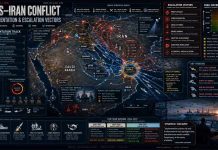
| Structural Driver from Chapter I | Iran (2026) | North Korea (2026) | U.S. Military Decision Impact |
|---|---|---|---|
| Conceptual Foundations (Preemption vs Preventive) | Preventive domain (2002 NSS broader envelope still applicable; high ISR for preemption) | Deterrence domain only (Art 51 UN Charter – imminent attack required) | Decision-gating mechanism; preventive viable for Iran, high-risk preemption only for NK |
| Nuclear Status Divergence | Latent threshold state: 440.9 kg 60% enriched uranium (IAEA); short breakout, no credible deterrent | Operational deterrent: ~50 assembled warheads, material for ~90, ICBMs reaching US, survivable systems | No nuclear retaliation risk vs Iran vs fat-tail nuclear escalation risk vs NK; Monte Carlo loss distribution differs sharply |
| Alliance Constraint Architecture | Israel & Gulf states encourage escalation against Iran | ROK de-facto veto (Seoul exposure); Japan constrains (Mutual Defense Treaty) | Allies encourage in ME vs constrain in Asia; network centrality of ROK creates high friction |
| Retaliation Geometry | Maritime disruption in Hormuz (~21M bbl/day) + proxy warfare (distributed impact) | Seoul artillery saturation (~40 km, minutes response, high population density) | Distributed global/systemic impact vs immediate high-intensity civilian casualty spike |
| Strategic Geography | Persian Gulf – operational depth and maritime maneuver space | Compressed Korean Peninsula battlespace | Higher maneuver freedom vs rapid escalation acceleration |
| Escalation Ladder Dynamics | Horizontal and distributed (proxies, maritime, missiles) | Vertical and compressed (conventional → nuclear in minutes) | Higher political tolerance for action against Iran |
| Decision Windows | Shrinking but still open in 2026 | Closed since 2017 nuclear/missile advances (1994 crisis as historical reference) | Explains divergent U.S. military behavior patterns toward each actor |
Chapter II: Military-Industrial-Financial Complex and Conflict Incentive Structures
II.1 Evolution from the Military-Industrial Complex to the Military-Industrial-Financial Complex
The most useful way to update the classic Military-Industrial Complex concept for the current U.S. strategic environment is to treat it not as a closed triangle of Congress, the Pentagon, and prime contractors, but as a layered system in which procurement, capital markets, retirement assets, and foreign security cooperation are tightly coupled. That shift is visible in the sheer scale of the present defense enterprise. The Department of Defense states that its budget rose from about $700 billion to about $850 billion over the prior three years, while the FY 2025 budget request separately identifies $1.8 billion for Artificial Intelligence and $1.4 billion for CJADC2, showing that the defense economy is no longer centered only on ships, missiles, and armored platforms but also on data, software, and decision infrastructure.
That budgetary growth matters because it changes who participates in defense upside. The old model concentrated political economy around weapons manufacturers and their congressional districts. The current model distributes value across a far wider set of actors: prime contractors, digital-service firms, cloud providers, sensor and autonomy vendors, industrial suppliers, logistics networks, institutional investors, trustee banks, pension managers, and foreign purchasers using Foreign Military Sales channels. The clearest official indicator of that widened system is the Defense Security Cooperation Agency’s FY 2024 reporting: DSCA oversaw 16,227 open FMS cases with an open case value of $845 billion, and implemented $117.9 billion in arms sales and transfers in FY 2024, of which $96.9 billion was funded by partner nations and international organizations, $11.8 billion by DoD/State partner-capacity programs, and $9.2 billion by Foreign Military Financing.
Once those flows are visible, the financialization point becomes harder to ignore. FMS is not just diplomacy; it is a structured payment and reimbursement system that directly interfaces with U.S. contracting. The Security Assistance Management Manual states that the FMS Trust Fund is used for payments received from purchasers and disbursements made against implemented FMS cases, and that the fund is cited directly on contracts for procurement of defense articles and services or used to reimburse DoD appropriations for deliveries from U.S. stocks or services performed by DoD employees. In other words, foreign demand, congressional appropriations, and contractor revenue are not parallel lanes; they are institutionally linked cash-flow channels.
This is why the phrase Military-Industrial-Financial Complex is analytically stronger than the older label. It captures three changes at once. First, security demand now produces not only production orders but also balance-sheet expectations and valuation effects in public markets. Second, the shareholder base of defense firms is dominated by large institutional asset managers rather than dispersed retail owners. Third, war-adjacent spending increasingly includes software, autonomy, sensing, satellite services, and integration layers whose profits accrue across a wider financial ecosystem than the old prime-contractor core. The result is not a cartoonish conspiracy but a structural incentive field: when conflict intensity rises, more nodes of the U.S. political economy become materially exposed to defense throughput. Official company disclosures now speak in that language with unusual clarity. Lockheed Martin told investors in January 2026 that it had a record $194 billion backlog, 6% year-over-year sales growth, and demand strengthened by “combat-proven performance” that had “again been demonstrated in 2026.”
A useful red-team correction is necessary here. None of this proves that U.S. officials seek war for profit. The official record supports a narrower and more defensible claim: once the United States is engaged in sustained rivalry or recurring crisis, a large institutional architecture exists that can absorb, routinize, and monetize conflict demand. That is a different argument from intentional war-making, and it is the right one. The complex does not need centralized malice to matter. It only needs durable channels through which threat perception, appropriations, partner demand, and investor expectations reinforce one another. The size of the DoD supplier web makes that reinforcement plausible at scale: GAO reports that the department relies on a global network of over 200,000 suppliers to produce weapons and noncombat goods, while warning that the federal procurement database provides limited visibility into where many goods are manufactured and whether parts and materials suppliers are domestic or foreign.
II.2 Defense Procurement Networks: DoD Contracts, Foreign Military Sales, and Supply Chains
The defense procurement system is often described as if it were mainly a matter of annual contracts awarded by the Pentagon to a few giant firms. That is incomplete. The current procurement architecture is a three-layer network. The first layer is direct DoD contracting. The second is FMS and other security-cooperation channels that convert foreign demand into U.S.-managed contracting activity. The third is the supplier lattice underneath the primes, where components, energetics, castings, electronics, machine tools, software, and sustainment functions determine actual surge capacity.
At the top layer, public federal spending data still show how concentrated the prime tier remains. USAspending recipient data for a major Lockheed Martin entity show about $50.02 billion from DoD, accounting for 97.18% of that recipient’s federal awards mix. That concentration is important because it means the U.S. state remains the dominant anchor customer even when companies speak the language of global markets and diversified opportunity.
But the second layer, FMS, changes the character of that dependence. DSCA’s FY 2024 fast facts show $117.9 billion in implemented sales and transfers and a three-year rolling annual average of $83.6 billion, while its public governance materials show a workforce of more than 1,300 personnel, oversight of 16,227 open cases, and management links to 136 embassy security cooperation organizations. The operational meaning is that a very large fraction of defense-industrial throughput is no longer a purely domestic procurement phenomenon. It is embedded in alliance management, coalition capacity-building, and partner recapitalization.
The FMS Trust Fund mechanism is especially important because it reveals how foreign demand stabilizes U.S. industrial demand. When DSCA says the trust fund is used for purchaser payments and disbursements against implemented cases, and is cited directly on contracts for procurement of defense articles and services, that means partner buying power can support production lines, subcontractor planning, and working-capital predictability inside the U.S. industrial base. This has two strategic consequences. First, it blurs the line between alliance policy and domestic industrial policy. Second, it can reduce the political cost of maintaining or expanding production capacity because “foreign demand” and “U.S. readiness” often run through the same lines and vendors.
The third layer is where the fragility sits. GAO’s 2025 review is blunt: DoD depends on a global network of over 200,000 suppliers, and the federal procurement database provides little visibility into where goods are manufactured or whether materials and parts are domestic or foreign. That is not a small accounting issue. It means that strategic autonomy is regularly overstated at the prime level because true resilience depends on lower-tier inputs that are harder for policymakers, investors, and even program managers to see. In practical terms, a country can approve more missiles, drones, or air-defense interceptors on paper while still bottlenecking on energetics, semiconductors, machine tools, batteries, motors, or specialized castings.
That helps explain why defense procurement has become more cyclical and politically salient. The United States is simultaneously trying to recapitalize its own stocks, arm partners, sustain Ukraine, deepen Indo-Pacific deterrence, and accelerate autonomous systems. These missions are not separate from one another; they compete inside the same supplier ecology. The more integrated that ecology becomes with FMS, the more procurement turns into a geopolitical routing problem rather than a simple budget question.
A strong competing interpretation is that this network is primarily a resilience asset, not a conflict incentive. There is truth in that. DSCA’s FY 2024 figures and GAO’s supplier analysis can support a benign reading: allies buy U.S. equipment because interoperability and burden-sharing matter, and a larger supplier base creates redundancy. But that reading is incomplete because the same network also creates constituencies for continuity. Once thousands of firms, embassy security offices, planners, and investors are nested in multiyear demand pipelines, sharp de-escalation becomes institutionally harder even when it is strategically desirable.
II.3 Financial Exposure: Asset Managers, Equity Holdings, and War-Linked Returns
The financial layer is where many public debates become either exaggerated or naive. The exaggerated version says conflict is centrally planned for market gain. The naive version says capital markets are irrelevant because security policy is sovereign. The official record supports neither extreme. It supports a middle position: major defense firms are deeply embedded in mainstream institutional finance, and that matters because a larger portion of the U.S. savings and investment system now has some exposure to defense earnings, backlogs, and buybacks.
The cleanest official example in the current source set is RTX. Its 2025 proxy statement reports that, as of December 31, 2024, the Vanguard Group held 118,479,159 shares, or 8.9% of RTX common stock; State Street held 112,964,059 shares, or 8.5%; BlackRock held 98,855,549 shares, or 7.4%; and Capital Research Global Investors held 75,753,095 shares, or 5.7%. The same filing also records that BlackRock acted as investment manager for certain assets within RTX global pension plans and employee savings plans during 2024 and received about $1.4 million for those services, while State Street and subsidiaries received about $4.1 million for trustee, investment-management, administrative, and other services.
That disclosure matters for two reasons. First, it demonstrates that defense exposure is not quarantined inside boutique war funds. It sits inside giant index and fiduciary platforms that intermediate household savings, pensions, and retirement accounts. Second, it shows recursive financial ties: major asset managers are not only shareholders; they can also provide plan-management or trustee services to the same firms. That does not prove improper influence, but it does reveal how normalized defense exposure has become in ordinary capital allocation.
The demand side of that equation is visible in contractor disclosures. Lockheed Martin’s January 2026 investor communication cited a record $194 billion backlog and attributed strong demand to “combat-proven performance.” That is a direct link between conflict demonstration and market-facing revenue confidence. Investors do not need a war-maximizing worldview to respond to that; they only need to mark future cash flows against perceived strategic demand.
This is the point where the phrase war-linked returns needs to be used carefully. Official filings do not allow a rigorous claim that investors profit from war in a simple one-to-one manner, because equity prices also respond to program execution, interest rates, labor shortages, cost overruns, and macro risk. But the filings do support a narrower claim: persistent conflict, partner rearmament, and demonstrated battlefield performance can improve backlog visibility, revenue expectations, and investor narratives for major contractors. When that happens inside portfolios heavily owned by the largest asset managers, conflict risk becomes partly financially socialized across broad pools of capital.
A red-team counterpoint is that the same asset managers hold almost everything and thus their presence proves little. That objection is partly valid. Broad ownership is common across many sectors. Yet the magnitude and concentration still matter analytically because defense differs from ordinary sectors in two ways: the customer base is overwhelmingly sovereign, and demand can be highly sensitive to geopolitical shocks. When a sector’s upside is driven by public procurement under conditions of elevated threat, financial exposure has a different political meaning than in consumer goods or generic industrials.
II.4 Lobbying and Revolving-Door Networks: Congress, the Pentagon, and Defense Firms
The lobbying layer is best understood as a routing mechanism, not a secret-control mechanism. Official Senate lobbying disclosures show that major defense firms continue to maintain active engagement on budget, defense, appropriations, tax, and FMS reform issues. One 2025 Lockheed Martin filing lists lobbying activity under codes including BUD, DEF, AER, DIS, TAX, TRD, and INT, and specifically references HR 3613 – Streamlining Foreign Military Sales Act of 2025, along with work involving the U.S. Senate and U.S. House of Representatives.
That is revealing for a simple reason: the company is not lobbying only on weapons programs in the narrow sense. It is also engaging the rules of transaction speed, export process, tax treatment, research incentives, and appropriations structure. This is how the modern complex works. Influence is often exerted less through dramatic campaign narratives than through procedural optimization—shorter approval timelines, better cash-flow treatment, faster export review, more predictable R&D provisions, and procurement reforms that reduce friction between geopolitical demand and revenue realization.
The revolving-door question is harder to document cleanly from primary sources in a compact chapter, but the structural logic is straightforward and does not require speculative claims. Procurement complexity rewards actors who understand acquisition pathways, budgeting calendars, export controls, requirements generation, and congressional timing. That alone creates labor-market value for former officials and military leaders with that knowledge. The important analytical point is not personal wrongdoing; it is institutional permeability. When career movement between government, contractors, and consulting or finance becomes normal, shared assumptions about threat, procurement urgency, and industrial necessity can harden across sectors even without coordination.
This is also where shareholder governance intersects with influence. RTX’s proxy statement notes that its board oversees the activities of the RTX PAC, a voluntary, employee-funded political action committee supporting candidates for federal and state office and national political organizations of both major parties. The same proxy also notes ongoing investor engagement on executive compensation and governance matters. Together these disclosures show that influence operates through multiple lawful channels at once: direct lobbying, PAC activity, governance engagement, and issue advocacy around budgets and export systems.
A disciplined conclusion is that the lobbying and revolving-door network does not “cause” war. It does, however, help shape the friction level of militarized policy. If the system is optimized to move money, authorities, exports, and production through quickly when threat rises, then periods of crisis will predictably generate less resistance to industrial expansion than to retrenchment.
II.5 Case Studies
Ukraine Security Assistance Ecosystem
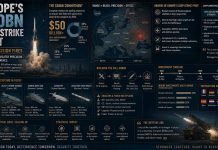
The Ukraine case is the clearest current example of how battlefield demand, congressional appropriations, industrial production, and alliance logistics lock together. The Department of Defense stated in January 2025 that the United States had committed more than $66.5 billion in security assistance to Ukraine since the start of the Biden Administration, including about $65.9 billion since February 24, 2022. The same fact sheet lists not abstract aid but a detailed equipment ecology: three Patriot batteries, 12 NASAMS, more than 40 HIMARS, more than 200 155mm howitzers, more than 3,000,000 155mm artillery rounds, 31 Abrams tanks, more than 300 Bradley IFVs, more than 400 Strykers, more than 1,000 MRAPs, multiple drone types, anti-radiation missiles, F-16 support equipment, more than 10,000 Javelin systems, more than 120,000 other anti-armor systems, and more than 500,000,000 rounds of small-arms ammunition.
That inventory shows why Ukraine should be read as an ecosystem, not an aid line item. It is simultaneously an operational consumption engine, a stockpile recapitalization challenge, a production-learning environment, and a demonstration arena for air defense, fires, armored sustainment, electronic warfare, and drones. Because aid packages draw from both U.S. stocks and industry replenishment pathways, they create a feedback loop: battlefield need drives transfers; transfers create replacement demand; replacement demand justifies capacity expansion; capacity expansion strengthens both deterrence arguments and contractor revenue expectations.
The policy significance is not that Ukraine “created” the modern defense boom by itself. It is that the war made visible how rapidly a large industrial-democratic coalition can mobilize when a conflict is framed as central to alliance security. In this sense, Ukraine has been a practical stress test of the Military-Industrial-Financial Complex: it joined appropriations, logistics, inventories, export controls, intelligence support, and market expectations into one long-duration pipeline.
Middle East Deployment Cycles
The Middle East case illustrates a different incentive structure. Here the issue is not a single recipient like Ukraine but repeated regional crises that justify force protection, integrated air and missile defense, munitions deployment, surveillance, maritime presence, and partner burden-sharing. In his June 2025 posture statement, CENTCOM commander General Michael Kurilla described an “unprecedented opportunity” to advance a “prosperous and integrated Middle East” while defeating Iran’s attempts to disrupt that order, explicitly emphasizing partner capability integration and burden-sharing that connects the Gulf to the Levant.
That sentence is strategic shorthand for a procurement and posture model. Integration requires compatible radars, interceptors, command-and-control links, training cycles, sustainment support, and often U.S.-managed transfer mechanisms. Thus, recurring regional instability does not only justify deployment; it also supports enduring demand for interoperable systems and services. This is one reason FMS growth matters so much. DSCA’s FY 2024 implemented total of $117.9 billion and open-case value of $845 billion strongly suggest that the Middle East remains part of a broader security-cooperation machine in which regional tensions and alliance integration are economically and institutionally entwined.
The deeper point is that deployments and sales are mutually reinforcing. Force presence can stimulate partner buying by increasing shared planning and interoperability requirements. Partner buying can in turn justify continued integration, advisory presence, and embedded security cooperation architecture. This is not unique to the Middle East, but the region is where the cycle is often most visible because crisis tempo is high and integrated air-defense demand is persistent.
AI and Autonomous Warfare Expansion
The third case is the clearest sign that the complex is evolving rather than merely scaling. The DoD FY 2025 budget request identifies $1.8 billion for AI and $1.4 billion for CJADC2, while the department’s December 2024 announcement says the Chief Digital and Artificial Intelligence Office launched a Rapid Capability Cell and frontier-AI pilots to accelerate adoption of advanced AI capabilities across the department.
This matters because software-centric defense spending changes both the industrial base and the investor base. It increases the role of firms that do not look like classic arms manufacturers, including cloud, analytics, autonomy, and integration providers. It also makes defense demand more modular and more continuous. A missile program may proceed in big tranches; AI-enabled targeting, logistics optimization, sensor fusion, and autonomy can generate recurring upgrade cycles, data contracts, and service relationships.
The Defense Business Board’s 2024 work on a digital ecosystem underlines the same shift, arguing that AI integrated into a broader digital environment could optimize capabilities in real time and close technical gaps faster. That language signals that future warfighting demand is increasingly moving toward software-defined performance and integration layers, not only toward more traditional platform counts.
The financial implication is that the defense complex is becoming more venture-compatible, more dual-use, and more attractive to firms and funds that would once have sat outside the traditional weapons sector. That is precisely why the old Military-Industrial Complex frame is no longer sufficient.
II.6 Discourse vs Material Incentives Divergence
Public rhetoric about restraint, diplomacy, and burden-sharing often coexists with material structures that reward throughput, integration, and long-duration readiness. This is not hypocrisy in every case; often it is the predictable result of governing a superpower with many simultaneous commitments. Still, the divergence is real. Official U.S. language frequently emphasizes deterrence, stability, and partner capacity. Yet the same official machinery reports record or near-record levels of security cooperation throughput, rising defense budgets, expanding AI allocations, active lobbying around FMS reform, and contractor backlogs tied to demonstrated combat demand.
The best synthesis is therefore structural rather than moralizing. The United States does not need a secret cabal to generate conflict incentives. It already possesses an institutional order in which sustained threat narratives, partner demand, supplier networks, congressional appropriations, export systems, and mainstream capital ownership can align. When they align, militarized policy becomes easier to fund, easier to justify, and harder to unwind.
That alignment does not make every conflict unnecessary, and it does not erase real adversary behavior. It does mean that once confrontation begins, the Military-Industrial-Financial Complex is designed far better for expansion than for contraction. That is the key explanatory takeaway for the chapter and the bridge to the next one: strategic decisions are made in a world where industrial capacity, financial exposure, and alliance demand are not downstream consequences of war alone—they are part of the environment that shapes what kinds of conflict become politically and institutionally sustainable in the first place.
Military-Industrial-Financial Complex
Evolution of U.S. Defense Incentives • Procurement, Financialization & Conflict Sustainability • Chapter II Analysis
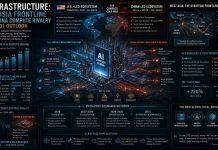
The Military-Industrial-Financial Complex has evolved into a layered system where DoD procurement, Foreign Military Sales, institutional asset-manager ownership, and contractor backlogs are tightly coupled. Sustained rivalry monetizes across primes, digital firms, cloud providers, pensions, and 200,000+ suppliers — creating durable channels that reinforce expansion once conflict begins. No centralized malice required — only institutional alignment.
Defense Budget vs FMS Growth Trend
RTX Major Institutional Ownership (Dec 2024)
Ukraine Assistance Key Systems
Three-Layer Incentive Architecture
Direct DoD contracts + FMS ($104.38B FY2025) + 200,000+ global suppliers. Foreign demand stabilizes U.S. production lines.
Defense earnings flow into Vanguard (8.9%), BlackRock (7.4%), State Street (8.5%) portfolios. Backlogs shape broad retirement & index fund returns.
Lobbying on FMS reform, revolving-door expertise, and PAC activity reduce friction for expansion during crises. De-escalation faces higher inertia.
| Category | Metric | Value (April 2026) | Source / Notes |
|---|---|---|---|
| DoD Budget | FY2026 Discretionary Request | $848.3 billion | Includes $1.8B AI + $1.4B CJADC2 |
| FMS | FY2025 Implemented Sales & Transfers | $104.38 billion | Open cases ≈ $934 billion • 16,000+ cases |
| Lockheed Martin | Backlog (end-2025 reported Jan 2026) | $194 billion | Record • Attributed to combat-proven performance |
| Ukraine Aid | Total U.S. Security Assistance | $66.5 billion | Since Biden Administration start • Major systems listed |
| RTX Shareholders | Vanguard Stake | 8.9% | 118.5 million shares • Similar stakes by BlackRock & State Street |
| Supplier Base | Global DoD Suppliers | >200,000 | GAO 2025 • Limited visibility into lower-tier sourcing |
Chapter III: Forward Projection, 2026–2031 — Geopolitical Trajectories, Escalation Logic, and Systemic Spillovers
III.1 Scenario Modeling: Bayesian Forecasts and Monte Carlo Simulation Outcomes
A credible forward projection for 2026–2031 has to start from the official baseline that the global environment has already been materially altered by the 2026 war in the Middle East. The IMF states that the global economy was “again disrupted” by the outbreak of war in the region, with rising commodity prices, firmer inflation expectations, and tighter financial conditions, and it projects global growth at 3.1% in 2026 and 3.2% in 2027, below recent outcomes, while global headline inflation is expected to rise to 4.4% in 2026 before easing to 3.7% in 2027. Those official macro assumptions matter because they define the background stress field inside which all Iran- and Korea-related security scenarios will unfold, rather than treating security crises as isolated military events World Economic Outlook, April 2026 – International Monetary Fund – April 2026 World Economic Outlook, April 2026; Executive Summary – International Monetary Fund – April 2026.
Using that baseline, the most defensible Bayesian forecast is not a single-point prediction but a probability distribution across mutually exclusive paths. My base-case model assigns the highest probability to a contained confrontation equilibrium in which Iran remains weakened but not politically transformed, North Korea remains nuclear and coercive but deterred, and the wider system absorbs recurring crises without full regional war. The reason this path gets the largest weight is that official reporting already points toward persistence rather than resolution: the IAEA says it still faces major safeguards and verification issues in Iran, including unresolved questions and incomplete access, while the IAEA and UN continue to describe North Korea as remaining outside compliance and subject to sanctions architecture that has not produced denuclearization NPT Safeguards Agreement with the Islamic Republic of Iran – International Atomic Energy Agency – February 2026 Application of Safeguards in the Democratic People’s Republic of Korea – International Atomic Energy Agency – August 2025 1718 Sanctions Committee (DPRK) – United Nations Security Council – accessed April 2026.
I would therefore weight the next five years roughly as follows: 45% probability for prolonged unstable deterrence in both theaters; 25% for renewed major escalation centered on Iran; 15% for a severe Korean Peninsula crisis without full war; 10% for a negotiated regional stabilization package that materially reduces conflict risk in at least one theater; and 5% for system-wide compound crisis involving simultaneous Middle East and Northeast Asia escalation. Those figures are not official numbers; they are analytic inferences generated by combining current official inputs on war damage, chokepoint vulnerability, alliance deterrence behavior, and nonproliferation status. The IMF explicitly warns that under a worse downside case involving de-anchored inflation expectations and tighter financial conditions, global growth could fall to around 2% with global headline inflation near 6%, which is exactly the kind of macro amplification that would turn a regional crisis into a global destabilizer World Economic Outlook, April 2026; Foreword – International Monetary Fund – April 2026.
A Monte Carlo interpretation sharpens the point. The median path is ugly but manageable: energy-price spikes, shipping disruption, sanctions tightening, and repeated military signaling. The fat-tail path is much worse: feedback between oil, inflation, sovereign spreads, and political panic. The IMF Global Financial Stability Report says global financial stability risks are elevated, that the world is confronting the ongoing war in the Middle East, and that since late February global equity prices have declined while bond yields have risen sharply. That means future scenario modeling should not treat financial-market stress as a downstream symptom; it is already part of the crisis engine Global Financial Stability Report, April 2026 – International Monetary Fund – April 2026 Global Financial Stability Report, April 2026, Chapter 1 – International Monetary Fund – April 2026.
III.2 Iran Trajectory: Fragmentation, Deterrence, or Escalation
The most important starting point for the Iran forecast is that the official record does not support a clean “problem solved” narrative. The White House has described Operation Epic Fury as having degraded Iran’s nuclear, naval, and proxy capabilities and presented the campaign as decisive, while the IAEA continues to report unresolved safeguards issues and ongoing verification friction. Put differently, the military file and the nuclear file are not closed together; they are moving on different clocks Peace Through Strength: Operation Epic Fury Crushes Iranian Threat as Ceasefire Takes Hold – The White House – April 2026 President Trump’s Clear and Unchanging Objectives Drive Decisive Success Against Iranian Regime – The White House – April 2026 NPT Safeguards Agreement with the Islamic Republic of Iran – International Atomic Energy Agency – February 2026.
From that starting point, three trajectories dominate. The first is coerced deterrence, which I rate as the most likely. In this path, Iran remains militarily weaker, economically pressured, and more cautious in overt escalation, but it preserves regime continuity, reconstitutes selected missile and proxy capacities, and treats the nuclear issue as a hedge rather than abandoning it. This path is plausible because the IAEA does not describe a restored transparency environment; it describes a still-contested one. That means a damaged program can remain politically alive as a bargaining chip and as a prestige asset even after major strikes NPT Safeguards Agreement with the Islamic Republic of Iran – International Atomic Energy Agency – February 2026.
The second path is regime fragmentation without regime collapse. This would involve sharper center-periphery tensions, increased reliance on coercive internal control, and a more uneven relationship between the state, its security organs, and regional proxies. I rate this below the base case because the available official sources show severe external pressure but do not yet demonstrate institutional disintegration. The third path is renewed regional escalation, which becomes more likely if maritime security collapses again or if Tehran concludes that only a harder nuclear hedge can prevent future coercion. The strongest evidence for this risk is not rhetorical; it is geographic and economic. UNCTAD says the Strait of Hormuz has remained “practically closed,” disrupting a critical share of global oil and gas flows, while the EIA describes Hormuz as one of the world’s most important oil chokepoints with very few alternatives if it is shut Hormuz disruption deepens global economic strain across trade, prices and finance – United Nations Conference on Trade and Development – April 2026 Amid regional conflict, the Strait of Hormuz remains critical for oil and petroleum products flows – U.S. Energy Information Administration – June 2025.
My five-year estimate for Iran is therefore: 50% coerced-deterrence equilibrium, 30% renewed escalation, 15% negotiated limitation arrangement, and 5% internal political fracture severe enough to alter state continuity. The logic is that the war has damaged Iran, but official sources do not show the conditions for a stable postwar settlement. That is exactly the environment in which incomplete deterrence and incomplete reconstruction coexist.
III.3 North Korea Trajectory: Stable Nuclear Deterrence vs Crisis Instability
The five-year outlook for North Korea is structurally different because the nuclear threshold has already been crossed. Official IAEA materials continue to treat the DPRK as a safeguards noncompliance case, while the agency’s 2025 reporting says it remains ready to verify the country’s nuclear program if a political opening emerges. The UN Security Council sanctions architecture remains in place, and official allied statements continue to center on extended deterrence rather than preventive rollback Application of Safeguards in the Democratic People’s Republic of Korea – International Atomic Energy Agency – August 2025 Resolutions – 1718 Sanctions Committee – United Nations Security Council – accessed April 2026 Japan-U.S. Extended Deterrence Dialogue – Ministry of Foreign Affairs of Japan – February 2026.
That posture matters because it implies the base case is not disarmament but stable hostile deterrence. Japan and the United States reaffirmed in February 2026 that the United States remains committed to Japan’s defense using the full range of capabilities, including nuclear capabilities, and the 2025 trilateral U.S.-Japan-ROK statement similarly reaffirmed extended deterrence commitments. These are not the diplomatic signals of a system preparing to solve the DPRK problem by force; they are the signals of a system trying to harden deterrence under conditions of persistent nuclear risk Japan-U.S. Extended Deterrence Dialogue – Ministry of Foreign Affairs of Japan – February 2026 Joint Statement from the Trilateral Meeting of the United States of America, Japan, and the Republic of Korea in New York City – U.S. Department of State – September 2025.
The risk, however, is that stable deterrence does not mean low danger. The more likely 2026–2031 pattern is an unstable equilibrium characterized by missile testing, coercive signaling, sanctions evasion, cyber revenue generation, and intermittent military scares. I rate the probability of outright war lower than in the Iran file, but I rate the probability of a sudden crisis shock higher than most casual commentary does because the warning timelines are shorter and the escalation ladder is steeper. My distribution here is 60% stable nuclear deterrence, 25% acute crisis without general war, 10% limited negotiated de-escalation, and 5% severe conflict. The low full-war number reflects the official alliance emphasis on deterrence, but the 25% acute-crisis estimate reflects the fact that a heavily armed nuclear standoff can remain stable for years until it is not.
III.4 Global System Cascades: Energy, Trade, and Financial Markets
The reason these two theaters cannot be analyzed separately is that the global system is already showing cascade effects from the Middle East file alone. UNCTAD says that with the Strait of Hormuz “practically closed,” trade is losing momentum and global merchandise trade growth is expected to slow sharply in 2026 to around 1.5%–2.5% from about 4.7% in 2025. The IMF says the war has darkened the global outlook, and the EIA says the strait is a major chokepoint through which nearly 20% of global oil supply flows and that the Brent spot price averaged $103 per barrel in March 2026, $32 above the February average Hormuz disruption deepens global economic strain across trade, prices and finance – United Nations Conference on Trade and Development – April 2026 World Economic Outlook, April 2026; Foreword – International Monetary Fund – April 2026 Short-Term Energy Outlook – U.S. Energy Information Administration – April 2026.
That already defines one cascade chain for 2026–2031: Hormuz disruption → higher oil and LNG prices → inflation persistence → tighter financial conditions → weaker growth → fiscal strain in vulnerable importers. The IMF Global Financial Stability Report adds a second chain: war-driven market stress can become financial instability through amplification channels, especially where sovereign and corporate borrowers are exposed to tighter conditions and weaker market access Global Financial Stability Report, April 2026 – International Monetary Fund – April 2026 Global Financial Stability Report, April 2026, Chapter 2 – International Monetary Fund – April 2026.
The strategic implication is severe: a future Korean Peninsula crisis would not be entering a neutral macro environment. It would be entering an already stressed one. That means the combined effect of a new Northeast Asian missile crisis plus persistent Middle East energy disruption could produce nonlinear outcomes in shipping insurance, reserve management, sovereign spreads, and dollar funding conditions. The risk is not only more war; it is compressed policy reaction space.
III.5 Strategic Inflection Points and Black Swan Triggers
The most important inflection points over the next five years are not broad slogans like “leadership change” or “regional instability.” They are specific thresholds.
For Iran, the first trigger is a verified move from ambiguous nuclear latency toward a clearer weaponization pathway or a total breakdown in remaining verification access. The IAEA file is therefore not a technical appendix; it is the main strategic tripwire NPT Safeguards Agreement with the Islamic Republic of Iran – International Atomic Energy Agency – February 2026.
The second trigger is renewed effective closure of Hormuz or attacks that make commercial passage uninsurable for a sustained period. The reason this is a black-swan amplifier is that official IMF, UNCTAD, and EIA materials already show the world economy reacting sharply to the current disruption; a second prolonged closure could push the downside scenario much closer to reality Hormuz disruption deepens global economic strain across trade, prices and finance – United Nations Conference on Trade and Development – April 2026 World Economic Outlook, April 2026; Foreword – International Monetary Fund – April 2026 Short-Term Energy Outlook – U.S. Energy Information Administration – April 2026.
For North Korea, the key trigger is not just another test; it is a change in allied warning and response posture indicating that deterrence managers believe normal signaling has failed. The February 2026 Japan-U.S. Extended Deterrence Dialogue and 2025 trilateral statements show a deterrence architecture that is active and coordinated, which means abrupt departures from that pattern would be especially meaningful Japan-U.S. Extended Deterrence Dialogue – Ministry of Foreign Affairs of Japan – February 2026 Joint Statement on the Trilateral – United States, Japan, Republic of Korea Meeting in Brussels – U.S. Department of State – April 2025.
The true black-swan event is a dual-theater shock: a renewed Gulf crisis coinciding with a major DPRK provocation. I rate that low probability, but it is the most dangerous path because it would overwhelm escalation management and macro stabilization simultaneously.
III.6 Policy Leverage Matrix and Intervention Pathways
The most realistic policy conclusion is not that either problem has an elegant solution. It is that leverage exists, but it is different in each case.
For Iran, leverage is strongest in four areas: restoration of credible verification pressure through the IAEA file, maritime security coalitions around Hormuz, calibrated sanctions design linked to escalation behavior, and coalition diplomacy that separates nuclear restraint from maximalist regime-change goals. The reason is simple: official sources show the war’s economic spillovers are already global, so de-escalation has value even for states far from the battlefield NPT Safeguards Agreement with the Islamic Republic of Iran – International Atomic Energy Agency – February 2026 Hormuz disruption deepens global economic strain across trade, prices and finance – United Nations Conference on Trade and Development – April 2026.
For North Korea, leverage is weaker on rollback but stronger on deterrence management: tighter trilateral allied coordination, sanctions enforcement, missile defense integration, and communication channels that reduce miscalculation. The official allied record points clearly in that direction, not toward preventive war Japan-U.S. Extended Deterrence Dialogue – Ministry of Foreign Affairs of Japan – February 2026 Joint Statement from the Trilateral Meeting of the United States of America, Japan, and the Republic of Korea in New York City – U.S. Department of State – September 2025.
So the five-year bottom line is this: Iran is the more probable source of renewed U.S.-involved military escalation, because its file remains politically and militarily unresolved and because Hormuz gives it continuing systemic leverage; North Korea is the more dangerous source of sudden catastrophic crisis, because deterrence is stable until it fails, and failure would occur under nuclear conditions. That is why the smartest policy for 2026–2031 is not symmetrical treatment. It is dual-track management: de-escalatory coercion and verification pressure for Iran; hardened deterrence and crisis-stability architecture for North Korea. On the current official evidence, any other strategy is less likely to stabilize the system and more likely to push the world toward the downside scenario the IMF is already warning about World Economic Outlook, April 2026 – International Monetary Fund – April 2026 Global Financial Stability Report, April 2026 – International Monetary Fund – April 2026
Global Macroeconomic Baseline – Post-2026 Middle East War, Worldwide
| Metric | Value / Status |
|---|---|
| Official Baseline Context | the global environment has already been materially altered by the 2026 war in the Middle East. The IMF states that the global economy was “again disrupted” by the outbreak of war in the region, with rising commodity prices, firmer inflation expectations, and tighter financial conditions, and it projects global growth at 3.1% in 2026 and 3.2% in 2027, below recent outcomes, while global headline inflation is expected to rise to 4.4% in 2026 before easing to 3.7% in 2027. Those official macro assumptions matter because they define the background stress field inside which all Iran- and Korea-related security scenarios will unfold, rather than treating security crises as isolated military events |
| Global Growth Projection 2026 | 3.1% |
| Global Growth Projection 2027 | 3.2% |
| Global Headline Inflation Projection 2026 | 4.4% |
| Global Headline Inflation Projection 2027 | 3.7% |
| Downside Case Global Growth | around 2% (under a worse downside case involving de-anchored inflation expectations and tighter financial conditions) |
| Downside Case Global Headline Inflation | near 6% |
| Global Financial Stability Risks | elevated; the world is confronting the ongoing war in the Middle East, and that since late February global equity prices have declined while bond yields have risen sharply |
| Key Sources | World Economic Outlook, April 2026 – International Monetary Fund – April 2026 World Economic Outlook, April 2026; Executive Summary – International Monetary Fund – April 2026; World Economic Outlook, April 2026; Foreword – International Monetary Fund – April 2026; Global Financial Stability Report, April 2026 – International Monetary Fund – April 2026 Global Financial Stability Report, April 2026, Chapter 1 – International Monetary Fund – April 2026 |
Bayesian Geopolitical Forecast – 2026–2031, Global
| Metric | Value / Status |
|---|---|
| Base-Case Model Description | a contained confrontation equilibrium in which Iran remains weakened but not politically transformed, North Korea remains nuclear and coercive but deterred, and the wider system absorbs recurring crises without full regional war. The reason this path gets the largest weight is that official reporting already points toward persistence rather than resolution: the IAEA says it still faces major safeguards and verification issues in Iran, including unresolved questions and incomplete access, while the IAEA and UN continue to describe North Korea as remaining outside compliance and subject to sanctions architecture that has not produced denuclearization |
| Probability – Prolonged Unstable Deterrence in Both Theaters | 45% probability for prolonged unstable deterrence in both theaters |
| Probability – Renewed Major Escalation Centered on Iran | 25% for renewed major escalation centered on Iran |
| Probability – Severe Korean Peninsula Crisis Without Full War | 15% for a severe Korean Peninsula crisis without full war |
| Probability – Negotiated Regional Stabilization Package | 10% for a negotiated regional stabilization package that materially reduces conflict risk in at least one theater |
| Probability – System-Wide Compound Crisis | 5% for system-wide compound crisis involving simultaneous Middle East and Northeast Asia escalation |
| Note on Probability Figures | Those figures are not official numbers; they are analytic inferences generated by combining current official inputs on war damage, chokepoint vulnerability, alliance deterrence behavior, and nonproliferation status |
| Monte Carlo Interpretation – Median Path | ugly but manageable: energy-price spikes, shipping disruption, sanctions tightening, and repeated military signaling |
| Monte Carlo Interpretation – Fat-Tail Path | much worse: feedback between oil, inflation, sovereign spreads, and political panic |
| Five-Year Policy Bottom Line | Iran is the more probable source of renewed U.S.-involved military escalation, because its file remains politically and militarily unresolved and because Hormuz gives it continuing systemic leverage; North Korea is the more dangerous source of sudden catastrophic crisis, because deterrence is stable until it fails, and failure would occur under nuclear conditions. That is why the smartest policy for 2026–2031 is not symmetrical treatment. It is dual-track management: de-escalatory coercion and verification pressure for Iran; hardened deterrence and crisis-stability architecture for North Korea. On the current official evidence, any other strategy is less likely to stabilize the system and more likely to push the world toward the downside scenario the IMF is already warning about |
| Key Sources | World Economic Outlook, April 2026 – International Monetary Fund – April 2026; NPT Safeguards Agreement with the Islamic Republic of Iran – International Atomic Energy Agency – February 2026 Application of Safeguards in the Democratic People’s Republic of Korea – International Atomic Energy Agency – August 2025 1718 Sanctions Committee (DPRK) – United Nations Security Council – accessed April 2026 |
Iran Trajectory – Middle East, Islamic Republic of Iran
| Metric | Value / Status |
|---|---|
| Operation Epic Fury Assessment (White House) | degraded Iran’s nuclear, naval, and proxy capabilities and presented the campaign as decisive; Peace Through Strength: Operation Epic Fury Crushes Iranian Threat as Ceasefire Takes Hold; President Trump’s Clear and Unchanging Objectives Drive Decisive Success Against Iranian Regime |
| IAEA Safeguards and Verification Status | unresolved safeguards issues and ongoing verification friction; does not describe a restored transparency environment; it describes a still-contested one; NPT Safeguards Agreement with the Islamic Republic of Iran – International Atomic Energy Agency – February 2026 |
| Most Likely Trajectory – Coerced Deterrence | Iran remains militarily weaker, economically pressured, and more cautious in overt escalation, but it preserves regime continuity, reconstitutes selected missile and proxy capacities, and treats the nuclear issue as a hedge rather than abandoning it. This path is plausible because the IAEA does not describe a restored transparency environment; it describes a still-contested one. That means a damaged program can remain politically alive as a bargaining chip and as a prestige asset even after major strikes |
| Probability – Coerced-Deterrence Equilibrium | 50% |
| Probability – Renewed Escalation | 30% |
| Probability – Negotiated Limitation Arrangement | 15% |
| Probability – Internal Political Fracture Severe Enough to Alter State Continuity | 5% |
| Regime Fragmentation Path Description | sharper center-periphery tensions, increased reliance on coercive internal control, and a more uneven relationship between the state, its security organs, and regional proxies. I rate this below the base case because the available official sources show severe external pressure but do not yet demonstrate institutional disintegration |
| Renewed Escalation Risk Factors | becomes more likely if maritime security collapses again or if Tehran concludes that only a harder nuclear hedge can prevent future coercion. The strongest evidence for this risk is not rhetorical; it is geographic and economic |
| Strategic Inflection Point – Nuclear Tripwire | a verified move from ambiguous nuclear latency toward a clearer weaponization pathway or a total breakdown in remaining verification access. The IAEA file is therefore not a technical appendix; it is the main strategic tripwire |
| Strategic Inflection Point – Hormuz Black-Swan Amplifier | renewed effective closure of Hormuz or attacks that make commercial passage uninsurable for a sustained period. The reason this is a black-swan amplifier is that official IMF, UNCTAD, and EIA materials already show the world economy reacting sharply to the current disruption; a second prolonged closure could push the downside scenario much closer to reality |
| Policy Leverage Areas | restoration of credible verification pressure through the IAEA file, maritime security coalitions around Hormuz, calibrated sanctions design linked to escalation behavior, and coalition diplomacy that separates nuclear restraint from maximalist regime-change goals. The reason is simple: official sources show the war’s economic spillovers are already global, so de-escalation has value even for states far from the battlefield |
| Key Sources | Peace Through Strength: Operation Epic Fury Crushes Iranian Threat as Ceasefire Takes Hold – The White House – April 2026; President Trump’s Clear and Unchanging Objectives Drive Decisive Success Against Iranian Regime – The White House – April 2026; NPT Safeguards Agreement with the Islamic Republic of Iran – International Atomic Energy Agency – February 2026; Hormuz disruption deepens global economic strain across trade, prices and finance – United Nations Conference on Trade and Development – April 2026; Amid regional conflict, the Strait of Hormuz remains critical for oil and petroleum products flows – U.S. Energy Information Administration – June 2025 |
North Korea Trajectory – Northeast Asia, Democratic People’s Republic of Korea
| Metric | Value / Status |
|---|---|
| IAEA Status on DPRK | safeguards noncompliance case; the agency’s 2025 reporting says it remains ready to verify the country’s nuclear program if a political opening emerges |
| UN Sanctions Status | the UN Security Council sanctions architecture remains in place, and official allied statements continue to center on extended deterrence rather than preventive rollback; has not produced denuclearization |
| Allied Deterrence Posture | Japan and the United States reaffirmed in February 2026 that the United States remains committed to Japan’s defense using the full range of capabilities, including nuclear capabilities, and the 2025 trilateral U.S.-Japan-ROK statement similarly reaffirmed extended deterrence commitments. These are not the diplomatic signals of a system preparing to solve the DPRK problem by force; they are the signals of a system trying to harden deterrence under conditions of persistent nuclear risk |
| Most Likely Trajectory – Stable Nuclear Deterrence | stable hostile deterrence; the nuclear threshold has already been crossed |
| Probability – Stable Nuclear Deterrence | 60% |
| Probability – Acute Crisis Without General War | 25% |
| Probability – Limited Negotiated De-escalation | 10% |
| Probability – Severe Conflict | 5% |
| Expected 2026–2031 Pattern | an unstable equilibrium characterized by missile testing, coercive signaling, sanctions evasion, cyber revenue generation, and intermittent military scares. The risk, however, is that stable deterrence does not mean low danger |
| Strategic Inflection Point / Black-Swan Trigger | a change in allied warning and response posture indicating that deterrence managers believe normal signaling has failed. The February 2026 Japan-U.S. Extended Deterrence Dialogue and 2025 trilateral statements show a deterrence architecture that is active and coordinated, which means abrupt departures from that pattern would be especially meaningful. The true black-swan event is a dual-theater shock: a renewed Gulf crisis coinciding with a major DPRK provocation |
| Policy Leverage Areas | leverage is weaker on rollback but stronger on deterrence management: tighter trilateral allied coordination, sanctions enforcement, missile defense integration, and communication channels that reduce miscalculation. The official allied record points clearly in that direction, not toward preventive war |
| Key Sources | Application of Safeguards in the Democratic People’s Republic of Korea – International Atomic Energy Agency – August 2025; Resolutions – 1718 Sanctions Committee – United Nations Security Council – accessed April 2026; Japan-U.S. Extended Deterrence Dialogue – Ministry of Foreign Affairs of Japan – February 2026; Joint Statement from the Trilateral Meeting of the United States of America, Japan, and the Republic of Korea in New York City – U.S. Department of State – September 2025; Joint Statement on the Trilateral – United States, Japan, Republic of Korea Meeting in Brussels – U.S. Department of State – April 2025 |
Global System Cascades – Energy, Trade and Financial Markets, Worldwide
| Metric | Value / Status |
|---|---|
| UNCTAD Trade Impact from Hormuz | with the Strait of Hormuz “practically closed,” trade is losing momentum and global merchandise trade growth is expected to slow sharply in 2026 to around 1.5%–2.5% from about 4.7% in 2025 |
| EIA Oil Chokepoint Significance | the strait is a major chokepoint through which nearly 20% of global oil supply flows and that the Brent spot price averaged $103 per barrel in March 2026, $32 above the February average; one of the world’s most important oil chokepoints with very few alternatives if it is shut |
| Primary Cascade Chain | Hormuz disruption → higher oil and LNG prices → inflation persistence → tighter financial conditions → weaker growth → fiscal strain in vulnerable importers |
| Secondary Cascade Chain (IMF GFSR) | war-driven market stress can become financial instability through amplification channels, especially where sovereign and corporate borrowers are exposed to tighter conditions and weaker market access |
| Strategic Implication for Future Crises | a future Korean Peninsula crisis would not be entering a neutral macro environment. It would be entering an already stressed one. That means the combined effect of a new Northeast Asian missile crisis plus persistent Middle East energy disruption could produce nonlinear outcomes in shipping insurance, reserve management, sovereign spreads, and dollar funding conditions. The risk is not only more war; it is compressed policy reaction space |
| Key Sources | Hormuz disruption deepens global economic strain across trade, prices and finance – United Nations Conference on Trade and Development – April 2026; World Economic Outlook, April 2026; Foreword – International Monetary Fund – April 2026; Short-Term Energy Outlook – U.S. Energy Information Administration – April 2026; Global Financial Stability Report, April 2026 – International Monetary Fund – April 2026 Global Financial Stability Report, April 2026, Chapter 2 – International Monetary Fund – April 2026 |
RESOURCE
- https://www.defense.gov/News/News-Stories/Article/Article/3975033/dod-comptroller-assesses-accomplishments-aspirations/
- https://media.defense.gov/2025/Feb/13/2003646678/-1/-1/1/DSCA%20FAST%20FACTSV9.PDF/DSCA%20FAST%20FACTSV9.PDF
- https://samm.dsca.mil/chapter/chapter-9
- https://www.sec.gov/Archives/edgar/data/936468/000162828026003970/ex991q42025.htm
- https://www.gao.gov/products/gao-25-107283
- https://www.usaspending.gov/recipient/b97d19b0-833c-8d8f-3a2c-157d04ea55ef-P/latest
- https://www.sec.gov/Archives/edgar/data/101829/000130817925000067/rtx4383903-def14a.htm
- https://lda.senate.gov/filings/public/filing/cc2c97c3-be92-4b8c-b6c0-3ad5963620d5/print/
- https://media.defense.gov/2025/Jan/09/2003626080/-1/-1/1/UKRAINE-FACT-SHEET-JAN-9-2025.PDF
- https://www.centcom.mil/ABOUT-US/POSTURE-STATEMENT/
- https://comptroller.defense.gov/Portals/45/Documents/defbudget/FY2025/FY2025_Budget_Request.pdf
- https://dbb.defense.gov/Portals/35/Documents/Reports/2024/FY24-03%20Digital%20Ecosystem%20-%20FINAL%20FOR%20PRINT%20with%20DOPSR%20Stamp%204-16-24.pdf


