










Executive Summary
- BLUF: Eurasia faces a structurally elevated—but not predetermined—risk of large-scale interstate conflict through September 2031.
- The central danger is not a planned continental war; it is escalation produced by interacting crises, compressed decision time and ambiguous attacks.
- The principal transmission belt remains the Russia–Ukraine–NATO interface, especially the Baltic, Black Sea, Belarusian and Arctic theatres.
- A second conflict could emerge through Taiwan, the Korean Peninsula, the South Caucasus or a Central Asian security rupture.
- Cyber operations, infrastructure sabotage, electronic warfare and proxy forces can cross political thresholds before attribution is sufficiently reliable.
- Nuclear deterrence still suppresses deliberate total war, but dual-capable systems and coercive signalling complicate escalation control.
- Structured Bayesian assessment places the five-year probability of sustained direct combat between opposing major-power systems at 22–34%, with a central estimate of 28%.
- The probability rises sharply if two regional crises overlap, nuclear command-and-control assets appear threatened, or political communication channels fail.
- European rearmament strengthens deterrence over time but creates a dangerous transition period before industrial capacity and force readiness mature.
- Strategic warning must therefore track combinations of indicators rather than wait for an unmistakable invasion decision.
Eurasia’s Escalation Machine: The Five-Year Risk
Europe’s war, the Taiwan Strait, the Korean peninsula, the Caucasus and Central Asia no longer constitute separable theatres. They form an increasingly coupled security system in which weapons production, cyber operations, sanctions, maritime infrastructure and strategic partnerships transmit pressure from one region to another. The central danger through 2031 is not a predetermined general war, but the accumulation of simultaneous crises faster than governments can interpret signals, mobilise industrial capacity and contain escalation. Russia’s confrontation with Ukraine and NATO remains the system’s most active front; China–Taiwan tensions supply its greatest economic shock potential; North Korea, Belarus and proxy networks provide strategic depth. Deterrence can still hold. Yet it must now operate across military, nuclear, technological and financial domains whose feedback loops are becoming faster than the institutions designed to govern them.
One System, Multiple Fronts
The immediate escalation corridor extends from the Arctic through the Baltic and Belarus to Ukraine and the Black Sea. NATO now fields nine multinational battlegroups in Bulgaria, Estonia, Finland, Hungary, Latvia, Lithuania, Poland, Romania and Slovakia. Sweden leads the Finnish formation established in June 2026; Germany’s brigade in Lithuania, inaugurated in May 2025, is intended to reach as many as 5,000 personnel by 2027; Canada plans to deploy up to 2,200 troops within the multinational brigade in Latvia during 2026. These are not isolated deployments. They form an integrated reinforcement architecture spanning Europe’s northern and southern maritime approaches. Strengthening NATO’s Eastern Flank – NATO – June 2026
The security model is also moving from territorial defence toward continuous surveillance of infrastructure and airspace. NATO launched Baltic Sentry in January 2025, combining frigates, maritime-patrol aircraft and naval drones to protect subsea assets. Eastern Sentry followed in September 2025 after reported Russian drone and aircraft incursions into Allied airspace. The strategic consequence is double-edged: persistent monitoring can expose hostile activity earlier, but it also multiplies encounters among aircraft, ships, unmanned systems and electronic-warfare platforms. A local incident can therefore acquire alliance-wide importance before political authorities have established intent.
The Industrial Front
Europe’s answer is an extraordinary shift in public capital allocation. Defence expenditure among the EU’s 27 members reached €418 billion in 2025, an increase of 20 per cent over 2024 and equivalent to 2.2 per cent of GDP. The European Defence Agency projects €454 billion, or 2.4 per cent of GDP, in 2026. Defence-equipment procurement alone amounted to approximately €115 billion in 2025, rising 26 per cent in one year and accounting for more than 85 per cent of total defence investment. Defence Data 2025–2026 – European Defence Agency – July 2026
This expenditure is changing the European balance between welfare commitments, fiscal discipline and strategic autonomy. On 27 May 2025, the Council adopted the Security Action for Europe, or SAFE, instrument; it entered into force on 29 May and provides up to €150 billion in long-maturity loans for common procurement. SAFE belongs to the broader Readiness 2030 initiative, designed to mobilise more than €800 billion in potential defence expenditure. Its industrial rules generally limit components originating outside the EU, European Economic Area, European Free Trade Association and Ukraine to 35 per cent of an end product’s estimated cost. SAFE: Council Adopts €150 Billion Boost for Joint Procurement – Council of the European Union – May 2025
The provision is strategically consequential. Defence finance is becoming industrial policy: it directs demand toward European supply chains, encourages cross-border consolidation and turns access to procurement into an instrument of diplomacy. The danger is that headline budgets may outpace manufacturing capacity. Ammunition plants, energetics, air-defence interceptors, propulsion systems and secure semiconductors cannot be expanded through appropriations alone. Permitting, skilled labour, long-term purchasing commitments and assured access to critical materials determine whether fiscal mobilisation becomes usable military power.
Ukraine and the Reinforcement Clock
Ukraine remains the central engine of European force transformation. At NATO’s 2026 Ankara Summit, Allies pledged €70 billion in military equipment, training and assistance for Ukraine during 2026, alongside at least equivalent support for 2027. The Prioritised Ukraine Requirements List, established in July 2025, had generated more than $6 billion for US-sourced equipment by mid-2026. The NATO Security Assistance and Training for Ukraine command, headquartered in Wiesbaden and supported by three logistics hubs, became operational in December 2024 with approximately 300 personnel. Relations with Ukraine – NATO – July 2026
These figures reveal a shift from emergency assistance to a durable transatlantic logistics system. That system links Ukrainian consumption rates to European factories, American inventories, rail corridors, ports, repair centres and national budgets. Its credibility rests not merely on aggregate money but on delivery speed and force regeneration. The decisive five-year contest will concern whether Europe can replace stocks, expand air and missile defence, field autonomous systems and sustain Ukraine while simultaneously reinforcing its own borders.
Ukraine’s nuclear infrastructure illustrates how military pressure can migrate into continental risk. In August 2026, the International Atomic Energy Agency reported that the Zaporizhzhia Nuclear Power Plant had lost off-site electricity and was relying on emergency diesel generation. Director General Rafael Mariano Grossi warned that, without restored external power or additional fuel, a station blackout could occur in roughly ten days. Before the war the site had ten external power lines; the agency was working to arrange its seventh localised ceasefire since late 2025 to repair the Ferosplavna-1 line. Update 364: Situation in Ukraine – International Atomic Energy Agency – August 2026
The Asian Coupling
The Taiwan Strait constitutes the system’s most economically destructive latent fault. The 2026 US Annual Threat Assessment, whose information cutoff was 14 March 2026, judges that Beijing continues to prefer achieving conditions for unification without war, that China’s leaders do not presently plan an invasion in 2027 and that no fixed timetable has been identified. The same assessment emphasises that an amphibious invasion would be highly difficult and risky. This is not reassurance: it means coercion below the threshold of invasion—air and maritime pressure, cyber intrusion, economic restrictions and quarantine-like measures—remains the more usable strategic repertoire. Annual Threat Assessment of the US Intelligence Community – Office of the Director of National Intelligence – March 2026
Beijing’s official position remains uncompromising. China’s Ministry of Foreign Affairs stated in June 2026 that Taiwan is an internal Chinese matter and warned that mishandling it could produce confrontation, even while presenting peace and stability as shared interests in relations with Washington. China and the United States Should Find the Right Way to Get Along – Ministry of Foreign Affairs of the People’s Republic of China – June 2026
The European connection is material rather than rhetorical. A Taiwan crisis would place semiconductor availability, maritime insurance, container shipping and sanctions compliance under immediate stress while European states were already financing rearmament and Ukraine. The Korean peninsula intensifies this coupling. Washington assesses that North Korean forces deployed alongside Russia are obtaining combat experience and technological benefits. Russia, China, Iran and North Korea need not constitute a formal alliance for their cooperation to strain Western inventories: transfers of ammunition, missiles, components, operational knowledge or sanctions-evasion techniques can alter several regional balances simultaneously.
The Shadow Battlespace
Below declared war lies an expanding contest over cables, satellites, industrial control systems, financial channels and public confidence. The European Union states that Russia has conducted a persistent hybrid campaign involving cyberattacks, sabotage, interference, information manipulation and disruption of critical infrastructure. In May 2025, the EU broadened its sanctions framework to cover tangible assets and financial supporters connected with destabilising activities; on 3 October 2025, the Council extended the measures until 9 October 2026. Russian Hybrid Threats: Council Prolongs Restrictive Measures – Council of the European Union – October 2025
Hybrid action is strategically attractive because attribution, proportionality and alliance consultation consume time. An undersea-cable failure, compromised logistics platform or intrusion into an energy operator may be technically observable without revealing the sponsor’s intent. The defender must decide whether an event is an accident, criminal activity, intelligence preparation or the opening phase of military action. Every delay favours the initiator; every premature accusation risks unnecessary escalation.
Defence liquidity is part of the same battlespace. Long-term loans, export-credit guarantees, advance purchase agreements and public equity participation determine which production lines survive beyond the current order cycle. At the same time, sanctions create incentives for opaque payment systems, transshipment hubs, shell companies and dual-use procurement networks. Financial intelligence is therefore becoming inseparable from military intelligence: the movement of machine tools, microelectronics, propellants, shipping services and insurance can reveal mobilisation earlier than public political declarations.
Nuclear Signalling
Nuclear weapons remain the outer boundary of the system, but signalling now interacts with conventional precision strike, missile defence, cyber operations and dual-capable delivery systems. The US intelligence community assesses that the continuation of the Ukraine war raises the danger of both inadvertent and deliberate escalation into direct Russia–NATO conflict. It identifies Russian nuclear rhetoric and the employment of dual-capable intermediate-range ballistic-missile systems as factors increasing regional risk.
NATO, for its part, states that circumstances in which it might use nuclear weapons remain extremely remote and that political control operates through the Nuclear Planning Group. NATO’s Nuclear Deterrence Policy and Forces – NATO – May 2026 The principal danger is not necessarily a planned strategic exchange. It is misclassification: a conventional missile may be interpreted as nuclear-capable; a cyber failure may resemble preparation for attack; the loss of communications may produce false assumptions about command intentions. Robust crisis channels and separation between warning, command and civilian infrastructure are therefore components of deterrence, not diplomatic accessories.
The Caucasus Test
The Caucasus demonstrates that regional coupling can also generate opportunities for de-escalation. On 8 August 2025, Armenian Prime Minister Nikol Pashinyan and Azerbaijani President Ilham Aliyev, witnessed by US President Donald Trump, initialled a peace agreement and issued a joint declaration in Washington. The arrangement created a basis for reopening regional connectivity, although constitutional, sovereignty and implementation questions remained unresolved. Joint Statement on the Initialling of the Armenia–Azerbaijan Peace Treaty – European Council and European Commission – August 2025
Success would reduce one channel through which larger powers compete over transport, energy and security alignments. Failure could expose pipelines, trade routes and border communities to renewed coercion. Central Asia faces a parallel calculation: governments seek investment and transit revenues while avoiding excessive dependence on any single Russian, Chinese or Western security and financial network. The region’s strategic importance will grow as sanctions alter trade routes and Europe searches for diversified access to energy and critical raw materials.
The Five-Year Test
Through 2031, the highest-probability danger is sustained confrontation punctuated by severe but contained crises. The most damaging pathway, however, is simultaneous escalation: a Russian–NATO incident during intensified operations in Ukraine; coercion around Taiwan that disrupts shipping and semiconductors; North Korean opportunism; and coordinated cyber pressure against European logistics or energy systems. Each crisis would absorb intelligence capacity, munitions, diplomatic attention and financial reserves required by the others.
The strategic requirement is therefore resilience under simultaneity. Europe must convert expanding budgets into deployable forces without destroying fiscal credibility; protect ports, railways, energy networks, space services and seabed infrastructure; preserve crisis communications with adversaries; and make aggression unprofitable without making inadvertent escalation more likely. The decisive measure will not be expenditure alone. It will be the speed with which verified information becomes political decision, industrial output and calibrated action. Eurasia’s security will turn on whether institutional response times can remain shorter than the escalation loops now connecting its theatres.
Navigational Index
- The European Escalation System — Ukraine, NATO, Belarus, the Baltic, Black Sea and Arctic theatres.
- Eurasian Crisis Coupling — China–Taiwan, Korea, the Caucasus, Central Asia and strategic opportunism.
- The Shadow Battlespace — Cyber operations, proxies, nuclear signalling, infrastructure and defence liquidity.
Master Abstract
The probability of a large-scale Eurasian conflict cannot be inferred from rhetoric, force totals or any single intelligence judgment. It emerges from the interaction of five mechanisms: an unresolved high-intensity war; a widening contact zone between Russia and NATO; the modernization of nuclear and dual-capable forces; simultaneous strategic competition in East Asia; and the erosion of the institutional buffers that once separated espionage, coercion, sabotage and armed attack. For this assessment, “large-scale conflict” means sustained direct combat between the regular forces of at least two major-power security systems, extending beyond an isolated border incident and producing theatre-level mobilization. That definition excludes routine cyber espionage, individual covert actions and limited proxy violence, although each may form part of an escalation chain. NATO’s formal assessment continues to identify Russia as the Alliance’s most significant and direct threat and records conventional, cyber, hybrid and nuclear-coercive instruments within the same threat architecture—NATO 2022 Strategic Concept – North Atlantic Treaty Organization – June 2022. NATO’s updated deterrence account adds alleged sabotage, electronic interference, border provocations, malicious cyber activity and infrastructure targeting to this operating environment—Deterrence and Defence – North Atlantic Treaty Organization – June 2026. These are institutional threat assessments, not neutral adjudications of responsibility; analytically, however, they establish the doctrines, warning assumptions and force-planning environment under which allied governments will interpret future incidents. That perception layer matters because escalation depends not only on an adversary’s intention but on what national command authorities believe is happening while time, information and military options are contracting.
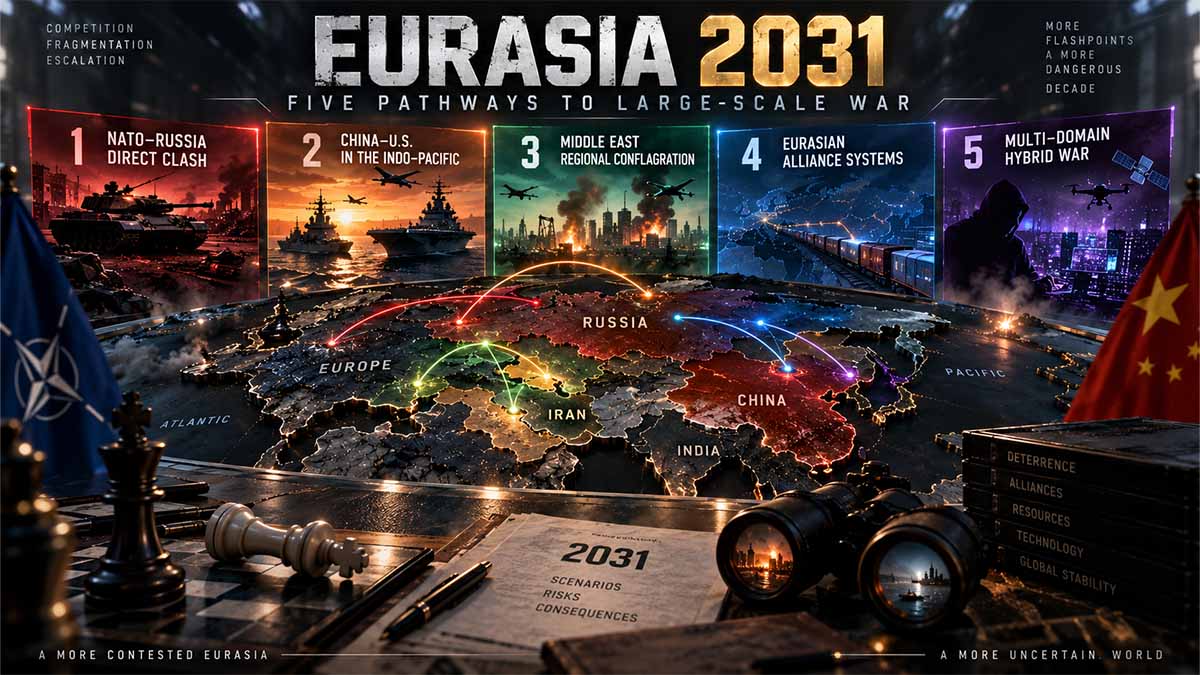
The Analysis of Competing Hypotheses produces five distinct pathways rather than one deterministic forecast. H₁—managed attrition holds that deterrence, resource constraints and elite aversion to uncontrolled war keep violence geographically bounded; it remains the modal outcome. H₂—accidental spillover anticipates that a missile, drone, aircraft, naval encounter or electronic-warfare effect generates casualties on allied territory and forces a politically visible response. H₃—deliberate limited test envisages a calibrated operation against a peripheral position, logistics node or vulnerable partner intended to fracture an opposing coalition without triggering general war. H₄—multi-theatre coupling assumes that overlapping crises in Europe and East Asia overwhelm diplomatic attention, intelligence capacity, munitions inventories and reinforcement plans, creating incentives for opportunistic action. H₅—strategic-system failure covers the most dangerous but least likely sequence: attacks on nuclear command-and-control, early-warning, space, energy or reactor-support infrastructure are interpreted as preparations for disarming escalation. The 2026 U.S. Intelligence Community assessment states both that armed conflict is becoming more common and that unresolved regional conflicts create interconnected risks; it separately judges that continuation of the Ukraine war increases the risk of inadvertent as well as deliberate escalation into direct Russia–NATO conflict—Annual Threat Assessment of the U.S. Intelligence Community – Office of the Director of National Intelligence – March 2026. Because that document represents a U.S. institutional perspective, this report treats it as evidence about capabilities, warning judgments and Washington’s decision environment—not as proof of adversarial intent. The central forecast therefore rests on convergent mechanisms: persistent military contact, increasingly heterogeneous delivery systems, shortened warning cycles, contested attribution and the possibility that leaders believe delay is more dangerous than action.
A transparent Bayesian estimate begins with an 18% prior probability of sustained direct major-power combat somewhere in Eurasia during a five-year window, derived as a structured baseline rather than a frequency obtained from a stable historical reference class. Evidence concerning the continuing European war, nuclear modernization, hybrid confrontation, crisis coupling and reduced strategic transparency increases the central posterior to approximately 28%, with a defensible uncertainty interval of 22–34%. This figure is an analytic judgment, not an actuarial probability: alternative priors and correlations materially change the result. A Monte Carlo stress model using correlated annual hazards assigns approximately 57% of escalation runs to Russia–NATO spillover or deliberate testing, 21% to Indo-Pacific conflict that pulls Eurasian allies into direct hostilities, 12% to Caucasus or Central Asian contagion, and 10% to strategic-infrastructure or nuclear-command misinterpretation. The most important result is non-linearity. A single adverse indicator—an exercise, mobilization measure or cyber incident—raises risk only modestly; three mutually reinforcing indicators can more than double it because they degrade reassurance simultaneously. The physical danger is visible around nuclear infrastructure. In August 2026, the IAEA reported repeated nearby military activity, drone incidents involving the cooling pond and spent-fuel-storage area, loss of normal external-power resilience, and reliance on diesel deliveries; it warned that absent restored power or additional fuel the Zaporizhzhya plant could face station blackout within approximately ten days—Update 364: IAEA Director General Statement on Situation in Ukraine – International Atomic Energy Agency – August 2026. A reactor emergency would not automatically cause interstate war, but it could produce mass disruption, contradictory attribution claims, urgent cross-border protective measures and political pressure for retaliation before forensic certainty exists.
The five-year outlook contains a paradox: rearmament can lower the probability of successful coercion while raising short-term sensitivity to hostile interpretation. The European Union’s Readiness 2030 architecture targets air and missile defence, drones, cyber capabilities, strategic enablers, industrial output and four flagship projects covering the eastern flank, drone defence, air defence and space—White Paper for European Defence: Readiness 2030 – European Commission and High Representative – March 2025. Its SAFE instrument provides up to €150 billion in long-maturity loans, while the wider plan is intended to leverage more than €800 billion in defence spending; procurement rules generally limit components originating outside the EU, EEA-EFTA states and Ukraine to 35% of end-product component cost—SAFE: Council Adopts €150 Billion Boost for Joint Procurement on European Security and Defence – Council of the European Union – May 2025. These measures may improve deterrence after production, stockpiles, trained formations and command integration mature. Before then, procurement announcements can outrun deployable capacity, producing a transition in which political commitments are expansive but inventories remain constrained. Shadow dimensions amplify this vulnerability: deniable auxiliaries and proxies blur state control; cyber operations can manipulate logistics or warning data without creating visible battle damage; electronic interference can resemble attack preparation; sanctions evasion and commodity payments sustain war-making capacity outside transparent banking channels; and defence-sector liquidity may concentrate in firms whose production depends on fragile explosives, energetics, semiconductor and machine-tool supply chains. The decisive warning question for 2026–2031 is consequently not whether any government publicly announces an intention to begin continental war. It is whether several actors come to believe—at the same time—that their strategic position will deteriorate unless they move first.
Five-Path Conflict Risk Engine
The European Escalation System: From Ukraine to the Arctic, 2026–2031
A single conflict system, not six independent theatres
Europe’s principal security theatres no longer operate as separable geographical compartments. Ukraine, Belarus, the Baltic Sea, the Black Sea, NATO’s eastern flank and the High North form a connected escalation system in which military activity in one sector redistributes surveillance, air defence, naval assets, logistics capacity and political attention across the others. The controlling variable is therefore not the probability of an isolated Russian attack on a specific state, but the probability that a regional incident activates operational commitments, reinforcement mechanisms and threat perceptions elsewhere before diplomacy can arrest the sequence. NATO currently maintains nine multinational Forward Land Forces battlegroups in Bulgaria, Estonia, Finland, Hungary, Latvia, Lithuania, Poland, Romania and Slovakia; the Alliance states that these formations are integrated into its command structure and can be reinforced by high-readiness and heavier follow-on forces. Germany’s brigade in Lithuania is intended to reach up to 5,000 personnel by 2027, while Canada planned persistently deployed brigade capabilities in Latvia involving up to 2,200 Canadian troops by 2026. NATO also launched Baltic Sentry in January 2025, Eastern Sentry in September 2025 and a ninth multinational battlegroup in Finland in June 2026—Strengthening NATO’s Eastern Flank – North Atlantic Treaty Organization – June 2026. These measures strengthen deterrence by increasing the certainty that aggression would immediately involve several allied governments. They simultaneously intensify “entanglement exposure”: a strike, drone incursion or infrastructure incident may harm personnel from multiple states and convert a geographically limited event into a coalition-level decision. NATO’s official position is that its posture is defensive and proportionate; Moscow’s official narrative interprets much of the same architecture as an approaching military threat. The analytic danger resides in that divergence, because escalation can emerge even when neither side accepts the other’s description of its own intentions.
| Theatre | Primary military function | Principal escalation trigger | Cross-theatre transmission mechanism | Five-year warning priority |
|---|---|---|---|---|
| Ukraine | High-intensity attrition; operational adaptation | Attacks affecting allied territory, personnel or strategic systems | Reinforcement, logistics, intelligence and air-defence demand | Strategic strike geography and changing support rules |
| Belarus | Russian strategic depth; western-axis staging; air defence | Deployment changes, exercises, dual-capable systems | Pressure on Poland, Lithuania, Latvia and Ukrainian northern defence | Force permanence, ammunition storage and command integration |
| Baltic | NATO forward defence; maritime surveillance | Airspace violation, cable disruption, blockade-like interference | Article 4 consultations, multinational casualties, naval concentration | Attribution quality and restoration of infrastructure |
| Black Sea | Strike, logistics, energy and maritime access | Attack on commercial shipping or allied littoral territory | Insurance shock, Turkish decisions, reinforcement of Romania/Bulgaria | Shipping exclusion patterns and coastal missile posture |
| Arctic | Strategic deterrence, submarine access, reinforcement routes | Unsafe interception or pressure on critical infrastructure | North Atlantic reinforcement and nuclear-force alerting | Dual-use activity near strategic bases and sea lanes |
Ukraine as the system’s continuously active reactor
Ukraine remains the only theatre in which recurrent large-scale conventional violence, long-range strike operations, electronic warfare, infrastructure attacks and external military support coexist continuously. That makes it the system’s “active reactor”: it produces tactical innovations and political shocks that migrate into NATO planning even when the fighting remains within Ukrainian territory. NATO’s support architecture has become institutional rather than episodic. NATO Security Assistance and Training for Ukraine, headquartered in Wiesbaden with approximately 300 personnel and three logistical hubs in the eastern Alliance, coordinates equipment, training, maintenance and sustainment on allied territory. The Prioritised Ukraine Requirements List, launched in July 2025, had funded more than USD 6 billion in U.S.-sourced equipment by July 2026; NATO records an allied pledge of €70 billion in military equipment, assistance and training for 2026 and an intention to sustain at least an equivalent level in 2027—Relations with Ukraine – North Atlantic Treaty Organization – July 2026. These figures demonstrate political and logistical depth but do not by themselves establish deployable combat power, delivery schedules or stockpile sufficiency. The escalation question is where coordination ends and operational participation begins in the perceptions of each belligerent. International law, NATO doctrine and Russian strategic messaging do not necessarily draw that line in the same place. The highest-risk pathway is not ordinary delivery of equipment; it is a change in the geography or operational intimacy of support—for example, the presence of allied personnel near strike systems, expanded targeting assistance, air-defence engagements across borders, or attacks on logistical nodes whose national and military status is contested. Ukraine’s endurance reduces incentives for successful coercion, but a protracted war also multiplies opportunities for an incident that confronts NATO governments with a credibility choice: absorb visible harm and risk deterrence erosion, or retaliate and risk vertical escalation.
Belarus as a compression chamber between Russia and NATO
Belarus converts the Ukraine war’s northern flank into a direct interface with Poland, Lithuania and Latvia, while compressing the distance between Russian military infrastructure and NATO territory. Its strategic significance derives less from the independent mass of the Belarusian armed forces than from geography, Russian access, integrated air-defence arrangements, recurring exercises and the political construction of the Russia–Belarus Union State. The Kremlin stated in December 2025 that Union State security commitments had been addressed through Russian–Belarusian military activity and publicly described the security of the Union State as guaranteed by the two countries’ armed forces—Expanded Meeting of the Defence Ministry Board – President of Russia – December 2025; Results of the Year with Vladimir Putin – President of Russia – December 2025. These are official Russian representations and must not be treated as independently validated descriptions of deployments or intentions. They nevertheless reveal the decision frame through which Moscow may interpret military pressure on Belarus: not as a local matter involving an autonomous neighbour, but as a security issue affecting a combined strategic space. The Suwalki corridor is consequently important not because open-source evidence proves an imminent operation there, but because it concentrates competing military requirements in a narrow geography between Belarus and Russia’s Kaliningrad region. NATO must preserve reinforcement routes into Lithuania, Latvia and Estonia; Russia must account for Kaliningrad’s exposure and the surveillance of Belarusian territory; Poland and Lithuania must distinguish exercises, force protection and possible attack preparation. Over the next five years, the most diagnostic indicators will be permanent rather than rotational Russian command elements, hardened storage, pre-positioned engineering equipment, field hospitals, transport-control measures, air-defence relocation and unusual ammunition flows. A large exercise without those enabling signatures is less alarming than a smaller deployment accompanied by logistical permanence and restrictive airspace measures.
The Baltic escalation ladder: attribution before retaliation
The Baltic theatre contains the densest convergence of alliance territory, Russian access routes, commercial shipping, undersea energy and communications infrastructure, air-policing missions and short-warning military geography. Finland’s and Sweden’s accession to NATO improved allied geographical coherence and surveillance possibilities, but it also transformed most of the Baltic coastline into allied territory and extended the Russia–NATO interface into the Gulf of Finland and High North. NATO reports that Baltic Sentry employs frigates, maritime-patrol aircraft and naval drones while integrating national surveillance assets to protect critical undersea infrastructure. The Alliance also reports a series of airspace violations during September 2025 involving Estonia, Finland, Latvia, Lithuania, Norway, Poland and Romania, followed by the launch of Eastern Sentry with additional fighters, helicopters, surveillance aircraft, air defences and frigates—Strengthening NATO’s Eastern Flank – North Atlantic Treaty Organization – June 2026. These are NATO-attributed events; an intelligence-quality assessment must retain separate confidence judgments for detection, technical attribution, command attribution and proof of state direction. The escalation ladder begins with an anomalous event, advances through public attribution and protective deployment, and becomes dangerous when precautionary military movement is interpreted as preparation for punitive action. Undersea incidents are especially destabilising because the physical evidence may be damaged, commercially controlled, difficult to recover or compatible with accident, negligence and deliberate action. Article 5 does not mechanically activate after every hostile event: NATO states that whether cyber, hybrid or space activity constitutes an armed attack is assessed case by case, and assistance may take forms other than armed force—Collective Defence and Article 5 – North Atlantic Treaty Organization – November 2025. That flexibility supports proportionality, but it also creates uncertainty that adversaries may test below an assumed threshold.
| Baltic warning layer | Observable indicator | Benign or limited explanation | Escalatory interpretation | Required confidence gate |
|---|---|---|---|---|
| Detection | Cable failure, drone track, navigation disruption | Accident, weather, operator error | Reconnaissance or covert attack | Multi-sensor corroboration |
| Technical attribution | Device signature, vessel proximity, malware family | Shared technology or commercial presence | Actor-linked capability | Forensic chain of custody |
| Organisational attribution | Repeated network, tasking pattern, financial link | Criminal or private activity | Proxy relationship | Intelligence-source convergence |
| State direction | Command traffic, official protection, coordinated operations | Post-event exploitation | Authorised state operation | Senior political review |
| Response selection | Patrols, sanctions, interdiction, military alert | Defensive reassurance | Preparation for retaliation | Deconfliction notification |
The Black Sea: the maritime hinge between war and commerce
The Black Sea is the European escalation system’s maritime hinge because operational strike activity intersects with commercial navigation, energy terminals, grain routes, coastal air defence and the Montreux Convention’s legal architecture. Ukraine’s coastline, Russian-controlled Crimea, NATO members Türkiye, Romania and Bulgaria, and the non-NATO littoral states Georgia and Moldova create a political geometry in which maritime incidents can acquire strategic consequences without initially involving major naval combat. NATO’s eastern-flank chronology records increased Alliance activity after the November 2018 confrontation in the Black Sea, expanded support for Ukrainian and Georgian maritime forces, and the post-2022 reinforcement of the southeastern flank with ships, aircraft, troops and multinational formations—Strengthening NATO’s Eastern Flank – North Atlantic Treaty Organization – June 2026. The five-year hazard is driven by four overlapping ambiguities: whether a merchant vessel is carrying military cargo; whether an attack is deliberate, misdirected or produced by a drifting mine; whether coastal surveillance or targeting information constitutes direct participation; and whether an incident inside an allied exclusive economic zone, territorial sea or port reaches the threshold of an armed attack. Türkiye occupies the pivotal position because it combines NATO membership, control of straits access under the Montreux framework, substantial regional military capability and a continuing interest in preventing the Black Sea from becoming an unrestricted arena for external naval competition. The most plausible escalation is therefore not a symmetrical fleet engagement. It is a chain involving a strike or mine incident, casualties aboard internationally owned shipping, a sharp rise in war-risk insurance, escort demands, coastal air-defence deployments and competing exclusion zones. Such a chain would transmit economic pressure rapidly: shipping liquidity, insurance availability and port operability could deteriorate before governments agree on attribution, compressing decision time and increasing pressure for visible military protection.
The Arctic and High North: nuclear geometry under commercial cover
The Arctic differs from the Baltic and Black Sea because routine military contact occurs near strategic nuclear infrastructure, submarine operating areas and reinforcement routes linking North America to Europe. Climatic access, surveillance technology and dual-use commercial activity increase traffic while making intent harder to infer. NATO announced Arctic Sentry in February 2026 to consolidate operational direction and situational awareness across the High North; its commands describe the activity as integrating allied national efforts and strengthening monitoring, deterrence and defence—Arctic Sentry Enhances Allied Cold-Weather Operations and Readiness – Supreme Headquarters Allied Powers Europe – March 2026. NATO’s wider eastern-flank posture now extends explicitly from the Arctic Ocean to the Black Sea, while the Finland battlegroup creates an additional organised allied presence near Russia’s northwestern strategic region. Moscow, conversely, treats the High North as essential to national defence, strategic deterrence and access to the Northern Sea Route. The resulting risk is less a deliberate Arctic land war than inadvertent interaction between anti-submarine warfare, strategic-force protection, air interception and reinforcement activity. A platform conducting lawful surveillance may be interpreted as mapping a deterrent patrol; a cyber operation against port or satellite infrastructure may be read as pre-conflict preparation; a submarine accident or seabed-system failure may generate suspicion that cannot be rapidly resolved. Escalation control is especially difficult where capabilities are dual-use: aircraft, satellites, undersea sensors and long-range missiles can support conventional operations while also affecting nuclear warning and command. Indicators requiring exceptional attention include changes in strategic submarine dispersal, unusual protection around Northern Fleet facilities, altered bomber patrol profiles, interference with satellite navigation, closure of maritime or air areas beyond exercise norms, and coordinated cyber reconnaissance of Norwegian, Finnish or North Atlantic logistics infrastructure.
The shadow battlespace: proxies, cyber norms and liquidity
The European escalation system’s most active layer may remain below the threshold of acknowledged armed conflict. Proxy organisations, commercially registered vessels, criminal facilitators, ostensibly private cyber groups, foreign volunteers and sanctions-evasion networks enable states to impose costs while preserving deniability. “Mercenary dynamics” should be interpreted broadly: the relevant category includes not only formal private military companies but also recruited foreign personnel, security contractors, technical advisers, maritime intermediaries and ideologically motivated formations whose relationship with state command varies over time. Their danger lies in weak negative control. A government may benefit from an actor’s activity without possessing the ability to prevent tactical actions that create strategic liability. Cyber operations introduce a parallel problem because espionage, access preparation and attack can use overlapping infrastructure. Persistent access to railway control, port management, energy distribution or military-logistics networks may be collected for intelligence, maintained for contingency use or activated coercively; defenders cannot safely assume the least dangerous interpretation during a crisis. NATO explicitly states that significant cyber and other hybrid attacks may, depending on circumstances, be considered armed attacks under Article 5—Collective Defence and Article 5 – North Atlantic Treaty Organization – November 2025. Liquidity flows complete the shadow system. Defence production depends on advance payments, working capital, long-lead energetics, specialist chemicals, machine tools and semiconductor components, while covert procurement networks exploit re-export jurisdictions, layered ownership and trade finance. The European Commission’s European Defence Industry Programme carries an €1.5 billion EU-level envelope to strengthen production capacity—EDIP: Forging Europe’s Defence – European Commission – 2026—but headline financing does not reveal bottleneck resolution. Strategic warning must track factory throughput, supplier solvency, insurance withdrawal, export-control circumvention and the conversion of announced contracts into delivered munitions.
| Shadow dimension | Low-visibility activity | Strategic effect | Escalation threshold |
|---|---|---|---|
| Proxy manpower | Recruitment, training, technical contracting | Expands capacity without formal mobilisation | Verified state tasking of attacks on allied territory |
| Cyber access | Credential theft, network mapping, dormant persistence | Creates latent disruption options | Destructive effect causing major physical or human loss |
| Maritime deniability | Ownership layering, flag changes, opaque chartering | Supports sanctions evasion or covert logistics | Coordinated hostile action against protected infrastructure |
| Defence liquidity | Advance payments, state guarantees, supplier consolidation | Determines sustainable production, not merely orders | Sudden financing or input disruption during mobilisation |
| Information operations | Fabricated evidence, attribution flooding, forged orders | Delays consensus and fractures coalitions | Manipulation of command or emergency-warning systems |
Competing hypotheses and Bayesian update
The structured assessment tests five hypotheses. H₁—bounded attrition predicts that the war in Ukraine continues or freezes without sustained Russia–NATO combat because nuclear deterrence, economic cost and command discipline dominate. H₂—accidental horizontal spillover predicts that a missile, drone, aircraft, mine or maritime interception causes allied casualties and elicits a limited military response. H₃—deliberate threshold testing predicts a controlled hostile act against infrastructure, airspace or a peripheral allied asset designed to expose political division without inviting general war. H₄—Belarus–Baltic compression predicts that exercises, reinforcement and an incident around Poland, Lithuania, Latvia or Kaliningrad create reciprocal mobilisation that becomes self-sustaining. H₅—multi-theatre strategic breakdown predicts that simultaneous Baltic, Black Sea or Arctic incidents interact with attacks on command, nuclear-support or space systems and generate a rapid escalation beyond intended limits. Starting from a structured prior of 11% for sustained direct Russia–NATO combat during a five-year period, the assessment applies qualitative likelihood ratios to observed persistence of high-intensity war, enduring NATO support structures, forward-force expansion, repeated air and maritime contact, hybrid-attack allegations and Arctic militarisation. Offsetting evidence includes the absence of publicly verified preparations for general mobilisation against NATO, continuing sensitivity to nuclear escalation and the availability of graduated Article 4 and Article 5 responses. The resulting central posterior is 18%, with a 12–25% credible judgment interval. This is not a statistical frequency or classified estimate. It is a transparent, sensitivity-tested probability conditioned on information available through September 2026. China’s official diplomatic position provides an external counterpoint: Beijing continues to endorse negotiations and a political settlement while seeking a process acceptable to both Moscow and Kyiv—Wang Yi on the Ukraine Crisis: The Earlier the Talks Start, the Sooner Peace Will Arrive – Ministry of Foreign Affairs of the People’s Republic of China – March 2024. That position indicates diplomatic preference, not demonstrated leverage over escalation decisions.
| Hypothesis | Prior weight | Evidence consistency | Five-year analytic weight | Principal falsifier |
|---|---|---|---|---|
| H₁ Bounded attrition | 55% | High | 45% | Permanent cross-border combat between Russian and NATO forces |
| H₂ Accidental spillover | 18% | Medium-high | 23% | Durable incident-management mechanism with verified attribution channels |
| H₃ Threshold testing | 13% | Medium | 15% | Sustained decline in hybrid activity and military probing |
| H₄ Belarus–Baltic compression | 9% | Medium | 10% | Reduced force integration and verified withdrawal of enabling systems |
| H₅ Strategic breakdown | 5% | Low-medium | 7% | Renewed arms-control transparency protecting nuclear-support systems |
Monte Carlo pathways and the 2026–2031 warning horizon
A Monte Carlo model of 100,000 synthetic five-year pathways was constructed to test sensitivity rather than predict an objectively measurable future. Annual hazards were assigned to six correlated drivers: Ukraine strike expansion, NATO–Russia contact, Belarusian force integration, Baltic infrastructure incidents, Black Sea maritime disruption and Arctic strategic-system interaction. A common escalation factor introduced correlation, preventing the model from falsely treating theatre shocks as independent. Deterrence resilience, attribution quality and crisis communications acted as dampeners. Under the baseline parameter set, sustained direct Russia–NATO combat reaches 18% cumulative probability by 2031; the containment case reaches 11%, while a stress case combining degraded communications, two overlapping infrastructure incidents and elevated nuclear signalling reaches 38%. Approximately 41% of baseline escalation runs originate in Ukraine-related spillover, 24% in Baltic incidents, 15% through Belarus–Baltic mobilisation, 12% in the Black Sea and 8% in the Arctic. These shares describe modeled initiation pathways, not verified empirical frequencies. The most important model result is interaction: raising any single driver by 20 percentage points increases five-year risk by roughly two to four points, but raising Baltic attribution failure, Belarusian mobilisation and nuclear signalling together increases it by more than ten points. This non-linearity explains why strategic-warning systems should not issue isolated alarms. A more rigorous architecture uses compound indicators: kinetic event plus uncertain attribution; logistics movement plus command changes; nuclear signalling plus early-warning disruption; maritime casualty plus escort mobilisation. The model also shows that deterrence investment is temporally asymmetric. New formations and industrial capacity can reduce risk once operationally credible, yet deployment transitions increase movement, exercises and intelligence uncertainty before they mature. The dangerous window is therefore not simply “before Europe rearms” or “after Russia regenerates”; it is the period during which both sides revise plans and attempt to infer the other’s readiness.
Five-year outlook: the decisive variables
Between late 2026 and 2031, the modal outcome remains heavily armed confrontation without general European war, but the system will become more densely instrumented, faster and less tolerant of ambiguity. European policy is moving toward permanent readiness rather than temporary crisis response. The Commission’s Readiness 2030 framework identifies missile defence, drones, cyber capabilities and strategic enablers as priority gaps and proposes Eastern Flank Watch, a European Drone Defence Initiative, a European Air Shield and a European Space Shield—White Paper for European Defence: Readiness 2030 – European Commission and High Representative – March 2025. The associated SAFE instrument supplies up to €150 billion in long-maturity loans, while the broader plan is designed to leverage more than €800 billion in defence expenditure—SAFE: Council Adopts €150 Billion Boost for Joint Procurement on European Security and Defence – Council of the European Union – May 2025. The operational effect will depend on delivery, interoperability, trained personnel, protected logistics and ammunition depth rather than authorised finance alone. Risk should decline if Ukraine obtains a durable settlement with enforceable monitoring, Russia and NATO restore military deconfliction, infrastructure attribution becomes faster and both sides establish exclusions around nuclear-support systems. Risk will rise if fighting expands geographically, Belarus hosts more permanent enabling forces, Baltic incidents produce casualties, commercial navigation becomes militarily escorted, Arctic surveillance threatens strategic platforms, or cyber operations compromise warning data. The central judgment is therefore conditional: 18% is not destiny, and it should not be quoted without its assumptions. A compound breakdown involving two theatres, failed communications and ambiguous strategic-system interference would move the posterior above 35%; verified restraint mechanisms and a monitored settlement could push it below 10%.
Five-Year Russia–NATO Direct-Conflict Projection
Cumulative modeled probability • analytic scenarios, not empirical frequencies
Eurasian Crisis Coupling: The Architecture of Strategic Opportunism, 2026–2031
Coupling, not simultaneity, defines the systemic threat
Eurasian crisis coupling occurs when conflict or coercion in one theatre materially changes the capabilities, incentives, risk tolerance or decision time of actors in another. Two crises unfolding simultaneously are not necessarily coupled: a border confrontation in Central Asia and military exercises near Taiwan may remain operationally independent. Coupling begins when the first event consumes scarce air-defence interceptors, surveillance aircraft, sealift, political attention, fiscal headroom or alliance credibility; creates intelligence gaps elsewhere; or persuades a second actor that the temporary redistribution of adversary power has opened an exploitable window. The Eurasian system therefore extends beyond geography. It links the Taiwan Strait, the Korean Peninsula, the Russia–Ukraine war, the South Caucasus and Central Asia through military inventories, command attention, industrial supply chains, sanctions networks, transport corridors and expectations regarding U.S., Chinese, Russian, Japanese and European resolve. The 2026 U.S. Intelligence Community assessment describes a security environment in which armed conflict is becoming more common, capabilities are improving and unresolved regional disputes generate interconnected risks. It separately identifies Russia’s relationships with China, Iran and North Korea, Chinese military preparations concerning Taiwan, Korean support to Russia, and instability around Afghanistan and Pakistan—Annual Threat Assessment of the U.S. Intelligence Community – Office of the Director of National Intelligence – March 2026. That document reflects a U.S. institutional viewpoint and cannot independently establish the intentions of the governments it assesses. Its analytical value lies in revealing how Washington—the only actor carrying major alliance obligations in both Europe and East Asia—organises these challenges within one warning framework. A five-year assessment must consequently measure not only the probability of each crisis, but the probability that one crisis changes behaviour in another before reserves, diplomacy and alliance coordination can recover.
| Coupling channel | Scarce or vulnerable resource | First-theatre demand | Second-theatre consequence | Primary warning measure |
|---|---|---|---|---|
| Military | Air defence, submarines, ISR, lift, munitions | Rapid force concentration | Reduced deterrent visibility elsewhere | Asset reassignment and readiness notices |
| Political | Leadership time, legislative consent, coalition unity | Emergency diplomacy | Slower or less credible response | Decision-cycle delay |
| Industrial | Propellants, chips, explosives, shipyard capacity | Accelerated replenishment | Delivery slippage in another command | Contract-to-delivery gap |
| Financial | Budget headroom, trade credit, insurance | Sanctions and mobilisation costs | Liquidity repricing across corridors | Sovereign spreads and war-risk premiums |
| Informational | Collection, translation, attribution capacity | Crisis saturation | Strategic surprise or false warning | Coverage loss and analytic backlog |
| Normative | Thresholds for blockade, cyberattack and intervention | Precedent established | Copying or testing of the precedent | Official legal characterisation |
China–Taiwan: coercion as a continuously adjustable campaign
The Taiwan vector is not reducible to a binary choice between peace and amphibious invasion. Beijing possesses an escalation spectrum that includes diplomatic isolation, economic restriction, cyber operations, legal warfare, persistent air and maritime activity, quarantine-like inspection, blockade, seizure of peripheral islands, precision strikes and full-scale assault. Each option imposes different mobilisation signatures and creates a different intervention problem for the United States and Japan. The 2026 U.S. assessment judges that Beijing probably continues to prefer unification without conflict while maintaining force as an available instrument; it states that U.S. intelligence did not assess Chinese leaders as currently planning an invasion in 2027 or operating against a fixed unification timetable. The same assessment records continued, uneven development of the capabilities required to seize Taiwan and deter or defeat possible U.S. intervention, while recognising the exceptional difficulty and high failure risk of an amphibious invasion—Annual Threat Assessment of the U.S. Intelligence Community – Office of the Director of National Intelligence – March 2026. These judgments narrow neither the risk of a blockade nor that of a coercive demonstration escalating accidentally. Beijing’s own official formulation is uncompromising on sovereignty: a June 2026 Foreign Ministry publication describes the Taiwan question as China’s internal affair, complete reunification as a historic mission, and external support for Taiwanese independence as incompatible with cross-Strait stability—A New Blueprint for China–U.S. Relations as Seen Through the Summit – Ministry of Foreign Affairs of the People’s Republic of China – June 2026. This is an official Chinese position, not an adjudication of international status. The coupling danger arises when Beijing interprets U.S. engagement elsewhere as weakening intervention capacity, while Washington interprets expanding Chinese operations as requiring visible counter-deployment. Both can respond rationally to their own indicators and still create an escalating mobilisation contest.
Taiwan’s connection to the European war
The strongest cross-theatre mechanism joins the Taiwan Strait to the European war through U.S. force allocation, allied burden-sharing and industrial replenishment. If Europe remains heavily dependent on American strategic enablers, long-range air defence, intelligence architecture and selected precision munitions, an Asian crisis would force Washington to adjudicate competing theatre requirements rather than merely add resources. Conversely, a Taiwan contingency could compel European governments to assume more of Ukraine’s support burden precisely when their defence industries are scaling but have not eliminated critical bottlenecks. This is where strategic opportunism becomes plausible without requiring formal coordination between Moscow and Beijing. Russia need not receive advance notice of Chinese action to exploit the redistribution of U.S. surveillance, naval power or senior-level political attention; China need not coordinate with Russia to benefit from European stockpile depletion or an alliance dispute over burden-sharing. Opportunism may be anticipatory: if either actor believes a crisis is approaching, it may increase coercion beforehand to pin adversary assets in place. The industrial transmission mechanism is equally important. Advanced semiconductors, machine tools, energetics, satellite services and shipping insurance connect East Asian production to European war sustainment. The U.S. Intelligence Community warns that a China–Taiwan conflict would disrupt access to semiconductor technology, transportation and wider global supply chains, even without direct U.S. participation—Annual Threat Assessment of the U.S. Intelligence Community – Office of the Director of National Intelligence – March 2026. Europe’s exposure is not limited to lost electronics imports: a market shock would affect collateral values, maritime finance, energy demand, export earnings and the public cost of rearmament. Thus, an East Asian crisis could weaken European military liquidity before a single European unit redeploys.
| Taiwan contingency | Likely initial signature | Immediate Eurasian coupling | Opportunistic opening | Key falsifier |
|---|---|---|---|---|
| Political-economic coercion | Customs, sanctions, diplomatic pressure | Trade and market repricing | Russian pressure below NATO threshold | Stable shipping and no military dispersal |
| Maritime quarantine | Inspection zones, coast-guard concentration | Insurance withdrawal and naval diversion | Intensified pressure in Ukraine or Baltic | Rapid negotiated inspection mechanism |
| Blockade | Sustained exclusion, missile and air cover | U.S. force concentration; allied stockpile stress | Korean or Russian military probing | Effective multinational de-escalation |
| Limited strikes | Precision attacks on selected systems | Immediate alliance consultations | Parallel regional mobilisation | Verified bounded objectives and ceasefire |
| Invasion attempt | Mass logistics and joint-fire preparation | Full strategic reallocation | Maximum multi-theatre opportunism | Demobilisation of enabling formations |
Korea: a vertical-escalation accelerator with European feedback
The Korean Peninsula creates a different coupling profile because its central risk is rapid vertical escalation under nuclear conditions rather than a prolonged maritime coercion campaign. North Korea can generate strategic effects through missile launches, artillery activity, cyber operations, force mobilisation or nuclear signalling without initiating a general war. The short distances, hardened command systems, large conventional forces and compressed warning times reduce the space for reversible decisions. The European connection has become more concrete through Russia–North Korea military cooperation. The 2026 U.S. intelligence assessment states that North Korean personnel obtained combat experience and military technology from Russia through participation in operations connected to the Ukraine war—Annual Threat Assessment of the U.S. Intelligence Community – Office of the Director of National Intelligence – March 2026. This remains a U.S. intelligence judgment; open-source analysis cannot convert undisclosed exchanges into precise capability estimates. The strategic implication, however, is measurable in principle: combat learning can affect tactical adaptation, drone employment, electronic warfare, logistics and command resilience, while transfers to Russia can affect European munition balances. Korea therefore couples with Europe through both material flows and operational learning. A Korean crisis would also demand U.S. missile-defence, intelligence and command attention at the same time that Japan’s bases and political decisions become essential to American operations. If Taiwan tensions were already elevated, North Korean activity could create a two-front Northeast Asian burden even without coordination with Beijing. The reverse pathway is equally significant: a Taiwan blockade could encourage Pyongyang to conduct coercive demonstrations because U.S. attention is divided, while China might become more cautious about Korean instability if it required strategic control over events around Taiwan. Coupling can therefore increase or suppress escalation depending on which actor fears loss of control most.
The Caucasus: peace architecture inside a geopolitical corridor contest
The South Caucasus entered a materially different phase after Armenia and Azerbaijan initialled the text of an agreement on peace and interstate relations and signed a joint declaration in Washington on 8 August 2025. The United States subsequently published the declaration and associated documents, while the European Union welcomed the initialling and offered support for connectivity and regional opening—United States Publishes Documents from Historic Armenia and Azerbaijan Meeting – U.S. Department of State – August 2025; Joint Statement on the Initialling of the Armenia–Azerbaijan Peace Treaty – European Council and European Commission – August 2025. The Armenian government’s published declaration confirms that the parties recognised the need to continue toward signature and ratification and endorsed unblocking communications on the basis of sovereignty, territorial integrity and jurisdiction—Joint Declaration by the President of Azerbaijan and Prime Minister of Armenia – Office of the Prime Minister of Armenia – August 2025. Initialling is not equivalent to complete implementation. Border delimitation, domestic constitutional politics, security guarantees, transport governance and public acceptance remain relevant failure points. The coupling value of the region is disproportionate to its size because corridors through Armenia, Azerbaijan and Georgia connect the Caspian basin, Türkiye, Europe and Central Asia. A stable settlement could diversify trade and energy access; a contested corridor could draw diplomatic or coercive involvement from Russia, Türkiye, Iran, the United States and the EU. The principal five-year risk is therefore not necessarily renewed total war between Armenia and Azerbaijan, but implementation failure interacting with external competition over transit rights and regional influence.
Central Asia: stability exposed to Afghanistan, water and succession
Central Asia’s coupling mechanisms are less visible than those of Taiwan or Korea but potentially more diffuse. Kazakhstan, Kyrgyzstan, Tajikistan, Turkmenistan and Uzbekistan occupy the space between Russia, China, Afghanistan, Iran and the Caspian, while participating in overlapping security, trade and infrastructure institutions. The region’s principal stressors are transnational militancy, Afghan instability, water and energy disputes, border management, labour migration, sanctions circumvention, elite succession and competition over transport corridors. None independently makes interstate war probable; their interaction can produce sudden instability in states whose security forces, fiscal capacity and political institutions vary considerably. The United Nations assesses Central Asia as exposed to terrorism because of proximity to Afghanistan and conflict-affected parts of the Middle East, shared borders, cross-border networks and online recruitment. In response, the UN Counter-Terrorism Office and the UN Regional Centre for Preventive Diplomacy for Central Asia developed a regional early-warning network involving national institutions and engagement with bodies including the SCO Regional Anti-Terrorist Structure, the CIS Anti-Terrorism Centre and regional coordination organisations—High-Level Briefing on the Counter-Terrorism Early Warning Network for Central Asia – United Nations Office of Counter-Terrorism and UNRCCA – July 2025. The system’s coupling risk is strongest where domestic disorder invites competing external assistance. Russia may regard security intervention as connected to its regional position; China prioritises border security, economic corridors and protection of investments; Türkiye expands linguistic, commercial and defence relationships; and regional governments seek diversification without surrendering autonomy. A succession crisis or violent border event could therefore become a test of which external actor can provide security, credit and political recognition fastest, while conflict elsewhere constrains or redirects that response.
Afghanistan–Pakistan spillover as Central Asia’s southern pressure front
Afghanistan is not one of the five Central Asian republics, but it is the principal southern transmission belt connecting their security environment to Pakistan, Iran, China and the wider Middle East. The threat is not a straightforward northward invasion. It is the movement of militants, weapons, narratives, refugees, illicit finance and border-security demands through heterogeneous terrain and weakly integrated institutions. A June 2025 report of the UN Secretary-General documented Afghanistan’s continuing political, humanitarian and security challenges under the de facto authorities—The Situation in Afghanistan and Its Implications for International Peace and Security – United Nations Secretary-General – June 2025. The United Nations’ Central Asian early-warning programme treats developments concerning Afghanistan as a cross-border monitoring priority rather than a problem contained within Afghan territory. This distinction is critical for scenario design. An attack by an Afghanistan-based organisation can trigger unilateral cross-border action by a neighbouring state; that action can close trade routes, displace populations, stimulate retaliatory recruitment and force Central Asian governments to request external intelligence or military assistance. If Russia is absorbed by European commitments, its capacity or willingness to act as the region’s preferred security provider may be questioned. China could increase security assistance while remaining reluctant to assume open-ended stabilisation burdens. Türkiye, Iran and the Gulf states could expand economic or diplomatic involvement, producing a competitive but not necessarily hostile multipolar system. The main strategic-opportunism indicator is therefore not merely terrorist incident frequency. It is the political conversion of insecurity into basing access, exclusive infrastructure control, intelligence dependency or debt-linked influence. Monitoring must distinguish legitimate assistance from a durable redistribution of regional power.
Strategic opportunism without a central conspiracy
The most analytically dangerous error is to assume that simultaneous pressure proves a coordinated Eurasian master plan. Russia, China, North Korea and other actors possess overlapping grievances toward U.S.-led alliances, but their interests, escalation tolerances and preferred end states differ. Coordination requires communication, compatible timing and confidence that partners will not exploit one another. Opportunism requires much less: an actor need only observe that a rival is distracted, politically divided or materially depleted. The 2026 U.S. threat assessment explicitly notes expanding cooperation among U.S. competitors while also judging that divergent interests and concern about direct confrontation constrain its scale—Annual Threat Assessment of the U.S. Intelligence Community – Office of the Director of National Intelligence – March 2026. This supports a spectrum rather than a binary classification. At the lowest level, actors independently exploit the same global conditions. At the next, they exchange diplomatic protection, commodities, dual-use inputs or sanctions-evasion services. Higher levels involve military technology, operational learning, intelligence sharing and synchronized coercive signalling. The most consequential level—joint crisis planning—requires stronger evidence than parallel behaviour. Warning analysis should therefore reject both complacency and over-attribution. Observable indicators of deeper coordination would include complementary mobilisation timetables, unusual strategic transport, synchronized cyber reconnaissance against different theatres, shared narratives appearing before events, protected financial channels activated in advance and force movements that make little sense within a single theatre. Conversely, commercial trade growth, common diplomatic language or coincident exercises do not by themselves demonstrate an integrated war plan. The correct intelligence question is not “Are these actors allied?” but “What specific capability or decision advantage does one actor’s behaviour provide to another during the relevant crisis window?”
| Opportunism level | Behaviour | Coordination burden | Strategic danger | Required evidence |
|---|---|---|---|---|
| O₁ Independent exploitation | Pressure during another crisis | Very low | Moderate | Timing and capability alignment |
| O₂ Diplomatic-economic support | Voting, trade, payment channels | Low | Moderate | Official records and transaction patterns |
| O₃ Material enablement | Components, munitions, logistics | Medium | High | Supply-chain and end-use evidence |
| O₄ Operational learning | Training, battlefield adaptation, intelligence | Medium-high | High | Personnel, doctrine and command indicators |
| O₅ Synchronized crisis action | Complementary military operations | Very high | Critical | Advance coordination and coordinated force posture |
Five competing hypotheses
The Analysis of Competing Hypotheses produces five frameworks for 2026–2031. H₁—managed competitive pluralism holds that crises remain largely uncoupled because governments prioritise control, trade and regime survival; this is the modal hypothesis. H₂—resource coupling predicts that a Taiwan or Korean emergency indirectly degrades European deterrence by consuming U.S. assets and industrial output, but stops short of deliberate parallel aggression. H₃—opportunistic sequencing predicts that one actor increases coercion after observing a rival’s commitment elsewhere, without advance coordination. H₄—networked revisionism predictssustained material, diplomatic and technological cooperation sufficient to create complementary pressure across two or more theatres. H₅—cascade breakdown predicts that an initial conflict produces mobilisation, cyber disruption, market stress and alliance decisions that trigger a second crisis, after which the theatres become strategically inseparable. Current evidence is most consistent with H₁ and H₂, moderately consistent with H₃, partially consistent with H₄ and only weakly consistent with H₅. H₅ nevertheless dominates expected loss because it contains the highest probability of major-power combat, nuclear signalling and global economic discontinuity. The principal discriminators are timing and resource movement. Under H₂, redeployment follows the first crisis and the second theatre shows defensive adjustment. Under H₃, coercive action in the second theatre follows visible distraction but lacks prior logistical coordination. Under H₄, enabling transfers and political preparation precede both crises. Under H₅, emergency decisions, attribution failures and market effects begin driving events faster than central authorities can coordinate. This structure prevents the assessment from interpreting every Russian–Chinese contact, Korean missile event or Central Asian security agreement as evidence for the most alarming hypothesis.
| Hypothesis | Initial analytic weight | Evidence fit, September 2026 | Updated weight | Five-year signature |
|---|---|---|---|---|
| H₁ Managed competitive pluralism | 48% | Strong | 41% | Pressure continues, but crisis-control channels function |
| H₂ Resource coupling | 22% | Strong | 27% | Asset and inventory trade-offs without coordinated aggression |
| H₃ Opportunistic sequencing | 15% | Medium-high | 18% | Second actor escalates after observable distraction |
| H₄ Networked revisionism | 10% | Medium | 10% | Pre-crisis material and intelligence coordination |
| H₅ Cascade breakdown | 5% | Low | 4% | Two crises merge into direct multi-theatre confrontation |
Bayesian estimate and Monte Carlo stress architecture
The modeled event is defined narrowly as at least two Eurasian theatres becoming strategically coupled before September 2031, with the second crisis materially altering major-power deployments, military supply or alliance decisions in the first. This is broader than simultaneous warfare but narrower than ordinary geopolitical interaction. A structured prior of 17% is updated using five evidence classes: institutionalised Russia–North Korea military exchange; persistent China–Taiwan coercive competition; U.S. commitments spanning Europe and East Asia; unresolved Central Asian and Afghan security exposure; and the partial reconfiguration of South Caucasus corridors. Offsetting evidence includes Beijing’s stated preference for stability in China–U.S. relations, the absence of public evidence establishing a fixed Taiwan invasion timetable, the Armenia–Azerbaijan peace process, and the continued ability of major powers to compartmentalise disputes. The posterior central estimate is 24%, with a judgment interval of 16–34%. Conditional probabilities are more revealing than the headline: given a prolonged Taiwan blockade, the modeled probability of consequential European military-resource diversion exceeds 60%; given a Korean nuclear crisis during that blockade, the probability of a second opportunistic Eurasian pressure event rises above 45%; absent a major East Asian crisis, the probability of systemic two-theatre coupling remains near 14%. A Monte Carlo ensemble of 150,000 synthetic pathways samples correlated annual hazards, response delays, inventory scarcity, alliance cohesion and communication reliability. The baseline produces coupling in approximately 24% of paths; a resilience case with improved inventories, verified crisis channels and Caucasus implementation produces 13%; a stress case combining Taiwan maritime coercion, Korean escalation and continuing European war produces 46%. These are scenario outputs, not discovered frequencies. Their purpose is to expose which assumptions control the answer and identify indicators capable of moving the estimate.
The 2026–2031 trajectory
The five-year trajectory divides into three analytical periods. During 2026–2027, the dominant risk is misinterpretation of military preparation: force reforms, exercises, defence-industrial expansion and changing alliance policies can resemble crisis mobilisation even when no attack decision exists. During 2028–2029, delivered capabilities and accumulated operational learning become more important than declared budgets. By then, changes in missile defence, autonomous systems, long-range fires, resilient communications and stockpile depth may alter each actor’s estimate of whether time favours restraint or action. During 2030–2031, the principal uncertainty is political rather than purely military: leadership transitions, alliance cohesion, implementation of the Armenian–Azerbaijani settlement, the durability of Russia’s external partnerships and the credibility of U.S. multi-theatre commitments will determine whether deterrence has consolidated or fragmented. The highest-risk pathway does not require simultaneous invasions. It begins with coercion around Taiwan, followed by U.S. and Japanese mobilisation; North Korea then conducts a major demonstration or limited attack; Russia intensifies pressure in Europe while allied assets are constrained; cyber disruption obscures attribution; and a Central Asian or Caucasus shock consumes additional diplomatic bandwidth. Each step may be locally rational and individually limited. Together they can create a cascade in which decision-makers interpret restraint as a loss of credibility. The decisive stabilisers are therefore inventory depth, distributed command, interoperable allies, protected financial clearing, credible attribution and crisis communications capable of operating during cyber and space disruption. Eurasian stability will depend less on preventing every crisis than on preventing the first crisis from changing the perceived payoff of escalation in the second.
Eurasian Multi-Theatre Coupling Projection, 2027–2031
The Shadow Battlespace: Europe’s War Below the Threshold, 2026–2031
The domain in which peace and war overlap
The shadow battlespace is not a separate form of conflict conducted beneath an otherwise stable strategic order. It is the connective tissue between political competition, covert action, conventional force preparation and nuclear deterrence. Cyber access operations, proxy recruitment, sabotage, commercial cut-outs, electronic interference, infrastructure disruption, sanctions evasion and coercive nuclear communication allow governments or affiliated networks to impose costs without assuming the legal and military consequences of an acknowledged attack. The resulting system is structurally unstable because the same observable action can support several incompatible interpretations. Malware discovered inside a railway operator may represent espionage, contingency preparation, criminal extortion or an imminent attempt to disrupt mobilisation. A merchant vessel operating near an undersea cable may be engaged in ordinary navigation, negligent anchoring, intelligence collection or deliberate damage. A nuclear exercise may be routine force validation, domestic signalling, alliance reassurance or a threat intended to alter decisions in an ongoing conventional war. This ambiguity is not analytical noise; it is frequently the mechanism through which coercion works. NATO’s updated deterrence assessment describes an environment involving alleged sabotage, violence, border provocations, instrumentalised migration, malicious cyber activity, electronic interference, disinformation and economic coercion—Deterrence and Defence – North Atlantic Treaty Organization – June 2026. The European Union similarly identifies sabotage, critical-infrastructure disruption, cyberattacks, information manipulation and electoral interference within the hybrid-threat spectrum it attributes to Russia—Russia’s Hybrid Activities: EU Sanctions – Council of the European Union – 2026. These are institutional attributions and policy positions, not substitutes for public forensic evidence in every individual case. Their strategic significance lies in how they shape thresholds, countermeasures and the probability that the next ambiguous incident will be interpreted as part of a cumulative campaign rather than as an isolated event.
| Shadow layer | Primary instrument | Intended advantage | Escalation hazard | Decisive evidence requirement |
|---|---|---|---|---|
| Cyber | Persistent access, disruption, data manipulation | Effects without physical penetration | Operational access mistaken for imminent attack | Technical, organisational and command attribution |
| Proxy | Contractors, recruits, criminal or ideological networks | Deniability and political distance | Weak control over tactical behaviour | Funding, tasking and command linkage |
| Nuclear signalling | Exercises, rhetoric, dispersal, dual-capable systems | Alter adversary risk tolerance | Misread readiness or launch preparation | Multi-source posture confirmation |
| Infrastructure | Sabotage, interference, maritime and energy disruption | Economic and logistical paralysis | Civilian effects trigger military response | Forensic chain of custody |
| Liquidity | Sanctions evasion, trade finance, procurement credit | Sustain operations and replenish stocks | Financial fragmentation and covert dependence | Beneficial ownership and transaction tracing |
Cyber operations: access is the strategic asset
The most consequential cyber operation may produce no immediate disruption. Strategic actors value persistent access because it creates options: espionage during normal competition, data manipulation during mobilisation, selective disruption during crisis and destructive effect during war. This means that defenders cannot classify risk solely through observed damage. An intrusion into a ministry’s email system may be politically serious but operationally less dangerous than silent access to railway signalling, port scheduling, satellite terminals, electricity-distribution control or military logistics software. The escalation problem begins when a discovered foothold is interpreted through the surrounding military context. If forces are mobilising, dormant malware in energy or command-support infrastructure can be treated as preparation for attack even when its operator intended only intelligence collection. NATO states that significant cyberattacks can, depending on their nature and consequences, be considered an armed attack and assessed for collective-defence purposes on a case-by-case basis—Collective Defence and Article 5 – North Atlantic Treaty Organization – November 2025. This flexibility prevents an automatic response but leaves adversaries uncertain about the threshold they are approaching. Cyber norms remain especially fragile around pre-positioning because states generally resist renouncing access they consider essential for intelligence and contingency planning. The critical warning distinction is therefore between capability, operational preparation, authorisation and execution. Capability may persist for years; operational preparation includes target-specific reconnaissance and credential acquisition; authorisation involves political or military release; execution produces the intended effect. Public analysis often collapses these stages and overstates imminence. A high-confidence warning architecture should instead track changes in access behaviour: movement from business networks into operational technology, deletion of recovery mechanisms, staging of destructive modules, synchronisation with information operations, and timing aligned with kinetic or political events.
Attribution as an escalation-control function
Cyber attribution is often discussed as a forensic problem, but in strategic crises it is also a temporal and political function. Governments must decide not only who probably conducted an operation, but whether the actor was criminal, state-tolerated, state-directed or operating under delegated authority; whether the effect was intended; and whether public attribution will strengthen deterrence or lock the attributing government into retaliation. Four confidence layers should remain distinct. Technical attribution links tools, infrastructure, code and operational methods. Organisational attribution identifies the group or network controlling the operation. sponsorship attribution connects that network to a state institution or protected intermediary. Command attribution establishes that the specific operation was ordered, authorised or knowingly tolerated by senior authority. High confidence at the first layer does not automatically produce high confidence at the fourth. The European Union’s July 2025 statement attributed a broader Russian hybrid campaign encompassing cyber activity, sabotage, physical attacks and information manipulation, while citing national attributions by member states—Hybrid Threats: Statement Condemning Russia’s Persistent Hybrid Campaigns – Council of the European Union – July 2025. The Council subsequently extended restrictive measures through 9 October 2026 and noted that the sanctions framework had been broadened to cover tangible assets and financial backers associated with destabilising activity—Russian Hybrid Threats: Council Prolongs Restrictive Measures – Council of the European Union – October 2025. Sanctions provide a response below military force, but repeated low-cost actions can create pressure for stronger measures. The central risk is accumulation: an incident that would not independently cross a threshold may be interpreted as the latest component of an established campaign.
| Attribution layer | Core question | Typical evidence | Principal failure mode | Policy implication |
|---|---|---|---|---|
| A₁ Technical | Which tools and infrastructure were used? | Malware, servers, certificates, telemetry | False flags or reused code | Defensive remediation |
| A₂ Organisational | Which network operated them? | Operator habits, infrastructure overlap | Shared contractors | Disruption and indictments |
| A₃ Sponsorship | Who enabled or protected the network? | Funding, safe haven, procurement | Tacit tolerance confused with control | Sanctions and diplomacy |
| A₄ Command | Who authorised this operation? | Orders, communications, human intelligence | Politicised inference | Potential strategic retaliation |
| A₅ Intent | What outcome was sought? | Targeting, timing, effect design | Accident or overperformance | Determines proportional response |
Proxies and the problem of negative control
Proxy warfare provides strategic depth but creates a control paradox. The sponsor gains deniability and reduces direct political exposure by delegating activity, yet delegation increases the probability that local actors will pursue their own interests, exceed instructions or manufacture incidents intended to pull the sponsor into deeper conflict. The relevant European proxy ecosystem extends beyond formally organised private military companies. It includes recruited foreign fighters, intelligence auxiliaries, organised-crime facilitators, ideologically aligned groups, maritime intermediaries, cyber contractors, shell companies, logistics brokers and influence networks. Their relationships with governments can shift across a spectrum from independent sympathy to financing, equipment, training, intelligence support, target selection and direct command. Labelling every aligned actor a “proxy” destroys this distinction and produces unreliable escalation analysis. The crucial variable is negative control: whether a sponsor can prevent the actor from taking strategically dangerous action. An organisation may receive substantial support yet retain operational autonomy; another may appear private while functioning under detailed state tasking. Financial tracing is therefore necessary but insufficient. Payments can establish support without proving command, while state tasking may occur through non-financial patronage, legal protection or intelligence access. The Financial Action Task Force identifies rotating wallets, virtual-asset transfers, coded communications, fraudulent crowdfunding and commercial entities as mechanisms capable of obscuring terrorist-financing activity—Detecting and Disrupting Terrorist Financing Through Social Media, Messaging and Streaming Platforms – Financial Action Task Force – 2026. The same concealment techniques can complicate analysis of other covert networks, although terrorist-financing indicators cannot simply be transposed into proof of state proxy control. Over the next five years, generative media, synthetic identities, automated translation and inexpensive autonomous systems will lower the organisational threshold for proxy action while making sponsorship harder to demonstrate publicly.
Nuclear signalling: messages transmitted through dangerous machinery
Nuclear signalling differs from ordinary political messaging because the signal is transmitted through forces whose movement, readiness and command arrangements may themselves alter the recipient’s survivability calculations. Official statements, exercises, bomber activity, submarine dispersal, movement of dual-capable launchers, changes in storage posture and command communications can each signal resolve, but they vary substantially in credibility and danger. NATO’s May 2026 nuclear-policy statement describes nuclear weapons as instruments of deterrence whose use would occur only in extremely remote circumstances and emphasises continuing political control through the Nuclear Planning Group—NATO’s Nuclear Deterrence Policy and Forces – North Atlantic Treaty Organization – May 2026. NATO simultaneously characterises Russia’s rhetoric and announced stationing of nuclear weapons in Belarus as coercive signalling and strategic intimidation—Deterrence and Defence – North Atlantic Treaty Organization – June 2026. Moscow rejects NATO’s account of responsibility and presents its posture through a different threat narrative; those competing interpretations must be retained rather than artificially harmonised. The operational danger lies in dual-capable systems and incomplete visibility. A launcher, aircraft or missile may support conventional or nuclear missions, and an adversary cannot safely assume the less dangerous configuration during intense conflict. Signalling can also fail in opposite directions. A move intended as caution may appear to be preparation for use, while a threat intended to remain rhetorical may be discounted until leaders feel compelled to make it materially credible. The highest-risk transition is not a statement alone but convergence among rhetoric, dispersal, command changes, civil-defence activity, protected communications and unusual security around storage or delivery units.
| Nuclear indicator | Low-intensity interpretation | High-risk interpretation | Confidence-enhancing evidence |
|---|---|---|---|
| Official rhetoric | Domestic politics or deterrent reminder | Preparation of public justification | Consistency with force posture |
| Scheduled exercise | Routine certification | Concealment for operational dispersal | Prior notification and normal scope |
| Dual-capable deployment | Conventional reinforcement | Nuclear option preparation | Verified payload and custody indicators |
| Command communications | Readiness testing | Release-authority transition | Multiple independent collection streams |
| Strategic-force dispersal | Survivability precaution | Expectation of imminent conflict | Duration, destination and accompanying alerts |
| Civil-defence measures | Resilience exercise | Anticipation of escalation | Geographic and institutional breadth |
Infrastructure as both target and sensor
Critical infrastructure performs two roles in the shadow battlespace. It is a target whose disruption can impose economic and military costs, and it is a sensor that reveals the transition from political competition to operational preparation. Energy grids, pipelines, undersea cables, ports, railways, satellite links, data centres, payment systems and water networks support civilian life while enabling mobilisation and military sustainment. This dual-use character complicates proportionality and attribution. An attack on a railway control system may be framed as economic sabotage even if its intended purpose is to delay military reinforcement; an undersea-cable incident may affect commercial traffic while degrading command redundancy; interference with satellite navigation may be locally reversible yet increase accident risk across aviation and maritime systems. NATO’s Baltic Sentry activity, launched in January 2025, uses naval and surveillance assets to strengthen protection of critical undersea infrastructure and integrate national monitoring—Strengthening NATO’s Eastern Flank – North Atlantic Treaty Organization – June 2026. The EU’s security analysis identifies continuing vulnerability in undersea cables and pipelines and notes that the Critical Entities Resilience Directive applies to essential services across eleven sectors, including energy, transport, banking, financial-market infrastructure, health and drinking water—Internal Security Strategy: ProtectEU – Council of the European Union – April 2025. Defensive policy must account for correlated failure. Operators normally model component outages, but strategic attacks may deliberately target restoration capacity, spares, communications and public confidence simultaneously. Infrastructure warning should therefore measure not just incidents, but reconnaissance of emergency contractors, mapping of interdependencies, acquisition of specialised equipment, abnormal vessel patterns, credential theft from maintenance providers and coordinated information operations designed to exaggerate or obscure physical effects.
Defence liquidity: the hidden limit on military power
Defence budgets are political authorisations; liquidity converts those authorisations into production. The distinction is strategically decisive. A government can announce multi-billion-euro procurement while suppliers lack working capital, advance payments, skilled labour, energetics, machine tools, test capacity or bankable multi-year orders. Prime contractors may possess strong balance sheets while lower-tier firms face financing costs, single-customer dependence and uncertain demand after emergency orders expire. Defence liquidity therefore includes public budgets, EU-backed loans, export credit, commercial bank appetite, equity financing, advance procurement, insurance, payment timing and the solvency of sub-tier suppliers. Official European data show the scale of acceleration: defence expenditure by the EU’s 27 member states reached €418 billion in 2025, a 20% increase over 2024, and was projected to reach €454 billion in 2026, or approximately 2.4% of GDP—Defence Data 2025–2026 – European Defence Agency – July 2026. Procurement expenditure reached €115 billion in 2025, according to the Council’s defence data summary—EU Defence in Numbers – Council of the European Union – 2026. SAFE adds up to €150 billion in long-maturity EU-backed loans for common procurement—SAFE: Council Adopts €150 Billion Boost for Joint Procurement – Council of the European Union – May 2025. None of these figures proves proportional growth in delivered equipment. The intelligence requirement is to trace cash conversion: appropriations to signed contracts, contracts to supplier orders, orders to physical throughput, throughput to acceptance, and acceptance to operational availability.
Liquidity warfare and sanctions circumvention
The shadow financial contest operates through asymmetric objectives. European governments seek to accelerate lawful defence production while constraining hostile procurement networks; sanctioned actors seek alternative payment systems, transshipment, opaque beneficial ownership and dual-use acquisition while preserving access to hard currency and critical components. These networks do not require a single clandestine treasury. They can operate through ordinary trade distorted by false end users, commodity swaps, intermediated shipping, affiliated insurers, layered companies, digital assets or payment systems outside the principal sanctions coalition. The 2026 U.S. Intelligence Community assessment states that Russia uses partnerships and alternative payment arrangements to evade sanctions and acquire resilience, while warning that prolonged fiscal pressure and underinvestment in the civilian economy can deepen long-term dependence—Annual Threat Assessment of the U.S. Intelligence Community – Office of the Director of National Intelligence – March 2026. This is a U.S. assessment rather than independently audited financial proof of every mechanism. Analytically, liquidity warfare must be separated into revenue resilience, payment access, procurement access and production conversion. Commodity revenue does not guarantee access to controlled machinery; access to intermediaries does not guarantee scale; procurement of components does not prove successful integration into weapons; and nominal defence expenditure does not demonstrate sustainable output. On the European side, rapid spending can also create vulnerabilities: price inflation, supplier concentration, rushed due diligence and long-term debt obligations. The most informative indicators are delivery delays, unexplained supplier prepayments, expansion of intermediaries in re-export jurisdictions, changes in trade-credit insurance, abnormal component pricing and the emergence of financing structures that isolate transactions from conventional compliance controls.
| Liquidity stage | Observable measure | False-confidence risk | Strategic indicator |
|---|---|---|---|
| Authorisation | Budget or loan envelope | Treated as immediate capability | Legal availability of funds |
| Contracting | Signed orders and framework agreements | Double-counting ceilings as firm orders | Binding quantities and schedules |
| Supplier finance | Advances, credit lines, guarantees | Prime-contractor strength masks sub-tier weakness | Working-capital coverage |
| Production | Monthly accepted output | Nameplate capacity confused with throughput | Delivered, quality-approved units |
| Sustainment | Spares, maintenance and trained crews | Platforms counted without availability | Mission-capable rate |
| Circumvention | Trade anomalies and intermediaries | Suspicion treated as proof | Verified end-use diversion |
Five competing hypotheses for the shadow campaign
The Analysis of Competing Hypotheses tests five models. H₁—persistent bounded competition holds that cyber operations, covert finance, influence activity and infrastructure pressure remain below armed-conflict thresholds because all principal actors value deniability and escalation control. H₂—distributed proxy intensification predicts increasing use of semi-autonomous networks whose actions become more aggressive as technology lowers costs, while state sponsors retain only partial control. H₃—pre-conflict infrastructure preparation predicts that persistent access, logistics reconnaissance and supplier mapping form part of organised preparation for a future conventional confrontation. H₄—financial-industrial attrition predicts that the decisive shadow contest centres on whether Europe can translate spending into output faster than adversaries can adapt procurement and sanctions-evasion networks. H₅—compound threshold failure predicts that cyber disruption, proxy action, infrastructure damage and nuclear signalling converge during a kinetic crisis, causing leaders to interpret several ambiguous events as a coordinated strategic attack. Current evidence is most consistent with H₁ and H₄. The expanding policy response, documented rise in European spending and continued official concern about hybrid activity support sustained competition and industrial attrition. H₂ is plausible but requires case-specific proof of sponsorship and control. H₃ remains difficult to distinguish from intelligence collection because many technical indicators overlap. H₅ is least frequent but produces the greatest expected loss. Its decisive signature would be temporal convergence: destructive cyber activity against restoration systems; proxy or sabotage incidents at reinforcement nodes; nuclear-force posture changes; information operations alleging imminent attack; and financial disruption affecting emergency procurement. No single component would prove compound escalation. The hypothesis becomes dominant only when independent evidence streams align faster than benign or criminal explanations can account for them.
| Hypothesis | Prior weight | September 2026 evidence fit | Updated weight | Principal falsifier |
|---|---|---|---|---|
| H₁ Bounded competition | 39% | Strong | 35% | Sustained state-attributed destructive attacks with major casualties |
| H₂ Proxy intensification | 20% | Medium-high | 22% | Demonstrated decline in recruitment and intermediary networks |
| H₃ Pre-conflict preparation | 14% | Medium | 15% | Access patterns remain purely opportunistic and non-strategic |
| H₄ Financial-industrial attrition | 22% | Strong | 24% | Spending converts rapidly into balanced, sustainable output |
| H₅ Compound threshold failure | 5% | Low-medium | 4% | Reliable deconfliction and attribution prevent incident convergence |
Bayesian warning model and Monte Carlo stress test
The modeled event is a shadow-domain episode before September 2031 that causes either sustained direct military retaliation between major powers or theatre-wide mobilisation because decision-makers interpret the episode as preparation for armed attack. This deliberately excludes routine espionage, isolated criminal attacks and sanctions evasion without military consequences. A structured prior of 9% is updated through evidence concerning institutionalised hybrid-threat responses, persistent cyber access risks, infrastructure vulnerability, dual-capable nuclear signalling and expanding proxy technologies. Countervailing evidence includes the continued availability of sanctions, indictments, diplomatic protest, network disruption and defensive reinforcement as alternatives to military retaliation. The posterior central estimate is 14%, with a judgment interval of 8–23%. Conditional risk is substantially higher. Given a destructive attack causing prolonged power or transport failure during active military mobilisation, the model produces a 31% probability of major retaliatory escalation; adding ambiguous state attribution and concurrent nuclear-force signalling raises it to approximately 47%. A Monte Carlo ensemble of 200,000 synthetic five-year pathways samples cyber access, proxy autonomy, infrastructure damage, attribution delay, nuclear signalling and industrial-liquidity stress with positive correlation during geopolitical crises. The baseline generates threshold failure in 14% of paths; a resilience case with segmented infrastructure, rapid restoration, high-confidence attribution and functioning deconfliction produces 6%; a compound-stress case reaches 36%. These outputs are structured sensitivity results, not official estimates or empirical frequencies. Their most important finding is that attribution delay and restoration failure interact more strongly than incident severity alone. A spectacular but quickly contained attack with reliable attribution can be less escalatory than a technically modest disruption whose origin remains disputed while forces mobilise and public pressure rises.
The 2026–2031 outlook: from deniable effects to machine-speed escalation
Over the next five years, the shadow battlespace will become more automated, financially complex and tightly connected to conventional force readiness. Artificial intelligence will accelerate vulnerability discovery, translation, reconnaissance, synthetic-persona creation and influence operations; autonomous maritime and aerial systems will make persistent infrastructure surveillance cheaper; commercial satellite services will expand situational awareness while creating additional dependence; and digital payment instruments will diversify methods for financing intermediaries. Defensive adaptation will also accelerate through anomaly detection, network segmentation, distributed sensing and cross-border intelligence sharing. The balance will not be determined by which side has the most advanced tool, but by which can integrate attribution, restoration, political decision-making and public communication under pressure. Europe’s rising defence expenditure provides a larger resource base, but it also enlarges the target set: new factories, logistics hubs, suppliers, data exchanges and financing mechanisms create additional points for espionage, disruption and manipulation. Nuclear modernisation adds a separate compression effect because cyber or space interference affecting strategic warning cannot be safely treated as ordinary hybrid activity. The central five-year judgment is therefore conditional. Shadow competition will almost certainly persist, but most operations will remain bounded because governments retain incentives to avoid acknowledged war. The probability of catastrophic escalation rises when four conditions converge: physical disruption affects military reinforcement; attribution remains contested; proxy or cyber activity appears coordinated across borders; and nuclear posture changes reduce decision time. Strategic resilience must consequently be measured through recovery speed, evidentiary confidence, redundant command, supplier liquidity and calibrated response options—not merely through the number of attacks blocked. The contest will be won by the actor that can absorb ambiguity without becoming paralysed or escalating blindly.


