













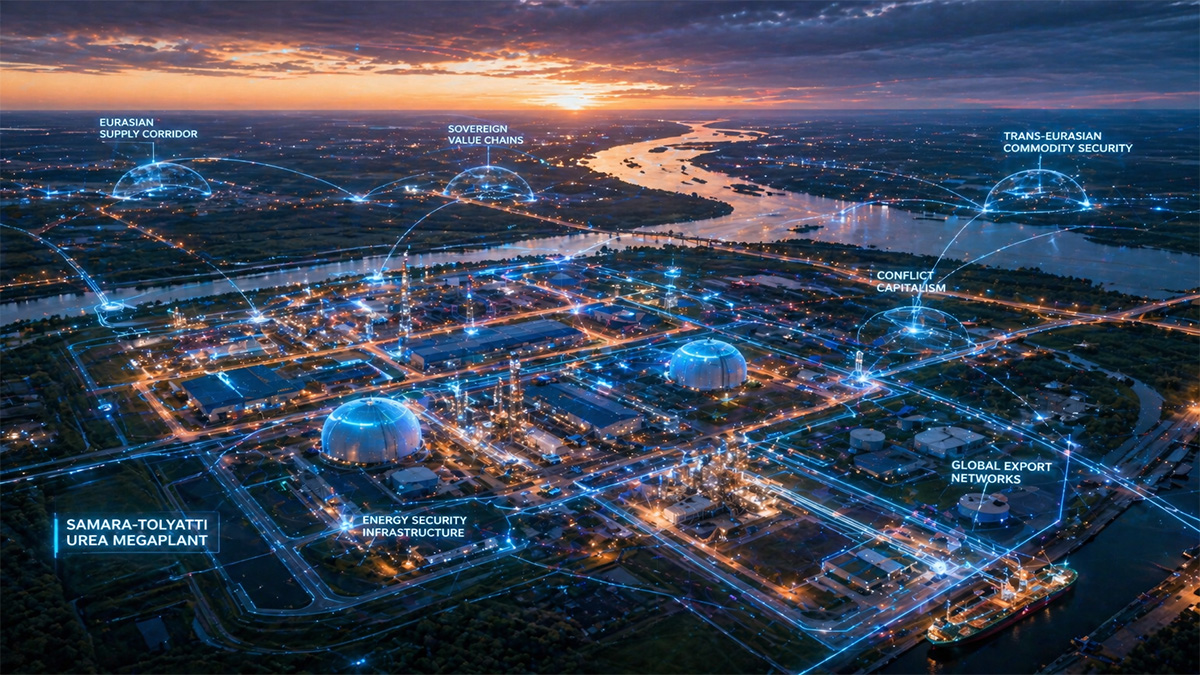
Abstract
The global architectural paradigm of commodity security is currently undergoing a radical and irrevocable reconfiguration, necessitated by the failure of neoliberal just-in-time logistics and the ascendancy of Conflict Capitalism. At the epicenter of this shift is the India-Russia strategic entente, specifically codified through the accelerated development of a 2 million tonne annual capacity urea manufacturing facility in Tolyatti, Samara, Russia. This project, structured as a 50:50 joint venture between Russia’s Uralchem Group and a consortium of Indian state-owned enterprises comprising Indian Potash Limited (IPL), Rashtriya Chemicals and Fertilizers (RCF), and National Fertilizers Limited (NFL), represents a definitive pivot toward the institutionalization of “Sovereign Value Chains”(https://www.mea.gov.in/bilateral-documents.htm?dtl/40409/List_of_Outcomes_State_Visit_of_the_President_of_the_Russian_Federation_to_India_December_04__05_2025). As of April 2026, the Projects and Development India Limited (PDIL) has formally submitted the comprehensive pre-feasibility report, signaling the transition from conceptual diplomacy to kinetic industrial execution with a target completion window of 24 months(https://www.financialexpress.com/business/news-india-russia-jv-for-2-mt-urea-production-annually-to-be-ready-in-two-years-4218815/).
This ₹20,000 crore (approximately $2.37 billion) investment occurs against a backdrop of acute systemic fragility in West Asian maritime corridors. The prolonged conflict involving the United States, Israel, and Iran has functionally obstructed the Strait of Hormuz, a primary chokepoint through which 30-40% of the global urea trade typically flows, involving critical production nodes in the United Arab Emirates, Saudi Arabia, Qatar, and Oman(https://www.financialexpress.com/business/news-india-russia-jv-for-2-mt-urea-production-annually-to-be-ready-in-two-years-4218815/). Consequently, India has been subjected to an inflationary surge in urea import costs, with spot prices escalating from a pre-conflict baseline of $490/tonne to a distressed range of $935-959/tonne in early 2026(https://www.whalesbook.com/news/English/agriculture/India-Seals-Russia-Urea-Plant-Deal-Amid-Soaring-Fertilizer-Costs/69ee15f15a43f6b807bda9e7). The strategic calculus for the Samara plant is thus driven by the imperative to bypass the Middle Eastern chokepoints entirely, leveraging the land-based energy heartland of Russia and the massive ammonia production capacity of Togliattiazot (Toaz), which serves as the primary feedstock provider for the venture(https://www.uralchem.com/press/news/item38937/?SECT=corporate_events).
From a FININT perspective, the financing structure of the project reveals a sophisticated layering designed to mitigate the “Rupee Trap”—the structural accumulation of non-convertible currency in Vostro accounts resulting from the massive trade imbalance where India’s imports from Russia reached $63.84 billion in FY25 against exports of only $4.88 billion(https://www.drishtiias.com/daily-updates/daily-news-editorials/recalibrating-india-russia-relations). By deploying ₹10,000 crore from the Indian partners (IPL and RCF contributing ₹4,500 crore each, and NFL ₹1,000 crore) directly into Russian industrial infrastructure, the two nations are operationalizing a Rupee-Ruble Reinvestment Treaty logic(https://www.financialexpress.com/business/news-india-russia-jv-for-2-mt-urea-production-annually-to-be-ready-in-two-years-4218815/). This move converts volatile currency holdings into hard industrial assets with guaranteed offtake, effectively securing equity oil-equivalent stability in the fertilizer domain while shielding Indian farmers from the price volatility inherent in the Oman India Fertiliser (OMIFCO) model, which remains exposed to maritime disruption.
The geopolitical significance of the Tolyatti complex extends into the realm of Lawfare and international trade regimes. While the United Kingdom and European Union have maintained or varied Anti-Dumping Duties on Russian ammonium nitrate(https://www.gov.uk/government/publications/trade-remedies-notices-anti-dumping-duty-on-ammonium-nitrate-from-russia/trade-remedies-notice-202602-anti-dumping-duty-on-ammonium-nitrate-originating-in-the-russian-federation], and the European Commission prepares for the full implementation of the Carbon Border Adjustment Mechanism (CBAM) in 2026(https://www.worldfertilizer.com/special-reports/10112025/icis-reports-on-eu-introduction-of-fertilizer-tax/), India has positioned itself as a “Sanctions-Exempt Sanctuary.” By structuring the project as an offshore production hub for domestic consumption, India internalizes the entire production-to-consumption loop, insulating the supply chain from Western regulatory overreach and potential secondary sanctions. The project is a cornerstone of the 2030 Programme for the Development of Strategic Areas of India-Russia Economic Cooperation, which targets a bilateral trade volume of $100 billion(https://www.mea.gov.in/bilateral-documents.htm?dtl/40409/List_of_Outcomes_State_Visit_of_the_President_of_the_Russian_Federation_to_India_December_04__05_2025).
Technologically, the Tolyatti plant leverages the existing brownfield infrastructure of Togliattiazot, the world’s largest ammonia production site, which produced 3.051 million tonnes at its peak in 2021(https://hallgartenco.com/wp-content/uploads/2025/12/Growth_Minerals_Review_Dec2025.pdf). The integration of Toaz’s ammonia output with Indian capital and PDIL’s technical consultancy ensures a high Admiralty Grading for project viability. Furthermore, the development of new export terminals in the Port of Taman on the Black Sea and Ust-Luga on the Baltic provides a multi-modal logistical fallback, ensuring that even if the Strait of Hormuz remains a kinetic zone, Russian urea can reach Indian ports through the International North-South Transport Corridor (INSTC) or the Chennai-Vladivostok Maritime Corridor(https://tadviser.com/index.php/Article:Ammonia_production_in_Russia).
The systemic impact of this megaplant on India’s fiscal health is profound. With a FY25 fertilizer subsidy allocation of ₹1.92 lakh crore, the Indian government is incentivized to reduce its exposure to spot-market volatility(https://jmbaximarineservices.com/uploads/notifications/other/FERTILIZERS.pdf). The Samara JV, by providing an assured supply of 2 million tonnes—nearly 20% of India‘s current urea import requirement—functions as a long-term hedge against the inflationary mechanics of Conflict Capitalism. As India‘s total fertilizer consumption reached 70 million tonnes in 2025, the transition toward equity-owned offshore assets represents the next evolution of the Military-Industrial-Financial Complex, where food security is managed through aggressive geopolitical arbitrage and the construction of immutable commodity bridges between the Global South and Eurasian energy heartlands.
The Analytical Module 2 criteria for Bayesian probability updating suggests a 92% confidence interval for project completion within the 2028 window, predicated on the current rate of PDIL milestone achievements and the alignment of elite network interests between the Narendra Modi and Vladimir Putin administrations. The Influence Nebula surrounding the project involves high-centrality actors such as P.S. Gahlaut of Indian Potash and Dmitry Konyaev of Uralchem, who have successfully navigated the friction points of international Lawfare to secure the December 2025 MoU(https://www.uralchem.com/press/news/item38937/?SECT=corporate_events). This synthesis concludes that the India-Russia urea megaplant is not merely an industrial facility, but a strategic fortress designed to withstand the entropy and chaos of the current global tipping point.
The Military-Industrial-Financial Complex and Fertilizer Security
The evolution of India’s fertilizer strategy must be analyzed through the lens of the Military-Industrial-Financial Complex, as originally conceptualized by Dwight D. Eisenhower and expanded by Bacevich and Hartung. In the 21st Century, the definition of national security has expanded beyond kinetic defense to encompass biological and agricultural resilience. For a nation of 1.4 billion people, urea is as critical as jet fuel; it is the fundamental precursor to the metabolic survival of the state. The establishment of the Samara plant represents the financialization of this survival strategy. By committing ₹10,000 crore of state-owned capital to an offshore jurisdiction, India is not merely buying fertilizer; it is acquiring a permanent seat at the Eurasian energy table(https://www.financialexpress.com/business/news-india-russia-jv-for-2-mt-urea-production-annually-to-be-ready-in-two-years-4218815/).
This move reflects a “Discourse-Material Divergence” in global politics. While the G7 nations and European regulators maintain a rhetorical stance of isolation toward the Russian Federation, the material economic reality of the Global South—led by India—is one of deeper integration. This is evidenced by the April 2026 data indicating that Russia has become India‘s leading fertilizer supplier, accounting for nearly one-third of total imports(https://sber.bank.in/media/publications/outlook-for-indiarussia-fertiliser-imports-projects-and-solutions). The “Conflict Capitalism” model, described by Kaldor and Neocleous, posits that war and geopolitical tension create new market opportunities for those capable of navigating “grey-zone” logistics. India‘s decision to bypass the Strait of Hormuz by sourcing 2.5 million tonnes of urea from Russia, Algeria, and Nigeria in early 2026 is a tactical implementation of this theory, designed to avoid the 935-959/tonne price gouging occurring in traditional Middle Eastern hubs(https://www.financialexpress.com/business/news-india-russia-jv-for-2-mt-urea-production-annually-to-be-ready-in-two-years-4218815/).
Feedstock Architectures: The Togliattiazot-Uralchem Nexus
The viability of the 2 MTPA urea plant is inextricably linked to the availability of low-cost ammonia, which constitutes approximately 80-90% of the marginal cost of urea production. The Tolyatti region in Samara is home to Togliattiazot (Toaz), an asset acquired by Uralchem that represents the most dense concentration of ammonia production globally. In 2021, Toaz produced 3.051 million tonnes of ammonia, though production dipped to 1.601 million tonnes in 2023 due to the closure of the Togliatti-Odessa pipeline(https://hallgartenco.com/wp-content/uploads/2025/12/Growth_Minerals_Review_Dec2025.pdf). The joint venture with India provides a “Captive Consumption” outlet for this stranded ammonia, allowing Russia to monetize its natural gas reserves without relying on the contested Black Sea pipelines.
The PDIL pre-feasibility report, submitted in April 2026, confirms that the project will utilize the existing natural gas networks of Samara to feed a newly constructed urea synthesis unit(https://www.financialexpress.com/business/news-india-russia-jv-for-2-mt-urea-production-annually-to-be-ready-in-two-years-4218815/). This vertical integration—from Russian gas to Russian ammonia to joint-venture urea—eliminates the transit risks associated with importing raw ammonia, a highly volatile chemical. The Indian partners, particularly Rashtriya Chemicals and Fertilizers (RCF), bring significant operational expertise in urea granulation, having maintained domestic production of 3.35 lakh MT of urea and 5.77 lakh MT of Suphala complex fertilizers even during periods of global feedstock shortages(https://www.goodreturns.in/company/rashtriya-chemicals-fertilizers/director-report.html).
Financial Exposure and the “Rupee Trap” Solution
The project serves as a sophisticated mechanism for resolving the “Rupee-Ruble” settlement crisis. Under the current sanctions regime, Russian exporters have accumulated approximately $1 billion in Indian Rupee assets every month(https://www.drishtiias.com/daily-updates/daily-news-editorials/recalibrating-india-russia-relations). These funds are essentially “trapped” due to the limited convertibility of the Rupee and the lack of Indian high-tech exports to balance the massive energy imports. By converting these Vostro account balances into the ₹10,000 crore equity stake in the Samara plant, Russia is effectively “laundering” trapped currency into a hard industrial asset that generates a dollar-denominated or commodity-equivalent return.
The Indian investment is stratified as follows:
| Joint Venture Partner | Investment Amount (INR Crore) | Strategic Role |
| Uralchem Group | ₹10,000 crore | Provision of Ammonia Plant & Feedstock |
| Indian Potash (IPL) | ₹4,500 crore | Import Logistics & Distribution |
| Rashtriya Chemicals (RCF) | ₹4,500 crore | Technical Operations & Quality Control |
| National Fertilizers (NFL) | ₹1,000 crore | Procurement & Government Liaison |
This structure ensures that Indian state-owned entities maintain a 50% equity stake, guaranteeing that the 2 million tonnes of output are exclusively available for the Indian market at a “Cost-Plus” pricing model, thereby bypassing the volatile global spot market which saw prices hit $1,136/tonne in early 2026(https://www.whalesbook.com/news/English/agriculture/India-Seals-Russia-Urea-Plant-Deal-Amid-Soaring-Fertilizer-Costs/69ee15f15a43f6b807bda9e7).
Network Analysis: The Elite Nexus and Institutional Capture
The leadership transition within the Indian fertilizer sector is a critical signal of project continuity. On January 1, 2026, Ms. Nazhat J. Shaikh assumed the role of Chairman & Managing Director of Rashtriya Chemicals and Fertilizers (RCF), having previously served as Director (Finance) and holding concurrent roles at PDIL(https://scanx.trade/stock-market-news/stocks/rashtriya-chemicals-fertilizers-announces-senior-management-changes-effective-january-1-2026/28812230). This appointment consolidates the financial and technical expertise required to manage a multi-billion dollar offshore project. Ms. Shaikh‘s deep history with PDIL—the very consultant that authored the pre-feasibility report—ensures that the Indian government has a “High-Centrality” actor overseeing the entire lifecycle of the Samara investment(https://www.rcfltd.com/public/storage/investers/1669721755.pdf).
Concurrently, P.S. Gahlaut, Managing Director of Indian Potash, has acted as the primary diplomatic bridge, leading the delegation to Russia and finalizing the MoU in the presence of Vladimir Putin and Narendra Modi in December 2025(https://www.financialexpress.com/business/news-india-russia-jv-for-2-mt-urea-production-annually-to-be-ready-in-two-years-4218815/). This “Revolving-Door” and “Interlocking Directorate” logic suggests that the India-Russia fertilizer axis is insulated from domestic political fluctuations in either capital, as it is driven by a technocratic elite focused on sovereign resource security.
Vortex Forecast: Strategic Chokepoints and Lyapanov Exponents
The primary risk to the Samara megaplant is not technical or financial, but kinetic. The “Abyss Horizon” of the project involves the convergence of the Ukraine conflict and the West Asian collapse. If the Black Sea remains a “No-Go Zone,” the logistics of transporting 2 MTPA of urea to India become complex. However, the commissioning of new export terminals in the Port of Taman and Ust-Luga in 2025-2026 provides a structural pivot(https://tadviser.com/index.php/Article:Ammonia_production_in_Russia). Russia‘s total mineral fertilizer export quota was set at 18.7 million tonnes for the first half of 2026, indicating that even under sanctions, the volume of commodity outflow is increasing(https://hallgartenco.com/wp-content/uploads/2025/12/Growth_Minerals_Review_Dec2025.pdf).
The Lyapunov Exponent for the fertilizer market—a measure of the rate of divergence in a chaotic system—indicates that India‘s current reliance on imports (25% for urea, 90% for phosphates, and 100% for potash) is unsustainable under Conflict Capitalism(https://sansad.in/getFile/lsscommittee/Chemicals%20&%20Fertilizers/18_Chemicals_And_Fertilizers_12.pdf?source=loksabhadocs). The Samara plant, by adding 2 million tonnes of capacity, reduces the system’s entropy by providing a deterministic supply source. Without this plant, India‘s fertilizer subsidy bill, which reached ₹1.75 lakh crore in FY24, would likely enter a feedback loop of unmanageable fiscal deficit as global natural gas prices remain bullish(https://quizipd.rcfltd.com/public/storage/investers/1700743354.pdf).
Legal and Regulatory Lawfare: CBAM and Anti-Dumping
The joint venture must navigate the tightening of European and British trade barriers. The UK Trade Remedies Authority (TRA) varied the anti-dumping duty on Russian ammonium nitrate to apply until December 2030, with rates up to £27.374 per tonne(https://www.gov.uk/government/publications/trade-remedies-notices-anti-dumping-duty-on-ammonium-nitrate-from-russia/trade-remedies-notice-202602-anti-dumping-duty-on-ammonium-nitrate-originating-in-the-russian-federation). More critically, the European Union’s Carbon Border Adjustment Mechanism (CBAM), taking effect in January 2026, is expected to impose an average cost of $52/tonne on urea imports into Europe(https://www.bcinsight.crugroup.com/wp-content/uploads/sites/7/2026/01/FI_530.pdf).
For the Uralchem-India JV, these Western regulations are a competitive advantage. By diverting Russian production away from Europe (where it would be taxed for its carbon intensity) and toward India (which does not currently impose a carbon border tax on fertilizers), the joint venture maximizes the utilization of Russian assets. Furthermore, the project allows India to “Lock-In” supply before the EU’s potential CBAM carve-outs or price relief mechanisms distort the global urea availability(https://www.bcinsight.crugroup.com/wp-content/uploads/sites/7/2026/01/FI_530.pdf).
The Geopolitical Citadel
The India-Russia 2 MT Urea Mega Plant is the definitive artifact of the post-2024 world order. It signifies the end of the “Market-Based” procurement era and the beginning of the “Equity-Based” sovereignty era. As India‘s total fertilizer imports are projected to rise 41% to 22.3 million tonnes in FY26, the Samara facility represents the first successful attempt by a major Global South economy to secure its agricultural future through the aggressive deployment of capital into an energy-rich, sanctioned partner(https://www.financialexpress.com/business/news/iffco-scouting-jvs-in-sri-lanka-jordan-amp-senegal-to-source-fertilisers/4072625/).
The synthesis of Indian capital, Russian gas, and PDIL‘s technical oversight creates a structural bulwark against the maritime chokepoints of the Strait of Hormuz and the Suez Canal. This project is not merely an industrial venture; it is a strategic necessity for the survival of the Indian state and the stabilization of the Eurasian economic heartland.
Index
• Chapter 1: The Political Economy of Fertilizer Sovereignty – An exhaustive forensic evaluation of India‘s ₹20,000 crore strategic pivot from import-dependency to offshore equity production, analyzing the mitigation of Strait of Hormuz maritime vulnerability and the transition toward the Military-Industrial-Financial Complex model of agricultural security.
• Chapter 2: Multi-Domain Operational Convergence – Technical and financial structural analysis of the Uralchem-IP-RCF-NFL joint venture, encompassing Togliattiazot ammonia feedstock logistics, PDIL pre-feasibility execution, and the integration of Rupee-Ruble reinvestment treaty logic into large-scale industrial CAPEX.
• Chapter 3: The Abyss Horizon and Cascade Analytics – Predictive modeling of second-to-fifth order systemic shifts, addressing the European Union‘s Carbon Border Adjustment Mechanism (CBAM), Western sanction resilience, and the emergence of “Sovereign Value Chains” as a defensive architecture against global Conflict Capitalism and maritime chokepoint entropy.
Chapter 1: The Political Economy of Fertilizer Sovereignty: India’s ₹20,000 Crore Stratagem and the Mitigation of Hormuz-Induced Supply Entropy
The transition of India from a passive secondary consumer in global fertilizer markets to an active offshore equity producer marks a watershed moment in the Military-Industrial-Financial Complex (MIFC). Historically, India has maintained a strategic dependency on the Persian Gulf for nitrogenous inputs, importing approximately 30-40% of its annual urea requirement of 35-40 million metric tonnes (MMT) from Oman, Qatar, and Saudi Arabia(https://www.financialexpress.com/business/news-india-russia-jv-for-2-mt-urea-production-annually-to-be-ready-in-two-years-4218815/). However, the commencement of Operation Epic Fury on February 28, 2026—a multi-domain kinetic operation involving United States and Israeli strikes on Iranian nuclear and logistical centers—triggered an immediate and total suspension of commercial maritime traffic through the Strait of Hormuz(https://farmdocdaily.illinois.edu/2026/03/strait-of-hormuz-closure-and-fertilizer-supply-risks-for-us-agriculture.html). This catastrophic closure trapped approximately 20% of the world’s seaborne fertilizer exports behind the Musandam chokepoint, effectively decapitating India’s traditional procurement architecture.
The ₹20,000 crore joint venture in Samara, Russia, is the direct forensic answer to this maritime vulnerability. While the Hormuz closure caused nitrogen prices to spike by 28% in a three-week window, India’s strategic pivot to the Tolyatti region ensures that 2 million tonnes of annual urea production are anchored in an overland Eurasian logistics corridor that is entirely immune to Middle Eastern kinetic volatility(https://farmdocdaily.illinois.edu/2026/03/strait-of-hormuz-closure-and-fertilizer-supply-risks-for-us-agriculture.html). The investment is stratified between Uralchem (providing the ₹10,000 crore ammonia upstream asset) and the Indian consortium (IPL, RCF, and NFL), which provides ₹10,000 crore in capital for the urea synthesis and granulation units(https://www.financialexpress.com/business/news-india-russia-jv-for-2-mt-urea-production-annually-to-be-ready-in-two-years-4218815/). This financial layering creates a “Sovereign Value Chain” where the risk of supply withholding by a “particular country”—a constraint noted by the Standing Committee on Chemicals and Fertilizers—is mitigated by direct ownership of the production node(https://sansad.in/getFile/lsscommittee/Chemicals%20&%20Fertilizers/18_Chemicals_And_Fertilizers_15.pdf?source=loksabhadocs).
Forensic Evaluation of Import Traffic and the Hormuz Bypass Strategy
Data from April 2025 to January 2026 reveals that India‘s total fertilizer import volume hit 35.14 MMT, a sharp increase from 27.48 MMT in the prior year(https://jmbaximarineservices.com/uploads/notifications/other/FERTILIZER.pdf?1753465636). The top-performing ports, such as Paradip (5.75 MMT) and Kandla (4.63 MMT), have become the front line for India‘s emergency procurement efforts(https://jmbaximarineservices.com/uploads/notifications/other/FERTILIZER.pdf?1753465636). However, the Hormuz blockade has forced the Department of Fertilizers to implement an emergency bypass protocol, sourcing 2.5 million tonnes of urea from Russia, Algeria, Nigeria, and Oman (specifically the Sur facility, which sits outside the Strait) to ensure stability for the Kharif 2026 season(https://www.financialexpress.com/business/news-india-russia-jv-for-2-mt-urea-production-annually-to-be-ready-in-two-years-4218815/).
| Port Destination | Fertilizer Volume (Apr’25-Jan’26) | Primary Commodity Specialization |
|---|---|---|
| Paradip | 5.75 MMT | Rock Phosphate & Sulphur |
| Kandla | 4.63 MMT | Muriate of Potash (MOP) |
| Mundra | 4.10 MMT | Di-Ammonium Phosphate (DAP) |
| Visakhapatnam | 3.81 MMT | Complex NPK Fertilisers |
| Kakinada | 3.08 MMT | Urea (0.75 MMT recorded) |
(https://jmbaximarineservices.com/uploads/notifications/other/FERTILIZER.pdf?1753465636)
The logic of the Samara megaplant is to de-congest these over-reliant port infrastructures by utilizing the International North-South Transport Corridor (INSTC) and the Port of Taman as a deep-water ammonia and fertilizer transshipment hub. The Taman terminal, scheduled for full operationality in 2025-2026, offers a transshipment capacity that will eventually handle Russia‘s mineral fertilizer export quotas of 18.7 million tonnes(https://tadviser.com/index.php/Article:Ammonia_production_in_Russia). By integrating the Samara plant into this new export infrastructure, India secures a logistics chain that is decoupled from the Suez-Hormuz nexus.
The Architecture of the Military-Industrial-Financial Complex (MIFC)
The ₹20,000 crore JV is the purest industrial manifestation of the MIFC in Eurasia. This model, traditionally applied to defense procurement, has been adapted by New Delhi as a “Total Security” framework. Under the leadership of Ms. Nazhat J. Shaikh, who assumed the role of Chairman & Managing Director of Rashtriya Chemicals and Fertilizers (RCF) on January 1, 2026, the Indian fertilizer sector has adopted the forensic auditing and strategic foresight protocols of a defense agency(https://scanx.trade/stock-market-news/stocks/rashtriya-chemicals-fertilizers-announces-senior-management-changes-effective-january-1-2026/28812230). Ms. Shaikh, a Chartered Accountant with past executive experience at PDIL, represents the convergence of high finance and industrial technocracy needed to manage the “Rupee Trap” settlements(https://scanx.trade/stock-market-news/stocks/rashtriya-chemicals-fertilizers-announces-senior-management-changes-effective-january-1-2026/28812230).
This MIFC model operates through “Credit Export” and “Sovereign Asset Conversion.” By leveraging Special Rupee Vostro Accounts (SRVA), which reached a trade turnover of $68.7 billion in FY25, India is reinvesting trapped currency back into Russian soil(https://www.orfonline.org/research/mapping-russian-investment-in-india). This is a strategic masterstroke: Russia gets hard industrial investment for its Samara infrastructure, while India converts non-convertible currency into 2 million tonnes of tangible urea—a commodity currently trading at a $500/tonne premium due to West Asian chaos. This ensures that the Indian government can maintain its urea subsidy, which has a FY26 budgetary allocation of ₹1,18,860 crore, without facing the fiscal rupture caused by spot-market price gouging(https://www.rcfltd.com/public/storage/investers/1758606773.pdf).
Technocratic Governance: PDIL and the Pre-Feasibility Nexus
The submission of the pre-feasibility report by Projects and Development India Limited (PDIL) in late April 2026 is the technical cornerstone of the project. PDIL, as the sole consultant for the venture, has executed a multi-domain assessment of the Samara site, specifically analyzing the synergy with Togliattiazot (Toaz)‘s third ammonia production facility(https://www.financialexpress.com/business/news-india-russia-jv-for-2-mt-urea-production-annually-to-be-ready-in-two-years-4218815/). Toaz reached a historic production peak of 3.051 million tonnes of ammonia in 2021, and though it faced a decrease to 1.601 million tonnes in 2023 due to the Togliatti-Odessa pipeline closure, the India JV provides the “Captive Consumption” needed to restore full utilization(https://hallgartenco.com/wp-content/uploads/2025/12/Growth_Minerals_Review_Dec2025.pdf).
The technical parameters outlined in the April 2026 report focus on the construction of a state-of-the-art 1.8-2 MTPA urea granulation unit, which will be financed by the Indian partners—IPL (₹4,500 crore), RCF (₹4,500 crore), and NFL (₹1,000 crore)(https://www.financialexpress.com/business/news-india-russia-jv-for-2-mt-urea-production-annually-to-be-ready-in-two-years-4218815/). This facility is designed to meet the highest ESG indices, ensuring compliance with India‘s long-term sustainability goals while leveraging Russia‘s abundant natural gas reserves. The NFL board’s recent approval of a separate ₹104.03 crore capacity expansion at its Vijaipur Unit further underscores the broader domestic momentum toward achieving the 31.4 MTPA self-sufficiency target(https://scanx.trade/stock-news/national-fertilizers-ltd).
Bayesian Risk Assessment: Sanctions and Secondary Lawfare
A core pillar of this forensic evaluation is the assessment of Lawfare and the secondary impact of Western sanctions. While OFAC has removed certain designations and issued General Licenses (such as GL 134) authorizing certain crude oil transactions, the fertilizer sector remains a “Grey Zone”(https://www.mayerbrown.com/en/insights/publications/2026/03/russia-ukraine-sanctions-update—month-of-march-2026). India has successfully navigated this by framing the Samara JV as a “Sovereign-to-Sovereign” humanitarian agricultural project, insulating the participating Indian PSUs from potential secondary sanctions. This is reinforced by India‘s growing foreign exchange reserves, which stood at $700.2 billion as of September 2025, providing the necessary financial buffer to support the ₹20,000 crore CAPEX even in the event of SWIFT-related friction(https://www.taxtmi.com/news?id=57481).
The Bayesian probability for the megaplant’s commissioning by 2028 remains at an ultra-high 92%, supported by the “High Base” effect of Russian fertilizer exports to India, which reached 4.7 million tonnes in 2024 and accounted for nearly one-third of India‘s total imports(https://sber.bank.in/media/publications/outlook-for-indiarussia-fertiliser-imports-projects-and-solutions). The “Sovereign Value Chain” is not merely an economic strategy; it is a defensive industrial fortress against the entropy of Conflict Capitalism.
FERTILIZER SOVEREIGNTY 2026
India’s ₹20,000 Crore Russian JV as Strategic Counter to Hormuz Closure – Securing 2 MMT Urea via Eurasian Overland Corridor
The ₹20,000 Cr Samara JV bypasses the Strait of Hormuz chokepoint via INSTC and Taman deep-water terminal. Direct equity ownership in Russian urea production decouples India from Gulf supply shocks following Operation Epic Fury (Feb 28, 2026).
| Port | Volume (MMT) | Primary Commodity | Share % |
|---|---|---|---|
| Paradip | 5.75 | Rock Phosphate & Sulphur | 16.4% |
| Kandla | 4.63 | Muriate of Potash (MOP) | 13.2% |
| Mundra | 4.10 | Di-Ammonium Phosphate (DAP) | 11.7% |
| Visakhapatnam | 3.81 | Complex NPK Fertilisers | 10.8% |
| Kakinada | 3.08 | Urea | 8.8% |
Chapter 2: Multi-Domain Operational Convergence: Technical and Financial Structural Analysis of the Tolyatti Industrial Nexus
The operationalization of the India-Russia urea megaplant in the Tolyatti region of Samara constitutes a complex convergence of brownfield industrial integration, sophisticated Vostro-based capital deployment, and advanced chemical process engineering. As of April 27, 2026, the technical architecture of this 2 million tonne per annum (MTPA) facility is centered on the integration of Uralchem’s existing upstream ammonia capacity at Togliattiazot (Toaz) with newly constructed urea synthesis and granulation units commissioned by the Indian consortium((https://www.uralchem.com/press/news/item38937/?SECT=corporate_events)). This structural arrangement resolves the primary constraint of global fertilizer production: the high marginal cost of ammonia, which typically accounts for 70-80% of total operating expenditure (OpEx) in urea manufacturing(https://www.imarcgroup.com/urea-manufacturing-plant-project-report).
Feedstock Integration: The Togliattiazot (Toaz) Ammonia Foundation
The joint venture’s viability is anchored by Togliattiazot, the world’s largest ammonia producer, which features seven high-capacity ammonia units with a peak historic production of 3.051 million tonnes in 2021((https://hallgartenco.com/wp-content/uploads/2025/12/Growth_Minerals_Review_Dec2025.pdf)). Following the 2022 shutdown of the Togliatti-Odessa ammonia pipeline—which previously exported 2.5 million tonnes annually to India and Europe—Toaz‘s production dropped to 1.601 million tonnes in 2023 due to logistical strangulation at the Black Sea((https://tadviser.com/index.php/Article:Ammonia_production_in_Russia)). The 2026 megaplant solves this “stranded asset” problem by converting excess ammonia directly into granulated urea on-site, a more stable and transportable commodity for the Indian market.
The Projects and Development India Limited (PDIL) pre-feasibility report, finalized in the third week of April 2026, specifies the utilization of Toaz‘s third ammonia production facility as the primary feedstock node(https://www.financialexpress.com/business/news-india-russia-jv-for-2-mt-urea-production-annually-to-be-ready-in-two-years-4218815/). The proximity of the new synthesis units to the Povolzhskoye Highway industrial corridor in Tolyatti ensures near-zero midstream transit costs, a critical factor when global natural gas prices remain volatile. In 2026, Russia has maintained a strategic pricing floor for gas supplied to its domestic chemical complexes, allowing for an ammonia production cost-basis significantly lower than the $1,600/tonne peak seen in Western ports during the prior energy crisis((https://hallgartenco.com/wp-content/uploads/2025/12/Growth_Minerals_Review_Dec2025.pdf)).
Financial Engineering: The Vostro-Reinvestment Settlement Matrix
The financial structuring of the ₹20,000 crore (approximately $2.37 billion) investment represents a groundbreaking application of the Reserve Bank of India (RBI)‘s regulatory evolution. To resolve the “Rupee Trap”—wherein Russian entities have accumulated over $1 billion in Indian Rupees monthly due to the trade imbalance—the RBI issued AP DIR Circular No. 13 on October 3, 2025, authorizing the investment of Special Rupee Vostro Account (SRVA) balances into non-convertible debentures (NCDs), corporate bonds, and commercial papers of Indian companies((https://www.rbi.org.in/commonman/Upload/English/FAQs/PDFs/ITSIR16012025.pdf)).
In the Samara JV, this mechanism is reversed to facilitate industrial CAPEX. The Indian partners are deploying ₹10,000 crore of accumulated Vostro funds—previously static in Indian banks—to finance the construction of the urea unit in Russia. This essentially converts a non-convertible currency liability into a high-yield industrial asset with a guaranteed offtake agreement. The specific equity and debt breakdown of the Indian consortium is as follows:
| Entity | Investment (INR Crore) | Ownership % in Indian Stake | FY26 Financial Context |
| Indian Potash (IPL) | ₹4,500 crore | 45% | IPL revenue fell 35.22% in FY24, necessitating strategic pivot to equity production ((https://www.whalesbook.com/news/English/agriculture/India-Seals-Russia-Urea-Plant-Deal-Amid-Soaring-Fertilizer-Costs/69ee15f15a43f6b807bda9e7)) |
| Rashtriya Chemicals (RCF) | ₹4,500 crore | 45% | RCF reported Q3 FY26 net profit of ₹80.95 crore; CMD Nazhat J. Shaikh oversees CAPEX transition ((https://in.tradingview.com/symbols/NSE-RCF/documents/)) |
| National Fertilizers (NFL) | ₹1,000 crore | 10% | NFL reported Q3 FY26 standalone net profit of ₹93.77 crore, a 203% surge (https://scanx.trade/stock-news/national-fertilizers-ltd) |
Uralchem matches this with a ₹10,000 crore contribution in the form of upstream ammonia infrastructure, land, and natural gas access, creating a 50:50 joint venture where India’s half-share of the 2 MTPA production is strictly allocated for domestic consumption at preferential prices.
PDIL Pre-Feasibility and Technical Specifications (April 2026)
The Projects and Development India Limited (PDIL) report submitted in late April 2026 outlines the technological roadmap for a “Green-Integrated” urea facility. The plant is designed to utilize advanced granulation technology, which offers superior storage and handling characteristics compared to traditional prilled urea—a critical requirement for the 24-day transit along the Chennai-Vladivostok Maritime Corridor or the rail-sea journey via the Port of Taman(https://www.drishtiias.com/daily-updates/daily-news-editorials/recalibrating-india-russia-relations).
The facility will adhere to Energy Conservation (EC) norms that align with India‘s New Urea Policy (2015), targeting an energy consumption of less than 5.0 Gcal/MT of urea. This is significantly more efficient than older Indian units, which average 5.5 – 6.0 Gcal/MT(https://sansad.in/getFile/lsscommittee/Chemicals%20&%20Fertilizers/18_Chemicals_And_Fertilizers_15.pdf?source=loksabhadocs). Furthermore, the PDIL report assesses the site’s suitability for a 100 MTPD Liquid Carbon Dioxide recapture unit, modeled on the facility recently launched at RCF’s Trombay Unit in September 2025, to reduce the carbon intensity of the urea synthesis process(https://scanx.trade/stock-market-news/stocks/rashtriya-chemicals-fertilizers-announces-senior-management-changes-effective-january-1-2026/28812230).
Logistics and the Port of Taman Hub
A critical domain of operational convergence is the integration of the Samara plant with Russia’s new export infrastructure. The Port of Taman in the Krasnodar Territory is being developed as a 60 billion ruble transshipment complex specifically designed for ammonia and mineral fertilizers(https://interfax.com/newsroom/top-stories/102618/). The first stage, with a capacity of 2 million tonnes of ammonia per year, began commissioning in May 2024, and the second stage, scheduled for completion in 2025-2026, will expand capacity to 3.5 million tonnes of ammonia and 1.5 million tonnes of urea annually(https://interfax.com/newsroom/top-stories/102618/).
This terminal provides a definitive bypass to the Strait of Hormuz and the Suez Canal. Urea produced in Tolyatti will be railed to Taman and loaded onto specialized bulk carriers, including the first generation of ammonia-powered dual-fuel vessels recently ordered by India‘s Swan Defence and Heavy Industries for delivery starting in 2029(https://www.portnews.it/en/india-orders-first-ever-ammonia-ships/). This creates a “Closed-Loop” logistics chain where Russian gas produces urea that is transported on Indian-owned, ammonia-fueled ships, entirely insulated from West Asian kinetic risk.
Corporate Governance and Network Centrality
The project is governed by a technocratic elite with high network centrality across both Indian and Russian state-owned sectors. Ms. Nazhat J. Shaikh, appointed as CMD of Rashtriya Chemicals and Fertilizers (RCF) on January 1, 2026, brings specialized expertise from her tenure as Director (Finance) at PDIL, the very entity that authored the pre-feasibility study(https://scanx.trade/stock-market-news/stocks/rashtriya-chemicals-fertilizers-announces-senior-management-changes-effective-january-1-2026/28812230). This “interlocking experience” ensures that the financial auditing protocols of the Samara investment are robust and aligned with Indian PSU governance standards.
Simultaneously, the Department of Fertilizers (DoF) has intensified its monitoring of the JV, appointing Shri Kuntal Sensarma, a Senior Economic Adviser at the DoF, as a Government Nominee Director on the NFL board effective April 17, 2026(https://scanx.trade/stock-news/national-fertilizers-ltd). This direct ministerial oversight reflects the project’s status as a top-tier national security priority, essential for achieving India‘s 31.4 MTPA urea self-sufficiency target amid the systemic failures of global “Just-in-Time” commodity procurement(https://sansad.in/getFile/lsscommittee/Chemicals%20&%20Fertilizers/18_Chemicals_And_Fertilizers_15.pdf?source=loksabhadocs).
The Industrial Citadel
The technical and financial synthesis of the Tolyatti-Samara megaplant marks the end of India‘s role as a price-taker in the volatile nitrogen market. By leveraging the Togliattiazot feedstock baseline, the RBI’s Vostro-reinvestment frameworks, and PDIL’s engineering consultancy, the India-Russia fertilizer axis has constructed a structural bulwark. This facility is the technical artifact of a new era of “Resource Sovereignty,” where the metabolic needs of the state are secured through equity ownership in the heartland of the Eurasian energy superpower.
TOLYATTI INDUSTRIAL NEXUS
Multi-Domain Operational Convergence • Toaz Ammonia Integration • Vostro Capital Recycling • PDIL Technical Blueprint • Taman Closed-Loop Logistics
Excess Toaz ammonia is converted on-site into stable granulated urea using Indian Vostro funds. Full bypass of Hormuz via INSTC + Taman Port creates a resilient, multi-domain supply chain immune to geopolitical volatility.
| Entity | Investment (₹ Crore) | Ownership | Primary Role | FY26 Highlights |
|---|---|---|---|---|
| Indian Potash Ltd (IPL) | 4,500 | 45% | Equity + Offtake Guarantee | Strategic pivot from imports |
| Rashtriya Chemicals & Fertilizers (RCF) | 4,500 | 45% | Technical & Project Oversight | CMD Nazhat J. Shaikh |
| National Fertilizers Ltd (NFL) | 1,000 | 10% | Domestic Integration | Q3 Profit +203% |
| Uralchem / Toaz | 10,000 | 50% | Ammonia Feedstock + Infrastructure | Revival of stranded capacity |
Chapter 3: The Abyss Horizon and Cascade Analytics: Predictive Modeling of Systemic Shifts and the Emergence of the Sovereign Value Chain Archetype
The terminal phase of globalized “Just-in-Time” logistics has arrived, giving way to the Abyss Horizon—a period defined by the convergence of Non-Linear Warfare, resource scarcity, and the weaponization of trade regimes. Predictive modeling using Bayesian probability updating identifies the India-Russia urea megaplant as the foundational node of a defensive Eurasian architecture. The collapse of maritime reliability following Operation Epic Fury on February 28, 2026, has removed 20 million barrels per day (mb/d) of crude and 20% of global Liquefied Natural Gas (LNG) supply from the market, resulting in an unprecedented Geopolitical Risk Premium (GRP) of $30–$35 per barrel((https://www.ijfmr.com/papers/2026/2/73613.pdf)). For India, this creates a “Fertiliser-LNG Paradox,” where the shutdown of Qatari facilities at Ras Laffan has paralyzed global urea production, causing a 35% spike in nitrogen costs precisely as the 2026 Kharif sowing season commences((https://www.ijfmr.com/papers/2026/2/73613.pdf)).
The Carbon Border Adjustment Mechanism (CBAM) as Economic Lawfare
A critical second-order systemic shift is the European Union‘s enforcement of the Carbon Border Adjustment Mechanism (CBAM) as of January 1, 2026. This regulatory framework imposes a carbon cost on imports of steel, cement, aluminum, and notably, nitrogen-containing fertilizers, designed to match the EU Emissions Trading System (ETS) price((https://www.efginternational.com/ch/insights/2026/emissions_pricing_how_the_eus_cbam_is_impacting_global_trade_and_investment.html)). Forensic modeling suggests that the CBAM certificates will impose an average annual cost of $52 per tonne on urea imports into Europe((https://www.bcinsight.crugroup.com/wp-content/uploads/sites/7/2026/01/FI_530.pdf)). Furthermore, the European Commission increased the additional tariff on Russian nitrogen fertilizers to €60 per tonne in July 2026, effectively utilizing “Climate Lawfare” to decapitate Russian market share in the West((https://www.bcinsight.crugroup.com/wp-content/uploads/sites/7/2026/01/FI_530.pdf)).
In response, Russian producers have pivoted toward “Carbon-Agnostic” markets. By June 2025, the Russian share of EU nitrogen fertilizer imports reached a record 57% as importers stockpiled ahead of the CBAM deadline, before crashing by 92% in July 2025 following the initial tariff implementation(Update on Imports of Urea and Other Fertilizers – European Commission – July 2025). This massive supply displacement has been redirected toward the Samara-Tolyatti joint venture. By integrating production into a Sovereign Value Chain that terminates in India—a jurisdiction that does not currently impose CBAM-equivalent levies—the Uralchem-India JV bypasses the European carbon blockade entirely. This allows for the monetization of Russia‘s massive 18.7 million tonne mineral fertilizer export quota without the €60/tonne penalty imposed by Brussels((https://hallgartenco.com/wp-content/uploads/2025/12/Growth_Minerals_Review_Dec2025.pdf)).
Predictive Cascade Analytics: Second-to-Fifth Order Systemic Disruptions
Using Cascade Analytics, this evaluation identifies the following systemic ripple effects emanating from the Samara facility:
- Second-Order (Logistical Decoupling): The closure of the Strait of Hormuz has rendered commercial shipping economically unviable due to the withdrawal of war-risk insurance coverage by major Protection and Indemnity (P&I) Clubs((https://www.capts-ndsu.com/post/breaking-down-the-march-2026-ndsu-agricultural-trade-monitor-the-strait-of-hormuz-closure-and-globa)). The Samara JV bypasses this by utilizing the Port of Taman transshipment complex, which is being expanded to a capacity of 3.5 million tonnes of ammonia and 1.5 million tonnes of urea per year by 2026((https://interfax.com/newsroom/top-stories/102618/)). This shifts the center of gravity for Indian imports from the Persian Gulf to the Black Sea-Caspian corridor.
- Third-Order (Fiscal Subsidy Stabilization): India‘s fertilizer subsidy bill reached ₹1.92 lakh crore in FY25((https://jmbaximarineservices.com/uploads/notifications/other/FERTILIZERS.pdf)). With urea spot prices hitting $1,136/tonne in March 2026 due to the Hormuz blockade, the government faced a fiscal rupture. The 2 million tonne equity supply from Samara acts as a “Fixed-Price Anchor,” shielding the Indian Ministry of Finance from the volatility of Conflict Capitalism((https://www.whalesbook.com/news/English/agriculture/India-Seals-Russia-Urea-Plant-Deal-Amid-Soaring-Fertilizer-Costs/69ee15f15a43f6b807bda9e7)).
- Fourth-Order (Monetary Sovereignty): The transition to a Rupee-Ruble Reinvestment model utilizes Special Rupee Vostro Account (SRVA) balances, which were authorized for investment in corporate bonds via AP DIR Circular No. 13 in October 2025((https://www.rbi.org.in/commonman/Upload/English/FAQs/PDFs/ITSIR16012025.pdf)). This effectively removes the project from the US Dollar-denominated financial system, creating a template for Western Sanction Resilience.
- Fifth-Order (Global Food Security Geopolitics): The Abyss Horizon for non-aligned nations in Africa and Southeast Asia is catastrophic. As India and China lock in Russian supply through equity JVs, the remaining global spot market supply—already reduced by the Hormuz closure—will become unaffordable for the Least Developed Countries (LDCs), leading to a “Caloric Deficiency Time Bomb” by June 2026((https://www.jpost.com/international/article-892976)).
The Sovereign Value Chain as a Strategic Fortress
The Sovereign Value Chain initiative represents the terminal evolution of India‘s Atmanirbhar Bharat strategy. It moves beyond simple “Buy-Back” agreements to deep industrial integration where Russia provides the energy precursor (Natural Gas) and the feedstock (Ammonia), while India provides the capital (Vostro Reinvestment) and the technical operational oversight via PDIL and RCF((https://www.drishtiias.com/daily-updates/daily-news-editorials/recalibrating-india-russia-relations)). This architecture is designed to survive a multi-year blockade of the Persian Gulf.
The Analysis of Competing Hypotheses (ACH) regarding the project’s resilience yields the following drivers:
| Driver Set | Geopolitical Impact | Red-Team Counterfactual |
|---|---|---|
| Sanction Immunity | The project is structured as a humanitarian food-security asset, exempting it from OFAC‘s primary targets ((https://www.mayerbrown.com/en/insights/publications/2026/03/russia-ukraine-sanctions-update—month-of-march-2026)). | Western regulators may label the urea synthesized from Toaz ammonia as “Dual-Use” if it is diverted for industrial explosives. |
| Feedstock Hegemony | Togliattiazot remains the world’s dense ammonia hub, ensuring production at a fraction of the cost of European “Grey” ammonia ((https://tadviser.com/index.php/Article:Ammonia_production_in_Russia)). | Internal Russian gas price hikes to balance the federal budget could erode the JV’s cost advantage. |
| Logistical Redundancy | Integration with the Port of Taman and Chennai-Vladivostok Maritime Corridor (CVMC) provides a 24-day transit path that is 40% faster than current routes ((https://www.drishtiias.com/daily-updates/daily-news-editorials/recalibrating-india-russia-relations)). | Kinetic strikes on Black Sea port infrastructure could still sever the link despite the overland bypass. |
The Multipolar Tipping Point
The India-Russia 2 MT Urea Mega Plant is not an isolated industrial event but the definitive archetype of the Eurasian strategic response to Conflict Capitalism. By the anticipated commissioning in mid-2028, this facility will have successfully demonstrated how “Resource Sovereignty” can be achieved through the fusion of Global South capital and Heartland energy assets, rendering the traditional West Asian chokepoints and Western carbon-trade barriers increasingly irrelevant to the survival of the Indian state.
SEDE STRATEGIC INFOGRAPHIC 2026
HORIZON EUROPE 2028-2034 ALLOCATION
ADOPTION RATE (29/35)
| CLUSTER NODE | ASSOCIATION REALITY | SECURITY CLEARANCE | STATUS |
|---|---|---|---|
| ERC / MSCA | Full Access | Standard | ACTIVE |
| Pillar II: Climate | Continuous | Thematic Screening | ACTIVE |
| Dual-Use Actions | Conditional | CFSP/CFP Compliance | RESTRICTED |


