












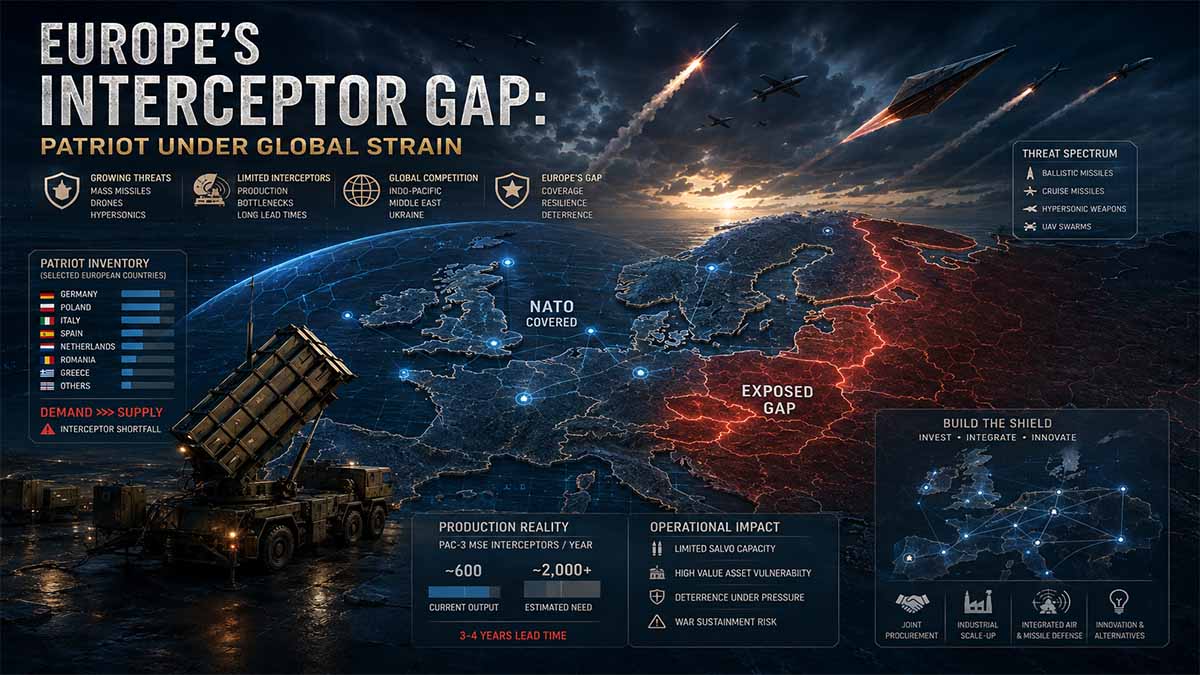
Executive Summary
- BLUF: Europe faces a demonstrable interceptor-allocation crisis, but no admissible public source proves that the United States has consumed “half” its Patriot inventory.
- The 2026 Iran war created extraordinary competing demand for Patriot and THAAD interceptors while drawing operational support from European bases.
- Ukraine remains structurally dependent on United States-produced Patriot missiles, increasing Europe–Middle East competition for the same industrial output.
- Published production capacity is rising rapidly, but announced capacity, contracted quantities, completed missiles and Europe-accessible deliveries are different variables.
- Europe’s 1,000-missile GEM-T procurement and the Franco-Italian SAMP/T NG reduce dependence only progressively; neither is immediately interchangeable with PAC-3 MSE.
- The most dangerous window is 2027–2029, when operational demand can still outrun deliveries, trained crews, launchers and integrated command capacity.
- The model assigns a 40% probability that annual European coverage remains inadequate in 2031, with much higher risk under renewed Middle Eastern escalation.
- The central strategic requirement is not simply “more Patriot,” but a layered architecture reserving scarce hit-to-kill interceptors for ballistic missiles.
Europe’s Interceptor Gap: The Five-Year Race to Rebuild the Shield
Europe’s air-defence problem is no longer defined by the number of Patriot launchers displayed on military inventories. The decisive measure is how many certified interceptors can be delivered, allocated, reloaded and sustained while the United States simultaneously supports Ukraine, protects forces in the Middle East and preserves reserves for other theatres. Washington has now authorized an extraordinary industrial expansion; Europe is accelerating SAMP/T NG, Aster, IRIS-T and CAMM. Yet appropriations are not missiles, factories are not stockpiles, and interoperability is not interchangeability. Between 2027 and 2031, the continent must transform fragmented national programmes into a layered defence economy capable of surviving simultaneous crises. The strategic contest will be decided inside component supply chains, test facilities, command networks and allocation mechanisms long before an interceptor leaves its launcher.
The Scale of the Deficit
On 12 March 2026, NATO Secretary General Mark Rutte stated that the Alliance required a 400% increase in air-defence systems and remained far from that objective. He also confirmed that MBDA and RTX planned to open Europe’s first Patriot-missile manufacturing facility in September 2026. Speech by the NATO Secretary General at the BEDEX 2026 Conference – NATO – March 2026.
Those two facts define the imbalance. NATO is creating industrial capacity, but the stated requirement is several times larger than its existing posture. Moreover, the new facility does not automatically create sovereign European control over delivery schedules, critical components, software configurations or wartime allocation. Its strategic value will depend on the variants manufactured, the origin of seekers and propulsion systems, the ownership of accepted rounds and the contractual priority assigned to European customers during a concurrent crisis.
The operational pressure is already visible. On 3 June 2026, Rutte said PAC-2 and PAC-3 interceptors continued moving from the United States to Ukraine “each day, each week,” while identifying production rate as the central constraint and acknowledging that intense operations could affect stocks. Joint Press Conference by the NATO Secretary General with the President of Ukraine – NATO – June 2026. The essential point is not that deliveries stopped; NATO said they continued. It is that Europe, Ukraine and other theatres draw upon an industrial system whose output has not yet caught up with the expanded requirement.
America’s Industrial Pivot
The United States has responded with a procurement shift of exceptional magnitude. The US Army’s April 2026 budget documentation records a fiscal-year 2027 PAC-3 MSE request comprising USD 1.297528 billion in discretionary funding and USD 10.931919 billion in mandatory funding. The mandatory component is associated with 2,554 MSE missiles under the Munitions Acceleration Council’s expanded production plan. On 16 April 2025, the Army Requirements Oversight Council had already increased the MSE acquisition and procurement objective from 3,376 to 13,773 missiles. Fiscal Year 2027 Missile Procurement, Army Budget Estimates – US Department of the Army – April 2026.
The same document demonstrates why headline totals require careful interpretation. The base programme lists 244 missiles for 2027, followed by planned procurement quantities of 1,672 in 2028, 1,675 in 2029, 1,684 in 2030 and 1,690 in 2031. Mandatory funding, base procurement, contractual awards, production and government acceptance are different stages. A missile financed in one fiscal year may require long-lead electronics, supplier expansion, assembly and acceptance activity extending well beyond it.
Foreign Military Sales add another tension. The Army states that forecast unit prices assume a specified annual volume of allied purchases; if that volume does not materialize, the budgeted price may not be achieved. Allied demand therefore improves industrial economics while competing for delivery positions. Europe needs American scale, but its purchases also enter an allocation system designed to satisfy US requirements, international contracts, combat replacement and strategic reserves.
The Bottleneck Below the Prime Contractor
The hidden constraint is not necessarily the final assembly line. In April 2024, the US Government Accountability Office reported that electronic-component lead time in one missile programme had increased from 19 to 34 months. It also found that some suppliers resisted multiyear agreements that would lock prices across several years. Ukraine: Status and Challenges of DOD Weapon Replacement Efforts – US Government Accountability Office – April 2024.
On 24 July 2025, GAO reported that the Department of Defense relied on more than 200,000 suppliers, while federal procurement data provided limited visibility into the origin of many materials and lower-tier components. Defense Industrial Base: Actions Needed to Address Risks Posed by Dependence on Foreign Suppliers – US Government Accountability Office – July 2025. This is the industrial anatomy of the interceptor problem: seekers, circuit-card assemblies, processors, thermal batteries, actuators, energetic materials, composite structures and specialized test equipment can restrict output even after funding and assembly space have expanded.
The financial consequences are equally important. Large prime contractors can absorb advance orders and long production cycles more easily than specialized suppliers confronting energy costs, workforce scarcity, qualification expenses and uncertain demand beyond the current emergency. A credible expansion consequently requires multiyear demand, advance procurement, indexed pricing where justified, reserved surge capacity and visibility below the first supplier tier. Without those mechanisms, additional appropriations may enlarge backlogs faster than physical output.
Europe’s Layered Alternative
Europe cannot solve the problem by reproducing Patriot missile for missile. It can reduce dependence by assigning different threats to the appropriate defensive layer. The most important continental alternative is the Franco-Italian SAMP/T NG and Aster architecture. On 12 September 2025, the Italian Ministry of Defence described SAMP/T NG as a jointly developed, NATO-interoperable system intended to counter aircraft and theatre ballistic missiles, with entry into service scheduled for 2026. La Danimarca sceglie il sistema italo-francese di difesa aerea SAMP/T NG – Italian Ministry of Defence – September 2025.
A Franco-Ukrainian declaration published on 14 July 2026 states that Ukraine intends to order four SAMP/T NG systems, with progressive deployment of qualified modules beginning in 2027. It also provides for one GF300 radar before the end of 2026, five GM400 radars before the end of 2027, two interim SAMP/T systems and accelerated Aster 30 deliveries by October 2026. France and Italy additionally authorized licensed Aster 30 production in Ukraine. Joint Declaration by the President of the French Republic and the President of Ukraine – Presidency of the French Republic – July 2026.
This is more than an equipment transfer. It connects combat validation, Ukrainian manufacturing capacity and the European defence-industrial base. Its credibility, however, will be measured by serially accepted missiles, not licensing announcements.
Germany and Britain Build the Lower Layers
Germany is constructing a layered architecture rather than relying on one interceptor family. On 3 July 2024, the Budget Committee of the German Bundestag approved four additional Patriot systems and associated missiles in a programme valued at nearly EUR 1.4 billion. The Federal Ministry of Defence stated that the four fire units would be delivered progressively by 2030. Luftverteidigung: Beschaffung von Patriot-Systemen und Lenkflugkörpern – German Federal Ministry of Defence – July 2024.
Germany had previously approved six IRIS-T SLM fire units, associated missiles, qualification and certification measures for up to EUR 950 million on 14 June 2023. Beschaffung: IRIS-T SLM, Einstieg in Arrow und weitere Wechselladersysteme – German Federal Ministry of Defence – June 2023. IRIS-T can relieve Patriot of engagements against aircraft, cruise missiles and drones; Arrow adds an exo-atmospheric ballistic layer. Neither makes Patriot redundant. Together, they reserve premium interceptors for the targets that require them.
The United Kingdom is developing a comparable logic through Sky Sabre and Land Ceptor. On 22 August 2025, the Ministry of Defence announced a GBP 118 million contract for six Land Ceptor launchers, intended to double the British Army’s deployable Sky Sabre capability. UK Jobs and Air Defences Boost with Purchase of New Missile Launchers – UK Ministry of Defence – August 2025. The strategic gain lies in preserving high-end ballistic interceptors by directing cruise missiles, aircraft and drones toward a less scarce defensive layer.
Brussels Enters the Production Chain
The European Union is beginning to address the problem as an industrial system. On 30 March 2026, the European Commission adopted an EUR 1.5 billion European Defence Industry Programme work programme for 2026–2027. More than EUR 700 million was directed toward increasing production of critical components and products, including missiles, ammunition and counter-drone systems; EUR 240 million was allocated to joint procurement, including air and missile defence. EDIP: Commission Adopts EUR 1.5 Billion Work Programme – European Commission – March 2026.
The implementing decision assigns EUR 60 million to the 2027 air-and-missile-defence common-procurement topic and requires proposed procurements to have an estimated value of at least EUR 80 million. Eligible projects may include sensors, command-and-control systems and kinetic or non-kinetic effectors for cruise, ballistic and hypersonic missiles, aircraft and unmanned systems. Commission Implementing Decision C(2026) 2174 – European Commission – March 2026.
The Commission’s contribution will not finance Europe’s entire shield. Its greater value is institutional: aggregating demand, reducing fragmented specifications, supporting lower-tier components and making multinational procurement investable. Europe’s weakness has never been the absence of capable companies. It is the absence of sufficiently predictable, standardized and coordinated orders.
The Five-Year Test
The critical interval is 2027–2029. New American funding, the European Patriot facility and Franco-Italian expansion must pass through component procurement, workforce qualification, testing and acceptance before they materially deepen magazines. During that interval, another high-consumption theatre could still alter scheduled allocations.
By 2030–2031, the official US procurement profile points toward much larger annual MSE quantities, while German Patriot deliveries, SAMP/T NG deployment and European Union industrial measures should be further advanced. But higher production will not by itself guarantee resilience. Adversaries can answer additional defensive capacity with larger mixed salvos, decoys, electronic warfare and attacks against command networks or logistics. NATO’s February 2025 IAMD policy accordingly requires a combination of short-, medium- and long-range systems, passive defence, distributed command, redundancy and resilience against cyber and electromagnetic disruption. NATO Integrated Air and Missile Defence Policy – NATO – February 2025.
Europe’s success must therefore be measured through accepted missile deliveries, interceptor depth per launcher, component lead times, reload capacity and multinational command certification—not budgets alone.
The Cost of Delay
The interceptor gap is ultimately a test of political economy. The United States is scaling production, but its arsenal serves global obligations. France and Italy offer Europe its most important indigenous anti-ballistic route; Germany is assembling a multi-layer shield; Britain and Poland are expanding distributed medium-range defence; Brussels is beginning to finance the industrial connective tissue.
What remains missing is a binding European architecture for minimum inventories, crisis allocation and sustained procurement. Without it, each new conflict can reorder national delivery schedules and turn allies into competitors for the same production slots. With it, Europe can use American capacity where indispensable while directing European systems toward the missions they can perform independently.
The strategic objective for 2031 should not be autarky. It should be operational freedom: enough industrial depth, technical interoperability and sovereign allocation authority to prevent a crisis in one theatre from exposing another. Europe’s shield will be credible only when the next interceptor exists before the next emergency begins.
Navigational Index
- Evidence Baseline — Verified operations, classified unknowns and information-integrity audit
- Industrial–Theater Competition — Production, allocation, European alternatives and hidden constraints
- Five-Year Outlook — Bayesian hypotheses, Monte Carlo distribution and strategic-warning indicators
Master Abstract
The verified baseline
As of 28 August 2026, the primary-source record supports the conclusion that the United States and NATO confront a serious high-end interceptor-allocation problem, but it does not support several numerical assertions circulating around that conclusion. Operation Epic Fury began against Iran on 28 February 2026 and publicly identified both Patriot interceptor missile systems and THAAD among the assets employed; the Pentagon’s first-thirteen-days summary reported approximately 6,000 Iranian targets struck, but disclosed neither Patriot expenditure nor remaining inventories. Operation Epic Fury Fact Sheet: The First 13 Days – U.S. Department of Defense – March 2026 — verified document. The war also consumed European strategic bandwidth: NATO Secretary General Mark Rutte stated that between 4,000 and 5,000 supporting flights departed European bases, demonstrating that Europe functioned simultaneously as NATO’s eastern defensive theater and as a logistics platform for Middle Eastern operations. Atlantic Council Front Page Conversation – NATO – June 2026 — verified transcript. Ukraine constitutes the second demand pole: NATO reported in February 2026 that the PURL mechanism had supplied approximately 75% of the missiles used by Ukraine’s Patriot batteries since the initiative began. Press Conference by NATO Secretary General Mark Rutte with President Volodymyr Zelenskyy – NATO – February 2026 — verified transcript. The operational stress is therefore verified; the alleged movement of particular interceptors from Europe, consumption of “half” the pre-war stock, inability to defeat a specific sustained salvo, and withdrawal of a Patriot-production licence offered to Ukraine are not verified by any live source satisfying the prescribed hierarchy. Because United States war-reserve levels and theater allocations remain classified, those claims are quarantined rather than converted into facts.
Capacity is not availability
The industrial evidence reveals a rapid but delayed response whose strategic value depends on deliveries and allocation rather than headline capacity. In October 2024, the United States Army funded an increase in maximum annual PAC-3 MSE production from 550 to 650 missiles, already demonstrating that anticipated demand exceeded the earlier production envelope. U.S. Army Awards Patriot Advanced Capability-3 Contract Worth Up to $368.6 Million – U.S. Army – November 2024 — verified release. The FY2027 Army budget subsequently requested $12.229 billion for PAC-3 MSE, including mandatory funding intended to procure 2,554 missiles under the Munitions Acceleration Council; this is a procurement request, not evidence that 2,554 combat-ready interceptors will be delivered in 2027. Missile Procurement, Army: FY2027 Budget Estimates – Department of the Army – 2026 — verified budget document. Europe is building a parallel replenishment channel. NATO’s procurement agency contracted for up to 1,000 Patriot GEM-T missiles for Germany, the Netherlands, Romania and Spain, including expanded European production. NATO to Buy 1,000 Patriot Missiles to Enhance Allies’ Air Defences – NATO – January 2024 — verified announcement. Germany then broke ground at Schrobenhausen for Europe’s first Patriot-missile production plant, with infrastructure expansion scheduled through 2028. Spatenstich für erstes Werk zur Produktion von Patriot-Lenkflugkörpern in Europa – German Federal Ministry of Defence – November 2024 — verified German-language source. The Franco-Italian counterweight is SAMP/T NG, expected to enter service from 2026 with the future Aster 30 B1 NT interceptor. La Danimarca sceglie il sistema italo-francese di difesa aerea SAMP/T NG – Italian Ministry of Defence – September 2025 — verified Italian-language source. These initiatives improve the five-year trajectory, but PAC-3 MSE, GEM-T and Aster occupy different engagement envelopes; missiles, launchers, radars, software, crews and rules of engagement are not automatically fungible.
Five-year probabilistic outlook
The five-year assessment uses a normalized coverage ratio because publishing invented stock counts would create false precision. A 100,000-trial Monte Carlo model samples 2027 starting supply between 0.55 and 0.90 of modeled mission demand, annual production growth between 12% and 30%, demand growth between minus 3% and 20%, Europe-accessible allocation between 65% and 95% of the notional requirement, progressive low-cost substitution, and a 35% annual probability of renewed Middle Eastern diversion. These are declared analytical assumptions—not government inventory estimates. The simulation produces median coverage ratios of 0.58 in 2027, 0.68 in 2028, 0.80 in 2029, 0.93 in 2030 and 1.08 in 2031. The probability of reaching annual adequacy rises from effectively zero in 2027 to 60% in 2031; the 2031 10th–90th percentile range remains exceptionally wide at 0.75–1.53, demonstrating that scheduled industrial expansion does not guarantee strategic endurance. Bayesian updating across five competing hypotheses yields provisional posteriors of 29% for H₂, persistent structural European undercoverage; 26% for H₁, managed scarcity through allocation and engagement discipline; 21% for H₃, industrial catch-up by 2030–2031; 16% for H₄, renewed theater competition overwhelming the ramp; and 8% for H₅, successful substitution by layered European systems. Russian official messaging claims that European missile and air-defence production is accelerating at a pace unseen since the Cold War, an adversary perception relevant to deterrence but not an independently auditable inventory measure. Statement on NATO and EU Military Production – Permanent Mission of the Russian Federation to the OSCE – July 2026 — verified Russian official source. Chinese doctrine has separately treated expanded United States missile defence as part of intensifying strategic competition; it informs escalation interpretation but supplies no admissible Patriot stock data. China’s National Defense in the New Era – PRC Ministry of National Defense – July 2019 — verified original Chinese text. Decisive indicators through 2031 will be delivered missiles rather than announced capacity, European allocation clauses, seeker and rocket-motor throughput, PURL delivery continuity, SAMP/T NG operational fielding, engagement ratios per incoming ballistic missile, cyberattacks against command networks and factories, contractor bottlenecks, export-credit liquidity and working-capital flows throughout the transatlantic missile supply chain.
European High-End Interceptor Stress
Evidence Baseline: Europe’s Patriot Interceptor Stress
Evidentiary boundary
The evidence baseline must separate four analytically different propositions that have been conflated in public discussion: operational use, geographic redeployment, inventory depletion and future defensive insufficiency. Primary documentation verifies that the United States employed Patriot interceptor missile systems and THAAD during Operation Epic Fury against Iran, which began at 01:15 on 28 February 2026; by 1 April, United States Central Command reported more than 12,300 targets struck and 13,000 combat flights, while deliberately withholding the number and type of defensive interceptors expended. Operation Epic Fury Fact Sheet – U.S. Central Command – April 2026 — verified official document. The document therefore establishes combat employment and operational scale, but it does not establish how many PAC-3 MSE, PAC-3 CRI, GEM-T or THAAD interceptors were fired, which inventories supplied them, or what percentage of the United States war reserve remained afterward. The evidentiary distinction is decisive: observing a weapon system in an operation proves presence, not expenditure volume; observing exceptional operational intensity raises the probability of substantial consumption, but cannot convert an unknown quantity into a verified stock estimate. This limitation is reinforced by the Pentagon’s explicit refusal, during the April 2024 Iranian mass attack, to disclose United States or partner readiness levels when asked whether more than 300 incoming weapons had created concern about air-defence stocks. Pentagon Press Secretary Air Force Maj. Gen. Pat Ryder Holds a Press Briefing – U.S. Department of Defense – April 2024 — verified official transcript. Accordingly, the statements that Washington “burned through half” its pre-war Patriot inventory, transferred identified missile lots from Europe, or could “definitely” not defeat a sustained ballistic campaign remain unverified intelligence propositions, not established facts, under the permitted source hierarchy.
Verified operational pressure
The verified operational record nevertheless supports a strong assessment that global demand for high-end interceptors has entered a structurally competitive phase. On 13–14 April 2024, Iran and aligned forces launched more than 300 airborne threats, including over 110 medium-range ballistic missiles, more than 30 land-attack cruise missiles and over 150 uncrewed aerial vehicles; United States forces destroyed more than 80 one-way attack drones and at least six ballistic missiles, while Israeli and other partner systems conducted additional engagements. Pentagon Press Secretary Air Force Maj. Gen. Pat Ryder Holds a Press Briefing – U.S. Department of Defense – April 2024 — verified official transcript. That episode demonstrates the adversary’s capacity to combine ballistic, cruise and unmanned threats in a single compressed attack window, forcing defenders to allocate different sensors and effectors under conditions of uncertain follow-on salvos. Operation Epic Fury then elevated the problem from episodic defence to sustained theater warfare. Europe was not insulated from that campaign: NATO Secretary General Mark Rutte stated that between 4,000 and 5,000 United States flights departed European bases in support of the Iran operation, confirming Europe’s role as an operational and logistical platform for American power projection. Atlantic Council Front Page Conversation with the NATO Secretary General – NATO – June 2026 — verified official transcript. This does not prove that Patriot missiles physically moved out of European depots, but it establishes that the European and Middle Eastern theaters draw upon overlapping command, basing, transport, maintenance, intelligence and industrial infrastructures. The resulting shortage risk is therefore broader than the number of missiles in storage. It includes the availability of launchers, trained crews, radar coverage, certified missile rounds, airlift, maintenance personnel, secure communications and political authority to reallocate scarce assets during simultaneous crises.
| Investigated proposition | Verified primary evidence | Confidence | Intelligence judgment |
|---|---|---|---|
| Patriot and THAAD were employed during the 2026 Iran war | CENTCOM explicitly lists both systems | A₁ / High | Verified operational employment |
| The Iran campaign generated exceptional military activity | CENTCOM reports 13,000-plus combat flights by 1 April | A₁ / High | Verified scale; interceptor expenditure undisclosed |
| Iranian forces can generate mixed, concentrated salvos | Pentagon documented 300-plus threats in April 2024 | A₁ / High | Verified precedent, not a forecast of future salvo size |
| European bases supported the 2026 Iran campaign | NATO reports 4,000–5,000 supporting flights | A₂ / High | Verified theater interdependence |
| Patriot missiles were transferred from European stocks to the Middle East | No admitted primary document identifies such transfers | C₃ / Unverified | Plausible allocation hypothesis; not publishable as fact |
| The United States consumed half its pre-war inventory | No admitted source publishes the denominator or expenditure | C₃ / Unverified | Numerical claim rejected from the factual baseline |
| Ukraine had effectively exhausted all Patriot missiles | NATO verifies urgent need and continuing flows, not zero inventory | B₂ / Medium | Severe scarcity plausible; total exhaustion unverified |
| Washington offered and then revoked a production licence | Official record confirms Ukrainian co-production proposals and ongoing discussions | C₂ / Low | Offer-and-reversal narrative not established |
Ukraine as the second demand pole
Ukraine creates a distinct but interconnected pressure channel because it requires United States-produced interceptors while European and Canadian governments increasingly finance the purchases. NATO stated on 3 February 2026 that the Prioritised Ukraine Requirements List, or PURL, had supplied approximately 75% of all missiles used by Ukraine’s Patriot batteries since the mechanism began, and that Ukraine required substantially more; the Secretary General also urged Allies to search deeply within their own stocks. Press Conference by NATO Secretary General Mark Rutte with President Volodymyr Zelenskyy – NATO – February 2026 — verified official transcript. This is among the strongest official indicators of scarcity because it documents both dependency and urgency without revealing classified inventories. It also shows why “United States stock” and “European availability” cannot be treated as separate analytical objects: missiles manufactured in the United States may be funded by European Allies, allocated through PURL, delivered to Ukraine and consequently unavailable for replenishing American units or European Patriot operators during the same production period. Germany’s Defence Ministry separately confirmed that its Patriot production expansion was intended partly to refill Bundeswehr stocks after weapons had been transferred to Ukraine in large quantities. Spatenstich für erstes Werk zur Produktion von Patriot-Lenkflugkörpern in Europa – German Federal Ministry of Defence – November 2024 — verified German-language official source. The evidence therefore supports “stock depletion requiring replenishment” for at least some European operators, but not the stronger assertion that Ukraine or NATO has reached zero effective inventory. Operational effectiveness depends on location, threat axis, launcher configuration and engagement doctrine: a country may retain missiles nationally while a particular battery, defended city or forward sector lacks sufficient ready rounds. Any audit that converts a local shortage into an alliance-wide inventory figure commits an ecological inference error.
The production-availability distinction
Industrial expansion is verifiable, but production announcements must not be misreported as immediately available combat power. In October 2024, the United States Army funded an increase in maximum annual PAC-3 MSE capacity from 550 to 650 missiles, describing the interceptor as a high-demand capability required across EUCOM, CENTCOM and INDOPACOM. U.S. Army Awards Patriot Advanced Capability-3 Contract Worth up to $368.6 Million – U.S. Army – November 2024 — verified official release. The FY2027 Army budget subsequently requested $12.229 billion for the MSE line, including $10.932 billion in mandatory funding intended to procure 2,554 MSE missiles under the Munitions Acceleration Council; it also recorded an increase in the Army Acquisition Objective and Army Procurement Objective from 3,376 to 13,773 missiles. Missile Procurement, Army: FY2027 Budget Estimates – Department of the Army – April 2026 — verified official budget document. Those figures demonstrate institutional recognition of a much larger requirement, but they remain budget requests and procurement objectives rather than proof of completed deliveries. The same document indicates that FY2027 base funding for 244 MSE missiles anticipates delivery between December 2026 and May 2029, illustrating the lag between appropriation, contract award, component acquisition, assembly, acceptance testing and field delivery. The evidence baseline must consequently track at least six separate quantities: authorized requirement, appropriated funding, contracted quantity, maximum production capacity, accepted deliveries and operationally allocated rounds. Combining them into a single “stockpile” number produces a materially false assessment. A factory may reach nominal capacity while constrained by seekers, circuit assemblies, rocket motors, energetics, specialized labor, acceptance facilities or government-furnished components; likewise, a completed missile may remain unavailable to a European unit because it has been allocated to another service, foreign customer or theater.
Industrial friction and replenishment lag
The official supply-chain record supports treating schedule risk as a central variable rather than a marginal complication. The U.S. Government Accountability Office found that long-standing industrial constraints had been intensified by the pandemic and Ukrainian demand; one reviewed missile program experienced an increase in electronic-component lead time from 19 to 34 months within two years. Ukraine: Status and Challenges of DOD Weapon Replacement Efforts – U.S. Government Accountability Office – April 2024 — verified official report. GAO also reported that Congress had provided $25.9 billion for replacing weapons transferred from United States stocks, with more than $18 billion obligated by the end of 2023, but warned that long lead times, supplier reluctance to lock prices into multiyear contracts and raw-material constraints could delay replenishment. The European response is substantial but similarly time-dependent. NATO’s procurement agency awarded a $5.5 billion contract for up to 1,000 Patriot GEM-T missiles for a coalition including Germany, the Netherlands, Romania and Spain, explicitly linking the order to European production expansion and stock replenishment. NATO to Buy 1,000 Patriot Missiles to Enhance Allies’ Air Defences – NATO – January 2024 — verified official source. Germany’s Schrobenhausen expansion includes production, maintenance, repair, modernization, additional assembly lines, storage bunkers and infrastructure scheduled through 2028. Spatenstich für erstes Werk zur Produktion von Patriot-Lenkflugkörpern in Europa – German Federal Ministry of Defence – November 2024 — verified German-language official source. Consequently, the verified industrial trajectory is positive, but the operational relief curve is back-loaded: contracts signed in 2024–2027 may improve readiness materially only after manufacturing qualification, delivery, integration and stockpile certification during 2028–2031.
Primary-Evidence Control Architecture • Operational Records, Budget, Supply Chain, Alliance Delivery & Analytical Judgment
Official Operational Record: System Presence, Mission Date & Theater Confirmation
The foundational evidentiary tier. Official operational records confirm system presence, mission execution dates, and theater deployment parameters. However, they intentionally omit expenditure rates and remaining inventory levels.
Information-integrity audit
The information environment contains three recurrent forms of distortion. The first is denominator fabrication: a source reports or estimates a number of missiles fired, then divides it by an assumed pre-war inventory that has never been officially released. The resulting percentage may appear mathematically precise while remaining evidentially unsupported at both ends. The second is category collapse: PAC-3 MSE, PAC-3 CRI, PAC-2 GEM-T, THAAD and other air-defence interceptors are aggregated as though they were technically and operationally interchangeable. They are not. They address overlapping but different threat sets, use different launch configurations and may be governed by different ownership, export, software, certification and allocation arrangements. The third is geographic inference: the appearance of Patriot systems in the Middle East is treated as proof that their missiles came from European units, even though forward stocks, continental United States depots, regional partners and new production could all contribute. The official record on Ukrainian co-production illustrates the same problem. At NATO’s July 2026 pre-summit press conference, a journalist stated that President Zelenskyy had offered co-production of PAC-3 missiles; Secretary General Rutte answered that bilateral discussions were ongoing and that there was nothing new to report. Pre-summit Press Conference by the NATO Secretary General – NATO – July 2026 — verified official transcript. This supports the existence of discussions initiated or promoted by Ukraine, but it does not support the claim that Washington granted a licence and subsequently withdrew it. Under a forensic publication standard, the latter assertion must remain excluded unless a United States licensing decision, government notification, contract instrument or attributable official statement becomes available.
Competing hypotheses and Bayesian update
The Analysis of Competing Hypotheses produces five distinct explanations rather than a binary choice between “severe shortage” and “no shortage.” H₁, the global-inventory shortage hypothesis, holds that Middle Eastern expenditure, transfers to Ukraine and peacetime requirements have reduced usable high-end stocks below the level required for simultaneous sustained campaigns. H₂, the allocation-bottleneck hypothesis, holds that aggregate inventories may remain significant but are distributed among countries, services and theaters in ways that prevent rapid concentration in Europe. H₃, the industrial-transition hypothesis, holds that the shortage is severe during 2026–2029 but progressively resolves as American and European production expansion converts into accepted deliveries. H₄, the local-readiness hypothesis, holds that reported shortages describe particular batteries, defended sectors or missile variants rather than the United States or NATO inventory as a whole. H₅, the narrative-amplification hypothesis, holds that adversarial or politically motivated actors are combining real scarcity indicators with unverifiable numbers to weaken confidence in NATO defence. The evidence increases the posterior probability of H₁ because combat employment, Ukrainian urgency, German replenishment and major procurement expansion are independently verified. It also sustains H₂ because official sources repeatedly describe global demand across EUCOM, CENTCOM and INDOPACOM without publishing allocations. H₃ gains support from the FY2027 procurement surge and European production facilities, although delivery lags prevent an immediate resolution. H₄ remains viable because official statements confirm urgent local needs without documenting zero aggregate inventory. H₅ receives the lowest posterior because the underlying scarcity is real, but it cannot be eliminated: unsupported claims such as “half the inventory” create a recognizable amplification signature by attaching false precision to classified data.
| Hypothesis | Prior | Evidence update | Posterior | Principal confirming indicator | Principal disconfirming indicator |
|---|---|---|---|---|---|
| H₁ Global high-end inventory shortage | 30% | Strong positive | 38% | Official delivery delays, emergency reallocation, lower training expenditure | Demonstrated war-reserve sufficiency across simultaneous theaters |
| H₂ Allocation and theater-access bottleneck | 25% | Moderate positive | 27% | Europe-funded orders diverted or delayed by U.S. theater priorities | Transparent, contractually protected European delivery schedules |
| H₃ Industrial transition gap resolving by 2030 | 20% | Moderate positive | 22% | Rising accepted deliveries from U.S. and German production lines | Persistent component shortages despite nominal factory expansion |
| H₄ Local shortage misreported as aggregate exhaustion | 15% | Mixed negative | 9% | Battery-specific readiness improves without major new production | Multiple governments independently confirm national-level insufficiency |
| H₅ Predominantly narrative amplification | 10% | Strong negative | 4% | Claims remain numerical but source-free while readiness remains stable | Continued official urgency, exceptional budgets and constrained deliveries |
Shadow dimensions
The “shadow” layer materially affects the five-year forecast because interceptor availability is determined by networks that conventional order-of-battle analysis often omits. In the cyber domain, NATO’s official IAMD policy requires resilient and redundant command structures because adversaries may attempt to disrupt air defence through cyberattack and electromagnetic warfare; it also identifies space-based early warning, satellite communications, intelligence, surveillance, reconnaissance, targeting and timing as crucial enabling services. NATO Integrated Air and Missile Defence Policy – NATO – February 2025 — verified official policy. A cyber compromise that delays track correlation or engagement authorization could reduce effective defensive capacity without destroying a single interceptor. In liquidity terms, multiyear procurement depends on appropriations, advance payments, price agreements, working capital and supplier confidence; GAO’s finding that some suppliers resist long-term fixed-price commitments demonstrates how inflation and uncertainty can obstruct nominally funded expansion. Ukraine: Status and Challenges of DOD Weapon Replacement Efforts – U.S. Government Accountability Office – April 2024 — verified official report. At the European level, the Commission’s ASAP programme allocated more than €500 million across explosives, powder, shells, missiles, testing and recertification, including approximately €50 million for missile-related projects, while explicitly identifying finance, critical inputs and production bottlenecks as intervention targets. ASAP: Boosting Defence Production – European Commission – 2024/2026 programme status — verified official EU source. The mercenary dimension is less direct but still relevant: private security, technical contractors, field-service representatives and logistics personnel can become high-demand human bottlenecks during simultaneous deployments. Their availability affects maintenance and certification, although the admitted sources do not support quantifying that exposure.
Multilingual strategic cross-check
The multilingual cross-check changes the geopolitical interpretation without changing the inventory baseline. The European Union’s official material describes missile production as a supply-chain and financing problem, while German and Italian sources emphasize sovereign European production, replenishment and interoperable alternatives. Italy and France are introducing SAMP/T NG, with a renewed engagement system, new-generation radar and future Aster 30 B1 NT interceptor; the Italian Ministry of Defence stated that entry into service was expected from 2026. La Danimarca sceglie il sistema italo-francese di difesa aerea SAMP/T NG – Italian Ministry of Defence – September 2025 — verified Italian-language official source. This provides a European diversification pathway, but not immediate fungibility with PAC-3 MSE. The Chinese-language source search produced no verifiable Patriot inventory data; however, an official Chinese Foreign Ministry document jointly issued with Russia frames expanded missile-defence systems, forward deployments and allied “kill chains” as threats to strategic stability. Joint Statement by the People’s Republic of China and the Russian Federation on Global Strategic Stability – Chinese Ministry of Foreign Affairs – May 2025 — verified official Chinese source. That document is a statement of strategic position, not neutral evidence about Western stocks, but it establishes that Moscow and Beijing may interpret NATO and United States interceptor expansion as part of an offense–defence competition rather than a purely protective response. Russian .ru official pages were checked during the audit but excluded where live retrieval failed; under the imposed protocol, their factual assertions and links cannot be used. This exclusion is analytically important because multilingual collection does not authorize lowering verification standards merely to satisfy geographic balance.
Monte Carlo five-year outlook
The Monte Carlo model uses normalized coverage rather than invented stockpile counts. In 100,000 trials, the 2027 supply index is sampled from a triangular distribution between 0.55 and 0.90 of modeled mission demand, annual production growth between 12% and 30%, annual demand growth between minus 3% and 20%, Europe-accessible allocation between 65% and 95%, and progressive substitution from cheaper or European layers. Each year also carries a 35% probability of a renewed Middle Eastern diversion shock that reduces Europe-accessible supply for that period. These are transparent analytical assumptions, not disclosed government figures. Under the baseline distribution, the median coverage ratio rises from 0.58 in 2027 to 1.08 in 2031; the probability of annual adequacy rises from effectively zero to 60.0%, while the 2031 10th–90th percentile range remains 0.75–1.53. The principal judgment is therefore asymmetric: industrial expansion makes improvement more likely than deterioration over five years, but the lower tail remains strategically unacceptable because the years of greatest exposure precede full delivery of the expanded capacity. A 2031 ratio above 1.00 would indicate modeled annual flow adequacy, not a sufficient war reserve for a prolonged multi-salvo conflict. The model also understates correlated shocks: renewed Iran warfare, intensified Russian missile attacks, an Indo-Pacific crisis, cyber disruption and component shortages would not necessarily occur independently. Positive correlation among these variables would thicken the failure tail and make conventional averages misleading. Decision-makers should therefore plan against the 10th–25th percentile path rather than the median, especially for protected critical infrastructure, reinforcement ports, command centers, air bases and nuclear-support facilities.
| Year | Median coverage ratio | 10th–90th percentile | Probability of annual adequacy | Dominant evidence risk |
|---|---|---|---|---|
| 2027 | 0.58 | 0.45–0.72 | <1% | Budget authority mistaken for delivered missiles |
| 2028 | 0.68 | 0.53–0.85 | 0.5% | Nominal factory capacity exceeds qualified component flow |
| 2029 | 0.80 | 0.60–1.02 | 12.2% | European and U.S. deliveries compete with theater diversion |
| 2030 | 0.93 | 0.67–1.25 | 37.3% | Aggregate supply improves but geographic allocation remains opaque |
| 2031 | 1.08 | 0.75–1.53 | 60.0% | Annual adequacy may conceal inadequate sustained-war reserve depth |
Five-year warning architecture
The decisive indicators for 2027–2031 must be observable, disconfirmable and resistant to political messaging. On the supply side, analysts should track accepted deliveries rather than announced production capacity; the opening and qualification of the German Patriot line; FY2027 appropriations and contract conversion; seeker, rocket-motor and circuit-card lead times; recertification throughput; and the interval between missile completion and unit-level availability. On the demand side, the principal indicators are Russian ballistic-missile salvo frequency, Ukraine’s monthly interceptor requirement, renewed Iranian launches, changes in United States force protection across CENTCOM, and any Indo-Pacific deployment that competes for the same production. On the allocation side, analysts should monitor PURL funding and delivery continuity, national procurement priority clauses, emergency drawdown decisions, training-shot reductions and unusual transfers of launchers or maintenance detachments. On the information side, any new numerical claim should be rejected unless it identifies the missile variant, measurement date, inventory category, denominator, theater and responsible authority. A genuine improvement would require convergent evidence: rising accepted deliveries, shorter component lead times, restored training expenditure, replenished national stocks, increased launcher readiness and reduced dependence on emergency allocation. Conversely, further classified reprogramming, recurring appeals to “dig deep” into stocks, delivery slippage and expanding production objectives without corresponding acceptance data would update H₁ and H₂ upward. The five-year baseline therefore supports neither complacency nor sensationalism. It supports a bounded conclusion: Europe faces a verified transition-period vulnerability in high-end missile defence, while the exact depth of United States and NATO inventory depletion remains classified and cannot be reconstructed responsibly from the admitted public record.
Figure 1: Five-Year Interceptor Coverage Projection
Normalized analytical coverage ratio and modeled probability of annual European adequacy, 2027–2031.
Industrial–Theater Competition: Production, Allocation, European Alternatives and Hidden Constraints
The central contest: output is not availability
The decisive variable in transatlantic air and missile defence is no longer whether additional interceptors have been ordered; it is whether certified rounds, launchers, crews, sensors, software baselines and transportation capacity become available to the correct theatre before operational demand changes again. Four quantities must therefore remain analytically separate: appropriated procurement, contracted production, government-accepted deliveries and theatre-allocated operational inventory. The latest Army documentation illustrates the scale of this distinction. The fiscal-year 2027 request combines approximately USD 1.298 billion in discretionary funding with USD 10.932 billion in mandatory funding for the Missile Segment Enhancement programme, with the mandatory element intended to procure 2,554 PAC-3 MSE interceptors. Yet the discretionary programme records only 244 base-year missiles, while projected procurement rises to approximately 1,672–1,690 annually during 2028–2031; these are budget quantities and planning objectives, not evidence that every round will be manufactured, accepted and released to a combatant command in the corresponding fiscal year. The same document discloses that the Army increased its acquisition and procurement objective from 3,376 to 13,773 missiles in April 2025, showing that the requirement baseline expanded faster than the legacy industrial plan. It also warns that forecast unit prices depend on assumed Foreign Military Sales volumes, meaning allied orders support scale economics while simultaneously competing for finite delivery positions. FY 2027 Missile Procurement, Army Budget Estimates – U.S. Department of the Army – April 2026. The analytical conclusion is consequently narrower but more defensible than any public claim about “half the stockpile”: the United States has recognized a requirement discontinuity and is financing a major expansion, but unclassified evidence does not establish current usable inventory, classified minimum reserve levels, theatre release authorities, accepted monthly output or the number of engagements sustainable under wartime shot doctrine.
| Industrial measure | What it demonstrates | What it does not demonstrate | Principal uncertainty |
|---|---|---|---|
| Budget authority | Political willingness and prospective purchasing power | Factory output in the budget year | Congressional enactment and execution |
| Procurement quantity | Intended contractual demand | Accepted or combat-ready rounds | Contract timing, options and reprogramming |
| Nameplate capacity | Maximum output under specified assumptions | Sustained yield at required quality | Labour, components, test capacity and downtime |
| Government acceptance | Completed rounds meeting contractual criteria | Availability to a particular theatre | Training, reserves, storage and release controls |
| Theatre allocation | Rounds assigned to a combatant command or ally | Duration against an unknown attack sequence | Salvo size, leakage tolerance and firing doctrine |
| Operational endurance | Ability to sustain engagements over time | A stable figure suitable for public disclosure | Classified stocks, probability of kill and reload cycle |
Production acceleration and the delivery-lag trap
The planned American expansion is strategically meaningful but cannot be interpreted as an instantaneous stockpile reset. The 2027 Army request values the base-year PAC-3 MSE missile hardware at approximately USD 4.988 million per round, excluding portions of surveillance, engineering, support-centre, obsolescence and programme-management expenditure. It records only 48 missiles against fiscal-year 2026 mandatory funding of USD 200 million, followed by the much larger 2027 mandatory request, revealing a step change in demand rather than proof that production can increase by a comparable multiple in one year. FY 2027 Missile Procurement, Army Budget Estimates – U.S. Department of the Army – April 2026. Historical evidence cautions against equating financial obligation with physical replenishment: the Government Accountability Office found that one missile programme experienced an increase in electronic-component lead time from 19 to 34 months, while suppliers sometimes resisted multiyear contracts that locked prices across volatile input markets. The Department of Defense had received USD 25.9 billion in replacement funding and committed or obligated more than USD 2.8 billion to production expansion, but long-lead electronics, raw materials and lower-tier capacity continued to delay replacement. Ukraine: Status and Challenges of DOD Weapon Replacement Efforts – U.S. Government Accountability Office – April 2024. Production acceleration therefore follows an S-curve: appropriations precede contracts; contracts precede supplier tooling and workforce qualification; these precede component deliveries; component deliveries precede assembly, lot-acceptance testing and government acceptance. The principal risk window is 2026–2028, when demand has already globalized but much of the newly financed capacity remains inside the industrial pipeline. By 2029–2031, throughput may become substantially higher, yet the backlog can persist because the same output must recapitalize American stocks, satisfy allied Foreign Military Sales, replace combat expenditures, support test programmes and create war reserves simultaneously.
Defense Acquisition Pipeline • Requirement Expansion to Operational Launcher & Theater Endurance
Stage 1: Requirement Expansion
The initial strategic formulation stage. Defines military capability gaps, threat profiles, and inventory objectives. Initiates the left side of the acquisition pipeline where long-term delays begin to accumulate.
Allocation as a multi-theatre optimization problem
Allocation decisions represent a constrained portfolio problem rather than a simple geographic transfer. The central authority must balance at least five claims on the same high-end inventory: homeland and force-protection reserves; European deterrence and the eastern flank; continuing deliveries to Ukraine; Middle Eastern base, partner and infrastructure defence; and Indo-Pacific contingency requirements. NATO publicly confirmed in June 2026 that PAC-2 and PAC-3 interceptors continued moving from the United States to Ukraine on a daily or weekly basis, that intense operations could eventually affect stocks, and that the limiting issue was the production rate rather than the availability of allied financing. NATO also acknowledged that American operations in the Middle East had not stopped the flow at that moment, but this wording does not establish that volume, prioritization or reserve adequacy remained unchanged. Joint Press Conference by the NATO Secretary General with the President of Ukraine – NATO – June 2026. The operative allocation function can be represented as maximizing expected loss avoided across theatres, subject to minimum strategic reserves, launcher compatibility, transport time and political commitments. A PAC-3 MSE round protecting a concentrated overseas base from a ballistic missile cannot automatically be replaced by a medium-range interceptor optimized for aircraft or cruise missiles; conversely, firing a premium ballistic-missile interceptor against an inexpensive drone imposes an adverse cost-exchange ratio and consumes capacity unavailable elsewhere. Allocation therefore depends on target value, warning time, threat classification, probability of successful engagement, expected salvo density, reload capacity and acceptable leakage. These inputs are partly classified and partly stochastic. Consequently, no public production number can resolve whether Europe possesses adequate endurance: additional output can be absorbed by previously unfunded requirements before it enlarges European operational holdings, while a single simultaneous crisis can override peacetime allocation schedules through emergency combatant-command prioritization.
| Theatre claim | Primary demand driver | Allocation advantage | Allocation vulnerability |
|---|---|---|---|
| United States and global reserve | Homeland defence, training, test and contingency floor | Highest sovereign control | Reserve criteria are classified and may rise after combat lessons |
| NATO Europe | Eastern-flank defence, reinforcement routes, critical infrastructure | Treaty obligation and established architecture | Rotational assets can be reassigned; coverage area is extensive |
| Ukraine | Recurrent ballistic and cruise-missile attack | Immediate combat utility and allied financing | Consumption is continuous and difficult to forecast |
| Middle East | Ballistic salvos, drones and protection of concentrated bases | Short-notice force-protection urgency | Surges can divert globally scarce interceptors |
| Indo-Pacific | Pre-conflict deterrence and high-end contingency planning | Strategic priority and long transport lead | Inventory may remain reserved rather than visibly deployed |
European alternatives: substitution by layers, not by replicas
Europe’s emerging response is a layered portfolio that can reduce demand on Patriot without reproducing every Patriot mission. The most consequential upper-medium alternative is the Franco-Italian SAMP/T NG architecture using the Aster family. Italy describes the system as interoperable with NATO, designed for aircraft and theatre-ballistic-missile defence, equipped with a new engagement system and next-generation radar, and scheduled to enter service from 2026. La Danimarca sceglie il sistema Italo Francese di difesa aerea SAMP/T NG – Italian Ministry of Defence – September 2025. France and Ukraine subsequently announced an intended order for four SAMP/T NG systems, progressive module deployment beginning in 2027, delivery of associated radars and authorization by France and Italy for licensed Aster 30 production in Ukraine. The declaration also provided for two interim SAMP/T complexes and accelerated delivery of an agreed quantity of Aster 30 missiles by October 2026. Joint Declaration by the President of the French Republic and the President of Ukraine – Presidency of the French Republic – July 2026. At the middle layer, Germany, Estonia and Latvia adopted IRIS-T SLM, officially described as capable against aircraft, helicopters, cruise missiles and drones at distances up to 40 kilometres, with compatibility for NATO’s integrated air-defence architecture. Verträge unterzeichnet: Deutschland, Estland und Lettland beschaffen IRIS-T SLM – German Federal Ministry of Defence – September 2023. At the lower and medium layers, the United Kingdom and Poland contracted for more than 1,000 CAMM-ER missiles and more than 100 iLaunchers, including technology transfer and prospective manufacture in Poland. £4 billion UK-Poland air defence deal strengthens European security – UK Ministry of Defence – November 2023. These programmes matter because every cruise missile, aircraft or drone assigned to an appropriate European interceptor preserves scarce PAC-3 inventory for the ballistic targets against which substitution is most difficult.
| European capability | Principal defensive layer | Industrial contribution | Patriot-demand reduction | Irreducible limitation |
|---|---|---|---|---|
| SAMP/T NG–Aster 30 | Medium-to-upper air and theatre-ballistic defence | Franco-Italian production; prospective Ukrainian licensing | High for selected aircraft, cruise and ballistic threats | Not automatically interchangeable with Patriot launchers, software or logistics |
| IRIS-T SLM | Short-to-medium air defence | German-led system with multinational adoption | High against aircraft, cruise missiles and drones | Does not replace the full high-end ballistic mission |
| CAMM/CAMM-ER | Short-to-medium distributed defence | UK-Italian lineage with Polish technology transfer | High for cruise-missile and aircraft defence | Mission envelope differs from PAC-3 MSE |
| Sky Sabre/Land Ceptor | Deployable medium-range air defence | UK launcher expansion and MBDA production | Frees premium interceptors from air-breathing threats | Launcher quantity and missile depth remain distinct constraints |
| Arrow 3 | Exo-atmospheric ballistic-missile defence | Israeli system with US cooperation, procured by Germany | Provides a layer above Patriot | Specialized upper-tier capability rather than general replacement |
| Guns, electronic warfare and counter-UAS systems | Point and terminal defence | Broad European supplier base | Preserves missiles against low-cost drones | Limited applicability to high-speed ballistic threats |
The substitution ceiling and interoperability burden
European alternatives reduce the marginal burden on Patriot only when sensors, command networks, identification rules, engagement authorities and logistics operate as a coherent system. Germany’s official layered model places Arrow against exo-atmospheric ballistic trajectories above 100 kilometres, Patriot beneath that layer, and IRIS-T in medium and shorter-range defence; Germany also reported purchasing eight Patriot systems plus two additional replacements following transfers. Regierungspressekonferenz vom 9. Januar 2026 – German Federal Government – January 2026. This architecture demonstrates complementarity, but it also exposes hidden integration costs. Different effectors require different radar tracks, fire-control-quality data, national release procedures, electromagnetic deconfliction, maintenance equipment, trained crews and spare parts. A battery may be technically compatible with NATO while still depending on national certification before accepting an external sensor’s track for engagement. NATO policy explicitly defines IAMD as a combination of surveillance, battle management, command, control, communications and information, active defence and passive defence; it also requires resilience against cyberattack and electronic warfare, distributed command nodes and redundant networks. NATO Integrated Air and Missile Defence Policy – NATO – February 2025. Accordingly, launcher acquisition without magazine depth produces visible capacity but shallow endurance, while missile acquisition without trained crews and certified networks creates warehouse inventory rather than combat power. The United Kingdom’s purchase of six additional Land Ceptor launchers, intended to double its deployable Sky Sabre capability under a three-year contract, illustrates the difference between expanding firing units and expanding the missiles available to sustain them. UK Jobs and Air Defences Boost with Purchase of New Missile Launchers – UK Ministry of Defence – August 2025. Europe can therefore substitute missions progressively, but no credible five-year plan should treat one interceptor family as a one-for-one replacement for another.
Hidden industrial constraints: suppliers, test infrastructure and contractual economics
The most consequential constraints frequently sit below the prime contractor and remain invisible in public factory-capacity announcements. Missile production depends on seekers, radio-frequency modules, circuit-card assemblies, processors, inertial components, thermal batteries, actuators, energetic materials, composite structures, warheads, propulsion units and specialized test equipment. A single constrained component can determine final output even when assembly space and prime-contractor labour have expanded. The Government Accountability Office reports that the Department of Defense relies on more than 200,000 suppliers, while its principal procurement database provides little visibility into where many materials and components are manufactured. GAO found that supply-chain transparency initiatives remained fragmented and offered limited insight into most lower-tier suppliers, including raw-material and parts providers. Defense Industrial Base: Actions Needed to Address Risks Posed by Dependence on Foreign Suppliers – U.S. Government Accountability Office – July 2025. Europe confronts an analogous problem and has increasingly designed policy around bottlenecks rather than final assembly alone. The European Commission allocated EUR 513 million from EU and Norwegian budgets to 31 industrial projects, leveraging approximately EUR 1.4 billion with co-financing; however, only about EUR 50 million of the initial ASAP portfolio directly concerned missiles, while much larger allocations addressed powder and explosives. The Commission Allocates EUR 500 Million to Ramp Up Ammunition Production – European Commission – March 2024. The 2026–2027 EDIP work programme moves further toward critical electronics, energetic components, guidance modules, propulsion electronics, radio-frequency equipment, semiconductor building blocks, assembly, testing and cyber-physical protection of production. It authorizes a maximum Union contribution of approximately EUR 1.467 billion, including EUR 296 million for the Ukraine Support Instrument. Commission Implementing Decision on Financing EDIP and Adopting the 2026–2027 Work Programme – European Commission – March 2026. The policy evolution itself is evidence that capital, electronics, energetics, testing and physical security—not assembly halls alone—define sustainable throughput.
Transatlantic industrial localization and allocation politics
The planned opening of the first European Patriot-missile manufacturing facility by MBDA and RTX in September 2026 is strategically significant because it can shorten selected logistics chains, deepen European maintenance competence and provide political support for larger multiyear orders. Speech by NATO Secretary General at the BEDEX 2026 Conference – NATO – March 2026. Nevertheless, “manufactured in Europe” should not be conflated with sovereign European allocation. Governance will depend on which interceptor variants are produced, the ownership and origin of critical components, export-control permissions, contract priority clauses, government acceptance arrangements and whether output belongs to national customers, NATO procurement programmes or American replenishment accounts. The production site may initially function as a transatlantic extension of an integrated supply network rather than a fully autonomous European chain. A disruption in American seekers, software-controlled components or energetics could therefore constrain European final assembly; conversely, a European component shortage could affect American deliveries if production networks become mutually dependent. The most stabilizing contractual structure would combine long-horizon orders, transparent customer delivery slots, reserved surge capacity, common configuration management and predetermined crisis-allocation rules. The least stable structure would rely on annual national orders, competing software baselines and discretionary reprioritization after each crisis. Multinational purchasing improves economies of scale, but it can also create political disputes if early investors believe later emergency customers have displaced their deliveries. The industrial problem is thus inseparable from alliance governance: production determines the feasible allocation set, while allocation credibility determines whether governments place the firm orders that justify private investment. Europe will gain meaningful autonomy only when it controls not merely launchers and assembly locations but also critical intellectual property, qualification capacity, lower-tier suppliers, war-reserve ownership and operational release authority.
Shadow dimensions: contractors, cyber norms and liquidity
Three shadow dimensions could alter the five-year trajectory without appearing in published interceptor totals. First, contractor and quasi-contractor dynamics affect protection requirements, workforce security and competition for specialized labour. Private logistics, engineering and security personnel increasingly support overseas sustainment, but they do not substitute for nationally certified operators authorized to execute engagements. Their expansion can improve maintenance availability while enlarging the counterintelligence and insider-risk surface around depots, production facilities and software-support networks. Second, cyber and electromagnetic contestation can reduce the effective value of otherwise adequate inventories. NATO’s policy assumes that IAMD will operate in contested and degraded environments, explicitly requiring resilience against cyberattack and electronic warfare. NATO Integrated Air and Missile Defence Policy – NATO – February 2025. An adversary that disrupts track fusion, satellite timing, logistics databases or maintenance diagnostics can create virtual scarcity without destroying a missile. Third, liquidity and contractual structure determine whether capacity survives after the immediate demand peak. Prime contractors may obtain strong cash flow from large orders, while smaller suppliers confront upfront tooling costs, long qualification periods, volatile energy and material prices, and uncertainty about post-conflict demand. Fixed-price multiyear contracts shift inflation risk toward suppliers; cost-plus arrangements protect suppliers but weaken government cost certainty; advance-purchase commitments accelerate investment but can lock customers into immature configurations. The UK-French decision to establish a joint complex-weapons portfolio office, align safety and testing standards, and explore integrated air-defence cooperation using Aster, SAMP/T NG and CAMM addresses duplication and transaction costs, but implementation remains the critical variable. Lancaster House 2.0: Declaration on Modernising UK-French Defence and Security Cooperation – UK Government – July 2025. Effective endurance therefore depends on financial and digital architecture as much as on metal, propellant and assembly labour.
Information-integrity and multilingual-source audit
The multilingual audit supports a distinction between verified industrial evidence and strategic messaging. Official Italian, French, German and European Union sources document procurement, planned entry into service, licensing, financing and industrial policy, but none provides a complete, comparable series for annual accepted interceptor output, current stocks or wartime allocation. Those variables remain classified or commercially protected and must not be reverse-engineered from press statements alone. Official Chinese material provides a useful adversarial-perception indicator rather than an inventory source. In a jointly issued Chinese-Russian statement, China and Russia characterized forward deployment of advanced offensive and defensive weapons, expanded missile interception and integrated counterforce–missile-defence concepts as destabilizing. Joint Statement by the People’s Republic of China and the Russian Federation on Global Strategic Stability – Ministry of Foreign Affairs of the People’s Republic of China – May 2025. This does not validate their technical claims or political framing; it does indicate that expanding European missile defence may stimulate adversary countermeasures, including larger salvos, decoys, maneuvering re-entry vehicles, electronic attack, cyber operations and pre-emption planning. Official Russian .ru sources were also checked during the live audit, but the relevant pages returned retrieval failures and are therefore omitted rather than cited. This exclusion is analytically important: a search-engine index or cached excerpt is insufficient under strict hyperlink verification. The evidence baseline consequently supports high confidence in the existence of major US and European capacity-expansion programmes, moderate confidence that European layered substitution will reduce some Patriot demand, and low confidence in any precise estimate of current theatre endurance. Claims about exact depletion, remaining firing days or guaranteed interception performance require classified inventory, engagement and reliability data that the permitted primary sources do not disclose.
Analysis of competing hypotheses and Bayesian update
Five hypotheses organize the 2027–2031 outlook. H₁, persistent allocation scarcity, holds that expanded output will be absorbed by replenishment, Ukraine, the Middle East, Indo-Pacific reserves and new allied orders, leaving European ballistic-defence depth below desired levels through most of the period. H₂, successful transatlantic catch-up, predicts that extraordinary American procurement, the European Patriot facility and multiyear allied demand will raise accepted deliveries faster than recurring consumption. H₃, layered European substitution, anticipates that SAMP/T NG, Aster, IRIS-T, CAMM, Arrow and counter-UAS systems will reserve Patriot primarily for targets requiring its specialized envelope, thereby improving effective endurance without matching the American stock missile-for-missile. H₄, renewed multi-theatre shock, assumes that a major Middle Eastern or Indo-Pacific contingency repeatedly diverts production and operational rounds away from Europe. H₅, integration and lower-tier failure, holds that component shortages, testing bottlenecks, cyber disruption, software incompatibility or workforce constraints will prevent authorized funding from producing usable output on schedule. Starting priors were distributed from historical procurement delays and the observed globalization of demand. The 2026 evidence raises H₂ because the Army’s requirement and financing increased sharply, raises H₃ because European alternatives are entering production or deployment, and preserves substantial weight for H₁ because NATO still identifies production rate as the constraint. H₄ remains a high-impact minority case; H₅ receives a lower standalone posterior because supply-chain failures are more likely to slow the other pathways than to become the sole dominant explanation. The posterior distribution is an analytic judgment, not an officially published probability.
| Hypothesis | Prior | Evidence update | Posterior | Principal observable by 2028 |
|---|---|---|---|---|
| H₁ Persistent allocation scarcity | 30% | Multi-theatre competition and continuing Ukraine flow support it | 32% | Production rises, but European reserve and delivery schedules remain compressed |
| H₂ Successful transatlantic catch-up | 24% | Large US procurement objective and European Patriot facility increase plausibility | 27% | Accepted deliveries rise across successive lots without recurrent reprioritization |
| H₃ Layered European substitution | 18% | SAMP/T NG, Aster licensing, IRIS-T and CAMM expansion support it | 21% | Non-Patriot systems assume more cruise-missile and drone engagements |
| H₄ Renewed multi-theatre shock | 18% | Middle Eastern demand demonstrates diversion mechanism, but recurrence is uncertain | 15% | Emergency allocation changes override planned European deliveries |
| H₅ Integration or supply-chain failure dominates | 10% | GAO and EDIP identify vulnerabilities, but mitigation investment is substantial | 5% | Component, qualification or C2 delays become the primary limiting factor |
Monte Carlo scenario model
A 200,000-draw Monte Carlo model was used to estimate the probability that Europe attains at least 90% of a normalized high-end defensive allocation requirement in each year from 2027 through 2031. Because operational stockpiles, reserve floors, firing doctrine and accepted monthly production are classified, the model uses indices rather than fictitious missile counts. For each draw, production growth, European allocation share, demand growth and delivery-lag factors were sampled from triangular distributions; annual diversion shocks reduced the allocation available to Europe; substitution factors represented the portion of cruise-missile, aircraft and drone demand progressively transferred to Aster, IRIS-T, CAMM and lower-cost systems. The baseline case uses annual industrial growth centered near 12%, an allocation share centered near 49% of the modeled contestable pool, demand growth centered near 9%, and cumulative European substitution rising to 16% by 2031. The accelerated-substitution case raises production growth toward 17%, increases European allocation and reaches 28% cumulative substitution. The sustained-pressure case lowers production growth, raises demand and imposes more frequent diversion. These are structured assumptions, not disclosed government plans. The model’s most important result is nonlinear: modest production gains initially disappear into replenishment and reserve restoration, but once output, allocation and substitution jointly cross the adequacy threshold, probability rises quickly. Conversely, the pressure case remains fragile even in 2031 because recurring diversion and threat growth offset industrial gains. The model therefore rejects both extremes—permanent inevitable shortage and automatic resolution through headline production capacity—and identifies allocation governance plus mission-appropriate substitution as the highest-leverage variables.
| Scenario | 2027 | 2028 | 2029 | 2030 | 2031 |
|---|---|---|---|---|---|
| Accelerated European substitution | 23.5% | 67.5% | 94.6% | 99.8% | 100.0% |
| Baseline industrial catch-up | 11.6% | 34.9% | 62.4% | 82.3% | 94.5% |
| Sustained multi-theatre pressure | 0.2% | 2.7% | 11.2% | 27.1% | 49.5% |
Five-year outlook and leading indicators
The highest-risk interval is 2027–2028, when European demand remains elevated, Ukraine continues consuming interceptors, new production investments are still traversing supplier qualification and delivery pipelines, and SAMP/T NG or localized Aster production has not yet reached mature volume. During this period, Europe’s most effective intervention is not attempting immediate full duplication of Patriot, but maximizing magazine efficiency: assign drones and lower-tier air-breathing threats to guns, electronic warfare, counter-UAS and medium-range effectors; reserve PAC-3 MSE and equivalent scarce interceptors for appropriate ballistic targets; harden and disperse defended assets; expand reload, maintenance and transport capacity; and pre-negotiate crisis-allocation rules. In 2029, the baseline model reaches its strategic inflection point as higher American procurement, European manufacturing, licensed production and layered substitution begin to accumulate. The critical observables will be accepted deliveries rather than contract announcements; the number of operationally certified fire units; annual missile deliveries per launcher; availability of trained crews; common C2 certification; and evidence that component lead times are declining. By 2030–2031, Europe could possess a substantially more resilient layered architecture, but only if governments sustain firm orders after the immediate crisis, protect lower-tier suppliers from boom-and-bust cycles and avoid fragmenting procurement across incompatible national configurations. The downside case remains structurally credible: repeated Middle Eastern or Indo-Pacific shocks, adversary salvo expansion, cyber disruption, test-range saturation or supplier failure could absorb production growth and keep adequacy below an even threshold. The recommended warning indicators are therefore monthly or quarterly accepted delivery rates, backlog-to-output ratios, component lead times, test rejection rates, delivery-slot reprioritizations, reserve-policy changes, European licensed-production milestones, and the proportion of engagements transferred from premium ballistic interceptors to cheaper layers.
Figure 1: Five-Year Allocation Adequacy Projection
Five-Year Outlook: Bayesian Hypotheses, Monte Carlo Distribution and Strategic-Warning Indicators
Analytical baseline and confidence boundaries
The 2027–2031 outlook begins from an asymmetry between observable industrial commitments and unobservable operational endurance. Public documentation establishes that the United States has sharply increased its prospective PAC-3 MSE requirement, that NATO is seeking a 400% increase in air-defence systems, that European interceptor and launcher programmes are expanding, and that PAC-2 and PAC-3 deliveries to Ukraine continued during the 2026 Middle Eastern campaign. It does not disclose usable inventories, combatant-command reserve floors, geographical distribution, missile reliability by lot, engagement doctrine, expected interceptors per target, launcher reload cycles or the fraction of scheduled production that has completed government acceptance. The Army’s fiscal-year 2027 documentation requests USD 12.229 billion for MSE when discretionary and mandatory funding are combined, associates the mandatory component with 2,554 missiles, and raises the acquisition and procurement objective from 3,376 to 13,773. The same document, however, distinguishes the extraordinary mandatory request from the base programme, which records 244 missiles in 2027 followed by planned quantities of 1,672–1,690 annually during 2028–2031. Fiscal Year 2027 Missile Procurement, Army Budget Estimates – U.S. Department of the Army – April 2026. These figures demonstrate an intended capacity discontinuity, not immediate theatre availability. NATO’s June 2026 acknowledgement that the PAC-2 and PAC-3 flow to Ukraine continued daily or weekly, while production rate remained the underlying problem and intense operations could affect future stocks, confirms that finance and demand already exceed comfortably available supply. Joint Press Conference by the NATO Secretary General with the President of Ukraine – NATO – June 2026. The forecast must therefore estimate probabilities of strategic states, not invent classified missile counts.
Bayesian competing hypotheses
The Bayesian baseline employs five mutually differentiable hypotheses. H₁, managed transatlantic catch-up, anticipates rising American and European production but continuing dependence on US-controlled components, release decisions and reserves. H₂, layered European autonomy, predicts that SAMP/T NG, Aster 30, IRIS-T, CAMM, Arrow and lower-cost counter-UAS systems will progressively transfer appropriate engagements away from Patriot, producing operational resilience through mission substitution rather than interceptor equivalence. H₃, persistent scarcity, assumes that production growth will be absorbed by stockpile recapitalization, Ukraine, additional allied orders and revised reserve requirements before Europe receives adequate magazine depth. H₄, recurrent multi-theatre diversion, expects repeated Middle Eastern or Indo-Pacific emergencies to override scheduled European allocations. H₅, industrial and integration failure, anticipates that lower-tier components, testing, workforce, software certification, cyber disruption or command-and-control incompatibility will prevent funded capacity from becoming deployable capability. The prior distribution assigned 28% to H₁, 18% to H₂, 27% to H₃, 17% to H₄ and 10% to H₅. Evidence observed through August 2026 raises H₁ because the American procurement objective has increased radically and NATO states that the first European Patriot-missile production facility will open through MBDA and RTX in September 2026. Speech by NATO Secretary General at the BEDEX 2026 Conference – NATO – March 2026. It raises H₂ because France and Italy have authorized licensed Aster 30 production in Ukraine and progressive SAMP/T NG deployment from 2027. Joint Declaration by the President of the French Republic and the President of Ukraine – Presidency of the French Republic – July 2026. The resulting posteriors remain conditional estimates, not official probabilities.
| Hypothesis | Prior | Posterior | Direction | Primary reason for update |
|---|---|---|---|---|
| H₁ Managed transatlantic catch-up | 28% | 31% | Higher | Exceptional US procurement expansion and European Patriot manufacturing |
| H₂ Layered European autonomy | 18% | 24% | Materially higher | SAMP/T NG, Aster licensing, IRIS-T and CAMM industrial localization |
| H₃ Persistent scarcity | 27% | 23% | Lower but substantial | Capacity investment improves supply outlook, while backlog remains unresolved |
| H₄ Recurrent multi-theatre diversion | 17% | 16% | Broadly stable | Middle Eastern demand proves the mechanism, but recurrence is uncertain |
| H₅ Industrial or integration failure | 10% | 6% | Lower | US and EU mitigation programmes reduce, but do not eliminate, bottleneck risk |
Analysis of competing hypotheses and disconfirmation tests
The hypotheses were tested through key-assumption checking, evidence consistency, diagnosticity, premortem analysis and adversarial red-teaming. H₁ depends on the assumption that funded American quantities translate into sustained accepted deliveries and that allocation policy releases a material share to Europe after American reserves and other theatres are satisfied. It would be weakened by repeated contract restructurings, acceptance delays or increases in classified reserve requirements. H₂ requires not merely new European launchers but sufficient missile depth, NATO-certified sensor integration, trained personnel, common engagement protocols and industrial control over critical components. It would be falsified if nominally European programmes remained dependent on a narrow set of non-European seekers, processors, propulsion inputs or software permissions. H₃ is supported by NATO’s explicit statement that production rate remains the limiting factor, but it would weaken if two consecutive years showed accepted deliveries exceeding combined combat consumption, training expenditure and revised reserve demand. H₄ requires recurrent rather than exceptional crises; one short diversion is insufficient, whereas two emergency reprioritizations within twelve months would provide strong diagnostic evidence. H₅ is the least probable as a dominant system-wide explanation, but it remains a potent cross-cutting accelerator of every adverse scenario. The Government Accountability Office found that the lead time for electronic components in one missile programme increased from 19 to 34 months, while multiyear contracting encountered supplier resistance to long-term price commitments. Ukraine: Status and Challenges of DOD Weapon Replacement Efforts – U.S. Government Accountability Office – April 2024. GAO subsequently reported that the Department of Defense relies on more than 200,000 suppliers while retaining little visibility into much of the lower-tier material and component network. Defense Industrial Base: Actions Needed to Address Risks Posed by Dependence on Foreign Suppliers – U.S. Government Accountability Office – July 2025. These findings prevent premature dismissal of H₅ even after substantial investment.
| Hypothesis | Evidence that would strengthen it | Evidence that would weaken it | Falsification threshold |
|---|---|---|---|
| H₁ | Rising accepted deliveries and stable European delivery slots | Repeated reprioritization or reserve increases | Two years of deliveries below 80% of scheduled acceptance |
| H₂ | European missile output rises faster than launcher count | Imported bottlenecks and insufficient magazine depth | No serial expansion by the end of 2028 |
| H₃ | Backlog grows despite higher nominal capacity | Replenishment exceeds aggregate consumption | Two consecutive years of net stock accumulation |
| H₄ | Multiple emergency diversions across theatres | Stable allocations through simultaneous crises | No material diversion through 2028 |
| H₅ | Component, test or C2 delays dominate schedules | Lead times fall and certification accelerates | No critical-path delay exceeding six months by 2029 |
Monte Carlo architecture and assumptions
The Monte Carlo model uses 250,000 seeded simulations covering 2027–2031. Each simulation first selects one of the five hypotheses according to its posterior probability and then samples annual interceptor-production growth, European allocation share, threat-demand growth, cumulative mission substitution and diversion shocks from triangular distributions. Triangular distributions were selected because official sources support directional bounds but do not disclose sufficient observations to justify normal or log-normal parameter estimation. The model begins with indexed global production between 92 and 118, indexed European high-end demand between 52 and 73, and a delivery-lag factor that rises from 0.82 in 2027 to 1.00 in 2031, representing the delayed conversion of investment into accepted rounds. Annual adequacy is reached when effective European supply equals at least 90% of modeled operational demand. Effective supply includes the sampled European allocation share and shock effects; effective demand falls as Aster, IRIS-T, CAMM, guns, electronic warfare and counter-UAS systems substitute for inappropriate use of premium ballistic-missile interceptors. The model does not assume that these systems technically replace PAC-3 MSE against identical targets. Instead, substitution measures the share of engagements reassigned to a more economical and mission-appropriate layer. The resulting probability is therefore an estimate of theatre-level defensive sufficiency, not a forecast of Patriot inventory alone. The European Commission’s 2026–2027 EDIP programme supports this modeling choice because it identifies air-defence missiles, energetic components, electronics, alternative navigation, sensor integration, assembly, testing and physical or cyber protection as interconnected industrial priorities rather than isolated final products. Commission Implementing Decision on Financing EDIP and Adopting the 2026–2027 Work Programme – European Commission – March 2026.
| Conditional model | Annual production growth | European allocation share | Annual demand growth | Substitution by 2031 | Annual diversion probability |
|---|---|---|---|---|---|
| H₁ Managed catch-up | 9–20% | 42–56% | 5–14% | 12–30% | 24% |
| H₂ Layered autonomy | 8–18% | 39–54% | 4–12% | 25–48% | 20% |
| H₃ Persistent scarcity | 4–13% | 34–49% | 9–20% | 8–22% | 35% |
| H₄ Multi-theatre diversion | 6–17% | 28–44% | 11–24% | 8–24% | 58% |
| H₅ Industrial/integration failure | −2–9% | 31–47% | 8–19% | 4–17% | 35% |
Monte Carlo distribution and terminal states
The baseline simulation produces neither automatic recovery nor inevitable collapse. The probability of reaching the modeled adequacy threshold is only 0.3% in 2027, reflecting the fact that recently authorized capacity has not yet completed supplier expansion, production, acceptance and delivery. It rises to 11.3% in 2028, 37.1% in 2029, 50.6% in 2030 and 54.2% in 2031. The corresponding mean coverage ratio increases from 0.60 to 0.97, but the difference between mean coverage and adequacy probability is critical: a mean close to unity can coexist with a large lower tail created by diversion shocks, demand surges and component failures. Terminal outcomes were classified into five operationally meaningful states. “Resilient layered adequacy” requires a final coverage ratio of at least 1.10 and European substitution above 25%. “Adequate but US-dependent” reaches at least 0.95 without sufficient European substitution to provide strategic autonomy. “Intermittent scarcity” ends between 0.70 and 0.95. “Multi-theatre diversion” ends below 0.70 after at least two significant diversion shocks. “Systemic industrial or integration constraint” captures the remaining severe shortfall. The baseline terminal distribution assigns 26.9% to resilient layered adequacy, 26.3% to adequate but US-dependent defence, 7.4% to intermittent scarcity, 28.2% to multi-theatre diversion and 11.1% to systemic constraint. Rounding accounts for a one-tenth-point discrepancy. A high-production sensitivity raises resilient adequacy to 50.1%; a severe-diversion sensitivity raises the diversion outcome to 40.8%. Allocation shocks therefore have at least as much influence as factory growth.
| Model year | Adequacy probability | Mean coverage ratio | Dominant uncertainty |
|---|---|---|---|
| 2027 | 0.3% | 0.60 | Industrial delivery lag and shallow European stocks |
| 2028 | 11.3% | 0.68 | Acceptance rates, Ukraine demand and first substitution effects |
| 2029 | 37.1% | 0.77 | Whether expanded output exceeds combined replenishment claims |
| 2030 | 50.6% | 0.86 | Maturity of European production and command integration |
| 2031 | 54.2% | 0.97 | Theatre diversion, threat growth and sustainable magazine depth |
| Terminal state in 2031 | Baseline | High-production sensitivity | Severe-diversion sensitivity |
|---|---|---|---|
| Resilient layered adequacy | 26.9% | 50.1% | 10.7% |
| Adequate but US-dependent | 26.3% | 11.5% | 18.1% |
| Intermittent scarcity | 7.4% | 21.6% | 24.2% |
| Multi-theatre diversion | 28.2% | 13.3% | 40.8% |
| Systemic industrial or integration constraint | 11.1% | 3.5% | 6.2% |
The 2027–2031 sequence
The five-year sequence divides into a vulnerability phase, an inflection phase and a possible consolidation phase. 2027 remains structurally exposed because exceptional budget authority and new facilities cannot bypass long-lead components, qualification, lot acceptance, trained crews and transportation. SAMP/T NG deployment begins to create an additional anti-ballistic layer, but initial modules and limited interceptor inventories cannot immediately transform continental endurance. 2028 becomes the principal validation year: scheduled American increases should begin appearing in accepted deliveries, while European programmes must demonstrate that launcher acquisitions are accompanied by serial interceptor output. Failure to show both would shift probability from H₁ and H₂ toward H₃. 2029 is the modeled industrial inflection point. If accepted production exceeds the combination of combat use, training, surveillance firings, obsolescence losses and reserve growth, the system begins genuine recapitalization; if not, larger production figures will merely service a larger deficit. 2030 tests whether European substitution has become operational rather than nominal. NATO itself notes that an engineering graduate beginning training in 2026 may become defence-industry-ready only around 2030, demonstrating why workforce development is a strategic lead-time variable. Speech by NATO Secretary General at the BEDEX 2026 Conference – NATO – March 2026. 2031 is the first year in which a durable layered architecture becomes plausible under baseline assumptions, yet the model still assigns nearly half of simulations to states below the adequacy threshold. The decisive distinction will be whether Europe has built reusable industrial and operational depth or remains dependent on emergency reallocations from an American-controlled global pool.
| Year | Strategic test | Positive signpost | Negative signpost |
|---|---|---|---|
| 2027 | Convert investment into qualified output | New lines achieve scheduled acceptance | Announced capacity remains pre-production |
| 2028 | Demonstrate serial European substitution | Missile deliveries rise with fire-unit deployment | Launcher expansion outpaces magazine depth |
| 2029 | Cross from replacement to net accumulation | Accepted output exceeds combined expenditure | Backlogs remain longer than annual output |
| 2030 | Achieve integrated multi-layer operations | Cross-sensor engagements become routine | National systems remain technically isolated |
| 2031 | Sustain defence through simultaneous crises | Allocations remain stable during diversion pressure | Emergency reprioritization empties European reserves |
Strategic-warning indicator system
A useful warning system must monitor flows, ratios and delays rather than public announcements. The highest-value industrial indicator is the accepted-delivery ratio: government-accepted rounds divided by scheduled deliveries. A value below 90% for two consecutive quarters should generate an amber warning; below 80% should generate red because it indicates that nameplate capacity is not converting into usable inventory. The second indicator is backlog years, calculated as outstanding contracted rounds divided by trailing twelve-month accepted output. A ratio above three years shows that additional orders are extending queues faster than production can clear them. Third is the missile-to-launcher depth ratio for each European system; adding launchers while interceptor holdings remain static improves geographic presence but not endurance. Fourth is the frequency of emergency allocation changes. One material diversion within six months indicates tightening competition; two diversions within twelve months provide strong evidence for H₄. Fifth is lower-tier lead time for seekers, circuit-card assemblies, batteries, actuators and propulsion components. Lead times moving above 24 months are amber and above 30 months red. Sixth is qualification throughput: test-range slots, lot-acceptance failures, software certification and national approval delays. Operational warning indicators must monitor adversary salvo size, target diversity, decoy use, simultaneous ballistic and cruise trajectories, electronic attack and attacks against logistics or production. NATO defines air and missile defence as a networked, layered system and explicitly requires resilience against cyberattack, electromagnetic warfare and degraded environments. NATO Integrated Air and Missile Defence Policy – NATO – February 2025. A cyber incident that delays track fusion or engagement authorization must therefore be treated as a reduction in effective interceptor supply.
| Indicator | Green | Amber | Red | Hypothesis affected |
|---|---|---|---|---|
| Accepted deliveries versus schedule | At least 95% | Below 90% for two quarters | Below 80% | H₁, H₃, H₅ |
| Contracted backlog divided by annual output | Below two years | Two to three years | Above three years | H₃ |
| Critical-component lead time | Below 18 months | 18–24 months | Above 30 months | H₅ |
| Unplanned theatre diversions | None | One in six months | Two in twelve months | H₄ |
| European missile-to-launcher depth | Rising | Static | Falling | H₂, H₃ |
| SAMP/T NG qualification schedule | On plan | Delay below six months | Delay above twelve months | H₂ |
| European Patriot facility | Serial acceptance achieved | Low-rate production only | Certification or component delay | H₁ |
| Aster licensed-production milestone | Qualified serial rounds | Pilot output only | No qualified output by end-2028 | H₂ |
| Cross-sensor engagement certification | Multinationally exercised | Limited national integration | Recurrent track or release failure | H₂, H₅ |
| Adversary salvo growth | Below defensive growth | Comparable to defensive growth | Persistently faster | H₃, H₄ |
| Premium interceptors used against low-cost UAS | Declining | Stable | Rising | H₃ |
| Cyber or electronic disruption of IAMD | No operational effect | Temporary degradation | Loss of engagement continuity | H₅ |
Italy, France, Germany, the United Kingdom and the European Union
The national pathways are complementary but strategically unequal. Italy and France possess the strongest indigenous European route toward an upper-medium and theatre-ballistic layer through SAMP/T NG and Aster. The Italian Ministry of Defence identifies the system as a joint Franco-Italian capability, interoperable with NATO and designed against aircraft and theatre ballistic missiles, with the new generation incorporating an upgraded engagement system and radar. La Danimarca sceglie il sistema Italo Francese di difesa aerea SAMP/T NG – Italian Ministry of Defence – September 2025. The principal warning indicator is no longer programme existence but the delivery rate of qualified Aster rounds relative to new national, Danish and Ukrainian demand. France becomes the key bridge between European production and Ukrainian combat validation through progressive SAMP/T NG deployment, radars, interim batteries and licensed Aster production. Germany provides the most explicit layered acquisition logic: Patriot for lower-tier ballistic defence, IRIS-T for aircraft, cruise missiles and drones, and Arrow for the upper exo-atmospheric layer. Its IRIS-T partnerships with Estonia and Latvia create economies of scale, although the system’s officially stated envelope of up to 40 kilometres confirms that it cannot replace the entire Patriot mission. Verträge unterzeichnet: Deutschland, Estland und Lettland beschaffen IRIS-T SLM – German Federal Ministry of Defence – September 2023. The United Kingdom contributes distributed medium-range depth through CAMM-ER and Polish industrial localization: the Narew programme covers more than 1,000 missiles and more than 100 launchers, with technology transfer intended to enable Polish production. GBP 4 Billion UK–Poland Air Defence Deal Strengthens European Security – UK Ministry of Defence – November 2023. The European Union must integrate these national lines through component security, financing, testing and joint procurement rather than impose artificial platform uniformity.
Adversary adaptation and shadow dimensions
The defensive outlook cannot be projected independently of adversary adaptation. A visible increase in European interceptor capacity can induce larger salvos, mixed ballistic–cruise–drone attacks, decoys, maneuvering trajectories, cyber preparation, attacks on logistics and efforts to exhaust expensive interceptors with inexpensive targets. Official Chinese-Russian strategic messaging treats forward-deployed missile defence and its integration with offensive counterforce systems as destabilizing, indicating that both states will interpret at least part of Europe’s defensive expansion through a strategic-competition lens rather than as a purely technical replenishment programme. Joint Statement by the People’s Republic of China and the Russian Federation on Global Strategic Stability – Ministry of Foreign Affairs of the People’s Republic of China – May 2025. This source establishes declared perception, not the accuracy of Chinese or Russian accusations. Relevant Russian .ru official pages were checked separately, but direct retrieval returned timeouts or gateway failures; they are therefore excluded under the live-verification standard. Three shadow dimensions require continuous monitoring. The first is cyber-norm erosion: attacks on civilian-linked radar, satellite, logistics or industrial systems may be framed as legitimate military action, expanding the attack surface below the threshold of declared war. The second is liquidity transmission: prime contractors may receive large advance orders while lower-tier firms remain constrained by working capital, fixed-price exposure, workforce shortages and uncertain post-2031 demand. The third is contractor and proxy activity around production, transport and depot infrastructure. Private security, logistics and technical personnel can increase resilience, but also widen insider, counterintelligence and attribution risks. These variables are difficult to quantify, yet they can shift effective capability faster than formal procurement totals.
Net assessment
The five-year outlook is best characterized as conditional convergence under recurrent shock risk. The central forecast is not that Europe will run out of advanced interceptors permanently, nor that the American and European production surge will automatically close the gap. The more likely trajectory combines partial US-led industrial recovery with a progressively layered European architecture, while maintaining vulnerability to simultaneous crises through at least 2029. The Bayesian posterior gives 55% combined probability to managed transatlantic catch-up or layered European autonomy, but only 24% specifically to an outcome approaching meaningful European autonomy. The Monte Carlo result is more demanding because it models execution, allocation and threat growth: only 26.9% of baseline simulations end in resilient layered adequacy, while a further 26.3% achieve adequacy but remain substantially dependent on the United States. The adverse tail remains strategically significant: multi-theatre diversion and systemic constraint account for 39.3% combined. The most important policy lever is not maximum production in isolation; it is the coordinated multiplication of production, magazine depth, mission substitution, common command architecture, passive defence and predetermined crisis allocation. The most important warning is a widening gap between announced capacity and accepted delivery. If European governments track only contracts and launcher acquisitions, they will discover scarcity during an attack. If they track component lead times, accepted rounds, reload capacity, allocation stability and the distribution of engagements across defensive layers, they can identify deterioration one to three years earlier. By 2031, Europe can possess a much stronger shield, but resilience will depend on whether it has built an integrated defensive ecosystem rather than a collection of nationally owned systems competing for globally scarce missiles.


