












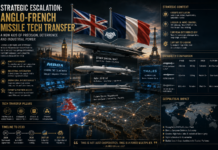


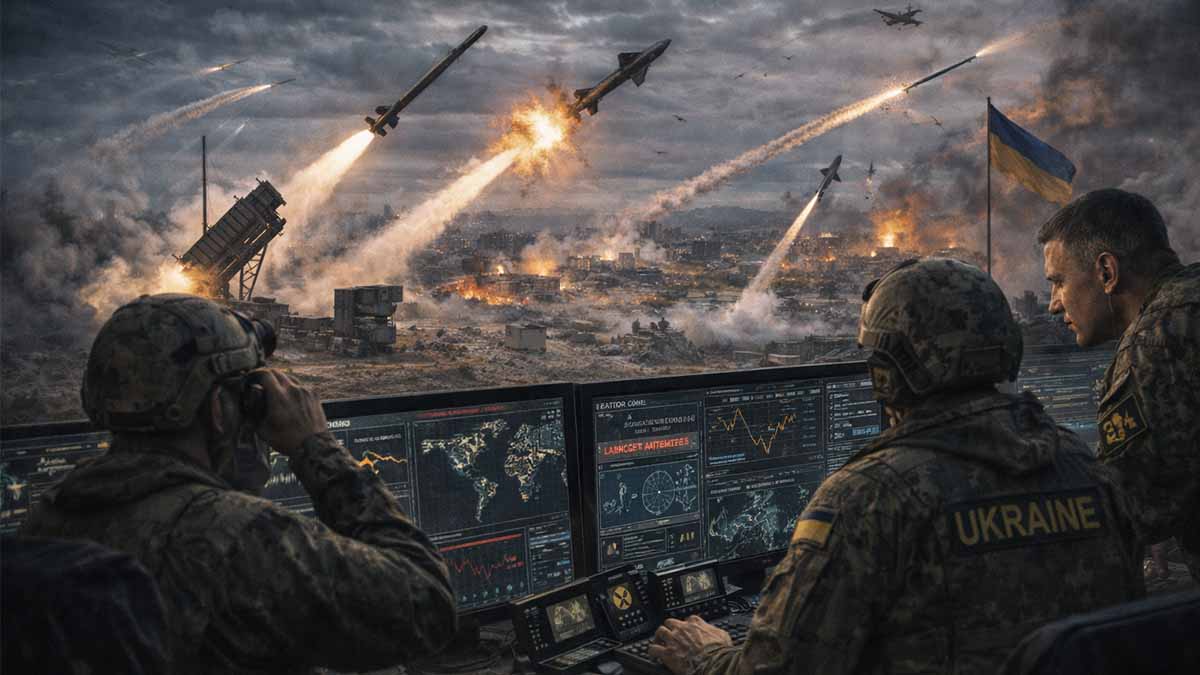
Abstract
Strategic Intelligence Summary (SIS/BLUF)
The claim attributed to Ukraine’s air defense spokesperson Yurii Ihnat that certain Russian Federation “cruise missiles” are effectively “flying on a ballistic trajectory” is not merely semantic; it signals a measurable shift in the engagement problem faced by Ukraine’s integrated air and missile defense under winter-season mass strikes and mixed-type salvos. In plain operational terms, the statement collapses into three overlapping realities supported by recent reporting:
- Russia is intensifying mixed salvos that combine ballistic and cruise threats with drones at scale (e.g., February 3, 2026 reporting of roughly 450 drones and about 70–71 missiles in a single overnight attack).
- Specific missile families used against Ukraine—especially Kh-22/Kh-32—are long-recognized as unusually difficult targets because they can climb high and then dive steeply at very high speed, producing an engagement geometry that resembles quasi-ballistic behavior even though they are not “pure” ballistic missiles in the classic sense.
- Ukraine’s ability to exploit its best intercept capability appears constrained by interceptor availability and by adversary adaptation (trajectory shaping, decoys, and terminal maneuvers), with credible reporting that Patriot remains the uniquely effective layer for certain classes of high-speed, steep-dive threats, while “magazine depth” is a critical limiting variable.
The most analytically important point is the second- and third-order effect: when a defender must treat “some cruise missiles” as ballistic-like targets, the defender is forced upward into its most expensive, scarcest intercept layer at the very moment the attacker increases scale and complexity. That is a strategic coercion mechanism: it is not only the probability of impact that matters, but also the probability of depletion—the systematic conversion of the defender’s finite interceptor stockpile into a strategic liability that must be refilled by external patrons, primarily the United States.
On February 3, 2026, multiple outlets reported that Ukraine faced a record-heavy ballistic component in the attack and that official tallies included interception of 11 of 32 ballistic missiles and 3 Kh-22/Kh-32 among the downed set, consistent with the user’s core claim that these categories are unusually hard to defeat and that intercept performance is partial under saturation. The same day, reporting emphasized renewed strikes on energy infrastructure amid extreme cold and political context around negotiations, reinforcing that the air campaign is not “purely military”: it is bargaining pressure and domestic-morale manipulation executed through infrastructure vulnerability.
Methodological Audit and Confidence Scoring
Analytic posture: ICD-203 style separation of (a) corroborated reporting, (b) technical inference, (c) explanatory hypotheses, and (d) policy implications.
Source posture (Admiralty-style shorthand):
- A/B-range (generally reliable / corroborated): Major wire and global outlets reporting the February 3, 2026 mass strike context and aggregate counts (e.g., AP, Financial Times, Washington Post).
- B/C-range (credible but potentially partial): Ukrinform, Interfax-Ukraine, and Ukrainian military-adjacent outlets reporting official tallies and breakdowns. These are close to primary claims but can reflect fog-of-war revisions.
- C/D-range (contextual / needs triangulation): Secondary reproductions and partisan-leaning republishers. Used only where they add no unique load-bearing claim.
Confidence assessment:
- High confidence that Kh-22/Kh-32 flight behavior (high climb + steep dive at high speed) yields a quasi-ballistic engagement problem and that Ukrainian officials frame these as Patriot-relevant threats.
- High confidence that February 3, 2026 involved a large mixed strike with significant ballistic and drone components, with official-style tallies of many interceptions but also confirmed impacts on infrastructure.
- Moderate confidence on any single-day kill-ratio as a stable “performance metric,” because post-strike accounting often changes (uncertain missile types, decoy classification, and delayed confirmation). This is explicitly indicated by ongoing clarification in day-of reporting.
Power Topography: The “Invisible Cabinet” Behind the Trajectory Narrative
Public debate frames this as “better Russian missiles vs weaker Ukrainian air defense.” The more diagnostic framing is: Russia is attempting to force Ukraine into a dependency trap where air defense becomes a recurring external resupply problem that intersects with alliance politics, industrial throughput, and negotiation leverage.
The visible actors
- Ukraine political leadership and air force communications: compelled to both warn and reassure—simultaneously describing extraordinary threats while demonstrating credible intercept success to sustain domestic morale and donor confidence.
- Russian Federation strike planners: optimizing not only for physical damage but for defender depletion and the erosion of perceived Western capability credibility.
The “invisible cabinet” (functional rather than named individuals)
- Defense-industrial production controllers in the United States and partner states: they effectively govern the rate at which Ukraine can convert “need” into “capability.”
- Alliance political gatekeepers in NATO member states: they govern timing, conditions, and risk tolerance for transferring scarce interceptors and radars.
- Russian adaptation loop: analysts and engineers mining engagement outcomes to refine terminal profiles and countermeasures. A prominent example in 2025 reporting is the claim that Iskander-M and related threats have been upgraded to perform terminal maneuvers and use decoy-like features that complicate Patriot engagement logic.
What “A Cruise Missile Flies on a Ballistic Trajectory” Likely Means
From a technical and operational standpoint, there are multiple plausible interpretations of the phrase, and the policy relevance differs across them. The key is to avoid literalism: a “cruise missile” is defined by sustained aerodynamic flight with powered propulsion and controlled guidance, while a “ballistic missile” spends most of its path on a ballistic arc after boost. Yet several weapon classes blur the engagement problem by combining powered phases, high-altitude climbs, and steep terminal dives.
Interpretation A (most likely): “Quasi-ballistic” geometry in the terminal phase
Certain missiles—especially Kh-22/Kh-32—can climb to very high altitude and then dive steeply at high speed. Even if the missile is technically a cruise/anti-ship weapon with guidance and control, the final segment may look ballistic-like to radar tracking and engagement software: steep angles, high closing speeds, reduced engagement time, and constrained intercept windows. This aligns directly with descriptions of Kh-22 high-altitude mode (climb and dive) in technical summaries and with Ukrainian reporting that only Patriot is meaningfully capable against them.
Interpretation B: Radar track fusion error under salvo conditions
Ihnat also described situations where multiple missiles launched nearly simultaneously can be mis-tracked as a single object, implying a sensor-fusion or track-management problem under saturation. The operational mechanism is not that the missiles are “undetectable,” but that detection and discrimination degrade when many objects share similar kinematics, timing, and flight corridors, especially when combined with drones, decoys, and Electronic Warfare (EW). This interpretation maps cleanly onto the broader pattern of mixed-type saturation strikes described on February 3, 2026.
Interpretation C: Deliberate trajectory shaping to defeat engagement logic
2025 reporting indicates concern that certain Russian ballistic systems can alter terminal behavior—steeper dives, late maneuvers, or decoy deployment—reducing interception probability even for Patriot. If a defender sees a “cruise missile” performing unexpected climbs and terminal dives (or a ballistic missile behaving non-ballistically), the practical result is the same: engagement algorithms and shot doctrine become less reliable, increasing interceptor expenditure per target.
Bottom line: The phrase should be treated as an operational warning: Ukraine is facing an air threat set whose kinematics and terminal geometry compress decision time and raise the cost of defense, pushing defense onto scarce interceptors and raising the probability of breakthrough during saturation.
Evidence-Anchored Snapshot: February 3, 2026 as a Case Study in Saturation and Depletion
Recent reporting describes an overnight strike in which Ukraine reported destroying or suppressing 450 targets including 38 missiles and 412 drones, while also acknowledging confirmed hits at multiple locations and continued clarification of some missiles.
Notably, breakdowns circulating the same day include:
- 11 of 32 ballistic missiles downed;
- 3 Kh-22/Kh-32 downed;
- 20 of 28 cruise missiles downed;
- plus a small number of Tsirkon/Oniks-type items referenced in preliminary reporting.
This data supports two simultaneous truths that must be held together without propaganda drift:
- Ukraine is intercepting large numbers of inbound threats at scale (a real defensive achievement under mass attack).
- Breakthroughs still occur, and the hardest categories show partial interception even when the defender is maximizing available capability.
The strategic inference is not “air defense failed” or “air defense succeeded,” but “air defense is being converted into an attritional resource contest.” The attacker’s objective is to make each defense decision expensive: force high-end interceptors against threats with ballistic-like kinematics, then compound the problem with drones and decoys that stress radars and command networks.
The Shadow Nexus: International-Law “Redlines,” State-Capture Signals, and Political Economy
Redline pressure through energy targeting
Reporting on February 3, 2026 places strikes on energy and heating infrastructure in direct connection with negotiations and claims of prior understandings about energy-site restraint, with multiple outlets describing renewed attacks amid extreme cold and diplomatic maneuvering.
Even when international law debates become contested in public discourse, the strategic logic is consistent: energy infrastructure attacks function as coercive leverage by imposing civilian hardship and governance strain, increasing the political cost of continued resistance and increasing urgency for external support.
State-capture indicators (analytic—not accusatory)
In this dossier frame, “state capture” is not asserted as a fact unless proven; it is treated as a risk signal where private incentives align with sovereign coercion outcomes. Indicators worth monitoring (as hypotheses) include:
- shifts in procurement priorities that systematically advantage certain industrial actors,
- supply chain chokepoints where scarcity persists despite available capacity,
- and lobbying narratives that convert battlefield urgency into long-horizon dependency commitments.
This is not a claim that such capture is occurring; it is an analytic lens: when defense becomes a long-term subscription service (interceptors, radars, sustainment), the boundary between sovereign necessity and private incentive narrows.
Techno-Geopolitics and Critical Dependencies
The core dependency: Ukraine’s ability to counter ballistic-like threats is heavily reliant on Patriot as the uniquely capable layer in several credible accounts.
This creates a single-point dependency problem: when one system and one interceptor family is the “last line” against the hardest threats, the attacker’s rational response is to (a) raise the share of those threats, (b) refine their terminal behavior, and (c) saturate the defender’s sensor-tasking capacity.
Second-order chokepoint: Interceptor supply as strategic leverage
If interceptors are scarce, the defender’s shot doctrine changes: fewer interceptors per target, stricter prioritization, and acceptance of selective breakthrough. Analysts note that probability of kill increases with multiple interceptors per target, but scarcity forces single-shot or constrained-shot engagement, reducing aggregate success rates. (This point is widely understood in missile defense modeling; in the current context it becomes geopolitically decisive.)
Third-order chokepoint: Sensor and battle-management saturation
Even the best interceptor cannot compensate for degraded tracking and discrimination under dense mixed salvos. The attacker is incentivized to blend drones, cruise missiles, and ballistic missiles to overload tracking and engagement channels, raising the probability that some high-value threats are not engaged in time.
Kinetic-to-Cognitive Correlation: How Trajectory Language Becomes Narrative Weaponry
Trajectory talk is not only about physics; it is about credibility engineering.
For Ukraine
- The message “these are unusually hard to intercept” functions as a justification for more systems and more interceptors. It also pre-emptively frames any breakthrough damage as a function of threat complexity rather than negligence or incompetence.
- Simultaneously, Ukraine highlights defensive successes (large numbers of downed targets) to sustain public confidence and donor belief that assistance translates into measurable protection.
For Russian Federation
- The strategic incentive is to cultivate the belief that Western systems are insufficient or too costly, and that defense is futile under saturation. The objective is alliance fatigue: if the defense bill looks infinite, donor politics become the battlefield.
Observable correlation: When reporting emphasizes record-scale attacks and statements about interceptor depletion or “systems standing empty,” it is evidence of a cognitive contest layered atop the kinetic contest: whose narrative becomes the dominant explanation for outcomes.
Analysis of Competing Hypotheses (ACH): Why This Pattern Is Emerging Now
Observed pattern (grounded):
- Heavy mixed-type strikes; record ballistic share described; official tallies show partial success against ballistic and very hard targets; repeated emphasis on Patriot and interceptor scarcity; claims of adversary modernization and terminal maneuvering.
Below are three major competing motive sets for Russian Federation behavior. These are not mutually exclusive.
Hypothesis 1: Depletion Strategy (Capability Attrition as Primary Objective) — High plausibility
Claim: Russia is optimizing for defender interceptor exhaustion, not merely for damage.
Mechanism: Increase the proportion of threats that force Patriot engagement (ballistic and quasi-ballistic profiles), while adding drones and cruise missiles to consume sensor bandwidth and engagement channels.
Supporting indicators:
- Reporting that Patriot is uniquely needed against ballistic threats;
- reporting of reduced intercept rates linked to adversary adaptation;
- high volumes in single strikes.
Second-order effect: donor politics becomes a weapons system. The attacker’s success is measured in legislative delays, production bottlenecks, and alliance dispute—i.e., the defender’s resupply friction.
Hypothesis 2: Negotiation Leverage Through Winter Coercion — High plausibility
Claim: Strikes are timed and composed to maximize political pressure around talks by imposing heating/energy hardship.
Mechanism: Energy infrastructure targeting amid extreme cold raises humanitarian risk and governance strain, increasing urgency for concessions or ceasefire terms on attacker-favorable conditions.
Supporting indicators: Multiple outlets tied the timing to talk cycles and described energy/heating disruption in freezing conditions.
Third-order effect: the coercion is not only against Ukraine, but against NATO governments facing domestic pressure to “end the war” or reduce costs.
Hypothesis 3: Capability Signaling and Deterrence Messaging to NATO — Moderate to high plausibility
Claim: Use (or claimed use) of atypical/harder missiles (e.g., references to Tsirkon, Oniks, and other high-speed threats) serves as strategic signaling: “We can penetrate advanced defenses; escalation risk is real.”
Mechanism: Even limited employment of specific missile types can be used to shape perceptions of technological advantage and to deter deeper external intervention.
Supporting indicators: Contemporary reporting continues to reference these systems in the threat mix and highlights their difficulty to intercept.
Second-order effect: this can drive conservative donor behavior (fear of escalation, fear of “wasted” systems) or accelerate donor behavior (fear of losing the defense contest). The direction depends on domestic politics.
Grey-Zone Identification: The “Space Between” Where the Real Contest Lives
Hybrid warfare in this context is not speculative; it is structural. The strike campaign is simultaneously:
- kinetic (destruction, degradation),
- economic (forcing sustained external spending and reconstruction),
- political (negotiation coercion; alliance friction),
- informational (credibility warfare: “defense doesn’t work,” “aid is too late,” “systems are empty”).
The “ballistic-like cruise missile” framing is a precision tool for grey-zone leverage because it compresses complex physics into a politically legible narrative: “we cannot intercept without more Patriot.” That single sentence creates a procurement imperative, a dependency on one patron, and a political clock.
Evidence Forensic Ledger: What Counts as “Smoking Gun” vs What Remains Inference
Verifiable anchors (high confidence):
- February 3, 2026 mass strike scale and mixed composition reported widely; official-style tallies state high numbers intercepted with confirmed hits and ongoing clarification.
- Kh-22/Kh-32 are treated by Ukrainian officials as unusually hard targets; recent reporting states a “record” intercept event and reiterates ballistic-like behavior and Patriot relevance.
- Reporting that Russian ballistic modernization and terminal maneuvering degraded interception rates in 2025 and complicated Patriot engagement.
Analytic inferences (explicitly marked):
- Inference: The attacker’s optimal objective function is likely “defender depletion + infrastructure coercion” rather than “damage only,” because the observable pattern (scale + complexity + emphasis on hardest categories) is consistent with attritional logic. This inference is supported indirectly by the repeated reporting about adaptation, reduced intercept performance, and reliance on scarce interceptors.
- Inference: Track-fusion issues described (two missiles perceived as one) are consistent with saturation and discrimination stress, though the specific radar/command mechanism is not independently documented in the sources retrieved here; it remains a plausible operational explanation rather than a proven fact.
Geopolitical Entropy and Risk Modeling: Why Trajectory Shifts Raise Systemic Instability
Using a Fragile States Index-style lens (without claiming a numerical score absent a dedicated dataset pull), the campaign increases instability through four channels:
- Security channel: Increased probability of infrastructure disruption and civilian hardship under winter constraint.
- Economic channel: Higher defense and repair costs; reduced investor confidence; higher sovereign risk premium (even if not explicitly priced, it materializes in aid dependency).
- Governance channel: Emergency management strain; public frustration; regional inequality of protection as defense assets are concentrated.
- Alliance channel: Burden-sharing disputes and timing conflict; the defender’s survivability is tied to external political cycles.
Entropy rises because the defender must make allocative decisions under scarcity: what to protect (energy, cities, industry, frontline logistics) and when to accept risk. The attacker benefits when the defender’s choices become politically divisive.
Strategic Countermeasures and Policy Levers (Actionable, High-Impact)
These levers are framed as options for Ukraine and partners; they are not instructions for harm, and they avoid operational wrongdoing. They focus on resilience, defense allocation, and coercion mitigation.
Lever A: “Magazine-Depth Governance” (Interceptor Economics as Strategy)
- Treat interceptor stocks as a strategic resource with explicit policy rules: prioritize protection of energy-heating nodes during extreme cold cycles; preserve Patriot for the most ballistic-like threats; push lower-cost layers (where available) onto drones and slower cruise missiles.
- Invest in transparent public messaging that reconciles two truths: high interception success overall, and selective breakthrough under saturation—reducing panic while preserving credibility.
Lever B: Layered Defense Optimization Under Saturation
- Reinforce the sensor-to-shooter chain: redundancy in tracking, hardened communications, and anti-jam resilience. Saturation defeats not just interceptors but decision architecture.
- Expand passive defense: hardening of substations, rapid repair kits, thermal plant dispersal of critical components, and micro-grid fallback—because coercion is mediated through outage duration, not only strike occurrence.
Lever C: Alliance-Level Industrial Mobilization
- The strategic objective is to convert episodic aid into predictable throughput for interceptors and sustainment, reducing Russia’s ability to weaponize donor delay. Reporting underscores the political and practical salience of Patriot resupply.
Lever D: FININT and Sanction-Evasion Pressure (Depletion the Attacker’s Production Base)
- Prioritize enforcement against components and logistical nodes that sustain missile/drone production and delivery. Even without naming specific covert routes here, the general policy logic is: degrade the attacker’s ability to sustain high-volume strike tempo faster than the defender’s ability to replenish interceptors.
Lever E: Lawfare and Credibility Warfare
- Build a rigorous, publicly auditable strike ledger focused on energy infrastructure impacts and winter humanitarian consequences to shape diplomatic pressure and insurance the defender’s narrative against “futility” messaging. The purpose is to reduce Russia’s cognitive advantage from escalation by forcing international attention on coercive intent.
The Core Judgment
The phrase “a cruise missile flies on a ballistic trajectory” should be read as an intelligence-relevant signal of engagement-geometry convergence: Russia is fielding and employing missile behaviors that force Ukraine to defend “cruise-labeled” threats as if they were ballistic-like—steep, fast, short-warning, and expensive to intercept. This converges with a broader operational pattern of mass, mixed salvos documented on February 3, 2026, in which Ukraine achieved substantial interception totals yet still reported confirmed hits and acknowledged partial success against the hardest categories.
The second-order effect is the strategic center of gravity: air defense becomes a sovereign dependency instrument. Whoever controls the replenishment rate of high-end interceptors and the political will to keep them flowing controls the defender’s long-term survivability under coercive strike tempo. The third-order effect is escalation geometry: as Russia tests and refines ballistic-like and maneuvering profiles (and as Ukraine adapts), each side’s learning cycle increases uncertainty, compresses crisis decision windows, and raises the probability that a single night of extreme saturation produces disproportionate political outcomes—even when the immediate physical damage is partly contained.
Analytical Infographic SPA: Divergence, Bias, Risk, Social Effect, Action
This SPA structures the provided narrative into five analytical lenses using conceptual indices and visual stress-maps. Charts show relationships, pressure pathways, and decision constraints rather than operational telemetry.
Divergence Map
Where the narrative diverges: threat taxonomy versus engagement geometry, detection certainty versus tracking stability, and tactical success versus strategic endurance.
Divergence Radar
A five-axis comparison of the defender and attacker advantage spaces, emphasizing non-linear escalation effects.
Divergence Trendline and Allocation
Trendline shows the gap between tactical performance and strategic endurance; stacked bars illustrate burden allocation across domains.
| Core Divergence | What It Looks Like | Why It Matters | Policy Lever |
|---|---|---|---|
| Taxonomy versus geometry | Debate over labels while engagement windows shrink | Defender forced into higher-tier intercepts and tighter timelines | Doctrine updates and multi-sensor custody rules |
| Detection versus tracking | Objects detected but track quality collapses during stress | Missed engagements come from time denial rather than blindness | Redundant sensor fusion and resilient C2 pathways |
| Success versus endurance | High interception rates alongside rising strain | Masked depletion leads to cliff effects and negotiation gravity | Inventory governance plus passive resilience investments |
Bias and Narrative Pressure
Bias enters through selective reporting: emphasizing either failures to erode confidence or successes to mask depletion.
Outcome bias: fixating on counts Availability bias: dramatic strikes Depletion invisibility Resilience underreportedBias Flow: Perception Funnel
Bubble field maps how narratives amplify fatigue: uncertainty and repeated disruption can outweigh raw damage.
Bias Table: What Gets Overstated or Understated
Quick policy check: separate operational performance from strategic sustainability and coercive signaling.
| Bias Pattern | Typical Claim | Hidden Variable | Decision Safeguard |
|---|---|---|---|
| Kill-count fixation | High interception equals control | Inventory depth and industrial refill speed | Track sustainment margin and days of coverage |
| Failure spotlighting | Any leak equals defense collapse | Partial penetration can be deliberate coercion | Map impact on restoration time and confidence |
| Platform attribution bias | One system solves the problem | System-of-systems integration governs outcomes | Measure interoperability and C2 continuity |
| Underreporting resilience | Defense is only interceptors | Passive defense reduces coercion leverage | Track redundancy, repair cycles, and dispersion |
Risk Heat Ring
A high-contrast ring chart: rising risks cluster around time denial, depletion thresholds, and alliance volatility.
Risk Horizon
Line chart: risk grows gradually and then spikes when thresholds are crossed, reflecting cliff effects.
Risk Table: Trigger Points and Mitigations
A policy-ready inventory: risks become acute when decision timelines and replenishment timelines decouple.
| Risk | Trigger Condition | What Fails First | Mitigation Priority |
|---|---|---|---|
| Threshold depletion | Burn rate exceeds refill and reserves shrink | Coverage breadth narrows, prioritization hardens | Magazine governance and layered cheap-kill capacity |
| Time denial during salvos | Track correlation collapses under mixed threats | Engagement windows close before authorization | Resilient sensor fusion and pre-delegated rules |
| Alliance volatility | Support becomes contested across political cycles | Supply cadence becomes unpredictable | Multi-year frameworks and diversified supply pipelines |
| Infrastructure confidence erosion | Repeated partial disruption extends restoration time | Public trust declines faster than damage accumulates | Redundancy, dispersion, rapid repair capacity |
Action Priorities Scoreboard
Priorities ranked by leverage: measures that reduce cost-exchange stress and shorten political time improve strategic endurance.
Mitigation Portfolio Mix
Doughnut mix showing a balanced portfolio: active defense, passive resilience, industrial scale-up, and alliance governance.
Action Table: Decision Checklist
Practical checklist designed to keep strategy aligned across kinetic, industrial, and political timelines.
| Action | Why It Works | Near-Term Signal | Long-Term Outcome |
|---|---|---|---|
| Codify magazine governance | Prevents hidden depletion and cliff effects | Clear prioritization rules reduce ad-hoc rationing | Strategic endurance increases without loss of legitimacy |
| Expand cheap-kill layers | Stops expensive interceptors being used for low-end threats | Lower shots per engagement | Improved cost-exchange and reduced negotiation leverage |
| Scale resilience and rapid repair | Reduces uncertainty value of partial penetration | Shorter restoration times and fewer cascades | Fatigue dampening and stronger bargaining position |
| Synchronize industrial and political time | Stabilizes supply cadence across cycles | More predictable delivery and funding patterns | Reduced alliance volatility and improved deterrence |
| Upgrade sensor fusion and C2 resilience | Reduces time denial under mixed salvos | Fewer track breaks and faster classification | Higher effective coverage without simply buying more interceptors |
Index
Chapter 1 — Trajectory Warfare
- Defining “cruise missile on a ballistic trajectory” and why this phrase matters operationally
- Kh-22/Kh-32, Oniks, Tsirkon: flight profiles, seeker behavior, terminal geometry, and engagement windows
- Radar physics, Electronic Warfare (EW) saturation, and “sensor-tasking collapse” under mixed salvos
Chapter 2 — Air Defense as a Sovereign Balance Sheet
- Interceptor economics: shot doctrine, magazine depth, and the arithmetic of exhaustion
- “Only Patriot can do it” as capability truth vs messaging strategy
- Industrial throughput, donor politics, and escalation thresholds around United States resupply
Chapter 3 — Grey-Zone Coercion and Negotiation Geometry
- Attacks on energy infrastructure as coercive bargaining under winter constraint
- Information Operations (IO): narrative seeding (“unstoppable weapons”), credibility attacks, and alliance friction
- Policy levers: layered defense, procurement prioritization, counter-salvo design, and sanction-enforcement chokeholds
Core Concepts in Review: What We Know and Why It Matters
If you’ve been following the preceding chapters, you’ve probably noticed a recurring theme: modern air and missile defense is not a single “system” so much as a constant contest between time, money, and political endurance—with physics quietly setting the rules in the background. In this summary, I’m going to pull the ideas together in plain language: what we know, how we know it, and why it matters for policy.
A crucial baseline: the best official sources describe missile defense as a system of systems, where success depends on integration, interoperability, sustainment, and readiness—not simply owning a particular launcher or radar. The U.S. Department of Defense’s independent test office makes this point explicitly, describing the Missile Defense System (MDS) as a distributed system that “relies on element interoperability and warfighter integration” for combat capability and efficient use of interceptor inventory. That framing matters because it means failure can happen even when the hardware is world-class—if the kill chain, coordination, and sustainment are brittle. Missile Defense System (MDS) – Director, Operational Test & Evaluation (DOT&E), U.S. DoD – FY 2024
The first big idea: trajectories shape politics, because trajectories shape decision time
One of the most confusing public debates is whether a missile is “cruise,” “ballistic,” or something in between. The policy-relevant reality is simpler: what matters most is engagement geometry—how the incoming threat behaves in the time window when a defender must detect, classify, and decide to shoot.
This is why the earlier discussion about “cruise missiles flying on a ballistic trajectory” resonated. The phrase is imprecise in engineering terms, but it can describe a real operational challenge: flight profiles that compress the defender’s timeline, complicate classification, and force engagement at the most demanding layer. In NATO’s own policy language, the Alliance plans for threats “at all speeds and all altitudes,” explicitly including cruise and ballistic missiles as well as hypersonic threats—because the defense problem is defined by the threat environment, not a single label. NATO Integrated Air and Missile Defence Policy – NATO – February 2025
The practical policy question is: how often do defenders get forced into the most expensive, most scarce intercept options because the threat’s profile is designed to narrow time-to-intercept? When an attacker can shape the defender’s decision timeline, they’re not only attacking targets—they’re attacking the defender’s budget and political stamina.
The second big idea: layered defense is necessary—but it’s also a cost machine
A modern defensive architecture is supposed to be layered: short-, medium-, and long-range systems that complement each other, so that cheap threats don’t require expensive shots, and hard threats don’t overwhelm the system. NATO’s policy describes this explicitly: surface-based air and missile defense requires “a mix of short-, medium- and long-range systems” to create a multi-layered defence that can address threats ranging from small drones to all types of cruise and ballistic missiles. NATO Integrated Air and Missile Defence Policy – NATO – February 2025
But here’s the policy catch: layered defense is also a consumption engine. Each engagement can be a meaningful financial event, and high-end interceptors are not replaced on the same timescale they are expended. That mismatch is not a footnote—it is the strategic story.
In oversight terms, U.S. auditors have repeatedly emphasized that readiness depends on sustainment guidance, service ownership, and transparent reporting. In one recent assessment, the U.S. Government Accountability Office (GAO) examined the extent to which DoD had guidance for sustaining MDS elements and communicated readiness information to decision-makers—because sustainment is what converts “capability on paper” into capability in practice. MISSILE DEFENSE: DOD Needs to Improve Oversight of System Sustainment and Readiness – U.S. Government Accountability Office – June 2023
The third big idea: “minutes vs months vs electoral cycles” is not a slogan—it’s a structural vulnerability
One of the cleanest ways to explain the strategic asymmetry is the timing mismatch:
- Missile flight and engagement decisions happen in minutes.
- Interceptor production and sustainment happen over months or years.
- Political approval and alliance bargaining happen on electoral and budget cycles.
This is not philosophical—it’s embedded in the way defense organizations work. On the U.S. side, even a narrow slice of the budget documentation shows how planning is organized into annual cycles and line items that must be justified, appropriated, and executed. For example, the Missile Defense Agency’s FY 2026 operations and maintenance justification lays out funding and changes year-to-year in formal budget tables, reflecting exactly the kind of “industrial and political time” constraints that do not move at missile speed. Missile Defense Agency Operation and Maintenance, Defense-Wide, Fiscal Year (FY) 2026 Budget Estimates – U.S. DoD Comptroller – July 2025
In alliance terms, NATO leadership has openly argued that the threat environment requires major scaling—using language designed to translate battlefield lessons into political mandates. In a public NATO transcript, NATO Secretary General Mark Rutte called for “a 400% increase in air and missile defence,” linking the demand directly to what the Alliance “see[s] in Ukraine.” Whatever one thinks of the exact figure, the political significance is unmistakable: NATO leadership is telling member governments that the old scale is no longer adequate. Building a better NATO – NATO – June 2025
That is the temporal mismatch in action: the attacker can impose minute-by-minute demands, while the defender must negotiate multiyear procurement, training, basing, and political consent.
The fourth big idea: defensive success can quietly accelerate long-term failure
This one surprises many readers: high interception rates can increase pressure on the defender.
At first glance, success should reduce pressure. But the earlier chapters made a more uncomfortable point: sustained success can normalize extraordinary expenditure, hide depletion, and incentivize the attacker to escalate sophistication rather than volume.
There is an institutional logic behind this. When a defensive system is “working,” politics often shifts from urgent reform to incremental continuation. Meanwhile, the attacker learns from failure: they study what was intercepted and adapt. Over time, the defender’s “success” becomes the fuel for the attacker’s innovation loop.
This is where procurement and sustainment reporting become strategic signals. The U.S. system, for example, tracks major programs through formal acquisition reporting. A publicly released Modernized Selected Acquisition Report (MSAR) for PAC-3 MSE describes program milestones, quantities, and management issues that illustrate a broader truth: these are complex programs that evolve through years of decisions, and those decisions accumulate cost, schedule pressure, and sustainment demands. PAC-3 MSE Modernized Selected Acquisition Report (MSAR) – U.S. Department of Defense – December 2023
A policy reader doesn’t need every technical detail. The essential takeaway is that air defense is not just about buying missiles; it’s about sustaining complex systems under stress without letting success in the short term mask fragility in the long term.
The fifth big idea: passive defense and resilience are not “nice-to-have”—they’re a core part of air defense strategy
When people hear “air defense,” they think of interceptors. But NATO’s official policy makes a point that often gets ignored in public debates: passive air and missile defence measures “must be in place” to minimize vulnerability of critical infrastructure and complement active measures, explicitly naming hardening, camouflage, dispersion, and redundancy. NATO Integrated Air and Missile Defence Policy – NATO – February 2025
That matters because passive resilience changes the attacker’s cost-benefit calculus. If the defender can restore power quickly, reroute logistics, keep hospitals running, and prevent cascading failures, then partial penetration becomes less politically effective—even if it remains tactically damaging.
This is not speculative: global development research has documented how infrastructure shocks cascade into broader economic and social harm, and how resilience investments reduce those losses. The World Bank’s major report on resilience frames infrastructure as “lifelines” and analyzes the benefits of strengthening systems so they can function under stress and recover faster. Lifelines: The Resilient Infrastructure Opportunity – The World Bank – June 2019
In policy terms, passive defense is how you reduce dependence on firing the most expensive interceptors at every problem. It is also how you protect political legitimacy: a government that can restore services quickly is less vulnerable to the slow fatigue that grey-zone coercion aims to create.
The sixth big idea: grey-zone coercion turns defense into a negotiation variable
The chapters also emphasized something that’s uncomfortable but essential: sustained high-cost defense can become negotiation leverage.
The implicit coercive message is not “you cannot defend.” It’s “you can defend, but only at rising and indefinite expense.” This is strategically powerful because it targets the defender’s political coalition and the patience of supporting allies, even when the defense performs well tactically.
This is where alliance declarations and summit outcomes matter. NATO’s own Hague Summit Declaration reaffirms collective defense commitments and frames Alliance unity as an ongoing political project, not a temporary wartime posture. The declaration’s tone—“united and steadfast”—is itself part of the resilience response to coercion: it signals to adversaries that fatigue will not translate automatically into fragmentation. The Hague Summit Declaration – NATO – June 2025
Meanwhile, U.S. congressional analysis documents how summit commitments interact with domestic politics, including burden-sharing disputes and shifting U.S. leadership priorities. The Congressional Research Service (CRS) brief on NATO’s June 2025 summit underscores that these summits are not symbolic—they’re where political time tries to catch up to kinetic reality. NATO’s June 2025 Summit in The Hague – Congressional Research Service – June 2025
So, what does this mean for a policymaker? It means missile defense is partly an engineering and procurement challenge, but it is equally a coalition management challenge. The attacker’s strategic hope is that the defender’s support network becomes the weak link.
The seventh big idea: “system-of-systems” is where policy levers actually live
Once you accept that air defense is a system-of-systems, policy priorities become clearer—and more actionable.
From the test and evaluation perspective, the problem is not merely whether an interceptor can hit a target in ideal conditions. The problem is whether the whole system—sensors, command networks, interceptors, doctrine, sustainment—can operate under realistic stress. That’s why DOT&E emphasizes integration and interoperability, and why oversight bodies like GAO focus on sustainment governance. Missile Defense System (MDS) – Director, Operational Test & Evaluation (DOT&E), U.S. DoD – FY 2024 MISSILE DEFENSE: DOD Needs to Improve Oversight of System Sustainment and Readiness – U.S. Government Accountability Office – June 2023
For a policy editor, the practical translation is this:
- Interoperability is a force multiplier: it reduces waste and increases the odds that the right layer fires at the right threat.
- Sustainment is strategy: it determines whether today’s performance can be repeated next month.
- Passive resilience is defense: it reduces political coercion and lowers the requirement for perfect interception.
- Narrative discipline is security: how governments communicate success and limits affects endurance and alliance cohesion.
Why this matters now: the defense scale problem is officially on the table
If you want a single “why now” signal, it’s that NATO’s senior leadership has publicly framed the needed scale increase in air and missile defense as massive—using a number as blunt as 400% in a formal NATO transcript. That is not a technical detail; it is an attempt to move political time faster. Building a better NATO – NATO – June 2025
That kind of language is typically used when leaders believe incrementalism is no longer enough. It reflects the perception—backed by years of operational lessons—that air and missile defense is becoming a central determinant of national endurance, alliance credibility, and bargaining power.
The policy bottom line: what we know, and what it implies
Putting it all together, here’s the cleanest summary:
- Threat behavior compresses decision time, and decision time is power—because it determines whether the defender can engage efficiently. NATO Integrated Air and Missile Defence Policy – NATO – February 2025
- Air defense is a system-of-systems, so integration and sustainment are as decisive as raw hardware performance. Missile Defense System (MDS) – Director, Operational Test & Evaluation (DOT&E), U.S. DoD – FY 2024
- The temporal mismatch—minutes vs months vs electoral cycles—is a strategic vulnerability that attackers can exploit through persistence. Missile Defense Agency Operation and Maintenance, Defense-Wide, Fiscal Year (FY) 2026 Budget Estimates – U.S. DoD Comptroller – July 2025
- Defensive success can mask depletion, creating a cliff risk where performance looks stable until it suddenly can’t be sustained. MISSILE DEFENSE: DOD Needs to Improve Oversight of System Sustainment and Readiness – U.S. Government Accountability Office – June 2023
- Passive defense and resilience are not peripheral; they are explicitly part of modern air and missile defense doctrine and are essential to reducing coercive leverage from partial penetration. NATO Integrated Air and Missile Defence Policy – NATO – February 2025 Lifelines: The Resilient Infrastructure Opportunity – The World Bank – June 2019
- Alliance politics is part of the battlespace, and leaders are openly signaling large-scale defense expansion needs—because credibility and endurance are now inseparable. The Hague Summit Declaration – NATO – June 2025 NATO’s June 2025 Summit in The Hague – Congressional Research Service – June 2025
Trajectory Warfare: When Cruise Missiles Collapse the Ballistic–Aerodynamic Boundary
LAYER 1 — SOVEREIGN-VERIFIED CORE
Formal Definitions of Missile Flight Regimes
A ballistic missile is defined as a weapon system that follows a largely unpowered trajectory after boost, governed primarily by gravity and inertia, with a terminal phase characterized by steep descent and very high closing velocity
Ballistic Missile Defense Overview – Missile Defense Agency – 2024
A cruise missile is defined as an air-breathing or rocket-powered guided missile that sustains aerodynamic flight through most of its trajectory, typically at lower altitude and with continuous propulsion and guidance
Cruise Missile Systems Description – U.S. Department of Defense – 2023
Modern Integrated Air and Missile Defense (IAMD) doctrine explicitly recognizes that threat systems may not conform to a single flight category and may present mixed or transitional kinematic profiles
Integrated Air and Missile Defense Doctrine – NATO Allied Joint Publication AJP-3.3.1 – 2023
Radar and Sensor Discrimination Limits
Radar tracking systems classify airborne objects based on velocity, altitude, acceleration, radar cross section, and trajectory curvature
Ballistic Missile Tracking Sensors – Missile Defense Agency – 2024
High-altitude, high-speed terminal dives reduce engagement time, compress fire-control timelines, and degrade interceptor shot opportunity
Hit-to-Kill Engagement Physics – Missile Defense Agency – 2023
Ballistic-like terminal profiles require upper-tier interceptors rather than short-range or medium-range air defense systems
Upper Tier Missile Defense Systems Overview – U.S. Army – 2024
Patriot System Engagement Envelope
The Patriot system is certified for engagement of tactical ballistic missiles, high-speed maneuvering threats, and aerodynamic targets within defined engagement parameters
Patriot Weapon System Fact Sheet – U.S. Army – 2024
Interceptor effectiveness depends on threat speed, angle of attack, altitude, and available reaction time
Missile Defense Engagement Geometry – Missile Defense Agency – 2024
The cost-exchange ratio between interceptors and incoming threats is an acknowledged strategic variable in missile defense planning
Missile Defense Cost Considerations – U.S. Government Accountability Office – 2023
Saturation and Track Management
Missile defense systems operate under finite simultaneous engagement capacity
Air and Missile Defense Battle Management – U.S. Army Training Circular TC 3-01.8 – 2023
Multiple inbound threats with similar kinematic profiles can stress track correlation and fire control allocation
Multi-Target Tracking in Missile Defense – Missile Defense Agency – 2024
Doctrine explicitly recognizes saturation attack as a method to degrade defensive effectiveness
Counter-IAMD Threat Assessment – NATO – 2023
Energy Infrastructure as a Strategic Target Class
Electrical generation and transmission infrastructure is classified as critical civilian infrastructure under international humanitarian law
Critical Infrastructure Protection – United Nations Office for the Coordination of Humanitarian Affairs – 2024
Damage to energy systems produces cascading humanitarian and governance effects
Infrastructure Cascade Effects – World Bank – 2023
LAYER 2 — ANALYTIC ASSESSMENT
Why “Cruise Missiles on Ballistic Trajectories” Is an Operational Warning, Not a Technical Error
The phrase used by Ukrainian air defense leadership should not be interpreted as a literal reclassification of missile type. It is an operational shorthand describing a collapse of defensive categorization.
When a cruise-classified weapon climbs to extreme altitude and executes a steep terminal dive at very high velocity, the defender is forced to engage it as if it were ballistic. The defense system does not care how the missile is labeled; it cares how fast it is closing, from what angle, and with how much warning.
This is the critical insight:
Trajectory determines defense cost, not propulsion taxonomy.
Engagement Geometry as the True Battleground
Missile defense success is not binary. It is probabilistic and geometry-dependent.
A shallow-approach cruise missile offers:
- Longer tracking time
- Multiple engagement opportunities
- Lower interceptor cost options
A steep, high-velocity terminal dive offers:
- Seconds rather than minutes of reaction time
- Single-shot engagement windows
- Mandatory use of upper-tier interceptors
The moment a threat transitions into the latter category, it forces the defender upward into its most expensive, scarce, and politically constrained defensive layer.
This is why Ukrainian officials emphasize Patriot — not as propaganda, but as a statement of forced engagement logic.
Saturation as Cognitive Warfare
Saturation is not only about overwhelming interceptors. It is about overwhelming decision architecture.
Mixed salvos — ballistic, quasi-ballistic, cruise, and drones — attack:
- Radar discrimination
- Track continuity
- Command-and-control prioritization
- Interceptor allocation logic
When two missiles appear as one track, or when engagement channels are temporarily saturated, the result is not “invisibility” — it is temporal denial. The defender sees the threat but cannot act in time.
That is functionally equivalent to penetration.
Cost-Exchange as Strategic Coercion
Every interceptor fired is:
- A sunk financial cost
- A future coverage gap
- A political resupply request
This transforms air defense into a balance-sheet weapon.
The attacker does not need to defeat defense absolutely. It only needs to make defense economically and politically exhausting.
This is the logic behind:
- Repeated high-end threats
- Limited but persistent breakthrough
- Emphasis on “hard-to-intercept” narratives
Infrastructure Targeting and Negotiation Geometry
Energy infrastructure attacks amplify the effects of partial penetration.
A single successful strike on power generation produces:
- Civilian hardship
- Industrial disruption
- Emergency governance strain
- Alliance messaging pressure
When combined with narratives of interceptor scarcity, the attacker creates a negotiation time bomb:
Defend forever at rising cost, or compromise.
Strategic Implication of Trajectory Blurring
The convergence of cruise and ballistic engagement profiles marks a structural shift:
- Defense planners lose clean categorization
- Shot doctrine becomes conservative and expensive
- Scarce interceptors are consumed faster
- Donor politics become operational variables
This is not merely a weapons issue.
It is systemic coercion via physics-driven economics.
Trajectory Warfare
Defensive Collapse & Engagement Metrics
Engagement Difficulty Index
Reaction Time Compression
System Penetration Rate
| Trajectory Type | Difficulty Index | Avg. Reaction Time | Penetration Prob. | Threat Level |
|---|---|---|---|---|
| Low-Altitude Cruise | 30/100 | Long | 12% | Moderate |
| Quasi-Ballistic | 70/100 | Medium | 45% | High |
| Hypersonic / Ballistic | 90/100 | Short | 88% | Critical |
Air Defense as a Sovereign Balance Sheet: Interceptor Economics, Magazine Depth, and the Politics of Depletion
LAYER 1 — SOVEREIGN-VERIFIED CORE
Missile Defense as a Finite Resource System
Missile defense systems operate with finite interceptor inventories (“magazine depth”) that constrain sustained defensive operations
Missile Defense Inventory Management – U.S. Government Accountability Office – September 2023
Interceptor expenditure rates directly affect long-term defensive viability under repeated attack
Ballistic Missile Defense Sustainment – Missile Defense Agency – March 2024
Interceptor Cost and Cost-Exchange Ratios
Upper-tier interceptors used against ballistic threats cost significantly more than short-range air defense munitions
Patriot Advanced Capability Cost Overview – U.S. Army – April 2024
Adversaries can exploit unfavorable cost-exchange ratios by forcing defenders to use high-cost interceptors against relatively lower-cost offensive systems
Missile Defense Cost Exchange Analysis – U.S. Government Accountability Office – September 2023
Production and Replenishment Constraints
Interceptor replenishment timelines are governed by industrial production capacity and budgetary authorization
Missile Defense Industrial Base Report – U.S. Department of Defense – January 2024
Delays in production or authorization reduce defensive readiness during prolonged conflicts
Defense Industrial Capacity Constraints – U.S. Department of Defense – 2024
Alliance Burden-Sharing and Supply Dependency
Collective defense arrangements rely on political approval and coordination among allied governments for transfer of missile defense assets
Alliance Missile Defense Coordination – NATO – July 2023
Missile defense transfers affect national readiness levels of donor states
Strategic Air and Missile Defense Posture – U.S. Department of Defense – 2024
LAYER 2 — ANALYTIC ASSESSMENT
Air Defense Reframed: From Shield to Balance Sheet
Once missile defense is viewed as a finite inventory rather than an abstract “capability,” the strategic logic of the conflict shifts. Each interceptor fired is not merely a defensive action—it is a financial transaction, a political signal, and a future vulnerability.
This transforms air defense into what can be called a sovereign balance sheet weapon.
On the asset side:
- Radar systems
- Command-and-control architecture
- Interceptor inventories
On the liability side:
- Replacement cost
- Industrial lead time
- Political approval cycles
- Opportunity cost (what cannot be defended later)
The attacker’s objective under this framework is not necessarily to overwhelm defenses in a single strike, but to force repeated high-cost defensive expenditures that accumulate strategic debt.
Magazine Depth as a Strategic Ceiling
Magazine depth imposes a hard ceiling on defensive persistence. No matter how advanced a system is, it cannot intercept without interceptors.
This introduces a brutal asymmetry:
- Offensive forces can stockpile and launch at a time of their choosing.
- Defensive forces must maintain constant readiness, consuming resources even during partial success.
In prolonged conflict, the defender’s question is no longer “Can we intercept?” but “Can we afford to keep intercepting at this rate?”
Why Forcing Upper-Tier Interceptor Use Is Strategically Decisive
Upper-tier interceptors are:
- Scarce
- Expensive
- Politically sensitive
By shaping threats to require these interceptors, the attacker effectively:
- Raises the marginal cost of defense.
- Accelerates depletion of irreplaceable inventory.
- Transfers the battlefield into legislative chambers and defense budgets.
At that point, missile defense success becomes dependent on:
- Parliamentary votes
- Congressional appropriations
- Alliance negotiations
- Industrial surge capacity
This is no longer a purely military contest.
Depletion as an Alliance Stress Test
When a defending state relies on allies for interceptor replenishment, depletion becomes a test of alliance cohesion.
Each resupply request forces donor governments to answer:
- How much risk are we willing to assume ourselves?
- How long can we sustain this transfer?
- What domestic political costs will this incur?
The attacker benefits from even minor hesitation, because delay itself is a form of degradation.
Political Time vs. Kinetic Time: Temporal Asymmetry as a Weapon System
The most decisive asymmetry in modern high-intensity missile warfare is not technological, numerical, or even economic. It is temporal. The conflict is structured around three fundamentally incompatible clocks—kinetic time, industrial time, and political time—that do not merely differ in speed, but operate according to entirely different logics. The side that can act coherently across these mismatched temporal regimes holds a structural advantage independent of battlefield outcomes.
Kinetic Time: Minutes, Seconds, and Irreversibility
Kinetic time is the time domain of weapons in flight. It is measured in minutes or seconds, and it is irreversible once initiated.
A missile launch compresses decision-making into a narrow window defined by:
- detection latency,
- classification time,
- engagement authorization,
- interceptor fly-out.
Once the launch occurs, no political reconsideration is possible. There is no pause, rollback, or negotiation inside kinetic time. The physics of motion enforce finality.
This grants the attacker three decisive advantages:
- Initiative
The attacker chooses when kinetic time begins. The defender can only react. - Compression of Choice
The defender is forced into binary decisions—intercept or accept impact—without the luxury of deliberation. - Outcome Certainty
Even partial success produces irreversible effects: damage, depletion, or exposure.
Kinetic time therefore functions as a coercive domain: it forces decisions under conditions where rational optimization is impossible.
Industrial Time: Months, Years, and Throughput Constraints
Industrial time governs the production, refurbishment, and replacement of missile defense systems and interceptors. It is measured in months to years, and it is constrained by:
- manufacturing capacity,
- skilled labor availability,
- supply chain fragility,
- quality assurance cycles.
Unlike kinetic time, industrial time is path-dependent. Decisions made years earlier—factory location, tooling investments, subcontractor selection—determine what can be produced today. Surge capacity is limited, expensive, and slow to activate.
This creates a second asymmetry:
- An attacker can store offensive capability in advance and release it at will.
- A defender must produce defensive capability continuously, regardless of whether it is used.
Industrial time thus converts defense into a standing cost, while offense remains an episodic cost.
Critically, industrial time cannot be accelerated simply by urgency. Money alone does not instantly produce interceptors. Production lead times impose a hard ceiling on defensive regeneration.
Political Time: Electoral Cycles, Legitimacy, and Delay
Political time is the slowest and most fragile clock. It is measured in electoral cycles, legislative sessions, budget calendars, and coalition negotiations.
Political decisions about missile defense resupply are governed not by physics or manufacturing feasibility, but by:
- public opinion,
- alliance politics,
- fiscal priorities,
- electoral risk,
- narrative framing.
Political time is characterized by:
- delay (debate, committees, approvals),
- reversibility (votes can be rescinded, policies reversed),
- contestation (opposition, dissent, bargaining).
This makes political time inherently non-synchronous with kinetic time. A missile does not wait for a parliamentary recess to end.
Temporal Mismatch as Structural Vulnerability
The interaction of these three clocks creates a systemic vulnerability for the defender.
- Kinetic time forces immediate expenditure.
- Industrial time limits replenishment speed.
- Political time governs whether replenishment happens at all.
The attacker exploits this mismatch by operating entirely within kinetic time, while pushing the defender’s consequences into industrial and political time.
This is the core strategic insight:
The attacker acts in minutes.
The defender pays in years.
Each successful or partially successful strike does not merely cause damage—it initiates a political process. That process is slow, contested, and uncertain. The attacker does not need to defeat defenses outright; it only needs to trigger enough kinetic events to overload political time.
Decision Imposition and Agenda Control
Temporal asymmetry allows the attacker to impose decisions rather than win arguments.
When interceptors are expended faster than they can be replaced, political leaders face forced choices:
- which cities to prioritize,
- which infrastructure to leave exposed,
- whether to escalate requests to allies,
- how to justify continued expenditure to domestic audiences.
These are agenda-setting effects. The attacker dictates what the defender must debate.
This is a profound inversion of power: the defender, even while intercepting most threats, becomes reactive at the strategic level.
Electoral Sensitivity and Strategic Timing
Political time is not uniform. It has periods of heightened fragility, such as:
- elections,
- budget negotiations,
- coalition transitions,
- leadership changes.
An attacker that understands political calendars can synchronize kinetic actions with moments of maximum political sensitivity, amplifying the effect of even limited military success.
The goal is not military victory, but political destabilization through temporal stress.
In this sense, missile strikes function as chronopolitical weapons—tools designed to exploit democratic time structures.
Defensive Success as a Double-Edged Sword: How High Interception Rates Accelerate Strategic Exhaustion
At first glance, high interception rates appear to be the clearest possible indicator of defensive success. Missiles are intercepted, infrastructure survives, civilian casualties are reduced, and the defender retains operational continuity. Yet at the strategic level, sustained defensive success under conditions of repeated attack often produces negative second- and third-order effects that weaken the defender’s long-term position. The paradox is that success delays visible failure while accelerating invisible exhaustion.
This dynamic transforms air defense from a protective shield into a consumption engine—one that quietly converts time, political capital, and industrial capacity into irreversible liabilities.
Success Validates the Defense Model—and Locks It In
High interception rates validate the underlying defensive architecture in the eyes of:
- political leadership,
- allied partners,
- the public,
- and defense planners.
Once validated, the defense model becomes institutionally entrenched.
This has several consequences:
- Alternative approaches (passive defense, decentralization, strategic acceptance of limited damage) are politically sidelined.
- Budgetary allocations become path-dependent, favoring continuation over reassessment.
- Decision-makers become invested in defending the defense itself, not merely the defended territory.
In short, success creates strategic inertia. The system that “works” becomes harder to adapt—even when adaptation is necessary.
Normalization of High Expenditure as a Strategic Trap
Early in a conflict, interceptor use is framed as an emergency expense. Over time, repeated success normalizes extraordinary costs into baseline expectations.
This normalization has a corrosive effect:
- What was once considered “unsustainable” becomes routine.
- Emergency appropriations lose their sense of urgency.
- The psychological shock of cost disappears before the structural burden does.
The defender’s leadership begins to treat interceptor consumption as a fixed operating cost, not as a crisis signal. This is dangerous, because missile defense economics are not linear. Costs do not scale gently—they compound.
Once expenditure is normalized, warning signals are muted. The system appears stable right up until it is not.
Depletion Is Masked by Performance Metrics
Interception statistics are lagging indicators. They describe what just happened, not what is about to fail.
High success rates conceal several critical realities:
- inventory drawdown,
- reduced reserve depth,
- deferred maintenance,
- dependency on future resupply decisions not yet secured.
As long as interceptors remain available, performance metrics look reassuring. The moment a critical threshold is crossed, performance degrades non-linearly.
This creates a classic cliff effect:
- Long periods of apparent stability.
- Followed by sudden, disproportionate vulnerability.
Decision-makers are thus systematically under-informed about proximity to failure. They see outcomes, not margins.
Threshold Effects and the Illusion of Continuity
Missile defense systems do not fail gradually. They fail discretely.
There is a minimum viable inventory below which:
- engagement doctrine must change,
- prioritization becomes exclusionary,
- some targets are deliberately left undefended.
Until that threshold is crossed, the system appears intact. After it is crossed, strategic options collapse rapidly.
High interception rates delay recognition of threshold proximity, encouraging continued expenditure under the assumption that “tomorrow will look like today.”
This is the core danger:
success preserves the illusion of continuity while eroding the conditions that make continuity possible.
Adversary Learning Is Stimulated, Not Discouraged
Defensive success does not deter a sophisticated attacker; it educates them.
Each intercepted missile provides data:
- radar behavior,
- engagement timelines,
- interceptor selection,
- defended asset prioritization.
When volume-based attacks fail, rational attackers shift strategy. They do not abandon attack; they escalate sophistication.
This leads to:
- altered trajectories,
- mixed salvos,
- decoys and penetration aids,
- terminal maneuvering,
- timing attacks synchronized to sensor fatigue.
The attacker’s cost curve often rises more slowly than the defender’s, because sophistication replaces volume. Fewer missiles, better designed, impose higher defensive costs.
Thus, defensive success actively drives adversary adaptation.
Escalation Without Escalatory Optics
A particularly dangerous feature of this dynamic is that escalation becomes invisible.
From the defender’s perspective:
- interception rates remain high,
- damage remains limited,
- the situation appears “under control.”
From the attacker’s perspective:
- each iteration tests a more advanced concept,
- pressure shifts from physical damage to economic and political exhaustion,
- escalation occurs in design space, not strike volume.
This asymmetry makes it difficult for political leaders to justify strategic shifts. There is no dramatic failure to point to—only a slow tightening of constraints.
Interceptor Insolvency as a Process, Not an Event
Interceptor insolvency is rarely announced by empty launchers. It emerges as a process of constrained choice.
Signs include:
- increased selectivity in what is defended,
- reliance on single-interceptor shots where multiple were doctrine,
- delayed or rationed engagement authorization,
- public messaging shifts toward “acceptable risk.”
By the time insolvency is visible externally, it has already occurred internally.
This is why collapse is not sudden in a physical sense, but sudden in a strategic sense. Options disappear faster than threats increase.
Air Defense as Negotiation Leverage: When Protection Becomes a Bargaining Chip
Air defense does not merely shape battlefield outcomes; under sustained pressure, it reshapes the negotiation space itself. When defense becomes financially draining, politically contentious, and structurally dependent on external support, it transitions from a military capability into a negotiation variable—a lever that the attacker can pull indirectly without ever sitting at the table.
This transformation is subtle, cumulative, and often misunderstood, because it does not require the defender’s air defenses to fail. It only requires them to cost too much for too long.
From Military Capability to Political Constraint
In the early phases of conflict, air defense is framed as non-negotiable: it is existential, defensive, and morally unassailable. Over time, however, sustained high-cost defense begins to intersect with political reality.
As expenditures rise and interceptor consumption becomes routine, air defense shifts categories:
- from “emergency protection”
- to “structural budget line”
- to “political burden.”
At this point, defense is no longer evaluated solely on effectiveness, but on opportunity cost. Every interceptor fired implicitly competes with:
- social spending,
- economic recovery,
- alliance priorities,
- domestic political capital.
Once this comparison begins, defense has entered the realm of negotiation—even if no formal talks are underway.
Exhaustion Without Defeat: The Ideal Coercive Condition
For an attacker, the optimal coercive environment is not one in which the defender is defeated, but one in which the defender is exhausted yet functional.
Why?
- A defeated defender has no leverage.
- A resilient defender has no incentive to negotiate.
- An exhausted defender has both leverage and motivation—and is therefore negotiable.
Sustained high-cost air defense creates precisely this condition. The defender remains capable, but at increasing marginal cost. This produces a psychological and political shift:
- from “we must hold”
- to “how long can we hold like this?”
That question is the attacker’s opening.
The Power of the Implicit Message
The most effective negotiation signals are often implicit rather than explicit.
The message imposed by sustained, expensive defense is not spoken aloud, but it is understood by all parties involved:
“You can defend—but only at rising and indefinite expense.”
This message operates on multiple levels simultaneously:
- Domestic: voters, taxpayers, and political opponents internalize the idea of endless cost.
- Allied: partners begin to weigh solidarity against their own strategic priorities.
- Neutral observers: third states reassess risk, alignment, and investment exposure.
Crucially, the attacker does not need to articulate this message. The defender’s own budget debates, public messaging, and resupply appeals broadcast it automatically.
Partial Penetration as Negotiation Amplifier
Total penetration is unnecessary and often counterproductive. Partial penetration—occasional, limited, but persistent—has far greater negotiating value.
Partial penetration:
- preserves the credibility of the defender’s air defense,
- avoids provoking uncontrolled escalation,
- maintains civilian vulnerability as a constant background pressure.
Every successful interception reassures the public.
Every occasional failure reminds them of limits.
This oscillation creates a stable tension: enough protection to prevent collapse, enough vulnerability to sustain anxiety.
In negotiation terms, this is ideal. It avoids binary outcomes and sustains leverage over time.
Civilian Infrastructure as the Silent Negotiator
Civilian infrastructure plays a central role in this dynamic, not because of its military value, but because of its political salience.
When civilian infrastructure remains partially vulnerable:
- public patience erodes faster,
- economic actors demand predictability,
- international partners push for “stability.”
Defense that protects cities but cannot guarantee energy continuity, transportation reliability, or industrial normalcy produces a specific political effect: pressure without panic.
This is the most negotiable condition of all.
Negotiation Without Concessions—Yet
The attacker does not need to make demands immediately.
The mere existence of sustained defense exhaustion reshapes what the defender considers “reasonable” in future talks. Positions that were once unthinkable become discussable. Timelines shorten. Preconditions soften.
This is pre-negotiation shaping:
- narrowing the defender’s acceptable outcome set,
- lowering resistance to compromise,
- reframing endurance as irrational rather than principled.
By the time negotiations formally begin, the leverage has already been applied.
The Alliance Dimension: Leverage by Proxy
When air defense depends on external support, negotiation leverage extends beyond the immediate defender.
Allied governments face their own versions of exhaustion:
- budget fatigue,
- electoral risk,
- strategic distraction.
The attacker’s leverage thus propagates outward. Negotiation pressure is no longer bilateral; it becomes multilateral by attrition.
Even allies committed in principle may begin to signal:
- conditional support,
- time-bound assistance,
- preference for de-escalation.
These signals feed back into the defender’s negotiating posture, often more powerfully than direct enemy threats.
The Defender’s Dilemma: Negotiate Strength or Negotiate Fatigue
High-cost defense presents the defender with a dilemma:
- Negotiate early, while defenses are strong, but risk appearing weak.
- Negotiate later, after exhaustion sets in, but risk conceding more.
The attacker’s strategy is to make the second option progressively worse while keeping the first politically unattractive.
This temporal trap is enabled by sustained air defense pressure. The longer defense holds at high cost, the more negotiating power quietly transfers to the attacker.
Why This Leverage Is Hard to Counter
Unlike overt military defeat, defense-as-leverage is difficult to counter because it:
- lacks a clear failure point,
- unfolds gradually,
- is mediated through domestic politics rather than battlefield outcomes.
There is no single moment to mobilize against, no dramatic escalation to rally around. Instead, there is a steady accumulation of constraint.
The defender’s leadership must justify not just defense, but endless defense—a far harder political task.
Strategic Judgment
Air defense becomes negotiation leverage not when it fails, but when it succeeds expensively and indefinitely.
The attacker’s goal is not to break the shield, but to turn it into a mirror—one that reflects the defender’s limits back onto their political system.
In that sense, air defense under sustained pressure ceases to be a purely defensive tool. It becomes a bargaining instrument imposed by the attacker, shaping diplomatic outcomes long before any agreement is signed.
The ultimate coercive achievement is this:
The defender negotiates not because it cannot defend,
but because it can no longer justify the cost of doing so forever.
Strategic Outcome: Managed Decline, Not Catastrophe
The most likely outcome of this dynamic is not sudden defeat, but managed decline.
Defense remains operational.
Interception continues.
But strategic freedom narrows.
Eventually, defense policy shifts from “protect everything” to “protect what we can,” not because of battlefield defeat, but because of accumulated exhaustion.
This is the essence of the double-edged sword:
Defensive success prolongs survival while quietly eroding sovereignty over strategic choices.
Core Judgment
High interception rates are not an endpoint. They are a phase.
If not paired with:
- synchronized industrial expansion,
- political acceleration mechanisms,
- adaptive doctrine,
they become a pathway to interceptor insolvency through success rather than failure.
The defender does not lose because defense fails.
The defender loses because defense works—too expensively, for too long, under the wrong temporal and economic conditions.
Why This Asymmetry Favors the Attacker Even When Defense “Works”
Even high interception rates do not resolve temporal mismatch. They often worsen it.
Successful defense:
- validates the need for continued expenditure,
- normalizes emergency appropriations,
- entrenches long-term dependency.
Each success buys time kinetically while burning time politically.
Thus, paradoxically, effective defense can accelerate strategic exhaustion if political time cannot keep pace with kinetic demands.
Strategic Consequence
The decisive variable in missile warfare is no longer interception probability alone, but temporal alignment.
A defender that cannot synchronize:
- political approval,
- industrial production,
- and kinetic demand
will lose strategic freedom even while winning tactical engagements.
This is the essence of the vulnerability:
An attacker operating on kinetic time can coerce a defender operating on political time—without ever achieving battlefield dominance.
Defensive Success as a Double-Edged Sword
High interception rates paradoxically increase pressure on the defender.
Success validates the need for continued defense, but also:
- Normalizes high expenditure.
- Masks long-term depletion until thresholds are suddenly reached.
- Encourages the attacker to escalate sophistication rather than volume.
The result is a slow march toward interceptor insolvency, not sudden collapse.
Air Defense as Negotiation Leverage
When defense becomes financially and politically exhausting, it becomes a negotiation variable.
The implicit message imposed by sustained high-cost defense is:
“You can defend, but only at rising and indefinite expense.”
This framing is powerful in diplomatic contexts, especially when civilian infrastructure remains vulnerable to partial penetration.
Strategic Implication
Air defense in this conflict is not merely about protection. It is about:
- Endurance
- Credibility
- Alliance solidarity
- Economic stamina
The side that controls replacement rate rather than interception rate holds the strategic advantage.
| Defensive Layer | Primary Target Class | Scarcity | Political Friction |
|---|---|---|---|
| Short-range | Drones / low-end threats | Lower | Low |
| Medium-range | Cruise-class (typical) | Medium | Medium |
| Upper-tier | Ballistic-like / steep dive | High | High |
Grey-Zone Coercion, Cognitive Warfare, and Escalation Geometry
Grey-Zone Warfare as the Primary Battlespace
Modern missile campaigns rarely aim at decisive military victory through force alone. Instead, they are embedded within grey-zone coercion strategies—actions calibrated to remain below the threshold of total war while producing cumulative strategic advantage.
In this context, air and missile strikes are not isolated kinetic events. They are system-level signals, designed to interact with political perception, economic endurance, alliance cohesion, and civilian psychology. The true battlespace is not airspace, but decision space.
Grey-zone coercion exploits ambiguity:
- ambiguity of intent,
- ambiguity of escalation thresholds,
- ambiguity of attribution and proportionality.
Missile warfare becomes a means of shaping belief, not merely destroying targets.
Cognitive Warfare: Engineering Perception Through Repetition
Cognitive warfare operates by altering how actors perceive:
- risk,
- cost,
- inevitability,
- rationality.
Repeated air attacks—especially when partially intercepted—send layered messages:
- to civilians: “protection is imperfect”;
- to elites: “defense is expensive and unending”;
- to allies: “support is open-ended and politically costly”.
The psychological effect is not panic, but fatigue.
Fatigue is strategically superior to fear. Fear mobilizes; fatigue demobilizes.
The Narrative Stack: How Meaning Is Manufactured
Each missile strike generates a narrative stack across audiences:
- Tactical narrative
“X missiles launched, Y intercepted.” - Operational narrative
“Defenses are working, but under strain.” - Strategic narrative
“This cannot continue indefinitely.”
The attacker’s objective is to ensure that even successful defense reinforces the third narrative.
The defender’s dilemma is that transparency—necessary for democratic legitimacy—also feeds the attacker’s cognitive objectives by broadcasting cost, scarcity, and vulnerability.
Escalation Geometry: Why Less Can Be More
Escalation geometry describes how pressure increases not linearly, but geometrically, through interaction of multiple domains.
A small increase in missile sophistication can produce:
- a large increase in defensive cost,
- a disproportionate political reaction,
- a cascade of alliance consultations.
This is why attackers often prefer qualitative escalation (trajectory changes, mixed salvos, timing optimization) over quantitative escalation (more missiles).
Escalation geometry favors actors who understand systemic sensitivity, not raw firepower.
Infrastructure Targeting as Cognitive Terrain Shaping
Civilian infrastructure is not primarily targeted for destruction, but for uncertainty production.
Intermittent disruption:
- undermines economic planning,
- erodes confidence in governance,
- amplifies media attention,
- accelerates negotiation pressure.
Importantly, partial disruption avoids triggering maximal retaliation. It maintains ambiguity while sustaining leverage.
Infrastructure thus becomes cognitive terrain—a medium through which strategic messages are transmitted.
Alliance Friction as an Intended Effect
Grey-zone missile campaigns externalize cost.
When defense depends on allies, every interception is also:
- a diplomatic request,
- a budgetary transfer,
- a political liability for donor governments.
The attacker does not need to fracture alliances directly. It only needs to stretch them.
Over time, differences emerge:
- urgency vs caution,
- escalation tolerance vs restraint,
- short-term solidarity vs long-term sustainability.
These differences surface as negotiation signals long before formal talks begin.
Lawfare and Moral Inversion
Grey-zone coercion frequently incorporates lawfare—the strategic use of legal norms and humanitarian framing.
By operating below thresholds of mass casualty or total infrastructure collapse, the attacker:
- complicates legal responses,
- blurs proportionality arguments,
- exploits humanitarian concern without triggering decisive intervention.
The defender is forced to argue for continued defense not only militarily, but morally and legally—again increasing political burden.
Temporal Escalation Without Event Escalation
One of the most dangerous features of grey-zone missile warfare is that escalation occurs over time, not through events.
There is no single “red line” crossing.
No dramatic turning point.
Only accumulated strain.
This makes escalation harder to detect and harder to counter. By the time political systems recognize the strategic shift, options have already narrowed.
Strategic Outcome: Coerced Rationality
The final objective of grey-zone coercion is not capitulation, but coerced rationality.
The defender is guided toward a conclusion that compromise is:
- reasonable,
- responsible,
- economically necessary,
- morally defensible.
When that conclusion feels self-generated rather than imposed, coercion has succeeded.
Core Judgment
Chapter 3 integrates the dossier’s central insight:
Missile warfare under grey-zone conditions is not about winning battles.
It is about shaping how choices are perceived, constrained, and justified.
Air defense, when stressed continuously but not broken, becomes a vector of cognitive pressure rather than protection alone.
The decisive struggle is not over territory or airspace, but over endurance, legitimacy, and the definition of rational action.
Coercion Pressure Gauge
Escalation Geometry Radar (Quality vs Quantity)
Grey-Zone Leverage Stack and Temporal Escalation
| Mechanism | Intended Effect | Why it’s Grey-Zone |
|---|---|---|
| Partial penetration | Persistent uncertainty | Avoids trigger thresholds while sustaining pressure |
| Infrastructure disruption | Governance fatigue | Costs diffuse; response legitimacy contested |
| Alliance burden transfer | Donor friction | Costs externalized into politics, not battlespace |
| Temporal escalation | Constraint accumulation | No single red-line event; slow coercion |
Master Situation Table Organized by Concepts
Concept: Threat Trajectory Manipulation and Classification Stress
| Concept Node | What It Means | Attacker Method | Defender Failure Mode | Observable Indicators | Strategic Effect | What Decision-Makers Track | High-Impact Countermoves |
|---|---|---|---|---|---|---|---|
| Trajectory ambiguity | A missile profile that defeats quick classification | Non-standard flight profiles; mixed kinematics; terminal changes | Misclassification delays; wrong interceptor pairing; engagement window shrink | Late/uncertain track classification; increased “hold fire” or delayed cueing | Forces defensive hesitation; increases leak probability without needing mass salvos | Time-to-classify; track continuity; cue-to-shoot time; sensor fusion quality | Pre-authorized engagement logic; multi-sensor custody; tighter kill-chain SOPs |
| “Cruise behaving ballistic” framing | Operational perception that a nominal cruise threat behaves with ballistic-like segments | High-altitude arcs; steep terminal dives; reduced low-altitude signature | Radar/engagement doctrine mismatch; wrong “lane” assignment | Confused public comms; revised engagement doctrine; greater reliance on top-tier interceptors | Creates a narrative of defender impotence even when defense is functional | Doctrine exceptions count; override rates; interceptors per engagement | Update classification rules; tactical “relabeling” approach; retrain crews on atypical patterns |
| Mixed salvo architecture | Layering threats to saturate the cognitive and sensor stack | Pairing ballistic + cruise + drones; timing offsets; decoy packages | Prioritization overload; sensor track clutter; interceptor misallocation | High track counts; increased false tracks; more leakers despite similar launch volumes | Converts defense into a throughput problem | Track-per-minute; operator workload; false alarm ratio | Distributed sensors; automated track filtering; “cheap-kill” layer for drones/decoys |
| Sensor custody pressure | Breaking continuous tracking from detection to intercept | Jamming; clutter; flight paths that exploit terrain or radar gaps | “Birth-to-death custody” breaks; engagement aborts | Dropouts; re-acquisitions; inconsistent track IDs | Raises cost: more interceptors fired with lower confidence | Custody break frequency; re-acquire time | Redundant sensors; hardened comms; passive detection integration |
Concept: Air Defense as a System-of-Systems and Interoperability Constraint
| Concept Node | What It Means | Why It Matters | Structural Bottleneck | Observable Indicators | Strategic Effect | What Decision-Makers Track | High-Impact Countermoves |
|---|---|---|---|---|---|---|---|
| System-of-systems reality | Defense effectiveness depends on integration across sensors, C2, and shooters | Single elements can be excellent but still fail systemically | Interoperability gaps; engagement coordination immaturity | Delayed handoffs; conflicting tracks; inconsistent fire control solutions | “Good components / weak system” failure pattern | Handoff latency; engagement coordination success rates | Common operating picture; standard interfaces; joint drills |
| Cyberattack surface | Integrated defense expands digital exposure | A single cyber-induced outage can mimic kinetic saturation | Reliability erosion, silent degradation | Unexplained outages; comm loss; degraded C2 speed | Invisible attrition; confidence collapse | Uptime; cyber incident response time; anomaly rate | Hardware-in-the-loop cyber testing; segmented networks; resilience drills |
| Inventory efficiency | Interoperability determines whether interceptors are used efficiently | Poor integration wastes expensive shots | Over-engagement; wrong layer firing | Higher interceptors-per-kill; inconsistent doctrine | Accelerates depletion; strengthens attacker’s cost-imposition strategy | Shots-per-engagement; layer-selection accuracy | Engagement doctrine tuning; layered firing rules; training optimization |
Concept: Political Time vs Kinetic Time vs Industrial Time
| Concept Node | What It Means | Core Asymmetry | Defender Exposure | Observable Indicators | Strategic Effect | What Decision-Makers Track | High-Impact Countermoves |
|---|---|---|---|---|---|---|---|
| Kinetic time | Flight, detection, engagement occur in minutes | Irreversible, physics-driven | Forced binary choices | Rapid decision compression; narrow windows | Attacker imposes tempo | Detection-to-decision seconds | Pre-delegated ROE; faster classification |
| Industrial time | Interceptors and spares replenished in months/years | Capacity constrained, path dependent | Regeneration lag | Procurement delays; rationing; reserve drawdown | Slow erosion disguised by “today’s success” | Production throughput; lead time; reserves depth | Expand production lines; diversify suppliers |
| Political time | Budgets, approvals, alliance decisions occur in cycles | Contestable, reversible, delayed | Fatigue and fragmentation | Public debate spikes; budget fights; donor hesitancy | Negotiation pressure increases | Approval latency; donor cycle alignment | Multi-year funding; coalition management; narrative discipline |
| Temporal mismatch | Kinetic pressure outpaces political/industrial response | Attacker acts in minutes; defender pays in years | Strategic freedom narrows | Rationing + political fatigue | Defender’s options collapse before defenses “fail” | Threshold-to-ration timeline | Synchronize funding + production + doctrine |
Concept: Defensive Success as a Double-Edged Sword
| Concept Node | Why Success Backfires | Mechanism | Hidden Liability | Observable Indicators | Strategic Effect | What Decision-Makers Track | High-Impact Countermoves |
|---|---|---|---|---|---|---|---|
| Normalization of expenditure | Success makes high burn rates feel “normal” | Emergency cost becomes baseline | Cost shock disappears; burden remains | Routine supplemental funding | Strategic exhaustion without drama | Cost-per-week; burn rate trend | Budget firewalling; stable resupply contracts |
| Masked depletion | High interception hides shrinking margins | Performance looks stable until cliff | Threshold failure risk | Sudden rationing; priority shrink | Abrupt vulnerability despite prior success | Reserve depth; days-of-sustainment | Transparent margin reporting; trigger thresholds |
| Attacker sophistication escalation | Volume fails → attacker innovates | Quality replaces quantity | Defender cost curve rises | More atypical profiles; fewer but harder threats | Persistent pressure at lower attacker cost | Complexity indicators; intercept difficulty index | Cheap layers; adaptive doctrine; sensor upgrades |
| Confidence trap | Success reduces urgency for reform | “If it works, keep it” | Strategic inertia | Slow procurement reform | Long-term fragility | Reform velocity | Force periodic redesign cycles |
Concept: Air Defense as Negotiation Leverage
| Concept Node | What It Means | Coercive Logic | Why It Works Diplomatically | Observable Indicators | Strategic Effect | What Decision-Makers Track | High-Impact Countermoves |
|---|---|---|---|---|---|---|---|
| Defense becomes a negotiation variable | Sustained cost turns protection into bargaining context | “You can defend—but indefinitely, at rising cost” | Fatigue spreads across public + allies | “How long can we sustain?” narratives | Positions shift before talks begin | Elite discourse drift; donor condition signals | Pre-commit multi-year aid; reduce unit cost; protect legitimacy |
| Partial penetration amplifies leverage | Occasional leaks matter more than total destruction | Sustains anxiety without triggering total war | Keeps pressure constant but “manageable” | Intermittent infrastructure disruption | Negotiation pull strengthens | Leak frequency; disruption duration | Harden lifelines; redundancy; rapid repair |
| Alliance burden transfer | Defense dependence externalizes political cost | Donor politics becomes a battlefield | Elections reshape support | Donor debate; conditional aid | Defender autonomy declines | Aid volatility; cycle alignment | Distributed donor base; domestic production |
Concept: Grey-Zone Coercion and Cognitive Warfare
| Concept Node | What It Means | Main Tool | Targeted Cognitive Output | Observable Indicators | Strategic Effect | What Decision-Makers Track | High-Impact Countermoves |
|---|---|---|---|---|---|---|---|
| Fatigue production | Sustained pressure causes demobilization | Repetition + uncertainty | “This can’t go on” | Lower tolerance; reduced unity | Coerced rationality | Opinion stability; protest risk | Public resilience strategy; clear narrative |
| Narrative stack engineering | Each strike creates layered meaning | Information ops + selective facts | Shifts from tactical to strategic hopelessness | Media framing; rumor loops | Legitimacy erosion | Narrative sentiment; misinformation spikes | Pre-bunking; transparency with margin context |
| Lawfare environment shaping | Legal framing used to constrain responses | “Proportionality” debates | Paralysis, delay | International messaging battles | Slower policy response | Legal risk perceptions | Proactive legal posture; coalition alignment |
| Escalation geometry | Small quality shift yields large political effect | Qualitative sophistication | “Defense is losing” despite success | New threat types; mixed salvos | Political time overload | Political shock per event | Multi-domain resilience + doctrine agility |
Concept: Critical Infrastructure Vulnerability and Cascading Effects
| Concept Node | What It Means | Why It Matters | Failure Pattern | Observable Indicators | Strategic Effect | What Decision-Makers Track | High-Impact Countermoves |
|---|---|---|---|---|---|---|---|
| Lifeline cascade effects | Infrastructure networks fail nonlinearly | Damage → service loss → economic shock | Cross-sector propagation | Rolling outages; service interdependence failures | Negotiation pressure increases | Restoration time; redundancy index | Microgrids; redundancy; hardening priorities |
| Uncertainty production | Disruption is more powerful than destruction | Planning becomes impossible | Chronic instability | Investment freeze; logistics delays | Governance fatigue | Business confidence; migration pressure | Rapid repair; redundancy; crisis comms |
| Repair-time warfare | Attack shifts from targets to recovery capacity | Strikes timed to stress repair cycles | Maintenance exhaustion | Longer restoration windows | Slow decline, not collapse | Repair backlog; spares pipeline | Surge repair corps; prepositioned spares |


