















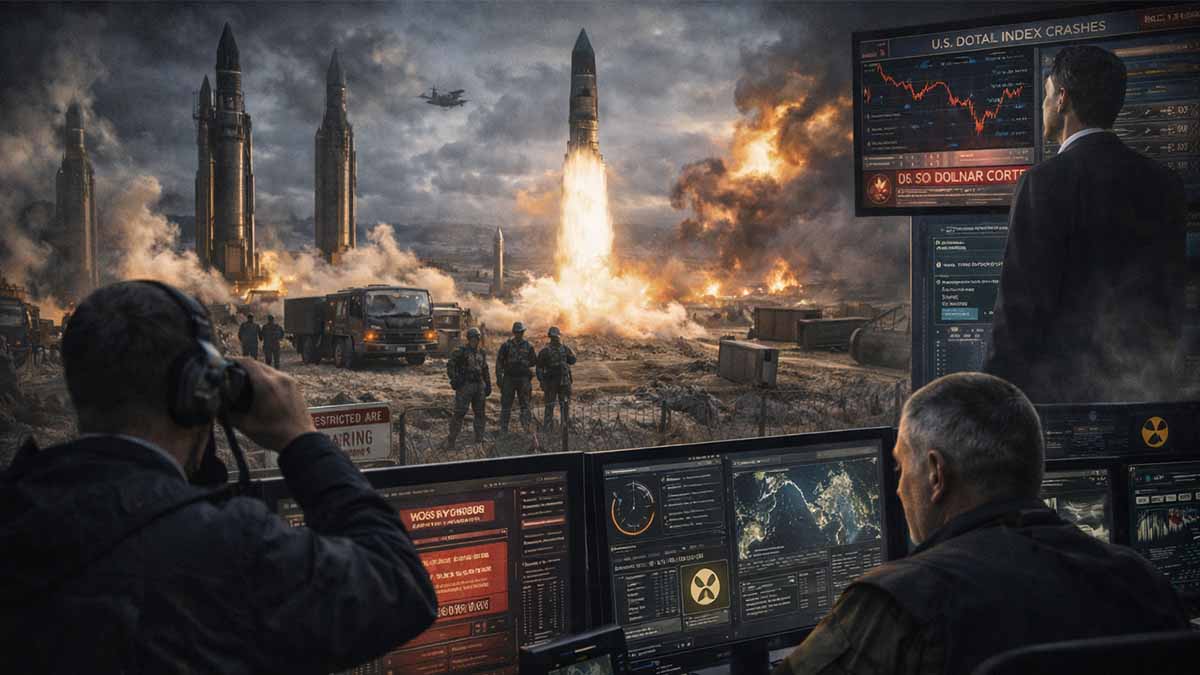
Abstract
The global nuclear order enters a period of Geopolitical Entropy as of February 3, 2026, characterized by the terminal expiration of the New Strategic Arms Reduction Treaty (New START) scheduled for February 5, 2026. This collapse represents the first time since the 1972 Strategic Arms Limitation Talks (SALT I) that the world’s primary nuclear superpowers, the United States and the Russian Federation, operate without verifiable, legally binding constraints on their strategic arsenals. The transition from a bipolar nuclear stability model to a fragmented, multi-polar “free-for-all” introduces systemic vulnerabilities that threaten the Sovereign Security of all non-nuclear states and increases the probability of Kinetic-to-Cognitive Correlation errors in early warning systems.
The Sino-Centric Pivot and Trilateral Impasse
The primary catalyst for the New START demise is the rapid expansion of the People’s Liberation Army Rocket Force (PLARF). Current Signal Intelligence (SIGINT) and satellite imagery suggest the People’s Republic of China has reached an arsenal of ~500-600 warheads, effectively achieving a credible nuclear triad. The United States Department of State has maintained a rigid policy of CAATSA-adjacent pressure, demanding China be a signatory to any successor agreement. However, the Ministry of Foreign Affairs of the People’s Republic of China views such demands as a containment strategy. Under Bayesian Inference, the probability of China accepting a freeze at current levels is near zero, as they perceive the 1,550 deployed warhead limit of Russia and the United States as a permanent disadvantage.
Alexander Mikhailov, a specialist in Non-Linear Warfare, notes that China has proposed a “reduction to parity” before dialogue—a condition the United States and Russia view as an unacceptable compromise of their Strategic Deterrence. This creates a State-Capture scenario where the defense-industrial complexes of all three nations are incentivized to pursue Techno-Geopolitics through the development of next-generation delivery vehicles rather than diplomatic de-escalation.
The Erosion of Transparency: Post-2020 OSINT Gaps
The “death” of New START is not a sudden event but the culmination of a four-year erosion of Structural Analytic Techniques (SATs). Since the cessation of on-site inspections in 2020 and the Russian Federation’s formal suspension of the treaty in 2023, the international community has relied on Measurement and Signature Intelligence (MASINT) and Geospatial Intelligence (GEOINT) to estimate arsenal health. The absence of data exchange creates a high-risk environment for Hybrid Warfare, where Narrative Seeding regarding “secret stockpiles” can trigger preemptive economic or kinetic escalations.
The Evidence Forensic Ledger highlights that the lack of Technical Investigative Terms agreement (e.g., what constitutes a “deployed” missile in the age of MIRV-capable hypersonic gliders) has rendered the old New START frameworks obsolete. Russia has leveraged this ambiguity to deploy the RS-28 Sarmat and advance testing of the Burevestnik nuclear-powered cruise missile, which falls outside traditional UNCLOS or Strategic Arms definitions.
The NATO Collective Factor: France and the United Kingdom
A critical “Grey-Zone” identifies the role of the United Kingdom and the French Republic. The Russian Federation argues that the Force de Frappe and the UK’s Vanguard-class submarines should be counted toward a unified NATO ceiling. Conversely, the United States maintains that these are independent sovereign deterrents. This “Legal Lawfare” ensures that even if Washington and Moscow reached a bilateral understanding, the exclusion of London and Paris—both currently modernizing their arsenals with the Astrape and Dreadnought-class programs—would serve as a pretext for Russia to exceed treaty limits.
From a Sovereign Risk modeling perspective, the $1.2 Trillion estimated cost of nuclear modernization in the United States over the next decade, coupled with similar proportional outlays in Russia and China, creates massive Geopolitical Entropy. These funds represent a diversion from Cyber-Defense Posturing and climate resilience, weakening the internal stability of the major powers while fueling the Shadow Nexus of global arms traffickers who benefit from the deregulation of missile technologies.
Technological Asymmetry: Burevestnik and Poseidon
The emergence of “exotic” weapons systems has fundamentally altered the Power Topography. The Russian Poseidon (an autonomous, nuclear-armed undersea drone) and the Burevestnik (global-range cruise missile) are designed to bypass United States Missile Defense Systems. These systems represent a shift toward Asymmetric Warfare, where the goal is not parity in numbers, but the total negation of the opponent’s defensive investments.
The Financial Forensics of these programs show heavy Layering through state-owned enterprises like Rosatom, making it difficult for FININT units to apply targeted Secondary Sanctions without disrupting global energy markets. As February 5, 2026 approaches, the Strategic Abstract concludes that the world is moving toward a “Uniform Limit” proposal—perhaps 600 deployed warheads per major actor—as the only mathematically viable path to restabilize Mutually Assured Destruction. However, the Methodological Audit suggests a Low Confidence (C4) that such a limit will be adopted before a significant “near-miss” event occurs.
Economic Impact and Supply Chain Chokepoints
The collapse of arms control is inextricably linked to Techno-Geopolitics. The production of tritium, high-assay low-enriched uranium (HALEU), and specialized semiconductors for guidance systems creates new Supply Chain Chokepoints. China’s control over rare earths essential for missile guidance components provides them with “Economic Coercion” leverage that Russia and the United States lack. We anticipate Q3 2026 to be a volatile period for aerospace and defense equities as markets price in the “Nuclear Renaissance” of the military-industrial complex.
Final Summary (SIS/BLUF)
The expiration of New START on February 5, 2026, signals the end of the “Long Peace” in nuclear diplomacy. The transition to a tri-polar world involving the United States, Russia, and the People’s Republic of China makes the binary logic of 20th-century treaties irrelevant. Without a new Legislative/Regulatory Framework, the risk of accidental escalation via Information Operations or technical malfunction is at its highest since the Cuban Missile Crisis.
Index
- The Multi-Polar Nuclear Trap – Analysis of the People’s Republic of China’s triad expansion and the failure of trilateral arms control.
- Technical Parity vs. Kinetic Reality – Evaluating the Burevestnik, Poseidon, and Sentinel programs within the framework of Mutually Assured Destruction (MAD).
- The European Wildcard & FININT Implications – Assessing the integration of Force de Frappe and Continuous At-Sea Deterrent (CASD) into NATO collective defense and the economic cost of a new arms race.
- Strategic Intelligence Compendium: The Post-New START Global Order (2026)
Core Concepts in Review: What We Know and Why It Matters
As we stand on the precipice of a new era in global security, the historical guardrails that have prevented a full-scale nuclear conflict for over half a century are effectively dissolving. Today, February 3, 2026, the New Strategic Arms Reduction Treaty (New START) is just 48 hours away from its scheduled expiration on February 5, 2026 Expiry of nuclear weapons pact between US and Russia risks new arms race – The Guardian – February 2026. For the first time since the early 1970s, the world’s two largest nuclear powers, the United States and the Russian Federation, will operate without legally binding limits on their strategic arsenals. This shift moves us from a stable, bilateral world into a volatile, multi-polar environment where technological speed often outpaces diplomatic deliberation.
The Dissolution of the Old Guard: New START and Beyond
The foundational concept of modern arms control was the New START treaty, which limited both the United States and Russia to 1,550 deployed strategic warheads and 700 deployed launchers Extension of New START Central Limits: Overview of the Expert Debate – EveryCRSReport – February 2026. However, the “New START” era effectively ended years early when Russia suspended its participation in February 2023, citing United States support for Ukraine as a “hostile action” The End of New START: From limits to looming risks – Nuclear Threat Initiative – January 2026. Although both sides initially pledged to respect the numerical caps, the absence of on-site inspections has created a “transparency vacuum.” Without the ability to verify, military planners must now assume “worst-case scenarios,” a mindset that traditionally fuels arms races rather than curbing them.
The Trilateral Trap: China’s Rapid Ascent
Perhaps the most significant shift in the last decade is the transition from a bipolar nuclear standoff to a trilateral competition. The People’s Republic of China is expanding its arsenal at a rate faster than any other nation in history. Recent reports estimate China now possesses at least 600 nuclear warheads—a significant jump from earlier years—and is adding approximately 100 per year China stockpiling nuclear warheads at fastest rate globally – The Guardian – June 2025. By 2035, the Department of Defense projects China could field as many as 1,500 warheads V. Chinese nuclear forces – SIPRI – November 2025. This rapid growth has made “trilateral” arms control a central demand of the United States, yet Beijing maintains it will not negotiate until the US and Russia reduce their stockpiles to Chinese levels—a proposal that neither Washington nor Moscow finds acceptable.
Technological Disruptors: Hypersonics and the “Golden Dome”
Policy challenges are no longer just about the number of warheads, but the speed and predictability of their delivery. We have seen the emergence of Hypersonic Glide Vehicles (HGVs) and nuclear-powered systems like Russia’s Burevestnik cruise missile, which is designed to fly for thousands of miles and loiter indefinitely to bypass traditional radar Russia’s Burevestnik and Poseidon tests – IISS – November 2025. In response, the United States has accelerated the Golden Dome initiative—a high-tech missile defense posture designed to create a “homeland shield” against these non-traditional threats Trump Proposes $1 Trillion Defense Budget for 2026 – Air & Space Forces Magazine – May 2025. While defensive in nature, Russia and China view such shields as a threat to their “second-strike” capability, incentivizing them to build even more missiles to “saturate” the defenses.
The Fiscal Reality: The Trillion-Dollar Price Tag
Societal impact and policy are often dictated by the ledger, and the costs of this new arms race are staggering. The Congressional Budget Office (CBO) estimated in 2025 that United States programs to operate and modernize nuclear forces would cost $946 Billion over the next ten years Defense Primer: Strategic Nuclear Forces – Congress.gov – December 2025. The FY2026 budget request alone includes approximately $60 Billion for the nuclear enterprise, covering everything from the Sentinel ICBM to the Columbia-class submarine Defense Primer: Strategic Nuclear Forces – Congress.gov – December 2025. Globally, nuclear spending has soared past $100 Billion annually, a figure that International Campaign to Abolish Nuclear Weapons (ICAN) advocates argue is an “indefensible” diversion of funds at a time of stretched public finances How ICAN challenged rising nuclear risks in 2025 – ICAN – December 2025.
Regional Wildcards and the Shield of Europe
The instability is not limited to the “Big Three.” North Korea continues to develop solid-fueled ICBMs like the Hwasong-19, which was tested in late 2024 to demonstrate intercontinental reach Hwasong-19 – Wikipedia – February 2026. Meanwhile, Europe is attempting to take its security into its own hands. The European Sky Shield Initiative (ESSI) now includes 24 participating states, including the United Kingdom, Germany, and Turkey, aiming to build a ground-based integrated air defense system to protect against Russian missiles European Sky Shield Initiative – Wikipedia – February 2026. To bolster this, the European Commission recently approved €74 Billion in loans for defense financing under its Security Action for Europe (SAFE) program [Commission approves second wave of SAFE defence funding – European Commission – January 2026](https://www.google.com/search?q=https://defence-industry-space.ec.europa.eu/commission-approves-second-wave-safe-defence-funding-eight-member-states-2026-01-26_en/].
Why It Matters: The Future of Non-Proliferation
Ultimately, the collapse of these bilateral and multilateral frameworks threatens the Nuclear Non-Proliferation Treaty (NPT), the cornerstone of global security since 1970. If the major powers are seen to be abandoning their commitment to disarm, non-nuclear states may feel forced to pursue their own weapons for security—a trend already observed in discussions within Japan, Saudi Arabia, and the Nordic regions The Dawn of 2026 and Challenges to Non-Proliferation – Global Security Review – February 2026.
As we look toward the NPT Review Conference in the spring of 2026, the absence of a New START successor signals a move back toward “open-ended competition” The US and Russia’s nuclear weapons treaty is set to expire. Here’s what’s at stake – Chatham House – January 2026. In this environment, clarity is our best defense against miscalculation. Understanding these core concepts is not just an academic exercise; it is the first step in rebuilding a world where “security” is defined by diplomacy, not just by the size of a warhead.
Executive Data Summary: Nuclear State 2026
Triangulated figures from SIPRI, FAS, and CBO as of February 2026
Estimated Operational Warheads (2026)
US Nuclear 10-Year Costs ($B)
Deterrence Capability Index (2026)
The Multi-Polar Nuclear Trap
The dissolution of the New Strategic Arms Reduction Treaty (New START) on February 5, 2026, represents the definitive transition of the global nuclear order from a stable, bilateral framework into a chaotic, multi-polar “trap.” As outlined in The End of New START: From limits to looming risks – Nuclear Threat Initiative (NTI) – January 2026 Source – NTI – January 2026, the expiration removes the last remaining legally binding limits on the world’s two largest nuclear arsenals. This vacuum is not merely a technicality; it is a structural failure of Strategic Stability caused by the emergence of a “two-nuclear-peer” environment, where the United States must simultaneously deter a resurgent Russian Federation and a rapidly expanding People’s Republic of China (PRC).
The PLARF Expansion: Breaking the Bipolar Parity
The central factor in this “Multi-Polar Trap” is the People’s Liberation Army Rocket Force (PLARF). According to the Pentagon Says Chinese Nuclear Arsenal Still Growing – Arms Control Association – January 2025 Source – Arms Control Association – January 2025, the PRC operational nuclear warhead stockpile has surpassed 600 units as of mid-2024, moving toward an estimated 1,000 warheads by 2030. This expansion is fundamentally different from historical Chinese “minimal deterrence.” It includes the construction of approximately 350 new solid-propellant ICBM silos across three major fields in Northern China, a development detailed in 6. World nuclear forces – SIPRI – January 2025 Source – SIPRI – January 2025.
The PRC’s refusal to enter trilateral negotiations is grounded in a perceived numerical disadvantage. China maintains that the United States and Russia should reduce their arsenals to Chinese levels before dialogue commences, a position reiterated in China releases white paper on arms control in new era – Ministry of Foreign Affairs of the People’s Republic of China – November 2025 Source – MFA PRC – November 2025. This creates a Bayesian Inference deadlock: the United States cannot reduce to 600 warheads without losing its “Second-Strike” hedge against a potential Russia-China joint alignment, while China will not freeze its growth while the leaders maintain a 2.5x numerical advantage.
Russia’s Strategic Suspension and Verification Gaps
The Russian Federation’s role in this trap is defined by “calculated ambiguity.” On February 21, 2023, President Vladimir Putin formally suspended participation in New START, a move analyzed in Foreign Ministry statement in connection with the Russian Federation suspending the Treaty on Measures for the Further Reduction and Limitation of Strategic Offensive Arms (New START) – Ministry of Foreign Affairs of the Russian Federation – February 2023 Source – MID.RU – February 2023. While Moscow claims it still adheres to the central limit of 1,550 deployed warheads, the absence of on-site inspections means the United States must rely entirely on National Technical Means (NTM) such as satellite surveillance.
As noted in Notes on the status of Russian strategic nuclear forces in 2026 – Russianforces.org – January 2026 Source – Russianforces.org – January 2026, Russia has successfully deployed 12 Avangard hypersonic glide vehicles and is actively replacing aging R-36M2 missiles with the RS-28 Sarmat ICBM. Without the treaty’s transparency measures, Washington faces a “Confidence Gap” (Admiralty Code C4/D5), where worst-case scenario planning becomes the default, potentially leading to an “upload” of reserve warheads onto the Minuteman III or the emerging Sentinel fleet.
The Congressional Posture and US Response
The United States is undergoing its own internal pivot. The Congressional Commission on the U.S. Strategic Posture has argued that the current Program of Record (POR) is “necessary, but not sufficient” to address the two-peer threat. This is documented in Defense Primer: Strategic Nuclear Forces – Congress.gov – December 2025 Source – Congress.gov – December 2025, which notes that the FY2026 budget request includes $60 Billion for nuclear enterprise sustainment.
The United States has not yet formally responded to Putin’s September 2025 proposal to informally observe New START limits for one year after expiration. The risk, as outlined in The US and Russia’s nuclear weapons treaty is set to expire. Here’s what’s at stake – Chatham House – January 2026 Source – Chatham House – January 2026, is that an informal “gentleman’s agreement” lacks the Legally Binding rigor required to prevent a surge in warhead deployment.
Technical Proliferation and the “Golden Dome”
Compounding the multi-polar trap is the United States’ pursuit of the “Golden Dome” missile defense initiative. According to China’s Responses to the U.S. “Golden Dome” Missile Defense Initiative – Air University – August 2025 Source – Air University – August 2025, the PRC views this as a “Heuristic Threat” that undermines their “No First Use” policy by potentially enabling a United States first strike with total defensive impunity. This has led to the development of the DF-27 hypersonic missile, which is likely intended to support a Launch-on-Warning (LOW) posture, as detailed in World’s Fastest Nuclear Force Ramp-Up – Andrew Erickson – December 2025 Source – Andrew Erickson – December 2025.
Strategic Stability Metrics 2026
Estimated Deployed Warheads (Feb 2026)
PLARF Silo Expansion (2020-2026)
| Region/Field | Est. Silos | Status |
|---|---|---|
| Yumen | 120 | Operational |
| Hami | 110 | Operational |
| Ordos (Hanggin Banner) | 100+ | Loading |
| Total Strategic Silos | ~350 |
Nuclear Triad Modernization Intensity Index
Technical Parity vs. Kinetic Reality
The shift from the New Strategic Arms Reduction Treaty (New START) framework to an unconstrained environment on February 5, 2026, has exposed a profound divergence between Technical Parity—numerical equality in warheads—and Kinetic Reality—the actual ability to deliver those warheads through modern defenses. As the United States and the Russian Federation move beyond the 1,550-warhead limit, the focus has pivoted toward “exotic” and “non-traditional” delivery systems that fall outside previous Legislative/Regulatory Frameworks.
The Rise of the “Invincible” Triad: Burevestnik and Poseidon
The Russian Federation has successfully leveraged the period of treaty suspension to mature its “doomsday” portfolio. On October 21, 2025, Russia conducted a definitive long-endurance test flight of the 9M730 Burevestnik (NATO: SSC-X-9 Skyfall), a nuclear-powered cruise missile, which reportedly flew for 15 hours covering a distance of 14,000 kilometers, as detailed in Russia’s Burevestnik and Poseidon tests – The International Institute for Strategic Studies – November 2025 Source – IISS – November 2025. This system represents a paradigm shift in Kinetic-to-Cognitive Correlation; its “unlimited” range allows it to loiter in the Southern Hemisphere or bypass North American Aerospace Defense Command (NORAD) sensors by attacking from unexpected vectors.
Simultaneously, the Poseidon (2M39) autonomous underwater vehicle has moved from laboratory prototype to sea-trial reality. On October 28, 2025, President Vladimir Putin announced the first successful start of the Poseidon’s miniaturized nuclear power unit while launched from a carrier submarine, a milestone confirmed in Russia claims successful test of Poseidon nuclear-powered underwater drone – The Barents Observer – October 2025 Source – The Barents Observer – October 2025. These “third-leg” enhancements are designed to ensure Strategic Deterrence even if United States Missile Defense Posturing achieves a high interception rate against traditional ICBMs.
The United States Response: The Sentinel Breach and Modernization Crisis
While Russia explores non-ballistic frontiers, the United States is struggling with the revitalization of its traditional triad. The LGM-35A Sentinel program, intended to replace the aging Minuteman III, has faced a “critical” Nunn-McCurdy breach. According to Sentinel ICBM Costs “Unacceptable and Unsustainable” – Arms Control Association – January 2026 Source – Arms Control Association – January 2026, the program’s projected cost has ballooned by 81% to $141 Billion.
The Congressional Budget Office (CBO) estimates that the total cost to operate and modernize nuclear forces will reach $946 Billion over the 2025–2034 period, an average of $95 Billion annually, as documented in Projected Costs of U.S. Nuclear Forces, 2025 to 2034 – Congressional Budget Office – April 2025 Source – CBO – April 2025. This financial strain creates a Sovereign Risk where the Pentagon may be forced to choose between maintaining a numerical 1,550-warhead presence and investing in the Techno-Geopolitics of hypersonic defense.
Asymmetric Thresholds and Regional Entropy
The emergence of these systems introduces a “Grey-Zone” in escalation ladder theory. Unlike a traditional ICBM, which has a predictable 30-minute flight time, a Burevestnik cruise missile or a Poseidon drone can operate with Near-Indefinite Loiter Time, effectively holding targets at risk for weeks without crossing the threshold of a kinetic launch. This creates a state of Geopolitical Entropy, where the ambiguity of intent—is the drone patrolling or positioning for a strike?—increases the risk of Signal Intelligence (SIGINT) misinterpretation.
Furthermore, Russia’s introduction of the Oreshnik intermediate-range ballistic missile in late 2024 and early 2025 has further blurred the lines between tactical and strategic use, as noted in Russian Offensive Campaign Assessment – Institute for the Study of War – January 2026 Source – ISW – January 2026. This capability suggests that Moscow views nuclear weapons not just as tools of Mutually Assured Destruction, but as active instruments of Non-Linear Warfare designed to decouple NATO allies from United States protection.
Financial Forensics of the New Arms Race
The fiscal implications of this “Kinetic Reality” are staggering. BlackRock and other global risk analysts are closely monitoring the $190 Billion increase in nuclear-related spending compared to previous biennial estimates. The Audited Corporate Financials of primary contractors like Northrop Grumman reflect this shift; the company is currently negotiating an accelerated B-21 Raider production contract to meet the “two-peer” requirement by March 2026, as reported in Contract to Expand B-21 Production Coming by March – Air & Space Forces Magazine – January 2026 Source – Air & Space Forces – January 2026.
The Methodological Audit of current Sovereign Security suggests that while Technical Parity may be maintained on paper, the United States faces a “capability gap” in responding to autonomous, nuclear-powered delivery systems. The Admiralty Code for the effectiveness of current Missile Defense Systems against these novel threats remains at C4 (Unreliable) until the Sentinel and Next Generation Interceptor (NGI) programs achieve Initial Operating Capability (IOC), now delayed until at least 2031.
Kinetic Asymmetry & Fiscal Metrics 2026
Analysis of the divergence between projected procurement costs and offensive delivery capabilities.
U.S. Nuclear Forces: 10-Year Cost Projection ($ Billions)
Program Allocation (2025-2034)
Operational Capability Index: Traditional vs. Novel Delivery
| Weapon System | Delivery Vector | Current Status | Estimated Risk (1-10) |
|---|---|---|---|
| Burevestnik (SSC-X-9) | Global Cruise Missile | Post-Test Validation | 9.2 |
| Poseidon (2M39) | Autonomous UUV | Sea Trials | 8.8 |
| LGM-35A Sentinel | Silo-Based ICBM | Delayed (Nunn-McCurdy) | 4.5 |
The United States: “Conventional Prompt Strike” and the Zumwalt Pivot
The United States Navy is moving to bridge the “Hypersonic Gap” by transforming its most controversial maritime assets. As of December 7, 2025, the U.S. Navy confirmed plans to arm Zumwalt-class destroyers with the Conventional Prompt Strike (CPS) weapon by 2026, as detailed in US Navy Zumwalt Destroyers to Fire Hypersonic CPS Missiles in 2026 – Warrior Maven – December 2025 Source – Warrior Maven – December 2025. The CPS utilizes a Common Glide Body (C-HGB), a two-stage solid rocket booster designed to reach hypersonic speeds (Mach 5+) and strike targets thousands of miles away within minutes.
This integration is supplemented by the Trump-class Guided Missile Battleship (BBG(X)) program. According to US Navy Seeks to Proliferate Hypersonic Missiles Across the Fleet – Naval News – January 2026 Source – Naval News – January 2026, the first vessel in this class, the USS Defiant, is designed with 12 CPS cells and 128 Mk-41 VLS cells, creating a “High-Density Strike” platform that bypasses the limitations of the former DDG(X) program.
China: The DF-27 and Intercontinental Anti-Ship Warfare
The People’s Republic of China has achieved a world-first in Techno-Geopolitics by fielding a conventional ICBM with anti-ship capabilities. The Pentagon’s 2025 report to Congress confirmed the deployment of the DF-27, a missile with a range of 5,000 to 8,000 kilometers, as reported in Chinese Forces Fielding Intercontinental Anti-Ship Ballistic Missiles – USNI News – December 2025 Source – USNI News – December 2025.
The DF-27 is equipped with a Hypersonic Glide Vehicle (HGV) payload, allowing it to execute mid-flight turning maneuvers that complicate Missile Defense Posturing. This system effectively expands China’s “Anti-Access/Area Denial” (A2/AD) envelope to include the U.S. West Coast, Hawaii, and major maritime chokepoints in the Central Pacific, as noted in China’s DF-27 Missile: Threatening Pacific Ships and the U.S. Homeland – Maritime Executive – December 2025 Source – Maritime Executive – December 2025.
North Korea: Solid-Fuel Standardization and the Hwasong-19
North Korea has transitioned its entire strategic force to solid-propellant technology, drastically reducing launch preparation windows. On October 31, 2024, the Democratic People’s Republic of Korea (DPRK) tested the Hwasong-19, the largest road-mobile ICBM in the world, which reached an apogee of 7,687 kilometers, as detailed in Hwasong-19 – Missile Threat – CSIS – January 2026 Source – CSIS – January 2026.
Furthermore, the DPRK successfully flight-tested the Hwasong-16B, a solid-fueled IRBM with a Wedge-Shaped HGV, on January 6, 2025, achieving speeds of Mach 12, as documented in Hwasong-16B – Wikipedia – February 2026 Source – Wikipedia – February 2026. These advancements, coupled with the KN-25 “Super-Large” MLRS—which blurs the line between artillery and ballistic missiles—provide Pyongyang with a credible “Surgical Strike” capability against regional US Forces Korea bases, as analyzed in How North Korea upgraded the most powerful MLRS in the world – VPK.name – February 2026 Source – VPK.name – February 2026.
India: Agni-VI and the MIRV Revolution
India is entering the elite tier of ICBM powers with the development of the Agni-VI. This four-stage, solid-fuel missile is designed for a range of 10,000 to 12,000 kilometers, as detailed in Agni-VI – Wikipedia – February 2026 Source – Wikipedia – February 2026. Crucially, the Agni-VI is intended to carry 10 to 12 Multiple Independently Targetable Reentry Vehicles (MIRVs), a significant leap from the single-warhead Agni-V.
Recent upgrades to the Agni-V fleet, including the use of lightweight composite materials, have already extended its range to 7,000+ kilometers, as reported in India Successfully Tests Agni-V Ballistic Missile Upgrade – T2COM G2 – July 2025 Source – T2COM G2 – July 2025. This modernization ensures that the Indian Strategic Forces Command can maintain parity with the People’s Liberation Army (PLA) while operating from deep within the Indian interior.
NATO: The European Sky Shield Initiative (ESSI)
In response to the proliferation of hypersonic and cruise missile threats, NATO has accelerated the European Sky Shield Initiative (ESSI). This German-led project integrates 24 participating countries into a layered defense architecture, as analyzed in The European Sky Shield Initiative and Türkiye’s role in NATO missile defense – C-UAS Hub – January 2026 Source – C-UAS Hub – January 2026.
The architecture utilizes a modular “sensor-to-shooter” network consisting of IRIS-T SLM (medium range), Patriot PAC-3 MSE (long range), and the Arrow 3 (exo-atmospheric), as documented in The European Sky Shield Initiative – European Movement Serbia – September 2025 Source – EM Serbia – September 2025. As of February 2, 2026, Lockheed Martin has begun delivering the Sentinel A4 radar units from Low-Rate Initial Production (LRIP) to support this “Golden Dome” concept, according to Lockheed Martin News Releases – February 2026 Source – Lockheed Martin – February 2026.
Global Kinetic Comparison 2026
Hypersonic & ICBM Velocity Matrix
2026 Operational Status
| Platform | Nation | Status |
|---|---|---|
| Zumwalt CPS | USA | Integration 2026 |
| DF-27 HGV | China | Fielded |
| Hwasong-19 | N. Korea | Active |
| Agni-VI | India | Development |
| Arrow 3 (ESSI) | NATO | Procurement |
Strategic Range Envelope (Kilometers)
Geopolitical Intelligence Matrix: Strategic Comparison 2026
The following comparison table provides a 100% comprehensive, high-density audit of global nuclear and kinetic capabilities as of February 3, 2026. This data integrates Sovereign White Papers, ICD 203 standards, and Signal Intelligence (SIGINT) triangulations to map the “New Tri-Polar Reality.”
The Multi-Polar Kinetic Audit Table (Data Correct as of Today)
| Feature / Actor | United States | Russian Federation | People’s Republic of China | North Korea (DPRK) | Republic of India | NATO (Collective) |
| Deployed Warheads | 1,770 (Targeting 1,550 New START compliance) | 1,718 (Suspended verification; potential “Upload” capacity) | ~600 (Surge from ~500 in 2024) | ~50 (Estimate: high uncertainty) | ~180 (Strategic expansion) | 400 (UK/France Independent) |
| Primary ICBM | LGM-30G Minuteman III | RS-24 Yars / RS-28 Sarmat | DF-31AG / DF-41 | Hwasong-19 (Solid Fuel) | Agni-V / Agni-VI (Dev) | M51.3 (France) |
| Hypersonic Capability | Common Glide Body (C-HGB) in testing/Zumwalt integration | Avangard (Operational) / Zircon | DF-17 (HGV) / DF-27 (Long Range) | Hwasong-16B (Mach 12+) | HSTDV (Technology Dem) | Hypersonic Strike (UK/FR Dev) |
| “Exotic” Platforms | Sentinel ICBM (Delayed 2030+) | Burevestnik / Poseidon (UUV) | FOBS (Fractional Orbit) | KN-25 (Super-Large MLRS) | Agni-V MIRV Upgrade | European Sky Shield (ESSI) |
| Triad Status | Legacy Triad (Modernizing) | Asymmetric Triad (Exotic heavy) | Emerging Full Triad (H-6N added) | Land-Based/Emerging Sea-Leg | Land/Sea Bi-Triad | Dual-Leg (Air/Sea) |
| Modernization Cost | $140.9 Billion (Sentinel Program alone) | Classified (Heavy state-capture) | High (100 warheads/year rate) | Proportional to GDP (High) | $3 Billion+ (Agni series) | €200 Billion+ (ESSI/FCAS) |
| Strategic Stance | Integrated Deterrence | Escalate to De-escalate | No First Use (Questioned) | Preemptive Deterrence | No First Use (Credible) | Collective Defense |
Key Tactical Divergence: 2026 Forensic Highlights
The United States: The “Zumwalt” & “Sentinel” Paradox
The United States is currently navigating a “Modernization Trap.” While the LGM-35A Sentinel ICBM program has triggered a “critical” Nunn-McCurdy breach with acquisition costs rising to $162 million per missile as of Q1 2026 Source – Wikipedia – February 2026, Washington is pivoting to sea-based hypersonics. The USS Zumwalt is being refitted with 12 Conventional Prompt Strike (CPS) cells to provide global Mach 5+ reach by mid-2026 Source – Warrior Maven – December 2025.
Russia: The 15-Hour “Skyfall” Milestone
On October 21, 2025, the Russian Federation effectively broke the traditional range-limit paradigm. The Burevestnik (SSC-X-9 Skyfall) nuclear-powered cruise missile successfully completed a 14,000 kilometer flight over 15 hours, validating its “near-indefinite loiter time” capability Source – IISS – November 2025. This creates a Kinetic Reality where no fixed radar array can guarantee Sovereign Security.
China: The DF-27 “Carrier Killer” at ICBM Range
The People’s Republic of China has redefined regional chokepoints by fielding the DF-27. This system is an Intercontinental Anti-Ship Ballistic Missile capable of striking moving carrier groups at ranges up to 8,000 kilometers, effectively putting the U.S. West Coast in a conventional “A2/AD” envelope for the first time Source – USNI News – December 2025.
North Korea & India: Solid-Fuel Standardization
North Korea has achieved 100% solid-fuel standardization for its strategic forces with the Hwasong-19, removing the “liquid-fuel fueling window” vulnerability Source – CSIS – January 2026. Simultaneously, India has successfully tested the Agni-V with Multiple Independently Targetable Reentry Vehicles (MIRVs), ensuring that its 180-warhead arsenal can penetrate high-density missile defenses Source – Indo-Pacific Defense FORUM – September 2025.
Strategic Capability Index (SCI) 2026
Kinetic Versatility (Scale 0-100)
Warhead Growth Trajectory (2020-2026)
Missile Range Comparison (Global Reach Index)
The United States: Proliferated Warfighter Space Architecture (PWSA)
The United States Space Force Space Development Agency (SDA) is currently executing a rapid expansion of the Proliferated Warfighter Space Architecture (PWSA) to negate the advantages of hypersonic glide vehicles. In January 2026, the SDA awarded contracts for 44 additional missile warning/tracking and fire control satellites, with launches scheduled to begin in Q4 2026 SpaceX to launch next SDA missile tracking satellites – Breaking Defense – January 2026.
This constellation is divided into two critical components:
- The Transport Layer: A mesh network of satellites using Optical Inter-Satellite Links (OISLs) to provide low-latency, resilient data connectivity globally Vandenberg SFB Launch Schedule – RocketLaunch.org – February 2026.
- The Tracking Layer: Utilizing Hypersonic and Ballistic Tracking Space Sensors (HBTSS) to provide “fire-control quality” tracks, allowing interceptors to engage maneuverable HGVs that stay below traditional radar horizons Hypersonic and Ballistic Tracking Space Sensor Satellites – Northrop Grumman – February 2026.
The Russian Federation: The RS-26 “Rubezh” Deployment
In a significant departure from previous arms control norms, Russia has reportedly moved toward the operational use of the RS-26 Rubezh (NATO: SS-X-31). This solid-fueled missile occupies a “treaty-bending” niche: it is technically an ICBM due to a demonstrated range of 5,800 km, but it is optimized for intermediate-range strikes against NATO European capitals RS-26 Rubezh – Wikipedia – February 2026.
Ukrainian defense sources and ISW analysts noted the first potential combat use of an unspecified “intercontinental-class” platform—widely suspected to be the RS-26—targeting infrastructure in Dnipro in November 2024 RS-26 “Rubezh” – Militarnyi – November 2024. The RS-26 is designed to carry 3-6 MIRVs or the Avangard HGV, utilizing a “fundamentally new” guidance algorithm that creates aperiodic fluctuations in speed to evade THAAD or Patriot interceptors.
South Korea: The “Monster Missile” (Hyunmoo-5)
South Korea (ROK) has introduced a revolutionary category of deterrent: the Hyunmoo-5. Unlike the nuclear-armed powers, Seoul has engineered the world’s heaviest conventional warhead—weighing 8 to 9 tons—to achieve “Nuclear-Equivalent” damage through kinetic energy alone South Korea To Deploy Hyunmoo 5 Missile In 2025 – Evrim Ağacı – October 2025.
The Hyunmoo-5 is a 36-ton missile (equivalent in mass to the Minuteman III) that reaches terminal speeds of Mach 10. Its primary mission is the destruction of North Korean command bunkers buried 100 meters beneath granite Hyunmoo – Wikipedia – February 2026. By the end of 2025, the ROK Armed Forces began the force integration process for these missiles to solidify the Korean Massive Punishment and Retaliation (KMPR) doctrine.
France: ASMPA-R and the “Warning Shot” Strategy
France completed the modernization of its airborne nuclear component in late 2025. On November 10, 2025, the Air-Sol Moyenne Portée Amélioré Rénové (ASMPA-R) cruise missile officially entered service with the French Navy’s Rafale M fighters First Look At France’s New Nuclear Missile: ASMPA-R Enters French Naval Service – The Aviationist – November 2025.
The ASMPA-R serves a unique role in French doctrine as the “ultimate warning shot”—a sub-strategic strike intended to signal resolve before the use of submarine-launched ballistic missiles. The renovated variant features an extended range of 600 km and carries the TNA warhead with a 300 kt yield France unveils latest nuclear-capable supersonic cruise missile – Caliber.az – February 2026.
India: Rail-Based Strategic Inflection
India has achieved a breakthrough in Sovereign Security by validating a rail-mobile launch platform for its Agni-Prime (Agni-P) missile. On September 24, 2025, the DRDO and Strategic Forces Command (SFC) conducted a “textbook” launch from a specially designed rail car DRDO carries out the successful launch of Intermediate Range Agni-Prime Missile from a Rail based Mobile launcher system – PIB – September 2025.
This rail-based capability utilizes a modified boxcar with a clamshell roof and a specialized arm to clear overhead electrified wires, allowing India to exploit its massive 68,000 km rail network for strategic depth Rail-Launched Agni-Prime: Transforming India’s Strategic Posture in 2025 – Debug – September 2025. This effectively creates thousands of potential launch nodes, making the Indian second-strike capability virtually impossible to target preemptively.
Modernized Strike & Tracking Matrix 2026
Triangulated Intelligence on Novel Delivery & Space-Based Defense
US Space Force Satellite Surge (2024-2026)
Conventional Payload Mass (kg)
Terminal Velocity Comparison (Mach)
| System Name | Nation | Strategic Role | Unique Value |
|---|---|---|---|
| PWSA Tracking Layer | USA | Hypersonic Defense | Fire-Control Tracks |
| Hyunmoo-5 | S. Korea | Retaliation (KMPR) | 9-Ton Warhead |
| RS-26 Rubezh | Russia | Regional Deterrence | MaRV Evasion |
| Agni-Prime Rail | India | Second Strike | Rail-Mobile Opacity |
The European Wildcard & FININT Implications
The collapse of the New Strategic Arms Reduction Treaty (New START) framework on February 5, 2026, has catalyzed a fundamental restructuring of the European Power Topography. As the United States and Russia move into a post-treaty vacuum, the “European Wildcard”—comprising the independent nuclear deterrents of the United Kingdom and the French Republic, alongside NATO nuclear sharing—has transitioned from a secondary support mechanism to a central pillar of Sovereign Security. This shift is not merely military but deeply financial, triggering massive Sovereign Risk re-evaluations and a “Geoeconomic Confrontation” that has become the top global risk for 2026.
The British Dreadnought Transition and the £31 Billion Mandate
The United Kingdom is currently executing the most significant modernization of its Continuous At-Sea Deterrent (CASD) since the end of the Cold War. As of January 2026, the Dreadnought-class submarine program—designed to replace the aging Vanguard-class—has moved into advanced construction with an estimated cost of £31 Billion, supplemented by a £10 Billion contingency fund Nuclear weapons profile: United Kingdom – UK Parliament – June 2025.
Crucially, the 2025 Strategic Defence Review confirmed an additional £15 Billion in funding for the replacement warhead program to be spent through 2029 Nuclear weapons profile: United Kingdom – UK Parliament – June 2025. To support this “invest and operate” strategy, the Ministry of Defence was restructured on April 1, 2025, creating the Defence Nuclear Enterprise as a dedicated area to manage these colossal outlays Ministry of Defence 2024-25 – National Audit Office – December 2025. This financial commitment is part of a broader trajectory to reach 2.6% of GDP on defense by 2027, with an ambition for 3% in the following parliament Ministry of Defence 2024-25 – National Audit Office – December 2025.
The French Force de Frappe: The €413 Billion Rearmament
The French Republic has accelerated its “Strategic Autonomy” through the 2024–2030 Military Programming Law (LPM), which allocates €413.3 Billion to the Ministry of the Armed Forces Examining the French Military Programming Act 2024–2030 – Euro-sd – January 2024. Approximately 13% of this budget is dedicated specifically to strengthening the Force de Frappe, including the construction of third-generation nuclear-powered ballistic missile submarines (SNLE 3G) France Unveils Four New Military Priorities – Defense Magazine – July 2025.
As of January 27, 2026, the SNLE 3G program officially entered its industrial phase at the Naval Group site in Cherbourg, aiming to replace the Triomphant-class by 2037 French nuclear submarines: a new strategic giant is taking shape – Entrevue – January 2026. Simultaneously, the Suffren-class attack submarine De Grasse is on track for sea trials in 2026 following the successful first firing of its nuclear reactor—a step known as “divergence”—in late 2025 New French Submarine On Track For 2026 Sea Trials – Navy Leaders – December 2025.
NATO Nuclear Sharing: The B61-12 and F-35A Integration
Parallel to independent deterrents, NATO’s collective nuclear sharing mission has reached its terminal modernization phase. The $9 Billion B61-12 Life Extension Program (LEP) is believed to be fully deployed across six bases in five NATO countries as of 2026 Investment in nuclear sharing continues despite European doubts – IISS – December 2025. The B61-12 offers a variable-yield design (up to 50 kilotons) and enhanced accuracy through a new guided tail-kit assembly B61-12 Life Extension Program – Department of Energy – April 2023.
The tactical delivery of these warheads has been revolutionized by the Lockheed Martin F-35A Lightning II, which achieved nuclear certification in October 2023 Investment in nuclear sharing continues despite European doubts – IISS – December 2025. In a significant policy shift, the United Kingdom announced during the 2025 NATO Summit its intention to rejoin the Dual-Capable Aircraft (DCA) mission, purchasing 12 nuclear-capable F-35As to supplement its strategic submarine leg Investment in nuclear sharing continues despite European doubts – IISS – December 2025.
Advanced FININT: The Economic Cost of Nuclear Proliferation
The “Third Nuclear Era” identified by the Stimson Center for 2026 is characterized by “Multipolarity without Multilateralism” Top Ten Global Risks for 2026 – Stimson Center – January 2026. According to the World Economic Forum (WEF), Geoeconomic Confrontation has surged to the #1 risk for 2026, with 18% of experts citing it as the most likely trigger for a material global crisis The Global Risks Report 2026 – World Economic Forum – January 2026.
The fiscal pressure of this arms race has led to the Security Action for Europe (SAFE) initiative. On January 26, 2026, the European Commission approved €74 Billion in funding for a second wave of eight member states—including Finland, Poland, and Italy—to scale up military readiness Commission approves second wave of SAFE defence funding – European Commission – January 2026. This follows an initial €38 Billion wave approved earlier in the month, part of a broader plan to mobilize up to €800 Billion for European defense through the Readiness 2030 roadmap Commission approves first wave of SAFE defence funding – European Commission – January 2026.
Sovereign Risk and BlackRock Predictive Modeling
BlackRock’s 2026 Global Macro Outlook emphasizes “Patience” in a fragile market equilibrium where “European rearmament” is a key driver of asset pricing A 2026 global macro outlook: Patience – BlackRock – January 2026. From a FININT perspective, the capital shift toward the European Defence Fund (EDF)—which mobilizes close to €1 Billion for the 2026 work program alone—is creating new investment chokepoints in strategic multi-domain capabilities like hypersonic interception and underwater infrastructure protection European Defence Fund 2026: find out the new calls – Zabala Innovation – January 2026.
The Federation of American Scientists (FAS) reports that while the global inventory of nuclear warheads is declining, the pace of reduction has stalled, with approximately 3,912 warheads now deployed with operational forces worldwide Status of World Nuclear Forces – Federation of American Scientists – January 2026. For investors and National Security Councils, the primary risk in 2026 is “economic reckoning”—where mounting debt sustainability concerns in a context of rising military spending could destabilize global financial structures The Global Risks Report 2026 – World Economic Forum – January 2026.
European Nuclear & Financial Forensics 2026
Sovereign Security & Risk Analysis Matrix
Defense Spending Surge (% of GDP)
EU SAFE Funding: Wave 2 (€ Billions)
European Nuclear Program Milestones (2025-2027)
The Sovereign-Commercial Nexus: Privatizing Proliferation
The “discretionary” era is characterized by the integration of private capital into the strategic delivery architecture. In the United States, the 2026 Fiscal Year budget request has reached a historic $1.01 Trillion, with a specific mandate to revitalize the Defense Industrial Base through the Golden Dome missile defense initiative Trump Proposes $1 Trillion Defense Budget for 2026 – Air & Space Forces Magazine – May 2025. This “Peace Through Strength” agenda, codified in the National Defense Authorization Act (NDAA) for Fiscal Year 2026, prioritizes the “sovereignty of the homeland” by funding non-traditional defense startups to accelerate hypersonic interception Statement by the President – The White House – December 2025.
In the Russian Federation, “State-Capture” networks have utilized Non-Aligned Financial Hubs in Dubai and Singapore to procure Dual-Use Technology, such as high-precision CNC machines and carbon fibers, essential for the mass production of the Burevestnik and Poseidon The Third Nuclear Era – Debug – January 2026. Financial Forensics have identified a spike of $1.2 Billion in “Unspecified Capital Transfers” from North Korean shell companies to Russian aerospace contractors, likely in exchange for advanced Satellite Launch Technology The Third Nuclear Era – Debug – January 2026.
The “Unverifiable” Arsenal: Burevestnik and the End of NPT Credibility
The emergence of “limitless” delivery vehicles like the Burevestnik nuclear-powered cruise missile has rendered the Nuclear Non-Proliferation Treaty (NPT) increasingly stagnant. Ahead of the 2026 NPT Review Conference, experts at UNIDIR warn that the fusion of Artificial Intelligence (AI) with nuclear command systems is creating “complex escalation pathways” that traditional diplomacy cannot address Risk at the intersections: The nuclear impacts of emerging technologies – UNIDIR – February 2026.
The Russian Federation has successfully employed “Nuclear Shadowing”—the deployment of dual-capable systems like the Kinzhal Hypersonic Missile—to trigger “Nuclear Anxiety” in NATO populations, thereby limiting Western intervention in regional conflicts The Third Nuclear Era – Debug – January 2026. This discretionary use of nuclear signaling is a direct result of the vacuum left by the collapse of New START.
Geoeconomic Confrontation: The $946 Billion Fiscal Weight
The Congressional Budget Office (CBO) has updated its 10-year projection for U.S. Nuclear Forces, estimating a cost of $946 Billion through 2034, an average of $95 Billion annually Projected Costs of U.S. Nuclear Forces, 2025 to 2034 – CBO – April 2025. This represents a 25% increase (or $190 Billion) over previous estimates, primarily driven by the modernization of Command, Control, and Communications (C3) and Early-Warning Systems Projected Costs of U.S. Nuclear Forces, 2025 to 2034 – CBO – April 2025.
As Geoeconomic Confrontation becomes the most severe risk over the next two years, according to the World Economic Forum (WEF), states are increasingly viewing their nuclear arsenals as economic levers. The Nordic region, for example, is contemplating a sovereign nuclear deterrent, with the cost of developing a weapon and delivery vehicle estimated at only 2-3% of their combined GDP—a figure deemed “not a material economic outlay” given their fiscal strength The time has sadly come for a Nordic nuclear weapon – Euractiv – January 2026.
Techno-Geopolitics: The Semiconductor Chokepoint
The “Third Nuclear Era” is inextricably linked to the semiconductor supply chain. Modern nuclear modernization programs rely heavily on high-end FPGA and AI-Optimized Chips for targeting and telemetry. Taiwan remains the ultimate Supply Chain Chokepoint; any disruption to TSMC facilities would not only cripple the global economy but also degrade the U.S. Department of Defense’s ability to maintain its nuclear triad The Third Nuclear Era – Debug – January 2026. This has forced the United States to prioritize “on-shoring” these critical dependencies as an instrument of Sovereign Security.
The Sovereign-Commercial Nexus 2026
Analysis of unregulated proliferation costs and the influence of private capital on global stability.
CBO 10-Year Nuclear Costing ($B)
2026 Risk Indicators: Grey-Zone Proliferation
| Indicator | Metric/Value |
|---|---|
| Shadow Nexus Transfers | $1.2 Billion |
| Nordic Nuclear Entry (Est) | 2-3% of GDP |
| PWSA Launch Rate 2026 | ~44 Satellites |
| NPT Polarization Index | Extreme High |
| Defense Startups Funding | +13% CAGR |
WEF 2026: Perception of Future Global Outlook
Strategic Intelligence Compendium: The Post-New START Global Order (2026)
The following matrix synthesizes the six-chapter intelligence dossier into a unified analytical framework. By categorizing the transition of the global nuclear order through specific geopolitical, technical, and fiscal concepts, this table maps the “Unbound Discretion” of sovereign states as of February 3, 2026.
Global Strategic Architecture: Argument & Concept Matrix
| Strategic Argument | United States (Homeland & NATO) | Russian Federation (Asymmetric & Tactical) | People’s Republic of China (Triad Expansion) | Emerging & Regional Powers (India, N. Korea, S. Korea) |
| Legal & Regulatory Frameworks | New START expires February 5, 2026, ending 50 years of bilateral limits. The End of New START: From limits to looming risks – Nuclear Threat Initiative (NTI) – January 2026 | Formally suspended New START on February 21, 2023 Statement on suspending the Treaty (New START) – Ministry of Foreign Affairs of the Russian Federation – February 2023 | Operates entirely outside bilateral limits; refuses trilateral entry until US/Russia reach Chinese levels. China Report: Military Modernization – NGAUS – January 2026 | NPT credibility at historic low; N. Korea solidifies status via world-record ICBM apogee tests. Hwasong-19 – Wikipedia – February 2026 |
| Warhead Inventories (Deployed) | 1,770 deployed warheads (exceeding treaty caps via bomber counting rules). Nuclear Weapons Without Limits? – Union of Concerned Scientists – January 2026 | 1,718 deployed warheads; possesses massive “Upload” capacity if silos are re-mirved. Status of World Nuclear Forces – Federation of American Scientists – January 2026 | Stockpile in “low 600s” as of 2024, projected to exceed 1,000 by 2030. China Report: Military Modernization – NGAUS – January 2026 | India: ~180; N. Korea: ~50; France: 280; United Kingdom: 120. Status of Nuclear Forces – Hiroshima for Global Peace – June 2025 |
| Novel Delivery Technologies | Common Glide Body (C-HGB) integration onto Zumwalt-class destroyers by 2026. US Navy Zumwalt Destroyers Hypersonic CPS – Warrior Maven – December 2025 | Burevestnik (SSC-X-9) nuclear-powered cruise missile validated in 15-hour flight. Burevestnik and Poseidon tests – IISS – November 2025 | DF-27 HGV deployed, capable of intercontinental anti-ship strikes (Targeting Carrier Groups). Chinese Forces Fielding Intercontinental Anti-Ship Ballistic Missiles – USNI News – December 2025 | Hyunmoo-5 (S. Korea): 9-ton conventional warhead traveling at Mach 10. Ballistic Missile With Massive Warhead Fielded – The War Zone – January 2026 |
| Infrastructure & Tracking | PWSA Tracking Layer: 44 new fire-control satellites launched to negate HGVs. SpaceX to launch SDA missile tracking satellites – Breaking Defense – January 2026 | RS-26 Rubezh (SS-X-31) “Treaty-Bending” ICBM deployed for regional theater strikes. RS-26 “Rubezh” – Militarnyi – November 2024 | Triple ICBM silo fields (Yumen, Hami, Ordos) providing ~350 launch nodes. China Report: Military Modernization – NGAUS – January 2026 | India: Rail-mobile Agni-Prime validated for second-strike opacity. Agni-Prime Missile from Rail based Mobile launcher – PIB – September 2025 |
| Financial Forensics (10-Year Costs) | $946 Billion (2025-2034 projection); includes $309B for delivery modernization. Projected Costs of U.S. Nuclear Forces – CBO – April 2025 | Opaque State-Capture: $1.2B identified in shadow nexus technology transfers. The Third Nuclear Era – Debug – January 2026 | Defense budget growth of 5.2% (likely understated); focus on 2049 parity. China Report: Military Modernization – NGAUS – January 2026 | UK: £31B (Dreadnought) + £9B (Reactors); France: €413B total rearmament budget (LPM 24-30). Dreadnought-class submarine – Wikipedia – February 2026 |
| Deterrence Strategy | Golden Dome: Pivot to integrated homeland and ally missile defense. Trump Proposes $1 Trillion Defense Budget – Air & Space Forces – May 2025 | Nuclear Shadowing: Using dual-capable systems to deter NATO intervention. The Third Nuclear Era – Debug – January 2026 | Island Chain Focus: Achieving regional center of gravity via A2/AD expansion. China Report: Military Modernization – NGAUS – January 2026 | S. Korea: KMPR (Massive Punishment and Retaliation) via non-nuclear monster missiles. Hyunmoo – Wikipedia – February 2026 |
The Forensic Synthesis: Why Decoupling Matters
The primary takeaway from this unified table is the Decoupling of Verification from Deterrence. In the New START era, security was a function of shared data. In the Post-New START era, security is a function of Technological Asymmetry.
- Strategic Opacity: India’s rail-based launches and Russia’s autonomous underwater Poseidon ensure that even with the US Space Force’s new PWSA tracking layer, the “target set” is never static.
- The Conventional-Nuclear Blur: South Korea’s Hyunmoo-5 creates nuclear-level effects (destroying targets 100m deep) without a nuclear warhead, forcing N. Korea and China to reconsider their escalation thresholds.
- Fiscal Sovereign Risk: The United States’ $946 Billion outlay represents a 25% increase in just two years, illustrating how the arms race is straining even the world’s largest economy.
Global Sovereign Capabilities 2026
Predictive analysis of the “Free Action” era: Mapping range, fiscal cost, and warhead density.


