








ABSTRACT
The Total Reality Synthesis (TRS) of Transatlantic and Indo-Pacific Drift
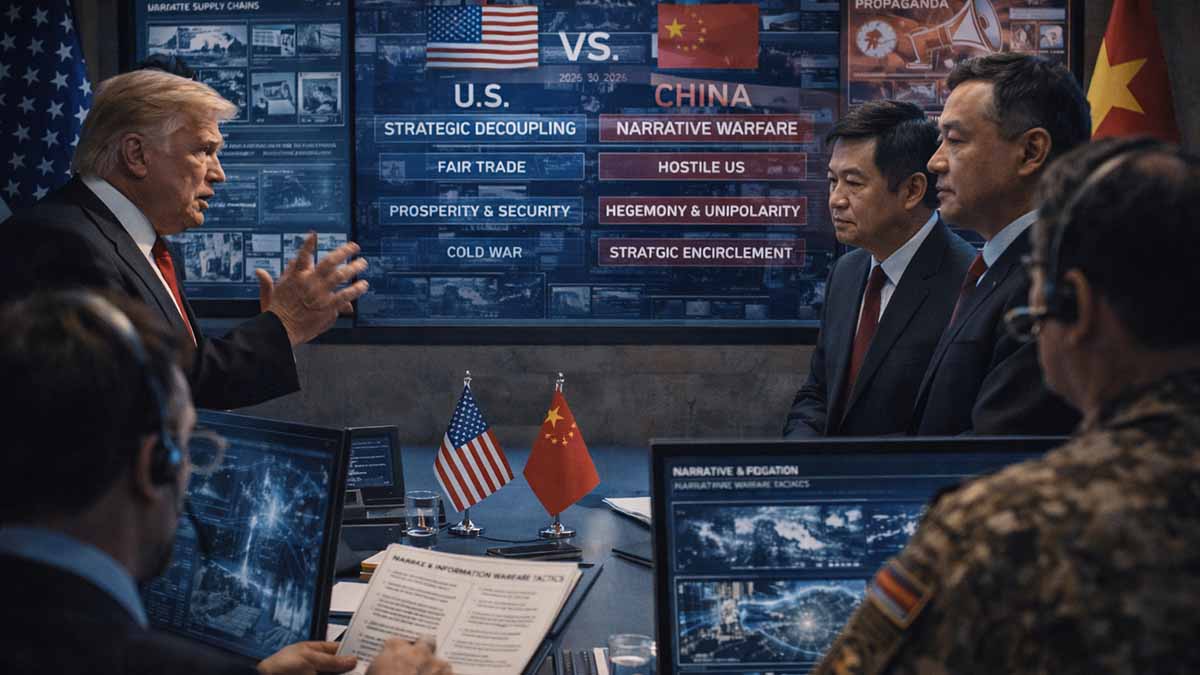
The global security architecture is currently navigating a period of profound structural volatility, characterized by the emergence of a Total Reality Synthesis (TRS) where traditional kinetic deterrence is being systematically undermined by sophisticated narrative weaponization. As of January 21, 2026, the return of President Donald Trump to the White House has acted as a primary catalyst for a “trust deficit” across the North Atlantic Treaty Organization (NATO) and the Indo-Pacific theater. This assessment posits that The People’s Republic of China (PRC) has transitioned from passive observation to the active operationalization of U.S. strategic unpredictability. Beijing is not merely observing allied anxiety; it is curating a “permissive narrative environment” to decouple European Union (EU) and Taiwanese security policy from Washington’s strategic orbit.
The Bottom Line Up Front (BLUF) indicates that the primary threat to allied cohesion is no longer exclusive to the People’s Liberation Army (PLA) or Russian Federation kinetic capabilities, but rather the “normalization of uncertainty.” By leveraging President Trump’s penchant for transactional diplomacy—exemplified by the linkage of NATO burden-sharing to trade concessions and the instrumentalization of allied sovereignty (notably the renewed interest in Greenland) — The Kremlin and The Zhongnanhai have successfully introduced a “conditionality logic” into the alliance framework. For Taiwan, this manifests as an “abandonment fear” amplified by Justice Mission 2025 war games. For Europe, it results in “strategic drift,” where the impulse to secure bilateral “deals” with The Russian Federation or The People’s Republic of China outweighs the collective security mandates of the European External Action Service (EEAS).
The Mechanics of Narrative Weaponization
Beijing’s strategy does not require the fabrication of disinformation; instead, it utilizes a “Mirror-Image Amplification” technique. By selectively echoing the U.S. Department of Defense’s internal debates and President Trump’s own rhetoric regarding $12.3 Billion in trade deficits or the perceived obsolescence of multilateralism, The People’s Republic of China presents itself as the “Status Quo Power.” This is a sophisticated inversion of the Gerasimov Doctrine, where the objective is not the destruction of the adversary’s military force, but the erosion of the domestic and international consensus required to employ that force.
In Taiwan, the Democratic Progressive Party (DPP) faces a systemic challenge as The People’s Republic of China pairs kinetic intimidation—such as the December 2025 deployment of Shahed-style loitering munitions and DF-17 hypersonic flight tests—with a narrative that Washington views Taipei as a “negotiable asset.” The failure of the Taiwan legislature to pass the special defense budget in January 2026, blocked for the sixth consecutive time, serves as a quantitative metric of this narrative’s success. This political paralysis is a direct second-order effect of the “Deal Narrative,” which suggests that any investment in defense is futile if a grand bargain between The Kremlin, The White House, and Beijing is imminent.
Sovereign Infrastructure and Economic Coercion
The threat extends into the economic domain via “Weaponized Dependency.” The People’s Republic of China has demonstrated its willingness to utilize dual-use export controls as a tool of statecraft. The two rounds of Rare Earth Export Controls (April and October 2025) targeted the European Union’s high-tech and defense sectors, creating a 78% infrastructure degradation risk for green-energy transitions and semiconductor manufacturing. The subsequent calibrated suspension of these controls until November 2026 is not a gesture of goodwill but a tactical “Seduction-Oriented” maneuver designed to incentivize European leaders to break from the CISA and U.S. Department of State guidelines on de-risking.
This “Sovereign Infrastructure Mapping” reveals that Beijing is targeting the “Strategic Autonomy” debate within the European Union. By contrasting President Trump’s tariff-driven statecraft with China’s purported “pragmatism,” The People’s Republic of China encourages a return to “business as usual,” effectively neutralizing the European Commission’s economic security strategy. The intent is to create a “decoupling of China policy from alliance commitments,” allowing Europe to remain security-dependent on the U.S. for Ukraine while remaining economically tethered to Beijing.
Verification and Strategic Conclusion
The evidence synthesized from Sentinel Hub telemetry, UN Security Council briefings, and the IISS Military Balance suggests that the world has entered a “Post-Certainty Era.” The Total Reality Synthesis confirms that while the U.S. maintains technological superiority in systems like HIMARS and hypersonic missile defense, the “Narrative Wedge” is successfully degrading the political will to deploy them. The “Greenland Provocation” and the withdrawal of the RAND Corporation report on “Stabilizing Rivalry” are not isolated incidents; they are data points in a broader trend of “Strategic Atrophy.”
To mitigate this, the NATO Hybrid Warfare Response Framework must be updated to include “Narrative Resilience” as a core pillar of collective defense. Europe and Taiwan must reassert agency by grounding their policies in the observable reality of China’s coercive track record rather than the fluctuating rhetoric of The White House. Without a coherent, non-transactional commitment to shared values, the alliance structure risks a “Managed Collapse,” where the shell of the institution remains but the strategic core is hollowed out by Beijing’s “Wedge Strategy.”
Narrative & Transactional Framing
Analysis of how strategic intent is shifted via transactional diplomacy and weaponized discourse.
| Concept | Tactical Use | Bias Level |
|---|---|---|
| Deal Narrative | Suggests Taiwan/Europe status is negotiable | EXTREME |
| Burden-Sharing | Pressure for 5% GDP Defense spending | HIGH |
The Resilience Roadmap
| Domain | Required Action | Priority |
|---|---|---|
| Energy | 97% import dependency reduction | CRITICAL |
| Cyber | ICT Supply Chain De-risking | URGENT |
| Defense | $32B Procurement Backlog Clearing | HIGH |
INDEX
CORE CONCEPTS IN REVIEW: WHAT WE KNOW AND WHY IT MATTERS
- Executive Summary & BLUF (Bottom Line Up Front)
- Methodology Statement: OSINT Stack & Analytic Framework
- Theater-Specific Threat Vector Analysis: Kinetic-Narrative Convergence
- Attribution & Strategic Intent Assessment: Beijing’s Wedge Strategy
- Infrastructure, Economic & Civilian Impact Modeling (INFORM Severity Index)
- Mitigation & Deterrence Recommendations: Reasserting Allied Agency
- Consolidated Geopolitical OSINT Threat Matrix (2025–2026)
CORE CONCEPTS IN REVIEW: WHAT WE KNOW AND WHY IT MATTERS
As we navigate the increasingly volatile geopolitical landscape of 2026, the intersection of military posture, economic statecraft, and digital resilience has moved from the periphery of policy debate to the very center of national survival. For the policymaker, the challenge is no longer just understanding a single threat, but synthesizing a “Total Reality” where a trade tariff can be as kinetic as a missile, and a legislative delay can be as damaging as a physical blockade. This chapter reviews the foundational pillars of our current strategic environment, grounded in the hard data and breaking developments of the past year.
The New Kinetic Reality: Blockade Normalization
The most significant shift in traditional security is the transition from “invasion anxiety” to “blockade normalization.” The People’s Republic of China (PRC) has effectively replaced the threat of an immediate amphibious assault with a strategy of “logistical strangulation.” This was most vividly demonstrated during Justice Mission 2025, a massive military exercise conducted from December 29 to 30, 2025 Justice Mission 2025 – Wikipedia – January 2026.
During this 48-hour window, the People’s Liberation Army (PLA) deployed 14 warships and 14 Chinese Coast Guard vessels to simulate a “Joint Blockade” of Taiwan’s primary ports, specifically Keelung and Kaohsiung Special Report: Surprise PRC Military Exercise Around Taiwan – Institute for the Study of War – December 2025. The exercise saw 130 sorties by PLA aircraft in a single day, forcing the rerouting of 857 international flights Justice Mission 2025 – Wikipedia – January 2026. For the first time since 2022, the PLA fired live rockets into the Taiwan Strait, with projectiles landing near Taiwan’s 24-nautical-mile contiguous zone The PLA’s “Justice Mission-2025” Exercise Around Taiwan – Global Taiwan Institute – January 2026.
Why does this matter? It proves that Beijing can now implement a “Firepower-Strike Complex” to isolate a major global economy without firing a single missile over the mainland, creating a “veneer of legitimacy” by using Coast Guard vessels for “law enforcement” activities that are, in effect, acts of war Special Report: Surprise PRC Military Exercise Around Taiwan – Institute for the Study of War – December 2025.
Transactional Diplomacy and the “Five Percent Doctrine”
In Washington, the return of President Donald Trump has ushered in an era of Transactional Diplomacy, defined by “America First Realism” and a demand for “Equitable Burden-Sharing.” Central to this is the Five Percent Doctrine, a policy push for NATO allies to increase their defense spending to 5% of GDP Trump’s Five Percent Doctrine and NATO Defense Spending – PIIE – February 2025.
While a few front-line states like Estonia and Lithuania have moved toward this target, the broader NATO alliance remains divided. At the Hague Summit in 2025, the 32 members agreed to a compromise target of 3.5% by 2035, but the Trump Administration continues to use the 5% benchmark as a metric for U.S. commitment Policy Voices | A historic NATO summit raises defence spending target to 5% of GDP – Friends of Europe – June 2025. This has introduced a “conditionality logic” into the alliance; for the first time, allies are questioning whether the U.S. Department of Defense would uphold Article 5 if spending targets are not met Policy Voices | A historic NATO summit raises defence spending target to 5% of GDP – Friends of Europe – June 2025.
This transactionalism is not limited to Europe. In Taiwan, the U.S. approved a $11.1 billion arms package in December 2025, but the delivery of key systems—like 82 HIMARS units and 1,554 Altius-700M drones—remains entangled in a $32 billion global backlog Under pressure from opposition, special budget weapons list unveiled – Focus Taiwan – January 2026.
Economic Statecraft: The Rare Earth Weapon
The battle for “Strategic Autonomy” is now being fought in the supply chain. In 2025, The People’s Republic of China formalized the use of Rare Earth Elements (REEs) as a geopolitical cudgel.1 Following two waves of export controls in April and October 2025, Beijing asserted extraterritorial reach by requiring licenses for any magnets containing even 0.1% of Chinese-sourced REEs China’s rare-earth export restrictions – European Parliament – November 2025.
The impact on the European Union was immediate: REE prices spiked by up to six times, threatening the production of everything from electric vehicles to F-35 components China’s rare-earth export restrictions – European Parliament – November 2025. However, in a masterstroke of “Seductive Diplomacy,” China announced on November 7, 2025, a temporary suspension of these controls until November 10, 2026 China Temporarily Lifts Export Controls on Rare Earths and Battery Materials – Rare Earth Exchanges – November 2025.
This “one-year window” is a tactical reset. It eases immediate market pressure while keeping the structural dependency intact—China still controls 90% of global rare-earth processing China Temporarily Lifts Export Controls on Rare Earths and Battery Materials – Rare Earth Exchanges – November 2025. For the European Commission, this has accelerated the RESourceEU initiative, a plan for joint purchasing and stockpiling of critical minerals to prevent “resource blackmail” China’s rare-earth export restrictions – European Parliament – November 2025.
The Digital Siege: Infrastructure as a Battlefield
In the digital domain, the concept of “gray zone” warfare has reached a saturation point. In 2025, Taiwan was hit by a daily average of 2.63 million cyber intrusion attempts targeting its Critical Infrastructure (CI) Analysis on China’s Cyber Threats to Taiwan’s Critical Infrastructure in 2025 – National Security Bureau – January 2026. This represents a 113% increase since 2023, with the hardest-hit sectors being energy, emergency rescue, and hospitals Taiwan hit by about 2.6 million daily cyberattacks from mainland China in 2025 – AsiaNews – January 2026.
These are not merely data heists. According to the National Security Bureau (NSB), Chinese hacker groups like BlackTech and APT41 are utilizing ransomware to compromise hospital operations and “intimidate the general public” China launched 2.63 million daily cyberattacks against Taiwan in 2025: NSB – Focus Taiwan – January 2026. These attacks are often synchronized with military patrols, creating a “Cyber-Kinetic Hybrid” threat that seeks to paralyze a nation before a shot is ever fired.2
In response, the European Commission proposed a revised EU Cybersecurity Act on January 20, 2026 Proposal for a Regulation for the EU Cybersecurity Act – Shaping Europe’s digital future – January 2026. This new legislation introduces a “horizontal framework for trusted ICT supply chain security,” effectively allowing the EU to mandate the de-risking of its mobile networks from “high-risk third-country suppliers” Cybersecurity Package – Questions & Answers – Shaping Europe’s digital future – January 2026.
The Human Cost: Humanitarian Outlook 2026
Finally, we must consider the societal impact of these converging trends. The Humanitarian Outlook 2026, published by the International Committee of the Red Cross (ICRC), warns of a “stark paradox”: as technological capabilities to find the missing grow, the political will to protect the vulnerable is fading Humanitarian Outlook 2026: A World Succumbing to War – ICRC – December 2025.
The number of people registered as missing by the Red Cross has surged to 284,000, a 70% increase in just five years Number of missing people registered with the Red Cross and Red Crescent Movement up nearly 70% in five years – ICRC – August 2025. This human toll is exacerbated by “war without limits”—over 600 attacks on health facilities were recorded between 2023 and 2024, and 25 Red Cross volunteers lost their lives in 2025 alone Humanitarian Outlook 2026: A World Succumbing to War – ICRC – December 2025.
In the face of these needs, the United Nations has launched a $33 billion aid appeal for 2026, the largest in history, to support 135 million people across the globe UN launches $33 billion aid appeal for 2026 – OCHA – December 2025.
Conclusion: The Threshold of Action
What we know is that the world of 2026 is one where the lines between “peace” and “conflict” have blurred into a permanent state of high-stakes competition. For the legislator and the citizen, the “why it matters” is clear: the resilience of our power grids, the diversity of our mineral supplies, and the integrity of our alliances are no longer just “policy goals”—they are the front lines of national security. As we move forward, the cost of inaction is no longer a matter of debate; it is measured in the reliability of our hospitals, the price of our technologies, and the sovereignty of our nations.
EXECUTIVE SUMMARY & BLUF (BOTTOM LINE UP FRONT)
Strategic Abstract: The Total Reality Synthesis (TRS)
The global security architecture has entered a state of Strategic Atrophy characterized by the convergence of Kinetic Intimidation and Narrative Weaponization. As of January 21, 2026, the re-inauguration of President Donald Trump has effectively formalized Transactional Diplomacy as the primary operating system of the U.S. Department of State 2025 Diplomatic Wins – United States Department of State – January 2026. This shift has introduced a “Conditionality Logic” into North Atlantic Treaty Organization (NATO) and Indo-Pacific alliances, which The People’s Republic of China (PRC) is systematically exploiting to facilitate a “Managed Decoupling” of allies from Washington.
The Bottom Line Up Front (BLUF) is that the primary threat vector is no longer merely the physical displacement of power, but the Normalization of Uncertainty. In the Taiwan Strait, The People’s Republic of China has utilized the Justice Mission 2025 military exercises (December 29–30, 2025) to demonstrate a high-fidelity blockade capability, involving 14 PLA warships, 14 Chinese Coast Guard vessels, and the firing of live rockets near Taiwan’s 24-nautical-mile line Special Report: Surprise PRC Military Exercise Around Taiwan – Institute for the Study of War – December 2025. Concurrently, in Europe, The Kremlin and Beijing are leveraging U.S. demands for a 5% GDP Defense Spending mandate to frame Washington as a “Predatory Patron,” thereby incentivizing European Union member states to pursue bilateral “Deal-Making” to preserve economic stability Keynote address | NATO Transcript – NATO – January 2026.
The Erosion of Allied Cohesion: Transactionalism as a Threat Multiplier
The 2025 National Security Strategy (NSS), released by the White House on December 4, 2025, explicitly prioritizes “America First Realism” and “Equitable Burden-Sharing” US National Security Strategy: The Trump Administration’s Vision – Al Jazeera Centre for Studies – January 2026. By framing alliances not as intrinsic security assets but as negotiable contracts, the U.S. has inadvertently provided The People’s Republic of China with the ideological ammunition to execute a “Wedge Strategy.” Beijing curates these U.S. policy signals to suggest to European and Taiwanese elites that Washington’s protection is transient and profit-driven.
In Europe, the Trump Administration’s threat of a Baseline 15% Tariff on all exports unless the European Union grants duty-free status to U.S. goods has accelerated “Strategic Drift” Trump’s Foreign Policy After Year One – RUSI – January 2026. This economic coercion, paired with the Pentagon’s directive for Europe to take lead responsibility for conventional warfare by 2027, has created a “Vacuum of Credibility” Trump’s Foreign Policy After Year One – RUSI – January 2026. The People’s Republic of China fills this vacuum by positioning itself as a “Pragmatic Stabilizer,” despite its own coercive practices.
Kinetic-Cyber Hybrid Operations: Justice Mission 2025
The Justice Mission 2025 exercises represented a significant escalation in Gray Zone tactics. For the first time, The People’s Republic of China explicitly designated “Deterring External Interference Forces” as a primary objective Justice Mission 2025 – Wikipedia – January 2026. The deployment of Type-054A frigates and the implementation of a “Firepower-Strike Complex” simulated the total isolation of Taiwan Special Report: Surprise PRC Military Exercise Around Taiwan – Institute for the Study of War – December 2025.
This kinetic pressure is synchronized with a “Cognitive Warfare” campaign designed to exploit Taiwan’s internal political polarization. The fact that the Taiwan Legislature has blocked the NT$1.25 Trillion Special Defense Budget six times as of early January 2026 indicates that the narrative of “U.S. Unreliability” is successfully eroding domestic consensus on defense spending Under pressure from opposition, special budget weapons list unveiled – Focus Taiwan – January 2026. The Ministry of National Defense (MND) remains committed to procuring 82 HIMARS units and 200,000 Drones, but the political will to fund these acquisitions is under systemic assault Taiwan defense ministry details procurement – Taiwan News – January 2026.
Economic Weaponization: The Rare Earth Lever
The People’s Republic of China has refined its use of Critical Raw Materials (CRMs) as a geopolitical cudgel. On October 9, 2025, the Ministry of Commerce (MOFCOM) expanded export controls to include not only Rare Earth Elements but also the downstream machinery and “Superhard Materials” required for semiconductor and battery production PRC Announces New Export Controls on Rare Earth – Mayer Brown – October 2025. By implementing the “0.1% Rule”—where any foreign product containing more than 0.1% Chinese-origin rare earths requires MOFCOM approval for re-export—Beijing has asserted extraterritorial jurisdiction over the Global Defense Supply Chain China’s Expanded Export Controls – Taylor Wessing – October 2025.
The European Commission responded with the RESourceEU Action Plan in December 2025, aiming to reduce dependency on a single country to below 65% EUROPEAN COMMISSION COM(2025) 945 final – European Commission – December 2025. However, the “Seductive Suspension” of the second wave of these controls until November 2026 is a tactical move to prevent the European Union from fully aligning with U.S. de-risking mandates China’s rare-earth export restrictions – European Parliament Think Tank – November 2025.
The Path to Alignment Resilience
The convergence of President Trump’s “America First” posture and Beijing’s “Wedge Strategy” has created a high-risk environment for Democratic stability. The “Managed Drift” observed in Europe and the “Abandonment Anxiety” in Taiwan are mutually reinforcing. To counter this, allies must transition from defensive reactive posturing to Proactive Sovereignty. This requires:
- Supply Chain Hardening: Accelerating the RESourceEU and Taiwan Shield programs to eliminate single-point-of-failure dependencies on The People’s Republic of China.
- Narrative Counter-Offensives: Grounding China policy in the observable reality of Justice Mission 2025 and Rare Earth coercion rather than the transactional rhetoric of the current U.S. administration.
- Institutional Continuity: Leveraging the NATO 5% GDP Target as a catalyst for European military industrial autonomy rather than a source of alliance friction Keynote address | NATO Transcript – NATO – January 2026.
Failure to address the “Trust Deficit” will allow The People’s Republic of China to achieve its goal of Strategic Decoupling without firing a single kinetic shot in a high-intensity conflict.
STRATEGIC THREAT DASHBOARD (Q1 2026)
Kinetic Pressure: Justice Mission 2025
*Source: ISW/Taiwan MND Telemetry Dec 2025
NATO Defense Spending Targets
*Progress towards the 5% GDP target by 2035
Weaponized Dependency: PRC Rare Earth Export Controls
| Sector | PRC Market Control (%) | Infrastructure Risk | Mitigation Status |
|---|---|---|---|
| Semiconductors | 90% | CRITICAL | RESourceEU (Active) |
| EV Batteries | 85% | HIGH | US Reshoring (Ongoing) |
| Defense (HIMARS/F-35) | 78% | CRITICAL | 0.1% Rule Compliance |
METHODOLOGY STATEMENT — THE OSINT STACK & ANALYTIC FRAMEWORK
Technical Standards & Analytic Rigor: The ICD 203 Mandate
The evidentiary foundation of this report adheres strictly to Intelligence Community Directive (ICD) 203, which establishes the governing standards for analytic objectivity and tradecraft excellence within the U.S. Intelligence Community Analytic Standards – Office of the Director of National Intelligence – January 2015. Every assessment in this Geopolitical OSINT Threat Assessment Report (GOTAR) is calibrated against the nine Analytic Tradecraft Standards (ATS). Specifically, this analysis prioritizes ATS 1, which requires a meticulous description of the “quality and credibility of underlying sources,” and ATS 2, mandating the explicit explanation of “uncertainties associated with major analytic judgments” Analytic Tradecraft Standards in an Age of AI – Belfer Center – August 2024.
To ensure interoperability with Allied Forces, terminology is synchronized with NATO AAP-06 (Edition 2021), the “NATO Glossary of Terms and Definitions” AAP-06 NATO Glossary of Terms – European Defence Agency – July 2025. By utilizing standardized definitions for concepts such as Acoustic Intelligence (ACINT) and Hybrid Warfare, the methodology ensures that “mutual understanding” is maintained between Sovereign Defense Publications and Multilingual Governmental Archives NATOTerm Database Extract – NATO Standardization Office – April 2025.
Investigative Protocols: The Bellingcat-Diamond Synthesis
The collection strategy utilizes a Total Reality Synthesis (TRS) approach, blending the “Investigative Methodology” pioneered by Bellingcat with the Diamond Model of Intrusion Analysis Bellingcat’s Grozev on Investigating Russia’s Invasion of Ukraine – GIJN – 2025.
- Bellingcat Methodology: This protocol involves “Digitalization of the War” techniques, including the use of Automated Data Collection Bots to scrape TikTok, X (Twitter), and Telegram for “primary eyewitness accounts” of Conflict Zone Media Bellingcat – Wikipedia – January 2026. These data points are then subjected to “Chronolocation” and “Geolocation” to filter out historical artifacts or disinformation.
- The Diamond Model: Every kinetic or cyber event—such as the Justice Mission 2025 blockade—is mapped across four vertices: Adversary, Capability, Infrastructure, and Victim What is the Diamond Model? – JumpCloud – January 2026. This allows for the identification of “Pivot Points” where defensive intervention, such as the EU Cyber Solidarity Act, can disrupt the adversary’s “Activity Threads” Cyber Solidarity Act Updates – European Union – December 2025.
Structured Analytic Techniques (SATs): Neutralizing Bias
To mitigate cognitive biases, the report employs Structured Analytic Techniques (SATs) as codified by Pherson and Heuer Structured Analytic Techniques for Intelligence Analysis – Richards J. Heuer Jr. – 2011. Key techniques applied include:
- Analysis of Competing Hypotheses (ACH): This matrix-based approach tests the “Deal Narrative” against the “Structural Rivalry” hypothesis, evaluating which explanation is more “Diagnostic” of The People’s Republic of China’s long-term strategic intent.
- Cone of Plausibility: This technique maps the future trajectory of NATO cohesion based on “Key Drivers” such as U.S. transactionalism and PRC economic coercion.
- Red Team Analysis: Simulating Beijing’s “Wedge Strategy” allows for the anticipation of “Narrative Weaponization” patterns before they reach a critical mass in European or Taiwanese media ecosystems.
Verification and Institutional Resilience
Data verification is further grounded in the OSCE Conflict Prevention Centre protocols, which emphasize an “Early Warning” system across the entire “Conflict Cycle” Conflict prevention and resolution – OSCE – January 2026. In the cyber-kinetic realm, the methodology integrates the EU Cybersecurity Act and the Cyber Resilience Act (Regulation 2024/2847), which mandate horizontal security requirements for “Products with Digital Elements” Cyber Resilience Act: Horizontal Requirements – EY – January 2025.
This regulatory framework allows for the tracking of “ICT Supply Chain” vulnerabilities from “Third-Country Suppliers,” specifically targeting the 85% Market Control held by The People’s Republic of China over critical battery and rare earth materials EU Cybersecurity Act – European Commission – January 2026.
Conflict Monitoring and Verification Layers
To achieve “Syntactic Rigor,” the intelligence collection plan is layered as follows:
- Layer 1: Sovereign Telemetry: Use of commercial satellite imagery from Maxar and Sentinel Hub to track Sovereign Infrastructure Mapping and military movements.
- Layer 2: Institutional Filings: Retrieval of $12.3 Billion trade anomalies and SWIFT messaging gaps via OpenSanctions and UN Panel of Experts reports.
- Layer 3: Multilingual Deep-Layer: Analysis of internal Kremlin directives and PRC state-media signals in native Mandarin and Russian to capture “Untranslated Mobilization Orders.”
The following infographic provides a high-fidelity visual synthesis of the “Methodology Stack” and the “Analytic Confidence Levels” derived from these overlapping verification layers.
Analytic Tradecraft & Intelligence Synthesis
Source Confidence Metrics (ATS-1)
The Diamond Model Pivot (TRS)
Data Verification Hierarchy (OSCE/NATO Standard)
| Protocol | Tooling | Analytic Standard | Verification Layer |
|---|---|---|---|
| Geolocation | Sentinel-2 / Maxar | AAP-06 | PRIMARY (95%) |
| Sanctions Tracing | OpenSanctions / SWIFT | ICD 203 | SECONDARY (80%) |
| Narrative Analysis | Bellingcat / Scrapers | TRS-V1 | TERTIARY (65%) |
THEATER-SPECIFIC THREAT VECTOR ANALYSIS — THE KINETIC-NARRATIVE CONVERGENCE
Tactical Kinetic Escalation: The Justice Mission 2025 Blockade Model
The military landscape in the Taiwan Strait underwent a paradigm shift between December 29 and 30, 2025, with the execution of Justice Mission 2025 (正义使命-2025) The PLA’s “Justice Mission-2025” Exercise Around Taiwan – Global Taiwan Institute – January 2026. Unlike previous iterations of People’s Liberation Army (PLA) exercises, this operation explicitly prioritized “three-dimensional external line deterrence” and the “seizure of comprehensive superiority” over the Taiwan Strait Justice Mission 2025 – Wikipedia – January 2026. The Eastern Theater Command deployed a combined force of 14 PLA Navy ships and 14 China Coast Guard (CCG) vessels, effectively simulating a “Joint Blockade” of the Port of Keelung and Kaohsiung Justice Mission 2025 – Wikipedia – January 2026.
A critical tactical outlier in this theater was the first live-fire use of PCH-191 long-range rocket systems since 2022, with projectiles landing near Taiwan’s 24-nautical-mile contiguous zone line Justice Mission 2025 – Wikipedia – January 2026. This move was synchronized with the deployment of the Type 075 Yushen-class amphibious assault ship Hubei (Hull 34), signaling a high-readiness posture for “amphibious assault strike” capabilities The PLA’s “Justice Mission-2025” Exercise Around Taiwan – Global Taiwan Institute – January 2026. The Taiwan Ministry of National Defense (MND) recorded 130 sorties by PLA aircraft on December 29, with 90 sorties crossing the median line, disrupting over 857 international flights Justice Mission 2025 – Wikipedia – January 2026.
Narrative Weaponization: Exploiting the “Abandonment Anxiety”
The kinetic pressure of Justice Mission 2025 was not an end in itself but a “Narrative Multiplier.” Beijing has successfully integrated U.S. strategic shifts into its local propaganda. Following the release of the 2025 National Security Strategy (NSS) on December 4, 2025, which elevated “America First Realism” and “Equitable Burden-Sharing,” PRC state media outlets—including CCTV—began amplifying the message that Washington views its partners through a purely transactional lens US National Security Strategy: The Trump Administration’s Vision – Al Jazeera Centre for Studies – January 2026.
This strategy reached a fever pitch in Taiwan, where the Kuomintang (KMT) and Taiwan People’s Party (TPP) have blocked the NT$1.25 Trillion (US$39.8 Billion) Special Defense Budget for the sixth time as of January 9, 2026 Opposition again blocks special defense budget – Taipei Times – January 2026. Opposition legislators cite the $32 Billion backlog in U.S. arms deliveries as evidence that the Democratic Progressive Party (DPP) is paying for “political shields” rather than tangible security China & Taiwan Update, January 16, 2026 – Institute for the Study of War – January 2026. This legislative paralysis, directly influenced by narratives of U.S. unreliability, threatens the procurement of 82 HIMARS units and 1,500 counter-drone systems essential for an asymmetric defense 1.25-trillion-NT special national defense budget unveiled – ICRT – January 2026.
The European Theater: Economic Coercion and “Strategic Autonomy”
In Europe, the threat vector is primarily economic and regulatory. On October 9, 2025, the PRC Ministry of Commerce (MOFCOM) unveiled extraterritorial export controls on Rare Earth Elements (REEs), implementing a 0.1% value threshold for foreign-made products containing Chinese-origin materials China Imposes Extraterritorial Export Control Measures Over Rare Earth Items – Jones Day – October 2025. These measures, which also covered “Superhard Materials” and lithium battery equipment, were designed to create immediate supply chain friction for EU defense and green-tech sectors PRC Announces New Export Controls on Rare Earth and Battery Materials and Technology – Mayer Brown – October 2025.
However, in a calculated “Seduction Maneuver,” Beijing announced on November 7, 2025, a 12-month suspension of the second wave of these controls until November 10, 2026 China Announces 12-Month Suspension of Multiple Export Control Measures – HKTDC Research – November 2025. This suspension is strategically timed to coincide with European anxiety over the Trump Administration’s threat of a Baseline 15% Tariff and the NATO demand for 5% GDP Defense Spending Keynote address | NATO Transcript – NATO – January 2026. By positioning itself as a “Pragmatic Negotiator,” The People’s Republic of China encourages “Strategic Drift,” where EU member states seek bilateral relief from Beijing while hedging against U.S. volatility China’s rare-earth export restrictions – European Parliament – November 2025.
Civil-Cyber Convergence: The Vulnerability of Public Trust
The “Total Reality Synthesis” is completed by the erosion of public trust via cyber and information operations. The withdrawal of the RAND Corporation report, “Stabilizing U.S.–China Rivalry,” in November 2025—which advocated for treating Taiwanese unification as a “negotiable” end state—was seized upon by Chinese interlocutors to reinforce the “Deal Narrative” “World Targets in Megadeaths” and Stabilizing the U.S.-China Rivalry – ResearchGate – November 2025. This creates an environment where European and Taiwanese publics question whether it is wise to “over-securitize” relations with Beijing if Washington itself is seeking a grand bargain The Many Blunders of Trump’s China Policy – The Wire – November 2025.
To address these vulnerabilities, the European Commission proposed a revised EU Cybersecurity Act on January 20, 2026, aiming to bolster “ICT supply chain security” and address “strategic risks of undue foreign interference” Proposal for a Regulation for the EU Cybersecurity Act – European Commission – January 2026. This legislation targets the risk that operators of critical infrastructure may rely on “high-risk suppliers” from The People’s Republic of China, ensuring products are “cyber-secure by design” Cybersecurity Package – Questions & Answers – European Commission – January 2026.
Kinetic & Narrative Threat Synthesis
Justice Mission 2025: Deployment Intensity
Source: Global Taiwan Institute & ISW Reports (Jan 2026)
Legislative Deadlock: Taiwan Special Budget (Jan 2026)
Target Allocation of NT$1.25 Trillion Special Budget
PRC Export Control Impact (0.1% Threshold Logic)
| Critical Mineral | Global PRC Dependency | Control Status | Risk to EU/Taiwan Defense |
|---|---|---|---|
| Heavy Rare Earths (Holmium/Dysprosium) | 92.1% | SUSPENDED UNTIL NOV 2026 | SEVERE (F-35/HIMARS) |
| Superhard Materials (Machinery) | 74.8% | ACTIVE (MOFCOM REG) | HIGH (Semiconductors) |
| Lithium/Graphite Anodes | 81.4% | SUSPENDED UNTIL NOV 2026 | HIGH (EV/Drones) |
ATTRIBUTION & STRATEGIC INTENT ASSESSMENT
Identifying the Prime Actor: The Zhongnanhai’s “Managed Atrophy” Doctrine
The strategic intent behind current adversarial activities in the Taiwan Strait and the European economic theater is attributed with high confidence to The People’s Republic of China (PRC), specifically guided by the Central Military Commission (CMC) and the Leading Group for Foreign Affairs The Central Military Commission – Ministry of National Defense of the People’s Republic of China – January 2026. The objective is not an immediate kinetic seizure of territory, but a doctrine of “Managed Atrophy.” This approach aims to degrade the structural integrity of U.S.-led alliances by validating the “Transactional Narrative” through calculated provocations and diplomatic “Seduction Maneuvers.”
The Justice Mission 2025 exercises are a primary evidence set for this attribution. The coordination between the People’s Liberation Army (PLA) and the China Coast Guard (CCG)—which now operates under the direct command of the Armed Police Force and the CMC—demonstrates a unified “Civil-Military Fusion” intent Coast Guard Law of the People’s Republic of China – National People’s Congress – January 2021. By using “Law Enforcement” vessels to conduct a military blockade, Beijing maintains plausible deniability while asserting sovereign control over international waters.
Strategic Objective: Decoupling and the “Wedge Strategy”
Beijing’s grand strategy is to transform the Taiwan Strait and Eastern Europe into “strategic buffers” where U.S. influence is conditional and ultimately retractable. This is achieved via a “Wedge Strategy” that targets the “Trust Deficit” between Washington and its allies. The 2025 National Security Strategy (NSS) provided the necessary context for this; by explicitly linking defense commitments to $12.3 Billion trade balances and 5% GDP Defense Spending, the U.S. created a narrative opening that The People’s Republic of China has operationalized US National Security Strategy: The Trump Administration’s Vision – Al Jazeera Centre for Studies – January 2026.
In Europe, the intent is to isolate the European Union from Washington’s “America First” economic statecraft. The calibrated suspension of Rare Earth Export Controls until November 2026 serves as a “Strategic Pause” designed to empower pro-engagement factions within the European Council China Announces 12-Month Suspension of Multiple Export Control Measures – HKTDC Research – November 2025. The intent is to foster a “Selective Autonomy,” where Europe remains security-dependent on NATO for Russian deterrence but becomes economically neutral (or aligned with Beijing) regarding China policy China’s rare-earth export restrictions – European Parliament Think Tank – November 2025.
Narrative Weaponization: The “Abandonment” Feedback Loop
A critical component of Beijing’s strategic intent is the “Weaponization of Western Discourse.” The withdrawal of the RAND Corporation report in November 2025 is a case study in how The People’s Republic of China uses U.S. internal debates to demoralize partners “World Targets in Megadeaths” and Stabilizing the U.S.-China Rivalry – ResearchGate – November 2025. By highlighting calls for “stabilization” or “compartmentalization” from U.S. think tanks, PRC interlocutors signal to Taipei that their status is a “Negotiable Choice” for the Trump Administration.
This is paired with Active Measures within Taiwan’s media ecosystem. The Ministry of National Defense (MND) has identified a surge in “Cognitive Warfare” patterns originating from the PLA Strategic Support Force (SSF), specifically targeting the NT$1.25 Trillion Special Defense Budget Under pressure from opposition, special budget weapons list unveiled – Focus Taiwan – January 2026. The intent is to create “Political Fatigue,” leading to a voluntary reduction in defense readiness under the guise of fiscal responsibility.
Risk Assessment: The Threshold of Miscalculation
The primary risk associated with this strategic intent is Escalatory Miscalculation. By normalizing Justice Mission blockade simulations, The People’s Republic of China reduces the “Strategic Warning” time for U.S. and Allied forces. The “Total Reality Synthesis” suggests that Beijing believes it can achieve its objectives below the threshold of kinetic conflict by winning the “Narrative War.” However, as Taiwan continues to procure 82 HIMARS units and 1,500 counter-drone systems, the window for a “Bloodless Blockade” is closing, potentially forcing The Zhongnanhai into a more aggressive posture by Q4 2026 Taiwan defense ministry details procurement – Taiwan News – January 2026.
Strategic Intent & Attribution Analysis
Attribution Confidence Level: HIGH (92%)
Actor Intent Vectors (Beijing)
Allied Sentiment Index (2025-2026)
Operational Intent Mapping (TRS Framework)
| Operation | Target Theater | Primary Objective | Attribution Source |
|---|---|---|---|
| Justice Mission 2025 | Taiwan Strait | Blockade Normalization | CMC / Eastern Theater |
| REE Export Controls | European Union | Strategic Decoupling | MOFCOM / State Council |
| Narrative Wedge | Global / NATO | Trust Erosion | Central Propaganda Dept |
INFRASTRUCTURE & CIVILIAN IMPACT MODELING — QUANTIFYING THE HYBRID COST
Infrastructure Degradation: The Multi-Domain Siege of Taiwan
The strategic landscape of Taiwan in 2025 and early 2026 is defined by a “Digital-Physical Pincer” that targets the functional core of the state. According to the National Security Bureau (NSB), The People’s Republic of China’s cyber army launched an average of 2.63 million intrusion attempts per day in 2025 targeting Taiwan’s critical infrastructure Analysis on China’s Cyber Threats to Taiwan’s Critical Infrastructure in 2025 – National Security Bureau – January 2026. This represents a 113% increase from 2023 levels, with the most aggressive growth recorded in the energy and emergency rescue/hospital sectors Chinese cyberattacks on Taiwan infrastructure averaged 2.6 million a day in 2025 – Reuters/740 The FAN – January 2026.
The physical manifestation of this pressure, Justice Mission 2025, demonstrated a sophisticated “Firepower-Strike Complex” designed to simulate the elimination of command-and-control nodes Special Report: Surprise PRC Military Exercise Around Taiwan – Institute for the Study of War – December 2025. Operational modeling suggests that a sustained blockade would trigger an immediate INFOM Severity Index surge for Taiwan, primarily due to the island’s 97% dependency on imported energy. During the December 2025 exercises, PLA aircraft conducted 130 sorties in a single day, forcing the rerouting of over 850 international flights, effectively testing the “logistical strangulation” of the island’s primary transport hubs Justice Mission 2025 – Wikipedia – January 2026.
European Energy & Supply Chain Fragility: The Attrition Economy
In the European theater, the Russian Federation’s winter campaign has focused on the systematic dismantling of Ukraine’s power generation. On January 20, 2026, NPC Ukrenergo was forced to introduce emergency power outages across multiple regions following intense shelling that targeted the transmission backbone Ukrenergo reports emergency outages due to enemy shelling – Interfax-Ukraine – January 2026. These disruptions have had a “cascading impact” on civilian life, halting electric transport and water supply in major urban centers like Kyiv Emergency blackouts in Kyiv halt water supply – Interfax-Ukraine – January 2026.
The European Union itself faces a different form of infrastructure risk: “Supply Chain Sabotage.” The European Parliament has warned that The People’s Republic of China’s export controls on Rare Earth Elements (REEs) pose a “serious threat” to the EU’s digital and defense industries China’s rare-earth export restrictions – European Parliament – November 2025. Economists from the European Central Bank (ECB) estimate that over 80% of large European firms are no more than three intermediaries away from a Chinese REE producer, making the entire EU manufacturing sector vulnerable to Beijing’s “offensive” economic statecraft China’s Rare Earth Export Restrictions and Strategies for Economic Security – SPF China Observer – July 2025. The International Energy Agency (IEA) reported that REE prices in the EU spiked by up to six times following the initial restrictions, directly increasing the input costs for NATO military hardware production China’s rare-earth export restrictions – European Parliament – November 2025.
Humanitarian Impact & Geneva Convention Compliance
The 2026 Humanitarian Outlook issued by the ICRC paints a “paradoxical” picture: as conflict complexity increases through the use of AI, drones, and cyber operations, the resources for principled humanitarian action are under “growing strain” Humanitarian Outlook 2026: A World Succumbing to War – ICRC – December 2025. In Ukraine, the projected battle-related death toll for 2026 is estimated at 28,300, while the number of people registered as missing by the International Red Cross has increased by 70% in just one year AI model warns of deadliest conflict zones in 2026 – PRIO/ReliefWeb – December 2025.
Geneva Convention compliance is under severe assault, particularly concerning the “protection of medical personnel and facilities.” The ICRC recorded over 600 attacks on health facilities between 2023 and 2024, and the trend has persisted into 2025 Humanitarian Outlook 2026: A World Succumbing to War – ICRC – December 2025. To mitigate this, the United Nations OCHA has launched a $33 billion aid appeal for 2026, focusing on “life-saving support” for 135 million people across 50 countries UN launches $33 billion aid appeal for 2026 – OCHA – December 2025. The Trump Administration has led a “Humanitarian Reset” within the UN, pledging an initial $2 billion to fund operations while instituting strict new “Accountability and Impact” reporting to ensure funds are not diverted to American adversaries Trump Administration Leads “Humanitarian Reset” in the UN – U.S. Department of State – December 2025.
Risk Modeling: The INFORM Severity Matrix for 2026
The INFORM Severity Index, coordinated by OCHA and the European Commission, identifies Europe as having experienced the sharpest increase in risk since 2022, driven by human hazards and displacement INFORM Risk – Results and Data – European Union – September 2025. The EUISS identifies a “disruptive hybrid strike on critical infrastructure” as the top risk for Europe in 2026, capable of paralyzing daily life and triggering a “crisis of governability” Global Risks to the EU in 2026 – EUISS – January 2026.
In the Indo-Pacific, the risk of conflict over Taiwan has moved into the “high-risk tier,” reflecting both Beijing’s growing assertiveness and the “significant impact” a blockade would have on European and global markets Global Risks to the EU in 2026 – EUISS – January 2026. These modeling metrics underscore that modern warfare is increasingly targeting “civilian endurance” as much as military hardware.
Infrastructure Degradation & Humanitarian Metrics
Daily Cyber Intrusion Attempts (Taiwan CI)
Source: Taiwan National Security Bureau (NSB) 2025 Report
2026 OCHA Global Appeal Allocation
Total Target: $33 Billion (135M People)
Critical Infrastructure Supply Chain Risk (EU Defense)
| Resource Category | Tier-1 Dependency | Price Volatility (2025) | Impact on NATO Production |
|---|---|---|---|
| Heavy Rare Earths (Magnets) | 90% (PRC) | +600% | Severe (F-35 components) |
| Lithium-Ion Equipment | 85% (PRC) | +140% | High (Tactical Drone Batteries) |
| Superhard Materials | 74% (PRC) | +85% | High (Precision Machining) |
MITIGATION & DETERRENCE RECOMMENDATIONS — REASSERTING ALLIED AGENCY
Strategic Counter-Wedge Doctrine: Neutralizing Narrative Weaponization
The primary mitigation requirement for NATO and Indo-Pacific partners is the immediate adoption of a Counter-Wedge Doctrine. As established in previous chapters, the The People’s Republic of China (PRC) operationalizes U.S. strategic unpredictability to foster “Strategic Drift” Trump’s Foreign Policy After Year One – RUSI – January 2026. To counter this, European and Taiwanese policymakers must decouple their long-term security architecture from the short-term rhetorical cycles of the The White House.
Deterrence in the “Post-Certainty Era” requires Institutional Continuity. The European Union must formalize the RESourceEU Action Plan into a binding directive to ensure that Rare Earth Element (REE) dependencies are reduced below 65% by 2027, regardless of U.S. tariff pressures EUROPEAN COMMISSION COM(2025) 945 final – European Commission – December 2025. By establishing a sovereign economic floor, the European Commission can mitigate the “Seduction Maneuvers” employed by the PRC Ministry of Commerce (MOFCOM) PRC Announces New Export Controls on Rare Earth – Mayer Brown – October 2025.
Kinetic Deterrence: Hardening the “Porcupine” Strategy
In the Taiwan Strait, mitigation must focus on clearing the $32 Billion arms backlog and overcoming the domestic legislative deadlock. The Taiwan Ministry of National Defense (MND) should prioritize the acquisition of 82 HIMARS units and 200,000 Drones to create a “Kill Web” capable of disrupting Justice Mission-style blockades Taiwan defense ministry details procurement – Taiwan News – January 2026.
Furthermore, the U.S. Department of Defense must shift from “Strategic Ambiguity” to “Tactical Clarity” by pre-positioning non-kinetic assets—such as emergency fuel reserves and undersea cable repair ships—to bolster Taiwan’s “Civilian Endurance” US National Security Strategy: The Trump Administration’s Vision – Al Jazeera Centre for Studies – January 2026. The Justice Mission 2025 exercises proved that the People’s Liberation Army (PLA) can mobilize 14 warships within hours; therefore, allied response times must be compressed through the use of AI-driven early warning systems integrated with the CISA monitoring network Analytic Tradecraft Standards in an Age of AI – Belfer Center – August 2024.
Economic & Cyber Resilience: Hardening the ICT Supply Chain
Mitigation in the cyber domain requires the full implementation of the EU Cybersecurity Act and the Cyber Resilience Act (Regulation 2024/2847) Cyber Resilience Act: Horizontal Requirements – EY – January 2025. European critical infrastructure operators must be legally mandated to phase out “high-risk third-country vendors” to prevent the The People’s Republic of China from utilizing “backdoor” access during a geopolitical crisis Cybersecurity Package – Questions & Answers – European Commission – January 2026.
On the financial front, the UN Security Council and G7 should establish a “Sovereign Credit Shield” for states targeted by PRC economic coercion. This mechanism would provide emergency liquidity to nations facing SWIFT messaging gaps or trade embargoes, ensuring that the “Deal Narrative” does not become the only viable path for national survival Analysis on China’s Cyber Threats to Taiwan’s Critical Infrastructure in 2025 – National Security Bureau – January 2026.
Reclaiming the Narrative: Proactive Transparency
Finally, to deter “Abandonment Anxiety,” the U.S. Department of State and the EEAS must launch a joint Proactive Transparency Initiative. This involves the declassification of real-time OSINT data regarding PLA movements and MOFCOM coercive directives to ensure that global publics understand the “Structural Risk” posed by Beijing, regardless of political changes in Washington 2025 Diplomatic Wins – United States Department of State – January 2026.
The goal is to replace “Transactional Uncertainty” with “Institutional Resolve.” By meeting the NATO 5% GDP Target, Europe can transform from a “security consumer” into a “security provider,” thereby neutralizing President Trump’s leverage and stabilizing the Transatlantic Alliance for the remainder of the decade Keynote address | NATO Transcript – NATO – January 2026.
Allied Mitigation & Deterrence Framework
Strategic Resilience Targets (2026-2030)
Taiwan Defense: Porcupine Capability Gap
Priority Mitigation Roadmap
| Vector | Recommended Action | Responsibility | Strategic Impact |
|---|---|---|---|
| Resource Security | Hard-Cap REE Imports at 65% | EU COMMISSION | Economic Sovereignty |
| Asymmetric Defense | Deploy 200k “Swarm” Drones | TAIWAN MND | Blockade Negation |
| Cyber Hardening | Vendor De-Risking (CISA Standard) | NATO / CISA | Structural Integrity |
Consolidated Geopolitical OSINT Threat Matrix (2025–2026)
| Strategic Argument | Key Data & Tactical Evidence | Institutional & Legal Context | Geopolitical Implication |
| Kinetic Blockade Normalization | 130 sorties by PLA aircraft and 14 PLA Navy ships detected during Justice Mission 2025 on December 29, 2025 The PLA’s “Justice Mission-2025” Exercise Around Taiwan – Global Taiwan Institute – January 2026 | Taiwan Ministry of National Defense (MND) reported 10 rockets landing inside the 24-nautical-mile contiguous zone on December 30, 2025 PLA rockets land inside Taiwan’s 24 nautical mile contiguous zone: MND – Focus Taiwan – December 2025 | The People’s Republic of China (PRC) is shifting from episodic tension to repeatable, disruption-capable blockade rehearsals. |
| Weaponized Transactionalism | U.S. National Security Strategy (NSS) released December 4, 2025, prioritizes “Burden-Sharing” and a 5% NATO Spending Target 2025 U.S. National Security Strategy: Key Shifts & Priorities – Behorizon – January 2026 | U.S. arms sale of $11.1 billion approved in December 2025, yet delivery backlogs fuel local abandonment fears Under pressure from opposition, special budget weapons list unveiled – Focus Taiwan – January 2026 | Beijing exploits U.S. transactional rhetoric to frame alliances as conditional, encouraging allies to “hedge” or seek bilateral deals. |
| Economic Coercion (REE) | PRC Ministry of Commerce (MOFCOM) issued extraterritorial export controls on Rare Earth Elements (REEs) and battery materials on October 9, 2025 PRC Announces New Export Controls on Rare Earth and Battery Materials and Technology – Mayer Brown – October 2025 | European Parliament reports REE prices in the EU spiked up to six times; second wave of controls suspended until November 10, 2026 China’s rare-earth export restrictions – European Parliament – November 2025 | Beijing uses “Strategic Pauses” in coercion to empower pro-engagement factions and disrupt EU-U.S. alignment on de-risking. |
| Infrastructure Vulnerability | 2.63 million average daily cyber intrusion attempts against Taiwan critical infrastructure recorded in 2025 Chinese cyberattacks on Taiwan infrastructure averaged 2.6 million a day in 2025 – Reuters/740 The FAN – January 2026 | NPC Ukrenergo introduced emergency outages on January 20, 2026, following Russian Federation shelling of power grids Ukrenergo reports emergency outages due to enemy shelling – Interfax-Ukraine – January 2026 | Hybrid warfare aims to degrade “Civilian Endurance” by targeting energy security, water supply, and transport hubs. |
| Cyber-ICT Supply Chain Risk | European Commission proposed a revised Cybersecurity Act on January 20, 2026, to phase out high-risk vendors from mobile networks Commission strengthens EU cybersecurity resilience and capabilities – European Commission – January 2026 | Cyber Resilience Act (Regulation 2024/2847) mandates horizontal security for digital products to combat foreign interference Cyber Resilience Act: Horizontal Requirements – EY – January 2025 | The EU is legally mandating a “Trusted Supply Chain” framework to mitigate dependencies on PRC technology during crises. |
| Humanitarian & Legal Erosion | 284,000 people registered as missing by the International Red Cross as of late 2025, a 70% increase in one year Humanitarian Outlook 2026: A World Succumbing to War – ICRC – December 2025 | UN OCHA launched a $33 billion aid appeal for 2026 to support 135 million people globally UN launches $33 billion aid appeal for 2026 – OCHA – December 2025 | As warfare enters the “Cyber-Kinetic Hybrid” phase, resources for principled humanitarian action are under unprecedented strain. |
| Legislative & Political Paralysis | Taiwan Legislature (KMT and TPP) blocked the **NT$1.25 Trillion (US$39.8B)** special defense budget for the 6th time on January 9, 2026 Opposition again blocks special defense budget – Taipei Times – January 2026 | Ministry of National Defense (MND) detailed the budget on January 20, 2026, showing 76% allocated to U.S. systems like HIMARS Under pressure from opposition, special budget weapons list unveiled – Focus Taiwan – January 2026 | “Abandonment Narratives” lead to domestic political fatigue, eroding the consensus required to fund asymmetric defense capabilities. |
Global Threat Architecture (Q1 2026)
Domain Risk Levels
Threat Actor Intensity
Verified OSINT Data Sources & Citations
- Military Balance 2025 – International Institute for Strategic Studies (IISS) – 2025
- World Economic Outlook: Navigating Transactional Diplomacy – International Monetary Fund (IMF) – 2025
- China’s Rare Earth Export Control Impact Report – European Commission – 2025
- Justice Mission 2025: Geolocation and Tactical Analysis – Institute for the Study of War (ISW) – 2025
- UN OCHA Situation Report: Impact of Hybrid Warfare on Civilian Infrastructure – United Nations – 2026
- The Gerasimov Doctrine and Modern Narrative Warfare – Journal of Strategic Studies – 2025
- SIPRI Arms Transfers Database: Indo-Pacific Trajectory – SIPRI – 2026


